EP1132425B1 - Weisse, biaxial orientierte, schwer entflammbare Polyesterfolie mit Cycloolefincopolymer, Verfahren zu ihrer Herstellung und ihre Verwendung - Google Patents
Weisse, biaxial orientierte, schwer entflammbare Polyesterfolie mit Cycloolefincopolymer, Verfahren zu ihrer Herstellung und ihre Verwendung Download PDFInfo
- Publication number
- EP1132425B1 EP1132425B1 EP01103547A EP01103547A EP1132425B1 EP 1132425 B1 EP1132425 B1 EP 1132425B1 EP 01103547 A EP01103547 A EP 01103547A EP 01103547 A EP01103547 A EP 01103547A EP 1132425 B1 EP1132425 B1 EP 1132425B1
- Authority
- EP
- European Patent Office
- Prior art keywords
- film
- weight
- layer
- coc
- polyester film
- Prior art date
- Legal status (The legal status is an assumption and is not a legal conclusion. Google has not performed a legal analysis and makes no representation as to the accuracy of the status listed.)
- Expired - Lifetime
Links
- 238000004519 manufacturing process Methods 0.000 title claims description 35
- 229920006267 polyester film Polymers 0.000 title claims description 25
- 229920001577 copolymer Polymers 0.000 title claims description 18
- 238000000034 method Methods 0.000 title description 27
- -1 polyethylene terephthalate Polymers 0.000 claims description 53
- 239000003063 flame retardant Substances 0.000 claims description 52
- RNFJDJUURJAICM-UHFFFAOYSA-N 2,2,4,4,6,6-hexaphenoxy-1,3,5-triaza-2$l^{5},4$l^{5},6$l^{5}-triphosphacyclohexa-1,3,5-triene Chemical compound N=1P(OC=2C=CC=CC=2)(OC=2C=CC=CC=2)=NP(OC=2C=CC=CC=2)(OC=2C=CC=CC=2)=NP=1(OC=1C=CC=CC=1)OC1=CC=CC=C1 RNFJDJUURJAICM-UHFFFAOYSA-N 0.000 claims description 42
- 229920000139 polyethylene terephthalate Polymers 0.000 claims description 20
- 239000005020 polyethylene terephthalate Substances 0.000 claims description 20
- 230000009477 glass transition Effects 0.000 claims description 18
- 210000003934 vacuole Anatomy 0.000 claims description 8
- 239000011888 foil Substances 0.000 claims description 5
- 239000000049 pigment Substances 0.000 claims description 5
- JFNLZVQOOSMTJK-KNVOCYPGSA-N norbornene Chemical compound C1[C@@H]2CC[C@H]1C=C2 JFNLZVQOOSMTJK-KNVOCYPGSA-N 0.000 claims description 4
- 150000002903 organophosphorus compounds Chemical class 0.000 claims description 3
- 239000000945 filler Substances 0.000 claims description 2
- 235000013305 food Nutrition 0.000 claims description 2
- QXFUBAAEKCHBQY-UHFFFAOYSA-N 3-[hydroxy(methyl)phosphoryl]propanoic acid Chemical compound CP(O)(=O)CCC(O)=O QXFUBAAEKCHBQY-UHFFFAOYSA-N 0.000 claims 1
- 150000002148 esters Chemical class 0.000 claims 1
- 230000001939 inductive effect Effects 0.000 claims 1
- 238000012856 packing Methods 0.000 claims 1
- 229920000636 poly(norbornene) polymer Polymers 0.000 claims 1
- 239000010410 layer Substances 0.000 description 95
- 239000002585 base Substances 0.000 description 42
- 229920000728 polyester Polymers 0.000 description 29
- 239000002994 raw material Substances 0.000 description 27
- 239000000203 mixture Substances 0.000 description 23
- 229920000089 Cyclic olefin copolymer Polymers 0.000 description 20
- 239000004594 Masterbatch (MB) Substances 0.000 description 19
- 230000008569 process Effects 0.000 description 18
- LYCAIKOWRPUZTN-UHFFFAOYSA-N Ethylene glycol Chemical compound OCCO LYCAIKOWRPUZTN-UHFFFAOYSA-N 0.000 description 15
- 229920001519 homopolymer Polymers 0.000 description 14
- 239000000654 additive Substances 0.000 description 13
- 229920001155 polypropylene Polymers 0.000 description 12
- 239000003381 stabilizer Substances 0.000 description 12
- 239000004743 Polypropylene Substances 0.000 description 10
- 238000002845 discoloration Methods 0.000 description 10
- 230000007062 hydrolysis Effects 0.000 description 10
- 238000006460 hydrolysis reaction Methods 0.000 description 10
- 238000005516 engineering process Methods 0.000 description 9
- 229920003023 plastic Polymers 0.000 description 9
- 239000004033 plastic Substances 0.000 description 9
- 229920000642 polymer Polymers 0.000 description 9
- 238000012360 testing method Methods 0.000 description 9
- TZCXTZWJZNENPQ-UHFFFAOYSA-L barium sulfate Chemical compound [Ba+2].[O-]S([O-])(=O)=O TZCXTZWJZNENPQ-UHFFFAOYSA-L 0.000 description 8
- 238000001125 extrusion Methods 0.000 description 8
- 239000000543 intermediate Substances 0.000 description 8
- WKBPZYKAUNRMKP-UHFFFAOYSA-N 1-[2-(2,4-dichlorophenyl)pentyl]1,2,4-triazole Chemical compound C=1C=C(Cl)C=C(Cl)C=1C(CCC)CN1C=NC=N1 WKBPZYKAUNRMKP-UHFFFAOYSA-N 0.000 description 7
- 239000003054 catalyst Substances 0.000 description 7
- 230000000052 comparative effect Effects 0.000 description 7
- 238000012545 processing Methods 0.000 description 7
- 239000002356 single layer Substances 0.000 description 7
- VGGSQFUCUMXWEO-UHFFFAOYSA-N Ethene Chemical compound C=C VGGSQFUCUMXWEO-UHFFFAOYSA-N 0.000 description 6
- 239000005977 Ethylene Substances 0.000 description 6
- 239000004793 Polystyrene Substances 0.000 description 6
- GWEVSGVZZGPLCZ-UHFFFAOYSA-N Titan oxide Chemical compound O=[Ti]=O GWEVSGVZZGPLCZ-UHFFFAOYSA-N 0.000 description 6
- 239000003795 chemical substances by application Substances 0.000 description 6
- 238000001035 drying Methods 0.000 description 6
- 229920002223 polystyrene Polymers 0.000 description 6
- 229920001169 thermoplastic Polymers 0.000 description 6
- KKEYFWRCBNTPAC-UHFFFAOYSA-N Terephthalic acid Chemical compound OC(=O)C1=CC=C(C(O)=O)C=C1 KKEYFWRCBNTPAC-UHFFFAOYSA-N 0.000 description 5
- 239000004566 building material Substances 0.000 description 5
- 150000001991 dicarboxylic acids Chemical class 0.000 description 5
- 238000010438 heat treatment Methods 0.000 description 5
- 230000004048 modification Effects 0.000 description 5
- 238000012986 modification Methods 0.000 description 5
- 239000002245 particle Substances 0.000 description 5
- ADCOVFLJGNWWNZ-UHFFFAOYSA-N antimony trioxide Chemical compound O=[Sb]O[Sb]=O ADCOVFLJGNWWNZ-UHFFFAOYSA-N 0.000 description 4
- 238000000576 coating method Methods 0.000 description 4
- 150000001925 cycloalkenes Chemical group 0.000 description 4
- 239000000178 monomer Substances 0.000 description 4
- 239000012492 regenerant Substances 0.000 description 4
- 238000005809 transesterification reaction Methods 0.000 description 4
- 239000004215 Carbon black (E152) Substances 0.000 description 3
- 230000008901 benefit Effects 0.000 description 3
- 229910052799 carbon Inorganic materials 0.000 description 3
- 125000004432 carbon atom Chemical group C* 0.000 description 3
- 230000008859 change Effects 0.000 description 3
- 150000001875 compounds Chemical class 0.000 description 3
- MTHSVFCYNBDYFN-UHFFFAOYSA-N diethylene glycol Chemical compound OCCOCCO MTHSVFCYNBDYFN-UHFFFAOYSA-N 0.000 description 3
- 238000000113 differential scanning calorimetry Methods 0.000 description 3
- 150000002009 diols Chemical class 0.000 description 3
- 239000011229 interlayer Substances 0.000 description 3
- 238000005259 measurement Methods 0.000 description 3
- RXOHFPCZGPKIRD-UHFFFAOYSA-N naphthalene-2,6-dicarboxylic acid Chemical compound C1=C(C(O)=O)C=CC2=CC(C(=O)O)=CC=C21 RXOHFPCZGPKIRD-UHFFFAOYSA-N 0.000 description 3
- 230000003287 optical effect Effects 0.000 description 3
- 238000006068 polycondensation reaction Methods 0.000 description 3
- 238000002360 preparation method Methods 0.000 description 3
- 239000004416 thermosoftening plastic Substances 0.000 description 3
- 239000004408 titanium dioxide Substances 0.000 description 3
- 238000004804 winding Methods 0.000 description 3
- 238000004383 yellowing Methods 0.000 description 3
- NEQFBGHQPUXOFH-UHFFFAOYSA-N 4-(4-carboxyphenyl)benzoic acid Chemical compound C1=CC(C(=O)O)=CC=C1C1=CC=C(C(O)=O)C=C1 NEQFBGHQPUXOFH-UHFFFAOYSA-N 0.000 description 2
- OYPRJOBELJOOCE-UHFFFAOYSA-N Calcium Chemical compound [Ca] OYPRJOBELJOOCE-UHFFFAOYSA-N 0.000 description 2
- VTYYLEPIZMXCLO-UHFFFAOYSA-L Calcium carbonate Chemical compound [Ca+2].[O-]C([O-])=O VTYYLEPIZMXCLO-UHFFFAOYSA-L 0.000 description 2
- NBIIXXVUZAFLBC-UHFFFAOYSA-N Phosphoric acid Chemical compound OP(O)(O)=O NBIIXXVUZAFLBC-UHFFFAOYSA-N 0.000 description 2
- 239000004698 Polyethylene Substances 0.000 description 2
- HCHKCACWOHOZIP-UHFFFAOYSA-N Zinc Chemical compound [Zn] HCHKCACWOHOZIP-UHFFFAOYSA-N 0.000 description 2
- 230000002411 adverse Effects 0.000 description 2
- 239000003513 alkali Substances 0.000 description 2
- 230000005540 biological transmission Effects 0.000 description 2
- WERYXYBDKMZEQL-UHFFFAOYSA-N butane-1,4-diol Chemical compound OCCCCO WERYXYBDKMZEQL-UHFFFAOYSA-N 0.000 description 2
- 239000011575 calcium Substances 0.000 description 2
- 229910052791 calcium Inorganic materials 0.000 description 2
- OSGAYBCDTDRGGQ-UHFFFAOYSA-L calcium sulfate Chemical compound [Ca+2].[O-]S([O-])(=O)=O OSGAYBCDTDRGGQ-UHFFFAOYSA-L 0.000 description 2
- 239000012876 carrier material Substances 0.000 description 2
- 239000011248 coating agent Substances 0.000 description 2
- 238000002425 crystallisation Methods 0.000 description 2
- 230000008025 crystallization Effects 0.000 description 2
- 125000004122 cyclic group Chemical group 0.000 description 2
- NNBZCPXTIHJBJL-UHFFFAOYSA-N decalin Chemical compound C1CCCC2CCCCC21 NNBZCPXTIHJBJL-UHFFFAOYSA-N 0.000 description 2
- JXTHNDFMNIQAHM-UHFFFAOYSA-N dichloroacetic acid Chemical compound OC(=O)C(Cl)Cl JXTHNDFMNIQAHM-UHFFFAOYSA-N 0.000 description 2
- 239000006185 dispersion Substances 0.000 description 2
- 239000008187 granular material Substances 0.000 description 2
- 125000004435 hydrogen atom Chemical group [H]* 0.000 description 2
- PQXKHYXIUOZZFA-UHFFFAOYSA-M lithium fluoride Chemical compound [Li+].[F-] PQXKHYXIUOZZFA-UHFFFAOYSA-M 0.000 description 2
- 150000002696 manganese Chemical class 0.000 description 2
- 239000011572 manganese Substances 0.000 description 2
- 239000000463 material Substances 0.000 description 2
- 238000010943 off-gassing Methods 0.000 description 2
- JRZJOMJEPLMPRA-UHFFFAOYSA-N olefin Natural products CCCCCCCC=C JRZJOMJEPLMPRA-UHFFFAOYSA-N 0.000 description 2
- ISWSIDIOOBJBQZ-UHFFFAOYSA-N phenol group Chemical group C1(=CC=CC=C1)O ISWSIDIOOBJBQZ-UHFFFAOYSA-N 0.000 description 2
- 230000000704 physical effect Effects 0.000 description 2
- 229920003207 poly(ethylene-2,6-naphthalate) Polymers 0.000 description 2
- 229920000515 polycarbonate Polymers 0.000 description 2
- 239000004417 polycarbonate Substances 0.000 description 2
- 229920000573 polyethylene Polymers 0.000 description 2
- 239000011112 polyethylene naphthalate Substances 0.000 description 2
- 229920000306 polymethylpentene Polymers 0.000 description 2
- 239000011116 polymethylpentene Substances 0.000 description 2
- YPFDHNVEDLHUCE-UHFFFAOYSA-N propane-1,3-diol Chemical compound OCCCO YPFDHNVEDLHUCE-UHFFFAOYSA-N 0.000 description 2
- QQONPFPTGQHPMA-UHFFFAOYSA-N propylene Natural products CC=C QQONPFPTGQHPMA-UHFFFAOYSA-N 0.000 description 2
- 229920001384 propylene homopolymer Polymers 0.000 description 2
- 239000004094 surface-active agent Substances 0.000 description 2
- XBFJAVXCNXDMBH-UHFFFAOYSA-N tetracyclo[6.2.1.1(3,6).0(2,7)]dodec-4-ene Chemical compound C1C(C23)C=CC1C3C1CC2CC1 XBFJAVXCNXDMBH-UHFFFAOYSA-N 0.000 description 2
- 229920005992 thermoplastic resin Polymers 0.000 description 2
- 239000011701 zinc Substances 0.000 description 2
- 229910052725 zinc Inorganic materials 0.000 description 2
- PXGZQGDTEZPERC-UHFFFAOYSA-N 1,4-cyclohexanedicarboxylic acid Chemical compound OC(=O)C1CCC(C(O)=O)CC1 PXGZQGDTEZPERC-UHFFFAOYSA-N 0.000 description 1
- MMINFSMURORWKH-UHFFFAOYSA-N 3,6-dioxabicyclo[6.2.2]dodeca-1(10),8,11-triene-2,7-dione Chemical group O=C1OCCOC(=O)C2=CC=C1C=C2 MMINFSMURORWKH-UHFFFAOYSA-N 0.000 description 1
- LZFNKJKBRGFWDU-UHFFFAOYSA-N 3,6-dioxabicyclo[6.3.1]dodeca-1(12),8,10-triene-2,7-dione Chemical group O=C1OCCOC(=O)C2=CC=CC1=C2 LZFNKJKBRGFWDU-UHFFFAOYSA-N 0.000 description 1
- VPWNQTHUCYMVMZ-UHFFFAOYSA-N 4,4'-sulfonyldiphenol Chemical class C1=CC(O)=CC=C1S(=O)(=O)C1=CC=C(O)C=C1 VPWNQTHUCYMVMZ-UHFFFAOYSA-N 0.000 description 1
- VSAWBBYYMBQKIK-UHFFFAOYSA-N 4-[[3,5-bis[(3,5-ditert-butyl-4-hydroxyphenyl)methyl]-2,4,6-trimethylphenyl]methyl]-2,6-ditert-butylphenol Chemical compound CC1=C(CC=2C=C(C(O)=C(C=2)C(C)(C)C)C(C)(C)C)C(C)=C(CC=2C=C(C(O)=C(C=2)C(C)(C)C)C(C)(C)C)C(C)=C1CC1=CC(C(C)(C)C)=C(O)C(C(C)(C)C)=C1 VSAWBBYYMBQKIK-UHFFFAOYSA-N 0.000 description 1
- NIXOWILDQLNWCW-UHFFFAOYSA-M Acrylate Chemical compound [O-]C(=O)C=C NIXOWILDQLNWCW-UHFFFAOYSA-M 0.000 description 1
- 239000005995 Aluminium silicate Substances 0.000 description 1
- 229930185605 Bisphenol Natural products 0.000 description 1
- 241000167857 Bourreria Species 0.000 description 1
- WKBOTKDWSSQWDR-UHFFFAOYSA-N Bromine atom Chemical class [Br] WKBOTKDWSSQWDR-UHFFFAOYSA-N 0.000 description 1
- 206010013786 Dry skin Diseases 0.000 description 1
- WHXSMMKQMYFTQS-UHFFFAOYSA-N Lithium Chemical compound [Li] WHXSMMKQMYFTQS-UHFFFAOYSA-N 0.000 description 1
- FYYHWMGAXLPEAU-UHFFFAOYSA-N Magnesium Chemical compound [Mg] FYYHWMGAXLPEAU-UHFFFAOYSA-N 0.000 description 1
- PHGBTOBVWQJBKT-UHFFFAOYSA-N OC(=O)P(O)=O Chemical class OC(=O)P(O)=O PHGBTOBVWQJBKT-UHFFFAOYSA-N 0.000 description 1
- ALQSHHUCVQOPAS-UHFFFAOYSA-N Pentane-1,5-diol Chemical compound OCCCCCO ALQSHHUCVQOPAS-UHFFFAOYSA-N 0.000 description 1
- OAICVXFJPJFONN-UHFFFAOYSA-N Phosphorus Chemical compound [P] OAICVXFJPJFONN-UHFFFAOYSA-N 0.000 description 1
- 241000227425 Pieris rapae crucivora Species 0.000 description 1
- XBDQKXXYIPTUBI-UHFFFAOYSA-M Propionate Chemical compound CCC([O-])=O XBDQKXXYIPTUBI-UHFFFAOYSA-M 0.000 description 1
- VYPSYNLAJGMNEJ-UHFFFAOYSA-N Silicium dioxide Chemical compound O=[Si]=O VYPSYNLAJGMNEJ-UHFFFAOYSA-N 0.000 description 1
- 229910010413 TiO 2 Inorganic materials 0.000 description 1
- RTAQQCXQSZGOHL-UHFFFAOYSA-N Titanium Chemical compound [Ti] RTAQQCXQSZGOHL-UHFFFAOYSA-N 0.000 description 1
- YIMQCDZDWXUDCA-UHFFFAOYSA-N [4-(hydroxymethyl)cyclohexyl]methanol Chemical compound OCC1CCC(CO)CC1 YIMQCDZDWXUDCA-UHFFFAOYSA-N 0.000 description 1
- 239000002253 acid Substances 0.000 description 1
- 150000007513 acids Chemical class 0.000 description 1
- 230000006978 adaptation Effects 0.000 description 1
- 230000002730 additional effect Effects 0.000 description 1
- 230000000996 additive effect Effects 0.000 description 1
- 238000004026 adhesive bonding Methods 0.000 description 1
- 150000001335 aliphatic alkanes Chemical group 0.000 description 1
- 125000001931 aliphatic group Chemical group 0.000 description 1
- RREGISFBPQOLTM-UHFFFAOYSA-N alumane;trihydrate Chemical compound O.O.O.[AlH3] RREGISFBPQOLTM-UHFFFAOYSA-N 0.000 description 1
- PNEYBMLMFCGWSK-UHFFFAOYSA-N aluminium oxide Inorganic materials [O-2].[O-2].[O-2].[Al+3].[Al+3] PNEYBMLMFCGWSK-UHFFFAOYSA-N 0.000 description 1
- 229910000147 aluminium phosphate Inorganic materials 0.000 description 1
- 235000012211 aluminium silicate Nutrition 0.000 description 1
- 150000008064 anhydrides Chemical class 0.000 description 1
- 229910052788 barium Inorganic materials 0.000 description 1
- DSAJWYNOEDNPEQ-UHFFFAOYSA-N barium atom Chemical compound [Ba] DSAJWYNOEDNPEQ-UHFFFAOYSA-N 0.000 description 1
- AYJRCSIUFZENHW-DEQYMQKBSA-L barium(2+);oxomethanediolate Chemical compound [Ba+2].[O-][14C]([O-])=O AYJRCSIUFZENHW-DEQYMQKBSA-L 0.000 description 1
- 239000006227 byproduct Substances 0.000 description 1
- 229910000019 calcium carbonate Inorganic materials 0.000 description 1
- 239000001506 calcium phosphate Substances 0.000 description 1
- 229910000389 calcium phosphate Inorganic materials 0.000 description 1
- 235000011010 calcium phosphates Nutrition 0.000 description 1
- 239000006229 carbon black Substances 0.000 description 1
- 150000004649 carbonic acid derivatives Chemical class 0.000 description 1
- 150000001805 chlorine compounds Chemical class 0.000 description 1
- 239000012141 concentrate Substances 0.000 description 1
- 238000010276 construction Methods 0.000 description 1
- 229920006037 cross link polymer Polymers 0.000 description 1
- QYQADNCHXSEGJT-UHFFFAOYSA-N cyclohexane-1,1-dicarboxylate;hydron Chemical class OC(=O)C1(C(O)=O)CCCCC1 QYQADNCHXSEGJT-UHFFFAOYSA-N 0.000 description 1
- PDXRQENMIVHKPI-UHFFFAOYSA-N cyclohexane-1,1-diol Chemical class OC1(O)CCCCC1 PDXRQENMIVHKPI-UHFFFAOYSA-N 0.000 description 1
- VKONPUDBRVKQLM-UHFFFAOYSA-N cyclohexane-1,4-diol Chemical compound OC1CCC(O)CC1 VKONPUDBRVKQLM-UHFFFAOYSA-N 0.000 description 1
- 238000000354 decomposition reaction Methods 0.000 description 1
- 230000007423 decrease Effects 0.000 description 1
- 230000007812 deficiency Effects 0.000 description 1
- 238000011161 development Methods 0.000 description 1
- 229960005215 dichloroacetic acid Drugs 0.000 description 1
- VONWDASPFIQPDY-UHFFFAOYSA-N dimethyl methylphosphonate Chemical compound COP(C)(=O)OC VONWDASPFIQPDY-UHFFFAOYSA-N 0.000 description 1
- 238000009826 distribution Methods 0.000 description 1
- 230000007613 environmental effect Effects 0.000 description 1
- 230000032050 esterification Effects 0.000 description 1
- 238000005886 esterification reaction Methods 0.000 description 1
- 229920001038 ethylene copolymer Polymers 0.000 description 1
- 230000008020 evaporation Effects 0.000 description 1
- 238000001704 evaporation Methods 0.000 description 1
- 230000002349 favourable effect Effects 0.000 description 1
- 239000000835 fiber Substances 0.000 description 1
- 239000012530 fluid Substances 0.000 description 1
- 239000007789 gas Substances 0.000 description 1
- 229910052736 halogen Inorganic materials 0.000 description 1
- 150000002366 halogen compounds Chemical class 0.000 description 1
- 150000002367 halogens Chemical class 0.000 description 1
- 238000007210 heterogeneous catalysis Methods 0.000 description 1
- XXMIOPMDWAUFGU-UHFFFAOYSA-N hexane-1,6-diol Chemical compound OCCCCCCO XXMIOPMDWAUFGU-UHFFFAOYSA-N 0.000 description 1
- 238000007172 homogeneous catalysis Methods 0.000 description 1
- 239000008240 homogeneous mixture Substances 0.000 description 1
- 229930195733 hydrocarbon Natural products 0.000 description 1
- 229910052739 hydrogen Inorganic materials 0.000 description 1
- 239000001257 hydrogen Substances 0.000 description 1
- 238000005984 hydrogenation reaction Methods 0.000 description 1
- 239000010954 inorganic particle Substances 0.000 description 1
- NLYAJNPCOHFWQQ-UHFFFAOYSA-N kaolin Chemical compound O.O.O=[Al]O[Si](=O)O[Si](=O)O[Al]=O NLYAJNPCOHFWQQ-UHFFFAOYSA-N 0.000 description 1
- 238000010030 laminating Methods 0.000 description 1
- 229910052744 lithium Inorganic materials 0.000 description 1
- 229910001386 lithium phosphate Inorganic materials 0.000 description 1
- 239000011777 magnesium Substances 0.000 description 1
- 229910052749 magnesium Inorganic materials 0.000 description 1
- ZLNQQNXFFQJAID-UHFFFAOYSA-L magnesium carbonate Chemical compound [Mg+2].[O-]C([O-])=O ZLNQQNXFFQJAID-UHFFFAOYSA-L 0.000 description 1
- 239000001095 magnesium carbonate Substances 0.000 description 1
- 229910000021 magnesium carbonate Inorganic materials 0.000 description 1
- GVALZJMUIHGIMD-UHFFFAOYSA-H magnesium phosphate Chemical compound [Mg+2].[Mg+2].[Mg+2].[O-]P([O-])([O-])=O.[O-]P([O-])([O-])=O GVALZJMUIHGIMD-UHFFFAOYSA-H 0.000 description 1
- 239000004137 magnesium phosphate Substances 0.000 description 1
- 229910000157 magnesium phosphate Inorganic materials 0.000 description 1
- 229960002261 magnesium phosphate Drugs 0.000 description 1
- 235000010994 magnesium phosphates Nutrition 0.000 description 1
- 230000014759 maintenance of location Effects 0.000 description 1
- 239000000155 melt Substances 0.000 description 1
- 230000008018 melting Effects 0.000 description 1
- 238000002844 melting Methods 0.000 description 1
- 238000005065 mining Methods 0.000 description 1
- 238000002156 mixing Methods 0.000 description 1
- KYTZHLUVELPASH-UHFFFAOYSA-N naphthalene-1,2-dicarboxylic acid Chemical class C1=CC=CC2=C(C(O)=O)C(C(=O)O)=CC=C21 KYTZHLUVELPASH-UHFFFAOYSA-N 0.000 description 1
- 125000003518 norbornenyl group Chemical group C12(C=CC(CC1)C2)* 0.000 description 1
- 239000011146 organic particle Substances 0.000 description 1
- 150000002902 organometallic compounds Chemical class 0.000 description 1
- 238000004806 packaging method and process Methods 0.000 description 1
- 150000003014 phosphoric acid esters Chemical class 0.000 description 1
- 229910052698 phosphorus Inorganic materials 0.000 description 1
- 239000011574 phosphorus Substances 0.000 description 1
- 150000003018 phosphorus compounds Chemical class 0.000 description 1
- XNGIFLGASWRNHJ-UHFFFAOYSA-N phthalic acid Chemical class OC(=O)C1=CC=CC=C1C(O)=O XNGIFLGASWRNHJ-UHFFFAOYSA-N 0.000 description 1
- 230000019612 pigmentation Effects 0.000 description 1
- 229920002959 polymer blend Polymers 0.000 description 1
- 239000000843 powder Substances 0.000 description 1
- 238000007639 printing Methods 0.000 description 1
- 230000001737 promoting effect Effects 0.000 description 1
- 125000004805 propylene group Chemical group [H]C([H])([H])C([H])([*:1])C([H])([H])[*:2] 0.000 description 1
- 150000003254 radicals Chemical class 0.000 description 1
- 229920005989 resin Polymers 0.000 description 1
- 239000011347 resin Substances 0.000 description 1
- 238000007151 ring opening polymerisation reaction Methods 0.000 description 1
- 238000007711 solidification Methods 0.000 description 1
- 230000008023 solidification Effects 0.000 description 1
- 230000006641 stabilisation Effects 0.000 description 1
- 238000011105 stabilization Methods 0.000 description 1
- 239000000021 stimulant Substances 0.000 description 1
- 238000003756 stirring Methods 0.000 description 1
- 239000000126 substance Substances 0.000 description 1
- 239000002344 surface layer Substances 0.000 description 1
- 230000003746 surface roughness Effects 0.000 description 1
- 230000002195 synergetic effect Effects 0.000 description 1
- 239000000454 talc Substances 0.000 description 1
- 229910052623 talc Inorganic materials 0.000 description 1
- 238000005496 tempering Methods 0.000 description 1
- KKEYFWRCBNTPAC-UHFFFAOYSA-L terephthalate(2-) Chemical compound [O-]C(=O)C1=CC=C(C([O-])=O)C=C1 KKEYFWRCBNTPAC-UHFFFAOYSA-L 0.000 description 1
- 125000000383 tetramethylene group Chemical group [H]C([H])([*:1])C([H])([H])C([H])([H])C([H])([H])[*:2] 0.000 description 1
- 238000001757 thermogravimetry curve Methods 0.000 description 1
- 229920001187 thermosetting polymer Polymers 0.000 description 1
- 150000003608 titanium Chemical class 0.000 description 1
- 239000010936 titanium Substances 0.000 description 1
- 229910052719 titanium Inorganic materials 0.000 description 1
- 238000012549 training Methods 0.000 description 1
- QORWJWZARLRLPR-UHFFFAOYSA-H tricalcium bis(phosphate) Chemical compound [Ca+2].[Ca+2].[Ca+2].[O-]P([O-])([O-])=O.[O-]P([O-])([O-])=O QORWJWZARLRLPR-UHFFFAOYSA-H 0.000 description 1
- TWQULNDIKKJZPH-UHFFFAOYSA-K trilithium;phosphate Chemical compound [Li+].[Li+].[Li+].[O-]P([O-])([O-])=O TWQULNDIKKJZPH-UHFFFAOYSA-K 0.000 description 1
- 150000003682 vanadium compounds Chemical class 0.000 description 1
- PXXNTAGJWPJAGM-UHFFFAOYSA-N vertaline Natural products C1C2C=3C=C(OC)C(OC)=CC=3OC(C=C3)=CC=C3CCC(=O)OC1CC1N2CCCC1 PXXNTAGJWPJAGM-UHFFFAOYSA-N 0.000 description 1
- 239000002699 waste material Substances 0.000 description 1
Classifications
-
- B—PERFORMING OPERATIONS; TRANSPORTING
- B32—LAYERED PRODUCTS
- B32B—LAYERED PRODUCTS, i.e. PRODUCTS BUILT-UP OF STRATA OF FLAT OR NON-FLAT, e.g. CELLULAR OR HONEYCOMB, FORM
- B32B27/00—Layered products comprising a layer of synthetic resin
- B32B27/18—Layered products comprising a layer of synthetic resin characterised by the use of special additives
-
- C—CHEMISTRY; METALLURGY
- C08—ORGANIC MACROMOLECULAR COMPOUNDS; THEIR PREPARATION OR CHEMICAL WORKING-UP; COMPOSITIONS BASED THEREON
- C08J—WORKING-UP; GENERAL PROCESSES OF COMPOUNDING; AFTER-TREATMENT NOT COVERED BY SUBCLASSES C08B, C08C, C08F, C08G or C08H
- C08J5/00—Manufacture of articles or shaped materials containing macromolecular substances
- C08J5/18—Manufacture of films or sheets
-
- C—CHEMISTRY; METALLURGY
- C08—ORGANIC MACROMOLECULAR COMPOUNDS; THEIR PREPARATION OR CHEMICAL WORKING-UP; COMPOSITIONS BASED THEREON
- C08L—COMPOSITIONS OF MACROMOLECULAR COMPOUNDS
- C08L67/00—Compositions of polyesters obtained by reactions forming a carboxylic ester link in the main chain; Compositions of derivatives of such polymers
- C08L67/02—Polyesters derived from dicarboxylic acids and dihydroxy compounds
-
- Y—GENERAL TAGGING OF NEW TECHNOLOGICAL DEVELOPMENTS; GENERAL TAGGING OF CROSS-SECTIONAL TECHNOLOGIES SPANNING OVER SEVERAL SECTIONS OF THE IPC; TECHNICAL SUBJECTS COVERED BY FORMER USPC CROSS-REFERENCE ART COLLECTIONS [XRACs] AND DIGESTS
- Y10—TECHNICAL SUBJECTS COVERED BY FORMER USPC
- Y10T—TECHNICAL SUBJECTS COVERED BY FORMER US CLASSIFICATION
- Y10T428/00—Stock material or miscellaneous articles
- Y10T428/249921—Web or sheet containing structurally defined element or component
- Y10T428/249953—Composite having voids in a component [e.g., porous, cellular, etc.]
- Y10T428/249955—Void-containing component partially impregnated with adjacent component
- Y10T428/249958—Void-containing component is synthetic resin or natural rubbers
-
- Y—GENERAL TAGGING OF NEW TECHNOLOGICAL DEVELOPMENTS; GENERAL TAGGING OF CROSS-SECTIONAL TECHNOLOGIES SPANNING OVER SEVERAL SECTIONS OF THE IPC; TECHNICAL SUBJECTS COVERED BY FORMER USPC CROSS-REFERENCE ART COLLECTIONS [XRACs] AND DIGESTS
- Y10—TECHNICAL SUBJECTS COVERED BY FORMER USPC
- Y10T—TECHNICAL SUBJECTS COVERED BY FORMER US CLASSIFICATION
- Y10T428/00—Stock material or miscellaneous articles
- Y10T428/249921—Web or sheet containing structurally defined element or component
- Y10T428/249953—Composite having voids in a component [e.g., porous, cellular, etc.]
- Y10T428/249967—Inorganic matrix in void-containing component
-
- Y—GENERAL TAGGING OF NEW TECHNOLOGICAL DEVELOPMENTS; GENERAL TAGGING OF CROSS-SECTIONAL TECHNOLOGIES SPANNING OVER SEVERAL SECTIONS OF THE IPC; TECHNICAL SUBJECTS COVERED BY FORMER USPC CROSS-REFERENCE ART COLLECTIONS [XRACs] AND DIGESTS
- Y10—TECHNICAL SUBJECTS COVERED BY FORMER USPC
- Y10T—TECHNICAL SUBJECTS COVERED BY FORMER US CLASSIFICATION
- Y10T428/00—Stock material or miscellaneous articles
- Y10T428/31504—Composite [nonstructural laminate]
- Y10T428/31786—Of polyester [e.g., alkyd, etc.]
- Y10T428/31797—Next to addition polymer from unsaturated monomers
Definitions
- the present invention relates to a white, biaxially oriented, flame retardant Polyester film comprising at least one layer comprising a polyester raw material and a cycloolefin copolymer (COC).
- the invention further relates to a method for Production of the polyester film and its use.
- White, biaxially oriented polyester films are known in the art. These known in the art films are characterized either by a good manufacturability, a good look or by an acceptable processing behavior out.
- DE-A 2 353 347 describes a process for producing a single-layer or multi-layered, described milky polyester film, which is characterized in that a mixture of particles of a linear polyester with 3 to 27 wt .-% of a Homopolymers or copolymers of ethylene or propylene, the Extruded mixture as a film, the film quenched and by stretching in vertical biaxially oriented directions and heat-set the film.
- a disadvantage of the method is that resulting in the production of the film Regenerate (essentially a mixture of polyester raw material and ethylene or Propylene copolymer) can no longer be used, otherwise the film turns yellow. The process is thus uneconomical and those with Regenerat produced film could not prevail on the market. In addition, the film has clearly too high roughness and thus has a very dull appearance (very low gloss), which is undesirable for many applications.
- EP-A 0 300 060 a single-layer polyester film is described, which except Polyethylene terephthalate still 3 to 40 wt .-% of a crystalline propylene polymer and 0.001 to 3 wt .-% of a surfactant.
- the surface active Substance causes the number of vacuoles in the film to increase and at the same time their size decreases to the desired extent. This will make a higher Opacity and a lower density of the film achieved.
- a disadvantage of the film remains Furthermore, that in the production of the film accumulating Regenerat (essentially a mixture of polyester raw material and propylene homopolymer) is no longer used can be, otherwise the film is yellow. The procedure is so uneconomical and produced with regenerated film could not on the market push through. In addition, the film has clearly too high roughness and has thus a very dull appearance (very low gloss), which for many uses is undesirable.
- EP-A 0 360 201 describes an at least two-layered polyester film which contains a base layer with fine vacuoles whose density is between 0.4 and 1.3 kg / dm 3 and which has at least one cover layer whose density is greater than 1 , 3 kg / dm 3 .
- the vacuoles are obtained by adding 4 to 30% by weight of a crystalline propylene polymer and then biaxially stretching the film.
- the additional cover layer improves the manufacturability of the film (no streaking on the surface of the film), increases the surface tension and reduces the roughness of the laminated surface.
- a further disadvantage is that the resulting in the production of the film regenerate (essentially a mixture of polyester raw material and propylene homopolymer) can no longer be used, otherwise the film is yellow. The process is therefore uneconomical and produced with regenerated film could not prevail on the market.
- the films listed in the examples still have too high roughness and thus has a dull appearance (low gloss), which is undesirable for many applications.
- EP-A 0 795 399 describes an at least two-layered polyester film which contains a base layer with fine vacuoles whose density lies between 0.4 and 1.3 kg / dm 3 and has at least one cover layer whose density is greater than 1, 3 kg / dm 3 .
- the vacuoles are obtained by adding 5 to 45% by weight of a thermoplastic polymer to the polyester raw material in the base and then biaxially stretching the film.
- Polypropylene, polyethylene, polymethylpentene, polystyrene or polycarbonate are mentioned as thermoplastic polymers, polypropylene being the preferred thermoplastic polymer.
- the additional cover layer improves the manufacturability of the film (no streaking on the surface of the film), the surface tension is increased and the roughness of the laminated surface can be adapted to the respective requirements.
- Further modification of the film in the base layer and / or in the cover layers with white pigments (usually TiO 2 ) and / or with optical brighteners allows the adaptation of the film properties to the respective application requirements.
- Another disadvantage remains that the resulting in the production of the film Regenerat (essentially a mixture of polyester raw material and the additive raw material) can no longer be used, otherwise the film is changed undefined in the color, which is highly undesirable. The process is thus uneconomical and produced with regenerated film could not prevail on the market.
- the films listed in the examples still have too high roughness and thus has a dull appearance (low gloss), which is undesirable for many applications.
- DE-A 195 40 277 describes a monolayer or multilayer polyester film which contains a base layer with fine vacuoles whose density is between 0.6 and 1.3 kg / dm 3 and has a birefringence in the plane of -0.02 to 0.04 is enough.
- the vacuoles are achieved by adding 3 to 40% by weight of a thermoplastic resin to the polyester raw material in the base and then biaxially stretching the film.
- Polypropylene, polyethylene, polymethylpentene, cyclic olefin polymers, polyacrylic resins, polystyrene or polycarbonate are mentioned as thermoplastic resins, with polypropylene and polystyrene being preferred raw materials.
- the claimed film is characterized in particular by a superior tensile strength and superior isotropic properties.
- the disadvantage remains that the resulting in the production of the film Regenerat can no longer be used, otherwise the film is undefined in the color is changed, which in turn is very undesirable. The process is thus uneconomical and produced with regenerated film could not prevail on the market.
- the films listed in the examples still have too high roughness and thus have a dull appearance (low gloss), which is undesirable for many applications.
- the object of the present invention was to provide a white, biaxially oriented To provide polyester film, which is characterized by a high gloss and by a improved manufacturability, i. low manufacturing costs, excels and the above In addition, has a good thermal stability and a heavy flammability.
- the Regeneratzugabe no significant yellowing of the film occur.
- a heavy flammability means that the white film in a so-called Fire test the conditions according to DIN 4102, Part 2, and in particular the Conditions according to DIN 4102, Part 1, fulfilled and in the building material class B 2, in particular B1, which can be classified flame retardant substances.
- the film should be UL-Test 94, the so-called “Vertical Burning Test for Flammability of Plastic Material ", so they are in the class 94 VTM-0 can be classified. This means that the film will take 10 seconds after removal Bunsen burner no longer burns, that after 30 seconds no more glow is observed and that no dripping is detected during the whole time.
- the plastic runs through the most gently drying vacuum dryer a temperature range of about 30 ° C to 130 ° C at a vacuum of 50 mbar. Thereafter, a so-called post-drying in a hopper at temperatures of 100 to 130 ° C and a residence time of 3 to 6 hours required. Even with this Procedure glued the known plastic extremely.
- Good thermal stability means that the film tempering process after 100 hours at 100 ° C in a convection oven no embrittlement and no poor mechanical Features.
- the object is achieved by a white, biaxially oriented, heavy Flammable polyester film with at least one base layer of polyester raw material whose characteristic features are to be seen in that at least the base layer additionally cycloolefin copolymer (COC) in an amount of 2 to 60% by weight, based on the weight of the base layer, wherein the glass transition temperature of the cycloolefin copolymer (COC) ranges from 70 to 270 ° C, and that the Contains film at least one flame retardant, preferably as a masterbatch the polyester raw material is metered directly into the film production.
- COC cycloolefin copolymer
- biaxially oriented polyester film in the sense of the present Invention refers to such a film which has a brightness of more than 70%, preferably greater than 75%, and more preferably greater than 80%. Furthermore, the opacity of the film according to the invention is more than 55%, preferably more than 60%, and more preferably more than 65%.
- the Amount of COC in the base layer be greater than 2 wt .-%, otherwise the Whiteness less than 70%.
- the amount of COC is greater than 60% by weight, then the film can no longer be produced economically, since they are no longer procedurally stretched.
- the glass transition temperature of the COC used is necessary that the glass transition temperature of the COC used greater than 70 ° C. Otherwise, if the glass transition temperature of the used COCs is less than 70 ° C, the raw material mixture is difficult to process because it is can only extrude poorly. The desired whiteness is no longer achieved and the regenerated used leads to a film that leads to increased yellowing inclines. On the other hand, if the glass transition temperature of the selected COC is larger than 270 ° C, then the raw material mixture in the extruder is no longer sufficient homogenize. This then has a film with undesirable inhomogeneous Properties result.
- the film according to the invention is characterized by a high / or. by a particularly high Whiteness and a high / resp. by a particularly high opacity, the Color change of the film by the Regeneratzugabe remains extremely low.
- the film according to the invention contains at least one flame retardant, over the so-called masterbatch technology is added directly to the film production, wherein the concentration of the flame retardant ranges from 0.5 to 30.0% by weight, preferably from 1.0 to 20.0% by weight, based on the weight of the layer containing the Contains flame retardant is located.
- a ratio of flame retardant to thermoplastic in the range of 60 to 40 wt .-% to 10 to 90 wt .-% complied with.
- the typical flame retardants include bromine compounds, chlorinated paraffins and other chlorine compounds, antimony trioxide, aluminum trihydrate, the halogen compounds due to the resulting halogen-containing by-products disadvantageous are. Furthermore, the low light resistance of a so-equipped sheet in addition to the development of hydrogen halides in case of fire extremely disadvantageous.
- Suitable flame retardants which are used according to the invention are for example, organic phosphorus compounds such as carboxyphosphinic acids, their Anhydrides and dimethyl methylphosphonate.
- hydrolysis stabilizer Since the flame retardants in general a certain susceptibility to hydrolysis have, the additional use of a hydrolysis stabilizer may be useful.
- hydrolysis stabilizer are generally phenolic stabilizers, alkali / Erdalkalistearate and / or alkali / alkaline earth carbonates in amounts in the range of 0.01 used to 1.0 wt .-%.
- Phenolic stabilizers are used in an amount of 0.05 to 0.6 wt .-%, in particular 0.15 to 0.3 wt .-% and with a molecular weight of more as 500 g / mol preferred.
- Pentaerythrityl tetrakis-3- (3,5-di-Terüetzmannbutyl-4-hydroxyphenyl) propionate or 1,3,5-trimethyl-2,4,6-tris (3,5-di-tert-butyl-4-hydroxybenzyl) benzene are particularly advantageous.
- the film according to the invention is single-layered or multi-layered.
- Single-layer Embodiments are like the COC-containing layer described below built up.
- Multilayer embodiments are at least two layers and always include the COC-containing layer and at least one further layer, wherein the COC-containing layer is the base layer, but also the intermediate or the cover layer of the multilayer film can form.
- the COC-containing layer forms the COC-containing layer with the base layer of the film at least one, preferably with double-sided outer layer / s, where appropriate one or both sides of the intermediate layer (s) can be present on one side.
- the COC-containing layer also forms a Interlayer of the multilayer film.
- COC-containing Interlayers are five-layered and have COC-containing Base layer COC-containing intermediate layers on both sides.
- the COC-containing layer may be in addition to the base layer, one or both sides Cover layer / s on the base or intermediate layer form.
- the base layer is in
- the layer containing more than 50 to 100%, preferably 70 to 90%, the total film thickness makes up.
- the cover layer is in In any case, the layer which forms the outer layer of the film, according to the invention it is preferred that on the COC-containing base layer one or two Cover layer / s is / are arranged and that the flame retardant in / the Cover layers are included.
- non-transparent films are those Films whose transparency to ASTM D 1003-77 is below 95%, preferably below 75%.
- the COC-containing layer (the base layer) of the film of the invention contains a Polyester raw material, preferably a polyester homopolymer, a COC, the Flame retardant and optionally other additives in each effective Amounts.
- this layer contains at least 20 wt .-%, preferably From 40 to 98% by weight, in particular from 70 to 96% by weight, of polyester raw material, based on the weight of the layer.
- the base layer of the film contains a thermoplastic component as the main component Polyester.
- a thermoplastic component as the main component Polyester.
- polyesters the at least 90 mol%, preferably at least 95 mol%, of ethylene glycol and Terephthalic acid units or from ethylene glycol and naphthalene-2,6-dicarboxylic acid units consist.
- Suitable other aliphatic diols are, for example, diethylene glycol, triethylene glycol, aliphatic glycols of the general formula HO- (CH 2 ) n -OH, where n is an integer from 3 to 6 (in particular propane-1,3-diol, butane-1,4 -diol, pentane-1,5-diol and hexane-1,6-diol) or branched aliphatic glycols having up to 6 carbon atoms.
- cycloaliphatic diols mention may be made of cyclohexanediols (in particular cyclohexane-1,4-diol).
- Suitable other aromatic diols correspond for example to the formula HO-C 6 H 4 -XC 6 H 4 -OH, where X is -CH 2 -, -C (CH 3 ) 2 -, -C (CF 3 ) 2 -, -O -, -S- or -SO 2 - stands.
- bisphenols of the formula HO-C 6 H 4 -C 6 H 4 -OH are also very suitable.
- aromatic dicarboxylic acids are preferably benzene dicarboxylic acids, naphthalene dicarboxylic acids (for example naphthalene-1,4- or 1,6-dicarboxylic acid), biphenyl-x, x'-dicarboxylic acids (in particular biphenyl-4,4'-dicarboxylic acid), diphenylacetylene-x, x ' dicarboxylic acids (especially diphenylacetylene-4,4'-dicarboxylic acid) or stilbene-x, x'-dicarboxylic acids.
- cycloaliphatic dicarboxylic acids mention may be made of cyclohexanedicarboxylic acids (in particular cyclohexane-1,4-dicarboxylic acid).
- aliphatic dicarboxylic acids the (C 3 -C 19 ) alkanedioic acids are particularly suitable, it being possible for the alkane part to be straight-chain or branched.
- the preparation of the polyesters may e.g. done after the transesterification process. It is based on Dicarbonklareestem and diols, with the usual Transesterification catalysts, such as zinc, calcium, lithium, magnesium and manganese salts, be implemented.
- Transesterification catalysts such as zinc, calcium, lithium, magnesium and manganese salts
- the intermediates are then in the presence commonly used polycondensation catalysts, such as antimony trioxide or titanium salts, polycondensed.
- polycondensation catalysts such as antimony trioxide or titanium salts
- the COC-containing layer (base layer) or the film contains single-layered embodiments of a cycloolefin copolymer (COC) in an amount from at least 4.0% by weight, preferably from 5 to 50% by weight and more preferably from 6 to 40 wt .-%, based on the weight of the base layer or based on the weight the film in a single-layered embodiment. It is essential for the present Invention that the COC is incompatible with the polyethylene terephthalate and with this does not form a homogeneous mixture in the melt.
- COC cycloolefin copolymer
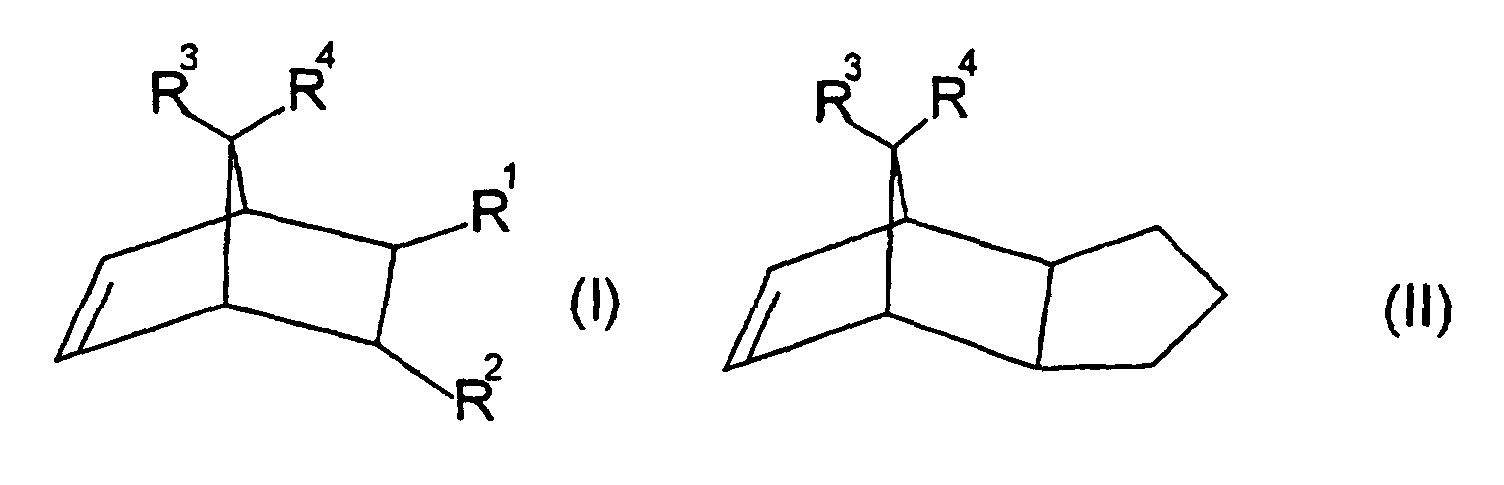
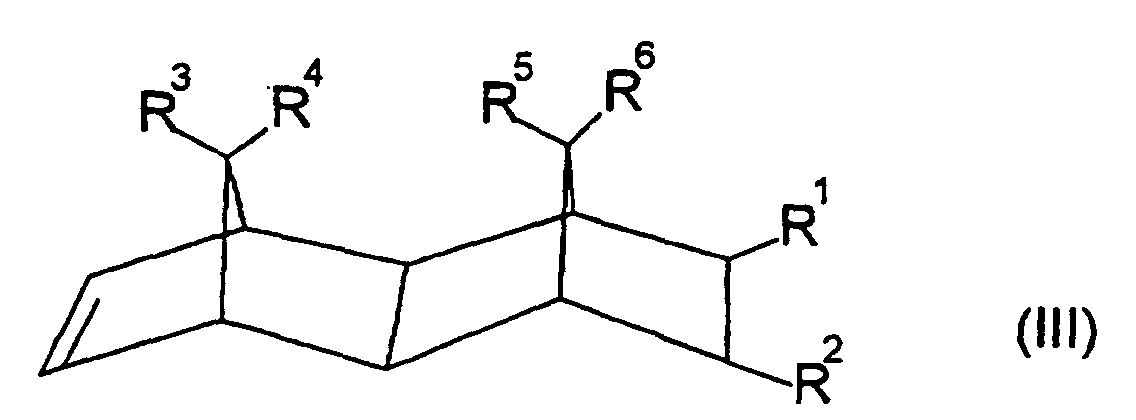
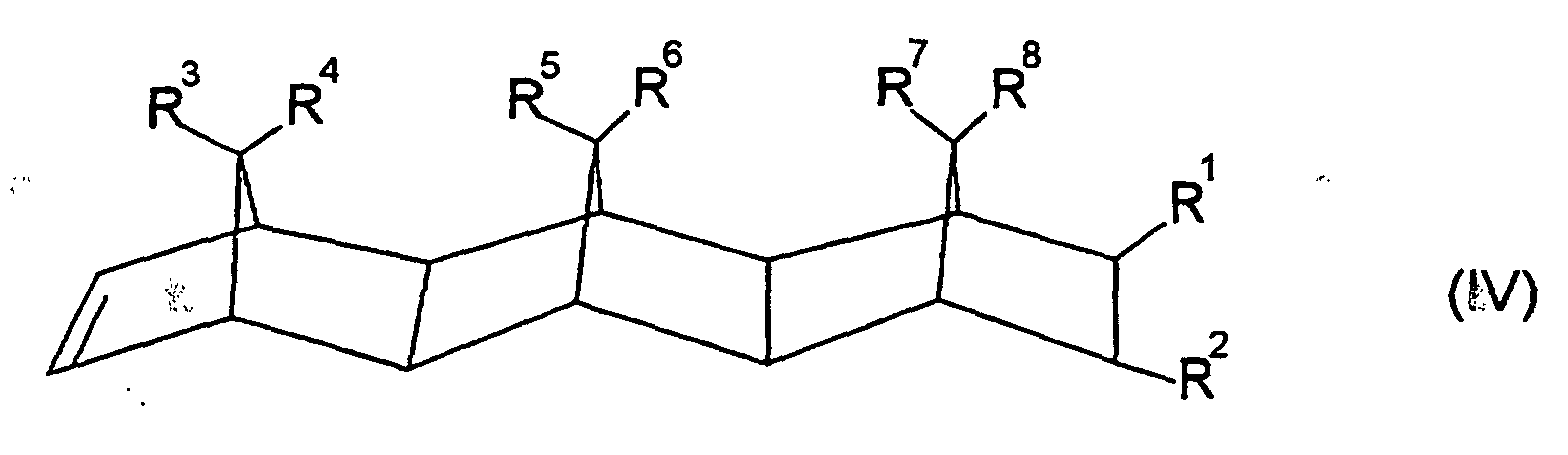
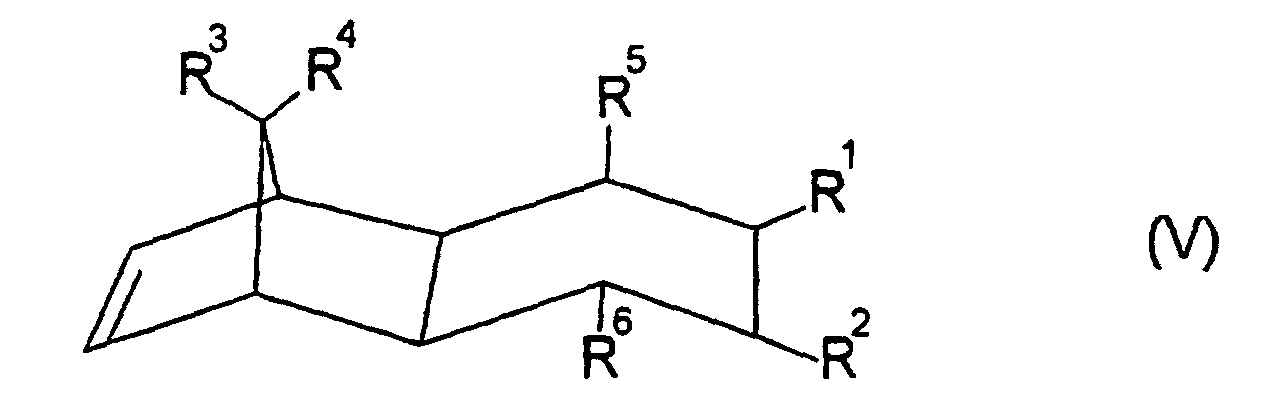
- Cycloolefin polymers are homopolymers or copolymers which contain polymerized cycloolefin units and optionally acyclic olefins as comonomer. Cycloolefin polymers which contain from 0.1 to 100% by weight, preferably from 10 to 99% by weight, particularly preferably from 50 to 95% by weight, based in each case on the total mass of the cycloolefin polymer, of polymerized cycloolefin units are suitable for the present invention. Particularly preferred are polymers which are composed of the monomers of the cyclic olefins of the formulas I, II, III, IV, V or VI:
- R 1 , R 2 , R 3 , R 4 , R 5 , R 6 , R 7 and R 8 are the same or different and represent a hydrogen atom or a C 1 -C 30 hydrocarbon radical; or two or more of R 1 to R 8 are cyclic, wherein like radicals in the various formulas have the same or different meanings.
- C 1 -C 30 -hydrocarbon radicals are, for example, linear or branched C 1 -C 8 -alkyl radicals, C 6 -C 18 -aryl radicals, C 7 -C 20 -alkylenearyl radicals or cyclic C 3 -C 20 -alkyl radicals or acyclic C 2 -C 20 alkenyl radicals.
- the COCs may contain from 0 to 45% by weight, based on the total weight of the cycloolefin polymer, of polymerized units of at least one monocyclic olefin of the formula VII:
- n is a number from 2 to 10.
- the COCs may contain from 0 to 99% by weight, based on the total weight of COC, of polymerized units of an acyclic olefin of formula VIII:
- R 9 , R 10 , R 11 , and R 12 are identical or different and denote a hydrogen atom or C 1 -C 10 -hydrocarbon radicals, for example a C 1 -C 8 -alkyl radical or C 6 -C 14 -aryl radical.
- cycloolefin polymers which are ring-opening Polymerization of at least one of the monomers of formulas I to VI and subsequent Hydrogenation can be obtained.
- Cycloolefin homopolymers are built up from a monomer of the formulas I-VI. These cycloolefin polymers are less for the purposes of the present invention suitable.
- cycloolefin copolymers which at least one cycloolefin of the formulas I to VI and acyclic Olefins of the formula VIII as a comonomer.
- acyclic olefins those which have 2 to 20 C atoms, in particular unbranched ones, are preferred acyclic olefins having 2 to 10 carbon atoms such as ethylene, propylene and / or butylene.
- the proportion of polymerized units of acyclic olefins of the formula VIII is up to 99 wt .-%, preferably 5 to 80 wt .-%, particularly preferably 10 bis 60 wt .-%, based on the total weight of the respective COCs.
- COCs particularly preferred the polymerized units of norbornene-based polycyclic olefins, particularly preferably norbornene or tetracyclododecene.
- the polymerized units of acyclic olefins in particular ethylene.
- Norbornene / ethylene and tetracyclododecene / ethylene copolymers containing from 5 to 80 Wt .-%, preferably 10 to 60 wt .-%, of ethylene (based on the weight of the copolymer).
- the above-described cycloolefin polymers generally have glass transition temperatures T g in the range between -20 ° C and 400 ° C.
- T g glass transition temperature
- COCs are usable, which have a glass transition temperature T g of greater than 70 ° C, preferably greater than 90 ° C and in particular greater than 110 ° C.
- the viscosity number (decalin, 135 ° C, DIN 53 728) is suitably between 0.1 and 200 ml / g, preferably between 50 and 150 ml / g.
- the COCs are incorporated into the film either as pure granules or as a granulated concentrate (masterbatch) by premixing the polyester granules or powder with the COC or the COC masterbatch and then feeding them to the extruder.
- the components are further mixed and heated to processing temperature. It is expedient for the process according to the invention that the extrusion temperature is above the glass transition temperature T g of the COC, generally at least 5 K, preferably 10 to 180 K, in particular 15 to 150 K, above the glass transition temperature of the COC.
- the same polymers can be used for the intermediate layers and for the outer layers as for the base layer.
- other materials can also be present in the outer layers, in which case the outer layers preferably consist of a mixture of polymers, a copolymer or a homopolymer which contain ethylene-2,6-naphthalate units and ethylene terephthalate units. Up to 30 mole percent of the polymers may consist of other comonomers (eg, ethylene isophthalate units.).
- the base layer and the other layers may additionally contain conventional additives such as stabilizers, antiblocking agents and other fillers. They are expedient the Polymer°. the polymer mixture already added before melting. Stabilizers used are, for example, phosphorus compounds, such as phosphoric acid or phosphoric acid esters.
- Typical antiblocking agents are inorganic and / or organic particles, for example calcium carbonate, amorphous silica, talc, magnesium carbonate, barium carbonate, calcium sulfate, barium sulfate, Lithium phosphate, calcium phosphate, magnesium phosphate, alumina, Lithium fluoride, calcium, barium, zinc or manganese salts of the used Dicarboxylic acids, carbon black, titanium dioxide, kaolin or crosslinked polymer particles, e.g. Polystyrene or acrylate particles.
- Dicarboxylic acids carbon black, titanium dioxide, kaolin or crosslinked polymer particles, e.g. Polystyrene or acrylate particles.
- additives may also be mixtures of two and more different Antiblocking agents or mixtures of antiblocking agents of the same composition, but different Komucc be dialed.
- the particles can be the polymers the individual layers of the film in the respective advantageous amounts, e.g. when glycolic dispersion during polycondensation or via masterbatches at Extrusion be added. Particularly suitable pigment concentrations from 0 to 25 wt .-% proved (based on the weight of the respective Layer).
- a detailed description of the antiblocking agents can be found, for example in EP-A-0 602 964.
- the base layer or the other additional layers may contain a further pigmentation.
- additional additives barium sulfate with a particle size from 0.3 to 0.8 microns, preferably from 0.4 to 0.7 microns or titanium dioxide with a Grain size from 0.05 to 0.3 microns to select.
- the film thus receives a brilliant, white appearance.
- the amount of barium sulfate or titanium dioxide is in the range of 1 to 25% by weight, preferably from 1 to 20% by weight, and most preferably from 1 to 15 wt .-%.
- the total thickness of the film can vary within wide limits and depends according to the intended use.
- the preferred embodiments of film according to the invention have total thicknesses of 4 to 400 microns, wherein 8 to 300 microns, especially 10 to 300 microns, are preferred.
- the thickness of any existing Interlayer (s) are generally each independently 0.5 up to 15 ⁇ m, wherein intermediate layer thicknesses of 1 to 10 ⁇ m, in particular 1 to 8 ⁇ m, are preferred.
- the indicated values refer to an intermediate layer.
- the thickness of the cover layer (s) becomes independent of the other layers is selected and is preferably in the range of 0.1 to 10 .mu.m, in particular from 0.2 to 5 microns, preferably from 0.3 to 2 microns, with applied on both sides cover layers may be the same or different in thickness and composition.
- the Thickness of the base layer results accordingly from the difference of total thickness of Foil and the thickness of the applied cover and vom harsh / s and therefore can analogous to the total thickness vary within wide limits.
- the cover layers can also be made of a Polyethylene naphthalate homopolymers or ethylene terephthalate ethylene naphthalate copolymer or a compound.
- thermoplastics of the cover layers also have one similar standard viscosity as the polyethylene terephthalate of the base layer.
- the flame retardant is preferably in the Base layer included. However, if necessary, the outer layers with flame retardant be equipped.
- the flame retardant in the outer layers be included. If necessary and with particularly high fire protection requirements can the base layer additively a so-called "basic equipment" to flame retardants contain.
- the amount here refers to Flame retardant in weight percent on the weight of each with the agent equipped layer.
- films according to the invention in the thickness range of 5 to 300 ⁇ m the building material class B1 according to DIN 4102 part 1 and the UL test 94.
- the film still contains in the Coatings equipped with flame retardants, small amounts of one Hydrolysis stabilizer.
- the film of the invention without environmental impact and without loss the mechanical properties can be easily recycled, making them, for example for use as short-lived advertising signs for trade fair construction and others Promotional items where fire protection is desired.
- the invention further relates to a process for the preparation of the invention Polyester film according to the known extrusion or co-extrusion process.
- the flame retardant optionally with the hydrolysis stabilizer, added via the masterbatch technology.
- the flame retardant is fully dispersed in a carrier material.
- the carrier material is the polyester raw material itself, such as the polyethylene terephthalate or other polymers, the are compatible with the polyester raw material, in question.
- the grain size and the bulk density of the masterbatch similar to the grain size and the bulk density of the polyester raw material is, so that a homogeneous distribution and thus a homogeneous stabilization can be done.
- the polyester films can be prepared by known methods from polyester raw material with optionally further raw materials, the flame retardant, optionally the hydrolysis stabilizer and / or other customary additives in the usual amount of 1.0 to max. 30% by weight both as Monofilm as well as multilayer, possibly coextruded films with the same or be made differently shaped surfaces, with a surface for example, is pigmented and the other surface contains no pigment.
- one or both surfaces of the film may be coated by known methods usual functional coating be provided.
- the masterbatch containing the flame retardant and optionally containing the hydrolysis stabilizer, pre-crystallized or predried becomes.
- This predrying involves a gradual heating of the masterbatch below reduced pressure (20 to 80 mbar, preferably 30 to 60 mbar, in particular 40 to 50 mbar) and with stirring and optionally drying at constant, elevated temperature also under reduced pressure.
- the masterbatch will preferably at room temperature from a dosing in the desired Blending together with the polymers of the base and / or outer layers and if necessary, other raw material components in batches in a vacuum dryer, the During the drying or residence time, a temperature range of 10 to 160 ° C, preferably 20 ° C to 150 ° C, in particular 30 ° C to 130 ° C, passes, filled. During the approximately 6-hour, preferably 5-hour, especially 4-hour Residence time, the raw material mixture at 10 to 70 rpm, preferably 15 to 65 rpm, in particular stirred at 20 to 60 rpm.
- the thus pre-crystallized or predried Raw material mixture is in a downstream also evacuated container at Temperatures of 90 to 180 ° C, preferably from 100 to 170 ° C, in particular of 110 to 160 ° C over a period of 2 to 8 hours, preferably from 3 to 7 Hours, in particular from 4 to 6 hours, after-dried.
- the procedure is one of single-layer Film / corresponding melt to the individual layers of the film Melt extruded / coextruded through a flat die Will / will, the resulting film for solidification on one or more roller / n
- the film is then biaxially stretched (oriented), the biaxially Stretched film then heat-set and optionally on the other Treatment provided surface layer corona or flame treated.
- the stretching in Longitudinal direction is preferably carried out with the help of two according to the desired Stretch ratio of different fast rotating rollers. Used for transverse stretching you generally a suitable clip frame.
- a simultaneous, i. simultaneous stretching of the film according to the invention in both Directions (MD direction and TD direction) using a suitable Kluppenrahmens has proved to be inappropriate. That is, this stretching leads to a film that has too low a degree of whiteness and too little opacity.
- the temperature at which the stretching is carried out in a relative vary greatly and depends on the desired characteristics of the area Foil.
- the longitudinal stretch ratio is generally in the range from 2.5: 1 to 6: 1, preferably from 3: 1 to 5.5: 1.
- the transverse stretch ratio is general in the range of 3.0: 1 to 5.0: 1, preferably from 3.5: 1 to 4.5: 1.
- the film is about 0.1 to 10 s at a Temperature maintained from 150 to 250 ° C. Subsequently, the film is cooled and then wound up in the usual way.
- the film can be chemically treated be or corona or flame treated.
- the treatment intensity is like this chosen that the surface tension of the film is generally above 45 mN / m.
- the film can be coated to set other properties. Typical coatings are adhesion-promoting, antistatic, slip-resistant or Dehesive layers. It is advisable to use these additional layers via in-line Coating by means of aqueous dispersions before transverse stretching on the film applied.
- the particular advantage of the film according to the invention is its high degree of whiteness and its high opacity combined with good flame resistance. Surprisingly, he was Gloss of the film also very high.
- the whiteness of the film is more than 70%, preferably more than 75%, and more preferably more than 80%.
- the opacity of film according to the invention is more than 55%, preferably more than 60% and more preferably more than 65%.
- the gloss of the film according to the invention is more than 80, preferably more than 90, and more preferably more than 100.
- Another particular advantage of the invention is that in the manufacture of the Film inherent regenerate in a concentration of 10 to 70 wt .-%, based on the total weight of the film, can be used again, without while the physical properties of the film significantly negatively affected become.
- the regenerate essentially of polyester raw material and COC
- the film does not change indefinitely in color, resulting in the films of the prior art is the case.
- an advantage of the invention is that the manufacturing cost of Inventive film are comparable to conventional opaque films after the state of the art.
- the other processing and use relevant Properties of the film according to the invention remain substantially unchanged or are even improved.
- the film is ideal for packaging light and / or air sensitive Food and stimulants.
- she is also excellent for use in the industrial area, e.g. in the production of stamping foils or as label foil, suitable.
- the film is of course particularly suitable for image recording papers, Sheets, magnetic recording cards, just to name a few To name applications.
- the processing and the winding behavior of the film is very good.
- a measure of the processing behavior is the coefficient of friction the film is less than 0.6.
- the winding behavior is next to a good Thickness profile, excellent flatness and low coefficient of friction decisively influenced by the roughness of the film. It turned out that the winding of the film according to the invention is particularly good, if under Retention of the other properties the average roughness in a range of 50 is up to 250 nm.
- the roughness can be u.a. by varying the COC concentration and the process parameters in the manufacturing process in the specified range vary.
- Table 1 summarizes the most important film properties according to the invention once again at a glance and thus particularly illustratively.
- the standard viscosity SV (DCE) is measured on the basis of DIN 53726 in dichloroacetic acid.
- the yellow value YID is the deviation from the colorlessness in the direction "yellow” and becomes measured according to DIN 6167.
- the fire behavior is in accordance with DIN4102, Part 2, building material class B2, and according to DIN 4102, Part 1, building material class B1, and according to the UL test 94 determined.
- the friction was determined according to DIN 53 375.
- the sliding coefficient became 14 days measured after production.
- the surface tension was determined by means of the so-called ink method (DIN 53 364) certainly.
- the roughness Ra of the film was according to DIN 4768 at a cut-off of 0.25 mm certainly.
- the determination of the whiteness and the opacity is carried out with the aid of the electrical remission photometer "ELREPHO" from Zeiss, Oberkochem (DE), standard illuminant C, 2 ° normal observer.
- the opacity is determined according to DIN 53 146.
- the light transmission is measured according to ASTM-D 1033-77.
- the gloss was determined according to DIN 67 530.
- the reflector value was measured as optical characteristic for the surface of a film. Based on ASTM-D standards 523-78 and ISO 2813, the angle of incidence was set at 60 °. A ray of light hits under the set angle of incidence on the flat test surface and is of this reflected or scattered. The striking on the photoelectric receiver Beams of light are displayed as a proportional electrical quantity. The measured value is dimensionless and must be specified with the angle of incidence.
- the glass transition temperature T g was determined on the basis of film samples with the aid of DSC (Differential Scanning Calorimetry) (DIN 73 765). A DSC 1090 from DuPont was used. The heating rate was 20 K / min and the weight approximately 12 mg. In the first heating process, the glass transition T g was determined. The samples often showed enthalpy relaxation (a peak) at the beginning of the stepped glass transition. As T g , the temperature was taken at which the step-like change in the heat capacity - regardless of the peak-shaped Enthalpierelaxation - reached half its height in the first heating. In all cases, only a single glass transition stage was observed in the thermogram on initial heating.
- DSC Different Scanning Calorimetry
- Chips of polyethylene terephthalate (prepared via the transesterification process with Mn as transesterification catalyst, Mn concentration: 100 ppm) were dried at 150 ° C. to a residual moisture content of below 100 ppm and fed to the extruder for the base layer B.
- chips were from COC the Fa. Ticona: ® Topas 6015 (COC consisting of 2-norbornene and ethylene, see also W. Hatke: films from COC, Kunststoffe 87 (1997) 1, p. 58-62) with a glass transition temperature T. g of about 160 ° C also supplied to the extruder for the base layer B.
- the quantitative proportion of the COC on the whole film was 10% by weight.
- 4% by weight of phosphorus-containing flame retardant was added.
- the flame retardant is the organic phosphorus compound Dimethyl methylphosphonate ® Amgard P 1045 from Albright & Wilson, which is available in PET is soluble.
- the flame retardant is added according to the invention in the form of a masterbatch.
- the masterbatch is composed of 20% by weight of flame retardant and 80% by weight of PET a standard viscosity SV (DCE) of 810.
- the masterbatch had a bulk density of 750 kg / m 3 .
- a white, opaque monolayer film with a total thickness of 23 microns was prepared
- Base layer B mixture of: 86.0% by weight Polyethylene terephthalate homopolymer having an SV of 800 10.0% by weight Cycloolefin copolymers (COC) from Ticona, Topas 6015 4.0% by weight Amgard P 1045
- the production conditions in the individual process steps were: extrusion Temperatures base layer 280 ° C Temperature of the take-off roll 30 ° C longitudinal stretching temperature 80-125 ° C Longitudinal stretching ratio 4.2 transverse stretching temperature 80 - 135 ° C Transverse stretching ratio 4.0 fixation temperature 230 ° C duration 3 s
- the film had the required good properties and shows the desired Handling and the desired processing behavior.
- the achieved properties thus produced films are shown in Table 2.
- Example 2 Compared to Example 1, 50% by weight of regenerate was now incorporated in the base layer added. The amount of COC in the film made therewith was again 10 Wt .-%, the flame retardant 4 wt .-%. The process parameters were in Comparison to example 1 not changed. It became the yellow discoloration of the film visually observed. From Table 2 it can be seen that hardly any yellow discoloration of the film has become visible.
- Base layer B mixture of: 43.0% by weight Polyethylene terephthalate homopolymer having an SV of 800 50.0% by weight Regenerate (86% by weight of polyester + 10% by weight of Topas 6015 + 4% by weight of Amgard P 1045) 5.0% by weight Cycloolefin copolymers (COC) from Ticona, Topas 6015 2,0Gew .-% Amgard P 1045
- Example 2 Compared to Example 1, a film having a thickness of 96 ⁇ m was now produced.
- the amount of COC in the film was 8 wt .-%, the flame retardant 4 wt .-%.
- the process parameters were not changed compared to Example 1. It was the yellow discoloration of the film is visually observed. From Table 2 it can be seen that no yellow discoloration of the film has become visible.
- Base layer B mixture of: 88.0% by weight Polyethylene terephthalate homopolymer having an SV of 800 8.0% by weight Cycloolefin copolymers (COC) from Ticona, Topas 6015 4,0Gew .-% Amgard P 1045
- Example 3 Compared to Example 3, 50% by weight of regenerate has now been added to the base. The amount of COC in the film was again 8% by weight and that of flame retardants 4.0% by weight. The process parameters were not compared to Example 1 changed. The yellow discoloration of the film was visually observed. Based on Table 2 shows that hardly a yellow discoloration of the film has become visible.
- Base layer B mixture of: 44.0% by weight Polyethylene terephthalate homopolymer having an SV of 800 50.0% by weight Self-regenerant (86% by weight of polyester + 10% by weight of Topas 6015 + 4% by weight of Amgard P 1045) 4.0% by weight Cycloolefin copolymers (COC) from Ticona, Topas 6015 2.0% by weight Amgard P 1045
- Example 1 from DE-A 2 353 347 was worked up. In modification of the For example, an additional 50% by weight of regenerate was co-processed. Based on the table 2 it can be seen that a clear yellow discoloration of the film has become visible.
- Base layer B mixture of: 47.5% by weight Polyethylene terephthalate homopolymer having an SV of 800 50.0% by weight Self-regenerant (95% by weight of polyester + 5% by weight of polypropylene) 2.5% by weight polypropylene
- Example 1 from EP-A 0 300 060 was worked up. In modification of the For example, an additional 50% by weight of regenerate was co-processed. Based on the table 2 it can be seen that a clear yellow discoloration of the film has become visible. In addition, the roughness of the film for many applications is clearly too high and the Gloss too low for many applications. That's probably the case Attributed to the use of other polymeric additives.
- Base layer B mixture of: 45.0% by weight Polyethylene terephthalate homopolymer having an SV of 800 50.0% by weight Self-regenerant (95% by weight of polyester + 5% by weight of polypropylene) 5.0% by weight polypropylene
- Example 1 from EP-A 0 360 201 was worked up. In modification of the For example, an additional 50% by weight of regenerate was co-processed. Based on the table 2 it can be seen that a clear yellow discoloration of the film has become visible. In addition, the roughness of the film for many applications is clearly too high and the Gloss too low for many applications. That's probably the case Attributed to the use of other polymeric additives.
- Base layer B mixture of: 40.0% by weight Polyethylene terephthalate homopolymer having an SV of 800 50.0% by weight Self-regenerant (95% by weight of polyester + 5% by weight of polypropylene) 10.0% by weight polypropylene
- Example 1 from DE-A 195 40 277 was worked up. In modification of the For example, an additional 50% by weight of regenerate was co-processed. Based on the table 2 it can be seen that a clear yellow discoloration of the film has become visible. In addition, the roughness of the film for many applications is clearly too high and the Gloss too low for many applications. That's probably the case Attributed to the use of other polymeric additives.
- Base layer B mixture of: 43.5% by weight Polyethylene terephthalate homopolymer having an SV of 800 50.0% by weight Self-regenerate (95% by weight of polyester + 5% by weight of polystyrene) 6.5% by weight polystyrene
Landscapes
- Chemical & Material Sciences (AREA)
- Health & Medical Sciences (AREA)
- Chemical Kinetics & Catalysis (AREA)
- Medicinal Chemistry (AREA)
- Polymers & Plastics (AREA)
- Organic Chemistry (AREA)
- Engineering & Computer Science (AREA)
- Manufacturing & Machinery (AREA)
- Materials Engineering (AREA)
- Laminated Bodies (AREA)
- Manufacture Of Macromolecular Shaped Articles (AREA)
- Compositions Of Macromolecular Compounds (AREA)
Description
- Der Kunststoff ist sehr hydrolyseempfindlich und muß sehr gut vorgetrocknet werden.
- Beim Trocknen mit Trocknern, die dem Stand der Technik entsprechen, verklebt der Kunststoff, so daß die Herstellung einer Folie, wenn überhaupt, nur unter schwierigsten Bedingungen gelingt.
- Die unter extremen und unwirtschaftlichen Bedingungen hergestellten Folien verspröden bei Temperaturbelastungen, d. h. die mechanischen Eigenschaften gehen aufgrund der schnell auftretenden Versprödung stark zurück, so daß die Folie technisch unbrauchbar ist. Bereits nach 48 Stunden Temperaturbelastung tritt diese Versprödung auf.
- Der Gelbwert der Folie im Vergleich zu einer nicht ausgerüsteten Folie im Rahmen der Meßgenauigkeit nicht negativ beeinflußt ist;
- keine Ausgasungen, keine Düsenablagerungen, keine Rahmenausdampfungen auftreten, wodurch die Folie eine exzellente Optik aufweist, ein ausgezeichnetes Profil und eine hervorragende Planlage hat;
- sich die schwer entflammbare, UV-stabile Folie durch einen hervorragende Streckbarkeit auszeichnet, so daß sie verfahrenssicher und stabil auf »highspeed film-lines« bei Geschwindigkeiten von bis zu 420 m/min produktionssicher hergestellt werden kann.


Die Basisschicht und die anderen Schichten können zusätzlich übliche Additive, wie Stabilisatoren, Antiblockmittel und andere Füller, enthalten. Sie werden zweckmäßig dem Polymerbzw. der Polymermischung bereits vor dem Aufschmelzen zugesetzt. Als Stabilisatoren werden beispielsweise Phosphorverbindungen, wie Phosphorsäure oder Phosphorsäureester, eingesetzt.

Die intrinsische Viskosität (IV) berechnet sich wie folgt aus der Standardviskosität (SV)
WG = Weißgrad, RY, RZ, RX = entsprechende Reflexionsfaktoren bei Einsatz des Y-, Z- und X-Farbmessfilters. Als Weißstandard wir ein Pressling aus Bariumsulfat (DIN 5033, Teil 9) verwendet. Eine ausführliche Beschreibung ist z.B. in Hansl Loos "Farbmessung","Verlag Beruf und Schule, Itzehoe (1989), beschrieben.
| 86,0 Gew.-% | Polyethylenterephthalat-Homopolymer mit einem SV-Wert von 800 |
| 10,0 Gew.-% | Cycloolefincopolymeren (COC) der Fa. Ticona, Topas 6015 |
| 4,0 Gew.-% | Amgard P 1045 |
| Extrusion | Temperaturen Basis-Schicht | 280 °C |
| Temperatur der Abzugswalze | 30 °C | |
| Längsstreckung | Temperatur | 80 - 125°C |
| Längsstreckverhältnis | 4,2 | |
| Querstreckung | Temperatur | 80 - 135 °C |
| Querstreckverhältnis | 4,0 | |
| Fixierung | Temperatur | 230 °C |
| Dauer | 3 s |
| 43,0 Gew.-% | Polyethylenterephthalat-Homopolymermit einem SV-Wert von 800 |
| 50,0 Gew.-% | Regenerat (86 Gew.-% Polyester + 10 Gew.-% Topas 6015 + 4 Gew.-% Amgard P 1045) |
| 5,0 Gew.-% | Cycloolefincopolymeren (COC) der Fa. Ticona, Topas 6015 |
| 2,0Gew.-% | Amgard P 1045 |
| 88,0 Gew.-% | Polyethylenterephthalat-Homopolymermit einem SV-Wert von 800 |
| 8,0 Gew.-% | Cycloolefincopolymeren (COC) der Fa. Ticona, Topas 6015 |
| 4,0Gew.-% | Amgard P 1045 |
| 44,0 Gew.-% | Polyethylenterephthalat-Homopolymer mit einem SV-Wert von 800 |
| 50,0 Gew.-% | Eigenregenerat (86 Gew.-% Polyester + 10 Gew.-% Topas 6015 + 4 Gew.-% Amgard P 1045) |
| 4,0 Gew.-% | Cycloolefincopolymeren (COC) der Fa. Ticona, Topas 6015 |
| 2,0 Gew.-% | Amgard P 1045 |
| 47,5 Gew.-% | Polyethylenterephthalat-Homopolymer mit einem SV-Wert von 800 |
| 50,0 Gew.-% | Eigenregenerat (95 Gew.-% Polyester + 5 Gew.-% Polypropylen) |
| 2,5 Gew.-% | Polypropylen |
| 45,0 Gew.-% | Polyethylenterephthalat-Homopolymer mit einem SV-Wert von 800 |
| 50,0 Gew.-% | Eigenregenerat (95 Gew.-% Polyester + 5 Gew.-% Polypropylen) |
| 5,0 Gew.-% | Polypropylen |
| 40,0 Gew.-% | Polyethylenterephthalat-Homopolymermit einem SV-Wert von 800 |
| 50,0 Gew.-% | Eigenregenerat (95 Gew.-% Polyester + 5 Gew.-% Polypropylen) |
| 10,0 Gew.-% | Polypropylen |
| 43,5 Gew.-% | Polyethylenterephthalat-Homopolymer mit einem SV-Wert von 800 |
| 50,0 Gew.-% | Eigenregenerat (95 Gew.-% Polyester + 5 Gew.-% Polystyrol) |
| 6,5 Gew.-% | Polystyrol |

Claims (12)
- Weiße, biaxial orientierte, schwer entflammbare Polyesterfolie umfassend mindestens eine Schicht, dadurch gekennzeichnet, daß zumindest diese Schicht ein Cycloolefincopolymeres (COC) in einer Menge von 4 bis 60 Gew.-%, bezogen auf das Gewicht dieser Schicht enthält, wobei die Glasübergangstemperatur des COCs im Bereich von 70 bis 270 °C liegt, und daß die Schicht mindestens ein Flammschutzmittel enthält.
- Polyesterfolie nach Anspruch 1, dadurch gekennzeichnet, daß das COC Polynorbornen, Polydimethyloctahydronaphthalin, Polycyclopenten oder Poly(5-methyl)norbornen enthält.
- Polyesterfolie nach Anspruch 1 oder 2, dadurch gekennzeichnet, daß das COC eine Glasübergangstemperatur im Bereich von 90 bis 250 °C aufweist und daß die Menge an Flammschutzmittel im Bereich zwischen 0,5 und 30 Gew.-%, vorzugsweise zwischen 1 und 20 Gew.-%, bezogen auf das Gewicht der das Flammschutzmittel enthaltenden Schicht, liegt.
- Polyesterfolie nach einem der Ansprüche 1 oder 2, dadurch gekennzeichnet, daß das Cycloolefincopolymere (COC) eine Glasübergangstemperatur im Bereich von 110 bis 220 °C aufweist und daß sie als Flammschutzmittel organische Phosphorverbindungen enthält, insbesondere solche organischen Phosphorverbindungen, die in Polyethylenterephthalat löslich sind.
- Polyesterfolie nach einem oder mehreren der Ansprüche 1 bis 4, dadurch gekennzeichnet, daß die Folie einen Weißgrad von mehr als 70 % aufweist.
- Polyesterfolie nach einem oder mehreren der Ansprüche 1 bis 5, dadurch gekennzeichnet, daß die Folie eine Opazität von mehr als 55 % aufweist.
- Polyesterfolie nach einem oder mehreren der Ansprüche 1 bis 6, dadurch gekennzeichnet, daß die Folie einen Glanz von mehr als 80 aufweist.
- Polyesterfolie nach einem oder mehreren der Ansprüche 1 bis 7, dadurch gekennzeichnet, daß die Schicht 0,5 bis 25 Gew.-% weiterer vakuoleniniziierender und/oder weißer Füllstoffe und/oder Pigment enthält, jeweils bezogen auf das Gewicht der Schicht, und daß sie als Flammschutzmittel den Bisglykolester von 2-Carboxyethyl-methyl-phosphinsäure bzw. von derem cyclischem Anhydrid, dem 2-Methyl-2,5-dioxo-1,2-oxophospholan enthält.
- Polyesterfolie nach einem oder mehreren der Ansprüche 1 bis 8, dadurch gekennzeichnet, daß auf der COC-haltigen Schicht eine Deckschicht angeordnet ist und daß das Flammschutzmittel in der/den Deckschichten enthalten sind.
- Polyesterfolie nach Anspruch 9, dadurch gekennzeichnet, daß zwischen der COC-haltigen Schicht und der Deckschicht eine Zwischenschicht angeordnet ist.
- Polyesterfolie nach einem oder mehreren der Ansprüche 1 bis 8, dadurch gekennzeichnet, daß die Folie einschichtig ist und aus der COC-haltigen Schicht besteht.
- Verwendung einer Folie nach einem der Ansprüche 1 bis 11 zur Verpackung von licht- und/oder luftempfindlichen Nahrungs- und Genußmitteln oder für den Einsatz im industrieellen Bereich, z.B. bei der Herstellung von Prägefolien oder als Etikettenfolie, oder für Bildaufzeichnungspapiere, Druckbögen oder magnetische Aufzeichnungskarten.
Applications Claiming Priority (2)
| Application Number | Priority Date | Filing Date | Title |
|---|---|---|---|
| DE10009295A DE10009295A1 (de) | 2000-02-28 | 2000-02-28 | Weisse, biaxial orientierte, schwer entflammbare Polyesterfolie mit Cycloolefincopolymer, Verfahren zu ihrer Herstellung und ihre Verwendung |
| DE10009295 | 2000-02-28 |
Publications (2)
| Publication Number | Publication Date |
|---|---|
| EP1132425A1 EP1132425A1 (de) | 2001-09-12 |
| EP1132425B1 true EP1132425B1 (de) | 2005-01-26 |
Family
ID=7632668
Family Applications (1)
| Application Number | Title | Priority Date | Filing Date |
|---|---|---|---|
| EP01103547A Expired - Lifetime EP1132425B1 (de) | 2000-02-28 | 2001-02-19 | Weisse, biaxial orientierte, schwer entflammbare Polyesterfolie mit Cycloolefincopolymer, Verfahren zu ihrer Herstellung und ihre Verwendung |
Country Status (5)
| Country | Link |
|---|---|
| US (1) | US6635340B2 (de) |
| EP (1) | EP1132425B1 (de) |
| JP (1) | JP2001240686A (de) |
| KR (1) | KR20010085666A (de) |
| DE (2) | DE10009295A1 (de) |
Families Citing this family (29)
| Publication number | Priority date | Publication date | Assignee | Title |
|---|---|---|---|---|
| DE19932384A1 (de) * | 1999-07-14 | 2001-01-18 | Mitsubishi Polyester Film Gmbh | Weiße, biaxial orientierte Polyesterfolie mit Cycloolefincopolymer (COC), Verfahren zu ihrer Herstellung und ihre Verwendung |
| DE10009286A1 (de) * | 2000-02-28 | 2001-08-30 | Mitsubishi Polyester Film Gmbh | Weisse, biaxial orientierte, schwer entflammbare und UV-stabilisierte Polyesterfolie mit Cycloolefincopolymer, Verfahren zu ihrer Herstellung und ihre Verwendung |
| DE10011652A1 (de) * | 2000-03-10 | 2001-09-13 | Mitsubishi Polyester Film Gmbh | Biaxial orientierte Polyesterfolie mit hohem Weißgrad, Verfahren zu ihrer Herstellung und ihre Verwendung |
| DE10022306A1 (de) * | 2000-05-09 | 2001-11-29 | Trespaphan Gmbh | Transparente biaxial orientierte Polyolefinfolie mit verbesserten Hafteigenschaften |
| DE10022942A1 (de) * | 2000-05-11 | 2001-11-15 | Mitsubishi Polyester Film Gmbh | Weisse, zumindest einseitig matte, biaxial orientierte Polyesterfolie mit Cycloolefincopolymer, Verfahren zu ihrer Herstellung und ihre Verwendung |
| DE10026177A1 (de) * | 2000-05-26 | 2001-11-29 | Mitsubishi Polyester Film Gmbh | Weiße, hochglänzende Polyesterfolie enthaltend Cycloolefincopolymer (COC), Verfahren zu ihrer Herstellung und ihre Verwendung |
| DE10030235A1 (de) * | 2000-06-20 | 2002-01-03 | Mitsubishi Polyester Film Gmbh | Weiße, siegelfähige, thermoformbare, biaxial orientierte und koextrudierte Polyesterfolie mit Cycloolefincopolymer, Verfahren zu ihrer Herstellung und ihre Verwendung |
| DE10035328A1 (de) * | 2000-07-20 | 2002-01-31 | Mitsubishi Polyester Film Gmbh | Opake Polyesterfolie enthaltend Cycloolefincopolymer (COC) mit guter Oberflächenhaftung, Verfahren zu ihrer Herstellung und ihre Verwendung |
| DE20020228U1 (de) | 2000-11-29 | 2001-01-25 | Töpfer Kulmbach GmbH, 95326 Kulmbach | Transparente Folie |
| DE10224516A1 (de) * | 2002-05-31 | 2003-12-11 | Etifix Etiketten Gmbh | Etikettenrolle |
| DE10352432A1 (de) * | 2003-11-10 | 2005-06-09 | Mitsubishi Polyester Film Gmbh | Weiße, heißsiegelbare, peelfähige Polyesterfolie, Verfahren zu ihrer Herstellung und ihre Verwendung |
| US7273894B2 (en) * | 2003-12-02 | 2007-09-25 | Eastman Chemical Company | Compositions for the preparation of void-containing articles |
| US20070004813A1 (en) * | 2004-09-16 | 2007-01-04 | Eastman Chemical Company | Compositions for the preparation of void-containing articles |
| ATE492044T1 (de) * | 2004-10-13 | 2011-01-15 | Teijin Dupont Films Japan Ltd | Mehrschichtiger körper für eine farbstoffsensibilisierte solarzelle, elektrode für eine farbstoffsensibilisierte solarzelle und herstellungsverfahren dafür |
| US20060110613A1 (en) * | 2004-11-24 | 2006-05-25 | Toray Plastics (America), Inc. | Flame retardant metallized polyester films having anti-dripping properties |
| US20060121219A1 (en) * | 2004-12-07 | 2006-06-08 | Eastman Chemical Co. | Void-containing polyester shrink film with improved density retention |
| KR100738900B1 (ko) * | 2005-11-18 | 2007-07-12 | 에스케이씨 주식회사 | 백색 다공성 단층 폴리에스테르 필름 및 이의 제조 방법 |
| US20100019410A1 (en) * | 2005-12-09 | 2010-01-28 | Scivax Corporation | Resin for Thermal Imprinting |
| JP5292812B2 (ja) * | 2006-10-27 | 2013-09-18 | 東レ株式会社 | 光反射板用白色ポリエステルフィルム |
| GB0710331D0 (en) * | 2007-05-30 | 2007-07-11 | Bioquell Uk Ltd | Improved in or relating to methods of decontaminating enclosed spaces |
| EP2163580B1 (de) * | 2007-06-07 | 2014-05-07 | Toray Industries, Inc. | Weisse polyesterfolie und oberflächenlichtquelle damit |
| KR20090009107A (ko) * | 2007-07-19 | 2009-01-22 | 도레이 카부시키가이샤 | 백색 폴리에스테르필름 |
| US20090227735A1 (en) * | 2008-03-07 | 2009-09-10 | Eastman Chemical Company | Miscible polyester blends and shrinkable films prepared therefrom |
| US10329393B2 (en) | 2012-12-12 | 2019-06-25 | Eastman Chemical Company | Copolysters plasticized with polymeric plasticizer for shrink film applications |
| JP2015151477A (ja) * | 2014-02-15 | 2015-08-24 | 三菱樹脂株式会社 | 白色難燃性ポリエステルフィルム |
| JP2015151476A (ja) * | 2014-02-15 | 2015-08-24 | 三菱樹脂株式会社 | 白色難燃性ポリエステルフィルム |
| CN109410739A (zh) * | 2018-10-08 | 2019-03-01 | 深圳昌茂粘胶新材料有限公司 | 一种磷氮系环保阻燃电镀聚酯薄膜电子标签材料及其制备方法 |
| JP7306569B2 (ja) * | 2020-03-25 | 2023-07-11 | 東洋紡株式会社 | 難燃性二軸配向ポリエステルフィルム |
| TWI790537B (zh) * | 2021-01-29 | 2023-01-21 | 南亞塑膠工業股份有限公司 | 聚酯白膜及其製造方法 |
Citations (1)
| Publication number | Priority date | Publication date | Assignee | Title |
|---|---|---|---|---|
| US4656220A (en) * | 1984-10-06 | 1987-04-07 | Chemische Werke Huls Aktiengesellschaft | Thermoplastic compositions based on polyphenylene ethers and polyoctenylenes, and method of manufacturing same |
Family Cites Families (20)
| Publication number | Priority date | Publication date | Assignee | Title |
|---|---|---|---|---|
| GB1415686A (en) | 1972-10-24 | 1975-11-26 | Ici Ltd | Voided films |
| DE2346787C3 (de) | 1973-09-17 | 1980-05-08 | Hoechst Ag, 6000 Frankfurt | Schwer entflammbare lineare Polyester, Verfahren zu deren Herstellung und deren Verwendung |
| US4614778A (en) * | 1984-02-03 | 1986-09-30 | Hirokazu Kajiura | Random copolymer |
| GB8504096D0 (en) * | 1985-02-18 | 1985-03-20 | Ici Plc | Polyester polyols |
| US5179171A (en) * | 1985-05-24 | 1993-01-12 | Mitsui Petrochemical Industries, Ltd. | Random copolymer, and process for production thereof |
| DE3521388A1 (de) * | 1985-06-14 | 1986-12-18 | Bayer Ag, 5090 Leverkusen | Thermoplastische formmassen mit flammwidrigen eigenschaften |
| JPH0717777B2 (ja) | 1987-02-05 | 1995-03-01 | ダイアホイルヘキスト株式会社 | 微細気泡含有ポリエステルフイルム |
| JPH0622962B2 (ja) | 1988-09-19 | 1994-03-30 | ダイアホイルヘキスト株式会社 | 積層フィルム |
| CA2006091C (en) | 1988-12-21 | 1999-09-07 | Yohzoh Yamamoto | Flame retardant cyclic olefinic polymer composition |
| JPH05154972A (ja) * | 1991-07-02 | 1993-06-22 | Unitika Ltd | 粗面化フィルムおよびその製造方法 |
| JP3131466B2 (ja) * | 1991-07-02 | 2001-01-31 | ユニチカ株式会社 | 軽量化ポリエステルフィルム及びその製造方法 |
| JPH05140349A (ja) * | 1991-11-15 | 1993-06-08 | Unitika Ltd | 軽量化ポリエステルフイルム及びその製造方法 |
| JPH05230253A (ja) * | 1992-02-19 | 1993-09-07 | Unitika Ltd | 軽量化ポリエステルフィルム及びその製造方法 |
| US5399428A (en) * | 1994-03-11 | 1995-03-21 | Monsanto Company | Flame retardant polyester copolymers |
| DE19540277B4 (de) | 1994-11-02 | 2007-04-19 | Toyo Boseki K.K. | Folie mit feinen Hohlräumen und Verfahren zu deren Herstellung |
| EP0795399A1 (de) | 1996-03-12 | 1997-09-17 | Mitsubishi Polyester Film Corporation | Mehrschichtiger Polyesterfilm |
| DE19643280A1 (de) | 1996-10-21 | 1998-04-23 | Basf Ag | Flammgeschützte Formmassen |
| JPH1135717A (ja) * | 1997-07-22 | 1999-02-09 | Oji Yuka Synthetic Paper Co Ltd | 微多孔性ポリエステル系樹脂フィルム |
| DE19739852B4 (de) * | 1997-09-11 | 2006-03-16 | Zimmer Ag | Verfahren zur Herstellung von flammfesten Polyestern |
| DE10012137A1 (de) * | 2000-03-13 | 2001-09-20 | Mitsubishi Polyester Film Gmbh | Biaxial orientierte Polyesterfolie enthaltend ein Cycloolefincopolymer, Verfahren zu ihrer Herstellung und ihre Verwendung |
-
2000
- 2000-02-28 DE DE10009295A patent/DE10009295A1/de not_active Withdrawn
-
2001
- 2001-02-12 US US09/781,722 patent/US6635340B2/en not_active Expired - Fee Related
- 2001-02-19 EP EP01103547A patent/EP1132425B1/de not_active Expired - Lifetime
- 2001-02-19 DE DE50105158T patent/DE50105158D1/de not_active Expired - Fee Related
- 2001-02-27 KR KR1020010010020A patent/KR20010085666A/ko not_active Withdrawn
- 2001-02-28 JP JP2001054120A patent/JP2001240686A/ja not_active Withdrawn
Patent Citations (1)
| Publication number | Priority date | Publication date | Assignee | Title |
|---|---|---|---|---|
| US4656220A (en) * | 1984-10-06 | 1987-04-07 | Chemische Werke Huls Aktiengesellschaft | Thermoplastic compositions based on polyphenylene ethers and polyoctenylenes, and method of manufacturing same |
Also Published As
| Publication number | Publication date |
|---|---|
| EP1132425A1 (de) | 2001-09-12 |
| JP2001240686A (ja) | 2001-09-04 |
| KR20010085666A (ko) | 2001-09-07 |
| DE50105158D1 (de) | 2005-03-03 |
| US20020115760A1 (en) | 2002-08-22 |
| DE10009295A1 (de) | 2001-08-30 |
| US6635340B2 (en) | 2003-10-21 |
Similar Documents
| Publication | Publication Date | Title |
|---|---|---|
| EP1132424B1 (de) | Weisse, biaxial orientierte, schwer entflammbare und UV-stabilisierte Polyesterfolie mit Cycloolefincopolymer, Verfahren zu ihrer Herstellung und ihre Verwendung | |
| EP1068949B1 (de) | Weisse, biaxial orientierte Polyesterfolie mit Cycloolefincopolymer (COC), Verfahren zu ihrer Herstellung und ihre Verwendung | |
| EP1132425A1 (de) | Weisse, biaxial orientierte, schwer entflammbare Polyesterfolie mit Cycloolefincopolymer, Verfahren zu ihrer Herstellung und ihre Verwendung | |
| EP1138716B1 (de) | Biaxal orientierte Polyesterfolie enthaltend ein Cycloolefincopolymer, Verfahren zu ihrer Herstellung und ihre Verwendung | |
| EP1268207B1 (de) | Weisse, siegelfähige, flammhemmend ausgerüstete, biaxial orientierte polyesterfolie, verfahren zu ihrer herstellung und ihre verwendung | |
| EP1127912A1 (de) | Weisse, biaxial orientierte und UV-stabilisierte Polyesterfolie mit Cycloolefincopolymer (COC), Verfahren zu ihrer Herstellung und ihre Verwendung | |
| EP1268632B2 (de) | Einseitig matte, siegelfähige, uv stabilisierte, flammhemmend ausgerüstete, biaxial orientierte polyesterfolie, verfahren zu ihrer herstellung und verwendung | |
| DE10011652A1 (de) | Biaxial orientierte Polyesterfolie mit hohem Weißgrad, Verfahren zu ihrer Herstellung und ihre Verwendung | |
| WO2001098080A2 (de) | Weisse, siegelfähige, thermoformbare, biaxial orientierte und koextrudierte polyesterfolie mit cycloolefincopolymer, verfahren zu ihrer herstellung und ihre verwendung | |
| EP1289759B1 (de) | Weisse, hochglänzende, polyesterfolie enthaltend cycloolefincopolymer (coc), verfahren zu ihrer herstellung und ihre verwendung | |
| DE10022942A1 (de) | Weisse, zumindest einseitig matte, biaxial orientierte Polyesterfolie mit Cycloolefincopolymer, Verfahren zu ihrer Herstellung und ihre Verwendung | |
| EP1125967A1 (de) | Weiss-opake Folie mit niedriger Transparenz aus einem kristallisierbaren Thermoplasten | |
| EP1268205B1 (de) | Einseitig matte, siegelfähige, flammhemmend ausgerüstete, koextrudierte, biaxial orientierte folie, verfahren zu ihrer herstellung und verwendung | |
| EP1299235B1 (de) | Weisse, siegelfähige, biaxial orientierte, koextrudierte polyesterfolie mit cycloolefincopolymer (coc), verfahren zu ihrer herstellung und ihre verwendung | |
| DE10022946A1 (de) | Weisse, zumindest einseitig matte, biaxial orientierte, UV-stabilisierte und schwer entflammbare Polyesterfolie mit Cycloolefincopolymer (COC), Verfahren zu ihrer Herstellung und ihre Verwendung | |
| DE10030237A1 (de) | Weiße, siegelfähige, biaxial orientierte, schwer entflammbare, koextrudierte Polyesterfolie mit Cycloolefincopolymer(COC), Verfahren zu ihrer Herstellung und ihre Verwendung | |
| DE10042333A1 (de) | Verbundfolie aus einer weißen, schwerentflammbaren Polyesterfolie enthaltend Cycloolefincopolymer (COC), Verfahren zu ihrer Herstellung und ihre Verwendung | |
| DE10022941A1 (de) | Weisse, zumindest einseitig matte, biaxial orientierte und schwer entflammbare Polyesterfolie mit Cycloolefincopolymer (COC) Verfahren zu ihrer Herstellung und ihre Verwendung | |
| DE10026163A1 (de) | Weiße, hochglänzende, UV-stabilisierte, schwerentflammbare Polyesterfolie enthaltend Cycloolefincopolymer (COC), Verfahren zu ihrer Herstellung und ihre Verwendung | |
| DE10026165A1 (de) | Weiße, hochglänzende, schwer entflammbare Polyesterfolie enthaltend Cycloolefincopolymer (COC), Verfahren zu ihrer Herstellung und ihre Verwendung | |
| DE10035327A1 (de) | Opake, schwerentflammbare Polyesterfolie enthaltend Cycloolefincopolymer (COC) mit guter Oberflächenhaftung, Verfahren zu ihrer Herstellung und ihre Verwendung | |
| DE10030239A1 (de) | Weiße, siegelfähige, UV stabilisierte, schwer entflammbare, biaxial orientierte, koextrudierte Polyesterfolie mit Cycloolefincopolymer(COC), Verfahren zu ihrer Herstellung und ihre Verwendung | |
| DE10042329A1 (de) | Verbundfolie aus einer weißen, UV-stabilisierten, schwerentflammbaren Polyesterfolie enthaltend Cycloolefincopolymer (COC), Verfahren zu ihrer Herstellung und ihre Verwendung | |
| DE10035323A1 (de) | Opake, UV-Stabile, schwerentflammbare Polyesterfolie enthaltend Cycloolefincopolymer (COC) mit guter Oberflächenhaftung, Verfahren zu ihrer Herstellung und ihre Verwendung | |
| DE10026166A1 (de) | Weiße, pigmentierte, hochglänzende Polyesterfolie enthaltend Cycloolefincopolymer (COC), Verfahren zu ihrer Herstellung und ihre Verwendung |
Legal Events
| Date | Code | Title | Description |
|---|---|---|---|
| PUAI | Public reference made under article 153(3) epc to a published international application that has entered the european phase |
Free format text: ORIGINAL CODE: 0009012 |
|
| AK | Designated contracting states |
Kind code of ref document: A1 Designated state(s): DE FR GB IT LU NL Kind code of ref document: A1 Designated state(s): AT BE CH CY DE DK ES FI FR GB GR IE IT LI LU MC NL PT SE TR |
|
| AX | Request for extension of the european patent |
Free format text: AL;LT;LV;MK;RO;SI |
|
| 17P | Request for examination filed |
Effective date: 20020312 |
|
| AKX | Designation fees paid |
Free format text: DE FR GB IT LU NL |
|
| 17Q | First examination report despatched |
Effective date: 20030916 |
|
| GRAP | Despatch of communication of intention to grant a patent |
Free format text: ORIGINAL CODE: EPIDOSNIGR1 |
|
| RBV | Designated contracting states (corrected) |
Designated state(s): DE FR GB IT LU |
|
| GRAS | Grant fee paid |
Free format text: ORIGINAL CODE: EPIDOSNIGR3 |
|
| GRAA | (expected) grant |
Free format text: ORIGINAL CODE: 0009210 |
|
| AK | Designated contracting states |
Kind code of ref document: B1 Designated state(s): DE FR GB IT LU |
|
| REG | Reference to a national code |
Ref country code: GB Ref legal event code: FG4D Free format text: NOT ENGLISH |
|
| REF | Corresponds to: |
Ref document number: 50105158 Country of ref document: DE Date of ref document: 20050303 Kind code of ref document: P |
|
| PGFP | Annual fee paid to national office [announced via postgrant information from national office to epo] |
Ref country code: LU Payment date: 20050310 Year of fee payment: 5 |
|
| GBT | Gb: translation of ep patent filed (gb section 77(6)(a)/1977) |
Effective date: 20050405 |
|
| PLBE | No opposition filed within time limit |
Free format text: ORIGINAL CODE: 0009261 |
|
| STAA | Information on the status of an ep patent application or granted ep patent |
Free format text: STATUS: NO OPPOSITION FILED WITHIN TIME LIMIT |
|
| 26N | No opposition filed |
Effective date: 20051027 |
|
| ET | Fr: translation filed | ||
| PGFP | Annual fee paid to national office [announced via postgrant information from national office to epo] |
Ref country code: DE Payment date: 20060216 Year of fee payment: 6 |
|
| PGFP | Annual fee paid to national office [announced via postgrant information from national office to epo] |
Ref country code: FR Payment date: 20060220 Year of fee payment: 6 |
|
| PG25 | Lapsed in a contracting state [announced via postgrant information from national office to epo] |
Ref country code: LU Free format text: LAPSE BECAUSE OF NON-PAYMENT OF DUE FEES Effective date: 20060228 |
|
| PGFP | Annual fee paid to national office [announced via postgrant information from national office to epo] |
Ref country code: IT Payment date: 20060228 Year of fee payment: 6 |
|
| GBPC | Gb: european patent ceased through non-payment of renewal fee |
Effective date: 20070219 |
|
| REG | Reference to a national code |
Ref country code: FR Ref legal event code: ST Effective date: 20071030 |
|
| PG25 | Lapsed in a contracting state [announced via postgrant information from national office to epo] |
Ref country code: DE Free format text: LAPSE BECAUSE OF NON-PAYMENT OF DUE FEES Effective date: 20070901 |
|
| PG25 | Lapsed in a contracting state [announced via postgrant information from national office to epo] |
Ref country code: GB Free format text: LAPSE BECAUSE OF NON-PAYMENT OF DUE FEES Effective date: 20070219 Ref country code: FR Free format text: LAPSE BECAUSE OF NON-PAYMENT OF DUE FEES Effective date: 20070228 |
|
| PGFP | Annual fee paid to national office [announced via postgrant information from national office to epo] |
Ref country code: GB Payment date: 20060215 Year of fee payment: 6 |
|
| PG25 | Lapsed in a contracting state [announced via postgrant information from national office to epo] |
Ref country code: IT Free format text: LAPSE BECAUSE OF NON-PAYMENT OF DUE FEES Effective date: 20070219 |