EP1127868A1 - Verfahren zur Herstellung von Malonsäurediestern in einem Reaktor mit innen liegenden Wärmeaustauschern - Google Patents
Verfahren zur Herstellung von Malonsäurediestern in einem Reaktor mit innen liegenden Wärmeaustauschern Download PDFInfo
- Publication number
- EP1127868A1 EP1127868A1 EP01100548A EP01100548A EP1127868A1 EP 1127868 A1 EP1127868 A1 EP 1127868A1 EP 01100548 A EP01100548 A EP 01100548A EP 01100548 A EP01100548 A EP 01100548A EP 1127868 A1 EP1127868 A1 EP 1127868A1
- Authority
- EP
- European Patent Office
- Prior art keywords
- reaction
- reactor
- transition metal
- general formula
- metal catalyst
- Prior art date
- Legal status (The legal status is an assumption and is not a legal conclusion. Google has not performed a legal analysis and makes no representation as to the accuracy of the status listed.)
- Granted
Links
- 238000000034 method Methods 0.000 title claims abstract description 23
- 238000002360 preparation method Methods 0.000 title claims abstract description 9
- 230000008569 process Effects 0.000 title claims abstract description 9
- -1 malonic acid diesters Chemical class 0.000 title claims description 5
- OFOBLEOULBTSOW-UHFFFAOYSA-N Propanedioic acid Natural products OC(=O)CC(O)=O OFOBLEOULBTSOW-UHFFFAOYSA-N 0.000 title description 2
- 238000006243 chemical reaction Methods 0.000 claims abstract description 59
- 239000003054 catalyst Substances 0.000 claims abstract description 18
- 229910052723 transition metal Inorganic materials 0.000 claims abstract description 17
- 150000003624 transition metals Chemical class 0.000 claims abstract description 17
- 150000002148 esters Chemical class 0.000 claims abstract description 14
- 238000005810 carbonylation reaction Methods 0.000 claims abstract description 12
- 150000005690 diesters Chemical class 0.000 claims abstract description 9
- 230000006315 carbonylation Effects 0.000 claims abstract description 8
- YXFVVABEGXRONW-UHFFFAOYSA-N Toluene Chemical compound CC1=CC=CC=C1 YXFVVABEGXRONW-UHFFFAOYSA-N 0.000 claims description 27
- 239000011541 reaction mixture Substances 0.000 claims description 21
- UGFAIRIUMAVXCW-UHFFFAOYSA-N Carbon monoxide Chemical compound [O+]#[C-] UGFAIRIUMAVXCW-UHFFFAOYSA-N 0.000 claims description 20
- 229910002091 carbon monoxide Inorganic materials 0.000 claims description 20
- 239000002253 acid Substances 0.000 claims description 11
- LFQSCWFLJHTTHZ-UHFFFAOYSA-N Ethanol Chemical compound CCO LFQSCWFLJHTTHZ-UHFFFAOYSA-N 0.000 claims description 10
- 230000035484 reaction time Effects 0.000 claims description 7
- 229910017052 cobalt Inorganic materials 0.000 claims description 6
- 239000010941 cobalt Substances 0.000 claims description 6
- GUTLYIVDDKVIGB-UHFFFAOYSA-N cobalt atom Chemical compound [Co] GUTLYIVDDKVIGB-UHFFFAOYSA-N 0.000 claims description 5
- KDLHZDBZIXYQEI-UHFFFAOYSA-N Palladium Chemical compound [Pd] KDLHZDBZIXYQEI-UHFFFAOYSA-N 0.000 claims description 4
- 125000000217 alkyl group Chemical group 0.000 claims description 4
- QVGXLLKOCUKJST-UHFFFAOYSA-N atomic oxygen Chemical compound [O] QVGXLLKOCUKJST-UHFFFAOYSA-N 0.000 claims description 4
- 125000004432 carbon atom Chemical group C* 0.000 claims description 4
- 239000001301 oxygen Substances 0.000 claims description 4
- 229910052760 oxygen Inorganic materials 0.000 claims description 4
- BASFCYQUMIYNBI-UHFFFAOYSA-N platinum Chemical compound [Pt] BASFCYQUMIYNBI-UHFFFAOYSA-N 0.000 claims description 4
- 125000003342 alkenyl group Chemical group 0.000 claims description 3
- 125000003710 aryl alkyl group Chemical group 0.000 claims description 3
- 125000000753 cycloalkyl group Chemical group 0.000 claims description 3
- MQIKJSYMMJWAMP-UHFFFAOYSA-N dicobalt octacarbonyl Chemical group [Co+2].[Co+2].[O+]#[C-].[O+]#[C-].[O+]#[C-].[O+]#[C-].[O+]#[C-].[O+]#[C-].[O+]#[C-].[O+]#[C-] MQIKJSYMMJWAMP-UHFFFAOYSA-N 0.000 claims description 3
- 239000007789 gas Substances 0.000 claims description 3
- 125000005843 halogen group Chemical group 0.000 claims description 3
- KJTLSVCANCCWHF-UHFFFAOYSA-N Ruthenium Chemical compound [Ru] KJTLSVCANCCWHF-UHFFFAOYSA-N 0.000 claims description 2
- 229940106681 chloroacetic acid Drugs 0.000 claims description 2
- 229910052763 palladium Inorganic materials 0.000 claims description 2
- 229910052697 platinum Inorganic materials 0.000 claims description 2
- 229910052707 ruthenium Inorganic materials 0.000 claims description 2
- 239000012454 non-polar solvent Substances 0.000 claims 2
- 150000001298 alcohols Chemical class 0.000 abstract description 4
- BEPAFCGSDWSTEL-UHFFFAOYSA-N dimethyl malonate Chemical compound COC(=O)CC(=O)OC BEPAFCGSDWSTEL-UHFFFAOYSA-N 0.000 description 18
- OKKJLVBELUTLKV-UHFFFAOYSA-N Methanol Chemical compound OC OKKJLVBELUTLKV-UHFFFAOYSA-N 0.000 description 12
- QABLOFMHHSOFRJ-UHFFFAOYSA-N methyl 2-chloroacetate Chemical compound COC(=O)CCl QABLOFMHHSOFRJ-UHFFFAOYSA-N 0.000 description 12
- 150000003839 salts Chemical class 0.000 description 10
- CDBYLPFSWZWCQE-UHFFFAOYSA-L Sodium Carbonate Chemical compound [Na+].[Na+].[O-]C([O-])=O CDBYLPFSWZWCQE-UHFFFAOYSA-L 0.000 description 6
- 239000002585 base Substances 0.000 description 6
- 239000006184 cosolvent Substances 0.000 description 6
- 238000004817 gas chromatography Methods 0.000 description 5
- 239000000203 mixture Substances 0.000 description 5
- 150000001875 compounds Chemical class 0.000 description 4
- 238000004519 manufacturing process Methods 0.000 description 4
- 239000007787 solid Substances 0.000 description 4
- 238000007792 addition Methods 0.000 description 3
- 230000000052 comparative effect Effects 0.000 description 3
- 239000007788 liquid Substances 0.000 description 3
- 238000002156 mixing Methods 0.000 description 3
- 229910000029 sodium carbonate Inorganic materials 0.000 description 3
- CURLTUGMZLYLDI-UHFFFAOYSA-N Carbon dioxide Chemical compound O=C=O CURLTUGMZLYLDI-UHFFFAOYSA-N 0.000 description 2
- 238000009825 accumulation Methods 0.000 description 2
- 238000011049 filling Methods 0.000 description 2
- 150000004820 halides Chemical class 0.000 description 2
- ZCYVEMRRCGMTRW-UHFFFAOYSA-N 7553-56-2 Chemical compound [I] ZCYVEMRRCGMTRW-UHFFFAOYSA-N 0.000 description 1
- WKBOTKDWSSQWDR-UHFFFAOYSA-N Bromine atom Chemical compound [Br] WKBOTKDWSSQWDR-UHFFFAOYSA-N 0.000 description 1
- UFHFLCQGNIYNRP-UHFFFAOYSA-N Hydrogen Chemical compound [H][H] UFHFLCQGNIYNRP-UHFFFAOYSA-N 0.000 description 1
- OFOBLEOULBTSOW-UHFFFAOYSA-L Malonate Chemical compound [O-]C(=O)CC([O-])=O OFOBLEOULBTSOW-UHFFFAOYSA-L 0.000 description 1
- 239000000654 additive Substances 0.000 description 1
- 229910052783 alkali metal Inorganic materials 0.000 description 1
- 229910000272 alkali metal oxide Inorganic materials 0.000 description 1
- 150000001340 alkali metals Chemical class 0.000 description 1
- 229910001860 alkaline earth metal hydroxide Inorganic materials 0.000 description 1
- 230000008901 benefit Effects 0.000 description 1
- 230000015572 biosynthetic process Effects 0.000 description 1
- GDTBXPJZTBHREO-UHFFFAOYSA-N bromine Substances BrBr GDTBXPJZTBHREO-UHFFFAOYSA-N 0.000 description 1
- 229910052794 bromium Inorganic materials 0.000 description 1
- 239000001569 carbon dioxide Substances 0.000 description 1
- 229910002092 carbon dioxide Inorganic materials 0.000 description 1
- BVKZGUZCCUSVTD-UHFFFAOYSA-N carbonic acid Chemical class OC(O)=O BVKZGUZCCUSVTD-UHFFFAOYSA-N 0.000 description 1
- 150000004649 carbonic acid derivatives Chemical class 0.000 description 1
- 125000002915 carbonyl group Chemical group [*:2]C([*:1])=O 0.000 description 1
- 229910052801 chlorine Inorganic materials 0.000 description 1
- 239000000460 chlorine Substances 0.000 description 1
- 125000001309 chloro group Chemical group Cl* 0.000 description 1
- 229940089960 chloroacetate Drugs 0.000 description 1
- FOCAUTSVDIKZOP-UHFFFAOYSA-N chloroacetic acid Chemical class OC(=O)CCl FOCAUTSVDIKZOP-UHFFFAOYSA-N 0.000 description 1
- 239000003086 colorant Substances 0.000 description 1
- 239000002826 coolant Substances 0.000 description 1
- 238000000354 decomposition reaction Methods 0.000 description 1
- 230000007423 decrease Effects 0.000 description 1
- 238000009826 distribution Methods 0.000 description 1
- 239000003814 drug Substances 0.000 description 1
- 239000000796 flavoring agent Substances 0.000 description 1
- 235000019634 flavors Nutrition 0.000 description 1
- 238000005187 foaming Methods 0.000 description 1
- 239000003205 fragrance Substances 0.000 description 1
- 229910052736 halogen Inorganic materials 0.000 description 1
- 150000002367 halogens Chemical class 0.000 description 1
- 238000010438 heat treatment Methods 0.000 description 1
- 239000001257 hydrogen Substances 0.000 description 1
- 229910052739 hydrogen Inorganic materials 0.000 description 1
- 239000012442 inert solvent Substances 0.000 description 1
- 239000000543 intermediate Substances 0.000 description 1
- 229910052740 iodine Inorganic materials 0.000 description 1
- 239000011630 iodine Substances 0.000 description 1
- 238000013021 overheating Methods 0.000 description 1
- 239000000575 pesticide Substances 0.000 description 1
- 239000004033 plastic Substances 0.000 description 1
- 229920003023 plastic Polymers 0.000 description 1
- 239000012429 reaction media Substances 0.000 description 1
- 238000011084 recovery Methods 0.000 description 1
- 230000009467 reduction Effects 0.000 description 1
- 230000004044 response Effects 0.000 description 1
- 238000000518 rheometry Methods 0.000 description 1
- 150000003388 sodium compounds Chemical class 0.000 description 1
- 159000000000 sodium salts Chemical class 0.000 description 1
- 239000002904 solvent Substances 0.000 description 1
- 238000003756 stirring Methods 0.000 description 1
- 239000000725 suspension Substances 0.000 description 1
- 238000003786 synthesis reaction Methods 0.000 description 1
- XLYOFNOQVPJJNP-UHFFFAOYSA-N water Substances O XLYOFNOQVPJJNP-UHFFFAOYSA-N 0.000 description 1
- 238000010626 work up procedure Methods 0.000 description 1
Classifications
-
- C—CHEMISTRY; METALLURGY
- C07—ORGANIC CHEMISTRY
- C07C—ACYCLIC OR CARBOCYCLIC COMPOUNDS
- C07C67/00—Preparation of carboxylic acid esters
- C07C67/36—Preparation of carboxylic acid esters by reaction with carbon monoxide or formates
Definitions
- the invention relates to a process for the production of malonic diesters by Carbonylation of haloacetic acid esters, especially chloroacetic acid alkyl esters, with carbon monoxide and reaction with monohydric alcohols and bases in Presence of transition metal catalysts using a reactor with one or more internal heat exchangers.
- the yields obtained on the compounds of the general formula I are also when the reaction is realized on an industrial scale, usually above 90 % of theory based on the amount of halogenoacetic acid ester used. in the With a view to minimizing production costs, it is particularly important to: Optimize space-time yields. In principle, these should be increased the reaction temperature and increasing the educt concentrations.
- An increase in the reaction temperature is not only because of the associated Increase the reaction rate, but in view of the high heat the reaction also because of the larger temperature difference between Reaction medium and cooling medium desirable.
- reaction temperature is, however, limits for several reasons set. For example, reaction temperatures are clearly above 100 ° C if only because the catalyst is generally high even in the presence of Carbon monoxide partial pressures are no longer stable.
- the invention therefore relates to a process for the preparation of malonic diesters of the general formula I, in which R 1 and R 2 each independently represent an unbranched or branched alkyl or alkenyl, a cycloalkyl or an aralkyl group having 1 to 30 carbon atoms, by carbonylation of haloacetic acid esters according to formula II, wherein R 1 has the above meaning and Hal represents a halogen atom, using carbon monoxide, a monohydric alcohol of the general formula R 2 OH, wherein R 2 has the above meaning, a base and a transition metal catalyst, characterized in that the Reaction is carried out in a stirred reactor with one or more internal heat exchanger (s).
- R 1 and R 2 each independently represent an unbranched or branched alkyl or alkenyl, a cycloalkyl or an aralkyl group having 1 to 30 carbon atoms, by carbonylation of haloacetic acid esters according to formula II, wherein R 1
- the components can be combined at ambient temperatures (room temperatures) become.
- the reaction temperatures are 40 to 100 ° C, preferably 50 to 95 ° C. Regardless of the type of reactor used, however, it turned out to be as advantageous, which are desirable in view of high space-time yields high reaction temperatures of, for example, 90 ° C continuously over a control defined temperature gradients. It proved to be particularly advantageous the reaction mixture initially to start the reaction required temperature of for example 50 ° C to heat before the temperature then gradually or - preferably - continuously to 90 ° C, for example was increased. If necessary, a post-reaction phase can then take place on the same or follow a lower temperature level.
- the halogen in the haloacetic acid ester represents chlorine, bromine or iodine. Chloroacetic acid esters are preferably used.
- Transition metal complexes or transition metal complex salts with transition metals selected from the group formed by cobalt, ruthenium, palladium and platinum can be used as transition metal catalysts.
- Cobalt is preferred as the transition metal.
- the dicobalt octacarbonyl and species which can be generated therefrom, such as, for example, alkali metal salts, in particular sodium salts, of cobalt carbonyl hydrogen are preferably used as the cobalt carbonyl complex catalyst.
- alkali metal and alkaline earth metal hydroxides, carbonates and hydrogen carbonates can be used as bases.
- the sodium compounds, especially sodium carbonate, are preferred.
- the catalyst is preferably replaced by oxygen or decomposes an oxygen-containing gas.
- a fundamental advantage of a stirred reactor - whether without or with one or more internal heat exchangers - compared to a loop reactor or "BUSS" reactor is the possibility of a faster expansion of the gas phase of the reactor.
- the amounts of carbon dioxide formed in the reaction mixture during the reaction produce rapid foaming upon rapid expansion, which leads to entrainment of liquid and solid components of the reaction mixture at small gas-liquid interfaces.
- the time for filling and emptying the "BIAZZI" reactor, heating the reaction mixture until the start of carbon monoxide uptake and the actual carbonylation reaction and reaction with the monohydric alcohol can be carried out in cycle times of significantly less than 120 minutes, preferably not more than 90 minutes.
- the reaction time measured from the start of carbon monoxide up to Achieving a haloacetic acid ester conversion of> 99.8% is preferably no more than 90 minutes.
- Malonic acid diesters are versatile synthetic building blocks in organic chemistry for example as intermediates in the synthesis of pharmaceuticals, plastics, Pesticides, fragrances, flavors and colors.
- a mixture of 542.2 g of methyl chloroacetate, 727.4 g of methanol, 293.1 g of sodium carbonate and 16.3 g of dicobalt octacarbonyl was placed in a 2 liter stirred autoclave with stirring at room temperature. The mixture was then gradually heated to a final temperature of 92 ° C. under a carbon monoxide (CO) partial pressure of 25 bar, the temperature rise being chosen so that overheating of the reaction mixture was impossible.
- the reaction time measured from the beginning of the carbon monoxide uptake until a methyl chloroacetate conversion of> 99.7% was achieved, was 90 minutes.
- the isolated yield of dimethyl malonate after aqueous workup of the reaction mixture was 91.3% of theory, based on the amount of methyl chloroacetate used.
- the dimethyl malonate thus produced had a purity, determined by gas chromatography, of> 99.5%.
- Example 2 The procedure was as in Example 1, but a "BUSS" reactor was used as the reactor. Due to the reactor principle, the reaction had to be carried out on a larger scale than in Example 1.
- the reaction time measured from the beginning of the carbon monoxide uptake until a methyl chloroacetate conversion of> 99.5% was achieved, was 150 minutes.
- the isolated yield of dimethyl malonate was 91.5% of theory, based on the amount of methyl chloroacetate used.
- the dimethyl malonate thus produced had a purity, determined by gas chromatography, of> 99.5%.
- Example 3 Preparation of dimethyl malonate using a "BIAZZI" reactor.
- Example 2 The procedure was as in Example 1, but a "BIAZZI" reactor was used as the reactor. Due to the reactor principle, the reaction had to be carried out on a larger scale than in Example 1.
- the reaction time measured from the beginning of the carbon monoxide uptake to a methyl chloroacetate conversion of> 99.7%, was 70 minutes.
- the isolated yield of dimethyl malonate was 93.4% of theory, based on the amount of methyl chloroacetate used.
- the dimethyl malonate thus produced had a purity, determined by gas chromatography, of> 99.8%.
- the reactor discharge obtained after the end of the reaction contained the reaction salt in an easily dispersible, by no means greasy form. Reaction salt adhering to the reactor walls could be completely removed by rinsing with a methanol / toluene mixture even after several attempts.
- the isolated yield of dimethyl malonate was 92.0% of theory, based on the amount of methyl chloroacetate used.
- the dimethyl malonate thus produced had a purity, determined by gas chromatography, of> 99.8%.
- Example 5 Preparation of dimethyl malonate (stirred reactor) (comparative example )
- the procedure was as in Example 4, but a simple stirred reactor was used as the reactor.
- the reactor discharge obtained after the end of the reaction contained the reaction salt in a greasy, difficult to handle form.
- reaction salt adhering to the reactor walls could no longer be completely removed by rinsing with methanol or a methanol / toluene mixture.
- the isolated yield of dimethyl malonate was only 87% of theory, based on the amount of methyl chloroacetate used.
- the dimethyl malonate thus produced had a purity, determined by gas chromatography, of> 99%.
Landscapes
- Chemical & Material Sciences (AREA)
- Organic Chemistry (AREA)
- Chemical Kinetics & Catalysis (AREA)
- Organic Low-Molecular-Weight Compounds And Preparation Thereof (AREA)
- Low-Molecular Organic Synthesis Reactions Using Catalysts (AREA)
- Catalysts (AREA)
Abstract
Description


Als Basen können insbesondere Alkali- und Erdalkalihydroxide, -carbonate und-hydrogencarbonate eingesetzt werden. Die Natriumverbindungen, insbesondere das Natriumcarbonat, werden dabei bevorzugt.
Zusammen mit den oben dargestellten Ergebnissen zur Steigerung der Raum-Zeit-Ausbeute des Verfahrens ergeben sich daher deutlich verkürzte Taktzeiten im Falle einer diskontinuierlichen (batch)-Fahrweise des Reaktors beziehungsweise es sind im Vergleich zum einfachen Rührreaktor und dem Schlaufen- beziehungsweise "BUSS"-Reaktor höhere Durchsätze bei einem kontinuierlichen Reaktorbetrieb möglich. Erfindungsgemäß kann so die Zeit für das Befüllen und Entleeren des "BIAZZI"-Reaktors, das Aufheizen der Reaktionsmischung bis zum Beginn der Kohlenmonoxid-Aufnahme sowie die eigentliche Carbonylierungsreaktion und Umsetzung mit dem einwertigen Alkohol auf Taktzeiten deutlich weniger als 120 Minuten, vorzugsweise nicht mehr als 90 Minuten, reduziert werden.
Die Reaktionszeit, gemessen vom Beginn der Kohlenmonoxid-Aufnahme bis zum Erzielen eines Chloressigsäuremethylester-Umsatzes von > 99,7 %, betrug 90 Minuten.
Die isolierte Ausbeute an Malonsäuredimethylester betrug nach wässriger Aufarbeitung des Reaktionsgemisches 91,3 % der Theorie, bezogen auf die Menge an eingesetztem Chloressigsäuremethylester. Der so hergestellte Malonsäuredimethylester wies eine gaschromatographisch bestimmte Reinheit von > 99,5 % auf.
Die Reaktionszeit, gemessen vom Beginn der Kohlenmonoxid-Aufnahme bis zum Erzielen eines Chloressigsäuremethylester-Umsatzes von > 99,5 %, betrug 150 Minuten.
Die isolierte Ausbeute an Malonsäuredimethylester betrug 91,5 % der Theorie, bezogen auf die Menge an eingesetztem Chloressigsäuremethylester. Der so hergestellte Malonsäuredimethylester wies eine gaschromatographisch bestimmte Reinheit von > 99,5 % auf.
Die Reaktionszeit, gemessen vom Beginn der Kohlenmonoxid-Aufnahme bis zum Erzielen eines Chloressigsäuremethylester-Umsatzes von > 99,7 %, betrug 70 Minuten.
Die isolierte Ausbeute an Malonsäuredimethylester betrug 93,4 % der Theorie, bezogen auf die Menge an eingesetztem Chloressigsäuremethylester. Der so hergestellte Malonsäuredimethylester wies eine gaschromatographisch bestimmte Reinheit von > 99,8 % auf.
Der nach Beendigung der Reaktion erhaltene Reaktoraustrag enthielt das Reaktionssalz in leicht dispergierbarer, keineswegs schmieriger Form. An den Reaktorwandungen anhaftendes Reaktionssalz konnte auch nach mehreren Versuchen problemlos durch Spülen mit Methanol/Toluol-Gemisch vollständig entfernt werden.
Die isolierte Ausbeute an Malonsäuredimethylester betrug 92,0 % der Theorie, bezogen auf die Menge an eingesetztem Chloressigsäuremethylester. Der so hergestellte Malonsäuredimethylester wies eine gaschromatographisch bestimmte Reinheit von > 99,8 % auf.
Der nach Beendigung der Reaktion erhaltene Reaktoraustrag enthielt das Reaktionssalz in schmieriger, schwierig zu handhabender Form. An den Reaktorwandungen anhaftendes Reaktionssalz konnte nach mehreren Versuchen durch Spülen mit Methanol oder Methanol/Toluol-Gemisch nicht mehr vollständig entfernt werden.
Die isolierte Ausbeute an Malonsäuredimethylester betrug lediglich 87 % der Theorie, bezogen auf die Menge an eingesetztem Chloressigsäuremethylester. Der so hergestellte Malonsäuredimethylester wies eine gaschromatographisch bestimmte Reinheit von > 99 % auf.
Claims (11)
- Verfahren zur Herstellung von Malonsäurediestern der allgemeinen Formel I,in der R1 und R2 jeweils unabhängig voneinander für eine unverzweigte oder verzweigte Alkyl- oder Alkenyl-, eine Cycloalkyl- oder eine Aralkylgruppe mit 1 bis 30 Kohlenstoffatomen steht, durch Carbonylierung von Halogenessigsäureestern der allgemeinen Formel II,
 worin R1 die vorstehende Bedeutung hat und Hal für ein Halogenatom steht, unter Einsatz von Kohlenmonoxid und Umsetzung mit einem einwertigen Alkohol der allgemeinen Formel R2OH, worin R2 die vorstehende Bedeutung hat, und einer Base in Gegenwart eines Übergangsmetall-Katalysators,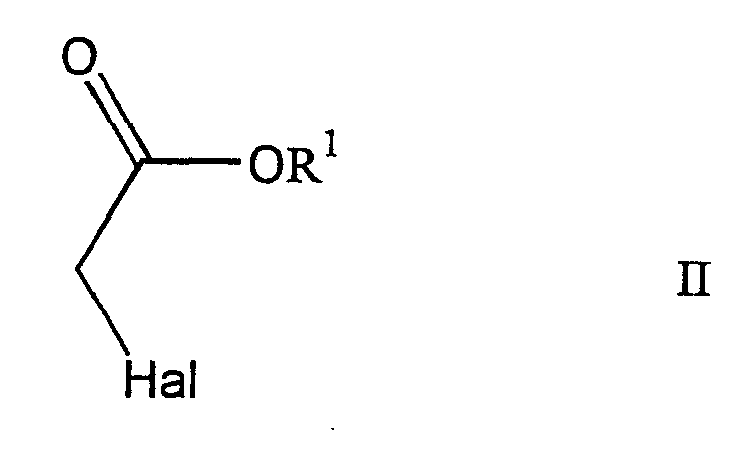
dadurch gekennzeichnet, dass
die Reaktion in einem Rührreaktor mit einem oder mehreren innen liegenden Wärmetauscher(n) durchgeführt wird. - Verfahren nach Anspruch 1,
dadurch gekennzeichnet, dass
der Rührreaktor einen Begasungsrührer enthält. - Verfahren nach Anspruch 1,
dadurch gekennzeichnet, dass
die Reaktionstemperatur mittels eines vorgewählten Temperaturgradienten bis zur Endtemperatur gesteigert wird. - Verfahren nach einem der Ansprüche 1 bis 3,
dadurch gekennzeichnet, dass
die Reaktionsmischung zusätzlich 0,1 bis 60 Gew.-% eines unpolaren unter den Reaktionsbedingungen inerten Lösemittels enthält. - Verfahren nach Anspruch 4,
dadurch gekennzeichnet, dass
als unpolares Lösemittel Toluol verwendet wird. - Verfahren nach einem der Ansprüche 1 bis 5,
dadurch gekennzeichnet, dass
die Reaktionszeit, gemessen vom Beginn der Kohlenmonoxid-Aufnahme bis zum Erzielen eines Halogenessigsäureester-Umsatzes von > 99,8 %, nicht mehr als 90 Minuten beträgt. - Verfahren nach einem der Ansprüche 1 bis 6,
dadurch gekennzeichnet, dass
als Halogenessigsäureester Chloressigsäureester eingesetzt wird. - Verfahren nach einem der Ansprüche 1 bis 7,
dadurch gekennzeichnet, dass
der Übergangsmetall-Katalysator nach Beendigung der Reaktion durch Sauerstoff oder ein sauerstoffhaltiges Gas zersetzt wird. - Verfahren nach einem der Ansprüche 1 bis 8,
dadurch gekennzeichnet, dass
das Übergangsmetall des Übergangsmetall-Katalysators aus der Gruppe, die durch Cobalt, Ruthenium, Platin und Palladium gebildet wird, ausgewählt wird. - Verfahren nach Anspruch 9,
dadurch gekennzeichnet, dass
der Katalysator Cobalt als Übergangsmetall enthält. - Verfahren nach Anspruch 10,
dadurch gekennzeichnet, dass
der Übergangsmetall-Katalysator Dicobaltoctacarbonyl als Einsatzmaterial enthält.
Priority Applications (1)
| Application Number | Priority Date | Filing Date | Title |
|---|---|---|---|
| DK01100548T DK1127868T3 (da) | 2000-02-25 | 2001-01-10 | Fremgangsmåde til fremsitlling af malonsyrediestere i en reaktor med indvendige varmevekslere |
Applications Claiming Priority (2)
| Application Number | Priority Date | Filing Date | Title |
|---|---|---|---|
| DE10008903A DE10008903A1 (de) | 2000-02-25 | 2000-02-25 | Verfahren zur Herstellung von Malonsäurediestern in einem Reaktor mit innen liegenden Wärmeaustauschern |
| DE10008903 | 2000-02-25 |
Publications (2)
| Publication Number | Publication Date |
|---|---|
| EP1127868A1 true EP1127868A1 (de) | 2001-08-29 |
| EP1127868B1 EP1127868B1 (de) | 2004-12-15 |
Family
ID=7632401
Family Applications (1)
| Application Number | Title | Priority Date | Filing Date |
|---|---|---|---|
| EP01100548A Expired - Lifetime EP1127868B1 (de) | 2000-02-25 | 2001-01-10 | Verfahren zur Herstellung von Malonsäurediestern in einem Reaktor mit innen liegenden Wärmeaustauschern |
Country Status (9)
| Country | Link |
|---|---|
| US (1) | US6617469B2 (de) |
| EP (1) | EP1127868B1 (de) |
| JP (1) | JP2001270847A (de) |
| KR (1) | KR20010085544A (de) |
| BR (1) | BR0004902A (de) |
| DE (2) | DE10008903A1 (de) |
| DK (1) | DK1127868T3 (de) |
| ES (1) | ES2232526T3 (de) |
| IL (1) | IL141617A0 (de) |
Families Citing this family (1)
| Publication number | Priority date | Publication date | Assignee | Title |
|---|---|---|---|---|
| CN105712876A (zh) * | 2014-12-01 | 2016-06-29 | 王志训 | 一种酯衍生物的工业生产方法 |
Citations (3)
| Publication number | Priority date | Publication date | Assignee | Title |
|---|---|---|---|---|
| DE2553931A1 (de) * | 1975-12-01 | 1977-06-08 | Dynamit Nobel Ag | Verfahren und vorrichtung zur durchfuehrung von carbonylierungsreaktionen |
| EP0633060A1 (de) * | 1993-07-08 | 1995-01-11 | Biazzi Sa | Vorrichtung für Gas-Flüssigkeit-Reaktionen |
| DE19836807A1 (de) * | 1998-08-14 | 2000-02-17 | Basf Ag | Verfahren zur Herstellung von Aldehyden und/oder Alkoholen oder Aminen |
Family Cites Families (2)
| Publication number | Priority date | Publication date | Assignee | Title |
|---|---|---|---|---|
| JPS6045629B2 (ja) | 1978-02-20 | 1985-10-11 | 三菱化学株式会社 | マロン酸ジアルキルエステルの製造法 |
| JPS5921855B2 (ja) | 1982-04-26 | 1984-05-22 | 電気化学工業株式会社 | マロン酸ジエステル類の製法 |
-
2000
- 2000-02-25 DE DE10008903A patent/DE10008903A1/de not_active Withdrawn
- 2000-10-18 BR BR0004902-6A patent/BR0004902A/pt not_active IP Right Cessation
- 2000-12-01 US US09/726,556 patent/US6617469B2/en not_active Expired - Fee Related
-
2001
- 2001-01-10 DE DE50104798T patent/DE50104798D1/de not_active Expired - Fee Related
- 2001-01-10 ES ES01100548T patent/ES2232526T3/es not_active Expired - Lifetime
- 2001-01-10 EP EP01100548A patent/EP1127868B1/de not_active Expired - Lifetime
- 2001-01-10 DK DK01100548T patent/DK1127868T3/da active
- 2001-02-22 JP JP2001047184A patent/JP2001270847A/ja active Pending
- 2001-02-23 KR KR1020010009321A patent/KR20010085544A/ko not_active Withdrawn
- 2001-02-23 IL IL14161701A patent/IL141617A0/xx unknown
Patent Citations (3)
| Publication number | Priority date | Publication date | Assignee | Title |
|---|---|---|---|---|
| DE2553931A1 (de) * | 1975-12-01 | 1977-06-08 | Dynamit Nobel Ag | Verfahren und vorrichtung zur durchfuehrung von carbonylierungsreaktionen |
| EP0633060A1 (de) * | 1993-07-08 | 1995-01-11 | Biazzi Sa | Vorrichtung für Gas-Flüssigkeit-Reaktionen |
| DE19836807A1 (de) * | 1998-08-14 | 2000-02-17 | Basf Ag | Verfahren zur Herstellung von Aldehyden und/oder Alkoholen oder Aminen |
Also Published As
| Publication number | Publication date |
|---|---|
| US20010018540A1 (en) | 2001-08-30 |
| US6617469B2 (en) | 2003-09-09 |
| JP2001270847A (ja) | 2001-10-02 |
| EP1127868B1 (de) | 2004-12-15 |
| DE50104798D1 (de) | 2005-01-20 |
| ES2232526T3 (es) | 2005-06-01 |
| IL141617A0 (en) | 2002-03-10 |
| DK1127868T3 (da) | 2005-04-18 |
| DE10008903A1 (de) | 2001-09-06 |
| BR0004902A (pt) | 2002-01-02 |
| KR20010085544A (ko) | 2001-09-07 |
Similar Documents
| Publication | Publication Date | Title |
|---|---|---|
| DE2848369C3 (de) | Verfahren zur Herstellung von Carbonsäureestern | |
| EP1227080B1 (de) | Durch Ammoniumsalze oder substituierte Ammoniumsalze cokatalysierstes Verfahren zur Herstellung von Oximen | |
| DE3728222A1 (de) | Verfahren zur herstellung von ethercarbonsaeuren | |
| DE2828041A1 (de) | Verfahren zur herstellung von arylbrenztraubensaeuren | |
| DE69004582T2 (de) | Verfahren zur Herstellung von alpha-Hydroxycarbonsäure-Amid. | |
| DE2749954C2 (de) | Verfahren zur Herstellung niedrigmolekularer Alkanmonocarbonsäuren | |
| DE2847241A1 (de) | Verfahren zur herstellung von carbonsaeuren oder ihren estern | |
| EP0181536B1 (de) | Verfahren zur Herstellung von 1-Alkyl- oder 1-Cycloalkylpiperazinen | |
| EP1127868B1 (de) | Verfahren zur Herstellung von Malonsäurediestern in einem Reaktor mit innen liegenden Wärmeaustauschern | |
| DE69803252T2 (de) | Verfahren zur Herstellung eines polyhydrischen Alkohols | |
| DE3335595A1 (de) | Verfahren zur herstellung von carbonsaeuren | |
| DE2359963C2 (de) | Verfahren zur Herstellung von Malonsäuredialkylestern | |
| DE2823309C2 (de) | ||
| EP1207148A1 (de) | Verfahren zur Herstellung von Phenylessigsäurederivaten | |
| DE3729734C2 (de) | ||
| EP0090977B2 (de) | Verfahren zur Herstellung von Kohlensäureestern | |
| EP0621262A1 (de) | Verfahren zur Herstellung von 3-Chloranthranilsäurealkylestern hoher Reinheit aus 3-Chloranthranilsäure | |
| DE2323867A1 (de) | Verfahren zur herstellung ungesaettigter aldehydcyanhydrine | |
| EP2603485B1 (de) | Verfahren zur herstellung von acyloxybenzoesäuren | |
| DE10008899A1 (de) | Verfahren zur Herstelung von Malonsäurediestern durch Carbonylierung von Halogenessigsäureestern in Gegenwart von inerten Cosolvenzien | |
| DE3605484A1 (de) | Verfahren zur herstellung von 1,1,3-trichloraceton | |
| DE69404951T2 (de) | Verwendung von Titania oder Zirconia zur Herstellung von Tertiärbutylalkohol aus Tertiärbutylhydroperoxid | |
| DE3335594A1 (de) | Verfahren zur herstellung von carbonsaeureanhydriden | |
| DE3221172A1 (de) | Verfahren zur herstellung von carbonsaeuren und estern | |
| EP1400503A1 (de) | Verfahren zur Herstellung von Trimethylcyclohexyl-alkan-3-olen mit einem hohen Anteil an trans-Isomeren |
Legal Events
| Date | Code | Title | Description |
|---|---|---|---|
| PUAI | Public reference made under article 153(3) epc to a published international application that has entered the european phase |
Free format text: ORIGINAL CODE: 0009012 |
|
| 17P | Request for examination filed |
Effective date: 20010110 |
|
| AK | Designated contracting states |
Kind code of ref document: A1 Designated state(s): AT BE CH CY DE DK ES FI FR GB GR IE IT LI LU MC NL PT SE TR |
|
| AX | Request for extension of the european patent |
Free format text: AL;LT;LV;MK;RO;SI |
|
| AKX | Designation fees paid |
Free format text: AT BE CH CY DE DK ES FI FR GB GR IE IT LI LU MC NL PT SE TR |
|
| 17Q | First examination report despatched |
Effective date: 20020417 |
|
| GRAP | Despatch of communication of intention to grant a patent |
Free format text: ORIGINAL CODE: EPIDOSNIGR1 |
|
| RBV | Designated contracting states (corrected) |
Designated state(s): CH DE DK ES FR GB IE IT LI |
|
| GRAS | Grant fee paid |
Free format text: ORIGINAL CODE: EPIDOSNIGR3 |
|
| GRAA | (expected) grant |
Free format text: ORIGINAL CODE: 0009210 |
|
| AK | Designated contracting states |
Kind code of ref document: B1 Designated state(s): CH DE DK ES FR GB IE IT LI |
|
| REG | Reference to a national code |
Ref country code: GB Ref legal event code: FG4D Free format text: NOT ENGLISH Ref country code: CH Ref legal event code: EP |
|
| REG | Reference to a national code |
Ref country code: CH Ref legal event code: NV Representative=s name: SCHMAUDER & PARTNER AG PATENTANWALTSBUERO |
|
| PGFP | Annual fee paid to national office [announced via postgrant information from national office to epo] |
Ref country code: GB Payment date: 20050110 Year of fee payment: 5 |
|
| REG | Reference to a national code |
Ref country code: IE Ref legal event code: FG4D Free format text: GERMAN |
|
| REF | Corresponds to: |
Ref document number: 50104798 Country of ref document: DE Date of ref document: 20050120 Kind code of ref document: P |
|
| PGFP | Annual fee paid to national office [announced via postgrant information from national office to epo] |
Ref country code: CH Payment date: 20050121 Year of fee payment: 5 |
|
| PGFP | Annual fee paid to national office [announced via postgrant information from national office to epo] |
Ref country code: FR Payment date: 20050124 Year of fee payment: 5 Ref country code: DK Payment date: 20050124 Year of fee payment: 5 |
|
| PGFP | Annual fee paid to national office [announced via postgrant information from national office to epo] |
Ref country code: IE Payment date: 20050126 Year of fee payment: 5 |
|
| PGFP | Annual fee paid to national office [announced via postgrant information from national office to epo] |
Ref country code: ES Payment date: 20050128 Year of fee payment: 5 |
|
| GBT | Gb: translation of ep patent filed (gb section 77(6)(a)/1977) |
Effective date: 20050116 |
|
| REG | Reference to a national code |
Ref country code: DK Ref legal event code: T3 |
|
| REG | Reference to a national code |
Ref country code: ES Ref legal event code: FG2A Ref document number: 2232526 Country of ref document: ES Kind code of ref document: T3 |
|
| PLBE | No opposition filed within time limit |
Free format text: ORIGINAL CODE: 0009261 |
|
| STAA | Information on the status of an ep patent application or granted ep patent |
Free format text: STATUS: NO OPPOSITION FILED WITHIN TIME LIMIT |
|
| ET | Fr: translation filed | ||
| 26N | No opposition filed |
Effective date: 20050916 |
|
| PG25 | Lapsed in a contracting state [announced via postgrant information from national office to epo] |
Ref country code: IE Free format text: LAPSE BECAUSE OF NON-PAYMENT OF DUE FEES Effective date: 20060110 Ref country code: GB Free format text: LAPSE BECAUSE OF NON-PAYMENT OF DUE FEES Effective date: 20060110 |
|
| PG25 | Lapsed in a contracting state [announced via postgrant information from national office to epo] |
Ref country code: ES Free format text: LAPSE BECAUSE OF NON-PAYMENT OF DUE FEES Effective date: 20060111 |
|
| PG25 | Lapsed in a contracting state [announced via postgrant information from national office to epo] |
Ref country code: LI Free format text: LAPSE BECAUSE OF NON-PAYMENT OF DUE FEES Effective date: 20060131 Ref country code: FR Free format text: LAPSE BECAUSE OF NON-PAYMENT OF DUE FEES Effective date: 20060131 Ref country code: DK Free format text: LAPSE BECAUSE OF NON-PAYMENT OF DUE FEES Effective date: 20060131 Ref country code: CH Free format text: LAPSE BECAUSE OF NON-PAYMENT OF DUE FEES Effective date: 20060131 |
|
| PGFP | Annual fee paid to national office [announced via postgrant information from national office to epo] |
Ref country code: IT Payment date: 20060131 Year of fee payment: 6 |
|
| REG | Reference to a national code |
Ref country code: DK Ref legal event code: EBP |
|
| REG | Reference to a national code |
Ref country code: CH Ref legal event code: PL |
|
| GBPC | Gb: european patent ceased through non-payment of renewal fee |
Effective date: 20060110 |
|
| REG | Reference to a national code |
Ref country code: IE Ref legal event code: MM4A |
|
| REG | Reference to a national code |
Ref country code: FR Ref legal event code: ST Effective date: 20060929 |
|
| REG | Reference to a national code |
Ref country code: ES Ref legal event code: FD2A Effective date: 20060111 |
|
| PGFP | Annual fee paid to national office [announced via postgrant information from national office to epo] |
Ref country code: DE Payment date: 20090122 Year of fee payment: 9 |
|
| PG25 | Lapsed in a contracting state [announced via postgrant information from national office to epo] |
Ref country code: IT Free format text: LAPSE BECAUSE OF NON-PAYMENT OF DUE FEES Effective date: 20070110 |
|
| PG25 | Lapsed in a contracting state [announced via postgrant information from national office to epo] |
Ref country code: DE Free format text: LAPSE BECAUSE OF NON-PAYMENT OF DUE FEES Effective date: 20100803 |