EP0090977B2 - Verfahren zur Herstellung von Kohlensäureestern - Google Patents
Verfahren zur Herstellung von Kohlensäureestern Download PDFInfo
- Publication number
- EP0090977B2 EP0090977B2 EP83102668A EP83102668A EP0090977B2 EP 0090977 B2 EP0090977 B2 EP 0090977B2 EP 83102668 A EP83102668 A EP 83102668A EP 83102668 A EP83102668 A EP 83102668A EP 0090977 B2 EP0090977 B2 EP 0090977B2
- Authority
- EP
- European Patent Office
- Prior art keywords
- reaction
- catalysts
- formula
- carbon atoms
- group
- Prior art date
- Legal status (The legal status is an assumption and is not a legal conclusion. Google has not performed a legal analysis and makes no representation as to the accuracy of the status listed.)
- Expired
Links
- 238000000034 method Methods 0.000 title claims description 27
- 150000004651 carbonic acid esters Chemical class 0.000 title claims description 10
- 238000002360 preparation method Methods 0.000 title description 2
- 238000006243 chemical reaction Methods 0.000 claims description 28
- 239000003054 catalyst Substances 0.000 claims description 20
- 239000000203 mixture Substances 0.000 claims description 10
- 229910052760 oxygen Inorganic materials 0.000 claims description 10
- 239000011541 reaction mixture Substances 0.000 claims description 10
- 125000004432 carbon atom Chemical group C* 0.000 claims description 9
- 229910002091 carbon monoxide Inorganic materials 0.000 claims description 9
- QVGXLLKOCUKJST-UHFFFAOYSA-N atomic oxygen Chemical compound [O] QVGXLLKOCUKJST-UHFFFAOYSA-N 0.000 claims description 8
- 239000001301 oxygen Substances 0.000 claims description 8
- UGFAIRIUMAVXCW-UHFFFAOYSA-N Carbon monoxide Chemical compound [O+]#[C-] UGFAIRIUMAVXCW-UHFFFAOYSA-N 0.000 claims description 7
- LFQSCWFLJHTTHZ-UHFFFAOYSA-N Ethanol Chemical compound CCO LFQSCWFLJHTTHZ-UHFFFAOYSA-N 0.000 claims description 7
- -1 halogen anion Chemical group 0.000 claims description 7
- 150000001768 cations Chemical class 0.000 claims description 5
- 239000010949 copper Substances 0.000 claims description 5
- 229910052751 metal Inorganic materials 0.000 claims description 5
- 239000002184 metal Substances 0.000 claims description 5
- 239000001257 hydrogen Substances 0.000 claims description 4
- 229910052739 hydrogen Inorganic materials 0.000 claims description 4
- 238000004519 manufacturing process Methods 0.000 claims description 4
- 150000007942 carboxylates Chemical group 0.000 claims description 3
- 150000001734 carboxylic acid salts Chemical class 0.000 claims description 3
- 150000001875 compounds Chemical class 0.000 claims description 3
- 229910052802 copper Inorganic materials 0.000 claims description 3
- 125000000113 cyclohexyl group Chemical group [H]C1([H])C([H])([H])C([H])([H])C([H])(*)C([H])([H])C1([H])[H] 0.000 claims description 3
- 229910052736 halogen Inorganic materials 0.000 claims description 3
- 125000002496 methyl group Chemical group [H]C([H])([H])* 0.000 claims description 3
- 150000002940 palladium Chemical class 0.000 claims description 3
- 150000001879 copper Chemical class 0.000 claims description 2
- 125000001495 ethyl group Chemical group [H]C([H])([H])C([H])([H])* 0.000 claims description 2
- 125000000959 isobutyl group Chemical group [H]C([H])([H])C([H])(C([H])([H])[H])C([H])([H])* 0.000 claims description 2
- 125000001449 isopropyl group Chemical group [H]C([H])([H])C([H])(*)C([H])([H])[H] 0.000 claims description 2
- 125000004108 n-butyl group Chemical group [H]C([H])([H])C([H])([H])C([H])([H])C([H])([H])* 0.000 claims description 2
- 125000004123 n-propyl group Chemical group [H]C([H])([H])C([H])([H])C([H])([H])* 0.000 claims description 2
- 239000000376 reactant Substances 0.000 claims description 2
- 125000000217 alkyl group Chemical group 0.000 claims 4
- RYGMFSIKBFXOCR-UHFFFAOYSA-N Copper Chemical compound [Cu] RYGMFSIKBFXOCR-UHFFFAOYSA-N 0.000 claims 2
- 125000003710 aryl alkyl group Chemical group 0.000 claims 2
- 125000000484 butyl group Chemical group [H]C([*])([H])C([H])([H])C([H])([H])C([H])([H])[H] 0.000 claims 2
- 125000004435 hydrogen atom Chemical group [H]* 0.000 claims 2
- 239000003513 alkali Substances 0.000 claims 1
- 125000001797 benzyl group Chemical group [H]C1=C([H])C([H])=C(C([H])=C1[H])C([H])([H])* 0.000 claims 1
- 125000004122 cyclic group Chemical group 0.000 claims 1
- 125000000753 cycloalkyl group Chemical group 0.000 claims 1
- 125000001997 phenyl group Chemical group [H]C1=C([H])C([H])=C(*)C([H])=C1[H] 0.000 claims 1
- 239000012429 reaction media Substances 0.000 claims 1
- 125000000547 substituted alkyl group Chemical group 0.000 claims 1
- 125000003107 substituted aryl group Chemical group 0.000 claims 1
- OKKJLVBELUTLKV-UHFFFAOYSA-N Methanol Chemical compound OC OKKJLVBELUTLKV-UHFFFAOYSA-N 0.000 description 15
- 239000007789 gas Substances 0.000 description 10
- 238000004817 gas chromatography Methods 0.000 description 7
- 150000003839 salts Chemical class 0.000 description 6
- 238000001816 cooling Methods 0.000 description 4
- 238000005260 corrosion Methods 0.000 description 4
- 230000007797 corrosion Effects 0.000 description 4
- 239000011521 glass Substances 0.000 description 4
- SCVFZCLFOSHCOH-UHFFFAOYSA-M potassium acetate Chemical compound [K+].CC([O-])=O SCVFZCLFOSHCOH-UHFFFAOYSA-M 0.000 description 4
- 239000002904 solvent Substances 0.000 description 4
- 229910021589 Copper(I) bromide Inorganic materials 0.000 description 3
- 150000001298 alcohols Chemical class 0.000 description 3
- 230000015572 biosynthetic process Effects 0.000 description 3
- 230000003197 catalytic effect Effects 0.000 description 3
- 238000011010 flushing procedure Methods 0.000 description 3
- KDLHZDBZIXYQEI-UHFFFAOYSA-N palladium Substances [Pd] KDLHZDBZIXYQEI-UHFFFAOYSA-N 0.000 description 3
- 238000003786 synthesis reaction Methods 0.000 description 3
- IJGRMHOSHXDMSA-UHFFFAOYSA-N Atomic nitrogen Chemical compound N#N IJGRMHOSHXDMSA-UHFFFAOYSA-N 0.000 description 2
- CURLTUGMZLYLDI-UHFFFAOYSA-N Carbon dioxide Chemical compound O=C=O CURLTUGMZLYLDI-UHFFFAOYSA-N 0.000 description 2
- UFHFLCQGNIYNRP-UHFFFAOYSA-N Hydrogen Chemical compound [H][H] UFHFLCQGNIYNRP-UHFFFAOYSA-N 0.000 description 2
- JUJWROOIHBZHMG-UHFFFAOYSA-N Pyridine Chemical compound C1=CC=NC=C1 JUJWROOIHBZHMG-UHFFFAOYSA-N 0.000 description 2
- 229910000831 Steel Inorganic materials 0.000 description 2
- 229910052783 alkali metal Inorganic materials 0.000 description 2
- GDTBXPJZTBHREO-UHFFFAOYSA-N bromine Substances BrBr GDTBXPJZTBHREO-UHFFFAOYSA-N 0.000 description 2
- 229910052794 bromium Inorganic materials 0.000 description 2
- 125000001246 bromo group Chemical group Br* 0.000 description 2
- 150000001735 carboxylic acids Chemical class 0.000 description 2
- 239000007795 chemical reaction product Substances 0.000 description 2
- 230000006837 decompression Effects 0.000 description 2
- IEJIGPNLZYLLBP-UHFFFAOYSA-N dimethyl carbonate Chemical compound COC(=O)OC IEJIGPNLZYLLBP-UHFFFAOYSA-N 0.000 description 2
- 238000002290 gas chromatography-mass spectrometry Methods 0.000 description 2
- 150000002736 metal compounds Chemical class 0.000 description 2
- BDAGIHXWWSANSR-UHFFFAOYSA-N methanoic acid Natural products OC=O BDAGIHXWWSANSR-UHFFFAOYSA-N 0.000 description 2
- 230000000737 periodic effect Effects 0.000 description 2
- 230000035484 reaction time Effects 0.000 description 2
- 239000010959 steel Substances 0.000 description 2
- 238000012619 stoichiometric conversion Methods 0.000 description 2
- 125000001424 substituent group Chemical group 0.000 description 2
- 230000002195 synergetic effect Effects 0.000 description 2
- XLYOFNOQVPJJNP-UHFFFAOYSA-N water Substances O XLYOFNOQVPJJNP-UHFFFAOYSA-N 0.000 description 2
- OSWFIVFLDKOXQC-UHFFFAOYSA-N 4-(3-methoxyphenyl)aniline Chemical compound COC1=CC=CC(C=2C=CC(N)=CC=2)=C1 OSWFIVFLDKOXQC-UHFFFAOYSA-N 0.000 description 1
- QTBSBXVTEAMEQO-UHFFFAOYSA-M Acetate Chemical compound CC([O-])=O QTBSBXVTEAMEQO-UHFFFAOYSA-M 0.000 description 1
- QGZKDVFQNNGYKY-UHFFFAOYSA-O Ammonium Chemical compound [NH4+] QGZKDVFQNNGYKY-UHFFFAOYSA-O 0.000 description 1
- CPELXLSAUQHCOX-UHFFFAOYSA-M Bromide Chemical compound [Br-] CPELXLSAUQHCOX-UHFFFAOYSA-M 0.000 description 1
- VEXZGXHMUGYJMC-UHFFFAOYSA-M Chloride anion Chemical compound [Cl-] VEXZGXHMUGYJMC-UHFFFAOYSA-M 0.000 description 1
- 229910021591 Copper(I) chloride Inorganic materials 0.000 description 1
- IAYPIBMASNFSPL-UHFFFAOYSA-N Ethylene oxide Chemical compound C1CO1 IAYPIBMASNFSPL-UHFFFAOYSA-N 0.000 description 1
- 101100028920 Neurospora crassa (strain ATCC 24698 / 74-OR23-1A / CBS 708.71 / DSM 1257 / FGSC 987) cfp gene Proteins 0.000 description 1
- KMTRUDSVKNLOMY-UHFFFAOYSA-N O=C1OCCO1 Chemical compound O=C1OCCO1 KMTRUDSVKNLOMY-UHFFFAOYSA-N 0.000 description 1
- YGYAWVDWMABLBF-UHFFFAOYSA-N Phosgene Chemical compound ClC(Cl)=O YGYAWVDWMABLBF-UHFFFAOYSA-N 0.000 description 1
- ZLMJMSJWJFRBEC-UHFFFAOYSA-N Potassium Chemical compound [K] ZLMJMSJWJFRBEC-UHFFFAOYSA-N 0.000 description 1
- QOSMNYMQXIVWKY-UHFFFAOYSA-N Propyl levulinate Chemical compound CCCOC(=O)CCC(C)=O QOSMNYMQXIVWKY-UHFFFAOYSA-N 0.000 description 1
- CIUQDSCDWFSTQR-UHFFFAOYSA-N [C]1=CC=CC=C1 Chemical compound [C]1=CC=CC=C1 CIUQDSCDWFSTQR-UHFFFAOYSA-N 0.000 description 1
- 150000001340 alkali metals Chemical class 0.000 description 1
- 150000001449 anionic compounds Chemical class 0.000 description 1
- 230000009286 beneficial effect Effects 0.000 description 1
- 238000009529 body temperature measurement Methods 0.000 description 1
- 239000006227 byproduct Substances 0.000 description 1
- 229910052793 cadmium Inorganic materials 0.000 description 1
- 239000001569 carbon dioxide Substances 0.000 description 1
- 229910002092 carbon dioxide Inorganic materials 0.000 description 1
- 150000004649 carbonic acid derivatives Chemical class 0.000 description 1
- 150000001732 carboxylic acid derivatives Chemical class 0.000 description 1
- 238000006555 catalytic reaction Methods 0.000 description 1
- OXBLHERUFWYNTN-UHFFFAOYSA-M copper(I) chloride Chemical compound [Cu]Cl OXBLHERUFWYNTN-UHFFFAOYSA-M 0.000 description 1
- GCFAUZGWPDYAJN-UHFFFAOYSA-N cyclohexyl 3-phenylprop-2-enoate Chemical compound C=1C=CC=CC=1C=CC(=O)OC1CCCCC1 GCFAUZGWPDYAJN-UHFFFAOYSA-N 0.000 description 1
- 125000005265 dialkylamine group Chemical group 0.000 description 1
- 150000005690 diesters Chemical class 0.000 description 1
- 150000002009 diols Chemical class 0.000 description 1
- 230000000694 effects Effects 0.000 description 1
- 125000004494 ethyl ester group Chemical group 0.000 description 1
- 238000002474 experimental method Methods 0.000 description 1
- 230000002349 favourable effect Effects 0.000 description 1
- 235000019253 formic acid Nutrition 0.000 description 1
- 125000000524 functional group Chemical group 0.000 description 1
- 229910052737 gold Inorganic materials 0.000 description 1
- 150000002367 halogens Chemical group 0.000 description 1
- 239000002815 homogeneous catalyst Substances 0.000 description 1
- XMBWDFGMSWQBCA-UHFFFAOYSA-N hydrogen iodide Chemical compound I XMBWDFGMSWQBCA-UHFFFAOYSA-N 0.000 description 1
- 239000011261 inert gas Substances 0.000 description 1
- 239000012442 inert solvent Substances 0.000 description 1
- 229910001412 inorganic anion Inorganic materials 0.000 description 1
- 239000000543 intermediate Substances 0.000 description 1
- 239000003446 ligand Substances 0.000 description 1
- 238000003760 magnetic stirring Methods 0.000 description 1
- 150000002739 metals Chemical class 0.000 description 1
- 150000004702 methyl esters Chemical class 0.000 description 1
- 229910052759 nickel Inorganic materials 0.000 description 1
- 229910052757 nitrogen Inorganic materials 0.000 description 1
- 238000005580 one pot reaction Methods 0.000 description 1
- 150000007530 organic bases Chemical class 0.000 description 1
- 239000007800 oxidant agent Substances 0.000 description 1
- IUGYQRQAERSCNH-UHFFFAOYSA-M pivalate Chemical compound CC(C)(C)C([O-])=O IUGYQRQAERSCNH-UHFFFAOYSA-M 0.000 description 1
- 229950010765 pivalate Drugs 0.000 description 1
- 229920005862 polyol Polymers 0.000 description 1
- 150000003077 polyols Chemical class 0.000 description 1
- 229910052700 potassium Inorganic materials 0.000 description 1
- 239000011591 potassium Substances 0.000 description 1
- 235000011056 potassium acetate Nutrition 0.000 description 1
- WFMNHCSATCWAAQ-UHFFFAOYSA-M potassium;2,2-dimethylpropanoate Chemical compound [K+].CC(C)(C)C([O-])=O WFMNHCSATCWAAQ-UHFFFAOYSA-M 0.000 description 1
- 150000003138 primary alcohols Chemical class 0.000 description 1
- UMJSCPRVCHMLSP-UHFFFAOYSA-N pyridine Natural products COC1=CC=CN=C1 UMJSCPRVCHMLSP-UHFFFAOYSA-N 0.000 description 1
- 238000006479 redox reaction Methods 0.000 description 1
- DCKVNWZUADLDEH-UHFFFAOYSA-N sec-butyl acetate Chemical compound CCC(C)OC(C)=O DCKVNWZUADLDEH-UHFFFAOYSA-N 0.000 description 1
- 150000003333 secondary alcohols Chemical class 0.000 description 1
- 230000035945 sensitivity Effects 0.000 description 1
- 238000000926 separation method Methods 0.000 description 1
- 229910052709 silver Inorganic materials 0.000 description 1
- 238000010189 synthetic method Methods 0.000 description 1
- 125000000999 tert-butyl group Chemical group [H]C([H])([H])C(*)(C([H])([H])[H])C([H])([H])[H] 0.000 description 1
- 230000007306 turnover Effects 0.000 description 1
- 238000010626 work up procedure Methods 0.000 description 1
- 229910052725 zinc Inorganic materials 0.000 description 1
Classifications
-
- C—CHEMISTRY; METALLURGY
- C07—ORGANIC CHEMISTRY
- C07C—ACYCLIC OR CARBOCYCLIC COMPOUNDS
- C07C68/00—Preparation of esters of carbonic or haloformic acids
- C07C68/01—Preparation of esters of carbonic or haloformic acids from carbon monoxide and oxygen
Definitions
- the invention relates to the production of carbonic acid esters.
- Carbonic acid esters, especially the symmetrical diesters, are used industrially as intermediates and solvents.
- DE-A 2110194 mentions metal complexes of groups IB, IIB and VIII of the periodic table as suitable catalysts, in particular the metals Cu, Ag, Au, Zn, Cd, Hg, Fe, Co, Ni, which are used in redox reactions in two different valence states can exist. According to the examples, only stoichiometric conversion with the C U2 CI 2 used takes place at 1 bar reaction pressure. An example of a reaction under elevated pressure in anhydrous pyridine is given, from which, however, the catalytic effect cannot be clearly assessed.
- DE-A 2 743 690 it is pointed out that the process of the aforementioned DE-A has serious disadvantages when it is carried out on an industrial scale, e.g. Sensitivity to water and carbon dioxide, which occur as by-products and lead to a low yield of esterified alcohol.
- the workup of the reaction products also presents difficulties, in particular the separation of water and carbonic acid ester from the reaction mixture from the homogeneous catalyst, the ligand of which is normally an organic base.
- DE-A 2 743 690 specifies the reaction of the alcohol with oxygen and carbon monoxide in the presence of the simple salts of a metal from group IB, IIB or VIII of the periodic table, the cation of which is bound to the lowest possible number of inorganic anions.
- reaction pressures 40-100 bar and temperatures between 140 and 190 ° C are used. Although these processes lead to comparatively good to very good sales, they involve a considerable load on the reactors used. When using steel autoclaves, e.g. considerable corrosion can be expected.
- the US-PS 3114762 teaches a combination of the metal salts PdCI 2 / CuCI 2 in the conversion of carbon monoxide and alcohol (but without oxygen) to the carbonic acid esters.
- An exclusively stoichiometric conversion takes place at a reaction pressure of 1 bar.
- the previously known processes produce carbonic acid esters at 1 bar reaction pressure - based on the catalyst used - exclusively stoichiometrically.
- the alcohols can, for example, be mono- or polyunsaturated. It can also be primary or secondary alcohols as well as diols and polyols.
- the alcohols can also carry substituents, e.g. also functional groups, such as the dialkylamine group.
- substituents e.g. also functional groups, such as the dialkylamine group.
- reaction is carried out without a solvent, i.e. carried out in the reaction mixture formed from the reactants, but suitable, inert solvents can also be used.
- the reaction is carried out at a reaction pressure below 20 bar, preferably below 15 bar, especially in the range from 1 to 10 bar. Temperatures in the range from 20 to 300 ° C., preferably 40 to 200 ° C., are generally used.
- the CO to O 2 ratio itself can be varied within wide limits; Because of the stoichiometric ratio, carbon monoxide and oxygen appropriately introduced in a (pressure) ratio of 2: 1.
- M ' preferably represents an alkali metal application, such as Li + , Na +, K + , Rb + , Cs + or an ammonium cation.
- M ' is potassium.
- K 2 PdC1 4 , K 2 PdBr 4 and K 2 PdJ 4 may be mentioned .
- carboxylic acids on which the formula IV is based are preferably monobasic carboxylic acids of the formic acid to C 30 carboxylic acid type.
- Particularly suitable carboxylic acid salts of the formula IV are those in which R 1 is hydrogen or an optionally branched alkyl radical having 1-6 carbon atoms, especially a methyl, ethyl, n-propyl, iso-propyl, n-butyl, iso- Butyl, tert-butyl, or a cyclohexyl or phenyl radical, which can optionally be partially unsaturated and / or substituted.
- the substituents include groups which are inert under the reaction conditions.
- longer-chain radicals R i are also very useful, for example those having 10 to 30 carbon atoms, especially 12, 16 and 17 carbon atoms.
- the same cations as M 'come into question as the cation M ", but M' and M" need not be identical.
- the catalyst components of the formula 11, 111 and IV are advantageously in a molar ratio (0.1 to 0.3) to 1 to (1 to 3).
- the total of the catalysts to the alcohol ROH is in an approximate molar ratio of 1:10 3 , with deviations up and down are possible.
- the low pressures required make it possible to carry out the reaction without using the otherwise expensive printing equipment.
- the method according to the invention can be carried out, for example, in glass autoclaves or enamelled pressure vessels. All in all, the corrosion problem that places so much strain on the state of the art takes a back seat.
- a CO / O Z gas mixture preferably at 1 to 10 bar, is introduced into the alcohol of the formula I containing the catalyst combination.
- the gas mixture is advantageously circulated through the reaction mixture in the reactor by means of a pump.
- a reaction temperature of 50 ° C approx. 2-7 h in many cases 2-3 h, can be taken as a guideline for the reaction time.
- the carbon monoxide and oxygen can also be injected into the reaction mixture (preferably after flushing with an inert gas such as nitrogen). After a certain reaction time, amounts of the two gases can be injected again, for example three to four times in total.
- the yield can be determined in a manner known per se, for example qualitatively by combined gas chromatography / mass spectrometry and quantitatively by gas chromatography.
- the method according to the present invention allows the synthesis of the carbonic acid esters with little expenditure on equipment and with a favorable energy balance. In particular, the problem of corrosion takes a back seat.
- the reaction products are characterized by very good yields and high purity.
- DMC dimethyl carbonate
Landscapes
- Chemical & Material Sciences (AREA)
- Organic Chemistry (AREA)
- Organic Low-Molecular-Weight Compounds And Preparation Thereof (AREA)
- Low-Molecular Organic Synthesis Reactions Using Catalysts (AREA)
Description
- Die Erfindung betrifft die Herstellung von Kohlensäureestern. Kohlensäureester, insbesondere die symmetrischen Diester, werden technisch als Zwischenprodukte und Lösungsmittel verwendet.
- Bekannte Syntheseverfahren zur Herstellung von Kohlensäureestern gehen von Phosgen oder Äthylenoxid aus. Zu diesen Verfahren trat die Umsetzung von Alkoholen mit Kohlenmonoxid und Sauerstoff oder anderen Oxidationsmitteln. Für die unter Verbrauch von Sauerstoff verlaufende einstufige Reaktion (siehe Gleichung) sind bestimmte Katalysatoren vorgeschlagen worden:
-

- In der DE-A 2110194 wurden als geeignete Katalysatoren Metallkomplexe der Gruppen IB, IIB und VIII des Periodensystems genannt, insbesondere die Metalle Cu, Ag, Au, Zn, Cd, Hg, Fe, Co, Ni, die bei Redoxreaktionen in zwei verschiedenen Valenzzuständen existieren können. Nach den beispielhaften Ausführungen findet bei 1 bar Reaktionsdruck ausschliesslich stöchiometrische Umsetzung mit dem verwendeten CU2CI2 statt. Ein Beispiel einer Umsetzung unter erhöhtem Druck in wasserfreiem Pyridin wird angegeben, aus dem jedoch die katalytische Wirkung nicht klar beurteilt werden kann.
- In der DE-A 2 743 690 wird darauf hingewiesen, dass das Verfahren der vorgenannten DE-A bei grosstechnischer Durchführung schwerwiegende Nachteile aufweist, wie z.B. Empfindlichkeit gegenüber Wasser und Kohlendioxid, die als Nebenprodukte auftreten und zu geringer Ausbeute an verestertem Alkohol führen. Auch bereitet die Aufarbeitung der Reaktionsprodukte Schwierigkeiten, insbesondere die Trennung von Wasser und Kohlensäureester aus dem Reaktionsgemisch von dem homogenen Katalysator, dessen Ligand normalerweise eine organische Base ist. In der DE-A 2 743 690 wird als Lösung die Umsetzung des Alkohols mit Sauerstoff und Kohlenmonoxid in Gegenwart der einfachen Salze eines Metalls der Gruppe IB, IIB oder VIII des Periodensystems, dessen Kation an die geringstmögliche Anzahl anorganischer Anionen gebunden ist, angegeben. Die DE-A 3 045 767 beschreibt die Herstellung von Dimethylcarbonat durch Umsetzung mit denselben Metallverbindungen in Methanol unter Verwendung des wasserstoffhaltigen Synthesegases. Bei den letzten beiden genannten Druckschriften scheint nur bei erhöhtem Reaktionsdruck (20-30 bar) eine katalytische Reaktion mit relativ geringer Aktivität abzulaufen. Der «Turnover» von CuCI beträgt etwa 4-6 Katalysecyclen. Für eine technische Synthese müssten erhebliche Mengen des Kupfersalzes eingesetzt werden.
- Bei den Verfahren gemäss DE-B 2334736, DE-A 2431 330 und 2520708 werden Reaktionsdrucke von 40-100 bar und Temperaturen zwischen 140 und 190°C angewendet. Diese Verfahren führen zwar zu vergleichsweise guten bis sehr guten Umsätzen, bringen aber eine erhebliche Beanspruchung der verwendeten Reaktoren mit sich. Bei Verwendung von Stahlautoklaven muss z.B. mit beträchtlicher Korrosion gerechnet werden.
- Die US-PS 3114762 lehrt eine Kombination der Metallsalze PdCI2/CuCI2 bei der Umsetzung von Kohlenmonoxid und Alkohol (jedoch ohne Sauerstoff) zu den Kohlensäureestern. Bei 1 bar Reaktionsdruck erfolgt eine ausschliesslich stöchiometrische Umsetzung. Die bisher bekannten Verfahren erzeugen Kohlensäureester bei 1 bar Reaktionsdruck - bezogen auf den eingesetzten Katalysator - ausschliesslich stöchiometrisch.
- Der Stand der Technik gibt Verfahren an, deren technische Realisierung erhebliche Schwierigkeiten bereitet. Als wenig aussichtsreich müssen von vorneherein Verfahren betrachtet werden, bei denen die Metallverbindungen in stöchiometrischen Mengen an der Umsetzung beteiligt sind. Weiter war die Anwendung hoher Drucke und Temperaturen zu vermeiden, u.a. weil dabei zu starke Korrosion auftritt. Ein technisch zu realisierendes Verfahren sollte demnach ein im echten Sinne katalytisches Verfahren sein, das unter möglichst milden Reaktionsbedingungen, insbesondere niedrigem Reaktionsdruck, zu guten Ausbeuten an Kohlensäureestern führt.
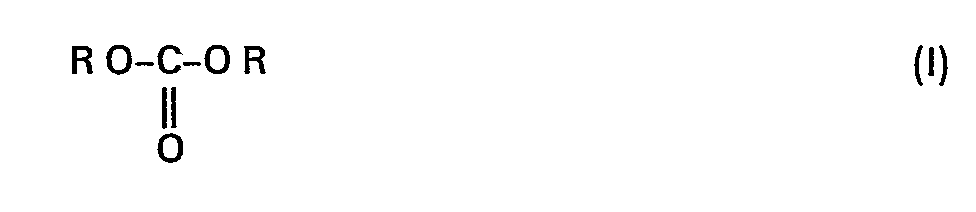
- Zur Lösung der vorliegenden Aufgabe wird das Verfahren gemäss Hauptanspruch vorgeschlagen. Hervorgehoben sei, dass hinsichtlich der Auswahl der Alkohole ROH keine Beschränkungen zu erkennen sind. Die Alkohole können beispielsweise einfach oder mehrfach ungesättigt sein. Es kann sich ferner um primäre oder sekundäre Alkohole sowie um Diole und Polyole handeln. Die Alkohole können weiter Substituenten tragen, z.B. auch funktionelle Gruppen, wie beispielsweise die Dialkylamingruppe. Die Eignung des Verfahrens zur Herstellung des Methylesters, Ethylesters, Propylesters, Isopropylesters, Butylesters, Benzylesters und Cyclohexylesters sei hervorgehoben.
- In der Regel wird die Umsetzung ohne Lösungsmittel, d.h. in dem aus den Reaktionspartnern gebildeten Reaktionsgemisch durchgeführt, jedoch können auch geeignete, inerte Lösungsmittel verwendet werden.
- Die Umsetzung wird bei einem Reaktionsdruck unterhalb 20 bar, bevorzugt unterhalb 15 bar, speziell im Bereich von 1 bis 10 bar, durchgeführt. Im allgemeinen werden Temperaturen im Bereich von 20 bis 300°C, vorzugsweise 40 bis 200°C angewendet. Das Verhältnis CO zu O2 kann an sich in weiten Grenzen variiert werden; wegen des stöchiometrisch vorgezeichneten Verhältnisses werden Kohlenmonoxid und Sauerstoff zweckmässig im (Druck-)Verhältnis 2:1 eingeführt.
- Die Katalysatoren:
- Die Katalysatoren der Formeln II und IIA weisen in der Bedeutung X=Halogen, vorzugsweise Chlorid, Bromid oder Jodid auf, gleiches gilt für die Katalysatoren der Formel II in der Bedeutung Y.
- Die Bedeutungen von X und Y können sowohl gleich als auch verschieden sein. Besonders bevorzugt ist der Fall, wenn Y für Brom steht, ebenfalls bevorzugt ist der Fall, wenn X für Brom steht. Bei den Palladiumsalzen der Formel IIA steht M' vorzugsweise für ein Alkalikation, wie Li+, Na+, K+, Rb+, Cs+ oder ein Ammoniumkation. Besonders hervorgehoben seien als Verbindungen der FormelllA diejenigen, worin M' für Kalium steht. Genannt seien die Verbindungen K2PdC14, K2PdBr4 und K2PdJ4. Für X und Y als Carboxylate kommen im Sinne der vorliegenden Erfindung die gleichen Bedeutungen in Frage, wie für den Rest

- Als Carbonsäuresalze der Formel IV kommen insbesondere diejenigen, worin R1 für Wasserstoff oder einen gegebenenfalls verzweigten Alkylrest mit 1-6 Kohlenstoffatomen steht, speziell ein Methyl-, Ethyl-, n-Propyl-, iso-Propyl-, n-Butyl, iso-Butyl-, tert.-Butyl-, oder ein Cyclohexyl-oder Phenylrest in Frage, die gegebenenfalls partiell ungesättigt und/oder substituiert sein können. Die Substituenten umfassen unter den Reaktionsbedingungen inerte Gruppen. Sehr gut brauchbar sind jedoch auch längerkettige Reste Ri, z.B. solche mit 10 bis 30 C-Atomen, speziell mit 12,16 und 17 C-Atomen. Als Kation M" kommen die gleichen Kationen in Frage wie für M', jedoch brauchen M' und M" nicht identisch zu sein.
- Die Katalysatorkomponenten der Formel 11, 111 und IV stehen vorteilhafterweise im molaren Verhältnis (0,1 bis 0,3) zu 1 zu (1 bis 3).
- Im allgemeinen stehen die Katalysatoren insgesamt zu den Alkohol ROH im ungefähren molaren Verhältnis 1:103, wobei Abweichungen nach oben und unten möglich sind.
- Die geringen erforderlichen Drucke gestatten es, die Reaktion ohne Anwendung der sonst gebräuchlichen teuren Druckapparaturen durchzuführen. Das erfindungsgemässe Verfahren kann z.B. in Glasautoklaven oder emaillierten Druckkesseln durchgeführt werden. Insgesamt tritt das Korrosionsproblem, das den stand der Technik so stark belastet, in den Hintergrund. In der Regel wird ein CO/OZ-Gasgemisch, vorzugsweise bei 1 bis 10 bar, in den die Katalysator-Kombination enthaltenden Alkohol der Formel I eingeleitet.
- Vorteilhafterweise wird das Gasgemisch mittels einer Pumpe im Kreis durch die im Reaktor befindliche Reaktionsmischung geführt. Bei einer Reaktionstemperatur von 50°C kann als Richtwert für die Reaktionsdauer ca. 2-7 h, in vielen Fällen 2-3 h, angenommen werden. Alternativ kann auch dem Reaktionsansatz (vorzugsweise nach erfolgter Spülung mit einem Inertgas wie Stickstoff) das Kohlenmonoxid und der Sauerstoff aufgepresst werden. Nach einer gewissen Reaktionsdauer können erneut Mengen der beiden Gase aufgepresst werden, beispielsweise drei- bis viermal insgesamt. Die Ausbeutebestimmung kann in an sich bekannter Weise, beispielsweise qualitativ durch kombinierte Gaschromatographie/Massenspektrometrie und quantitativ durch Gaschromatographie vorgenommen werden.
- Das Verfahren gemäss der vorliegenden Erfindung gestattet die Synthese der Kohlensäureester mit geringem apparativem Aufwand und mit günstiger Energiebilanz. Insbesondere tritt das Problem der Korrosion in den Hintergrund. Die Reaktionsprodukte zeichnen sich durch sehr gute Ausbeuten und hohe Reinheit aus.
- Der synergistische Effekt der Carbonsäuresalze der Formel IV, im Zusammenwirken mit den Katalysatoren der Formeln 11 bzw. IIA und 111, konnte in keiner Weise vorausgesehen werden. Der synergistische Effekt kommt z.B. in den Beispielen 15-17, im Vergleich zu Beispiel 8, oder im Beispiel 18, im Vergleich zu Beispiel 19, zum Ausdruck.
- In einem heizbaren Reaktor mit Gaseinleitrohr wurden 50 ml Methanol als Lösungsmittel und 0,85 mmol Pd-Salz, 3,7 mmol Cu-Salz sowie 5,1 mmol Kaliumacetat als Katalysator vorgelegt. Danach wurde bei 50°C und 1 bar ein C0:02=2:1 Gasgemisch in die Reaktionsmischung eingeleitet. Das Gasgemisch wurde mit einer Pumpe durch die Reaktionsmischung im Kreis gefahren. Die Hauptreaktion war nach 2-3 h beendet.
- Nach dem Abkühlen wurde Dimethylcarbonat (DMC) mit Hilfe der Gaschromatographie (GC) identifiziert und quantitativ bestimmt.
- Ergebnisse siehe Tabelle 1.

- Es wurde wie in den Beispielen 1-17 gearbeitet. Zu 0,85 mmol Pd-Salz und 3,7 mmol Cu-Salz in 50 ml Methanol wurden jeweils 5,1 mmol eines Alkalicarboxylates gegeben.
- Ergebnis siehe Tabelle 2.

- In einem 21-Glasautoklaven wurden 150 ml Methanol und 2,55 mmol K2PdBr4, 11,1 mmol CuBr und 15,3 mmol Kaliumpivalat vorgelegt. Nach Spülung mit N2 wurden bei Raumtemperatur 4 bar CO und 2 bar O2 aufgepresst. Danach wurde auf 40-160°C erhitzt. Insgesamt wurden 3 mol CO und O2 im angegebenen Verhältnis aufgepresst. Nach dem Abkühlen und Entspannen wurde der Reaktoraustrag jeweils quantitativ gaschromatographisch analysiert.
- Ergebnisse siehe Tabelle 3.

- Bis 10 bar Reaktionsdruck erfolgten die Versuche im 1 1-Glasautoklaven und ab 10 bar im 0,351-Stahlautoklaven, jeweils mit Innentemperaturmessung und Magnetrührung.
- Es wurden 50 ml Methanol als Lösungsmittel und 0,85 mmol Pd(OAc)2, 3,7 mmol CuCI und 5,1 mmol K-pivalat als Katalysator vorgelegt. Danach wurde bei Raumtemperatur bis zu dem in der Tabelle 4 angegebenen Druck CO und 02 im Verhältnis 2:1 aufgepresst. Anschliessend wurde auf 60°C Reaktionstemperatur erhitzt. Nach Versuchsende wurde der Autoklav bei Raumtemperatur entspannt und das erhaltene Reaktionsgemisch mit Hilfe der Gaschromatographie quantitativ bestimmt.
- Ergebnisse siehe Tabelle 4.

- In einem heizbaren Reaktor mit Gaseinleitrohr wurden 50 ml Alkohol (s. Tab. 5) und 0,85 mmol PdBr2, 3,7 mmol CuBr sowie 5,1 mmol KOAc als Katalysator vorgelegt. Danach wurde bei 50°C und 1 bar ein CO:02 = 2:1 Gasgemisch in die Reaktionsmischung eingeleitet. Das Gasgemisch wurde mit einer Pumpe 7 h durch die Reaktionsmischung im Kreis gefahren.
- Nach dem Abkühlen wurden die Carbonate durch Gaschromatographie/Massenspektrometrie und mit GC quantitativ bestimmt.
- Ergebnisse siehe Tabelle 5.


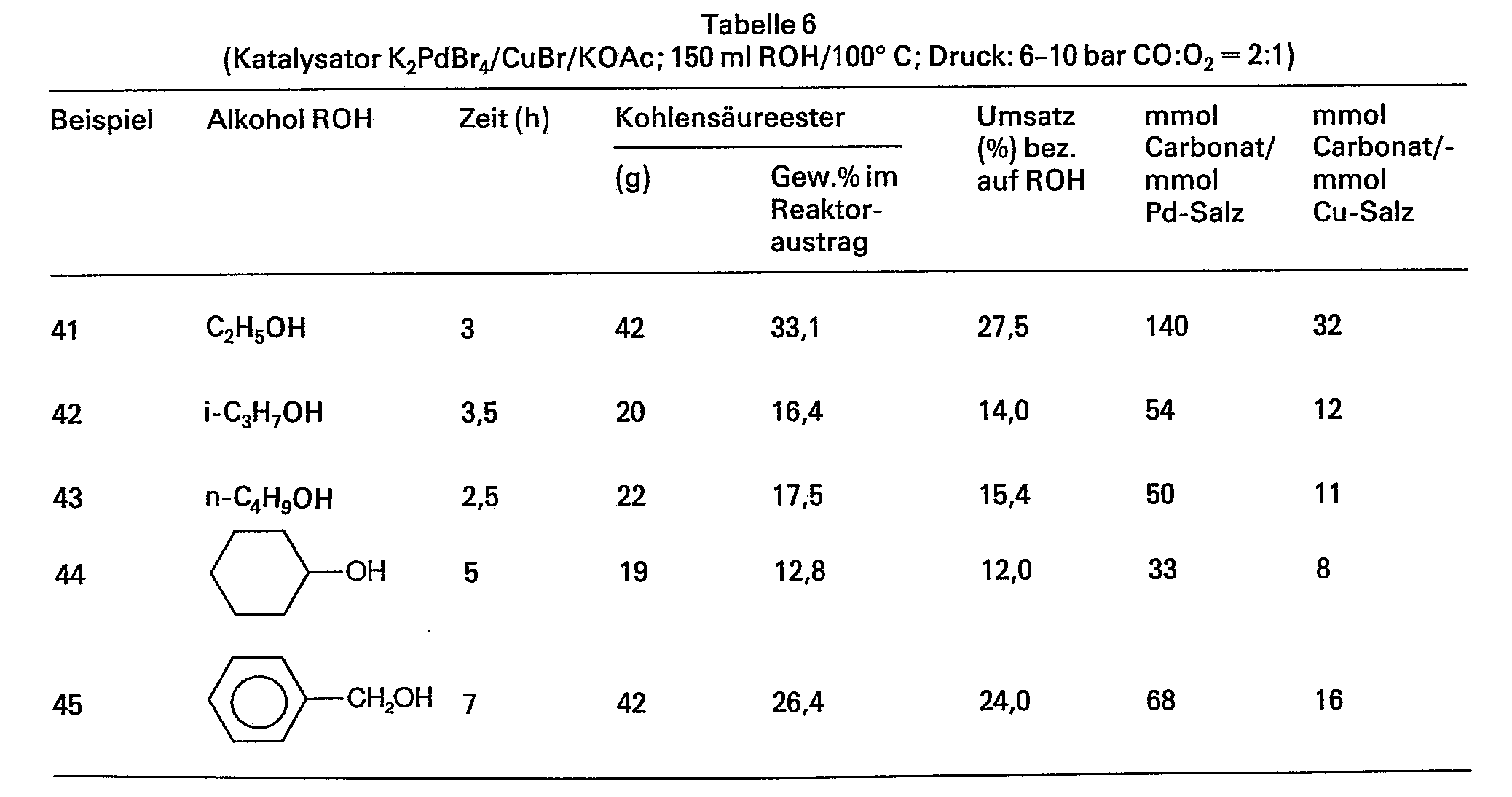
- In einen 21-Glasautoklaven wurden 150 ml Alkohol (s. Tab. 6) und 2,55 mmol K2PdBr, 11,1 mmol CuBr und 15,3 mmol KOAc vorgelegt. Nach Spülung mit N2 wurden bei Raumtemperatur 4 bar CO und 2 bar O2 aufgepresst. Danach wurde auf 100°C erhitzt. Insgesamt wurden dreimal CO und O2 im angegebenen Verhältnis aufgepresst.
- Nach dem Abkühlen und Entspannen wurde der Reaktoraustrag jeweils gaschromatographisch analysiert.
- Ergebnis siehe Tabelle 6.
Claims (13)


Applications Claiming Priority (2)
| Application Number | Priority Date | Filing Date | Title |
|---|---|---|---|
| DE3212535A DE3212535A1 (de) | 1982-04-03 | 1982-04-03 | Verfahren zur herstellung von kohlensaeureestern |
| DE3212535 | 1982-04-03 |
Publications (3)
| Publication Number | Publication Date |
|---|---|
| EP0090977A1 EP0090977A1 (de) | 1983-10-12 |
| EP0090977B1 EP0090977B1 (de) | 1985-07-24 |
| EP0090977B2 true EP0090977B2 (de) | 1988-09-14 |
Family
ID=6160220
Family Applications (1)
| Application Number | Title | Priority Date | Filing Date |
|---|---|---|---|
| EP83102668A Expired EP0090977B2 (de) | 1982-04-03 | 1983-03-18 | Verfahren zur Herstellung von Kohlensäureestern |
Country Status (4)
| Country | Link |
|---|---|
| EP (1) | EP0090977B2 (de) |
| JP (1) | JPS58185542A (de) |
| CA (1) | CA1206974A (de) |
| DE (2) | DE3212535A1 (de) |
Families Citing this family (5)
| Publication number | Priority date | Publication date | Assignee | Title |
|---|---|---|---|---|
| JP2638174B2 (ja) * | 1988-02-16 | 1997-08-06 | ダイセル化学工業株式会社 | 炭酸エステルの製造法 |
| US5258541A (en) * | 1988-02-16 | 1993-11-02 | Daicel Chemical Industries, Ltd. | Process for producing carbonic acid ester |
| DE4203796A1 (de) * | 1992-02-10 | 1993-08-12 | Bayer Ag | Verfahren zur herstellung von dialkylcarbonaten |
| IT1254226B (it) * | 1992-02-26 | 1995-09-14 | Enichem Sintesi | Prodedimento catalitico per la preparazione di carbonati organici |
| DE102010042214A1 (de) * | 2010-10-08 | 2012-04-12 | Bayer Materialscience Aktiengesellschaft | Katalysatorsystem für die oxidative Carbonylierung von Diolen und Polyolen |
Family Cites Families (4)
| Publication number | Priority date | Publication date | Assignee | Title |
|---|---|---|---|---|
| US3114762A (en) * | 1960-10-12 | 1963-12-17 | Nat Distillers Chem Corp | Preparation of carbonates |
| JPS5545655A (en) * | 1978-09-28 | 1980-03-31 | Mitsubishi Chem Ind Ltd | Production of carbonate ester |
| JPS55130939A (en) * | 1979-03-29 | 1980-10-11 | Mitsubishi Chem Ind Ltd | Preparation of carbonic acid ester |
| US4361519A (en) * | 1979-05-14 | 1982-11-30 | General Electric Company | Catalytic aliphatic carbonate process |
-
1982
- 1982-04-03 DE DE3212535A patent/DE3212535A1/de not_active Withdrawn
-
1983
- 1983-03-18 EP EP83102668A patent/EP0090977B2/de not_active Expired
- 1983-03-18 DE DE8383102668T patent/DE3360421D1/de not_active Expired
- 1983-03-31 JP JP58054104A patent/JPS58185542A/ja active Pending
- 1983-04-05 CA CA000425243A patent/CA1206974A/en not_active Expired
Also Published As
| Publication number | Publication date |
|---|---|
| EP0090977A1 (de) | 1983-10-12 |
| EP0090977B1 (de) | 1985-07-24 |
| DE3360421D1 (en) | 1985-08-29 |
| CA1206974A (en) | 1986-07-02 |
| JPS58185542A (ja) | 1983-10-29 |
| DE3212535A1 (de) | 1983-10-13 |
Similar Documents
| Publication | Publication Date | Title |
|---|---|---|
| DE69009393T3 (de) | Verfahren zur Herstellung eines Diesters der Kohlensäure. | |
| EP0038984B1 (de) | Verfahren zur Herstellung von Kohlensäureestern | |
| EP0010295B1 (de) | Verfahren zur Herstellung von Ethanol aus Synthesegas | |
| DE19619949A1 (de) | Verfahren zur Herstellung von Diarylcarbonaten | |
| EP0464460B1 (de) | Verfahren zur Herstellung von Dialkylcarbonaten | |
| EP0304763A1 (de) | Verfahren zur Herstellung von Ethercarbonsäuren | |
| EP0090977B1 (de) | Verfahren zur Herstellung von Kohlensäureestern | |
| DE2630268C2 (de) | Verfahren zur Herstellung von Methacrylsäure oder niedermolekularen Methacrylsäurealkylestern | |
| DE4431233A1 (de) | Verfahren zur Herstellung von Formiatsalzen tertiärer Amine | |
| DE2415742B2 (de) | Verfahren zur Herstellung von Carbonsäureestern | |
| DE69205030T2 (de) | Verfahren zur Herstellung von Diestern der Carbonsäure. | |
| DE3108602C2 (de) | Verfahren zur selektiven Herstellung von eine Perfluorkohlenstoffgruppe enthaltenden Aldehyden | |
| DE2703069C2 (de) | ||
| DD151621A5 (de) | Verfahren zur herstellung von sauerstoffhaltigen kohlenstoffverbindungen und olefinen aus synthesegas | |
| DE2645844C3 (de) | Verfahren zur Herstellung von Oxalsäureestern | |
| EP0538676B1 (de) | Verfahren zur Herstellung von Dialkylcarbonaten | |
| DE2747497C2 (de) | ||
| DE2645845C3 (de) | Verfahren zur Herstellung von Oxalsäureestern | |
| DE69404951T2 (de) | Verwendung von Titania oder Zirconia zur Herstellung von Tertiärbutylalkohol aus Tertiärbutylhydroperoxid | |
| DE3122796C2 (de) | Verfahren zur Herstellung von Carbonsäurealkylestern | |
| EP0675129A1 (de) | Verfahren zur Herstellung von heterosubstituierten Acetalen | |
| DE2201456C3 (de) | Verfahren zur Herstellung von Aldehyden und Diolen | |
| DE2550747B2 (de) | Verfahren zur Herstellung von vicinalen Glykolen und deren Monoessigsäureestern | |
| DE2716170C2 (de) | Verfahren zur Herstellung von Oxalsäuredialkylestern | |
| DE3887779T2 (de) | Verfahren zur Herstellung von Glykolestern. |
Legal Events
| Date | Code | Title | Description |
|---|---|---|---|
| PUAI | Public reference made under article 153(3) epc to a published international application that has entered the european phase |
Free format text: ORIGINAL CODE: 0009012 |
|
| AK | Designated contracting states |
Designated state(s): DE FR GB IT NL |
|
| 17P | Request for examination filed |
Effective date: 19840309 |
|
| ITF | It: translation for a ep patent filed | ||
| GRAA | (expected) grant |
Free format text: ORIGINAL CODE: 0009210 |
|
| AK | Designated contracting states |
Designated state(s): DE FR GB IT NL |
|
| REF | Corresponds to: |
Ref document number: 3360421 Country of ref document: DE Date of ref document: 19850829 |
|
| ET | Fr: translation filed | ||
| PLBI | Opposition filed |
Free format text: ORIGINAL CODE: 0009260 |
|
| 26 | Opposition filed |
Opponent name: BAYER AG, LEVERKUSEN KONZERNVERWALTUNG RP PATENTAB Effective date: 19860404 |
|
| NLR1 | Nl: opposition has been filed with the epo |
Opponent name: BAYER AG, LEVERKUSEN KONZERNVERWALTUNG RP PATENTAB |
|
| PUAH | Patent maintained in amended form |
Free format text: ORIGINAL CODE: 0009272 |
|
| STAA | Information on the status of an ep patent application or granted ep patent |
Free format text: STATUS: PATENT MAINTAINED AS AMENDED |
|
| 27A | Patent maintained in amended form |
Effective date: 19880914 |
|
| AK | Designated contracting states |
Kind code of ref document: B2 Designated state(s): DE FR GB IT NL |
|
| ITF | It: translation for a ep patent filed | ||
| ET3 | Fr: translation filed ** decision concerning opposition | ||
| NLR2 | Nl: decision of opposition | ||
| NLR3 | Nl: receipt of modified translations in the netherlands language after an opposition procedure | ||
| ITPR | It: changes in ownership of a european patent |
Owner name: CESSIONE;ROEHM GMBH |
|
| REG | Reference to a national code |
Ref country code: GB Ref legal event code: 732 |
|
| REG | Reference to a national code |
Ref country code: FR Ref legal event code: TP |
|
| ITTA | It: last paid annual fee | ||
| NLS | Nl: assignments of ep-patents |
Owner name: BAYER AKTIENGESELLSCHAFT TE LEVERKUSEN-BAYERWERK, |
|
| PGFP | Annual fee paid to national office [announced via postgrant information from national office to epo] |
Ref country code: NL Payment date: 19940331 Year of fee payment: 12 |
|
| PG25 | Lapsed in a contracting state [announced via postgrant information from national office to epo] |
Ref country code: NL Effective date: 19951001 |
|
| NLV4 | Nl: lapsed or anulled due to non-payment of the annual fee |
Effective date: 19951001 |
|
| PGFP | Annual fee paid to national office [announced via postgrant information from national office to epo] |
Ref country code: DE Payment date: 19980216 Year of fee payment: 16 |
|
| PGFP | Annual fee paid to national office [announced via postgrant information from national office to epo] |
Ref country code: GB Payment date: 19980312 Year of fee payment: 16 |
|
| PGFP | Annual fee paid to national office [announced via postgrant information from national office to epo] |
Ref country code: FR Payment date: 19980330 Year of fee payment: 16 |
|
| PG25 | Lapsed in a contracting state [announced via postgrant information from national office to epo] |
Ref country code: GB Free format text: LAPSE BECAUSE OF NON-PAYMENT OF DUE FEES Effective date: 19990318 |
|
| GBPC | Gb: european patent ceased through non-payment of renewal fee |
Effective date: 19990318 |
|
| PG25 | Lapsed in a contracting state [announced via postgrant information from national office to epo] |
Ref country code: FR Free format text: LAPSE BECAUSE OF NON-PAYMENT OF DUE FEES Effective date: 19991130 |
|
| REG | Reference to a national code |
Ref country code: FR Ref legal event code: ST |
|
| PG25 | Lapsed in a contracting state [announced via postgrant information from national office to epo] |
Ref country code: DE Free format text: LAPSE BECAUSE OF NON-PAYMENT OF DUE FEES Effective date: 20000101 |