EP1034212B1 - Graft polymeric membranes and ion-exchange membranes formed therefrom - Google Patents
Graft polymeric membranes and ion-exchange membranes formed therefrom Download PDFInfo
- Publication number
- EP1034212B1 EP1034212B1 EP98952479A EP98952479A EP1034212B1 EP 1034212 B1 EP1034212 B1 EP 1034212B1 EP 98952479 A EP98952479 A EP 98952479A EP 98952479 A EP98952479 A EP 98952479A EP 1034212 B1 EP1034212 B1 EP 1034212B1
- Authority
- EP
- European Patent Office
- Prior art keywords
- ion
- group
- exchange
- exchange membrane
- formula
- Prior art date
- Legal status (The legal status is an assumption and is not a legal conclusion. Google has not performed a legal analysis and makes no representation as to the accuracy of the status listed.)
- Expired - Lifetime
Links
Images
Classifications
-
- C—CHEMISTRY; METALLURGY
- C08—ORGANIC MACROMOLECULAR COMPOUNDS; THEIR PREPARATION OR CHEMICAL WORKING-UP; COMPOSITIONS BASED THEREON
- C08J—WORKING-UP; GENERAL PROCESSES OF COMPOUNDING; AFTER-TREATMENT NOT COVERED BY SUBCLASSES C08B, C08C, C08F, C08G or C08H
- C08J7/00—Chemical treatment or coating of shaped articles made of macromolecular substances
- C08J7/12—Chemical modification
- C08J7/16—Chemical modification with polymerisable compounds
-
- C—CHEMISTRY; METALLURGY
- C08—ORGANIC MACROMOLECULAR COMPOUNDS; THEIR PREPARATION OR CHEMICAL WORKING-UP; COMPOSITIONS BASED THEREON
- C08F—MACROMOLECULAR COMPOUNDS OBTAINED BY REACTIONS ONLY INVOLVING CARBON-TO-CARBON UNSATURATED BONDS
- C08F255/00—Macromolecular compounds obtained by polymerising monomers on to polymers of hydrocarbons as defined in group C08F10/00
- C08F255/02—Macromolecular compounds obtained by polymerising monomers on to polymers of hydrocarbons as defined in group C08F10/00 on to polymers of olefins having two or three carbon atoms
-
- C—CHEMISTRY; METALLURGY
- C08—ORGANIC MACROMOLECULAR COMPOUNDS; THEIR PREPARATION OR CHEMICAL WORKING-UP; COMPOSITIONS BASED THEREON
- C08F—MACROMOLECULAR COMPOUNDS OBTAINED BY REACTIONS ONLY INVOLVING CARBON-TO-CARBON UNSATURATED BONDS
- C08F255/00—Macromolecular compounds obtained by polymerising monomers on to polymers of hydrocarbons as defined in group C08F10/00
- C08F255/02—Macromolecular compounds obtained by polymerising monomers on to polymers of hydrocarbons as defined in group C08F10/00 on to polymers of olefins having two or three carbon atoms
- C08F255/023—On to modified polymers, e.g. chlorinated polymers
-
- C—CHEMISTRY; METALLURGY
- C08—ORGANIC MACROMOLECULAR COMPOUNDS; THEIR PREPARATION OR CHEMICAL WORKING-UP; COMPOSITIONS BASED THEREON
- C08F—MACROMOLECULAR COMPOUNDS OBTAINED BY REACTIONS ONLY INVOLVING CARBON-TO-CARBON UNSATURATED BONDS
- C08F259/00—Macromolecular compounds obtained by polymerising monomers on to polymers of halogen containing monomers as defined in group C08F14/00
- C08F259/08—Macromolecular compounds obtained by polymerising monomers on to polymers of halogen containing monomers as defined in group C08F14/00 on to polymers containing fluorine
-
- C—CHEMISTRY; METALLURGY
- C08—ORGANIC MACROMOLECULAR COMPOUNDS; THEIR PREPARATION OR CHEMICAL WORKING-UP; COMPOSITIONS BASED THEREON
- C08F—MACROMOLECULAR COMPOUNDS OBTAINED BY REACTIONS ONLY INVOLVING CARBON-TO-CARBON UNSATURATED BONDS
- C08F291/00—Macromolecular compounds obtained by polymerising monomers on to macromolecular compounds according to more than one of the groups C08F251/00 - C08F289/00
-
- C—CHEMISTRY; METALLURGY
- C08—ORGANIC MACROMOLECULAR COMPOUNDS; THEIR PREPARATION OR CHEMICAL WORKING-UP; COMPOSITIONS BASED THEREON
- C08F—MACROMOLECULAR COMPOUNDS OBTAINED BY REACTIONS ONLY INVOLVING CARBON-TO-CARBON UNSATURATED BONDS
- C08F291/00—Macromolecular compounds obtained by polymerising monomers on to macromolecular compounds according to more than one of the groups C08F251/00 - C08F289/00
- C08F291/18—Macromolecular compounds obtained by polymerising monomers on to macromolecular compounds according to more than one of the groups C08F251/00 - C08F289/00 on to irradiated or oxidised macromolecules
-
- C—CHEMISTRY; METALLURGY
- C08—ORGANIC MACROMOLECULAR COMPOUNDS; THEIR PREPARATION OR CHEMICAL WORKING-UP; COMPOSITIONS BASED THEREON
- C08J—WORKING-UP; GENERAL PROCESSES OF COMPOUNDING; AFTER-TREATMENT NOT COVERED BY SUBCLASSES C08B, C08C, C08F, C08G or C08H
- C08J5/00—Manufacture of articles or shaped materials containing macromolecular substances
- C08J5/20—Manufacture of shaped structures of ion-exchange resins
- C08J5/22—Films, membranes or diaphragms
- C08J5/2206—Films, membranes or diaphragms based on organic and/or inorganic macromolecular compounds
- C08J5/2218—Synthetic macromolecular compounds
- C08J5/2231—Synthetic macromolecular compounds based on macromolecular compounds obtained by reactions involving unsaturated carbon-to-carbon bonds
- C08J5/2237—Synthetic macromolecular compounds based on macromolecular compounds obtained by reactions involving unsaturated carbon-to-carbon bonds containing fluorine
-
- H—ELECTRICITY
- H01—ELECTRIC ELEMENTS
- H01M—PROCESSES OR MEANS, e.g. BATTERIES, FOR THE DIRECT CONVERSION OF CHEMICAL ENERGY INTO ELECTRICAL ENERGY
- H01M8/00—Fuel cells; Manufacture thereof
- H01M8/10—Fuel cells with solid electrolytes
- H01M8/1016—Fuel cells with solid electrolytes characterised by the electrolyte material
- H01M8/1018—Polymeric electrolyte materials
- H01M8/102—Polymeric electrolyte materials characterised by the chemical structure of the main chain of the ion-conducting polymer
- H01M8/1023—Polymeric electrolyte materials characterised by the chemical structure of the main chain of the ion-conducting polymer having only carbon, e.g. polyarylenes, polystyrenes or polybutadiene-styrenes
-
- H—ELECTRICITY
- H01—ELECTRIC ELEMENTS
- H01M—PROCESSES OR MEANS, e.g. BATTERIES, FOR THE DIRECT CONVERSION OF CHEMICAL ENERGY INTO ELECTRICAL ENERGY
- H01M8/00—Fuel cells; Manufacture thereof
- H01M8/10—Fuel cells with solid electrolytes
- H01M8/1016—Fuel cells with solid electrolytes characterised by the electrolyte material
- H01M8/1018—Polymeric electrolyte materials
- H01M8/1039—Polymeric electrolyte materials halogenated, e.g. sulfonated polyvinylidene fluorides
-
- H—ELECTRICITY
- H01—ELECTRIC ELEMENTS
- H01M—PROCESSES OR MEANS, e.g. BATTERIES, FOR THE DIRECT CONVERSION OF CHEMICAL ENERGY INTO ELECTRICAL ENERGY
- H01M8/00—Fuel cells; Manufacture thereof
- H01M8/10—Fuel cells with solid electrolytes
- H01M8/1016—Fuel cells with solid electrolytes characterised by the electrolyte material
- H01M8/1018—Polymeric electrolyte materials
- H01M8/1067—Polymeric electrolyte materials characterised by their physical properties, e.g. porosity, ionic conductivity or thickness
-
- H—ELECTRICITY
- H01—ELECTRIC ELEMENTS
- H01M—PROCESSES OR MEANS, e.g. BATTERIES, FOR THE DIRECT CONVERSION OF CHEMICAL ENERGY INTO ELECTRICAL ENERGY
- H01M8/00—Fuel cells; Manufacture thereof
- H01M8/10—Fuel cells with solid electrolytes
- H01M8/1016—Fuel cells with solid electrolytes characterised by the electrolyte material
- H01M8/1018—Polymeric electrolyte materials
- H01M8/1069—Polymeric electrolyte materials characterised by the manufacturing processes
- H01M8/1072—Polymeric electrolyte materials characterised by the manufacturing processes by chemical reactions, e.g. in situ polymerisation or in situ crosslinking
-
- H—ELECTRICITY
- H01—ELECTRIC ELEMENTS
- H01M—PROCESSES OR MEANS, e.g. BATTERIES, FOR THE DIRECT CONVERSION OF CHEMICAL ENERGY INTO ELECTRICAL ENERGY
- H01M8/00—Fuel cells; Manufacture thereof
- H01M8/10—Fuel cells with solid electrolytes
- H01M8/1016—Fuel cells with solid electrolytes characterised by the electrolyte material
- H01M8/1018—Polymeric electrolyte materials
- H01M8/1069—Polymeric electrolyte materials characterised by the manufacturing processes
- H01M8/1086—After-treatment of the membrane other than by polymerisation
- H01M8/1088—Chemical modification, e.g. sulfonation
-
- C—CHEMISTRY; METALLURGY
- C08—ORGANIC MACROMOLECULAR COMPOUNDS; THEIR PREPARATION OR CHEMICAL WORKING-UP; COMPOSITIONS BASED THEREON
- C08J—WORKING-UP; GENERAL PROCESSES OF COMPOUNDING; AFTER-TREATMENT NOT COVERED BY SUBCLASSES C08B, C08C, C08F, C08G or C08H
- C08J2323/00—Characterised by the use of homopolymers or copolymers of unsaturated aliphatic hydrocarbons having only one carbon-to-carbon double bond; Derivatives of such polymers
- C08J2323/02—Characterised by the use of homopolymers or copolymers of unsaturated aliphatic hydrocarbons having only one carbon-to-carbon double bond; Derivatives of such polymers not modified by chemical after treatment
- C08J2323/04—Homopolymers or copolymers of ethene
- C08J2323/06—Polyethene
-
- C—CHEMISTRY; METALLURGY
- C08—ORGANIC MACROMOLECULAR COMPOUNDS; THEIR PREPARATION OR CHEMICAL WORKING-UP; COMPOSITIONS BASED THEREON
- C08J—WORKING-UP; GENERAL PROCESSES OF COMPOUNDING; AFTER-TREATMENT NOT COVERED BY SUBCLASSES C08B, C08C, C08F, C08G or C08H
- C08J2327/00—Characterised by the use of homopolymers or copolymers of compounds having one or more unsaturated aliphatic radicals, each having only one carbon-to-carbon double bond, and at least one being terminated by a halogen; Derivatives of such polymers
- C08J2327/02—Characterised by the use of homopolymers or copolymers of compounds having one or more unsaturated aliphatic radicals, each having only one carbon-to-carbon double bond, and at least one being terminated by a halogen; Derivatives of such polymers not modified by chemical after-treatment
- C08J2327/12—Characterised by the use of homopolymers or copolymers of compounds having one or more unsaturated aliphatic radicals, each having only one carbon-to-carbon double bond, and at least one being terminated by a halogen; Derivatives of such polymers not modified by chemical after-treatment containing fluorine atoms
- C08J2327/18—Homopolymers or copolymers of tetrafluoroethylene
-
- Y—GENERAL TAGGING OF NEW TECHNOLOGICAL DEVELOPMENTS; GENERAL TAGGING OF CROSS-SECTIONAL TECHNOLOGIES SPANNING OVER SEVERAL SECTIONS OF THE IPC; TECHNICAL SUBJECTS COVERED BY FORMER USPC CROSS-REFERENCE ART COLLECTIONS [XRACs] AND DIGESTS
- Y02—TECHNOLOGIES OR APPLICATIONS FOR MITIGATION OR ADAPTATION AGAINST CLIMATE CHANGE
- Y02E—REDUCTION OF GREENHOUSE GAS [GHG] EMISSIONS, RELATED TO ENERGY GENERATION, TRANSMISSION OR DISTRIBUTION
- Y02E60/00—Enabling technologies; Technologies with a potential or indirect contribution to GHG emissions mitigation
- Y02E60/30—Hydrogen technology
- Y02E60/50—Fuel cells
-
- Y—GENERAL TAGGING OF NEW TECHNOLOGICAL DEVELOPMENTS; GENERAL TAGGING OF CROSS-SECTIONAL TECHNOLOGIES SPANNING OVER SEVERAL SECTIONS OF THE IPC; TECHNICAL SUBJECTS COVERED BY FORMER USPC CROSS-REFERENCE ART COLLECTIONS [XRACs] AND DIGESTS
- Y02—TECHNOLOGIES OR APPLICATIONS FOR MITIGATION OR ADAPTATION AGAINST CLIMATE CHANGE
- Y02P—CLIMATE CHANGE MITIGATION TECHNOLOGIES IN THE PRODUCTION OR PROCESSING OF GOODS
- Y02P70/00—Climate change mitigation technologies in the production process for final industrial or consumer products
- Y02P70/50—Manufacturing or production processes characterised by the final manufactured product
Definitions
- the present invention relates to graft polymeric membranes in which one or more trif-luorovinyl aromatic monomers are radiation graft polymerized to a preformed polymeric base film.
- the resultant membranes are useful in dialysis applications, and particularly in electrochemical applications, for example as membrane electrolytes in electrochemical fuel cells and electrolyzers.
- U.S. Patent No. 4,012,303 reports the radiation grafting of ⁇ , ⁇ , ⁇ -trifluorostyrene (TFS) to polymeric base films using gamma co-irradiation, followed by the introduction of various ion-exchange substituents to the pendant aromatic rings of the grafted chains.
- TFS ⁇ , ⁇ , ⁇ -trifluorostyrene
- undesirable processes such as monomer dimerization and/or independent homopolymerization of the monomer may occur in competition with the desired graft polymerization reaction.
- TFS monomer may be first sulfonated and then grafted to the base film.
- introduction of ion-exchange groups into the membrane can be done as part of the grafting process, or in a second step.
- Aromatic sulfonation, haloalkylation, amination, hydroxylation, carboxylation, phosphonation and phosphoration are among the reactions subsequently used to introduce ion-exchange groups into the grafted polymeric chains. Post-sulfonation rates of 40% to 100% are reported.
- the prior art TFS-based grafted membranes incorporate a maximum of one functional group per monomer unit in the grafted chain. Further, they typically incorporate only one type of functional group as substituents on the pendant aromatic rings in the grafted chains.
- one or more types of substituted TFS monomers are grafted to polymeric base films, the substituents being selected to offer particular advantages, for example:
- trifluorovinyl aromatic or heteroaromatic monomers offering one or more of the above described advantages similarly may be grafted to polymeric base films to give novel graft polymeric membranes.
- Graft polymeric membranes comprise one or more trifluorovinyl aromatic monomers radiation graft polymerized to a preformed polymeric base film.
- a graft polymeric membrane comprises a preformed polymeric base film to which has been graft polymerized a substituted ⁇ , ⁇ , ⁇ -trifluorostyrene monomer selected from the group consisting of monomers of formula (I):
- the group A may be OR, SR, NRR' (where R and R' are independently selected from the group consisting of alkyl, fluoroalkyl and aryl), which are substituents that activate the monomer.
- the monomer of formula (I) may have more than one aromatic ring, for example when A is Ph, OPh, SPh, N(R)Ph (where R is selected from the group consisting of hydrogen, Ph, alkyl and fluoroalkyl), (CH 2 ) n Ph or (CF 2 ) n Ph (where n is an integer greater than zero).
- R is selected from the group consisting of hydrogen, Ph, alkyl and fluoroalkyl
- the groups Ph, OPh, SPh, N(R)Ph are particularly preferred.
- substituents, A which are useful precursors to ion-exchange groups can be advantageously selected, for example, SO 2 X (where X is selected from the group consisting of F, Cl, Br, I), OH, NH 2 , CN, and NO 2 .
- a graft polymeric membrane comprises a preformed polymeric base film to which has been graft polymerized a trifluorovinyl naphthalene monomer selected from the group consisting of monomers of formula (II):
- B may be hydrogen, or may be selected from the preferred substituents described above for A in formula (I).
- trifluorovinyl polyaromatic and heteroaromatic monomers may be advantageously graft polymerized to polymeric base films, as such monomer units provide more sites for subsequent introduction of functional groups, and in many cases, the aromatic rings are electron rich and activated compared to that of TFS.
- the preformed polymeric base film may be grafted with a single monomer whereby the grafted chains are homopolymeric.
- the preformed polymeric base film may be grafted with a mixture of monomers to give grafted chains which are copolymeric.
- the monomer mixture may comprise, or may consist predominantly of, one or more monomers described by the formulae. In some embodiments the mixture may consist of monomers described by the formulae.
- Preferred vinyl monomers for co-grafting with those described by the formulae include styrene and ethylene-based monomers, fluorinated ethylene-based monomers, and other ⁇ , ⁇ , ⁇ -trifluorostyrene monomers.
- one or more monomers of formula (III) may be included in the mixture: where D is selected from the group consisting of hydrogen, halomethyl, perfluoroalkyl, perfluoroalkenyl and fluorine and SO 3 - M + , the latter representing a sulfonic acid salt where M + is a counterion.
- ion-exchange groups may be introduced by the transformation of precursor groups already present as aromatic substituents in the monomers, and/or via post-graft reaction processes.
- the membranes may be subjected to a reaction process selected from the group consisting of sulfonation, phosphonation, phosphorylation, amination, carboxylation, hydroxylation and nitration whereby ion-exchange groups are introduced into pendant aromatic rings of the grafted chains, directly by these reaction processes or via these reaction processes in combination with subsequent steps.
- an ion-exchange membrane comprises a preformed polymeric base film with grafted chains comprising monomer units of formula (IV) : where A is OH, OR, SR or NRR' (where R and R' are independently selected from the group consisting of alkyl, fluoroalkyl and aryl) and at least a portion of the monomer units include at least one ion-exchange substituent on the aromatic ring thereof.
- at least a portion of the monomer units include at least two ion-exchange substituents, which may the same or different from each other, on the aromatic ring thereof. If at least two ion-exchange substituents are present on the ring, A may also be hydrogen.
- A is selected from the group consisting of OR (where R is selected from the group consisting of alkyl and fluoroalkyl), and at least a portion of the monomer units include two SO 3 H substituents on the aromatic ring thereof.
- an ion-exchange membrane comprises a preformed polymeric base film with grafted chains comprising monomer units of formula (IV) where A is (CH 2 ) n Ph and (CF 2 ) n Ph (where n is an integer greater than zero) or more preferably Ph, OPh, SPh or N(R)Ph (where R is selected from the group consisting of hydrogen, Ph, alkyl and fluoroalkyl) and at least a portion of the monomer units include at least one ion-exchange substituent on an aromatic ring thereof.
- at least a portion of the monomer units include at least two ion-exchange substituents which may the same or different from each other. These monomer units have more than one aromatic ring and therefore facilitate the introduction of more than one ion-exchange group per monomer unit.
- A is OPh and at least a portion of the monomer units include two SO 3 H substituents.
- an ion-exchange membrane comprises a preformed polymeric base film with grafted chains comprising monomer units of formula (V) :
- B is selected from the group consisting of hydrogen, OR, SR, NRR' (where R and R' are independently selected from the group consisting of alkyl, fluoroalkyl and aryl), Ph, OPh, SPh, N(R)Ph (where R is selected from the group consisting of hydrogen, Ph, alkyl and fluoroalkyl), (CH 2 ) n Ph and (CF 2 ) n Ph (where n is an integer greater than zero), and at least a portion of the monomer units include at least one ion-exchange substituent on the naphthyl ring structure thereof.
- At least a portion of the monomer units include at least two ion-exchange substituents, which may the same or different from each other, on the naphthyl ring structure thereof. These naphthyl monomer units facilitate the introduction of more than one ion-exchange group per monomer unit.
- the preferred embodiments described above in which at least a portion of the monomer units include at least two ion-exchange substituents enable ion-exchange membranes wherein the grafted chains include an average of greater than one ion-exchange substituent per monomer unit in the grafted chains.
- the grafted chains include an average of greater than one ion-exchange substituent per monomer unit in the grafted chains.
- not every monomer unit in the grafted chains necessarily includes two or even one ion-exchange substituent, but because enough monomer units include two or more ion-exchange substituents, on average the monomer units in the chain include more than one ion-exchange substituent.
- the ion-exchange membranes described above may include more than one different type of ion-exchange group in the grafted chains, for example it is possible to incorporate both anion- and cation-exchange groups.
- the different ion-exchange groups may be introduced in post-grafting reactions, however it is generally more convenient to introduce at least one of them via a precursor substituent present on one of the graft polymerized monomers.
- an ion-exchange membrane comprises a preformed polymeric base film with grafted chains comprising a first monomer unit of formula (VI) : and a second monomer unit of formula (VII): wherein X 1 and X 2 are different ion-exchange groups.
- these substituents may be introduced via precursor groups present in the grafted monomers, or subsequently to the graft polymerization reaction.
- preferred ion-exchange substituents or groups are SO 3 H, PO 2 H 2 , PO 3 H 2 , CH 2 PO 3 H 2 , COOH, OSO 3 H, OPO 2 H 2 , OPO 3 H 2 , NRR'R" + and CH 2 NRR'R” + (where R, R' and R" are independently selected from the group consisting of hydrogen, alkyl, fluoroalkyl and aryl).
- the sulfonic acid substituent SO 3 H is particularly preferred.
- the grafted chains may be homopolymeric or may be copolymeric.
- Copolymeric grafted chains may comprise, or may consist predominantly of, one or more monomer units described by the formulae. In some embodiments, copolymeric grafted chains may consist of a mixture of monomer units described by the formulae.
- the preformed polymeric film or substrate for the grafting reaction is preferably selected so that it imparts mechanical strength to the membrane and will be physically and chemically stable to irradiation and under the conditions to which it is to be exposed in the end-use application for the membrane.
- Suitable materials generally include homopolymers or copolymers of non-fluorinated, fluorinated and perfluorinated vinyl monomers. Fluorinated and perfluorinated polymers are preferred for certain applications due to their enhanced oxidative and thermal stability.
- Suitable materials include, but are not limited to, polyvinylidene fluoride, poly(tetrafluoroethylene-co-perfluorovinylether), poly(tetrafluoroethylene-co-hexafluoropropylene), poly(chlorotrifluoroethylene-co-ethylene), polyethylene and polypropylene, and particularly poly(ethylene-co-tetrafluoroethylene) and polytetrafluoroethylene.
- the polymeric base film may be porous or substantially gas impermeable. Porous base films may be used where the resultant grafted membrane is not required to be gas impermeable, for example, in filtration applications. However, for most electrochemical applications it is preferable that the ion-exchange membranes, and therefore the polymeric base film, be substantially gas impermeable, for example, for use in electrochemical fuel cells. In these or other applications, the ion-exchange membranes may be used in conjunction with one or more electrodes, in some cases in a consolidated electrode apparatus or a membrane electrode assembly.
- the presence of the polymeric base film in the grafted membranes can reduce the water solubility of the membrane as a whole and increase dimensional stability on hydration/dehydration. This is an important advantage of these grafted ion-exchange membranes in applications, such as fuel cells, where high ion-exchange capacity but water insolubility, dimensional stability and low water content are desirable properties. Also, some of the homopolymers and copolymers described herein as grafted chains, would be unlikely to form mechanically stable membranes in isolation. Once again the presence of the base film can impart desirable properties to the grafted membrane. Also, depending on the nature of the preformed polymeric base film and the functionality of the grafted chains, the grafted ion-exchange membranes may reduce reactant crossover in fuel cell applications, for example, in direct methanol fuel cells.
- the properties of the grafted membranes may be modified through varying degrees of crosslinking of the grafted chains by known methods, such as thermolysis, photolysis, plasma treatment and electron beam irradiation processes or the use of crosslinking agents.
- fluoroalkyl means any partially fluorinated or perfluorinated alkyl group
- halomethyl means any partially or fully halogenated methyl group.
- the abbreviation Ph is used to represent a phenyl group.
- any radiation capable of introducing sufficient concentrations of free radical sites on the base polymeric film may be used in the preparation of the grafted polymeric membranes described herein.
- the irradiation may be by gamma-rays, X-rays or electron beam.
- Electron beam irradiation is generally preferable as the process times are short and thus more suited to high volume production processes. The decay of the source and typically longer reactions times required with gamma radiation render it less suitable for high volume manufacturing processes.
- the preformed polymeric base film may be pre-irradiated prior to bringing it into contact with the monomer or monomer mixture to be grafted or the substrate and monomer(s) may be irradiated together (co-irradiation).
- the polymeric base film is treated with the monomer(s) in the liquid phase, either as neat liquids or in a solution. It can be advantageous to select a solvent which will cause the solution to penetrate the base film and cause it to swell. This facilitates grafting of the monomer(s) throughout the membrane thickness.
- the irradiation and grafting process is carried out in an inert atmosphere.
- grafting to a preformed base film is generally more efficient and cost-effective than grafting to a substrate in some other form such as a powder and then forming a membrane from the graft material.
- a 2 mil (approx. 50 ⁇ m) thick, 7 inch x 7 inch (17.78 cm x 17.78 cm) piece of poly(ethylene-co-tetrafluoroethylene) (Tefzel®) film was irradiated with a dose of 5.2 Mrad using a cobalt-60 gamma radiation source, in an inert atmosphere.
- the irradiated base film was kept at -30°C in inert atmosphere prior to use.
- the irradiated membrane was placed in a reactor chamber and treated with neat, freshly distilled p -SO 2 F-TFS (200 g) in an inert atmosphere at 50°C for 50 hours.
- the membrane was removed and washed with heptane.
- the percentage graft which is calculated by expressing the weight increase of the film as a percentage of the weight of the grafted film, was 20%.
- the grafted film was placed in a 33% w/v aqueous solution of potassium hydroxide at 80°C to hydrolyze the sulfonyl fluoride substituents to give a theoretical equivalent weight of approximately 1500 g/mole based on the percentage graft.
- a 2 mil (approx. 50 ⁇ m) thick, 7 inch x 7 inch (17.78 cm x 17.78 cm) film of poly(ethylene-co-tetrafluoroethylene) (Tefzel®) was irradiated, treated with a solution of p-MeO-TFS and sulfonated using a similar procedure to that described in Example 2.
- the resultant ion-exchange membrane had an equivalent weight of 1101 g/mole.
- the membrane prepared as described in Example 3 was bonded to two catalyzed carbon fiber paper electrodes to form a membrane electrode assembly having a total platinum catalyst loading of 8 mg/cm 2 .
- the membrane electrode assembly was tested in a Ballard Mark IV single cell fuel cell. The following operating conditions were used:
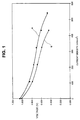
- FIG. 1 shows polarization plots of voltage as a function of current density for the sulfonated grafted membrane employed in a membrane electrode assembly in the electrochemical fuel cell operating on hydrogen-oxygen (plot A) and hydrogen-air (plot B).
- a 2 mil (approx. 50 ⁇ m) thick 8.5 inch x 8.5 inch film of poly(ethylene-co-tetrafluoroethylene) film was irradiated with a dose of 3 Mrad using a high energy electron beam irradiation source, in an inert atmosphere.
- the irradiated base film was kept at -30°C in an inert atmosphere prior to use.
- the irradiated membrane was treated with neat, freshly distilled p-methoxy ⁇ , ⁇ , ⁇ -trifluorostyrene (p-MeO-TFS) in an inert atmosphere at 50°C for 60 hours. The membrane was removed and washed with toluene and then dichloromethane, and then dried under vacuum. The percentage graft was 48%.
- the grafted membrane was sulfonated using a similar procedure to that described in Example 2.
- the resultant ion-exchange membrane had an equivalent weight of 679 g/mole.
- Three membrane electrode assemblies were prepared by bonding a pair of catalyzed carbon fiber paper electrodes to each of three different membranes.
- the three assemblies had similar, but not identical, electrode structures.
- the active area was 49 cm 2 , and a platinum black catalyst was used at the cathode and a platinum/ruthenium catalyst was used at the anode.
- the membrane of Example 5 with a thickness of 50 microns and an equivalent weight of 679 g/mole was used.
- a Nafion® 112 membrane with a thickness of 50 microns and an equivalent weight of 1100 g/mole was used.
- the third assembly employed a Nafion® 117 membrane with a thickness of 175 microns and an equivalent weight of 1100 g/mole.
- Each membrane electrode assembly was tested in a Ballard liquid feed direct methanol fuel cell (0.4M aqueous methanol as fuel, air as oxidant, operating temperature approximately 110°C and reactant pressure approximately 30 psig).
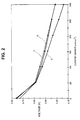
- FIG. 2 shows polarization plots of voltage as a function of current density for the sulfonated grafted membrane (plot C), the Nafion® 112 membrane (plot D) and the Nafion® 117 membrane (plot E) employed in a membrane electrode assembly in the direct methanol fuel cell.
- the performance of the sulfonated grafted membrane is comparable with that of the Nafion® 112 membrane, and is considerably better than that of the thicker Nafion® 117 membrane, especially at higher current densities.
Landscapes
- Chemical & Material Sciences (AREA)
- Chemical Kinetics & Catalysis (AREA)
- Engineering & Computer Science (AREA)
- Manufacturing & Machinery (AREA)
- General Chemical & Material Sciences (AREA)
- Health & Medical Sciences (AREA)
- Medicinal Chemistry (AREA)
- Polymers & Plastics (AREA)
- Organic Chemistry (AREA)
- Sustainable Energy (AREA)
- Sustainable Development (AREA)
- Electrochemistry (AREA)
- Life Sciences & Earth Sciences (AREA)
- Inorganic Chemistry (AREA)
- Materials Engineering (AREA)
- Crystallography & Structural Chemistry (AREA)
- Graft Or Block Polymers (AREA)
- Manufacture Of Macromolecular Shaped Articles (AREA)
- Treatments Of Macromolecular Shaped Articles (AREA)
- Fuel Cell (AREA)
- Conductive Materials (AREA)
Applications Claiming Priority (3)
| Application Number | Priority Date | Filing Date | Title |
|---|---|---|---|
| US967960 | 1978-12-11 | ||
| US08/967,960 US6359019B1 (en) | 1997-11-12 | 1997-11-12 | Graft polymeric membranes and ion-exchange membranes formed therefrom |
| PCT/CA1998/001041 WO1999024497A1 (en) | 1997-11-12 | 1998-11-12 | Graft polymeric membranes and ion-exchange membranes formed therefrom |
Publications (2)
| Publication Number | Publication Date |
|---|---|
| EP1034212A1 EP1034212A1 (en) | 2000-09-13 |
| EP1034212B1 true EP1034212B1 (en) | 2002-02-06 |
Family
ID=25513529
Family Applications (1)
| Application Number | Title | Priority Date | Filing Date |
|---|---|---|---|
| EP98952479A Expired - Lifetime EP1034212B1 (en) | 1997-11-12 | 1998-11-12 | Graft polymeric membranes and ion-exchange membranes formed therefrom |
Country Status (8)
| Country | Link |
|---|---|
| US (1) | US6359019B1 (enExample) |
| EP (1) | EP1034212B1 (enExample) |
| JP (1) | JP2001522914A (enExample) |
| AT (1) | ATE213006T1 (enExample) |
| AU (1) | AU733804B2 (enExample) |
| CA (1) | CA2309631C (enExample) |
| DE (1) | DE69803801T2 (enExample) |
| WO (1) | WO1999024497A1 (enExample) |
Families Citing this family (35)
| Publication number | Priority date | Publication date | Assignee | Title |
|---|---|---|---|---|
| US6723758B2 (en) * | 1997-11-12 | 2004-04-20 | Ballard Power Systems Inc. | Graft polymeric membranes and ion-exchange membranes formed therefrom |
| JP3506213B2 (ja) | 1998-06-22 | 2004-03-15 | 株式会社豊田中央研究所 | 高耐久性固体高分子電解質 |
| US6461791B1 (en) * | 1999-10-13 | 2002-10-08 | Shin-Etsu Chemical Co., Ltd. | Polymers, chemical amplification resist compositions and patterning process |
| JP3708398B2 (ja) * | 1999-10-21 | 2005-10-19 | 株式会社荏原製作所 | 分離機能性材料 |
| WO2001058576A1 (en) * | 2000-02-14 | 2001-08-16 | Ballard Power Systems Inc. | Graft polymeric membranes and ion-exchange membranes formed therefrom |
| EP1303559A4 (en) * | 2000-07-14 | 2004-06-30 | Mimotopes Pty Ltd | ACTIVATED, PROPFCOPOLYMERIZED SURFACES IN MODULAR DESIGN |
| CN1137192C (zh) * | 2001-05-11 | 2004-02-04 | 崔蔚 | 含无机纳米材料的有机复合材料、其制备方法及用途 |
| EP1421125A1 (en) * | 2001-08-27 | 2004-05-26 | Ballard Power Systems Inc. | Process for preparing graft copolymer membranes |
| US20040016693A1 (en) * | 2001-08-27 | 2004-01-29 | Ballard Power Systems Inc. | Process for preparing graft copolymer membranes |
| DE10163518A1 (de) | 2001-12-21 | 2003-07-10 | Fraunhofer Ges Forschung | Protonenleitfähige Membranen/Schichten und Verfahren zu deren Herstellung |
| WO2004042839A2 (en) * | 2002-05-13 | 2004-05-21 | Polyfuel, Inc. | Ion conductive block copolymers |
| US20040018410A1 (en) * | 2002-06-10 | 2004-01-29 | Hongli Dai | Additive for direct methanol fuel cells |
| US7402351B2 (en) * | 2002-06-10 | 2008-07-22 | E.I. Du Pont De Nemours And Company | Carboxylic acid-based ionomer fuel cells |
| US6828386B2 (en) * | 2002-09-20 | 2004-12-07 | Ballard Power Systems Inc. | Process for preparing graft copolymers and membranes formed therefrom |
| US20060135715A1 (en) * | 2003-06-27 | 2006-06-22 | Zhen-Yu Yang | Trifluorostyrene containing compounds, and their use in polymer electrolyte membranes |
| US7557164B2 (en) * | 2003-08-19 | 2009-07-07 | E. I. Du Pont De Nemours And Company | Membranes of fluorinated ionomer blended with nonionomeric fluoropolymers for electrochemical cells |
| JP2007507560A (ja) * | 2003-09-29 | 2007-03-29 | イー・アイ・デュポン・ドウ・ヌムール・アンド・カンパニー | ベースポリマーにグラフト化されたトリフルオロスチレン含有化合物 |
| JP4352878B2 (ja) * | 2003-11-28 | 2009-10-28 | トヨタ自動車株式会社 | モノマー化合物、グラフト共重合化合物、及びそれらの製造方法、高分子電解質膜、並びに燃料電池 |
| DE112004002850T5 (de) * | 2004-05-07 | 2007-04-05 | E.I. Du Pont De Nemours And Company, Wilmington | Beständige Trifluorstyrol enthaltende Verbindungen, die auf Basispolymere aufgepfropft sind, und ihre Verwendung als Polymerelektrolytmembranen |
| DE112004002849T5 (de) * | 2004-05-07 | 2007-04-05 | E.I. Du Pont De Nemours And Co., Wilmington | Stabile Trifluorstyrolverbindungen und ihre Verwendung in Polymerelektrolytmembranen |
| US7606184B2 (en) * | 2005-01-04 | 2009-10-20 | Tdk Corporation | Multiplexers employing bandpass-filter architectures |
| WO2006102671A1 (en) * | 2005-03-24 | 2006-09-28 | E. I. Du Pont De Nemours And Company | Process to prepare stable trifluorostyrene containing compounds grafted to base polymers using a solvent/water mixture |
| WO2006102672A1 (en) * | 2005-03-24 | 2006-09-28 | E. I. Du Pont De Nemours And Company | Process to prepare stable trifluorostyrene containing compounds grafted to base polymers using an alcohol/water mixture |
| US20060264576A1 (en) * | 2005-03-24 | 2006-11-23 | Roelofs Mark G | Process to prepare stable trifluorostyrene containing compounds grafted to base polymers |
| JP2006351244A (ja) * | 2005-06-13 | 2006-12-28 | Shin Etsu Chem Co Ltd | 固体高分子電解質膜及びその製造方法、並びに燃料電池 |
| GB0701449D0 (en) * | 2007-01-26 | 2007-03-07 | Secr Defence | Anion Exchange Membranes |
| US20080217182A1 (en) * | 2007-03-08 | 2008-09-11 | E. I. Dupont De Nemours And Company | Electroplating process |
| FR2921517B1 (fr) * | 2007-09-26 | 2010-12-03 | Commissariat Energie Atomique | Membranes conductrices de protons pour pile a combustible presentant un gradient de protons et procedes de preparation desdites membranes |
| JP2008135399A (ja) * | 2008-01-07 | 2008-06-12 | Ube Ind Ltd | 電解質膜−電極接合体、燃料電池および電解質膜−電極接合体の製造方法 |
| US20110045381A1 (en) * | 2009-08-18 | 2011-02-24 | Gm Global Technology Operations, Inc. | Hydrocarbon PEM Membranes with Perfluorosulfonic Acid Groups for Automotive Fuel Cells |
| KR102093443B1 (ko) | 2012-11-29 | 2020-03-25 | 삼성전자주식회사 | 전기 흡착 탈이온 장치 및 이를 사용한 유체 처리 방법 |
| KR102092941B1 (ko) | 2013-06-12 | 2020-03-24 | 삼성전자주식회사 | 전기 흡착 탈이온 장치 및 이를 사용한 유체 처리 방법 |
| KR102212322B1 (ko) | 2013-12-24 | 2021-02-03 | 삼성전자주식회사 | 전기 흡착 탈이온 전극, 그 제조 방법 및 이를 포함한 전기흡착 탈이온 장치 |
| KR101975149B1 (ko) | 2017-09-14 | 2019-05-03 | 스미또모 가가꾸 가부시키가이샤 | 비수 전해액 이차 전지용 세퍼레이터 |
| DE102018131928A1 (de) * | 2018-12-12 | 2020-06-18 | Carl Freudenberg Kg | Separator für elektrochemische Energiespeicher und Wandler |
Family Cites Families (16)
| Publication number | Priority date | Publication date | Assignee | Title |
|---|---|---|---|---|
| US3341366A (en) * | 1964-08-19 | 1967-09-12 | Gen Electric | Sulfonated polymers of alpha, beta, beta-trifluorostyrene, with applications to structures and cells |
| US4169023A (en) | 1974-02-04 | 1979-09-25 | Tokuyama Soda Kabushiki Kaisha | Electrolytic diaphragms, and method of electrolysis using the same |
| US4012303A (en) * | 1974-12-23 | 1977-03-15 | Hooker Chemicals & Plastics Corporation | Trifluorostyrene sulfonic acid membranes |
| US4113922A (en) | 1974-12-23 | 1978-09-12 | Hooker Chemicals & Plastics Corp. | Trifluorostyrene sulfonic acid membranes |
| US4024043A (en) * | 1975-12-31 | 1977-05-17 | Allied Chemical Corporation | Single film, high performance bipolar membrane |
| US4262041A (en) * | 1978-02-02 | 1981-04-14 | Kanegafuchi Kagaku Kogyo Kabushiki Kaisha | Process for preparing a composite amphoteric ion exchange membrane |
| NO843527L (no) | 1983-09-06 | 1985-03-07 | Chlorine Eng Corp Ltd | Fremgangsmaate for fremstilling av en membran av podepolymer |
| US5049253A (en) * | 1988-12-16 | 1991-09-17 | Tokuyama Soda Kabushiki Kaisha | Electrode apparatus for dialysis |
| US5140074A (en) * | 1990-01-26 | 1992-08-18 | Himont Incorporated | Method of producing olefin polymer graft copolymers |
| NL9201564A (nl) * | 1992-09-09 | 1994-04-05 | Dsm Nv | Thermoplastische polymeersamenstelling. |
| US5602185A (en) * | 1993-09-21 | 1997-02-11 | Ballard Power Systems Inc. | Substituted trifluorostyrene compositions |
| US5834523A (en) * | 1993-09-21 | 1998-11-10 | Ballard Power Systems, Inc. | Substituted α,β,β-trifluorostyrene-based composite membranes |
| US5422411A (en) | 1993-09-21 | 1995-06-06 | Ballard Power Systems Inc. | Trifluorostyrene and substituted trifluorostyrene copolymeric compositions and ion-exchange membranes formed therefrom |
| US5777038A (en) * | 1994-11-15 | 1998-07-07 | Sunstar Giken Kabushiki Kaisha | High dielectric graft copolymer |
| JPH09102322A (ja) | 1995-07-31 | 1997-04-15 | Imura Zairyo Kaihatsu Kenkyusho:Kk | 燃料電池用の固体高分子電解質膜およびその製造方法 |
| US5863994A (en) * | 1997-09-29 | 1999-01-26 | Montell North America Inc. | Using nitric oxide to reduce reactor fouling during polypropylene graft copolymerization |
-
1997
- 1997-11-12 US US08/967,960 patent/US6359019B1/en not_active Expired - Fee Related
-
1998
- 1998-11-12 CA CA002309631A patent/CA2309631C/en not_active Expired - Fee Related
- 1998-11-12 JP JP2000520500A patent/JP2001522914A/ja active Pending
- 1998-11-12 WO PCT/CA1998/001041 patent/WO1999024497A1/en not_active Ceased
- 1998-11-12 AU AU10176/99A patent/AU733804B2/en not_active Ceased
- 1998-11-12 EP EP98952479A patent/EP1034212B1/en not_active Expired - Lifetime
- 1998-11-12 AT AT98952479T patent/ATE213006T1/de not_active IP Right Cessation
- 1998-11-12 DE DE69803801T patent/DE69803801T2/de not_active Expired - Fee Related
Also Published As
| Publication number | Publication date |
|---|---|
| CA2309631A1 (en) | 1999-05-20 |
| ATE213006T1 (de) | 2002-02-15 |
| AU733804B2 (en) | 2001-05-24 |
| DE69803801D1 (de) | 2002-03-21 |
| US6359019B1 (en) | 2002-03-19 |
| DE69803801T2 (de) | 2002-06-20 |
| EP1034212A1 (en) | 2000-09-13 |
| WO1999024497A1 (en) | 1999-05-20 |
| CA2309631C (en) | 2004-01-20 |
| JP2001522914A (ja) | 2001-11-20 |
| AU1017699A (en) | 1999-05-31 |
Similar Documents
| Publication | Publication Date | Title |
|---|---|---|
| EP1034212B1 (en) | Graft polymeric membranes and ion-exchange membranes formed therefrom | |
| US5834523A (en) | Substituted α,β,β-trifluorostyrene-based composite membranes | |
| US5656386A (en) | Electrochemical cell with a polymer electrolyte and process for producing these polymer electrolytes | |
| US6723758B2 (en) | Graft polymeric membranes and ion-exchange membranes formed therefrom | |
| US5994426A (en) | Solid-polymer-electrolyte membrane for fuel cell and process for producing the same | |
| FI68067C (fi) | Katjonbytarharts dess framstaellning och anvaendning | |
| AU674328B2 (en) | Polymers of haloperfluoro and perfluoro ethers | |
| US7285612B2 (en) | Partially fluorinated copolymer based on trifluorostyrene and substituted vinyl compound and ionic conductive polymer membrane formed therefrom | |
| KR20070072530A (ko) | 전해질 재료, 전해질 막 및 고체 고분자형 연료 전지용막전극 접합체 | |
| US20080199756A1 (en) | Polymer electrolyte membranes comprising alkyl graft chains and a process for producing the same | |
| CA2398836C (en) | Graft polymeric membranes and ion-exchange membranes formed therefrom | |
| Nasef | Radiation Grafted Ion Conducting Membranes for Electrochemical Energy Systems: Status of Developmental and Upscaled Membranes | |
| JPS60110711A (ja) | グラフト重合膜の製造方法 | |
| CN117397071A (zh) | 质子交换膜状物 |
Legal Events
| Date | Code | Title | Description |
|---|---|---|---|
| PUAI | Public reference made under article 153(3) epc to a published international application that has entered the european phase |
Free format text: ORIGINAL CODE: 0009012 |
|
| 17P | Request for examination filed |
Effective date: 20000606 |
|
| AK | Designated contracting states |
Kind code of ref document: A1 Designated state(s): AT BE CH CY DE DK ES FI FR GB GR IE IT LI LU MC NL PT SE |
|
| GRAG | Despatch of communication of intention to grant |
Free format text: ORIGINAL CODE: EPIDOS AGRA |
|
| 17Q | First examination report despatched |
Effective date: 20010330 |
|
| GRAG | Despatch of communication of intention to grant |
Free format text: ORIGINAL CODE: EPIDOS AGRA |
|
| GRAH | Despatch of communication of intention to grant a patent |
Free format text: ORIGINAL CODE: EPIDOS IGRA |
|
| GRAH | Despatch of communication of intention to grant a patent |
Free format text: ORIGINAL CODE: EPIDOS IGRA |
|
| GRAA | (expected) grant |
Free format text: ORIGINAL CODE: 0009210 |
|
| REG | Reference to a national code |
Ref country code: GB Ref legal event code: IF02 |
|
| AK | Designated contracting states |
Kind code of ref document: B1 Designated state(s): AT BE CH CY DE DK ES FI FR GB GR IE IT LI LU MC NL PT SE |
|
| PG25 | Lapsed in a contracting state [announced via postgrant information from national office to epo] |
Ref country code: LI Free format text: LAPSE BECAUSE OF FAILURE TO SUBMIT A TRANSLATION OF THE DESCRIPTION OR TO PAY THE FEE WITHIN THE PRESCRIBED TIME-LIMIT Effective date: 20020206 Ref country code: IT Free format text: LAPSE BECAUSE OF FAILURE TO SUBMIT A TRANSLATION OF THE DESCRIPTION OR TO PAY THE FEE WITHIN THE PRESCRIBED TIME-LIMIT;WARNING: LAPSES OF ITALIAN PATENTS WITH EFFECTIVE DATE BEFORE 2007 MAY HAVE OCCURRED AT ANY TIME BEFORE 2007. THE CORRECT EFFECTIVE DATE MAY BE DIFFERENT FROM THE ONE RECORDED. Effective date: 20020206 Ref country code: GR Free format text: LAPSE BECAUSE OF FAILURE TO SUBMIT A TRANSLATION OF THE DESCRIPTION OR TO PAY THE FEE WITHIN THE PRESCRIBED TIME-LIMIT Effective date: 20020206 Ref country code: FR Free format text: LAPSE BECAUSE OF FAILURE TO SUBMIT A TRANSLATION OF THE DESCRIPTION OR TO PAY THE FEE WITHIN THE PRESCRIBED TIME-LIMIT Effective date: 20020206 Ref country code: FI Free format text: LAPSE BECAUSE OF FAILURE TO SUBMIT A TRANSLATION OF THE DESCRIPTION OR TO PAY THE FEE WITHIN THE PRESCRIBED TIME-LIMIT Effective date: 20020206 Ref country code: CH Free format text: LAPSE BECAUSE OF FAILURE TO SUBMIT A TRANSLATION OF THE DESCRIPTION OR TO PAY THE FEE WITHIN THE PRESCRIBED TIME-LIMIT Effective date: 20020206 Ref country code: BE Free format text: LAPSE BECAUSE OF FAILURE TO SUBMIT A TRANSLATION OF THE DESCRIPTION OR TO PAY THE FEE WITHIN THE PRESCRIBED TIME-LIMIT Effective date: 20020206 Ref country code: AT Free format text: LAPSE BECAUSE OF FAILURE TO SUBMIT A TRANSLATION OF THE DESCRIPTION OR TO PAY THE FEE WITHIN THE PRESCRIBED TIME-LIMIT Effective date: 20020206 |
|
| REF | Corresponds to: |
Ref document number: 213006 Country of ref document: AT Date of ref document: 20020215 Kind code of ref document: T |
|
| REG | Reference to a national code |
Ref country code: CH Ref legal event code: EP |
|
| REF | Corresponds to: |
Ref document number: 69803801 Country of ref document: DE Date of ref document: 20020321 |
|
| PG25 | Lapsed in a contracting state [announced via postgrant information from national office to epo] |
Ref country code: SE Free format text: LAPSE BECAUSE OF FAILURE TO SUBMIT A TRANSLATION OF THE DESCRIPTION OR TO PAY THE FEE WITHIN THE PRESCRIBED TIME-LIMIT Effective date: 20020506 Ref country code: PT Free format text: LAPSE BECAUSE OF FAILURE TO SUBMIT A TRANSLATION OF THE DESCRIPTION OR TO PAY THE FEE WITHIN THE PRESCRIBED TIME-LIMIT Effective date: 20020506 Ref country code: DK Free format text: LAPSE BECAUSE OF FAILURE TO SUBMIT A TRANSLATION OF THE DESCRIPTION OR TO PAY THE FEE WITHIN THE PRESCRIBED TIME-LIMIT Effective date: 20020506 |
|
| REG | Reference to a national code |
Ref country code: CH Ref legal event code: PL |
|
| PG25 | Lapsed in a contracting state [announced via postgrant information from national office to epo] |
Ref country code: ES Free format text: LAPSE BECAUSE OF FAILURE TO SUBMIT A TRANSLATION OF THE DESCRIPTION OR TO PAY THE FEE WITHIN THE PRESCRIBED TIME-LIMIT Effective date: 20020829 |
|
| PG25 | Lapsed in a contracting state [announced via postgrant information from national office to epo] |
Ref country code: LU Free format text: LAPSE BECAUSE OF NON-PAYMENT OF DUE FEES Effective date: 20021112 Ref country code: IE Free format text: LAPSE BECAUSE OF NON-PAYMENT OF DUE FEES Effective date: 20021112 |
|
| EN | Fr: translation not filed | ||
| PG25 | Lapsed in a contracting state [announced via postgrant information from national office to epo] |
Ref country code: CY Free format text: LAPSE BECAUSE OF FAILURE TO SUBMIT A TRANSLATION OF THE DESCRIPTION OR TO PAY THE FEE WITHIN THE PRESCRIBED TIME-LIMIT Effective date: 20021130 |
|
| PLBE | No opposition filed within time limit |
Free format text: ORIGINAL CODE: 0009261 |
|
| STAA | Information on the status of an ep patent application or granted ep patent |
Free format text: STATUS: NO OPPOSITION FILED WITHIN TIME LIMIT |
|
| 26N | No opposition filed |
Effective date: 20021107 |
|
| PG25 | Lapsed in a contracting state [announced via postgrant information from national office to epo] |
Ref country code: MC Free format text: LAPSE BECAUSE OF NON-PAYMENT OF DUE FEES Effective date: 20030601 |
|
| REG | Reference to a national code |
Ref country code: IE Ref legal event code: MM4A |
|
| PGFP | Annual fee paid to national office [announced via postgrant information from national office to epo] |
Ref country code: NL Payment date: 20071104 Year of fee payment: 10 Ref country code: DE Payment date: 20071108 Year of fee payment: 10 |
|
| PGFP | Annual fee paid to national office [announced via postgrant information from national office to epo] |
Ref country code: GB Payment date: 20071107 Year of fee payment: 10 |
|
| GBPC | Gb: european patent ceased through non-payment of renewal fee |
Effective date: 20081112 |
|
| PG25 | Lapsed in a contracting state [announced via postgrant information from national office to epo] |
Ref country code: NL Free format text: LAPSE BECAUSE OF NON-PAYMENT OF DUE FEES Effective date: 20090601 |
|
| NLV4 | Nl: lapsed or anulled due to non-payment of the annual fee |
Effective date: 20090601 |
|
| PG25 | Lapsed in a contracting state [announced via postgrant information from national office to epo] |
Ref country code: DE Free format text: LAPSE BECAUSE OF NON-PAYMENT OF DUE FEES Effective date: 20090603 |
|
| PG25 | Lapsed in a contracting state [announced via postgrant information from national office to epo] |
Ref country code: GB Free format text: LAPSE BECAUSE OF NON-PAYMENT OF DUE FEES Effective date: 20081112 |