EP1032928B1 - Verfahren und vorrichtung zum signalisieren von lokalen verkehrsstörungen - Google Patents
Verfahren und vorrichtung zum signalisieren von lokalen verkehrsstörungen Download PDFInfo
- Publication number
- EP1032928B1 EP1032928B1 EP98963454A EP98963454A EP1032928B1 EP 1032928 B1 EP1032928 B1 EP 1032928B1 EP 98963454 A EP98963454 A EP 98963454A EP 98963454 A EP98963454 A EP 98963454A EP 1032928 B1 EP1032928 B1 EP 1032928B1
- Authority
- EP
- European Patent Office
- Prior art keywords
- vehicle
- group
- vehicles
- objects
- data
- Prior art date
- Legal status (The legal status is an assumption and is not a legal conclusion. Google has not performed a legal analysis and makes no representation as to the accuracy of the status listed.)
- Expired - Lifetime
Links
- 238000000034 method Methods 0.000 title claims description 41
- 230000011664 signaling Effects 0.000 title claims description 19
- 230000001934 delay Effects 0.000 title 1
- 230000006399 behavior Effects 0.000 claims description 21
- 238000001514 detection method Methods 0.000 claims description 16
- 230000001133 acceleration Effects 0.000 claims description 11
- 238000012986 modification Methods 0.000 claims description 8
- 230000004048 modification Effects 0.000 claims description 8
- 238000011156 evaluation Methods 0.000 claims description 6
- 230000015654 memory Effects 0.000 claims description 6
- 230000000875 corresponding effect Effects 0.000 claims 6
- 230000004075 alteration Effects 0.000 claims 2
- 230000005540 biological transmission Effects 0.000 description 11
- 230000008569 process Effects 0.000 description 9
- 241001136792 Alle Species 0.000 description 8
- 238000004458 analytical method Methods 0.000 description 5
- 230000006870 function Effects 0.000 description 4
- 238000012731 temporal analysis Methods 0.000 description 4
- 230000001154 acute effect Effects 0.000 description 3
- 238000013459 approach Methods 0.000 description 3
- 238000004891 communication Methods 0.000 description 3
- 238000002955 isolation Methods 0.000 description 3
- 230000033001 locomotion Effects 0.000 description 3
- 230000015572 biosynthetic process Effects 0.000 description 2
- 230000008859 change Effects 0.000 description 2
- 230000001419 dependent effect Effects 0.000 description 2
- 238000010586 diagram Methods 0.000 description 2
- 230000009429 distress Effects 0.000 description 2
- 230000000694 effects Effects 0.000 description 2
- 230000004927 fusion Effects 0.000 description 2
- 230000000670 limiting effect Effects 0.000 description 2
- 230000013011 mating Effects 0.000 description 2
- 230000035772 mutation Effects 0.000 description 2
- 230000010363 phase shift Effects 0.000 description 2
- 230000002829 reductive effect Effects 0.000 description 2
- 230000011218 segmentation Effects 0.000 description 2
- 238000012549 training Methods 0.000 description 2
- 230000000007 visual effect Effects 0.000 description 2
- 238000012935 Averaging Methods 0.000 description 1
- 230000008901 benefit Effects 0.000 description 1
- 230000008094 contradictory effect Effects 0.000 description 1
- 238000011161 development Methods 0.000 description 1
- 230000018109 developmental process Effects 0.000 description 1
- 238000004090 dissolution Methods 0.000 description 1
- 230000007613 environmental effect Effects 0.000 description 1
- 230000002068 genetic effect Effects 0.000 description 1
- 238000009434 installation Methods 0.000 description 1
- 230000007787 long-term memory Effects 0.000 description 1
- 230000007246 mechanism Effects 0.000 description 1
- 238000002156 mixing Methods 0.000 description 1
- 238000005457 optimization Methods 0.000 description 1
- 230000036961 partial effect Effects 0.000 description 1
- 230000008707 rearrangement Effects 0.000 description 1
- 230000003068 static effect Effects 0.000 description 1
- 230000001360 synchronised effect Effects 0.000 description 1
- 230000008685 targeting Effects 0.000 description 1
- 238000012360 testing method Methods 0.000 description 1
- 238000012546 transfer Methods 0.000 description 1
Images

Classifications
-
- G—PHYSICS
- G08—SIGNALLING
- G08G—TRAFFIC CONTROL SYSTEMS
- G08G1/00—Traffic control systems for road vehicles
- G08G1/16—Anti-collision systems
- G08G1/161—Decentralised systems, e.g. inter-vehicle communication
- G08G1/163—Decentralised systems, e.g. inter-vehicle communication involving continuous checking
-
- G—PHYSICS
- G08—SIGNALLING
- G08G—TRAFFIC CONTROL SYSTEMS
- G08G1/00—Traffic control systems for road vehicles
- G08G1/09—Arrangements for giving variable traffic instructions
- G08G1/0962—Arrangements for giving variable traffic instructions having an indicator mounted inside the vehicle, e.g. giving voice messages
- G08G1/0967—Systems involving transmission of highway information, e.g. weather, speed limits
- G08G1/096708—Systems involving transmission of highway information, e.g. weather, speed limits where the received information might be used to generate an automatic action on the vehicle control
- G08G1/096716—Systems involving transmission of highway information, e.g. weather, speed limits where the received information might be used to generate an automatic action on the vehicle control where the received information does not generate an automatic action on the vehicle control
-
- G—PHYSICS
- G08—SIGNALLING
- G08G—TRAFFIC CONTROL SYSTEMS
- G08G1/00—Traffic control systems for road vehicles
- G08G1/09—Arrangements for giving variable traffic instructions
- G08G1/0962—Arrangements for giving variable traffic instructions having an indicator mounted inside the vehicle, e.g. giving voice messages
- G08G1/0967—Systems involving transmission of highway information, e.g. weather, speed limits
- G08G1/096708—Systems involving transmission of highway information, e.g. weather, speed limits where the received information might be used to generate an automatic action on the vehicle control
- G08G1/096725—Systems involving transmission of highway information, e.g. weather, speed limits where the received information might be used to generate an automatic action on the vehicle control where the received information generates an automatic action on the vehicle control
-
- G—PHYSICS
- G08—SIGNALLING
- G08G—TRAFFIC CONTROL SYSTEMS
- G08G1/00—Traffic control systems for road vehicles
- G08G1/09—Arrangements for giving variable traffic instructions
- G08G1/0962—Arrangements for giving variable traffic instructions having an indicator mounted inside the vehicle, e.g. giving voice messages
- G08G1/0967—Systems involving transmission of highway information, e.g. weather, speed limits
- G08G1/096733—Systems involving transmission of highway information, e.g. weather, speed limits where a selection of the information might take place
- G08G1/096758—Systems involving transmission of highway information, e.g. weather, speed limits where a selection of the information might take place where no selection takes place on the transmitted or the received information
-
- G—PHYSICS
- G08—SIGNALLING
- G08G—TRAFFIC CONTROL SYSTEMS
- G08G1/00—Traffic control systems for road vehicles
- G08G1/09—Arrangements for giving variable traffic instructions
- G08G1/0962—Arrangements for giving variable traffic instructions having an indicator mounted inside the vehicle, e.g. giving voice messages
- G08G1/0967—Systems involving transmission of highway information, e.g. weather, speed limits
- G08G1/096766—Systems involving transmission of highway information, e.g. weather, speed limits where the system is characterised by the origin of the information transmission
- G08G1/096775—Systems involving transmission of highway information, e.g. weather, speed limits where the system is characterised by the origin of the information transmission where the origin of the information is a central station
-
- G—PHYSICS
- G08—SIGNALLING
- G08G—TRAFFIC CONTROL SYSTEMS
- G08G1/00—Traffic control systems for road vehicles
- G08G1/09—Arrangements for giving variable traffic instructions
- G08G1/0962—Arrangements for giving variable traffic instructions having an indicator mounted inside the vehicle, e.g. giving voice messages
- G08G1/0967—Systems involving transmission of highway information, e.g. weather, speed limits
- G08G1/096766—Systems involving transmission of highway information, e.g. weather, speed limits where the system is characterised by the origin of the information transmission
- G08G1/096791—Systems involving transmission of highway information, e.g. weather, speed limits where the system is characterised by the origin of the information transmission where the origin of the information is another vehicle
Definitions
- the invention relates to a method and a Device for signaling local traffic disruptions and in particular to a method and an apparatus for Detect and display accidents and increased traffic and congestion caused by it.
- Traffic volumes have already become conventional traffic management systems along particularly heavy traffic sections, such as busy motorways etc., permanently installed.
- Such conventional fixed installed Traffic control systems have a variety of detection devices, for example the traffic density, the speed of the motor vehicle current, the Record environmental conditions (temperature, fog) etc. and motor vehicle traffic based on the respective detection signals along the predetermined section over scoreboards control such that a traffic jam or accidents be prevented as far as possible.
- a disadvantage of such conventional traffic control systems is the fixed installation along a predetermined Route section, which is extremely high Acquisition costs result. It also has a such a permanently installed traffic control system only one low flexibility, since it is only the traffic in regulates or directs relatively short sections.
- US 4,706,086 suggests a communication system between a variety of motor vehicles before, with signals and information accordingly the respective driving conditions of the motor vehicle a transmitting / receiving device by means of electromagnetic Radio waves is transmitted.
- US-A-5,426,544 is a Device and method for signaling local Known traffic disruptions in which the vehicle data or states of the motor vehicle, such as the speed, the route and direction, via communication facilities be transferred to each other. The transfer the respective data on another motor vehicle is done in an indirect way via an oncoming Motor vehicle. It also needs this conventional traffic information system a navigation module, a map module and an own position determination device to identify your own position.
- this conventional traffic information system a navigation module, a map module and an own position determination device to identify your own position.
- such conventional communication systems have the disadvantage that they are unconditionally a variety of need expensive items such as a map memory, a navigation module and a positioning module to recognize your own position.
- EP-A-0 715 286 describes a method for signaling of local traffic disruptions according to the generic term of claim 1 and a device for signaling of local traffic disruptions according to the generic term of Claim 10 known.
- the invention has for its object a method and a device for signaling local To create traffic disruptions that are relatively inexpensive is to produce, has a high flexibility and independent of permanently installed detection devices is.
- the relevant ones are preferably determined Group of vehicles using a fractal method Darwinian object creation, whereby an order or Sequence within a group of vehicles continuously by looking at the respective vehicle data and subsequent weighting of a possible position probability is produced. This can already be done by a minimal number of vehicle data accurate positioning or order of respective vehicles within a group can be determined without using expensive systems to use for positioning.
- a maximum group to be considered in each case can in particular by a maximum reception range of a receiving device result. However, you can also by a maximum Storage capacity must be set.
- An identification code is preferably used as vehicle data to identify a particular vehicle Speed value for specifying an instantaneous speed of the vehicle and a distance parameter used.
- the one distance between the reference vehicle and the respective vehicles from the maximum group to be considered Distance parameters can, for example, from the reception field strength derived from the respectively transmitted radio signal become.
- a deceleration / acceleration value for example, are further vehicle data to indicate an instantaneous Deceleration / acceleration of the respective vehicle, a steering lock angle for specifying an instantaneous Steering lock of the respective vehicle Directional value for specifying an instantaneous absolute Direction, a position value to indicate an instantaneous absolute position of each vehicle, and a Brake signal value to indicate current use a braking device of the respective vehicle is conceivable.
- a group behavior value can also be used as the vehicle date be forwarded, the current Group behavior of one belonging to the reference vehicle relevant group.
- the information signaled in the reference vehicle can Both visible and audible via a display device be made. But it can also lead directly to one Control the braking behavior of the reference vehicle or affect the engine control, which for example automatic full braking can be realized can.
- an emergency signal be generated compared to the individual vehicle data signals enjoys increased priority. This can, for example if an acute danger occurs this state to groups from Vehicles are passed on, which makes them special rapid spread of information results.
- an emergency signal is then only passed on to a greater extent (Repeater function) if its reception field strength is below one predetermined threshold falls.
- FIG. 1 shows a schematic illustration of a traffic situation, like for example on a country road can occur.
- the reference symbol denotes 0 is a reference vehicle, while reference numerals 1 to 4 Display vehicles in a preceding column.
- the Vehicles 0 to 4 each have transmitting / receiving devices, with which they can create their individual Send motion states or vehicle data or that of received vehicle data sent to the other vehicles.
- the transmission / reception device of the reference vehicle 0 is taken into account, taking particular care of their received data is turned off. It is assumed that the reference vehicle 0 at a certain distance behind the vehicle column from vehicles 1 to 4, but due to a road layout, for example through a forest, has no visual contact with the column.
- the transmitted vehicle data signals have an identification code as the minimum vehicle data IC that identifies a particular vehicle, and a speed value v representing the current speed of the respective vehicle.
- the reference vehicle receives 0 a variety of vehicle data from the column in front of him or relevant group of vehicles.
- Via an evaluation device the vehicle data of the relevant Vehicles evaluated and with the vehicle data of the reference vehicle 0 compared or related to each other.
- the generation of a signal in the reference vehicle 0 the for example from a visible or audible display may exist to reduce speed.
- the visual contact to a relevant group of vehicles at an early stage Warning is given, causing accidents in a safe manner be avoided.
- the generated signal value cannot only be an audible one or cause visible display in the reference vehicle 0, but also automatic braking or acceleration cause.
- Vehicle data are recorded and transmitted.
- vehicle data are, for example, a deceleration value or acceleration value v, an instantaneous delay or acceleration of a particular vehicle Steering angle ⁇ , which is an instantaneous steering angle of the respective vehicle indicates a directional value DIR, which, for example, uses a compass to determine the current represents the absolute direction of the respective vehicle, a position value POS, for example via a GPS system the current absolute position of each Vehicle indicates, or a brake signal value BRAKE, a current use of a braking device of the respective vehicle.
- a recognized group behavior value for example the average speed of the entire group, as the vehicle date be sent out, creating a link between Groups result in superordinate groups can.
- fractal Darwinian Object creation it is preferred to determine the relevant group from vehicles 1 to 4 a method for fractal Darwinian Object creation performed, such as it from German patent application DE 197 47 161 (registered on October 24, 1997).
- Property rules for example, a specific driving situation determine the respective vehicle
- context rules define the order within the group of vehicles and variation rules in the ongoing regrouping of vehicles, for example when overtaking, establish.
- the fractal, hierarchical object library owns typical traffic situations as basic objects, for example for driving on country roads, on motorways or in heavy city traffic.
- a large number of vehicle data are examined at intervals, which, for example, changes the classification probability for a certain belonging to a Group or a specific position within a Group increased iteratively.
- a traffic situation as a multiscale, fractal and evolutionary or Darwinian process understood.
- the single ones Objects of a traffic situation are considered as a kind treated by independent "living beings", which at the beginning of the The procedure itself is very vague, formal and unrealistic but if the procedure is carried out repeatedly change and become more concrete that they are always better adapt to a library of known objects, which, so to speak, form the wealth of experience of the computer.
- the objects are structured hierarchically. Large or higher-level objects are therefore sub-objects or subordinate objects disassembled or smashed, while small or subordinate objects become too large or parent objects can be summarized.
- the procedure to adapt the objects to the object library thus on several levels (scales) instead. For this adjustment are compared to the object library a property rule for the objects and on the other hand Context rules between the objects as well as hierarchical ones Structures of importance.
- isolation is to be understood as the delimitation of partial areas, for example of an image to be examined, from objects. This can be done by disassembling or smashing or segmenting according to certain algorithms. A method is preferably used for the segmentation, in which the similarity or affiliation between picture elements and picture segments is determined taking into account homogeneity criteria. Conversely, the small objects or subordinate objects can also be combined into large or superordinate objects. In this case, limiting this grouping to a certain number of group members corresponds to isolation.
- a hierarchical object structure can be generated largely without knowledge and thus lead to a hierarchical abstraction of any given data set by combining smaller objects into larger objects if the application of a homogeneity criterion leads to a value that is below a threshold value.
- a homogeneity criterion for example, the difference between the size-weighted heterogeneity h of an object newly created by fusion or foundation and the sum of the heterogeneities of the original objects h 1 or h 2 weighted with the respective size n 1 or n 2 can be used.
- a subordinate object that is potentially interchangeable between two objects is always actually rearranged if this exchange or rearrangement results in the weighted heterogeneity of both objects according to the equation h weight after ⁇ h weight before ⁇ n 1 after h 1 after + n 2 after h 2 after ⁇ n 1 before h 1 before + n 2 before h 2 before is reduced.
- a foundation where superordinate objects are generated, a smashing to Create subordinate objects opposite.
- the merger to create larger objects from a variety of Small objects represent the resolution to create smaller ones Objects from a large object.
- the Subordination objects are captured and a parent Child object.
- the Ungrouping a child from a parent Object ejected. When regrouping is done an exchange of subordinate objects.
- each object can be shared with other group members have special relationships. These relationships or context rules are also referred to as attractions. In static images, the attraction or the relationship in certain patterns with characteristic express relative distances, proportions or angles. In addition, each object has predetermined properties assigned, for example, their geometric Form in n-dimensional space in a condensed manner, reflect the color distribution, etc.
- a local modification of an object could be considered View mutation. But since there are different options from Variations from the local variation there will be the general one Term variation used.
- a variety of objects can also serve as long-term memory and object structures are used. This means, that not only the absolute best (highest classification probability) of these objects or structures survived or continues to be used, but also less good objects (lower classification probability). Thereby go once found, but currently second-rate Opportunities not immediately lost.
- This diversity represents a memory for second or third class. This makes sense, as the second-rate in at the moment can be superior to a later development phase.
- Mutation another kind of variation possible. This one more Kind of modification is called "mating" or blending and Combining different solution structures.
- the similarity of an object to the object to be examined or the image with that of an object in the object library corresponds to a local fitness or local Classification likelihood.
- This local probability of classification is not enough, however, because even for objects with a very high fitness or classification probability ambiguity persists can, i.e. a similarly high local fitness or Classification probability for several objects of the Object library exists. Then often the context rules or the structure of the child objects of the the meaning of each object is only clearly recognizable.
- the fractal treatment to be examined Structure such as an image or one Traffic situation, therefore requires a fractal, hierarchical Object library, a fractal fitness or classification probability, a fractal variation and possibly a fractal reproduction and a fractal Clear.
- the fractal object library is a library in which not only the properties or property rules of objects, but also their possible inner and external relationships (internal and external context rules) and the modification rules are stored. This means that in the fractal object library is also stored, from which possible subordinate Objects the object can consist of, including the possible relationships of these subordinate objects, and in what relationships or contexts the object relates to parent objects.
- Figure 2 shows a further schematic representation of a Traffic situation, such as on a freeway exist.
- the reference symbol 0 again designates a reference vehicle, while the reference numerals 1 to 4 for the Reference vehicle 0 relevant vehicles or a relevant one Group of vehicles as they face in the direction of travel drive in front of the reference vehicle 0.
- the reference vehicle 0 has, for example, a maximum reception range, as indicated by the oval border. Within this maximum reception range is next to the relevant group of vehicles a variety of others Vehicles.
- reference numerals 5, 6, 10 denote and 12 the vehicles that are on the freeway in opposite directions Move direction, but also in the reception area of the reference vehicle 0.
- Reference numerals 7, 8, 9 and 11 vehicles although in the drive in the same direction as the reference vehicle 0, but are behind it and therefore primarily not to be taken into account for the reference vehicle 0 or less are. All vehicles send and receive in more or less evenly spaced or continuously Vehicle data signals representing the respective vehicle data contain. Thus, for example, the reference vehicle goes 0 a variety of vehicle data, for example in Simplified form in table 4 shown are.
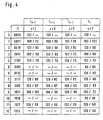
- FIG. 4 shows a simplified representation of a tabular storage of the minimum vehicle data for the respective vehicles 0 to 12.
- the respective identification code of a received vehicle data signal is stored in binary form (0000 to 1100).
- the vehicle data received at times t n-3 , t n-2 , t n-1 and t n are stored in the further columns in the form of a speed value v and a respective reception field strength E.
- the first line of the table according to FIG. 4 gives here the vehicle data of the reference vehicle 0, which as Comparison or as reference values for the other vehicle data serve.
- the reception field strength E is therefore not entered.
- the reference vehicle has a speed v of 120 km / h.
- the vehicles 1 and 3 traveling in the right-hand lane of the motorway have the same speed v1 and v3 of 100 km / h, which is why they have increasing values for the reception field strengths for different times t n-3 to t n .
- the reception field strength increases because the distance to vehicles 1 and 3 is reduced due to the overtaking process by reference vehicle 0.
- vehicles 2 and 4 have the same speed v2 and v4 of 120 km / h, which is why their reception field strength remains constant in proportion to the distance to reference vehicle 0.
- the group of vehicles relevant to the reference vehicle 0 1 to 4 is set in a similar manner. in this connection a more precise classification can take place, for example for vehicles immediately ahead 2 and 4 and vehicles 1 and 3 traveling in the adjacent lane. Classification in such a multitude of subordinate ones and higher-level groups or objects are carried out on the The usual fractal Darwinian described above Wise. If a group of vehicles, for example the Vehicles 2 and 4, classified as a particularly relevant group, for example, their respective group behavior by arithmetically averaging their average speed, their delay behavior, etc. determined and with the vehicle data of the reference vehicle 0 be compared. Based on this comparison there is now a signaling, for example in the form of known traffic symbols, i.e.
- the important one for determining the objects or groups Parameters of the distance based on the reception field strength of the received radio signal determined.
- the reception field strength can also other signals or measured values than for Distance between the respective vehicles and the reference vehicle proportional values are used.
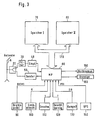
- Figure 3 shows a block diagram of the device for Signaling local traffic disruptions according to a preferred one Embodiment.
- reference numeral 10 denotes a transmission - respectively.
- Receiving antenna the reference numeral 20 a Transmit / receive switch to separate the receive channel from the transmit channel
- the reference numeral 30 a filter device with which the respective radio signals of the respective vehicles accordingly their identification code are filtered out
- reference numeral 40 a receiver and reference numeral 50 a transmitter.
- the filter device 30 can in addition, a detector for detecting the reception field strength of the respective radio signal.
- the recipient 40 and the transmitter 50 are with a microprocessor 60 connected to the control of the transceiver takes over.
- Reference numerals 90 to 140 show a variety of detection devices that the respective vehicle data of the vehicle.
- Reference numeral 90 denotes a detection device for detection the use of a brake pedal.
- Reference numeral 100 denotes a detection device having a value ⁇ according to an instantaneous steering angle.
- Reference numeral 110 denotes a detection device, which the current speed value v of the vehicle.
- Reference numeral 120 denotes a detection device that detects an instantaneous acceleration or delay value v of the respective Vehicle indicates.
- the device according to Figure 3 have a compass 130, the direction signal DIR indicates that the current direction of travel of the respective Vehicle.
- a GPS system global positioning system
- POS absolute Position value
- the detection devices 90 to 140 are for example with an input port of the microprocessor 60 and output signals of the detection devices 90 to 140 are used as vehicle data either via the transmitter 50 and the antenna 1 the other vehicles sent out or for a comparison the received vehicle data with the local vehicle data used.
- Reference numeral 70 denotes a first storage device, in the example shown in Figure 4 Table can be filed.
- the device for Signaling of local traffic disruptions also a second storage device 80.
- this second storage device 80 is then the fractal hierarchical Object Library.
- the first storage device 70 and the second storage device 80 are via a bus system 170 with the microprocessor 60 connected, causing a data exchange is guaranteed.
- the microprocessor during the evaluation the vehicle data states that the group behavior contradicting its relevant relevant group his own vehicle data, for example the speed the relevant group is significantly less than that Speed of its associated vehicle signaling either via the display device 150 or via a control device 160.
- the display device 150 the respective signal becomes visible and / or audibly displayed, preferably the known characters can be used for a speed limit.
- the Control device 160 for example, an automatic one Emergency braking is initiated when the evaluation of the received vehicle data with the local vehicle data results in an acute dangerous situation.
- Such an acute dangerous situation can also be caused by an additional emergency signal that has a higher priority, sent out to the other vehicles, thereby in a particularly effective way, for example Mass collapse of vehicles can be prevented.
- the receiver 40 Around to ensure maximum spread of the emergency signal, the receiver 40 has a threshold value decider which only emergency signals below a certain reception field strength evaluates and via the microprocessor 60 and sends the transmitter 50 out again, which makes results in a repeater function. Here it has again and amplifies the distress signal emitted the same identity code like the vehicle that originally made the distress signal sent out.
- each vehicle can be a relevance test for itself regarding the received emergency signal. It is checked whether the vehicle that issued the emergency signal originally sent out, belongs to a group, that are in no way relevant to the respective vehicle can be. A repeater function would be used in this case not done.
- the ignition key preferably activates transmitters and Receiver of the respective vehicle. With that belong the parking Vehicles do not automatically belong to the relevant groups of vehicles.
- coordinating the transmitters can be more advantageous his. This can be done by synchronizing or a "group tuning" of the transmitters happen.
- the synchronization can, for example, centrally using the radio clock signal happen.
- Send blocks sent is defined in Send blocks sent. After every block there is a pause before the next vehicle can send. If there is a group, the transmitters can choose one Define the order of their transmission blocks. For example, the Order in which the transmitters entered the group are.
- Groups that come too close to each other and each other can interfere with each other with regard to a transmit clock are "merged” if they match (for example, the same Direction of travel) and therefore the group is not too big becomes.
- merging for example, the order within of the original groups and the Group, one of the members of which was first the merger has proposed to send first and then the second Group. If the group became too big through a merger or the two groups don't fit well together (for example Oncoming traffic), it must nevertheless be ensured that they do not send at the same time. This can be done, for example, using a "Zipper procedure" happen. This means that dependent how many groups meet, each the groups the transmission pauses between the individual programs so enlarged that the members of the other groups fit in between.
- Broadcast breaks are not just for enabling the Group dynamics, but also for sending a signal (Emergency signal) with high priority (accident, full braking) necessary.
- the reference vehicle has the send number n, so the reference vehicle the transmission number n plus 1. Is n plus 1 above one Threshold, the reference vehicle is number one, however with a phase shift of 180 degrees.
- the Reference vehicle thus represents the first member of the second Group represents.
- the reference vehicle then sends in the enlarged Transmission breaks of the vehicles in front.
- the transmitter behind the reference vehicle is number 2 with 180 Degree phase. If in the group of the reference vehicle the number is reached, continue with number 1 and 0 degree phase of a third group.
- Third and first Group now send synchronously. If they are far enough from each other are distant, they don't bother each other.
- the transmission frequencies can be easily moved so that adjacent groups (just like that) can no longer receive. So nevertheless information from one group to another Speakers of the groups can be determined (for example, the last Vehicles), which then operate on multiple frequencies work at the same time.
Landscapes
- Physics & Mathematics (AREA)
- General Physics & Mathematics (AREA)
- Life Sciences & Earth Sciences (AREA)
- Atmospheric Sciences (AREA)
- Traffic Control Systems (AREA)
Applications Claiming Priority (3)
| Application Number | Priority Date | Filing Date | Title |
|---|---|---|---|
| DE19750942A DE19750942A1 (de) | 1997-11-17 | 1997-11-17 | Verfahren und Vorrichtung zum Signalisieren von lokalen Verkehrsstörungen |
| DE19750942 | 1997-11-17 | ||
| PCT/EP1998/007283 WO1999026212A1 (de) | 1997-11-17 | 1998-11-13 | Verfahren und vorrichtung zum signalisieren von lokalen verkehrsstörungen |
Publications (2)
| Publication Number | Publication Date |
|---|---|
| EP1032928A1 EP1032928A1 (de) | 2000-09-06 |
| EP1032928B1 true EP1032928B1 (de) | 2002-03-20 |
Family
ID=7849009
Family Applications (1)
| Application Number | Title | Priority Date | Filing Date |
|---|---|---|---|
| EP98963454A Expired - Lifetime EP1032928B1 (de) | 1997-11-17 | 1998-11-13 | Verfahren und vorrichtung zum signalisieren von lokalen verkehrsstörungen |
Country Status (5)
| Country | Link |
|---|---|
| US (2) | US6397141B1 (https=) |
| EP (1) | EP1032928B1 (https=) |
| JP (1) | JP4132662B2 (https=) |
| DE (2) | DE19750942A1 (https=) |
| WO (1) | WO1999026212A1 (https=) |
Cited By (1)
| Publication number | Priority date | Publication date | Assignee | Title |
|---|---|---|---|---|
| DE112011101255B4 (de) | 2010-04-07 | 2020-07-02 | Toyota Jidosha Kabushiki Kaisha | Fahrzeugfahrunterstützungsvorrichtung |
Families Citing this family (34)
| Publication number | Priority date | Publication date | Assignee | Title |
|---|---|---|---|---|
| DE19948733B4 (de) * | 1999-10-09 | 2013-07-25 | Volkswagen Ag | Fahrzeugkommunikationssystem |
| DE10034723C2 (de) * | 2000-07-17 | 2003-01-02 | Friedrich-Karl Wefelmeier | Verzögerungssystem für Kraftfahrzeuge |
| DE10041099C2 (de) * | 2000-08-22 | 2002-10-24 | Bosch Gmbh Robert | Verfahren zur Übertragung von Datenpaketen zwischen Kraftfahrzeugen |
| JP4064044B2 (ja) * | 2000-08-29 | 2008-03-19 | 三菱電機株式会社 | 交通情報送信システム及び交通情報収集配信システム並びに交通情報収集配信方法 |
| DE10062856B4 (de) * | 2000-12-16 | 2008-01-10 | Daimlerchrysler Ag | Verfahren zur fahrzeugindividuellen Verkehrsprognose |
| US6942800B2 (en) * | 2001-11-19 | 2005-09-13 | Michael J. Jungbauer | Septic system treatment process |
| DE10206698B4 (de) * | 2002-02-15 | 2013-12-12 | Definiens Ag | Vorrichtung und Verfahren zum Empfangen von Datenpaketen in wellengebundenen Signalen zur Verwendung in einem dezentral gesteuerten Kommunikationsnetz und ein Verfahren zum Zugreifen auf ein dezentral gesteuertes Kommunikationsnetz |
| DE10207508B4 (de) * | 2002-02-22 | 2012-07-12 | Volkswagen Ag | Verkehrsflusskontrolle |
| DE10225782B4 (de) * | 2002-06-10 | 2005-04-07 | Daimlerchrysler Ag | Verfahren zum Informieren von Verkehrsteilnehmern |
| EP1422679A1 (fr) * | 2002-11-19 | 2004-05-26 | Thierry Racine | Système de prevention d'accidents |
| US6711493B1 (en) | 2002-12-09 | 2004-03-23 | International Business Machines Corporation | Method and apparatus for collecting and propagating information relating to traffic conditions |
| US9818136B1 (en) | 2003-02-05 | 2017-11-14 | Steven M. Hoffberg | System and method for determining contingent relevance |
| US20040258179A1 (en) * | 2003-06-20 | 2004-12-23 | Long Jerral A. | RF receiver and method for region specific data selection |
| US7515997B2 (en) * | 2003-07-09 | 2009-04-07 | Akira Imai | Method of identifying moving bodies |
| US7606327B2 (en) * | 2003-07-28 | 2009-10-20 | Delphi Technologies, Inc. | Method to receive local information with a national broadcast service |
| GB0318480D0 (en) * | 2003-08-07 | 2003-09-10 | Koninkl Philips Electronics Nv | Method of and system for assessing the nature of movement of articles along a path of movement |
| US7188025B2 (en) | 2003-12-18 | 2007-03-06 | International Business Machines Corporation | Method and apparatus for exchanging traffic condition information using peer to peer networking |
| DE102004017602B4 (de) * | 2004-04-07 | 2022-03-17 | Volkswagen Ag | Verfahren und Anordnung für ein Kommunikationsnetz mit direkter Fahrzeug-Fahrzeug Kommunikation |
| US20060235967A1 (en) * | 2005-04-19 | 2006-10-19 | Neomedia Technologies, Inc. | System and method for exchange of information amongst peers in a peer to peer wireless network |
| US8874477B2 (en) | 2005-10-04 | 2014-10-28 | Steven Mark Hoffberg | Multifactorial optimization system and method |
| US7859392B2 (en) * | 2006-05-22 | 2010-12-28 | Iwi, Inc. | System and method for monitoring and updating speed-by-street data |
| US20090221302A1 (en) * | 2008-02-28 | 2009-09-03 | Vesa Pekka Luiro | Method, apparatus and computer program for reverse load balancing for the provision of services to client devices |
| DE102008047143B4 (de) | 2008-09-12 | 2010-09-09 | Technische Universität Carolo-Wilhelmina Zu Braunschweig | Verfahren und Vorrichtung zur Ermittlung einer Fahrstrategie |
| DE102010002093B4 (de) * | 2009-06-03 | 2024-03-14 | Continental Automotive Technologies GmbH | C2X-Kommunikation mit reduzierter Datenmenge |
| CN102529962B (zh) * | 2010-12-08 | 2014-11-05 | 安尼株式会社 | 移动体防碰撞装置和移动体 |
| US9014632B2 (en) * | 2011-04-29 | 2015-04-21 | Here Global B.V. | Obtaining vehicle traffic information using mobile bluetooth detectors |
| DE102012210252A1 (de) * | 2012-06-19 | 2013-12-19 | Robert Bosch Gmbh | Bildung einer Rettungsgasse |
| SE1251163A1 (sv) * | 2012-10-15 | 2014-04-16 | Scania Cv Ab | System och metod i samband med förekomst av fordonståg |
| DE102012020297B4 (de) | 2012-10-17 | 2017-08-31 | Audi Ag | Verfahren zur Zuordnung eines Senders zu einem detektierten Objekt in der Kraftfahrzeug-zu-Kraftfahrzeug-Kommunikation und Kraftfahrzeug |
| US8914225B2 (en) | 2012-12-04 | 2014-12-16 | International Business Machines Corporation | Managing vehicles on a road network |
| KR101491256B1 (ko) * | 2013-05-28 | 2015-02-06 | 현대자동차주식회사 | 무선통신을 이용한 차선인식 장치 및 방법 |
| DE102014002113A1 (de) * | 2014-02-15 | 2015-08-20 | Audi Ag | Verfahren zum Betrieb eines Sicherheitssystems eines Kraftfahrzeugs und Kraftfahrzeug |
| CN105989712A (zh) * | 2015-11-06 | 2016-10-05 | 乐卡汽车智能科技(北京)有限公司 | 一种车辆数据处理的方法及车辆终端 |
| US10836398B2 (en) | 2018-06-26 | 2020-11-17 | International Business Machines Corporation | Vehicular navigational control |
Family Cites Families (20)
| Publication number | Priority date | Publication date | Assignee | Title |
|---|---|---|---|---|
| IT1183820B (it) * | 1985-05-06 | 1987-10-22 | Fiat Auto Spa | Sistema di comunicazione e segnalazione automatica fra una pluralita di autoveicoli |
| FR2658938B1 (fr) * | 1990-02-23 | 1992-07-03 | Finance Tech Systemes | Systeme de communication entre pietons et vehicules. |
| US5428544A (en) * | 1990-11-05 | 1995-06-27 | Norm Pacific Automation Corporation | Traffic information inter-vehicle transference and navigation system |
| DE4137000C2 (de) * | 1991-11-11 | 1994-06-09 | Opel Adam Ag | Verfahren zur feldstärkeabhängigen Auswertung von Rundfunkinformationen für Fahrzeuge |
| JP2995970B2 (ja) * | 1991-12-18 | 1999-12-27 | トヨタ自動車株式会社 | 車両用走行制御装置 |
| JP3401026B2 (ja) * | 1992-03-19 | 2003-04-28 | 株式会社日立製作所 | 自動車間通信による走行制御装置 |
| JP3233995B2 (ja) * | 1992-07-10 | 2001-12-04 | マツダ株式会社 | 車両の通報システムおよび通報装置 |
| JP2959334B2 (ja) * | 1993-06-15 | 1999-10-06 | 三菱自動車工業株式会社 | 後続車両警告方法およびその装置 |
| JPH07200991A (ja) * | 1993-11-30 | 1995-08-04 | Sconick Joseph | 2台以上の車両の連携運転システム |
| JPH0855300A (ja) * | 1994-08-08 | 1996-02-27 | Mitsubishi Electric Corp | 車群走行システムの制御装置 |
| EP0715286B1 (de) * | 1994-11-28 | 1999-01-07 | MANNESMANN Aktiengesellschaft | Verfahren zur Reduzierung einer aus den Fahrzeugen einer Stichprobenfahrzeugflotte zu übertragenden Datenmenge |
| JPH08240653A (ja) * | 1995-03-03 | 1996-09-17 | Hitachi Ltd | 位置情報表示装置 |
| JPH08263793A (ja) * | 1995-03-23 | 1996-10-11 | Honda Motor Co Ltd | 車両制御装置 |
| JP3237451B2 (ja) * | 1995-04-10 | 2001-12-10 | 三菱自動車工業株式会社 | 自動追従走行システム |
| DE19606258C1 (de) * | 1996-02-06 | 1997-04-30 | Mannesmann Ag | Fahrzeugautonome Detektion von Verkehrsstau |
| JP3633707B2 (ja) * | 1996-03-08 | 2005-03-30 | 日産ディーゼル工業株式会社 | 車群走行制御装置 |
| JPH10261194A (ja) * | 1997-03-18 | 1998-09-29 | Fujitsu Ten Ltd | 車両群形成制御装置および方法 |
| JP3818722B2 (ja) * | 1997-03-21 | 2006-09-06 | 富士通テン株式会社 | 車両群形成制御装置 |
| JP3851410B2 (ja) * | 1997-04-21 | 2006-11-29 | 富士通テン株式会社 | 車両群形成制御装置および方法 |
| DE19747161A1 (de) * | 1997-10-24 | 1999-04-29 | Delphi 2 Creative Tech Gmbh | Fraktal darwinistische Objekterzeugung |
-
1997
- 1997-11-17 DE DE19750942A patent/DE19750942A1/de not_active Withdrawn
-
1998
- 1998-11-13 DE DE59803467T patent/DE59803467D1/de not_active Expired - Lifetime
- 1998-11-13 JP JP2000521494A patent/JP4132662B2/ja not_active Expired - Fee Related
- 1998-11-13 WO PCT/EP1998/007283 patent/WO1999026212A1/de not_active Ceased
- 1998-11-13 US US09/554,949 patent/US6397141B1/en not_active Expired - Lifetime
- 1998-11-13 EP EP98963454A patent/EP1032928B1/de not_active Expired - Lifetime
-
2002
- 2002-02-25 US US10/083,860 patent/US20020082768A1/en not_active Abandoned
Cited By (1)
| Publication number | Priority date | Publication date | Assignee | Title |
|---|---|---|---|---|
| DE112011101255B4 (de) | 2010-04-07 | 2020-07-02 | Toyota Jidosha Kabushiki Kaisha | Fahrzeugfahrunterstützungsvorrichtung |
Also Published As
| Publication number | Publication date |
|---|---|
| US6397141B1 (en) | 2002-05-28 |
| WO1999026212A1 (de) | 1999-05-27 |
| JP2001523871A (ja) | 2001-11-27 |
| DE59803467D1 (de) | 2002-04-25 |
| DE19750942A1 (de) | 1999-05-20 |
| US20020082768A1 (en) | 2002-06-27 |
| JP4132662B2 (ja) | 2008-08-13 |
| EP1032928A1 (de) | 2000-09-06 |
Similar Documents
| Publication | Publication Date | Title |
|---|---|---|
| EP1032928B1 (de) | Verfahren und vorrichtung zum signalisieren von lokalen verkehrsstörungen | |
| DE69917543T2 (de) | Verkehrsinformationübermittlungssystem | |
| DE102017217297B4 (de) | System zur Erzeugung und/oder Aktualisierung eines digitalen Modells einer digitalen Karte | |
| EP1932016B1 (de) | Verfahren und vorrichtung zur steuerung mindestens eines objektdetektionssensors | |
| DE102018222601A1 (de) | Verfahren und Fahrerassistenzsystem zum Unterstützen eines Fahrers eines Fahrzeugs beim Führen des Fahrzeugs | |
| DE102019116380A1 (de) | Vorrichtung und Verfahren zum Steuern eines Fahrens eines Fahrzeugs | |
| EP2826031A1 (de) | Verfahren zur stauerkennung mittels einer drahtlosen fahrzeug-zu-fahrzeug-kommunikation | |
| WO2008043795A1 (de) | Verfahren und vorrichtung zur erkennung von verdeckten objekten im strassenverkehr | |
| DE102016011414A1 (de) | Verfahren zum Warnen eines Fahrers eines Kraftfahrzeugs unter Berücksichtigung eines aktuellen Sichtbereichs des Fahrers, Recheneinrichtung sowie Erfassungsfahrzeug | |
| DE102021128727A1 (de) | Geisterpunktfilterung | |
| DE102017111468A1 (de) | Fahrzeugsystem und Verfahren zum Bestimmen, ob ein Fahrzeuginsasse ein fahrzeugexternes Objekt wahrgenommen hat | |
| AT521647B1 (de) | Verfahren und System zur Datenaufbereitung, zum Trainieren eines künstlichen neuronalen Netzes und zum Analysieren von Sensordaten | |
| DE102019216074A1 (de) | Verfahren zum Bereitstellen einer Objektnachricht über ein in einer Umgebung eines Verkehrsteilnehmers erkanntes Objekt in einem Kommunikationsnetzwerk zur Kommunikation mit anderen Verkehrsteilnehmern | |
| EP2662846A1 (de) | Verfahren zum Reduzieren einer Staugefahr | |
| EP3802257B1 (de) | Steuerung eines kraftfahrzeugs | |
| DE102014202509A1 (de) | Steuerung einer hoch- oder vollautomatischen Fahrfunktion | |
| DE112022005447T5 (de) | Fahrzeugsteuervorrichtung | |
| EP4018425B1 (de) | Verfahren zum vorhersagen eines verhaltens eines zielfahrzeugs | |
| DE102021200027B4 (de) | Verfahren zum Betreiben eines Assistenzsystems eines Kraftfahrzeugs, Computerprogrammprodukt sowie Assistenzsystem | |
| DE102022200674A1 (de) | Verfahren zum Betreiben eines Fahrzeugs | |
| DE102023117712A1 (de) | Vermeiden einer Kollision von Fahrzeugen | |
| DE102023002485A1 (de) | Verfahren zum Passieren einer Straße mit Gegenverkehr | |
| DE102017217299A1 (de) | Verfahren und Einrichtung | |
| WO2022148657A1 (de) | Verfahren zum erzeugen einer spurwechselfreigabe eines zumindest teilweise assistiert betriebenen kraftfahrzeugs, computerprogrammprodukt, sowie spurhalteassistenzsystem | |
| DE102022201200A1 (de) | Verfahren und System zur Bestimmung einer Verkehrsausrichtung |
Legal Events
| Date | Code | Title | Description |
|---|---|---|---|
| PUAI | Public reference made under article 153(3) epc to a published international application that has entered the european phase |
Free format text: ORIGINAL CODE: 0009012 |
|
| 17P | Request for examination filed |
Effective date: 20000615 |
|
| AK | Designated contracting states |
Kind code of ref document: A1 Designated state(s): DE ES FR GB IT |
|
| 17Q | First examination report despatched |
Effective date: 20001002 |
|
| GRAG | Despatch of communication of intention to grant |
Free format text: ORIGINAL CODE: EPIDOS AGRA |
|
| RAP1 | Party data changed (applicant data changed or rights of an application transferred) |
Owner name: DEFINIENS AG. |
|
| GRAG | Despatch of communication of intention to grant |
Free format text: ORIGINAL CODE: EPIDOS AGRA |
|
| GRAH | Despatch of communication of intention to grant a patent |
Free format text: ORIGINAL CODE: EPIDOS IGRA |
|
| GRAH | Despatch of communication of intention to grant a patent |
Free format text: ORIGINAL CODE: EPIDOS IGRA |
|
| REG | Reference to a national code |
Ref country code: GB Ref legal event code: IF02 |
|
| GRAA | (expected) grant |
Free format text: ORIGINAL CODE: 0009210 |
|
| AK | Designated contracting states |
Kind code of ref document: B1 Designated state(s): DE ES FR GB IT |
|
| PG25 | Lapsed in a contracting state [announced via postgrant information from national office to epo] |
Ref country code: IT Free format text: LAPSE BECAUSE OF FAILURE TO SUBMIT A TRANSLATION OF THE DESCRIPTION OR TO PAY THE FEE WITHIN THE PRESCRIBED TIME-LIMIT;WARNING: LAPSES OF ITALIAN PATENTS WITH EFFECTIVE DATE BEFORE 2007 MAY HAVE OCCURRED AT ANY TIME BEFORE 2007. THE CORRECT EFFECTIVE DATE MAY BE DIFFERENT FROM THE ONE RECORDED. Effective date: 20020320 Ref country code: FR Free format text: LAPSE BECAUSE OF FAILURE TO SUBMIT A TRANSLATION OF THE DESCRIPTION OR TO PAY THE FEE WITHIN THE PRESCRIBED TIME-LIMIT Effective date: 20020320 |
|
| GBT | Gb: translation of ep patent filed (gb section 77(6)(a)/1977) |
Effective date: 20020320 |
|
| REF | Corresponds to: |
Ref document number: 59803467 Country of ref document: DE Date of ref document: 20020425 |
|
| PG25 | Lapsed in a contracting state [announced via postgrant information from national office to epo] |
Ref country code: ES Free format text: LAPSE BECAUSE OF FAILURE TO SUBMIT A TRANSLATION OF THE DESCRIPTION OR TO PAY THE FEE WITHIN THE PRESCRIBED TIME-LIMIT Effective date: 20020925 |
|
| EN | Fr: translation not filed | ||
| PLBE | No opposition filed within time limit |
Free format text: ORIGINAL CODE: 0009261 |
|
| STAA | Information on the status of an ep patent application or granted ep patent |
Free format text: STATUS: NO OPPOSITION FILED WITHIN TIME LIMIT |
|
| 26N | No opposition filed |
Effective date: 20021223 |
|
| PGFP | Annual fee paid to national office [announced via postgrant information from national office to epo] |
Ref country code: DE Payment date: 20171113 Year of fee payment: 20 |
|
| PGFP | Annual fee paid to national office [announced via postgrant information from national office to epo] |
Ref country code: GB Payment date: 20171124 Year of fee payment: 20 |
|
| REG | Reference to a national code |
Ref country code: DE Ref legal event code: R071 Ref document number: 59803467 Country of ref document: DE |
|
| REG | Reference to a national code |
Ref country code: GB Ref legal event code: PE20 Expiry date: 20181112 |
|
| PG25 | Lapsed in a contracting state [announced via postgrant information from national office to epo] |
Ref country code: GB Free format text: LAPSE BECAUSE OF EXPIRATION OF PROTECTION Effective date: 20181112 |