EP0987294B1 - Poröses Polyimidmaterial und Verfahren zu dessen Herstellung - Google Patents
Poröses Polyimidmaterial und Verfahren zu dessen Herstellung Download PDFInfo
- Publication number
- EP0987294B1 EP0987294B1 EP99307404A EP99307404A EP0987294B1 EP 0987294 B1 EP0987294 B1 EP 0987294B1 EP 99307404 A EP99307404 A EP 99307404A EP 99307404 A EP99307404 A EP 99307404A EP 0987294 B1 EP0987294 B1 EP 0987294B1
- Authority
- EP
- European Patent Office
- Prior art keywords
- porous material
- polyimide
- polyimide precursor
- accordance
- gel
- Prior art date
- Legal status (The legal status is an assumption and is not a legal conclusion. Google has not performed a legal analysis and makes no representation as to the accuracy of the status listed.)
- Expired - Lifetime
Links
Images

Classifications
-
- C—CHEMISTRY; METALLURGY
- C08—ORGANIC MACROMOLECULAR COMPOUNDS; THEIR PREPARATION OR CHEMICAL WORKING-UP; COMPOSITIONS BASED THEREON
- C08J—WORKING-UP; GENERAL PROCESSES OF COMPOUNDING; AFTER-TREATMENT NOT COVERED BY SUBCLASSES C08B, C08C, C08F, C08G or C08H
- C08J9/00—Working-up of macromolecular substances to porous or cellular articles or materials; After-treatment thereof
- C08J9/28—Working-up of macromolecular substances to porous or cellular articles or materials; After-treatment thereof by elimination of a liquid phase from a macromolecular composition or article, e.g. drying of coagulum
-
- H—ELECTRICITY
- H01—ELECTRIC ELEMENTS
- H01B—CABLES; CONDUCTORS; INSULATORS; SELECTION OF MATERIALS FOR THEIR CONDUCTIVE, INSULATING OR DIELECTRIC PROPERTIES
- H01B3/00—Insulators or insulating bodies characterised by the insulating materials; Selection of materials for their insulating or dielectric properties
- H01B3/18—Insulators or insulating bodies characterised by the insulating materials; Selection of materials for their insulating or dielectric properties mainly consisting of organic substances
- H01B3/30—Insulators or insulating bodies characterised by the insulating materials; Selection of materials for their insulating or dielectric properties mainly consisting of organic substances plastics; resins; waxes
- H01B3/303—Macromolecular compounds obtained by reactions forming a linkage containing nitrogen with or without oxygen or carbon in the main chain of the macromolecule, not provided for in groups H01B3/38 or H01B3/302
- H01B3/306—Polyimides or polyesterimides
-
- C—CHEMISTRY; METALLURGY
- C08—ORGANIC MACROMOLECULAR COMPOUNDS; THEIR PREPARATION OR CHEMICAL WORKING-UP; COMPOSITIONS BASED THEREON
- C08J—WORKING-UP; GENERAL PROCESSES OF COMPOUNDING; AFTER-TREATMENT NOT COVERED BY SUBCLASSES C08B, C08C, C08F, C08G or C08H
- C08J2201/00—Foams characterised by the foaming process
- C08J2201/04—Foams characterised by the foaming process characterised by the elimination of a liquid or solid component, e.g. precipitation, leaching out, evaporation
- C08J2201/05—Elimination by evaporation or heat degradation of a liquid phase
- C08J2201/0502—Elimination by evaporation or heat degradation of a liquid phase the liquid phase being organic
-
- C—CHEMISTRY; METALLURGY
- C08—ORGANIC MACROMOLECULAR COMPOUNDS; THEIR PREPARATION OR CHEMICAL WORKING-UP; COMPOSITIONS BASED THEREON
- C08J—WORKING-UP; GENERAL PROCESSES OF COMPOUNDING; AFTER-TREATMENT NOT COVERED BY SUBCLASSES C08B, C08C, C08F, C08G or C08H
- C08J2203/00—Foams characterized by the expanding agent
- C08J2203/08—Supercritical fluid
-
- C—CHEMISTRY; METALLURGY
- C08—ORGANIC MACROMOLECULAR COMPOUNDS; THEIR PREPARATION OR CHEMICAL WORKING-UP; COMPOSITIONS BASED THEREON
- C08J—WORKING-UP; GENERAL PROCESSES OF COMPOUNDING; AFTER-TREATMENT NOT COVERED BY SUBCLASSES C08B, C08C, C08F, C08G or C08H
- C08J2379/00—Characterised by the use of macromolecular compounds obtained by reactions forming in the main chain of the macromolecule a linkage containing nitrogen with or without oxygen, or carbon only, not provided for in groups C08J2361/00 - C08J2377/00
- C08J2379/04—Polycondensates having nitrogen-containing heterocyclic rings in the main chain; Polyhydrazides; Polyamide acids or similar polyimide precursors
- C08J2379/08—Polyimides; Polyester-imides; Polyamide-imides; Polyamide acids or similar polyimide precursors
Definitions
- the present invention relates to a highly heat-resistant porous material for use in construction materials, heat insulators and insulating materials and a method for producing the same.
- Polyimide resins exhibit excellent heat resistance and superb insulation and therefore enjoy a wide application for liquid crystal alignment films, interlayer insulating films for semiconductor circuits, and the like. Active use of such advantages of polyimide resin and realization of a product exhibiting high performance by substituting the polyimide resin for a conventionally used resin have been investigated. Addition of a new function to the polyimide resin to a high addition value in the polyimide resin has also been studied.
- polyimide resin One exemplary technical development in the polyimide resin is an attempt to reduce the dielectric constant or thermal conductivity of polyimide resin by forming the polyimide resin into a porous material.
- the technology for making the polyimide resin porous has been disclosed in, for example, the Japanese Laid-Open Patent Publication No. Hei 5-205526 and Thermal Conductivity, Vol. 18, pp. 437-443, 1985 (by D.D. Barley, entitled "Thermal Conductivity of a Polyimide Foam").
- the Publication No. Hei 5-205526 discloses a method for forming a porous film by first forming a block copolymer of a polyimide matrix and a thermally decomposable polymer matrix, forming a film therefrom, and then removing the thermally decomposable polymer from the film by heating.
- the above-mentioned article discloses a process for making a foam by blowing a polyimide with the aid of a blowing agent.
- the polyimide resin per se is much refractory to molding, because it is highly chemical resistant and has a glass transition point of 300 °C or higher.
- the disclosed methods for making this resin porous therefore, have advantages and disadvantages. Now, the problem involved in the use of porous polyimide resin as, for example, a heat insulator will be discussed.
- the method disclosed in the above-mentioned Japanese patent publication can produce a fine porous film having a pore size of 1 ⁇ m or less.
- the disclosed method has a drawback that it is not applicable to any low heat-resistant base because it includes a heating step for removing the thermally decomposable polymer.
- the disclosed technology in the above-mentioned article is also disadvantageous in that since formation of cells in the order of several hundred ⁇ m is inevitable, it is necessary to minimize the size of those cells in order to improve the heat insulation of the resultant foam.
- a variety of methods for making the polyimide resin porous have been attempted in addition to the above-mentioned methods.
- a primary aim of the present invention is to provide a porous material having a low density and a small mean pore size.
- Another aim of the present invention is to provide a method for producing such a porous material.
- a further aim of the present invention is to provide a heat insulator exhibiting high insulating performance and a semiconductor circuit with high dielectric characteristics comprising the heat insulator.
- the porous material in accordance with the present invention is characterized by comprising a dry gel of a polyimide resin which has an apparent density of 800 kg/m 3 or less and a mean pore size of 1 ⁇ m or less.
- the present invention relates to a porous material comprising a dry gel of a polyimide resin, said porous material having an apparent density of 800 kg/m 3 or less and a mean pore size of 1 ⁇ m or less.
- the polyimide resin has preferably a three-dimensional crosslinked structure.
- the dry gel is preferably an aerogel.
- the porous material having an apparent density of 800 kg/m 3 or less and a mean pore size of 1 ⁇ m or less.
- the present invention relates to a method for producing a porous material, comprising the steps of:
- the gelling step comprises a step of forming a solution or a swollen body of a polyimide precursor and a step of imidizing said polyimide precursor in said solution or swollen body.
- the gelling step preferably comprises a step of obtaining a polyimide resin by imidizing a polyimide precursor, a step of forming a solution or a swollen body of said polyimide resin and a step of crosslinking said polyimide resin in said solution or swollen body.
- the gelling step preferably comprises a step of forming a solution or a swollen body of a polyimide precursor, a step of forming a wet gel of said polyimide precursor by crosslinking said polyimide precursor in said solution or swollen body and a step of imidizing said polyimide precursor in said wet gel.
- the present invention relates to a method for producing a porous material, said method comprising the steps of:
- the drying step preferably uses an supercritical drying method and a finally obtained dry gel is an aerogel.
- these mehod further comprises a step of heating said dry gel of said polyimide resin in an inert atmosphere at 500 °C or higher to form a porous material comprising a carbon material.
- a finally obtained porous material has an apparent density of 800 kg/m 3 or less and a mean pore size of 1 ⁇ m or less.
- the present invention relates to a heat insulator formed by filling the above-mentioned porous material.
- the vessel is a gas-tight vessel and has been reduced in internal pressure.
- the present invention relates to a semiconductor circuit formed by using the above-mentioned porous material, said circuit being formed with an interlayer insulating film which effects electrical insulation between a plurality of electrode lines arranged on a base plate.
- the porous material in accordance with the present invention is a composition comprising a dry gel having consecutive communicating micropores and a fine gel structure or skeleton. This composition enables the porous material to exhibit high heat insulation. Since the porous material in accordance with the present invention has a high porosity, it can function as an insulating material with a low dielectric constant.
- the dry gel used in the present invention can be obtained by drying a wet gel having a gel skeleton formed from a solvent-containing resin.
- the pores of the dry gel resulting from evaporation of the solvent from the wet gel are solids and contain air.
- the dry gel is an aerogel obtained by drying the wet gel by a supercritical drying method, heat insulation and dielectric characteristics of the resultant porous material are conveniently increased.
- the polyimide resin used in the present invention can be obtained by synthesizing a polyamide acid as a precursor (hereinafter referred to as "polyimide precursor") from a starting material and subsequently imidizing the polyimide precursor.
- polyimide precursor a polyamide acid as a precursor
- the polyimide resin in the context of the present invention involves a wide variety of polyimide ranging from those of common classification to synthetic polymers whose molecular structure of main chain is an imide ring structure, such as polyamide imide, polyether imide. Any of the above-exemplified polyimide resins exhibit excellent heat resistance, electric insulation, chemical resistance and resistance against environment.
- the porous material in accordance with the present invention is a dry gel comprising a polyimide resin, wherein the polyimide resin constitutes a matrix skeleton of the gel and the pores of the dry gel contain air.
- the dry gel has an apparent density of 800 kg/m 3 or less and a mean pore size of 1 ⁇ m or less, it can be a porous material exhibiting high heat insulation and excellent dielectric characteristics, that is, high electric insulation.
- the thermal conductivity of the porous material in accordance with the present invention is determined by totalizing the thermal conductivity of the skeleton of the porous material, that of the air in the pores, and that produced by radiation and convection. Increased heat insulation can be achieved by reducing each thermal conductivity.
- the porous material in accordance with the present invention prevents the air from flowing by the gel skeleton and therefore the thermal conductivity by radiation and convection is much smaller than the other two thermal conductivities. This in turn decreases thermal conductivity of the air inside the pores.
- the porous material in accordance with the present invention it is particularly preferable for the porous material in accordance with the present invention to have a mean pore size of 100 nm or less.
- the mean pore size of 100 nm or less is equal to or less than the mean free path of the molecules in the atmosphere, which produces a drastic decrease of the thermal conductivity of the air inside the pores thereby improving the heat insulation of the resultant porous material.
- an allowable lower limit of the mean pore size in the present invention is about 1 nm.
- a preferred apparent density is 500 kg/m 3 or less, because when the porous material has this apparent density, the skeletal volume can be minimized and therefore the thermal conductivity of the skeleton of the porous material can be decreased. Similarly, the lower the lower limit of the apparent size, the better for the porous material.
- An allowable lower limit of the apparent density in the present invention is about 50 kg/m 3 .
- the porous material in accordance with the present invention may be shaped in any form, for example, a block, a sheet, a plate, a powder.
- the porous material in accordance with the present invention may comprise a carbon material obtained by baking the above-mentioned polyimide resin dry gel.
- the porous material comprising such carbon material sustains the shape of the dry gel. When it has an apparent density of 800 kg/m 3 or less and a mean pore size of 1 ⁇ m or less, then it has particularly excellent performance.
- porous carbon material obtained by baking and carbonizing the polyimide resin has been used for electrode material or active carbon.
- the porous material comprising such carbon material in accordance with the present invention is composed of a low dense carbon material and, therefore, has a large specific surface area and exhibits excellent performance as a carbon material.
- any porous carbon material having a specific surface area of 400 m 2 /g or more as measured by the known Brunauer-Emmett-Teller (BET) method exhibits much better performance as a carbon material. Therefore, when the porous material is used as a carbon material, it is desirable even for the dry gel of the polyimide resin to have a specific surface area of 400 m 2 /g or more as measured by the BET method before being baked.
- BET Brunauer-Emmett-Teller
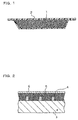
- FIG. 1 illustrates a cross-sectional view of a heat insulator produced by using the porous material in accordance with the present invention.
- a porous material 1 obtained by the present invention is used as a core and housed in a gas-tight vessel 2. Then, the vessel 2 is evacuated and sealed airtightly which produces a heat insulator. Vacuum evacuation of the vessel 2 would give a vacuum heat insulator of much better performance.
- the porous material When the intended use of the porous material is a heat insulator, then it is desirable that the porous material has a mean pore size of 100 nm or less. This is because when the mean pore size is at this level, an equivalent thermal conductivity to that obtained by evacuating a vessel filled with a conventional vacuum heat insulating material composed of a powder to an extent of a vacuum degree of 0.01 Torr or so can be achieved by mere evacuation of the vessel to an extent of 10 to 100 Torr.
- the small pore size of the porous material in accordance with the present invention largely contributes to the above effect.
- FIG. 2 is a schematic cross-sectional view of an example of a semiconductor circuit formed with an interlayer insulating film comprising the porous material in accordance with the present invention.
- electrodes 4 made of a metal that are arranged on a semiconductor board 3 and then an interlayer insulating layer 5 made of the porous material in accordance with the present invention is formed such that it covers and embeds gaps between the electrodes 4.
- a protective layer 6 is further formed above the interlayer insulating layer 5.
- the circuit may be made into a multilayered circuit by forming an element or a device on an upper layer with an omission of the protective layer 6.
- the porous material in accordance with the present invention is greater in volume occupied by air compared to that of the gel skeleton and has small and dense-packed pores, it can retain the strength surprisingly. Therefore, the porous material of the present invention can be used as a dielectric material with a low dielectric constant which can retains the structural strength in the above-mentioned semiconductor circuit.
- porous material in accordance with the present invention reduces dielectric loss of the electrical insulator thereby realizing rapid signal transmission.
- the porous material of the present invention can also reduce loss of electric power at high frequencies if included in electric or electronic appliances.
- the application to a roller such as motor can reduce leakage of electric power at high frequencies thereby realizing energy savings of the device.
- the method for producing a porous material in accordance with the present invention can be roughly classified into two types.
- One type method contains the processes A, B and C.
- the other type method contains the process D. The order of the steps in each method type will be explained referring to FIG. 3.
- Processes A, B and C form a polyimide wet gel and dry it to obtain a dry gel of a polyimide resin.
- the three processes were classified according to the step to produce the polyimide wet gel.
- Process A obtains a polyimide resin by imidizing a polyimide precursor in first. Then, after dissolving the resultant resin in a solvent to have a polyimide resin solution or after giving the resultant resin an affinity for the solvent to form a swollen body of the polyimide resin, the solution or the swollen body is gelled by crosslinking the polyimide resin to form a polyimide wet gel.
- Process B obtains a solution or a swollen body of a polyimide precursor in first. Then, the solution or the swollen body is gelled to form a wet gel of the polyimide precursor, and then an imidization is carried out from the resultant wet gel as it is.
- the solvent to be selected should be one having a high boiling point. Otherwise, the wet gel can be formed into an imide by chemical treatment.
- Process C obtains a solution or a swollen body of a polyimide precursor in first. Then, the solution-or the swollen body is gelled while heating it to accelerate their gelling and the polyimide precursor is imidized at the same time thereby obtaining a polyimide wet gel.
- Process A has an advantage over the other two processes because the gel is prevented from being shrunk during imidization, which technically facilitates dimensional designing.
- Process A is limited in that it requires selection of a polyimide molecular structure that is soluble or wettable in a solvent.
- Process D obtains a solution or a swollen body of a polyimide precursor, and then gels them to form a wet gel of the polyimide precursor. Subsequently, the resultant wet gel is dried to obtain a dry gel. Then, the dry gel is imidized to obtain a dry gel of a polyimide resin.
- Process D is characterized in that it permits preformation of a skeleton of the resultant porous material by the polyimide precursor because the polyimide precursor is readily soluble in the solvent, facilitating production operation of the porous material.
- Process D is particularly effective for obtaining a polyimide resin which is hardly soluble in a solvent.
- drying by heating is suited for a final step of imidization an imide in order to prevent the dry gel from being wetted again.
- the process further includes a step of carbonizing the dry gel of the polyimide resin obtained in the above-mentioned manner by heating. Carbonization should be performed in a vacuum or an inert gas atmosphere in order to prevent the dry gel from being burnt during carbonization.
- a particularly preferred simple method is baking the dry gel in an inert gas atmosphere such as nitrogen or argon or in an atmosphere at 500 °C or higher. Temperatures of 500 °C or higher can accelerate carbonization of the dry gel. In order to achieve complete carbonization, the heating temperature should be 800 °C or higher, preferably 1,000 °C or higher. An upper limit of heating temperature may be about 1500 °C, because the carbonization may proceeds effecively.
- an inert gas atmosphere such as nitrogen or argon or in an atmosphere at 500 °C or higher.
- the intended use of the porous material obtained by the above-mentioned method is an active carbon, then activation with the use of water vapor or inorganic salt may be supplemented to the carbonization.
- Step A-1 synthesizes a polyimide precursor.
- the polyimide resin is synthesized by condensation reaction of a compound such as an aromatic or aliphatic tetracarboxylic dianhydride (hereinafter referred to as compound “a”) with a compound such as an aromatic or aliphatic diamine (hereinafter referred to as compound “b”). Therefore, a polyamide acid which is a polyimide precursor is synthesized by condensation of the compounds "a” and "b".
- the polyimide precursor can be processed into a sheet because it is soluble in any organic solvent.
- the molecular structures of the compounds "a” and "b” should be selected.
- Compounds having an ether group or a ketone group as the main chain and those having a bulky group such as phenyl group, alkyl group or trifluoromethyl group as the side chain are readily soluble in any solvent.
- substitutional group plays a role as a crosslink forming portion during gelling.
- Exemplary compound "a” may include pyromellitic dianhydride, bisphenyltetracarboxylic dianhydride, benzophenontetracarboxylic dianhydride, 4,4'-hexafluoroisopropylidenebis (phthalic anhydride), cyclobutanetetracarboxylic dianhydride, and 2,3,5-tricarboxycyclopentyl acetic dianhydride. These compounds can be used alone or in arbitrary combinations to the extent not to damage the effects of the present invention.
- Exemplary compound "b” may include p-phenylenediamine, m-phenylenediamine, bis(4-aminophenyl)ether, 4,4'-diaminotriphenylmethane, 2,2-bis(4-aminophenyl)-hexafluoropropane, 4-4'-diamino-4"-hydroxytriphenylmethane, 3,3'-dihydroxy-4,4'-diaminobiphenyl, 2,2-bis(3-amino-4-hydroxyphenyl)-hexafluoropropane, and 3,5-diaminobenzoic acid. These compounds can also be used alone or in arbitrary combinations to the extent not to damage the effects of the present invention.
- the compounds "a” and “b” as the starting materials are not limited to the above examples and any compounds may be used if their combination can form a resin having a polyimide structure.
- N-methylpyrrolidone N,N-dimethylacetamide, dimethyl sulfoxide, hexamethylphosphoric amide are widely used, for example.
- cresol, tetrahydrofuran, dioxane or methanol may be selected depending on the intended molecular structure of the resultant polyimide. These solvents may be used alone or in arbitrary combinations.
- those having a high boiling point of 100 °C or higher can be used in synthesizing the polyimide resin by heat treatment in Step A-2, in addition to synthesizing the polyimide precursor.
- the polyimide precursor obtained in Step A-1 is imidized by heating or a chemical treatment with a dehydrated solvent such as acetic anhydride or pyridine to form a polyimide resin.
- a dehydrated solvent such as acetic anhydride or pyridine.
- the polyimide resins thus obtained are mostly highly resistant to and hardly soluble in the solvent.
- the treatment to form a polyimide from the polyimide precursor can be roughly classified into two groups: one is heat treatment and the other is chemical treatment.
- Imidization by heating is performed at about 50 to 400 °C. Preferably, heating should be done in a range of 100 to 300 C. Imidization is a reaction where an imide ring is formed by dehydration of polyamide acid. Therefore, stepwise elevations of the heating temperature, 100 °C for one hour, 200 °C for one hour and 300 °C for one hour, for example, are better than an abrupt elevation.
- the atmosphere is preferably an inert gas atmosphere such as nitrogen or argon other than air. Heating in a vacuum may also be adopted.
- Imidization by chemical treatment may be performed by, for example, immersing the polyimide precursor in a dehydrated solvent such as acetic anhydride or pyridine to form an imide ring. Since this method is a wet method, it is not suited for imidizing the dry gel of the polyimide precursor as done in the above-mentioned process D.
- Step A-3 obtains a solution or a swollen body of the polyimide resin.
- polar or nonpolar solvents such as xylene, toluene, hexane, cyclohexane, 2-butanone, methanol, ethanol, 2-methoxyethanol, dichloromethane may be used alone or in arbitrary combinations in addition to the above-exemplified solvents for synthesis. Water may be added to these solvents to wet the polyimide resin.
- the polyimide resin has a hydrophilic group such as hydroxyl group, carboxylic group or sulfonic group in the skeleton, then the use of mere water is enough.
- the polyimide resin solution is prepared by selecting a solvent which can dissolve the resin components and adjusting the weight of resin components and the volume of the solvent to make an intended apparent density of the finally obtained dry gel.
- the polyimide resin swollen body is prepared by selecting a solvent as listed above which can swell the resin components and adjusting the weight of resin components and the volume of the solvent to make an intended apparent density of the finally obtained dry gel.
- the solvent to be used here may be a mixed solvent. If one solvent is used, one which has a high affinity for resin components but does not dissolve them is preferred. When the resin contains, for example, a hydroxylic group as component, a suited solvent is water or alcohol.
- a mixed solvent it may be a mixture selected from those which dissolve the resin components and those which do not; for instance, N-methylpyrrolidone and methanol may be selected.
- the solvents to be mixed are insoluble in each other, they may be formed into a colloidal emulsion when mixed with the resin components.
- crosslinking treatment is often effective.
- the crosslinking treatment can be performed by introducing a functional group such as a hydroxylic group, a carboxylic group, a sulfonic group, an amino group into a resin component and adding a crosslinking agent reactive to the introduced functional group.
- any agent may be used if it has a functional group reactive to the functional group contained in the resin components.
- Applicable functional groups for this purpose may be exemplified as hydroxylic group, methylol group, amino group, isocyanate group, epoxy group, aldehyde group, carboxylic group, chloroformyl group, chlorosilyl group, and alkoxysilyl group.
- those having two or more functional groups are preferred in order to retain the strength of the gel skeleton.
- an acid, a base or an acid anhydride may be added as a hardening agent.
- crosslinking agents include ethylene glycol, diols such as 1,4-butanediol, cyclopentane-1,2-diol, polyhydric alcohols such as glycerin, pentaerythritol, resins having a methylol group such as phenolic resin, melamine resin, ammonia, amines such as methylamine, polyhydric amines such as ethylenediamine, hexamethylenediamine, phenylenediamine, diethylenetriamine isocyanates such as tolylene diisocyanate, diphenylmethane diisocyanate, hexamethylene diisocyanate epoxy resins such as phenylglycidyl ether, ethylene glycol diglycidyl ether, bisphenol A diglycidyl ether, novolak diglycidyl ether, aldehydes such as formaldehyde, acetaldehyde, furfural, benzalde
- the drying step can be performed by using any routine drying method such as natural drying, drying by heating or drying under reduced pressure, supercritical drying method, or freeze drying method.
- Supercritical drying and freeze drying are suitable drying methods for producing a low dense porous dry gel, because they allow drying the wet gel with no risk of stress on the gel skeleton due to surface tension by eliminating liquid-gas interface by changing the solvent phase from liquid to a suited phase, thereby preventing the gel from shrinking during drying.
- the dry gel obtained by the supercritical drying method is particularly called "aerogel".
- the solvent to be used for the supercritical drying method can be the same as that used for the wet gel; however, substitution with a solvent which is easy to handle during supercritical drying is desirable.
- Exemplary solvents for this purpose include alcohols such as methanol, ethanol and isopropanol, and carbon dioxide all of which directly change the solvent into an supercritical fluid. Substitution with any routine easy-to-handle organic solvent such as acetone, isoamyl acetate or hexane which are known to be readily eluted as an supercritical fluid is also recommended.
- the supercritical drying should be performed in a pressed vessel such as autoclave.
- the solvent is methanol
- supercritical drying should be done under supercritical conditions of methanol, that is, a pressure of 8.09 MPa and a temperature of 239.4 °C or higher by gradually releasing the pressure while holding the temperature constant.
- the solvent is carbon dioxide
- supercritical drying should be done under supercritical conditions of carbon dioxide, that is, a pressure of 7.38 MPa and a temperature of 31.1 °C or higher by releasing the pressure in the supercritical state of carbon dioxide to make it gaseous while holding the temperature constant similar to the above.
- the first step of Process B is preparation of a polyimide precursor in the same manner as in Step A-1.
- the next step is production of a solution or a swollen body of the polyimide precursor in the same manner as in Step A-3.
- the solvent to be used here can be the same as that used for producing the polyimide resin solution or swollen body.
- a tertiary amine such as triethylamine at the portion of a carboxylic group in the polyamide acid, namely in the polyimide precursor enhances the affinity for water thereby facilitating swelling the polyimide precursor.
- the polyimide precursor solution is prepared by selecting a solvent which can dissolve resin components and adjusting the weight of resin components and volume of the solvent so that the final dry gel can have an intended apparent density.
- the polyimide precursor swollen body is prepared by selecting a solvent which can swell resin components and adjusting the weight of resin components and volume of the solvent so that the final dry gel can have an intended apparent density.
- a single solvent or a mixed solvent may be used as the solvent.
- a single solvent one which has a high affinity for the resin components but does not dissolve them is desirable.
- exemplary suitable solvents are water and alcohols.
- a mixed solvent it is possible to select one which can dissolve the resin components such as N-methylpyrrolidone, for example, and one which cannot such as methanol, for example.
- the selected solvents are not soluble in each other, then they may be made into a colloidal emulsion when mixed with the resin components.
- Step B-3 the polyimide precursor solution or swollen body is gelled in the same manner as in Step A-4 to obtain a wet gel of the polyimide precursor.
- the resultant polyimide precursor wet gel is imidized to obtain a polyimide wet gel which is then dried to produce a polyimide dry gel. These steps can be performed in the same manner as in Steps A-2 and A-5.
- Process C is basically the same as Process B except that imidization is performed simultaneously with drying in Step C-3.
- the polyimide precursor may be heated in wet state in Step C-3 to form an imide therefrom.
- the polyimide precursor becomes insoluble and forms a gel.
- Crosslinking treatment is also effective for enhancing the strength of the resultant gel.
- Process D is also the same as Process B except that the order of the steps of imidization and drying is reversed.
- the polyimide dry gel obtained by any of Processes A to D can be used as a porous material as it is or otherwise may be formed into a carbon material by carbonization.
- the resultant carbon material can be used as a porous material.
- Carbonization is performed by placing and heating the dry gel in a heated oven such as electric oven, atmospheric furnace or dry distillation furnace. Heating can be done at 500 °C or higher which is a generally accepted highest heat-resistant temperature of the polyimide resin in an inert gas atmosphere such as nitrogen or argon. When the temperature is over this range, the polyimide resin will be condensed by itself and is carbonized.
- a heated oven such as electric oven, atmospheric furnace or dry distillation furnace.
- Heating can be done at 500 °C or higher which is a generally accepted highest heat-resistant temperature of the polyimide resin in an inert gas atmosphere such as nitrogen or argon. When the temperature is over this range, the polyimide resin will be condensed by itself and is carbonized.
- the production method of the present invention can produce a porous material of a dry gel comprising a polyimide resin having an apparent density of 1,000 kg/m 3 or less and a mean pore size of 1 ⁇ m or less.
- the present invention can provide a porous material having an apparent density of 800 kg/m 3 or less and a mean pore size of 1 ⁇ m or less which can serve as a porous material with excellent heat insulation and dielectric characteristics.
- the present invention can also provide a porous material having an apparent density of 500 kg/m 3 or less and a mean pore size of 100 nm or less which can demonstrate excellent heat insulation under atmospheric pressure. It is also possible to provide a porous material having a specific surface area of 400 m 2 /g or more as measured by the BET method.
- thermoplastic resins have a heat-resistant temperature of 200 °C or lower because they are molten and softened at 200 °C or lower.
- the heat-resistant temperature of thermoset resin is around 250 °C because the thermal decomposition starts at 200 °C or higher.
- the porous material in accordance with the present invention exhibits almost the same heat resistance as that of nonporous bulky polyimide resin and therefore can serve as a highly heatproof porous material.
- the present invention can further provide a porous material having a thermal conductivity of 0.025 W/mK or less at a mean temperature of 24 °C under atmospheric pressure which is lower than the value of 0.035 W/mK of commonly used glass wool.
- this porous material has a mean pore size of 100 nm or less, then it can serve as a porous material with an even lower thermal conductivity (0.017 W/mK or less).
- porous material in accordance with the present invention When the porous material in accordance with the present invention is filled into a laminated film vessel made of aluminum or stainless steel and vacuum-sealed, then a heat insulator having a thermal conductivity of 0.012 W/mK or less and exhibiting excellent heat insulation will result.
- the present invention can further provide a porous material having a specific dielectric constant less than 2 at 1 MHz.
- Bulky polyimide resins have a specific dielectric constant of ca. 3.3 at 1 MHz.
- the specific dielectric constant of tetrafluoroethylene which is a material having the lowest specific dielectric constant among other bulky materials is ca. 2 which value is higher than that of the porous material of the present invention. As such, the porous material of the present invention is excellent even at high frequencies.
- porous material in accordance with the present invention was produced according to the process A.
- the compound “a” was 4,4'-hexafluoroisopropylidenebis (phthalic anhydride) and the compound “b” was 2,2-bis(3-amino-4-hydroxyphenyl)-hexafluoropropane.
- Those compounds "a” and “b” were mixed in N,N'-dimethylacetamide (hereinafter abbreviated to "DMAc") to make a molar ratio of 1:1 and a polyimide precursor was synthesized at room temperature.
- DMAc N,N'-dimethylacetamide
- the solution thus obtained was reprecipitated using methanol and dried.
- the resultant solid polyimide precursor was heated primarily at 100 °C for 1 hour and then at 200 °C for 2 hours under gaseous nitrogen stream to imidize the precursor to give a polyimide resin.
- the resultant polyimide resin (10 g) was dissolved in 50 cc tetrahydrofuran (hereinafter abbreviated to "THF") which gave a polyimide solution.
- THF 50 cc tetrahydrofuran
- hexamethylene diisocyanate (3 g) was added as a crosslinking agent and heated at 55 °C for 3 days which gave a polyimide wet gel.
- the polyimide wet gel was placed in a stainless steel autoclave and subjected to supercritical drying at 50 °C under 9 MPa using carbon dioxide which gave an aerogel of a polyimide dry gel.
- the dry gel thus produced in accordance with the process A had an apparent density of about 300 kg/m 3 , a mean pore size of 40 nm and a BET specific surface area of 600 m 2 /g.
- the dry gel remained stationary in apparent density even after being left in a thermostat at 300 °C for 2 hours, indicating excellent heat resistance.
- the resultant porous material had a thermal conductivity of about 0.020 W/mK at a mean temperature of 24 °C.
- the porous material was then placed in an aluminum laminated film vessel and the vessel reduced in pressure to make an internal pressure of 0.01 Torr and sealed.
- the heat insulator thus obtained had a thermal conductivity of about 0.008 W/mK at the mean temperature of 24 °C, which indicated excellent heat insulation.
- porous material in accordance with the present invention was produced according to the process B.
- NMP N-methylpyrrolidone
- p-phthalic chloride was added at 0.04 g/cc as the crosslinking agent and heated at 80 °C to crosslink the polyimide precursor which gave a wet gel of the polyimide precursor.
- the wet gel thus obtained was heated(imidized) at 160 °C for 5 hours to make a polyimide wet gel.
- the heat treatment produced no marked shrinkage or contraction of the wet gel.
- the polyimide wet gel was immersed in a formaldehyde aqueous solution and then added with diluted hydrochloric acid to crosslink the polyimide at 80 °C for 2 days. After the solvent was replaced with acetone, the crosslinked polyimide wet gel was dried at 50 °C under reduced pressure which gave a polyimide dry gel.
- the dry gel thus produced in accordance with the process B had an apparent density of about 180 kg/m 3 , a mean pore size of about 100 nm and a BET specific surface area of about 800 m 2 /g.
- the dry gel remained stationary in apparent density even after being left in a thermostat at 300 °C for 2 hours, indicating excellent heat resistance.
- a porous material comprising a carbon material was produced by heating the polyimide dry gel obtained in Example 2 at 1,000 °C for 1 hour in a nitrogen atmosphere for carbonization.
- the carbon material formed from the dry gel had an apparent density of about 200 kg/m 3 , a mean pore size of about 90 nm and a BET specific surface area of about 800 m 2 /g.
- the carbon material retained the low dense porous structure despite slight shrinkage. Measurement of electric resistance using a tester showed decreased electric resistance of the porous material after carbonization compared to that before carbonization.
- porous material in accordance with the present invention was produced according to the process C.
- the dry gel thus produced in accordance with the process C had an apparent density of about 250 kg/m 3 , a mean pore size of about 80 nm and a BET specific surface area of about 800 m 2 /g.
- the dry gel remained stationary in the property such as apparent density even after being left in a thermostat at 300 °C for 2 hours, indicating excellent heat resistance.
- the resultant porous material had a thermal conductivity of about 0.018 W/mK at the mean temperature of 24 °C.
- the porous material was then placed in an aluminum laminated film vessel and the vessel was reduced in pressure to make an internal pressure of 10 Torr and sealed.
- the heat insulator thus obtained had a thermal conductivity of about 0.0108 W/mK at the mean temperature of 24 °C, which indicated excellent heat insulation.
- porous material in accordance with the present invention was produced according to the process A.
- the compound “a” was pyromellitic anhydride and the compound “b” was 3,3'-dihydroxy-4,4'-diaminobiphenyl plus 4,4'-diaminodiphenyl ether. Those compounds “a” and “b” were mixed in NMP to make a molar ratio of 1:0.5:0.5 and a polyimide precursor was synthesized at room temperature.
- the solution thus obtained was reprecipitated using methanol and dried.
- the resultant was dissolved in NMP again, then processed into a sheet by a cast method and dried.
- the polyimide precursor sheet was subjected to imidization by heating at 200 °C for 3 hours in a nitrogen atmosphere to give a polyimide resin sheet.
- the polyimide resin sheet was immersed in a methanal/water mixed solvent and heated at 50 °C for 1 day which gave a polyimide swollen body. The swollen body was further heated for 7 days consecutively as it was to make a gel. The polyimide wet gel thus obtained was subjected to supercritical drying using carbon dioxide which gave a polyimide dry gel.
- the dry gel thus produced in accordance with the process A had an apparent density of about 500 kg/m 3 , a mean pore size of about 700 nm and a BET specific surface area of about 450 m 2 /g.
- the polyimide dry gel was carbonized at 800 °C in a nitrogen atmosphere to produce a porous material of carbon material.
- the resultant porous material had an apparent density of about 800 kg/m 3 , a mean pore size of about 600 nm and a BET specific surface area of about 500 m 2 /g. Measurement by a tester confirmed a decrease in electric resistance.
- porous material in accordance with the present invention was produced according to the process D.
- a polyimide precursor was synthesized in the same manner as in EXAMPLE 5 using the same compounds as those of EXAMPLE 5 for the compounds "a" and "b” and THF/methanol as the solvent.
- the polyimide precursor was mixed with methanol to which novolak polyglycidyl ether and phthalic anhydride were further added as crosslinking agents to make a polyimide precursor wet gel.
- the wet gel was dried at 60 °C for 3 days in a nitrogen atmosphere and a polyimide precursor dry gel was produced.
- the dry gel was further subjected to imidization by heating at ascending temperatures of 150 °C for 1 hour, 200 °C for 1 hour and 250 °C for 1 hour in a nitrogen atmosphere to give a polyimide dry gel.
- the dry gel thus produced in accordance with the process D had an apparent density of about 250 kg/m 3 , a mean pore size of about 80 nm and a BET specific surface area of about 600 m 2 /g.
- a polyimide precursor was synthesized at room temperature by mixing bisphenyltetracarboxylic anhydride as the compound "a” and 3,3'-dihydroxy-4,4'-diaminobiphenyl as the compound "b" in DMAc to make a molar ratio of 1:1.
- the resultant solution was diluted with a triethylamine aqueous solution to form a polyimide precursor triethylamine salt.
- the resultant mixed solution was reprecipitated in methanol which gave a solid polyimide precursor triethylamine salt.
- the solid salt was added to a water/ethanol solution containing tetraethoxysilane as the crosslinking agent which gave an emulsion of swollen triethylamine salt as polyimide precursor.
- the emulsion was coated on a silicone board arranged with copper electrodes.
- the board was heated primarily at 70 °C for 1 hour, then at 90 °C for 1 hour and finally at 110 °C for 1 hour to crosslink and gel the polyimide precursor emulsion. Then, the gel thus obtained was dried.
- the gel was further imidized by drying at 200 ° C for 2 hours in a vacuum. In this way, an interlayer insulating layer of a polyimide dry gel was formed on the board.
- a silica protective film was further formed on the interlayer insulating layer by a chemical vapor deposition method which gave a semiconductor circuit.
- the interlayer insulating layer of the semiconductor circuit thus formed had an apparent density of about 400 kg/m 3 and a mean pore size of about 100 nm.
- the interlayer insulating layer had an inter-electrode specific dielectric constant of about 1.4 at 1 MHz which value was lower than the value of about 3.3 of the bulky polyimide resin.
- the lower specific dielectric constant reduced leakage of electric power at high frequencies to about half the original leakage and improved the signal transmission delay 1.5 times.
- the present invention can provide porous materials exhibiting excellent heat resistance and having a low density and a small mean pore size.
- the use of any porous material in accordance with the present invention enables a provision of a heat insulator with low thermal conductivity and excellent heat insulation.
- the present invention can also provide a heat insulator with a low dielectric constant which demonstrates superb dielectric characteristics at high frequencies.
Landscapes
- Chemical & Material Sciences (AREA)
- Chemical Kinetics & Catalysis (AREA)
- Physics & Mathematics (AREA)
- Spectroscopy & Molecular Physics (AREA)
- Health & Medical Sciences (AREA)
- Materials Engineering (AREA)
- Engineering & Computer Science (AREA)
- Medicinal Chemistry (AREA)
- Polymers & Plastics (AREA)
- Organic Chemistry (AREA)
- Manufacture Of Porous Articles, And Recovery And Treatment Of Waste Products (AREA)
- Carbon And Carbon Compounds (AREA)
- Compositions Of Macromolecular Compounds (AREA)
Claims (15)
- Poröses Material, aufweisend ein trockenes Gel aus einem Polyimidharz, wobei das poröse Material eine Rohdichte von 800 kg/m3 oder eine geringere Dichte und eine mittlere Porengrößen von 1 µm oder eine geringere Größe aufweist.
- Poröses Material nach Anspruch 1, wobei das Polyimidharz eine dreidimensional vernetzte Struktur aufweist.
- Poröses Material nach Anspruch 1, wobei das trockene Gel ein Aerogel ist.
- Poröses Material, aufweisend ein Kohlenstoffmaterial, das gewonnen wird durch Backen des porösen Materials nach Anspruch 1.
- Verfahren zur Herstellung eines porösen Materials, aufweisend die Schritte:Gelieren eines Polyimidharzes zur Bereitstellung eines feuchten Gels aus dem Polyimidharz, undTrocknen des feuchten Gels zur Entfernung von Lösungsmittel aus dem feuchten Gel zur Bereitstellung eines trockenen Gels aus dem Polyimidharz.
- Verfahren zur Herstellung eines porösen Materials nach Anspruch 5, wobei der Gelierungsschritt einen Schritt zur Bildung einer Lösung bzw. eines gequollenen Körpers auf einem Polyimid-Vorläufer umfasst, und einen Schritt zum Imidisieren des Polyimid-Vorläufers in der Lösung bzw. dem gequollenen Körper.
- Verfahren zur Herstellung eines porösen Materials nach Anspruch 5, wobei der Gelierungsschritt einen Schritt zum Gewinnen eines Polyimidharzes durch Imidisieren eines Polyimid-Vorläufers umfasst, einen Schritt zum Bilden einer Lösung bzw. eines gequollenen Körpers aus dem Polyimidharz, und einen Schritt zum Vernetzen des Polyimidharzes in der Lösung bzw. dem gequollenen Körper.
- Verfahren zur Herstellung eines porösen Materials nach Anspruch 5, wobei der Gelierungsschritt einen Schritt zum Bilden einer Lösung bzw. eines gequollenen Körpers aus einem Polyimid-Vorläufer umfasst, einen Schritt zum Bilden eines feuchten Gels auf dem Polyimid-Vorläufer durch Vernetzen des Polyimid-Vorläufers in der Lösung bzw. des gequollenen Körpers, und einen Schritt zum Imidisieren des Polyimid-Vorläufers in dem feuchten Gel.
- Verfahren zur Herstellung eines porösen Materials, wobei das Verfahren die Schritte aufweist:Bilden einer Lösung bzw. eines gequollenen Körpers aus einem Polyimid-Vorläufer;Gelieren des Polyimid-Vorläufers durch Vernetzen des Polyimid-Vorläufers in der Lösung bzw. dem gequollenen Körper zur Bildung eines feuchten Gels aus dem Polyimid-Vorläufer;Trocknen des feuchten Gels zur Entfernung eines Lösungsmittels daraus zur Bildung eines trockenen Gels aus dem Polyimid-Vorläufer; undImidisieren des Polyimid-Vorläufers in dem trockenen Gel zur Bildung eines trockenen Gels aus einem Polyimidharz.
- Verfahren zur Herstellung eines porösen Materials nach Anspruch 5, wobei der Trocknungsschritt ein superkritisches Trocknungsverfahren verwendet und das resultierende trockene Gel ein Aerogel ist.
- Verfahren zur Herstellung eines porösen Materials nach einem der Anspruch 5 bis 10, außerdem aufweisend einen Schritt zum Erwärmen des trockenen Gels aus dem Polyimidharz in einer Inertgasatmosphäre bei 500°C zur Bildung eines porösen Material, aufweisend ein Kohlenstoffmaterial.
- Verfahren zur Herstellung eines porösen Materials nach Anspruch 5, wobei ein letztendlich gewonnenes poröses Material eine Rohdichte von 800 kg/m3 oder eine geringere Dichte und eine mittlere Porengröße von 1 µm oder eine geringere Größe aufweist.
- Wärmisolator, gebildet durch Füllen des porösen Materials in Übereinstimmung mit dem Anspruch 1 in einem Behälter.
- Wärmeisolator nach Anspruch 13, wobei der Behälter ein gasdichter Behälter ist und bezüglich seines Innendrucks reduziert ist.
- Halbleiterschaltung, gebildet unter Verwendung des porösen Materials nach Anspruch 1, wobei die Schaltung mit einem Zwischenisolationsfilm gebildet ist, der die elektrische Isolation zwischen mehreren Elektrodenleitungen beeinflusst, die auf einer Basisplatte angeordnet sind.
Applications Claiming Priority (2)
| Application Number | Priority Date | Filing Date | Title |
|---|---|---|---|
| JP26321298 | 1998-09-17 | ||
| JP26321298 | 1998-09-17 |
Publications (2)
| Publication Number | Publication Date |
|---|---|
| EP0987294A1 EP0987294A1 (de) | 2000-03-22 |
| EP0987294B1 true EP0987294B1 (de) | 2004-11-10 |
Family
ID=17386348
Family Applications (1)
| Application Number | Title | Priority Date | Filing Date |
|---|---|---|---|
| EP99307404A Expired - Lifetime EP0987294B1 (de) | 1998-09-17 | 1999-09-17 | Poröses Polyimidmaterial und Verfahren zu dessen Herstellung |
Country Status (4)
| Country | Link |
|---|---|
| US (1) | US6399669B1 (de) |
| EP (1) | EP0987294B1 (de) |
| KR (1) | KR100380425B1 (de) |
| DE (1) | DE69921750T2 (de) |
Cited By (2)
| Publication number | Priority date | Publication date | Assignee | Title |
|---|---|---|---|---|
| WO2004009673A1 (en) | 2002-07-22 | 2004-01-29 | Aspen Aerogels, Inc. | Polyimide aerogels, carbon aerogels, and metal carbide aerogels and methods of making same |
| CN105968354A (zh) * | 2016-05-30 | 2016-09-28 | 南京工业大学 | 一种co2吸附用聚酰亚胺气凝胶的制备方法 |
Families Citing this family (51)
| Publication number | Priority date | Publication date | Assignee | Title |
|---|---|---|---|---|
| JP4107732B2 (ja) * | 1998-10-20 | 2008-06-25 | 松下電器産業株式会社 | 有機多孔体の製造方法 |
| JP4238416B2 (ja) * | 1999-05-27 | 2009-03-18 | 宇部興産株式会社 | 多孔質炭化膜およびその製造方法 |
| JP2001144086A (ja) * | 1999-08-31 | 2001-05-25 | Sony Corp | 埋め込み配線の形成方法、及び、基体処理装置 |
| JP4386564B2 (ja) | 2000-11-30 | 2009-12-16 | 日東電工株式会社 | 低分子量物を含むポリイミド前駆体又はポリイミドからの低分子量物の除去方法 |
| CN1332999C (zh) | 2001-02-27 | 2007-08-22 | 钟渊化学工业株式会社 | 聚酰亚胺膜及其制造方法 |
| JP4896309B2 (ja) * | 2001-07-13 | 2012-03-14 | 日東電工株式会社 | 多孔質ポリイミド樹脂の製造方法 |
| US6796166B1 (en) * | 2002-12-02 | 2004-09-28 | The United States Of America As Represented By The Secretary Of The Army | All polymer humidity sensor based on laser carbonized polyimide substrate |
| DE102004008751B4 (de) * | 2004-02-23 | 2008-04-24 | Siemens Ag | Mittel zur elektrischen Isolierung von Mittel- und Hochspannungskomponenten |
| US20060176683A1 (en) * | 2005-02-08 | 2006-08-10 | Chen-Cheng Chien | Outdoor light |
| JP2010521560A (ja) * | 2007-03-12 | 2010-06-24 | ユニヴァーシティ オブ ワシントン | 非多孔質熱可塑性材料の衝撃強度の変更方法 |
| US9309369B1 (en) * | 2009-09-30 | 2016-04-12 | The United States Of America, As Represented By The Administrator Of The National Aeronautics And Space Administration | Polyimide aerogels with three-dimensional cross-linked structure |
| JP5048742B2 (ja) * | 2009-11-06 | 2012-10-17 | 株式会社ジャパンディスプレイイースト | 液晶表示装置 |
| US20120308807A1 (en) * | 2009-11-11 | 2012-12-06 | Nano-Nouvelle Pty Ltd | Porous Materials |
| US8945677B2 (en) * | 2011-01-25 | 2015-02-03 | Aspen Aerogels, Inc. | Electronic device manufacture using low-k dielectric materials |
| JP5827178B2 (ja) * | 2012-06-05 | 2015-12-02 | 北越紀州製紙株式会社 | セルロース多孔質体及びその製造方法 |
| US10100513B2 (en) * | 2012-11-05 | 2018-10-16 | Basf Se | Process for producing profiled elements |
| JP5919185B2 (ja) * | 2012-12-17 | 2016-05-18 | 日東電工株式会社 | ポリエーテルイミド多孔質体及びその製造方法 |
| BR112015021190B1 (pt) | 2013-03-08 | 2021-10-05 | Aspen Aerogels, Inc | Compósito de aerogel e painel laminado |
| US8974903B2 (en) * | 2013-03-14 | 2015-03-10 | Ohio Aerospace Institute | Porous cross-linked polyimide-urea networks |
| KR101601095B1 (ko) * | 2013-12-31 | 2016-03-09 | 현대자동차 주식회사 | 단열 코팅 조성물 및 단열 코팅층 |
| CN103965505B (zh) * | 2014-05-15 | 2016-08-17 | 广东埃力生高新科技有限公司 | 具有抗红外辐射特性的聚酰亚胺气凝胶及其制备方法 |
| KR101886244B1 (ko) * | 2014-09-25 | 2018-08-08 | 한학수 | 나노 다공성 마이크로 구형의 폴리이미드 에어로젤 및 이의 제조방법 |
| US20180112054A1 (en) * | 2015-03-31 | 2018-04-26 | Aerogel Technologies, Llc | Aerogel materials and methods for their production |
| JP2017052877A (ja) | 2015-09-09 | 2017-03-16 | 富士ゼロックス株式会社 | ポリイミド前駆体組成物、ポリイミド前駆体組成物の製造方法、及びポリイミド成形体の製造方法 |
| CN108348871B (zh) | 2015-10-30 | 2021-11-05 | 蓝移材料有限公司 | 高度支化的非交联气凝胶、其制备方法及用途 |
| JP6780259B2 (ja) * | 2016-02-22 | 2020-11-04 | 富士ゼロックス株式会社 | ポリイミド前駆体組成物、及びポリイミド前駆体組成物の製造方法 |
| CA3016132A1 (en) | 2016-06-08 | 2017-12-14 | Blueshift Materials, Inc. | Polymer aerogel with improved mechanical and thermal properties |
| WO2018200838A1 (en) * | 2017-04-28 | 2018-11-01 | Blueshift Materials, Inc. | Highly branched non-crosslinked aerogel having macropores, methods of making, and uses thereof |
| CN111433265B (zh) | 2017-12-05 | 2023-09-29 | 蓝移材料有限公司 | 经热处理的聚酰胺酰胺气凝胶 |
| KR20250013309A (ko) | 2018-05-31 | 2025-01-31 | 아스펜 에어로겔, 인코포레이티드 | 화재 등급 강화 에어로겔 조성물 |
| CN109293981A (zh) * | 2018-10-17 | 2019-02-01 | 山东科思姆特种材料技术开发有限公司 | 一种高强度多孔聚酰亚胺材料及其制备方法 |
| WO2020085830A1 (ko) * | 2018-10-26 | 2020-04-30 | 한국전기연구원 | 입자크기 또는 기공구조가 제어되는 폴리이미드 에어로젤 및 이의 제조방법 |
| KR102785162B1 (ko) * | 2018-10-26 | 2025-03-21 | 한국전기연구원 | 입자크기 또는 기공구조가 제어되는 폴리이미드 에어로젤 및 이의 제조방법 |
| BR112021017064A2 (pt) | 2019-02-27 | 2021-11-09 | Aspen Aerogels Inc | Materiais de eletrodos à base de aerogel de carbono e respectivos métodos de fabricação. |
| EP3941612A4 (de) | 2019-03-22 | 2023-04-19 | Aspen Aerogels Inc. | Auf kohlenstoffaerogel basierende kathoden für lithium-schwefel-batterien |
| AU2020245362B2 (en) | 2019-03-22 | 2025-07-17 | Aspen Aerogels, Inc. | Carbon aerogel-based cathodes for lithium-air batteries |
| US11753517B2 (en) | 2019-12-12 | 2023-09-12 | Raytheon Company | Dispensable polyimide aerogel prepolymer, method of making the same, method of using the same, and substrate comprising patterned polyimide aerogel |
| KR102378209B1 (ko) * | 2020-04-24 | 2022-03-23 | 연세대학교 원주산학협력단 | 고내상 에멀젼을 이용한 저유전율의 폴리이미드 필름 및 이의 제조방법 |
| MX2023001926A (es) | 2020-08-25 | 2023-03-09 | Aspen Aerogels Inc | Materiales de perlas de poliimida y metodos de manufactura de los mismos. |
| EP4259704A1 (de) | 2020-12-11 | 2023-10-18 | Aspen Aerogels Inc. | Wässrige verfahren zur herstellung von polyamidsäuregelen, polymatgelen, polyimidgelen und porösen kohlenstoffmaterialien |
| WO2022125825A2 (en) | 2020-12-11 | 2022-06-16 | Aspen Aerogels, Inc. | Carbon aerogel-based lithium metal anode materials and methods of manufacture thereof |
| US12381221B2 (en) | 2020-12-30 | 2025-08-05 | Aspen Aerogels, Inc. | Fibrous carbon aerogels coated with nano-thin silicon as lithium battery anodes |
| US20240128455A1 (en) | 2021-02-15 | 2024-04-18 | Aspen Aerogels, Inc. | Fibrillar carbon-silicon composite materials and methods of manufacture thereof |
| US20240421288A1 (en) | 2021-12-09 | 2024-12-19 | Aspen Aerogels, Inc. | Composite materials providing improved battery performance and methods of manufacture thereof |
| WO2023180971A1 (en) | 2022-03-25 | 2023-09-28 | Aspen Aerogels, Inc. | Apparatus and method for heating at pyrolytic temperatures using microwave radiation |
| CN118974963A (zh) | 2022-04-01 | 2024-11-15 | 亚斯朋空气凝胶公司 | 用于制备电池电极的组合物和方法 |
| EP4392596A2 (de) | 2022-04-01 | 2024-07-03 | Aspen Aerogels Inc. | Synthese von übergangsmetallhydroxiden, oxiden und nanopartikeln davon |
| US20250361374A1 (en) | 2022-09-01 | 2025-11-27 | Aspen Aerogels, Inc. | High strength aerogel material and method |
| CN115991859B (zh) * | 2022-12-19 | 2023-11-17 | 台州学院 | 基于季戊四羟基苯甲醛和三聚氰胺的共价有机骨架材料及其制备方法和应用 |
| CN116355275B (zh) * | 2023-04-21 | 2024-05-24 | 中国人民解放军海军工程大学 | 一种3d打印聚酰亚胺气凝胶的组装方法及其产品 |
| CN117534330B (zh) * | 2023-11-25 | 2025-10-17 | 威伦维客节能科技河北有限公司 | 一种粉红色环保玻璃棉 |
Family Cites Families (4)
| Publication number | Priority date | Publication date | Assignee | Title |
|---|---|---|---|---|
| US4272467A (en) * | 1975-12-22 | 1981-06-09 | Exxon Research & Engineering Co. | Method for producing an essentially gas and liquid impermeable low density, closed-cell, microcellular polyparabanic acid article |
| JPS57170936A (en) * | 1981-04-14 | 1982-10-21 | Ube Ind Ltd | Preparation of porous polyimide film |
| US5231162A (en) * | 1989-09-21 | 1993-07-27 | Toho Rayon Co. Ltd. | Polyamic acid having three-dimensional network molecular structure, polyimide obtained therefrom and process for the preparation thereof |
| JP2531906B2 (ja) | 1991-09-13 | 1996-09-04 | インターナショナル・ビジネス・マシーンズ・コーポレイション | 発泡重合体 |
-
1999
- 1999-09-13 KR KR10-1999-0038940A patent/KR100380425B1/ko not_active Expired - Fee Related
- 1999-09-17 EP EP99307404A patent/EP0987294B1/de not_active Expired - Lifetime
- 1999-09-17 US US09/398,585 patent/US6399669B1/en not_active Expired - Lifetime
- 1999-09-17 DE DE69921750T patent/DE69921750T2/de not_active Expired - Fee Related
Cited By (3)
| Publication number | Priority date | Publication date | Assignee | Title |
|---|---|---|---|---|
| WO2004009673A1 (en) | 2002-07-22 | 2004-01-29 | Aspen Aerogels, Inc. | Polyimide aerogels, carbon aerogels, and metal carbide aerogels and methods of making same |
| CN105968354A (zh) * | 2016-05-30 | 2016-09-28 | 南京工业大学 | 一种co2吸附用聚酰亚胺气凝胶的制备方法 |
| CN105968354B (zh) * | 2016-05-30 | 2019-07-02 | 南京工业大学 | 一种co2吸附用聚酰亚胺气凝胶的制备方法 |
Also Published As
| Publication number | Publication date |
|---|---|
| EP0987294A1 (de) | 2000-03-22 |
| DE69921750D1 (de) | 2004-12-16 |
| KR100380425B1 (ko) | 2003-04-18 |
| US6399669B1 (en) | 2002-06-04 |
| DE69921750T2 (de) | 2005-03-31 |
| KR20000023103A (ko) | 2000-04-25 |
Similar Documents
| Publication | Publication Date | Title |
|---|---|---|
| EP0987294B1 (de) | Poröses Polyimidmaterial und Verfahren zu dessen Herstellung | |
| JP4338264B2 (ja) | 多孔質体の製造方法 | |
| US7071287B2 (en) | Aerogel metallic compositions | |
| CN110944744B (zh) | 大孔结构的聚合物气凝胶 | |
| JP2000154268A (ja) | 低誘電率の層間誘電体のためのナノ孔質ポリマ―フィルム及びその製造方法 | |
| CN113683812A (zh) | 一种阻燃隔热的聚酰亚胺纳米纤维气凝胶及其制备方法 | |
| CN114854087B (zh) | 一种具备双导热网络的聚酰亚胺复合材料及其制备方法 | |
| US10047207B2 (en) | Microporous polyimide sponge and method for producing the same | |
| CN115340703B (zh) | 一种具有定向散热功能的聚酰亚胺薄膜及其制备方法 | |
| US12503596B2 (en) | Low-dielectric-constant polyimide composite powder, and method for producing same | |
| CN109942848A (zh) | 表面结构疏水型聚酰亚胺气凝胶薄膜的制备方法 | |
| JP2023525572A (ja) | エアロゲル層を含む高温断熱積層体 | |
| CN109734954A (zh) | 一种具有良好耐湿性的柔性聚酰亚胺气凝胶及其制备方法和应用 | |
| CN111433265A (zh) | 经热处理的聚酰胺酰胺气凝胶 | |
| JP6395145B2 (ja) | ポリイミド−シリカ複合多孔体およびその製造方法 | |
| JP2002003724A (ja) | 絶縁材料及びその製造方法 | |
| US12391024B2 (en) | Low-dielectric constant, low-dissipation factor laminates including aerogel layers | |
| Hedrick et al. | Nanoscopically engineered polyimides | |
| US20250026887A1 (en) | Porous film with low dielectric property and manufacturing method thereof | |
| JP4219762B2 (ja) | フォーム・ポリイミド・コンポジット、ポリイミド多孔体、およびそれらの製造方法 | |
| CN119264429A (zh) | 一种低介电含氟硅烷改性聚酰亚胺及其应用 | |
| JP2004051447A (ja) | ガラス状炭素フィルムの製造方法 | |
| US10442894B2 (en) | Microporous polyimide sponge and method for producing the same | |
| Liu et al. | A review on recent progress of research and applications for polyimide aerogels | |
| CN115278477B (zh) | 用于发声装置的球顶、振膜组件、发声装置及电子设备 |
Legal Events
| Date | Code | Title | Description |
|---|---|---|---|
| PUAI | Public reference made under article 153(3) epc to a published international application that has entered the european phase |
Free format text: ORIGINAL CODE: 0009012 |
|
| AK | Designated contracting states |
Kind code of ref document: A1 Designated state(s): DE FR GB |
|
| AX | Request for extension of the european patent |
Free format text: AL;LT;LV;MK;RO;SI |
|
| 17P | Request for examination filed |
Effective date: 20000816 |
|
| AKX | Designation fees paid |
Free format text: DE FR GB |
|
| GRAP | Despatch of communication of intention to grant a patent |
Free format text: ORIGINAL CODE: EPIDOSNIGR1 |
|
| GRAS | Grant fee paid |
Free format text: ORIGINAL CODE: EPIDOSNIGR3 |
|
| GRAA | (expected) grant |
Free format text: ORIGINAL CODE: 0009210 |
|
| AK | Designated contracting states |
Kind code of ref document: B1 Designated state(s): DE FR GB |
|
| REG | Reference to a national code |
Ref country code: GB Ref legal event code: FG4D |
|
| REF | Corresponds to: |
Ref document number: 69921750 Country of ref document: DE Date of ref document: 20041216 Kind code of ref document: P |
|
| ET | Fr: translation filed | ||
| PLBE | No opposition filed within time limit |
Free format text: ORIGINAL CODE: 0009261 |
|
| STAA | Information on the status of an ep patent application or granted ep patent |
Free format text: STATUS: NO OPPOSITION FILED WITHIN TIME LIMIT |
|
| 26N | No opposition filed |
Effective date: 20050811 |
|
| PGFP | Annual fee paid to national office [announced via postgrant information from national office to epo] |
Ref country code: FR Payment date: 20060908 Year of fee payment: 8 |
|
| PGFP | Annual fee paid to national office [announced via postgrant information from national office to epo] |
Ref country code: GB Payment date: 20060913 Year of fee payment: 8 |
|
| PGFP | Annual fee paid to national office [announced via postgrant information from national office to epo] |
Ref country code: DE Payment date: 20060914 Year of fee payment: 8 |
|
| GBPC | Gb: european patent ceased through non-payment of renewal fee |
Effective date: 20070917 |
|
| PG25 | Lapsed in a contracting state [announced via postgrant information from national office to epo] |
Ref country code: DE Free format text: LAPSE BECAUSE OF NON-PAYMENT OF DUE FEES Effective date: 20080401 |
|
| REG | Reference to a national code |
Ref country code: FR Ref legal event code: ST Effective date: 20080531 |
|
| PG25 | Lapsed in a contracting state [announced via postgrant information from national office to epo] |
Ref country code: FR Free format text: LAPSE BECAUSE OF NON-PAYMENT OF DUE FEES Effective date: 20071001 |
|
| PG25 | Lapsed in a contracting state [announced via postgrant information from national office to epo] |
Ref country code: GB Free format text: LAPSE BECAUSE OF NON-PAYMENT OF DUE FEES Effective date: 20070917 |