EP0938534B1 - Verwendung eines additivs zur verbesserung der eigenschaften von schweren ölen - Google Patents
Verwendung eines additivs zur verbesserung der eigenschaften von schweren ölen Download PDFInfo
- Publication number
- EP0938534B1 EP0938534B1 EP97912206A EP97912206A EP0938534B1 EP 0938534 B1 EP0938534 B1 EP 0938534B1 EP 97912206 A EP97912206 A EP 97912206A EP 97912206 A EP97912206 A EP 97912206A EP 0938534 B1 EP0938534 B1 EP 0938534B1
- Authority
- EP
- European Patent Office
- Prior art keywords
- acid
- component
- weight
- carbon atoms
- additive
- Prior art date
- Legal status (The legal status is an assumption and is not a legal conclusion. Google has not performed a legal analysis and makes no representation as to the accuracy of the status listed.)
- Expired - Lifetime
Links
Classifications
-
- C—CHEMISTRY; METALLURGY
- C10—PETROLEUM, GAS OR COKE INDUSTRIES; TECHNICAL GASES CONTAINING CARBON MONOXIDE; FUELS; LUBRICANTS; PEAT
- C10L—FUELS NOT OTHERWISE PROVIDED FOR; NATURAL GAS; SYNTHETIC NATURAL GAS OBTAINED BY PROCESSES NOT COVERED BY SUBCLASSES C10G OR C10K; LIQUIFIED PETROLEUM GAS; USE OF ADDITIVES TO FUELS OR FIRES; FIRE-LIGHTERS
- C10L10/00—Use of additives to fuels or fires for particular purposes
-
- C—CHEMISTRY; METALLURGY
- C10—PETROLEUM, GAS OR COKE INDUSTRIES; TECHNICAL GASES CONTAINING CARBON MONOXIDE; FUELS; LUBRICANTS; PEAT
- C10L—FUELS NOT OTHERWISE PROVIDED FOR; NATURAL GAS; SYNTHETIC NATURAL GAS OBTAINED BY PROCESSES NOT COVERED BY SUBCLASSES C10G OR C10K; LIQUIFIED PETROLEUM GAS; USE OF ADDITIVES TO FUELS OR FIRES; FIRE-LIGHTERS
- C10L1/00—Liquid carbonaceous fuels
- C10L1/10—Liquid carbonaceous fuels containing additives
- C10L1/14—Organic compounds
- C10L1/143—Organic compounds mixtures of organic macromolecular compounds with organic non-macromolecular compounds
-
- C—CHEMISTRY; METALLURGY
- C10—PETROLEUM, GAS OR COKE INDUSTRIES; TECHNICAL GASES CONTAINING CARBON MONOXIDE; FUELS; LUBRICANTS; PEAT
- C10L—FUELS NOT OTHERWISE PROVIDED FOR; NATURAL GAS; SYNTHETIC NATURAL GAS OBTAINED BY PROCESSES NOT COVERED BY SUBCLASSES C10G OR C10K; LIQUIFIED PETROLEUM GAS; USE OF ADDITIVES TO FUELS OR FIRES; FIRE-LIGHTERS
- C10L10/00—Use of additives to fuels or fires for particular purposes
- C10L10/04—Use of additives to fuels or fires for particular purposes for minimising corrosion or incrustation
-
- C—CHEMISTRY; METALLURGY
- C10—PETROLEUM, GAS OR COKE INDUSTRIES; TECHNICAL GASES CONTAINING CARBON MONOXIDE; FUELS; LUBRICANTS; PEAT
- C10L—FUELS NOT OTHERWISE PROVIDED FOR; NATURAL GAS; SYNTHETIC NATURAL GAS OBTAINED BY PROCESSES NOT COVERED BY SUBCLASSES C10G OR C10K; LIQUIFIED PETROLEUM GAS; USE OF ADDITIVES TO FUELS OR FIRES; FIRE-LIGHTERS
- C10L1/00—Liquid carbonaceous fuels
- C10L1/10—Liquid carbonaceous fuels containing additives
- C10L1/14—Organic compounds
- C10L1/16—Hydrocarbons
- C10L1/1608—Well defined compounds, e.g. hexane, benzene
-
- C—CHEMISTRY; METALLURGY
- C10—PETROLEUM, GAS OR COKE INDUSTRIES; TECHNICAL GASES CONTAINING CARBON MONOXIDE; FUELS; LUBRICANTS; PEAT
- C10L—FUELS NOT OTHERWISE PROVIDED FOR; NATURAL GAS; SYNTHETIC NATURAL GAS OBTAINED BY PROCESSES NOT COVERED BY SUBCLASSES C10G OR C10K; LIQUIFIED PETROLEUM GAS; USE OF ADDITIVES TO FUELS OR FIRES; FIRE-LIGHTERS
- C10L1/00—Liquid carbonaceous fuels
- C10L1/10—Liquid carbonaceous fuels containing additives
- C10L1/14—Organic compounds
- C10L1/16—Hydrocarbons
- C10L1/1616—Hydrocarbons fractions, e.g. lubricants, solvents, naphta, bitumen, tars, terpentine
-
- C—CHEMISTRY; METALLURGY
- C10—PETROLEUM, GAS OR COKE INDUSTRIES; TECHNICAL GASES CONTAINING CARBON MONOXIDE; FUELS; LUBRICANTS; PEAT
- C10L—FUELS NOT OTHERWISE PROVIDED FOR; NATURAL GAS; SYNTHETIC NATURAL GAS OBTAINED BY PROCESSES NOT COVERED BY SUBCLASSES C10G OR C10K; LIQUIFIED PETROLEUM GAS; USE OF ADDITIVES TO FUELS OR FIRES; FIRE-LIGHTERS
- C10L1/00—Liquid carbonaceous fuels
- C10L1/10—Liquid carbonaceous fuels containing additives
- C10L1/14—Organic compounds
- C10L1/18—Organic compounds containing oxygen
- C10L1/182—Organic compounds containing oxygen containing hydroxy groups; Salts thereof
- C10L1/1822—Organic compounds containing oxygen containing hydroxy groups; Salts thereof hydroxy group directly attached to (cyclo)aliphatic carbon atoms
- C10L1/1824—Organic compounds containing oxygen containing hydroxy groups; Salts thereof hydroxy group directly attached to (cyclo)aliphatic carbon atoms mono-hydroxy
-
- C—CHEMISTRY; METALLURGY
- C10—PETROLEUM, GAS OR COKE INDUSTRIES; TECHNICAL GASES CONTAINING CARBON MONOXIDE; FUELS; LUBRICANTS; PEAT
- C10L—FUELS NOT OTHERWISE PROVIDED FOR; NATURAL GAS; SYNTHETIC NATURAL GAS OBTAINED BY PROCESSES NOT COVERED BY SUBCLASSES C10G OR C10K; LIQUIFIED PETROLEUM GAS; USE OF ADDITIVES TO FUELS OR FIRES; FIRE-LIGHTERS
- C10L1/00—Liquid carbonaceous fuels
- C10L1/10—Liquid carbonaceous fuels containing additives
- C10L1/14—Organic compounds
- C10L1/18—Organic compounds containing oxygen
- C10L1/185—Ethers; Acetals; Ketals; Aldehydes; Ketones
- C10L1/1852—Ethers; Acetals; Ketals; Orthoesters
-
- C—CHEMISTRY; METALLURGY
- C10—PETROLEUM, GAS OR COKE INDUSTRIES; TECHNICAL GASES CONTAINING CARBON MONOXIDE; FUELS; LUBRICANTS; PEAT
- C10L—FUELS NOT OTHERWISE PROVIDED FOR; NATURAL GAS; SYNTHETIC NATURAL GAS OBTAINED BY PROCESSES NOT COVERED BY SUBCLASSES C10G OR C10K; LIQUIFIED PETROLEUM GAS; USE OF ADDITIVES TO FUELS OR FIRES; FIRE-LIGHTERS
- C10L1/00—Liquid carbonaceous fuels
- C10L1/10—Liquid carbonaceous fuels containing additives
- C10L1/14—Organic compounds
- C10L1/18—Organic compounds containing oxygen
- C10L1/188—Carboxylic acids; metal salts thereof
- C10L1/1881—Carboxylic acids; metal salts thereof carboxylic group attached to an aliphatic carbon atom
-
- C—CHEMISTRY; METALLURGY
- C10—PETROLEUM, GAS OR COKE INDUSTRIES; TECHNICAL GASES CONTAINING CARBON MONOXIDE; FUELS; LUBRICANTS; PEAT
- C10L—FUELS NOT OTHERWISE PROVIDED FOR; NATURAL GAS; SYNTHETIC NATURAL GAS OBTAINED BY PROCESSES NOT COVERED BY SUBCLASSES C10G OR C10K; LIQUIFIED PETROLEUM GAS; USE OF ADDITIVES TO FUELS OR FIRES; FIRE-LIGHTERS
- C10L1/00—Liquid carbonaceous fuels
- C10L1/10—Liquid carbonaceous fuels containing additives
- C10L1/14—Organic compounds
- C10L1/18—Organic compounds containing oxygen
- C10L1/188—Carboxylic acids; metal salts thereof
- C10L1/1881—Carboxylic acids; metal salts thereof carboxylic group attached to an aliphatic carbon atom
- C10L1/1883—Carboxylic acids; metal salts thereof carboxylic group attached to an aliphatic carbon atom polycarboxylic acid
-
- C—CHEMISTRY; METALLURGY
- C10—PETROLEUM, GAS OR COKE INDUSTRIES; TECHNICAL GASES CONTAINING CARBON MONOXIDE; FUELS; LUBRICANTS; PEAT
- C10L—FUELS NOT OTHERWISE PROVIDED FOR; NATURAL GAS; SYNTHETIC NATURAL GAS OBTAINED BY PROCESSES NOT COVERED BY SUBCLASSES C10G OR C10K; LIQUIFIED PETROLEUM GAS; USE OF ADDITIVES TO FUELS OR FIRES; FIRE-LIGHTERS
- C10L1/00—Liquid carbonaceous fuels
- C10L1/10—Liquid carbonaceous fuels containing additives
- C10L1/14—Organic compounds
- C10L1/18—Organic compounds containing oxygen
- C10L1/188—Carboxylic acids; metal salts thereof
- C10L1/1885—Carboxylic acids; metal salts thereof resin acid
-
- C—CHEMISTRY; METALLURGY
- C10—PETROLEUM, GAS OR COKE INDUSTRIES; TECHNICAL GASES CONTAINING CARBON MONOXIDE; FUELS; LUBRICANTS; PEAT
- C10L—FUELS NOT OTHERWISE PROVIDED FOR; NATURAL GAS; SYNTHETIC NATURAL GAS OBTAINED BY PROCESSES NOT COVERED BY SUBCLASSES C10G OR C10K; LIQUIFIED PETROLEUM GAS; USE OF ADDITIVES TO FUELS OR FIRES; FIRE-LIGHTERS
- C10L1/00—Liquid carbonaceous fuels
- C10L1/10—Liquid carbonaceous fuels containing additives
- C10L1/14—Organic compounds
- C10L1/18—Organic compounds containing oxygen
- C10L1/188—Carboxylic acids; metal salts thereof
- C10L1/1888—Carboxylic acids; metal salts thereof tall oil
-
- C—CHEMISTRY; METALLURGY
- C10—PETROLEUM, GAS OR COKE INDUSTRIES; TECHNICAL GASES CONTAINING CARBON MONOXIDE; FUELS; LUBRICANTS; PEAT
- C10L—FUELS NOT OTHERWISE PROVIDED FOR; NATURAL GAS; SYNTHETIC NATURAL GAS OBTAINED BY PROCESSES NOT COVERED BY SUBCLASSES C10G OR C10K; LIQUIFIED PETROLEUM GAS; USE OF ADDITIVES TO FUELS OR FIRES; FIRE-LIGHTERS
- C10L1/00—Liquid carbonaceous fuels
- C10L1/10—Liquid carbonaceous fuels containing additives
- C10L1/14—Organic compounds
- C10L1/22—Organic compounds containing nitrogen
- C10L1/234—Macromolecular compounds
- C10L1/238—Macromolecular compounds obtained otherwise than by reactions involving only carbon-to-carbon unsaturated bonds
-
- C—CHEMISTRY; METALLURGY
- C10—PETROLEUM, GAS OR COKE INDUSTRIES; TECHNICAL GASES CONTAINING CARBON MONOXIDE; FUELS; LUBRICANTS; PEAT
- C10L—FUELS NOT OTHERWISE PROVIDED FOR; NATURAL GAS; SYNTHETIC NATURAL GAS OBTAINED BY PROCESSES NOT COVERED BY SUBCLASSES C10G OR C10K; LIQUIFIED PETROLEUM GAS; USE OF ADDITIVES TO FUELS OR FIRES; FIRE-LIGHTERS
- C10L1/00—Liquid carbonaceous fuels
- C10L1/10—Liquid carbonaceous fuels containing additives
- C10L1/14—Organic compounds
- C10L1/24—Organic compounds containing sulfur, selenium and/or tellurium
- C10L1/2431—Organic compounds containing sulfur, selenium and/or tellurium sulfur bond to oxygen, e.g. sulfones, sulfoxides
- C10L1/2437—Sulfonic acids; Derivatives thereof, e.g. sulfonamides, sulfosuccinic acid esters
-
- C—CHEMISTRY; METALLURGY
- C10—PETROLEUM, GAS OR COKE INDUSTRIES; TECHNICAL GASES CONTAINING CARBON MONOXIDE; FUELS; LUBRICANTS; PEAT
- C10L—FUELS NOT OTHERWISE PROVIDED FOR; NATURAL GAS; SYNTHETIC NATURAL GAS OBTAINED BY PROCESSES NOT COVERED BY SUBCLASSES C10G OR C10K; LIQUIFIED PETROLEUM GAS; USE OF ADDITIVES TO FUELS OR FIRES; FIRE-LIGHTERS
- C10L1/00—Liquid carbonaceous fuels
- C10L1/10—Liquid carbonaceous fuels containing additives
- C10L1/14—Organic compounds
- C10L1/26—Organic compounds containing phosphorus
- C10L1/2633—Organic compounds containing phosphorus phosphorus bond to oxygen (no P. C. bond)
- C10L1/2641—Organic compounds containing phosphorus phosphorus bond to oxygen (no P. C. bond) oxygen bonds only
Definitions
- the invention relates to the use of an additive to improve the Properties of heavy oils and heavy oils with this additive.
- Heavy oils are used in the processing of petroleum (Crude oils) preserved and are residues of Processing processes such as distillation under Atmospheric pressure or vacuum, thermal or catalytic cracking and the like. Chemically speaking are these residual fuels or Residual fuels (bunker C oils) essentially from paraffinic, naphthenic and aromatic Hydrocarbons of partially high molecular weight Structure.
- the high molecular components, too Called asphaltenes are not solved, but in a more or less dispersed form from what several problems result.
- Heavy oils especially in the form of heavy heating oils (Marine Fuel Oils) and mixtures of heavy Heating oils and heavy distillates (Inter Fuel Oils) are used in large quantities mainly as fuel Industrial plants and power plants and as fuel for slower running internal combustion engines, in particular Marine engines.
- Marine Fuel Oils and mixtures of heavy Heating oils and heavy distillates
- Inter Fuel Oils are used in large quantities mainly as fuel Industrial plants and power plants and as fuel for slower running internal combustion engines, in particular Marine engines.
- FR-A-2 172 797 describes basic iron salts of organic acids and in FR-A-2 632 966 a mixture of Iron hydroxide and a basic calcium soap as Tools to improve the combustion of Heavy oils described.
- US-A-4,129,589 highly basic and oil soluble magnesium salts from Sulphonic acids recommended as oil additives.
- one Document EP-A-476 196 is a mixture consisting of essentially from (1) at least one oil-soluble Manganese carbonyl compound, (2) at least one oil-soluble neutral or basic alkali or Alkaline earth metal salt from an organic Acid component and (3) at least one oil-soluble Dispersants from the group of succinimides described as an oil additive.
- US-A-5 421 993 wherein oxalkylated fatty amines and Fatty amine derivatives as corrosion inhibitors, Demulsifiers and pour point depressants for crude oils are described.
- the amine compounds of formula (VI) and their Manufacturing are in the aforementioned US-A-5 421 993 described in detail here is involved. They are made by oxalkylation of Amines of the formulas (II) to (V) given first with Ethylene oxide and then with propylene oxide with the addition of Obtain bases such as alkali metal hydroxides. The implementation takes place in stages at a temperature of preferably 100 to 160 ° C. The amount of wagered The catalyst / base is generally 0.5 to 3.0% by weight, based on the starting amine used.
- Preferred metals in the metal salt compound of the Component b) are the alkali or alkaline earth metals (first and second main group of the periodic table), Copper or silver (first subgroup), zinc or Cadmium (second sub-group), titanium or zircon (fourth Subgroup), molybdenum, chromium or tungsten (sixth Subgroup), iron, cobalt or nickel (eighth Subgroup) and lanthanum, cerium or ytterbium (Lanthanide group).
- Metals are particularly preferred the alkaline earth metals such as barium, beryllium, calcium or Magnesium, copper, zinc, zircon, molybdenum, iron, Nickel, cerium or ytterbium.
- Preferred acids in the metal salt compound of the Component b) are aliphatic carboxylic acids 8 to 40 carbon atoms, preferably 12 to 30 carbon atoms.
- the aliphatic rest can be straight or be branched, saturated or unsaturated.
- the aliphatic carboxylic acids are preferably fatty acids with 8 to 40 carbon atoms, preferably 12 to 30 carbon atoms.
- the aliphatic carboxylic acids and Fatty acids can be synthetic or natural and as such or as a mixture of two or more acids are present.
- octanoic acid caprylic acid
- decanoic acid Capric acid
- dodecanoic acid lauric acid
- Tetradecanoic acid myristic acid
- hexadecanoic acid Palmitic acid
- octadecanoic acid stearic acid
- Eicosanoic acid arachic acid
- docosanoic acid behenic acid
- Dodecenoic acid laauroleic acid
- tetradecenoic acid Myristoleic acid
- hexadecenoic acid palmitoleic acid
- Octadecenoic acid oleic acid
- 12-oxy-octadecenoic acid Rosin
- octadecadienoic acid octadecadienoic acid
- Octadecatrienoic acid lainolenic acid
- coconut fatty acid Tallow fatty acid, palm kernel fatty acid and the like.
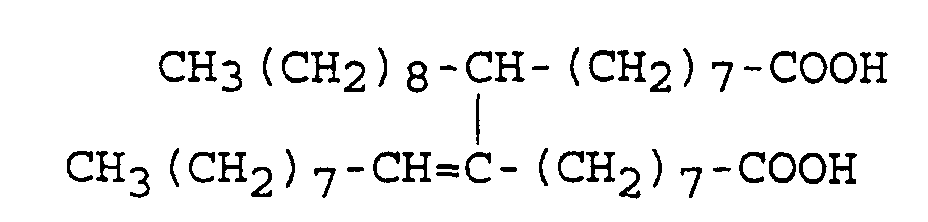
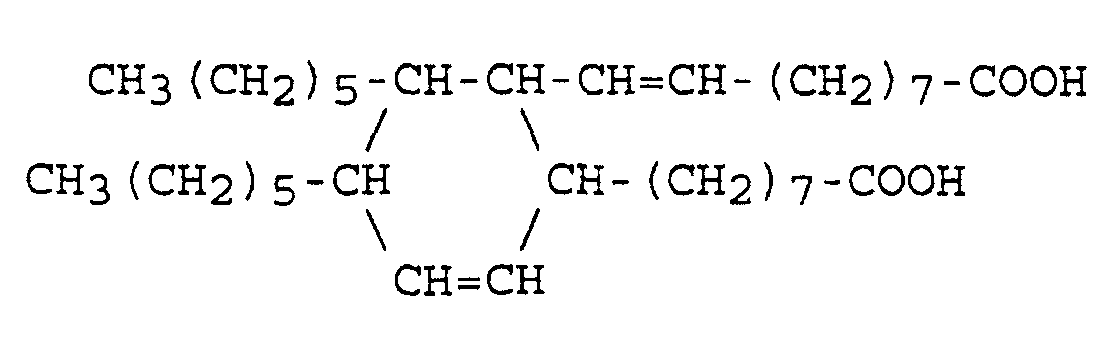
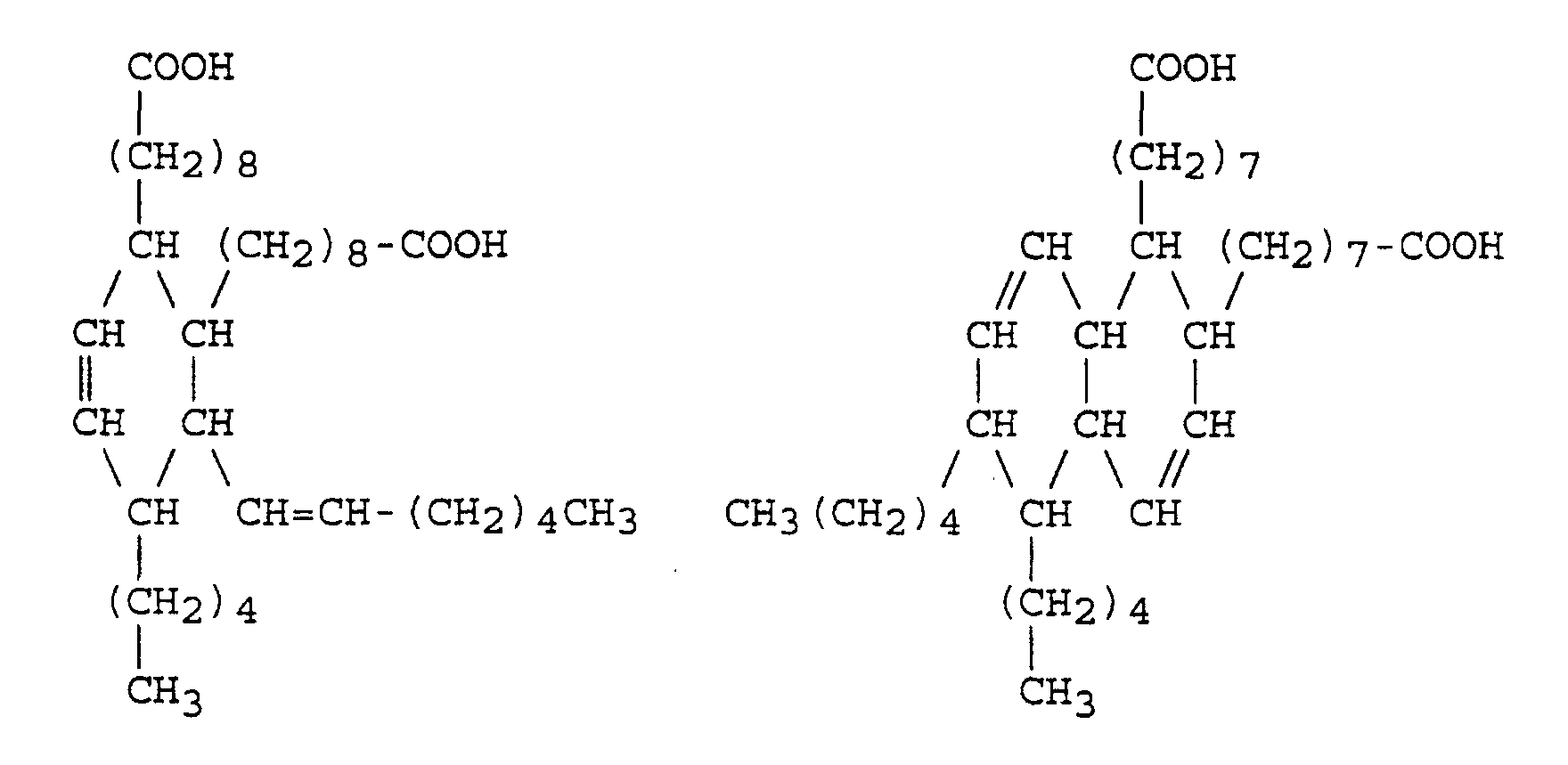
- dimeric fatty acids are also preferred acid components. These dimeric fatty acids correspond to the following formula (VII) HOOC-R 2 -COOH where R 2 is a divalent hydrocarbon radical with 34 C atoms (R 2 thus represents the radical containing 34 C atoms which is formed when an unsaturated fatty acid with 18 C atoms is dimerized to form a dicarboxylic acid with a total of 36 C atoms).
- dimerization means the union of two identical molecules to form a new molecule, the dimer, by means of an addition reaction.
- the dimerization of C 18 fatty acids is generally carried out at a temperature of 150 to 250 ° C, preferably 180 to 230 ° C, with or without a dimerization catalyst.
- the dicarboxylic acid obtained corresponds to the formula VII given, where R 2 is the divalent linkage formed in the dimerization of the C 18 fatty acid, which bears the two -COOH groups and has 34 C atoms.
- R 2 is preferably an acyclic (aliphatic) or a mono- or bicyclic (cycloaliphatic) radical with 34 C atoms.
- the acyclic radical is usually a branched (substituted) and mono- to trisaturated alkyl radical with 34 carbon atoms.
- the cycloaliphatic radical generally also has 1 to 3 double bonds.
- the preferred dimeric fatty acids described are generally a mixture of two or more dicarboxylic acids of the formula VII with structurally different R 2 radicals.
- the dicarboxylic acid mixture often has a more or less large content of trimeric fatty acids, which were formed during the dimerization and were not removed during the working up of the product by distillation. Similar mixtures are also obtained from natural products, for example in the manufacture of rosin from pine extract.
- some dimeric fatty acids are given in terms of formula, the hydrocarbon radical bearing the two -COOH groups being an acyclic, monocyclic or bicyclic radical:
- dimeric fatty acids described are commercially available under the name "dimerized fatty acids" or “Dimer fatty acids” are available and can, as above already mentioned, a more or less high proportion of contain trimerized fatty acids.
- Preferred acids in the metal salt compound of the Component b) are also aliphatic or aromatic Sulfonic acids with 8 to 40 carbon atoms, preferably 12 to 30 carbon atoms, in aliphatic or aromatic radical.
- the aliphatic The rest can be straight or branched, saturated or be unsaturated.
- the aromatic sulfonic acid is preferably a benzenesulfonic acid with an alkyl or Alkenyl radical with 12 to 30 carbon atoms.
- Metal soaps are particularly preferred.
- organic metal salts can according to the state of the art Techniques described methods can be produced. there be particularly to the above Documents FR-A-2 172 797, FR-A-2 632 966, US-A-4 129 589 and EP-A-476 196, which are here be included.
- organic metal salts are said to be oil-soluble or at least be oil dispersible. It is also a neutral or basic product, the latter is preferred.
- basic denotes as is known such metal salts in which the metal in a stoichiometrically larger amount than the organic one Acid radical is present.
- the invention have basic metal salt products to be used accordingly a pH of generally 7.5 to 12, preferably from 8 to 10.
- the additive used according to the invention is produced by mixing components a) and b) together, optionally using a solution or Dispersant.
- Suitable such means are lower or higher alcohols such as ethanol, isopropanol, Butanol, decanol, dodecanol and the like, lower or higher glycols and their mono- or dialkyl ethers such as ethylene glycol, propylene glycol, diethylene glycol, Tetraethylene glycol, tetrapropylene glycol and the like, low to medium high boiling aliphatic, aromatic or cycloaliphatic hydrocarbons such as toluene, xylene, naphtha and the like, light to medium heavy mineral oils, oil distillates, natural or synthetic oils and derivatives thereof and mixtures of two or more of these solvents.
- the Bringing the two components together, amine compound and metal salt compound generally takes place at Atmospheric pressure and a temperature of 15 to 100 ° C, preferably 20 to 70 ° C.
- the heavy oils are marked by a content of the additive described.
- the effective amount of additive in heavy oil can vary widely Limits vary. Generally the oil contains 2 to 2000 ppm additive, preferably 100 to 1000 ppm.
- the additive used according to the invention and the heavy oils with this additive have a particularly desirable one Property profile on, and this should be mostly on an unexpectedly high synergism of those used according to the invention Combination of components a) and b) are based. So lies the additive dissolved or highly distributed in the oil. Also in Oils with a high content of asphaltenes and / or other higher molecular compounds are all of these insoluble parts well emulsified or dispersed. The the same applies in the case of sludge, so that too Sludge formation largely eliminated or at least is significantly reduced.
- the additive used according to the invention is also a highly effective combustion improver. It ensures the complete combustion of heavy Oil while reducing soot formation.
- the heavy oils according to the invention thus fulfill the requirements mentioned in a surprising high degree.
- improved storage stability reduced separation of insoluble components
- improved pumpability due to low viscosity longer service life of the filter systems
- improved Injection behavior at the combustion devices what additionally contributes to the optimization of the combustion
- increased corrosion protection for all facilities the good corrosion inhibition of the additive are therefore, above all as fuel for industrial plants and power plants used and also as a fuel for marine engines.
- the fatty acid used to produce product b 1 is a distilled fatty acid consisting of a mixture (blend) of distilled talc oil fatty acid and resin acid with a molecular weight of about 300 g / mol. Approach: FeCl 3 0.85 l Density 1.48 g / cm 3 NH 3 0.785 l Density 0.91 g / cm 3 fatty acid 0.22 l Density 0.94 g / cm 3 water 0.20 l Petroleum distillate 0.80 l Density 0.82 g / cm 3
- the 0.85 l FeCl 3 , 0.22 l fatty acid, 0.20 l water and 0.80 l petroleum distillate are mixed together at room temperature (15 to 30 ° C).
- the 0.785 l of NH 3 are slowly introduced into this mixture with stirring (exothermic reaction).
- the mixture is heated to 80 to 90 ° C. with stirring, an aqueous and an organic phase being formed.
- the phase formation can be completed by adding more petroleum distillate.
- the two phases are separated from one another (decanted), whereupon the organic phase is still centrifuged to remove residual water.
- the organic phase contains the desired iron carboxylate compound.
- the fatty acid used to produce product b 2 is an alkylbenzenesulfonic acid with a molecular weight of approximately 322 g / mol.
- Comparative Examples 1 to 3 the compounds a 1 , a 3 and b 1 are each used alone.
- the three test solutions are subjected to the same test procedure as the examples according to the invention. Result: All test solutions do not meet the asphaltene dispersibility test or the combustibility improvement test.
- the additives used therefore have a unexpectedly high effectiveness regarding dispersion of Asphaltenes in heavy oils and also with regard to combustion of heavy oils; this should come from a surprisingly high Synergism of additive components a) and b) result. Because of the beneficial effects of The oils show new additives all those properties that are essential for use in industrial plants, power plants and heavy Ship engines are particularly desired.
Landscapes
- Chemical & Material Sciences (AREA)
- Oil, Petroleum & Natural Gas (AREA)
- Engineering & Computer Science (AREA)
- Organic Chemistry (AREA)
- Combustion & Propulsion (AREA)
- Chemical Kinetics & Catalysis (AREA)
- General Chemical & Material Sciences (AREA)
- Liquid Carbonaceous Fuels (AREA)
- Lubricants (AREA)
- Production Of Liquid Hydrocarbon Mixture For Refining Petroleum (AREA)
- Solid Fuels And Fuel-Associated Substances (AREA)
- Emulsifying, Dispersing, Foam-Producing Or Wetting Agents (AREA)
Description
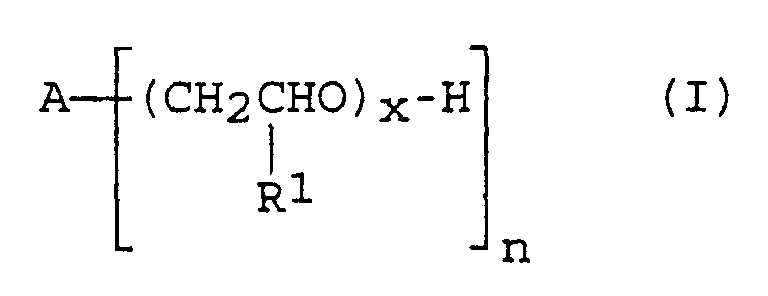
- n
- 1, 2, 3 oder 4,
- A
- einen Rest der Formeln (II) bis (V)
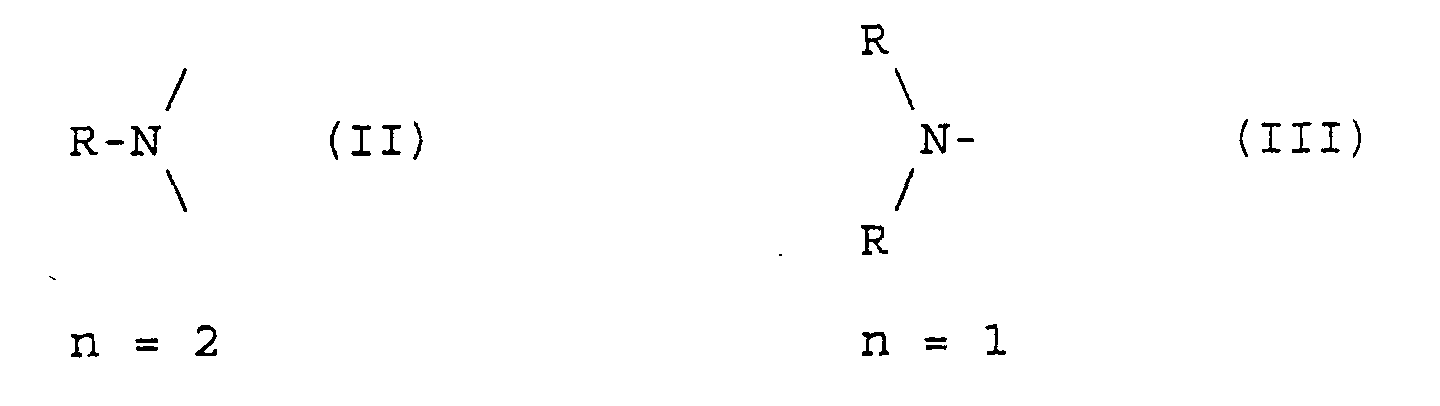 wobei R ein C6 bis C22-Alkyl ist, vorzugsweise ein C6 bis C18-Alkyl, und m 2, 3 oder 4 ist, vorzugsweise 2 oder 3,
- x
- eine Zahl von 5 bis 120, vorzugsweise 10 bis 80,
- R1
- H, CH3 oder H und CH3, wobei die Oxalkylenreste statistisch oder in Blöcken angeordnet sind, und
(R1 ist H und CH3 und der Polyoxalkylenrest besteht aus Ethylenoxid- und Propylenoxideinheiten, die statistisch verteilt beziehungsweise blockweise vorliegen) umgesetzt wird. Die Umsetzung wird im allgemeinen bei einer Temperatur von 100 bis 180 °C gegebenenfalls in Gegenwart eines alkalischen oder sauren Oxalkylierungskatalysators unter Luftausschluß durchgeführt. Bevorzugte Aminverbindungen als Komponente a) entsprechen der nachstehenden Formel (VI)

- n
- 1, 2, 3 oder 4,
- A
- einen Rest der oben angegebenen Formeln (II) bis (V) ,
- a
- eine Zahl von 5 bis 30, vorzugsweise 8 bis 20,
- b
- eine Zahl von 5 bis 50, vorzugsweise 10 bis 30, und
- c
- eine Zahl von 0 bis 40, vorzugsweise 0 bis 20.
| Formel (I) | |||||
| Verbindung | A | R | a | b | c |
| a1 | II | C14 bis C18-Alkyl ungesättigt | 22 | 33 | 0 |
| a2 | III | C14 bis C18-Alkyl ungesättigt | 6 | 9 | 0 |
| a3 | V | C14 bis C18-Alkyl ungesättigt | 22 | 33 | 0 |
| a4 | IV | C14 bis C18-Alkyl ungesättigt | 22 | 33 | 0 |
| a5 | III | C14 bis C18-Alkyl ungesättigt | 12 | 28 | 25 |
| a6 | III | C14 bis C18-Alkyl ungesättigt | 12 | 28 | 15 |
- Komponente a) des erfindungsgemäßen verwendeten Additivs:
Als Komponente a) werden die Verbindungen a1, a3 und a5 von Tabelle 1 eingesetzt. - Komponente b) des erfindungsgemäßen verwendeten Additivs:
Als Komponente b) werden die nachstehend näher beschriebenen Produkte b1 und b2 eingesetzt.
| Ansatz: | ||
| FeCl3 | 0,85 l | Dichte 1,48 g/cm3 |
| NH3 | 0,785 l | Dichte 0,91 g/cm3 |
| Fettsäure | 0,22 l | Dichte 0,94 g/cm3 |
| Wasser | 0,20 l | |
| Petroleum-Destillat | 0,80 l | Dichte 0,82 g/cm3 |
| Ansatz: | ||
| FeCl3 | 44 ml | Dichte 1,48 g/cm3 |
| NH3 | 34 ml | Dichte 0,91 g/cm3 |
| Säure | 13 ml | Dichte 1,06 g/cm3 |
| Wasser | 16 ml | |
| Petroleum-Destillat | 84 ml | Dichte 0,82 g/cm3 |
Eisenalkylbenzolsulfonat, erfolgt analog Produkt b1. Erfindungsgemäße verwendeten Additive:
- Test der erfindungsgemäßen
verwendeten Additive:
Die Additive der Beispiele 1 bis 3 werden bezüglich Asphalten-Dispergierbarkeit und Verbesserung der Verbrennbarkeit von Schwerölen getestet. Für den Test der Asphalten-Dispergierbarkeit wird zunächst eine Asphaltene enthaltende Lösung hergestellt. - Herstellung einer Lösung von Asphaltenen in Toluol:
Zur Herstellung dieser Lösung wird ein Asphaltene enthaltendes Rückstandsöl einer Extraktion unterworfen, die im einzelnen wie folgt durchgeführt wird. In einem ersten Schritt werden etwa 30 g Rückstandsöl in einem Becherglas mit etwa 300 ml Essigsäureethylester versetzt. Die Mischung wird 2 Stunden bei 40 °C gerührt und danach 24 Stunden lang stehengelassen, worauf sie über ein einfaches Porenfilter abfiltriert wird. In einem zweiten Schritt wird der Filterrückstand in eine für Soxhlet-Extraktion übliche Extraktionshülse gegeben und mit Hilfe von wiederum etwa 300 ml Essigsäureethylester etwa 2 Stunden lang extrahiert, wobei der Paraffin-Anteil im Filterkuchen in die Essigsäureethylester-Phase übergeht. In einem dritten Schritt werden mit Hilfe von etwa 300 ml Pentan die Harzanteile ebenfalls durch Soxhlet-Extraktion herausgelöst. In einem vierten Schritt werden dann mit Hilfe von etwa 300 ml Toluol die Asphaltene extrahiert, wobei die gewünschte Lösung von Asphaltenen in Toluol erhalten wird. - Test der erfindungsgemäßen
verwendeten Additive auf
Asphalten-Dispergierbarkeit: Dieser Test wird nach den Vorschriften ISO 10307-1:1993 oder ASTM D4370-32 (Heißfiltration) durchgeführt. Dazu werden zunächst 30 g von einer etwa 10gew.%igen Asphalten-Lösung in Toluol mit 100 ml Pentan vermischt. In drei solche Asphalten-Toluol/Pentan-Lösungen werden jeweils 700 ppm Additiv vom Beispiel 1, 2 und 3 bei Raumtemperatur eingerührt. Diese drei Testlösungen werden dann gemäß den genannten Vorschriften behandelt. Ergebnis: Die erfindungsgemäßen verwendeten Additive erfüllen den Test. - Test der erfindungsgemäßen
verwendeten Additive auf Verbesserung
der Verbrennbarkeit von Schwerölen:
Dieser Test wird nach den Vorschriften von VDI 2066, Blatt 1 (VDI heißt Verein deutscher Ingenieure) durchgeführt, wobei die Additive der Beispiele 1, 2 und 3 in einer Menge von 500 ppm, 700 ppm und 900 ppm eingesetzt werden. Ergebnis: Die erfindungsgemäßen verwendeten Additive erfüllen den Test.
Claims (8)
- Verwendung eines Additivs, bestehend im wesentlichen ausGewichtsprozente bezogen auf das Additiv, als Emulgier- und Dispergiermittel und als Verbrennungsverbesserer für schwere Öle.a) 1 bis 99 Gew.-% von mindestens einer Aminverbindung der nachstehenden Formel (I)worin bedeuten
 n 1, 2, 3 oder 4,A einen Rest der Formeln (II) bis (V)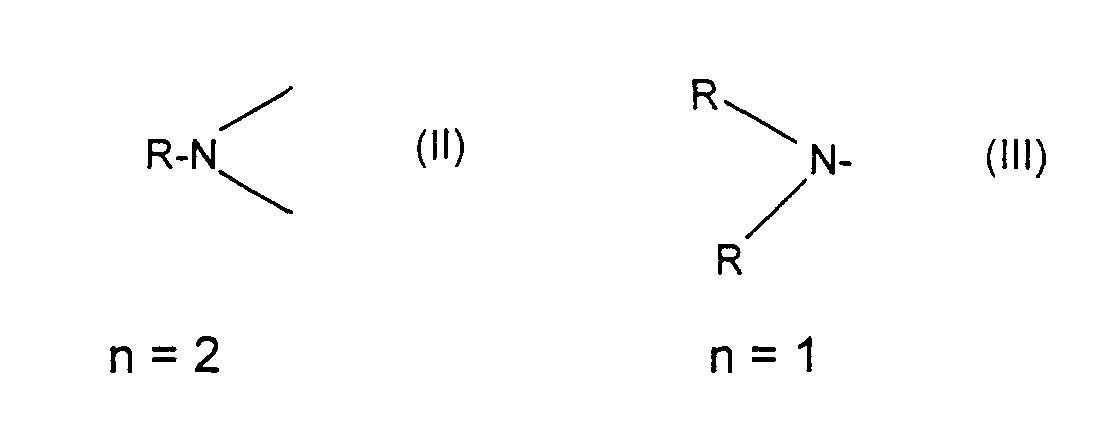
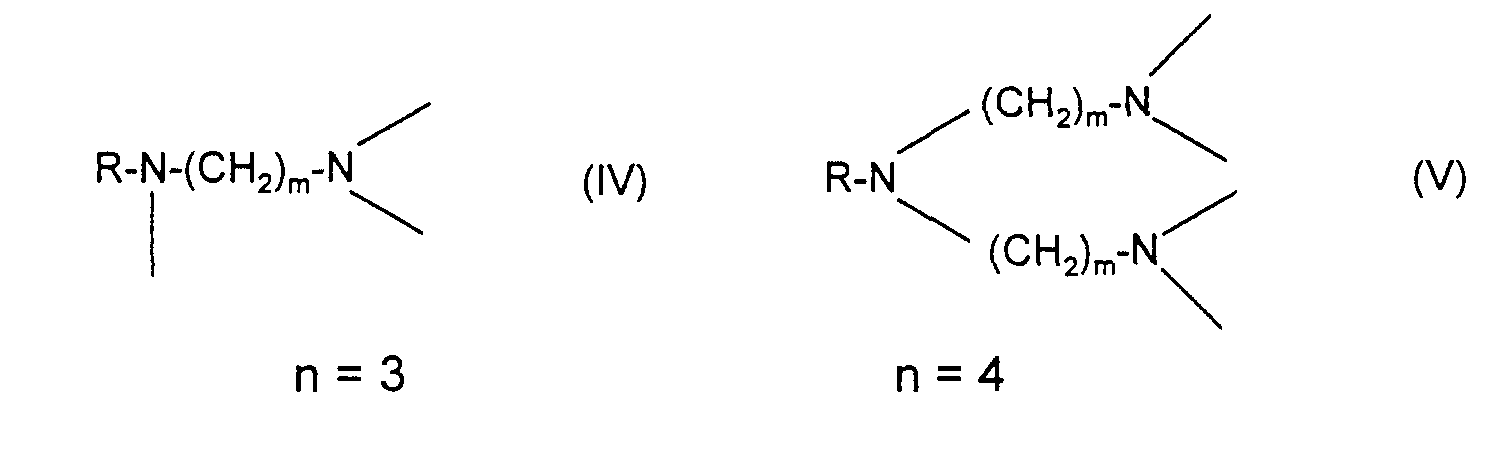 wobei R ein C6 bis C22-Alkyl undm 2, 3 oder 4 ist,
- x
- eine Zahl von 5 bis 120,
- R1
- H, CH3 oder H und CH3, wobei die Oxalkylenreste statistisch oder in Blöcken angeordnet sind, und
b) 1 bis 99 Gew.-% von mindestens einer öllöslichen oder öldispergierbaren, neutralen oder basischen Metallsalzverbindung mit einem Metall der ersten Hauptgruppe des Periodensystems der Elemente, der zweiten Hauptgruppe, der ersten Nebengruppe, der zweiten Nebengruppe, der vierten Nebengruppe, der sechsten Nebengruppe, der achten Nebengruppe oder der Lanthanidengruppe des Periodensystems und einer Carbonsäure, Sulfonsäure, Esterphosphorsäure oder Esterschwefelsäure mit einem Kohlenwasserstoffrest von jeweils 8 bis 40 Kohlenstoffatomen als Säurekomponente, - Verwendung nach Anspruch 1, dadurch gekennzeichnet, daß die Komponente a) eine Aminverbindung der nachstehenden Formel (VI) istworin bedeuten

- n
- 1, 2, 3 oder 4,
- A
- einen Rest der angegebenen Formeln (II) bis (V),
- a
- eine Zahl von 5 bis 30,
- b
- eine Zahl von 5 bis 50 und
- c
- eine Zahl von 0 bis 40.
- Verwendung nach Anspruch 1 oder 2, dadurch gekennzeichnet, daß die Komponente b) eine Metallsalzverbindung ist mit einem Metall ausgewählt aus der Gruppe bestehend aus Alkalimetallen, Erdalkalimetallen, Kupfer, Silber, Zink, Cadmium, Titan, Zirkon, Molybdän, Chrom, Wolfram, Eisen, Kobalt, Nickel, Lanthan, Cer und Ytterbium, und mit einer Säure ausgewählt aus der Gruppe bestehend aus aliphatischen Carbonsäuren mit 8 bis 40 Kohlenstoffatomen, dimeren Fettsäuren mit 36 Kohlenstoffatomen und aliphatischen oder aromatischen Sulfonsäuren mit 8 bis 40 Kohlenstoffatomen.
- Verwendung nach Anspruch 1 oder 2, dadurch gekennzeichnet, daß die Komponente b) eine Metallsalzverbindung ist, wobei das Metall ein Erdalkalimetall, Kupfer, Zink, Zirkon, Molybdän, Eisen, Nickel, Cer oder Ytterbium ist, und die Säurekomponente eine Fettsäure mit 8 bis 40 Kohlenstoffatomen, eine dimere Fettsäure mit 36 Kohlenstoffatomen oder eine aliphatische oder aromatische Sulfonsäure mit 8 bis 40 Kohlenstoffatomen ist.
- Verwendung nach einem oder mehreren der Ansprüche 1 bis 4, dadurch gekennzeichnet, daß es von der Komponente a) 20 bis 80 Gew.-% und von der Komponente b) 20 bis 80 Gew.-% enthält.
- Verwendung nach einem oder mehreren der Ansprüche 1 bis 4, dadurch gekennzeichnet, daß es von der Komponente a) 40 bis 60 Gew.-% und von der Komponente b) 40 bis 60 Gew.-% enthält.
- Verwendung nach einem oder mehreren der Ansprüche 1 bis 6, dadurch gekennzeichnet, daß es einen pH-Wert von 7,5 bis 12 aufweist.
- Verwendung von Additiven gemäß einem oder mehreren der Ansprüche 1 bis 7 in Industrieanlagen, Kraftwerken oder Schiffsmotoren.
Applications Claiming Priority (3)
| Application Number | Priority Date | Filing Date | Title |
|---|---|---|---|
| DE19643832A DE19643832A1 (de) | 1996-10-30 | 1996-10-30 | Schwere Öle mit verbesserten Eigenschaften und ein Additiv dafür |
| DE19643832 | 1996-10-30 | ||
| PCT/EP1997/005793 WO1998018885A1 (de) | 1996-10-30 | 1997-10-21 | Schwere öle mit verbesserten eigenschaften und ein additiv dafür |
Publications (2)
| Publication Number | Publication Date |
|---|---|
| EP0938534A1 EP0938534A1 (de) | 1999-09-01 |
| EP0938534B1 true EP0938534B1 (de) | 2001-09-26 |
Family
ID=7809624
Family Applications (1)
| Application Number | Title | Priority Date | Filing Date |
|---|---|---|---|
| EP97912206A Expired - Lifetime EP0938534B1 (de) | 1996-10-30 | 1997-10-21 | Verwendung eines additivs zur verbesserung der eigenschaften von schweren ölen |
Country Status (20)
| Country | Link |
|---|---|
| US (1) | US6488724B1 (de) |
| EP (1) | EP0938534B1 (de) |
| CN (1) | CN1235629A (de) |
| AR (1) | AR008902A1 (de) |
| AU (1) | AU727164B2 (de) |
| BR (1) | BR9712463A (de) |
| CA (1) | CA2270218C (de) |
| CO (1) | CO4870788A1 (de) |
| DE (2) | DE19643832A1 (de) |
| DK (1) | DK0938534T3 (de) |
| ES (1) | ES2165031T3 (de) |
| HU (1) | HUP9904230A3 (de) |
| ID (1) | ID22062A (de) |
| MY (1) | MY121236A (de) |
| NO (1) | NO317758B1 (de) |
| RU (1) | RU2177980C2 (de) |
| TR (1) | TR199900929T2 (de) |
| UA (1) | UA52704C2 (de) |
| WO (1) | WO1998018885A1 (de) |
| ZA (1) | ZA979704B (de) |
Families Citing this family (13)
| Publication number | Priority date | Publication date | Assignee | Title |
|---|---|---|---|---|
| FR2789999B1 (fr) * | 1999-02-18 | 2004-05-28 | Arc Chimie | Procede de traitement des melanges d'hydrocarbures contenant des asphaltenes |
| NO20031604L (no) * | 2002-04-23 | 2003-10-24 | Rohm & Haas | Aminumettede addukter som asfaltendispergenter i råolje |
| ITRM20020509A1 (it) * | 2002-10-08 | 2004-04-09 | Chimec Spa | Additivo per olio combustibile. |
| US20040232043A1 (en) * | 2003-05-23 | 2004-11-25 | Ravindranath Mukkamala | Amine-unsaturated acid adducts as asphaltene dispersants in crude oil |
| CA2547147C (en) * | 2005-05-20 | 2014-08-05 | Value Creation Inc. | Decontamination of asphaltic heavy oil |
| CO5930080A1 (es) * | 2006-12-06 | 2008-06-27 | Ecopetrol Sa | Aditivo anti-coquizante y estabilizante de asfalteno y procedimiento para su obtencion |
| US8876921B2 (en) * | 2007-07-20 | 2014-11-04 | Innospec Limited | Hydrocarbon compositions |
| US9255043B2 (en) | 2011-08-31 | 2016-02-09 | Chevron Oronite Company Llc | Liquid crude hydrocarbon composition |
| US9212330B2 (en) * | 2012-10-31 | 2015-12-15 | Baker Hughes Incorporated | Process for reducing the viscosity of heavy residual crude oil during refining |
| KR101836946B1 (ko) * | 2015-09-17 | 2018-04-19 | 이영서 | 온실가스, 질소산화물 및 입자상 물질 저감을 위한 연료첨가제 |
| CN109219649B (zh) * | 2016-03-18 | 2021-01-15 | 韩国化学研究院 | 借助于沥青质高分散化的重质油转化方法 |
| US10781378B2 (en) | 2017-12-05 | 2020-09-22 | Fqe Chemicals Inc. | Compositions and methods for dissolution of heavy organic compounds |
| KR20240035547A (ko) | 2021-07-16 | 2024-03-15 | 이노스펙 리미티드 | 연료유 조성물, 및 이와 관련된 방법 및 용도 |
Family Cites Families (22)
| Publication number | Priority date | Publication date | Assignee | Title |
|---|---|---|---|---|
| DE1284378B (de) * | 1966-06-01 | 1968-12-05 | Hoechst Ag | Verfahren zur Verhuetung von Paraffin- und Asphaltablagerungen bei der Erdoelfoerderung |
| FR2172797A1 (en) * | 1972-02-22 | 1973-10-05 | Gamlen Naintre Sa | Oil-sol ferric salts of org acids - for use as paint and varnish siccatives and fuel additives |
| DE2316230A1 (de) * | 1972-04-10 | 1973-10-18 | Drew Chem Corp | Heizoel-additiv |
| US4033718A (en) * | 1973-11-27 | 1977-07-05 | The Procter & Gamble Company | Photoactivated bleaching process |
| US4129589A (en) | 1976-07-15 | 1978-12-12 | Surpass Chemicals Limited | Over-based magnesium salts of sulphonic acids |
| US4182613A (en) * | 1976-11-24 | 1980-01-08 | Exxon Research & Engineering Co. | Compatibility additive for fuel oil blends |
| US4129508A (en) * | 1977-10-13 | 1978-12-12 | The Lubrizol Corporation | Demulsifier additive compositions for lubricants and fuels and concentrates containing the same |
| US4512774A (en) * | 1978-12-27 | 1985-04-23 | Calgon Corporation | Residual fuel oil conditioners containing metal salts in aqueous solution |
| FR2451364A1 (fr) * | 1979-03-16 | 1980-10-10 | Inst Francais Du Petrole | Complexes organo-solubles a haute teneur en fer utilisables comme adjuvants de combustion dans les combustibles liquides |
| FR2476645A2 (fr) * | 1979-04-06 | 1981-08-28 | Inst Francais Du Petrole | Complexes organo-solubles a haute teneur en fer utilisables comme adjuvants de combustion dans les combustibles liquides |
| US4505718A (en) * | 1981-01-22 | 1985-03-19 | The Lubrizol Corporation | Organo transition metal salt/ashless detergent-dispersant combinations |
| US4604188A (en) * | 1983-08-11 | 1986-08-05 | Mobil Oil Corporation | Thermal upgrading of residual oil to light product and heavy residual fuel |
| US4479805A (en) * | 1983-09-12 | 1984-10-30 | Columbia Chase Corporation | Treating-high asphaltene fuel oils |
| FR2576032B1 (fr) * | 1985-01-17 | 1987-02-06 | Elf France | Composition homogene et stable d'hydrocarbures liquides asphalteniques et d'au moins un additif utilisable notamment comme fuel industriel |
| US4804389A (en) * | 1985-08-16 | 1989-02-14 | The Lubrizol Corporation | Fuel products |
| US4659338A (en) * | 1985-08-16 | 1987-04-21 | The Lubrizol Corporation | Fuel compositions for lessening valve seat recession |
| US4690687A (en) * | 1985-08-16 | 1987-09-01 | The Lubrizol Corporation | Fuel products comprising a lead scavenger |
| DE3638743A1 (de) * | 1986-11-13 | 1988-05-26 | Hoechst Ag | Verzweigte polyoxalkylenmischpolyester, verfahren zu ihrer herstellung und ihre verwendung |
| DE3809067A1 (de) * | 1988-03-18 | 1989-09-28 | Hoechst Ag | Verfahren zum trennen von erdoelemulsionen vom typ wasser-in-oel |
| FR2632966B1 (fr) * | 1988-06-21 | 1990-11-16 | Bycosin Kemi Ab | Dispersions d'hydroxydes de fer utiles comme additifs ameliorant la combustion |
| ES2060058T3 (es) | 1990-09-20 | 1994-11-16 | Ethyl Petroleum Additives Ltd | Composiciones de combustible hidrocarbonado y aditivos para las mismas. |
| DE59308532D1 (de) * | 1992-08-22 | 1998-06-18 | Clariant Gmbh | Polyfunktionelle Demulgatoren für Rohöle |
-
1996
- 1996-10-30 DE DE19643832A patent/DE19643832A1/de not_active Withdrawn
-
1997
- 1997-10-21 BR BR9712463-0A patent/BR9712463A/pt not_active Application Discontinuation
- 1997-10-21 UA UA99052952A patent/UA52704C2/uk unknown
- 1997-10-21 CN CN97199328A patent/CN1235629A/zh active Pending
- 1997-10-21 HU HU9904230A patent/HUP9904230A3/hu unknown
- 1997-10-21 EP EP97912206A patent/EP0938534B1/de not_active Expired - Lifetime
- 1997-10-21 AU AU49487/97A patent/AU727164B2/en not_active Ceased
- 1997-10-21 DK DK97912206T patent/DK0938534T3/da active
- 1997-10-21 RU RU99111742/04A patent/RU2177980C2/ru not_active IP Right Cessation
- 1997-10-21 ID IDW990210A patent/ID22062A/id unknown
- 1997-10-21 ES ES97912206T patent/ES2165031T3/es not_active Expired - Lifetime
- 1997-10-21 TR TR1999/00929T patent/TR199900929T2/xx unknown
- 1997-10-21 CA CA002270218A patent/CA2270218C/en not_active Expired - Fee Related
- 1997-10-21 DE DE59704734T patent/DE59704734D1/de not_active Expired - Lifetime
- 1997-10-21 WO PCT/EP1997/005793 patent/WO1998018885A1/de not_active Ceased
- 1997-10-27 CO CO97062842A patent/CO4870788A1/es unknown
- 1997-10-27 US US08/957,834 patent/US6488724B1/en not_active Expired - Lifetime
- 1997-10-28 AR ARP970104981A patent/AR008902A1/es active IP Right Grant
- 1997-10-29 ZA ZA979704A patent/ZA979704B/xx unknown
- 1997-10-29 MY MYPI97005124A patent/MY121236A/en unknown
-
1999
- 1999-04-23 NO NO19991949A patent/NO317758B1/no not_active IP Right Cessation
Also Published As
| Publication number | Publication date |
|---|---|
| ID22062A (id) | 1999-08-26 |
| HUP9904230A2 (hu) | 2000-04-28 |
| WO1998018885A1 (de) | 1998-05-07 |
| NO991949L (no) | 1999-04-23 |
| RU2177980C2 (ru) | 2002-01-10 |
| US6488724B1 (en) | 2002-12-03 |
| DE59704734D1 (de) | 2001-10-31 |
| DK0938534T3 (da) | 2001-12-17 |
| ZA979704B (en) | 1998-07-27 |
| AU4948797A (en) | 1998-05-22 |
| AU727164B2 (en) | 2000-12-07 |
| CO4870788A1 (es) | 1999-12-27 |
| UA52704C2 (uk) | 2003-01-15 |
| BR9712463A (pt) | 1999-12-21 |
| CA2270218C (en) | 2006-10-31 |
| EP0938534A1 (de) | 1999-09-01 |
| NO317758B1 (no) | 2004-12-13 |
| TR199900929T2 (xx) | 1999-07-21 |
| DE19643832A1 (de) | 1998-05-07 |
| MY121236A (en) | 2006-01-28 |
| ES2165031T3 (es) | 2002-03-01 |
| HUP9904230A3 (en) | 2001-02-28 |
| CN1235629A (zh) | 1999-11-17 |
| AR008902A1 (es) | 2000-02-23 |
| NO991949D0 (no) | 1999-04-23 |
| CA2270218A1 (en) | 1998-05-07 |
Similar Documents
| Publication | Publication Date | Title |
|---|---|---|
| DE69730709T2 (de) | Brennstoffzusätze | |
| DE3246123C2 (de) | Zusammensetzungen aus Hydroxyaminen und Carboxyl-Dispersants und ihre Verwendung als Treibstoffzusätze | |
| DE2842064A1 (de) | Schmieroelzubereitung | |
| DE2027129A1 (de) | Treibstoffgemisch | |
| EP0938534A1 (de) | Schwere öle mit verbesserten eigenschaften und ein additiv dafür | |
| EP0900836B2 (de) | Additiv zur Verbesserung der Fliessfähigkeit von Mineralölen und Mineralöldestillaten | |
| DE69427080T2 (de) | Überbasische, alkylierte alkylsalicylate | |
| EP1230330B1 (de) | Verwendung von fettsäuresalzen von alkoxylierten oligoaminen als schmierfähigkeitsverbesserer für mineralölprodukte | |
| DE19848621A1 (de) | Paraffindispergatoren mit Lubricity-Wirkung für Erdölmitteldestillate | |
| DE69810746T2 (de) | Sauerstoffenthaltende produkte als dieselbrennstoff | |
| DE69002823T2 (de) | Hybride Brennstoffzusammensetzung in Form einer wässrigen Mikroemulsion. | |
| DE3852668T3 (de) | Brennstoffzusammensetzung mit einem Zusatz zur Verminderung des Rückschlags des Ventilsitzes. | |
| DE69601701T3 (de) | Kraftstoffzusammensetzungen | |
| DE69001295T2 (de) | In zufuhranlage niederschlaege kontrollierende zusammensetzungen. | |
| WO1998039549A1 (de) | Verfahren zur entfernung von bei der erdölproduktion anfallenden festen asphaltenrückständen | |
| DE2621207C3 (de) | Malonsäureester, Verfahren zu ihrer Herstellung und sie enthaltende Schmiermittel, flüssige Treibstoffe und Aditive | |
| EP0006527A1 (de) | Kraftstoffe für Ottomotoren, die Additivmischungen enthalten | |
| DE2711218A1 (de) | Mitteldestillatbrennstoffgemisch | |
| EP0597278A1 (de) | Erdölmitteldestillatzusammensetzungen | |
| DE69733274T3 (de) | Kraftstoffe mit schmieradditiven | |
| DE69709677T2 (de) | Esteramine enthaltende kraftstoffezusammensetzungen | |
| EP0710271B1 (de) | Umsetzungsprodukte von aminoalkylencarbonsäuren sowie erdölmitteldestillate, die diese enthalten | |
| WO2004041975A1 (de) | Kraftstoffe mit verbesserter additivwirkung | |
| EP1723218A1 (de) | Treibstoffzusammensetzungen | |
| DE1946239C3 (de) | Kraftstoff- oder Schmierölmischungen |
Legal Events
| Date | Code | Title | Description |
|---|---|---|---|
| PUAI | Public reference made under article 153(3) epc to a published international application that has entered the european phase |
Free format text: ORIGINAL CODE: 0009012 |
|
| 17P | Request for examination filed |
Effective date: 19990531 |
|
| AK | Designated contracting states |
Kind code of ref document: A1 Designated state(s): DE DK ES FR GB GR IT NL SE |
|
| RTI1 | Title (correction) |
Free format text: UTILISATION D'UN ADDITIF POUR AMELIORER LES PROPRIETES D'HUILES LOURDES |
|
| GRAG | Despatch of communication of intention to grant |
Free format text: ORIGINAL CODE: EPIDOS AGRA |
|
| 17Q | First examination report despatched |
Effective date: 20010116 |
|
| GRAG | Despatch of communication of intention to grant |
Free format text: ORIGINAL CODE: EPIDOS AGRA |
|
| GRAH | Despatch of communication of intention to grant a patent |
Free format text: ORIGINAL CODE: EPIDOS IGRA |
|
| GRAH | Despatch of communication of intention to grant a patent |
Free format text: ORIGINAL CODE: EPIDOS IGRA |
|
| GRAA | (expected) grant |
Free format text: ORIGINAL CODE: 0009210 |
|
| AK | Designated contracting states |
Kind code of ref document: B1 Designated state(s): DE DK ES FR GB GR IT NL SE |
|
| REF | Corresponds to: |
Ref document number: 59704734 Country of ref document: DE Date of ref document: 20011031 |
|
| REG | Reference to a national code |
Ref country code: GB Ref legal event code: IF02 |
|
| GBT | Gb: translation of ep patent filed (gb section 77(6)(a)/1977) |
Effective date: 20011224 |
|
| ET | Fr: translation filed | ||
| REG | Reference to a national code |
Ref country code: ES Ref legal event code: FG2A Ref document number: 2165031 Country of ref document: ES Kind code of ref document: T3 |
|
| REG | Reference to a national code |
Ref country code: GR Ref legal event code: EP Ref document number: 20010402591 Country of ref document: GR |
|
| PLBE | No opposition filed within time limit |
Free format text: ORIGINAL CODE: 0009261 |
|
| STAA | Information on the status of an ep patent application or granted ep patent |
Free format text: STATUS: NO OPPOSITION FILED WITHIN TIME LIMIT |
|
| 26N | No opposition filed | ||
| PGFP | Annual fee paid to national office [announced via postgrant information from national office to epo] |
Ref country code: DK Payment date: 20060811 Year of fee payment: 10 |
|
| REG | Reference to a national code |
Ref country code: FR Ref legal event code: CD |
|
| REG | Reference to a national code |
Ref country code: DK Ref legal event code: EBP |
|
| PG25 | Lapsed in a contracting state [announced via postgrant information from national office to epo] |
Ref country code: DK Free format text: LAPSE BECAUSE OF NON-PAYMENT OF DUE FEES Effective date: 20071031 |
|
| PGFP | Annual fee paid to national office [announced via postgrant information from national office to epo] |
Ref country code: SE Payment date: 20141021 Year of fee payment: 18 Ref country code: GB Payment date: 20141021 Year of fee payment: 18 Ref country code: DE Payment date: 20141022 Year of fee payment: 18 Ref country code: ES Payment date: 20141028 Year of fee payment: 18 Ref country code: FR Payment date: 20141022 Year of fee payment: 18 Ref country code: GR Payment date: 20141014 Year of fee payment: 18 |
|
| PGFP | Annual fee paid to national office [announced via postgrant information from national office to epo] |
Ref country code: NL Payment date: 20141021 Year of fee payment: 18 |
|
| PGFP | Annual fee paid to national office [announced via postgrant information from national office to epo] |
Ref country code: IT Payment date: 20141028 Year of fee payment: 18 |
|
| REG | Reference to a national code |
Ref country code: DE Ref legal event code: R119 Ref document number: 59704734 Country of ref document: DE |
|
| REG | Reference to a national code |
Ref country code: SE Ref legal event code: EUG |
|
| GBPC | Gb: european patent ceased through non-payment of renewal fee |
Effective date: 20151021 |
|
| REG | Reference to a national code |
Ref country code: NL Ref legal event code: MM Effective date: 20151101 |
|
| REG | Reference to a national code |
Ref country code: GR Ref legal event code: ML Ref document number: 20010402591 Country of ref document: GR Effective date: 20160506 |
|
| PG25 | Lapsed in a contracting state [announced via postgrant information from national office to epo] |
Ref country code: IT Free format text: LAPSE BECAUSE OF NON-PAYMENT OF DUE FEES Effective date: 20151021 Ref country code: DE Free format text: LAPSE BECAUSE OF NON-PAYMENT OF DUE FEES Effective date: 20160503 Ref country code: GB Free format text: LAPSE BECAUSE OF NON-PAYMENT OF DUE FEES Effective date: 20151021 Ref country code: GR Free format text: LAPSE BECAUSE OF NON-PAYMENT OF DUE FEES Effective date: 20160506 |
|
| REG | Reference to a national code |
Ref country code: FR Ref legal event code: ST Effective date: 20160630 |
|
| PG25 | Lapsed in a contracting state [announced via postgrant information from national office to epo] |
Ref country code: NL Free format text: LAPSE BECAUSE OF NON-PAYMENT OF DUE FEES Effective date: 20151101 Ref country code: SE Free format text: LAPSE BECAUSE OF NON-PAYMENT OF DUE FEES Effective date: 20151022 Ref country code: FR Free format text: LAPSE BECAUSE OF NON-PAYMENT OF DUE FEES Effective date: 20151102 |
|
| REG | Reference to a national code |
Ref country code: ES Ref legal event code: FD2A Effective date: 20161125 |
|
| PG25 | Lapsed in a contracting state [announced via postgrant information from national office to epo] |
Ref country code: ES Free format text: LAPSE BECAUSE OF NON-PAYMENT OF DUE FEES Effective date: 20151022 |