EP0918360A1 - Verfahren zur herstellung actives positiven polmaterials für alkalische sekundärbatterie, nickelpastepol, und alkalische sekundärbatterie und verfahren zur herstellung derselben - Google Patents
Verfahren zur herstellung actives positiven polmaterials für alkalische sekundärbatterie, nickelpastepol, und alkalische sekundärbatterie und verfahren zur herstellung derselben Download PDFInfo
- Publication number
- EP0918360A1 EP0918360A1 EP98902184A EP98902184A EP0918360A1 EP 0918360 A1 EP0918360 A1 EP 0918360A1 EP 98902184 A EP98902184 A EP 98902184A EP 98902184 A EP98902184 A EP 98902184A EP 0918360 A1 EP0918360 A1 EP 0918360A1
- Authority
- EP
- European Patent Office
- Prior art keywords
- cobalt
- hydroxide
- active material
- nickel
- secondary battery
- Prior art date
- Legal status (The legal status is an assumption and is not a legal conclusion. Google has not performed a legal analysis and makes no representation as to the accuracy of the status listed.)
- Withdrawn
Links
Images

Classifications
-
- H—ELECTRICITY
- H01—ELECTRIC ELEMENTS
- H01M—PROCESSES OR MEANS, e.g. BATTERIES, FOR THE DIRECT CONVERSION OF CHEMICAL ENERGY INTO ELECTRICAL ENERGY
- H01M10/00—Secondary cells; Manufacture thereof
- H01M10/24—Alkaline accumulators
- H01M10/28—Construction or manufacture
- H01M10/288—Processes for forming or storing electrodes in the battery container
-
- C—CHEMISTRY; METALLURGY
- C01—INORGANIC CHEMISTRY
- C01G—COMPOUNDS CONTAINING METALS NOT COVERED BY SUBCLASSES C01D OR C01F
- C01G51/00—Compounds of cobalt
- C01G51/04—Oxides
-
- C—CHEMISTRY; METALLURGY
- C01—INORGANIC CHEMISTRY
- C01G—COMPOUNDS CONTAINING METALS NOT COVERED BY SUBCLASSES C01D OR C01F
- C01G53/00—Compounds of nickel
-
- C—CHEMISTRY; METALLURGY
- C01—INORGANIC CHEMISTRY
- C01G—COMPOUNDS CONTAINING METALS NOT COVERED BY SUBCLASSES C01D OR C01F
- C01G53/00—Compounds of nickel
- C01G53/04—Oxides
-
- H—ELECTRICITY
- H01—ELECTRIC ELEMENTS
- H01M—PROCESSES OR MEANS, e.g. BATTERIES, FOR THE DIRECT CONVERSION OF CHEMICAL ENERGY INTO ELECTRICAL ENERGY
- H01M4/00—Electrodes
- H01M4/02—Electrodes composed of, or comprising, active material
- H01M4/24—Electrodes for alkaline accumulators
- H01M4/32—Nickel oxide or hydroxide electrodes
-
- H—ELECTRICITY
- H01—ELECTRIC ELEMENTS
- H01M—PROCESSES OR MEANS, e.g. BATTERIES, FOR THE DIRECT CONVERSION OF CHEMICAL ENERGY INTO ELECTRICAL ENERGY
- H01M4/00—Electrodes
- H01M4/02—Electrodes composed of, or comprising, active material
- H01M4/36—Selection of substances as active materials, active masses, active liquids
- H01M4/48—Selection of substances as active materials, active masses, active liquids of inorganic oxides or hydroxides
- H01M4/52—Selection of substances as active materials, active masses, active liquids of inorganic oxides or hydroxides of nickel, cobalt or iron
-
- C—CHEMISTRY; METALLURGY
- C01—INORGANIC CHEMISTRY
- C01P—INDEXING SCHEME RELATING TO STRUCTURAL AND PHYSICAL ASPECTS OF SOLID INORGANIC COMPOUNDS
- C01P2004/00—Particle morphology
- C01P2004/80—Particles consisting of a mixture of two or more inorganic phases
- C01P2004/82—Particles consisting of a mixture of two or more inorganic phases two phases having the same anion, e.g. both oxidic phases
-
- C—CHEMISTRY; METALLURGY
- C01—INORGANIC CHEMISTRY
- C01P—INDEXING SCHEME RELATING TO STRUCTURAL AND PHYSICAL ASPECTS OF SOLID INORGANIC COMPOUNDS
- C01P2006/00—Physical properties of inorganic compounds
- C01P2006/40—Electric properties
-
- H—ELECTRICITY
- H01—ELECTRIC ELEMENTS
- H01M—PROCESSES OR MEANS, e.g. BATTERIES, FOR THE DIRECT CONVERSION OF CHEMICAL ENERGY INTO ELECTRICAL ENERGY
- H01M10/00—Secondary cells; Manufacture thereof
- H01M10/42—Methods or arrangements for servicing or maintenance of secondary cells or secondary half-cells
- H01M10/44—Methods for charging or discharging
- H01M10/446—Initial charging measures
-
- Y—GENERAL TAGGING OF NEW TECHNOLOGICAL DEVELOPMENTS; GENERAL TAGGING OF CROSS-SECTIONAL TECHNOLOGIES SPANNING OVER SEVERAL SECTIONS OF THE IPC; TECHNICAL SUBJECTS COVERED BY FORMER USPC CROSS-REFERENCE ART COLLECTIONS [XRACs] AND DIGESTS
- Y02—TECHNOLOGIES OR APPLICATIONS FOR MITIGATION OR ADAPTATION AGAINST CLIMATE CHANGE
- Y02E—REDUCTION OF GREENHOUSE GAS [GHG] EMISSIONS, RELATED TO ENERGY GENERATION, TRANSMISSION OR DISTRIBUTION
- Y02E60/00—Enabling technologies; Technologies with a potential or indirect contribution to GHG emissions mitigation
- Y02E60/10—Energy storage using batteries
-
- Y—GENERAL TAGGING OF NEW TECHNOLOGICAL DEVELOPMENTS; GENERAL TAGGING OF CROSS-SECTIONAL TECHNOLOGIES SPANNING OVER SEVERAL SECTIONS OF THE IPC; TECHNICAL SUBJECTS COVERED BY FORMER USPC CROSS-REFERENCE ART COLLECTIONS [XRACs] AND DIGESTS
- Y02—TECHNOLOGIES OR APPLICATIONS FOR MITIGATION OR ADAPTATION AGAINST CLIMATE CHANGE
- Y02P—CLIMATE CHANGE MITIGATION TECHNOLOGIES IN THE PRODUCTION OR PROCESSING OF GOODS
- Y02P70/00—Climate change mitigation technologies in the production process for final industrial or consumer products
- Y02P70/50—Manufacturing or production processes characterised by the final manufactured product
-
- Y—GENERAL TAGGING OF NEW TECHNOLOGICAL DEVELOPMENTS; GENERAL TAGGING OF CROSS-SECTIONAL TECHNOLOGIES SPANNING OVER SEVERAL SECTIONS OF THE IPC; TECHNICAL SUBJECTS COVERED BY FORMER USPC CROSS-REFERENCE ART COLLECTIONS [XRACs] AND DIGESTS
- Y10—TECHNICAL SUBJECTS COVERED BY FORMER USPC
- Y10T—TECHNICAL SUBJECTS COVERED BY FORMER US CLASSIFICATION
- Y10T29/00—Metal working
- Y10T29/49—Method of mechanical manufacture
- Y10T29/49002—Electrical device making
- Y10T29/49108—Electric battery cell making
Definitions
- the present invention relates to a method of producing an active material of a positive electrode used for an alkaline secondary battery, a paste-type nickel electrode, an alkaline secondary battery and a method of producing thereof.
- active materials of positive electrodes used for alkaline secondary batteries such as nickel-cadmium secondary battery, nickel-hydrogen secondary battery, nickel-zinc secondary battery, nickel-iron secondary battery and others
- active materials of positive electrodes which are made by adding and mixing at least one kind of such cobalt compounds as metallic cobalt powder, cobalt hydroxide or cobalt monoxide etc. as an additive to increase electric conductivity and utilization rate of the active material, with nickel hydroxide powder which is an active material or a nickel hydroxide powder with any metallic element such as cobalt, zinc, etc. formed in the solid solution.
- this active material of the positive electrode is mixed and kneaded with an aqueous solution of a thickener such as carboxymethyl cellulose etc.
- the paste is filled in an alkaline-resistant porous current collecting substrate made of a foamed nickel or a felt-like nickel etc., and then is dried and pressed to produce a paste type nickel electrode, and the paste-type nickel electrode used as the positive electrode is stacked with a negative electrode one upon another with a separator interposed therebetween to form a plate group, and the plate group is put in a battery container and a given amount of alkaline electrolyte is poured therein and thereafter a cover is applied thereto and an alkaline secondary battery is produced.
- the above-mentioned metallic cobalt or cobalt compound reacts with hydroxide ions in the electrolyte and water soluble cobalt complex ions are formed and diffused, and are oxidized by charging of battery, so that the conductive cobalt oxyhydroxide CoOOH for coating the surface of the nickel hydroxide is precipitated to form the so called electric conductive matrix network, so that electric conductivity of the active material of the paste-type nickel electrode, that is, between the nickel hydroxide particles is improved, and accordingly the intention of the improvement in utilization rate of the active material is achieved.
- JP-A 92-234867 a method of producing an active material of a positive electrode in which the nickel hydroxide powder is immersed in an aqueous solution of metallic cobalt or cobalt salts such as cobalt sulfate, cobalt acetate, etc., is added with sodium hydroxide to be made to react therewith in a weak alkaline region, and ⁇ -Co(OH) 2 or ⁇ -Co(OH) 2 is precipitated, and there is obtained an active material for the nickel positive electrode in which the surface of the nickel hydroxide is coated with any of these cobalt compounds and a nickel electrode used for an alkaline battery prepared by filling this in a porous collecting substrate are disclosed.
- metallic cobalt or cobalt salts such as cobalt sulfate, cobalt acetate, etc.
- JP-A 8-236108 there is disclosed a method of producing a nickel positive electrode in which a nickel hydroxide is produced and an aqueous solution of a cobalt salt and an aqueous solution of an alkali metallic hydroxide such as sodium hydroxide etc. are added to the slurry of nickel hydroxide and stirred to be made to react one with another while maintaining the alkaline condition of pH11.5 ⁇ 0.3 to produce an active material in which a layer of cobalt hydroxide is formed on the surfaces of nickel hydroxide particles, and a paste thereof is added and kneaded with such an additive as a metallic cobalt powder or the like to obtain an active material paste, which is filled in the porous substrate.
- JP-A 8-227712 it is disclosed that a solution of cobalt salt and an aqueous alkali solution are reacted in the alkaline region under the presence of a reducing agent such as hydrozine to precipitated cobalt hydroxide Co(OH) 2 , and at the same time, the oxidation reaction of cobalt hydroxide caused by dissolved oxygen in the reacting solution is inhibited due to the presence of the reducing agent, and as a result, forming of an inactive higher-order cobalt oxide such as Co 3 O 4 on the surface of Co(OH) 2 is prevented, and Co(OH) 2 powder which is obtained by being precipitated, is washed with water and dried, and Co(OH) 2 thus obtained is then added to nickel hydroxide and the paste-type active material thereof is filled in the porous electrode substrate to produce a nickel positive electrode.
- a reducing agent such as hydrozine to precipitated cobalt hydroxide Co(OH) 2
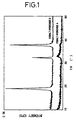
- particles of cobalt hydroxide Co(OH) 2 precipitated by reacting the nickel hydroxide particles with cobalt salt and alkaline solution in an alkaline region of the reaction solution before filling an active material of nickel hydroxide in the porous collective substrate is obtained as ⁇ -Co(OH) 2 which is high in crystallizability, as it is clear from the X-ray diffraction patterns shown in FIG. 1 and FIG.2, and therefore the surface area thereof is small, and accordingly reactivity thereof with alkaline electrolyte is low.
- ⁇ -Co(OH) 2 is easily oxidizable and the crystal grains thereof are easily turned into higher-order oxides such as inactive tricobalt tetroxide or the like with the lapse of time so that the electric conductivity thereof is lowered. Therefore, when the pasted-type nickel electrode is produced by using the positive electrode active material prepared by mixing the particles thereof in cobalt hydroxide particles, there is caused such a problem that the utilization rate of the active material is lowered. Also the active material of a positive electrode has such an inconvenience that the oxidization thereof is progressed during preservation, and the preservation and control thereof become difficult.
- a method of producing the active material of the positive electrode disclosed in JP-A 8-236108 is also such that the cobalt hydroxide is precipitated in an alkaline region, and accordingly the particles of cobalt hydroxide have the same high- crystallizability as the cobalt hydroxide in the invention disclosed in JP-A8-227712, so that it is easily oxidizable by contacting it with dissolved oxygen in the reaction solution or oxygen in the air, and easily becomes the inactive high-order oxides, and accordingly this involves such inconvenient problems that the utilization rate of the pasted-type nickel electrode using this material is lowered and that the preservation and control of the positive active material thus produced become difficult.
- the present invention lies in a method of producing an active material of a positive electrode used for an alkaline secondary battery characterized in that nickel hydroxide powder with or without any of metallic elements formed into a solid solution is dispersed in an aqueous solution of strongly acidic cobalt salt, and the diffused solution is added with an alkaline solution gradually while being stirred so that the cobalt salt and the alkaline solution may be made to react one with another to precipitate cobalt hydroxide, and after the reaction is completed, an active material of a positive electrode which is a mixture of a mass of the cobalt hydroxide particles and a mass of the nickel hydroxide particles is separated from the reaction solution in the region of acidity to neutrality and is then washed with water.
- the alkaline solution is added to the dispersed solution prepared by dispersing the nickel hydroxide powder in the strongly acidic cobalt salt solution, and is made to react with cobalt sulfate, for instance, to precipitate cobalt hydroxide
- cobalt hydroxide is precipitated in the region of acidity to neutrality of the reaction solution to stop a nuetralization treatment, so that the cobalt hydroxide which is separated from the reaction solution which is in the region of acidity to neutrality is obtained as cobalt hydroxide which is amorphous to microcrystal, accordingly the solid part separated from the resulting reaction solution can be obtained as an excellent active material of a positive electrode in which cobalt hydroxide is mixed in the nickel hydroxide as mentioned above.
- this invention is to provide a paste-type nickel electrode which is improved in utilization rate of the active material of nickel hydroxide, and is characterized in that it is provided with an active material of a positive electrode made by mixing microcrystal or/and amorphous cobalt hydroxide in nickel hydroxide.
- an alkaline secondary battery provided with this as the positive electrode can be obtained as an alkaline secondary battery which is improved in utilization rate of the active material of the nickel electrode, and accordingly has a high capacity and is excellent in a battery characteristics such as a discharge characteristics as compared with the conventional alkaline secondary battery provided with the paste-type nickel electrode provided as the positive electrode with the active material for the positive electrode prepared by mixing the high crystalline cobalt hydroxide in the nickel hydroxide.
- the present invention is to provide an alkaline secondary battery provided with the above-mentioned paste-type nickel electrode, and it is so constructed that using the above-mentioned past-type nickel electrode of the present invention as a positive electrode, and a plate group formed by stacking it with a negative electrode one upon another with a separator interposed therebetween is put in a battery container, and a given amount of an alkaline electrolyte is poured therein and the opening of the battery container is applied with a cover and sealed.
- a nickel paste-type sealed alkaline secondary battery with an excellent battery characteristics is obtained.
- the present invention is to provide a method of producing an alkaline secondary battery which is improved in the utilization rate of an active material and is improved in a discharge characteristics, and it is characterized in that the foregoing alkaline secondary battery of the present invention is allowed to stand under temperature atmospheres of 20 - 80°C, and an initial charge is carried out. Thereby, there is obtained an alkaline secondary battery which is superior to the conventional alkaline secondary batteries.
- the present invention is to provide a method of producing an alkaline secondary battery which is kept in a low internal pressure state in charging of the battery, and is excellent in the utilization rate of an active material, a discharge characteristics and a capacity recovering characteristics, and, it is characterized in that after the above-mentioned alkaline battery of the present invention is allowed to stand under temperature atmosphere in the range of 20 - 80°C and is subjected to a preliminary charge, an initial charge is carried out at an ordinary temperature. Thereby, lowering in the voltage of the battery is more difficult than the case of carrying out the initial charge at 20 - 80°C immediately without the preliminary charging. In addition, there is brought about a sealed alkaline secondary battery which is excellent in utilization rate of the active material, discharge characteristics and capacity recovery rate.
- the present invention is to provide a preferable one of the above-mentioned alkaline secondary batteries and it is characterized in that the preliminary charging is carried out with a quantity of electricity corresponding to 30% or more of such a quantity of electricity that is necessary for oxidizing cobalt hydroxide contained in the nickel electrode to become a trivalent state (CoOOH).
- the quantity of electricity for charging is carried out in the range of 30 to 300%.
- any of cobalt salts of strong acids such as sulfuric acid, nitric acid, hydrochloric acid, etc.
- that is a strong acid cobalt salt selected from cobalt sulfate, cobalt nitrate, cobalt hydrochloride etc. is dissolved in water, and nickel hydroxide powder with or without a metal such as zinc, cobalt, etc., formed in a solid solution is dispersed in the acidic solution thereof, and a given amount of aqueous alkali solution is added gradually in the dispersed solution while the dispersed solution is being stirred vigorously.
- the cobalt salt and the aqueous alkali solution may be made to react one with another gradually to precipitate cobalt hydroxide, and the reaction treatment is ended in such a condition that the final resulting reaction solution is kept in the range from an acidic region to a neutral region, typically, in the range of pH6-7.
- the cobalt hydroxide thus obtained is, as will be made clear hereinafter, in such amorphous to microcrystal forms that is obviously different from the high crystalline cobalt hydroxide precipitated and separated from the conventional alkaline reaction solution, and is difficult to be oxidized and is high in reactivity with an alkaline electrolyte and is easy to form cobalt complex ions by charging.
- aqueous alkali solution an aqueous dilute alkali solution is preferable. It is also possible to carry out the above-mentioned neutralization treatment by adding a small amount of a buffer such as an ammonium sulfate, an ammonium acetate, etc.
- a buffer such as an ammonium sulfate, an ammonium acetate, etc.
- aqueous solution of dilute alkali for example, 0.01-0.5M of sodium hydroxide, potassium hydroxide, lithium hydroxide, ammonia, etc. can be preferably used.
- the active material of the positive electrode consisted of a mixture of a mass of nickel hydroxide particles and a mass of cobalt hydroxide Co(OH) 2 particles is obtained as a solid part.
- a solid-liquid separation for example, by filtration, the active material of the positive electrode is separated out and washed with water thoroughly.
- the active material of the positive electrode thus obtained may be left as it is or may be made in a dried state.
- the positive electrode When it is dried, it is obtained as an active material of the positive electrode comprising a mixture powder in such a state that the cobalt hydroxide powders are mixed in the nickel hydroxide powders, in other words, in such a state that the cobalt hydroxide powders are mixed in the nickel hydroxide powders, and the nickel hydroxide powders are coated with the cobalt hydroxide powders.
- the present invention is to provide a paste-type nickel electrode which is improved in utilization rate of the active material, and is characterized in that it is provided with an active material of a positive electrode in which microcrystal or/and amorphous cobalt hydroxide is/are mixed in nickel hydroxide.
- the active material of the positive electrode obtained by the method of producing the active material of the positive electrode according to the present invention is, as it is or after dried by heating, mixed and kneaded with a viscous solution in which a thickener such a CMC or the like is dissolved in water etc. to form a paste, and the active material paste thereof is filled in a three dimensional porous collecting substrate in the plate shape such as a foamed nickel substrate or the like, and is dried and pressed to obtain a paste-type nickel electrode.
- the paste-type nickel electrode of the present invention in which the surfaces of an innumerable active material particles of nickel hydroxide filled in an electrode plate which as an innumerable micro porous are coated with the particles of amorphous to microcrystal cobalt hydroxide, in the other words, in such a state that the cobalt hydroxide particles are interposed between the nickel hydroxide active material particles.
- cobalt hydroxide in the nickel positive electrode dissolves in the alkaline electrolyte to form cobalt complex ion, HCoO 2 - .
- the temperature is higher, the amount of dissolution and the amount of dispersion thereof into the nickel hydroxide active material particles are increased and the penetration thereof among the primary particles of nickel hydroxide or among the agglomerated secondary particles is increased, which is, therefore preferable.
- the current collecting efficiency of the nickel electrode containing the cobalt hydroxide according to the present invention is increased, the content of cobalt compound used as a raw material can be decreased, and with this decreased amount, the content ratio of nickel hydroxide active material can be increased, so that the high capacity paste-type nickel electrode can be produced at a low cost.
- a preliminary charge may be carried out.
- the preliminary charging is such a one that flows an electric current of a quantity of electricity ranging from 30% to more than that, preferably up to 300% of a theoretical electrical quantity which is required for oxidizing a divalent cobalt hydroxide Co(OH) 2 contained in the nickel electrode to become trivalent CoOOH state, and thereafter, when the initial charge is carried out at ordinary temperatures (20 - 25°C), the oxidation corrosion of the negative electrode is not involved and even after it is allowed to stand under the condition that the internal pressure of the battery is remarkably low, decrease in the capacity is prevented, so that there can be produced an alkaline secondary battery which is improved in utilization rate of the active material to have a high capacity and also is excellent in capacity recovery characteristics after the preservation thereof.
- An aqueous solution of cobalt sulfate (pH5.11) was prepared by dissolving 200g of cobalt sulfate heptohydrate in 500ml of ion exchange water. This aqueous solution was put in a reaction tank which had a pH meter installed therein, and 300g of commercial nickel hydroxide powder for use in batteries in the shape of a spheroidal or egg and contained 1.5%Co, 3%Zn formed into solid solutions was added thereto, and was stirred using a magnetic stirrer at 120rpm, and 1000m of on aqueous solution of 0.44M sodium hydroxide was added dropwise at a flow rate of 10ml/min via a buret to the dispersed solution of nickel hydroxide which was being stirred vigorously, so that the cobalt sulfate and the sodium hydroxide were made to react one with another to precipitate cobalt hydroxide, and this reaction was so carried out as to maintain the reaction solution in the region of acidity to neutrality.
- the pH of the reaction solution after the completion of the reaction was 6.9 in the neutral region.
- the reaction solution in this neutral region was filtered, so that a solid part was separated from a filtrate.
- the color of the filtrate at this point was of a transparent light reddish brown color to indicate such a condition that the cobalt sulfate was still remained.
- the separated solid part thus obtained was washed with water completely, it was dried at 100°C for one hour.
- the powder obtained was of a dark blue-green color, and there was obtained a powder as a solid part, that was, the active material of the positive electrode according to the present invention which was consisted of a mixture of nickel hydroxide powder and cobalt hydroxide powder which would be described later. This will be referred as to the active material A for short, hereafter.
- Example 2 Except for that 500ml of a 0.44M sodium hydroxide solution was used and the pH of the final reaction solution was 6.2 in the acidic region, the same manner as Example 1 was carried out, so that there was produced an active material of the positive electrode B which was consisted of a mixture of nickel hydroxide powder and cobalt hydroxide powder which would be described later. This will be referred as to the active material B for short, hereafter.
- An aqueous solution of cobalt sulfate was prepared by dissolving 74g of cobalt sulfate heptohydrate in 500ml of ion exchange water. This aqueous solution was put in a reaction tank which had a pH meter installed therein, and 300g of the same commercial nickel hydroxide powder for use in batteries as used in Example 1 was added thereto and stirred, and 1000ml of 0.44M sodium hydroxide solution was added dropwise at a flow rate of 10ml/min via a buret to the dispersed solution of nickel hydroxide which was being stirred vigorously, so that there was carried out such a reaction that the cobalt suite and the sodium hydroxide were made to react one with another to precipitate cobalt hydroxide.
- An aqueous solution of cobalt sulfate was prepared by dissolving 74g of cobalt sulfate heptohydrate and 5g of hydrazinium sulfate as a reducing agent in 500ml of ion exchange water.
- This aqueous solution was put in a reaction tank which had a pH meter installed therein, and 300g of the same nickel hydroxide powder for use in batteries as used in Example 1 was added thereto and stirred, and 1000ml of the 1M sodium hydroxide solution was added dropwise at a flow rate of 10ml/min via a buret to the dispersed solution of nickel hydroxide which was being stirred vigorously, so that there was carried out such a reaction that the cobalt sulfate and the sodium hydroxide were made to react one with another to precipitate cobalt hydroxide. While monitoring the pH meter, the supply of the sodium hydroxide was stopped when the reaction solution reached pH11.5 in the alkaline region.
- the alkaline reaction solution was filtered, so that a solid part was separated from a filtrate.
- the color of the filtrate at this point was clear to indicate such a condition that all of the cobalt sulfate was converted into cobalt hydroxide.
- the separated solid part was washed with water completely, it was dried at 100°C for one hour.
- the powder thus obtained was of a light brown-green color, and there was obtained an active material of a positive electrode in which the cobalt hydroxide powder which would be described later was mixed in the nickel hydroxide and which was free from the reducing agent. This will be referred as to the active material D for short, hereafter.
- Example 1 100g of the same nickel hydroxide powder for batteries as used in Example 1 was put in 500ml of ion exchange water in a reaction tank, and while it was being heated at 60°C and stirred, a 0.1M aqueous cobalt sulfate solution, a 0.2M ammonia solution and a 0.2M sodium hydroxide were added thereto at a flow rate of 1ml/min. to be made to react one with another for several hours.
- the alkaline solution was filtered, and after the separated solid part was washed with water completely it was dried at 80°C for one hour, and there was obtained an active material of the positive electrode in which the cobalt hydroxide powder which would be described later was mixed in the nickel hydroxide coated with the cobalt hydroxide.
- the active material E for short, hereafter.
- the same nickel hydroxide powder for batteries as that used in Example 1 was used as it was, as the active material of the positive electrode. This will be referred as to the active material G for short, hereafter.
- the cobalt hydroxide synthesized in the alkaline region like the case of Comparative Examples 1 - 4, is susceptible to be oxidized, but if the cobalt hydroxide is synthesized in the region of acidity to neutrality, like the case of Examples 1 and 2, it is difficult to be oxidized.
- various comparisons and researches were carried out. It has been found that one of the causes is due to the difference in the crystal forms between both of the cobalt hydroxides as will be clarified by the comparison tests as mentioned below.
- Example 1 Except for that the nickel hydroxide positive material used in the above-mentioned Example 1 was not used, the same manner as that in Example 1 was carried out and blue colored cobalt hydroxide powder A was obtained.
- thermogravimetric analysis [ a differential thermal analysis (DTA) and a thermogravimetric analysis (TGA) ] were carried out for each of the cobalt hydroxides A and D. The results thereof are shown in FIG. 2.
- the result of the differential thermal analysis is that the DTA curve of the cobalt hydroxide A does not show any large chemical change up to 290°C other than that it shows an endothermic peak representing removal of water contained in the particles thereof up to 120°C. In contrast therewith, the DTA curve of the cobalt hydroxide D shows a large and sharp peak near 140°C.
- the result of thermogravimetric analysis is that the TGA curve of the cobalt hydroxide A shows a decrease of weight thereof by approximately 11% up to 120°C. This represents that the cobalt hydroxide A has a large amount of water and that the water is removed.
- the TGA curve of the cobalt hydroxide D shows a decrease of weight thereof by 2.5% from near 140 °C that corresponds to its DTA curve. This represents the occurrence in the oxidation reaction which is accompanied by a thermal decomposition. It has been found therefrom that the cobalt hydroxide A is a substance which contains a large amount of water in the particles, and does not make the oxidation reaction up to near 300°C and such a useful one that can be treated with high temperatures at a drying process, etc.
- paste-type nickel electrode plates A - F were prepared respectively according to the ordinary method.
- each of the above-mentioned active materials A - F it was added with 36 wt. parts of an aqueous solution of CMC based on 100 wt. parts thereof and was kneaded to prepare an active material paste of a positive electrode.
- Each of the active material pastes was filled in the foamed nickel substrate, and after dried, it was pressed and cut to prepare each of paste-type nickel electrode plates A - F. The filled amount and the size of each electrode were made equal.
- the theoretical quantity of electricity for oxidizing all of cobalt hydroxide contained therein to cobalt oxyhydroxide is 120mAh in the cases of the paste-type nickel electrode plates A,C,D,E and F, and 60mAh in the case of the paste-type nickel electrode plate B.
- the untreated active material namely, the active material G in which the commercial cobalt hydroxide powder itself was used as the active material of the positive electrode, it was added directly to cobalt hydroxide powder and to prepare a paste-type nickel electrode plate according to the ordinary conventional men as follows.
- each of the nickel hydroxide active material in the nickel electrodes is found by setting a theoretical capacity at the time of reaction of one electron of the nickel hydroxide at 100%.
- Discharge capacity (mAh) Utilization rate of the nickel hydroxide (%) Battery A 1346 199 Battery B 1282 110 Battery C 1279 113 Battery D 1233 109 Battery E 1154 102 Battery F 1245 110 Battery G 1222 108
- a capacity retention rate is the value found by setting the discharge capacity of each of the batteries A - G with 0.2C at 20°C at 100%. Capacity retention rate at the time of discharge with 3C (%) 20°C 0°C Battery A 88 75 Battery B 83 72 Battery C 80 70 Battery D 75 50 Battery E 78 51 Battery F 74 45 Battery G 75 40
- the battery G it is considered that since such a one that the cobalt hydroxide powder is added directly to the nickel hydroxide powder is used as the active material of the positive electrode, the electric conductivity among the nickel hydroxide particles is grown worse, and consequently, the discharge capacity and the utilization rate of the active material is further lowered.
- the addition amount of the cobalt hydroxide to the nickel hydroxide is in the range of 1 to 10 %K.
- the utilization rate is increased with the increase of the addition amount thereof in the range of 1 to 6%. It has been found that when more than that is added, the utilization rate is not improved more than that, and become almost constant and therefore it is uneconomical.
- the batteries A and B of the present invention which are good in growth of the cobalt electric conductive matrix exhibit a high capacity retention rate at either temperature of 20°C or 0°C as compared with the control batteries C - G. It is considered that this is because the paste-type nickel electrodes according to the present invention are excellent in the electric collecting efficiency, and a voltage drop caused by the polarization at the discharging time is small, so that the capacity which can be taken out until the final voltage is increased.
- the battery A which is larger in the amount of the cobalt hydroxide which is interposed among the particles of the nickel hydroxide active material and coats the surfaces thereof shows such a tendency that is higher in utilization rate of nickel hydroxide and the capacity retention rate than the battery B.
- the amount of the cobalt hydroxide is too large, the amount of the nickel hydroxide is decreased too much relatively, and therefore it is preferable that the amount of the cobalt hydroxide contained in the active material of the positive electrode is kept in a proper range.
- the proper range thereof is 1 to 10 %.
- the amount of cobalt in the battery B is half of that in the conventional battery G, as shown in Table 2 and Table 3, it has been found that it is high in all of the discharge capacity, the utilization rate and the capacity retention rate for the small containing amount thereof. It has been found therefrom that the amount of cobalt can be decreased in order to obtain the capacity of the same level.
- the initial activation was carried out by repetition of a charge-discharge cycle of charging of 150% of the nominal capacity with 0.2C and discharging with 0.2C to the battery voltage of 1V, and the discharge capacity and the utilization rate of the nickel hydroxide at the time of discharge of the third cycle were evaluated.
- the results thereof are shown in Table 4 below.
- the utilization rate of the nickel hydroxide of the nickel electrode is found by setting the theoretical capacity at the time of reaction of one electron of the nickel hydroxide at 100%.
- the utilization rate of the active material shows such a tendency that as the temperature during the standing of the batteries and at the time of the initial charge is higher, it is increased generally, and it is not increased more than that above 60°C, and is saturated. It is considered that this is because, with the rise in temperature, the reaction between the coated cobalt hydroxide and the alkaline electrolyte, and the diffusion of the produced cobalt complex ions become smoother, so that the growth of cobalt electric conductive matrix formed between the nickel hydroxide particle becomes easier.
- the batteries A and B of the present invention are large in the rate of increase in the utilization rate of the active material from 30 to 40°C as compared with the other batteries C-G.
- the battery A is remartably improved in the utilization rate of the active material in the initial charge temperatures from 20°C to 90°C as compared with the other batteries C - G.
- the battery B although the content of the cobalt hydroxide is so less as the half of the other batteries, there is obtained such a result that the utilization rate thereof is about the same or larger than those of the batteries B - G in which the content of the cobalt hydroxide is approximately double.
- the battery A is the cobalt hydroxide which has a unique crystal form contained in the nickel electrode of B, high-order oxides thereof are not formed its reaction with alkaline electrolyte is high and better formation of cobalt electric conductive matrix among the particles of the nickel hydroxide is made, as compared with such cobalt hydroxides contained in the nickel electrodes of the batteries C - G that are high in crystalline and partly formed into high-order oxides.
- the batteries A to G are all increased in the internal pressure of the batteries with the rise in the initial charge temperature, and increased suddenly especially above 90 °C. It is considered that this is because the surfaces of the hydrogen- occlusion alloys of the negative electrodes are corroded at the time of the standing at 90°C. Accordingly, it has been found that the temperature during the standing time is preferable to be limited below 80°C.
- the capacity recovery rates of the batteries A - G are increased with the rise in temperature of the initial charge. It is considered that this is caused since the conversion efficiency of cobalt hydroxide into cobalt oxydydroxide is increased as the temperature rises, the amount of the cobalt oxyhydroxide is increased and the reactivity with the electrolyte and the resistance to reduction of the cobalt oxyhydroxide is increased. Also, especially as for the batteries A and B, it is considered that since the cobalt hydroxide contained in the nickel electrodes thereof is high in reactivity, as compared with the cobalt hydroxide contained in the nickel electrodes of the batteries C-G, they exhibit higher capacity recoverabilities.
- each thereof was subjected to such preliminary charges for flowing with 0.2C current so as to charge the amounts of electric quantities corresponding to 20, 30, 100, 200, 300 and 400% of the theoretical electrical capacity required for oxidizing all of cobalt hydroxide in the nickel electrode pole to cobalt oxyhydroxide.
- each temperature was allowed to stand at room temperature (25 ⁇ 5°C) for one hour, charging was resumed and the initial charge was carried out so as to become 150% of the nominal capacity of each battery.
- the initial discharge with 0.2C was carried out.
- the initial activation was carried out by repeating the charge-discharge cycle which consists of charging with 0.2C and 150% of the nominal capacity and discharging with 0.2C to the battery voltage of 1V, and the utilization rate of the nickel hydroxide was evaluated at the third cycle of the discharge.
- the results are shown In Table 7 below.
- the utilization rate of the nickel electrode is found by setting the theoretical capacity at the time of reaction of one battery of the nickel hydroxide at 100%.
- the utilization rate of the active material has, as shown in Table 7 above, such a tendency that it is increased as the ratio of the charged amount at the preliminary charge is increased. Since it reaches the saturation at 300%, the charged amount up to 300% is sufficient, and from a point of view of the electricity consumption and the work time, etc., it is preferable to be limited up to 300%.
- the battery internal pressure has, as shown in Table 8 above, such a tendency that it is increased as the charged amount at the preliminary charge is increased.
- the battery internal pressure after the initial charge can be suppressed remarkably low.
- the capacity recovery rate has, as shown in Table 9 above, such a tendency that it is increased as the ratio of the charged amount at the preliminary charge is increased. However, it has been found that since the capacity recovery rate is not improved at 300% or more, it is preferable to carry out in the ratios of the charged amounts up to 300% from the view points of the working efficiency and economy.
- the present invention is, in the field of alkaline secondary batteries, useful as a method of producing an active material of a positive electrode thereof, a paste-type nickel electrode, an alkaline secondary battery and a method of producing thereof.
Landscapes
- Chemical & Material Sciences (AREA)
- Organic Chemistry (AREA)
- Inorganic Chemistry (AREA)
- Chemical Kinetics & Catalysis (AREA)
- Electrochemistry (AREA)
- General Chemical & Material Sciences (AREA)
- Engineering & Computer Science (AREA)
- Manufacturing & Machinery (AREA)
- Battery Electrode And Active Subsutance (AREA)
- Secondary Cells (AREA)
Applications Claiming Priority (3)
| Application Number | Priority Date | Filing Date | Title |
|---|---|---|---|
| JP46998/97 | 1997-02-14 | ||
| JP04699897A JP3205276B2 (ja) | 1997-02-14 | 1997-02-14 | アルカリ二次電池用正極活物質の製造法、ペースト式ニッケル極、アルカリ二次電池並びにその製造法 |
| PCT/JP1998/000549 WO1998036463A1 (en) | 1997-02-14 | 1998-02-12 | Method for manufacturing positive pole active material for alkaline secondary battery, paste nickel pole, and alkaline secondary battery and method for manufacturing thereof |
Publications (1)
| Publication Number | Publication Date |
|---|---|
| EP0918360A1 true EP0918360A1 (de) | 1999-05-26 |
Family
ID=12762871
Family Applications (1)
| Application Number | Title | Priority Date | Filing Date |
|---|---|---|---|
| EP98902184A Withdrawn EP0918360A1 (de) | 1997-02-14 | 1998-02-12 | Verfahren zur herstellung actives positiven polmaterials für alkalische sekundärbatterie, nickelpastepol, und alkalische sekundärbatterie und verfahren zur herstellung derselben |
Country Status (4)
| Country | Link |
|---|---|
| US (1) | US6258483B1 (de) |
| EP (1) | EP0918360A1 (de) |
| JP (1) | JP3205276B2 (de) |
| WO (1) | WO1998036463A1 (de) |
Families Citing this family (12)
| Publication number | Priority date | Publication date | Assignee | Title |
|---|---|---|---|---|
| JP4566303B2 (ja) * | 1999-07-22 | 2010-10-20 | 本田技研工業株式会社 | ニッケル水素電池用正極板 |
| JP2001035488A (ja) * | 1999-07-26 | 2001-02-09 | Honda Motor Co Ltd | ニッケル水素電池の製造方法 |
| JP4589550B2 (ja) * | 2001-03-05 | 2010-12-01 | パナソニック株式会社 | ニッケル水素蓄電池の製造方法 |
| US6878487B2 (en) * | 2001-09-05 | 2005-04-12 | Samsung Sdi, Co., Ltd. | Active material for battery and method of preparing same |
| JP3632686B2 (ja) * | 2002-08-27 | 2005-03-23 | ソニー株式会社 | 正極活物質及び非水電解質二次電池 |
| WO2007000075A1 (en) * | 2005-06-27 | 2007-01-04 | Shenzhen Bak Battery Co., Ltd | Method for preparing spherical nickelous hydroxide which is dopped and multiple metal oxides, and lithium ion secondary battery |
| KR100796687B1 (ko) * | 2005-11-30 | 2008-01-21 | 삼성에스디아이 주식회사 | 리튬 이차 전지용 활물질, 이의 제조방법 및 이를 포함하는 리튬 이차 전지 |
| KR100728160B1 (ko) * | 2005-11-30 | 2007-06-13 | 삼성에스디아이 주식회사 | 리튬 이차 전지용 음극 활물질, 이의 제조 방법 및 이를포함하는 리튬 이차 전지 |
| US8048566B2 (en) * | 2008-02-07 | 2011-11-01 | Powergenix Systems, Inc. | Nickel hydroxide electrode for rechargeable batteries |
| US8043748B2 (en) * | 2008-02-07 | 2011-10-25 | Powergenix Systems, Inc. | Pasted nickel hydroxide electrode for rechargeable nickel-zinc batteries |
| US8586247B2 (en) * | 2009-12-11 | 2013-11-19 | Samsung Sdi Co., Ltd. | Positive electrode active material comprising an agglomeration of at least two primary particles for lithium battery and lithium battery using the same |
| EP2943991A4 (de) | 2013-01-14 | 2016-01-06 | Powergenix Systems Inc | Pastöse nickel-hydroxid-elektrode und zusätze für wiederaufladbare alkalbatterien |
Family Cites Families (7)
| Publication number | Priority date | Publication date | Assignee | Title |
|---|---|---|---|---|
| JPS6264062A (ja) * | 1985-09-12 | 1987-03-20 | Yuasa Battery Co Ltd | アルカリ蓄電池用正極板 |
| JPS62237667A (ja) | 1986-04-08 | 1987-10-17 | Yuasa Battery Co Ltd | アルカリ蓄電池用ニツケル正極 |
| US5281494A (en) * | 1990-05-04 | 1994-01-25 | Inco Limited | Nickel hydroxide |
| JP3738052B2 (ja) * | 1994-09-20 | 2006-01-25 | 三洋電機株式会社 | ニッケル電極用活物質とこれを用いたニッケル電極及びニッケルアルカリ蓄電池並びにこれらの製造方法 |
| JP3232990B2 (ja) * | 1994-12-19 | 2001-11-26 | 松下電器産業株式会社 | アルカリ蓄電池およびその製造方法 |
| JP3249326B2 (ja) * | 1995-02-14 | 2002-01-21 | 三洋電機株式会社 | アルカリ蓄電池用ニッケル活物質、その製造方法 |
| KR100385480B1 (ko) * | 1995-07-31 | 2003-08-19 | 산요 덴키 가부시키가이샤 | 알칼리축전지용비소결식니켈전극의제조방법및알칼리축전지 |
-
1997
- 1997-02-14 JP JP04699897A patent/JP3205276B2/ja not_active Expired - Fee Related
-
1998
- 1998-02-12 US US09/125,047 patent/US6258483B1/en not_active Expired - Fee Related
- 1998-02-12 WO PCT/JP1998/000549 patent/WO1998036463A1/ja not_active Ceased
- 1998-02-12 EP EP98902184A patent/EP0918360A1/de not_active Withdrawn
Non-Patent Citations (1)
| Title |
|---|
| See references of WO9836463A1 * |
Also Published As
| Publication number | Publication date |
|---|---|
| JP3205276B2 (ja) | 2001-09-04 |
| WO1998036463A1 (en) | 1998-08-20 |
| US6258483B1 (en) | 2001-07-10 |
| JPH10228907A (ja) | 1998-08-25 |
Similar Documents
| Publication | Publication Date | Title |
|---|---|---|
| CN100448074C (zh) | 表面包覆γ羟基氧化钴的氢氧化镍的制备方法 | |
| EP0571630B1 (de) | Verfahren zur herstellung einer nickelplatte und einer alkalibatterie | |
| US6258483B1 (en) | Method for manufacturing positive pole active material for alkaline secondary battery, paste nickel pole, and alkaline secondary battery and method for manufacturing thereof | |
| EP4525076A1 (de) | Lithium-mangan-eisenphosphat-positivelektrodenmaterial und herstellungsverfahren dafür, mangan-eisenphosphat-vorläufer und herstellungsverfahren dafür sowie lithium-ionen-batterie | |
| US5759718A (en) | Alkaline storage battery and method for making same | |
| CN109768248A (zh) | 包覆改性LiNi0.8Co0.1Mn0.1O2三元正极材料及其制备方法和电池 | |
| JP2025179099A (ja) | アルカリニッケル酸化物の酸化的脱リチウム化 | |
| JP3617203B2 (ja) | ニッケル水素二次電池の製造方法 | |
| US4603094A (en) | Alkaline storage battery | |
| US6156456A (en) | Positive electrode active material for alkaline storage battery | |
| JP4608128B2 (ja) | コバルト化合物およびその製造方法ならびにそれを用いたアルカリ蓄電池用正極板およびアルカリ蓄電池 | |
| EP0944124B1 (de) | Wasserstoffabsorbierende Legierung für Batterien, Verfahren zu ihrer Herstellung und alkalische Speicherbatterie die diese Legierung verwendet | |
| US6800396B1 (en) | Nickel hydroxide coated with cobaltous hydroxide | |
| JP2002056844A (ja) | アルカリ蓄電池用正極活物質の製造方法およびこの正極活物質を用いたニッケル電極ならびにこのニッケル電極を用いたアルカリ蓄電池 | |
| CN109755523A (zh) | 包覆改性LiNi0.6Co0.2Mn0.2O2三元正极材料及其制备方法和电池 | |
| JP3414200B2 (ja) | アルカリ蓄電池 | |
| JPH10188975A (ja) | 酸化銀電池用陽極材料とその製造方法 | |
| JPH10294110A (ja) | アルカリ二次電池用正極活物質の製造法、ペースト式ニッケル極並びにアルカリ二次電池の製造法 | |
| JPH10334911A (ja) | アルカリ蓄電池およびその製造法 | |
| JPH10302829A (ja) | アルカリ二次電池の製造法 | |
| JPH10302789A (ja) | ペースト式ニッケル極製造用コバルト添加剤、その製造法、ペースト式ニッケル極並びにアルカリ二次電池の製造法 | |
| JPH02234356A (ja) | 密閉形アルカリ電池 | |
| JP5760353B2 (ja) | コバルトジルコニウム化合物及び活物質、それらの製造方法、並びにアルカリ蓄電池 | |
| KR19990051812A (ko) | 알칼리 2차전지의 양극슬러리 제조방법 | |
| JPH1167198A (ja) | アルカリ二次電池用正極活物質の製造法、ペースト式ニッケル極板、その製造法並びにアルカリ二次電池 |
Legal Events
| Date | Code | Title | Description |
|---|---|---|---|
| PUAI | Public reference made under article 153(3) epc to a published international application that has entered the european phase |
Free format text: ORIGINAL CODE: 0009012 |
|
| 17P | Request for examination filed |
Effective date: 19980812 |
|
| AK | Designated contracting states |
Kind code of ref document: A1 Designated state(s): DE FR GB |
|
| STAA | Information on the status of an ep patent application or granted ep patent |
Free format text: STATUS: THE APPLICATION IS DEEMED TO BE WITHDRAWN |
|
| 18D | Application deemed to be withdrawn |
Effective date: 20010901 |