EP0903387B1 - Procede de modification superficielle d'un adhesif autocollant au moyen d'un groupe fonctionnel - Google Patents
Procede de modification superficielle d'un adhesif autocollant au moyen d'un groupe fonctionnel Download PDFInfo
- Publication number
- EP0903387B1 EP0903387B1 EP97922201A EP97922201A EP0903387B1 EP 0903387 B1 EP0903387 B1 EP 0903387B1 EP 97922201 A EP97922201 A EP 97922201A EP 97922201 A EP97922201 A EP 97922201A EP 0903387 B1 EP0903387 B1 EP 0903387B1
- Authority
- EP
- European Patent Office
- Prior art keywords
- pressure
- sensitive adhesive
- functional group
- sensitive
- group
- Prior art date
- Legal status (The legal status is an assumption and is not a legal conclusion. Google has not performed a legal analysis and makes no representation as to the accuracy of the status listed.)
- Expired - Lifetime
Links
- 239000004820 Pressure-sensitive adhesive Substances 0.000 title claims description 187
- 125000000524 functional group Chemical group 0.000 title claims description 140
- 238000000034 method Methods 0.000 title claims description 35
- 238000012986 modification Methods 0.000 title description 21
- 230000004048 modification Effects 0.000 title description 11
- 150000001875 compounds Chemical class 0.000 claims description 43
- 238000006243 chemical reaction Methods 0.000 claims description 34
- -1 polyvinylamine Polymers 0.000 claims description 16
- 229920002873 Polyethylenimine Polymers 0.000 claims description 10
- 229920000083 poly(allylamine) Polymers 0.000 claims description 9
- 239000002904 solvent Substances 0.000 claims description 9
- 229920002125 Sokalan® Polymers 0.000 claims description 4
- 239000004584 polyacrylic acid Substances 0.000 claims description 4
- VLKZOEOYAKHREP-UHFFFAOYSA-N n-Hexane Chemical compound CCCCCC VLKZOEOYAKHREP-UHFFFAOYSA-N 0.000 description 30
- 239000010410 layer Substances 0.000 description 27
- 230000001070 adhesive effect Effects 0.000 description 26
- 239000000243 solution Substances 0.000 description 26
- 239000000853 adhesive Substances 0.000 description 24
- 230000000052 comparative effect Effects 0.000 description 24
- 125000003277 amino group Chemical group 0.000 description 23
- 239000000126 substance Substances 0.000 description 23
- XLYOFNOQVPJJNP-UHFFFAOYSA-N water Substances O XLYOFNOQVPJJNP-UHFFFAOYSA-N 0.000 description 19
- 239000007864 aqueous solution Substances 0.000 description 17
- IQPQWNKOIGAROB-UHFFFAOYSA-N isocyanate group Chemical group [N-]=C=O IQPQWNKOIGAROB-UHFFFAOYSA-N 0.000 description 17
- 239000012071 phase Substances 0.000 description 17
- 238000001035 drying Methods 0.000 description 14
- NIXOWILDQLNWCW-UHFFFAOYSA-N acrylic acid group Chemical group C(C=C)(=O)O NIXOWILDQLNWCW-UHFFFAOYSA-N 0.000 description 13
- 238000000576 coating method Methods 0.000 description 13
- XEKOWRVHYACXOJ-UHFFFAOYSA-N Ethyl acetate Chemical compound CCOC(C)=O XEKOWRVHYACXOJ-UHFFFAOYSA-N 0.000 description 12
- 229920001971 elastomer Polymers 0.000 description 12
- 239000005060 rubber Substances 0.000 description 12
- 238000004627 transmission electron microscopy Methods 0.000 description 12
- 239000011248 coating agent Substances 0.000 description 9
- 239000000178 monomer Substances 0.000 description 9
- 239000007787 solid Substances 0.000 description 9
- 239000007788 liquid Substances 0.000 description 8
- 229920000346 polystyrene-polyisoprene block-polystyrene Polymers 0.000 description 8
- 239000011521 glass Substances 0.000 description 7
- 239000000203 mixture Substances 0.000 description 7
- 125000003178 carboxy group Chemical group [H]OC(*)=O 0.000 description 6
- 239000007791 liquid phase Substances 0.000 description 6
- 229920006267 polyester film Polymers 0.000 description 6
- 230000003578 releasing effect Effects 0.000 description 6
- 239000002966 varnish Substances 0.000 description 6
- 238000004833 X-ray photoelectron spectroscopy Methods 0.000 description 5
- 238000010521 absorption reaction Methods 0.000 description 5
- 229920005601 base polymer Polymers 0.000 description 5
- 125000003700 epoxy group Chemical group 0.000 description 5
- 239000012948 isocyanate Substances 0.000 description 5
- 229920000642 polymer Polymers 0.000 description 5
- 239000011347 resin Substances 0.000 description 5
- 229920005989 resin Polymers 0.000 description 5
- 229910001220 stainless steel Inorganic materials 0.000 description 5
- 239000010935 stainless steel Substances 0.000 description 5
- 239000000758 substrate Substances 0.000 description 5
- 238000012360 testing method Methods 0.000 description 5
- 125000000391 vinyl group Chemical group [H]C([*])=C([H])[H] 0.000 description 5
- NGNBDVOYPDDBFK-UHFFFAOYSA-N 2-[2,4-di(pentan-2-yl)phenoxy]acetyl chloride Chemical group CCCC(C)C1=CC=C(OCC(Cl)=O)C(C(C)CCC)=C1 NGNBDVOYPDDBFK-UHFFFAOYSA-N 0.000 description 4
- XEEYBQQBJWHFJM-UHFFFAOYSA-N Iron Chemical compound [Fe] XEEYBQQBJWHFJM-UHFFFAOYSA-N 0.000 description 4
- PPBRXRYQALVLMV-UHFFFAOYSA-N Styrene Chemical compound C=CC1=CC=CC=C1 PPBRXRYQALVLMV-UHFFFAOYSA-N 0.000 description 4
- 239000000654 additive Substances 0.000 description 4
- 125000005370 alkoxysilyl group Chemical group 0.000 description 4
- 125000000217 alkyl group Chemical group 0.000 description 4
- 230000000694 effects Effects 0.000 description 4
- 238000000691 measurement method Methods 0.000 description 4
- 238000002715 modification method Methods 0.000 description 4
- 238000002360 preparation method Methods 0.000 description 4
- 230000009257 reactivity Effects 0.000 description 4
- 229920006305 unsaturated polyester Polymers 0.000 description 4
- SMZOUWXMTYCWNB-UHFFFAOYSA-N 2-(2-methoxy-5-methylphenyl)ethanamine Chemical compound COC1=CC=C(C)C=C1CCN SMZOUWXMTYCWNB-UHFFFAOYSA-N 0.000 description 3
- YXFVVABEGXRONW-UHFFFAOYSA-N Toluene Chemical compound CC1=CC=CC=C1 YXFVVABEGXRONW-UHFFFAOYSA-N 0.000 description 3
- 230000000996 additive effect Effects 0.000 description 3
- 238000004873 anchoring Methods 0.000 description 3
- CQEYYJKEWSMYFG-UHFFFAOYSA-N butyl acrylate Chemical compound CCCCOC(=O)C=C CQEYYJKEWSMYFG-UHFFFAOYSA-N 0.000 description 3
- 238000007796 conventional method Methods 0.000 description 3
- 239000007792 gaseous phase Substances 0.000 description 3
- 238000006116 polymerization reaction Methods 0.000 description 3
- BPSIOYPQMFLKFR-UHFFFAOYSA-N trimethoxy-[3-(oxiran-2-ylmethoxy)propyl]silane Chemical compound CO[Si](OC)(OC)CCCOCC1CO1 BPSIOYPQMFLKFR-UHFFFAOYSA-N 0.000 description 3
- OZAIFHULBGXAKX-UHFFFAOYSA-N 2-(2-cyanopropan-2-yldiazenyl)-2-methylpropanenitrile Chemical compound N#CC(C)(C)N=NC(C)(C)C#N OZAIFHULBGXAKX-UHFFFAOYSA-N 0.000 description 2
- JKNCOURZONDCGV-UHFFFAOYSA-N 2-(dimethylamino)ethyl 2-methylprop-2-enoate Chemical compound CN(C)CCOC(=O)C(C)=C JKNCOURZONDCGV-UHFFFAOYSA-N 0.000 description 2
- GOXQRTZXKQZDDN-UHFFFAOYSA-N 2-Ethylhexyl acrylate Chemical compound CCCCC(CC)COC(=O)C=C GOXQRTZXKQZDDN-UHFFFAOYSA-N 0.000 description 2
- IJGRMHOSHXDMSA-UHFFFAOYSA-N Atomic nitrogen Chemical compound N#N IJGRMHOSHXDMSA-UHFFFAOYSA-N 0.000 description 2
- 244000043261 Hevea brasiliensis Species 0.000 description 2
- YGYAWVDWMABLBF-UHFFFAOYSA-N Phosgene Chemical group ClC(Cl)=O YGYAWVDWMABLBF-UHFFFAOYSA-N 0.000 description 2
- KJTLSVCANCCWHF-UHFFFAOYSA-N Ruthenium Chemical compound [Ru] KJTLSVCANCCWHF-UHFFFAOYSA-N 0.000 description 2
- 239000006087 Silane Coupling Agent Substances 0.000 description 2
- 230000001133 acceleration Effects 0.000 description 2
- 125000004018 acid anhydride group Chemical group 0.000 description 2
- 238000004458 analytical method Methods 0.000 description 2
- 125000004069 aziridinyl group Chemical group 0.000 description 2
- 229920001577 copolymer Polymers 0.000 description 2
- 230000009849 deactivation Effects 0.000 description 2
- 239000004205 dimethyl polysiloxane Substances 0.000 description 2
- 229910001873 dinitrogen Inorganic materials 0.000 description 2
- 239000012530 fluid Substances 0.000 description 2
- 239000007789 gas Substances 0.000 description 2
- 238000005227 gel permeation chromatography Methods 0.000 description 2
- 125000002887 hydroxy group Chemical group [H]O* 0.000 description 2
- 230000006872 improvement Effects 0.000 description 2
- 229910052742 iron Inorganic materials 0.000 description 2
- 238000005259 measurement Methods 0.000 description 2
- 229910052751 metal Inorganic materials 0.000 description 2
- 239000002184 metal Substances 0.000 description 2
- VHRYZQNGTZXDNX-UHFFFAOYSA-N methacryloyl chloride Chemical compound CC(=C)C(Cl)=O VHRYZQNGTZXDNX-UHFFFAOYSA-N 0.000 description 2
- 229920003052 natural elastomer Polymers 0.000 description 2
- 229920001194 natural rubber Polymers 0.000 description 2
- 125000004433 nitrogen atom Chemical group N* 0.000 description 2
- 239000002985 plastic film Substances 0.000 description 2
- 229920006255 plastic film Polymers 0.000 description 2
- 229920000435 poly(dimethylsiloxane) Polymers 0.000 description 2
- 229920000728 polyester Polymers 0.000 description 2
- 125000002924 primary amino group Chemical group [H]N([H])* 0.000 description 2
- 229910052707 ruthenium Inorganic materials 0.000 description 2
- 239000007790 solid phase Substances 0.000 description 2
- 150000003505 terpenes Chemical class 0.000 description 2
- 235000007586 terpenes Nutrition 0.000 description 2
- KPAPHODVWOVUJL-UHFFFAOYSA-N 1-benzofuran;1h-indene Chemical compound C1=CC=C2CC=CC2=C1.C1=CC=C2OC=CC2=C1 KPAPHODVWOVUJL-UHFFFAOYSA-N 0.000 description 1
- RLRINNKRRPQIGW-UHFFFAOYSA-N 1-ethenyl-2-[4-(2-ethenylphenyl)butyl]benzene Chemical compound C=CC1=CC=CC=C1CCCCC1=CC=CC=C1C=C RLRINNKRRPQIGW-UHFFFAOYSA-N 0.000 description 1
- QWDQYHPOSSHSAW-UHFFFAOYSA-N 1-isocyanatooctadecane Chemical compound CCCCCCCCCCCCCCCCCCN=C=O QWDQYHPOSSHSAW-UHFFFAOYSA-N 0.000 description 1
- 125000000022 2-aminoethyl group Chemical group [H]C([*])([H])C([H])([H])N([H])[H] 0.000 description 1
- OMIGHNLMNHATMP-UHFFFAOYSA-N 2-hydroxyethyl prop-2-enoate Chemical compound OCCOC(=O)C=C OMIGHNLMNHATMP-UHFFFAOYSA-N 0.000 description 1
- VSKJLJHPAFKHBX-UHFFFAOYSA-N 2-methylbuta-1,3-diene;styrene Chemical compound CC(=C)C=C.C=CC1=CC=CC=C1.C=CC1=CC=CC=C1 VSKJLJHPAFKHBX-UHFFFAOYSA-N 0.000 description 1
- SJECZPVISLOESU-UHFFFAOYSA-N 3-trimethoxysilylpropan-1-amine Chemical compound CO[Si](OC)(OC)CCCN SJECZPVISLOESU-UHFFFAOYSA-N 0.000 description 1
- DXPPIEDUBFUSEZ-UHFFFAOYSA-N 6-methylheptyl prop-2-enoate Chemical compound CC(C)CCCCCOC(=O)C=C DXPPIEDUBFUSEZ-UHFFFAOYSA-N 0.000 description 1
- CUXGDKOCSSIRKK-UHFFFAOYSA-N 7-methyloctyl prop-2-enoate Chemical compound CC(C)CCCCCCOC(=O)C=C CUXGDKOCSSIRKK-UHFFFAOYSA-N 0.000 description 1
- RSWGJHLUYNHPMX-UHFFFAOYSA-N Abietic-Saeure Natural products C12CCC(C(C)C)=CC2=CCC2C1(C)CCCC2(C)C(O)=O RSWGJHLUYNHPMX-UHFFFAOYSA-N 0.000 description 1
- HRPVXLWXLXDGHG-UHFFFAOYSA-N Acrylamide Chemical compound NC(=O)C=C HRPVXLWXLXDGHG-UHFFFAOYSA-N 0.000 description 1
- NLHHRLWOUZZQLW-UHFFFAOYSA-N Acrylonitrile Chemical compound C=CC#N NLHHRLWOUZZQLW-UHFFFAOYSA-N 0.000 description 1
- NOWKCMXCCJGMRR-UHFFFAOYSA-N Aziridine Chemical compound C1CN1 NOWKCMXCCJGMRR-UHFFFAOYSA-N 0.000 description 1
- MQIUGAXCHLFZKX-UHFFFAOYSA-N Di-n-octyl phthalate Natural products CCCCCCCCOC(=O)C1=CC=CC=C1C(=O)OCCCCCCCC MQIUGAXCHLFZKX-UHFFFAOYSA-N 0.000 description 1
- JIGUQPWFLRLWPJ-UHFFFAOYSA-N Ethyl acrylate Chemical compound CCOC(=O)C=C JIGUQPWFLRLWPJ-UHFFFAOYSA-N 0.000 description 1
- VVQNEPGJFQJSBK-UHFFFAOYSA-N Methyl methacrylate Chemical compound COC(=O)C(C)=C VVQNEPGJFQJSBK-UHFFFAOYSA-N 0.000 description 1
- WHNWPMSKXPGLAX-UHFFFAOYSA-N N-Vinyl-2-pyrrolidone Chemical compound C=CN1CCCC1=O WHNWPMSKXPGLAX-UHFFFAOYSA-N 0.000 description 1
- CTQNGGLPUBDAKN-UHFFFAOYSA-N O-Xylene Chemical compound CC1=CC=CC=C1C CTQNGGLPUBDAKN-UHFFFAOYSA-N 0.000 description 1
- ISWSIDIOOBJBQZ-UHFFFAOYSA-N Phenol Chemical compound OC1=CC=CC=C1 ISWSIDIOOBJBQZ-UHFFFAOYSA-N 0.000 description 1
- 239000005062 Polybutadiene Substances 0.000 description 1
- 229920002367 Polyisobutene Polymers 0.000 description 1
- 239000004793 Polystyrene Substances 0.000 description 1
- XBDQKXXYIPTUBI-UHFFFAOYSA-M Propionate Chemical compound CCC([O-])=O XBDQKXXYIPTUBI-UHFFFAOYSA-M 0.000 description 1
- KHPCPRHQVVSZAH-HUOMCSJISA-N Rosin Natural products O(C/C=C/c1ccccc1)[C@H]1[C@H](O)[C@@H](O)[C@@H](O)[C@@H](CO)O1 KHPCPRHQVVSZAH-HUOMCSJISA-N 0.000 description 1
- ZJCCRDAZUWHFQH-UHFFFAOYSA-N Trimethylolpropane Chemical compound CCC(CO)(CO)CO ZJCCRDAZUWHFQH-UHFFFAOYSA-N 0.000 description 1
- 239000007983 Tris buffer Substances 0.000 description 1
- XTXRWKRVRITETP-UHFFFAOYSA-N Vinyl acetate Chemical compound CC(=O)OC=C XTXRWKRVRITETP-UHFFFAOYSA-N 0.000 description 1
- 238000007259 addition reaction Methods 0.000 description 1
- 125000001931 aliphatic group Chemical group 0.000 description 1
- 239000003963 antioxidant agent Substances 0.000 description 1
- 125000003118 aryl group Chemical group 0.000 description 1
- UWCPYKQBIPYOLX-UHFFFAOYSA-N benzene-1,3,5-tricarbonyl chloride Chemical compound ClC(=O)C1=CC(C(Cl)=O)=CC(C(Cl)=O)=C1 UWCPYKQBIPYOLX-UHFFFAOYSA-N 0.000 description 1
- BJQHLKABXJIVAM-UHFFFAOYSA-N bis(2-ethylhexyl) phthalate Chemical compound CCCCC(CC)COC(=O)C1=CC=CC=C1C(=O)OCC(CC)CCCC BJQHLKABXJIVAM-UHFFFAOYSA-N 0.000 description 1
- 230000000740 bleeding effect Effects 0.000 description 1
- 229920001400 block copolymer Polymers 0.000 description 1
- 229920005549 butyl rubber Polymers 0.000 description 1
- 239000007795 chemical reaction product Substances 0.000 description 1
- 238000007334 copolymerization reaction Methods 0.000 description 1
- 239000003431 cross linking reagent Substances 0.000 description 1
- 238000007598 dipping method Methods 0.000 description 1
- 238000007599 discharging Methods 0.000 description 1
- 239000006185 dispersion Substances 0.000 description 1
- 238000004043 dyeing Methods 0.000 description 1
- 239000003822 epoxy resin Substances 0.000 description 1
- BXOUVIIITJXIKB-UHFFFAOYSA-N ethene;styrene Chemical group C=C.C=CC1=CC=CC=C1 BXOUVIIITJXIKB-UHFFFAOYSA-N 0.000 description 1
- 238000001704 evaporation Methods 0.000 description 1
- 239000004744 fabric Substances 0.000 description 1
- 239000000945 filler Substances 0.000 description 1
- 239000011888 foil Substances 0.000 description 1
- VOZRXNHHFUQHIL-UHFFFAOYSA-N glycidyl methacrylate Chemical compound CC(=C)C(=O)OCC1CO1 VOZRXNHHFUQHIL-UHFFFAOYSA-N 0.000 description 1
- 238000010559 graft polymerization reaction Methods 0.000 description 1
- 238000007757 hot melt coating Methods 0.000 description 1
- 230000000977 initiatory effect Effects 0.000 description 1
- 238000011835 investigation Methods 0.000 description 1
- FPYJFEHAWHCUMM-UHFFFAOYSA-N maleic anhydride Chemical compound O=C1OC(=O)C=C1 FPYJFEHAWHCUMM-UHFFFAOYSA-N 0.000 description 1
- 239000000463 material Substances 0.000 description 1
- 150000002739 metals Chemical class 0.000 description 1
- GRVDJDISBSALJP-UHFFFAOYSA-N methyloxidanyl Chemical compound [O]C GRVDJDISBSALJP-UHFFFAOYSA-N 0.000 description 1
- PHQOGHDTIVQXHL-UHFFFAOYSA-N n'-(3-trimethoxysilylpropyl)ethane-1,2-diamine Chemical compound CO[Si](OC)(OC)CCCNCCN PHQOGHDTIVQXHL-UHFFFAOYSA-N 0.000 description 1
- 229910052757 nitrogen Inorganic materials 0.000 description 1
- 229920000620 organic polymer Polymers 0.000 description 1
- PNJWIWWMYCMZRO-UHFFFAOYSA-N pent‐4‐en‐2‐one Natural products CC(=O)CC=C PNJWIWWMYCMZRO-UHFFFAOYSA-N 0.000 description 1
- 239000003208 petroleum Substances 0.000 description 1
- 238000005191 phase separation Methods 0.000 description 1
- 239000000049 pigment Substances 0.000 description 1
- 238000009832 plasma treatment Methods 0.000 description 1
- 229920003023 plastic Polymers 0.000 description 1
- 239000004033 plastic Substances 0.000 description 1
- 229920001084 poly(chloroprene) Polymers 0.000 description 1
- 229920002857 polybutadiene Polymers 0.000 description 1
- 229920001083 polybutene Polymers 0.000 description 1
- 229920000647 polyepoxide Polymers 0.000 description 1
- 229920001195 polyisoprene Polymers 0.000 description 1
- 239000003505 polymerization initiator Substances 0.000 description 1
- 229920002223 polystyrene Polymers 0.000 description 1
- 229920002635 polyurethane Polymers 0.000 description 1
- 239000004814 polyurethane Substances 0.000 description 1
- 239000010734 process oil Substances 0.000 description 1
- 239000000047 product Substances 0.000 description 1
- 230000005855 radiation Effects 0.000 description 1
- 230000009467 reduction Effects 0.000 description 1
- 238000007363 ring formation reaction Methods 0.000 description 1
- 150000003335 secondary amines Chemical class 0.000 description 1
- 125000000467 secondary amino group Chemical group [H]N([*:1])[*:2] 0.000 description 1
- 229920002379 silicone rubber Polymers 0.000 description 1
- 239000004945 silicone rubber Substances 0.000 description 1
- 238000001228 spectrum Methods 0.000 description 1
- 238000004528 spin coating Methods 0.000 description 1
- 238000010186 staining Methods 0.000 description 1
- 238000003756 stirring Methods 0.000 description 1
- 229920006132 styrene block copolymer Polymers 0.000 description 1
- 229920003048 styrene butadiene rubber Polymers 0.000 description 1
- 229920000468 styrene butadiene styrene block copolymer Polymers 0.000 description 1
- 125000003396 thiol group Chemical group [H]S* 0.000 description 1
- DVKJHBMWWAPEIU-UHFFFAOYSA-N toluene 2,4-diisocyanate Chemical compound CC1=CC=C(N=C=O)C=C1N=C=O DVKJHBMWWAPEIU-UHFFFAOYSA-N 0.000 description 1
- KHPCPRHQVVSZAH-UHFFFAOYSA-N trans-cinnamyl beta-D-glucopyranoside Natural products OC1C(O)C(O)C(CO)OC1OCC=CC1=CC=CC=C1 KHPCPRHQVVSZAH-UHFFFAOYSA-N 0.000 description 1
- 238000012546 transfer Methods 0.000 description 1
- 238000005406 washing Methods 0.000 description 1
- 230000003313 weakening effect Effects 0.000 description 1
- 239000008096 xylene Substances 0.000 description 1
Images



Classifications
-
- C—CHEMISTRY; METALLURGY
- C08—ORGANIC MACROMOLECULAR COMPOUNDS; THEIR PREPARATION OR CHEMICAL WORKING-UP; COMPOSITIONS BASED THEREON
- C08J—WORKING-UP; GENERAL PROCESSES OF COMPOUNDING; AFTER-TREATMENT NOT COVERED BY SUBCLASSES C08B, C08C, C08F, C08G or C08H
- C08J7/00—Chemical treatment or coating of shaped articles made of macromolecular substances
- C08J7/12—Chemical modification
-
- Y—GENERAL TAGGING OF NEW TECHNOLOGICAL DEVELOPMENTS; GENERAL TAGGING OF CROSS-SECTIONAL TECHNOLOGIES SPANNING OVER SEVERAL SECTIONS OF THE IPC; TECHNICAL SUBJECTS COVERED BY FORMER USPC CROSS-REFERENCE ART COLLECTIONS [XRACs] AND DIGESTS
- Y10—TECHNICAL SUBJECTS COVERED BY FORMER USPC
- Y10T—TECHNICAL SUBJECTS COVERED BY FORMER US CLASSIFICATION
- Y10T428/00—Stock material or miscellaneous articles
- Y10T428/28—Web or sheet containing structurally defined element or component and having an adhesive outermost layer
Definitions
- the present invention relates to a modification method of functional group on a pressure-sensitive adhesive surface, capable of stably introducing at high density functional group(s) effective for the improvement and control of an adhesive property to the surface of a pressure-sensitive adhesive.
- a pressure-sensitive adhesive is widely used for adhesion to the surfaces of various adherends such as metals, glasses, woods, papers, corrugated boards or plastic materials.
- a pressure-sensitive adhesive include acrylic pressure-sensitive adhesives each made up of a polymer mainly comprising an acrylic monomer such as butyl acrylate or 2-ethylhexyl acrylate, as the base polymer, and rubber-based pressure-sensitive adhesives each made up of rubber-based polymer such as a natural rubber or a styrene-isoprene-styrene block polymer as the base polymer.
- a functional group such as a carboxyl group or an amino groups .
- a functional group-containing monomer copolymerizable with a main monomer such as acrylic acid or dimethylaminoethyl methacrylate is copolymerized and in the rubber-based pressure-sensitive adhesive, an additive such as a tackifier resin having a functional group is used or a functional monomer is grafted onto the rubber molecular chain.
- a monomer having a non-adhesive functional group such as a long-chain alkyl group is copolymerized with or grafted to the adhesive, or an additive having a non-adhesive functional group is compounded with the adhesive.
- a modification method of functional group on a pressure-sensitive adhesive surface for increasing or weakening the adhesive strength to an adherend a method of coating a diluted solution of a function group-containing compound on the surface of a pressure-sensitive adhesive is known.
- the functional group is hard to exist at the surface of the pressure-sensitive adhesive and there is a tendency that the functional group diffused in the inside of the pressure-sensitive adhesive with the passage of time to lower the concentration of the functional group at the surface of the pressure-sensitive adhesive.
- a thin layer of the functional group-containing compound is formed on the surface of the pressure-sensitive adhesive but in this case, the functional group-containing compound is repelled to form uneven coating and the solvent dissolving the functional group-containing compound dissolves or swells the surface of the pressure-sensitive adhesive, whereby the thin layer of the functional group-containing compound sometimes cannot be formed well.
- the fixed strength of the functional group-containing compound is liable to become insufficient, whereby the thin layer of the functional group-containing compound is liable to be damaged by friction, etc.
- a modificationon method of functional group on surfaces used for modifying the surfaces of plastic films such as a corona discharging treatment, a plasma treatment, a radiation treatment or a photo-graft polymerization, are known, the methods of this kind are not so effective for a soft composition such as a pressure-sensitive adhesive.
- An object of the present invention is to overcome these problems in the conventional techniques and to provide a modification method of functional group on a pressure-sensitive adhesive surface capable of safely introducing at high density functional group(s) effective for the improvement and the control of a pressure-sensitive adhesive property to the surface of a pressure-sensitive adhesive.
- the present inventors have found that when a functional group is fixed to the surface of a pressure-sensitive adhesive by causing an interfacial contact reaction between a pressure-sensitive adhesive phase and a phase containing a functional group-containing compound, the occurrence of the faults shown in the conventional techniques is avoided, the desired functional group can be safely introduced at high density to the surface of the pressure-sensitive adhesive as well as at the introduction of the functional group, the problems that the fluid characteristics and the adhesive characteristics of the pressure-sensitive adhesive are reduced and the surface of the adherend is stained by the bleeding out and the transfer of the compound do not occur, and also because the fixed strength of the functional group to the surface of the pressure-sensitive adhesive is large, the problem that the above-described functional group is easily released by a friction, etc., does not occur, and the present invention has been accomplished based on this finding.
- the present invention is a method for modifying function groups on the surface of a pressure-sensitive adhesive, which comprises subjecting the pressure-sensitive adhesive surface containing a reactive functional group (A) and a functional group (B)-containing compound having a reactive functional group (B) which is reactive to the reactive functional group (A) to an interfacial contact reaction, thereby fixing a functional group (B)-modified phase having a thickness of 1,000 nm or less on the surface of the pressure-sensitive adhesive.
- the functional group (B)-containing compound is at least one of polyethylenimine, polyallylamine, polyvinylamine, and polyacrylic acid.
- the thickness of the functional group (B)-modified phase is 100 nm or less.
- a solvent which does not dissolve or swell the pressure-sensitive adhesive surface and a functional group (B)-containing compound are used in conducting the interfacial contact reaction.
- the present invention further provides a preferred method, which comprises, after fixing a functional group (B) to the surface of the pressure-sensitive adhesive, causing an interfacial contact reaction of another functional group (C)-containing compound with the functional group (B) to fix another functional group (C) to the surface of the pressure-sensitive adhesive.
- the pressure-sensitive adhesive containing a compound having a reactive functional group in the present invention includes any known pressure-sensitive adhesives such as acrylic pressure-sensitive adhesives or rubber-based pressure-sensitive adhesives.
- the pressure-sensitive adhesives can appropriately mix tackifier resins such as rosin-based tackifiers, terpene-based tackifiers, styrene-based tackifiers, aliphatic petroleum-based tackifiers, aromatic petroleum-tackifiers, xylene-based tackifiers, phenol-based tackifiers, coumarone-indene-based tackifiers or the hydrogenated products thereof; softeners such as liquid resins, liquid rubbers, polybutene, process oils or dioctyl phthalate; and other additives such as antioxidants, fillers, pigments or crosslinking agents.
- tackifier resins such as rosin-based tackifiers, terpene-based tackifiers, styrene-based tackifiers, aliphatic petroleum-based tackifiers, aromatic petroleum-tackifiers, xylene-based tackifiers, phenol-based
- the acrylic pressure-sensitive adhesve comprises a copolymer of a monomer mixture made up of butyl acrylate, 2-ethylhexyl acrylate, isooctyl acrylate, isononyl acrylate or ethyl acrylate, as the main monomer added with a modifying monomer such as acrylonitrile, vinyl acetate, styrene, methyl methacrylate, acrylic acid, maleic anhydride, vinylpyrrolidone, glycidyl methacrylate, dimethylaminoethyl methacrylate, hydroxyethyl acrylate or acrylamide, as the base polymer.
- a modifying monomer such as acrylonitrile, vinyl acetate, styrene, methyl methacrylate, acrylic acid, maleic anhydride, vinylpyrrolidone, glycidyl methacrylate, dimethylaminoethyl methacrylate, hydroxye
- the rubber-based pressure-sensitive adhesive comprises a rubber-based polymer such as a natural rubber, a styrene-isoprene-styrene block copolymer, a styrene-butadiene-styrene block copolymer, a styrene-ethylene ⁇ butylene-styrene block copolymer, a styrenebutadiene rubber, polybutadiene, polyisoprene, polyisobutylene, a butyl rubber, a chloroprene rubber or a silicone rubber, as the base polymer.
- a rubber-based polymer such as a natural rubber, a styrene-isoprene-styrene block copolymer, a styrene-butadiene-styrene block copolymer, a styrene-ethylene ⁇ butylene-styrene block copolymer,
- the pressure-sensitive adhesive layer is formed in the form of a pressure-sensitive adhesive tape, a pressure-sensitive adhesive sheet, a pressure-sensitive adhesive label, etc.
- the pressure-sensitive adhesive layer is formed, after coating the above-described pressure-sensitive adhesive on a substrate such as a plastic film, a paper, a cloth, a metal foil or a separator, as a solution or an aqueous dispersion thereof, the solvent or water is removed by drying or is formed by using a means such as hot melt coating or calender coating.
- the coated layer is photopolymerized by the irradiation with ultraviolet rays to form the pressure-sensitive adhesive layer.
- the modification method of functional group on the pressure-sensitive adhesive surface of the present invention is usually applied to the above-described pressure-sensitive adhesive layers and as a specific embodiment, by carrying out the interfacial contact reaction between the solid phase or liquid phase made up of the above-described pressure-sensitive adhesive layer and the liquid phase or gaseous phase containing the functional group-containing compound, fixing of the functional group to the surface of the pressure-sensitive adhesive is carried out.
- the compound having the reactive functional group contained in the pressure-sensitive adhesive phase is allowed to stand for a long period of time after forming the pressure-sensitive adhesive layer in the form of, for example, a pressure-sensitive tape
- the above-described reactive functional group reacts with water in air or with other components in the pressure-sensitive adhesive layer, thereby the reactive functional group is vanished to lose the reactivity (deactivated).
- the period that the reactive functional group becomes deactivation differs according to the kind of the functional group but is usually from about one day to 3 months.
- the functional group is an isocyanate group or a carbonyl chloride group
- the functional group is deactivated in a relatively early period of from about 2 to 20 days.
- the interfacial contact reaction in the present invention means that the reactive functional group contained in the pressure-sensitive adhesive phase is reacted with a functional group-containing compound having other reactive functional group by the interfacial contact with the compound in the state of having a reactivity in the surface thereof (that is, in the state that the reactive functional group contained in the pressure-sensitive adhesive phase is not deactivated).
- the liquid phase containing the functional group-containing compound is subjected to the interfacial contact reaction, it is preferred to carry out the reaction by dipping or immersing but after coating the liquid phase by a kiss coater, a roll coater, a squeeze coater, a spin coater, etc., the excessively coated matter may be removed by washing.
- the gaseous phase containing the functional group-containing compound is subjected to the interfacial contact reaction, the reaction may be carried out by placing the pressure-sensitive adhesive phase (a solid phase or a liquid phase) in a chamber in which the functional group-containing compound exists as the gas thereof.
- the surface of the pressure-sensitive adhesive and the functional group-containing compound become a strongly bonded state by a chemical bond such as a covalent bond, a coordinate bond, an ionic bond, a metallic bond, etc.
- an interfacial contact reaction proceeds in a short time.
- a reaction between a primary or secondary amino group and an isocyanate group, an acid chloride group, an epoxy group, or an acid anhydride group there are a reaction between a carboxyl group and an aziridine group; a reaction between a hydrosilyl group and a hydroxy group or a vinyl group; a reaction between an epoxy group and an acid anhydride group; and a reaction between an acid chloride group and a hydroxy group or a mercapto group.
- one or more reactive functional groups are bonded to one molecule of the base polymer of the pressure-sensitive adhesive by a copolymerization, a graft reaction, a side-chain denaturing reaction, etc., or the compound having the reactive functional group as described above may be added to the pressure-sensitive adhesive.
- the thin layer of the compound having the reactive functional group as described above may be formed on the surface of the pressure-sensitive adhesive by a coating method of a diluted solution or a coating method such as a squeeze coating method or a spin coating method.
- the functional group-containing compound which reacts with the above-described reactive functional group contained in the pressure-sensitive adhesive may be a compound having at least one reactive functional group which reacts with the reactive functional group contained in the pressure-sensitive adhesive in one molecule, and the reactive functional group for forming a bond to the surface of the pressure-sensitive adhesive may be same as or different from the functional group which is intended to be finally introduced to the surface of the pressure-sensitive adhesive.
- particularly preferred examples of the functional group-containing compound include polyethyleneimine, polyallylamine, polyvinylamine, and polyacrylic acid.
- the thickness of the functional group modifying phase formed on the surface of the pressure-sensitive adhesive as described above is usually 1,000 nm or less, and preferably 100 nm or less. If the thickness of the functional group modifying phase becomes too large, it undesirably hinders the flowability and the adhesive characteristics of the pressure-sensitive adhesive.
- other functional group can be further introduced to the surface of the pressure-sensitive adhesive by causing the interfacial contact reaction of other functional group-containing compound with the functional group fixed to the surface of the pressure-sensitive adhesive by utilizing the reactivity of the latter functional group.
- the functional group fixed to the surface of the pressure-sensitive adhesive is a primary or secondary amine having a high reactivity (that is, when above-described polyethyleneimine, polyallylamine, polyvinylamine, etc., is used as the functional group-containing compound), by causing the interfacial contact reaction of the amino group with a function group-containing compound having an alkoxysilyl group, a vinyl group, a polydimethylsiloxane group or a long chain alkyl group, as other functional group together with a functional group such as an epoxy group, an acid chloride group or an isocyanate group, which reacts with the amino group, it is possible to increase the adhesive strength according to the kind of the adherend or impart a releasing property (lightly releasing property).
- Fig. 1 is a photograph (250,000 magnifications) by TEM showing the sectional structure of the portion near the surface of the pressure-sensitive adhesive layer of the pressure-sensitive tape of Example 1,
- Fig. 2 is a photograph (250,000 magnifications) by TEM showing the sectional structure of the portion near the surface of the pressure-sensitive adhesive layer of the pressure-sensitive tape of Example 2,
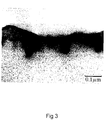
- Fig. 3 is a photograph (250,000 magnifications) by TEM showing the sectional structure of the portion near the surface of the pressure-sensitive adhesive layer of the pressure-sensitive tape of Example 3,
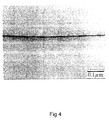
- Fig. 4 is a photograph (250,000 magnifications) by TEM showing the sectional structure of the portion near the surface of the pressure-sensitive adhesive layer of the pressure-sensitive tape of Example 4,
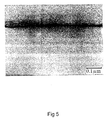
- Fig. 5 is a photograph (250,000 magnifications) by TEM showing the sectional structure of the portion near the surface of the pressure-sensitive adhesive layer of the pressure-sensitive tape of Example 5, and
- Fig. 6 is a photograph (250,000 magnifications) by TEM showing the sectional structure of the portion near the surface of the pressure-sensitive adhesive layer of the pressure-sensitive tape of Comparative Example 1.
- the present invention is described in more practically by the following examples. All parts in these examples, unless otherwise indicated, are by weight. Also, the acrylic pressure-sensitive adhesive solution and the SIS-based pressure-sensitive adhesive solution (the pressure-sensitive adhesive solution using a styrene-isoprene-styrene block copolymer) are prepared by the following methods.
- SIS-based pressure-sensitive adhesive solution having a solid content of 50% by weight.
- the pressure-sensitive tape obtained in Reference Example 1 was immersed in an aqueous solution containing 0.2 g of polyethyleneimine [Epomin P-1000, trade name, made by Nippon Shokubai Co., Ltd., (molecular weight: 70,000)] in 1,000 ml of water before the isocyanate group in the pressure-sensitive adhesive was not deactivated (within 6 hours) and thereafter the pressure-sensitive tape was pulled up in the perpendicular direction at a speed of 40 cm/minute. After drying off water attached to the pressure-sensitive tape, the tape was allowed to stand at room temperature such that the surface of the pressure-sensitive adhesive layer did not tough other substances. Thus, a functional group-modification on the surface of the pressure-sensitive adhesive was conducted.
- a functional group-modification on the pressure-sensitive adhesive surface was conducted in the same manner as in Example 1 except that an aqueous solution of polyallylamine [PAA-10L-10C, trade name, made by Nitto Boseki Co., Ltd., (molecular weight: 100,000)] was used in place of the aqueous solution of polyethyleneimine.
- PAA-10L-10C trade name, made by Nitto Boseki Co., Ltd., (molecular weight: 100,000)
- a functional group-modification on the pressure-sensitive surface was conducted in the same manner as in Example 1 except that an aqueous solution of polyvinylamine [PVAM0595B, trade name, made by Mitsubishi Chemical Corporation, (molecular weight: 600,000)] was used in place of the aqueous solution of polyethyleneimine.
- PVAM0595B trade name, made by Mitsubishi Chemical Corporation, (molecular weight: 600,000)
- the pressure-sensitive tape After allowing to stand the pressure-sensitive tape obtained in Reference Example 1 for 4 days or longer at room temperature and confirming the deactivation of the isocyanate group in the pressure-sensitive adhesive, the pressure-sensitive tape was immersed in an aqueous solution of polyethyleneimine and pulled out as in Example 1. After drying off water as in Example 1, the pressure-sensitive tape was allowed to stand at room temperature such that the surface of the pressure-sensitive adhesive did not touch other substances, whereby a functional group-modification on the pressure-sensitive adhesive surface was conducted.
- a functional group-modification on the pressure-sensitive adhesive surface was conducted in the same manner as in Comparative Example 1 except that the same aqueous polyallylamine solution as in Example 2 was used in place of the aqueous solution of polyethyleneimine.
- a functional group-modification was conducted in the same manner as in Comparative Example 1 except that the same aqueous polyvinylamine solution as in Example 3 was used in place of the aqueous solution of polyethyleneimine.
- Example 4 A functional group-modification was conducted in the same manner as in Example 4 except that the same aqueous solution of polyvinylamine as in Example 3 was used in place of the aqueous solution of polyallylamine.
- the pressure-sensitive tape sample was allowed to stand at room temperature for 4 days or longer since the preparation thereof and after confirming by infrared absorption that the isocyanate group was vanished and deactivated, the sample was adhered to the surface of the coated plate.
- the assembly After placing the assembly in a vessel kept at a constant temperature of 50°C for 5 days, the assembly was taken out therefrom, and after allowing to stand the assembly in a chamber kept at a constant temperature of 23°C for 30 minutes or longer, the 180 degree peel strength was measured by Schopper's tensile tester at a peeling speed of 300 mm/minute.
- the pressure-sensitive tape obtained in Reference Example 2 was immersed in an aqueous solution containing 1 g of polyacrylic acid (made by Wako Pure Chemical Industries, Ltd.) in 1,000 ml of water before the aziridinyl group contained in the pressure-sensitive adhesive was not deactivted, and after allowing to stand for 10 minutes, the pressure-sensitive tape was pulled up. After drying off water attached to the pressure-sensitive tape, the tape was allowed to stand at room temperature such that the surface of the pressure-sensitive adhesive did not touch other substances to carry out the functional group-modification on the pressure-sensitive adhesive surface.
- polyacrylic acid made by Wako Pure Chemical Industries, Ltd.
- the pressure-sensitive tape obtained in Reference Example 1 was immersed in an aqueous solution containing 0.2 g of polyallylamine [PAA-10C, trade name, made by Nitto Boseki Co., Ltd., (molecular weight: 10,000)] in 1,000 ml of water before the isocyanate group in the pressure-sensitive adhesive was not deactivated (within 6 hours) and thereafter, the tape was pulled up in the perpendicular direction at a speed of 4 cm/minute. After drying off water attached to the pressure-sensitive tape, the tape was allowed to stand at room temperature such that the surface of the pressure-sensitive adhesive did not touch other substances.
- PAA-10C polyallylamine
- the pressure-sensitive tape was immersed in an aqueous solution containing 2 g of ⁇ -glycidoxypropyl trimethoxysilane shown by the following chemical formula [silane coupling agent, KBM-403, trade name, made by Shin-Etsu Chemical Co., Ltd.] in 1000 ml of water for 30 minutes and thereafter, the pressure-sensitive tape was pulled up and washed with water. After drying off water attached to the pressure-sensitive tape, the tape was allowed to stand at room temperature such that the surface of the pressure-sensitive adhesive did not touch other substances to carry out the functional group modification on the pressure-sensitive adhesive surface.
- the pressure-sensitive tape obtained in Reference Example 1 for 4 days at room temperature and confirming that the isocynate group in the pressure-sensitive adhesive was deactivated the pressure-sensitive tape was immersed in the aqueous solution containing ⁇ -glycidoxypropyl trimethoxysilane as in Example 7, pulled up, and washed with water. After drying off water attached to the pressure-sensitive tape as in Example 7, the pressure-sensitive tape was allowed to stand at room temperature such that the surface of the pressure-sensitive adhesive did not touch other substances to carry out a functional group modification on the surface of the pressure-sensitive adhesive.
- the pressure-sensitive tape After allowing to stand the pressure-sensitive tape obtained in Reference Example 1 for 4 days at room temperature and confirming that the isocyanate group in the pressure-sensitive adhesive was deactivated, the pressure-sensitive tape was immersed in an aqueous solution containing 2 g of N- ⁇ (aminoethyl) ⁇ -aminopropyltrimethoxysilane shown by the following chemical formula (CH 3 O) 3 SiC 3 H 6 NHC 2 H 4 NH 2 [silane coupling agent, KBM-603, trade name, made by Shin-Etsu Chemical Co., Ltd.) in 1,000 ml of water for 30 minutes. Thereafter, the pressure-sensitive tape was pulled up and washed with water. After drying off water attached to the pressure-sensitive tape, the tape was allowed to stand at room temperature such that the surface of the pressure-sensitive adhesive did not touch other substances to carry out a functional group modification on the surface of the pressure-sensitive adhesive.
- an aqueous solution containing 2 g of N- ⁇ (amin
- Table 4 As is clear from the results shown in Table 4, it can be seen that in the pressure-sensitive tape of Example 7, wherein an amino group was previously fixed to the surface of the pressure-sensitive adhesive as a functional group and further an alkoxysilyl group was introduced and fixed to the surface of the presser-sensitive adhesive by the reaction with the amino group, the adhesive strength to the surface of the glass plate was greatly improved by that the surface of the pressure-sensitive adhesive was more effectively improved by the alkoxysilyl group, as compared with the pressure-sensitive tape of Reference Example 1 and the pressure-sensitive tapes of Comparative Examples 4 and 5, wherein the introduction and fixation of an alkoxysilyl group were tried by other methods than the method of Example 7.
- the pressure-sensitive tape obtained in Reference Example 1 After allowing to stand the pressure-sensitive tape obtained in Reference Example 1 for 4 days or longer at room temperature and confirming that the isocyanate group in the pressure-sensitive adhesive was deactivated, the pressure-sensitive tape was immersed in the n-hexane solution containing methacryloyl chloride as in Example 8, pulled up, and washed with n-hexane. After drying off n-hexane as in Example 8, the pressure-sensitive tape was allowed to stand at room temperature such that the surface of the pressure-sensitive adhesive did not touch other substances to carry out a functional group modification of the surface of the pressure-sensitive adhesive.
- the pressure-sensitive tape sample was allowed to stand at room temperature for 4 days or longer since the preparation thereof and after confirming by infrared absorption that the isocyanate group was vanished and deactivated, the sample was stuck to the surface of the coated plate.
- the assembly After placing the assembly in a vessel kept at a constant temperature of 110°C for 1 hour, the assembly was took out therefrom, and after allowing to stand the assembly in a chamber kept at a constant temperature of 23°C for 30 minutes or longer, the 180 degree peel strength was measured by Schopper's tensile tester at a peeling speed of 300 mm/minute.
- Example 7 After allowing to stand the pressure-sensitive tape having fixed an amino group as a functional group to the surface of the pressure-sensitive adhesive for 4 days at room temperature, the pressure-sensitive tape was immersed in a n-hexane solution containing 2 g of polydimethylsiloxane containing an epoxy group at one terminal shown by the following chemical formula [X-22-173DX, trade name, made by Shin-Etsu Chemical Co., Ltd., (molecular weight: 4.500)] in 1,000 ml thereof for 30 minutes. Thereafter, the pressure-sensitive tape was pulled out and washed with n-hexane. After drying off n-hexane attached to the pressure-sensitive tape, the tape was allowed to stand at room temperature such that the surface of the pressure-sensitive adhesive did not touch other substances. Thus, the functional group modification of the surface of the pressure-sensitive adhesive was carried out.
- the pressure-sensitive tape obtained in Reference Example 1 After allowing to stand the pressure-sensitive tape obtained in Reference Example 1 for 4 days or longer at room temperature and confirming that the isocyanate group in the pressure-sensitive adhesive was deactivated, the pressure-sensitive tape was immersed in the n-hexane solution containing polydimethylsiloxane containing an epoxy group at one terminal as in Example 9, pulled out, and washed with n-hexane. After drying off n-hexane as in Example 9, the pressure-sensitive tape was allowed to stand at room temperature such that the surface of the pressure-sensitive adhesive did not touch other substances to carry out a functional group modification on the surface of the pressure-sensitive adhesive.
- the 180 degree peel strength to the surface of a stainless steel plate was measured by the method shown below. The results are shown in Table 6.
- the pressure-sensitive tape sample of Reference Example 1 was allowed to stand at room temperature for 4 days or longer since the preparation thereof and after confirming by the infrared absorption that the isocyanate compound in the pressure-sensitive adhesive was vanished and deactivated, the sample was stuck to the surface of a stainless steel plate.
- a desired functional group can be stably introduced at high density to the surface of the pressure-sensitive adhesive, and according to the method, the conventional problems that the fluid characteristics and the adhesive characteristics of the adhesive are reduced and the surface of the adherend is stained by a bleed out do not occur, and also the fixing strength of the functional group to the surface of the adhesive is large, whereby there is no possibility that the above-described functional group is easily released by a friction, etc.
Landscapes
- Chemical & Material Sciences (AREA)
- General Chemical & Material Sciences (AREA)
- Health & Medical Sciences (AREA)
- Chemical Kinetics & Catalysis (AREA)
- Medicinal Chemistry (AREA)
- Polymers & Plastics (AREA)
- Organic Chemistry (AREA)
- Adhesives Or Adhesive Processes (AREA)
- Adhesive Tapes (AREA)
- Other Resins Obtained By Reactions Not Involving Carbon-To-Carbon Unsaturated Bonds (AREA)
- Immobilizing And Processing Of Enzymes And Microorganisms (AREA)
- Treatments Of Macromolecular Shaped Articles (AREA)
Claims (5)
- Procédé pour modifier des groupes fonctionnels sur la surface d'un adhésif autocollant, qui comprend :le fait de soumettre la surface de l'adhésif autocollant contenant un groupe fonctionnel réactif (A) et un composé contenant un groupe fonctionnel (B) ayant un groupe fonctionnel réactif (B) qui est réactif vis-à-vis du groupe fonctionnel (A) à une réaction de contact interfacial,et de fixer ainsi la phase modifiée par le groupe fonctionnel (B) ayant une épaisseur de 1000 nm ou moins sur la surface de l'adhésif autocollant.
- Procédé pour modifier des groupes fonctionnels selon la revendication 1, dans lequel le composé contenant le groupe fonctionnel (B) est au moins un composé de polyéthylènimine, de polyallylamine, de polyvinylamine et d'acide polyacrylique.
- Procédé pour modifier des groupes fonctionnels selon la revendication 1, dans lequel l'épaisseur de la phase modifiée par le groupe fonctionnel (B) est de 100 nm ou moins.
- Procédé pour modifier des groupes fonctionnels selon la revendication 1, dans lequel un solvant qui ne dissout ni ne fait gonfler la surface de l'adhésif autocollant et un composé contenant le groupe fonctionnel (B) sont utilisés pour effectuer la réaction de contact interfacial.
- Procédé pour modifier des groupes fonctionnels selon la revendication 1, qui comprend, après la fixation d'un groupe fonctionnel (B) à la surface de l'adhésif autocollant, l'induction d'une réaction de contact interfacial d'un autre composé contenant un groupe fonctionnel (C) avec le groupe fonctionnel (B) pour fixer un autre groupe fonctionnel (C) à la surface de l'adhésif autocollant.
Applications Claiming Priority (7)
| Application Number | Priority Date | Filing Date | Title |
|---|---|---|---|
| JP13506696 | 1996-05-29 | ||
| JP13506696 | 1996-05-29 | ||
| JP135066/96 | 1996-05-29 | ||
| JP28956396 | 1996-10-31 | ||
| JP08289563A JP3124995B2 (ja) | 1996-05-29 | 1996-10-31 | 粘着剤表面官能基修飾法 |
| JP289563/96 | 1996-10-31 | ||
| PCT/JP1997/001796 WO1997045501A1 (fr) | 1996-05-29 | 1997-05-27 | Procede de modification superficielle d'un adhesif autocollant au moyen d'un groupe fonctionnel |
Publications (3)
| Publication Number | Publication Date |
|---|---|
| EP0903387A1 EP0903387A1 (fr) | 1999-03-24 |
| EP0903387A4 EP0903387A4 (fr) | 2000-03-01 |
| EP0903387B1 true EP0903387B1 (fr) | 2003-08-13 |
Family
ID=26469009
Family Applications (1)
| Application Number | Title | Priority Date | Filing Date |
|---|---|---|---|
| EP97922201A Expired - Lifetime EP0903387B1 (fr) | 1996-05-29 | 1997-05-27 | Procede de modification superficielle d'un adhesif autocollant au moyen d'un groupe fonctionnel |
Country Status (8)
| Country | Link |
|---|---|
| US (1) | US6103302A (fr) |
| EP (1) | EP0903387B1 (fr) |
| JP (1) | JP3124995B2 (fr) |
| KR (1) | KR100389185B1 (fr) |
| CN (1) | CN1091789C (fr) |
| CA (1) | CA2256723C (fr) |
| DE (1) | DE69724120T2 (fr) |
| WO (1) | WO1997045501A1 (fr) |
Families Citing this family (19)
| Publication number | Priority date | Publication date | Assignee | Title |
|---|---|---|---|---|
| JPH08156890A (ja) * | 1994-12-05 | 1996-06-18 | Kawasaki Heavy Ind Ltd | 旋回式スラスタを装備した双頭船 |
| JPH1150265A (ja) * | 1997-08-05 | 1999-02-23 | Nitto Denko Corp | 表面低エネルギ―化処理法 |
| JP4722249B2 (ja) * | 1999-05-19 | 2011-07-13 | 日東電工株式会社 | 接着力経日上昇性粘着剤、及び粘着テープ又はシート |
| JP2001240820A (ja) * | 2000-02-29 | 2001-09-04 | Nitto Denko Corp | 塗膜保護シート、その製造方法及び施工方法 |
| JP4557304B2 (ja) * | 2000-05-08 | 2010-10-06 | 日東電工株式会社 | エマルジヨン系粘着剤の表面改質方法 |
| JP4776060B2 (ja) * | 2000-05-15 | 2011-09-21 | 日東電工株式会社 | 表面反応性官能基修飾粘着剤及び粘着テープ又はシート |
| DE10030553A1 (de) * | 2000-06-29 | 2002-01-10 | Basf Ag | Stabilisierte thermoplastische Formmassen |
| DE10030635A1 (de) * | 2000-06-29 | 2002-01-10 | Basf Ag | Stabilisierte schwarze Polyoxymethylenformmassen |
| US6448301B1 (en) | 2000-09-08 | 2002-09-10 | 3M Innovative Properties Company | Crosslinkable polymeric compositions and use thereof |
| JP2002226793A (ja) * | 2001-01-31 | 2002-08-14 | Nitto Denko Corp | 電子部品連設用接着テープ |
| JP2003147325A (ja) * | 2001-11-14 | 2003-05-21 | Nitto Denko Corp | 表面変性粘着剤および粘着剤の表面変性方法並びに粘着テープ又はシート |
| JP4007920B2 (ja) * | 2002-02-01 | 2007-11-14 | 日東電工株式会社 | 粘着型光学フィルムおよび画像表示装置 |
| JP2003307621A (ja) * | 2002-04-18 | 2003-10-31 | Nitto Denko Corp | 粘着型光学フィルムおよび画像表示装置 |
| WO2005009633A1 (fr) * | 2003-07-22 | 2005-02-03 | Arizona Board Of Regents | Systeme et procede de nettoyage de contact a sec permettant d'enlever des particules de plaquettes semi-conductrices |
| US7595141B2 (en) * | 2004-10-26 | 2009-09-29 | Az Electronic Materials Usa Corp. | Composition for coating over a photoresist pattern |
| US20060251888A1 (en) * | 2005-05-06 | 2006-11-09 | Richard Lane | Pressure sensitive adhesive (PSA) laminates |
| US20060251889A1 (en) * | 2005-05-06 | 2006-11-09 | Richard Lane | Pressure sensitive adhesive (PSA) laminates |
| JP6452918B1 (ja) * | 2017-03-30 | 2019-01-16 | リンテック株式会社 | 接着シート、及び積層体の製造方法 |
| CN110461975B (zh) * | 2017-03-30 | 2021-12-24 | 琳得科株式会社 | 粘接片、和层叠体的制造方法 |
Family Cites Families (8)
| Publication number | Priority date | Publication date | Assignee | Title |
|---|---|---|---|---|
| JPS5813114B2 (ja) * | 1980-03-25 | 1983-03-11 | 日東電工株式会社 | 両面接着テ−プ及び該テ−プの製法 |
| JPS5813114A (ja) * | 1981-07-14 | 1983-01-25 | Nissan Motor Co Ltd | デイ−ゼルエンジンのパ−テイキユレイト捕集装置 |
| JPS58118237A (ja) * | 1981-12-30 | 1983-07-14 | 日東電工株式会社 | 高分子複合体 |
| JPS6067581A (ja) * | 1983-09-21 | 1985-04-17 | Nitto Electric Ind Co Ltd | 感圧接着性フィルム又はテ−プの改質方法 |
| JPS6067851A (ja) * | 1983-09-24 | 1985-04-18 | Shimadzu Corp | グルコ−ス分析計における感度調整方法 |
| JPS6116289A (ja) * | 1984-07-02 | 1986-01-24 | Sanyo Electric Co Ltd | 送風機 |
| JP2524223B2 (ja) * | 1989-06-23 | 1996-08-14 | 日本ポリウレタン工業株式会社 | イソシアヌレ―ト環を有する有機ポリイソシアネ―ト変性体の製造方法 |
| JP3346638B2 (ja) * | 1993-04-13 | 2002-11-18 | 日東電工株式会社 | 感圧性接着テ―プの製法 |
-
1996
- 1996-10-31 JP JP08289563A patent/JP3124995B2/ja not_active Expired - Fee Related
-
1997
- 1997-05-27 CA CA002256723A patent/CA2256723C/fr not_active Expired - Fee Related
- 1997-05-27 DE DE69724120T patent/DE69724120T2/de not_active Expired - Lifetime
- 1997-05-27 WO PCT/JP1997/001796 patent/WO1997045501A1/fr not_active Ceased
- 1997-05-27 EP EP97922201A patent/EP0903387B1/fr not_active Expired - Lifetime
- 1997-05-27 US US09/194,183 patent/US6103302A/en not_active Expired - Lifetime
- 1997-05-27 KR KR10-1998-0709575A patent/KR100389185B1/ko not_active Expired - Fee Related
- 1997-05-27 CN CN97196910A patent/CN1091789C/zh not_active Expired - Fee Related
Also Published As
| Publication number | Publication date |
|---|---|
| KR100389185B1 (ko) | 2005-01-15 |
| CA2256723A1 (fr) | 1997-12-04 |
| CN1226916A (zh) | 1999-08-25 |
| JPH1046112A (ja) | 1998-02-17 |
| DE69724120D1 (de) | 2003-09-18 |
| CN1091789C (zh) | 2002-10-02 |
| DE69724120T2 (de) | 2004-04-01 |
| CA2256723C (fr) | 2005-12-20 |
| EP0903387A4 (fr) | 2000-03-01 |
| EP0903387A1 (fr) | 1999-03-24 |
| US6103302A (en) | 2000-08-15 |
| WO1997045501A1 (fr) | 1997-12-04 |
| KR20000016013A (ko) | 2000-03-25 |
| JP3124995B2 (ja) | 2001-01-15 |
Similar Documents
| Publication | Publication Date | Title |
|---|---|---|
| US6103302A (en) | Method for modification of surface of pressure-sensitive adhesive with functional group | |
| EP1312656A2 (fr) | Adhésif sensible à la pression modifié en surface, procédé pour modifier la surface de l'adhésif sensible à la pression et ruban adhésif sensible à la pression | |
| EP0951948B1 (fr) | Procédé pour rendre collante une surface souple | |
| CN101932638B (zh) | 硅氧烷自粘合剂、其生产方法、使用其的复合物及其应用 | |
| Lee et al. | Adhesion performance and microscope morphology of UV-curable semi-interpenetrated dicing acrylic PSAs in Si-wafer manufacture process for MCP | |
| JP4722249B2 (ja) | 接着力経日上昇性粘着剤、及び粘着テープ又はシート | |
| Jin et al. | Properties of solvent-borne acrylic pressure-sensitive adhesives synthesized by a simple approach | |
| CA2244410C (fr) | Methode de traitement visant a reduire l'energie de surface | |
| JP4636649B2 (ja) | 剥離剤形成用重合性組成物、剥離剤物品及び剥離剤物品の製造方法 | |
| CN113891922A (zh) | 用于柔性版印刷板安装带的粘合剂底胶 | |
| NO860063L (no) | Vannbasert slippmiddel. | |
| JP2000290603A (ja) | 粘着性再発現方法 | |
| JP4776060B2 (ja) | 表面反応性官能基修飾粘着剤及び粘着テープ又はシート | |
| JPH04178482A (ja) | 感圧接着剤及び表面保護部材 | |
| JP4097451B2 (ja) | 表面反応性官能基修飾粘着剤及び粘着テープ又はシート | |
| JPS6210181A (ja) | 感圧性接着テ−プ類の製造法 | |
| JP4806497B2 (ja) | 表面変性フィルム状感圧性接着剤および表面保護材 | |
| JPS5825719B2 (ja) | ハクリセイシヨリザイ | |
| JP4097454B2 (ja) | 表面反応性官能基修飾粘着剤及び粘着テープ又はシート | |
| JPH04202586A (ja) | 制振材用感圧性接着剤組成物 | |
| JPH0568517B2 (fr) | ||
| JP4557304B2 (ja) | エマルジヨン系粘着剤の表面改質方法 | |
| JPS61268783A (ja) | 剥離性処理剤 | |
| JP2003327927A (ja) | 電子部品固定用接着シート |
Legal Events
| Date | Code | Title | Description |
|---|---|---|---|
| PUAI | Public reference made under article 153(3) epc to a published international application that has entered the european phase |
Free format text: ORIGINAL CODE: 0009012 |
|
| 17P | Request for examination filed |
Effective date: 19981119 |
|
| AK | Designated contracting states |
Kind code of ref document: A1 Designated state(s): DE GB |
|
| A4 | Supplementary search report drawn up and despatched |
Effective date: 20000118 |
|
| AK | Designated contracting states |
Kind code of ref document: A4 Designated state(s): DE GB |
|
| 17Q | First examination report despatched |
Effective date: 20010710 |
|
| GRAH | Despatch of communication of intention to grant a patent |
Free format text: ORIGINAL CODE: EPIDOS IGRA |
|
| GRAH | Despatch of communication of intention to grant a patent |
Free format text: ORIGINAL CODE: EPIDOS IGRA |
|
| GRAA | (expected) grant |
Free format text: ORIGINAL CODE: 0009210 |
|
| AK | Designated contracting states |
Designated state(s): DE GB |
|
| REG | Reference to a national code |
Ref country code: GB Ref legal event code: FG4D |
|
| REF | Corresponds to: |
Ref document number: 69724120 Country of ref document: DE Date of ref document: 20030918 Kind code of ref document: P |
|
| PLBE | No opposition filed within time limit |
Free format text: ORIGINAL CODE: 0009261 |
|
| STAA | Information on the status of an ep patent application or granted ep patent |
Free format text: STATUS: NO OPPOSITION FILED WITHIN TIME LIMIT |
|
| 26N | No opposition filed |
Effective date: 20040514 |
|
| PGFP | Annual fee paid to national office [announced via postgrant information from national office to epo] |
Ref country code: GB Payment date: 20090527 Year of fee payment: 13 |
|
| GBPC | Gb: european patent ceased through non-payment of renewal fee |
Effective date: 20100527 |
|
| PG25 | Lapsed in a contracting state [announced via postgrant information from national office to epo] |
Ref country code: GB Free format text: LAPSE BECAUSE OF NON-PAYMENT OF DUE FEES Effective date: 20100527 |
|
| PGFP | Annual fee paid to national office [announced via postgrant information from national office to epo] |
Ref country code: DE Payment date: 20110525 Year of fee payment: 15 |
|
| REG | Reference to a national code |
Ref country code: DE Ref legal event code: R119 Ref document number: 69724120 Country of ref document: DE Effective date: 20121201 |
|
| PG25 | Lapsed in a contracting state [announced via postgrant information from national office to epo] |
Ref country code: DE Free format text: LAPSE BECAUSE OF NON-PAYMENT OF DUE FEES Effective date: 20121201 |