EP0903353B1 - Imidazolidinderivate, ihre Herstellung, ihre Verwendung und sie enthaltende pharmazeutische Präparate - Google Patents
Imidazolidinderivate, ihre Herstellung, ihre Verwendung und sie enthaltende pharmazeutische Präparate Download PDFInfo
- Publication number
- EP0903353B1 EP0903353B1 EP98117231A EP98117231A EP0903353B1 EP 0903353 B1 EP0903353 B1 EP 0903353B1 EP 98117231 A EP98117231 A EP 98117231A EP 98117231 A EP98117231 A EP 98117231A EP 0903353 B1 EP0903353 B1 EP 0903353B1
- Authority
- EP
- European Patent Office
- Prior art keywords
- alkyl
- aryl
- radical
- formula
- optionally substituted
- Prior art date
- Legal status (The legal status is an assumption and is not a legal conclusion. Google has not performed a legal analysis and makes no representation as to the accuracy of the status listed.)
- Expired - Lifetime
Links
- 238000002360 preparation method Methods 0.000 title claims description 27
- WRYCSMQKUKOKBP-UHFFFAOYSA-N Imidazolidine Chemical compound C1CNCN1 WRYCSMQKUKOKBP-UHFFFAOYSA-N 0.000 title 1
- 239000008194 pharmaceutical composition Substances 0.000 title 1
- -1 (C1-C8)-alkyl radical Chemical class 0.000 claims description 306
- 150000001875 compounds Chemical class 0.000 claims description 133
- 150000003254 radicals Chemical class 0.000 claims description 106
- 125000004178 (C1-C4) alkyl group Chemical group 0.000 claims description 85
- 125000005915 C6-C14 aryl group Chemical group 0.000 claims description 70
- 239000000203 mixture Substances 0.000 claims description 58
- 108010008212 Integrin alpha4beta1 Proteins 0.000 claims description 55
- 150000003839 salts Chemical class 0.000 claims description 48
- 229910052760 oxygen Inorganic materials 0.000 claims description 44
- 239000001257 hydrogen Substances 0.000 claims description 42
- 229910052739 hydrogen Inorganic materials 0.000 claims description 42
- 239000001301 oxygen Substances 0.000 claims description 41
- 125000001997 phenyl group Chemical group [H]C1=C([H])C([H])=C(*)C([H])=C1[H] 0.000 claims description 38
- 150000005840 aryl radicals Chemical class 0.000 claims description 36
- 238000000034 method Methods 0.000 claims description 36
- 125000004169 (C1-C6) alkyl group Chemical group 0.000 claims description 34
- 125000002924 primary amino group Chemical group [H]N([H])* 0.000 claims description 29
- QVGXLLKOCUKJST-UHFFFAOYSA-N atomic oxygen Chemical compound [O] QVGXLLKOCUKJST-UHFFFAOYSA-N 0.000 claims description 25
- 125000006652 (C3-C12) cycloalkyl group Chemical group 0.000 claims description 24
- 238000011321 prophylaxis Methods 0.000 claims description 22
- 238000002560 therapeutic procedure Methods 0.000 claims description 22
- 125000002023 trifluoromethyl group Chemical group FC(F)(F)* 0.000 claims description 22
- 125000004435 hydrogen atom Chemical group [H]* 0.000 claims description 21
- 125000000229 (C1-C4)alkoxy group Chemical group 0.000 claims description 19
- 125000003917 carbamoyl group Chemical group [H]N([H])C(*)=O 0.000 claims description 18
- 125000001797 benzyl group Chemical group [H]C1=C([H])C([H])=C(C([H])=C1[H])C([H])([H])* 0.000 claims description 15
- 229910052736 halogen Inorganic materials 0.000 claims description 15
- 150000002367 halogens Chemical class 0.000 claims description 15
- ORTFAQDWJHRMNX-UHFFFAOYSA-N hydroxidooxidocarbon(.) Chemical group O[C]=O ORTFAQDWJHRMNX-UHFFFAOYSA-N 0.000 claims description 14
- 125000000524 functional group Chemical group 0.000 claims description 13
- 230000008569 process Effects 0.000 claims description 12
- HZVOZRGWRWCICA-UHFFFAOYSA-N methanediyl Chemical class [CH2] HZVOZRGWRWCICA-UHFFFAOYSA-N 0.000 claims description 11
- 125000000008 (C1-C10) alkyl group Chemical group 0.000 claims description 10
- 230000005012 migration Effects 0.000 claims description 10
- 238000013508 migration Methods 0.000 claims description 10
- 125000000175 2-thienyl group Chemical group S1C([*])=C([H])C([H])=C1[H] 0.000 claims description 9
- 125000000339 4-pyridyl group Chemical group N1=C([H])C([H])=C([*])C([H])=C1[H] 0.000 claims description 9
- 125000001541 3-thienyl group Chemical group S1C([H])=C([*])C([H])=C1[H] 0.000 claims description 8
- CIUQDSCDWFSTQR-UHFFFAOYSA-N [C]1=CC=CC=C1 Chemical class [C]1=CC=CC=C1 CIUQDSCDWFSTQR-UHFFFAOYSA-N 0.000 claims description 8
- 239000000825 pharmaceutical preparation Substances 0.000 claims description 8
- 125000003349 3-pyridyl group Chemical group N1=C([H])C([*])=C([H])C([H])=C1[H] 0.000 claims description 7
- 239000002243 precursor Substances 0.000 claims description 7
- 206010039073 rheumatoid arthritis Diseases 0.000 claims description 7
- 206010020751 Hypersensitivity Diseases 0.000 claims description 6
- 230000007815 allergy Effects 0.000 claims description 6
- 150000001732 carboxylic acid derivatives Chemical class 0.000 claims description 6
- 238000009833 condensation Methods 0.000 claims description 6
- 230000005494 condensation Effects 0.000 claims description 6
- 125000004454 (C1-C6) alkoxycarbonyl group Chemical group 0.000 claims description 5
- 208000022559 Inflammatory bowel disease Diseases 0.000 claims description 5
- 206010028980 Neoplasm Diseases 0.000 claims description 5
- 208000006673 asthma Diseases 0.000 claims description 5
- 208000027866 inflammatory disease Diseases 0.000 claims description 5
- 230000005764 inhibitory process Effects 0.000 claims description 5
- 230000002265 prevention Effects 0.000 claims description 5
- 239000000654 additive Substances 0.000 claims description 4
- 239000012634 fragment Substances 0.000 claims description 4
- 239000003112 inhibitor Substances 0.000 claims description 4
- 206010003210 Arteriosclerosis Diseases 0.000 claims description 3
- 206010027476 Metastases Diseases 0.000 claims description 3
- 208000011775 arteriosclerosis disease Diseases 0.000 claims description 3
- 206010012601 diabetes mellitus Diseases 0.000 claims description 3
- 201000004792 malaria Diseases 0.000 claims description 3
- 201000000596 systemic lupus erythematosus Diseases 0.000 claims description 3
- 208000024172 Cardiovascular disease Diseases 0.000 claims description 2
- 230000003110 anti-inflammatory effect Effects 0.000 claims description 2
- 210000003169 central nervous system Anatomy 0.000 claims description 2
- 230000006378 damage Effects 0.000 claims description 2
- 210000000056 organ Anatomy 0.000 claims description 2
- 239000000546 pharmaceutical excipient Substances 0.000 claims description 2
- 230000004614 tumor growth Effects 0.000 claims description 2
- 125000004356 hydroxy functional group Chemical group O* 0.000 claims 3
- 125000004135 2-norbornyl group Chemical group [H]C1([H])C([H])([H])C2([H])C([H])([H])C1([H])C([H])([H])C2([H])* 0.000 claims 1
- 125000005073 adamantyl group Chemical group C12(CC3CC(CC(C1)C3)C2)* 0.000 claims 1
- 125000004093 cyano group Chemical group *C#N 0.000 claims 1
- 230000005740 tumor formation Effects 0.000 claims 1
- YMWUJEATGCHHMB-UHFFFAOYSA-N Dichloromethane Chemical compound ClCCl YMWUJEATGCHHMB-UHFFFAOYSA-N 0.000 description 123
- ZMXDDKWLCZADIW-UHFFFAOYSA-N N,N-Dimethylformamide Chemical compound CN(C)C=O ZMXDDKWLCZADIW-UHFFFAOYSA-N 0.000 description 105
- XEKOWRVHYACXOJ-UHFFFAOYSA-N Ethyl acetate Chemical compound CCOC(C)=O XEKOWRVHYACXOJ-UHFFFAOYSA-N 0.000 description 96
- 239000000243 solution Substances 0.000 description 83
- OKKJLVBELUTLKV-UHFFFAOYSA-N Methanol Chemical compound OC OKKJLVBELUTLKV-UHFFFAOYSA-N 0.000 description 72
- 125000004209 (C1-C8) alkyl group Chemical group 0.000 description 62
- IJGRMHOSHXDMSA-UHFFFAOYSA-N Atomic nitrogen Chemical compound N#N IJGRMHOSHXDMSA-UHFFFAOYSA-N 0.000 description 56
- DTQVDTLACAAQTR-UHFFFAOYSA-N Trifluoroacetic acid Chemical compound OC(=O)C(F)(F)F DTQVDTLACAAQTR-UHFFFAOYSA-N 0.000 description 52
- GSNUFIFRDBKVIE-UHFFFAOYSA-N DMF Natural products CC1=CC=C(C)O1 GSNUFIFRDBKVIE-UHFFFAOYSA-N 0.000 description 51
- UFHFLCQGNIYNRP-UHFFFAOYSA-N Hydrogen Chemical compound [H][H] UFHFLCQGNIYNRP-UHFFFAOYSA-N 0.000 description 51
- 125000001072 heteroaryl group Chemical group 0.000 description 51
- YXFVVABEGXRONW-UHFFFAOYSA-N Toluene Chemical compound CC1=CC=CC=C1 YXFVVABEGXRONW-UHFFFAOYSA-N 0.000 description 48
- 229910052757 nitrogen Inorganic materials 0.000 description 42
- 229920005989 resin Polymers 0.000 description 41
- 239000011347 resin Substances 0.000 description 41
- 125000001424 substituent group Chemical group 0.000 description 39
- 210000004027 cell Anatomy 0.000 description 37
- 238000006243 chemical reaction Methods 0.000 description 36
- NINIDFKCEFEMDL-UHFFFAOYSA-N Sulfur Chemical compound [S] NINIDFKCEFEMDL-UHFFFAOYSA-N 0.000 description 34
- XLYOFNOQVPJJNP-UHFFFAOYSA-N water Substances O XLYOFNOQVPJJNP-UHFFFAOYSA-N 0.000 description 34
- 125000006552 (C3-C8) cycloalkyl group Chemical group 0.000 description 31
- 108010000134 Vascular Cell Adhesion Molecule-1 Proteins 0.000 description 31
- 102100023543 Vascular cell adhesion protein 1 Human genes 0.000 description 30
- 239000002904 solvent Substances 0.000 description 30
- RTZKZFJDLAIYFH-UHFFFAOYSA-N Diethyl ether Chemical compound CCOCC RTZKZFJDLAIYFH-UHFFFAOYSA-N 0.000 description 29
- 125000004432 carbon atom Chemical group C* 0.000 description 29
- 125000001449 isopropyl group Chemical group [H]C([H])([H])C([H])(*)C([H])([H])[H] 0.000 description 27
- VEXZGXHMUGYJMC-UHFFFAOYSA-N Hydrochloric acid Chemical compound Cl VEXZGXHMUGYJMC-UHFFFAOYSA-N 0.000 description 26
- 125000004433 nitrogen atom Chemical group N* 0.000 description 26
- 125000004648 C2-C8 alkenyl group Chemical group 0.000 description 25
- 125000005842 heteroatom Chemical group 0.000 description 25
- JGFZNNIVVJXRND-UHFFFAOYSA-N N,N-Diisopropylethylamine (DIPEA) Chemical compound CCN(C(C)C)C(C)C JGFZNNIVVJXRND-UHFFFAOYSA-N 0.000 description 24
- QTBSBXVTEAMEQO-UHFFFAOYSA-N Acetic acid Chemical compound CC(O)=O QTBSBXVTEAMEQO-UHFFFAOYSA-N 0.000 description 23
- 210000000265 leukocyte Anatomy 0.000 description 23
- 239000002253 acid Substances 0.000 description 22
- 125000002887 hydroxy group Chemical group [H]O* 0.000 description 22
- 229910052717 sulfur Inorganic materials 0.000 description 22
- 125000000999 tert-butyl group Chemical group [H]C([H])([H])C(*)(C([H])([H])[H])C([H])([H])[H] 0.000 description 22
- 125000002619 bicyclic group Chemical group 0.000 description 21
- 238000003776 cleavage reaction Methods 0.000 description 21
- 125000000623 heterocyclic group Chemical group 0.000 description 21
- 238000001819 mass spectrum Methods 0.000 description 21
- 230000007017 scission Effects 0.000 description 21
- 239000012074 organic phase Substances 0.000 description 20
- LFQSCWFLJHTTHZ-UHFFFAOYSA-N Ethanol Chemical compound CCO LFQSCWFLJHTTHZ-UHFFFAOYSA-N 0.000 description 19
- IMNFDUFMRHMDMM-UHFFFAOYSA-N N-Heptane Chemical compound CCCCCCC IMNFDUFMRHMDMM-UHFFFAOYSA-N 0.000 description 19
- VYPSYNLAJGMNEJ-UHFFFAOYSA-N Silicium dioxide Chemical compound O=[Si]=O VYPSYNLAJGMNEJ-UHFFFAOYSA-N 0.000 description 19
- 235000001014 amino acid Nutrition 0.000 description 19
- 229940024606 amino acid Drugs 0.000 description 19
- 150000001413 amino acids Chemical group 0.000 description 19
- 239000000741 silica gel Substances 0.000 description 19
- 229910002027 silica gel Inorganic materials 0.000 description 19
- 239000011593 sulfur Substances 0.000 description 19
- 238000003756 stirring Methods 0.000 description 18
- PMZURENOXWZQFD-UHFFFAOYSA-L Sodium Sulfate Chemical compound [Na+].[Na+].[O-]S([O-])(=O)=O PMZURENOXWZQFD-UHFFFAOYSA-L 0.000 description 17
- 229910052938 sodium sulfate Inorganic materials 0.000 description 17
- 235000011152 sodium sulphate Nutrition 0.000 description 17
- XKRFYHLGVUSROY-UHFFFAOYSA-N Argon Chemical compound [Ar] XKRFYHLGVUSROY-UHFFFAOYSA-N 0.000 description 16
- MYMOFIZGZYHOMD-UHFFFAOYSA-N Dioxygen Chemical compound O=O MYMOFIZGZYHOMD-UHFFFAOYSA-N 0.000 description 16
- 125000004108 n-butyl group Chemical group [H]C([H])([H])C([H])([H])C([H])([H])C([H])([H])* 0.000 description 16
- 229920006395 saturated elastomer Polymers 0.000 description 16
- 125000004649 C2-C8 alkynyl group Chemical group 0.000 description 15
- 125000001570 methylene group Chemical class [H]C([H])([*:1])[*:2] 0.000 description 15
- 125000003831 tetrazolyl group Chemical group 0.000 description 15
- 238000010168 coupling process Methods 0.000 description 14
- 238000001914 filtration Methods 0.000 description 14
- 125000006239 protecting group Chemical group 0.000 description 14
- 125000004076 pyridyl group Chemical group 0.000 description 14
- 125000006702 (C1-C18) alkyl group Chemical group 0.000 description 13
- 230000008878 coupling Effects 0.000 description 13
- 238000005859 coupling reaction Methods 0.000 description 13
- 125000002496 methyl group Chemical group [H]C([H])([H])* 0.000 description 13
- 125000004123 n-propyl group Chemical group [H]C([H])([H])C([H])([H])C([H])([H])* 0.000 description 13
- 125000001544 thienyl group Chemical group 0.000 description 13
- CYRMSUTZVYGINF-UHFFFAOYSA-N trichlorofluoromethane Chemical compound FC(Cl)(Cl)Cl CYRMSUTZVYGINF-UHFFFAOYSA-N 0.000 description 13
- 201000010099 disease Diseases 0.000 description 12
- 208000037265 diseases, disorders, signs and symptoms Diseases 0.000 description 12
- 150000002148 esters Chemical class 0.000 description 12
- 125000002541 furyl group Chemical group 0.000 description 12
- 125000002883 imidazolyl group Chemical group 0.000 description 12
- 230000003993 interaction Effects 0.000 description 12
- 125000004043 oxo group Chemical group O=* 0.000 description 12
- 238000003786 synthesis reaction Methods 0.000 description 12
- 125000000041 C6-C10 aryl group Chemical group 0.000 description 11
- FAPWRFPIFSIZLT-UHFFFAOYSA-M Sodium chloride Chemical class [Na+].[Cl-] FAPWRFPIFSIZLT-UHFFFAOYSA-M 0.000 description 11
- 239000000706 filtrate Substances 0.000 description 11
- 125000001841 imino group Chemical group [H]N=* 0.000 description 11
- 125000000168 pyrrolyl group Chemical group 0.000 description 11
- PECYZEOJVXMISF-UHFFFAOYSA-N 3-aminoalanine Chemical class [NH3+]CC(N)C([O-])=O PECYZEOJVXMISF-UHFFFAOYSA-N 0.000 description 10
- WYURNTSHIVDZCO-UHFFFAOYSA-N Tetrahydrofuran Chemical compound C1CCOC1 WYURNTSHIVDZCO-UHFFFAOYSA-N 0.000 description 10
- 230000027455 binding Effects 0.000 description 10
- 210000002889 endothelial cell Anatomy 0.000 description 10
- 125000001495 ethyl group Chemical group [H]C([H])([H])C([H])([H])* 0.000 description 10
- 239000003446 ligand Substances 0.000 description 10
- 125000002950 monocyclic group Chemical group 0.000 description 10
- HEMHJVSKTPXQMS-UHFFFAOYSA-M Sodium hydroxide Chemical compound [OH-].[Na+] HEMHJVSKTPXQMS-UHFFFAOYSA-M 0.000 description 9
- FPQVGDGSRVMNMR-JCTPKUEWSA-N [[(z)-(1-cyano-2-ethoxy-2-oxoethylidene)amino]oxy-(dimethylamino)methylidene]-dimethylazanium;tetrafluoroborate Chemical compound F[B-](F)(F)F.CCOC(=O)C(\C#N)=N/OC(N(C)C)=[N+](C)C FPQVGDGSRVMNMR-JCTPKUEWSA-N 0.000 description 9
- 150000001408 amides Chemical class 0.000 description 9
- 125000003277 amino group Chemical group 0.000 description 9
- 125000000051 benzyloxy group Chemical group [H]C1=C([H])C([H])=C(C([H])=C1[H])C([H])([H])O* 0.000 description 9
- 230000015572 biosynthetic process Effects 0.000 description 9
- 239000003921 oil Substances 0.000 description 9
- 235000019198 oils Nutrition 0.000 description 9
- 239000012071 phase Substances 0.000 description 9
- 239000011541 reaction mixture Substances 0.000 description 9
- KEAYESYHFKHZAL-UHFFFAOYSA-N Sodium Chemical compound [Na] KEAYESYHFKHZAL-UHFFFAOYSA-N 0.000 description 8
- 239000005557 antagonist Substances 0.000 description 8
- 229910052786 argon Inorganic materials 0.000 description 8
- 125000003118 aryl group Chemical group 0.000 description 8
- AGEZXYOZHKGVCM-UHFFFAOYSA-N benzyl bromide Chemical compound BrCC1=CC=CC=C1 AGEZXYOZHKGVCM-UHFFFAOYSA-N 0.000 description 8
- 230000000903 blocking effect Effects 0.000 description 8
- 239000000872 buffer Substances 0.000 description 8
- 239000003814 drug Substances 0.000 description 8
- 239000000047 product Substances 0.000 description 8
- WRHZVMBBRYBTKZ-UHFFFAOYSA-N pyrrole-2-carboxylic acid Chemical compound OC(=O)C1=CC=CN1 WRHZVMBBRYBTKZ-UHFFFAOYSA-N 0.000 description 8
- 239000012312 sodium hydride Substances 0.000 description 8
- 229910000104 sodium hydride Inorganic materials 0.000 description 8
- 239000000126 substance Substances 0.000 description 8
- 125000006376 (C3-C10) cycloalkyl group Chemical group 0.000 description 7
- 125000003088 (fluoren-9-ylmethoxy)carbonyl group Chemical group 0.000 description 7
- 125000005914 C6-C14 aryloxy group Chemical group 0.000 description 7
- QOSSAOTZNIDXMA-UHFFFAOYSA-N Dicylcohexylcarbodiimide Chemical compound C1CCCCC1N=C=NC1CCCCC1 QOSSAOTZNIDXMA-UHFFFAOYSA-N 0.000 description 7
- 108010016626 Dipeptides Proteins 0.000 description 7
- VGGSQFUCUMXWEO-UHFFFAOYSA-N Ethene Chemical class C=C VGGSQFUCUMXWEO-UHFFFAOYSA-N 0.000 description 7
- 108010067306 Fibronectins Proteins 0.000 description 7
- 102000016359 Fibronectins Human genes 0.000 description 7
- 238000004587 chromatography analysis Methods 0.000 description 7
- 108010044426 integrins Proteins 0.000 description 7
- 102000006495 integrins Human genes 0.000 description 7
- 239000007787 solid Substances 0.000 description 7
- 125000003682 3-furyl group Chemical group O1C([H])=C([*])C([H])=C1[H] 0.000 description 6
- CSNNHWWHGAXBCP-UHFFFAOYSA-L Magnesium sulfate Chemical compound [Mg+2].[O-][S+2]([O-])([O-])[O-] CSNNHWWHGAXBCP-UHFFFAOYSA-L 0.000 description 6
- 210000001744 T-lymphocyte Anatomy 0.000 description 6
- 230000010062 adhesion mechanism Effects 0.000 description 6
- 125000004453 alkoxycarbonyl group Chemical group 0.000 description 6
- 239000008346 aqueous phase Substances 0.000 description 6
- 238000003556 assay Methods 0.000 description 6
- 229910052799 carbon Inorganic materials 0.000 description 6
- 239000000969 carrier Substances 0.000 description 6
- 239000000460 chlorine Substances 0.000 description 6
- KRKNYBCHXYNGOX-UHFFFAOYSA-N citric acid Chemical compound OC(=O)CC(O)(C(O)=O)CC(O)=O KRKNYBCHXYNGOX-UHFFFAOYSA-N 0.000 description 6
- 230000004054 inflammatory process Effects 0.000 description 6
- 125000000959 isobutyl group Chemical group [H]C([H])([H])C([H])(C([H])([H])[H])C([H])([H])* 0.000 description 6
- 125000002911 monocyclic heterocycle group Chemical group 0.000 description 6
- 238000010532 solid phase synthesis reaction Methods 0.000 description 6
- 239000000725 suspension Substances 0.000 description 6
- 210000001519 tissue Anatomy 0.000 description 6
- 0 C*(CC1(CCCC1)C1)C1OC Chemical compound C*(CC1(CCCC1)C1)C1OC 0.000 description 5
- 108090000695 Cytokines Proteins 0.000 description 5
- 102000004127 Cytokines Human genes 0.000 description 5
- 206010061218 Inflammation Diseases 0.000 description 5
- 125000000218 acetic acid group Chemical group C(C)(=O)* 0.000 description 5
- 230000010933 acylation Effects 0.000 description 5
- 238000005917 acylation reaction Methods 0.000 description 5
- 235000008206 alpha-amino acids Nutrition 0.000 description 5
- 229910002091 carbon monoxide Inorganic materials 0.000 description 5
- 230000021164 cell adhesion Effects 0.000 description 5
- 238000001035 drying Methods 0.000 description 5
- 230000006870 function Effects 0.000 description 5
- NPZTUJOABDZTLV-UHFFFAOYSA-N hydroxybenzotriazole Substances O=C1C=CC=C2NNN=C12 NPZTUJOABDZTLV-UHFFFAOYSA-N 0.000 description 5
- 230000002401 inhibitory effect Effects 0.000 description 5
- 230000008611 intercellular interaction Effects 0.000 description 5
- 239000000543 intermediate Substances 0.000 description 5
- 210000004698 lymphocyte Anatomy 0.000 description 5
- 125000001280 n-hexyl group Chemical group C(CCCCC)* 0.000 description 5
- 125000000740 n-pentyl group Chemical group [H]C([H])([H])C([H])([H])C([H])([H])C([H])([H])C([H])([H])* 0.000 description 5
- QJGQUHMNIGDVPM-UHFFFAOYSA-N nitrogen group Chemical group [N] QJGQUHMNIGDVPM-UHFFFAOYSA-N 0.000 description 5
- 108090000765 processed proteins & peptides Proteins 0.000 description 5
- IHYHNCMLRJLBEK-ZBUUCQELSA-N tert-butyl (2s)-2-(1-adamantylmethoxycarbonylamino)-3-aminopropanoate Chemical compound C1C(C2)CC3CC2CC1(COC(=O)N[C@@H](CN)C(=O)OC(C)(C)C)C3 IHYHNCMLRJLBEK-ZBUUCQELSA-N 0.000 description 5
- 238000012360 testing method Methods 0.000 description 5
- PAQZWJGSJMLPMG-UHFFFAOYSA-N 2,4,6-tripropyl-1,3,5,2$l^{5},4$l^{5},6$l^{5}-trioxatriphosphinane 2,4,6-trioxide Chemical compound CCCP1(=O)OP(=O)(CCC)OP(=O)(CCC)O1 PAQZWJGSJMLPMG-UHFFFAOYSA-N 0.000 description 4
- WAKFXKMJYLVGHE-UHFFFAOYSA-N 2,4-dioxoimidazolidine-1-carboxylic acid Chemical class OC(=O)N1CC(=O)NC1=O WAKFXKMJYLVGHE-UHFFFAOYSA-N 0.000 description 4
- 125000002941 2-furyl group Chemical group O1C([*])=C([H])C([H])=C1[H] 0.000 description 4
- 125000003903 2-propenyl group Chemical group [H]C([*])([H])C([H])=C([H])[H] 0.000 description 4
- 125000001397 3-pyrrolyl group Chemical group [H]N1C([H])=C([*])C([H])=C1[H] 0.000 description 4
- VHYFNPMBLIVWCW-UHFFFAOYSA-N 4-Dimethylaminopyridine Chemical compound CN(C)C1=CC=NC=C1 VHYFNPMBLIVWCW-UHFFFAOYSA-N 0.000 description 4
- HBAQYPYDRFILMT-UHFFFAOYSA-N 8-[3-(1-cyclopropylpyrazol-4-yl)-1H-pyrazolo[4,3-d]pyrimidin-5-yl]-3-methyl-3,8-diazabicyclo[3.2.1]octan-2-one Chemical class C1(CC1)N1N=CC(=C1)C1=NNC2=C1N=C(N=C2)N1C2C(N(CC1CC2)C)=O HBAQYPYDRFILMT-UHFFFAOYSA-N 0.000 description 4
- ZAMOUSCENKQFHK-UHFFFAOYSA-N Chlorine atom Chemical compound [Cl] ZAMOUSCENKQFHK-UHFFFAOYSA-N 0.000 description 4
- 101000622304 Homo sapiens Vascular cell adhesion protein 1 Proteins 0.000 description 4
- 108010064593 Intercellular Adhesion Molecule-1 Proteins 0.000 description 4
- 102000015271 Intercellular Adhesion Molecule-1 Human genes 0.000 description 4
- NQRYJNQNLNOLGT-UHFFFAOYSA-N Piperidine Chemical compound C1CCNCC1 NQRYJNQNLNOLGT-UHFFFAOYSA-N 0.000 description 4
- JUJWROOIHBZHMG-UHFFFAOYSA-N Pyridine Chemical compound C1=CC=NC=C1 JUJWROOIHBZHMG-UHFFFAOYSA-N 0.000 description 4
- UIIMBOGNXHQVGW-UHFFFAOYSA-M Sodium bicarbonate Chemical compound [Na+].OC([O-])=O UIIMBOGNXHQVGW-UHFFFAOYSA-M 0.000 description 4
- 150000007513 acids Chemical class 0.000 description 4
- 230000029936 alkylation Effects 0.000 description 4
- 238000005804 alkylation reaction Methods 0.000 description 4
- 208000026935 allergic disease Diseases 0.000 description 4
- 150000001371 alpha-amino acids Chemical class 0.000 description 4
- 150000001412 amines Chemical class 0.000 description 4
- 125000004429 atom Chemical group 0.000 description 4
- 125000005605 benzo group Chemical group 0.000 description 4
- 150000001602 bicycloalkyls Chemical group 0.000 description 4
- FJDQFPXHSGXQBY-UHFFFAOYSA-L caesium carbonate Chemical compound [Cs+].[Cs+].[O-]C([O-])=O FJDQFPXHSGXQBY-UHFFFAOYSA-L 0.000 description 4
- 229910000024 caesium carbonate Inorganic materials 0.000 description 4
- 125000003178 carboxy group Chemical group [H]OC(*)=O 0.000 description 4
- 229910052801 chlorine Inorganic materials 0.000 description 4
- 238000001816 cooling Methods 0.000 description 4
- 239000012043 crude product Substances 0.000 description 4
- DIOQZVSQGTUSAI-UHFFFAOYSA-N decane Chemical compound CCCCCCCCCC DIOQZVSQGTUSAI-UHFFFAOYSA-N 0.000 description 4
- 230000001419 dependent effect Effects 0.000 description 4
- 230000000694 effects Effects 0.000 description 4
- 239000003480 eluent Substances 0.000 description 4
- 238000004128 high performance liquid chromatography Methods 0.000 description 4
- 230000002757 inflammatory effect Effects 0.000 description 4
- 239000012948 isocyanate Substances 0.000 description 4
- 150000002513 isocyanates Chemical class 0.000 description 4
- 125000001972 isopentyl group Chemical group [H]C([H])([H])C([H])(C([H])([H])[H])C([H])([H])C([H])([H])* 0.000 description 4
- 230000023404 leukocyte cell-cell adhesion Effects 0.000 description 4
- 238000011068 loading method Methods 0.000 description 4
- 125000001624 naphthyl group Chemical group 0.000 description 4
- KDLHZDBZIXYQEI-UHFFFAOYSA-N palladium Substances [Pd] KDLHZDBZIXYQEI-UHFFFAOYSA-N 0.000 description 4
- NFHFRUOZVGFOOS-UHFFFAOYSA-N palladium;triphenylphosphane Chemical compound [Pd].C1=CC=CC=C1P(C=1C=CC=CC=1)C1=CC=CC=C1.C1=CC=CC=C1P(C=1C=CC=CC=1)C1=CC=CC=C1.C1=CC=CC=C1P(C=1C=CC=CC=1)C1=CC=CC=C1.C1=CC=CC=C1P(C=1C=CC=CC=1)C1=CC=CC=C1 NFHFRUOZVGFOOS-UHFFFAOYSA-N 0.000 description 4
- 125000004585 polycyclic heterocycle group Chemical group 0.000 description 4
- 238000002953 preparative HPLC Methods 0.000 description 4
- 238000000746 purification Methods 0.000 description 4
- DOYOPBSXEIZLRE-UHFFFAOYSA-N pyrrole-3-carboxylic acid Natural products OC(=O)C=1C=CNC=1 DOYOPBSXEIZLRE-UHFFFAOYSA-N 0.000 description 4
- 102000005962 receptors Human genes 0.000 description 4
- 108020003175 receptors Proteins 0.000 description 4
- 238000007363 ring formation reaction Methods 0.000 description 4
- 239000011780 sodium chloride Substances 0.000 description 4
- 210000001258 synovial membrane Anatomy 0.000 description 4
- GUTOOFAUODQZRP-LBPRGKRZSA-N tert-butyl (2s)-3-amino-2-(phenylmethoxycarbonylamino)propanoate Chemical compound CC(C)(C)OC(=O)[C@H](CN)NC(=O)OCC1=CC=CC=C1 GUTOOFAUODQZRP-LBPRGKRZSA-N 0.000 description 4
- ZJXHVYSDMUKUCA-UHFFFAOYSA-N tert-butyl 3-aminopropanoate Chemical class CC(C)(C)OC(=O)CCN ZJXHVYSDMUKUCA-UHFFFAOYSA-N 0.000 description 4
- FYSNRJHAOHDILO-UHFFFAOYSA-N thionyl chloride Chemical compound ClS(Cl)=O FYSNRJHAOHDILO-UHFFFAOYSA-N 0.000 description 4
- 238000011282 treatment Methods 0.000 description 4
- 125000006272 (C3-C7) cycloalkyl group Chemical group 0.000 description 3
- 125000006704 (C5-C6) cycloalkyl group Chemical group 0.000 description 3
- 125000004066 1-hydroxyethyl group Chemical group [H]OC([H])([*])C([H])([H])[H] 0.000 description 3
- 125000001637 1-naphthyl group Chemical group [H]C1=C([H])C([H])=C2C(*)=C([H])C([H])=C([H])C2=C1[H] 0.000 description 3
- 125000000954 2-hydroxyethyl group Chemical group [H]C([*])([H])C([H])([H])O[H] 0.000 description 3
- 125000001622 2-naphthyl group Chemical group [H]C1=C([H])C([H])=C2C([H])=C(*)C([H])=C([H])C2=C1[H] 0.000 description 3
- 125000004105 2-pyridyl group Chemical group N1=C([*])C([H])=C([H])C([H])=C1[H] 0.000 description 3
- 125000006495 3-trifluoromethyl benzyl group Chemical group [H]C1=C([H])C(=C([H])C(=C1[H])C([H])([H])*)C(F)(F)F 0.000 description 3
- 125000004217 4-methoxybenzyl group Chemical group [H]C1=C([H])C(=C([H])C([H])=C1OC([H])([H])[H])C([H])([H])* 0.000 description 3
- WFDIJRYMOXRFFG-UHFFFAOYSA-N Acetic anhydride Chemical compound CC(=O)OC(C)=O WFDIJRYMOXRFFG-UHFFFAOYSA-N 0.000 description 3
- WEVYAHXRMPXWCK-UHFFFAOYSA-N Acetonitrile Chemical compound CC#N WEVYAHXRMPXWCK-UHFFFAOYSA-N 0.000 description 3
- ATRRKUHOCOJYRX-UHFFFAOYSA-N Ammonium bicarbonate Chemical compound [NH4+].OC([O-])=O ATRRKUHOCOJYRX-UHFFFAOYSA-N 0.000 description 3
- SNRUBQQJIBEYMU-UHFFFAOYSA-N Dodecane Natural products CCCCCCCCCCCC SNRUBQQJIBEYMU-UHFFFAOYSA-N 0.000 description 3
- 102000009109 Fc receptors Human genes 0.000 description 3
- 108010087819 Fc receptors Proteins 0.000 description 3
- PXGOKWXKJXAPGV-UHFFFAOYSA-N Fluorine Chemical compound FF PXGOKWXKJXAPGV-UHFFFAOYSA-N 0.000 description 3
- YLQBMQCUIZJEEH-UHFFFAOYSA-N Furan Chemical compound C=1C=COC=1 YLQBMQCUIZJEEH-UHFFFAOYSA-N 0.000 description 3
- 239000001828 Gelatine Substances 0.000 description 3
- PEDCQBHIVMGVHV-UHFFFAOYSA-N Glycerine Chemical compound OCC(O)CO PEDCQBHIVMGVHV-UHFFFAOYSA-N 0.000 description 3
- UKZZLYXCJLZNAP-PEHGTWAWSA-N N[C@@H](CC(=O)O)C(=O)NC(C1=CC=CC=C1)C(=O)O Chemical class N[C@@H](CC(=O)O)C(=O)NC(C1=CC=CC=C1)C(=O)O UKZZLYXCJLZNAP-PEHGTWAWSA-N 0.000 description 3
- QAOWNCQODCNURD-UHFFFAOYSA-N Sulfuric acid Chemical compound OS(O)(=O)=O QAOWNCQODCNURD-UHFFFAOYSA-N 0.000 description 3
- ZMANZCXQSJIPKH-UHFFFAOYSA-N Triethylamine Chemical compound CCN(CC)CC ZMANZCXQSJIPKH-UHFFFAOYSA-N 0.000 description 3
- 239000007983 Tris buffer Substances 0.000 description 3
- 239000008186 active pharmaceutical agent Substances 0.000 description 3
- 125000003545 alkoxy group Chemical group 0.000 description 3
- 125000000217 alkyl group Chemical group 0.000 description 3
- 239000001099 ammonium carbonate Substances 0.000 description 3
- 235000012501 ammonium carbonate Nutrition 0.000 description 3
- 239000000538 analytical sample Substances 0.000 description 3
- 210000003719 b-lymphocyte Anatomy 0.000 description 3
- 239000002585 base Substances 0.000 description 3
- XSCHRSMBECNVNS-UHFFFAOYSA-N benzopyrazine Natural products N1=CC=NC2=CC=CC=C21 XSCHRSMBECNVNS-UHFFFAOYSA-N 0.000 description 3
- 210000004369 blood Anatomy 0.000 description 3
- 239000008280 blood Substances 0.000 description 3
- 239000002775 capsule Substances 0.000 description 3
- 125000002843 carboxylic acid group Chemical group 0.000 description 3
- 230000000052 comparative effect Effects 0.000 description 3
- 125000001995 cyclobutyl group Chemical group [H]C1([H])C([H])([H])C([H])(*)C1([H])[H] 0.000 description 3
- 125000000113 cyclohexyl group Chemical group [H]C1([H])C([H])([H])C([H])([H])C([H])(*)C([H])([H])C1([H])[H] 0.000 description 3
- 125000001559 cyclopropyl group Chemical group [H]C1([H])C([H])([H])C1([H])* 0.000 description 3
- 239000002274 desiccant Substances 0.000 description 3
- XBDQKXXYIPTUBI-UHFFFAOYSA-N dimethylselenoniopropionate Natural products CCC(O)=O XBDQKXXYIPTUBI-UHFFFAOYSA-N 0.000 description 3
- 210000003038 endothelium Anatomy 0.000 description 3
- 239000011737 fluorine Substances 0.000 description 3
- 229910052731 fluorine Inorganic materials 0.000 description 3
- 238000004108 freeze drying Methods 0.000 description 3
- 108020001507 fusion proteins Proteins 0.000 description 3
- 102000037865 fusion proteins Human genes 0.000 description 3
- 229920000159 gelatin Polymers 0.000 description 3
- 235000019322 gelatine Nutrition 0.000 description 3
- 125000002795 guanidino group Chemical group C(N)(=N)N* 0.000 description 3
- WJRBRSLFGCUECM-UHFFFAOYSA-N hydantoin Chemical compound O=C1CNC(=O)N1 WJRBRSLFGCUECM-UHFFFAOYSA-N 0.000 description 3
- 229940091173 hydantoin Drugs 0.000 description 3
- 125000004029 hydroxymethyl group Chemical group [H]OC([H])([H])* 0.000 description 3
- RAXXELZNTBOGNW-UHFFFAOYSA-N imidazole Natural products C1=CNC=N1 RAXXELZNTBOGNW-UHFFFAOYSA-N 0.000 description 3
- 238000001727 in vivo Methods 0.000 description 3
- 208000015181 infectious disease Diseases 0.000 description 3
- 125000004491 isohexyl group Chemical group C(CCC(C)C)* 0.000 description 3
- 229910052943 magnesium sulfate Inorganic materials 0.000 description 3
- 235000019341 magnesium sulphate Nutrition 0.000 description 3
- 230000007246 mechanism Effects 0.000 description 3
- QABLOFMHHSOFRJ-UHFFFAOYSA-N methyl 2-chloroacetate Chemical compound COC(=O)CCl QABLOFMHHSOFRJ-UHFFFAOYSA-N 0.000 description 3
- VLKZOEOYAKHREP-UHFFFAOYSA-N n-Hexane Chemical compound CCCCCC VLKZOEOYAKHREP-UHFFFAOYSA-N 0.000 description 3
- 229910052763 palladium Inorganic materials 0.000 description 3
- NNFCIKHAZHQZJG-UHFFFAOYSA-N potassium cyanide Chemical compound [K+].N#[C-] NNFCIKHAZHQZJG-UHFFFAOYSA-N 0.000 description 3
- NLKNQRATVPKPDG-UHFFFAOYSA-M potassium iodide Chemical compound [K+].[I-] NLKNQRATVPKPDG-UHFFFAOYSA-M 0.000 description 3
- 239000002244 precipitate Substances 0.000 description 3
- 235000018102 proteins Nutrition 0.000 description 3
- 108090000623 proteins and genes Proteins 0.000 description 3
- 102000004169 proteins and genes Human genes 0.000 description 3
- 230000007115 recruitment Effects 0.000 description 3
- 238000010992 reflux Methods 0.000 description 3
- 125000002914 sec-butyl group Chemical group [H]C([H])([H])C([H])([H])C([H])(*)C([H])([H])[H] 0.000 description 3
- 239000003826 tablet Substances 0.000 description 3
- JOXIMZWYDAKGHI-UHFFFAOYSA-N toluene-4-sulfonic acid Chemical class CC1=CC=C(S(O)(=O)=O)C=C1 JOXIMZWYDAKGHI-UHFFFAOYSA-N 0.000 description 3
- LENZDBCJOHFCAS-UHFFFAOYSA-N tris Chemical compound OCC(N)(CO)CO LENZDBCJOHFCAS-UHFFFAOYSA-N 0.000 description 3
- WLHVVJQYBWFVGN-YGIZDMHFSA-N (3s)-3-(1,3-benzodioxol-5-yl)-3-[[(2s)-2-[(4s)-3-benzyl-4-methyl-2,5-dioxo-4-phenylimidazolidin-1-yl]-4-methylpentanoyl]amino]propanoic acid Chemical compound O=C([C@]1(C)C=2C=CC=CC=2)N([C@@H](CC(C)C)C(=O)N[C@@H](CC(O)=O)C=2C=C3OCOC3=CC=2)C(=O)N1CC1=CC=CC=C1 WLHVVJQYBWFVGN-YGIZDMHFSA-N 0.000 description 2
- ZJMVIWUCCRKNHY-IBGZPJMESA-N (3s)-3-(9h-fluoren-9-ylmethoxycarbonylamino)-4-oxo-4-prop-2-enoxybutanoic acid Chemical group C1=CC=C2C(COC(=O)N[C@@H](CC(=O)O)C(=O)OCC=C)C3=CC=CC=C3C2=C1 ZJMVIWUCCRKNHY-IBGZPJMESA-N 0.000 description 2
- ZQUNVNMQLMHUDO-JTQLQIEISA-N (5s)-5-(4-bromophenyl)-5-methylimidazolidine-2,4-dione Chemical compound C=1C=C(Br)C=CC=1[C@]1(C)NC(=O)NC1=O ZQUNVNMQLMHUDO-JTQLQIEISA-N 0.000 description 2
- 125000004191 (C1-C6) alkoxy group Chemical group 0.000 description 2
- BDNKZNFMNDZQMI-UHFFFAOYSA-N 1,3-diisopropylcarbodiimide Chemical compound CC(C)N=C=NC(C)C BDNKZNFMNDZQMI-UHFFFAOYSA-N 0.000 description 2
- AVFZOVWCLRSYKC-UHFFFAOYSA-N 1-methylpyrrolidine Chemical compound CN1CCCC1 AVFZOVWCLRSYKC-UHFFFAOYSA-N 0.000 description 2
- 125000006017 1-propenyl group Chemical group 0.000 description 2
- 125000000530 1-propynyl group Chemical group [H]C([H])([H])C#C* 0.000 description 2
- HZAXFHJVJLSVMW-UHFFFAOYSA-N 2-Aminoethan-1-ol Chemical compound NCCO HZAXFHJVJLSVMW-UHFFFAOYSA-N 0.000 description 2
- JKMHFZQWWAIEOD-UHFFFAOYSA-N 2-[4-(2-hydroxyethyl)piperazin-1-yl]ethanesulfonic acid Chemical compound OCC[NH+]1CCN(CCS([O-])(=O)=O)CC1 JKMHFZQWWAIEOD-UHFFFAOYSA-N 0.000 description 2
- JVUOELXLGNIPFB-UHFFFAOYSA-N 2-amino-2-(aminomethyl)-3-(9h-fluoren-9-ylmethoxy)-3-oxopropanoic acid Chemical compound C1=CC=C2C(COC(=O)C(N)(C(O)=O)CN)C3=CC=CC=C3C2=C1 JVUOELXLGNIPFB-UHFFFAOYSA-N 0.000 description 2
- 125000001494 2-propynyl group Chemical group [H]C#CC([H])([H])* 0.000 description 2
- 125000000389 2-pyrrolyl group Chemical group [H]N1C([*])=C([H])C([H])=C1[H] 0.000 description 2
- WADSJYLPJPTMLN-UHFFFAOYSA-N 3-(cycloundecen-1-yl)-1,2-diazacycloundec-2-ene Chemical compound C1CCCCCCCCC=C1C1=NNCCCCCCCC1 WADSJYLPJPTMLN-UHFFFAOYSA-N 0.000 description 2
- 125000005917 3-methylpentyl group Chemical group 0.000 description 2
- TXFPEBPIARQUIG-UHFFFAOYSA-N 4'-hydroxyacetophenone Chemical compound CC(=O)C1=CC=C(O)C=C1 TXFPEBPIARQUIG-UHFFFAOYSA-N 0.000 description 2
- 125000006283 4-chlorobenzyl group Chemical group [H]C1=C([H])C(=C([H])C([H])=C1Cl)C([H])([H])* 0.000 description 2
- 125000004176 4-fluorobenzyl group Chemical group [H]C1=C([H])C(=C([H])C([H])=C1F)C([H])([H])* 0.000 description 2
- 125000001255 4-fluorophenyl group Chemical group [H]C1=C([H])C(*)=C([H])C([H])=C1F 0.000 description 2
- KWOLFJPFCHCOCG-UHFFFAOYSA-N Acetophenone Chemical compound CC(=O)C1=CC=CC=C1 KWOLFJPFCHCOCG-UHFFFAOYSA-N 0.000 description 2
- QGZKDVFQNNGYKY-UHFFFAOYSA-N Ammonia Chemical compound N QGZKDVFQNNGYKY-UHFFFAOYSA-N 0.000 description 2
- CPELXLSAUQHCOX-UHFFFAOYSA-M Bromide Chemical compound [Br-] CPELXLSAUQHCOX-UHFFFAOYSA-M 0.000 description 2
- WKBOTKDWSSQWDR-UHFFFAOYSA-N Bromine atom Chemical compound [Br] WKBOTKDWSSQWDR-UHFFFAOYSA-N 0.000 description 2
- 125000004399 C1-C4 alkenyl group Chemical group 0.000 description 2
- HEDRZPFGACZZDS-UHFFFAOYSA-N Chloroform Chemical compound ClC(Cl)Cl HEDRZPFGACZZDS-UHFFFAOYSA-N 0.000 description 2
- 206010009900 Colitis ulcerative Diseases 0.000 description 2
- 108020004414 DNA Proteins 0.000 description 2
- BUDQDWGNQVEFAC-UHFFFAOYSA-N Dihydropyran Chemical compound C1COC=CC1 BUDQDWGNQVEFAC-UHFFFAOYSA-N 0.000 description 2
- 108010024212 E-Selectin Proteins 0.000 description 2
- 102100023471 E-selectin Human genes 0.000 description 2
- 239000005977 Ethylene Chemical class 0.000 description 2
- 108010012088 Fibrinogen Receptors Proteins 0.000 description 2
- AEMRFAOFKBGASW-UHFFFAOYSA-N Glycolic acid Chemical compound OCC(O)=O AEMRFAOFKBGASW-UHFFFAOYSA-N 0.000 description 2
- 239000007995 HEPES buffer Substances 0.000 description 2
- HTTJABKRGRZYRN-UHFFFAOYSA-N Heparin Chemical compound OC1C(NC(=O)C)C(O)OC(COS(O)(=O)=O)C1OC1C(OS(O)(=O)=O)C(O)C(OC2C(C(OS(O)(=O)=O)C(OC3C(C(O)C(O)C(O3)C(O)=O)OS(O)(=O)=O)C(CO)O2)NS(O)(=O)=O)C(C(O)=O)O1 HTTJABKRGRZYRN-UHFFFAOYSA-N 0.000 description 2
- 241000282412 Homo Species 0.000 description 2
- 108060003951 Immunoglobulin Proteins 0.000 description 2
- 102000016844 Immunoglobulin-like domains Human genes 0.000 description 2
- 108050006430 Immunoglobulin-like domains Proteins 0.000 description 2
- SIKJAQJRHWYJAI-UHFFFAOYSA-N Indole Chemical compound C1=CC=C2NC=CC2=C1 SIKJAQJRHWYJAI-UHFFFAOYSA-N 0.000 description 2
- 102100022339 Integrin alpha-L Human genes 0.000 description 2
- 102100022337 Integrin alpha-V Human genes 0.000 description 2
- VQTUBCCKSQIDNK-UHFFFAOYSA-N Isobutene Chemical group CC(C)=C VQTUBCCKSQIDNK-UHFFFAOYSA-N 0.000 description 2
- 108010064548 Lymphocyte Function-Associated Antigen-1 Proteins 0.000 description 2
- BZLVMXJERCGZMT-UHFFFAOYSA-N Methyl tert-butyl ether Chemical compound COC(C)(C)C BZLVMXJERCGZMT-UHFFFAOYSA-N 0.000 description 2
- AHVYPIQETPWLSZ-UHFFFAOYSA-N N-methyl-pyrrolidine Natural products CN1CC=CC1 AHVYPIQETPWLSZ-UHFFFAOYSA-N 0.000 description 2
- NBIIXXVUZAFLBC-UHFFFAOYSA-N Phosphoric acid Chemical compound OP(O)(O)=O NBIIXXVUZAFLBC-UHFFFAOYSA-N 0.000 description 2
- ONIBWKKTOPOVIA-UHFFFAOYSA-N Proline Chemical compound OC(=O)C1CCCN1 ONIBWKKTOPOVIA-UHFFFAOYSA-N 0.000 description 2
- KYQCOXFCLRTKLS-UHFFFAOYSA-N Pyrazine Chemical compound C1=CN=CC=N1 KYQCOXFCLRTKLS-UHFFFAOYSA-N 0.000 description 2
- KAESVJOAVNADME-UHFFFAOYSA-N Pyrrole Chemical compound C=1C=CNC=1 KAESVJOAVNADME-UHFFFAOYSA-N 0.000 description 2
- SMWDFEZZVXVKRB-UHFFFAOYSA-N Quinoline Chemical compound N1=CC=CC2=CC=CC=C21 SMWDFEZZVXVKRB-UHFFFAOYSA-N 0.000 description 2
- CDBYLPFSWZWCQE-UHFFFAOYSA-L Sodium Carbonate Chemical compound [Na+].[Na+].[O-]C([O-])=O CDBYLPFSWZWCQE-UHFFFAOYSA-L 0.000 description 2
- DKGAVHZHDRPRBM-UHFFFAOYSA-N Tert-Butanol Chemical compound CC(C)(C)O DKGAVHZHDRPRBM-UHFFFAOYSA-N 0.000 description 2
- YTPLMLYBLZKORZ-UHFFFAOYSA-N Thiophene Chemical compound C=1C=CSC=1 YTPLMLYBLZKORZ-UHFFFAOYSA-N 0.000 description 2
- 201000006704 Ulcerative Colitis Diseases 0.000 description 2
- KZSNJWFQEVHDMF-UHFFFAOYSA-N Valine Natural products CC(C)C(N)C(O)=O KZSNJWFQEVHDMF-UHFFFAOYSA-N 0.000 description 2
- 108010048673 Vitronectin Receptors Proteins 0.000 description 2
- DGYIJVNZSDYBOE-UHFFFAOYSA-N [CH2]C1=CC=NC=C1 Chemical group [CH2]C1=CC=NC=C1 DGYIJVNZSDYBOE-UHFFFAOYSA-N 0.000 description 2
- YXXKMTIGKAVJTA-UHFFFAOYSA-N ac1l3htk Chemical compound C1C(C2)CC3[CH]C1CC2C3 YXXKMTIGKAVJTA-UHFFFAOYSA-N 0.000 description 2
- 230000002378 acidificating effect Effects 0.000 description 2
- 230000004913 activation Effects 0.000 description 2
- 239000004480 active ingredient Substances 0.000 description 2
- ORILYTVJVMAKLC-UHFFFAOYSA-N adamantane Chemical compound C1C(C2)CC3CC1CC2C3 ORILYTVJVMAKLC-UHFFFAOYSA-N 0.000 description 2
- 150000001298 alcohols Chemical class 0.000 description 2
- 150000003973 alkyl amines Chemical class 0.000 description 2
- 239000002168 alkylating agent Substances 0.000 description 2
- 229940100198 alkylating agent Drugs 0.000 description 2
- HSFWRNGVRCDJHI-UHFFFAOYSA-N alpha-acetylene Natural products C#C HSFWRNGVRCDJHI-UHFFFAOYSA-N 0.000 description 2
- 150000003978 alpha-halocarboxylic acids Chemical class 0.000 description 2
- 238000004458 analytical method Methods 0.000 description 2
- 239000002260 anti-inflammatory agent Substances 0.000 description 2
- 229940121363 anti-inflammatory agent Drugs 0.000 description 2
- 239000000427 antigen Substances 0.000 description 2
- 108091007433 antigens Proteins 0.000 description 2
- 102000036639 antigens Human genes 0.000 description 2
- 125000003785 benzimidazolyl group Chemical group N1=C(NC2=C1C=CC=C2)* 0.000 description 2
- 125000004618 benzofuryl group Chemical group O1C(=CC2=C1C=CC=C2)* 0.000 description 2
- WPYMKLBDIGXBTP-UHFFFAOYSA-N benzoic acid Chemical compound OC(=O)C1=CC=CC=C1 WPYMKLBDIGXBTP-UHFFFAOYSA-N 0.000 description 2
- 125000004196 benzothienyl group Chemical group S1C(=CC2=C1C=CC=C2)* 0.000 description 2
- WGQKYBSKWIADBV-UHFFFAOYSA-N benzylamine Chemical compound NCC1=CC=CC=C1 WGQKYBSKWIADBV-UHFFFAOYSA-N 0.000 description 2
- 125000001584 benzyloxycarbonyl group Chemical group C(=O)(OCC1=CC=CC=C1)* 0.000 description 2
- 150000001576 beta-amino acids Chemical class 0.000 description 2
- 239000012148 binding buffer Substances 0.000 description 2
- 230000037396 body weight Effects 0.000 description 2
- GDTBXPJZTBHREO-UHFFFAOYSA-N bromine Substances BrBr GDTBXPJZTBHREO-UHFFFAOYSA-N 0.000 description 2
- 229910052794 bromium Inorganic materials 0.000 description 2
- PFKFTWBEEFSNDU-UHFFFAOYSA-N carbonyldiimidazole Chemical compound C1=CN=CN1C(=O)N1C=CN=C1 PFKFTWBEEFSNDU-UHFFFAOYSA-N 0.000 description 2
- 150000001735 carboxylic acids Chemical class 0.000 description 2
- 239000003054 catalyst Substances 0.000 description 2
- 230000003197 catalytic effect Effects 0.000 description 2
- 230000008619 cell matrix interaction Effects 0.000 description 2
- 230000001413 cellular effect Effects 0.000 description 2
- 239000003153 chemical reaction reagent Substances 0.000 description 2
- 239000003795 chemical substances by application Substances 0.000 description 2
- 239000012230 colorless oil Substances 0.000 description 2
- 239000012228 culture supernatant Substances 0.000 description 2
- 125000001511 cyclopentyl group Chemical group [H]C1([H])C([H])([H])C([H])([H])C([H])(*)C1([H])[H] 0.000 description 2
- BGRWYRAHAFMIBJ-UHFFFAOYSA-N diisopropylcarbodiimide Natural products CC(C)NC(=O)NC(C)C BGRWYRAHAFMIBJ-UHFFFAOYSA-N 0.000 description 2
- YWEUIGNSBFLMFL-UHFFFAOYSA-N diphosphonate Chemical compound O=P(=O)OP(=O)=O YWEUIGNSBFLMFL-UHFFFAOYSA-N 0.000 description 2
- 239000006185 dispersion Substances 0.000 description 2
- 239000000839 emulsion Substances 0.000 description 2
- 125000004341 endo-2-norbornyl group Chemical group [H]C1([H])C([H])([H])[C@@]2([H])C([H])([H])[C@]1([H])C([H])([H])[C@@]2([H])* 0.000 description 2
- 239000002158 endotoxin Substances 0.000 description 2
- 125000004340 exo-2-norbornyl group Chemical group [H]C1([H])C([H])([H])[C@@]2([H])C([H])([H])[C@]1([H])C([H])([H])[C@]2([H])* 0.000 description 2
- 238000002474 experimental method Methods 0.000 description 2
- 210000002744 extracellular matrix Anatomy 0.000 description 2
- 125000002485 formyl group Chemical group [H]C(*)=O 0.000 description 2
- 230000002068 genetic effect Effects 0.000 description 2
- 229960002897 heparin Drugs 0.000 description 2
- 229920000669 heparin Polymers 0.000 description 2
- 150000001469 hydantoins Chemical class 0.000 description 2
- XMBWDFGMSWQBCA-UHFFFAOYSA-N hydrogen iodide Chemical compound I XMBWDFGMSWQBCA-UHFFFAOYSA-N 0.000 description 2
- 102000018358 immunoglobulin Human genes 0.000 description 2
- 238000000338 in vitro Methods 0.000 description 2
- 125000001041 indolyl group Chemical group 0.000 description 2
- 239000007924 injection Substances 0.000 description 2
- 238000002347 injection Methods 0.000 description 2
- 229910052740 iodine Inorganic materials 0.000 description 2
- AWJUIBRHMBBTKR-UHFFFAOYSA-N isoquinoline Chemical compound C1=NC=CC2=CC=CC=C21 AWJUIBRHMBBTKR-UHFFFAOYSA-N 0.000 description 2
- 125000005956 isoquinolyl group Chemical group 0.000 description 2
- 150000002540 isothiocyanates Chemical class 0.000 description 2
- JVTAAEKCZFNVCJ-UHFFFAOYSA-N lactic acid Chemical compound CC(O)C(O)=O JVTAAEKCZFNVCJ-UHFFFAOYSA-N 0.000 description 2
- 229920006008 lipopolysaccharide Polymers 0.000 description 2
- 239000007788 liquid Substances 0.000 description 2
- 230000036210 malignancy Effects 0.000 description 2
- 230000001404 mediated effect Effects 0.000 description 2
- 201000001441 melanoma Diseases 0.000 description 2
- 230000009401 metastasis Effects 0.000 description 2
- TWXDDNPPQUTEOV-FVGYRXGTSA-N methamphetamine hydrochloride Chemical compound Cl.CN[C@@H](C)CC1=CC=CC=C1 TWXDDNPPQUTEOV-FVGYRXGTSA-N 0.000 description 2
- 150000004702 methyl esters Chemical class 0.000 description 2
- 239000003094 microcapsule Substances 0.000 description 2
- 150000007522 mineralic acids Chemical class 0.000 description 2
- 201000006417 multiple sclerosis Diseases 0.000 description 2
- 125000003136 n-heptyl group Chemical group [H]C([H])([H])C([H])([H])C([H])([H])C([H])([H])C([H])([H])C([H])([H])C([H])([H])* 0.000 description 2
- 239000007922 nasal spray Substances 0.000 description 2
- 125000005244 neohexyl group Chemical group [H]C([H])([H])C(C([H])([H])[H])(C([H])([H])[H])C([H])([H])C([H])([H])* 0.000 description 2
- 125000001971 neopentyl group Chemical group [H]C([*])([H])C(C([H])([H])[H])(C([H])([H])[H])C([H])([H])[H] 0.000 description 2
- 210000000440 neutrophil Anatomy 0.000 description 2
- UMRZSTCPUPJPOJ-KNVOCYPGSA-N norbornane Chemical compound C1C[C@H]2CC[C@@H]1C2 UMRZSTCPUPJPOJ-KNVOCYPGSA-N 0.000 description 2
- CTSLXHKWHWQRSH-UHFFFAOYSA-N oxalyl chloride Chemical compound ClC(=O)C(Cl)=O CTSLXHKWHWQRSH-UHFFFAOYSA-N 0.000 description 2
- 238000005191 phase separation Methods 0.000 description 2
- 125000000951 phenoxy group Chemical group [H]C1=C([H])C([H])=C(O*)C([H])=C1[H] 0.000 description 2
- DLYUQMMRRRQYAE-UHFFFAOYSA-N phosphorus pentoxide Inorganic materials O1P(O2)(=O)OP3(=O)OP1(=O)OP2(=O)O3 DLYUQMMRRRQYAE-UHFFFAOYSA-N 0.000 description 2
- 239000006187 pill Substances 0.000 description 2
- 229920005862 polyol Polymers 0.000 description 2
- 150000003077 polyols Chemical class 0.000 description 2
- 229920005990 polystyrene resin Polymers 0.000 description 2
- 125000001844 prenyl group Chemical group [H]C([*])([H])C([H])=C(C([H])([H])[H])C([H])([H])[H] 0.000 description 2
- UMJSCPRVCHMLSP-UHFFFAOYSA-N pyridine Natural products COC1=CC=CN=C1 UMJSCPRVCHMLSP-UHFFFAOYSA-N 0.000 description 2
- 125000005493 quinolyl group Chemical group 0.000 description 2
- 230000002829 reductive effect Effects 0.000 description 2
- DCKVNWZUADLDEH-UHFFFAOYSA-N sec-butyl acetate Chemical compound CCC(C)OC(C)=O DCKVNWZUADLDEH-UHFFFAOYSA-N 0.000 description 2
- 238000000926 separation method Methods 0.000 description 2
- 239000011734 sodium Substances 0.000 description 2
- 235000017557 sodium bicarbonate Nutrition 0.000 description 2
- 229910000030 sodium bicarbonate Inorganic materials 0.000 description 2
- VRQDPNKOUPEWOC-UHFFFAOYSA-N spiro[bicyclo[2.2.2]octane-3,3'-piperidine] Chemical compound C1CCNCC21C(CC1)CCC1C2 VRQDPNKOUPEWOC-UHFFFAOYSA-N 0.000 description 2
- 238000010561 standard procedure Methods 0.000 description 2
- 239000000829 suppository Substances 0.000 description 2
- 239000006188 syrup Substances 0.000 description 2
- 235000020357 syrup Nutrition 0.000 description 2
- DYHSDKLCOJIUFX-UHFFFAOYSA-N tert-butoxycarbonyl anhydride Chemical compound CC(C)(C)OC(=O)OC(=O)OC(C)(C)C DYHSDKLCOJIUFX-UHFFFAOYSA-N 0.000 description 2
- AJUDCUMCCJRTSA-JNYXMARXSA-N tert-butyl (2s)-2-(1-adamantylmethoxycarbonylamino)-3-[(2-methylpropan-2-yl)oxycarbonylamino]propanoate Chemical compound C1C(C2)CC3CC2CC1(COC(=O)N[C@@H](CNC(=O)OC(C)(C)C)C(=O)OC(C)(C)C)C3 AJUDCUMCCJRTSA-JNYXMARXSA-N 0.000 description 2
- RMMATBBIKAKDDP-QRPNPIFTSA-N tert-butyl (2s)-2-amino-3-[(2-methylpropan-2-yl)oxycarbonylamino]propanoate;hydrochloride Chemical compound Cl.CC(C)(C)OC(=O)NC[C@H](N)C(=O)OC(C)(C)C RMMATBBIKAKDDP-QRPNPIFTSA-N 0.000 description 2
- HGMARVXDZBZNKP-HNNXBMFYSA-N tert-butyl (2s)-3-[(2-methylpropan-2-yl)oxycarbonylamino]-2-(phenylmethoxycarbonylamino)propanoate Chemical compound CC(C)(C)OC(=O)NC[C@@H](C(=O)OC(C)(C)C)NC(=O)OCC1=CC=CC=C1 HGMARVXDZBZNKP-HNNXBMFYSA-N 0.000 description 2
- HLOZQRHZWDBHRC-JTQLQIEISA-N tert-butyl (3s)-3-amino-3-(1,3-benzodioxol-5-yl)propanoate Chemical compound CC(C)(C)OC(=O)C[C@H](N)C1=CC=C2OCOC2=C1 HLOZQRHZWDBHRC-JTQLQIEISA-N 0.000 description 2
- BNWCETAHAJSBFG-UHFFFAOYSA-N tert-butyl 2-bromoacetate Chemical compound CC(C)(C)OC(=O)CBr BNWCETAHAJSBFG-UHFFFAOYSA-N 0.000 description 2
- 125000001973 tert-pentyl group Chemical group [H]C([H])([H])C([H])([H])C(*)(C([H])([H])[H])C([H])([H])[H] 0.000 description 2
- 238000010998 test method Methods 0.000 description 2
- 230000001225 therapeutic effect Effects 0.000 description 2
- 238000002054 transplantation Methods 0.000 description 2
- IIYFAKIEWZDVMP-UHFFFAOYSA-N tridecane Chemical compound CCCCCCCCCCCCC IIYFAKIEWZDVMP-UHFFFAOYSA-N 0.000 description 2
- 150000003672 ureas Chemical class 0.000 description 2
- 125000000391 vinyl group Chemical group [H]C([*])=C([H])[H] 0.000 description 2
- 229920002554 vinyl polymer Polymers 0.000 description 2
- AIFRHYZBTHREPW-UHFFFAOYSA-N β-carboline Chemical compound N1=CC=C2C3=CC=CC=C3NC2=C1 AIFRHYZBTHREPW-UHFFFAOYSA-N 0.000 description 2
- NWVVNRIYTDEFTB-IDHUDCCISA-N (2s)-2-(1-adamantylmethoxycarbonylamino)-3-[[2-[(4s)-3-benzyl-4-[4-(hydroxymethyl)phenyl]-4-methyl-2,5-dioxoimidazolidin-1-yl]acetyl]amino]propanoic acid Chemical compound N1([C@@](C(N(CC(=O)NC[C@H](NC(=O)OCC23CC4CC(CC(C4)C2)C3)C(O)=O)C1=O)=O)(C)C=1C=CC(CO)=CC=1)CC1=CC=CC=C1 NWVVNRIYTDEFTB-IDHUDCCISA-N 0.000 description 1
- XEDVKEAGEHUTQQ-CVDCTZTESA-N (2s)-2-[(4s)-3-benzyl-4-methyl-2,5-dioxo-4-phenylimidazolidin-1-yl]-4-methylpentanoic acid Chemical compound O=C([C@]1(C)C=2C=CC=CC=2)N([C@@H](CC(C)C)C(O)=O)C(=O)N1CC1=CC=CC=C1 XEDVKEAGEHUTQQ-CVDCTZTESA-N 0.000 description 1
- FOXRXVSTFGNURG-VIFPVBQESA-N (2s)-3-amino-2-(phenylmethoxycarbonylamino)propanoic acid Chemical compound NC[C@@H](C(O)=O)NC(=O)OCC1=CC=CC=C1 FOXRXVSTFGNURG-VIFPVBQESA-N 0.000 description 1
- MIZOVJKVZITVGQ-GBANGYGTSA-N (3s)-3-(1,3-benzodioxol-5-yl)-3-[[(2s)-4-methyl-2-[(4s)-4-methyl-2,5-dioxo-4-phenyl-3-[(4-phenylphenyl)methyl]imidazolidin-1-yl]pentanoyl]amino]propanoic acid Chemical compound O=C([C@]1(C)C=2C=CC=CC=2)N([C@@H](CC(C)C)C(=O)N[C@@H](CC(O)=O)C=2C=C3OCOC3=CC=2)C(=O)N1CC(C=C1)=CC=C1C1=CC=CC=C1 MIZOVJKVZITVGQ-GBANGYGTSA-N 0.000 description 1
- FMCFYCAFMBIDKY-AIQWNVMPSA-N (3s)-3-[[(2s)-2-[(4s)-3-benzyl-4-methyl-2,5-dioxo-4-phenylimidazolidin-1-yl]-4-methylpentanoyl]amino]-3-(2,4-dimethoxyphenyl)propanoic acid Chemical compound COC1=CC(OC)=CC=C1[C@H](CC(O)=O)NC(=O)[C@H](CC(C)C)N1C(=O)[C@](C)(C=2C=CC=CC=2)N(CC=2C=CC=CC=2)C1=O FMCFYCAFMBIDKY-AIQWNVMPSA-N 0.000 description 1
- SESDBMPMTKXRCJ-SWLSCSKDSA-N (5r)-5-methyl-5-[4-[(2s)-oxan-2-yl]oxyphenyl]imidazolidine-2,4-dione Chemical compound C=1C=C(O[C@@H]2OCCCC2)C=CC=1[C@@]1(C)NC(=O)NC1=O SESDBMPMTKXRCJ-SWLSCSKDSA-N 0.000 description 1
- 125000003161 (C1-C6) alkylene group Chemical group 0.000 description 1
- 125000006650 (C2-C4) alkynyl group Chemical group 0.000 description 1
- 125000006590 (C2-C6) alkenylene group Chemical group 0.000 description 1
- DSSYKIVIOFKYAU-XCBNKYQSSA-N (R)-camphor Chemical compound C1C[C@@]2(C)C(=O)C[C@@H]1C2(C)C DSSYKIVIOFKYAU-XCBNKYQSSA-N 0.000 description 1
- OQHKEWIEKYQINX-UHFFFAOYSA-N 1,2,3,3a,4,5,6,6a-octahydrocyclopenta[b]pyrrol-1-ium-2-carboxylate Chemical compound C1CCC2NC(C(=O)O)CC21 OQHKEWIEKYQINX-UHFFFAOYSA-N 0.000 description 1
- NSENYWQRQUNUGD-UHFFFAOYSA-N 1,2,3,4,4a,5,6,7,8,8a-decahydroisoquinolin-2-ium-3-carboxylate Chemical compound C1CCCC2CNC(C(=O)O)CC21 NSENYWQRQUNUGD-UHFFFAOYSA-N 0.000 description 1
- DIWCUPFNJXAUAE-UHFFFAOYSA-N 1,2,3,4,4a,5,6,7,8,8a-decahydroquinolin-1-ium-2-carboxylate Chemical compound C1CCCC2NC(C(=O)O)CCC21 DIWCUPFNJXAUAE-UHFFFAOYSA-N 0.000 description 1
- DQJOCEQKMJIKLJ-UHFFFAOYSA-N 1,2-oxazolidine-3-carboxylic acid Chemical compound OC(=O)C1CCON1 DQJOCEQKMJIKLJ-UHFFFAOYSA-N 0.000 description 1
- 125000001989 1,3-phenylene group Chemical group [H]C1=C([H])C([*:1])=C([H])C([*:2])=C1[H] 0.000 description 1
- RYHBNJHYFVUHQT-UHFFFAOYSA-N 1,4-Dioxane Chemical compound C1COCCO1 RYHBNJHYFVUHQT-UHFFFAOYSA-N 0.000 description 1
- 125000001140 1,4-phenylene group Chemical group [H]C1=C([H])C([*:2])=C([H])C([H])=C1[*:1] 0.000 description 1
- HZQLUIZFUXNFHK-UHFFFAOYSA-N 1-(bromomethyl)-4-phenylbenzene Chemical compound C1=CC(CBr)=CC=C1C1=CC=CC=C1 HZQLUIZFUXNFHK-UHFFFAOYSA-N 0.000 description 1
- ASOKPJOREAFHNY-UHFFFAOYSA-N 1-Hydroxybenzotriazole Chemical compound C1=CC=C2N(O)N=NC2=C1 ASOKPJOREAFHNY-UHFFFAOYSA-N 0.000 description 1
- FOSIJJWHNJBMAA-UHFFFAOYSA-N 1-[4-(oxan-2-yloxy)phenyl]ethanone Chemical compound C1=CC(C(=O)C)=CC=C1OC1OCCCC1 FOSIJJWHNJBMAA-UHFFFAOYSA-N 0.000 description 1
- UXBIXOXDACBTDG-UHFFFAOYSA-N 1-adamantyl radical Chemical compound C1C(C2)CC3C[C]1CC2C3 UXBIXOXDACBTDG-UHFFFAOYSA-N 0.000 description 1
- MDVGOOIANLZFCP-UHFFFAOYSA-N 1-adamantylmethanol Chemical compound C1C(C2)CC3CC2CC1(CO)C3 MDVGOOIANLZFCP-UHFFFAOYSA-N 0.000 description 1
- DFPYXQYWILNVAU-UHFFFAOYSA-N 1-hydroxybenzotriazole Chemical compound C1=CC=C2N(O)N=NC2=C1.C1=CC=C2N(O)N=NC2=C1 DFPYXQYWILNVAU-UHFFFAOYSA-N 0.000 description 1
- FGMPLJWBKKVCDB-UHFFFAOYSA-N 1-hydroxypyrrolidine-2-carboxylic acid Chemical compound ON1CCCC1C(O)=O FGMPLJWBKKVCDB-UHFFFAOYSA-N 0.000 description 1
- 125000004343 1-phenylethyl group Chemical group [H]C1=C([H])C([H])=C(C([H])=C1[H])C([H])(*)C([H])([H])[H] 0.000 description 1
- WMQUKDQWMMOHSA-UHFFFAOYSA-N 1-pyridin-4-ylethanone Chemical compound CC(=O)C1=CC=NC=C1 WMQUKDQWMMOHSA-UHFFFAOYSA-N 0.000 description 1
- 125000004214 1-pyrrolidinyl group Chemical group [H]C1([H])N(*)C([H])([H])C([H])([H])C1([H])[H] 0.000 description 1
- BAXOFTOLAUCFNW-UHFFFAOYSA-N 1H-indazole Chemical compound C1=CC=C2C=NNC2=C1 BAXOFTOLAUCFNW-UHFFFAOYSA-N 0.000 description 1
- WSMBEQKQQASPPL-UHFFFAOYSA-N 2,3,3a,4,5,6,7,7a-octahydro-1h-isoindole-1-carboxylic acid Chemical compound C1CCCC2C(C(=O)O)NCC21 WSMBEQKQQASPPL-UHFFFAOYSA-N 0.000 description 1
- ZYJLQIFSQDFEQU-UHFFFAOYSA-N 2,3,3a,4,5,7a-hexahydro-1h-indole-2-carboxylic acid Chemical compound C1CC=CC2NC(C(=O)O)CC21 ZYJLQIFSQDFEQU-UHFFFAOYSA-N 0.000 description 1
- UQHGTAZYPANFGX-UHFFFAOYSA-N 2-(3-benzyl-4-methyl-2,5-dioxo-4-phenylimidazolidin-1-yl)acetic acid Chemical compound O=C1N(CC(O)=O)C(=O)C(C)(C=2C=CC=CC=2)N1CC1=CC=CC=C1 UQHGTAZYPANFGX-UHFFFAOYSA-N 0.000 description 1
- BFLLTLLVSMDIMJ-ZDUSSCGKSA-N 2-[(4s)-4-(4-cyanophenyl)-4-methyl-2,5-dioxoimidazolidin-1-yl]acetic acid Chemical compound C=1C=C(C#N)C=CC=1[C@]1(C)NC(=O)N(CC(O)=O)C1=O BFLLTLLVSMDIMJ-ZDUSSCGKSA-N 0.000 description 1
- SRXRBNCPSVMKIE-UHFFFAOYSA-N 2-azaspiro[4.4]nonane-3-carboxylic acid Chemical compound C1NC(C(=O)O)CC11CCCC1 SRXRBNCPSVMKIE-UHFFFAOYSA-N 0.000 description 1
- QATSWWZBTBBYRX-UHFFFAOYSA-N 2-azaspiro[4.5]decane-3-carboxylic acid Chemical compound C1NC(C(=O)O)CC21CCCCC2 QATSWWZBTBBYRX-UHFFFAOYSA-N 0.000 description 1
- XBEMWFUKTKDJKP-UHFFFAOYSA-N 2-azoniabicyclo[3.1.0]hexane-3-carboxylate Chemical compound N1C(C(=O)O)CC2CC21 XBEMWFUKTKDJKP-UHFFFAOYSA-N 0.000 description 1
- 125000004174 2-benzimidazolyl group Chemical group [H]N1C(*)=NC2=C([H])C([H])=C([H])C([H])=C12 0.000 description 1
- 125000004974 2-butenyl group Chemical group C(C=CC)* 0.000 description 1
- 125000006282 2-chlorobenzyl group Chemical group [H]C1=C([H])C(Cl)=C(C([H])=C1[H])C([H])([H])* 0.000 description 1
- BFSVOASYOCHEOV-UHFFFAOYSA-N 2-diethylaminoethanol Chemical compound CCN(CC)CCO BFSVOASYOCHEOV-UHFFFAOYSA-N 0.000 description 1
- 125000006176 2-ethylbutyl group Chemical group [H]C([H])([H])C([H])([H])C([H])(C([H])([H])*)C([H])([H])C([H])([H])[H] 0.000 description 1
- YRCGAHTZOXPQPR-UHFFFAOYSA-N 2-ethylnonanoic acid Chemical compound CCCCCCCC(CC)C(O)=O YRCGAHTZOXPQPR-UHFFFAOYSA-N 0.000 description 1
- 125000004847 2-fluorobenzyl group Chemical group [H]C1=C([H])C(F)=C(C([H])=C1[H])C([H])([H])* 0.000 description 1
- 125000004198 2-fluorophenyl group Chemical group [H]C1=C([H])C(F)=C(*)C([H])=C1[H] 0.000 description 1
- 125000006179 2-methyl benzyl group Chemical group [H]C1=C([H])C(=C(C([H])=C1[H])C([H])([H])*)C([H])([H])[H] 0.000 description 1
- WVKPYYLOFMTDHB-UHFFFAOYSA-N 2-norbornyl radical Chemical compound C1CC2[CH]CC1C2 WVKPYYLOFMTDHB-UHFFFAOYSA-N 0.000 description 1
- 125000000094 2-phenylethyl group Chemical group [H]C1=C([H])C([H])=C(C([H])=C1[H])C([H])([H])C([H])([H])* 0.000 description 1
- 125000006479 2-pyridyl methyl group Chemical group [H]C1=C([H])C([H])=C([H])C(=N1)C([H])([H])* 0.000 description 1
- VHMICKWLTGFITH-UHFFFAOYSA-N 2H-isoindole Chemical compound C1=CC=CC2=CNC=C21 VHMICKWLTGFITH-UHFFFAOYSA-N 0.000 description 1
- 125000005806 3,4,5-trimethoxybenzyl group Chemical group [H]C1=C(OC([H])([H])[H])C(OC([H])([H])[H])=C(OC([H])([H])[H])C([H])=C1C([H])([H])* 0.000 description 1
- 125000005809 3,4,5-trimethoxyphenyl group Chemical group [H]C1=C(OC([H])([H])[H])C(OC([H])([H])[H])=C(OC([H])([H])[H])C([H])=C1* 0.000 description 1
- 125000006512 3,4-dichlorobenzyl group Chemical group [H]C1=C(Cl)C(Cl)=C([H])C(=C1[H])C([H])([H])* 0.000 description 1
- 125000006186 3,5-dimethyl benzyl group Chemical group [H]C1=C(C([H])=C(C([H])=C1C([H])([H])[H])C([H])([H])*)C([H])([H])[H] 0.000 description 1
- FPQQSJJWHUJYPU-UHFFFAOYSA-N 3-(dimethylamino)propyliminomethylidene-ethylazanium;chloride Chemical compound Cl.CCN=C=NCCCN(C)C FPQQSJJWHUJYPU-UHFFFAOYSA-N 0.000 description 1
- BMVVXSIHLQYXJJ-UHFFFAOYSA-N 3-azoniabicyclo[2.2.1]heptane-2-carboxylate Chemical compound C1CC2C(C(=O)O)NC1C2 BMVVXSIHLQYXJJ-UHFFFAOYSA-N 0.000 description 1
- YDIUZWIFYIATRZ-UHFFFAOYSA-N 3-azoniabicyclo[2.2.2]octane-2-carboxylate Chemical compound C1CC2C(C(=O)O)NC1CC2 YDIUZWIFYIATRZ-UHFFFAOYSA-N 0.000 description 1
- 125000004975 3-butenyl group Chemical group C(CC=C)* 0.000 description 1
- 125000003852 3-chlorobenzyl group Chemical group [H]C1=C([H])C(=C([H])C(Cl)=C1[H])C([H])([H])* 0.000 description 1
- 125000004179 3-chlorophenyl group Chemical group [H]C1=C([H])C(*)=C([H])C(Cl)=C1[H] 0.000 description 1
- 125000006284 3-fluorobenzyl group Chemical group [H]C1=C([H])C(=C([H])C(F)=C1[H])C([H])([H])* 0.000 description 1
- 125000004180 3-fluorophenyl group Chemical group [H]C1=C([H])C(*)=C([H])C(F)=C1[H] 0.000 description 1
- 125000006180 3-methyl benzyl group Chemical group [H]C1=C([H])C(=C([H])C(=C1[H])C([H])([H])[H])C([H])([H])* 0.000 description 1
- 125000006201 3-phenylpropyl group Chemical group [H]C1=C([H])C([H])=C(C([H])=C1[H])C([H])([H])C([H])([H])C([H])([H])* 0.000 description 1
- QISOBCMNUJQOJU-UHFFFAOYSA-N 4-bromo-1h-pyrazole-5-carboxylic acid Chemical compound OC(=O)C=1NN=CC=1Br QISOBCMNUJQOJU-UHFFFAOYSA-N 0.000 description 1
- 125000006281 4-bromobenzyl group Chemical group [H]C1=C([H])C(=C([H])C([H])=C1Br)C([H])([H])* 0.000 description 1
- HVCNXQOWACZAFN-UHFFFAOYSA-N 4-ethylmorpholine Chemical compound CCN1CCOCC1 HVCNXQOWACZAFN-UHFFFAOYSA-N 0.000 description 1
- 229940073735 4-hydroxy acetophenone Drugs 0.000 description 1
- 125000004203 4-hydroxyphenyl group Chemical group [H]OC1=C([H])C([H])=C(*)C([H])=C1[H] 0.000 description 1
- 125000004172 4-methoxyphenyl group Chemical group [H]C1=C([H])C(OC([H])([H])[H])=C([H])C([H])=C1* 0.000 description 1
- 125000006181 4-methyl benzyl group Chemical group [H]C1=C([H])C(=C([H])C([H])=C1C([H])([H])[H])C([H])([H])* 0.000 description 1
- DNPNXLYNSXZPGM-UHFFFAOYSA-N 4-sulfanylideneimidazolidin-2-one Chemical compound O=C1NCC(=S)N1 DNPNXLYNSXZPGM-UHFFFAOYSA-N 0.000 description 1
- 125000003352 4-tert-butyl benzyl group Chemical group [H]C1=C([H])C(=C([H])C([H])=C1C([H])([H])*)C(C([H])([H])[H])(C([H])([H])[H])C([H])([H])[H] 0.000 description 1
- 125000001318 4-trifluoromethylbenzyl group Chemical group [H]C1=C([H])C(=C([H])C([H])=C1C([H])([H])*)C(F)(F)F 0.000 description 1
- KWSLGOVYXMQPPX-UHFFFAOYSA-N 5-[3-(trifluoromethyl)phenyl]-2h-tetrazole Chemical compound FC(F)(F)C1=CC=CC(C2=NNN=N2)=C1 KWSLGOVYXMQPPX-UHFFFAOYSA-N 0.000 description 1
- CVICEEPAFUYBJG-UHFFFAOYSA-N 5-chloro-2,2-difluoro-1,3-benzodioxole Chemical group C1=C(Cl)C=C2OC(F)(F)OC2=C1 CVICEEPAFUYBJG-UHFFFAOYSA-N 0.000 description 1
- SNZSSCZJMVIOCR-UHFFFAOYSA-N 7-azabicyclo[2.2.1]heptane Chemical compound C1CC2CCC1N2 SNZSSCZJMVIOCR-UHFFFAOYSA-N 0.000 description 1
- 241001136792 Alle Species 0.000 description 1
- 101710145634 Antigen 1 Proteins 0.000 description 1
- 201000001320 Atherosclerosis Diseases 0.000 description 1
- 208000037260 Atherosclerotic Plaque Diseases 0.000 description 1
- 208000032116 Autoimmune Experimental Encephalomyelitis Diseases 0.000 description 1
- 239000005711 Benzoic acid Substances 0.000 description 1
- 208000006386 Bone Resorption Diseases 0.000 description 1
- COVZYZSDYWQREU-UHFFFAOYSA-N Busulfan Chemical compound CS(=O)(=O)OCCCCOS(C)(=O)=O COVZYZSDYWQREU-UHFFFAOYSA-N 0.000 description 1
- AKCRVYNORCOYQT-YFKPBYRVSA-N CC(C)[C@@H](C(O)=O)NC Chemical compound CC(C)[C@@H](C(O)=O)NC AKCRVYNORCOYQT-YFKPBYRVSA-N 0.000 description 1
- 108010041884 CD4 Immunoadhesins Proteins 0.000 description 1
- 101100289995 Caenorhabditis elegans mac-1 gene Proteins 0.000 description 1
- 241000283707 Capra Species 0.000 description 1
- 108010067225 Cell Adhesion Molecules Proteins 0.000 description 1
- 102000016289 Cell Adhesion Molecules Human genes 0.000 description 1
- 241000819038 Chichester Species 0.000 description 1
- 208000017667 Chronic Disease Diseases 0.000 description 1
- 241000723346 Cinnamomum camphora Species 0.000 description 1
- 108010035532 Collagen Proteins 0.000 description 1
- 102000008186 Collagen Human genes 0.000 description 1
- 229920002261 Corn starch Polymers 0.000 description 1
- PMPVIKIVABFJJI-UHFFFAOYSA-N Cyclobutane Chemical compound C1CCC1 PMPVIKIVABFJJI-UHFFFAOYSA-N 0.000 description 1
- RGSFGYAAUTVSQA-UHFFFAOYSA-N Cyclopentane Chemical compound C1CCCC1 RGSFGYAAUTVSQA-UHFFFAOYSA-N 0.000 description 1
- LVZWSLJZHVFIQJ-UHFFFAOYSA-N Cyclopropane Chemical compound C1CC1 LVZWSLJZHVFIQJ-UHFFFAOYSA-N 0.000 description 1
- 229920002307 Dextran Polymers 0.000 description 1
- QUSNBJAOOMFDIB-UHFFFAOYSA-N Ethylamine Chemical class CCN QUSNBJAOOMFDIB-UHFFFAOYSA-N 0.000 description 1
- 208000009386 Experimental Arthritis Diseases 0.000 description 1
- 102000010834 Extracellular Matrix Proteins Human genes 0.000 description 1
- 108010037362 Extracellular Matrix Proteins Proteins 0.000 description 1
- 102000008946 Fibrinogen Human genes 0.000 description 1
- 108010049003 Fibrinogen Proteins 0.000 description 1
- 238000005033 Fourier transform infrared spectroscopy Methods 0.000 description 1
- WQZGKKKJIJFFOK-GASJEMHNSA-N Glucose Natural products OC[C@H]1OC(O)[C@H](O)[C@@H](O)[C@@H]1O WQZGKKKJIJFFOK-GASJEMHNSA-N 0.000 description 1
- 208000009329 Graft vs Host Disease Diseases 0.000 description 1
- 101100005713 Homo sapiens CD4 gene Proteins 0.000 description 1
- 101000610640 Homo sapiens U4/U6 small nuclear ribonucleoprotein Prp3 Proteins 0.000 description 1
- DGAQECJNVWCQMB-PUAWFVPOSA-M Ilexoside XXIX Chemical compound C[C@@H]1CC[C@@]2(CC[C@@]3(C(=CC[C@H]4[C@]3(CC[C@@H]5[C@@]4(CC[C@@H](C5(C)C)OS(=O)(=O)[O-])C)C)[C@@H]2[C@]1(C)O)C)C(=O)O[C@H]6[C@@H]([C@H]([C@@H]([C@H](O6)CO)O)O)O.[Na+] DGAQECJNVWCQMB-PUAWFVPOSA-M 0.000 description 1
- 108010009817 Immunoglobulin Constant Regions Proteins 0.000 description 1
- 102000009786 Immunoglobulin Constant Regions Human genes 0.000 description 1
- 108700005091 Immunoglobulin Genes Proteins 0.000 description 1
- 102000012355 Integrin beta1 Human genes 0.000 description 1
- 108010022222 Integrin beta1 Proteins 0.000 description 1
- 108010002352 Interleukin-1 Proteins 0.000 description 1
- ZGUNAGUHMKGQNY-ZETCQYMHSA-N L-alpha-phenylglycine zwitterion Chemical compound OC(=O)[C@@H](N)C1=CC=CC=C1 ZGUNAGUHMKGQNY-ZETCQYMHSA-N 0.000 description 1
- CKLJMWTZIZZHCS-REOHCLBHSA-N L-aspartic acid Chemical compound OC(=O)[C@@H](N)CC(O)=O CKLJMWTZIZZHCS-REOHCLBHSA-N 0.000 description 1
- AGPKZVBTJJNPAG-WHFBIAKZSA-N L-isoleucine Chemical compound CC[C@H](C)[C@H](N)C(O)=O AGPKZVBTJJNPAG-WHFBIAKZSA-N 0.000 description 1
- ROHFNLRQFUQHCH-YFKPBYRVSA-N L-leucine Chemical compound CC(C)C[C@H](N)C(O)=O ROHFNLRQFUQHCH-YFKPBYRVSA-N 0.000 description 1
- COLNVLDHVKWLRT-QMMMGPOBSA-N L-phenylalanine Chemical compound OC(=O)[C@@H](N)CC1=CC=CC=C1 COLNVLDHVKWLRT-QMMMGPOBSA-N 0.000 description 1
- KZSNJWFQEVHDMF-BYPYZUCNSA-N L-valine Chemical compound CC(C)[C@H](N)C(O)=O KZSNJWFQEVHDMF-BYPYZUCNSA-N 0.000 description 1
- GUBGYTABKSRVRQ-QKKXKWKRSA-N Lactose Natural products OC[C@H]1O[C@@H](O[C@H]2[C@H](O)[C@@H](O)C(O)O[C@@H]2CO)[C@H](O)[C@@H](O)[C@H]1O GUBGYTABKSRVRQ-QKKXKWKRSA-N 0.000 description 1
- ROHFNLRQFUQHCH-UHFFFAOYSA-N Leucine Natural products CC(C)CC(N)C(O)=O ROHFNLRQFUQHCH-UHFFFAOYSA-N 0.000 description 1
- 238000005684 Liebig rearrangement reaction Methods 0.000 description 1
- 206010025323 Lymphomas Diseases 0.000 description 1
- 238000005004 MAS NMR spectroscopy Methods 0.000 description 1
- 241000124008 Mammalia Species 0.000 description 1
- 102000018697 Membrane Proteins Human genes 0.000 description 1
- 108010052285 Membrane Proteins Proteins 0.000 description 1
- 241001465754 Metazoa Species 0.000 description 1
- BAVYZALUXZFZLV-UHFFFAOYSA-N Methylamine Chemical class NC BAVYZALUXZFZLV-UHFFFAOYSA-N 0.000 description 1
- 108010085220 Multiprotein Complexes Proteins 0.000 description 1
- 102000007474 Multiprotein Complexes Human genes 0.000 description 1
- 238000007126 N-alkylation reaction Methods 0.000 description 1
- 150000001204 N-oxides Chemical class 0.000 description 1
- MKSWEMMHXNWZFU-QRPNPIFTSA-N N=C=O.CC(C)C[C@H](N)C(=O)OC(C)(C)C Chemical compound N=C=O.CC(C)C[C@H](N)C(=O)OC(C)(C)C MKSWEMMHXNWZFU-QRPNPIFTSA-N 0.000 description 1
- 238000005481 NMR spectroscopy Methods 0.000 description 1
- 108091028043 Nucleic acid sequence Proteins 0.000 description 1
- 102000004264 Osteopontin Human genes 0.000 description 1
- 108010081689 Osteopontin Proteins 0.000 description 1
- ZCQWOFVYLHDMMC-UHFFFAOYSA-N Oxazole Chemical compound C1=COC=N1 ZCQWOFVYLHDMMC-UHFFFAOYSA-N 0.000 description 1
- 208000037273 Pathologic Processes Diseases 0.000 description 1
- 241001494479 Pecora Species 0.000 description 1
- PCNDJXKNXGMECE-UHFFFAOYSA-N Phenazine Natural products C1=CC=CC2=NC3=CC=CC=C3N=C21 PCNDJXKNXGMECE-UHFFFAOYSA-N 0.000 description 1
- YGYAWVDWMABLBF-UHFFFAOYSA-N Phosgene Chemical compound ClC(Cl)=O YGYAWVDWMABLBF-UHFFFAOYSA-N 0.000 description 1
- OFOBLEOULBTSOW-UHFFFAOYSA-N Propanedioic acid Natural products OC(=O)CC(O)=O OFOBLEOULBTSOW-UHFFFAOYSA-N 0.000 description 1
- WTKZEGDFNFYCGP-UHFFFAOYSA-N Pyrazole Chemical compound C=1C=NNC=1 WTKZEGDFNFYCGP-UHFFFAOYSA-N 0.000 description 1
- CZPWVGJYEJSRLH-UHFFFAOYSA-N Pyrimidine Chemical compound C1=CN=CN=C1 CZPWVGJYEJSRLH-UHFFFAOYSA-N 0.000 description 1
- 239000007868 Raney catalyst Substances 0.000 description 1
- NPXOKRUENSOPAO-UHFFFAOYSA-N Raney nickel Chemical compound [Al].[Ni] NPXOKRUENSOPAO-UHFFFAOYSA-N 0.000 description 1
- 229910000564 Raney nickel Inorganic materials 0.000 description 1
- 108010008281 Recombinant Fusion Proteins Proteins 0.000 description 1
- 102000007056 Recombinant Fusion Proteins Human genes 0.000 description 1
- 241000219061 Rheum Species 0.000 description 1
- 101001110823 Saccharomyces cerevisiae (strain ATCC 204508 / S288c) 60S ribosomal protein L6-A Proteins 0.000 description 1
- 101000712176 Saccharomyces cerevisiae (strain ATCC 204508 / S288c) 60S ribosomal protein L6-B Proteins 0.000 description 1
- 235000021355 Stearic acid Nutrition 0.000 description 1
- CZMRCDWAGMRECN-UGDNZRGBSA-N Sucrose Chemical compound O[C@H]1[C@H](O)[C@@H](CO)O[C@@]1(CO)O[C@@H]1[C@H](O)[C@@H](O)[C@H](O)[C@@H](CO)O1 CZMRCDWAGMRECN-UGDNZRGBSA-N 0.000 description 1
- 229930006000 Sucrose Natural products 0.000 description 1
- FEWJPZIEWOKRBE-UHFFFAOYSA-N Tartaric Acid Chemical compound [H+].[H+].[O-]C(=O)C(O)C(O)C([O-])=O FEWJPZIEWOKRBE-UHFFFAOYSA-N 0.000 description 1
- FZWLAAWBMGSTSO-UHFFFAOYSA-N Thiazole Chemical compound C1=CSC=N1 FZWLAAWBMGSTSO-UHFFFAOYSA-N 0.000 description 1
- 206010052779 Transplant rejections Diseases 0.000 description 1
- GSEJCLTVZPLZKY-UHFFFAOYSA-N Triethanolamine Chemical compound OCCN(CCO)CCO GSEJCLTVZPLZKY-UHFFFAOYSA-N 0.000 description 1
- 229920004890 Triton X-100 Polymers 0.000 description 1
- 239000013504 Triton X-100 Substances 0.000 description 1
- 101710098624 Tyrosine-protein kinase ABL1 Proteins 0.000 description 1
- 102100040374 U4/U6 small nuclear ribonucleoprotein Prp3 Human genes 0.000 description 1
- 229910052770 Uranium Inorganic materials 0.000 description 1
- 108010031318 Vitronectin Proteins 0.000 description 1
- 102100035140 Vitronectin Human genes 0.000 description 1
- AYLIEDQYYJIGDP-UHFFFAOYSA-N [C]1=CC=CS1 Chemical compound [C]1=CC=CS1 AYLIEDQYYJIGDP-UHFFFAOYSA-N 0.000 description 1
- ZVQOOHYFBIDMTQ-UHFFFAOYSA-N [methyl(oxido){1-[6-(trifluoromethyl)pyridin-3-yl]ethyl}-lambda(6)-sulfanylidene]cyanamide Chemical compound N#CN=S(C)(=O)C(C)C1=CC=C(C(F)(F)F)N=C1 ZVQOOHYFBIDMTQ-UHFFFAOYSA-N 0.000 description 1
- GKELHXYNBNIXOX-XINBEAJESA-N ac1q7dgb Chemical compound C1C(C)(C(/C2)=N\O)CC3CC\C(=N/O)C1C32N1CCOCC1 GKELHXYNBNIXOX-XINBEAJESA-N 0.000 description 1
- 125000000738 acetamido group Chemical group [H]C([H])([H])C(=O)N([H])[*] 0.000 description 1
- 150000001242 acetic acid derivatives Chemical class 0.000 description 1
- 239000013543 active substance Substances 0.000 description 1
- 230000001154 acute effect Effects 0.000 description 1
- 230000006022 acute inflammation Effects 0.000 description 1
- 208000038016 acute inflammation Diseases 0.000 description 1
- 125000002015 acyclic group Chemical group 0.000 description 1
- 125000003670 adamantan-2-yl group Chemical group [H]C1([H])C(C2([H])[H])([H])C([H])([H])C3([H])C([*])([H])C1([H])C([H])([H])C2([H])C3([H])[H] 0.000 description 1
- 230000001464 adherent effect Effects 0.000 description 1
- 102000019997 adhesion receptor Human genes 0.000 description 1
- 108010013985 adhesion receptor Proteins 0.000 description 1
- 239000002671 adjuvant Substances 0.000 description 1
- 150000001299 aldehydes Chemical class 0.000 description 1
- 229910052783 alkali metal Inorganic materials 0.000 description 1
- 229910052784 alkaline earth metal Inorganic materials 0.000 description 1
- 125000004457 alkyl amino carbonyl group Chemical group 0.000 description 1
- 230000002152 alkylating effect Effects 0.000 description 1
- IYABWNGZIDDRAK-UHFFFAOYSA-N allene Chemical group C=C=C IYABWNGZIDDRAK-UHFFFAOYSA-N 0.000 description 1
- 201000009961 allergic asthma Diseases 0.000 description 1
- 230000000172 allergic effect Effects 0.000 description 1
- 150000001370 alpha-amino acid derivatives Chemical class 0.000 description 1
- 229910000147 aluminium phosphate Inorganic materials 0.000 description 1
- 229910021529 ammonia Inorganic materials 0.000 description 1
- 150000008064 anhydrides Chemical class 0.000 description 1
- 238000005349 anion exchange Methods 0.000 description 1
- 230000008485 antagonism Effects 0.000 description 1
- 125000005428 anthryl group Chemical group [H]C1=C([H])C([H])=C2C([H])=C3C(*)=C([H])C([H])=C([H])C3=C([H])C2=C1[H] 0.000 description 1
- 239000003963 antioxidant agent Substances 0.000 description 1
- 239000000010 aprotic solvent Substances 0.000 description 1
- 206010003246 arthritis Diseases 0.000 description 1
- 125000003710 aryl alkyl group Chemical group 0.000 description 1
- 125000005100 aryl amino carbonyl group Chemical group 0.000 description 1
- 125000005129 aryl carbonyl group Chemical group 0.000 description 1
- 235000003704 aspartic acid Nutrition 0.000 description 1
- 208000010668 atopic eczema Diseases 0.000 description 1
- 239000011324 bead Substances 0.000 description 1
- 230000006399 behavior Effects 0.000 description 1
- 235000010233 benzoic acid Nutrition 0.000 description 1
- OQFSQFPPLPISGP-UHFFFAOYSA-N beta-carboxyaspartic acid Natural products OC(=O)C(N)C(C(O)=O)C(O)=O OQFSQFPPLPISGP-UHFFFAOYSA-N 0.000 description 1
- VIQRCOQXIHFJND-UHFFFAOYSA-N bicyclo[2.2.2]oct-2-ene Chemical compound C1CC2CCC1C=C2 VIQRCOQXIHFJND-UHFFFAOYSA-N 0.000 description 1
- GPRLTFBKWDERLU-UHFFFAOYSA-N bicyclo[2.2.2]octane Chemical compound C1CC2CCC1CC2 GPRLTFBKWDERLU-UHFFFAOYSA-N 0.000 description 1
- LPCWKMYWISGVSK-UHFFFAOYSA-N bicyclo[3.2.1]octane Chemical compound C1C2CCC1CCC2 LPCWKMYWISGVSK-UHFFFAOYSA-N 0.000 description 1
- 239000011230 binding agent Substances 0.000 description 1
- 238000010256 biochemical assay Methods 0.000 description 1
- 230000004071 biological effect Effects 0.000 description 1
- PFYXSUNOLOJMDX-UHFFFAOYSA-N bis(2,5-dioxopyrrolidin-1-yl) carbonate Chemical compound O=C1CCC(=O)N1OC(=O)ON1C(=O)CCC1=O PFYXSUNOLOJMDX-UHFFFAOYSA-N 0.000 description 1
- 210000004204 blood vessel Anatomy 0.000 description 1
- 210000001185 bone marrow Anatomy 0.000 description 1
- 230000024279 bone resorption Effects 0.000 description 1
- 210000002665 bowman capsule Anatomy 0.000 description 1
- 125000004369 butenyl group Chemical group C(=CCC)* 0.000 description 1
- 159000000007 calcium salts Chemical class 0.000 description 1
- DSSYKIVIOFKYAU-UHFFFAOYSA-N camphor Chemical compound C1CC2(C)C(=O)CC1C2(C)C DSSYKIVIOFKYAU-UHFFFAOYSA-N 0.000 description 1
- 229960000846 camphor Drugs 0.000 description 1
- 229930008380 camphor Natural products 0.000 description 1
- 150000004657 carbamic acid derivatives Chemical class 0.000 description 1
- 235000013877 carbamide Nutrition 0.000 description 1
- 150000001718 carbodiimides Chemical class 0.000 description 1
- 150000004649 carbonic acid derivatives Chemical class 0.000 description 1
- 125000002915 carbonyl group Chemical group [*:2]C([*:1])=O 0.000 description 1
- 238000005341 cation exchange Methods 0.000 description 1
- 238000004113 cell culture Methods 0.000 description 1
- SMNPLAKEGAEPJD-UHFFFAOYSA-N chembl34922 Chemical compound Cl.Cl.Cl.C1CN(C)CCN1C1=CC=C(NC(=N2)C=3C=C4N=C(NC4=CC=3)C=3C=CC(O)=CC=3)C2=C1 SMNPLAKEGAEPJD-UHFFFAOYSA-N 0.000 description 1
- 150000001805 chlorine compounds Chemical class 0.000 description 1
- 230000006020 chronic inflammation Effects 0.000 description 1
- WCZVZNOTHYJIEI-UHFFFAOYSA-N cinnoline Chemical compound N1=NC=CC2=CC=CC=C21 WCZVZNOTHYJIEI-UHFFFAOYSA-N 0.000 description 1
- 239000011248 coating agent Substances 0.000 description 1
- 229920001436 collagen Polymers 0.000 description 1
- 239000003086 colorant Substances 0.000 description 1
- 208000030499 combat disease Diseases 0.000 description 1
- 239000000470 constituent Substances 0.000 description 1
- 229920001577 copolymer Polymers 0.000 description 1
- 239000008120 corn starch Substances 0.000 description 1
- 238000002425 crystallisation Methods 0.000 description 1
- 230000008025 crystallization Effects 0.000 description 1
- 125000004122 cyclic group Chemical group 0.000 description 1
- 125000005167 cycloalkylaminocarbonyl group Chemical group 0.000 description 1
- 125000000582 cycloheptyl group Chemical group [H]C1([H])C([H])([H])C([H])([H])C([H])([H])C([H])(*)C([H])([H])C1([H])[H] 0.000 description 1
- 125000004210 cyclohexylmethyl group Chemical group [H]C([H])(*)C1([H])C([H])([H])C([H])([H])C([H])([H])C([H])([H])C1([H])[H] 0.000 description 1
- 125000006547 cyclononyl group Chemical group [H]C1([H])C([H])([H])C([H])([H])C([H])([H])C([H])([H])C([H])(*)C([H])([H])C([H])([H])C1([H])[H] 0.000 description 1
- 125000000640 cyclooctyl group Chemical group [H]C1([H])C([H])([H])C([H])([H])C([H])([H])C([H])(*)C([H])([H])C([H])([H])C1([H])[H] 0.000 description 1
- 125000004186 cyclopropylmethyl group Chemical group [H]C([H])(*)C1([H])C([H])([H])C1([H])[H] 0.000 description 1
- 210000004544 dc2 Anatomy 0.000 description 1
- 230000003111 delayed effect Effects 0.000 description 1
- 238000001212 derivatisation Methods 0.000 description 1
- 238000011161 development Methods 0.000 description 1
- 125000004655 dihydropyridinyl group Chemical group N1(CC=CC=C1)* 0.000 description 1
- 239000003085 diluting agent Substances 0.000 description 1
- UXGNZZKBCMGWAZ-UHFFFAOYSA-N dimethylformamide dmf Chemical compound CN(C)C=O.CN(C)C=O UXGNZZKBCMGWAZ-UHFFFAOYSA-N 0.000 description 1
- 230000006806 disease prevention Effects 0.000 description 1
- 239000007884 disintegrant Substances 0.000 description 1
- 239000002270 dispersing agent Substances 0.000 description 1
- 238000009826 distribution Methods 0.000 description 1
- 125000003438 dodecyl group Chemical group [H]C([H])([H])C([H])([H])C([H])([H])C([H])([H])C([H])([H])C([H])([H])C([H])([H])C([H])([H])C([H])([H])C([H])([H])C([H])([H])C([H])([H])* 0.000 description 1
- 239000008298 dragée Substances 0.000 description 1
- 230000008030 elimination Effects 0.000 description 1
- 238000003379 elimination reaction Methods 0.000 description 1
- 239000003995 emulsifying agent Substances 0.000 description 1
- 230000003511 endothelial effect Effects 0.000 description 1
- 210000003979 eosinophil Anatomy 0.000 description 1
- 210000000981 epithelium Anatomy 0.000 description 1
- 125000004185 ester group Chemical group 0.000 description 1
- 125000005678 ethenylene group Chemical group [H]C([*:1])=C([H])[*:2] 0.000 description 1
- 125000004494 ethyl ester group Chemical group 0.000 description 1
- 125000002534 ethynyl group Chemical group [H]C#C* 0.000 description 1
- 230000005284 excitation Effects 0.000 description 1
- 208000012997 experimental autoimmune encephalomyelitis Diseases 0.000 description 1
- 230000027948 extracellular matrix binding Effects 0.000 description 1
- 239000003925 fat Substances 0.000 description 1
- 230000002349 favourable effect Effects 0.000 description 1
- 229940012952 fibrinogen Drugs 0.000 description 1
- 239000000945 filler Substances 0.000 description 1
- 239000007941 film coated tablet Substances 0.000 description 1
- 125000003983 fluorenyl group Chemical group C1(=CC=CC=2C3=CC=CC=C3CC12)* 0.000 description 1
- 210000000285 follicular dendritic cell Anatomy 0.000 description 1
- 235000003599 food sweetener Nutrition 0.000 description 1
- 239000001530 fumaric acid Substances 0.000 description 1
- 108010074605 gamma-Globulins Proteins 0.000 description 1
- 238000007429 general method Methods 0.000 description 1
- 238000010353 genetic engineering Methods 0.000 description 1
- 239000008103 glucose Substances 0.000 description 1
- 208000024908 graft versus host disease Diseases 0.000 description 1
- 239000008187 granular material Substances 0.000 description 1
- 230000003394 haemopoietic effect Effects 0.000 description 1
- 150000004820 halides Chemical class 0.000 description 1
- 210000005003 heart tissue Anatomy 0.000 description 1
- 238000010438 heat treatment Methods 0.000 description 1
- 125000004836 hexamethylene group Chemical group [H]C([H])([*:2])C([H])([H])C([H])([H])C([H])([H])C([H])([H])C([H])([H])[*:1] 0.000 description 1
- 150000004677 hydrates Chemical class 0.000 description 1
- 150000002431 hydrogen Chemical class 0.000 description 1
- 238000005984 hydrogenation reaction Methods 0.000 description 1
- 230000007062 hydrolysis Effects 0.000 description 1
- 238000006460 hydrolysis reaction Methods 0.000 description 1
- 230000035874 hyperreactivity Effects 0.000 description 1
- PPVUCLAYECHOQZ-UHFFFAOYSA-N imidazolidine-4,5-dione Chemical compound O=C1NCNC1=O PPVUCLAYECHOQZ-UHFFFAOYSA-N 0.000 description 1
- 150000002461 imidazolidines Chemical class 0.000 description 1
- 125000002632 imidazolidinyl group Chemical group 0.000 description 1
- 210000000987 immune system Anatomy 0.000 description 1
- 230000002163 immunogen Effects 0.000 description 1
- 239000007943 implant Substances 0.000 description 1
- PZOUSPYUWWUPPK-UHFFFAOYSA-N indole Natural products CC1=CC=CC2=C1C=CN2 PZOUSPYUWWUPPK-UHFFFAOYSA-N 0.000 description 1
- RKJUIXBNRJVNHR-UHFFFAOYSA-N indolenine Natural products C1=CC=C2CC=NC2=C1 RKJUIXBNRJVNHR-UHFFFAOYSA-N 0.000 description 1
- 239000012442 inert solvent Substances 0.000 description 1
- 230000004968 inflammatory condition Effects 0.000 description 1
- 239000003978 infusion fluid Substances 0.000 description 1
- 230000000968 intestinal effect Effects 0.000 description 1
- 238000001990 intravenous administration Methods 0.000 description 1
- 229960004903 invert sugar Drugs 0.000 description 1
- 238000011835 investigation Methods 0.000 description 1
- PNDPGZBMCMUPRI-UHFFFAOYSA-N iodine Chemical compound II PNDPGZBMCMUPRI-UHFFFAOYSA-N 0.000 description 1
- 125000001261 isocyanato group Chemical group *N=C=O 0.000 description 1
- 229960000310 isoleucine Drugs 0.000 description 1
- AGPKZVBTJJNPAG-UHFFFAOYSA-N isoleucine Natural products CCC(C)C(N)C(O)=O AGPKZVBTJJNPAG-UHFFFAOYSA-N 0.000 description 1
- ZLTPDFXIESTBQG-UHFFFAOYSA-N isothiazole Chemical compound C=1C=NSC=1 ZLTPDFXIESTBQG-UHFFFAOYSA-N 0.000 description 1
- 125000001810 isothiocyanato group Chemical group *N=C=S 0.000 description 1
- CTAPFRYPJLPFDF-UHFFFAOYSA-N isoxazole Chemical compound C=1C=NOC=1 CTAPFRYPJLPFDF-UHFFFAOYSA-N 0.000 description 1
- 210000003125 jurkat cell Anatomy 0.000 description 1
- 210000003734 kidney Anatomy 0.000 description 1
- HXEACLLIILLPRG-RXMQYKEDSA-N l-pipecolic acid Natural products OC(=O)[C@H]1CCCCN1 HXEACLLIILLPRG-RXMQYKEDSA-N 0.000 description 1
- 239000004310 lactic acid Substances 0.000 description 1
- 235000014655 lactic acid Nutrition 0.000 description 1
- 239000008101 lactose Substances 0.000 description 1
- 229960003136 leucine Drugs 0.000 description 1
- 238000011694 lewis rat Methods 0.000 description 1
- 230000007774 longterm Effects 0.000 description 1
- 239000000314 lubricant Substances 0.000 description 1
- 210000004072 lung Anatomy 0.000 description 1
- 210000001165 lymph node Anatomy 0.000 description 1
- 210000003563 lymphoid tissue Anatomy 0.000 description 1
- 125000000040 m-tolyl group Chemical group [H]C1=C([H])C(*)=C([H])C(=C1[H])C([H])([H])[H] 0.000 description 1
- 210000002540 macrophage Anatomy 0.000 description 1
- 159000000003 magnesium salts Chemical class 0.000 description 1
- VZCYOOQTPOCHFL-UPHRSURJSA-N maleic acid Chemical compound OC(=O)\C=C/C(O)=O VZCYOOQTPOCHFL-UPHRSURJSA-N 0.000 description 1
- 239000011976 maleic acid Substances 0.000 description 1
- 238000004519 manufacturing process Methods 0.000 description 1
- 239000011159 matrix material Substances 0.000 description 1
- 239000002207 metabolite Substances 0.000 description 1
- AFVFQIVMOAPDHO-UHFFFAOYSA-N methanesulfonic acid Substances CS(O)(=O)=O AFVFQIVMOAPDHO-UHFFFAOYSA-N 0.000 description 1
- WSFSSNUMVMOOMR-NJFSPNSNSA-N methanone Chemical compound O=[14CH2] WSFSSNUMVMOOMR-NJFSPNSNSA-N 0.000 description 1
- 125000000956 methoxy group Chemical group [H]C([H])([H])O* 0.000 description 1
- WCYWZMWISLQXQU-UHFFFAOYSA-N methyl Chemical compound [CH3] WCYWZMWISLQXQU-UHFFFAOYSA-N 0.000 description 1
- GVABMAUOGKWCBF-JTQLQIEISA-N methyl (2s)-2-amino-2-(4-bromophenyl)propanoate Chemical compound COC(=O)[C@@](C)(N)C1=CC=C(Br)C=C1 GVABMAUOGKWCBF-JTQLQIEISA-N 0.000 description 1
- 238000002156 mixing Methods 0.000 description 1
- 230000004048 modification Effects 0.000 description 1
- 238000012986 modification Methods 0.000 description 1
- 210000001616 monocyte Anatomy 0.000 description 1
- 125000004573 morpholin-4-yl group Chemical group N1(CCOCC1)* 0.000 description 1
- 125000002757 morpholinyl group Chemical group 0.000 description 1
- 210000000066 myeloid cell Anatomy 0.000 description 1
- 210000003098 myoblast Anatomy 0.000 description 1
- YRNOSHBJMBLOSL-UHFFFAOYSA-N n-[tert-butylimino-bis(dimethylamino)-$l^{5}-phosphanyl]-n-methylmethanamine Chemical compound CN(C)P(N(C)C)(N(C)C)=NC(C)(C)C YRNOSHBJMBLOSL-UHFFFAOYSA-N 0.000 description 1
- 125000004923 naphthylmethyl group Chemical group C1(=CC=CC2=CC=CC=C12)C* 0.000 description 1
- 239000013642 negative control Substances 0.000 description 1
- 210000003061 neural cell Anatomy 0.000 description 1
- 125000000449 nitro group Chemical group [O-][N+](*)=O 0.000 description 1
- ZCYXXKJEDCHMGH-UHFFFAOYSA-N nonane Chemical compound CCCC[CH]CCCC ZCYXXKJEDCHMGH-UHFFFAOYSA-N 0.000 description 1
- 231100000252 nontoxic Toxicity 0.000 description 1
- 230000003000 nontoxic effect Effects 0.000 description 1
- 125000005485 noradamantyl group Chemical group 0.000 description 1
- BKIMMITUMNQMOS-UHFFFAOYSA-N normal nonane Natural products CCCCCCCCC BKIMMITUMNQMOS-UHFFFAOYSA-N 0.000 description 1
- 238000000655 nuclear magnetic resonance spectrum Methods 0.000 description 1
- 125000003261 o-tolyl group Chemical group [H]C1=C([H])C(*)=C(C([H])=C1[H])C([H])([H])[H] 0.000 description 1
- QIQXTHQIDYTFRH-UHFFFAOYSA-N octadecanoic acid Chemical compound CCCCCCCCCCCCCCCCCC(O)=O QIQXTHQIDYTFRH-UHFFFAOYSA-N 0.000 description 1
- OQCDKBAXFALNLD-UHFFFAOYSA-N octadecanoic acid Natural products CCCCCCCC(C)CCCCCCCCC(O)=O OQCDKBAXFALNLD-UHFFFAOYSA-N 0.000 description 1
- CQYBNXGHMBNGCG-RNJXMRFFSA-N octahydroindole-2-carboxylic acid Chemical compound C1CCC[C@H]2N[C@H](C(=O)O)C[C@@H]21 CQYBNXGHMBNGCG-RNJXMRFFSA-N 0.000 description 1
- IOQPZZOEVPZRBK-UHFFFAOYSA-N octan-1-amine Chemical compound CCCCCCCCN IOQPZZOEVPZRBK-UHFFFAOYSA-N 0.000 description 1
- 239000002674 ointment Substances 0.000 description 1
- 150000007524 organic acids Chemical class 0.000 description 1
- 230000003204 osmotic effect Effects 0.000 description 1
- 210000002997 osteoclast Anatomy 0.000 description 1
- 125000004430 oxygen atom Chemical group O* 0.000 description 1
- 125000003854 p-chlorophenyl group Chemical group [H]C1=C([H])C(*)=C([H])C([H])=C1Cl 0.000 description 1
- 125000006503 p-nitrobenzyl group Chemical group [H]C1=C([H])C(=C([H])C([H])=C1[N+]([O-])=O)C([H])([H])* 0.000 description 1
- 125000000636 p-nitrophenyl group Chemical group [H]C1=C([H])C(=C([H])C([H])=C1*)[N+]([O-])=O 0.000 description 1
- 125000001037 p-tolyl group Chemical group [H]C1=C([H])C(=C([H])C([H])=C1*)C([H])([H])[H] 0.000 description 1
- 238000007911 parenteral administration Methods 0.000 description 1
- 210000003658 parietal epithelial cell Anatomy 0.000 description 1
- 230000036961 partial effect Effects 0.000 description 1
- 230000009054 pathological process Effects 0.000 description 1
- NFBAXHOPROOJAW-UHFFFAOYSA-N phenindione Chemical class O=C1C2=CC=CC=C2C(=O)C1C1=CC=CC=C1 NFBAXHOPROOJAW-UHFFFAOYSA-N 0.000 description 1
- COLNVLDHVKWLRT-UHFFFAOYSA-N phenylalanine Natural products OC(=O)C(N)CC1=CC=CC=C1 COLNVLDHVKWLRT-UHFFFAOYSA-N 0.000 description 1
- 229960005190 phenylalanine Drugs 0.000 description 1
- 125000000843 phenylene group Chemical group C1(=C(C=CC=C1)*)* 0.000 description 1
- LFSXCDWNBUNEEM-UHFFFAOYSA-N phthalazine Chemical compound C1=NN=CC2=CC=CC=C21 LFSXCDWNBUNEEM-UHFFFAOYSA-N 0.000 description 1
- 230000035790 physiological processes and functions Effects 0.000 description 1
- HXEACLLIILLPRG-UHFFFAOYSA-N pipecolic acid Chemical compound OC(=O)C1CCCCN1 HXEACLLIILLPRG-UHFFFAOYSA-N 0.000 description 1
- 125000004193 piperazinyl group Chemical group 0.000 description 1
- 125000000587 piperidin-1-yl group Chemical group [H]C1([H])N(*)C([H])([H])C([H])([H])C([H])([H])C1([H])[H] 0.000 description 1
- 239000013612 plasmid Substances 0.000 description 1
- 159000000001 potassium salts Chemical class 0.000 description 1
- LPNYRYFBWFDTMA-UHFFFAOYSA-N potassium tert-butoxide Chemical compound [K+].CC(C)(C)[O-] LPNYRYFBWFDTMA-UHFFFAOYSA-N 0.000 description 1
- 239000000843 powder Substances 0.000 description 1
- 239000003755 preservative agent Substances 0.000 description 1
- 238000011809 primate model Methods 0.000 description 1
- 239000000651 prodrug Substances 0.000 description 1
- 229940002612 prodrug Drugs 0.000 description 1
- 125000006410 propenylene group Chemical group 0.000 description 1
- 235000019260 propionic acid Nutrition 0.000 description 1
- 125000004307 pyrazin-2-yl group Chemical group [H]C1=C([H])N=C(*)C([H])=N1 0.000 description 1
- VNUORQWNUXXHLX-UHFFFAOYSA-N pyrazolidine-3-carboxylic acid Chemical compound OC(=O)C1CCNN1 VNUORQWNUXXHLX-UHFFFAOYSA-N 0.000 description 1
- 125000000246 pyrimidin-2-yl group Chemical group [H]C1=NC(*)=NC([H])=C1[H] 0.000 description 1
- 125000004527 pyrimidin-4-yl group Chemical group N1=CN=C(C=C1)* 0.000 description 1
- 125000004528 pyrimidin-5-yl group Chemical group N1=CN=CC(=C1)* 0.000 description 1
- 125000000719 pyrrolidinyl group Chemical group 0.000 description 1
- JWVCLYRUEFBMGU-UHFFFAOYSA-N quinazoline Chemical compound N1=CN=CC2=CC=CC=C21 JWVCLYRUEFBMGU-UHFFFAOYSA-N 0.000 description 1
- IUVKMZGDUIUOCP-BTNSXGMBSA-N quinbolone Chemical compound O([C@H]1CC[C@H]2[C@H]3[C@@H]([C@]4(C=CC(=O)C=C4CC3)C)CC[C@@]21C)C1=CCCC1 IUVKMZGDUIUOCP-BTNSXGMBSA-N 0.000 description 1
- 238000011555 rabbit model Methods 0.000 description 1
- 230000009467 reduction Effects 0.000 description 1
- 230000000241 respiratory effect Effects 0.000 description 1
- 208000037803 restenosis Diseases 0.000 description 1
- 230000002441 reversible effect Effects 0.000 description 1
- 150000003335 secondary amines Chemical class 0.000 description 1
- 150000003349 semicarbazides Chemical class 0.000 description 1
- 230000035945 sensitivity Effects 0.000 description 1
- 238000007086 side reaction Methods 0.000 description 1
- 238000010898 silica gel chromatography Methods 0.000 description 1
- 229910052708 sodium Inorganic materials 0.000 description 1
- 229910000033 sodium borohydride Inorganic materials 0.000 description 1
- 239000012279 sodium borohydride Substances 0.000 description 1
- 229910000029 sodium carbonate Inorganic materials 0.000 description 1
- 229910001379 sodium hypophosphite Inorganic materials 0.000 description 1
- 159000000000 sodium salts Chemical class 0.000 description 1
- HPALAKNZSZLMCH-UHFFFAOYSA-M sodium;chloride;hydrate Chemical class O.[Na+].[Cl-] HPALAKNZSZLMCH-UHFFFAOYSA-M 0.000 description 1
- 239000007790 solid phase Substances 0.000 description 1
- 239000012453 solvate Substances 0.000 description 1
- 230000009870 specific binding Effects 0.000 description 1
- 208000010110 spontaneous platelet aggregation Diseases 0.000 description 1
- 239000003381 stabilizer Substances 0.000 description 1
- 239000012192 staining solution Substances 0.000 description 1
- 239000007858 starting material Substances 0.000 description 1
- 239000008117 stearic acid Substances 0.000 description 1
- 230000000707 stereoselective effect Effects 0.000 description 1
- 210000002536 stromal cell Anatomy 0.000 description 1
- 238000006467 substitution reaction Methods 0.000 description 1
- 239000005720 sucrose Substances 0.000 description 1
- 150000003457 sulfones Chemical class 0.000 description 1
- 150000003460 sulfonic acids Chemical class 0.000 description 1
- 150000003462 sulfoxides Chemical class 0.000 description 1
- 125000004434 sulfur atom Chemical group 0.000 description 1
- 239000003765 sweetening agent Substances 0.000 description 1
- 239000000454 talc Substances 0.000 description 1
- 229910052623 talc Inorganic materials 0.000 description 1
- 239000011975 tartaric acid Substances 0.000 description 1
- 125000004213 tert-butoxy group Chemical group [H]C([H])([H])C(O*)(C([H])([H])[H])C([H])([H])[H] 0.000 description 1
- CFTICDBRHXLCFF-CUNXSJBXSA-N tert-butyl (2s)-2-[(4s)-3-benzyl-4-(4-bromophenyl)-4-methyl-2,5-dioxoimidazolidin-1-yl]-4-methylpentanoate Chemical compound O=C([C@]1(C)C=2C=CC(Br)=CC=2)N([C@@H](CC(C)C)C(=O)OC(C)(C)C)C(=O)N1CC1=CC=CC=C1 CFTICDBRHXLCFF-CUNXSJBXSA-N 0.000 description 1
- OAWWOLARSVBDIA-CUNXSJBXSA-N tert-butyl (2s)-2-[(4s)-3-benzyl-4-methyl-2,5-dioxo-4-phenylimidazolidin-1-yl]-4-methylpentanoate Chemical compound O=C([C@]1(C)C=2C=CC=CC=2)N([C@@H](CC(C)C)C(=O)OC(C)(C)C)C(=O)N1CC1=CC=CC=C1 OAWWOLARSVBDIA-CUNXSJBXSA-N 0.000 description 1
- CRUPIPKSTGPHKY-YWZLYKJASA-N tert-butyl (2s)-2-[(4s)-4-(4-bromophenyl)-4-methyl-2,5-dioxoimidazolidin-1-yl]-4-methylpentanoate Chemical compound O=C1N([C@@H](CC(C)C)C(=O)OC(C)(C)C)C(=O)N[C@@]1(C)C1=CC=C(Br)C=C1 CRUPIPKSTGPHKY-YWZLYKJASA-N 0.000 description 1
- HBEJJYHFTZDAHZ-QMMMGPOBSA-N tert-butyl (2s)-2-amino-4-methylpentanoate Chemical compound CC(C)C[C@H](N)C(=O)OC(C)(C)C HBEJJYHFTZDAHZ-QMMMGPOBSA-N 0.000 description 1
- BDEZTCBBICTQAK-LBPRGKRZSA-N tert-butyl (3s)-3-amino-3-(2,4-dimethoxyphenyl)propanoate Chemical compound COC1=CC=C([C@@H](N)CC(=O)OC(C)(C)C)C(OC)=C1 BDEZTCBBICTQAK-LBPRGKRZSA-N 0.000 description 1
- LCZVKKUAUWQDPX-UHFFFAOYSA-N tert-butyl 2-[(2-acetyloxyphenyl)methyl-[2-[(2-acetyloxyphenyl)methyl-[2-[(2-methylpropan-2-yl)oxy]-2-oxoethyl]amino]ethyl]amino]acetate Chemical compound CC(=O)OC1=CC=CC=C1CN(CC(=O)OC(C)(C)C)CCN(CC(=O)OC(C)(C)C)CC1=CC=CC=C1OC(C)=O LCZVKKUAUWQDPX-UHFFFAOYSA-N 0.000 description 1
- UJKDXJPPDNLMKJ-UHFFFAOYSA-N tert-butyl 4-methylpentanoate Chemical compound CC(C)CCC(=O)OC(C)(C)C UJKDXJPPDNLMKJ-UHFFFAOYSA-N 0.000 description 1
- WMOVHXAZOJBABW-UHFFFAOYSA-N tert-butyl acetate Chemical compound CC(=O)OC(C)(C)C WMOVHXAZOJBABW-UHFFFAOYSA-N 0.000 description 1
- ISXSCDLOGDJUNJ-UHFFFAOYSA-N tert-butyl prop-2-enoate Chemical compound CC(C)(C)OC(=O)C=C ISXSCDLOGDJUNJ-UHFFFAOYSA-N 0.000 description 1
- WHRNULOCNSKMGB-UHFFFAOYSA-N tetrahydrofuran thf Chemical compound C1CCOC1.C1CCOC1 WHRNULOCNSKMGB-UHFFFAOYSA-N 0.000 description 1
- 125000005958 tetrahydrothienyl group Chemical group 0.000 description 1
- 150000003536 tetrazoles Chemical class 0.000 description 1
- 239000002562 thickening agent Substances 0.000 description 1
- 125000004568 thiomorpholinyl group Chemical group 0.000 description 1
- 229930192474 thiophene Natural products 0.000 description 1
- ZWZVWGITAAIFPS-UHFFFAOYSA-N thiophosgene Chemical compound ClC(Cl)=S ZWZVWGITAAIFPS-UHFFFAOYSA-N 0.000 description 1
- DZLNHFMRPBPULJ-UHFFFAOYSA-N thioproline Chemical compound OC(=O)C1CSCN1 DZLNHFMRPBPULJ-UHFFFAOYSA-N 0.000 description 1
- 150000003585 thioureas Chemical class 0.000 description 1
- VZCYOOQTPOCHFL-UHFFFAOYSA-N trans-butenedioic acid Natural products OC(=O)C=CC(O)=O VZCYOOQTPOCHFL-UHFFFAOYSA-N 0.000 description 1
- 238000001890 transfection Methods 0.000 description 1
- PCFIPYFVXDCWBW-UHFFFAOYSA-N tricyclo[3.3.1.03,7]nonane Chemical compound C1C(C2)C3CC2CC1C3 PCFIPYFVXDCWBW-UHFFFAOYSA-N 0.000 description 1
- JOYRKODLDBILNP-UHFFFAOYSA-N urethane group Chemical group NC(=O)OCC JOYRKODLDBILNP-UHFFFAOYSA-N 0.000 description 1
- 239000004474 valine Substances 0.000 description 1
- 229960004295 valine Drugs 0.000 description 1
- 210000003556 vascular endothelial cell Anatomy 0.000 description 1
- 235000015112 vegetable and seed oil Nutrition 0.000 description 1
- 239000008158 vegetable oil Substances 0.000 description 1
- 239000001993 wax Substances 0.000 description 1
- 239000000080 wetting agent Substances 0.000 description 1
Classifications
-
- C—CHEMISTRY; METALLURGY
- C07—ORGANIC CHEMISTRY
- C07K—PEPTIDES
- C07K5/00—Peptides containing up to four amino acids in a fully defined sequence; Derivatives thereof
- C07K5/04—Peptides containing up to four amino acids in a fully defined sequence; Derivatives thereof containing only normal peptide links
- C07K5/10—Tetrapeptides
- C07K5/1024—Tetrapeptides with the first amino acid being heterocyclic
-
- A—HUMAN NECESSITIES
- A61—MEDICAL OR VETERINARY SCIENCE; HYGIENE
- A61P—SPECIFIC THERAPEUTIC ACTIVITY OF CHEMICAL COMPOUNDS OR MEDICINAL PREPARATIONS
- A61P1/00—Drugs for disorders of the alimentary tract or the digestive system
-
- A—HUMAN NECESSITIES
- A61—MEDICAL OR VETERINARY SCIENCE; HYGIENE
- A61P—SPECIFIC THERAPEUTIC ACTIVITY OF CHEMICAL COMPOUNDS OR MEDICINAL PREPARATIONS
- A61P11/00—Drugs for disorders of the respiratory system
-
- A—HUMAN NECESSITIES
- A61—MEDICAL OR VETERINARY SCIENCE; HYGIENE
- A61P—SPECIFIC THERAPEUTIC ACTIVITY OF CHEMICAL COMPOUNDS OR MEDICINAL PREPARATIONS
- A61P11/00—Drugs for disorders of the respiratory system
- A61P11/06—Antiasthmatics
-
- A—HUMAN NECESSITIES
- A61—MEDICAL OR VETERINARY SCIENCE; HYGIENE
- A61P—SPECIFIC THERAPEUTIC ACTIVITY OF CHEMICAL COMPOUNDS OR MEDICINAL PREPARATIONS
- A61P11/00—Drugs for disorders of the respiratory system
- A61P11/08—Bronchodilators
-
- A—HUMAN NECESSITIES
- A61—MEDICAL OR VETERINARY SCIENCE; HYGIENE
- A61P—SPECIFIC THERAPEUTIC ACTIVITY OF CHEMICAL COMPOUNDS OR MEDICINAL PREPARATIONS
- A61P17/00—Drugs for dermatological disorders
-
- A—HUMAN NECESSITIES
- A61—MEDICAL OR VETERINARY SCIENCE; HYGIENE
- A61P—SPECIFIC THERAPEUTIC ACTIVITY OF CHEMICAL COMPOUNDS OR MEDICINAL PREPARATIONS
- A61P19/00—Drugs for skeletal disorders
- A61P19/02—Drugs for skeletal disorders for joint disorders, e.g. arthritis, arthrosis
-
- A—HUMAN NECESSITIES
- A61—MEDICAL OR VETERINARY SCIENCE; HYGIENE
- A61P—SPECIFIC THERAPEUTIC ACTIVITY OF CHEMICAL COMPOUNDS OR MEDICINAL PREPARATIONS
- A61P25/00—Drugs for disorders of the nervous system
-
- A—HUMAN NECESSITIES
- A61—MEDICAL OR VETERINARY SCIENCE; HYGIENE
- A61P—SPECIFIC THERAPEUTIC ACTIVITY OF CHEMICAL COMPOUNDS OR MEDICINAL PREPARATIONS
- A61P27/00—Drugs for disorders of the senses
-
- A—HUMAN NECESSITIES
- A61—MEDICAL OR VETERINARY SCIENCE; HYGIENE
- A61P—SPECIFIC THERAPEUTIC ACTIVITY OF CHEMICAL COMPOUNDS OR MEDICINAL PREPARATIONS
- A61P27/00—Drugs for disorders of the senses
- A61P27/02—Ophthalmic agents
- A61P27/14—Decongestants or antiallergics
-
- A—HUMAN NECESSITIES
- A61—MEDICAL OR VETERINARY SCIENCE; HYGIENE
- A61P—SPECIFIC THERAPEUTIC ACTIVITY OF CHEMICAL COMPOUNDS OR MEDICINAL PREPARATIONS
- A61P29/00—Non-central analgesic, antipyretic or antiinflammatory agents, e.g. antirheumatic agents; Non-steroidal antiinflammatory drugs [NSAID]
-
- A—HUMAN NECESSITIES
- A61—MEDICAL OR VETERINARY SCIENCE; HYGIENE
- A61P—SPECIFIC THERAPEUTIC ACTIVITY OF CHEMICAL COMPOUNDS OR MEDICINAL PREPARATIONS
- A61P3/00—Drugs for disorders of the metabolism
-
- A—HUMAN NECESSITIES
- A61—MEDICAL OR VETERINARY SCIENCE; HYGIENE
- A61P—SPECIFIC THERAPEUTIC ACTIVITY OF CHEMICAL COMPOUNDS OR MEDICINAL PREPARATIONS
- A61P3/00—Drugs for disorders of the metabolism
- A61P3/08—Drugs for disorders of the metabolism for glucose homeostasis
- A61P3/10—Drugs for disorders of the metabolism for glucose homeostasis for hyperglycaemia, e.g. antidiabetics
-
- A—HUMAN NECESSITIES
- A61—MEDICAL OR VETERINARY SCIENCE; HYGIENE
- A61P—SPECIFIC THERAPEUTIC ACTIVITY OF CHEMICAL COMPOUNDS OR MEDICINAL PREPARATIONS
- A61P35/00—Antineoplastic agents
-
- A—HUMAN NECESSITIES
- A61—MEDICAL OR VETERINARY SCIENCE; HYGIENE
- A61P—SPECIFIC THERAPEUTIC ACTIVITY OF CHEMICAL COMPOUNDS OR MEDICINAL PREPARATIONS
- A61P35/00—Antineoplastic agents
- A61P35/04—Antineoplastic agents specific for metastasis
-
- A—HUMAN NECESSITIES
- A61—MEDICAL OR VETERINARY SCIENCE; HYGIENE
- A61P—SPECIFIC THERAPEUTIC ACTIVITY OF CHEMICAL COMPOUNDS OR MEDICINAL PREPARATIONS
- A61P37/00—Drugs for immunological or allergic disorders
-
- A—HUMAN NECESSITIES
- A61—MEDICAL OR VETERINARY SCIENCE; HYGIENE
- A61P—SPECIFIC THERAPEUTIC ACTIVITY OF CHEMICAL COMPOUNDS OR MEDICINAL PREPARATIONS
- A61P37/00—Drugs for immunological or allergic disorders
- A61P37/08—Antiallergic agents
-
- A—HUMAN NECESSITIES
- A61—MEDICAL OR VETERINARY SCIENCE; HYGIENE
- A61P—SPECIFIC THERAPEUTIC ACTIVITY OF CHEMICAL COMPOUNDS OR MEDICINAL PREPARATIONS
- A61P9/00—Drugs for disorders of the cardiovascular system
-
- A—HUMAN NECESSITIES
- A61—MEDICAL OR VETERINARY SCIENCE; HYGIENE
- A61P—SPECIFIC THERAPEUTIC ACTIVITY OF CHEMICAL COMPOUNDS OR MEDICINAL PREPARATIONS
- A61P9/00—Drugs for disorders of the cardiovascular system
- A61P9/10—Drugs for disorders of the cardiovascular system for treating ischaemic or atherosclerotic diseases, e.g. antianginal drugs, coronary vasodilators, drugs for myocardial infarction, retinopathy, cerebrovascula insufficiency, renal arteriosclerosis
-
- C—CHEMISTRY; METALLURGY
- C07—ORGANIC CHEMISTRY
- C07K—PEPTIDES
- C07K5/00—Peptides containing up to four amino acids in a fully defined sequence; Derivatives thereof
- C07K5/02—Peptides containing up to four amino acids in a fully defined sequence; Derivatives thereof containing at least one abnormal peptide link
- C07K5/0202—Peptides containing up to four amino acids in a fully defined sequence; Derivatives thereof containing at least one abnormal peptide link containing the structure -NH-X-X-C(=0)-, X being an optionally substituted carbon atom or a heteroatom, e.g. beta-amino acids
-
- C—CHEMISTRY; METALLURGY
- C07—ORGANIC CHEMISTRY
- C07K—PEPTIDES
- C07K5/00—Peptides containing up to four amino acids in a fully defined sequence; Derivatives thereof
- C07K5/04—Peptides containing up to four amino acids in a fully defined sequence; Derivatives thereof containing only normal peptide links
- C07K5/08—Tripeptides
- C07K5/0802—Tripeptides with the first amino acid being neutral
- C07K5/0812—Tripeptides with the first amino acid being neutral and aromatic or cycloaliphatic
-
- C—CHEMISTRY; METALLURGY
- C07—ORGANIC CHEMISTRY
- C07K—PEPTIDES
- C07K5/00—Peptides containing up to four amino acids in a fully defined sequence; Derivatives thereof
- C07K5/04—Peptides containing up to four amino acids in a fully defined sequence; Derivatives thereof containing only normal peptide links
- C07K5/08—Tripeptides
- C07K5/0821—Tripeptides with the first amino acid being heterocyclic, e.g. His, Pro, Trp
-
- C—CHEMISTRY; METALLURGY
- C07—ORGANIC CHEMISTRY
- C07K—PEPTIDES
- C07K5/00—Peptides containing up to four amino acids in a fully defined sequence; Derivatives thereof
- C07K5/04—Peptides containing up to four amino acids in a fully defined sequence; Derivatives thereof containing only normal peptide links
- C07K5/10—Tetrapeptides
- C07K5/1002—Tetrapeptides with the first amino acid being neutral
- C07K5/1016—Tetrapeptides with the first amino acid being neutral and aromatic or cycloaliphatic
-
- C—CHEMISTRY; METALLURGY
- C07—ORGANIC CHEMISTRY
- C07K—PEPTIDES
- C07K5/00—Peptides containing up to four amino acids in a fully defined sequence; Derivatives thereof
- C07K5/04—Peptides containing up to four amino acids in a fully defined sequence; Derivatives thereof containing only normal peptide links
- C07K5/10—Tetrapeptides
- C07K5/1027—Tetrapeptides containing heteroatoms different from O, S, or N
-
- A—HUMAN NECESSITIES
- A61—MEDICAL OR VETERINARY SCIENCE; HYGIENE
- A61K—PREPARATIONS FOR MEDICAL, DENTAL OR TOILETRY PURPOSES
- A61K38/00—Medicinal preparations containing peptides
-
- Y—GENERAL TAGGING OF NEW TECHNOLOGICAL DEVELOPMENTS; GENERAL TAGGING OF CROSS-SECTIONAL TECHNOLOGIES SPANNING OVER SEVERAL SECTIONS OF THE IPC; TECHNICAL SUBJECTS COVERED BY FORMER USPC CROSS-REFERENCE ART COLLECTIONS [XRACs] AND DIGESTS
- Y02—TECHNOLOGIES OR APPLICATIONS FOR MITIGATION OR ADAPTATION AGAINST CLIMATE CHANGE
- Y02A—TECHNOLOGIES FOR ADAPTATION TO CLIMATE CHANGE
- Y02A50/00—TECHNOLOGIES FOR ADAPTATION TO CLIMATE CHANGE in human health protection, e.g. against extreme weather
- Y02A50/30—Against vector-borne diseases, e.g. mosquito-borne, fly-borne, tick-borne or waterborne diseases whose impact is exacerbated by climate change
Definitions
- the present invention relates to novel imidazolidine derivatives of the formula I according to claim 1, in which B, E, W, Z, R, R 0 , R 2 , R 3 , e and h have the meanings given below.
- the compounds of the formula I are valuable active pharmaceutical ingredients which are suitable, for example, for the therapy and prophylaxis of inflammatory diseases, for example rheumatoid arthritis, or allergic diseases.
- the compounds of the formula I are inhibitors of the adhesion and migration of leucocytes and / or antagonists of the group of integrins belonging adhesion receptor VLA-4.
- the invention further relates to processes for the preparation of the compounds of the formula I, their use in the therapy and prophylaxis of said disease states and pharmaceutical preparations containing compounds of the formula I.
- the integrins are a group of adhesion receptors involved in cell-cell binding and cell extracellular matrix-binding processes play an essential role. They have an ⁇ -heterodimeric structure and show a wide cellular distribution and a high degree of evolutionary conservation. Integrins include, for example, the fibrinogen receptor on platelets, which interacts primarily with the RGD sequence of fibrinogen, or the vitronectin receptor on osteoclasts, which interacts primarily with the RGD sequence of vitronectin or osteopontin.
- the integrins are divided into three major groups, the ⁇ 2 subfamily with the names LFA-1, Mac-1 and p150 / 95, which are responsible in particular for cell-cell interactions of the immune system, and the subfamilies ⁇ 1 and ⁇ 3, whose representatives mainly mediate cell attachment to extracellular matrix components ( Ruoslahti, Annu. Rev. Biochem. 1988, 57, 375 ).
- the integrins of the ⁇ 1 subfamily also called VLA proteins (very late (activation) antigen), comprise at least six receptors that specifically interact with fibronectin, collagen and / or laminin as ligands.
- VLA-4 Within the VLA family, the integrin VLA-4 ( ⁇ 4 ⁇ 1) is atypical in that it is primarily confined to and responsible for lymphoid and myeloid cells for cell-cell interactions with a variety of other cells. For example, VLA-4 mediates the interaction of T and B lymphocytes with the heparin II binding fragment of human plasma fibronectin (FN). The binding of VLA-4 with the heparin II binding fragment of plasma fibronectin is mainly due to an interaction with an LDVP sequence. Unlike the fibrinogen receptor or vitronectin receptor, VLA-4 is not a typical RGD-binding integrin ( Kilger and Holzmann, J. Mol. Meth. 1995, 73, 347 ).
- the circulating leukocytes normally show little affinity for the vascular endothelial cells that line the blood vessels.
- Cytokines released from inflamed tissue cause activation of endothelial cells and thus expression of a variety of cell surface antigens.
- these include, for example, the adhesion molecules ELAM-1 (also referred to as E-selectin) which binds, inter alia, neutrophils, ICAM-1 (intercellular adhesion molecule-1) LUC-1 (leucocyte function-associated antigen 1) interacts on leucocytes, and VCAM-1 (vascular cell adhesion molecule-1), which binds various leukocytes, including lymphocytes ( Osborn et al., Cell 1989, 59, 1203 ).
- ELAM-1 also referred to as E-selectin
- ICAM-1 intercellular adhesion molecule-1
- LUC-1 leucocyte function-associated antigen 1
- VCAM-1 vascular cell adhesion molecule-1
- VCAM-1 like ICAM-1, is a member of the immunoglobulin gene superfamily.
- VCAM-1 first known as INCAM-110
- INCAM-1 inflammatory cytokines
- LPS lipopolysaccharides
- VLA-4 also occurs on other leukocytes, and the attachment of leukocytes other than lymphocytes is also mediated via the VCAM-1NLA-4 adhesion mechanism.
- VLA-4 thus represents a single example of a ⁇ 1-integrin receptor, which plays an essential role in the cell-cell interactions as well as in cell extracellular matrix interactions via the ligands VCAM-1 and fibronectin, respectively.
- the cytokine-induced adhesion molecules play an important role in the recruitment of leukocytes into extravascular tissue areas.
- Leukocytes are recruited into inflammatory tissue areas by cell adhesion molecules that are expressed on the surface of endothelial cells and serve as ligands for leukocyte cell surface proteins or protein complexes (receptors) (the terms ligand and receptor can also be used vice versa).
- receptors the terms ligand and receptor can also be used vice versa.
- Leukocytes from the blood must first attach to endothelial cells before they can migrate into the synovium.
- VCAM-1 binds to cells carrying the integrin VLA-4 ( ⁇ 4 ⁇ 1), such as eosinophils, T and B lymphocytes, monocytes or even neutrophils, it has the function of the VCAM-1 / VLA-4 mechanism to recruit such cells from the bloodstream into infection areas and sites of inflammation ( Elices et al., Cell 1990, 60, 577 ; Osbom, Cell 1990, 62, 3 ; Issekutz et al., J. Exp. Med. 1996, 183, 2175 ).
- VCAM-1 The VCAM-1 / VLA-4 adhesion mechanism has been implicated in a number of physiological and pathological processes.
- VCAM-1 is expressed, in addition to cytokine-induced endothelium, inter alia, by the following cells: myoblasts, lymphoid dendritic cells and tissue macrophages, rheumatoid synovium, cytokine-stimulated neural cells, Bowmans capsule parietal epithelial cells, renal tubular epithelium, inflamed heart tissue and kidney graft rejection and intestinal tissue in graft versus host disease. VCAM-1 is also found expressed on such arterial endothelial tissue areas that correspond to early atherosclerotic plaques of a rabbit model.
- VCAM-1 is expressed on follicular dendritic cells of human lymph nodes and is found on stromal cells of the bone marrow, for example in the mouse. The latter finding indicates a function of VCAM-1 in B-cell development.
- VLA-4 is also found, for example, on melanoma cell lines, except on cells of haematopoietic origin, and the VCAM-1 / VLA-4 adhesion mechanism has been implicated in the metastasis of such tumors ( Rice et al., Science 1989, 246, 1303 ).
- VCAM-7D The major form in which VCAM-1 occurs in vivo on endothelial cells and which is the dominant form in vivo is termed VCAM-7D and carries seven immunoglobulin domains. Domains 4, 5, and 6 are similar in their amino acid sequences to domains 1, 2, and 3. The fourth domain is removed by alternative splicing in another six-domain form, herein designated VCAM-6D. VCAM-6D can also bind VLA-4 expressing cells.
- VLA-4 VCAM-1
- integrins VCAM-1
- adhesion proteins Further details on VLA-4, VCAM-1, integrins and adhesion proteins can be found, for example, in the articles by Kilger and Holzmann, J. Mol. Meth. 1995, 73, 347 ; Elices, Cell Adhesion in Human Disease, Wiley, Chichester 1995, p. 79 ; Kuijpers, Springer Semin. Immunopathol. 1995, 16, 379 ,
- VCAM-1 / VLA-4 mechanism Due to the role of the VCAM-1 / VLA-4 mechanism in cell adhesion processes, which are of importance, for example, in infections, inflammations or atherosclerosis, attempts have been made to combat diseases by intervening in these adhesion processes, in particular inflammation ( Osbom et al., Cell 1989, 59, 1203 ).
- One method is the use of monoclonal antibodies directed against VLA-4.
- Such monoclonal antibodies (mAbs) that block the interaction between VCAM-1 and VLA-4 as VLA-4 antagonists are known.
- anti-VLA-4 mAb HP2 / 1 and HP1 / 3 inhibit the attachment of VLA-4 expressing Ramos cells (B cell-like cells) to human umbilical endothelial cells and to VCAM-1 transfected COS cells.
- the anti-VCAM-1 mAb 4B9 inhibits the adhesion of Ramos cells, Jurkat cells (T cell-like cells) and HL60 cells (granulocyte-like cells) to COS cells transfected with genetic constructs that cause that VCAM-6D and VCAM-7D are expressed.
- VLA-4 dependent cell adhesion mechanism was also studied in a primate model of inflammatory bowel disease (IBD).
- IBD inflammatory bowel disease
- VLA-4-dependent cell adhesion plays a role in the following clinical conditions, including the following chronic inflammatory processes: Rheumatoid arthritis ( Cronstein and Weismann, Arthritis Rheum. 1993, 36, 147 ; Elices et al., J. Clin. Invest. 1994, 93, 405 ), Diabetes mellitus ( Yang et al., Proc. Natl. Acad. Sci. USA 1993, 90, 10494 ), systemic lupus erythematosus ( Takeuchi et al., J. Clin. Invest.
- VLA-4 blocking by suitable antagonists offers effective therapeutic options, in particular for treating, for example, various inflammatory conditions including asthma and IBD.
- VLA-4 antagonists for the treatment of rheumatoid arthritis arises, as already said, from the fact that leukocytes from the blood must first attach to endothelial cells before they can migrate into the synovium, and that at This attachment of the VLA-4 receptor plays a role. That VCAM-1 is induced by inflammatory agents on endothelial cells ( Osborn, Cell 1990, 62, 3 ; Stoolman, Cell 1989, 56, 907 ), and the recruitment of various leukocytes into infection areas and sites of inflammation has already been mentioned above.
- T cells adhere to activated endothelium mainly via the LFA-1 / ICAM-1 and VLA-4 / VCAM-1 adhesion mechanisms ( Springer, Cell 1994, 76, 301 ).
- the binding capacity of VLA-4 for VCAM-1 is at the rheumatoid Arthritis increases ( Postigo et al., J. Clin. Invest. 1992, 89, 1445 ).
- increased attachment of synovial T cells to fibronectin has been observed ( Laffon et al., J. Clin. Invest. 1991, 88, 546 ; Morales-Ducret et al., J. Immunol. 1992, 149, 1424 ).
- VLA-4 is upregulated both in its expression and in its function on T lymphocytes of the rheumatoid synovial membrane. Blocking the binding of VLA-4 to its physiological ligands VCAM-1 and fibronectin enables effective prevention or alleviation of articular inflammatory processes. This is also confirmed by experiments with the antibody HP2 / 1 on Lewis rats with adjuvant arthritis, in which effective disease prevention has been observed ( Barbadillo et al., Springer Semin. Immunopathol. 1995, 16, 427 ). VLA-4 thus represents an important therapeutic target molecule.
- VLA-4 antibodies and the use of antibodies as VLA-4 antagonists are in the patent applications WO-A-93/13798 . WO-A-93/15764 . WO 94/16094 . WO 94/17828 and WO-A-95119790 described.
- WO 94/15958 WO 95/15973 .
- WO-A-96/00581 WO-A-96/06108 and WO-A-96/20216
- peptidic compounds are described as VLA-4 antagonists.
- the use of antibodies and peptidic compounds as pharmaceuticals has disadvantages, for example, lack of oral availability, easy biodegradability or immunogenic effect in case of long-term use. There is thus a need for VLA-4 antagonists with a favorable property profile for use in therapy and prophylaxis.
- Alkyl radicals can be straight-chain or branched. This also applies if they carry substituents or occur as substituents of other radicals, for example in alkoxy radicals, alkoxycarbonyl radicals or arylalkyl radicals. The same applies to alkylene radicals.
- Examples of suitable (C 1 -C 18 ) -alkyl radicals are methyl, ethyl, n-propyl, n-butyl, n-pentyl, n-hexyl, n-heptyl, n-octyl, n-decyl, n-undecyl, n Dodecyl, n-tridecyl, n-pentadecyl, n-hexadecyl, n-heptadecyl, n-octadecyl, isopropyl, isobutyl, isopentyl, isohexyl, 3-methylpentyl, neo-pentyl, neohexyl, 2,3,5-trimethylhexyl, sec-butyl , tert-butyl, tert-pentyl.
- Preferred alkyl radicals are methyl, ethyl, n-propyl, isopropyl, n-butyl, isobutyl, sec-butyl, tert-butyl, n-pentyl, isopentyl, n-hexyl and isohexyl.
- alkylene radicals are methylene, ethylene, tri-, tetra-, penta- and hexamethylene or alkyl-substituted methylene or ethylene, for example methylene, which is represented by a methyl group, an ethyl group, an isopropyl group, an isobutyl group, a tert-butyl group, an n-pentyl group, an isopentyl group or an n-hexyl group, or, for example, ethylene which may be substituted on both the one carbon atom or the other carbon atom or on both carbon atoms.
- methylene which is represented by a methyl group, an ethyl group, an isopropyl group, an isobutyl group, a tert-butyl group, an n-pentyl group, an isopentyl group or an n-hexyl group, or, for example, ethylene which may be substituted on both the
- Alkenyl radicals and alkenylene radicals and also alkynyl radicals may be straight-chain or branched.
- alkenyl radicals are vinyl, 1-propenyl, allyl, butenyl, 3-methyl-2-butenyl
- alkenylene radicals are vinylene or propenylene
- Cycloalkyl radicals are, in particular, cyclopropyl, cyclobutyl, cyclopentyl, cyclohexyl, cycloheptyl, cyclooctyl, cyclononyl, cyclodecyl, cycloundecyl and cyclododecyl, which, however, may also be substituted by (C 1 -C 4 ) -alkyl, for example.
- Examples of substituted cycloalkyl radicals are 4-methylcyclohexyl and 2,3-dimethylcyclopentyl. The same applies to cycloalkylene radicals.
- Bicycloalkyl radicals, tricycloalkyl radicals and the 6-membered to 24-membered bicyclic and tricyclic radicals R 16 are obtained formally by abstraction of a hydrogen atom from bicycles or tricycles.
- the underlying bicyclic and tricyclic compounds may contain only carbon atoms as ring members, ie they may be bicycloalkanes or tricycloalkanes, but in the case of the radicals R 16 , they may also have one to four identical or different heteroatoms selected from nitrogen, oxygen and sulfur Thus, they may be aza-, oxa- and thiabicyclo- and -tricycloalkane.
- heteroatoms are included, one or two heteroatoms, in particular nitrogen atoms or oxygen atoms, are preferably contained.
- the heteroatoms can take any position in the bicyclic or tricyclic skeleton, they can be located in the bridges or in the case of nitrogen atoms at the bridgeheads.
- Both the bicycloalkanes and tricycloalkanes, as well as their hetero analogs, may be fully saturated or contain one or more double bonds; they preferably contain one or two double bonds or are in particular completely saturated.
- Both the bicycloalkanes and tricycloalkanes, as well as the hetero analogs and both the saturated and the unsaturated representatives, can be unsubstituted or in any suitable positions by one or more oxo groups and / or one or more identical or different (C 1 -C 4 ) - Alkyl groups, for example methyl groups or isopropyl groups, preferably methyl groups, to be substituted.
- the free bonding of the bicyclic or tricyclic radical may be in any position of the molecule, so the radical may be linked via a bridgehead atom or an atom in a bridge.
- the free bond may also be in any stereochemical position for example, in an exo position or an endo position.
- bicyclic or tricyclic radicals are derived from bridged bicyclic or tricyclic radicals, ie from systems in which rings have two or more than two atoms in common.
- bicyclic and tricyclic radicals are the 2-norbornyl radical, both the one having the free bond in the exo position and the one having the free bond in the endo position, the 2-bicyclo [3.2.1] octyl radical Adamantyl group, both the 1-adamantyl group and the 2-adamantyl group, the homoadamantyl group and the noradamantyl group, for example, the 3-noradamantyl group.
- (C 6 -C 14 ) -aryl groups are, for example, phenyl, naphthyl, for example 1-naphthyl and 2-naphthyl, biphenylyl, for example 2-biphenylyl, 3-biphenylyl and 4-biphenylyl, Anthryl or fluorenyl, (C 6 -C 10 ) -aryl groups, for example 1-naphthyl, 2-naphthyl and especially phenyl.
- Aryl radicals in particular phenyl radicals, may be mono- or polysubstituted, preferably mono-, di- or trisubstituted, by identical or different radicals from the series (C 1 -C 8 ) -alkyl, in particular (C 1 -C 4 ) -alkyl, (C 1 - C 8 ) -alkoxy, in particular (C 1 -C 4 ) -alkoxy, halogen, nitro, amino, trifluoromethyl, hydroxy, hydroxy (C 1 -C 4 ) -alkyl, for example hydroxymethyl or 1-hydroxyethyl or 2-hydroxyethyl , Methylenedioxy, ethylenedioxy, formyl, acetyl, cyano, hydroxycarbonyl, aminocarbonyl, (C 1 -C 4 ) -alkoxycarbonyl, phenyl, phenoxy, benzyl, benzyloxy, tetrazolyl.
- Arylalkyl radicals are in particular benzyl and 1- and 2-naphthylmethyl, 2-, 3- and 4-biphenylylmethyl and 9-fluorenylmethyl, which may also be substituted.
- Substituted arylalkyl radicals are, for example, substituted by one or more (C 1 -C 8 ) -alkyl radicals, in particular (C 1 -C 4 ) -alkyl radicals, benzyl radicals substituted in the aryl moiety and naphthylmethyl radicals, for example 2-, 3- and 4-methylbenzyl, Isobutylbenzyl, 4-tert-butylbenzyl, 4-octylbenzyl, 3,5-dimethylbenzyl, pentamethylbenzyl, 2-, 3-, 4-, 5-, 6-, 7- and 8-methyl-1-naphthylmethyl, 1-, 3 -, 4-, 5-, 6-, 7- and 8-methyl-2-naphthylmethyl, by one or more (C 1 -C 8 ) alkoxy, in particular (C 1 -C 4 ) alkoxy substituted in the aryl moiety Benzyl radicals and naphthylmethyl
- the substituent may be in the 2-, 3- or 4-position, with the 3- and 4-positions being preferred. If phenyl is substituted twice, the substituents may be in 1,2-, 1,3- or 1,4-position to each other. Thus, doubly substituted phenyl can be in the 2,3-position, the 2,4-position, the 2,5-position, the 2,6-position, the 3,4-position or the 3,5-position, based on the linkage site to be substituted.
- the two substituents in the 3-position and the 4-position, based on the point of attachment, are preferably arranged in doubly substituted phenyl radicals.
- the substituents may be, for example, in the 2,3,4-position, the 2,3,5-position, the 2,4,5-position, the 2,4,6-position, the 2,3 , 6-position or 3,4,5-position.
- phenylene radicals which may be present, for example, as 1,4-phenylene or as 1,3-phenylene.
- Phenylene- (C 1 -C 3 ) -alkyl is in particular phenylenemethyl (-C 6 H 4 -CH 2 -) and phenylenethyl, (C 1 -C 3 ) -alkylene-phenyl, in particular methylene-phenyl (-CH 2 -C 6 H 4 -).
- Phenylene- (C 2 -C 6 ) -alkenyl is especially phenylenethenyl and phenylenepropenyl.
- Heteroaryl represents a monocyclic or polycyclic aromatic radical having 5 to 14 ring members containing 1, 2, 3, 4 or 5 heteroatoms as ring members. Examples of heteroatoms are N, O and S. If several heteroatoms are present, they may be the same or different.
- Heteroaryl radicals can also be mono- or polysubstituted, preferably mono-, di- or trisubstituted, by identical or different radicals from the series (C 1 -C 8 ) -alkyl, in particular (C 1 -C 4 ) -alkyl, (C 1 -C 6 ) Alkoxy, in particular (C 1 -C 4 ) -alkoxy, halogen, nitro, amino, trifluoromethyl, hydroxy, hydroxy (C 1 -C 4 ) -alkyl, for example hydroxymethyl or 1-hydroxyethyl or 2-hydroxyethyl, methylenedioxy, Formyl, acetyl, cyano, hydroxycarbonyl, aminocarbonyl, (C 1 -C 4 ) alkoxycarbonyl, phenyl, phenoxy, benzyl, benzyloxy, tetrazolyl.
- heteroaryl is a monocyclic or bicyclic aromatic radical containing 1, 2, 3 or 4, in particular 1, 2 or 3, identical or different heteroatoms from the series N, O and S and by 1, 2, 3 or 4 , in particular 1, 2 or 3, identical or different substituents from the series (C 1 -C 6 ) -alkyl, (C 1 -C 6 ) -alkoxy, fluorine, chlorine, nitro, amino, trifluoromethyl, hydroxy, hydroxy- ( C 1 -C 4 ) alkyl, (C 1 -C 4 ) alkoxycarbonyl, phenyl, phenoxy, benzyloxy and benzyl.
- heteroaryl is a monocyclic or bicyclic aromatic radical having 5 to 10 ring members, in particular for a 5-membered to 6-membered monocyclic aromatic radical containing 1, 2 or 3, in particular 1 or 2, identical or different heteroatoms from the series N, O and S and by 1 or 2 identical or different substituents from the series (C 1 -C 4 ) alkyl, (C 1 -C 4 ) alkoxy, phenyl, phenoxy, benzyloxy and benzyl may be substituted.
- Heterocycles which are monocyclic or bicyclic 5-membered to 12-membered heterocyclic rings may be aromatic or partially or completely saturated. They may be unsubstituted or substituted on one or more carbon atoms or on one or more nitrogen atoms by identical or different substituents as indicated for the heteroaryl radical.
- the heterocyclic ring on carbon atoms may be mono- or polysubstituted by identical or different radicals from the series (C 1 -C 8 ) -alkyl, for example (C 1 -C 4 ) -alkyl, (C 1 -C 8 ) -alkoxy, for example (C 1 -C 4 ) -alkoxy, such as methoxy, phenyl- (C 1 -C 4 ) -alkoxy, for example benzyloxy, hydroxy, oxo, halogen, nitro, amino or trifluoromethyl, and / or may be ring-substituted Nitrogen atoms in heterocyclic rings as well as in heteroaryl radicals by (C 1 -C 8 ) -alkyl, for example (C 1 -C 4 ) -alkyl, such as methyl or ethyl, by optionally substituted phenyl or phenyl (C 1 -C 4 )
- heterocycles which may be based on the heteroaryl radical or the radical of the monocyclic or bicyclic 5-membered to 12-membered heterocyclic ring are pyrrole, furan, thiophene, imidazole, pyrazole, oxazole, isoxazole, thiazole, isothiazole, tetrazole, pyridine, Pyrazine, pyrimidine, indole, isoindole, indazole, phthalazine, quinoline, isoquinoline, quinoxaline, quinazoline, cinnoline, beta-carboline or benzo-fused, cyclopenta-fused, cyclohexa-fused or cyclohepta-fused derivatives of these heterocycles.
- Nitrogen heterocycles may also be present as N-oxides.
- Radicals which may be heteroaryl or the radical of a monocyclic or bicyclic 5-membered to 12-membered heterocyclic ring are, for example, 2- or 3-pyrrolyl, phenylpyrrolyl, for example 4- or 5-phenyl-2-pyrrolyl, 2- Furyl, 3-furyl, 2-thienyl, 3-thienyl, 4-imidazolyl, methylimidazolyl, for example 1-methyl-2-, 4- or -5-imidazolyl, 1,3-thiazol-2-yl, 2- Pyridyl, 3-pyridyl, 4-pyridyl, N-oxido-2-, -3- or -4-pyridyl, 2-pyrazinyl, 2-, 4- or 5-pyrimidinyl, 2-, 3- or 5-indolyl, substituted 2-indolyl, for example 1-methyl, 5-methyl, 5-methoxy, 5-benzyloxy, 5-chloro or 4,5-dimethyl-2-indolyl,
- Heterocyclic radicals which stand for the radical Het can be unsubstituted on carbon atoms and / or ring nitrogen atoms or can be monosubstituted or polysubstituted, for example, twice, three times, four times or five times, by identical or different substituents.
- Carbon atoms may be exemplified by (C 1 -C 8 ) alkyl, especially (C 1 -C 4 ) alkyl, (C 1 -C 8 ) alkoxy, especially (C 1 -C 4 ) alkoxy, halogen, nitro , Amino, trifluoromethyl, hydroxy, oxo, cyano, hydroxycarbonyl, aminocarbonyl, (C 1 -C 4 ) -alkoxycarbonyl, phenyl, phenoxy, benzyl, benzyloxy, tetrazolyl, in particular by (C 1 -C 4 ) -alkyl, for example Example, methyl, ethyl or tert-butyl, (C 1 -C 4 ) alkoxy, for example methoxy, hydroxy, oxo, phenyl, phenoxy, benzyl, benzyloxy.
- Sulfur atoms can be oxidized to the sulfoxide or the sulfone.
- the radical Het are 1-pyrrolidinyl, 1-piperidinyl, 1-piperazinyl, 4-substituted 1-piperazinyl, 4-morpholinyl, 4-thiomorpholinyl, 1-oxo-4-thiomorpholinyl, 1,1-dioxo-4-thiomorpholinyl , Perhydroazepin-1-yl, 2,6-dimethyl-1-piperidinyl, 3,3-dimethyl-4-morpholinyl, 4-isopropyl-2,2,6,6-tetramethyl-1-piperazinyl, 4-acetyl-1 -piperazinyl, 4-ethoxycarbonyl-1-piperazinyl.
- heteroaromatic radicals furyl, thienyl, pyrrolyl, imidazolyl and pyridyl which are present for R 1 can be bonded via each of the carbon atoms, that is to say the radicals 2-furyl, 3-furyl, 2-thienyl, 3-thienyl, 2-pyrrolyl, 3 4-imidazolyl, 5-imidazolyl, 2-pyridyl, 3-pyridyl and 4-pyridyl.
- the benzanelated radicals standing for R 1 are preferably bonded via a carbon atom in the heterocyclic ring, in which case they may in turn be bound via each of these carbon atoms.
- Examples of such benzanellated radicals R 1 are 1-naphthyl, 2-naphthyl, 2-benzofuryl, 3-benzofuryl, 2-benzothienyl, 3-benzothienyl, 2-indolyl, 3-indolyl, 4-indolyl, 5-indolyl, 6-indolyl, 7-indolyl, 2-benzimidazolyl, 2-quinolyl, 3-quinolyl, 4-quinolyl, 1-isoquinolyl, 3-isoquinolyl or 4-isoquinolyl.
- the radicals R 1 may be unsubstituted or substituted in any desired positions by one or more, for example one, two, three or four, identical or different substituents.
- the above explanations apply, for example to the substituent positions in phenyl radicals and heterocyclic radicals, correspondingly also for the radicals R 1 .
- substituents on carbon atoms are (C 1 -C 8 ) -alkyl, in particular (C 1 -C 4 ) -alkyl, (C 1 -C 8 ) -alkoxy, in particular (C 1 -C 4 ) -alkoxy, Halogen, nitro, amino, trifluoromethyl, hydroxy, hydroxy (C 1 -C 4 ) -alkyl, such as hydroxymethyl or 1-hydroxyethyl or 2-hydroxyethyl, methylenedioxy, ethylenedioxy, cyano, formyl, acetyl, hydroxycarbonyl, aminocarbonyl, (C 1 - C 4 ) alkoxycarbonyl, phenyl, phenoxy, benzyl, benzyloxy and tetrazolyl, these substituents being on carbon atoms in the heterocyclic ring and / or on carbon atoms in a fused benzene ring.
- Nitrogen atoms in pyrrolyl radicals, imidazolyl radicals and their benzanellated analogs may be unsubstituted or in particular for example by (C 1 -C 8 ) -alkyl, for example (C 1 -C 4 ) -alkyl, such as methyl or ethyl, by optionally substituted phenyl or phenyl- (C 1 -C 4 ) -alkyl, for example Benzyl, or substituted for example by (C 1 -C 4 ) alkyl CO.
- the substituent on a substituted for B substituent alkylene may contain a cycle, if it is a substituent from the series (C 3 -C 10 ) -cycloalkyl, (C 3 -C 10 ) -cycloalkyl (C 1 -C 6 ) -alkyl, optionally substituted (C 6 -C 14 ) -aryl, optionally substituted in the aryl radical (C 6 -C 14 ) -aryl (C 1 -C 6 ) -alkyl, optionally substituted heteroaryl and in the heteroaryl optionally substituted heteroaryl - (C 1 -C 6 ), and it may be acyclic to another when it is a substituent from the series (C 1 -C 8 ) alkyl, (C 2 -C 8 ) alkenyl and (C 2 -C 8 ) alkynyl.
- the acyclic substituents may contain 2, 3, 4, 5, 6, 7 or 8 carbon atoms or, in the case of the saturated alkyl radical, also 1 carbon atom.
- the double bond or triple bond may be in any position and, in the case of the double bond, may have cis configuration or trans configuration.
- these alkyl radicals, alkenyl radicals and alkynyl radicals can be straight-chain or branched.
- substituents which may bear the (C 1 -C 6 ) -alkylene radical which may be present for B include in particular methyl, ethyl, n-propyl, n-butyl, n-pentyl, n-hexyl, n-heptyl, n -Octyl, isopropyl, isobutyl, isopentyl, isohexyl, sec-butyl, tert-butyl, tert-pentyl, neo-pentyl, neohexyl, 3-methylpentyl, 2-ethylbutyl, vinyl, allyl, 1-propenyl, 2-butenyl, 3-butenyl , 3-methyl-2-butenyl, ethynyl, 1-propynyl, 2-propynyl, 6-hexynyl, phenyl, benzyl, 1-phenylethyl,
- Halogen is fluorine, chlorine, bromine or iodine, in particular fluorine or chlorine.
- an amino acid, imino acid or azaamino acid or a dipeptide is obtained, as customary in peptide chemistry, from the corresponding amino acid, imino acid or azaamino acid or the dipeptide by formally removing a hydrogen atom from the N-terminal amino group or from the imino group.
- this group is then linked in a peptide-like manner by an amide bond to the CO group in the R 6 -CO group.
- R 6 represents the remainder of a natural or unnatural ⁇ -amino acid attached to the ⁇ -carbon atom is not branched, that is, bearing a hydrogen atom on the ⁇ -carbon atom, then the radical -N is -CH (SC) -CO-L before (b R) in which CO-L is the acid group of the amino acid or a derivative of which, for example, an ester group or an amide group, R b is, for example, hydrogen and SC is the side chain of the ⁇ -amino acid, that is, for example, one of the substituents in the ⁇ -position of the above, in the ⁇ Position unbranched ⁇ -amino acids are included.
- side chains are alkyl radicals, for example the methyl group in alanine or the isopropyl group in valine, the benzyl radical in phenylalanine, the phenyl radical in phenylglycine, the 4-aminobutyl radical in lysine or the hydroxycarbonylmethyl group in aspartic acid.
- side chains and thus the amino acids can be grouped, in addition to their chemical structure, for example also on account of their physicochemical properties, for example, lipophilic side chains can be distinguished from hydrophilic side chains which contain polar groups.
- lipophilic side chains which may be contained in R 6 amino acids are alkyl radicals, arylalkyl radicals or aryl radicals.
- Azaamino acids are natural or unnatural amino acids in which a CH unit is replaced by a nitrogen atom, for example in ⁇ -amino acids of the central building block is replaced.
- an imino acid are, in particular, radicals of heterocycles from the following group: pyrrolidine-2-carboxylic acid; Piperidine-2-carboxylic acid; 1,2,3,4-Tetrahydroisochinotin-3-carboxylic acid; Decahydroisoquinoline-3-carboxylic acid; Octahydroindole-2-carboxylic acid; Decahydroquinoline-2-carboxylic acid; Octahydrocyclopenta [b] pyrrole-2-carboxylic acid; 2-azabicyclo [2.2.2] octane-3-carboxylic acid; 2-azabicyclo [2.2.1] heptan-3-carboxylic acid; 2-azabicyclo [3.1.0] hexane-3-carboxylic acid; 2-azaspiro [4.4] nonane-3-carboxylic acid; 2-azaspiro [4.5] decane-3-carboxylic acid; Spiro (bicyclo [2.2.1]
- Dipeptides may contain natural or unnatural amino acids, imino acids and azaamino acids as building blocks.
- the natural or unnatural amino acids, imino acids, azaamino acids and dipeptides can also be present in the form of derivatives of the carboxylic acid group, for example as esters or amides, for example as methyl esters, ethyl esters, n-propyl esters, isopropyl esters, isobutyl esters, tert-butyl esters, benzyl esters , unsubstituted amides, methylamides, ethylamides, semicarbazides or ⁇ -amino (C 2 -C 8 ) -alkylamides.
- Functional groups in residues of amino acids, imino acids, azaamino acids and dipeptides as well as in other parts of the molecules of the formula I can be present in protected form.
- Suitable protecting groups such as urethane protecting groups, carboxyl protecting groups and side chain protecting groups are included Hubbuch, Contacts (Merck) 1979, No. 3, pages 14 to 23 , and at Büllesbach, contacts (Merck) 1980, no. 1, pages 23 to 35 , described.
- Physiologically acceptable salts of the compounds of the formula I are, in particular, pharmaceutically usable or non-toxic salts.
- Such salts are, for example, compounds of the formula I which contain acidic groups, for example carboxylic acid groups, alkali metal salts or alkaline earth metal salts and also salts with ammonia and physiologically compatible organic amines.
- Such compounds of the formula I can therefore be present, for example, as sodium salts, potassium salts, calcium salts, magnesium salts or as acid addition salts with amines, for example triethylamine, ethanolamine, tris (2-hydroxyethyl) amine or amino acids, in particular basic amino acids.
- Compounds of the formula I which contain basic groups, for example an amino group or a guanidino group, form with inorganic acids, such as, for example, hydrochloric acid, sulfuric acid or phosphoric acid, and with organic carboxylic acids or sulfonic acids, such as, for example, acetic acid, citric acid, benzoic acid, maleic acid , Fumaric, tartaric, methanesulfonic or p-toluenesulfonic acid salts. If the compounds of the formula I simultaneously contain acidic and basic groups in the molecule, then, in addition to the salt forms described, internal salts or betaines also belong to the invention.
- inorganic acids such as, for example, hydrochloric acid, sulfuric acid or phosphoric acid
- organic carboxylic acids or sulfonic acids such as, for example, acetic acid, citric acid, benzoic acid, maleic acid , Fumaric, tartaric, methanesulfonic or p-to
- Salts can be obtained from the compounds of the formula I by customary methods known to the person skilled in the art, for example by combining with one organic or inorganic acid or base in a solvent or dispersant, or else by anion exchange or cation exchange from other salts.
- the present invention also encompasses all salts of the compounds of the formula I which are not suitable directly for use in medicaments because of poor physiological compatibility, but are suitable, for example, as intermediates for chemical reactions or for the preparation of physiologically acceptable salts.
- the compounds of formula I can exist in stereoisomeric forms. If the compounds of the formula I contain one or more centers of asymmetry, these may independently of one another have the S configuration or the R configuration.
- the invention includes all possible stereoisomers, for example enantiomers and diastereomers, and mixtures of two or more stereoisomeric forms, for example mixtures of enantiomers and / or diastereomers, in all ratios. Enantiomers are therefore in enantiomerically pure form, both as levorotatory as well as dextrorotatory antipodes, in the form of racemates and in the form of mixtures of the two enantiomers in all proportions of the invention.
- both the cis-form and the trans-form and mixtures of these forms are the subject of the invention.
- the preparation of individual stereoisomers can, if desired, be carried out by separating a mixture by customary methods, for example by chromatography or crystallization, by using stereochemically uniform starting substances in the synthesis or by stereoselective synthesis.
- derivatization may occur prior to separation of stereoisomers.
- the separation of a stereoisomeric mixture can be carried out at the stage of the compounds of the formula I or at the stage of a starting substance or an intermediate in the course of the synthesis.
- the compounds of the formula I according to the invention may moreover comprise mobile hydrogen atoms, that is to say in different tautomeric forms available. These tautomers are also the subject of the present invention.
- the present invention furthermore comprises all solvates of compounds of the formula I, for example hydrates or adducts with alcohols, and derivatives of the compounds of the formula I, for example esters, prodrugs and active metabolites.
- W is preferably R 1 -AC (R 13 ).
- Z is preferably oxygen.
- A is preferably a direct bond or methylene, more preferably a direct bond.
- B preferably represents a bivalent radical from the series methylene, ethylene, trimethylene, tetramethylene, vinylene, phenylene or a substituted (C 1 -C 4 ) -alkylene radical.
- B is a substituted methylene radical or ethylene radical, in particular a substituted methylene radical.
- it is preferably substituted by a radical from the series (C 1 -C 8 ) -alkyl, (C 2 -C 8 ) -alkenyl, (C 2 -C 8 ) -alkynyl, (C 3 -C 7 ) -cycloalkyl, in particular (C 5 -C 6 ) -cycloalkyl, (C 3 -C 7 ) -cycloalkyl- (C 1 - C 4 ) -alkyl, in particular (C 5 -C 6 ) -cycloalkyl- (C 1 -C 4 ) -alkyl, optionally substituted (C 6 -C 10 ) -aryl, optionally substituted in the aryl radical (C 6 -C 10 ) -Aryl (C 1 -C 4 ) -alkyl, optional
- a substituted alkylene radical standing for B is substituted by (C 1 -C 8 ) -alkyl, ie by a straight-chain or branched alkyl radical having 1, 2, 3, 4, 5, 6, 7 or 8 carbon atoms.
- E is preferably tetrazolyl or R 10 CO, particularly preferably R 10 CO.
- R is preferably hydrogen, (C 1 -C 8 ) -alkyl or benzyl, particularly preferably hydrogen or (C 1 -C 8 ) -alkyl, very particularly preferably hydrogen or (C 1 -C 4 ) -alkyl, in particular for hydrogen, methyl or ethyl.
- R 0 is preferably (C 1 -C 8 ) -alkyl, (C 3 -C 12 ) -cycloalkyl, (C 3 -C 12 ) -cycloalkyl- (C 1 -C 8 ) -alkyl, (C 6 -C 12 bicycloalkyl, (C 6 -C 12) bicycloalkyl (C 1 -C 8) alkyl, (C6-C12) - tricycloalkyl, (C 6 -C 12) -Tricycloalkyl- (C 1 -C 8 ) -alkyl, optionally substituted (C 6 -C 14 ) -aryl, optionally substituted in the aryl radical (C 6 -C 14 ) -aryl (C 1 -C 8 ) -alkyl, optionally substituted heteroaryl or in the heteroaryl radical optionally substituted heteroaryl (C 1 -C 8 ) -alkyl, particularly preferred for (
- R 0 represents optionally substituted (C 6 -C 14 ) -aryl (C 1 -C 4 ) -alkyl in the aryl radical, in particular biphenylylmethyl, naphthylmethyl or benzyl which is unsubstituted or mono- or polysubstituted in the aryl radical.
- R 1 preferably represents a radical from the series phenyl, furyl, thienyl, pyrrolyl, imidazolyl and pyridyl, which is not benzanellated. More preferably, R 1 is phenyl, 2-furyl, 3-furyl, 2-thienyl, 3-thienyl, 3-pyrrolyl, 4-imidazolyl, 3-pyridyl, and the like a 4-pyridyl radical, very particularly preferably a phenyl radical, a 2-furyl radical, a 3-furyl radical, a 2-thienyl radical, a 3-thienyl radical, a 4-imidazolyl radical or a 4-pyridyl radical, moreover preferably a phenyl radical or a 4-pyridyl.
- a radical R 1 is unsubstituted or substituted by one, two or three, in particular by one or by two, identical or different of those radicals which are given above as being suitable substituents on carbon atoms and nitrogen atoms in R 1 .
- a radical R 1 is unsubstituted.
- Preferred substituents on carbon atoms in the radical R 1 are (C 1 -C 4 ) -alkyl, (C 1 -C 4 ) -alkoxy, halogen, amino, trifluoromethyl, hydroxy, hydroxy (C 1 -C 4 ) -alkyl, Methylenedioxy, ethylenedioxy, phenyl, phenoxy, benzyl and benzyloxy, especially as substituents on carbon atoms of a heteroaryl radical R 1 .
- Particularly preferred substituents on carbon atoms in R 1 are (C 1 -C 4 ) -alkyl, (C 1 -C 4 ) -alkoxy, halogen, trifluoromethyl, hydroxy, hydroxy- (C C 1 -C 4 ) alkyl, methylenedioxy, ethylenedioxy, phenyl, phenoxy, benzyl and benzyloxy.
- R 2 is preferably hydrogen or (C 1 -C 8 ) -alkyl, particularly preferably hydrogen or (C 1 -C 4 ) -alkyl.
- R 3 is preferably (C 1 -C 8 ) -alkyl, optionally substituted (C 6 -C 14 ) -aryl, optionally substituted in the aryl radical (C 6 -C 14 ) -aryl (C 1 -C 4 ) -alkyl , (C 3 -C 8 ) -cycloalkyl, (C 3 -C 8 ) -cycloalkyl- (C 1 -C 4 ) -alkyl, (C 6 -C 12 ) -bicycloalkyl, (C 6 -C 12 ) -bicycloalkyl - (C 1 -C 4 ) -alkyl, (C 6 -C 12 ) -tricycloalkyl, (C 6 -C 12 ) -tricycloalkyl- (C 1 -C 4 ) -alkyl, (C 2 -C 8 ) -alkenyl , (C 2 -C 8
- R 4 is preferably (C 1 -C 8 ) -alkyl, which may optionally be substituted as indicated above in the definition of R 4 , particularly preferably (C 1 -C 8 ) -alkyl, in particular (C 1 -C 6 ) -Alkyl which is substituted by one or two of the substituents given in the above definition of R 4 .
- one of the substituents in the 1-position of the alkyl group is bonded, ie to that carbon atom of the alkyl group to which the nitrogen atom in the group CONHR 4 or in the group CON (CH 3 ) R 4 is bonded and if this substituent in the 1-position of one of the radicals hydroxycarbonyl, aminocarbonyl, mono- or di - ((C 1 -C 18 ) -alkyl) -aminocarbonyl, (C 6 -C 14 ) -aryl- (C 1 - C 8 ) -alkoxycarbonyl, which may also be substituted in the aryl radical, Het-CO, R 6 is -CO, (C 1 -C 8 ) -alkoxycarbonyl or tetrazolyl.
- the radical -NHR 4 or the radical -N (CH 3 ) R 4 thus represents the radical of an ⁇ -amino acid or of an N-methyl- ⁇ -amino acid or a derivative thereof, where formally this Rest is obtained by abstraction of a hydrogen atom from the amino group of the amino acid.
- Specially preferred ⁇ -amino acids are those having a lipophilic side chain, for example phenylglycine, phenylalanine, valine, leucine, isoleucine and homologs thereof, as well as derivatives of these amino acids such as esters, amides or the derivatives in which the carboxylic acid group in the radical Het-CO is transferred.
- R 11 preferably represents hydrogen, R 23a , R 12a -CO, H-CO, R 12a -O-CO, R 12b -CO, R 12b- CS or R 12a -S (O) 2 , particularly preferably hydrogen, R 12a , R 12a -CO, R 12a -O-CO, R 12b -CO, R 12b -CS or R 12a S (O) 2 , very particularly preferably for R 12a , R 12a -CO, R 12a -O- CO, R 12b -CO, R 12b -CS or R 12a -S (O) 2, moreover preferably R 12, R 12 -CO, R 12a -O-CO, R (12b -CO or R 12a -S O) 2 .
- R 12a is preferably (C 1 -C 10 ) -alkyl, (C 2 -C 8 ) -alkenyl, (C 2 -C 8 ) -alkynyl, (C 3 -C 12 ) -cycloalkyl, (C 3 -C 12 ) -cycloalkyl- (C 1 -C 8 ) -alkyl, optionally substituted (C 6 -C 14 ) -aryl, optionally substituted in the aryl radical (C 6 -C 14 ) -aryl- (C 1 - C 8 ) -alkyl, optionally substituted heteroaryl, in the heteroaryl radical optionally substituted heteroaryl (C 1 -C 8 ) -alkyl or the radical R 15 .
- R 12b is preferably R 12a -NH.
- R 13 is preferably hydrogen, (C 1 -C 6 ) -alkyl, (C 3 -C 8 ) -cycloalkyl or benzyl, particularly preferably hydrogen or (C 1 -C 6 ) -alkyl, very particularly preferably hydrogen or (C 1 -C 4 ) -alkyl, in particular (C 1 -C 4 ) -alkyl, where a preferred alkyl radical R 13 is the methyl radical.
- R 15 is preferably R 16 - (C 1 -C 3 ) -alkyl or R 16 , particularly preferably R 16 - (C 1 ) -alkyl or R 16 .
- R 15 is preferably the exo-2-norbornyl radical, the endo-2-norbornyl radical or the bicyclo [3.2.1] octyl radical
- R 15 is where R 3 is CONHR 15 stands for the exo-2-norbornyl radical, the endo-2-norbornyl radical, the 3-noradamantyl radical and in particular the 1-adamantyl radical, the 2-adamantyl radical, the 1-adamantylmethyl radical or the 2-adamantylmethyl radical.
- R 16 is preferably a 6-membered to 14-membered, in particular a 7-membered to 12-membered, bridged bicyclic or tricyclic radical which is saturated or partially unsaturated and which also contains one to four, in particular one, two or three, especially one or two, may contain identical or different heteroatoms from the series nitrogen, oxygen and sulfur and which may also be substituted by one or more identical or different substituents from the series (C 1 -C 4 ) alkyl and oxo.
- Het is preferably the radical of a 5-membered to 10-membered, saturated monocyclic or polycyclic heterocycle bonded via a ring nitrogen atom and having one or two identical or different additional ring heteratoms may contain from the series oxygen, nitrogen and sulfur and may optionally be substituted on carbon atoms and on ring nitrogen atoms, wherein on additional ring nitrogen atoms identical or different radicals from the series hydrogen, R h , HCO, R h CO or R h O -CO can stand as a substituent.
- Het particularly preferably represents such a heterocycle which does not contain an additional ring heteroatom or which contains an additional ring heteroatom from the series nitrogen, oxygen and sulfur, very particularly preferably Het is the radical of a 5-membered atom bound via a nitrogen atom, 6-membered or 7-membered, saturated monocyclic heterocycle which contains no additional ring heteroatom or which contains an additional ring heteroatom from the series nitrogen, oxygen and sulfur, wherein in these cases the radical Het may be unsubstituted or on carbon atoms and / or substituted on additional ring nitrogen atoms.
- R 3 is one of the radicals (C 1 -C 8 ) -alkyl, optionally substituted (C 6 -C 14 ) -aryl, optionally substituted in the aryl radical (C 6 -C 14 ) -aryl (C 1 -C 8 ) -alkyl, optionally substituted heteroaryl, in the heteroaryl radical optionally substituted heteroaryl (C 1 -C 8 ) -alkyl, (C 3 -C 8 ) -cycloalkyl, (C 3 -C 8 ) -cycloalkyl- (C 1 -C 8 ) -alkyl, (C 6 -C 12 ) -cycloalkyl, (C 6 -C 12 ) -bicycloalkyl- (C 1 -C 8 ) -alkyl, (C 6 -C 12 ) -tricycloalkyl, (C 6 -C 12 ) Tricycloalkyl- (C 1 -C
- Especially preferred compounds of the formula I are, on the one hand, those in which B is unsubstituted methylene or is methylene which is represented by a (C 1 -C 8 ) -alkyl radical is substituted, in all its stereoisomeric forms and mixtures thereof in all proportions, and their physiologically acceptable salts.
- Particularly particularly preferred compounds of the formula I are those in which B is methylene which is substituted by a (C 1 -C 8 ) -alkyl radical, in all their stereoisomeric forms and mixtures thereof in all ratios, and their physiologically tolerable salts.
- R 1 is a radical from the group consisting of phenyl, furyl, thienyl, pyrrolyl, imidazolyl and pyridyl, which is unsubstituted or substituted by one, two or three identical or different substituents from the series ( C 1 -C 4 ) alkyl, (C 1 -C 4 ) alkoxy, halogen, amino, trifluoromethyl, hydroxy, hydroxy (C 1 -C 4 ) alkyl, methylenedioxy, ethylenedioxy, phenyl, phenoxy, benzyl and benzyloxy is substituted, in all its stereoisomeric forms and mixtures thereof in all proportions, and their physiologically acceptable salts.
- R 1 is a radical selected from phenyl, 2-furyl, 3-furyl, 2-thienyl, 3-thienyl, 3-pyrrolyl, 4-imidazolyl and 3-pyridyl and 4 Pyridyl, wherein the phenyl radical is unsubstituted or by one or two identical or different radicals from the series (C 1 -C 4 ) -alkyl, (C 1 -C 4 ) -alkoxy, halogen, trifluoromethyl, hydroxy, hydroxy- ( C 1 -C 4 ) -alkyl, methylenedioxy, ethylenedioxy, phenyl, phenoxy, benzyl and benzyloxy and wherein the heteroaromatic radicals are unsubstituted or by one or two identical or different radicals from the series (C 1 -C 4 ) alkyl , (C 1 -C 4 ) alkoxy, halogen,
- R 1 is an unsubstituted radical from the series phenyl, 2-Euryl 3-furyl, 2-thienyl, 3-thienyl, 3-pyrrolyl, 4-imidazolyl, 3-pyridyl and 4-pyridyl, in all their stereoisomeric forms and mixtures thereof in all ratios, and their physiologically acceptable salts.
- R 1 is an unsubstituted radical selected from phenyl, 2-furyl, 3-furyl, 2-thienyl, 3-thienyl, 4-imidazolyl and 4-pyridyl, in all of them stereoisomeric forms and mixtures thereof in all ratios, and their physiologically acceptable salts.
- the compounds of the formula I can be prepared, for example, by fragment condensation of a compound of the formula II with a compound of formula III, where in the formulas II and III the groups W, Z, B, E, R, R 0 , R 2 and R 3 and e and h are defined as indicated above or in these groups, functional groups in protected form or in the form of Precursors may be included, and wherein G is hydroxycarbonyl, (C 1 -C 6 ) alkoxycarbonyl or activated carboxylic acid derivatives such as acid chlorides or active esters.
- Suitable condensing agents are, for example, carbonyldiimidazole, carbodiimides such as dicyclohexylcarbodiimide or diisopropylcarbodiimide, O - ((cyano (ethoxycarbonyl) methylene) amino) -N, N, N ', N'-tetramethyluronium tetrafluoroborate (TOTU) or propylphosphonic anhydride (PPA) ,
- TOTU N, N ', N'-tetramethyluronium tetrafluoroborate
- PPA propylphosphonic anhydride
- carboxyl groups which are not involved in the reaction and which are preferably present during the condensation as (C 1 -C 6 ) -alkyl esters, for example tert-butyl esters, or benzyl esters.
- An amino group protection is unnecessary if the amino groups are still present in the form of precursors, for example as nitro groups, and are formed only after the coupling, for example by hydrogenation. After coupling, the protective groups present are split off in a suitable manner. For example, NO 2 groups (guanidino protection in amino acids), benzyloxycarbonyl groups and benzyl groups in benzyl esters can be hydrogenated off.
- the tert-butyl type protecting groups are acid-cleaved while the 9-fluorenylmethyloxycarbonyl residue is removed by secondary amines.
- the compounds of the formula I can also be prepared, for example, by building up the compounds stepwise on a solid phase by customary methods, it being possible to introduce the individual components of the molecule in different orders.
- Compounds of the formula II in which W is R 1 -AC (R 13 ) and Z is oxygen can be prepared, for example, by firstly preparing compounds of the formula IV in a Bucherer reaction to compounds of the formula V, in which as well as in the formula IV R 1 , R 13 and A are as defined above, implements ( HT Bucherer, VA Lieb, J. Prakt. Chem. 141 (1934), 5 ).
- Compounds of the formula VI, in which R 1 , R 13 , A, B and G are defined above, can then be obtained by, for example, first reacting the compounds of formula V with an alkylating reagent which introduces the radical -BG into the molecule.
- this structural element can be introduced, for example, by condensing an aldehyde analogously to known methods with a dioxoimidazolidine or thioxo-oxo-imidazolidine which contains an unsubstituted methylene group in the position corresponding to group W. ,
- amino compounds of the formula III can be synthesized by or analogous to well-known standard methods from starting compounds which are commercially available or obtainable according to or analogously to literature specifications.
- ⁇ -amino acids or N-substituted ⁇ -amino acids obtainable by standard processes or preferably their esters, for example the methyl, ethyl, tert-butyl or benzyl ester, for example a compound of the formula VII, wherein R 0 , R 1 , R 13 and A are as defined above, with an isocyanate or isothiocyanate, for example of the formula VIII, wherein B, E, R, R 2 , R 3 , e and h are defined as indicated above and U is isocyanato or isothiocyanato, one obtains urea derivatives or thiourea derivatives of the formula IX, for which the definitions given above apply, and which by heating with acid to saponify the ester functions to compounds of the formula Ia be cyclized, apply to the meanings given above.
- the cyclization of the compounds of formula IX to the compounds of formula Ia can also be carried out by treatment with bases in inert solvents, for example by treatment with sodium hydride in an aprotic solvent such as dimethylformamide.
- functional groups may exist in protected form.
- Another method for preparing compounds of the formula Ia is, for example, the reaction of compounds of the formula XIII, in which W is R 1 -AC (R 13 ) and for which the definitions otherwise given above apply, with phosgene or thiophosgene or equivalent (analogous S. Goldschmidt and M. Wick, Liebigs Ann. Chem. 575 (1952), 217-231 and C. Tropp, Chem. Ber. 61 (1928), 1431-1439 ).
- the compounds of the formula I are valuable active pharmaceutical ingredients which are suitable, for example, for the therapy and prophylaxis of inflammatory diseases, allergic diseases or asthma.
- the compounds of the formula I and their physiologically tolerable salts can be administered to the animal, preferably to the mammal, and in particular to humans, as medicaments for therapy or prophylaxis. They may be administered alone, in mixtures with each other or in the form of pharmaceutical preparations permitting enteral or parenteral administration and containing as active ingredient an effective dose of at least one compound of formula I and / or its physiologically acceptable salts in addition to conventional pharmaceutically acceptable Contain carriers and / or additives.
- the present invention therefore also provides the compounds of the formula I and / or their physiologically tolerable salts for use as medicaments, the use of the compounds of the formula I and / or their physiologically tolerable salts for the preparation of medicaments for the therapy and prophylaxis of the above or in the following explained diseases, for example for the therapy and prophylaxis of inflammatory diseases, as well as the use of the compounds of formula I and / or their physiologically acceptable salts in the therapy and prophylaxis of these diseases. Furthermore, the present invention relates to pharmaceutical preparations containing an effective dose of at least one compound of formula I and / or their physiologically acceptable salts in addition to conventional pharmaceutically acceptable excipients and / or additives.
- the medicaments can be administered orally, for example in the form of pills, tablets, film-coated tablets, dragees, granules, hard and soft gelatine capsules, solutions, syrups, emulsions or suspensions.
- the administration may also be rectal, for example in the form of suppositories, or parenterally, for example in the form of injection solutions or infusion solutions, microcapsules or rods, or percutaneously, for example in the form of ointments, solutions or tinctures, or by other means, for Example in the form of nasal sprays or aerosol mixtures done.
- the preparation of the pharmaceutical preparations according to the invention is carried out in a manner known per se, wherein in addition to the compound or compounds of the formula I and / or their physiologically acceptable salts, pharmaceutically inert inorganic or organic carriers are used.
- pharmaceutically inert inorganic or organic carriers are used for the production of pills, tablets, coated tablets and hard gelatine capsules.
- Carriers for soft gelatine capsules and suppositories are, for example, fats, waxes, semi-solid and liquid polyols, natural or hydrogenated oils, etc.
- Suitable carriers for the preparation of solutions are, for example, water, alcohols, glycerol, Polyols, sucrose, invert sugar, glucose, vegetable oils, etc.
- carriers for microcapsules, implants or rods are, for example, copolymers of glycolic acid and lactic acid.
- the pharmaceutical preparations normally contain about 0.5 to 90% by weight of the compounds of the formula I and / or their physiologically tolerable salts.
- the pharmaceutical preparations may also contain additives, such as, for example, fillers, disintegrants, binders, lubricants, wetting agents, stabilizers, emulsifiers, preservatives, sweeteners, colorants, flavorings or flavorings, Thickeners, diluents, buffer substances, further solvents or solubilizers or means for obtaining a depot effect, as well as salts for changing the osmotic pressure, coating agent or Contains antioxidants. They may also contain two or more compounds of the formula I and / or their physiologically tolerable salts.
- compositions of the formula I and / or their physiologically acceptable salts may also contain one or more other therapeutically or prophylactically active substances, for example substances having an anti-inflammatory action.
- the pharmaceutical preparations normally contain 0.2 to 500 mg, preferably 1 to 100 mg of active ingredient of the formula I and / or its physiologically tolerable salts.
- the compounds of formula I have the ability to inhibit cell-cell and cell-matrix interaction processes in which interactions between VLA-4 and its ligands play a role.
- the activity of the compounds of the formula I can be demonstrated, for example, in an assay in which the binding of cells which have the VLA-4 receptor, for example of leukocytes, to ligands of this receptor is measured, for example on VCAM-1, which can be advantageously produced by genetic engineering. Details of such an assay are described below.
- the compounds of formula I are capable of inhibiting the adhesion and migration of leukocytes, such as the attachment of leukocytes to endothelial cells, which is controlled via the VCAM-1 / VLA-4 adhesion mechanism, as discussed above.
- the compounds of formula I and their physiologically acceptable salts are generally suitable for the therapy and prophylaxis of diseases which are based on the interaction between the VLA-4 receptor and its ligands or can be influenced by an inhibition of this interaction, and in particular, they are useful in the therapy and prophylaxis of diseases caused or associated, at least in part, by an undesirable degree of leukocyte adhesion and / or leukocyte migration, or for the prevention, alleviation or cure of which the adhesion and / or migration of leukocytes are reduced should.
- the compounds of formula I can be used as anti-inflammatory agents in inflammatory phenomena of various causes. They are used, for example, for the therapy or prophylaxis of rheumatoid arthritis, inflammatory bowel disease (ulcerative colitis), systemic lupus erythematosus or for the therapy or prophylaxis of inflammatory diseases of the central nervous system such as multiple sclerosis, for the therapy or prophylaxis of asthma or of allergies, for example, delayed-type allergies (type IV allergy).
- cardiovascular diseases arteriosclerosis, restenosis
- therapy or prophylaxis of diabetes for the prevention of damage to organ transplants, for the inhibition of tumor growth or tumor metastasis in various malignancies, for the treatment of malaria and other diseases in which blocking of the integrin VLA-4 and / or influencing leukocyte activity for prevention, alleviation or cure appears appropriate.
- the dose when using the compounds of the formula I can vary within wide limits and, as usual, must be adapted to the individual circumstances in each individual case. It depends, for example, on the compound used or on the type and severity of the disease to be treated or on whether an acute or chronic condition is being treated or whether prophylaxis is being carried out.
- a daily dose of about 0.01 to 100 mg / kg, preferably 0.1 to 10 mg / kg, especially 0.3 to 2 mg / kg (each per kg of body weight) is about 75 kg of heavy adults to achieve effective results.
- the daily dose is generally about 0.01 to 50 mg / kg, preferably 0.01 to 10 mg / kg body weight.
- the daily dose can be divided into several, for example 2, 3 or 4, partial administrations, in particular when administering larger amounts. It may be necessary, depending on individual behavior, to deviate upwards or downwards from the stated daily dose.
- the present invention therefore also provides the compounds of the formula I for inhibiting the adhesion and / or migration of leukocytes or for inhibiting the VLA-4 receptor and the use of the compounds of the formula I for the preparation of medicaments therefor, ie of medicaments for therapy or prophylaxis of diseases in which leukocyte adhesion and / or leukocyte migration is undesirable, or diseases in which VLA-4-dependent adhesion processes are involved, as well as the use of the compounds of formula I and / or their physiologically acceptable salts the therapy and prophylaxis of such diseases.
- the compounds of formula I and their salts may be further used for diagnostic purposes, for example in in vitro diagnostics, and as adjuvants in biochemical assays involving VLA-4 blocking or cell-cell or cell-affecting effects Matrix interactions is sought. Furthermore, they can serve as intermediates for the preparation of other compounds, in particular other active pharmaceutical ingredients which are obtainable from the compounds of the formula I, for example by modification or introduction of radicals or functional groups.
- the compounds were identified by mass spectra (MS) and / or NMR spectra.
- the compound was prepared by reaction of (R, S) -2 - ((S) -4-phenyl-3-benzyl-4-methyl-2,5-dioxo-imidazolidin-1-yl) -4-methylpentanoic acid ( 1.4) and (S) -3-amino-2-benzyloxycarbonylamino-propionic acid tert-butyl ester prepared analogously to the preparation of 1.4, wherein after cleavage of the tert-butyl ester and removal of the trifluoroacetic acid in vacuo, the residue with dichloromethane / methanol / acetic acid / water (9: 1: 0.1: 0.1) was chromatographed on silica gel.
- the (S) -3-amino-2-benzyloxycarbonylamino-propionic acid tert-butyl ester was prepared as follows. 10 g (42 mmol) of (S) -3-amino-2-benzyloxycarbonylamino-propionic acid were dissolved in a mixture of 100 ml of dioxane, 100 ml of isobutylene and 8 ml of conc. H 2 SO 4 shaken for 3 days at 20 atm N 2 pressure in an autoclave. Excess isobutylene was blown off and to the remaining solution was added 150 ml of diethyl ether and 150 ml of saturated NaHCO 3 solution.
- the compound was prepared by reacting 1.4 with (R, S) -3-amino-3- (3,4-methylenedioxy-phenyl) -propionic acid tert-butyl ester hydrochloride and subsequent cleavage of the tert-butyl ester as described in Example 1 , ES (+) - MS: 586.3 (M + H) +
- the tert-butyl (R, S) -3-amino-3- (3,4-methylenedioxy-phenyl) -propionate hydrochloride was prepared by analogously WM Radionov, EAPostovskaya, J. Am. Chem. Soc. 1929, 51, 841 (see also Houben-Weyl, Methods of Organic Chemistry, Volume XI / 2, Georg Thieme Verlag, Stuttgart, 1958, p 497 ), the corresponding ⁇ -amino acid was first prepared.
- the compound was prepared by reacting (R, S) -2 - ((R, S) -3-benzyl-4-phenyl-4-methyl-2,5-dioxo-imidazolidin-1-yl) -2-isopropyl -acetic acid (prepared analogously to the instructions in Example 1 from (R, S) -4-methyl-4-phenyl-2,5-dioxo-imidazolidine) with (S) -3-amino-2- (1-adamantylmethyloxycarbonylamino) - propionic acid tert-butyl ester and subsequent cleavage of the tert-butyl ester as described in Example 1.
- the crude product was purified by preparative HPLC over RP-18. ES (+) - MS: 659.4 (M + H) +
- the compound was prepared by reacting ((R, S) -4- (4-phenyl) -3-benzyl-4-methyl-2,5-dioxo-imidazolidin-1-yl) -acetic acid (prepared analogously to Example 1) (R, S) -4-phenyl-4-methyl-2,5-dioxo-imidazolidine by alkylation with methyl chloroacetate and then with benzyl bromide and subsequent cleavage of the methyl ester) with H-Asp (O t Bu) -Phg- ( O t Bu) x HCl analogously to Example 1 and subsequent cleavage of the tert-butyl ester.
- the radicals R 50 to R 55 in Scheme 1 have the meaning of the radicals which are located in the relevant position in the molecule in the formula I, or they may contain functional groups in protected form or in the form of precursors.
- R 50 corresponds to the radical R.
- R 51 corresponds to the radicals R 4 or R 15 , where functional groups present in these radicals may be present in protected form or in the form of precursors (the radical -NHR 51 may thus be, for example, the radical of an amino acid formally obtained by removing a hydrogen atom from the amino group).
- R 52 together with the CH group to which this radical is attached, corresponds to group B (R 52 thus corresponds to a substituent on a methylene group standing for B).
- R 53 corresponds to R 13
- R 54 corresponds to the group R 1 -A, wherein therein existing functional groups in protected form or in the form of precursors may be present.
- R 55 corresponds to the group R 0 .
- FmocAsp (OH) OAllyl FmocAsp (OtBu) OAllyl (40 g, 88.7 mmol) was admixed with 25 ml of trifluoroacetic acid and stirred at room temperature for 30 min. The solvent was removed on a rotary evaporator. The residue was dried in vacuo. FmocAsp (OH) OAllyl was obtained as a yellow oil (33.9 g, 97%). ES (+) - MS: 395.2 (M + H) +
- the resin was preswollen under argon for 5 min in DMF at room temperature. After addition of tetrakis (triphenylphosphine) palladium and N-methylpyrrolidine (10 equivalents), the mixture was shaken under argon at 40 ° C for 6 hours. After completion of the reaction, the solution was filtered off with suction and the resin was washed successively each time three times with DMF, methanol, toluene and dichloromethane and then dried.
- tetrakis (triphenylphosphine) palladium and N-methylpyrrolidine 10 equivalents
- the loaded resin with free carboxyl function was preswollen in DMF at room temperature for 5 min. After addition of a solution of HOBt (1.2 equivalents), TOTU (1.2 equivalents) and diisopropyl-ethylamine (1.2 equivalents) in DMF, the mixture was shaken for 30 minutes at room temperature. The amino compound (1.2 equivalents) was added dissolved in DMF. The suspension was shaken at room temperature until complete reaction (HPLC control). After completion of the reaction, the solution was filtered off with suction and the resin was washed successively each time three times with DMF, methanol, toluene and dichloromethane and then dried.
- HOBt 1.2 equivalents
- TOTU 1.2 equivalents
- diisopropyl-ethylamine 1.2 equivalents
- the resin was preswollen in DMF at room temperature for 5 min. After adding a solution of DMF / piperidine (1: 1) was shaken for 20 min at room temperature. The solution was sucked off and the process repeated. Cleavage of an analytical sample gave complete reaction by HPLC / MS assay. After completion of the reaction, the resin was washed three times with dichloromethane and inserted directly into the coupling.
- the resin was preswollen for 5 minutes with dichloromethane at room temperature.
- the ⁇ -halocarboxylic acid halides (1.5 equivalents) were added dissolved in dichloromethane.
- the mixture was shaken for 8 hours at room temperature.
- the solution was filtered off with suction and the resin was washed successively each time three times with DMF, toluene and dichloromethane and then reacted further immediately.
- the 4,4-disubstituted hydantoins (2 equivalents) were activated in DMF with diazabicycloundecene (DBU) (2 equivalents) at room temperature.
- DBU diazabicycloundecene
- the activated solution was added after 15 min to the preswollen in DMF for 5 min.
- the mixture was shaken for 8 h at room temperature.
- the solution was filtered off with suction and the resin was washed successively each time three times with DMF, methanol, toluene and dichloromethane and then dried.
- the resin was preswollen in DMF at room temperature for 5 min. After addition of cesium carbonate (3 equivalents) was shaken for 30 min at room temperature. After addition of the alkylating agent (bromide or iodide) was shaken at 50 ° C for 6 h. After completion of the reaction, the solution was filtered off with suction, and the resin was successively washed three times each with DMF, methanol / water / DMF (1.5: 1.5: 7), DMF, toluene and dichloromethane, and then dried.
- cesium carbonate 3 equivalents
- the alkylating agent bromide or iodide
- the resin was preswollen in DMF at room temperature for 5 min. After addition of N "'- tert-butyl-N, N, N', N ', N", N "-hexamethylphosphorimidenäuretriamid (phosphazene base P1-t-Bu) (3 equivalents) was shaken for 30 min at room temperature Addition of the alkylating agent (bromide or iodide) was shaken for 4 hours at room temperature After completion of the reaction, the solution was sucked off and the resin was washed successively each time with DMF, toluene and dichloromethane, followed by drying.
- the resin was filtered off and washed 3 times with 10 ml of DMF, once with 10 ml of toluene, once with 10 ml of methanol and 3 times with 10 ml of dichloromethane.
- the determination of the loading by the Fmoc method gave a loading of 0.9 mmol / g.
- the resin was preswollen under argon for 5 min in DMF at room temperature. After addition of tetrakis (triphenylphosphine) palladium and N-methylpyrrolidine (10 equivalents), the mixture was shaken under argon at 40 ° C for 6 hours. After completion of the reaction, the solution was filtered off with suction and the resin was washed successively each time three times with DMF, methanol, toluene and dichloromethane and then dried.
- tetrakis (triphenylphosphine) palladium and N-methylpyrrolidine 10 equivalents
- the resin was preswollen in DMF at room temperature for 5 min. After adding a solution of DMF / piperidine (1: 1) was shaken for 20 min at room temperature. The solution was sucked off and the process repeated. The cleavage of an analytical sample gave complete reaction by HPLC / MS analysis. After completion of the reaction, the resin was washed three times with dichloromethane and used directly in the next step.
- step L The 3-benzyl-4-phenyl-4-methyl-2,5-dioxo-imidazolidin-1-yl-acetic acid used in step L was obtained according to the following general procedure for the preparation of 4,4-disubstituted hydantoincarboxylic acids.
- the hydantoinTalkreseester was suspended with one equivalent of cesium carbonate and one equivalent of benzyl bromide in DMF (20 ml / g hydantoin derivative). The mixture was stirred for 1 h at room temperature. Subsequently, water was added and extracted with ethyl acetate. The combined organic phases were dried over magnesium sulfate, filtered and concentrated. The residue was purified by chromatography on silica gel (hexane / ethyl acetate). The 3-benzyl-hydantoinsigklader was obtained as an oil. The tert-butyl ester group was then cleaved under standard conditions with trifluoroacetic acid to give the carboxylic acid.
- Example 6 The compound was prepared analogously to Example 5 by reacting 6.2 (see Example 6) with (S) -2- (1-adamantylmethyloxycarbonylamino) -3-amino-propionic acid tert-butyl ester (preparation see Example 4) and subsequent cleavage of the tert. Butyl ester with trifluoroacetic acid.
- the primary alkylamine (50 mmol) was dissolved in 80 ml of methanol (when the alkylamine was used in the form of the hydrochloride, the amine was initially liberated by the addition of potassium tert-butylate (45 mmol)). 7.25 ml of tert-butyl acrylate (50 mmol) was added and, after mixing, allowed to stand for 2 days at room temperature. It was then filtered off from any solids present, concentrated on a rotary evaporator at 60 ° C and coevaporated twice with toluene. The residue was taken up in 100 ml of absolute diethyl ether, filtered and the filtrate concentrated vigorously. The resulting product was obtained as an oil or solid and was used in the next reaction step without further purification.
- the hydantoincarboxylic acid (0.5 mmol) (see Example 128), 114 mg of N-ethyl-N '- (3-dimethylaminopropyl) carbodiimide hydrochloride (0.6 mmol), 70 mg of 1-hydroxybenzotriazole (0.6 mmol) and the N-alkylated ⁇ - Alanine tert-butyl ester (1.0 mmol) was dissolved in 2 ml of absolute DMF and stirred at room temperature for 8 h. The reaction mixture was taken up in 100 ml of ethyl acetate and washed three times each with KHSO 4 solution (10%), KHCO 3 solution and water.
- the ethyl acetate phase was dried with MgSO 4 and concentrated to dryness.
- the residue was treated with 3 ml of trifluoroacetic acid and allowed to stand at room temperature for 1 h.
- the trifluoroacetic acid was removed in vacuo and the residue coevaporated with toluene and diethyl ether.
- the compound was prepared starting from benzylamine according to the procedure in Example 171. Yield: 183 mg (73%) of colorless powder.
- the compound was prepared starting from n-octylamine according to the procedure in Example 171. Yield: 293 mg (99%) of colorless oil.
- VLA-4 integrins As a test method for the efficacy of the compounds of formula I on the interaction between VCAM-1 and VLA-4, an assay specific for this interaction is used.
- the cellular binding partners that is, the VLA-4 integrins, are offered in their natural form as surface molecules on human U937 cells (ATCC CRL 1593) belonging to the leukocyte group.
- Genetically engineered recombinant soluble fusion proteins consisting of the extra-cytoplasmic domain of human VCAM-1 and the IgG1 subclass human immunoglobulin constant region are used as specific binding partners.
- a genetic construct was used to express the extracellular domain of human VCAM-1, linked to the genetic sequence of the human heavy chain of the human immunoglobulin IgG1 (hinge, CH2 and CH3 regions) (from Dr. Brian Seed, Massachusetts General Hospital, Boston, USA; Damle and Aruffo, Proc. Natl. Acad. Sci. USA 1991, 88, 6403-6407 ).
- the soluble fusion protein hVCAM-1 (1-3) IgG contained the three amino-terminal extracellular immunoglobulin-like domains of human VCAM-1 ( Damle and Aruffo, Proc. Natl. Acad. Sci. USA 1991, 88, 6403 ).
- the recombinant proteins were expressed as soluble proteins after DEAE / dextran-mediated DNA transfection in COS cells (ATCC CRL1651) according to standard procedures ( Ausubel et al., Current Protocols in Molecular Biology, John Wiley & Sons, Inc., 1994 ).
- the intensity of the light emitted by the stained U937 cells is a measure of the number of remaining adherent to the hVCAM-1 (1-3) IgG U937 cells and thus a measure of the ability of the added test substance to inhibit this adhesion. From the inhibition of adhesion at various concentrations of the test substance, the concentration IC 50 was calculated, which leads to an inhibition of adhesion by 50%.
Landscapes
- Health & Medical Sciences (AREA)
- Chemical & Material Sciences (AREA)
- Organic Chemistry (AREA)
- General Health & Medical Sciences (AREA)
- Life Sciences & Earth Sciences (AREA)
- Medicinal Chemistry (AREA)
- Animal Behavior & Ethology (AREA)
- Molecular Biology (AREA)
- Pharmacology & Pharmacy (AREA)
- General Chemical & Material Sciences (AREA)
- Proteomics, Peptides & Aminoacids (AREA)
- Chemical Kinetics & Catalysis (AREA)
- Public Health (AREA)
- Veterinary Medicine (AREA)
- Biochemistry (AREA)
- Biophysics (AREA)
- Nuclear Medicine, Radiotherapy & Molecular Imaging (AREA)
- Genetics & Genomics (AREA)
- Bioinformatics & Cheminformatics (AREA)
- Engineering & Computer Science (AREA)
- Pulmonology (AREA)
- Diabetes (AREA)
- Crystallography & Structural Chemistry (AREA)
- Immunology (AREA)
- Rheumatology (AREA)
- Cardiology (AREA)
- Heart & Thoracic Surgery (AREA)
- Hematology (AREA)
- Obesity (AREA)
- Emergency Medicine (AREA)
- Oncology (AREA)
- Pain & Pain Management (AREA)
- Neurology (AREA)
- Ophthalmology & Optometry (AREA)
- Biomedical Technology (AREA)
- Neurosurgery (AREA)
- Vascular Medicine (AREA)
- Urology & Nephrology (AREA)
- Endocrinology (AREA)
- Orthopedic Medicine & Surgery (AREA)
Description
- Die vorliegende Erfindung betrifft neue Imidazolidinderivate der Formel I gemäß Anspruch 1,

- Die Integrine sind eine Gruppe von Adhäsionsrezeptoren, die bei Zell-Zellbindenden und Zell-Extrazelluläre Matrix-bindenden Prozessen eine wesentliche Rolle spielen. Sie weisen eine αβ-heterodimere Struktur auf und zeigen eine weite zelluläre Verbreitung und ein hohes Maß an evolutiver Konservierung. Zu den Integrinen gehört zum Beispiel der Fibrinogen-Rezeptor auf Thrombozyten, der vor allem mit der RGD-Sequenz des Fibrinogens interagiert, oder der Vitronectin-Rezeptor auf Osteoclasten, der vor allem mit der RGD-Sequenz des Vitronectins oder des Osteopontins interagiert. Man teilt die Integrine in drei Großgruppen ein, die β2-Unterfamilie mit den Vertetern LFA-1, Mac-1 und p150/95, die insbesondere für Zell-Zell-Interaktionen des Immunsystems verantwortlich sind, und die Unterfamilien β1 und β3, deren Vertreter hauptsächlich die Zellanheftung an Komponenten der extrazellulären Matrix vermitteln (Ruoslahti, Annu. Rev. Biochem. 1988, 57, 375). Die Integrine der β1-Unterfamilie, auch VLA-Proteine (very late (activation) antigen) genannt, umfassen mindestens sechs Rezeptoren, die spezifisch mit Fibronektin, Kollagen und/oder Laminin als Liganden interagieren. Innerhalb der VLA-Familie ist das Integrin VLA-4 (α4β1) insofern untypisch, als es hauptsächlich auf lymphoide und myeloide Zellen begrenzt ist und bei diesen verantwortlich ist für Zell-Zell-Interaktionen mit einer Vielzahl von anderen Zellen. VLA-4 vermittelt zum Beispiel die Interaktion von T- und B-Lymphozyten mit dem Heparin II-Bindungsfragment von humanem Plasmafibronektin (FN). Die Bindung von VLA-4 mit dem Heparin II-Bindungsfragment des Plasmafibronektins beruht vor allem auf einer Interaktion mit einer LDVP-Sequenz. Im Unterschied zum Fibrinogen-Rezeptor oder Vitronectin-Rezeptor ist VLA-4 kein typisches RGDbindendes Integrin (Kilger und Holzmann, J. Mol. Meth. 1995, 73, 347).
- Die im Blut zirkulierenden Leukozyten zeigen normalerweise nur eine geringe Affinität zu den vaskulären endothelialen Zellen, die die Blutgefäße auskleiden. Zytokine, die von entzündetem Gewebe abgegeben werden, bewirken die Aktivierung von Endothelzellen und damit die Expression einer Vielzahl von Zelloberflächenantigenen. Diese umfassen zum Beispiel die Adhäsionsmoleküle ELAM-1 (endothelial cell adhesion molecule-1; auch als E-Selektin bezeichnet), das unter anderem Neutrophile bindet, ICAM-1 (intercellular adhesion molecule-1), das mit LFA-1 (leucocyte function-associated antigen 1) auf Leukozyten interagiert, und VCAM-1 (vascular cell adhesion molecule-1), das verschiedene Leukozyten, unter anderem Lymphozyten, bindet (Osborn et al., Cell 1989, 59, 1203). VCAM-1 ist, wie ICAM-1, ein Mitglied der Immunglobulin-Gen-Überfamilie. Identifiziert wurde VCAM-1 (zuerst bekannt als INCAM-110) als ein Adhäsionsmolekül, das auf endothelialen Zellen durch Entzündungs-Zytokine wie TNF und IL-1 und Lipopolysaccharide (LPS) induziert wird. Elices et al. (Cell 1990, 60, 577) zeigten, daß VLA-4 und VCAM-1 ein Rezeptor-Ligand-Paar bilden, das die Anheftung von Lymphozyten an aktiviertes Endothel vermittelt. Die Bindung von VCAM-1 an VLA-4 erfolgt dabei nicht durch eine Interaktion des VLA-4 mit einer RGD-Sequenz, eine solche ist im VCAM-1-nicht enthalten (Bergelson et al., Current Biology 1995, 5, 615). VLA-4 tritt aber auch auf anderen Leukozyten auf, und über den VCAM-1NLA-4-Adhäsionsmechanismus wird auch die Anheftung von anderen Leukozyten als Lymphozyten vermittelt. VLA-4 repräsentiert somit ein einzelnes Beispiel eines β1-Integrin-Rezeptors, der über die Liganden VCAM-1 bzw. Fibronektin sowohl bei Zell-Zell-Interaktionen als auch bei Zell-Extrazellulärer Matrix-Interaktionen eine wesentliche Rolle spielt.
- Die Zytokin-induzierten Adhäsionsmoleküle spielen eine wichtige Rolle bei der Rekrutierung von Leukozyten in extravaskuläre Gewebebereiche. Leukozyten werden in entzündliche Gewebebereiche durch Zelladhäsionsmoleküle rekrutiert, die auf der Oberfläche von endothelialen Zellen exprimiert werden und als Liganden für Leukozyten-Zelloberflächen-Proteine oder -Proteinkomplexe (Rezeptoren) dienen (die Begriffe Ligand und Rezeptor können auch vice versa verwendet werden). Leukozyten aus dem Blut müssen zunächst an endotheliale Zellen anheften, bevor sie in das Synovium auswandern können. Da VCAM-1 an Zellen bindet, die das Integrin VLA-4 (α4β1) tragen, wie Eosinophile, T- und B-Lymphozyten, Monozyten oder auch Neutrophile, kommt ihm und dem VCAM-1/ VLA-4-Mechanismus die Funktion zu, derartige Zellen aus dem Blutstrom in Infektionsgebiete und Entzündungsherde zu rekrutieren (Elices et al., Cell 1990, 60, 577; Osbom, Cell 1990, 62, 3; Issekutz et al., J. Exp. Med. 1996, 183, 2175).
- Der VCAM-1/VLA-4-Adhäsionsmechanismus wurde mit einer Reihe von physiologischen und pathologischen Prozessen in Verbindung gebracht. VCAM-1 wird außer von Zytokin-induziertern Endothel unter anderem noch von den folgenden Zellen exprimiert: Myoblasten, lymphoiden dendritischen Zellen und Gewebsmakrophagen, rheumatoidem Synovium, Zytokin-stimutierten Neuralzellen, parietalen Epithelzellen der Bowmans Kapsel, dem renalen Tubularepithel, entzündetem Gewebe bei Herz- und Nieren-Transplantat-Abstoßung und von Intestinalgewebe bei Graft versus host-Krankheit. VCAM-1 findet man auch exprimiert auf solchen Gewebearealen des arteriellen Endotheliums, die frühen arteriosklerotischen Plaques eines Kaninchenmodells entsprechen. Zusätzlich wird VCAM-1 auf follikulären dendritischen Zellen von humanen Lymphknoten exprimiert und findet sich auf Stromazellen des Knochenmarks, zum Beispiel in der Maus. Letzterer Befund weist auf eine Funktion von VCAM-1 in der B-Zell-Entwicklung hin. VLA-4 wird, außer auf Zellen haematopoetischen Ursprunges, auch zum Beispiel auf Melanoma-Zellinien gefunden, und der VCAM-1/VLA-4-Adhäsionsmechanismus wird mit der Metastasierung von solchen Tumoren in Verbindung gebracht (Rice et al., Science 1989, 246, 1303).
- Die hauptsächliche Form, in der VCAM-1 in vivo auf endothelialen Zellen vorkommt und die die dominante Form in vivo ist, wird als VCAM-7D bezeichnet und trägt sieben Immunglobulin-Domänen. Die Domänen 4, 5 und 6 ähneln in ihren Aminosäuresequenzen den Domänen 1, 2 und 3. Die vierte Domäne ist bei einer weiteren, aus sechs Domänen bestehenden Form, hier als VCAM-6D bezeichnet, durch alternatives Splicing entfernt. Auch VCAM-6D kann VLA-4-exprimierende Zellen binden.
- Weitere Angaben zu VLA-4, VCAM-1, Integrinen und Adhäsionsproteinen finden sich zum Beispiel in den Artikeln von Kilger und Holzmann, J. Mol. Meth. 1995, 73, 347; Elices, Cell Adhesion in Human Disease, Wiley, Chichester 1995, S. 79; Kuijpers, Springer Semin. Immunopathol. 1995, 16, 379.
- Aufgrund der Rolle des VCAM-1/VLA-4-Mechanismus bei Zelladhäsionsprozessen, die von Bedeutung zum Beispiel bei Infektionen, Entzündungen oder Atherosklerose sind, wurde versucht, durch Eingriffe in diese Adhäsionsprozesse Krankheiten zu bekämpfen, insbesondere zum Beispiel Entzündungen (Osbom et al., Cell 1989, 59, 1203). Eine Methode hierzu ist die Verwendung von monoklonalen Antikörpern, die gegen VLA-4 gerichtet sind. Derartige monoklonale Antikörper (mAK), die als VLA-4-Antagonisten die Interaktion zwischen VCAM-1 und VLA-4 blockieren, sind bekannt. So inhibieren zum Beispiel die anti-VLA-4 mAK HP2/1 und HP1/3 die Anheftung von VLA-4 exprimierenden Ramos-Zellen (B-Zell-ähnlichen Zellen) an humane Nabelschnurendothelzellen und an VCAM-1-transfizierte COS-Zellen. Ebenso inhibiert der anti-VCAM-1 mAK 4B9 die Adhäsion von Ramos-Zellen, Jurkat-Zellen (T-Zell-ähnlichen Zellen) und HL60-Zellen (Granulozyten-ähnlichen Zellen) an COS-Zellen transfiziert mit genetischen Konstrukten, die veranlassen, daß VCAM-6D und VCAM-7D exprimiert werden. In vitro-Daten mit Antikörpern, die gegen die α4-Untereinheit von VLA-4 gerichtet sind, zeigen, daß die Anheftung von Lymphozyten an synoviale Endothelzellen blockiert wird, eine Adhäsion, die bei der rheumatoiden Arthritis eine Rolle spielt (van Dinther-Janssen et al., J. Immunol. 1991, 147, 4207).
- In vivo-Versuche haben gezeigt, daß eine experimentelle autoimmune Enzephalomyelitis durch anti-α4 mAK gehemmt werden kann. Die Wanderung von Leukozyten in einen Entzündungsherd wird ebenfalls durch einen monoklonalen Antikörper gegen die α4-Kette von VLA-4 blockiert. Die Beeinflussung des VLA-4-abhängigen Adhäsionsmechanismus mit Antikörpern wurde auch in einem Asthma-Modell untersucht, um die Rolle von VLA-4 bei der Rekrutierung von Leukozyten in entzündetes Lungengewebe zu untersuchen (
USSN 07/821,768 ;EP-A-626 861 - Der VLA-4 abhängige Zelladhäsionsmechanismus wurde ebenfalls in einem Primatenmodell der inflammatory bowel disease (IBD) untersucht. In diesem Modell, das der ulcerativen Colitis im Menschen entspricht, ergab die Gabe von anti-VLA-4-Antikörpern eine signifikante Reduktion der akuten Entzündung.
- Darüber hinaus konnte gezeigt werden, daß die VLA-4-abhängige Zelladhäsion bei den folgenden klinischen Konditionen einschließlich der folgenden chronischen entzündlichen Prozesse eine Rolle spielt: Rheumatoide Arthritis (Cronstein und Weismann, Arthritis Rheum. 1993, 36, 147; Elices et al., J. Clin. Invest. 1994, 93, 405), Diabetes mellitus (Yang et al., Proc. Natl. Acad. Sci. USA 1993, 90, 10494), systemischer Lupus erythematosus (Takeuchi et al., J. Clin. Invest. 1993, 92, 3008), Allergien vom verzögerten Typ (Typ IV-Allergie) (Elices et al., Clin. Exp. Rheumatol. 1993, 11, S77), multiple Sklerose (Yednock et al., Nature 1992, 356, 63), Malaria (Ockenhouse et al., J. Exp. Med. 1992, 176, 1183), Arteriosklerose (O'Brien et al., J. Clin. Invest. 1993, 92, 945), Transplantation (Isobe et al., Transplantation Proceedings 1994, 26, 867-868), verschiedene Malignitäten, zum Beispiel Melanom (Renkonen et al., Am. J. Pathol. 1992, 140, 763), Lymphom (Freedman et al., Blood 1992, 79, 206) und andere (Albelda et al., J. Cell Biol. 1991, 114, 1059).
- Eine VLA-4-Blockierung durch geeignete Antagonisten bietet danach effektive therapeutische Möglichkeiten, insbesondere zum Beispiel verschiedene entzündliche Konditionen einschließlich Asthma und IBD zu behandeln. Die besondere Relevanz von VLA-4-Antagonisten für die Behandlung der rheumatoiden Arthritis ergibt sich dabei, wie bereits gesagt, aus der Tatsache, daß Leukozyten aus dem Blut zunächst an endotheliale Zellen anheften müssen, ehe sie in das Synovium auswandern können, und daß bei dieser Anheftung der VLA-4-Rezeptor eine Rolle spielt. Darauf, daß durch Entzündungsagenzien auf endothelialen Zellen VCAM-1 induziert wird (Osborn, Cell 1990, 62, 3; Stoolman, Cell 1989, 56, 907), und auf die Rekrutierung verschiedener Leukozyten in Infektionsgebiete und Entzündungsherde wurde bereits oben eingegangen. T-Zellen adherieren dabei an aktiviertes Endothel hauptsächlich über die LFA-1/ICAM-1- und VLA-4/VCAM-1-Adhäsionsmechanismen (Springer, Cell 1994, 76, 301). Auf den meisten synovialen T-Zellen ist die Bindungskapazität von VLA-4 für VCAM-1 bei der rheumatoiden Arthritis erhöht (Postigo et al., J. Clin. Invest. 1992, 89, 1445). Zusätzlich wurde eine verstärkte Anheftung von synovialen T-Zellen an Fibronektin beobachtet (Laffon et al., J. Clin. Invest. 1991, 88, 546; Morales-Ducret et al., J. Immunol. 1992, 149, 1424). VLA-4 ist also hochreguliert sowohl im Rahmen seiner Expression als auch hinsichtlich seiner Funktion auf T-Lymphozyten der rheumatoiden Synovialmembran. Die Blockierung der Bindung von VLA-4 an seine physiologischen Liganden VCAM-1 und Fibronektin ermöglicht eine effektive Verhinderung oder Linderung von artikulären Entzündungsprozessen. Dies wird auch durch Experimente mit dem Antikörper HP2/1 an Lewis-Ratten mit Adjuvanz-Arthritis bestätigt, bei denen eine effektive Krankheitsprävention beobachtet wurde (Barbadillo et al., Springer Semin. Immunopathol. 1995, 16, 427). VLA-4 stellt also ein wichtiges therapeutisches Zielmolekül dar.
- Die oben erwähnten VLA-4-Antikörper und der Einsatz von Antikörpern als VLA-4-Antagonisten sind in den Patentanmeldungen
WO-A-93/13798 WO-A-93/15764 WO-A-94/16094 WO-A-94/17828 WO-A-95119790 WO-A-94/15958 WO-A-95/15973 WO-A-96/00581 WO-A-96/06108 WO-A-96/20216 - In der
WO-A-95/14008 WO-A-94121607 WO-A-93118057 EP-A-449 079 EP-A-530 505 US-A-5 389 614 ), derEP-A-566 919 US-A-5 397 796 ), derEP-A-580 008 US-A-5 424 293 ) und derEP-A-584 694 US-A-5 554 594 ) sind substituierte 5-Ring-Heterocyclen beschrieben, die am N-terminalen Ende des Moleküls eine Amino-, Amidino- oder Guanidinofunktion aufweisen und die thrombozytenaggregationshemmende Wirkungen zeigen. In derEP-A-796 855 97103712.2 EP-A-842 943 EP-A-842 945 EP-A-842 944 19647380.2 ,19647381.0 und19647382.9 ) wird beschrieben; daß bestimmte Verbindungen aus dieser Reihe und bestimmte weitere Verbindungen überraschenderweise auch die Leukozytenadhäsion hemmen und VLA-4-Antagonisten sind. Nicht konkret offenbart werden in den genannten Anmeldungen aber die ausgewählten Verbindungen der Formel I, die sich durch ihren VLA-4-Antagonismus und/oder ihre hemmende Wirkung auf die Leukozytenadhäsion und Leukozytenmigration auszeichnen und die Gegenstand der vorliegenden Erfindung sind. - Die vorliegende Erfindung betrifft somit Verbindungen der Formel I gemäß Anspruch 1,

- W
- für R1-A-C(R13) oder R1-CH=C steht;
- Z
- für Sauerstoff oder Schwefel steht;
- A
- für eine direkte Bindung oder (C1-C2)-Alkylen steht;
- B
- einen zweiwertigen Rest aus der Reihe (C1-C6)-Alkylen, (C2-C6)-Alkenylen, Phenylen, Phenylen-(C1-C3)-alkyl, (C1-C3)-Alkylen-phenyl bedeutet, wobei der zweiwertige (C1-C6)-Alkylen-Rest unsubstituiert oder durch einen Rest aus der Reihe (C1-C8)-Alkyl, (C2-C8)-Alkenyl, (C2-C8)-Alkinyl, (C3-C10)-Cycloalkyl, (C3- C10)-Cycloalkyl-(C1-C6)-alkyl, gegebenenfalls substituiertes (C6-C14)-Aryl, im Arylrest gegebenenfalls substituiertes (C6-C14)-Aryl-(C1-C6)-alkyl, gegebenenfalls substituiertes Heteroaryl und im Heteroarylrest gegebenenfalls substituiertes Heteroaryl-(C1-C6)-alkyl substituiert sein kann;
- E
- Tetrazolyl, (R8O)2P(O), HOS(O)2, R9NHS(O), oder R10CO bedeutet;
- R
- Wasserstoff, (C1-C8)-Alkyl, (C3-C12)-Cycloalkyl, (C3-C12)-Cycloalkyl-(C1-C8)-alkyl, gegebenenfalls substituiertes (C6-C14)-Aryl, im Arylrest gegebenenfalls substituiertes (C6-C14)-Aryl-(C1-C8)-alkyl, gegebenenfalls substituiertes Heteroaryl oder im Heteroarylrest gegebenenfalls substituiertes Heteroaryl-(C1- C8)-alkyl bedeutet;
- R0
- für Wasserstoff, (C1-C8)-Alkyl, (C3-C12)-Cycloalkyl, (C3-C12)-Cycloalkyl-(C1-C8)- alkyl, (C6-C12)-Bicycloalkyl, (C6-C12)-Bicycloalkyl-(C1-C8)-alkyl, (C6-C12)- Tricycloalkyl, (C6-C12)-Tricycloalkyl-(C1-C8)-alkyl, gegebenenfalls substituiertes (C6-C14)-Aryl, im Arylrest gegebenenfalls substituiertes (C6-C4)-Aryl-(C1-C8)- alkyl, gegebenenfalls substituiertes Heteroaryl, im Heteroarylrest gegebenenfalls substituiertes Heteroaryl-(C1-C8)-alky), H-CO, (C1-C8)-Alkyl-CO, (C3-C12)- Cycloalkyl-CO, (C3-C12)-Cycloalkyl-(C1-C8)-alkyl-CO, (C6-C12)-Bicycloalkyl-CO, (C6-C12)-Bicycloalkyl-(C1-C8)-alkyl-CO, (C6-C12)- Tricycloalkyl-CO, (C6-C12)- Tricycoalkyl-(C1-C8)-alkyl-CO, gegebenenfalls substituiertes (C6-C14)-Aryl-CO, im Arylrest gegebenenfalls substituiertes (C6-C14)-Aryl-(C1-C8)-alkyl-CO, gegebenenfalls substituiertes Heteroaryl-CO, im Heteroarylrest gegebenenfalls substituiertes Heteroaryl-(C1-C8)-alkyl-CO, (C1-C8)-Alkyl-S(O)n, (C3-C12)- Cycloalkyl-S(O)n, (C3-C12)-Cycloalkyl-(C1-C8)-alkyl-S(O)n, (C8-C12)-Bicycloalkyl- S(O)n, (C6-C12)-Bicycloalkyl-(C1-C8)-alkyl-S(O)n, (C6-C12)-Tricycloalkyl-S(O)n, (C6- C12)-Tricycloalkyl-(C1-C8)-alkyl-S(O)n, gegebenenfalls substituiertes (C6-C14)- Aryl-S(O)n, im Arylrest gegebenenfalls substituiertes (C6-C14)-Aryl-(C1-C8)-alkyl- S(O)n, gegebenenfalls substituiertes Heteroaryl-S(O)n oder im Heteroarylrest gegebenenfalls substituiertes Heteroaryl-(C1-C8)-alkyl-S(O)n steht, wobei n für 1 oder 2 steht;
- R1
- für einen gegebenenfalls substituierten Rest aus der Reihe Phenyl, Furyl, Thienyl, Pyrrolyl, Imidazolyl und Pyridyl steht, wobei jeder dieser Reste auch benzanelliert sein kann;
- R2
- Wasserstoff, (C1-C8)-Alkyl, gegebenenfalls substituiertes (C6-C14)-Aryl, im Arylrest gegebenenfalls substituiertes (C6-C14)-Aryl-(C1-C8)-alkyl oder (C3-C8)- Cycloalkyl bedeutet;
- R3
- Wasserstoff, (C1-C8)-Alkyl, gegebenenfalls substituiertes (C6-C14)-Aryl, im Arylrest gegebenenfalls substituiertes (C6-C14)-Aryl-(C1-C8)-alkyl, gegebenenfalls substituiertes Heteroaryl, im Heteroarylrest gegebenenfalls substituiertes Heteroaryl-(C1-C8)-alkyl, (C3-C8)-Cycloalkyl, (C3-C8)-Cycloalkyl-(C1-C8)-alkyl, (C6- C12)-Bicycloalkyl, (C6-C12)-Bicycloalkyl-(C1-C8)-alkyl, (C6-C12)- Tricycloalkyl, (C6- C12)-Tricycloalkyl-(C1-C8)-alkyl, (C2-C8)-Alkenyl, (C2-C8)-Alkinyl, R11NH, CON(CH3)R4, CONHR4, COOR15, CON(CH3)R15 oder CONHR15 bedeutet;
- R4
- Wasserstoff oder (C1-C10)-Alkyl bedeutet, das gegebenenfalls einfach oder mehrfach durch gleiche oder verschiedene Reste aus der Reihe Hydroxy, (C1- C8)-Alkoxy, R5, gegebenenfalls substituiertes (C3-C8)-Cycloalkyl, Hydroxycarbonyl, Aminocarbonyl, Mono- oder Di-((C1-C18)-aikyl)-aminocarbonyl, (C6-C14)-Aryl-(C1-C8)-alkoxycarbonyl, das im Arylrest auch substituiert sein kann, (C1-C8)-Alkoxycarbonyl, Het-CO, R6-CO, Tetrazolyl und Trifluormethyl substituiert sein kann;
- R5
- gegebenenfalls substituiertes (C6-C14)-Aryl, im Arylrest gegebenenfalls substituiertes (C6-C14)-Aryl-(C1-C8)-alkyl oder einen gegebenenfalls substituierten monocyclischen oder bicyclischen 5-gliedrigen bis 12-gliedrigen heterocyclischen Ring, der aromatisch, teilhydriert oder vollständig hydriert sein kann und der ein, zwei oder drei gleiche oder verschiedene Heteroatome aus der Reihe Stickstoff, Sauerstoff und Schwefel enthalten kann, bedeutet;
- R6
- den Rest einer natürlichen oder unnatürlichen Aminosäure, Iminosäure, gegebenenfalls N-(C1-C8)-alkylierten oder N-((C6-C14)-Aryl-(C1-C8)-alkylierten) Azaaminosäure, der im Arylrest auch substituiert kann, oder den Rest eines Dipeptids bedeutet, sowie deren Ester und Amide, wobei freie funktionelle Gruppen durch in der Peptidchemie übliche Schutzgruppen geschützt sein können;
- R8
- Wasserstoff, (C1-C18)-Alkyl, gegebenenfalls substituiertes (C6-C14)-Aryl oder (C6- C14)-Aryl-(C1-C8)-alkyl, das im Arylrest auch substituiert sein kann, bedeutet;
- R9
- Wasserstoff, Aminocarbonyl, (C1-C18)-Alkylaminocarbonyl, (C3-C8)- Cycloalkylaminocarbonyl, gegebenenfalls substituiertes (C6-C14)- Arylaminocarbonyl, (C1-C18)-Alkyl, gegebenenfalls substituiertes (C6-C14)-Aryl oder (C3-C8)-Cycloalkyl bedeutet;
- R10
- Hydroxy, (C1-C18)-Alkoxy, (C6-C14)-Aryl-(C1-C8)-alkoxy, das im Arylrest auch substituiert sein kann, gegebenenfalls substituiertes (C6-C14)-Aryloxy, (C1-C8)- Alkylcarbonyloxy-(C1-C6)-alkoxy, (C6-C14)-Arylcarbonyloxy-(C1-C6)-alkoxy, Amino oder Mono- oder Di-((C1C18)-alkykl)-amino bedeutet;
- R11
- für Wasserstoff, R12a, R12a-CO, H-CO, R12-O-CO, R12b-CO, R12b-CS, R12a-S(O)2 oder R12b-S(O)2 steht;
- R12a
- (C1-C18)-Alkyl, (C2-C8)-Alkenyl, (C2-C8)-Alkinyl, (C3-C12)-Cycloalkyl, (C3-C12)- Cycloalkyl-(C1-C8)-alkyl, gegebenenfalls substituiertes (C6-C14)-Aryl, im Arylrest gegebenenfalls substituiertes (C6-C14)-Aryl-(C1-C8)-alkyl, gegebenenfalls substituiertes Heteroaryl, im Heteroarylrest gegebenenfalls substituiertes Heteroaryl-(C1-C8)-alkyl oder den Rest R15 bedeutet;
- R12b
- Amino, Di-((C1-C18)-alkyl)-amino oder R12a-NH bedeutet;
- R13
- Wasserstoff, (C1-C6)-Alkyl, gegebenenfalls substituiertes (C6-C14)-Aryl, im Arylrest gegebenenfalls substituiertes (C6-C14)-Aryl-(C1-C6)-alkyl, (C3-C8)- Cycloalkyl oder (C3-C8)-Cyclo-(C1-C6)-alkyl bedeutet;
- R15
- für R16-(C1-C6)-alkyl oder für R16 steht;
- R16
- für einen 6-gliedrigen bis 24-gliedrigen bicyclischen oder tricyclischen Rest steht, der gesättigt oder teilweise ungesättigt ist und der auch ein, zwei, drei oder vier gleiche oder verschiedene Heteroatome aus der Reihe Stickstoff, Sauerstoff und Schwefel enthalten kann und der auch durch einen oder mehrere gleiche oder verschiedene Substituenten aus der Reihe (C1-C4)-Alkyl und Oxo substituiert sein kann;
- Het
- für den Rest eines über ein Ring-Stickstoffatom gebundenen 5-gliedrigen bis 10-gliedrigen, gesättigten monocyclischen oder polycyclischen Heterocyclus steht, der ein, zwei, drei oder vier gleiche oder verschiedene zusätzliche Ring- Heteratome aus der Reihe Sauerstoff, Stickstoff und Schwefel enthalten kann und der an Kohlenstoffatomen und an zusätzlichen Ring-Stickstoffatomen gegebenenfalls substituiert sein kann, wobei an zusätzlichen Ring- Stickstoffatomen gleiche oder verschiedene Reste aus der Reihe Wasserstoff, Rh, HCO, RhCO und RhO-CO als Substituenten stehen können und Rh für (C1- C8)-Alkyl, (C3-C8)-Cycloalkyl, (C3-C8)-Cycloalkyl-(C1-C8)-alkyl, gegebenenfalls substituiertes (C6-C14)-Aryl oder im Arylrest gegebenenfalls substituiertes (C6- C14)-Aryl-(C1-C8)-alkyl steht;
- e und h
- unabhängig voneinander für 0 oder 1 stehen;
- in allen ihren stereoisomeren Formen und Mischungen davon in allen Verhältnissen, und ihre physiologisch verträglichen Salze.
- Alkylreste können geradkettig oder verzweigt sein. Dies gilt auch, wenn sie Substituenten tragen oder als Substituenten anderer Reste auftreten, beispielsweise in Alkoxyresten, Alkoxycarbonylresten oder Arylalkylresten. Entsprechendes gilt für Alkylenreste. Beispiele für geeignete (C1-C18)-Alkylreste sind Methyl, Ethyl, n-Propyl, n-Butyl, n-Pentyl, n-Hexyl, n-Heptyl, n-Octyl, n-Decyl, n-Undecyl, n-Dodecyl, n-Tridecyl, n-Pentadecyl, n-Hexadecyl, n-Heptadecyl, n-Octadecyl, Isopropyl, Isobutyl, Isopentyl, Isohexyl, 3-Methylpentyl, Neopentyl, Neohexyl, 2,3,5-Trimethylhexyl, sec-Butyl, tert-Butyl, tert-Pentyl. Bevorzugte Alkylreste sind Methyl, Ethyl, n-Propyl, Isopropyl, n-Butyl, Isobutyl, sec-Butyl, tert-Butyl, n-Pentyl, Isopentyl, n-Hexyl und Isohexyl. Beispiele für Alkylenreste sind Methylen, Ethylen, Tri-, Tetra-, Penta- und Hexamethylen oder durch einen Alkylrest substituiertes Methylen oder Ethylen, zum Beispiel Methylen, das durch eine Methylgruppe, eine Ethylgruppe, eine Isopropylgruppe, eine Isobutylgruppe, eine tert-Butylgruppe, eine n-Pentylgruppe, eine Isopentylgruppe oder eine n-Hexylgruppe substituiert ist, oder zum Beispiel Ethylen, das sowohl an dem einem als auch an dem anderen Kohlenstoffatom oder auch an an beiden Kohlenstoffatomen substituiert sein kann.
- Auch Alkenylreste und Alkenylenreste sowie Alkinylreste können geradkettig oder verzweigt sein. Beispiele für Alkenylreste sind Vinyl, 1-Propenyl, Allyl, Butenyl, 3-Methyl-2-butenyl, Beispiele für Alkenylenreste sind Vinylen oder Propenylen, für Alkinylreste Ethinyl, 1-Propinyl oder Propargyl.
- Cycloalkylreste sind insbesondere Cyclopropyl, Cyclobutyl, Cyclopentyl, Cyclohexyl, Cycloheptyl, Cyclooctyl, Cyclononyl, Cyclodecyl, Cycloundecyl und Cyclododecyl, die aber auch beispielsweise durch (C1-C4)-Alkyl substituiert sein können. Als Beispiele für substituierte Cycloalkylreste seien 4-Methylcyclohexyl und 2,3-Dimethylcyclopentyl genannt. Analoges gilt für Cycloalkylenreste.
- Bicycloalkylreste, Tricycloalkylreste und die für R16 stehenden 6-gliedrigen bis 24-gliedrigen bicyclischen und tricyclischen Reste werden formal durch Abstraktion eines Wasserstoffatoms aus Bicyclen bzw. Tricyclen erhalten. Die zugrunde liegenden Bicyclen und Tricyclen können als Ringglieder nur Kohlenstoffatome enthalten, es kann sich also um Bicycloalkane oder Tricycloalkane handeln, sie können aber im Falle der für R16 stehenden Reste auch ein bis vier gleiche oder verschiedene Heteroatome aus der Reihe Stickstoff, Sauerstoff und Schwefel enthalten, es kann sich also um Aza-, Oxa- und Thiabicyclo- und -tricycloalkane handeln. Sind Heteroatome enthalten, so sind bevorzugt ein oder zwei Heteroatome, insbesondere Stickstoffatome oder Sauerstoffatome, enthalten. Die Heteroatome können beliebige Positionen im bicyclischen bzw. tricyclischen Gerüst einnehmen, sie können sich in den Brücken oder im Falle von Stickstoffatomen auch an den Brückenköpfen befinden. Sowohl die Bicycloalkane und Tricycloalkane als auch ihre Hetero-Analoga können vollständig gesättigt sein oder eine oder mehrere Doppelbindungen enthalten; bevorzugt enthalten sie eine oder zwei Doppelbindungen oder sind insbesondere vollständig gesättigt. Sowohl die Bicycloalkane und Tricycloalkane als auch die Hetero-Analoga und sowohl die gesättigten als auch die ungesättigten Vertreter können unsubstituiert sein oder in beliebigen geeigneten Positionen durch eine oder mehrere Oxogruppen und/oder eine oder mehrere gleiche oder verschiedene (C1-C4)-Alkylgruppen, zum Beispiel Methylgruppen oder lsopropylgruppen, bevorzugt Methylgruppen, substituiert sein. Die freie Bindung des bicyclischen oder tricyclischen Restes kann sich in einer beliebigen Position des Moleküls befinden, der Rest kann also über ein Brückenkopfatom oder ein Atom in einer Brücke gebunden sein. Die freie Bindung kann sich auch in einer beliebigen stereochemischen Position befinden, beispielsweise in einer exo-Position oder einer endo-Position.
- Beispiele für Grundkörper bicyclischer Ringsysteme, von denen sich ein bicyclischer Rest ableiten kann, sind das Norbornan (= Bicyclo[2.2.1]heptan), das Bicyclo[2.2.2]octan und das Bicyclo[3.2.1]octan, Beispiele für Heteroatome enthaltende, für ungesättigte oder für substituierte Ringsysteme sind das 7-Azabicylo[2.2.1]heptan, das Bicyclo[2.2.2]oct-5-en und der Campher (= 1,7,7-Trimethyl-2-oxobicyclo[2.2.1]heptan).
- Beispiele für Systeme, von denen sich ein tricyclischer Rest ableiten kann, sind das Twistan (= Tricyclo[4.4.0.03.8]decan), das Adamantan (= Tricyclo[3.3.1.13,7]decan), das Noradamantan (= Tricyclo[3.3.103,7]nonan), das Tricyclo[2.2.1.02,6]heptan, das Tricyclo[5.3.2.04,9]dodecan, das Tricyclo[5.4.0.02,9]undecan oder das Tricyclo[5.5.1.03,11]tridecan.
- Bevorzugt leiten sich bicyclische oder tricyclische Reste von verbrückten Bicyclen bzw. Tricyclen ab, also von Systemen, in denen Ringe zwei oder mehr als zwei Atome gemeinsam haben. Bevorzugt sind, soweit nicht anders angegeben, weiterhin auch bicyclische oder tricyclische Reste mit 6 bis 18 Ringgliedern, besonders bevorzugt solche mit 6 bis 14 Ringgliedern, ganz besonders bevorzugt solche mit 7 bis 12 Ringgliedern.
- Im einzelnen besonders bevorzugte bicyclische und tricyclische Reste sind der 2-Norbornylrest, sowohl derjenige mit der freien Bindung in der exo-Position als auch derjenige mit der freien Bindung in der endo-Position, der 2-Bicyclo[3.2.1]octylrest, der Adamantylrest, sowohl der 1-Adamantylrest als auch der 2-Adamantylrest, der Homoadamantylrest und der Noradamantylrest, zum Beispiel der 3-Noradamantylrest. Darüber hinaus bevorzugt sind der 1- und der 2-Adamantylrest.
- (C6-C14)-Arylgruppen sind beispielsweise Phenyl, Naphthyl, zum Beispiel 1-Naphthyl und 2-Naphthyl, Biphenylyl, zum Beispiel 2-Biphenylyl, 3-Biphenylyl und 4-Biphenylyl, Anthryl oder Fluorenyl, (C6-C10)-Arylgruppen beispielsweise 1-Naphthyl, 2-Naphthyl und insbesondere Phenyl. Arylreste, insbesondere Phenylreste, können einfach oder mehrfach, bevorzugt einfach, zweifach oder dreifach, durch gleiche oder verschiedene Reste aus der Reihe (C1-C8)-Alkyl, insbesondere (C1-C4)-Alkyl, (C1-C8)-Alkoxy, insbesondere (C1-C4)-Alkoxy, Halogen, Nitro, Amino, Trifluormethyl, Hydroxy, Hydroxy-(C1-C4)-alkyl wie zum Beispiel Hydroxymethyl oder 1-Hydroxyethyl oder 2-Hydroxyethyl, Methylendioxy, Ethylendioxy, Formyl, Acetyl, Cyan, Hydroxycarbonyl, Aminocarbonyl, (C1-C4)-Alkoxycarbonyl, Phenyl, Phenoxy, Benzyl, Benzyloxy, Tetrazolyl substituiert sein. Entsprechendes gilt beispielsweise für Reste wie Arylalkyl oder Arylcarbonyl. Arylalkylreste sind insbesondere Benzyl sowie 1- und 2-Naphthylmethyl, 2-, 3- und 4-Biphenylylmethyl und 9-Fluorenylmethyl, die auch substituiert sein können. Substituierte Arylalkylreste sind beispielsweise durch einen oder mehrere (C1-C8)-Alkylreste, insbesondere (C1-C4)-Alkylreste, im Arylteil substituierte Benzylreste und Naphthylmethylreste, zum Beispiel 2-, 3- und 4-Methylbenzyl, 4-Isobutylbenzyl, 4-tert-Butylbenzyl, 4-Octylbenzyl, 3,5-Dimethylbenzyl, Pentamethylbenzyl, 2-, 3-, 4-, 5-, 6-, 7- und 8-Methyl-1-naphthylmethyl, 1-, 3-, 4-, 5-, 6-, 7-und 8-Methyl-2-naphthylmethyl, durch einen oder mehrere (C1-C8)-Alkoxyreste, insbesondere (C1-C4)-Alkoxyreste, im Arylteil substituierte Benzylreste und Naphthylmethylreste, zum Beispiel 4-Methoxybenzyl, 4-Neopentyloxybenzyl, 3,5-Dimethoxybenzyl, 3,4-Methylendioxybenzyl, 2,3,4-Trimethoxybenzyl, Nitrobenzylreste, zum Beispiel 2-, 3-und 4-Nitrobenzyl, Halobenzylreste, zum Beispiel 2-, 3- und 4-Chlorbenzyl und 2-, 3- und 4-Fluorbenzyl, 3,4-Dichlorbenzyl, Pentafluorbenzyl, Trifluormethylbenzylreste, zum Beispiel 3- und 4-Trifluormethylbenzyl oder 3,5-Bis(trifluormethyl)benzyl. Substituierte Arylalkylreste können aber auch unterschiedliche Substituenten aufweisen.
- In monosubstituierten Phenylresten kann sich der Substituent in der 2-, der 3- oder der 4-Position befinden, wobei die 3- und die 4-Position bevorzugt sind. Ist Phenyl zweifach substituiert, können die Substituenten in 1,2-, 1,3- oder 1,4-Position zueinander stehen. Zweifach substituiertes Phenyl kann also in der 2,3-Position, der 2,4-Position, der 2,5-Position, der 2,6-Position, der 3,4-Position oder der 3,5-Position, bezogen auf die Verknüpfungstelle, substituiert sein. Bevorzugt sind in zweifach substituierten Phenylresten die beiden Substituenten in der 3-Position und der 4-Position, bezogen auf die Verknüpfungsstelle, angeordnet. In dreifach substituierten Phenylresten können sich die Substituenten beispielsweise in der 2,3,4-Position, der 2,3,5-Position, der 2,4,5-Position, der 2,4,6-Position, der 2,3,6-Position oder der 3,4,5-Position befinden. Entsprechendes gilt für Phenylenreste, die zum Beispiel als 1,4-Phenylen oder als 1,3-Phenylen vorliegen können.
- Phenylen-(C1-C3)-alkyl ist insbesondere Phenylenmethyl (-C6H4-CH2-) und Phenylenethyl, (C1-C3)-Alkylen-phenyl insbesondere Methylenphenyl (-CH2-C6H4-). Phenylen-(C2-C6)-alkenyl ist insbesondere Phenylenethenyl und Phenylenpropenyl.
- Heteroaryl steht für einen monocyclischen oder polycyclischen aromatischen Rest mit 5 bis 14 Ringgliedern, der 1, 2, 3, 4 oder 5 Heteroatome als Ringglieder enthält. Beispiele für Heteroatome sind N, O und S. Sind mehrere Heteroatome enthalten, können diese gleich oder verschieden sein. Heteroarylreste können ebenfalls einfach oder mehrfach, bevorzugt einfach, zweifach oder dreifach, durch gleiche oder verschiedene Reste aus der Reihe (C1-C8)-Alkyl, insbesondere (C1-C4)-Alkyl, (C1-C6)-Alkoxy, insbesondere (C1-C4)-Alkoxy, Halogen, Nitro, Amino, Trifluormethyl, Hydroxy, Hydroxy-(C1-C4)-alkyl wie zum Beispiel Hydroxymethyl oder 1-Hydroxyethyl oder 2-Hydroxyethyl, Methylendioxy, Formyl, Acetyl, Cyan, Hydroxycarbonyl, Aminocarbonyl, (C1-C4)-Alkoxycarbonyl, Phenyl, Phenoxy, Benzyl, Benzyloxy, Tetrazolyl substituiert sein. Bevorzugt steht Heteroaryl für einen monocyclischen oder bicyclischen aromatischen Rest, der 1, 2, 3 oder 4, insbesondere 1, 2 oder 3, gleiche oder verschiedene Heteroatome aus der Reihe N, O und S enthält und der durch 1, 2, 3 oder 4, insbesondere 1, 2 oder 3, gleiche oder verschiedene Substituenten aus der Reihe (C1-C6)-Alkyl, (C1-C6)-Alkoxy, Fluor, Chlor, Nitro, Amino, Trifluormethyl, Hydroxy, Hydroxy-(C1-C4)-alkyl, (C1-C4)-Alkoxycarbonyl, Phenyl, Phenoxy, Benzyloxy und Benzyl substituiert sein kann. Besonders bevorzugt steht Heteroaryl für einen monocyclischen oder bicyclischen aromatischen Rest mit 5 bis 10 Ringgliedern, insbesondere für einen 5-gliedrigen bis 6-gliedrigen monocyclischen aromatischen Rest, der 1, 2 oder 3, insbesondere 1 oder 2, gleiche oder verschiedene Heteroatome aus der Reihe N, O und S enthält und durch 1 oder 2 gleiche oder verschiedene Substituenten aus der Reihe (C1-C4)-Alkyl, (C1-C4)-Alkoxy, Phenyl, Phenoxy, Benzyloxy und Benzyl substituiert sein kann.
- Heterocyclen, die für monocylische oder bicyclische 5-gliedrige bis 12-gliedrige heterocyclische Ringe stehen, können aromatisch oder teilweise oder vollständig gesättigt sein. Sie können unsubstituiert sein oder an einem oder mehreren Kohlenstoffatomen oder an einem oder mehreren Stickstoffatomen durch gleiche oder verschiedene Substituenten substituiert sein, wie dies für den Rest Heteroaryl angegeben ist. Insbesondere kann der heterocyclische Ring an Kohlenstoffatomen einfach oder mehrfach durch gleiche oder verschiedene Reste aus der Reihe (C1-C8)-Alkyl, zum Beispiel (C1-C4)-Alkyl, (C1-C8)-Alkoxy, zum Beispiel (C1-C4)-Alkoxy wie Methoxy, Phenyl-(C1-C4)-alkoxy, zum Beispiel Benzyloxy, Hydroxy, Oxo, Halogen, Nitro, Amino oder Trifluormethyl substituiert sein, und/oder können Ring-Stickstoffatome in heterocyclischen Ringen wie auch in Heteroarylresten durch (C1-C8)-Alkyl, zum Beispiel (C1-C4)-Alkyl wie Methyl oder Ethyl, durch gegebenenfalls substituiertes Phenyl oder Phenyl-(C1-C4)-alkyl, zum Beispiel Benzyl, substituiert sein.
- Beispiele für Heterocyclen, die dem Heteroarylrest oder dem Rest des monocyclilschen oder bicyclischen 5-gliedrigen bis 12-gliedrigen heterocyclischen Ring zugrunde liegen können, sind Pyrrol, Furan, Thiophen, Imidazol, Pyrazol, Oxazol, Isoxazol, Thiazol, Isothiazol, Tetrazol, Pyridin, Pyrazin, Pyrimidin, Indol, Isoindol, Indazol, Phthalazin, Chinolin, Isochinolin, Chinoxalin, Chinazolin, Cinnolin, β-Carbolin oder benzanellierte, cyclopenta-anellierte, cyclohexa-anellierte oder cyclohepta-anellierte Derivate dieser Heterocyclen.
- Stickstoffheterocyclen können auch als N-Oxide vorliegen.
- Reste, die für Heteroaryl oder den Rest eines monocyclischen oder bicyclischen 5-gliedrigen bis 12-gliedrigen heterocyclischen Ringes stehen können, sind beispielsweise 2- oder 3-Pyrrolyl, Phenylpyrrolyl, zum Beispiel 4- oder 5-Phenyl-2-pyrrolyl, 2-Furyl, 3-Furyl, 2-Thienyl, 3-Thienyl, 4-Imidazolyl, Methylimidazolyl, zum Beispiel 1-Methyl-2-, -4- oder -5-imidazolyl, 1,3-Thiazol-2-yl, 2-Pyridyl, 3-Pyridyl, 4-Pyridyl, N-Oxido-2-, -3- oder -4-Pyridyl, 2-Pyrazinyl, 2-, 4- oder 5-Pyrimidinyl, 2-, 3-oder 5-Indolyl, substituiertes 2-Indolyl, zum Beispiel 1-Methyl-, 5-Methyl-, 5-Methoxy-, 5-Benzyloxy-, 5-Chlor- oder 4,5-Dimethyl-2-indolyl, 1-Benzyl-2- oder -3-indolyl, 4,5,6,7-Tetrahydro-2-indolyl, Cyclohepta[b]-5-pyrrolyl, 2-, 3- oder 4-Chinolyl, 1-, 3-oder4-Isochinolyl, 1-Oxo-1,2-dihydro-3-isochinolyl, 2-Chinoxalinyl, 2-Benzofuranyl, 2-Benzothienyl, 2-Benzoxazolyl oder 2-Benzothiazolyl oder, als Reste von teilhydrierten oder vollständig hydrierten heterocyclischen Ringen, beispielsweise auch Dihydropyridinyl, Pyrrolidinyl, zum Beispiel 2- oder 3-(N-Methylpyrrolidinyl), Piperazinyl, Morpholinyl, Thiomorpholinyl, Tetrahydrothienyl, Benzodioxolanyl.
- Für den Rest Het stehende heterocylische Reste können an Kohlenstoffatomen und/oder Ring-Stickstoffatomen unsubstituiert oder einfach oder mehrfach, zum Beispiel zweifach, dreifach, vierfach oder fünffach, durch gleiche oder verschiedene Substituenten substituiert sein. Kohlenstoffatome können zum Beispiel durch (C1-C8)-Alkyl, insbesondere (C1-C4)-Alkyl, (C1-C8)-Alkoxy, insbesondere (C1-C4)-Alkoxy, Halogen, Nitro, Amino, Trifluormethyl, Hydroxy, Oxo, Cyan, Hydroxycarbonyl, Aminocarbonyl, (C1-C4)-Alkoxycarbonyl, Phenyl, Phenoxy, Benzyl, Benzyloxy, Tetrazolyl substituiert sein, insbesondere durch (C1-C4)-Alkyl, zum Beispiel Methyl, Ethyl oder tert-Butyl, (C1-C4)-Alkoxy, zum Beispiel Methoxy, Hydroxy, Oxo, Phenyl, Phenoxy, Benzyl, Benzyloxy. Schwefelatome können zum Sulfoxid oder zum Sulfon oxidiert sein. Beispiele für den Rest Het sind 1-Pyrrolidinyl, 1-Piperidinyl, 1-Piperazinyl, 4-substituiertes 1-Piperazinyl, 4-Morpholinyl, 4-Thiomorpholinyl, 1-Oxo-4-thiomorpholinyl, 1,1-Dioxo-4-thiomorpholinyl, Perhydroazepin-1-yl, 2,6-Dimethyl-1-piperidinyl, 3,3-Dimethyl-4-morpholinyl, 4-Isopropyl-2,2,6,6-tetramethyl-1-piperazinyl, 4-Acetyl-1-piperazinyl, 4-Ethoxycarbonyl-1-piperazinyl.
- Die für R1 stehenden heteroaromatischen Reste Furyl, Thienyl, Pyrrolyl, Imidazolyl und Pyridyl können über jedes der Kohlenstoffatome gebunden sein, es können also die Reste 2-Furyl, 3-Furyl, 2-Thienyl, 3-Thienyl, 2-Pyrrolyl, 3-Pyrrolyl, 2-Imidazolyl, 4-Imidazolyl, 5-Imidazolyl, 2-Pyridyl, 3-Pyridyl und 4-Pyridyl vorliegen. Der für R1 stehende Phenylrest und die heteroaromatischen Reste können auch benzanelliert sein, R1 kann also auch für Naphthyl, Benzo[b]furyl (= Benzofuryl), Benzo[c]furyl, Benzo[b]thienyl (= Benzothienyl), Benzo[c]thienyl, Indolyl, Benzimidazolyl, Chinolyl und Isochinolyl stehen, insbesondere für Naphthyl, Benzofuryl, Benzothienyl, Indolyl, Benzimidazolyl, Chinolyl und Isochinolyl. Die für R1 stehenden benzanellierten Reste sind bevorzugt über ein Kohlenstoffatom im heterocyclischen Ring gebunden, wobei sie wiederum über jedes dieser Kohlenstoffatome gebunden sein können. Beispiele für solche für R1 stehenden benzanellierten Reste sind 1-Naphthyl, 2-Naphthyl, 2-Benzofuryl, 3-Benzofuryl, 2-Benzothienyl, 3-Benzothienyl, 2-Indolyl, 3-Indolyl, 4-Indolyl, 5-Indolyl, 6-Indolyl, 7-Indolyl, 2-Benzimidazolyl, 2-Chinolyl, 3-Chinolyl, 4-Chinolyl, 1-Isochinolyl, 3-Isochinolyl oder 4-Isochinolyl.
- Die für R1 stehenden Reste können unsubstituiert sein oder in beliebigen Positionen durch einen oder mehrere, zum Beispiel einen, zwei, drei oder vier, gleiche oder verschiedene Substituenten substituiert sein. Dabei gelten die obigen Erläuterungen, zum Beispiel zu den Substituentenpositionen in Phenylresten und heterocyclischen Resten, entsprechend auch für die für R1 stehenden Reste. Als Substituenten an Kohlenstoffatomen kommen also zum Beispiel (C1-C8)-Alkyl, insbesondere (C1-C4)-Alkyl, (C1-C8)-Alkoxy, insbesondere (C1-C4)-Alkoxy, Halogen, Nitro, Amino, Trifluormethyl, Hydroxy, Hydroxy-(C1-C4)-alkyl wie Hydroxymethyl oder 1-Hydroxyethyl oder 2-Hydroxyethyl, Methylendioxy, Ethylendioxy, Cyan, Formyl, Acetyl, Hydroxycarbonyl, Aminocarbonyl, (C1-C4)-Alkoxycarbonyl, Phenyl, Phenoxy, Benzyl, Benzyloxy und Tetrazolyl in Betracht, wobei diese Substituenten an Kohlenstoffatomen im heterocyclischen Ring und/oder an Kohlenstoffatomen in einem anellierten Benzolring stehen können. Stickstoffatome in Pyrrolylresten, Imidazolylresten und ihren benzanellierten Analogen können unsubstituiert sein oder insbesondere zum Beispiel durch (C1-C8)-Alkyl, zum Beispiel (C1-C4)-Alkyl wie Methyl oder Ethyl, durch gegebenenfalls substituiertes Phenyl oder Phenyl-(C1-C4)-alkyl, zum Beispiel Benzyl, oder zum Beispiel durch (C1-C4)-Alkyl-CO substituiert sein.
- Der Substituent an einem für B stehenden substituierten Alkylenrest kann zum einen einen Cyclus enthalten, wenn es sich um einen Substituenten aus der Reihe (C3-C10)-Cycloalkyl, (C3-C10)-Cycloalkyl-(C1-C6)-alkyl, gegebenenfalls substituiertes (C6-C14)-Aryl, im Arylrest gegebenenfalls substituiertes (C6-C14)-Aryl-(C1-C6)-alkyl, gegebenenfalls substituiertes Heteroaryl und im Heteroarylrest gegebenenfalls substituiertes Heteroaryl-(C1-C6) handelt, und er kann zum anderen acyclisch sein, wenn es sich um einen Substituenten aus der Reihe (C1-C8)-Alkyl, (C2-C8)-Alkenyl und (C2-C8)-Alkinyl handelt. Die acyclischen Substituenten können 2, 3, 4, 5, 6, 7 oder 8 Kohlenstoffatome oder im Falle des gesättigten Alkylrests auch 1 Kohlenstoffatom enthalten. Im Falle der Alkenylreste und Alkinylreste kann sich die Doppelbindung oder Dreifachbindung in einer beliebigen Position befinden und im Falle der Doppelbindung cis-Konfiguration oder trans-Konfigurätion aufweisen. Wie oben erläutert, können diese Alkylreste, Alkenylreste und Alkinylreste geradkettig oder verzweigt sein.
- Als Beispiele für Substituenten, die der für B stehende (C1-C6)-Alkylenrest tragen kann, seien insbesondere genannt Methyl, Ethyl, n-Propyl, n-Butyl, n-Pentyl, n-Hexyl, n-Heptyl, n-Octyl, Isopropyl, Isobutyl, Isopentyl, Isohexyl, sec-Butyl, tert-Butyl, tert-Pentyl, Neopentyl, Neohexyl, 3-Methylpentyl, 2-Ethylbutyl, Vinyl, Allyl, 1-Propenyl, 2-Butenyl, 3-Butenyl, 3-Methyl-2-butenyl, Ethinyl, 1-Propinyl, 2-Propinyl, 6-Hexinyl, Phenyl, Benzyl, 1-Phenylethyl, 2-Phenylethyl, 3-Phenylpropyl, 4-Biphenylylmethyl, Cyclopropyl, Cyclopropylmethyl, Cyclopentyl, Cyclohexyl, Cyclohexylmethyl, 2-Cyclohexylethyl, 3-Cyclooctylpropyl, 2-Pyridyl, 3-Pyridyl, 4-Pyridyl, 4-Pyridylmethyl, 2-(4-Pyridyl)ethyl, 2-Furylmethyl, 2-Thienylmethyl, 3-Thienylmethyl oder 2-(3-Indolyl)ethyl.
- Halogen steht für Fluor, Chlor, Brom oder Iod, insbesondere für Fluor oder Chlor.
- Der Rest einer Aminosäure, Iminosäure oder Azaaminosäure oder eines Dipeptids wird wie in der Peptidchemie üblich aus der entsprechenden Aminosäure, Iminosäure oder Azaaminosäure oder dem Dipeptid erhalten, indem von der N-terminalen Aminogruppe oder von der Iminogruppe formal ein Wasserstoffatom entfernt wird. Über die so entstehende freie Bindung an der Aminogruppe oder der Iminogruppe ist diese Gruppe dann peptidartig durch eine Amidbindung mit der CO-Gruppe in der Gruppe R6-CO verknüpft.
- Die natürlichen und unnatürlichen Aminosäuren können in allen stereochemischen Formen vorliegen, beispielsweise in der D-Form, der L-Form oder in Form einer Mischung von Stereoisomeren, zum Beispiel in Form eines Racemats. Bevorzugte Aminosäuren sind α-Aminosäuren und β-Aminosäuren, besonders bevorzugt sind α-Aminosäuren. Als in Betracht kommende Aminosäuren seien beispielsweise genannt (vgl. Houben-Weyl, Methoden der organischen Chemie, Band 15/1 und 15/2. Georg Thieme Verlag, Stuttgart, 1974):
- Aad, Abu, γAbu, ABz, 2ABz, εAca, Ach, Acp, Adpd, Ahb, Aib, βAib, Ala, βAla, ΔAla, Alg, All, Ama, Amt, Ape, Apm, Apr, Arg, Asn, Asp, Asu, Aze, Azi, Bai, Bph, Can, Cit, Cys, (Cys)2, Cyta, Daad, Dab, Dadd, Dap, Dapm, Dasu, Djen, Dpa, Dtc, Fel, Gln, Glu, Gly, Guv, hAla, hArg, hCys, hGln, hGlu, His, hIle, hLeu, hLys, hMet, hPhe, hPro, hSer, hThr, hTrp, hTyr, Hyl, Hyp, 3Hyp, Ile, Ise, Iva, Kyn, Lant, Lcn, Leu, Lsg, Lys, βLys, ΔLys, Met, Mim, Min, nArg, Nle, Nva, Oly, Orn, Pan, Pec, Pen, Phe, Phg, Pic, Pro, ΔPro, Pse, Pya, Pyr, Pza, Qin, Ros, Sar, Sec, Sem, Ser, Thi, βThi, Thr, Thy, Thx, Tia, Tle, Tly, Trp, Trta, Tyr, Val, tert-Butylglycin (Tbg), Neopentylglycin (Npg), Cyclohexylglycin (Chg), Cyclohexylalanin (Cha), 2-Thienylalanin (Thia), 2,2-Diphenylaminoessigsäure, 2-(p-Tolyl)-2-phenylaminoessigsäure, 2-(p-Chlorphenyl)-aminoessigsäure.
- Steht R6 für den Rest einer natürlichen oder unnatürlichen α-Aminosäure, die am α-Kohlenstoffatom nicht verzweigt ist, das heißt, die am α-Kohlenstoffatom ein Wasserstoffatom trägt, dann liegt der Rest -N(Rb)-CH(SC)-CO-L vor, in dem CO-L für die Säuregruppe der Aminosäure oder ein Derivat davon, zum Beispiel eine Estergruppe oder eine Amidgruppe, steht, Rb zum Beispiel für Wasserstoff und SC für die Seitenkette der α-Aminosäure steht, also zum Beispiel für einen der Substituenten, die in der α-Position der vorstehend genannten, in der α-Position unverzweigten α-Aminosäuren enthalten sind. Beispiele für Seitenketten sind Alkylreste, zum Beispiel die Methylgruppe im Alanin oder die Isopropylgrupppe im Valin, der Benzylrest im Phenylalanin, der Phenylrest im Phenylglycin, der 4-Aminobutylrest im Lysin oder die Hydroxycarbonylmethylgruppe in der Asparaginsäure. Solche Seitenketten und damit die Aminosäuren können im Sinne der vorliegenden Erfindung außer durch ihre chemische Struktur zum Beispiel auch aufgrund ihrer physikochemischen Eigenschaften zu einer Gruppe zusammengefaßt werden, beispielsweise können lipophile Seitenketten von hydrophilen Seitenketten, die polare Gruppen enthalten, unterschieden werden. Beispiele für lipophile Seitenketten, die in für R6 stehenden Aminosäuren enthalten sein können, sind Alkylreste, Arylalkylreste oder Arylreste.
- Azaaminosäuren sind natürliche oder unnatürliche Aminosäuren, in denen eine CH-Einheit durch ein Stickstoffatom ersetzt ist, beispielsweise in α-Aminosäuren der Zentralbaustein

- Als Rest einer Iminosäure kommen insbesondere Reste von Heterocyclen aus der folgenden Gruppe in Betracht: Pyrrolidin-2-carbonsäure; Piperidin-2-carbonsäure; 1,2,3,4-Tetrahydroisochinotin-3-carbonsäure; Decahydroisochinolin-3-carbonsäure; Octahydroindol-2-carbonsäure; Decahydrochinolin-2-carbonsäure; Octahydrocyclopenta[b]pyrrol-2-carbonsäure; 2-Azabicyclo[2.2.2]octan-3-carbonsäure; 2-Azabicyclo[2.2.1]heptan-3-carbonsäure; 2-Azabicyclo[3.1.0]hexan-3-carbonsäure; 2-Azaspiro[4.4]nonan-3-carbonsäure; 2-Azaspiro[4.5]decan-3-carbonsäure; Spiro(bicyclo[2.2.1]heptan)-2,3-pyrrolidin-5-carbonsäure; Spiro(bicyclo[2.2.2]octan)-2,3-pyrrolidin-5-carbonsäure; 2-Azatricyclo[4.3.0.16.9]decan-3-carbonsäure; Decahydrocyclohepta[b]pyrrol-2-carbonsäure; Decahydrocycloocta[c]pyrrol-2-carbonsäure; Octahydrocyclopenta[c]pyrrol-2-carbonsäure; Octahydroisoindol-1-carbonsäure; 2,3,3a,4,6a-Hexahydrocyclopenta[b]pyrrol-2-carbonsäure; 2,3,3a,4,5,7a-Hexahydroindol-2-carbonsäure; Tetrahydrothiazol-4-carbonsäure; Isoxazolidin-3-carbonsäure; Pyrazolidin-3-carbonsäure, Hydroxypyrrolidin-2-carbonsäure, die alle gegebenenfalls substituiert sein können (siehe folgende Formeln):




- Die oben genannten Resten zugrundeliegenden Heterocyclen sind beispielsweise bekannt aus
US-A-4,344,949 ;US-A 4,374,847 ;US-A 4,350,704 ;EP-A 29,488 EP-A 31,741 EP-A 46,953 EP-A 49,605 EP-A 49,658 EP-A 50,800 EP-A 51,020 EP-A 52,870 EP-A 79,022 EP-A 84,164 EP-A 89,637 EP-A 90,341 EP-A 90,362 EP-A 105,102 EP-A 109,020 EP-A 111,873 EP-A271,865 EP-A344,682 - Dipeptide können als Bausteine natürliche oder unnatürliche Aminosäuren, Iminosäuren sowie Azaaminosäuren enthalten. Ferner können die natürlichen oder unnatürlichen Aminosäuren, Iminosäuren, Azaaminosäuren und Dipeptide auch in Form von Derivaten der Carbonsäuregruppe vorliegen, zum Beispiel als Ester oder Amide, wie zum Beispiel als Methylester, Ethylester, n-Propylester, Isopropylester, Isobutylester, tert-Butylester, Benzylester, unsubstituierte Amide, Methylamide, Ethylamide, Semicarbazide oder ω-Amino-(C2-C8)-alkylamide.
- Funktionelle Gruppen in Resten von Aminosäuren, Iminosäuren, Azaaminosäuren und Dipeptiden sowie in anderen Teilen der Moleküle der Formel I können in geschützter Form vorliegen. Geeignete Schutzgruppen wie zum Beispiel Urethanschutzgruppen, Carboxylschutzgruppen und Seitenkettenschutzgruppen sind bei Hubbuch, Kontakte (Merck) 1979, Nr. 3, Seiten 14 bis 23, und bei Büllesbach, Kontakte (Merck) 1980, Nr. 1, Seiten 23 bis 35, beschrieben. Insbesondere seien genannt: Aloc, Pyoc, Fmoc, Tcboc, Z, Boc, Ddz, Bpoc, Adoc, Msc, Moc, Z(NO2), Z(Haln); Bobz, Iboc, Adpoc, Mboc, Acm, tert-Butyl, OBzl, ONbzl, OMbzl, Bzl, Mob, Pic, Trt.
- Physiologisch verträgliche Salze der Verbindungen der Formel I sind insbesondere pharmazeutisch verwendbare oder nicht-toxische Salze. Solche Salze sind beispielsweise bei Verbindungen der Formel I, welche saure Gruppen, zum Beispiel Carbonsäuregruppen, enthalten, Alkalimetallsalze oder Erdalkalimetallsalze sowie Salze mit Ammoniak und physiologisch verträglichen organischen Aminen. Solche Verbindungen der Formel I können also zum Beispiel als Natriumsalze, Kaliumsalze, Calciumsalze, Magnesiumsalze oder als Säureadditionssalze mit Aminen wie zum Beispiel Triethylamin, Ethanolamin, Tris-(2-hydroxy-ethyl)-amin oder Aminosäuren, insbesondere basischen Aminosäuren, vorliegen.
- Verbindungen der Formel I, welche basische Gruppen, zum Beispiel eine Aminogruppe oder eine Guanidinogruppe, enthalten, bilden mit anorganischen Säuren, wie zum Beispiel Salzsäure, Schwefelsäure oder Phosphorsäure, und mit organischen Carbonsäuren oder Sulfonsäuren, wie zum Beispiel Essigsäure, Citronensäure, Benzoesäure, Maleinsäure, Fumarsäure, Weinsäure, Methansulfonsäure oder p-Toluolsulfonsäure Salze. Enthalten die Verbindungen der Formel I gleichzeitig saure und basische Gruppen im Molekül, so gehören neben den geschilderten Salzformen auch innere Salze oder Betaine zu der Erfindung.
- Salze können aus den Verbindungen der Formel I nach üblichen, dem Fachmann bekannten Verfahren erhalten werden, beispielsweise durch Vereinigung mit einer organischen oder anorganischen Säure oder Base in einem Lösungsmittel oder Dispergiermittel, oder auch durch Anionenaustausch oder Kationenaustausch aus anderen Salzen. Die vorliegende Erfindung umfaßt auch alle Salze der Verbindungen der Formel I, die sich wegen geringer physiologischer Verträglichkeit nicht direkt für eine Verwendung in Arzneimitteln eignen, aber zum Beispiel als Zwischenprodukte für chemische Reaktionen oder für die Herstellung physiologisch verträglicher Salze in Betracht kommen.
- Die Verbindungen der Formel I können in stereoisomeren Formen vorliegen. Enthalten die Verbindungen der Formel I ein oder mehrere Asymmetriezentren, so können diese unabhängig voneinander die S-Konfiguration oder die R-Konfiguration aufweisen. Zur Erfindung gehören alle möglichen Stereoisomeren, zum Beispiel Enantiomere und Diastereomere, und Mischungen von zwei oder mehr stereoisomeren Formen, zum Beispiel Mischungen von Enantiomeren und/oder Diastereomeren, in allen Verhältnissen. Enantiomere sind also in enantiomerenreiner Form, sowohl als linksdrehende als auch als rechtsdrehende Antipoden, in Form von Racematen und in Form von Mischungen der beiden Enantiomeren in allen Verhältnissen Gegenstand der Erfindung. Bei Vorliegen einer cis/trans-Isomerie sind sowohl die cis-Form als auch die trans-Form und Mischungen dieser Formen Gegenstand der Erfindung. Die Herstellung von einzelnen Stereoisomeren kann gewünschtenfalls durch Auftrennung eines Gemisches nach üblichen Methoden, zum Beispiel durch Chromatographie oder Kristallisation, durch Verwendung von stereochemisch einheitlichen Ausgangssubstanzen bei der Synthese oder durch stereoselektive Synthese erfolgen. Gegebenenfalls kann vor einer Trennung von Stereoisomeren eine Derivatisierung erfolgen. Die Trennung eines Stereoisomerengemisches kann auf der Stufe der Verbindungen der Formel I erfolgen oder auf der Stufe einer Ausgangssubstanz oder eines Zwischenprodukts im Verlaufe der Synthese.
- Die erfindungsgemäßen Verbindungen der Formel I können darüber hinaus bewegliche Wasserstoffatome enthalten, also in verschiedenen tautomeren Formen vorliegen. Auch diese Tautomeren sind Gegenstand der vorliegenden Erfindung. Die vorliegende Erfindung umfaßt weiterhin alle Solvate von Verbindungen der Formel I, zum Beispiel Hydrate oder Addukte mit Alkoholen, sowie Derivate der Verbindungen der Formel I, zum Beispiel Ester, Pro-Drugs und aktive Metabolite.
- Die einzelnen Strukturelemente in der Formel I haben bevorzugt unabhängig voneinander die folgenden Bedeutungen.
- W steht bevorzugt für R1-A-C(R13).
- Z steht bevorzugt für Sauerstoff.
- A steht bevorzugt für eine direkte Bindung oder Methylen, besonders bevorzugt für eine direkte Bindung.
- B steht bevorzugt für einen zweiwertigen Rest aus der Reihe Methylen, Ethylen, Trimethylen, Tetramethylen, Vinylen, Phenylen oder für einen substituierten (C1-C4)-Alkylenrest. Besonders bevorzugt steht B für einen zweiwertigen Methylenrest oder Ethylenrest (= 1,2-Ethylen), insbesondere für einen Methylenrest, wobei jeder dieser Reste unsubstituiert oder substituiert sein kann. Ganz besonders bevorzugt steht B für einen substituierten Methylenrest oder Ethylenrest, insbesondere für einen substituierten Methylenrest. Ist ein für B stehender zweiwertiger Alkylenrest, insbesondere ein Methylenrest oder Ethylenrest (= 1,2-Ethylen), substituiert, so ist er bevorzugt substituiert durch einen Rest aus der Reihe (C1-C8)-Alkyl, (C2-C8)-Alkenyl, (C2-C8)-Alkinyl, (C3-C7)-Cycloalkyl, insbesondere (C5-C6)-Cycloalkyl, (C3-C7)-Cycloalkyl-(C1-C4)-alkyl, insbesondere (C5-C6)-Cycloalkyl-(C1-C4)-alkyl, gegebenenfalls substituiertes (C6-C10)-Aryl, im Arylrest gegebenenfalls substituiertes (C6-C10)-Aryl-(C1-C4)-alkyl, gegebenenfalls substituiertes Heteroaryl oder im Heteroarylrest gegebenenfalls substituiertes Heteroaryl-(C1-C4)-alkyl. Besonders bevorzugt ist ein für B stehender substituierter Alkylenrest substituiert durch (C1-C8)-Alkyl, also durch einen geradkettigen oder verzweigten Alkylrest mit 1, 2, 3, 4, 5, 6, 7 oder 8 Kohlenstoffatomen.
- E steht bevorzugt für Tetrazolyl oder R10CO, besonders bevorzugt für R10CO.
- R steht bevorzugt für Wasserstoff, (C1-C8)-Alkyl oder Benzyl, besonders bevorzugt für Wasserstoff oder (C1-C8)-Alkyl, ganz besonders bevorzugt für Wasserstoff oder (C1-C4)-Alkyl, insbesondere für Wasserstoff, Methyl oder Ethyl.
- R0 steht bevorzugt für (C1-C8)-Alkyl, (C3-C12)-Cycloalkyl, (C3-C12)-Cycloalkyl-(C1-C8)-alkyl, (C6-C12-Bicycloalkyl, (C6-C12)-Bicycloalkyl-(C1-C8)-alkyl, (C6-C12)- Tricycloalkyl, (C6-c12)-Tricycloalkyl-(C1-C8)-alkyl, gegebenenfalls substituiertes (C6-C14)-Aryl, im Arylrest gegebenenfalls substituiertes (C6-C14)-Aryl-(C1-C8)-alkyl, gegebenenfalls substituiertes Heteroaryl oder im Heteroarylrest gegebenenfalls substituiertes Heteroaryl-(C1-C8)-alkyl, besonders bevorzugt für (C1-C8)-Alkyl, (C3-C12)-Cycloalkyl, (C3-C12)-Cycloalkyl-(C1-C4)-alkyl, gegebenenfalls substituiertes (C6-C14)-Aryl, im Arylrest gegebenenfalls substituiertes (C6-C14)-Aryl-(C1-C4)-alkyl, gegebenenfalls substituiertes Heteroaryl oder im Heteroarylrest gegebenenfalls substituiertes Heteroaryl-(C1-C4)-alkyl, ganz besonders bevorzugt für gegebenenfalls substituiertes (C6-C14)-Aryl, im Arylrest gegebenenfalls substituiertes (C6-C14)-Aryl-(C1-C4)-alkyl, gegebenenfalls substituiertes Heteroaryl oder im Heteroarylrest gegebenenfalls substituiertes Heteroaryl-(C1-C4)-alkyl, darüber hinaus bevorzugt für im Arylrest gegebenenfalls substituiertes (C6-C14)-Aryl-(C1-C4)-alkyl oder im Heteroarylrest substituiertes Heteroaryl-(C1-C4)-alkyl. Speziell bevorzugt ist es, wenn R0 für im Arylrest gegebenenfalls substituiertes (C6-C14)-Aryl-(C1-C4)-alkyl, insbesondere für unsubstituiertes oder im Arylrest einfach oder mehrfach substituiertes Biphenylylmethyl, Naphthylmethyl oder Benzyl steht.
- R1 steht bevorzugt für einen Rest aus der Reihe Phenyl, Furyl, Thienyl, Pyrrolyl, Imidazolyl und Pyridyl, der nicht benzanelliert ist. Besonders bevorzugt steht R1 für einen Phenylrest, einen 2-Furylrest, einen 3-Furylrest, einen 2-Thienylrest, einen 3-Thienylrest, einen 3-Pyrrolylrest, einen 4-Imidazolylrest, einen 3-Pyridylrest oder einen 4-Pyridylrest, ganz besonders bevorzugt für einen Phenylrest, einen 2-Furylrest, einen 3-Furylrest, einen 2-Thienylrest, einen 3-Thienylrest, einen 4-Imidazolylrest oder einen 4-Pyridylrest, darüber hinaus bevorzugt für einen Phenylrest oder einen 4-Pyridylrest. Bevorzugt ist ein für R1 stehender Rest unsubstituiert oder durch einen, zwei oder drei, insbesondere durch einen oder durch zwei, gleiche oder verschiedene derjenigen Reste substituiert, die oben als in Betracht kommende Substituenten an Kohlenstoffatomen und Stickstoffatomen in R1 angegeben sind. Besonders bevorzugt ist ein für R1 stehender Rest unsubstituiert. Bevorzugte Substituenten an Kohlenstoffatomen in dem Rest R1 sind (C1-C4)-Alkyl, (C1-C4)-Alkoxy, Halogen, Amino, Trifluormethyl, Hydroxy, Hydroxy-(C1-C4)-alkyl, Methylendioxy, Ethylendioxy, Phenyl, Phenoxy, Benzyl und Benzyloxy, insbesondere als Substituenten an Kohlenstoffatomen eines für R1 stehenden Heteroarylrests. Besonders bevorzugte Substituenten an Kohlenstoffatomen in R1, insbesondere an Kohlenstoffatomen eines für R1 stehenden Phenylrests, sind (C1-C4)-Alkyl, (C1-C4)-Alkoxy, Halogen, Trifluormethyl, Hydroxy, Hydroxy-(C1-C4)-alkyl, Methylendioxy, Ethylendioxy, Phenyl, Phenoxy, Benzyl und Benzyloxy.
- R2 steht bevorzugt für Wasserstoff oder (C1-C8)-Alkyl, besonders bevorzugt für Wasserstoff oder (C1-C4)-Alkyl.
- R3 steht bevorzugt für (C1-C8)-Alkyl, gegebenenfalls substituiertes (C6-C14)-Aryl, im Arylrest gegebenenfalls substituiertes (C6-C14)-Aryl-(C1-C4)-alkyl, (C3-C8)-Cycloalkyl, (C3-C8)-Cycloalkyl-(C1-C4)-alkyl, (C6-C12)-Bicycloalkyl, (C6-C12)-Bicycloalkyl-(C1-C4)-alkyl, (C6-C12)-Tricycloalkyl, (C6-C12)-Tricycloalkyl-(C1-C4)-alkyl, (C2-C8)-Alkenyl, (C2-C8)-Alkinyl, gegebenenfalls substituiertes Heteroaryl, im Heteroarylrest gegebenenfalls substituiertes Heteroaryl-(C1-C4)-alkyl, R11NH, CON(CH3)R, CONHR4, CON(CH3)R15 oder CONHR15, besonders bevorzugt für gegebenenfalls substituiertes (C6-C14)-Aryl, insbesondere gegebenenfalls substituiertes (C6-C10)-Aryl, gegebenenfalls substituiertes 5-gliedriges oder 6-gliedriges Heteroaryl mit einem oder zwei gleichen oder verschiedenen Heteroatomen aus der Reihe Stickstoff, Sauerstoff und Schwefel, insbesondere Pyridyl, R11NH, CON(CH3)R4, CONHR4, CON(CH3)R15 oder CONHR15, ganz besonders bevorzugt für gegebenenfalls substituiertes (C6-C10)-Aryl, R11NH, CON(CH3)R4, CONHR4, CON(CH3)R15 oder CONHR15
- R4 steht bevorzugt für (C1-C8)-Alkyl, das gegebenenfalls wie oben in der Definition von R4 angegeben substituiert sein kann, besonders bevorzugt für (C1-C8)-Alkyl, insbesondere (C1-C6)-Alkyl, das durch einen oder zwei der in der obigen Definition von R4 angegebenen Substituenten substituiert ist. Ganz besonders bevorzugt ist es, wenn einer der Substituenten in der 1-Position der Alkylgruppe gebunden ist, also an dasjenige Kohlenstoffatom der Alkylgruppe, an das auch das Stickstoffatom in der Gruppe CONHR4 oder in der Gruppe CON(CH3)R4 gebunden ist, und wenn dieser Substituent in der 1-Position einer der Reste Hydroxycarbonyl, Aminocarbonyl, Mono- oder Di-((C1-C18)-alkyl)-aminocarbonyl, (C6-C14)-Aryl-(C1-C8)-alkoxycarbonyl, das im Arylrest auch substituiert sein kann, Het-CO, R6-CO, (C1-C8)-Alkoxycarbonyl oder Tetrazolyl ist. In diesem ganz besonders bevorzugten Fall steht der Rest -NHR4 bzw. der Rest -N(CH3)R4 somit für den Rest einer α-Aminosäure bzw. einer N-Methyl-α-aminosäure oder eines Derivats davon, wobei formal dieser Rest durch Abstraktion eines Wasserstoffatoms von der Aminogruppe der Aminosäure erhalten wird. Speziell bevorzugte α-Aminosäuren sind dabei solche mit einer lipophilen Seitenkette, zum Beispiel Phenylglycin, Phenylalanin, Valin, Leucin, Isoleucin und Homologe davon, sowie Derivate dieser Aminosäuren wie Ester, Amide oder die Derivate, in denen die Carbonsäuregruppe in den Rest Het-CO überführt ist.
- R11 steht bevorzugt für Wasserstoff, R23a, R12a-CO, H-CO, R12a-O-CO, R12b-CO, R12b-CS oder R12a-S(O)2, besonders bevorzugt für Wasserstoff, R12a, R12a-CO, R12a-O-CO, R12b-CO, R12b-CS oder R12aS(O)2, ganz besonders bevorzugt für R12a, R12a-CO, R12a-O-CO, R12b-CO, R12b-CS oder R12a-S(O)2, darüber hinaus bevorzugt für R12, R12-CO, R12a-O-CO, R12b-CO oder R12a-S(O)2.
- R12a steht bevorzugt für (C1-C10)-Alkyl, (C2-C8)-Alkenyl, (C2-C8)-Alkinyl, (C3-C12)-Cycloalkyl, (C3-C12)-Cycloalkyl-(C1-C8)-alkyl, gegebenenfalls substituiertes (C6-C14)-Aryl, im Arylrest gegebenenfalls substituiertes (C6-C14)-Aryl-(C1-C8)-alkyl, gegebenenfalls substituiertes Heteroaryl, im Heteroarylrest gegebenenfalls substituiertes Heteroaryl-(C1-C8)-alkyl oder den Rest R15.
- R12b steht bevorzugt für R12a-NH.
- R13 steht bevorzugt für Wasserstoff, (C1-C6)-Alkyl, (C3-C8)-Cycloalkyl oder Benzyl, besonders bevorzugt für Wassserstoff oder (C1-C6)-Alkyl, ganz besonders bevorzugt für Wasserstoff oder (C1-C4)-Alkyl, insbesondere für (C1-C4)-Alkyl, wobei ein bevorzugter Alkylrest, für den R13 steht, der Methylrest ist.
- R15 steht bevorzugt für R16-(C1-C3)-alkyl oder für R16, besonders bevorzugt für R16-(C1)-alkyl oder R16. Darüber hinaus bevorzugt steht R15 dann, wenn R3 für COOR15 steht, für den exo-2-Norbornylrest, den endo-2-Norbornylrest oder den Bicyclo[3.2.1]octylrest, und steht R15 dann, wenn R3 für CONHR15 steht, für den exo-2-Norbornylrest, den endo-2-Norbornylrest, den 3-Noradamantylrest und insbesondere den 1-Adamantylrest, den 2-Adamantylrest, den 1-Adamantylmethylrest oder den 2-Adamantylmethylrest.
- R16 steht bevorzugt für einen 6-gliedrigen bis 14-gliedrigen, insbesondere einen 7-gliedrigen bis 12-gliedrigen, verbrückten bicyclischen oder tricyclischen Rest, der gesättigt oder teilweise ungesättigt ist und der auch ein bis vier, insbesondere ein, zwei oder drei, speziell ein oder zwei, gleiche oder verschiedene Heteroatome aus der Reihe Stickstoff, Sauerstoff und Schwefel enthalten kann und der auch durch einen oder mehrere gleiche oder verschiedene Substituenten aus der Reihe (C1-C4)-Alkyl und Oxo substituiert sein kann.
- Het steht bevorzugt für den Rest eines über ein Ring-Stickstoffatom gebundenen 5-gliedrigen bis 10-gliedrigen, gesättigten monocyclischen oder polycyclischen Heterocyclus, der ein oder zwei gleiche oder verschiedene zusätzliche Ring-Heteratome aus der Reihe Sauerstoff, Stickstoff und Schwefel enthalten kann und an Kohlenstoffatomen und an Ring-Stickstoffatomen gegebenenfalls substituiert sein kann, wobei an zusätzlichen Ring-Stickstoffatome gleiche oder verschiedene Reste aus der Reihe Wasserstoff, Rh, HCO, RhCO oder RhO-CO als Substituenten stehen können. Besonders bevorzugt steht Het für einen derartigen Heterocyclus, der kein zusätzliches Ring-Heteroatom enthält oder der ein zusätzliches Ring-Heteroatom aus der Reihe Stickstoff, Sauerstoff und Schwefel enthält, ganz besonders bevorzugt steht Het für den Rest eines über ein Stickstoffatom gebundenen 5-gliedrigen, 6-gliedrigen oder 7-gliedrigen, gesättigten monocyclischen Heterocyclus, der kein zusätzliches Ring-Heteroatom enthält oder der ein zusätzliches Ring-Heteroatom aus der Reihe Stickstoff, Sauerstoff und Schwefel enthält, wobei auch in diesen Fällen der Rest Het unsubstituiert sein kann oder an Kohlenstoffatomen und/oder an zusätzlichen Ring-Stickstoffatomen substituiert sein kann.
- Steht R3 für einen der Reste (C1-C8)-Alkyl, gegebenenfalls substituiertes (C6-C14)-Aryl, im Arylrest gegebenenfalls substituiertes (C6-C14)-Aryl-(C1-C8)-alkyl, gegebenenfalls substituiertes Heteroaryl, im Heteroarylrest gegebenenfalls substituiertes Heteroaryl-(C1-C8)-alkyl, (C3-C8)-Cycloalkyl, (C3-C8)-Cycloalkyl-(C1-C8)-alkyl, (C6-C12)-Bicycloalkyl, (C6-C12)-Bicycloalkyl-(C1-C8)-alkyl, (C6-C12)-Tricycloalkyl, (C6-C12)-Tricycloalkyl-(C1-C8)-alkyl, (C2-C8)-Alkenyl, (C2-C8)-Alkinyl, CON(CH3)R4, CONHR4, COOR15, CON(CH3)R15 oder CONHR15, so steht bevorzugt e für 0 und h für 1. Steht R3 für R11NH, so steht bevorzugt e für 1 und h für 0.
- Bevorzugte Verbindungen der Formel I sind solche Verbindungen, in denen einer oder mehrere der Reste bevorzugte Bedeutungen haben, wobei alle Kombinationen von bevorzugten Substituentenbedeutungen Gegenstand der vorliegenden Erfindung sind. Besonders bevorzugte Verbindungen der Formel 1 sind solche, worin gleichzeitig
- W
- für R1-A-C(R13) steht;
- Z
- für Sauerstoff oder Schwefel steht;
- A
- für eine direkte Bindung oder Methylen steht;
- B
- für einen zweiwertigen Methylenrest oder Ethylenrest steht, die beide unsubstituiert sein können oder substituiert sein können durch einen Rest aus der Reihe (C1-C8)-Alkyl, (C2-C8)-Alkenyl, (C2-C8)-Alkinyl, (C3-C10)-Cycloalkyl, (C3- C10)-Cycloalkyl-(C1-C6)-alkyl, gegebenenfalls substituiertes (C6-C14)-Aryl, im Arylrest gegebenenfalls substituiertes (C6-C14)-Aryl-(C1-C6)-alkyl, gegebenenfalls substituiertes Heteroaryl und im Heteroarylrest gegebenenfalls substituiertes Heteroaryl-(C1-C6)-alkyl;
- E
- Tetrazolyl oder R10CO bedeutet;
- R
- Wasserstoff oder (C1-C8)-Alkyl bedeutet;
- R0
- für Wasserstoff, (C1-C8)-Alkyl, (C3-C12)-Cycloalkyl, (C3-C12)-Cycloalkyl-(C1-C8)- alkyl, (C6-C12)-Bicycloalkyl, (C6-C12)-Bicycloalkyl-(C1-C8)-alkyl, (C6-C12)- Tricycloalkyl, (C6-C12)-Tricycloalkyl-(C1-C8)-alkyl, gegebenenfalls substituiertes (C6-C14)-Aryl, im Arylrest gegebenenfalls substituiertes (C6-C14)-Aryl-(C1-C8)- alkyl, gegebenenfalls substituiertes Heteroaryl, im Heteroarylrest gegebenenfalls substituiertes Heteroaryl-(C1-C8)-alkyl, H-CO, (C1-C8)-Alkyl-CO, (C3-C12)-Cycloalkyl-CO, (C3-C12)-Cycloalkyl-(C1-C8)-alkyl-CO, (C6-C12)- Bicycloalkyl-CO, (C6-C12)-Bicycloalkyl-(C1-C8)-alkyl-CO, (C6-C12)-Tricycloalkyl- CO, (C6-C12)-Tricycloalkyl-(C1-C8)-alkyl-CO, gegebenenfalls substituiertes (C6- C14)-Aryl-CO, im Arylrest gegebenenfalls substituiertes (C6-C14)-Aryl-(C1-C8)- alkyl-CO, gegebenenfalls substituiertes Heteroaryl-CO, im Heteroarylrest gegebenenfalls substituiertes Heteroaryl-(C1-C8)-alkyl-CO, (C1-C8)-Alkyl-S(O)n, (C3-C12)-Cycloalkyl-S(O)n, (C3-C12)-Cycloalkyl-(C1-C8)-alkyl-S(O)n, (C6-C12)- Bicycloalkyl-S(O)n, (C6-C12)-Bicycloalkyl-(C1-C8)-alkyl-S(O)n, (C6-C12)- Tricycloalkyl-S(O)n, (C6-C12)-Tricycloalkyl-(C1-C8)-alkyl-S(O)n, gegebenenfalls substituiertes (C6-C14)-Aryl-S(O)n, im Arylrest gegebenenfalls substituiertes (C6- C14)-Aryl-(C1-C8)-alkyl-S(O)n, gegebenenfalls substituiertes Heteroaryl-S(O)n oder im Heteroarylrest gegebenenfalls substituiertes Heteroaryl-(C1-C8)-alkyl- S(O)n steht, wobei n für 1 oder 2 steht;
- R1
- für einen gegebenenfalls substituierten Rest aus der Reihe Phenyl, Furyl, Thienyl, Pyrrolyl, Imidazolyl und Pyridyl steht, wobei jeder dieser Reste auch benzanelliert sein kann;
- R2
- Wasserstoff oder (C1-C8)-Alkyl bedeutet;
- R3
- Wasserstoff, (C1-C8)-Alkyl, gegebenenfalls substituiertes (C6-C14)-Aryl, im Arylrest gegebenenfalls substituiertes (C6-C14)-Aryl-(C1-C8)-alkyl, gegebenenfalls substituiertes Heteroaryl, im Heteroarylrest gegebenenfalls substituiertes Heteroaryl-(C1-C8)-alkyl, (C3-C8)-Cycloalkyl, (C3-C8)-Cycloalkyl-(C1-C8)-alkyl, (C6- C12)-Bicycloalkyl, (C6-C12)-Bicycloalkyl-(C1-C8)-alkyl, (C6-C12)-Tricycloalkyl, (C6- C12)-Tricycloalkyl-(C1-C8)-alkyl, (C2-C8)-Alkenyl, (C2-C8)-Alkinyl, R11NH, CON(CH3)R4, CONHR4, COOR15, CON(CH3)R15 oder CONHR15 bedeutet;
- R4
- (C1-C8)-Alkyl bedeutet, das gegebenenfalls einfach oder mehrfach durch gleiche oder verschiedene Reste aus der Reihe Hydroxy, (C1-C8)-Alkoxy, R5, gegebenenfalls substituiertes (C3-C8)-Cycloalkyl, Hydroxycarbonyl, Aminocarbonyl, Mono- oder Di-((C1-C18)-alkyl)-aminocarbonyl, (C6-C14)-Aryl-(C1- C8)-alkoxycarbonyl, das im Arylrest auch substituiert sein kann, (C1-C8)- Alkoxycarbonyl, Het-CO, R6-CO, Tetrazolyl und Trifluormethyl substituiert sein kann;
- R5
- gegebenenfalls substituiertes (C6-C14)-Aryl, im Arylrest gegebenenfalls substituiertes (C6-C14)-Aryl-(C1-C8)-alkyl oder einen gegebenenfalls substituierten monocyclischen oder bicyclischen 5-gliedrigen bis 12-gliedrigen heterocyclischen Ring, der aromatisch, teilhydriert oder vollständig hydriert sein kann und der ein, zwei oder drei gleiche oder verschiedene Heteroatome aus der Reihe Stickstoff, Sauerstoff und Schwefel enthalten kann, bedeutet;
- R6
- den Rest einer natürlichen oder unnatürlichen Aminosäure, Iminosäure, gegebenenfalls N-(C1-C8)-alkylierten oder N-((C6-C14)-Aryl-(C1-C8)-alkylierten) Azaaminosäure, der im Arylrest auch substituiert kann, oder den Rest eines Dipeptids bedeutet, sowie deren Ester und Amide, wobei freie funktionelle Gruppen durch in der Peptidchemie übliche Schutzgruppen geschützt sein können;
- R10
- Hydroxy, (C1-C18)-Alkoxy, (C6-C14)-Aryl-(C1-C8)-alkoxy, das im Arylrest auch substituiert sein kann, gegebenenfalls substituiertes (C6-C14)-Aryloxy, (C1-C8)- Alkylcarbonyloxy-(C1-C6)-alkoxy, (C6-C14)-Arylcarbonyloxy-(C1-C6)-alkoxy,
- R11
- Amino oder Mono- oder Di-((C1-C18)-alkyl)-amino bedeutet; für Wasserstoff, R12a, R12a-CO, R12a-O-CO, R12b-CO, R12b-CS oder R12a-S(O)2 steht;
- R12a
- (C1-C18)-Alkyl, (C2-C8)-Alkenyl, (C2-C8)-Alkinyl, (C3-C12)-Cycloalkyl, (C3-C12)- Cycloalkyl-(C1-C8)-alkyl, gegebenenfalls substituiertes (C6-C14)-Aryl, im Arylrest gegebenenfalls substituiertes (C6-C14)-Aryl-(C1-C8)-alkyl, gegebenenfalls substituiertes Heteroaryl, im Heteroarylrest gegebenenfalls substituiertes Heteroaryl-(C1-C8)-alkyl oder den Rest R15 bedeutet;
- R12b
- Amino, Di-((C1-C18)-alkyl)-amino oder R12a-NH bedeutet;
- R13
- Wasserstoff oder (C1-C6)-Alkyl bedeutet;
- R15
- für R16-(C1-C6)-alkyl oder für R16 steht;
- R16
- für einen 6-gliedrigen bis 14-gliedrigen bicyclischen oder tricyclischen Rest steht, der gesättigt oder teilweise ungesättigt ist und der auch ein, zwei, drei oder vier gleiche oder verschiedene Heteroatome aus der Reihe Stickstoff, Sauerstoff und Schwefel enthalten kann und der auch durch einen oder mehrere gleiche oder verschiedene Substituenten aus der Reihe (C1-C4)-Alkyl und Oxo substituiert sein kann;
- Het
- für den Rest eines über ein Ring-Stickstoffatom gebundenen 5-gliedrigen bis 10-gliedrigen, gesättigten monocyclischen oder polycyclischen Heterocyclus steht, der ein, zwei, drei oder vier gleiche oder verschiedene zusätzliche Ring- Heteratome aus der Reihe Sauerstoff, Stickstoff und Schwefel enthalten kann und der an Kohlenstoffatomen und an zusätzlichen Ring-Stickstoffatomen gegebenenfalls substituiert sein kann, wobei an zusätzlichen Ring- Stickstoffatomen gleiche oder verschiedene Reste aus der Reihe Wasserstoff, Rh, HCO, RhCO oder RhO-CO als Substituenten stehen können und Rh für (C1- C8)-Alkyl, (C3-C8)-Cycloalkyl, (C3-C8)-Cycloalkyl-(C1-C8)-alkyl, gegebenenfalls substituiertes (C6-C14)-Aryl oder im Arylrest gegebenenfalls substituiertes (C6- C14)-Aryl-(C1-C8)-alkyl steht;
- e und h
- unabhängig voneinander für 0 oder 1 stehen;
- Ganz besonders bevorzugte Verbindungen der Formel I sind solche, worin gleichzeitig
- W
- für R1-A-C(R13) steht;
- Z
- für Sauerstoff steht;
- A
- für eine direkte Bindung oder Methylen steht;
- B
- für einen zweiwertigen Methylenrest oder Ethylenrest steht, die beide unsubstituiert sein können oder substituiert sein können durch einen Rest aus der Reihe (C1-C8)-Alkyl, (C2-C8)-Alkenyl, (C2-C8)-Alkinyl, (C3-C10)-Cycloalkyl, (C3- C10)-Cycloalkyl-(C1-C6)-alkyl, gegebenenfalls substituiertes (C6-C14)-Aryl, im Arylrest gegebenenfalls substituiertes (C6-C14)-Aryl-(C1-C6)-alkyl, gegebenenfalls substituiertes Heteroaryl und im Heteroarylrest gegebenenfalls substituiertes Heteroaryl-(C1-C6)-alkyl;
- E
- R10CO bedeutet;
- R
- Wasserstoff oder (C1-C4)-Alkyl bedeutet;
- R0
- für (C1-C8)-Alkyl, (C3-C12)-Cycloalkyl, (C3-C12)-Cycloalkyl-(C1-C8)-alkyl, (C6-C12)- Bicycloalkyl, (C6-C12)-Bicycloalkyl-(C1-C8)-alkyl, (C6-C12)-Tricycloalkyl, (C6-C12)- Tricycloalkyl-(C1-C8)-alkyl, gegebenenfalls substituiertes (C6-C14)-Aryl, im Arylrest gegebenenfalls substituiertes (C6-C14)-Aryl-(C1-C8)-alkyl, gegebenenfalls substituiertes Heteroaryl oder im Heteroarylrest gegebenenfalls substituiertes Heteroaryl-(C1-C8)-alkyl steht;
- R1
- für einen gegebenenfalls substituierten Rest aus der Reihe Phenyl, Furyl, Thienyl, Pyrrolyl, Imidazolyl und Pyridyl steht;
- R2
- Wasserstoff oder (C1-C4)-Alkyl bedeutet;
- R3
- (C1-C8)-Alkyl, gegebenenfalls substituiertes (C6-C14)-Aryl, im Arylrest gegebenenfalls substituiertes (C6-C14)-Aryl-(C1-C4)-alkyl, gegebenenfalls substituiertes Heteroaryl, im Heteroarylrest gegebenenfalls substituiertes Heteroaryl-(C1-C4)-alkyl, (C3-C8)-Cycloalkyl, (C3-C8)-Cycloalkyl-(C1-C4)-alkyl, (C6- C12)-Bicycloalkyl, (C6-C12)-Bicycloalkyl-(C1-C4)-alkyl, (C6-C12)-Tricycloalkyl, (C6- C12)-Tricycloalkyl-(C1-C4)-alkyl, R11NH, CON(CH3)R4, CONHR4, COOR15, CON(CH3)R15 oder CONHR15 bedeutet;
- R4
- (C1-C8)-Alkyl bedeutet, das gegebenenfalls einfach oder mehrfach durch gleiche
- R5
- oder verschiedene Reste aus der Reihe Hydroxy, (C1-C8)-Alkoxy, R5, gegebenenfalls substituiertes (C3-C8)-Cycloalkyl, Hydroxycarbonyl, Aminocarbonyl, Mono- oder Di-((C1-C8)-alkyl)-aminocarbonyl, (C6-C14)-Aryl-(C1- C8)-alkoxycarbonyl, das im Arylrest auch substituiert sein kann, (C1-C8)- Alkoxycarbonyl, Het-CO, R6-CO, Tetrazolyl und Trifluormethyl substituiert sein kann; gegebenenfalls substituiertes (C6-C14)-Aryl, im Arylrest gegebenenfalls substituiertes (C6-C14)-Aryl-(C1-C8)-alkyl oder einen gegebenenfalls substituierten monocyclischen oder bicyclischen 5-gliedrigen bis 12-gliedrigen heterocyclischen Ring, der aromatisch, teilhydriert oder vollständig hydriert sein kann und der ein, zwei oder drei gleiche oder verschiedene Heteroatome aus der Reihe Stickstoff, Sauerstoff und Schwefel enthalten kann, bedeutet;
- R6
- den Rest einer natürlichen oder unnatürlichen Aminosäure, Iminosäure oder gegebenenfalls N-(C1-C8)-alkylierten oder N-((C6-C14)-Aryl-(C1-C8)-alkylierten) Azaaminosäure, der im Arylrest auch substituiert kann, bedeutet, sowie deren Ester und Amide, wobei freie funktionelle Gruppen durch in der Peptidchemie übliche Schutzgruppen geschützt sein können;
- R10
- Hydroxy, (C1-C8)-Alkoxy, (C6-C14)-Aryl-(C1-C8)-alkoxy, das im Arylrest auch substituiert sein kann, gegebenenfalls substituiertes (C6-C14)-Aryloxy, (C1-C8)- Alkylcarbonyloxy-(C1-C6)-alkoxy, (C6-C14)-Arylcarbonyloxy-(C1-C6)-alkoxy, Amino oder Mono- oder Di-((C1-C8)-alkyl)-amino bedeutet;
- R11
- für R12a, R12a-CO, R12a-O-CO, R12b-CO oder R12a-S(O)2 steht;
- R12a
- (C1-C10)-Alkyl, (C2-C8)-Alkenyl, (C2-C8)-Alkinyl; (C3-C12)-Cycloalkyl, (C3-C12)- Cycloalkyl-(C1-C8)-alkyl, gegebenenfalls substituiertes (C6-C14)-Aryl, im Arylrest gegebenenfalls substituiertes (C6-C14)-Aryl-(C1-C8)-alkyl, gegebenenfalls substituiertes Heteroaryl, im Heteroarylrest gegebenenfalls substituiertes Heteroaryl-(C1-C8)-alkyl oder den Rest R15 bedeutet;
- R12b
- Amino, Di-((C1-C10)-alkyl)-amino oder R12a-NH bedeutet;
- R13
- Wasserstoff oder (C1-C4)-Alkyl bedeutet;
- R15
- für R16-(C1-C3)-alkyl oder für R16 steht;
- R16
- für einen 7-gliedrigen bis 12-gliedrigen bicyclischen oder tricyclischen Rest
- Het
- steht, der gesättigt oder teilweise ungesättigt ist und der auch ein oder zwei gleiche oder verschiedene Heteroatome aus der Reihe Stickstoff, Sauerstoff und Schwefel enthalten kann und der auch durch einen oder mehrere gleiche oder verschiedene Substituenten aus der Reihe (C1-C4)-Alkyl und Oxo substituiert sein kann; für den Rest eines über ein Ring-Stickstoffatom gebundenen 5-gliedrigen bis 10-gliedrigen, gesättigten monocyclischen oder polycyclischen Heterocyclus steht, der ein oder zwei gleiche oder verschiedene zusätzliche Ring- Heteratome aus der Reihe Sauerstoff, Stickstoff und Schwefel enthalten kann und der an Kohlenstoffatomen und zusätzlichen Ring-Stickstoffatomen gegebenenfalls substituiert sein kann, wobei an zusätzlichen Ring- Stickstoffatomen gleiche oder verschiedene Reste aus der Reihe Wasserstoff, Rh, HCO, RhCO oder RhO-CO als Substituenten stehen können und Rh für (C1- C6)-Alkyl, (C3-C8)-Cycloalkyl, (C3-C8)-Cycloalkyl-(C1-C4)-alkyl, gegebenenfalls substituiertes (C6-C14)-Aryl oder im Arylrest gegebenenfalls substituiertes (C6- C14)-Aryl-(C1-C4)-alkyl steht;
- e und h
- unabhängig voneinander für 0 oder 1 stehen;
- Darüber hinaus bevorzugte Verbindungen der Formel I sind solche, worin gleichzeitig
- W
- für R1-A-C(R13) steht;
- Z
- für Sauerstoff steht;
- A
- für eine direkte Bindung oder Methylen steht;
- B
- für einen unsubstituierten Methylenrest oder für einen Methylenrest steht, der durch einen Rest aus der Reihe (C1-C8)-Alkyl, (C2-C8)-Alkenyl, (C2-C8)-Alkinyl, (C3-C7)-Cycloalkyl, (C3-C7)-Cycloalkyl-(C1-C4)-alkyl, gegebenenfalls substituiertes (C6-C10)-Aryl, im Arylrest gegebenenfalls substituiertes (C6-C10)- Aryl-(C1-C4)-alkyl, gegebenenfalls substituiertes Heteroaryl und im Heteroarylrest gegebenenfalls substituiertes Heteroaryl-(C1-C4)-alkyl substituiert ist;
- E
- R10CO bedeutet;
- R
- Wasserstoff oder (C1-C4)-Alkyl bedeutet;
- R0
- für im Arylrest gegebenenfalls substituiertes (C6-C14)-Aryl-(C1-C4)-alkyl oder im Heteroarylrest gegebenenfalls substituiertes Heteroaryl-(C1-C4)-alkyl steht;
- R1
- für einen gegebenenfalls substituierten Rest aus der Reihe Phenyl, Furyl, Thienyl, Pyrrolyl, Imidazolyl und Pyridyl steht;
- R2
- Wasserstoff oder (C1-C4)-Alkyl bedeutet;
- R3
- für einen unsubstituierten Phenylrest oder Naphthylrest oder einen durch einen, zwei oder drei gleiche oder verschiedene Reste aus der Reihe (C1-C4)-Alkyl, (C1- C4)-Alkoxy, Hydroxy, Halogen, Trifluormethyl, Nitro, Methylendioxy, Ethylendioxy, Hydroxycarbonyl, (C1-C4)-Alkoxycarbonyl, Aminocarbonyl, Cyan, Phenyl, Phenoxy, Benzyl und Benzyloxy substituierten Phenylrest oder Naphthylrest steht oder R3 für Pyridyl, (C1-C4)-Alkyl, (C2-C4)-Alkenyl, (C2-C4)- Alkinyl, (C5-C6)-Cycloalkyl, R11NH, CON(CH3)R4, CONHR4, CON(CH3)R15 oder CONHR15 steht;
- R4
- (C1-C8)-Alkyl bedeutet, das durch einen oder zwei gleiche oder verschiedene Reste aus der Reihe Hydroxy, (C1-C8)-Alkoxy, R5, gegebenenfalls substituiertes (C3-C8)-Cycloalkyl, Hydroxycarbonyl, Aminocarbonyl, (C6-C10)-Aryl-(C1-C4)- alkoxycarbonyl, das im Arylrest auch substituiert sein kann, (C1-C6)- Alkoxycarbonyl, Het-CO, R6-CO, Tetrazolyl und Trifluormethyl substituiert ist;
- R5
- gegebenenfalls substituiertes (C6-C10)-Aryl, im Arylrest gegebenenfalls substituiertes (C6-C10)-Aryl-(C1-C4)-alkyl oder einen gegebenenfalls substituierten monocyclischen oder bicyclischen 5-gliedrigen bis 10-gliedrigen heterocyclischen Ring, der aromatisch, teilhydriert oder vollständig hydriert sein kann und der ein, zwei oder drei gleiche oder verschiedene Heteroatome aus der Reihe Stickstoff, Sauerstoff und Schwefel enthalten kann, bedeutet;
- R10
- Hydroxy, (C1-C8)-Alkoxy, (C6-C10)-Aryl-(C1-C4)-alkoxy, das im Arylrest auch substituiert sein kann, gegebenenfalls substituiertes (C6-C10)-Aryloxy, (C1-C8)- Alkylcarbonyloxy-(C1-C4)-alkoxy, (C8-C10)-Arylcarbonyloxy-(C1-C4)-alkoxy, Amino oder Mono- oder Di-((C1-C8)-alkyl)-amino bedeutet;
- R11
- für R12a, R12a-CO, R12a-O-CO, R12b-CO oder R12a-S(O)2 steht;
- R12a
- (C1-C10)-Alkyl, (C2-C8)-Alkenyl, (C2-C8)-Alkinyl, (C3-C12)-Cycloalkyl, (C3-C12)- Cycloalkyl-(C1-C8)-alkyl, gegebenenfalls substituiertes (C6-C14)-Aryl, im Arylrest gegebenenfalls substituiertes (C6-C14)-Aryl-(C1-C8)-alkyl, gegebenenfalls substituiertes Heteroaryl, im Heteroarylrest gegebenenfalls substituiertes Heteroaryl-(C1-C8)-alkyl oder den Rest R15 bedeutet;
- R12b
- Amino, Di-((C1-C10)-alkyl)-amino oder R12a-NH bedeutet;
- R13
- Wasserstoff oder (C1-C4)-Alkyl bedeutet;
- R15
- für R16-(C1-C3)-alkyl oder für R16 steht;
- R16
- für einen 7-gliedrigen bis 12-gliedrigen bicyclischen oder tricyclischen Rest steht, der gesättigt ist und der auch ein oder zwei gleiche oder verschiedene Heteroatome aus der Reihe Stickstoff, Sauerstoff und Schwefel enthalten kann und der auch durch einen oder mehrere gleiche oder verschiedene Substituenten aus der Reihe (C1-C4)-Alkyl und Oxo substituiert sein kann;
- Het
- für den Rest eines über ein Ring-Stickstoffatom gebundenen 5-gliedrigen bis 7-gliedrigen, gesättigten monocyclischen Heterocyclus steht, der ein oder zwei gleiche oder verschiedene zusätzliche Ring-Heteratome aus der Reihe Sauerstoff, Stickstoff und Schwefel enthalten kann und der an Kohlenstoffatomen und an zusätzlichen Ring-Stickstoffatomen gegebenenfalls substituiert sein kann, wobei an zusätzlichen Ring-Stickstoffatomen gleiche oder verschiedene Reste aus der Reihe Wasserstoff, Rh, HCO, RhCO oder RhO-CO als Substituenten stehen können und Rh (C1-C6)-Alkyl, (C3-C8)- Cycloalkyl, (C3-C8)-Cycloalkyl-(C1-C4)-alkyl, gegebenenfalls substituiertes (C6- C10)-Aryl oder im Arylrest gegebenenfalls substituiertes (C6-C10)-Aryl-(C1-C4)- alkyl steht;
- e und h
- unabhängig voneinander für 0 oder 1 stehen;
- Speziell bevorzugte Verbindungen der Formel I sind zum einen solche, worin B für unsubstituiertes Methylen steht oder für Methylen steht, das durch einen (C1-C8)-Alkylrest substituiert ist, in allen ihren stereoisomeren Formen und Mischungen davon in allen Verhältnissen, und ihre physiologisch verträglichen Salze. Besonders speziell bevorzugte Verbindungen der Formel I sind solche, worin B für Methylen steht, das durch einen (C1-C8)-Alkylrest substituiert ist, in allen ihren stereoisomeren Formen und Mischungen davon in allen Verhältnissen, und ihre physiologisch verträglichen Salze.
- Speziell bevorzugte Verbindungen der Formel I sind zum anderen solche, worin R1 für einen Rest aus der Reihe Phenyl, Furyl, Thienyl, Pyrrolyl, Imidazolyl und Pyridyl steht, der unsubstituiert oder durch einen, zwei oder drei gleiche oder verschiedene Substituenten aus der Reihe (C1-C4)-Alkyl, (C1-C4)-Alkoxy, Halogen, Amino, Trifluormethyl, Hydroxy, Hydroxy-(C1-C4)-alkyl, Methylendioxy, Ethylendioxy, Phenyl, Phenoxy, Benzyl und Benzyloxy substituiert ist, in allen ihren stereoisomeren Formen und Mischungen davon in allen Verhältnissen, und ihre physiologisch verträglichen Salze.
- Besonders speziell bevorzugte Verbindungen der Formel I sind solche, worin R1 für einen Rest aus der Reihe Phenyl, 2-Furyl, 3-Furyl, 2-Thienyl, 3-Thienyl, 3-Pyrrolyl, 4-Imidazolyl und 3-Pyridyl und 4-Pyridyl steht, wobei der Phenylrest unsubstituiert ist oder durch einen oder zwei gleich oder verschiedene Reste aus der Reihe (C1-C4)-Alkyl, (C1-C4)-Alkoxy, Halogen, Trifluormethyl, Hydroxy, Hydroxy-(C1-C4)-alkyl, Methylendioxy, Ethylendioxy, Phenyl, Phenoxy, Benzyl und Benzyloxy substituiert ist und wobei die heteroaromatischen Reste unsubstituiert sind oder durch einen oder zwei gleiche oder verschiedene Reste aus der Reihe (C1-C4)-Alkyl, (C1-C4)-Alkoxy, Halogen, Amino, Trifluormethyl, Hydroxy, Hydroxy-(C1-C4)-alkyl, Methylendioxy, Ethylendioxy, Phenyl, Phenoxy, Benzyl und Benzyloxy substituiert sind, in allen ihren stereoisomeren Formen und Mischungen davon in allen Verhältnissen, und ihre physiologisch verträglichen Salze.
- Ganz besonders speziell bevorzugte Verbindungen der Formel I sind solche, worin R1 für einen unsubstituierten Rest aus der Reihe Phenyl, 2-Euryl 3-Furyl, 2-Thienyl, 3-Thienyl, 3-Pyrrolyl, 4-Imidazolyl, 3-Pyridyl und 4-Pyridyl steht, in allen ihren stereoisomeren Formen und Mischungen davon in allen Verhältnissen, und ihre physiologisch verträglichen Salze.
- Noch spezieller bevorzugte Verbindungen der Formel I sind solche, worin R1 für einen unsubstituierten Rest aus der Reihe Phenyl, 2-Furyl, 3-Furyl, 2-Thienyl, 3-Thienyl, 4-Imidazolyl und 4-Pyridyl steht, in allen ihren stereoisomeren Formen und Mischungen davon in allen Verhältnissen, und ihre physiologisch verträglichen Salze.
- Generell sind Verbindungen der Formel I bevorzugt, die an Chiralitätszentren, zum Beispiel bei entsprechender Substitution an dem die Reste R2 und R3 tragenden chiralen Kohlenstoffatom und/oder an dem Zentrum W im Imidazolidin-Ring in der Formel I, eine einheitliche Konfiguration aufweisen.
- Die Verbindungen der Formel I können beispielsweise hergestellt werden durch Fragmentkondensation einer Verbindung der Formel II


- Zur Kondensation der Verbindungen der Formel II mit denen der Formel III verwendet man vorteilhafterweise die dem Fachmann an sich wohlbekannten Kupplungsmethoden der Peptidchemie (siehe zum Beispiel Houben-Weyl, Methoden der Organischen Chemie, Band 15/1 und 15/2, Georg Thieme Verlag, Stuttgart, 1974). Als Kondensationsmittel kommen zum Beispiel Carbonyldiimidazol, Carbodiimide wie Dicyclohexylcarbodiimid oder Diisopropylcarbodiimid, das O-((Cyan(ethoxycarbonyl)methylen)amino)-N,N,N',N'-tetramethyluronium-tetrafluoroborat (TOTU) oder Propylphosphonsäureanhydrid (PPA) in Betracht. Bei der Kondensation ist es in der Regel nötig, daß vorhandene, nicht reagierende Aminogruppen durch reversible Schutzgruppen geschützt werden. Gleiches gilt für nicht an der Reaktion beteiligte Carboxylgruppen, die während der Kondensation bevorzugt als (C1-C6)-Alkylester, zum Beispiel tert-Butylester, oder Benzylester vorliegen. Ein Aminogruppen-Schutz erübrigt sich, wenn die Aminogruppen noch in Form von Vorstufen, zum Beispiel als Nitrogruppen, vorliegen und erst nach der Kupplung, zum Beispiel durch Hydrierung, gebildet werden. Nach der Kupplung werden die vorhandenen Schutzgruppen in geeigneter Weise abgespalten. Beispielsweise können NO2-Gruppen (Guanidinoschutz in Aminosäuren), Benzyloxycarbonylgruppen und Benzylgruppen in Benzylestern abhydriert werden. Die Schutzgruppen vom tert-Butyltyp werden sauer abgespalten, während der 9-Fluorenylmethyloxycarbonylrest durch sekundäre Amine entfernt wird. Die Herstellung der Verbindungen der Formel I kann beispielsweise auch erfolgen, indem man die Verbindungen nach üblichen Methoden schrittweise an einer Festphase aufbaut, wobei die einzelnen Bauelemente des Moleküls in unterschiedlicher Reihenfolge eingeführt werden können.
- Verbindungen der Formel II, in der W für R1-A-C(R13) steht und Z für Sauerstoff steht, können beispielsweise hergestellt werden, indem man zunächst Verbindungen der Formel IV


WO-A-96/33976 - Steht W für R1-A-CH=C, so kann dieses Strukturelement beispielsweise eingeführt werden, indem analog bekannten Methoden ein Aldehyd mit einem Dioxoimidazolidin oder Thioxo-oxo-imidazolidin kondensiert wird, das eine unsubstituierte Methylengruppe in der der Gruppe W entsprechenden Position enthält.
- Die Aminoverbindungen der Formel III können nach oder analog zu wohlbekannten Standardverfahren aus Ausgangsverbindungen aufgebaut werden, die käuflich sind oder nach oder analog zu Literaturvorschriften erhältlich sind.
- Verbindungen der Formel I, in denen W für R1-A-C(R13) steht, können auch wie folgt erhalten werden:
- Durch Reaktion von nach Standardverfahren erhältlichen α-Aminosäuren oder N-substituierten α-Aminosäuren oder bevorzugt deren Estern, zum Beispiel der Methyl-, Ethyl-, tert-Butyl- oder Benzylester, beispielsweise einer Verbindung der Formel VII,


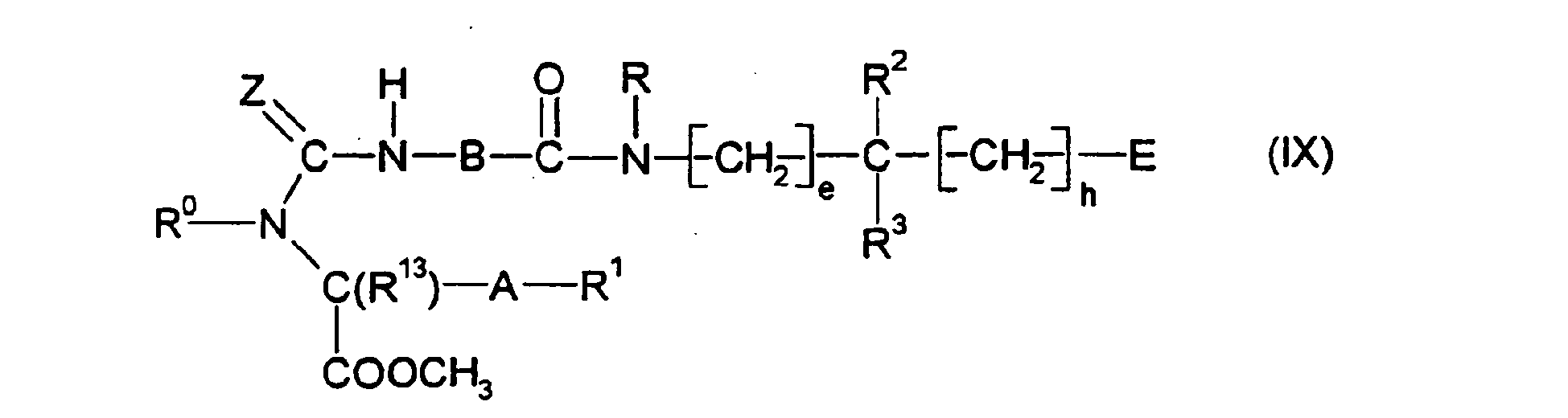

- Verbindungen der Formel I, in denen W für R1-A-C(R13) steht, können auch erhalten werden, indem man eine Verbindung der Formel VII mit einem Isocyanat oder Isothiocyanat der Formel X


- Eine weitere Methode zur Herstellung von Verbindungen der Formel Ia ist beispielsweise die Umsetzung von Verbindungen der Formel XIII,

- Hinsichtlich der Herstellung der Verbindungen der Formel I wird weiterhin vollinhaltlich Bezug genommen auf die
WO-A-95/14008 EP-A-796 855 97103712.2 WO-A-96/33976 - Die Verbindungen der Formel I sind wertvolle Arzneimittelwirkstoffe, die sich beispielsweise für die Therapie und Prophylaxe von Entzündungserkrankungen, allergischen Erkrankungen oder Asthma eignen. Die Verbindungen der Formel I und ihre physiologisch verträglichen Salze können erfindungsgemäß am Tier, bevorzugt am Säugetier, und insbesondere am Menschen als Arzneimittel zur Therapie oder Prophylaxe verabreicht werden. Sie können für sich allein, in Mischungen untereinander oder in Form von pharmazeutischen Präparaten verabreicht werden, die eine enterale oder parenterale Anwendung gestatten und die als aktiven Bestandteil eine wirksame Dosis mindestens einer Verbindung der Formel I und/oder ihrer physiologisch verträglichen Salze neben üblichen pharmazeutisch einwandfreien Trägerstoffen und/oder Zusatzstoffen enthalten.
- Gegenstand der vorliegenden Erfindung sind daher auch die Verbindungen der Formel I und/oder ihre physiologisch verträglichen Salze zur Verwendung als Arzneimittel, die Verwendung der Verbindungen der Formel I und/oder ihrer physiologisch verträglichen Salze zur Herstellung von Arzneimitteln für die Therapie und Prophylaxe der oben oder im folgenden erläuterten Krankheiten, zum Beispiel für die Therapie und Prophylaxe von Entzündungserkrankungen, sowie die Verwendung der Verbindungen der Formel I und/oder ihrer physiologisch verträglichen Salze bei der Therapie und Prophylaxe dieser Krankheiten. Weiterhin sind Gegenstand der vorliegenden Erfindung pharmazeutische Präparate, die eine wirksame Dosis mindestens einer Verbindung der Formel I und/oder ihrer physiologisch verträglichen Salze neben üblichen pharmazeutisch einwandfreien Trägerstoffen und/oder Zusatzstoffen enthalten.
- Die Arzneimittel können oral, zum Beispiel in Form von Pillen, Tabletten, Filmtabletten, Dragees, Granulaten, Hart- und Weichgelatinekapseln, Lösungen, Sirupen, Emulsionen oder Suspensionen verabreicht werden. Die Verabreichung kann aber auch rektal, zum Beispiel in Form von Suppositorien, oder parenteral, zum Beispiel in Form von Injektionslösungen oder Infusionslösungen, Mikrokapseln oder Rods, oder perkutan, zum Beispiel in Form von Salben, Lösungen oder Tinkturen, oder auf anderem Wege, zum Beispiel in Form von Nasalsprays oder Aerosolmischungen, erfolgen.
- Die Herstellung der erfindungsgemäßen pharmazeutischen Präparate erfolgt in an sich bekannter Weise, wobei neben der oder den Verbindungen der Formel I und/oder ihren physiologisch verträglichen Salzen pharmazeutisch inerte anorganische oder organische Trägerstoffe verwendet werden. Für die Herstellung von Pillen, Tabletten, Dragees und Hartgelatinekapseln kann man zum Beispiel Lactose, Maisstärke oder Derivate davon, Talk, Stearinsäure oder deren Salze etc. verwenden. Trägerstoffe für Weichgelatinekapseln und Suppositorien sind zum Beispiel Fette, Wachse, halbfeste und flüssige Polyole, natürliche oder gehärtete Öle etc. Als Trägerstoffe für die Herstellung von Lösungen, zum Beispiel Injektionslösungen, oder von Emulsionen oder Sirupen eignen sich zum Beispiel Wasser, Alkohole, Glycerin, Polyole, Saccharose, Invertzucker, Glukose, pflanzliche Öle etc. Als Trägerstoffe für Mikrokapseln, Implantate oder Rods eignen sich zum Beispiel Mischpolymerisate aus Glykolsäure und Milchsäure. Die pharmzeutischen Präparate enthalten normalerweise etwa 0,5 bis 90 Gew.-% der Verbindungen der Formel I und/oder ihrer physiologisch verträglichen Salze.
- Die pharmazeutischen Präparate können neben den Wirkstoffen und Trägerstoffen noch Zusatzstoffe, wie zum Beispiel Füllstoffe, Spreng-, Binde-, Gleit-, Netz-, Stabilisierungs-, Emulgier-, Konservierungs-, Süß-, Färbe-, Geschmacks- oder Aromatisierungs-, Dickungs-, Verdünnungsmittel, Puffersubstanzen, ferner Lösungsmittel oder Lösungsvermittler oder Mittel zur Erzielung eines Depoteffekts, sowie Salze zur Veränderung des osmotischen Drucks, überzugsmittel oder Antioxidantien enthalten. Sie können auch zwei oder mehrere Verbindungen der Formel I und/oder deren physiologisch verträgliche Salze enthalten. Ferner können sie neben mindestens einer Verbindung der Formel I und/oder ihren physiologisch verträglichen Salzen noch einen oder mehrere andere therapeutisch oder prophylaktisch wirksame Stoffe enthalten, zum Beispiel Stoffe mit entzündungshemmender Wirkung. Die pharmazeutische Präparate enthalten normalerweise 0,2 bis 500 mg, vorzugsweise 1 bis 100 mg Wirkstoff der Formel I und/oder dessen physiologisch verträgliche Salze.
- Die Verbindungen der Formel I haben die Fähigkeit, Zell-Zell- und Zell-Matrix-Interaktionsprozesse zu inhibieren, bei denen Wechselwirkungen zwischen VLA-4 mit seinen Liganden eine Rolle spielen. Die Wirksamkeit der Verbindungen der Formel I kann beispielsweise in einem Assay nachgewiesen werden, in dem die Bindung von Zellen, die den VLA-4-Rezeptor aufweisen, zum Beispiel von Leukozyten, an Liganden dieses Rezeptors gemessen wird, zum Beispiel an VCAM-1, das dafür vorteilhafterweise auch gentechnisch hergestellt werden kann. Einzelheiten eines solchen Assay sind weiter unten beschrieben. Insbesondere vermögen die Verbindungen der Formel I die Adhäsion und die Migration von Leukozyten inhibieren, etwa die Anheftung von Leukozyten an endotheliale Zellen, die - wie oben erläutert - über den VCAM-1/VLA-4-Adhäsionsmechanismus gesteuert wird. Außer als Entzündungshemmstoffe eignen sich die Verbindungen der Formel I und ihre physiologisch verträglichen Salze daher generell zur Therapie und Prophylaxe von Krankheiten, die auf der Wechselwirkung zwischen dem VLA-4-Rezeptor und seinen Liganden beruhen oder durch eine Hemmung dieser Wechselwirkung beeinflußt werden können, und insbesondere eignen sie sich für die Therapie und Prophylaxe von Krankheiten, die zumindest teilweise durch ein unerwünschtes Ausmaß an Leukozytenadhäsion und/oder Leukozytenmigration verursacht werden oder damit verbunden sind, oder zu deren Vorbeugung, Linderung oder Heilung die Adhäsion und/oder Migration von Leukozyten verringert werden soll.
- Die Verbindungen der Formel I können bei entzündlichen Erscheinungen unterschiedlichster Ursache als Entzündungshemmer eingesetzt werden. Anwendung finden sie beispielsweise zur Therapie oder Prophylaxe der rheumatoiden Arthritis, der inflammatorischen bowel disease (ulcerativen Colitis), des systemischen Lupus erythematosus oder zur Therapie oder Prophylaxe von inflammatorischen Erkrankungen des zentralen Nervensystems wie zum Beispiel der multiplen Sklerose, zur Therapie oder Prophylaxe von Asthma oder von Allergien, zum Beispiel Allergien vom verzögerten Typ (Typ IV-Allergie). Weiterhin eignen sie sich zur Therapie oder Prophylaxe von cardiovaskulären Erkrankungen, der Arteriosklerose, von Restenosen, zur Therapie oder Prophylaxe von Diabetes, zur Verhinderung der Schädigung von Organtransplantaten, zur Hemmung von Tumorwachstum oder Tumormetastasierung bei verschiedenen Malignitäten, zur Therapie der Malaria sowie von weiteren Krankheiten, bei denen eine Blockierung des Integrins VLA-4 und/oder eine Beeinflussung der Leukozytenaktivität zur Vorbeugung, Linderung oder Heilung angebracht erscheint.
- Die Dosis bei der Anwendung der Verbindungen der Formel I kann innerhalb weiter Grenzen variieren und ist wie üblich in jedem einzelnen Fall den individuellen Gegebenheiten anzupassen. Sie hängt beispielsweise von der eingesetzten Verbindung oder von der Art und Schwere der zu behandelnden Krankheit ab oder davon, ob ein akuter oder chronischer Krankheitszustand behandelt wird oder ob Prophylaxe betrieben wird. Im allgemeinen ist bei der oralen Verabreichung eine Tagesdosis von etwa 0,01 bis 100 mg/kg, vorzugsweise 0,1 bis 10 mg/kg, insbesondere 0,3 bis 2 mg/kg (jeweils pro kg Körpergewicht) bei einem ca. 75 kg schweren Erwachsenen zur Erzielung wirksamer Ergebnisse angemessen. Bei intravenöser Applikation beträgt die Tagesdosis im allgemeinen etwa 0,01 bis 50 mg/kg, vorzugsweise 0,01 bis 10 mg/kg Körpergewicht. Die Tagesdosis kann, insbesondere bei der Applikation größerer Mengen, in mehrere, zum Beispiel 2, 3 oder 4, Teilverabreichungen aufgeteilt werden. Gegebenenfalls kann es, je nach individuellem Verhalten, erforderlich werden, von der angegebenen Tagesdosis nach oben oder nach unten abzuweichen.
- Gegenstand der vorliegenden Erfindung sind daher auch die Verbindungen der Formel I zur Hemmung der Adhäsion und/oder Migration von Leukozyten oder zur Hemmung des VLA-4-Rezeptors und die Verwendung der Verbindungen der Formel I zur Herstellung von Arzneimitteln dafür, also von Arzneimitteln zur Therapie oder Prophylaxe von Krankheiten, bei denen die Leukozytenadhäsion und/oder Leukozytenmigration ein unerwünschtes Ausmaß aufweist, oder von Krankheiten, bei denen VLA-4-abhängige Adhäsionsvorgänge eine Rolle spielen, sowie die Verwendung der Verbindungen der Formel I und/oder ihrer physiologisch verträglichen Salze bei der Therapie und Prophylaxe derartiger Krankheiten.
- Die Verbindungen der Formel I und ihre Salze können weiterhin für diagnostische Zwecke, zum Beispiel in in-vitro-Diagnosen, und als Hilfsmittel in biochemischen Untersuchungen eingesetzt werden, bei denen eine VLA-4-Blockierung oder eine Beeinflussung von Zell-Zell- oder Zell-Matrix-Interaktionen angestrebt wird. Weiterhin können sie als Zwischenprodukte für die Herstellung anderer Verbindungen dienen, insbesondere anderer Arzneimittelwirkstoffe, die aus den Verbindungen der Formel I beispielsweise durch Abwandlung oder Einführung von Resten oder funktionellen Gruppen erhältlich sind.
- Die Verbindungen wurden über Massenspektren (MS) und/oder NMR-Spektren identifiziert. Verbindungen, die durch Chromatographie unter Verwendung eines Laufmittels gereinigt wurden, das beispielsweise Essigsäure oder Trifluoressigsäure enthielt, und anschließend gefriergetrocknet wurden, enthielten zum Teil je nach Durchführung der Gefriertrocknung noch die aus dem Laufmittel stammende Säure, sind also teilweise oder vollständig in Form eines Salzes der verwendeten Säure, zum Beispiel in Form des Essigsäuresalzes oder Trifluoressigsäuresalzes, angefallen.
- Es bedeuten:
DMF N,N-Dimethylformamid THF Tetrahydrofuran DCC N,N'-Dicyclohexylcarbodiimid HOBt 1-Hydroxybenzotriazol TOTU O-(Cyan(ethoxycarbonyl)methylenamino)-1,1,3,3-tetramethyluronium-tetrafluoroborat -

- Man gab zu einer Lösung von 2,5 g (12,8 mmol) (R,S)-2-Brom-4-methylpentansäure in 80 ml Chloroform und 80 ml tert-Butylacetat 1,96 ml konzentrierte Schwefelsäure und 0,515 ml Oleum (20 %ig) und ließ das Gemisch 3 h bei Raumtemperatur rühren. Dann stellte man durch Zugabe von 10 %iger NaHCO3-Lösun einen pH-Wert von 4 ein. Die wäßrige Phase wurde abgetrennt und 2 x mit Dichlormethan extrahiert. Die vereinigten organischen Phasen wurden über Natriumsulfat getrocknet. Nach Filtration und Einengen des Filtrats im Vakuum erhielt man 2,62 g (82 %) 1.1.
- Man gab zu einer Lösung von 2,08 g (7,72 mmol) an (S)-4-(4-Brom-phenyl)-4-methyl-2,5-dioxo-imidazolidin in 20 ml absolutem DMF unter Argon bei 0 °C 213 mg (8,87 mmol) Natriumhydrid, ließ 1 h bei Raumtemperatur rühren, gab 1,94 g (7,72 mmol) 1.1 zu, rührte 5 h bei Raumtemperatur und ließ das Gemisch über Nacht bei Raumtemperatur stehen. Das Lösungsmittel wurde im Vakuum entfernt, der Rückstand in Essigester aufgenommen und die Essigester-Lösung mit Wasser gewaschen. Die organische Phase wurde über Natriumsulfat getrocknet, das Trockenmittel abfiltriert und das Filtrat im Vakuum eingeengt. Der Rückstand wurde mit Heptan/Essigester (2:1) über Kieselgel chromatographiert. Nach Einengen der Produktfraktionen erhielt man 2,45 g (72 %) 1.2.
- Man gab zu einer Lösung von 1,92 g (4,37 mmol) 1.2 in 10 ml absolutem DMF unter Argon bei 0 °C 126 mg (5,24 mmol) Natriumhydrid, ließ 1 h bei Raumtemperatur rühren, gab 570 µl (4,8 mmol) Benzylbromid zu und ließ erneut 1 h bei Raumtemperatur rühren. Das Lösungsmittel wurde im Vakuum entfernt, der Rückstand zwischen Wasser und Essigester verteilt und nach Phasentrennung die Wasserphase mit Essigester extrahiert. Die vereinigten organischen Phasen wurden über Natriumsulfat getrocknet, das Trockenmittel wurde abfiltriert und das Filtrat im Vakuum eingeengt. Man erhielt 2,17 g (94 %) 1.3.
- Eine Lösung von 1 g (1,88 mmol) 1.3 in 100 ml Ethanol wurde über 40 mg 10 % Pd/C hydriert. Nach 2 h wurde der Katalysator abfiltriert, das Filtrat im Vakuum eingeengt, der Rückstand in Essigester gelöst und die Lösung mit 10 %iger NaHCO3-Lösung und Wasser gewaschen und über Natriumsulfat getrocknet. Nach Filtration und Entfernen des Lösungsmittels im Vakuum wurde der Rückstand mit 10 ml 90 %iger Trifluoressigsäure versetzt. Nach 15 min bei Raumtemperatur wurde die Trifluoressigsäure im Vakuum entfernt und der Rückstand 2 x mit Toluol eingeengt. Man erhielt 740 mg (100 %) 1.4.
- Zu einer Lösung von 200 mg (0,507 mmol) 1.4 und 210 mg (0,507 mmol) H-Asp(OtBu)-Phg-OtBu-Hydrochlorid in 10 ml absolutem DMF wurden 166 mg (0,507 mmol) TOTU und 172 µl (1,014 mmol) Diisopropyl-ethylamin gegeben. Nach 2 h Rühren bei Raumtemperatur wurde das Reaktionsgemisch im Vakuum eingeengt, der Rückstand in Essigester aufgenommen und die organische Phase 2 x mit gesättigter NaHCO3-Lösung und Wasser gewaschen. Nach Trocknen über Natriumsulfat, Filtration und Einengen des Filtrats im Vakuum érhielt man 393 mg Rohprodukt, das mit Heptan/Essigester (3:1) über Kieselgel chromatographiert wurde. Nach Einengen der Produktfraktionen wurde der Rückstand in 5 ml 90 %iger Trifluoressigsäure gelöst, nach 15 min bei Raumtemperatur die Trifluoressigsäure im Vakuum entfernt und der Rückstand in 20 %iger Essigsäure gelöst und gefriergetrocknet. Man erhielt 219 mg (67 %) 1.5.
ES(+)-MS: 643,3 (M+H)+ -

- Die Verbindung wurde durch Reaktion von (R,S)-2-((S)-4-Phenyl-3-benzyl-4-methyl-2,5-dioxo-imidazolidin-1-yl)-4-methyl-pentansäure (1.4) und (S)-3-Amino-2-benzyloxycarbonylamino-propionsäure-tert-butylester analog der Herstellung von 1.4 hergestellt, wobei nach Spaltung des tert-Butylesters und Entfernen der Trifluoressigsäure im Vakuum der Rückstand mit Dichlormethan/Methanol/Essigsäure/Wasser (9:1:0,1:0,1) über Kieselgel chromatographiert wurde.
ES(+)-MS: 615,4 (M+H)+ - Der (S)-3-Amino-2-benzyloxycarbonylamino-propionsäure-tert-butylester wurde wie folgt hergestellt. 10 g (42 mmol) (S)-3-Amino-2-benzyloxycarbonylamino-propionsäure wurden in einem Gemisch aus 100 ml Dioxan, 100 ml Isobutylen und 8 ml konz. H2SO4 3 Tage bei 20 atm N2-Druck im Autoklaven geschüttelt. Überschüssiges Isobutylen wurde abgeblasen und zur verbleibenden Lösung wurden 150 ml Diethylether und 150 ml gesättigte NaHCO3-Lösung gegeben. Die Phasen wurden getrennt und die wäßrige Phase wurde 2 x mit je 100 ml Diethylether extrahiert. Die vereinigten organischen Phasen wurden mit 2 x 100 ml Wasser gewaschen und über Na2SO4 getrocknet. Nach Entfernen des Lösungsmittels im Vakuum erhielt man 9,58 g (78 %) (S)-3-Amino-2-benzyloxycarbonylamino-propionsäure-tert-butylester als blaßgelbes Öl.
-

- Die Verbindung wurde hergestellt durch Umsetzung von 1.4 mit (R,S)-3-Amino-3-(3,4-methylendioxy-phenyl)-propionsäure-tert-butylester-hydrochlorid und anschließende Spaltung des tert-Butylesters wie in Beispiel 1 beschrieben.
ES(+)-MS: 586,3 (M+H)+ - Das (R,S)-3-Amino-3-(3,4-methylendioxy-phenyl)-propionsäure-tert-butylester-hydrochlorid wurde hergestellt, indem analog W. M. Radionow, E.A.Postovskaya, J. Am. Chem. Soc. 1929, 51, 841 (siehe auch Houben-Weyl, Methoden der Organischen Chemie, Band XI/2, Georg Thieme Verlag, Stuttgart, 1958, S. 497), zunächst die entsprechende β-Aminosäure hergestellt wurde. Diese wurde in das Benzyloxycarbonylamino-Derivat überführt, aus dem dann nach der folgenden Synthesevorschrift der tert-Butylester erhalten wurde: Zu 1 mmol der 3-Benzyloxycarbonylamino-carbonsäure in 13 ml absolutem Dichlormethan wurden 1,5 mmol Oxalylchlorid gegeben. Nach 4 h Rühren bei Raumtemperatur wurde das Reaktionsgemisch eingeengt und zum Rückstand 6,5 ml tert-Butanol gegeben. Es wurde 1 h bei Raumtemperatur gerührt und das Reaktionsgemisch im Vakuum eingeengt. Der Rückstand wurde in Essigester aufgenommen und 2 x mit gesättigter NaHCO3-Lösung und Wasser extrahiert. Die organische Phase wurde über Natriumsulfat getrocknet und nach Filtration das Lösungsmittel im Vakuum entfernt. Zur Herstellung des ß-Aminosäure-tert-butylester-hydrochlorids wurde anschließend die Benzyloxycarbonylgruppe über 10 % Pd/C in Methanol/HCl abhydriert.
-

- Die Verbindung wurde hergestellt durch Umsetzung von (R,S)-2-((R,S)-3-Benzyl-4-phenyl-4-methyl-2,5-dioxo-imidazolidin-1-yl)-2-isopropyl-essigsäure (hergestellt analog den Vorschriften in Beispiel 1 aus (R,S)-4-Methyl-4-phenyl-2,5-dioxo-imidazolidin) mit (S)-3-Amino-2-(1-adamantylmethyloxycarbonylamino)-propionsäure-tert-butylester und anschließende Spaltung des tert-Butylesters wie in Beispiel 1 beschrieben. Das Rohprodukt wurde mittels präparativer HPLC über RP-18 gereinigt.
ES(+)-MS: 659,4 (M+H)+ - Der (S)-3-Amino-2-(1-adamantylmethyloxycarbonylamino)-propionsäure-tert-butylester wurde wie folgt hergestellt.
- Man gab zu einer Lösung von 10 g (34 mmol) (S)-3-Amino-2-benzyloxycarbonylaminopropionsäure-tert-butylester (siehe Beispiel 2) in 600 ml THF/Wasser (2:1) bei 0 °C 8,9 g (40,8 mmol) Di-tert-butyl-dicarbonat und anschließend portionsweise 1 N NaOH, so daß der pH der Lösung zwischen 9 und 10 lag (Verbrauch an 1 N NaOH: 32 ml). Nach 3 h Rühren bei Raumtemperatur gab man 1 I Wasser zu und extrahierte 3 mal mit Diethylether. Nach Trocknen der organischen Phase über Natriumsulfat, Filtration und Entfernen des Lösungsmittels im Vakuum wurde der Rückstand mit Dichlormethan/Methanol (20:1) über Kieselgel chromatographiert. Man erhielt 13,19 g (98 %) (S)-2-Benzyloxycarbonylamino-3-tert-butoxycarbonylamino-propionsäure-tert-butylester.
- 13,1 g (S)-2-Benzyloxycarbonylamino-3-tert-butoxycarbonylamino-propionsäuretert-butylester wurden in Methanol/HCl über 10 % Pd/C hydriert. Nach 1,5 h wurde filtriert und das Filtrat im Vakuum eingeengt. Man erhielt 9,77 g (99 %) (S)-2-Amino-3-tert-butoxycarbonylamino-propionsäure-tert-butylester-hydrochlorid als farblosen Feststoff.
- Eine Lösung von 10,9 g (65,4 mmol) 1-Hydroxymethyl-adamantan und 10,6 g (65,4 mmol) Carbonyldiimidazol in 60 ml THF wurde 1,5 h bei 50°C gerührt. Man gab 9,7 g (32,7 mmol) (S)-2-Amino-3-tert-butoxycarbonylamino-propionsäure-tert-butylesterhydrochlorid in 25 ml THF und 5,6 ml (32,7 mmol) Diisopropyl-ethylamin zu, rührte 4 h bei 60°C und ließ über Nacht bei Raumtemperatur stehen. Das Lösungsmittel wurde im Vakuum entfernt und der Rückstand mit Heptan/Essigester (7:3) über Kieselgel chromatographiert. Man erhielt 8,7 g (59 %) (S)-2-(1-Adamantylmethyloxycarbonylamino)-3-tert-butoxycarbonylamino-propionsäure-tert-butylester als farbloses Öl.
- Eine Lösung von 8,7 g (19,22 mmol) an (S)-2-(1-Adamantylmethyloxycarbonylamino)-3-tert-butoxycarbonylamino-propionsäure-tert-butylester in 180 ml Trifluoressigsäure/Dichlormethan (1:1) wurde nach 1 min in 1,5 I eiskalte NaHCO3-Lösun gegeben, das Gemisch dreimal mit Dichlormethan extrahiert und die Dichlormethan-Phasen anschließend über Natriumsulfat getrocknet. Nach Filtration und Entfernen des Lösungsmittels im Vakuum erhielt man 6,35 g (94 %) an (S)-3-Amino-2-(1-adamantylmethyloxycarbonylamino)-propionsäure-tert-butylester als farblosen Feststoff.
-

- 36,34 g (300 mmol) 4-Acetylpyridin und 259,2 g (2,694 mol) Ammoniumcarbonat wurden in 400 ml 50 %igem Äthanol suspendiert. Dazu gab man 25,5 g (392 mmol) Kaliumcyanid. Man rührte 5 Stunden bei 50 - 60 °C, ließ das Gemisch auf Raumtemperatur abkühlen, stellte durch Zugabe von 6 N HCl den pH-Wert auf 6,3 ein und ließ über Nacht bei Raumtemperatur stehen. Man stellte erneut einen pH-Wert von 6,3 ein und entfernte das Lösungsmittel im Vakuum. Der Rückstand wurde mehrmals mit Dichlormethan aufgeschlämmt. Die unlöslichen Anteile wurden jeweils abfiltriert und die vereinigten Filtrate im Vakuum eingeengt. Der Rückstand wurde mit Dichlormethan/Methanol über Kieselgel chromatographiert. Nach Einengen der Produktfraktionen erhielt man 37,53 g (65 %) 5.1.
- Man gab zu einer Lösung von 50 mg (0,133 mmol) an ((R,S)-4-(4-Pyridyl)-3-benzyl-4-methyl-2,5-dioxo-imidazolidin-1-yl)-essigsäure-hydrochlorid (hergestellt durch Spaltung von ((R,S)-4-(4-Pyridyl)-3-benzyl-4-methyl-2,5-dioxo-imidazolidin-1-yl)-essigsäure-tert-butylester mit 90 %iger Trifluoressigsäure und anschließende Überführung in das Hydrochlorid, wobei der ((R,S)-4-(4-Pyridyl)-3-benzyl-4-methyl-2,5-dioxo-imidazolidin-1-yl)-essigsäure-tert-butylester durch Alkylierung von 5.1 erst mit Bromessigsäure-tert-butylester und anschließend mit Benzylbromid analog Beispiel 1 hergestellt wurde) und 55 mg (0,133 mmol) H-Asp(OtBu)-Phg-(OtBu) x HCl in 10 ml absolutem DMF 43,6 mg TOTU und 68 µl Diisopropyl-ethylamin. Nach 3 d bei Raumtemperatur wurde das Lösungsmittel im Vakuum entfernt, der Rückstand in Essigester aufgenommen, die Lösung mit gesättigter NaHCO3-Lösung, Wasser und KHSO4/K2SO4-lösung gewaschen und über Natriumsulfat getrocknet. Nach Filtration wurde das Lösungsmittel im Vakuum entfernt und der Rückstand mit 10 ml 90 %iger Trifluoressigsäure versetzt. Nach 1 h bei Raumtemperatur wurde die Trifluoressigsäure im Vakuum entfernt, der Rückstand zwischen Diethylether und Wasser verteilt, die wäßrige Phase gefriergetrocknet und der Rückstand durch zweimalige Chromatographie über Kieselgel gereinigt. Man erhielt 19,5 mg (25 %) 5.2.
ES(+)-MS: 588,3 (M+H)+ -

- Man gab zu einer Lösung von 4,1 g (21,44 mmol) (R,S)-4-(4-Pyridyl)-4-methyl-2,5-dioxo-imidazolidin (siehe Beispiel 5) in 30 ml absolutem DMF unter Eiskühlung 1,03 g (23,58 mmol) Natriumhydrid. Man ließ 15 min bei Raumtemperatur rühren und gab dann 4,23 g (21,44 mmol) (R,S)-2-Brom-4-methyl-pentansäure-tert-butylester zu. Nach 2 h Rühren und Stehen über Nacht bei Raumtemperatur wurde das Lösungsmittel im Vakuum entfernt und der Rückstand mit Dichlormethan/Methanol (95:5) über Kieselgel chromatographiert. Man erhielt 1,2 g (15 %) (R,S)-2-((R,S)-4-(4-Pyridyl)-4-methyl-2,5-dioxo-imidazolidin-1-yl)-2-(2-methyl-propyl)-essigsäure-tert-butylester, der analog Beispiel 1 durch Reaktion mit Benzylbromid zu 6.1 umgesetzt wurde.
- 1,4 g (3,1 mmol) 6.1 in 30 ml 90 %iger Trifluoressigsäure wurden 1 h bei Raumtemperatur gerührt. Die Trifluoressigsäure wurde im Vakuum entfernt und der Rückstand zwischen Diethylether und Wasser verteilt. Die Phasen wurden getrennt, die organische Phase eingeengt und der Rückstand mit Dichlormethan/Methanol/Essigsäure/Wasser (9,5:0,5:0,05:0,05) über Kieselgel gereinigt. Man erhielt 650 mg (47 %) 6.2.
- Die Verbindung wurde analog Beispiel 5 durch Reaktion von 6.2 mit H-Asp(OtBu)-Phg-(OtBu) x HCl und anschließende Spaltung der tert-Butylester hergestellt. ES(+)-MS: 644,3 (M+H)+
-

- Die Verbindung wurde hergestellt durch Umsetzung von ((R,S)-4-(4-Phenyl)-3-benzyl-4-methyl-2,5-dioxo-imidazolidin-1-yl)-essigsäure (hergestellt analog Beispiel 1 aus (R,S)-4-Phenyl-4-methyl-2,5-dioxo-imidazolidin durch Alkylierung mit Chloressigsäure-methylester und anschließend mit Benzylbromid und nachfolgende Spaltung des Methylesters) mit H-Asp(OtBu)-Phg-(OtBu) x HCl analog Beispiel 1 und anschließende Spaltung der tert-Butylester.
ES(+)-MS: 587,1 (M+H)+ -

- Man gab zu einer Lösung von 20 g (73,1 mmol) ((S)-4-(4-Cyanphenyl)-4-methyl-2,5-dioxo-imidazolidin-1-yl)-essigsäure in 120 ml absolutem DMF unter Eiskühlung 7,73 g (160,8 mmol) Natriumhydrid. Nach 30 min Rühren bei Raumtemperatur wurden 19 ml (160,8 mmol) Benzylbromid zugegeben. Das Reaktionsgemisch wurde 2 h bei Raumtemperatur gerührt, über Nacht stehen gelassen, das Lösungsmittel im Vakuum entfernt und der Rückstand mit Heptan/Essigester (2:1) über Kieselgel chromatographiert. Man erhielt 11,43 g (35 %) 8.1.
- Man gab zu einer Lösung von 6,08 g (13,42 mmol) 8.1 in 200 ml Pyridin/Essigsäure/Wasser (2:1:1) bei 0 °C 24,3 g Natriumhypophosphit x H2O und 4,02 g Raney-Nickel und erhitzte das Reaktionsgemisch 8 h auf 60°C. Nach Abkühlen auf Raumtemperatur und Filtration wurde das Reaktionsgemisch im Vakuum eingeengt, der Rückstand in Essigester aufgenommen und die Essigesterphase 2 x mit Wasser, 2 x mit 10 %iger Zitronensäure-Lösung, 2 x mit gesättigter NaHCO3-Lösung und mit gesättigter Kochsalz-Lösung extrahiert. Die organische Phase wurde über Magnesiumsulfat getrocknet und nach Filtration das Lösungsmittel im Vakuum entfernt. Man erhielt 4,82 g (79 %) 8.2.
- Man gab zu einer Lösung von 500 mg (1,1 mmol) 8.2 in 50 ml Ethanol 20 ml Wasser und anschließend bei 0 °C 22 mg (0,6 mmol) Natriumborhydrid. Nach 40 min Rühren bei 0 °C wurde das Reaktionsgemisch im Vakuum eingeengt, der Rückstand in 30 ml 6 N Salzsäure/THF (1:1) 12 h bei 50°C erhitzt und das Reaktionsgemisch über Nacht bei Raumtemperatur stehen lassen. Das Gemisch wurde mit Dichlormethan extrahiert und die organische Phase über Natriumsulfat getrocknet. Nach Filtration wurde das Lösungsmittel im Vakuum entfernt, der Rückstand mit Wasser versetzt und gefriergetrocknet. Man erhielt 440 mg rohes 8.3, das ohne weitere Reinigung im nächsten Syntheseschritt eingesetzt wurde.
- Eine Lösung von 200 mg (0,54 mmol) rohem 8.3, 225 mg (0,54 mmol) H-Asp(OtBu)-Phg-(OtBu) x HCl und 178 mg (0,54 mmol) TOTU wurde mit 185 µl (1,08 mmol) Diisopropyl-ethylamin versetzt. Nach 1 h bei Raumtemperatur wurde das Lösungsmittel im Vakuum entfernt, der Rückstand in Essigester gelöst und die Essigesterphase jeweils 2 x mit KHSO4K2SO4-Lösung, gesättigter NaHCO3-Lösung und gesättigter Kochsalz-Lösung extrahiert. Nach Phasentrennung wurde die organische Phase über Natriumsulfat getrocknet. Nach Filtration wurde das Lösungsmittel im Vakuum entfernt und der Rückstand durch Chromatographie mit Methyl-tert-butylether/Heptan (8:2) über Kieselgel gereinigt. Nach Einengen der Produktfraktionen wurde der Rückstand in 5 ml 90 %iger Trifluoressigsäure gelöst. Nach 1 h bei Raumtemperatur wurde die Trifluoressigsäure im Vakuum entfernt und der Rückstand mittels präparativer HPLC über RP-18 gereinigt. Man erhielt nach Gefriertrocknung 44 mg (13 %) 8.4.
ES(+)-MS: 617,2 (M+H)+ -

- Die Herstellung erfolgte analog Beispiel 8 durch Kupplung von 8.3 mit (S)-2-(1-Adamantylmethyloxycarbonylamino)-3-amino-propionsäure-tert-butylester (siehe Beispiel 4) an Stelle von H-Asp(OtBu)-Phg-(OtBu) x HCl. Nach Spaltung des, tert-Butylesters mit 90 %iger Trifluoressigsäure wurde das Rohprodukt zwischen Wasser und Dichlormethan verteilt. Die organische Phase wurde abgetrennt, über Natriumsulfat getrocknet und nach Filtration das Lösungsmittel im Vakuum entfernt. Der Rückstand wurde durch präparative HPLC über RP-18 gereinigt.
ES(+)-MS: 647,3 (M+H)+ -

- 13,62 g (100 mmol) 4-Hydroxyacetophenon und 10,04 ml (110 mmol) 3,4-Dihydro-2H-pyran wurden in 100 ml wasserfreiem Methylenchlorid suspendiert. Bei 0 °C wurden unter Rühren 190 mg (1 mmol) p-Toluolsulfonsäure zugesetzt und 3 Stunden bei 0 °C gerührt. Es wurden nochmals 10.04 ml (110 mmol) 3,4-Dihydro-2H-pyran zugesetzt und weitere 3 Stunden bei Raumtemperatur gerührt. Der Ansatz wurde in 150 ml Wasser gegossen, die Phasen wurden getrennt und die organische Phase wurde mit gesättigter NaHCO3-Lösung, gesättigter NaCl-Lösung sowie mit Wasser extrahiert. Die organische Phase wurde über Natriumsulfat getrocknet, eingeengt und zur Reinigung über Kieselgel (70-200 µm) mit Methylenchlorid als Laufmittel chromatographiert. Man erhielt 13,65 g (62 %) 10.1.
- 11,01 g (50 mmol) 10.1 und 42,3 g (440 mmol) Ammoniumcarbonat wurden in 200 ml 50 %igem Äthanol suspendiert. Dazu gab man 4,23 g (65 mmol) Kaliumcyanid. Man rührte 5 Stunden bei 50 bis 60 °C. Es entstand nach kurzer Zeit eine klare Lösung. Man ließ über Nacht bei Raumtemperatur stehen und rührte anschließend bei 60 °C 6 Stunden weiter. Mit 6 N HCl wurde der pH-Wert auf 6,3 eingestellt und das Gemisch 2 h unter Eiskühlung rühren lassen. Der Niederschlag wurde abgesaugt, mit Wasser gewaschen und über Phosphorpentoxid im Exikkator getrocknet. Man erhielt 9,5 g (65 %) 10.2.
- 230 mg (10 mmol) Natrium wurden unter Argon in 25 ml wasserfreiem Methanol gelöst. Es wurden 2,9 g (10 mmol) 10.2 zugesetzt. Man erhitzte unter Rühren 2 Stunden zum Rückfluß. Anschließend gab man 1,66 g (10 mmol) Kaliumiodid zu und tropfte innerhalb von 15 Minuten eine Lösung von 0,975 ml (10 mmol) Chloressigsäuremethylester in 1,1 ml wasserfreiem Methanol zu. Es wurde 4 Stunden zum Rückfluß erhitzt und anschließend über Nacht bei Raumtemperatur stehen gelassen. Weitere 0,195 ml (2 mmol) Chloressigsäuremethylester in 0,22 ml wasserfreiem Methanol wurden zugesetzt und der Ansatz wurde 4 Stunden unter Rückfluß gerührt. Der Niederschlag wurde abgesaugt und das Filtrat eingeengt. Der Rückstand wurde in Methylenchlorid gelöst, vom Unlöslichen abfiltriert und mit Methylenchlorid/Essigester (9:1) über Kieselgel chromatographiert. Man erhielt 2,56 g (71 %) 10.3.
- 2,53 g (7 mmol) 10.3 wurden unter Argon in 8,5 ml wasserfreiem DMF gelöst. Bei 15 °C wurden 370 mg (7,7 mmol) Natriumhydrid (50 %ig in Öl) zugegeben. Man rührte 15 Minuten bei 15 °C und tropfte anschließend 0,91 ml (7,7 mmol) Benzylbromid zu. Man rührte 7,5 Stunden bei Raumtemperatur und ließ über Nacht bei Raumtemperatur stehen. Die klare Lösung wurde im Vakuum eingeengt und der Rückstand wurde zwischen Essigester und Wasser verteilt. Die organische Phase wurde abgetrennt und die wäßrige Phase nochmals mit Essigester gewaschen. Die organischen Phasen wurden vereinigt, mit Wasser gewaschen, über Natriumsulfat getrocknet und eingeengt. Der Rückstand wurde mit Methylenchlorid/Essigester (9,5:0,5) über Kieselgel chromatographiert. Man erhielt 1,59 g (50 %) 10.4.
- 1,53 g (3.5 mmol) 10.4 wurden mit 30 ml konzentrierter Salzsäure 3 h unter Rückfluß erhitzt. Nach Einengen der Lösung im Vakuum wurde der Rückstand mit Wasser verrieben, über Nacht gekühlt und anschließend abgesaugt. Man trocknete über Phosphorpentoxid im Exsikkator und erhielt 1,22 g (98 %) 10.5.
- 354 mg (1 mmol) 10.5, 415 mg (1 mmol) H-Asp(OtBu)-Phg-OtBu x HCl und 135 mg (1 mmol) HOBt wurden in 10 ml DMF gelöst. Bei 0 °C gab man 0,13 ml (1 mmol) N-Ethylmorpholin und 220 mg (1 mmol) DCC zu. Man rührte 1 Stunde bei 0 °C und 3 Stunden bei Raumtemperatur und ließ über Nacht bei Raumtemperatur stehen. Es wurde abgesaugt und das Filtrat im Vakuum eingeengt. Der Rückstand wurde in Essigester gelöst und mit NaHCO3-Lösung, K2SO4KHSO4-Lösung und gesättigter Kochsalzlösung gewaschen. Nach Trocknen über Natriumsulfat wurde das Trockenmittel abfiltriert und das Filtrat im Vakuum eingeengt. Der ölige Rückstand wurde mit Diethylether verrieben und die organische Phase eingeengt. Man erhielt 730 mg (100 %) 10.6.
- 370 mg (0,52 mmol) 10.6 wurden in 4 ml 90 %iger Trifluoressigsäure gelöst und 1 Stunde bei Raumtemperatur stehen gelassen. Anschließend engte man ein. Der Rückstand wurde mit Diethylether verrieben und abgesaugt. Man erhielt 202 mg (64 %) 10.7.
- Die Aspartyl-Phenylglycin-Derivate der Beispiele 12 bis 126 wurden durch Festphasensynthese nach der in Beispiel 11 angegebenen allgemeinen Vorschrift hergestellt.
- Die Synthesen am polymeren Träger wurden nach der Synthesesequenz durchgeführt, die im Schema 1 dargestellt ist. Die Reste R50 bis R55 im Schema 1 haben die Bedeutung der Reste, die sich in der Formel I in der betreffenden Position im Molekül befinden, oder sie können funktionelle Gruppen in geschützter Form oder in Form von Vorstufen enthalten. R50 entspricht dem Rest R. R51 entspricht den Resten R4 bzw. R15, wobei in diesen Resten vorhandene funktionelle Gruppen in geschützter Form oder in Form von Vorstufen vorliegen können (der Rest -NHR51 kann also beispielsweise für den Rest einer Aminosäure stehen, der formal durch Entfernen eines Wasserstoffatoms von der Aminogruppe erhalten wird). R52 entspricht zusammen mit der CH-Gruppe, an die dieser Rest gebunden ist, der Gruppe B (R52 entspricht also einem Substituenten an einer für B stehenden Methylengruppe). R53 entspricht R13, R54 entspricht der Gruppe R1-A, wobei darin
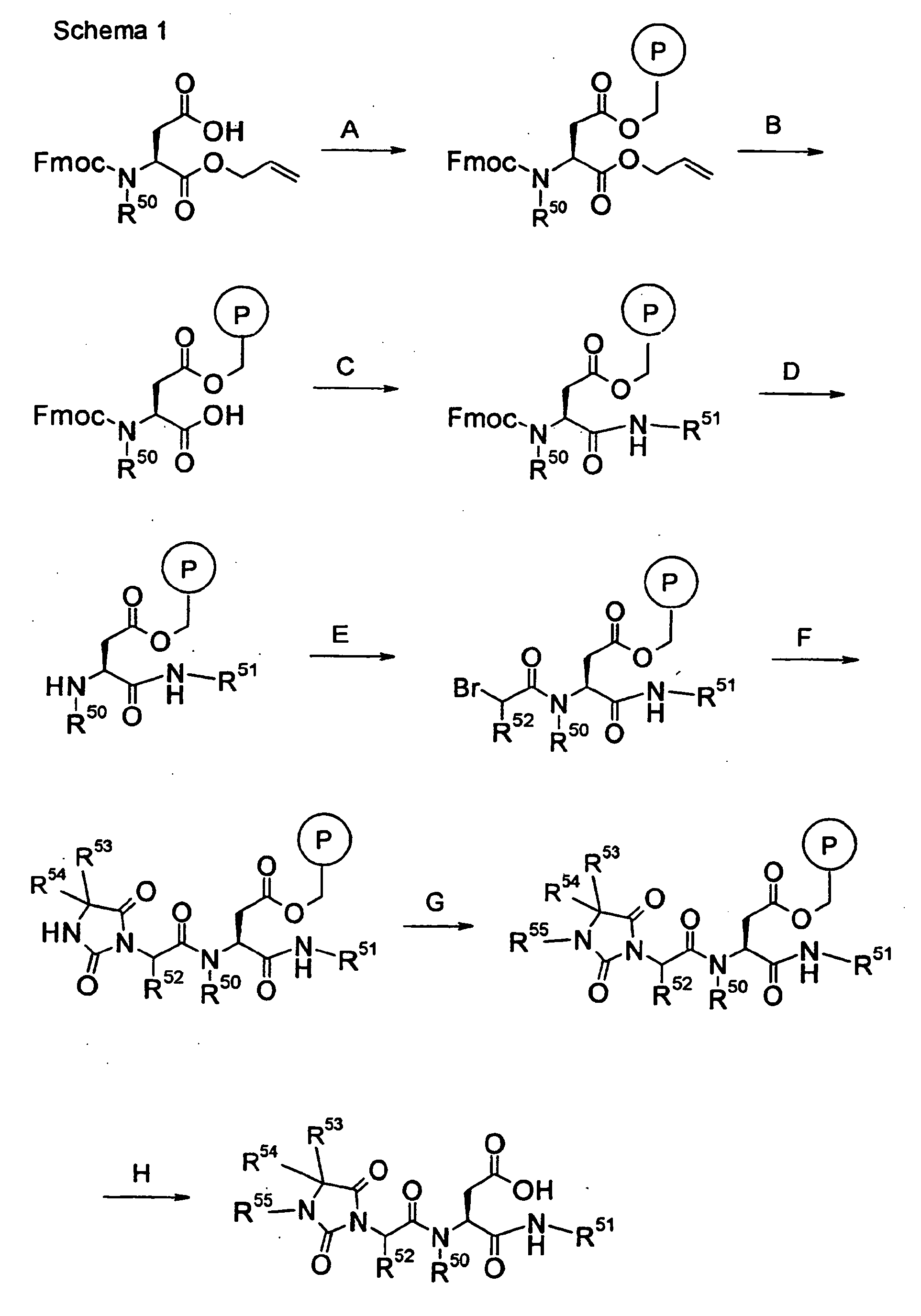
- Die Synthese von Zwischenstufen in größerem Maßstab wurde in speziellen Reaktionsgefäßen mit eingelassenen Fritten am Boden des Reaktionsgefäßes durchgeführt, die Synthese der Verbindungen der Formel I wurde in Spritzen oder Reaktionsblöcken durchgeführt (Act 496, MultiSynTech). Die Synthesen am Harz wurden durch on bead-Analytik (FT-IR mit ATR-Einheit und MAS-NMR) und Abspaltung einer analytischen Probe vom Harz (HPLC, MS, NMR) verfolgt.
- Herstellung des Asparaginsäurebausteines FmocAsp(OH)OAllyl FmocAsp(OtBu)OAllyl (40 g, 88,7 mmol) wurde mit 25 ml Trifluoressigsäure versetzt und 30 min bei Raumtemperatur gerührt. Das Lösungsmittel wurde am Rotationsverdampfer abgezogen. Der Rückstand wurde im Vakuum getrocknet. Man erhielt FmocAsp(OH)OAllyl als gelbes Öl (33,9 g, 97 %).
ES(+)-MS: 395,2 (M+H)+ - 40 g Wang-Polystyrolharz (1,1 mmol/g; Bachem) wurden 5 min mit 20 ml DMF bei Raumtemperatur vorgequollen. Nach Zugabe einer Lösung von 26,0 g (1,5 Äquivalente) FmocAsp(OH)OAllyl und 34,3 g (1,5 Äquivalente) 1-Benzotriazolyloxytripyrrolidinophosphonium-hexafluorophosphat (PyBOP) und 9,3 ml (1,5 Äquivalente) Düsopropyl-ethylamin in 120 ml DMF wurde das Gemisch 10 h bei 40 °C geschüttelt. Nach beendeter Reaktion wurde die Lösung abgesaugt und das Harz mit DMF gewaschen (5 x 20 ml). Nach Zugabe einer Lösung von Acetanhydrid (10 ml) und Diisopropyl-ethylamin (9,3 ml, 1,5 Äquivalente) in 40 ml DMF wurde das Gemisch erneut für 30 min bei Raumtemperatur geschüttelt. Die Lösung wurde abgesaugt und das Harz nacheinander jeweils dreimal mit 40 ml DMF, Methanol und Dichlormethan gewaschen. Das Harz wurde anschließend im Vakuum getrocknet. Die Bestimmung der Beladung nach der Fmoc-Methode ergab eine Beladung von 0,6 mmol/g.
- Das Harz wurde unter Argon 5 min in DMF bei Raumtemperatur vorgequollen. Nach Zugabe von Tetrakis(triphenylphosphin)palladium und N-Methylpyrrolidin (10 Äquivalente) wurde das Gemisch unter Argon 6 h bei 40 °C geschüttelt. Nach beendeter Reaktion wurde die Lösung abgesaugt und das Harz nacheinander jeweils dreimal mit DMF, Methanol, Toluol und Dichlormethan gewaschen und anschließend getrocknet.
- Das beladene Harz mit freier Carboxylfunktion wurde 5 min in DMF bei Raumtemperatur vorgequollen. Nach Zugabe einer Lösung von HOBt (1,2 Äquivalente), TOTU (1,2 Äquivalente) und Düsopropyl-ethylamin (1,2 Äquivalente) in DMF wurde das Gemisch 30 min bei Raumtemperatur geschüttelt. Die Aminoverbindung (1,2 Äquivalente) wurde gelöst in DMF zugegeben. Die Suspension wurde bei Raumtemperatur bis zur vollständigen Umsetzung geschüttelt (HPLC-Kontrolle). Nach beendeter Reaktion wurde die Lösung abgesaugt und das Harz nacheinander jeweils dreimal mit DMF, Methanol, Toluol und Dichlormethan gewaschen und anschließend getrocknet.
- Zur Abspaltung der Fmoc-Schutzgruppe wurde das Harz 5 min in DMF bei Raumtemperatur vorgequollen. Nach Zugabe einer Lösung von DMF/Piperidin (1:1) wurde 20 min bei Raumtemperatur geschüttelt. Die Lösung wurde abgesaugt und der Vorgang wiederholt. Die Abspaltung einer analytischen Probe ergab vollständige Umsetzung nach HPLC/MS-Untersuchung. Nach vollständiger Umsetzung wurde das Harz dreimal mit Dichlormethan gewaschen und direkt in die Kupplung eingesetzt.
- Aus α-Halogencarbonsäuren (5 Äquivalente) wurden durch 30-minütige Reaktion mit Diisopropylcarbodiimid (2,4 Äquivalente) in Dichlormethan die symmetrischen Anhydride gebildet. Nach dieser Zeit wurden 2 Äquivalente Diisopropyl-ethylamin zugegeben. Das Gemisch wurde zu dem Harz gegeben und 12 h bei Raumtemperatur geschüttelt. Nach beendeter Reaktion wurde die Lösung abgesaugt und das Harz nacheinander jeweils dreimal mit DMF, Toluol und Dichlormethan gewaschen und anschließend sofort weiter umgesetzt.
- Das Harz wurde 5 min mit Dichlormethan bei Raumtemperatur vorgequollen. Die α-Halogencarbonsäurehalogenide (1,5 Äquivalente) wurden gelöst in Dichlormethan zugegeben. Nach Zugabe einer katalytischen Menge 4-Dimethylaminopyridin und Diisopropyl-ethylamin (1 Äquivalent) wurde das Gemisch für 8 h bei Raumtemperatur geschüttelt. Nach beendeter Reaktion wurde die Lösung abgesaugt und das Harz nacheinander jeweils dreimal mit DMF, Toluol und Dichlormethan gewaschen und anschließend sofort weiter umgesetzt.
- Die 4,4-disubstituierten Hydantoine (2 Äquivalente) wurden in DMF mit Diazabicycloundecen (DBU) (2 Äquivalente) bei Raumtemperatur aktiviert. Die aktivierte Lösung wurde nach 15 min zu dem in DMF für 5 min vorgequollenen Harz gegeben. Das Gemisch wurde 8 h bei Raumtemperatur geschüttelt. Nach beendeter Reaktion wurde die Lösung abgesaugt und das Harz nacheinander jeweils dreimal mit DMF, Methanol, Toluol und Dichlormethan gewaschen und anschließend getrocknet.
- Das Harz wurde 5 min in DMF bei Raumtemperatur vorgequollen. Nach Zugabe von Caesiumcarbonat (3 Äquivalente) wurde 30 min bei Raumtemperatur geschüttelt. Nach Zugabe des Alkylierungsmittels (Bromid oder lodid) wurde 6 h bei 50 °C geschüttelt. Nach beendeter Reaktion wurde die Lösung abgesaugt und das Harz nacheinander jeweils dreimal mit DMF, Methanol/Wasser/DMF(1,5:1,5:7), DMF, Toluol und Dichlormethan gewaschen und anschließend getrocknet.
- Das Harz wurde 5 min in DMF bei Raumtemperatur vorgequollen. Nach Zugabe von N"'-tert-Butyl-N,N,N',N',N",N"-hexamethylphosphorimidsäuretriamid (Phosphazen-Base P1-t-Bu) (3 Äquivalente) wurde 30 min bei Raumtemperatur geschüttelt. Nach Zugabe des Alkylierungsmittels (Bromid oder Iodid) wurde 4 h bei Raumtemperatur geschüttelt. Nach beendeter Reaktion wurde die Lösung abgesaugt und das Harz nacheinander jeweils dreimal mit DMF, Toluol und Dichlormethan gewaschen und anschließend getrocknet.
- Zur Abspaltung der Verbindung vom Harz wurde ein Gemisch von Trifluoressigsäure/Dichlormethan (1:1) zum Harz zugegeben. Die Suspension wurde 1 h geschüttelt. Das Harz wurde abfiltriert. Die verbleibende Lösung wurde im Vakuum eingeengt. Der Rückstand wurde durch Kieselgelchromatographie gereinigt (Dichlormethan und Essigester).
- Nach der im Beispiel 11 beschriebenen allgemeinen Methode wurden die Verbindungen der Beispiele 12 bis 126 hergestellt, die die in der Formel Ib angegebene Struktur aufweisen. Die Bedeutungen der Reste in den einzelnen Verbindungen sind in den Tabellen 1 und 2 angegeben.
- In den Tabellen 1 und 2 bedeuten:
Bn = Benzyl 3-BrBn = 3-Brombenzyl 4-BrBn = 4-Brombenzyl 4-CIBn = 4-Chlorbenzyl 4-Bip = 4-Biphenylylmethyl 2-Py = 2-Pyridylmethyl 3-Py = 3-Pyridylmethyl 4-Py = 4-Pyridylmethyl H = Wasserstoff Me = Methyl Et = Ethyl nPr = n-Propyl iPr = Isopropyl nBu = n-Butyl iBu = Isobutyl nPe = n-Pentyl nHe = n-Hexyl All = Allyl Ph = Phenyl - Die folgenden Abkürzungen stehen für Reste , die für die Gruppe -NH-R51 in der Formel Ib stehen. Es sind Reste von Aminosäuren oder Derivaten davon, die formal durch Abstraktion eines Wasserstoffatoms von der Aminogruppe der Aminosäure erhalten werden.



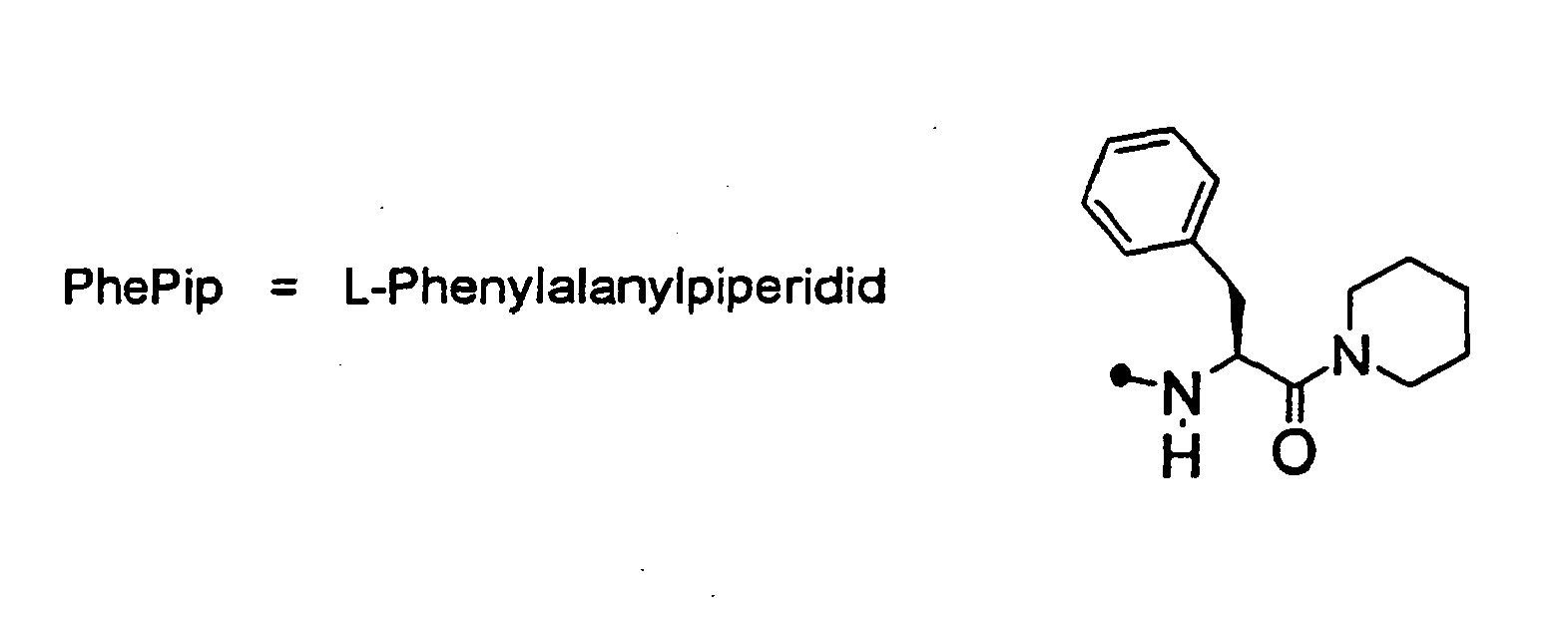
Tabelle 1 Beispiel R50 -NH-R51 R52 R53 R54 R55 ES(+)-MS 12 Me Val Bn Me Ph Bn 659 13 Me Val iPr Me Ph 4-Bip 686 14 Me Val H Me Ph Bn 568 15 H Phg H Me Ph 2-Py 589 16 H Phg H Me Ph 3-Py 589 17 H Phg H Me Ph 4-Py 589 18 H Phg Et Me Ph Bn 617 19 H Phg H Ph Ph Bn 651 20 H Phg nBu Me Ph Bn 644 21 H Phg iBu Me Ph Bn 644 22 H Phg nBu Me Ph 2-Py 645 23 H Phg nBu Me Ph 3-Py 645 24 H Phg nBu Me Ph 4-Py 645 25 H Phg iBu Me Ph 2-Py 645 26 H Phg iBu Me Ph 3-Py 645 27 H Phg iBu Me Ph 4-Py 645 28 H Ile H Me Ph 4-BrBn 647 29 H Ile Bn Me Ph Bn 659 30 H Ile iPr Me Ph Bn 610 31 H Ile iPr Me Ph 4-Bip 686 32 H Ile H Me Ph Bn 568 33 H Ile nPe Me Ph Bn 639 34 H Ile nPe Me Ph 4-Bip 715 35 H Ala Bn Me Ph Bn 616 36 H Ala iPr Me Ph Bn 568 37 H Ala iPr Me Ph 4-Bip 644 38 H Ala H Me Ph Bn 525 39 H Ala nPe Me Ph Bn 596 40 H Ala nPe Me Ph 4-Bip 672 41 H Phg Bn Me Ph Bn 679 42 H Phg iPr Me Ph Bn 630 43 H Phg iPr Me Ph 4-Bip 707 44 H Phg H Me Ph Bn 588 45 H Phg nPe Me Ph Bn 658 46 H Phg nPe Me Ph 4-Bip 735 47 H Phg Et Me Ph 2-Py 618 48 H Phg Et Me Ph 3-Py 618 49 H Phg Et Me Ph 4-Py 618 50 H Phg H Ph Ph 2-Py 651 51 H Phg H Ph Ph 3-Py 651 52 H Phg H Ph Ph 4-Py 651 53 Me Val nPe Me Ph Bn 638 54 Me Val nPe Me Ph 4-Bip 715 55 H Val H Me Ph Bn 554 56 H Val Bn Me Ph Bn 644 57 H Val iPr Me Ph 4-Bip 672 58 H Val iPr Me Ph Bn 596 59 H Val nPe Me Ph Bn 624 60 H Val nPe Me Ph 4-Bip 701 61 H PheMor H Me Ph Bn 671 62 H PheMor Bn Me Ph Bn 762 63 H PheMor iPr Me Ph 4-Bip 790 64 H PheMor iPr Me Ph Bn 714 65 H PheMor nPe Me Ph Bn 742 66 H PheMor nPe Me Ph 4-Bip 818 67 H PhePip H Me Ph Bn 670 68 H PhePip Bn Me Ph Bn 760 69 H PhePip iPr Me Ph 4-Bip 788 70 H PhePip nBu Me Ph Bn 712 71 H PhePip nPe Me Ph Bn 726 72 H PhePip nBu Me Ph 4-Bip 802 73 H PhgMor H Me Ph Bn 658 74 H PhgMor Bn Me Ph Bn 748 75 H PhgMor iPr Me Ph Bn 700 76 H PhgMor nPe Me Ph Bn 728 77 H PhgMor nPe Me Ph 4-Bip 804 78 H PhgPip H Me Ph Bn 656 79 H PhgPip Bn Me Ph Bn 746 80 H PhgPip iPr Me Ph 4-Bip 774 81 H PhgPip iPr Me Ph Bn 698 82 H PhgPip nPe Me Ph Bn 726 83 H PhgPip nPe Me Ph 4-Bip 802 84 H Phg 4-CIBn Me Ph Bn 713 85 H Phg All Me Ph Bn 629 86 H Phg H Me Ph 4-BrBn 667 87 H Phg H Me Ph 3-BrBn 667 88 H Ph(CH2)3NH- nBu Me Ph Bn 628 89 H Phg nBu Me Ph nPr 595 90 H Phg nBu Me Ph iBu 610 91 H Phg nBu Me Ph nHe 638 92 H Phg nPr Me Ph Bn 630 93 H Phg nHe Me Ph Bn 672 94 H Phg H Me Ph nPr 539 95 H PheMor H Me Ph nPr 622 96 H PheMor iBu Me Ph Bn 727 97 H Phg H Me Ph Et 525 98 H Phg H Me Ph iBu 553 99 H Phg H Me Ph iPr 539 100 H Phg nBu Me Ph Bn 644 101 H CH3(CH2)7NH- nBu Me Ph Bn 621 102 H Phg Et Me Ph iPr 567 103 H Phg nPr Me Ph Bn 630 104 H Phg nPr Me Ph iBu 595 105 H Phg nPr Me Ph iPr 581 Tabelle 2 In allen Verbindungen der Tabelle 2 steht in der Formel Ib der Rest R50 für Wasserstoff, der Rest -NH-R51 für Phg (= L-Phenylglycyl) und der Rest R52 für n-Butyl. Beispiel R53 R54 R55 ES(+)-MS 106 Me 2-Fluorphenyl Bn 661 107 Me 3-Fluorphenyl Bn 661 108 Me 4-Fluorphenyl Bn 109 Me 4-Fluorbenzyl Bn 110 Me 3-Trifluormethylphenyl Bn 111 Me 3-Chlorphenyl Bn 112 Bn Bn Bn 113 Me 4-Methoxybenzyl Bn 114 Me Cyclohexyl Bn 115 Me Bn Bn 116 Me 2-Thienyl Bn 117 Me 3-Trifluormethylbenzyl Bn 118 Cyclopropyl Ph Bn 119 Cyclobutyl Ph Bn 120 Me 3,4,5-Trimethoxyphenyl Bn 121 Me 4-Fluorphenyl H 122 Bn Bn H 123 Me 4-Methoxybenzyl H 124 Me 3-Trifluormethylbenzyl H 125 Cyclobutyl Ph H 126 Me 3,4,5-Trimethoxybenzyl H -

- Die Verbindung wurde analog der im Beispiel 11 beschriebenen allgemeinen Vorschrift durch Festphasensynthese hergestellt.
ES(+)-MS: 616 - Die 2,3-Diaminopropionsäure-Derivate der Beispiele 129 bis 168 wurden durch Festphasensynthese nach der in Beispiel 128 angegebenen allgemeinen Vorschrift hergestellt.
- Die Synthesen am polymeren Träger wurden nach der Synthesesequenz durchgeführt, die im Schema 2 dargestellt ist. Die obigen allgemeinen Erläuterungen zur Herstellung von Aspartyl-Phenylglycin-Derivaten durch Festphasensynthese gelten hier entsprechend.
- Man gab zu 1 g Wang-Polystyrolharz eine Lösung von 0,243 g (1,8 mmol) HOBt, 0,590 g (1,8 mmol) TOTU, 0,25 ml (1,8 mmol) Düsopropyl-ethylamin und 0,738 g (1,8 mmol) (S)-α-Fmoc-β-Alloc-2,3-Diaminopropionsäure in 5 ml DMF und ließ das Gemisch 12 h bei Raumtemperatur schütteln. Das Harz wurde abfiltriert und 3 mal mit je 10 ml DMF, einmal mit 10 ml Toluol, einmal mit 10 ml Methanol und 3 mal mit 10 ml Dichlormethan gewaschen. Die Bestimmung der Beladung nach der Fmoc-Methode ergab eine Beladung von 0,9 mmol/g.
- Das Harz wurde unter Argon 5 min in DMF bei Raumtemperatur vorgequollen. Nach Zugabe von Tetrakis(triphenylphosphin)palladium und N-Methylpyrrolidin (10 Äquivalente) wurde das Gemisch unter Argon 6 h bei 40 °C geschüttelt. Nach beendeter Reaktion wurde die Lösung abgesaugt und das Harz nacheinander jeweils dreimal mit DMF, Methanol, Toluol und Dichlormethan gewaschen und anschließend getrocknet.

- Man gab zu 100 mg Harz, das mit der α-Fmoc-2,3-Diaminopropionsäure (0,9 mmollg) beladen war, eine Lösung von 36 mg (0,27 mmol) HOBt, 88 mg (0,27 mmol) TOTU, 37 µl (0,27 mmol) Diisopropyl-ethylamin und 0,27 mmol (R,S)-3-Benzyl-4-phenyl-4-methyl-2,5-dioxo-imidazolidin-1-yl-essigsäure in 5 ml DMF und ließ das Gemisch 12 h bei Raumtemperatur schütteln. Das Harz wurde abfiltriert und 3 mal mit je 10 ml DMF, einmal mit 10 ml Toluol, einmal mit 10 ml Methanol und 3 mal mit 10 ml Dichlormethan gewaschen.
- Zur Abspaltung der Fmoc-Schutzgruppe wurde das Harz 5 min in DMF bei Raumtemperatur vorgequollen. Nach Zugabe einer Lösung von DMF/Piperidin (1:1) wurde 20 min bei Raumtemperatur geschüttelt. Die Lösung wurde abgesaugt und der Vorgang wiederholt. Die Abspaltung einer analytischen Probe ergab vollständige Umsetzung nach HPLC/MS Untersuchung. Nach der vollständigen Umsetzung wurde das Harz dreimal mit Dichlormethan gewaschen und direkt in den nächsten Schritt eingesetzt.
- Man gab zu 100 mg Harz, das mit dem 2,3-Diaminopropionsäurebaustein beladen war, eine Lösung von 36 mg (0,27 mmol) HOBt, 88 mg (0,27 mmol) TOTU, 37 µl (0,27 mmol) Diisopropyl-ethylamin und 0,27 mmol der entsprechenden Carbonsäure der Formel R60-COOH in 5 ml DMF und ließ das Gemisch 12 h bei Raumtemperatur schütteln. Das Harz wurde abfiltriert und 3 mal mit je 10 ml DMF, einmal mit 10 ml Toluol, einmal mit 10 ml Methanol und 3 mal mit 10 ml Dichlormethan gewaschen.
- Man gab zu 100 mg Harz, das mit dem 2,3-Diaminopropionsäurebaustein beladen war, eine Lösung von 0,27 mmol des entsprechenden Isocyanats der Formel R60-N=C=O und einer katalytischen Menge (1 mg) 4-Dimethylaminopyridin in 5 ml DMF und ließ das Gemisch 8 h bei Raumtemperatur schütteln. Das Harz wurde abfiltriert und 3 mal mit je 10 ml DMF, einmal mit 10 ml Toluol, einmal mit 10 ml Methanol und 3 mal mit 10 ml Dichlormethan gewaschen.
- Der entsprechende Alkohol (0,27 mmol) der Formel R60-OH wurde mit jeweils äquivalenten Mengen Di-(N-succinimidyl)-carbonat und Diisopropyl-ethylamin 5 h bei 40 °C geschüttelt. Die Lösung wurde zu 100 mg Harz, das mit dem 2,3-Diaminopropionsäurebaustein beladen war, gegeben und das Gemisch 8 h bei Raumtemperatur geschüttelt. Das Harz wurde abfiltriert und 3 mal mit je 10 ml DMF, einmal mit 10 ml Toluol, einmal mit 10 ml Methanol und 3 mal mit 10 ml Dichlormethan gewaschen.
- Zur Abspaltung der Verbindung vom Harz wurde ein Gemisch von Trifluoressigsäure und Dichlormethan (1:1) zum Harz zugegeben. Die Suspension wurde 1 h geschüttelt und dann das Harz abfiltriert. Die verbleibende Lösung wurde im Vakuum eingeengt. Der Rückstand wurde durch Chromatographie an Kieselgel gereinigt (Dichlormethan und Essigester).
- Die im Schritt L eingesetzte 3-Benzyl-4-phenyl-4-methyl-2,5-dioxo-imidazolidin-1-yl-essigsäure wurde nach der folgenden allgemeinen Arbeitsvorschrift zur Herstellung von 4,4-disubstituierten Hydantoincarbonsäuren erhalten.
- Zu 3,0 mmol Acetophenon und 3,0 g Ammoniumcarbonat in 3,8 ml Ethanol wurde eine Lösung von 288 mg Kaliumcyanid in 3,8 ml Wasser pipettiert. Das Gemisch wurde 5 h bei 55 °C gerührt. Anschließend wurden 8 ml 6 N Salzsäure langsam zudosiert und das Gemisch weitere 2 h bei 55 °C gerührt. Nach Zugabe von 6,0 ml Wasser wurde das Gemisch über 2 h auf Raumtemperatur abgekühlt. Das Produkt wurde abgesaugt, mit Wasser gewaschen und an der Luft getrocknet.
- Das (R,S)-4-Methyl-4-phenyl-hydantoin wurde mit einem Äquivalent Caesiumcarbonat in DMF (20 ml/g Hydantoinderivat) suspendiert und für 20 min bei Raumtemperatur gerührt. Nach Zugabe von einem Äquivalent Bromessigsäure-tert-butylester wurde das Gemisch für 1 h bei Raumtemperatur gerührt. Anschließend wurde mit Wasser versetzt und mit Essigester extrahiert. Die vereinigten organischen Phasen wurden über Magnesiumsulfat getrocknet, filtriert und eingeengt. Man erhielt den Hydantoinessigsäureester als Öl.
- Der Hydantoinessigsäureester wurde mit einem Äquivalent Caesiumcarbonat und einem Äquivalent Benzylbromid in DMF (20 ml/g Hydantoinderivat) suspendiert. Das Gemisch wurde für 1 h bei Raumtemperatur gerührt. Anschließend wurde mit Wasser versetzt und mit Essigester extrahiert. Die vereinigten organischen Phasen wurden über Magnesiumsulfat getrocknet, filtriert und eingeengt. Der Rückstand wurde durch Chromatographie an Kieselgel gereinigt (Hexan/Essigester). Man erhielt den 3-Benzyl-hydantoinessigsäureester als Öl. Die tert-Butylestergruppe wurde anschließend unter Standardbedingungen mit Trifluoressigsäure zur Carbonsäure gespalten.
- Nach der im Beispiel 128 beschriebenen allgemeinen Vorschrift wurden die Verbindungen der Beispiele 129 bis 168 hergestellt, die die in der Formel Ic angegebene Struktur aufweisen. Die Bedeutung der Gruppen X und R60 in den einzelnen Verbindungen der Formel Ic sind in der Tabelle 3 angegeben. Steht X für eine direkte Bindung, so heißt das, daß die Gruppe R60 direkt an die Carbonylgruppe gebunden ist und somit eine Gruppe R60CO vorliegt.

Tabelle 3 Beispiel -X- R60 ES-(+)-MS 129 direkte Bindung 3-Methylphenyl 543 130 direkte Bindung 2-Methylphenyl 543 131 direkte Bindung 2,4-Dimethoxyphenyl 589 132 direkte Bindung 3,5-Dinitrophenyl 619 133 direkte Bindung 4-tert-Butylphenyl 585 134 direkte Bindung 2,4,5-Trimethylphenyl 571 135 -NH- 4-Chlorphenyl 579 136 -NH- 4-Isopropylphenyl 586 137 -NH- 2-Nitrophenyl 589 138 direkte Bindung 4-Chlorphenyl 564 139 direkte Bindung 4-Methylphenyl 543 140 direkte Bindung 4-Methoxyphenyl 559 141 direkte Bindung 4-Nitrophenyl 574 142 -NH- 4-(Trifluormethoxy)phenyl 628 143 -NH- 2-Methoxyphenyl 574 144 -NH- 3,5-Bis(trifluormethyl)phenyl 680 145 -NH- Benzyl 558 146 -O- 2-Methoxyethyl 527 147 -O- Prop-2-inyl 507 148 -O- 2,2,2-Trifluorethyl 551 149 -O- Cyclopentyl 537 150 -O- 2-Cyclohexylethyl 580 151 -O- Prop-2-enyl 510 152 -O- 2-(4-Fluorphenyl)ethyl 591 153 -O- 2-(4-Nitrophenyl)ethyl 618 154 -O- 2-(3-Methoxyphenyl)ethyl 604 155 -O- Cyclopropylmethy) 523 156 -O- Isobutyl 525 157 -O- 2,2-Dimethylpropyl 539 158 -O- Cyclobutylmethyl 537 159 -O- 2-Ethylbutyl 553 160 -O- Cyclopentylmethyl 551 161 -O- 2-(4-Methylphenyl)ethyl 589 162 -O- 4-Benzylbenzyl 650 163 -O- 4-Nitrobenzyl 604 164 -O- 2-Phenylethyl 573 165 -O- 2-(4-Methoxyphenyl)ethyl 604 166 -O- 2-(1-Naphthyl)ethyl 624 167 -O- 2-(2-Naphthyl)ethyl 624 168 -O- 2-(4-tert-Butylphenyl)ethyl 630 -

- 15 g (55,7 mmol) (S)-4-(4-Bromphenyl)-4 methyl-2,5-dioxo-imidazolidin wurden in 107 ml 3 N Natronlauge suspendiert und die Suspension 2 h bei 145°C im Autoklaven erhitzt. Man ließ auf Raumtemperatur abkühlen, filtrierte den Niederschlag ab, löste ihn in Wasser und stellte mit 1 N Salzsäure pH 1 ein. Nach Gefriertrocknen wurde der Feststoff in 150 ml absolutem Methanol suspendiert. Die Suspension wurde auf -15°C abgekühlt und mit 8,8 ml Thionylchlorid versetzt. Nach 6 h Rühren bei Raumtemperatur und Stehenlassen über Nacht wurden weitere 100 ml absolutes Methanol und 8,8 ml Thionylchlorid zugegeben. Das Gemisch wurde 8 h bei Raumtemperatur gerührt und erneut über Nacht stehen lassen. Nach Entfernen flüchtiger Anteile im Vakuum wurde der Rückstand mit Natriumhydrogencarbonat-Lösung und Natriumcarbonat-Lösung auf pH 9,3 gestellt und anschließend die wäßrige Phase 2 x mit Essigester extrahiert. Nach Trocknen über Natriumsulfat, Filtration und Entfernen des Lösungsmittels im Vakuum erhielt man 11,4 g (79 %) 169.1.
- Man gab zu einer Lösung von 5,8 g (22,5 mmol) 169.1 in 50 ml DMF 4,8 g L-Leucin-tert-butylester-isocyanat (hergestellt aus L-Leucin-tert-butylester analog J. S. Nowick et al., J. Org. Chem. 1996, 61, 3929). Nach 4 h Rühren bei Raumtemperatur wurde das Lösungsmittel entfernt und der Rückstand mit Heptan/tert-Butyl-methylether = 6/4 über Kieselgel chromatographiert. Die das Zwischenprodukt enthaltenden Fraktionen wurden vereinigt, das Lösungsmittel wurde im Vakuum entfernt, der Rückstand erneut in 90 ml absolutem DMF gelöst und die Lösung bei 0 °C mit 775 mg einer 55 - 65 %igen Natriumhydrid-Dispersion in Öl versetzt. Nach 3 h Rühren bei Raumtemperatur wurde das Lösungsmittel im Vakuum entfernt und der Rückstand mit Heptan/tert-Butyl-methylether =1/1 über Kieselgel chromatographiert. Nach Einengen der Produktfraktionen erhielt man 7,8 g (79 %) an 169.2 als farblosen Feststoff.
- Man gab zu einer Lösung von 1,75 g (4 mmol) 169.2 in 20 ml absolutem DMF 540 µl (4,4 mmol) Benzylbromid und anschließend bei 0 °C 140 mg einer 55 - 65 %igen Natriumhydrid-Dispersion in Öl und ließ 15 min bei 0 °C und 3 h bei Raumtemperatur rühren. Nach Stehenlassen über Nacht wurde das Lösungsmittel im Vakuum entfernt und der Rückstand mit Heptan/Essigester = 8/2 über Kieselgel chromatographiert. Die Produktfraktionen wurden vereinigt und das Lösungsmittel im Vakuum entfernt. Man erhielt 1,97 g (93 %) 169.3.
- 1,9 g (3,59 mmol) 169.3 in 190 ml Ethanol wurden 2 h über 76 mg 10 % Palladium/Kohlenstoff hydriert. Der Katalysator wurde abfiltriert, das Lösungsmittel im Vakuum entfernt, der Rückstand in Essigester gelöst und die Lösung mit einer 10 %igen Natriumhydrogencarbonat-Lösung gewaschen. Die Phasen wurden getrennt und die organische Phase über Natriumsulfat getrocknet. Nach Filtration erhielt man 1,3g(80%) 169.4.
- 1,3 g (2,89 mmol) 169.4 in einem Gemisch aus 10 ml 6 N Salzsäure und 2 ml Tetrahydrofuran wurden 4 h unter Rückfluß erhitzt. Nach Entfernen des Lösungsmittels im Vakuum und Chromatographie des Rückstandes mit Heptan/Essigester = 3/2 erhielt man 510 mg (45 %) 169.5.
- Die Verbindung wurde hergestellt analog Beispiel 1 durch Umsetzung von 169.5 mit (S)-3-Amino-3-(3,4-methylendioxy-phenyl)-propionsäure-tert-butylester (hergestellt analog S. G. Davis et al., Tetrahedron Asymmetry 1991, 2, 183), Spaltung des tert-Butylesters mit Trifluoressigsäure wie in Beispiel 1 beschrieben, und anschließende Reinigung des Rohproduktes mittels präparativer HPLC (RP18, Eluens: Acetonitril/Wasser = 501120).
ES(+)-MS: 586.4 (M+H)+ - Analog Beispiel 169 können auch die folgenden beiden Verbindungen hergestellt werden:
-

-

-

- Die Verbindung wurde analog Beispiel 5 hergestellt durch Umsetzung von 6.2 (siehe Beispiel 6) mit (S)-2-(1-Adamantylmethyloxycarbonylamino)-3-amino-propionsäure-tert-butylester (Herstellung siehe Beispiel 4) und anschließende Spaltung des tert-Butylesters mit Trifluoressigsäure.
ES(+)-MS: 674.5 (M+H)+ - Das primäre Alkylamin (50 mmol) wurde in 80 ml Methanol gelöst (wenn das Alkylamin in Form des Hydrochlorids eingesetzt wurde, wurde zunächst durch die Zugabe von Kalium-tert-butylat (45 mmol) das Amin freigesetzt). 7.25 ml Acrylsäuretert-butylester (50 mmol) wurden zugegeben und nach Durchmischen wurde 2 Tage bei Raumtemperatur stehen gelassen. Dann wurde von eventuell vorhandenen Feststoffen abfiltriert, am Rotationsverdampfer bei 60 °C eingeengt und zweimal mit Toluol koevaporiert. Der Rückstand wurde in 100 ml absolutem Diethylether aufgenommen, filtriert und das Filtrat scharf eingeengt. Das so erhaltene Produkt fiel als Öl oder Feststoff an und wurde ohne weitere Reinigung im nächsten Reaktionsschritt eingesetzt.
- Die Hydantoincarbonsäure (0.5 mmol) (siehe Beispiel 128), 114 mg N-Ethyl-N'-(3-dimethylaminopropyl)carbodümid-Hydrochlorid (0.6 mmol), 70 mg 1-Hydroxybenzotriazol (0.6 mmol) und der N-alkylierte β-Alanin-tert-butylester (1.0 mmol) wurden in 2 ml absolutem DMF gelöst und 8 h bei Raumtemperatur gerührt. Die Reaktionsmischung wurde in 100 ml Ethylacetat aufgenommen und je dreimal mit KHSO4-Lösung (10%), KHCO3-Lösung und Wasser gewaschen. Die Ethylacetatphase wurde mit MgSO4 getrocknet und zur Trockene eingeengt. Der Rückstand wurde mit 3 ml Trifluoressigsäure versetzt und 1 h bei Raumtemperatur stehen gelassen. Die Trifluoressigsäure wurde im Vakuum entfernt und der Rückstand mit Toluol und Diethylether koevaporiert.
-
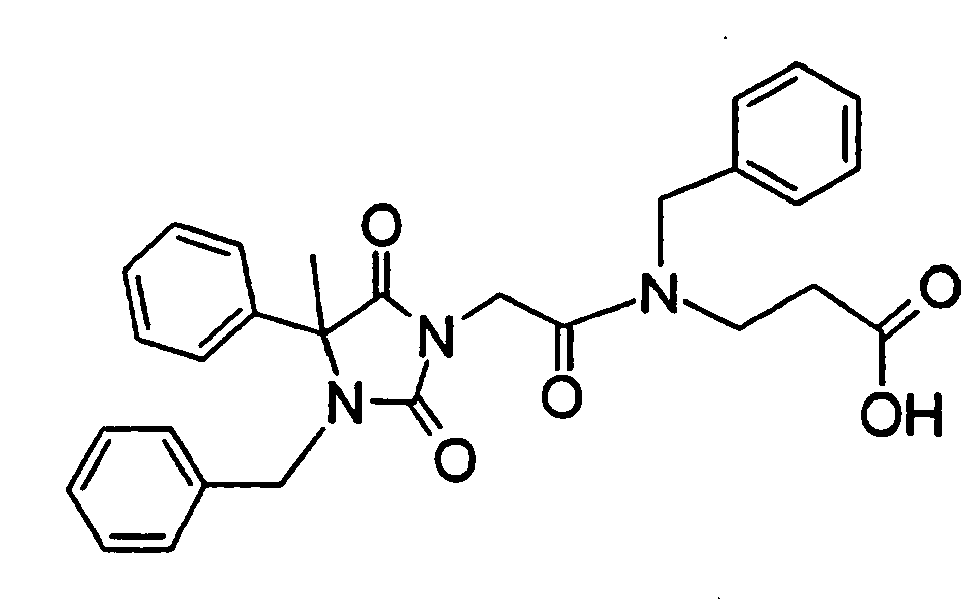
- Die Verbindung wurde ausgehend von Benzylamin nach der Vorschrift in Beispiel 171 hergestellt. Ausbeute: 183 mg (73 %) farbloses Pulver.
-

- Die Verbindung wurde ausgehend von n-Octylamin nach der Vorschrift in Beispiel 171 hergestellt. Ausbeute: 293 mg (99 %) farbloses Öl.
- Als Testmethode für die Wirksamkeit der Verbindungen der Formel I auf die Interaktion zwischen VCAM-1 und VLA-4 wird ein Assay verwendet, der für diese Interaktion spezifisch ist. Die zellulären Bindungspartner, das heißt die VLA-4-Integrine, werden in ihrer natürlichen Form als Oberflächenmoleküle auf humanen U937-Zellen (ATCC CRL 1593), die zur Gruppe der Leukozyten gehören, angeboten. Als spezifische Bindungspartner werden gentechnisch hergestellte rekombinante lösliche Fusionsproteine, bestehend aus der extrazytoplasmatischen Domäne von humanen VCAM-1 und der konstanten Region eines humanen Immunglobulins der Subklasse IgG1, verwendet.
- Eingesetzt wurde ein genetisches Konstrukt zur Expression der extrazellulären Domäne des humanen VCAM-1, verbunden mit der genetischen Sequenz der schweren Kette des humanen Immunglobulins IgG1 (Hinge, CH2 und CH3 Regionen) (von Dr. Brian Seed, Massachusetts General Hospital, Boston, USA; vgl. Damle und Aruffo, Proc. Natl. Acad. Sci. USA 1991, 88, 6403-6407). Das lösliche Fusionsprotein hVCAM-1(1-3)-IgG enthielt die drei aminoterminalen extrazellulären Immunglobulin-ähnlichen Domänen des humanen VCAM-1 (Damle und Aruffo, Proc. Natl. Acad. Sci. USA 1991, 88, 6403). CD4-IgG (Zettlmeissl et al., DNA and Cell Biology 1990, 9, 347) diente als Fusionsprotein für negative Kontrollen. Die rekombinanten Proteine wurden als lösliche Proteine nach DEAE/Dextranvermittelter DNA-Transfektion in COS-Zellen (ATCC CRL1651) gemäß Standardprozeduren exprimiert (Ausubel et al., Current Protocols in Molecular Biology, John Wiley & Sons, Inc., 1994).
-
- 2.1 96 well-Mikrotitertestplatten (Nunc Maxisorb) wurden mit 100 µl/well einer Ziege-anti-human-IgG-Antikörperlösung (10 µg/ml in 50 mM Tris, pH 9,5) 1 Stunde bei Raumtemperatur inkubiert. Nach Entfernen der Antikörperlösung wurde einmal mit PBS gewaschen.
- 2.2 150 µl/well eines Blockierungspuffers (1 % BSA in PBS) wurde 0,5 Stunden bei Raumtemperatur auf den Platten inkubiert. Nach Entfernen des Biockierungspuffers wurde einmal mit PBS gewaschen.
- 2.3 100 µl pro well eines Zellkulturüberstandes von transfektierten COS-Zellen wurden für 1,5 Stunden bei Raumtemperatur auf den Platten inkubiert. Die COS-Zellen waren mit einem Plasmid transfiziert, welches für die drei N-terminalen Immunglobulin-ähnlichen Domänen des VCAM-1, gekoppelt an den Fc-Teil von humanem IgG1 (hVCAM-1(1-3)-IgG), codiert. Der Gehalt an hVCAM-1(1-3)-IgG betrug ca. 0,5 - 1 µg/ml. Nach Entfernen des Kulturüberstandes wurde einmal mit PBS gewaschen.
- 2.4 Die Platten wurden mit 100 µl/well Fc-Rezeptor-Blockpuffer (1 mg/ml γ-Globulin, 100 mM NaCl, 100 µM MgCl2, 100 µM MnCl2, 100 µM CaCl2, 1 mg/ml BSA in 50 mM HEPES, pH 7,5) für 20 Minuten bei Raumtemperatur inkubiert. Nach Entfernen des Fc-Rezeptor-Blockpuffers wurde einmal mit PBS gewaschen.
- 2.5 20 µl Bindungspuffer (100 mM NaCl, 100 µM M9Cl2, 100 µM MnCl2, 100 µM CaCl2, 1 mg/ml BSA in 50 mM HEPES, pH 7,5) wurden vorgelegt, die zu testenden Substanzen in 10 µl Bindungspuffer zugegeben und für 20 Minuten inkubiert. Als Kontrollen dienten Antikörper gegen VCAM-1 (BBT, Nr. BBA6) und gegen VLA-4 (Immunotech, Nr. 0764).
- 2.6 U937-Zellen wurden 20 Minuten in Fc-Rezeptor-Blockpuffer inkubiert und anschließend in einer Konzentration von 1 x 10⁶/ml und in einer Menge von 100 µl pro well zupipettiert (Endvolumen 125µl/well).
- 2.7 Die Platten wurden in einem 45°-Winkel in Stoppuffer (100 mM NaCl, 100 µM M9Cl2, 100 µM MnCl2, 100 µM CaCl2 in 25 mM Tris, pH 7,5) langsam eingetaucht und ausgeschlagen. Der Vorgang wurde wiederholt.
- 2.8 Anschließend wurden 50 µl/well einer Färbelösung (16,7 µg/ml Hoechst Farbstoff 33258, 4 % Formaldehyd, 0,5 % Triton-X-100 in PBS) 15 Minuten auf den Platten inkubiert.
- 2.9 Die Platten wurden ausgeschlagen, in einem 45°-Winkel in Stoppuffer (100 mM NaCl, 100 µM MgCl2, 100 µM MnCl2, 100 µM CaCl2 in 25 mM Tris, pH 7,5) langsam eingetaucht. Der Vorgang wurde wiederholt. Anschließend wurde mit der Flüssigkeit in einem Cytofluorimeter (Millipore) gemessen (Sensitivität: 5, Filter: Anregungswellenlänge: 360 nm, Emissionswellenlänge: 460 nm).
- Die Intensität des von den angefärbten U937-Zellen emittierten Lichts ist ein Maß für die Zahl der an der Platte verbliebenen, an das hVCAM-1(1-3)-IgG adhärierten U937-Zellen und somit ein Maß für die Fähigkeit der zugesetzten Testsubstanz, diese Adhäsion zu hemmen. Aus der Hemmung der Adhäsion bei verschiedenen Konzentrationen der Testsubstanz wurde die Konzentration IC50 berechnet, die zu einer Hemmung der Adhäsion um 50 % führt.
- Es wurden die folgenden Testergebnisse erhalten:
Beispiel U937NCAM-1 Zelladhäsionstest IC50 (µM) 4 45 7 8 8 4,5 9 4 10 9,5
Claims (11)
- Verbindung der Formel I,
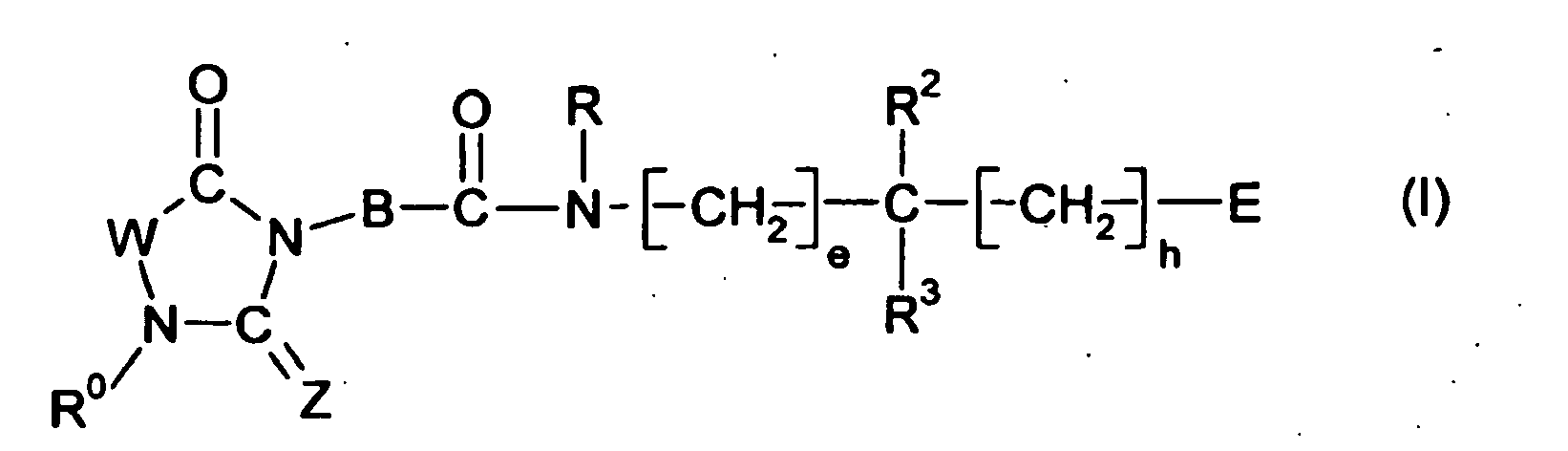 W für R1-A-C(R13) steht;Z für Sauerstoff steht;A für eine direkte Bindung steht;B für einen unsubstituierten Methylenrest oder für einen Methylenrest, der durch einen (C1-C8)-Alkylrest substituiert ist, steht;E R10CO bedeutet;R Wasserstoff oder (C1-C4)-Alkyl bedeutet;R0 für im Arylrest gegebenenfalls substituiertes (C6-C14)-Aryl-(C1-C4)-alkyl steht;R1 für einen unsubstituierten Rest aus der Reihe Phenyl, 2-Thienyl, 3-Thienyl, 3- Pyridyl und 4-Pyridyl steht;R2 Wasserstoff oder (C1-C4)-Alkyl bedeutet;R3 für einen unsubstituierten Phenylrest oder einen durch einen, zwei oder drei gleiche oder verschiedene Reste aus der Reihe (C1-C4)-Alkyl, (C1-C4)-Alkoxy, Hydroxy, Halogen. Trifluormethyl, Nitro, Methylendioxy, Ethylendioxy und Cyan substituierten Phenylrest steht, oder R3 für R11NH, CON(CH3)R4 oder CONHR4 steht;R4 (C1-C6)-Alkyl bedeutet, das durch einen oder zwei gleiche oder verschiedene Reste aus der Reihe Hydroxy, (C1-C8)-Alkoxy, Phenyl, Benzyl, Hydroxycarbonyl, Aminocarbonyl und (C1-C6)-Alkoxycarbonyl substituiert ist;R10 Hydroxy, (C1-C8)-Alkoxy, (C6-C10)-Aryl-(C1-C4)-alkoxy, das im Arylrest auch substituiert sein kann, gegebenenfalls substituiertes (C6-C10)-Aryloxy, (C1-C8)- Alkylcarbonyloxy-(C1-C4)-alkoxy, (C6-C10)-Arylcarbonyloxy-(C1-C4)-alkoxy, Amino oder Mono- oder Di-((C1-C8)-alkyl)-amino bedeutet;R11 für R12a-CO, R12a-O-CO oder R12a-NH-CO steht;R12a (C1-C10)-Alkyl, (C3-C12)-Cycloalkyl, (C3-C12)-Cycloalkyl-(C1-C8)-alkyl, gegebenenfalls substituiertes (C6-C14)-Aryl, im Arylrest gegebenenfalls substituiertes (C6-C14)-Aryl-(C1 -C8)-alkyl oder den Rest R15 bedeutet;R13 Wasserstoff oder (C1-C4)-Alkyl bedeutet;R15 für R16-(C1-C3)-alkyl oder für R16 steht;R16 für-einen 2-Norbornylrest, 2-Bicyclo[3.2.1]octylrest, Adamantylrest, Homoadamantylrest oder Noradamantylrest steht;e und h unabhängig voneinander für 0 oder 1 stehen;in allen ihren stereoisomeren Formen und Mischungen davon in allen Verhältnissen, und ihre physiologisch verträglichen Salze.
 - Verbindung der Formel I gemäß Anspruch 1, worin R1 für einen unsubstituierten Rest aus der Reihe Phenyl, 2-Thienyl, 3-Thienyl und 4-Pyridyl steht, in allen ihren stereoisomeren Formen und Mischungen davon in allen Verhältnissen, und ihre physiologisch verträglichen Salze.
- Verbindung der Formel I gemäß Anspruch 1 und/oder 2, worin R13 für (C1-C4)-Alkyl steht, in allen ihren stereoisomeren Formen und Mischungen davon in allen Verhältnissen, und ihre physiologisch verträglichen Salze.
- Verfahren zur Herstellung einer Verbindung der Formel I gemäß einem oder mehreren der Ansprüche 1 bis 3, dadurch gekennzeichnet, daß man eine Fragmentkondensation einer Verbindung der Formel II


- Verbindung der Formel I gemäß einem oder mehreren der Ansprüche 1 bis 3 und/oder ein physiologisch verträgliches Salz davon zur Verwendung als Arzneimittel.
- Pharmazeutisches Präparat, dadurch gekennzeichnet, daß es eine oder mehrere Verbindungen der Formel I gemäß einem oder mehreren der Ansprüche 1 bis 3 und/oder ihre physiologisch verträgliche Salze neben pharmazeutisch einwandfreien Trägerstoffen und/oder Zusatzstoffen enthält.
- Verbindung der Formel I gemäß einem oder mehreren der Ansprüche 1 bis 3 und/oder ein physiologisch verträgliches Salz davon zur Verwendung als Entzündungshemmstoff.
- Verbindung der Formel I gemäß einem oder mehreren der Ansprüche 1 bis 3 und/oder ein physiologisch verträgliches Salz davon zur Verwendung in der Therapie oder Prophylaxe der rheumatoiden Arthritis, der inflammatorischen bowel disease, des systemischen Lupus erythematosus oder von inflammatorischen Erkrankungen des zentralen Nervensystems.
- Verbindung der Formel I gemäß einem oder mehreren der Ansprüche 1 bis 3 und/oder ein physiologisch verträgliches Salz davon zur Verwendung in der Therapie oder Prophylaxe von Asthma oder Allergien.
- Verbindung der Formel I gemäß einem oder mehreren der Ansprüche 1 bis 3 und/oder ein physiologisch verträgliches Salz davon zur Verwendung in der Therapie oder Prophylaxe von cardiovaskulären Erkrankungen, der Arteriosklerose, von Restenosen oder von Diabetes, zur Verhinderung der Schädigung von Organtransplantaten, zur Hemmung von Tumorwachstum oder Tumormetastasierung oder zur Therapie der Malaria.
- Verbindung der Formel I gemäß einem oder mehreren der Ansprüche 1 bis 3 und/oder ein physiologisch verträgliches Salz davon zur Verwendung als Hemmstoff der Adhäsion und/oder der Migration von Leukozyten oder als Hemmstoff des VLA-4-Rezeptors.
Applications Claiming Priority (2)
| Application Number | Priority Date | Filing Date | Title |
|---|---|---|---|
| DE19741235 | 1997-09-18 | ||
| DE19741235A DE19741235A1 (de) | 1997-09-18 | 1997-09-18 | Neue Imidazolidinderivate, ihre Herstellung, ihre Verwendung und sie enthaltende pharmazeutische Präparate |
Publications (2)
| Publication Number | Publication Date |
|---|---|
| EP0903353A1 EP0903353A1 (de) | 1999-03-24 |
| EP0903353B1 true EP0903353B1 (de) | 2009-11-25 |
Family
ID=7842856
Family Applications (1)
| Application Number | Title | Priority Date | Filing Date |
|---|---|---|---|
| EP98117231A Expired - Lifetime EP0903353B1 (de) | 1997-09-18 | 1998-09-11 | Imidazolidinderivate, ihre Herstellung, ihre Verwendung und sie enthaltende pharmazeutische Präparate |
Country Status (25)
| Country | Link |
|---|---|
| US (2) | US6423712B1 (de) |
| EP (1) | EP0903353B1 (de) |
| JP (1) | JP4537505B2 (de) |
| KR (1) | KR19990029915A (de) |
| CN (1) | CN1125054C (de) |
| AR (1) | AR015444A1 (de) |
| AT (1) | ATE449786T1 (de) |
| AU (1) | AU748599B2 (de) |
| BR (1) | BR9803486A (de) |
| CA (1) | CA2247551A1 (de) |
| CZ (1) | CZ298898A3 (de) |
| DE (2) | DE19741235A1 (de) |
| HR (1) | HRP980511A2 (de) |
| HU (1) | HUP9802121A3 (de) |
| ID (1) | ID20855A (de) |
| IL (1) | IL126247A0 (de) |
| MY (1) | MY121745A (de) |
| NO (1) | NO984309L (de) |
| NZ (1) | NZ331924A (de) |
| PL (1) | PL328686A1 (de) |
| RU (1) | RU2213737C2 (de) |
| SK (1) | SK124798A3 (de) |
| TR (1) | TR199801840A2 (de) |
| TW (1) | TW553937B (de) |
| ZA (1) | ZA988496B (de) |
Cited By (2)
| Publication number | Priority date | Publication date | Assignee | Title |
|---|---|---|---|---|
| US7671216B2 (en) | 2005-11-08 | 2010-03-02 | Ranbaxy Laboratories Limited | Process for preparation of (3R,5R)-7-[2-(4-fluorophenyl)-5-isopropyl-3-phenyl-4-[(4-hydroxy methyl phenyl amino) carbonyl]-pyrrol-1-yl]-3,5-dihydroxy-heptanoic acid hemi calcium salt |
| US7923467B2 (en) | 2003-05-30 | 2011-04-12 | Ranbaxy Laboratories, Inc. | Substituted pyrrole derivatives and their use as HMG-CO inhibitors |
Families Citing this family (17)
| Publication number | Priority date | Publication date | Assignee | Title |
|---|---|---|---|---|
| DE19647382A1 (de) * | 1996-11-15 | 1998-05-20 | Hoechst Ag | Heterocyclen als Inhibitoren der Leukozytenadhäsion und VLA-4-Antagonisten |
| DE19741873A1 (de) * | 1997-09-23 | 1999-03-25 | Hoechst Marion Roussel De Gmbh | Neue 5-Ring-Heterocyclen, ihre Herstellung, ihre Verwendung und sie enthaltende pharmazeutische Präparate |
| DE19821483A1 (de) | 1998-05-14 | 1999-11-18 | Hoechst Marion Roussel De Gmbh | Imidazolidinderivate, ihre Herstellung, ihre Verwendung und sie enthaltende pharmazeutische Präparate |
| SK288186B6 (sk) * | 1999-05-07 | 2014-05-06 | Encysive Pharmaceuticals, Inc. | Deriváty kyseliny propiónovej, ktoré inhibujú väzbu integrínov na ich receptory, farmaceutické kompozície s ich obsahom a ich použitie |
| US6723711B2 (en) | 1999-05-07 | 2004-04-20 | Texas Biotechnology Corporation | Propanoic acid derivatives that inhibit the binding of integrins to their receptors |
| DE19922462A1 (de) * | 1999-05-17 | 2000-11-23 | Aventis Pharma Gmbh | Spiro-imidazolidinderivate, ihre Herstellung ihre Verwendung und sie enthaltende pharmazeutische Präparate |
| ES2270868T3 (es) * | 1999-08-13 | 2007-04-16 | Biogen Idec Ma Inc. | Inhibidores de la adhesion celular. |
| YU41202A (sh) | 1999-12-28 | 2005-03-15 | Pfizer Products Inc. | Ne-peptidni inhibitori vezivanja za ćeliju zavisnog od vla-4 korisni pri tretiranju inflamatornih, autoimunih i respiratornih bolesti |
| DE10111877A1 (de) | 2001-03-10 | 2002-09-12 | Aventis Pharma Gmbh | Neue Imidazolidinderivate, ihre Herstellung, ihre Verwendung und sie enthaltende pharmazeutische Präparate |
| DE10111876A1 (de) * | 2001-03-10 | 2002-09-19 | Aventis Pharma Gmbh | Bis(trifluormethyl)hydantoine als Zwischenprodukte für pharmazeutische Wirkstoffe |
| FR2823209B1 (fr) * | 2001-04-04 | 2003-12-12 | Fournier Lab Sa | Nouvelles thiohydantoines et leur utilisation en therapeutique |
| DE10137595A1 (de) | 2001-08-01 | 2003-02-13 | Aventis Pharma Gmbh | Neue Imidazolidinderivate, ihre Herstellung und ihre Verwendung |
| DE102006024024A1 (de) * | 2006-05-23 | 2007-11-29 | Bayer Healthcare Aktiengesellschaft | Substituierte Arylimidazolone und -triazolone sowie ihre Verwendung |
| AU2008219007A1 (en) | 2007-02-20 | 2008-08-28 | Merrimack Pharmaceuticals, Inc. | Methods of treating multiple sclerosis by administration of alpha-fetoprotein in combination with an integrin antagonist |
| JP5639039B2 (ja) | 2008-04-11 | 2014-12-10 | メリマック ファーマシューティカルズ インコーポレーティッド | ヒト血清アルブミンリンカーおよびそのコンジュゲート |
| KR101492351B1 (ko) * | 2010-09-22 | 2015-02-10 | 미쓰이가가쿠 아그로 가부시키가이샤 | 함불소 카바메이트기를 가지는 아미노산 아미드 유도체의 제조방법, 그 제조 중간체, 및 에틸렌디아민 유도체의 제조방법 |
| EP3722808B1 (de) | 2010-10-25 | 2024-09-11 | Biogen MA Inc. | Verfahren zur bestimmung von unterschieden in einer alpha-4-integrin-aktivität durch korrelation von unterschieden in svcam- und/oder smadcam-ebenen |
Family Cites Families (58)
| Publication number | Priority date | Publication date | Assignee | Title |
|---|---|---|---|---|
| DE235866C (de) | ||||
| GB1602188A (en) * | 1977-12-01 | 1981-11-11 | Wellcome Found | Hydantoin derivatives |
| DE3044236A1 (de) | 1980-11-25 | 1982-06-16 | Hoechst Ag, 6000 Frankfurt | Aminosaeurederivate und verfahren zu ihrer herstellung |
| DE2937779A1 (de) | 1979-09-19 | 1981-04-09 | Hoechst Ag, 6000 Frankfurt | Aminosaeurederivate und verfahren zu ihrer herstellung |
| FR2487829A2 (fr) | 1979-12-07 | 1982-02-05 | Science Union & Cie | Nouveaux imino acides substitues, leurs procedes de preparation et leur emploi comme inhibiteur d'enzyme |
| US4350704A (en) * | 1980-10-06 | 1982-09-21 | Warner-Lambert Company | Substituted acyl derivatives of octahydro-1H-indole-2-carboxylic acids |
| FR2483414A1 (fr) * | 1980-05-29 | 1981-12-04 | Rhone Poulenc Agrochimie | Procede de preparation de carbamoyl-1(dichloro-3,5-phenyl)-3-hydantoines et chlorocarbonyl-1(dichloro-3,5-phenyl)-3-hydantoine intermediaire utilisable pour ce procede |
| DE3177130D1 (de) | 1980-08-30 | 1990-01-11 | Hoechst Ag | Aminosaeurederivate, verfahren zu ihrer herstellung, diese enthaltende mittel und deren verwendung. |
| US4344949A (en) | 1980-10-03 | 1982-08-17 | Warner-Lambert Company | Substituted acyl derivatives of 1,2,3,4-tetrahydroisoquinoline-3-carboxylic acids |
| DE3038901A1 (de) | 1980-10-15 | 1982-05-06 | Bayer Ag, 5090 Leverkusen | Verfahren zur herstellung von n-substituierten derivaten des 1-desoxynojirimycins |
| LU88621I2 (fr) | 1980-10-23 | 1995-09-01 | Schering Corp | Sandopril |
| US4374847A (en) * | 1980-10-27 | 1983-02-22 | Ciba-Geigy Corporation | 1-Carboxyalkanoylindoline-2-carboxylic acids |
| DE3226768A1 (de) | 1981-11-05 | 1983-05-26 | Hoechst Ag, 6230 Frankfurt | Derivate der cis, endo-2-azabicyclo-(3.3.0)-octan-3-carbonsaeure, verfahren zu ihrer herstellung, diese enthaltende mittel und deren verwendung |
| NZ202903A (en) | 1981-12-29 | 1988-01-08 | Hoechst Ag | 1-- pe pyrrol-2-yl-carboxylic acid derivatives and pharmaceutical compositions |
| DE3210496A1 (de) | 1982-03-23 | 1983-10-06 | Hoechst Ag | Neue derivate bicyclischer aminsaeuren, verfahren zu ihrer herstellung, diese enthaltende mittel und deren verwendung sowie neue bicyclische aminosaeuren als zwischenstufen und verfahren zu deren herstellung |
| DE3211397A1 (de) | 1982-03-27 | 1983-11-10 | Hoechst Ag, 6230 Frankfurt | Spiro (4.(3+n))-2-aza-3-carbonsaeure-derivate, verfahren zu ihrer herstellung, diese enthaltende mittel und ihre verwendung |
| DE3211676A1 (de) | 1982-03-30 | 1983-10-06 | Hoechst Ag | Neue derivate von cycloalka (c) pyrrol-carbonsaeuren, verfahren zu ihrer herstellung, diese enthaltende mittel und deren verwendung sowie neue cycloalka (c) pyrrol-carbonsaeuren als zwischenstufen und verfahren zu deren herstellung |
| DE3227055A1 (de) | 1982-07-20 | 1984-01-26 | Hoechst Ag, 6230 Frankfurt | Neue derivate der 2-aza-bicyclo(2.2.2)octan-3-carbonsaeure, verfahren zu ihrer herstellung, diese enthaltende mittel und deren verwendung sowie 2-aza-bicyclo(2.2.2)octan-3-carbonsaeure als zwischenstufe und verfahren zu deren herstellung |
| DE3242151A1 (de) | 1982-11-13 | 1984-05-17 | Hoechst Ag, 6230 Frankfurt | Neue derivate tricyclischer aminosaeuren, verfahren zu ihrer herstellung, diese enthaltende mittel und deren verwendung, sowie neue bicyclische aminosaeuren als zwischenstufen und verfahren zu deren herstellung |
| DE3246503A1 (de) | 1982-12-16 | 1984-06-20 | Hoechst Ag, 6230 Frankfurt | Derivate der cis, endo-2-azabicyclo-(5.3.0)-decan-3-carbonsaeure, verfahren zu ihrer herstellung, diese enthaltende mittel und deren verwendung |
| DE3643012A1 (de) | 1986-12-17 | 1988-06-30 | Hoechst Ag | 2,3-disubstituierte isoxazolidine, verfahren zu ihrer herstellung, diese enthaltende mittel und ihre verwendung |
| DE3818850A1 (de) | 1988-06-03 | 1989-12-07 | Hoechst Ag | Oligopeptide mit zyklischen prolin-analogen aminosaeuren |
| JPH02160581A (ja) * | 1988-12-14 | 1990-06-20 | Showa Denko Kk | 感熱記録材用添加剤 |
| DE4009506A1 (de) | 1990-03-24 | 1991-09-26 | Hoechst Ag | Hydantoinderivate |
| US5242939A (en) * | 1990-09-28 | 1993-09-07 | Warner-Lambert Company | Anilide derivatives with angiotensin ii antagonist properties |
| DE4126277A1 (de) * | 1991-08-08 | 1993-02-11 | Cassella Ag | Hydantoinderivate |
| CA2127462C (en) | 1992-01-13 | 1999-03-23 | Roy R. Lobb | Treatment for asthma |
| JPH07506566A (ja) | 1992-02-12 | 1995-07-20 | バイオゲン インコーポレイテッド | 炎症性胃腸病の処置 |
| DE4207254A1 (de) | 1992-03-07 | 1993-09-09 | Cassella Ag | 4-oxo-2-thioxoimidazolidin-derivate |
| GR920100131A (el) * | 1992-04-03 | 1993-12-30 | Ntoural A V E E Systimata Epip | Δισκοειδής κόμβος και εξαρτήματα συνδέσεως ράβδων για λυόμενες κατασκεύες. |
| DE4213634A1 (de) * | 1992-04-24 | 1993-10-28 | Cassella Ag | 2,4-Dioxo-imidazolidin-Derivate |
| DE4224414A1 (de) * | 1992-07-24 | 1994-01-27 | Cassella Ag | Phenylimidazolidin-derivate, ihre Herstellung und ihre Verwendung |
| DE4228717A1 (de) * | 1992-08-28 | 1994-03-03 | Cassella Ag | Imidazolidin-Derivate |
| EP0677060A1 (de) | 1993-01-08 | 1995-10-18 | Tanabe Seiyaku Co., Ltd. | Die Zell-Adhäsion hemmende Peptide |
| SG44845A1 (en) | 1993-01-12 | 1997-12-19 | Biogen Inc | Recombitant anti-vla4 antibody molecules |
| WO1994017828A2 (en) | 1993-02-09 | 1994-08-18 | Biogen, Inc. | Treatment for insulin dependent diabetes |
| DE4308034A1 (de) * | 1993-03-13 | 1994-09-15 | Cassella Ag | Neue Heterocyclen, ihre Herstellung und ihre Verwendung |
| DE4427979A1 (de) * | 1993-11-15 | 1996-02-15 | Cassella Ag | Substituierte 5-Ring-Heterocyclen, ihre Herstellung und ihre Verwendung |
| US5770573A (en) * | 1993-12-06 | 1998-06-23 | Cytel Corporation | CS-1 peptidomimetics, compositions and methods of using the same |
| US5821231A (en) * | 1993-12-06 | 1998-10-13 | Cytel Corporation | CS-1 peptidomimetics, compositions and methods of using same |
| AU693143B2 (en) * | 1993-12-06 | 1998-06-25 | Cytel Corporation | CS-1 peptidomimetics, compositions and methods of using the same |
| DE69535133T2 (de) | 1994-01-25 | 2008-08-21 | Elan Pharmaceuticals, Inc., San Francisco | Humanisierte antikörper gegen das leukozytenadhäsionsmolekül vla-4 |
| US5770575A (en) * | 1994-03-16 | 1998-06-23 | Ortho Pharmaceutical Corporation | Nipecotic acid derivatives as antithrombotic compounds |
| AU2958195A (en) | 1994-06-29 | 1996-01-25 | Texas Biotechnology Corporation | Process to inhibit binding of the integrin alpha 4 beta 1 to vcam-1 or fibronectin |
| US5811391A (en) | 1994-08-25 | 1998-09-22 | Cytel Corporation | Cyclic CS-1 peptidomimetics, compositions and methods of using same |
| JP3667760B2 (ja) * | 1994-11-11 | 2005-07-06 | 株式会社 東海理化電機製作所 | 車両用始動許可装置及び識別コード登録方法 |
| GB9524630D0 (en) | 1994-12-24 | 1996-01-31 | Zeneca Ltd | Chemical compounds |
| US6306840B1 (en) | 1995-01-23 | 2001-10-23 | Biogen, Inc. | Cell adhesion inhibitors |
| DE19515177A1 (de) * | 1995-04-28 | 1996-10-31 | Cassella Ag | Hydantoinderivate als Zwischenprodukte für pharmazeutische Wirkstoffe |
| US6248713B1 (en) | 1995-07-11 | 2001-06-19 | Biogen, Inc. | Cell adhesion inhibitors |
| TW448172B (en) * | 1996-03-08 | 2001-08-01 | Pharmacia & Upjohn Co Llc | Novel hydroxamic acid derivatives useful for the treatment of diseases related to connective tissue degradation |
| ATE212990T1 (de) | 1996-03-20 | 2002-02-15 | Hoechst Ag | Inhibitoren der knochenresorption und vitronectinrezeptor-antagonisten |
| JP2000516596A (ja) | 1996-07-25 | 2000-12-12 | バイオジェン,インコーポレイテッド | 細胞接着インヒビター |
| DE19647381A1 (de) * | 1996-11-15 | 1998-05-20 | Hoechst Ag | Neue Heterocyclen als Inhibitoren der Leukozytenadhäsion und VLA-4-Antagonisten |
| DE19647380A1 (de) * | 1996-11-15 | 1998-05-20 | Hoechst Ag | 5-Ring-Heterocyclen als Inhibitoren der Leukozytenadhäsion und VLA-4-Antagonisten |
| DE19647382A1 (de) * | 1996-11-15 | 1998-05-20 | Hoechst Ag | Heterocyclen als Inhibitoren der Leukozytenadhäsion und VLA-4-Antagonisten |
| WO1998042656A1 (en) | 1997-03-21 | 1998-10-01 | Cytel Corporation | Novel compounds |
| DE19741873A1 (de) * | 1997-09-23 | 1999-03-25 | Hoechst Marion Roussel De Gmbh | Neue 5-Ring-Heterocyclen, ihre Herstellung, ihre Verwendung und sie enthaltende pharmazeutische Präparate |
-
1997
- 1997-09-18 DE DE19741235A patent/DE19741235A1/de not_active Withdrawn
-
1998
- 1998-09-10 TR TR1998/01840A patent/TR199801840A2/xx unknown
- 1998-09-11 SK SK1247-98A patent/SK124798A3/sk unknown
- 1998-09-11 EP EP98117231A patent/EP0903353B1/de not_active Expired - Lifetime
- 1998-09-11 DE DE59814412T patent/DE59814412D1/de not_active Expired - Lifetime
- 1998-09-11 AT AT98117231T patent/ATE449786T1/de not_active IP Right Cessation
- 1998-09-16 MY MYPI98004246A patent/MY121745A/en unknown
- 1998-09-16 CA CA002247551A patent/CA2247551A1/en not_active Abandoned
- 1998-09-16 ID IDP981241A patent/ID20855A/id unknown
- 1998-09-16 IL IL12624798A patent/IL126247A0/xx unknown
- 1998-09-16 AR ARP980104601A patent/AR015444A1/es unknown
- 1998-09-16 NZ NZ331924A patent/NZ331924A/en unknown
- 1998-09-17 BR BR9803486-3A patent/BR9803486A/pt not_active Application Discontinuation
- 1998-09-17 RU RU98117230/04A patent/RU2213737C2/ru not_active IP Right Cessation
- 1998-09-17 AU AU85231/98A patent/AU748599B2/en not_active Ceased
- 1998-09-17 ZA ZA988496A patent/ZA988496B/xx unknown
- 1998-09-17 CZ CZ982988A patent/CZ298898A3/cs unknown
- 1998-09-17 JP JP26316498A patent/JP4537505B2/ja not_active Expired - Fee Related
- 1998-09-17 HR HR19741235.1A patent/HRP980511A2/hr not_active Application Discontinuation
- 1998-09-17 NO NO984309A patent/NO984309L/no not_active Application Discontinuation
- 1998-09-18 HU HU9802121A patent/HUP9802121A3/hu unknown
- 1998-09-18 KR KR1019980038607A patent/KR19990029915A/ko not_active Ceased
- 1998-09-18 US US09/157,241 patent/US6423712B1/en not_active Expired - Lifetime
- 1998-09-18 PL PL98328686A patent/PL328686A1/xx not_active Application Discontinuation
- 1998-09-18 CN CN98119629A patent/CN1125054C/zh not_active Expired - Fee Related
- 1998-09-25 TW TW087115382A patent/TW553937B/zh not_active IP Right Cessation
-
2002
- 2002-05-20 US US10/147,921 patent/US6759424B2/en not_active Expired - Lifetime
Cited By (4)
| Publication number | Priority date | Publication date | Assignee | Title |
|---|---|---|---|---|
| US7923467B2 (en) | 2003-05-30 | 2011-04-12 | Ranbaxy Laboratories, Inc. | Substituted pyrrole derivatives and their use as HMG-CO inhibitors |
| US7671216B2 (en) | 2005-11-08 | 2010-03-02 | Ranbaxy Laboratories Limited | Process for preparation of (3R,5R)-7-[2-(4-fluorophenyl)-5-isopropyl-3-phenyl-4-[(4-hydroxy methyl phenyl amino) carbonyl]-pyrrol-1-yl]-3,5-dihydroxy-heptanoic acid hemi calcium salt |
| US7956198B2 (en) | 2005-11-08 | 2011-06-07 | Ranbaxy Laboratories, Limited | Pharmaceutical compositions |
| US8026377B2 (en) | 2005-11-08 | 2011-09-27 | Ranbaxy Laboratories, Limited | Process for (3R, 5R)-7-[2-(4-fluorophenyl)-5-isopropyl-3-phenyl-4-[(4-hydroxy methyl phenyl amino) carbonyl]-pyrrol-1-yl]-3,5-dihydroxy-heptanoic acid hemi calcium salt |
Also Published As
Similar Documents
| Publication | Publication Date | Title |
|---|---|---|
| EP0842944B1 (de) | Heterocyclen als Inhibitoren der Leukozytenadhäsion und VLA-4-Antagonisten | |
| EP0842945B1 (de) | Heterocyclen als Inhibitoren der Leukozytenadhäsion und VLA-4-Antagonisten | |
| EP0842943B1 (de) | 5-Ring-Heterocyclen als Inhibitoren der Leukozytenadhäsion und VLA-4-Antagonisten | |
| EP0918059B1 (de) | Substituierte Imidazolidinderivate, ihre Herstellung, ihre Verwendung und sie enthaltende pharmazeutische Präparate | |
| US6667334B1 (en) | Imidazolidine derivatives, the production thereof, their use and pharmaceutical preparations containing the same | |
| JP4537505B2 (ja) | 新規なイミダゾリジン誘導体、その製造およびその使用ならびにそれを含有する医薬製剤 | |
| JP4603104B2 (ja) | 新規な5員環の複素環式化合物、その製法およびその使用ならびにそれを含有する医薬製剤 | |
| DE10137595A1 (de) | Neue Imidazolidinderivate, ihre Herstellung und ihre Verwendung | |
| MXPA98007565A (en) | New derivatives of imidazolidine, its preparation, its use, and pharmaceutical preparations that contain them | |
| MXPA98007712A (en) | New heterociclos annulares of 5 members, its preparation, its use, and pharmaceutical preparations that contain them |
Legal Events
| Date | Code | Title | Description |
|---|---|---|---|
| PUAI | Public reference made under article 153(3) epc to a published international application that has entered the european phase |
Free format text: ORIGINAL CODE: 0009012 |
|
| AK | Designated contracting states |
Kind code of ref document: A1 Designated state(s): AT BE CH CY DE DK ES FI FR GB GR IE IT LI LU NL PT SE |
|
| AX | Request for extension of the european patent |
Free format text: AL;LT;LV;MK;RO;SI |
|
| 17P | Request for examination filed |
Effective date: 19990924 |
|
| AKX | Designation fees paid |
Free format text: AT BE CH CY DE DK ES FI FR GB GR IE IT LI LU NL PT SE |
|
| AXX | Extension fees paid |
Free format text: SI PAYMENT 19990924 |
|
| RAP1 | Party data changed (applicant data changed or rights of an application transferred) |
Owner name: AVENTIS PHARMA DEUTSCHLAND GMBH |
|
| RAP1 | Party data changed (applicant data changed or rights of an application transferred) |
Owner name: SANOFI-AVENTIS DEUTSCHLAND GMBH |
|
| 17Q | First examination report despatched |
Effective date: 20070129 |
|
| GRAP | Despatch of communication of intention to grant a patent |
Free format text: ORIGINAL CODE: EPIDOSNIGR1 |
|
| GRAS | Grant fee paid |
Free format text: ORIGINAL CODE: EPIDOSNIGR3 |
|
| GRAA | (expected) grant |
Free format text: ORIGINAL CODE: 0009210 |
|
| AK | Designated contracting states |
Kind code of ref document: B1 Designated state(s): AT BE CH CY DE DK ES FI FR GB GR IE IT LI LU NL PT SE |
|
| AX | Request for extension of the european patent |
Extension state: SI |
|
| REG | Reference to a national code |
Ref country code: GB Ref legal event code: FG4D Free format text: NOT ENGLISH |
|
| REG | Reference to a national code |
Ref country code: CH Ref legal event code: EP |
|
| REG | Reference to a national code |
Ref country code: IE Ref legal event code: FG4D |
|
| REF | Corresponds to: |
Ref document number: 59814412 Country of ref document: DE Date of ref document: 20100107 Kind code of ref document: P |
|
| REG | Reference to a national code |
Ref country code: NL Ref legal event code: VDEP Effective date: 20091125 |
|
| PG25 | Lapsed in a contracting state [announced via postgrant information from national office to epo] |
Ref country code: SE Free format text: LAPSE BECAUSE OF FAILURE TO SUBMIT A TRANSLATION OF THE DESCRIPTION OR TO PAY THE FEE WITHIN THE PRESCRIBED TIME-LIMIT Effective date: 20091125 Ref country code: PT Free format text: LAPSE BECAUSE OF FAILURE TO SUBMIT A TRANSLATION OF THE DESCRIPTION OR TO PAY THE FEE WITHIN THE PRESCRIBED TIME-LIMIT Effective date: 20100325 Ref country code: FI Free format text: LAPSE BECAUSE OF FAILURE TO SUBMIT A TRANSLATION OF THE DESCRIPTION OR TO PAY THE FEE WITHIN THE PRESCRIBED TIME-LIMIT Effective date: 20091125 |
|
| PG25 | Lapsed in a contracting state [announced via postgrant information from national office to epo] |
Ref country code: CY Free format text: LAPSE BECAUSE OF FAILURE TO SUBMIT A TRANSLATION OF THE DESCRIPTION OR TO PAY THE FEE WITHIN THE PRESCRIBED TIME-LIMIT Effective date: 20091125 |
|
| REG | Reference to a national code |
Ref country code: IE Ref legal event code: FD4D |
|
| PG25 | Lapsed in a contracting state [announced via postgrant information from national office to epo] |
Ref country code: NL Free format text: LAPSE BECAUSE OF FAILURE TO SUBMIT A TRANSLATION OF THE DESCRIPTION OR TO PAY THE FEE WITHIN THE PRESCRIBED TIME-LIMIT Effective date: 20091125 Ref country code: IE Free format text: LAPSE BECAUSE OF FAILURE TO SUBMIT A TRANSLATION OF THE DESCRIPTION OR TO PAY THE FEE WITHIN THE PRESCRIBED TIME-LIMIT Effective date: 20091125 Ref country code: ES Free format text: LAPSE BECAUSE OF FAILURE TO SUBMIT A TRANSLATION OF THE DESCRIPTION OR TO PAY THE FEE WITHIN THE PRESCRIBED TIME-LIMIT Effective date: 20100308 Ref country code: DK Free format text: LAPSE BECAUSE OF FAILURE TO SUBMIT A TRANSLATION OF THE DESCRIPTION OR TO PAY THE FEE WITHIN THE PRESCRIBED TIME-LIMIT Effective date: 20091125 |
|
| PLBE | No opposition filed within time limit |
Free format text: ORIGINAL CODE: 0009261 |
|
| STAA | Information on the status of an ep patent application or granted ep patent |
Free format text: STATUS: NO OPPOSITION FILED WITHIN TIME LIMIT |
|
| PG25 | Lapsed in a contracting state [announced via postgrant information from national office to epo] |
Ref country code: GR Free format text: LAPSE BECAUSE OF FAILURE TO SUBMIT A TRANSLATION OF THE DESCRIPTION OR TO PAY THE FEE WITHIN THE PRESCRIBED TIME-LIMIT Effective date: 20100226 |
|
| 26N | No opposition filed |
Effective date: 20100826 |
|
| BERE | Be: lapsed |
Owner name: SANOFI-AVENTIS DEUTSCHLAND G.M.B.H. Effective date: 20100930 |
|
| PG25 | Lapsed in a contracting state [announced via postgrant information from national office to epo] |
Ref country code: IT Free format text: LAPSE BECAUSE OF FAILURE TO SUBMIT A TRANSLATION OF THE DESCRIPTION OR TO PAY THE FEE WITHIN THE PRESCRIBED TIME-LIMIT Effective date: 20091125 |
|
| REG | Reference to a national code |
Ref country code: CH Ref legal event code: PL |
|
| PG25 | Lapsed in a contracting state [announced via postgrant information from national office to epo] |
Ref country code: LI Free format text: LAPSE BECAUSE OF NON-PAYMENT OF DUE FEES Effective date: 20100930 Ref country code: CH Free format text: LAPSE BECAUSE OF NON-PAYMENT OF DUE FEES Effective date: 20100930 Ref country code: BE Free format text: LAPSE BECAUSE OF NON-PAYMENT OF DUE FEES Effective date: 20100930 |
|
| PG25 | Lapsed in a contracting state [announced via postgrant information from national office to epo] |
Ref country code: AT Free format text: LAPSE BECAUSE OF NON-PAYMENT OF DUE FEES Effective date: 20100911 |
|
| PG25 | Lapsed in a contracting state [announced via postgrant information from national office to epo] |
Ref country code: LU Free format text: LAPSE BECAUSE OF NON-PAYMENT OF DUE FEES Effective date: 20100911 |
|
| PGFP | Annual fee paid to national office [announced via postgrant information from national office to epo] |
Ref country code: DE Payment date: 20130904 Year of fee payment: 16 |
|
| PGFP | Annual fee paid to national office [announced via postgrant information from national office to epo] |
Ref country code: GB Payment date: 20130911 Year of fee payment: 16 Ref country code: FR Payment date: 20130910 Year of fee payment: 16 |
|
| REG | Reference to a national code |
Ref country code: DE Ref legal event code: R119 Ref document number: 59814412 Country of ref document: DE |
|
| GBPC | Gb: european patent ceased through non-payment of renewal fee |
Effective date: 20140911 |
|
| REG | Reference to a national code |
Ref country code: DE Ref legal event code: R119 Ref document number: 59814412 Country of ref document: DE Effective date: 20150401 |
|
| REG | Reference to a national code |
Ref country code: FR Ref legal event code: ST Effective date: 20150529 |
|
| PG25 | Lapsed in a contracting state [announced via postgrant information from national office to epo] |
Ref country code: DE Free format text: LAPSE BECAUSE OF NON-PAYMENT OF DUE FEES Effective date: 20150401 Ref country code: GB Free format text: LAPSE BECAUSE OF NON-PAYMENT OF DUE FEES Effective date: 20140911 |
|
| PG25 | Lapsed in a contracting state [announced via postgrant information from national office to epo] |
Ref country code: FR Free format text: LAPSE BECAUSE OF NON-PAYMENT OF DUE FEES Effective date: 20140930 |