EP0888348B1 - Acyclic nucleoside derivatives - Google Patents
Acyclic nucleoside derivatives Download PDFInfo
- Publication number
- EP0888348B1 EP0888348B1 EP97903708A EP97903708A EP0888348B1 EP 0888348 B1 EP0888348 B1 EP 0888348B1 EP 97903708 A EP97903708 A EP 97903708A EP 97903708 A EP97903708 A EP 97903708A EP 0888348 B1 EP0888348 B1 EP 0888348B1
- Authority
- EP
- European Patent Office
- Prior art keywords
- butyl
- guanine
- valyloxy
- amino
- compound
- Prior art date
- Legal status (The legal status is an assumption and is not a legal conclusion. Google has not performed a legal analysis and makes no representation as to the accuracy of the status listed.)
- Expired - Lifetime
Links
Images
Classifications
-
- C—CHEMISTRY; METALLURGY
- C07—ORGANIC CHEMISTRY
- C07D—HETEROCYCLIC COMPOUNDS
- C07D473/00—Heterocyclic compounds containing purine ring systems
-
- A—HUMAN NECESSITIES
- A61—MEDICAL OR VETERINARY SCIENCE; HYGIENE
- A61P—SPECIFIC THERAPEUTIC ACTIVITY OF CHEMICAL COMPOUNDS OR MEDICINAL PREPARATIONS
- A61P31/00—Antiinfectives, i.e. antibiotics, antiseptics, chemotherapeutics
- A61P31/12—Antivirals
-
- A—HUMAN NECESSITIES
- A61—MEDICAL OR VETERINARY SCIENCE; HYGIENE
- A61P—SPECIFIC THERAPEUTIC ACTIVITY OF CHEMICAL COMPOUNDS OR MEDICINAL PREPARATIONS
- A61P31/00—Antiinfectives, i.e. antibiotics, antiseptics, chemotherapeutics
- A61P31/12—Antivirals
- A61P31/14—Antivirals for RNA viruses
- A61P31/18—Antivirals for RNA viruses for HIV
-
- A—HUMAN NECESSITIES
- A61—MEDICAL OR VETERINARY SCIENCE; HYGIENE
- A61P—SPECIFIC THERAPEUTIC ACTIVITY OF CHEMICAL COMPOUNDS OR MEDICINAL PREPARATIONS
- A61P31/00—Antiinfectives, i.e. antibiotics, antiseptics, chemotherapeutics
- A61P31/12—Antivirals
- A61P31/20—Antivirals for DNA viruses
- A61P31/22—Antivirals for DNA viruses for herpes viruses
-
- C—CHEMISTRY; METALLURGY
- C07—ORGANIC CHEMISTRY
- C07D—HETEROCYCLIC COMPOUNDS
- C07D473/00—Heterocyclic compounds containing purine ring systems
- C07D473/02—Heterocyclic compounds containing purine ring systems with oxygen, sulphur, or nitrogen atoms directly attached in positions 2 and 6
- C07D473/18—Heterocyclic compounds containing purine ring systems with oxygen, sulphur, or nitrogen atoms directly attached in positions 2 and 6 one oxygen and one nitrogen atom, e.g. guanine
-
- C—CHEMISTRY; METALLURGY
- C07—ORGANIC CHEMISTRY
- C07D—HETEROCYCLIC COMPOUNDS
- C07D473/00—Heterocyclic compounds containing purine ring systems
- C07D473/26—Heterocyclic compounds containing purine ring systems with an oxygen, sulphur, or nitrogen atom directly attached in position 2 or 6, but not in both
- C07D473/32—Nitrogen atom
-
- Y—GENERAL TAGGING OF NEW TECHNOLOGICAL DEVELOPMENTS; GENERAL TAGGING OF CROSS-SECTIONAL TECHNOLOGIES SPANNING OVER SEVERAL SECTIONS OF THE IPC; TECHNICAL SUBJECTS COVERED BY FORMER USPC CROSS-REFERENCE ART COLLECTIONS [XRACs] AND DIGESTS
- Y02—TECHNOLOGIES OR APPLICATIONS FOR MITIGATION OR ADAPTATION AGAINST CLIMATE CHANGE
- Y02P—CLIMATE CHANGE MITIGATION TECHNOLOGIES IN THE PRODUCTION OR PROCESSING OF GOODS
- Y02P20/00—Technologies relating to chemical industry
- Y02P20/50—Improvements relating to the production of bulk chemicals
- Y02P20/55—Design of synthesis routes, e.g. reducing the use of auxiliary or protecting groups
Definitions
- This invention relates to the field of antivirals and in particular to derivatives of acyclic nucleosides useful against herpes and retroviral infections.
- the invention provides novel compounds, pharmaceutical compositions comprising these compounds, methods for the treatment or prophylaxis of viral infections employing them, and methods for their manufacture.
- European patent EP165 289 describes the promising antiherpes agent 9-[4-hydroxy-(2-hydroxymethyl)butyl]guanine, otherwise known as H2G.
- European patent EP 186 640 discloses 6-deoxy H2G.
- European patent EP 343 133 discloses that these compounds, particularly the R-(-) enantiomer, are additionally active against retroviral infections such as HIV.
- Various derivatives of H2G, such as phosphonates, aliphatic esters (for example, the diacetate and the dipropionate) and ethers of the hydroxy groups on the acyclic side chain are disclosed in EP 343 133.
- This patent also discloses methods for the preparation of these derivatives comprising the condensation of the acyclic side chain to the N-9 position of a typically 6-halogenated purine moiety or, alternatively, the imidazole ring closure of a pyrimidine or furazano-[3,4-d] pyrimidine moeity or the pyrimidine ring closure of an imidazole moiety, where the acyclic side chain is already present in the precursor pyrimidine or imidazole moiety, respectively.
- the acyclic side chain is pre-derivatised but individual examples also show a one-step diacylation of H2G with acetic or proprionic anhydride and DMF.
- Lake-Bakaar, et al. discloses in Antimicrob, Agents Chemother, 33 No. 1, 110-112 (1989) diacetate and dipropionate derivatives of H2G and monoacetate and diacetate derivatives of 6-deoxy H2G.
- the diacetate and dipropionate derivatives of H2G are reported to result in only modest improvements in bioavailability relative to H2G.
- a second approach to providing prodrugs of acyclic nucleosides involves the preparation of amino acid esters of one or more of the hydroxy groups on the acyclic side chain.
- European patent EP 99 493 discloses generally amino acid esters of acyclovir and European patent application EP 308 065, published March 22, 1989, discloses the valine and isoleucine esters of acyclovir.
- European patent application EP 375 329 discloses amino acid ester derivatives of ganciclovir, including the di-valine, di-isoleucine, di-glycine and di-alanine ester derivatives.
- International patent application WO95/09855, published April 13, 1995 discloses amino acid ester derivatives of penciclovir, including the mono-valine and di-valine ester derivatives.
- EP 694 547 published January 31, 1996, discloses the mono-L-valine ester of ganciclovir and its preparation from di-valyl-ganciclovir.
- EP 654 473 published May 24, 1995, discloses various bis amino acid ester derivatives of 9-[1',2'-bishydroxymethyl)-cyclopropan-1'yl] methylguanine.
- the advantageous effect on oral bioavailability of the mixed fatty acid and amino acid esters of the invention is particularly unexpected in comparison to the oral bioavailability of the corresponding fatty acid esters.
- Table 1A urinary recovery assay
- Table 1B plasma drug assay
- the invention also provides pharmaceutical compositions comprising the compounds of Formula I and their pharmaceutically acceptable salts in conjunction with a pharmaceutically acceptable carrier or diluent. Further aspects of the invention include the compounds of Formula I and their pharmaceutically acceptable salts for use in therapy and the use of these compounds and salts in the preparation of a medicament for the treatment or prophylaxis of viral infection in humans or animals.
- the compounds of the invention are potent antivirals, especially against herpes infections, such as those caused by Varicella zoster virus, Herpes simplex virus types 1 & 2, Epstein-Barr virus, Herpes type 6 (HHV-6) and type 8 (HHV-8).
- the compounds are particularly useful against Varicella zoster virus infections such as shingles in the elderly including post herpelic neuralgia or chicken pox in the young where the duration and severity of the disease can be reduced by several days.
- Epstein Barr virus infections amenable to treatment with the compounds include infectious mononucleosis/glandular fever which has previously not been treatable but which can cause many months of scholastic incapacity amongst adolescents.
- the compounds of the invention are also active against certain retroviral infections, notably SIV, HIV-1 and HIV-2, and against infections where a transactivating virus is indicated.
- a further aspect of the invention provides a method for the prophylaxis or treatment of a viral infection in humans or animals comprising the administration of an effective amount of a compound of Formula I or its pharmaceutically acceptable salt to the human or animal.
- R 3 may be hydrogen thus defining the generally more soluble 6-deoxy derivative which can be oxidised in vivo (e.g. by xanthine oxidase) to the guanine form.
- the compound of formula I may be presented in a racemic mixture that is a mixture of the 2 R and 2 S isomers.
- a composition comprising a compound of formula I has at least 70%, preferably at least 90% R form, for example greater than 95%.
- the compound of formula I is in the enantiomerically pure R form.
- amino acid of group R 1 /R 2 is derived from an L-amino acid.
- the fatty acid of group R 1 /R 2 has in total an even number of carbon atoms, in particular, decanoyl (C 10 ), lauryl (C 12 ), myristoyl (C 14 ), palmitoyl (C 16 ), stearoyl (C 18 ) or eicosanoyl (C 20 ).
- Other useful R 1 /R 2 groups include butyryl, hexanoyl, octanoyl or behenoyl (C 22 ).
- R 1 /R 2 groups include those derived from myristoleic, myristelaidic, palmitoleic, palmitelaidic, n6-octadecenoic, oleic, elaidic, gandoic, erucic or brassidic acids.
- Monounsaturated fatty acid esters typically have the double bond in the trans configuration, preferably in the ⁇ -6, ⁇ -9 or ⁇ -1 position, dependent upon their length.
- the R 1 /R 2 group is derived from a fatty acid which comprises a C 9 to C 17 saturated, or n:9 monounsaturated, alkyl.
- the saturated or unsaturated fatty acid or R 1 /R 2 may optionally be substituted with up to five similar or different substituents independently selected from the group consisting of such as hydroxy, C 1 -C 6 alkyl, C 1 -C 6 alkoxy, C 1 -C 6 alkoxy C 1 -C 6 alkyl, C 1 -C 6 alkanoyl, amino, halo, cyano, azido, oxo, mercapto, and nitro.
- R 1 is -C(O)CH(CH 3 ) 2 )NH 2 or -C(O)CH(CH(CH 3 )CH 2 CH 3 )NH 2 and R 2 is -C(O)C 9 -C 17 saturated alkyl.
- lower alkyl refers to straight or branched chain alkyl radicals containing from 1 to 7 carbon atoms including, but not limited to, methyl, ethyl, n-propyl, iso-propyl, n-butyl, iso-butyl, sec-butyl, t-butyl, n-pentyl, 1-methylbutyl, 2,2-dimethylbutyl, 2-methylpentyl, 2,2-dimethylpropyl, n-hexyl and the like.
- N-protecting group or “N-protected” as used herein refers to those groups intended to protect the N-terminus of an amino acid or peptide or to protect an amino group against undesirable reactions during synthetic procedures. Commonly used N-protecting groups are disclosed in Greene, "Protective Groups in Organic Synthesis” (John Wiley & Sons, New York, 1981), which is hereby incorporated by reference.
- N-protecting groups include acyl groups such as formyl, acetyl, propionyl, pivaloyl, t-butylacetyl, 2-chloroacetyl, 2-bromoacetyl, trifluoracetyl, trichloroacetyl, phthalyl, o-nitrophenoxyacetyl, ⁇ -chlorobutyryl, benzoyl, 4-chlorobenzoyl, 4-bromobenzoyl, 4-nitrobenzoyl, and the like; sulfonyl groups such as benzenesulfonyl, p-toluenesulfonyl, and the like, carbamate forming groups such as benzyloxycarbonyl, p-chlorobenzyloxycarbonyl, p-methoxybenzyloxycarbonyl, p-nitrobenzyloxycarbonyl, 2-nitrobenzyloxycarbonyl, p-bromobenzy
- Favoured N-protecting groups include formyl, acetyl, benzoyl, pivaloyl, t-butylacetyl, phenylsulfonyl, benzyl, t-butoxycarbonyl (BOC) and benzyloxycarbonyl (Cbz).
- activated ester derivative refers to acid halides such as acid chlorides, and activated esters including, but not limited to, formic and acetic acid derived anhydrides, anhydrides derived from alkoxycarbonyl halides such as isobutyloxycarbonylchloride and the like, N-hydroxysuccinimide derived esters, N-hydroxyphthalimide derived esters, N-hydroxybenzotriazole derived esters, N-hydroxy-5-norbomene-2,3-dicarboxamide derived esters, 2,4,5-trichlorophenyl derived esters and the like.
- Preferred compounds of formula I include:
- the compounds of formula I can form salts which form an additional aspect of the invention.
- Appropriate pharmaceutically acceptable salts of the compounds of formula I include salts of organic acids, especially carboxylic acids, including but not limited to acetate, trifluoroacetate, lactate, gluconate, citrate, tartrate, maleate, malate, pantothenate, isethionate, adipate, alginate, aspartate, benzoate, butyrate, digluconate, cyclopentanate, glucoheptanate, glycerophosphate, oxalate, heptanoate, hexanoate, fumarate, nicotinate, palmoate, pectinate, 3-phenylpropionate, picrate, pivalate, proprionate, tartrate, lactobionate, pivolate, camphorate, undecanoate and succinate, organic sulphonic acids such as methanesulphonate, ethanesulphonate, 2-
- the compounds of Formula 1 may be isolated as the hydrate.
- the compounds of the invention may be isolated in crystal form, preferably homogenous crystals, and thus an additional aspect of the invention provides the compounds of Formula I in substantially pure crystalline form, comprising >70%, preferably >90% homogeneous crystalline material for example >95% homogeneous crystalline material.
- the compounds of the invention arc particularly suited to oral administration, but may also be administered rectally, vaginally, nasally, topically, transdermally or parenterally, for instance intramuscularly, intravenously or epidurally.
- the compounds may be administered alone, for instance in a capsule, but will generally be administered in conjunction with a pharmaceutically acceptable carrier or diluent.
- the invention extends to methods for preparing a pharmaceutical composition comprising bringing a compound of Formula I or its pharmaceutically acceptable salt in conjunction or association with a pharmaceutically acceptable carrier or vehicle.
- Oral formulations are conveniently prepared in unit dosage form, such as capsules or tablets, employing conventional carriers or binders such as magnesium stearate, chalk, starch, lactose, wax, gum or gelatin.
- Liposomes or synthetic or natural polymers such as HPMC or PVP may be used to afford a sustained release formulation.
- the formulation may be presented as a nasal or eye drop, syrup, gel or cream comprising a solution, suspension, emulsion, oil-in-water or water-in-oil preparation in conventional vehicles such as water, saline, ethanol, vegetable oil or glycerine, optionally with flavourant and/or preservative and/or emulsifier.
- the compounds of the invention may be administered at a daily dose generally in the range 0.1 to 200 mg/kg/day, advantageously, 0.5 to 100 mg/kg/day, more preferably 10 to 50mg/kg/day, such as 10 to 25 mg/kg/day.
- a typical dosage rate for a normal adult will be around 50 to 500 mg, for example 300 mg, once or twice per day for herpes infections and 2 to 10 times this dosage for HIV infections.
- the compounds of the invention can be administered in combination with other antiviral agents, such as acyclovir, valcyclovir, penciclovir, famciclovir, ganciclovir and its prodrugs, cidofovir, foscarnet and the like for herpes indications and AZT, ddI, ddC, d4T. 3TC, foscarnet, ritonavir, indinavir, saquinavir, delaviridine, Vertex VX 478, Agouron AG1343 and the like for retroviral indications.
- antiviral agents such as acyclovir, valcyclovir, penciclovir, famciclovir, ganciclovir and its prodrugs, cidofovir, foscarnet and the like for herpes indications and AZT, ddI, ddC, d4T. 3TC, foscarnet, ritonavir, indinavir
- the compounds of the invention can be prepared de novo or by esterification of the H2G parent compound which is prepared, for example, by the synthesis methodology disclosed in European Patent EP 343 133, which is incorporated herein by reference.
- step 1 is typically carried out with a base catalyst such as NaOH or Na 2 CO 3 in a solvent such as DMF.
- Step 2 involves a reduction which can be performed with LiBH 4 /tetrahydrofuran in a solvent such as t-BuOH.
- the substitution in step 3 of the chlorine with an amino group can be performed under pressure with ammonia.
- Step 4 employs adenosine deaminase which can be conveniently immobilized on a solid support. Cooling the reaction mixture allows unreacted isomeric precursor to remain in solution thereby enhancing purity.
- Starting materials for compounds of the invention in which R 3 is hydrogen may be prepared as shown in European Patent EP 186 640, the contents of which are incorporated herein by reference. These starting materials may be acylated as described for H2G below, optionally after protecting the purine 2-amino group with a conventional N-protecting group as defined above, especially BOC (t-BuO-CO-), Z (BnO-CO-) or Ph 3 C-.
- the compounds of the invention may be prepared from H2G as described below in Schemes A and B.
- Scheme A depicts the preparation of compounds in which R 1 is derived from the amino acid and R 2 is derived from the fatty acid, but the converse scheme is applicable to compounds where R 1 is derived from the fatty acid and R 2 is derived from the amino acid ester.
- G is guanine or 6-deoxyguanine
- PG is an optional N-protecting group or hydrogen
- R 1 * is the valine or isoleucine side chain
- R 2 * is the fatty acid chain.
- H2G is depicted above as a starting material but this of course may be optionally protected at R 3 or the 2 position of the purine with conventional N-protecting groups (not shown).
- the H2G reacts in the first step with an activated R 1 ⁇ -amino acid derivative, as further described below, in a solvent such as dimethylformamide or pyridine, to give a monoacylated product.
- the R 1 ⁇ -amino acid may be suitably N-protected with N-BOC or N-CBz or the like.
- the first acylation can be made to predominantly take place at the side chain 4-hydroxy group on the side chain of H2G.
- These controlled conditions can be achieved, for example, by manipulating the reagent concentrations or rate of addition, especially of the acylating agent, by lowering the temperature or by the choice of solvent.
- the reaction can be followed by TLC to monitor the controlled conditions.
- the R 1 monoacylated compounds are further acylated on the side chain 2-CH 2 OH group with the appropriate activated fatty acid derivative to give diacylated products using similar procedures as for the first esterification step.
- the diester products are subsequently subjected to a conventional deprotection treatment using for example trifluoroacetic acid, HCl(aq)/dioxane or hydrogenation in the presence of catalyst to give the desired compound of Formula I.
- the compound may be in salt form depending on the deprotection conditions.
- the activated R 1 /R 2 acid derivative used in the various acylations may comprise e.g. the acid halide, acid anhydride, activated acid ester or the acid in the presence of coupling reagent, for example dicyclohexylcarbodiimide.
- “acid” in each case represents the corresponding R 1 /R 2 amino acid or the R 1 /R 2 fatty acid.
- activated acid derivatives include the acid chloride, formic and acetic acid derived mixed anhydrides, anhydrides derived from alkoxycarbonyl halides such as isobutyloxycarbonylchloride and the like, N-hydroxysuccinamide derived esters, N-hydroxyphthalimide derived esters, N-hydroxy-5-norbornene-2,3-dicarboxamide derived esters, 2,4,5-trichlorophenol derived esters and the like.
- Scheme B has been exemplified with reference to the preparation of a compound where R 1 is derived from an amino acid and R 2 is derived from the fatty acid ester, but a converse scheme will be applicable to compounds where R 2 is derived from the amino acid and R 1 is derived from the fatty acid.
- This scheme relies on regioselective protection of the H2G side chain 4-hydroxy group with a bulky protecting group.
- this is depicted as t-butyldiphenylsilyl, but other regioselective protecting groups such as trityl, 9-(9-phenyl)xanthenyl, 1,1-bis(4-methylphenyl)-1'-pyrenylmethyl may also be appropriate.
- the resulting product is acylated at the side chain 2-hydroxymethyl group using analogous reagents and procedures as described. in scheme A above, but wherein the activated acid derivative is the R 2 fatty acid. for example, myristic, stearic, oleic, elaidic acid chloride and the like.
- the thus monoacylated compounds are subjected to appropriate deprotection treatment to remove the side chain 4-hydroxy protecting group which can be done in a highly selective manner with such reagents, depending on the regioselective protecting group, as HF/pyridine and the like and manipulation of the reaction conditions, viz reagent concentration, speed of addition, temperature and solvent etc, as elaborated above.
- the then free side chain 4-hydroxy group is acylated with the activated ⁇ -amino acid in a similar way as described in scheme A above.
- Additional techniques for introducing the fatty acid ester of R 1 /R 2 include the enzymatic route described in Preparative Biotransformations 1.11.8 (Ed S M Roberts, J Wiley and Son, NY, 1995) with a lipase such as SP 435 immobilized Candida antarcticus (Novo Nordisk), porcine pancreatic lipase or Candida rugosa lipase. Enzymatic acylation is especially convenient where it is desired to avoid N-protection and deprotection steps on the other acyl group or the purine 2-amine.
- An alternative route to compounds of Formula I in which R 3 is hydrogen is to 6-activate the correponding guanine compound of Formula I (wherein the amino acid ester moiety of R 1 /R 2 is optionally protected with conventional N-protecting groups such as BOC) with an activating group such as halo.
- the thus activated 6-purine is subsequently reduced to purine, for instance with a palladium catalyst and deprotected to the desired 6-deoxy H2G di-ester.
- a further aspect of the invention thus provides a method for the preparation of the compounds of formula I comprising
- Schemes A and B above employ selective acylation to stepwise add the amino acid and fatty acid esters.
- An alternative process for the preparation of the compounds of formula I starts with a diacylated H2G derivative, wherein both the acyl groups are the same, and employs selective removal of one of the acyl groups to obtain a monoacyl intermediate which is then acylated with the second, differing, acyl group in the same manner as Schemes A and B above.
- This alternative process has the advantage that the preparation of the diacylated H2G derivative is facile and requires little or no purification steps. Selective removal of one only of the acyl groups of a diacylated H2G derivative can be achieved by manipulating the reaction conditions, in particular the temperature, rate of reactant addition and choice of base.
- R 1 and R 2 are both initially identical and are most preferably the same amino acid ester.
- a di-amino acid ester will generally be N-protected during its preparation and may be used directly in this condition in the selective deacylation step.
- an N-protected di-aminoacylated H2G derivative may be deprotected and optionally reprotected, as described below.
- the unprotected di-aminoacyl H2G derivative thus comprises one of the following compounds:
- unprotected H2G diacylated derivatives can be directly subject to selective deacylation of one of the acyl groups (typically the side chain 4-position acyl) followed by enzymatic acylation of the liberated 4-hydroxy as described above.
- the unprotected H2G diacylated derivative can be re-protected and then subjected to the selective deacylation, followed in turn by conventional acylation with the fatty acid ester, as described in Schemes A and B.
- a reprotection step is done with a different N-protecting group, having properties appropriate to the subsequent acylation.
- a lipophilic N-protecting group such as Fmoc
- Fmoc when preparing a di-amino acid H2G derivative, as the lipophilic nature of the protecting group assists with separation of the acylated products.
- the lipophilic nature of Fmoc is of less utility when conducting an acylation with a fatty acid, and thus it is convenient to reprotect a diacylated H2G with an alternative N-protecting group such as BOC.
- Useful compounds thus include:
- malonate 1 (R 4 and R 5 are lower alkyl or benzyl or the like) is alkylated by reaction with from about 0.5 to about 2.0 molar equivalents of acetal 2 (R 6 and R 7 are lower alkyl or benzyl and the like or R 6 and R 7 taken together are -CH 2 CH 2 - or -CH 2 CH 2 CH 2 - or -CH 2 CH 2 CH 2 CH 2 - and X 1 is a leaving group (for example, Cl, Br or I, or a sulfonate such as methanesulfonate, inflate, p-toluenesulfonate, benzenesulfonate and the like)) in the presence of from about 0.5 to about 2.0 molar equivalents of a base (for example, potassium t-butoxide or sodium ethoxide or NaH or KH and the like) in an inert solvent (for example, DMF or THF or dioxane
- a base
- Reduction of 3 with from about 0.5 to about 4.0 molar equivalents of an ester to alcohol reducing agent (for example, LiBH 4 or Ca(BH 4 ) 2 or NaBH 4 or LiAlH 4 and the like) in an inert solvent (for example, THF or methyl t-butyl ether or t-BuOH and the like) at a temperature of from about -20°C to about 100°C provides diol 4 .
- an ester to alcohol reducing agent for example, LiBH 4 or Ca(BH 4 ) 2 or NaBH 4 or LiAlH 4 and the like
- an inert solvent for example, THF or methyl t-butyl ether or t-BuOH and the like
- This reaction can be carried out in the absence of solvent or in the presence of an inert solvent (for example, methyl t-butyl ether or toluene or hexane and the like). The reaction is carried out at a temperature of from about -20°C to about 80°C.
- the alcohol substituent of 6 is converted to a leaving group (for example, a halogen or a sulfonate) by reaction with a halogenating agent (for example NBS/P(Ph) 3 or NCS/P(Ph) 3 or POCl 3 or NCS/P(Ph) 3 /Nal in acetone and like) in an inert solvent (for example, methylene chloride or toluene or ethylacetate and the like) or by reaction with from about 0.8 molar equivalents to about 2.0 molar equivalents of a sulfonyl halide (for example, benzenesulfonylchloride, toluenesulfonylchloride or methane sulfonylchloride and the like) in the presence of from about 1.0 to about 4.0 molar equivalents of a base (for example, triethylamine or potassium carbonate or pyridine or dimethylaminopyridine or
- a base for example, potassium carbonate or NaH or KH or NaOH or KOH or lithium diisopropylamide and the like
- an inert solvent for example, DMF or THF or acetonitrile or N-methylpyrrolidone or ethanol and the like
- Reaction of 9 with from about 2.0 to about 20 molar equivalents of an alcohol R 9 OH (R 9 is an alcohol protecting group such as benzyl and the like) in the presence of from about 1.0 to about 6.0 molar equivalents of a base (for example, potassium t-butoxide or potassium carbonate or NaH or KH or lithium diisopropylamide and the like) in an inert solvent (for example, THF or DMF and the like) at a temperature of from about -25°C to about 150°C provides alcohol 10 .
- a base for example, potassium t-butoxide or potassium carbonate or NaH or KH or lithium diisopropylamide and the like
- an inert solvent for example, THF or DMF and the like
- Removal of the alcohol protecting group R 9 of 10 (for example, by catalytic hydrogenation in an inert solvent such as ethanol or benzyl alcohol or methanol or THF and the like in the presence of an hydrogenation catalyst such as Pd/C or Pd(OH) 2 and the like) provides substitued guanine 11 .
- an inert solvent such as ethanol or benzyl alcohol or methanol or THF and the like
- an hydrogenation catalyst such as Pd/C or Pd(OH) 2 and the like
- a coupling agent for example DCC
- the acetal substituent of 12 is deprotected and the resulting aldehyde is reduced by first reacting 12 with from about 0.1 to about 10.0 molar equivalents of an acid (for example, triflic acid or HCl or acetic acid or sulfuric acid and the like) in an inert solvent (for example, THF/H 2 O or methylene chloride/H 2 O or ethylacetate/H 2 O or ethanol/H 2 O or methanol/H 2 O and the like) at a temperature of from about -25 °C to about 100°C.
- an acid for example, triflic acid or HCl or acetic acid or sulfuric acid and the like
- an inert solvent for example, THF/H 2 O or methylene chloride/H 2 O or ethylacetate/H 2 O or ethanol/H 2 O or methanol/H 2 O and the like
- a base for example, sodium bicarbonate or potassium carbonate or triethylamine or pyridine or KOH and the like
- additional inert solvent for example, THF and or methylene chloride or ethylacetate or methyl t-butyl ether or isopropoanol and the like
- an aldehyde reducing agent for example, sodium borohydride or RaNi/H 2 and the like
- N-protected amino acid P 1 NHCH(R 11 )COOH or an activated derivative thereof P 1 is an N-protecting group and R 11 is isopropyl or isobutyl
- an inert solvent for example, THF or dioxane or dioxolane or DMF or methylene chloride and the like
- N-deprotection of 14 provides the compound of the invention of formula I wherein R 3 is -OH.
- compound 13 can be reacted with the symmetrical anhydride derived from P 1 NHCH(R 11 )COOH (i.e.P 1 NHCH(R 11 )C(O)O-C(O)CH(R 11 )NHP 1 ) to provide 1 wherein R 3 is OH.
- Reduction of 16 with from about 0.5 to about 4.0 molar equivalents of an ester to alcohol reducing agent (for example LiBH 4 or Ca(BH 4 ) 2 or NaBH 4 or LiAlH 4 and the like) in an inert solvent (for example THF or methyl t-butyl ether or ethanol or t-butanol and the like) at a temperature of from about -20°C to about 100°C provides diol 17 .
- an ester to alcohol reducing agent for example LiBH 4 or Ca(BH 4 ) 2 or NaBH 4 or LiAlH 4 and the like
- an inert solvent for example THF or methyl t-butyl ether or ethanol or t-butanol and the like
- the reaction can be carried out in the absence of solvent or in the presence of an inert solvent (for example methyl t-butyl ether or toluene or hexane or the like).
- the reaction is carried out at a temperature of from about -20°C to about 80°C.
- the alcohol substituent of 18 is converted to a leaving group (for example a halogen or sulfonate) by reaction with a halogenating agent (for example NBS/P(Ph) 3 or NCS/P(Ph) 3 or POCl 3 or NCS/P(Ph) 3 /Nal in acetone and the like) in an inert solvent (for example methylene chloride or toluene or ethylacetate and the like) or by reaction with from about 0.8 molar equivalents to about 2.0 molar equivalents of a sulfonyl halide (for example benzenesulfonylchloride, toluenesulfonylchloride or methane sulfonylchloride and the like) in the presence of from about 1.0 to about 4.0 molar equivalents of a base (for example triethylamine or potassium carbonate or pyridine or methyl t-butyl ether and the like
- a base for example potassium carbonate or NaH or KH or NaOH or KOH or lithium diisopropylamide and the like
- an inert solvent for example DMF or THF or acetonitrile or N-methylpyrrolidone or ethanol and the like
- Mitsunobu coupling for example, P(PH) 3 /diethyl azidocarboxylate
- 2-amino-4-chloropurine 8 provides 20 .
- Reaction of 20 with from about 2.0 to about 20.0 molar equivalents of an alcohol R 9 OH (R 9 is an alcohol protecting group such as benzyl and the like) in the presence of from about 1.0 to about 6.0 molar equivalents of a base (for example, potassium t-butoxide or potassium carbonate or NaH or KH or lithium diisopropylamide and the like in an inert solvent (for example, THF or DMF and the like) at a temperature of from about -25°C to about 150°C provides alcohol 21 .
- a base for example, potassium t-butoxide or potassium carbonate or NaH or KH or lithium diisopropylamide and the like
- an inert solvent for example, THF or DMF and the like
- Removal of the alcohol protecting group R 9 of 21 (for example by catalytic hydrogenation in an inert solvent such as ethanol or benzyl alcohol or methanol or THF and the like in the presence of an hydrogenation catalyst such as Pd/C or Pd(OH) 2 and the like) provides substituted guanine 22 .
- an inert solvent such as ethanol or benzyl alcohol or methanol or THF and the like
- an hydrogenation catalyst such as Pd/C or Pd(OH) 2 and the like
- the ether substitutent of 23 is deprotected by reaction with a) a reducing agent (for example, HCO 2 H and Pd/C and the like) wherein R 12 is -CH(Ph) 2 or -C(Ph) 3 , or b) a desilylating agent (for example Bu 4 NF and the like) wherein R 12 is -Si(t-Bu)(Me) 2 and the like to provide 13 .
- a reducing agent for example, HCO 2 H and Pd/C and the like
- R 12 is -CH(Ph) 2 or -C(Ph) 3
- a desilylating agent for example Bu 4 NF and the like
- Alcohol 13 can be converted to 1 as outlined in scheme C.
- This example illustrates the application of preparation scheme A.
- the titled compound was obtained as the bistrifluoroacetate salt in a manner analogous to Example 1 but using in step b the DMAP/DCC conditions of Example 1, step a) in conjunction with docosanoic acid in place of the N- t -Boc-L-valine and a mixture of DMF and dichloromethane as solvent.
- 1 H NMR 250 MHz, DMSO- d 6 ): ⁇ 0.97 (t, 3H), 1.05 (dd, 6H), 1.34 (br s, 36 H), 1.58 (m, 2H), 1.77 (m, 2H), 2.24 (m, 1H).
- the title compound was obtained as the bistrifluoroacetyl salt in a manner analogous to Example 1 using N-BOC-L-isoleucine instead of N-BOC-valine in step a) and myristoyl chloride in step b).
- the titled compound was obtained as the bistrifluoroacetate salt in a manner analogous to Example 1 but using in step b) the DCC/DMAP conditions of Example 1, step a) in conjunction with 4-acetylbutyric acid instead of N- t -Boc-L-valine.
- the titled compound was obtained as the bistriflouroacetate salt in a manner analogous to Example 1 using dodecanoyl chloride instead of stearoyl chloride in step b).
- This example shows the deoxygenation of group R 1 .
- H2G (7.60 g, 30 mmol) was heated to solution in dry DMF (200 ml). The solution was filtered to remove solid impurities, cooled to 20° C (H2G cystallized) and stirred at that temperature during addition of pyridine (9.0 g, 114 mmol), 4-dimethylaminopyridine (0.46 g, 3.75 mmol) and then, slowly, stearoyl chloride (20.0 g, 66 mmol). Stirring was continued at room temperature overnight.
- step c) The product of Example 16, step c) (20.07 g, 32.5 mmol) was dissolved in absolute ethanol (400 ml) with heating, filtered, and further diluted with ethanol (117.5 ml). To this solution was added water (HPLC grade, 103.5 ml), and the mixture was allowed to cool to 35-40°C. After the mixture was cooled, water (HPLC grade, 931.5 ml) was added at a constant rate over 16 hours with efficient stirring. After all the water was added, stirring was continued for 4 hours at room temperature. The resulting precipitate was filtered through paper and dried under vacuum at room temperature to obtain the title compound as a white, free flowing crystalline powder (19.43 g, 97%), m pt 169-170°C.
- Example 1 The product of Example 1, step a) was deprotected with trifluoroaacetic acid in the same manner as Example 1, step c)
- 1 H-NMR 250 MHz, DMSO-d 6 ): ⁇ 1.04 (dd, 6H), 1.55-1.88 (m, 2H), 2.21 (m, 2H), 3.48 (m, 2H), 4.00 (m, 1H), 4.13 (m, 2H), 4.34 (t, 2H), 6.9 (br s, 2H), 8.21 (s, 1H), 8.5 (br s, 3H), 11.1 (br s, 1H).
- step d The product of Example 16, step d) (360 mg, 0.479 mmol) was dissolved in a mixture of methanol (10 ml) and ethyl acetate (10 ml). To the solution was added 10% Pd/C (100 mg) and 1N HCl (520 microlitres). The reaction mixture was stirred at room temperature for 2 hours under 1 atm. H 2 . The reaction mixture was filtered and the solvent evaporated from the filtrate to provide the desired product as a crystalline solid (300 mg).
- a tabletting machine is used to compress the mixture to tablets containing 250 mg of active ingredient.
- the tablets of Formulation Example A are spray coated in a tablet coater with a solution comprising 120 g ethyl cellulose 30 g propylene glycol 10g sorbitan monooleate ad 1 000 ml aq. dist.
- the compound of the invention is dispersed in the lecithin and arachis oil and filled into soft gelatin capsules.
- the bioavailability of compounds of the invention were compared to the parent compound H2G and other H2G derivatives in a rat model.
- Compounds of the invention and comparative compounds were administered, per oral (by catheter into the stomach), to multiples of three individually weighed animals to give 0.1 mmol/kg of the dissolved prodrug in an aqueous (Example 4, 5, Comparative example 1 - 3, 5, 8), peanut oil (Comparative examples 4, 9,10) or propylene glycol (Example 1 - 3, 6 - 12, 17, Comparative example 6, 7) vehicle dependent on the solubility of the test compound ingredient.
- the animals were fasted from 5 hours before to approximately 17 hours after administration and were maintained in metabolic cages. Urine was collected for the 24 hours following administration and frozen until analysis.
- H2G was analysed in the urine using the HPLC/UV assay of St ⁇ hle & ⁇ berg, Antimicrob Agents Chemother. 36 No 2, 339-342 (1992), modified as follows: samples upon thawing are diluted 1:100 in aq dist H 2 O and filtered through an amicon filter with centrifugation at 3000 rpm for 10 minutes.
- Duplicate 30 ⁇ l samples are chromatographed on an HPLC column; Zorbax SB-C18; 75 x 4.6 mm; 3.5 micron; Mobile phase 0.05M NH 4 PO 4 , 3 - 4 % methanol, pH 3.3 - 3.5; 0.5 ml/min; 254 nm, retention time for H2G at MeOH 4% and pH 3.33, ⁇ 12.5 min.
- Bioavailability is calculated as the measured H2G recovery from each animal averaged over at least three animals and expressed as a percentage of the averaged 24 hour urinary H2G recovery from a group of 4 individually weighed rats respectively injected i.v.jugularis with 0.1 mmol/kg H2G in a Ringer's buffer vehicle and analysed as above.
- Comparative example 1 was from the same batch as used for preparation of Examples 1 to 12.
- the preparation of Comparative example 2 (monoVal-H2G) and 3 (diVal-H2G) are shown in Examples 21 and 23.
- Comparative example 4 (distearoyl H2G) was prepared by di-esterification of unprotected H2G in comparable esterification conditions to step 2 of Example 1.
- Comparative examples 5 & 8 (Val/Ac H2G) were prepared analogously to Example 4 using acetic anhydride with relevant monovaline H2G.
- Comparative example 6 (Ala/stearoyl H2G) was prepared analogously to Example 6 using N- t -Boc-L-alanine in step 4.
- Comparative example 7 (Gly/decanoyl) was prepared analogously to Example 5 but using the step 1 intermediate made with N- t -Boc-L-glycine. The preparation of Comparative examples 9 and 10 is shown in Examples 24 and 25 respectively. The results appear on Table 2 overleaf: Compound R 1 R 2 Bioavailability Comparative example 1 hydrogen hydrogen 8 % Comparative example 2 valyl hydrogen 29 % Comparative example 3 valyl valyl 36 % Example 1 valyl stearoyl 56 % Comparative example 4 stearoyl stearoyl 1 % Example 2 valyl myristoyl 57 % Example 3 valyl olcoyl 51 % Example 4 valyl butyryl 45 % Comparative example 5 valyl acetyl 11 % Example 5 valyl decanoyl 48 % Example 6 valyl docosanoyl 48 % Example 7 isoleucyl stearoyl 53 % Example 8 isoleucyl
- Comparison of the bioavailabilities of the compounds of the invention with the comparative examples indicates that the particular combination of the fatty acids at R 1 /R 2 with the amino acids at R 1 /R 2 produces bioavailabilities significantly greater than the corresponding diamino acid ester or difatty acid ester.
- the compound of Example 1 displays 55 % better bioavailability than the corresponding divaline ester of Comparative example 3.
- the compound of Example 4 displays 25 % better availability than the corresponding divaline ester.
- a plasma concentration assay was done in male Sprague Dawley derived rats. The animals were fasted overnight prior to dosing but were permitted free access to water. Each of the compounds evaluated was prepared as a solution/suspension in propylene glycol at a concentration corresponding to 10 mg H2G /ml and shaken at room temperature for eight hours. Groups of rats (at least 4 rats in each group) received a 10 mg/kg (1ml/kg) oral dose of each of the compounds; the dose was administered by gavage. At selected time points after dosing (0.25, 0.5, 1, 1.5, 2, 4, 6, 9, 12, 15, and 24 hours after dosing), heparinized blood samples (0.4 ml/sample) were obtained from a tail vein of each animal.
- the blood samples were immediately chilled in an ice bath. Within two hours of collection, the plasma was separated from the red cells by centrifugation and frozen till analysis. The components of interest were separated from the plasma proteins using acetonitrile precipitation. Following lyophilisation, and reconstitution, the plasma concentrations were determined by reverse phase HPLC with fluorescence detection.
- the oral uptake of H2G and other test compounds was determined by comparison of the H2G area under the curve derived from the oral dose compared to that obtained from a 10 mg/kg intravenous dose of H2G, administered to a separate group of rats. The results are depicted in Table 1B above.
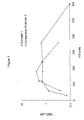
- Example 1 The compounds of Example 1 and Comparative example 3 (see Biology Example 1 above) were administered p.o. by gavage to cynomolgus monkeys.
- the solutions comprised:
- Plasma samples were taken at 30 min, 1, 2, 3, 4, 6, 10 and 24 hours. Plasma was separated by centrifugation at 2500 rpm and the samples were inactivated at 54°C for 20 minutes before being frozen pending analysis. Plasma H2G levels were monitored by the HPLC/UV assay of Example 30 above.
- Figure I depicts the plasma H2G recovery as a function of time. Although it is not possible to draw statistically significant conclusions from single animal trials, it appears that the animal receiving the compound of the invention experienced a somewhat more rapid and somewhat greater exposure to H2G than the animal which received an alternative prodrug of H2G.
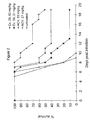
- Herpes simplex virus-1 (HSV-1)- infected mouse serves as an animal model to determine the efficacy of antiviral agents in vivo.
- Mice inoculated intraperitoneally with HSV-1 at 1000 times the LD 50 were administered either with a formulation comprising the currently marketed anti-herpes agent acyclovir (21 and 83 mg/kg in a 2% propylene glycol in sterile water vehicle, three times daily, p.o.) or the compound of Example 29 (21 and 83 mg/kg in a 2% propylene glycol in sterile water vehicle, three times daily, p.o.) for 5 consecutive days beginning 5 hours after inoculation. The animals were assessed daily for deaths.
- FIG. 2 charts the survival rate against time.
- the compound of the invention is denoted Ex.29 and acyclovir is denoted ACV.
- the percentage of mice surviving the HSV-1 infection was significantly greater following a given dose of the compound of the invention relative to an equivalent dose of acyclovir.
Landscapes
- Chemical & Material Sciences (AREA)
- Organic Chemistry (AREA)
- Health & Medical Sciences (AREA)
- Life Sciences & Earth Sciences (AREA)
- Virology (AREA)
- Animal Behavior & Ethology (AREA)
- Public Health (AREA)
- Chemical Kinetics & Catalysis (AREA)
- General Chemical & Material Sciences (AREA)
- Medicinal Chemistry (AREA)
- Nuclear Medicine, Radiotherapy & Molecular Imaging (AREA)
- Pharmacology & Pharmacy (AREA)
- Communicable Diseases (AREA)
- General Health & Medical Sciences (AREA)
- Oncology (AREA)
- Veterinary Medicine (AREA)
- Molecular Biology (AREA)
- AIDS & HIV (AREA)
- Tropical Medicine & Parasitology (AREA)
- Engineering & Computer Science (AREA)
- Biotechnology (AREA)
- Pharmaceuticals Containing Other Organic And Inorganic Compounds (AREA)
- Saccharide Compounds (AREA)
- Acyclic And Carbocyclic Compounds In Medicinal Compositions (AREA)
- Medicines That Contain Protein Lipid Enzymes And Other Medicines (AREA)
Priority Applications (1)
| Application Number | Priority Date | Filing Date | Title |
|---|---|---|---|
| SI9730476T SI0888348T1 (en) | 1996-02-16 | 1997-02-14 | Acyclic nucleoside derivatives |
Applications Claiming Priority (5)
| Application Number | Priority Date | Filing Date | Title |
|---|---|---|---|
| SE9600613 | 1996-02-16 | ||
| SE9600613A SE9600613D0 (sv) | 1996-02-16 | 1996-02-16 | Acyclic nucleoside derivatives |
| SE9600614 | 1996-02-16 | ||
| SE9600614A SE9600614D0 (sv) | 1996-02-16 | 1996-02-16 | Antiviral compounds |
| PCT/SE1997/000241 WO1997030051A1 (en) | 1996-02-16 | 1997-02-14 | Acyclic nucleoside derivatives |
Publications (2)
| Publication Number | Publication Date |
|---|---|
| EP0888348A1 EP0888348A1 (en) | 1999-01-07 |
| EP0888348B1 true EP0888348B1 (en) | 2003-01-22 |
Family
ID=26662518
Family Applications (2)
| Application Number | Title | Priority Date | Filing Date |
|---|---|---|---|
| EP97903708A Expired - Lifetime EP0888348B1 (en) | 1996-02-16 | 1997-02-14 | Acyclic nucleoside derivatives |
| EP97903709A Expired - Lifetime EP0880521B1 (en) | 1996-02-16 | 1997-02-14 | Synthesis of acyclic nucleosides |
Family Applications After (1)
| Application Number | Title | Priority Date | Filing Date |
|---|---|---|---|
| EP97903709A Expired - Lifetime EP0880521B1 (en) | 1996-02-16 | 1997-02-14 | Synthesis of acyclic nucleosides |
Country Status (25)
| Country | Link |
|---|---|
| US (5) | US5869493A (2) |
| EP (2) | EP0888348B1 (2) |
| JP (2) | JP2000504721A (2) |
| KR (1) | KR100464692B1 (2) |
| CN (1) | CN1067073C (2) |
| AR (1) | AR005827A1 (2) |
| AT (2) | ATE231507T1 (2) |
| AU (1) | AU715062B2 (2) |
| BG (1) | BG64179B1 (2) |
| CA (1) | CA2243826C (2) |
| CZ (1) | CZ292169B6 (2) |
| DE (2) | DE69718619T2 (2) |
| DK (1) | DK0888348T3 (2) |
| EA (2) | EA001404B1 (2) |
| ES (2) | ES2189942T3 (2) |
| HU (1) | HU229865B1 (2) |
| IL (1) | IL124760A (2) |
| MY (1) | MY123083A (2) |
| NO (1) | NO322930B1 (2) |
| NZ (1) | NZ330472A (2) |
| PL (1) | PL184892B1 (2) |
| SK (1) | SK284613B6 (2) |
| TR (1) | TR199801318T2 (2) |
| TW (1) | TW533213B (2) |
| WO (2) | WO1997030052A1 (2) |
Families Citing this family (19)
| Publication number | Priority date | Publication date | Assignee | Title |
|---|---|---|---|---|
| US6458772B1 (en) | 1909-10-07 | 2002-10-01 | Medivir Ab | Prodrugs |
| US5869493A (en) * | 1996-02-16 | 1999-02-09 | Medivir Ab | Acyclic nucleoside derivatives |
| US6703394B2 (en) | 1996-02-16 | 2004-03-09 | Medivir Ab | Acyclic nucleoside derivatives |
| JP2001503767A (ja) * | 1996-11-12 | 2001-03-21 | メディヴィル・アクチボラグ | ヌクレオシド |
| US6184376B1 (en) * | 1997-02-10 | 2001-02-06 | Mediver Ab | Synthesis of acyclic nucleoside derivatives |
| CA2572577C (en) * | 1997-02-10 | 2011-04-05 | Medivir Ab | Synthesis of acyclic nucleoside derivatives |
| DE69829784T2 (de) * | 1997-08-15 | 2006-02-16 | Medivir Ab | 3'-Fluorierte Guanosinderivate zur Behandlung oder Prophylaxe von HBV- oder retroviralen Infektionen |
| WO1999032490A1 (en) * | 1997-12-19 | 1999-07-01 | Bristol-Myers Squibb Company | Prodrugs of lobucavir and methods of use |
| TW200510415A (en) * | 2003-04-30 | 2005-03-16 | Teva Pharma | Process for the preparation of famciclovir |
| EP1835916B1 (en) | 2004-12-30 | 2009-04-01 | Medivir Ab | Compounds useful in the treatment of hiv |
| US20080233053A1 (en) * | 2005-02-07 | 2008-09-25 | Pharmalight Inc. | Method and Device for Ophthalmic Administration of Active Pharmaceutical Ingredients |
| CN101033238B (zh) * | 2006-03-06 | 2011-02-16 | 中国科学院上海药物研究所 | 嘌呤类化合物双氨基酸酯的制备方法和用途 |
| ZA200702234B (en) * | 2006-03-21 | 2008-07-30 | Cipla Ltd | Preparation of ester of purine derivatives |
| US9296776B2 (en) | 2007-07-09 | 2016-03-29 | Eastern Virginia Medical School | Substituted nucleoside derivatives with antiviral and antimicrobial properties |
| MX2010003056A (es) | 2007-09-21 | 2010-04-07 | Epiphany Biosciences Inc | Polimorfos de valomaciclovir. |
| WO2011022712A1 (en) * | 2009-08-21 | 2011-02-24 | Epiphany Biosciences, Inc. | Method of treating infectious mononucleosis with acylic nucleoside derivatives |
| ES2667425T3 (es) | 2011-06-10 | 2018-05-10 | Oregon Health & Science University | Glucoproteínas y vectores recombinantes de CMV |
| KR101763127B1 (ko) | 2015-06-23 | 2017-08-01 | (주)농협아그로 | 끈끈이 엠보싱 트랩 테이프 |
| US20260191871A1 (en) * | 2022-11-28 | 2026-07-09 | Epiphany Biosciences | Use of antiviral agents, composition of matter, combination preparations/agents to treat chronic diseases associated with epstein-barr virus and other human herpes viruses |
Family Cites Families (43)
| Publication number | Priority date | Publication date | Assignee | Title |
|---|---|---|---|---|
| US3116282A (en) | 1960-04-27 | 1963-12-31 | Upjohn Co | Pyrimidine nucleosides and process |
| FR2040177A1 (en) | 1969-01-31 | 1971-01-22 | Robugen Gmbh | 2-deoxyribosyl-uracil derivs |
| US3817982A (en) | 1971-12-29 | 1974-06-18 | Syntex Inc | 2{40 ,3{40 -unsaturated nucleosides and method of making |
| US4267171A (en) | 1979-07-02 | 1981-05-12 | The Regents Of The University Of California | C-5 Substituted cytosine nucleosides |
| US4247544A (en) | 1979-07-02 | 1981-01-27 | The Regents Of The University Of California | C-5 Substituted uracil nucleosides |
| JPS57146798A (en) | 1981-03-06 | 1982-09-10 | Yamasa Shoyu Co Ltd | Hexosyl nucleoside derivative |
| NL8202626A (nl) * | 1982-06-29 | 1984-01-16 | Stichting Rega V Z W | Derivaten van 9-(2-hydroxyethoxymethyl)guanine. |
| IL73682A (en) * | 1983-12-20 | 1991-08-16 | Medivir Ab | Antiviral pharmaceutical compositions containing 9-hydroxy aliphatic derivatives of guanine,some new such derivatives and process for their preparation |
| SE8406538D0 (sv) * | 1984-12-21 | 1984-12-21 | Astra Laekemedel Ab | Novel derivatives of purine |
| US4724232A (en) | 1985-03-16 | 1988-02-09 | Burroughs Wellcome Co. | Treatment of human viral infections |
| EP0286825A3 (en) | 1987-03-18 | 1989-04-12 | Max-Planck-Gesellschaft zur Förderung der Wissenschaften e.V. | Use of 3'-fluro-3' deoxythymidine for the manufacture of a medicament for the treatment of virus infections |
| SE8701605D0 (sv) | 1987-04-16 | 1987-04-16 | Astra Ab | Novel medicinal compounds |
| AP160A (en) * | 1987-08-15 | 1991-11-18 | The Wellcome Foundation Ltd | Therapeutic acyclic nucleosides. |
| EP0339075B1 (en) * | 1987-10-28 | 1993-08-18 | Pro-Neuron, Inc. | Acylated uridine and cytidine and uses thereof |
| SE8704298D0 (sv) | 1987-11-03 | 1987-11-03 | Astra Ab | Compounds for use in therapy |
| US5284837A (en) | 1988-05-06 | 1994-02-08 | Medivir Ab | Derivatives of purine, process for their preparation and a pharmaceutical preparation |
| SE8801729D0 (sv) * | 1988-05-06 | 1988-05-06 | Astra Ab | Purine derivatives for use in therapy |
| US5216141A (en) | 1988-06-06 | 1993-06-01 | Benner Steven A | Oligonucleotide analogs containing sulfur linkages |
| SE8802173D0 (sv) | 1988-06-10 | 1988-06-10 | Astra Ab | Pyrimidine derivatives |
| US5043339A (en) * | 1988-12-19 | 1991-08-27 | Burroughs Wellcome Co. | Antiviral compounds |
| FI95384C (fi) | 1989-04-06 | 1996-01-25 | Squibb Bristol Myers Co | Menetelmä 3'-deoksi-3'-substituoitujen metyylinukleosidien valmistamiseksi ja menetelmässä käytettäviä välituotteita |
| US5216142A (en) * | 1989-04-17 | 1993-06-01 | Efamol Holdings Plc | Anti-virals |
| US5674869A (en) * | 1990-07-07 | 1997-10-07 | Beecham Group Plc | Pharmaceutical treatment |
| SE9003151D0 (sv) | 1990-10-02 | 1990-10-02 | Medivir Ab | Nucleoside derivatives |
| GB2260319B (en) * | 1991-10-07 | 1995-12-06 | Norsk Hydro As | Acyl derivatives of nucleosides and nucleoside analogues having anti-viral activity |
| US5874578A (en) | 1992-07-13 | 1999-02-23 | Bristol-Myers Squibb | Process for preparing guanine-containing antiviral agents and purinyl salts useful in such process |
| GB9307043D0 (en) * | 1993-04-05 | 1993-05-26 | Norsk Hydro As | Chemical compounds |
| DE4311801A1 (de) * | 1993-04-09 | 1994-10-13 | Hoechst Ag | Neue Carbonsäureester von 2-Amino-7-(1,3-dihydroxy-2-propoxymethyl)purin, deren Herstellung sowie deren Verwendung |
| GB9320316D0 (en) * | 1993-10-01 | 1993-11-17 | Smithkline Beecham Plc | Pharmaceuticals |
| TW282470B (2) * | 1993-11-18 | 1996-08-01 | Ajinomoto Kk | |
| US5521161A (en) | 1993-12-20 | 1996-05-28 | Compagnie De Developpment Aguettant S.A. | Method of treating HIV in humans by administration of ddI and hydroxycarbamide |
| WO1995022330A1 (en) * | 1994-02-17 | 1995-08-24 | Commonwealth Scientific And Industrial Research Organisation | Antiviral agents |
| US5543414A (en) * | 1994-07-28 | 1996-08-06 | Syntex (Usa) Inc. | Achiral amino acid acyl esters of ganciclovir and its derivatives |
| PE32296A1 (es) * | 1994-07-28 | 1996-08-07 | Hoffmann La Roche | Ester de l-monovalina derivado de 2-(2-amino-1,6-dihidro-6-oxo-purin-9-il) metoxi-1,3-propandiol y sus sales farmaceuticamente aceptables |
| JP3906488B2 (ja) | 1995-02-21 | 2007-04-18 | 味の素株式会社 | プリン誘導体の製造方法 |
| US5700936A (en) * | 1996-01-26 | 1997-12-23 | Syntex (U.S.A.) Inc. | Process for preparing a 2-(2-amino-1,6-dihydro-6-oxo-purin-9-yl) methoxy-1,3-propanediol valinate |
| US5840890A (en) * | 1996-01-26 | 1998-11-24 | Syntex (U.S.A.) Inc. | Process for preparing a 2-(2-amino-1,6-dihydro-6-oxo-purin-9-yl)methoxy-1,3-propanediol derivative |
| US5756736A (en) * | 1996-01-26 | 1998-05-26 | Syntex (U.S.A.) Inc. | Process for preparing a 2-(2-amino-1,6-dihydro-6-oxo-purin-9-yl)methoxy-1,3-propanediol derivative |
| CN1064683C (zh) * | 1996-01-26 | 2001-04-18 | 弗·哈夫曼-拉罗切有限公司 | 制备嘌呤衍生物的方法 |
| AU1592897A (en) * | 1996-01-26 | 1997-08-20 | F. Hoffmann-La Roche Ag | Process for preparing purine derivatives |
| US5869493A (en) | 1996-02-16 | 1999-02-09 | Medivir Ab | Acyclic nucleoside derivatives |
| US6703394B2 (en) * | 1996-02-16 | 2004-03-09 | Medivir Ab | Acyclic nucleoside derivatives |
| EP0827960A1 (en) | 1996-09-10 | 1998-03-11 | Ajinomoto Co., Inc. | Process for producing purine derivatives |
-
1997
- 1997-02-10 US US08/798,216 patent/US5869493A/en not_active Expired - Lifetime
- 1997-02-14 ES ES97903709T patent/ES2189942T3/es not_active Expired - Lifetime
- 1997-02-14 TR TR1998/01318T patent/TR199801318T2/xx unknown
- 1997-02-14 AU AU18182/97A patent/AU715062B2/en not_active Ceased
- 1997-02-14 EP EP97903708A patent/EP0888348B1/en not_active Expired - Lifetime
- 1997-02-14 HU HU9900680A patent/HU229865B1/hu not_active IP Right Cessation
- 1997-02-14 EA EA199800729A patent/EA001404B1/ru not_active IP Right Cessation
- 1997-02-14 SK SK985-98A patent/SK284613B6/sk not_active IP Right Cessation
- 1997-02-14 KR KR10-1998-0706309A patent/KR100464692B1/ko not_active Expired - Fee Related
- 1997-02-14 CA CA002243826A patent/CA2243826C/en not_active Expired - Fee Related
- 1997-02-14 JP JP9529280A patent/JP2000504721A/ja not_active Ceased
- 1997-02-14 EA EA200000787A patent/EA002809B1/ru not_active IP Right Cessation
- 1997-02-14 DE DE69718619T patent/DE69718619T2/de not_active Expired - Lifetime
- 1997-02-14 AR ARP970100594A patent/AR005827A1/es active IP Right Grant
- 1997-02-14 MY MYPI97000553A patent/MY123083A/en unknown
- 1997-02-14 NZ NZ330472A patent/NZ330472A/en not_active IP Right Cessation
- 1997-02-14 DE DE69718626T patent/DE69718626T2/de not_active Expired - Lifetime
- 1997-02-14 WO PCT/SE1997/000242 patent/WO1997030052A1/en not_active Ceased
- 1997-02-14 WO PCT/SE1997/000241 patent/WO1997030051A1/en not_active Ceased
- 1997-02-14 CZ CZ19982322A patent/CZ292169B6/cs not_active IP Right Cessation
- 1997-02-14 CN CN97192183A patent/CN1067073C/zh not_active Expired - Fee Related
- 1997-02-14 AT AT97903709T patent/ATE231507T1/de not_active IP Right Cessation
- 1997-02-14 AT AT97903708T patent/ATE231508T1/de active
- 1997-02-14 JP JP52927997A patent/JP4171069B2/ja not_active Expired - Fee Related
- 1997-02-14 EP EP97903709A patent/EP0880521B1/en not_active Expired - Lifetime
- 1997-02-14 IL IL12476097A patent/IL124760A/xx not_active IP Right Cessation
- 1997-02-14 PL PL97328335A patent/PL184892B1/pl unknown
- 1997-02-14 ES ES97903708T patent/ES2189941T3/es not_active Expired - Lifetime
- 1997-02-14 TW TW086101758A patent/TW533213B/zh not_active IP Right Cessation
- 1997-02-14 DK DK97903708T patent/DK0888348T3/da active
-
1998
- 1998-07-13 NO NO19983216A patent/NO322930B1/no not_active IP Right Cessation
- 1998-07-22 BG BG102647A patent/BG64179B1/bg unknown
- 1998-09-03 US US09/146,194 patent/US6255312B1/en not_active Expired - Lifetime
-
2000
- 2000-04-17 US US09/550,554 patent/US6576763B1/en not_active Expired - Fee Related
-
2008
- 2008-10-03 US US12/245,553 patent/US8124609B2/en not_active Expired - Fee Related
-
2012
- 2012-01-20 US US13/355,231 patent/US20120123119A1/en not_active Abandoned
Also Published As
Similar Documents
| Publication | Publication Date | Title |
|---|---|---|
| US8124609B2 (en) | Acyclic nucleoside derivatives | |
| US6184376B1 (en) | Synthesis of acyclic nucleoside derivatives | |
| US6703394B2 (en) | Acyclic nucleoside derivatives | |
| CA2572577C (en) | Synthesis of acyclic nucleoside derivatives | |
| AU713916C (en) | Synthesis of acyclic nucleosides | |
| CA2238516C (en) | Acyclic nucleoside derivatives | |
| HK1015773B (en) | Acyclic nucleoside derivatives | |
| JP2009298785A (ja) | 非環状ヌクレオシド誘導体の合成 | |
| AU5354799A (en) | Substituted guanine compounds | |
| MXPA98006631A (en) | Synthesis of nucleosid acicli | |
| CA2723085A1 (en) | Synthesis of acyclic nucleoside derivatives | |
| MXPA99007340A (en) | Synthesis of acyclic nucleoside derivatives |
Legal Events
| Date | Code | Title | Description |
|---|---|---|---|
| PUAI | Public reference made under article 153(3) epc to a published international application that has entered the european phase |
Free format text: ORIGINAL CODE: 0009012 |
|
| 17P | Request for examination filed |
Effective date: 19980715 |
|
| AK | Designated contracting states |
Kind code of ref document: A1 Designated state(s): AT BE CH DE DK ES FI FR GB GR IE IT LI LU MC NL PT SE |
|
| AX | Request for extension of the european patent |
Free format text: LT PAYMENT 980715;LV PAYMENT 980715;RO PAYMENT 980715;SI PAYMENT 980715 |
|
| 17Q | First examination report despatched |
Effective date: 20011212 |
|
| GRAH | Despatch of communication of intention to grant a patent |
Free format text: ORIGINAL CODE: EPIDOS IGRA |
|
| GRAH | Despatch of communication of intention to grant a patent |
Free format text: ORIGINAL CODE: EPIDOS IGRA |
|
| GRAA | (expected) grant |
Free format text: ORIGINAL CODE: 0009210 |
|
| AK | Designated contracting states |
Kind code of ref document: B1 Designated state(s): AT BE CH DE DK ES FI FR GB GR IE IT LI LU MC NL PT SE |
|
| AX | Request for extension of the european patent |
Free format text: LT PAYMENT 19980715;LV PAYMENT 19980715;RO PAYMENT 19980715;SI PAYMENT 19980715 |
|
| REG | Reference to a national code |
Ref country code: GB Ref legal event code: FG4D |
|
| REG | Reference to a national code |
Ref country code: CH Ref legal event code: EP |
|
| REG | Reference to a national code |
Ref country code: IE Ref legal event code: FG4D |
|
| REF | Corresponds to: |
Ref document number: 69718626 Country of ref document: DE Date of ref document: 20030227 Kind code of ref document: P |
|
| PG25 | Lapsed in a contracting state [announced via postgrant information from national office to epo] |
Ref country code: MC Free format text: LAPSE BECAUSE OF NON-PAYMENT OF DUE FEES Effective date: 20030228 |
|
| REG | Reference to a national code |
Ref country code: CH Ref legal event code: NV Representative=s name: PA ALDO ROEMPLER |
|
| REG | Reference to a national code |
Ref country code: SE Ref legal event code: TRGR |
|
| REG | Reference to a national code |
Ref country code: DK Ref legal event code: T3 |
|
| REG | Reference to a national code |
Ref country code: GR Ref legal event code: EP Ref document number: 20030400837 Country of ref document: GR |
|
| REG | Reference to a national code |
Ref country code: ES Ref legal event code: FG2A Ref document number: 2189941 Country of ref document: ES Kind code of ref document: T3 |
|
| ET | Fr: translation filed | ||
| PLBE | No opposition filed within time limit |
Free format text: ORIGINAL CODE: 0009261 |
|
| STAA | Information on the status of an ep patent application or granted ep patent |
Free format text: STATUS: NO OPPOSITION FILED WITHIN TIME LIMIT |
|
| 26N | No opposition filed |
Effective date: 20031023 |
|
| REG | Reference to a national code |
Ref country code: SI Ref legal event code: IF |
|
| REG | Reference to a national code |
Ref country code: CH Ref legal event code: PCAR Free format text: ALDO ROEMPLER PATENTANWALT;BRENDENWEG 11 POSTFACH 154;9424 RHEINECK (CH) |
|
| PGFP | Annual fee paid to national office [announced via postgrant information from national office to epo] |
Ref country code: LU Payment date: 20140220 Year of fee payment: 18 |
|
| PGFP | Annual fee paid to national office [announced via postgrant information from national office to epo] |
Ref country code: CH Payment date: 20140214 Year of fee payment: 18 Ref country code: IE Payment date: 20140218 Year of fee payment: 18 Ref country code: FI Payment date: 20140218 Year of fee payment: 18 Ref country code: DK Payment date: 20140225 Year of fee payment: 18 Ref country code: DE Payment date: 20140220 Year of fee payment: 18 Ref country code: NL Payment date: 20140217 Year of fee payment: 18 Ref country code: SE Payment date: 20140224 Year of fee payment: 18 |
|
| PGFP | Annual fee paid to national office [announced via postgrant information from national office to epo] |
Ref country code: ES Payment date: 20140224 Year of fee payment: 18 Ref country code: IT Payment date: 20140224 Year of fee payment: 18 Ref country code: AT Payment date: 20140226 Year of fee payment: 18 Ref country code: FR Payment date: 20140228 Year of fee payment: 18 Ref country code: BE Payment date: 20140218 Year of fee payment: 18 Ref country code: GR Payment date: 20140226 Year of fee payment: 18 |
|
| PGFP | Annual fee paid to national office [announced via postgrant information from national office to epo] |
Ref country code: GB Payment date: 20140220 Year of fee payment: 18 Ref country code: PT Payment date: 20140127 Year of fee payment: 18 |
|
| PG25 | Lapsed in a contracting state [announced via postgrant information from national office to epo] |
Ref country code: BE Free format text: LAPSE BECAUSE OF NON-PAYMENT OF DUE FEES Effective date: 20150228 |
|
| REG | Reference to a national code |
Ref country code: PT Ref legal event code: MM4A Free format text: LAPSE DUE TO NON-PAYMENT OF FEES Effective date: 20150814 |
|
| REG | Reference to a national code |
Ref country code: DE Ref legal event code: R119 Ref document number: 69718626 Country of ref document: DE |
|
| REG | Reference to a national code |
Ref country code: NL Ref legal event code: V1 Effective date: 20150901 |
|
| REG | Reference to a national code |
Ref country code: DK Ref legal event code: EBP Effective date: 20150228 |
|
| REG | Reference to a national code |
Ref country code: LT Ref legal event code: MM9D Effective date: 20150214 |
|
| REG | Reference to a national code |
Ref country code: SE Ref legal event code: EUG |
|
| PG25 | Lapsed in a contracting state [announced via postgrant information from national office to epo] |
Ref country code: LU Free format text: LAPSE BECAUSE OF NON-PAYMENT OF DUE FEES Effective date: 20150214 Ref country code: NL Free format text: LAPSE BECAUSE OF NON-PAYMENT OF DUE FEES Effective date: 20150901 |
|
| REG | Reference to a national code |
Ref country code: CH Ref legal event code: PL |
|
| REG | Reference to a national code |
Ref country code: AT Ref legal event code: MM01 Ref document number: 231508 Country of ref document: AT Kind code of ref document: T Effective date: 20150214 |
|
| GBPC | Gb: european patent ceased through non-payment of renewal fee |
Effective date: 20150214 |
|
| PG25 | Lapsed in a contracting state [announced via postgrant information from national office to epo] |
Ref country code: PT Free format text: LAPSE BECAUSE OF NON-PAYMENT OF DUE FEES Effective date: 20150814 Ref country code: LI Free format text: LAPSE BECAUSE OF NON-PAYMENT OF DUE FEES Effective date: 20150228 Ref country code: FI Free format text: LAPSE BECAUSE OF NON-PAYMENT OF DUE FEES Effective date: 20150214 Ref country code: CH Free format text: LAPSE BECAUSE OF NON-PAYMENT OF DUE FEES Effective date: 20150228 |
|
| REG | Reference to a national code |
Ref country code: GR Ref legal event code: ML Ref document number: 20030400837 Country of ref document: GR Effective date: 20150902 |
|
| REG | Reference to a national code |
Ref country code: IE Ref legal event code: MM4A |
|
| REG | Reference to a national code |
Ref country code: FR Ref legal event code: ST Effective date: 20151030 |
|
| PG25 | Lapsed in a contracting state [announced via postgrant information from national office to epo] |
Ref country code: SE Free format text: LAPSE BECAUSE OF NON-PAYMENT OF DUE FEES Effective date: 20150215 Ref country code: AT Free format text: LAPSE BECAUSE OF NON-PAYMENT OF DUE FEES Effective date: 20150214 Ref country code: GR Free format text: LAPSE BECAUSE OF NON-PAYMENT OF DUE FEES Effective date: 20150902 |
|
| REG | Reference to a national code |
Ref country code: SI Ref legal event code: KO00 Effective date: 20151026 |
|
| PG25 | Lapsed in a contracting state [announced via postgrant information from national office to epo] |
Ref country code: IT Free format text: LAPSE BECAUSE OF NON-PAYMENT OF DUE FEES Effective date: 20150214 |
|
| PG25 | Lapsed in a contracting state [announced via postgrant information from national office to epo] |
Ref country code: DK Free format text: LAPSE BECAUSE OF NON-PAYMENT OF DUE FEES Effective date: 20150228 Ref country code: IE Free format text: LAPSE BECAUSE OF NON-PAYMENT OF DUE FEES Effective date: 20150214 Ref country code: DE Free format text: LAPSE BECAUSE OF NON-PAYMENT OF DUE FEES Effective date: 20150901 Ref country code: GB Free format text: LAPSE BECAUSE OF NON-PAYMENT OF DUE FEES Effective date: 20150214 |
|
| PG25 | Lapsed in a contracting state [announced via postgrant information from national office to epo] |
Ref country code: FR Free format text: LAPSE BECAUSE OF NON-PAYMENT OF DUE FEES Effective date: 20150302 |
|
| REG | Reference to a national code |
Ref country code: ES Ref legal event code: FD2A Effective date: 20160329 |
|
| PG25 | Lapsed in a contracting state [announced via postgrant information from national office to epo] |
Ref country code: ES Free format text: LAPSE BECAUSE OF NON-PAYMENT OF DUE FEES Effective date: 20150215 |