EP0872441B1 - Rubber-based paper feed rollers - Google Patents
Rubber-based paper feed rollers Download PDFInfo
- Publication number
- EP0872441B1 EP0872441B1 EP19980302830 EP98302830A EP0872441B1 EP 0872441 B1 EP0872441 B1 EP 0872441B1 EP 19980302830 EP19980302830 EP 19980302830 EP 98302830 A EP98302830 A EP 98302830A EP 0872441 B1 EP0872441 B1 EP 0872441B1
- Authority
- EP
- European Patent Office
- Prior art keywords
- rollers
- paper
- rubber
- roller
- sheet
- Prior art date
- Legal status (The legal status is an assumption and is not a legal conclusion. Google has not performed a legal analysis and makes no representation as to the accuracy of the status listed.)
- Expired - Lifetime
Links
Images



Classifications
-
- C—CHEMISTRY; METALLURGY
- C08—ORGANIC MACROMOLECULAR COMPOUNDS; THEIR PREPARATION OR CHEMICAL WORKING-UP; COMPOSITIONS BASED THEREON
- C08L—COMPOSITIONS OF MACROMOLECULAR COMPOUNDS
- C08L7/00—Compositions of natural rubber
-
- B—PERFORMING OPERATIONS; TRANSPORTING
- B65—CONVEYING; PACKING; STORING; HANDLING THIN OR FILAMENTARY MATERIAL
- B65H—HANDLING THIN OR FILAMENTARY MATERIAL, e.g. SHEETS, WEBS, CABLES
- B65H27/00—Special constructions, e.g. surface features, of feed or guide rollers for webs
-
- B—PERFORMING OPERATIONS; TRANSPORTING
- B65—CONVEYING; PACKING; STORING; HANDLING THIN OR FILAMENTARY MATERIAL
- B65H—HANDLING THIN OR FILAMENTARY MATERIAL, e.g. SHEETS, WEBS, CABLES
- B65H3/00—Separating articles from piles
- B65H3/02—Separating articles from piles using friction forces between articles and separator
- B65H3/06—Rollers or like rotary separators
-
- C—CHEMISTRY; METALLURGY
- C08—ORGANIC MACROMOLECULAR COMPOUNDS; THEIR PREPARATION OR CHEMICAL WORKING-UP; COMPOSITIONS BASED THEREON
- C08K—Use of inorganic or non-macromolecular organic substances as compounding ingredients
- C08K5/00—Use of organic ingredients
- C08K5/0008—Organic ingredients according to more than one of the "one dot" groups of C08K5/01 - C08K5/59
- C08K5/005—Stabilisers against oxidation, heat, light, ozone
-
- C—CHEMISTRY; METALLURGY
- C08—ORGANIC MACROMOLECULAR COMPOUNDS; THEIR PREPARATION OR CHEMICAL WORKING-UP; COMPOSITIONS BASED THEREON
- C08L—COMPOSITIONS OF MACROMOLECULAR COMPOUNDS
- C08L23/00—Compositions of homopolymers or copolymers of unsaturated aliphatic hydrocarbons having only one carbon-to-carbon double bond; Compositions of derivatives of such polymers
- C08L23/02—Compositions of homopolymers or copolymers of unsaturated aliphatic hydrocarbons having only one carbon-to-carbon double bond; Compositions of derivatives of such polymers not modified by chemical after-treatment
- C08L23/16—Ethylene-propylene or ethylene-propylene-diene copolymers
-
- B—PERFORMING OPERATIONS; TRANSPORTING
- B65—CONVEYING; PACKING; STORING; HANDLING THIN OR FILAMENTARY MATERIAL
- B65H—HANDLING THIN OR FILAMENTARY MATERIAL, e.g. SHEETS, WEBS, CABLES
- B65H2404/00—Parts for transporting or guiding the handled material
- B65H2404/10—Rollers
- B65H2404/13—Details of longitudinal profile
- B65H2404/134—Axle
- B65H2404/1341—Elastic mounting, i.e. subject to biasing means
-
- Y—GENERAL TAGGING OF NEW TECHNOLOGICAL DEVELOPMENTS; GENERAL TAGGING OF CROSS-SECTIONAL TECHNOLOGIES SPANNING OVER SEVERAL SECTIONS OF THE IPC; TECHNICAL SUBJECTS COVERED BY FORMER USPC CROSS-REFERENCE ART COLLECTIONS [XRACs] AND DIGESTS
- Y10—TECHNICAL SUBJECTS COVERED BY FORMER USPC
- Y10T—TECHNICAL SUBJECTS COVERED BY FORMER US CLASSIFICATION
- Y10T428/00—Stock material or miscellaneous articles
- Y10T428/24—Structurally defined web or sheet [e.g., overall dimension, etc.]
- Y10T428/24273—Structurally defined web or sheet [e.g., overall dimension, etc.] including aperture
-
- Y—GENERAL TAGGING OF NEW TECHNOLOGICAL DEVELOPMENTS; GENERAL TAGGING OF CROSS-SECTIONAL TECHNOLOGIES SPANNING OVER SEVERAL SECTIONS OF THE IPC; TECHNICAL SUBJECTS COVERED BY FORMER USPC CROSS-REFERENCE ART COLLECTIONS [XRACs] AND DIGESTS
- Y10—TECHNICAL SUBJECTS COVERED BY FORMER USPC
- Y10T—TECHNICAL SUBJECTS COVERED BY FORMER US CLASSIFICATION
- Y10T428/00—Stock material or miscellaneous articles
- Y10T428/24—Structurally defined web or sheet [e.g., overall dimension, etc.]
- Y10T428/24355—Continuous and nonuniform or irregular surface on layer or component [e.g., roofing, etc.]
-
- Y—GENERAL TAGGING OF NEW TECHNOLOGICAL DEVELOPMENTS; GENERAL TAGGING OF CROSS-SECTIONAL TECHNOLOGIES SPANNING OVER SEVERAL SECTIONS OF THE IPC; TECHNICAL SUBJECTS COVERED BY FORMER USPC CROSS-REFERENCE ART COLLECTIONS [XRACs] AND DIGESTS
- Y10—TECHNICAL SUBJECTS COVERED BY FORMER USPC
- Y10T—TECHNICAL SUBJECTS COVERED BY FORMER US CLASSIFICATION
- Y10T428/00—Stock material or miscellaneous articles
- Y10T428/31504—Composite [nonstructural laminate]
- Y10T428/31826—Of natural rubber
-
- Y—GENERAL TAGGING OF NEW TECHNOLOGICAL DEVELOPMENTS; GENERAL TAGGING OF CROSS-SECTIONAL TECHNOLOGIES SPANNING OVER SEVERAL SECTIONS OF THE IPC; TECHNICAL SUBJECTS COVERED BY FORMER USPC CROSS-REFERENCE ART COLLECTIONS [XRACs] AND DIGESTS
- Y10—TECHNICAL SUBJECTS COVERED BY FORMER USPC
- Y10T—TECHNICAL SUBJECTS COVERED BY FORMER US CLASSIFICATION
- Y10T428/00—Stock material or miscellaneous articles
- Y10T428/31504—Composite [nonstructural laminate]
- Y10T428/31826—Of natural rubber
- Y10T428/31833—Next to aldehyde or ketone condensation product or addition polymer from unsaturated monomers
- Y10T428/31837—Including polyene monomers
Definitions
- the present invention relates to rollers used for feeding individual sheets of paper into, for example, printing or duplicating devices.
- a typical printing or duplicating (e.g., photocopying) device individual sheets of blank paper are fed from a paper stack (e.g., a paper supply tray) into the area in which the printing or duplicating takes place.
- a paper stack e.g., a paper supply tray
- a pick roller to accomplish that function.
- the pick roller and the paper stack are not spring loaded against one another.
- the pick roll is mounted on a rotating swing arm. The roll rests on the paper stack.
- a torque is applied to the swing arm through the downstream gear train which rotates the swing arm and pick roll into the paper stack.
- the normal force generated is dictated by the buckling resistance of the media being picked. In theory, the normal force generated is no more than is required to buckle a single sheet of media plus the friction resistance between the first and second sheets. As soon as the sheet has moved, the normal force automatically relaxes.
- the materials used to make the pick (feed) rollers must satisfy a long list of stringent and sometimes inconsistent performance criteria.
- the elastomer used must meet the following requirements:
- EP-A 0446382 discloses vulcanised rubber compositions comprising an ethylene-propylene-diene rubber and a conjugated diene rubber, suitable for use in various fields such as tires, automobile parts, general engineering parts and civil engineering building materials.
- the present invention encompasses paper moving rollers made from a rubber composition
- a rubber composition comprising: (a) isoprene rubber, (b) at least one ozone-resistant rubber, wherein the ratio by weight of (a):(b) is from about 75:25 to about 65:35, and (c) an effective amount of a rubber curing system substantially soluble in the mixture of (a) and (b).
- Preferred rubber compositions additionally contain an effective amount of a mild antioxidant, such as a phenolic antioxidant.
- the preferred ozone-resistant rubber is ethylene-propylene-diene-monomer (EPDM).
- EPDM ethylene-propylene-diene-monomer
- at least a portion of the surface of the roller is ground such that it has a surface roughness of between about 6 and about 12 microns.
- the invention also encompasses a process for moving paper, such as in a printing or duplicating device, comprising the steps of:
- the present invention relates to rollers for moving paper (also known as pick rollers), for example in printing or duplicating devices, out of a paper feed tray and into a processing area (e.g., where printing takes place).
- the rollers which are described in the present application, are especially useful in autocompensating feeders where the normal force of the feeder roll on the paper supply tray is relatively low (about 20 grams).
- These rollers are made from a specifically-defined rubber composition which includes three required components: (1) isoprene rubber, (2) at least one ozone-resistant rubber, and (3) a rubber curing system.
- the rubber composition as formulated, has a relatively high coefficient of friction (i.e., the tangential force provided by the roller surface divided by the normal force of the roller surface on the surface of the paper) of at least about 1.7, and as high as about 2.
- the rubber composition is also relatively soft, having a hardness of about 40 Shore A durometer.
- the isoprene rubber component provides the rubber composition used in the present invention with very high friction levels.
- the isoprene component may include natural isoprene rubbers, as well as synthetic isoprene rubbers.
- other high friction rubbers which can be used in the present invention include ethylene-propylene-diene monomer (EPDM) rubbers and epichlorohydrin terpolymer rubbers (e.g., HydrinTM commercially available from Zeon Chemical).
- EPDM ethylene-propylene-diene monomer
- epichlorohydrin terpolymer rubbers e.g., HydrinTM commercially available from Zeon Chemical
- the isoprenes provide the best results.
- the rubbers utilized must not only have high friction characteristics and be relatively soft, but must also, when formulated in the composition, satisfy the range of other characteristics set forth previously in the present application. Examples of specific materials which may be used as the isoprene rubber component include the NatsynTM polyisoprene rubber series, commercial
- the rubber composition of the present invention must also include at least one ozone-resistant rubber. These materials are inherently immune to attack by atmospheric ozone and oxygen.
- the ozone-resistant rubbers may be used singly in the present invention or mixtures of such materials may be used. The use of such materials in the compositions prevents the pick rollers of the present invention from degrading over time.
- Materials which are useful as the ozone resistant rubber include neoprene, ethylene-propylene-diene-monomer (EPDM) rubber, chlorosulfonated polyethylene rubber, and mixtures thereof. EPDM rubber is particularly preferred since it is chemically compatible (i.e., it is non-polar) with the isoprene rubber.
- the EPDM used should have a low molecular weight so it will match the viscosity of the isoprene (and, hence, blend well with it) and it should be fast-curing so it will co-cure with the isoprene.
- ozone resistance may be obtained by adding certain powder anti-ozonants, such as WingstayTM 300 (Goodyear), to the isoprene rubber, the use of EPDM is preferable since (a) EPDM is more effective in retarding ozonation, and (b) the best anti-ozonant powders tend to stain.
- ozone-resistant rubbers utilized in the present invention include the commercial EPDM rubber series RoyaleneTM (Uniroyal), EPsynTM (Copolymer Rubber), and NordelTM (DuPont), as well as the neoprene rubber series NeopreneTM (DuPont) and the chlorosulfonated polyethylene rubber series HypalonTM (DuPont).
- the isoprene and ozone-resistant rubbers are combined in the compositions of the present invention within a very narrow weight range.
- the intent is to minimize the amount of ozone-resistant rubber in the composition since its presence could potentially lower the high friction coefficient imparted by the isoprene.
- the ratio, by weight, of isoprene to ozone-resistant rubber is from about 75:25 to about 65:35, and is preferably about 70:30.
- the final component in the rubber compositions of the present invention is a rubber curing system which is effective to cure the isoprene and ozone-resistant components of the composition.
- the curing system must be substantially soluble in the rubber mixture.
- substantially soluble means there is no appreciable migration of the curing ingredients out of the rubber. If the curing system is not substantially soluble, materials (such as sulfur) may bleed out of the composition to the roller surface. This will lower the friction coefficient of the rubber. Also, if those materials come into contact with components of the printer or duplicating device, they can corrode the electronics of those devices.
- Examples of curing systems which may be used in the compositions of the present invention include zinc oxide, stearic acid, zinc-2-ethylhexanoate, tetrabutylthiuram disulfide, tetramethylthiuram disulfide, sulfur, N-oxydiethylene henzothiazyl-2-sulfenamid, diphenylguanidine, dicumyl peroxide, benzoyl peroxide, and mixtures thereof.
- the rubber curing system is used in the compositions of the present invention in an effective amount (i.e., an amount effective to cure the particular rubber composition formulated). The precise amount will vary from composition to composition based on the particular components included, but is easily determined by one skilled in the art. Preferably, the compositions contain from about 0.5% to about 15% of the rubber curing system.
- the rubber compositions utilized in the present invention may optionally include a mild antioxidant.
- a mild antioxidant is included in an effective amount (i.e., an amount effective to provide the antioxidant benefit to the rubber composition) and preferably are included in the present invention at from about 0.5% to about 5% of the composition.
- useful mild antioxidants include hindered phenols, hindered bisphenols, hydroquinolines, and mixtures thereof, with hindered phenol antioxidants being particularly preferred since they are non-blooming and non-staining.
- Examples of such materials include the WingstayTM series of materials, commercially available from Goodyear, as well as the AgeriteTM series, commercially available from R.T. Vanderbilt.
- ком ⁇ онент conventionally used in rubber compositions such as those used for pick rollers, may be included at their conventional and art-established levels for their conventional purposes.
- examples of such components include white fillers (such as clay, silica, calcium carbonate), carbon black (in small amounts, since this material in large amounts may cause marking) and oils (paraffinic or naphthenic).
- the paper moving rollers of the present invention are made by blending the components of the rubber composition as is well known in the art.
- the rubber composition is then molded and cured to form the rollers.
- Each roller may be molded individually or a continuous hose may be molded from the rubber composition with the rollers cut off from the hose at their desired width.
- the cure time and cure temperatures utilized are defined by the particular rubbers and curing system used in the composition. However, a curing temperature about 320°F (about 160°C) with a curing time of about 15 minutes is fairly typical.
- the paper moving rollers of the present invention should preferably have surface roughness to help grab each individual sheet of paper from the feed stack. This may be accomplished by molding the roller to have treads. However, a preferred mode of imparting surface, roughness is by grinding at least a portion of the surface of the roller. Preferred rollers of the present invention are those where the entire outer surface of the roll is ground. This grinding is accomplished using a grinding wheel or a grinding belt. The fineness of the grit on the wheel or belt, the revolution speed of the wheel or belt, and the force and time of the wheel or belt on the roller surface will determine the extent of roughness imparted to the roller surface.
- Preferred rollers of the present invention have a surface roughness of from about 6 to about 12 microns (average peak to valley on the roller surface measured parallel to the roller axis). This roughness can be measured using a surface analyzer. It is preferred that the roller be ground such that, in use, it turns against the grain of the grind (i.e., the roller pushes the paper in the same direction as the roller turned against the grind wheel or belt).
- a sheet of paper is contacted with one or more of the paper moving rollers described above.
- This paper could be the top sheet of a plurality of sheets contained in a paper feed tray of a printer or duplicating device.
- the paper moving roller or rollers are biased toward the paper with a relatively low normal force, such as from about 15 to about 25 grams, preferably about 20 grams.
- the rollers are caused to rotate (for example, by a motor or other drive device); each roller rotates preferably in the same direction and preferably at approximately the same speed. Since the rollers are in contact with the paper, through frictional forces they cause the sheet of paper to move in the direction of the rollers' rotation.
- the rollers then come into contact with the next sheet of paper in the paper feed tray.
- the feed device which incorporates the rollers of the present invention is an autocompensating feeder such as that described in U.S. Patent 5,527,026, Padget, et al., issued June 18, 1996.
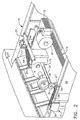
- FIG. 1 An example of such an autocompensating feeder is shown in the attached drawings.
- a tray (10) used in a printer (11).
- the tray (10) supports a plurality of sheets (12) of a media such as bond paper, for example, in a stack (14).
- the sheets (12) may be other media, such as labels or envelopes, for example.
- the tray (10) has a bottom surface or wall (15) supporting the stack (14) of the sheets (12) therein.
- the tray (10) has a rear restraint (15') abutting a trailing edge of each of the sheets (12) of the stack (14).
- Adjacent to its front end (16), the tray (10) has an inclined surface or wall (17) integral with the bottom surface (15) of the tray (10).
- the surface (17) is inclined at an obtuse angle to the bottom surface (15) of the tray (10) and to the adjacent end of the stack (14) of the sheets (12).
- the inclined or angled surface (17) constitutes a portion of a dam against which each of the sheets (12) in the stack (14) is advanced into engagement.
- the dam also includes a vertical surface (17') above the inclined surface (17).
- the sheets (12) are advanced from the vertical surface (17') toward a processing station of the printer (11) at which the printing occurs.
- Each of the sheets (12) is advanced from the stack (14) by a pair of feed rollers (18), which are rotatably mounted on a pivotally mounted arm (19). These feed rollers are preferably those described in the present application.
- the feed rollers (18) are driven from a motor (20) through a gear drive train (21).
- the motor (20) is alternately turned off and on by control means (not shown) as each of the sheets (12) is advanced from the top of the stack (14).
- the motor (20) (see Fig. 3) is supported on a bracket (22) by screws (23) (one shown).
- the bracket (22) is fixed to a sheet metal portion (24) of the printer (11).
- Self-tapping screws (25) extend upwardly through clearance holes (26) in the bracket (22) into extruded holes (not shown) in the sheet metal portion (24) of the printer (11).
- the pivotally mounted arm (19) has a sleeve (30) fixed thereto.
- the sleeve (30) is rotatably supported by a pair of substantially parallel vertical walls (31 and 32) of the bracket (22) through a pivot shaft (33) extending through the walls (31 and 32) and being rotatably supported thereby.
- a bell crank (34) (see Fig. 5) is mounted on one end of the pivot shaft (33) and fixed thereto.
- the bell crank (34) has a spring connector (35) fixed thereto and to which one end of a spring (36) is secured.
- the spring (36) has its other end connected to a post (37) (see Fig. 1) extending from a side frame (38) of the printer (11).
- the spring (36) continuously urges the bell crank (34) clockwise so that a pin (39) fixed to the pivot shaft (33) engages a rib (40) (see Figs. 3 and 4) on the sleeve (30).
- This engagement of the pin (39) with the rib (40) holds the pivotally mounted arm (19) in a raised position in which the feed rollers (18) cannot engage the top sheet of the stack (14). This occurs when the tray (10) is removed from the printer (11).
- a vertical wall (41') (see Fig. 5) extending upwardly from a side wall (42) of the tray (10) engages a flat surface (43) of the bell crank (34) to rotate the bell crank (34) counterclockwise against the force of the spring (36).
- This counterclockwise rotation of the bell crank (34) causes counterclockwise rotation of the pivot shaft (33), which has the bell crank (34) fixed thereto, so that the pin (39) of the pivot shaft (33) ceases to engage the rib (40) on the sleeve (30).
- the pivotally mounted arm (19) pivots counterclockwise (as viewed in Fig. 3), because of gravity, so that the feed rollers (18) engage the top of the stack (14) of the sheets (12) (see Fig. 1).
- a counterbalance spring (44) extends between an ear (45) on the pivotally mounted arm (19) and an ear (46) and a flat portion (47) of the bracket (22).
- the counterbalance spring (44) limits the force applied by the feed rollers (18) to the top of the sheets (12) in the stack (14) (see Fig. 1).
- the top sheet is advanced by rotation of the feed rollers (18) through energization of the motor (20). This causes the leading edge of the top sheet to engage the inclined surface (17) of the tray (10), which is preferably formed of plastic. As the sheet of paper advances to a new position for further processing, such as for printing in a printer, the feed rollers are then able to come into contact with the next sheet on the stack (14).
- a rubber composition having the formulation set forth in the table below is formulated by combining the stated ingredients, typically on a two-roll mill or in an internal mixer.
- the rubber composition is injected under pressure into molds to form the paper moving rollers of the present invention.
- the composition is cured in the molds for 15 minutes at 320°F (160°C).
- the rollers formed are about 1.0 cm wide and about 0.3 cm thick.
- the surface of each of these rollers is ground with a grinding wheel to produce a surface roughness of about 8 microns.
Landscapes
- Chemical & Material Sciences (AREA)
- Health & Medical Sciences (AREA)
- Chemical Kinetics & Catalysis (AREA)
- Medicinal Chemistry (AREA)
- Polymers & Plastics (AREA)
- Organic Chemistry (AREA)
- Engineering & Computer Science (AREA)
- Mechanical Engineering (AREA)
- Sheets, Magazines, And Separation Thereof (AREA)
- Handling Of Cut Paper (AREA)
- Delivering By Means Of Belts And Rollers (AREA)
Applications Claiming Priority (2)
| Application Number | Priority Date | Filing Date | Title |
|---|---|---|---|
| US847831 | 1997-04-17 | ||
| US08/847,831 US5932313A (en) | 1997-04-17 | 1997-04-17 | Rubber-based paper feed rollers |
Publications (2)
| Publication Number | Publication Date |
|---|---|
| EP0872441A1 EP0872441A1 (en) | 1998-10-21 |
| EP0872441B1 true EP0872441B1 (en) | 2002-09-25 |
Family
ID=25301619
Family Applications (1)
| Application Number | Title | Priority Date | Filing Date |
|---|---|---|---|
| EP19980302830 Expired - Lifetime EP0872441B1 (en) | 1997-04-17 | 1998-04-09 | Rubber-based paper feed rollers |
Country Status (7)
| Country | Link |
|---|---|
| US (1) | US5932313A (https=) |
| EP (1) | EP0872441B1 (https=) |
| JP (1) | JP3947809B2 (https=) |
| KR (1) | KR100567934B1 (https=) |
| CN (1) | CN1123523C (https=) |
| DE (1) | DE69808167T2 (https=) |
| TW (1) | TW394746B (https=) |
Families Citing this family (32)
| Publication number | Priority date | Publication date | Assignee | Title |
|---|---|---|---|---|
| JPS62208475A (ja) * | 1986-03-07 | 1987-09-12 | Matsushita Electric Ind Co Ltd | 再生装置 |
| KR100601597B1 (ko) * | 1999-01-25 | 2006-07-14 | 삼성전자주식회사 | 인쇄기기의 급지장치 |
| US6279897B1 (en) * | 1999-08-30 | 2001-08-28 | Lexmark International, Inc. | Sheet separator dam |
| US6227534B1 (en) * | 1999-11-12 | 2001-05-08 | Lexmark International, Inc. | Method and apparatus for controlling an auto compensation pick mechanism to reduce the occurence of multi-feeds |
| US6581925B1 (en) * | 2000-03-14 | 2003-06-24 | Illbruck Gmbh | Feeder and retard rollers, and method of maximizing lifetime of rollers |
| TW568833B (en) * | 2000-05-03 | 2004-01-01 | Benq Corp | Feeding mechanism and method for feeding media |
| US6209862B1 (en) * | 2000-05-23 | 2001-04-03 | Hewlett-Packard Company | Print media pick and feed anti-wrap method and apparatus |
| US6550992B2 (en) | 2001-04-11 | 2003-04-22 | Agilent Technologies, Inc. | Cored roller for image forming device |
| JP3828410B2 (ja) * | 2001-11-30 | 2006-10-04 | 住友ゴム工業株式会社 | 紙送りローラ及び紙送りローラの製造方法 |
| US7004460B2 (en) * | 2003-04-23 | 2006-02-28 | Hewlett-Packard Development Company, L.P. | Media bias assembly for hardcopy devices |
| US7292820B2 (en) * | 2003-07-30 | 2007-11-06 | Lexmark International, Inc. | Integrated media input tray including electronics |
| JP4042061B2 (ja) * | 2004-03-05 | 2008-02-06 | ブラザー工業株式会社 | 画像記録装置及び供給トレイ |
| JP4285299B2 (ja) * | 2004-03-30 | 2009-06-24 | 住友ゴム工業株式会社 | 紙送りローラ |
| US7448612B2 (en) * | 2004-06-28 | 2008-11-11 | Lexmark International, Inc. | Auto-compensating mechanism lifter |
| KR100561444B1 (ko) * | 2004-08-28 | 2006-03-17 | 삼성전자주식회사 | 화상형성장치의 급지장치 및 이를 구비한 화상형성장치 |
| US7413183B2 (en) * | 2004-09-15 | 2008-08-19 | Brother Kogyo Kabushiki Kaisha | Image recording apparatus |
| US20070013107A1 (en) * | 2005-07-15 | 2007-01-18 | Lexmark International, Inc. | Epichlorohydrin rollers improved for grinding |
| US7594647B2 (en) * | 2005-09-08 | 2009-09-29 | Lexmark International, Inc. | Pick mechanism with stack height dependent force for use in an image forming device |
| US20070182086A1 (en) * | 2006-02-09 | 2007-08-09 | Lexmark International, Inc. | Methods and devices for controlling a leading edge of a media sheet in an image forming device |
| JP4732258B2 (ja) * | 2006-07-07 | 2011-07-27 | キヤノン株式会社 | 給紙装置及び画像形成装置 |
| US20080106028A1 (en) * | 2006-11-07 | 2008-05-08 | Robert Michael Meadows | Pick Tire for an Image Forming Device |
| US20120007305A1 (en) * | 2009-03-09 | 2012-01-12 | Synztec Co., Ltd | Paper sheet separation/conveyance roller |
| EP2330153B1 (en) * | 2009-12-01 | 2013-07-17 | Sumitomo Rubber Industries, Ltd. | Paper feed roller |
| JP5241775B2 (ja) * | 2010-06-11 | 2013-07-17 | 住友ゴム工業株式会社 | ゴム組成物および紙送りローラ |
| US8061704B1 (en) * | 2010-10-29 | 2011-11-22 | Lexmark International, Inc. | Apparatus for feeding compressible media in an image forming device with rotation limiting stop |
| CN102963742B (zh) * | 2012-12-11 | 2015-10-21 | 天津派曙坊科技有限公司 | 一种高拍仪走纸器 |
| JP2015218009A (ja) * | 2014-05-14 | 2015-12-07 | 株式会社ミマキエンジニアリング | 媒体の搬送装置 |
| JP7157901B2 (ja) * | 2018-06-28 | 2022-10-21 | 住友ゴム工業株式会社 | ゴム組成物とそれを用いた紙送りローラ |
| JP7157900B2 (ja) * | 2018-06-28 | 2022-10-21 | 住友ゴム工業株式会社 | ゴム組成物とそれを用いた紙送りローラ |
| CN112940401A (zh) * | 2019-12-10 | 2021-06-11 | 住友橡胶工业株式会社 | 送纸辊 |
| JP7568496B2 (ja) * | 2020-12-09 | 2024-10-16 | 株式会社ブリヂストン | ゴム組成物、ゴム-金属複合体、ホース、コンベヤベルト、ゴムクローラ及びタイヤ |
| WO2023010091A1 (en) * | 2021-07-28 | 2023-02-02 | Crane Payment Innovations, Inc. | Multi-mode bulk banknote feeder |
Family Cites Families (18)
| Publication number | Priority date | Publication date | Assignee | Title |
|---|---|---|---|---|
| US3306491A (en) * | 1964-10-14 | 1967-02-28 | American Photocopy Equip Co | Apparatus and structure for handling copy paper |
| US3931090A (en) * | 1974-04-26 | 1976-01-06 | Xerox Corporation | Rubber composition for flexible belts |
| US4149797A (en) * | 1977-06-03 | 1979-04-17 | Xerox Corporation | Sleeved organic rubber pressure rolls |
| US4314006A (en) * | 1980-06-26 | 1982-02-02 | Xerox Corporation | Flexible document transport belt of ethylene propylene diene rubber |
| US4374212A (en) * | 1981-07-29 | 1983-02-15 | Xerox Corporation | Sheet handling device |
| JPH01156241A (ja) * | 1987-12-10 | 1989-06-19 | Matsushita Electric Ind Co Ltd | 給紙装置 |
| JP2807502B2 (ja) * | 1989-10-05 | 1998-10-08 | 三井化学株式会社 | エチレン―プロピレン―ジエン系ゴム、エラストマー組成物およびその加硫ゴム |
| JP2880238B2 (ja) * | 1990-03-31 | 1999-04-05 | 東海ゴム工業株式会社 | 給紙装置における重送防止用ゴム部材 |
| US5120609A (en) * | 1990-05-23 | 1992-06-09 | Xerox Corporation | Thermoplastic elastomeric sheet transport member |
| JP2872452B2 (ja) * | 1991-07-30 | 1999-03-17 | キヤノン株式会社 | 自動給紙装置及び記録装置 |
| JPH0610273A (ja) * | 1992-06-23 | 1994-01-18 | Teijin Ltd | 芳香族ポリアミド繊維の処理方法 |
| JPH0577508A (ja) * | 1991-09-21 | 1993-03-30 | Sumitomo Rubber Ind Ltd | 弾性体ローラ |
| US5267008A (en) * | 1991-12-23 | 1993-11-30 | Xerox Corporation | Friction retard feeder with a composite feed element |
| JPH07267395A (ja) * | 1994-03-31 | 1995-10-17 | Tokai Rubber Ind Ltd | シート送り機構およびそれに用いる給紙ローラ |
| JPH0836281A (ja) * | 1994-05-18 | 1996-02-06 | Bridgestone Corp | 給紙ロール及び給紙装置 |
| JPH08175685A (ja) * | 1994-12-27 | 1996-07-09 | Showa Densen Shoji Kk | シート状物の給送ロール装置及び給送ロール |
| US5527026A (en) * | 1995-03-17 | 1996-06-18 | Lexmark International, Inc. | Auto compensating paper feeder |
| JPH08283583A (ja) * | 1995-04-11 | 1996-10-29 | Bridgestone Corp | 高分子組成物 |
-
1997
- 1997-04-17 US US08/847,831 patent/US5932313A/en not_active Expired - Lifetime
-
1998
- 1998-04-01 TW TW87104916A patent/TW394746B/zh not_active IP Right Cessation
- 1998-04-09 DE DE69808167T patent/DE69808167T2/de not_active Expired - Fee Related
- 1998-04-09 EP EP19980302830 patent/EP0872441B1/en not_active Expired - Lifetime
- 1998-04-16 KR KR1019980013548A patent/KR100567934B1/ko not_active Expired - Fee Related
- 1998-04-16 CN CN98106952A patent/CN1123523C/zh not_active Expired - Fee Related
- 1998-04-17 JP JP12414198A patent/JP3947809B2/ja not_active Expired - Fee Related
Also Published As
| Publication number | Publication date |
|---|---|
| EP0872441A1 (en) | 1998-10-21 |
| DE69808167T2 (de) | 2003-04-30 |
| US5932313A (en) | 1999-08-03 |
| JP3947809B2 (ja) | 2007-07-25 |
| KR100567934B1 (ko) | 2006-07-06 |
| CN1123523C (zh) | 2003-10-08 |
| JPH115638A (ja) | 1999-01-12 |
| CN1197733A (zh) | 1998-11-04 |
| TW394746B (en) | 2000-06-21 |
| KR19980081449A (ko) | 1998-11-25 |
| DE69808167D1 (de) | 2002-10-31 |
Similar Documents
| Publication | Publication Date | Title |
|---|---|---|
| EP0872441B1 (en) | Rubber-based paper feed rollers | |
| EP2330153B1 (en) | Paper feed roller | |
| US8807554B2 (en) | Sheet conveying roller and image forming apparatus | |
| CN102276927B (zh) | 橡胶组合物和送纸辊 | |
| US8900108B2 (en) | Sheet conveying roller and rubber composition | |
| EP0683438B1 (en) | Paper feed roll and apparatus | |
| JP5155286B2 (ja) | 紙送りローラ | |
| JP3053372B2 (ja) | ゴム組成物及びこれを用いた弾性体ローラ | |
| US10261460B2 (en) | Paper feed roller and image forming apparatus with the paper feed roller | |
| US7367554B2 (en) | Member for preventing feeding of a plurality of sheets at a time | |
| US7866657B2 (en) | Paper-feeding roller | |
| US9926161B2 (en) | Paper feeding roller | |
| JP5059836B2 (ja) | 紙送りローラ | |
| JP4575855B2 (ja) | 給紙機構および画像形成装置 | |
| JP4443755B2 (ja) | 紙送りローラ | |
| JP2000109704A (ja) | 紙送りローラ用ゴム組成物及び紙送りローラ | |
| JP3919178B2 (ja) | 紙葉類の重送防止部材 | |
| JPH0967470A (ja) | 複写機用白色ベルトゴム組成物およびそれを用いた複写機用白色ベルト | |
| JPH09316207A (ja) | 加硫ゴムおよび紙送り用ゴムローラ | |
| JP2004203593A (ja) | 紙送りローラ | |
| JP2004149731A (ja) | 給紙搬送用ゴム部材 | |
| JP2000204208A (ja) | 紙送りロ―ラ | |
| JPH0781794A (ja) | 複写機用紙送りベルト |
Legal Events
| Date | Code | Title | Description |
|---|---|---|---|
| PUAI | Public reference made under article 153(3) epc to a published international application that has entered the european phase |
Free format text: ORIGINAL CODE: 0009012 |
|
| AK | Designated contracting states |
Kind code of ref document: A1 Designated state(s): DE FR GB IT |
|
| AX | Request for extension of the european patent |
Free format text: AL;LT;LV;MK;RO;SI |
|
| 17P | Request for examination filed |
Effective date: 19990408 |
|
| AKX | Designation fees paid |
Free format text: DE FR GB IT |
|
| 17Q | First examination report despatched |
Effective date: 20010131 |
|
| GRAG | Despatch of communication of intention to grant |
Free format text: ORIGINAL CODE: EPIDOS AGRA |
|
| GRAG | Despatch of communication of intention to grant |
Free format text: ORIGINAL CODE: EPIDOS AGRA |
|
| GRAH | Despatch of communication of intention to grant a patent |
Free format text: ORIGINAL CODE: EPIDOS IGRA |
|
| GRAH | Despatch of communication of intention to grant a patent |
Free format text: ORIGINAL CODE: EPIDOS IGRA |
|
| GRAA | (expected) grant |
Free format text: ORIGINAL CODE: 0009210 |
|
| AK | Designated contracting states |
Kind code of ref document: B1 Designated state(s): DE FR GB IT |
|
| REG | Reference to a national code |
Ref country code: GB Ref legal event code: FG4D |
|
| REF | Corresponds to: |
Ref document number: 69808167 Country of ref document: DE Date of ref document: 20021031 |
|
| ET | Fr: translation filed | ||
| PLBE | No opposition filed within time limit |
Free format text: ORIGINAL CODE: 0009261 |
|
| STAA | Information on the status of an ep patent application or granted ep patent |
Free format text: STATUS: NO OPPOSITION FILED WITHIN TIME LIMIT |
|
| 26N | No opposition filed |
Effective date: 20030626 |
|
| PGFP | Annual fee paid to national office [announced via postgrant information from national office to epo] |
Ref country code: DE Payment date: 20070531 Year of fee payment: 10 |
|
| PGFP | Annual fee paid to national office [announced via postgrant information from national office to epo] |
Ref country code: GB Payment date: 20070425 Year of fee payment: 10 |
|
| PGFP | Annual fee paid to national office [announced via postgrant information from national office to epo] |
Ref country code: IT Payment date: 20070519 Year of fee payment: 10 |
|
| PGFP | Annual fee paid to national office [announced via postgrant information from national office to epo] |
Ref country code: FR Payment date: 20070417 Year of fee payment: 10 |
|
| GBPC | Gb: european patent ceased through non-payment of renewal fee |
Effective date: 20080409 |
|
| PG25 | Lapsed in a contracting state [announced via postgrant information from national office to epo] |
Ref country code: DE Free format text: LAPSE BECAUSE OF NON-PAYMENT OF DUE FEES Effective date: 20081101 |
|
| REG | Reference to a national code |
Ref country code: FR Ref legal event code: ST Effective date: 20081231 |
|
| PG25 | Lapsed in a contracting state [announced via postgrant information from national office to epo] |
Ref country code: FR Free format text: LAPSE BECAUSE OF NON-PAYMENT OF DUE FEES Effective date: 20080430 |
|
| PG25 | Lapsed in a contracting state [announced via postgrant information from national office to epo] |
Ref country code: GB Free format text: LAPSE BECAUSE OF NON-PAYMENT OF DUE FEES Effective date: 20080409 |
|
| PG25 | Lapsed in a contracting state [announced via postgrant information from national office to epo] |
Ref country code: IT Free format text: LAPSE BECAUSE OF NON-PAYMENT OF DUE FEES Effective date: 20080409 |