EP0836182B1 - Methods for bonding structurally dissimilar optical discs - Google Patents
Methods for bonding structurally dissimilar optical discs Download PDFInfo
- Publication number
- EP0836182B1 EP0836182B1 EP97308053A EP97308053A EP0836182B1 EP 0836182 B1 EP0836182 B1 EP 0836182B1 EP 97308053 A EP97308053 A EP 97308053A EP 97308053 A EP97308053 A EP 97308053A EP 0836182 B1 EP0836182 B1 EP 0836182B1
- Authority
- EP
- European Patent Office
- Prior art keywords
- light
- disc
- optical disc
- bonding material
- optical
- Prior art date
- Legal status (The legal status is an assumption and is not a legal conclusion. Google has not performed a legal analysis and makes no representation as to the accuracy of the status listed.)
- Expired - Lifetime
Links
- 230000003287 optical effect Effects 0.000 title claims abstract description 78
- 238000000034 method Methods 0.000 title claims abstract description 25
- 239000000463 material Substances 0.000 claims abstract description 73
- 239000011248 coating agent Substances 0.000 claims abstract description 8
- 238000000576 coating method Methods 0.000 claims abstract description 8
- 238000001723 curing Methods 0.000 description 30
- 230000015572 biosynthetic process Effects 0.000 description 2
- 238000012545 processing Methods 0.000 description 2
- 230000001627 detrimental effect Effects 0.000 description 1
- 230000000694 effects Effects 0.000 description 1
- 238000007687 exposure technique Methods 0.000 description 1
- 238000010438 heat treatment Methods 0.000 description 1
- 230000015654 memory Effects 0.000 description 1
- 238000012986 modification Methods 0.000 description 1
- 230000004048 modification Effects 0.000 description 1
- 238000012216 screening Methods 0.000 description 1
- 230000000007 visual effect Effects 0.000 description 1
Images



Classifications
-
- G—PHYSICS
- G11—INFORMATION STORAGE
- G11B—INFORMATION STORAGE BASED ON RELATIVE MOVEMENT BETWEEN RECORD CARRIER AND TRANSDUCER
- G11B7/00—Recording or reproducing by optical means, e.g. recording using a thermal beam of optical radiation by modifying optical properties or the physical structure, reproducing using an optical beam at lower power by sensing optical properties; Record carriers therefor
- G11B7/24—Record carriers characterised by shape, structure or physical properties, or by the selection of the material
-
- B—PERFORMING OPERATIONS; TRANSPORTING
- B29—WORKING OF PLASTICS; WORKING OF SUBSTANCES IN A PLASTIC STATE IN GENERAL
- B29C—SHAPING OR JOINING OF PLASTICS; SHAPING OF MATERIAL IN A PLASTIC STATE, NOT OTHERWISE PROVIDED FOR; AFTER-TREATMENT OF THE SHAPED PRODUCTS, e.g. REPAIRING
- B29C35/00—Heating, cooling or curing, e.g. crosslinking or vulcanising; Apparatus therefor
- B29C35/02—Heating or curing, e.g. crosslinking or vulcanizing during moulding, e.g. in a mould
- B29C35/08—Heating or curing, e.g. crosslinking or vulcanizing during moulding, e.g. in a mould by wave energy or particle radiation
-
- B—PERFORMING OPERATIONS; TRANSPORTING
- B29—WORKING OF PLASTICS; WORKING OF SUBSTANCES IN A PLASTIC STATE IN GENERAL
- B29C—SHAPING OR JOINING OF PLASTICS; SHAPING OF MATERIAL IN A PLASTIC STATE, NOT OTHERWISE PROVIDED FOR; AFTER-TREATMENT OF THE SHAPED PRODUCTS, e.g. REPAIRING
- B29C65/00—Joining or sealing of preformed parts, e.g. welding of plastics materials; Apparatus therefor
- B29C65/02—Joining or sealing of preformed parts, e.g. welding of plastics materials; Apparatus therefor by heating, with or without pressure
- B29C65/14—Joining or sealing of preformed parts, e.g. welding of plastics materials; Apparatus therefor by heating, with or without pressure using wave energy, i.e. electromagnetic radiation, or particle radiation
- B29C65/1429—Joining or sealing of preformed parts, e.g. welding of plastics materials; Apparatus therefor by heating, with or without pressure using wave energy, i.e. electromagnetic radiation, or particle radiation characterised by the way of heating the interface
- B29C65/1435—Joining or sealing of preformed parts, e.g. welding of plastics materials; Apparatus therefor by heating, with or without pressure using wave energy, i.e. electromagnetic radiation, or particle radiation characterised by the way of heating the interface at least passing through one of the parts to be joined, i.e. transmission welding
-
- B—PERFORMING OPERATIONS; TRANSPORTING
- B29—WORKING OF PLASTICS; WORKING OF SUBSTANCES IN A PLASTIC STATE IN GENERAL
- B29C—SHAPING OR JOINING OF PLASTICS; SHAPING OF MATERIAL IN A PLASTIC STATE, NOT OTHERWISE PROVIDED FOR; AFTER-TREATMENT OF THE SHAPED PRODUCTS, e.g. REPAIRING
- B29C65/00—Joining or sealing of preformed parts, e.g. welding of plastics materials; Apparatus therefor
- B29C65/02—Joining or sealing of preformed parts, e.g. welding of plastics materials; Apparatus therefor by heating, with or without pressure
- B29C65/14—Joining or sealing of preformed parts, e.g. welding of plastics materials; Apparatus therefor by heating, with or without pressure using wave energy, i.e. electromagnetic radiation, or particle radiation
- B29C65/1429—Joining or sealing of preformed parts, e.g. welding of plastics materials; Apparatus therefor by heating, with or without pressure using wave energy, i.e. electromagnetic radiation, or particle radiation characterised by the way of heating the interface
- B29C65/1445—Joining or sealing of preformed parts, e.g. welding of plastics materials; Apparatus therefor by heating, with or without pressure using wave energy, i.e. electromagnetic radiation, or particle radiation characterised by the way of heating the interface heating both sides of the joint
-
- B—PERFORMING OPERATIONS; TRANSPORTING
- B29—WORKING OF PLASTICS; WORKING OF SUBSTANCES IN A PLASTIC STATE IN GENERAL
- B29C—SHAPING OR JOINING OF PLASTICS; SHAPING OF MATERIAL IN A PLASTIC STATE, NOT OTHERWISE PROVIDED FOR; AFTER-TREATMENT OF THE SHAPED PRODUCTS, e.g. REPAIRING
- B29C65/00—Joining or sealing of preformed parts, e.g. welding of plastics materials; Apparatus therefor
- B29C65/02—Joining or sealing of preformed parts, e.g. welding of plastics materials; Apparatus therefor by heating, with or without pressure
- B29C65/14—Joining or sealing of preformed parts, e.g. welding of plastics materials; Apparatus therefor by heating, with or without pressure using wave energy, i.e. electromagnetic radiation, or particle radiation
- B29C65/1429—Joining or sealing of preformed parts, e.g. welding of plastics materials; Apparatus therefor by heating, with or without pressure using wave energy, i.e. electromagnetic radiation, or particle radiation characterised by the way of heating the interface
- B29C65/1464—Joining or sealing of preformed parts, e.g. welding of plastics materials; Apparatus therefor by heating, with or without pressure using wave energy, i.e. electromagnetic radiation, or particle radiation characterised by the way of heating the interface making use of several radiators
- B29C65/1467—Joining or sealing of preformed parts, e.g. welding of plastics materials; Apparatus therefor by heating, with or without pressure using wave energy, i.e. electromagnetic radiation, or particle radiation characterised by the way of heating the interface making use of several radiators at the same time, i.e. simultaneous welding
-
- B—PERFORMING OPERATIONS; TRANSPORTING
- B29—WORKING OF PLASTICS; WORKING OF SUBSTANCES IN A PLASTIC STATE IN GENERAL
- B29C—SHAPING OR JOINING OF PLASTICS; SHAPING OF MATERIAL IN A PLASTIC STATE, NOT OTHERWISE PROVIDED FOR; AFTER-TREATMENT OF THE SHAPED PRODUCTS, e.g. REPAIRING
- B29C65/00—Joining or sealing of preformed parts, e.g. welding of plastics materials; Apparatus therefor
- B29C65/02—Joining or sealing of preformed parts, e.g. welding of plastics materials; Apparatus therefor by heating, with or without pressure
- B29C65/14—Joining or sealing of preformed parts, e.g. welding of plastics materials; Apparatus therefor by heating, with or without pressure using wave energy, i.e. electromagnetic radiation, or particle radiation
- B29C65/1477—Joining or sealing of preformed parts, e.g. welding of plastics materials; Apparatus therefor by heating, with or without pressure using wave energy, i.e. electromagnetic radiation, or particle radiation making use of an absorber or impact modifier
- B29C65/1483—Joining or sealing of preformed parts, e.g. welding of plastics materials; Apparatus therefor by heating, with or without pressure using wave energy, i.e. electromagnetic radiation, or particle radiation making use of an absorber or impact modifier coated on the article
-
- B—PERFORMING OPERATIONS; TRANSPORTING
- B29—WORKING OF PLASTICS; WORKING OF SUBSTANCES IN A PLASTIC STATE IN GENERAL
- B29C—SHAPING OR JOINING OF PLASTICS; SHAPING OF MATERIAL IN A PLASTIC STATE, NOT OTHERWISE PROVIDED FOR; AFTER-TREATMENT OF THE SHAPED PRODUCTS, e.g. REPAIRING
- B29C65/00—Joining or sealing of preformed parts, e.g. welding of plastics materials; Apparatus therefor
- B29C65/48—Joining or sealing of preformed parts, e.g. welding of plastics materials; Apparatus therefor using adhesives, i.e. using supplementary joining material; solvent bonding
- B29C65/4805—Joining or sealing of preformed parts, e.g. welding of plastics materials; Apparatus therefor using adhesives, i.e. using supplementary joining material; solvent bonding characterised by the type of adhesives
- B29C65/483—Reactive adhesives, e.g. chemically curing adhesives
- B29C65/4845—Radiation curing adhesives, e.g. UV light curing adhesives
-
- B—PERFORMING OPERATIONS; TRANSPORTING
- B29—WORKING OF PLASTICS; WORKING OF SUBSTANCES IN A PLASTIC STATE IN GENERAL
- B29C—SHAPING OR JOINING OF PLASTICS; SHAPING OF MATERIAL IN A PLASTIC STATE, NOT OTHERWISE PROVIDED FOR; AFTER-TREATMENT OF THE SHAPED PRODUCTS, e.g. REPAIRING
- B29C66/00—General aspects of processes or apparatus for joining preformed parts
- B29C66/40—General aspects of joining substantially flat articles, e.g. plates, sheets or web-like materials; Making flat seams in tubular or hollow articles; Joining single elements to substantially flat surfaces
- B29C66/41—Joining substantially flat articles ; Making flat seams in tubular or hollow articles
- B29C66/45—Joining of substantially the whole surface of the articles
- B29C66/452—Joining of substantially the whole surface of the articles the article having a disc form, e.g. making CDs or DVDs
-
- B—PERFORMING OPERATIONS; TRANSPORTING
- B29—WORKING OF PLASTICS; WORKING OF SUBSTANCES IN A PLASTIC STATE IN GENERAL
- B29D—PRODUCING PARTICULAR ARTICLES FROM PLASTICS OR FROM SUBSTANCES IN A PLASTIC STATE
- B29D17/00—Producing carriers of records containing fine grooves or impressions, e.g. disc records for needle playback, cylinder records; Producing record discs from master stencils
- B29D17/005—Producing optically read record carriers, e.g. optical discs
-
- B—PERFORMING OPERATIONS; TRANSPORTING
- B32—LAYERED PRODUCTS
- B32B—LAYERED PRODUCTS, i.e. PRODUCTS BUILT-UP OF STRATA OF FLAT OR NON-FLAT, e.g. CELLULAR OR HONEYCOMB, FORM
- B32B37/00—Methods or apparatus for laminating, e.g. by curing or by ultrasonic bonding
- B32B37/0007—Methods or apparatus for laminating, e.g. by curing or by ultrasonic bonding involving treatment or provisions in order to avoid deformation or air inclusion, e.g. to improve surface quality
-
- G—PHYSICS
- G11—INFORMATION STORAGE
- G11B—INFORMATION STORAGE BASED ON RELATIVE MOVEMENT BETWEEN RECORD CARRIER AND TRANSDUCER
- G11B7/00—Recording or reproducing by optical means, e.g. recording using a thermal beam of optical radiation by modifying optical properties or the physical structure, reproducing using an optical beam at lower power by sensing optical properties; Record carriers therefor
- G11B7/24—Record carriers characterised by shape, structure or physical properties, or by the selection of the material
- G11B7/26—Apparatus or processes specially adapted for the manufacture of record carriers
-
- B—PERFORMING OPERATIONS; TRANSPORTING
- B29—WORKING OF PLASTICS; WORKING OF SUBSTANCES IN A PLASTIC STATE IN GENERAL
- B29C—SHAPING OR JOINING OF PLASTICS; SHAPING OF MATERIAL IN A PLASTIC STATE, NOT OTHERWISE PROVIDED FOR; AFTER-TREATMENT OF THE SHAPED PRODUCTS, e.g. REPAIRING
- B29C35/00—Heating, cooling or curing, e.g. crosslinking or vulcanising; Apparatus therefor
- B29C35/02—Heating or curing, e.g. crosslinking or vulcanizing during moulding, e.g. in a mould
- B29C35/08—Heating or curing, e.g. crosslinking or vulcanizing during moulding, e.g. in a mould by wave energy or particle radiation
- B29C35/0805—Heating or curing, e.g. crosslinking or vulcanizing during moulding, e.g. in a mould by wave energy or particle radiation using electromagnetic radiation
- B29C2035/0827—Heating or curing, e.g. crosslinking or vulcanizing during moulding, e.g. in a mould by wave energy or particle radiation using electromagnetic radiation using UV radiation
-
- B—PERFORMING OPERATIONS; TRANSPORTING
- B29—WORKING OF PLASTICS; WORKING OF SUBSTANCES IN A PLASTIC STATE IN GENERAL
- B29C—SHAPING OR JOINING OF PLASTICS; SHAPING OF MATERIAL IN A PLASTIC STATE, NOT OTHERWISE PROVIDED FOR; AFTER-TREATMENT OF THE SHAPED PRODUCTS, e.g. REPAIRING
- B29C2791/00—Shaping characteristics in general
- B29C2791/001—Shaping in several steps
-
- B—PERFORMING OPERATIONS; TRANSPORTING
- B29—WORKING OF PLASTICS; WORKING OF SUBSTANCES IN A PLASTIC STATE IN GENERAL
- B29C—SHAPING OR JOINING OF PLASTICS; SHAPING OF MATERIAL IN A PLASTIC STATE, NOT OTHERWISE PROVIDED FOR; AFTER-TREATMENT OF THE SHAPED PRODUCTS, e.g. REPAIRING
- B29C65/00—Joining or sealing of preformed parts, e.g. welding of plastics materials; Apparatus therefor
- B29C65/02—Joining or sealing of preformed parts, e.g. welding of plastics materials; Apparatus therefor by heating, with or without pressure
- B29C65/14—Joining or sealing of preformed parts, e.g. welding of plastics materials; Apparatus therefor by heating, with or without pressure using wave energy, i.e. electromagnetic radiation, or particle radiation
- B29C65/1403—Joining or sealing of preformed parts, e.g. welding of plastics materials; Apparatus therefor by heating, with or without pressure using wave energy, i.e. electromagnetic radiation, or particle radiation characterised by the type of electromagnetic or particle radiation
- B29C65/1406—Ultraviolet [UV] radiation
-
- B—PERFORMING OPERATIONS; TRANSPORTING
- B29—WORKING OF PLASTICS; WORKING OF SUBSTANCES IN A PLASTIC STATE IN GENERAL
- B29C—SHAPING OR JOINING OF PLASTICS; SHAPING OF MATERIAL IN A PLASTIC STATE, NOT OTHERWISE PROVIDED FOR; AFTER-TREATMENT OF THE SHAPED PRODUCTS, e.g. REPAIRING
- B29C66/00—General aspects of processes or apparatus for joining preformed parts
- B29C66/01—General aspects dealing with the joint area or with the area to be joined
- B29C66/05—Particular design of joint configurations
- B29C66/10—Particular design of joint configurations particular design of the joint cross-sections
- B29C66/11—Joint cross-sections comprising a single joint-segment, i.e. one of the parts to be joined comprising a single joint-segment in the joint cross-section
- B29C66/112—Single lapped joints
- B29C66/1122—Single lap to lap joints, i.e. overlap joints
-
- B—PERFORMING OPERATIONS; TRANSPORTING
- B29—WORKING OF PLASTICS; WORKING OF SUBSTANCES IN A PLASTIC STATE IN GENERAL
- B29L—INDEXING SCHEME ASSOCIATED WITH SUBCLASS B29C, RELATING TO PARTICULAR ARTICLES
- B29L2017/00—Carriers for sound or information
- B29L2017/001—Carriers of records containing fine grooves or impressions, e.g. disc records for needle playback, cylinder records
- B29L2017/003—Records or discs
- B29L2017/005—CD''s, DVD''s
-
- B—PERFORMING OPERATIONS; TRANSPORTING
- B32—LAYERED PRODUCTS
- B32B—LAYERED PRODUCTS, i.e. PRODUCTS BUILT-UP OF STRATA OF FLAT OR NON-FLAT, e.g. CELLULAR OR HONEYCOMB, FORM
- B32B2310/00—Treatment by energy or chemical effects
- B32B2310/08—Treatment by energy or chemical effects by wave energy or particle radiation
- B32B2310/0806—Treatment by energy or chemical effects by wave energy or particle radiation using electromagnetic radiation
Definitions
- This invention relates to information recording media in the form of light-readable discs, and more particularly to such media which are made up of two such discs secured to one another back to back to form a two-sided stack.
- Light-readable information recording media in the form of discs are well known as shown, for example, by Kramer U.S. patent 5,068,846.
- Commercially available compact discs (“CDs”) and compact disc read-only memories (“CD-ROMs”) are examples of recording media of this general type.
- DVDs digital versatile discs
- program information information on discs.
- DVDs are formed from two discs (similar in appearance to conventional audio CDs) bonded back to back (see, for example, U.S. patent No. 5 729 533. Bonding of the two discs is normally performed by coating each disc's back side (i.e., the side of a disc which is bonded to another disc) with a light-curable bonding material, stacking the discs back to back, and curing the bonding material by simultaneously exposing each disc's front side to ultra-violet light. This bonding technique is commonly referred to as “simultaneous exposure” and is disclosed in JP 63160034.
- the transmissivity of each disc is also similar. Accordingly, light of approximately the same characteristics (e.g., wavelength and intensity) may be used to expose each disc during simultaneous exposure.
- the transmissivity of each disc may differ greatly.
- an asymmetrical DVD formed with structurally asymmetrical or structurally dissimilar discs
- unequal amounts of light reach the bonding material through each disc (assuming a similar light source is used to expose each disc).
- a disc contains a printed image
- the characteristics of light transmitted through the disc vary with the transmissivity variations inherent in the printed image (e.g., due to ink thickness or color variations).
- the underlying bonding material will be cured non-uniformly and in a manner related to the spatial transmissivity variations present in the printed image.
- an image closely resembling the original printed image may be visible through a program information disc bonded to the printed image disc.
- This type of bleed-through phenomenon is referred to as "image pass-through.”
- image pass-through In addition to producing an unattractive mirror image of the original printed image, the non-uniformly cured bonding material responsible for image pass-through may actually degrade DVD playability.
- One technique for reducing image pass-through in an asymmetrical DVD is to cure the light-curable bonding material by exposing only the program information side of the DVD to light (commonly referred to as "one-sided exposure"). In this manner, the spatial transmissivity variations present in the printed image have no effect on the curing process, and image pass-through is eliminated. Unfortunately, a one-sided exposure also results in non-uniform curing of the bonding material as bonding material proximate the disc being exposed to light is cured more rapidly than bonding material distal the exposed disc.
- bonding material expands during the curing process, bonding material receiving more light (e.g., the bonding material proximate the exposed disc) expands more rapidly than bonding material receiving less light (e.g., the remaining bonding material).
- This non-uniform bonding material expansion strains the bonding material and the discs of the DVD and causes the DVD to warp or tilt. Thereafter, the warped/tilted DVD will not play properly. This problem is exacerbated by the non-uniform infrared heating associated with the curing process.
- the method of bonding optical discs comprising:
- the method of reducing disc tilt and image pass-through during the bonding of optical discs comprising:
- a DVD is formed from a first and a second optical disc by coating the back side of at least one of the optical discs with a light-curable bonding material and stacking the first and second optical discs back to back.
- the second disc comprises program information
- the first disc comprises some form of artwork.
- the front side of the second optical disc is exposed to light for a first predetermined time period. This first exposure partially cures the light-curable bonding material, making it much less susceptible to image pass-through.
- the DVD may warp slightly as a result of this one-sided exposure.
- the front sides of both the first optical disc and the second optical disc are simultaneously exposed to light for a second predetermined time period. Because the light-curable bonding material is partially cured during the first exposure, the second exposure cures the light-curable bonding material without producing image pass-through.
- the front side of the first optical disc is exposed to light for a third predetermined time period.
- This third exposure completes the curing of the light-curable bonding material and reduces disc tilt within the DVD through expansion of bonding material proximate the back side of the first optical disc. In this manner, any disc warpage produced during the first exposure is reduced or eliminated during the third exposure.
- an asymmetrical DVD is formed without suffering from disc tilt or image pass-through.
- FIG. 1A shows a DVD 11 formed using a conventional simultaneous exposure technique.
- DVD 11 contains an image disc 13 (containing a graphical image 15) bonded to a program information disc 17 with a light-curable bonding material 19.
- Program information disc 17 contains program information 21 in a form similar to the format shown by Kramer U.S. Patent 5,068,846.
- Graphical image 15 contains pit art (see, for example, U.S. patent No. 5,729,533), enhanced pit art (see, for example, U.S. patent No. 5 958 651), generic or specific artwork (see, for example, U.S. patent No. 5,766,495), holographic artwork, printed labels, printed images, silk screening, or the like.
- FIG. 1B shows a top view of DVD 11 (and image disc 13) wherein graphical image 15 is represented by the word GRAPHICS.
- light-curable bonding material 19 is cured by simultaneously shining light through both the front side of image disc 13 and the front side of program information disc 17.
- light-curable bonding material 19 cures non-uniformly and in a manner related to the spatial transmissivity variations of graphical image 15.
- This non-uniform curing produces a mirror image 15' of graphical image 15 which is visible through program information disc 17 as shown in FIG. 1C. That is, image pass-through of the graphical image 15 results from the simultaneous exposure of DVD 11.
- DVD 11 can be cured by performing a one-sided exposure through program information disc 17.
- bonding material 19 is exposed to an ultraviolet light source located on the program information side of DVD 11.
- bonding material 19 is unaffected by the spatial transmissivity variations of graphical image 15. Bonding material 19 therefore cures independently of graphical image 15, and image pass-through is eliminated.
- While a one-sided exposure eliminates the non-uniform curing of bonding material 19 (due to the spatial transmissivity variations of graphical image 15) responsible for image pass-through, the one-sided exposure produces an alternate form of non-uniform bonding material curing.
- bonding material proximate program information disc 17 e.g., near the light source used to expose bonding material 19
- bonding material proximate program information disc 17 cures more rapidly than bonding material near graphical image 15. Because bonding material 19 expands during curing, bonding material proximate program information disc 17 expands more rapidly than bonding material near graphical image 15.
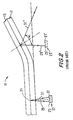
- DVD 11 warps As shown in FIG. 2. When DVD 11 warps, much of program information 21 is no longer readable (as described below).
- program information 21 of DVD 11 is read (i.e., the DVD 11 is "played") via an optical pick-up 23.
- Optical pick-up 23 contains a laser source 25, a detector 27, and various optical and digital signal processing components (not shown) for maintaining the focus of a transmitted laser beam 29 (emitted by laser source 25) on program information 21.
- laser source 25 emits and directs transmitted laser beam 29 (focused via optical pick-up 23) toward program information disc 17.
- Transmitted laser beam 29 travels through program information disc 17, strikes program information 21, and generates a reflected laser beam 31 which is modulated by the surface features of program information 21.
- optical pick-up 23 When optical pick-up 23 reads a planar portion of DVD 11 (e.g., a non-warped portion), reflected laser beam 31 reflects toward and is detected by detector 27 as shown in FIG. 2. Detector 27 provides information to optical pick-up 23 regarding the intensity of the detected reflected laser beam 31. Optical pick-up 23 interprets this information, and extracts program information 21 therefrom.
- FIG. 2 also shows an optical pick-up 23' in phantom (identical to optical pick-up 23) disposed beneath the warped portion of DVD 11.
- Optical pick-up 23' contains a laser source 25', a detector 27', and various optical and digital signal processing components (not shown) for maintaining the focus of a transmitted laser beam 29' on program information 21.
- laser source 25' emits and directs transmitted laser beam 29' toward program information 21.
- Transmitted laser beam 29' travels through program information disc 17, strikes program information 21, and generates a reflected laser beam 31'.
- reflected laser beam 31' is modulated by the surface features of program information 21.
- reflected laser beam 31' does not reflect toward the detector 27'. Rather, because transmitted laser beam 29' strikes a warped portion of DVD 11, reflected laser beam 31' reflects away from detector 27' as shown in FIG. 2. Detector 27' fails to detect reflected laser beam 31' such that optical pick-up 23' is unable to read program information 21 from the warped portion of DVD 11. Thus, because DVD 11 is warped, all program information 21 located on the warped portion of DVD 11 is unreadable. A disc tilt angle ⁇ is assigned to DVD warpage and must not exceed 0.8° for the DVD to remain playable.
- FIG. 3 shows an illustrative curing apparatus 33 for curing bonding material 19 in accordance with the present invention.
- Curing apparatus 33 comprises an array of top lamps 35/1, 35/2, and 35/3 separated from an array of bottom lamps 35/4, 35/5, and 35/6 by a conveyor 37.
- Conveyor 37 is used for transporting DVD 11 through curing apparatus 33 during the curing of bonding material 19, and is sufficiently transparent to allow the DVD 11 to cure via light emitted from lamps 35/4, 35/5, and 35/6.
- Each lamp 35 comprises an ultra-violet light source 39 and a reflector 41 for directing light emitted from light source 39 toward DVD 11 as shown in FIG. 3.
- each lamp 35 is independently controllable.
- Conveyor 37 is used to move DVD 11 underneath lamp 35/3 and above lamp 35/6 and lamp 35/6 is lit for a first predetermined time period while lamp 35/3 remains extinguished.
- a one-sided exposure is thereby performed through program information disc 17. This exposure partially cures bonding material 19 and may cause DVD 11 to warp slightly in the direction shown in FIG. 2.
- conveyor 37 moves DVD 11 beneath lamp 35/2 and above lamp 35/5. Thereafter, both lamp 35/2 and lamp 35/5 are lit for a second predetermined time period. Because bonding material 19 was partially cured by lamp 35/6, the spatial transmissivity variations inherent in graphical image 15 have a reduced impact on the curing of bonding material 19. Accordingly, image pass-through does not result during this simultaneous exposure.
- conveyor 37 moves DVD 11 beneath lamp 35/1 and lamp 35/4. Lamp 35/1 is then lit for a third predetermined time period while lamp 35/4 remains extinguished.
- This third exposure completes the curing of bonding material 19 and reduces any disc tilt within DVD 11 (through expansion of bonding material 19 near graphical image 15) produced during the first exposure. Accordingly, both image pass-through and disc tilt are substantially reduced by employing the inventive curing method disclosed herein.
- the above-described hybrid simultaneous/one-sided exposure may be employed with any DVD containing a graphical image disc and a program information disc.
- the particular type of graphical image e.g., pit art, enhanced pit art, printed image, holographic artwork, etc.
- the following exposure times and lamp intensities may be employed.
- Lamp Power W/cm 2
- Exposure Time sec 1 80 5.3 2 80 5.3 3 0 --- 4 0 --- 5 80 5.3 6 80 5.3
- the light energy at the front side of image disc 13 and at the front side of program information disc 17 is approximately 0.83 Joules/cm 2 .
- the light energy at bonding material 19 is approximately 1.2% of this value.
- FIG. 4 shows an illustrative sequence of steps in accordance with the invention for operating the curing apparatus of FIG. 3 as described above. To some extent these steps have already been mentioned and the discussion of them here can be somewhat abbreviated.
- step 100 (subsequent to forming DVD 11 by coating at least one of the back sides of image disc 13 and program information disc 17 with bonding material 19 and stacking the discs back-to-back), DVD 11 is moved beneath lamp 35/3 and above lamp 35/6. Lamp 35/6 is then lit for a first time period t 1 while lamp 35/3 remains extinguished. This one-sided exposure partially cures bonding material 19 and may cause DVD 11 to warp slightly in the direction shown in FIG. 2. Step 102 then follows.
- step 102 DVD 11 is moved beneath lamp 35/2 and above lamp 35/5. Thereafter, both lamp 35/2 and lamp 35/5 are lit for a second time period t 2 . Because bonding material 19 was partially cured by lamp 35/6, the spatial transmissivity variations inherent in graphical image 15 have a reduced impact on the curing of bonding material 19. Accordingly, image pass-through does not result during this simultaneous exposure. Step 104 then follows.
- step 104 DVD 11 is moved beneath lamp 35/1 and lamp 35/4. Lamp 35/1 is then lit for a third time period t 3 while lamp 35/4 remains extinguished. This third exposure completes the curing of bonding material 19 and reduces any disc tilt within DVD 11 produced during step 100. Accordingly, both image pass-through and disc tilt are substantially reduced by employing the inventive curing steps of FIG. 4.
- first, second, and third predetermined time periods depend on a number of other factors including bonding material thickness and curing properties, the type of disc materials employed, the type of graphical image on image disc 13, and the like.
- While the present invention is particularly useful for reducing image pass-through and disc tilt during asymmetrical DVD formation, it also may be employed during the formation of structurally symmetrical or otherwise structurally similar DVDs (e.g., DVDs with two program information discs) if so desired.
- Curing apparatus 33 may be used for either simultaneous exposures or one-sided exposures. For instance, for a conventional simultaneous exposure, DVD 11 travels along conveyor 37 and stops beneath lamp 35/3 and above lamp 35/6. Lamps 35/3 and 35/6 are then lit so that bonding material 19 is exposed to light through both image disc 13 and program information disc 17. After a first predetermined time period, lamps 35/3 and 35/6 are extinguished and conveyor 37 moves DVD 11 beneath lamp 35/2 and above lamp 35/5. Lamps 35/2 and 35/5 are then lit so that bonding material 19 is again exposed to light through both image disc 13 and program information disc 17. After a second predetermined time period, lamps 35/2 and 35/5 are extinguished and conveyor 37 moves DVD 11 beneath lamp 35/1 and above lamp 35/4.
- Lamps 35/1 and 35/4 are then lit for a third predetermined time period to complete the curing of bonding material 19.
- the above sequence is repeated with lamps 35/3, 35/2, and 35/1 extinguished during the entire curing process.
Landscapes
- Engineering & Computer Science (AREA)
- Mechanical Engineering (AREA)
- Health & Medical Sciences (AREA)
- Physics & Mathematics (AREA)
- Toxicology (AREA)
- Electromagnetism (AREA)
- General Chemical & Material Sciences (AREA)
- Chemical Kinetics & Catalysis (AREA)
- Chemical & Material Sciences (AREA)
- Manufacturing & Machinery (AREA)
- Oral & Maxillofacial Surgery (AREA)
- Thermal Sciences (AREA)
- Quality & Reliability (AREA)
- Manufacturing Optical Record Carriers (AREA)
- Optical Record Carriers And Manufacture Thereof (AREA)
- Non-Silver Salt Photosensitive Materials And Non-Silver Salt Photography (AREA)
- Joining Of Glass To Other Materials (AREA)
- Mechanical Coupling Of Light Guides (AREA)
Applications Claiming Priority (4)
| Application Number | Priority Date | Filing Date | Title |
|---|---|---|---|
| US944148 | 1987-11-13 | ||
| US2835696P | 1996-10-11 | 1996-10-11 | |
| US28356P | 1996-10-11 | ||
| US08/944,148 US5900098A (en) | 1996-10-11 | 1997-10-06 | Methods for bonding structurally dissimilar optical discs |
Publications (3)
| Publication Number | Publication Date |
|---|---|
| EP0836182A2 EP0836182A2 (en) | 1998-04-15 |
| EP0836182A3 EP0836182A3 (en) | 1998-11-11 |
| EP0836182B1 true EP0836182B1 (en) | 2005-05-18 |
Family
ID=26703594
Family Applications (1)
| Application Number | Title | Priority Date | Filing Date |
|---|---|---|---|
| EP97308053A Expired - Lifetime EP0836182B1 (en) | 1996-10-11 | 1997-10-10 | Methods for bonding structurally dissimilar optical discs |
Country Status (6)
| Country | Link |
|---|---|
| US (1) | US5900098A (enExample) |
| EP (1) | EP0836182B1 (enExample) |
| JP (1) | JPH10199054A (enExample) |
| AT (1) | ATE295987T1 (enExample) |
| AU (1) | AU715313B2 (enExample) |
| DE (1) | DE69733299T2 (enExample) |
Families Citing this family (34)
| Publication number | Priority date | Publication date | Assignee | Title |
|---|---|---|---|---|
| JPH113541A (ja) * | 1997-06-11 | 1999-01-06 | Sony Corp | 光ディスク及びその製造方法 |
| US6103039A (en) * | 1997-11-12 | 2000-08-15 | First Light Technology, Inc. | System and method for thermally manipulating a combination of a top and bottom substrate before a curing operation |
| CN1284908A (zh) * | 1998-02-27 | 2001-02-21 | 奥德梅国际有限公司 | 用来对碟片进行热处理的方法和装置 |
| US6117284A (en) * | 1998-09-28 | 2000-09-12 | Wea Manufacturing, Inc. | Dual-layer DVD disc, and method and apparatus for making same |
| EP1115525B1 (en) * | 1998-09-28 | 2011-05-04 | WEA Manufacturing, Inc. | Dual-layer dvd disc, and method and apparatus for making same |
| US6604342B1 (en) * | 2000-04-13 | 2003-08-12 | Paul Appelbaum | Method and apparatus for packaging articles in card and blister packages |
| ATE381423T1 (de) * | 2001-05-04 | 2008-01-15 | Xenon Corp | Doppellampensystem sowie verfahren zu dessen verwendung zur neigungskorrektur von optischen speichermedien |
| JP2002352480A (ja) * | 2001-05-25 | 2002-12-06 | Matsushita Electric Ind Co Ltd | ディスク貼り合わせ装置およびディスク貼り合わせ方法 |
| US6896829B2 (en) | 2002-03-13 | 2005-05-24 | Wea Manufacturing, Inc. | Method of manufacturing a composite disc structure and apparatus for performing the method |
| TW588202B (en) * | 2002-12-27 | 2004-05-21 | Chi Mei Optoelectronics Corp | Curing method and apparatus |
| US7359309B2 (en) | 2003-01-23 | 2008-04-15 | Fujifilm Corporation | Optical disk, thin plastic sheet, and method for affixing display sheet to disk substrate |
| US20050021903A1 (en) * | 2003-07-25 | 2005-01-27 | Baxter John Francis | Method of embedding product information on a digital versatile disc |
| WO2005035237A1 (en) * | 2003-10-09 | 2005-04-21 | Target Technology Company, Llc | Multi-layer optical information storage medium and method of making the same |
| US7906194B2 (en) * | 2005-03-31 | 2011-03-15 | Cinram International Inc. | Optical disc with textured edge |
| US7978583B2 (en) * | 2005-05-24 | 2011-07-12 | Cinram International Inc. | Apparatus and method for forming reflective layer of optical disc |
| US20060274617A1 (en) * | 2005-06-03 | 2006-12-07 | Musto James J | Techniques for forming burst cutting area mark |
| US7564771B2 (en) * | 2005-07-14 | 2009-07-21 | Cinram International Inc. | Bonded pre-recorded and pre-grooved optical disc |
| US7785092B2 (en) * | 2005-08-09 | 2010-08-31 | Coopervision International Holding Company, Lp | Systems and methods for producing contact lenses from a polymerizable composition |
| US20070090006A1 (en) * | 2005-10-26 | 2007-04-26 | Jeffery Kelsch | Spindle sleeve |
| US8675464B2 (en) * | 2005-11-03 | 2014-03-18 | Cinram Group, Inc. | Dual sided optical storage media and method for making same |
| US7986611B1 (en) | 2007-03-22 | 2011-07-26 | Cinram International Inc. | High-density optical recording media and method for making same |
| US7684309B2 (en) | 2005-11-03 | 2010-03-23 | Cinram International Inc. | Multi-purpose high-density optical disc |
| US20110096655A1 (en) * | 2006-03-09 | 2011-04-28 | Cinram International Inc. | Forming light-transmitting cover layer for recording medium |
| US7910191B1 (en) | 2006-03-09 | 2011-03-22 | Cinram International Inc. | Method for forming light-transmitting cover layer for optical recording medium |
| US7955662B2 (en) * | 2006-09-29 | 2011-06-07 | The University Of Tokyo | Optical multilayer reflective film, and aligned metal particle film and manufacturing process therefor |
| US20080223743A1 (en) * | 2007-03-12 | 2008-09-18 | Gary Lenkeit | Ecofriendly package for CDs and DVDs |
| US20080291815A1 (en) * | 2007-05-23 | 2008-11-27 | Imation Corp. | Topographical surface label formed in an optical disk substrate |
| US7946015B1 (en) | 2007-11-07 | 2011-05-24 | Cinram International Inc. | Method and apparatus for separating dummy disc from multi-layer substrate for optical storage medium |
| US20090127142A1 (en) * | 2007-11-15 | 2009-05-21 | Jeff Rothstein | Optical disc enclosure incorporating fragrance atomizer |
| US8739299B1 (en) | 2009-12-24 | 2014-05-27 | Cinram Group, Inc. | Content unlocking |
| US8369196B1 (en) | 2010-05-04 | 2013-02-05 | Cinram International Inc. | BCA recording on optical recording medium |
| US8526282B1 (en) | 2010-07-07 | 2013-09-03 | Cinram Group, Inc. | Method for replicating media using unique identifiers |
| JP5772382B2 (ja) * | 2011-08-16 | 2015-09-02 | セイコーエプソン株式会社 | 記録装置 |
| JP6122337B2 (ja) * | 2013-04-26 | 2017-04-26 | 日東電工株式会社 | 偏光フィルムおよびその製造方法、光学フィルムおよび画像表示装置 |
Family Cites Families (20)
| Publication number | Priority date | Publication date | Assignee | Title |
|---|---|---|---|---|
| NL161284C (nl) * | 1972-09-02 | 1980-01-15 | Philips Nv | Weergavestelsel voor een optisch uitleesbare informatie- structuur, alsmede registratiedrager voor gebruik daarin. |
| US4629668A (en) * | 1985-03-12 | 1986-12-16 | Quixote Corporation | Optically read recording medium and method for making same |
| JPH0729313B2 (ja) * | 1986-05-30 | 1995-04-05 | 松下電器産業株式会社 | 透明プラスチツク板の成形方法 |
| JPS63160034A (ja) * | 1986-12-23 | 1988-07-02 | Seiko Epson Corp | 光記録媒体の製造方法 |
| DE68928586T2 (de) * | 1988-04-12 | 1998-10-29 | Dainippon Printing Co Ltd | Optisches aufzeichnungsmedium und methode zu dessen herstellung |
| JP2532593B2 (ja) * | 1988-07-08 | 1996-09-11 | シャープ株式会社 | 光メモリ素子の製造方法 |
| JPH0240146A (ja) * | 1988-07-29 | 1990-02-08 | Sharp Corp | 光メモリ素子の製造方法 |
| JPH0728590Y2 (ja) * | 1988-09-29 | 1995-06-28 | パイオニア株式会社 | 光学式情報記録担体 |
| JP2514261B2 (ja) * | 1990-01-11 | 1996-07-10 | 松下電器産業株式会社 | 光情報媒体、その製造方法、及びそのカセットケ―ス |
| US5255262A (en) * | 1991-06-04 | 1993-10-19 | International Business Machines Corporation | Multiple data surface optical data storage system with transmissive data surfaces |
| US5470627A (en) * | 1992-03-06 | 1995-11-28 | Quantum Corporation | Double-sided optical media for a disk storage device |
| TW247960B (enExample) * | 1992-11-16 | 1995-05-21 | Canon Kk | |
| DE4323687A1 (de) * | 1993-07-15 | 1995-01-19 | Bayer Ag | Kontinuierliches Verfahren zur Herstellung von aromatischen Aminen |
| FR2710443B1 (fr) * | 1993-09-22 | 1995-11-10 | Digipress Sa | Procédé d'enregistrement d'informations sur un disque optique et de lecture de celles-ci, support d'enregistrement et agencement de lecture pour la mise en Óoeuvre du procédé. |
| JPH07201083A (ja) * | 1993-12-29 | 1995-08-04 | Ricoh Co Ltd | 光ディスク及びその作製方法 |
| FR2725069B1 (fr) * | 1994-09-28 | 1997-01-03 | Digipress Sa | Disque compact comportant un marquage anti-piratage, moule de pressage et procede de marquage anti-piratage de disques compacts |
| DE69520920T2 (de) * | 1994-10-03 | 2001-09-27 | Matsushita Electric Industrial Co., Ltd. | Optisches Informationsmedium, sowie Einheit und Verfahren zu dessen Herstellung |
| US5759332A (en) * | 1995-05-22 | 1998-06-02 | Pioneer Electronic Corporation | Process of reproducing optical discs and optical discs produced by the same |
| JP3096242B2 (ja) * | 1995-08-30 | 2000-10-10 | 日本政策投資銀行 | 光ディスクの硬化装置 |
| US5779855A (en) * | 1995-08-30 | 1998-07-14 | Kitano Engineering Co., Ltd. | Apparatus for curing an optical disc |
-
1997
- 1997-10-06 US US08/944,148 patent/US5900098A/en not_active Expired - Lifetime
- 1997-10-10 EP EP97308053A patent/EP0836182B1/en not_active Expired - Lifetime
- 1997-10-10 AT AT97308053T patent/ATE295987T1/de not_active IP Right Cessation
- 1997-10-10 AU AU40960/97A patent/AU715313B2/en not_active Ceased
- 1997-10-10 DE DE69733299T patent/DE69733299T2/de not_active Expired - Lifetime
- 1997-10-13 JP JP9279231A patent/JPH10199054A/ja active Pending
Also Published As
| Publication number | Publication date |
|---|---|
| HK1010269A1 (en) | 1999-06-17 |
| EP0836182A2 (en) | 1998-04-15 |
| ATE295987T1 (de) | 2005-06-15 |
| US5900098A (en) | 1999-05-04 |
| JPH10199054A (ja) | 1998-07-31 |
| AU715313B2 (en) | 2000-01-20 |
| DE69733299T2 (de) | 2006-04-27 |
| DE69733299D1 (de) | 2005-06-23 |
| EP0836182A3 (en) | 1998-11-11 |
| AU4096097A (en) | 1998-04-23 |
Similar Documents
| Publication | Publication Date | Title |
|---|---|---|
| US5900098A (en) | Methods for bonding structurally dissimilar optical discs | |
| JP4618822B2 (ja) | 光学式多層情報担体 | |
| US5793734A (en) | Optical pickup device | |
| US6124011A (en) | Information-bearing discs and methods of fabrication | |
| US6069868A (en) | Multiple layer optical disk storing information at a like multiple densities | |
| JPH11296890A (ja) | 互換型光ピックアップ装置 | |
| JPH10199054A5 (enExample) | ||
| HK1010269B (en) | Methods for bonding structurally dissimilar optical discs | |
| US5905699A (en) | Focusing apparatus and optical disk apparatus using the same | |
| CN100380457C (zh) | 记录信息的方法及其设备和信息记录介质 | |
| JP2004152398A (ja) | 多層情報記録媒体及び多層情報記録媒体記録再生装置 | |
| JP2000353338A (ja) | 光ディスク及び光ディスク再生装置 | |
| US7315506B2 (en) | Information recording medium, information recording apparatus, information recording method, information playback apparatus, information playback method, recording program recording medium, and playback program recording medium | |
| JPH11110816A (ja) | 光記録媒体及びイメージの形成方法 | |
| JP3006682B2 (ja) | 光ディスクおよびその製造方法 | |
| KR20060105233A (ko) | 하이브리드 디스크, 그 기록 및/또는 재생 장치 및 방법 | |
| JP2001202655A (ja) | 光ディスク | |
| JP3249377B2 (ja) | 光記録媒体の再生方法 | |
| JPH113541A (ja) | 光ディスク及びその製造方法 | |
| JP2005141799A (ja) | 光記録媒体の製造装置及びその製造方法 | |
| JP3306975B2 (ja) | 光ディスクの再生方法及び光ディスク | |
| TWI440028B (zh) | 具有基本上平坦記錄層之光學記錄媒體,其製造和提供方法及裝置 | |
| JPH08315413A (ja) | 光ディスク及びディスク駆動装置 | |
| JPH09134546A5 (enExample) | ||
| JPH11306598A5 (enExample) |
Legal Events
| Date | Code | Title | Description |
|---|---|---|---|
| PUAI | Public reference made under article 153(3) epc to a published international application that has entered the european phase |
Free format text: ORIGINAL CODE: 0009012 |
|
| AK | Designated contracting states |
Kind code of ref document: A2 Designated state(s): AT BE DE FR GB GR IT NL |
|
| AX | Request for extension of the european patent |
Free format text: AL;LT;LV;RO;SI |
|
| PUAL | Search report despatched |
Free format text: ORIGINAL CODE: 0009013 |
|
| AK | Designated contracting states |
Kind code of ref document: A3 Designated state(s): AT BE CH DE DK ES FI FR GB GR IE IT LI LU MC NL PT SE |
|
| AX | Request for extension of the european patent |
Free format text: AL;LT;LV;RO;SI |
|
| 17P | Request for examination filed |
Effective date: 19990416 |
|
| AKX | Designation fees paid |
Free format text: AT BE DE FR GB GR IT NL |
|
| 17Q | First examination report despatched |
Effective date: 20030530 |
|
| GRAP | Despatch of communication of intention to grant a patent |
Free format text: ORIGINAL CODE: EPIDOSNIGR1 |
|
| RIN1 | Information on inventor provided before grant (corrected) |
Inventor name: PICKUTOSKI, EDWARD Inventor name: GENSEL, LEWIS R. Inventor name: MUELLER, WILLIAM R. |
|
| GRAS | Grant fee paid |
Free format text: ORIGINAL CODE: EPIDOSNIGR3 |
|
| GRAA | (expected) grant |
Free format text: ORIGINAL CODE: 0009210 |
|
| RIN1 | Information on inventor provided before grant (corrected) |
Inventor name: PICKUTOSHI, EDWARD Inventor name: GENSEL, LEWIS R. Inventor name: MUELLER, WILLIAM R. |
|
| AK | Designated contracting states |
Kind code of ref document: B1 Designated state(s): AT BE DE FR GB GR IT NL |
|
| REG | Reference to a national code |
Ref country code: GB Ref legal event code: FG4D |
|
| REF | Corresponds to: |
Ref document number: 69733299 Country of ref document: DE Date of ref document: 20050623 Kind code of ref document: P |
|
| PG25 | Lapsed in a contracting state [announced via postgrant information from national office to epo] |
Ref country code: GR Free format text: LAPSE BECAUSE OF FAILURE TO SUBMIT A TRANSLATION OF THE DESCRIPTION OR TO PAY THE FEE WITHIN THE PRESCRIBED TIME-LIMIT Effective date: 20050818 |
|
| REG | Reference to a national code |
Ref country code: HK Ref legal event code: GR Ref document number: 1010269 Country of ref document: HK |
|
| PLBE | No opposition filed within time limit |
Free format text: ORIGINAL CODE: 0009261 |
|
| STAA | Information on the status of an ep patent application or granted ep patent |
Free format text: STATUS: NO OPPOSITION FILED WITHIN TIME LIMIT |
|
| ET | Fr: translation filed | ||
| 26N | No opposition filed |
Effective date: 20060221 |
|
| PGFP | Annual fee paid to national office [announced via postgrant information from national office to epo] |
Ref country code: IT Payment date: 20080228 Year of fee payment: 11 Ref country code: GB Payment date: 20080227 Year of fee payment: 11 |
|
| PGFP | Annual fee paid to national office [announced via postgrant information from national office to epo] |
Ref country code: AT Payment date: 20080220 Year of fee payment: 11 |
|
| PGFP | Annual fee paid to national office [announced via postgrant information from national office to epo] |
Ref country code: FR Payment date: 20080218 Year of fee payment: 11 |
|
| PGFP | Annual fee paid to national office [announced via postgrant information from national office to epo] |
Ref country code: BE Payment date: 20080306 Year of fee payment: 11 |
|
| BERE | Be: lapsed |
Owner name: *WEA MFG INC. Effective date: 20081031 |
|
| GBPC | Gb: european patent ceased through non-payment of renewal fee |
Effective date: 20081010 |
|
| REG | Reference to a national code |
Ref country code: FR Ref legal event code: ST Effective date: 20090630 |
|
| PG25 | Lapsed in a contracting state [announced via postgrant information from national office to epo] |
Ref country code: IT Free format text: LAPSE BECAUSE OF NON-PAYMENT OF DUE FEES Effective date: 20081010 Ref country code: AT Free format text: LAPSE BECAUSE OF NON-PAYMENT OF DUE FEES Effective date: 20081010 |
|
| PG25 | Lapsed in a contracting state [announced via postgrant information from national office to epo] |
Ref country code: BE Free format text: LAPSE BECAUSE OF NON-PAYMENT OF DUE FEES Effective date: 20081031 |
|
| PG25 | Lapsed in a contracting state [announced via postgrant information from national office to epo] |
Ref country code: FR Free format text: LAPSE BECAUSE OF NON-PAYMENT OF DUE FEES Effective date: 20081031 |
|
| PG25 | Lapsed in a contracting state [announced via postgrant information from national office to epo] |
Ref country code: GB Free format text: LAPSE BECAUSE OF NON-PAYMENT OF DUE FEES Effective date: 20081010 |
|
| PGFP | Annual fee paid to national office [announced via postgrant information from national office to epo] |
Ref country code: NL Payment date: 20161010 Year of fee payment: 20 Ref country code: DE Payment date: 20161004 Year of fee payment: 20 |
|
| REG | Reference to a national code |
Ref country code: DE Ref legal event code: R071 Ref document number: 69733299 Country of ref document: DE |
|
| REG | Reference to a national code |
Ref country code: NL Ref legal event code: MK Effective date: 20171009 |