EP0822445B2 - Flüssige, strahlungshärtbare Zusammensetzung, insbesondere für die Stereolithographie - Google Patents
Flüssige, strahlungshärtbare Zusammensetzung, insbesondere für die Stereolithographie Download PDFInfo
- Publication number
- EP0822445B2 EP0822445B2 EP97810510A EP97810510A EP0822445B2 EP 0822445 B2 EP0822445 B2 EP 0822445B2 EP 97810510 A EP97810510 A EP 97810510A EP 97810510 A EP97810510 A EP 97810510A EP 0822445 B2 EP0822445 B2 EP 0822445B2
- Authority
- EP
- European Patent Office
- Prior art keywords
- weight
- compounds
- component
- liquid
- composition
- Prior art date
- Legal status (The legal status is an assumption and is not a legal conclusion. Google has not performed a legal analysis and makes no representation as to the accuracy of the status listed.)
- Expired - Lifetime
Links
- 0 COC(CCC(COC(C(CCC1*)CC1OC(C=C)=O)=O)C1)C1OC(C=C)=O Chemical compound COC(CCC(COC(C(CCC1*)CC1OC(C=C)=O)=O)C1)C1OC(C=C)=O 0.000 description 2
- LISQVJRGPPEVJK-UHFFFAOYSA-N C=CC(OCC(C1)CC2C1C1CC2C(COC(C=C)=O)C1)=O Chemical compound C=CC(OCC(C1)CC2C1C1CC2C(COC(C=C)=O)C1)=O LISQVJRGPPEVJK-UHFFFAOYSA-N 0.000 description 1
Classifications
-
- G—PHYSICS
- G03—PHOTOGRAPHY; CINEMATOGRAPHY; ANALOGOUS TECHNIQUES USING WAVES OTHER THAN OPTICAL WAVES; ELECTROGRAPHY; HOLOGRAPHY
- G03F—PHOTOMECHANICAL PRODUCTION OF TEXTURED OR PATTERNED SURFACES, e.g. FOR PRINTING, FOR PROCESSING OF SEMICONDUCTOR DEVICES; MATERIALS THEREFOR; ORIGINALS THEREFOR; APPARATUS SPECIALLY ADAPTED THEREFOR
- G03F7/00—Photomechanical, e.g. photolithographic, production of textured or patterned surfaces, e.g. printing surfaces; Materials therefor, e.g. comprising photoresists; Apparatus specially adapted therefor
- G03F7/004—Photosensitive materials
- G03F7/027—Non-macromolecular photopolymerisable compounds having carbon-to-carbon double bonds, e.g. ethylenic compounds
-
- C—CHEMISTRY; METALLURGY
- C08—ORGANIC MACROMOLECULAR COMPOUNDS; THEIR PREPARATION OR CHEMICAL WORKING-UP; COMPOSITIONS BASED THEREON
- C08L—COMPOSITIONS OF MACROMOLECULAR COMPOUNDS
- C08L63/00—Compositions of epoxy resins; Compositions of derivatives of epoxy resins
-
- B—PERFORMING OPERATIONS; TRANSPORTING
- B33—ADDITIVE MANUFACTURING TECHNOLOGY
- B33Y—ADDITIVE MANUFACTURING, i.e. MANUFACTURING OF THREE-DIMENSIONAL [3D] OBJECTS BY ADDITIVE DEPOSITION, ADDITIVE AGGLOMERATION OR ADDITIVE LAYERING, e.g. BY 3D PRINTING, STEREOLITHOGRAPHY OR SELECTIVE LASER SINTERING
- B33Y70/00—Materials specially adapted for additive manufacturing
-
- C—CHEMISTRY; METALLURGY
- C08—ORGANIC MACROMOLECULAR COMPOUNDS; THEIR PREPARATION OR CHEMICAL WORKING-UP; COMPOSITIONS BASED THEREON
- C08G—MACROMOLECULAR COMPOUNDS OBTAINED OTHERWISE THAN BY REACTIONS ONLY INVOLVING UNSATURATED CARBON-TO-CARBON BONDS
- C08G59/00—Polycondensates containing more than one epoxy group per molecule; Macromolecules obtained by polymerising compounds containing more than one epoxy group per molecule using curing agents or catalysts which react with the epoxy groups
- C08G59/02—Polycondensates containing more than one epoxy group per molecule
- C08G59/022—Polycondensates containing more than one epoxy group per molecule characterised by the preparation process or apparatus used
-
- C—CHEMISTRY; METALLURGY
- C08—ORGANIC MACROMOLECULAR COMPOUNDS; THEIR PREPARATION OR CHEMICAL WORKING-UP; COMPOSITIONS BASED THEREON
- C08G—MACROMOLECULAR COMPOUNDS OBTAINED OTHERWISE THAN BY REACTIONS ONLY INVOLVING UNSATURATED CARBON-TO-CARBON BONDS
- C08G59/00—Polycondensates containing more than one epoxy group per molecule; Macromolecules obtained by polymerising compounds containing more than one epoxy group per molecule using curing agents or catalysts which react with the epoxy groups
- C08G59/18—Macromolecules obtained by polymerising compounds containing more than one epoxy group per molecule using curing agents or catalysts which react with the epoxy groups ; e.g. general methods of curing
- C08G59/40—Macromolecules obtained by polymerising compounds containing more than one epoxy group per molecule using curing agents or catalysts which react with the epoxy groups ; e.g. general methods of curing characterised by the curing agents used
- C08G59/62—Alcohols or phenols
- C08G59/621—Phenols
-
- G—PHYSICS
- G03—PHOTOGRAPHY; CINEMATOGRAPHY; ANALOGOUS TECHNIQUES USING WAVES OTHER THAN OPTICAL WAVES; ELECTROGRAPHY; HOLOGRAPHY
- G03F—PHOTOMECHANICAL PRODUCTION OF TEXTURED OR PATTERNED SURFACES, e.g. FOR PRINTING, FOR PROCESSING OF SEMICONDUCTOR DEVICES; MATERIALS THEREFOR; ORIGINALS THEREFOR; APPARATUS SPECIALLY ADAPTED THEREFOR
- G03F7/00—Photomechanical, e.g. photolithographic, production of textured or patterned surfaces, e.g. printing surfaces; Materials therefor, e.g. comprising photoresists; Apparatus specially adapted therefor
- G03F7/0037—Production of three-dimensional images
-
- G—PHYSICS
- G03—PHOTOGRAPHY; CINEMATOGRAPHY; ANALOGOUS TECHNIQUES USING WAVES OTHER THAN OPTICAL WAVES; ELECTROGRAPHY; HOLOGRAPHY
- G03F—PHOTOMECHANICAL PRODUCTION OF TEXTURED OR PATTERNED SURFACES, e.g. FOR PRINTING, FOR PROCESSING OF SEMICONDUCTOR DEVICES; MATERIALS THEREFOR; ORIGINALS THEREFOR; APPARATUS SPECIALLY ADAPTED THEREFOR
- G03F7/00—Photomechanical, e.g. photolithographic, production of textured or patterned surfaces, e.g. printing surfaces; Materials therefor, e.g. comprising photoresists; Apparatus specially adapted therefor
- G03F7/004—Photosensitive materials
- G03F7/038—Macromolecular compounds which are rendered insoluble or differentially wettable
-
- C—CHEMISTRY; METALLURGY
- C08—ORGANIC MACROMOLECULAR COMPOUNDS; THEIR PREPARATION OR CHEMICAL WORKING-UP; COMPOSITIONS BASED THEREON
- C08L—COMPOSITIONS OF MACROMOLECULAR COMPOUNDS
- C08L2205/00—Polymer mixtures characterised by other features
- C08L2205/02—Polymer mixtures characterised by other features containing two or more polymers of the same C08L -group
- C08L2205/025—Polymer mixtures characterised by other features containing two or more polymers of the same C08L -group containing two or more polymers of the same hierarchy C08L, and differing only in parameters such as density, comonomer content, molecular weight, structure
Definitions
- the present invention relates to a liquid, radiation-curable composition, in particular suitable for the production of three-dimensional molded articles by means of stereolithography, a process for the preparation a cured product and in particular for the stereolithographic production of a three-dimensional shaped body from this composition.
- the desired shaped body is produced from a liquid radiation-curable composition by means of a repetitive alternating sequence of two method steps (a) and (b), wherein in step (a) a layer of the liquid, radiation-curable composition whose one boundary defines the surface composition is, with the aid of suitable, generally of one, preferably computer-controlled, Laser source generated radiation within a surface area is cured, the desired cross-section.
- step (b) the cured layer is covered with a new layer of the liquid, radiation curable composition and the sequence of Repeat steps (a) and (b) until a so-called green body of the desired shape is ready.
- This Greenware is generally not yet fully cured and therefore usually needs to be postcured.
- the mechanical strength of the green body (modulus of elasticity, breaking strength), also known as green strength, represents an important property of the green compact and becomes essentially of the type of stereolithographic resin composition used certainly.
- Other important properties of a stereolithographic resin composition are u. a. a high sensitivity for the radiation used in the curing and a curl factor that is as low as possible, which promises a high degree of dimensional stability of the green body.
- the precured material layers are well wettable by the liquid film therapy resin composition
- the green body but also the finally cured molded body should be as possible have good mechanical properties.
- stereolithographic resin compositions however, lead to moldings which still have a show relatively high water absorption, which is undesirable in some cases.
- An object of the present invention it is therefore.
- the other important properties for stereolithography, such as z. B the properties already mentioned above, at least largely preserved.
- composition according to the invention may in particular still (F) contain one or more di (meth) acrylates, preferably in an amount of 5 to 40 weight percent.
- epoxy resins which can be used in the compositions according to the invention, these are conveniently resins which are liquid at room temperature, which on average contain more than one epoxide group Possess (oxirane ring) in the molecule.
- Such resins may be aliphatic, or cycloaliphatic, Have structure; they contain epoxide groups as side groups, or these groups form part of an alicyclic or heterocyclic ring system.
- Epoxy resins of these types are general known and commercially available.
- Polyglycidyl and poly ( ⁇ -methylglycidyl) esters are an example of suitable epoxy resins. They are available by reacting a compound having at least two carboxyl groups in the molecule and epichlorohydrin or glycerol dichlorohydrin or ⁇ -methyl epichlorohydrin. The reaction is conveniently carried out in the presence of bases. As connections with at least two carboxyl groups in the molecule can in this case z. As used aliphatic polycarboxylic acids such as glutaric acid, adipic acid, pimelic acid, suberic acid, azelaic acid, sebacic acid or dimerized or trimerized linoleic acid.
- cycloaliphatic polycarboxylic acids such as for example, tetrahydrophthalic acid, 4-methyltetrahydrophthalic acid, hexahydrophthalic acid or 4-methylhexahydrophthalic acid.
- Polyglycidyl or poly ( ⁇ -methylglycidyl) ethers obtainable by reacting a compound with at least two free alcoholic hydroxy groups and one suitably substituted Epichlorohydrin under alkaline conditions or in the presence of an acid catalyst and then Alkali treatment can also be used.
- Ethers of this type are derived, for example, from acyclic Alcohols, such as ethylene glycol, diethylene glycol and higher poly (oxyethylene) glycols, propane-1,2-diol, or poly (oxypropylene) glycols, Propane-1,3-diol, butane-1,4-diol, poly (oxytetramethylene) -glycols, pentane-1,5-diol, hexane-1,6-diol, Hexane-2,4,6-triol, glycerol, 1,1,1-trimethylolpropane, bistrimethylolpropane, pentaerythritol, sorbitol, and of Polyepichlorohydrins.
- acyclic Alcohols such as ethylene glycol, diethylene glycol and higher poly (oxyethylene) glycols, propane-1,2-diol, or poly (oxypropylene) glycols, Propane-1,
- suitable glycidyl ethers are also obtainable from cycloaliphatic alcohols, such as 1,3- or 1,4-dihydroxycyclohexane, bis (4-hydroxycyclohexyl) methane, 2,2-bis (4-hydroxycyclohexyl) -propane or 1,1-bis (hydroxymethyl) cyclohex-3-ene.
- Examples of epoxide compounds wherein the epoxide groups are part of an alicyclic or heterocyclic Ring systems include bis (2,3-epoxycyclopentyl) ether, 2,3-Epoxycyclopentylglycidylether, 1,2-bis (2,3-epoxycyclopentyloxy) ethane, bis (4-hydroxycyclohexyl) -methanediglycidyl ether, 2,2-bis (4-hydroxycyclohexyl) -propanediglycidyl ether ,.
- epoxy resins which are the 1,2-epoxy groups to different functional groups are bound.
- liquid mixtures of epoxy resins in the inventive compositions be used.
- component (B) of the compositions according to the invention a multiplicity of known and Use in the art of proven cationic photoinitiators for epoxy resins. These are, for example around onium salts with anions of weak nucleophilicity. Examples are halonium salts, iodosyl salts or sulfonium salts, as described in EP-A-0 153 904, sulphoxonium salts, as for example in EP-A-0 035 969, EP-A-0 044 274, EP-A-0 054 509 and EP-A-0 164 314, or diazonium salts, such as in US-A-3,708,296. Further cationic photoinitiators are metallocene salts, as for example in US Pat EP-A-0 094 914 and EP-A-0 094 915.
- C 6 -C 18 -aryl examples are here phenyl, naphthyl, anthryl and phenanthryl.
- substituents for suitable radicals are alkyl, preferably C 1 -C 6 -alkyl, such as methyl, ethyl, n-propyl, isopropyl, n-butyl, sec-butyl, isobutyl, tert-butyl or the various pentyl or hexyl Isomare, alkoxy, preferably C 1 -C 6 -alkoxy, such as methoxy, ethoxy, propoxy, butoxy, pentoxy or hexoxy, alkylthio, preferably C 1 -C 6 -alkylthio, such as methylthio, ethylthio, propylthio, butylthio, pentylthio or hexylthio, Halogen, such as fluorine, chlorine, bromine or i
- Preferred halogen atoms Q are chlorine and especially fluorine.
- Preferred anions LQ mB are BF 4 - , PF 6 -, AsF 6 - , Sbf 6 - and SbF 5 (OH) - .
- compositions comprising as component (B) a compound of the formula (B-III) in which R 5B , R 6B and R 7B are aryl, where aryl is especially phenyl or biphenyl or mixtures of these two groups.
- Examples of p-arenes as R 8B and anions of p-arenes R 9B can be found in EP-A-0 094 915.
- Examples of preferred p-arenes as R 8B are toluene, xylene, ethylbenzene, cumene, methoxybenzene, methylnaphthalene , Pyrene, perylene, stilbene, diphenylene oxide and diphenylene sulfide. Especially preferred are cumene, methylnaphthalene or stilbene.
- Examples of non-nucleophilic anions X - are FSO 3 -, anions of organic sulfonic acids, of carboxylic acids or of anions LQ mB - .
- Preferred anions are derived from teiffluoro- or perfluoroaliphatic or partially fluoric or perfluoroaromatic carboxylic acids, such as CF 3 SO 3 - , C 2 F 5 SO 3 - , nC 3 F 7 SO 3 - , nC 4 F 9 SO 3 - , nC 6 F 13 SO 3 - , nC 8 F 17 SO 3 - , or in particular of partially fluoric or perfluoroaliphatic or partially fluorinated or perfluoroaromatic organic sulfonic acids, eg. B.
- C 6 F 5 SO 3 - or it is preferably anions LQ mB - , such as BF 4 - , PF 6 - AsF 6 - , SbF 6 - , SbF 5 (OH) - .
- the metallocene salts can also be used in combination with oxidizing agents. Such combinations are described in EP-A-0 126 712.
- sensitizers can also be used to increase the luminous efficacy.
- examples These are polycyclic aromatic hydrocarbons or aromatic keto compounds. specific Examples of preferred sensitizers are mentioned in EP-A-0 153 904.
- photoinitiators can be used as component (C) are used, which form free radicals at the corresponding irradiation.
- Typical representatives of radical Photoinitiators are benzoins, such as benzoin, benzoin ethers, such as benzoin methyl ether, benzoin ethyl ether and Benzoin isopropyl ether, benzoinphenyl ether and benzoin acetate, acetophenones such as acetophenone, 2,2-dimethoxyacetophenone and 1,1-dichloroacetophenone, benzil, benzil ketals such as benzil dimethyl ketal and benzil diethyl ketal, anthraquinones, such as 2-methylanthraquinone, 2-ethylanthraquinone, 2-tert-butylanthraquinone, 1-chloroanthraquinone and 2-amylanthraquinone and 2-amylanthr
- a class of photoinitiators (C) commonly used when using argon ion lasers are the benzil ketals, such as benzil dimethyl ketal.
- benzil dimethyl ketal an a-hydroxyphenyl ketone is used as the photoinitiator, Benzil dimethyl ketal or 2,4,6-trimethylbenzoyldiphenylphosphine oxide.
- Suitable photoinitiators are the ionic dye-counter ion compounds, which are capable of absorbing actinic rays and generating free radicals that can initiate polymerization of the acrylates.
- the compositions of this invention containing ionic dye counterion compounds can thus be more variably cured with visible light in the tunable wavelength range of 400-700 nm.
- Ionene dye counterion compounds and their mode of action are known, for example from EP-A-0 223 587 and US Pat. Nos. 4,751,102, 4,772,530 and 4,772,541.
- ionic dye counterion compounds examples include the anionic dye-iodonium ion complexes, the anionic dye-pyryllium ion complexes and in particular the cationic dye borate anion compounds of the following formula wherein D c + is a cationic dye and R 1C , R 2C , R 3C and R 4C are each independently an alkyl, aryl, alkaryl, allyl, aralkyl, alkenyl, alkynyl, an alicyclic or saturated or unsaturated heterocyclic group.
- R 1C , R 2C , R 3C and R 4C are each independently an alkyl, aryl, alkaryl, allyl, aralkyl, alkenyl, alkynyl, an alicyclic or saturated or unsaturated heterocyclic group.
- Preferred definitions of the radicals Ric to R4c can be found, for example, in EP-A-0 223 587.
- compositions according to the invention preferably contain as photoinitiator (C) a 1-hydroxyphenyl ketone, in particular 1-hydroxycyclohexyl phenyl ketone.
- the photoinitiators (B) and (C) are added in effective amounts, that is, in amounts of from 0.1 to 10, in particular from 0.5 to 5 weight percent, based on the total amount of the composition. If the Compositions according to the invention can be used for stereolithographic processes, normally Laser beams are used, it is essential that the absorption capacity of the composition Type and concentration of the photoinitiators is adjusted so that the hardening depth at normal laser speed is about 0.1 to 2.5 mm. Preferably, the total amount of photoinitiators in the inventive Compositions between 0.5 and 6 weight percent.
- the mixtures according to the invention may also contain various photoinitiators which are opposite Rays of emission lines of different wavelengths are different sensitive. You can achieve this, for example a better utilization of a UV / VIS light source, which emission lines of different wavelengths radiates. It is advantageous if the different photoinitiators are selected and in such a concentration be used that produces the same optical absorption in the emission lines used becomes.
- novel compositions preferably contain component (D) in an amount of at least 5, in particular of at least 10 weight percent, based on the total amount of the components (A), (B), (C), (D) and (E).
- the compounds of the above formulas (D-I), (D-II), to the respective 1,4-derivatives or bis-1,4-derivatives are preferably, to the respective 1,4-derivatives or bis-1,4-derivatives.
- Component (D) of the compositions according to the invention preferably consists of (D2) phenolic compounds having at least 2 hydroxyl groups which have been reacted with ethylene oxide, propylene oxide or with ethylene oxide and propylene oxide, in particular from the compounds of the formula (D-IIa): wherein R 1D and P 2D both represent a hydrogen atom or both a methyl group: R 3D and R 4D are each independently a hydrogen atom or a methyl group and xD and yD each represent an integer of 1 to 15.
- the compounds preferably have a molecular weight of 200 to 500.
- Suitable aliphatic polyfunctional (meth) acrylates are, for example, the triacrylates and trimethacrylates of hexane-2,4,6-triol, glycerol or 1,1,1-trimethylolpropane, ethoxylated or propoxylated glycerol or 1,1,1-trimethylolpropane and the hydroxy-containing tri (meth) acrylates which are obtained by reaction of triepoxide compounds, such as the triglycidyl ethers of the said triols are obtained with (meth) acrylic acid.
- pentaerythritol tetraacrylate bistrimethylolpropane tetraacrylate, pentaerythritol monohydroxytriacrylate or methacrylate or dipentaerythritol monohydroxypentaacrylate or methacrylate.
- Urethane (meth) acrylates are known to those skilled in the art and can be prepared in a known manner by For example, reacting a hydroxyl-terminated polyurethane with acrylic acid or methacrylic acid, or by reacting an isocyanate-terminated prepolymer with hydroxyalkyl (meth) acrylates to urethane (meth) acrylate.
- Suitable aromatic tri (meth) acrylates are the reaction products of triglycidyl ethers trivalent phenols and three hydroxyl-containing phenol or cresol novolaks with (meth) acrylic acid.
- the (meth) acrylates used as component (E) are known compounds and are partially commercially available, for example, from the company SARTOMER Company under product designations such as SR®295, Sol®350, SR®351, SR®367, SR®399, SR®444, SR®454 or SR®9041.
- component (E) is a tri (meth) acrylate or a penta (meth) acrylate is.
- the di (meth) acrylates of cycloaliphatic are suitable for the di (meth) acrylate component (F) or aromatic diols, such as 1,4-dihydroxymethylcyclohexane, 2,2-bis (4-hydroxycyclohexyl) -propane, bis (4-hydroxycyclohexyl) -methane, Hydroquinone, 4,4'-dihydroxybiphenyl, bisphenol A, bisphenol F, bisphenol S, ethoxylated or propoxylated bisphenol A, ethoxylated or propoxylated bisphenol F or ethoxylated or propoxylated Bisphenol S.
- Such di (meth) acrylates are known and in part commercially available.
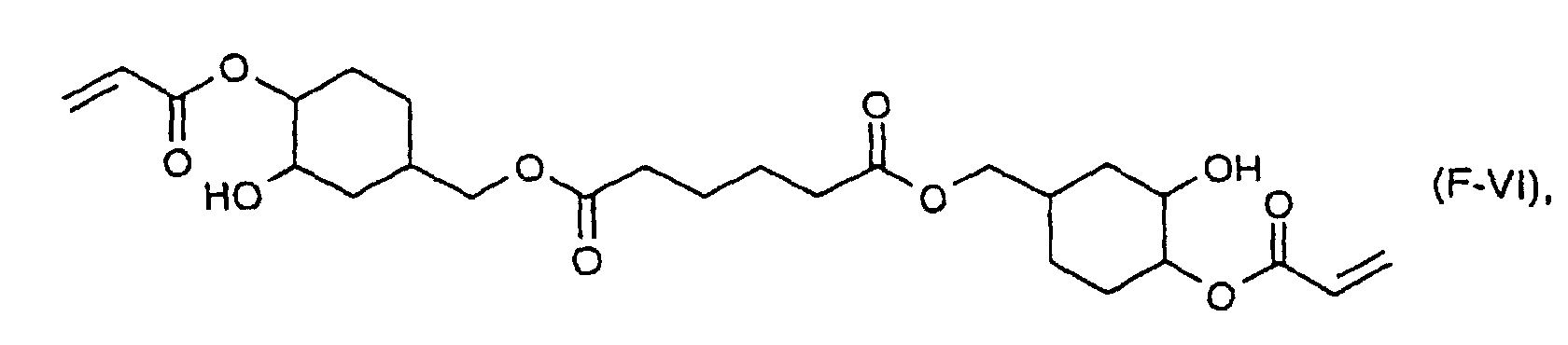
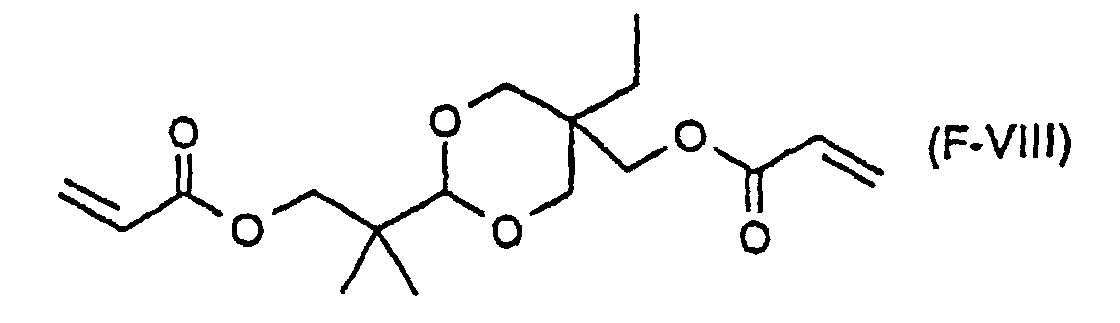
- di (meth) acrylates for example, compounds of the formulas (FV), (F-VI), (F-VII) or (F-VIII) be used. These compounds of formula (FI) to (F-VIII) are known and in part commercially available. Their preparation is further described in EP-A-0 646 580.
- z. B conventional additives, such as reactive diluents, for.
- reactive diluents for.
- propylene carbonate, propylene carbonate propenyl ether or lactones for.
- Stabilizers e.g. As UV stabilizers, polymerization inhibitors, release agents, wetting agents, flow control agents, Sensitizers, anti-settling agents, surfactants, dyes, pigments or fillers.
- UV stabilizers e.g. As UV stabilizers, polymerization inhibitors, release agents, wetting agents, flow control agents, Sensitizers, anti-settling agents, surfactants, dyes, pigments or fillers.
- fillers but also in larger Quantities still be useful, for. B. in amounts up to 75 weight percent.
- novel compositions can be prepared in a known manner, for example by premixing individual components and then mixing these premixes or by Mixing all components by means of conventional devices, such as stirred tank, in the absence of light and optionally at slightly elevated temperature.
- compositions according to the invention can be obtained by irradiation with actinic light, for example by means of electron, X-rays, UV or VIS light, preferably with rays in the wavelength range be polymerized from 280-650 nm.
- actinic light for example by means of electron, X-rays, UV or VIS light, preferably with rays in the wavelength range be polymerized from 280-650 nm.
- Particularly suitable are laser beams of HeCd, argon or nitrogen and Metal vapor and NdYAG laser.
- the appropriate one for each selected light source Photoinitiator must be selected and optionally sensitized. It has been recognized that the penetration depth of the Blasting in the composition to be polymerized and the operating speed in direct connection with the absorption coefficient and the concentration of the photoinitiator. Become in the stereo Preferably, such photoinitiators used which have the highest number of resulting free radicals or cause cationic particles and the largest radiation penetration into the polymerized Allow composition
- a further subject of the invention is a method for producing a cured product, in which compositions as described above are treated with actinic radiation.
- the compositions according to the invention may be used here as adhesives, as coating agents, as photoresists, z. B. as Lötstoppresist, or used for rapid prototyping, but especially for stereolithography become.
- the mixtures according to the invention are used as coating agents, clear results are obtained and hard coatings on wood, paper, metal, ceramics or other surfaces.
- the coating thickness can thereby vary widely and be from about 0.01 mm to about 1 mm.
- Relief images for printed circuits or printing plates can be produced directly by irradiating the mixtures, for example, by means of a computer-controlled laser beam of suitable wavelength or using a Photomask and a corresponding light source.
- a specific embodiment of the aforementioned method is a method for stereolithographic Production of a three-dimensional shaped body, in which the body is made of a composition according to the invention with the aid of a repetitive alternating sequence of method steps (a) and (b), wherein in step (a) a layer of the composition, one limit of which is the surface of the composition is cured by means of suitable radiation within a surface area of the desired cross-sectional area of the three-dimensional body to be formed corresponds to the height of this layer, in step (b) the freshly cured layer is overcoated with a new layer of the liquid, radiation-curable composition this sequence of steps (a) and (b) is repeated until a body having the desired shape is formed is.
- a laser beam is preferably used as the radiation source, which is particularly preferred is computer controlled.
- liquid in this application means “liquid at room temperature” if nothing otherwise, below room temperature, generally a temperature of between 5 ° and 40 ° C is preferred between 10 ° and 30 ° C, is to be understood.
- the formulations given in the examples are prepared by mixing the components with a Stirrer at 60 ° C are mixed until a homogeneous composition is obtained.
- the physical Data for the formulations are obtained as follows:
- the viscosity of the liquid mixture is determined at 30 ° C with a Brookfield viscometer.
- the mechanical properties of the formulations are determined on three-dimensional bodies which using a He / Cd or Ar / UV laser.
- the photosensitivity of the formulations is determined on so-called "window panes". This will be single-layered Test specimens were prepared with different laser energies and the resulting layer thicknesses were measured.
- the graphical representation of the layer thickness obtained against the logarithm of the incident energy gives a Straight ("working curve"). The slope of this line is called Dp (in mm or mils).
- the energy, where the line intersects the x-axis is called the ec (the energy that just gels it up) of the material takes place, cf. P. Jacobs, Rapid Prototyping and Manufacturing, Soc. of Manufacturing Engineers, 1992, P. 270 ff.)
- the green strength is determined by measuring the flexural modulus 10 min. and 1 hour after production of the test specimen (ASTM D 790).
- the flex modulus after curing becomes after 1 hour of cure of the specimen determined in UV light.
- the curl factor (CF) is used in stereolithography to determine the shrinkage properties of various Formulas (compare P. Jacobs, Rapid Prototyping and Manufacturing, Soc Engineers, 1992, pp. 256ff.).
- the curl factors (in%) given in this application are determined on test specimens determined by the architectural style "ACES” (see P. Jacobs, Stereolithography and other RP & MTechnologies, Soc. of Manufacturing Engineers, 1996, p. 156 et seq.) with a layer thickness of 0.15 mm (6 mils).
- test specimens with the "Quick Cast” style cf., P. Jacobs, Stereolithography and other RP & M Technologies, 1996, pp. 183ff.
- complete cure 60 min in UV light, 30 min at 100 ° C
- the samples are added 62 or 88% humidity stored.
- the water absorption is done by weighing the samples at regular intervals determined until weight constancy is reached, which i. a. at the latest after 7-14 days the case is. In the present Examples given is the water absorption after 14 days.
- Examples 2-8 Further mixtures according to the invention are prepared in the manner described above. Their composition and physical properties can be seen in the table below.
Landscapes
- Physics & Mathematics (AREA)
- Chemical & Material Sciences (AREA)
- General Physics & Mathematics (AREA)
- Spectroscopy & Molecular Physics (AREA)
- Organic Chemistry (AREA)
- Materials Engineering (AREA)
- Medicinal Chemistry (AREA)
- Polymers & Plastics (AREA)
- Health & Medical Sciences (AREA)
- Engineering & Computer Science (AREA)
- Manufacturing & Machinery (AREA)
- Chemical Kinetics & Catalysis (AREA)
- Epoxy Resins (AREA)
- Polymerisation Methods In General (AREA)
- Heating, Cooling, Or Curing Plastics Or The Like In General (AREA)
- Addition Polymer Or Copolymer, Post-Treatments, Or Chemical Modifications (AREA)
- Materials For Photolithography (AREA)
- Macromonomer-Based Addition Polymer (AREA)
- Paints Or Removers (AREA)
Description
dadurch gekennzeichnet ist, dass
die Komponente (D) ausgewählt ist aus der Gruppe bestehend aus:
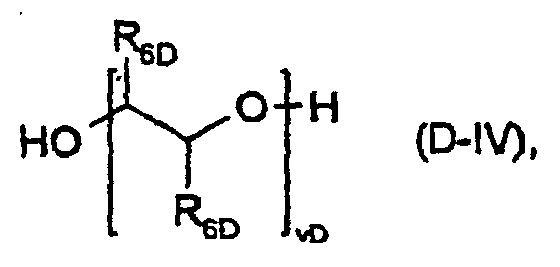
zD eine ganze Zahl von 1 bis 4 und
vD eine ganze Zahl von 2 bis 20 bedeuten, und
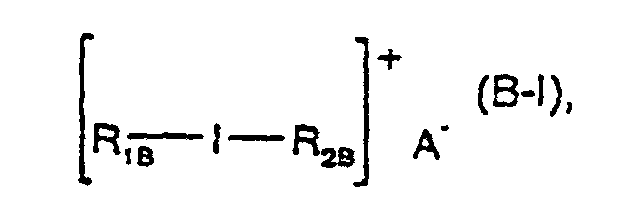

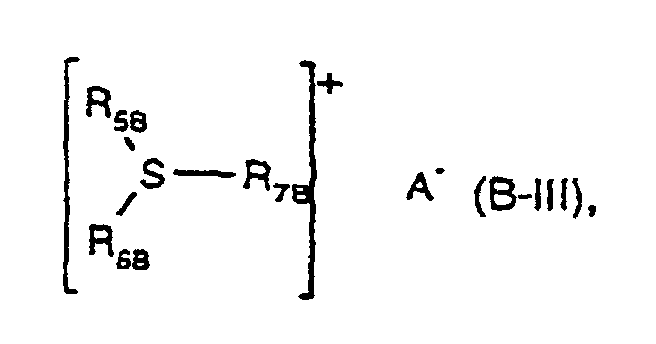
- A-
- CF3SO3 - oder ein Anion der Formel [LQmB]- bedeutet, worin
- L
- Bor, Phosphor, Arsen oder Antimon darstellt,
- Q
- ein Halogenatom ist oder ein Teil der Reste Q in einem Anion LQm - auch Hydroxyl gruppen sein kann und
- mB
- eine ganze Zahl ist, die der um 1 vergrösserten Wertigkeit von L entspricht.
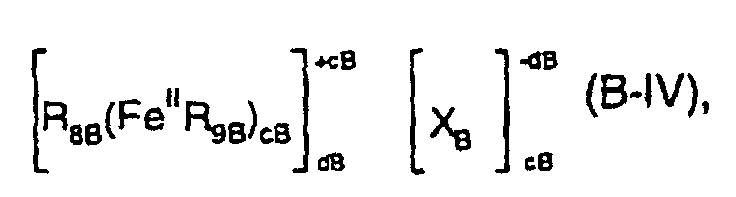
- cB
- 1 oder 2 bedeutet,
- dB
- 1, 2, 3, 4 oder 5 ist,
- XB
- für ein nicht nukleophiles Anion, insbesondere PF6-, AsF6-, SbF6-, CF3SO3 -, C2F5SO3 -, n-C3F7SO3 -, n-C4F9SO3 -, n-C6F13SO3 - und n-C8F17SO3 - steht,
- R8B
- ein p-Aren ist und
- R9B
- ein Anion eines p-Arens, insbesondere ein Cyclopentadienylanion, bedeutet.

(D1) den Dihydroxybenzolen, Trihydroxybenzolen und den Verbindungen der Formel (D-1):
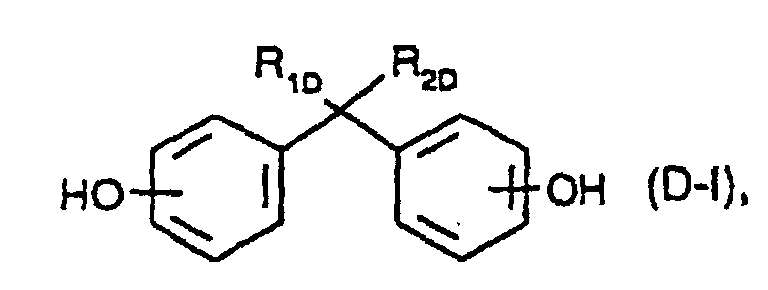
- R1D und R2D
- ein Wasserstotfatom oder eine Methylgruppe bedeuten; und
- (D2)
- den Verbindungen der Formel (DII):
worin
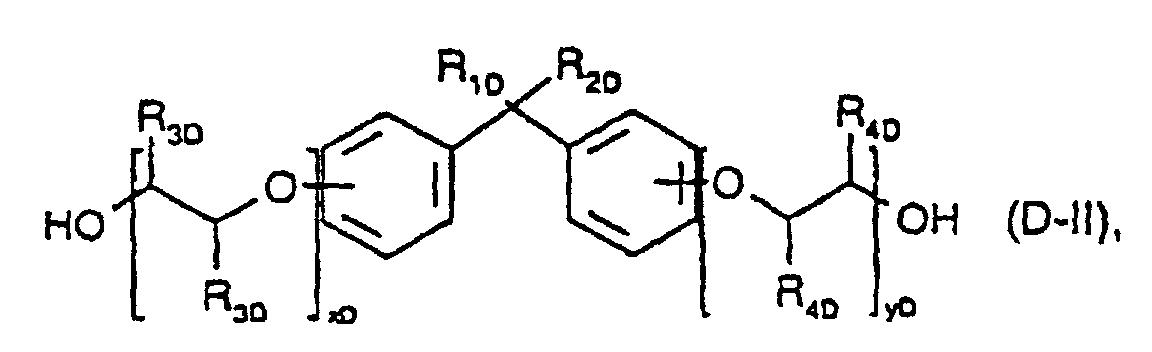
R3D und R4D alle unabhängig voneinander ein Wasserstoffatom oder eine Methylgruppe und
xD sowie yD jeweils eine ganze Zahl von 1 bis 15 bedeuten;
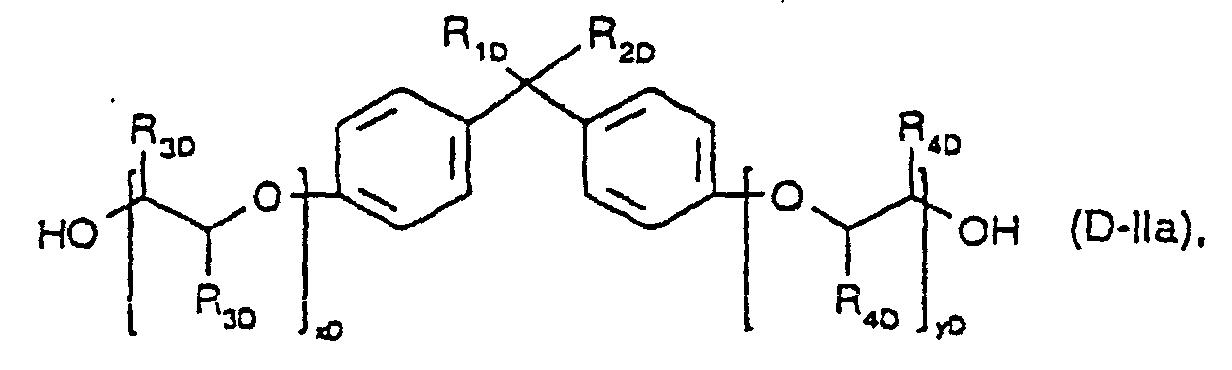
R1D und P2D beide ein Wasserstoffatom oder beide eine Methylgruppe:
R3D und R4D alle unabhängig voneinander jeweils ein Wasserstoffatom oder eine Methylgruppe und
xD sowie yD jeweils eine ganze Zahl von 1 bis 15 bedeuten.

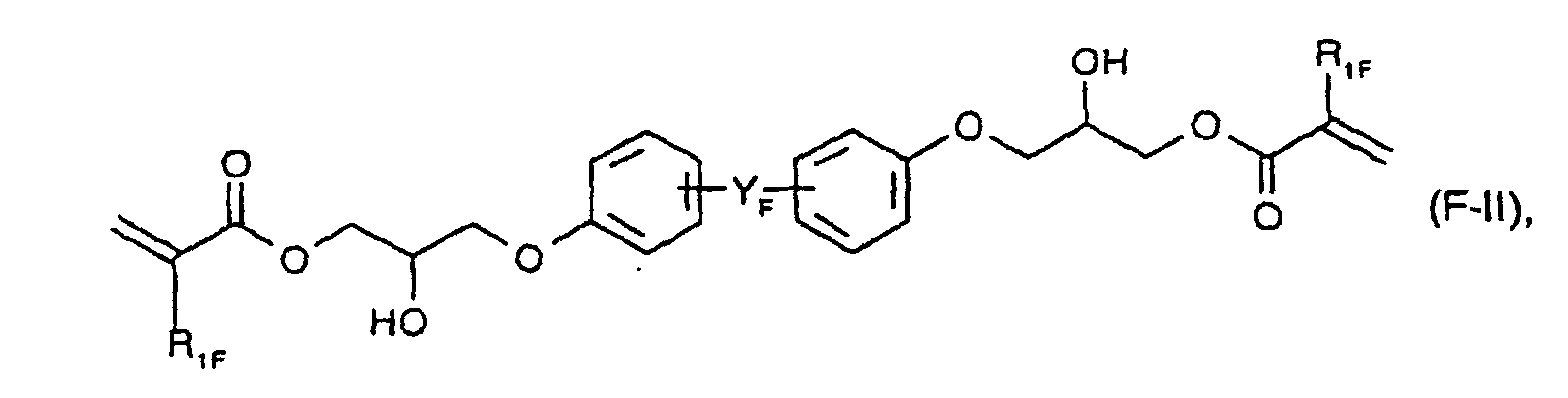


- R1F
- ein Wasserstoffatom oder Methyl bedeutet,
- YF
- für eine direkte Bindung, C1-C6-Alkylen, -S-, -O-, -SO-, -SO2- oder -CO- steht,
- R2F
- für eine C1-C8-Alkylgruppe, eine unsubstituierte oder durch eine oder mehrere C1-C4-Alkylgruppen, Hydroxygruppen oder Halogenatome substituierte Phenylgruppe, oder für einen Rest der Formel -CH2-OR3F steht, worin
- R3F
- eine C1-C8-Alkytgruppe oder Phenylgruppe bedeutet und
- AF
- einen Rest ausgewählt aus den Resten der Formeln
darstellt.
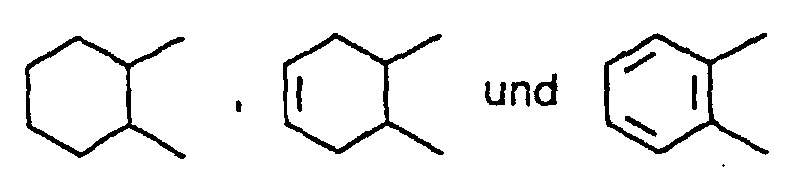


| Handelsname | Chemische Bezeichnung |
| Araldit CY 179 | 3,4-Epoxycyclohexylmethyl-3',4'-epoxycyclohexancarboxylat |
| Araldit DY 026 | Butandiol-diglycidylether |
| Araldit DY 0395 | Trimethylolpropantriglycidylether |
| Araldit DY 0396 | Cyclohexandimethanoldiglycidylether |
| Cyracure UVI 6974 | Gemisch aus (C6H5)S(C6H4)-S+(C6H5)2SbF6 - und F6Sb-(C6H5)2S+-(C6H4)S(C6H4)-S+(C6H5)2SbF6 - |
| lrgacure 184 | 1-Hydroxycyclohexylphenylketon |
| Dianol 320 | Propoxyliertes Bisphenol A |
| Dianol 2211 | Ethoxyliertes Bisphenol A |
| Sariomer SR 399 Sartomer SR 9041 | Dipentaerythritolmonohydroxypentaacrylat |
| Novacure 3700 | Bisphenol-A-diglycidyletherdiacrylat |
| 14.6 g | Araldit DY 0395 |
| 42.5 g | Araldit CY 179 |
| 6,0 g | Novacure 3700 |
| 6,0 g | Sartomer 399 |
| 24,9 g | Dianol 320 |
| 2,0g | Irgacure 184 |
| 4,0 g | Cyracure UVI 6974 |
| 20,0 g | Araldit DY 0395 |
| 15,0 g | Araldit DY 0396 |
| 34,0 g | Araldit CY 179 |
| 6,0 g | Bisphenol-A-diglycidyldiacrylat |
| 6,0 g | Sartomer 9041 |
| 13,5 g | Dianol 320 |
| 1,5 g | Irgacure 184 |
| 4,0 g | Cyracure UVI 6974 |

Claims (8)
- Flüssige, strahlungshärtbare Zusammensetzung, die neben einer flüssigen, radikalisch polymerisierbaren Komponente zumindest die folgenden weiteren Komponenten enthält:die Komponente (D) Substanzen enthält, die aromatische Kohlenstoffringe in ihrem Molekül aufweisen.(A) 40 bis 80 Gewichtsprozent eines flüssigen difunktionellen oder höherfunktionellenaliphatischen oder cycloaliphatischen Epoxidharzes oder eines flüssigen Gemisches bestehend aus difunktionellen oder höherfunktionellen aliphatischen oder cycloaliphatischen Epoxidharzen;(B) 0,1 bis 10 Gewichtsprozent eines kationischen Photoinitiators oder eines Gemisches kationischer Photoinitiatoren; und(C) 0,1 bis 10 Gewichtsprozent eines radikalischen Photoinitiators oder eines Gemisches radikalischer Photoinitatoren; und(D) bis zu 40 Gewichtsprozent einer spezifischen Hydroxylverbindung,
dadurch gekennzeichnet ist, dass
die Komponente (D) ausgewählt ist aus der Gruppe bestehend aus:und in den Zusammensetzungen in einer Menge von mindestens 2 Gewichtsprozent enthalten ist, die radikalisch polymerisierbare Komponente zumindest(D1) phenolischen Verbindungen mit mindestens 2 Hydroxylgruppen,(D2) phenolischen Verbindungen mit mindestens 2 Hydroxylgruppen, die mit Ethylenoxid, Propylenoxid oder mit Ethylenoxid und Propylenoxid umgesetzt sind,(D3) Trimathylolpropan, Glycerin, Ricinusöl (Kastoröl) und den Verbindungen der Formel (D-III) und (D-IV):worin R5D ein unverzweigter oder verzweigter (zD)-wertiger C2-C20Alkanrest,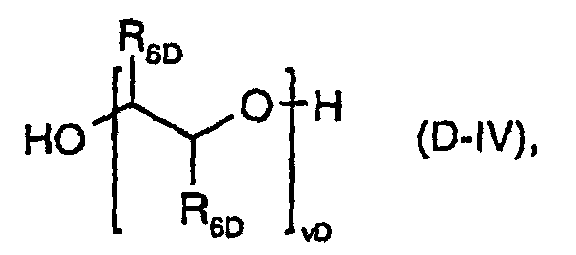
R60 alle unabhängig voneinander jeweils ein Wasserstoffatom oder eine Methylgruppe
zD eine ganze Zahl von 1 bis 4 und
vD eine ganze Zahl von 2 bis 20 bedeuten, und(D4) einem Gemisch aus mindestens 2 der unter (D1) bis (D3) genannten Verbindungen,(E) 4 bis 30 Gewichtsprozent mindestens eines flüssigen Poly(meth-)acrylats mit einer (Meth-)Acrylatfunktionalität von grösser als 2 enthält, und - Zusammensetzung nach Anspruch 1, die mindestens 5 Gewichtsprozent der Komponente (D) enthält.
- Zusammensetzung nach einem der Ansprüche 1 oder 2, bei der die Komponente(D) ausgewählt ist aus der Gruppe bestehend aus(D1) den Dihydroxybenzolen, Trihydroxybenzolen und den Verbindungen der Formel (D-I):worin R1D und R2D ein Wasserstoffatom oder eine Methylgruppe bedeuten; und
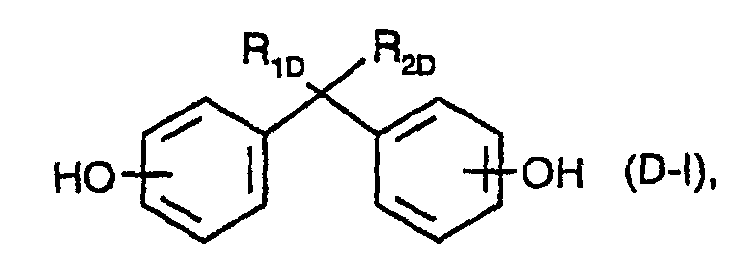 (D2) den Verbindungen der Formel (DII):worin R1D und R2D jeweils ein Wasserstoffatom oder eine Methylgruppe;
R3D und R4D alle unabhängig voneinander jeweils ein Wasserstoffatom oder eine Methylgruppe und
xD sowie yD jeweils eine ganze Zahl von 1 bis 15 bedeuten. - Zusammensetzung nach einem der Ansprüche 1 bis 3, bei der die Komponente (D) aus (D2) phenolischen Verbindungen mit mindestens 2 Hydroxylgruppen besteht, die mit Ethylenoxid, Propylenoxid oder mit Ethylenoxid und Propylenoxid umgesetzt sind.
- Zusammensetzung nach Anspruch 4, bei der die Komponente (D) aus (D2) den Verbindungen der Formel (D-IIa) bestehtworin R1D und R2D beide ein Wasserstoffatom oder beide eine Methylgruppe;

R3D und R4D alle unabhängig voneinander ein Wasserstoffatom oder eine Methylgruppe und
xD sowie yD jeweils eine ganze Zahl von 1 bis 15 bedeuten. - Zusammensetzung nach einem der Ansprüche 1 bis 5, die als eine weitere Komponente (F) ein oder mehrere Di(meth-)acrylate enthält.
- Zusammensetzung nach Anspruch 6, die Komponente (F) in einer Menge von 5 bis 40 Gewichtsprozent enthält.
- Verfahren zur Herstellung eines gehärteten Produkts, bei dem man als gehärtetes Produkt einen dreidimensionalen Formkörper herstellt, indem man den Körper aus einer Zusammensetzung gemäss einem der Ansprüche 1 bis 7 mit Hilfe einer sich wiederholenden abwechselnden Abfolge von Verfahrensschritten (a) und (b) aufbaut, wobei in Schritt (a) eine Schicht der Zusammensetzung, deren eine Begrenzung die Oberfläche der Zusammensetzung ist, mit Hilfe von geeigneter Strahlung innerhalb eines Flächenbereiches gehärtet wird, der der gewünschten Querschnittsfläche des zu bildenden dreidimensionalen Körpers in der Höhe dieser Schicht entspricht, in Schritt (b) die frisch gehärtete Schicht mit einer neuen Schicht der strahlungshärtbaren flüssigen Zusammensetzung überschichtet wird, diese Abfolge der Schritte (a) und (b) solange wiederholt wird, bis ein Körper mit der gewünschten Form gebildet ist und dieser Körper gegebenenfalls nachgehärtet wird.
Applications Claiming Priority (6)
| Application Number | Priority Date | Filing Date | Title |
|---|---|---|---|
| CH188596 | 1996-07-29 | ||
| CH188596 | 1996-07-29 | ||
| CH1885/96 | 1996-07-29 | ||
| CH2201/96 | 1996-09-05 | ||
| CH220196 | 1996-09-05 | ||
| CH220196 | 1996-09-05 |
Publications (3)
| Publication Number | Publication Date |
|---|---|
| EP0822445A1 EP0822445A1 (de) | 1998-02-04 |
| EP0822445B1 EP0822445B1 (de) | 2000-03-22 |
| EP0822445B2 true EP0822445B2 (de) | 2005-02-09 |
Family
ID=25688916
Family Applications (1)
| Application Number | Title | Priority Date | Filing Date |
|---|---|---|---|
| EP97810510A Expired - Lifetime EP0822445B2 (de) | 1996-07-29 | 1997-07-21 | Flüssige, strahlungshärtbare Zusammensetzung, insbesondere für die Stereolithographie |
Country Status (10)
| Country | Link |
|---|---|
| US (1) | US5972563A (de) |
| EP (1) | EP0822445B2 (de) |
| JP (1) | JP3564650B2 (de) |
| KR (1) | KR100491736B1 (de) |
| AT (1) | ATE191090T1 (de) |
| AU (1) | AU716984B2 (de) |
| CA (1) | CA2211628C (de) |
| DE (1) | DE59701299D1 (de) |
| ES (1) | ES2144836T3 (de) |
| TW (1) | TW350863B (de) |
Cited By (1)
| Publication number | Priority date | Publication date | Assignee | Title |
|---|---|---|---|---|
| CN1813220B (zh) * | 2003-06-23 | 2010-11-03 | 德雷弗奥托塑胶有限责任公司 | 特别是用于立体平版印刷制备耳机的低粘度、可辐照固化的配制剂 |
Families Citing this family (70)
| Publication number | Priority date | Publication date | Assignee | Title |
|---|---|---|---|---|
| EP0938026B1 (de) * | 1998-02-18 | 2009-05-27 | DSM IP Assets B.V. | Fotohärtbare flüssige Harzzusammensetzung |
| US6136497A (en) | 1998-03-30 | 2000-10-24 | Vantico, Inc. | Liquid, radiation-curable composition, especially for producing flexible cured articles by stereolithography |
| US6100007A (en) * | 1998-04-06 | 2000-08-08 | Ciba Specialty Chemicals Corp. | Liquid radiation-curable composition especially for producing cured articles by stereolithography having high heat deflection temperatures |
| US6762002B2 (en) | 1998-07-10 | 2004-07-13 | Dsm Desotech, Inc. | Solid imaging compositions for preparing polypropylene-like articles |
| US20060154175A9 (en) * | 1998-07-10 | 2006-07-13 | Lawton John A | Solid imaging compositions for preparing polypropylene-like articles |
| US6287748B1 (en) | 1998-07-10 | 2001-09-11 | Dsm N.V. | Solid imaging compositions for preparing polyethylene-like articles |
| US6379866B2 (en) * | 2000-03-31 | 2002-04-30 | Dsm Desotech Inc | Solid imaging compositions for preparing polypropylene-like articles |
| CA2398160A1 (en) * | 2000-02-08 | 2001-08-16 | Vantico Ag | Liquid, radiation-curable composition, especially for stereolithography |
| JP4837187B2 (ja) * | 2001-06-06 | 2011-12-14 | 株式会社クラレ | 活性エネルギー線硬化性樹脂組成物 |
| US6811937B2 (en) | 2001-06-21 | 2004-11-02 | Dsm Desotech, Inc. | Radiation-curable resin composition and rapid prototyping process using the same |
| US20030149124A1 (en) * | 2001-11-27 | 2003-08-07 | Thommes Glen A. | Radiation curable resin composition for making colored three dimensional objects |
| US20030198824A1 (en) * | 2002-04-19 | 2003-10-23 | Fong John W. | Photocurable compositions containing reactive polysiloxane particles |
| JP2005529200A (ja) * | 2002-05-03 | 2005-09-29 | ディーエスエム アイピー アセッツ ビー.ブイ. | 照射硬化可能な樹脂組成物及びそれを用いるラピッドプロトタイピング法 |
| GB0212977D0 (en) * | 2002-06-06 | 2002-07-17 | Vantico Ag | Actinic radiation curable compositions and their use |
| US20040054025A1 (en) * | 2002-06-20 | 2004-03-18 | Lawton John A. | Compositions comprising a benzophenone photoinitiator |
| US6989225B2 (en) * | 2002-07-18 | 2006-01-24 | 3D Systems, Inc. | Stereolithographic resins with high temperature and high impact resistance |
| US6833231B2 (en) * | 2002-07-31 | 2004-12-21 | 3D Systems, Inc. | Toughened stereolithographic resin compositions |
| US20040077745A1 (en) * | 2002-10-18 | 2004-04-22 | Jigeng Xu | Curable compositions and rapid prototyping process using the same |
| US20040087687A1 (en) * | 2002-10-30 | 2004-05-06 | Vantico A&T Us Inc. | Photocurable compositions with phosphite viscosity stabilizers |
| US20040137368A1 (en) * | 2003-01-13 | 2004-07-15 | 3D Systems, Inc. | Stereolithographic resins containing selected oxetane compounds |
| US20040170923A1 (en) * | 2003-02-27 | 2004-09-02 | 3D Systems, Inc. | Colored stereolithographic resins |
| US6856283B2 (en) * | 2003-02-28 | 2005-02-15 | Raytheon Company | Method and apparatus for a power system for phased-array radar |
| US20050040562A1 (en) * | 2003-08-19 | 2005-02-24 | 3D Systems Inc. | Nanoparticle-filled stereolithographic resins |
| US7244793B2 (en) * | 2003-09-26 | 2007-07-17 | Illinois Tool Works Inc. | Adhesive compositions |
| US7232850B2 (en) * | 2003-10-03 | 2007-06-19 | Huntsman Advanced Materials Americas Inc. | Photocurable compositions for articles having stable tensile properties |
| US20070149667A1 (en) * | 2003-10-16 | 2007-06-28 | Dsm Ip Assets B.V. | Curable compositions and rapid prototyping process using the same |
| US20050101684A1 (en) * | 2003-11-06 | 2005-05-12 | Xiaorong You | Curable compositions and rapid prototyping process using the same |
| US20050165127A1 (en) * | 2003-12-31 | 2005-07-28 | Dsm Desotech, Inc. | Solid imaging compositions for preparing polyethylene-like articles |
| GB0413366D0 (en) * | 2004-06-15 | 2004-07-21 | Heeschen Andreas | Binder-free photopolymerizable compositions |
| DE102004030019A1 (de) * | 2004-06-22 | 2006-01-19 | Xetos Ag | Photopolymerisierbare Zusammensetzung |
| US20060078638A1 (en) * | 2004-10-08 | 2006-04-13 | 3D Systems, Inc. | Stereolithographic apparatus |
| JP4753601B2 (ja) * | 2005-03-23 | 2011-08-24 | 旭化成イーマテリアルズ株式会社 | 感光性組成物 |
| JP5306814B2 (ja) * | 2005-09-13 | 2013-10-02 | スリーディー システムズ インコーポレーテッド | Abs類似物品製造を目的とした光硬化性組成物 |
| US7585450B2 (en) * | 2005-09-30 | 2009-09-08 | 3D Systems, Inc. | Rapid prototyping and manufacturing system and method |
| US20070075461A1 (en) * | 2005-09-30 | 2007-04-05 | 3D Systems, Inc. | Rapid prototyping and manufacturing system and method |
| US7690909B2 (en) * | 2005-09-30 | 2010-04-06 | 3D Systems, Inc. | Rapid prototyping and manufacturing system and method |
| US7520740B2 (en) * | 2005-09-30 | 2009-04-21 | 3D Systems, Inc. | Rapid prototyping and manufacturing system and method |
| US7621733B2 (en) * | 2005-09-30 | 2009-11-24 | 3D Systems, Inc. | Rapid prototyping and manufacturing system and method |
| US20070077323A1 (en) * | 2005-09-30 | 2007-04-05 | 3D Systems, Inc. | Rapid prototyping and manufacturing system and method |
| US20070092733A1 (en) * | 2005-10-26 | 2007-04-26 | 3M Innovative Properties Company | Concurrently curable hybrid adhesive composition |
| JP5084461B2 (ja) * | 2007-11-16 | 2012-11-28 | 東邦化学工業株式会社 | 光重合性不飽和化合物 |
| US8377623B2 (en) * | 2007-11-27 | 2013-02-19 | 3D Systems, Inc. | Photocurable resin composition for producing three dimensional articles having high clarity |
| RU2478393C2 (ru) * | 2008-07-31 | 2013-04-10 | Сони Корпорейшн | Адсорбент, моющее средство, лекарственное средство при почечной недостаточности и функциональное питание |
| US20100190881A1 (en) | 2009-01-28 | 2010-07-29 | 3D Systems, Incorporated | Radiation Curable Compositions Useful in Solid Freeform Fabrication Systems |
| WO2010104603A2 (en) | 2009-03-13 | 2010-09-16 | Dsm Ip Assets B.V | Radiation curable resin composition and rapid three-dimensional imaging process using the same |
| WO2011087793A1 (en) | 2009-12-22 | 2011-07-21 | Huntsman Petrochemical Llc | Etheramines and their use as intermediates in polymer synthesis |
| WO2011079125A1 (en) * | 2009-12-22 | 2011-06-30 | Huntsman Petrochemical Llc | Etheramines containing flexible and rigid segments and their use as intermediates for polymer synthesis |
| CN102668152A (zh) | 2009-12-23 | 2012-09-12 | 默克专利有限公司 | 包括聚合粘结剂的组合物 |
| EP2468789A1 (de) | 2010-12-24 | 2012-06-27 | Sika Technology AG | Klebstoff für Rotorblätter für Windkraftanlagen |
| JP6273213B2 (ja) | 2012-02-17 | 2018-01-31 | ハンツマン・アドバンスド・マテリアルズ・アメリカズ・エルエルシー | ベンズオキサジン、エポキシ及び無水物の混合物 |
| AR098050A1 (es) | 2013-10-18 | 2016-04-27 | Huntsman Petrochemical Llc | Eteraminas con mayor estabilidad térmica y su uso como curativos o intermediarios para la síntesis de polímeros |
| EP2868692B2 (de) * | 2013-11-05 | 2025-07-16 | Stratasys, Inc. | Stabilisierte matrixgefüllte flüssige strahlungshärtbare Harzzusammensetzungen zur Additivherstellung |
| CN114163628A (zh) | 2013-11-05 | 2022-03-11 | 亨斯迈石油化学有限责任公司 | 醚胺和它们作为固化剂或聚合物合成的中间体的用途 |
| EP3143067B1 (de) | 2014-05-14 | 2023-09-13 | Huntsman Advanced Materials Americas LLC | Multifunktionale polyamide für schutzbeschichtungen |
| EP4079484A1 (de) | 2014-06-23 | 2022-10-26 | Carbon, Inc. | Verfahren zur herstellung dreidimensionaler gegenstände aus materialien mit mehreren mechanismen zum härten |
| CN117682965A (zh) | 2016-01-12 | 2024-03-12 | 亨斯迈石油化学有限责任公司 | 聚醚胺和亚烷基胺的联合制备 |
| EP3439856B1 (de) | 2016-04-08 | 2020-02-19 | Solvay Specialty Polymers USA, LLC | Lichthärtbare polymere, lichthärtbare polymerzusammensetzungen und lithografische prozesse damit |
| PT3472221T (pt) | 2016-06-16 | 2021-11-30 | Huntsman Petrochemical Llc | Mistura para curar composições de resina epóxi |
| CN109716234A (zh) | 2016-06-30 | 2019-05-03 | 3M创新有限公司 | 包括高度粘稠组分的可打印组合物和由其形成3d制品的方法 |
| KR102400694B1 (ko) | 2016-08-19 | 2022-05-23 | 헌츠만 어드밴스드 머티리얼스 아메리카스 엘엘씨 | 부가물 및 이의 용도 |
| CN109923145B (zh) | 2017-02-06 | 2022-11-29 | 亨斯迈石油化学有限责任公司 | 用于环氧树脂的固化剂 |
| JP7065088B2 (ja) | 2017-02-06 | 2022-05-11 | ハンツマン ペトロケミカル エルエルシー | エポキシ樹脂のための硬化剤 |
| ES2685280B2 (es) | 2017-03-31 | 2019-06-21 | Centro Tecnologico De Nanomateriales Avanzados S L | Composición de resina curable por radiación y procedimiento para su obtención |
| US10316213B1 (en) | 2017-05-01 | 2019-06-11 | Formlabs, Inc. | Dual-cure resins and related methods |
| EP3758916A4 (de) * | 2018-03-02 | 2021-10-27 | Formlabs, Inc. | Harze mit latenter härtung und verwandte verfahren |
| CN108822122A (zh) * | 2018-08-23 | 2018-11-16 | 广州康瑞泰药业有限公司 | 一种高效制备4,4-二甲基-3,5,8-三氧杂双环[5,1,0]辛烷的方法 |
| EP4100469A1 (de) | 2020-02-04 | 2022-12-14 | Cabot Corporation | Zusammensetzung zur flüssigkeitsbasierten generativen fertigung |
| EP3909748A1 (de) | 2020-05-12 | 2021-11-17 | TIGER Coatings GmbH & Co. KG | Wärmehärtbares material zur verwendung in der generativen fertigung |
| WO2022180175A1 (en) | 2021-02-25 | 2022-09-01 | Huntsman Advanced Materials Licensing (Switzerland) Gmbh | One component polymerizable composition for trickle impregnation |
| EP4094942A1 (de) | 2021-05-26 | 2022-11-30 | TIGER Coatings GmbH & Co. KG | Strahlungshärtbare zusammensetzung zur generativen fertigung für elektronische anwendungen |
Family Cites Families (31)
| Publication number | Priority date | Publication date | Assignee | Title |
|---|---|---|---|---|
| US3708296A (en) * | 1968-08-20 | 1973-01-02 | American Can Co | Photopolymerization of epoxy monomers |
| US4091223A (en) * | 1976-08-04 | 1978-05-23 | Ciba-Geigy Corporation | Unsaturated hydantoin coagents |
| US4156035A (en) * | 1978-05-09 | 1979-05-22 | W. R. Grace & Co. | Photocurable epoxy-acrylate compositions |
| US4339567A (en) * | 1980-03-07 | 1982-07-13 | Ciba-Geigy Corporation | Photopolymerization by means of sulphoxonium salts |
| US4383025A (en) * | 1980-07-10 | 1983-05-10 | Ciba-Geigy Corporation | Photopolymerization by means of sulfoxonium salts |
| US4398014A (en) * | 1980-11-04 | 1983-08-09 | Ciba-Geigy Corporation | Sulfoxonium salts and their use as polymerization catalysts |
| EP0094915B1 (de) * | 1982-05-19 | 1987-01-21 | Ciba-Geigy Ag | Härtbare, Metallocenkomplexe enthaltende Zusammensetzungen, daraus erhältliche aktivierte Vorstufen und deren Verwendung |
| DE3366408D1 (en) * | 1982-05-19 | 1986-10-30 | Ciba Geigy Ag | Photopolymerisation with organometal salts |
| US4874798A (en) * | 1983-02-07 | 1989-10-17 | Union Carbide Corporation | Photocopolymerizable compositions based on epoxy and hydroxyl-containing organic materials and substituted cycloaliphatic monoepoxide reactive diluents |
| US4818776A (en) * | 1983-02-07 | 1989-04-04 | Union Carbide Corporation | Photocopolymerizable compositions based on epoxy and hydroxyl-containing organic materials having primary hydroxyl content |
| US4599401A (en) * | 1983-10-27 | 1986-07-08 | Union Carbide Corporation | Low viscosity adducts of poly(active hydrogen) organic compounds and a polyepoxide |
| ATE37242T1 (de) * | 1984-02-10 | 1988-09-15 | Ciba Geigy Ag | Verfahren zur herstellung einer schutzschicht oder einer reliefabbildung. |
| GB8414525D0 (en) * | 1984-06-07 | 1984-07-11 | Ciba Geigy Ag | Sulphoxonium salts |
| US4694029A (en) * | 1985-04-09 | 1987-09-15 | Cook Paint And Varnish Company | Hybrid photocure system |
| US4772530A (en) * | 1986-05-06 | 1988-09-20 | The Mead Corporation | Photosensitive materials containing ionic dye compounds as initiators |
| EP0223587B1 (de) * | 1985-11-20 | 1991-02-13 | The Mead Corporation | Ionische Farbstoffe als Initiatoren enthaltende fotosensitive Materialien |
| US4772541A (en) * | 1985-11-20 | 1988-09-20 | The Mead Corporation | Photohardenable compositions containing a dye borate complex and photosensitive materials employing the same |
| US4751102A (en) * | 1987-07-27 | 1988-06-14 | The Mead Corporation | Radiation-curable ink and coating compositions containing ionic dye compounds as initiators |
| JPH01110507A (ja) * | 1987-10-22 | 1989-04-27 | Sunstar Giken Kk | 光硬化性組成物 |
| JPH07103218B2 (ja) * | 1988-09-13 | 1995-11-08 | 旭電化工業株式会社 | 光学的造形用樹脂組成物 |
| JP2632961B2 (ja) * | 1988-09-13 | 1997-07-23 | 旭電化工業株式会社 | 樹脂の光学的造形方法 |
| JP2612484B2 (ja) * | 1988-11-18 | 1997-05-21 | ディーエスエム・エヌヴィ | 光学的立体造形用樹脂組成物 |
| JP3197907B2 (ja) * | 1991-02-15 | 2001-08-13 | 旭電化工業株式会社 | エネルギー線を用いた注型成型方法 |
| JP2873126B2 (ja) * | 1991-04-17 | 1999-03-24 | 日本ペイント株式会社 | 体積ホログラム記録用感光性組成物 |
| TW269017B (de) * | 1992-12-21 | 1996-01-21 | Ciba Geigy Ag | |
| TW259797B (de) * | 1992-12-23 | 1995-10-11 | Ciba Geigy | |
| JPH07128856A (ja) * | 1993-04-30 | 1995-05-19 | Japan Synthetic Rubber Co Ltd | 感光性樹脂組成物および感光性樹脂レジスト |
| ATE193532T1 (de) * | 1993-09-16 | 2000-06-15 | Ciba Sc Holding Ag | Vinyletherverbindungen mit zusätzlichen von vinylethergruppen verschiedenen funktionellen gruppen und deren verwendung zur formulierung härtbarer zusammensetzungen |
| US5665792A (en) * | 1995-06-07 | 1997-09-09 | E. I. Du Pont De Nemours And Company | Stabilizers for use with photoacid precursor formulations |
| US5707780A (en) * | 1995-06-07 | 1998-01-13 | E. I. Du Pont De Nemours And Company | Photohardenable epoxy composition |
| JPH09268205A (ja) * | 1996-03-29 | 1997-10-14 | Asahi Denka Kogyo Kk | 光学的立体造形用樹脂組成物および光学的立体造形法 |
-
1997
- 1997-07-21 AT AT97810510T patent/ATE191090T1/de not_active IP Right Cessation
- 1997-07-21 EP EP97810510A patent/EP0822445B2/de not_active Expired - Lifetime
- 1997-07-21 ES ES97810510T patent/ES2144836T3/es not_active Expired - Lifetime
- 1997-07-21 DE DE59701299T patent/DE59701299D1/de not_active Expired - Lifetime
- 1997-07-21 KR KR1019970033932A patent/KR100491736B1/ko not_active Expired - Lifetime
- 1997-07-25 CA CA002211628A patent/CA2211628C/en not_active Expired - Lifetime
- 1997-07-28 TW TW086110701A patent/TW350863B/zh not_active IP Right Cessation
- 1997-07-28 AU AU31579/97A patent/AU716984B2/en not_active Ceased
- 1997-07-28 US US08/901,303 patent/US5972563A/en not_active Expired - Lifetime
- 1997-07-29 JP JP21822197A patent/JP3564650B2/ja not_active Expired - Lifetime
Cited By (1)
| Publication number | Priority date | Publication date | Assignee | Title |
|---|---|---|---|---|
| CN1813220B (zh) * | 2003-06-23 | 2010-11-03 | 德雷弗奥托塑胶有限责任公司 | 特别是用于立体平版印刷制备耳机的低粘度、可辐照固化的配制剂 |
Also Published As
| Publication number | Publication date |
|---|---|
| TW350863B (en) | 1999-01-21 |
| KR980009381A (ko) | 1998-04-30 |
| CA2211628C (en) | 2007-03-13 |
| JPH1087791A (ja) | 1998-04-07 |
| EP0822445B1 (de) | 2000-03-22 |
| CA2211628A1 (en) | 1998-01-29 |
| US5972563A (en) | 1999-10-26 |
| KR100491736B1 (ko) | 2005-09-09 |
| ATE191090T1 (de) | 2000-04-15 |
| AU716984B2 (en) | 2000-03-16 |
| JP3564650B2 (ja) | 2004-09-15 |
| ES2144836T3 (es) | 2000-06-16 |
| DE59701299D1 (de) | 2000-04-27 |
| AU3157997A (en) | 1998-02-05 |
| EP0822445A1 (de) | 1998-02-04 |
Similar Documents
| Publication | Publication Date | Title |
|---|---|---|
| EP0822445B2 (de) | Flüssige, strahlungshärtbare Zusammensetzung, insbesondere für die Stereolithographie | |
| EP0605361B1 (de) | Photoempfindliche Zusammensetzungen | |
| EP0646580B1 (de) | Vinyletherverbindungen mit zusätzlichen von Vinylethergruppen verschiedenen funktionellen Gruppen und deren Verwendung zur Formulierung härtbarer Zusammensetzungen | |
| DE69908775T2 (de) | Flüssige, strahlenhärtbare zusammensetzung insbesondere für stereolithographie | |
| DE60312443T2 (de) | Stereolithographische Harze mit Hochtemperaturbeständig und mit höher Schlagzähigkeit | |
| EP0604364B1 (de) | Neue (cyclo)aliphatische Epoxidverbindungen | |
| DE69702490T2 (de) | Photohärtbare Harzzusammensetzung | |
| DE60035189T3 (de) | Harzzusammensetzung zur photo-herstellung dreidimensionaler gegenstände | |
| EP0732625B1 (de) | Stabilisierung flüssiger strahlungshärtbarer Zusammensetzungen gegen unerwünschte vorzeitige Polymerisation | |
| EP0506616B1 (de) | Photoempfindliches Gemisch auf Basis von Acrylaten | |
| DE60104408T2 (de) | Solid Imaging-Zusammensetzungen für die Herstellung polypropylenähnlicher Gegenstände | |
| DE60129666T2 (de) | Polymerisierbare zusammensetzung und gehärtetes harz daraus, verfahren zur seiner herstellung | |
| DE69738578T2 (de) | Photohärtbare Harzzusammensetzung | |
| DE60214754T2 (de) | Strahlenhärtbare zusammensetzung um gefärbte dreidimensionale objekte anzufertigen | |
| DE69706041T2 (de) | Photohärtbare harzzusammensetzung | |
| EP1256032B1 (de) | Flüssige, strahlenhärtbare zusammensetzung insbesondere für stereolithographie | |
| DE69911617T2 (de) | Stereolithographische zusammensetzungen für die herstellung polyäthylenähnlicher gegenstände | |
| EP0614122B1 (de) | Tetraacrylate enthaltende polymerisierbare Gemische | |
| EP0643329A2 (de) | Flüssige strahlungshärtbare Zusammensetzung, insbesondere für die Stereolithographie | |
| CH696710A5 (de) | Gefärbte stereolithographische Harze | |
| EP0554215B1 (de) | Diacrylate und Dimethacrylate | |
| DE112004001165T5 (de) | Durch aktinische Strahlung härtbare stereolithographische Harzzusammensetzung mit verbesserter Stabilität | |
| DE69713726T2 (de) | Photohärtbare Harzzusammensetzung |
Legal Events
| Date | Code | Title | Description |
|---|---|---|---|
| PUAI | Public reference made under article 153(3) epc to a published international application that has entered the european phase |
Free format text: ORIGINAL CODE: 0009012 |
|
| AK | Designated contracting states |
Kind code of ref document: A1 Designated state(s): AT BE CH DE ES FR GB IT LI NL SE |
|
| 17P | Request for examination filed |
Effective date: 19980608 |
|
| AKX | Designation fees paid |
Free format text: AT BE CH DE ES FR GB IT LI NL SE |
|
| RBV | Designated contracting states (corrected) |
Designated state(s): AT BE CH DE ES FR GB IT LI NL SE |
|
| GRAG | Despatch of communication of intention to grant |
Free format text: ORIGINAL CODE: EPIDOS AGRA |
|
| 17Q | First examination report despatched |
Effective date: 19990305 |
|
| GRAG | Despatch of communication of intention to grant |
Free format text: ORIGINAL CODE: EPIDOS AGRA |
|
| GRAH | Despatch of communication of intention to grant a patent |
Free format text: ORIGINAL CODE: EPIDOS IGRA |
|
| GRAH | Despatch of communication of intention to grant a patent |
Free format text: ORIGINAL CODE: EPIDOS IGRA |
|
| GRAA | (expected) grant |
Free format text: ORIGINAL CODE: 0009210 |
|
| AK | Designated contracting states |
Kind code of ref document: B1 Designated state(s): AT BE CH DE ES FR GB IT LI NL SE |
|
| REF | Corresponds to: |
Ref document number: 191090 Country of ref document: AT Date of ref document: 20000415 Kind code of ref document: T |
|
| REG | Reference to a national code |
Ref country code: CH Ref legal event code: EP |
|
| REF | Corresponds to: |
Ref document number: 59701299 Country of ref document: DE Date of ref document: 20000427 |
|
| ITF | It: translation for a ep patent filed | ||
| GBT | Gb: translation of ep patent filed (gb section 77(6)(a)/1977) |
Effective date: 20000509 |
|
| REG | Reference to a national code |
Ref country code: ES Ref legal event code: FG2A Ref document number: 2144836 Country of ref document: ES Kind code of ref document: T3 |
|
| ET | Fr: translation filed | ||
| REG | Reference to a national code |
Ref country code: CH Ref legal event code: PUE Owner name: CIBA SPECIALTY CHEMICALS HOLDING INC. TRANSFER- VA |
|
| REG | Reference to a national code |
Ref country code: GB Ref legal event code: 732E |
|
| PLBI | Opposition filed |
Free format text: ORIGINAL CODE: 0009260 |
|
| PLBF | Reply of patent proprietor to notice(s) of opposition |
Free format text: ORIGINAL CODE: EPIDOS OBSO |
|
| PLBQ | Unpublished change to opponent data |
Free format text: ORIGINAL CODE: EPIDOS OPPO |
|
| PLAB | Opposition data, opponent's data or that of the opponent's representative modified |
Free format text: ORIGINAL CODE: 0009299OPPO |
|
| NLS | Nl: assignments of ep-patents |
Owner name: VANTICO AG |
|
| 26 | Opposition filed |
Opponent name: DSM N.V. Effective date: 20001221 |
|
| R26 | Opposition filed (corrected) |
Opponent name: DSM N.V. Effective date: 20001221 |
|
| NLR1 | Nl: opposition has been filed with the epo |
Opponent name: DSM N.V. |
|
| NLR1 | Nl: opposition has been filed with the epo |
Opponent name: DSM N.V. |
|
| PLBF | Reply of patent proprietor to notice(s) of opposition |
Free format text: ORIGINAL CODE: EPIDOS OBSO |
|
| PLBF | Reply of patent proprietor to notice(s) of opposition |
Free format text: ORIGINAL CODE: EPIDOS OBSO |
|
| REG | Reference to a national code |
Ref country code: GB Ref legal event code: IF02 |
|
| RAP2 | Party data changed (patent owner data changed or rights of a patent transferred) |
Owner name: VANTICO AG |
|
| NLT2 | Nl: modifications (of names), taken from the european patent patent bulletin |
Owner name: VANTICO AG |
|
| PGFP | Annual fee paid to national office [announced via postgrant information from national office to epo] |
Ref country code: SE Payment date: 20020705 Year of fee payment: 6 |
|
| PGFP | Annual fee paid to national office [announced via postgrant information from national office to epo] |
Ref country code: AT Payment date: 20020711 Year of fee payment: 6 |
|
| PGFP | Annual fee paid to national office [announced via postgrant information from national office to epo] |
Ref country code: ES Payment date: 20020726 Year of fee payment: 6 |
|
| REG | Reference to a national code |
Ref country code: FR Ref legal event code: TP |
|
| PG25 | Lapsed in a contracting state [announced via postgrant information from national office to epo] |
Ref country code: AT Free format text: LAPSE BECAUSE OF NON-PAYMENT OF DUE FEES Effective date: 20030721 |
|
| PG25 | Lapsed in a contracting state [announced via postgrant information from national office to epo] |
Ref country code: SE Free format text: LAPSE BECAUSE OF NON-PAYMENT OF DUE FEES Effective date: 20030722 Ref country code: ES Free format text: LAPSE BECAUSE OF NON-PAYMENT OF DUE FEES Effective date: 20030722 |
|
| PGFP | Annual fee paid to national office [announced via postgrant information from national office to epo] |
Ref country code: NL Payment date: 20030730 Year of fee payment: 7 |
|
| EUG | Se: european patent has lapsed | ||
| PLAB | Opposition data, opponent's data or that of the opponent's representative modified |
Free format text: ORIGINAL CODE: 0009299OPPO |
|
| R26 | Opposition filed (corrected) |
Opponent name: KONINKLIJKE DSM N.V. Effective date: 20001221 |
|
| NLR1 | Nl: opposition has been filed with the epo |
Opponent name: KONINKLIJKE DSM N.V. |
|
| REG | Reference to a national code |
Ref country code: ES Ref legal event code: FD2A Effective date: 20030722 |
|
| RAP2 | Party data changed (patent owner data changed or rights of a patent transferred) |
Owner name: HUNTSMAN ADVANCED MATERIALS (SWITZERLAND) GMBH |
|
| PUAH | Patent maintained in amended form |
Free format text: ORIGINAL CODE: 0009272 |
|
| STAA | Information on the status of an ep patent application or granted ep patent |
Free format text: STATUS: PATENT MAINTAINED AS AMENDED |
|
| NLT2 | Nl: modifications (of names), taken from the european patent patent bulletin |
Owner name: HUNTSMAN ADVANCED MATERIALS (SWITZERLAND) GMBH |
|
| PG25 | Lapsed in a contracting state [announced via postgrant information from national office to epo] |
Ref country code: NL Free format text: LAPSE BECAUSE OF NON-PAYMENT OF DUE FEES Effective date: 20050201 |
|
| 27A | Patent maintained in amended form |
Effective date: 20050209 |
|
| AK | Designated contracting states |
Kind code of ref document: B2 Designated state(s): AT BE CH DE ES FR GB IT LI NL SE |
|
| REG | Reference to a national code |
Ref country code: CH Ref legal event code: AEN Free format text: AUFRECHTERHALTUNG DES PATENTES IN GEAENDERTER FORM |
|
| REG | Reference to a national code |
Ref country code: ES Ref legal event code: FD2A Effective date: 20030722 |
|
| NLV4 | Nl: lapsed or anulled due to non-payment of the annual fee |
Effective date: 20050201 |
|
| REG | Reference to a national code |
Ref country code: CH Ref legal event code: PFA Owner name: HUNTSMAN ADVANCED MATERIALS (SWITZERLAND) GMBH Free format text: VANTICO AG#KLYBECKSTRASSE 200#4057 BASEL (CH) -TRANSFER TO- HUNTSMAN ADVANCED MATERIALS (SWITZERLAND) GMBH#KLYBECKSTRASSE 200#4057 BASEL (CH) Ref country code: CH Ref legal event code: NV Representative=s name: BOVARD AG PATENTANWAELTE |
|
| GBTA | Gb: translation of amended ep patent filed (gb section 77(6)(b)/1977) | ||
| ET3 | Fr: translation filed ** decision concerning opposition | ||
| REG | Reference to a national code |
Ref country code: CH Ref legal event code: PFA Owner name: HUNTSMAN ADVANCED MATERIALS (SWITZERLAND) GMBH Free format text: HUNTSMAN ADVANCED MATERIALS (SWITZERLAND) GMBH#KLYBECKSTRASSE 200#4057 BASEL (CH) -TRANSFER TO- HUNTSMAN ADVANCED MATERIALS (SWITZERLAND) GMBH#KLYBECKSTRASSE 200#4057 BASEL (CH) |
|
| REG | Reference to a national code |
Ref country code: CH Ref legal event code: PUE Owner name: 3D SYSTEMS, INC. Free format text: HUNTSMAN ADVANCED MATERIALS (SWITZERLAND) GMBH#KLYBECKSTRASSE 200#4057 BASEL (CH) -TRANSFER TO- 3D SYSTEMS, INC.#333 THREE D SYSTEMS CIRCLE#ROCK HILL, SOUTH CAROLINA 29730 (SC) |
|
| REG | Reference to a national code |
Ref country code: CH Ref legal event code: PUE Owner name: HUNTSMAN ADVANCED MATERIALS (SWITZERLAND) GMBH Free format text: 3D SYSTEMS, INC.#333 THREE D SYSTEMS CIRCLE#ROCK HILL, SOUTH CAROLINA 29730 (SC) -TRANSFER TO- HUNTSMAN ADVANCED MATERIALS (SWITZERLAND) GMBH#KLYBECKSTRASSE 200#4057 BASEL (CH) Ref country code: CH Ref legal event code: PUE Owner name: 3D SYSTEMS, INC. Free format text: HUNTSMAN ADVANCED MATERIALS (SWITZERLAND) GMBH#KLYBECKSTRASSE 200#4057 BASEL (CH) -TRANSFER TO- 3D SYSTEMS, INC.#333 THREE D SYSTEMS CIRCLE#ROCK HILL, SOUTH CAROLINA 29730 (US) Ref country code: CH Ref legal event code: PK Free format text: BEI DER UEBERTRAGUNG VOM 14.06.2012 AUF 3D SYSTEMS, INC WURDE EIN FALSCHER LAENDERCODE VERWENDET. |
|
| REG | Reference to a national code |
Ref country code: CH Ref legal event code: NV Representative=s name: PATENTANWAELTE SCHAAD, BALASS, MENZL & PARTNER AG |
|
| REG | Reference to a national code |
Ref country code: DE Ref legal event code: R082 Ref document number: 59701299 Country of ref document: DE Representative=s name: VON KREISLER SELTING WERNER, DE |
|
| REG | Reference to a national code |
Ref country code: GB Ref legal event code: 732E Free format text: REGISTERED BETWEEN 20120712 AND 20120718 |
|
| REG | Reference to a national code |
Ref country code: FR Ref legal event code: TP Owner name: 3D SYSTEMS, INC., US Effective date: 20120730 |
|
| REG | Reference to a national code |
Ref country code: DE Ref legal event code: R082 Ref document number: 59701299 Country of ref document: DE Representative=s name: DOMPATENT VON KREISLER SELTING WERNER - PARTNE, DE Effective date: 20120730 Ref country code: DE Ref legal event code: R082 Ref document number: 59701299 Country of ref document: DE Representative=s name: VON KREISLER SELTING WERNER - PARTNERSCHAFT VO, DE Effective date: 20120730 Ref country code: DE Ref legal event code: R082 Ref document number: 59701299 Country of ref document: DE Representative=s name: VON KREISLER SELTING WERNER, DE Effective date: 20120730 Ref country code: DE Ref legal event code: R081 Ref document number: 59701299 Country of ref document: DE Owner name: 3D SYSTEMS, INC., ROCK HILL, US Free format text: FORMER OWNER: HUNTSMAN ADVANCED MATERIALS (SWITZERLAND) GMBH, BASEL, CH Effective date: 20120730 Ref country code: DE Ref legal event code: R081 Ref document number: 59701299 Country of ref document: DE Owner name: 3D SYSTEMS, INC., US Free format text: FORMER OWNER: HUNTSMAN ADVANCED MATERIALS (SWITZERLAND) GMBH, BASEL, CH Effective date: 20120730 |
|
| REG | Reference to a national code |
Ref country code: FR Ref legal event code: PLFP Year of fee payment: 19 |
|
| REG | Reference to a national code |
Ref country code: FR Ref legal event code: PLFP Year of fee payment: 20 |
|
| PGFP | Annual fee paid to national office [announced via postgrant information from national office to epo] |
Ref country code: IT Payment date: 20160722 Year of fee payment: 20 Ref country code: CH Payment date: 20160727 Year of fee payment: 20 Ref country code: DE Payment date: 20160726 Year of fee payment: 20 Ref country code: GB Payment date: 20160727 Year of fee payment: 20 |
|
| PGFP | Annual fee paid to national office [announced via postgrant information from national office to epo] |
Ref country code: FR Payment date: 20160726 Year of fee payment: 20 |
|
| PGFP | Annual fee paid to national office [announced via postgrant information from national office to epo] |
Ref country code: BE Payment date: 20160727 Year of fee payment: 20 |
|
| REG | Reference to a national code |
Ref country code: DE Ref legal event code: R071 Ref document number: 59701299 Country of ref document: DE |
|
| REG | Reference to a national code |
Ref country code: CH Ref legal event code: PL |
|
| REG | Reference to a national code |
Ref country code: GB Ref legal event code: PE20 Expiry date: 20170720 |
|
| REG | Reference to a national code |
Ref country code: BE Ref legal event code: MK Effective date: 20170721 |
|
| PG25 | Lapsed in a contracting state [announced via postgrant information from national office to epo] |
Ref country code: GB Free format text: LAPSE BECAUSE OF EXPIRATION OF PROTECTION Effective date: 20170720 |