EP0797264A2 - Elektrode enthaltend eine Kohlstoffdisulfid-Zusammensetzung und Verfahren zur Herstellung - Google Patents
Elektrode enthaltend eine Kohlstoffdisulfid-Zusammensetzung und Verfahren zur Herstellung Download PDFInfo
- Publication number
- EP0797264A2 EP0797264A2 EP97104806A EP97104806A EP0797264A2 EP 0797264 A2 EP0797264 A2 EP 0797264A2 EP 97104806 A EP97104806 A EP 97104806A EP 97104806 A EP97104806 A EP 97104806A EP 0797264 A2 EP0797264 A2 EP 0797264A2
- Authority
- EP
- European Patent Office
- Prior art keywords
- electrode
- sulfur
- solution
- bond
- organic disulfide
- Prior art date
- Legal status (The legal status is an assumption and is not a legal conclusion. Google has not performed a legal analysis and makes no representation as to the accuracy of the status listed.)
- Granted
Links
Images

Classifications
-
- H—ELECTRICITY
- H01—ELECTRIC ELEMENTS
- H01M—PROCESSES OR MEANS, e.g. BATTERIES, FOR THE DIRECT CONVERSION OF CHEMICAL ENERGY INTO ELECTRICAL ENERGY
- H01M4/00—Electrodes
- H01M4/02—Electrodes composed of, or comprising, active material
- H01M4/13—Electrodes for accumulators with non-aqueous electrolyte, e.g. for lithium-accumulators; Processes of manufacture thereof
- H01M4/137—Electrodes based on electro-active polymers
-
- H—ELECTRICITY
- H01—ELECTRIC ELEMENTS
- H01M—PROCESSES OR MEANS, e.g. BATTERIES, FOR THE DIRECT CONVERSION OF CHEMICAL ENERGY INTO ELECTRICAL ENERGY
- H01M4/00—Electrodes
- H01M4/02—Electrodes composed of, or comprising, active material
-
- G—PHYSICS
- G02—OPTICS
- G02F—OPTICAL DEVICES OR ARRANGEMENTS FOR THE CONTROL OF LIGHT BY MODIFICATION OF THE OPTICAL PROPERTIES OF THE MEDIA OF THE ELEMENTS INVOLVED THEREIN; NON-LINEAR OPTICS; FREQUENCY-CHANGING OF LIGHT; OPTICAL LOGIC ELEMENTS; OPTICAL ANALOGUE/DIGITAL CONVERTERS
- G02F1/00—Devices or arrangements for the control of the intensity, colour, phase, polarisation or direction of light arriving from an independent light source, e.g. switching, gating or modulating; Non-linear optics
- G02F1/01—Devices or arrangements for the control of the intensity, colour, phase, polarisation or direction of light arriving from an independent light source, e.g. switching, gating or modulating; Non-linear optics for the control of the intensity, phase, polarisation or colour
- G02F1/15—Devices or arrangements for the control of the intensity, colour, phase, polarisation or direction of light arriving from an independent light source, e.g. switching, gating or modulating; Non-linear optics for the control of the intensity, phase, polarisation or colour based on an electrochromic effect
- G02F1/153—Constructional details
- G02F1/155—Electrodes
- G02F2001/1555—Counter electrode
-
- H—ELECTRICITY
- H01—ELECTRIC ELEMENTS
- H01M—PROCESSES OR MEANS, e.g. BATTERIES, FOR THE DIRECT CONVERSION OF CHEMICAL ENERGY INTO ELECTRICAL ENERGY
- H01M4/00—Electrodes
- H01M4/02—Electrodes composed of, or comprising, active material
- H01M4/36—Selection of substances as active materials, active masses, active liquids
- H01M4/60—Selection of substances as active materials, active masses, active liquids of organic compounds
-
- Y—GENERAL TAGGING OF NEW TECHNOLOGICAL DEVELOPMENTS; GENERAL TAGGING OF CROSS-SECTIONAL TECHNOLOGIES SPANNING OVER SEVERAL SECTIONS OF THE IPC; TECHNICAL SUBJECTS COVERED BY FORMER USPC CROSS-REFERENCE ART COLLECTIONS [XRACs] AND DIGESTS
- Y02—TECHNOLOGIES OR APPLICATIONS FOR MITIGATION OR ADAPTATION AGAINST CLIMATE CHANGE
- Y02E—REDUCTION OF GREENHOUSE GAS [GHG] EMISSIONS, RELATED TO ENERGY GENERATION, TRANSMISSION OR DISTRIBUTION
- Y02E60/00—Enabling technologies; Technologies with a potential or indirect contribution to GHG emissions mitigation
- Y02E60/10—Energy storage using batteries
Definitions
- the present invention relates to a composite electrode including an organic disulfide compound to be used in electrochemical elements such as batteries, electrochromic display devices, sensors, and memories, and also relates to a method of producing the same.
- Conductive polymer electrodes have been studied intensively since the discovery of conductive polyacetylene in 1971, because application of conductive polymers for the electrode material may result in desirable electrochemical elements, such as batteries that are light in weight and have a high energy density, electrochromic devices of large areas, and biochemical sensors utilizing microelectrodes.
- Organic disulfide compounds have been proposed in U.S. Patent No. 4,833,048 as an organic material that can further enhance an energy density.
- the most simplified form of such compounds is represented by the formula M + - - S-R-S - -M + , wherein R denotes an aliphatic or aromatic organic group, S indicates a sulfur atom, and M + indicates a proton or metal cation.
- Such compounds are bonded to each other via S-S bonds by electrolytic oxidation, and form a polymer represented by M + - - S-S-S-S-S-S-R-S -M + .
- a metal-sulfur secondary battery prepared by combining a metal M that supplies and captures cations (M + ) with an organic disulfide compound has been proposed in the U.S. patent mentioned above.
- This proposed metal-sulfur secondary battery is expected to have an energy density of not less than 150 Wh/kg, which is comparable to or even better than the conventional secondary batteries.
- organic disulfide compounds however, have a problem; that is, repeated oxidation and reduction (i.e., charging and discharging) results in a gradual decrease of the electrode capacity.
- Oxidation (charging) of the organic disulfide compound yields a polydisulfide compound which is electrically insulating and has a poor ionic conductivity.
- the polydisulfide compound has poor solubility in electrolytes.
- organic disulfide monomers which are generated by reducing (discharging) the polydisulfide compound have high solubility in electrolytes.
- the battery with an electrode including an organic disulfide compound as the cathode accordingly has drawbacks, such as lowered charging and discharging efficiency and a shortened charge and discharge cycle life.
- the object of the present invention is thus to solve the above problems and provide an electrode that maintains high charging and discharging efficiency and has favorable charge and discharge cycle characteristic without losing the characteristic of a high energy density of the organic disulfide compound.
- the present invention is directed to an electrode comprising a complex of at least one copper ion and at least one organic disulfide compound, wherein the organic disulfide compound contains at least one sulfur-sulfur bond, and wherein the sulfur-sulfur bond is cleaved when electrolytically reduced to form a sulfur-metal ion bond and the sulfur-metal ion bond is regenerated into the sulfur-sulfur bond when electrolytically oxidized, the metal ion including a proton.
- the electrode further comprises a conductive material.
- the electrode further comprises polyaniline.
- a mixture comprising the complex and the conductive material, such as carbon power, or polyaniline is supported by a conductive support member, such as a carbon sheet or a titanium foil.
- the present invention is also directed to a method of producing an electrode, which comprises the steps of:
- the method further comprises the step of applying the mixture of the solution A and the solution B onto a conductive support member, prior to the heating step.
- the present invention further provides a lithium secondary battery comprising a cathode composed of the above-mentioned electrode, an anode, and a non-aqueous electrolyte.
- An electrode utilizing lithium as an active material such as metal lithium, a lithium-containing alloy, or a lithium-containing composite oxide which can reversibly intercalate and deintercalate lithium, is applied for the anode.
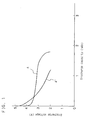
- Fig. 1 is a graph showing discharge voltages of lithium secondary batteries respectively including an electrode A of Example 1 and an electrode A' of Comparative Example as cathodes.
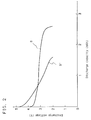
- Fig. 2 is a graph showing discharge voltages of lithium secondary batteries respectively including an electrode B of Example 2 and an electrode B' of Comparative Example as cathodes.
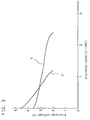
- Fig. 3 is a graph showing discharge voltages of lithium secondary batteries respectively including an electrode C of Example 3 and an electrode C' of Comparative Example as cathodes.
- Fig. 4 is a graph showing discharge voltages of lithium secondary batteries respectively including an electrode D of Example 4 and an electrode D' of Comparative Example as cathodes.
- the electrode of the present invention comprises a complex of at least one organic disulfide compound and at least one copper ion.
- the organic disulfide compound functions as a ligand and is coordinated to the copper ion.
- the organic disulfide compound used for preparing the complex is represented by the general formula of (R(S) y ) n , wherein R represents an aliphatic or an aromatic group, S denotes a sulfur atom, and y and n, respectively, denote an integer of not less than 1 and an integer of not less than 2.
- organic disulfide compounds include dithioglycol represented by HSCH 2 CH 2 SH (hereinafter referred to as DTG), 2,5-dimercapto-1,3,4-thiadiazole represented by C 2 N 2 S(SH) 2 (hereinafter referred to as DMcT), s-triazine-2,4,6-trithiol represented by C 3 H 3 N 3 S 3 (hereinafter referred to as TTA), 7-methyl-2,6,8-trimercaptopurine represented by C 6 H 6 N 4 S 3 (hereinafter referred to as MTMP), and 4,5-diamino-2,6-dimercaptopyrimidine represented by C 4 H 6 N 4 S 2 (hereinafter referred to as DDPy).
- DTG dithioglycol represented by HSCH 2 CH 2 SH
- DMcT 2,5-dimercapto-1,3,4-thiadiazole represented by C 2 N 2 S(SH) 2
- TTA s-triazine-2,
- polymers of such organic disulfide compounds including their dimers and tetramers, which are obtained by polymerizing these organic disulfide compounds by a chemical polymerization process using an oxidizing agent, such as iodine, potassium ferricyanide, hydrogen peroxide, or by an electrolytic oxidation process.
- an oxidizing agent such as iodine, potassium ferricyanide, hydrogen peroxide, or by an electrolytic oxidation process.
- Both monovalent and divalent copper ions may be used for preparing the complex, although divalent copper ions are preferable.
- the complex of the organic disulfide compound and copper ion (hereinafter referred to as SSCu) is synthesized, for example, according to the following process.
- SSCu copper ion
- a solution prepared by dissolving 0.76 g (6 millimoles) of iodine in 50 ml ethanol is added to a solution prepared by dissolving 1.1 g (6 millimoles) of copper(II) chloride 2-hydrate (CuCl 2 ⁇ 2H 2 O) in 25 ml ethanol.
- the solution mixture is then added to a solution prepared by dissolving 1.8 g (12 millimoles) of DMcT in 50 ml ethanol, and a reddish orange complex immediately deposits as a solid substance.
- the solid complex is separated by centrifugation and washed several times with hot alcohol.
- the solid complex is further washed with ethyl ether and dried in a vacuum. This gives a complex in which 2 molecules of DMcT are coordinated to one copper ion, Cu(C 2 HN 2 S 3 ) 2 .
- DTG, TTA, MTMP, and DDPy used as the organic disulfide compounds respectively yield Cu(C 2 H 2 S 2 ) 2 , Cu 3 (C 3 N 3 S 3 ) 2 , Cu(C 6 H 4 N 4 S 3 ) 2 , and Cu(C 4 H 4 N 4 S 2 ) 2 .
- SSCu of the organic disulfide compound and the monovalent copper ion is synthesized by mixing an ethanol solution of copper (II) chloride reduced with SO 2 with an ethanol solution of the organic disulfide compound.
- the powder of SSCu is molded under pressure to an electrode.
- a conductive material such as conductive polymer powder like polyaniline, acetylene black, or metallic copper powder, may be mixed with the complex in the process of preparing the electrode.
- polyaniline functions as the conductive material as well as the ligand of the copper ion, while the organic disulfide compound acts as a dopant of polyaniline to form a complex.
- SSCuPAn high-order metal polymer complex
- This metal polymer complex keeps the organic disulfide compound more securely in the electrode, in comparison with the complex of the organic disulfide compound and the copper ion.
- the resultant electrode thus holds the high reversibility.
- the preferable ratio of SSCu to polyaniline is 0.1 to 10 molecules of polyaniline per one molecule of the organic disulfide compound.
- Polyaniline used for preparing SSCuPAn is obtained by polymerizing aniline or its derivative according to a chemical polymerization process or an electrolytic polymerization process. Especially preferable is reduced polyaniline in the de-doped state that can effectively capture the organic disulfide monomers.
- Polyaniline having an RDI value of not larger than 0.5 is preferably used.
- the degree of de-doping of polyaniline is shown by conductivity.
- Polyaniline having a conductivity of not larger than 10 -5 S/cm is preferably used.
- the electrode containing SSCuPAn is obtained by mixing the SSCu powder with polyaniline powder.
- NAP N-R-2-pyrrolidone
- the resultant electrode has the organic disulfide compound, the copper ion, and polyaniline that are homogeneously mixed in the molecular level.
- the first step dissolves the organic disulfide compound in N-R-2-pyrrolidone to prepare a solution.
- the second step adds polyaniline powder to this solution to prepare a solution A, whereas dissolving the copper salt in N-R-2-pyrrolidone to prepare a solution B.
- the third step mixes the solution A with the solution B, preferably applies the mixture onto an appropriate conductive support member, and heats the mixture in an inert gas atmosphere or in a vacuum, to obtain an electrode containing SSCuPAn.
- NAP used in the process of producing the SSCuPAn-containing electrode may be a commercially available reagent as received or after reduction of the water content to be not larger than 20 ppm with a zeolite adsorbent.
- Preferable examples of NAP are those having a hydrogen atom, a methyl group, an ethyl group, and a butyl group as R; that is, 2-pyrrolidone, N-methyl-2-pyrrolidone, N-ethyl-2-pyrrolidone, and N-butyl-2-pyrrolidone.
- An organic polymer binder such as poly(vinyl pyrrolidone), poly(vinyl alcohol), or poly(vinyl pyridine) may be added to the electrode of the present invention.
- a gel electrolyte may also be added to the electrode material.
- the gel electrolyte is obtained by gelling an organic electrolyte with a polymer, such as polyacrylonitrile, polyethylene oxide, polyvinylidene fluoride, or polyacrylic acid.
- the organic electrolyte is prepared by dissolving a lithium salt, such as LiBF 4 , LiPF 6 , LiAsF 6 , LiClO 4 , LiCF 3 SO 3 , or LiN(CF 3 SO 2 ) 2 in a non-protic solvent, such as propylene carbonate or ethylene carbonate.
- a lithium salt such as LiBF 4 , LiPF 6 , LiAsF 6 , LiClO 4 , LiCF 3 SO 3 , or LiN(CF 3 SO 2 ) 2
- a non-protic solvent such as propylene carbonate or ethylene carbonate.
- the present invention provides an electrode, from which a secondary battery having a high energy density can be prepared.
- the resultant secondary battery has less release of the active material from the electrode in the course of charging and discharging and less reduction of the discharging capacity in the course of charging and discharging.
- the present invention also provides an electrode that can give a flat discharge voltage.
- the electrode of the present invention is applied to the batteries.
- the electrode of the present invention may, however, be used as a counter electrode to give electrochromic devices having high coloring and fading rates and biochemical sensors, for example, glucose sensors having a high response.
- the electrode of the present invention also gives electrochemical analog memories having high writing and reading rates.
- the gel electrolyte solution was prepared by dissolving 2.3 g of LiBF 4 in a solvent mixture containing 10.5 g of propylene carbonate and 7.9 g of ethylene carbonate, adding 3 g of polyacrylonitrile powder to the resultant organic electrolyte, heating the mixture to 100°C for dissolution of polyacrylonitrile powder, and diluting the gel electrolyte with 20 g of acetonitrile.
- a slurry obtained by mixing 1 g of DMcT powder with 0.05 g of acetylene black powder and 1 g of the gel electrolyte solution used in Example 1 was applied on the porous carbon sheet and heated at 60°C in a vacuum. This gave an electrode A' having a thickness of 82 ⁇ m including the carbon sheet.
- a slurry prepared by mixing 1 g of Cu 3 (C 3 N 3 S 3 ) 2 powder, that is, the complex synthesized from copper(II) chloride 2-hydrate and TTA, with 0.05 g of acetylene black powder, and 1 g of the gel electrolyte solution used in Example 1 was applied on a porous carbon sheet composed of a fluorocarbon resin and acetylene black and having dimensions of 5 ⁇ 10 cm and a thickness of 50 ⁇ m, and subsequently heated at 60°C in a vacuum. This gave an electrode B having a thickness of 85 ⁇ m including the carbon sheet.
- a slurry prepared by mixing 1 g of DMcT powder with 0.05 g of acetylene black powder and 1 g of the gel electrolyte solution used in Example 1 was applied on the porous carbon sheet and heated at 60°C in a vacuum. This gave an electrode B' having a thickness of 88 ⁇ m including the carbon sheet.
- a solution was prepared by dissolving 1.5 g of DMcT in 10 g of N-methyl-2-pyrrolidone (hereinafter referred to as NMP).
- NMP N-methyl-2-pyrrolidone
- De-doped reduced polyaniline having a conductivity of 10 -8 S/cm and an RDI value of 0.26 was obtained by de-doping polyaniline (manufactured by Nitto Denko Corp., trade name: Anilead) in an alkaline solution and then reducing the de-doped polyaniline with hydrazine.
- Addition of 1.0 g of the de-doped reduced polyaniline powder to the solution yielded a bluish green, viscous DMcT-polyaniline (hereinafter referred to as PAn)-NMP solution.
- Example 3 The DMcT-PAn-NMP solution used in Example 3 was applied onto a titanium foil current-collector and subsequently dried at 80°C in a vacuum for two hours. This gave an electrode C' having a thickness of 50 ⁇ m including the titanium foil.
- a solution was prepared by dissolving 1.8 g of TTA in 10 g of NMP.
- De-doped reduced polyaniline having a conductivity of 10 -8 S/cm and an RDI value of 0.28 was obtained by de-doping polyaniline (manufactured by Nitto Denko Corp., trade name: Anilead) in an alkaline solution and then reducing the de-doped polyaniline with hydrazine.
- Addition of 1.0 g of the de-doped reduced polyaniline powder to the solution yielded a bluish green, viscous TTA-PAn-NMP solution.
- Example 4 The TTA-PAn-NMP solution used in Example 4 was applied onto a titanium foil current-collector and subsequently dried at 80°C in a vacuum for two hours. This gave an electrode D' having a thickness of 58 ⁇ m including the titanium foil.
- Batteries A, B, C, D, A', B', C', and D' (2 ⁇ 2 cm square) were prepared to include the electrodes A, B, C, D, A', B', C', and D' obtained in Examples 1, 2, 3, and 4 and Comparative Example 1, 2, 3, and 4 as cathodes, metallic lithium of 0.3 mm in thickness as an anode, and a gel electrolyte of 0.6 mm in thickness as a separator layer.
- the gel electrolyte was obtained by gelling 3.0 g of polyacrylonitrile with 20.7 g of a propylene carbonate/ethylene carbonate solution (1:1 ratio by volume) containing 1M LiBF 4 dissolved therein.
- the batteries A to D and A' to D' were repeatedly charged and discharged in the range of 4.65 to 2.0 V at a constant current of 0.2 mA at 20°C, and the discharging capacity (unit: mAh) was measured in each charge and discharge cycle for evaluation of the charge and discharge cycle characteristic.
- the results of measurement are shown in Table 1.
- Figs. 1, 2, 3, and 4 respectively show the discharge voltages at the fifth cycle of the batteries A and A', the batteries B and B', the batteries C and C', and the batteries D and D'.
- the discharge capacity is less decreased during the charge - discharge cycles, in comparison with the batteries using the corresponding electrodes of Comparative Examples.
- the batteries using the electrodes of Examples provide comparatively flat discharge voltages in the range of 3.5 to 2.5 V, in comparison with the batteries using the corresponding electrodes of Comparative Examples.
Landscapes
- Chemical & Material Sciences (AREA)
- Chemical Kinetics & Catalysis (AREA)
- Electrochemistry (AREA)
- General Chemical & Material Sciences (AREA)
- Engineering & Computer Science (AREA)
- Materials Engineering (AREA)
- Battery Electrode And Active Subsutance (AREA)
- Secondary Cells (AREA)
- Electrochromic Elements, Electrophoresis, Or Variable Reflection Or Absorption Elements (AREA)
- Organic Low-Molecular-Weight Compounds And Preparation Thereof (AREA)
- Carbon And Carbon Compounds (AREA)
- Electrodes For Compound Or Non-Metal Manufacture (AREA)
Applications Claiming Priority (3)
| Application Number | Priority Date | Filing Date | Title |
|---|---|---|---|
| JP06492296A JP3292441B2 (ja) | 1996-03-21 | 1996-03-21 | 有機ジスルフィド化合物を含有する電極およびその製造方法 |
| JP64922/96 | 1996-03-21 | ||
| JP6492296 | 1996-03-21 |
Publications (3)
| Publication Number | Publication Date |
|---|---|
| EP0797264A2 true EP0797264A2 (de) | 1997-09-24 |
| EP0797264A3 EP0797264A3 (de) | 1999-11-10 |
| EP0797264B1 EP0797264B1 (de) | 2004-09-22 |
Family
ID=13272030
Family Applications (1)
| Application Number | Title | Priority Date | Filing Date |
|---|---|---|---|
| EP97104806A Expired - Lifetime EP0797264B1 (de) | 1996-03-21 | 1997-03-20 | Elektrode enthaltend eine Kohlstoffdisulfid-Zusammensetzung und Verfahren zur Herstellung |
Country Status (6)
| Country | Link |
|---|---|
| US (1) | US5869206A (de) |
| EP (1) | EP0797264B1 (de) |
| JP (1) | JP3292441B2 (de) |
| CN (1) | CN1080464C (de) |
| AT (1) | ATE277428T1 (de) |
| DE (1) | DE69730768T2 (de) |
Cited By (4)
| Publication number | Priority date | Publication date | Assignee | Title |
|---|---|---|---|---|
| US6057056A (en) * | 1997-04-22 | 2000-05-02 | Korea Kumho Petrochemical Co., Ltd. | Composite electrode and secondary battery therefrom |
| US6090504A (en) * | 1997-09-24 | 2000-07-18 | Korea Kumho Petrochemical Co., Ltd. | High capacity composite electrode and secondary cell therefrom |
| EP1050914A1 (de) * | 1999-04-26 | 2000-11-08 | Matsushita Electric Industrial Co., Ltd. | Positive Elektrode, Verfahren zu ihrer Herstellung und diese verwendende Lithiumbatterie |
| US6335118B1 (en) | 1999-03-10 | 2002-01-01 | Korea Kumho Petrochemical Co., Ltd. | Sulfurated hydrocarbon materials having high capacity and secondary cells using the same |
Families Citing this family (20)
| Publication number | Priority date | Publication date | Assignee | Title |
|---|---|---|---|---|
| US6706963B2 (en) * | 2002-01-25 | 2004-03-16 | Konarka Technologies, Inc. | Photovoltaic cell interconnection |
| US7414188B2 (en) * | 2002-01-25 | 2008-08-19 | Konarka Technologies, Inc. | Co-sensitizers for dye sensitized solar cells |
| US20030192585A1 (en) * | 2002-01-25 | 2003-10-16 | Konarka Technologies, Inc. | Photovoltaic cells incorporating rigid substrates |
| US6900382B2 (en) * | 2002-01-25 | 2005-05-31 | Konarka Technologies, Inc. | Gel electrolytes for dye sensitized solar cells |
| US6949400B2 (en) * | 2002-01-25 | 2005-09-27 | Konarka Technologies, Inc. | Ultrasonic slitting of photovoltaic cells and modules |
| US7186911B2 (en) * | 2002-01-25 | 2007-03-06 | Konarka Technologies, Inc. | Methods of scoring for fabricating interconnected photovoltaic cells |
| US6913713B2 (en) * | 2002-01-25 | 2005-07-05 | Konarka Technologies, Inc. | Photovoltaic fibers |
| US20050284513A1 (en) * | 2002-08-08 | 2005-12-29 | Christoph Brabec | Chip card comprising an integrated energy converter |
| US7205473B2 (en) * | 2002-01-25 | 2007-04-17 | Konarka Technologies, Inc. | Photovoltaic powered multimedia greeting cards and smart cards |
| US20030192584A1 (en) * | 2002-01-25 | 2003-10-16 | Konarka Technologies, Inc. | Flexible photovoltaic cells and modules formed using foils |
| US7351907B2 (en) * | 2002-01-25 | 2008-04-01 | Konarka Technologies, Inc. | Displays with integrated photovoltaic cells |
| JP4979878B2 (ja) * | 2002-01-25 | 2012-07-18 | コナルカ テクノロジーズ インコーポレイテッド | 色素増感太陽電池の構造及び材料 |
| EP1470563A2 (de) * | 2002-01-25 | 2004-10-27 | Konarka Technologies, Inc. | Photovoltaikzellekomponente und -materialien |
| DE10240921B4 (de) * | 2002-09-02 | 2007-12-13 | Qimonda Ag | Verfahren und Anordnung zum selektiven Metallisieren von 3-D-Strukturen |
| US20050183963A1 (en) * | 2002-10-08 | 2005-08-25 | Yuzo Mori | Electrode for electrolytic processing |
| KR20080044233A (ko) * | 2005-08-22 | 2008-05-20 | 코나르카 테크놀로지, 인코포레이티드 | 일체형 광전지를 갖는 디스플레이 |
| US20070079867A1 (en) * | 2005-10-12 | 2007-04-12 | Kethinni Chittibabu | Photovoltaic fibers |
| JP2014191915A (ja) | 2013-03-26 | 2014-10-06 | Nitto Denko Corp | 蓄電デバイス用電極およびそれを用いた蓄電デバイス |
| JP2015018635A (ja) | 2013-07-09 | 2015-01-29 | 日東電工株式会社 | 蓄電デバイス用電極およびその製法、並びにそれを用いた蓄電デバイス |
| CN108987699B (zh) * | 2018-07-13 | 2021-09-14 | 广州明美新能源股份有限公司 | 一种高稳定性高容量锂离子电池负极活性材料及其制备方法 |
Family Cites Families (13)
| Publication number | Priority date | Publication date | Assignee | Title |
|---|---|---|---|---|
| JPH04155766A (ja) * | 1990-10-18 | 1992-05-28 | Fuji Photo Film Co Ltd | 環状ジスルフィド化合物を用いた電極活物質及びそれを用いた導電性材料 |
| JP3116451B2 (ja) * | 1991-09-24 | 2000-12-11 | 松下電器産業株式会社 | 可逆性電極 |
| JPH05314979A (ja) * | 1992-05-07 | 1993-11-26 | Matsushita Electric Ind Co Ltd | 可逆性電極 |
| JPH0636797A (ja) * | 1992-07-15 | 1994-02-10 | Fuji Photo Film Co Ltd | リチウム二次電池 |
| US5518841A (en) * | 1993-02-12 | 1996-05-21 | Matsushita Electric Industrial Co., Ltd. | Composite cathode |
| JPH06251770A (ja) * | 1993-02-26 | 1994-09-09 | Tonen Corp | 二次電池 |
| US5460905A (en) * | 1993-06-16 | 1995-10-24 | Moltech Corporation | High capacity cathodes for secondary cells |
| US5516598A (en) * | 1994-07-28 | 1996-05-14 | Polyplus Battery Company, Inc. | Secondary cell using organosulfur/metal charge transfer materials as positive electrode |
| US5686201A (en) * | 1994-11-23 | 1997-11-11 | Polyplus Battery Company, Inc. | Rechargeable positive electrodes |
| US5523179A (en) * | 1994-11-23 | 1996-06-04 | Polyplus Battery Company | Rechargeable positive electrode |
| US5665492A (en) * | 1995-02-08 | 1997-09-09 | Matsushita Electric Industrial Co., Ltd. | Composite Electrode including organic disulfide compound, method of producing the same, and lithium secondary battery utilizing the same |
| US5723230A (en) * | 1995-02-27 | 1998-03-03 | Yazaki Corporation | Oligosulfide type electrode material and secondary battery containing such electrode material |
| JP3539594B2 (ja) * | 1995-10-09 | 2004-07-07 | 松下電器産業株式会社 | 有機ジスルフィド化合物を含有する正極を有する二次電池の充放電方法 |
-
1996
- 1996-03-21 JP JP06492296A patent/JP3292441B2/ja not_active Expired - Fee Related
-
1997
- 1997-03-18 US US08/820,210 patent/US5869206A/en not_active Expired - Fee Related
- 1997-03-20 DE DE69730768T patent/DE69730768T2/de not_active Expired - Fee Related
- 1997-03-20 EP EP97104806A patent/EP0797264B1/de not_active Expired - Lifetime
- 1997-03-20 AT AT97104806T patent/ATE277428T1/de not_active IP Right Cessation
- 1997-03-21 CN CN97109622A patent/CN1080464C/zh not_active Expired - Fee Related
Cited By (5)
| Publication number | Priority date | Publication date | Assignee | Title |
|---|---|---|---|---|
| US6057056A (en) * | 1997-04-22 | 2000-05-02 | Korea Kumho Petrochemical Co., Ltd. | Composite electrode and secondary battery therefrom |
| US6090504A (en) * | 1997-09-24 | 2000-07-18 | Korea Kumho Petrochemical Co., Ltd. | High capacity composite electrode and secondary cell therefrom |
| US6335118B1 (en) | 1999-03-10 | 2002-01-01 | Korea Kumho Petrochemical Co., Ltd. | Sulfurated hydrocarbon materials having high capacity and secondary cells using the same |
| EP1050914A1 (de) * | 1999-04-26 | 2000-11-08 | Matsushita Electric Industrial Co., Ltd. | Positive Elektrode, Verfahren zu ihrer Herstellung und diese verwendende Lithiumbatterie |
| US6576370B1 (en) | 1999-04-26 | 2003-06-10 | Matsushita Electric Industrial Co., Ltd. | Positive electrode and lithium battery using the same |
Also Published As
| Publication number | Publication date |
|---|---|
| US5869206A (en) | 1999-02-09 |
| CN1080464C (zh) | 2002-03-06 |
| DE69730768T2 (de) | 2005-02-10 |
| DE69730768D1 (de) | 2004-10-28 |
| ATE277428T1 (de) | 2004-10-15 |
| JPH09259864A (ja) | 1997-10-03 |
| EP0797264A3 (de) | 1999-11-10 |
| CN1166696A (zh) | 1997-12-03 |
| EP0797264B1 (de) | 2004-09-22 |
| JP3292441B2 (ja) | 2002-06-17 |
Similar Documents
| Publication | Publication Date | Title |
|---|---|---|
| EP0797264B1 (de) | Elektrode enthaltend eine Kohlstoffdisulfid-Zusammensetzung und Verfahren zur Herstellung | |
| US6174621B1 (en) | Electroactive high storage capacity polyacetylene-co-polysulfur materials and electrolytic cells containing same | |
| EP1722430B1 (de) | Sekundärbatterie mit radikalischer Verbindung als aktives Elektrodenmaterial | |
| US5518841A (en) | Composite cathode | |
| US6228532B1 (en) | Lithium secondary cell | |
| US6576370B1 (en) | Positive electrode and lithium battery using the same | |
| JP5410277B2 (ja) | シアノ基を有する非水電解液添加剤及びこれを用いた電気化学素子 | |
| US6245458B1 (en) | Composite electrode, method of producing the same, and lithium secondary battery using the same | |
| US6090504A (en) | High capacity composite electrode and secondary cell therefrom | |
| US5665492A (en) | Composite Electrode including organic disulfide compound, method of producing the same, and lithium secondary battery utilizing the same | |
| KR19990076829A (ko) | 전기화학적 리튬 삽입용 전극 재료 | |
| EP2023427A1 (de) | Lagerungsvorrichtung | |
| KR100305669B1 (ko) | 금속복합양극재로이루어진양극을포함하는리튬폴리머이차전지 | |
| US20200176762A1 (en) | Electron conductive polymer composites and their use as electrode materials | |
| KR100416150B1 (ko) | 리튬 이차 전지의 제조 방법 및 이 제조 방법으로 제조된리튬 이차 전지 | |
| EP1744388A1 (de) | Redox-aktive reversible elektrode und sekundärbatterie damit | |
| JPH1027615A (ja) | 有機ジスルフィド化合物を含有する複合電極とその製造法 | |
| JP2000311684A (ja) | リチウム二次電池およびその正極の製造方法 | |
| JP2000340225A (ja) | 複合電極組成物およびこれを用いたリチウム電池 | |
| US6309778B1 (en) | Electroactive high storage capacity polyacetylene-co-polysulfur materials and electrolytic cells containing same | |
| JP3444463B2 (ja) | 有機ジスルフィド化合物を含有する電極およびその製造方法 | |
| JP2001266885A (ja) | 複合電極組成物、その製造方法およびリチウム電池 | |
| JPH08203530A (ja) | 複合電極、その製造方法、およびリチウム二次電池 | |
| JP4076748B2 (ja) | リチウム電池及びリチウムイオン電池用電解質、その電解液または固体電解質並びに、リチウム電池またはリチウムイオン電池 | |
| JPH10284083A (ja) | 銅−有機ジスルフィド電極およびそれを用いた二次電池 |
Legal Events
| Date | Code | Title | Description |
|---|---|---|---|
| PUAI | Public reference made under article 153(3) epc to a published international application that has entered the european phase |
Free format text: ORIGINAL CODE: 0009012 |
|
| 17P | Request for examination filed |
Effective date: 19970320 |
|
| AK | Designated contracting states |
Kind code of ref document: A2 Designated state(s): AT BE CH DE FR GB IT LI NL SE |
|
| PUAL | Search report despatched |
Free format text: ORIGINAL CODE: 0009013 |
|
| AK | Designated contracting states |
Kind code of ref document: A3 Designated state(s): AT BE CH DE FR GB IT LI NL SE |
|
| RIC1 | Information provided on ipc code assigned before grant |
Free format text: 6H 01M 4/60 A, 6H 01M 4/02 B, 6G 02F 1/15 B |
|
| GRAP | Despatch of communication of intention to grant a patent |
Free format text: ORIGINAL CODE: EPIDOSNIGR1 |
|
| GRAS | Grant fee paid |
Free format text: ORIGINAL CODE: EPIDOSNIGR3 |
|
| GRAA | (expected) grant |
Free format text: ORIGINAL CODE: 0009210 |
|
| AK | Designated contracting states |
Kind code of ref document: B1 Designated state(s): AT BE CH DE FR GB IT LI NL SE |
|
| PG25 | Lapsed in a contracting state [announced via postgrant information from national office to epo] |
Ref country code: NL Free format text: LAPSE BECAUSE OF FAILURE TO SUBMIT A TRANSLATION OF THE DESCRIPTION OR TO PAY THE FEE WITHIN THE PRESCRIBED TIME-LIMIT Effective date: 20040922 Ref country code: LI Free format text: LAPSE BECAUSE OF FAILURE TO SUBMIT A TRANSLATION OF THE DESCRIPTION OR TO PAY THE FEE WITHIN THE PRESCRIBED TIME-LIMIT Effective date: 20040922 Ref country code: IT Free format text: LAPSE BECAUSE OF FAILURE TO SUBMIT A TRANSLATION OF THE DESCRIPTION OR TO PAY THE FEE WITHIN THE PRE;WARNING: LAPSES OF ITALIAN PATENTS WITH EFFECTIVE DATE BEFORE 2007 MAY HAVE OCCURRED AT ANY TIME BEFORE 2007. THE CORRECT EFFECTIVE DATE MAY BE DIFFERENT FROM THE ONE RECORDED.SCRIBED TIME-LIMIT Effective date: 20040922 Ref country code: CH Free format text: LAPSE BECAUSE OF FAILURE TO SUBMIT A TRANSLATION OF THE DESCRIPTION OR TO PAY THE FEE WITHIN THE PRESCRIBED TIME-LIMIT Effective date: 20040922 Ref country code: BE Free format text: LAPSE BECAUSE OF FAILURE TO SUBMIT A TRANSLATION OF THE DESCRIPTION OR TO PAY THE FEE WITHIN THE PRESCRIBED TIME-LIMIT Effective date: 20040922 Ref country code: AT Free format text: LAPSE BECAUSE OF FAILURE TO SUBMIT A TRANSLATION OF THE DESCRIPTION OR TO PAY THE FEE WITHIN THE PRESCRIBED TIME-LIMIT Effective date: 20040922 |
|
| REG | Reference to a national code |
Ref country code: GB Ref legal event code: FG4D |
|
| REG | Reference to a national code |
Ref country code: CH Ref legal event code: EP |
|
| REF | Corresponds to: |
Ref document number: 69730768 Country of ref document: DE Date of ref document: 20041028 Kind code of ref document: P |
|
| PG25 | Lapsed in a contracting state [announced via postgrant information from national office to epo] |
Ref country code: SE Free format text: LAPSE BECAUSE OF FAILURE TO SUBMIT A TRANSLATION OF THE DESCRIPTION OR TO PAY THE FEE WITHIN THE PRESCRIBED TIME-LIMIT Effective date: 20041222 |
|
| REG | Reference to a national code |
Ref country code: CH Ref legal event code: PL |
|
| NLV1 | Nl: lapsed or annulled due to failure to fulfill the requirements of art. 29p and 29m of the patents act | ||
| ET | Fr: translation filed | ||
| PLBE | No opposition filed within time limit |
Free format text: ORIGINAL CODE: 0009261 |
|
| STAA | Information on the status of an ep patent application or granted ep patent |
Free format text: STATUS: NO OPPOSITION FILED WITHIN TIME LIMIT |
|
| 26N | No opposition filed |
Effective date: 20050623 |
|
| PGFP | Annual fee paid to national office [announced via postgrant information from national office to epo] |
Ref country code: GB Payment date: 20070314 Year of fee payment: 11 |
|
| PGFP | Annual fee paid to national office [announced via postgrant information from national office to epo] |
Ref country code: DE Payment date: 20070315 Year of fee payment: 11 |
|
| PGFP | Annual fee paid to national office [announced via postgrant information from national office to epo] |
Ref country code: FR Payment date: 20070308 Year of fee payment: 11 |
|
| GBPC | Gb: european patent ceased through non-payment of renewal fee |
Effective date: 20080320 |
|
| REG | Reference to a national code |
Ref country code: FR Ref legal event code: ST Effective date: 20081125 |
|
| PG25 | Lapsed in a contracting state [announced via postgrant information from national office to epo] |
Ref country code: DE Free format text: LAPSE BECAUSE OF NON-PAYMENT OF DUE FEES Effective date: 20081001 |
|
| PG25 | Lapsed in a contracting state [announced via postgrant information from national office to epo] |
Ref country code: FR Free format text: LAPSE BECAUSE OF NON-PAYMENT OF DUE FEES Effective date: 20080331 |
|
| PG25 | Lapsed in a contracting state [announced via postgrant information from national office to epo] |
Ref country code: GB Free format text: LAPSE BECAUSE OF NON-PAYMENT OF DUE FEES Effective date: 20080320 |