EP0779807B1 - VERFAHREN ZU hERSTELLUNG EINER MANTELTABLETTE MIT SPITZEM KERN - Google Patents
VERFAHREN ZU hERSTELLUNG EINER MANTELTABLETTE MIT SPITZEM KERN Download PDFInfo
- Publication number
- EP0779807B1 EP0779807B1 EP95931985A EP95931985A EP0779807B1 EP 0779807 B1 EP0779807 B1 EP 0779807B1 EP 95931985 A EP95931985 A EP 95931985A EP 95931985 A EP95931985 A EP 95931985A EP 0779807 B1 EP0779807 B1 EP 0779807B1
- Authority
- EP
- European Patent Office
- Prior art keywords
- tablet
- dry
- core
- release
- opening
- Prior art date
- Legal status (The legal status is an assumption and is not a legal conclusion. Google has not performed a legal analysis and makes no representation as to the accuracy of the status listed.)
- Expired - Lifetime
Links
- 238000000034 method Methods 0.000 title claims description 11
- 230000008569 process Effects 0.000 title description 3
- 239000013543 active substance Substances 0.000 claims abstract description 20
- 230000003628 erosive effect Effects 0.000 claims abstract description 13
- 238000013270 controlled release Methods 0.000 claims abstract description 6
- 239000000126 substance Substances 0.000 claims description 8
- 239000003814 drug Substances 0.000 claims description 6
- 238000004519 manufacturing process Methods 0.000 claims description 5
- 239000008187 granular material Substances 0.000 claims description 4
- 239000000843 powder Substances 0.000 claims description 4
- 238000003825 pressing Methods 0.000 claims description 4
- 239000003337 fertilizer Substances 0.000 claims description 3
- 239000008240 homogeneous mixture Substances 0.000 claims description 2
- 238000005406 washing Methods 0.000 claims description 2
- 230000000845 anti-microbial effect Effects 0.000 claims 1
- 239000004599 antimicrobial Substances 0.000 claims 1
- 239000011814 protection agent Substances 0.000 claims 1
- 239000003826 tablet Substances 0.000 description 54
- 239000004480 active ingredient Substances 0.000 description 36
- 239000011159 matrix material Substances 0.000 description 16
- 238000009792 diffusion process Methods 0.000 description 14
- 210000004379 membrane Anatomy 0.000 description 6
- 239000012528 membrane Substances 0.000 description 6
- 229940079593 drug Drugs 0.000 description 5
- 230000003204 osmotic effect Effects 0.000 description 5
- 230000003111 delayed effect Effects 0.000 description 4
- 238000005516 engineering process Methods 0.000 description 4
- 230000007246 mechanism Effects 0.000 description 4
- 239000003795 chemical substances by application Substances 0.000 description 3
- 238000013267 controlled drug release Methods 0.000 description 3
- 239000000463 material Substances 0.000 description 3
- 230000036470 plasma concentration Effects 0.000 description 3
- 230000002035 prolonged effect Effects 0.000 description 3
- XLYOFNOQVPJJNP-UHFFFAOYSA-N water Substances O XLYOFNOQVPJJNP-UHFFFAOYSA-N 0.000 description 3
- 230000008859 change Effects 0.000 description 2
- 238000005253 cladding Methods 0.000 description 2
- 239000011248 coating agent Substances 0.000 description 2
- 238000000576 coating method Methods 0.000 description 2
- 201000010099 disease Diseases 0.000 description 2
- 208000037265 diseases, disorders, signs and symptoms Diseases 0.000 description 2
- 238000012377 drug delivery Methods 0.000 description 2
- 230000000694 effects Effects 0.000 description 2
- 239000007788 liquid Substances 0.000 description 2
- 229920002785 Croscarmellose sodium Polymers 0.000 description 1
- VJHCJDRQFCCTHL-UHFFFAOYSA-N acetic acid 2,3,4,5,6-pentahydroxyhexanal Chemical compound CC(O)=O.OCC(O)C(O)C(O)C(O)C=O VJHCJDRQFCCTHL-UHFFFAOYSA-N 0.000 description 1
- 239000002156 adsorbate Substances 0.000 description 1
- 239000003963 antioxidant agent Substances 0.000 description 1
- 230000009286 beneficial effect Effects 0.000 description 1
- 230000008901 benefit Effects 0.000 description 1
- 210000001124 body fluid Anatomy 0.000 description 1
- 239000010839 body fluid Substances 0.000 description 1
- 230000001447 compensatory effect Effects 0.000 description 1
- 239000000599 controlled substance Substances 0.000 description 1
- 229960005168 croscarmellose Drugs 0.000 description 1
- 239000001767 crosslinked sodium carboxy methyl cellulose Substances 0.000 description 1
- 230000007423 decrease Effects 0.000 description 1
- 235000014113 dietary fatty acids Nutrition 0.000 description 1
- 238000007598 dipping method Methods 0.000 description 1
- 239000000975 dye Substances 0.000 description 1
- 239000003925 fat Substances 0.000 description 1
- 239000000194 fatty acid Substances 0.000 description 1
- 229930195729 fatty acid Natural products 0.000 description 1
- 150000004665 fatty acids Chemical class 0.000 description 1
- 150000002191 fatty alcohols Chemical class 0.000 description 1
- 239000000945 filler Substances 0.000 description 1
- 239000007941 film coated tablet Substances 0.000 description 1
- 239000000796 flavoring agent Substances 0.000 description 1
- 235000019634 flavors Nutrition 0.000 description 1
- 230000037406 food intake Effects 0.000 description 1
- 210000001156 gastric mucosa Anatomy 0.000 description 1
- 230000009477 glass transition Effects 0.000 description 1
- 229920001477 hydrophilic polymer Polymers 0.000 description 1
- 238000010348 incorporation Methods 0.000 description 1
- 230000007794 irritation Effects 0.000 description 1
- 239000000314 lubricant Substances 0.000 description 1
- 230000014759 maintenance of location Effects 0.000 description 1
- 230000000813 microbial effect Effects 0.000 description 1
- 239000000203 mixture Substances 0.000 description 1
- 230000035699 permeability Effects 0.000 description 1
- 239000000575 pesticide Substances 0.000 description 1
- 239000012450 pharmaceutical intermediate Substances 0.000 description 1
- 239000000049 pigment Substances 0.000 description 1
- 229920000642 polymer Polymers 0.000 description 1
- 235000013809 polyvinylpolypyrrolidone Nutrition 0.000 description 1
- 229920000523 polyvinylpolypyrrolidone Polymers 0.000 description 1
- 238000002203 pretreatment Methods 0.000 description 1
- 150000003839 salts Chemical class 0.000 description 1
- 239000002195 soluble material Substances 0.000 description 1
- 238000005507 spraying Methods 0.000 description 1
- 230000002522 swelling effect Effects 0.000 description 1
- 230000001225 therapeutic effect Effects 0.000 description 1
- 238000002560 therapeutic procedure Methods 0.000 description 1
- 239000001993 wax Substances 0.000 description 1
- 239000000080 wetting agent Substances 0.000 description 1
Images

Classifications
-
- C—CHEMISTRY; METALLURGY
- C11—ANIMAL OR VEGETABLE OILS, FATS, FATTY SUBSTANCES OR WAXES; FATTY ACIDS THEREFROM; DETERGENTS; CANDLES
- C11D—DETERGENT COMPOSITIONS; USE OF SINGLE SUBSTANCES AS DETERGENTS; SOAP OR SOAP-MAKING; RESIN SOAPS; RECOVERY OF GLYCEROL
- C11D17/00—Detergent materials or soaps characterised by their shape or physical properties
- C11D17/0047—Detergents in the form of bars or tablets
- C11D17/0065—Solid detergents containing builders
- C11D17/0073—Tablets
- C11D17/0078—Multilayered tablets
-
- A—HUMAN NECESSITIES
- A61—MEDICAL OR VETERINARY SCIENCE; HYGIENE
- A61K—PREPARATIONS FOR MEDICAL, DENTAL OR TOILETRY PURPOSES
- A61K9/00—Medicinal preparations characterised by special physical form
- A61K9/20—Pills, tablets, discs, rods
- A61K9/2072—Pills, tablets, discs, rods characterised by shape, structure or size; Tablets with holes, special break lines or identification marks; Partially coated tablets; Disintegrating flat shaped forms
-
- C—CHEMISTRY; METALLURGY
- C11—ANIMAL OR VEGETABLE OILS, FATS, FATTY SUBSTANCES OR WAXES; FATTY ACIDS THEREFROM; DETERGENTS; CANDLES
- C11D—DETERGENT COMPOSITIONS; USE OF SINGLE SUBSTANCES AS DETERGENTS; SOAP OR SOAP-MAKING; RESIN SOAPS; RECOVERY OF GLYCEROL
- C11D17/00—Detergent materials or soaps characterised by their shape or physical properties
- C11D17/0047—Detergents in the form of bars or tablets
- C11D17/0056—Lavatory cleansing blocks
-
- C—CHEMISTRY; METALLURGY
- C11—ANIMAL OR VEGETABLE OILS, FATS, FATTY SUBSTANCES OR WAXES; FATTY ACIDS THEREFROM; DETERGENTS; CANDLES
- C11D—DETERGENT COMPOSITIONS; USE OF SINGLE SUBSTANCES AS DETERGENTS; SOAP OR SOAP-MAKING; RESIN SOAPS; RECOVERY OF GLYCEROL
- C11D17/00—Detergent materials or soaps characterised by their shape or physical properties
- C11D17/0047—Detergents in the form of bars or tablets
- C11D17/0065—Solid detergents containing builders
- C11D17/0073—Tablets
- C11D17/0082—Coated tablets
Definitions
- the invention relates to a method for Production of a coated tablet for controlled Release of active substances.
- the coated tablet should make it possible in liquid media such.
- a delayed release of active ingredient can be found reach different ways. On the one hand, it succeeds physico-chemical measures to which an active substance is subjected becomes. Such measures include e.g. the stake of active ingredient adsorbates, poorly soluble active ingredient salts and complexes.
- Matrix systems on the one hand or the membrane systems on the other assign.
- Matrix systems contain active substances in dissolved and suspended form, rarely also in form of a multiparticulate pharmaceutical intermediate. The release occurs either by diffusion of Active substances from the matrix or through continuous erosion of the matrix beginning at the edge zones.
- Membrane systems on the other hand contain an active substance-containing reservoir, which with a coating that is at least semi-permeable for the active ingredient is enveloped. The release takes place by means of Diffusion of the drug through the membrane.
- the release rate depends on these systems from various influencing factors.
- matrix tablets belong to this u. a. specific properties of the used Auxiliary substances such as molecular weight, solubility, swellability and glass transition temperature, but also active ingredient concentration and geometric shape of the matrix.
- active ingredient concentration and geometric shape of the matrix When released by diffusion from a matrix count the size of the active Surface, the matrix volume, the diffusion coefficient, the concentration and solubility of the active ingredient in the matrix, the porosity and tortuosity of the Matrix, as well as the diffusion resistance between matrix and a liquid surrounding medium to the essential factors.
- Coated tablets set active ingredients at a rate free that primarily depends on the size of the active surface, the permeability of the active ingredient the membrane and the concentration gradient on both sides depends on the membrane.
- the release rate can only be controlled to a limited extent with conventional matrix and film-coated tablets.
- the achievement of an evenly delayed release encounters difficulties in both cases.
- the release rate changes more or less strongly in the course of the release due to the change in the erodible surface, depending on the shape of the matrix.
- diffusion matrices on the other hand a growing by increasing Wirkstoffdepletion diffusion layer with the result forms the release pattern that the release rate as a function of t 1 ⁇ 2 decreases (Higuchi, J. Pharm. Sci. 50, p 874, 1961).
- EP-A 0 432 607 describes a multi-layer tablet, the active substance-containing matrix of which is one of the layers which is partially covered by auxiliary layers.
- the use of geometric elements is described in US Pat. No. 3,924,622, the device for controlled drug delivery claimed here not being a tablet.
- the geometrical control principle of the compensatory enlargement of the area is described here, with which the slowing factors of the release - extension of the diffusion path, active ingredient depletion etc. - are counteracted.
- the device is designed so that it has an active substance reservoir with a defined, constant opening through which the active substance exits.
- the release occurs through erosion of the reservoir.
- the shape of the reservoir is chosen so that the erosion area increases continuously with the distance of the erosion front from the opening in the course of the release.
- EPA 0 259 219 describes a coated tablet with a central opening through which the active ingredient from the tablet core is released to the outside.
- the thickness of the tablet core takes from the central opening to the periphery towards what is analogous to the systems described above the distance increasing in the course of the release between the erosion or diffusion front to the opening through an increase in area is compensated.
- a device for the controlled release of active substance is also described in WO 90/01925.
- This has an erodable core and at least one active substance for controlled active substance release. This is arranged in a largely erosion-resistant jacket layer with an opening to which the core reaches.
- the device is produced by coating a core, which is, for example, in the form of a convex or biconvex tablet, by spraying, dipping or tableting processes.
- the opening is subsequently made in the casing with a suitable tool. In the case of coated tablets, the opening can be created by asymmetrical or eccentric positioning when pressing on the coated layer.
- a similarly effective release rate control can be achieved with osmotic systems.
- This contain a coated reservoir of active ingredients and auxiliary substances, in which has an osmotic pressure after the entry of water builds up.
- the membranes that surround the drug reservoirs are semi-permeable; they allow entry of Water, but are impermeable to active ingredients but an almost microscopic opening through which diffused water together with dissolved active ingredient can leak.
- osmotic systems could sometimes constant release rates over a longer period of time can be achieved (Theuwes, Pharm. Int. 5, 293, 1984).
- the invention has for its object a method for the production of tablets for to create controlled release of active ingredients, what geometric elements to control the release rate has an opening, through which active ingredient emerges and with increasing Distance to this opening is increasing Diffusion or erosion front formed, the highly efficient and with which the tablets are simple and large Number of pieces to be produced.
- the active ingredient-containing tablet core is first with a narrow or tapered end area shaped and pressed from powder or granules.
- the pressed one The tablet core then becomes one suitable for exact core positioning Coated tablet press fed and there in such a way already partially filled die opening that be pressed narrow or tapered end to the edge of the intended Approach the die opening.
- the Pressing process formed an opening in the cladding layer to which the tablet core with its tapered Reaching the end. Through the opening when using the Tablet released the active ingredient.
- the invention creates for the first time Possibility of coated tablets with a defined, opposite the size of the core comparatively small opening to provide and to control the release rate use, and this with a usual, highly efficient Tablet technology simple, precise and with to produce economic means in large numbers.
- the release profile is determined in the individual case, can be determined with which gradient the release-relevant Cross-sectional area - in this case the erosion or diffusion front - with the distance too Opening increases.
- the cross-sectional area of the core can advantageously change continuously with increasing distance from the opening of the jacket according to a first or second order function. However, it can also be used that the cross-sectional area of the core changes abruptly with increasing distance from the opening.
- the core contains at least two different active ingredients, for example for pre- or post-treatment of a disease state, and that these are present either in a homogeneous mixture or in different layers of the core. Several cores with different active ingredients can also be accommodated in the coated tablet.
- the shape of the coated tablet can be adapted to the shape of the tablet core and this can be formed from at least 70% of the mass of the coated tablet, whereby the proportion of the active ingredient in the total mass can be chosen to be correspondingly high.
- active ingredient can also be added to the cladding layer.
- Figure 1 shows the structure of a tablet according to the invention.
- the tablet core (1) which contains the active ingredient (2), is for End area (3) is tapered and is sufficient its tapered end on the outer edge (4) of the tablet approach. Because at this point the one surrounding the core (1) Mass of the casing (5) of the tablet is interrupted, there is an opening (6) through which the active ingredient (2) can be released from the tablet.
- the control of the release rate is all the more more effective, the more dimensionally stable the jacket (5) at least over a substantial part of the release period and the less permeable to active ingredient. Through these conditions it is ensured that the active ingredient release predominantly happens at the point at which the opening located. The fulfillment of these conditions depends on the Choice of auxiliaries and on the manufacturing parameters.
- the jacket (5) can be made of physiologically harmless Polymers, waxes, wax-like substances, Fats, fatty acids, fatty alcohols or other pharmaceutical usable tableting aids, if necessary in a mixture with other auxiliaries such as Antioxidants, dyes, Pigments, flavors, flow agents, release agents and lubricants, Wetting agents, solubility improvers, hydrophilizing agents, Fillers, substances for adjusting the pH value, etc. be constructed.
- the solution speed must be slow in order to To be able to guarantee shape retention. The solution speed in turn depends not only on the solubility of the material but also on the force with which the material is compressed.
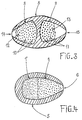
- the invention also allows incorporation of more than an active ingredient. So it is possible, for example, like figure 3 shows two tablet cores (8) and (9) with different active ingredients (10) and (11) per tablet insert their narrow or tapered end areas (12) and (13) at different points (14) and (15) reach the outer wall (4) of the tablet. Likewise can a tablet according to Figure 1 according to the invention an active ingredient Core (1) with more than one active ingredient (2) contain. Finally, the tablet can be in a zone like e.g. in the jacket (5) or in an additional separate component also contain active ingredient, which then not the mechanism described above is subject to release control.
- the restriction is particularly advantageous for ingestion the tablet size to the minimum dimensions. Usually you will at least try to size the coat (5) by limiting it relative to the tablet diameter thinly designed, what by an approximation of the Core shape to support the tablet shape. To strive for is a limitation of the jacket mass not more than 30% of the total mass of the tablet.
- a tablet with two parts (1) or (1 ') The core is shown in FIG. 4.
- the core parts (1, 1 ') contain different active ingredients (2) or (2 '). It can active ingredient for pre-treatment and subsequent post-treatment a disease state, e.g. an irritation of the Gastric mucosa or similar act.
Landscapes
- Chemical & Material Sciences (AREA)
- Life Sciences & Earth Sciences (AREA)
- Engineering & Computer Science (AREA)
- Chemical Kinetics & Catalysis (AREA)
- Oil, Petroleum & Natural Gas (AREA)
- Wood Science & Technology (AREA)
- Organic Chemistry (AREA)
- Health & Medical Sciences (AREA)
- Epidemiology (AREA)
- Pharmacology & Pharmacy (AREA)
- Medicinal Chemistry (AREA)
- Animal Behavior & Ethology (AREA)
- General Health & Medical Sciences (AREA)
- Public Health (AREA)
- Veterinary Medicine (AREA)
- Medicinal Preparation (AREA)
- Medical Preparation Storing Or Oral Administration Devices (AREA)
- Glanulating (AREA)
- Detergent Compositions (AREA)
- Fertilizers (AREA)
- Control And Other Processes For Unpacking Of Materials (AREA)
- Medicines Containing Plant Substances (AREA)
Description
Die Verwendung geometrischer Elemente ist in US 3 924 622 beschrieben, wobei es sich bei der hierin beanspruchten Vorrichtung zur gesteuerten Wirkstoffabgabe nicht um eine Tablette handelt. Jedoch wird hier das geometrische Steuerprinzip der kompensatorischen Flächenvergrößerung beschrieben, mit welchem den verlangsamenden Faktoren der Freisetzung - Verlängerung des Diffusionsweges, Wirkstoffdepletion etc. - entgegengewirkt wird. Die Vorrichtung ist so gestaltet, daß sie ein Wirkstoffreservoir mir einer definierten, gleichbleibenden Öffnung besitzt, durch die der Wirkstoff nach außen tritt. Die Freisetzung geschieht durch Erosion des Reservoirs. Die Form des Reservoirs ist so gewählt, daß sich die Erosionsfläche mit der im Laufe der Freisetzung zunehmenden Entfernung der Erosionsfront von der Öffnung kontinuierlich vergrößert.
Die Vorrichtung wird durch Umhüllung eines Kerns, der z.B. in Form einer konvexen oder bikonvexen Tablette vorliegt, durch Sprüh-, Tauch- oder Tablettierverfahren hergestellt. Die Öffnung wird nachträglich mit einem geeigneten Werkzeug in die Umhüllung eingebracht. Im Falle der Manteltablettierung kann die Öffnung durch asymetrisches bzw. exzentrisches Positionieren beim Aufpressen der Mantelschicht erzeugt werden.
Eine weitere Ausgestaltung sieht vor, daß der Kern wenigstens zwei unterschiedliche Wirkstoffe, z.B. für Voroder Nachbehandlung eines Krankheitszustandes, enthält und diese entweder in homogener Mischung oder in unterschiedlichen Schichten der Kerns vorliegen. Auch können in der Manteltablette mehrere Kerne mit unterschiedlichen Wirkstoffen untergebracht werden.
Schließlich kann auch der Mantelschicht Wirkstoff zugegeben werden.
Claims (11)
- Verfahren zur Herstellung einer Manteltablette zur kontrollierten Freisetzung von Wirkstoff, mit einem erodierbaren und mindestens einen Wirkstoff (2) enthaltenden Tablettenkern (1) und einer weitgehend erosionsresistenten Umhüllung aus einer Mantelschicht (5) mit einer Öffnung,
dadurch gekennzeichnet,
daß zuerst der wirkstoffhaltige Tablettenkern (1) mit einem schmal oder spitz zulaufenden Endbereich (3) geformt und dabei aus Pulver oder Granulat gepreßt und sodann dieser einer Manteltablettenpresse zugeführt wird, welche ihn derart in eine bereits teilbefüllte Matrizenöffnung drückt, daß sein schmal oder spitz zulaufendes Ende (3) an den Rand der vorgesehenen Matrizenöffnung heranreicht, und daß er daraufhin mit weiterem Pulver oder Granulat zusammengepreßt wird, wobei in der Mantelschicht (5) eine Öffnung zugleich mit den Preßvorgang ausgebildet wird, an die der Kern (1) mit seinem spitz zulaufenden Ende (3) heranreicht. - Verfahren nach Anspruch 1, dadurch gekennzeichnet, daß die Querschnittsfläche des Kerns (1) mit zunehmender Entfernung von der Öffnung (6) der Mantelschicht (5) nach einer Funktion erster oder zweiter Ordnung stetig geändert wird.
- Verfahren nach Anspruch 1 oder 2, dadurch gekennzeichnet, daß die Querschnittsfläche des Kerns (1) mit zunehmender Entfernung von der Öffnung (6) sprunghaft geändert wird.
- Verfahren nach einem oder mehreren der Ansprüche 1 bis 3, dadurch gekennzeichnet, daß die Form der Manteltablette der Form des Tablettenkerns (1) angeglichen wird und der Kern (1) aus mindestens 70% der Masse der Manteltablette gebildet wird.
- Verfahren nach einem oder mehreren der Ansprüche 1 bis 4, dadurch gekennzeichnet, daß der Kern (1) aus wenigstens zwei unterschiedlichen Wirkstoffen gebildet wird und diese entweder in homogener Mischung oder in unterschiedlichen Schichten zugegeben werden.
- Verfahren nach einem oder mehreren der Ansprüche 1 bis 5, dadurch gekennzeichnet, daß auch der Mantelschicht (5) Wirkstoff (2) zugegeben wird.
- Verfahren nach einem oder mehreren der Ansprüche 1 bis 6, dadurch gekennzeichnet, daß der Manteltablette wenigstens zwei Kerne (8,9) mit unterschiedlichen Wirkstoffen zugegeben werden.
- Verwendung der Manteltablette nach den vorhergehenden Ansprüchen 1 bis 7 zur Freisetzung von Pflanzenschutzmitteln.
- Verwendung der Manteltablette nach den Ansprüchen 1 bis 7 zur Freisetzung von Düngestoffen.
- Verwendung der Manteltablette nach den Ansprüchen 1 bis 7 zur Freisetzung von antimikrobiellen Stoffen in Spül- oder Waschprozessen.
- Verwendung der Manteltablette nach den Ansprüchen 1 bis 7 zur Herstellung eines Arzneimittels.
Priority Applications (1)
| Application Number | Priority Date | Filing Date | Title |
|---|---|---|---|
| SI9530360T SI0779807T1 (en) | 1994-09-06 | 1995-09-04 | Process of preparing a laminated tablet with pointed core |
Applications Claiming Priority (3)
| Application Number | Priority Date | Filing Date | Title |
|---|---|---|---|
| DE4431653A DE4431653C2 (de) | 1994-09-06 | 1994-09-06 | Manteltablette zur kontrollierten Freisetzung von Wirkstoffen, ein Verfahren zu ihrer Herstellung und ihre Verwendung |
| DE4431653 | 1994-09-06 | ||
| PCT/EP1995/003474 WO1996007401A1 (de) | 1994-09-06 | 1995-09-04 | Manteltablette mit spitzem kern |
Publications (2)
| Publication Number | Publication Date |
|---|---|
| EP0779807A1 EP0779807A1 (de) | 1997-06-25 |
| EP0779807B1 true EP0779807B1 (de) | 1999-11-03 |
Family
ID=6527497
Family Applications (1)
| Application Number | Title | Priority Date | Filing Date |
|---|---|---|---|
| EP95931985A Expired - Lifetime EP0779807B1 (de) | 1994-09-06 | 1995-09-04 | VERFAHREN ZU hERSTELLUNG EINER MANTELTABLETTE MIT SPITZEM KERN |
Country Status (10)
| Country | Link |
|---|---|
| US (1) | US6264985B1 (de) |
| EP (1) | EP0779807B1 (de) |
| JP (1) | JPH10505264A (de) |
| AT (1) | ATE186211T1 (de) |
| CA (1) | CA2199249C (de) |
| DE (2) | DE4431653C2 (de) |
| DK (1) | DK0779807T3 (de) |
| ES (1) | ES2141380T3 (de) |
| GR (1) | GR3032524T3 (de) |
| WO (1) | WO1996007401A1 (de) |
Families Citing this family (40)
| Publication number | Priority date | Publication date | Assignee | Title |
|---|---|---|---|---|
| CA2338710C (en) * | 1998-07-29 | 2009-10-27 | Guido Waeschenbach | A tablet comprising a basic composition and particle comprising core and envelope |
| CA2338819A1 (en) * | 1998-07-29 | 2000-02-10 | Guido Waeschenbach | Composition for use in a water reservoir |
| JP2000139322A (ja) * | 1998-11-11 | 2000-05-23 | Maruyama Mfg Co Ltd | 粉粒剤散布方法及びこの粉粒剤散布方法に使用される粉粒剤 |
| DE19856214C1 (de) * | 1998-12-05 | 2000-03-09 | Henkel Kgaa | Punkttablette |
| GB9901688D0 (en) | 1999-01-26 | 1999-03-17 | Unilever Plc | Detergent compositions |
| DE19963570A1 (de) * | 1999-12-29 | 2001-07-26 | Reckitt Benckiser Nv | Zusammensetzung zur Verwendung in einer Geschirrspülmaschine mit einer Basiszusammensetzung in Form einer Tablette |
| DE19963569B4 (de) * | 1999-12-29 | 2006-11-16 | Reckitt Benckiser N.V. | Zusammensetzung zur Verwendung in einer Geschirrspülmaschine |
| US6569152B2 (en) * | 2000-03-21 | 2003-05-27 | Farrington Pharmaceuticals, Llc | Sustained release delivery systems for solutes |
| US6960357B2 (en) | 2001-05-25 | 2005-11-01 | Mistral Pharma Inc. | Chemical delivery device |
| DE10127897B4 (de) | 2001-06-08 | 2006-04-20 | Bionorica Ag | Manteltablette mit Pflanzentrockenextrakten |
| US7122143B2 (en) | 2001-09-28 | 2006-10-17 | Mcneil-Ppc, Inc. | Methods for manufacturing dosage forms |
| US7838026B2 (en) | 2001-09-28 | 2010-11-23 | Mcneil-Ppc, Inc. | Burst-release polymer composition and dosage forms comprising the same |
| WO2003026626A2 (en) * | 2001-09-28 | 2003-04-03 | Mcneil-Ppc, Inc. | Modified release dosage forms |
| US20040052843A1 (en) * | 2001-12-24 | 2004-03-18 | Lerner E. Itzhak | Controlled release dosage forms |
| NZ552514A (en) * | 2001-12-24 | 2008-08-29 | Teva Pharma | Dosage form with a core tablet of active ingredient sheathed in a compressed annular body of powder or granular material, and process and tooling for producing it |
| USD481456S1 (en) | 2002-01-30 | 2003-10-28 | Smithkline Beecham P.L.C. | Capsule |
| GB0203296D0 (en) | 2002-02-12 | 2002-03-27 | Glaxo Group Ltd | Novel composition |
| EP1492508A4 (de) * | 2002-03-04 | 2009-05-06 | Teva Pharma | Dosierformen mit kontrollierter freisetzung |
| US8637512B2 (en) * | 2002-07-29 | 2014-01-28 | Glaxo Group Limited | Formulations and method of treatment |
| AU2003218359A1 (en) * | 2002-09-28 | 2004-04-19 | Mcneil-Ppc, Inc. | Polymer composition and dosage forms comprising the same |
| NZ538842A (en) | 2002-09-28 | 2008-03-28 | Mcneil Ppc Inc | Immediate release dosage form comprising a solid core of density 0.9 g/ml surrounded by a shell that is readily soluble to gastrointestinal fluids |
| US7879354B2 (en) | 2004-01-13 | 2011-02-01 | Mcneil-Ppc, Inc. | Rapidly disintegrating gelatinous coated tablets |
| US20060002986A1 (en) * | 2004-06-09 | 2006-01-05 | Smithkline Beecham Corporation | Pharmaceutical product |
| AU2005266882A1 (en) * | 2004-07-26 | 2006-02-02 | Teva Pharmaceutical Indudstries, Ltd. | Dosage forms with an enterically coated core tablet |
| US20060024368A1 (en) * | 2004-07-30 | 2006-02-02 | Reza Fassihi | Compressed composite delivery system for release-rate modulation of bioactives |
| WO2006031584A2 (en) * | 2004-09-13 | 2006-03-23 | L. Perrigo Company | Quick dissolve medicament and method of manufacturing |
| DE102004051620A1 (de) * | 2004-10-22 | 2006-04-27 | Henkel Kgaa | Wasch- oder Reinigungsmittel |
| US8673352B2 (en) | 2005-04-15 | 2014-03-18 | Mcneil-Ppc, Inc. | Modified release dosage form |
| WO2009023006A2 (en) * | 2006-05-08 | 2009-02-19 | Mcneil-Ppc, Inc. | Modified release dosage form |
| DE102007026037A1 (de) | 2007-06-04 | 2008-12-11 | Lts Lohmann Therapie-Systeme Ag | Gastroretentives System mit Alginat-Körper |
| TWI542338B (zh) * | 2008-05-07 | 2016-07-21 | 壯生和壯生視覺關懷公司 | 用於活性劑之控制釋放的眼用裝置 |
| AU2011342893A1 (en) | 2010-12-13 | 2013-05-02 | Purdue Pharma L.P. | Controlled release dosage forms |
| DE102011051653A1 (de) | 2011-07-07 | 2013-01-10 | Lts Lohmann Therapie-Systeme Ag | Quellfähige Manteltablette |
| CN103948557A (zh) * | 2014-04-08 | 2014-07-30 | 闻晓光 | 一种新型控释片 |
| DE102014107026B4 (de) * | 2014-05-19 | 2017-07-13 | Romaco Kilian Gmbh | Vorrichtung zum Herstellen von Kerntabletten sowie Mantelkerntabletten (Doppelkern- oder Mehrfachkerntablette) |
| KR20240039186A (ko) | 2015-06-03 | 2024-03-26 | 트리아스텍 인코포레이티드 | 제형 및 이의 용도 |
| JP6927466B2 (ja) * | 2017-01-17 | 2021-09-01 | フロイント産業株式会社 | 錠剤製造装置及び錠剤製造方法 |
| KR20190107712A (ko) | 2017-01-26 | 2019-09-20 | 트리아스텍 인코포레이티드 | 특정 위장 부위에서의 제어 방출의 투여 형태 |
| WO2018221981A1 (ko) * | 2017-05-31 | 2018-12-06 | 한밭대학교 산학협력단 | 패각의 중간절편을 이용한 경량 고강도 소재의 제조방법 |
| WO2019137200A1 (en) | 2018-01-09 | 2019-07-18 | Triastek, Inc. | Oral drug dosage forms comprising a fixed-dose of an adhd non-stimulant and an adhd stimulant |
Family Cites Families (16)
| Publication number | Priority date | Publication date | Assignee | Title |
|---|---|---|---|---|
| US994742A (en) * | 1910-04-08 | 1911-06-13 | Marshal J Gregory | Fence-post foundation. |
| US3845770A (en) * | 1972-06-05 | 1974-11-05 | Alza Corp | Osmatic dispensing device for releasing beneficial agent |
| US3924622A (en) | 1973-10-11 | 1975-12-09 | Mead Johnson & Co | Zero-order release method |
| US3851648A (en) * | 1973-10-11 | 1974-12-03 | Mead Johnson & Co | Zero-order release device |
| US3993072A (en) * | 1974-08-28 | 1976-11-23 | Alza Corporation | Microporous drug delivery device |
| US4564364A (en) * | 1983-05-26 | 1986-01-14 | Alza Corporation | Active agent dispenser |
| GB8319766D0 (en) * | 1983-07-22 | 1983-08-24 | Graham N B | Controlled release device |
| US4692336A (en) * | 1984-03-19 | 1987-09-08 | Alza Corporation | Self controlled release device for administering beneficial agent to recipient |
| US4816262A (en) * | 1986-08-28 | 1989-03-28 | Universite De Montreal | Controlled release tablet |
| US4803076A (en) * | 1986-09-04 | 1989-02-07 | Pfizer Inc. | Controlled release device for an active substance |
| US4814183A (en) * | 1987-08-31 | 1989-03-21 | Merck & Co., Inc. | Device for the controlled release of drugs with Donnan-like modulation by charged insoluble resins |
| GB8820353D0 (en) * | 1988-08-26 | 1988-09-28 | Staniforth J N | Controlled release tablet |
| IT1237904B (it) | 1989-12-14 | 1993-06-18 | Ubaldo Conte | Compresse a rilascio a velocita' controllata delle sostanze attive |
| DE69229881T2 (de) * | 1991-10-04 | 1999-12-09 | Yoshitomi Pharmaceutical Industries, Ltd. | Tablette mit verzögerter freisetzung |
| DK0542364T3 (da) * | 1991-11-13 | 1996-03-11 | Glaxo Canada | Anordning til reguleret frigivelse |
| DE4341442C2 (de) | 1993-12-04 | 1998-11-05 | Lohmann Therapie Syst Lts | Vorrichtung zur kontrollierten Freisetzung von Wirkstoffen sowie ihre Verwendung |
-
1994
- 1994-09-06 DE DE4431653A patent/DE4431653C2/de not_active Expired - Fee Related
-
1995
- 1995-09-04 EP EP95931985A patent/EP0779807B1/de not_active Expired - Lifetime
- 1995-09-04 ES ES95931985T patent/ES2141380T3/es not_active Expired - Lifetime
- 1995-09-04 WO PCT/EP1995/003474 patent/WO1996007401A1/de not_active Ceased
- 1995-09-04 DK DK95931985T patent/DK0779807T3/da active
- 1995-09-04 DE DE59507193T patent/DE59507193D1/de not_active Expired - Lifetime
- 1995-09-04 US US08/810,801 patent/US6264985B1/en not_active Expired - Fee Related
- 1995-09-04 AT AT95931985T patent/ATE186211T1/de active
- 1995-09-04 CA CA002199249A patent/CA2199249C/en not_active Expired - Fee Related
- 1995-09-04 JP JP8509201A patent/JPH10505264A/ja active Pending
-
2000
- 2000-01-31 GR GR20000400220T patent/GR3032524T3/el unknown
Also Published As
| Publication number | Publication date |
|---|---|
| US6264985B1 (en) | 2001-07-24 |
| GR3032524T3 (en) | 2000-05-31 |
| JPH10505264A (ja) | 1998-05-26 |
| ES2141380T3 (es) | 2000-03-16 |
| DE59507193D1 (de) | 1999-12-09 |
| DK0779807T3 (da) | 2000-05-08 |
| WO1996007401A1 (de) | 1996-03-14 |
| CA2199249A1 (en) | 1996-03-14 |
| EP0779807A1 (de) | 1997-06-25 |
| ATE186211T1 (de) | 1999-11-15 |
| DE4431653C2 (de) | 2000-01-20 |
| CA2199249C (en) | 2005-12-27 |
| DE4431653A1 (de) | 1996-03-07 |
Similar Documents
| Publication | Publication Date | Title |
|---|---|---|
| EP0779807B1 (de) | VERFAHREN ZU hERSTELLUNG EINER MANTELTABLETTE MIT SPITZEM KERN | |
| DE4341442C2 (de) | Vorrichtung zur kontrollierten Freisetzung von Wirkstoffen sowie ihre Verwendung | |
| DE69011045T2 (de) | Durch Aufquellung gesteuerte polymere Wirkstoffabgabevorrichtung. | |
| DE3876724T2 (de) | Die zur freisetzung bioaktiver substanzen kontrollierende umhuellungszubereitung. | |
| DE69720055T2 (de) | Verabreichungsform zur abgabe von steigenden wirkstoffdosen | |
| DE2525061C2 (de) | Formkörper zur Abgabe eines Wirkstoffs und Verfahren zu dessen Herstellung | |
| DE69207863T2 (de) | Vorrichtung zur kontrollierten Wirkstoffreigabe | |
| DE3811114C2 (de) | Zweischichtige Dosierungsform zur Abgabe eines Wirkstoffs | |
| DE69612481T2 (de) | Mit bändern versehene dosisform zur verlängerten freisetzung eines wirkstoffs | |
| DE2808505C2 (de) | Mit im wesentlichen gleichmäßiger Geschwindigkeit eluierbare Tablette und Verfahren zu ihrer Herstellung | |
| DE69221711T2 (de) | Verabreichungsvorrichtung von Wirkstoffdispersionen mit kontrollierter Freisetzung | |
| DE2549856A1 (de) | Wirkstoffspender und verfahren zu seiner herstellung | |
| CH671696A5 (de) | ||
| WO1997032570A1 (de) | Implantate mit phasenweiser arzneistoffabgabe | |
| LU82718A1 (de) | Teilbare tablette mit kontrollierter und verzoegerter wirkstoffabgabe | |
| DE1617724A1 (de) | Verfahren zur Herstellung von Arzneimitteln mit verzoegerter Wirkung | |
| CH636276A5 (de) | Durch osmose betaetigbare abgabevorrichtung. | |
| CH659944A5 (de) | Vorrichtung zur abgabe von zwei unterschiedlichen wirkstoffen durch osmose. | |
| EP1227801A2 (de) | Mehrschichtige filmförmige zubereitung aus hydrophilen polymeren zur schnellen freisetzung von wirkstoffen | |
| EP0387694A2 (de) | Pflaster als therapeutisches System zur Verabreichung von Wirkstoffen an die Haut mit einer abgestuften Wirkstoffabgabe, Verfahren zu seiner Herstellung sowie Verwendung | |
| EP0837674B1 (de) | Verfahren zur herstellung von schichttabletten zur kontrollierten freisetzung von wirkstoffen | |
| DE2243986A1 (de) | Biologisch abbaubarer augeneinsatz zur verabreichung eines arzneimittels | |
| DE3443586C2 (de) | Osmotisches Abgabesystem | |
| DE2308144A1 (de) | Kontakklinse | |
| EP1923056B1 (de) | Pharmazeutische Einzeldosisform |
Legal Events
| Date | Code | Title | Description |
|---|---|---|---|
| PUAI | Public reference made under article 153(3) epc to a published international application that has entered the european phase |
Free format text: ORIGINAL CODE: 0009012 |
|
| 17P | Request for examination filed |
Effective date: 19970215 |
|
| AK | Designated contracting states |
Kind code of ref document: A1 Designated state(s): AT BE CH DE DK ES FR GB GR IE IT LI LU NL PT SE |
|
| AX | Request for extension of the european patent |
Free format text: SI PAYMENT 970215 |
|
| 17Q | First examination report despatched |
Effective date: 19980312 |
|
| GRAG | Despatch of communication of intention to grant |
Free format text: ORIGINAL CODE: EPIDOS AGRA |
|
| GRAG | Despatch of communication of intention to grant |
Free format text: ORIGINAL CODE: EPIDOS AGRA |
|
| GRAH | Despatch of communication of intention to grant a patent |
Free format text: ORIGINAL CODE: EPIDOS IGRA |
|
| GRAH | Despatch of communication of intention to grant a patent |
Free format text: ORIGINAL CODE: EPIDOS IGRA |
|
| GRAA | (expected) grant |
Free format text: ORIGINAL CODE: 0009210 |
|
| AK | Designated contracting states |
Kind code of ref document: B1 Designated state(s): AT BE CH DE DK ES FR GB GR IE IT LI LU NL PT SE |
|
| AX | Request for extension of the european patent |
Free format text: SI PAYMENT 19970215 |
|
| REF | Corresponds to: |
Ref document number: 186211 Country of ref document: AT Date of ref document: 19991115 Kind code of ref document: T |
|
| REG | Reference to a national code |
Ref country code: CH Ref legal event code: EP |
|
| REF | Corresponds to: |
Ref document number: 59507193 Country of ref document: DE Date of ref document: 19991209 |
|
| ET | Fr: translation filed | ||
| REG | Reference to a national code |
Ref country code: CH Ref legal event code: NV Representative=s name: PATENTANWALTSBUERO FELDMANN AG |
|
| REG | Reference to a national code |
Ref country code: IE Ref legal event code: FG4D Free format text: GERMAN |
|
| ITF | It: translation for a ep patent filed | ||
| GBT | Gb: translation of ep patent filed (gb section 77(6)(a)/1977) |
Effective date: 20000127 |
|
| REG | Reference to a national code |
Ref country code: ES Ref legal event code: FG2A Ref document number: 2141380 Country of ref document: ES Kind code of ref document: T3 |
|
| REG | Reference to a national code |
Ref country code: PT Ref legal event code: SC4A Free format text: AVAILABILITY OF NATIONAL TRANSLATION Effective date: 20000111 |
|
| REG | Reference to a national code |
Ref country code: DK Ref legal event code: T3 |
|
| PLBE | No opposition filed within time limit |
Free format text: ORIGINAL CODE: 0009261 |
|
| STAA | Information on the status of an ep patent application or granted ep patent |
Free format text: STATUS: NO OPPOSITION FILED WITHIN TIME LIMIT |
|
| 26N | No opposition filed | ||
| REG | Reference to a national code |
Ref country code: GB Ref legal event code: IF02 |
|
| REG | Reference to a national code |
Ref country code: CH Ref legal event code: PFA Owner name: LTS LOHMANN THERAPIE-SYSTEME GMBH Free format text: LTS LOHMANN THERAPIE-SYSTEME GMBH#IRLICHER STRASSE 55#56567 NEUWIED (DE) -TRANSFER TO- LTS LOHMANN THERAPIE-SYSTEME GMBH#IRLICHER STRASSE 55#56567 NEUWIED (DE) |
|
| PGFP | Annual fee paid to national office [announced via postgrant information from national office to epo] |
Ref country code: IT Payment date: 20100922 Year of fee payment: 16 |
|
| PGFP | Annual fee paid to national office [announced via postgrant information from national office to epo] |
Ref country code: IE Payment date: 20110923 Year of fee payment: 17 Ref country code: DK Payment date: 20110926 Year of fee payment: 17 Ref country code: CH Payment date: 20110923 Year of fee payment: 17 |
|
| PGFP | Annual fee paid to national office [announced via postgrant information from national office to epo] |
Ref country code: SE Payment date: 20110923 Year of fee payment: 17 Ref country code: GR Payment date: 20110923 Year of fee payment: 17 Ref country code: GB Payment date: 20110920 Year of fee payment: 17 Ref country code: PT Payment date: 20110901 Year of fee payment: 17 Ref country code: AT Payment date: 20110914 Year of fee payment: 17 Ref country code: FR Payment date: 20110928 Year of fee payment: 17 Ref country code: ES Payment date: 20110926 Year of fee payment: 17 Ref country code: DE Payment date: 20110923 Year of fee payment: 17 |
|
| PGFP | Annual fee paid to national office [announced via postgrant information from national office to epo] |
Ref country code: NL Payment date: 20110929 Year of fee payment: 17 |
|
| PGFP | Annual fee paid to national office [announced via postgrant information from national office to epo] |
Ref country code: LU Payment date: 20111005 Year of fee payment: 17 Ref country code: BE Payment date: 20110914 Year of fee payment: 17 |
|
| REG | Reference to a national code |
Ref country code: PT Ref legal event code: MM4A Free format text: LAPSE DUE TO NON-PAYMENT OF FEES Effective date: 20130304 |
|
| BERE | Be: lapsed |
Owner name: LOHMANN THERAPIE-SYSTEME G.M.B.H. *LTS Effective date: 20120930 |
|
| REG | Reference to a national code |
Ref country code: NL Ref legal event code: V1 Effective date: 20130401 |
|
| PG25 | Lapsed in a contracting state [announced via postgrant information from national office to epo] |
Ref country code: SE Free format text: LAPSE BECAUSE OF NON-PAYMENT OF DUE FEES Effective date: 20120905 |
|
| REG | Reference to a national code |
Ref country code: CH Ref legal event code: PL Ref country code: SE Ref legal event code: EUG |
|
| REG | Reference to a national code |
Ref country code: AT Ref legal event code: MM01 Ref document number: 186211 Country of ref document: AT Kind code of ref document: T Effective date: 20120904 |
|
| REG | Reference to a national code |
Ref country code: GR Ref legal event code: ML Ref document number: 20000400220 Country of ref document: GR Effective date: 20130404 |
|
| GBPC | Gb: european patent ceased through non-payment of renewal fee |
Effective date: 20120904 |
|
| PG25 | Lapsed in a contracting state [announced via postgrant information from national office to epo] |
Ref country code: PT Free format text: LAPSE BECAUSE OF NON-PAYMENT OF DUE FEES Effective date: 20130304 |
|
| REG | Reference to a national code |
Ref country code: DK Ref legal event code: EBP |
|
| REG | Reference to a national code |
Ref country code: IE Ref legal event code: MM4A |
|
| REG | Reference to a national code |
Ref country code: FR Ref legal event code: ST Effective date: 20130531 |
|
| PG25 | Lapsed in a contracting state [announced via postgrant information from national office to epo] |
Ref country code: AT Free format text: LAPSE BECAUSE OF NON-PAYMENT OF DUE FEES Effective date: 20120904 Ref country code: GB Free format text: LAPSE BECAUSE OF NON-PAYMENT OF DUE FEES Effective date: 20120904 Ref country code: IE Free format text: LAPSE BECAUSE OF NON-PAYMENT OF DUE FEES Effective date: 20120904 Ref country code: DE Free format text: LAPSE BECAUSE OF NON-PAYMENT OF DUE FEES Effective date: 20130403 Ref country code: CH Free format text: LAPSE BECAUSE OF NON-PAYMENT OF DUE FEES Effective date: 20120930 Ref country code: LI Free format text: LAPSE BECAUSE OF NON-PAYMENT OF DUE FEES Effective date: 20120930 Ref country code: BE Free format text: LAPSE BECAUSE OF NON-PAYMENT OF DUE FEES Effective date: 20120930 |
|
| PG25 | Lapsed in a contracting state [announced via postgrant information from national office to epo] |
Ref country code: NL Free format text: LAPSE BECAUSE OF NON-PAYMENT OF DUE FEES Effective date: 20130401 Ref country code: IT Free format text: LAPSE BECAUSE OF NON-PAYMENT OF DUE FEES Effective date: 20120904 Ref country code: GR Free format text: LAPSE BECAUSE OF NON-PAYMENT OF DUE FEES Effective date: 20130404 Ref country code: FR Free format text: LAPSE BECAUSE OF NON-PAYMENT OF DUE FEES Effective date: 20121001 |
|
| REG | Reference to a national code |
Ref country code: DE Ref legal event code: R119 Ref document number: 59507193 Country of ref document: DE Effective date: 20130403 |
|
| REG | Reference to a national code |
Ref country code: ES Ref legal event code: FD2A Effective date: 20131021 |
|
| PG25 | Lapsed in a contracting state [announced via postgrant information from national office to epo] |
Ref country code: ES Free format text: LAPSE BECAUSE OF NON-PAYMENT OF DUE FEES Effective date: 20120905 Ref country code: DK Free format text: LAPSE BECAUSE OF NON-PAYMENT OF DUE FEES Effective date: 20121001 |
|
| PG25 | Lapsed in a contracting state [announced via postgrant information from national office to epo] |
Ref country code: LU Free format text: LAPSE BECAUSE OF NON-PAYMENT OF DUE FEES Effective date: 20120904 |