EP0778076B1 - Procédé d'élaboration de membranes supportées - Google Patents
Procédé d'élaboration de membranes supportées Download PDFInfo
- Publication number
- EP0778076B1 EP0778076B1 EP96402589A EP96402589A EP0778076B1 EP 0778076 B1 EP0778076 B1 EP 0778076B1 EP 96402589 A EP96402589 A EP 96402589A EP 96402589 A EP96402589 A EP 96402589A EP 0778076 B1 EP0778076 B1 EP 0778076B1
- Authority
- EP
- European Patent Office
- Prior art keywords
- process according
- oxide
- gel
- zeolite
- support
- Prior art date
- Legal status (The legal status is an assumption and is not a legal conclusion. Google has not performed a legal analysis and makes no representation as to the accuracy of the status listed.)
- Expired - Lifetime
Links
Images
Classifications
-
- B—PERFORMING OPERATIONS; TRANSPORTING
- B01—PHYSICAL OR CHEMICAL PROCESSES OR APPARATUS IN GENERAL
- B01D—SEPARATION
- B01D67/00—Processes specially adapted for manufacturing semi-permeable membranes for separation processes or apparatus
- B01D67/0039—Inorganic membrane manufacture
- B01D67/0048—Inorganic membrane manufacture by sol-gel transition
-
- B—PERFORMING OPERATIONS; TRANSPORTING
- B01—PHYSICAL OR CHEMICAL PROCESSES OR APPARATUS IN GENERAL
- B01D—SEPARATION
- B01D67/00—Processes specially adapted for manufacturing semi-permeable membranes for separation processes or apparatus
- B01D67/0039—Inorganic membrane manufacture
- B01D67/0051—Inorganic membrane manufacture by controlled crystallisation, e,.g. hydrothermal growth
-
- B—PERFORMING OPERATIONS; TRANSPORTING
- B01—PHYSICAL OR CHEMICAL PROCESSES OR APPARATUS IN GENERAL
- B01D—SEPARATION
- B01D67/00—Processes specially adapted for manufacturing semi-permeable membranes for separation processes or apparatus
- B01D67/0081—After-treatment of organic or inorganic membranes
- B01D67/0083—Thermal after-treatment
-
- B—PERFORMING OPERATIONS; TRANSPORTING
- B01—PHYSICAL OR CHEMICAL PROCESSES OR APPARATUS IN GENERAL
- B01D—SEPARATION
- B01D69/00—Semi-permeable membranes for separation processes or apparatus characterised by their form, structure or properties; Manufacturing processes specially adapted therefor
- B01D69/10—Supported membranes; Membrane supports
- B01D69/105—Support pretreatment
-
- B—PERFORMING OPERATIONS; TRANSPORTING
- B01—PHYSICAL OR CHEMICAL PROCESSES OR APPARATUS IN GENERAL
- B01D—SEPARATION
- B01D69/00—Semi-permeable membranes for separation processes or apparatus characterised by their form, structure or properties; Manufacturing processes specially adapted therefor
- B01D69/12—Composite membranes; Ultra-thin membranes
-
- B—PERFORMING OPERATIONS; TRANSPORTING
- B01—PHYSICAL OR CHEMICAL PROCESSES OR APPARATUS IN GENERAL
- B01D—SEPARATION
- B01D71/00—Semi-permeable membranes for separation processes or apparatus characterised by the material; Manufacturing processes specially adapted therefor
- B01D71/02—Inorganic material
- B01D71/028—Molecular sieves
- B01D71/0281—Zeolites
-
- B—PERFORMING OPERATIONS; TRANSPORTING
- B01—PHYSICAL OR CHEMICAL PROCESSES OR APPARATUS IN GENERAL
- B01J—CHEMICAL OR PHYSICAL PROCESSES, e.g. CATALYSIS OR COLLOID CHEMISTRY; THEIR RELEVANT APPARATUS
- B01J20/00—Solid sorbent compositions or filter aid compositions; Sorbents for chromatography; Processes for preparing, regenerating or reactivating thereof
- B01J20/02—Solid sorbent compositions or filter aid compositions; Sorbents for chromatography; Processes for preparing, regenerating or reactivating thereof comprising inorganic material
- B01J20/10—Solid sorbent compositions or filter aid compositions; Sorbents for chromatography; Processes for preparing, regenerating or reactivating thereof comprising inorganic material comprising silica or silicate
- B01J20/16—Alumino-silicates
- B01J20/18—Synthetic zeolitic molecular sieves
- B01J20/183—Physical conditioning without chemical treatment, e.g. drying, granulating, coating, irradiation
-
- B—PERFORMING OPERATIONS; TRANSPORTING
- B01—PHYSICAL OR CHEMICAL PROCESSES OR APPARATUS IN GENERAL
- B01J—CHEMICAL OR PHYSICAL PROCESSES, e.g. CATALYSIS OR COLLOID CHEMISTRY; THEIR RELEVANT APPARATUS
- B01J37/00—Processes, in general, for preparing catalysts; Processes, in general, for activation of catalysts
- B01J37/02—Impregnation, coating or precipitation
- B01J37/024—Multiple impregnation or coating
- B01J37/0246—Coatings comprising a zeolite
-
- B—PERFORMING OPERATIONS; TRANSPORTING
- B01—PHYSICAL OR CHEMICAL PROCESSES OR APPARATUS IN GENERAL
- B01D—SEPARATION
- B01D2323/00—Details relating to membrane preparation
- B01D2323/08—Specific temperatures applied
- B01D2323/081—Heating
-
- B—PERFORMING OPERATIONS; TRANSPORTING
- B01—PHYSICAL OR CHEMICAL PROCESSES OR APPARATUS IN GENERAL
- B01D—SEPARATION
- B01D2323/00—Details relating to membrane preparation
- B01D2323/46—Impregnation
-
- B—PERFORMING OPERATIONS; TRANSPORTING
- B01—PHYSICAL OR CHEMICAL PROCESSES OR APPARATUS IN GENERAL
- B01J—CHEMICAL OR PHYSICAL PROCESSES, e.g. CATALYSIS OR COLLOID CHEMISTRY; THEIR RELEVANT APPARATUS
- B01J2229/00—Aspects of molecular sieve catalysts not covered by B01J29/00
- B01J2229/60—Synthesis on support
- B01J2229/64—Synthesis on support in or on refractory materials
-
- B—PERFORMING OPERATIONS; TRANSPORTING
- B01—PHYSICAL OR CHEMICAL PROCESSES OR APPARATUS IN GENERAL
- B01J—CHEMICAL OR PHYSICAL PROCESSES, e.g. CATALYSIS OR COLLOID CHEMISTRY; THEIR RELEVANT APPARATUS
- B01J37/00—Processes, in general, for preparing catalysts; Processes, in general, for activation of catalysts
- B01J37/0009—Use of binding agents; Moulding; Pressing; Powdering; Granulating; Addition of materials ameliorating the mechanical properties of the product catalyst
- B01J37/0018—Addition of a binding agent or of material, later completely removed among others as result of heat treatment, leaching or washing,(e.g. forming of pores; protective layer, desintegrating by heat)
-
- Y—GENERAL TAGGING OF NEW TECHNOLOGICAL DEVELOPMENTS; GENERAL TAGGING OF CROSS-SECTIONAL TECHNOLOGIES SPANNING OVER SEVERAL SECTIONS OF THE IPC; TECHNICAL SUBJECTS COVERED BY FORMER USPC CROSS-REFERENCE ART COLLECTIONS [XRACs] AND DIGESTS
- Y10—TECHNICAL SUBJECTS COVERED BY FORMER USPC
- Y10S—TECHNICAL SUBJECTS COVERED BY FORMER USPC CROSS-REFERENCE ART COLLECTIONS [XRACs] AND DIGESTS
- Y10S95/00—Gas separation: processes
- Y10S95/90—Solid sorbent
- Y10S95/902—Molecular sieve
Definitions
- the invention relates to a process for the controlled production of membranes. supported.
- Zeolites are used for their adsorption separation properties selective or their catalytic properties.
- the separation on a zeolite in powder is a batch process.
- a zeolite membrane offers the possibility of to separate molecules by an economically interesting continuous process.
- the support is immersed in a zeolite precursor gel and the whole is subjected to hydrothermal conditions in order to crystallize the zeolite.
- Patent application JP-A-60 / 129,119 describes a membrane composed of a zeolite film crystallized on the surface of an alumina support.
- a membrane is obtained by crystallization of a sieve molecular on a non-porous surface and separation of the film from this surface.
- EP-A-481660 concerning a zeolite membrane supported, the zeolite layer is directly linked to the support.
- Patent application JP-A-06/321 530 describes a process for producing composite membranes in which the temperature synthesis is increased during crystallization.
- the support is brought into contact with a colloidal solution, separated from it and placed in saturated steam to crystallize the zeolite from the adsorbed solution.
- International application WO-A-93 / 17,781 describes a process for forming a zeolite membrane by exposure to saturated water vapor of an aqueous or alcoholic colloidal solution deposited on a porous support.
- the present invention relates to a process for preparing a membrane composite consisting of a continuous layer of zeolite, of controlled thickness, located mainly on the surface of a porous support, characterized in that it comprises at least (a) a gel formation step, located mainly at said surface of said porous support, by bringing said porous support into contact successively and in any order with two immiscible liquids containing the agents necessary for the formation of said gel: an aqueous liquid and a liquid containing the hydrolysable sources leading to said oxide, immiscible with said liquid aqueous; said porous support impregnated with the first liquid being brought into contact with the second liquid; then (b) a step of transforming said gel into the zeolite sought; and finally (c) elimination of residual agents.
- the process of the invention also applies to the preparation of a silico-metallate, mesoporous oxide or microporous oxide membrane.
- This process leads to a composite membrane consisting of a layer continuous and thin zeolite (or silico-metallate or mesoporous oxide or oxide microporous) located mainly on the surface of a porous support outside but also inside of it. This fact allows good adhesion of the zeolite (or silico-metallate or mesoporous oxide or microporous oxide) at support.
- the thickness of this layer as well as the size and morphology of the crystals are checked. The thickness is controlled by the amount of gel incorporated. The size and morphology depend on the relative proportions of the different reagents components of the gel. Therefore, this process can lead to the formation of thin layers, suitable for possible use in separation.
- the support consists a porous material whose pores have a diameter between 4 nm and 100 ⁇ m, preferably between 4 nm and 10 ⁇ m and whose fraction of total pore volume is greater than 5%, preferably 40%.
- the support consists of an inorganic, organic or mixed material.
- a ceramic support based on alumina and / or zirconia and / or titanium oxide is a appropriate example.
- other materials may be suitable: metal (steel stainless, silver), glass (sintered glass, Vycor® glass, glass microfibers), carbon, silica (airgel), zeolites, clays or polymers.
- metal steel stainless, silver
- glass sintered glass, Vycor® glass, glass microfibers
- carbon silica (airgel), zeolites, clays or polymers.
- silica airgel
- zeolites clays or polymers.
- the use of an alumina support - ⁇ is preferred.
- Geometry can be flat: disc, sheet, etc. It can also be tubular or in the form of spiral.
- the porous support is brought into contact successively with two immiscible liquids containing the agents necessary for the formation of the gel: a liquid containing the sources of the hydrolysable structural elements and an aqueous liquid.
- the liquid containing the sources of the hydrolysable structural elements consists either of these sources which are pure or diluted in a solvent miscible but immiscible with the aqueous liquid in order to avoid homogenization of the two liquids.
- the sources of the hydrolysable structural elements are likely to lead to tetrahedra TO 4 (where T represents for example an element chosen for example from Si, Al, B, Ga, Ge and P) and are chosen from the group formed by alkoxides of silicon and aluminum and the chlorides of silicon and aluminum, such as for example silicon tetrachloride and aluminum trichloride. These are preferably the alkoxides of silicon or aluminum.
- the aqueous liquid consists of pure water, optionally added with a polar organic solvent and / or one or more adjuvants for the gel formation reaction and / or one or more adjuvants for the crystallization of the zeolite. If the polar organic solvent is miscible with the liquid containing the sources of the hydrolysable structural members, it must be incorporated in small quantities, or the gel-forming reaction must be extremely rapid.
- the adjuvants of the gel formation reaction consist of acids or mineral and / or organic bases which act as catalysts. Acids hydrochloric and hydrofluoric, soda and ammonia are examples appropriate.
- the zeolite crystallization aids consist of acids or bases and / or mineral and / or organic salts and / or non-dissociated molecules essentially serving as mobilizing and structuring agents and counter-ion of the load of the frame.
- the main agents are fluoride or hydroxide ions mobilizers, introduced for example in the form of sodium hydroxide and acid hydrofluoric.
- Various mineral or organic structuring agents may be suitable: hydrated cations (sodium or potassium ions), ionic pairs (ammonium ions or phosphonium and the corresponding anions) or neutral molecules (amines, alcohols, or ethers). Most commonly used as crystallization aids tetrapropylammonium hydroxide or bromide, sodium hydroxides and potassium, ammonia, hydrofluoric acid and as ethers, crown ethers.
- the first step in forming the gel consists in drying the porous support, cooling it to room temperature and impregnating it with the aqueous liquid or the liquid containing the sources of the hydrolysable structural elements.
- the drying of the support can be carried out at a temperature between 40 and 600 ° C, for example for a period between 1 minute and 48 hours. It is preferably carried out at 60 ° C for 1 night.
- the impregnation preferably consists of immersing the support in the liquid. However, other methods can be used, for example depositing the liquid on the surface of the porous support.
- the impregnation can be carried out at a temperature between - 20 and 200 ° C, for example for a period between 1 minute and 72 hours and under a pressure between 10-5 and 1 atm. For example, the impregnation can be carried out at room temperature, for 30 minutes and under a pressure of 2.10 -2 atm.
- the second stage of gel formation consists in putting the impregnated support of the first liquid in contact with the second liquid immiscible with the first.
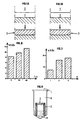
- the gel can be formed according to methods A and B described in conjunction with FIGS. 1A and 1B, on which (1) represents the aqueous liquid, (2) the liquid containing the sources of hydrolysable structural members and (3) gel.
- the porous support impregnated with the aqueous liquid is brought to contact of the liquid containing the sources of the hydrolysable structural elements, preferably tetramethoxysilane.
- the aqueous liquid consists of pure water.
- the gel formation reaction is slow.
- the amount of gel formed is a function of the duration of contact between the support assembly and water and the liquid containing the sources of the hydrolysable structural elements.
- the contact durations in hours are plotted on the abscissa and, on the ordinate, percentage of silica formed relative to the initial mass of the support.
- this duration can be between 1 hour and 15 days and the percentage of the mass of silica gel incorporated relative to the initial mass of the support is preferably between 4 and 15.
- the liquid aqueous consists of water added with a polar organic solvent and / or several adjuvants.
- the gel formation reaction should preferably be rapid to avoid diffusion of the reagents from the aqueous liquid out of the porous support. It can be rapid and complete in the presence of a catalyst.
- the mobilizing agents such as fluoride or hydroxide ions, are preferably used to play this role.
- the speed of gel formation depends on the composition of the aqueous liquid. For example, the speed is higher the higher the solution is more basic.
- the porous support impregnated with the liquid containing the sources of hydrolysable structural elements preferably tetramethoxysilane
- the aqueous liquid consists of pure water.
- the gel formation reaction is slow.
- the amount of gel formed is a function of the duration of contact between the support assembly and liquid containing the sources of hydrolysable structural elements and water.
- the amount of gel formed is nevertheless limited by the amount of liquid containing the sources of hydrolysable structural elements initially introduced into the porous support.
- the aqueous liquid consists of water added with a polar organic solvent and / or several adjuvants.
- the gel formation reaction should preferably be rapid to avoid diffusion of the liquid containing the sources of the structural members hydrolyzable out of the porous support. It can be fast and complete in the presence of a catalyst. Mobilizing agents, such as fluoride or hydroxide ions, are preferentially used to play this role.
- the amount of gel formed and by therefore the thickness of the zeolite layer is controlled by the amount of liquid containing the sources of the hydrolysable structural elements incorporated.
- the amount of gel formed can be increased by repetition of the two stages of gel formation as many times as necessary.
- the number of incorporations is plotted on the abscissa and, on the ordinate, the percentage of silica formed relative to the initial mass of the support.
- the support containing the gel formed previously is optionally washed for example with methanol and dried at a temperature between 40 and 200 ° C for a period of between 1 and 24 hours. Drying is preferably carried out at a temperature between 60 and 100 ° C, for example during a duration between 2 and 24 hours.
- the support containing the gel is then placed in the contact with a solution which may contain adjuvants for the crystallization of the zeolite and / or an additional structural element of the zeolite, preferably in the form of alkoxides and / or oxides of silicon and / or aluminum to prevent the formation of possible cracks.
- a solution which may contain adjuvants for the crystallization of the zeolite and / or an additional structural element of the zeolite, preferably in the form of alkoxides and / or oxides of silicon and / or aluminum to prevent the formation of possible cracks.
- the zeolite is then crystallized by bringing the gel into contact with steam. saturated water.
- the support containing the gel is placed in a device suitable ( Figure 4) and is exposed to saturated water vapor at a temperature between 50 and 300 ° C, preferably between 80 and 220 ° C, for example for a period of between 1 hour and 15 days, preferably between 3 and 72 hours, in order to crystallize the gel into a zeolite.
- the device presented as illustrated in FIG. 4 consists of an autoclave having a PTFE jacket (1) (polytetrafluoroethylene), in which a cylindrical part (2) is installed, also made of PTFE, supporting the porous support on which the gel is formed (3).
- the autoclave contains liquid water (4) in equilibrium at the pressure considered with the steam (5).
- Additional volatile adjuvants for zeolite crystallization can be added to water vapor, for example hydrofluoric acid, ammonia or amines, such as propylamine or triethylamine, or alcohols, such as methanol.
- the membrane thus formed is cooled to room temperature, washed with so as to at least partially eliminate the adjuvants from the formation reaction of the gel and / or those of the crystallization of the zeolite. This washing is preferably made with distilled water.
- the membrane is then preferably dried at 60 ° C for a period between 2 and 24 hours and cooled to temperature room.
- the membrane is then calcined by gradual rise to a temperature between 300 and 800 ° C, preferably between 400 and 600 ° C. This rise can be done continuously or in stages for example for a period between 5 and 50 hours. The calcination temperature is then maintained at this value for example for a period of between 10 minutes and 24 hours. The membrane is then gradually cooled to room temperature. Cooling can be carried out continuously or in stages for example for a period of between 1 and 24 hours.
- This process can be applied to all zeolites, that is to say all crystallized solids characterized by a structure comprising a three-dimensional framework resulting from the sequence of TO 4 tetrahedra (T being chosen for example from Si, Al, B , Ga, Ge and P), each oxygen atom being common to two tetrahedra, and channels and cavities of molecular dimensions.
- T being chosen for example from Si, Al, B , Ga, Ge and P
- each oxygen atom being common to two tetrahedra
- channels and cavities of molecular dimensions are suitable examples.
- the thickness of the continuous zeolite layer is controllable by the amount of incorporated gel. It is between 1 and 100 ⁇ m and preferably between 5 and 50 .mu.m.
- the size and morphology of the crystals depend on the relative proportions of the different reagents constituting the gel.
- the crystals formed in a very basic medium are generally small, on the order of a few micrometers. They are all the more smaller than the middle is more basic.
- the method of the invention can also be applied to the manufacture of membranes comprising on an porous support all oxides, which can be designated by the term "silico-metallates", the structure of which contains tetrahedra SiO 4 and octahedra TO 6 , where T represents at least one element chosen for example from titanium, manganese, molybdenum and tungsten, for example titanosilicates.
- the liquid immiscible with the aqueous liquid must then contain the sources of the hydrolysable structural elements of the desired oxide.
- the method of the invention can also be applied to the manufacture of membranes made of mesoporous solids (pore sizes from about 1.5 to 10 nanometers) on porous support.
- the porous support is brought into contact successively with two immiscible liquids containing the agents necessary for the formation of the mesoporous solid.
- One of the two immiscible liquids consists of an aqueous liquid containing optionally at least one adjuvant of the gel-forming reaction, acid or base, and containing at least one mesoporous solid-forming adjuvant, which can consist of a cationic surfactant, in particular an ammonium halide quaternary, for example hexadecyltrimethylammonium chloride or bromide, optionally added an acid or a base.
- a cationic surfactant in particular an ammonium halide quaternary, for example hexadecyltrimethylammonium chloride or bromide
- the adjuvants of the gel formation reaction are the same as in the case of the manufacture of a zeolite membrane, i.e. acids or bases, such as for example HCl, HF, NaOH or NH 3 .
- Liquid immiscible with aqueous liquid contains hydrolysable sources leading to the mesoporous solid, chosen from silicon alkoxides or aluminum, silicon or aluminum chlorides, such as tetrachloride silicon or aluminum trichloride (the alkoxides of silicon or aluminum being preferred) and similar compounds of other metals which may enter the composition of the mesoporous solids which it is desired to deposit on the support.
- hydrolysable sources leading to the mesoporous solid chosen from silicon alkoxides or aluminum, silicon or aluminum chlorides, such as tetrachloride silicon or aluminum trichloride (the alkoxides of silicon or aluminum being preferred) and similar compounds of other metals which may enter the composition of the mesoporous solids which it is desired to deposit on the support.
- a hydrothermal treatment for example by contacting with steam saturating at a temperature of 50 to 300 ° C, preferably 80 to 220 ° C, for a duration of 1 hour to 15 days, preferably 3 to 72 hours, so as to form the mesoporous solid, on the support.
- the whole is cooled, for example to ambient temperature.
- the membrane formed is then washed, dried and calcined under the conditions described above for the zeolite membranes.
- mesoporous solids that can be deposited on porous supports to form membranes by the method of the invention, mention will be made of those of the family M41 S and more specifically those of the MCM-41 type.
- Membranes made of non-zeolitic microporous oxides on porous support can finally be manufactured by the method of the invention including the gel formation by bringing a porous support into contact with two liquids immiscible containing the agents necessary for the formation of said gel: a liquid aqueous and an immiscible liquid containing the hydrolysable sources leading to the microporous oxide sought.
- the aqueous liquid does not contain adjuvants of crystallization, but only the adjuvant (s) of the reaction of formation of the gel and the adjuvant (s) of the oxide formation reaction.
- the support comprising the gel formed is dried at a temperature comprised between 20 and 200 ° C, for example for a period of 5 minutes to 24 hours; then calcined at a temperature of 300 to 600 ° C, preferably about 400 ° C, by example for a period of 5 minutes. to 24 hours.
- microporous oxides can consist, for example, of silicas, aluminas, aluminosilicates or simple or combined oxides of various others metals.
- ⁇ -alumina support (from the company Velterop) with pores with a diameter of 0.15 ⁇ m is dried at 60 ° C. overnight, cooled to room temperature in a desiccator filled with silica gel and weighed. Its mass is 1.9563 g. It is immersed in 17 g of an aqueous solution containing 4% NaOH and 3.1% of tetrapropylammonium hydroxide TPAOH (% by mass) for 2 hours. The support containing 0.37 g of solution is then immersed in 10 g of Si (OCH 3 ) 4 for 3 hours. After separation, the mass of the support increases by 0.09 g. The support and the zeolite precursor gel formed are placed in saturated steam at 170 ° C for 48 hours.
- the autoclave is cooled to room temperature.
- the support is washed with distilled water, dried at 60 ° C overnight, cooled to room temperature in a desiccator filled with silica gel and weighed. Its mass is 2.1037 g.
- the support is again immersed in the previous solution for 2 hours.
- the mass of solution incorporated is then 0.30 g.
- the support is immersed in 10 g of Si (OCH 3 ) 4 for 3 hours. After separation, the mass of the support increases by 0.02 g.
- a second crystallization of zeolite is carried out in saturated steam at 170 ° C for 48 hours.
- the autoclave is cooled to room temperature.
- the membrane is washed with distilled water, dried at 60 ° C overnight, cooled to room temperature in a desiccator topped with silica gel, calcined at 500 ° C for 6 hours (heating rate: 0.5 ° C / min; cooling rate: 1 ° C / min) then cooled to room temperature.
- the membrane Before the calcination stage (channels of the zeolite obstructed by the tetrapropylammonium ions TPA + ), the membrane is impermeable to methane. This shows the absence of spaces between the zeolite crystals.
- the average size of the zeolite crystals in the membrane formed is of the order of 5 ⁇ m.
- the procedure is similar to that of the membrane described in Example 1, with the exception of the composition of the aqueous solution used for the reactions of hydrolysis of Si (OCH 3 ) 4 and of condensation of the species formed.
- This aqueous solution is composed of 4% NaOH and 6.2% TPAOH.
- the average size of the zeolite crystals is of the order of 2 ⁇ m, while that of the membrane described in Example 1 was of the order of 5 ⁇ m. This shows that the size of the crystals can be controlled thanks to the composition of the solution.
- ⁇ -alumina support (from the company Velterop) with pores with a diameter of 0.15 ⁇ m is dried at 60 ° C. overnight, cooled to room temperature in a desiccator filled with silica gel and weighed. Its mass is 1.9487 g. It is placed in unstable equilibrium on a crystallizer containing tetramethoxysilane. The assembly is placed in an enclosure under reduced pressure for 10 minutes in order to eliminate the air trapped in the support. This is then switched to tetramethoxysilane always under reduced pressure. The immersion time is 30 minutes.
- the support containing 0.33 g of tetramethoxysilane is immersed in 7.2 g of a solution consisting of a mixture of water, ammonia and methanol for 30 minutes.
- the molar composition of this solution reduced to one mole of Si (OCH 3 ) 4 is as follows: 16.7 NH 3 ; 46.7 CH 3 OH; 50 H 2 O.
- the support containing the silica gel is then washed with methanol, dried at 60 ° C overnight, then at 100 ° C for 2 hours, cooled to room temperature in a desiccator topped with silica gel and weighed.
- the mass of silica gel formed in the support is 0.15 g.
- the support containing the silica gel is immersed in 15 g of an aqueous solution of sodium silicate and tetrapropylammonium bromide of molar composition: SiO 2 ; 0.6 NaOH; 0.1 TPABr; 20 H 2 O for 1 hour.
- the mass of this incorporated solution is 0.23 g.
- the support containing the precursor zeolite gel is placed in saturated steam at 170 ° C for 48 hours.
- the autoclave is cooled to room temperature.
- the support is washed with distilled water, dried at 60 ° C for 2 hours, cooled to room temperature in a desiccator filled with silica gel and again immersed in the previous solution for 2 hours.
- the mass of incorporated solution is then 0.36 g.
- a second crystallization of zeolite is carried out in saturated steam at 170 ° C for 48 hours.
- the autoclave is cooled to room temperature.
- the membrane is washed with distilled water, dried at 60 ° C overnight, cooled to room temperature in a desiccator topped with silica gel, calcined at 500 ° C for 6 hours (heating rate: 0.5 ° C / min; cooling rate: 1 ° C / min) then cooled to room temperature.
- the membrane Before the calcination stage (channels of the zeolite obstructed by TPA + ), the membrane is tight with methane. This shows the absence of spaces between the zeolite crystals.
- the membrane is glued to a perforated metal disc using resin gas-tight epoxy.
- the whole is placed in a gas permeation apparatus and the membrane is subjected to a pressure difference.
- Pressure on the upstream side is kept constant at 2 bar absolute and the pressure on the downstream side is the pressure atmospheric.
- the gas flow is measured using a flow meter.
- the flow rates are measured after calcination of the membrane at 500 ° C for 6 hours and activation of the zeolite at 373 K (Table 1).
- Various gas flows Gas Pressure difference (bar) Flow rate (cm 3 / h) ambient temperature Flow (cm 3 / h) 373 K H 2 1 281 - CH 4 1 126.7 128.6 iC 4 H 10 1 5 5
- the selectivity of methane with respect to isobutane is only 1.5 for the support without zeolite. It is 25.3 at room temperature and 25.7 to 373 K for the membrane.
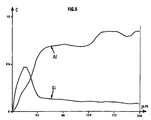
- a distribution profile of the elements Si and Al is produced on the membrane of Example 3 over a thickness of the order of 200 ⁇ m. It indicates that the atoms of silicon, therefore the zeolite, are located mainly on the surface of the support (Figure 5). In FIG. 5, the diameters are plotted on the abscissa micrometers and on the ordinate, the concentrations by weight of silicon and aluminum.
- ⁇ -alumina support (from the company Velterop) with pores with a diameter of 0.15 ⁇ m is dried at 60 ° C. overnight, cooled to room temperature in a desiccator filled with silica gel and weighed. Its mass is 1.9596 g. It is placed in unstable equilibrium on a crystallizer containing tetramethoxysilane. The assembly is placed in an enclosure under reduced pressure for 10 minutes in order to eliminate the air trapped in the support. This is then switched to tetramethoxysilane always under reduced pressure. The immersion time is 30 minutes.
- the support containing 0.33 g of tetramethoxysilane is immersed in 7.2 g of a solution consisting of a mixture of water, ammonia and methanol for 30 minutes.
- the molar composition of this solution reduced to one mole of Si (OCH 3 ) 4 is as follows: 16.7 NH 3 ; 46.7 CH 3 OH; 50 H 2 O.
- the support containing the silica gel is then washed with methanol, dried at 60 ° C overnight, then at 100 ° C for 2 hours, cooled to room temperature in a desiccator topped with silica gel and weighed.
- the mass of silica gel formed in the support is 0.15 g.
- the support containing the silica gel is immersed in 10 g of an aqueous solution containing 3.3% NaOH and 22.3% TPABr (% by mass) under reduced pressure for 10 minutes.
- the mass of solution incorporated is 0.30 g.
- the final hydrogel included in the support has the following molar composition: SiO 2 ; 0.1 NaOH; 0.1 TPABr; 5 H 2 O.
- the support containing the zeolite precursor gel is placed in saturated steam at 170 ° C for 48 hours. The autoclave is cooled to room temperature.
- the membrane is washed with distilled water, dried at 60 ° C overnight, cooled to room temperature in a desiccator topped with silica gel, calcined at 550 ° C for 6 hours (heating rate: 0.5 ° C / min; cooling rate: 1 ° C / min) then cooled to room temperature.
- the membrane Before the calcination stage (channels of the zeolite obstructed by TPA + ), the membrane is tight with methane. This shows the absence of spaces between the zeolite crystals.
Landscapes
- Chemical & Material Sciences (AREA)
- Chemical Kinetics & Catalysis (AREA)
- Inorganic Chemistry (AREA)
- Engineering & Computer Science (AREA)
- Manufacturing & Machinery (AREA)
- Organic Chemistry (AREA)
- Physics & Mathematics (AREA)
- Crystallography & Structural Chemistry (AREA)
- Life Sciences & Earth Sciences (AREA)
- Thermal Sciences (AREA)
- Materials Engineering (AREA)
- Geology (AREA)
- Analytical Chemistry (AREA)
- Dispersion Chemistry (AREA)
- Separation Using Semi-Permeable Membranes (AREA)
- Silicates, Zeolites, And Molecular Sieves (AREA)
Applications Claiming Priority (2)
| Application Number | Priority Date | Filing Date | Title |
|---|---|---|---|
| FR9514563A FR2742070B1 (fr) | 1995-12-08 | 1995-12-08 | Procede d'elaboration controlee de membranes de zeolithe supportee |
| FR9514563 | 1995-12-08 |
Publications (2)
| Publication Number | Publication Date |
|---|---|
| EP0778076A1 EP0778076A1 (fr) | 1997-06-11 |
| EP0778076B1 true EP0778076B1 (fr) | 2003-11-05 |
Family
ID=9485300
Family Applications (1)
| Application Number | Title | Priority Date | Filing Date |
|---|---|---|---|
| EP96402589A Expired - Lifetime EP0778076B1 (fr) | 1995-12-08 | 1996-11-29 | Procédé d'élaboration de membranes supportées |
Country Status (5)
| Country | Link |
|---|---|
| US (1) | US6140263A (enExample) |
| EP (1) | EP0778076B1 (enExample) |
| JP (1) | JP3899418B2 (enExample) |
| DE (1) | DE69630570T2 (enExample) |
| FR (1) | FR2742070B1 (enExample) |
Families Citing this family (36)
| Publication number | Priority date | Publication date | Assignee | Title |
|---|---|---|---|---|
| DE19624862A1 (de) * | 1996-06-21 | 1998-01-02 | Basf Ag | Mesoporöse Oxidformkörper |
| DE19741498B4 (de) * | 1997-09-20 | 2008-07-03 | Evonik Degussa Gmbh | Herstellung eines Keramik-Edelstahlgewebe-Verbundes |
| GR1003047B (el) * | 1997-12-24 | 1999-01-14 | Μεθοδος για αυξηση των πορων ανοργανων σωματιδιων με χρηση ανοργανων προδρομων ουσιων, επιφανειοδραστικων και λιποφιλων οργανικων ενωσεων χαμηλης πτητικοτητας | |
| AU754663B2 (en) * | 1998-10-20 | 2002-11-21 | Ngk Insulators, Ltd. | Zeolite composite film and process for producing the same |
| FR2786710B1 (fr) * | 1998-12-04 | 2001-11-16 | Ceramiques Tech Soc D | Membrane comprenant un support poreux et une couche d'un tamis modeculaire et son procede de preparation |
| US6767384B1 (en) * | 2000-01-21 | 2004-07-27 | The Regents Of The University Of Colorado | Isomorphously substituted molecular sieve membranes |
| EP1232999B1 (en) | 2000-03-02 | 2018-07-25 | NGK Insulators, Ltd. | Zeolite formed product, zeolite laminate intermediate, zeolite laminate composite and method for their preparation |
| AU2003248380B2 (en) * | 2000-03-02 | 2006-06-29 | Ngk Insulators, Ltd | Porous zeolite shaped body |
| JP4531997B2 (ja) * | 2001-02-16 | 2010-08-25 | 日本碍子株式会社 | ゼオライト成形体、ゼオライト積層中間体、ゼオライト積層複合体及びそれらの製造方法 |
| US6500490B1 (en) * | 2000-03-23 | 2002-12-31 | Honeywell International Inc. | Hydrophilic zeolite coating |
| JP3871501B2 (ja) * | 2000-08-07 | 2007-01-24 | 株式会社ノリタケカンパニーリミテド | ゼオライト膜とその製造方法と膜リアクター |
| US6340433B1 (en) * | 2000-09-15 | 2002-01-22 | Engelhard Corporation | Water purification using titanium silicate membranes |
| US6942784B2 (en) * | 2000-09-22 | 2005-09-13 | Engelhard Corporation | Structurally enhanced cracking catalysts |
| JP4855582B2 (ja) * | 2001-02-09 | 2012-01-18 | 日本碍子株式会社 | メソポーラスシリカ、メソポーラスシリカ複合体及びそれらの製造方法 |
| DE10107539A1 (de) * | 2001-02-17 | 2002-09-05 | Aaflowsystems Gmbh & Co Kg | Filterkörper |
| KR20030026515A (ko) * | 2001-09-26 | 2003-04-03 | 주식회사 신성이엔지 | 제올라이트를 이용한 기체 분리 장치 |
| DE10208276A1 (de) * | 2002-02-26 | 2003-09-04 | Creavis Tech & Innovation Gmbh | Compositmembran, Verfahren zu deren Herstellung und die Verwendung der Membran |
| US6818333B2 (en) * | 2002-06-03 | 2004-11-16 | Institut Francais Du Petrole | Thin zeolite membrane, its preparation and its use in separation |
| FR2840236B1 (fr) * | 2002-06-03 | 2005-02-04 | Inst Francais Du Petrole | Membrane zeolithique de faible epaisseur, sa preparation et son utilisation en separation |
| US7476635B2 (en) * | 2002-06-03 | 2009-01-13 | Institut Francais Du Petrole | Process for making supported thin zeolite membrane |
| FR2850588B1 (fr) * | 2003-01-31 | 2007-08-03 | Inst Francais Du Petrole | Membrane inorganique poreuse contenant du carbone, son procede de preparation et son utilisation |
| JP4795626B2 (ja) * | 2003-03-04 | 2011-10-19 | 紀夫 寺前 | 多孔体膜並びに薄膜の作製方法 |
| JP3922389B2 (ja) | 2003-08-06 | 2007-05-30 | 株式会社物産ナノテク研究所 | ゼオライト膜の製造方法及び製造装置、並びにこの方法により得られたゼオライト管状分離膜 |
| US7316727B2 (en) * | 2004-03-19 | 2008-01-08 | The Regents Of The University Of Colorado | High-selectivity supported SAPO membranes |
| CA2573685A1 (en) | 2004-08-03 | 2006-02-16 | The Regents Of The University Of Colorado, A Body Corporate | Membranes for highly selective separations |
| WO2007081212A1 (en) * | 2006-01-16 | 2007-07-19 | Stichting Energieonderzoek Centrum Nederland | Microporous molecular separation membrane with high hydrothermal stability |
| CN101443298A (zh) * | 2006-05-15 | 2009-05-27 | 科罗拉多州立大学董事会 | 用于co2/ch4分离的高通量和高选择性的sapo-34膜 |
| EP2032239B1 (de) * | 2006-06-13 | 2014-03-19 | Basf Se | Verfahren zur herstellung einer komposit-membran sowie verwendungen |
| US7811359B2 (en) * | 2007-01-18 | 2010-10-12 | General Electric Company | Composite membrane for separation of carbon dioxide |
| US8302782B2 (en) * | 2007-03-09 | 2012-11-06 | The Regents of the University of Colorado, a body corporated | Synthesis of zeolites and zeolite membranes using multiple structure directing agents |
| JP5481075B2 (ja) * | 2009-02-04 | 2014-04-23 | 日本碍子株式会社 | ゼオライト膜の製造方法 |
| DE102010009542A1 (de) | 2010-02-26 | 2011-09-01 | Dbi - Gastechnologisches Institut Ggmbh Freiberg | Verfahren zur Abtrennung von Erdgas- oder Erdölbegleitgaskomponenten an anorganisch porösen Membranen |
| US8679227B2 (en) | 2010-04-29 | 2014-03-25 | The Regents Of The University Of Colorado | High flux SAPO-34 membranes for CO2/CH4 separation and template removal method |
| WO2014130998A1 (en) * | 2013-02-25 | 2014-08-28 | Spinnaker Biosciences, Inc. | Surface functionalized porous silicon |
| JP5901817B2 (ja) * | 2015-04-06 | 2016-04-13 | 日揮触媒化成株式会社 | 重質炭化水素油の接触分解、水素化分解触媒用ヘテロ接合多孔性結晶体 |
| CN112999890B (zh) * | 2021-03-03 | 2022-04-19 | 大连理工大学 | 一种平板有机无机杂化SiO2复合膜及其制备方法和应用 |
Family Cites Families (17)
| Publication number | Priority date | Publication date | Assignee | Title |
|---|---|---|---|---|
| US4310440A (en) * | 1980-07-07 | 1982-01-12 | Union Carbide Corporation | Crystalline metallophosphate compositions |
| JPS6028826A (ja) * | 1983-07-26 | 1985-02-14 | Hiroshi Suzuki | かご型ゼオライト薄膜表層を有する複合膜及びその製造法 |
| GB8609249D0 (en) * | 1986-04-16 | 1986-05-21 | Alcan Int Ltd | Anodic oxide membrane catalyst support |
| US5374411A (en) * | 1987-08-28 | 1994-12-20 | The Dow Chemical Company | Crystalline aluminumphosphate compositions |
| US4861743A (en) * | 1987-11-25 | 1989-08-29 | Uop | Process for the production of molecular sieves |
| US5109263A (en) * | 1989-07-28 | 1992-04-28 | Hitachi, Ltd. | Semiconductor device with optimal distance between emitter and trench isolation |
| US5100596A (en) | 1990-06-05 | 1992-03-31 | Mobil Oil Corp. | Synthesis of membrane composed of a pure molecular sieve |
| GB9022836D0 (en) * | 1990-10-19 | 1990-12-05 | British Petroleum Co Plc | Membranes |
| NL9100217A (nl) * | 1991-02-07 | 1992-09-01 | Univ Delft Tech | Moleculaire-zeefkristallen bevattend anorganisch composietmembraan. |
| JPH05105420A (ja) * | 1991-03-29 | 1993-04-27 | Ngk Insulators Ltd | ゼオライト結晶体の合成膜およびその製造方法 |
| US5183482A (en) * | 1991-06-19 | 1993-02-02 | Texaco Inc. | Separation by membrane techniques |
| DE4131447A1 (de) * | 1991-09-21 | 1993-03-25 | Basf Ag | Farbige, kristalline alumophosphate und/oder silicoalumophosphate vom ael-typ |
| US5258339A (en) * | 1992-03-12 | 1993-11-02 | Worcester Polytechnic Institute | Formation of zeolite membranes from sols |
| GB9206783D0 (en) * | 1992-03-27 | 1992-05-13 | British Petroleum Co Plc | Deposition process |
| DE69207596T2 (de) * | 1992-09-07 | 1996-07-04 | Shell Int Research | Herstellung einer keramischen Membran |
| EP0695216B1 (en) * | 1993-04-23 | 1998-07-22 | Exxon Chemical Patents Inc. | Layers containing crystalline molecular sieves and processes for their manufacture |
| US5464798A (en) * | 1994-02-24 | 1995-11-07 | Jia; Meng-Dong | Ceramic-zeolite composite membranes and use for separation of vapor/gas mixtures |
-
1995
- 1995-12-08 FR FR9514563A patent/FR2742070B1/fr not_active Expired - Fee Related
-
1996
- 1996-11-29 DE DE69630570T patent/DE69630570T2/de not_active Expired - Lifetime
- 1996-11-29 EP EP96402589A patent/EP0778076B1/fr not_active Expired - Lifetime
- 1996-12-06 JP JP32720996A patent/JP3899418B2/ja not_active Expired - Fee Related
- 1996-12-06 US US08/761,340 patent/US6140263A/en not_active Expired - Fee Related
Also Published As
| Publication number | Publication date |
|---|---|
| DE69630570T2 (de) | 2004-05-13 |
| JPH09173799A (ja) | 1997-07-08 |
| FR2742070B1 (fr) | 1998-01-09 |
| EP0778076A1 (fr) | 1997-06-11 |
| DE69630570D1 (de) | 2003-12-11 |
| FR2742070A1 (fr) | 1997-06-13 |
| US6140263A (en) | 2000-10-31 |
| JP3899418B2 (ja) | 2007-03-28 |
Similar Documents
| Publication | Publication Date | Title |
|---|---|---|
| EP0778076A1 (fr) | Procédé d'élaboration de membranes de zéolithe supportées et membranes obtenues | |
| EP1230972B1 (fr) | Procédé de préparation de membranes zéolithiques supportées par cristallisation contrôlées en température | |
| EP0778075B1 (fr) | Procédé de l'élaboration de membranes de zéolithe supportées par du verre poreux | |
| EP0695216B1 (en) | Layers containing crystalline molecular sieves and processes for their manufacture | |
| Lin et al. | Synthesis of silicalite tubular membranes by in situ crystallization | |
| US11666867B2 (en) | Zeolite separation membrane and production method therefor | |
| EP3001819B1 (en) | A method for producing a crystalline film of zeolite and/or zeolite like crystals on a porous substrate | |
| US11554359B2 (en) | Supported zeolite films and methods for preparing | |
| NL9100217A (nl) | Moleculaire-zeefkristallen bevattend anorganisch composietmembraan. | |
| JP2003534907A (ja) | 改良されたシリカ膜およびその製造方法 | |
| WO1995029751A1 (fr) | Materiau inorganique composite poreux, notamment sous forme de membrane, et procede d'obtention d'un tel materiau | |
| FR2919205A1 (fr) | Membranes zeolithique supportees de type structural fau, leur procede de preparation et leurs applications. | |
| FR2917645A1 (fr) | Utilisation de zeolithes modifiees pour la decontamination moleculaire. | |
| EP1713580B1 (fr) | Catalyseur sous forme de grains comportant un coeur poreux acide entoure d une couche externe uniforme | |
| FR2894844A1 (fr) | Membranes zeolithiques supportees, leur procede de fabrication et leurs applications | |
| US20090318282A1 (en) | Zeolite-Like Membranes from Nano-Zeolitic Particles | |
| EP1369166A1 (fr) | Membrane zéolithique de faible epaisseur, sa préparation et son utilisation en séparation | |
| FR2718432A1 (fr) | Procédé de préparation d'un matériau anisotrope poreux ou pseudoporeux, à matrice polymère céramique. | |
| JP2002263456A (ja) | ゼオライト膜の処理方法、および分離方法 | |
| EP1531917A2 (fr) | Adsorbant non homogene et son utilisation dans des procedes de separation diffusionnelle | |
| EP2875172A1 (fr) | Procede de preparation d'une couche de quartz-alpha epitaxiee sur support solide, materiau obtenu et applications | |
| AU9416798A (en) | Molecular sieve layers and processes for their manufacture |
Legal Events
| Date | Code | Title | Description |
|---|---|---|---|
| PUAI | Public reference made under article 153(3) epc to a published international application that has entered the european phase |
Free format text: ORIGINAL CODE: 0009012 |
|
| AK | Designated contracting states |
Kind code of ref document: A1 Designated state(s): DE FR GB IT |
|
| 17P | Request for examination filed |
Effective date: 19971211 |
|
| 17Q | First examination report despatched |
Effective date: 20010508 |
|
| GRAH | Despatch of communication of intention to grant a patent |
Free format text: ORIGINAL CODE: EPIDOS IGRA |
|
| RTI1 | Title (correction) |
Free format text: PROCESS FOR THE PREPARATION OF SUPPORTED MEMBRANES |
|
| GRAS | Grant fee paid |
Free format text: ORIGINAL CODE: EPIDOSNIGR3 |
|
| GRAA | (expected) grant |
Free format text: ORIGINAL CODE: 0009210 |
|
| AK | Designated contracting states |
Kind code of ref document: B1 Designated state(s): DE FR GB IT |
|
| REG | Reference to a national code |
Ref country code: GB Ref legal event code: FG4D Free format text: NOT ENGLISH |
|
| REF | Corresponds to: |
Ref document number: 69630570 Country of ref document: DE Date of ref document: 20031211 Kind code of ref document: P |
|
| GBT | Gb: translation of ep patent filed (gb section 77(6)(a)/1977) |
Effective date: 20031219 |
|
| PLBE | No opposition filed within time limit |
Free format text: ORIGINAL CODE: 0009261 |
|
| STAA | Information on the status of an ep patent application or granted ep patent |
Free format text: STATUS: NO OPPOSITION FILED WITHIN TIME LIMIT |
|
| 26N | No opposition filed |
Effective date: 20040806 |
|
| PGFP | Annual fee paid to national office [announced via postgrant information from national office to epo] |
Ref country code: DE Payment date: 20091202 Year of fee payment: 14 |
|
| PGFP | Annual fee paid to national office [announced via postgrant information from national office to epo] |
Ref country code: IT Payment date: 20091121 Year of fee payment: 14 Ref country code: GB Payment date: 20091124 Year of fee payment: 14 Ref country code: FR Payment date: 20091023 Year of fee payment: 14 |
|
| REG | Reference to a national code |
Ref country code: DE Ref legal event code: R081 Ref document number: 69630570 Country of ref document: DE Owner name: IFP ENERGIES NOUVELLES, FR Free format text: FORMER OWNER: INSTITUT FRANCAIS DU PETROLE, RUEIL-MALMAISON, HAUTS-DE-SEINE, FR Effective date: 20110331 Ref country code: DE Ref legal event code: R081 Ref document number: 69630570 Country of ref document: DE Owner name: IFP ENERGIES NOUVELLES, FR Free format text: FORMER OWNER: INSTITUT FRANCAIS DU PETROLE, RUEIL-MALMAISON, FR Effective date: 20110331 |
|
| GBPC | Gb: european patent ceased through non-payment of renewal fee |
Effective date: 20101129 |
|
| REG | Reference to a national code |
Ref country code: DE Ref legal event code: R119 Ref document number: 69630570 Country of ref document: DE Effective date: 20110601 Ref country code: DE Ref legal event code: R119 Ref document number: 69630570 Country of ref document: DE Effective date: 20110531 |
|
| REG | Reference to a national code |
Ref country code: FR Ref legal event code: ST Effective date: 20110801 |
|
| PG25 | Lapsed in a contracting state [announced via postgrant information from national office to epo] |
Ref country code: DE Free format text: LAPSE BECAUSE OF NON-PAYMENT OF DUE FEES Effective date: 20110531 |
|
| PG25 | Lapsed in a contracting state [announced via postgrant information from national office to epo] |
Ref country code: FR Free format text: LAPSE BECAUSE OF NON-PAYMENT OF DUE FEES Effective date: 20101130 |
|
| PG25 | Lapsed in a contracting state [announced via postgrant information from national office to epo] |
Ref country code: GB Free format text: LAPSE BECAUSE OF NON-PAYMENT OF DUE FEES Effective date: 20101129 |
|
| PG25 | Lapsed in a contracting state [announced via postgrant information from national office to epo] |
Ref country code: IT Free format text: LAPSE BECAUSE OF NON-PAYMENT OF DUE FEES Effective date: 20101129 |