EP0776593B1 - Verfahren und vorrichtung zur räumlichen verbesserung von stereo- und monosignalen - Google Patents
Verfahren und vorrichtung zur räumlichen verbesserung von stereo- und monosignalen Download PDFInfo
- Publication number
- EP0776593B1 EP0776593B1 EP96921325A EP96921325A EP0776593B1 EP 0776593 B1 EP0776593 B1 EP 0776593B1 EP 96921325 A EP96921325 A EP 96921325A EP 96921325 A EP96921325 A EP 96921325A EP 0776593 B1 EP0776593 B1 EP 0776593B1
- Authority
- EP
- European Patent Office
- Prior art keywords
- input
- stereo
- output
- signal
- coupled
- Prior art date
- Legal status (The legal status is an assumption and is not a legal conclusion. Google has not performed a legal analysis and makes no representation as to the accuracy of the status listed.)
- Expired - Lifetime
Links
- 238000000034 method Methods 0.000 title claims abstract description 14
- 230000002708 enhancing effect Effects 0.000 title claims description 13
- 239000003990 capacitor Substances 0.000 claims abstract description 27
- 238000001914 filtration Methods 0.000 claims description 10
- 230000000694 effects Effects 0.000 abstract description 17
- 238000002156 mixing Methods 0.000 abstract description 2
- 238000012546 transfer Methods 0.000 description 58
- 230000015572 biosynthetic process Effects 0.000 description 15
- 238000010586 diagram Methods 0.000 description 15
- 238000003786 synthesis reaction Methods 0.000 description 15
- 238000013461 design Methods 0.000 description 8
- 230000008901 benefit Effects 0.000 description 6
- 238000012545 processing Methods 0.000 description 6
- 238000013459 approach Methods 0.000 description 4
- 206010011878 Deafness Diseases 0.000 description 3
- 230000008878 coupling Effects 0.000 description 3
- 238000010168 coupling process Methods 0.000 description 3
- 238000005859 coupling reaction Methods 0.000 description 3
- 230000001419 dependent effect Effects 0.000 description 3
- 230000008030 elimination Effects 0.000 description 3
- 238000003379 elimination reaction Methods 0.000 description 3
- 230000004048 modification Effects 0.000 description 3
- 238000012986 modification Methods 0.000 description 3
- 230000035945 sensitivity Effects 0.000 description 3
- 238000000926 separation method Methods 0.000 description 3
- 230000015556 catabolic process Effects 0.000 description 2
- 238000006731 degradation reaction Methods 0.000 description 2
- 230000001965 increasing effect Effects 0.000 description 2
- 230000003071 parasitic effect Effects 0.000 description 2
- 238000007493 shaping process Methods 0.000 description 2
- 230000009466 transformation Effects 0.000 description 2
- 230000007704 transition Effects 0.000 description 2
- 230000002411 adverse Effects 0.000 description 1
- 230000002238 attenuated effect Effects 0.000 description 1
- 230000005540 biological transmission Effects 0.000 description 1
- 102220367298 c.216G>A Human genes 0.000 description 1
- 102220344922 c.231G>A Human genes 0.000 description 1
- 238000006243 chemical reaction Methods 0.000 description 1
- 235000009508 confectionery Nutrition 0.000 description 1
- 238000010276 construction Methods 0.000 description 1
- 230000003111 delayed effect Effects 0.000 description 1
- 238000012217 deletion Methods 0.000 description 1
- 230000037430 deletion Effects 0.000 description 1
- 238000001514 detection method Methods 0.000 description 1
- 230000003467 diminishing effect Effects 0.000 description 1
- 230000009977 dual effect Effects 0.000 description 1
- 230000002452 interceptive effect Effects 0.000 description 1
- 230000007246 mechanism Effects 0.000 description 1
- 239000000203 mixture Substances 0.000 description 1
- ORQBXQOJMQIAOY-UHFFFAOYSA-N nobelium Chemical compound [No] ORQBXQOJMQIAOY-UHFFFAOYSA-N 0.000 description 1
- 230000004044 response Effects 0.000 description 1
- 102220052991 rs139591041 Human genes 0.000 description 1
- 102220171250 rs146647469 Human genes 0.000 description 1
- 102220110933 rs151253274 Human genes 0.000 description 1
- 102220276577 rs1553130310 Human genes 0.000 description 1
- 102220023117 rs387907554 Human genes 0.000 description 1
- 102220060030 rs55861249 Human genes 0.000 description 1
- 102220039362 rs587780556 Human genes 0.000 description 1
- 102220032187 rs61750388 Human genes 0.000 description 1
- 102220054673 rs727505106 Human genes 0.000 description 1
- 102220052446 rs727505324 Human genes 0.000 description 1
- 102220156992 rs775896337 Human genes 0.000 description 1
- 102220062292 rs786203886 Human genes 0.000 description 1
- 102220110347 rs886038603 Human genes 0.000 description 1
- 102220131792 rs886046308 Human genes 0.000 description 1
- 102220134064 rs886055163 Human genes 0.000 description 1
- 238000005070 sampling Methods 0.000 description 1
- 238000009738 saturating Methods 0.000 description 1
- 230000005236 sound signal Effects 0.000 description 1
Images








Classifications
-
- H—ELECTRICITY
- H04—ELECTRIC COMMUNICATION TECHNIQUE
- H04S—STEREOPHONIC SYSTEMS
- H04S1/00—Two-channel systems
-
- H—ELECTRICITY
- H04—ELECTRIC COMMUNICATION TECHNIQUE
- H04S—STEREOPHONIC SYSTEMS
- H04S5/00—Pseudo-stereo systems, e.g. in which additional channel signals are derived from monophonic signals by means of phase shifting, time delay or reverberation
-
- H—ELECTRICITY
- H04—ELECTRIC COMMUNICATION TECHNIQUE
- H04S—STEREOPHONIC SYSTEMS
- H04S1/00—Two-channel systems
- H04S1/002—Non-adaptive circuits, e.g. manually adjustable or static, for enhancing the sound image or the spatial distribution
Definitions
- the present invention relates to a system for enhancing an acoustic image comprising first and second input channels and to a method for enhancing an acoustic image.
- US-A-4,910,778 discloses a system for enhancing an acoustic image comprising first and second input channels wherein means for processing said first and second input channels to produce a first output channel and means for combining the first output channel and the first and second input channels to produce a second output channel, wherein said first and second output channels are indicative of a spatially enhanced signal.
- stereo enhancement systems fail to effectively address the monophonic aspects of stereo signals. For instance, it is desirable in a stereo enhancement system to retain compatibility with monophonic receivers, that is, receivers which receive only the modified sum (L+R) component of the stereo signal. Receiving only the modified sum component without the ability to extract the spatial effects encoded into the difference signal results in an undesirable degradation of the original monophonic acoustic image.
- a stereo enhancement system since many of the presently broadcast and recorded acoustic images include both stereo and monophonic sources, it is also desirable for a stereo enhancement system to not only spatially enhance monophonic acoustic images but also to have the ability to smoothly and automatically transition between stereo signal enhancement and monophonic signal enhancement.
- the above object is solved by a system in accordance with features of claim 1 and furthermore is solved by a method for enhancing an acoustic image in accordance with the features of claim 17.
- audio enhancement systems should be channel symmetric in order to preserve the centering of the original stereo signal. That is, the left and right channels of the audio signal should be identically processed such that a reversing of the inputs to the audio enhancement system would not effect the operation of the system.
- Channel-symmetric audio enhancement systems are typically implemented using either a lattice topology or a shuffle topology.
- Figure 1a illustrates the signal flow in a lattice topology, where L and R represent the left and right channel input signals respectively, and L' and R' represent the left and right output signals respectively.
- each of the output signals is a sum of its respective input signal times a linear transfer function S(s) and the opposite input signal times a linear transfer function A(s).
- an audio enhancement system is sum invariant so as to be compatible with monophonic receivers.
- the right signal R is inverted at inverter 21 and combined with the left input signal L at summing element 20 to produce a difference signal (L-R), which is then processed through a filter 22 having a transfer function B(s).
- the processed difference signal (L-R) is summed with the original left input signal L at summing element 23 to produce the left output signal L'.
- the processed difference signal (L-R) is inverted at inverter 24 and summed with the original right input signal R at summing element 25 to produce the right output signal R'.
- the left output signal L' is inverted at inverter 34 and summed with the original right R and left L input signals at summing element 35 to produce the right output signal R'.
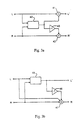
- Figures 2a and 2b may be broadened as illustrated in Figures 3a and 3b, respectively.
- the left L and right R signals are combined and processed in function block 40 which may implement either a linear or nonlinear function.
- This processed signal is added to the left input signal L at summing element 41 to produce the left output signal L' and subtracted from the right input signal R via inverter 43 and summing element 42 to produce the right output signal R'.
- the processing performed by filter 40 may be any suitable signal shaping function of one or both of the input signals L, R.
- the processing function of filter 45 may be any suitable signal shaping function of one or both of the two input signals L, R.
- the output signal of filter 45 is provided as the left output signal L', while the right output signal R' is produced by subtracting the left output signal L' from the sum (L+R) of the input signals.
- the shuffle topology (Figure 1b) is generally preferred over the lattice topology ( Figure 1a) since the shuffle topology requires only two filters 13-14, where the lattice topology requires four filters 1-4. Nevertheless, Applicant has found that the lattice topology allows for a simpler circuit implementation of a stereo enhancement system.
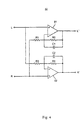
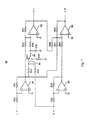
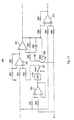
- FIG 4 shows a stereo enhancement system 50 in accordance with one embodiment of the present invention.
- Enhancement system 50 the design of which stems from the lattice topology of Figure 1a, requires only two op-amps 51, 52.
- the left input signal L is provided to the positive input of op-amp 51 and to the negative input of op-amp 52 via resistor R3, while the right input signal R is provided to the positive input of op-amp 52 and to the negative input of op-amp 51 via resistor R1.
- resistors R1, R2, and capacitor C1 may in some embodiments be equal to the values of R3, R4 and capacitor C2, respectively.
- the values for the above-mentioned resistors and capacitors may, in actual embodiments, vary depending upon the operating characteristics of the selected op-amp, noise and input impedance considerations, and cost and size restrictions of discrete capacitors C1 and C2, as is well understood in the art.
- op-amps 51 and 52 are low noise audio-grade op-amps such as the TL074, available from Texas Instruments.
- enhancement system 50 of Figure 4 does not boost or otherwise alter the high-frequency portions of the difference (L-R) signal, i.e., those portions above approximately 1100 Hz.
- L-R difference-frequency portion of the difference
- the embodiment of Figure 4 achieves a superior balance between centered and off-centered acoustic images in the source signal than do those conventional systems which provide more power to the high-frequencies of the difference (L-R) signal.
- the embodiment of Figure 4 does not alter the sum (L+R) signal, thereby preserving monophonic acoustic images and retaining compatibility with monophonic receivers.
- enhancement system 50 of Figure 4 may be also be described in terms of the shuffle topology of Figure 1b and the sum-invariant based topologies of Figures 2a, 2b.
- the corresponding values of N 0 and ⁇ p should be approximately 7.25 and a ⁇ p of about 600 ⁇ s, respectively. Setting P(s) equal to one-half ensures sum-invariance, as described above.
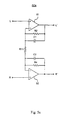
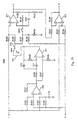
- Enhancement system 60a of Figure 5a operates in a manner similar to that of Figure 4 and, accordingly, those components common to the embodiments of Figures 4 and 5a are similarly labelled.
- the simpler design of enhancement system 60a also allows the left and right input signals to be directly coupled to the positive inputs of op-amps 51 and 52, respectively.
- enhancement system 60a desirably exhibits a high input impedance. Resistors R2 and R4 must be equal and capacitors C1 and C2 must be equal.
- a switch SW1 may be added in series with resistor R11 as shown in Figure 5b.
- the resultant enhancement system 60b may thus switch between an enhancement mode, in which the left and right input signals L, R are enhanced as described above to produce enhanced left and right output signals L', R', and a bypass mode, in which the left and right input signals L, R pass unmodified through enhancement system 60 and appear as left and right output signals L', R'.
- Switch SW1 may be any suitable switching device.
- the low-pass filter nature of op-amps 51 and 52 desirably prevents instantaneous voltage changes between input signals and output signals.
- the left and right output signals L', R' will exponentially converge to their respective input signals L, R as a function of the time constant ⁇ p , thereby resulting in smooth switching transitions between modes. Accordingly, complex switching techniques which minimize switching noise, such as zero-crossing switching techniques, are unnecessary.
- the sum-invariant topologies depicted in Figures 2a and 2b may allow for an improved circuit implementation of stereo enhancement system in accordance with the present invention.
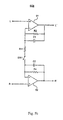
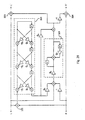
- the design of enhancement system 70 is based upon the sum-invariant topology illustrated in Figure 2b.
- the left output signal L' is produced through op-amp 71 and its associated feedback elements R21 and C20, which operate as a leaky integrator, from the sum of the left and right input signals (L+R).
- the right output signal R' is constructed according to equation (5), i.e., op-amp 72 sums the left output signal L' with the input signal sum (L+R) to produce the right output signal R'.
- resistors R23 and R24 should be of equal value, and resistors R22 and R25 should be of equal value. Note that the sum-invariant design of enhancement system 70 requires only one capacitor C20, as opposed to the two capacitors required in the embodiments of Figures 4 and 5. Switch SW2 allows the enhancement system 70 to switch between enhancement and bypass modes as previously described with respect to Figure 5.
- the values of B 0 and ⁇ p are approximately 3.125 and 600 ⁇ s, respectively.
- the values of the resistors contained in enhancement system 70 may vary depending upon desired operating characteristics. Note that since capacitor C20 prevents the voltage at the negative input of op-amp 71 from changing instantaneously, voltage continuity of the left output signal L' is preserved when switching between modes via switch SW2. Thus, when enhancement system 70 is switched from enhancement to bypass mode, op-amp 71 acts as a voltage follower, with the output voltage offset by the voltage across C20. Capacitor C20 will gradually discharge through the parallel combination of resistors R20 and R21.
- capacitor C20 When switch SW2 switches from bypass to enhancement mode, capacitor C20 is exponentially charged, thereby preserving the voltage continuity of the output and minimizing switching impulse energy. Resistors R20, R21 and capacitor C20 determine the time constant of exponential transients caused when switching between modes.
- Line 74 serves primarily as a shunt to prevent parasitic coupling between lines 73 and 75 from producing any unwanted residual effect in bypass mode. Where not necessary, line 74 may be removed such that capacitor C20 discharges only through R21.
- the embodiments described above with reference to Figures 4-6 employ a minimum number of op-amps in order to minimize implementation cost.
- the distortion and fidelity associated with enhancement system 70 may be improved by modifying enhancement system 70 to employ op-amps which operate only in an inverting mode.
- Such a modification is illustrated in Figure 7 as stereo enhancement system 80.
- Op-amp 81 and resistors R30, R31 invert the left input signal L
- Op amp 84 and associated resistors R40-R43 produce the right output signal R' according to the sum-invariant constraint of Equation (5).
- Resistors R40-R43 should be of equal value to ensure proper summing at op-amp 84.
- Resistors R32, R33 and R36 are related radiometrically to R37.
- Switch SW3 switches enhancement system 80 between enhancement and bypass modes. When SW3 connects lines 85 and 86, enhancement system 80 enters enhancement mode and operates as described above. When switch SW3 connects line 85 to ground via resistor R34, enhancement system 80 enters bypass mode. In this mode, op-amp 82 operates as an inverter and provides a left output signal L' equal to the left input signal L. It follows, then, that the L' signal and inverted L signal cancel at op-amp 84 such that the right output signal R' is equal to the right input signal R.
- Capacitor C30 helps to ensure voltage continuity between modes as discussed previously. When switching from enhancement to bypass mode, C30 completely discharges to ground through the parallel combination of resistors R36 and R34. While not necessary to the operation of system 80, the path to ground through resistor R34 helps to eliminate parasitic coupling. When switching from bypass to spatialization mode, C30 gradually charges in the normal course of operation.
- the embodiments described above with reference to Figures 4-7 are advantageous over prior enhancement systems based upon the shuffle topology in that the voltages of the internal nodes of the embodiments of Figures 4-7 will not exceed the maximum input voltage or maximum output voltage.
- the internally generated sum (L+R) and difference (L-R) signal voltages may be twice that of the maximum input signals, thereby requiring either (1) halving the voltage range of the input signals or (2) dividing the sum (L+R) and difference (L-R) signals by a factor of two.
- the former alternative undesirably limits the range of compatible input signal levels, while the latter alternative undesirably reduces the signal to noise ratio (by as much as 6 dB).
- the bilinear transformation can be used to derive a discrete time version.
- B ( z ) B 0 1 + 2 T ⁇ P 1+ z -1 1 + 1- 2 T ⁇ P 1 + 2 T ⁇ P z -1
- An efficient approach to computing a spatially enhanced data sample can be obtained by using the signal flow illustrated in the topology of Figure 2a in conjunction with the above-denoted B(z). It is to be understood that a particular topology which yields the greatest efficiency in an analog implementation does not necessarily yield the most efficient digital implementation. For instance, in analog implementations, the number of inverting and summing operations significantly affects implementation cost, while the number of signals added or inverted in a particular operation has only a slight impact upon implementation cost. In a digital implementation, on the other hand, the total number of summing operations is a function of the total number of signals so summed minus the number of summing operations. Further, negations typically impose no additional overhead.
- a system which spatially enhances not only stereo signals but also monophonic signals in a manner similar to those previously described.
- a complete understanding of these other embodiments requires an appreciation of some basic principles used in the conversion of monophonic signals to pseudo-stereo signals.
- a pseudo-stereo signal may be synthesized from a monophonic signal (e.g., a signal in which the right and left channels are identical) by spatially "placing" the sound towards either the left or right channel in a selective manner dependent upon the frequency of the monophonic input signal.
- a synthesis may be accomplished by first modifying the input signal and then adding and subtracting this modified signal to and from, respectively, the original input signal to produce left and right channels which are different.
- Figures 8a and 8b illustrate two common topologies for such synthesis.
- the monophonic input signal M is routed through an all-pass filter 90 having a transfer function C(s).
- the output of filter 90 is alternately added to, via summing element 92, and subtracted from, via inverter 91 and summing element 93, attenuated replicas of the original input signal M to produce left L' and right R' pseudo stereo signals, respectively.
- L' M (0.5+ C ( s ))
- R' M (0.5- C ( s ))
- C(s) is an all-pass transfer function of the following form:
- C ( s ) C 0 (1-s ⁇ 1 *) (1- s ⁇ 2 *) (1+ s ⁇ 1 )(1+ s ⁇ 2 ) ... (1- s ⁇ n *) (1+ s ⁇ n )
- the time constants ⁇ 1 - ⁇ n will, in actual implementations, naturally occur in complex conjugate pairs.
- the constant C 0 determines the "depth" of the pseudo-stereo effect. This effect is maximized when C 0 is equal to either 0.5 or -0.5. At these values of C 0 , certain frequencies will appear exclusively in one of the output channels.
- the sign of C 0 is somewhat arbitrary, since reversing the sign is merely equivalent to swapping the L' and R' channel outputs of Figure 8a.
- the number of crossover points that is, the number of particular frequencies at which the energies in the left and right channels are equal, is determined by the order of C(s).
- topology illustrated in Figure 8b which operates in a manner identical to that of the topology of Figure 8a, may provide a more economical implementation in certain cases.
- one of the pseudo-stereo synthesis topologies illustrated in Figures 8a and 8b may be cascaded with the stereo enhancement systems described above in accordance with the present invention, as illustrated in Figure 9a.
- filter 100 creates the pseudo-stereo left channel on line 103 while inverter 101 and summing element 102 create the pseudo-stereo right channel on line 104.
- a stereo enhancement system 107 enhances these pseudo-stereo channel signals to produce left and right output signal L', R' on lines 105 and 106, respectively.
- System 107 may be any suitable one of the stereo enhancement systems previously described in accordance with the present invention.
- the boost associated with a pseudo-stereo enhancement system should be somewhat lower than that of a pure stereo enhancement system such as those described earlier.
- Applicant has chosen D 0 to be equal to just over half of 2B 0 +1, i.e., approximately 4.5.
- the time constant ⁇ p is, as mentioned previously, approximately equal to 600 ⁇ s.
- the particular order of transfer function C(s) involves a tradeoff between superior sound quality (higher order) and implementation cost (lower order).
- C(s) is implemented in a manner so as to have three poles and zeroes, an order which Applicant believes achieves a satisfactory compromise between sound enhancement and implementation cost.
- the preferred time constants for the three poles and zeroes are 46 ⁇ s, 67 ⁇ s and 254 ⁇ s, respectively, which are all real. Applicant has found that a value of 0.2 for the constant C 0 results in an optimal tradeoff between deep separation and shallow subtlety.
- a pseudo-stereo synthesis system 131 may be cascaded with stereo enhancement system 126 as illustrated the topology in Figure 10a. It is to be understood that stereo enhancement system 126 may be any of the previously described stereo enhancement systems.
- variable gain element 121 may be varied between zero and unity in response to an external control signal (not shown) such as a stereo blend signal received from an FM stereo decoder or a stereophonic source detection circuit or even a user control.
- an external control signal not shown
- gain element 121 is set to have a gain of zero, the pseudo-stereo synthesis portion 131 is effectively disabled such that the operation of the topology of Figure 10a is determined solely by stereo enhancement system 126.
- variable gain element 121 allows for the dynamic control of the depth of the pseudo-stereo synthesis effect. Note that it is possible, with the appropriate choice of parameters, to fix the gain of variable gain element 121 at unity for all signal sources.
- variable gain element 121 has unity gain
- R' R - B ( s )( L - R )- C ( s )(1+ 2B ( s ))( L + R )
- variable gain element 121 is used to dynamically switch between modes, i.e., between enabling and disabling pseudo-stereo synthesis portion 131, certain measures will need to be taken to ensure low switching noise. For instance, the gain of variable gain element 121 should varied at such a rate so as not to introduce significant high-frequency energy into the acoustic signals.
- both pseudo-stereo input signals (synthesized from a monophonic input signal via portion 131) and stereophonic input signals are filtered via stereo enhancement system 126 and, thus, are processed according to the same previously disclosed parameters associated with the transfer function B(s). Since, however, pseudo-stereo signals generated from monophonic signals are different from pure stereophonic signals, it would be advantageous for each of such signals to be spatially enhanced according to different parameters while simultaneously enabling a blending of the two enhancement effects.
- a pseudo-stereo synthesis system 140 is cascaded to the output lines 143, 144 of stereo enhancement system 126 as illustrated in the topology of Figure 10b.
- the stereo enhancement parameters and thus the spatially enhancing effect of stereo enhancement circuit 126 will affect only stereophonic signals received on input lines 141, 142 (since monophonic signals do not contain a (L-R) difference component, monophonic input signals received on lines 141, 142 pass unmodified through stereo enhancement system 126).
- variable gain element is set to unity gain
- D(s) is of the form disclosed in Equation (9), where D 0 and ⁇ p are approximately 4.5 and 600 ⁇ s, respectively.
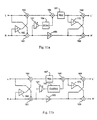
- the topologies of Figures 10a and 10b may be modified so as to operate according to shuffle-style topologies as illustrated in Figures 11a and 11b, respectively.
- the topology of Figure 11a uses the same enhancement filter 167, having a transfer function of N(s), in processing both stereo and pseudo-stereo signals. That is, like the topology of Figure 10a, the topology of Figure 11a uses the same parameters in spatially enhancing both stereo and pseudo-stereo signals.
- the function N(s) is of the form previously described with respect to Figure 1b.
- Pseudo-stereo filter 164 operates according to the previously described transfer function C(s) multiplied by a factor of 2.
- variable gain element 121 may be either manually or automatically controlled to accommodate a variety of types of input signals, or set to unity gain and still handle most monophonic and stereo input signals.
- the topology of Figure 11b a modified version of the topology of Figure 11a, utilizes distinct spatial enhancement parameters for stereo and pseudo-stereo signals in a manner similar to that described with respect to the topology of Figure 10b.
- the pseudo-stereo signal is synthesized and spatially enhanced by filter 147 according to transfer functions C(s) and D(s), respectively, and summed with the enhanced stereo signal generated by filter 167 according to transfer function N(s).
- transfer functions C(s), D(s), and N(s) are of the respective forms previously described.
- topologies are sum-invariant, they may be modified to operate according to the sum-invariant topologies of Figures 3a and 3b, thereby resulting in more simplified and more cost-effective implementations.
- Applicant has found that greater simplification may be achieved by setting the pole time constant of the D(s) transfer function equal to that of the B(s) transfer function.
- the D(s) transfer function need not be explicitly implemented while advantageously providing distinct enhancement parameters for stereo and pseudo-stereo signals.
- the filter which would have otherwise implemented C(s)D(s) now need only implement C(s), thereby allowing for the elimination of one pole-determining capacitor. Note that this simplification results in the elimination of one delay element in digital implementations.
- FIG. 12 The resultant simplified topologies derived from the topologies of Figures 11a and 11b are illustrated in Figures 12 and 13, respectively.
- summing elements 208 and 209, along with inverter 210 replicate the style of the sum-invariant topology of Figure 3a.
- Summing element 200, variable gain element 210, filter 202 having a transfer function C(s), and gain element 205 construct the pseudo-stereo signal.
- the magnitude of the signal output from filter 202 will, to a significant degree, determine the magnitude of the pseudo-stereo synthesis at those frequencies significantly above the pole of transfer function B(s), i.e., significantly above 265 Hz.
- the magnitude of the signal output from gain element 205 will determine the magnitude of the pseudo-stereo synthesis at DC.
- the inputs of a summing network are usually multiplied by some gain factor.
- the stereo enhancement portion of the topology of Figure 12 operates in a manner similar to that of the topology of Figures 2a.
- the form and parameter values for transfer function B(s) and C(s) are preferably as stated previously.
- the topology of Figure 13 operates in a manner nearly identical to that of Figure 12 with one notable exception.
- Inverter 229 and summing elements 227 and 228 are configured so as to replicate the sum-invariant style topology of Figure 3b.
- components within block 45 of the topology of Figure 13 operate in an identical manner and perform the same function as those components in block 40 of the topology of Figure 12.
- Figures 12 and 13 may be modified by eliminating the signal path passing through gain element 205 and altering filter 202 to have a transfer function C(s)D(s).
- FIG. 12 The topologies of Figures 12 and 13 may be further simplified, and thus implemented at a reduced cost, by slightly sacrificing the spatial attribute of the pseudo-stereo signal.
- Such a simplified topology is illustrated in Figure 14, where the role of filters 246, 247 and summing element 248 may be performed in analog implementations by a single op-amp configured as a leaky integrator such as, for instance, op-amp 51 of stereo enhancement system 50 of Figure 4.
- the left L' and right R' output signals and left L and right R input signals in the topology of Figure 14 are related to one another as expressed by Equation (11), where gain element 241 is set to unity.
- D 0 is restricted as follows: B 0 +1 ⁇ D 0 ⁇ 1
- G 243 B 0 +1- D 0 B 0
- G 243 should preferably be zero in order to effect the maximum depth possible which, in turn, implies that D 0 should be approximately 4.125.
- the preferred form and associated parameter values for transfer functions B(s) and C(s) are as stated previously.
- the signals provided to summing elements 244 and 245 may be independently scaled.
- All-pass filter 15 includes three cascaded single pole all-pass filters 251, 252, 253. Isolating each pole to a separate stage minimizes sensitivity to component variation.
- the individual single pole filters 251-253 should be configured according to well known techniques such that resultant three-pole filter 250 has pole time constants of 46 ⁇ s, 67 ⁇ s and 254 ⁇ s. It is to be understood that a filter utilizing second or higher order sections may used in order to reduce the number of required op-amps. Further, second order filter sections allow for complex pole conjugate pairs. However, such second or higher order filter sections are more sensitive to component variation.
- FIG. 16 The preferred embodiment of the present invention is illustrated in Figure 16.
- the operation of stereo/mono enhancement system 260 is based upon the topology of Figure 13 and, accordingly, the discussion of the topology of Figure 13 is equally applicable to system 260.
- the left input signal L is inverted by op-amp 270 and associated resistors R60 and R61, while the right input signal R is inverted by op-amp 272 and associated resistors R70 and R71.
- This filtered signal is summed with the inverted left input signal L and the pseudo-stereo signal (synthesized by filter 250) at op-amp 271 to produce the left output signal L' output.
- Op-amp 275 subtracts the left output signal L' from the sum of the left L and right R input signals.
- Switches SW4 and SW5 allow system 260 to operate in one of three possible modes. If switch SW4 connects line 277 to ground via resistor R65, the stereo enhancement filter, e.g., the B(s) function, is disabled. When switch SW5 connects line 278 to ground, thereby disabling the pseudo-stereo synthesis function of filter 250, e.g., function C(s), system 260 will operate in a bypass mode. In this mode, the left L and right R input signals appear unmodified as left L' and right R' output signals, respectively. If, on the other hand, switch SW4 connects line 277 to line 276, the stereo enhancement filter B(s) is enabled. The operating mode of system 260 will now depend upon the position of switch SW5.
- the stereo enhancement filter e.g., the B(s) function
- switch SW5 now connects line 278 to ground, thereby disabling the pseudo-stereo synthesis function C(s), system 260 operates in a stereo-only mode. If, however, switch SW5 connects filter 250 to line 278, thereby enabling the pseudo-stereo synthesis function C(s), system 260 operates in a dual stereo/mono mode and will spatially enhance both types of input signals.
- the switching between bypass and stereo/mono enhancement modes via switch SW4 exhibits relatively low switching noise due to the low-pass filtering function of capacitor C50.
- the switching of switch SW5 may cause a discontinuity in the output signals.
- such a discontinuity is tolerable in most applications since the gain of the pseudo-stereo signal on line 278 is fairly low as compared to that of the stereo signals.
- the discontinuity may be minimized using well known zero-crossing switching techniques, or by replacing switch SW5 with a variable gain element controlled by a switching ramp signal.
- K 1 should be chosen such that K 1 ⁇ 2C 0 .
- K 1 is equal to 0.4.
- the K 1 coefficient is one such degree of freedom which can be chosen according to convenience. The above constraint on K 1 is recommended for the sake of dynamic signal range in order prevent the output of op-amp 273 from saturating with maximum input signals on both input channels.
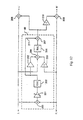
- a stereo/mono system 280 is disclosed below and illustrated in Figure 17 which operates in accordance with the topology of Figure 14. Accordingly, the discussion above with respect to the topology of Figure 14 is equally applicable to stereo/mono system 280, where the left L' and right R' output signals are related to the left L and right R inputs signals according to Equation (11).
- the stereo enhancement portion of system 280 is performed by op-amps 293, 294 and their respective associated capacitor C60 and resistors R86-R91, and thus implements the B(s) transfer function in a manner identical to stereo enhancement system 70 of Figure 6.
- Pseudo-stereo enhancement is combined with stereo enhancement by summing the pseudo-stereo signal with the left input signal L before stereo enhancement is performed, as is discussed below.
- Op-amp 290 and associated resistors R80-R81 sum and then scale by one-half the left L and right R inputs signals in order to extract the monophonic component (L+R) of the input source.
- resistors R80 and R81 should be of equal value.
- This sum signal is filtered by filter 250 according to the C(s) transfer function to synthesize a pseudo-stereo signal.
- This pseudo-stereo signal is then summed with the left input signal L by op-amp 292 and associated resistors R82-R85.
- System 280 includes two switches SW4 and SW5 which allow system 280 to switch, in a manner identical to that of system 260 of Figure 16, between bypass, stereo-only enhancement, and stereo/mono enhancement modes.
- switch SW5 connects line 295 to ground
- the operating mode of system 280 is determined by position of switch SW4. If switch SW4 connects lines 296 and 297, system 280 operates in stereo-only mode. If switch SW4 connect lines 296 and 298, system 280 operates in bypass mode.
- System 280 operates in stereo/mono mode when switch SW4 connects lines 296, 297 and switch SW5 connects line 295 to the output of filter 250.
- system 280 as compared to system 260 is achieved by using both the inverting and non-inverting modes of the op-amps therein. Although utilizing both modes of the op-amps as such may adversely affect sound quality, any such degradation in acoustic quality will be slight and well within the performance requirements of many applications.
- FIG. 14 The topology of Figure 14 can be implemented in an even simpler design allowing attenuation of the input signals.
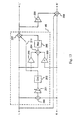
- a stereo/mono enhancement system 300a is disclosed below and illustrated in Figure 18 which requires only four op-amps.
- the input signals L and R are scaled by a factor K 2 .
- K 2 The selection of an appropriate value of K 2 involves consideration of two factors as will be discussed shortly.
- the pseudo-stereo portion of system 300a is formed by op-amps 310 and 311 and their associated resistors R100-R108 and capacitors C70-C72.
- Op-amp 310 first sums the left L and right R input signals, thereby extracting the monophonic component, and then filters this sum according to a single-pole all-pass filter.
- Op-amp 311 forms the core of a second order all-pass filter which also divides the sum signal by a factor 1+K 3 . Although somewhat dependent upon the pole frequencies, the value of K 3 should generally be close to unity in order to minimize sensitivity to component variation.
- Op-amps 312 and 313 form the stereo enhancement portion of system 300a and operate in a manner similar to stereo enhancement system 70 of Figure 6.
- Resistors R109-R113 allow D 0 to vary between B 0 + 1 and 1.
- Resistor R119 matches the attenuation of the sum signal path to the rest of the circuit.
- System 300a includes two switches SW4 and SW5 which allow system 300a to operate in either bypass, stereo only enhancement, or stereo/mono enhancement mode as previously described with respect to systems 260 and 280.
- the selection of component values in system 300a is dictated by application requirements and component types.
- the factors K 2 and K 3 can be selected to minimize the component sensitivity of the second order all-pass filter as well as to adjust the overall signal attenuation level. These two factors are constrained as follows:
- K 2 and K 3 are equal to 0.667 and 0.25, respectively.
- Time constants ⁇ 1 , ⁇ 2 and ⁇ 3 can be any permutation of recommended time constants for the C(s) function poles.
- Resistors R110-R113 provide more flexibility than may be needed for a given set of parameters. For instance, if a maximum value of D 0 is desired, then R111 should be omitted. If, on the other hand, D 0 is desired to equal 1, then R113 should be omitted. The complete set is shown for the sake of generality. It should be noted that the system 300a attenuates the input signals in all modes of operation, including bypass. Thus, the sum of output signals L' and R' will be the sum of input signals L and R multiplied by some constant factor.
- System 300a of Figure 18 may be modified to have no signal attenuation by slightly compromising the stereo enhancement transfer function B(s).
- the resultant structure, embodied as stereo/mono enhancement system 300b, is illustrated in Figure 19.
- System 300b is identical to and operates in the same manner as system 300a of Figure 18 except for the deletion of resistor R 119 and the addition of resistors R120-R121.
- R109 R110 R120 R121
- the error factor K 4 Although it is desirable for the error factor K 4 to be as small as possible, minimizing K 4 must be balanced with practicality of either maximizing resistors R111-R113 or minimizing resistors R120-R121. Applicant has found that a value of 0.1 for K 4 is fairly easily realized and produces a sound quality virtually indistinguishable from systems operating without such an error factor. This result may be objectively verified by considering that the error factor K 4 comprises a significant portion of the B' (s) transfer function only at higher frequencies and, even then, constitutes only a small fraction of the output signal power.
- FIG. 12 illustrates a complete data flow diagram for a DSP implementation based upon the topology of Figure 12.
- Block 320 forms a three-stage all-pass filter, which is equivalent to the C(s) transfer function normalized to a unity magnitude gain.
- Block 321 performs the B(s) transfer function.
- Multiplier factor g 5 accounts for the factor C 0 which is not present in the all-pass filter block 320.
- multiplier factor g 4 is scaled by C 0 . Note that gain multiplications can be rearranged in the signal flow without affecting functionality.
- the multiplier factors should be chosen as follows:
- This implementation thus requires only seven multiplier coefficients and only five delay storage elements.
- the architecture of the particular DSP used may require modifications to the signal flow diagram of Figure 20. For instance, if the DSP uses fixed-point arithmetic with a small word size, scaling might be required to avoid saturation at nodes such as those at the output of block 321 and the output of adder 322.
- multiply-accumulate operations are as economical to implement as are simple addition or multiplication, it may be advantageous to rearrange the multiplication operations so as to pair with addition operations.
Landscapes
- Physics & Mathematics (AREA)
- Engineering & Computer Science (AREA)
- Acoustics & Sound (AREA)
- Signal Processing (AREA)
- Stereophonic System (AREA)
- Stereo-Broadcasting Methods (AREA)
- Surface Acoustic Wave Elements And Circuit Networks Thereof (AREA)
- Measurement Of Velocity Or Position Using Acoustic Or Ultrasonic Waves (AREA)
Claims (18)
- System zum Verbessern eines akustischen Bildes mit ersten und zweiten Eingangskanälen (L, R),
gekennzeichnet durch,wobei die Einrichtung (46, 47) zum Kombinieren des ersten Ausgangskanals (L') mit einer Summe aus dem ersten und zweiten Eingangskanal (L, R) eine Summierschaltung (47) enthält, die den ersten Ausgangskanal (L') von einer Summe aus dem ersten und zweiten Eingangskanal subtrahiert und dadurch den zweiten Ausgangskanal (R') erzeugt.eine Filter- und Kombinationseinrichtung (45), welche erste und zweite Eingangskanälen (L, R) am Eingang aufweist und ein erster Ausgangskanal (L') erzeugt,durch eine Kombinationseinrichtung (46, 47), welche den ersten Ausgangskanal (L') mit einer Summe aus den ersten und zweiten Ausgangskanälen (L, R) kombiniert und einen zweiten Ausgangskanal (R') erzeugt, wobei die ersten und zweiten Ausgangskanäle (L', R') für ein räumlich verbessertes Signal indikativ sind, - System nach Anspruch 1, bei welchem die Kombinationseinrichtung eine Summierschaltung (45) aufweist, wobei die Summierschaltung den ersten Ausgangskanal (L') mit dem invertierten ersten bzw. zweiten Eingangskanal summiert, um den zweiten Ausgangskanal (R') zu erzeugen.
- System nach Anspruch 1, bei dem die Einrichtung zur Filterung einen Integrator aufweist.
- System nach Anspruch 3, bei dem der Integrator aufweist:einen ersten Operationsverstärker (71) mit ersten und zweiten Eingangsanschlüssen und einem Ausgangsanschluss, wobei der erste Eingangsanschluss des ersten Operationsverstärkers (71) so angeschlossen ist, dass er den ersten Eingangskanal empfängt, wobei der zweite Eingangsanschluss des ersten Operationsverstärkers (71) so geschaltet ist, dass er den zweiten Eingangskanal empfängt, wobei der Ausgangsanschluss des ersten Operationsverstärkers (71) den ersten Ausgangskanal liefert; undein Rückkopplungsnetzwerk (R21, C20), welches zwischen dem Ausgangsanschluss und dem zweiten Eingangsanschluss des ersten Operationsverstärkers (71) geschaltet ist.
- System nach Anspruch 4, bei dem die Summierschaltung einen zweiten Operationsverstärker (72) mit ersten und zweiten Eingangsanschlüssen und einem Ausgangsanschluss aufweist, wobei der erste Eingangsanschluss des zweiten Operationsverstärkers (72) so geschaltet ist, dass er die ersten und zweiten Eingangskanäle empfängt, wobei der zweite Eingangsanschluss des zweiten Operationsverstärkers (72) so geschaltet ist, dass er den ersten Ausgangskanal empfängt, wobei der Ausgangsanschluss des zweiten Operationsverstärkers (72) den zweiten Ausgangskanal liefert.
- System nach Anspruch 1, bei dem die Einrichtung zur Filterung und Kombination aufweist:eine Summiereinrichtung (200) zum Summieren der ersten und zweiten Eingangskanäle, um ein Summensignal zu erzeugen;eine Phasenschiebereinrichtung (202) zum Phasenschieben des Summensignals, wobei ein Allpass-Filter verwendet wird, um ein verbessertes Summensignal zu liefern;eine Kombinationseinrichtung (244) zum Kombinieren des verbesserten Summensignals mit dem ersten Eingangskanal zur Lieferung eines Zwischensignals; undeine Filtereinrichtung (246) zum Filtern des Zwischensignals unter Verwendung eines Tiefpass-Filters zur Erzeugung des ersten Ausgangskanals.
- System nach Anspruch 6, bei dem die Summiereinrichtung (200) und die Phasenschiebereinrichtung (202) aufweisen:einen ersten Operationsverstärker (310) mit einem nicht-invertierenden und einem invertierenden Anschluss, die jeweils so geschaltet sind, dass sie die ersten und zweiten Eingangskanäle empfangen, und welcher weiterhin einen Ausgangsanschluss aufweist, und einen zweiten Operationsverstärker (311) mit einem nicht-invertierenden und einem invertierenden Anschluss, die jeweils mit dem Ausgangsanschluss des ersten Operationsverstärkers (310) verbunden sind, wobei der zweite Operationsverstärker (311) das verbesserte Summensignal an dessen Ausgangsanschluss abgibt.
- System nach Anspruch 7, bei dem die Kombinationseinrichtung (244) zum Kombinieren des verbesserten Summensignals mit dem ersten Eingangskanal einen dritten Operationsverstärker (312) aufweist mit einem nicht-invertierenden Anschluss, der geschaltet ist, um den ersten Eingangskanal und das verbesserte Summensignal zu empfangen und einen invertierenden Anschluss aufweist, der so geschaltet ist, dass er den zweiten Eingangskanal empfängt, wobei der dritte Operationsverstärker (312) den ersten Ausgangskanal an seinem Ausgangsanschluss liefert.
- System nach Anspruch 8, bei dem die Kombinationseinrichtung (244) zum Kombinieren des ersten Ausgangskanals und des ersten und zweiten Eingangskanals einen vierten Operationsverstärker (313) mit einem nicht-invertierenden Anschluss aufweist, der geschaltet ist, um den ersten und zweiten Eingangskanal zu empfangen, und einen invertierenden Anschluss aufweist, der geschaltet ist, um den ersten Ausgangskanal zu empfangen, wobei der vierte Operationsverstärker (313) den zweiten Ausgangskanal an seinem Ausgangsanschluss liefert.
- System nach Anspruch 9, welches weiterhin einen ersten Kondensator (C70) mit einer ersten Platte, die an dem nicht-invertierenden Anschluss des ersten Operationsverstärkers (310) angeschlossen ist, und mit einer zweiten Platte, die an einem ersten Knoten (GND) angeschlossen ist, aufweist, wobei der erste Kondensator (C70) einen Allpass-Filter erster Ordnung darstellt.
- System nach Anspruch 10, welches weiterhin ein Rückkopplungsnetzwerk (R106, C71, C72) aufweist, welches zwischen dem invertierenden Anschluss und dem Ausgangsanschluss des zweiten Operationsverstärkers (311) geschaltet ist, wobei das Rückkopplungsnetzwerk einen Allpass-Filter implementiert.
- System nach Anspruch 11, bei dem das Rückkopplungsnetzwerk (R106, C71, C72) einen Allpass-Filter zweiter Ordnung implementiert.
- System nach Anspruch 11, bei dem das Rückkopplungsnetzwerk weiterhin aufweist:einen Widerstand (R106), dessen erstes Ende an den invertierenden Anschluss des zweiten Operationsverstärkers (311) angeschlossen ist;einen ersten Kondensator (C71), dessen erste Platte mit dem ersten Ende des Widerstandes (R106) verbunden ist; undeinen zweiten Kondensator (C72), dessen erste Platte an eine zweite Platte des ersten Kondensators (C71) angeschlossen ist und der eine zweite Platte aufweist, die an das zweite Ende des Widerstandes (R106) und an den Ausgangsanschluss des zweiten Operationsverstärkers (311) angeschlossen ist.
- System nach Anspruch 9, welches weiterhin ein Rückkopplungsnetzwerk aufweist, welches aufweist:einen ersten Widerstand (R114), der zwischen dem invertierenden und dem Ausgangsanschluss des dritten Operationsverstärkers (312) geschaltet ist; undeinen Kondensator (C73), der parallel zum ersten Widerstand (R114) geschaltet ist.
- Verfahren zum Verbessern eines akustischen Bildes, welches einbeziehend erste und zweite Eingangskanäle zur Lieferung eines verbesserten akustischen Bildes, wobei das Verfahren die Schritte aufweist:wobei die ersten und zweiten Ausgangskanäle das verbesserte akustische Bild enthalten,Filtern und Kombinieren des ersten und zweiten Eingangskanals zur Lieferung eines ersten Ausgangskanals; undKombinieren des ersten Ausgangskanals und des ersten und zweiten Eingangskanals zur Lieferung eines zweiten Ausgangskanals,
wobei der Kombinationsschritt zur Lieferung des zweiten Ausgangskanals ein Subtrahieren des ersten Ausgangskanals von einer Summe aus dem ersten und zweiten Eingangskanal aufweist. - Verfahren nach Anspruch 15, bei dem der Kombinationsschritt ein Summieren des ersten Ausgangskanals mit dem invertierten ersten und zweiten Ausgangskanal zur Lieferung des zweiten Ausgangskanals aufweist.
- Verfahren nach Anspruch 15, bei dem der Schritt des Filterns einen Integrator verwendet.
- Verfahren nach Anspruch 15, bei dem Schritt des Filterns und Kombinierens weiterhin aufweist:Summieren des ersten und zweiten Eingangskanals zur Lieferung eines Summensignals;Phasenverschiebung des Summensignals unter Verwendung eines Allpass-Filters zur Lieferung eines verbesserten Summensignals;Kombinieren des verbesserten Summensignals mit dem ersten Eingangskanal zur Lieferung eines Zwischensignals; undFiltern des Zwischensignals unter Verwendung eines Tiefpassfilters zur Lieferung des ersten Ausgangskanals.
Applications Claiming Priority (3)
| Application Number | Priority Date | Filing Date | Title |
|---|---|---|---|
| US491138 | 1995-06-15 | ||
| US08/491,138 US5692050A (en) | 1995-06-15 | 1995-06-15 | Method and apparatus for spatially enhancing stereo and monophonic signals |
| PCT/US1996/009240 WO1997000594A1 (en) | 1995-06-15 | 1996-06-13 | Method and apparatus for spatially enhancing stereo and monophonic signals |
Publications (2)
| Publication Number | Publication Date |
|---|---|
| EP0776593A1 EP0776593A1 (de) | 1997-06-04 |
| EP0776593B1 true EP0776593B1 (de) | 2004-09-01 |
Family
ID=23950946
Family Applications (1)
| Application Number | Title | Priority Date | Filing Date |
|---|---|---|---|
| EP96921325A Expired - Lifetime EP0776593B1 (de) | 1995-06-15 | 1996-06-13 | Verfahren und vorrichtung zur räumlichen verbesserung von stereo- und monosignalen |
Country Status (11)
| Country | Link |
|---|---|
| US (3) | US5692050A (de) |
| EP (1) | EP0776593B1 (de) |
| JP (1) | JP3420247B2 (de) |
| KR (1) | KR100305407B1 (de) |
| AT (1) | ATE275317T1 (de) |
| AU (1) | AU701204B2 (de) |
| BR (1) | BR9606444A (de) |
| CA (1) | CA2196779C (de) |
| DE (1) | DE69633264D1 (de) |
| TW (1) | TW312889B (de) |
| WO (1) | WO1997000594A1 (de) |
Families Citing this family (49)
| Publication number | Priority date | Publication date | Assignee | Title |
|---|---|---|---|---|
| US5661808A (en) | 1995-04-27 | 1997-08-26 | Srs Labs, Inc. | Stereo enhancement system |
| US5692050A (en) * | 1995-06-15 | 1997-11-25 | Binaura Corporation | Method and apparatus for spatially enhancing stereo and monophonic signals |
| US5912975A (en) * | 1995-06-30 | 1999-06-15 | Philips Electronics North America Corp | Method and circuit for creating phantom sources using phase shifting circuitry |
| JP3740670B2 (ja) * | 1997-05-20 | 2006-02-01 | 株式会社河合楽器製作所 | ステレオ音像拡大装置 |
| SE512719C2 (sv) * | 1997-06-10 | 2000-05-02 | Lars Gustaf Liljeryd | En metod och anordning för reduktion av dataflöde baserad på harmonisk bandbreddsexpansion |
| US6947564B1 (en) * | 1999-01-11 | 2005-09-20 | Thomson Licensing | Stereophonic spatial expansion circuit with tonal compensation and active matrixing |
| SE9903553D0 (sv) | 1999-01-27 | 1999-10-01 | Lars Liljeryd | Enhancing percepptual performance of SBR and related coding methods by adaptive noise addition (ANA) and noise substitution limiting (NSL) |
| ATE228331T1 (de) | 1999-04-22 | 2002-12-15 | Heinrich Wehberg | Vorrichtung zum aufnehmen eines thermooptischen bildes der weiblichen brust |
| WO2000070913A2 (en) * | 1999-05-13 | 2000-11-23 | Thomson Licensing S.A. | Centralizing of a spatially expanded stereophonic audio image |
| JP2000341798A (ja) * | 1999-05-28 | 2000-12-08 | Sanyo Electric Co Ltd | ステレオ音像拡大装置 |
| TR200100825T1 (tr) * | 1999-07-20 | 2001-07-23 | Koninklijke Philips Electronics N.V. | Bir stereo sinyali ve bir veri sinyali taşıyan bir kayıt taşıyıcısı |
| WO2001039547A1 (en) | 1999-11-25 | 2001-05-31 | Embracing Sound Experience Ab | A method of processing and reproducing an audio stereo signal, and an audio stereo signal reproduction system |
| SE0001926D0 (sv) * | 2000-05-23 | 2000-05-23 | Lars Liljeryd | Improved spectral translation/folding in the subband domain |
| US7660424B2 (en) * | 2001-02-07 | 2010-02-09 | Dolby Laboratories Licensing Corporation | Audio channel spatial translation |
| GB0106269D0 (en) * | 2001-03-14 | 2001-05-02 | Auntiegravity Ltd | Improvements in noise cancellation |
| JP4371621B2 (ja) * | 2001-03-22 | 2009-11-25 | 新日本無線株式会社 | サラウンド再生回路 |
| US8605911B2 (en) | 2001-07-10 | 2013-12-10 | Dolby International Ab | Efficient and scalable parametric stereo coding for low bitrate audio coding applications |
| SE0202159D0 (sv) * | 2001-07-10 | 2002-07-09 | Coding Technologies Sweden Ab | Efficientand scalable parametric stereo coding for low bitrate applications |
| US7752266B2 (en) | 2001-10-11 | 2010-07-06 | Ebay Inc. | System and method to facilitate translation of communications between entities over a network |
| EP1423847B1 (de) | 2001-11-29 | 2005-02-02 | Coding Technologies AB | Wiederherstellung von hochfrequenzkomponenten |
| US6735314B2 (en) * | 2002-05-13 | 2004-05-11 | Thomson Licensing S.A. | Expanded stereophonic circuit with tonal compensation |
| US7564982B1 (en) * | 2002-06-25 | 2009-07-21 | Phantom Technologies, Inc. | Two channel audio surround sound circuit |
| SE0202770D0 (sv) | 2002-09-18 | 2002-09-18 | Coding Technologies Sweden Ab | Method for reduction of aliasing introduces by spectral envelope adjustment in real-valued filterbanks |
| FI118370B (fi) | 2002-11-22 | 2007-10-15 | Nokia Corp | Stereolaajennusverkon ulostulon ekvalisointi |
| SE527062C2 (sv) * | 2003-07-21 | 2005-12-13 | Embracing Sound Experience Ab | Stereoljudbehandlingsmetod, -anordning och -system |
| US7623669B2 (en) * | 2005-03-25 | 2009-11-24 | Upbeat Audio, Inc. | Simplified amplifier providing sharing of music with enhanced spatial presence through multiple headphone jacks |
| SE530180C2 (sv) * | 2006-04-19 | 2008-03-18 | Embracing Sound Experience Ab | Högtalaranordning |
| US8619998B2 (en) * | 2006-08-07 | 2013-12-31 | Creative Technology Ltd | Spatial audio enhancement processing method and apparatus |
| US8639782B2 (en) | 2006-08-23 | 2014-01-28 | Ebay, Inc. | Method and system for sharing metadata between interfaces |
| US8363842B2 (en) * | 2006-11-30 | 2013-01-29 | Sony Corporation | Playback method and apparatus, program, and recording medium |
| US20080165976A1 (en) * | 2007-01-05 | 2008-07-10 | Altec Lansing Technologies, A Division Of Plantronics, Inc. | System and method for stereo sound field expansion |
| US8073153B2 (en) * | 2007-02-21 | 2011-12-06 | Knowles Electronics, Llc | System and method for engaging in conversation while using an earphone |
| EP1988746A3 (de) * | 2007-03-31 | 2009-09-09 | Sony Deutschland Gmbh | Verfahren zur Ausgabe von Audiosignalen und Audiodekodierer |
| EP2197105A1 (de) * | 2007-09-27 | 2010-06-16 | Yamaha Corporation | Elektronische vorrichtung |
| US8121318B1 (en) * | 2008-05-08 | 2012-02-21 | Ambourn Paul R | Two channel audio surround sound circuit with automatic level control |
| US20100027799A1 (en) * | 2008-07-31 | 2010-02-04 | Sony Ericsson Mobile Communications Ab | Asymmetrical delay audio crosstalk cancellation systems, methods and electronic devices including the same |
| US8577065B2 (en) * | 2009-06-12 | 2013-11-05 | Conexant Systems, Inc. | Systems and methods for creating immersion surround sound and virtual speakers effects |
| US8259960B2 (en) * | 2009-09-11 | 2012-09-04 | BSG Laboratory, LLC | Phase layering apparatus and method for a complete audio signal |
| US8571232B2 (en) * | 2009-09-11 | 2013-10-29 | Barry Stephen Goldfarb | Apparatus and method for a complete audio signal |
| US8553892B2 (en) * | 2010-01-06 | 2013-10-08 | Apple Inc. | Processing a multi-channel signal for output to a mono speaker |
| CH703501A2 (de) * | 2010-08-03 | 2012-02-15 | Stormingswiss Gmbh | Vorrichtung und Verfahren zur Auswertung und Optimierung von Signalen auf der Basis algebraischer Invarianten. |
| JP5556673B2 (ja) * | 2011-01-11 | 2014-07-23 | 株式会社Jvcケンウッド | 音声信号補正装置、音声信号補正方法及びプログラム |
| JP5776223B2 (ja) * | 2011-03-02 | 2015-09-09 | ソニー株式会社 | 音像制御装置および音像制御方法 |
| US8913752B2 (en) * | 2012-03-22 | 2014-12-16 | Htc Corporation | Audio signal measurement method for speaker and electronic apparatus having the speaker |
| WO2013179100A1 (en) * | 2012-06-01 | 2013-12-05 | Nokia Coporation | Stereo audio output, associated apparatus and methods |
| WO2014144968A1 (en) | 2013-03-15 | 2014-09-18 | O'polka Richard | Portable sound system |
| US10149058B2 (en) | 2013-03-15 | 2018-12-04 | Richard O'Polka | Portable sound system |
| USD740784S1 (en) | 2014-03-14 | 2015-10-13 | Richard O'Polka | Portable sound device |
| WO2022035730A1 (en) * | 2020-08-13 | 2022-02-17 | Owlet Baby Care, Inc. | Multi-channel common-mode coupled ac gain amplifier |
Family Cites Families (80)
| Publication number | Priority date | Publication date | Assignee | Title |
|---|---|---|---|---|
| US2836662A (en) * | 1954-08-18 | 1958-05-27 | Emi Ltd | Electrical sound transmission systems |
| US3670106A (en) * | 1970-04-06 | 1972-06-13 | Parasound Inc | Stereo synthesizer |
| US4096360A (en) * | 1975-09-27 | 1978-06-20 | Victor Company Of Japan, Ltd. | Multichannel record disc reproducing system |
| US4087629A (en) * | 1976-01-14 | 1978-05-02 | Matsushita Electric Industrial Co., Ltd. | Binaural sound reproducing system with acoustic reverberation unit |
| US4118599A (en) * | 1976-02-27 | 1978-10-03 | Victor Company Of Japan, Limited | Stereophonic sound reproduction system |
| JPS52125301A (en) * | 1976-04-13 | 1977-10-21 | Victor Co Of Japan Ltd | Signal processing circuit |
| US4053711A (en) * | 1976-04-26 | 1977-10-11 | Audio Pulse, Inc. | Simulation of reverberation in audio signals |
| US4149036A (en) * | 1976-05-19 | 1979-04-10 | Nippon Columbia Kabushikikaisha | Crosstalk compensating circuit |
| DE2640254A1 (de) * | 1976-09-03 | 1978-03-09 | Manfred Schunke | Verfahren zur bearbeitung elektrischer signale zwecks simulation akustischer raumklangeffekte und geraet zur durchfuehrung des verfahrens |
| JPS53114201U (de) * | 1977-02-18 | 1978-09-11 | ||
| JPS53116101A (en) * | 1977-03-18 | 1978-10-11 | Matsushita Electric Ind Co Ltd | Acoustic reproducer |
| JPS5832840B2 (ja) * | 1977-09-10 | 1983-07-15 | 日本ビクター株式会社 | 立体音場拡大装置 |
| US4239939A (en) * | 1979-03-09 | 1980-12-16 | Rca Corporation | Stereophonic sound synthesizer |
| US4309570A (en) * | 1979-04-05 | 1982-01-05 | Carver R W | Dimensional sound recording and apparatus and method for producing the same |
| JPS5931279B2 (ja) * | 1979-06-19 | 1984-08-01 | 日本ビクター株式会社 | 信号変換回路 |
| US4388494A (en) * | 1980-01-12 | 1983-06-14 | Schoene Peter | Process and apparatus for improved dummy head stereophonic reproduction |
| JPS56111400A (en) * | 1980-02-06 | 1981-09-03 | Mitsubishi Electric Corp | Sound field expanding apparatus |
| US4356349A (en) * | 1980-03-12 | 1982-10-26 | Trod Nossel Recording Studios, Inc. | Acoustic image enhancing method and apparatus |
| US4308423A (en) * | 1980-03-12 | 1981-12-29 | Cohen Joel M | Stereo image separation and perimeter enhancement |
| US4355203A (en) * | 1980-03-12 | 1982-10-19 | Cohen Joel M | Stereo image separation and perimeter enhancement |
| JPS575499A (en) * | 1980-06-12 | 1982-01-12 | Mitsubishi Electric Corp | Acoustic reproducing device |
| JPS575500A (en) * | 1980-06-12 | 1982-01-12 | Mitsubishi Electric Corp | Acoustic reproducing device |
| JPS5742300A (en) * | 1980-08-27 | 1982-03-09 | Toshiba Corp | Sound image extension and playback device |
| JPS5773599A (en) * | 1980-10-24 | 1982-05-08 | Pioneer Electronic Corp | Stereophonic reproducing device |
| US4394535A (en) * | 1981-03-09 | 1983-07-19 | Rca Corporation | Split phase stereophonic sound synthesizer |
| US4479235A (en) * | 1981-05-08 | 1984-10-23 | Rca Corporation | Switching arrangement for a stereophonic sound synthesizer |
| DE3118704A1 (de) * | 1981-05-12 | 1982-12-02 | Bruens, Dieter, 5030 Hürth | Playback synthesizer |
| US4415768A (en) * | 1981-05-28 | 1983-11-15 | Carver R W | Tuning apparatus and method |
| JPS5830299A (ja) * | 1981-08-18 | 1983-02-22 | Toshiba Corp | 音場拡大装置 |
| US4495637A (en) * | 1982-07-23 | 1985-01-22 | Sci-Coustics, Inc. | Apparatus and method for enhanced psychoacoustic imagery using asymmetric cross-channel feed |
| US5412731A (en) * | 1982-11-08 | 1995-05-02 | Desper Products, Inc. | Automatic stereophonic manipulation system and apparatus for image enhancement |
| US4567607A (en) * | 1983-05-03 | 1986-01-28 | Stereo Concepts, Inc. | Stereo image recovery |
| EP0160431B1 (de) * | 1984-04-09 | 1990-09-19 | Pioneer Electronic Corporation | Schallfeldverbesserungssystem |
| US4594730A (en) * | 1984-04-18 | 1986-06-10 | Rosen Terry K | Apparatus and method for enhancing the perceived sound image of a sound signal by source localization |
| JPS60172500U (ja) * | 1984-04-23 | 1985-11-15 | パイオニア株式会社 | デジタルオ−デイオ再生装置 |
| WO1986001363A1 (en) * | 1984-08-10 | 1986-02-27 | Matsushita Electric Industrial Co., Ltd. | Apparatus for reproducing sound field |
| US4700389A (en) * | 1985-02-15 | 1987-10-13 | Pioneer Electronic Corporation | Stereo sound field enlarging circuit |
| JPS61187500A (ja) * | 1985-02-15 | 1986-08-21 | Pioneer Electronic Corp | ステレオ再生音場拡大回路 |
| IT1185706B (it) * | 1985-09-12 | 1987-11-12 | Sgs Microelettronica Spa | Sistema non recursivo di espansione della base stereo per apparati di diffusione acustica stereofonica |
| JPS62163499A (ja) * | 1986-01-13 | 1987-07-20 | Fujitsu Ten Ltd | ステレオ音響装置の残響付加装置 |
| GB2187068B (en) * | 1986-02-25 | 1988-12-14 | Microbourne Limited | Sound reproduction system |
| US4748669A (en) * | 1986-03-27 | 1988-05-31 | Hughes Aircraft Company | Stereo enhancement system |
| JPS63224599A (ja) * | 1987-03-13 | 1988-09-19 | Asa Plan:Kk | ステレオ処理装置 |
| US5136651A (en) * | 1987-10-15 | 1992-08-04 | Cooper Duane H | Head diffraction compensated stereo system |
| US4910779A (en) * | 1987-10-15 | 1990-03-20 | Cooper Duane H | Head diffraction compensated stereo system with optimal equalization |
| US4975954A (en) * | 1987-10-15 | 1990-12-04 | Cooper Duane H | Head diffraction compensated stereo system with optimal equalization |
| US5034983A (en) * | 1987-10-15 | 1991-07-23 | Cooper Duane H | Head diffraction compensated stereo system |
| US4893342A (en) * | 1987-10-15 | 1990-01-09 | Cooper Duane H | Head diffraction compensated stereo system |
| US4910778A (en) * | 1987-10-16 | 1990-03-20 | Barton Geoffrey J | Signal enhancement processor for stereo system |
| US4837824A (en) * | 1988-03-02 | 1989-06-06 | Orban Associates, Inc. | Stereophonic image widening circuit |
| US4841572A (en) * | 1988-03-14 | 1989-06-20 | Hughes Aircraft Company | Stereo synthesizer |
| US4831652A (en) * | 1988-05-05 | 1989-05-16 | Thomson Consumer Electronics, Inc. | Stereo expansion circuit selection switch |
| US5109415A (en) * | 1988-08-30 | 1992-04-28 | Nec Corporation | Audio signal processing system performing balance control in both amplitude and phase of audio signal |
| JP2522529B2 (ja) * | 1988-10-31 | 1996-08-07 | 株式会社東芝 | 音響効果装置 |
| US4866774A (en) * | 1988-11-02 | 1989-09-12 | Hughes Aircraft Company | Stero enhancement and directivity servo |
| JPH03163999A (ja) * | 1989-08-05 | 1991-07-15 | Matsushita Electric Ind Co Ltd | 音響再生装置 |
| CA2000955A1 (en) * | 1989-08-07 | 1991-02-07 | Lyman R. Lyon | Pipe liner and method of installation thereof |
| JPH03171900A (ja) * | 1989-11-29 | 1991-07-25 | Pioneer Electron Corp | 狭空間用音場補正装置 |
| US5042068A (en) * | 1989-12-28 | 1991-08-20 | Zenith Electronics Corporation | Audio spatial equalization system |
| JPH0435499A (ja) * | 1990-05-31 | 1992-02-06 | Sony Corp | 音響付加回路 |
| JP2945724B2 (ja) * | 1990-07-19 | 1999-09-06 | 松下電器産業株式会社 | 音場補正装置 |
| JPH04128896A (ja) * | 1990-09-20 | 1992-04-30 | Casio Comput Co Ltd | 残響付加装置 |
| JPH07105999B2 (ja) * | 1990-10-11 | 1995-11-13 | ヤマハ株式会社 | 音像定位装置 |
| FR2677839A1 (fr) * | 1991-06-14 | 1992-12-18 | Looktag Ltd | Procede et dispositif pour systeme stereophonique de reproduction du son. |
| JPH05191896A (ja) * | 1992-01-13 | 1993-07-30 | Pioneer Electron Corp | 擬似ステレオ装置 |
| US5420929A (en) * | 1992-05-26 | 1995-05-30 | Ford Motor Company | Signal processor for sound image enhancement |
| US5274708A (en) * | 1992-06-01 | 1993-12-28 | Fusan Labs, Inc. | Digital stereo sound enhancement unit and method |
| GB9211756D0 (en) * | 1992-06-03 | 1992-07-15 | Gerzon Michael A | Stereophonic directional dispersion method |
| US5278909A (en) * | 1992-06-08 | 1994-01-11 | International Business Machines Corporation | System and method for stereo digital audio compression with co-channel steering |
| US5414774A (en) * | 1993-02-12 | 1995-05-09 | Matsushita Electric Corporation Of America | Circuit and method for controlling an audio system |
| US5572591A (en) * | 1993-03-09 | 1996-11-05 | Matsushita Electric Industrial Co., Ltd. | Sound field controller |
| US5425106A (en) * | 1993-06-25 | 1995-06-13 | Hda Entertainment, Inc. | Integrated circuit for audio enhancement system |
| US5400405A (en) * | 1993-07-02 | 1995-03-21 | Harman Electronics, Inc. | Audio image enhancement system |
| US5440638A (en) * | 1993-09-03 | 1995-08-08 | Q Sound Ltd. | Stereo enhancement system |
| US5434921A (en) * | 1994-02-25 | 1995-07-18 | Sony Electronics Inc. | Stereo image control circuit |
| JP3276528B2 (ja) * | 1994-08-24 | 2002-04-22 | シャープ株式会社 | 音像拡大装置 |
| US5527591A (en) * | 1994-12-02 | 1996-06-18 | Augat Inc. | Electrical contact having a particulate surface |
| US5692050A (en) * | 1995-06-15 | 1997-11-25 | Binaura Corporation | Method and apparatus for spatially enhancing stereo and monophonic signals |
| US5677957A (en) * | 1995-11-13 | 1997-10-14 | Hulsebus; Alan | Audio circuit producing enhanced ambience |
| US5724429A (en) * | 1996-11-15 | 1998-03-03 | Lucent Technologies Inc. | System and method for enhancing the spatial effect of sound produced by a sound system |
-
1995
- 1995-06-15 US US08/491,138 patent/US5692050A/en not_active Expired - Fee Related
- 1995-06-30 TW TW084106768A patent/TW312889B/zh active
-
1996
- 1996-06-13 BR BR9606444A patent/BR9606444A/pt unknown
- 1996-06-13 CA CA002196779A patent/CA2196779C/en not_active Expired - Fee Related
- 1996-06-13 DE DE69633264T patent/DE69633264D1/de not_active Expired - Lifetime
- 1996-06-13 WO PCT/US1996/009240 patent/WO1997000594A1/en not_active Ceased
- 1996-06-13 EP EP96921325A patent/EP0776593B1/de not_active Expired - Lifetime
- 1996-06-13 KR KR1019970700916A patent/KR100305407B1/ko not_active Expired - Fee Related
- 1996-06-13 AU AU62572/96A patent/AU701204B2/en not_active Ceased
- 1996-06-13 AT AT96921325T patent/ATE275317T1/de not_active IP Right Cessation
- 1996-06-13 JP JP50316897A patent/JP3420247B2/ja not_active Expired - Fee Related
-
1997
- 1997-05-08 US US08/848,386 patent/US5850454A/en not_active Expired - Fee Related
- 1997-05-08 US US08/848,402 patent/US5883962A/en not_active Expired - Fee Related
Also Published As
| Publication number | Publication date |
|---|---|
| US5692050A (en) | 1997-11-25 |
| US5883962A (en) | 1999-03-16 |
| AU6257296A (en) | 1997-01-15 |
| KR970705326A (ko) | 1997-09-06 |
| AU701204B2 (en) | 1999-01-21 |
| MX9701199A (es) | 1998-05-31 |
| BR9606444A (pt) | 1997-09-02 |
| US5850454A (en) | 1998-12-15 |
| TW312889B (de) | 1997-08-11 |
| CA2196779A1 (en) | 1997-01-03 |
| CA2196779C (en) | 1999-08-03 |
| JP3420247B2 (ja) | 2003-06-23 |
| JPH10504170A (ja) | 1998-04-14 |
| DE69633264D1 (de) | 2004-10-07 |
| KR100305407B1 (ko) | 2001-09-28 |
| EP0776593A1 (de) | 1997-06-04 |
| WO1997000594A1 (en) | 1997-01-03 |
| ATE275317T1 (de) | 2004-09-15 |
Similar Documents
| Publication | Publication Date | Title |
|---|---|---|
| EP0776593B1 (de) | Verfahren und vorrichtung zur räumlichen verbesserung von stereo- und monosignalen | |
| CN100493235C (zh) | 夏富拉型音响信号处理电路以及方法 | |
| US4349698A (en) | Audio signal translation with no delay elements | |
| US6173061B1 (en) | Steering of monaural sources of sound using head related transfer functions | |
| US7945054B2 (en) | Method and apparatus to reproduce wide mono sound | |
| KR100410794B1 (ko) | 사운드 이미지 정위 처리 장치 | |
| EP0865226B1 (de) | System zur Verbesserung des Raumklangeffektes von Stereoton oder kodierten Tonsignalen | |
| US6067360A (en) | Apparatus for localizing a sound image and a method for localizing the same | |
| KR19990041134A (ko) | 머리 관련 전달 함수를 이용한 3차원 사운드 시스템 및 3차원 사운드 구현 방법 | |
| WO2002009474A2 (en) | Stereo audio processing device | |
| JP3557177B2 (ja) | ヘッドホン用立体音響装置および音声信号処理プログラム | |
| JP3219752B2 (ja) | 疑似ステレオ化装置 | |
| US5751817A (en) | Simplified analog virtual externalization for stereophonic audio | |
| US8107632B2 (en) | Digital signal processing apparatus, method thereof and headphone apparatus | |
| EP1968348A2 (de) | Stereotonausgabevorrichtung und Verfahren zur Erzeugung von Frühreflexionen dafür | |
| WO2008064050A2 (en) | Stereo synthesizer using comb filters and intra-aural differences | |
| KR100682492B1 (ko) | 오디오 재생장치 | |
| MXPA97001199A (en) | Metodo and aparatoo to spaciously improve stereo phonic and monofoni signals | |
| JP3311701B2 (ja) | 疑似ステレオ化装置 | |
| JPWO1999035885A1 (ja) | 音像定位処理装置 | |
| HK1016010B (en) | A system for improving a spatial effect of stereo sound or encoded sound |
Legal Events
| Date | Code | Title | Description |
|---|---|---|---|
| PUAI | Public reference made under article 153(3) epc to a published international application that has entered the european phase |
Free format text: ORIGINAL CODE: 0009012 |
|
| AK | Designated contracting states |
Kind code of ref document: A1 Designated state(s): AT BE CH DE DK ES FI FR GB GR IE IT LI LU MC NL PT SE |
|
| AX | Request for extension of the european patent |
Free format text: AL PAYMENT 970303;LT PAYMENT 970303;LV PAYMENT 970303;SI PAYMENT 970303 |
|
| 17P | Request for examination filed |
Effective date: 19970603 |
|
| 17Q | First examination report despatched |
Effective date: 20010404 |
|
| GRAP | Despatch of communication of intention to grant a patent |
Free format text: ORIGINAL CODE: EPIDOSNIGR1 |
|
| GRAS | Grant fee paid |
Free format text: ORIGINAL CODE: EPIDOSNIGR3 |
|
| GRAA | (expected) grant |
Free format text: ORIGINAL CODE: 0009210 |
|
| AK | Designated contracting states |
Kind code of ref document: B1 Designated state(s): AT BE CH DE DK ES FI FR GB GR IE IT LI LU MC NL PT SE |
|
| AX | Request for extension of the european patent |
Extension state: AL LT LV SI |
|
| PG25 | Lapsed in a contracting state [announced via postgrant information from national office to epo] |
Ref country code: NL Free format text: LAPSE BECAUSE OF FAILURE TO SUBMIT A TRANSLATION OF THE DESCRIPTION OR TO PAY THE FEE WITHIN THE PRESCRIBED TIME-LIMIT Effective date: 20040901 Ref country code: LI Free format text: LAPSE BECAUSE OF FAILURE TO SUBMIT A TRANSLATION OF THE DESCRIPTION OR TO PAY THE FEE WITHIN THE PRESCRIBED TIME-LIMIT Effective date: 20040901 Ref country code: IT Free format text: LAPSE BECAUSE OF FAILURE TO SUBMIT A TRANSLATION OF THE DESCRIPTION OR TO PAY THE FEE WITHIN THE PRESCRIBED TIME-LIMIT;WARNING: LAPSES OF ITALIAN PATENTS WITH EFFECTIVE DATE BEFORE 2007 MAY HAVE OCCURRED AT ANY TIME BEFORE 2007. THE CORRECT EFFECTIVE DATE MAY BE DIFFERENT FROM THE ONE RECORDED. Effective date: 20040901 Ref country code: FR Free format text: LAPSE BECAUSE OF FAILURE TO SUBMIT A TRANSLATION OF THE DESCRIPTION OR TO PAY THE FEE WITHIN THE PRESCRIBED TIME-LIMIT Effective date: 20040901 Ref country code: FI Free format text: LAPSE BECAUSE OF FAILURE TO SUBMIT A TRANSLATION OF THE DESCRIPTION OR TO PAY THE FEE WITHIN THE PRESCRIBED TIME-LIMIT Effective date: 20040901 Ref country code: CH Free format text: LAPSE BECAUSE OF FAILURE TO SUBMIT A TRANSLATION OF THE DESCRIPTION OR TO PAY THE FEE WITHIN THE PRESCRIBED TIME-LIMIT Effective date: 20040901 Ref country code: BE Free format text: LAPSE BECAUSE OF FAILURE TO SUBMIT A TRANSLATION OF THE DESCRIPTION OR TO PAY THE FEE WITHIN THE PRESCRIBED TIME-LIMIT Effective date: 20040901 Ref country code: AT Free format text: LAPSE BECAUSE OF FAILURE TO SUBMIT A TRANSLATION OF THE DESCRIPTION OR TO PAY THE FEE WITHIN THE PRESCRIBED TIME-LIMIT Effective date: 20040901 |
|
| REG | Reference to a national code |
Ref country code: GB Ref legal event code: FG4D |
|
| REG | Reference to a national code |
Ref country code: CH Ref legal event code: EP |
|
| REG | Reference to a national code |
Ref country code: IE Ref legal event code: FG4D |
|
| REF | Corresponds to: |
Ref document number: 69633264 Country of ref document: DE Date of ref document: 20041007 Kind code of ref document: P |
|
| PG25 | Lapsed in a contracting state [announced via postgrant information from national office to epo] |
Ref country code: SE Free format text: LAPSE BECAUSE OF FAILURE TO SUBMIT A TRANSLATION OF THE DESCRIPTION OR TO PAY THE FEE WITHIN THE PRESCRIBED TIME-LIMIT Effective date: 20041201 Ref country code: GR Free format text: LAPSE BECAUSE OF FAILURE TO SUBMIT A TRANSLATION OF THE DESCRIPTION OR TO PAY THE FEE WITHIN THE PRESCRIBED TIME-LIMIT Effective date: 20041201 Ref country code: DK Free format text: LAPSE BECAUSE OF FAILURE TO SUBMIT A TRANSLATION OF THE DESCRIPTION OR TO PAY THE FEE WITHIN THE PRESCRIBED TIME-LIMIT Effective date: 20041201 |
|
| PG25 | Lapsed in a contracting state [announced via postgrant information from national office to epo] |
Ref country code: DE Free format text: LAPSE BECAUSE OF FAILURE TO SUBMIT A TRANSLATION OF THE DESCRIPTION OR TO PAY THE FEE WITHIN THE PRESCRIBED TIME-LIMIT Effective date: 20041202 |
|
| PG25 | Lapsed in a contracting state [announced via postgrant information from national office to epo] |
Ref country code: ES Free format text: LAPSE BECAUSE OF FAILURE TO SUBMIT A TRANSLATION OF THE DESCRIPTION OR TO PAY THE FEE WITHIN THE PRESCRIBED TIME-LIMIT Effective date: 20041212 |
|
| LTIE | Lt: invalidation of european patent or patent extension |
Effective date: 20040901 |
|
| NLV1 | Nl: lapsed or annulled due to failure to fulfill the requirements of art. 29p and 29m of the patents act | ||
| REG | Reference to a national code |
Ref country code: CH Ref legal event code: PL |
|
| PG25 | Lapsed in a contracting state [announced via postgrant information from national office to epo] |
Ref country code: LU Free format text: LAPSE BECAUSE OF NON-PAYMENT OF DUE FEES Effective date: 20050613 Ref country code: IE Free format text: LAPSE BECAUSE OF NON-PAYMENT OF DUE FEES Effective date: 20050613 Ref country code: GB Free format text: LAPSE BECAUSE OF NON-PAYMENT OF DUE FEES Effective date: 20050613 |
|
| PG25 | Lapsed in a contracting state [announced via postgrant information from national office to epo] |
Ref country code: MC Free format text: LAPSE BECAUSE OF NON-PAYMENT OF DUE FEES Effective date: 20050630 |
|
| PLBE | No opposition filed within time limit |
Free format text: ORIGINAL CODE: 0009261 |
|
| STAA | Information on the status of an ep patent application or granted ep patent |
Free format text: STATUS: NO OPPOSITION FILED WITHIN TIME LIMIT |
|
| 26N | No opposition filed |
Effective date: 20050602 |
|
| EN | Fr: translation not filed | ||
| GBPC | Gb: european patent ceased through non-payment of renewal fee |
Effective date: 20050613 |
|
| REG | Reference to a national code |
Ref country code: IE Ref legal event code: MM4A |
|
| PG25 | Lapsed in a contracting state [announced via postgrant information from national office to epo] |
Ref country code: PT Free format text: LAPSE BECAUSE OF NON-PAYMENT OF DUE FEES Effective date: 20050201 |