EP0768951B1 - Windschutzscheibensystem - Google Patents
Windschutzscheibensystem Download PDFInfo
- Publication number
- EP0768951B1 EP0768951B1 EP95923496A EP95923496A EP0768951B1 EP 0768951 B1 EP0768951 B1 EP 0768951B1 EP 95923496 A EP95923496 A EP 95923496A EP 95923496 A EP95923496 A EP 95923496A EP 0768951 B1 EP0768951 B1 EP 0768951B1
- Authority
- EP
- European Patent Office
- Prior art keywords
- adhesive sheet
- sheet
- stack
- conveyor
- adhesive
- Prior art date
- Legal status (The legal status is an assumption and is not a legal conclusion. Google has not performed a legal analysis and makes no representation as to the accuracy of the status listed.)
- Expired - Lifetime
Links
- 239000000853 adhesive Substances 0.000 claims abstract description 133
- 230000001070 adhesive effect Effects 0.000 claims abstract description 133
- 239000011521 glass Substances 0.000 claims abstract description 16
- 230000000712 assembly Effects 0.000 claims abstract description 10
- 238000000429 assembly Methods 0.000 claims abstract description 10
- 238000000926 separation method Methods 0.000 claims description 32
- 238000000034 method Methods 0.000 claims description 6
- 239000000463 material Substances 0.000 description 3
- 239000003973 paint Substances 0.000 description 3
- 239000000428 dust Substances 0.000 description 2
- 238000010030 laminating Methods 0.000 description 2
- 229920003023 plastic Polymers 0.000 description 2
- 239000004033 plastic Substances 0.000 description 2
- 229910001220 stainless steel Inorganic materials 0.000 description 2
- 239000010935 stainless steel Substances 0.000 description 2
- 125000004063 butyryl group Chemical group O=C([*])C([H])([H])C([H])([H])C([H])([H])[H] 0.000 description 1
- 230000007547 defect Effects 0.000 description 1
- 230000000694 effects Effects 0.000 description 1
- 239000012467 final product Substances 0.000 description 1
- 230000001788 irregular Effects 0.000 description 1
- 238000002955 isolation Methods 0.000 description 1
- 230000002093 peripheral effect Effects 0.000 description 1
- 229920000728 polyester Polymers 0.000 description 1
- 239000004814 polyurethane Substances 0.000 description 1
- 229920003225 polyurethane elastomer Polymers 0.000 description 1
- 239000000047 product Substances 0.000 description 1
- 229920002379 silicone rubber Polymers 0.000 description 1
- 239000004945 silicone rubber Substances 0.000 description 1
- 238000009966 trimming Methods 0.000 description 1
Images



Classifications
-
- B—PERFORMING OPERATIONS; TRANSPORTING
- B65—CONVEYING; PACKING; STORING; HANDLING THIN OR FILAMENTARY MATERIAL
- B65H—HANDLING THIN OR FILAMENTARY MATERIAL, e.g. SHEETS, WEBS, CABLES
- B65H3/00—Separating articles from piles
- B65H3/08—Separating articles from piles using pneumatic force
- B65H3/0808—Suction grippers
- B65H3/0816—Suction grippers separating from the top of pile
-
- B—PERFORMING OPERATIONS; TRANSPORTING
- B32—LAYERED PRODUCTS
- B32B—LAYERED PRODUCTS, i.e. PRODUCTS BUILT-UP OF STRATA OF FLAT OR NON-FLAT, e.g. CELLULAR OR HONEYCOMB, FORM
- B32B17/00—Layered products essentially comprising sheet glass, or glass, slag, or like fibres
- B32B17/06—Layered products essentially comprising sheet glass, or glass, slag, or like fibres comprising glass as the main or only constituent of a layer, next to another layer of a specific material
- B32B17/10—Layered products essentially comprising sheet glass, or glass, slag, or like fibres comprising glass as the main or only constituent of a layer, next to another layer of a specific material of synthetic resin
- B32B17/10005—Layered products essentially comprising sheet glass, or glass, slag, or like fibres comprising glass as the main or only constituent of a layer, next to another layer of a specific material of synthetic resin laminated safety glass or glazing
- B32B17/10009—Layered products essentially comprising sheet glass, or glass, slag, or like fibres comprising glass as the main or only constituent of a layer, next to another layer of a specific material of synthetic resin laminated safety glass or glazing characterized by the number, the constitution or treatment of glass sheets
- B32B17/10036—Layered products essentially comprising sheet glass, or glass, slag, or like fibres comprising glass as the main or only constituent of a layer, next to another layer of a specific material of synthetic resin laminated safety glass or glazing characterized by the number, the constitution or treatment of glass sheets comprising two outer glass sheets
-
- B—PERFORMING OPERATIONS; TRANSPORTING
- B32—LAYERED PRODUCTS
- B32B—LAYERED PRODUCTS, i.e. PRODUCTS BUILT-UP OF STRATA OF FLAT OR NON-FLAT, e.g. CELLULAR OR HONEYCOMB, FORM
- B32B17/00—Layered products essentially comprising sheet glass, or glass, slag, or like fibres
- B32B17/06—Layered products essentially comprising sheet glass, or glass, slag, or like fibres comprising glass as the main or only constituent of a layer, next to another layer of a specific material
- B32B17/10—Layered products essentially comprising sheet glass, or glass, slag, or like fibres comprising glass as the main or only constituent of a layer, next to another layer of a specific material of synthetic resin
- B32B17/10005—Layered products essentially comprising sheet glass, or glass, slag, or like fibres comprising glass as the main or only constituent of a layer, next to another layer of a specific material of synthetic resin laminated safety glass or glazing
- B32B17/10807—Making laminated safety glass or glazing; Apparatus therefor
- B32B17/10899—Making laminated safety glass or glazing; Apparatus therefor by introducing interlayers of synthetic resin
- B32B17/10954—Making laminated safety glass or glazing; Apparatus therefor by introducing interlayers of synthetic resin by using an aligning laminating device
-
- B—PERFORMING OPERATIONS; TRANSPORTING
- B32—LAYERED PRODUCTS
- B32B—LAYERED PRODUCTS, i.e. PRODUCTS BUILT-UP OF STRATA OF FLAT OR NON-FLAT, e.g. CELLULAR OR HONEYCOMB, FORM
- B32B38/00—Ancillary operations in connection with laminating processes
- B32B38/18—Handling of layers or the laminate
- B32B38/1825—Handling of layers or the laminate characterised by the control or constructional features of devices for tensioning, stretching or registration
- B32B38/1833—Positioning, e.g. registration or centering
- B32B38/1841—Positioning, e.g. registration or centering during laying up
-
- B—PERFORMING OPERATIONS; TRANSPORTING
- B32—LAYERED PRODUCTS
- B32B—LAYERED PRODUCTS, i.e. PRODUCTS BUILT-UP OF STRATA OF FLAT OR NON-FLAT, e.g. CELLULAR OR HONEYCOMB, FORM
- B32B38/00—Ancillary operations in connection with laminating processes
- B32B38/18—Handling of layers or the laminate
- B32B38/1858—Handling of layers or the laminate using vacuum
-
- B—PERFORMING OPERATIONS; TRANSPORTING
- B65—CONVEYING; PACKING; STORING; HANDLING THIN OR FILAMENTARY MATERIAL
- B65H—HANDLING THIN OR FILAMENTARY MATERIAL, e.g. SHEETS, WEBS, CABLES
- B65H3/00—Separating articles from piles
- B65H3/46—Supplementary devices or measures to assist separation or prevent double feed
- B65H3/50—Elements, e.g. fingers, plates, rollers, inserted or traversed between articles to be separated and remainder of the pile
-
- B—PERFORMING OPERATIONS; TRANSPORTING
- B32—LAYERED PRODUCTS
- B32B—LAYERED PRODUCTS, i.e. PRODUCTS BUILT-UP OF STRATA OF FLAT OR NON-FLAT, e.g. CELLULAR OR HONEYCOMB, FORM
- B32B38/00—Ancillary operations in connection with laminating processes
- B32B38/18—Handling of layers or the laminate
- B32B2038/1891—Using a robot for handling the layers
-
- Y—GENERAL TAGGING OF NEW TECHNOLOGICAL DEVELOPMENTS; GENERAL TAGGING OF CROSS-SECTIONAL TECHNOLOGIES SPANNING OVER SEVERAL SECTIONS OF THE IPC; TECHNICAL SUBJECTS COVERED BY FORMER USPC CROSS-REFERENCE ART COLLECTIONS [XRACs] AND DIGESTS
- Y10—TECHNICAL SUBJECTS COVERED BY FORMER USPC
- Y10T—TECHNICAL SUBJECTS COVERED BY FORMER US CLASSIFICATION
- Y10T156/00—Adhesive bonding and miscellaneous chemical manufacture
- Y10T156/17—Surface bonding means and/or assemblymeans with work feeding or handling means
- Y10T156/1702—For plural parts or plural areas of single part
- Y10T156/1744—Means bringing discrete articles into assembled relationship
-
- Y—GENERAL TAGGING OF NEW TECHNOLOGICAL DEVELOPMENTS; GENERAL TAGGING OF CROSS-SECTIONAL TECHNOLOGIES SPANNING OVER SEVERAL SECTIONS OF THE IPC; TECHNICAL SUBJECTS COVERED BY FORMER USPC CROSS-REFERENCE ART COLLECTIONS [XRACs] AND DIGESTS
- Y10—TECHNICAL SUBJECTS COVERED BY FORMER USPC
- Y10T—TECHNICAL SUBJECTS COVERED BY FORMER US CLASSIFICATION
- Y10T156/00—Adhesive bonding and miscellaneous chemical manufacture
- Y10T156/17—Surface bonding means and/or assemblymeans with work feeding or handling means
- Y10T156/1702—For plural parts or plural areas of single part
- Y10T156/1744—Means bringing discrete articles into assembled relationship
- Y10T156/1751—At least three articles
- Y10T156/1761—Stacked serially
-
- Y—GENERAL TAGGING OF NEW TECHNOLOGICAL DEVELOPMENTS; GENERAL TAGGING OF CROSS-SECTIONAL TECHNOLOGIES SPANNING OVER SEVERAL SECTIONS OF THE IPC; TECHNICAL SUBJECTS COVERED BY FORMER USPC CROSS-REFERENCE ART COLLECTIONS [XRACs] AND DIGESTS
- Y10—TECHNICAL SUBJECTS COVERED BY FORMER USPC
- Y10T—TECHNICAL SUBJECTS COVERED BY FORMER US CLASSIFICATION
- Y10T156/00—Adhesive bonding and miscellaneous chemical manufacture
- Y10T156/17—Surface bonding means and/or assemblymeans with work feeding or handling means
- Y10T156/1702—For plural parts or plural areas of single part
- Y10T156/1744—Means bringing discrete articles into assembled relationship
- Y10T156/1768—Means simultaneously conveying plural articles from a single source and serially presenting them to an assembly station
-
- Y—GENERAL TAGGING OF NEW TECHNOLOGICAL DEVELOPMENTS; GENERAL TAGGING OF CROSS-SECTIONAL TECHNOLOGIES SPANNING OVER SEVERAL SECTIONS OF THE IPC; TECHNICAL SUBJECTS COVERED BY FORMER USPC CROSS-REFERENCE ART COLLECTIONS [XRACs] AND DIGESTS
- Y10—TECHNICAL SUBJECTS COVERED BY FORMER USPC
- Y10T—TECHNICAL SUBJECTS COVERED BY FORMER US CLASSIFICATION
- Y10T156/00—Adhesive bonding and miscellaneous chemical manufacture
- Y10T156/17—Surface bonding means and/or assemblymeans with work feeding or handling means
- Y10T156/1702—For plural parts or plural areas of single part
- Y10T156/1744—Means bringing discrete articles into assembled relationship
- Y10T156/1776—Means separating articles from bulk source
- Y10T156/1778—Stacked sheet source
-
- Y—GENERAL TAGGING OF NEW TECHNOLOGICAL DEVELOPMENTS; GENERAL TAGGING OF CROSS-SECTIONAL TECHNOLOGIES SPANNING OVER SEVERAL SECTIONS OF THE IPC; TECHNICAL SUBJECTS COVERED BY FORMER USPC CROSS-REFERENCE ART COLLECTIONS [XRACs] AND DIGESTS
- Y10—TECHNICAL SUBJECTS COVERED BY FORMER USPC
- Y10T—TECHNICAL SUBJECTS COVERED BY FORMER US CLASSIFICATION
- Y10T156/00—Adhesive bonding and miscellaneous chemical manufacture
- Y10T156/17—Surface bonding means and/or assemblymeans with work feeding or handling means
- Y10T156/1702—For plural parts or plural areas of single part
- Y10T156/1744—Means bringing discrete articles into assembled relationship
- Y10T156/1776—Means separating articles from bulk source
- Y10T156/1778—Stacked sheet source
- Y10T156/1783—Translating picker
-
- Y—GENERAL TAGGING OF NEW TECHNOLOGICAL DEVELOPMENTS; GENERAL TAGGING OF CROSS-SECTIONAL TECHNOLOGIES SPANNING OVER SEVERAL SECTIONS OF THE IPC; TECHNICAL SUBJECTS COVERED BY FORMER USPC CROSS-REFERENCE ART COLLECTIONS [XRACs] AND DIGESTS
- Y10—TECHNICAL SUBJECTS COVERED BY FORMER USPC
- Y10T—TECHNICAL SUBJECTS COVERED BY FORMER US CLASSIFICATION
- Y10T29/00—Metal working
- Y10T29/49—Method of mechanical manufacture
- Y10T29/49826—Assembling or joining
- Y10T29/49828—Progressively advancing of work assembly station or assembled portion of work
Definitions
- the present invention relates generally to windshields for vehicles and, more specifically, to a windshield assembly system for assembling windshield assemblies, and a method for assembling windshield assemblies, for automotive vehicles.
- the windshield assembly typically includes an inner or short ply of glass and an outer or long ply of glass which are secured together by an adhesive sheet.
- the short ply has a paint band along one edge which acts to hide mechanical components (e.g., wiper).
- the adhesive sheet has a gradient band along one edge which acts as a sun shade and is aligned with the paint band.
- the windshield assemblies are assembled in a manual assembly station.
- a conveyor extends through the manual assembly station and delivers an unlaminated bent long ply and short ply.
- Operators on opposed sides of the conveyor use an assembly assist lift having suction cups to grip and lift the long ply above the conveyor.
- the short ply is located in place by locators along the conveyor.
- the operators grasp an adhesive sheet from a stack adjacent the conveyor and locate the adhesive sheet relative to the short ply by aligning predetermined marks on the gradient band with the paint band.
- the operators then use the assembly assist lift to lower the long ply near the adhesive sheet and short ply.
- the long ply is released by discontinuing vacuum to the vacuum cups of the assembly assist lift.
- the operators manually position the long ply to the adhesive sheet and short ply.
- the locators are released and the conveyor delivers the windshield assembly to another station which trims off the excess adhesive sheet and heats the windshield assembly to laminate the long ply and short ply together with adhesive sheet.
- a serious problem with an automated windshield assembly concerns the effective separation of an uppermost sheet from a stack of adhesive sheets. This is achieved in the invention described hereafter by providing a robotic sheet separation apparatus having vacuum separation means which allows initial separation of the uppermost adhesive sheet and also providing a robot having a vacuum operated pick-up handler which transfers the uppermost sheet to the lower ply of glass.
- EP-A-319251 achieves sheet separation by means of a rotatable peeling head provided with needles which penetrate the uppermost film. It is believed that the peeling technique used will cause damage to the uppermost sheet and ultimately imperfections in the final product.
- the invention utilises vacuum to achieve sheet separation and this overcomes this problem.
- EP-A-210923 utilises a single robot to pick up the uppermost sheet under the action of suction and then transfer it to the laminating station. More particularly EPA 210923 makes no provision for peeling off the adhesive sheet as a separate operation to transferring the sheet to the laminating station. The provision of a 'peeling' step, separate from the 'transferring' step is essential for uniformity of product.
- FR-A-2,594,812 makes no provision for the separation of the sheet from a stack of sheets.
- a windshield assembly system for assembling windshield assemblies for vehicles comprising: a lay-up conveyor for delivering two plys of glass to an assembly station and an associated first robot for lifting one of the two plys from said conveyor; a transfer cart conveyor located transversely of said lay-up conveyor for moving a stack of adhesive sheets towards the lay-up conveyor and an associated robotic sheet separation apparatus disposed above the transfer cart conveyor said sheet separation apparatus being provided with vacuum means whereby a corner of the uppermost adhesive sheet in the stack of adhesive sheets may be lifted to separate said uppermost adhesive sheet from the stack of adhesive sheets; a third robot having a pick-up handler including a contourable pick-up plate provided with a plurality of vacuum cups for gripping the uppermost adhesive sheet, removing the adhesive sheet from the stack and placing the removed adhesive sheet on the lower ply; said assembly station first robot having the capability to position the said lifted ply of glass on the lay-up of adhesive sheet and lower ply of glass.
- a method for assembling windshield assemblies for vehicles comprising the steps of: delivering at least two plys of glass to an assembly station with a lay-up conveyor; lifting one of the two plys from the conveyor with a first robot; delivering a stack of adhesive sheets on a transfer cart conveyor located transversely of said lay-up conveyor; separating an uppermost sheet from the stack of adhesive sheets by a robotic sheet separation apparatus including vacuum means; gripping and removing the adhesive sheet from the stack of adhesive sheets with a third robot and placing the adhesive sheet adjacent the other one of the two plays; and placing the one of the two plys adjacent the removed adhesive sheet with the first robot to assemble the windshield assembly.
- a windshield assembly system is provided for assembling windshield assemblies for automotive vehicles.
- the windshield assembly system provides the ability to assemble automotive windshields automatically with minimal human intervention.
- the windshield assembly system improves positioning of the adhesive sheet relative to the plys of glass, thereby improving quality.
- the windshield assembly system allows easier handling of the adhesive sheet and reduces dust and dirt being deposited on the adhesive sheet.
- the windshield assembly system reduces defects, glass overlap scrap, short adhesive sheet, and trimming quality complaints.
- a windshield assembly system 10 for assembling a windshield assembly, generally indicated at 12, for a vehicle such as an automotive vehicle (not shown).
- the windshield assembly 12 includes an inner or short ply of glass 14, an outer or long ply of glass 16 and an adhesive sheet 18 for securing the short and long plys 14 and 16 together.
- the adhesive sheet 18 may be made of a polvinyl butyryl (PVB) and have a thickness of approximately 0.0762 cm (thirty mils; .030 inches). It should be appreciated that any suitable material may be used for the adhesive sheet 18 such as polyester, polyurethane or silicone rubber. It should also be appreciated that the plys 14 and 16 and adhesive sheet 18 are contoured.
- the windshield assembly system 10 includes a lay-up conveyor, generally indicated at 20, for moving the plys 14 and 16 to an assembly station and for moving the assembled windshield assembly 12 from the assembly station.
- the lay-up conveyor 20 is conventional and known in the art.
- the windshield assembly system 10 also includes a squaring device or locator, generally indicated at 24, for locating the short ply 14 along the lay-up conveyor 20 in the assembly station.
- the squaring locator 24 has a support structure 26 located below a portion of the lay-up conveyor 20 and a plurality of locator arms 28 which extend upwardly from the support structure 26.
- the locator arms 28 are movable by suitable means (not shown) to extend the locator arms 28 in the path of the lay-up conveyor 20 to stop the short ply 14 and to retract the locator arms 28 out of the path of the lay-up conveyor 20 to release the assembled windshield assembly 12.
- the squaring locator 24 is programmable, conventional and known in the art.
- the windshield assembly system 10 further includes a transfer cart conveyor, generally indicated at 30, for moving stacks of adhesive sheets 18 to the assembly station.
- the transfer cart conveyor 30 moves a transfer cart 31 which supports a stack of adhesive sheets 18.
- the transfer cart conveyor 30 is conventional and known in the art.
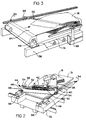
- the windshield assembly system 10 includes a sheet separation apparatus, generally indicated at 32, for separating individual adhesive sheets 18 from the stack of adhesive sheets 18.
- the sheet separation apparatus 32 is disposed above the lay-up conveyor 20.
- the sheet separation apparatus 32 is spaced from the transfer cart conveyor 32 by an elevator, generally indicated at 34.
- the elevator 34 moves up and down to allow indexing of stacks of adhesive sheets 18 at approximately 0.0762 cm (0.030 inches) per cycle. It should be appreciated that the elevator 34 is conventional and known in the art.
- the sheet separation apparatus 32 includes a base 36 located over the lay-up conveyor 20.
- the sheet separation apparatus 32 also includes a second robot 38 supported by the base 36.
- the second robot 38 has a vacuum cup 40 connected to a source of vacuum (not shown) and is used to lift a corner of the adhesive sheet 18.
- the second robot 38 is of a miniature vacuum cup handler type which is commercially available from FANUC Corp. of Auburn Hills, Michigan.
- the sheet separation apparatus 32 may include a segmented compliant vacuum bar 42 for separating a pillar edge of an adhesive sheet 18 from the other adhesive sheets 18 in the stack.
- the vacuum bar 42 compensates for irregularities in the elevation of the pillar edge of the stack of adhesive sheets 18.
- the vacuum bar 42 is supported by the base 36 and located relative to the first robot 38 and in close proximity to the pillar edge of the adhesive sheet 18 to grip and lift the pillar edge of the adhesive sheet 18 as a knife 50 and separator blade 62 to be described traverses that edge of the stack.
- the initial separation of the pillar edge of the adhesive sheet 18 is through a "lift and peel" action of the vacuum bar 42. It should be appreciated that the vacuum bar 42 is connected to a source of vacuum (not shown).
- the sheet separation apparatus 32 may include an edge separator, generally indicated at 44, for separating the pillar edge of an adhesive sheet 18 from the other adhesive sheets 18 in the stack.
- the edge separator 44 has a support member 46 extending longitudinally and a pair of ball screw servo drives 48 for moving the support member 46.
- the ball screw servo drives 48 move the support member 46 parallel to a centreline of the transfer cart 31.
- the edge separator 44 also includes a knife 50, a belt 52 connected to the knife 50 and a pair of pulleys 54 supporting the belt 52 and rotatably attached to the support member 46.
- the belt 52 is rotated by a motor 56 attached to one of the pulleys 54 to move the knife 50 back and forth between the pulleys 54.
- the edge separator 44 includes a device (not shown) for reading an elevation of the stack of adhesive sheets 18 and changing an elevation of the knife 50 to match the elevation of the stack as the knife 50 traverses along the edge of the stack to compensate for irregularities in the edge of the stack.
- the sheet separation apparatus 32 further includes a guideway 58 along each side of the support member 46 and supported by the base 36 for guiding the support member 46 generally parallel to the centreline of the transfer cart 31. It should be appreciated that the knife 50 has a relatively dull edge for separating the adhesive sheets 18.
- the sheet separation apparatus 32 may include a sheet separator, generally indicated at 60, for separating an adhesive sheet 18 from the other adhesive sheets 18 in the stack.
- the sheet separator 60 peels the top adhesive sheet 18 loose from the adjacent adhesive sheets 18 of the stack and overcomes any tendency of the top adhesive sheet 18 to adhere or "stick" to the lower adhesive sheet 18 below the top adhesive sheet 18.
- the sheet separator 60 includes a separator blade 62 and a shade 64 having a leading edge attached to the separator blade 62.
- the separator blade 62 is angled relative to the pillar edge of the adhesive sheet 18 and can flex and comply with an irregular elevation of the pillar edge during separation.
- the shade 64 is coiled or wound about a take-up reel 66 attached to the base 36.
- the shade 64 is perforated for a function to be described.
- the sheet separator 60 includes a guide mechanism 68 for moving the separator blade 62 along the adhesive sheet 18 generally parallel to the centreline of the transfer cart 31 in order to complete a full separation of the top adhesive sheet 18 from the immediately adjacent adhesive sheet 18 of the stack. It should be appreciated that the separator blade 62 has a relatively dull edge for separating the adhesive sheets 18.
- the windshield assembly system 10 includes a first robot 70 for moving the upper ply 16 relative to the lay-up conveyor 20.
- One embodiment of the first robot 70 is a FANUC S-420 type and commercially available from FANUC Corporation of Auburn Hills, Michigan.
- the first robot 70 has a plurality of vacuum cups 72 for gripping the ply 16 and are connected by a conduit 74 to a source of vacuum (not shown).
- the windshield assembly system 10 further includes a third robot 76 for moving the removed adhesive sheet 18 relative to the stack of adhesive sheets 18 and the lower ply 14.
- a third robot 76 for moving the removed adhesive sheet 18 relative to the stack of adhesive sheets 18 and the lower ply 14.
- the third robot 76 is a FANUC S-420 type and commercially available from FANUC Corporation of Auburn Hills, Michigan.
- the third robot 76 has a pick-up platen or handler, generally indicated at 78, at one end for gripping an adhesive sheet 18 on the stack, removing the adhesive sheet 18 from the stack and placing the removed adhesive sheet 18 on the lower ply 14.
- the handler 78 includes a contourable pick-up or face plate 80 and a plurality of electromechanical actuators 82 connected to the face plate 80.
- the handler 76 includes a centre anchor 84, connected to the electromechanical actuators 82 and fixedly mounted to an arm of the third robot 76.
- the face plate 80 is made of a suitable material such as 0.102 cm (.040 inches) stainless steel or 0.317 to 0.475 cm (0.125 to 0.187 inches) ultra high molecular weight (UHMW) plastic.
- the face plate 80 may be made of a 0.152 cm (0.060 inch) UHMW plastic backed by an adhesively attached 0.051 cm (0.020 inch) stainless steel sheet.
- the handler 78 may have a base plate (not shown) made of a honeycomb material to assist in mounting the actuators 82 and a manifold 90 to be described.
- the handler 78 also includes a plurality of vacuum cups 86 attached to the face plate 80 and spaced across its lower surface. Each vacuum cup 86 is fitted with a self-actuating valve, a mechanical device which allows the cup working surface to automatically vary in elevation from the lower surface of the face plate 80 and a mechanical mechanism to compensate for irregularities in the shape of the surface of the adhesive sheet 18.
- the handler 78 further includes a plurality of flex conduits 88 connected to the vacuum cups 86 and a manifold 90 connected to the flex conduits 88 and attached to the centre anchor 84.
- the manifold 90 is also connected by conduits 92 to a source of vacuum (not shown).
- the electromechanical actuators 82 and vacuum cups 86 are conventional and known in the art. It should also be appreciated that the vacuum cups 86 may be selectively turned ON and OFF.
- the handler 78 may include a vacuum lift bar 94 at a pillar edge of the face plate 80 and pivotally attached by a hinge 95 to an end of the face plate 80.
- the vacuum lift bar 94 is manipulated independently by an actuating mechanism 96 attached to the handler 78.
- the vacuum lift bar 94 has a plurality of vacuum cups 86 attached thereto and spaced across its lower surface.
- the vacuum cups 86 are attached by flex conduits 88 to the manifold 90. It should be appreciated that the vacuum lift bar 94 is manipulated independently of the remainder of the face plate 80 for the purpose of adding additional "peel effect" to that edge if required.
- the handler 78 may include a stripper roller 96 for stripping the adhesive sheet 18.
- the stripper roller 96 is operatively connected to the handler 78 to move longitudinally back and forth along the face plate 80.
- the handler 78 also includes sensors (not shown) mounted around a periphery of the face plate 80 to read the periphery of the adhesive sheet 18 as well as the location of the gradient band.
- the third robot 76 positions the handler 78 relative to the stack of adhesive sheets 18 such that the face plate 80 is concave and the vacuum lift bar 94 contacts the pillar edge of the stack.
- the handler 78 activates the vacuum to the vacuum cups 86 on the vacuum lift bar 94 and lifts the pillar edge of the top adhesive sheet 18 free of the stack.
- the handler 78 advances to separate the top adhesive sheet 18 from the stack.
- the handler 78 progressively activates vacuum to the vacuum cups 86 on the face plate 80 as it advances to end of the face plate 80.
- the handler 78 recontours the face plate 80.
- the third robot 76 then moves the removed adhesive sheet 18 on to the assembly station.
- the handler 78 may include the stripper roller 96 for stripping the adhesive sheet 18.
- the third robot 76 positions the handler 78 relative to the stack of adhesive sheets 18 such that the face plate 80 is concave and the vacuum lift bar 94 contacts the pillar edge of the stack.
- the handler 78 activates the vacuum to the vacuum cups 86 on the vacuum lift bar 94 and lifts the pillar edge of the top adhesive sheet 18 free of the stack.
- the handler 78 advances the stripper roller 96 to separate the top adhesive sheet 18 from the stack.
- the handler 78 progressively activates vacuum to the vacuum cups 86 on the face plate 80 as the stripper roller 96 advances to end of the face plate 80.
- the handler 78 returns the stripper roller 96 to its home or original position and recontours the face plate 80.
- the third robot 76 then moves the removed adhesive sheet 18 on to the assembly station.
- the lay-up conveyor 20 delivers an unlaminated contoured long ply 16 and short ply 14 to the assembly station.
- the first robot 70 positions the vacuum cups 72 adjacent the long ply 16 and applies a vacuum thereto.
- the first robot 70 lifts the long ply 16 above the lay-up conveyor 20.
- the short ply 14 is located by the squaring locator 24 and stopped in place along the lay-up conveyor 20.
- the second robot 38 grips the corner of the adhesive sheet 18 with the vacuum cup 40 and peels the corner away from the immediately adjacent lower adhesive sheet 18 about 2.54 to 5.08 cm (1.0 inches to 2.0 inches) to allow access for the knife 50 of the edge separator 44.
- the edge separator 44 moves or extends the knife 50 into the space between the adhesive sheets 18 and the second robot 38 releases the vacuum to the vacuum cup 40.
- the edge separator 44 moves the knife 50 elevationally and transversely across the pillar edge of the top adhesive sheet 18 for clearance and acceptance of the blade 62 of the sheet separator 60.
- the sheet separator 60 indexes the shade 64 and blade 62 parallel to the centreline of the stack in order to complete a full separation and isolation of the top adhesive sheet 18 from the immediately adjacent lower adhesive sheet 18 of the stack.
- the shade 64 serves as a clean flat working surface or table which contains the separated adhesive sheet 18. It should also be appreciated that the perforations in the shade 64 prevent a "local" vacuum from being drawn between the adhesive sheet 18 being handled and the shade 64.
- the third robot 76 moves the handler 78 to the surface of the sheet separator 60 and recontours to a flat or convex configuration required to pick-up the separated adhesive sheet 18.
- the handler 78 picks-up the separated adhesive sheet 18 as previously described in connection with either FIGS. 5 and 6.
- the handler 78 grips the separated adhesive sheet 18 upon contact and lifts it from the surface of the sheet separator 60.
- the third robot 76 moves the removed adhesive sheet 18 near the lay-up conveyor 20 and the handler 78 recontours under software control to a pre-established shape near that of the short ply 14.
- the handler 78 When the handler 78 nears the short ply 14, it pauses to "read" the position of the short ply 14 by sensing the configuration or peripheral shape and predetermined mark(s) in the gradient band and painted band.
- the third robot 76 manoeuvres the handler 78 as required to accurately position the gradient band of the adhesive sheet 18 to the marks on the short ply 14 as well as the periphery of the short ply 14.
- the vacuum to the vacuum cups 86 Once in the correct relationship to the short ply 14, the vacuum to the vacuum cups 86 is released and the removed adhesive sheet 18 settles slowly to the short ply 14.
- the third robot 76 then positions the long ply 16 relative to the short ply 14.
- the vacuum to the vacuum cups 72 is discontinued and the long ply 16 settles on the adhesive sheet 18 and short ply 14.
- the squaring locator 24 retracts the locator arms 28 to release the windshield assembly 12 and the lay-up conveyor 20 moves the assembled windshield assembly 12 from the assembly station.
- the windshield assembly system 10 features a second robot 38 to initially separate a corner of the adhesive sheet 18, an edge separator 44 to subsequently separate the pillar edge of the top adhesive sheet 18 from the adjacent lower adhesive sheet 18 on the stack and a sheet separator 60 to subsequently separate the full top adhesive sheet 18 from the adjacent lower adhesive sheet 18 on the stack.
- the sheet separator 60 isolates the top adhesive sheet 18 from the stack to a non-reactive surface so that no further tendency for the adhesive sheets 18 to stick together can occur.
- the windshield assembly system 10 has a handler 78 having a contourable face plate 80 with vacuum cups 86 and a third robot 76 for moving the handler 78 and adhesive sheet 18 to the short ply 14 and a first robot 70 for moving the long ply 16 initially from the lay-up conveyor 20 and finally to the adhesive sheet 18 and short ply 14.
Landscapes
- Engineering & Computer Science (AREA)
- Mechanical Engineering (AREA)
- Automobile Manufacture Line, Endless Track Vehicle, Trailer (AREA)
- Collation Of Sheets And Webs (AREA)
- Sheets, Magazines, And Separation Thereof (AREA)
- Laminated Bodies (AREA)
- Joining Of Glass To Other Materials (AREA)
Claims (10)
- Ein Windschutzscheiben-Montagesystem zur Montage Von Windschutzscheiben-Vorrichtungen (12) für Fahrzeuge, bestehend aus:einem Speicherband (20) für die Zuführung von zwei Glasscheiben (14, 16) zu einer Montagestation und einem entsprechenden ersten Roboter (70) zum Anheben einer (16) der beiden Glasscheiben vom besagten Förderband (20);einem Transfertstapelband (30), das sich quer zum besagten Speicherband (20) befindet, um einen Stapel Haftfolien (18) zum Speicherband und einem entsprechenden robotisierten Apparat (32) zum Absondern der Folien, der sich über dem Transfertstapelband (30) befindet, wobei der besagte Apparat (32) zum Absondern der Folien mit einer Vakuumvorrichtung versehen ist, durch die eine Ecke der obersten Haftfolie (18) im Haftfolienstapel (18) angehoben werden kann, um die besagte oberste Haftfolie vom Haftfolienstapel abzunehmen;einem dritten Roboter (76) mit einem Pick-up-Mechanismus (78), der eine anpassbare Pick-up-Platte (80) enthält, die mit einer Vielzahl von Vakuumschalen (86) zum Ergreifen der obersten Haftfolie (18) versehen ist, die die Haftfolie (18) vom Stapel nimmt und die abgesonderte Haftfolie (18) auf die untere Glasscheibe (14) legt;wobei der besagte erste Roboter (70) der Montagestation in der Lage ist, die besagte hochgehobene Glasscheibe (16) auf dem Speicherband der Haftfolien (18) und der unteren Glasscheibe (14) zu positionieren.
- Ein Windschutzscheiben-Montagesystem nach Anspruch 1, in dem der Apparat (32) zum Absondern der Folien eine verformbare Vakuumstange (42) enthalt, um eine Säulenkante der Haftfolie (18) von den anderen Haftfolien (18) im Stapel abzusondern.
- Ein Windschutzscheiben-Montagesystem nach Anspruch 1, in dem der Apparat (32) zum Absondern der Folien einen Kantenabscheider (44) enthält mit einem beweglichen Stützglied (46), um die Säulenkante einer Haftfolie (18) von den anderen Haftfolien (18) im Stapel zu trennen.
- Ein Windschutzscheiben-Montagesystem nach Anspruch 3, in dem der Apparat (32) zum Absondern der Folien ein bewegliches Messer (50) und eine Vorrichtung zur Änderung der Höhe des Messers (50) enthält.
- Ein Windschutzscheiben-Montagesystem nach irgendeinem der vorausgegangenen Ansprüche, in dem der Apparat (32) zum Absondern der Folien eine bewegliche Abscheideklinge (62) und eine schattierte Fläche (64) mit einer Führungskante enthält, die an der Abscheideklinge (62) befestigt ist.
- Ein Windschutzscheiben-Montägesystem nach Anspruch 5, in dem der Apparat (32) zum Absondern der Folien einen Führungsmechanismus (68) enthält, um die Abscheideklinge (62) an der Haftfolie (18) entlang, im allgemeinen parallel zur Mittellinie eines Transfertstaplers (31) zu bewegen, um ein vollständiges Absondern der oberen Haftfolie (18) von der unmittelbar benachbarten Haftfolie (18) des Stapels auszuführen.
- Ein Windschutzscheiben-Montagesystem nach irgendeinem der vorausgegangenen Ansprüche, in dem jede Vakuumschale (86) auf dem Pick-up-Mechanismus (78) mit einem selbsttätigen Ventil versehen ist, sowie mit einer mechanischen Vorrichtung, die dem Schalen-Arbeitssystem (86) ermöglicht, die Höhe automatisch von der unteren Oberfläche der Platte (80) zu ändern und einer mechanischen Vorrichtung zum Ausgleich von Unregelmässigkeiten in der Form der Haftfolie (18).
- Eine Windschutzscheiben-Vorrichtung nach irgendeinem der vorausgegangenen Ansprüche, in der der Pick-up-Mechanismus (78) über eine Vakuumhebestange (94) verfügt, die unabhängig vom Rest der Platte (80) betätigt werden kann.
- Eine Windschutzscheiben-Vorrichtung nach irgendeinem der vorausgegangenen Ansprüche, in der der Mechanismus (78) eine Abstreifrolle (96) enthält, die wirksam mit dem Mechanismus (78) verbunden ist, um sich längs nach rückwärts und vorwärts an der Vorderplatte (80) entlang zu bewegen.
- Eine Methode zur Montage von Windschutzscheiben-Vorrichtungen für Fahrzeuge, wobei die besagte Methode folgende Schritte enthält:Zuführung von mindestens zwei Glasscheiben (14, 16) zu einer Montagestätion mit einem Speicherband (20);Anheben einer (16) der beiden Glasscheiben (14, 16) vom Förderband (20) mit einem ersten Roboter (70);Zuführung eines Haftfolienstapels (18) zu einem Transfertstapelband (30), das sich quer zum besagten Speicherband (20) befindet;Absondern der obersten Folie (18) vom Haftfolienstapel (18) durch einen robotisierten Apparat (32) zum Absondern einer Folie, mit einer Vakuumvorrichtung;Ergreifen und Absondern der Haftfolie (18) vom Haftfolienstapel (18) durch einen dritten Roboter (76) und Ablegen der Haftfolie (18) nahe einer (14) der beiden Glasscheiben undAblegen einer (16) der beiden Glasscheiben nahe der abgesonderten Haftfolie (18) durch den ersten Roboter (70), um die Windschutzscheiben-Vorrichtung zu montieren
Applications Claiming Priority (3)
| Application Number | Priority Date | Filing Date | Title |
|---|---|---|---|
| US08/277,921 US5556505A (en) | 1994-07-05 | 1994-07-05 | Windshield assembly system |
| US277921 | 1994-07-05 | ||
| PCT/GB1995/001577 WO1996001183A1 (en) | 1994-07-05 | 1995-07-05 | Windshield assembly system |
Publications (2)
| Publication Number | Publication Date |
|---|---|
| EP0768951A1 EP0768951A1 (de) | 1997-04-23 |
| EP0768951B1 true EP0768951B1 (de) | 1998-08-26 |
Family
ID=23062952
Family Applications (1)
| Application Number | Title | Priority Date | Filing Date |
|---|---|---|---|
| EP95923496A Expired - Lifetime EP0768951B1 (de) | 1994-07-05 | 1995-07-05 | Windschutzscheibensystem |
Country Status (5)
| Country | Link |
|---|---|
| US (2) | US5556505A (de) |
| EP (1) | EP0768951B1 (de) |
| JP (1) | JPH10502607A (de) |
| DE (1) | DE69504352T2 (de) |
| WO (1) | WO1996001183A1 (de) |
Families Citing this family (34)
| Publication number | Priority date | Publication date | Assignee | Title |
|---|---|---|---|---|
| US5735200A (en) * | 1996-07-01 | 1998-04-07 | Chrysler Corporation | Stamping press loader |
| US5845950A (en) * | 1996-08-20 | 1998-12-08 | Industrial Magnetics, Inc. | Pneumatically actuated magnetic article holder |
| IT1288363B1 (it) * | 1996-10-21 | 1998-09-22 | Tai Tecnologia Automazione Inn | Procedimento di assemblaggio automatico di vetrature stratificate ed apparecchiatura idonea alla esecuzione di tale procedimento |
| US6054001A (en) * | 1998-02-17 | 2000-04-25 | Donnelly Corporation | Vehicle assembly line-side heat activation of a "ready-to-install" window fixing adhesive for attachment of a vehicle window to a vehicle |
| US6203639B1 (en) * | 1998-02-17 | 2001-03-20 | Donnelly Corporation | Vehicle assembly line-side heat activation of a “ready-to-install” window fixing adhesive for attachment of a vehicle window to a vehicle |
| DE19835496B4 (de) * | 1998-08-06 | 2006-03-16 | Haverkamp Gmbh | Verfahren und Beschichtungsvorrichtung zur Herstellung einer wenigstens einachsig gebogenen Verbundscheibe |
| EP1232689B1 (de) * | 2001-02-16 | 2004-06-16 | JUWEL AQUARIUM GmbH & CO. KG | Verfahren zur Herstellung von Behältern aus im wesentlichen plattenformigen Elementen sowie nach dem Verfahren herstellbares Erzeugnis |
| DE10152232B4 (de) * | 2001-10-20 | 2005-02-17 | Daimlerchrysler Ag | Verfahren und Vorrichtung zum automatisierten Handhaben von Harzmatten bei der Herstellung von SMC-Teilen |
| US20040071539A1 (en) * | 2002-07-03 | 2004-04-15 | Anater Raymond J. | Automated container management system |
| ITRM20020377A1 (it) * | 2002-07-12 | 2004-01-12 | Abb Service Srl | Procedimento ed apparecchiatura robotizzata compatta per l'assemblaggio di vetrature composite. |
| DE10312927A1 (de) * | 2003-03-22 | 2004-09-30 | Schuler Automation Gmbh & Co.Kg | Vereinzelungsvorrichtung und Vereinzelungsverfahren |
| US20070062020A1 (en) * | 2004-09-23 | 2007-03-22 | Mayhugh Kent R | Single technician large windshield installation tool |
| US20060156533A1 (en) * | 2004-09-23 | 2006-07-20 | Mayhugh Kent R | Single technician large windshield installation tool |
| DE102005057690A1 (de) * | 2005-04-14 | 2006-10-19 | Maschinenbau Gerold Gmbh & Co. Kg | Vorrichtung und Verfahren zum Vereinzeln von Folien, insbesondere von Verbundglasscheibenfolien |
| US7322092B2 (en) * | 2005-11-14 | 2008-01-29 | Aegis Tools International, Inc. | Windshield installation device and method of use |
| US7628434B2 (en) * | 2006-07-12 | 2009-12-08 | Honda Motor Co., Ltd. | Vacuum-operated vehicle glass handling system |
| US20080014414A1 (en) * | 2006-07-13 | 2008-01-17 | Vincent James Yacovone | Windshield Interlayer Having a Gradient Region Having a White Coloration |
| US7842395B2 (en) * | 2006-11-01 | 2010-11-30 | Solutia Inc. | Multiple layer interlayers having a gradient region |
| US8152160B2 (en) * | 2006-11-28 | 2012-04-10 | Ouellette Machinery Systems, Inc. | Tier sheet dispensing apparatus for a conveyor system |
| JP5591793B2 (ja) * | 2008-04-23 | 2014-09-17 | イージス・ツールズ・インターナショナル・インコーポレーテッド | ウインドシールド取り付け装置及び使用方法 |
| DE102011106214A1 (de) * | 2011-06-07 | 2012-12-13 | Brötje-Automation GmbH | Endeffektor |
| ES1078327Y (es) * | 2012-12-05 | 2013-04-04 | Simplicity Works Europe Sl | Herramienta para transportar y conformar piezas laminares flexibles. |
| KR101596725B1 (ko) * | 2013-05-22 | 2016-02-24 | 삼성디스플레이 주식회사 | 충전 필름 및 이를 이용한 유기 발광 디스플레이 장치의 제조 방법 |
| EP3221241B1 (de) * | 2014-11-19 | 2021-04-28 | Corning Incorporated | Vorrichtung und verfahren zum ablösen eines mehrschichtigen substrats |
| DE102015009177A1 (de) | 2015-07-09 | 2017-01-12 | Broetje-Automation Gmbh | Verfahren zum Herstellen eines Faser-Metall-Laminatbauteils eines Flugzeugs |
| GB2543843B (en) * | 2015-10-31 | 2020-04-29 | Loop Tech Ltd | A system for handling flexible materials |
| US10369706B2 (en) * | 2017-08-09 | 2019-08-06 | The Boeing Company | End effectors carrying plies of limp material for shaping by a mandrel |
| NL2020363B1 (en) * | 2018-01-31 | 2019-08-07 | Airborne Int B V | An end effector, system and methods for handling stacked sheets |
| NL2020362B1 (en) | 2018-01-31 | 2019-08-07 | Airborne Int B V | Manufacturing layered products |
| CN109573614B (zh) * | 2018-12-05 | 2021-01-19 | 福建世高智能科技有限公司 | 一种用于双片玻璃的拆垛传输装置 |
| DE102019104590B3 (de) * | 2019-02-22 | 2020-04-16 | Bohle Ag | Haltekopf für eine Vakuum-Haltevorrichtung zur Handhabung eines plattenförmigen Werkstücks und entsprechende Vakuum-Haltevorrichtung |
| CN111056312A (zh) * | 2019-04-24 | 2020-04-24 | 福耀玻璃(湖北)有限公司 | 用于汽车前挡玻璃合片前的自动上线系统 |
| JP7424178B2 (ja) * | 2020-04-13 | 2024-01-30 | 株式会社デンソーウェーブ | シール材貼付けシステム |
| TR202008802A1 (tr) * | 2020-06-08 | 2021-12-21 | Elektroteks Elektronik Tekstil Sanayi Ve Ticaret Ltd Sirketi | Yatak i̇malatinda kullanilmak üzere bi̇r taşima mekani̇zmasi |
Family Cites Families (25)
| Publication number | Priority date | Publication date | Assignee | Title |
|---|---|---|---|---|
| US2594373A (en) * | 1950-03-03 | 1952-04-29 | Christensen Machine Co | Sheet separator air blast nozzle |
| BE552016A (de) * | 1955-10-24 | |||
| US3167184A (en) * | 1962-11-28 | 1965-01-26 | Borax Benjamin | Rack for holding paint tubes |
| US3168184A (en) * | 1963-04-23 | 1965-02-02 | Ingersoll Rand Co | Glass transfer apparatus |
| US3275317A (en) * | 1964-05-01 | 1966-09-27 | Jr Frank H Fromm | Method and mechanism for transferring fabric blanks |
| US3637092A (en) * | 1970-04-30 | 1972-01-25 | Gen Electric | Material-handling apparatus |
| SE343811B (de) * | 1970-06-22 | 1972-03-20 | Emmaboda Glasverk Ab | |
| US3669445A (en) * | 1970-09-15 | 1972-06-13 | Bernard J Wallis | De-stacking device for sheet metal blanks |
| BE791606A (fr) * | 1972-07-10 | 1973-03-16 | Pilot Pen Co Ltd | Procede et appareil pour aspirer et soulever la feuille la plussuperieure d'une pile de feuilles de ce type |
| GB1561264A (en) * | 1976-10-05 | 1980-02-20 | Htb Ltd | Sheet feeding machines |
| US4129328A (en) * | 1977-06-20 | 1978-12-12 | Littell Edmund R | Plate handling apparatus with load deflection compensation |
| US4228993A (en) * | 1978-05-01 | 1980-10-21 | Ppg Industries, Inc. | Sheet orienting and transporting frame |
| US4366013A (en) * | 1981-07-28 | 1982-12-28 | Ppg Industries, Inc. | Shaped mold and a method of using same to assemble sandwich of a sheet of flexible interlayer material with bent glass sheets |
| US4368087A (en) * | 1981-07-28 | 1983-01-11 | Ppg Industries, Inc. | Arrangement of vacuum cups to assemble one or more bent glass sheets with a sheet of flexible interlayer material |
| US4420361A (en) * | 1981-07-28 | 1983-12-13 | Ppg Industries, Inc. | Apparatus for aligning bent glass sheets for assembly into bent glass sheet sandwiches |
| US4367107A (en) * | 1981-07-28 | 1983-01-04 | Ppg Industries, Inc. | Aligning bent glass sheets for assembly into bent glass sheet sandwiches |
| IT1149632B (it) * | 1982-02-12 | 1986-12-03 | Car Ventomatic Spa | Dispositivo di prelievo e separazione dei sacchida pacco per il servizio di infilasacchi automatici |
| JPS60204537A (ja) * | 1984-03-30 | 1985-10-16 | Hitachi Chem Co Ltd | シ−ト材料を取り出す方法 |
| BR8603037A (pt) * | 1985-07-25 | 1987-02-17 | Saint Gobain Vitrage | Processo e dispositivo para a preensao de uma folha de materia plastica flexivel |
| FR2594812B1 (fr) * | 1986-02-27 | 1988-05-27 | Saint Gobain Vitrage | Procede et dispositif pour l'assemblage automatique des vitrages feuilletes |
| DE3629968A1 (de) * | 1986-09-03 | 1988-03-10 | Messerschmitt Boelkow Blohm | Vorrichtung zum aufnehmen und ablegen von zuschnitten |
| FR2603566B1 (fr) * | 1986-09-08 | 1992-07-03 | Nippon Sheet Glass Co Ltd | Dispositif pour charger des produits fabriques a partir de verre en feuilles |
| CA1322946C (en) * | 1987-11-30 | 1993-10-12 | Nippon Sheet Glass Co., Ltd. | Method and apparatus for manufacturing laminated glass |
| DE4218203A1 (de) * | 1992-06-03 | 1993-12-09 | Kolbus Gmbh & Co Kg | Vorrichtung zum Vereinzeln von Bogen aus einem Stapelmagazin |
| US5323918A (en) * | 1993-05-20 | 1994-06-28 | Moore Business Forms, Inc. | Adhesive sheet separator |
-
1994
- 1994-07-05 US US08/277,921 patent/US5556505A/en not_active Expired - Lifetime
-
1995
- 1995-05-02 US US08/432,734 patent/US5578153A/en not_active Expired - Lifetime
- 1995-07-05 DE DE69504352T patent/DE69504352T2/de not_active Expired - Fee Related
- 1995-07-05 WO PCT/GB1995/001577 patent/WO1996001183A1/en not_active Ceased
- 1995-07-05 EP EP95923496A patent/EP0768951B1/de not_active Expired - Lifetime
- 1995-07-05 JP JP8503750A patent/JPH10502607A/ja active Pending
Also Published As
| Publication number | Publication date |
|---|---|
| EP0768951A1 (de) | 1997-04-23 |
| DE69504352D1 (de) | 1998-10-01 |
| DE69504352T2 (de) | 1999-01-07 |
| JPH10502607A (ja) | 1998-03-10 |
| WO1996001183A1 (en) | 1996-01-18 |
| US5556505A (en) | 1996-09-17 |
| US5578153A (en) | 1996-11-26 |
Similar Documents
| Publication | Publication Date | Title |
|---|---|---|
| EP0768951B1 (de) | Windschutzscheibensystem | |
| JP4157604B2 (ja) | スペーサー材の自動装着装置及びそれを使用する方法 | |
| CN100503406C (zh) | 薄膜供给装置和薄膜粘贴装置及其薄膜粘贴系统 | |
| JP2002505232A (ja) | 車体への粘着性保護フィルムの貼着方法及び装置 | |
| KR19990028523A (ko) | 반도체웨이퍼의 보호점착테이프의 박리방법 및 그 장치 | |
| CN113290363A (zh) | 一种全自动背光组装设备 | |
| CN211545451U (zh) | 一种自动贴膜平台 | |
| WO2006057376A1 (ja) | 脆質部材の処理装置 | |
| US5104473A (en) | Apparatus and method for removing a release sheet from a workpiece | |
| CN114229153A (zh) | 一种撕贴膜一体式自动化设备 | |
| CN216943917U (zh) | 一种撕贴膜一体式自动化设备 | |
| KR101282699B1 (ko) | 시트 첩부 장치 및 첩부 방법 | |
| JPH0522524Y2 (de) | ||
| CN117226924B (zh) | 覆膜结构、收料机构和加工装置 | |
| JP2788177B2 (ja) | フイルムの移載装置 | |
| CN212147550U (zh) | 一种用于曲面贴带粘性无底膜的贴膜装置 | |
| CN218548509U (zh) | 一种自动贴胶装置 | |
| CN213891266U (zh) | 一种辅料自动贴合设备 | |
| JPH07309510A (ja) | ホイル用防錆フィルムの貼着治具及び貼着装置 | |
| JP3805511B2 (ja) | 通気性薄物の自動供給装置 | |
| CN210200675U (zh) | 一种自动撕金装置 | |
| JPH06254451A (ja) | ラッピングフィルムの貼付方法及び装置 | |
| CN113772475A (zh) | 一种手机钢化膜包装的蓝胶粘贴装置 | |
| JPH0530615B2 (de) | ||
| JPH0740434A (ja) | シート貼付け方法及びシート貼付け装置 |
Legal Events
| Date | Code | Title | Description |
|---|---|---|---|
| PUAI | Public reference made under article 153(3) epc to a published international application that has entered the european phase |
Free format text: ORIGINAL CODE: 0009012 |
|
| 17P | Request for examination filed |
Effective date: 19961209 |
|
| AK | Designated contracting states |
Kind code of ref document: A1 Designated state(s): DE FR GB |
|
| 17Q | First examination report despatched |
Effective date: 19970429 |
|
| GRAG | Despatch of communication of intention to grant |
Free format text: ORIGINAL CODE: EPIDOS AGRA |
|
| GRAG | Despatch of communication of intention to grant |
Free format text: ORIGINAL CODE: EPIDOS AGRA |
|
| GRAH | Despatch of communication of intention to grant a patent |
Free format text: ORIGINAL CODE: EPIDOS IGRA |
|
| GRAH | Despatch of communication of intention to grant a patent |
Free format text: ORIGINAL CODE: EPIDOS IGRA |
|
| GRAA | (expected) grant |
Free format text: ORIGINAL CODE: 0009210 |
|
| AK | Designated contracting states |
Kind code of ref document: B1 Designated state(s): DE FR GB |
|
| REF | Corresponds to: |
Ref document number: 69504352 Country of ref document: DE Date of ref document: 19981001 |
|
| ET | Fr: translation filed | ||
| PLBE | No opposition filed within time limit |
Free format text: ORIGINAL CODE: 0009261 |
|
| STAA | Information on the status of an ep patent application or granted ep patent |
Free format text: STATUS: NO OPPOSITION FILED WITHIN TIME LIMIT |
|
| 26N | No opposition filed | ||
| REG | Reference to a national code |
Ref country code: GB Ref legal event code: 746 Effective date: 20010614 |
|
| REG | Reference to a national code |
Ref country code: FR Ref legal event code: D6 |
|
| REG | Reference to a national code |
Ref country code: GB Ref legal event code: IF02 |
|
| PGFP | Annual fee paid to national office [announced via postgrant information from national office to epo] |
Ref country code: GB Payment date: 20030704 Year of fee payment: 9 |
|
| PGFP | Annual fee paid to national office [announced via postgrant information from national office to epo] |
Ref country code: DE Payment date: 20030710 Year of fee payment: 9 |
|
| PGFP | Annual fee paid to national office [announced via postgrant information from national office to epo] |
Ref country code: FR Payment date: 20030711 Year of fee payment: 9 |
|
| PG25 | Lapsed in a contracting state [announced via postgrant information from national office to epo] |
Ref country code: GB Free format text: LAPSE BECAUSE OF NON-PAYMENT OF DUE FEES Effective date: 20040705 |
|
| PG25 | Lapsed in a contracting state [announced via postgrant information from national office to epo] |
Ref country code: DE Free format text: LAPSE BECAUSE OF NON-PAYMENT OF DUE FEES Effective date: 20050201 |
|
| GBPC | Gb: european patent ceased through non-payment of renewal fee |
Effective date: 20040705 |
|
| PG25 | Lapsed in a contracting state [announced via postgrant information from national office to epo] |
Ref country code: FR Free format text: LAPSE BECAUSE OF NON-PAYMENT OF DUE FEES Effective date: 20050331 |
|
| REG | Reference to a national code |
Ref country code: FR Ref legal event code: ST |