EP0741383A2 - Optisches Informationsaufzeichnungsmedium - Google Patents
Optisches Informationsaufzeichnungsmedium Download PDFInfo
- Publication number
- EP0741383A2 EP0741383A2 EP96112240A EP96112240A EP0741383A2 EP 0741383 A2 EP0741383 A2 EP 0741383A2 EP 96112240 A EP96112240 A EP 96112240A EP 96112240 A EP96112240 A EP 96112240A EP 0741383 A2 EP0741383 A2 EP 0741383A2
- Authority
- EP
- European Patent Office
- Prior art keywords
- light
- region
- laser beam
- layer
- information recording
- Prior art date
- Legal status (The legal status is an assumption and is not a legal conclusion. Google has not performed a legal analysis and makes no representation as to the accuracy of the status listed.)
- Granted
Links
- 230000003287 optical effect Effects 0.000 title claims abstract description 45
- 239000000758 substrate Substances 0.000 claims abstract description 42
- 238000001704 evaporation Methods 0.000 claims description 3
- 230000008020 evaporation Effects 0.000 claims description 3
- 238000012986 modification Methods 0.000 claims description 3
- 230000004048 modification Effects 0.000 claims description 3
- 238000000859 sublimation Methods 0.000 claims description 3
- 230000008022 sublimation Effects 0.000 claims description 3
- 238000000354 decomposition reaction Methods 0.000 claims description 2
- 238000002844 melting Methods 0.000 claims description 2
- 230000008018 melting Effects 0.000 claims description 2
- 239000010410 layer Substances 0.000 description 47
- 239000011241 protective layer Substances 0.000 description 8
- 239000004065 semiconductor Substances 0.000 description 8
- 239000000463 material Substances 0.000 description 6
- 229920000515 polycarbonate Polymers 0.000 description 6
- 239000004417 polycarbonate Substances 0.000 description 6
- 229910052737 gold Inorganic materials 0.000 description 5
- 239000010931 gold Substances 0.000 description 5
- 239000011347 resin Substances 0.000 description 5
- 229920005989 resin Polymers 0.000 description 5
- 238000010521 absorption reaction Methods 0.000 description 4
- PCHJSUWPFVWCPO-UHFFFAOYSA-N gold Chemical compound [Au] PCHJSUWPFVWCPO-UHFFFAOYSA-N 0.000 description 4
- 238000004544 sputter deposition Methods 0.000 description 4
- 238000001746 injection moulding Methods 0.000 description 3
- 229910052751 metal Inorganic materials 0.000 description 3
- 239000002184 metal Substances 0.000 description 3
- 238000004528 spin coating Methods 0.000 description 3
- 239000002344 surface layer Substances 0.000 description 3
- 239000004925 Acrylic resin Substances 0.000 description 2
- 229910001218 Gallium arsenide Inorganic materials 0.000 description 2
- 229910052782 aluminium Inorganic materials 0.000 description 2
- 239000011248 coating agent Substances 0.000 description 2
- 238000000576 coating method Methods 0.000 description 2
- 229910052802 copper Inorganic materials 0.000 description 2
- 239000010949 copper Substances 0.000 description 2
- SWXVUIWOUIDPGS-UHFFFAOYSA-N diacetone alcohol Chemical compound CC(=O)CC(C)(C)O SWXVUIWOUIDPGS-UHFFFAOYSA-N 0.000 description 2
- 239000003822 epoxy resin Substances 0.000 description 2
- 238000000465 moulding Methods 0.000 description 2
- 229920000647 polyepoxide Polymers 0.000 description 2
- 230000035939 shock Effects 0.000 description 2
- 229910052709 silver Inorganic materials 0.000 description 2
- ANRHNWWPFJCPAZ-UHFFFAOYSA-M thionine Chemical compound [Cl-].C1=CC(N)=CC2=[S+]C3=CC(N)=CC=C3N=C21 ANRHNWWPFJCPAZ-UHFFFAOYSA-M 0.000 description 2
- RYGMFSIKBFXOCR-UHFFFAOYSA-N Copper Chemical compound [Cu] RYGMFSIKBFXOCR-UHFFFAOYSA-N 0.000 description 1
- BQCADISMDOOEFD-UHFFFAOYSA-N Silver Chemical compound [Ag] BQCADISMDOOEFD-UHFFFAOYSA-N 0.000 description 1
- 229910045601 alloy Inorganic materials 0.000 description 1
- 239000000956 alloy Substances 0.000 description 1
- XAGFODPZIPBFFR-UHFFFAOYSA-N aluminium Chemical compound [Al] XAGFODPZIPBFFR-UHFFFAOYSA-N 0.000 description 1
- 230000015572 biosynthetic process Effects 0.000 description 1
- 238000006243 chemical reaction Methods 0.000 description 1
- 230000000694 effects Effects 0.000 description 1
- 229910052748 manganese Inorganic materials 0.000 description 1
- DZVCFNFOPIZQKX-LTHRDKTGSA-M merocyanine Chemical compound [Na+].O=C1N(CCCC)C(=O)N(CCCC)C(=O)C1=C\C=C\C=C/1N(CCCS([O-])(=O)=O)C2=CC=CC=C2O\1 DZVCFNFOPIZQKX-LTHRDKTGSA-M 0.000 description 1
- VLTRZXGMWDSKGL-UHFFFAOYSA-M perchlorate Inorganic materials [O-]Cl(=O)(=O)=O VLTRZXGMWDSKGL-UHFFFAOYSA-M 0.000 description 1
- VLTRZXGMWDSKGL-UHFFFAOYSA-N perchloric acid Chemical compound OCl(=O)(=O)=O VLTRZXGMWDSKGL-UHFFFAOYSA-N 0.000 description 1
- IEQIEDJGQAUEQZ-UHFFFAOYSA-N phthalocyanine Chemical compound N1C(N=C2C3=CC=CC=C3C(N=C3C4=CC=CC=C4C(=N4)N3)=N2)=C(C=CC=C2)C2=C1N=C1C2=CC=CC=C2C4=N1 IEQIEDJGQAUEQZ-UHFFFAOYSA-N 0.000 description 1
- 229920001296 polysiloxane Polymers 0.000 description 1
- 239000012858 resilient material Substances 0.000 description 1
- 239000004332 silver Substances 0.000 description 1
- 239000010944 silver (metal) Substances 0.000 description 1
- 239000000243 solution Substances 0.000 description 1
- 239000002904 solvent Substances 0.000 description 1
- 229920002803 thermoplastic polyurethane Polymers 0.000 description 1
Images



Classifications
-
- G—PHYSICS
- G11—INFORMATION STORAGE
- G11B—INFORMATION STORAGE BASED ON RELATIVE MOVEMENT BETWEEN RECORD CARRIER AND TRANSDUCER
- G11B7/00—Recording or reproducing by optical means, e.g. recording using a thermal beam of optical radiation by modifying optical properties or the physical structure, reproducing using an optical beam at lower power by sensing optical properties; Record carriers therefor
- G11B7/24—Record carriers characterised by shape, structure or physical properties, or by the selection of the material
- G11B7/24018—Laminated discs
- G11B7/24027—Layers; Shape, structure or physical properties thereof
-
- G—PHYSICS
- G11—INFORMATION STORAGE
- G11B—INFORMATION STORAGE BASED ON RELATIVE MOVEMENT BETWEEN RECORD CARRIER AND TRANSDUCER
- G11B7/00—Recording or reproducing by optical means, e.g. recording using a thermal beam of optical radiation by modifying optical properties or the physical structure, reproducing using an optical beam at lower power by sensing optical properties; Record carriers therefor
- G11B7/007—Arrangement of the information on the record carrier, e.g. form of tracks, actual track shape, e.g. wobbled, or cross-section, e.g. v-shaped; Sequential information structures, e.g. sectoring or header formats within a track
- G11B7/0079—Zoned data area, e.g. having different data structures or formats for the user data within data layer, Zone Constant Linear Velocity [ZCLV], Zone Constant Angular Velocity [ZCAV], carriers with RAM and ROM areas
-
- G—PHYSICS
- G11—INFORMATION STORAGE
- G11B—INFORMATION STORAGE BASED ON RELATIVE MOVEMENT BETWEEN RECORD CARRIER AND TRANSDUCER
- G11B7/00—Recording or reproducing by optical means, e.g. recording using a thermal beam of optical radiation by modifying optical properties or the physical structure, reproducing using an optical beam at lower power by sensing optical properties; Record carriers therefor
- G11B7/24—Record carriers characterised by shape, structure or physical properties, or by the selection of the material
-
- G—PHYSICS
- G11—INFORMATION STORAGE
- G11B—INFORMATION STORAGE BASED ON RELATIVE MOVEMENT BETWEEN RECORD CARRIER AND TRANSDUCER
- G11B7/00—Recording or reproducing by optical means, e.g. recording using a thermal beam of optical radiation by modifying optical properties or the physical structure, reproducing using an optical beam at lower power by sensing optical properties; Record carriers therefor
- G11B7/24—Record carriers characterised by shape, structure or physical properties, or by the selection of the material
- G11B7/241—Record carriers characterised by shape, structure or physical properties, or by the selection of the material characterised by the selection of the material
-
- G—PHYSICS
- G11—INFORMATION STORAGE
- G11B—INFORMATION STORAGE BASED ON RELATIVE MOVEMENT BETWEEN RECORD CARRIER AND TRANSDUCER
- G11B7/00—Recording or reproducing by optical means, e.g. recording using a thermal beam of optical radiation by modifying optical properties or the physical structure, reproducing using an optical beam at lower power by sensing optical properties; Record carriers therefor
- G11B7/004—Recording, reproducing or erasing methods; Read, write or erase circuits therefor
- G11B7/0045—Recording
- G11B7/00452—Recording involving bubble or bump forming
-
- G—PHYSICS
- G11—INFORMATION STORAGE
- G11B—INFORMATION STORAGE BASED ON RELATIVE MOVEMENT BETWEEN RECORD CARRIER AND TRANSDUCER
- G11B7/00—Recording or reproducing by optical means, e.g. recording using a thermal beam of optical radiation by modifying optical properties or the physical structure, reproducing using an optical beam at lower power by sensing optical properties; Record carriers therefor
- G11B7/004—Recording, reproducing or erasing methods; Read, write or erase circuits therefor
- G11B7/005—Reproducing
- G11B7/0051—Reproducing involving phase depth effects
-
- Y—GENERAL TAGGING OF NEW TECHNOLOGICAL DEVELOPMENTS; GENERAL TAGGING OF CROSS-SECTIONAL TECHNOLOGIES SPANNING OVER SEVERAL SECTIONS OF THE IPC; TECHNICAL SUBJECTS COVERED BY FORMER USPC CROSS-REFERENCE ART COLLECTIONS [XRACs] AND DIGESTS
- Y10—TECHNICAL SUBJECTS COVERED BY FORMER USPC
- Y10S—TECHNICAL SUBJECTS COVERED BY FORMER USPC CROSS-REFERENCE ART COLLECTIONS [XRACs] AND DIGESTS
- Y10S428/00—Stock material or miscellaneous articles
- Y10S428/913—Material designed to be responsive to temperature, light, moisture
-
- Y—GENERAL TAGGING OF NEW TECHNOLOGICAL DEVELOPMENTS; GENERAL TAGGING OF CROSS-SECTIONAL TECHNOLOGIES SPANNING OVER SEVERAL SECTIONS OF THE IPC; TECHNICAL SUBJECTS COVERED BY FORMER USPC CROSS-REFERENCE ART COLLECTIONS [XRACs] AND DIGESTS
- Y10—TECHNICAL SUBJECTS COVERED BY FORMER USPC
- Y10S—TECHNICAL SUBJECTS COVERED BY FORMER USPC CROSS-REFERENCE ART COLLECTIONS [XRACs] AND DIGESTS
- Y10S430/00—Radiation imagery chemistry: process, composition, or product thereof
- Y10S430/146—Laser beam
-
- Y—GENERAL TAGGING OF NEW TECHNOLOGICAL DEVELOPMENTS; GENERAL TAGGING OF CROSS-SECTIONAL TECHNOLOGIES SPANNING OVER SEVERAL SECTIONS OF THE IPC; TECHNICAL SUBJECTS COVERED BY FORMER USPC CROSS-REFERENCE ART COLLECTIONS [XRACs] AND DIGESTS
- Y10—TECHNICAL SUBJECTS COVERED BY FORMER USPC
- Y10T—TECHNICAL SUBJECTS COVERED BY FORMER US CLASSIFICATION
- Y10T428/00—Stock material or miscellaneous articles
- Y10T428/24—Structurally defined web or sheet [e.g., overall dimension, etc.]
- Y10T428/24802—Discontinuous or differential coating, impregnation or bond [e.g., artwork, printing, retouched photograph, etc.]
- Y10T428/24917—Discontinuous or differential coating, impregnation or bond [e.g., artwork, printing, retouched photograph, etc.] including metal layer
-
- Y—GENERAL TAGGING OF NEW TECHNOLOGICAL DEVELOPMENTS; GENERAL TAGGING OF CROSS-SECTIONAL TECHNOLOGIES SPANNING OVER SEVERAL SECTIONS OF THE IPC; TECHNICAL SUBJECTS COVERED BY FORMER USPC CROSS-REFERENCE ART COLLECTIONS [XRACs] AND DIGESTS
- Y10—TECHNICAL SUBJECTS COVERED BY FORMER USPC
- Y10T—TECHNICAL SUBJECTS COVERED BY FORMER US CLASSIFICATION
- Y10T428/00—Stock material or miscellaneous articles
- Y10T428/31504—Composite [nonstructural laminate]
- Y10T428/31678—Of metal
Definitions
- the present invention relates to an optical information recording medium of the type wherein recorded data are reproduced by scanning them by a laser beam More particularly, it relates to an optical information recording medium comprising a ROM region where data are already recorded and an information recordable region where data can be recorded.
- writable optical information recording media capable of recording data by means of laser beams, have a recording layer of e.g. a metal such as Te, Bi or Mn or a dye such as cyanine, merocyanine or phthalocyanine, and they are designed to record data in such a manner that when irradiated with a laser beam, such recording layer is deformed, sublimed, evaporated or modified to form pits.
- a recording layer e.g. a metal such as Te, Bi or Mn or a dye such as cyanine, merocyanine or phthalocyanine
- optical information recording media having such recording layer it is common to form a space behind the recording layer to facilitate the deformation, sublimation, evaporation or modification of the recording layer for the formation of the pits.
- a typical example is a laminated structure so-called an air sandwich structure wherein a pair of substrates are laminated with a space therebetween.
- a writing laser beam is irradiated through a transparent substrate to form optically readable pits in the recording layer.
- a reading laser beam having a less power than the writing laser beam is irradiated through the substrate, and the contrast between the light reflected from the pits and the light reflected from non-pitted portion, is read as an electrical signal.
- optical information recording media of so-called ROM (read only memory) type wherein data are already recorded, and no further data are recordable or the recorded data are no longer erasable or rewritable, are widely practically employed in the sound recording and information treating fields.
- Optical information recording media of this type have no such a recording layer as described above.
- Prepits or pregrooves corresponding to data to be reproduced are already formed on a substrate of e.g. polycarbonate by e.g. press molding, a reflective layer of a metal such as Au, Ag, Cu or Al is formed thereon, and a protective layer is further provided thereon.
- the most typical optical information recording medium of this ROM type is a compact disc so-called CD which is widely used in the sound recording and information treating fields.
- CD compact disc
- the specification for recording and read-out signals for this CD is standardized, and the reproducing or play back apparatus for CD in accordance with this standard is widely available as compact disc players (CD players).
- optical information recording media all take a disc form having a center hole for engagement with a rotatory shaft, i.e. a form of an optical disc.
- ROM type optical information recording media have a merit in that media having the same data can be produced in a large quantity, and the recorded data will not be erased inadvertently. However, the user can not record optional data thereon.
- recordable optical information recording media the user can record any optional data thereon.
- recording media are not suitable for recording the same data in a large quantity, and they also have a demerit that the recorded data may inadvertently be erased.
- the present invention provides an optical information recording medium of the type wherein recorded data are reproduced by scanning them with a laser beam, which comprises a ROM region where optically readable pits are already formed and an information recordable region where optically readable pits can be formed by irradiation with a writing laser beam, wherein the information recordable region comprises a light transmitting substrate having a deformable surface, a light absorptive layer overlaying the deformable surface, to absorb the writing laser beam, and a light reflective layer overlaying the light absorptive layer, said deformable surface being deformable by energy generated upon absorption of the writing laser beam by the light absorptive layer, to form optically readable pits.
- the optical information recording medium of the present invention has an information recordable region and a ROM region on a single substrate, whereby in the ROM region, the same data can be recorded in a large quantity by e.g. press molding and there is no danger of inadvertent erasure of the recorded data, and in the recordable region, any desired data may be recorded at will by the user.
- such a light absorptive layer may be formed to fill up the pregroove formed preliminarily on the substrate, so that the attenuation of light due to interference of the light reflected from the pregroove and the light reflected from the land will be suppressed, whereby the reflectance for reproduction at the pregroove portion will be high, and the degree of modulation of pits formed in the information recordable region can be made high.
- the read-out signals from the pits formed in the information recordable region and the read-out signals from the prepits on the substrate will both have adequate degrees of modulation.
- Figure 1 is a partially cross-sectional perspective view diagrammatically illustrating one embodiment of the structure of the optical information recording medium of the present invention.
- Figure 2 is an enlarged view of portion of Figure 1.
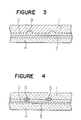
- Figure 3 is an enlarged view of portion B of Figure 1.
- Figure 4 is a diagrammatical cross-sectional view of another embodiment of portion B after recording.
- Figures 5 to 7 are waveform views showing output waveforms obtained by playing back optical discs prepared in Examples by a commercially available CD player.
- Figures 1 to 3 diagrammatically illustrate a structure of the optical information recording medium according to the present invention.
- reference numeral 1 indicates a light transmitting substrate
- numeral 2 indicates a light absorptive layer formed thereon, which generates heat upon absorption of an irradiated laser beam and is thereby melted, evaporated, sublimed, deformed or modified to form pits on the surface of the substrate 1 or in the light absorptive layer 2.
- Reference numeral 3 is a light reflective layer formed thereon
- numeral 4 indicates a protective layer provided thereon.
- the light transmitting substrate 1 is made of a material having high transparency to laser beams and is usually made of a resin having excellent strength such as a polycarbonate, an acrylate resin or an epoxy resin.
- the substrate may be made of any other material so long as it is transparent to writing and reading laser beams and at least the surface layer adjacent to the light absorptive layer 2 in the information recordable region 7 is deformable by energy generated by the light absorptive layer upon absorption of the writing laser beam, to form optically readable pits.
- the substrate or at least the surface layer thereof preferably has a heat distortion temperature within a range of from 85 to 200°C, more preferably from 90 to 150°C, as measured in accordance with ASTM D648 under a load of 4.6 kg/cm 2 and/or a Rockwell hardness within a range of from M200 to M75, more preferably from M105 to M80, as measured in accordance with ASTM D785.
- the heat distortion temperature or the Rockwell hardness of the substrate When the heat distortion temperature or the Rockwell hardness of the substrate is within the above-mentioned range, the energy generated by the light absorptive layer 2 upon absorption of the writing laser beam can effectively be absorbed by the local deformation of the surface layer of the substrate 1 so that no substantial strain will remain in the formed pits, whereby the stability of the recorded data will be secured. If the heat deformation temperature or the hardness is too low, the formed pits tend to easily be deformed by heat or external force, whereby the stability will be poor.
- the heat distortion temperature or the hardness is too high, the energy generated by the light absorptive layer 2 can hardly be absorbed in the form of deformation of the substrate 1, and it is difficult to form distinct pits 5, whereby it will be difficult to obtain read-out signals having a high degree of modulation.
- the thickness of the substrate 1 is not critical, but it is usually within a range of from 1.1 to 1.5 mm.
- the light absorptive layer 2 in the information recordable region 7 is a layer which absorbs a laser beam entered through the light transmitting substrate 1, whereupon it generates heat and at the same time undergoes melting, evaporation, sublimation, reaction, decomposition or modification. It is formed usually by spin coating a dye material such as a cyanine dye on the substrate 1.
- the light absorptive layer 2 may be formed to cover also the ROM region 6.
- the thickness of the light absorptive layer 2 is usually within a range of from 20 to 500 nm, preferably from 100 to 300 nm.
- the light reflective layer 3 is usually made of a metal such as gold, silver, copper, aluminum or an alloy thereof.
- the thickness of the light reflective layer 3 is usually within a range of from 30 to 150 nm, preferably from 40 to 130 nm.
- the protective layer 4 is made of a resin excellent in the impact resistance like the light transmitting substrate 1 and is most commonly formed by coating a ultraviolet curable resin by spin coating, followed by irradiation with ultraviolet rays for curing.
- a resin excellent in the impact resistance like the light transmitting substrate 1 is most commonly formed by coating a ultraviolet curable resin by spin coating, followed by irradiation with ultraviolet rays for curing.
- an epoxy resin, an acrylate resin and a silicone hard coat resin may usually be used.
- a resilient material such as a urethane resin to obtain a cushion effect.
- the thickness of the protective layer 4 is not critical and is usually within a range of from 3 to 30 ⁇ m, preferably from 5 to 15 ⁇ m.
- an organic dye to form the light absorptive layer 0.65 g of 1,1'-dibutyl-3,3,3',3'-tetramethyl-4,5,4',5'-dibenzoindodicarbocyanine perchlorate (product number NK3219, manufactured by Nippon Kanko Shikiso K.K.) was dissolved in 10 me of a diacetone alcohol solvent. The solution was coated by spin coating on the surface of the portion corresponding to the outer region of the substrate 1 i.e. the information recordable region 7 outside the diameter of 80 mm, to form a light absorptive layer 2 of a light sensitive dye film having a thickness of 0.13 ⁇ m.
- a gold film having a thickness of 400 ⁇ was formed by sputtering over the entire surface of a region of the diameter of from 45 to 118 mm of this disc, to form a light reflective layer 3.
- An ultraviolet curable resin was further spin-coated on this light reflective layer 3 and cured by irradiation with ultraviolet rays to form a protective layer 4 having a thickness of 10 ⁇ m.
- a semiconductor laser beam having a wavelength of 780 nm was irradiated at a linear speed of 1.2 m/sec with a recording power of 6.0 mW to record EFM signals.
- the CD standards prescribe that the reflectance is at least 70%, I 11 /I top is at least 0.6 and I 3 /I top is from 0.3 to 0.7.
- the optical disc of this example meets these standards with both the ROM region and the information recordable region.
- a gold film having a thickness of 400 ⁇ was formed by sputtering on the entire surface of a region of the diameter of from 45 to 118 mm of this disc, to form a light reflective layer 3.
- a semiconductor laser beam having a wavelength of 780 nm was irradiated at a linear speed of 1.2 m/sec with a recording power of 6.0 mW to record EFM signals. Then, this optical disc was played back by the same CD player as used in Example 1, whereby the waveform of the read-out signals obtained from the inside ROM region 6 was as shown in Figure 5, and in this region, the reflectance of the semiconductor laser beam was 85%, I 11 /I top was 0.7 and I 3 /I top was 0.47. Further, the waveform of the read-out signals obtained from the outside information recordable region 7 was as shown in Figure 7, and in this region, the reflectance of the semiconductor laser beam was 76%, I 11 /I top was 0.65 and I 3 /I top was 0.35.
- the CD standards prescribe that the reflectance is at least 70%' I 11 /I top is at least 0.6 and I 3 /I top is from 0.3 to 0.7.
- the optical disc of this example meets the standards with both the ROM region and the information recordable region.
- a gold film having a thickness of 400 ⁇ was formed by sputtering on the entire surface of a region of the diameter of from 45 to 118 mm of this disc, to form a light reflective layer 3.
- a semiconductor laser beam having a wavelength of 780 nm was irradiated at a linear speed of 1.2 m/sec with a recording power of 6.0 mW, to record EFM signals. Then, this optical disc was played back by the same CD player as used in Example 1, whereby the waveforms of the read-out signals, the reflectance of the semiconductor laser beam, I 11 /I top and I 3 /I top in both the inside ROM regions 6 and the information recordable regions 7, were substantially the same as in Example 2.
- a shock absorbing portion such as a space is formed behind the information recordable layer so that when the recording layer absorbs a laser beam and generates heat and is thereby melted, evaporated, sublimed, deformed or modified, such thermal changes are absorbed by the above shock absorbing portion, whereby pits are formed to the recording layer itself.
- the optical information recording medium of the present invention has a light reflective layer 3 behind the light absorptive layer 2 and a protective layer 4 behind the light reflective layer 3, and by forming the layers behind the light absorptive layer 2 with materials more hardly heat-deformable than the substrate 1, it is possible to employ a recording system wherein the thermal changes of the light absorptive layer 2 are absorbed by the substrate 1 so that optically modified pits such as protuberances, waved pits or dents will be formed on the substrate.
- the polycarbonate substrate 1 had a Rockwell hardness (ASTM D785) of M75 and a heat distortion temperature (ASTM D648) of 132°C under a load of 4.6 kg/cm 2 .
- the protective layer 4 had a Rockwell hardness (ASTM D785) of M90 and a heat distortion temperation (ASTM D648) of 150°C under a load of 4.6 kg/cm 2 .
- the protective layer 4 behind the light absorptive layer 2 is made of a material more hardly heat-deformable than the substrate, whereby the thermal changes of the light absorptive layer 2 are absorbed by the surface of the substrate 1 and pits in the form of protuberances are formed on the surface of the substrate.
- pits 5 in the form of protuberances are observed on the surface of the substrate 1 of the optical disc which is in contact with the light absorptive layer 2.
- the optical information recording medium of the present invention has a ROM region and an information recordable region on the same medium, whereby at the ROM region, the same data can be recorded in a large quantity and the recorded data can be reproduced without inadvertent erasure, and at the same time, in the information recordable region, the user can record any optional data.
- the optical information recording medium of the present invention is useful for wide a range of applications.
Landscapes
- Engineering & Computer Science (AREA)
- Software Systems (AREA)
- Theoretical Computer Science (AREA)
- Optical Record Carriers And Manufacture Thereof (AREA)
- Optical Recording Or Reproduction (AREA)
- Thermal Transfer Or Thermal Recording In General (AREA)
Applications Claiming Priority (10)
| Application Number | Priority Date | Filing Date | Title |
|---|---|---|---|
| JP19171688 | 1988-07-30 | ||
| JP19171688 | 1988-07-30 | ||
| JP19171588 | 1988-07-30 | ||
| JP191716/88 | 1988-07-30 | ||
| JP63191715A JPH07114028B2 (ja) | 1988-07-30 | 1988-07-30 | 光情報記録媒体 |
| JP191715/88 | 1988-07-30 | ||
| JP751189 | 1989-01-14 | ||
| JP1007511A JPH0827985B2 (ja) | 1988-07-30 | 1989-01-14 | 光情報記録媒体とその記録方法 |
| JP7511/89 | 1989-01-14 | ||
| EP19890106809 EP0353391B1 (de) | 1988-07-30 | 1989-04-17 | Optisches Informationsaufzeichnungsmedium |
Related Parent Applications (2)
| Application Number | Title | Priority Date | Filing Date |
|---|---|---|---|
| EP19890106809 Division EP0353391B1 (de) | 1988-07-30 | 1989-04-17 | Optisches Informationsaufzeichnungsmedium |
| EP89106809.0 Division | 1989-04-17 |
Publications (3)
| Publication Number | Publication Date |
|---|---|
| EP0741383A2 true EP0741383A2 (de) | 1996-11-06 |
| EP0741383A3 EP0741383A3 (de) | 1996-11-20 |
| EP0741383B1 EP0741383B1 (de) | 2002-07-03 |
Family
ID=27277632
Family Applications (2)
| Application Number | Title | Priority Date | Filing Date |
|---|---|---|---|
| EP19960112240 Expired - Lifetime EP0741383B1 (de) | 1988-07-30 | 1989-04-17 | Optisches Informationsaufzeichnungsmedium |
| EP19890106809 Expired - Lifetime EP0353391B1 (de) | 1988-07-30 | 1989-04-17 | Optisches Informationsaufzeichnungsmedium |
Family Applications After (1)
| Application Number | Title | Priority Date | Filing Date |
|---|---|---|---|
| EP19890106809 Expired - Lifetime EP0353391B1 (de) | 1988-07-30 | 1989-04-17 | Optisches Informationsaufzeichnungsmedium |
Country Status (9)
| Country | Link |
|---|---|
| US (1) | US4940618A (de) |
| EP (2) | EP0741383B1 (de) |
| KR (1) | KR950005035B1 (de) |
| AT (2) | ATE220238T1 (de) |
| CA (1) | CA1320573C (de) |
| DE (2) | DE68929413T2 (de) |
| ES (2) | ES2097738T3 (de) |
| HK (1) | HK1000262A1 (de) |
| SG (1) | SG43846A1 (de) |
Families Citing this family (56)
| Publication number | Priority date | Publication date | Assignee | Title |
|---|---|---|---|---|
| US5155723A (en) * | 1988-07-30 | 1992-10-13 | Yuden Co., Ltd. Taiyo | Optical information recording method and medium |
| US5249175A (en) * | 1988-09-09 | 1993-09-28 | Matsushita Electric Industrial Co., Ltd. | Optical information recording medium and information recording and reproducing method therefor |
| JP2760812B2 (ja) * | 1988-09-28 | 1998-06-04 | 株式会社日立製作所 | 光再生装置及び光再生方法 |
| US5075147A (en) * | 1989-03-24 | 1991-12-24 | Fuji Photo Film Co., Ltd. | Method for optically recording information and information recorded medium |
| JPH0827983B2 (ja) * | 1989-05-02 | 1996-03-21 | 太陽誘電株式会社 | 光情報記録媒体 |
| JPH0383226A (ja) * | 1989-08-25 | 1991-04-09 | Sony Corp | 記録媒体 |
| US5336531A (en) * | 1990-02-06 | 1994-08-09 | Sharp Kabushiki Kaisha | Magneto-optical disk and manufacturing methods thereof |
| JP2600004B2 (ja) * | 1990-02-06 | 1997-04-16 | シャープ株式会社 | 光磁気記録媒体及びその表面処理方法 |
| US5204852A (en) * | 1990-02-17 | 1993-04-20 | Victor Company Of Japan, Ltd. | Optical disc-like recoding medium and manufacturing method thereof |
| JPH03275382A (ja) * | 1990-03-27 | 1991-12-06 | Fuji Photo Film Co Ltd | 光記録媒体及び記録再生方法 |
| CA2044427C (en) * | 1990-06-13 | 1997-02-11 | Junichiro Nakayama | Magneto-optical disk and manufacturing methods thereof |
| JP3126411B2 (ja) * | 1990-06-22 | 2001-01-22 | 三井化学株式会社 | 光記録媒体及び記録方法 |
| US5274623A (en) * | 1990-07-19 | 1993-12-28 | Fuji Photo Film Co., Ltd. | Information recording medium having high modulation degree |
| GB9017266D0 (en) * | 1990-08-07 | 1990-09-19 | Ici Plc | Optical recording elements |
| JPH0497242A (ja) * | 1990-08-10 | 1992-03-30 | Sharp Corp | 情報記録再生方法 |
| NL9002024A (nl) * | 1990-09-14 | 1992-04-01 | Philips Nv | Optisch registratie-element. |
| US5401549A (en) * | 1990-10-15 | 1995-03-28 | Ricoh Company, Ltd. | Optical information recording medium |
| JP3109866B2 (ja) * | 1990-11-17 | 2000-11-20 | 太陽誘電株式会社 | 光学式情報記録担体用基板及びその製造方法 |
| US5316814A (en) * | 1991-05-14 | 1994-05-31 | Ricoh Company, Ltd. | Optical information recording medium |
| JPH05579A (ja) * | 1991-06-25 | 1993-01-08 | Pioneer Electron Corp | 光記録媒体 |
| JP3160632B2 (ja) * | 1991-09-27 | 2001-04-25 | ソニー株式会社 | 光ディスクとその再生方法 |
| US5272047A (en) * | 1992-06-26 | 1993-12-21 | Eastman Kodak Company | Optical information recording medium using azo dyes |
| CA2110233C (en) | 1992-12-02 | 1999-01-12 | Mitsui Toatsu Chemicals, Incorporated | Optical information recording medium and composition for optical information recording film |
| US6168901B1 (en) | 1993-01-08 | 2001-01-02 | Eastman Kodak Company | Recordable optical element using low absorption materials |
| US5294471A (en) * | 1993-02-01 | 1994-03-15 | Eastman Kodak Company | Optical information recording medium using metallized formazan dyes |
| US5326677A (en) * | 1993-02-19 | 1994-07-05 | Eastman Kodak Company | Optical retrieval apparatus using a tellurium (IV) leuco dye |
| US5362536A (en) * | 1993-02-19 | 1994-11-08 | Eastman Kodak Company | Recordable optical element having a leuco dye |
| US5356685A (en) * | 1993-02-19 | 1994-10-18 | Eastman Kodak Company | Recordable optical element having a leuco dye |
| JP3145235B2 (ja) * | 1993-09-03 | 2001-03-12 | パイオニア株式会社 | 記録可能ディスク及びその記録装置、記録方法 |
| US5426015A (en) * | 1993-10-18 | 1995-06-20 | Eastman Kodak Company | Metallized azo dianion with two cationic dye counter ions for optical information recording medium |
| US5518789A (en) | 1994-05-17 | 1996-05-21 | Eastman Kodak Company | Thioether containing photopolymerizable compositions |
| US5547728A (en) * | 1994-09-23 | 1996-08-20 | Eastman Kodak Company | Optical recording elements having recording layers containing mixtures of formazan and cyanine dyes |
| US5547727A (en) * | 1994-12-13 | 1996-08-20 | Eastman Kodak Company | Optical recording elements having recording layers containing cationic azo dyes |
| US5470626A (en) * | 1995-02-21 | 1995-11-28 | Eastman Kodak Company | Optical recording layers containing sulfur |
| US5585158A (en) * | 1995-06-07 | 1996-12-17 | Eastman Kodak Company | Recordable optical element using low absorption materials |
| US5667860A (en) * | 1995-11-14 | 1997-09-16 | Eastman Kodak Company | Optical recording elements having recording layers exhibiting reduced bubble formation |
| US5728441A (en) * | 1995-12-01 | 1998-03-17 | Samsung Electronics Co., Ltd. | Recordable/replayable optical recording medium and optical recording method therefor |
| US5925433A (en) * | 1995-12-01 | 1999-07-20 | Akzo Nobel N.V. | Optical recording medium based on Fabry-Perot principle |
| US5770293A (en) * | 1996-04-12 | 1998-06-23 | Eastman Kodak Company | Method of forming recordable optical element using low absorption materials |
| US5725741A (en) * | 1996-04-12 | 1998-03-10 | Eastman Kodak Company | Method of forming recordable optical element using low absorption materials |
| JP2000517455A (ja) * | 1996-09-02 | 2000-12-26 | アクゾ ノーベル ナムローゼ フェンノートシャップ | 架橋されたバッファー層を含む光記録媒体 |
| US5695843A (en) * | 1996-09-27 | 1997-12-09 | Eastman Kodak Company | Mixtures of symmetrical and unsymmetrical nickel formazan dyes |
| KR100230449B1 (ko) * | 1996-10-10 | 1999-11-15 | 윤종용 | 광기록매체 |
| KR100230448B1 (ko) * | 1996-10-10 | 1999-11-15 | 윤종용 | 광기록매체 |
| US5963536A (en) * | 1997-04-08 | 1999-10-05 | Eastman Kodak Company | Copy count protection structure for optical recording medium and method for same |
| US6007887A (en) * | 1997-12-15 | 1999-12-28 | Eastman Kodak Company | Performance recording media for recordable element using silver reflector |
| US6020041A (en) * | 1997-12-15 | 2000-02-01 | Eastman Kodak Company | Performance recording media for recordable element using gold reflector |
| JP3697896B2 (ja) | 1998-01-23 | 2005-09-21 | 株式会社デンソー | 光情報記録媒体およびその製造方法 |
| US6228440B1 (en) * | 1998-07-28 | 2001-05-08 | Motorola, Inc. | Perishable media information storage mechanism and method of fabrication |
| US6242068B1 (en) | 1999-12-28 | 2001-06-05 | Eastman Kodak Company | Recordable optical media with a silver-palladium reflective layer |
| US6638593B2 (en) | 2000-06-30 | 2003-10-28 | Verification Technologies, Inc. | Copy-protected optical media and method of manufacture thereof |
| US20030117936A1 (en) * | 2001-12-20 | 2003-06-26 | Eastman Kodak Company | Hybrid disc architecture |
| JP4273705B2 (ja) * | 2002-05-13 | 2009-06-03 | 日本電気株式会社 | 光ディスク媒体 |
| WO2007100139A1 (ja) * | 2006-03-03 | 2007-09-07 | Sharp Kabushiki Kaisha | 光情報記録媒体、該光情報記録媒体の再生装置、該再生装置の制御方法及び制御プログラム、並びに該制御プログラムを記録した記録媒体 |
| CN101785055B (zh) | 2007-08-30 | 2012-05-30 | 夏普株式会社 | 超分辨光学记录介质、光学记录介质再生装置及其控制方法 |
| CN112002782B (zh) * | 2020-08-28 | 2022-03-01 | 河南师范大学 | 一种基于MnBi2Te4单层的纳米尺度光电传感器 |
Family Cites Families (14)
| Publication number | Priority date | Publication date | Assignee | Title |
|---|---|---|---|---|
| FR2368779A1 (fr) * | 1976-10-22 | 1978-05-19 | Thomson Brandt | Support thermosensible destine a l'enregistrement d'information et procede d'enregistrement d'information sur un tel support |
| US4315269A (en) * | 1977-08-29 | 1982-02-09 | Rca Corporation | Thick protective overcoat layer for optical video disc |
| CA1165871A (en) * | 1978-11-08 | 1984-04-17 | Kornelis Bulthuis | Optically inscribable record carrier |
| FR2474222A1 (fr) * | 1980-01-23 | 1981-07-24 | Thomson Csf | Procede d'inscription thermo-optique d'information et support d'information destine a la mise en oeuvre de ce procede |
| FR2474223A1 (fr) * | 1980-01-23 | 1981-07-24 | Thomson Csf | Procede d'inscription thermo-optique d'information et support d'information destine a la mise en oeuvre de ce procede |
| US4360908A (en) * | 1980-02-25 | 1982-11-23 | Eastman Kodak Company | Physically optimized optical disc structure, method and apparatus |
| DE3118058A1 (de) * | 1980-05-14 | 1982-03-11 | RCA Corp., 10020 New York, N.Y. | Aufzeichnungstraeger und verfahren zum schreiben einer informationsspur sowie zum loeschen einer in dem traeger gespeicherten information |
| FR2488711B1 (fr) * | 1980-08-13 | 1985-06-28 | Thomson Csf | Procede thermo-optique d'inscription d'information et support d'information destine a la mise en oeuvre de ce procede |
| JPS5919253A (ja) * | 1982-07-23 | 1984-01-31 | Sony Corp | 情報記録媒体 |
| KR870002142B1 (ko) * | 1982-09-20 | 1987-12-12 | 디스커비소젼 어시에이츠 | 광학 기록 매체 및 그의 제조방법 |
| JPS6028045A (ja) * | 1983-07-25 | 1985-02-13 | Sony Corp | 情報記録媒体 |
| JPS62137744A (ja) * | 1985-12-11 | 1987-06-20 | Hitachi Ltd | 光デイスク |
| JP2591941B2 (ja) * | 1986-04-21 | 1997-03-19 | キヤノン株式会社 | 光記録方法及び光記録媒体 |
| JPS62246782A (ja) * | 1986-04-21 | 1987-10-27 | Canon Inc | 光記録媒体 |
-
1989
- 1989-04-14 US US07/340,078 patent/US4940618A/en not_active Expired - Lifetime
- 1989-04-17 SG SG1996002100A patent/SG43846A1/en unknown
- 1989-04-17 DE DE68929413T patent/DE68929413T2/de not_active Expired - Lifetime
- 1989-04-17 EP EP19960112240 patent/EP0741383B1/de not_active Expired - Lifetime
- 1989-04-17 ES ES89106809T patent/ES2097738T3/es not_active Expired - Lifetime
- 1989-04-17 ES ES96112240T patent/ES2179137T3/es not_active Expired - Lifetime
- 1989-04-17 DE DE68927751T patent/DE68927751T2/de not_active Expired - Lifetime
- 1989-04-17 AT AT96112240T patent/ATE220238T1/de not_active IP Right Cessation
- 1989-04-17 EP EP19890106809 patent/EP0353391B1/de not_active Expired - Lifetime
- 1989-04-17 AT AT89106809T patent/ATE148803T1/de not_active IP Right Cessation
- 1989-05-11 CA CA 599418 patent/CA1320573C/en not_active Expired - Lifetime
- 1989-07-22 KR KR1019890010427A patent/KR950005035B1/ko not_active Expired - Lifetime
-
1997
- 1997-09-16 HK HK97101791A patent/HK1000262A1/en not_active IP Right Cessation
Also Published As
| Publication number | Publication date |
|---|---|
| KR950005035B1 (ko) | 1995-05-17 |
| ATE148803T1 (de) | 1997-02-15 |
| EP0741383B1 (de) | 2002-07-03 |
| ES2179137T3 (es) | 2003-01-16 |
| EP0741383A3 (de) | 1996-11-20 |
| EP0353391B1 (de) | 1997-02-05 |
| US4940618A (en) | 1990-07-10 |
| ATE220238T1 (de) | 2002-07-15 |
| CA1320573C (en) | 1993-07-20 |
| HK1000262A1 (en) | 1998-02-13 |
| ES2097738T3 (es) | 1997-04-16 |
| EP0353391A3 (en) | 1990-08-08 |
| DE68927751D1 (de) | 1997-03-20 |
| DE68929413D1 (de) | 2002-08-08 |
| DE68929413T2 (de) | 2002-10-31 |
| EP0353391A2 (de) | 1990-02-07 |
| DE68927751T2 (de) | 1997-05-28 |
| KR910003605A (ko) | 1991-02-27 |
| SG43846A1 (en) | 1997-11-14 |
Similar Documents
| Publication | Publication Date | Title |
|---|---|---|
| EP0741383B1 (de) | Optisches Informationsaufzeichnungsmedium | |
| HK1000262B (en) | Optical information recording medium | |
| US4990388A (en) | Optical information recording medium | |
| US5155723A (en) | Optical information recording method and medium | |
| EP0353393B2 (de) | Optisches Informationsaufzeichnungsmedium | |
| US5204220A (en) | Optical recording medium | |
| KR100230448B1 (ko) | 광기록매체 | |
| JP3026357B2 (ja) | 光記録媒体 | |
| JPH07114028B2 (ja) | 光情報記録媒体 | |
| JP3026356B2 (ja) | 光記録媒体 | |
| US5441848A (en) | Optical recording/reproducing method | |
| JP3548929B2 (ja) | 光情報記録媒体 | |
| EP0777224B1 (de) | Optisches Aufzeichnungsmedium und optisches Aufzeichnungsverfahren | |
| KR100292378B1 (ko) | 기록/재생 가능한 광기록 매체 및 그에 대한 광기록 방법 | |
| US5206063A (en) | Optical recording element with rom and recording regions | |
| JP2834420B2 (ja) | 光情報記録媒体 | |
| EP1055232A1 (de) | Optisches aufzeichnungsmedum mit dünnen aufzeichnungsschichten | |
| KR100207582B1 (ko) | 광기록매체 | |
| KR19980022575A (ko) | 기록 가능한 광디스크 | |
| JP2793516B2 (ja) | 光情報記録媒体とその再生方法 | |
| KR100207581B1 (ko) | 광기록매체 | |
| JPH0827976B2 (ja) | 光情報記録媒体 |
Legal Events
| Date | Code | Title | Description |
|---|---|---|---|
| PUAI | Public reference made under article 153(3) epc to a published international application that has entered the european phase |
Free format text: ORIGINAL CODE: 0009012 |
|
| PUAL | Search report despatched |
Free format text: ORIGINAL CODE: 0009013 |
|
| 17P | Request for examination filed |
Effective date: 19960729 |
|
| AC | Divisional application: reference to earlier application |
Ref document number: 353391 Country of ref document: EP |
|
| AK | Designated contracting states |
Kind code of ref document: A2 Designated state(s): AT BE CH DE ES FR GB IT LI NL SE |
|
| AK | Designated contracting states |
Kind code of ref document: A3 Designated state(s): AT BE CH DE ES FR GB IT LI NL SE |
|
| 17Q | First examination report despatched |
Effective date: 19980814 |
|
| GRAG | Despatch of communication of intention to grant |
Free format text: ORIGINAL CODE: EPIDOS AGRA |
|
| GRAG | Despatch of communication of intention to grant |
Free format text: ORIGINAL CODE: EPIDOS AGRA |
|
| GRAH | Despatch of communication of intention to grant a patent |
Free format text: ORIGINAL CODE: EPIDOS IGRA |
|
| GRAH | Despatch of communication of intention to grant a patent |
Free format text: ORIGINAL CODE: EPIDOS IGRA |
|
| GRAH | Despatch of communication of intention to grant a patent |
Free format text: ORIGINAL CODE: EPIDOS IGRA |
|
| GRAA | (expected) grant |
Free format text: ORIGINAL CODE: 0009210 |
|
| AC | Divisional application: reference to earlier application |
Ref document number: 353391 Country of ref document: EP |
|
| AK | Designated contracting states |
Kind code of ref document: B1 Designated state(s): AT BE CH DE ES FR GB IT LI NL SE |
|
| REF | Corresponds to: |
Ref document number: 220238 Country of ref document: AT Date of ref document: 20020715 Kind code of ref document: T |
|
| REG | Reference to a national code |
Ref country code: CH Ref legal event code: EP |
|
| REG | Reference to a national code |
Ref country code: CH Ref legal event code: NV Representative=s name: A. BRAUN, BRAUN, HERITIER, ESCHMANN AG PATENTANWAE |
|
| REF | Corresponds to: |
Ref document number: 68929413 Country of ref document: DE Date of ref document: 20020808 |
|
| ET | Fr: translation filed | ||
| REG | Reference to a national code |
Ref country code: ES Ref legal event code: FG2A Ref document number: 2179137 Country of ref document: ES Kind code of ref document: T3 |
|
| PLBE | No opposition filed within time limit |
Free format text: ORIGINAL CODE: 0009261 |
|
| STAA | Information on the status of an ep patent application or granted ep patent |
Free format text: STATUS: NO OPPOSITION FILED WITHIN TIME LIMIT |
|
| 26N | No opposition filed |
Effective date: 20030404 |
|
| REG | Reference to a national code |
Ref country code: CH Ref legal event code: PFA Owner name: TAIYO YUDEN CO., LTD. Free format text: TAIYO YUDEN CO., LTD.#16-20, UENO 6-CHOME#TAITO-KU TOKYO 110 (JP) -TRANSFER TO- TAIYO YUDEN CO., LTD.#16-20, UENO 6-CHOME#TAITO-KU TOKYO 110 (JP) |
|
| PGFP | Annual fee paid to national office [announced via postgrant information from national office to epo] |
Ref country code: ES Payment date: 20080429 Year of fee payment: 20 Ref country code: DE Payment date: 20080418 Year of fee payment: 20 Ref country code: CH Payment date: 20080415 Year of fee payment: 20 |
|
| PGFP | Annual fee paid to national office [announced via postgrant information from national office to epo] |
Ref country code: AT Payment date: 20080415 Year of fee payment: 20 |
|
| PGFP | Annual fee paid to national office [announced via postgrant information from national office to epo] |
Ref country code: BE Payment date: 20080522 Year of fee payment: 20 Ref country code: IT Payment date: 20080426 Year of fee payment: 20 |
|
| PGFP | Annual fee paid to national office [announced via postgrant information from national office to epo] |
Ref country code: SE Payment date: 20080414 Year of fee payment: 20 Ref country code: NL Payment date: 20080415 Year of fee payment: 20 |
|
| PGFP | Annual fee paid to national office [announced via postgrant information from national office to epo] |
Ref country code: FR Payment date: 20080412 Year of fee payment: 20 |
|
| PGFP | Annual fee paid to national office [announced via postgrant information from national office to epo] |
Ref country code: GB Payment date: 20080421 Year of fee payment: 20 |
|
| BE20 | Be: patent expired |
Owner name: *TAIYO YUDEN CO. LTD Effective date: 20090417 |
|
| REG | Reference to a national code |
Ref country code: CH Ref legal event code: PL |
|
| REG | Reference to a national code |
Ref country code: GB Ref legal event code: PE20 Expiry date: 20090416 |
|
| PG25 | Lapsed in a contracting state [announced via postgrant information from national office to epo] |
Ref country code: NL Free format text: LAPSE BECAUSE OF EXPIRATION OF PROTECTION Effective date: 20090417 |
|
| NLV7 | Nl: ceased due to reaching the maximum lifetime of a patent |
Effective date: 20090417 |
|
| EUG | Se: european patent has lapsed | ||
| REG | Reference to a national code |
Ref country code: ES Ref legal event code: FD2A Effective date: 20090418 |
|
| PG25 | Lapsed in a contracting state [announced via postgrant information from national office to epo] |
Ref country code: ES Free format text: LAPSE BECAUSE OF EXPIRATION OF PROTECTION Effective date: 20090418 |
|
| PG25 | Lapsed in a contracting state [announced via postgrant information from national office to epo] |
Ref country code: GB Free format text: LAPSE BECAUSE OF EXPIRATION OF PROTECTION Effective date: 20090416 |