EP0735650B2 - Elektromotor - Google Patents
Elektromotor Download PDFInfo
- Publication number
- EP0735650B2 EP0735650B2 EP96104701A EP96104701A EP0735650B2 EP 0735650 B2 EP0735650 B2 EP 0735650B2 EP 96104701 A EP96104701 A EP 96104701A EP 96104701 A EP96104701 A EP 96104701A EP 0735650 B2 EP0735650 B2 EP 0735650B2
- Authority
- EP
- European Patent Office
- Prior art keywords
- housing
- frequency converter
- housing part
- electric motor
- motor according
- Prior art date
- Legal status (The legal status is an assumption and is not a legal conclusion. Google has not performed a legal analysis and makes no representation as to the accuracy of the status listed.)
- Expired - Lifetime
Links
- 238000001816 cooling Methods 0.000 claims description 42
- 238000002347 injection Methods 0.000 claims description 5
- 239000007924 injection Substances 0.000 claims description 5
- 229910052751 metal Inorganic materials 0.000 claims description 3
- 239000002184 metal Substances 0.000 claims description 3
- 238000012876 topography Methods 0.000 claims description 2
- 239000003990 capacitor Substances 0.000 description 4
- 230000017525 heat dissipation Effects 0.000 description 4
- 238000010276 construction Methods 0.000 description 3
- 238000004519 manufacturing process Methods 0.000 description 3
- 230000006978 adaptation Effects 0.000 description 2
- 238000005266 casting Methods 0.000 description 2
- 229910052782 aluminium Inorganic materials 0.000 description 1
- XAGFODPZIPBFFR-UHFFFAOYSA-N aluminium Chemical compound [Al] XAGFODPZIPBFFR-UHFFFAOYSA-N 0.000 description 1
- 230000008878 coupling Effects 0.000 description 1
- 238000010168 coupling process Methods 0.000 description 1
- 238000005859 coupling reaction Methods 0.000 description 1
- 238000005553 drilling Methods 0.000 description 1
- 230000000694 effects Effects 0.000 description 1
- 238000005516 engineering process Methods 0.000 description 1
- 230000002349 favourable effect Effects 0.000 description 1
- 239000012530 fluid Substances 0.000 description 1
- 238000009413 insulation Methods 0.000 description 1
- 230000010354 integration Effects 0.000 description 1
- 239000008141 laxative Substances 0.000 description 1
- 230000002475 laxative effect Effects 0.000 description 1
- 238000005192 partition Methods 0.000 description 1
- 230000000630 rising effect Effects 0.000 description 1
- 238000007789 sealing Methods 0.000 description 1
- 239000004065 semiconductor Substances 0.000 description 1
- 239000000243 solution Substances 0.000 description 1
- 238000004804 winding Methods 0.000 description 1
Images

Classifications
-
- H—ELECTRICITY
- H02—GENERATION; CONVERSION OR DISTRIBUTION OF ELECTRIC POWER
- H02K—DYNAMO-ELECTRIC MACHINES
- H02K11/00—Structural association of dynamo-electric machines with electric components or with devices for shielding, monitoring or protection
- H02K11/30—Structural association with control circuits or drive circuits
- H02K11/33—Drive circuits, e.g. power electronics
-
- H—ELECTRICITY
- H02—GENERATION; CONVERSION OR DISTRIBUTION OF ELECTRIC POWER
- H02K—DYNAMO-ELECTRIC MACHINES
- H02K2213/00—Specific aspects, not otherwise provided for and not covered by codes H02K2201/00 - H02K2211/00
- H02K2213/12—Machines characterised by the modularity of some components
-
- H—ELECTRICITY
- H02—GENERATION; CONVERSION OR DISTRIBUTION OF ELECTRIC POWER
- H02K—DYNAMO-ELECTRIC MACHINES
- H02K5/00—Casings; Enclosures; Supports
- H02K5/04—Casings or enclosures characterised by the shape, form or construction thereof
- H02K5/22—Auxiliary parts of casings not covered by groups H02K5/06-H02K5/20, e.g. shaped to form connection boxes or terminal boxes
- H02K5/225—Terminal boxes or connection arrangements
Definitions
- the invention relates to a frequency converter supplied electric motor with the features specified in the preamble of claim 1.
- Frequency converter fed electric motors of the type mentioned are now increasingly used in particular for the drive of fluid flow machines, such. B. centrifugal pumps and blowers used. Especially in such machines can be extended by variance of the speed, in particular by the possible in Frequenzumrichterspeisung raising the speed of the power field at low efficiencies upwards, since their power increases with the third power of the drive speed.
- the speed variance possible by the frequency converter feeding can also bring advantages in the partial load range, since with appropriate control, the speed corresponding to the required power can be adjusted, so that the unit operates with adapted energy expenditure.
- the capacitors of the power circuit of the frequency converter require more space with increasing motor power, on the other hand, the dissipation of the heat generated in the power circuit of the frequency converter with increasing motor power problematic.
- a generic frequenzumrichtergespeister electric motor is known.
- the frequency converter is not laterally, but the back, so mounted in extension of the motor housing, the frequency converter housing connected via a designed as a fan cover housing part to the motor housing part, such that the air flow generated by the motor fan initially flows substantially radially, then to Passage through the fan along the cooling fins of the engine to flow. In the inflow region, in which the air flow is directed substantially radially, this passes over a heat sink, which is part of the frequency converter housing.
- the invention has the object, while avoiding the described disadvantages of a generic unit in such a way that on the one hand achieves intensive cooling of the frequency converter housing and on the other hand, the frequency converter housing is freely designable in many areas.
- a compact and the heat loss of the frequency converter good laxative construction should be created, which is simple and inexpensive to manufacture.
- the solution according to the invention provides that the frequency converter is arranged in alignment with the rest of the motor housing and the cooling air flow of the motor is specifically exploited for cooling the frequency converter.
- the frequency converter housing is designed so that a housing part at the same time forms the fan cowl of the engine. In this way, one and the same motor housing can be provided either with frequency converter or only with the usual fan cover, so without frequency converter without design changes.
- the integration of the motor fan in the frequency converter housing also has the advantage that targeted flow of heat through the entire cooling air flow of the engine can be carried out by appropriate flow control within the frequency converter housing. Furthermore, a very compact design can be realized, as well as the otherwise unused space in the fan hood for components or cooling parts of the frequency converter is available.
- the frequency converter-fed electric motor thus formed is compact and slim in construction, so that in the majority of applications, the increase in the design caused by the frequency converter causes no problems.
- the first housing part of the frequency converter housing is provided with a transverse wall and this transverse wall for heat-conducting connection of the heat-generating Components of the power circuit provided and designed. Therefore, namely, the heat coupling regardless of the size of the frequency converter via a corresponding Heatspreader done on this plane surface, so that a good heat dissipation is achieved.
- the housing part in which the cooling air flow is forcibly guided, that is, which is intensively flowed through by cooling air.
- the other housing parts of the frequency therefore need not be specially designed in terms of heat dissipation.
- a plurality of cooling fins are provided both inside and outside, wherein openings are provided in the foot region of the outer cooling fins through which the cooling air flow enters the fan wheel.
- the first housing part of the frequency converter is adapted in the region of its transverse wall to the topography of the power electronics on the one hand and the outer contour of the fan wheel on the other hand, which serves both a targeted heat dissipation and a compact design.
- this first housing part then joins another housing part, which may have only housing function and therefore structurally largely freely designable.
- the frequency converter housing is modular, so that for a motor series same outer cross-section, the first thermally conductive housing part of the frequency always unchanged and only the further formed by a tubular hollow profile housing part is varied.
- This variance occurs exclusively in length, d. h., the adaptation of the frequency converter housing to the respective motor size is carried out by this tubular hollow profile is set in the appropriate length.
- the end of this hollow profile end cap can also remain the same in all versions.
- the first and the further housing part of the frequency converter housing in one piece, for example, form as a casting.
- the frequency converter housing can splash-proof or hermetically be completed without problems by, for example, between the first housing part and the profile housing part and between the profile housing part and the lid corresponding sealing means are provided. It is understood that the cable through or -heraus exchangeen are designed protected in the frequency converter housing.
- Manufacturing technology is particularly favorable to form the first housing part as a metallic casting, which is highly thermally conductive and the other housing part as a pipe section of a corresponding metal profile tube.
- the electrical line connection between the terminal box provided on the motor housing and the frequency converter can advantageously be effected by a pipe arranged on the outside of the motor housing, which opens on the one hand in the terminal box and on the other hand in the frequency converter housing.
- the electrical cables in the pipe are protected there and easily accessible. And this training allows the connection of the same motor both via the terminal box directly to the electrical supply network or via the terminal box to the frequency converter and from there to the electrical supply network depending on the equipment of the engine.
- this pipe is preferably arranged in the corner, since this space for the actual engine is not usable anyway and the fan blade does not sweep this area.
- the end cover of the frequency converter housing is only used to terminate the housing part formed from a pipe section and thus has no supporting function.
- the lid may therefore be preferably formed as a low-cost plastic injection molded part and be attached end regardless of the length of the frequency converter housing.
- the frequency converter housing is arranged in alignment with the motor housing and extends in its cross-sectional outer contour, so that the size is not influenced transversely to the motor axis by the frequency converter. However, this size is important in the majority of applications.
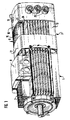
- the electric motor shown in its entirety with reference to FIGS. 1 and 4 has a motor housing 1 and a frequency converter housing 2 arranged in alignment with it in the direction of the motor axis.
- the drive shaft 3 of the motor exits from this, on the other end side sits on this shaft 3, a fan 4, the shaft 3 is in a conventional manner on both sides mounted the motor housing 1 and carries a rotor 5 which rotates within a stator 6.
- the metallic motor housing 1 is provided on its outside with extending in the direction of the motor axis cooling fins 7, such that there is a cross-sectionally approximately rectangular but rounded outer contour. At the top of the motor is a cooling fins 7 interrupting and the actual motor housing upwardly superior terminal box 8 is arranged, in which the stator winding terminals are guided and via which the electrical connection of the motor takes place.
- the motor housing 1 can be completed in a conventional manner by a fan cover, then the electrical connection is made directly in the terminal box 8.
- the motor is provided with a frequency converter, a corresponding frequency converter housing 2 connects to the motor housing 1 on.
- the frequency converter housing 2 consists of a first housing part 9, which connects directly to the motor housing 1, this laterally engages and at the same time forms the fan guard, and a second housing part 10 and a lid 11.
- the second housing part 10 is formed by a portion of a correspondingly formed profile strand an aluminum hollow profile and determines the length of the frequency converter housing 2.
- the first housing part 9 is formed as a metal injection molded part
- the lid 11 is a plastic injection molded part.
- the first housing part 9 has a tubular, the motor housing 1 cross-part 12, to which a ribbed part 13 connects.
- the tubular part 12 has lateral bores 14, on which the first housing part 9 is fastened by means of screws to the motor housing 1.
- the ribbed part 13 of the first housing part 9 has outer cooling ribs 15 which are substantially aligned with the cooling ribs 7 of the motor housing 1. Openings in the housing wall are provided between the cooling fins 15 in the region where the finned part 13 merges into the tubular part 12, so that the cooling air flow sucked in by the fan wheel can flow into the frequency converter housing 2 along these cooling fins 15.
- a transverse wall 16 is provided, which closes the frequency converter housing 2 from the fan space.
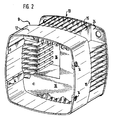
- This transverse wall 16 is stepped, as shown in FIG. 2 can be seen.
- This graduated formed transverse wall 16 is formed on the side facing the second housing part 10 side as a flat surface 17 for heat connection of the power electronics.
- the adjoining, sloping towards the motor region is designed to receive the capacitors 18 of the power circuit and a coil 19 of the frequency converter.
- the heat-conducting connection to the flat surface 17 is carried out in a conventional manner via a Heatspreader, which in turn is thermally conductively connected to the heat-generating semiconductor components of the power circuit of the frequency converter.
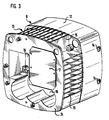
- a circuit board 20 is visible, which carries the essential components of the power circuit. It is clearly visible that the first housing part 9 is provided and formed in particular within the ribbed part 13 for receiving these rising from the board 20 components (see Fig. 3).
- circuit board 20 On the other side of the circuit board 20, in the region of the second housing part 10, there is an insulating plate 21 and a circuit board 22, which carries further electronic components of the frequency converter.
- the motor When connecting a frequency converter, the motor is not connected directly via the terminal box, but via the frequency inverter.
- the tube 23 is at its ends tightly connected to the frequency converter housing 2 on the one hand and the terminal box 8 on the other hand, so that both the terminal box 8 and the frequency converter housing 2 hermetically sealed, but at least splashproof can be formed.
- the second formed as a pipe section housing part 10 is secured via the flange 24 of the first housing part 9, provided therein bores and corresponding fastening screws with this. Accordingly, the lid 11 is attached to the other side by means of screws.
- a series engine housing 1 of different lengths are provided, however, have the same cross-sectional connection dimensions. Within certain limits, so the performance of the engine alone by changing the length (with appropriate adjustment of the internal structure) can be changed.
- An appropriate power adjustment of the frequency converter is necessary.
- the size of the capacitors 18 which are to be accommodated in the frequency converter housing increases in particular.
- As a length compensation here serves the second housing part 10, which is reached according to the required length. In this way, the frequency converter housing 2 can be varied in length, without being changed constructively in any other way. It is therefore sufficient for an engine series of the same outer contour to adapt the frequency converter housing 2 with respect to the second housing part 10.
- the costly to manufacture injection molded parts, namely the first housing part 9 and the lid 11 remain unchanged. Since the second housing part 10 consists of a profile pipe section, it can be provided inexpensively in any length.
Landscapes
- Engineering & Computer Science (AREA)
- Microelectronics & Electronic Packaging (AREA)
- Power Engineering (AREA)
- Motor Or Generator Frames (AREA)
- Motor Or Generator Cooling System (AREA)
Description
- Die Erfindung betrifft einen frequenzumrichtergespeisten Elektromotor mit den im Oberbegriff des Anspruches 1 angegebenen Merkmalen.
- Frequenzumrichtergespeiste Elektromotoren der eingangs erwähnten Art werden heutzutage vermehrt insbesondere zum Antrieb von Strömungsarbeitsmaschinen, wie z. B. Kreiselpumpen und Gebläsen eingesetzt. Gerade bei derartigen Maschinen kann durch Varianz der Drehzahl, insbesondere durch das bei Frequenzumrichterspeisung mögliche Anheben der Drehzahl das Leistungsfeld bei günstigen Wirkungsgraden nach oben hin erweitert werden, da ihre Leistung mit der dritten Potenz der Antriebsdrehzahl steigt. Andererseits kann die durch die Frequenzumrichterspeisung mögliche Drehzahlvarianz auch im Teillastbereich Vorteile bringen, da bei entsprechender Regelung die der erforderlichen Leistung entsprechende Drehzahl eingestellt werden kann, so daß das Aggregat mit angepaßtem Energieaufwand arbeitet.
- Zum Antrieb solcher Aggregate sind sogenannte Normmotoren bekannt, die von namhaften Pumpenherstellern angeboten werden. Es handelt sich dabei um Motorbaureihen, die hinsichtlich ihrer Leistung so abgestuft sind, daß sich für jeden Anwendungsfall ein passender Antriebsmotor finden läßt.
- Insbesondere bei Motoren höherer Leistung benötigt auch der Frequenzumrichter einen erheblichen Raumbedarf. Zum einen benötigen die Kondensatoren des Leistungskreises des Frequenzumrichters mit zunehmender Motorleistung mehr Raum, zum anderen wird die Abfuhr der im Leistungkreis des Frequenzumrichters erzeugten Verlustwärme mit wachsender Motorleistung problematischer.
- Es ist bekannt, den Frequenzumrichter seitlich am Motorgehäuse nach Art eines Klemmenkastens anzuflanschen und durch Konvektionskühlung oder aber durch den Kühlluftstrom des Motors zu kühlen. Doch dies ist bei Motoren größerer Leistung ebenfalls kritisch, da zum einen die Kühlung des Frequenzumrichters Probleme bereitet und zum anderen die räumlichen Abmessungen des Frequenzumrichters den Einsatz des Elektromotors beschränken.
- Aus EP-A1-0 619 432, von der die Erfindung ausgeht, ist ein gattungsgemäßer frequenzumrichtergespeister Elektromotor bekannt. Bei diesem Motor ist der Frequenzumrichter nicht seitlich, sondern rückseitig, also in Verlängerung des Motorengehäuses angebracht, wobei das Frequenzumrichtergehäuse über einen als Lüfterhaube ausgebildeten Gehäuseteil an das Motorgehäuseteil anschließt, derart, daß der vom Motorlüfter erzeugte Luftstrom zunächst im wesentlichen radial anströmt, um dann nach Durchtritt durch das Lüfterrad längs der Kühlrippen des Motors zu strömen. In dem Einströmbereich, in dem der Luftstrom im wesentlichen radial gerichtet ist, überstreicht dieser einen Kühlkörper, der Teil des Frequenzumrichtergehäuses ist.
- Aufgrund der ausschließlich radialen Luftführung im Bereich des Kühlkörpers ist die Kühlwirkung dieser bekannten Konstruktion sehr begrenzt, da die Strecke, über welche die anströmende Luft Wärme des Frequenzumrichters aufnehmen kann, vergleichsweise kurz ist. Darüber hinaus haben diese ausschließlich innen liegenden Kühlrippen den Nachteil, daß eine Konvektionskühlung nach außen aufgrund der räumlichen Anordnung der Kühlrippen praktisch nicht möglich ist.
- Aus US-4,668,898 ist ein frequenzumrichtergespeister Elektromotor mit einem Kühlluftgebläse bekannt, bei dem der Frequenzumrichter in einem berippten Gehäuse rückseitig des Motors angeordnet ist, so daß eine wirksame Kühlung des Frequenzumrichters auch in Bereichen außerhalb des Kühlluftstromes durch Konvektionskühlung erfolgen kann. Nachteilig hierbei ist jedoch, daß das gesamte Frequenzumrichtergehäuse der Kühlung dient und insoweit konstruktiv gebunden ist.
- Vor diesem Stand der Technik liegt der Erfindung die Aufgabe zugrunde, unter Vermeidung der vorgeschilderten Nachteile ein gattungsgemäßes Aggregat so auszubilden, daß einerseits eine intensive Kühlung des Frequenzumrichtergehäuses erreicht und andererseits das Frequenzumrichtergehäuse in weiten Bereichen frei gestaltbar ist. Darüber hinaus soll eine kompakte und die Verlustwärme des Frequenzumrichters gut abführende Konstruktion geschaffen werden, die einfach und kostengünstig in der Herstellung ist.
- Diese Aufgabe wird gemäß der Erfindung mit den Merkmalen des Anspruchs 1 gelöst.
- Die erfindungsgemäße Lösung sieht vor, daß der Frequenzumrichter in Flucht zum übrigen Motorgehäuse angeordnet ist und der Kühlluftstrom des Motors gezielt auch zur Kühlung des Frequenzumrichters ausgenutzt wird. Dabei ist das Frequenzumrichtergehäuse so ausgebildet, daß ein Gehäuseteil zugleich die Lüfterhaube des Motors bildet. Auf diese Weise kann ein und dasselbe Motorgehäuse wahlweise mit Frequenzumrichter oder aber auch nur mit der üblichen Lüfterhaube, also ohne Frequenzumrichter ohne konstruktive Änderungen bereitgestellt werden. Die Integration des Motorlüfters in das Frequenzumrichtergehäuse hat zudem den Vorteil, daß durch entsprechende Strömungsführung innerhalb des Frequenzumrichtergehäuses eine gezielte Wärmeabfuhr durch den gesamten Kühlluftstrom des Motors erfolgen kann. Des weiteren läßt sich eine sehr kompakte Bauweise realisieren, da auch der sonst nicht genutzte Raum im Bereich der Lüfterhaube für Bauteile bzw. Kühlteile des Frequenzumrichters nutzbar ist. Der so gebildete frequenzumrichtergespeiste Elektromotor ist kompakt und schlank im Aufbau, so daß in der Mehrzahl der Anwendungsfälle die durch den Frequenzumrichter bedingte Vergrößerung der Bauform keine Probleme bereitet. Gemäß der Erfindung ist das erste Gehäuseteil des Frequenzumrichtergehäuses mit einer Querwand versehen und diese Querwand zum wärmeleitenden Anschluß der wärmeerzeugenden Bauteile des Leistungskreises vorgesehen und ausgebildet. Deshalb kann nämlich die Wärmeankopplung unabhängig von der Baugröße des Frequenzumrichters über einen entsprechenden Heatspreader an dieser Planfläche erfolgen, so daß eine gute Wärmeableitung erzielt wird. Denn dieses erste Teil ist das Gehäuseteil, in dem der Kühlluftstrom zwangsgeführt ist, d. h., das intensiv von Kühlluft durchströmt wird. Die weiteren Gehäuseteile des Frequenzumrichters brauchen daher hinsichtlich der Wärmeabfuhr nicht besonders ausgebildet zu werden. Um die Wärmeabfuhr dieses ersten Gehäuseteiles weiter zu verbessern, sind sowohl innen als auch außen eine Vielzahl von Kühlrippen vorgesehen, wobei im Fußbereich der äußeren Kühlrippen Durchbrüche vorgesehen sind, durch welche der Kühlluftstrom zum Lüfterrad hin eintritt. Hierdurch wird die Kühlung des Frequenzumrichters bei vergleichsweise kleiner Baugröße noch weiter intensiviert. Das erste Gehäuseteil des Frequenzumrichters ist im Bereich seiner Querwand an die Topographie der Leistungselektronik einerseits und der Außenkontur des Lüfterrades andererseits angepaßt, was sowohl einer gezielten Wärmeabfuhr als auch einer kompakten Bauform dient. An dieses erste Gehäuseteil schließt sich dann ein weiteres Gehäuseteil an, das ausschließlich Gehäusefunktion haben kann und daher konstruktiv weitgehend frei gestaltbar ist.
- Bevorzugt ist das Frequenzumrichtergehäuse modular aufgebaut, so daß für eine Motorbaureihe gleichen Außenquerschnittes das erste wärmeleitende Gehäuseteil des Frequenzumrichters stets unverändert und lediglich das weitere durch ein rohrförmiges Hohlprofil gebildete Gehäuseteil variiert wird. Diese Varianz erfolgt ausschließlich in der Länge, d. h., die Anpassung des Frequenzumrichtergehäuses an die jeweilige Motorgröße erfolgt, indem dieses rohrförmige Hohlprofil in entsprechender Länge angesetzt wird. Der dieses Hohlprofil endseitig abschließende Deckel kann ebenfalls bei allen Ausführungen gleich bleiben.
- Insbesondere für Motoren kleiner Baugröße kann es zweckmäßig sein, das erste und das weitere Gehäuseteil des Frequenzumrichtergehäuses einstückig, beispielsweise als Gußteil auszubilden.
- Das Frequenzumrichtergehäuse kann ohne Probleme spritzwassergeschützt oder auch hermetisch abgeschlossen sein, indem beispielsweise zwischen dem ersten Gehäuseteil und dem Profilgehäuseteil sowie zwischen dem Profilgehäuseteil und dem Deckel entsprechende Dichtungsmittel vorgesehen sind. Es versteht sich, daß auch die Kabeldurch- bzw. -herausführungen im Frequenzumrichtergehäuse entsprechend geschützt ausgebildet sind.
- Fertigungstechnisch besonders günstig ist es, das erste Gehäuseteil als metallisches Gußteil auszubilden, das gut wärmeleitfähig ist und das weitere Gehäuseteil als Rohrabschnitt eines entsprechenden Metallprofilrohres.
- Die elektrische Leitungsverbindung zwischen dem am Motorgehäuse vorgesehenen Klemmenkasten und dem Frequenzumrichter kann vorteilhaft durch ein an der Außenseite des Motorgehäuses angeordnetes Rohr erfolgen, das einerseits im Klemmenkasten und andererseits im Frequenzumrichtergehäuse mündet. Die im Rohr befindlichen elektrischen Leitungen liegen dort geschützt und gut zugänglich. Und auch diese Ausbildung ermöglicht den Anschluß desselben Motors sowohl über den Klemmenkasten direkt an das elektrische Versorgungsnetz oder aber über den Klemmenkasten an den Frequenzumrichter und von dort an das elektrische Versorgungsnetz je nach Ausstattung des Motors.
- Wenn der Elektromotor im Querschnitt eine etwa rechteckige Außenkontur aufweist, wie dies bei modernen Motoren dieser Art üblich ist, dann wird dieses Rohr vorzugsweise im Eckbereich angeordnet, da dieser Raum für den eigentlichen Motor ohnehin nicht nutzbar ist und der Lüfterflügel diesen Bereich nicht überstreicht.
- Der endseitige Deckel des Frequenzumrichtergehäuses dient lediglich zum Abschluß des aus einem Rohrabschnitt gebildeten Gehäuseteiles und hat somit keine tragende Funktion. Der Deckel kann daher vorzugsweise als kostengünstiges Kunststoffspritzgußteil ausgebildet sein und unabhängig von der Länge des Frequenzumrichtergehäuses endseitig angebracht werden.
- Das Frequenzumrichtergehäuse ist dabei fluchtend zum Motorgehäuse angeordnet und verläuft in dessen Querschnittsaußenkontur, so daß die Baugröße quer zur Motorachse durch den Frequenzumrichter nicht beeinflußt wird. Gerade diese Baugröße ist jedoch bei der Mehrzahl der Anwendungsfälle von Bedeutung.
- Die Erfindung ist nachfolgend eines in der Zeichnung dargestellten Ausführungsbeispieles näher erläutert. Es zeigen:
- Fig. 1
- in schematischer perspektivischer Darstellung eine Ansicht eines Elektromotors nach der Erfindung,
- Fig. 2
- in vergrößerter Darstellung das erste Gehäuseteil des Frequenzumrichters in Darstellung entsprechend Fig. 1,
- Fig. 3
- das erste Gehäuseteil in Darstellung nach Fig. 2, jedoch von der anderen Seite und
- Fig. 4
- einen Längsschnitt durch Motor und Frequenzumrichter.
- Der anhand der Figuren 1 und 4 in seiner Gesamtheit dargestellte Elektromotor weist ein Motorgehäuse 1 und ein dazu in Richtung der Motorachse fluchtend angeordnetes Frequenzumrichtergehäuse 2 auf. Zu einer Stirnseite des Motorgehäuses 1 tritt die Antriebswelle 3 des Motors aus diesem aus, zur anderen Stirnseite sitzt auf dieser Welle 3 ein Lüfterrad 4. Die Welle 3 ist in an sich bekannter Weise zu beiden Seiten des Motorgehäuses 1 gelagert und trägt einen Rotor 5, der innerhalb eines Stators 6 umläuft.
- Das metallische Motorgehäuse 1 ist an seiner Außenseite mit in Richtung der Motorachse verlaufenden Kühlrippen 7 versehen, derart, daß sich eine im Querschnitt etwa rechteckige jedoch abgerundete Außenkontur ergibt. An der Oberseite des Motors ist ein die Kühlrippen 7 unterbrechender und das eigentliche Motorgehäuse nach oben hin überragender Klemmenkasten 8 angeordnet, in den die Statorwicklungsanschlüsse geführt sind und über den der elektrische Anschluß des Motors erfolgt.
- Das Motorgehäuse 1 kann in an sich bekannter Weise durch eine Lüfterhaube abgeschlossen werden, dann erfolgt der elektrische Anschluß direkt im Klemmenkasten 8. Bei der anhand der Figuren dargestellten Ausführungsform ist der Motor jedoch mit einem Frequenzumrichter versehen, ein entsprechendes Frequenzumrichtergehäuse 2 schließt sich an das Motorgehäuse 1 an.
- Das Frequenzumrichtergehäuse 2 besteht aus einem ersten Gehäuseteil 9, das sich direkt an das Motorgehäuse 1 anschließt, dieses seitlich übergreift und gleichzeitig die Lüfterhaube bildet, sowie einem zweiten Gehäuseteil 10 und einem Deckel 11. Das zweite Gehäuseteil 10 ist durch einen Abschnitt eines entsprechend ausgebildeten Profilstranges eines Aluminiumhohlprofiles gebildet und bestimmt die Länge des Frequenzumrichtergehäuses 2. Das erste Gehäuseteil 9 ist als metallisches Spritzgußteil ausgebildet, der Deckel 11 ist ein Kunststoffspritzteil.
- Das erste Gehäuseteil 9 weist einen rohrförmigen, das Motorgehäuse 1 übergreifenden Teil 12 auf, an den sich ein berippter Teil 13 anschließt. Der rohrförmige Teil 12 weist seitliche Bohrungen 14 auf, an denen das erste Gehäuseteil 9 mittels Schrauben am Motorgehäuse 1 befestigt ist. Der berippte Teil 13 des ersten Gehäuseteiles 9 weist äußere Kühlrippen 15 auf, die im wesentlichen zu den Kühlrippen 7 des Motorgehäuses 1 fluchten. Zwischen den Kühlrippen 15 sind in dem Bereich, wo der berippte Teil 13 in den rohrförmigen Teil 12 übergeht, Durchbrüche in der Gehäusewand vorgesehen, so daß der vom Lüfterrad angesaugte Kühlluftstrom längs dieser Kühlrippen 15 in das Frequenzumrichtergehäuse 2 einströmen kann.
- Innerhalb des ersten Gehäuseteiles 9 ist eine Querwand 16 vorgesehen, welche das Frequenzumrichtergehäuse 2 vom Lüfterraum abschließt. Diese Querwand 16 ist abgestuft ausgebildet, wie aus Fig. 2 ersichtlich ist. Auf diese Weise können auch innerhalb des ersten Gehäuseteiles 9 noch weitere Kühlrippen vorgesehen werden, insbesondere wird die innere Oberfläche des Frequenzumrichtergehäuses vergrößert, was zu einem noch intensiveren Wärmeaustausch mit dem Kühlluftstrom führt und zudem eine räumliche Anpassung an die Bauteile des Leistungskreises des Frequenzumrichters ermöglicht, wie dies anhand von Fig. 4 sichtbar ist. Diese abgestuft ausgebildete Querwand 16 ist an der zum zweiten Gehäuseteil 10 weisenden Seite als Planfläche 17 zum Wärmeanschluß der Leistungselektronik ausgebildet. Der daneben liegende, zum Motor hin abfallende Bereich ist ausgebildet zur Aufnahme der Kondensatoren 18 des Leistungkreises sowie einer Spule 19 des Frequenzumrichters. Der wärmeleitende Anschluß an die Planfläche 17 erfolgt in an sich bekannter Weise über einen Heatspreader, der seinerseits wärmeleitend mit dem wärmeerzeugenden Halbleiterbauelementen des Leistungskreises des Frequenzzumrichters verbunden ist.
- In Fig. 4 ist eine Platine 20 sichtbar, welche die wesentlichen Bauteile des Leistungskreises trägt. Es ist deutlich sichtbar, daß das erste Gehäuseteil 9 insbesondere innerhalb des berippten Teiles 13 zur Aufnahme dieser sich von der Platine 20 erhebenden Bauteile vorgesehen und ausgebildet ist (siehe Fig. 3).
- Jenseits der Platine 20 schließt sich im Bereich des zweiten Gehäuseteiles 10 eine Isolierplatte 21 an sowie eine Platine 22, die weitere elektronische Bauteile des Frequenzumrichters trägt.
- Bei Vorschaltung eines Frequenzumrichters erfolgt der Anschluß des Motors nicht direkt über den Klemmenkasten, sondern über den Frequenzumrichter. Die elektrische Leitungsverbindung zwischen Klemmenkasten 8 und Frequenzumrichtergehäuse 2 erfolgt über ein Rohr 23, das auf der zum Frequenzumrichtergehäuse 2 weisenden Seite des Klemmenkastens 8 anschließt, den rohrförmigen Teil 12 des ersten Gehäuseteiles 9 durchsetzt, an den Kühlrippen 15 vorbeiläuft und schließlich in einem Flansch 24 am Ende des berippten Teiles 13 des ersten Gehäuseteiles 9 in das zweite Gehäuseteil 10 mündet. Das Rohr 23 ist an seinen Enden dicht mit dem Frequenzumrichtergehäuse 2 einerseits und dem Klemmenkasten 8 andererseits verbunden, so daß sowohl der Klemmenkasten 8 als auch das Frequenzumrichtergehäuse 2 hermetisch abgeschlossen, zumindest jedoch spritzwassergeschützt ausgebildet sein können.
- In dem zweiten Gehäuseteil 10 sind drei mit Gewinde versehenen Bohrungen vorgesehen, in denen aus Kunststoff bestehende Leitungsdurchführungen 25 eingeschraubt sind. Mittels dieser Leitungsdurchführungen 25 werden die elektrischen Anschlußleitungen aus dem Frequenzumrichtergehäuse 2 dicht herausgeführt.
- Das zweite als Rohrabschnitt ausgebildete Gehäuseteil 10 ist über den Flansch 24 des ersten Gehäuseteiles 9, darin vorgesehene Bohrungen und entsprechende Befestigungsschrauben mit diesem befestigt. Entsprechend ist der Deckel 11 zur anderen Seite mittels Schrauben befestigt.
- In einer Baureihe sind Motorengehäuse 1 unterschiedlicher Länge vorgesehen, die jedoch die gleichen Querschnittsanschlußmaße aufweisen. In gewissen Grenzen kann also die Leistung des Motors allein durch Änderung der Baulänge (bei entsprechender Anpassung des inneren Aufbaues) verändert werden. Eine entsprechende Leistungsanpassung des Frequenzumrichters ist jedoch notwendig. Mit zunehmender Motorleistung wächst insbesondere die Größe der Kondensatoren 18, die im Frequenzumrichtergehäuse unterzubringen sind. Als Längenausgleich dient hier das zweite Gehäuseteil 10, das entsprechend der erforderlichen Baulänge angelängt wird. Auf diese Weise kann das Frequenzumrichtergehäuse 2 in der Länge variiert werden, ohne in sonstiger Weise konstruktiv verändert zu werden. Es genügt also für eine Motorbaureihe gleicher Außenkontur, das Frequenzumrichtergehäuse 2 hinsichtlich des zweiten Gehäuseteiles 10 anzupassen. Die in der Herstellung aufwendigen Spritzgußteile, nämlich das erste Gehäuseteil 9 und auch der Deckel 11 bleiben unverändert. Da das zweite Gehäuseteil 10 aus einem Profilrohrabschnitt besteht, kann es in beliebiger Länge kostengünstig bereitgestellt werden.
-
- 1 -
- Motorgehäuse
- 2 -
- Frequenzumrichtergehäuse
- 3 -
- Antriebswelle
- 4 -
- Lüfterrad
- 5 -
- Rotor
- 6 -
- Stator
- 7 -
- Kühlrippen des Motors
- 8 -
- Klemmenkasten
- 9 -
- erstes Gehäuseteil
- 10 -
- zweites Gehäuseteil
- 11 -
- Deckel
- 12 -
- rohrförmiger Teil von 9
- 13 -
- berippter Teil von 9
- 14 -
- Bohrungen
- 15 -
- Kühlrippen des Frequenzumrichters
- 16 -
- Querwand
- 17 -
- Planfläche
- 18 -
- Kondensatoren
- 19 -
- Spule
- 20 -
- Platine
- 21 -
- Isolierplatte
- 22 -
- Platine
- 23 -
- Rohr
- 24 -
- Flansch
- 25 -
- Leitungsdurchführungen
Claims (8)
- Frequenzumrichtergespeister Elektromotor mit einem Kühlluftgebläse (4), dessen Kühlluftstrom zur Kühlung des Motors entlang von am Motorgehäuse (1) angeordneten Kühlrippen (7) geführt ist, bei dem der Frequenzumrichter in einem Frequenzumrichtergehäuse (2) angeordnet ist, das lösbar mit dem Motorgehäuse (1) verbunden ist und das ein erstes wärmeleitendes Gehäuseteil (9) und mindestens ein weiteres Gehäuseteil (10) aufweist, wobei das erste Gehäuseteil (9) des Frequenzumrichtergehäuses (2) die Lüfterhaube bildet und eine Querwand (16) aufweist, die zum wärmeleitenden Anschluß (17) der wärmeerzeugenden Bauteile des Leistungskreises des Frequenzumrichters vorgesehen und ausgebildet ist und das weitere Gehäuseteil (10) an einem Ende an das erste Gehäuseteil (9) anschließt, wobei das erste Gehäuseteil (9) berippt ausgebildet ist dadurch gekennzeichnet daß im Fußbereich von Kühlrippen (15) Durchbrüche in der Gehäusewand als Lufteintrittsöffnungen für den Kühlluftstrom vorgesehen sind und daß das erste Gehäuseteil (9) des Frequenzumrichters im Bereich seiner Querwand (16) an die Topographie der Leistungselektronik einerseits und an die Außenkontur des Lüfterrades (4) andererseits angepaßt ist.
- Elektromotor nach Anspruch 1, dadurch gekennzeichnet, daß das weitere Gehäuseteil (10) des Frequenzumrichtergehäuses (2) durch ein rohrförmiges Hohlprofil gebildet, das am seinem freien Ende durch einen Deckel (11) abgeschlossen ist.
- Elektromotor nach einem der vorhergehenden Ansprüche, dadurch gekennzeichnet, daß das erste und das weitere Gehäuseteil einstückig ausgebildet sind.
- Elektromotor nach einem der vorhergehenden Ansprüche, dadurch gekennzeichnet, daß das Frequenzumrichtergehäuses (2) spritzwassergeschützt abgeschlossen ist.
- Elektromotor nach einem der vorhergehenden Ansprüche, dadurch gekennzeichnet, daß das erste Gehäuseteil (9) ein metallisches Gußteil und das daran anschließende weitere Gehäuseteil (10) ein Metallrohrabschnitt ist.
- Elektromotor nach einem der vorhergehenden Ansprüche, dadurch gekennzeichnet, daß der Klemmenkasten (8) an der Außenseite des Motorgehäuses (1) angeordnet und über mindestens ein aussenliegendes Rohr (23) mit dem Frequenzumrichtergehäuse (2) verbunden ist, durch das elektrische Leitungen geführt sind.
- Elektromotor nach einem der vorhergehenden Ansprüche, dadurch gekennzeichnet, daß der endseitige Deckel (11) des Frequenzumrichtergehäuses (2) ein Kunststoffspritzgußteil ist.
- Elektromotor nach einem der vorhergehenden Ansprüche, dadurch gekennzeichnet, daß das Frequenzumrichtergehäuse (2) zum Motorgehäuse fluchtet und im wesentlichen in dessen Querschnittsaußenkontur verläuft.
Applications Claiming Priority (2)
| Application Number | Priority Date | Filing Date | Title |
|---|---|---|---|
| DE19511114A DE19511114C1 (de) | 1995-03-25 | 1995-03-25 | Elektromotor |
| DE19511114 | 1995-03-25 |
Publications (3)
| Publication Number | Publication Date |
|---|---|
| EP0735650A1 EP0735650A1 (de) | 1996-10-02 |
| EP0735650B1 EP0735650B1 (de) | 1999-08-18 |
| EP0735650B2 true EP0735650B2 (de) | 2007-05-30 |
Family
ID=7757816
Family Applications (1)
| Application Number | Title | Priority Date | Filing Date |
|---|---|---|---|
| EP96104701A Expired - Lifetime EP0735650B2 (de) | 1995-03-25 | 1996-03-25 | Elektromotor |
Country Status (3)
| Country | Link |
|---|---|
| US (1) | US5714816A (de) |
| EP (1) | EP0735650B2 (de) |
| DE (2) | DE19511114C1 (de) |
Families Citing this family (77)
| Publication number | Priority date | Publication date | Assignee | Title |
|---|---|---|---|---|
| DE69432192T2 (de) * | 1993-10-12 | 2003-12-04 | Smc K.K., Tokio/Tokyo | Linearantrieb |
| JPH0984294A (ja) * | 1995-09-19 | 1997-03-28 | Mitsubishi Electric Corp | 可変速電動機 |
| DE19622396A1 (de) * | 1996-06-04 | 1997-12-18 | Alexander Dr Stoev | Frequenzumrichter für eine Antriebsvorrichtung |
| DE19726258C2 (de) * | 1996-07-01 | 2001-10-04 | Barmag Barmer Maschf | Galetteneinheit zum Führen und Fördern eines Fadens |
| FR2753848B1 (fr) * | 1996-09-26 | 1998-12-11 | Moteur electrique a commande electronique integree | |
| DE29700643U1 (de) * | 1997-01-15 | 1997-03-13 | Siemens AG, 80333 München | Entwärmungskonzept für ein elektrisches Antriebssystem |
| DE19704226B4 (de) * | 1997-02-05 | 2004-09-30 | Sew-Eurodrive Gmbh & Co. Kg | Klemmdeckelumrichter |
| DE19714784A1 (de) * | 1997-04-10 | 1998-10-22 | Danfoss As | Kompaktantrieb |
| DE19723781A1 (de) * | 1997-06-06 | 1998-12-10 | Abb Daimler Benz Transp | Stromrichtergespeistes Antriebssystem |
| US6949849B1 (en) | 1998-06-30 | 2005-09-27 | General Electric Company | Motor endshield assembly for an electronically commutated motor |
| HU224398B1 (hu) * | 1998-06-30 | 2005-08-29 | General Electric Co. | Pajzsszerkezet, pajzs villamos motorhoz, valamint eljárás a pajzsszerkezet szerelésére |
| DE19843771A1 (de) * | 1998-09-24 | 2000-03-30 | Mannesmann Vdo Ag | Elektromotorisches Stellglied, insbesondere mit einer Drosselklappe |
| DE19843990C1 (de) * | 1998-09-25 | 1999-08-19 | Dienes Apparatebau Gmbh | Integriertes Galettenaggregat |
| ES2152852B1 (es) * | 1998-10-06 | 2001-10-01 | Tecnotrans Sabre S A | Conjunto compacto de moto-variador-reductor para accionamiento de maquinas industriales. |
| DE19851439A1 (de) * | 1998-11-09 | 2000-03-30 | Daimler Chrysler Ag | Elektrische Maschine mit Kühlung |
| RU2155427C1 (ru) * | 1998-12-04 | 2000-08-27 | Акционерное общество закрытого типа "Спецремонт" | Корпус преобразователя напряжения |
| DE19859930A1 (de) * | 1998-12-24 | 2000-06-29 | Dietz Motoren Gmbh & Co Kg | Elektromotoranordnung |
| DE29908962U1 (de) * | 1999-05-21 | 1999-09-02 | Neumag - Neumünstersche Maschinen- und Anlagenbau GmbH, 24536 Neumünster | Aufspulmaschine |
| DE19945823C1 (de) * | 1999-09-24 | 2000-10-26 | Neumag Gmbh | Aufspulmaschine |
| DE10010961A1 (de) * | 2000-03-06 | 2001-09-20 | Grundfos As | Motorbaueinheit für ein Tauchpumpenaggregat |
| US7679234B1 (en) * | 2000-09-22 | 2010-03-16 | Isothermal Systems Research, Inc. | Spray cool means for cooling a modular inverter electric motor system |
| DE10063321A1 (de) | 2000-12-19 | 2002-06-20 | Gfas Mbh Ges Fuer Aufladetechn | Elektrisch angetriebener Strömungsverdichter |
| US6398521B1 (en) | 2001-01-30 | 2002-06-04 | Sta-Rite Industries, Inc. | Adapter for motor and fluid pump |
| US6589018B2 (en) | 2001-08-14 | 2003-07-08 | Lakewood Engineering And Manufacturing Co. | Electric fan motor assembly with motor housing control switch and electrical input socket |
| US6926502B2 (en) * | 2002-02-22 | 2005-08-09 | A. O. Smith Corporation | Combination shield and conduit box cover |
| EP1349257A1 (de) * | 2002-03-28 | 2003-10-01 | Kitt S.r.l. | Luftgekühlter elektrischer Motor mit zylindrischer, für elektrische Komponeten vorgesehener Kammer |
| DE10239557B4 (de) * | 2002-08-23 | 2013-09-12 | Sew-Eurodrive Gmbh & Co. Kg | Elektromotor und Baureihe von Elektromotoren |
| EP1422810A1 (de) * | 2002-11-21 | 2004-05-26 | Continental ISAD Electronic Systems GmbH & Co. oHG | Kraftfahrzeug-Antriebssystem |
| US6916149B2 (en) * | 2003-07-01 | 2005-07-12 | Un-Fei Liou | Vortex blower |
| DE10353330A1 (de) * | 2003-11-14 | 2005-07-07 | Siemens Ag | Gehäuse für eine elektrische Maschine mit Fremdbelüftung |
| DE102004013719A1 (de) * | 2004-03-18 | 2005-10-06 | Sensor-Technik Wiedemann Gmbh | Elektrodynamische Maschine mit elektrischer Beschaltung |
| DE502004004636D1 (de) * | 2004-04-02 | 2007-09-27 | Grundfos As | Pumpenaggregat |
| DE102004025812A1 (de) * | 2004-05-24 | 2005-12-22 | Bosch Rexroth Aktiengesellschaft | Vorrichtung zur Aufnahme peripherer Antriebskomponenten |
| US7202577B2 (en) * | 2004-06-17 | 2007-04-10 | Bose Corporation | Self-cooling actuator |
| DE102004037079A1 (de) * | 2004-07-30 | 2006-03-23 | Siemens Ag | Elektrischer Kompaktantrieb |
| DE202004015038U1 (de) * | 2004-09-24 | 2005-11-10 | Dbt Gmbh | Antriebseinrichtung für Bergbaugewinnungsmaschinen |
| US7687945B2 (en) * | 2004-09-25 | 2010-03-30 | Bluwav Systems LLC. | Method and system for cooling a motor or motor enclosure |
| JP4275614B2 (ja) * | 2004-12-10 | 2009-06-10 | 三菱電機株式会社 | 車両用回転電機 |
| US7199496B2 (en) * | 2005-01-18 | 2007-04-03 | Oriental Motor Boston Technology Group Incorporated | Integrated electric motor and drive, optimized for high-temperature operation |
| DE102005032969B4 (de) * | 2005-07-14 | 2010-05-12 | Siemens Ag | Umrichtermotor |
| NL1030489C1 (nl) * | 2005-11-22 | 2007-05-23 | Maasland Nv | Voerinrichting. |
| JP4846390B2 (ja) * | 2006-02-28 | 2011-12-28 | 新明和工業株式会社 | 水中ポンプ |
| EP1834917B1 (de) * | 2006-03-16 | 2015-05-20 | ThyssenKrupp Aufzugswerke GmbH | Aufzugantrieb mit einem Elektromotor |
| US7777375B2 (en) * | 2006-08-24 | 2010-08-17 | Siemens Industry, Inc. | Devices, systems, and methods for producing an electric motor |
| US8167585B2 (en) * | 2006-09-28 | 2012-05-01 | Siemens Industry, Inc. | Devices and/or systems for mounting an auxiliary blower |
| US20080179973A1 (en) * | 2006-09-28 | 2008-07-31 | Scott Kreitzer | Methods for coupling an auxiliary blower to an electric motor |
| DE102006047269A1 (de) * | 2006-10-04 | 2008-04-10 | Robert Bosch Gmbh | Umrichtermotor |
| DE102007005321A1 (de) * | 2007-01-29 | 2008-07-31 | Schunk Gmbh & Co. Kg Spann- Und Greiftechnik | Elektromotorsystem und Baukassten hierfür |
| USD571290S1 (en) * | 2007-07-27 | 2008-06-17 | Globe Motors, Inc. | Rotary actuator housing |
| EP2110929B1 (de) * | 2008-04-18 | 2018-08-29 | Grundfos Management a/s | Frequenzumrichter auf einem Motor |
| DE102010002068A1 (de) * | 2010-02-18 | 2011-08-18 | Siemens Aktiengesellschaft, 80333 | Motoreinheit |
| CN201860218U (zh) * | 2010-11-29 | 2011-06-08 | 中山大洋电机股份有限公司 | 一种直流无刷电机结构 |
| DE102011006355B4 (de) * | 2011-03-29 | 2016-11-03 | Siemens Aktiengesellschaft | Antrieb zum Antreiben eines Unterseeboots oder eines Schiffs |
| EP2607708B1 (de) * | 2011-12-23 | 2020-02-26 | Grundfos Holding A/S | Elektromotor |
| EP2607707B2 (de) * | 2011-12-23 | 2022-11-23 | Grundfos Holding A/S | Elektromotor |
| PL2607709T3 (pl) * | 2011-12-23 | 2016-06-30 | Grundfos Holding As | Silnik elektryczny |
| EP2626566B1 (de) * | 2012-02-08 | 2021-07-28 | Grundfos Holding A/S | Elektromotor |
| DE102012209970A1 (de) | 2012-06-14 | 2013-12-19 | Krones Ag | Monotec-sternsäulen mit umluftkühler |
| CN103427530B (zh) * | 2013-08-30 | 2016-08-10 | 维尔纳(福建)电机有限公司 | 电机后端盖 |
| US20150132148A1 (en) * | 2013-11-13 | 2015-05-14 | Reza Afshar | Dual speed motor controller and method for operation thereof |
| US9991759B2 (en) * | 2014-03-06 | 2018-06-05 | Honeywell International Inc. | Multi-directional air cooling of a motor using radially mounted fan and axial/circumferential cooling fins |
| DE102014009313A1 (de) * | 2014-06-27 | 2015-12-31 | Sew-Eurodrive Gmbh & Co Kg | Antrieb |
| DE102014109322A1 (de) * | 2014-07-03 | 2016-01-07 | Dr. Fritz Faulhaber Gmbh & Co. Kg | Mechatronische Antriebsvorrichtung |
| GB201413008D0 (en) * | 2014-07-23 | 2014-09-03 | Black & Decker Inc | A range of power tools |
| CN108781018B (zh) * | 2016-03-11 | 2021-09-21 | Itt制造企业有限责任公司 | 包括具有多层功率和控制印刷电路板组件的功率平面的用于驱动泵或旋转装置的电机组件 |
| DE102017001929A1 (de) | 2017-03-02 | 2018-09-06 | Wilo Se | Elektronikmodul für einen Elektromotor, insbesondere eines Pumpenaggregats |
| DE202017106269U1 (de) | 2017-10-17 | 2019-01-21 | Keb Automation Kg | Antriebseinrichtung für eine Pumpe |
| TWI664796B (zh) * | 2017-11-14 | 2019-07-01 | 財團法人工業技術研究院 | 電動機 |
| DE102018221667A1 (de) | 2018-12-13 | 2020-06-18 | Siemens Aktiengesellschaft | Motorvorrichtung für einen Schalterantrieb eines elektrischen Schalters |
| USD914619S1 (en) * | 2019-06-13 | 2021-03-30 | Sonceboz Automotive S.A | Electric rotary actuator |
| DE102019215842A1 (de) * | 2019-10-15 | 2021-04-15 | Baumüller Nürnberg GmbH | Antrieb |
| CN112814866A (zh) * | 2021-01-09 | 2021-05-18 | 苏州杰利凯工业设备有限公司 | 一种散热高效的变频一体水泵装置 |
| USD1081573S1 (en) * | 2021-09-06 | 2025-07-01 | Webasto SE | Electric motor |
| USD1032526S1 (en) * | 2022-02-02 | 2024-06-25 | Sew-Eurodrive Gmbh & Co Kg | Electric motor |
| CN116800030A (zh) * | 2022-03-17 | 2023-09-22 | 山东科技大学 | 一种散热变频式乳化液泵 |
| USD1019564S1 (en) * | 2022-07-29 | 2024-03-26 | Sew-Eurodrive Gmbh & Co Kg | Electric motor |
| US12510080B2 (en) * | 2022-12-15 | 2025-12-30 | Agilent Technologies, Inc. | Fluid pump and enclosure providing stator holder and cooling for motor and electronics |
Citations (1)
| Publication number | Priority date | Publication date | Assignee | Title |
|---|---|---|---|---|
| DE3642724C2 (de) † | 1986-12-13 | 1989-12-14 | Grundfos International A/S, Bjerringbro, Dk |
Family Cites Families (14)
| Publication number | Priority date | Publication date | Assignee | Title |
|---|---|---|---|---|
| DE2101267A1 (de) * | 1971-01-13 | 1972-09-07 | Bosch Gmbh Robert | Stromversorgungseinrichtung für Fahrzeuge |
| DE2146893C3 (de) * | 1971-09-20 | 1974-02-07 | Siemens Ag, 1000 Berlin U. 8000 Muenchen | Kollektorloser Gleichstrommotor mit einer durch Hall generatoren gesteuerten, aus Halbleiterschaltelementen aufgebauten Kommutierungseinrichtung |
| US4712030A (en) * | 1985-12-06 | 1987-12-08 | Fasco Industires, Inc. | Heat sink and mounting arrangement therefor |
| US4840222A (en) * | 1985-12-06 | 1989-06-20 | Fasco Industries, Inc. | Heat sink and mounting arrangement therefor |
| US5038088A (en) * | 1985-12-30 | 1991-08-06 | Arends Gregory E | Stepper motor system |
| US4668898A (en) * | 1986-04-21 | 1987-05-26 | General Electric Company | Electronically commutated motor |
| FI77754C (fi) * | 1986-12-23 | 1989-04-10 | Kone Oy | Lyftmotorenhet. |
| US5006744A (en) * | 1988-12-27 | 1991-04-09 | General Electric Company | Integrated electronically commutated motor and control circuit assembly |
| US4988905A (en) * | 1989-07-05 | 1991-01-29 | Pitney Bowes Inc. | Integrated driver-encoder assembly for brushless motor |
| EP0687588B1 (de) * | 1991-09-03 | 1999-01-07 | Honda Giken Kogyo Kabushiki Kaisha | Bremssystem mit Energierückgewinnung in einem Kraftfahrzeug |
| DE4243044C2 (de) * | 1991-12-20 | 1996-07-11 | Gold Star Co | Wechselrichter-Motorkombination |
| US5245237A (en) * | 1992-03-19 | 1993-09-14 | General Electric Company | Two compartment motor |
| DE9305174U1 (de) * | 1993-04-05 | 1993-11-04 | Franz Morat KG Elektro-Feinmechanik & Maschinenbau (GmbH & Co), 79871 Eisenbach | Drehstrom-Asynchronmotor mit Frequenzumrichter |
| DK0619432T3 (da) * | 1993-04-08 | 1997-03-17 | Vogel Pumpen | Anlæg med mindst en væskepumpe |
-
1995
- 1995-03-25 DE DE19511114A patent/DE19511114C1/de not_active Expired - Fee Related
-
1996
- 1996-03-22 US US08/620,272 patent/US5714816A/en not_active Expired - Fee Related
- 1996-03-25 DE DE59602761T patent/DE59602761D1/de not_active Expired - Lifetime
- 1996-03-25 EP EP96104701A patent/EP0735650B2/de not_active Expired - Lifetime
Patent Citations (1)
| Publication number | Priority date | Publication date | Assignee | Title |
|---|---|---|---|---|
| DE3642724C2 (de) † | 1986-12-13 | 1989-12-14 | Grundfos International A/S, Bjerringbro, Dk |
Also Published As
| Publication number | Publication date |
|---|---|
| EP0735650B1 (de) | 1999-08-18 |
| DE59602761D1 (de) | 1999-09-23 |
| DE19511114C1 (de) | 1996-08-29 |
| EP0735650A1 (de) | 1996-10-02 |
| US5714816A (en) | 1998-02-03 |
Similar Documents
| Publication | Publication Date | Title |
|---|---|---|
| EP0735650B1 (de) | Elektromotor | |
| EP2639940B1 (de) | Elektromotor | |
| EP0860930B1 (de) | Elektromotor für eine Pumpe oder einen Lüfter | |
| EP0958646B2 (de) | Elektromotor mit vorgeschaltetem frequenzumrichter | |
| DE60303718T2 (de) | Fahrzeuggenerator mit Gleichrichter der auf einem Kühlkörper mit Kühlrippen montiert ist | |
| DE19749108C1 (de) | Elektromotor | |
| EP2607707B1 (de) | Elektromotor | |
| EP2110929B1 (de) | Frequenzumrichter auf einem Motor | |
| EP0960464A1 (de) | Elektrische maschine, vorzugsweise drehstromgenerator mit gleichrichter-baueinheit | |
| DE10052331A1 (de) | Lüfteranlage | |
| EP0513014A1 (de) | Elektrische maschine mit fremdbelüftung. | |
| EP1032967A1 (de) | Elektrische maschine, vorzugsweise drehstromgenerator mit gleichrichter-baueinheit | |
| WO2009015946A1 (de) | Elektromotor | |
| DE29700643U1 (de) | Entwärmungskonzept für ein elektrisches Antriebssystem | |
| EP2607709B1 (de) | Elektromotor | |
| EP3750230A1 (de) | Elektromotor sowie verfahren zur herstellung eines elektromotors | |
| WO2015049075A1 (de) | Lüftervorrichtung und verwendung einer solchen | |
| EP2607708B1 (de) | Elektromotor | |
| DE102015204025A1 (de) | Elektrische Maschine mit einem Kühlkörper | |
| EP3940242A1 (de) | Strömungsmaschine mit in einer vergussmasse eingebetteten anschlussleitungen | |
| EP1133047B1 (de) | Frequenzumrichter | |
| DE102014009315A1 (de) | Verfahren zum Herstellen von verschiedenen Varianten eines Antriebs aus einem Baukasten und Antrieb nach einem solchen Verfahren | |
| EP1104079A2 (de) | Elektromotor für insbesondere eine Kreiselpumpe | |
| DE102005032964A1 (de) | Umrichtermotor | |
| DE102004053326A1 (de) | Wechselstromgenerator |
Legal Events
| Date | Code | Title | Description |
|---|---|---|---|
| PUAI | Public reference made under article 153(3) epc to a published international application that has entered the european phase |
Free format text: ORIGINAL CODE: 0009012 |
|
| AK | Designated contracting states |
Kind code of ref document: A1 Designated state(s): DE FR GB IT SE |
|
| 17P | Request for examination filed |
Effective date: 19961031 |
|
| 17Q | First examination report despatched |
Effective date: 19980428 |
|
| GRAG | Despatch of communication of intention to grant |
Free format text: ORIGINAL CODE: EPIDOS AGRA |
|
| GRAG | Despatch of communication of intention to grant |
Free format text: ORIGINAL CODE: EPIDOS AGRA |
|
| GRAH | Despatch of communication of intention to grant a patent |
Free format text: ORIGINAL CODE: EPIDOS IGRA |
|
| GRAH | Despatch of communication of intention to grant a patent |
Free format text: ORIGINAL CODE: EPIDOS IGRA |
|
| GRAA | (expected) grant |
Free format text: ORIGINAL CODE: 0009210 |
|
| AK | Designated contracting states |
Kind code of ref document: B1 Designated state(s): DE FR GB IT SE |
|
| REF | Corresponds to: |
Ref document number: 59602761 Country of ref document: DE Date of ref document: 19990923 |
|
| ITF | It: translation for a ep patent filed | ||
| GBT | Gb: translation of ep patent filed (gb section 77(6)(a)/1977) |
Effective date: 19991116 |
|
| ET | Fr: translation filed | ||
| PLBQ | Unpublished change to opponent data |
Free format text: ORIGINAL CODE: EPIDOS OPPO |
|
| PLBI | Opposition filed |
Free format text: ORIGINAL CODE: 0009260 |
|
| PLBF | Reply of patent proprietor to notice(s) of opposition |
Free format text: ORIGINAL CODE: EPIDOS OBSO |
|
| 26 | Opposition filed |
Opponent name: WILO GMBH Effective date: 20000518 |
|
| PLBF | Reply of patent proprietor to notice(s) of opposition |
Free format text: ORIGINAL CODE: EPIDOS OBSO |
|
| PLBF | Reply of patent proprietor to notice(s) of opposition |
Free format text: ORIGINAL CODE: EPIDOS OBSO |
|
| REG | Reference to a national code |
Ref country code: GB Ref legal event code: IF02 |
|
| PLBO | Opposition rejected |
Free format text: ORIGINAL CODE: EPIDOS REJO |
|
| APAC | Appeal dossier modified |
Free format text: ORIGINAL CODE: EPIDOS NOAPO |
|
| APBQ | Date of receipt of statement of grounds of appeal recorded |
Free format text: ORIGINAL CODE: EPIDOSNNOA3O |
|
| PLBQ | Unpublished change to opponent data |
Free format text: ORIGINAL CODE: EPIDOS OPPO |
|
| PLAB | Opposition data, opponent's data or that of the opponent's representative modified |
Free format text: ORIGINAL CODE: 0009299OPPO |
|
| APAA | Appeal reference recorded |
Free format text: ORIGINAL CODE: EPIDOS REFN |
|
| R26 | Opposition filed (corrected) |
Opponent name: WILO GMBH Effective date: 20000518 |
|
| PLAQ | Examination of admissibility of opposition: information related to despatch of communication + time limit deleted |
Free format text: ORIGINAL CODE: EPIDOSDOPE2 |
|
| PLAR | Examination of admissibility of opposition: information related to receipt of reply deleted |
Free format text: ORIGINAL CODE: EPIDOSDOPE4 |
|
| PLBQ | Unpublished change to opponent data |
Free format text: ORIGINAL CODE: EPIDOS OPPO |
|
| PLAB | Opposition data, opponent's data or that of the opponent's representative modified |
Free format text: ORIGINAL CODE: 0009299OPPO |
|
| APBU | Appeal procedure closed |
Free format text: ORIGINAL CODE: EPIDOSNNOA9O |
|
| R26 | Opposition filed (corrected) |
Opponent name: WILO AG Effective date: 20000518 |
|
| APAH | Appeal reference modified |
Free format text: ORIGINAL CODE: EPIDOSCREFNO |
|
| PUAH | Patent maintained in amended form |
Free format text: ORIGINAL CODE: 0009272 |
|
| STAA | Information on the status of an ep patent application or granted ep patent |
Free format text: STATUS: PATENT MAINTAINED AS AMENDED |
|
| 27A | Patent maintained in amended form |
Effective date: 20070530 |
|
| AK | Designated contracting states |
Kind code of ref document: B2 Designated state(s): DE FR GB IT SE |
|
| REG | Reference to a national code |
Ref country code: SE Ref legal event code: RPEO |
|
| GBTA | Gb: translation of amended ep patent filed (gb section 77(6)(b)/1977) | ||
| ET3 | Fr: translation filed ** decision concerning opposition | ||
| PGFP | Annual fee paid to national office [announced via postgrant information from national office to epo] |
Ref country code: IT Payment date: 20120306 Year of fee payment: 17 |
|
| PGFP | Annual fee paid to national office [announced via postgrant information from national office to epo] |
Ref country code: SE Payment date: 20130320 Year of fee payment: 18 Ref country code: GB Payment date: 20130311 Year of fee payment: 18 Ref country code: FR Payment date: 20130227 Year of fee payment: 18 |
|
| PGFP | Annual fee paid to national office [announced via postgrant information from national office to epo] |
Ref country code: DE Payment date: 20130514 Year of fee payment: 18 |
|
| REG | Reference to a national code |
Ref country code: DE Ref legal event code: R119 Ref document number: 59602761 Country of ref document: DE |
|
| REG | Reference to a national code |
Ref country code: SE Ref legal event code: EUG |
|
| GBPC | Gb: european patent ceased through non-payment of renewal fee |
Effective date: 20140325 |
|
| PG25 | Lapsed in a contracting state [announced via postgrant information from national office to epo] |
Ref country code: SE Free format text: LAPSE BECAUSE OF NON-PAYMENT OF DUE FEES Effective date: 20140326 |
|
| REG | Reference to a national code |
Ref country code: FR Ref legal event code: ST Effective date: 20141128 |
|
| REG | Reference to a national code |
Ref country code: DE Ref legal event code: R119 Ref document number: 59602761 Country of ref document: DE Effective date: 20141001 |
|
| PG25 | Lapsed in a contracting state [announced via postgrant information from national office to epo] |
Ref country code: FR Free format text: LAPSE BECAUSE OF NON-PAYMENT OF DUE FEES Effective date: 20140331 Ref country code: GB Free format text: LAPSE BECAUSE OF NON-PAYMENT OF DUE FEES Effective date: 20140325 Ref country code: DE Free format text: LAPSE BECAUSE OF NON-PAYMENT OF DUE FEES Effective date: 20141001 |
|
| PG25 | Lapsed in a contracting state [announced via postgrant information from national office to epo] |
Ref country code: IT Free format text: LAPSE BECAUSE OF NON-PAYMENT OF DUE FEES Effective date: 20140325 |