EP0706817A2 - Verfahren zur gleichzeitigen Verminderung der im Abgas einer Verbrennungskraftmaschine enthaltenen Kohlenwasserstoffe, Kohlenmonoxid und Stickoxide - Google Patents
Verfahren zur gleichzeitigen Verminderung der im Abgas einer Verbrennungskraftmaschine enthaltenen Kohlenwasserstoffe, Kohlenmonoxid und Stickoxide Download PDFInfo
- Publication number
- EP0706817A2 EP0706817A2 EP95115382A EP95115382A EP0706817A2 EP 0706817 A2 EP0706817 A2 EP 0706817A2 EP 95115382 A EP95115382 A EP 95115382A EP 95115382 A EP95115382 A EP 95115382A EP 0706817 A2 EP0706817 A2 EP 0706817A2
- Authority
- EP
- European Patent Office
- Prior art keywords
- exhaust gas
- oxide
- catalyst
- vol
- oxygen
- Prior art date
- Legal status (The legal status is an assumption and is not a legal conclusion. Google has not performed a legal analysis and makes no representation as to the accuracy of the status listed.)
- Granted
Links
- 239000007789 gas Substances 0.000 title claims abstract description 70
- 229930195733 hydrocarbon Natural products 0.000 title claims abstract description 17
- 150000002430 hydrocarbons Chemical class 0.000 title claims abstract description 17
- 238000002485 combustion reaction Methods 0.000 title claims abstract description 11
- MWUXSHHQAYIFBG-UHFFFAOYSA-N nitrogen oxide Inorganic materials O=[N] MWUXSHHQAYIFBG-UHFFFAOYSA-N 0.000 title claims description 73
- 238000000034 method Methods 0.000 title claims description 27
- UGFAIRIUMAVXCW-UHFFFAOYSA-N Carbon monoxide Chemical compound [O+]#[C-] UGFAIRIUMAVXCW-UHFFFAOYSA-N 0.000 title claims description 14
- 229910002091 carbon monoxide Inorganic materials 0.000 title claims description 14
- 230000008569 process Effects 0.000 title claims description 12
- 230000009467 reduction Effects 0.000 title claims description 11
- 239000003054 catalyst Substances 0.000 claims abstract description 88
- BASFCYQUMIYNBI-UHFFFAOYSA-N platinum Substances [Pt] BASFCYQUMIYNBI-UHFFFAOYSA-N 0.000 claims abstract description 41
- 239000011248 coating agent Substances 0.000 claims abstract description 37
- 238000000576 coating method Methods 0.000 claims abstract description 37
- 229910052751 metal Inorganic materials 0.000 claims abstract description 26
- 239000002184 metal Substances 0.000 claims abstract description 26
- QVGXLLKOCUKJST-UHFFFAOYSA-N atomic oxygen Chemical compound [O] QVGXLLKOCUKJST-UHFFFAOYSA-N 0.000 claims abstract description 19
- 239000001301 oxygen Substances 0.000 claims abstract description 19
- 229910052760 oxygen Inorganic materials 0.000 claims abstract description 19
- 239000012876 carrier material Substances 0.000 claims abstract description 9
- 238000001354 calcination Methods 0.000 claims abstract description 6
- VYPSYNLAJGMNEJ-UHFFFAOYSA-N Silicium dioxide Chemical compound O=[Si]=O VYPSYNLAJGMNEJ-UHFFFAOYSA-N 0.000 claims description 52
- YKTSYUJCYHOUJP-UHFFFAOYSA-N [O--].[Al+3].[Al+3].[O-][Si]([O-])([O-])[O-] Chemical compound [O--].[Al+3].[Al+3].[O-][Si]([O-])([O-])[O-] YKTSYUJCYHOUJP-UHFFFAOYSA-N 0.000 claims description 30
- -1 platinum group metals Chemical class 0.000 claims description 29
- 239000000377 silicon dioxide Substances 0.000 claims description 26
- 235000012239 silicon dioxide Nutrition 0.000 claims description 25
- 239000010953 base metal Substances 0.000 claims description 19
- 229910052697 platinum Inorganic materials 0.000 claims description 19
- 150000002736 metal compounds Chemical class 0.000 claims description 17
- IJGRMHOSHXDMSA-UHFFFAOYSA-N Atomic nitrogen Chemical compound N#N IJGRMHOSHXDMSA-UHFFFAOYSA-N 0.000 claims description 16
- 239000000203 mixture Substances 0.000 claims description 15
- CURLTUGMZLYLDI-UHFFFAOYSA-N Carbon dioxide Chemical compound O=C=O CURLTUGMZLYLDI-UHFFFAOYSA-N 0.000 claims description 14
- KDLHZDBZIXYQEI-UHFFFAOYSA-N Palladium Chemical compound [Pd] KDLHZDBZIXYQEI-UHFFFAOYSA-N 0.000 claims description 14
- TWNQGVIAIRXVLR-UHFFFAOYSA-N oxo(oxoalumanyloxy)alumane Chemical compound O=[Al]O[Al]=O TWNQGVIAIRXVLR-UHFFFAOYSA-N 0.000 claims description 13
- 150000001875 compounds Chemical class 0.000 claims description 12
- 239000000463 material Substances 0.000 claims description 11
- XLYOFNOQVPJJNP-UHFFFAOYSA-N water Chemical compound O XLYOFNOQVPJJNP-UHFFFAOYSA-N 0.000 claims description 10
- XEEYBQQBJWHFJM-UHFFFAOYSA-N Iron Chemical compound [Fe] XEEYBQQBJWHFJM-UHFFFAOYSA-N 0.000 claims description 8
- PXHVJJICTQNCMI-UHFFFAOYSA-N Nickel Chemical compound [Ni] PXHVJJICTQNCMI-UHFFFAOYSA-N 0.000 claims description 8
- 229910052757 nitrogen Inorganic materials 0.000 claims description 8
- 229910052784 alkaline earth metal Inorganic materials 0.000 claims description 7
- 229910002092 carbon dioxide Inorganic materials 0.000 claims description 7
- 229910052763 palladium Inorganic materials 0.000 claims description 7
- 239000010457 zeolite Substances 0.000 claims description 7
- RVTZCBVAJQQJTK-UHFFFAOYSA-N oxygen(2-);zirconium(4+) Chemical compound [O-2].[O-2].[Zr+4] RVTZCBVAJQQJTK-UHFFFAOYSA-N 0.000 claims description 6
- 229910052720 vanadium Inorganic materials 0.000 claims description 6
- 229910001928 zirconium oxide Inorganic materials 0.000 claims description 6
- 150000001342 alkaline earth metals Chemical class 0.000 claims description 5
- 239000001569 carbon dioxide Substances 0.000 claims description 5
- 150000002894 organic compounds Chemical class 0.000 claims description 5
- RYGMFSIKBFXOCR-UHFFFAOYSA-N Copper Chemical compound [Cu] RYGMFSIKBFXOCR-UHFFFAOYSA-N 0.000 claims description 4
- 229910052802 copper Inorganic materials 0.000 claims description 4
- 239000010949 copper Substances 0.000 claims description 4
- 229910052742 iron Inorganic materials 0.000 claims description 4
- 229910052759 nickel Inorganic materials 0.000 claims description 4
- 229910001935 vanadium oxide Inorganic materials 0.000 claims description 4
- GWEVSGVZZGPLCZ-UHFFFAOYSA-N Titan oxide Chemical compound O=[Ti]=O GWEVSGVZZGPLCZ-UHFFFAOYSA-N 0.000 claims description 3
- XHCLAFWTIXFWPH-UHFFFAOYSA-N [O-2].[O-2].[O-2].[O-2].[O-2].[V+5].[V+5] Chemical compound [O-2].[O-2].[O-2].[O-2].[O-2].[V+5].[V+5] XHCLAFWTIXFWPH-UHFFFAOYSA-N 0.000 claims description 3
- 239000003513 alkali Substances 0.000 claims description 3
- 229910052741 iridium Inorganic materials 0.000 claims description 3
- GKOZUEZYRPOHIO-UHFFFAOYSA-N iridium atom Chemical compound [Ir] GKOZUEZYRPOHIO-UHFFFAOYSA-N 0.000 claims description 3
- QGLKJKCYBOYXKC-UHFFFAOYSA-N nonaoxidotritungsten Chemical compound O=[W]1(=O)O[W](=O)(=O)O[W](=O)(=O)O1 QGLKJKCYBOYXKC-UHFFFAOYSA-N 0.000 claims description 3
- 229910052703 rhodium Inorganic materials 0.000 claims description 3
- 239000010948 rhodium Substances 0.000 claims description 3
- MHOVAHRLVXNVSD-UHFFFAOYSA-N rhodium atom Chemical compound [Rh] MHOVAHRLVXNVSD-UHFFFAOYSA-N 0.000 claims description 3
- OGIDPMRJRNCKJF-UHFFFAOYSA-N titanium oxide Inorganic materials [Ti]=O OGIDPMRJRNCKJF-UHFFFAOYSA-N 0.000 claims description 3
- WFKWXMTUELFFGS-UHFFFAOYSA-N tungsten Chemical compound [W] WFKWXMTUELFFGS-UHFFFAOYSA-N 0.000 claims description 3
- 229910052721 tungsten Inorganic materials 0.000 claims description 3
- 239000010937 tungsten Substances 0.000 claims description 3
- 229910001930 tungsten oxide Inorganic materials 0.000 claims description 3
- ZOKXTWBITQBERF-UHFFFAOYSA-N Molybdenum Chemical compound [Mo] ZOKXTWBITQBERF-UHFFFAOYSA-N 0.000 claims description 2
- BQCADISMDOOEFD-UHFFFAOYSA-N Silver Chemical compound [Ag] BQCADISMDOOEFD-UHFFFAOYSA-N 0.000 claims description 2
- HCHKCACWOHOZIP-UHFFFAOYSA-N Zinc Chemical compound [Zn] HCHKCACWOHOZIP-UHFFFAOYSA-N 0.000 claims description 2
- QCWXUUIWCKQGHC-UHFFFAOYSA-N Zirconium Chemical compound [Zr] QCWXUUIWCKQGHC-UHFFFAOYSA-N 0.000 claims description 2
- 229910017052 cobalt Inorganic materials 0.000 claims description 2
- 239000010941 cobalt Substances 0.000 claims description 2
- GUTLYIVDDKVIGB-UHFFFAOYSA-N cobalt atom Chemical compound [Co] GUTLYIVDDKVIGB-UHFFFAOYSA-N 0.000 claims description 2
- 229910052732 germanium Inorganic materials 0.000 claims description 2
- GNPVGFCGXDBREM-UHFFFAOYSA-N germanium atom Chemical compound [Ge] GNPVGFCGXDBREM-UHFFFAOYSA-N 0.000 claims description 2
- 229910052735 hafnium Inorganic materials 0.000 claims description 2
- VBJZVLUMGGDVMO-UHFFFAOYSA-N hafnium atom Chemical compound [Hf] VBJZVLUMGGDVMO-UHFFFAOYSA-N 0.000 claims description 2
- 239000000395 magnesium oxide Substances 0.000 claims description 2
- CPLXHLVBOLITMK-UHFFFAOYSA-N magnesium oxide Inorganic materials [Mg]=O CPLXHLVBOLITMK-UHFFFAOYSA-N 0.000 claims description 2
- AXZKOIWUVFPNLO-UHFFFAOYSA-N magnesium;oxygen(2-) Chemical compound [O-2].[Mg+2] AXZKOIWUVFPNLO-UHFFFAOYSA-N 0.000 claims description 2
- WPBNNNQJVZRUHP-UHFFFAOYSA-L manganese(2+);methyl n-[[2-(methoxycarbonylcarbamothioylamino)phenyl]carbamothioyl]carbamate;n-[2-(sulfidocarbothioylamino)ethyl]carbamodithioate Chemical compound [Mn+2].[S-]C(=S)NCCNC([S-])=S.COC(=O)NC(=S)NC1=CC=CC=C1NC(=S)NC(=O)OC WPBNNNQJVZRUHP-UHFFFAOYSA-L 0.000 claims description 2
- 229910052750 molybdenum Inorganic materials 0.000 claims description 2
- 239000011733 molybdenum Substances 0.000 claims description 2
- 229910052709 silver Inorganic materials 0.000 claims description 2
- 239000004332 silver Substances 0.000 claims description 2
- 229910052725 zinc Inorganic materials 0.000 claims description 2
- 239000011701 zinc Substances 0.000 claims description 2
- 229910052845 zircon Inorganic materials 0.000 claims description 2
- 229910052726 zirconium Inorganic materials 0.000 claims description 2
- GFQYVLUOOAAOGM-UHFFFAOYSA-N zirconium(iv) silicate Chemical compound [Zr+4].[O-][Si]([O-])([O-])[O-] GFQYVLUOOAAOGM-UHFFFAOYSA-N 0.000 claims description 2
- GPPXJZIENCGNKB-UHFFFAOYSA-N vanadium Chemical compound [V]#[V] GPPXJZIENCGNKB-UHFFFAOYSA-N 0.000 claims 1
- HNPSIPDUKPIQMN-UHFFFAOYSA-N dioxosilane;oxo(oxoalumanyloxy)alumane Chemical compound O=[Si]=O.O=[Al]O[Al]=O HNPSIPDUKPIQMN-UHFFFAOYSA-N 0.000 abstract description 5
- 229910000323 aluminium silicate Inorganic materials 0.000 abstract 1
- 239000010970 precious metal Substances 0.000 abstract 1
- 238000006243 chemical reaction Methods 0.000 description 31
- 239000006185 dispersion Substances 0.000 description 31
- RAHZWNYVWXNFOC-UHFFFAOYSA-N Sulphur dioxide Chemical compound O=S=O RAHZWNYVWXNFOC-UHFFFAOYSA-N 0.000 description 26
- 239000002243 precursor Substances 0.000 description 17
- 230000000052 comparative effect Effects 0.000 description 15
- 229910052782 aluminium Inorganic materials 0.000 description 14
- GNTDGMZSJNCJKK-UHFFFAOYSA-N divanadium pentaoxide Chemical compound O=[V](=O)O[V](=O)=O GNTDGMZSJNCJKK-UHFFFAOYSA-N 0.000 description 12
- 239000003344 environmental pollutant Substances 0.000 description 11
- 231100000719 pollutant Toxicity 0.000 description 11
- 230000003647 oxidation Effects 0.000 description 10
- 238000007254 oxidation reaction Methods 0.000 description 10
- 239000007787 solid Substances 0.000 description 9
- 239000002253 acid Substances 0.000 description 8
- PNEYBMLMFCGWSK-UHFFFAOYSA-N aluminium oxide Inorganic materials [O-2].[O-2].[O-2].[Al+3].[Al+3] PNEYBMLMFCGWSK-UHFFFAOYSA-N 0.000 description 8
- 238000005470 impregnation Methods 0.000 description 8
- 239000000446 fuel Substances 0.000 description 7
- OGUCKKLSDGRKSH-UHFFFAOYSA-N oxalic acid oxovanadium Chemical compound [V].[O].C(C(=O)O)(=O)O OGUCKKLSDGRKSH-UHFFFAOYSA-N 0.000 description 7
- 239000006069 physical mixture Substances 0.000 description 7
- 239000000243 solution Substances 0.000 description 7
- 239000007864 aqueous solution Substances 0.000 description 6
- 238000000746 purification Methods 0.000 description 6
- AKEJUJNQAAGONA-UHFFFAOYSA-N sulfur trioxide Chemical compound O=S(=O)=O AKEJUJNQAAGONA-UHFFFAOYSA-N 0.000 description 6
- 238000012360 testing method Methods 0.000 description 6
- LEONUFNNVUYDNQ-UHFFFAOYSA-N vanadium atom Chemical compound [V] LEONUFNNVUYDNQ-UHFFFAOYSA-N 0.000 description 6
- 230000032683 aging Effects 0.000 description 5
- 230000015572 biosynthetic process Effects 0.000 description 5
- 230000003197 catalytic effect Effects 0.000 description 5
- 238000010438 heat treatment Methods 0.000 description 5
- MRELNEQAGSRDBK-UHFFFAOYSA-N lanthanum(3+);oxygen(2-) Chemical compound [O-2].[O-2].[O-2].[La+3].[La+3] MRELNEQAGSRDBK-UHFFFAOYSA-N 0.000 description 5
- 238000005259 measurement Methods 0.000 description 5
- 229910021536 Zeolite Inorganic materials 0.000 description 4
- XAGFODPZIPBFFR-UHFFFAOYSA-N aluminium Chemical compound [Al] XAGFODPZIPBFFR-UHFFFAOYSA-N 0.000 description 4
- 239000000919 ceramic Substances 0.000 description 4
- 229910052681 coesite Inorganic materials 0.000 description 4
- 229910052878 cordierite Inorganic materials 0.000 description 4
- 229910052906 cristobalite Inorganic materials 0.000 description 4
- JSKIRARMQDRGJZ-UHFFFAOYSA-N dimagnesium dioxido-bis[(1-oxido-3-oxo-2,4,6,8,9-pentaoxa-1,3-disila-5,7-dialuminabicyclo[3.3.1]nonan-7-yl)oxy]silane Chemical compound [Mg++].[Mg++].[O-][Si]([O-])(O[Al]1O[Al]2O[Si](=O)O[Si]([O-])(O1)O2)O[Al]1O[Al]2O[Si](=O)O[Si]([O-])(O1)O2 JSKIRARMQDRGJZ-UHFFFAOYSA-N 0.000 description 4
- 238000001035 drying Methods 0.000 description 4
- AMWRITDGCCNYAT-UHFFFAOYSA-L hydroxy(oxo)manganese;manganese Chemical compound [Mn].O[Mn]=O.O[Mn]=O AMWRITDGCCNYAT-UHFFFAOYSA-L 0.000 description 4
- 229910052682 stishovite Inorganic materials 0.000 description 4
- 238000003786 synthesis reaction Methods 0.000 description 4
- 229910052905 tridymite Inorganic materials 0.000 description 4
- ZNOKGRXACCSDPY-UHFFFAOYSA-N tungsten trioxide Chemical compound O=[W](=O)=O ZNOKGRXACCSDPY-UHFFFAOYSA-N 0.000 description 4
- PAJMKGZZBBTTOY-UHFFFAOYSA-N 2-[[2-hydroxy-1-(3-hydroxyoctyl)-2,3,3a,4,9,9a-hexahydro-1h-cyclopenta[g]naphthalen-5-yl]oxy]acetic acid Chemical compound C1=CC=C(OCC(O)=O)C2=C1CC1C(CCC(O)CCCCC)C(O)CC1C2 PAJMKGZZBBTTOY-UHFFFAOYSA-N 0.000 description 3
- QGZKDVFQNNGYKY-UHFFFAOYSA-O Ammonium Chemical compound [NH4+] QGZKDVFQNNGYKY-UHFFFAOYSA-O 0.000 description 3
- NOWPEMKUZKNSGG-UHFFFAOYSA-N azane;platinum(2+) Chemical compound N.N.N.N.[Pt+2] NOWPEMKUZKNSGG-UHFFFAOYSA-N 0.000 description 3
- 150000002500 ions Chemical class 0.000 description 3
- RMAQACBXLXPBSY-UHFFFAOYSA-N silicic acid Chemical compound O[Si](O)(O)O RMAQACBXLXPBSY-UHFFFAOYSA-N 0.000 description 3
- 229910052710 silicon Inorganic materials 0.000 description 3
- 239000010703 silicon Substances 0.000 description 3
- 235000002639 sodium chloride Nutrition 0.000 description 3
- MGWGWNFMUOTEHG-UHFFFAOYSA-N 4-(3,5-dimethylphenyl)-1,3-thiazol-2-amine Chemical compound CC1=CC(C)=CC(C=2N=C(N)SC=2)=C1 MGWGWNFMUOTEHG-UHFFFAOYSA-N 0.000 description 2
- 229910052684 Cerium Inorganic materials 0.000 description 2
- 241000640882 Condea Species 0.000 description 2
- RWSOTUBLDIXVET-UHFFFAOYSA-N Dihydrogen sulfide Chemical compound S RWSOTUBLDIXVET-UHFFFAOYSA-N 0.000 description 2
- VEXZGXHMUGYJMC-UHFFFAOYSA-N Hydrochloric acid Chemical compound Cl VEXZGXHMUGYJMC-UHFFFAOYSA-N 0.000 description 2
- DGAQECJNVWCQMB-PUAWFVPOSA-M Ilexoside XXIX Chemical compound C[C@@H]1CC[C@@]2(CC[C@@]3(C(=CC[C@H]4[C@]3(CC[C@@H]5[C@@]4(CC[C@@H](C5(C)C)OS(=O)(=O)[O-])C)C)[C@@H]2[C@]1(C)O)C)C(=O)O[C@H]6[C@@H]([C@H]([C@@H]([C@H](O6)CO)O)O)O.[Na+] DGAQECJNVWCQMB-PUAWFVPOSA-M 0.000 description 2
- 230000009471 action Effects 0.000 description 2
- 229910052783 alkali metal Inorganic materials 0.000 description 2
- 150000001340 alkali metals Chemical class 0.000 description 2
- RBAKORNXYLGSJB-UHFFFAOYSA-N azane;platinum(2+);dinitrate Chemical compound N.N.N.N.[Pt+2].[O-][N+]([O-])=O.[O-][N+]([O-])=O RBAKORNXYLGSJB-UHFFFAOYSA-N 0.000 description 2
- QVQLCTNNEUAWMS-UHFFFAOYSA-N barium oxide Chemical compound [Ba]=O QVQLCTNNEUAWMS-UHFFFAOYSA-N 0.000 description 2
- 230000008901 benefit Effects 0.000 description 2
- 239000012018 catalyst precursor Substances 0.000 description 2
- ZMIGMASIKSOYAM-UHFFFAOYSA-N cerium Chemical compound [Ce][Ce][Ce][Ce][Ce][Ce][Ce][Ce][Ce][Ce][Ce][Ce][Ce][Ce][Ce][Ce][Ce][Ce][Ce][Ce][Ce][Ce][Ce][Ce][Ce][Ce][Ce][Ce][Ce][Ce][Ce][Ce][Ce][Ce][Ce][Ce][Ce][Ce] ZMIGMASIKSOYAM-UHFFFAOYSA-N 0.000 description 2
- 229910000420 cerium oxide Inorganic materials 0.000 description 2
- 229910052593 corundum Inorganic materials 0.000 description 2
- 239000013078 crystal Substances 0.000 description 2
- 238000000354 decomposition reaction Methods 0.000 description 2
- 238000009826 distribution Methods 0.000 description 2
- 230000009969 flowable effect Effects 0.000 description 2
- 238000009472 formulation Methods 0.000 description 2
- 229910000037 hydrogen sulfide Inorganic materials 0.000 description 2
- 230000007062 hydrolysis Effects 0.000 description 2
- 238000006460 hydrolysis reaction Methods 0.000 description 2
- 238000004519 manufacturing process Methods 0.000 description 2
- JCXJVPUVTGWSNB-UHFFFAOYSA-N nitrogen dioxide Inorganic materials O=[N]=O JCXJVPUVTGWSNB-UHFFFAOYSA-N 0.000 description 2
- BMMGVYCKOGBVEV-UHFFFAOYSA-N oxo(oxoceriooxy)cerium Chemical compound [Ce]=O.O=[Ce]=O BMMGVYCKOGBVEV-UHFFFAOYSA-N 0.000 description 2
- GPNDARIEYHPYAY-UHFFFAOYSA-N palladium(ii) nitrate Chemical compound [Pd+2].[O-][N+]([O-])=O.[O-][N+]([O-])=O GPNDARIEYHPYAY-UHFFFAOYSA-N 0.000 description 2
- 239000002245 particle Substances 0.000 description 2
- SCVFZCLFOSHCOH-UHFFFAOYSA-M potassium acetate Chemical compound [K+].CC([O-])=O SCVFZCLFOSHCOH-UHFFFAOYSA-M 0.000 description 2
- SONJTKJMTWTJCT-UHFFFAOYSA-K rhodium(iii) chloride Chemical compound [Cl-].[Cl-].[Cl-].[Rh+3] SONJTKJMTWTJCT-UHFFFAOYSA-K 0.000 description 2
- 150000003839 salts Chemical class 0.000 description 2
- NDVLTYZPCACLMA-UHFFFAOYSA-N silver oxide Chemical compound [O-2].[Ag+].[Ag+] NDVLTYZPCACLMA-UHFFFAOYSA-N 0.000 description 2
- SQGYOTSLMSWVJD-UHFFFAOYSA-N silver(1+) nitrate Chemical compound [Ag+].[O-]N(=O)=O SQGYOTSLMSWVJD-UHFFFAOYSA-N 0.000 description 2
- 229910052708 sodium Inorganic materials 0.000 description 2
- 239000011734 sodium Substances 0.000 description 2
- 238000001179 sorption measurement Methods 0.000 description 2
- 239000000126 substance Substances 0.000 description 2
- 230000007704 transition Effects 0.000 description 2
- 229910001845 yogo sapphire Inorganic materials 0.000 description 2
- VEHXKUNAGOJDJB-UHFFFAOYSA-N (4-formyl-2-methoxyphenyl) 4-methoxybenzoate Chemical compound C1=CC(OC)=CC=C1C(=O)OC1=CC=C(C=O)C=C1OC VEHXKUNAGOJDJB-UHFFFAOYSA-N 0.000 description 1
- NGNBDVOYPDDBFK-UHFFFAOYSA-N 2-[2,4-di(pentan-2-yl)phenoxy]acetyl chloride Chemical class CCCC(C)C1=CC=C(OCC(Cl)=O)C(C(C)CCC)=C1 NGNBDVOYPDDBFK-UHFFFAOYSA-N 0.000 description 1
- PAITUROHVRNCEN-UHFFFAOYSA-J 2-hydroxyacetate;zirconium(4+) Chemical class [Zr+4].OCC([O-])=O.OCC([O-])=O.OCC([O-])=O.OCC([O-])=O PAITUROHVRNCEN-UHFFFAOYSA-J 0.000 description 1
- KSSJBGNOJJETTC-UHFFFAOYSA-N COC1=C(C=CC=C1)N(C1=CC=2C3(C4=CC(=CC=C4C=2C=C1)N(C1=CC=C(C=C1)OC)C1=C(C=CC=C1)OC)C1=CC(=CC=C1C=1C=CC(=CC=13)N(C1=CC=C(C=C1)OC)C1=C(C=CC=C1)OC)N(C1=CC=C(C=C1)OC)C1=C(C=CC=C1)OC)C1=CC=C(C=C1)OC Chemical compound COC1=C(C=CC=C1)N(C1=CC=2C3(C4=CC(=CC=C4C=2C=C1)N(C1=CC=C(C=C1)OC)C1=C(C=CC=C1)OC)C1=CC(=CC=C1C=1C=CC(=CC=13)N(C1=CC=C(C=C1)OC)C1=C(C=CC=C1)OC)N(C1=CC=C(C=C1)OC)C1=C(C=CC=C1)OC)C1=CC=C(C=C1)OC KSSJBGNOJJETTC-UHFFFAOYSA-N 0.000 description 1
- OYPRJOBELJOOCE-UHFFFAOYSA-N Calcium Chemical compound [Ca] OYPRJOBELJOOCE-UHFFFAOYSA-N 0.000 description 1
- ZYSSNSIOLIJYRF-UHFFFAOYSA-H Cl[Ir](Cl)(Cl)(Cl)(Cl)Cl Chemical compound Cl[Ir](Cl)(Cl)(Cl)(Cl)Cl ZYSSNSIOLIJYRF-UHFFFAOYSA-H 0.000 description 1
- UFHFLCQGNIYNRP-UHFFFAOYSA-N Hydrogen Chemical compound [H][H] UFHFLCQGNIYNRP-UHFFFAOYSA-N 0.000 description 1
- 229910002651 NO3 Inorganic materials 0.000 description 1
- NHNBFGGVMKEFGY-UHFFFAOYSA-N Nitrate Chemical compound [O-][N+]([O-])=O NHNBFGGVMKEFGY-UHFFFAOYSA-N 0.000 description 1
- BOTDANWDWHJENH-UHFFFAOYSA-N Tetraethyl orthosilicate Chemical compound CCO[Si](OCC)(OCC)OCC BOTDANWDWHJENH-UHFFFAOYSA-N 0.000 description 1
- 238000002441 X-ray diffraction Methods 0.000 description 1
- DOSXDVYWNFUSBU-UHFFFAOYSA-N [O-][N+](=O)[Pt][N+]([O-])=O Chemical compound [O-][N+](=O)[Pt][N+]([O-])=O DOSXDVYWNFUSBU-UHFFFAOYSA-N 0.000 description 1
- 230000001133 acceleration Effects 0.000 description 1
- 150000001242 acetic acid derivatives Chemical class 0.000 description 1
- 239000000654 additive Substances 0.000 description 1
- 239000000853 adhesive Substances 0.000 description 1
- 230000001070 adhesive effect Effects 0.000 description 1
- 150000001298 alcohols Chemical class 0.000 description 1
- 150000001299 aldehydes Chemical class 0.000 description 1
- 150000001341 alkaline earth metal compounds Chemical class 0.000 description 1
- 239000012736 aqueous medium Substances 0.000 description 1
- AQBOUNVXZQRXNP-UHFFFAOYSA-L azane;dichloropalladium Chemical compound N.N.N.N.Cl[Pd]Cl AQBOUNVXZQRXNP-UHFFFAOYSA-L 0.000 description 1
- KHCPSOMSJYAQSY-UHFFFAOYSA-L azane;dichloroplatinum Chemical compound N.N.N.N.Cl[Pt]Cl KHCPSOMSJYAQSY-UHFFFAOYSA-L 0.000 description 1
- UNTBPXHCXVWYOI-UHFFFAOYSA-O azanium;oxido(dioxo)vanadium Chemical compound [NH4+].[O-][V](=O)=O UNTBPXHCXVWYOI-UHFFFAOYSA-O 0.000 description 1
- 229910052788 barium Inorganic materials 0.000 description 1
- ITHZDDVSAWDQPZ-UHFFFAOYSA-L barium acetate Chemical compound [Ba+2].CC([O-])=O.CC([O-])=O ITHZDDVSAWDQPZ-UHFFFAOYSA-L 0.000 description 1
- DSAJWYNOEDNPEQ-UHFFFAOYSA-N barium atom Chemical compound [Ba] DSAJWYNOEDNPEQ-UHFFFAOYSA-N 0.000 description 1
- 238000007664 blowing Methods 0.000 description 1
- 229910001593 boehmite Inorganic materials 0.000 description 1
- 229910052791 calcium Inorganic materials 0.000 description 1
- 239000011575 calcium Substances 0.000 description 1
- VSGNNIFQASZAOI-UHFFFAOYSA-L calcium acetate Chemical compound [Ca+2].CC([O-])=O.CC([O-])=O VSGNNIFQASZAOI-UHFFFAOYSA-L 0.000 description 1
- 239000001639 calcium acetate Substances 0.000 description 1
- 235000011092 calcium acetate Nutrition 0.000 description 1
- 229960005147 calcium acetate Drugs 0.000 description 1
- BRPQOXSCLDDYGP-UHFFFAOYSA-N calcium oxide Chemical compound [O-2].[Ca+2] BRPQOXSCLDDYGP-UHFFFAOYSA-N 0.000 description 1
- 239000000292 calcium oxide Substances 0.000 description 1
- ODINCKMPIJJUCX-UHFFFAOYSA-N calcium oxide Inorganic materials [Ca]=O ODINCKMPIJJUCX-UHFFFAOYSA-N 0.000 description 1
- 239000000969 carrier Substances 0.000 description 1
- 238000006555 catalytic reaction Methods 0.000 description 1
- 230000008859 change Effects 0.000 description 1
- 239000003795 chemical substances by application Substances 0.000 description 1
- 238000004140 cleaning Methods 0.000 description 1
- 239000002131 composite material Substances 0.000 description 1
- 230000008094 contradictory effect Effects 0.000 description 1
- 238000007796 conventional method Methods 0.000 description 1
- 239000004148 curcumin Substances 0.000 description 1
- XAYGUHUYDMLJJV-UHFFFAOYSA-Z decaazanium;dioxido(dioxo)tungsten;hydron;trioxotungsten Chemical compound [H+].[H+].[NH4+].[NH4+].[NH4+].[NH4+].[NH4+].[NH4+].[NH4+].[NH4+].[NH4+].[NH4+].O=[W](=O)=O.O=[W](=O)=O.O=[W](=O)=O.O=[W](=O)=O.O=[W](=O)=O.O=[W](=O)=O.[O-][W]([O-])(=O)=O.[O-][W]([O-])(=O)=O.[O-][W]([O-])(=O)=O.[O-][W]([O-])(=O)=O.[O-][W]([O-])(=O)=O.[O-][W]([O-])(=O)=O XAYGUHUYDMLJJV-UHFFFAOYSA-Z 0.000 description 1
- 230000003247 decreasing effect Effects 0.000 description 1
- 238000013461 design Methods 0.000 description 1
- 238000011161 development Methods 0.000 description 1
- 230000018109 developmental process Effects 0.000 description 1
- 150000004985 diamines Chemical class 0.000 description 1
- 238000005516 engineering process Methods 0.000 description 1
- LMABILRJNNFCPG-UHFFFAOYSA-L ethane-1,2-diamine;platinum(2+);dichloride Chemical compound [Cl-].[Cl-].[Pt+2].NCCN LMABILRJNNFCPG-UHFFFAOYSA-L 0.000 description 1
- 238000001914 filtration Methods 0.000 description 1
- 239000006260 foam Substances 0.000 description 1
- 239000001257 hydrogen Substances 0.000 description 1
- 229910052739 hydrogen Inorganic materials 0.000 description 1
- XLYOFNOQVPJJNP-UHFFFAOYSA-M hydroxide Chemical compound [OH-] XLYOFNOQVPJJNP-UHFFFAOYSA-M 0.000 description 1
- FAHBNUUHRFUEAI-UHFFFAOYSA-M hydroxidooxidoaluminium Chemical compound O[Al]=O FAHBNUUHRFUEAI-UHFFFAOYSA-M 0.000 description 1
- 238000007654 immersion Methods 0.000 description 1
- 230000006872 improvement Effects 0.000 description 1
- 229910052746 lanthanum Inorganic materials 0.000 description 1
- FZLIPJUXYLNCLC-UHFFFAOYSA-N lanthanum atom Chemical compound [La] FZLIPJUXYLNCLC-UHFFFAOYSA-N 0.000 description 1
- 238000002156 mixing Methods 0.000 description 1
- 230000007935 neutral effect Effects 0.000 description 1
- 150000007524 organic acids Chemical class 0.000 description 1
- 235000005985 organic acids Nutrition 0.000 description 1
- 230000001590 oxidative effect Effects 0.000 description 1
- KTUFCUMIWABKDW-UHFFFAOYSA-N oxo(oxolanthaniooxy)lanthanum Chemical compound O=[La]O[La]=O KTUFCUMIWABKDW-UHFFFAOYSA-N 0.000 description 1
- 150000003058 platinum compounds Chemical class 0.000 description 1
- 235000011056 potassium acetate Nutrition 0.000 description 1
- CHWRSCGUEQEHOH-UHFFFAOYSA-N potassium oxide Chemical group [O-2].[K+].[K+] CHWRSCGUEQEHOH-UHFFFAOYSA-N 0.000 description 1
- 229910001404 rare earth metal oxide Inorganic materials 0.000 description 1
- 230000001105 regulatory effect Effects 0.000 description 1
- 229910001961 silver nitrate Inorganic materials 0.000 description 1
- 229910001923 silver oxide Inorganic materials 0.000 description 1
- 239000002356 single layer Substances 0.000 description 1
- CMZUMMUJMWNLFH-UHFFFAOYSA-N sodium metavanadate Chemical compound [Na+].[O-][V](=O)=O CMZUMMUJMWNLFH-UHFFFAOYSA-N 0.000 description 1
- XMVONEAAOPAGAO-UHFFFAOYSA-N sodium tungstate Chemical compound [Na+].[Na+].[O-][W]([O-])(=O)=O XMVONEAAOPAGAO-UHFFFAOYSA-N 0.000 description 1
- 230000000087 stabilizing effect Effects 0.000 description 1
- 229910052712 strontium Inorganic materials 0.000 description 1
- CIOAGBVUUVVLOB-UHFFFAOYSA-N strontium atom Chemical compound [Sr] CIOAGBVUUVVLOB-UHFFFAOYSA-N 0.000 description 1
- 150000003467 sulfuric acid derivatives Chemical class 0.000 description 1
- 238000005496 tempering Methods 0.000 description 1
- DANYXEHCMQHDNX-UHFFFAOYSA-K trichloroiridium Chemical compound Cl[Ir](Cl)Cl DANYXEHCMQHDNX-UHFFFAOYSA-K 0.000 description 1
- CMPGARWFYBADJI-UHFFFAOYSA-L tungstic acid Chemical compound O[W](O)(=O)=O CMPGARWFYBADJI-UHFFFAOYSA-L 0.000 description 1
- 238000009827 uniform distribution Methods 0.000 description 1
- 238000011144 upstream manufacturing Methods 0.000 description 1
- 150000003682 vanadium compounds Chemical class 0.000 description 1
Classifications
-
- B—PERFORMING OPERATIONS; TRANSPORTING
- B01—PHYSICAL OR CHEMICAL PROCESSES OR APPARATUS IN GENERAL
- B01D—SEPARATION
- B01D53/00—Separation of gases or vapours; Recovering vapours of volatile solvents from gases; Chemical or biological purification of waste gases, e.g. engine exhaust gases, smoke, fumes, flue gases, aerosols
- B01D53/34—Chemical or biological purification of waste gases
- B01D53/92—Chemical or biological purification of waste gases of engine exhaust gases
- B01D53/94—Chemical or biological purification of waste gases of engine exhaust gases by catalytic processes
- B01D53/9445—Simultaneously removing carbon monoxide, hydrocarbons or nitrogen oxides making use of three-way catalysts [TWC] or four-way-catalysts [FWC]
- B01D53/945—Simultaneously removing carbon monoxide, hydrocarbons or nitrogen oxides making use of three-way catalysts [TWC] or four-way-catalysts [FWC] characterised by a specific catalyst
-
- B—PERFORMING OPERATIONS; TRANSPORTING
- B01—PHYSICAL OR CHEMICAL PROCESSES OR APPARATUS IN GENERAL
- B01J—CHEMICAL OR PHYSICAL PROCESSES, e.g. CATALYSIS OR COLLOID CHEMISTRY; THEIR RELEVANT APPARATUS
- B01J21/00—Catalysts comprising the elements, oxides, or hydroxides of magnesium, boron, aluminium, carbon, silicon, titanium, zirconium, or hafnium
- B01J21/12—Silica and alumina
-
- B—PERFORMING OPERATIONS; TRANSPORTING
- B01—PHYSICAL OR CHEMICAL PROCESSES OR APPARATUS IN GENERAL
- B01J—CHEMICAL OR PHYSICAL PROCESSES, e.g. CATALYSIS OR COLLOID CHEMISTRY; THEIR RELEVANT APPARATUS
- B01J23/00—Catalysts comprising metals or metal oxides or hydroxides, not provided for in group B01J21/00
- B01J23/38—Catalysts comprising metals or metal oxides or hydroxides, not provided for in group B01J21/00 of noble metals
- B01J23/54—Catalysts comprising metals or metal oxides or hydroxides, not provided for in group B01J21/00 of noble metals combined with metals, oxides or hydroxides provided for in groups B01J23/02 - B01J23/36
- B01J23/56—Platinum group metals
-
- B—PERFORMING OPERATIONS; TRANSPORTING
- B01—PHYSICAL OR CHEMICAL PROCESSES OR APPARATUS IN GENERAL
- B01J—CHEMICAL OR PHYSICAL PROCESSES, e.g. CATALYSIS OR COLLOID CHEMISTRY; THEIR RELEVANT APPARATUS
- B01J23/00—Catalysts comprising metals or metal oxides or hydroxides, not provided for in group B01J21/00
- B01J23/38—Catalysts comprising metals or metal oxides or hydroxides, not provided for in group B01J21/00 of noble metals
- B01J23/54—Catalysts comprising metals or metal oxides or hydroxides, not provided for in group B01J21/00 of noble metals combined with metals, oxides or hydroxides provided for in groups B01J23/02 - B01J23/36
- B01J23/56—Platinum group metals
- B01J23/58—Platinum group metals with alkali- or alkaline earth metals
-
- B—PERFORMING OPERATIONS; TRANSPORTING
- B01—PHYSICAL OR CHEMICAL PROCESSES OR APPARATUS IN GENERAL
- B01J—CHEMICAL OR PHYSICAL PROCESSES, e.g. CATALYSIS OR COLLOID CHEMISTRY; THEIR RELEVANT APPARATUS
- B01J23/00—Catalysts comprising metals or metal oxides or hydroxides, not provided for in group B01J21/00
- B01J23/38—Catalysts comprising metals or metal oxides or hydroxides, not provided for in group B01J21/00 of noble metals
- B01J23/54—Catalysts comprising metals or metal oxides or hydroxides, not provided for in group B01J21/00 of noble metals combined with metals, oxides or hydroxides provided for in groups B01J23/02 - B01J23/36
- B01J23/56—Platinum group metals
- B01J23/63—Platinum group metals with rare earths or actinides
-
- Y—GENERAL TAGGING OF NEW TECHNOLOGICAL DEVELOPMENTS; GENERAL TAGGING OF CROSS-SECTIONAL TECHNOLOGIES SPANNING OVER SEVERAL SECTIONS OF THE IPC; TECHNICAL SUBJECTS COVERED BY FORMER USPC CROSS-REFERENCE ART COLLECTIONS [XRACs] AND DIGESTS
- Y02—TECHNOLOGIES OR APPLICATIONS FOR MITIGATION OR ADAPTATION AGAINST CLIMATE CHANGE
- Y02T—CLIMATE CHANGE MITIGATION TECHNOLOGIES RELATED TO TRANSPORTATION
- Y02T10/00—Road transport of goods or passengers
- Y02T10/10—Internal combustion engine [ICE] based vehicles
- Y02T10/12—Improving ICE efficiencies
Definitions
- the invention relates to a method for simultaneously reducing the hydrocarbons, carbon monoxide and nitrogen oxides contained in the exhaust gas of an internal combustion engine by passing the exhaust gases over a catalyst, from a gas-permeable inert support body with a catalytically active coating, which has at least one high-surface carrier material and optionally one or more base metal compounds and at least one contains a metal from the platinum group.
- the normalized air-fuel ratio lambda is defined as the amount of air actually required for 1 kg of fuel to the amount of air for stoichiometric combustion of the fuel. Only with lambda values close to 1 can conversion rates for all three types of pollutants close to or greater than 90% be achieved with three-way catalysts.
- the exhaust gas from lean-burn engines has a proportion of oxygen in the exhaust gas of greater than 1% by volume during the predominant operating period of normal driving. This so-called “lean” operation can change over to the "rich” or stoichiometric operation with excess fuel during relatively short acceleration phases.
- lean-burn engines are similar to diesel engines, the exhaust gas of which usually also contains more than 1% by volume of oxygen.
- the known exhaust gas purification methods only allow the hydrocarbons and carbon monoxide contained in the exhaust gas to be converted to water and carbon dioxide by means of an oxidation catalytic converter.
- the nitrogen monoxide contained in the exhaust gas is also partially converted into the more environmentally harmful nitrogen dioxide by oxidation.
- the sulfur dioxide also present in the exhaust gas is oxidized to the more environmentally harmful sulfur trioxide.
- Special catalyst formulations have been developed to avoid these undesirable oxidations.
- DE 39 40 758 C2 describes a catalyst for the oxidative purification of the exhaust gases from diesel engines with a high conversion capacity for hydrocarbons and carbon monoxide at low temperatures and an inhibited oxidation action against nitrogen monoxide and sulfur dioxide.
- This catalyst contains a catalytically active coating on the freely flowable channels of a monolithic honeycomb-shaped inert support body made of ceramic or metal, which consists of finely divided, high-surface aluminum oxide, titanium oxide and / or silicon dioxide.
- a high-surface carrier material is understood to be a material whose specific surface area (to be determined in accordance with DIN 66132 by the Brunauer, Emmet and Teller method; BET surface area) is greater than 10 m 2 / g.
- These finely divided, high-surface materials have to be temperature-stable in order to prevent the specific surface area of the materials from being significantly reduced under the operating temperatures of the catalyst and thus the catalytic activity of the catalyst from decreasing.
- Substances are sufficiently temperature-stable that can still be considered as high-surface areas even after several hours of exposure to temperatures of at least 700 ° C.
- Platinum and / or palladium and a vanadium component are deposited as catalytically active components on the finely divided, high-surface area materials from DE 39 40 758 C2.
- the vanadium component largely prevents further oxidation of nitrogen monoxide and sulfur dioxide in this catalyst. With this catalyst, the hydrocarbons and carbon monoxide are converted into harmless components with good effectiveness. However, there is no reduction of nitrogen oxides to nitrogen. Nitric oxide and sulfur dioxide pass through the catalyst almost unchanged.
- the object of the present invention is therefore to provide a method which makes it possible to improve the exhaust gas purification of lean-operated gasoline engines and of diesel engines by an additional reduction in nitrogen oxides.
- This object is achieved by a process for simultaneously reducing the hydrocarbons, oxygen-containing organic compounds, carbon monoxide and nitrogen oxides contained in the exhaust gas of an internal combustion engine by passing the exhaust gas over a catalyst from a gas-permeable inert support body with a catalytically active coating, which has at least one high-surface carrier material and optionally one or contains several base metal compounds and at least one metal from the platinum group.
- the method is characterized in that the exhaust gas from the internal combustion engine has an excess of oxygen during the predominant operating time and the high-surface carrier material contains an aluminum silicate which, even after calcining for 7 hours at 950 ° C., in a synthetic exhaust gas of 10% by volume carbon dioxide, 6 Vol .-% oxygen, 10 vol% water vapor, the rest nitrogen, still has a specific surface area of at least 150 m2 / g.
- the method according to the invention it is essential for the method according to the invention to use a high-temperature stable aluminum silicate with a homogeneous element distribution of aluminum and silicon, which are not zeolites.
- X-ray diffraction studies for such aluminum silicates show e.g. B. the crystal structure of transition series alumina such as ⁇ -alumina.
- the precursors of aluminum silicate which may also be used in a mixture with aluminum silicate, can have, for example, the crystal structure of boehmite.
- such aluminum silicates or their precursors contain amorphous, ie not exactly determinable by X-ray, proportions that increase with the silicon dioxide content.
- the preliminary stages of the aluminum silicate are converted into the aluminum silicate according to the invention at the latest at the exhaust gas temperatures of an internal combustion engine.
- Aluminum silicates and their precursors with 0.5 to 70% by weight of silicon dioxide are preferred. These materials can optionally contain homogeneously introduced, high-temperature stable oxides forming elements. Suitable elements are, for example, the rare earths such as lanthanum and cerium as well as zircon and the alkaline earth metals, which are introduced in the form of suitable precursor compounds. Contents of these elements of up to 10% by weight calculated as oxide are preferred.
- Highly suitable aluminum silicates have a sodium content, calculated as oxide, of less than 75 ppm.
- a particularly suitable aluminum silicate is described in the patent DE 38 39 580 C1.
- the aluminum silicate is obtained by mixing an aluminum compound with a silicic acid compound in an aqueous medium, drying and optionally calcining the product.
- a C2 - C20 aluminum alcoholate is used as the aluminum compound, which is dehydrated with water purified via ion exchangers.
- 0.1-5.0% by weight of an orthosilicic acid solution cleaned via ion exchangers are added to the hydrolysis water.
- a 0.1-5.0% by weight orthosilicic acid purified by ion exchanger can be added to the alumina / water mixture obtained by neutral hydrolysis.
- This particularly suitable aluminum silicate can Contain additives of lanthanum oxide or other rare earth oxides.
- high-surface area carrier materials such as silicon dioxide, titanium oxide, zirconium oxide, temperature-stable zeolites, aluminum oxide, magnesium oxide or mixtures thereof or their precursor compounds such as, for example, their hydroxo compounds.
- these substances are used, for example, to improve the processability of the aluminum silicate when it is applied to the carrier body.
- they can, for example in the form of a sol, increase the adhesive strength of the aluminum silicate on the carrier body or also serve to set a suitable porosity of the coating. For this purpose, they are usually used in amounts of up to 50% by weight, preferably up to 25% by weight, based on the weight of the coating.
- the catalytically active coating of the catalyst as base metal compounds is one or more non-volatile compounds, preferably as oxides, of molybdenum, tungsten, vanadium, zirconium, hafnium, germanium, manganese, iron, nickel, cobalt, zinc, Copper and silver contains the alkali and alkaline earth metals as well as rare earths.
- Vanadium and / or tungsten oxide are preferably used when it is important to suppress the further oxidation of sulfur dioxide to sulfur trioxide during exhaust gas purification.
- the amount of the catalytically active coating applied to the carrier body is based on the type and the geometric surface of the carrier body that is available for applying the coating.
- the catalytically active coating on the carrier body is preferably present in an amount of 20 to 400 g / l carrier body volume. It contains 0.01 to 25 g / l platinum group metals and optionally up to 100 g / l base metal compounds (calculated as oxide). Platinum, palladium, rhodium and iridium from the group of platinum metals and vanadium oxide and / or tungsten oxide as base metal compounds are preferably used for the catalyst, platinum and palladium in particular showing good results.
- the ratio of the total amount of the catalytically active coating to the amount of platinum group metals or to the amount of base metal compounds (calculated as oxide) which may be present is preferably less than 500.
- Honeycomb-shaped monoliths made of ceramic or metal in any design are particularly suitable as support bodies for the catalytically active coating.
- filter bodies for filtering diesel exhaust gases from foam ceramics or so-called wall flow filters in the form of honeycomb bodies with mutually blocked exhaust gas channels can also be used as support bodies.
- monoliths with freely flowable exhaust gas channels are preferably used, the density of the exhaust gas channels over the cross section of the monoliths (usually referred to as cell density) being between 7 and 200 cm 2 and the The walls of the channels have a thickness of between 0.02 and 0.3 mm, depending on the cell density and material of the monolith.
- the catalyst required for the process according to the invention can be produced in various ways.
- an aqueous dispersion with a high solids content is first prepared, which contains the aluminum silicate or its precursors and optionally at least one further high-surface area component and optionally base metal compounds.
- the inert support body for the catalyst is coated with this dispersion in a manner known per se. This can be done, for example, by immersing the inert support body in the aqueous dispersion one or more times and then blowing off the possibly blocked exhaust gas flow channels.
- the aqueous dispersion for coating the support body can also be pumped into or sucked into the support body.
- the support body is coated with finely divided aluminum silicate and, if necessary, the other components.
- the coating is then dried. This can be done either at room temperature or at an elevated temperature up to about 200 ° C. Drying is usually followed by calcination at temperatures above 250, preferably between 300 and 800 ° C.
- the coating produced in this way can then be impregnated with the aid of soluble precursor compounds of the platinum group metals.
- the catalyst precursor thus obtained is dried again.
- the precursors of the platinum metals can then be calcined in a customary manner at elevated temperatures up to approximately 800 ° C., if appropriate in a gas stream containing hydrogen.
- the catalyst can then be impregnated with precursors of the base metal compounds or these themselves.
- the base metal compounds can also be introduced after the support body has been coated and before the platinum group metals have been applied.
- the catalyst to be used according to the invention can be produced in a variety of ways, the number of impregnation steps being limited to a few steps for economic reasons.
- a production method is preferred in which all components of the catalytic coating are present in a dispersion and are applied together to the support body. If base metal compounds are present in the dispersion, they can be present in dissolved and / or undissolved form therein.
- All common salts and complex salts thereof are suitable as a precursor for the platinum group metals.
- examples of such compounds are hexachloroplatinic acid, tetrachloroplatinic acid, diammine dinitroplatin (II), tetraammine platinum (II) chloride, ammonium tetrachloroplatinate (II), ammonium hexachloroplatinate (IV), platinum ethylenediamine dichloride, tetraammine platinum (II) nitrate, platinum, tetraammine platinum (II) nitrate, platinum , Palladium nitrate, diamine dinitropalladium (II), tetraamine palladium (II) hydroxide and hexachloroiridium acid.
- All water-soluble or partially water-soluble vanadium compounds such as potassium metavanadate, sodium metavanadate and vanadium pentoxide or precursor compounds such as vanadyl oxalate, vanadyl formate and are suitable for introducing the important base metal component vanadium Ammonium metavanadate.
- the latter are converted into vanadium pentoxide by heat treatment of the catalyst precursor.
- Ammonium metatungstate, ammonium paratungstate, tungsten trioxide, sodium tungstate and tungstic acid are suitable for the introduction of tungsten.
- Other base metals such as nickel, iron and cerium can be introduced as oxides, the alkali and alkaline earth metals as salts of organic acids, for example as acetates.
- the process according to the invention is distinguished from the process known from the prior art according to DE 39 40 758 C2 in that, with approximately constant conversion rates for hydrocarbons and carbon monoxide and approximately constant inhibited oxidation action against sulfur dioxide, an additional significant reduction in nitrogen oxides, especially nitrogen monoxide , is achieved.
- the process results in significantly improved conversion rates for oxygen-containing organic compounds such as alcohols and aldehydes.
- the method according to the invention is able to remove nitrogen monoxide in the exhaust gas from diesel engines or lean-burn gasoline engines even with oxygen contents in the exhaust gas to convert to 12 vol.% with conversion rates depending on the catalyst formulation and space velocities of 50,000 h ⁇ 1 up to 60% in harmless nitrogen. At lower space velocities, the conversion rate for the nitrogen oxides increases accordingly. This is a significant advance over the processes known from the prior art, which until now have at most been able to prevent further oxidation of the nitrogen monoxide to nitrogen dioxide. A reduction of the nitrogen monoxide to nitrogen, as made possible by the method according to the invention now available, has not hitherto been possible with the methods known from the prior art.
- the temperature-stable aluminum silicate or its precursor compounds as carriers for the catalytically active components. Both materials are characterized by a largely uniform distribution of elements of aluminum and silicon.
- the aluminum silicate to be used according to the invention thus differs fundamentally from the mixture of discrete aluminum oxide and silicon dioxide particles proposed in DE 39 40 758 C2. With this purely physical mixture, it is not possible to reduce the nitrogen oxide content in the oxygen-containing exhaust gas.
- a comparative catalyst was produced with a physical mixture of aluminum oxide and silicon dioxide as carrier oxides for the catalytically active components.
- an aqueous coating dispersion of aluminum oxide and silicon dioxide with a solids content of 40% by weight was prepared.
- the solids content of the dispersion consisted of 95% by weight of ⁇ -aluminum oxide with a specific surface area of 180 m2 / g and 5% by weight of silicon dioxide with a specific surface area of 100 m2 / g.
- a honeycomb-shaped, open-celled support body made of cordierite with a diameter of 2.5 cm, a length of 7.6 cm, 62 cells or flow channels / cm 2 and a wall thickness of the flow channels of 0.2 mm was used.
- This support body was coated by immersion in the coating dispersion with the aluminum oxide / silicon dioxide mixture in an amount of 200 g oxides / liter support body volume. The coating was air dried at 120 ° C. After a further 2-hour heat treatment at 300 ° C., the coated support body was impregnated with an aqueous solution of tetraammine platinum (II) hydroxide.
- the platinum compound was reduced in a forming gas stream (95 vol.% N2 and 5 vol.% H2) at 500 ° C for 2 h.
- the finished catalyst contained 1.76 g of platinum / liter volume.
- a catalyst according to Comparative Example 1 was subsequently coated with 5 g of vanadium pentoxide per liter of support volume.
- the catalyst was soaked in a solution of vanadyl oxalate, dried at 120 ° C. and calcined at 400 ° C. for 2 hours to decompose the vanadyl oxalate.
- supporting bodies made of cordierite with the same dimensions as in comparative example 1 were different composite aluminum silicates coated.
- the properties of the aluminum silicates used are listed in Table 1.
- the last two columns of Table 1 give the specific surface measured according to DIN 66132 by nitrogen adsorption according to Brunauer, Emmett and Teller (BET surface) for the fresh state of the material and after aging in a synthetic exhaust gas for 7 hours at 950 ° C again.
- the synthetic exhaust gas consisted of 10 vol.% Carbon dioxide, 6 vol.% Oxygen, 10 vol.% Water vapor, the rest nitrogen.
- the aluminum silicates to be used according to the invention still have a BET surface area above 150 m2 / g even after aging, the specific surface area of the physical mixture of aluminum oxide and silicon dioxide according to Comparative Examples V1 and V2 is reduced to only 95 m2 / g.
- the aluminum silicates to be used according to the invention therefore have a significantly higher surface stability.
- An alumina containing silica was produced by impregnating a ⁇ -alumina (specific surface area 180 m 2 / g) according to EP 0 184 506 with an amount of tetraethoxysilane which was designed for a 5% silica content of the alumina. The impregnated aluminum oxide was then dried at 120 ° C. and then calcined at 500 ° C. for 1 hour. A catalyst according to Comparative Example 1 was produced with this material.
- Table 1 example Al2O3 content [% by weight] SiO2 content [% by weight] BET surface when fresh [m2 / g] BET surface after aging [m2 / g] V1 - V2 95 1) 5 1) 175 95 V3 95 2) 5 2) 171 127 B 1-18 95 5 286 235 B 19 98.5 1.5 200 159 B 20 90 10th 333 224 B 21 80 20th 374 265 B 22 70 30th 407 270 B 23 60 40 432 271 B 24 - 37 95 5 286 235 1) as a physical mixture 2) SiO2 introduced as a silica sol according to EP 0 184 506
- the catalysts according to Example 1 were impregnated with variously concentrated aqueous solutions of vanadyl oxalate and dried at 120 ° C.
- the decomposition of vanadyl oxalate too Vanadium pentoxide took place during a two-hour heat treatment at 300 ° C.
- a catalyst according to Example 1 was impregnated with palladium instead of platinum.
- An aqueous solution of palladium nitrate was used as the impregnation solution.
- a catalyst according to Example 1 was impregnated with hexachloroplatinic acid as the platinum precursor and, instead of the reduction in the forming gas stream, subjected to a four-hour heat treatment at 300 ° C. in air with a water vapor content of 10% by volume.
- a catalyst according to Example 1 was impregnated with a hydrochloric acid solution of rhodium chloride instead of tetraamine platinum (II) hydroxide.
- a catalyst according to Example 1 was impregnated with a mixture of platinum and iridium in a weight ratio of 2: 1 instead of platinum.
- As an impregnation solution an aqueous solution of hexachloroplatinic acid and iridium chloride was used.
- a catalyst according to Example 1 was produced instead of platinum with a mixture of platinum and palladium in a weight ratio of 2: 1.
- An aqueous solution of tetraammine platinum (II) hydroxide and palladium tetraamine nitrate was used as the impregnation solution.
- a catalyst according to Example 1 was impregnated with a mixture of platinum and rhodium in a weight ratio of 5: 1 instead of platinum.
- An aqueous solution of hexachloroplatinic acid and rhodium chloride was used as the impregnation solution.
- Catalysts were produced in accordance with Example 1, the aluminum silicate to be used according to the invention having a silicon dioxide content of 1.5 or 10% by weight.
- Catalysts were produced according to Example 2, the aluminum silicate to be used according to the invention having a silicon dioxide content of 20, 30 and 40% by weight.
- a catalyst according to Example 1 was subsequently impregnated with potassium metavanadate, dried and calcined at 300 ° C. overnight.
- the amount of potassium metavanadate was dimensioned so that it corresponded to 5 g of vanadium pentoxide per liter of support volume.
- a coating dispersion with aluminum silicate (Condea, Siralox 5/320) was prepared and then hexachloroplatinic acid was added. After the support body had been coated, it was dried at 120 ° C., calcined for 2 hours at 300 ° C. and finally reduced in the forming gas stream as in Example 1.
- a catalyst according to Example 24 was prepared as described in Example 2 with 3 g of vanadium pentoxide.
- a catalyst provided with a vanadium component was prepared as described in Example 24, with vanadyl oxalate being added to the coating dispersion as the soluble precursor of the vanadium component.
- a catalyst according to Example 26 was produced without a final reduction.
- a catalyst was prepared as in Example 24. However, instead of the ceramic supporting body made of cordierite, an open-cell honeycomb-shaped metal supporting body with a diameter of 2.5 cm, a length of 7.5 cm and 62 cells or flow channels / cm2 and a wall thickness of the flow channels of 0.04 mm was used.
- a catalyst according to Example 2 was impregnated with ammonium metatungstate instead of vanadyl oxalate.
- the finished catalyst contained 1.76 g of platinum and 10 g of tungsten trioxide per liter of volume.
- a catalyst was prepared according to Example 1 with an aluminum silicate doped with lanthanum oxide (5% by weight SiO2; 1.5% by weight La2O3), which had been prepared analogously to Example 7 from DE-PS 38 39 580.
- a catalyst was produced according to Example 1, the coating dispersion additionally containing 5% by weight of silicon dioxide, based on the solids content of the dispersion.
- the additional silicon dioxide had a specific surface area of 200 m2 / g.
- a catalyst was produced according to Example 3, the coating dispersion additionally containing a zirconium oxide sol in the form of a zirconium hydroxyacetate.
- the zirconium oxide content of the finished coating was 10% by weight, based on the total oxide content of the coating.
- the weight ratio of the aluminum silicate to the zeolite was 80:20.
- the zeolite was exchanged with 1.1% by weight of copper, based on the weight of the zeolite, within the scope of its exchange capacity.
- a catalyst was produced according to Example 1, the coating dispersion additionally comprising 10% by weight of manganese oxide (Sedema, Faradizer M), based on the solids content.
- a catalyst was prepared according to Example 9, the coating dispersion additionally comprising 15% by weight of zirconium oxide stabilized with cerium oxide (BET surface area 52 m 2 / g) and 6% by weight of barium oxide in the form of barium acetate, based on the solids content.
- a catalyst was produced according to Example 14, the coating dispersion additionally comprising 20% by weight of cerium oxide stabilized with zirconium oxide (specific surface area: 85 m 2 / g) and 4% by weight of calcium oxide in the form of calcium acetate and 2% by weight of potassium oxide Form of potassium acetate each based on the solids content of the dispersion contained.
- a catalyst was produced according to Example 17, the coating dispersion additionally comprising 15% by weight of silver oxide, introduced as silver nitrate, based on the solids content.
- the catalytic activity of the exhaust gas purification catalysts of the above examples was measured on a synthesis gas test system. With this system it is possible to simulate all gaseous exhaust gas components present in the real exhaust gas of a diesel or Otto engine.
- the selected test conditions and the model gas composition are listed in Table 3.
- the measuring devices specified in Table 4 were used to measure the gas components contained in the exhaust gas.
- the light-off temperatures of the catalysts for the conversion of carbon monoxide and hydrocarbons and the conversion rates achievable in continuous operation at exhaust gas temperatures of 225 ° C for carbon monoxide, hydrocarbons and nitrogen monoxide and the oxidation of SO2 to SO3 at exhaust gas temperatures of 450 ° C were measured.
- the light-off temperatures are those exhaust gas temperatures at which the respective pollutant comes from Catalyst is converted to 50%.
- the exhaust gas was heated in steps of 25 ° C. with a holding time of 15 minutes after each step.
- the measurements were carried out on fresh catalysts and after the catalysts had been aged in the oven for 16 h at 750 ° C. in air.
- the space velocity was 50,000 h ⁇ 1 in all measurements.
- the manganese oxide-containing catalyst according to Example 34 shows approximately the same conversion rates for the pollutants NO x , CO and HC (hydrocarbons) as the catalyst according to Example 1, but also has the advantage of largely releasing malodorous hydrogen sulfide when changing from lean to rich operating mode to suppress.
- the catalyst of Example 35 has, compared to the catalyst of Example 9, an improved low-temperature conversion of the pollutants and an improved nitrogen oxide conversion, particularly in dynamic operation.
- the catalyst of Example 36 shows a slightly increased nitrogen oxide conversion compared to the catalyst of Example 14, but leads to significantly improved conversion rates for all three pollutants in dynamic operation.
- the catalyst of comparative example 3 likewise has good conversion rates for carbon monoxide and hydrocarbons, it has considerably lower conversion rates for nitrogen oxides than the catalyst of example 1 according to the invention.
- the catalyst of Example 37 shows only a slightly reduced nitrogen oxide conversion compared to the catalyst of Example 17, but leads to significantly higher conversion rates of oxygen-containing organic compounds.
- Table 3 Test conditions and model gas composition for determining the conversion rates of the pollutants CO, HC, NO x and SO2 in the synthesis gas test system component concentration CO 350 [vppm] H2 117 [vppm] C3H6 800 [vppm] SO2 25 [vppm] NO 270 [vppm] O2 6 [vol.%] H2O 10 [vol.%] CO2 10.7 [vol.%] N2 rest Amount of gas 1950 [Nl / h] Catalyst size ⁇ 25 mm x 76 mm Space velocity 50,000 [h ⁇ 1] Heating up 25 ° C steps Holding time: 15 min.
Landscapes
- Chemical & Material Sciences (AREA)
- Engineering & Computer Science (AREA)
- Chemical Kinetics & Catalysis (AREA)
- Materials Engineering (AREA)
- Organic Chemistry (AREA)
- Health & Medical Sciences (AREA)
- Combustion & Propulsion (AREA)
- Biomedical Technology (AREA)
- Environmental & Geological Engineering (AREA)
- Analytical Chemistry (AREA)
- General Chemical & Material Sciences (AREA)
- Oil, Petroleum & Natural Gas (AREA)
- Catalysts (AREA)
- Exhaust Gas Treatment By Means Of Catalyst (AREA)
Abstract
Description
- Die Erfindung betrifft ein Verfahren zur gleichzeitigen Verminderung der im Abgas einer Verbrennungskraftmaschine enthaltenen Kohlenwasserstoffe, Kohlenmonoxid und Stickoxide durch Leiten der Abgase über einen Katalysator, aus einem gasdurchlässigen inerten Tragkörper mit katalytisch aktiver Beschichtung, welche mindestens ein hochoberflächiges Trägermaterial sowie gegebenenfalls ein oder mehrere Unedelmetallverbindungen und mindestens ein Metall aus der Platingruppe enthält.
- Zur gleichzeitigen Beseitigung der Schadstoffe im Abgas von Verbrennungskraftmaschinen müssen Kohlenwasserstoffe und Kohlenmonoxid oxidiert und gleichzeitig die Stickoxide reduziert werden. Diese sich widersprechenden Forderungen sind nur mit sogenannten Dreiweg-Katalysatoren zu erfüllen bei gleichzeitiger Regelung des normierten Luft-Kraftstoff-Verhältnisses Lambda auf einen Wert nahe um 1 herum. Das normierte Luft-Kraftstoff-Verhältnis Lambda ist definiert als die tatsächlich benötigte Luftmenge für 1 kg Kraftstoff zu der Luftmenge für eine stöchiometrische Verbrennung des Kraftstoffes. Nur bei Lambda-Werten nahe um 1 können mit Dreiweg-Katalysatoren Konversionsgrade für alle drei Schadstoffarten nahe oder größer als 90 % erzielt werden.
- Für moderne Motoren mit Benzin und/oder Gasbetrieb, z. B. sogenannte Magermotoren, gibt es Entwicklungskonzepte, die zwecks Kraftstoffeinsparung mit normierten Luft-Kraftstoff-Verhältnissen größer als 1, d. h. mit einem Luft und somit einem Sauerstoffüberschuß arbeiten. Dieser Sauerstoff-Überschuß findet sich auch im Abgas wieder.
- Das Abgas von Magermotoren weist während der überwiegenden Betriebsdauer eines normalen Fahrbetriebes einen Anteil von Sauerstoff im Abgas von größer als 1 Vol.% auf. Dieser sogenannte "magere" Betrieb kann während relativ kurzer Beschleunigungsphasen in den "fetten" bzw. stöchiometrischen Betrieb mit Kraftstoffüberschuß überwechseln. In ihrer Betriebsweise ähneln Magermotoren somit Dieselmotoren, deren Abgas ebenfalls gewöhnlich über 1 Vol.% Sauerstoff enthält.
- Die bekannten Abgasreinigungsverfahren erlauben unter mageren Abgasbedingungen lediglich, die im Abgas enthaltenen Kohlenwasserstoffe und Kohlenmonoxid durch Oxidation mit Hilfe eines Oxidationskatalysators zu Wasser und Kohlendioxid zu konvertieren. Dabei besteht die Gefahr, daß auch das im Abgas enthaltene Stickstoffmonoxid teilweise durch Oxidation in das umweltschädlichere Stickstoffdioxid überführt wird. Weiterhin besteht die Gefahr, daß das ebenfalls im Abgas vorhandene Schwefeldioxid zu dem umweltschädlicheren Schwefeltrioxid aufoxidiert wird. Zur Vermeidung dieser unerwünschten Oxidationen wurden spezielle Katalysatorformulierungen entwickelt.
- So beschreibt zum Beispiel die DE 39 40 758 C2 einen Katalysator zur oxidativen Reinigung der Abgase von Dieselmotoren mit hoher Konversionsleistung für Kohlenwasserstoffe und Kohlenmonoxid bei niedrigen Temperaturen und gehemmter Oxidationswirkung gegenüber Stickstoffmonoxid und Schwefeldioxid. Dieser Katalysator enthält auf den frei durchströmbaren Kanälen eines monolithischen wabenförmigen inerten Tragkörpers aus Keramik oder Metall eine katalytisch aktive Beschichtung, welche aus feinteiligem, hochoberflächigem Aluminiumoxid, Titanoxid und/oder Siliziumdioxid besteht.
- Als hochoberflächiges Trägermaterial wird im Rahmen dieser Erfindung ein Material verstanden, dessen spezifische Oberfläche (zu bestimmen gemäß DIN 66132 nach der Methode von Brunauer, Emmet und Teller; BET-Oberfläche) größer als 10 m²/g ist.
- Diese feinteiligen, hochoberflächigen Stoffe müssen temperaturstabil sein, um zu verhindern, daß unter den Betriebstemperaturen des Katalysators sich die spezifische Oberfläche der Materialien wesentlich verringert und damit die katalytische Aktivität des Katalysators abnimmt. Ausreichend temperaturstabil sind solche Stoffe, die auch nach mehrstündiger Temperaturbeaufschlagung bei Temperaturen von mindestens 700°C noch als hochoberflächig gelten können.
- Auf die feinteiligen, hochoberflächigen Stoffe aus der DE 39 40 758 C2 sind als katalytisch aktive Komponenten Platin und/oder Palladium sowie eine Vanadiumkomponente abgeschieden. Die Vanadiumkomponente verhindert bei diesem Katalysator weitgehend die Weiteroxidation von Stickstoffmonoxid und Schwefeldioxid. Mit diesem Katalysator werden die Kohlenwasserstoffe und Kohlenmonoxid mit guter Effektivität in unschädliche Komponenten konvertiert. Eine Reduktion der Stickoxide zu Stickstoff findet jedoch nicht statt. Stickstoffmonoxid und Schwefeldioxid passieren den Katalysator nahezu unverändert.
- Aufgabe der vorliegenden Erfindung ist es deshalb, ein Verfahren anzugeben, welches es gestattet, die Abgasreinigung von mager betriebenen Ottomotoren und von Dieselmotoren durch eine zusätzliche Reduktion der Stickoxide zu verbessern.
- Diese Aufgabe wird gelöst durch ein Verfahren zur gleichzeitigen Verminderung der im Abgas einer Verbrennungskraftmaschine enthaltenen Kohlenwasserstoffe, sauerstoffhaltige organische Verbindungen, Kohlenmonoxid und Stickoxide durch Leiten des Abgases über einen Katalysator aus einem gasdurchlässigen inerten Tragkörper mit katalytisch aktiver Beschichtung, welche mindestens ein hochoberflächiges Trägermaterial sowie gegebenenfalls eine oder mehrere Unedelmetallverbindungen und mindestens ein Metall aus der Platingruppe enthält.
- Das Verfahren ist dadurch gekennzeichnet, daß das Abgas der Verbrennungskraftmaschine während der überwiegenden Betriebsdauer einen Sauerstoffüberschuß aufweist und das hochoberflächige Trägermaterial ein Aluminiumsilikat beinhaltet, welches auch nach 7-stündigem Calcinieren bei 950° C in einem synthetischen Abgas aus 10 Vol.-% Kohlendioxid, 6 Vol.-% Sauerstoff, 10 Vol-% Wasserdampf, Rest Stickstoff, noch eine spezifische Oberfläche von mindestens 150 m²/g aufweist.
- Wesentlich für das erfindungsgemäße Verfahren ist die Verwendung eines hochtemperaturstabilen Aluminiumsilikates mit einer homogenen Elementverteilung von Aluminium und Silizium, wobei es sich dabei nicht um Zeolithe handelt. Untersuchungen mittels Röntgenbeugung zeigen für derartige Aluminiumsilikate z. B. die Kristallstruktur von Aluminiumoxid der Übergangsreihe, wie γ-Aluminiumoxid, auf. Die ebenfalls, gegebenenfalls in Mischung mit Aluminiumsilikat, einsetzbaren Vorstufen des Aluminiumsilikates können z.B.die Kristallstruktur von Böhmit aufweisen. Daneben enthalten derartige Aluminiumsilikate bzw. deren Vorstufen amorphe, d. h. röntgenographisch nicht genau bestimmbare, Anteile, die mit dem Siliziumdioxidgehalt ansteigen. Die Vorstufen des Aluminiumsilikates werden spätestens bei den Abgastemperaturen einer Verbrennungskraftmaschine in das erfindungsgemäße Aluminiumsilikat überführt.
- Bevorzugt sind Aluminiumsilikate und deren Vorstufen mit 0,5 bis 70 Gew.-% Siliziumdioxid. Diese Materialien können gegebenenfalls homogen eingebrachte, hochtemperaturstabile Oxide bildende Elemente enthalten. Geeignete Elemente stellen zum Beispiel die Seltenen Erden wie Lanthan und Cer sowie Zirkon und die Erdalkalimetalle dar, die in Form geeigneter Vorläuferverbindungen eingebracht werden. Bevorzugt sind Gehalte an diesen Elementen bis 10 Gew.-% berechnet als Oxid.
- Ungünstig haben sich höhere Alkalimetallgehalte wie zum Beispiel von Natrium erwiesen. Gut geeignete Aluminiumsilikate weisen einen Gehalt an Natrium, berechnet als Oxid, von weniger als 75 ppm auf.
- Die benötigte homogene Elementverteilung, zumindest zwischen Aluminium und Silizium kann nicht durch übliche Verfahren zur Stabilisierung von Aluminiumoxid erhalten werden. Auch physikalische Mischungen aus Aluminiumoxid und Siliziumdioxid sind für das erfindungsgemäße Verfahren ungeeignet.
- Ein besonders geeignetes Aluminiumsilikat wird in der Patentschrift DE 38 39 580 C1 beschrieben. Gemäß dieser Patentschrift wird das Aluminiumsilikat durch Vermischen einer Aluminiumverbindung mit einer Kieselsäureverbindung in wäßrigem Milieu, Trocknen sowie gegebenenfalls Calcinieren des Produktes erhalten. Als Aluminiumverbindung wird ein C₂ - C₂₀ Aluminiumalkoholat verwendet, das mit über Ionenaustauschern gereinigtem Wasser dehydrolysiert wird.
- Dem Hydrolysewasser werden 0,1 - 5,0 Gew.-% einer über Ionenaustauscher gereinigten Orthokieselsäurelösung zugesetzt. Alternativ kann dem durch neutrale Hydrolyse gewonnenen Tonerde/Wasser-Gemisch eine 0,1 - 5,0 Gew.-%ige über Ionenaustauscher gereinigte Orthokieselsäure zugesetzt werden. Dieses besonders geeignete Aluminiumsilikat kann Zusätze von Lanthanoxid oder auch andere Seltenerdoxide enthalten.
- Als weitere hochoberflächige Trägermaterialien können neben Aluminiumsilikat oder dessen Vorläuferverbindungen (z.B. Hydroxid) noch andere hochoberflächige Stoffe wie Siliziumdioxid, Titanoxid, Zirkonoxid, temperaturstabile Zeolithe, Aluminiumoxid, Magnesiumoxid oder Mischungen davon oder deren Vorläuferverbindungen wie zum Beispiel deren Hydroxoverbindungen enthalten sein. Diese Stoffe werden zum Beispiel eingesetzt, um die Verarbeitbarkeit des Aluminiumsilikates bei seiner Aufbringung auf den Trägerkörper zu verbessern. Weiterhin können sie zum Beispiel in Form eines Sols die Haftfestigkeit des Aluminiumsilikates auf dem Trägerkörper erhöhen oder auch der Einstellung einer geeigneten Porosität der Beschichtung dienen. Zu diesem Zweck werden sie üblicherweise in Mengen von bis zu 50 Gew.-%, bevorzugt bis zu 25 Gew.-%, bezogen auf das Gewicht der Beschichtung, eingesetzt.
- Für das erfindungsgemäße Verfahren ist es vorteilhaft, wenn die katalytisch aktive Beschichtung des Katalysators als Unedelmetallverbindungen ein oder mehrere nichtflüchtige Verbindungen, bevorzugt als Oxide, von Molybdän, Wolfram, Vanadium, Zirkon, Hafnium, Germanium, Mangan, Eisen, Nickel, Cobalt, Zink, Kupfer und Silber den Alkali- und Erdalkalimetallen sowie Seltenen Erden enthält. Bevorzugt werden Vanadium- und/oder Wolframoxid verwendet, wenn es gilt, die Weiteroxidation von Schwefeldioxid zu Schwefeltrioxid bei der Abgasreinigung zu unterdrücken. Im Falle der Reinigung von Abgasen mit erhöhtem SO₂-Gehalt, wie zum Beispiel Dieselmotorabgasen, führt dies auch zu einer Verminderung der Partikelemission, die ansonsten durch die Bildung von Sulfaten gefördert würde. Verbindungen sulfidbildender Elemente wie Eisen, Nickel, Calcium, Strontium und Barium finden zur Unterdrückung der H₂S-Emission beim Übergang von magerer zu fetter Betriebsweise Verwendung. Mittels Alkali- und auch Erdalkalimetallverbindungen kann die NOx-Konvertierung des erfindungsgemäßen Katalysators weiter gesteigert werden.
- Die Menge der auf dem Trägerkörper aufgebrachten katalytisch aktiven Beschichtung orientiert sich an der Art und an der geometrischen Oberfläche des Trägerkörpers, die zum Auftrag der Beschichtung zur Verfügung steht. Bevorzugt liegt die katalytisch aktive Beschichtung auf dem Tragkörper in einer Menge von 20 bis 400 g/l Tragkörpervolumen vor. Sie enthält 0,01 bis 25 g/l Platingruppenmetalle und gegebenenfalls bis 100 g/l Unedelmetallverbindungen (berechnet als Oxid). Bevorzugt werden Platin, Palladium, Rhodium und Iridium aus der Gruppe der Platinmetalle und als Unedelmetallverbindungen Vanadiumoxid und/oder Wolframoxid für den Katalysator verwendet, wobei insbesondere Platin und Palladium gute Ergebnisse zeigen.
- Üblicherweise liegen bei hohen Beschichtungskonzentrationen auf dem Tragkörper auch hohe Konzentrationen an Platingruppenmetallen und Unedelmetallverbindungen vor. Bevorzugt besteht ein Verhältnis von der Gesamtmenge der katalytisch aktiven Beschichtung zu der Menge an Platingruppenmetallen bzw. zu der gegebenenfalls anwesenden Menge an Unedelmetallverbindungen (gerechnet als Oxid) von kleiner 500.
- Als Tragkörper für die katalytisch aktive Beschichtung eignen sich besonders wabenförmige Monolithe aus Keramik oder Metall in beliebiger Ausführung. Aber auch Filterkörper für die Filterung von Dieselabgasen aus Schaumkeramiken oder sogenannte Wandflußfilter in Form von Wabenkörpern mit wechselseitig verstopften Abgaskanälen können als Tragkörper verwendet werden.
- Bevorzugt werden jedoch Monolithe mit frei durchströmbaren Abgaskanälen eingesetzt, wobei die Dichte der Abgaskanäle über den Querschnitt der Monolithe (gewöhnlich als Zelldichte bezeichnet) zwischen 7 und 200 cm⁻² liegt und die Wandungen der Kanäle eine Dicke je nach Zelldichte und Material des Monolithen zwischen 0,02 und 0,3 mm aufweisen.
- Der für das erfindungsgemäße Verfahren benötigte Katalysator kann auf verschiedenartige Weise hergestellt werden. Gewöhnlich wird zunächst eine wäßrige Dispersion mit hohem Feststoffgehalt angesetzt, die das Aluminiumsilikat bzw. dessen Vorstufen sowie gegebenenfalls mindestens eine weitere hochoberflächige Komponente und gegebenenfalls Unedelmetallverbindungen enthält. Der inerte Tragkörper für den Katalysator wird in an sich bekannter Weise mit dieser Dispersion beschichtet. Dies kann zum Beispiel durch ein- oder mehrmaliges Eintauchen des inerten Tragkörpers in die wäßrige Dispersion mit anschließendem Freiblasen der eventuell verstopften Abgasströmungskanäle erfolgen. Alternativ kann die wäßrige Dispersion zur Beschichtung des Tragkörpers auch in diesen hineingepumpt oder hineingesaugt werden.
- Auf diese Weise wird der Tragkörper mit feinteiligem Aluminiumsilikat und gegebenenfalls den weiteren Komponenten beschichtet. Anschließend wird die Beschichtung getrocknet. Dies kann entweder bei Raumtemperatur oder bei erhöhter Temperatur bis etwa 200° C erfolgen. An die Trocknung schließt sich meist eine Calcinierung bei Temperaturen oberhalb 250, vorzugsweise zwischen 300 und 800° C an. Die auf diese Weise erzeugte Beschichtung kann danach mit Hilfe von löslichen Vorläuferverbindungen der Platingruppenmetalle imprägniert werden. Die so erhaltene Katalysatorvorstufe wird erneut getrocknet. Danach können die Vorstufen der Platinmetalle in üblicher Weise bei erhöhten Temperaturen bis ca. 800° C gegebenenfalls in einem Wasserstoff enthaltenen Gasstrom calciniert werden. Anschließend kann der Katalysator noch durch Imprägnieren mit Vorstufen der Unedelmetallverbindungen oder diesen selbst belegt werden. An diese erneute Imprägnierung schließt sich zumindest eine Trocknung sowie gegebenenfalls die Zersetzung der Vorstufen der Unedelmetallverbindungen bei erhöhten Temperaturen an. Gegebenenfalls können die löslichen Vorläuferverbindungen der Platingruppenmetalle und die löslichen Unedelmetallverbindungen in einem einzigen Imprägnierschritt aufgebracht werden.
- Alternativ zum oben beschriebenen Herstellungsablauf können die Unedelmetallverbindungen auch nach der Beschichtung des Tragkörpers und vor dem Aufbringen der Platingruppenmetalle eingebracht werden. Grundsätzlich kann der erfindungsgemäß zu verwendende Katalysator, wie die vorstehenden Ausführungen zeigen, auf vielfältige Weise hergestellt werden, wobei die Anzahl der Imprägnierschritte aus wirtschaftlichen Gründen auf wenige Schritte beschränkt bleiben sollte. Bevorzugt ist ein Herstellverfahren bei dem alle Komponenten der katalytischen Beschichtung in einer Dispersion vorliegen und gemeinsam auf den Tragkörper aufgebracht werden. Sofern Unedelmetallverbindungen in der Dispersion vorliegen, können sie in gelöster und/oder ungelöster Form darin vorhanden sein.
- Als Vorstufe für die Platingruppen-Metalle sind alle gebräuchlichen Salze und Komplexsalze derselben geeignet. Beispiele für solche Verbindungen sind Hexachloroplatinsäure, Tetrachloroplatinsäure, Diammindinitroplatin(II),Tetraamminplatin(II)-chlorid, Ammoniumtetrachloroplatinat(II), Ammoniumhexachloroplatinat(IV), Platinethylendiamindichlorid, Tetraamminplatin(II)-Nitrat, Tetraamminplatin(II)-Hydroxid, Platinnitrat, Palladiumchlorid, Palladiumnitrat, Diammindinitropalladium(II), Tetraamminpalladium(II)-Hydroxid und Hexachloroiridiumsäure.
- Zur Einbringung der wichtigen Unedelmetallkomponente Vanadin eignen sich alle wasserlöslichen oder teilweise wasserlöslichen Vanadinverbindungen wie Kaliummetavanadat, Natriummetavanadat und Vanadiumpentoxid oder Vorläuferverbindungen wie Vanadyloxalat, Vanadylformiat und Ammoniunmetavanadat. Letztere werden durch Temperaturbehandlung der Katalylsatorvorstufe in Vanadiumpentoxid überführt. Zur Einbringung von Wolfram eignen sich Ammoniummetawolframat, Ammoniumparawolframat, Wolframtrioxid, Natriumwolframat und Wolframsäure. Andere Unedelmetalle wie Nickel, Eisen und Cer können als Oxide, die Alkali- und Erdalkalimetalle gut als Salze von organischen Säuren zum Beispiel als Acetate eingebracht werden.
- Für eine hohe Konversionsrate der Stickoxide erweist sich ein Dispersionsgrad DPM der Platingruppenmetalle am frischen Katalysator (Engler et al., Applied Catalysis, 48 (1989) 71 - 92) zwischen etwa 30 und 70 % als vorteilhaft. Aber auch abweichende Dispersionsgrade führen je nach Zusammensetzung des Katalysators noch zu befriedigenden Ergebnissen.
- Der Dispersionsgrad DPM im Rahmen dieser Erfindung bezeichnet das Verhältnis der experimentell durch CO-Chemisorption bestimmten Metalloberfläche zur theoretisch möglichen Metalloberfläche bei vollständiger Dispersion des Metalls in Form einer Monolage DPM = 100 %.
- Das erfindungsgemäße Verfahren zeichnet sich gegenüber dem aus dem Stand der Technik bekannten Verfahren nach der DE 39 40 758 C2 dadurch aus, daß bei etwa gleichbleibenden Konversionsraten für Kohlenwasserstoffe und Kohlenmonoxid und etwa gleichbleibender gehemmter Oxidationswirkung gegenüber Schwefeldioxid eine zusätzliche deutliche Verminderung der Stickoxide, speziell von Stickstoffmonoxid, erzielt wird. Darüber hinaus werden durch das Verfahren deutlich verbesserte Konvertierungsraten für sauerstoffhaltige organische Verbindungen wie zum Beispiel Alkoholen und Aldehyden erhalten.
- Das erfindungsgemäße Verfahren ist in der Lage, Stickstoffmonoxid im Abgas von Dieselmotoren oder mager betriebenen Otto-Motoren selbst bei Sauerstoffgehalten im Abgas von bis zu 12 Vol.% mit Konversionsraten je nach Katalysatorformulierung und Raumgeschwindigkeiten von 50 000 h⁻¹ bis zu 60 % in unschädlichen Stickstoff zu konvertieren. Bei niedrigeren Raumgeschwindigkeiten steigt die Konversionsrate für die Stickoxide entsprechend an. Dies ist ein bedeutender Fortschritt gegenüber den aus dem Stand der Technik bekannten Verfahren, die bisher allenfalls in der Lage waren, eine Weiteroxidation des Stickstoffmonoxids zu Stickstoffdioxid zu verhindern. Eine Reduktion des Stickstoffmonoxids zu Stickstoff, wie sie das jetzt vorliegende erfindungsgemäße Verfahren ermöglicht, war mit den aus dem Stand der Technik bekannten Verfahren bisher nicht realisierbar.
- Diese wesentliche Verbesserung im Abgasreinigungsverhalten wurde durch die Verwendung des temperaturstabilen Aluminiumsilikates oder seiner Vorläuferverbindungen als Träger für die katalytisch aktiven Komponenten möglich. Beide Stoffe zeichnen sich durch eine weitgehend gleichmäßige Elementverteilung von Aluminium und Silizium aus. Das erfindungsgemäß zu verwendende Aluminiumsilikat unterscheidet sich somit grundlegend von der in der DE 39 40 758 C2 vorgeschlagenen Mischung aus diskreten Aluminiumoxid- und Siliziumdioxidpartikeln. Mit dieser rein physikalischen Mischung ist eine Verminderung des Stickstoffoxidgehaltes im sauerstoffhaltigen Abgas nicht möglich.
- Die folgenden Beispiele sollen die vorteilhaften Eigenschaften des erfindungsgemäßen Abgasreinigungsverfahrens verdeutlichen.
- Analog zur DE 39 40 758 C2 wurde ein Vergleichskatalysator mit einer physikalischen Mischung aus Aluminiumoxid und Siliziumdioxid als Trägeroxide für die katalytisch aktiven Komponenten hergestellt.
- Zu diesem Zweck wurde eine wäßrige Beschichtungsdispersion aus Aluminiumoxid und Siliziumdioxid mit einem Feststoffgehalt von 40 Gew.-% angesetzt. Der Feststoffanteil der Dispersion bestand zu 95 Gew.-% aus γ-Aluminiumoxid mit einer spezifischen Oberfläche von 180 m²/g und zu 5 Gew.-% aus Siliziumdioxid mit einer spezifischen Oberfläche von 100 m²/g.
- Als Katalysatorträger wurde ein wabenförmiger, offenzelliger Tragkörper aus Cordierit mit 2,5 cm Durchmesser, 7,6 cm Länge, 62 Zellen beziehungsweise Strömungskanälen/cm² und einer Wandstärke der Strömungskanäle von 0,2 mm verwendet. Dieser Tragkörper wurde durch Eintauchen in die Beschichtungsdispersion mit der Aluminiumoxid/Siliziumdioxid-Mischung in einer Menge von 200 g Oxiden/Liter Tragkörpervolumen beschichtet. Die Beschichtung wurde bei 120° C an Luft getrocknet. Nach einer weiteren 2-stündigen Temperung bei 300° C wurde der beschichtete Tragkörper mit einer wäßrigen Lösung von Tetraamminplatin(II)-hydroxid imprägniert. Nach einer erneuten Trocknung bei 150° C und einer zweistündigen Temperung bei 300° C wurde die Platinverbindung in einem Formiergasstrom (95 Vol.% N₂ und 5 Vol.% H₂) bei 500° C für die Dauer von 2 h reduziert. Der fertige Katalysator enthielt 1,76 g Platin/Liter Tragkörpervolumen.
- Ein Katalysator nach Vergleichsbeispiel 1 wurde nachträglich mit 5 g Vanadiumpentoxid pro Liter Tragkörpervolumen belegt. Dazu wurde der Katalysator in einer Lösung von Vanadyloxalat getränkt, bei 120° C getrocknet und 2 Stunden bei 400° C zur Zersetzung des Vanadyloxalats calciniert.
- Für die folgenden erfindungsgemäßen Beispiele B1 - B37 wurden Tragkörper aus Cordierit mit den gleichen Abmessungen wie im Vergleichsbeispiel 1 mit verschieden zusammengesetzten Aluminiumsilikaten beschichtet. Die Eigenschaften der verwendeten Aluminiumsilikate sind in Tabelle 1 aufgeführt.
- Die letzten beiden Spalten von Tabelle 1 geben die nach DIN 66132 durch Stickstoffadsorption gemessene spezifische Oberfläche nach Brunauer, Emmett und Teller (BET-Oberfläche) für den Frischzustand des Materials und nach Alterung in einem synthetischen Abgas für die Dauer von 7 Stunden bei 950° C wieder. Das synthetische Abgas setzte sich aus 10 Vol.-% Kohlendioxid, 6 Vol.-% Sauerstoff, 10 Vol.-% Wasserdampf, Rest Stickstoff zusammen.
- Während die erfindungsgemäß zu verwendenden Aluminiumsilikate auch nach Alterung noch eine BET-Oberfläche oberhalb von 150 m²/g aufweisen, verringert sich die spezifische Oberfläche der physikalischen Mischung aus Aluminiumoxid und Siliziumdioxid nach den Vergleichsbeispielen V1 und V2 auf nur 95 m²/g. Die erfindungsgemäß zu verwendenden Aluminiumsilikate weisen also eine wesentlich höhere Oberflächenstabilität auf.
- Ein Siliziumdioxid enthaltendes Aluminiumoxid wurde hergestellt, indem ein γ-Aluminiumoxid (spezifische Oberfläche 180 m²/g) gemäß EP 0 184 506 mit einer Menge Tetraethoxisilan imprägniert wurde, die für einen 5 %igen Siliziumdioxidgehalt des Aluminiumoxids ausgelegt war. Danach wurde das imprägnierte Aluminiumoxid bei 120°C getrocknet und anschließend 1 Stunde bei 500° C calciniert. Mit diesem Material wurde ein Katalysator entsprechend Vergleichsbeispiel 1 hergestellt.
Tabelle 1 Beispiel Al₂O₃-Gehalt [Gew.-%] SiO₂-Gehalt [Gew.-%] BET-Oberfl. im Frischzust. [m²/g] BET-Oberfl. nach Alterung [m²/g] V1 - V2 951) 51) 175 95 V3 952) 52) 171 127 B 1 - 18 95 5 286 235 B 19 98,5 1,5 200 159 B 20 90 10 333 224 B 21 80 20 374 265 B 22 70 30 407 270 B 23 60 40 432 271 B 24 - 37 95 5 286 235 1) als physikalische Mischung 2) SiO₂ als Kieselsol nach EP 0 184 506 eingebracht - Es wurde eine wäßrige Dispersion eines Aluminiumsilikates mit 5 Gew.-% Siliziumdioxid und einer spezifischen Oberfläche von 286 m²/g (Condea, Siralox 5/320) angesetzt. Der Cordierit-Tragkörper wurde wie in Vergleichsbeispiel 1 beschrieben mit 200 g Oxid/Liter Tragkörpervolumen beschichtet. Die anschließende Imprägnierung und Fertigstellung des Katalysators wurde wie im Vergleichsbeispiel 1 vorgenommen. Die Zusammensetzung dieses Katalysators und aller Katalysatoren der folgenden Beispiele sind in Tabelle 2 aufgelistet.
- Die Katalysatoren nach Beispiel 1 wurden nach der Reduktion im Formiergasstrom mit verschieden konzentrierten wäßrigen Lösungen von Vanadyloxalat imprägniert und bei 120° C getrocknet. Die Zersetzung von Vanadyloxalat zu Vanadiumpentoxid erfolgte während einer zweistündigen Temperung bei 300° C.
- Es wurden zwei Katalysatoren analog zu Beispiel 1 mit 140 bzw. 100 g Aluminiumsilikat/Liter Tragkörpervolumen hergestellt.
- Es wurden zwei Katalysatoren analog zu Beispiel 2 mit 140 bzw. 100 g Aluminiumsilikat/Liter Tragkörpervolumen hergestellt.
- Ein Katalysator nach Beispiel 1 wurde statt mit Platin mit Palladium imprägniert. Als Imprägnierlösung diente eine wäßrige Lösung von Palladiumnitrat.
- Ein Katalysator nach Beispiel 1 wurde mit Hexachloroplatinsäure als Platinvorstufe imprägniert und anstelle der Reduktion im Formiergasstrom einer vierstündigen Temperung bei 300° C an Luft mit einem Wasserdampfgehalt von 10 Vol.-% unterworfen.
- Ein Katalysator nach Beispiel 1 wurde statt mit Tetraaminplatin(II)-hydroxid mit einer salzsauren Lösung von Rhodiumchlorid imprägniert.
- Ein Katalysator nach Beispiel 1 wurde anstelle von Platin mit einer Mischung aus Platin und Iridium im Gewichtsverhältnis von 2 : 1 imprägniert. Als Imprägnierlösung wurde eine wäßrige Lösung aus Hexachloroplatinsäure und Iridiumchlorid eingesetzt.
- Ein Katalysator nach Beispiel 1 wurde anstelle von Platin mit einer Mischung aus Platin und Palladium im Gewichtsverhältnis 2 : 1 hergestellt. Als Imprägnierlösung wurde eine wäßrige Lösung von Tetraamminplatin(II)-Hydroxid und Palladiumtetraamminnitrat eingesetzt.
- Ein Katalysator nach Beispiel 1 wurde anstelle von Platin mit einer Mischung aus Platin und Rhodium im Gewichtsverhältnis 5 : 1 imprägniert. Als Imprägnierlösung diente eine wäßrige Lösung von Hexachloroplatinsäure und Rhodiumchlorid.
- Es wurden drei Katalysatoren mit 0,88, 0,44 bzw. 0,22 g Platin/Liter Tragkörpervolumen nach Beispiel 1 hergestellt.
- Es wurden Katalysatoren nach Beispiel 1 angefertigt, wobei das erfindungsgemäß einzusetzende Aluminiumsilikat einen Gehalt von 1,5 bzw. 10 Gew.-% an Siliziumdioxid aufwies.
- Es wurden Katalysatoren nach Beispiel 2 angefertigt, wobei das erfindungsgemäß einzusetzende Aluminiumsilikat einen Gehalt von 20, 30 bzw. 40 Gew.-% an Siliziumdioxid aufwies.
- Ein Katalysator nach Beispiel 1 wurde nachträglich mit Kaliummetavanadat imprägniert, getrocknet und bei 300° C über Nacht calciniert. Die Menge des Kaliummetavanadats wurde so bemessen, daß sie 5 g Vanadiumpentoxid pro Liter Tragkörpervolumen entsprach.
- Zur Herstellung des Katalysators wurde eine Beschichtungsdispersion mit Aluminiumsilikat (Condea, Siralox 5/320) angesetzt und anschließend Hexachloroplatinsäure hinzugefügt. Nach dem Beschichten des Tragkörpers wurde bei 120° C getrocknet, 2 Stunden bei 300° C calciniert und abschließend wie in Beispiel 1 im Formiergasstrom reduziert.
- Ein Katalysator nach Beispiel 24 wurde wie in Beispiel 2 beschrieben mit 3 g Vanadiumpentoxid hergestellt.
- Es wurde ein mit einer Vanadiumkomponente versehener Katalysator wie in Beispiel 24 beschrieben hergestellt, wobei als lösliche Vorstufe der Vanadiumkomponente Vanadyloxalat der Beschichtungsdispersion zugesetzt wurde.
- Ein Katalysator nach Beispiel 26 wurde ohne abschließende Reduktion hergestellt.
- Es wurde ein Katalysator wie in Beispiel 24 hergestellt. Jedoch wurde anstelle des keramischen Tragkörpers aus Cordierit ein ebenfalls offenzelliger wabenförmiger Metalltragkörper mit einem Durchmesser von 2,5 cm, einer Länge von 7,5 cm sowie 62 Zellen beziehungsweise Strömungskanälen/cm² und einer Wandstärke der Strömungskanäle von 0,04 mm verwendet.
- Ein Katalysator nach Beispiel 2 wurde anstelle von Vanadyloxalat mit Ammoniummetawolframat imprägniert. Der fertige Katalysator enthielt neben 1,76 g Platin noch 10 g Wolframtrioxid pro Liter Tragkörpervolumen.
- Es wurde ein Katalysator nach Beispiel 1 mit einem Lanthanoxid dotierten Aluminiumsilikat (5 Gew.-% SiO₂; 1,5 Gew.-% La₂O₃) hergestellt, welches analog zu Beispiel 7 aus der DE-PS 38 39 580 angefertigt worden war.
- Es wurde ein Katalysator nach Beispiel 1 hergestellt, wobei die Beschichtungsdispersion zusätzlich 5 Gew.-% Siliziumdioxid, bezogen auf den Feststoffgehalt der Dispersion, enthielt. Das zusätzliche Siliziumdioxid hatte eine spezifische Oberfläche von 200 m²/g.
- Es wurde ein Katalysator nach Beispiel 3 hergestellt, wobei der Beschichtungsdispersion zusätzlich ein Zirkonoxidsol in Form eines Zirkonhydroxyacetats enthielt. Der Zirkonoxidgehalt der fertigen Beschichtung betrug 10 Gew.-% bezogen auf den Gesamtoxidgehalt der Beschichtung.
- Es wurde ein Katalysator nach Beispiel 24 hergestellt, wobei nach Zugabe und Sorption der Hexachloroplatinsäure auf dem Aluminiumsilikat als weitere Feststoffkomponente der Beschichtungsdispersion ein mit Kupfer ausgetauschter ZSM5-Zeolith (Molverhältnis SiO₂ : Al₂O₃ = 45) zugefügt wurde. Das Gewichtsverhältnis des Aluminiumsilikats zum Zeolithen betrug 80 : 20. Der Zeolith war im Rahmen seiner Austauschkapazität mit 1,1-Gew.-% Kupfer, bezogen auf das Gewicht des Zeolithen, ausgetauscht.
- Es wurde ein Katalysator nach Beispiel 1 hergestellt, wobei die Beschichtungsdispersion zusätzlich 10 Gew.-% Manganoxid (Sedema, Faradizer M), bezogen auf den Feststoffgehalt, enthielt.
- Es wurde ein Katalysator nach Beispiel 9 hergestellt, wobei die Beschichtungsdispersion zusätzlich 15 Gew.-% mit Ceroxid stabilisiertes Zirkonoxid (BET-Oberfläche 52 m²/g) sowie 6 Gew.-% Bariumoxid in Form von Bariumacetat, bezogen auf den Feststoffgehalt, enthielt.
- Es wurde ein Katalysator nach Beispiel 14 hergestellt, wobei die Beschichtungsdispersion zusätzlich 20 Gew.-% mit Zirkonoxid stabilisiertes Ceroxid (spezifische Oberfläche: 85 m²/g) sowie 4 Gew.-% Calciumoxid in Form von Calciumacetat und 2 Gew.-% Kaliumoxid in Form von Kaliumacetat jeweils bezogen auf den Feststoffgehalt der Dispersion enthielt.
- Es wurde ein Katalysator nach Beispiel 17 hergestellt, wobei die Beschichtungsdispersion zusätzlich 15 Gew.-% Silberoxid, eingebracht als Silbernitrat, bezogen auf den Feststoffgehalt, enthielt.


- Die katalytische Aktivität der Abgasreinigungskatalysatoren der vorstehenden Beispiele wurde an einer Synthesegastestanlage gemessen. Mit dieser Anlage ist es möglich, alle im realen Abgas eines Diesel- oder Otto-Motors vorhandenen gasförmigen Abgaskomponenten zu simulieren.
- Die gewählten Testbedingungen und die Modellgas-Zusammensetzung sind in Tabelle 3 aufgelistet. Zur Messung der im Abgas enthaltenen Gaskomponenten wurden die in Tabelle 4 angegebenen Meßgeräte verwendet.
- An der Synthesegas-Testanlage wurden die Anspringtemperaturen der Katalysatoren für die Konversion von Kohlenmonoxid und Kohlenwasserstoffen sowie die im Dauerbetrieb bei Abgastemperaturen von 225° C erzielbaren Konversionsraten für Kohlenmonoxid, Kohlenwasserstoffen und Stickstoffmonoxid und die Oxidation von SO₂ zu SO₃ bei Abgastemperaturen von 450° C gemessen. Bei den Anspringtemperaturen handelt es sich um diejenigen Abgastemperaturen, bei denen der jeweilige Schadstoff vom Katalysator zu 50 % konvertiert wird. Zur Bestimmung der Anspringtemperaturen wurde das Abgas in Schritten von 25° C erwärmt mit einer Haltezeit nach jedem Schritt von 15 Minuten.
- Die Messungen wurden an frischen Katalysatoren als auch nach einer Ofenalterung der Katalysatoren von 16 h bei 750° C an Luft vorgenommen. Die Raumgeschwindigkeit betrug bei allen Messungen 50.000 h⁻¹.
- Die Berechnung der Konversionsraten erfolgte mittels folgender Formel

- X =
- Konversionsrate [%]
- NE =
- Konzentration des Schadstoffes vor Katalysator [vppm]
- NA =
- Konzentration des Schadstoffes nach Katalysator [vppm]
- Die Konversionsmessungen der Tabellen 5 und 6 zeigen deutlich die Vorteile des erfindungsgemäßen Verfahrens. Bei Verwendung von Aluminiumsilikat als hochoberflächiges Trägeroxid für die katalytisch aktiven Komponenten können neben der Konversion von Kohlenwasserstoffen und Kohlenmonoxid hohe Umsetzungsgrade für Stickstoffmonoxid erzielt werden. Eine physikalische Mischung aus Aluminiumoxid und Siliziumdioxid wie im Vergleichsbeispiel führt dagegen zu nur minimaler Konversion des Stickstoffmonoxids.
- Der Manganoxid enthaltende Katalysator nach Beispiel 34 zeigt annähernd gleiche Konversionsraten für die Schadstoffe NOx, CO und HC (Kohlenwasserstoffe) wie der Katalysator nach Beispiel 1, hat aber darüber hinaus den Vorteil, die Freisetzung von übelriechendem Schwefelwasserstoff bei Übergang von magerer zu fetter Betriebsweise weitgehend zu unterdrücken.
- Der Katalysator von Beispiel 35 weist im Vergleich zum Katalysator von Beispiel 9 eine verbesserte Tieftemperaturkonversion der Schadstoffe und eine verbesserte Stickoxid-Konversion besonders bei dynamischer Betriebsweise auf.
- Der Katalysator von Beispiel 36 zeigt eine gegenüber dem Katalysator von Beispiel 14 nur leicht erhöhte Stickoxid-Konversion auf, führt aber bei dynamischer Betriebsweise für alle drei Schadstoffe zu deutlich verbesserten Konversionsraten.
- Der Katalysator von Vergleichsbeispiel 3 besitzt zwar ebenfalls gute Konversionsraten für Kohlenmonoxid und Kohlenwasserstoffe, weist aber erheblich geringere Konversionsraten für Stickoxide als der erfindungsgemäße Katalysator von Beispiel 1 auf.
- Der Katalysator von Beispiel 37 zeigt gegenüber dem Katalysator von Beispiel 17 nur eine leicht erniedrigte Stickoxidkonversion, führt aber zu deutlich erhöhten Konversionsraten von sauerstoffhaltigen organischen Verbindungen.
Tabelle 3 Testbedingungen und Modellgaszusammensetzung zur Bestimmung der Konversionsraten der Schadstoffe CO, HC, NOx und SO₂ in der Synthesegastestanlage Komponente Konzentration CO 350 [vppm] H₂ 117 [vppm] C₃H₆ 800 [vppm] SO₂ 25 [vppm] NO 270 [vppm] O₂ 6 [Vol.%] H₂O 10 [Vol.%] CO₂ 10,7 [Vol.%] N₂ Rest Gasmenge 1950 [Nl/h] Katalysatorgröße ⌀ 25 mm x 76 mm Raumgeschwindigkeit 50.000 [h⁻¹] Aufheizung 25° C Schritte Haltezeit: 15 min. Tabelle 4 Zusammenstellung der Meßgeräte zur Messung der Abgaskonzentration am Synthesegasteststand Analysiertes Gas Meßgerätebezeichnung Hersteller O₂ Oxymat Siemens AG Kohlenwasserstoffe FID Pierburg Meßtechnik NOx CLD 700 Elht Zellweger ECO-Systeme CO Binos Rosemount CO₂ Binos Rosemount SO₂ Binos Rosemount - Es wurden die Dispersionsgrade der Platingruppenmetalle der Katalysatoren des Vergleichsbeispiels und einiger ausgewählter Katalysatoren der Beispiele 1 bis 37 gemessen. Die Ergebnisse sind in Tabelle 7 zusammengefaßt. Sie zeigen durch Vergleich mit den Konversionsmessungen von Tabelle 5, daß die Katalysatoren der erfindungsgemäßen Beispiele sich durch einen Dispersionsgrad zwischen 30 und 70 % auszeichnen. Der Katalysator des Vergleichsbeispiels 1 mit nur geringer Stickoxidkonvertierung aus einer physikalischen Mischung von Aluminiumoxid und Siliziumdioxid weist dagegen nur einen Dispersionsgrad von 15 % auf.
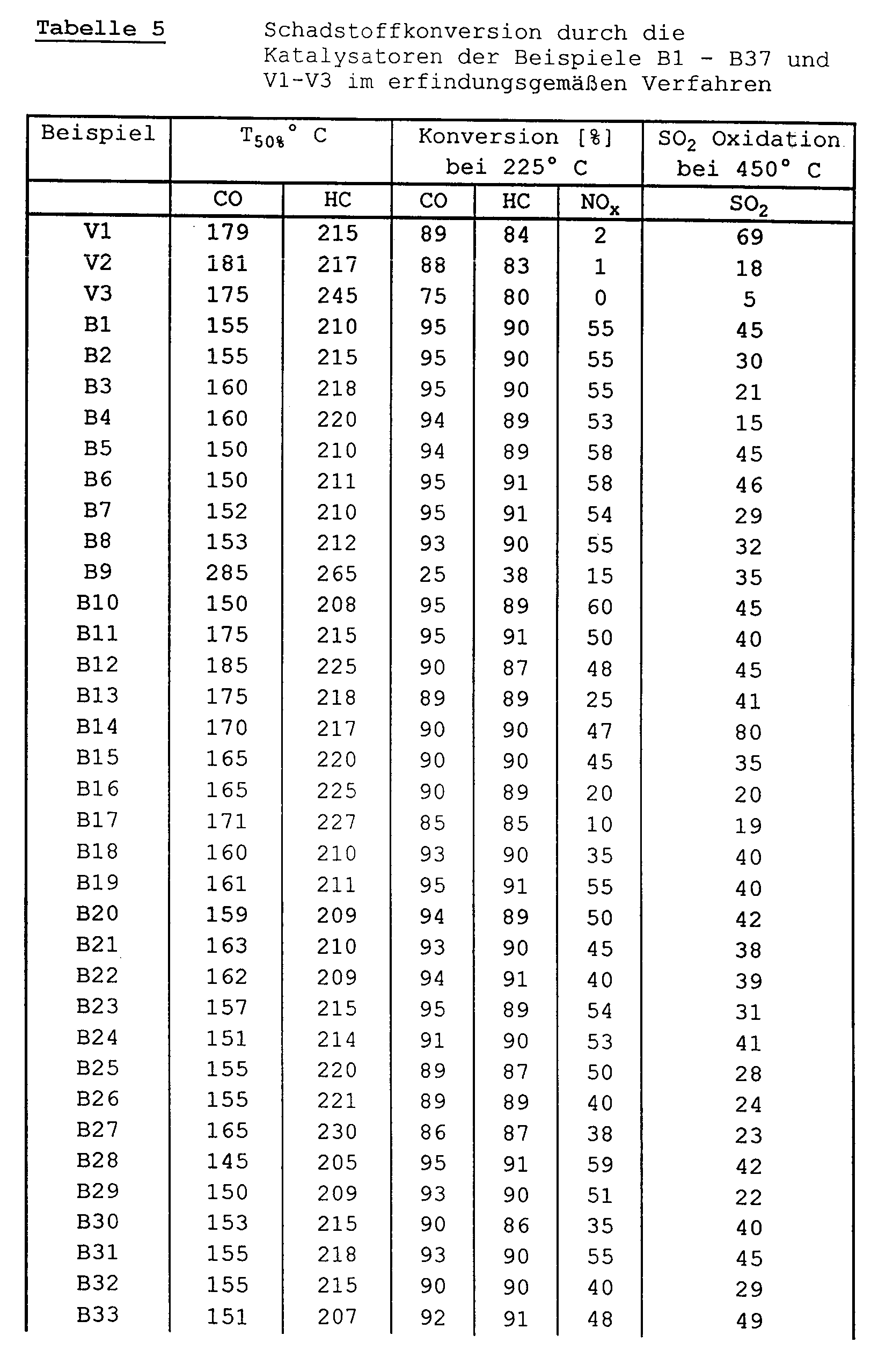

Tabelle 6 Schadstoffkonversion durch die Katalysatoren von ausgewählten Beispielen nach Ofenalterung (16 h, 750° C, Luft) Beispiel T50%° C Konversion [%] bei 225° C SO₂-Oxidation bei 450° C CO HC CO HC NOx SO₂ B1 165 221 90 90 50 21 B2 168 225 90 86 50 15 B4 175 228 85 83 48 9 B5 163 221 89 87 50 22 B6 165 225 86 86 45 25 B8 165 220 91 89 52 19 B15 170 229 85 90 40 17 B16 175 235 84 80 10 10 B17 185 255 85 65 5 10 B18 170 225 90 88 25 22 B20 170 220 91 88 48 25 B22 171 219 90 89 37 20 B26 170 230 87 85 35 11 Tabelle 7 Dispersionsgrade der Platingruppenmetalle der Katalysatoren einiger ausgewählter Beispiele Beispiel Dispersionsgrad DPM [%] B1 63 B2 55 B4 56 B10 50 B18 51 B22 35 V1 15
Claims (7)
- Verfahren zur gleichzeitigen Verminderung der im Abgas einer Verbrennungskraftmaschine enthaltenen Kohlenwasserstoffe, sauerstoffhaltige organische Verbindungen, Kohlenmonoxid und Stickoxide durch Leiten des Abgases über einen Katalysator aus einem gasdurchlässigen inerten Tragkörper mit katalytisch aktiver Beschichtung, welche mindestens ein hochoberflächiges Trägermaterial sowie gegebenenfalls eine oder mehrere Unedelmetallverbindungen und mindestens ein Metall aus der Platingruppe enthält,
dadurch gekennzeichnet,
daß das Abgas der Verbrennungskraftmaschine während der überwiegenden Betriebsdauer einen Sauerstoffüberschuß aufweist und das hochoberflächige Trägermaterial ein Aluminiumsilikat enthält, welches auch nach 7-stündigem Calcinieren bei 950° C in einem synthetischen Abgas aus 10 Vol.-% Kohlendioxid, 6 Vol.-% Sauerstoff, 10 Vol.-% Wasserdampf, Rest Stickstoff, noch eine spezifische Oberfläche von mindestens 150 m²/g aufweist. - Verfahren nach Anspruch 1,
dadurch gekennzeichnet,
daß das Aluminiumsilikat 0,5 bis 70 Gew.-% Siliziumdioxid sowie gegebenenfalls mindestens ein homogen eingebrachtes, ein hochtemperaturstabiles Oxid bildendes Element aus der Gruppe der Seltenen Erden, Erdalkalimetalle und Zirkon enthält. - Verfahren nach Anspruch 2,
dadurch gekennzeichnet,
daß es sich bei den Unedelmetallverbindungen um nichtflüchtige Verbindungen von, Molybdän, Wolfram, Vanadium, Zirkon, Hafnium, Germanium, Mangan, Eisen, Nickel, Cobalt, Zink, Kupfer und Silber sowie Alkali-, Erdalkalimetalle und Seltene Erden handelt. - Verfahren nach den Ansprüchen 1 bis 3,
dadurch gekennzeichnet, daß die Beschichtung neben Aluminiumsilikat bis zu 50 Gew.-%, bevorzugt bis zu 25 Gew.-%, weitere hochoberflächige Trägermaterialien wie Siliziumdioxid, Titanoxid, Zirkonoxid, Zeolithe, Aluminiumoxid, Magnesiumoxid oder deren Mischungen enthält. - Verfahren nach einem der Ansprüche 1 bis 4,
dadurch gekennzeichnet,
daß die katalytisch aktive Beschichtung auf dem Tragkörper in einer Menge von 20 bis 400 g/l Tragkörpervolumen vorliegt und 0,01 bis 5 g/l Platingruppenmetalle und 0 bis 100 g/l Unedelmetallverbindungen, berechnet als Oxid, enthält. - Verfahren nach Anspruch 5,
dadurch gekennzeichnet,
daß es sich bei den Platingruppenmetallen um Platin, Palladium, Rhodium und Iridium und bei den Unedelmetallverbindungen um Vanadiumoxid und/oder Wolframoxid handelt. - Verwendung eines Katalysators, welcher auf einem gasdurchlässigen inerten Tragkörper eine katalytisch aktive Beschichtung enthält, für die gleichzeitige Verminderung der im Abgas einer Verbrennungskraftmaschinen enthaltenen Kohlenwasserstoffe, sauerstoffhaltige organische Verbindungen, Kohlenmonoxid und Stickoxide, wobei das Abgas während der überwiegenden Betriebsdauer einen Sauerstoffüberschuß aufweist und die katalytisch aktive Beschichtung neben einem Aluminiumsilikat, welches auch nach 7-stündigem Calcinieren bei 950° C in einem synthetischen Abgas aus 10 Vol.-% Kohlendioxid, 6 Vol.-% Sauerstoff, 10 Vol.-% Wasserdampf, Rest Stickstoff, noch eine spezifische Oberfläche von mindestens 150 m²/g aufweist, noch mindestens ein Metall aus der Platingruppe und gegebenenfalls Vanadiumoxid enthält.
Applications Claiming Priority (2)
| Application Number | Priority Date | Filing Date | Title |
|---|---|---|---|
| DE4436890A DE4436890A1 (de) | 1994-10-15 | 1994-10-15 | Verfahren zur gleichzeitigen Verminderung der im Abgas einer Verbrennungskraftmaschine enthaltenen Kohlenwasserstoffe, Kohlenmonoxid und Stickoxide |
| DE4436890 | 1994-10-15 |
Publications (3)
| Publication Number | Publication Date |
|---|---|
| EP0706817A2 true EP0706817A2 (de) | 1996-04-17 |
| EP0706817A3 EP0706817A3 (de) | 1997-08-13 |
| EP0706817B1 EP0706817B1 (de) | 2003-02-26 |
Family
ID=6530856
Family Applications (1)
| Application Number | Title | Priority Date | Filing Date |
|---|---|---|---|
| EP95115382A Expired - Lifetime EP0706817B1 (de) | 1994-10-15 | 1995-09-29 | Verfahren zur gleichzeitigen Verminderung der im Abgas einer Verbrennungskraftmaschine enthaltenen Kohlenwasserstoffe, Kohlenmonoxid und Stickoxide |
Country Status (8)
| Country | Link |
|---|---|
| US (1) | US5643542A (de) |
| EP (1) | EP0706817B1 (de) |
| JP (1) | JPH08192030A (de) |
| BR (1) | BR9504406A (de) |
| CA (1) | CA2160494C (de) |
| DE (2) | DE4436890A1 (de) |
| ES (1) | ES2189816T3 (de) |
| ZA (1) | ZA958684B (de) |
Cited By (12)
| Publication number | Priority date | Publication date | Assignee | Title |
|---|---|---|---|---|
| EP0800856A3 (de) * | 1996-04-12 | 1998-11-04 | Degussa Aktiengesellschaft | Katalysator zur Reinigung der Abgase von Dieselmotoren |
| WO1999003566A1 (en) * | 1997-07-15 | 1999-01-28 | The University Of Queensland | Catalytic conversion of gases via cation-exchangeable alumino-silicate materials |
| RU2129914C1 (ru) * | 1997-12-23 | 1999-05-10 | Открытое акционерное общество "Электростальский химико-механический завод" | Способ получения катализатора окисления оксида углерода |
| RU2130803C1 (ru) * | 1997-12-23 | 1999-05-27 | Открытое акционерное общество "Электростальский химико-механический завод" | Способ получения катализатора |
| WO1999041000A1 (de) * | 1998-02-16 | 1999-08-19 | Siemens Aktiengesellschaft | Katalysator und verfahren zur abgasreinigung |
| RU2147461C1 (ru) * | 1998-11-26 | 2000-04-20 | ОАО "Электростальский химико-механический завод" | Способ получения катализатора для очистки газов от оксидов азота |
| RU2167713C1 (ru) * | 2000-02-08 | 2001-05-27 | Государственное унитарное предприятие Электростальское научно-производственное объединение "Неорганика" | Способ получения катализатора для разложения вредных примесей |
| RU2169041C1 (ru) * | 2000-02-08 | 2001-06-20 | Государственное унитарное предприятие Электростальское научно-производственное объединение "Неорганика" | Способ получения катализатора |
| RU2213616C1 (ru) * | 2002-05-28 | 2003-10-10 | Российский химико-технологический университет им. Д.И. Менделеева | Способ получения катализатора |
| RU2218211C1 (ru) * | 2002-06-10 | 2003-12-10 | Российский химико-технологический университет им. Д.И. Менделеева | Способ получения катализатора для разложения озона |
| WO2010086148A1 (de) | 2009-01-28 | 2010-08-05 | Süd-Chemie AG | Vanadiumfreier diesel-oxidationskatalysator und vefahren zu dessen herstellung |
| WO2010086149A1 (de) | 2009-01-28 | 2010-08-05 | Süd-Chemie AG | Diesel-oxidationskatalysator mit guter tieftemperaturaktivität |
Families Citing this family (28)
| Publication number | Priority date | Publication date | Assignee | Title |
|---|---|---|---|---|
| US20040086441A1 (en) | 1995-12-06 | 2004-05-06 | Masao Hori | Process for purifying exhaust gas from gasoline engines |
| JPH1099686A (ja) * | 1996-09-27 | 1998-04-21 | Mazda Motor Corp | 排気ガス浄化用触媒及びその製法及び排気ガス浄化方法 |
| US6165429A (en) * | 1997-01-10 | 2000-12-26 | Toyota Jidosha Kabushiki Kaisha | Exhaust gas purifying catalyst and exhaust gas purifying method |
| DE19829104C1 (de) * | 1998-06-30 | 1999-09-02 | Mannesmann Sachs Ag | Verfahren zum Verbinden eines Schwungrads einer Kupplung mit einem Kupplungsgehäuse |
| AR019182A1 (es) * | 1998-07-04 | 2001-12-26 | Degussa Huls Aktiengesellscahft | Catalizador para reduccion de oxidos de nitrogeno en atmosfera oxidante y reductora, procedimiento para la preparacion de un catalizador , y empleo delcatalizador. |
| US6129898A (en) * | 1998-08-17 | 2000-10-10 | Ford Global Technologies, Inc. | NOx trap catalyst for lean burn engines |
| DE19847008A1 (de) * | 1998-10-13 | 2000-04-20 | Degussa | Stickoxid-Speicherkatalysator |
| WO2000029726A1 (en) * | 1998-11-13 | 2000-05-25 | Engelhard Corporation | Catalyst and method for reducing exhaust gas emissions |
| FR2792851B1 (fr) * | 1999-04-29 | 2002-04-05 | Inst Francais Du Petrole | Catalyseur a base de metal noble faiblement disperse et son utilisation pour la conversion de charges hydrocarbonees |
| EP1147811A1 (de) * | 2000-04-20 | 2001-10-24 | Engelhard Corporation | Katalysator, Katalysatorträger und Verfahren zur Hydrierung, Hydroisomerierung, Hydrospaltung und/oder Hydroentschwefelung |
| DE10027220A1 (de) * | 2000-05-31 | 2001-12-20 | Dornier Gmbh | Katalysator zur selektiven Oxidation von CO in H¶2¶-haltigem Gas |
| EP1188913A1 (de) | 2000-09-18 | 2002-03-20 | Neomat S.A. | Heterogene Katalyse in einer Brennkraftmaschine |
| EP1250952A1 (de) * | 2001-04-18 | 2002-10-23 | OMG AG & Co. KG | Katalysator sowie Filter und Verfahren zur Beseitigung von Russpartikeln aus dem Abgas eines Dieselmotors |
| WO2009100097A2 (en) | 2008-02-05 | 2009-08-13 | Basf Catalysts Llc | Gasoline engine emissions treatment systems having particulate traps |
| DE102005038547A1 (de) * | 2005-08-12 | 2007-02-15 | Universität Karlsruhe (Th) | Katalysator zur Verwendung bei einer selektiven NOx-Reduktion in NOx-haltigen Abgasen |
| JP2008168278A (ja) * | 2006-12-15 | 2008-07-24 | Nissan Motor Co Ltd | 排ガス浄化用触媒及びその製造方法 |
| DE102007057305A1 (de) | 2007-11-28 | 2009-06-04 | Süd-Chemie AG | Beschichtungszusammensetzung für Dieseloxidationskatalysatoren |
| US8513153B2 (en) * | 2009-04-22 | 2013-08-20 | Uto Environmental Products Limited | Fuel additive |
| US8815189B2 (en) | 2010-04-19 | 2014-08-26 | Basf Corporation | Gasoline engine emissions treatment systems having particulate filters |
| DE102010040808A1 (de) | 2010-09-15 | 2012-03-15 | Karlsruher Institut für Technologie | Katalysator zur Verwendung bei einer selektiven NOx-Reduktion |
| GB201220912D0 (en) | 2012-11-21 | 2013-01-02 | Johnson Matthey Plc | Oxidation catalyst for treating the exhaust gas of a compression ignition engine |
| KR20170020337A (ko) * | 2014-06-19 | 2017-02-22 | 오츠카 가가쿠 가부시키가이샤 | 배기 가스 정화 촉매, 배기 가스 정화 장치 및 필터, 및 해당 촉매의 제조 방법 |
| DE102016107466A1 (de) | 2016-04-22 | 2017-10-26 | Keyou GmbH | Katalysator, Vorrichtung und Verfahren zur selektiven NOx-Reduktion mittels Wasserstoff in NOx-haltigen Abgasen |
| GB201608643D0 (en) * | 2016-05-17 | 2016-06-29 | Thermo Fisher Scient Bremen | Elemental analysis system and method |
| KR102514680B1 (ko) * | 2017-03-06 | 2023-03-30 | 우미코레 아게 운트 코 카게 | 망간을 함유하는 디젤 산화 촉매 |
| DE102017124541A1 (de) | 2017-10-20 | 2019-04-25 | Argomotive Gmbh | Vorrichtung zur Nachbehandlung von Abgasen eines Verbrennungsmotors |
| DE102018127219A1 (de) | 2018-10-31 | 2020-04-30 | Keyou GmbH | Katalysator zur Verwendung bei einer selektiven NOx-Reduktion in NOx-haltigen Abgasen, Verfahren zur Herstellung eines Katalysators, Vorrichtung zur selektiven NOx-Reduktion und Verfahren zur selektiven NOx-Reduktion |
| US11685659B2 (en) | 2021-11-24 | 2023-06-27 | Uop Llc | Processes and apparatuses for reducing carbon monoxide levels in a gaseous stream |
Citations (3)
| Publication number | Priority date | Publication date | Assignee | Title |
|---|---|---|---|---|
| EP0184506A1 (de) | 1984-12-05 | 1986-06-11 | Rhone-Poulenc Chimie | Verfahren zur Herstellung von auf Aluminiumoxid basierenden Katalysatorträgern mit verbesserten Dauerhaftigkeit |
| DE3839580C1 (de) | 1988-11-24 | 1990-07-05 | Condea Chemie Gmbh, 2212 Brunsbuettel, De | |
| DE3940758C2 (de) | 1989-12-09 | 1993-07-08 | Degussa Ag, 6000 Frankfurt, De |
Family Cites Families (11)
| Publication number | Priority date | Publication date | Assignee | Title |
|---|---|---|---|---|
| FR2501065B1 (fr) * | 1981-03-09 | 1986-02-07 | Pro Catalyse | Catalyseur et procede perfectionnes pour le traitement des gaz d'echappement des moteurs a combustion interne |
| FR2556236B1 (fr) * | 1983-12-09 | 1988-04-01 | Pro Catalyse | Procede de fabrication d'un catalyseur pour le traitement des gaz d'echappement |
| US4624940A (en) * | 1985-04-12 | 1986-11-25 | Engelhard Corporation | High temperature catalyst compositions for internal combustion engine |
| US4904633A (en) * | 1986-12-18 | 1990-02-27 | Nippon Shokubai Kagaku Kogyo Co., Ltd. | Catalyst for purifying exhaust gas and method for production thereof |
| US5232890A (en) * | 1990-01-02 | 1993-08-03 | Ganguli Partha S | Precious metal catalysts with oxygen-ion conducting support |
| JPH04150950A (ja) * | 1990-10-16 | 1992-05-25 | Ube Ind Ltd | 金属/担体系固体触媒活性成分の分散度制御方法 |
| EP0678325B1 (de) * | 1991-07-09 | 1999-05-06 | Mitsubishi Jukogyo Kabushiki Kaisha | Katalysator und Verfahren zur Reinigung von Abgasen |
| US5155077A (en) * | 1991-09-03 | 1992-10-13 | Ford Motor Company | Catalyst for purification of lean-burn engine exhaust gas |
| JP3250824B2 (ja) * | 1991-09-13 | 2002-01-28 | マツダ株式会社 | NOx浄化方法 |
| DE4206699C2 (de) * | 1992-03-04 | 1996-02-01 | Degussa | NO¶x¶-Verminderung im mageren Abgas von Kraftfahrzeugmotoren |
| DE4239875C2 (de) * | 1992-11-27 | 1999-02-11 | Degussa | Abgasreinigungssystem zur Verminderung der Kohlenwasserstoff-Emissionen während des Kaltstarts von Verbrennungskraftmaschinen |
-
1994
- 1994-10-15 DE DE4436890A patent/DE4436890A1/de not_active Ceased
-
1995
- 1995-09-29 ES ES95115382T patent/ES2189816T3/es not_active Expired - Lifetime
- 1995-09-29 EP EP95115382A patent/EP0706817B1/de not_active Expired - Lifetime
- 1995-09-29 DE DE59510566T patent/DE59510566D1/de not_active Expired - Lifetime
- 1995-10-12 US US08/542,124 patent/US5643542A/en not_active Expired - Lifetime
- 1995-10-13 BR BR9504406A patent/BR9504406A/pt not_active IP Right Cessation
- 1995-10-13 CA CA002160494A patent/CA2160494C/en not_active Expired - Fee Related
- 1995-10-13 ZA ZA958684A patent/ZA958684B/xx unknown
- 1995-10-13 JP JP7265818A patent/JPH08192030A/ja active Pending
Patent Citations (3)
| Publication number | Priority date | Publication date | Assignee | Title |
|---|---|---|---|---|
| EP0184506A1 (de) | 1984-12-05 | 1986-06-11 | Rhone-Poulenc Chimie | Verfahren zur Herstellung von auf Aluminiumoxid basierenden Katalysatorträgern mit verbesserten Dauerhaftigkeit |
| DE3839580C1 (de) | 1988-11-24 | 1990-07-05 | Condea Chemie Gmbh, 2212 Brunsbuettel, De | |
| DE3940758C2 (de) | 1989-12-09 | 1993-07-08 | Degussa Ag, 6000 Frankfurt, De |
Cited By (14)
| Publication number | Priority date | Publication date | Assignee | Title |
|---|---|---|---|---|
| EP0800856A3 (de) * | 1996-04-12 | 1998-11-04 | Degussa Aktiengesellschaft | Katalysator zur Reinigung der Abgase von Dieselmotoren |
| US5928981A (en) * | 1996-04-12 | 1999-07-27 | Degussa-Huls Aktiengesellschaft | Diesel catalytic converter |
| WO1999003566A1 (en) * | 1997-07-15 | 1999-01-28 | The University Of Queensland | Catalytic conversion of gases via cation-exchangeable alumino-silicate materials |
| RU2129914C1 (ru) * | 1997-12-23 | 1999-05-10 | Открытое акционерное общество "Электростальский химико-механический завод" | Способ получения катализатора окисления оксида углерода |
| RU2130803C1 (ru) * | 1997-12-23 | 1999-05-27 | Открытое акционерное общество "Электростальский химико-механический завод" | Способ получения катализатора |
| WO1999041000A1 (de) * | 1998-02-16 | 1999-08-19 | Siemens Aktiengesellschaft | Katalysator und verfahren zur abgasreinigung |
| RU2147461C1 (ru) * | 1998-11-26 | 2000-04-20 | ОАО "Электростальский химико-механический завод" | Способ получения катализатора для очистки газов от оксидов азота |
| RU2167713C1 (ru) * | 2000-02-08 | 2001-05-27 | Государственное унитарное предприятие Электростальское научно-производственное объединение "Неорганика" | Способ получения катализатора для разложения вредных примесей |
| RU2169041C1 (ru) * | 2000-02-08 | 2001-06-20 | Государственное унитарное предприятие Электростальское научно-производственное объединение "Неорганика" | Способ получения катализатора |
| RU2213616C1 (ru) * | 2002-05-28 | 2003-10-10 | Российский химико-технологический университет им. Д.И. Менделеева | Способ получения катализатора |
| RU2218211C1 (ru) * | 2002-06-10 | 2003-12-10 | Российский химико-технологический университет им. Д.И. Менделеева | Способ получения катализатора для разложения озона |
| WO2010086148A1 (de) | 2009-01-28 | 2010-08-05 | Süd-Chemie AG | Vanadiumfreier diesel-oxidationskatalysator und vefahren zu dessen herstellung |
| WO2010086149A1 (de) | 2009-01-28 | 2010-08-05 | Süd-Chemie AG | Diesel-oxidationskatalysator mit guter tieftemperaturaktivität |
| DE102009006403A1 (de) | 2009-01-28 | 2010-08-05 | Süd-Chemie AG | Vanadiumfreier Diesel-Oxidationskatalysator und Verfahren zu dessen Herstellung |
Also Published As
| Publication number | Publication date |
|---|---|
| DE59510566D1 (de) | 2003-04-03 |
| CA2160494C (en) | 2005-11-22 |
| JPH08192030A (ja) | 1996-07-30 |
| EP0706817A3 (de) | 1997-08-13 |
| US5643542A (en) | 1997-07-01 |
| BR9504406A (pt) | 1997-05-27 |
| DE4436890A1 (de) | 1996-04-18 |
| EP0706817B1 (de) | 2003-02-26 |
| ES2189816T3 (es) | 2003-07-16 |
| CA2160494A1 (en) | 1996-04-16 |
| ZA958684B (en) | 1996-05-22 |
Similar Documents
| Publication | Publication Date | Title |
|---|---|---|
| EP0706817B1 (de) | Verfahren zur gleichzeitigen Verminderung der im Abgas einer Verbrennungskraftmaschine enthaltenen Kohlenwasserstoffe, Kohlenmonoxid und Stickoxide | |
| EP0800856B1 (de) | Katalysator zur Reinigung der Abgase von Dieselmotoren | |
| EP0432534B2 (de) | Katalysator zur Reinigung der Abgase von Dieselmotoren | |
| EP1004347B1 (de) | Katalysator für die Reinigung der Abgase eines Dieselmotors | |
| EP0559021B1 (de) | NOx-Verminderung im mageren Abgas von Kraftfahrzeugmotoren | |
| DE69105921T2 (de) | Katalysatorzusammensetzung und Katalysator zur Reinigung von Abgasen und Verfahren zu seiner Herstellung. | |
| DE69516281T2 (de) | Zusammengesetzter katalysator mit schichtstruktur | |
| DE69115895T2 (de) | Katalysator zur Reinigung von Abgas | |
| DE69910791T2 (de) | Abgaskatalysator enthaltend rhodium, zirkon-, cer- und lanthanoxid | |
| DE60216573T2 (de) | Abgasreinigungskatalysator | |
| EP1181970B1 (de) | Abgasreinigungskatalysator für motornahen Einsatz und Verfahren zu seiner Herstellung | |
| DE69503527T2 (de) | Katalysator zur Reinigung von Abgasen | |
| DE2928249C2 (de) | ||
| DE69204830T2 (de) | Katalysator und Verfahren zur Reinigung von Abgas. | |
| DE112013004202B4 (de) | Abgasreinigungskatalysator | |
| DE60316069T3 (de) | NOx-Speicherkatalysator | |
| EP2718011B1 (de) | Verfahren zur selektiven katalytischen reduktion von stickoxiden in abgasen von dieselmotoren | |
| DD147146A5 (de) | Verfahren zur umwandlung von kohlenmonoxid-,kohlenwasserstoff-und stickstoffoxidkomponenten | |
| DE69501100T2 (de) | Katalysator und Verfahren zur Reinigung von Abgasen | |
| DE69838589T2 (de) | Verfahren zur abgasreinigung | |
| EP0566878A1 (de) | Katalysator zur oxidativen Reinigung der Abgase von Dieselmotoren | |
| DE69316058T2 (de) | Verfahren zur Reinigung von Abgasen | |
| DE3806960A1 (de) | Katalysator zur reinigung von auspuffgas und verfahren fuer seine herstellung | |
| EP1998875A2 (de) | Oxidationskatalysator | |
| DE69913089T2 (de) | Speicherung von Stickstoffoxiden durch Metal-Zirconoxidmaterialien während des Betriebs eines mit Luftüberschuss arbeitenden Kraftfahrzeugmotors |
Legal Events
| Date | Code | Title | Description |
|---|---|---|---|
| PUAI | Public reference made under article 153(3) epc to a published international application that has entered the european phase |
Free format text: ORIGINAL CODE: 0009012 |
|
| AK | Designated contracting states |
Kind code of ref document: A2 Designated state(s): BE DE DK ES FR GB IT LU NL |
|
| PUAL | Search report despatched |
Free format text: ORIGINAL CODE: 0009013 |
|
| AK | Designated contracting states |
Kind code of ref document: A3 Designated state(s): BE DE DK ES FR GB IT LU NL |
|
| 17P | Request for examination filed |
Effective date: 19970715 |
|
| 17Q | First examination report despatched |
Effective date: 19980112 |
|
| RAP1 | Party data changed (applicant data changed or rights of an application transferred) |
Owner name: DEGUSSA-HUELS AKTIENGESELLSCHAFT |
|
| RAP3 | Party data changed (applicant data changed or rights of an application transferred) |
Owner name: DEGUSSA-HUELS AKTIENGESELLSCHAFT |
|
| RAP1 | Party data changed (applicant data changed or rights of an application transferred) |
Owner name: DMC2 DEGUSSA METALS CATALYSTS CERDEC AG |
|
| RAP1 | Party data changed (applicant data changed or rights of an application transferred) |
Owner name: OMG AG & CO. KG |
|
| GRAG | Despatch of communication of intention to grant |
Free format text: ORIGINAL CODE: EPIDOS AGRA |
|
| GRAG | Despatch of communication of intention to grant |
Free format text: ORIGINAL CODE: EPIDOS AGRA |
|
| GRAH | Despatch of communication of intention to grant a patent |
Free format text: ORIGINAL CODE: EPIDOS IGRA |
|
| GRAH | Despatch of communication of intention to grant a patent |
Free format text: ORIGINAL CODE: EPIDOS IGRA |
|
| GRAA | (expected) grant |
Free format text: ORIGINAL CODE: 0009210 |
|
| AK | Designated contracting states |
Designated state(s): BE DE DK ES FR GB IT LU NL |
|
| PG25 | Lapsed in a contracting state [announced via postgrant information from national office to epo] |
Ref country code: NL Free format text: LAPSE BECAUSE OF FAILURE TO SUBMIT A TRANSLATION OF THE DESCRIPTION OR TO PAY THE FEE WITHIN THE PRESCRIBED TIME-LIMIT Effective date: 20030226 |
|
| REG | Reference to a national code |
Ref country code: GB Ref legal event code: FG4D Free format text: NOT ENGLISH |
|
| REF | Corresponds to: |
Ref document number: 59510566 Country of ref document: DE Date of ref document: 20030403 Kind code of ref document: P |
|
| GBT | Gb: translation of ep patent filed (gb section 77(6)(a)/1977) |
Effective date: 20030408 |
|
| PG25 | Lapsed in a contracting state [announced via postgrant information from national office to epo] |
Ref country code: DK Free format text: LAPSE BECAUSE OF FAILURE TO SUBMIT A TRANSLATION OF THE DESCRIPTION OR TO PAY THE FEE WITHIN THE PRESCRIBED TIME-LIMIT Effective date: 20030526 |
|
| REG | Reference to a national code |
Ref country code: ES Ref legal event code: FG2A Ref document number: 2189816 Country of ref document: ES Kind code of ref document: T3 |
|
| NLV1 | Nl: lapsed or annulled due to failure to fulfill the requirements of art. 29p and 29m of the patents act | ||
| PG25 | Lapsed in a contracting state [announced via postgrant information from national office to epo] |
Ref country code: LU Free format text: LAPSE BECAUSE OF NON-PAYMENT OF DUE FEES Effective date: 20030929 |
|
| PG25 | Lapsed in a contracting state [announced via postgrant information from national office to epo] |
Ref country code: BE Free format text: LAPSE BECAUSE OF NON-PAYMENT OF DUE FEES Effective date: 20030930 |
|
| ET | Fr: translation filed | ||
| RAP2 | Party data changed (patent owner data changed or rights of a patent transferred) |
Owner name: UMICORE AG & CO. KG |
|
| PLBE | No opposition filed within time limit |
Free format text: ORIGINAL CODE: 0009261 |
|
| STAA | Information on the status of an ep patent application or granted ep patent |
Free format text: STATUS: NO OPPOSITION FILED WITHIN TIME LIMIT |
|
| 26N | No opposition filed |
Effective date: 20031127 |
|
| BERE | Be: lapsed |
Owner name: *OMG A.G. & CO. K.G. Effective date: 20030930 |
|
| REG | Reference to a national code |
Ref country code: FR Ref legal event code: CD |
|
| REG | Reference to a national code |
Ref country code: ES Ref legal event code: PC2A |
|
| PGFP | Annual fee paid to national office [announced via postgrant information from national office to epo] |
Ref country code: ES Payment date: 20070927 Year of fee payment: 13 |
|
| PGFP | Annual fee paid to national office [announced via postgrant information from national office to epo] |
Ref country code: IT Payment date: 20080925 Year of fee payment: 14 Ref country code: FR Payment date: 20080912 Year of fee payment: 14 |
|
| PGFP | Annual fee paid to national office [announced via postgrant information from national office to epo] |
Ref country code: GB Payment date: 20080918 Year of fee payment: 14 |
|
| REG | Reference to a national code |
Ref country code: ES Ref legal event code: FD2A Effective date: 20080930 |
|
| PG25 | Lapsed in a contracting state [announced via postgrant information from national office to epo] |
Ref country code: ES Free format text: LAPSE BECAUSE OF NON-PAYMENT OF DUE FEES Effective date: 20080930 |
|
| GBPC | Gb: european patent ceased through non-payment of renewal fee |
Effective date: 20090929 |
|
| REG | Reference to a national code |
Ref country code: FR Ref legal event code: ST Effective date: 20100531 |
|
| PG25 | Lapsed in a contracting state [announced via postgrant information from national office to epo] |
Ref country code: FR Free format text: LAPSE BECAUSE OF NON-PAYMENT OF DUE FEES Effective date: 20090930 |
|
| PG25 | Lapsed in a contracting state [announced via postgrant information from national office to epo] |
Ref country code: GB Free format text: LAPSE BECAUSE OF NON-PAYMENT OF DUE FEES Effective date: 20090929 |
|
| PG25 | Lapsed in a contracting state [announced via postgrant information from national office to epo] |
Ref country code: IT Free format text: LAPSE BECAUSE OF NON-PAYMENT OF DUE FEES Effective date: 20090929 |
|
| PGFP | Annual fee paid to national office [announced via postgrant information from national office to epo] |
Ref country code: DE Payment date: 20140923 Year of fee payment: 20 |
|
| REG | Reference to a national code |
Ref country code: DE Ref legal event code: R071 Ref document number: 59510566 Country of ref document: DE |