EP0704431A2 - Ortho-substituierte Benzoesäurederivate - Google Patents
Ortho-substituierte Benzoesäurederivate Download PDFInfo
- Publication number
- EP0704431A2 EP0704431A2 EP95112998A EP95112998A EP0704431A2 EP 0704431 A2 EP0704431 A2 EP 0704431A2 EP 95112998 A EP95112998 A EP 95112998A EP 95112998 A EP95112998 A EP 95112998A EP 0704431 A2 EP0704431 A2 EP 0704431A2
- Authority
- EP
- European Patent Office
- Prior art keywords
- methylsulfonyl
- formula
- methyl
- benzoic acid
- benzoesäure
- Prior art date
- Legal status (The legal status is an assumption and is not a legal conclusion. Google has not performed a legal analysis and makes no representation as to the accuracy of the status listed.)
- Granted
Links
- 150000001558 benzoic acid derivatives Chemical class 0.000 title claims description 7
- 229910052801 chlorine Inorganic materials 0.000 claims abstract description 25
- 229910052794 bromium Inorganic materials 0.000 claims abstract description 23
- 150000003839 salts Chemical class 0.000 claims abstract description 23
- 125000002023 trifluoromethyl group Chemical group FC(F)(F)* 0.000 claims abstract description 16
- 229910052760 oxygen Inorganic materials 0.000 claims abstract description 11
- JNCMHMUGTWEVOZ-UHFFFAOYSA-N F[CH]F Chemical compound F[CH]F JNCMHMUGTWEVOZ-UHFFFAOYSA-N 0.000 claims abstract description 8
- 108010081348 HRT1 protein Hairy Proteins 0.000 claims abstract description 8
- 102100021881 Hairy/enhancer-of-split related with YRPW motif protein 1 Human genes 0.000 claims abstract description 8
- VUWZPRWSIVNGKG-UHFFFAOYSA-N fluoromethane Chemical compound F[CH2] VUWZPRWSIVNGKG-UHFFFAOYSA-N 0.000 claims abstract description 8
- 125000001997 phenyl group Chemical group [H]C1=C([H])C([H])=C(*)C([H])=C1[H] 0.000 claims abstract description 8
- 229910052717 sulfur Inorganic materials 0.000 claims abstract description 8
- 125000000217 alkyl group Chemical group 0.000 claims abstract description 6
- 125000001589 carboacyl group Chemical group 0.000 claims abstract description 6
- 125000002947 alkylene group Chemical group 0.000 claims abstract description 5
- 125000003435 aroyl group Chemical group 0.000 claims abstract description 5
- 125000004206 2,2,2-trifluoroethyl group Chemical group [H]C([H])(*)C(F)(F)F 0.000 claims abstract description 4
- 125000000753 cycloalkyl group Chemical group 0.000 claims abstract description 4
- 125000004981 cycloalkylmethyl group Chemical group 0.000 claims abstract description 4
- 125000005004 perfluoroethyl group Chemical group FC(F)(F)C(F)(F)* 0.000 claims abstract description 4
- 150000001875 compounds Chemical class 0.000 claims description 58
- -1 thiocarbamoyl group Chemical group 0.000 claims description 45
- 239000002253 acid Substances 0.000 claims description 27
- 125000002496 methyl group Chemical group [H]C([H])([H])* 0.000 claims description 26
- 238000011282 treatment Methods 0.000 claims description 17
- 125000004432 carbon atom Chemical group C* 0.000 claims description 16
- 150000003254 radicals Chemical class 0.000 claims description 13
- 125000002485 formyl group Chemical group [H]C(*)=O 0.000 claims description 12
- 125000002887 hydroxy group Chemical group [H]O* 0.000 claims description 12
- 238000000034 method Methods 0.000 claims description 12
- 229910052731 fluorine Inorganic materials 0.000 claims description 11
- 208000037265 diseases, disorders, signs and symptoms Diseases 0.000 claims description 9
- 201000010099 disease Diseases 0.000 claims description 8
- 239000003814 drug Substances 0.000 claims description 8
- 229910052740 iodine Inorganic materials 0.000 claims description 7
- 238000004519 manufacturing process Methods 0.000 claims description 7
- 238000002360 preparation method Methods 0.000 claims description 7
- 150000002148 esters Chemical class 0.000 claims description 6
- 125000002560 nitrile group Chemical group 0.000 claims description 6
- 230000003647 oxidation Effects 0.000 claims description 6
- 238000007254 oxidation reaction Methods 0.000 claims description 6
- 239000000543 intermediate Substances 0.000 claims description 5
- 239000000825 pharmaceutical preparation Substances 0.000 claims description 5
- 206010061216 Infarction Diseases 0.000 claims description 4
- 206010003119 arrhythmia Diseases 0.000 claims description 4
- 150000001732 carboxylic acid derivatives Chemical class 0.000 claims description 4
- 230000001413 cellular effect Effects 0.000 claims description 4
- 230000007062 hydrolysis Effects 0.000 claims description 4
- 238000006460 hydrolysis reaction Methods 0.000 claims description 4
- CBOIHMRHGLHBPB-UHFFFAOYSA-N hydroxymethyl Chemical compound O[CH2] CBOIHMRHGLHBPB-UHFFFAOYSA-N 0.000 claims description 4
- 230000007574 infarction Effects 0.000 claims description 4
- 239000007788 liquid Substances 0.000 claims description 4
- 230000003449 preventive effect Effects 0.000 claims description 4
- COFVVEJCFZEIDF-UHFFFAOYSA-N 4-bromo-n-(diaminomethylidene)-2-ethyl-5-methylsulfonylbenzamide Chemical compound CCC1=CC(Br)=C(S(C)(=O)=O)C=C1C(=O)N=C(N)N COFVVEJCFZEIDF-UHFFFAOYSA-N 0.000 claims description 3
- PBZXNBOUKGUDDT-UHFFFAOYSA-N 4-chloro-n-(diaminomethylidene)-2-ethyl-5-methylsulfonylbenzamide Chemical compound CCC1=CC(Cl)=C(S(C)(=O)=O)C=C1C(=O)N=C(N)N PBZXNBOUKGUDDT-UHFFFAOYSA-N 0.000 claims description 3
- XJOYGWNOFSHSAG-UHFFFAOYSA-N 4-chloro-n-(diaminomethylidene)-2-methyl-5-methylsulfonylbenzamide Chemical compound CC1=CC(Cl)=C(S(C)(=O)=O)C=C1C(=O)N=C(N)N XJOYGWNOFSHSAG-UHFFFAOYSA-N 0.000 claims description 3
- 206010002383 Angina Pectoris Diseases 0.000 claims description 3
- 230000029936 alkylation Effects 0.000 claims description 3
- 238000005804 alkylation reaction Methods 0.000 claims description 3
- 230000006793 arrhythmia Effects 0.000 claims description 3
- 239000003795 chemical substances by application Substances 0.000 claims description 3
- IFCXSOAGVXFIJI-UHFFFAOYSA-N n-(diaminomethylidene)-4-fluoro-2-methyl-5-methylsulfonylbenzamide Chemical compound CC1=CC(F)=C(S(C)(=O)=O)C=C1C(=O)N=C(N)N IFCXSOAGVXFIJI-UHFFFAOYSA-N 0.000 claims description 3
- 239000007787 solid Substances 0.000 claims description 3
- IOHPVZBSOKLVMN-UHFFFAOYSA-N 2-(2-phenylethyl)benzoic acid Chemical compound OC(=O)C1=CC=CC=C1CCC1=CC=CC=C1 IOHPVZBSOKLVMN-UHFFFAOYSA-N 0.000 claims description 2
- YNYSKRCZLQPSHY-UHFFFAOYSA-N 4-bromo-n-(diaminomethylidene)-2-methyl-5-methylsulfonylbenzamide Chemical compound CC1=CC(Br)=C(S(C)(=O)=O)C=C1C(=O)N=C(N)N YNYSKRCZLQPSHY-UHFFFAOYSA-N 0.000 claims description 2
- QLWBIUBEALCZGB-UHFFFAOYSA-N 4-cyano-n-(diaminomethylidene)-2-methyl-5-methylsulfonylbenzamide Chemical compound CC1=CC(C#N)=C(S(C)(=O)=O)C=C1C(=O)N=C(N)N QLWBIUBEALCZGB-UHFFFAOYSA-N 0.000 claims description 2
- 230000010933 acylation Effects 0.000 claims description 2
- 238000005917 acylation reaction Methods 0.000 claims description 2
- 150000008064 anhydrides Chemical class 0.000 claims description 2
- 230000002337 anti-port Effects 0.000 claims description 2
- 125000003917 carbamoyl group Chemical group [H]N([H])C(*)=O 0.000 claims description 2
- 239000002552 dosage form Substances 0.000 claims description 2
- 150000004820 halides Chemical class 0.000 claims description 2
- 230000026030 halogenation Effects 0.000 claims description 2
- 238000005658 halogenation reaction Methods 0.000 claims description 2
- 230000011987 methylation Effects 0.000 claims description 2
- 238000007069 methylation reaction Methods 0.000 claims description 2
- 238000006396 nitration reaction Methods 0.000 claims description 2
- 125000004170 methylsulfonyl group Chemical group [H]C([H])([H])S(*)(=O)=O 0.000 claims 1
- RZIVXSRWYPNDGP-UHFFFAOYSA-N n-(diaminomethylidene)-2-ethyl-4-fluoro-5-methylsulfonylbenzamide Chemical compound CCC1=CC(F)=C(S(C)(=O)=O)C=C1C(=O)N=C(N)N RZIVXSRWYPNDGP-UHFFFAOYSA-N 0.000 claims 1
- 239000000546 pharmaceutical excipient Substances 0.000 claims 1
- 239000005711 Benzoic acid Substances 0.000 abstract description 19
- 229910052736 halogen Inorganic materials 0.000 abstract description 5
- 150000002367 halogens Chemical class 0.000 abstract description 4
- JCXJVPUVTGWSNB-UHFFFAOYSA-N Nitrogen dioxide Chemical compound O=[N]=O JCXJVPUVTGWSNB-UHFFFAOYSA-N 0.000 abstract description 3
- WPYMKLBDIGXBTP-UHFFFAOYSA-N benzoic acid Chemical compound OC(=O)C1=CC=CC=C1 WPYMKLBDIGXBTP-UHFFFAOYSA-N 0.000 abstract 2
- 241000972349 Ocoa Species 0.000 abstract 1
- HSFWRNGVRCDJHI-UHFFFAOYSA-N alpha-acetylene Natural products C#C HSFWRNGVRCDJHI-UHFFFAOYSA-N 0.000 abstract 1
- 235000010233 benzoic acid Nutrition 0.000 abstract 1
- 125000002534 ethynyl group Chemical group [H]C#C* 0.000 abstract 1
- OKKJLVBELUTLKV-UHFFFAOYSA-N Methanol Chemical compound OC OKKJLVBELUTLKV-UHFFFAOYSA-N 0.000 description 54
- 229910052757 nitrogen Inorganic materials 0.000 description 35
- ZMXDDKWLCZADIW-UHFFFAOYSA-N N,N-Dimethylformamide Chemical compound CN(C)C=O ZMXDDKWLCZADIW-UHFFFAOYSA-N 0.000 description 24
- 238000006243 chemical reaction Methods 0.000 description 21
- LFQSCWFLJHTTHZ-UHFFFAOYSA-N Ethanol Chemical compound CCO LFQSCWFLJHTTHZ-UHFFFAOYSA-N 0.000 description 20
- XLYOFNOQVPJJNP-UHFFFAOYSA-N water Substances O XLYOFNOQVPJJNP-UHFFFAOYSA-N 0.000 description 20
- VEXZGXHMUGYJMC-UHFFFAOYSA-N Hydrochloric acid Chemical compound Cl VEXZGXHMUGYJMC-UHFFFAOYSA-N 0.000 description 17
- 239000004480 active ingredient Substances 0.000 description 17
- 239000000203 mixture Substances 0.000 description 17
- 239000000243 solution Substances 0.000 description 17
- 229910003204 NH2 Inorganic materials 0.000 description 15
- HEMHJVSKTPXQMS-UHFFFAOYSA-M Sodium hydroxide Chemical compound [OH-].[Na+] HEMHJVSKTPXQMS-UHFFFAOYSA-M 0.000 description 14
- 125000006239 protecting group Chemical group 0.000 description 14
- QTBSBXVTEAMEQO-UHFFFAOYSA-N Acetic acid Chemical compound CC(O)=O QTBSBXVTEAMEQO-UHFFFAOYSA-N 0.000 description 12
- XEKOWRVHYACXOJ-UHFFFAOYSA-N Ethyl acetate Chemical compound CCOC(C)=O XEKOWRVHYACXOJ-UHFFFAOYSA-N 0.000 description 12
- WYURNTSHIVDZCO-UHFFFAOYSA-N Tetrahydrofuran Chemical compound C1CCOC1 WYURNTSHIVDZCO-UHFFFAOYSA-N 0.000 description 12
- 239000002904 solvent Substances 0.000 description 11
- 239000000126 substance Substances 0.000 description 11
- ZRALSGWEFCBTJO-UHFFFAOYSA-N Guanidine Chemical compound NC(N)=N ZRALSGWEFCBTJO-UHFFFAOYSA-N 0.000 description 10
- 241000282414 Homo sapiens Species 0.000 description 10
- YMWUJEATGCHHMB-UHFFFAOYSA-N Dichloromethane Chemical compound ClCCl YMWUJEATGCHHMB-UHFFFAOYSA-N 0.000 description 9
- QAOWNCQODCNURD-UHFFFAOYSA-N Sulfuric acid Chemical compound OS(O)(=O)=O QAOWNCQODCNURD-UHFFFAOYSA-N 0.000 description 9
- 239000011541 reaction mixture Substances 0.000 description 9
- DTQVDTLACAAQTR-UHFFFAOYSA-N Trifluoroacetic acid Chemical compound OC(=O)C(F)(F)F DTQVDTLACAAQTR-UHFFFAOYSA-N 0.000 description 8
- 150000007513 acids Chemical class 0.000 description 8
- 125000002924 primary amino group Chemical group [H]N([H])* 0.000 description 8
- 150000004702 methyl esters Chemical class 0.000 description 7
- WEVYAHXRMPXWCK-UHFFFAOYSA-N Acetonitrile Chemical compound CC#N WEVYAHXRMPXWCK-UHFFFAOYSA-N 0.000 description 6
- UHOVQNZJYSORNB-UHFFFAOYSA-N Benzene Chemical compound C1=CC=CC=C1 UHOVQNZJYSORNB-UHFFFAOYSA-N 0.000 description 6
- RTZKZFJDLAIYFH-UHFFFAOYSA-N Diethyl ether Chemical compound CCOCC RTZKZFJDLAIYFH-UHFFFAOYSA-N 0.000 description 6
- KFZMGEQAYNKOFK-UHFFFAOYSA-N Isopropanol Chemical compound CC(C)O KFZMGEQAYNKOFK-UHFFFAOYSA-N 0.000 description 6
- KWYUFKZDYYNOTN-UHFFFAOYSA-M Potassium hydroxide Chemical compound [OH-].[K+] KWYUFKZDYYNOTN-UHFFFAOYSA-M 0.000 description 6
- ZMANZCXQSJIPKH-UHFFFAOYSA-N Triethylamine Chemical compound CCN(CC)CC ZMANZCXQSJIPKH-UHFFFAOYSA-N 0.000 description 6
- 210000000056 organ Anatomy 0.000 description 6
- VLTRZXGMWDSKGL-UHFFFAOYSA-N perchloric acid Chemical compound OCl(=O)(=O)=O VLTRZXGMWDSKGL-UHFFFAOYSA-N 0.000 description 6
- BWHMMNNQKKPAPP-UHFFFAOYSA-L potassium carbonate Chemical compound [K+].[K+].[O-]C([O-])=O BWHMMNNQKKPAPP-UHFFFAOYSA-L 0.000 description 6
- 239000002244 precipitate Substances 0.000 description 6
- 239000007858 starting material Substances 0.000 description 6
- 239000003826 tablet Substances 0.000 description 6
- YLQBMQCUIZJEEH-UHFFFAOYSA-N tetrahydrofuran Natural products C=1C=COC=1 YLQBMQCUIZJEEH-UHFFFAOYSA-N 0.000 description 6
- RYHBNJHYFVUHQT-UHFFFAOYSA-N 1,4-Dioxane Chemical compound C1COCCO1 RYHBNJHYFVUHQT-UHFFFAOYSA-N 0.000 description 5
- ODSUNGPMHBSXNU-UHFFFAOYSA-N 2,4-dichloro-5-methylsulfonylbenzoic acid Chemical compound CS(=O)(=O)C1=CC(C(O)=O)=C(Cl)C=C1Cl ODSUNGPMHBSXNU-UHFFFAOYSA-N 0.000 description 5
- LKLMGWPBKSPBAK-UHFFFAOYSA-N 4-chloro-2-ethyl-5-methylsulfonylbenzoic acid Chemical compound CCC1=CC(Cl)=C(S(C)(=O)=O)C=C1C(O)=O LKLMGWPBKSPBAK-UHFFFAOYSA-N 0.000 description 5
- QGZKDVFQNNGYKY-UHFFFAOYSA-N Ammonia Chemical compound N QGZKDVFQNNGYKY-UHFFFAOYSA-N 0.000 description 5
- CHJJGSNFBQVOTG-UHFFFAOYSA-N N-methyl-guanidine Natural products CNC(N)=N CHJJGSNFBQVOTG-UHFFFAOYSA-N 0.000 description 5
- 125000002777 acetyl group Chemical group [H]C([H])([H])C(*)=O 0.000 description 5
- 125000002252 acyl group Chemical group 0.000 description 5
- 125000001797 benzyl group Chemical group [H]C1=C([H])C([H])=C(C([H])=C1[H])C([H])([H])* 0.000 description 5
- SWSQBOPZIKWTGO-UHFFFAOYSA-N dimethylaminoamidine Natural products CN(C)C(N)=N SWSQBOPZIKWTGO-UHFFFAOYSA-N 0.000 description 5
- 239000011734 sodium Substances 0.000 description 5
- KEQGZUUPPQEDPF-UHFFFAOYSA-N 1,3-dichloro-5,5-dimethylimidazolidine-2,4-dione Chemical compound CC1(C)N(Cl)C(=O)N(Cl)C1=O KEQGZUUPPQEDPF-UHFFFAOYSA-N 0.000 description 4
- NRXQPZBYHPSYEM-UHFFFAOYSA-N 2,4-dicyano-5-methylsulfonylbenzoic acid Chemical compound CS(=O)(=O)C1=CC(C(O)=O)=C(C#N)C=C1C#N NRXQPZBYHPSYEM-UHFFFAOYSA-N 0.000 description 4
- 125000001917 2,4-dinitrophenyl group Chemical group [H]C1=C([H])C(=C([H])C(=C1*)[N+]([O-])=O)[N+]([O-])=O 0.000 description 4
- OYOYYRQKTPGGCD-UHFFFAOYSA-N 2-chloro-4-fluoro-5-methylsulfonylbenzoic acid Chemical compound CS(=O)(=O)C1=CC(C(O)=O)=C(Cl)C=C1F OYOYYRQKTPGGCD-UHFFFAOYSA-N 0.000 description 4
- KVZRAXOZLHQQGO-UHFFFAOYSA-N 4-chloro-2-(fluoromethyl)-5-methylsulfonylbenzoic acid Chemical compound CS(=O)(=O)C1=CC(C(O)=O)=C(CF)C=C1Cl KVZRAXOZLHQQGO-UHFFFAOYSA-N 0.000 description 4
- AASMXPMAZZFTAF-UHFFFAOYSA-N 4-chloro-2-methoxy-5-methylsulfonylbenzoic acid Chemical compound COC1=CC(Cl)=C(S(C)(=O)=O)C=C1C(O)=O AASMXPMAZZFTAF-UHFFFAOYSA-N 0.000 description 4
- KPJLRZJXZKNSOH-UHFFFAOYSA-N 4-cyano-2-(fluoromethyl)-5-methylsulfonylbenzoic acid Chemical compound CS(=O)(=O)C1=CC(C(O)=O)=C(CF)C=C1C#N KPJLRZJXZKNSOH-UHFFFAOYSA-N 0.000 description 4
- INYOUDZHBQPGFT-UHFFFAOYSA-N 4-cyano-2-ethyl-5-methylsulfonylbenzoic acid Chemical compound CCC1=CC(C#N)=C(S(C)(=O)=O)C=C1C(O)=O INYOUDZHBQPGFT-UHFFFAOYSA-N 0.000 description 4
- TXRCFMAGOXHFFE-UHFFFAOYSA-N 4-cyano-2-methoxy-5-methylsulfonylbenzoic acid Chemical compound COC1=CC(C#N)=C(S(C)(=O)=O)C=C1C(O)=O TXRCFMAGOXHFFE-UHFFFAOYSA-N 0.000 description 4
- ROSDSFDQCJNGOL-UHFFFAOYSA-N Dimethylamine Chemical compound CNC ROSDSFDQCJNGOL-UHFFFAOYSA-N 0.000 description 4
- IAZDPXIOMUYVGZ-UHFFFAOYSA-N Dimethylsulphoxide Chemical compound CS(C)=O IAZDPXIOMUYVGZ-UHFFFAOYSA-N 0.000 description 4
- QPJVMBTYPHYUOC-UHFFFAOYSA-N Methyl benzoate Natural products COC(=O)C1=CC=CC=C1 QPJVMBTYPHYUOC-UHFFFAOYSA-N 0.000 description 4
- JUJWROOIHBZHMG-UHFFFAOYSA-N Pyridine Chemical compound C1=CC=NC=C1 JUJWROOIHBZHMG-UHFFFAOYSA-N 0.000 description 4
- 150000001298 alcohols Chemical class 0.000 description 4
- FFGPTBGBLSHEPO-UHFFFAOYSA-N carbamazepine Chemical compound C1=CC2=CC=CC=C2N(C(=O)N)C2=CC=CC=C21 FFGPTBGBLSHEPO-UHFFFAOYSA-N 0.000 description 4
- XTHPWXDJESJLNJ-UHFFFAOYSA-N chlorosulfonic acid Substances OS(Cl)(=O)=O XTHPWXDJESJLNJ-UHFFFAOYSA-N 0.000 description 4
- 238000007327 hydrogenolysis reaction Methods 0.000 description 4
- 239000012442 inert solvent Substances 0.000 description 4
- HQKMJHAJHXVSDF-UHFFFAOYSA-L magnesium stearate Chemical compound [Mg+2].CCCCCCCCCCCCCCCCCC([O-])=O.CCCCCCCCCCCCCCCCCC([O-])=O HQKMJHAJHXVSDF-UHFFFAOYSA-L 0.000 description 4
- GEHJYWRUCIMESM-UHFFFAOYSA-L sodium sulfite Chemical compound [Na+].[Na+].[O-]S([O-])=O GEHJYWRUCIMESM-UHFFFAOYSA-L 0.000 description 4
- VZGDMQKNWNREIO-UHFFFAOYSA-N tetrachloromethane Chemical compound ClC(Cl)(Cl)Cl VZGDMQKNWNREIO-UHFFFAOYSA-N 0.000 description 4
- JOXIMZWYDAKGHI-UHFFFAOYSA-N toluene-4-sulfonic acid Chemical compound CC1=CC=C(S(O)(=O)=O)C=C1 JOXIMZWYDAKGHI-UHFFFAOYSA-N 0.000 description 4
- HIASUYXBXUCWFD-UHFFFAOYSA-N 2-butyl-5-chlorosulfonyl-4-fluorobenzoic acid Chemical compound CCCCC1=CC(F)=C(S(Cl)(=O)=O)C=C1C(O)=O HIASUYXBXUCWFD-UHFFFAOYSA-N 0.000 description 3
- PDWCLISLYAGQFQ-UHFFFAOYSA-N 4-bromo-5-chlorosulfonyl-2-(difluoromethyl)benzoic acid Chemical compound OC(=O)C1=CC(S(Cl)(=O)=O)=C(Br)C=C1C(F)F PDWCLISLYAGQFQ-UHFFFAOYSA-N 0.000 description 3
- DVRWYWVALVLRRF-UHFFFAOYSA-N 4-bromo-5-chlorosulfonyl-2-ethylbenzoic acid Chemical compound CCC1=CC(Br)=C(S(Cl)(=O)=O)C=C1C(O)=O DVRWYWVALVLRRF-UHFFFAOYSA-N 0.000 description 3
- GAFUXRFGHZXDFV-UHFFFAOYSA-N 4-bromo-5-chlorosulfonyl-2-methoxybenzoic acid Chemical compound COC1=CC(Br)=C(S(Cl)(=O)=O)C=C1C(O)=O GAFUXRFGHZXDFV-UHFFFAOYSA-N 0.000 description 3
- YRVXHBQPNVULJD-UHFFFAOYSA-N 4-bromo-5-chlorosulfonyl-2-nitrobenzoic acid Chemical compound OC(=O)C1=CC(S(Cl)(=O)=O)=C(Br)C=C1[N+]([O-])=O YRVXHBQPNVULJD-UHFFFAOYSA-N 0.000 description 3
- CAABRDKURXVZOV-UHFFFAOYSA-N 4-bromo-5-chlorosulfonyl-2-propylbenzoic acid Chemical compound CCCC1=CC(Br)=C(S(Cl)(=O)=O)C=C1C(O)=O CAABRDKURXVZOV-UHFFFAOYSA-N 0.000 description 3
- YGYZEHXIHONBML-UHFFFAOYSA-N 4-chloro-2-methyl-5-methylsulfonylbenzoic acid Chemical compound CC1=CC(Cl)=C(S(C)(=O)=O)C=C1C(O)=O YGYZEHXIHONBML-UHFFFAOYSA-N 0.000 description 3
- LDQXAKMSZLMUTL-UHFFFAOYSA-N 4-chloro-5-chlorosulfonyl-2-(1,1,2,2,2-pentafluoroethyl)benzoic acid Chemical compound OC(=O)C1=CC(S(Cl)(=O)=O)=C(Cl)C=C1C(F)(F)C(F)(F)F LDQXAKMSZLMUTL-UHFFFAOYSA-N 0.000 description 3
- YQFWFTJXQAVMLD-UHFFFAOYSA-N 4-chloro-5-chlorosulfonyl-2-propan-2-ylbenzoic acid Chemical compound CC(C)C1=CC(Cl)=C(S(Cl)(=O)=O)C=C1C(O)=O YQFWFTJXQAVMLD-UHFFFAOYSA-N 0.000 description 3
- GTOAYMALPAKWFE-UHFFFAOYSA-N 4-cyano-5-methylsulfonyl-2-(1,1,2,2,2-pentafluoroethyl)benzoic acid Chemical compound CS(=O)(=O)C1=CC(C(O)=O)=C(C(F)(F)C(F)(F)F)C=C1C#N GTOAYMALPAKWFE-UHFFFAOYSA-N 0.000 description 3
- XVBZHYLFGZCZIE-UHFFFAOYSA-N 5-chlorosulfonyl-2-(fluoromethyl)-4-formylbenzoic acid Chemical compound OC(=O)C1=CC(S(Cl)(=O)=O)=C(C=O)C=C1CF XVBZHYLFGZCZIE-UHFFFAOYSA-N 0.000 description 3
- GZFUZGGBHVJIMN-UHFFFAOYSA-N 5-chlorosulfonyl-2-ethyl-4-fluorobenzoic acid Chemical compound CCC1=CC(F)=C(S(Cl)(=O)=O)C=C1C(O)=O GZFUZGGBHVJIMN-UHFFFAOYSA-N 0.000 description 3
- DKRFEHYUNKZYSD-UHFFFAOYSA-N 5-chlorosulfonyl-4-fluoro-2-(1,1,2,2,2-pentafluoroethyl)benzoic acid Chemical compound OC(=O)C1=CC(S(Cl)(=O)=O)=C(F)C=C1C(F)(F)C(F)(F)F DKRFEHYUNKZYSD-UHFFFAOYSA-N 0.000 description 3
- XLDDQZFASKAUMH-UHFFFAOYSA-N 5-chlorosulfonyl-4-fluoro-2-(trifluoromethyl)benzoic acid Chemical compound OC(=O)C1=CC(S(Cl)(=O)=O)=C(F)C=C1C(F)(F)F XLDDQZFASKAUMH-UHFFFAOYSA-N 0.000 description 3
- UPCTZOYHIBJQMM-UHFFFAOYSA-N 5-chlorosulfonyl-4-fluoro-2-propan-2-ylbenzoic acid Chemical compound CC(C)C1=CC(F)=C(S(Cl)(=O)=O)C=C1C(O)=O UPCTZOYHIBJQMM-UHFFFAOYSA-N 0.000 description 3
- KNENPIFKTUWGCI-UHFFFAOYSA-N 5-chlorosulfonyl-4-fluoro-2-propylbenzoic acid Chemical compound CCCC1=CC(F)=C(S(Cl)(=O)=O)C=C1C(O)=O KNENPIFKTUWGCI-UHFFFAOYSA-N 0.000 description 3
- CSCPPACGZOOCGX-UHFFFAOYSA-N Acetone Chemical compound CC(C)=O CSCPPACGZOOCGX-UHFFFAOYSA-N 0.000 description 3
- 102000003669 Antiporters Human genes 0.000 description 3
- 108090000084 Antiporters Proteins 0.000 description 3
- XTHFKEDIFFGKHM-UHFFFAOYSA-N Dimethoxyethane Chemical compound COCCOC XTHFKEDIFFGKHM-UHFFFAOYSA-N 0.000 description 3
- OFOBLEOULBTSOW-UHFFFAOYSA-N Malonic acid Chemical compound OC(=O)CC(O)=O OFOBLEOULBTSOW-UHFFFAOYSA-N 0.000 description 3
- GRYLNZFGIOXLOG-UHFFFAOYSA-N Nitric acid Chemical compound O[N+]([O-])=O GRYLNZFGIOXLOG-UHFFFAOYSA-N 0.000 description 3
- KDLHZDBZIXYQEI-UHFFFAOYSA-N Palladium Chemical compound [Pd] KDLHZDBZIXYQEI-UHFFFAOYSA-N 0.000 description 3
- 229910006074 SO2NH2 Inorganic materials 0.000 description 3
- YXFVVABEGXRONW-UHFFFAOYSA-N Toluene Chemical compound CC1=CC=CC=C1 YXFVVABEGXRONW-UHFFFAOYSA-N 0.000 description 3
- 239000008186 active pharmaceutical agent Substances 0.000 description 3
- 125000003118 aryl group Chemical group 0.000 description 3
- 239000002775 capsule Substances 0.000 description 3
- 150000001735 carboxylic acids Chemical class 0.000 description 3
- 239000003054 catalyst Substances 0.000 description 3
- KRKNYBCHXYNGOX-UHFFFAOYSA-N citric acid Chemical compound OC(=O)CC(O)(C(O)=O)CC(O)=O KRKNYBCHXYNGOX-UHFFFAOYSA-N 0.000 description 3
- 239000012154 double-distilled water Substances 0.000 description 3
- 125000004435 hydrogen atom Chemical group [H]* 0.000 description 3
- 239000007924 injection Substances 0.000 description 3
- 238000002347 injection Methods 0.000 description 3
- INQOMBQAUSQDDS-UHFFFAOYSA-N iodomethane Chemical compound IC INQOMBQAUSQDDS-UHFFFAOYSA-N 0.000 description 3
- PDBVNECVFBBRCH-UHFFFAOYSA-N methyl 4-chloro-2-ethyl-5-methylsulfonylbenzoate Chemical compound CCC1=CC(Cl)=C(S(C)(=O)=O)C=C1C(=O)OC PDBVNECVFBBRCH-UHFFFAOYSA-N 0.000 description 3
- INGSNHMAAYVQPH-UHFFFAOYSA-N methyl 4-chloro-2-methyl-5-methylsulfonylbenzoate Chemical compound COC(=O)C1=CC(S(C)(=O)=O)=C(Cl)C=C1C INGSNHMAAYVQPH-UHFFFAOYSA-N 0.000 description 3
- 229910017604 nitric acid Inorganic materials 0.000 description 3
- 229910000027 potassium carbonate Inorganic materials 0.000 description 3
- 238000006722 reduction reaction Methods 0.000 description 3
- 238000003797 solvolysis reaction Methods 0.000 description 3
- 239000000829 suppository Substances 0.000 description 3
- 239000000454 talc Substances 0.000 description 3
- 229910052623 talc Inorganic materials 0.000 description 3
- 230000000699 topical effect Effects 0.000 description 3
- 125000003088 (fluoren-9-ylmethoxy)carbonyl group Chemical group 0.000 description 2
- OFHZCJSZEUABAV-UHFFFAOYSA-N 2,4-dichloro-n-(diaminomethylidene)-5-methylsulfonylbenzamide Chemical compound CS(=O)(=O)C1=CC(C(=O)N=C(N)N)=C(Cl)C=C1Cl OFHZCJSZEUABAV-UHFFFAOYSA-N 0.000 description 2
- YYGBUXFCSGXLSA-UHFFFAOYSA-N 2,4-dicyano-n-(diaminomethylidene)-5-methylsulfonylbenzamide Chemical compound CS(=O)(=O)C1=CC(C(=O)N=C(N)N)=C(C#N)C=C1C#N YYGBUXFCSGXLSA-UHFFFAOYSA-N 0.000 description 2
- SVNNSSZNRPKUEF-UHFFFAOYSA-N 2-(difluoromethyl)-4-formyl-5-methylsulfonylbenzoic acid Chemical compound CS(=O)(=O)C1=CC(C(O)=O)=C(C(F)F)C=C1C=O SVNNSSZNRPKUEF-UHFFFAOYSA-N 0.000 description 2
- ZWEHNKRNPOVVGH-UHFFFAOYSA-N 2-Butanone Chemical compound CCC(C)=O ZWEHNKRNPOVVGH-UHFFFAOYSA-N 0.000 description 2
- XNWFRZJHXBZDAG-UHFFFAOYSA-N 2-METHOXYETHANOL Chemical group COCCO XNWFRZJHXBZDAG-UHFFFAOYSA-N 0.000 description 2
- OSZHJMGBWHFZBM-UHFFFAOYSA-N 2-amino-4-chloro-n-(diaminomethylidene)-5-methylsulfonylbenzamide Chemical compound CS(=O)(=O)C1=CC(C(=O)N=C(N)N)=C(N)C=C1Cl OSZHJMGBWHFZBM-UHFFFAOYSA-N 0.000 description 2
- AFWZFOMABUNWJE-UHFFFAOYSA-N 2-bromo-4-methyl-5-methylsulfonylbenzoic acid Chemical compound CC1=CC(Br)=C(C(O)=O)C=C1S(C)(=O)=O AFWZFOMABUNWJE-UHFFFAOYSA-N 0.000 description 2
- DKGRGFQNLDZPNP-UHFFFAOYSA-N 2-chloro-4-cyano-5-methylsulfonylbenzoic acid Chemical compound CS(=O)(=O)C1=CC(C(O)=O)=C(Cl)C=C1C#N DKGRGFQNLDZPNP-UHFFFAOYSA-N 0.000 description 2
- ACDIAPHXHWPFSE-UHFFFAOYSA-N 2-chloro-n-(diaminomethylidene)-4-fluoro-5-methylsulfonylbenzamide Chemical compound CS(=O)(=O)C1=CC(C(=O)N=C(N)N)=C(Cl)C=C1F ACDIAPHXHWPFSE-UHFFFAOYSA-N 0.000 description 2
- HKNYQKSWBDFTBB-UHFFFAOYSA-N 2-cyano-n-(diaminomethylidene)-4-formyl-5-methylsulfonylbenzamide Chemical compound CS(=O)(=O)C1=CC(C(=O)N=C(N)N)=C(C#N)C=C1C=O HKNYQKSWBDFTBB-UHFFFAOYSA-N 0.000 description 2
- HYDYAAOAWPDZCT-UHFFFAOYSA-N 2-ethyl-4-fluoro-5-methylsulfonylbenzoic acid Chemical compound CCC1=CC(F)=C(S(C)(=O)=O)C=C1C(O)=O HYDYAAOAWPDZCT-UHFFFAOYSA-N 0.000 description 2
- HLTGGOJZHKXIJD-UHFFFAOYSA-N 4-bromo-2-ethyl-5-methylsulfonylbenzoic acid Chemical compound CCC1=CC(Br)=C(S(C)(=O)=O)C=C1C(O)=O HLTGGOJZHKXIJD-UHFFFAOYSA-N 0.000 description 2
- ZTWQTUOGOAUVTA-UHFFFAOYSA-N 4-bromo-2-methyl-5-methylsulfonylbenzoic acid Chemical compound CC1=CC(Br)=C(S(C)(=O)=O)C=C1C(O)=O ZTWQTUOGOAUVTA-UHFFFAOYSA-N 0.000 description 2
- OCKAOPGAXCSZIV-UHFFFAOYSA-N 4-bromo-2-methyl-5-sulfamoylbenzoic acid Chemical compound CC1=CC(Br)=C(S(N)(=O)=O)C=C1C(O)=O OCKAOPGAXCSZIV-UHFFFAOYSA-N 0.000 description 2
- RVCJOGNLYVNRDN-UHFFFAOYSA-N 4-bromo-2-methylbenzoic acid Chemical compound CC1=CC(Br)=CC=C1C(O)=O RVCJOGNLYVNRDN-UHFFFAOYSA-N 0.000 description 2
- JBFHRHQMMMIVPE-UHFFFAOYSA-N 4-bromo-n-(diaminomethylidene)-2-methyl-5-sulfamoylbenzamide Chemical compound CC1=CC(Br)=C(S(N)(=O)=O)C=C1C(=O)N=C(N)N JBFHRHQMMMIVPE-UHFFFAOYSA-N 0.000 description 2
- XSZFTCAZVBJCTG-UHFFFAOYSA-N 4-chloro-2-(difluoromethyl)-5-methylsulfonylbenzoic acid Chemical compound CS(=O)(=O)C1=CC(C(O)=O)=C(C(F)F)C=C1Cl XSZFTCAZVBJCTG-UHFFFAOYSA-N 0.000 description 2
- LCHVZEXZRVBSPK-UHFFFAOYSA-N 4-chloro-2-(difluoromethyl)-5-methylsulfonylbenzoic acid 4-cyano-2-(difluoromethyl)-5-methylsulfonylbenzoic acid Chemical compound FC(C1=C(C(=O)O)C=C(C(=C1)C#N)S(=O)(=O)C)F.FC(C1=C(C(=O)O)C=C(C(=C1)Cl)S(=O)(=O)C)F LCHVZEXZRVBSPK-UHFFFAOYSA-N 0.000 description 2
- OYRBBSKHKUSUBI-UHFFFAOYSA-N 4-chloro-2-ethylbenzoic acid Chemical compound CCC1=CC(Cl)=CC=C1C(O)=O OYRBBSKHKUSUBI-UHFFFAOYSA-N 0.000 description 2
- FERWVGVSGHFWHO-UHFFFAOYSA-N 4-chloro-2-ethynyl-5-methylsulfonylbenzoic acid Chemical compound CS(=O)(=O)C1=CC(C(O)=O)=C(C#C)C=C1Cl FERWVGVSGHFWHO-UHFFFAOYSA-N 0.000 description 2
- YAOQNOXHNQJWQE-UHFFFAOYSA-N 4-chloro-5-methylsulfonyl-2-(1,1,2,2,2-pentafluoroethyl)benzoic acid Chemical compound CS(=O)(=O)C1=CC(C(O)=O)=C(C(F)(F)C(F)(F)F)C=C1Cl YAOQNOXHNQJWQE-UHFFFAOYSA-N 0.000 description 2
- UMBWESADEOWEAS-UHFFFAOYSA-N 4-chloro-n-(diaminomethylidene)-2-(fluoromethyl)-5-methylsulfonylbenzamide Chemical compound CS(=O)(=O)C1=CC(C(=O)N=C(N)N)=C(CF)C=C1Cl UMBWESADEOWEAS-UHFFFAOYSA-N 0.000 description 2
- HYVCWBQCSORVMX-UHFFFAOYSA-N 4-cyano-2-(difluoromethyl)-5-methylsulfonylbenzoic acid Chemical compound CS(=O)(=O)C1=CC(C(O)=O)=C(C(F)F)C=C1C#N HYVCWBQCSORVMX-UHFFFAOYSA-N 0.000 description 2
- AGENSJILNFGVLW-UHFFFAOYSA-N 4-cyano-2-ethynyl-5-methylsulfonylbenzoic acid Chemical compound CS(=O)(=O)C1=CC(C(O)=O)=C(C#C)C=C1C#N AGENSJILNFGVLW-UHFFFAOYSA-N 0.000 description 2
- HTVVTDRCVZXQDQ-UHFFFAOYSA-N 4-cyano-2-methyl-5-methylsulfonylbenzoic acid Chemical compound CC1=CC(C#N)=C(S(C)(=O)=O)C=C1C(O)=O HTVVTDRCVZXQDQ-UHFFFAOYSA-N 0.000 description 2
- NDUXYNARFADDJW-UHFFFAOYSA-N 4-cyano-n-(diaminomethylidene)-2-(difluoromethyl)-5-methylsulfonylbenzamide Chemical compound CS(=O)(=O)C1=CC(C(=O)N=C(N)N)=C(C(F)F)C=C1C#N NDUXYNARFADDJW-UHFFFAOYSA-N 0.000 description 2
- MVROXOKSCKJQGO-UHFFFAOYSA-N 4-cyano-n-(diaminomethylidene)-2-(fluoromethyl)-5-methylsulfonylbenzamide Chemical compound CS(=O)(=O)C1=CC(C(=O)N=C(N)N)=C(CF)C=C1C#N MVROXOKSCKJQGO-UHFFFAOYSA-N 0.000 description 2
- DYVWRAKIDVAEBW-UHFFFAOYSA-N 4-cyano-n-(diaminomethylidene)-2-ethyl-5-methylsulfonylbenzamide Chemical compound CCC1=CC(C#N)=C(S(C)(=O)=O)C=C1C(=O)N=C(N)N DYVWRAKIDVAEBW-UHFFFAOYSA-N 0.000 description 2
- BCVGQVHTXMTBRU-UHFFFAOYSA-N 4-cyano-n-(diaminomethylidene)-2-methoxy-5-methylsulfonylbenzamide Chemical compound COC1=CC(C#N)=C(S(C)(=O)=O)C=C1C(=O)N=C(N)N BCVGQVHTXMTBRU-UHFFFAOYSA-N 0.000 description 2
- NNIUVLFUBAKZLX-UHFFFAOYSA-N 4-cyano-n-(diaminomethylidene)-5-methylsulfonyl-2-(1,1,2,2,2-pentafluoroethyl)benzamide Chemical compound CS(=O)(=O)C1=CC(C(=O)N=C(N)N)=C(C(F)(F)C(F)(F)F)C=C1C#N NNIUVLFUBAKZLX-UHFFFAOYSA-N 0.000 description 2
- CPAINAKEMVSNFD-UHFFFAOYSA-N 4-fluoro-2-methyl-5-methylsulfonylbenzoic acid Chemical compound CC1=CC(F)=C(S(C)(=O)=O)C=C1C(O)=O CPAINAKEMVSNFD-UHFFFAOYSA-N 0.000 description 2
- MQZYNMPGZNHAMT-UHFFFAOYSA-N 4-fluoro-5-methylsulfonyl-2-(1,1,2,2,2-pentafluoroethyl)benzoic acid Chemical compound CS(=O)(=O)C1=CC(C(O)=O)=C(C(F)(F)C(F)(F)F)C=C1F MQZYNMPGZNHAMT-UHFFFAOYSA-N 0.000 description 2
- MHOKHNAKEOBNMK-UHFFFAOYSA-N 4-fluoro-5-methylsulfonyl-2-nitrobenzoic acid Chemical compound CS(=O)(=O)C1=CC(C(O)=O)=C([N+]([O-])=O)C=C1F MHOKHNAKEOBNMK-UHFFFAOYSA-N 0.000 description 2
- NROWRQLPSKLXIE-UHFFFAOYSA-N 4-formyl-2-methoxy-5-methylsulfonylbenzoic acid Chemical compound COC1=CC(C=O)=C(S(C)(=O)=O)C=C1C(O)=O NROWRQLPSKLXIE-UHFFFAOYSA-N 0.000 description 2
- GDDVZKMHMNGHKW-UHFFFAOYSA-N 5-(benzenesulfonyl)-4-chloro-n-(diaminomethylidene)-2-methylbenzamide Chemical compound C1=C(C(=O)N=C(N)N)C(C)=CC(Cl)=C1S(=O)(=O)C1=CC=CC=C1 GDDVZKMHMNGHKW-UHFFFAOYSA-N 0.000 description 2
- NLXLAEXVIDQMFP-UHFFFAOYSA-N Ammonium chloride Substances [NH4+].[Cl-] NLXLAEXVIDQMFP-UHFFFAOYSA-N 0.000 description 2
- VHUUQVKOLVNVRT-UHFFFAOYSA-N Ammonium hydroxide Chemical compound [NH4+].[OH-] VHUUQVKOLVNVRT-UHFFFAOYSA-N 0.000 description 2
- 206010003210 Arteriosclerosis Diseases 0.000 description 2
- CIWBSHSKHKDKBQ-JLAZNSOCSA-N Ascorbic acid Chemical compound OC[C@H](O)[C@H]1OC(=O)C(O)=C1O CIWBSHSKHKDKBQ-JLAZNSOCSA-N 0.000 description 2
- 241000282472 Canis lupus familiaris Species 0.000 description 2
- 241000282693 Cercopithecidae Species 0.000 description 2
- HEDRZPFGACZZDS-UHFFFAOYSA-N Chloroform Chemical compound ClC(Cl)Cl HEDRZPFGACZZDS-UHFFFAOYSA-N 0.000 description 2
- RGHNJXZEOKUKBD-SQOUGZDYSA-N D-gluconic acid Chemical compound OC[C@@H](O)[C@@H](O)[C@H](O)[C@@H](O)C(O)=O RGHNJXZEOKUKBD-SQOUGZDYSA-N 0.000 description 2
- 208000002249 Diabetes Complications Diseases 0.000 description 2
- 206010012655 Diabetic complications Diseases 0.000 description 2
- RWSOTUBLDIXVET-UHFFFAOYSA-N Dihydrogen sulfide Chemical compound S RWSOTUBLDIXVET-UHFFFAOYSA-N 0.000 description 2
- 241000282326 Felis catus Species 0.000 description 2
- VZCYOOQTPOCHFL-OWOJBTEDSA-N Fumaric acid Chemical compound OC(=O)\C=C\C(O)=O VZCYOOQTPOCHFL-OWOJBTEDSA-N 0.000 description 2
- 206010020880 Hypertrophy Diseases 0.000 description 2
- 206010021143 Hypoxia Diseases 0.000 description 2
- DGAQECJNVWCQMB-PUAWFVPOSA-M Ilexoside XXIX Chemical compound C[C@@H]1CC[C@@]2(CC[C@@]3(C(=CC[C@H]4[C@]3(CC[C@@H]5[C@@]4(CC[C@@H](C5(C)C)OS(=O)(=O)[O-])C)C)[C@@H]2[C@]1(C)O)C)C(=O)O[C@H]6[C@@H]([C@H]([C@@H]([C@H](O6)CO)O)O)O.[Na+] DGAQECJNVWCQMB-PUAWFVPOSA-M 0.000 description 2
- GUBGYTABKSRVRQ-QKKXKWKRSA-N Lactose Natural products OC[C@H]1O[C@@H](O[C@H]2[C@H](O)[C@@H](O)C(O)O[C@@H]2CO)[C@H](O)[C@@H](O)[C@H]1O GUBGYTABKSRVRQ-QKKXKWKRSA-N 0.000 description 2
- 239000002841 Lewis acid Substances 0.000 description 2
- 241001465754 Metazoa Species 0.000 description 2
- 241000699670 Mus sp. Species 0.000 description 2
- JGFZNNIVVJXRND-UHFFFAOYSA-N N,N-Diisopropylethylamine (DIPEA) Chemical compound CCN(C(C)C)C(C)C JGFZNNIVVJXRND-UHFFFAOYSA-N 0.000 description 2
- LRHPLDYGYMQRHN-UHFFFAOYSA-N N-Butanol Chemical compound CCCCO LRHPLDYGYMQRHN-UHFFFAOYSA-N 0.000 description 2
- SECXISVLQFMRJM-UHFFFAOYSA-N N-Methylpyrrolidone Chemical compound CN1CCCC1=O SECXISVLQFMRJM-UHFFFAOYSA-N 0.000 description 2
- UFWIBTONFRDIAS-UHFFFAOYSA-N Naphthalene Chemical compound C1=CC=CC2=CC=CC=C21 UFWIBTONFRDIAS-UHFFFAOYSA-N 0.000 description 2
- 206010028980 Neoplasm Diseases 0.000 description 2
- PVNIIMVLHYAWGP-UHFFFAOYSA-N Niacin Chemical compound OC(=O)C1=CC=CN=C1 PVNIIMVLHYAWGP-UHFFFAOYSA-N 0.000 description 2
- NBIIXXVUZAFLBC-UHFFFAOYSA-N Phosphoric acid Chemical compound OP(O)(O)=O NBIIXXVUZAFLBC-UHFFFAOYSA-N 0.000 description 2
- NQRYJNQNLNOLGT-UHFFFAOYSA-N Piperidine Chemical compound C1CCNCC1 NQRYJNQNLNOLGT-UHFFFAOYSA-N 0.000 description 2
- 241000700159 Rattus Species 0.000 description 2
- DKGAVHZHDRPRBM-UHFFFAOYSA-N Tert-Butanol Chemical compound CC(C)(C)O DKGAVHZHDRPRBM-UHFFFAOYSA-N 0.000 description 2
- WGLPBDUCMAPZCE-UHFFFAOYSA-N Trioxochromium Chemical compound O=[Cr](=O)=O WGLPBDUCMAPZCE-UHFFFAOYSA-N 0.000 description 2
- 239000013543 active substance Substances 0.000 description 2
- 125000001931 aliphatic group Chemical group 0.000 description 2
- 125000004453 alkoxycarbonyl group Chemical group 0.000 description 2
- VSCWAEJMTAWNJL-UHFFFAOYSA-K aluminium trichloride Chemical compound Cl[Al](Cl)Cl VSCWAEJMTAWNJL-UHFFFAOYSA-K 0.000 description 2
- 150000001408 amides Chemical class 0.000 description 2
- 125000004202 aminomethyl group Chemical group [H]N([H])C([H])([H])* 0.000 description 2
- 229910021529 ammonia Inorganic materials 0.000 description 2
- 235000011114 ammonium hydroxide Nutrition 0.000 description 2
- 230000003288 anthiarrhythmic effect Effects 0.000 description 2
- 239000003416 antiarrhythmic agent Substances 0.000 description 2
- 208000011775 arteriosclerosis disease Diseases 0.000 description 2
- 125000003710 aryl alkyl group Chemical group 0.000 description 2
- QVGXLLKOCUKJST-UHFFFAOYSA-N atomic oxygen Chemical compound [O] QVGXLLKOCUKJST-UHFFFAOYSA-N 0.000 description 2
- 125000003236 benzoyl group Chemical group [H]C1=C([H])C([H])=C(C([H])=C1[H])C(*)=O 0.000 description 2
- 230000015572 biosynthetic process Effects 0.000 description 2
- 230000037396 body weight Effects 0.000 description 2
- 125000004063 butyryl group Chemical group O=C([*])C([H])([H])C([H])([H])C([H])([H])[H] 0.000 description 2
- 230000004663 cell proliferation Effects 0.000 description 2
- 238000004587 chromatography analysis Methods 0.000 description 2
- 239000003086 colorant Substances 0.000 description 2
- 238000001816 cooling Methods 0.000 description 2
- DOBRDRYODQBAMW-UHFFFAOYSA-N copper(i) cyanide Chemical compound [Cu+].N#[C-] DOBRDRYODQBAMW-UHFFFAOYSA-N 0.000 description 2
- 125000004093 cyano group Chemical group *C#N 0.000 description 2
- XBDQKXXYIPTUBI-UHFFFAOYSA-N dimethylselenoniopropionate Natural products CCC(O)=O XBDQKXXYIPTUBI-UHFFFAOYSA-N 0.000 description 2
- BNIILDVGGAEEIG-UHFFFAOYSA-L disodium hydrogen phosphate Chemical compound [Na+].[Na+].OP([O-])([O-])=O BNIILDVGGAEEIG-UHFFFAOYSA-L 0.000 description 2
- 230000000694 effects Effects 0.000 description 2
- 230000032050 esterification Effects 0.000 description 2
- 238000005886 esterification reaction Methods 0.000 description 2
- 150000002170 ethers Chemical class 0.000 description 2
- 239000011521 glass Substances 0.000 description 2
- PJJJBBJSCAKJQF-UHFFFAOYSA-N guanidinium chloride Chemical compound [Cl-].NC(N)=[NH2+] PJJJBBJSCAKJQF-UHFFFAOYSA-N 0.000 description 2
- 229930195733 hydrocarbon Natural products 0.000 description 2
- 150000002430 hydrocarbons Chemical class 0.000 description 2
- 229910000037 hydrogen sulfide Inorganic materials 0.000 description 2
- 206010020718 hyperplasia Diseases 0.000 description 2
- 230000001146 hypoxic effect Effects 0.000 description 2
- 239000003112 inhibitor Substances 0.000 description 2
- 208000028867 ischemia Diseases 0.000 description 2
- 230000000302 ischemic effect Effects 0.000 description 2
- SUMDYPCJJOFFON-UHFFFAOYSA-N isethionic acid Chemical compound OCCS(O)(=O)=O SUMDYPCJJOFFON-UHFFFAOYSA-N 0.000 description 2
- TWBYWOBDOCUKOW-UHFFFAOYSA-N isonicotinic acid Chemical compound OC(=O)C1=CC=NC=C1 TWBYWOBDOCUKOW-UHFFFAOYSA-N 0.000 description 2
- JVTAAEKCZFNVCJ-UHFFFAOYSA-N lactic acid Chemical compound CC(O)C(O)=O JVTAAEKCZFNVCJ-UHFFFAOYSA-N 0.000 description 2
- 239000008101 lactose Substances 0.000 description 2
- 150000007517 lewis acids Chemical class 0.000 description 2
- 235000019359 magnesium stearate Nutrition 0.000 description 2
- BDAGIHXWWSANSR-UHFFFAOYSA-N methanoic acid Natural products OC=O BDAGIHXWWSANSR-UHFFFAOYSA-N 0.000 description 2
- HYZINPTYZLTBOR-UHFFFAOYSA-N methyl 2,4-dichloro-5-methylsulfonylbenzoate Chemical compound COC(=O)C1=CC(S(C)(=O)=O)=C(Cl)C=C1Cl HYZINPTYZLTBOR-UHFFFAOYSA-N 0.000 description 2
- KYIVIIGLHCFLJV-UHFFFAOYSA-N methyl 2-(difluoromethyl)-4-formyl-5-methylsulfonylbenzoate Chemical compound COC(=O)C1=CC(S(C)(=O)=O)=C(C=O)C=C1C(F)F KYIVIIGLHCFLJV-UHFFFAOYSA-N 0.000 description 2
- SUHCMLBOLPHTHV-UHFFFAOYSA-N methyl 2-chloro-4-fluoro-5-methylsulfonylbenzoate Chemical compound COC(=O)C1=CC(S(C)(=O)=O)=C(F)C=C1Cl SUHCMLBOLPHTHV-UHFFFAOYSA-N 0.000 description 2
- RZGPEDXYULNBSB-UHFFFAOYSA-N methyl 2-ethyl-4-fluoro-5-methylsulfonylbenzoate Chemical compound CCC1=CC(F)=C(S(C)(=O)=O)C=C1C(=O)OC RZGPEDXYULNBSB-UHFFFAOYSA-N 0.000 description 2
- HASKJVQEQZBMAW-UHFFFAOYSA-N methyl 4-bromo-2-ethynyl-5-methylsulfonylbenzoate Chemical compound COC(=O)C1=CC(S(C)(=O)=O)=C(Br)C=C1C#C HASKJVQEQZBMAW-UHFFFAOYSA-N 0.000 description 2
- QXEUTIBQTXUECQ-UHFFFAOYSA-N methyl 4-bromo-2-methyl-5-methylsulfonylbenzoate Chemical compound COC(=O)C1=CC(S(C)(=O)=O)=C(Br)C=C1C QXEUTIBQTXUECQ-UHFFFAOYSA-N 0.000 description 2
- XGPLNHHOOREOPD-UHFFFAOYSA-N methyl 4-bromo-2-methyl-5-sulfamoylbenzoate Chemical compound COC(=O)C1=CC(S(N)(=O)=O)=C(Br)C=C1C XGPLNHHOOREOPD-UHFFFAOYSA-N 0.000 description 2
- YKZCUMZXQMBXDH-UHFFFAOYSA-N methyl 4-chloro-2-(fluoromethyl)-5-methylsulfonylbenzoate Chemical compound COC(=O)C1=CC(S(C)(=O)=O)=C(Cl)C=C1CF YKZCUMZXQMBXDH-UHFFFAOYSA-N 0.000 description 2
- GCPAAHFQEUSAOO-UHFFFAOYSA-N methyl 4-chloro-2-ethynyl-5-methylsulfonylbenzoate Chemical compound COC(=O)C1=CC(S(C)(=O)=O)=C(Cl)C=C1C#C GCPAAHFQEUSAOO-UHFFFAOYSA-N 0.000 description 2
- QOGWKVLBWXCHPD-UHFFFAOYSA-N methyl 4-fluoro-2-methyl-5-methylsulfonylbenzoate Chemical compound COC(=O)C1=CC(S(C)(=O)=O)=C(F)C=C1C QOGWKVLBWXCHPD-UHFFFAOYSA-N 0.000 description 2
- KMBZPQJQKUEKOE-UHFFFAOYSA-N methyl 4-fluoro-5-methylsulfonyl-2-(1,1,2,2,2-pentafluoroethyl)benzoate Chemical compound COC(=O)C1=CC(S(C)(=O)=O)=C(F)C=C1C(F)(F)C(F)(F)F KMBZPQJQKUEKOE-UHFFFAOYSA-N 0.000 description 2
- AONYDUBEEBUMPS-UHFFFAOYSA-N methyl 4-fluoro-5-methylsulfonyl-2-nitrobenzoate Chemical compound COC(=O)C1=CC(S(C)(=O)=O)=C(F)C=C1[N+]([O-])=O AONYDUBEEBUMPS-UHFFFAOYSA-N 0.000 description 2
- KFVJJSWPARCOBM-UHFFFAOYSA-N methyl 4-formyl-2-methoxy-5-methylsulfonylbenzoate Chemical compound COC(=O)C1=CC(S(C)(=O)=O)=C(C=O)C=C1OC KFVJJSWPARCOBM-UHFFFAOYSA-N 0.000 description 2
- 150000007522 mineralic acids Chemical class 0.000 description 2
- SCEXQZAKFUMXRY-UHFFFAOYSA-N n-(diaminomethylidene)-2,4-difluoro-5-methylsulfonylbenzamide Chemical compound CS(=O)(=O)C1=CC(C(=O)N=C(N)N)=C(F)C=C1F SCEXQZAKFUMXRY-UHFFFAOYSA-N 0.000 description 2
- ZIZYZWLUYGXFMR-UHFFFAOYSA-N n-(diaminomethylidene)-2-(difluoromethyl)-4-formyl-5-methylsulfonylbenzamide Chemical compound CS(=O)(=O)C1=CC(C(=O)N=C(N)N)=C(C(F)F)C=C1C=O ZIZYZWLUYGXFMR-UHFFFAOYSA-N 0.000 description 2
- COPUVNKZAUGSHL-UHFFFAOYSA-N n-(diaminomethylidene)-4-fluoro-5-methylsulfonyl-2-(1,1,2,2,2-pentafluoroethyl)benzamide Chemical compound CS(=O)(=O)C1=CC(C(=O)N=C(N)N)=C(C(F)(F)C(F)(F)F)C=C1F COPUVNKZAUGSHL-UHFFFAOYSA-N 0.000 description 2
- JBVSQKRWDADZKM-UHFFFAOYSA-N n-(diaminomethylidene)-4-fluoro-5-methylsulfonyl-2-nitrobenzamide Chemical compound CS(=O)(=O)C1=CC(C(=O)N=C(N)N)=C([N+]([O-])=O)C=C1F JBVSQKRWDADZKM-UHFFFAOYSA-N 0.000 description 2
- NERAVXZMEIUFND-UHFFFAOYSA-N n-(diaminomethylidene)-4-formyl-2-methoxy-5-methylsulfonylbenzamide Chemical compound COC1=CC(C=O)=C(S(C)(=O)=O)C=C1C(=O)N=C(N)N NERAVXZMEIUFND-UHFFFAOYSA-N 0.000 description 2
- 210000000653 nervous system Anatomy 0.000 description 2
- LQNUZADURLCDLV-UHFFFAOYSA-N nitrobenzene Chemical compound [O-][N+](=O)C1=CC=CC=C1 LQNUZADURLCDLV-UHFFFAOYSA-N 0.000 description 2
- 229910000510 noble metal Inorganic materials 0.000 description 2
- 239000002674 ointment Substances 0.000 description 2
- 239000003960 organic solvent Substances 0.000 description 2
- 239000007800 oxidant agent Substances 0.000 description 2
- 239000001301 oxygen Substances 0.000 description 2
- 230000001575 pathological effect Effects 0.000 description 2
- 235000019271 petrolatum Nutrition 0.000 description 2
- 230000000144 pharmacologic effect Effects 0.000 description 2
- 235000011007 phosphoric acid Nutrition 0.000 description 2
- WLJVNTCWHIRURA-UHFFFAOYSA-N pimelic acid Chemical compound OC(=O)CCCCCC(O)=O WLJVNTCWHIRURA-UHFFFAOYSA-N 0.000 description 2
- 239000012286 potassium permanganate Substances 0.000 description 2
- 229920001592 potato starch Polymers 0.000 description 2
- 238000011321 prophylaxis Methods 0.000 description 2
- 125000001501 propionyl group Chemical group O=C([*])C([H])([H])C([H])([H])[H] 0.000 description 2
- UMJSCPRVCHMLSP-UHFFFAOYSA-N pyridine Natural products COC1=CC=CN=C1 UMJSCPRVCHMLSP-UHFFFAOYSA-N 0.000 description 2
- 230000035484 reaction time Effects 0.000 description 2
- 238000001953 recrystallisation Methods 0.000 description 2
- 230000035939 shock Effects 0.000 description 2
- 235000010265 sodium sulphite Nutrition 0.000 description 2
- 150000003460 sulfonic acids Chemical class 0.000 description 2
- 239000000725 suspension Substances 0.000 description 2
- 238000003786 synthesis reaction Methods 0.000 description 2
- 235000012222 talc Nutrition 0.000 description 2
- 125000000999 tert-butyl group Chemical group [H]C([H])([H])C(*)(C([H])([H])[H])C([H])([H])[H] 0.000 description 2
- 125000005931 tert-butyloxycarbonyl group Chemical group [H]C([H])([H])C(OC(*)=O)(C([H])([H])[H])C([H])([H])[H] 0.000 description 2
- 229940124597 therapeutic agent Drugs 0.000 description 2
- 238000002560 therapeutic procedure Methods 0.000 description 2
- 125000005425 toluyl group Chemical group 0.000 description 2
- VZCYOOQTPOCHFL-UHFFFAOYSA-N trans-butenedioic acid Natural products OC(=O)C=CC(O)=O VZCYOOQTPOCHFL-UHFFFAOYSA-N 0.000 description 2
- URAYPUMNDPQOKB-UHFFFAOYSA-N triacetin Chemical compound CC(=O)OCC(OC(C)=O)COC(C)=O URAYPUMNDPQOKB-UHFFFAOYSA-N 0.000 description 2
- 238000010626 work up procedure Methods 0.000 description 2
- DGVVWUTYPXICAM-UHFFFAOYSA-N β‐Mercaptoethanol Chemical compound OCCS DGVVWUTYPXICAM-UHFFFAOYSA-N 0.000 description 2
- DNIAPMSPPWPWGF-GSVOUGTGSA-N (R)-(-)-Propylene glycol Chemical compound C[C@@H](O)CO DNIAPMSPPWPWGF-GSVOUGTGSA-N 0.000 description 1
- BJEPYKJPYRNKOW-REOHCLBHSA-N (S)-malic acid Chemical compound OC(=O)[C@@H](O)CC(O)=O BJEPYKJPYRNKOW-REOHCLBHSA-N 0.000 description 1
- 0 *C(c1cc(*)c(*)cc1*)=O Chemical compound *C(c1cc(*)c(*)cc1*)=O 0.000 description 1
- WSLDOOZREJYCGB-UHFFFAOYSA-N 1,2-Dichloroethane Chemical compound ClCCCl WSLDOOZREJYCGB-UHFFFAOYSA-N 0.000 description 1
- JKMQMDVWRNAVKQ-UHFFFAOYSA-N 1-chloro-4,5-dimethyl-2-methylsulfonylbenzene Chemical compound CC1=CC(Cl)=C(S(C)(=O)=O)C=C1C JKMQMDVWRNAVKQ-UHFFFAOYSA-N 0.000 description 1
- PZNPLUBHRSSFHT-RRHRGVEJSA-N 1-hexadecanoyl-2-octadecanoyl-sn-glycero-3-phosphocholine Chemical compound CCCCCCCCCCCCCCCCCC(=O)O[C@@H](COP([O-])(=O)OCC[N+](C)(C)C)COC(=O)CCCCCCCCCCCCCCC PZNPLUBHRSSFHT-RRHRGVEJSA-N 0.000 description 1
- 125000001088 1-naphthoyl group Chemical group C1(=CC=CC2=CC=CC=C12)C(=O)* 0.000 description 1
- ATCRIUVQKHMXSH-UHFFFAOYSA-N 2,4-dichlorobenzoic acid Chemical compound OC(=O)C1=CC=C(Cl)C=C1Cl ATCRIUVQKHMXSH-UHFFFAOYSA-N 0.000 description 1
- TXRNGQXSMDPHKN-UHFFFAOYSA-N 2-(difluoromethyl)-4-formylbenzoic acid Chemical compound OC(=O)C1=CC=C(C=O)C=C1C(F)F TXRNGQXSMDPHKN-UHFFFAOYSA-N 0.000 description 1
- UMGOSUQPOZLTTM-UHFFFAOYSA-N 2-(difluoromethyl)-4-formylbenzoic acid methyl 2-(difluoromethyl)-4-formyl-5-methylsulfonylbenzoate Chemical compound COC(C1=C(C=C(C(=C1)S(=O)(=O)C)C=O)C(F)F)=O.FC(C1=C(C(=O)O)C=CC(=C1)C=O)F UMGOSUQPOZLTTM-UHFFFAOYSA-N 0.000 description 1
- WJLVFFAREDFLOJ-UHFFFAOYSA-N 2-(fluoromethyl)-4-formyl-5-sulfamoylbenzoic acid Chemical compound NS(=O)(=O)C1=CC(C(O)=O)=C(CF)C=C1C=O WJLVFFAREDFLOJ-UHFFFAOYSA-N 0.000 description 1
- OXQGTIUCKGYOAA-UHFFFAOYSA-N 2-Ethylbutanoic acid Chemical compound CCC(CC)C(O)=O OXQGTIUCKGYOAA-UHFFFAOYSA-N 0.000 description 1
- ZJEXWVPJSAXGPV-UHFFFAOYSA-N 2-amino-4-chloro-5-methylsulfonylbenzoic acid Chemical compound CS(=O)(=O)C1=CC(C(O)=O)=C(N)C=C1Cl ZJEXWVPJSAXGPV-UHFFFAOYSA-N 0.000 description 1
- FIILABXXUPNJAW-UHFFFAOYSA-N 2-bromo-4-fluoro-5-methylsulfonylbenzoic acid Chemical compound CS(=O)(=O)C1=CC(C(O)=O)=C(Br)C=C1F FIILABXXUPNJAW-UHFFFAOYSA-N 0.000 description 1
- ZZYYOHPHSYCHQG-UHFFFAOYSA-N 2-bromo-4-methylbenzoic acid Chemical compound CC1=CC=C(C(O)=O)C(Br)=C1 ZZYYOHPHSYCHQG-UHFFFAOYSA-N 0.000 description 1
- HCVARZXZFWMDGR-UHFFFAOYSA-N 2-butyl-4-fluoro-5-sulfamoylbenzoic acid Chemical compound CCCCC1=CC(F)=C(S(N)(=O)=O)C=C1C(O)=O HCVARZXZFWMDGR-UHFFFAOYSA-N 0.000 description 1
- KBHRQIXRVHFRPF-UHFFFAOYSA-M 2-chloro-1-methylpyridin-1-ium;chloride Chemical compound [Cl-].C[N+]1=CC=CC=C1Cl KBHRQIXRVHFRPF-UHFFFAOYSA-M 0.000 description 1
- GRPWQLDSGNZEQE-UHFFFAOYSA-N 2-chloro-4-fluorobenzoic acid Chemical compound OC(=O)C1=CC=C(F)C=C1Cl GRPWQLDSGNZEQE-UHFFFAOYSA-N 0.000 description 1
- XQCSQMRAPUFDLV-UHFFFAOYSA-N 2-cyano-4-formyl-5-methylsulfonylbenzoic acid Chemical compound CS(=O)(=O)C1=CC(C(O)=O)=C(C#N)C=C1C=O XQCSQMRAPUFDLV-UHFFFAOYSA-N 0.000 description 1
- CAOSMZBXGIRIJH-UHFFFAOYSA-N 2-cyano-4-methyl-5-methylsulfonylbenzoic acid Chemical compound CC1=CC(C#N)=C(C(O)=O)C=C1S(C)(=O)=O CAOSMZBXGIRIJH-UHFFFAOYSA-N 0.000 description 1
- ZNQVEEAIQZEUHB-UHFFFAOYSA-N 2-ethoxyethanol Chemical compound CCOCCO ZNQVEEAIQZEUHB-UHFFFAOYSA-N 0.000 description 1
- HWWXEVZWSJFSIP-UHFFFAOYSA-N 2-ethyl-4-fluoro-5-sulfamoylbenzoic acid Chemical compound CCC1=CC(F)=C(S(N)(=O)=O)C=C1C(O)=O HWWXEVZWSJFSIP-UHFFFAOYSA-N 0.000 description 1
- GJSPYENYQNIHAL-UHFFFAOYSA-N 2-ethynyl-4-methyl-5-methylsulfonylbenzoic acid Chemical compound CC1=CC(C#C)=C(C(O)=O)C=C1S(C)(=O)=O GJSPYENYQNIHAL-UHFFFAOYSA-N 0.000 description 1
- 125000001216 2-naphthoyl group Chemical group C1=C(C=CC2=CC=CC=C12)C(=O)* 0.000 description 1
- BMYNFMYTOJXKLE-UHFFFAOYSA-N 3-azaniumyl-2-hydroxypropanoate Chemical compound NCC(O)C(O)=O BMYNFMYTOJXKLE-UHFFFAOYSA-N 0.000 description 1
- OSWFIVFLDKOXQC-UHFFFAOYSA-N 4-(3-methoxyphenyl)aniline Chemical compound COC1=CC=CC(C=2C=CC(N)=CC=2)=C1 OSWFIVFLDKOXQC-UHFFFAOYSA-N 0.000 description 1
- TWMOIBSKNJHTDA-UHFFFAOYSA-N 4-bromo-2-(difluoromethyl)-5-sulfamoylbenzoic acid Chemical compound NS(=O)(=O)C1=CC(C(O)=O)=C(C(F)F)C=C1Br TWMOIBSKNJHTDA-UHFFFAOYSA-N 0.000 description 1
- MQSANEVBXCEYLC-UHFFFAOYSA-N 4-bromo-2-(fluoromethyl)-5-sulfamoylbenzoic acid Chemical compound NS(=O)(=O)C1=CC(C(O)=O)=C(CF)C=C1Br MQSANEVBXCEYLC-UHFFFAOYSA-N 0.000 description 1
- CFDFHHFFKUHKFC-UHFFFAOYSA-N 4-bromo-2-ethyl-5-sulfamoylbenzoic acid Chemical compound CCC1=CC(Br)=C(S(N)(=O)=O)C=C1C(O)=O CFDFHHFFKUHKFC-UHFFFAOYSA-N 0.000 description 1
- QICLFMFOLSIPOD-UHFFFAOYSA-N 4-bromo-2-ethylbenzoic acid Chemical compound CCC1=CC(Br)=CC=C1C(O)=O QICLFMFOLSIPOD-UHFFFAOYSA-N 0.000 description 1
- SDOQBTYQWOJDSD-UHFFFAOYSA-N 4-bromo-2-ethynyl-5-methylsulfonylbenzoic acid Chemical compound CS(=O)(=O)C1=CC(C(O)=O)=C(C#C)C=C1Br SDOQBTYQWOJDSD-UHFFFAOYSA-N 0.000 description 1
- HPMUHUHXQQFRTF-UHFFFAOYSA-N 4-bromo-2-methoxy-5-sulfamoylbenzoic acid Chemical compound COC1=CC(Br)=C(S(N)(=O)=O)C=C1C(O)=O HPMUHUHXQQFRTF-UHFFFAOYSA-N 0.000 description 1
- VXMNWQHHZYQVQN-UHFFFAOYSA-N 4-bromo-2-nitro-5-sulfamoylbenzoic acid Chemical compound NS(=O)(=O)C1=CC(C(O)=O)=C([N+]([O-])=O)C=C1Br VXMNWQHHZYQVQN-UHFFFAOYSA-N 0.000 description 1
- MTMNHNBKERMXMC-UHFFFAOYSA-N 4-bromo-2-propyl-5-sulfamoylbenzoic acid Chemical compound CCCC1=CC(Br)=C(S(N)(=O)=O)C=C1C(O)=O MTMNHNBKERMXMC-UHFFFAOYSA-N 0.000 description 1
- HGKXENQBMZEVHW-UHFFFAOYSA-N 4-bromo-5-chlorosulfonyl-2-(fluoromethyl)benzoic acid Chemical compound OC(=O)C1=CC(S(Cl)(=O)=O)=C(Br)C=C1CF HGKXENQBMZEVHW-UHFFFAOYSA-N 0.000 description 1
- BQEQTMSCWSAVQS-UHFFFAOYSA-N 4-bromo-5-chlorosulfonyl-2-methylbenzoic acid Chemical compound CC1=CC(Br)=C(S(Cl)(=O)=O)C=C1C(O)=O BQEQTMSCWSAVQS-UHFFFAOYSA-N 0.000 description 1
- VLOAYKRWKQNZHB-UHFFFAOYSA-N 4-bromo-n-(diaminomethylidene)-2-ethynyl-5-methylsulfonylbenzamide Chemical compound CS(=O)(=O)C1=CC(C(=O)N=C(N)N)=C(C#C)C=C1Br VLOAYKRWKQNZHB-UHFFFAOYSA-N 0.000 description 1
- HNQLMBJUMVLFCF-UHFFFAOYSA-N 4-chloro-1,2-dimethylbenzene Chemical compound CC1=CC=C(Cl)C=C1C HNQLMBJUMVLFCF-UHFFFAOYSA-N 0.000 description 1
- YKYDXCFZOQYCPR-UHFFFAOYSA-N 4-chloro-2-(1,1,2,2,2-pentafluoroethyl)-5-sulfamoylbenzoic acid Chemical compound NS(=O)(=O)C1=CC(C(O)=O)=C(C(F)(F)C(F)(F)F)C=C1Cl YKYDXCFZOQYCPR-UHFFFAOYSA-N 0.000 description 1
- MIUSIKIQFDFKHH-UHFFFAOYSA-N 4-chloro-2-(difluoromethyl)benzoic acid Chemical compound OC(=O)C1=CC=C(Cl)C=C1C(F)F MIUSIKIQFDFKHH-UHFFFAOYSA-N 0.000 description 1
- RFOGFPRFPMOLLH-UHFFFAOYSA-N 4-chloro-2-(fluoromethyl)benzoic acid Chemical compound OC(=O)C1=CC=C(Cl)C=C1CF RFOGFPRFPMOLLH-UHFFFAOYSA-N 0.000 description 1
- UFEYMXHWIHFRBX-UHFFFAOYSA-N 4-chloro-2-methoxybenzoic acid Chemical compound COC1=CC(Cl)=CC=C1C(O)=O UFEYMXHWIHFRBX-UHFFFAOYSA-N 0.000 description 1
- XXFKOBGFMUIWDH-UHFFFAOYSA-N 4-chloro-2-methylbenzoic acid Chemical compound CC1=CC(Cl)=CC=C1C(O)=O XXFKOBGFMUIWDH-UHFFFAOYSA-N 0.000 description 1
- LVLJSOCWKHIFBU-UHFFFAOYSA-N 4-chloro-5-chlorosulfonyl-2-(1,1,2,2,2-pentafluoroethyl)benzoic acid 4-chloro-2-(1,1,2,2,2-pentafluoroethyl)-5-sulfamoylbenzoic acid Chemical compound FC(C(F)(F)F)(C1=C(C(=O)O)C=C(C(=C1)Cl)S(=O)(=O)N)F.FC(C(F)(F)F)(C1=C(C(=O)O)C=C(C(=C1)Cl)S(=O)(=O)Cl)F LVLJSOCWKHIFBU-UHFFFAOYSA-N 0.000 description 1
- NCQDAJKFHASGAH-UHFFFAOYSA-N 4-chloro-5-chlorosulfonyl-2-cyanobenzoic acid Chemical compound OC(=O)C1=CC(S(Cl)(=O)=O)=C(Cl)C=C1C#N NCQDAJKFHASGAH-UHFFFAOYSA-N 0.000 description 1
- WWLKFLWGPKISRM-UHFFFAOYSA-N 4-chloro-5-chlorosulfonyl-2-ethynylbenzoic acid Chemical compound OC(=O)C1=CC(S(Cl)(=O)=O)=C(Cl)C=C1C#C WWLKFLWGPKISRM-UHFFFAOYSA-N 0.000 description 1
- YMZFMWATKJNMSY-UHFFFAOYSA-N 4-chloro-n-(diaminomethylidene)-2-ethynyl-5-methylsulfonylbenzamide Chemical compound CS(=O)(=O)C1=CC(C(=O)N=C(N)N)=C(C#C)C=C1Cl YMZFMWATKJNMSY-UHFFFAOYSA-N 0.000 description 1
- GRZVIXSNWADVTF-UHFFFAOYSA-N 4-cyano-n-(diaminomethylidene)-2-ethynyl-5-methylsulfonylbenzamide Chemical compound CS(=O)(=O)C1=CC(C(=O)N=C(N)N)=C(C#C)C=C1C#N GRZVIXSNWADVTF-UHFFFAOYSA-N 0.000 description 1
- GUSFIEWAIXFNOE-UHFFFAOYSA-N 4-fluoro-2-(1,1,2,2,2-pentafluoroethyl)-5-sulfamoylbenzoic acid Chemical compound NS(=O)(=O)C1=CC(C(O)=O)=C(C(F)(F)C(F)(F)F)C=C1F GUSFIEWAIXFNOE-UHFFFAOYSA-N 0.000 description 1
- RXYVGOUGKNUMOW-UHFFFAOYSA-N 4-fluoro-2-(1,1,2,2,2-pentafluoroethyl)benzoic acid Chemical compound OC(=O)C1=CC=C(F)C=C1C(F)(F)C(F)(F)F RXYVGOUGKNUMOW-UHFFFAOYSA-N 0.000 description 1
- KDXOONIQRUZGSY-UHFFFAOYSA-N 4-fluoro-2-methylbenzoic acid Chemical compound CC1=CC(F)=CC=C1C(O)=O KDXOONIQRUZGSY-UHFFFAOYSA-N 0.000 description 1
- YLUCXHMYRQUERW-UHFFFAOYSA-N 4-fluoro-2-nitrobenzoic acid Chemical compound OC(=O)C1=CC=C(F)C=C1[N+]([O-])=O YLUCXHMYRQUERW-UHFFFAOYSA-N 0.000 description 1
- LNYFVTWMKZCXIE-UHFFFAOYSA-N 4-fluoro-2-propan-2-yl-5-sulfamoylbenzoic acid Chemical compound CC(C)C1=CC(F)=C(S(N)(=O)=O)C=C1C(O)=O LNYFVTWMKZCXIE-UHFFFAOYSA-N 0.000 description 1
- IZCPZVYHPHZZNM-UHFFFAOYSA-N 4-fluoro-2-propyl-5-sulfamoylbenzoic acid Chemical compound CCCC1=CC(F)=C(S(N)(=O)=O)C=C1C(O)=O IZCPZVYHPHZZNM-UHFFFAOYSA-N 0.000 description 1
- DKNSITABLAAITO-UHFFFAOYSA-N 4-fluoro-5-sulfamoyl-2-(trifluoromethyl)benzoic acid Chemical compound NS(=O)(=O)C1=CC(C(O)=O)=C(C(F)(F)F)C=C1F DKNSITABLAAITO-UHFFFAOYSA-N 0.000 description 1
- QAYQOARPTBPKMR-UHFFFAOYSA-N 4-formyl-2-methoxybenzoic acid Chemical compound COC1=CC(C=O)=CC=C1C(O)=O QAYQOARPTBPKMR-UHFFFAOYSA-N 0.000 description 1
- 241000416162 Astragalus gummifer Species 0.000 description 1
- 206010048962 Brain oedema Diseases 0.000 description 1
- QCTRNNPTHDOWMH-UHFFFAOYSA-N C(#C)C1=C(C(=O)O)C=C(C(=C1)Cl)S(=O)(=O)N.C(#C)C1=C(C(=O)O)C=C(C(=C1)Cl)S(=O)(=O)Cl Chemical compound C(#C)C1=C(C(=O)O)C=C(C(=C1)Cl)S(=O)(=O)N.C(#C)C1=C(C(=O)O)C=C(C(=C1)Cl)S(=O)(=O)Cl QCTRNNPTHDOWMH-UHFFFAOYSA-N 0.000 description 1
- CJTFKLNOEYYWMV-UHFFFAOYSA-N C(C)(C)C1=C(C(=O)O)C=C(C(=C1)Cl)S(=O)(=O)N.C(C)(C)C1=C(C(=O)O)C=C(C(=C1)Cl)S(=O)(=O)Cl Chemical compound C(C)(C)C1=C(C(=O)O)C=C(C(=C1)Cl)S(=O)(=O)N.C(C)(C)C1=C(C(=O)O)C=C(C(=C1)Cl)S(=O)(=O)Cl CJTFKLNOEYYWMV-UHFFFAOYSA-N 0.000 description 1
- KVKZCTWVCJRHPS-UHFFFAOYSA-N C(C)(C)C1=C(C(=O)O)C=C(C(=C1)F)S(=O)(=O)N.C(C)(C)C1=C(C(=O)O)C=C(C(=C1)F)S(=O)(=O)Cl Chemical compound C(C)(C)C1=C(C(=O)O)C=C(C(=C1)F)S(=O)(=O)N.C(C)(C)C1=C(C(=O)O)C=C(C(=C1)F)S(=O)(=O)Cl KVKZCTWVCJRHPS-UHFFFAOYSA-N 0.000 description 1
- UTEWGGZZLJRTCG-UHFFFAOYSA-N C(C)C1=C(C(=O)O)C=C(C(=C1)Br)S(=O)(=O)N.C(C)C1=C(C(=O)O)C=C(C(=C1)Br)S(=O)(=O)Cl Chemical compound C(C)C1=C(C(=O)O)C=C(C(=C1)Br)S(=O)(=O)N.C(C)C1=C(C(=O)O)C=C(C(=C1)Br)S(=O)(=O)Cl UTEWGGZZLJRTCG-UHFFFAOYSA-N 0.000 description 1
- KMHWPIQCKWBSKC-UHFFFAOYSA-N C(C)C1=C(C(=O)O)C=C(C(=C1)F)S(=O)(=O)N.C(C)C1=C(C(=O)O)C=C(C(=C1)F)S(=O)(=O)Cl Chemical compound C(C)C1=C(C(=O)O)C=C(C(=C1)F)S(=O)(=O)N.C(C)C1=C(C(=O)O)C=C(C(=C1)F)S(=O)(=O)Cl KMHWPIQCKWBSKC-UHFFFAOYSA-N 0.000 description 1
- OIZIKHUTDKZQSG-UHFFFAOYSA-N C(C)C1=C(C(=O)OC)C=C(C(=C1)Br)S(=O)(=O)C.C(C)C1=C(C(=O)O)C=CC(=C1)Br Chemical compound C(C)C1=C(C(=O)OC)C=C(C(=C1)Br)S(=O)(=O)C.C(C)C1=C(C(=O)O)C=CC(=C1)Br OIZIKHUTDKZQSG-UHFFFAOYSA-N 0.000 description 1
- FPZRPENUPHCIDV-UHFFFAOYSA-N C(CC)C1=C(C(=O)O)C=C(C(=C1)Br)S(=O)(=O)N.C(CC)C1=C(C(=O)O)C=C(C(=C1)Br)S(=O)(=O)Cl Chemical compound C(CC)C1=C(C(=O)O)C=C(C(=C1)Br)S(=O)(=O)N.C(CC)C1=C(C(=O)O)C=C(C(=C1)Br)S(=O)(=O)Cl FPZRPENUPHCIDV-UHFFFAOYSA-N 0.000 description 1
- CMLXENLEWYZITD-UHFFFAOYSA-N C(CC)C1=C(C(=O)O)C=C(C(=C1)F)S(=O)(=O)N.C(CC)C1=C(C(=O)O)C=C(C(=C1)F)S(=O)(=O)Cl Chemical compound C(CC)C1=C(C(=O)O)C=C(C(=C1)F)S(=O)(=O)N.C(CC)C1=C(C(=O)O)C=C(C(=C1)F)S(=O)(=O)Cl CMLXENLEWYZITD-UHFFFAOYSA-N 0.000 description 1
- XRTWWYIAARAEJT-UHFFFAOYSA-N C(CCC)C1=C(C(=O)O)C=C(C(=C1)F)S(=O)(=O)N.C(CCC)C1=C(C(=O)O)C=C(C(=C1)F)S(=O)(=O)Cl Chemical compound C(CCC)C1=C(C(=O)O)C=C(C(=C1)F)S(=O)(=O)N.C(CCC)C1=C(C(=O)O)C=C(C(=C1)F)S(=O)(=O)Cl XRTWWYIAARAEJT-UHFFFAOYSA-N 0.000 description 1
- QCXPNBLCUWULLS-UHFFFAOYSA-N COC(C1=C(C=C(C(=C1)S(=O)(=O)C)Cl)C#C)=O.C(#C)C1=C(C(=O)O)C=CC(=C1)Cl Chemical compound COC(C1=C(C=C(C(=C1)S(=O)(=O)C)Cl)C#C)=O.C(#C)C1=C(C(=O)O)C=CC(=C1)Cl QCXPNBLCUWULLS-UHFFFAOYSA-N 0.000 description 1
- WTZOXCKAEUTFOX-UHFFFAOYSA-N COC(C1=C(C=C(C(=C1)S(=O)(=O)C)Cl)CF)=O.FCC1=C(C(=O)O)C=CC(=C1)Cl Chemical compound COC(C1=C(C=C(C(=C1)S(=O)(=O)C)Cl)CF)=O.FCC1=C(C(=O)O)C=CC(=C1)Cl WTZOXCKAEUTFOX-UHFFFAOYSA-N 0.000 description 1
- WMHYKUKKNYMYMQ-UHFFFAOYSA-N COC(C1=C(C=C(C(=C1)S(=O)(=O)C)Cl)OC)=O.COC1=C(C(=O)O)C=CC(=C1)Cl Chemical compound COC(C1=C(C=C(C(=C1)S(=O)(=O)C)Cl)OC)=O.COC1=C(C(=O)O)C=CC(=C1)Cl WMHYKUKKNYMYMQ-UHFFFAOYSA-N 0.000 description 1
- QKJDREXKJXIFHJ-UHFFFAOYSA-N COC(C1=C(C=C(C(=C1)S(=O)(=O)C)F)C(C(F)(F)F)(F)F)=O.FC(C(F)(F)F)(C1=C(C(=O)O)C=CC(=C1)F)F Chemical compound COC(C1=C(C=C(C(=C1)S(=O)(=O)C)F)C(C(F)(F)F)(F)F)=O.FC(C(F)(F)F)(C1=C(C(=O)O)C=CC(=C1)F)F QKJDREXKJXIFHJ-UHFFFAOYSA-N 0.000 description 1
- PIGLMHSLOGHJHR-UHFFFAOYSA-N COC(C1=C(C=C(C(=C1)S(=O)(=O)C)F)[N+](=O)[O-])=O.[N+](=O)([O-])C1=C(C(=O)O)C=CC(=C1)F Chemical compound COC(C1=C(C=C(C(=C1)S(=O)(=O)C)F)[N+](=O)[O-])=O.[N+](=O)([O-])C1=C(C(=O)O)C=CC(=C1)F PIGLMHSLOGHJHR-UHFFFAOYSA-N 0.000 description 1
- 238000005705 Cannizzaro reaction Methods 0.000 description 1
- OKTJSMMVPCPJKN-UHFFFAOYSA-N Carbon Chemical compound [C] OKTJSMMVPCPJKN-UHFFFAOYSA-N 0.000 description 1
- 241000700198 Cavia Species 0.000 description 1
- RGHNJXZEOKUKBD-UHFFFAOYSA-N D-gluconic acid Natural products OCC(O)C(O)C(O)C(O)C(O)=O RGHNJXZEOKUKBD-UHFFFAOYSA-N 0.000 description 1
- FEWJPZIEWOKRBE-JCYAYHJZSA-N Dextrotartaric acid Chemical compound OC(=O)[C@H](O)[C@@H](O)C(O)=O FEWJPZIEWOKRBE-JCYAYHJZSA-N 0.000 description 1
- ZAFNJMIOTHYJRJ-UHFFFAOYSA-N Diisopropyl ether Chemical compound CC(C)OC(C)C ZAFNJMIOTHYJRJ-UHFFFAOYSA-N 0.000 description 1
- 208000007530 Essential hypertension Diseases 0.000 description 1
- GELKMQYWZHGWQP-UHFFFAOYSA-N FC(C(F)(F)F)(C1=C(C(=O)O)C=C(C(=C1)F)S(=O)(=O)N)F.FC(C(F)(F)F)(C1=C(C(=O)O)C=C(C(=C1)F)S(=O)(=O)Cl)F Chemical compound FC(C(F)(F)F)(C1=C(C(=O)O)C=C(C(=C1)F)S(=O)(=O)N)F.FC(C(F)(F)F)(C1=C(C(=O)O)C=C(C(=C1)F)S(=O)(=O)Cl)F GELKMQYWZHGWQP-UHFFFAOYSA-N 0.000 description 1
- PQEVEGORNNZNJG-UHFFFAOYSA-N FC(C1=C(C(=O)O)C=C(C(=C1)Br)S(=O)(=O)N)F.FC(C1=C(C(=O)O)C=C(C(=C1)Br)S(=O)(=O)Cl)F Chemical compound FC(C1=C(C(=O)O)C=C(C(=C1)Br)S(=O)(=O)N)F.FC(C1=C(C(=O)O)C=C(C(=C1)Br)S(=O)(=O)Cl)F PQEVEGORNNZNJG-UHFFFAOYSA-N 0.000 description 1
- MWPBVBCGSDCTNY-UHFFFAOYSA-N FC(C1=C(C(=O)O)C=C(C(=C1)F)S(=O)(=O)N)(F)F.FC(C1=C(C(=O)O)C=C(C(=C1)F)S(=O)(=O)Cl)(F)F Chemical compound FC(C1=C(C(=O)O)C=C(C(=C1)F)S(=O)(=O)N)(F)F.FC(C1=C(C(=O)O)C=C(C(=C1)F)S(=O)(=O)Cl)(F)F MWPBVBCGSDCTNY-UHFFFAOYSA-N 0.000 description 1
- 206010016654 Fibrosis Diseases 0.000 description 1
- 238000005727 Friedel-Crafts reaction Methods 0.000 description 1
- 108010010803 Gelatin Proteins 0.000 description 1
- 241000282412 Homo Species 0.000 description 1
- UFHFLCQGNIYNRP-UHFFFAOYSA-N Hydrogen Chemical compound [H][H] UFHFLCQGNIYNRP-UHFFFAOYSA-N 0.000 description 1
- 229910021576 Iron(III) bromide Inorganic materials 0.000 description 1
- 239000004166 Lanolin Substances 0.000 description 1
- 241000124008 Mammalia Species 0.000 description 1
- AFVFQIVMOAPDHO-UHFFFAOYSA-N Methanesulfonic acid Chemical compound CS(O)(=O)=O AFVFQIVMOAPDHO-UHFFFAOYSA-N 0.000 description 1
- FXHOOIRPVKKKFG-UHFFFAOYSA-N N,N-Dimethylacetamide Chemical compound CN(C)C(C)=O FXHOOIRPVKKKFG-UHFFFAOYSA-N 0.000 description 1
- CTQNGGLPUBDAKN-UHFFFAOYSA-N O-Xylene Chemical compound CC1=CC=CC=C1C CTQNGGLPUBDAKN-UHFFFAOYSA-N 0.000 description 1
- 239000007868 Raney catalyst Substances 0.000 description 1
- NPXOKRUENSOPAO-UHFFFAOYSA-N Raney nickel Chemical compound [Al].[Ni] NPXOKRUENSOPAO-UHFFFAOYSA-N 0.000 description 1
- 229910000564 Raney nickel Inorganic materials 0.000 description 1
- VYPSYNLAJGMNEJ-UHFFFAOYSA-N Silicium dioxide Chemical compound O=[Si]=O VYPSYNLAJGMNEJ-UHFFFAOYSA-N 0.000 description 1
- PMZURENOXWZQFD-UHFFFAOYSA-L Sodium Sulfate Chemical compound [Na+].[Na+].[O-]S([O-])(=O)=O PMZURENOXWZQFD-UHFFFAOYSA-L 0.000 description 1
- 229920002472 Starch Polymers 0.000 description 1
- KDYFGRWQOYBRFD-UHFFFAOYSA-N Succinic acid Natural products OC(=O)CCC(O)=O KDYFGRWQOYBRFD-UHFFFAOYSA-N 0.000 description 1
- 229930006000 Sucrose Natural products 0.000 description 1
- CZMRCDWAGMRECN-UGDNZRGBSA-N Sucrose Chemical compound O[C@H]1[C@H](O)[C@@H](CO)O[C@@]1(CO)O[C@@H]1[C@H](O)[C@@H](O)[C@H](O)[C@@H](CO)O1 CZMRCDWAGMRECN-UGDNZRGBSA-N 0.000 description 1
- 241000282887 Suidae Species 0.000 description 1
- FEWJPZIEWOKRBE-UHFFFAOYSA-N Tartaric acid Natural products [H+].[H+].[O-]C(=O)C(O)C(O)C([O-])=O FEWJPZIEWOKRBE-UHFFFAOYSA-N 0.000 description 1
- 229920001615 Tragacanth Polymers 0.000 description 1
- XSTXAVWGXDQKEL-UHFFFAOYSA-N Trichloroethylene Chemical group ClC=C(Cl)Cl XSTXAVWGXDQKEL-UHFFFAOYSA-N 0.000 description 1
- GPQZFXPIMBPEKZ-UHFFFAOYSA-N [N+](=O)([O-])C1=C(C(=O)O)C=C(C(=C1)Br)S(=O)(=O)N.[N+](=O)([O-])C1=C(C(=O)O)C=C(C(=C1)Br)S(=O)(=O)Cl Chemical compound [N+](=O)([O-])C1=C(C(=O)O)C=C(C(=C1)Br)S(=O)(=O)N.[N+](=O)([O-])C1=C(C(=O)O)C=C(C(=C1)Br)S(=O)(=O)Cl GPQZFXPIMBPEKZ-UHFFFAOYSA-N 0.000 description 1
- 150000001263 acyl chlorides Chemical class 0.000 description 1
- 239000000443 aerosol Substances 0.000 description 1
- 150000001299 aldehydes Chemical class 0.000 description 1
- 125000002723 alicyclic group Chemical group 0.000 description 1
- 150000001347 alkyl bromides Chemical class 0.000 description 1
- 150000001348 alkyl chlorides Chemical class 0.000 description 1
- BJEPYKJPYRNKOW-UHFFFAOYSA-N alpha-hydroxysuccinic acid Natural products OC(=O)C(O)CC(O)=O BJEPYKJPYRNKOW-UHFFFAOYSA-N 0.000 description 1
- XSDQTOBWRPYKKA-UHFFFAOYSA-N amiloride Chemical compound NC(=N)NC(=O)C1=NC(Cl)=C(N)N=C1N XSDQTOBWRPYKKA-UHFFFAOYSA-N 0.000 description 1
- 229960002576 amiloride Drugs 0.000 description 1
- 125000003277 amino group Chemical group 0.000 description 1
- 239000003708 ampul Substances 0.000 description 1
- 238000002399 angioplasty Methods 0.000 description 1
- 238000010171 animal model Methods 0.000 description 1
- 230000003276 anti-hypertensive effect Effects 0.000 description 1
- NZLBHDRPUJLHCE-UHFFFAOYSA-N aprindine Chemical compound C1C2=CC=CC=C2CC1N(CCCN(CC)CC)C1=CC=CC=C1 NZLBHDRPUJLHCE-UHFFFAOYSA-N 0.000 description 1
- 229960004957 aprindine Drugs 0.000 description 1
- 239000007864 aqueous solution Substances 0.000 description 1
- 235000019568 aromas Nutrition 0.000 description 1
- 150000001491 aromatic compounds Chemical class 0.000 description 1
- 125000005098 aryl alkoxy carbonyl group Chemical group 0.000 description 1
- 125000005161 aryl oxy carbonyl group Chemical group 0.000 description 1
- 235000010323 ascorbic acid Nutrition 0.000 description 1
- 239000011668 ascorbic acid Substances 0.000 description 1
- 229960005070 ascorbic acid Drugs 0.000 description 1
- 150000003935 benzaldehydes Chemical class 0.000 description 1
- 229960000686 benzalkonium chloride Drugs 0.000 description 1
- 235000019445 benzyl alcohol Nutrition 0.000 description 1
- 150000003938 benzyl alcohols Chemical class 0.000 description 1
- CADWTSSKOVRVJC-UHFFFAOYSA-N benzyl(dimethyl)azanium;chloride Chemical compound [Cl-].C[NH+](C)CC1=CC=CC=C1 CADWTSSKOVRVJC-UHFFFAOYSA-N 0.000 description 1
- 125000001584 benzyloxycarbonyl group Chemical group C(=O)(OCC1=CC=CC=C1)* 0.000 description 1
- 235000010290 biphenyl Nutrition 0.000 description 1
- 150000004074 biphenyls Chemical class 0.000 description 1
- 230000000903 blocking effect Effects 0.000 description 1
- 210000001772 blood platelet Anatomy 0.000 description 1
- 238000009835 boiling Methods 0.000 description 1
- 208000006752 brain edema Diseases 0.000 description 1
- KDYFGRWQOYBRFD-NUQCWPJISA-N butanedioic acid Chemical compound O[14C](=O)CC[14C](O)=O KDYFGRWQOYBRFD-NUQCWPJISA-N 0.000 description 1
- 125000000484 butyl group Chemical group [H]C([*])([H])C([H])([H])C([H])([H])C([H])([H])[H] 0.000 description 1
- 235000014633 carbohydrates Nutrition 0.000 description 1
- 150000001720 carbohydrates Chemical class 0.000 description 1
- 229910052799 carbon Inorganic materials 0.000 description 1
- 150000003857 carboxamides Chemical class 0.000 description 1
- 125000003178 carboxy group Chemical group [H]OC(*)=O 0.000 description 1
- 125000002843 carboxylic acid group Chemical group 0.000 description 1
- 230000000747 cardiac effect Effects 0.000 description 1
- 230000003293 cardioprotective effect Effects 0.000 description 1
- 210000000748 cardiovascular system Anatomy 0.000 description 1
- 239000000969 carrier Substances 0.000 description 1
- 238000009903 catalytic hydrogenation reaction Methods 0.000 description 1
- 238000006555 catalytic reaction Methods 0.000 description 1
- 210000004027 cell Anatomy 0.000 description 1
- 150000008280 chlorinated hydrocarbons Chemical class 0.000 description 1
- 235000015165 citric acid Nutrition 0.000 description 1
- 238000003776 cleavage reaction Methods 0.000 description 1
- 239000011248 coating agent Substances 0.000 description 1
- 238000000576 coating method Methods 0.000 description 1
- 229940110456 cocoa butter Drugs 0.000 description 1
- 235000019868 cocoa butter Nutrition 0.000 description 1
- 239000004020 conductor Substances 0.000 description 1
- 239000006071 cream Substances 0.000 description 1
- 239000013078 crystal Substances 0.000 description 1
- 238000002425 crystallisation Methods 0.000 description 1
- 230000008025 crystallization Effects 0.000 description 1
- 238000001514 detection method Methods 0.000 description 1
- 235000005911 diet Nutrition 0.000 description 1
- 230000037213 diet Effects 0.000 description 1
- HPNMFZURTQLUMO-UHFFFAOYSA-N diethylamine Chemical compound CCNCC HPNMFZURTQLUMO-UHFFFAOYSA-N 0.000 description 1
- SBZXBUIDTXKZTM-UHFFFAOYSA-N diglyme Chemical compound COCCOCCOC SBZXBUIDTXKZTM-UHFFFAOYSA-N 0.000 description 1
- 229910000397 disodium phosphate Inorganic materials 0.000 description 1
- 235000019800 disodium phosphate Nutrition 0.000 description 1
- 208000035475 disorder Diseases 0.000 description 1
- MOTZDAYCYVMXPC-UHFFFAOYSA-N dodecyl hydrogen sulfate Chemical compound CCCCCCCCCCCCOS(O)(=O)=O MOTZDAYCYVMXPC-UHFFFAOYSA-N 0.000 description 1
- 239000008298 dragée Substances 0.000 description 1
- 239000006196 drop Substances 0.000 description 1
- 229940079593 drug Drugs 0.000 description 1
- 238000007336 electrophilic substitution reaction Methods 0.000 description 1
- 230000008030 elimination Effects 0.000 description 1
- 238000003379 elimination reaction Methods 0.000 description 1
- 239000003995 emulsifying agent Substances 0.000 description 1
- 239000000839 emulsion Substances 0.000 description 1
- 210000003743 erythrocyte Anatomy 0.000 description 1
- AFAXGSQYZLGZPG-UHFFFAOYSA-N ethanedisulfonic acid Chemical compound OS(=O)(=O)CCS(O)(=O)=O AFAXGSQYZLGZPG-UHFFFAOYSA-N 0.000 description 1
- CCIVGXIOQKPBKL-UHFFFAOYSA-M ethanesulfonate Chemical compound CCS([O-])(=O)=O CCIVGXIOQKPBKL-UHFFFAOYSA-M 0.000 description 1
- 125000003754 ethoxycarbonyl group Chemical group C(=O)(OCC)* 0.000 description 1
- 125000001495 ethyl group Chemical group [H]C([H])([H])C([H])([H])* 0.000 description 1
- LYCAIKOWRPUZTN-UHFFFAOYSA-N ethylene glycol Natural products OCCO LYCAIKOWRPUZTN-UHFFFAOYSA-N 0.000 description 1
- 239000003889 eye drop Substances 0.000 description 1
- 229940012356 eye drops Drugs 0.000 description 1
- 230000003176 fibrotic effect Effects 0.000 description 1
- 239000000796 flavoring agent Substances 0.000 description 1
- 235000019634 flavors Nutrition 0.000 description 1
- 239000006260 foam Substances 0.000 description 1
- 235000019253 formic acid Nutrition 0.000 description 1
- 235000011389 fruit/vegetable juice Nutrition 0.000 description 1
- 239000001530 fumaric acid Substances 0.000 description 1
- 239000007789 gas Substances 0.000 description 1
- 239000000499 gel Substances 0.000 description 1
- 239000008273 gelatin Substances 0.000 description 1
- 229920000159 gelatin Polymers 0.000 description 1
- 239000007903 gelatin capsule Substances 0.000 description 1
- 235000019322 gelatine Nutrition 0.000 description 1
- 235000011852 gelatine desserts Nutrition 0.000 description 1
- 239000000174 gluconic acid Substances 0.000 description 1
- 235000012208 gluconic acid Nutrition 0.000 description 1
- 235000013773 glyceryl triacetate Nutrition 0.000 description 1
- 229940093915 gynecological organic acid Drugs 0.000 description 1
- 150000008282 halocarbons Chemical class 0.000 description 1
- 125000005843 halogen group Chemical group 0.000 description 1
- 238000010438 heat treatment Methods 0.000 description 1
- 125000000623 heterocyclic group Chemical group 0.000 description 1
- GNOIPBMMFNIUFM-UHFFFAOYSA-N hexamethylphosphoric triamide Chemical compound CN(C)P(=O)(N(C)C)N(C)C GNOIPBMMFNIUFM-UHFFFAOYSA-N 0.000 description 1
- 125000004051 hexyl group Chemical group [H]C([H])([H])C([H])([H])C([H])([H])C([H])([H])C([H])([H])C([H])([H])* 0.000 description 1
- 229910052739 hydrogen Inorganic materials 0.000 description 1
- 239000001257 hydrogen Substances 0.000 description 1
- WGCNASOHLSPBMP-UHFFFAOYSA-N hydroxyacetaldehyde Natural products OCC=O WGCNASOHLSPBMP-UHFFFAOYSA-N 0.000 description 1
- 239000005457 ice water Substances 0.000 description 1
- 239000007943 implant Substances 0.000 description 1
- 238000011065 in-situ storage Methods 0.000 description 1
- 150000007529 inorganic bases Chemical class 0.000 description 1
- 125000000959 isobutyl group Chemical group [H]C([H])([H])C([H])(C([H])([H])[H])C([H])([H])* 0.000 description 1
- 238000002955 isolation Methods 0.000 description 1
- 125000001449 isopropyl group Chemical group [H]C([H])([H])C([H])(*)C([H])([H])[H] 0.000 description 1
- 125000005928 isopropyloxycarbonyl group Chemical group [H]C([H])([H])C([H])(OC(*)=O)C([H])([H])[H] 0.000 description 1
- 150000002576 ketones Chemical class 0.000 description 1
- 210000003734 kidney Anatomy 0.000 description 1
- 239000004310 lactic acid Substances 0.000 description 1
- 235000014655 lactic acid Nutrition 0.000 description 1
- 235000019388 lanolin Nutrition 0.000 description 1
- 229940039717 lanolin Drugs 0.000 description 1
- 210000000265 leukocyte Anatomy 0.000 description 1
- 210000004185 liver Anatomy 0.000 description 1
- 239000006210 lotion Substances 0.000 description 1
- 210000004072 lung Anatomy 0.000 description 1
- VZCYOOQTPOCHFL-UPHRSURJSA-N maleic acid Chemical compound OC(=O)\C=C/C(O)=O VZCYOOQTPOCHFL-UPHRSURJSA-N 0.000 description 1
- 239000011976 maleic acid Substances 0.000 description 1
- 239000001630 malic acid Substances 0.000 description 1
- 235000011090 malic acid Nutrition 0.000 description 1
- 229940126601 medicinal product Drugs 0.000 description 1
- 238000002844 melting Methods 0.000 description 1
- 230000008018 melting Effects 0.000 description 1
- 239000012528 membrane Substances 0.000 description 1
- UKVIEHSSVKSQBA-UHFFFAOYSA-N methane;palladium Chemical compound C.[Pd] UKVIEHSSVKSQBA-UHFFFAOYSA-N 0.000 description 1
- 125000001160 methoxycarbonyl group Chemical group [H]C([H])([H])OC(*)=O 0.000 description 1
- KYYNJKIBAXJQBU-UHFFFAOYSA-N methyl 2,4-difluoro-5-methylsulfonylbenzoate Chemical compound COC(=O)C1=CC(S(C)(=O)=O)=C(F)C=C1F KYYNJKIBAXJQBU-UHFFFAOYSA-N 0.000 description 1
- PYBNOKXWYDPAMR-UHFFFAOYSA-N methyl 2-(fluoromethyl)-4-formyl-5-sulfamoylbenzoate Chemical compound COC(=O)C1=CC(S(N)(=O)=O)=C(C=O)C=C1CF PYBNOKXWYDPAMR-UHFFFAOYSA-N 0.000 description 1
- OUKZNWUICBCBFK-UHFFFAOYSA-N methyl 2-amino-4-chloro-5-methylsulfonylbenzoate Chemical compound COC(=O)C1=CC(S(C)(=O)=O)=C(Cl)C=C1N OUKZNWUICBCBFK-UHFFFAOYSA-N 0.000 description 1
- JCUWFYRXNNSGLJ-UHFFFAOYSA-N methyl 2-bromo-4-fluoro-5-methylsulfonylbenzoate Chemical compound COC(=O)C1=CC(S(C)(=O)=O)=C(F)C=C1Br JCUWFYRXNNSGLJ-UHFFFAOYSA-N 0.000 description 1
- DKZHZXXFAJQUCP-UHFFFAOYSA-N methyl 2-bromo-4-methyl-5-methylsulfonylbenzoate Chemical compound COC(=O)C1=CC(S(C)(=O)=O)=C(C)C=C1Br DKZHZXXFAJQUCP-UHFFFAOYSA-N 0.000 description 1
- WKSKLIPSWWQKAG-UHFFFAOYSA-N methyl 2-butyl-4-fluoro-5-sulfamoylbenzoate Chemical compound CCCCC1=CC(F)=C(S(N)(=O)=O)C=C1C(=O)OC WKSKLIPSWWQKAG-UHFFFAOYSA-N 0.000 description 1
- GHDGXTVEHXMNMV-UHFFFAOYSA-N methyl 2-ethyl-4-fluoro-5-sulfamoylbenzoate Chemical compound CCC1=CC(F)=C(S(N)(=O)=O)C=C1C(=O)OC GHDGXTVEHXMNMV-UHFFFAOYSA-N 0.000 description 1
- REEOKSUGNPPFEO-UHFFFAOYSA-N methyl 2-ethynyl-4-methyl-5-methylsulfonylbenzoate Chemical compound COC(=O)C1=CC(S(C)(=O)=O)=C(C)C=C1C#C REEOKSUGNPPFEO-UHFFFAOYSA-N 0.000 description 1
- KVYPGNWQCGMKJS-UHFFFAOYSA-N methyl 4-bromo-2-(difluoromethyl)-5-sulfamoylbenzoate Chemical compound COC(=O)C1=CC(S(N)(=O)=O)=C(Br)C=C1C(F)F KVYPGNWQCGMKJS-UHFFFAOYSA-N 0.000 description 1
- YJPJSLLJFYTNJY-UHFFFAOYSA-N methyl 4-bromo-2-(fluoromethyl)-5-sulfamoylbenzoate Chemical compound COC(=O)C1=CC(S(N)(=O)=O)=C(Br)C=C1CF YJPJSLLJFYTNJY-UHFFFAOYSA-N 0.000 description 1
- IDXRFFZXEIWTLY-UHFFFAOYSA-N methyl 4-bromo-2-ethyl-5-methylsulfonylbenzoate Chemical compound CCC1=CC(Br)=C(S(C)(=O)=O)C=C1C(=O)OC IDXRFFZXEIWTLY-UHFFFAOYSA-N 0.000 description 1
- SXLHIYDNPUMCIC-UHFFFAOYSA-N methyl 4-bromo-2-ethyl-5-sulfamoylbenzoate Chemical compound CCC1=CC(Br)=C(S(N)(=O)=O)C=C1C(=O)OC SXLHIYDNPUMCIC-UHFFFAOYSA-N 0.000 description 1
- YLMYKTNVIPVWKR-UHFFFAOYSA-N methyl 4-bromo-2-methoxy-5-sulfamoylbenzoate Chemical compound COC(=O)C1=CC(S(N)(=O)=O)=C(Br)C=C1OC YLMYKTNVIPVWKR-UHFFFAOYSA-N 0.000 description 1
- POQSLNRGPHUGIM-UHFFFAOYSA-N methyl 4-bromo-2-nitro-5-sulfamoylbenzoate Chemical compound COC(=O)C1=CC(S(N)(=O)=O)=C(Br)C=C1[N+]([O-])=O POQSLNRGPHUGIM-UHFFFAOYSA-N 0.000 description 1
- FZEWAYVVHAMCCB-UHFFFAOYSA-N methyl 4-bromo-2-propyl-5-sulfamoylbenzoate Chemical compound CCCC1=CC(Br)=C(S(N)(=O)=O)C=C1C(=O)OC FZEWAYVVHAMCCB-UHFFFAOYSA-N 0.000 description 1
- AHUTVKKZGBLMJX-UHFFFAOYSA-N methyl 4-chloro-2-(1,1,2,2,2-pentafluoroethyl)-5-sulfamoylbenzoate Chemical compound COC(=O)C1=CC(S(N)(=O)=O)=C(Cl)C=C1C(F)(F)C(F)(F)F AHUTVKKZGBLMJX-UHFFFAOYSA-N 0.000 description 1
- ZPXDXHKNAFIQTG-UHFFFAOYSA-N methyl 4-chloro-2-(difluoromethyl)-5-methylsulfonylbenzoate Chemical compound COC(=O)C1=CC(S(C)(=O)=O)=C(Cl)C=C1C(F)F ZPXDXHKNAFIQTG-UHFFFAOYSA-N 0.000 description 1
- RIFVYMHJOXBNJI-UHFFFAOYSA-N methyl 4-chloro-2-cyano-5-sulfamoylbenzoate Chemical compound COC(=O)C1=CC(S(N)(=O)=O)=C(Cl)C=C1C#N RIFVYMHJOXBNJI-UHFFFAOYSA-N 0.000 description 1
- PZESRPPNRVMDSY-UHFFFAOYSA-N methyl 4-chloro-2-ethynyl-5-sulfamoylbenzoate Chemical compound COC(=O)C1=CC(S(N)(=O)=O)=C(Cl)C=C1C#C PZESRPPNRVMDSY-UHFFFAOYSA-N 0.000 description 1
- NZQFZGFJDFKWNO-UHFFFAOYSA-N methyl 4-chloro-2-methoxy-5-methylsulfonylbenzoate Chemical compound COC(=O)C1=CC(S(C)(=O)=O)=C(Cl)C=C1OC NZQFZGFJDFKWNO-UHFFFAOYSA-N 0.000 description 1
- PPULCCHGLQOQQW-UHFFFAOYSA-N methyl 4-chloro-2-propan-2-yl-5-sulfamoylbenzoate Chemical compound COC(=O)C1=CC(S(N)(=O)=O)=C(Cl)C=C1C(C)C PPULCCHGLQOQQW-UHFFFAOYSA-N 0.000 description 1
- PUDQBGQCWOZCGP-UHFFFAOYSA-N methyl 4-fluoro-2-(1,1,2,2,2-pentafluoroethyl)-5-sulfamoylbenzoate Chemical compound COC(=O)C1=CC(S(N)(=O)=O)=C(F)C=C1C(F)(F)C(F)(F)F PUDQBGQCWOZCGP-UHFFFAOYSA-N 0.000 description 1
- DGXXWVYWUSEYGO-UHFFFAOYSA-N methyl 4-fluoro-2-propan-2-yl-5-sulfamoylbenzoate Chemical compound COC(=O)C1=CC(S(N)(=O)=O)=C(F)C=C1C(C)C DGXXWVYWUSEYGO-UHFFFAOYSA-N 0.000 description 1
- GSRBMDAXYAKNPA-UHFFFAOYSA-N methyl 4-fluoro-2-propyl-5-sulfamoylbenzoate Chemical compound CCCC1=CC(F)=C(S(N)(=O)=O)C=C1C(=O)OC GSRBMDAXYAKNPA-UHFFFAOYSA-N 0.000 description 1
- JALZDNAUFWCHBV-UHFFFAOYSA-N methyl 4-fluoro-5-sulfamoyl-2-(trifluoromethyl)benzoate Chemical compound COC(=O)C1=CC(S(N)(=O)=O)=C(F)C=C1C(F)(F)F JALZDNAUFWCHBV-UHFFFAOYSA-N 0.000 description 1
- LSILKKYOSCLZRW-UHFFFAOYSA-N methyl 5-(benzenesulfonyl)-4-chloro-2-methylbenzoate Chemical compound C1=C(C)C(C(=O)OC)=CC(S(=O)(=O)C=2C=CC=CC=2)=C1Cl LSILKKYOSCLZRW-UHFFFAOYSA-N 0.000 description 1
- DNIAPMSPPWPWGF-UHFFFAOYSA-N monopropylene glycol Natural products CC(O)CO DNIAPMSPPWPWGF-UHFFFAOYSA-N 0.000 description 1
- 235000019799 monosodium phosphate Nutrition 0.000 description 1
- LNOPIUAQISRISI-UHFFFAOYSA-N n'-hydroxy-2-propan-2-ylsulfonylethanimidamide Chemical compound CC(C)S(=O)(=O)CC(N)=NO LNOPIUAQISRISI-UHFFFAOYSA-N 0.000 description 1
- 239000011664 nicotinic acid Substances 0.000 description 1
- 229960003512 nicotinic acid Drugs 0.000 description 1
- 235000001968 nicotinic acid Nutrition 0.000 description 1
- 150000002825 nitriles Chemical class 0.000 description 1
- 150000002828 nitro derivatives Chemical class 0.000 description 1
- 125000004433 nitrogen atom Chemical group N* 0.000 description 1
- LYGJENNIWJXYER-UHFFFAOYSA-N nitromethane Chemical compound C[N+]([O-])=O LYGJENNIWJXYER-UHFFFAOYSA-N 0.000 description 1
- 150000007524 organic acids Chemical class 0.000 description 1
- 235000005985 organic acids Nutrition 0.000 description 1
- 150000007530 organic bases Chemical class 0.000 description 1
- 239000012074 organic phase Substances 0.000 description 1
- 238000006053 organic reaction Methods 0.000 description 1
- 230000003204 osmotic effect Effects 0.000 description 1
- 230000001590 oxidative effect Effects 0.000 description 1
- 125000003232 p-nitrobenzoyl group Chemical group [N+](=O)([O-])C1=CC=C(C(=O)*)C=C1 0.000 description 1
- 125000006503 p-nitrobenzyl group Chemical group [H]C1=C([H])C(=C([H])C([H])=C1[N+]([O-])=O)C([H])([H])* 0.000 description 1
- 230000020477 pH reduction Effects 0.000 description 1
- 229910052763 palladium Inorganic materials 0.000 description 1
- 239000006072 paste Substances 0.000 description 1
- 125000001147 pentyl group Chemical group C(CCCC)* 0.000 description 1
- UYWQUFXKFGHYNT-UHFFFAOYSA-N phenylmethyl ester of formic acid Natural products O=COCC1=CC=CC=C1 UYWQUFXKFGHYNT-UHFFFAOYSA-N 0.000 description 1
- 150000003016 phosphoric acids Chemical class 0.000 description 1
- OXNIZHLAWKMVMX-UHFFFAOYSA-N picric acid Chemical class OC1=C([N+]([O-])=O)C=C([N+]([O-])=O)C=C1[N+]([O-])=O OXNIZHLAWKMVMX-UHFFFAOYSA-N 0.000 description 1
- IUGYQRQAERSCNH-UHFFFAOYSA-N pivalic acid Chemical compound CC(C)(C)C(O)=O IUGYQRQAERSCNH-UHFFFAOYSA-N 0.000 description 1
- 229920001223 polyethylene glycol Polymers 0.000 description 1
- 239000000843 powder Substances 0.000 description 1
- 239000003755 preservative agent Substances 0.000 description 1
- 230000002265 prevention Effects 0.000 description 1
- 150000003138 primary alcohols Chemical class 0.000 description 1
- SSOLNOMRVKKSON-UHFFFAOYSA-N proguanil Chemical compound CC(C)\N=C(/N)N=C(N)NC1=CC=C(Cl)C=C1 SSOLNOMRVKKSON-UHFFFAOYSA-N 0.000 description 1
- 235000019260 propionic acid Nutrition 0.000 description 1
- 125000001436 propyl group Chemical group [H]C([*])([H])C([H])([H])C([H])([H])[H] 0.000 description 1
- 235000013772 propylene glycol Nutrition 0.000 description 1
- 230000001681 protective effect Effects 0.000 description 1
- 238000000746 purification Methods 0.000 description 1
- IUVKMZGDUIUOCP-BTNSXGMBSA-N quinbolone Chemical compound O([C@H]1CC[C@H]2[C@H]3[C@@H]([C@]4(C=CC(=O)C=C4CC3)C)CC[C@@]21C)C1=CCCC1 IUVKMZGDUIUOCP-BTNSXGMBSA-N 0.000 description 1
- 230000000717 retained effect Effects 0.000 description 1
- 229910001927 ruthenium tetroxide Inorganic materials 0.000 description 1
- 230000000894 saliuretic effect Effects 0.000 description 1
- 238000007127 saponification reaction Methods 0.000 description 1
- 230000007017 scission Effects 0.000 description 1
- 125000002914 sec-butyl group Chemical group [H]C([H])([H])C([H])([H])C([H])(*)C([H])([H])[H] 0.000 description 1
- 238000007086 side reaction Methods 0.000 description 1
- 239000000741 silica gel Substances 0.000 description 1
- 229910002027 silica gel Inorganic materials 0.000 description 1
- CDBYLPFSWZWCQE-UHFFFAOYSA-L sodium carbonate Substances [Na+].[Na+].[O-]C([O-])=O CDBYLPFSWZWCQE-UHFFFAOYSA-L 0.000 description 1
- 229910000029 sodium carbonate Inorganic materials 0.000 description 1
- AJPJDKMHJJGVTQ-UHFFFAOYSA-M sodium dihydrogen phosphate Chemical compound [Na+].OP(O)([O-])=O AJPJDKMHJJGVTQ-UHFFFAOYSA-M 0.000 description 1
- 229910000162 sodium phosphate Inorganic materials 0.000 description 1
- 229910052938 sodium sulfate Inorganic materials 0.000 description 1
- 235000011152 sodium sulphate Nutrition 0.000 description 1
- 239000011877 solvent mixture Substances 0.000 description 1
- 239000008347 soybean phospholipid Substances 0.000 description 1
- 239000007921 spray Substances 0.000 description 1
- 239000003381 stabilizer Substances 0.000 description 1
- 239000008107 starch Substances 0.000 description 1
- 235000019698 starch Nutrition 0.000 description 1
- 125000003107 substituted aryl group Chemical group 0.000 description 1
- 238000006467 substitution reaction Methods 0.000 description 1
- 239000005720 sucrose Substances 0.000 description 1
- 125000000565 sulfonamide group Chemical group 0.000 description 1
- 125000000542 sulfonic acid group Chemical group 0.000 description 1
- 150000003462 sulfoxides Chemical class 0.000 description 1
- 238000011477 surgical intervention Methods 0.000 description 1
- 239000006188 syrup Substances 0.000 description 1
- 235000020357 syrup Nutrition 0.000 description 1
- 239000011975 tartaric acid Substances 0.000 description 1
- 235000002906 tartaric acid Nutrition 0.000 description 1
- 230000001225 therapeutic effect Effects 0.000 description 1
- 239000000196 tragacanth Substances 0.000 description 1
- 235000010487 tragacanth Nutrition 0.000 description 1
- 229940116362 tragacanth Drugs 0.000 description 1
- 229960002622 triacetin Drugs 0.000 description 1
- FEONEKOZSGPOFN-UHFFFAOYSA-K tribromoiron Chemical compound Br[Fe](Br)Br FEONEKOZSGPOFN-UHFFFAOYSA-K 0.000 description 1
- YNJBWRMUSHSURL-UHFFFAOYSA-N trichloroacetic acid Chemical compound OC(=O)C(Cl)(Cl)Cl YNJBWRMUSHSURL-UHFFFAOYSA-N 0.000 description 1
- 125000002221 trityl group Chemical group [H]C1=C([H])C([H])=C([H])C([H])=C1C([*])(C1=C(C(=C(C(=C1[H])[H])[H])[H])[H])C1=C([H])C([H])=C([H])C([H])=C1[H] 0.000 description 1
- 230000002792 vascular Effects 0.000 description 1
- 235000015112 vegetable and seed oil Nutrition 0.000 description 1
- 239000008158 vegetable oil Substances 0.000 description 1
- 239000011782 vitamin Substances 0.000 description 1
- 229940088594 vitamin Drugs 0.000 description 1
- 235000013343 vitamin Nutrition 0.000 description 1
- 229930003231 vitamin Natural products 0.000 description 1
- 239000000080 wetting agent Substances 0.000 description 1
- 239000008096 xylene Substances 0.000 description 1
Classifications
-
- C—CHEMISTRY; METALLURGY
- C07—ORGANIC CHEMISTRY
- C07C—ACYCLIC OR CARBOCYCLIC COMPOUNDS
- C07C317/00—Sulfones; Sulfoxides
- C07C317/44—Sulfones; Sulfoxides having sulfone or sulfoxide groups and carboxyl groups bound to the same carbon skeleton
- C07C317/48—Sulfones; Sulfoxides having sulfone or sulfoxide groups and carboxyl groups bound to the same carbon skeleton the carbon skeleton being further substituted by singly-bound nitrogen atoms, not being part of nitro or nitroso groups
- C07C317/50—Sulfones; Sulfoxides having sulfone or sulfoxide groups and carboxyl groups bound to the same carbon skeleton the carbon skeleton being further substituted by singly-bound nitrogen atoms, not being part of nitro or nitroso groups at least one of the nitrogen atoms being part of any of the groups, X being a hetero atom, Y being any atom
-
- C—CHEMISTRY; METALLURGY
- C07—ORGANIC CHEMISTRY
- C07C—ACYCLIC OR CARBOCYCLIC COMPOUNDS
- C07C317/00—Sulfones; Sulfoxides
- C07C317/44—Sulfones; Sulfoxides having sulfone or sulfoxide groups and carboxyl groups bound to the same carbon skeleton
- C07C317/48—Sulfones; Sulfoxides having sulfone or sulfoxide groups and carboxyl groups bound to the same carbon skeleton the carbon skeleton being further substituted by singly-bound nitrogen atoms, not being part of nitro or nitroso groups
-
- A—HUMAN NECESSITIES
- A61—MEDICAL OR VETERINARY SCIENCE; HYGIENE
- A61P—SPECIFIC THERAPEUTIC ACTIVITY OF CHEMICAL COMPOUNDS OR MEDICINAL PREPARATIONS
- A61P35/00—Antineoplastic agents
- A61P35/02—Antineoplastic agents specific for leukemia
-
- A—HUMAN NECESSITIES
- A61—MEDICAL OR VETERINARY SCIENCE; HYGIENE
- A61P—SPECIFIC THERAPEUTIC ACTIVITY OF CHEMICAL COMPOUNDS OR MEDICINAL PREPARATIONS
- A61P9/00—Drugs for disorders of the cardiovascular system
-
- A—HUMAN NECESSITIES
- A61—MEDICAL OR VETERINARY SCIENCE; HYGIENE
- A61P—SPECIFIC THERAPEUTIC ACTIVITY OF CHEMICAL COMPOUNDS OR MEDICINAL PREPARATIONS
- A61P9/00—Drugs for disorders of the cardiovascular system
- A61P9/06—Antiarrhythmics
-
- A—HUMAN NECESSITIES
- A61—MEDICAL OR VETERINARY SCIENCE; HYGIENE
- A61P—SPECIFIC THERAPEUTIC ACTIVITY OF CHEMICAL COMPOUNDS OR MEDICINAL PREPARATIONS
- A61P9/00—Drugs for disorders of the cardiovascular system
- A61P9/08—Vasodilators for multiple indications
-
- A—HUMAN NECESSITIES
- A61—MEDICAL OR VETERINARY SCIENCE; HYGIENE
- A61P—SPECIFIC THERAPEUTIC ACTIVITY OF CHEMICAL COMPOUNDS OR MEDICINAL PREPARATIONS
- A61P9/00—Drugs for disorders of the cardiovascular system
- A61P9/10—Drugs for disorders of the cardiovascular system for treating ischaemic or atherosclerotic diseases, e.g. antianginal drugs, coronary vasodilators, drugs for myocardial infarction, retinopathy, cerebrovascula insufficiency, renal arteriosclerosis
-
- C—CHEMISTRY; METALLURGY
- C07—ORGANIC CHEMISTRY
- C07C—ACYCLIC OR CARBOCYCLIC COMPOUNDS
- C07C311/00—Amides of sulfonic acids, i.e. compounds having singly-bound oxygen atoms of sulfo groups replaced by nitrogen atoms, not being part of nitro or nitroso groups
- C07C311/15—Sulfonamides having sulfur atoms of sulfonamide groups bound to carbon atoms of six-membered aromatic rings
- C07C311/16—Sulfonamides having sulfur atoms of sulfonamide groups bound to carbon atoms of six-membered aromatic rings having the nitrogen atom of at least one of the sulfonamide groups bound to hydrogen atoms or to an acyclic carbon atom
-
- C—CHEMISTRY; METALLURGY
- C07—ORGANIC CHEMISTRY
- C07C—ACYCLIC OR CARBOCYCLIC COMPOUNDS
- C07C311/00—Amides of sulfonic acids, i.e. compounds having singly-bound oxygen atoms of sulfo groups replaced by nitrogen atoms, not being part of nitro or nitroso groups
- C07C311/15—Sulfonamides having sulfur atoms of sulfonamide groups bound to carbon atoms of six-membered aromatic rings
- C07C311/16—Sulfonamides having sulfur atoms of sulfonamide groups bound to carbon atoms of six-membered aromatic rings having the nitrogen atom of at least one of the sulfonamide groups bound to hydrogen atoms or to an acyclic carbon atom
- C07C311/17—Sulfonamides having sulfur atoms of sulfonamide groups bound to carbon atoms of six-membered aromatic rings having the nitrogen atom of at least one of the sulfonamide groups bound to hydrogen atoms or to an acyclic carbon atom to an acyclic carbon atom of a hydrocarbon radical substituted by singly-bound oxygen atoms
-
- C—CHEMISTRY; METALLURGY
- C07—ORGANIC CHEMISTRY
- C07C—ACYCLIC OR CARBOCYCLIC COMPOUNDS
- C07C317/00—Sulfones; Sulfoxides
- C07C317/44—Sulfones; Sulfoxides having sulfone or sulfoxide groups and carboxyl groups bound to the same carbon skeleton
-
- C—CHEMISTRY; METALLURGY
- C07—ORGANIC CHEMISTRY
- C07C—ACYCLIC OR CARBOCYCLIC COMPOUNDS
- C07C317/00—Sulfones; Sulfoxides
- C07C317/44—Sulfones; Sulfoxides having sulfone or sulfoxide groups and carboxyl groups bound to the same carbon skeleton
- C07C317/46—Sulfones; Sulfoxides having sulfone or sulfoxide groups and carboxyl groups bound to the same carbon skeleton the carbon skeleton being further substituted by singly-bound oxygen atoms
Definitions
- the object of the invention was to find new compounds with valuable properties, in particular those which can be used for the production of medicaments or as intermediates for the production of other active substances.
- the substances of the formula I are particularly suitable as intermediates which can be used in particular for the synthesis of other inhibitors of the cellular Na + / H + antiporter of the acylguanidine type which are not claimed here.
- the new compounds are inhibitors of the cellular Na + / H + antiporter, ie active substances which inhibit the Na + / H + exchange mechanism of the cells (Düsing et al., Med. Klin. 87 , 378-384 (1992)) and are therefore good antiarrhythmic agents, which are particularly suitable for the treatment of arrhythmias that occur as a result of lack of oxygen.
- amiloride The best-known active ingredient in the group of acylguanidines is amiloride. However, this substance primarily shows an antihypertensive and saluretic effect, which is particularly undesirable in the treatment of cardiac arrhythmia, while the antiarrhythmic properties are only very weak.
- Structurally similar compounds are known, for example, from EP 04 16 499.
- acylguanidine-type substances according to the invention of the present application show a good cardioprotective effect and are therefore particularly suitable for the treatment of infarcts, prophylaxis of the infarct and for the treatment of angina pectoris. Furthermore, the substances counteract all pathological hypoxic and ischemic damage, so that the diseases caused primarily or secondarily can be treated.
- the active ingredients are also well suited for preventive applications.
- the compounds can also be used as therapeutic agents in diseases caused by cell proliferation, such as arteriosclerosis, late diabetic complications, tumor diseases, fibrotic diseases, in particular of the lungs, liver and kidneys, and organ hypertrophies and hyperplasias.
- the substances are suitable for diagnostic use for the detection of diseases which are caused by increased activity of the Na + / H + antiporter, e.g. in erythrocytes, platelets or leukocytes.
- Suitable experimental animals are e.g. Mice, rats, guinea pigs, dogs, cats, monkeys or pigs.
- the compounds of the formula I in particular the acylguanidine derivatives, can therefore be used as active pharmaceutical ingredients in human and veterinary medicine. They can also be used as intermediates for the production of further active pharmaceutical ingredients, in particular for those which inhibit cellular Na + / H + antiport.
- the invention thus relates to ortho-substituted benzoic acid derivatives of the formula I and their physiologically acceptable salts.
- A denotes a branched or unbranched alkyl group having 1-6, preferably 1-4, in particular 1, 2 or 3 carbon atoms, in particular preferably methyl and ethyl, further preferably propyl, isopropyl, butyl, isobutyl, further preferably sec-butyl, tert-butyl, pentyl, isopentyl (3-methylbutyl), hexyl or isohexyl (4-methylpentyl).
- R1 is preferably A, where A in particular has the particularly preferred meanings given above, also preferably OA, CF3, Cl, Br, NH2 or CN.
- R2 particularly preferably denotes SO2A, SO2NH2 or SO2NA2.
- R3 is preferably halogen such as F, but in particular Br or Cl, but also A, in particular methyl, CN or CHO.
- R4 and R5 are preferably each independently H or A.
- the alkylene group is preferably unbranched, in particular preferably - (CH2) k -, where k is 4 or 5; but also preferred - (CH2) 2-O- (CH2) 2-, - (CH2) 2-NH- (CH2) 2-, - (CH2) 2-NA- (CH2) 2, -CH2-O- ( CH2) 2-, -CH2-NH- (CH2) 2-, or -CH2-NA- (CH2) 2- or -CO- (CH2) 3-, -CO- (CH2) 4- or -CH2- CO- (CH2) 2.
- - (CH2) k - where k is 4 or 5; but also preferred - (CH2) 2-O- (CH2) 2-, - (CH2) 2-NH- (CH2) 2-, - (CH2) 2-NA- (CH2) 2, -CH2-O- ( CH2) 2-, -CH2-NH- (CH2) 2-, or -CH2-NA- (CH2) 2- or -CO- (CH2) 3-, -CO- (CH2) 4- or -CH2- CO
- Ph is preferably unsubstituted or simply substituted by Cl, Br, A, OA, NH2, NHA, NA2 or CF3.
- R6 is preferably A, in particular methyl or preferably also unsubstituted phenyl.
- R7 and R8 are preferably independently of one another H.
- the radical X is preferably O or NH.
- Q in addition to guanidinyl, is particularly preferably Cl, Br, OH or OA, but also -O-CO-A or -O-CO-Ph.
- Ac is preferably alkanoyl with 1 to 6 carbon atoms, in particular formyl, acetyl, propionyl, butyryl, isobutyryl, valeroyl or capronyl, but also preferably benzoyl, toluyl or 1- or 2-naphthoyl.
- n is 2.
- the compounds of the formula I are otherwise prepared by methods known per se, as described in the literature (for example in the standard works such as Houben-Weyl, Methods of Organic Chemistry, Georg-Thieme-Verlag, Stuttgart; Organic Reactions, John Wiley & Sons , Inc., New York; and in the above-mentioned patent application), under reaction conditions which are known and suitable for the reactions mentioned. Use can also be made of variants which are known per se and are not mentioned here in detail.
- the starting materials can also be formed in situ in such a way that they are not isolated from the reaction mixture, but instead are immediately converted further into the compounds of the formula I.
- the compounds of the formula I are preferably prepared, inter alia, by oxidizing a compound of the formula II with L equal to CH3, CH2OH, CHO or phenyl.
- the oxidation of methyl-substituted benzoic acid derivatives succeeds, for example, with nitric acid or with KMnO4.
- Primary alcohols of formula II can e.g. be converted into the corresponding acids with AgO, KMnO4, CrO3 or other strong oxidizing agents known per se.
- appropriately substituted benzaldehydes of the formula II e.g. with the usual oxidizing agents or, for example, by means of the Cannizzaro reaction in the corresponding acids or their salts.
- a direct transfer of the aldehydes of the formula II is e.g. by means of Al (OC2H5) 3 in the corresponding esters.
- biphenyls with a corresponding substitution pattern can be converted into the corresponding carboxylic acids by oxidation with RuO4.
- Compounds of the formula I can also be prepared by electrophilic substitution reactions on the aromatic compound, provided that other side reactions can be excluded.
- they can be chlorinated, brominated, alkylated or acylated under the conditions of the Friedel-Crafts reactions by using the appropriate halogen or alkyl chloride or alkyl bromide with catalysis by Lewis acids such as AlCl3, FeBr3 or Fe, or the desired acyl chloride in the presence of a Lewis acid at temperatures between 30 ° and 150 °, advantageously between 50 ° and 150 ° in an inert solvent, such as hydrocarbons, THF or carbon tetrachloride, with the compound of formula I to be derivatized.
- Lewis acids such as AlCl3, FeBr3 or Fe
- the compounds of the formula I can also be obtained by liberating them from their functional derivatives by solvolysis, in particular hydrolysis, or by hydrogenolysis.
- Particularly preferred starting materials for the hydrolysis are compounds of the formula I which have a nitrile group or those of the formula II in which L is CN.
- Such compounds can be prepared under known reaction conditions, e.g. can be hydrolyzed to the carboxylic acid in a sulfuric acid medium, via the corresponding carboxamide derivative, or generally by heating with strong acids or bases.
- Further preferred starting materials for solvolysis or hydrogenolysis are those which otherwise correspond to the formula I, but instead of one or more free amino and / or hydroxyl groups contain corresponding protected amino and / or hydroxyl groups, preferably those which instead of an H atom , which is connected to an N atom, carry an amino protective group, in particular those which carry an R'-N group instead of an HN group, in which R 'represents an amino protective group, and / or those which replace the H atom a hydroxy group carry a hydroxy protecting group, e.g. those which correspond to the formula I, but instead of a group -COOH carry a group -COOR ", in which R" denotes a hydroxyl protective group.
- amino protecting group is generally known and refers to groups which are suitable for protecting (blocking) an amino group from chemical reactions, but which are easily removable after the desired chemical reaction has been carried out at another point in the molecule .
- Typical of such groups are in particular unsubstituted or substituted acyl, aryl (e.g. 2,4-dinitrophenyl (DNP)), aralkoxymethyl (e.g. benzyloxymethyl (BOM)) or aralkyl groups (e.g. benzyl, 4-nitrobenzyl, triphenylmethyl).
- acyl group is to be understood in the broadest sense in connection with the present process. It encompasses acyl groups derived from aliphatic, araliphatic, aromatic or heterocyclic carboxylic acids or sulfonic acids, and in particular alkoxycarbonyl, aryloxycarbonyl and especially aralkoxycarbonyl groups.
- acyl groups are alkanoyl such as acetyl, propionyl, butyryl; Aralkanoyl such as phenylacetyl; Aroyl such as benzoyl or toluyl; Aryloxyalkanoyl such as phenoxyacetyl; Alkoxycarbonyl such as methoxycarbonyl, ethoxycarbonyl, 2,2,2-trichloroethoxycarbonyl, isopropoxycarbonyl, tert-butoxycarbonyl (BOC), 2-iodoethoxycarbonyl; Aralkyloxycarbonyl such as benzyloxycarbonyl (CBZ), 4-methoxybenzyloxycarbonyl, 9-fluorenylmethoxycarbonyl (FMOC).
- Preferred amino protecting groups are BOC, DNP and BOM, furthermore CBZ, benzyl and acetyl.
- hydroxyl protecting group is also generally known and refers to groups which are suitable for protecting a hydroxyl group against chemical reactions, but which are easily removable after the desired chemical reaction has been carried out elsewhere in the molecule. Typical of such groups are the unsubstituted or substituted aryl, aralkyl or acyl groups mentioned above, and also alkyl groups.
- the nature and size of the hydroxyl protective groups is not critical since they are removed again after the desired chemical reaction or reaction sequence; groups with 1-20, in particular 1-10, carbon atoms are preferred.
- hydroxy protecting groups include tert-butyl, benzyl, p-nitrobenzoyl, p-toluenesulfonyl and acetyl, with benzyl and acetyl being particularly preferred.
- the functional derivatives of the compounds of the formula I to be used as starting materials can be prepared by customary methods, as described, for example, in the standard works mentioned and patent applications, for example by reacting compounds which correspond to the formulas II and III, but at least one of these Compounds contains a protective group instead of an H atom.
- the liberation of the compounds of formula I from their functional derivatives succeeds - depending on the protective group used - e.g. with strong acids, suitably with trifluoroacetic acid or perchloric acid, but also with other strong inorganic acids such as hydrochloric acid or sulfuric acid, strong organic carboxylic acids such as trichloroacetic acid or sulfonic acids such as benzene or p-toluenesulfonic acid.
- strong acids suitably with trifluoroacetic acid or perchloric acid
- other strong inorganic acids such as hydrochloric acid or sulfuric acid
- strong organic carboxylic acids such as trichloroacetic acid or sulfonic acids
- benzene or p-toluenesulfonic acid strong organic carboxylic acids
- the presence of an additional inert solvent is possible, but not always necessary.
- Suitable inert solvents are preferably organic, for example carboxylic acids such as acetic acid, ethers such as tetrahydrofuran (THF) or dioxane, amides such as dimethylformamide (DMF), halogenated hydrocarbons such as dichloromethane, and also alcohols such as methanol, ethanol or isopropanol and water. Mixtures of the abovementioned solvents are also suitable. Trifluoroacetic acid is preferably used in excess without the addition of another solvent, perchloric acid in the form of a mixture of acetic acid and 70% perchloric acid in a ratio of 9: 1.
- the reaction temperatures for the cleavage are advantageously between about 0 and about 50 °; preferably one works between 15 and 30 ° (room temperature).
- the BOC group can e.g. preferably with 40% trifluoroacetic acid in dichloromethane or with about 3 to 5N HCl in dioxane at 15-60 °, the FMOC group with an about 5-20% solution of dimethylamine, diethylamine or piperidine in DMF at 15- 50 °.
- the DNP group can be split off e.g. also with an approximately 3-10% solution of 2-mercaptoethanol in DMF / water at 15-30 °.
- Protective groups which can be removed hydrogenolytically can be eliminated, for example, by treatment with hydrogen in the presence of a catalyst (for example a noble metal catalyst such as palladium, advantageously on a support such as carbon).
- a catalyst for example a noble metal catalyst such as palladium, advantageously on a support such as carbon.
- Suitable solvents are those mentioned above, in particular, for example
- Alcohols like methanol or ethanol or amides like DMF are generally carried out at temperatures between about 0 and 100 ° and pressures between about 1 and 200 bar, preferably at 20-30 ° and 1-10 bar. Hydrogenolysis of the CBZ group succeeds e.g. good on 5-10% Pd-C in methanol at 20-30 °.
- a radical R1, R2, R3 and / or Q can be converted into another radical (s) R1, R2, R3 and / or Q.
- cyano groups can be reduced to aminomethyl groups.
- a reduction of cyano groups to aminomethyl groups is conveniently accomplished by catalytic hydrogenation, e.g. on Raney nickel at temperatures between 0 and 100 °, preferably 10 and 30 °, and pressures between 1 and 200 bar, preferably at normal pressure, in an inert solvent, e.g. a lower alcohol such as methanol or ethanol, advantageously in the presence of ammonia.
- an inert solvent e.g. a lower alcohol such as methanol or ethanol, advantageously in the presence of ammonia.
- benzyl ester or N-benzyl groups present in the starting material are retained.
- a noble metal catalyst preferably Pd carbon
- an acid such as acetic acid and also water can be added to the solution.
- an acid of formula I can be treated with an excess of an alcohol, advantageously in the presence of a strong acid such as hydrochloric acid or sulfuric acid at temperatures between 0 and 100, preferably 20 and 50 °.
- Alcohols such as methanol, ethanol, isopropanol, n-butanol or tert-butanol are also particularly suitable as solvents; Ethers such as diethyl ether, diisopropyl ether, tetrahydrofuran (THF) or dioxane; Glycol ethers such as ethylene glycol monomethyl or monoethyl ether (methyl glycol or ethyl glycol), ethylene glycol dimethyl ether (diglyme); Ketones such as acetone or butanone; Nitriles such as acetonitrile; Nitro compounds such as nitromethane or nitrobenzene; Esters such as ethyl acetate or phosphoric acid hexamethyl triamide; Sulfoxides such as dimethyl sulfoxide (DMSO); chlorinated hydrocarbons such as dichloromethane, chloroform, trichlorethylene, 1,2-dichloroethane or carbon tetrachlor
- a suitable compound of the formula I in which Q is not guanidinyl can be converted into an acylguanidine by reaction with guanidine.
- reaction of a reactive carboxylic acid derivative of the formula II with guanidine is carried out in a manner known per se, preferably in a protic or aprotic polar or non-polar inert organic solvent.
- Suitable solvents are methanol, THF, dimethoxyethane, dioxane or mixtures prepared therefrom and water.
- temperatures between 20 ° and the boiling point of the solvent are suitable as the reaction temperature.
- the reaction times are between 5 minutes and 12 hours. It is advisable to add an acid in the reaction clog. Any type of base that does not interfere with the reaction itself is suitable for this.
- inorganic bases such as potassium carbonate or of organic bases such as triethylamine or pyridine or an excess of guanidine is particularly suitable.
- a base of the formula I can be converted into the associated acid addition salt using an acid.
- acids that provide physiologically acceptable salts are suitable for this implementation.
- So inorganic acids can be used, e.g. Sulfuric acid, nitric acid, hydrohalic acids such as hydrochloric acid or hydrobromic acid, phosphoric acids such as orthophosphoric acid, sulfamic acid, furthermore organic acids, especially aliphatic, alicyclic, araliphatic, aromatic or heterocyclic mono- or polybasic carboxylic, sulfonic or sulfuric acids, e.g.
- Formic acid acetic acid, trifluoroacetic acid, propionic acid, pivalic acid, diethylacetic acid, malonic acid, succinic acid, pimelic acid, fumaric acid, maleic acid, lactic acid, tartaric acid, malic acid, citric acid, gluconic acid, ascorbic acid, nicotinic acid, isonicotinic acid, methane- or ethanesulfonic acid, ethanedisulfonic acid, 2-hydroxyethanesulfonic acid, benzenesulfonic , p-toluenesulfonic acid, naphthalene mono- and disulfonic acids, laurylsulfuric acid. Salts with physiologically unacceptable acids, e.g. Picrates can be used for the isolation and / or purification of the compounds of the formula I.
- Salts with physiologically unacceptable acids e.g. Picrates can be used for the isolation and / or purification of the compounds of
- the free bases of the formula I can be liberated from their salts, for example by treatment with strong bases such as sodium or potassium hydroxide, sodium or potassium carbonate.
- the compounds of formula I and their physiologically acceptable salts can be used for the production of pharmaceutical preparations, in particular in a non-chemical way. They can be brought into a suitable dosage form together with at least one solid, liquid and / or semi-liquid carrier or auxiliary and optionally in combination with one or more further active ingredient (s).
- the invention further relates to agents, in particular pharmaceutical preparations, containing at least one compound of the formula I in which Q is guanidinyl and / or one of its physiologically acceptable salts.
- Suitable carriers are organic or inorganic substances which are suitable for enteral (e.g. oral), parenteral or topical application and do not react with the new compounds, for example water, vegetable oils, benzyl alcohols, polyethylene glycols, glycerol triacetate, gelatin, carbohydrates such as lactose or starch, magnesium stearate, talc, lanolin, petroleum jelly.
- tablets, dragees, capsules, syrups, juices or drops are used, for rectal use suppositories, for parenteral use, solutions, preferably oily or aqueous solutions, furthermore suspensions, emulsions or implants, for topical use, ointments, creams, pastes, Lotions, gels, sprays, foams, aerosols, solutions (e.g. solutions in alcohols such as ethanol or isopropanol, acetonitrile, DMF, dimethylacetamide, 1,2-propanediol or their mixtures with one another and / or with water) or powder.
- the new compounds can also be lyophilized and the resulting lyophilisates e.g. can be used for the production of injectables.
- Liposomal preparations are also particularly suitable for topical use.
- the specified preparations can be sterilized and / or contain auxiliaries such as conductors, preservatives, stabilizers and / or wetting agents, emulsifiers, salts for influencing the osmotic pressure, buffer substances, colors, flavors and / or aromas. If desired, they can also contain one or more other active ingredients, e.g. one or more vitamins.
- the compounds of formula I and their physiologically acceptable salts can be administered to humans or animals, in particular mammals such as monkeys, dogs, cats, rats or mice and in the therapeutic treatment of the human or animal body as well be used in combating diseases, in particular in the therapy and / or prophylaxis of disorders of the cardiovascular system. They are therefore suitable for the treatment of arrhythmias, in particular if they are caused by a lack of oxygen, of angina pectoris, infarcts, ischemia of the nervous system such as stroke or cerebral edema, of shock conditions and for preventive treatment.
- the substances can also be used as therapeutic agents for diseases in which cell proliferation plays a role, such as arteriosclerosis, late diabetic complications, tumor diseases, fibroses and organ hypertrophies and organ hyperplasias.
- the substances according to the invention are generally used in analogy to known antiarrhythmics, e.g. Aprindine administered, preferably in dosages between about 0.01 and 5 mg, in particular between 0.02 and 0.5 mg per dosage unit.
- the daily dosage is preferably between about 0.0001 and 0.1, in particular between 0.0003 and 0.01 mg / kg body weight.
- the specific dose for each particular patient depends on a wide variety of factors, for example on the effectiveness of the particular compound used, on the age, body weight, general health, sex, on the diet, on the time and route of administration, on the rate of elimination, combination of drugs and severity of the respective disease that gin therapy. Oral application is preferred.
- customary workup means: If necessary, water is added, the mixture is extracted with an organic solvent such as ethyl acetate, the mixture is separated off, the organic phase is dried over sodium sulfate, filtered, evaporated and purified by chromatography and / or crystallization.
- organic solvent such as ethyl acetate
- a solution of 200 g of 4-chloro-2-methylbenzoic acid and 410 g of chlorosulfonic acid is stirred at 140 ° for 6 hours and the reaction mixture is then poured onto ice.
- the precipitate is filtered off with suction and added in portions to a suspension of 447 g of sodium sulfite in 1170 ml of water at 10 °, sodium hydroxide solution being added at the same time, so that a pH of 9 is reached.
- the mixture is stirred for a further 3 hours and then acidified with ice cooling.
- the resulting precipitate is again filtered off with suction and introduced together with 610 g of methyl iodide into a mixture of 575 ml of methanol and 350 ml of water.
- the pH is adjusted to 9 and the mixture is boiled for 36 hours before the solvent is removed and worked up as usual.
- esterification of the compounds from Example 10 with methanol gives: Methyl 2-ethyl-4-bromo-5-N, N-dimethylaminosulfonylbenzoate; Methyl 2-propyl-4-bromo-5-N, N-dimethylaminosulfonylbenzoate; 2-isopropyl-4-chloro-5-N, N-dimethylaminosulfonyl-benzoic acid methyl ester; 2-propyl-4-fluoro-5-N, N-dimethylaminosulfonyl benzoic acid methyl ester; Methyl 2-methoxy-4-bromo-5-N, N-dimethylaminosulfonylbenzoate; 2-cyano-4-chloro-5-N, N-dimethylaminosulfonyl benzoic acid methyl ester; Methyl 2-isopropyl-4-fluoro-5-N, N-dimethylaminosulfonyl benzoic acid
- Example A Injection glasses
- a solution of 100 g of an active ingredient of the formula I and 5 g of disodium hydrogenphosphate is adjusted to pH 6.5 in 3 l of double-distilled water with 2N hydrochloric acid, sterile filtered, filled into injection glasses, lyophilized under sterile conditions and sealed sterile. Each injection jar contains 5 mg of active ingredient.
- a mixture of 20 g of an active ingredient of the formula I is melted with 100 g of soy lecithin and 1400 g of cocoa butter, poured into molds and allowed to cool. Each suppository contains 20 mg of active ingredient.
- a solution is prepared from 1 g of an active ingredient of the formula I, 9.38 g of NaH2PO4 ⁇ 2 H2O, 28.48 g of Na2HPO4 ⁇ 12 H2O and 0.1 g of benzalkonium chloride in 940 ml of double-distilled water. It is adjusted to pH 6.8, made up to 1 l and sterilized by irradiation. This solution can be used in the form of eye drops, for example.
- Example D ointment
- 500 mg of an active ingredient of the formula I are mixed with 99.5 g of petroleum jelly under aseptic conditions.
- a mixture of 1 kg of active ingredient of the formula I, 4 kg of lactose, 1.2 kg of potato starch, 0.2 kg of talc and 0.1 kg of magnesium stearate is compressed into tablets in a conventional manner such that each tablet contains 10 mg of active ingredient.
- Example F coated tablets
- Example E tablets are pressed, which are then coated in a conventional manner with a coating of sucrose, potato starch, talc, tragacanth and colorant.
- Example G capsules
- each capsule contains 20 mg of the active ingredient.
- a solution of 1 kg of active ingredient of the formula I in 60 l of double-distilled water is sterile filtered, filled into ampoules, lyophilized under sterile conditions and sealed under sterile conditions. Each ampoule contains 10 mg of active ingredient.
Landscapes
- Chemical & Material Sciences (AREA)
- Organic Chemistry (AREA)
- Health & Medical Sciences (AREA)
- Engineering & Computer Science (AREA)
- Bioinformatics & Cheminformatics (AREA)
- Veterinary Medicine (AREA)
- Public Health (AREA)
- Chemical Kinetics & Catalysis (AREA)
- General Chemical & Material Sciences (AREA)
- Medicinal Chemistry (AREA)
- Nuclear Medicine, Radiotherapy & Molecular Imaging (AREA)
- Pharmacology & Pharmacy (AREA)
- Life Sciences & Earth Sciences (AREA)
- Animal Behavior & Ethology (AREA)
- General Health & Medical Sciences (AREA)
- Heart & Thoracic Surgery (AREA)
- Cardiology (AREA)
- Hematology (AREA)
- Oncology (AREA)
- Urology & Nephrology (AREA)
- Vascular Medicine (AREA)
- Acyclic And Carbocyclic Compounds In Medicinal Compositions (AREA)
- Organic Low-Molecular-Weight Compounds And Preparation Thereof (AREA)
- Pharmaceuticals Containing Other Organic And Inorganic Compounds (AREA)
Abstract
Description
- Die Erfindung betrifft ortho-substituierte Benzoesäurederivate der Formel I

worin - R¹
- A, CF₃, CH₂F, CHF₂, C₂F₅, CN, NO₂, Hal, C≡CH oder -X-R⁴,
- R²
- CF₃, -SOn-R⁶ oder -SO₂NR⁴R⁵,
- R³
- CN, Hal, COA, CHO, CSNR⁷R⁸, CONR⁷R⁸ oder A, sofern Q ungleich -N=C(NH₂)₂ ist;
- Q
- -N=C(NH₂)₂, Cl, Br, OA, O-CO-A, O-CO-Ph, OH oder eine andere reaktionsfähige veresterte OH-Gruppe bzw. leicht nucleophil substituierbare Abgangsgruppe,
- R⁴
- H, A, Cycloalkyl mit 5 bis 7 C-Atomen, Cycloalkylmethyl mit 6 bis 8 C-Atomen, CF₃, CH₂F, CHF₂, CH₂CF₃, Ph oder -CH₂-Ph,
- R⁵
- H oder A oder aber
- R⁴ und R⁵
- zusammen auch Alkylen mit 4 bis 5 C-Atomen, wobei eine CH₂-Gruppe auch durch O, S, NH, N-A oder N-CH₂-Ph ersetzt sein kann,
- R⁶
- A oder Ph,
- R⁷ und R⁸
- jeweils unabhängig voneinander H, A oder Ac,
- A
- Alkyl mit 1 bis 6 C-Atomen
- X
- O, S oder NR⁵,
- Hal
- F, Cl, Br oder I,
- Ph
- unsubstituiertes oder ein-, zwei- oder dreifach durch A, OA, NR⁴R⁵, F, Cl, Br, I oder CF₃ substituiertes Phenyl,
- Ac
- Alkanoyl mit 1 bis 10 C-Atomen oder Aroyl mit 7 bis 11 C-Atomen und
- n
- 1 oder 2
- Der Erfindung lag die Aufgabe zugrunde, neue Verbindungen mit wertvollen Eigenschaften aufzufinden, insbesondere solche, die zur Herstellung von Arzneimitteln oder als Zwischenprodukte zur Herstellung anderer Wirkstoffe verwendet werden können.
- Es wurde gefunden, daß die Verbindungen der Formel I, insbesondere diejenigen in denen Q -N=C(NH₂)₂ bedeutet, und ihre physiologisch unbedenklichen Salze bei guter Verträglichkeit wertvolle pharmakologische Eigenschaften besitzen.
- Ferner eignen sich die Substanzen der Formel I besonders als Zwischenprodukte, die insbesondere zur Synthese von anderen, hier nicht beanspruchten Hemmstoffen des zellulären Na+/H+-Antiporters vom Acylguanidintyp verwendet werden können.
- Bei den neuen Verbindungen handelt es sich um Inhibitoren des zellulären Na+/H+-Antiporters, d.h. um Wirkstoffe, die den Na+/H+-Austauschmechanismus der Zellen hemmen (Düsing et al., Med. Klin. 87, 378-384 (1992)) und die somit gute Antiarrhythmika darstellen, die sich insbesondere zur Behandlung von Arrhythmien eignen, die als Folge von Sauerstoffmangel auftreten.
- Der bekannteste Wirkstoff der Gruppe der Acylguanidine ist Amilorid. Diese Substanz zeigt jedoch in erster Linie eine blutdrucksenkende und saluretische Wirkung, was insbesondere bei der Behandlung von Herz-Rhythmus-Störungen unerwünscht ist, während die antiarrhythmischen Eigenschaften nur sehr schwach ausgeprägt sind.
- Man kennt strukturell ähnliche Verbindungen beispielsweise aus EP 04 16 499.
- Die erfindungsgemäßen Substanzen vom Acylguanidintyp der vorliegenden Anmeldung zeigen eine gute kardioprotektive Wirkung und eignen sich daher besonders zur Infarktbehandlung, Infarktprophylaxe und zur Behandlung von Angina pectoris. Ferner wirken die Substanzen allen pathologischen hypoxischen und ischämischen Schädigungen entgegen, so daß die dadurch primär oder sekundär verursachten Krankheiten behandelt werden können. Die Wirkstoffe sind ebenfalls für präventive Anwendungen gut geeignet.
- Aufgrund der protektiven Wirkungen dieser Substanzen bei pathologischen hypoxischen oder ischämischen Situationen resultieren daraus weitere Anwendungsmöglichkeiten bei chirurgischen Eingriffen zum Schutz zeitweilig minderversorgter Organe, bei Organtransplantationen zum Schutz der entnommenen Organe, bei angioplastischen Gefäß- oder Herzeingriffen, bei Ischämien des Nervensystems, bei der Therapie von Schockzuständen und zur präventiven Verhinderung der essentiellen Hypertonie.
- Ferner können die Verbindungen auch als Therapeutika bei durch Zellproliferation bedingten Erkrankungen wie Arteriosklerose, diabetische Spätkomplikationen, Tumorerkrankungen, fibrotischen Erkrankungen, insbesondere von Lunge, Leber und Nieren sowie Organhypertrophien und -hyperplasien, eingesetzt werden. Darüber hinaus eignen sich die Substanzen zur diagnostischen Anwendung zur Erkennung von Krankheiten, die von einer gesteigerten Aktivität des Na+/H+-Antiporters z.B. in Erythrozyten, Thrombozyten oder Leukozyten begleitet werden.
- Die Wirkungen der Verbindungen können mit Hilfe an sich bekannter Methoden ermittelt werden, wie sie z.B. von N. Escobales and J. Figueroa in J. Membrane Biol. 120, 41-49 (1991) oder von L. Counillon, W. Scholz, H.J. Lang und J. Pouysségur in Mol. Pharmacol. 44, 1041-1045 (1993) angegeben werden.
- Als Versuchstiere eignen sich z.B. Mäuse, Ratten, Meerschweinchen, Hunde, Katzen, Affen oder Schweine.
- Die Verbindungen der Formel I, insbesondere die Acylguanidin-Derivate, können daher als Arzneimittelwirkstoffe in der Human- und Veterinärmedizin verwendet werden. Ferner können sie als Zwischenprodukte zur Herstellung weiterer Arzneimittelwirkstoffe Verwendung finden, insbesondere für solche, die den zellulären Na+/H+-Antiport hemmen.
- Gegenstand der Erfindung sind somit ortho-substituierte Benzoesäurederivate der Formel I sowie ihre physiologisch unbedenklichen Salze.
- In den angegebenen Formeln bedeutet A eine verzweigte oder unverzweigte Alkylgruppe mit 1-6, bevorzugt 1-4, insbesondere 1, 2 oder 3 C-Atomen, im einzelnen vorzugsweise Methyl und Ethyl, ferner bevorzugt Propyl, Isopropyl, Butyl, Isobutyl, weiterhin bevorzugt sek.-Butyl, tert.-Butyl, Pentyl, Isopentyl (3-Methylbutyl), Hexyl oder Isohexyl (4-Methylpentyl).
- R¹ bedeutet vorzugsweise A, wobei A insbesondere die zuvor angegebenen besonders bevorzugten Bedeutungen hat, ferner auch bevorzugt OA, CF₃, Cl, Br, NH₂ oder CN.
- R² bedeutet besonders bevorzugt SO₂A, SO₂NH₂ oder SO₂NA₂.
- R³ bedeutet vorzugsweise Halogen wie F, insbesondere aber Br oder Cl, ferner aber auch A, insbesondere Methyl, CN oder CHO.
- R⁴ und R⁵ bedeuten vorzugsweise jeweils unabhängig voneinander H oder A.
- Falls R⁴ und R⁵ zusammen Alkylen bedeuten, so ist die Alkylengruppe vorzugsweise unverzweigt, im einzelnen bevorzugt -(CH₂)k-, wobei k 4 oder 5 bedeutet; aber auch bevorzugt -(CH₂)₂-O-(CH₂)₂-, -(CH₂)₂-NH-(CH₂)₂-, -(CH₂)₂-NA-(CH₂)₂, -CH₂-O-(CH₂)₂-, -CH₂-NH-(CH₂)₂-, oder -CH₂-NA-(CH₂)₂- bzw. -CO-(CH₂)₃-, -CO-(CH₂)₄- oder -CH₂-CO-(CH₂)₂.
- Ph bedeutet vorzugsweise unsubstituiertes oder einfach durch Cl, Br, A, OA, NH₂, NHA, NA₂ oder CF₃ substituiertes Phenyl.
- R⁶ steht bevorzugt für A, insbesondere für Methyl oder aber vorzugsweise auch für unsubstituiertes Phenyl.
- R⁷ und R⁸ bedeuten vorzugsweise unabhängig voneinander H.
- Der Rest X bedeutet vorzugsweise O oder NH.
- Q bedeutet insbesondere -N=C(NH₂)₂, sofern es sich um Wirkstoffe mit guten pharmakologischen Eigenschaften handelt.
- Im Fall von besonders geeigneten Zwischenprodukten für die Synthese von Arzneimittelwirkstoffen ist Q, neben Guanidinyl, insbesondere bevorzugt Cl, Br, OH oder OA, ferner aber auch -O-CO-A oder -O-CO-Ph.
- Ac ist vorzugsweise Alkanoyl mit 1 bis 6 C-Atomen, insbesondere Formyl, Acetyl, Propionyl, Butyryl, Isobutyryl, Valeroyl oder Capronyl, ferner aber auch bevorzugt Benzoyl, Toluyl oder 1- oder 2-Naphthoyl. Die bevorzugte Bedeutung von n ist 2.
- Allgemein gilt, daß sämtliche Reste, die mehrfach in den Verbindungen auftreten, gleich oder verschieden sein können.
- Dementsprechend sind Gegenstand der Erfindung insbesondere diejenigen Verbindungen der Formel I, in denen mindestens einer der genannten Reste eine der vorstehend angegebenen bevorzugten Bedeutungen hat. Einige bevorzugte Gruppen von Verbindungen können durch die nachstehenden Formeln Ia bis Ih ausgedrückt werden, die der Formel I entsprechend und worin die nicht näher bezeichneten Reste die bei der Formel I angegebene Bedeutung haben, worin jedoch
- in Ia
- R¹ A und R² -SO₂-CH₃ oder -SO₂-NH₂ bzw. -SO₂-NA₂ bedeuten;
- in Ib
- R¹ A, Cl, Br, NH₂, OH oder OA und R² SO₂CH₃ bedeuten;
- in Ic
- R¹ A, Cl oder Br und R³ CN, CHO, Cl oder Br bedeutet;
- in Id
- R² SO₂-CH₃, -SO₂NH₂ oder SO₂-NA₂ und R³ A, F, Cl; Br oder CN bedeuten;
- in Ie
- R¹ A, R² -SO₂-CH₃ und R³ A, F, Cl, Br oder CN bedeuten;
- in If
- R¹ A, R² -SO₂-NH₂ oder -SO₂N(CH₃)₂ und R³ A, F, Cl oder Br bedeuten;
- in Ig
- R¹ CH₃ oder C₂H₅, R³ F, Cl, Br CHO oder COA und R² -SO₂-CH₃ bedeuten;
- in Ih
- R¹ und R³ unabhängig voneinander jeweils Hal, A oder CN bedeuten.
- Ferner sind alle diejenigen Verbindungen bevorzugt, in denen die Reste R¹, R² und R³ die unter Ia bis Ih genannten bevorzugten Bedeutungen haben, worin jedoch gleichzeitig Q -N=C(NH₂)₂ bedeutet.
- Gegenstand der Erfindung ist ferner ein Verfahren zur Herstellung von ortho-substituierten Benzoesäurederivaten der oben angegebenen Formel I sowie von deren Salzen, dadurch gekennzeichnet, daß man eine Verbindung der Formel II

worin
R¹, R² und R³ die angegebenen Bedeutungen besitzen, und - L
- CH₃, CH₂OH, CHO oder Phenyl bedeutet,
- -
- einen Ester der Formel I verseift, oder
- -
- eine Carbonsäure der Formel I verestert, in ein Anhydrid oder Säurehalogenid überführt oder in ein Acylguanidin überführt, oder
- -
- eine CN-Gruppe katalytisch hydriert, oder
- -
- eine Nitrilgruppierung zu einer Carbamoyl- oder einer Sauregruppe hydrolysiert, oder
- -
- eine Nitrilgruppe in eine Thiocarbamoylgruppe umwandelt,
- eine Verbindung der Formel I durch Behandeln mit einer Säure oder einer Base in eines ihrer Salze überfuhrt.
- Die Verbindungen der Formel I werden im übrigen nach an sich bekannten Methoden hergestellt, wie sie in der Literatur (z.B. in den Standardwerken wie Houben-Weyl, Methoden der organischen Chemie, Georg-Thieme-Verlag, Stuttgart; Organic Reactions, John Wiley & Sons, Inc., New York; sowie in der oben angegebenen Patentanmeldung) beschrieben sind, und zwar unter Reaktionsbedingungen, die für die genannten Umsetzungen bekannt und geeignet sind. Dabei kann man auch von an sich bekannten, hier nicht näher erwähnten Varianten Gebrauch machen.
- Die Ausgangsstoffe können gewünschtenfalls auch in situ gebildet werden, derart, daß man sie aus dem Reaktionsgemisch nicht isoliert, sondern sofort weiter zu den Verbindungen der Formel I umsetzt.
- Vorzugsweise werden die Verbindungen der Formel I unter anderem hergestellt, indem man eine Verbindung der Formel II mit L gleich CH₃, CH₂OH, CHO oder Phenyl oxidiert.
- Die Oxidation von methyl-substituierten Benzoesäurederivaten gelingt beispielsweise mit Salpetersäure oder mit KMnO₄. Primäre Alkohole der Formel II können z.B. mit AgO, KMnO₄, CrO₃ oder anderen an sich bekannten starken Oxidationsmitteln in die entsprechenden Säuren überführt werden. Ferner gelingt es, entsprechend substituierte Benzaldehyde der Formel II z.B. mit den üblichen Oxidationsmittel oder beispielsweise mittels der Cannizzaro-Reaktion in die entsprechenden Säuren bzw. deren Salze zu überführen. Weiterhin ist eine direkte Überführung der Aldehyde der Formel II z.B. mittels Al(OC₂H₅)₃ in die entsprechenden Ester möglich. Außerdem können Biphenyle mit entsprechendem Substitutionsmuster durch Oxidation mit RuO₄ in die entsprechenden Carbonsäuren überführt werden.
- Es handelt sich bei den Oxidationen stets um an sich bekannte Verfahren, die beispielsweise in J. March, Adv. Org. Chem., 3rd ed., John Wiley & Sons (1985) beschrieben werden.
- Verbindungen der Formel I können ferner durch elektrophile Substitutionsreaktionen am Aromaten hergestellt werden, sofern andere Nebenreaktionen ausgeschlossen werden können. Sie können z.B. unter den Bedingungen der Friedel-Crafts-Reaktionen chloriert, bromiert, alkyliert oder acyliert werden, indem man das entsprechende Halogen oder Alkylchlorid bzw. Alkylbromid unter Katalyse von Lewis-Säuren, wie z.B. AlCl₃, FeBr₃ oder Fe, oder das gewünschte Acylchlorid in Gegenwart einer Lewis-Säure bei Temperaturen zwischen 30° und 150°, zweckmäßig zwischen 50° und 150° in einem inerten Lösungsmittel, wie z.B. Kohlenwasserstoffen, THF oder Tetrachlorkohlenstoff, mit der zu derivatisierenden Verbindung der Formel I umsetzt.
- Die Verbindungen der Formel I können auch erhalten werden, indem man sie aus ihren funktionellen Derivaten durch Solvolyse, insbesondere Hydrolyse, oder durch Hydrogenolyse in Freiheit setzt.
- Besonders bevorzugte Ausgangsstoffe für die Hydrolyse sind Verbindungen der Formel I, die über eine Nitrilgruppe verfügen oder solche der Formel II, in denen L CN bedeutet. Derartige Verbindungen können unter an sich bekannten Reaktionsbedingungen, z.B. in schwefelsaurem Medium, über das entsprechende Carbonsäureamidderivat, oder allgemein durch Erhitzen mit starken Säuren oder Basen zur Carbonsäure hydrolysiert werden.
- Weitere bevorzugte Ausgangsstoffe für die Solvolyse bzw. Hydrogenolyse sind solche, die sonst der Formel I entsprechen, aber anstelle einer oder mehrerer freier Amino- und/oder Hydroxygruppen entsprechende geschützte Amino- und/oder Hydroxygruppen enthalten, vorzugsweise solche, die anstelle eines H-Atoms, das mit einem N-Atom verbunden ist, eine Aminoschutzgruppe tragen, insbesondere solche, die anstelle einer HN-Gruppe eine R'-N-Gruppe tragen, worin R' eine Aminoschutzgruppe bedeutet, und/oder solche, die anstelle des H-Atoms einer Hydroxygruppe eine Hydroxyschutzgruppe tragen, z.B. solche, die der Formel I entsprechen, jedoch anstelle einer Gruppe -COOH eine Gruppe -COOR'' tragen, worin R'' eine Hydroxyschutzgruppe bedeutet.
- Es können auch mehrere - gleiche oder verschiedene - geschützte Amino-und/oder Hydroxygruppen im Molekül des Ausgangsstoffes vorhanden sein. Falls die vorhandenen Schutzgruppen voneinander verschieden sind, können sie in vielen Fällen selektiv abgespalten werden.
- Der Ausdruck "Aminoschutzgruppe" ist allgemein bekannt und bezieht sich auf Gruppen, die geeignet sind, eine Aminogruppe vor chemischen Umsetzungen zu schützen (zu blockieren), die aber leicht entfernbar sind, nachdem die gewünschte chemische Reaktion an einer anderen Stelle des Moleküls durchgeführt worden ist. Typisch für solche Gruppen sind insbesondere unsubstituierte oder substituierte Acyl-, Aryl- (z.B. 2,4-Dinitrophenyl (DNP)), Aralkoxymethyl- (z.B. Benzyloxymethyl (BOM)) oder Aralkylgruppen (z.B. Benzyl, 4-Nitrobenzyl, Triphenylmethyl). Da die Aminoschutzgruppen nach der gewünschten Reaktion (oder Reaktionsfolge) entfernt werden, ist ihre Art und Größe im übrigen nicht kritisch; bevorzugt werden jedoch solche mit 1-20, insbesondere 1-8 C-Atomen. Der Ausdruck "Acylgruppe" ist im Zusammenhang mit dem vorliegenden Verfahren im weitesten Sinne aufzufassen. Er umschließt von aliphatischen, araliphatischen, aromatischen oder heterocyclischen Carbonsäuren oder Sulfonsäuren abgeleitete Acylgruppen sowie insbesondere Alkoxycarbonyl-, Aryloxycarbonyl- und vor allem Aralkoxycarbonylgruppen. Beispiele für derartige Acylgruppen sind Alkanoyl wie Acetyl, Propionyl, Butyryl; Aralkanoyl wie Phenylacetyl; Aroyl wie Benzoyl oder Toluyl; Aryloxyalkanoyl wie Phenoxyacetyl; Alkoxycarbonyl wie Methoxycarbonyl, Ethoxycarbonyl, 2,2,2-Trichlorethoxycarbonyl, Isopropoxycarbonyl, tert.-Butoxycarbonyl (BOC), 2-Jodethoxycarbonyl; Aralkyloxycarbonyl wie Benzyloxycarbonyl (CBZ), 4-Methoxybenzyloxycarbonyl, 9-Fluorenylmethoxycarbonyl (FMOC). Bevorzugte Aminoschutzgruppen sind BOC, DNP und BOM, ferner CBZ, Benzyl und Acetyl.
- Der Ausdruck "Hydroxyschutzgruppe" ist ebenfalls allgemein bekannt und bezieht sich auf Gruppen, die geeignet sind, eine Hydroxygruppe vor chemischen Umsetzungen zu schützen, die aber leicht entfernbar sind, nachdem die gewünschte chemische Reaktion an einer anderen Stelle des Moleküls durchgeführt worden ist. Typisch für solche Gruppen sind die oben genannten unsubstituierten oder substituierten Aryl-, Aralkyl- oder Acylgruppen, ferner auch Alkylgruppen. Die Natur und Größe der Hydroxyschutzgruppen ist nicht kritisch, da sie nach der gewünschten chemischen Reaktion oder Reaktionsfolge wieder entfernt werden; bevorzugt sind Gruppen mit 1-20, insbesondere 1-10 C-Atomen. Beispiele für Hydroxyschutzgruppen sind u.a. tert.-Butyl, Benzyl, p-Nitrobenzoyl, p-Toluolsulfonyl und Acetyl, wobei Benzyl und Acetyl besonders bevorzugt sind.
- Die als Ausgangsstoffe zu verwendenden funktionellen Derivate der Verbindungen der Formel I können nach üblichen Methoden hergestellt werden, wie sie z.B. in den genannten Standardwerken und Patentanmeldungen beschrieben sind, z.B. durch Umsetzung von Verbindungen, die den Formeln II und III entsprechen, wobei jedoch mindestens eine dieser Verbindungen eine Schutzgruppe anstelle eines H-Atoms enthält.
- Das In-Freiheit-Setzen der Verbindungen der Formel I aus ihren funktionellen Derivaten gelingt - je nach der benutzten Schutzgruppe - z.B. mit starken Säuren, zweckmäßig mit Trifluoressigsäure oder Perchlorsäure, aber auch mit anderen starken anorganischen Säuren wie Salzsäure oder Schwefelsäure, starken organischen Carbonsäuren wie Trichloressigsäure oder Sulfonsäuren wie Benzol- oder p-Toluolsulfonsäure. Die Anwesenheit eines zusätzlichen inerten Lösungsmittels ist möglich, aber nicht immer erforderlich.
- Als inerte Lösungsmittel eignen sich vorzugsweise organische, beispielsweise Carbonsäuren wie Essigsäure, Ether wie Tetrahydrofuran (THF) oder Dioxan, Amide wie Dimethylformamid (DMF), halogenierte Kohlenwasserstoffe wie Dichlormethan, ferner auch Alkohole wie Methanol, Ethanol oder Isopropanol sowie Wasser. Ferner kommen Gemische der vorgenannten Lösungsmittel in Frage. Trifluoressigsäure wird vorzugsweise im Überschuß ohne Zusatz eines weiteren Lösungsmittels verwendet, Perchlorsäure in Form eines Gemisches aus Essigsäure und 70%iger Perchlorsäure im Verhältnis 9:1. Die Reaktionstemperaturen für die Spaltung liegen zweckmäßig zwischen etwa 0 und etwa 50°; vorzugsweise arbeitet man zwischen 15 und 30° (Raumtemperatur).
- Die BOC-Gruppe kann z.B. bevorzugt mit 40%iger Trifluoressigsäure in Dichlormethan oder mit etwa 3 bis 5 n HCl in Dioxan bei 15-60° abgespalten werden, die FMOC-Gruppe mit einer etwa 5-20%igen Lösung von Dimethylamin, Diethylamin oder Piperidin in DMF bei 15-50°. Eine Abspaltung der DNP-Gruppe gelingt z.B. auch mit einer etwa 3-10%igen Lösung von 2-Mercaptoethanol in DMF/Wasser bei 15-30°.
- Hydrogenolytisch entfernbare Schutzgruppen (z.B. BOM, CBZ oder Benzyl) können z.B. durch Behandeln mit Wasserstoff in Gegenwart eines Katalysators (z.B. eines Edelmetallkatalysators wie Palladium, zweckmäßig auf einem Träger wie Kohle) abgespalten werden. Als Lösungsmittel eignen sich dabei die oben angegebenen, insbesondere z.B.
- Alkohole wie Methanol oder Ethanol oder Amide wie DMF. Die Hydrogenolyse wird in der Regel bei Temperaturen zwischen etwa 0 und 100° und Drucken zwischen etwa 1 und 200 bar, bevorzugt bei 20-30° und 1-10 bar durchgeführt. Eine Hydrogenolyse der CBZ-Gruppe gelingt z.B. gut an 5-10%igem Pd-C in Methanol bei 20-30°.
- Weiterhin kann man in einer Verbindung der Formel I einen Rest R¹, R², R³ und/oder Q in (einen) andere(n) Rest(e) R¹, R², R³ und/oder Q umwandeln.
- Beispielsweise ist es möglich, daß man einen Ester der Formel I (Q = OA) verseift, zweckmäßig durch Solvolyse nach einer an sich bekannten Methode, z.B. mit NaOH oder KOH in Dioxan/Wasser bei Temperaturen zwischen 0 und 40°, vorzugsweise 10 und 30°.
- Weiterhin kann man Cyangruppen zu Aminomethylgruppen reduzieren. Eine Reduktion von Cyangruppen zu Aminomethylgruppen gelingt zweckmäßigerweise durch katalytische Hydrierung, z.B. an Raney-Nickel bei Temperaturen zwischen 0 und 100°, vorzugsweise 10 und 30°, und Drucken zwischen 1 und 200 bar, vorzugsweise bei Normaldruck, in einem inerten Lösungsmittel, z.B. einem niederen Alkohol wie Methanol oder Ethanol, zweckmäßig in Gegenwart von Ammoniak. Arbeitet man z.B. bei etwa 20° und 1 bar, so bleiben im Ausgangsmaterial vorhandene Benzylester-oder N-Benzylgruppen erhalten. Will man diese hydrogenolytisch spalten, so verwendet man zweckmäßig einen Edelmetallkatalysator, vorzugsweise Pd-Kohle, wobei man der Lösung eine Säure wie Essigsäure sowie auch Wasser zusetzen kann.
- Zur Veresterung kann man eine Säure der Formel I mit einem Überschuß eines Alkohols behandeln, zweckmäßig in Gegenwart einer starken Säure wie Salzsäure oder Schwefelsäure bei Temperaturen zwischen 0 und 100, vorzugsweise 20 und 50°.
- Ferner ist es möglich, eine Nitrilgruppe durch Umsetzung mit Schwefelwasserstoff in eine Thiocarbamoylgruppe zu überführen, zweckmäßig bei Temperaturen zwischen -10 und +50° bei Reaktionszeiten zwischen wenigen Minuten und 3 Tagen in geeigneten Lösungsmitteln oder Lösungsmittelgemischen, wobei H₂S-Gas kontinuierlich eingeleitet wird.
- Als Lösungsmittel eignen sich insbesondere auch Alkohole wie Methanol, Ethanol, Isopropanol, n-Butanol oder tert.-Butanol; Ether wie Diethylether, Diisopropylether, Tetrahydrofuran (THF) oder Dioxan; Glykolether wie Ethylenglykolmonomethyl- oder -monoethylether (Methylglykol oder Ethylglykol), Ethylenglykoldimethylether (Diglyme); Ketone wie Aceton oder Butanon; Nitrile wie Acetonitril; Nitroverbindungen wie Nitromethan oder Nitrobenzol; Ester wie Ethylacetat oder Phosphorsäurehexamethyltriamid; Sulfoxide wie Dimethylsulfoxid (DMSO); chlorierte Kohlenwasserstoffe wie Dichlormethan, Chloroform, Trichlorethylen, 1,2-Dichlorethan oder Kohlenstofftetrachlorid; Kohlenwasserstoffe wie Benzol, Toluol oder Xylol. Weiterhin eignen sie Gemische dieser Lösungsmittel untereinander. Besonders geeignet ist Pyridin, Triethylamin oder DMF bzw. Mischungen dieser Lösungsmittel.
- Ferner kann eine geeignete Verbindung der Formel I, in der Q ungleich Guanidinyl ist, durch Umsetzung mit Guanidin in ein Acylguanidin überführt werden.
- Die Umsetzung eines reaktionsfähigen Carbonsäurederivates der Formel II mit Guanidin erfolgt in an sich bekannter Weise vorzugsweise in einem protischen oder aprotischen polaren oder unpolaren inerten organischen Lösungsmittel.
- Geeignete Lösungsmittel sind Methanol, THF, Dimethoxyethan, Dioxan oder daraus herstellbare Gemische sowie Wasser. Als Reaktionstemperatur sind beispielsweise Temperaturen zwischen 20° und dem Siedepunkt des Lösungsmittels geeignet. Die Reaktionszeiten liegen zwischen 5 Min. und 12 Std.. Es ist zweckmäßig, bei der Reaktion einen Säurelänger ein zusetzen. Hierzu eignen sich jegliche Arten von Basen, die die Reaktion selbst nicht stören. Besonders geeignet ist jedoch die Verwendung von anorganischen Basen wie Kaliumcarbonat oder von organischen Basen wie Triethylamin oder Pyridin oder aber ein Überschuß des Guanidins.
- Eine Base der Formel I kann mit einer Säure in das zugehörige Säureadditionssalz übergeführt werden. Für diese Umsetzung kommen insbesondere Säuren in Frage, die physiologisch unbedenkliche Salze liefern. So können anorganische Säuren verwendet werden, z.B. Schwefelsäure, Salpetersäure, Halogenwasserstoffsäuren wie Chlorwasserstoffsäure oder Bromwasserstoffsäure, Phosphorsäuren wie Orthophosphorsäure, Sulfaminsäure, ferner organische Säuren, insbesondere aliphatische, alicyclische, araliphatische, aromatische oder heterocyclische ein- oder mehrbasige Carbon-, Sulfon- oder Schwefelsäuren, z.B. Ameisensäure, Essigsäure, Trifluoressigsäure, Propionsäure, Pivalinsäure, Diethylessigsäure, Malonsäure, Bernsteinsäure, Pimelinsäure, Fumarsäure, Maleinsäure, Milchsäure, Weinsäure, Äpfelsäure, Citronensäure, Gluconsäure, Ascorbinsäure, Nicotinsäure, Isonicotinsäure, Methan- oder Ethansulfonsäure, Ethandisulfonsäure, 2-Hydroxyethansulfonsäure, Benzolsulfonsäure, p-Toluolsulfonsäure, Naphthalin-mono- und -disulfonsäuren, Laurylschwefelsäure. Salze mit physiologisch nicht unbedenklichen Säuren, z.B. Pikrate, können zur Isolierung und/oder Aufreinigung der Verbindungen der Formel I verwendet werden.
- Die freien Basen der Formel I können, falls gewünscht, aus ihren Salzen beispielsweise durch Behandlung mit starken Basen wie Natrium- oder Kaliumhydroxid, Natrium- oder Kaliumcarbonat in Freiheit gesetzt werden.
- Die Verbindungen der Formel I und ihre physiologisch unbedenklichen Salze können zur Herstellung pharmazeutischer Zubereitungen verwendet werden, insbesondere auf nicht-chemischem Wege. Hierbei können sie zusammen mit mindestens einem festen, flüssigen und/oder halbflüssigen Träger- oder Hilfsstoff und gegebenenfalls in Kombination mit einem oder mehreren weiteren Wirkstoff(en) in eine geeignete Dosierungsform gebracht werden.
- Gegenstand der Erfindung sind ferner Mittel, insbesondere pharmazeutische Zubereitungen, enthaltend mindestens eine Verbindung der Formel I, in der Q Guanidinyl bedeutet und/oder eines ihrer physiologisch unbedenklichen Salze.
- Diese Zubereitungen können als Arzneimittel in der Human- oder Veterinärmedizin verwendet werden. Als Trägerstoffe kommen organische oder anorganische Substanzen in Frage, die sich für die enterale (z.B. orale), parenterale oder topische Applikation eignen und mit den neuen Verbindungen nicht reagieren, beispielsweise Wasser, pflanzliche Öle, Benzylalkohole, Polyethylenglykole, Glycerintriacetat, Gelatine, Kohlenhydrate wie Lactose oder Stärke, Magnesiumstearat, Talk, Lanolin, Vaseline. Zur oralen Anwendung dienen insbesondere Tabletten, Dragees, Kapseln, Sirupe, Säfte oder Tropfen, zur rektalen Anwendung Suppositorien, zur parenteralen Anwendung Lösungen, vorzugsweise ölige oder wässerige Lösungen, ferner Suspensionen, Emulsionen oder Implantate, für die topische Anwendung Salben, Cremes, Pasten, Lotionen, Gele, Sprays, Schäume, Aerosole, Lösungen (z.B. Lösungen in Alkoholen wie Ethanol oder Isopropanol, Acetonitril, DMF, Dimethylacetamid, 1,2-Propandiol oder deren Gemischen untereinander und/oder mit Wasser) oder Puder. Die neuen Verbindungen können auch lyophilisiert und die erhaltenen Lyophilisate z.B. zur Herstellung von Injektionspräparaten verwendet werden.
- Insbesondere für die topische Anwendung kommen auch liposomale Zubereitungen in Betracht. Die angegebenen Zubereitungen können sterilisiert sein und/oder Hilfsstoffe wie Geleit-, Konservierungs-, Stabilisierungs-und/oder Netzmittel, Emulgatoren, Salze zur Beeinflussung des osmotisches Druckes, Puffersubstanzen, Farb-, Geschmacks- und/oder Aromastoffe enthalten. Sie können, falls erwünscht, auch einen oder mehrere weitere Wirkstoffe enthalten, z.B. ein oder mehrere Vitamine.
- Die Verbindungen der Formel I und ihre physiologisch unbedenklichen Salze können an Menschen oder Tiere, insbesondere Säugetiere wie Affen, Hunde, Katzen, Ratten oder Mäuse verabreicht und bei der therapeutischen Behandlung des menschlichen oder tierischen Körpers sowie bei der Bekämpfung von Krankheiten verwendet werden, insbesondere bei der Therapie und/oder Prophylaxe von Störungen des cardiovasculären Systems. Sie eignen sich daher zur Behandlung von Arrhythmien, insbesondere wenn diese durch Sauerstoffmangel hervorgerufen werden, von Angina pectoris, Infarkten, Ischämien des Nervensystems wie z.B. Schlaganfall oder Hirnödeme, von Schockzuständen und zur Präventivbehandlung.
- Die Substanzen können ferner als Therapeutika bei Erkrankungen eingesetzt werden, bei denen Zellproliferationen eine Rolle spielen wie Arteriosklerose, diabetische Spätkomplikationen, Tumorerkrankungen, Fibrosen sowie Organhypertrophien und -hyperplasien.
- Dabei werden die erfindungsgemäßen Substanzen in der Regel in Analogie zu bekannten Antiarrhythmika, z.B. Aprindin, verabreicht, vorzugsweise in Dosierungen zwischen etwa 0,01 und 5 mg, insbesondere zwischen 0,02 und 0,5 mg pro Dosierungseinheit. Die tägliche Dosierung liegt vorzugsweise zwischen etwa 0,0001 und 0,1, insbesondere zwischen 0,0003 und 0,01 mg/kg Körpergewicht. Die spezielle Dosis für jeden bestimmten Patienten hängt jedoch von den verschiedensten Faktoren ab, beispielsweise von der Wirksamkeit der eingesetzten speziellen Verbindung, vom Alter, Körpergewicht, dem allgemeinen Gesundheitszustand, Geschlecht, von der Kost, vom Verabfolgungszeitpunkt und -weg, von der Ausscheidungsgeschwindigkeit, Arzneistoffkombination und Schwere der jeweiligen Erkrankung, welcher die Therapie gin. Die orale Applikation ist bevorzugt.
- In den nachfolgenden Beispielen bedeutet "übliche Aufarbeitung":
Man gibt, falls erforderlich, Wasser hinzu, extrahiert mit einem organischen Lösungsmittel wie Ethylacetat, trennt ab, trocknet die organische Phase über Natriumsulfat, filtriert, dampft ein und reinigt durch Chromatographie und/oder Kristallisation. - Man rührt eine Lösung von 200 g 4-Chlor-2-methyl-benzoesäure und 410 g Chlorsulfonsäure 6 Std. bei 140° und gießt die Reaktionsmischung anschließend auf Eis. Der Niederschlag wird abgesaugt und portionsweise in eine Suspension von 447 g Natriumsulfit in 1170 ml Wasser bei 10° eingetragen, wobei gleichzeitig Natronlauge zugegeben wird, so daß ein pH-Wert von 9 erreicht wird. Man rührt noch 3 Std. nach und säuert anschließend unter Eiskühlung an. Der entstandene Niederschlag wird wiederum abgesaugt und zusammen mit 610 g Methyliodid in eine Mischung aus 575 ml Methanol und 350 ml Wasser eingebracht. Man stellt einen pH-Wert von 9 ein und kocht 36 Std., bevor man das Lösungsmittel entfernt und wie üblich aufarbeitet. Man erhält den 2-Methyl-4-chlor-5-methylsulfonyl-benzoesäuremethylester, F. 151°.
- Analog erhält man durch Umsetzung mit Chlorsulfonsäure, Reduktion und Methylierung
- aus
- 2-Ethyl-4-chlor-benzoesäure den
2-Ethyl-4-chlor-5-methylsulfonyl-benzoesäuremethylester, F. 98-100°; - aus
- 2,4-Dichlor-benzoesäure den
2,4-Dichlor-5-methylsulfonyl-benzoesäuremethylester, F. 155-156°; - aus
- 2-Methyl-4-brom-benzoesäure den
2-Methyl-4-brom-5-methylsulfonyl-benzoesäuremethylester, F. 150°; - aus
- 2-Brom-4-methyl-benzoesäure den
2-Brom-4-methyl-5-methylsulfonyl-benzoesäuremethylester, F. 160-165°; - aus
- 2-Ethyl-4-brom-benzoesäure den
2-Ethyl-4-brom-5-methylsulfonyl-benzoesäuremethylester; - aus
- 2-Ethyl-4-chlor-benzoesäure den
2-Ethyl-4-chlor-5-methylsulfonyl-benzoesäuremethylester; - aus
- 2-Ethyl-4-5-fluorbenzoesäure den
2-Ethyl-4-5-methylsulfonyl-fluorbenzoesäuremethylester; - aus
- 2-Chlor-4-fluor-benzoesäure den
2-Chlor-4-fluor-5-methylsulfonyl-benzoesäuremethylester, F. 137-138°; - aus
- 2-Methoxy-4-chlor-benzoesäure den
2-Methoxy-4-chlor-5-methylsulfonyl-benzoesäuremethylester; - aus
- 2-Fluormethyl-4-chlor-benzoesäure den
2-Fluormethyl-4-chlor-5-methylsulfonyl-benzoesäuremethylester; - aus
- 2-Difluormethyl-4-chlor-benzoesäure den
2-Difluormethyl-4-chlor-5-methylsulfonyl-benzoesauremethylester; - aus
- 2-Ethinyl-4-brom-benzoesäure den
2-Ethinyl-4-brom-5-methylsulfonyl-benzoesäuremethylester; - aus
- 2-Ethinyl-4-methyl-benzoesäure den
2-Ethinyl-4-methyl-5-methylsulfonyl-benzoesäuremethylester; - aus
- 2-Nitro-4-fluor-benzoesäure den
2-Nitro-4-fluor-5-methylsulfonyl-benzoesäuremethylester; - aus
- 2-Methoxy-4-formyl-benzoesäure den
2-Methoxy-4-formyl-5-methylsulfonyl-benzoesäuremethylester; - aus
- 2-Difluormethyl-4-formyl-benzoesäure den
2-Difluormethyl-4-formyl-5-methylsulfonyl-benzoesäuremethylester; - aus
- 2-Ethinyl-4-chlor-benzoesäure den
2-Ethinyl-4-chlor-5-methylsulfonyl-benzoesäuremethylester; - aus
- 2-Cyan-4-methyl-benzoesäure den
2-Cyan-4-methyl-5-methylsulfonyl-benzoesäuremethylester; - aus
- 2-Pentafluorethyl-4-fluor-benzoesäure den
2-Pentafluorethyl-4-fluor-5-methylsulfonyl-benzoesäuremethylester; - aus
- 2-Methyl-4-fluor-benzoesäure den
2-Methyl-4-fluor-5-methylsulfonyl-benzoesäuremethylester; - aus
- 2-Cyan-4-formyl-benzoesäure den
2-Cyan-4-formyl-5-methylsulfonyl-benzoesäuremethylester. - 10 g 2-Methyl-4-chlor-5-methylsulfonyl-benzoesäuremethylester werden unter Eiskühlung in eine Mischung aus 30 ml konz. HCl und 200 ml Methanol gegeben und 2 Std. gerührt. Der entstandene Niederschlag wird abgesaugt und aus Methanol umkristallisiert. Man erhält 2-Methyl-4-chlor-5-methylsulfonyl-benzoesäure, F. 217-218°.
- Analog erhält man durch Verseifung
- von
- 2-Ethyl-4-chlor-5-methylsulfonyl-benzoesäuremethylester:
2-Ethyl-4-chlor-5-methylsulfonyl-benzoesäure, F. 180-183°; - von
- 2,4-Dichlor-5-methylsulfonyl-benzoesäuremethyIester:
2,4-Dichlor-5-methylsulfonyl-benzoesäure, F. 208°; - von
- 2-Methyl-4-brom-5-methylsulfonyl-benzoesäuremethylester:
2-Methyl-4-brom-5-methylsulfonyl-benzoesäure, F. 221-222°; - von
- 2-Brom-4-methyl-5-methylsulfonyl-benzoesäuremethylester:
2-Brom-4-methyl-5-methylsulfonyl-benzoesäure, F. 209-212°; - von
- 2-Chlor-4-fluor-5-methylsulfonyl-benzoesäuremethylester:
2-Chlor-4-fluor-5-methylsulfonyl-benzoesäure, F. 213-215°; - von
- 2-Methoxy-4-chlor-5-methylsulfonyl-benzoesäuremethylester:
2-Methoxy-4-chlor-5-methylsulfonyl-benzoesäure, F.236-237°; - von
- 2-Fluormethyl-4-chlor-5-methylsulfonyl-benzoesäuremethylester:
2-Fluormethyl-4-chlor-5-methylsulfonyl-benzoesäure; - von
- 2-Ethyl-4-brom-5-methylsulfoyl-benzoesäurenmethylester:
2-Ethyl-4-brom-5-methylsulfonyl-benzoesäure; - von
- 2-Methyl-4-fluor-5-methylsulfonyl-benzoesäuremethylester:
2-Methyl-4-fluor-5-methylsulfonylbenzoesäure; - von
- 2-Ethyl-4-fluor-5-methylsulfonyl-benzoesäuremethylester:
2-Ethyl-4-fluor-5-methylsulfonyl-benzoesäure; - von
- 2-Difluormethyl-4-chlor-5-methylsulfonyl-benzoesäuremethylester:
2-Difluormethyl-4-chlor-5-methylsulfonyl-benzoesäure; - von
- 2-Ethinyl-4-brom-5-methylsulfonyl-benzoesäuremethylester:
2-Ethinyl-4-brom-5-methylsulfonyl-benzoesäure; - von
- 2-Ethinyl-4-methyl-5-methylsulfonyl-benzoesäuremethylester:
2-Ethinyl-4-methyl-5-methylsulfonyl-benzoesäure; - von
- 2-Nitro-4-fluor-5-methylsulfonyl-benzoesäuremethylester:
2-Nitro-4-fluor-5-methylsulfonyl-benzoesäure; - von
- 2-Methoxy-4-formyl-5-methylsulfonyl-benzoesäuremethylester:
2-Methoxy-4-formyl-5-methylsulfonyl-benzoesäure; - von
- 2-Difluormethyl-4-formyl-5-methylsulfonyl-benzoesäuremethylester:
2-Difluormethyl-4-formyl-5-methylsulfonyl-benzoesäure; - von
- 2-Ethinyl-4-chlor-5-methylsulfonyl-benzoesäuremethylester:
2-Ethinyl-4-chlor-5-methylsulfonyl-benzoesäure; - von
- 2-Cyan-4-methyl-5-methylsulfonyl-benzoesäuremethylester:
2-Cyan-4-methyl-5-methylsulfonyl-benzoesäure; - von
- 2-Pentafluorethyl-4-fluor-5-methylsulfonyl-benzoesäuremethylester:
2-Pentafluorethyl-4-fluor-5-methylsulfonyl-benzoesäure; - von
- 2-Cyan-4-formyl-5-methylsulfonyl-benzoesäuremethylester:
2-Cyan-4-formyl-5-methylsulfonyl-benzoesäure. - 15 g 2-Ethyl-4-chlor-5-methylsulfonyl-benzoesäuremethylester werden in 100ml Methanol und 50 ml 2 n Natronlauge 1 Std. bei Raumtemperatur gerührt. Anschließend wird die Reaktionsmischung eingeengt und mit 200 ml Eiswasser versetzt. Nach Ansäuern mit konz. HCl wird der entstandene Niederschlag abgesaugt, mit Ether gewaschen und getrocknet. Man erhält 2-Ethyl-4-chlor-5-methylsulfonyl-benzoesäure, F. 180-183°.
- 2 g 1-Chlor-2-methylsulfonyl-4,5-dimethylbenzol [erhältlich nach Bsp. 1 ausgehend von 1-Chlor-3,4-dimethylbenzol durch Umsetzung mit Chlorsulfonsäure, Natriumsulfit und Methyliodid] werden zusammen mit 40 ml 15-%iger Salpetersäure im Autoklaven 5 Std. bei 132° erhitzt. Anschließend wird die Reaktionsmischung mit Essigsäureethylester extrahiert und wie üblich aufgearbeitet. Man erhält 2-Methyl-4-chlor-5-methylsulfonyl-benzoesäure, F. 217-218°.
- 8,3 g 2-Methyl-4-chlor-5-methylsulfonyl-benzoesäure werden mit 70 ml N-Methylpyrrolidon und 7,4 g CuCN zusammengegeben und 3 Tage bei 150° gerührt. Anschließend gießt man die Reaktionsmischung in 250 ml Wasser ein und arbeitet wie üblich auf. Nach Umkristallisieren aus Methanol erhält man 2-Methyl-4-cyan-5-methylsulfonyl-benzoesäure, F. 248-249°.
- Analog erhält durch Umsetzung von CuCN
- mit
- 2-Ethyl-4-chlor-5-methylsulfonyl-benzoesäure:
2-Ethyl-4-cyan-5-methylsulfonyl-benzoesäure; - mit
- 2,4-Dichlor-5-methylsulfonyl-benzoesäure:
2,4-Dicyan-5-methylsulfonyl-benzoesäure; - mit
- 2-Chlor-4-fluor-5-methylsulfonyl-benzoesäure:
2-Chlor-4-cyan-5-methylsulfonyl-benzoesäure; - mit
- 2-Methoxy-4-chlor-5-methylsulfonyl-benzoesäure:
2-Methoxy-4-cyan-5-methylsulfonyl-benzoesäure; - mit
- 2-Fluormethyl-4-chlor-5-methylsulfonyl-benzoesäure:
2-Fluormethyl-4-cyan-5-methylsulfonyl-benzoesäure; - mit
- 2-Difluormethyl-4-chlor-5-methylsulfonyl-benzoesäure
2-Difluormethyl-4-cyan-5-methylsulfonyl-benzoesäure; - mit
- 2-Ethinyl-4-chlor-5-methylsulfonyl-benzoesäure:
2-Ethinyl-4-cyan-5-methylsulfonyl-benzoesäure; - mit
- 2-Pentafluorethyl-4-chlor-5-methylsulfonyl-benzoesäure;
2-Pentafluorethyl-4-cyan-5-methylsulfonyl-benzoesaüre. - 50 g 2,4-Dichlor-5-methylsulfonyl-benzoesäure [erhältlich nach Bsp. 2] werden zusammen mit 500 ml 32-%iger wäßriger Ammoniak-Lösung im Autoklaven 12 Std. bei 180° und einem Druck von 30 bar erhitzt. Anschließend wird die Reaktionsmischung auf Eis gegossen, mit konz. HCl angesäuert und mit Methanol ausgekocht. Man erhält 2-Amino-4-chlor-5-methylsulfonyl-benzoesäure, F. 284-286°.
- 5,8 g 2-Brom-4-fluor-5-methylsulfonyl-bensoesäure werden in 20 ml DMF zusammen mit 3,7 ml Methyliodid und 8,3 g Kaliumcarbonat 12 Std. bei Raumtemperatur gerührt. Anschließend wird die Reaktionsmischung eingeengt und mit 50 ml Wasser versetzt. Der dabei ausfallende Niederschlag wird abgesaugt und getrocknet. Man erhält 2-Brom-4-fluor-5-methylsulfonyl-benzoesäuremethylester, F. 126°.
- 74,1 g 2-Methyl-4-brom-5-chlorsulfonyl-benzoesäure [erhältlich durch Umsetzung von 2-Methyl-4-brom-benzoesäure mit Chlorsulfonsäure] werden bei 10° über einen Zeitraum von 1,5 Std. in 170 ml wäßrige 32-%ige Ammoniak-Lösung eingerührt und anschließend bei Raumtemperatur 3 Std. gerührt. Danach wird die Reaktionsmischung eingeengt, mit 50 ml Wasser versetzt und mit konz. HCl angesäuert. Der dabei ausfallende Niederschlag wird abgesaugt und aus Methanol umkristallisiert. Man erhält 2-Methyl-4-brom-5-aminosulfonyl-benzoesäure, F. 237°.
- Analog erhält man durch Umsetzung von Ammoniak
- mit
- 2-Ethyl-4-brom-5-chlorsulfonyl-benzoesäure die
2-Ethyl-4-brom-5-aminosulfonyl-benzoesäure; - mit
- 2-Propyl-4-brom-5-chlorsulfonyl-benzoesäure die
2-Propyl-4-brom-5-aminosulfonyl-benzoesäure; - mit
- 2-Isopropyl-4-chlor-5-chlorsulfonyl-benzoesäure die
2-Isopropyl-4-chlor-5-aminosulfonyl-benzoesaure;
- mit
- 2-Propyl-4-fluor-5-chlorsulfonyl-benzoesäure die
2-Propyl-4-fluor-5-aminosulfonyl-benzoesäure; - mit
- 2-Methoxy-4-brom-5-chlorsulfonyl-benzoesäure die
2-Methoxy-4-brom-5-aminosulfonyl-benzoesäure; - mit
- 2-Cyan-4-chlor-5-chlorsulfonyl-benzoesäure die
2-Cyan-4-chlor-5-aminosulfonyl-benzoesäure; - mit
- 2-Isopropyl-4-fluor-5-chlorsulfonyl-benzoesäure die
2-Isopropyl-4-fluor-5-aminosulfonyl-benzoesäure; - mit
- 2-Butyl-4-fluor-5-chlorsulfonyl-benzoesäure die
2-Butyl-4-fluor-5-aminosulfonyl-benzoesäure; - mit
- 2-Ethyl-4-fluor-5-chlorsulfonyl-benzoesäure die
2-Ethyl-4-fluor-5-aminosulfonyl-benzoesäure; - mit
- 2-Nitro-4-brom-5-chlorsulfonyl-benzoesäure die
2-Nitro-4-brom-5-aminosulfonyl-benzoesäure; - mit
- 2-Ethinyl-4-chlor-5-chlorsulfonyl-benzoesäure die
2-Ethinyl-4-chlor-5-aminosulfonyl-benzoesäure; - mit
- 2-Trifluormethyl-4-fluor-5-chlorsulfonyl-benzoesäure die
2-Trifluormethyl-4-fluor-5-aminosulfonyl-benzoesäure; - mit
- 2-Fluormethyl-4-brom-5-chlorsulfonyl-benzoesäure die
2-Fluormethyl-4-brom-5-aminosulfonyl-benzoesäure; - mit
- 2-Fluormethyl-4-formyl-5-chlorsulfonyl-benzoesäure die
2-Fluormethyl-4-formyl-5-aminosulfonyl-benzoesäure; - mit
- 2-Difluormethyl-4-brom-5-chlorsulfonyl-benzoesäure die
2-Difluormethyl-4-brom-5-aminosulfonyl-benzoesäure; - mit
- 2-Pentafluorethyl-4-chlor-5-chlorsulfonyl-benzoesäure die
2-Pentafluorethyl-4-chlor-5-aminosulfonyl-benzoesäure; - mit
- 2-Pentafluorethyl-4-fluor-5-chlorsulfonyl-benzoesäure die
2-Pentafluorethyl-4-fluor-5-aminosulfonyl-benzoesäure. - 7 g 2-Methyl-4-brom-5-aminosulfonyl-benzoesäure [erhältlich nach Bsp. 8] werden 5 Std. in methanolischer HCl-Lösung gekocht. Anschließend wird auf Raumtemperatur abgekühlt, die Reaktionsmischung eingeengt und wie üblich aufgearbeitet. Nachdem aus Methanol umkristallisiert wurde, erhält man 2-Methyl-4-brom-5-aminosulfonyl-benzoesäuremethylester, F. 198-200°.
- Analog erhält man durch Veresterung der Verbindungen aus Beispiel 8 mit Methanol:
2-Ethyl-4-brom-5-aminosulfonyl-benzoesäuremethylester;
2-Propyl-4-brom-5-aminosulfonyl-benzoesäuremethylester;
2-Isopropyl-4-chlor-5-aminosulfonyl-benzoesäuremethylester;
2-Propyl-4-fluor-5-aminosulfonyl-benzoesäuremethylester;
2-Methoxy-4-brom-5-aminosulfonyl-benzoesäuremethylester;
2-Cyan-4-chlor-5-aminosulfonyl-benzoesäuremethylester;
2-Isopropyl-4-fluor-5-aminosulfonyl-benzoesäuremethylester;
2-Butyl-4-fluor-5-aminosulfonyl-benzoesäuremethylester;
2-Ethyl-4-fluor-5-aminosulfonyl-benzoesäuremethylester;
2-Nitro-4-brom-5-aminosulfonyl-benzoesäuremethylester;
2-Ethinyl-4-chlor-5-aminosulfonyl-benzoesäuremethylester;
2-Trifluormethyl-4-fluor-5-aminosulfonyl-benzoesäuremethylester;
2-Fluormethyl-4-brom-5-aminosulfonyl-benzoesäuremethylester;
2-Fluormethyl-4-formyl-5-aminosulfonyl-benzoesäuremethylester;
2-Difluormethyl-4-brom-5-aminosulfonyl-benzoesäuremethylester;
2-Pentafluorethyl-4-chlor-5-aminosulfonyl-benzoesäuremethylester;
2-Pentafluorethyl-4-fluor-5-aminosulfonyl-benzoesäuremethyIester. - Analog Beispiel 8 erhält man durch Umsetzung von Dimethylamin
- mit
- 2-Ethyl-4-brom-5-chlorsulfonyl-benzoesäure die
2-Ethyl-4-brom-5-N,N-dimethylaminosulfonyl-benzoesäure; - mit
- 2-Propyl-4-brom-5-chlorsulfonyl-benzoesäure die
2-Propyl-4-brom-5-N,N-dimethylaminosulfonyl-benzoesäure; - mit
- 2-Isopropyl-4-chlor-5-chlorsulfonyl-benzoesäure die
2-Isopropyl-4-chlor-5-N,N-dimethylaminosulfonyl-benzoesäure; - mit
- 2-Propyl-4-fluor-5-chlorsulfonyl-benzoesäure die
2-Propyl-4-fluor-5-N,N-dimethylaminosulfonyl-benzoesäure; - mit
- 2-Methoxy-4-brom-5-chlorsulfonyl-benzoesäure die
2-Methoxy-4-brom-5-N,N-dimethylaminosulfonyl-benzoesäure; - mit
- 2-Cyan-4-chlor-5-chlorsulfonyl-benzoesäure die
2-Cyan-4-chlor-5-N,N-dimethylaminosulfonyl-benzoesäure; - mit
- 2-Isopropyl-4-fluor-5-chlorsulfonyl-benzoesäure die
2-Isopropyl-4-fluor-5-N,N-dimethylaminosulfonyl-benzoesäure; - mit
- 2-Butyl-4-fluor-5-chlorsulfonyl-benzoesäure die
2-Butyl-4-fluor-5-N,N-dimethylaminosulfonyl-benzoesäure; - mit
- 2-Ethyl-4-fluor-5-chlorsulfonyl-benzoesäure die
2-Ethyl-4-fluor-5-N,N-dimethylaminosulfonyl-benzoesäure; - mit
- 2-Nitro-4-brom-5-chlorsulfonyl-benzoesäure die
2-Nitro-4-brom-5-N,N-dimethylaminosulfonyl-benzoesäure; - mit
- 2-Ethinyl-4-chlor-5-chlorsulfonyl-benzoesäure die
2-Ethinyl-4-chlor-5-N,N-dimethylaminosulfonyl-benzoesäure; - mit
- 2-Trifluormethyl-4-fluor-5-chlorsulfonyl-benzoesäure die
2-Trifluormethyl-4-fluor-5-N,N-dimethylaminosulfonyl-benzoesäure; - mit
- 2-Fluormethyl-4-brom-5-chlorsulfonyI-benzoesäure die
2-Fluormethyl-4-brom-5-N,N-dimethylaminosulfonyl-benzoesäure; - mit
- 2-Fluormethyl-4-formyl-5-chlorsulfonyl-benzoesäure die
2-Fluormethyl-4-formyl-5-N,N-dimethylaminosulfonyl-benzoesäure; - mit
- 2-Difluormethyl-4-brom-5-chlorsulfonyl-benzoesäure die
2-Difluormethyl-4-brom-5-N,N-dimethylaminosulfonyl-benzoesäure; - mit
- 2-Pentafluorethyl-4-chlor-5-chlorsulfonyl-benzoesäure die
2-Pentafluorethyl-4-chlor-5-N,N-dimethylaminosuffonyl-benzoesäure; - mit
- 2-Pentafluorethyl-4-fluor-5-chlorsulfonyl-benzoesäure die
2-Pentafluorethyl-4-fluor-5-N,N-dimethylaminosulfonyl-benzoesäure. - Analog Beispiel 9 erhält man durch Veresterung der Verbindungen aus Beispiel 10 mit Methanol:
2-Ethyl-4-brom-5-N,N-dimethylaminosulfonyl-benzoesäuremethylester;
2-Propyl-4-brom-5-N,N-dimethylaminosulfonyl-benzoesäuremethylester;
2-Isopropyl-4-chlor-5-N,N-dimethylaminosulfonyl-benzoesäuremethylester;
2-Propyl-4-fluor-5-N,N-dimethylaminosulfonyl-benzoesäuremethylester;
2-Methoxy-4-brom-5-N,N-dimethylaminosulfonyl-benzoesäuremethylester;
2-Cyan-4-chlor-5-N,N-dimethylaminosulfonyl-benzoesäuremethylester;
2-Isopropyl-4-fluor-5-N,N-dimethylaminosulfonyl-benzoesäuremethylester;
2-Butyl-4-fluor-5-N,N-dimethylaminosulfonyl-benzoesäuremethylester;
2-Ethyl-4-fluor-5-N,N-dimethylaminosulfonyl-benzoesäuremethylester;
2-Nitro-4-brom-5-N,N-dimethyIaminosulfonyl-benzoesäuremethylester;
2-Ethinyl-4-chlor-5-N,N-dimethylaminosulfonyl-benzoesäuremethylester;
2-Trifluormethyl-4-fluor-5-N,N-dimethylaminosulfonylbenzoesäuremethylester;
2-Fluormethyl-4-brom-5-N,N-dimethylaminosulfonylbenzoesäuremethylester;
2-Fluormethyl-4-formyl-5-N,N-dimethylaminosulfonylbenzoesäuremethylester;
2-Difluormethyl-4-brom-5-N,N-dimethylaminosulfonylbenzoesäuremethylester;
2-Pentafluorethyl-4-chlor-5-N,N-dimethylaminosulfonylbenzoesäuremethylester;
2-Pentafluorethyl-4-fluor-5-N,N-dimethylaminosulfonylbenzoesäuremethylester. - 1,0 g 2-Methyl-4-cyan-5-methylsulfonyl-benzoesäure [erhältlich nach Bsp. 5] werden in 15 ml 1-Methylpyrrolidon gelöst, mit 0,67 g 1-Methyl-2-chlorpyridiniumchlorid versetzt und 15 Min. gerührt. Anschließend fügt man 1 Equivalent Guanidiniumchlorid sowie 2,6 ml Diisopropylethylamin hinzu und rührt 1 Std. bei Raumtemperatur. Nach üblicher Aufarbeitung erhält man nach Chromatographie über Kieselgel (Flash-Verfahren, Ethylacetat/10% Methanol) und anschließende Behandlung mit HCl N-Diaminomethylen-2-methyl-4-cyan-5-methylsulfonyl-benzamid, Hydrochlorid, F. 227-228°.
- Analog erhält man durch Umsetzung von Guanidinumchlorid
- mit
- 2-Ethyl-4-cyan-5-methylsulfonyl-benzoesäure:
N-Diaminomethylen-2-ethyl-4-cyan-5-methylsulfonyl-benzamid, Hydrochlorid; - mit
- 2,4-Dicyan-5-methylsulfonyl-benzoesäure:
N-Diaminomethylen-2,4-dicyan-5-methylsulfonyl-benzamid; - mit
- 2-Methoxy-4-cyan-5-methylsulfonyl-benzoesäure:
N-Diaminomethylen-2-methoxy-4-cyan-5-methylsulfonyl-benzamid; - mit
- 2-Fluormethyl-4-cyan-5-methylsulfonyl-benzoesäure:
N-Diaminomethylen-2-fluormethyl-4-cyan-5-methylsulfonyl-benzamid; - mit
- 2-Difluormethyl-4-cyan-5-methylsulfonyl-benzoesäure:
N-Diaminomethylen-2-difluormethyl-4-cyan-5-methylsulfonylbenzamid; - mit
- 2-Ethinyl-4-cyan-5-methylsulfonyl-benzoesäure:
N-Diaminomethylen-2-ethinyl-4-cyan-5-methylsulfonyl-benzamid; - mit
- 2-Pentafluorethyl-4-cyan-5-methylsulfonyl-benzoesäure:
N-Diaminomethylen-2-pentafluorethyl-4-cyan-5-methylsulfonylbenzamid. - Man kocht eine Lösung von 1,8 g 2-Methyl-4-brom-5-methylsulfonylbenzoesäuremethylester [erhältlich nach Bsp. 1] und 1,5 g Guanidin in 50 ml Methanol fünf Stunden und entfernt anschließend das Lösungsmittel. Der Rückstand wird mit Wasser behandelt, das verbleibende Kristallisat abgesaugt und mit verd. Natronlauge behandelt. Man filtriert den festen Rückstand ab, kristallisiert aus Ethanol um und erhält N-Diaminomethylen-2-methyl-4-brom-5-methylsulfonyl-benzamid, F. 207-208°.
- Analog erhält man durch Umsetzung von Guanidin
- mit
- 2-Methyl-4-chlor-5-methylsulfonyl-benzoesäuremethylester:
N-Diaminomethylen-2-methyl-4-chlor-5-methylsulfonyl-benzamid, F. 204-205°; - mit
- 2-Amino-4-chlor-5-methylsulfonyl-benzoesäuremethylester:
N-Diaminomethylen-2-amino-4-chlor-5-methylsulfonyl-benzamid, F. 245°; - mit
- 2,4-Dichlor-5-methylsulfonyl-benzoesäuremethylester:
N-Diaminomethylen-2,4-dichlor-5-methylsulfonyl-benzamid, F. 189-190°; - mit
- 2-Ethyl-4-chlor-5-methylsulfonyl-benzoesäuremethylester:
N-Diaminomethylen-2-ethyl-4-chlor-5-methylsulfonyl-benzamid, F. 160-162°; - mit
- 2-Methyl-4-brom-5-aminosulfonyl-benzoesäuremethylester:
N-Diaminomethylen-2-methyl-4-brom-5-aminosulfonyl-benzamid, F. 204°; - mit
- 2-Methyl-4-brom-5-N,N-dimethylaminosulfonylbenzoesäuremethylester:
N-Diaminomethylen-2-methyl-4-brom-5-N',N'-dimethylaminosulfonylbenzamid, F. 222-223°; - mit
- 2-Chlor-4-fluor-5-methylsulfonyl-benzoesäuremethylester:
N-Diaminomethylen-2-chlor-4-fluor-5-methylsulfonyl-benzamid; - mit
- 2-Methyl-4-chlor-5-phenylsulfonyl-benzoesauremethylester:
N-Diaminomethylen-2-methyl-4-chlor-5-phenylsulfonyl-benzamid, F. 185-187°; F. 230-232° (Hydrochlorid); - mit
- 2-Fluormethyl-4-chlor-5-methylsulfonyl-benzoesauremethylester:
N-Diaminomethylen-2-fluormethyl-4-chlor-5-methylsulfonyl-benzamid; - mit
- 2-Ethyl-4-brom-5-methylsulfonyl-benzoesäuremethylester:
N-Diaminomethylen-2-ethyl-4-brom-5-methylsulfonyl-benzamid, F. 169-171°; - mit
- 2-Methyl-4-fluor-5-methylsulfonyl-benzoesäuremethylester:
N-Diaminomethylen-2-methyl-4-fluor-5-methylsulfonyl-benzamid, F. 208-210°; - mit
- 2-Ethyl-4-fluor-5-methylsulfonyl-bnzoesäuremethylester:
N-Diamionomethylen-2-ethyl-4-fluor-5-methylsulfonyl-benzamid; - mit
- 2,4-Difluor-5-methylsulfonyl-benzoesäuremethylester:
N-Diaminomethylen-2,4-difluor-5-methylsulfonyl-benzamid, F. 260°; - mit
- 2-Ethinyl-4-brom-5-methylsulfonyl-benzoesäuremethylester:
N-Diaminomethylen-2-ethinyl-4-brom-5-methylsulfonyl-benzamid; - mit
- 2-Nitro-4-fluor-5-methylsulfonyl-benzoesäuremethylester:
N-Diaminomethylen-2-nitro-4-fluor-5-methylsulfonyl-benzamid; - mit
- 2-Methoxy-4-formyl-5-methylsulfonyl-benzoesauremethylester:
N-Diaminomethylen-2-methoxy-4-formyl-5-methylsulfonyl-benzamid; - mit
- 2-Difluormethyl-4-formyl-5-methylsulfonyl-benzoesäuremethylester:
N-Diaminomethylen-2-difluormethyl-4-formyl-5-methylsulfonylbenzamid; - mit
- 2-Ethinyl-4-chlor-5-methylsulfonyl-benzoesäuremethylester:
N-Diaminomethylen-2-ethinyl-4-chlor-5-methylsulfonyl-benzamid; - mit
- 2-Pentafluorethyl-4-fluor-5-methylsulfonyl-benzoesäuremethylester:
N-Diaminomethylen-2-pentafluorethyl-4-fluor-5-methylsulfonylbenzamid; - mit
- 2-Cyan-4-formyl-5-methylsulfonyl-benzoesäuremethylester:
N-Diaminomethylen-2-cyan-4-formyl-5-methylsulfonyl-benzamid. - Die nachfolgenden Beispiele betreffen pharmazeutische Zubereitungen:
- Eine Lösung von 100 g eines Wirkstoffes der Formel I und 5 g Dinatriumhydrogenphosphat wird in 3 l zweifach destilliertem Wasser mit 2 n Salzsäure auf pH 6,5 eingestellt, steril filtriert, in Injektionsgläser abgefüllt, unter sterilen Bedingungen lyophilisiert und steril verschlossen. Jedes Injektionsglas enthält 5 mg Wirkstoff.
- Man schmilzt ein Gemisch von 20 g eines Wirkstoffes der Formel I mit 100 g Sojalecithin und 1400 g Kakaobutter, gießt in Formen und läßt erkalten. Jedes Suppositorium enthält 20 mg Wirkstoff.
- Man bereitet eine Lösung aus 1 g eines Wirkstoffes der Formel I, 9,38 g NaH₂PO₄ · 2 H₂O, 28,48 g Na₂HPO₄ · 12 H₂O und 0,1 g Benzalkoniumchlorid in 940 ml zweifach destillertem Wasser. Man stellt auf pH 6,8 ein, füllt auf 1 l auf und sterilisiert durch Bestrahlung. Diese Lösung kann beispielsweise in Form von Augentropfen verwendet werden.
- Man mischt 500 mg eines Wirkstoffes der Formel I mit 99,5 g Vaseline unter aseptischen Bedingungen.
- Ein Gemisch von 1 kg Wirkstoff der Formel I, 4 kg Lactose, 1,2 kg Kartoffelstärke, 0,2 kg Talk und 0,1 kg Magnesiumstearat wird in üblicher Weise zu Tabletten verpreßt, derart, daß jede Tablette 10 mg Wirkstoff enthält.
- Analog Beispiel E werden Tabletten gepreßt, die anschließend in üblicher Weise mit einem Überzug aus Saccharose, Kartoffelstärke, Talk, Tragant und Farbstoff überzogen werden.
- 2 kg Wirkstoff der Formel I werden in üblicher Weise in Hartgelatinekapseln gefüllt, so daß jede Kapsel 20 mg des Wirkstoffs enthält.
- Eine Losung von 1 kg Wirkstoff der Formel I in 60 l zweifach destilliertem Wasser wird steril filtriert, in Ampullen abgefüllt, unter sterilen Bedingungen lyophilisiert und steril verschlossen. Jede Ampulle enthält 10 mg Wirkstoff.
sowie deren pharmazeutisch vertraglichen Salze.
oder daß man eine Verbindung der Formel II, in der L CN bedeutet, durch Hydrolyse in eine Verbindung der Formel I überführt, oder daß man
eine Verbindung der Formel II, in der R² H und L CO₂R⁵ bedeuten, durch Chlorsulfonierung, gefolgt von Reduktion und Alkylierung in eine Verbindung der Formel I überführt, oder daß man
eine Verbindung der Formel I aus einem ihrer funktionellen Derivate durch Behandeln mit einem solvolysierenden oder hydrogenolysierenden Mittel in Freiheit setzt, oder daß man
ein Benzoesäurederivat, welches an sich der Formel I entspricht, worin jedoch einer der Reste R¹, R² oder R³ fehlt, durch Alkylierung, Acylierung, Halogenierung oder Nitrierung in eine Verbindung der Formel I überführt, oder daß man
einen Rest R¹, R², R³ und/oder Q in einen anderen Rest R¹, R², R³ und/oder Q umwandelt, indem man
Claims (9)
- Ortho-substituierte Benzoesäurederivate der Formel I
 R¹ A, CF₃, CH₂F, CHF₂, C₂F₅, CN, NO₂, Hal, C≡CH oder -X-R⁴,R² CF₃, -SOn-R⁶ oder -SO₂NR⁴R⁵,R³ CN, Hal, COA, CHO, CSNR⁷R⁸ oder CONR⁷R⁸,Q -N=C(NH₂)₂, Cl, Br, OA, O-CO-A, O-CO-Ph, OH oder eine andere reaktionsfähige veresterte OH-Gruppe bzw. leicht nucleophil substituierbare Abgangsgruppe,R⁴ H, A, Cycloalkyl mit 5 bis 7 C-Atomen, Cycloalkylmethyl mit 6 bis 8 C-Atomen, CF₃, CH₂F, CHF₂, CH₂CF₃, Ph oder -CH₂-Ph.R⁵ H oder A oder aberR⁴ und R⁵ zusammen auch Alkylen mit 4 bis 5 C-Atomen, wobei eine CH₂-Gruppe auch durch O, S, NH, N-A oder N-CH₂-Ph ersetzt sein kann,R⁶ A oder Ph,R⁷ und R⁸ jeweils unabhängig voneinander H, A oder Ac,A Alkyl mit 1 bis 6 C-AtomenX O, S oder NR⁵,Ph unsubstituiertes oder ein-, zwei- oder dreifach durch A, OA, NR⁴R⁵, F, Cl, Br, I oder CF₃ substituiertes Phenyl,Ac Alkanoyl mit 1 bis 10 C-Atomen oder Aroyl mit 7 bis 11 C-Atomen undn 1 oder 2bedeuten,
sowie deren pharmazeutisch verträglichen Salze. - (a) N-Diaminomethylen-2-methyl-4-brom-5-methylsulfonylbenzamid;(b) N-Diaminomethylen-2-methyl-4-chlor-5-methylsulfonylbenzamid;(c) N-Diaminomethylen-2-methyl-4-cyan-5-methylsulfonylbenzamid;(d) N-Diaminomethylen-2-ethyl-4-brom-5-methylsulfonylbenzamid;(e) N-Diaminomethylen-2-ethyl-4-chlor-5-methylsulfonylbenzamid;(f) N-Diaminomethylen-2-methyl-4-fluor-5-methylsulfonylbenzamid;(g) N-Diaminomethylen-2-ethyl-4-fluor-5-methylsulfonyl-benzamid;gemäß Anspruch 1, sowie deren physiologisch unbedenkliche Salze.
- Verfahren zur Herstellung von ortho-substituierten Benzoesäurederivaten der Formel I gemäß Anspruch 1 sowie von deren Salzen, dadurch gekennzeichnet, daß man eine Verbindung der Formel II
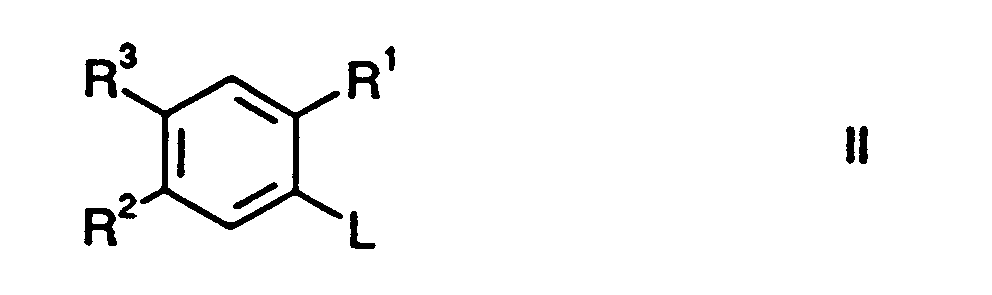 L CH₃, CH₂OH, CHO oder Phenyl bedeutet,durch Oxidation in eine Verbindung der Formel I überführt,
oder daß man eine Verbindung der Formel II, in der L CN bedeutet, durch Hydrolyse in eine Verbindung der Formel I überführt, oder daß man
eine Verbindung der Formel I aus einem ihrer funktionellen Derivate durch Behandeln mit einem solvolysierenden oder hydrogenolysierenden Mittel in Freiheit setzt, oder daß man
in eine Verbindung der Formel I, in der R² H bedeutet, die Methansulfonylgruppe durch Chlorsulfonierung, Reduktion und Methylierung einführt, oder daß man
ein Benzoesäurederivat, welches an sich der Formel I entspricht, worin jedoch ein Rest R¹, R² oder R³ fehlt; durch Alkylierung, Acylierung, Halogenierung oder Nitrierung in eine Verbindung der Formel I überführt, oder daß man
einen Rest R¹, R², R³ und/oder Q in einen anderen Rest R¹, R², R³ und/oder Q umwandelt, indem man- einen Ester der Formel I verseift, oder- eine Carbonsäure der Formel I verestert, in ein Anhydrid oder Säurehalogenid überführt oder in ein Acylguanidin überführt, oder- eine CN-Gruppe katalytisch hydriert, oder- eine Nitrilgruppierung zu einer Carbamoyl- oder einer Säuregruppe hydrolysiert, oder- eine Nitrilgruppe in eine Thiocarbamoylgruppe umwandelt,und/oder daß man- eine Verbindung der Formel I durch Behandeln mit einer Säure oder einer Base in eines ihrer Salze überführt. - Verfahren zur Herstellung einer pharmazeutischen Zubereitung, dadurch gekennzeichnet, daß man eine Verbindung der Formel I gemäß Anspruch 1 in der Q -N=C(NH₂)₂ bedeutet und/oder eines ihrer physiologisch unbedenklichen Salze zusammen mit mindestens einem festen, flüssigen oder halbflüssigen Träger- oder Hilfsstoff in eine geeignete Darreichungsform bringt.
- Pharmazeutische Zubereitung, gekennzeichnet durch einen Gehalt an mindestens einer Verbindung der Formel I, gemäß Anspruch 1, in der Q -N=C(NH₂)₂ bedeutet, und/oder einem ihrer physiologisch unbedenklichen Salze.
- Verwendung einer Verbindung der Formel I gemäß Anspruch 1, in der Q -N=C(NH₂)₂ bedeutet, und/oder eines ihrer physiologisch unbedenklichen Salze bei der Bekämpfung von Krankheiten.
- Verwendung einer Verbindung der Formel I gemäß Anspruch 1, in der Q -N=C(NH₂)₂ bedeutet, und/oder eines ihrer physiologisch unbedenklichen Salze zur Herstellung von Arzneimitteln.
- Verwendung von Verbindungen der Formel I nach Anspruch 1 in der Q -N=C(NH₂)₂ bedeutet, zur Herstellung von Arzneimitteln zur Behandlung von Arrhythmien, Angina pectoris, Infarkten sowie zur Präventiv-Behandlung der genannten Indikationen.
- Verwendung der Benzoesäurederivate der Formel I gemäß Anspruch 1 als Zwischenprodukte zur Herstellung von Wirkstoffen, die den zellulären Na⁺/H⁺-Antiport hemmen.
Applications Claiming Priority (2)
| Application Number | Priority Date | Filing Date | Title |
|---|---|---|---|
| DE4430212 | 1994-08-28 | ||
| DE4430212A DE4430212A1 (de) | 1994-08-28 | 1994-08-28 | Ortho-substituierte Benzoesäure-Derivate |
Publications (3)
| Publication Number | Publication Date |
|---|---|
| EP0704431A2 true EP0704431A2 (de) | 1996-04-03 |
| EP0704431A3 EP0704431A3 (de) | 1997-01-29 |
| EP0704431B1 EP0704431B1 (de) | 2000-05-24 |
Family
ID=6526569
Family Applications (1)
| Application Number | Title | Priority Date | Filing Date |
|---|---|---|---|
| EP95112998A Expired - Lifetime EP0704431B1 (de) | 1994-08-28 | 1995-08-18 | Ortho-substituierte Benzoesäurederivate |
Country Status (23)
| Country | Link |
|---|---|
| US (1) | US5849796A (de) |
| EP (1) | EP0704431B1 (de) |
| JP (1) | JPH0859602A (de) |
| KR (1) | KR100406686B1 (de) |
| CN (1) | CN1068587C (de) |
| AT (1) | ATE193282T1 (de) |
| AU (1) | AU703633B2 (de) |
| BR (1) | BR9503817A (de) |
| CA (1) | CA2156959A1 (de) |
| CZ (1) | CZ289492B6 (de) |
| DE (2) | DE4430212A1 (de) |
| DK (1) | DK0704431T3 (de) |
| ES (1) | ES2147810T3 (de) |
| GR (1) | GR3033989T3 (de) |
| HU (1) | HUT74946A (de) |
| NO (1) | NO305794B1 (de) |
| PL (1) | PL181183B1 (de) |
| PT (1) | PT704431E (de) |
| RU (1) | RU2125981C1 (de) |
| SK (1) | SK282202B6 (de) |
| TW (1) | TW406067B (de) |
| UA (1) | UA44238C2 (de) |
| ZA (1) | ZA957161B (de) |
Cited By (2)
| Publication number | Priority date | Publication date | Assignee | Title |
|---|---|---|---|---|
| EP0869116A1 (de) * | 1997-04-01 | 1998-10-07 | Hoechst Aktiengesellschaft | Ortho-substiuierte Benzoylguanidine, Verfahren zu ihrer Herstellung, ihre Verwendung als Medikament oder Diagnostikum sowie sie enthaltendes Medikament |
| WO2000066552A1 (de) * | 1999-04-28 | 2000-11-09 | Merck Patent Gmbh | Verfahren zur herstellung eines benzoylguanidinderivates |
Families Citing this family (15)
| Publication number | Priority date | Publication date | Assignee | Title |
|---|---|---|---|---|
| AU2001293555A1 (en) * | 2000-09-21 | 2002-04-02 | Novation Pharmaceuticals Inc. | Benzoic acid derivatives and uses thereof |
| NZ531153A (en) * | 2001-08-09 | 2005-10-28 | Ono Pharmaceutical Co | Carboxylic acid derivative compounds and drugs comprising these compounds as the active ingredient |
| US8980952B2 (en) * | 2002-03-20 | 2015-03-17 | University Of Maryland, Baltimore | Methods for treating brain swelling with a compound that blocks a non-selective cation channel |
| DK2438913T3 (da) * | 2002-03-20 | 2020-06-22 | Univ Maryland | Ikke-selektiv kationkanal i neurale celler og forbindelser, der blokerer kanalen, til anvendelse i behandling af opsvulmning af hjernen |
| AU2005287090A1 (en) * | 2004-09-18 | 2006-03-30 | Department Of Veterans Affairs | Therapeutic agents targeting the NCca-ATP channel and methods of use thereof |
| ATE486606T1 (de) * | 2004-09-18 | 2010-11-15 | Univ Maryland | Therapeutische mittel zum targeting des ncca-atp- kanals und verwendungsverfahren dafür |
| DK2395004T3 (en) * | 2005-06-22 | 2016-03-21 | Plexxikon Inc | Pyrrolo [2,3-b] pyridine derivatives as protein kinase inhibitors |
| WO2008089103A2 (en) | 2007-01-12 | 2008-07-24 | University Of Maryland, Baltimore | Targeting ncca-atp channel for organ protection following ischemic episode |
| WO2008098160A1 (en) * | 2007-02-09 | 2008-08-14 | University Of Maryland, Baltimore | Antagonists of a non-selective cation channel in neural cells |
| CA3065983C (en) | 2007-06-22 | 2022-07-26 | The United States Of America As Represented By The Department Of Veterans Affairs | Inhibitors of ncca-atp channels for therapy |
| LT6401B (lt) * | 2015-07-28 | 2017-06-12 | Vilniaus Universitetas | Karboanhidrazės selektyvūs inhibitoriai |
| CN105732357A (zh) * | 2016-03-23 | 2016-07-06 | 叶芳 | 2-氯-4氟苯甲酸及其制备方法 |
| CN106892852B (zh) * | 2017-03-21 | 2019-07-09 | 重庆医科大学 | 具有抗流感病毒活性的胍基类似物及其制备方法 |
| CN111116395B (zh) * | 2019-12-27 | 2023-04-07 | 湖北工业大学 | 多碘代芳香酸类化合物及其在抗腺病毒7型中的应用 |
| WO2025215115A1 (en) * | 2024-04-09 | 2025-10-16 | B&A Oncomedical | Compounds for use the treatment of cancer, neurodegenerative diseases, psychiatric disorders, inflammation, epilepsy and seizures |
Citations (1)
| Publication number | Priority date | Publication date | Assignee | Title |
|---|---|---|---|---|
| EP0416499A2 (de) | 1989-09-06 | 1991-03-13 | Hoechst Aktiengesellschaft | Benzoylguanidine, Verfahren zu ihrer Herstellung, ihre Verwendung als Medikament sowie sie enthaltendes Medikament |
Family Cites Families (7)
| Publication number | Priority date | Publication date | Assignee | Title |
|---|---|---|---|---|
| EP0556674B1 (de) * | 1992-02-15 | 1996-06-19 | Hoechst Aktiengesellschaft | 3,5-Substituierte Benzoylguanidine, mit antiarrythmischer Wirkung und inhibierender Wirkung auf die Proliferationen von Zellen |
| DK0556673T3 (da) * | 1992-02-15 | 1998-04-14 | Hoechst Ag | o-Substituerede benzoylguanidiner til behandling og profylakse af hjerterytmeforstyrrelser og iskæmisk inducerede skader samt til inhiberering af celleproliferation |
| ES2092729T3 (es) * | 1992-07-01 | 1996-12-01 | Hoechst Ag | Benzoilguanidinas 3,4,5-sustituidas, procedimiento para su preparacion, su empleo como medicamento o agente de diagnostico, asi como medicamento que las contiene. |
| DK0589336T3 (da) * | 1992-09-22 | 1997-06-16 | Hoechst Ag | Benzylguanidiner, fremgangsmåde til deres fremstilling samt deres anvendelse som antiarytmetika |
| TW250479B (de) * | 1992-12-15 | 1995-07-01 | Hoechst Ag | |
| DE4404183A1 (de) * | 1994-02-10 | 1995-08-17 | Merck Patent Gmbh | 4-Amino-1-piperidylbenzoylguanidine |
| DE4422685A1 (de) * | 1994-06-29 | 1996-01-04 | Hoechst Ag | Ortho-amino-substituierte Benzoylguanidine, Verfahren zu ihrer Herstellung, ihre Verwendung als Medikament oder Diagnostikum sowie sie enthaltendes Medikament |
-
1994
- 1994-08-28 DE DE4430212A patent/DE4430212A1/de not_active Withdrawn
-
1995
- 1995-07-25 TW TW084107705A patent/TW406067B/zh not_active IP Right Cessation
- 1995-08-18 ES ES95112998T patent/ES2147810T3/es not_active Expired - Lifetime
- 1995-08-18 PT PT95112998T patent/PT704431E/pt unknown
- 1995-08-18 AT AT95112998T patent/ATE193282T1/de not_active IP Right Cessation
- 1995-08-18 DK DK95112998T patent/DK0704431T3/da active
- 1995-08-18 EP EP95112998A patent/EP0704431B1/de not_active Expired - Lifetime
- 1995-08-18 DE DE59508383T patent/DE59508383D1/de not_active Expired - Fee Related
- 1995-08-21 AU AU30145/95A patent/AU703633B2/en not_active Ceased
- 1995-08-23 UA UA95083919A patent/UA44238C2/uk unknown
- 1995-08-25 ZA ZA957161A patent/ZA957161B/xx unknown
- 1995-08-25 PL PL95310192A patent/PL181183B1/pl not_active IP Right Cessation
- 1995-08-25 SK SK1054-95A patent/SK282202B6/sk unknown
- 1995-08-25 NO NO953352A patent/NO305794B1/no not_active IP Right Cessation
- 1995-08-25 CZ CZ19952181A patent/CZ289492B6/cs not_active IP Right Cessation
- 1995-08-25 CA CA002156959A patent/CA2156959A1/en not_active Abandoned
- 1995-08-25 CN CN95116623A patent/CN1068587C/zh not_active Expired - Fee Related
- 1995-08-25 HU HU9502500A patent/HUT74946A/hu unknown
- 1995-08-25 RU RU95114389/04A patent/RU2125981C1/ru not_active IP Right Cessation
- 1995-08-28 US US08/520,340 patent/US5849796A/en not_active Expired - Fee Related
- 1995-08-28 KR KR1019950026798A patent/KR100406686B1/ko not_active Expired - Fee Related
- 1995-08-28 BR BR9503817A patent/BR9503817A/pt not_active IP Right Cessation
- 1995-08-28 JP JP7240500A patent/JPH0859602A/ja active Pending
-
2000
- 2000-07-21 GR GR20000401675T patent/GR3033989T3/el not_active IP Right Cessation
Patent Citations (1)
| Publication number | Priority date | Publication date | Assignee | Title |
|---|---|---|---|---|
| EP0416499A2 (de) | 1989-09-06 | 1991-03-13 | Hoechst Aktiengesellschaft | Benzoylguanidine, Verfahren zu ihrer Herstellung, ihre Verwendung als Medikament sowie sie enthaltendes Medikament |
Non-Patent Citations (4)
| Title |
|---|
| COUNILLON L. ET AL., MOL. PHARMACOL., vol. 44, 1993, pages 1041 - 1045 |
| DUESING ET AL., MED. KLIN., vol. 87, 1992, pages 378 - 384 |
| ESCOBALES N., FIGUEROA J., J. MEMBRANE BIOL., vol. 120, 1991, pages 41 - 49 |
| MARCH J.: "Adv. Org. Chem.", 1985, JOHN WILEY & SONS. |
Cited By (3)
| Publication number | Priority date | Publication date | Assignee | Title |
|---|---|---|---|---|
| EP0869116A1 (de) * | 1997-04-01 | 1998-10-07 | Hoechst Aktiengesellschaft | Ortho-substiuierte Benzoylguanidine, Verfahren zu ihrer Herstellung, ihre Verwendung als Medikament oder Diagnostikum sowie sie enthaltendes Medikament |
| US6075054A (en) * | 1997-04-01 | 2000-06-13 | Hoechst Aktiengesellschaft | Ortho-substituted benzoylguanidines, process for their preparation, their use as a medicament or diagnostic, and medicament comprising them |
| WO2000066552A1 (de) * | 1999-04-28 | 2000-11-09 | Merck Patent Gmbh | Verfahren zur herstellung eines benzoylguanidinderivates |
Also Published As
| Publication number | Publication date |
|---|---|
| CN1068587C (zh) | 2001-07-18 |
| PT704431E (pt) | 2000-10-31 |
| HUT74946A (en) | 1997-03-28 |
| ATE193282T1 (de) | 2000-06-15 |
| CA2156959A1 (en) | 1996-03-01 |
| AU3014595A (en) | 1996-03-14 |
| UA44238C2 (uk) | 2002-02-15 |
| ES2147810T3 (es) | 2000-10-01 |
| RU2125981C1 (ru) | 1999-02-10 |
| DE59508383D1 (de) | 2000-06-29 |
| ZA957161B (en) | 1996-04-17 |
| EP0704431A3 (de) | 1997-01-29 |
| BR9503817A (pt) | 1996-04-16 |
| HU9502500D0 (en) | 1995-10-30 |
| SK282202B6 (sk) | 2001-12-03 |
| KR100406686B1 (ko) | 2004-07-19 |
| AU703633B2 (en) | 1999-03-25 |
| CZ218195A3 (en) | 1996-03-13 |
| EP0704431B1 (de) | 2000-05-24 |
| PL310192A1 (en) | 1996-03-04 |
| CN1125722A (zh) | 1996-07-03 |
| PL181183B1 (pl) | 2001-06-29 |
| NO953352L (no) | 1996-02-29 |
| KR960007539A (ko) | 1996-03-22 |
| DK0704431T3 (da) | 2000-09-11 |
| TW406067B (en) | 2000-09-21 |
| SK105495A3 (en) | 1996-03-06 |
| JPH0859602A (ja) | 1996-03-05 |
| NO305794B1 (no) | 1999-07-26 |
| DE4430212A1 (de) | 1996-02-29 |
| CZ289492B6 (cs) | 2002-02-13 |
| GR3033989T3 (en) | 2000-11-30 |
| US5849796A (en) | 1998-12-15 |
| NO953352D0 (no) | 1995-08-25 |
Similar Documents
| Publication | Publication Date | Title |
|---|---|---|
| EP0667341B1 (de) | 4-Amino-1-piperidylbenzoylguanidine als Na+/H+-antiporter Inhibitoren | |
| EP0699666B1 (de) | Heterocyclyl-benzoylguanidine | |
| DE4430212A1 (de) | Ortho-substituierte Benzoesäure-Derivate | |
| DE4344550A1 (de) | Substituierte 1-Oxo-1,2-dihydro-isochinolinoyl- und 1,1-Dioxo-2H-1,2-benzothiazinoylguanidine, Verfahrenzu ihrer Herstellung, ihre Verwendung als Medikamentt oder Diagnostikum sowie sie enthaltendes Medikamen | |
| EP0903339B1 (de) | Biphenylsulfonylcyanamide, Verfahren zu ihrer Herstellung und ihre Verwendung als Medikament | |
| EP0699660B1 (de) | Arylbenzoylguanidine | |
| EP0758644B1 (de) | Sulfonyl- oder Sulfinyl-benzoyl-guanidin-Derivate | |
| EP0743301B1 (de) | Fluorhaltige Benzoylguanidine | |
| EP0699663B1 (de) | Alkyl-benzoylguanidin-Derivate | |
| DE3049959C2 (de) | ||
| EP0760365B1 (de) | Alkenyl-Benzoylguanidine | |
| EP0708088B1 (de) | Alkyl-5-methylsulfonyl-benzoyl-guanidin-Derivate | |
| EP0723963B1 (de) | 4-Amino-benzoylguanidin-Derivate | |
| DE19526381A1 (de) | 4-Fluoralkyl-substituierte Benzoylguanidine, Verfahren zu ihrer Herstellung, ihre Verwendung als Medikament oder Diagnostikum sowie sie enthaltendes Medikament | |
| EP0694537B1 (de) | 1,6-Dihydro-6-oxo-3-pyridazinyloxy-benzoylguanidin-Derivate, deren Herstellung und deren Verwendung als Inhibitoren des zellulären Na+/H+-Antiporters | |
| EP1999113B1 (de) | Substituierte 1-amino-4-phenyl-dihydroisochinoline, verfahren zu ihrer herstellung, ihre verwendung als medikament, sowie sie enthaltendes medikament | |
| EP0725062B1 (de) | 4-Mercapto-benzoylguanidin-Derivate | |
| DE19548708A1 (de) | Cyclische Sulfone |
Legal Events
| Date | Code | Title | Description |
|---|---|---|---|
| PUAI | Public reference made under article 153(3) epc to a published international application that has entered the european phase |
Free format text: ORIGINAL CODE: 0009012 |
|
| AK | Designated contracting states |
Kind code of ref document: A2 Designated state(s): AT BE CH DE DK ES FR GB GR IE IT LI LU NL PT SE |
|
| PUAL | Search report despatched |
Free format text: ORIGINAL CODE: 0009013 |
|
| AK | Designated contracting states |
Kind code of ref document: A3 Designated state(s): AT BE CH DE DK ES FR GB GR IE IT LI LU NL PT SE |
|
| 17P | Request for examination filed |
Effective date: 19970625 |
|
| 17Q | First examination report despatched |
Effective date: 19980617 |
|
| GRAG | Despatch of communication of intention to grant |
Free format text: ORIGINAL CODE: EPIDOS AGRA |
|
| GRAG | Despatch of communication of intention to grant |
Free format text: ORIGINAL CODE: EPIDOS AGRA |
|
| GRAH | Despatch of communication of intention to grant a patent |
Free format text: ORIGINAL CODE: EPIDOS IGRA |
|
| GRAH | Despatch of communication of intention to grant a patent |
Free format text: ORIGINAL CODE: EPIDOS IGRA |
|
| GRAA | (expected) grant |
Free format text: ORIGINAL CODE: 0009210 |
|
| AK | Designated contracting states |
Kind code of ref document: B1 Designated state(s): AT BE CH DE DK ES FR GB GR IE IT LI LU NL PT SE |
|
| REF | Corresponds to: |
Ref document number: 193282 Country of ref document: AT Date of ref document: 20000615 Kind code of ref document: T |
|
| REG | Reference to a national code |
Ref country code: CH Ref legal event code: EP |
|
| REG | Reference to a national code |
Ref country code: IE Ref legal event code: FG4D Free format text: GERMAN |
|
| REF | Corresponds to: |
Ref document number: 59508383 Country of ref document: DE Date of ref document: 20000629 |
|
| GBT | Gb: translation of ep patent filed (gb section 77(6)(a)/1977) |
Effective date: 20000626 |
|
| ITF | It: translation for a ep patent filed | ||
| ET | Fr: translation filed | ||
| REG | Reference to a national code |
Ref country code: DK Ref legal event code: T3 |
|
| REG | Reference to a national code |
Ref country code: ES Ref legal event code: FG2A Ref document number: 2147810 Country of ref document: ES Kind code of ref document: T3 |
|
| REG | Reference to a national code |
Ref country code: PT Ref legal event code: SC4A Free format text: AVAILABILITY OF NATIONAL TRANSLATION Effective date: 20000731 |
|
| PLBE | No opposition filed within time limit |
Free format text: ORIGINAL CODE: 0009261 |
|
| STAA | Information on the status of an ep patent application or granted ep patent |
Free format text: STATUS: NO OPPOSITION FILED WITHIN TIME LIMIT |
|
| 26N | No opposition filed | ||
| REG | Reference to a national code |
Ref country code: GB Ref legal event code: IF02 |
|
| PGFP | Annual fee paid to national office [announced via postgrant information from national office to epo] |
Ref country code: NL Payment date: 20040803 Year of fee payment: 10 |
|
| PGFP | Annual fee paid to national office [announced via postgrant information from national office to epo] |
Ref country code: SE Payment date: 20040806 Year of fee payment: 10 |
|
| PGFP | Annual fee paid to national office [announced via postgrant information from national office to epo] |
Ref country code: FR Payment date: 20040810 Year of fee payment: 10 |
|
| PGFP | Annual fee paid to national office [announced via postgrant information from national office to epo] |
Ref country code: IE Payment date: 20040811 Year of fee payment: 10 Ref country code: AT Payment date: 20040811 Year of fee payment: 10 |
|
| PGFP | Annual fee paid to national office [announced via postgrant information from national office to epo] |
Ref country code: DK Payment date: 20040813 Year of fee payment: 10 |
|
| PGFP | Annual fee paid to national office [announced via postgrant information from national office to epo] |
Ref country code: PT Payment date: 20040818 Year of fee payment: 10 Ref country code: GB Payment date: 20040818 Year of fee payment: 10 Ref country code: CH Payment date: 20040818 Year of fee payment: 10 |
|
| PGFP | Annual fee paid to national office [announced via postgrant information from national office to epo] |
Ref country code: LU Payment date: 20040824 Year of fee payment: 10 |
|
| PGFP | Annual fee paid to national office [announced via postgrant information from national office to epo] |
Ref country code: ES Payment date: 20040825 Year of fee payment: 10 |
|
| PGFP | Annual fee paid to national office [announced via postgrant information from national office to epo] |
Ref country code: DE Payment date: 20040826 Year of fee payment: 10 |
|
| PGFP | Annual fee paid to national office [announced via postgrant information from national office to epo] |
Ref country code: GR Payment date: 20040827 Year of fee payment: 10 |
|
| PGFP | Annual fee paid to national office [announced via postgrant information from national office to epo] |
Ref country code: BE Payment date: 20041020 Year of fee payment: 10 |
|
| PG25 | Lapsed in a contracting state [announced via postgrant information from national office to epo] |
Ref country code: LU Free format text: LAPSE BECAUSE OF NON-PAYMENT OF DUE FEES Effective date: 20050818 Ref country code: IT Free format text: LAPSE BECAUSE OF NON-PAYMENT OF DUE FEES Effective date: 20050818 Ref country code: GB Free format text: LAPSE BECAUSE OF NON-PAYMENT OF DUE FEES Effective date: 20050818 Ref country code: AT Free format text: LAPSE BECAUSE OF NON-PAYMENT OF DUE FEES Effective date: 20050818 |
|
| PG25 | Lapsed in a contracting state [announced via postgrant information from national office to epo] |
Ref country code: SE Free format text: LAPSE BECAUSE OF NON-PAYMENT OF DUE FEES Effective date: 20050819 Ref country code: ES Free format text: LAPSE BECAUSE OF NON-PAYMENT OF DUE FEES Effective date: 20050819 |
|
| PG25 | Lapsed in a contracting state [announced via postgrant information from national office to epo] |
Ref country code: LI Free format text: LAPSE BECAUSE OF NON-PAYMENT OF DUE FEES Effective date: 20050831 Ref country code: DK Free format text: LAPSE BECAUSE OF NON-PAYMENT OF DUE FEES Effective date: 20050831 Ref country code: CH Free format text: LAPSE BECAUSE OF NON-PAYMENT OF DUE FEES Effective date: 20050831 Ref country code: BE Free format text: LAPSE BECAUSE OF NON-PAYMENT OF DUE FEES Effective date: 20050831 |
|
| PG25 | Lapsed in a contracting state [announced via postgrant information from national office to epo] |
Ref country code: PT Free format text: LAPSE BECAUSE OF NON-PAYMENT OF DUE FEES Effective date: 20060220 |
|
| PG25 | Lapsed in a contracting state [announced via postgrant information from national office to epo] |
Ref country code: NL Free format text: LAPSE BECAUSE OF NON-PAYMENT OF DUE FEES Effective date: 20060301 Ref country code: DE Free format text: LAPSE BECAUSE OF NON-PAYMENT OF DUE FEES Effective date: 20060301 |
|
| PG25 | Lapsed in a contracting state [announced via postgrant information from national office to epo] |
Ref country code: GR Free format text: LAPSE BECAUSE OF NON-PAYMENT OF DUE FEES Effective date: 20060302 |
|
| REG | Reference to a national code |
Ref country code: CH Ref legal event code: PL |
|
| REG | Reference to a national code |
Ref country code: DK Ref legal event code: EBP |
|
| EUG | Se: european patent has lapsed | ||
| GBPC | Gb: european patent ceased through non-payment of renewal fee |
Effective date: 20050818 |
|
| PG25 | Lapsed in a contracting state [announced via postgrant information from national office to epo] |
Ref country code: FR Free format text: LAPSE BECAUSE OF NON-PAYMENT OF DUE FEES Effective date: 20060428 |
|
| NLV4 | Nl: lapsed or anulled due to non-payment of the annual fee |
Effective date: 20060301 |
|
| REG | Reference to a national code |
Ref country code: IE Ref legal event code: MM4A |
|
| REG | Reference to a national code |
Ref country code: FR Ref legal event code: ST Effective date: 20060428 |
|
| REG | Reference to a national code |
Ref country code: ES Ref legal event code: FD2A Effective date: 20050819 |
|
| BERE | Be: lapsed |
Owner name: *MERCK PATENT G.M.B.H. Effective date: 20050831 |