EP0700306B1 - Absorbent articles - Google Patents
Absorbent articles Download PDFInfo
- Publication number
- EP0700306B1 EP0700306B1 EP19950912485 EP95912485A EP0700306B1 EP 0700306 B1 EP0700306 B1 EP 0700306B1 EP 19950912485 EP19950912485 EP 19950912485 EP 95912485 A EP95912485 A EP 95912485A EP 0700306 B1 EP0700306 B1 EP 0700306B1
- Authority
- EP
- European Patent Office
- Prior art keywords
- sheet
- weight
- crystalline polyolefin
- polypropylene
- absorbent article
- Prior art date
- Legal status (The legal status is an assumption and is not a legal conclusion. Google has not performed a legal analysis and makes no representation as to the accuracy of the status listed.)
- Expired - Lifetime
Links
Images
Classifications
-
- A—HUMAN NECESSITIES
- A61—MEDICAL OR VETERINARY SCIENCE; HYGIENE
- A61F—FILTERS IMPLANTABLE INTO BLOOD VESSELS; PROSTHESES; DEVICES PROVIDING PATENCY TO, OR PREVENTING COLLAPSING OF, TUBULAR STRUCTURES OF THE BODY, e.g. STENTS; ORTHOPAEDIC, NURSING OR CONTRACEPTIVE DEVICES; FOMENTATION; TREATMENT OR PROTECTION OF EYES OR EARS; BANDAGES, DRESSINGS OR ABSORBENT PADS; FIRST-AID KITS
- A61F13/00—Bandages or dressings; Absorbent pads
- A61F13/15—Absorbent pads, e.g. sanitary towels, swabs or tampons for external or internal application to the body; Supporting or fastening means therefor; Tampon applicators
- A61F13/51—Absorbent pads, e.g. sanitary towels, swabs or tampons for external or internal application to the body; Supporting or fastening means therefor; Tampon applicators characterised by the outer layers of the pads
- A61F13/514—Backsheet, i.e. the impermeable cover or layer furthest from the skin
- A61F13/51401—Backsheet, i.e. the impermeable cover or layer furthest from the skin characterised by the material
-
- A—HUMAN NECESSITIES
- A61—MEDICAL OR VETERINARY SCIENCE; HYGIENE
- A61L—METHODS OR APPARATUS FOR STERILISING MATERIALS OR OBJECTS IN GENERAL; DISINFECTION, STERILISATION OR DEODORISATION OF AIR; CHEMICAL ASPECTS OF BANDAGES, DRESSINGS, ABSORBENT PADS OR SURGICAL ARTICLES; MATERIALS FOR BANDAGES, DRESSINGS, ABSORBENT PADS OR SURGICAL ARTICLES
- A61L15/00—Chemical aspects of, or use of materials for, bandages, dressings or absorbent pads
- A61L15/16—Bandages, dressings or absorbent pads for physiological fluids such as urine or blood, e.g. sanitary towels, tampons
- A61L15/22—Bandages, dressings or absorbent pads for physiological fluids such as urine or blood, e.g. sanitary towels, tampons containing macromolecular materials
- A61L15/24—Macromolecular compounds obtained by reactions only involving carbon-to-carbon unsaturated bonds; Derivatives thereof
-
- C—CHEMISTRY; METALLURGY
- C08—ORGANIC MACROMOLECULAR COMPOUNDS; THEIR PREPARATION OR CHEMICAL WORKING-UP; COMPOSITIONS BASED THEREON
- C08L—COMPOSITIONS OF MACROMOLECULAR COMPOUNDS
- C08L23/00—Compositions of homopolymers or copolymers of unsaturated aliphatic hydrocarbons having only one carbon-to-carbon double bond; Compositions of derivatives of such polymers
- C08L23/02—Compositions of homopolymers or copolymers of unsaturated aliphatic hydrocarbons having only one carbon-to-carbon double bond; Compositions of derivatives of such polymers not modified by chemical after-treatment
- C08L23/10—Homopolymers or copolymers of propene
-
- Y—GENERAL TAGGING OF NEW TECHNOLOGICAL DEVELOPMENTS; GENERAL TAGGING OF CROSS-SECTIONAL TECHNOLOGIES SPANNING OVER SEVERAL SECTIONS OF THE IPC; TECHNICAL SUBJECTS COVERED BY FORMER USPC CROSS-REFERENCE ART COLLECTIONS [XRACs] AND DIGESTS
- Y10—TECHNICAL SUBJECTS COVERED BY FORMER USPC
- Y10T—TECHNICAL SUBJECTS COVERED BY FORMER US CLASSIFICATION
- Y10T428/00—Stock material or miscellaneous articles
- Y10T428/249921—Web or sheet containing structurally defined element or component
- Y10T428/249953—Composite having voids in a component [e.g., porous, cellular, etc.]
- Y10T428/249978—Voids specified as micro
- Y10T428/24998—Composite has more than two layers
-
- Y—GENERAL TAGGING OF NEW TECHNOLOGICAL DEVELOPMENTS; GENERAL TAGGING OF CROSS-SECTIONAL TECHNOLOGIES SPANNING OVER SEVERAL SECTIONS OF THE IPC; TECHNICAL SUBJECTS COVERED BY FORMER USPC CROSS-REFERENCE ART COLLECTIONS [XRACs] AND DIGESTS
- Y10—TECHNICAL SUBJECTS COVERED BY FORMER USPC
- Y10T—TECHNICAL SUBJECTS COVERED BY FORMER US CLASSIFICATION
- Y10T442/00—Fabric [woven, knitted, or nonwoven textile or cloth, etc.]
- Y10T442/60—Nonwoven fabric [i.e., nonwoven strand or fiber material]
- Y10T442/647—Including a foamed layer or component
-
- Y—GENERAL TAGGING OF NEW TECHNOLOGICAL DEVELOPMENTS; GENERAL TAGGING OF CROSS-SECTIONAL TECHNOLOGIES SPANNING OVER SEVERAL SECTIONS OF THE IPC; TECHNICAL SUBJECTS COVERED BY FORMER USPC CROSS-REFERENCE ART COLLECTIONS [XRACs] AND DIGESTS
- Y10—TECHNICAL SUBJECTS COVERED BY FORMER USPC
- Y10T—TECHNICAL SUBJECTS COVERED BY FORMER US CLASSIFICATION
- Y10T442/00—Fabric [woven, knitted, or nonwoven textile or cloth, etc.]
- Y10T442/60—Nonwoven fabric [i.e., nonwoven strand or fiber material]
- Y10T442/647—Including a foamed layer or component
- Y10T442/651—Plural fabric layers
-
- Y—GENERAL TAGGING OF NEW TECHNOLOGICAL DEVELOPMENTS; GENERAL TAGGING OF CROSS-SECTIONAL TECHNOLOGIES SPANNING OVER SEVERAL SECTIONS OF THE IPC; TECHNICAL SUBJECTS COVERED BY FORMER USPC CROSS-REFERENCE ART COLLECTIONS [XRACs] AND DIGESTS
- Y10—TECHNICAL SUBJECTS COVERED BY FORMER USPC
- Y10T—TECHNICAL SUBJECTS COVERED BY FORMER US CLASSIFICATION
- Y10T442/00—Fabric [woven, knitted, or nonwoven textile or cloth, etc.]
- Y10T442/60—Nonwoven fabric [i.e., nonwoven strand or fiber material]
- Y10T442/674—Nonwoven fabric with a preformed polymeric film or sheet
- Y10T442/678—Olefin polymer or copolymer sheet or film [e.g., polypropylene, polyethylene, ethylene-butylene copolymer, etc.]
Definitions
- This invention relates to an absorbent article. More particularly, it relates to an absorbent article comprising a porous sheet which exhibits excellent tensile strength and high molding productivity as well as excellent moisture permeability and resistance to water pressure.
- Porous sheets for absorbent articles have conventionally been produced by a process comprising molding a molten mixture of a polyolefin, such as polyethylene or polypropylene, and 40% by weight or more of an inorganic filler into a sheet and monoaxially or biaxially stretching the resulting sheet.
- a polyolefin such as polyethylene or polypropylene
- Porous sheets obtained by the above process are excellent in air- and moisture-permeability and cause no moisture condensation and are therefore useful as wall paper and wrapping paper. Addition of softness to these excellent properties makes the porous sheet suitable for use as an element of absorbent articles such as a back sheet of disposable diapers.
- the conventional porous sheet has the following disadvantages for use as an element of absorbent articles such as disposal diapers.
- commonly employed disposal diapers are fabricated from an absorbent member for absorbing excreta such as urine, a topsheet which covers the surface of the absorbent member and is directly applied to the skin, and a back sheet which covers the back side of the absorbent member and prevents leakage, these three parts being adhered together into a unitary body.
- the top and bottom ends and side edges of the diaper corresponding to the waist portion and a crotch portion are made stretchable for tight-fit to prevent leakage.
- the disposable diapers also have a fastening means such as tapes, with which the diaper is fitted to a wearer's body in use.
- the above-mentioned porous sheet is used as the back sheet.
- the above-mentioned tapes provided for fastening mostly have a width of about 25 to 35 mm for convenience of handling.
- fastening tapes when the fastening tape is unfastened to adjust the position of the diaper for a better fit or to see if urine has been discharged or not, the tape cannot be peeled without tearing the soft back sheet due to lack of strength. This being the case, the diaper must be changed with a new one.
- landing tapes many problems are posed by the use of landing tapes. That is, the kinds of diaper constituting members and processes of production of diapers increase. A landing tape is more costly than any other diaper constituting members, so that use of the landing tape with a sufficient width increases the cost. In addition, even with a wide landing tape, cases are sometimes met with depending on the body size of a wearer, in which a fastening tape is adhered to the back sheet outside the landing tape area and cannot be stripped off.
- Japanese Patent Application Laid-open 5-98057 discloses a high strength porous sheet obtained by blow molding a composition comprising a specific polyolefin, a filler, a specific plasticizer and a radical generator, and monoaxially stretching the blown film in the machine direction.
- the sheet disclosed has nearly twice as much strength as a porous sheet obtained by a conventional process (a molten mixture of a polyolefin and an inorganic filler is molded into a sheet followed by stretching), such a degree of improvement is still insufficient for eliminating the necessity of landing tapes.
- the radical generator makes melt flow properties of the molded resin composition different from those of the composition before molding, it is difficult to recycle inevitably produced in the course of the production, resulting in reduced productivity.
- Japanese Patent Application Laid-open 5-38011 (corresponding to USP 4,539,256) discloses a microporous sheet obtained by a process comprising melt-blending a specific crystallizable polymer and a specific compound miscible with that polymer, molding the mixture into a sheet, causing phase separation to occur during a cooling step, and stretching the resulting sheeting.
- the microporous sheet disclosed has two or three times as high strength as a sheet obtained by the conventional process (a molten mixture of a polyolefin and an inorganic filler is molded into a sheet followed by stretching), the strength still does not reach a sufficient level for making landing tapes needless.
- a porous sheet withstanding removal of a fastening tape therefrom is required to have at least 4 times, preferably 5 times, as high strength as a porous sheet obtained by the conventional process.
- the process for producing a microporous sheet as disclosed in the above patent involves problems that scattering of the compound miscible with the crystallizable polymer causes pollution of the working environment, and that wear of a screw and scorching of the polymer are likely to occur, so that the molding should be suspended occasionally for the molding machine to be taken apart and cleaned, resulting in poor industrial productivity.
- An object of the present invention is to provide an absorbent article such as a disposable diaper comprising a porous sheet as a back sheet, in which the porous sheet exhibits markedly excellent tensile strength as well as moisture permeability and resistance to water pressure and can be produced at high productivity so that the diaper is inexpensive and easy to use. That is, the diaper can be fastened by adhering a fastening tape to any position of the back sheet regardless of the body size of a wearer with no need of providing a landing tape.
- the present invention provides an absorbent article comprising a liquid permeable topsheet, a liquid impermeable back sheet and an absorbent member interposed between said topsheet and said back sheet, said absorbent article being characterized in that:
- the absorbent article of the present invention is characterized by having the above-described porous sheet as a back sheet.
- the crystalline polyolefin which is used in the porous sheet is polypropylene having a weight average molecular weight (Mw) to number average molecular weight (Mn) ratio (Mw/Mn) of more than 6.0, preferably more than 6.3.
- An Mw/Mn ratio is a measure of molecular weight distribution. As long as the Mw/Mn ratio of the polypropylene is more than 6.0, when the polypropylene is melt-blended with, for example, not less than 20% by weight of the above-mentioned compound such as mineral oil, the mineral oil rapidly dissolves in the polypropylene so that they can be mixed in a stable manner.
- the polypropylene exhibits instable dissolving properties with respect to the aforesaid compound such as mineral oil. This being the case, it is difficult to mix the polypropylene and the mineral oil at a prescribed mixing ratio. Additionally, in using a twin-screw extruder, a vent-up phenomenon occurs, and mixing cannot be effected smoothly, failing to perform extrusion stably.
- the polypropylene having the above-specified molecular weight distribution can easily be obtained by polymerizing propylene in multiple stages in the presence of a prescribed catalyst.
- an organoaluminum compound or a reaction product of an organoaluminum compound and ethyl ether is reacted with titanium tetrachloride to obtain a solid reaction product, which is further reacted with ethyl ether and titanium tetrachloride to obtain a solid reaction product.
- the resulting solid reaction product is combined with an organoaluminum compound and an aromatic carboxylic acid ester (a) to prepare a catalyst system having an aromatic carboxylic acid ester (a) to solid reaction product (b) molar ratio (a/b) of 0.1 to 10.0.
- the above-described polypropylene can easily be obtained by a multi-stage polymerization process in the presence of the thus prepared catalyst system in such a manner, for example, that 35 to 65% by weight of the total polymer is produced in the first stage and the balance, 35 to 65% by weight, is produced in the second and following stages.
- the polypropylene preferably has a weight average molecular weight between 300,000 and 600,000 and a melting point between 155° C and 170° C.
- the polypropylene may be any of a homopolymer, a block copolymer or a random copolymer, or a mixture of two or more thereof. As long as the effects of the present invention are not impaired, the polypropylene may be used in combination with other polymers such as polyethylene.
- the polypropylene satisfies the relationship: 1.00 ⁇ P ⁇ 0.015 log MI + 0.955, wherein P is an isotactic pendant content; and MI is a melt index.
- the isotactic pendant content (P) is indicative of crystallinity of polypropylene.
- the polypropylene exhibits high crystallinity and improved rigidity. If P is less than 0.015 log MI + 0.955, the polypropylene has reduced rigidity so that the porous sheet may have to have a large thickness for assuring rigidity necessary as a back sheet, which leads to an increase of cost.
- the MI of the polypropylene preferably ranges from 0.03 to 2.0 g/10 min.
- the molten polymer needs increased power in granulation or molding because of its poor fluidity, which is not only uneconomical but hinders speeding up of production. If it exceeds 2.0, the molten resin has reduced tension. It follows that, for example, a tubular film of the polypropylene is hard to lift in blown film extrusion, and sheeting becomes instable.
- the polypropylene satisfying the above relationship can be prepared by, for example, the process disclosed in Japanese Patent Publication 64-5051, p. 7, col. 13, 1. 44 to p. 8, col. 15, 1. 9.
- the compound which is used in the porous sheet is a compound with which said crystalline polyolefin is miscible and in which said crystalline polyolefin will dissolve at or above the melting point of said crystalline polyolefin but which will phase separate below the melting point of said crystalline polyolefin.
- the compound is not particularly limited as long as it possesses the above-mentioned characteristics.
- Suitable examples include mineral oils such as liquid paraffin, synthetic lubricating oils, dioctyl phthalate, diethyl phthalate, triethylene glycol, dibutyl phthalate, and esters of phthalic acid, trimellitic acid, pyromellitic acid and/or an aliphatic polybasic carboxylic acid and an alkyl alcohol.
- the porous sheet to be used in the present invention is a porous sheet obtainable by preparing, by melt blending, a melt blended solution comprising 30 to 90 par by weight, preferably 60 to 80 parts by weight, of a crystalline polyolefin and 10 to 70 parts by weight,preferably 20 to 40 parts by weight, of the compound, molding the melt blended solution into a sheet, and stretching the sheet at least in one direction.
- the stretched sheet obtained has poor fabricability due to shortage of the matrix resin and, when rolled, undergoes collapse of fine pores or bleeding of the compound, such as mineral oil. If it exceeds 90 parts by weight, fine pores affording moisture permeability cannot be formed by stretching.
- the temperature suitable for melt blending is at or above the melting point of the crystalline polyolefin, preferably ranging from 180 to 250 °C.
- Melt blending for preparing a melt blended solution can be carried out in a twin-screw extruder. Polypropylene pellets are fed into a hopper in an constant amount, while the compound is fed into the vent of the twin-screw extruder.
- the melt blended solution is preferably once cooled to prepare pellets of the blend.
- the pellets are blow molded by extrusion through a circular die of a single-screw extruder, or the pellets is blow molded by extrusion through a circular die connected to the tip of a twin-screw extruder via a gear pump.
- the following additives may be added to the melt blended solution in the amounts described below, all based on the total melt blended solution, if desired.
- the nucleating agent masterbatch is a pelletized mixture prepared by mixing a nucleating agent and a resin, such as polypropylene or polyethylene, with a solvent.
- Stretching of the sheet is preferably conducted at a stretching temperature of 10 to 80°C to a stretching ratio of 1.2 to 3 either monoaxially or biaxially.
- the micro pores formed on stretching preferably have a pore size of 0.05 to 1 ⁇ m.
- the porous sheet preferably has a density of 0.7 to 0.85 g/cm 3 , a basis weight of 10 to 60 g/m 2 , and a thickness of 20 to 70 ⁇ m.
- the method for obtaining the porous sheet of the present invention will be illustrated by way of a specific example, molding method (1).
- the melt blended solution comprising polypropylene and the compound at a prescribed ratio and, if desired, various additives is extruded by a twin-screw extruder (diameter: 45 mm; L/D: 33.5) at 230 °C into strands, cooled in a water bath, and pelletized by an pelletizer to prepare compounded pellets.
- the polypropylene is fed into a hopper, while the compound is fed into the middle part of the extruder by means of a diaphragm pump.
- the compounded pellets are fed into an air cooling type blown-film extrusion machine, extruded from a circular die having a diameter of 200 mm at 210°C, and cooled by air at 20°C blown from an air ring while being taken up at a take-up speed of 6 m/min to obtain a blown tube having a blow-up ratio of 2, a flat width of about 630 mm, and a thickness of about 50 ⁇ m.
- a nucleating agent is added, a nucleating agent masterbatch and polypropylene are previously dry blended at a prescribed ratio and fed into the blown-film extrusion machine.
- the resulting sheet is monoaxially stretched in the machine direction at 50 °C at a stretching ratio of 1.5 by means of a roller stretcher and subjected to annealing at 120 °C to obtain a porous sheet.
- the resulting porous sheet has a thickness of about 40 ⁇ m.
- the thus obtained porous sheet preferably has a moisture permeability of 0.5 to 4.0 g/100 cm 2 ⁇ hr.
- the porous sheet preferably has a yield strength (the stress at the yield point in the stress-strain curve in a tensile measurement) of 90 to 180 kgf/cm 2 provided that the yield strength is measured in the direction (MD or CD) which exhibits lower yield strength.
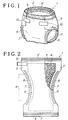
- Fig. 1 is a perspective view of a disposable diaper as one embodiment of the absorbent article of the present invention.
- Fig. 2 is a perspective view of the disposable diaper shown in Fig. 1 in an unfolded condition and having a part thereof cut away.
- the disposable diaper shown in Figs. 1 and 2 comprises a liquid permeable topsheet 2, liquid impermeable back sheet 3 and an absorbent member 4 interposed between the topsheet 2 and the back sheet 3, in which back sheet 3 comprises the above-mentioned porous sheet.
- rear waist area 5', front waist area 5, crotch area 9, and side flaps 8 of the disposable diaper are fabricated from topsheet 2, back sheet 3, and absorbent member 4, each having an hourglass shape.
- Elastic members 7 are provided between topsheet 2 and back sheet 3 in front waist area 5, rear waist area 5', and side flaps 8, respectively.
- a pair of tape fasteners 10 are provided on both edges of rear waist area 5', thereby enhancing the function and performance of the diaper.
- the disposable diaper is constituted such that it has longitudinal sides and that the topsheet 2 is almost the same as the back sheet in width and length.
- the topsheet 2 is usually fabricated from nonwoven fabric having a basis weight of, for example, 15 to 40 g/m 2 . As far as liquid permeable, a film, a net or the like may be used as the topsheet 2.
- the topsheet 2 with a hydrophilic central area and water-repellent peripheral area is particularly preferred.
- the absorbent member 4 preferably comprises fluff (comminuted kraft pulp) covered with water-absorbing paper, preferably one containing superabsorbent polymer particles.
- the fluff usually weighs 10 to 40 g.
- the superabsorbent polymer may be located in any of the upper, medium and lower layers of the absorbent member or be mixed with pulp.
- suitable superabsorbent polymers include starch types, cellulose types and synthetic polymer types, such as a starch-acrylic acid (or a salt thereof) graft copolymer, a saponified starch-acrylonitrile copolymer, crosslinked sodium carboxymethyl cellulose, and an acrylic acid (or a salt thereof) polymer.
- Such a superabsorbent polymer is capable of absorbing and retaining 20 times as much liquid as its own weight and gels on liquid absorption.
- the elastic member 7 preferably comprises at least 1 and more preferably up to about 5 strings or ribbons of polyurethane, natural rubber, or strings which become elastic on being wetted with water.
- the elastic member 7 has a length of 30 to 60% of that of a diaper and is preferably extensible 1.3 to 2.0 times the original length.
- the absorbent article of the present invention has been explained by referring to flat type disposable diapers, the present invention is not limited thereto and is applicable to other articles, such as sanitary napkins, pads for incontinence, and panty diapers.
- a porous sheet was obtained by the above-described molding method (1) using 70 parts by weight of the polypropylene shown in Table 1, 25 parts by weight of the compound shown in Table 2, and 5 parts by weight of a nucleating agent masterbatch [nucleating agent( "EC-1", a trade name produced by EC Kagaku K.K.; 2 wt%)].
- a disposable diaper shown in Figs. 1 and 2 was fabricated using the resulting porous sheet as a back sheet.
- a porous sheet was obtained by the above-described molding method (1) using 65 parts by weight of the polypropylene shown in Table 1 and 35 parts by weight of the compound shown in Table 2.
- a disposable diaper shown in Figs. 1 and 2 was fabricated using the resulting porous sheet as a back sheet.
- a porous sheet was obtained by the above-described molding method (1) using 70 parts by weight of the polypropylene shown in Table 1 and 30 parts by weight of the compound shown in Table 2.
- a disposable diaper shown in Figs. 1 and 2 was fabricated using the resulting porous sheet as a back sheet.
- a porous sheet was obtained by the above-described molding method (1) using 65 parts by weight of the polypropylene shown in Table 1, 30 parts by weight of the compound shown in Table 2, and 5 parts by weight of the same nucleating agent masterbatch as used in Example 1.
- a disposable diaper shown in Figs. 1 and 2 was fabricated using the resulting porous sheet as a back sheet.
- the fastening tape used comprises a 80 ⁇ m thick polyethylene sheet having coated thereon Panel Master AM936 produced by Kanebo NSC Co., Ltd. by means of a bar coater and allowed to stand at room temperature for 24 hours to have a 30 ⁇ m thick adhesive layer and an adhesive area of 30 x 25 mm 2 .
- the absorbent article according to the present invention comprises, as a back sheet, a porous sheet excellent in tensile strength, molding productivity as well as moisture permeability and water pressure resistance. Therefore, there is no need of providing a landing tape, and the absorbent article is inexpensive and is easy to use in that a fastening tape may be adhered to any position of the back sheet regardless of the body size of a wearer.
Landscapes
- Health & Medical Sciences (AREA)
- Chemical & Material Sciences (AREA)
- General Health & Medical Sciences (AREA)
- Veterinary Medicine (AREA)
- Public Health (AREA)
- Engineering & Computer Science (AREA)
- Epidemiology (AREA)
- Life Sciences & Earth Sciences (AREA)
- Animal Behavior & Ethology (AREA)
- Materials Engineering (AREA)
- Hematology (AREA)
- Chemical Kinetics & Catalysis (AREA)
- Dermatology (AREA)
- Biomedical Technology (AREA)
- Heart & Thoracic Surgery (AREA)
- Vascular Medicine (AREA)
- Absorbent Articles And Supports Therefor (AREA)
- Manufacture Of Porous Articles, And Recovery And Treatment Of Waste Products (AREA)
- Compositions Of Macromolecular Compounds (AREA)
- Laminated Bodies (AREA)
- Orthopedics, Nursing, And Contraception (AREA)
- Solid-Sorbent Or Filter-Aiding Compositions (AREA)
Applications Claiming Priority (4)
| Application Number | Priority Date | Filing Date | Title |
|---|---|---|---|
| JP05632694A JP3511398B2 (ja) | 1994-03-25 | 1994-03-25 | 吸収性物品 |
| JP5632694 | 1994-03-25 | ||
| JP56326/94 | 1994-03-25 | ||
| PCT/JP1995/000510 WO1995026208A1 (en) | 1994-03-25 | 1995-03-20 | Absorbent articles |
Publications (2)
| Publication Number | Publication Date |
|---|---|
| EP0700306A1 EP0700306A1 (en) | 1996-03-13 |
| EP0700306B1 true EP0700306B1 (en) | 2001-09-05 |
Family
ID=13024066
Family Applications (1)
| Application Number | Title | Priority Date | Filing Date |
|---|---|---|---|
| EP19950912485 Expired - Lifetime EP0700306B1 (en) | 1994-03-25 | 1995-03-20 | Absorbent articles |
Country Status (11)
| Country | Link |
|---|---|
| US (1) | US5804518A (enExample) |
| EP (1) | EP0700306B1 (enExample) |
| JP (1) | JP3511398B2 (enExample) |
| KR (1) | KR100386075B1 (enExample) |
| CN (1) | CN1152719C (enExample) |
| AU (1) | AU682761B2 (enExample) |
| DE (1) | DE69522518T2 (enExample) |
| ES (1) | ES2161871T3 (enExample) |
| MY (1) | MY114668A (enExample) |
| TW (1) | TW312625B (enExample) |
| WO (1) | WO1995026208A1 (enExample) |
Families Citing this family (10)
| Publication number | Priority date | Publication date | Assignee | Title |
|---|---|---|---|---|
| DE19640451A1 (de) * | 1996-09-30 | 1998-04-02 | Kimberly Clark Gmbh | Absorbierender Artikel |
| JP3763652B2 (ja) * | 1997-11-05 | 2006-04-05 | 花王株式会社 | 透湿フィルム |
| KR20010024772A (ko) * | 1997-12-19 | 2001-03-26 | 데이비드 엠 모이어 | 일회용 흡수성 제품 |
| US6649808B1 (en) | 1997-12-19 | 2003-11-18 | The Procter & Gamble Company | Disposable absorbent articles comprising microporous polymer films with registered graphics |
| JP2002253604A (ja) * | 2001-03-03 | 2002-09-10 | Daio Paper Corp | 吸収性物品 |
| EP1484041A1 (en) | 2003-06-06 | 2004-12-08 | 3M Innovative Properties Company | Fastening film system and assembly comprising a fastening film system and a substrate |
| CN104981487B (zh) * | 2013-01-31 | 2017-03-08 | 沙特基础工业公司 | 用于烯烃聚合的催化剂组合物 |
| TWI737580B (zh) * | 2014-06-12 | 2021-09-01 | 美商陶氏全球科技有限責任公司 | 多層膜及由其製造的物件(一) |
| EP3386742B1 (en) * | 2015-12-11 | 2022-08-03 | Dow Global Technologies LLC | Monolayer films, and articles made therefrom |
| JP7345257B2 (ja) * | 2019-01-18 | 2023-09-15 | 株式会社プライムポリマー | プロピレン重合体組成物からなる微多孔フィルム |
Family Cites Families (16)
| Publication number | Priority date | Publication date | Assignee | Title |
|---|---|---|---|---|
| FR1515826A (fr) * | 1963-08-07 | 1968-03-08 | Grace W R & Co | Séparateur pour batterie et procédé pour sa fabrication |
| GB1044503A (en) * | 1964-03-23 | 1966-10-05 | Grace W R & Co | Cold-worked polyolefin compositions |
| US4206980A (en) * | 1978-04-24 | 1980-06-10 | Minnesota Mining And Manufacturing Company | Reversibly transparent-translucent film and method of making same |
| SE431934B (sv) * | 1981-12-11 | 1984-03-12 | Carl Gustaf Kamme | Absorptionskropp med semipermeabelt membran |
| CA1226112A (en) * | 1982-09-09 | 1987-09-01 | Minnesota Mining And Manufacturing Company | Microporous sheet material, method of making and articles made therewith |
| US4539256A (en) * | 1982-09-09 | 1985-09-03 | Minnesota Mining And Manufacturing Co. | Microporous sheet material, method of making and articles made therewith |
| US5085654A (en) * | 1982-11-15 | 1992-02-04 | The Procter & Gamble Company | Disposable garment with breathable leg cuffs |
| US4609584A (en) * | 1985-09-19 | 1986-09-02 | Minnesota Mining And Manufacturing Company | Absorptive devices |
| US4813950A (en) * | 1986-09-15 | 1989-03-21 | Branch Wilma J | Sanitary menses panty |
| US4726989A (en) * | 1986-12-11 | 1988-02-23 | Minnesota Mining And Manufacturing | Microporous materials incorporating a nucleating agent and methods for making same |
| US5151091A (en) * | 1988-10-24 | 1992-09-29 | Mcneil-Ppc, Inc. | Absorbent structure having multiple canals |
| CA1316804C (en) * | 1988-11-22 | 1993-04-27 | Sylvie Boisse | Absorbent liner for impermeable clothing |
| US5246432A (en) * | 1989-07-17 | 1993-09-21 | Uni-Charm Corporation | Disposable absorbent articles |
| US5106383A (en) * | 1989-07-28 | 1992-04-21 | Minnesota Mining And Manufacturing Company | Closure systems for diapers and method of preparation |
| US5169712A (en) * | 1991-08-23 | 1992-12-08 | Amoco Corporation | Porous film composites |
| US5260360A (en) * | 1991-10-18 | 1993-11-09 | Minnesota Mining And Manufacturing Company | Oil, water and sweat repellent microporous membrane materials |
-
1994
- 1994-03-25 JP JP05632694A patent/JP3511398B2/ja not_active Expired - Fee Related
-
1995
- 1995-03-17 MY MYPI95000679A patent/MY114668A/en unknown
- 1995-03-17 TW TW84102581A patent/TW312625B/zh not_active IP Right Cessation
- 1995-03-20 CN CNB95190213XA patent/CN1152719C/zh not_active Expired - Fee Related
- 1995-03-20 WO PCT/JP1995/000510 patent/WO1995026208A1/en not_active Ceased
- 1995-03-20 DE DE69522518T patent/DE69522518T2/de not_active Expired - Lifetime
- 1995-03-20 AU AU19609/95A patent/AU682761B2/en not_active Ceased
- 1995-03-20 KR KR1019950705277A patent/KR100386075B1/ko not_active Expired - Fee Related
- 1995-03-20 US US08/545,693 patent/US5804518A/en not_active Expired - Lifetime
- 1995-03-20 EP EP19950912485 patent/EP0700306B1/en not_active Expired - Lifetime
- 1995-03-20 ES ES95912485T patent/ES2161871T3/es not_active Expired - Lifetime
Also Published As
| Publication number | Publication date |
|---|---|
| CN1152719C (zh) | 2004-06-09 |
| HK1010991A1 (en) | 1999-07-02 |
| JPH07255775A (ja) | 1995-10-09 |
| KR100386075B1 (ko) | 2003-08-14 |
| MY114668A (en) | 2002-12-31 |
| AU1960995A (en) | 1995-10-17 |
| ES2161871T3 (es) | 2001-12-16 |
| KR960702291A (ko) | 1996-04-27 |
| TW312625B (enExample) | 1997-08-11 |
| JP3511398B2 (ja) | 2004-03-29 |
| CN1124459A (zh) | 1996-06-12 |
| DE69522518D1 (de) | 2001-10-11 |
| EP0700306A1 (en) | 1996-03-13 |
| WO1995026208A1 (en) | 1995-10-05 |
| AU682761B2 (en) | 1997-10-16 |
| DE69522518T2 (de) | 2002-04-18 |
| US5804518A (en) | 1998-09-08 |
Similar Documents
| Publication | Publication Date | Title |
|---|---|---|
| EP0700277B1 (en) | Disposable diaper | |
| US5849001A (en) | Porous sheet and absorbent article using the same | |
| EP0700306B1 (en) | Absorbent articles | |
| JP3474677B2 (ja) | 多孔性シート及びそれを用いた吸収性物品 | |
| JPH07216120A (ja) | 多孔性フィルム又はシート及びその製造方法 | |
| JP4717343B2 (ja) | 多孔性フィルム及びその製造方法 | |
| HK1010991B (en) | Absorbent articles | |
| JP3462303B2 (ja) | 多孔性シート及びそれを用いた吸収性物品 | |
| JPH07216119A (ja) | 多孔性フィルム又はシート及びその製造方法 | |
| JP3544041B2 (ja) | 多孔性シート及びその製造方法並びに該多孔性シートを用いた吸収性物品 | |
| JPH08300498A (ja) | 多孔性シート及びその製造方法並びに該多孔性シートを用いた吸収性物品 | |
| JP3356357B2 (ja) | 多孔性シート及びそれを用いた吸収性物品 | |
| JP3507114B2 (ja) | 多孔性フィルム又はシート及びその製造方法 | |
| JP4046923B2 (ja) | 多孔性フィルム | |
| JP3474662B2 (ja) | 多孔性シート及びそれを用いた吸収性物品 | |
| JP3805493B2 (ja) | 伸縮フィルム用樹脂組成物及びフィルム | |
| JPH093224A (ja) | 多孔性シート及びそれを用いた吸収性物品 | |
| JPH09206331A (ja) | 多孔性シート及びそれを用いた吸収性物品 | |
| JPH07149937A (ja) | 多孔性フィルム及び該フィルムを用いた衛生用品 | |
| JP3880767B2 (ja) | 多孔性フィルム | |
| JPH08281795A (ja) | 多孔性シート及びその製造方法並びに該多孔性シートを用いた吸収性物品 | |
| JPH093223A (ja) | 多孔性シート及びそれを用いた吸収性物品 | |
| JPH10298323A (ja) | 多孔性シート |
Legal Events
| Date | Code | Title | Description |
|---|---|---|---|
| PUAI | Public reference made under article 153(3) epc to a published international application that has entered the european phase |
Free format text: ORIGINAL CODE: 0009012 |
|
| AK | Designated contracting states |
Kind code of ref document: A1 Designated state(s): DE ES FR GB IT NL SE |
|
| 17P | Request for examination filed |
Effective date: 19960226 |
|
| GRAG | Despatch of communication of intention to grant |
Free format text: ORIGINAL CODE: EPIDOS AGRA |
|
| 17Q | First examination report despatched |
Effective date: 20001106 |
|
| GRAG | Despatch of communication of intention to grant |
Free format text: ORIGINAL CODE: EPIDOS AGRA |
|
| GRAH | Despatch of communication of intention to grant a patent |
Free format text: ORIGINAL CODE: EPIDOS IGRA |
|
| GRAH | Despatch of communication of intention to grant a patent |
Free format text: ORIGINAL CODE: EPIDOS IGRA |
|
| GRAA | (expected) grant |
Free format text: ORIGINAL CODE: 0009210 |
|
| AK | Designated contracting states |
Kind code of ref document: B1 Designated state(s): DE ES FR GB IT NL SE |
|
| RIN1 | Information on inventor provided before grant (corrected) |
Inventor name: ODAJIMA, SHINGO, KAO SHATAKU 3-402 Inventor name: KUMAMOTO, YOSHIAKI, MARONIE PLAZA KAMINOKAWA C-10 Inventor name: MAEDA, KATSUSHI, KAO JOGENRYO C111 Inventor name: SAKAI, YOSHIHIRO |
|
| REF | Corresponds to: |
Ref document number: 69522518 Country of ref document: DE Date of ref document: 20011011 |
|
| REG | Reference to a national code |
Ref country code: ES Ref legal event code: FG2A Ref document number: 2161871 Country of ref document: ES Kind code of ref document: T3 |
|
| REG | Reference to a national code |
Ref country code: GB Ref legal event code: IF02 |
|
| ET | Fr: translation filed | ||
| PLBE | No opposition filed within time limit |
Free format text: ORIGINAL CODE: 0009261 |
|
| STAA | Information on the status of an ep patent application or granted ep patent |
Free format text: STATUS: NO OPPOSITION FILED WITHIN TIME LIMIT |
|
| 26N | No opposition filed | ||
| PGFP | Annual fee paid to national office [announced via postgrant information from national office to epo] |
Ref country code: NL Payment date: 20060315 Year of fee payment: 12 |
|
| PGFP | Annual fee paid to national office [announced via postgrant information from national office to epo] |
Ref country code: IT Payment date: 20060331 Year of fee payment: 12 |
|
| NLV4 | Nl: lapsed or anulled due to non-payment of the annual fee |
Effective date: 20071001 |
|
| PG25 | Lapsed in a contracting state [announced via postgrant information from national office to epo] |
Ref country code: NL Free format text: LAPSE BECAUSE OF NON-PAYMENT OF DUE FEES Effective date: 20071001 |
|
| PGFP | Annual fee paid to national office [announced via postgrant information from national office to epo] |
Ref country code: GB Payment date: 20080326 Year of fee payment: 14 |
|
| PGFP | Annual fee paid to national office [announced via postgrant information from national office to epo] |
Ref country code: FR Payment date: 20080311 Year of fee payment: 14 Ref country code: ES Payment date: 20080331 Year of fee payment: 14 |
|
| PG25 | Lapsed in a contracting state [announced via postgrant information from national office to epo] |
Ref country code: IT Free format text: LAPSE BECAUSE OF NON-PAYMENT OF DUE FEES Effective date: 20070320 |
|
| GBPC | Gb: european patent ceased through non-payment of renewal fee |
Effective date: 20090320 |
|
| REG | Reference to a national code |
Ref country code: FR Ref legal event code: ST Effective date: 20091130 |
|
| PG25 | Lapsed in a contracting state [announced via postgrant information from national office to epo] |
Ref country code: GB Free format text: LAPSE BECAUSE OF NON-PAYMENT OF DUE FEES Effective date: 20090320 Ref country code: FR Free format text: LAPSE BECAUSE OF NON-PAYMENT OF DUE FEES Effective date: 20091123 |
|
| REG | Reference to a national code |
Ref country code: ES Ref legal event code: FD2A Effective date: 20090321 |
|
| PG25 | Lapsed in a contracting state [announced via postgrant information from national office to epo] |
Ref country code: ES Free format text: LAPSE BECAUSE OF NON-PAYMENT OF DUE FEES Effective date: 20090321 |
|
| PGFP | Annual fee paid to national office [announced via postgrant information from national office to epo] |
Ref country code: SE Payment date: 20110311 Year of fee payment: 17 |
|
| PGFP | Annual fee paid to national office [announced via postgrant information from national office to epo] |
Ref country code: DE Payment date: 20110316 Year of fee payment: 17 |
|
| REG | Reference to a national code |
Ref country code: SE Ref legal event code: EUG |
|
| PG25 | Lapsed in a contracting state [announced via postgrant information from national office to epo] |
Ref country code: SE Free format text: LAPSE BECAUSE OF NON-PAYMENT OF DUE FEES Effective date: 20120321 |
|
| REG | Reference to a national code |
Ref country code: DE Ref legal event code: R119 Ref document number: 69522518 Country of ref document: DE Effective date: 20121002 |
|
| PG25 | Lapsed in a contracting state [announced via postgrant information from national office to epo] |
Ref country code: DE Free format text: LAPSE BECAUSE OF NON-PAYMENT OF DUE FEES Effective date: 20121002 |