EP0671883B1 - Method for stabilizing rice bran and rice bran products - Google Patents
Method for stabilizing rice bran and rice bran products Download PDFInfo
- Publication number
- EP0671883B1 EP0671883B1 EP94903261A EP94903261A EP0671883B1 EP 0671883 B1 EP0671883 B1 EP 0671883B1 EP 94903261 A EP94903261 A EP 94903261A EP 94903261 A EP94903261 A EP 94903261A EP 0671883 B1 EP0671883 B1 EP 0671883B1
- Authority
- EP
- European Patent Office
- Prior art keywords
- rice bran
- enzyme
- water
- liquid phase
- wet
- Prior art date
- Legal status (The legal status is an assumption and is not a legal conclusion. Google has not performed a legal analysis and makes no representation as to the accuracy of the status listed.)
- Expired - Lifetime
Links
Images

Classifications
-
- C—CHEMISTRY; METALLURGY
- C12—BIOCHEMISTRY; BEER; SPIRITS; WINE; VINEGAR; MICROBIOLOGY; ENZYMOLOGY; MUTATION OR GENETIC ENGINEERING
- C12N—MICROORGANISMS OR ENZYMES; COMPOSITIONS THEREOF; PROPAGATING, PRESERVING, OR MAINTAINING MICROORGANISMS; MUTATION OR GENETIC ENGINEERING; CULTURE MEDIA
- C12N9/00—Enzymes; Proenzymes; Compositions thereof; Processes for preparing, activating, inhibiting, separating or purifying enzymes
- C12N9/99—Enzyme inactivation by chemical treatment
-
- A—HUMAN NECESSITIES
- A23—FOODS OR FOODSTUFFS; TREATMENT THEREOF, NOT COVERED BY OTHER CLASSES
- A23C—DAIRY PRODUCTS, e.g. MILK, BUTTER OR CHEESE; MILK OR CHEESE SUBSTITUTES; PREPARATION THEREOF
- A23C11/00—Milk substitutes, e.g. coffee whitener compositions
- A23C11/02—Milk substitutes, e.g. coffee whitener compositions containing at least one non-milk component as source of fats or proteins
- A23C11/10—Milk substitutes, e.g. coffee whitener compositions containing at least one non-milk component as source of fats or proteins containing or not lactose but no other milk components as source of fats, carbohydrates or proteins
-
- A—HUMAN NECESSITIES
- A23—FOODS OR FOODSTUFFS; TREATMENT THEREOF, NOT COVERED BY OTHER CLASSES
- A23L—FOODS, FOODSTUFFS OR NON-ALCOHOLIC BEVERAGES, NOT OTHERWISE PROVIDED FOR; PREPARATION OR TREATMENT THEREOF
- A23L7/00—Cereal-derived products; Malt products; Preparation or treatment thereof
- A23L7/10—Cereal-derived products
- A23L7/115—Cereal fibre products, e.g. bran, husk
Definitions
- the present invention relates to a method for enzymatically stabilizing rice bran according to claim 1, to a method for extracting products according to claim 11 and to a product according to claim 20 produced from stabilized and unstabilized rice bran, included among which is a rice bran milk-replacer.
- rice When harvested from the field, rice is in the form of paddy or rough rice, where the kernel is enveloped by a rice hull. After being dried, rice for human consumption is first milled to remove the hull, yielding brown rice. In a second stage of milling, the outer brown layer is removed from the rice kernel to yield polished or white rice.
- rice bran may include part of the germ and it may also be mixed with part of the hull.
- the composition of rice bran (in percent by weight) is generally 11-13% of water, 18-21% of crude fat and oil, 14-16% crude protein, 8-10% of crude fiber, 9-12% of ash and 33-36% of carbohydrate.
- Rice bran has naturally occurring lipases that hydrolyze the oil into glycerol and free fatty acids which give the product a rancid smell and taste. Under normal milling conditions (ambient temperatures above freezing), rice bran will degrade in approximately six hours into an unpalatable material which is not suitable as a human food. Because of the problem with rancidity, most rice bran is used as feed for animals or as fertilizer or fuel.
- the oil from rice bran is sometimes extracted for use as human food. Because of the lipases, most extractions are carried out close to the growing areas in small capacity rice mills. To obviate this problem, others have found that naturally occurring lipases can be deactivated by heating the rice bran for a short period of time, as for example by passing it through a high temperature high pressure extruder. The heat stabilizes the rice bran such that it can be transported to a central operation for extraction of the oil but the protein is denatured by the heat such that the rice bran is unfit for use in the manner of the present invention.
- WO 92/07474 discloses a novel and simple method for efficiently removing the protein, ash and carbohydrate components, and phytic acid from ceral grain brans, to produce a non-white fiber concentrate with an increased total dietary fiber content and optionally a decreased ash content and phytic acid by treatment with acid and/or base.
- the resulting dietary fiber product is suitable for human consumption or further bleaching and may be used in food products to raise fiber content and in pharmaceutical products.
- GB 186 634 discloses a method of manufacturing a food product rich in water soluble B vitamines from such raw materials as rice polishings, wheat bran, cereal germs and the like which comprises first extracting the oil from the raw materials, then cooking the raw materials until the starch present is gelatinised and then saccharifying the gelatinised starch.
- US-A-4,357,323 discloses a polysaccharide RBS substance having the ultraviolet absorption spectrum depicted in Fig. 1 and the infrared absorption spectrum depicited in Fig. 2 obtained from rice bran by extraction with hot water. These substances have been tested for anti-tumor activity against Sarcoma 180 ascites tumor and against Ehrlich ascites tumor and were determined to have anti-tumor activity against these tested tumors.
- US-A-2,853,388 discloses a process of preparing cereals to render them quick cooking, comprising the steps of reducing raw cereal grains to granular form, dry mixing with the resulting cereal granules a small amount of proteolytic enzyme in a concentration equivalent to at least 0.01% by weight of said cereal grains, adding only sufficient water to wet the surface of said cereal granules and to distribute said proteolytic enzyme throughout said cereal granules, reacting at temperatures between about 35-55°C said enzyme with the protein contained in said cereal granules with continuous stirring for from about one to two hours until said protein has been partially digested, and driving off a substantial portion of said water and thermally inactivating said enzyme by a treatment comprising as its terminal portion heating to a temperature between about 80 and 90°C.
- US-A-3, 852, 504 discloses that all the constituents of seeds and brans of cereal grains, especially rice bran, are recovered by mixing the same with an excess of an aqueous acid solution, pulverizing the mixture, separating an emulsified solution of the dissolved phytin and the protein bonded with the oil dispersed in the acid solution from the solid residue, and screening the solid residue to separate crude fiber-containing substances from a starch-rice fraction.
- the method enzymatically for stabilizing rice bran is defined in the characterizing portion of claim 1, the method for extracting products from a rice bran is defined in the characterizing portion of claim 11, and the product is defined in claim 20.
- An important object of the present invention is to provide a process for stabilizing rice bran by deactivating naturally occurring lipases without denaturing the rice bran's protein or otherwise altering its physical or chemical properties.
- the process may be advantageously applied to the rice bran in conjunction with milling on a local basis close to the rice growing fields with the stabilized rica bran being transported to a centralized facility for further processing.
- Another object is to provide a process which realizes the full nutritional potential of rice bran in a number of useful products including a rice bran milk-replacer.
- rice bran containing protein and having a naturally occurring lipase enzyme that causes rancidity is stabilized without denaturing the protein.
- An antilipase enzyme is selected which inactivates the naturally occurring lipase enzyme in the rice bran.
- the rice bran is mixed with water and with the antilipase enzyme.
- the antilipase enzyme is provided in an amount effective to substantially inactivate the lipase enzyme in a period of time that is a function of the amount of water present in the mix.
- the rice bran is stabilized against rancidity without denaturing the protein.
- the wet stabilized rice bran can be dried or processed into other products for use in food or industry.
- the wet stabilized rice bran can be wet milled (sometimes with pH adjustment) and the soluble dietary fiber separated as a liquid phase from the insoluble dietary fiber.
- the protein and other nutritional components of the rice bran such as starch, minerals, vitamins and so forth pass mainly in the liquid phase.
- the starch in the liquid phase can be converted into dextrins and dextroses by application of acid, heat and/or amylases.
- the liquid phase is microfiltered (with a molecular weight cut-off of 100,000 or greater) and then ultrafiltered (with a molecular weight cut-off of 10,000 or greater) to produce various products having food or industrial utility.
- the present invention is concerned with a series of processing steps by which a number of novel products are obtained from rice bran. It starts with freshly milled rice bran which is provided as a flour preferably ground to the point that all of the material will pass through a 0.42 mm (40 mesh) screen.
- the rice bran has a naturally occurring lipase which tends to hydrolyze the oil in the rice bran into glycerol and fatty acids.
- Suitable starting materials include recently milled (unhydrolyzed) full-fat rice bran, low-fat rice bran, defatted rice bran and so forth.
- Low-fat rice bran and defatted rice bran are derived from full-fat rice bran by solvent extraction or the like.
- Full-fat rice bran has a fat content of about 14-18% by weight and low fat and defatted rice bran have about 3-14% and less than 3% fat, respectively, on a weight basis.
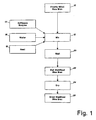
- an inactivating enzyme 14 is selected to inactivate the naturally occurring lipase in the rice bran.
- suitable materials for this purpose are known to include nonspecific proteases of plant and fungal origin.
- papain an enzyme naturally occurring in papaya fruit, and bromelin, an enzyme naturally occurring in pineapples, function as suitable antilipase enzymes 14 when used as described below.
- Enzeco Fungal Protease brand concentrate an enzyme fermented from various fungi, also functions as an antilipase enzyme.
- Enzeco Fungal Protease brand concentrate is a commercially available product from Enzyme Development Corporation located in New York City, New York. All the aforementioned antilipase enzymes appear to work with substantially the same degree of efficiency. Proteases of bacterial and animal origin (such, as pancreatic) may also be useful and mixtures of antilipase enzymes are also contemplated.
- freshly milled rice bran 10 has a water content of 20% by weight or less, in general about 10%.
- the water content of the rice bran is increased to permit the activity of the antilipase enzymes mentioned above, all of which function in an aqueous or hydrated environment.
- Additional water above the threshold amount needed to activate the antilipase enzyme in general increases the speed of inactivation. For example, when water is added to the fresh rice bran in a ratio of 1:10 based on weight, the stabilization process takes approximately 24 hours to complete, whereas when the water to rice bran ratio is 5:1 based on weight, the process will be completed in approximately five minutes.
- Rice bran 10 does not become unpalatable even when the stabilization process takes as long as 24 hours to complete. While additional water increases the speed with which the rice bran is stabilized, excessive amounts of water should be avoided as it must be removed later and increases the processing costs.
- selected antilipase enzyme 14 is added to a quantity of water 16 sufficient to wet rice bran 10 and activate the enzyme.
- Water 16 is preferably preheated at 18 with steam or the like.
- Antilipase enzyme 14 is added in an amount effective to substantially inactivate the lipase in a selected time that is dependent, as described above, on the amount of water used to wet the rice bran.
- antilipase enzyme 14 is preferably employed at levels of from about 0.01% to about 0.1% by weight.
- the mixture is maintained, preferably with continued mixing, at a temperature of about 20 degrees C to about 50 degrees C for a waiting period 20 sufficient for the antilipase enzyme to inactivate substantially all of the naturally occurring lipase in the rice bran.
- waiting time 20 is shorter at higher temperatures and with higher levels of antilipase enzyme 14.
- rice bran 10 has been processed into a wet stabilized rice bran 22.
- wet stabilized rice bran can be dried 24 by air drying, oven drying, vacuum drying, freeze drying or the like to produce a dried product 26.
- the dried product has a moisture content preferably in the range from about 6% to about 10% by weight and can be stored for long periods of time without deterioration.
- Dried stabilized rice bran product 26 can be rewetted for further processing as shown in Figs. 2 and 3 or used as an ingredient in various food products.
- Wet stabilized rice bran 22 (or rewetted dried rice bran 26) can be further processed as shown in Fig. 2 when it is prepared from rice bran 10 which is full-fatted or only partially defatted.
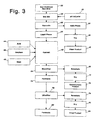
- Wet stabilized rice bran 22 can be further processed as shown in Fig. 3 when it is prepared from rice bran 10 whether it is defatted or not, the nature of the products, however, depend on the fat content.
- the insoluble dietary fiber present in wet stabilized rice bran 22 must be separated from the water soluble dietary fiber. Soluble dietary fiber is considered beneficial but insoluble dietary fiber tends to accelerate the passage of the rice bran through the human digestive tract so that only a small nutritive contribution is realized.
- the pH of wet stabilized rice bran 22 affects the way in which the protein is partitioned when the insoluble dietary fiber is separated from the soluble dietary fiber. More particularly, proteins are more soluble when the pH is on the basic side. For that reason, it is preferred that the pH of wet stabilized rice bran 24 be adjusted with a pH adjuster 28 so that the pH is from about 7.5 to about 12. In this range, most of the proteins stay in water solution and are not denatured.
- Suitable food grade bases for pH adjuster 28 include calcium hydroxide, sodium hydroxide, potassium hydroxide, ammonium hydroxide and so forth. Calcium hydroxide is preferred for nutritional reasons since it is a source of additional calcium.
- pH adjuster 28 is a food grade acid, suitable ones of which are illustrated below.
- the exact effect of the pH of the wet stabilized rice bran and amount of protein in the insoluble dietary fiber can be determined empirically.
- the pH-adjusted, wet stabilized rice bran 22 is wet milled 30 such as in a mixer/grinder into a slurry consisting of a finely ground solid phase 32 containing the insoluble dietary fiber and a liquid phase 34.
- the protein and other nutritional components of the rice bran such as starch, minerals, vitamins and so forth pass mainly with the soluble dietary fiber into liquid phase 34.
- the solid phase is separated 36 from the liquid phase by means of a decanter centrifuge or the like. Solid phase 32 can then be dried 38 such as in a spray dryer into a dried fiber product 40.
- liquid phase 34 After the insoluble dietary fiber (fiber product 40) has been separated from liquid phase 34, the liquid phase can be processed into a number of other products.
- the nature of the other products depend on whether liquid phase 34 was derived from a full-fat, partially defatted or fully defatted rice bran 10. The products also depend on whether the starch in liquid phase 34 is converted into simpler carbohydrates and on the amount of conversion. Subsequent filtration steps also affect the nature of the products as more particularly discussed below.
- liquid phase 34 When liquid phase 34 is derived from a full-fat or only partially defatted rice bran 10, the liquid phase can be further processed into a milk-replacer as shown in Fig. 2.
- liquid phase 34 When liquid phase 34 is made from a full-fat rice bran 10, a whole-milk milk-replacer is produced, whereas a partially defatted rice bran 10 provides a low-fat milk-replacer.
- the starch in liquid phase 34 be converted 42 into dextrins and dextroses. This can be accomplished by treating liquid phase 34 with acid, heat or enzymes or some combination thereof.
- the pH of liquid phase 34 be adjusted to about 5.5 to 7.0 with a food grade acid 44.
- the proteins are still soluble and not coagulated and the end products are more palatable for human consumption.
- the minerals and phytin are made more soluble.
- Mineral acids such as hydrochloric acid and sulfuric acid or organic acids such as citric acid, fumaric acid, maleic acid or acetic acid and so forth may be used to achieve the desired pH.
- an amylase 46 is added to liquid phase 34 to enzymatically digest the starch into dextrins. Conversion is further promoted by heating the mixture to a temperature in the range of about 50 degrees C to about 60 degrees C.
- An amyloglucosidase may also be added to aid in the conversion of the dextrins into glucoses. Acceptable results have been obtained when the enzymatic digestion is carried out with from about 0.1 1 to about 1.0 1 of amylase per ton of stabilized rice bran 26. When amyloglucosidase is used, it is preferably present at a level of about 0.1 1 to about 1.0 1 per ton.
- Amylase is commercially available as TERMAMYL 1 from Novo Nordisk of Copenhagen, Denmark and amyloglucosidase is commercially available as AMG from Novo Nordisk.
- Conversion is allowed to continue until about 80% to about 100% by weight of the starch has been digested into dextrins and glucoses that will pass through a 100,000 molecular weight filter.
- the time necessary for this to occur varies from about 15 minutes to about 4 hours depending upon the pH of liquid phase 34, the temperature and the amount of amylase (and amyloglucosidase, if present).
- conversion occurs in about 15 minutes to about 1 hour.
- liquid phase 34 may be condensed 48 by removal of some of the water. This may be accomplished by passing liquid phase 34 through a vacuum evaporator where from about 20% to about 60% by weight of the water is removed. The fat may then be homogenized 50, if desired, by passing liquid phase 34 through a homogenizer.
- liquid phase 34 is filtered through a filter having a particle size or molecular weight cut-off such that a retentate 56 contains proteins, fats and carbohydrate of a selected molecular weight and higher and a permeate 58 contains phytin, minerals and vitamins, along with proteins, fats and sugars which pass through the filter.
- Retentate 56 may be dried 60 in a spray drier or the like into a dried product 62.
- Filters suitable for filtering liquid phase 34 are typically membrane filters, sometimes referred to as hollow fibers, spiral wound and ceramic filters. A detailed discussion of microfiltration and ultrafiltration means can be found in "Ultrafiltration Handbook" by M. Cheryan, Technomic Publishing Co., 1986.
- liquid phase 34 is passed through a microfilter with a molecular weight cut-off of about 250,000 to about 100,000, more preferably a molecular weight cut-off of about 100,000.
- liquid phase 34 can be processed as shown in Fig. 3.
- the process shown in Fig. 3 can be used on wet stabilized rice bran 22 derived from defatted as well as full-fat and partially defatted rice bran.
- the process is identical to that shown in Fig. 2 down to the point that the starches in liquid phase 34 are converted with acid 44, heat 48 and amylase 46. In this instance, conversion is stopped, preferably after a period of about 10 minutes to 30 minutes, or when less than about 80% by weight of the starch has been digested into simpler carbohydrates that will pass through a 100,000 molecular weight filter.
- Liquid phase 34 is passed through a microfilter 64 (preferably a 100,000 molecular weight microfilter) such that a retentate 66 contains carbohydrates having a molecular weight of 100,000 or higher.
- Retentate 66 can be dried 70 such as in a spray drier to yield a slow-release carbohydrate product 72.
- Permeate 74 from the microfiltration step can be further passed through an ultrafilter 76 with a molecular weight cut-off of about 20,000 to about 10,000, preferably about 15,000 to about 10,000, and more preferably about 10,000.
- a retentate 78 on ultrafilter 76 contains proteins and simple sugars having a molecular weight of 10,000 and higher and a permeate 80 contains phytin, minerals and vitamins, along with any proteins and sugars which pass through ultrafilter 76.
- Retentate 78 can be dried 82 in a spray drier or the like into a dried product 84.
- Rice products unlike soy products, are generally non-allergenic. Hence it is anticipated that wet stabilized rice bran 22 and dried products 26, 40, 62, 72 and 84 and liquid products 58 and 80 have a similar characteristic.
- dried product 62 can be used as a hypoallergenic milk-replacer either in its dried form or reconstituted to a liquid consistency. When reconstituted, the solids content can be adjusted by the addition of water to yield a beverage very similar in appearance and taste to milk.
- Dried product 62 can also be used in a wide variety of food formulations as a replacement for milk and sugar solids.
- Dried product 84 cannot be used as a milk-replacer but it is useful for other purposes in food products.
- Dried product 40 can be used as fiber in health foods and dried product 72 is a good source of slow-release carbohydrates.
- Liquid products 58 and 80 are rich in minerals and phytin and may be used, for example, as an isotonic sports drink.
- retentate 66 contains fat or oil. If retentate 66 is intended for use, for example in the cosmetic and pharmaceutical industry, the presence of active lipase may be advantageous.
- the lipases may be used to partially hydrolyze the triglycerides into mono- and diglycerides and are then deactivated by the addition of an antilipase enzyme or the application of heat.
- Mono- and diglycerides are useful as emulsifiers.
- a full-fat dried stabilized rice bran 26 was prepared as shown in Fig. 1. To thirty pounds of water 16, five ounces of Enzeco Fungal Protease brand concentrate 14 was added and thoroughly mixed. The aqueous solution was added to 136 kg (300 pounds) of fresh full-fat rice bran 10 and mixed in a planetary mixer for 20 minutes (mixing step 12). The mixture was allowed to work for twenty minutes (waiting time 20) at 32°C (85 degrees F) (heating step 18). The wet stabilized rice bran 22 was then dried to 6% by weight in a forced air oven (drying step 24).
- the resulting dried stabilized rice bran 26 had a fatty acid content of 1.82% of total oil content after three weeks of storage.
- the free fatty acid content of unhydrolyzed rice bran is 0.28% by weight.
- the normal free fatty acid content in unstabilized rice bran at the same moisture and temperature varies from 35% to 55% of total oil content.
- the reduction in free fatty acid present in the product after three weeks of storage demonstrates that the lipase enzyme had been deactivated and that the resulting dried stabilized rice bran 26 should have a long shelf life without deterioration.
- the dried stabilized rice bran 26 prepared in Example 1 by the process shown in Fig. 1 was further processed as shown in Fig. 2,567 kg (1,250 pounds) of water was heated to 31°C (82 degrees F) and 113 kg (250 pounds) of full-fat dried stabilized rice bran 26 were added to the water.
- the pH of the resultant wet stabilized rice bran 22 was 6.7.
- the pH was adjusted to 9.15 by the addition of 1,000 ml of 50% sodium hydroxide (pH adjuster 28).
- the product was passed through an in-line mixer/grinder (wet mill step 30) and then through a decanter centrifuge (separation step 36).
- the liquid phase 34 was put through the decanter centrifuge twice and then the pH was adjusted from 9.1 to 6.1 with the addition of hydrochloric acid (addition of acid step 44).
- the solid phase 32 was spray dried (drying step 38) after it was washed with water.
- BioCon brand amylase enzyme (addition of amylase step 46) was then added to convert (conversion step 42) the starch to simpler carbohydrates such as dextrins and glucoses.
- BioCon is a trademark of BioCon Systems Company in Louisville, Kentucky.
- the product of the conversion went to a Contherm vacuum evaporator and was flashed to 32°C (85 degrees F) (condensation step 48). Solids after the vacuum evaporator were 7.5% by weight as measured by a Cenco moisture analyzer. Remaining liquid phase 34 was homogenized (homogenization step 50). The purpose of the homogenization step was to combine the fats and the proteins in the liquid. Homogenization typically occurs from 1,034.10 6 to 1,034.10 7 N.m -2 (1,500 to 15,000 PSI). The first stage of homogenization occurred at 1,38.10 6 N.m. -2 (2,000 PSI) and the second stage occurred at 3,4.10 5 N.m. -2 (500 PSI).
- the liquid then went through a 100,000 molecular weight filter (microfilter step 54).
- the system used a Polysulfone membrane.
- the retentate 56 was then spray dried to yield a total of 0,816 kg (1.8 pounds) of material from the chamber and 0,21 kg (0.47 pounds) from the cyclones.
- the pH of the liquid phase 34 was adjusted to 6.7 with 36% hydrochloric acid (addition of acid step 44) and heated to 88-93°C (190-200 degrees F) (heating step 48) and held for 45 minutes while 100 ml of amylase (addition of amylase step 46) and some "Edlong", a natural masking flavor, were added.
- the liquid phase 34 was then evaporated in a Contherm flashed to 85 degrees C (condensation step 48).
- the product was then homogenized at 1,7.10 6 N.m. -2 (2,500 PSI), 1,3.10 6 N.m. -2 (2,000 PSI) first stage and 3,4.10 5 N.m. -2 (500 PSI) second stage (homogenization step 50).
- Liquid phase 34 was then microfiltered with a 100,000 molecular weight filter. The solids were 16% (refractometer) and weighed 52,2 kg (115 pounds). Retentate 56 was spray dried (drying step 60).
- Permeate 74 was then filtered a second time through a 30,000 molecular weight cut-off ultrafilter 76.
- the protein content of retentate 78 was 1.0% by weight and the protein content of permeate 80 was 0.8% by weight.
- Example 5 This example was carried out exactly like Example 4 except that the 30,000 molecular weight cut-off ultrafilter 76 was replaced with a 10,000 molecular weight cut-off ultrafilter.
- the protein content of retentate 78 was 1.5% by weight and the protein content in permeate 80 was too low to measure.
- Permeate 80 of Example 5 is like permeate 58 in Examples 2 and 3.
Landscapes
- Chemical & Material Sciences (AREA)
- Life Sciences & Earth Sciences (AREA)
- Engineering & Computer Science (AREA)
- Health & Medical Sciences (AREA)
- Food Science & Technology (AREA)
- Polymers & Plastics (AREA)
- Organic Chemistry (AREA)
- Zoology (AREA)
- Wood Science & Technology (AREA)
- Genetics & Genomics (AREA)
- Bioinformatics & Cheminformatics (AREA)
- Biotechnology (AREA)
- General Engineering & Computer Science (AREA)
- Molecular Biology (AREA)
- Microbiology (AREA)
- Medicinal Chemistry (AREA)
- General Chemical & Material Sciences (AREA)
- Biochemistry (AREA)
- Biomedical Technology (AREA)
- General Health & Medical Sciences (AREA)
- Nutrition Science (AREA)
- Cereal-Derived Products (AREA)
- Coloring Foods And Improving Nutritive Qualities (AREA)
- Enzymes And Modification Thereof (AREA)
- Noodles (AREA)
Applications Claiming Priority (3)
| Application Number | Priority Date | Filing Date | Title |
|---|---|---|---|
| US07/975,527 US5292537A (en) | 1992-11-12 | 1992-11-12 | Method for stabilizing rice bran and rice bran products |
| US975527 | 1992-11-12 | ||
| PCT/US1993/011025 WO1994012038A1 (en) | 1992-11-12 | 1993-11-12 | Method for stabilizing rice bran and rice bran products |
Publications (3)
| Publication Number | Publication Date |
|---|---|
| EP0671883A1 EP0671883A1 (en) | 1995-09-20 |
| EP0671883A4 EP0671883A4 (en) | 1997-02-26 |
| EP0671883B1 true EP0671883B1 (en) | 2002-06-12 |
Family
ID=25523125
Family Applications (1)
| Application Number | Title | Priority Date | Filing Date |
|---|---|---|---|
| EP94903261A Expired - Lifetime EP0671883B1 (en) | 1992-11-12 | 1993-11-12 | Method for stabilizing rice bran and rice bran products |
Country Status (8)
| Country | Link |
|---|---|
| US (4) | US5292537A (enExample) |
| EP (1) | EP0671883B1 (enExample) |
| JP (1) | JP3466189B2 (enExample) |
| AT (1) | ATE218808T1 (enExample) |
| AU (1) | AU689453B2 (enExample) |
| CA (1) | CA2149321C (enExample) |
| DE (1) | DE69332027T2 (enExample) |
| WO (1) | WO1994012038A1 (enExample) |
Families Citing this family (49)
| Publication number | Priority date | Publication date | Assignee | Title |
|---|---|---|---|---|
| US5292537A (en) * | 1992-11-12 | 1994-03-08 | Bran Tec, Inc. | Method for stabilizing rice bran and rice bran products |
| US5510128A (en) * | 1993-08-27 | 1996-04-23 | Takubo Kogyosho Co., Ltd. | Process for producing emulsified filtrate of half-hulled rice |
| US5609895A (en) * | 1994-08-04 | 1997-03-11 | Takubo Kogyosho Co., Ltd. | Method for producing half-hulled rice milk |
| US5552167A (en) * | 1995-05-05 | 1996-09-03 | Nabisco, Inc. | Rice bran oil antioxidant |
| US5777383A (en) * | 1996-05-09 | 1998-07-07 | Lsi Logic Corporation | Semiconductor chip package with interconnect layers and routing and testing methods |
| AU767968B2 (en) * | 1996-05-10 | 2003-11-27 | Unilever Plc | Liquid fatty component containing composition |
| US6054149A (en) * | 1997-05-16 | 2000-04-25 | Bran Tec, Inc. | Use of rice bran extract as a processing aid |
| US5902928A (en) * | 1997-06-02 | 1999-05-11 | International Business Machines Corporation | Controlling engagement of a scanning microscope probe with a segmented piezoelectric actuator |
| ATE531381T1 (de) * | 1997-08-29 | 2011-11-15 | Ricex Company Inc | Stabilisierte reiskleiederivate zur behandlung von diabetes |
| US6126943A (en) | 1997-09-02 | 2000-10-03 | The Ricex Company | Method for treating hypercholesterolemia, hyperlipidemia, and atherosclerosis |
| US5985344A (en) * | 1997-09-02 | 1999-11-16 | The Ricex Company | Process for obtaining micronutrient enriched rice bran oil |
| US5891493A (en) * | 1997-11-25 | 1999-04-06 | Santillo, Jr.; Humbart D. | Predigested seed food composition |
| US6616924B1 (en) * | 1999-06-04 | 2003-09-09 | Producers Rice Mill, Inc. | Stabilized rice bran deer feed, attractant and browse supplement |
| EP1198991B1 (en) * | 2000-10-20 | 2012-12-19 | Nutriz N.V: | Non-dairy products derived from rice |
| WO2002101033A1 (en) * | 2001-06-08 | 2002-12-19 | Cb Bio Products India Pvt. Ltd. | A process of isolation and utilization of rice bran lipase |
| US6902739B2 (en) * | 2001-07-23 | 2005-06-07 | Nutracea | Methods for treating joint inflammation, pain, and loss of mobility |
| US20030082290A1 (en) * | 2001-11-01 | 2003-05-01 | Dull Bob J. | Method for stabilizing bran and the resultant composition |
| ITMI20021300A1 (it) * | 2002-06-12 | 2003-12-12 | Ezio Bartocci | Alimento a base di riso particolarmente studiato per l'alimentazione umana e relativo metodo di lavorazione |
| CN101123883B (zh) * | 2004-02-23 | 2013-03-13 | 金克克国际有限公司 | 高纯度稻米蛋白浓缩物的制备方法 |
| US20050287282A1 (en) * | 2004-06-29 | 2005-12-29 | The Regents Of The University Of California | Cereal-Based Adhesives and Their Uses |
| US20060093592A1 (en) * | 2004-10-04 | 2006-05-04 | Nutracea | Synbiotics |
| GB0425517D0 (en) * | 2004-11-19 | 2004-12-22 | Galactogen Products Ltd | Endurance bar |
| US7678403B2 (en) * | 2005-07-15 | 2010-03-16 | Crm Ip Llc | Whole grain non-dairy milk production, products and use |
| US7867543B2 (en) * | 2005-10-19 | 2011-01-11 | Taipei Medical University | Rice bran flour and method of making thereof |
| US20070231449A1 (en) * | 2006-03-30 | 2007-10-04 | Nutracea | Non-starchy rice bran polysaccharides |
| US8133527B2 (en) | 2006-06-16 | 2012-03-13 | Kraft Foods Global Brands Llc | Production of stabilized whole grain wheat flour and products thereof |
| WO2008004313A1 (en) * | 2006-07-05 | 2008-01-10 | Ricetech Corporation | Apparatus for heat treatment of powdery/granular substance |
| JP5206947B2 (ja) * | 2007-03-30 | 2013-06-12 | 独立行政法人産業技術総合研究所 | 微細繊維状セルロース系物質及びその製造方法 |
| GB2455329B (en) * | 2007-12-05 | 2012-03-28 | Mars Inc | Fiber enriched cereal products |
| US8226997B2 (en) * | 2007-12-05 | 2012-07-24 | Mars, Inc. | Whole grain rice compositions and coating methods |
| WO2009078938A1 (en) * | 2007-12-14 | 2009-06-25 | Nutracea | Mechanical extrusion process for stabilizing cereal and oil seed bran and germ components |
| US20090191308A1 (en) * | 2008-01-28 | 2009-07-30 | Gingras Leo G | Method of preparing emulsified cereal bran derivatives |
| US20090220666A1 (en) * | 2008-02-11 | 2009-09-03 | Leo Gingras | Utilization of stabilized bran in high protein products |
| KR100893661B1 (ko) | 2008-03-06 | 2009-04-17 | 최성훈 | 효소분해와 진공건조를 이용한 기능성 미강의 제조방법 |
| US9055752B2 (en) * | 2008-11-06 | 2015-06-16 | Intercontinental Great Brands Llc | Shelf-stable concentrated dairy liquids and methods of forming thereof |
| WO2011126162A1 (ko) * | 2010-04-07 | 2011-10-13 | 씨제이제일제당 주식회사 | 쌀 식이섬유의 제조 방법 |
| JP2013535983A (ja) * | 2010-08-24 | 2013-09-19 | ダニスコ・ユーエス・インク | 低温コメタンパク質濃縮物を含有する食品 |
| UA112972C2 (uk) | 2010-09-08 | 2016-11-25 | Інтерконтінентал Грейт Брендс ЛЛС | Рідкий молочний концентрат з високим вмістом сухих речовин |
| US20140370151A1 (en) * | 2013-06-12 | 2014-12-18 | Bob J. Dull | Method for Producing Sweet Bran and the Resultant Product |
| CN105341625A (zh) * | 2015-11-05 | 2016-02-24 | 四川省农业科学院农产品加工研究所 | 一种微波辅助酶稳定米糠的方法 |
| US10624356B2 (en) | 2016-03-18 | 2020-04-21 | General Mills, Inc. | Refrigerated dough with extended shelf life made from white wheat flour |
| DE102016112048B4 (de) | 2016-06-30 | 2019-01-03 | Fraunhofer-Gesellschaft zur Förderung der angewandten Forschung e.V. | Verfahren zur Gewinnung von Phytinsäure und/oder Phytat aus Getreide |
| WO2018181644A1 (ja) * | 2017-03-29 | 2018-10-04 | 日清ファルマ株式会社 | 加工ふすまの製造方法 |
| JP6376502B1 (ja) * | 2017-04-18 | 2018-08-22 | マルワ食産株式会社 | Lps含有米糠エキスの製造方法及び米糠エキスを利用した健康食品 |
| CN108185110B (zh) * | 2018-01-09 | 2021-07-30 | 中南林业科技大学 | 一种提高米糠蛋白功能性质的方法 |
| CN109380641A (zh) * | 2018-09-30 | 2019-02-26 | 东北农业大学 | 一种磁性固定化酶稳定新鲜米糠的方法 |
| CN110313580A (zh) * | 2019-06-19 | 2019-10-11 | 国家粮食和物资储备局科学研究院 | 一种焙烤预处理米糠加工糙米米线的方法 |
| WO2021144005A1 (de) * | 2020-01-14 | 2021-07-22 | DÖHLER GmbH | Verfahren zum herstellen eines hochdruckbehandelten pflanzlichen samenbasisprodukts und pflanzliches samenbasisprodukt |
| CN112790325B (zh) * | 2021-02-01 | 2022-12-30 | 广东省农业科学院蚕业与农产品加工研究所 | 一种营养增强型稳定化米糠快速加工方法 |
Family Cites Families (54)
| Publication number | Priority date | Publication date | Assignee | Title |
|---|---|---|---|---|
| US976332A (en) * | 1909-01-04 | 1910-11-22 | Henry Anhaltzer | Making a cereal breakfast food. |
| US1178039A (en) * | 1915-09-09 | 1916-04-04 | Wahl Henius Res Lab | Food product and method of preparing the same. |
| GB186634A (en) * | 1921-10-01 | 1924-03-03 | Ward Baking Co | Improvements in and relating to the production of food products |
| US1541263A (en) * | 1921-10-01 | 1925-06-09 | Ward Baking Co | Food product |
| US2585978A (en) * | 1949-06-10 | 1952-02-19 | Us Agriculture | Method of stabilizing rice products |
| US2853388A (en) * | 1955-12-27 | 1958-09-23 | Little Inc A | Method of treating cereals with proteolytic enzymes and resulting product |
| US3157513A (en) * | 1961-11-15 | 1964-11-17 | Kellog Co | Enzymatic treatment of cereal grains |
| US3243301A (en) * | 1964-04-03 | 1966-03-29 | Clifford W Hesseltine | Cereal-containing varieties of tempeh and process therefor |
| US3519431A (en) * | 1966-06-13 | 1970-07-07 | Truman B Wayne | Milling of cereal grains and processing of products derived therefrom |
| US3816389A (en) * | 1968-12-30 | 1974-06-11 | Nakataki Pharm Ind Co Inc | Process for treatment of oil-containing seeds |
| US3852504A (en) * | 1969-04-09 | 1974-12-03 | Nakataki Pharm Ind Co Ltd | Process for complete separation of constituents of rice-bran and the like |
| US3630754A (en) * | 1969-05-07 | 1971-12-28 | Truman Benjamin Wayne | Milling of cereal grains and processing of products derived therefrom |
| US3714719A (en) * | 1971-02-01 | 1973-02-06 | Wayne T & Ass | Apparatus for desolventizing solvent extracted milled rice and rice bran |
| US4070422A (en) * | 1971-02-26 | 1978-01-24 | Dso "Uharmachim" | Method for producing phytin |
| US3859451A (en) * | 1972-08-25 | 1975-01-07 | Us Agriculture | Preparation of stable protein concentrates from grain by-products |
| US3871273A (en) * | 1973-08-14 | 1975-03-18 | Hsieh Chin Yuan | Beverage making apparatus |
| US3988436A (en) * | 1974-02-11 | 1976-10-26 | Carnation Company | Sunscreening method using rice bran oil |
| US4073958A (en) * | 1976-04-28 | 1978-02-14 | Shunji Abe | Rice flavored snack food |
| US4204008A (en) * | 1976-06-14 | 1980-05-20 | The United States Of America As Represented By The Secretary Of Agriculture | Preparation of protein concentrates from whey and seed products |
| US4064283A (en) * | 1976-06-14 | 1977-12-20 | The United States Of America As Represented By The Secretary Of Agriculture | Preparation of protein concentrates from whey and seed products |
| JPS6050423B2 (ja) * | 1976-10-15 | 1985-11-08 | 旭電化工業株式会社 | ハ−ドバタ− |
| JPS5943929B2 (ja) * | 1979-08-13 | 1984-10-25 | サッポロビール株式会社 | 多糖体rbs物質,その製法およびそれを有効成分とする抗腫瘍性剤 |
| US4384837A (en) * | 1980-07-08 | 1983-05-24 | Oryza Oil & Fat Chemical Co., Ltd. | Apparatus for pretreatment for extracting crude oil from rice bran |
| CA1155110A (en) * | 1980-11-06 | 1983-10-11 | Ronald E. Murray | Recovery of a proteinaceous oat fraction from a dispersion thereof in hydrocarbon solvent |
| US5047254A (en) * | 1981-09-15 | 1991-09-10 | Lee Tung Ching | Process for the recovery of edible oil from cereal products |
| US4442130A (en) * | 1982-01-13 | 1984-04-10 | Riviana Foods, Inc. | Continuous processing of rice |
| IN158206B (enExample) * | 1983-08-11 | 1986-09-27 | Godrej Soaps Pvt Ltd | |
| US4565702A (en) * | 1984-06-04 | 1986-01-21 | Warner-Lambert Company | Dietary fiber food products and method of manufacture |
| US4804545A (en) * | 1984-08-10 | 1989-02-14 | Barco, Inc. | Production of beta-glucan, bran, protein, oil and maltose syrup from waxy barley |
| JPS6156142A (ja) * | 1984-08-24 | 1986-03-20 | Shikishima Sutaac Kk | フィチン及びフィチン酸の製造法 |
| SE465951B (sv) * | 1984-10-23 | 1991-11-25 | Perstorp Ab | Isomer av inositoltrifosfat foeretraedesvis i saltform foer anvaendning som terapeutiskt eller profylaktiskt medel samt kompositioner daerav |
| US4697004A (en) * | 1985-09-06 | 1987-09-29 | Bristol-Myers Company | Process for preparing low phytate soy protein isolate |
| JPS6258950A (ja) * | 1985-09-09 | 1987-03-14 | Q P Jozo Kk | 漬物用調味液の製造方法 |
| CA1300968C (en) * | 1985-12-10 | 1992-05-19 | Albert D. Bolles | High fiber flaked cereal |
| US4894242A (en) * | 1986-04-24 | 1990-01-16 | Mitchell Cheryl R | Nutritional rice milk product |
| US4744992A (en) * | 1986-04-24 | 1988-05-17 | Mitchell Cheryl R | Nutritional rice milk production |
| US4756912A (en) * | 1986-04-28 | 1988-07-12 | California Natural Products | Rice syrup sweetener production |
| US4876096A (en) * | 1986-04-28 | 1989-10-24 | California Natural Products | Rice syrup sweetener |
| US4741264A (en) * | 1986-05-05 | 1988-05-03 | Brady International Inc. | Rice bran processing apparatus |
| US4889921A (en) * | 1987-04-29 | 1989-12-26 | The University Of Toronto Innovations Foundation | Production of rapeseed protein materials |
| US4859474A (en) * | 1987-09-28 | 1989-08-22 | Nabisco/Cetus Food Biotechnology Research Partnership | Method of making an enzyme sweetened cereal product |
| US4857339A (en) * | 1987-09-28 | 1989-08-15 | Nabisco/Cetus Food Biotechnology Research Partnership | Method for making cereal products naturally sweetened with fructose |
| US4996064A (en) * | 1988-08-24 | 1991-02-26 | Nakano Vinegar Co., Ltd. | Novel foodstuff from soymilk and method for production thereof |
| JPH02124894A (ja) * | 1988-11-01 | 1990-05-14 | Sanwa Kagaku Kenkyusho Co Ltd | フィチン酸安定化組成物 |
| JPH0611764B2 (ja) * | 1988-12-07 | 1994-02-16 | 雪印乳業株式会社 | 水溶性ヘミセルロースの製造方法 |
| US5041245A (en) * | 1989-03-10 | 1991-08-20 | Bioseparations, Inc. | Continuous extraction of oil-containing vegetable matter with pressurized normally gaseous solvent |
| US4990344A (en) * | 1989-07-11 | 1991-02-05 | Bristol-Myers Company | Method for making soluble rice protein concentrate and the product produced therefrom |
| JPH0348625A (ja) * | 1989-07-14 | 1991-03-01 | Sanwa Kagaku Kenkyusho Co Ltd | フィチン酸の安定化組成物及びこれを有効成分とする体臭、尿臭除去剤 |
| US4997665A (en) * | 1989-10-05 | 1991-03-05 | Michigan Biotechnology Institute | Dietary fibers and a process for their production |
| US5209940A (en) * | 1990-07-26 | 1993-05-11 | The United States Of America As Represented By The Secretary Of Agriculture | Stabilizing unmilled brown rice by ethanol vapors |
| AU9016291A (en) * | 1990-11-06 | 1992-05-26 | E.I. Du Pont De Nemours And Company | High fiber and low ash cereal fibers |
| US5153019A (en) * | 1991-05-30 | 1992-10-06 | University Research & Marketing, Inc. | Rice bran-honey based beverage product and process for making same |
| US5225219A (en) * | 1992-01-02 | 1993-07-06 | The United States Of America, As Represented By The Secretary Of Agriculture | Amylodextrin compositions and method therefor |
| US5292537A (en) * | 1992-11-12 | 1994-03-08 | Bran Tec, Inc. | Method for stabilizing rice bran and rice bran products |
-
1992
- 1992-11-12 US US07/975,527 patent/US5292537A/en not_active Expired - Lifetime
-
1993
- 1993-11-12 WO PCT/US1993/011025 patent/WO1994012038A1/en not_active Ceased
- 1993-11-12 AU AU57270/94A patent/AU689453B2/en not_active Expired
- 1993-11-12 AT AT94903261T patent/ATE218808T1/de not_active IP Right Cessation
- 1993-11-12 CA CA002149321A patent/CA2149321C/en not_active Expired - Lifetime
- 1993-11-12 JP JP51320194A patent/JP3466189B2/ja not_active Expired - Fee Related
- 1993-11-12 DE DE69332027T patent/DE69332027T2/de not_active Expired - Lifetime
- 1993-11-12 EP EP94903261A patent/EP0671883B1/en not_active Expired - Lifetime
-
1994
- 1994-01-10 US US08/179,078 patent/US5376390A/en not_active Expired - Lifetime
- 1994-12-23 US US08/362,827 patent/US5512307A/en not_active Expired - Lifetime
-
1996
- 1996-04-12 US US08/631,587 patent/US5753283A/en not_active Expired - Lifetime
Also Published As
| Publication number | Publication date |
|---|---|
| AU5727094A (en) | 1994-06-22 |
| US5292537A (en) | 1994-03-08 |
| JPH08506720A (ja) | 1996-07-23 |
| US5376390A (en) | 1994-12-27 |
| AU689453B2 (en) | 1998-04-02 |
| ATE218808T1 (de) | 2002-06-15 |
| WO1994012038A1 (en) | 1994-06-09 |
| JP3466189B2 (ja) | 2003-11-10 |
| DE69332027D1 (de) | 2002-07-18 |
| CA2149321C (en) | 2004-08-03 |
| DE69332027T2 (de) | 2003-02-27 |
| CA2149321A1 (en) | 1994-06-09 |
| EP0671883A1 (en) | 1995-09-20 |
| US5753283A (en) | 1998-05-19 |
| US5512307A (en) | 1996-04-30 |
| EP0671883A4 (en) | 1997-02-26 |
Similar Documents
| Publication | Publication Date | Title |
|---|---|---|
| US5512307A (en) | Method for stabilizing rice bran and rice bran products | |
| RU2233599C2 (ru) | СПОСОБ ПОЛУЧЕНИЯ КОМПОЗИЦИИ, СОДЕРЖАЩЕЙ ВОДОРАСТВОРИМЫЙ β-ГЛЮКАН, (ВАРИАНТЫ) И ИЗГОТАВЛИВАЕМЫЕ ИЗ НЕЕ ПРОДУКТЫ | |
| US4990344A (en) | Method for making soluble rice protein concentrate and the product produced therefrom | |
| JPS60501937A (ja) | 豆乳プロセス | |
| Meleshkina et al. | Innovative trends in the development of advanced triticale grain processing technology | |
| CN116367729A (zh) | 提高分散稳定性和/或溶解性的加工植物性奶的制造方法 | |
| CA1198700A (en) | Enzyme for decomposition of a high molecular carbohydrate, the isolated high molecular carbohydrate, a method for selection of a microorganism producing such enzyme and a method for production of such enzyme | |
| AU745130B2 (en) | Predigested seed food composition | |
| FI114685B (fi) | Kauran fraktiointimenetelmä ja sen tuote | |
| MXPA04008759A (es) | Concentrado de proteina de soya con contenido bajo de oligosacaridos no digeribles y proceso de produccion. | |
| KR19980023071A (ko) | 쌀눈 음료의 제조방법 | |
| US20030022274A1 (en) | Partially hydrolysed protein nutrient supplement | |
| EP0627887B1 (en) | Method for treatment of potato pulp | |
| US12453361B2 (en) | Process for increasing yield in production of plant based products | |
| US20240215612A1 (en) | Hydrolysate compositions and methods for producing thereof | |
| JP6618097B2 (ja) | 食用酵素組成物の製造方法 | |
| JPH06502547A (ja) | 部分的に加水分解された澱粉を連続的に生産する方法、この方法によって得られる製品およびその応用 | |
| JP2024533617A5 (enExample) | ||
| US20080199581A1 (en) | Processs for saccrification and liquification of potato and tapioca | |
| JPH01191660A (ja) | グルタチオン含有胚芽抽出物及びその製造法 |
Legal Events
| Date | Code | Title | Description |
|---|---|---|---|
| PUAI | Public reference made under article 153(3) epc to a published international application that has entered the european phase |
Free format text: ORIGINAL CODE: 0009012 |
|
| 17P | Request for examination filed |
Effective date: 19950518 |
|
| AK | Designated contracting states |
Kind code of ref document: A1 Designated state(s): AT BE CH DE DK ES FR GB GR IE IT LI LU MC NL PT SE |
|
| A4 | Supplementary search report drawn up and despatched | ||
| AK | Designated contracting states |
Kind code of ref document: A4 Designated state(s): AT BE CH DE DK ES FR GB GR IE IT LI LU MC NL PT SE |
|
| 17Q | First examination report despatched |
Effective date: 20001129 |
|
| GRAG | Despatch of communication of intention to grant |
Free format text: ORIGINAL CODE: EPIDOS AGRA |
|
| GRAG | Despatch of communication of intention to grant |
Free format text: ORIGINAL CODE: EPIDOS AGRA |
|
| GRAH | Despatch of communication of intention to grant a patent |
Free format text: ORIGINAL CODE: EPIDOS IGRA |
|
| GRAH | Despatch of communication of intention to grant a patent |
Free format text: ORIGINAL CODE: EPIDOS IGRA |
|
| GRAA | (expected) grant |
Free format text: ORIGINAL CODE: 0009210 |
|
| AK | Designated contracting states |
Kind code of ref document: B1 Designated state(s): AT BE CH DE DK ES FR GB GR IE IT LI LU MC NL PT SE |
|
| PG25 | Lapsed in a contracting state [announced via postgrant information from national office to epo] |
Ref country code: GR Free format text: LAPSE BECAUSE OF FAILURE TO SUBMIT A TRANSLATION OF THE DESCRIPTION OR TO PAY THE FEE WITHIN THE PRESCRIBED TIME-LIMIT Effective date: 20020612 Ref country code: AT Free format text: LAPSE BECAUSE OF FAILURE TO SUBMIT A TRANSLATION OF THE DESCRIPTION OR TO PAY THE FEE WITHIN THE PRESCRIBED TIME-LIMIT Effective date: 20020612 |
|
| REF | Corresponds to: |
Ref document number: 218808 Country of ref document: AT Date of ref document: 20020615 Kind code of ref document: T |
|
| REG | Reference to a national code |
Ref country code: GB Ref legal event code: FG4D |
|
| RIC1 | Information provided on ipc code assigned before grant |
Free format text: 7A 21D 8/02 A, 7A 23L 1/36 B, 7C 12C 7/00 B, 7A 23J 1/14 B, 7C 12N 9/00 B, 7C 12N 9/96 B, 7C 12P 21/00 B, 7A 23C 9/12 B, 7A 23J 1/12 B, 7A 21D 8/00 B |
|
| REG | Reference to a national code |
Ref country code: CH Ref legal event code: EP |
|
| REF | Corresponds to: |
Ref document number: 69332027 Country of ref document: DE Date of ref document: 20020718 |
|
| REG | Reference to a national code |
Ref country code: IE Ref legal event code: FG4D |
|
| PG25 | Lapsed in a contracting state [announced via postgrant information from national office to epo] |
Ref country code: SE Free format text: LAPSE BECAUSE OF FAILURE TO SUBMIT A TRANSLATION OF THE DESCRIPTION OR TO PAY THE FEE WITHIN THE PRESCRIBED TIME-LIMIT Effective date: 20020912 Ref country code: PT Free format text: LAPSE BECAUSE OF FAILURE TO SUBMIT A TRANSLATION OF THE DESCRIPTION OR TO PAY THE FEE WITHIN THE PRESCRIBED TIME-LIMIT Effective date: 20020912 Ref country code: DK Free format text: LAPSE BECAUSE OF FAILURE TO SUBMIT A TRANSLATION OF THE DESCRIPTION OR TO PAY THE FEE WITHIN THE PRESCRIBED TIME-LIMIT Effective date: 20020912 |
|
| PG25 | Lapsed in a contracting state [announced via postgrant information from national office to epo] |
Ref country code: LU Free format text: LAPSE BECAUSE OF NON-PAYMENT OF DUE FEES Effective date: 20021112 Ref country code: IE Free format text: LAPSE BECAUSE OF NON-PAYMENT OF DUE FEES Effective date: 20021112 |
|
| ET | Fr: translation filed | ||
| PG25 | Lapsed in a contracting state [announced via postgrant information from national office to epo] |
Ref country code: ES Free format text: LAPSE BECAUSE OF FAILURE TO SUBMIT A TRANSLATION OF THE DESCRIPTION OR TO PAY THE FEE WITHIN THE PRESCRIBED TIME-LIMIT Effective date: 20021220 |
|
| PLBE | No opposition filed within time limit |
Free format text: ORIGINAL CODE: 0009261 |
|
| STAA | Information on the status of an ep patent application or granted ep patent |
Free format text: STATUS: NO OPPOSITION FILED WITHIN TIME LIMIT |
|
| PG25 | Lapsed in a contracting state [announced via postgrant information from national office to epo] |
Ref country code: MC Free format text: LAPSE BECAUSE OF NON-PAYMENT OF DUE FEES Effective date: 20030601 |
|
| 26N | No opposition filed |
Effective date: 20030313 |
|
| REG | Reference to a national code |
Ref country code: IE Ref legal event code: MM4A |
|
| PGFP | Annual fee paid to national office [announced via postgrant information from national office to epo] |
Ref country code: CH Payment date: 20121122 Year of fee payment: 20 Ref country code: DE Payment date: 20121121 Year of fee payment: 20 Ref country code: FR Payment date: 20121130 Year of fee payment: 20 |
|
| PGFP | Annual fee paid to national office [announced via postgrant information from national office to epo] |
Ref country code: IT Payment date: 20121123 Year of fee payment: 20 Ref country code: GB Payment date: 20121120 Year of fee payment: 20 Ref country code: BE Payment date: 20121122 Year of fee payment: 20 |
|
| PGFP | Annual fee paid to national office [announced via postgrant information from national office to epo] |
Ref country code: NL Payment date: 20121120 Year of fee payment: 20 |
|
| REG | Reference to a national code |
Ref country code: DE Ref legal event code: R071 Ref document number: 69332027 Country of ref document: DE |
|
| REG | Reference to a national code |
Ref country code: DE Ref legal event code: R071 Ref document number: 69332027 Country of ref document: DE |
|
| REG | Reference to a national code |
Ref country code: NL Ref legal event code: V4 Effective date: 20131112 |
|
| REG | Reference to a national code |
Ref country code: CH Ref legal event code: PL |
|
| BE20 | Be: patent expired |
Owner name: *BRAN TEC INC. Effective date: 20131112 |
|
| REG | Reference to a national code |
Ref country code: GB Ref legal event code: PE20 Expiry date: 20131111 |
|
| PG25 | Lapsed in a contracting state [announced via postgrant information from national office to epo] |
Ref country code: GB Free format text: LAPSE BECAUSE OF EXPIRATION OF PROTECTION Effective date: 20131111 Ref country code: DE Free format text: LAPSE BECAUSE OF EXPIRATION OF PROTECTION Effective date: 20131113 |