EP0658574B1 - Verfahren zur Herstellung einer Plastisol-Zusammensetzung - Google Patents
Verfahren zur Herstellung einer Plastisol-Zusammensetzung Download PDFInfo
- Publication number
- EP0658574B1 EP0658574B1 EP94119611A EP94119611A EP0658574B1 EP 0658574 B1 EP0658574 B1 EP 0658574B1 EP 94119611 A EP94119611 A EP 94119611A EP 94119611 A EP94119611 A EP 94119611A EP 0658574 B1 EP0658574 B1 EP 0658574B1
- Authority
- EP
- European Patent Office
- Prior art keywords
- copolymer
- acid
- olefin
- reaction
- carbon atoms
- Prior art date
- Legal status (The legal status is an assumption and is not a legal conclusion. Google has not performed a legal analysis and makes no representation as to the accuracy of the status listed.)
- Expired - Lifetime
Links
- 229920001944 Plastisol Polymers 0.000 title claims description 29
- 239000004999 plastisol Substances 0.000 title claims description 29
- 238000000034 method Methods 0.000 title claims description 17
- 239000000203 mixture Substances 0.000 title claims description 15
- 229920001577 copolymer Polymers 0.000 claims description 42
- 239000002318 adhesion promoter Substances 0.000 claims description 28
- 239000004711 α-olefin Substances 0.000 claims description 23
- 229920000768 polyamine Polymers 0.000 claims description 18
- 150000001412 amines Chemical class 0.000 claims description 14
- 150000001875 compounds Chemical class 0.000 claims description 14
- 125000004432 carbon atom Chemical group C* 0.000 claims description 12
- 238000006243 chemical reaction Methods 0.000 claims description 12
- VZCYOOQTPOCHFL-UHFFFAOYSA-N trans-butenedioic acid Natural products OC(=O)C=CC(O)=O VZCYOOQTPOCHFL-UHFFFAOYSA-N 0.000 claims description 11
- VZCYOOQTPOCHFL-OWOJBTEDSA-N Fumaric acid Chemical compound OC(=O)\C=C\C(O)=O VZCYOOQTPOCHFL-OWOJBTEDSA-N 0.000 claims description 10
- FPYJFEHAWHCUMM-UHFFFAOYSA-N maleic anhydride Chemical compound O=C1OC(=O)C=C1 FPYJFEHAWHCUMM-UHFFFAOYSA-N 0.000 claims description 10
- -1 amido amines Chemical class 0.000 claims description 9
- 229920000915 polyvinyl chloride Polymers 0.000 claims description 9
- 239000004800 polyvinyl chloride Substances 0.000 claims description 9
- 125000003277 amino group Chemical group 0.000 claims description 8
- IMUDHTPIFIBORV-UHFFFAOYSA-N aminoethylpiperazine Chemical group NCCN1CCNCC1 IMUDHTPIFIBORV-UHFFFAOYSA-N 0.000 claims description 7
- OFOBLEOULBTSOW-UHFFFAOYSA-N Propanedioic acid Natural products OC(=O)CC(O)=O OFOBLEOULBTSOW-UHFFFAOYSA-N 0.000 claims description 6
- PPBRXRYQALVLMV-UHFFFAOYSA-N Styrene Chemical compound C=CC1=CC=CC=C1 PPBRXRYQALVLMV-UHFFFAOYSA-N 0.000 claims description 6
- 150000001732 carboxylic acid derivatives Chemical class 0.000 claims description 6
- VZCYOOQTPOCHFL-UPHRSURJSA-N maleic acid Chemical compound OC(=O)\C=C/C(O)=O VZCYOOQTPOCHFL-UPHRSURJSA-N 0.000 claims description 6
- 239000011976 maleic acid Substances 0.000 claims description 6
- 125000002496 methyl group Chemical group [H]C([H])([H])* 0.000 claims description 6
- 239000004014 plasticizer Substances 0.000 claims description 6
- SMZOUWXMTYCWNB-UHFFFAOYSA-N 2-(2-methoxy-5-methylphenyl)ethanamine Chemical compound COC1=CC=C(C)C=C1CCN SMZOUWXMTYCWNB-UHFFFAOYSA-N 0.000 claims description 5
- NIXOWILDQLNWCW-UHFFFAOYSA-N 2-Propenoic acid Natural products OC(=O)C=C NIXOWILDQLNWCW-UHFFFAOYSA-N 0.000 claims description 5
- CERQOIWHTDAKMF-UHFFFAOYSA-N Methacrylic acid Chemical compound CC(=C)C(O)=O CERQOIWHTDAKMF-UHFFFAOYSA-N 0.000 claims description 5
- 125000000217 alkyl group Chemical group 0.000 claims description 5
- 239000001530 fumaric acid Substances 0.000 claims description 5
- 229920001281 polyalkylene Polymers 0.000 claims description 5
- 125000002924 primary amino group Chemical group [H]N([H])* 0.000 claims description 4
- QYKIQEUNHZKYBP-UHFFFAOYSA-N Vinyl ether Chemical compound C=COC=C QYKIQEUNHZKYBP-UHFFFAOYSA-N 0.000 claims description 3
- 125000004494 ethyl ester group Chemical group 0.000 claims description 3
- CERQOIWHTDAKMF-UHFFFAOYSA-M Methacrylate Chemical compound CC(=C)C([O-])=O CERQOIWHTDAKMF-UHFFFAOYSA-M 0.000 claims description 2
- 229910052799 carbon Inorganic materials 0.000 claims description 2
- 229910052757 nitrogen Inorganic materials 0.000 claims description 2
- 125000004193 piperazinyl group Chemical group 0.000 claims description 2
- 150000002430 hydrocarbons Chemical group 0.000 claims 2
- 239000000047 product Substances 0.000 claims 2
- ATVJXMYDOSMEPO-UHFFFAOYSA-N 3-prop-2-enoxyprop-1-ene Chemical compound C=CCOCC=C ATVJXMYDOSMEPO-UHFFFAOYSA-N 0.000 claims 1
- 239000007795 chemical reaction product Substances 0.000 claims 1
- 238000004519 manufacturing process Methods 0.000 description 13
- 150000001336 alkenes Chemical class 0.000 description 12
- 150000008064 anhydrides Chemical class 0.000 description 11
- 229920000642 polymer Polymers 0.000 description 11
- JRZJOMJEPLMPRA-UHFFFAOYSA-N olefin Natural products CCCCCCCC=C JRZJOMJEPLMPRA-UHFFFAOYSA-N 0.000 description 10
- 239000002904 solvent Substances 0.000 description 9
- CTQNGGLPUBDAKN-UHFFFAOYSA-N O-Xylene Chemical compound CC1=CC=CC=C1C CTQNGGLPUBDAKN-UHFFFAOYSA-N 0.000 description 8
- 150000002148 esters Chemical class 0.000 description 8
- 239000008096 xylene Substances 0.000 description 8
- BAPJBEWLBFYGME-UHFFFAOYSA-N acrylic acid methyl ester Natural products COC(=O)C=C BAPJBEWLBFYGME-UHFFFAOYSA-N 0.000 description 7
- MQIUGAXCHLFZKX-UHFFFAOYSA-N Di-n-octyl phthalate Natural products CCCCCCCCOC(=O)C1=CC=CC=C1C(=O)OCCCCCCCC MQIUGAXCHLFZKX-UHFFFAOYSA-N 0.000 description 5
- 239000000853 adhesive Substances 0.000 description 5
- 230000001070 adhesive effect Effects 0.000 description 5
- LFQSCWFLJHTTHZ-UHFFFAOYSA-N Ethanol Chemical compound CCO LFQSCWFLJHTTHZ-UHFFFAOYSA-N 0.000 description 4
- 239000002253 acid Substances 0.000 description 4
- BJQHLKABXJIVAM-UHFFFAOYSA-N bis(2-ethylhexyl) phthalate Chemical compound CCCCC(CC)COC(=O)C1=CC=CC=C1C(=O)OCC(CC)CCCC BJQHLKABXJIVAM-UHFFFAOYSA-N 0.000 description 4
- 238000000354 decomposition reaction Methods 0.000 description 4
- 235000014113 dietary fatty acids Nutrition 0.000 description 4
- 229930195729 fatty acid Natural products 0.000 description 4
- 239000000194 fatty acid Substances 0.000 description 4
- 150000004665 fatty acids Chemical class 0.000 description 4
- 150000003949 imides Chemical class 0.000 description 4
- 239000007858 starting material Substances 0.000 description 4
- 238000003756 stirring Methods 0.000 description 4
- XLYOFNOQVPJJNP-UHFFFAOYSA-N water Substances O XLYOFNOQVPJJNP-UHFFFAOYSA-N 0.000 description 4
- LIKMAJRDDDTEIG-UHFFFAOYSA-N 1-hexene Chemical compound CCCCC=C LIKMAJRDDDTEIG-UHFFFAOYSA-N 0.000 description 3
- BWDBEAQIHAEVLV-UHFFFAOYSA-N 6-methylheptan-1-ol Chemical compound CC(C)CCCCCO BWDBEAQIHAEVLV-UHFFFAOYSA-N 0.000 description 3
- WVDDGKGOMKODPV-UHFFFAOYSA-N Benzyl alcohol Chemical compound OCC1=CC=CC=C1 WVDDGKGOMKODPV-UHFFFAOYSA-N 0.000 description 3
- OKKJLVBELUTLKV-UHFFFAOYSA-N Methanol Chemical compound OC OKKJLVBELUTLKV-UHFFFAOYSA-N 0.000 description 3
- 125000001931 aliphatic group Chemical group 0.000 description 3
- 230000009435 amidation Effects 0.000 description 3
- 238000007112 amidation reaction Methods 0.000 description 3
- 230000015572 biosynthetic process Effects 0.000 description 3
- 150000001735 carboxylic acids Chemical class 0.000 description 3
- 238000000576 coating method Methods 0.000 description 3
- IUNMPGNGSSIWFP-UHFFFAOYSA-N dimethylaminopropylamine Chemical compound CN(C)CCCN IUNMPGNGSSIWFP-UHFFFAOYSA-N 0.000 description 3
- 238000002845 discoloration Methods 0.000 description 3
- 230000002209 hydrophobic effect Effects 0.000 description 3
- 238000006358 imidation reaction Methods 0.000 description 3
- 239000002184 metal Substances 0.000 description 3
- 239000000178 monomer Substances 0.000 description 3
- 230000035484 reaction time Effects 0.000 description 3
- 238000003860 storage Methods 0.000 description 3
- 239000000126 substance Substances 0.000 description 3
- IAUKWGFWINVWKS-UHFFFAOYSA-N 1,2-di(propan-2-yl)naphthalene Chemical compound C1=CC=CC2=C(C(C)C)C(C(C)C)=CC=C21 IAUKWGFWINVWKS-UHFFFAOYSA-N 0.000 description 2
- GQEZCXVZFLOKMC-UHFFFAOYSA-N 1-hexadecene Chemical compound CCCCCCCCCCCCCCC=C GQEZCXVZFLOKMC-UHFFFAOYSA-N 0.000 description 2
- 0 CCC(*)N*=NC Chemical compound CCC(*)N*=NC 0.000 description 2
- 239000004215 Carbon black (E152) Substances 0.000 description 2
- LRHPLDYGYMQRHN-UHFFFAOYSA-N N-Butanol Chemical compound CCCCO LRHPLDYGYMQRHN-UHFFFAOYSA-N 0.000 description 2
- 239000011248 coating agent Substances 0.000 description 2
- 238000010276 construction Methods 0.000 description 2
- LSXWFXONGKSEMY-UHFFFAOYSA-N di-tert-butyl peroxide Chemical compound CC(C)(C)OOC(C)(C)C LSXWFXONGKSEMY-UHFFFAOYSA-N 0.000 description 2
- 150000001990 dicarboxylic acid derivatives Chemical class 0.000 description 2
- 150000001991 dicarboxylic acids Chemical class 0.000 description 2
- 230000002349 favourable effect Effects 0.000 description 2
- 239000000945 filler Substances 0.000 description 2
- 238000009472 formulation Methods 0.000 description 2
- VOZRXNHHFUQHIL-UHFFFAOYSA-N glycidyl methacrylate Chemical compound CC(=C)C(=O)OCC1CO1 VOZRXNHHFUQHIL-UHFFFAOYSA-N 0.000 description 2
- 125000000623 heterocyclic group Chemical group 0.000 description 2
- NAQMVNRVTILPCV-UHFFFAOYSA-N hexane-1,6-diamine Chemical compound NCCCCCCN NAQMVNRVTILPCV-UHFFFAOYSA-N 0.000 description 2
- 229930195733 hydrocarbon Natural products 0.000 description 2
- 238000002844 melting Methods 0.000 description 2
- 230000008018 melting Effects 0.000 description 2
- 150000002734 metacrylic acid derivatives Chemical class 0.000 description 2
- 150000002763 monocarboxylic acids Chemical class 0.000 description 2
- 229930014626 natural product Natural products 0.000 description 2
- RPQRDASANLAFCM-UHFFFAOYSA-N oxiran-2-ylmethyl prop-2-enoate Chemical class C=CC(=O)OCC1CO1 RPQRDASANLAFCM-UHFFFAOYSA-N 0.000 description 2
- 238000006116 polymerization reaction Methods 0.000 description 2
- 239000011241 protective layer Substances 0.000 description 2
- 238000010992 reflux Methods 0.000 description 2
- 239000000758 substrate Substances 0.000 description 2
- JOXIMZWYDAKGHI-UHFFFAOYSA-N toluene-4-sulfonic acid Chemical compound CC1=CC=C(S(O)(=O)=O)C=C1 JOXIMZWYDAKGHI-UHFFFAOYSA-N 0.000 description 2
- 150000004670 unsaturated fatty acids Chemical class 0.000 description 2
- 235000021122 unsaturated fatty acids Nutrition 0.000 description 2
- KEQXNNJHMWSZHK-UHFFFAOYSA-L 1,3,2,4$l^{2}-dioxathiaplumbetane 2,2-dioxide Chemical compound [Pb+2].[O-]S([O-])(=O)=O KEQXNNJHMWSZHK-UHFFFAOYSA-L 0.000 description 1
- QJJDJWUCRAPCOL-UHFFFAOYSA-N 1-ethenoxyoctadecane Chemical compound CCCCCCCCCCCCCCCCCCOC=C QJJDJWUCRAPCOL-UHFFFAOYSA-N 0.000 description 1
- KWKAKUADMBZCLK-UHFFFAOYSA-N 1-octene Chemical compound CCCCCCC=C KWKAKUADMBZCLK-UHFFFAOYSA-N 0.000 description 1
- VILCJCGEZXAXTO-UHFFFAOYSA-N 2,2,2-tetramine Chemical compound NCCNCCNCCN VILCJCGEZXAXTO-UHFFFAOYSA-N 0.000 description 1
- ZAXCZCOUDLENMH-UHFFFAOYSA-N 3,3,3-tetramine Chemical compound NCCCNCCCNCCCN ZAXCZCOUDLENMH-UHFFFAOYSA-N 0.000 description 1
- RNLHGQLZWXBQNY-UHFFFAOYSA-N 3-(aminomethyl)-3,5,5-trimethylcyclohexan-1-amine Chemical compound CC1(C)CC(N)CC(C)(CN)C1 RNLHGQLZWXBQNY-UHFFFAOYSA-N 0.000 description 1
- IGSBHTZEJMPDSZ-UHFFFAOYSA-N 4-[(4-amino-3-methylcyclohexyl)methyl]-2-methylcyclohexan-1-amine Chemical compound C1CC(N)C(C)CC1CC1CC(C)C(N)CC1 IGSBHTZEJMPDSZ-UHFFFAOYSA-N 0.000 description 1
- 229920000089 Cyclic olefin copolymer Polymers 0.000 description 1
- RPNUMPOLZDHAAY-UHFFFAOYSA-N Diethylenetriamine Chemical compound NCCNCCN RPNUMPOLZDHAAY-UHFFFAOYSA-N 0.000 description 1
- PIICEJLVQHRZGT-UHFFFAOYSA-N Ethylenediamine Chemical compound NCCN PIICEJLVQHRZGT-UHFFFAOYSA-N 0.000 description 1
- BZHJMEDXRYGGRV-UHFFFAOYSA-N Vinyl chloride Chemical compound ClC=C BZHJMEDXRYGGRV-UHFFFAOYSA-N 0.000 description 1
- GKXVJHDEWHKBFH-UHFFFAOYSA-N [2-(aminomethyl)phenyl]methanamine Chemical compound NCC1=CC=CC=C1CN GKXVJHDEWHKBFH-UHFFFAOYSA-N 0.000 description 1
- 239000003377 acid catalyst Substances 0.000 description 1
- 150000007513 acids Chemical class 0.000 description 1
- 125000005396 acrylic acid ester group Chemical group 0.000 description 1
- 239000000654 additive Substances 0.000 description 1
- 238000004026 adhesive bonding Methods 0.000 description 1
- 239000012790 adhesive layer Substances 0.000 description 1
- 230000002411 adverse Effects 0.000 description 1
- 150000001298 alcohols Chemical class 0.000 description 1
- 238000010533 azeotropic distillation Methods 0.000 description 1
- 235000019445 benzyl alcohol Nutrition 0.000 description 1
- 238000012512 characterization method Methods 0.000 description 1
- 238000009833 condensation Methods 0.000 description 1
- 230000005494 condensation Effects 0.000 description 1
- 238000001816 cooling Methods 0.000 description 1
- 238000007334 copolymerization reaction Methods 0.000 description 1
- 230000007797 corrosion Effects 0.000 description 1
- 238000005260 corrosion Methods 0.000 description 1
- LDHQCZJRKDOVOX-NSCUHMNNSA-N crotonic acid Chemical compound C\C=C\C(O)=O LDHQCZJRKDOVOX-NSCUHMNNSA-N 0.000 description 1
- 239000000539 dimer Substances 0.000 description 1
- 239000006185 dispersion Substances 0.000 description 1
- 230000008030 elimination Effects 0.000 description 1
- 238000003379 elimination reaction Methods 0.000 description 1
- 239000010419 fine particle Substances 0.000 description 1
- 125000005842 heteroatom Chemical group 0.000 description 1
- 238000011065 in-situ storage Methods 0.000 description 1
- 238000009413 insulation Methods 0.000 description 1
- 239000010410 layer Substances 0.000 description 1
- PIJPYDMVFNTHIP-UHFFFAOYSA-L lead sulfate Chemical compound [PbH4+2].[O-]S([O-])(=O)=O PIJPYDMVFNTHIP-UHFFFAOYSA-L 0.000 description 1
- 239000007788 liquid Substances 0.000 description 1
- 125000005397 methacrylic acid ester group Chemical group 0.000 description 1
- 238000002156 mixing Methods 0.000 description 1
- LSHROXHEILXKHM-UHFFFAOYSA-N n'-[2-[2-[2-(2-aminoethylamino)ethylamino]ethylamino]ethyl]ethane-1,2-diamine Chemical compound NCCNCCNCCNCCNCCN LSHROXHEILXKHM-UHFFFAOYSA-N 0.000 description 1
- 235000011837 pasties Nutrition 0.000 description 1
- WVDDGKGOMKODPV-ZQBYOMGUSA-N phenyl(114C)methanol Chemical compound O[14CH2]C1=CC=CC=C1 WVDDGKGOMKODPV-ZQBYOMGUSA-N 0.000 description 1
- 239000000843 powder Substances 0.000 description 1
- 150000003141 primary amines Chemical group 0.000 description 1
- 230000001737 promoting effect Effects 0.000 description 1
- 239000011541 reaction mixture Substances 0.000 description 1
- 239000003566 sealing material Substances 0.000 description 1
- 239000007787 solid Substances 0.000 description 1
- 239000004575 stone Substances 0.000 description 1
- 230000035882 stress Effects 0.000 description 1
- WYKYCHHWIJXDAO-UHFFFAOYSA-N tert-butyl 2-ethylhexaneperoxoate Chemical compound CCCCC(CC)C(=O)OOC(C)(C)C WYKYCHHWIJXDAO-UHFFFAOYSA-N 0.000 description 1
- FAGUFWYHJQFNRV-UHFFFAOYSA-N tetraethylenepentamine Chemical compound NCCNCCNCCNCCN FAGUFWYHJQFNRV-UHFFFAOYSA-N 0.000 description 1
- 230000008646 thermal stress Effects 0.000 description 1
- LDHQCZJRKDOVOX-UHFFFAOYSA-N trans-crotonic acid Natural products CC=CC(O)=O LDHQCZJRKDOVOX-UHFFFAOYSA-N 0.000 description 1
- 229960001124 trientine Drugs 0.000 description 1
- 239000013638 trimer Substances 0.000 description 1
Classifications
-
- C—CHEMISTRY; METALLURGY
- C08—ORGANIC MACROMOLECULAR COMPOUNDS; THEIR PREPARATION OR CHEMICAL WORKING-UP; COMPOSITIONS BASED THEREON
- C08F—MACROMOLECULAR COMPOUNDS OBTAINED BY REACTIONS ONLY INVOLVING CARBON-TO-CARBON UNSATURATED BONDS
- C08F8/00—Chemical modification by after-treatment
- C08F8/30—Introducing nitrogen atoms or nitrogen-containing groups
- C08F8/32—Introducing nitrogen atoms or nitrogen-containing groups by reaction with amines
-
- C—CHEMISTRY; METALLURGY
- C08—ORGANIC MACROMOLECULAR COMPOUNDS; THEIR PREPARATION OR CHEMICAL WORKING-UP; COMPOSITIONS BASED THEREON
- C08F—MACROMOLECULAR COMPOUNDS OBTAINED BY REACTIONS ONLY INVOLVING CARBON-TO-CARBON UNSATURATED BONDS
- C08F220/00—Copolymers of compounds having one or more unsaturated aliphatic radicals, each having only one carbon-to-carbon double bond, and only one being terminated by only one carboxyl radical or a salt, anhydride ester, amide, imide or nitrile thereof
- C08F220/62—Monocarboxylic acids having ten or more carbon atoms; Derivatives thereof
- C08F220/70—Nitriles; Amides; Imides
-
- C—CHEMISTRY; METALLURGY
- C09—DYES; PAINTS; POLISHES; NATURAL RESINS; ADHESIVES; COMPOSITIONS NOT OTHERWISE PROVIDED FOR; APPLICATIONS OF MATERIALS NOT OTHERWISE PROVIDED FOR
- C09D—COATING COMPOSITIONS, e.g. PAINTS, VARNISHES OR LACQUERS; FILLING PASTES; CHEMICAL PAINT OR INK REMOVERS; INKS; CORRECTING FLUIDS; WOODSTAINS; PASTES OR SOLIDS FOR COLOURING OR PRINTING; USE OF MATERIALS THEREFOR
- C09D127/00—Coating compositions based on homopolymers or copolymers of compounds having one or more unsaturated aliphatic radicals, each having only one carbon-to-carbon double bond, and at least one being terminated by a halogen; Coating compositions based on derivatives of such polymers
- C09D127/02—Coating compositions based on homopolymers or copolymers of compounds having one or more unsaturated aliphatic radicals, each having only one carbon-to-carbon double bond, and at least one being terminated by a halogen; Coating compositions based on derivatives of such polymers not modified by chemical after-treatment
- C09D127/04—Coating compositions based on homopolymers or copolymers of compounds having one or more unsaturated aliphatic radicals, each having only one carbon-to-carbon double bond, and at least one being terminated by a halogen; Coating compositions based on derivatives of such polymers not modified by chemical after-treatment containing chlorine atoms
- C09D127/06—Homopolymers or copolymers of vinyl chloride
-
- C—CHEMISTRY; METALLURGY
- C08—ORGANIC MACROMOLECULAR COMPOUNDS; THEIR PREPARATION OR CHEMICAL WORKING-UP; COMPOSITIONS BASED THEREON
- C08L—COMPOSITIONS OF MACROMOLECULAR COMPOUNDS
- C08L33/00—Compositions of homopolymers or copolymers of compounds having one or more unsaturated aliphatic radicals, each having only one carbon-to-carbon double bond, and only one being terminated by only one carboxyl radical, or of salts, anhydrides, esters, amides, imides or nitriles thereof; Compositions of derivatives of such polymers
- C08L33/24—Homopolymers or copolymers of amides or imides
Definitions
- the invention relates to a method for manufacturing a plastisol composition.
- Adhesion improver or adhesion promoter in English usage Above all, also called adhesion promoters Use in the so-called plastisols. Acting with these it is pasty dispersions of a powder finely divided polymer in a plasticizer.
- polymers here are especially polyvinyl chloride, polyvinyl chloride copolymers and polyalkylene methacrylates mentioned.
- Plastisols are used, among other things, for heat and sound insulation Layers, for gluing and sealing Materials, for protection against corrosion and stone chips, here especially in motor vehicle construction by application Various types of metal surfaces are used. Plastisols are fairly weak in themselves Adherence that is by no means today's high Meets requirements. Is e.g. after application of the Protective layer, the adhesion at certain points is insufficient or it loosens over time through mechanical ones Stress, the metal can corrode quickly.
- the plastisol is an adhesion promoter or adhesion promoter add, which then the plastisol mixture itself adheres better.
- the adhesion promoter that is incorporated into the plastisol is before the plastisol on the surface to be coated brought, but should not only improve liability, it is also said to improve the workability of the Plastisols contribute, it should also be thermally so stable be that when the coating is baked on it doesn't unwanted discoloration comes.
- the Adhesion promoters make it possible with the lowest possible Baking temperatures and the shortest possible baking times get along. Furthermore, it should be so efficient that this and other goals with the lowest possible amounts can be achieved.
- the European Patent application 171 850 cites the adhesion improver on the Basis of polymerized fatty acids of a certain Composition and 1.0 to 2.2 equivalents of a heterocyclic Amins describes, or the European patent application 378 205, the teaching of which is mixtures of polyalkylene polyamines and N-aminoalkylpiperazine for building up the Use polyaminoamides.
- the unsaturated fatty acids are natural products whose Composition is subject to fluctuations. That too is Production of the polyaminoamides is not always manageable.
- adhesion improvers Although numerous adhesion improvers are already known, there are another need for improvers with improved Properties such as adhesion promoting ability, efficiency, thermal stability, color stability, processability, as well as advantageous manufacturing methods.
- the object of the invention is a plastisol composition to provide that already at mild Stoving conditions adheres well, a favorable processability and has a favorable flow behavior, thermally is stable and has an undisturbed plastisol color and those with adjustable property profiles reproducible.
- the ethylenically unsaturated compounds are preferably ⁇ - ⁇ -unsaturated Links; these are preferably hydrophobic. Especially ⁇ -olefins, vinyl ethers and allyl ethers are also suitable styrene can be used.
- the polyamine has preferably at least one primary amino group.
- ethylenically unsaturated compounds which are used for Structure of the copolymer from monounsaturated carboxylic acids or their derivatives is used, they are ⁇ - ⁇ -unsaturated Links. These compounds are preferred hydrophobic, i.e. they have a hydrophobic in the ⁇ -position Rest. Preferably, ⁇ -olefins are used. Very suitable are also vinyl ethers such as vinyl octadecyl ether, as well as corresponding allyl ethers and styrene.
- Copolymers of ⁇ -olefins with 10 to 24 carbon atoms are particularly advantageous. Copolymers are preferred from maleic acid, maleic anhydride and fumaric acid and ⁇ -olefins used. Copolymers are also very advantageous based on acrylic acid, methacrylic acid and their esters and ⁇ -olefins.
- a procedure for Manufacture of imidoamines is that copolymers of ⁇ - ⁇ -unsaturated compounds, preferably ⁇ -olefins and unsaturated dicarboxylic acids or their anhydride initially reacted with an alcohol and the polymer obtained Ester by reaction with polyamines to imidoamine implements.
- the imide is preferably formed in situ.
- a copolymer is on known way from an ethylenically unsaturated Compound, especially ⁇ -olefins and an unsaturated Dicarboxylic acid or an anhydride of the unsaturated carboxylic acid produced.
- ⁇ -olefins Olefins with 10 to 24 carbon atoms.
- ⁇ -olefins less than 10 or more than 24 carbon atoms be used, e.g. 1-hexene or an ⁇ -olefin with 30 carbon atoms. Mixtures or cuts of ⁇ -olefins are suitable.
- unsaturated dicarboxylic acid or its anhydride especially suitable for maleic acid.
- the copolymer is then either initially with alcohols such as butanol, isooctanol or benzyl alcohol to the corresponding Ester reacted and then by further addition of a polyamine converted to an imide.
- alcohols such as butanol, isooctanol or benzyl alcohol
- copolymers of monounsaturated carboxylic acids or their derivatives and ⁇ -olefins are known per se and are produced by conventional polymerization methods.
- ⁇ -olefins Conventional linear or branched can be used as ⁇ -olefins Connections are used such as ⁇ -hexene, ⁇ -octene or also olefins with higher molecular weights such as ⁇ -hexadecene u. Like. Preferred are ⁇ -olefins with 10 up to 24 carbon atoms used. Mixtures or the commercially available cuts are very suitable.
- monounsaturated are Carboxylic acids or their derivatives used.
- amidoamines and esteramines which according to the invention are used, in particular monounsaturated Monocarboxylic acids such as acrylic acid, methacrylic acid, crotonic acid or their esters such as methyl and ethyl esters are used.
- the imidoamines used according to the invention become monounsaturated dicarboxylic acids as the second comonomer or their derivatives, especially their anhydrides used.
- anhydrides used is mainly maleic acid, maleic anhydride or to call fumaric acid.
- Comonomer glycidyl ester of monounsaturated monocarboxylic acids used as e.g. Glycidyl methacrylate.
- Such products can be obtained commercially, e.g. by the company Marubeni Kunststoff GmbH Düsseldorf under the trade name Blemmer G or the company Röhm GmbH Chemical factory, Darmstadt (Germany) under the Trade name GMA.
- copolymers are then reacted with polyamines.
- polyamines Here arise from copolymers of acrylic acid, methacrylic acid or their methyl or ethyl ester amidoamines by reaction the amine group with the acid or ester function.
- copolymers of glycidyl acrylates arise from the reaction of the amine group with the epoxy group ester amines.
- the primary amine group reacts forming the imide.
- adhesion promoter are thermally very stable and impair the plastisol color to a lesser extent than is otherwise the case is.
- the adhesion promoters can be produced reproducibly. In particular, it is possible through targeted chemical structure of the adhesion promoter for the most varied Tailor purposes. One can therefore the property profiles according to the wishes of the customer vary.
- adhesion promoter according to the invention is not only possible in plastisols based on Polyvinyl chloride or copolymers of vinyl chloride have been. Rather, they can also be found in plastisols are used, which prepares on the basis of other polymers has been. Here in particular are polyalkylene methacrylates to call.
- the copolymers are composed in particular of long-chain ⁇ -olefins (or olefin cuts) with C numbers from C 10 -C 24 and an unsaturated (olefinic) comonomer such as acrylic acid or methacrylic acid or acrylic acid ester or methacrylic acid ester such as from C 1 to C 4 Alcohols or glycidyl acrylate or methacrylate or an unsaturated comonomer such as maleic acid, maleic anhydride, fumaric acid or their esters. They are produced by radical copolymerization of the monomers in bulk or in solution at 80-200 ° C., preferably 100-160 ° C. The molecular weights of the copolymers are generally between 2,000 and 20,000, preferably between 3,000 and 10,000.
- copolymers are depending on the molecular weight, olefin C number and Type of comonomer viscous liquids to brittle solids.
- the comonomer ratio of the olefin / maleic anhydride copolymers is preferably 1/1 - 1/2 or for Olefin / acrylate copolymers at 1/1 - 1/4.
- the copolymers produced in the first stage are reacted with polyamines in bulk or solvent.
- the imidation of, for example, the maleic anhydride copolymers takes place at, for example, 130-180 ° C. in a solvent such as xylene with azeotropic removal of the water of reaction with a corresponding amine in a molar ratio of anhydride / amine such as 1 / 0.5-1 / 5, the excess of amine is preferred in the case of amines with more than one primary amino group.
- an acid catalyst such as p-TSA favors imide formation.
- the amidation of the acrylic acid ester copolymers is carried out at 150-220 ° C in solution or solvent-free with elimination of the ester alcohol and addition of the corresponding amine in a molar ratio of ester / amine such as 1/1 - 1/5.
- Polyamines include compounds with at least two Understand amino groups.
- Suitable polyamines for imidation / amidation or Esteramine formation are aliphatic polyamines that optionally containing heteroatoms, such as polyoxyalkylene polyamines, Polyalkylene amines such as ethylenediamine, diethylenetriamine, Triethylene tetramine, tripropylene tetramine, Tetraethylene pentamine, pentaethylene hexamine, hexamethylene diamine, Dimethylaminopropylamine, cycloaliphatic polyamines such as 3,3'-dimethyl-4,4'-diaminodicyclohexylmethane and isophoronediamine and heterocyclic polyamines such as N-aminoethylpiperazine and xylylenediamine.
- heteroatoms such as polyoxyalkylene polyamines, Polyalkylene amines such as ethylenediamine, diethylenetriamine, Triethylene tetramine, tripropylene tetramine, Tetraethylene pentamine
- adhesion promoters produced by the above procedure dissolved in plasticizer or solvent in 0.1-5% by weight (based on the overall formulation) usual PVC plastisols (fine-particle polyvinyl chloride, common plasticizers, Fillers, additives) added at room temperature.
- PVC plastisols fine-particle polyvinyl chloride, common plasticizers, Fillers, additives
- the plastisols according to the invention applied to metallic substrates, which are optionally coated (e.g. with KTL coating), according to the usual stoving conditions (90 - 170 ° C; 10 - 30 min) to be firmly adhered Branded covers.
- 1,780 g of C 14/16 alpha olefin (8.7 mol) are placed in a 5 l Quickfit flask with 560 g of xylene, rinsed with N 2 and heated to 140.degree. 30 portions of maleic anhydride (853 g, 8.7 mol) and di-tert-butyl peroxide (43 ml) are then added with stirring within 150 min. After an after-reaction of 60 min, the decomposition products of the starter, solvent and free olefin are distilled off (190 ° C., 25 mbar). The polymer obtained (2,500 g) had a molecular weight of 7,500 (GPC) and a melting range of 91-97 ° C.
- the polymer obtained (1,150 g) had a molecular weight of 4,500 (GPC) and a kinematic viscosity of 8,800 mm 2 / s (cSt) at 40 ° C.
- the monomer ratio of olefin to methyl acrylate was 1: 3.1).
- the plastisols according to the invention prepared with the adhesion promoter solutions A and B were compared to the adhesion promoter-free plastisol (blank) and a reference product from the "polyaminoamide" class with regard to rheological properties (yield point, thixotropy, shear thinning viscosity), storage stability and properties of the baked compound, such as adhesive strength a KTL sheet (type: BASF series 7628) and compound discoloration (Y I : Yellowness Index) as a function of the amount of adhesion promoter investigated.
- the plastisols containing adhesion promoter were applied as a strip to the KTL sheet using a doctor blade (10 x 2 mm width x height) and cured at 130 ° C. and 160 ° C. for 20 minutes. After a cooling time of 60 minutes, the adhesive strength was determined by hand (scale 1-4) and the yellowness index of the 160 ° C. sample.
- Adhesion promoter type Amount (%) Adhesive strength colour (YI) 160 ° C 130 ° C 160 ° C Blank - 1 1 20th reference 0.5 1 2nd 50 1.0 2nd 3-4 72 2.0 3rd 4th 83 A 0.3 3rd 3-4 37 0.5 3rd 4th 44 1.0 3rd 4th 51 2.0 2nd 4th 73 B 0.3 3rd 3rd 39 0.5 3rd 4th 46 1.0 3rd 4th 62
- the table shows the high efficiency of the adhesion promoter A and B (0.5 parts by weight of the adhesion promoter solution at 160 ° C baking temperature maximum adhesion) with less Compound discoloration.
- Example A the plastisols according to the invention (Example A) were rheologically characterized in comparison with the reference product at the same use concentration (1%, 40% solution) before baking using a rotary viscometer at 20 ° C. as a function of the storage time.
- the invention reduces Adhesion promoter A compared to the reference product Compound thixotropy and improves the compound storage stability.
Landscapes
- Chemical & Material Sciences (AREA)
- Organic Chemistry (AREA)
- Chemical Kinetics & Catalysis (AREA)
- Health & Medical Sciences (AREA)
- Medicinal Chemistry (AREA)
- Polymers & Plastics (AREA)
- General Chemical & Material Sciences (AREA)
- Life Sciences & Earth Sciences (AREA)
- Engineering & Computer Science (AREA)
- Materials Engineering (AREA)
- Wood Science & Technology (AREA)
- Addition Polymer Or Copolymer, Post-Treatments, Or Chemical Modifications (AREA)
- Compositions Of Macromolecular Compounds (AREA)
- Organic Low-Molecular-Weight Compounds And Preparation Thereof (AREA)
- Adhesives Or Adhesive Processes (AREA)
Description

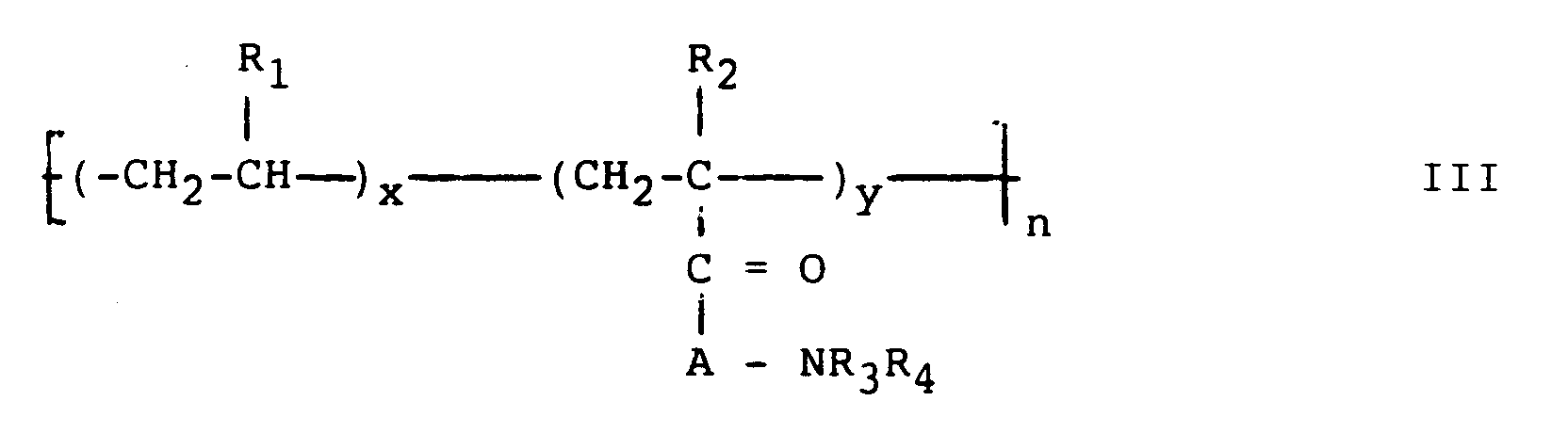
oder R3 und R4 mit dem Amidstickstoffatom einen Piperazinring bilden;

Nach einer Nachreaktion von 60 min werden die Zersetzungsprodukte des Starters, Lösemittel und freies Olefin abdestilliert (190°C, 25 mbar). Das erhaltene Polymer (2 500 g) hatte ein Molgewicht von 7 500 (GPC) und einen Schmelzbereich von 91 - 97°C.
| Haftvermittler Typ | Menge (%) | Haftfestigkeit | Farbe (YI) 160°C | |
| 130°C | 160°C | |||
| Blank | - | 1 | 1 | 20 |
| Referenz | 0.5 | 1 | 2 | 50 |
| 1.0 | 2 | 3-4 | 72 | |
| 2.0 | 3 | 4 | 83 | |
| A | 0.3 | 3 | 3-4 | 37 |
| 0.5 | 3 | 4 | 44 | |
| 1.0 | 3 | 4 | 51 | |
| 2.0 | 2 | 4 | 73 | |
| B | 0.3 | 3 | 3 | 39 |
| 0.5 | 3 | 4 | 46 | |
| 1.0 | 3 | 4 | 62 |


Claims (9)
- Verfahren zur Herstellung einer Plastisol-Zusammensetzung, dadurch gekennzeichnet, daß 0,1 - 5 Gew.-%, bezogen auf das Gewicht der gesamten Plastisol-Zusammensetzung, eines Haftverbesserers, der aus einer Gruppe ausgewählt wird, die aus Amidoaminen, Imidoaminen und Esteraminen besteht, zu einem Platisol gegeben wird, welches Polyvinylchlorid, Polyvinylchloridcopolymere und Polyalkylenmethacrylat in einem Weichmacher umfaßt, um die Plastisol-Zusammensetzung zu bilden, wobei der Haftverbesserer ein Produkt ist ausder Reaktion wenigstens einer ethylenisch ungesättigten Verbindung, welche ein Styrol, ein α-Olefin, ein Vinylether oder ein Allylether ist, mit wenigstens einer einfach ungesättigten Carbonsäure oder einem einfach ungesättigten Carbonsäure-Derivat, um ein Copolymeres zu bilden;Reaktion des Copolymeren mit wenigstens einem Polyamin mit wenigstens einer primären Aminogruppe, um den Haftverbesserer zu bilden.
- Verfahren nach Anspruch 1, dadurch gekennzeichnet, daß das α-Olefin 10 bis 24 Kohlenstoffatome aufweist.
- Verfahren nach Anspruch 1, dadurch gekennzeichnet, daß die einfach ungesättigte Carbonsäure oder deren Derivat Acrylsäure, Methacrylsäure bzw. deren Methyl- oder Ethylester ist.
- Verfahren nach Anspruch 1 oder 2, dadurch gekennzeichnet, daß die einfach ungesättigte Carbonsäure Maleinsäure, Maleinsäureanhydrid oder Fumarsäure ist.
- Verfahren nach Anspruch 1 oder 2, dadurch gekennzeichnet, daß das Derivat der einfach ungesättigten Carbonsäure Glycidylester ist.
- Verfahren nach einem der Ansprüche 1 bis 6, dadurch gekennzeichnet, daß das Polyamin N-Aminoethylpiperazin ist.
- Verfahren nach Anspruch 2, dadurch gekennzeichnet, daß das gebildete Copolymer eine der folgenden Formeln aufweist:wobei
 X = 1;y = 1 - 4;n = 5 - 50;R1 = C6 - C22 - AlkylR2 = H, CH3; R3 = H oder C - C3 Alkyl und R4 ein eine oder mehrere Amingruppen aufweisender Kohlenwasserstoffrest mit 2 bis 14 Kohlenstoffatomen ist oder R3 und R4 mit dem Amidstickstoffatom einen Piperazinring bilden:wobei
 x = 1;y = 1 - 2;n = 5 - 50;R1 = C8 - C22-AlkylR2 ein eine oder mehrere Amingruppen aufweisender Kohlenwasserstoffrest mit 2 bis 14 Kohlenstoffatomen ist: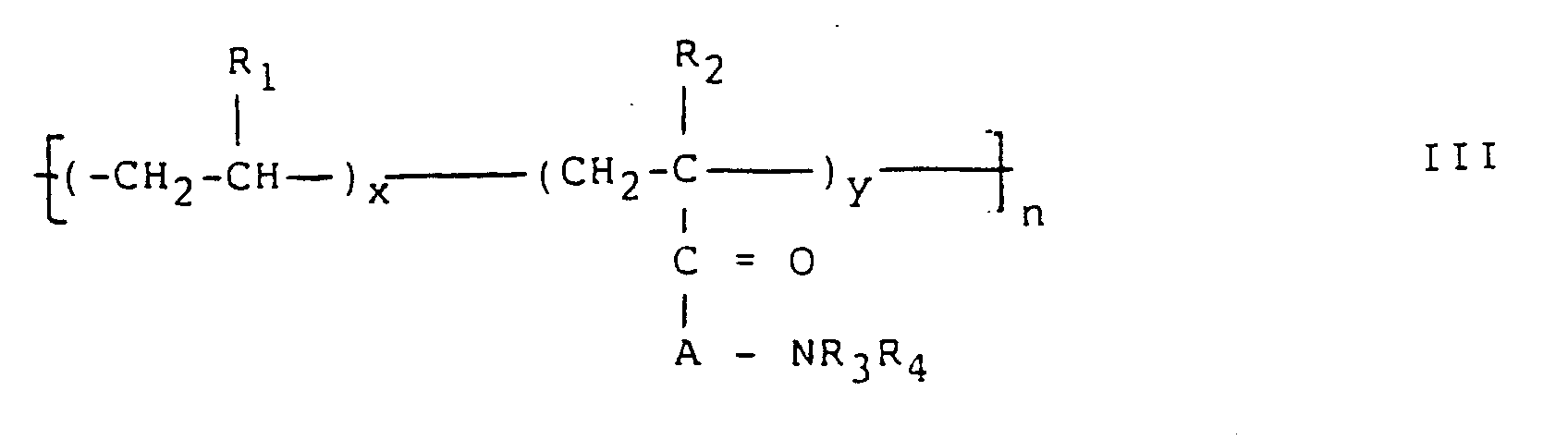
- Verfahren nach einem der vorstehenden Ansprüche, dadurch gekennzeichnet, daß der Haftverbesserer ein Imidoamin ist, das das Produkt ist ausder Reaktion eines α-Olefins mit 10 bis 24 Kohlenstoffatomen mit Maleinsäure, Maleinsäureanhydrid oder Fumarsäure, um ein Copolymer zu bilden; undder Reaktion des Copolymeren mit wenigstens einem Polyamin mit wenigstens einer primären Aminogruppe.
- Verfahren nach Anspruch 8, dadurch gekennzeichnet, daß das Copolymere ein Reaktionsprodukt aus einem α-Olefin mit 14 bis 16 Kohlenstoffatomen und Maleinsäureanhydrid ist, wobei das Copolymere dann mit N-Aminoethylpiperazin umgesetzt wird.
Applications Claiming Priority (2)
| Application Number | Priority Date | Filing Date | Title |
|---|---|---|---|
| DE4342672 | 1993-12-15 | ||
| DE4342672A DE4342672A1 (de) | 1993-12-15 | 1993-12-15 | Haftverbesserer |
Publications (2)
| Publication Number | Publication Date |
|---|---|
| EP0658574A1 EP0658574A1 (de) | 1995-06-21 |
| EP0658574B1 true EP0658574B1 (de) | 1998-06-03 |
Family
ID=6505014
Family Applications (1)
| Application Number | Title | Priority Date | Filing Date |
|---|---|---|---|
| EP94119611A Expired - Lifetime EP0658574B1 (de) | 1993-12-15 | 1994-12-12 | Verfahren zur Herstellung einer Plastisol-Zusammensetzung |
Country Status (7)
| Country | Link |
|---|---|
| US (1) | US6040385A (de) |
| EP (1) | EP0658574B1 (de) |
| JP (1) | JP3784425B2 (de) |
| KR (1) | KR100391731B1 (de) |
| CA (1) | CA2138117A1 (de) |
| DE (2) | DE4342672A1 (de) |
| ES (1) | ES2116516T3 (de) |
Families Citing this family (6)
| Publication number | Priority date | Publication date | Assignee | Title |
|---|---|---|---|---|
| CA2413972A1 (en) * | 2000-06-02 | 2001-12-13 | Henkel Corporation | A plastisol composition and method for using same |
| US20040034143A1 (en) * | 2001-05-17 | 2004-02-19 | James Hubert | Plastisol composition and method for using same |
| DE102004035937A1 (de) * | 2004-07-23 | 2006-02-16 | Röhm GmbH & Co. KG | Plastisole mit verringerter Wasseraufnahme |
| DE102006021200A1 (de) | 2006-05-06 | 2007-11-15 | Byk-Chemie Gmbh | Verwendung von Copolymeren als Haftvermittler in Lacken |
| FR3085602B1 (fr) | 2018-09-07 | 2023-02-24 | Psa Automobiles Sa | Procede d’application d’un revetement multicouche d’un ou plusieurs elements de carrosserie d’un vehicule automobile et installation pour mise en œuvre d’un tel procede |
| US20240218125A1 (en) * | 2021-05-14 | 2024-07-04 | Evonik Operations Gmbh | Amidoamine composition and adhesive composition containing the same |
Family Cites Families (36)
| Publication number | Priority date | Publication date | Assignee | Title |
|---|---|---|---|---|
| US3291731A (en) * | 1962-02-05 | 1966-12-13 | Exxon Research Engineering Co | Incorporating sodium nitrite into lubricant compositions |
| DE2327958A1 (de) * | 1973-06-01 | 1975-01-02 | Henkel & Cie Gmbh | Haftvermittler enthaltende plastisole |
| DE2448344C3 (de) * | 1974-10-10 | 1978-08-31 | Chemische Werke Huels Ag, 4370 Marl | Verwendung eines haftverbessernden Zusatzes zu Schmelzklebern auf der Basis von Copolyamiden |
| US4020966A (en) * | 1975-03-28 | 1977-05-03 | W. R. Grace & Co. | Plastisol composition and container closure gasket made therefrom |
| DE2544948C3 (de) * | 1975-10-08 | 1978-11-16 | Akzo Gmbh, 5600 Wuppertal | Verfahren zur Herstellung von kationischen Leimungsmitteln für Papier |
| DE2654871C3 (de) * | 1976-12-03 | 1984-10-04 | Schering AG, 1000 Berlin und 4709 Bergkamen | Polyvinylchlorid-Plastisole mit verbesserter Haftung |
| SU618395A1 (ru) * | 1977-01-26 | 1978-08-05 | Предприятие П/Я В-2756 | Клей-расплав |
| US4357250A (en) * | 1978-04-17 | 1982-11-02 | The Lubrizol Corporation | Nitrogen-containing terpolymer-based compositions useful as multi-purpose lubricant additives |
| US4357440A (en) * | 1979-09-10 | 1982-11-02 | Union Carbide Corporation | Wet-adhesion aid |
| US4480056A (en) * | 1981-06-29 | 1984-10-30 | The United States Of America As Represented By The Secretary Of The Navy | Organotin antifouling coatings with novolac and Bisphenol-A epoxy resins |
| DE3201265A1 (de) * | 1982-01-16 | 1983-07-28 | Schering Ag, 1000 Berlin Und 4619 Bergkamen | Verfahren zum herstellen von ueberzuegen und klebeverbindung mit polyvinylchlorid-plastisolen mit verbesserter haftung und plastisole fuer das verfahren |
| DE3221354A1 (de) * | 1982-06-05 | 1983-12-08 | Schering AG, 1000 Berlin und 4709 Bergkamen | Verfahren zum herstellen von ueberzuegen und klebeverbindungen mit polyvinylchlorid-plastisolen mit verbesserter haftung und plastisole fuer das verfahren |
| IT1180214B (it) * | 1984-08-02 | 1987-09-23 | Chem Plast Spa | Promotori d'adesione per plastisols in grado di mantenere stabile il colore dei plastisols all'effetto del trattamento termico d'applicazione |
| US4547224A (en) * | 1984-09-17 | 1985-10-15 | Westvaco Corporation | Emulsifiers for bituminous emulsions |
| DE3504804A1 (de) * | 1985-02-13 | 1986-08-14 | Henkel KGaA, 4000 Düsseldorf | Schmelzkleber |
| US4578424A (en) * | 1985-05-03 | 1986-03-25 | Ashland Oil, Inc. | High performance two-component epoxy structural adhesives with chemical thixotropy |
| US4668412A (en) * | 1985-06-27 | 1987-05-26 | Texaco Inc. | Lubricating oil containing dispersant VII and pour depressant |
| DE3523480C1 (de) * | 1985-07-01 | 1987-01-22 | Teroson Gmbh | Metallklebstoff |
| US5188693A (en) * | 1986-04-18 | 1993-02-23 | Aishin Kakou K.K. | Process for applying polyvinyl chloride sealing material having low thixotropic index |
| JPH0662779B2 (ja) * | 1986-11-11 | 1994-08-17 | 住友化学工業株式会社 | カチオン性ポリマーの水分散液およびその用途 |
| CA1326730C (en) * | 1987-01-16 | 1994-02-01 | Tadayuki Ohmae | Ethylene copolymer and process for producing said copolymer |
| EP0293087A1 (de) * | 1987-04-30 | 1988-11-30 | Sumitomo Chemical Company, Limited | Herstellung von elektrisch leitfähigen Ethylencopolymerformen |
| JP2661241B2 (ja) * | 1988-03-03 | 1997-10-08 | 住友化学工業株式会社 | エチレン共重合体を有効成分とする殺菌剤および殺菌性樹脂組成物 |
| DE3827056A1 (de) * | 1988-08-10 | 1990-02-15 | Hoechst Ag | Verfahren zur herstellung von mischpolymerisaten des ethylens mit hoher schaelfestigkeit |
| DE3827587A1 (de) * | 1988-08-13 | 1990-03-01 | Basf Lacke & Farben | Aminogruppenhaltige copolymerisate, verfahren zu ihrer herstellung sowie ihre verwendung in beschichtungsmitteln |
| DE3830007A1 (de) * | 1988-09-03 | 1990-03-15 | Basf Ag | Verfahren zur herstellung von aminmodifizierten ethylen-carbonsaeure-copolymerisaten, derartige copolymerisate und ihre verwendung fuer haftvermittler und kabelummantelungen |
| CA2007328A1 (en) * | 1989-01-10 | 1990-07-10 | Don S. Wozniak | Adhesion and paintability improvements in pvc plastisols at low bake temperatures |
| DE3900933A1 (de) * | 1989-01-14 | 1990-07-26 | Basf Ag | Nichtwaessrige kunststoffzubereitungen |
| US5236785A (en) * | 1989-09-01 | 1993-08-17 | Tomoegawa Paper Co., Ltd. | Printing sheet |
| DE3929163A1 (de) * | 1989-09-02 | 1991-03-07 | Bayer Ag | Sekundaere aminogruppen aufweisende copolymerisate, ein verfahren zu ihrer herstellung und ihre verwendung als bindemittel oder bindemittelkomponente |
| US5248562A (en) * | 1990-02-07 | 1993-09-28 | Ppg Industries, Inc. | Polyvinyl chloride plastisol composition suitable as a sealant |
| CA2035538C (en) * | 1990-02-07 | 1999-01-05 | Ppg Industries Ohio, Inc. | Polyvinyl chloride plastisol composition suitable as a sealant |
| US5182326A (en) * | 1991-04-08 | 1993-01-26 | Westvaco Corporation | Rosin and fatty acid based pigment grinding aids for water-based ink formulations |
| DE4117487A1 (de) * | 1991-05-28 | 1992-12-03 | Wacker Chemie Gmbh | Aminooxy-vernetzer enthaltende waessrige dispersionen von carbonylgruppen enthaltenden copolymerisaten |
| US5120725A (en) * | 1991-05-29 | 1992-06-09 | American Home Products Corporation | Bicyclic rapamycins |
| DE69318593T2 (de) * | 1992-02-28 | 1998-11-26 | Dai-Ichi Kogyo Seiyaku Co., Ltd., Kyoto | Aminogruppen enthaltende Copolymere und Verfahren zur Herstellung |
-
1993
- 1993-12-15 DE DE4342672A patent/DE4342672A1/de not_active Withdrawn
-
1994
- 1994-12-12 DE DE59406129T patent/DE59406129D1/de not_active Expired - Fee Related
- 1994-12-12 EP EP94119611A patent/EP0658574B1/de not_active Expired - Lifetime
- 1994-12-12 ES ES94119611T patent/ES2116516T3/es not_active Expired - Lifetime
- 1994-12-13 JP JP30933794A patent/JP3784425B2/ja not_active Expired - Fee Related
- 1994-12-14 KR KR1019940034074A patent/KR100391731B1/ko not_active Expired - Fee Related
- 1994-12-14 CA CA002138117A patent/CA2138117A1/en not_active Abandoned
- 1994-12-15 US US08/356,663 patent/US6040385A/en not_active Expired - Lifetime
Also Published As
| Publication number | Publication date |
|---|---|
| KR950018068A (ko) | 1995-07-22 |
| JPH07206926A (ja) | 1995-08-08 |
| US6040385A (en) | 2000-03-21 |
| CA2138117A1 (en) | 1995-06-16 |
| JP3784425B2 (ja) | 2006-06-14 |
| EP0658574A1 (de) | 1995-06-21 |
| DE4342672A1 (de) | 1995-06-22 |
| DE59406129D1 (de) | 1998-07-09 |
| KR100391731B1 (ko) | 2004-03-18 |
| ES2116516T3 (es) | 1998-07-16 |
Similar Documents
| Publication | Publication Date | Title |
|---|---|---|
| DE3311752A1 (de) | Crotonesterhaltige copolymerisate, verfahren zu ihrer herstellung und ihre verwendung als verdicker in waessrigen systemen sowie als schlichtemittel | |
| EP2301977A1 (de) | Wasserdispergierbares, cyclocarbonatfunktionalisiertes vinylcopolymer-system | |
| DE69505180T2 (de) | Polymere aus Allyl-Alkohol-Propoxylaten | |
| DE3713538C2 (de) | ||
| AT392797B (de) | Druckempfindlicher kleber | |
| DE69005315T2 (de) | Haft- und Streichbarkeitsverbesserung von PVC-Plastisolen bei niedrigen Einbrenntemperaturen. | |
| DE3622566C2 (de) | ||
| EP0056971B1 (de) | Verfahren zur Herstellung von Copolymerisaten und Verwendung der erhaltenen Produkte | |
| EP0658574A1 (de) | Haftverbesserer | |
| EP1173490B1 (de) | Copolymere mit amphiphilen untereinheiten, verfahren zu deren herstellung und deren verwendung | |
| DE60316947T2 (de) | Verfahren zur polymerisation ethylenisch ungesättigter monomere | |
| DE3883286T2 (de) | Emulsionscopolymerisation. | |
| DE2325177A1 (de) | Hitzehaertbares anstrichmittel in form einer waessrigen dispersion oder loesung | |
| EP0042506A2 (de) | Copolymerisate auf Basis von Styrol und (Meth)Acrylsäureestern und ihre Verwendung in benzinhaltigen Fassadenfarben oder Putzen | |
| EP0022982B1 (de) | Verdickungsmittel für physikalisch trocknende Beschichtungsstoffe und Verfahren zu dessen Herstellung | |
| EP1012196A1 (de) | Verfahren zur herstellung lösemittelfreier polivinylester-dispersionen mit erhöhter wasserresistenz | |
| EP0960889A1 (de) | Phosphat- oder Phosphonatgruppen enthaltende Bindemittel für den Korrosionsschutz | |
| DE2719740C2 (de) | ||
| DE1207630B (de) | Verfahren zur Herstellung von wasserloeslichen Mischpolymerisaten des Acrylamids | |
| EP0007531B1 (de) | Carboxylgruppenhaltige Vinylchloridcopolymerisate und ihre Verwendung | |
| DE2730251C2 (de) | Verfahren zur Herstellung einer Beschichtungsemulsion | |
| DE1092656B (de) | Verfahren zur Emulsionspolymerisation von Vinylacetat fuer sich und in Mischpolymerisation mit Estern ungesaettigter Mono- und Dicarbonsaeuren | |
| DE1922587A1 (de) | Nitrocelluloselacke,die AEthylen/Vinylester/Carbonsaeure-Mischpolymerisate enthalten | |
| DE102006055473A1 (de) | Verfahren zur Herstellung von Pfropfcopolymeren auf Basis von Polyethern | |
| DE3604177A1 (de) | Verfahren zur herstellung von kunstharzbindemitteln fuer den bautenschutz |
Legal Events
| Date | Code | Title | Description |
|---|---|---|---|
| PUAI | Public reference made under article 153(3) epc to a published international application that has entered the european phase |
Free format text: ORIGINAL CODE: 0009012 |
|
| AK | Designated contracting states |
Kind code of ref document: A1 Designated state(s): BE DE ES FR GB IT NL PT SE |
|
| 17P | Request for examination filed |
Effective date: 19950712 |
|
| RAP1 | Party data changed (applicant data changed or rights of an application transferred) |
Owner name: AIR PRODUCTS AND CHEMICALS, INC. |
|
| 17Q | First examination report despatched |
Effective date: 19960620 |
|
| GRAG | Despatch of communication of intention to grant |
Free format text: ORIGINAL CODE: EPIDOS AGRA |
|
| GRAG | Despatch of communication of intention to grant |
Free format text: ORIGINAL CODE: EPIDOS AGRA |
|
| GRAH | Despatch of communication of intention to grant a patent |
Free format text: ORIGINAL CODE: EPIDOS IGRA |
|
| GRAH | Despatch of communication of intention to grant a patent |
Free format text: ORIGINAL CODE: EPIDOS IGRA |
|
| GRAA | (expected) grant |
Free format text: ORIGINAL CODE: 0009210 |
|
| AK | Designated contracting states |
Kind code of ref document: B1 Designated state(s): BE DE ES FR GB IT NL PT SE |
|
| PG25 | Lapsed in a contracting state [announced via postgrant information from national office to epo] |
Ref country code: NL Free format text: LAPSE BECAUSE OF FAILURE TO SUBMIT A TRANSLATION OF THE DESCRIPTION OR TO PAY THE FEE WITHIN THE PRESCRIBED TIME-LIMIT Effective date: 19980603 |
|
| GBT | Gb: translation of ep patent filed (gb section 77(6)(a)/1977) |
Effective date: 19980603 |
|
| REF | Corresponds to: |
Ref document number: 59406129 Country of ref document: DE Date of ref document: 19980709 |
|
| REG | Reference to a national code |
Ref country code: ES Ref legal event code: FG2A Ref document number: 2116516 Country of ref document: ES Kind code of ref document: T3 |
|
| ITF | It: translation for a ep patent filed | ||
| PG25 | Lapsed in a contracting state [announced via postgrant information from national office to epo] |
Ref country code: PT Free format text: LAPSE BECAUSE OF FAILURE TO SUBMIT A TRANSLATION OF THE DESCRIPTION OR TO PAY THE FEE WITHIN THE PRESCRIBED TIME-LIMIT Effective date: 19980903 |
|
| ET | Fr: translation filed | ||
| NLV1 | Nl: lapsed or annulled due to failure to fulfill the requirements of art. 29p and 29m of the patents act | ||
| PG25 | Lapsed in a contracting state [announced via postgrant information from national office to epo] |
Ref country code: SE Free format text: LAPSE BECAUSE OF NON-PAYMENT OF DUE FEES Effective date: 19981213 |
|
| PG25 | Lapsed in a contracting state [announced via postgrant information from national office to epo] |
Ref country code: BE Free format text: LAPSE BECAUSE OF NON-PAYMENT OF DUE FEES Effective date: 19981231 |
|
| PLBE | No opposition filed within time limit |
Free format text: ORIGINAL CODE: 0009261 |
|
| STAA | Information on the status of an ep patent application or granted ep patent |
Free format text: STATUS: NO OPPOSITION FILED WITHIN TIME LIMIT |
|
| 26N | No opposition filed | ||
| BERE | Be: lapsed |
Owner name: AIR PRODUCTS AND CHEMICALS INC. Effective date: 19981231 |
|
| PG25 | Lapsed in a contracting state [announced via postgrant information from national office to epo] |
Ref country code: ES Free format text: LAPSE BECAUSE OF NON-PAYMENT OF DUE FEES Effective date: 19991213 |
|
| REG | Reference to a national code |
Ref country code: GB Ref legal event code: IF02 |
|
| REG | Reference to a national code |
Ref country code: ES Ref legal event code: FD2A Effective date: 20000114 |
|
| PGFP | Annual fee paid to national office [announced via postgrant information from national office to epo] |
Ref country code: IT Payment date: 20081212 Year of fee payment: 15 |
|
| PGFP | Annual fee paid to national office [announced via postgrant information from national office to epo] |
Ref country code: FR Payment date: 20081205 Year of fee payment: 15 |
|
| PGFP | Annual fee paid to national office [announced via postgrant information from national office to epo] |
Ref country code: DE Payment date: 20081230 Year of fee payment: 15 |
|
| PGFP | Annual fee paid to national office [announced via postgrant information from national office to epo] |
Ref country code: GB Payment date: 20081110 Year of fee payment: 15 |
|
| GBPC | Gb: european patent ceased through non-payment of renewal fee |
Effective date: 20091212 |
|
| REG | Reference to a national code |
Ref country code: FR Ref legal event code: ST Effective date: 20100831 |
|
| PG25 | Lapsed in a contracting state [announced via postgrant information from national office to epo] |
Ref country code: FR Free format text: LAPSE BECAUSE OF NON-PAYMENT OF DUE FEES Effective date: 20091231 |
|
| PG25 | Lapsed in a contracting state [announced via postgrant information from national office to epo] |
Ref country code: DE Free format text: LAPSE BECAUSE OF NON-PAYMENT OF DUE FEES Effective date: 20100701 |
|
| PG25 | Lapsed in a contracting state [announced via postgrant information from national office to epo] |
Ref country code: GB Free format text: LAPSE BECAUSE OF NON-PAYMENT OF DUE FEES Effective date: 20091212 |
|
| PG25 | Lapsed in a contracting state [announced via postgrant information from national office to epo] |
Ref country code: IT Free format text: LAPSE BECAUSE OF NON-PAYMENT OF DUE FEES Effective date: 20091212 |