EP0610089A2 - Katalytischen Metall-Polymer-Komplex enthaltende Zusammensetzung und mehrschichtiger Vorformling oder Laminat daraus - Google Patents
Katalytischen Metall-Polymer-Komplex enthaltende Zusammensetzung und mehrschichtiger Vorformling oder Laminat daraus Download PDFInfo
- Publication number
- EP0610089A2 EP0610089A2 EP94300833A EP94300833A EP0610089A2 EP 0610089 A2 EP0610089 A2 EP 0610089A2 EP 94300833 A EP94300833 A EP 94300833A EP 94300833 A EP94300833 A EP 94300833A EP 0610089 A2 EP0610089 A2 EP 0610089A2
- Authority
- EP
- European Patent Office
- Prior art keywords
- polymer
- catalytic metal
- laminate
- metal
- monomer
- Prior art date
- Legal status (The legal status is an assumption and is not a legal conclusion. Google has not performed a legal analysis and makes no representation as to the accuracy of the status listed.)
- Granted
Links
Images
Classifications
-
- B—PERFORMING OPERATIONS; TRANSPORTING
- B32—LAYERED PRODUCTS
- B32B—LAYERED PRODUCTS, i.e. PRODUCTS BUILT-UP OF STRATA OF FLAT OR NON-FLAT, e.g. CELLULAR OR HONEYCOMB, FORM
- B32B5/00—Layered products characterised by the non- homogeneity or physical structure, i.e. comprising a fibrous, filamentary, particulate or foam layer; Layered products characterised by having a layer differing constitutionally or physically in different parts
- B32B5/22—Layered products characterised by the non- homogeneity or physical structure, i.e. comprising a fibrous, filamentary, particulate or foam layer; Layered products characterised by having a layer differing constitutionally or physically in different parts characterised by the presence of two or more layers which are next to each other and are fibrous, filamentary, formed of particles or foamed
- B32B5/24—Layered products characterised by the non- homogeneity or physical structure, i.e. comprising a fibrous, filamentary, particulate or foam layer; Layered products characterised by having a layer differing constitutionally or physically in different parts characterised by the presence of two or more layers which are next to each other and are fibrous, filamentary, formed of particles or foamed one layer being a fibrous or filamentary layer
- B32B5/26—Layered products characterised by the non- homogeneity or physical structure, i.e. comprising a fibrous, filamentary, particulate or foam layer; Layered products characterised by having a layer differing constitutionally or physically in different parts characterised by the presence of two or more layers which are next to each other and are fibrous, filamentary, formed of particles or foamed one layer being a fibrous or filamentary layer another layer next to it also being fibrous or filamentary
-
- B—PERFORMING OPERATIONS; TRANSPORTING
- B32—LAYERED PRODUCTS
- B32B—LAYERED PRODUCTS, i.e. PRODUCTS BUILT-UP OF STRATA OF FLAT OR NON-FLAT, e.g. CELLULAR OR HONEYCOMB, FORM
- B32B5/00—Layered products characterised by the non- homogeneity or physical structure, i.e. comprising a fibrous, filamentary, particulate or foam layer; Layered products characterised by having a layer differing constitutionally or physically in different parts
- B32B5/02—Layered products characterised by the non- homogeneity or physical structure, i.e. comprising a fibrous, filamentary, particulate or foam layer; Layered products characterised by having a layer differing constitutionally or physically in different parts characterised by structural features of a fibrous or filamentary layer
- B32B5/08—Layered products characterised by the non- homogeneity or physical structure, i.e. comprising a fibrous, filamentary, particulate or foam layer; Layered products characterised by having a layer differing constitutionally or physically in different parts characterised by structural features of a fibrous or filamentary layer the fibres or filaments of a layer being of different substances, e.g. conjugate fibres, mixture of different fibres
-
- B—PERFORMING OPERATIONS; TRANSPORTING
- B32—LAYERED PRODUCTS
- B32B—LAYERED PRODUCTS, i.e. PRODUCTS BUILT-UP OF STRATA OF FLAT OR NON-FLAT, e.g. CELLULAR OR HONEYCOMB, FORM
- B32B15/00—Layered products comprising a layer of metal
- B32B15/14—Layered products comprising a layer of metal next to a fibrous or filamentary layer
-
- B—PERFORMING OPERATIONS; TRANSPORTING
- B32—LAYERED PRODUCTS
- B32B—LAYERED PRODUCTS, i.e. PRODUCTS BUILT-UP OF STRATA OF FLAT OR NON-FLAT, e.g. CELLULAR OR HONEYCOMB, FORM
- B32B15/00—Layered products comprising a layer of metal
- B32B15/20—Layered products comprising a layer of metal comprising aluminium or copper
-
- B—PERFORMING OPERATIONS; TRANSPORTING
- B32—LAYERED PRODUCTS
- B32B—LAYERED PRODUCTS, i.e. PRODUCTS BUILT-UP OF STRATA OF FLAT OR NON-FLAT, e.g. CELLULAR OR HONEYCOMB, FORM
- B32B5/00—Layered products characterised by the non- homogeneity or physical structure, i.e. comprising a fibrous, filamentary, particulate or foam layer; Layered products characterised by having a layer differing constitutionally or physically in different parts
- B32B5/02—Layered products characterised by the non- homogeneity or physical structure, i.e. comprising a fibrous, filamentary, particulate or foam layer; Layered products characterised by having a layer differing constitutionally or physically in different parts characterised by structural features of a fibrous or filamentary layer
- B32B5/024—Woven fabric
-
- C—CHEMISTRY; METALLURGY
- C08—ORGANIC MACROMOLECULAR COMPOUNDS; THEIR PREPARATION OR CHEMICAL WORKING-UP; COMPOSITIONS BASED THEREON
- C08F—MACROMOLECULAR COMPOUNDS OBTAINED BY REACTIONS ONLY INVOLVING CARBON-TO-CARBON UNSATURATED BONDS
- C08F283/00—Macromolecular compounds obtained by polymerising monomers on to polymers provided for in subclass C08G
- C08F283/01—Macromolecular compounds obtained by polymerising monomers on to polymers provided for in subclass C08G on to unsaturated polyesters
-
- C—CHEMISTRY; METALLURGY
- C08—ORGANIC MACROMOLECULAR COMPOUNDS; THEIR PREPARATION OR CHEMICAL WORKING-UP; COMPOSITIONS BASED THEREON
- C08J—WORKING-UP; GENERAL PROCESSES OF COMPOUNDING; AFTER-TREATMENT NOT COVERED BY SUBCLASSES C08B, C08C, C08F, C08G or C08H
- C08J3/00—Processes of treating or compounding macromolecular substances
- C08J3/20—Compounding polymers with additives, e.g. colouring
- C08J3/22—Compounding polymers with additives, e.g. colouring using masterbatch techniques
- C08J3/226—Compounding polymers with additives, e.g. colouring using masterbatch techniques using a polymer as a carrier
-
- H—ELECTRICITY
- H05—ELECTRIC TECHNIQUES NOT OTHERWISE PROVIDED FOR
- H05K—PRINTED CIRCUITS; CASINGS OR CONSTRUCTIONAL DETAILS OF ELECTRIC APPARATUS; MANUFACTURE OF ASSEMBLAGES OF ELECTRICAL COMPONENTS
- H05K1/00—Printed circuits
- H05K1/02—Details
- H05K1/03—Use of materials for the substrate
- H05K1/0313—Organic insulating material
- H05K1/0353—Organic insulating material consisting of two or more materials, e.g. two or more polymers, polymer + filler, + reinforcement
- H05K1/0373—Organic insulating material consisting of two or more materials, e.g. two or more polymers, polymer + filler, + reinforcement containing additives, e.g. fillers
-
- B—PERFORMING OPERATIONS; TRANSPORTING
- B32—LAYERED PRODUCTS
- B32B—LAYERED PRODUCTS, i.e. PRODUCTS BUILT-UP OF STRATA OF FLAT OR NON-FLAT, e.g. CELLULAR OR HONEYCOMB, FORM
- B32B2260/00—Layered product comprising an impregnated, embedded, or bonded layer wherein the layer comprises an impregnation, embedding, or binder material
- B32B2260/02—Composition of the impregnated, bonded or embedded layer
- B32B2260/021—Fibrous or filamentary layer
-
- B—PERFORMING OPERATIONS; TRANSPORTING
- B32—LAYERED PRODUCTS
- B32B—LAYERED PRODUCTS, i.e. PRODUCTS BUILT-UP OF STRATA OF FLAT OR NON-FLAT, e.g. CELLULAR OR HONEYCOMB, FORM
- B32B2260/00—Layered product comprising an impregnated, embedded, or bonded layer wherein the layer comprises an impregnation, embedding, or binder material
- B32B2260/04—Impregnation, embedding, or binder material
- B32B2260/046—Synthetic resin
-
- B—PERFORMING OPERATIONS; TRANSPORTING
- B32—LAYERED PRODUCTS
- B32B—LAYERED PRODUCTS, i.e. PRODUCTS BUILT-UP OF STRATA OF FLAT OR NON-FLAT, e.g. CELLULAR OR HONEYCOMB, FORM
- B32B2262/00—Composition or structural features of fibres which form a fibrous or filamentary layer or are present as additives
- B32B2262/10—Inorganic fibres
- B32B2262/101—Glass fibres
-
- C—CHEMISTRY; METALLURGY
- C08—ORGANIC MACROMOLECULAR COMPOUNDS; THEIR PREPARATION OR CHEMICAL WORKING-UP; COMPOSITIONS BASED THEREON
- C08G—MACROMOLECULAR COMPOUNDS OBTAINED OTHERWISE THAN BY REACTIONS ONLY INVOLVING UNSATURATED CARBON-TO-CARBON BONDS
- C08G63/00—Macromolecular compounds obtained by reactions forming a carboxylic ester link in the main chain of the macromolecule
- C08G63/91—Polymers modified by chemical after-treatment
- C08G63/914—Polymers modified by chemical after-treatment derived from polycarboxylic acids and polyhydroxy compounds
- C08G63/918—Polycarboxylic acids and polyhydroxy compounds in which at least one of the two components contains aliphatic unsaturation
-
- C—CHEMISTRY; METALLURGY
- C08—ORGANIC MACROMOLECULAR COMPOUNDS; THEIR PREPARATION OR CHEMICAL WORKING-UP; COMPOSITIONS BASED THEREON
- C08J—WORKING-UP; GENERAL PROCESSES OF COMPOUNDING; AFTER-TREATMENT NOT COVERED BY SUBCLASSES C08B, C08C, C08F, C08G or C08H
- C08J2433/00—Characterised by the use of homopolymers or copolymers of compounds having one or more unsaturated aliphatic radicals, each having only one carbon-to-carbon double bond, and only one being terminated by only one carboxyl radical, or of salts, anhydrides, esters, amides, imides, or nitriles thereof; Derivatives of such polymers
-
- C—CHEMISTRY; METALLURGY
- C08—ORGANIC MACROMOLECULAR COMPOUNDS; THEIR PREPARATION OR CHEMICAL WORKING-UP; COMPOSITIONS BASED THEREON
- C08J—WORKING-UP; GENERAL PROCESSES OF COMPOUNDING; AFTER-TREATMENT NOT COVERED BY SUBCLASSES C08B, C08C, C08F, C08G or C08H
- C08J2467/00—Characterised by the use of polyesters obtained by reactions forming a carboxylic ester link in the main chain; Derivatives of such polymers
-
- H—ELECTRICITY
- H05—ELECTRIC TECHNIQUES NOT OTHERWISE PROVIDED FOR
- H05K—PRINTED CIRCUITS; CASINGS OR CONSTRUCTIONAL DETAILS OF ELECTRIC APPARATUS; MANUFACTURE OF ASSEMBLAGES OF ELECTRICAL COMPONENTS
- H05K2201/00—Indexing scheme relating to printed circuits covered by H05K1/00
- H05K2201/02—Fillers; Particles; Fibers; Reinforcement materials
- H05K2201/0203—Fillers and particles
- H05K2201/0206—Materials
- H05K2201/0236—Plating catalyst as filler in insulating material
-
- H—ELECTRICITY
- H05—ELECTRIC TECHNIQUES NOT OTHERWISE PROVIDED FOR
- H05K—PRINTED CIRCUITS; CASINGS OR CONSTRUCTIONAL DETAILS OF ELECTRIC APPARATUS; MANUFACTURE OF ASSEMBLAGES OF ELECTRICAL COMPONENTS
- H05K2203/00—Indexing scheme relating to apparatus or processes for manufacturing printed circuits covered by H05K3/00
- H05K2203/11—Treatments characterised by their effect, e.g. heating, cooling, roughening
- H05K2203/1157—Using means for chemical reduction
-
- H—ELECTRICITY
- H05—ELECTRIC TECHNIQUES NOT OTHERWISE PROVIDED FOR
- H05K—PRINTED CIRCUITS; CASINGS OR CONSTRUCTIONAL DETAILS OF ELECTRIC APPARATUS; MANUFACTURE OF ASSEMBLAGES OF ELECTRICAL COMPONENTS
- H05K3/00—Apparatus or processes for manufacturing printed circuits
- H05K3/10—Apparatus or processes for manufacturing printed circuits in which conductive material is applied to the insulating support in such a manner as to form the desired conductive pattern
- H05K3/18—Apparatus or processes for manufacturing printed circuits in which conductive material is applied to the insulating support in such a manner as to form the desired conductive pattern using precipitation techniques to apply the conductive material
- H05K3/181—Apparatus or processes for manufacturing printed circuits in which conductive material is applied to the insulating support in such a manner as to form the desired conductive pattern using precipitation techniques to apply the conductive material by electroless plating
-
- Y—GENERAL TAGGING OF NEW TECHNOLOGICAL DEVELOPMENTS; GENERAL TAGGING OF CROSS-SECTIONAL TECHNOLOGIES SPANNING OVER SEVERAL SECTIONS OF THE IPC; TECHNICAL SUBJECTS COVERED BY FORMER USPC CROSS-REFERENCE ART COLLECTIONS [XRACs] AND DIGESTS
- Y10—TECHNICAL SUBJECTS COVERED BY FORMER USPC
- Y10S—TECHNICAL SUBJECTS COVERED BY FORMER USPC CROSS-REFERENCE ART COLLECTIONS [XRACs] AND DIGESTS
- Y10S428/00—Stock material or miscellaneous articles
- Y10S428/901—Printed circuit
-
- Y—GENERAL TAGGING OF NEW TECHNOLOGICAL DEVELOPMENTS; GENERAL TAGGING OF CROSS-SECTIONAL TECHNOLOGIES SPANNING OVER SEVERAL SECTIONS OF THE IPC; TECHNICAL SUBJECTS COVERED BY FORMER USPC CROSS-REFERENCE ART COLLECTIONS [XRACs] AND DIGESTS
- Y10—TECHNICAL SUBJECTS COVERED BY FORMER USPC
- Y10T—TECHNICAL SUBJECTS COVERED BY FORMER US CLASSIFICATION
- Y10T442/00—Fabric [woven, knitted, or nonwoven textile or cloth, etc.]
- Y10T442/20—Coated or impregnated woven, knit, or nonwoven fabric which is not [a] associated with another preformed layer or fiber layer or, [b] with respect to woven and knit, characterized, respectively, by a particular or differential weave or knit, wherein the coating or impregnation is neither a foamed material nor a free metal or alloy layer
- Y10T442/2926—Coated or impregnated inorganic fiber fabric
- Y10T442/2934—Coating or impregnation contains vinyl polymer or copolymer
-
- Y—GENERAL TAGGING OF NEW TECHNOLOGICAL DEVELOPMENTS; GENERAL TAGGING OF CROSS-SECTIONAL TECHNOLOGIES SPANNING OVER SEVERAL SECTIONS OF THE IPC; TECHNICAL SUBJECTS COVERED BY FORMER USPC CROSS-REFERENCE ART COLLECTIONS [XRACs] AND DIGESTS
- Y10—TECHNICAL SUBJECTS COVERED BY FORMER USPC
- Y10T—TECHNICAL SUBJECTS COVERED BY FORMER US CLASSIFICATION
- Y10T442/00—Fabric [woven, knitted, or nonwoven textile or cloth, etc.]
- Y10T442/30—Woven fabric [i.e., woven strand or strip material]
- Y10T442/3382—Including a free metal or alloy constituent
- Y10T442/3407—Chemically deposited metal layer [e.g., chemical precipitation or electrochemical deposition or plating, etc.]
-
- Y—GENERAL TAGGING OF NEW TECHNOLOGICAL DEVELOPMENTS; GENERAL TAGGING OF CROSS-SECTIONAL TECHNOLOGIES SPANNING OVER SEVERAL SECTIONS OF THE IPC; TECHNICAL SUBJECTS COVERED BY FORMER USPC CROSS-REFERENCE ART COLLECTIONS [XRACs] AND DIGESTS
- Y10—TECHNICAL SUBJECTS COVERED BY FORMER USPC
- Y10T—TECHNICAL SUBJECTS COVERED BY FORMER US CLASSIFICATION
- Y10T442/00—Fabric [woven, knitted, or nonwoven textile or cloth, etc.]
- Y10T442/30—Woven fabric [i.e., woven strand or strip material]
- Y10T442/3382—Including a free metal or alloy constituent
- Y10T442/3415—Preformed metallic film or foil or sheet [film or foil or sheet had structural integrity prior to association with the woven fabric]
-
- Y—GENERAL TAGGING OF NEW TECHNOLOGICAL DEVELOPMENTS; GENERAL TAGGING OF CROSS-SECTIONAL TECHNOLOGIES SPANNING OVER SEVERAL SECTIONS OF THE IPC; TECHNICAL SUBJECTS COVERED BY FORMER USPC CROSS-REFERENCE ART COLLECTIONS [XRACs] AND DIGESTS
- Y10—TECHNICAL SUBJECTS COVERED BY FORMER USPC
- Y10T—TECHNICAL SUBJECTS COVERED BY FORMER US CLASSIFICATION
- Y10T442/00—Fabric [woven, knitted, or nonwoven textile or cloth, etc.]
- Y10T442/30—Woven fabric [i.e., woven strand or strip material]
- Y10T442/3382—Including a free metal or alloy constituent
- Y10T442/3415—Preformed metallic film or foil or sheet [film or foil or sheet had structural integrity prior to association with the woven fabric]
- Y10T442/3423—Plural metallic films or foils or sheets
-
- Y—GENERAL TAGGING OF NEW TECHNOLOGICAL DEVELOPMENTS; GENERAL TAGGING OF CROSS-SECTIONAL TECHNOLOGIES SPANNING OVER SEVERAL SECTIONS OF THE IPC; TECHNICAL SUBJECTS COVERED BY FORMER USPC CROSS-REFERENCE ART COLLECTIONS [XRACs] AND DIGESTS
- Y10—TECHNICAL SUBJECTS COVERED BY FORMER USPC
- Y10T—TECHNICAL SUBJECTS COVERED BY FORMER US CLASSIFICATION
- Y10T442/00—Fabric [woven, knitted, or nonwoven textile or cloth, etc.]
- Y10T442/30—Woven fabric [i.e., woven strand or strip material]
- Y10T442/3382—Including a free metal or alloy constituent
- Y10T442/3415—Preformed metallic film or foil or sheet [film or foil or sheet had structural integrity prior to association with the woven fabric]
- Y10T442/3431—Plural fabric layers
- Y10T442/3439—Including a nonwoven fabric layer
-
- Y—GENERAL TAGGING OF NEW TECHNOLOGICAL DEVELOPMENTS; GENERAL TAGGING OF CROSS-SECTIONAL TECHNOLOGIES SPANNING OVER SEVERAL SECTIONS OF THE IPC; TECHNICAL SUBJECTS COVERED BY FORMER USPC CROSS-REFERENCE ART COLLECTIONS [XRACs] AND DIGESTS
- Y10—TECHNICAL SUBJECTS COVERED BY FORMER USPC
- Y10T—TECHNICAL SUBJECTS COVERED BY FORMER US CLASSIFICATION
- Y10T442/00—Fabric [woven, knitted, or nonwoven textile or cloth, etc.]
- Y10T442/30—Woven fabric [i.e., woven strand or strip material]
- Y10T442/3707—Woven fabric including a nonwoven fabric layer other than paper
- Y10T442/378—Coated, impregnated, or autogenously bonded
- Y10T442/3813—Coating or impregnation contains synthetic polymeric material
-
- Y—GENERAL TAGGING OF NEW TECHNOLOGICAL DEVELOPMENTS; GENERAL TAGGING OF CROSS-SECTIONAL TECHNOLOGIES SPANNING OVER SEVERAL SECTIONS OF THE IPC; TECHNICAL SUBJECTS COVERED BY FORMER USPC CROSS-REFERENCE ART COLLECTIONS [XRACs] AND DIGESTS
- Y10—TECHNICAL SUBJECTS COVERED BY FORMER USPC
- Y10T—TECHNICAL SUBJECTS COVERED BY FORMER US CLASSIFICATION
- Y10T442/00—Fabric [woven, knitted, or nonwoven textile or cloth, etc.]
- Y10T442/60—Nonwoven fabric [i.e., nonwoven strand or fiber material]
- Y10T442/654—Including a free metal or alloy constituent
- Y10T442/656—Preformed metallic film or foil or sheet [film or foil or sheet had structural integrity prior to association with the nonwoven fabric]
-
- Y—GENERAL TAGGING OF NEW TECHNOLOGICAL DEVELOPMENTS; GENERAL TAGGING OF CROSS-SECTIONAL TECHNOLOGIES SPANNING OVER SEVERAL SECTIONS OF THE IPC; TECHNICAL SUBJECTS COVERED BY FORMER USPC CROSS-REFERENCE ART COLLECTIONS [XRACs] AND DIGESTS
- Y10—TECHNICAL SUBJECTS COVERED BY FORMER USPC
- Y10T—TECHNICAL SUBJECTS COVERED BY FORMER US CLASSIFICATION
- Y10T442/00—Fabric [woven, knitted, or nonwoven textile or cloth, etc.]
- Y10T442/60—Nonwoven fabric [i.e., nonwoven strand or fiber material]
- Y10T442/654—Including a free metal or alloy constituent
- Y10T442/658—Particulate free metal or alloy constituent
Definitions
- This invention relates to a composition including a novel catalytic metal-polymer complex which is useful in a method of manufacturing a laminate preform or a laminate.
- the laminate is catalytically effective for subsequent electroless metallization thereof and is useful, for example, as a substrate for printed circuit boards.
- the invention relates to a method in which reinforcing material is impregnated with a composition including a crosslinkable synthetic polymer complexed with a salt of a Group IB or Group VIII metal, and the complex is destroyed and the metal reduced to finely divided elemental metal during or after crosslinking of the polymer.
- Electroless deposition of metals is well known in the art, see, for example, U.S. Patent No. 3,560,257 to F. W. Schneble, Jr., et al., the disclosure of which is incorporated herein by reference.
- the substrate may be filled, i.e., fabricated to contain, a dispersed filler comprising a metal catalytic to the deposition of the electroless metal as is known from, for example, U.S. Patent No. 3,549,009 to F. W. Schneble, Jr., et al.
- a substrate free of metal catalyst may have its surfaces activated by immersion of the substrate in a solution containing a salt of a Group IB or Group VIII metal as is known from, for example, U.S. Patent No. 2,702,253 to Bergstrom or U.S. Patent No. 3,011,920 to Shipley, or in a solvent-metal complex as described, for example, in U.S. Patent No. 4,575,467 to Sirinyan.
- Catalytic metal coated fillers according to U.S. Patent No. 3,546,009 are known to yield substrates having an uneven distribution of the catalytic metal coated filler therein resulting from the relatively high specific gravity and tendency to settle of such fillers. Uneven filler distribution is known to cause bowing and twisting problems within the resulting substrate. Moreover, uneven metal distribution is known to cause varying rates of electroless metal deposition, for example, onto sidewall surfaces of throughbores in the substrate, during electroless metallization. Employing catalytic metal coated fillers additionally tends to produce a substrate surface that is polymer-rich and catalytic metal-deficient. Consequently, it is common to coat such substrates with a catalyst-containing adhesive coating. The coating step is tedious, however, and a common source of defects.
- Substrates-surface activated according to the prior art by immersion in a colloidal suspension or solution containing a catalytic metal salt also exhibit certain deficiencies.
- Surface activation often leads to poor adhesion of the metal subsequently deposited by electroless metallization onto the surface of the substrate due to the weak adhesion of the interboundary layer of activator (e.g., palladium or nickel) to the substrate.
- the surface activation technique frequently includes the steps of mechanical roughening or chemical etching of the surface prior to surface activation.
- Such roughening is known to degrade the surface due to the undesirable formation of cavities, the presence of which tends to occlude some etchant, for example, an etchant including chromic and sulfuric acids, which then passivates that particular site and inhibits or prevents metallization.
- etchant including chromic and sulfuric acids
- substrates frequently have numerous throughbores of varying size provided therein. These throughbores are drilled to form through-hole circuitry upon metallization but, having high aspect ratios and/or being made of highly hydrophobic materials, the sidewall surfaces of such holes are difficult to wet during immersion and, consequently, difficult to activate uniformly.
- U.S. Patent No. 4,493,861 to K. Sirinyan et al. teaches surface activation of substrates for currentless metallization by wetting the surface to be metallized with a palladium-II organic compound dissolved in a solvent, removing the solvent, and reducing the palladium-II organic compound adhering to the surface to be metallized.
- the organic moiety of the palladium-II organic compounds is an oligomeric, prepolymeric or polymeric compound of conjugated dienes or an unsaturated polyester.
- the compound is a complex formed by reaction of organic metallic compounds with the oligomeric, prepolymeric or polymeric compound, the reaction being accompanied by ligand exchange.
- an aqueous solution of a compound of a metal of Group VIII or Group IB is added to a resin solution for impregnating an insulating material or to the adhesive of one or more adhesive layers applied to the insulating material.
- the aqueous solution may be, for example, a solution of palladium chloride (PdCl2) in water, which preferably contains a small amount of ammonium chloride.
- the aqueous solution may be added to a resin impregnating solution including a polyester resin, an epoxy resin, a polyepoxy resin, a phenol-resol resin, or a phenol-formaldehyde resin.
- the solution may be used to impregnate a paper web or glass-fibers to provide a prepreg which may be processed on a hot press into laminates useful as printed circuit boards.
- Aqueous solutions of catalytic metal compounds are not compatible or have only a limited compatibility with synthetic polymers, however.
- Solvent systems have uniformity problems, particularly for thick layers where the solvent is driven off non-uniformly.
- the present invention provides a concentrate comprising a catalytic metal-polymer complex formed between at least one salt of a catalytic metal and at least one crosslinkable synthetic monomer or polymer, wherein the at least one salt is a salt of a catalytic metal selected from the group consisting of a metal of Group IB and a metal of Group VIII of the Periodic Table of the elements, and wherein the at least one crosslinkable synthetic monomer or polymer is one of (a) a polymer selected from the group consisting of an unsaturated polyester and a polyvinyl ester, and (b) a monomer which contains a double bond and which is a reactive diluent compatible with unsaturated polyesters and polyvinyl esters.
- the present invention additionally provides a composition, comprising a concentrate as described above and at least one additional substance selected from the group consisting of additional said polymer, additional said monomer, a solvent, and a crosslinking agent.
- the present invention additionally provides a laminate preform, comprising at least one layer of reinforcing material; and an impregnating composition as described above applied to the at least one layer of reinforcing material, wherein the laminate preform includes said at least one crosslinkable synthetic polymer as a B-stage polymer, i.e., partially crosslinked.
- the present invention additionally provides a laminate which is catalytically effective for subsequent electroless metallization thereof, comprising at least one layer of reinforcing material impregnated with at least one crosslinked synthetic polymer containing finely divided particles of at least one catalytic metal, as elemental metal, uniformly distributed therein, wherein the at least one crosslinked synthetic polymer is selected from the group consisting of an unsaturated polyester and a polyvinyl ester, and optionally a monomer which contains a double bond and which is a reactive diluent compatible with unsaturated polyesters and polyvinyl esters, wherein the at least one metal is selected from the group consisting of a metal of Group IB and a metal of Group VIII of the Periodic Table of the elements, and wherein essentially no settling of the finely divided particles of at least one catalytic metal has occurred.
- the present invention additionally provides a method of manufacturing a laminate preform, comprising admixing at least one salt of a catalytic metal selected from the group consisting of a metal of Group IB and a metal of Group VIII of the Periodic Table of the elements with at least one crosslinkable synthetic monomer or polymer to form a catalytic metal-polymer complex therebetween and provide a concentrate, wherein the at least one crosslinkable synthetic monomer or polymer is one of (a) a polymer selected from the group consisting of an unsaturated polyester and a polyvinyl ester, and (b) a monomer which contains a double bond and which is a reactive diluent compatible with unsaturated polyesters and polyvinyl esters; admixing the concentrate with at least one additional substance selected from the group consisting of an unsaturated polyester and a polyvinyl ester, (b) a crosslinkable monomer which contains a double bond and which is a reactive diluent compatible with unsaturated polyesters and polyvin
- the present invention additionally provides a method of manufacturing a laminate, comprising admixing at least one salt of a catalytic metal selected from the group consisting of a metal of Group IB and a metal of Group VIII of the Periodic Table of the elements with at least one crosslinkable synthetic monomer or polymer to form a catalytic metal-polymer complex therebetween and provide a concentrate, wherein the at least one crosslinkable synthetic monomer or polymer is one of (a) a polymer selected from the group consisting of an unsaturated polyester and a polyvinyl ester, and (b) a monomer which contains a double bond and which is a reactive diluent compatible with unsaturated polyesters and polyvinyl esters; admixing the concentrate with at least one additional substance selected from the group consisting of (a) a crosslinkable synthetic polymer selected from the group consisting of an unsaturated polyester and a polyvinyl ester, (b) a monomer which contains a double bond and which is a reactive d
- the inventive method may be a continuous or a batch lamination process, such as the well-known press lamination process employing pressure and/or heat.
- Continuous lamination processes are also well known, such as those described in U.S. Patent Nos. 4,420,509; 4,446,173; and 4,587,161 to Barrell et al., the disclosures of which are incorporated herein by reference.
- the inventive method provides a simple and economical method of manufacturing a laminate which is catalytically effective for subsequent electroless deposition thereon of metals, such as copper, and which is useful as a substrate for printed circuit boards.
- the inventive method provides an improved laminate having a substantially uniform distribution of finely divided catalytic metal, Me (0) , within a crosslinked synthetic polymer impregnant.
- a "catalytic metal” as used herein refers to a metal which is catalytic for electroless deposition and which is selected from Group IB or Group VIII of the Periodic Table of the elements.
- the catalytic metal is at least one of palladium or nickel.
- a catalytic metal-polymer complex is formed between a salt of a catalytic metal and a crosslinkable synthetic polymer, optionally containing a monomeric reactive diluent, to provide a concentrate which may be worked up into an impregnating composition for impregnating reinforcing material therewith.
- the complex is then destroyed and the catalytic metal, such as palladium-II, reduced to elemental metal, such as palladium metal, Pd (0) , during or after crosslinking of the polymer system under conditions effective for crosslinking the polymer system. Preferably destruction and reduction occur during crosslinking.
- polymer system refers to the at least one crosslinkable synthetic polymer selected from the group consisting of an unsaturated polyester and a polyvinyl ester, and any monomeric reactive diluent.
- the polymer and/or monomer reactive diluent containing a double bond
- a mixer such as a ball mill or a three-roll mill
- a high shear mixer such as a Cowles mixer
- particles of the catalytic metal salt are then added to the mixer.
- ball milling induces formation of the complex in about 6 to 10 hours
- high shear mixing induces formation of the complex in from about 0.5 to 2 hours.
- the mixer While any of various types of such mixers may be employed, it is preferable for the mixer to be operating at high speed during the addition. Ultrasonic mixers also greatly aid the formation of the complex, and most preferably a high shear mixer and an ultrasonic mixer are used in combination.
- the complex is soluble in the polymer system and adequate mixing is achieved when the catalytic metal salt particles are no longer visible. The application of heat is to be avoided.
- the concentrates and compositions according to the invention are formulated entirely without the application of heat other than that generated in the mixing means. For palladium salts, for example, heating to about 80°C caused undesirable formation of a colloidal suspension instead of the soluble complex sought by the present invention.
- anticaking agent any of the well-known anticaking agents may be used, such as CABOSIL (fumed silica), however, a preferred anticaking agent is MAGNESOL POLYSORB 40/50 made by the Dallas Group of America. While a broad range of ratios of anticaking agent to catalytic metal salt may be used, a preferred range is from 2:1 to 25:1 parts by weight, most preferably from 4:1 to 10:1 parts by weight, of anticaking agent to catalytic metal salt.
- a broad range of catalytic metal salt amounts may be employed in the polymer systems according to the invention. Indeed, any amount effective to result in an adequate concentration of elemental catalytic metal in the finished laminate may be employed. An adequate concentration is one which is effective for electroless metallization of the laminate.
- Ratios of from about 0.01 to about 50 grams of catalytic metal salt per 1000 grams of polymer system, i.e., the at least one crosslinkable synthetic polymer and any monomer-reactive diluent are typically combined to produce complexes of various concentrations, depending on the target concentration in the impregnating composition. Preferably from about 1 to about 20 grams of catalytic metal salt per 1000 grams of polymer system are employed, most preferably from about 5 to about 15, especially about 10.
- preferred salts for this invention include metal halides, such as chlorides, and metal salts of organic acids, i.e, organic carboxylates, such as acetates, of Group IB and Group VIII metals.
- the salts of organic acids are preferred over the halides due to the absence of hydrolyzable halides upon destruction of the complex and reduction of the metal to the elemental metal, Me (0) .
- the salts of organic acids include, but are not limited to, formate, acetate, propionate, butyrate, and valerate, and these, as well as the halides may be prepared by any of several well-known methods.
- Catalytic metal salts such as palladium salts
- Catalytic metal salts are generally insoluble or only very poorly soluble in the polymer system, while the complex is soluble.
- the color of a clear polymer will change to a clear golden brown upon complexation with the catalytic metal salts of the invention and the catalytic metal salt particles will no longer be visible.
- the solubility of the complex ultimately results in a small particle size being obtained for the elemental metal, after complex destruction and reduction of the metal to the elemental metal, on the order of less than 1.0 micrometers, such as from about 0.1 to about 1.0 micrometers, which thereby reduces settling and promotes uniformity of distribution.
- the change of color into the visible seems to indicate that a coordination compound or complex compound or complex is formed.
- the crosslinkable synthetic polymers suitable for the present invention are unsaturated polyesters and unsaturated polyvinyl esters. These polymers contain functional groups such as an allyl group, an ether group, and an ester group, the presence of which has been found to result in the formation of the desired catalytic metal-polymer complex. A concentrate of the complex may be formed with an effective amount of such polymers which may then be worked up into a composition suitable as an impregnating composition by the addition of further ingredients.
- Catalytic metal complexes may alternatively be formed with an appropriate monomer containing a double bond, i.e., a reactive diluent, so long as the monomer is compatible with and reacts with the polymer during crosslinking. It is thus possible to prepare a concentrate containing a complex formed between the catalytic metal salt and a monomer containing a double bond, such as styrene. The concentrate may then be worked up into a composition useful either as an impregnating composition or as a coating composition, such as a composition suitable for coating an adhesive layer onto a laminate preform or a finished laminate, by admixing appropriate remaining ingredients.
- a reactive diluent i.e., a reactive diluent
- Solvents compatible with the materials may, of course, be employed to obtain desired viscosity or other characteristics but are not essential and may even be detrimental. If employed, however, any among many known solvents, such as ketones including methyl ethyl ketone, may be employed.
- solvents as used herein means a non-reactive diluent.
- Other ingredients may also be included as is known in the art, such as dyes, pigments, extenders, fillers, etc.
- crosslinkable synthetic polymers useful in the invention are polyesters and polyvinyl esters.
- Unsaturated polyesters are a preferred synthetic thermoset polymer for the present invention and are condensation polymers formed by the reaction of polycarboxylic acids and polyols, with olefinic unsaturation being contributed by one of the reactants, usually the acid.
- the polyols and polycarboxylic acids are at least difunctional, i.e., glycols and dicarboxylic acids.
- the acids can be either aliphatic or aromatic, and the glycols can be aliphatic, branched, or etheric.
- the polymer is usually diluted with a double-bond-containing monomer, i.e., a reactive diluent, such as styrene.
- Suitable polyols include, but are not limited to, glycols of ethylene, diethylene, propylene, dipropylene, dibromoneopentyl, neopentyl, trimethylpentanediol, cyclohexanedimethanol, bisphenol A, propoxylated bisphenol A, and hydrogenated bisphenol A.
- Dicyclopentadiene, while not a true glycol, may be utilized as such. Hydroxy-terminated elastomers can also be used.
- Suitable polycarboxylic acids include, but are not limited to, maleic, fumaric, nadic, isomers of phthalic (ortho, meta, para), adipic, glutaric, azelaic, chlorendic, and succinic acids. Also suitable are anhydrides including maleic, phthalic, tetrabromophthalic, tetrachlorophthalic, and endomethylene-tetrahydrophthalic anhydrides. Carboxy-terminated elastomers can also be used.
- the unsaturated polyester polymer system preferred for the present invention is based upon dicyclopentadiene, maleic acid, diethylene glycol, and propylene glycol diluted with a double-bond-containing monomer, i.e., a reactive diluent, such as styrene monomer.
- a preferred polymer includes 0.5 moles of dicyclopentadiene, 1 mole of maleic acid, 0.8 moles of diethylene glycol, and 0.1 moles of propylene glycol.
- Polyvinyl esters are an additional preferred synthetic thermoset polymer for use in the present invention and are the reaction products of epoxy resins with ethylenically unsaturated carboxylic acids. Simple diepoxide resins can be further extended with bisphenol A to form higher molecular weight analogs. Suitable polymer chain extenders include, but are not limited to, bisphenol A, bisphenol F, or hydroxy-terminated elastomers.
- Suitable epoxy resins include, but are not limited to, diglycidyl ethers of bisphenol A or bisphenol F, phenol-formaldehyde novolacs, or any epoxy. Epoxy-terminated elastomers can also be utilized.
- Suitable ethylenically unsaturated carboxylic acids include, but are not limited to, acrylic, methacrylic, crotonic, and cinnamic acids.
- the polyvinyl ester polymer system preferred for the present invention is that of a diglycidyl ether of bisphenol A, whose chain is extended with bisphenol A and terminated with methacrylic acid moiety, and diluted with styrene monomer.
- a preferred polymer includes 1.8 moles of a diglycidyl ether of bisphenol A, such as EPON 828 from Shell Chemical Co., 0.75 moles of bisphenol A, and 1.0 moles of methacrylic acid.
- the synthetic polymers employed in the invention are preferably diluted with a reactive diluent monomer to achieve an optimum working viscosity and provide control over the rate of crosslinking during curing. Dilution with an appropriate monomer facilitates impregnation of the reinforcing material and/or the crosslinking of the laminate preform. From about 1 to about 99% by weight of the monomer is employed based on the total percent by weight of the polymer system, preferably from about 25 to about 35%, most preferably about 30%. Formation of a particularly stable complex between the synthetic polymer and the catalytic metal salt is facilitated when a monomer (reactive diluent) is employed which contains at least one double bond.
- Suitable monomers include, but are not limited to, styrene, dibromo styrene, tribromo styrene, butyl acrylate, methyl methacrylate, ethyl methacrylate, butyl methacrylate, alpha-methyl styrene, vinyl toluene, para-methyl styrene, diallyl phthalate, diallyl isophthalate, octyl acrylamide, trimethylol propane triacrylate, triallyl cyanurate, triallyl isocyanurate, diallyl maleate, diallyl tetrabromophthalate, and divinyl benzene.
- the synthetic thermoset polymers useful in the present invention progress through various stages which correspond to the degree of crosslinking experienced.
- a first stage referred to in the art as an "A-stage” because crosslinking has not yet begun
- the synthetic polymers for example, an unsaturated polyester or a polyvinyl ester
- the A-stage material is crosslinkable and the at least one crosslinkable synthetic polymer which is admixed with a catalytic metal salt to form a catalytic metal-polymer complex therebetween according to this invention is such an A-stage material.
- the A-stage material may be formulated as an impregnating composition to impregnate reinforcing material to provide a laminate or as a coating composition for a catalyzed adhesive layer for PC Board laminates.
- the complex may be formed as a concentrate prior to formulation of a composition according to the invention or at the same time as the composition is formulated.
- the composition may be formulated as an impregnating composition or as a coating composition and, as such, contains additional ingredients, such as a crosslinking agent.
- the crosslinking agent i.e., a crosslinking catalyst, is at least one substance which forms free radicals when the impregnating composition is treated under conditions effective to crosslink the polymer system, such as by means of heat, UV radiation, or electron beam bombardment.
- the crosslinking agent is a peroxide, most preferably a mixture of peroxides since this has been found to advantageously more completely crosslink the polymer composition.
- a preferred crosslinking agent is a mixture of ESPEROX 28 and ESPEROX 10 peroxide catalysts available from Witco Corporation. These peroxide catalysts decompose to form free radicals at different rates which has been found to more completely cure the polymer composition. Preferably from about 0.05 to about 2% by weight of catalyst based on the weight of the polymer system is employed.
- the laminate preform is treated under conditions effective to crosslink the at least one synthetic polymer and any reactive diluent-monomers, such as with heat, UV irradiation, or electron beam bombardment.
- Free radical induced crosslinking of synthetic monomers and polymers is well known in the art, see, for example, the Handbook of Thermoset Plastics by Sidney Gordon, Noyes Publications, 1986, the disclosure of which is incorporated herein by reference.
- heating from about 120 to about 210°C for from about 15 minutes to about one hour generally suffices to completely crosslink the polymer system, preferably from about 150 to about 200°C for from about 30 minutes to about one hour, most preferably about 175°C for about one hour.
- UV irradiation and electron beam bombardment dosage conditions of intensity and duration are well known in the art and can be readily determined by well-known techniques so that these techniques need not be discussed.
- promoters and, optionally, copromoters may be used as are well known in the art.
- Chapter 11 of the Gordon text referenced above describes promoters including soaps of cobalt, tin, manganese, vanadium, calcium, and barium, for example, and describes copromoters including amines, acetonides, acetonates and quaternary salts, for example, which coact with the promoters.
- Promoters and copromoters may each be used in amounts ranging from about 500 to about 20,000 ppm, i.e., from about 0.05 to about 2 PHR (parts per hundred parts resin, that is, the polymer system).
- Crosslinking includes the formation of crosslinks between the crosslinkable synthetic polymer and any monomeric reactive diluent included therein.
- the catalytic metal-polymer complex is generally destroyed and the metal reduced to the elemental metal during complete crosslinking of the polymer, that is, treatment to crosslink the B-stage material into the C-stage material.
- gentle crosslinking conditions e.g., lower temperatures to obtain complete crosslinking without destruction of the complex and/or without reduction of the metal to the elemental metal.
- the impregnating composition containing the complex is utilized in a continuous or batch lamination process as discussed in the foregoing.
- a laminate produced with the catalytic metal-polymer complex undergoes a noticeable color change during crosslinking of the polymer from the B-stage to the C-stage.
- the clear golden color of, for example, a palladium-polymer complex will change to a grey color ranging from light to dark grey, which indicates that destruction of the complex and reduction of the palladium to elemental palladium, Pd (0) , has occurred.
- the complex Prior to reduction of the catalytic metal, the complex is destroyed in one or more of three ways.
- a double bond in the polymer/monomer which is involved in the structure of the complex may react with a free radical during or after cure to destroy the complex.
- the complex may be perturbed due to conformational changes in the backbone of the curing polymer and/or by heat generated from the exothermic reaction during crosslinking or by heat, UV irradiation or electron beam bombardment applied to implement crosslinking or thereafter. Partial crosslinking to the B-stage may be accomplished without any substantial destruction of the complex.
- the catalytic metal For the catalytic metal to be effective as a catalyst for electroless deposition of metals, it must exist as the elemental metal, Me (0) . Therefore, destruction of the complex and reduction of the catalytic metal is necessary. Reducing the catalytic metal too early, e.g., prior to at least a partial gelation of the polymer (B-stage), is undesirable because it can give the precipitated Me (0) sufficient time to settle within the laminate preform.
- the poor mobility of the catalytic metal-polymer complex in the gelatinous mass may inhibit destruction of the complex and reduction of all of the catalytic metal to Me (0) unless more intense treatment, e.g., higher temperatures and/or longer time periods are employed.
- a reducing agent may be included in the impregnating composition to aid or impede the reduction of the catalytic metal once the complex is destroyed during or after crosslinking.
- the presence of water found at trace levels in most synthetic polymer compositions (A-stage), may function as such a reducing agent in suitable amounts.
- any substance which is compatible with the polymer systems and which will oxidize to donate electrons for reduction may act as the reducing agent.
- Suitable reducing agents would therefore be readily determinable by the artisan and include, but are not limited to, for example, water, cobalt octate, cobalt napthenate, aluminum isopropoxide, and lithium aluminum hydride.
- the concentration and chemical strength of the reducing agent can be tailored to optimize the catalytic metal reduction for a particular impregnating composition.
- Amounts of reducing agent(s) ranging from about 0.00001 up to about 1,000 ppm are useful.
- Certain materials expedite reduction of the catalytic metal such as methacrylic acid.
- Other substances, such as dibromostyrene stabilize the complex and thereby retard reduction.
- methacrylic acid was noted to expedite reduction of palladium to Pd (0) and dibromostyrene was noted to stabilize a palladium-unsaturated polyester complex and thus retard reduction.
- the palladium-polymer complex concentrate was admixed with additional constituents suitable to provide an impregnating composition including 500 grams of additional unsaturated polyester or polyvinyl ester, 165 grams of styrene, and 0.36% by weight of t-butyl peroxy 2-ethylhexanoate based on the total weight of the composition. Fillers and extenders, fire retardants, processing aids, and other performance enhancing additives could also be included as is known in the art.
- a laminate preform was formed between glass plates separated from the impregnating mixture by a carrier film.
- a sheet of carrier film for example, a sheet of MYLAR, a polyethylene teraphthalate, having a thickness of from 1.5 to 7 mil, was placed upon a 1/8 inch thick, heat treated glass plate.
- From about 100 to about 300 grams of the impregnating composition was poured onto the carrier film, immediately after which about one square foot of from about 1 to about 3 ounces of chopped random mat fiberglass was carefully layed on top of the impregnating composition. The composition penetrates and saturates the glass mat material and a tongue depressor was used to distribute the composition across the glass mat to a thickness of about 0.065 inches.
- a second sheet of carrier film was placed on top of the laminate preform followed by placement of another glass plate on top of the second carrier film.
- the entire sandwich assembly was positioned within a convection oven at from about 200 to about 400°F for from 10 to 30 minutes to initiate crosslinking and progression of the polymer material through the B-stage and onto the C-stage. After the assembly had cooled, the glass plates and carrier films were removed from the finished laminate. Upon crosslinking, the laminate preform changed color to a dark grey, indicated that destruction of the complex and reduction to palladium metal had occurred, and the final thickness was about 0.059 inches.
- the above laminate may then be placed in a copper electroless metallization bath of the type that is well known in the art. Deposition of copper will occur uniformly and at a rate at least equivalent to other catalyst-containing laminates.
- An unsaturated polyester was synthesized by a typical route well known in the art to contain equal molar amounts of maleic acid and diethylene glycol.
- a 507.73 gram sample of this polymer was placed in a water bath at about 82°C which melts the polymer and affords a workable viscosity.
- the molten polymer was mixed with a Cowles blade operated by an air mixer at high shear.
- a 0.5 gram amount of powdered palladium acetate was added to the molten polymer during mixing. After about 30 seconds of agitation, a palladium complex formed with the molten polymer as indicated by the characteristic color change to a golden brown color, the solubilization of the complex and the disappearance of palladium salt particles.
- the palladium-polymer mixture was thinned with 217 grams of styrene and cooled to room temperature. About 2% by weight of methyl ethyl ketone peroxide was added to the blend and a casting made. The polymer was cured at 100°C in a convection oven for one hour and the casting changed from a golden brown color to a dark black color as curing progressed thereby indicating that complex destruction and palladium reduction had occurred.
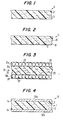
- Figure 1 shows a laminate preform 1 in cross-section.
- the preform 1 includes polymer system 2 comprised of a palladium-polymer complex, at least one crosslinkable synthetic polymer and, optionally, a reactive diluent, and a reinforcing material 3 shown as chopped random mat fiberglass.
- the reinforcing material 3 may be fiberglass roving, fiberglass veil, woven fiberglass, or even paper as is known in the printed circuit board art.
- Figure 2 shows, in cross-section, a finished laminate 11 which results after the polymer system 2 of laminate preform 1 has been crosslinked and the palladium-polymer complex has been destroyed and the palladium reduced to palladium Pd (0) either during or after crosslinking.
- Figure 2 thus shows finely divided particles of Pd (0) 14 uniformly distributed in the crosslinked polymer system 12, along with reinforcing material 3.
- Figure 3 shows in cross-section a laminate preform 21 having three impregnated sections 21a, 21b and 21c, all impregnated with polymer system 22 (which may be the same as polymer system 2 in Figure 1, for example).
- Section 21a includes reinforcing material 23 shown as fiberglass veil.
- Sections 21b and 21c are shown as including sheets of woven fiberglass 24.
- Figure 4 shows in cross-section a laminate preform 31 which is metal foil clad on each of a pair of opposing surfaces 1a and 1b.
- Metal foil 32a, 32b is shown laminated onto opposing surfaces 1a, 1b of an impregnated section 1 which is the laminate preform 1 shown in Figure 1.
- Section 1 includes polymer system 2 and reinforcing material 3.
- Catalyzed laminates produced according to the present invention advantageously have a more homogenous distribution of catalytic metal, Me (0) , and catalytic metal having a finer grain size.
- Particle sizes for Pd (0) range from 0.2 to 0.4 micrometers compared to conventional Pd (0) coated fillers having 5 to 10 micrometer filler diameter. This results in a substantial cost savings because less catalytic metal is required to achieve the desired catalytic result. For example, a cost reduction of about 20% is possible for a palladium-containing laminate compared to such a laminate prepared by conventional technology, such as a laminate produced according to U.S. Patent No. 3,546,009.
- coated or laminated substrates are produced with less bow and twist.
- Metal catalyst levels at the surface are more uniform so that laminates according to the invention achieve the desired catalytic result and allow fabrication without the need to additionally employ a catalyzed adhesive coating.
- Suitable reinforcement materials useful in the present invention include fiberglass, synthetic linear aliphatic polyamides which are capable of fiber formation (commonly termed nylons ), synthetic aromatic polyamides which are capable of fiber formation (commonly called aramids ), mica (preferably high aspect ratio mica), and paper.
- Fiberglass is preferred as a reinforcing material, and may be used in the form of woven glass fabric, continuous strand mat, random chopped strand mat, oriented chopped strand mat, and veil.
- Particularly preferred reinforcement materials are chopped strand mat (preferably two ounces per square foot) and/or woven glass fabric (preferably type 14176).
Landscapes
- Chemical & Material Sciences (AREA)
- Health & Medical Sciences (AREA)
- Chemical Kinetics & Catalysis (AREA)
- Medicinal Chemistry (AREA)
- Polymers & Plastics (AREA)
- Organic Chemistry (AREA)
- Engineering & Computer Science (AREA)
- Microelectronics & Electronic Packaging (AREA)
- Textile Engineering (AREA)
- Laminated Bodies (AREA)
- Reinforced Plastic Materials (AREA)
- Macromonomer-Based Addition Polymer (AREA)
Applications Claiming Priority (4)
| Application Number | Priority Date | Filing Date | Title |
|---|---|---|---|
| US1332093A | 1993-02-04 | 1993-02-04 | |
| US13320 | 1993-02-04 | ||
| US08/070,775 US5419954A (en) | 1993-02-04 | 1993-06-03 | Composition including a catalytic metal-polymer complex and a method of manufacturing a laminate preform or a laminate which is catalytically effective for subsequent electroless metallization thereof |
| US70775 | 1993-06-03 |
Publications (3)
| Publication Number | Publication Date |
|---|---|
| EP0610089A2 true EP0610089A2 (de) | 1994-08-10 |
| EP0610089A3 EP0610089A3 (en) | 1996-09-04 |
| EP0610089B1 EP0610089B1 (de) | 1999-05-06 |
Family
ID=26684699
Family Applications (1)
| Application Number | Title | Priority Date | Filing Date |
|---|---|---|---|
| EP94300833A Expired - Lifetime EP0610089B1 (de) | 1993-02-04 | 1994-02-04 | Katalytischen Metall-Polymer-Komplex enthaltende Zusammensetzung und mehrschichtiger Vorformling oder Laminat daraus |
Country Status (6)
| Country | Link |
|---|---|
| US (2) | US5419954A (de) |
| EP (1) | EP0610089B1 (de) |
| JP (1) | JPH07118351A (de) |
| AT (1) | ATE179723T1 (de) |
| DE (1) | DE69418228T2 (de) |
| DK (1) | DK0610089T3 (de) |
Families Citing this family (23)
| Publication number | Priority date | Publication date | Assignee | Title |
|---|---|---|---|---|
| DE19721601A1 (de) * | 1997-05-23 | 1998-11-26 | Hoechst Ag | Polybetain-stabilisierte, Palladium-haltige Nanopartikel, ein Verfahren zu ihrer Herstellung sowie daraus hergestellte Katalysatoren zur Gewinnung von Vinylacetat |
| EP0994116B1 (de) * | 1998-03-09 | 2010-09-29 | Japan Science and Technology Agency | Poröses organisch/metallisches verbundmaterial |
| WO2002002081A1 (en) * | 2000-07-05 | 2002-01-10 | Capricorn Pharma, Inc. | Rapid-melt semi-solid compositions, methods of making same and methods of using same |
| EP1355860A1 (de) * | 2001-01-09 | 2003-10-29 | Wastewater Biological Solutions Corp. | Vorrichtung und verfahren zur biologischen behandlung von umweltverschmutzenden stoffen und abfall |
| RU2259871C2 (ru) * | 2001-04-30 | 2005-09-10 | Поустеч Фаундейшн | Коллоидный раствор наночастиц металла, нанокомпозиты металл-полимер и способы их получения |
| US20040176503A1 (en) * | 2002-12-02 | 2004-09-09 | Kent State University | Radiation thickened sheet molding compounds |
| US8435603B2 (en) * | 2003-12-05 | 2013-05-07 | Conductive Inkjet Technology Limited | Formation of solid layers on substrates |
| US20090056994A1 (en) * | 2007-08-31 | 2009-03-05 | Kuhr Werner G | Methods of Treating a Surface to Promote Metal Plating and Devices Formed |
| WO2009029871A1 (en) * | 2007-08-31 | 2009-03-05 | Zettacore, Inc. | Methods of treating a surface to promote binding of molecule(s) of interest, coatings and devices formed therefrom |
| WO2009086441A2 (en) * | 2007-12-27 | 2009-07-09 | Zettacore, Inc. | Self-contained charge storage molecules for use in molecular capacitors |
| US8927775B2 (en) | 2008-07-14 | 2015-01-06 | Esionic Es, Inc. | Phosphonium ionic liquids, salts, compositions, methods of making and devices formed there from |
| US8907133B2 (en) | 2008-07-14 | 2014-12-09 | Esionic Es, Inc. | Electrolyte compositions and electrochemical double layer capacitors formed there from |
| US8586798B2 (en) * | 2008-07-14 | 2013-11-19 | Esionic Es, Inc. | Heat transfer medium, phosphonium ionic liquids, and methods of making |
| WO2010116291A2 (en) | 2009-04-08 | 2010-10-14 | International Business Machines Corporation | Optical waveguide with embedded light-reflecting feature and method for fabricating the same |
| KR101774906B1 (ko) | 2010-07-06 | 2017-09-05 | 나믹스 코포레이션 | 인쇄회로기판에서 사용하기 위한 유기 기판에의 접착을 향상시키는 구리 표면의 처리 방법 |
| KR20160098237A (ko) * | 2013-12-12 | 2016-08-18 | 아크조 노벨 케미칼즈 인터내셔널 비.브이. | 라디칼 경화형 수지의 경화 방법 |
| US9631279B2 (en) * | 2014-05-19 | 2017-04-25 | Sierra Circuits, Inc. | Methods for forming embedded traces |
| US10573610B2 (en) * | 2014-05-19 | 2020-02-25 | Catlam, Llc | Method for wafer level packaging |
| TWI686115B (zh) * | 2014-06-05 | 2020-02-21 | 美商凱特聯有限責任公司 | 嵌入跡線 |
| US10849233B2 (en) | 2017-07-10 | 2020-11-24 | Catlam, Llc | Process for forming traces on a catalytic laminate |
| US10349520B2 (en) | 2017-06-28 | 2019-07-09 | Catlam, Llc | Multi-layer circuit board using interposer layer and conductive paste |
| US10765012B2 (en) | 2017-07-10 | 2020-09-01 | Catlam, Llc | Process for printed circuit boards using backing foil |
| US10827624B2 (en) | 2018-03-05 | 2020-11-03 | Catlam, Llc | Catalytic laminate with conductive traces formed during lamination |
Family Cites Families (33)
| Publication number | Priority date | Publication date | Assignee | Title |
|---|---|---|---|---|
| DE1073135B (de) * | 1960-01-14 | Dr Beck a Co GmbH Ham burg | Losungsmittelfreie warmehartbare Elektrodrahtlacke | |
| US2702253A (en) * | 1950-11-01 | 1955-02-15 | Gasaccumulator Svenska Ab | Surface metallizing method |
| CH355291A (de) * | 1955-12-17 | 1961-06-30 | Kasika Chem Fab Gmbh | Verfahren zur Herstellung von Kunststoffüberzügen oder -folien |
| US3011920A (en) * | 1959-06-08 | 1961-12-05 | Shipley Co | Method of electroless deposition on a substrate and catalyst solution therefor |
| US3124550A (en) * | 1960-07-18 | 1964-03-10 | Stable non-draining composition of mat- | |
| US3226256A (en) * | 1963-01-02 | 1965-12-28 | Jr Frederick W Schneble | Method of making printed circuits |
| AT310285B (de) * | 1966-02-22 | 1973-09-25 | Photocircuits Corp | Verfahren zur Herstellung eines Schichtkörpers für gedruckte Schaltungen |
| US3560257A (en) * | 1967-01-03 | 1971-02-02 | Kollmorgen Photocircuits | Metallization of insulating substrates |
| US3600330A (en) * | 1967-01-03 | 1971-08-17 | Photocircuits Division Of Koli | Metallization of insulating substrates |
| US3546009A (en) * | 1967-01-03 | 1970-12-08 | Kollmorgen Corp | Metallization of insulating substrates |
| US3930109A (en) * | 1971-03-09 | 1975-12-30 | Hoechst Ag | Process for the manufacture of metallized shaped bodies of macromolecular material |
| JPS4948171A (de) * | 1972-09-11 | 1974-05-10 | ||
| SU529180A1 (ru) * | 1974-06-07 | 1976-09-25 | Московский Ордена Ленина И Ордена Трудового Красного Знамени Химикотехнологический Институт Им.Д.И. Менделеева | Способ получени ненасыщенных полиэфиров |
| DE2451217C2 (de) * | 1974-10-29 | 1982-12-23 | Basf Ag, 6700 Ludwigshafen | Aktivierung von Substraten für die stromlose Metallisierung |
| US4021314A (en) * | 1976-03-25 | 1977-05-03 | Western Electric Company, Inc. | Method of depositing a metal on a surface |
| US4035500A (en) * | 1976-06-04 | 1977-07-12 | Western Electric Company, Inc. | Method of depositing a metal on a surface of a substrate |
| DE2635457C2 (de) * | 1976-08-04 | 1985-06-05 | Schering AG, 1000 Berlin und 4709 Bergkamen | Katalytischer Lack und seine Verwendung zur Herstellung von gedruckten Schaltungen |
| IT1065139B (it) * | 1976-08-05 | 1985-02-25 | Sir Soc Italiana Resine Spa | Composizioni stabili comprendenti una resina poliestere insatura |
| DE2728465C2 (de) * | 1977-06-24 | 1982-04-22 | Preh, Elektrofeinmechanische Werke, Jakob Preh, Nachf. Gmbh & Co, 8740 Bad Neustadt | Gedruckte Schaltung |
| DE2852375A1 (de) * | 1978-12-04 | 1980-06-26 | Dynamit Nobel Ag | Isolierstoffkoerper mit im harz verteilten metallpartikeln |
| US4446173A (en) * | 1981-08-11 | 1984-05-01 | Glasteel Tennessee, Inc. | Copper-clad polyester-glass fiber laminates using zinc-coated copper |
| US4420509A (en) * | 1981-08-11 | 1983-12-13 | Glasteel Tennessee, Inc. | Copper-clad polyester-glass fiber laminates |
| DE3150985A1 (de) * | 1981-12-23 | 1983-06-30 | Bayer Ag, 5090 Leverkusen | Verfahren zur aktivierung von substratoberflaechen fuer die stromlose metallisierung |
| DE3242162A1 (de) * | 1982-11-13 | 1984-05-17 | Bayer Ag, 5090 Leverkusen | Verfahren zur herstellung von verbundwerkstoffen |
| DE3324767A1 (de) * | 1983-07-08 | 1985-01-17 | Bayer Ag, 5090 Leverkusen | Verfahren zur aktivierung von substraten fuer die stromlose metallisierung |
| DE3407114A1 (de) * | 1984-02-28 | 1985-09-05 | Bayer Ag, 5090 Leverkusen | Verfahren zur herstellung von leiterplatten |
| DE3424065A1 (de) * | 1984-06-29 | 1986-01-09 | Bayer Ag, 5090 Leverkusen | Verfahren zur aktivierung von substratoberflaechen fuer die stromlose metallisierung |
| US4727050A (en) * | 1984-11-01 | 1988-02-23 | Johnson Matthey, Inc. | Supported catalyst |
| EP0233145B1 (de) * | 1986-01-30 | 1989-10-18 | Ciba-Geigy Ag | Polymerzusammensetzungen enthaltend einen gelösten Dibenzalaceton-Palladiumkomplex |
| DE3625587A1 (de) * | 1986-07-29 | 1988-02-04 | Bayer Ag | Verfahren zur verbesserung der haftfestigkeit von stromlos abgeschiedenen metallschichten auf kunststoffoberflaechen |
| US5135779A (en) * | 1988-12-23 | 1992-08-04 | International Business Machines Corporation | Method for conditioning an organic polymeric material |
| IT1230061B (it) * | 1989-04-18 | 1991-09-27 | Eniricerche Spa | Catalizzatore di polimerizzazione, procedimento per la sua preparazione e suo impiego nella omo e copolimerizzazione di etilene. |
| US5217760A (en) * | 1990-07-20 | 1993-06-08 | Loctite Corporation | Free radically curable formulations employing dithiolate catalysts |
-
1993
- 1993-06-03 US US08/070,775 patent/US5419954A/en not_active Expired - Fee Related
-
1994
- 1994-02-04 DE DE69418228T patent/DE69418228T2/de not_active Expired - Fee Related
- 1994-02-04 EP EP94300833A patent/EP0610089B1/de not_active Expired - Lifetime
- 1994-02-04 DK DK94300833T patent/DK0610089T3/da active
- 1994-02-04 JP JP1301594A patent/JPH07118351A/ja active Pending
- 1994-02-04 AT AT94300833T patent/ATE179723T1/de not_active IP Right Cessation
- 1994-12-30 US US08/367,018 patent/US5985785A/en not_active Expired - Fee Related
Also Published As
| Publication number | Publication date |
|---|---|
| ATE179723T1 (de) | 1999-05-15 |
| EP0610089A3 (en) | 1996-09-04 |
| EP0610089B1 (de) | 1999-05-06 |
| DE69418228D1 (de) | 1999-06-10 |
| US5419954A (en) | 1995-05-30 |
| US5985785A (en) | 1999-11-16 |
| JPH07118351A (ja) | 1995-05-09 |
| DE69418228T2 (de) | 1999-11-04 |
| DK0610089T3 (da) | 1999-11-01 |
Similar Documents
| Publication | Publication Date | Title |
|---|---|---|
| US5985785A (en) | Composition including a catalytic metal-polymer complex and a method of manufacturing a laminate preform or a laminate which is catalytically effective for subsequent electroless metallization thereof | |
| JP5704793B2 (ja) | プリント配線板の絶縁層構成用の樹脂組成物 | |
| JP5650908B2 (ja) | 樹脂組成物及びその樹脂組成物を用いて得られる樹脂付銅箔 | |
| EP0217311B1 (de) | Glasfaserverstärkte elektrische Schichtstoffe und kontinuierliches Verfahren zu ihrer Herstellung | |
| US4954304A (en) | Process for producing prepreg and laminated sheet | |
| US20020041966A1 (en) | Vinyl-terminated polybutadiene and butadiene-styrene copolymers containing urethane and/or ester residues, and the electrical laminates obtained therefrom | |
| US5539012A (en) | Fiber/resin composites and method of preparation | |
| EP0642416B1 (de) | Faser/harzverbundwerkstoffe und methode zur deren herstellung | |
| JP2889868B2 (ja) | 熱硬化性樹脂組成物から得られる電気積層体の製造方法 | |
| EP0304693A1 (de) | Feuerhemmender elektrischer Schichtstoff | |
| US5312691A (en) | Copper-clad MC4 unsaturated polyester resin | |
| JPH02283718A (ja) | エポキシ樹脂組成物、プリプレグ及び積層板 | |
| JP2007051226A (ja) | 低誘電率樹脂組成物 | |
| JP2001013679A (ja) | レジスト組成物 | |
| JPH093157A (ja) | 銅張積層板用樹脂組成物 | |
| JP2007051225A (ja) | 高誘電率樹脂組成物 | |
| JPH0284441A (ja) | プリプレグ及び積層板の製造方法 | |
| JPH04175332A (ja) | エポキシ樹脂組成物および積層板の製造法 | |
| JPH01200951A (ja) | 積層板の製法 | |
| JPH0532765A (ja) | エポキシ樹脂組成物及び積層板の製法 | |
| JPH02120312A (ja) | エポキシ樹脂組成物及びこれを用いたプリプレグと積層板の製法 | |
| JPH0288626A (ja) | エポキシ樹脂組成物、及びプリプレグと積層板の製法 | |
| JP2023179812A (ja) | 高速通信基板用ボンディングフィルム | |
| JP2013258201A (ja) | 銅張積層板とその製造方法 | |
| JP3173343B2 (ja) | 積層板用樹脂組成物及びそれを用いた積層板 |
Legal Events
| Date | Code | Title | Description |
|---|---|---|---|
| PUAI | Public reference made under article 153(3) epc to a published international application that has entered the european phase |
Free format text: ORIGINAL CODE: 0009012 |
|
| AK | Designated contracting states |
Kind code of ref document: A2 Designated state(s): AT BE CH DE DK FR GB IT LI NL SE |
|
| PUAL | Search report despatched |
Free format text: ORIGINAL CODE: 0009013 |
|
| AK | Designated contracting states |
Kind code of ref document: A3 Designated state(s): AT BE CH DE DK FR GB IT LI NL SE |
|
| 17P | Request for examination filed |
Effective date: 19970303 |
|
| 17Q | First examination report despatched |
Effective date: 19970710 |
|
| GRAG | Despatch of communication of intention to grant |
Free format text: ORIGINAL CODE: EPIDOS AGRA |
|
| GRAG | Despatch of communication of intention to grant |
Free format text: ORIGINAL CODE: EPIDOS AGRA |
|
| GRAH | Despatch of communication of intention to grant a patent |
Free format text: ORIGINAL CODE: EPIDOS IGRA |
|
| GRAH | Despatch of communication of intention to grant a patent |
Free format text: ORIGINAL CODE: EPIDOS IGRA |
|
| GRAA | (expected) grant |
Free format text: ORIGINAL CODE: 0009210 |
|
| ITF | It: translation for a ep patent filed | ||
| AK | Designated contracting states |
Kind code of ref document: B1 Designated state(s): AT BE CH DE DK FR GB IT LI NL SE |
|
| REF | Corresponds to: |
Ref document number: 179723 Country of ref document: AT Date of ref document: 19990515 Kind code of ref document: T |
|
| REG | Reference to a national code |
Ref country code: CH Ref legal event code: NV Representative=s name: ISLER & PEDRAZZINI AG Ref country code: CH Ref legal event code: EP |
|
| REF | Corresponds to: |
Ref document number: 69418228 Country of ref document: DE Date of ref document: 19990610 |
|
| ET | Fr: translation filed | ||
| REG | Reference to a national code |
Ref country code: DK Ref legal event code: T3 |
|
| PLBE | No opposition filed within time limit |
Free format text: ORIGINAL CODE: 0009261 |
|
| STAA | Information on the status of an ep patent application or granted ep patent |
Free format text: STATUS: NO OPPOSITION FILED WITHIN TIME LIMIT |
|
| 26N | No opposition filed | ||
| PGFP | Annual fee paid to national office [announced via postgrant information from national office to epo] |
Ref country code: SE Payment date: 20010206 Year of fee payment: 8 |
|
| PGFP | Annual fee paid to national office [announced via postgrant information from national office to epo] |
Ref country code: DE Payment date: 20010212 Year of fee payment: 8 |
|
| PGFP | Annual fee paid to national office [announced via postgrant information from national office to epo] |
Ref country code: FR Payment date: 20010213 Year of fee payment: 8 Ref country code: DK Payment date: 20010213 Year of fee payment: 8 Ref country code: CH Payment date: 20010213 Year of fee payment: 8 Ref country code: AT Payment date: 20010213 Year of fee payment: 8 |
|
| PGFP | Annual fee paid to national office [announced via postgrant information from national office to epo] |
Ref country code: NL Payment date: 20010228 Year of fee payment: 8 |
|
| PGFP | Annual fee paid to national office [announced via postgrant information from national office to epo] |
Ref country code: BE Payment date: 20010427 Year of fee payment: 8 |
|
| REG | Reference to a national code |
Ref country code: GB Ref legal event code: IF02 |
|
| PG25 | Lapsed in a contracting state [announced via postgrant information from national office to epo] |
Ref country code: AT Free format text: LAPSE BECAUSE OF NON-PAYMENT OF DUE FEES Effective date: 20020204 |
|
| PG25 | Lapsed in a contracting state [announced via postgrant information from national office to epo] |
Ref country code: SE Free format text: LAPSE BECAUSE OF NON-PAYMENT OF DUE FEES Effective date: 20020205 |
|
| PGFP | Annual fee paid to national office [announced via postgrant information from national office to epo] |
Ref country code: GB Payment date: 20020206 Year of fee payment: 9 |
|
| PG25 | Lapsed in a contracting state [announced via postgrant information from national office to epo] |
Ref country code: LI Free format text: LAPSE BECAUSE OF NON-PAYMENT OF DUE FEES Effective date: 20020228 Ref country code: DK Free format text: LAPSE BECAUSE OF NON-PAYMENT OF DUE FEES Effective date: 20020228 Ref country code: CH Free format text: LAPSE BECAUSE OF NON-PAYMENT OF DUE FEES Effective date: 20020228 Ref country code: BE Free format text: LAPSE BECAUSE OF NON-PAYMENT OF DUE FEES Effective date: 20020228 |
|
| BERE | Be: lapsed |
Owner name: THE ALPHA CORP. Effective date: 20020228 |
|
| PG25 | Lapsed in a contracting state [announced via postgrant information from national office to epo] |
Ref country code: NL Free format text: LAPSE BECAUSE OF NON-PAYMENT OF DUE FEES Effective date: 20020901 |
|
| PG25 | Lapsed in a contracting state [announced via postgrant information from national office to epo] |
Ref country code: DE Free format text: LAPSE BECAUSE OF NON-PAYMENT OF DUE FEES Effective date: 20020903 |
|
| EUG | Se: european patent has lapsed |
Ref document number: 94300833.4 |
|
| REG | Reference to a national code |
Ref country code: CH Ref legal event code: PL |
|
| REG | Reference to a national code |
Ref country code: DK Ref legal event code: EBP |
|
| PG25 | Lapsed in a contracting state [announced via postgrant information from national office to epo] |
Ref country code: FR Free format text: LAPSE BECAUSE OF NON-PAYMENT OF DUE FEES Effective date: 20021031 |
|
| NLV4 | Nl: lapsed or anulled due to non-payment of the annual fee |
Effective date: 20020901 |
|
| REG | Reference to a national code |
Ref country code: FR Ref legal event code: ST |
|
| PG25 | Lapsed in a contracting state [announced via postgrant information from national office to epo] |
Ref country code: GB Free format text: LAPSE BECAUSE OF NON-PAYMENT OF DUE FEES Effective date: 20030204 |
|
| GBPC | Gb: european patent ceased through non-payment of renewal fee | ||
| PG25 | Lapsed in a contracting state [announced via postgrant information from national office to epo] |
Ref country code: IT Free format text: LAPSE BECAUSE OF NON-PAYMENT OF DUE FEES Effective date: 20050204 |