EP0564781B1 - Verfahren zur kontinuierlichen Herstellung von Schaumperlen - Google Patents
Verfahren zur kontinuierlichen Herstellung von Schaumperlen Download PDFInfo
- Publication number
- EP0564781B1 EP0564781B1 EP93102080A EP93102080A EP0564781B1 EP 0564781 B1 EP0564781 B1 EP 0564781B1 EP 93102080 A EP93102080 A EP 93102080A EP 93102080 A EP93102080 A EP 93102080A EP 0564781 B1 EP0564781 B1 EP 0564781B1
- Authority
- EP
- European Patent Office
- Prior art keywords
- exchange column
- process according
- pressure
- polymer particles
- internals
- Prior art date
- Legal status (The legal status is an assumption and is not a legal conclusion. Google has not performed a legal analysis and makes no representation as to the accuracy of the status listed.)
- Expired - Lifetime
Links
Images
Classifications
-
- B—PERFORMING OPERATIONS; TRANSPORTING
- B29—WORKING OF PLASTICS; WORKING OF SUBSTANCES IN A PLASTIC STATE IN GENERAL
- B29C—SHAPING OR JOINING OF PLASTICS; SHAPING OF MATERIAL IN A PLASTIC STATE, NOT OTHERWISE PROVIDED FOR; AFTER-TREATMENT OF THE SHAPED PRODUCTS, e.g. REPAIRING
- B29C44/00—Shaping by internal pressure generated in the material, e.g. swelling or foaming ; Producing porous or cellular expanded plastics articles
- B29C44/34—Auxiliary operations
- B29C44/3461—Making or treating expandable particles
Definitions
- the present invention relates to a continuous process for the production of foam beads from polymers.
- JP-A-59 067 022 describes a continuous process for the production of foam beads.
- the heat treatment is carried out in a cascade of six stirred reactors.
- the mashing of polymer and dispersant flows through all of the stirred tanks and is expanded in a low-pressure chamber, whereby the polymer particles expand.
- the six stirred kettles one is required to add a gaseous blowing agent and one to extend the dispersion.
- the pressure in the latter is higher than in the boilers used for heat treatment. All reactors must be designed to be pressure-stable, which results in increased equipment expenditure.
- the large number of stirred tanks, pumps and auxiliary units makes an investment extremely unattractive.
- the polymer particles are usually impregnated with a volatile blowing agent during the heat treatment, wherein in usually hydrocarbons such as propane, butane, pentane, hexane or heptane, alicyclic hydrocarbons such as cyclopentane or cyclohexane, halogenated hydrocarbons such as trichlorofluoromethane, dichlorodifluoromethane, dichlorotetrafluoroethane, dichloromonofluoromethane, trichlorotrifluoroethane, methyl chloride or ethyl chloride such as carbon dioxide or methylene chloride or ethyl chloride such as carbon dioxide or inorganic chloride such as methylene chloride or ethyl chloride such as methylene chloride or ethyl chloride .
- hydrocarbons such as propane, butane, pentane, hexane or heptane
- blowing agents are released from the polymer particles under pressure and released again when the pressure is released in the low-pressure chamber.
- the blowing agent released should be able to be recovered and recycled after the relaxation.
- liquid-filled gasometers are used to store the large amounts of gas released until they can be reused for a new reaction batch; in the case of higher-boiling propellants, these are condensed and temporarily stored in liquid form.
- the object of the present invention was therefore to develop a continuous process for the production of foam beads which is simple in terms of apparatus, in which the blowing agent can be circulated without problems without the use of large-volume containers or condensers, and with the production of foam beads without complex process measures constant quality allowed, which in particular have a uniform cell diameter and a uniform degree of expansion.
- polymer particles and a dispersing agent are continuously fed to a slim, pressure-operated, non-stirred mass transfer column and are subjected to a heat treatment in this column under pressure, after which the dispersion is sprayed out into a low-pressure space, the polymer particles expanding.
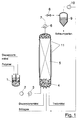
- a dispersion is prepared, for example, in a boiler 1 as a mashing of polymer in a dispersing agent and continuously fed to a mass transfer column 4 with the aid of a pump 2 .
- the mass transfer column is operated at a pressure greater than or equal to the vapor pressure of the dispersant and a temperature above the softening point of the polymer, measured in accordance with ASTM D 648 (4.6 kg / mm2 load).
- the upper temperature limit is determined by the requirement that the polymer particles not soften to the extent that they aggregate and thus clog the plant; those skilled in the art, who are familiar with the corresponding batch processes, are familiar with the upper limits for the respective polymers.
- This temperature is introduced into the mass transfer column either via a heat exchanger 3 or via a heating jacket 11 , for example a double jacket tempered with liquid or steam.
- the pressure prevailing in the mass transfer column is generally a maximum of 100 bar, but higher pressures are also possible if the pressure is designed accordingly. Usually a pressure between 5 and 50 bar is used.
- the dispersion After passing through the mass transfer column, the dispersion is brought to the final required temperature using a heat exchanger 6 , if necessary, and then expanded via a throttle device 8 , the polymer particles foaming.
- polystyrene polystyrene, poly- ⁇ -methylstyrene, copolymers of styrene and maleic anhydride or maleimides, blends or graft copolymers of polyphenylene oxide and polystyrene, copolymers of Acrylonitrile and styrene, terpolymers of acrylonitrile, butadiene and styrene, copolymers of styrene and butadiene, impact-resistant polystyrene, polyvinyl chloride, copolymers of vinyl chloride and vinyl acetate, chlorinated polyvinyl chloride, polyamides, polyesters and polyolefins.
- polyolefins examples include propylene polymers such as propylene-ethylene or propylene-butylene random copolymers, random terpolymers of ethylene, propylene and butene-1, ethylene-propylene block copolymers and homopolypropylene, ethylene polymers such as low, medium or high density polyethylene, linear polyethylene Density, ethylene-vinyl acetate copolymers, ethylene-methyl methacrylate copolymers, ionomers or other polyolefins such as polybutene-1 are suitable.
- propylene polymers such as propylene-ethylene or propylene-butylene random copolymers, random terpolymers of ethylene, propylene and butene-1, ethylene-propylene block copolymers and homopolypropylene
- ethylene polymers such as low, medium or high density polyethylene, linear polyethylene Density, ethylene-vinyl acetate copolymers, ethylene-methyl methacryl
- polymers exist as discrete particles. They preferably have an average particle diameter of 0.5 to 5 mm. In order to achieve uniform foaming, they can optionally contain, according to the prior art, a filler which acts as a nucleating agent.
- Water is preferably used as the dispersant.
- alcohols such as methanol or ethanol are also suitable.
- a fine-particle dispersant and / or a surface-active compound can be added to the mashing of polymer particles in the dispersant.
- examples of these are calcium phosphate, basic magnesium carbonate, basic zinc carbonate, calcium carbonate, aluminum oxide, barium sulfate, talc, alkylbenzenesulfonates, paraffin sulfonates or ethoxylates.
- the solids content of the slurry can be between 1 and 60% by weight; it is preferably between 20 and 35% by weight.
- the polymer particles and the dispersant can also be introduced continuously into the column separately from one another.
- the mass transfer column has a slenderness ratio, ie a ratio of column height to column cross section, of 3 to 60. Preferably this ratio is 5 to 40, a ratio of 9 to 25 being particularly preferred.
- the heat treatment time of all polymer grains must be the same.
- An equal length of stay of all polymer grains can be achieved in that the mass transfer column is provided with internals 5 .
- the foam pearls have a uniform quality with significantly lower throughput of the mashing, which has a favorable effect on the height of the mass transfer column.
- the internals can consist, for example, of welded-in deflection plates, each of which occupy a maximum of 80% of the cross-sectional area of the mass transfer column and are alternately attached at a distance of at least 0.1 times and a maximum of 10 times the inside diameter of the mass transfer column.
- the internals can also be made of commercially available elements such as. B.
- static mixers e.g. Sulzer SMV or SMX, Kenics mixer.
- the length of a zone of the internals should be at least twice the diameter of the mass transfer column.
- the proportion of the length of the zones with internals in the total length of the mass transfer column should be at least 0.2.
- blowing agents are known from the discontinuous processes of the prior art; for example, saturated aliphatic hydrocarbons such as ethane, propane, n-butane, i-butane, pentane or hexane, alicyclic hydrocarbons such as cyclopentane or cyclohexane, halogenated hydrocarbons such as trichloromonofluoromethane, dichlorodifluoromethane, Dichlortetraflruorethan, trichlorotrifluoroethane, dichloromonofluoromethane, methylene chloride, methyl chloride or ethyl chloride, as well as inorganic gases such as carbon dioxide , individually or as a mixture. If the amount is sufficient, a gaseous blowing agent can also take on the role of the supporting gas. Otherwise, the blowing agent can
- the dispersing agent alone acts as a blowing agent. In this way, only moderate to medium expansion rates are achieved, but for many applications, e.g. B. where a somewhat stiffer foam is required is quite desirable.
- the corresponding temperature can be set either in the upper part of the mass transfer column with a separate double jacket or directly in the exit line with a heat exchanger 6 .
- the heat exchanger 6 is followed by a heat-insulated pipe section 7 , the cross section of which is at least three times the free cross section of the heat exchanger and the length of which is at least twice the length of the heat exchanger.
- a simple single-hole orifice or nozzle can be used as the throttling device 8 .
- a controllable valve It has been shown that the quality of the foam beads does not depend on the extension speed if a pre-expansion chamber is provided in the valve in front of the vena contracta. This pre-expansion chamber is an expansion of the flow channel in the valve, so that a volume is created which allows a residence time of the expanding material of greater than 0.1 milliseconds, preferably greater than 0.5 milliseconds.
- the throughput through the mass transfer column and thus the system capacity can be adapted to the operational requirements.
- the reactor pressure can also be selected independently of the throughput.
- the dispersion is sprayed through the throttle device 8 into the low-pressure chamber 9 , the polymer particles foaming.
- Any volatile blowing agents that are used are at least largely continuously released. This offers the possibility of returning the volatile propellants and the supporting gas, which is desirable for economic reasons and for reasons of environmental protection.
- the low-pressure chamber can be suctioned off with the aid of a compressor 10 . After appropriate compression, these auxiliaries can be fed back into the continuously operated mass transfer column, which means a significant simplification of the process. In particular, expensive storage containers are unnecessary.
- the foamed polymer particles are then optionally washed to remove the dispersant, and then separated and dried in a conventional manner.
- expansion rates are obtained which are usually in the range from 4 to 15 in the case of polyolefins, while expansion rates which are generally in the range from 4 to 40 are obtained when using a volatile organic blowing agent.
- the foamed polymer particles can be processed into molded parts using known methods.
- the polymer foam is pressurized with the help of water vapor from e.g. B. softened or melted 1 - 5 bar, whereby the individual foam particles weld into a molded part.
- the method according to the invention has a number of advantages over the prior art. This enables the continuous procedure a significantly higher production capacity because there are no flushing, filling and heating times. In addition, the better automatability means that product quality can be more constant than with batch mode.
- the mass transfer column does not require any devices for stirring the slurry; this makes the process less energy-intensive. Due to the slenderness of the mass transfer column, its pressure-proof design is less expensive than e.g. B. in a stirred tank. In contrast to a cascade of several reactors, only a single mass transfer column is required here; Because of the small number of mechanically moving parts, the investment, monitoring and maintenance are also much less complex.
Landscapes
- Manufacture Of Porous Articles, And Recovery And Treatment Of Waste Products (AREA)
- Processing And Handling Of Plastics And Other Materials For Molding In General (AREA)
- Molding Of Porous Articles (AREA)
Applications Claiming Priority (2)
| Application Number | Priority Date | Filing Date | Title |
|---|---|---|---|
| DE4211972A DE4211972A1 (de) | 1992-04-09 | 1992-04-09 | Verfahren zur Herstellung von Schaumperlen |
| DE4211972 | 1992-04-09 |
Publications (2)
| Publication Number | Publication Date |
|---|---|
| EP0564781A1 EP0564781A1 (de) | 1993-10-13 |
| EP0564781B1 true EP0564781B1 (de) | 1995-11-15 |
Family
ID=6456489
Family Applications (1)
| Application Number | Title | Priority Date | Filing Date |
|---|---|---|---|
| EP93102080A Expired - Lifetime EP0564781B1 (de) | 1992-04-09 | 1993-02-10 | Verfahren zur kontinuierlichen Herstellung von Schaumperlen |
Country Status (5)
| Country | Link |
|---|---|
| US (1) | US5480599A (enExample) |
| EP (1) | EP0564781B1 (enExample) |
| JP (1) | JPH0615754A (enExample) |
| AT (1) | ATE130240T1 (enExample) |
| DE (2) | DE4211972A1 (enExample) |
Families Citing this family (24)
| Publication number | Priority date | Publication date | Assignee | Title |
|---|---|---|---|---|
| DE4319587A1 (de) * | 1993-06-14 | 1994-12-15 | Huels Chemische Werke Ag | Verfahren zur Herstellung vorgeschäumter Polyolefin-Partikel |
| DE4409400A1 (de) * | 1994-03-18 | 1995-09-21 | Basf Ag | Verfahren zur kontinuierlichen Herstellung von expandierten Polymer-Partikeln |
| DE19512059A1 (de) * | 1995-03-31 | 1996-10-02 | Huels Chemische Werke Ag | Verfahren zur Herstellung von Formkörpern aus geschäumten Polyolefinen |
| DE19542734A1 (de) * | 1995-11-16 | 1997-05-22 | Huels Chemische Werke Ag | Verfahren zur Ausrüstung von polyolefinischem Partikelschaum |
| DE19547398A1 (de) | 1995-12-19 | 1997-06-26 | Huels Chemische Werke Ag | Verfahren zur Herstellung schäumbarer Kunststoff-Granulate |
| DE19706884A1 (de) * | 1997-02-21 | 1998-08-27 | Huels Chemische Werke Ag | Verfahren zum Nachschäumen von preexpandierten polyolefinischen Partikeln |
| US5977195A (en) * | 1997-08-01 | 1999-11-02 | Huntsman Corporation | Expandable thermoplastic polymer particles and method for making same |
| NZ502493A (en) * | 1997-08-01 | 2002-12-20 | Huntsman Corp | Expandable thermoplastic particles made from a solvent free, dry atomization method |
| EP1102808A1 (en) * | 1998-07-24 | 2001-05-30 | Huntsman Corporation | Expandable thermoplastic particles and methods for making same |
| US20070032853A1 (en) * | 2002-03-27 | 2007-02-08 | Hossainy Syed F | 40-O-(2-hydroxy)ethyl-rapamycin coated stent |
| US7807211B2 (en) * | 1999-09-03 | 2010-10-05 | Advanced Cardiovascular Systems, Inc. | Thermal treatment of an implantable medical device |
| US6790228B2 (en) * | 1999-12-23 | 2004-09-14 | Advanced Cardiovascular Systems, Inc. | Coating for implantable devices and a method of forming the same |
| US20050118344A1 (en) | 2003-12-01 | 2005-06-02 | Pacetti Stephen D. | Temperature controlled crimping |
| JP2009161668A (ja) * | 2008-01-08 | 2009-07-23 | Kaneka Corp | ポリオレフィン系樹脂予備発泡粒子の製造方法 |
| KR100902331B1 (ko) * | 2008-02-29 | 2009-06-12 | 하오기술 주식회사 | 폴리올레핀계 발포 입자의 제조방법 |
| JP2011105879A (ja) * | 2009-11-19 | 2011-06-02 | Asahi Kasei Chemicals Corp | ポリアミド発泡粒子及びその製造方法、ポリアミド発泡粒子群並びに発泡成型品 |
| US20130267617A1 (en) * | 2012-04-06 | 2013-10-10 | General Electric Company | Process of fabricating a cast foam product, a cast foam product and an intermediate foam product |
| WO2016091847A1 (en) * | 2014-12-11 | 2016-06-16 | Akzo Nobel Chemicals International B.V. | Apparatus and method for expanding thermally expandable thermoplastic microspheres to expanded thermoplastic microspheres |
| WO2016091741A1 (en) * | 2014-12-11 | 2016-06-16 | Construction Research & Technology Gmbh | Method for manufacturing a cementitious composition |
| EP4237474A1 (de) | 2020-10-30 | 2023-09-06 | INEOS Styrolution Group GmbH | Expandierbare, thermoplastische polymerpartikel auf basis von styrolpolymeren und verfahren zu deren herstellung |
| CN119731250A (zh) | 2022-07-08 | 2025-03-28 | 英力士苯领集团股份公司 | 含有回收材料的可发性热塑性聚合物颗粒及其生产方法 |
| WO2024008914A1 (de) | 2022-07-08 | 2024-01-11 | Ineos Styrolution Group Gmbh | Expandierte, thermoplastische polymerpartikel mit rezyklat-anteil und verfahren zu deren herstellung |
| EP4594073A1 (en) * | 2022-09-30 | 2025-08-06 | JSP International SARL | Apparatus for pressurizing polyolefin particles |
| WO2024068002A1 (en) * | 2022-09-30 | 2024-04-04 | Fox Velution Gmbh | Apparatus for pressurizing polymer particles |
Family Cites Families (25)
| Publication number | Priority date | Publication date | Assignee | Title |
|---|---|---|---|---|
| US2829117A (en) * | 1952-07-31 | 1958-04-01 | Lonza Electric & Chem Works | Process for making closed cell cellular bodies |
| US2829177A (en) * | 1954-03-29 | 1958-04-01 | Exxon Research Engineering Co | Guerbet condensation of alcohols by ferric nitrate |
| US2929106A (en) * | 1954-12-31 | 1960-03-22 | Phillips Petroleum Co | Process of manufacture of hollow spheres |
| US3089857A (en) * | 1960-04-12 | 1963-05-14 | Koppers Co Inc | Storage stable expandable polymeric composition containing expandable polymeric particles and two different blowing agents and method of making same |
| US3086885A (en) * | 1960-09-22 | 1963-04-23 | Dow Chemical Co | Non-clumping foamable thermoplastic polymer granules and method of making |
| BE615859A (enExample) * | 1961-04-01 | |||
| NO135308L (enExample) * | 1968-10-07 | 1900-01-01 | ||
| IT1008525B (it) * | 1972-12-19 | 1976-11-30 | Kanegafuchi Chemical Ind | Collegamento di sci a blocco ad inerzia metodo ed apparecchio di stampag gio per resine poliolefiniche espanse |
| US3914360A (en) * | 1973-04-23 | 1975-10-21 | Dow Chemical Co | Expansion of expandable synthetic resinous microspheres |
| JPS5923731B2 (ja) * | 1980-11-22 | 1984-06-04 | 日本スチレンペ−パ−株式会社 | ポリプロピレン系樹脂予備発泡粒子 |
| AU559244B2 (en) * | 1982-05-13 | 1987-03-05 | Kanegafuchi Kagaku Kogyo K.K. | Expanded polyolefin particles |
| SE452471B (sv) * | 1982-11-26 | 1987-11-30 | Casco Nobel Ab | Forfarande for expandering av termoplastiska mikrosferer |
| JPS6049039A (ja) * | 1983-08-26 | 1985-03-18 | Badische Yuka Co Ltd | ポリオレフイン系樹脂発泡体粒子の製造方法 |
| JPS60219015A (ja) * | 1984-04-14 | 1985-11-01 | Kanegafuchi Chem Ind Co Ltd | 発泡性熱可塑性樹脂粒子の予備発泡方法 |
| US4560705A (en) * | 1984-04-23 | 1985-12-24 | Texstyrene Plastics, Inc. | Impregnating polystyrene beads with an expanding agent |
| US4704239A (en) * | 1984-04-28 | 1987-11-03 | Japan Styrene Paper Corp. | Process for the production of expanded particles of a polymeric material |
| DE3422425A1 (de) * | 1984-06-16 | 1985-12-19 | Storopack Hans Reichenecker GmbH & Co, 7430 Metzingen | Verfahren zur herstellung schuettfaehiger kugelsegmentfoermiger packmaterialkoerper aus kunststoff |
| GB2162789A (en) * | 1984-07-16 | 1986-02-12 | Cosden Technology | Process for making expandable polystyrene |
| JPH0645721B2 (ja) * | 1985-07-16 | 1994-06-15 | 日本スチレンペーパー株式会社 | 熱可塑性樹脂予備発泡粒子の製造法 |
| US4622346A (en) * | 1985-11-29 | 1986-11-11 | Atlantic Richfield Company | Process for producing modified styrenic polymer beads for high strength foamed articles |
| JPH0660258B2 (ja) * | 1986-06-26 | 1994-08-10 | 鐘淵化学工業株式会社 | 熱可塑性樹脂粒子の予備発泡方法 |
| CA2030754C (en) * | 1989-11-24 | 1997-06-03 | Kazuo Turugai | Production method of prefoamed synthetic resin particles |
| JPH04506767A (ja) * | 1990-05-08 | 1992-11-26 | ゲブリューダー ズルツアー アクチエンゲゼルシャフト | 混合装置の配列法、触媒装置の配列法、ならびにこの触媒装置配列法の使用 |
| JPH07119315B2 (ja) * | 1990-06-26 | 1995-12-20 | 鐘淵化学工業株式会社 | 熱可塑性樹脂粒子の予備発泡方法およびそれに用いる装置 |
| US5049328A (en) * | 1990-07-02 | 1991-09-17 | Arco Chemical Technology, Inc. | Purification, impregnation and foaming of polymer particles with carbon dioxide |
-
1992
- 1992-04-09 DE DE4211972A patent/DE4211972A1/de not_active Withdrawn
-
1993
- 1993-02-10 AT AT93102080T patent/ATE130240T1/de not_active IP Right Cessation
- 1993-02-10 DE DE59300926T patent/DE59300926D1/de not_active Expired - Lifetime
- 1993-02-10 EP EP93102080A patent/EP0564781B1/de not_active Expired - Lifetime
- 1993-04-08 JP JP5081823A patent/JPH0615754A/ja active Pending
-
1994
- 1994-08-12 US US08/289,546 patent/US5480599A/en not_active Expired - Fee Related
Also Published As
| Publication number | Publication date |
|---|---|
| US5480599A (en) | 1996-01-02 |
| DE4211972A1 (de) | 1993-10-14 |
| ATE130240T1 (de) | 1995-12-15 |
| JPH0615754A (ja) | 1994-01-25 |
| EP0564781A1 (de) | 1993-10-13 |
| DE59300926D1 (de) | 1995-12-21 |
Similar Documents
| Publication | Publication Date | Title |
|---|---|---|
| EP0564781A1 (de) | Verfahren zur kontinuierlichen Herstellung von Schaumperlen | |
| DE60006676T2 (de) | Fluidisierte wirbelschichtpolymerisation | |
| DE69823230T2 (de) | Nachbehandlung zur erhöhung des polymergehaltes in einem verfahren zur lösungspolymerisation von olefinen | |
| DE69829373T2 (de) | Polymerisationsverfahren | |
| DE69715027T2 (de) | Düse zur zerstäubung einer flüssigkeit in einem wirbelschicht | |
| EP0860262A1 (de) | Verfahren zum Nachschäumen von preexpandierten polyolefinischen Partikeln | |
| DE60121649T2 (de) | Kontinuierliches Verfahren zur Herstellung von Polyolefinschaumteilchen | |
| DE1916220A1 (de) | Verfahren zur kontinuierlichen Herstellung von treibfaehigen Thermoplasten | |
| DE1794174B1 (de) | Verwendung einer treibmittelmischung zum herstellen einer geschaeumten folie aus einem thermoplastischen polymeren | |
| DE2131145C3 (de) | Verfahren zur Hochdruckpolymerisation von Äthylen | |
| EP0646619B1 (de) | Verfahren zur Herstellung von Schaumperlen | |
| EP0777698B1 (de) | Verfahren zur herstellung von expandierten polyolefin-partikeln | |
| EP0630935B1 (de) | Verfahren zur Herstellung vorgeschäumter Polyolefin-Partikel | |
| DE69904059T2 (de) | Kontinuierliches gasphasenverfahren zur beschichtung von polymerisationskatalysatoren | |
| DE1165269B (de) | Verfahren zur kontinuierlichen Herstellung von feinteiligen expandierbaren Styrolpolymerisaten | |
| EP0673963A1 (de) | Verfahren zur kontinuierlichen Herstellung von expandierten Polymer-Partikeln | |
| DE60025952T2 (de) | Fliessbettreaktor mit asymmetrischem gaseinlass | |
| DE1569552A1 (de) | Thermoplastische polymere Partikel,die durch Waerme aufweitbar sind | |
| DE1960737C3 (de) | Verfahren zur Herstellung von Polyäthylen | |
| DE1241975C2 (de) | Verfahren zur Herstellung verschaeumbarer Formmassen aus alkenylaromatischen Polymerisaten | |
| DE2205166A1 (de) | Verfahren zur Polymerisation eines Olefins bei hohem Druck in röhrenförmigen Reaktoren | |
| EP0828781B1 (de) | Verfahren zur herstellung von expandierten polyolefin-partikeln | |
| DE1778373A1 (de) | Verfahren zur Herstellung von Formgegenstaenden aus Olefinpolymeren mit praktisch geschlossenen Zellen | |
| DE2856135C2 (enExample) | ||
| EP0831115A2 (de) | Verfahren zur Herstellung von expandierten Polyolefinpartikeln |
Legal Events
| Date | Code | Title | Description |
|---|---|---|---|
| PUAI | Public reference made under article 153(3) epc to a published international application that has entered the european phase |
Free format text: ORIGINAL CODE: 0009012 |
|
| 17P | Request for examination filed |
Effective date: 19930719 |
|
| AK | Designated contracting states |
Kind code of ref document: A1 Designated state(s): AT BE DE FR GB IT NL SE |
|
| 17Q | First examination report despatched |
Effective date: 19950113 |
|
| GRAA | (expected) grant |
Free format text: ORIGINAL CODE: 0009210 |
|
| AK | Designated contracting states |
Kind code of ref document: B1 Designated state(s): AT BE DE FR GB IT NL SE |
|
| REF | Corresponds to: |
Ref document number: 130240 Country of ref document: AT Date of ref document: 19951215 Kind code of ref document: T |
|
| REF | Corresponds to: |
Ref document number: 59300926 Country of ref document: DE Date of ref document: 19951221 |
|
| ET | Fr: translation filed | ||
| ITF | It: translation for a ep patent filed | ||
| GBT | Gb: translation of ep patent filed (gb section 77(6)(a)/1977) |
Effective date: 19960109 |
|
| PLBE | No opposition filed within time limit |
Free format text: ORIGINAL CODE: 0009261 |
|
| STAA | Information on the status of an ep patent application or granted ep patent |
Free format text: STATUS: NO OPPOSITION FILED WITHIN TIME LIMIT |
|
| 26N | No opposition filed | ||
| PGFP | Annual fee paid to national office [announced via postgrant information from national office to epo] |
Ref country code: AT Payment date: 19990226 Year of fee payment: 7 |
|
| PGFP | Annual fee paid to national office [announced via postgrant information from national office to epo] |
Ref country code: NL Payment date: 19990228 Year of fee payment: 7 |
|
| PGFP | Annual fee paid to national office [announced via postgrant information from national office to epo] |
Ref country code: BE Payment date: 19990316 Year of fee payment: 7 |
|
| PG25 | Lapsed in a contracting state [announced via postgrant information from national office to epo] |
Ref country code: AT Free format text: LAPSE BECAUSE OF NON-PAYMENT OF DUE FEES Effective date: 20000210 |
|
| PGFP | Annual fee paid to national office [announced via postgrant information from national office to epo] |
Ref country code: SE Payment date: 20000217 Year of fee payment: 8 |
|
| PG25 | Lapsed in a contracting state [announced via postgrant information from national office to epo] |
Ref country code: BE Free format text: LAPSE BECAUSE OF NON-PAYMENT OF DUE FEES Effective date: 20000228 |
|
| BERE | Be: lapsed |
Owner name: HULS A.G. Effective date: 20000228 |
|
| PG25 | Lapsed in a contracting state [announced via postgrant information from national office to epo] |
Ref country code: NL Free format text: LAPSE BECAUSE OF NON-PAYMENT OF DUE FEES Effective date: 20000901 |
|
| NLV4 | Nl: lapsed or anulled due to non-payment of the annual fee |
Effective date: 20000901 |
|
| PG25 | Lapsed in a contracting state [announced via postgrant information from national office to epo] |
Ref country code: SE Free format text: LAPSE BECAUSE OF NON-PAYMENT OF DUE FEES Effective date: 20010211 |
|
| EUG | Se: european patent has lapsed |
Ref document number: 93102080.4 |
|
| REG | Reference to a national code |
Ref country code: GB Ref legal event code: IF02 |
|
| PG25 | Lapsed in a contracting state [announced via postgrant information from national office to epo] |
Ref country code: IT Free format text: LAPSE BECAUSE OF NON-PAYMENT OF DUE FEES;WARNING: LAPSES OF ITALIAN PATENTS WITH EFFECTIVE DATE BEFORE 2007 MAY HAVE OCCURRED AT ANY TIME BEFORE 2007. THE CORRECT EFFECTIVE DATE MAY BE DIFFERENT FROM THE ONE RECORDED. Effective date: 20050210 |
|
| PGFP | Annual fee paid to national office [announced via postgrant information from national office to epo] |
Ref country code: FR Payment date: 20120223 Year of fee payment: 20 |
|
| PGFP | Annual fee paid to national office [announced via postgrant information from national office to epo] |
Ref country code: GB Payment date: 20120223 Year of fee payment: 20 |
|
| PGFP | Annual fee paid to national office [announced via postgrant information from national office to epo] |
Ref country code: DE Payment date: 20120416 Year of fee payment: 20 |
|
| REG | Reference to a national code |
Ref country code: DE Ref legal event code: R071 Ref document number: 59300926 Country of ref document: DE |
|
| REG | Reference to a national code |
Ref country code: GB Ref legal event code: PE20 Expiry date: 20130209 |
|
| PG25 | Lapsed in a contracting state [announced via postgrant information from national office to epo] |
Ref country code: GB Free format text: LAPSE BECAUSE OF EXPIRATION OF PROTECTION Effective date: 20130209 Ref country code: DE Free format text: LAPSE BECAUSE OF EXPIRATION OF PROTECTION Effective date: 20130212 |
|
| REG | Reference to a national code |
Ref country code: DE Ref legal event code: R082 Ref document number: 59300926 Country of ref document: DE Representative=s name: KAEWERT, KLAUS, DE Effective date: 20140410 Ref country code: DE Ref legal event code: R081 Ref document number: 59300926 Country of ref document: DE Owner name: SSW PEARLFOAM GMBH, DE Free format text: FORMER OWNER: FAGERDALA DEUTSCHLAND GMBH, 99885 OHRDRUF, DE Effective date: 20140410 |