EP0530794B1 - Verfahren zum Nachweis ähnlicher Nukleinsäuren - Google Patents
Verfahren zum Nachweis ähnlicher Nukleinsäuren Download PDFInfo
- Publication number
- EP0530794B1 EP0530794B1 EP92115065A EP92115065A EP0530794B1 EP 0530794 B1 EP0530794 B1 EP 0530794B1 EP 92115065 A EP92115065 A EP 92115065A EP 92115065 A EP92115065 A EP 92115065A EP 0530794 B1 EP0530794 B1 EP 0530794B1
- Authority
- EP
- European Patent Office
- Prior art keywords
- oligonucleotides
- nucleic acids
- detected
- extension
- nucleotide
- Prior art date
- Legal status (The legal status is an assumption and is not a legal conclusion. Google has not performed a legal analysis and makes no representation as to the accuracy of the status listed.)
- Expired - Lifetime
Links
Images





Classifications
-
- C—CHEMISTRY; METALLURGY
- C12—BIOCHEMISTRY; BEER; SPIRITS; WINE; VINEGAR; MICROBIOLOGY; ENZYMOLOGY; MUTATION OR GENETIC ENGINEERING
- C12Q—MEASURING OR TESTING PROCESSES INVOLVING ENZYMES, NUCLEIC ACIDS OR MICROORGANISMS; COMPOSITIONS OR TEST PAPERS THEREFOR; PROCESSES OF PREPARING SUCH COMPOSITIONS; CONDITION-RESPONSIVE CONTROL IN MICROBIOLOGICAL OR ENZYMOLOGICAL PROCESSES
- C12Q1/00—Measuring or testing processes involving enzymes, nucleic acids or microorganisms; Compositions therefor; Processes of preparing such compositions
- C12Q1/68—Measuring or testing processes involving enzymes, nucleic acids or microorganisms; Compositions therefor; Processes of preparing such compositions involving nucleic acids
- C12Q1/6813—Hybridisation assays
- C12Q1/6827—Hybridisation assays for detection of mutation or polymorphism
-
- C—CHEMISTRY; METALLURGY
- C12—BIOCHEMISTRY; BEER; SPIRITS; WINE; VINEGAR; MICROBIOLOGY; ENZYMOLOGY; MUTATION OR GENETIC ENGINEERING
- C12Q—MEASURING OR TESTING PROCESSES INVOLVING ENZYMES, NUCLEIC ACIDS OR MICROORGANISMS; COMPOSITIONS OR TEST PAPERS THEREFOR; PROCESSES OF PREPARING SUCH COMPOSITIONS; CONDITION-RESPONSIVE CONTROL IN MICROBIOLOGICAL OR ENZYMOLOGICAL PROCESSES
- C12Q1/00—Measuring or testing processes involving enzymes, nucleic acids or microorganisms; Compositions therefor; Processes of preparing such compositions
- C12Q1/68—Measuring or testing processes involving enzymes, nucleic acids or microorganisms; Compositions therefor; Processes of preparing such compositions involving nucleic acids
- C12Q1/6844—Nucleic acid amplification reactions
- C12Q1/6858—Allele-specific amplification
Definitions
- the invention relates to a method for detection similar nucleic acids, a set of oligonucleotides, which are suitable for a reagent kit with which the inventive method can be carried out and various uses of the method in the Diagnostics of genes and infections.
- EP-A-0 332 435 describes a method with which principally one nucleic acid selectively next to another Nucleic acid that can only be detected in a nucleotide from her.
- the Exploited effect that theoretically only those to the Nucleic acid to be detected hybridized oligonucleotides can be extended enzymatically, whose in Extension direction of terminal nucleotide complementary to the corresponding nucleotide to be detected Is nucleic acid (of one allele).
- the oligonucleotide is therefore chosen so that only the one to be proven Nucleic acid has such complementarity. That on the other allele hybridized oligonucleotide is so theoretically not extended.
- Control product distinguishable from the specific product deliver.
- the control product is in a PCR product before, but is not a specific product of the investigated Allels found, it is assumed that the examined Sample the allele to be detected in the reaction set up does not contain. This methodology therefore requires two alleles detected by two separate reactions or be excluded and in every single PCR reaction a control PCR must be included.
- thermostable ligase is used to specifically link two adjacent oligonucleotides, and only if they are hybridized to a complementary target at a stringent hybridization temperature and a complete base pairing at the linkage point is present. If two alleles differ by a mutation at the position of the linkage point, the stated condition of complete base pairing is only fulfilled for one of the alleles.
- Two additional oligonucleotides, complementary to the first two, are additionally needed to amplify the ligation product in the ligase chain reaction.
- This method is also a direct and discrete analysis of genomic DNA possible, that is without PCR, but then there are additional digestive and Electrophoresis steps required.
- the ASO technique described above is transferred to a PCR technique. In the original ASO technique, an error of, for example, 5% due to cross hybridization can still be tolerated, since an absolutely unambiguous interpretation of the results is then possible by comparing the intensity of the signals with appropriate controls.
- WO 90/11372 describes a method for the amplification and detection of several Nucleic acids described in which two-part primers are used. The first parts are complementary to the different alleles to be detected and the second parts differ by a unique tail.
- Nucleic Acids Research, Vol. 17, 7, 2503-2516 (1989) describes the use of 3'-mismatch primers described for differentiation between nucleic acids. It is also disclosed that the introduction of further mismatches of the oligonucleotides to be detected Nucleic acids, especially near the 3 'end, further the primer / template complexes destabilized.
- the object of the invention was to provide a simple method for the specific detection of similar To provide nucleic acids that do not require restriction digestion, and at which it is possible to amplify the similar nucleic acids in one reaction.
- nucleic acids in the sense of Invention are nucleic acids whose nucleotide sequences in are essentially identical, but with at least a difference in a position of the nucleotide sequence exhibit. In the following, this position is marked with X designated. If there are several differences in the subject of Invention belong, these are with X1, X2 ... XN designated. Such differences come for example by point mutations (e.g. substitutions by others Bases or by deletions or insertions of a or more bases. The similar Nucleic acids are then usually called alleles designated.
- nucleic acids are similar individual bacterial strains in the sequence of their ribosomal Genes or the rRNA very strong. Similar nucleic acids in However, the meaning of the invention is also Control nucleic acids to be detected Resemble nucleic acid. The position X is also called designated polymorphic place.
- the ones to be proven Nucleic acids can be RNA or DNA. At Bacterial diagnostics has proven to be particularly useful for rRNA proven.
- the original target is the nucleic acid that was included in the sample.
- the later with her Use emerging polynucleotides that are also be used again as the target nucleic acid and the are usually shorter than the original target, are considered as Designated product target.
- these embodiments can be in simple way with the detection of nucleic acids all conceivable differences in X (e.g. all conceivable Alleles) by using appropriate oligonucleotides be transmitted.
- a defined position on a Designated nucleic acid This position can for example, be occupied by a nucleotide.
- Complementary are nucleotides that have one ensure regular, Watson-Crick base pairing (e.g. G-C, A-T or A-U). These lead to so-called matches, non-complementary to mismatches.
- the nucleic acids to be detected must be used for in vitro reactions suitable form. This will be a too examining sample from, for example, a tissue, individual cells or a cell-containing liquid first open-minded in a known manner to the To break open cell walls (e.g. thermal, enzymatic or chemical lysis or combinations thereof).
- nucleic acids are not in single-stranded form exist, they will be in such a known manner transferred (e.g. thermal or alkaline denaturation, enzymatic strand separation or destabilization of the Double strands under certain salt conditions).
- the sample is mixed with a set of Oligonucleotides contacted.
- Oligonucleotides with the corresponding areas of the Hybridize nucleic acids to be detected This Hybridization is commonly called annealing designated.
- a hybridization with undetectable Nucleic acids can be selected by choosing the nucleotide sequence, length, Temperature, auxiliary materials etc. can be avoided.
- the set of oligonucleotides according to the invention consists of at least as many different oligonucleotides as different nucleic acids are to be detected. When detecting two different nucleic acids therefore at least two different oligonucleotides (and possibly counter-stranded oligonucleotides) is required.
- the oligonucleotides used preferably have a length less than 100, particularly preferably from 5 to 50 nt.
- Each oligonucleotide has a nucleotide sequence that corresponds to that in the vicinity of nucleotide X so is very complementary that the oligonucleotide with the can hybridize nucleic acids to be detected.
- the Oligonucleotides of a set according to the invention However, their sequence differ entirely certain ways.
- a difference in the nucleotide sequence of the A set of oligonucleotides is in the Position, which is in the hybridized state of the position X corresponds to the nucleic acid. This difference can by substitution with another base or Base analogs or deletion / insertion.
- the oligonucleotide is used as “Match” oligonucleotide, which is located at position X has a nucleotide which is the nucleotide of Position X of the nucleic acid to be detected complementary is.
- the nucleic acid that matches the match oligonucleotide (with which an extension takes place) is called the target nucleic acid designated.
- the nucleotide in Position X is a nucleotide that is not related to the nucleotide in position X of those under consideration nucleic acid to be detected is complementary.
- the nucleotide X is located on a specific method Place the oligonucleotides, for example in the middle or at one end of the oligonucleotides.
- the inventive method an improvement of Procedure based on competitive priming (in Called variant 1 below) and in the second case of Mismatch priming method of EP-A-0 332 435 and related methods (hereinafter referred to as variant 2).
- variant 2 the Nucleotide in position X of the nucleic acid to be detected corresponding nucleotide complementary to this nucleotide is.
- this oligonucleotide is in position X contains a nucleotide which corresponds to the corresponding Nucleotides of the others present in the sample to be demonstrated with respect to position X different Nucleic acids is not complementary.
- the oligonucleotides according to the invention differ in at least one other position Y in the hybridizing area from each other. This can be achieved through substitutions by others Bases or base analogs and / or deletions / insertions in the sequence of the oligonucleotide. At least one however, preferably each of the invention Oligonucleotides of a set have one Nucleotide position Y preferably has a nucleotide which to the corresponding nucleotide to be detected Nucleic acids is not complementary. Essential for that optimal implementation of the method according to the invention is that for the oligonucleotides of a set, these Positions Y in different relative positions to X are located. For variant 1 the position is from Y to the Oligonucleotides are not critical. You can therefore in essentially freely chosen.
- Position Y is preferred in variant 2 near the nucleotide position X in the 3 'end region of the Oligonucleotides.
- Position Y is preferably 1-8, preferably 1-3 nucleotides removed from X.
- oligonucleotide for the detection of three similar nucleic acids
- Each oligonucleotide can also be in multiple positions Have nucleotides that match the definition of the nucleotide Position Y correspond. This preferably contains Oligonucleotide 1-5 such nucleotides.
- Oligonucleotides which have at least two according to the invention Contains oligonucleotides, which are at least in their X corresponding nucleotides and two each distinguish further nucleotides.
- This arrangement of non-complementary nucleotides in the oligonucleotides has the consequence that in no phase of the subsequent carried out extension reaction, such as a PCR according to EP-A-0 200 362, an extension product arises, which with another oligonucleotide of the Sentence only a difference in the nucleotide in Position X has.
- One set of oligonucleotides is common to at least one nucleotide sequence region which except in position Y for a common sequence of nucleic acids to be detected is complementary. This Areas preferably comprise at least 50% of the length of the Oligonucleotides.
- a such an extension reaction is preferably appending of mononucleotides that correspond to the corresponding Complementary nucleotides of the original target nucleic acid to the oligonucleotide in the 3 '---- 5' direction. This happens preferably if in the extension direction terminal nucleotide of the hybridized oligonucleotide to the corresponding nucleotide of the one nucleic acid is complementary (match) and chemical structure is extendable.
- the reaction conditions for one such chain extension using a polymerase and Mononucleotides are, for example, from EP-A-0 201 184 or EP-A-0 332 435.
- the extension can be made by adding a further oligonucleotide to the already hybridized match oligonucleotide, the oligonucleotide to be attached essentially complementary must be to the single-stranded region of the nucleic acid, which adjoins the area to which the match oligonucleotide is already hybridized. That kind of Extension can be achieved with a ligase reaction become. Such an extension reaction is for example in Proceedings of the Natl. Acad. of Sciences USA 88, pp. 189-193, (1991) or WO 89/09835 described. Further amplification methods on which The invention can be applied to repair chains Reaction (WO 90/01069), the method of DE-A-4010465 and the first stage of the process from WO 91/03573.
- mismatch oligonucleotide P1 is the one nucleic acid however at least two mismatch nucleotides (X, Y1) it hybridizes under competitive conditions not as good with this nucleic acid as the match oligonucleotide P2, which at position X the Has match nucleotide, provided that the Y positions in the two competitive Oligonucleotides are chosen so that the competition of the Oligonucleotides anyway from the base Position X is decided (and not by the Differences in the Y positions).
- the oligonucleotides can also be offset against each other in variant 1 on the Original target hybridized, but the Positions X and preferably also positions Y in the common area.
- Main product of Extension reaction is therefore a nucleic acid that acts on extension of the match oligonucleotide.
- Variant 2 can also use mismatch oligonucleotides hybridize to the nucleic acid to be detected in each case, however, an extension is only found for the match oligonucleotide instead of.
- extension reaction in variant 2 Prerequisite for the specificity of the extension reaction in variant 2 is that the enzyme which the Extension reaction, not completely independent whether there are mismatches, an extension of the Catalyzed oligonucleotides. These are prerequisites however, for example with Thermus aquaticus DNA polymerase (EP-A-0 258 017), or E. coli ligase.
- oligonucleotides that lead to the elongates in are essentially complementary (Counter strand oligonucleotides) and for hybridization brought. These oligonucleotides are used of the extension products manufactured in the first step extended as a template, with position X usually is in the area of the extension. The Counter strand oligonucleotides can be detected for all Nucleic acids be the same. However, you can too be all-selective.
- This extension can also be done by appending Mononucleotides or oligonucleotides can be carried out.
- the in at least two other positions besides position X Differentiate positions arises in the second Extension reaction (hereinafter called cycle 2)
- cycle 2 Second Extension reaction
- the product itself is (the original match oligonucleotide), at least 3 (i.e. more than originally available) not has complementary nucleotides. So that's one Extension of mismatch oligonucleotides on this Product complicates.
- cycle 2 by additional Y positions the incorrect annealing to the Amplification product of the other allele difficult become. This will block the Amplification product for the appropriate oligonucleotide, and an associated reduction in yield avoided.
- the main product of the extension reaction in variant 1 is a nucleic acid based on the extension of the match oligonucleotide is based.
- Hybridization of the mismatch oligonucleotide an extension product from cycle 2 from hybridization with the match oligonucleotide practically impossible because three mismatches (X, Y1, Y2) are present.
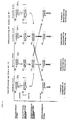
- This situation is exemplary in Fig. 1 shown. Success is particularly practical through a clever choice of the annealing temperature (If desired, other reaction parameters such as Concentration of oligonucleotides) reached.
- T M value is defined as the temperature at which 50% of a target sequence is hybridized with a primer. At this temperature, a bound suitable oligonucleotide can also be released again quickly (equilibrium).
- the T M value on the same target is lower, ie at this lower T M value, the less suitable oligonucleotide will hardly bind to the said target, but will be displaced by the more than 50% binding suitable oligonucleotide .
- This annealing takes place at the corresponding temperatures in both alleles.
- the T M values for the perfectly complementary target combination [(E), (H), FIG. 1] are significantly increased in comparison to the T M values of the oligonucleotide / target combinations [( A), (B), (C), (D) Fig.
- variant 1 has the advantage that a differentiation by temperature selection in the subsequent cycles only has to take place roughly or not at all. In addition, the direct detection of genomic nucleic acids without pre-amplification is possible.
- the variant described here is particularly suitable for multiplex analyzes, since not only the T M values for a mutation and the corresponding primers can be achieved in the annealing step carried out before the PCR, but also by slow cooling over a range from the highest T M -Value below the lowest T M -value, all oligonucleotides a selective annealing is made possible.
- the second variant is explained with reference to FIGS. 2-4.
- This case in which the 3 'end nucleotide is the Oligonucleotides corresponding to position X is due to preferred its higher selectivity. This is in it justifies that it is often not practical for selectivity depends on whether the mismatch oligonucleotide is hybridized or not.
- Three primers are used, a counter strand primer and one primer each for each one of the alleles.
- the primers are selective in that the base at the 3 'end of a selective primer to M, the of the other primer is complementary to N.
- the two alleleselective primers are now e.g. divided by two distinguish between additional substitutions, with a mismatch to the template in each primer arises, so that each of the two primers a mismatch to each selected allele and two mismatches to other allele.
- allel-selective primers of different lengths can be selected.
- allel-selective primers of different lengths can be selected.
- These changes are reflected in the respective PCR products installed so that in the further course of the PCR by one PCR product each of the alleleselective primers a better (namely, completely complementary) Target for this primer represents as the original target, and also for the other allele-selective Primer is no longer a suitable target because of this now even has three mismatches to the changed target.
- This is the fault-determining selection of the alleles through the primer essentially in annealing to the Original target or / and in the following extension of the Primer; the further amplification of the existing PCR products is separated by the additional changes.
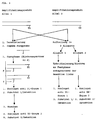
- Fig. 2 the relative location is that in the examples specified oligonucleotides indicated (position 1 at the 3 'end). This is proof of two Alleles of the apolipoprotein B gene (Proc. Natl. Acad. Of Sciences USA 86, pp. 587-591, 1989).
- the results of the first three cycles are one PCR reproduced when the invention Oligonucleotides P1 and P2 in one approach to Amplification can be used.
- the last base at the 3 'end of the P1 oligonucleotide matches the mutant allele
- the last one Base at the 3 'end of oligonucleotide P2 matches normal Allele, so that an extension of the primer in the in Figure 3 marked as (B) and (C) Primer / template combinations are made.
- Products of Reaction are the nucleic acid hybrids (F) and (G). In the (B) and (C) with * marked differences (Mismatches) do not prevent the primers from being extended Completely.
- Extension products exactly complementary counter-strands (I) or (K), upper sequence).
- These new ones Products can work with each other Oligonucleotide to products (O) or (L) hybridize, but finds an extension reaction not because there are 3 mismatches in these hybrids are.
- an extension of the corresponding takes place associated oligonucleotides from products (M) and (N) instead of.
- the specificity of the detection in variant 2 can be increased by additional differential hybridization of the oligonucleotides to the nucleic acids to be detected according to the type of COP.
- the oligonucleotides hybridized with all the nucleic acids to be detected with approximately the same efficiency. However, if the oligonucleotides have further differences in position Y (e.g.
- the annealing of the match oligonucleotide can therefore are hardly impeded by annealing the mismatch oligonucleotide on the product target, so that separation of the amplification occurs and a reduction in the amplification rate due to blocking incorrect annealing is excluded.
- nucleic acids in particular of variant 2, can have 2 or more nucleic acids with 2 or more Differences (polymorphic locations, X1, X2 ... XN) in the Nucleotide sequence are detected, the in (Nucl.Acids Res. 1988, Vol. 16, 23, 11141-11155) described method can be used transferred (Multiplex method).
- the polymorphic locations separately from the subject of the method according to the invention made.
- Oligonucleotides are used like polymorphic sites different nucleic acids to be detected.
- For 2 polymorphic sites on 2 nucleic acids is therefore at least one set of 4 according to the invention
- Oligonucleotides P1, P2, P4, P5 used are used.
- Fig. 8 The amplified areas which is also limited by the two counter strand primers will not overlap here, but are preferred different lengths. This is a separate proof simply possible.
- primer P6 can be omitted become.
- the amplification for both polymorphic locations of the counter strand primer P3 are used.
- a second embodiment is based on the fact that the sets of inventive sets belonging to different locations Oligonucleotides with different strands of the Hybridize nucleic acids to be detected (FIG. 9).
- the amplified areas can also overlap, whereby by analog use of Y positions (in overlapping area of oligonucleotides P1, P2, P4 and P5) it can be ensured that the amplification of the two polymorphic locations remains separate.
- Y positions in overlapping area of oligonucleotides P1, P2, P4 and P5
- a third preferred embodiment in which the detection of polymophisms is linked, does not need a counter strand primer, since the inventive Oligonucleotides act as such.
- the inventive Oligonucleotides act as such.
- four different amplification products are formed and verified, depending on whether corresponding alleles are present. So that's one too direct determination of the cis / trans location of mutations possible.
- a particularly preferred embodiment is based on the Use of the PCR (EP-A-0 201 184), which follows reference is made to the content. To demonstrate similar It is only necessary to pass a primer through nucleic acids a set of the oligonucleotides according to the invention replace. The remaining reaction conditions for the Amplification, especially the use of the Counter strand primers can be applied analogously.
- LCR ligase chain reaction
- oligonucleotide Set of oligonucleotides according to the invention instead of at least one oligonucleotide Set of oligonucleotides according to the invention used.
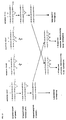
- Fig. 13 is shown that the number of Cross product mismatches increased.
- X can be located at the 3 'end of the one or at the 5 'end of the other oligonucleotide are located.
- COP it is basically analogous to COP perform an LCR where X is near the center of the Oligonucleotide.
- Counterstring oligonucleotides used those in the Y corresponding positions have nucleotides that to none of the nucleotides of positions Y of the oligonucleotides according to the invention are complementary.
- the improvement according to the invention can also be done in promoter-primed, cyclically guided Amplification reactions are used, as with Process of EP-A-0310229, EP-A-0329822 or EP-A-0373960.
- the content of these documents is hereby acknowledged Referred.
- With these amplifications is using of a promoter primer a variety of product targets (RNA) formed again using the promoter primer be amplified.
- the specific proof of the extension products which is a measure of the presence or amount of represents nucleic acid to be detected in the sample possible, for example, that the used Distinguish oligonucleotides in another feature.
- the difference can be, for example, that the Oligonucleotides of a set of different lengths exhibit. This creates through the extension different oligonucleotides of different lengths Extension products.
- the oligonucleotides can however also differ in that they are different contain detectable groups D.
- detectable Groups D are, for example, color or Fluorescence molecules or chemical residues contained in one subsequent reaction with a detectable residue can be determined.
- Such chemical groups are for example haptens, such as digoxin or digoxigenin. Haptens can be detected by using a labeled antibodies against the hapten are implemented and the mark is measured. Another hapten could be, for example, biotin, which is different labeled antibody or detectable with streptavidin is made.
- Nucleic acid can be either after division of the Approach separate, sequential upon receipt of the approach and if suitable markings are used, simultaneously known methods can be demonstrated.
- steroid hormones as a marker has been found in EP-A-0 324 474 described method proved to be preferred.
- a another method is to use different ones Fluorescent dyes.
- the oligonucleotides can either be marked directly, or e.g. Antibodies against chemical groups could be fluorescently labeled accordingly his.
- Evidence of the various allelic products is then in several by simultaneous fluorescence measurement Channels possible.
- a marking of a part of the products with fluorescent markers and other products from the same Approach with enzymes is also possible. All other possible marking methods and detection methods are in principle also suitable.
- haptens caused by various antibodies are recognized for labeling the two oligonucleotides be used.
- examples of such haptens are Digoxigenin, biotin and fluroeszein.
- the antibody against Have fluorescein and the antibody against digoxigenin then different enzymes are preferred as labels.
- substrates detectable for the enzymes By sequential or simultaneous contact with substrates detectable for the enzymes, both nucleic acids can be detected.
- Alternatives as demonstrated by the extension products 5 to 7 are given.
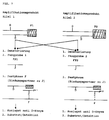
- the mixture of the common extension reaction is in of the embodiment shown in Fig. 5 (left side) subjected to a common denaturation reaction.
- the single-strand extension products come with a immobilized or via a group I (e.g. biotin) immobilizable, so-called capture probe to a solid phase F bound.
- group I e.g. biotin
- capture probe to a solid phase F bound.
- the extension products of Reaction with all nucleic acids to be detected immobilized Due to the different detectable Groups is a sequential detection to be detected Nucleic acids (separated by a washing step) possible. If the signals to be finally detected also produced and verified side by side in a vessel can be dispensed with, the washing step become.
- Fig. 5 On the right side of Fig. 5 is a variant shown at the after the common Extension reaction the reaction mixture at least twice (or correspondingly more often if more is proven than 2 alleles and use of more than 2 Labeling enzymes) a sufficient amount of liquid removed and these individually on the extension products being checked. From a multiplex reaction Aliquots are taken and depending on the number of used different labels on the oligonucleotides correspondingly many amplification products per aliquot be detected.
- Extension reaction also with an immobilizable Group modified mononucleotide or oligonucleotide was installed. This allows the Extension products directly (i.e. without separate Capture probe and without denaturation) to a solid phase be bound (analogous to DE-A-4001145).
- the detection is also, as shown in Fig. 5, simultaneous, sequential or possible side by side.
- Fig. 7 an embodiment is shown, which on the The fact is that the extension products are for different nucleic acids to be detected preferably around distinguish at least three nucleotides from one another. This can be used for selective immobilization via a Capture probe can be used. Detectable groups D are by incorporating a modified mono- or oligonucleotide introduced. This group can be used for Extension products of both alleles are identical.
- Oligonucleotides are preferably based on gel chromatographic separation of the extension products, which are as long as the amplified area (inclusive of oligonucleotides).
- the detection can be done directly after Separation in the gel, (e.g. ethidium bromide staining) after Incorporation of labeled oligonucleotides, mononucleotides or Hybridization done with labeled probes.
- On Difference in electrophoretic mobility can also can be achieved in other ways, e.g.
- the method according to the invention can be used in a variety of ways become. For example, the appearance of alleles in a sample drawn by a single subject was (individual diagnosis), in correlation to certain Diseases (e.g. metabolic disorders).
- the procedure is because of the good Specificity also suitable for processes based on the Principle of pool screening based on samples.
- the defect in the apo B 3500 gene for example proven to be useful, 64 samples in a pool unite. It is with the method according to the invention possible to determine whether a sample of the pool has the gene defect exhibited. By switching several times in a row Implementation of the method according to the invention Sub-pools of a pool with a positive result can be compared to the prior art, few provisions the sample can be determined, which is the gene with the defect having.
- the gene is always without the defect can be detected if it is present is.
- this can be mutant in pool screening Product can be detected or if no mutant allele is present, the normal product can be proven.
- the possibility of being able to detect both alleles provides in addition to a possibility to control the reaction as such also a means of quantifying the evidence Represent nucleic acids.
- Main advantage of the invention over the prior art is the ability to add allelic compounds in mixtures practically negligible background reaction to be able to detect simultaneously in one vessel. On Restriction digestion is not necessary. The goal will be achieved by quasi-separation of the amplifications (Reduction of cross reactions) of the individual alleles, although an amplification in a common vessel is carried out.
- the invention also relates to a set of Oligonucleotides, which has at least two oligonucleotides contains that hybridize with similar nucleic acids can, the oligonucleotides being in at least 2, preferably at least in 3 defined positions as well preferably distinguish another structural feature.
- Preferred are those oligonucleotides that are in their 3'-terminal nucleotides (which correspond to position X) and in two further nucleotides as well as preferred distinguish another structural feature.
- the detectable structural feature can different length of the oligonucleotides or one be detectable or immobilizable group.
- the Oligonucleotides can be present as a mixture. Moreover can this mixture still other oligonucleotides included in the amplification of nucleic acids using the set of Oligonucleotides are required, in particular Counter strand oligonucleotides or primer.
- Oligonucleotides that are different in position Y Have nucleotides, but these are not complementary to the nucleotides of the template nucleic acids if this position in the oligonucleotides is this Has the same distance from X.
- One weakened effect shows such a set of Oligonucleotides, only one of which is in position Y has a nucleotide that does not correspond to the corresponding one Position of the associated nucleic acid to be detected is complementary.
- the inventive set of Oligonucleotides are used to solve the problem in the Process used according to the invention.
- Another object of the invention is a reagent kit for the detection of similar nucleic acids, which a set of oligonucleotides according to the invention and a Enzyme to extend nucleic acids and possibly others required to extend the oligonucleotides Contains reagents and auxiliary substances. Besides, that can Reagent kit for other oligonucleotides, for example Counter strand primer included. In the reagent kit prefers the enzyme and the oligonucleotides in the other reagents separate containers.
- Human genomic DNA was made from EDTA blood by the method by Higuchi (in PCR Technology, Principles and Application for DNA Amplification, ed. Ehrlich, H.A. (Stockton press, New York), 31-38 (1989)) isolated, whereby the volume of DNA solution ultimately obtained is equal to that Volume of the EDTA blood used is. On average For example, 7500 leukocytes / ⁇ l becomes a 2 ⁇ l sample contain up to 15,000 leukocytes, so with up to about 100 ng DNA can be calculated in 2 ⁇ l solution. The DNA was at the end of the Higuchi method at 100 ° C heated so that further denaturation before implementation the PCR is no longer required.
- the 10 x PCR buffer is: 100 mM Tris-HCl pH 8.3, 500 mM KCl, 0.1% gelatin
- the samples were amplified using the two alleleselective primers P1, P2 and the counter strand primer P3.
- the normal sample provides only a 134 bp product
- the mutant sample only a 114 bp product.
- the heterozygous test subject (lane 4 in FIG. 11) delivers both products, as expected. If, on the other hand, only one of the alleleselective primers is used, the PCR product corresponding to the primer is obtained regardless of which of the templates has been amplified.
- the normal subject also delivers the band corresponding to the mutant allele (lane 6) and the cloned mutant DNA the product of the normally selective primer (lane 10).
- the cloned DNA is a fragment positions 10573-1070 of the Apo B cDNA sequence includes in the vector Gem3zf (-) (Atlanta / Promega). Before the When used in the PCR reaction, the DNA was linearized with BamH1 and diluted to 0.06 pg / ⁇ l. This thinning contains approx. 15000 DNA molecules / ⁇ l, i.e. in approx. 2 ⁇ l the Apo B sequence as often as 2 ⁇ l DNA solution from one DNA isolation from EDTA blood.
- primer P7 and primers P3 also deliver with a very large number of cycles Primer dimers, which may be the desired PCR product could no longer be obtained.
- the concentration of the normal selective primer is in this reaction is significantly lower than that of the mutant selective primers, since only those in reaction 1 existing amount of normal selective primer taken over has been. This is a preferred amplification of the mutant alleles possible.
- the existing amount of normal-selective primer is sufficient, however, in the event that there is no mutant allele in the approach to a visible amplification product after the 3rd Obtain a reaction step and thus also in pool screening to allow internal control of the PCR reaction.
- 12 ⁇ l preparation of the 1st reaction step 58 ⁇ l aliquot of the reagent mix: 1.4 ⁇ l primer P7 (51.1 ng / ⁇ l stock solution) SEQ ID NO 5 0.7 ⁇ l Asa short (95.7 ng / ⁇ l stock solution) SEQ ID NO 1 0.85 ⁇ l Mg 2+ of 20 mM MgCl 2 solution 5.8 ⁇ l 10 x PCR buffer without Mg 2+ 0.12 ⁇ l Taq polymerase 49.13 ⁇ l H 2 O 70 ⁇ l total volume
- the last four cycles should ensure that before starting no single-stranded DNA in the third reaction step there is more.
- Selectivity is essential in the second reaction determined by the low dNTP concentration (2 ⁇ M), while the annealing temperature is relatively low at 60 ° C is to ensure efficient annealing. In the 3rd reaction, however, becomes a higher amount of dNTP used so that a larger amount of product can be formed. Since the additional mutations in the Primers with the second reaction in the PCR products were installed, the annealing temperature in the 3rd Response to 65 ° C can be increased.
- 8 EDTA blood samples were mixed to primary pools and an aliquot of 8 primary pools was used to generate a 64 pool.
- This scheme is optimal for a three-step analysis with a frequency of mutation from 1 in 8 3 to 1 in 512, but can also be used over a wide range of other frequencies.
- the isolation of the DNA was initially only carried out for the 64 pools. Approx. 4100 samples were analyzed in this way. Here 6 pools of 64 were found, the mutant sequence contained. The DNA of the corresponding pools of 8 was isolated and analyzed in the same way as the 64 series Pools. Eventually, the DNA became positive individual samples found in pools of 8 isolated and examined according to Example 1. That way 6 heterozygous carriers identified.
- oligonucleotides against extension e.g. by incorporating a dideoxynucleotide at the 3 'end (Cozzarelli et al. Journal of Molecular Biology 45, 513 (1969)).
- a multiplex system that serves to determine whether of several known (rare) mutations one (or more) is present, so the normal ones Alleles are excluded from amplification so that the number of amplification products for each subject in usually limited to 1-3 bands (1 normal Band is also amplified to control the Amplification, 1-2 bands of mutant alleles).
- a wrong one Annealing on the original template in cycles after the primary annealing step may also be due to subsequent addition of blocked oligonucleotides that are perfectly complementary to the original target are.
- an allele or an isolate of an infectious agent or somatic mutant (oncogenes) estimated with variant 2 should be a third artificial allele as Standard and for this and the allele, that is to be estimated becomes one according to the invention Primer with 3'-OH end used, while the Amplification of the remaining alleles by Dideoxyoligonucleotides is prevented.
- the artificial 3rd Alleles can have the Y deviations of the corresponding primer already included and insofar as the primer then Relatively many Y positions matched directly to the template contribute to a safe separation of the amplifications achieve.
- LCAT e.g. but also LDL receptor
- a specific person only to check whether one of the known mutations can amplify normal alleles (except for one band as a PCR control). This reduces the number of bands in one Normal person on a gang. The existing mutation comes just a gang. The overall yield of the PCR is distributed so on significantly fewer bands and the band pattern is simplified. Do you have e.g. of 40 different possible defects one proven (in several Multiplex reactions), then can Heterozygosity or homozygosity to be tested (this time instead of with dideoxy- with normal primer).
- promoters-controlled variants one of the above oligonucleotides are used or a primer, which is a variant of the Contains promoter sequence.
Landscapes
- Chemical & Material Sciences (AREA)
- Life Sciences & Earth Sciences (AREA)
- Organic Chemistry (AREA)
- Engineering & Computer Science (AREA)
- Zoology (AREA)
- Wood Science & Technology (AREA)
- Proteomics, Peptides & Aminoacids (AREA)
- Health & Medical Sciences (AREA)
- Biophysics (AREA)
- General Engineering & Computer Science (AREA)
- Immunology (AREA)
- Microbiology (AREA)
- Molecular Biology (AREA)
- Analytical Chemistry (AREA)
- Physics & Mathematics (AREA)
- Genetics & Genomics (AREA)
- Biochemistry (AREA)
- Bioinformatics & Cheminformatics (AREA)
- Biotechnology (AREA)
- General Health & Medical Sciences (AREA)
- Chemical Kinetics & Catalysis (AREA)
- Measuring Or Testing Involving Enzymes Or Micro-Organisms (AREA)
- Saccharide Compounds (AREA)
Description
- wobei sich die Oligonukleotide des Satzes außerdem in mindestens einer weiteren Position (Y) voneinander unterscheiden, wobei die Positionen X und Y im hybridisierenden Bereich liegen, so daß sich die Verlängerungsprodukte aus b) in mehr als einer Position im hybridisierenden Bereich voneinander unterscheiden und
- in Schritt c) die in Schritt b) erzeugten Unterschiede der Verlängerungsprodukte zu den ähnlichen Nukleinsäuren sowie die Position (X) zum Nachweis der Verlängerungsprodukte verwendet werden.
- Oligonukleotid P1 :
- Asa kurz (29 Basen): SEQ ID No. 1
Nukleotid in Position X: T (selektiv mutant)
Nukleotid in Position 2 (Y1): G (mismatch)
Nukleotid in Position 4 (Y2): G (match) - Oligonukleotid P2 :
- Asa lang (49 Basen): SEQ ID No. 2
Nukleotid in Position X: C (selektiv normal)
Nukleotid in Position 2 (Y1): C (match)
Nukleotid in Position 4 (Y2): T (mismatch) - Oligonukleotid P3 :
- Gegenstrangprimer : SEQ ID No. 3
komplett komplementär zum Strang - Oligonukleotid P2':
- Asa lang' (49 Basen): SEQ ID No. 4
Nukleotid in Position X: C (selektiv normal)
Nukleotid in Position 2 (Y1): G (mismatch)
Nukleotid in Position 4 (Y2): G (match)
- I
- Gruppe für Immobilisierung
- D
- Gruppen für Detektion
- D1, D2
- unterschiedliche Gruppen für Detektion
- F
- Festphase
- P1, P4
- Primer 1, 4 gemäß der Erfindung
- P2, P5
- Primer 2, 5 gemäß der Erfindung
- P2'
- Vergleichsprimer
- P3, P6, P7
- Gegenstrangprimer
- X, X1, X2
- allele Positionen
- Y1, Y2
- Positionen der Mismatches
Abkühlung auf Raumtemperatur
| 2 µl DNA-Lösung |
| 10 µl Aliquot des Reagenzienmixes: |
| 1.4 µl dNTP Mix (20 µM Stammlösung) |
| 0.9 µl Mg2+ (20 mM Stammlösung) |
| 1.2 µl 10 x PCR-Puffer ohne Mg2+ (s. Beispiel 1) |
| 0.28 µl Primer Asa lang (81 ng/µl Stammlösung) SEQ |
| ID NO 2 |
| 5.99 µl H2O |
| 0.23 µl Taq-Polymerase (5 U/µl, Beckmann) |
| 12 µl Gesamtvolumen |
| 12 µl = Ansatz des 1. Reaktionsschrittes |
| 58 µl Aliquot des Reagenzienmixes: |
| 1.4 µl Primer P7 (51.1 ng/µl Stammlösung) |
| SEQ ID NO 5 |
| 0.7 µl Asa kurz (95.7 ng/µl Stammlösung) |
| SEQ ID NO 1 |
| 0.85 µl Mg2+ von 20 mM MgCl2 Lösung |
| 5.8 µl 10 x PCR-Puffer ohne Mg2+ |
| 0.12 µl Taq-Polymerase |
| 49.13 µl H2O |
| 70 µl Gesamtvolumen |
- Temperaturverlauf:
- 20 x (1 min 95°C, 1 min 60°C,
1 min 72°C),
4 x (2 min 60°C, 2 min 72°C)
5 min 72°C
| 7 µl des Produkts des 2. Reaktionsschrittes |
| 43 µl Aliquot des Reagenzienmixes: |
| 0.5 µl Primer 3 (92.4 ng/µl) SEQ ID NO 4 |
| 0.65 µl Asa kurz, SEQ ID NO 1 |
| 0.2 µl Asa lang, SEQ ID NO 2 |
| 5 µl 10 x Puffer ohne Mg2+ |
| 2.14 µl Mg2+ von 10 mM MgCl2 Lösung |
| 2.5 µl dNTP-Mix, in dem die vier dNTPs je 100 µM |
| vorliegen |
| 31.76 µl H2O |
| 0.25 µl Taq-Polymerase (5 U/µl, Beckmann) |
| 50 µl Gesamtvolumen |
- Temperaturverlauf:
- 40 x (1 min 95°C, 1 min 65°C,
1 min 72°C),
4 x (2 min 65°C, 2 min 72°C),
5 min 72°C
- Sequenzlänge:
- 29 Basen
- Art der Sequenz:
- Desoxyribonukleotid
- Strangform:
- Einzelstrang
- Topologie:
- Linear
- Position:
- 10658-10686 (J. Biol. Chem. 261,12918 -12921 (1986))
- 3'-TGAGAAGTCA CTTCGACGTC CCGTGAAGG-5'
- Sequenzlänge:
- 49 Basen
- Art der Sequenz:
- Desoxyribonukleotid
- Strangform:
- Einzelstrang
- Topologie:
- Linear
- Position:
- 10658-10706
- 3'-CCATAAGTCA CTTCGACGTC CCGTGAACCT TTTAACTACT ATAGACCTT-5'
- Sequenzlänge:
- 49 Basen
- Art der Sequenz:
- Desoxyribonukleotidsequenz
- Strangform:
- Einzelstrang
- Topologie:
- Linear
- Position:
- 10658-10706
- 3'-CGAGAAGTCA CTTCGACGTC CCGTGAACCT TTTAACTACT ATAGACCTT-5'
- Sequenzlänge:
- 28 Basen
- Art der Sequenz:
- Desoxyribonukleotidsequenz
- Strangform:
- Einzelstrang
- Topologie:
- Linear
- Position:
- 10573-10600
- 5'-GATGTCAAGG GTTCGGTTCT TTCTCGGG-3'
- Sequenzlänge:
- 31 Basen
- Art der Sequenz:
- Desoxyribonukleotidsequenz
- Strangform:
- Einzelstrang
- Topologie:
- Linear
- Position:
- 10532-10562
- 5'-GCCTCACCTC TTACTTTTCC ATTGAGTCAT C-3'
Claims (14)
- Verfahren zum Nachweis ähnlicher Nukleinsäuren, deren Nukleotidsequenzen sich in mindestens einer Position (X) voneinander unterscheiden, welches mindestens folgende Teilschritte enthält:a) Umsetzung eines Satzes von Oligonukleotiden, deren Nukleotidsequenzen sich in der der Position X entsprechenden Position unterscheiden, mit den nachzuweisenden Nukleinsäuren unter Hybridisierungsbedingungen;b) Verlängerung der anhybridisierten Oligonukleotide unter Verwendung der nachzuweisenden Nukleinsäuren als Template in einem einzigen Reaktionsgefäß; undc) Nachweis von Verlängerungsprodukten;
dadurch gekennzeichnet, daßsich die Oligonukleotide des Satzes außerdem in mindestens einer weiteren Position (Y) voneinander unterscheiden, wobei die Positionen X und Y im hybridisierenden Bereich liegen, so daß sich die Verlängerungsprodukte aus b) in mehr als einer Position im hybridisierenden Bereich voneinander unterscheiden undin Schritt c) die in Schritt b) erzeugten Unterschiede der Verlängerungsprodukte zu den ähnlichen Nukleinsäuren sowie die Position (X) zum Nachweis der Verlängerungsprodukte verwendet werden. - Verfahren nach Anspruch 1, dadurch gekennzeichnet, daß Schritt c) folgende Teilschritte enthält:α) Bildung von zu den Verlängerungsprodukten aus Schritt b) oder einem wesentlichen Teil davon komplementären Nukleinsäuren;β) Verlängerung eines neuen Satzes der Oligonukleotide aus Schritt a) zu Polynukleotiden unter Verwendung der in α) gebildeten komplementären Nukleinsäuren als target-Nukleinsäuren;γ) Nachweis der Verlängerungsprodukte aus α) oder β).
- Verfahren gemäß Anspruch 1, dadurch gekennzeichnet, daß jeweils das X entsprechende Nukleotid eines Oligonukleotids zu dem Nukleotid X einer nachzuweisenden Nukleinsäure, nicht jedoch der anderen nachzuweisenden Nukleinsäuren, komplementär ist.
- Verfahren nach Anspruch 3, dadurch gekennzeichnet, daß die Oligonukleotide mit dem Position X entsprechenden Nukleotid enden.
- Verfahren nach Anspruch 1 oder 2, dadurch gekennzeichnet, daß die Positionen Y aus dem Bereich der Oligonukleotide gewählt werden, der 1 bis 8 Nukleotide vom endständigen Nukleotid der Oligonukleotide entfernt ist.
- Verfahren nach einem der vorangehenden Ansprüche, dadurch gekennzeichnet, daß die Verlängerungsreaktionen der Oligonukleotide simultan erfolgen.
- Verfahren nach einem der vorangehenden Ansprüche, dadurch gekennzeichnet, daß sich die Oligonukleotide detektierbar unterscheiden.
- Verfahren nach einem der vorangehenden Ansprüche, dadurch gekennzeichnet, daß die Oligonukleotide unterschiedlich lang sind.
- Verfahren nach einem der vorangehenden Ansprüche, dadurch gekennzeichnet, daß die Oligonukleotide unterschiedliche detektierbare Gruppen aufweisen.
- Verfahren gemäß Anspruch 1, bei dem der Nachweis der Verlängerungsprodukte durch selektive Hybridisierung mit einer Sonde erfolgt.
- Verfahren gemäß Anspruch 2, bei dem der Nachweis der komplementären Nukleinsäuren durch selektive Hybridisierung mit einer Sonde erfolgt.
- Verfahren gemäß Anspruch 10 oder 11, dadurch gekennzeichnet, daß die Sonde einen ersten Teil besitzt, der im Bereich der Oligonukleotide anhybridisiert sowie einen zweiten Teil, der im Bereich der Verlängerung hybridisiert.
- Verfahren gemäß Anspruch 1 oder 2, wobei der Nachweis der Verlängerungsprodukte darauf beruht, daß sich die Verlängerungsprodukte für verschiedene nachzuweisende Nukleinsäuren bevorzugt um mindestens drei Nukleotide voneinander unterscheiden.
- Verfahren gemäß Anspruch 10 oder 11, bei dem der Nachweis der Verlängerungsprodukte zugleich eine Selektion auf das richtige Verlängerungsprodukt und auf die verschiedenen Allele liefert.
Applications Claiming Priority (2)
| Application Number | Priority Date | Filing Date | Title |
|---|---|---|---|
| DE4129653 | 1991-09-06 | ||
| DE4129653A DE4129653A1 (de) | 1991-09-06 | 1991-09-06 | Verfahren zum nachweis aehnlicher nukleinsaeuren |
Publications (2)
| Publication Number | Publication Date |
|---|---|
| EP0530794A1 EP0530794A1 (de) | 1993-03-10 |
| EP0530794B1 true EP0530794B1 (de) | 2000-04-12 |
Family
ID=6440005
Family Applications (1)
| Application Number | Title | Priority Date | Filing Date |
|---|---|---|---|
| EP92115065A Expired - Lifetime EP0530794B1 (de) | 1991-09-06 | 1992-09-03 | Verfahren zum Nachweis ähnlicher Nukleinsäuren |
Country Status (6)
| Country | Link |
|---|---|
| US (2) | US5605794A (de) |
| EP (1) | EP0530794B1 (de) |
| JP (1) | JPH0813280B2 (de) |
| AT (1) | ATE191748T1 (de) |
| DE (2) | DE4129653A1 (de) |
| ES (1) | ES2147180T3 (de) |
Cited By (1)
| Publication number | Priority date | Publication date | Assignee | Title |
|---|---|---|---|---|
| US8673871B2 (en) | 2006-05-05 | 2014-03-18 | Isis Pharmaceuticals, Inc. | Compounds and methods for modulating expression ApoB |
Families Citing this family (41)
| Publication number | Priority date | Publication date | Assignee | Title |
|---|---|---|---|---|
| US5869252A (en) * | 1992-03-31 | 1999-02-09 | Abbott Laboratories | Method of multiplex ligase chain reaction |
| US6100099A (en) * | 1994-09-06 | 2000-08-08 | Abbott Laboratories | Test strip having a diagonal array of capture spots |
| US7001722B1 (en) * | 1993-06-22 | 2006-02-21 | Baylor College Of Medicine | Parallel primer extension approach to nucleic acid sequence analysis |
| GB9503808D0 (en) * | 1995-02-24 | 1995-04-12 | Univ Nottingham | Detection assay |
| US6703228B1 (en) | 1998-09-25 | 2004-03-09 | Massachusetts Institute Of Technology | Methods and products related to genotyping and DNA analysis |
| EP1001037A3 (de) * | 1998-09-28 | 2003-10-01 | Whitehead Institute For Biomedical Research | Vorselektion und Isolierung eines Einzelnukleotidpolymorphismus |
| DE19855469C2 (de) * | 1998-12-01 | 2001-01-11 | Michael Esrich | Verfahren zur Bestimmung des Apolipoprotein-E-Genotyps in einer menschlichen Probe |
| JP5095888B2 (ja) | 1999-03-18 | 2012-12-12 | エクシコン エ/エス | 特異的lnaプライマによる遺伝子内における突然変異の検出 |
| US6977161B2 (en) | 2000-10-14 | 2005-12-20 | Eragen Biosciences, Inc. | Solid support assay systems and methods utilizing non-standard bases |
| CA2409309A1 (en) * | 2000-05-19 | 2001-11-29 | Eragen Biosciences, Inc. | Materials and methods for detection of nucleic acids |
| WO2002004673A1 (en) * | 2000-07-12 | 2002-01-17 | Bionex, Inc. | Method for detecting sequence variation of nucleic acid |
| JP2001137000A (ja) * | 2000-09-19 | 2001-05-22 | Nobuyuki Hamashima | 遺伝子変異の判別方法 |
| CN100385013C (zh) * | 2000-10-14 | 2008-04-30 | 伊拉根生物科学公司 | 使用非标准碱基的固相支持体分析系统和方法 |
| WO2002068684A2 (en) * | 2001-02-23 | 2002-09-06 | Pyrosequencing Ab | Allele-specific primer extension assay |
| US7407943B2 (en) | 2001-08-01 | 2008-08-05 | Isis Pharmaceuticals, Inc. | Antisense modulation of apolipoprotein B expression |
| US7888324B2 (en) | 2001-08-01 | 2011-02-15 | Genzyme Corporation | Antisense modulation of apolipoprotein B expression |
| DE60324253D1 (de) * | 2002-02-08 | 2008-12-04 | Olympus Corp | Spezifische multiplex-analyse von nukleinsäuren |
| KR101078977B1 (ko) * | 2002-11-07 | 2011-11-01 | 세키스이 메디칼 가부시키가이샤 | 유전자 변이 검출법 |
| US7511131B2 (en) | 2002-11-13 | 2009-03-31 | Genzyme Corporation | Antisense modulation of apolipoprotein B expression |
| DE602004018270D1 (de) * | 2003-01-17 | 2009-01-22 | Eragen Biosciences Inc | Nukleinsäureamplifikation mit nichtstandardbasen |
| JP4567673B2 (ja) * | 2003-04-01 | 2010-10-20 | エラジェン バイオサイエンシズ インコーポレイテッド | ポリメラーゼ阻害剤およびその使用方法 |
| WO2005081776A2 (en) * | 2004-01-30 | 2005-09-09 | Eragen Biosciences, Inc. | Materials and methods for the detection of sars |
| US20050287558A1 (en) | 2004-05-05 | 2005-12-29 | Crooke Rosanne M | SNPs of apolipoprotein B and modulation of their expression |
| EP1623996A1 (de) * | 2004-08-06 | 2006-02-08 | Deutsches Krebsforschungszentrum Stiftung des öffentlichen Rechts | Verbessertes Verfahren zur Auswahl eines Proteins von einer Bibliothek |
| WO2006101913A2 (en) * | 2005-03-18 | 2006-09-28 | Eragen Biosciences, Inc. | Methods for detecting multiple species and subspecies of neiserria |
| CA2610863C (en) | 2005-06-07 | 2017-01-17 | Eragen Biosciences, Inc. | Methods for detection and typing of nucleic acids |
| JP3859688B1 (ja) * | 2005-10-07 | 2006-12-20 | 松下電器産業株式会社 | Dnaが有する標的塩基を判別する方法 |
| US7285387B2 (en) * | 2005-10-07 | 2007-10-23 | Matsushita Electric Industrial Co., Ltd. | Discrimination method of target base in DNA, and allele specific primer used in the method of the same |
| JP3859686B1 (ja) * | 2005-11-21 | 2006-12-20 | 松下電器産業株式会社 | Dnaが有する標的塩基を判別する方法 |
| JP3859687B1 (ja) | 2005-11-21 | 2006-12-20 | 松下電器産業株式会社 | Dnaが有する標的塩基を判別する方法 |
| JP3859684B1 (ja) * | 2005-11-21 | 2006-12-20 | 松下電器産業株式会社 | Dnaが有する標的塩基を判別する方法 |
| US20070264694A1 (en) * | 2006-04-07 | 2007-11-15 | Eragen Biosciences, Inc. | Use of non-standard bases and proximity effects for gene assembly and conversion of non-standard bases to standard bases during dna synthesis |
| RU2559536C2 (ru) | 2007-03-24 | 2015-08-10 | Джензим Корпорейшн | Введение антисмысловых олигонуклеотидов, комплементарных человеческому аполипопротеину в |
| US20090270601A1 (en) * | 2008-04-21 | 2009-10-29 | Steven Albert Benner | Differential detection of single nucleotide polymorphisms |
| US9107933B2 (en) | 2009-03-16 | 2015-08-18 | Isis Pharmaceuticals, Inc. | Compositions and methods of targeting apolipoprotein B for the reduction of apolipoprotein C-III |
| AU2010270309A1 (en) | 2009-07-10 | 2012-02-02 | Basf Plant Science Company Gmbh | Expression cassettes for endosperm-specific expression in plants |
| CN102639712A (zh) * | 2009-10-23 | 2012-08-15 | 卢米耐克斯公司 | 用于提高反应特异性的具有非标准碱基的扩增引物 |
| EP2507375A4 (de) | 2009-12-03 | 2013-04-24 | Basf Plant Science Co Gmbh | Expressionskassetten für embryospezifische expression in pflanzen |
| EP2455485A1 (de) | 2010-11-19 | 2012-05-23 | Anagnostics Bioanalysis GmbH | Verfahren zum Nachweis von Nukleinsäuren |
| CR20180597A (es) | 2016-05-20 | 2019-05-07 | Basf Agro Bv | Péptidos de tránsito dual para el direccionamiento a polipéptidos |
| UY39125A (es) | 2020-03-11 | 2021-09-30 | BASF Agricultural Solutions Seed US LLC | Secuencias de nucleótidos reguladoras de la transcripción y métodos de uso |
Family Cites Families (13)
| Publication number | Priority date | Publication date | Assignee | Title |
|---|---|---|---|---|
| US4683202A (en) * | 1985-03-28 | 1987-07-28 | Cetus Corporation | Process for amplifying nucleic acid sequences |
| ES8706823A1 (es) * | 1985-03-28 | 1987-06-16 | Cetus Corp | Un procedimiento para detectar la presencia o ausencia de al menos una secuencia especifica de acidos nucleicos en una muestra |
| CA1340843C (en) * | 1987-07-31 | 1999-12-07 | J. Lawrence Burg | Selective amplification of target polynucleotide sequences |
| AU622426B2 (en) * | 1987-12-11 | 1992-04-09 | Abbott Laboratories | Assay using template-dependent nucleic acid probe reorganization |
| CA1340807C (en) * | 1988-02-24 | 1999-11-02 | Lawrence T. Malek | Nucleic acid amplification process |
| IE61148B1 (en) * | 1988-03-10 | 1994-10-05 | Ici Plc | Method of detecting nucleotide sequences |
| DE68916671T2 (de) * | 1988-03-18 | 1995-03-02 | Baylor College Medicine | Mutationsnachweis durch kompetitiven Oligonukleotid-Priming. |
| AU3539089A (en) * | 1988-04-08 | 1989-11-03 | Salk Institute For Biological Studies, The | Ligase-based amplification method |
| AU3694689A (en) * | 1988-04-28 | 1989-11-24 | Mark H. Skolnick | Amplified sequence polymorphisms (asps) |
| WO1990001069A1 (en) * | 1988-07-20 | 1990-02-08 | Segev Diagnostics, Inc. | Process for amplifying and detecting nucleic acid sequences |
| WO1990006995A1 (en) * | 1988-12-16 | 1990-06-28 | Siska Diagnostics, Inc. | Self-sustained sequence replication system |
| WO1990012115A1 (en) * | 1989-03-21 | 1990-10-18 | Collaborative Research, Inc. | A dna diagnostic test using an exonuclease activity |
| GB8918226D0 (en) * | 1989-08-09 | 1989-09-20 | Wellcome Found | Dna assays |
-
1991
- 1991-09-06 DE DE4129653A patent/DE4129653A1/de not_active Withdrawn
-
1992
- 1992-09-01 JP JP4233447A patent/JPH0813280B2/ja not_active Expired - Lifetime
- 1992-09-03 DE DE59209826T patent/DE59209826D1/de not_active Expired - Lifetime
- 1992-09-03 EP EP92115065A patent/EP0530794B1/de not_active Expired - Lifetime
- 1992-09-03 AT AT92115065T patent/ATE191748T1/de not_active IP Right Cessation
- 1992-09-03 ES ES92115065T patent/ES2147180T3/es not_active Expired - Lifetime
-
1994
- 1994-03-03 US US08/205,777 patent/US5605794A/en not_active Expired - Lifetime
-
1996
- 1996-03-06 US US08/611,872 patent/US5728530A/en not_active Expired - Lifetime
Cited By (2)
| Publication number | Priority date | Publication date | Assignee | Title |
|---|---|---|---|---|
| US8673871B2 (en) | 2006-05-05 | 2014-03-18 | Isis Pharmaceuticals, Inc. | Compounds and methods for modulating expression ApoB |
| US9045754B2 (en) | 2006-05-05 | 2015-06-02 | Isis Pharmaceuticals, Inc. | Short antisense compounds with gapmer configuration |
Also Published As
| Publication number | Publication date |
|---|---|
| US5605794A (en) | 1997-02-25 |
| ES2147180T3 (es) | 2000-09-01 |
| EP0530794A1 (de) | 1993-03-10 |
| JPH0813280B2 (ja) | 1996-02-14 |
| DE59209826D1 (de) | 2000-05-18 |
| ATE191748T1 (de) | 2000-04-15 |
| DE4129653A1 (de) | 1993-03-11 |
| JPH05244996A (ja) | 1993-09-24 |
| US5728530A (en) | 1998-03-17 |
Similar Documents
| Publication | Publication Date | Title |
|---|---|---|
| EP0530794A1 (de) | Verfahren zum Nachweis ähnlicher Nukleinsäuren | |
| DE69230873T3 (de) | Selektive Restriktionsfragmentenamplifikation: generelles Verfahren für DNS-Fingerprinting | |
| DE68915202T3 (de) | Verfahren zur Vermehrung und zum Nachweis von Nukleinsäuresequenzen. | |
| DE69619864T2 (de) | Verfahren zur amplifizierung spezifischer nukleinsäuresequenzen | |
| DE60035691T2 (de) | Verfahren zur Erkennung von Einzel-Nukleotid-Polymorphismen | |
| DE69531831T2 (de) | Verfahren mit einer hohen umsatzrate für das auffinden von sequenzen oder genetischen veränderungen in nukleinsäuren | |
| DE3650679T2 (de) | Oligonukleotide zur Amplifizierung von Nukleinsäuresequenzen und zur Anknüpfung einer Promotersequenz | |
| DE69412540T2 (de) | Gleichzeitige Amplifikation von Vielfachzielen | |
| DE69219727T2 (de) | Nukleinsäure Zielerzeugung | |
| DE69524425T2 (de) | Nukleotid-sequenzierungsmethode | |
| DE69213112T2 (de) | Verbesserte Methoden zur Nukleinsäure-Amplifizierung | |
| DE69531542T2 (de) | Ligase/polymerase-vermittelte analyse genetischer elemente von einzelnukleotid-polymorphismen und ihre verwendung in der genetischen analyse | |
| EP0833942B1 (de) | Verfahren zur transkriptionsfreien amplifizierung von nukleinsäuren | |
| DE69133389T2 (de) | Direkte Klonierung von PCR amplifizierten Nukleinsäuren | |
| DE69421277T2 (de) | NUKLEINSäURE-SEQUENZANALYSE DURCH DIE METHODE DER PARALLELEN PRIMEREXTENSION | |
| DE69527444T2 (de) | Glycosylase verwendende detektion von bestimmten nukleinsäuresequenzen | |
| DE69713599T2 (de) | Verfahren zur bestimmung von nukleinsäure-sequenzen und diagnostische anwendungen derselben | |
| DE69327326T2 (de) | Vervielfältigungs- und detektionsprozess | |
| DE60029876T2 (de) | Verfahren und Oligonukleotide zum Nachweis von Nukleinsäuresequenzvariationen | |
| DE68916671T2 (de) | Mutationsnachweis durch kompetitiven Oligonukleotid-Priming. | |
| DE69003477T2 (de) | Verfahren zum Nachweis von Nucleinsäuren. | |
| DE60219199T2 (de) | Analyse und detektion von mehreren zielsequenzen unter verwendung von zirkulären proben | |
| DE69633941T2 (de) | Nachweis von unterschieden in nukleinsäuren | |
| DE69434688T2 (de) | Diagnostischer nachweis von rna und reagentiensätze unter verwendung binärer rna proben und einer rna-abhängigen rna ligase | |
| DE10130800A1 (de) | Verfahren zum Nachweis von Cytosin-Methylierung mit hoher Sensitivität |
Legal Events
| Date | Code | Title | Description |
|---|---|---|---|
| PUAI | Public reference made under article 153(3) epc to a published international application that has entered the european phase |
Free format text: ORIGINAL CODE: 0009012 |
|
| 17P | Request for examination filed |
Effective date: 19920903 |
|
| AK | Designated contracting states |
Kind code of ref document: A1 Designated state(s): AT BE CH DE DK ES FR GB GR IE IT LI LU NL PT SE |
|
| 17Q | First examination report despatched |
Effective date: 19961125 |
|
| GRAG | Despatch of communication of intention to grant |
Free format text: ORIGINAL CODE: EPIDOS AGRA |
|
| RAP3 | Party data changed (applicant data changed or rights of an application transferred) |
Owner name: ROCHE DIAGNOSTICS GMBH |
|
| GRAG | Despatch of communication of intention to grant |
Free format text: ORIGINAL CODE: EPIDOS AGRA |
|
| GRAH | Despatch of communication of intention to grant a patent |
Free format text: ORIGINAL CODE: EPIDOS IGRA |
|
| GRAH | Despatch of communication of intention to grant a patent |
Free format text: ORIGINAL CODE: EPIDOS IGRA |
|
| GRAA | (expected) grant |
Free format text: ORIGINAL CODE: 0009210 |
|
| AK | Designated contracting states |
Kind code of ref document: B1 Designated state(s): AT BE CH DE DK ES FR GB GR IE IT LI LU NL PT SE |
|
| PG25 | Lapsed in a contracting state [announced via postgrant information from national office to epo] |
Ref country code: GR Free format text: LAPSE BECAUSE OF NON-PAYMENT OF DUE FEES Effective date: 20000412 |
|
| REF | Corresponds to: |
Ref document number: 191748 Country of ref document: AT Date of ref document: 20000415 Kind code of ref document: T |
|
| REG | Reference to a national code |
Ref country code: CH Ref legal event code: EP |
|
| REF | Corresponds to: |
Ref document number: 59209826 Country of ref document: DE Date of ref document: 20000518 |
|
| REG | Reference to a national code |
Ref country code: IE Ref legal event code: FG4D Free format text: GERMAN |
|
| REG | Reference to a national code |
Ref country code: CH Ref legal event code: NV Representative=s name: F. HOFFMANN-LA ROCHE AG |
|
| ITF | It: translation for a ep patent filed | ||
| GBT | Gb: translation of ep patent filed (gb section 77(6)(a)/1977) |
Effective date: 20000619 |
|
| PG25 | Lapsed in a contracting state [announced via postgrant information from national office to epo] |
Ref country code: PT Free format text: LAPSE BECAUSE OF FAILURE TO SUBMIT A TRANSLATION OF THE DESCRIPTION OR TO PAY THE FEE WITHIN THE PRESCRIBED TIME-LIMIT Effective date: 20000712 Ref country code: DK Free format text: LAPSE BECAUSE OF FAILURE TO SUBMIT A TRANSLATION OF THE DESCRIPTION OR TO PAY THE FEE WITHIN THE PRESCRIBED TIME-LIMIT Effective date: 20000712 |
|
| ET | Fr: translation filed | ||
| REG | Reference to a national code |
Ref country code: ES Ref legal event code: FG2A Ref document number: 2147180 Country of ref document: ES Kind code of ref document: T3 |
|
| PG25 | Lapsed in a contracting state [announced via postgrant information from national office to epo] |
Ref country code: AT Free format text: LAPSE BECAUSE OF NON-PAYMENT OF DUE FEES Effective date: 20000903 Ref country code: LU Free format text: LAPSE BECAUSE OF NON-PAYMENT OF DUE FEES Effective date: 20000903 |
|
| PGFP | Annual fee paid to national office [announced via postgrant information from national office to epo] |
Ref country code: SE Payment date: 20000906 Year of fee payment: 9 |
|
| PG25 | Lapsed in a contracting state [announced via postgrant information from national office to epo] |
Ref country code: BE Free format text: LAPSE BECAUSE OF NON-PAYMENT OF DUE FEES Effective date: 20000930 |
|
| PG25 | Lapsed in a contracting state [announced via postgrant information from national office to epo] |
Ref country code: IE Free format text: LAPSE BECAUSE OF NON-PAYMENT OF DUE FEES Effective date: 20010205 |
|
| PLBE | No opposition filed within time limit |
Free format text: ORIGINAL CODE: 0009261 |
|
| REG | Reference to a national code |
Ref country code: IE Ref legal event code: FD4D |
|
| 26N | No opposition filed | ||
| BERE | Be: lapsed |
Owner name: ROCHE DIAGNOSTICS G.M.B.H. Effective date: 20000930 |
|
| PG25 | Lapsed in a contracting state [announced via postgrant information from national office to epo] |
Ref country code: SE Free format text: LAPSE BECAUSE OF NON-PAYMENT OF DUE FEES Effective date: 20010904 |
|
| REG | Reference to a national code |
Ref country code: GB Ref legal event code: IF02 |
|
| EUG | Se: european patent has lapsed |
Ref document number: 92115065.2 |
|
| PGFP | Annual fee paid to national office [announced via postgrant information from national office to epo] |
Ref country code: DE Payment date: 20100930 Year of fee payment: 19 |
|
| PGFP | Annual fee paid to national office [announced via postgrant information from national office to epo] |
Ref country code: CH Payment date: 20110729 Year of fee payment: 20 |
|
| PGFP | Annual fee paid to national office [announced via postgrant information from national office to epo] |
Ref country code: FR Payment date: 20110901 Year of fee payment: 20 Ref country code: GB Payment date: 20110826 Year of fee payment: 20 Ref country code: ES Payment date: 20110905 Year of fee payment: 20 |
|
| PGFP | Annual fee paid to national office [announced via postgrant information from national office to epo] |
Ref country code: NL Payment date: 20110912 Year of fee payment: 20 Ref country code: IT Payment date: 20110919 Year of fee payment: 20 |
|
| REG | Reference to a national code |
Ref country code: DE Ref legal event code: R071 Ref document number: 59209826 Country of ref document: DE |
|
| REG | Reference to a national code |
Ref country code: DE Ref legal event code: R071 Ref document number: 59209826 Country of ref document: DE |
|
| REG | Reference to a national code |
Ref country code: NL Ref legal event code: V4 Effective date: 20120903 |
|
| REG | Reference to a national code |
Ref country code: CH Ref legal event code: PL |
|
| REG | Reference to a national code |
Ref country code: GB Ref legal event code: PE20 Expiry date: 20120902 |
|
| PG25 | Lapsed in a contracting state [announced via postgrant information from national office to epo] |
Ref country code: DE Free format text: LAPSE BECAUSE OF EXPIRATION OF PROTECTION Effective date: 20120904 Ref country code: GB Free format text: LAPSE BECAUSE OF EXPIRATION OF PROTECTION Effective date: 20120902 |
|
| REG | Reference to a national code |
Ref country code: ES Ref legal event code: FD2A Effective date: 20121122 |
|
| PG25 | Lapsed in a contracting state [announced via postgrant information from national office to epo] |
Ref country code: ES Free format text: LAPSE BECAUSE OF EXPIRATION OF PROTECTION Effective date: 20120904 |