EP0480909B1 - Charbon actif poreux préparé à partir d'un polycondensat arÔmatique et son application dans des électrodes pour piles électrochimiques - Google Patents
Charbon actif poreux préparé à partir d'un polycondensat arÔmatique et son application dans des électrodes pour piles électrochimiques Download PDFInfo
- Publication number
- EP0480909B1 EP0480909B1 EP92100194A EP92100194A EP0480909B1 EP 0480909 B1 EP0480909 B1 EP 0480909B1 EP 92100194 A EP92100194 A EP 92100194A EP 92100194 A EP92100194 A EP 92100194A EP 0480909 B1 EP0480909 B1 EP 0480909B1
- Authority
- EP
- European Patent Office
- Prior art keywords
- active carbon
- cell
- porous active
- organic
- porous
- Prior art date
- Legal status (The legal status is an assumption and is not a legal conclusion. Google has not performed a legal analysis and makes no representation as to the accuracy of the status listed.)
- Expired - Lifetime
Links
- 229910052799 carbon Inorganic materials 0.000 title claims description 42
- OKTJSMMVPCPJKN-UHFFFAOYSA-N Carbon Chemical compound [C] OKTJSMMVPCPJKN-UHFFFAOYSA-N 0.000 title claims description 40
- 125000003118 aryl group Chemical group 0.000 title claims description 10
- 229920000642 polymer Polymers 0.000 title claims description 10
- 238000009833 condensation Methods 0.000 title claims description 9
- 230000005494 condensation Effects 0.000 title claims description 9
- 239000011148 porous material Substances 0.000 claims description 31
- 239000008151 electrolyte solution Substances 0.000 claims description 9
- 150000002500 ions Chemical class 0.000 claims description 8
- 239000000243 solution Substances 0.000 claims description 5
- WHXSMMKQMYFTQS-UHFFFAOYSA-N Lithium Chemical compound [Li] WHXSMMKQMYFTQS-UHFFFAOYSA-N 0.000 claims description 4
- QVGXLLKOCUKJST-UHFFFAOYSA-N atomic oxygen Chemical compound [O] QVGXLLKOCUKJST-UHFFFAOYSA-N 0.000 claims description 4
- 239000001257 hydrogen Substances 0.000 claims description 4
- 229910052739 hydrogen Inorganic materials 0.000 claims description 4
- 229910052744 lithium Inorganic materials 0.000 claims description 4
- 229910052760 oxygen Inorganic materials 0.000 claims description 4
- 239000001301 oxygen Substances 0.000 claims description 4
- RUOJZAUFBMNUDX-UHFFFAOYSA-N propylene carbonate Chemical compound CC1COC(=O)O1 RUOJZAUFBMNUDX-UHFFFAOYSA-N 0.000 claims description 4
- 238000004438 BET method Methods 0.000 claims description 3
- UFHFLCQGNIYNRP-UHFFFAOYSA-N Hydrogen Chemical compound [H][H] UFHFLCQGNIYNRP-UHFFFAOYSA-N 0.000 claims description 3
- 150000001875 compounds Chemical class 0.000 claims description 3
- 239000005486 organic electrolyte Substances 0.000 claims description 3
- 239000003960 organic solvent Substances 0.000 claims description 3
- 238000005868 electrolysis reaction Methods 0.000 claims description 2
- MHCFAGZWMAWTNR-UHFFFAOYSA-M lithium perchlorate Chemical compound [Li+].[O-]Cl(=O)(=O)=O MHCFAGZWMAWTNR-UHFFFAOYSA-M 0.000 claims description 2
- 229910001486 lithium perchlorate Inorganic materials 0.000 claims description 2
- 229910001496 lithium tetrafluoroborate Inorganic materials 0.000 claims description 2
- WEVYAHXRMPXWCK-UHFFFAOYSA-N Acetonitrile Chemical compound CC#N WEVYAHXRMPXWCK-UHFFFAOYSA-N 0.000 claims 3
- YMWUJEATGCHHMB-UHFFFAOYSA-N Dichloromethane Chemical compound ClCCl YMWUJEATGCHHMB-UHFFFAOYSA-N 0.000 claims 3
- ZMXDDKWLCZADIW-UHFFFAOYSA-N N,N-Dimethylformamide Chemical compound CN(C)C=O ZMXDDKWLCZADIW-UHFFFAOYSA-N 0.000 claims 3
- 229910052783 alkali metal Inorganic materials 0.000 claims 3
- 150000001340 alkali metals Chemical class 0.000 claims 3
- WPWHSFAFEBZWBB-UHFFFAOYSA-N 1-butyl radical Chemical compound [CH2]CCC WPWHSFAFEBZWBB-UHFFFAOYSA-N 0.000 claims 2
- YEJRWHAVMIAJKC-UHFFFAOYSA-N 4-Butyrolactone Chemical compound O=C1CCCO1 YEJRWHAVMIAJKC-UHFFFAOYSA-N 0.000 claims 2
- IAZDPXIOMUYVGZ-UHFFFAOYSA-N Dimethylsulphoxide Chemical compound CS(C)=O IAZDPXIOMUYVGZ-UHFFFAOYSA-N 0.000 claims 2
- WYURNTSHIVDZCO-UHFFFAOYSA-N Tetrahydrofuran Chemical compound C1CCOC1 WYURNTSHIVDZCO-UHFFFAOYSA-N 0.000 claims 2
- XTHFKEDIFFGKHM-UHFFFAOYSA-N Dimethoxyethane Chemical compound COCCOC XTHFKEDIFFGKHM-UHFFFAOYSA-N 0.000 claims 1
- KMTRUDSVKNLOMY-UHFFFAOYSA-N Ethylene carbonate Chemical group O=C1OCCO1 KMTRUDSVKNLOMY-UHFFFAOYSA-N 0.000 claims 1
- 229910021135 KPF6 Inorganic materials 0.000 claims 1
- FXHOOIRPVKKKFG-UHFFFAOYSA-N N,N-Dimethylacetamide Chemical compound CN(C)C(C)=O FXHOOIRPVKKKFG-UHFFFAOYSA-N 0.000 claims 1
- 229910019785 NBF4 Inorganic materials 0.000 claims 1
- 229910052784 alkaline earth metal Inorganic materials 0.000 claims 1
- 150000001342 alkaline earth metals Chemical class 0.000 claims 1
- UKFWSNCTAHXBQN-UHFFFAOYSA-N ammonium iodide Chemical compound [NH4+].[I-] UKFWSNCTAHXBQN-UHFFFAOYSA-N 0.000 claims 1
- 239000002131 composite material Substances 0.000 claims 1
- 229910001540 lithium hexafluoroarsenate(V) Inorganic materials 0.000 claims 1
- FVAUCKIRQBBSSJ-UHFFFAOYSA-M sodium iodide Chemical compound [Na+].[I-] FVAUCKIRQBBSSJ-UHFFFAOYSA-M 0.000 claims 1
- HXJUTPCZVOIRIF-UHFFFAOYSA-N sulfolane Chemical compound O=S1(=O)CCCC1 HXJUTPCZVOIRIF-UHFFFAOYSA-N 0.000 claims 1
- YLQBMQCUIZJEEH-UHFFFAOYSA-N tetrahydrofuran Natural products C=1C=COC=1 YLQBMQCUIZJEEH-UHFFFAOYSA-N 0.000 claims 1
- 229910017053 inorganic salt Inorganic materials 0.000 description 11
- WSFSSNUMVMOOMR-UHFFFAOYSA-N Formaldehyde Chemical compound O=C WSFSSNUMVMOOMR-UHFFFAOYSA-N 0.000 description 9
- 239000007864 aqueous solution Substances 0.000 description 9
- ISWSIDIOOBJBQZ-UHFFFAOYSA-N phenol group Chemical group C1(=CC=CC=C1)O ISWSIDIOOBJBQZ-UHFFFAOYSA-N 0.000 description 9
- XLYOFNOQVPJJNP-UHFFFAOYSA-N water Substances O XLYOFNOQVPJJNP-UHFFFAOYSA-N 0.000 description 8
- 150000004945 aromatic hydrocarbons Chemical class 0.000 description 6
- 238000007599 discharging Methods 0.000 description 6
- JIAARYAFYJHUJI-UHFFFAOYSA-L zinc dichloride Chemical compound [Cl-].[Cl-].[Zn+2] JIAARYAFYJHUJI-UHFFFAOYSA-L 0.000 description 6
- 229920000049 Carbon (fiber) Polymers 0.000 description 5
- 125000002887 hydroxy group Chemical group [H]O* 0.000 description 5
- 239000000047 product Substances 0.000 description 5
- 150000001299 aldehydes Chemical class 0.000 description 4
- VNWKTOKETHGBQD-UHFFFAOYSA-N methane Chemical compound C VNWKTOKETHGBQD-UHFFFAOYSA-N 0.000 description 4
- KXGFMDJXCMQABM-UHFFFAOYSA-N 2-methoxy-6-methylphenol Chemical compound [CH]OC1=CC=CC([CH])=C1O KXGFMDJXCMQABM-UHFFFAOYSA-N 0.000 description 3
- KWYUFKZDYYNOTN-UHFFFAOYSA-M Potassium hydroxide Chemical compound [OH-].[K+] KWYUFKZDYYNOTN-UHFFFAOYSA-M 0.000 description 3
- YXFVVABEGXRONW-UHFFFAOYSA-N Toluene Chemical compound CC1=CC=CC=C1 YXFVVABEGXRONW-UHFFFAOYSA-N 0.000 description 3
- HSFWRNGVRCDJHI-UHFFFAOYSA-N alpha-acetylene Natural products C#C HSFWRNGVRCDJHI-UHFFFAOYSA-N 0.000 description 3
- 239000003990 capacitor Substances 0.000 description 3
- 239000004917 carbon fiber Substances 0.000 description 3
- 229910001914 chlorine tetroxide Inorganic materials 0.000 description 3
- 239000002019 doping agent Substances 0.000 description 3
- 238000001704 evaporation Methods 0.000 description 3
- 230000008020 evaporation Effects 0.000 description 3
- 239000004744 fabric Substances 0.000 description 3
- 239000000835 fiber Substances 0.000 description 3
- 238000010438 heat treatment Methods 0.000 description 3
- 239000000463 material Substances 0.000 description 3
- 238000001000 micrograph Methods 0.000 description 3
- 230000001590 oxidative effect Effects 0.000 description 3
- VLTRZXGMWDSKGL-UHFFFAOYSA-M perchlorate Chemical compound [O-]Cl(=O)(=O)=O VLTRZXGMWDSKGL-UHFFFAOYSA-M 0.000 description 3
- 229920001568 phenolic resin Polymers 0.000 description 3
- 239000005011 phenolic resin Substances 0.000 description 3
- 229920001197 polyacetylene Polymers 0.000 description 3
- 239000011592 zinc chloride Substances 0.000 description 3
- 235000005074 zinc chloride Nutrition 0.000 description 3
- IKHGUXGNUITLKF-UHFFFAOYSA-N Acetaldehyde Chemical compound CC=O IKHGUXGNUITLKF-UHFFFAOYSA-N 0.000 description 2
- IJGRMHOSHXDMSA-UHFFFAOYSA-N Atomic nitrogen Chemical compound N#N IJGRMHOSHXDMSA-UHFFFAOYSA-N 0.000 description 2
- VEXZGXHMUGYJMC-UHFFFAOYSA-N Hydrochloric acid Chemical compound Cl VEXZGXHMUGYJMC-UHFFFAOYSA-N 0.000 description 2
- HBBGRARXTFLTSG-UHFFFAOYSA-N Lithium ion Chemical compound [Li+] HBBGRARXTFLTSG-UHFFFAOYSA-N 0.000 description 2
- PXHVJJICTQNCMI-UHFFFAOYSA-N Nickel Chemical compound [Ni] PXHVJJICTQNCMI-UHFFFAOYSA-N 0.000 description 2
- CTQNGGLPUBDAKN-UHFFFAOYSA-N O-Xylene Chemical compound CC1=CC=CC=C1C CTQNGGLPUBDAKN-UHFFFAOYSA-N 0.000 description 2
- 150000001721 carbon Chemical group 0.000 description 2
- 239000007859 condensation product Substances 0.000 description 2
- 238000000635 electron micrograph Methods 0.000 description 2
- 239000012530 fluid Substances 0.000 description 2
- HYBBIBNJHNGZAN-UHFFFAOYSA-N furfural Chemical compound O=CC1=CC=CO1 HYBBIBNJHNGZAN-UHFFFAOYSA-N 0.000 description 2
- 239000011521 glass Substances 0.000 description 2
- 230000002401 inhibitory effect Effects 0.000 description 2
- 229910001416 lithium ion Inorganic materials 0.000 description 2
- 238000004519 manufacturing process Methods 0.000 description 2
- 239000000203 mixture Substances 0.000 description 2
- 239000002245 particle Substances 0.000 description 2
- 150000002989 phenols Chemical class 0.000 description 2
- 229920003987 resole Polymers 0.000 description 2
- 239000000126 substance Substances 0.000 description 2
- 239000008096 xylene Substances 0.000 description 2
- KJCVRFUGPWSIIH-UHFFFAOYSA-N 1-naphthol Chemical class C1=CC=C2C(O)=CC=CC2=C1 KJCVRFUGPWSIIH-UHFFFAOYSA-N 0.000 description 1
- MQCPOLNSJCWPGT-UHFFFAOYSA-N 2,2'-Bisphenol F Chemical class OC1=CC=CC=C1CC1=CC=CC=C1O MQCPOLNSJCWPGT-UHFFFAOYSA-N 0.000 description 1
- QTWJRLJHJPIABL-UHFFFAOYSA-N 2-methylphenol;3-methylphenol;4-methylphenol Chemical compound CC1=CC=C(O)C=C1.CC1=CC=CC(O)=C1.CC1=CC=CC=C1O QTWJRLJHJPIABL-UHFFFAOYSA-N 0.000 description 1
- 241000894006 Bacteria Species 0.000 description 1
- UGFAIRIUMAVXCW-UHFFFAOYSA-N Carbon monoxide Chemical compound [O+]#[C-] UGFAIRIUMAVXCW-UHFFFAOYSA-N 0.000 description 1
- 230000003213 activating effect Effects 0.000 description 1
- 239000013543 active substance Substances 0.000 description 1
- 239000003463 adsorbent Substances 0.000 description 1
- 229910052793 cadmium Inorganic materials 0.000 description 1
- BDOSMKKIYDKNTQ-UHFFFAOYSA-N cadmium atom Chemical compound [Cd] BDOSMKKIYDKNTQ-UHFFFAOYSA-N 0.000 description 1
- 229910002091 carbon monoxide Inorganic materials 0.000 description 1
- 239000003795 chemical substances by application Substances 0.000 description 1
- 230000000052 comparative effect Effects 0.000 description 1
- 238000010276 construction Methods 0.000 description 1
- 229930003836 cresol Natural products 0.000 description 1
- 238000001723 curing Methods 0.000 description 1
- 230000007547 defect Effects 0.000 description 1
- YADSGOSSYOOKMP-UHFFFAOYSA-N dioxolead Chemical compound O=[Pb]=O YADSGOSSYOOKMP-UHFFFAOYSA-N 0.000 description 1
- 238000009826 distribution Methods 0.000 description 1
- 230000000694 effects Effects 0.000 description 1
- 230000003028 elevating effect Effects 0.000 description 1
- 238000010304 firing Methods 0.000 description 1
- 239000007789 gas Substances 0.000 description 1
- 239000003365 glass fiber Substances 0.000 description 1
- 238000013007 heat curing Methods 0.000 description 1
- 150000002431 hydrogen Chemical class 0.000 description 1
- 150000005352 hydroxybiphenyls Chemical class 0.000 description 1
- WSFSSNUMVMOOMR-NJFSPNSNSA-N methanone Chemical compound O=[14CH2] WSFSSNUMVMOOMR-NJFSPNSNSA-N 0.000 description 1
- 238000000034 method Methods 0.000 description 1
- 238000002156 mixing Methods 0.000 description 1
- 229910052759 nickel Inorganic materials 0.000 description 1
- 229910052757 nitrogen Inorganic materials 0.000 description 1
- 229920003986 novolac Polymers 0.000 description 1
- OTCVAHKKMMUFAY-UHFFFAOYSA-N oxosilver Chemical compound [Ag]=O OTCVAHKKMMUFAY-UHFFFAOYSA-N 0.000 description 1
- -1 phenol Chemical class 0.000 description 1
- DPLVEEXVKBWGHE-UHFFFAOYSA-N potassium sulfide Chemical compound [S-2].[K+].[K+] DPLVEEXVKBWGHE-UHFFFAOYSA-N 0.000 description 1
- 239000000843 powder Substances 0.000 description 1
- 238000002360 preparation method Methods 0.000 description 1
- 229920005989 resin Polymers 0.000 description 1
- 239000011347 resin Substances 0.000 description 1
- 239000004065 semiconductor Substances 0.000 description 1
- 238000000926 separation method Methods 0.000 description 1
- 229910001923 silver oxide Inorganic materials 0.000 description 1
- NDVLTYZPCACLMA-UHFFFAOYSA-N silver oxide Substances [O-2].[Ag+].[Ag+] NDVLTYZPCACLMA-UHFFFAOYSA-N 0.000 description 1
- 239000001488 sodium phosphate Substances 0.000 description 1
- 229910000162 sodium phosphate Inorganic materials 0.000 description 1
- 238000001179 sorption measurement Methods 0.000 description 1
- 229910001220 stainless steel Inorganic materials 0.000 description 1
- 239000010935 stainless steel Substances 0.000 description 1
- 238000005979 thermal decomposition reaction Methods 0.000 description 1
- RYFMWSXOAZQYPI-UHFFFAOYSA-K trisodium phosphate Chemical compound [Na+].[Na+].[Na+].[O-]P([O-])([O-])=O RYFMWSXOAZQYPI-UHFFFAOYSA-K 0.000 description 1
- 238000005406 washing Methods 0.000 description 1
- 125000002256 xylenyl group Chemical class C1(C(C=CC=C1)C)(C)* 0.000 description 1
- IPCXNCATNBAPKW-UHFFFAOYSA-N zinc;hydrate Chemical compound O.[Zn] IPCXNCATNBAPKW-UHFFFAOYSA-N 0.000 description 1
Images
Classifications
-
- H—ELECTRICITY
- H01—ELECTRIC ELEMENTS
- H01M—PROCESSES OR MEANS, e.g. BATTERIES, FOR THE DIRECT CONVERSION OF CHEMICAL ENERGY INTO ELECTRICAL ENERGY
- H01M4/00—Electrodes
- H01M4/02—Electrodes composed of, or comprising, active material
- H01M4/36—Selection of substances as active materials, active masses, active liquids
- H01M4/58—Selection of substances as active materials, active masses, active liquids of inorganic compounds other than oxides or hydroxides, e.g. sulfides, selenides, tellurides, halogenides or LiCoFy; of polyanionic structures, e.g. phosphates, silicates or borates
- H01M4/583—Carbonaceous material, e.g. graphite-intercalation compounds or CFx
-
- C—CHEMISTRY; METALLURGY
- C04—CEMENTS; CONCRETE; ARTIFICIAL STONE; CERAMICS; REFRACTORIES
- C04B—LIME, MAGNESIA; SLAG; CEMENTS; COMPOSITIONS THEREOF, e.g. MORTARS, CONCRETE OR LIKE BUILDING MATERIALS; ARTIFICIAL STONE; CERAMICS; REFRACTORIES; TREATMENT OF NATURAL STONE
- C04B38/00—Porous mortars, concrete, artificial stone or ceramic ware; Preparation thereof
- C04B38/0022—Porous mortars, concrete, artificial stone or ceramic ware; Preparation thereof obtained by a chemical conversion or reaction other than those relating to the setting or hardening of cement-like material or to the formation of a sol or a gel, e.g. by carbonising or pyrolysing preformed cellular materials based on polymers, organo-metallic or organo-silicon precursors
-
- C—CHEMISTRY; METALLURGY
- C08—ORGANIC MACROMOLECULAR COMPOUNDS; THEIR PREPARATION OR CHEMICAL WORKING-UP; COMPOSITIONS BASED THEREON
- C08J—WORKING-UP; GENERAL PROCESSES OF COMPOUNDING; AFTER-TREATMENT NOT COVERED BY SUBCLASSES C08B, C08C, C08F, C08G or C08H
- C08J9/00—Working-up of macromolecular substances to porous or cellular articles or materials; After-treatment thereof
- C08J9/28—Working-up of macromolecular substances to porous or cellular articles or materials; After-treatment thereof by elimination of a liquid phase from a macromolecular composition or article, e.g. drying of coagulum
-
- H—ELECTRICITY
- H01—ELECTRIC ELEMENTS
- H01B—CABLES; CONDUCTORS; INSULATORS; SELECTION OF MATERIALS FOR THEIR CONDUCTIVE, INSULATING OR DIELECTRIC PROPERTIES
- H01B1/00—Conductors or conductive bodies characterised by the conductive materials; Selection of materials as conductors
- H01B1/06—Conductors or conductive bodies characterised by the conductive materials; Selection of materials as conductors mainly consisting of other non-metallic substances
- H01B1/12—Conductors or conductive bodies characterised by the conductive materials; Selection of materials as conductors mainly consisting of other non-metallic substances organic substances
- H01B1/124—Intrinsically conductive polymers
-
- H—ELECTRICITY
- H01—ELECTRIC ELEMENTS
- H01M—PROCESSES OR MEANS, e.g. BATTERIES, FOR THE DIRECT CONVERSION OF CHEMICAL ENERGY INTO ELECTRICAL ENERGY
- H01M10/00—Secondary cells; Manufacture thereof
- H01M10/05—Accumulators with non-aqueous electrolyte
- H01M10/052—Li-accumulators
-
- H—ELECTRICITY
- H01—ELECTRIC ELEMENTS
- H01M—PROCESSES OR MEANS, e.g. BATTERIES, FOR THE DIRECT CONVERSION OF CHEMICAL ENERGY INTO ELECTRICAL ENERGY
- H01M10/00—Secondary cells; Manufacture thereof
- H01M10/05—Accumulators with non-aqueous electrolyte
- H01M10/052—Li-accumulators
- H01M10/0525—Rocking-chair batteries, i.e. batteries with lithium insertion or intercalation in both electrodes; Lithium-ion batteries
-
- H—ELECTRICITY
- H01—ELECTRIC ELEMENTS
- H01M—PROCESSES OR MEANS, e.g. BATTERIES, FOR THE DIRECT CONVERSION OF CHEMICAL ENERGY INTO ELECTRICAL ENERGY
- H01M4/00—Electrodes
- H01M4/02—Electrodes composed of, or comprising, active material
- H01M4/36—Selection of substances as active materials, active masses, active liquids
- H01M4/58—Selection of substances as active materials, active masses, active liquids of inorganic compounds other than oxides or hydroxides, e.g. sulfides, selenides, tellurides, halogenides or LiCoFy; of polyanionic structures, e.g. phosphates, silicates or borates
- H01M4/583—Carbonaceous material, e.g. graphite-intercalation compounds or CFx
- H01M4/587—Carbonaceous material, e.g. graphite-intercalation compounds or CFx for inserting or intercalating light metals
-
- H—ELECTRICITY
- H01—ELECTRIC ELEMENTS
- H01M—PROCESSES OR MEANS, e.g. BATTERIES, FOR THE DIRECT CONVERSION OF CHEMICAL ENERGY INTO ELECTRICAL ENERGY
- H01M4/00—Electrodes
- H01M4/02—Electrodes composed of, or comprising, active material
- H01M4/36—Selection of substances as active materials, active masses, active liquids
- H01M4/60—Selection of substances as active materials, active masses, active liquids of organic compounds
-
- C—CHEMISTRY; METALLURGY
- C08—ORGANIC MACROMOLECULAR COMPOUNDS; THEIR PREPARATION OR CHEMICAL WORKING-UP; COMPOSITIONS BASED THEREON
- C08J—WORKING-UP; GENERAL PROCESSES OF COMPOUNDING; AFTER-TREATMENT NOT COVERED BY SUBCLASSES C08B, C08C, C08F, C08G or C08H
- C08J2361/00—Characterised by the use of condensation polymers of aldehydes or ketones; Derivatives of such polymers
- C08J2361/04—Condensation polymers of aldehydes or ketones with phenols only
- C08J2361/06—Condensation polymers of aldehydes or ketones with phenols only of aldehydes with phenols
-
- Y—GENERAL TAGGING OF NEW TECHNOLOGICAL DEVELOPMENTS; GENERAL TAGGING OF CROSS-SECTIONAL TECHNOLOGIES SPANNING OVER SEVERAL SECTIONS OF THE IPC; TECHNICAL SUBJECTS COVERED BY FORMER USPC CROSS-REFERENCE ART COLLECTIONS [XRACs] AND DIGESTS
- Y02—TECHNOLOGIES OR APPLICATIONS FOR MITIGATION OR ADAPTATION AGAINST CLIMATE CHANGE
- Y02E—REDUCTION OF GREENHOUSE GAS [GHG] EMISSIONS, RELATED TO ENERGY GENERATION, TRANSMISSION OR DISTRIBUTION
- Y02E60/00—Enabling technologies; Technologies with a potential or indirect contribution to GHG emissions mitigation
- Y02E60/10—Energy storage using batteries
Definitions
- This invention relates to an organic electrolyte cell comprising a positive electrode, a negative electrode and an electrolytic solution, one or both of said positive and negative electrodes being composed of porous active carbon having a specified surface area and containing open pores.
- Lead batteries have long been used in various industrial fields as secondary cells of a large capacity, but suffer from the defect of having large weight. This cannot be avoided since they use lead peroxide and lead as electrodes. Attempts have recently been made to reduce the size of these batteries and improve their performance in order to use them as cells for electric automobiles, but have not proved to be commercially successful. There is still a strong demand for secondary cells having a large capacity and light weight.
- the cells now in commercial use have their own advantages and disadvantages, and are used selectively according to the intended uses. There has, however, been a strong need for the reduction of the size, thickness or weight of the cells.
- a cell meeting such a need a cell has recently been studied and proposed in which a thin film-like polyacetylene, i.e. an organic semiconductor, doped with an electron donating or accepting substance is used as an electrode active substance.
- This cell is a secondary cell having high performance and has a possibility of being reduced in thickness and weight.
- polyacetylene is a very unstable substance which is easily oxidized by oxygen in air or thermally degenerated. Accordingly, an electric cell from this material must be produced in an inert gaseous atmosphere.
- Japanese Laid-Open Patent Publication No. 35881/1983 proposes an electrochemical cell comprising carbon fibers having a specific area of 1,000 to 10,000 m 2 /g as at least one of its electrodes.
- the specification of this Publication shows that the carbon fibers have a diameter of 10 to 20 micrometers, and are formed into a sheet or the like for use as an electrode.
- An object of this invention is to provide an organic electrolytic cell.
- a further object of this invention is to provide an organic electrolytic cell having a large capacity per unit weight and a high energy density.
- a further object of this invention is to provide an economical organic electrolytic secondary cell which can be reduced in size, thickness and weight and is easy to produce.
- a further object of this invention is to provide a secondary cell which has a high electromotive force and a low internal resistance and can be charged and discharged over a long period of time.
- an organic electrolyte cell comprising a positive electrode, a negative electrode and an electrolytic solution, one or both of said positive and negative electrodes being composed of porous active carbon having a specific surface area, measured by the BET method, of at least 600 m 2 /g and containing open pores having an average pore diameter of 0,2 to 10 micrometers, said porous active carbon being a carbonized product of an aromatic condensation polymer consisting of carbon, hydrogen and oxygen, and said electrolytic solution being a solution in an aprotic organic solvent of a compound capable of forming ions which can dope said electrode by electrolysis.
- the aromatic condensation polymer used in this invention is a condensation product between an aromatic hydrocarbon compound having a phenolic hydroxyl group and an aldehyde.
- suitable aromatic hydrocarbon compounds are phenols such as phenol, cresol and xylenol, but are not limited to these.
- they may be methylene-bis-phenols represented by the following formula wherein x and y, independently from each other, represent 0, 1 or 2, or hydroxy-biphenyls and hydroxynaphthalenes.
- phenols, particularly phenol are preferred.
- the aromatic condensation polymer used in this invention may also be a modified aromatic polymer from a aromatic hydrocarbon compound having a phenolic hydroxyl group partly replaced by an aromatic hydrocarbon compound having no phenolic hydroxyl group such as xylene and toluene, and an aldehyde, such as a condensation product of phenol, xylene and formaldehyde.
- aldehyde examples include formaldehyde, acetaldehyde and furfural.
- Formaldehyde is preferred.
- the phenol/formaldehyde condensate may be a novolak, or a resol, or a composition of both.
- the preparation of the aromatic condensation polymer and the further treatment may be performed, for example, in the following manner.
- a precondensate between an aromatic hydrocarbon compound having a phenolic hydroxyl group with or without an aromatic hydrocarbon compound having no phenolic hydroxyl group and an aldehyde is prepared, and an aqueous solution of the precondensate and an inorganic salt is formed.
- the aqueous solution is poured into a suitable mold, and heated while inhibiting evaporation of water, whereby it is cured and converted into such a form as a film or a cylindrical article.
- the cured article is then washed to remove the inorganic salt contained in it.
- the resultant porous cured condensate is heated to 400 to 800°C in a non-oxidizing atmosphere.
- the inorganic salt used together with the precondensate is a pore forming agent to form open pores in the cured article and is removed in a later step.
- the inorganic salt are zinc chloride, sodium phosphate, potassium hydroxide and potassium sulfide. Of these, zinc chloride is especially preferred.
- the inorganic salt is used in an amount 2.5 to 10 times the weight of the precondensate. If its amount is less than the lower limit, it is difficult to obtain a porous cured article having open pores. If, on the other hand, it is larger than the upper limit, the heat-treated product finally obtained undesirably tends to have a reduced mechanical strength.
- the aqueous solution of the precondensate and the inorganic salt can be prepared by using water in an amount 0.1 to 1 times the weight of the inorganic salt.
- the aqueous solution having a viscosity of 100,000 to 100 poises is poured into a suitable mold, and heated to a temperature of, for example 50 to 200°C. It is important that during the heat-treatment, evaporation of water in the aqueous solution should be inhibited. It is thought that the precondensate undergoes heating in the aqueous solution and gradually cures and grows to a three-dimensional network structure while separating from the inorganic salt and water.
- the inorganic salt can be removed from the cured product by washing it fully with water, dilute hydrochloric acid, etc. After the removal of the inorganic salt, the cured product is dried to give a porous cured condensate in which open pores are developed.
- the porous cured condensate is of the three-dimensional network structure in the resin portion or open cells therein, it contains open pores into and out of which a fluid is permitted to flow easily.
- the pores have an average pore diameter of as small as not more than 10 micrometers, for example 10 to 0.03 micrometer.
- the porous condensate has a uniform diameter and a sharp pore diameter distribution.
- Such articles can be used in various fields, for example, as filters for separating relatively large particles, separators for electric cells, and separation of bacteria or colloidal particles.
- the porous cured condensate obtained has an apparent density of 0.3 to 0.7 g/cm 3 .
- the preferred rate of temperature elevation during the heat-treatment slightly differs depending upon the type of the aromatic condensation polymer, its shape, the degree of the curing treatment, etc.
- the temperature can be elevated from room temperature to about 300°C at a relatively large rate, for example 100°C/hour.
- the thermal decomposition of the aromatic condensation polymer begins to evolve gases such as steam (H 2 O), hydrogen, methane and carbon monoxide, and therefore, the temperature is advantageously elevated at a sufficiently slow rate.
- the porous active carbon can be produced by the method as mentioned above wherein the cured product is fired (carbonized) in a non-oxidizing atmosphere instead of heat-treating it. Firing can usually be carried out until the temperature exceeds 800°C.
- the porous active carbon usually has an apparent density (bulk density) of 0.2 to 0.6 g/cm 3 . Namely, it has a relatively high porosity to a relatively low porosity.
- the mechanical strength of a porous material varies with its apparent density.
- the porous active carbon mentioned above has such a strength as can fully withstand use in practical applications even when its apparent density is, for example, 0.2 g/cm 3 .
- the porous active carbon Since the porous active carbon has fine open pores, a fluid can smoothly come into and out of it, and because of its high specific surface area, has excellent activity. Moreover, since the porous active carbon can permit various types of physical adsorption on it smoothly and in great quantities by utilizing its fine open pores and high specific surface area, it can be suitably used not only as an electrode of an organic cell as stated above, but also as an adsorbent material or a separating material.
- a cell of the second type built by using undoped porous active carbon and lithium as electrodes and a 1 mole/liter propylene carbonate solution of LiClO 4 as an electrolytic solution has an electromotive force of about 3 V after building.
- ClO 4 - ions are doped into the porous active carbon by applying voltage from an external power supply, its electromotive force is 3.5 to 4.5 V.
- doping of an electron donating dopant into porous active carbon corresponds to discharging, and undoping corresponds to charging.
- the cell of the above structure has an electromotive force of about 3 V immediately after building.
- lithium ions are doped into porous active carbon by releasing an electric current outside, its electromotive force is 1.0 to 2.5.
- the electromotive force again becomes about 3 V.
- the doping or undoping may be carried out at a fixed current or voltage or under conditions where the current and voltage vary. But the amount of the dopant doped into the porous active carbon is preferably 0.5 to 10 % in terms of the number of ions doped per carbon atom of the active carbon.
- the cell of this invention comprising the porous active carbon as an electrode is a secondary cell which can be repeatedly charged and discharged. Its electromotive force differs according to the construction of the cell.
- the first type has an electromotive force of 1 to 3 V.
- the second type has an electromotive force of 3.5 to 4.5 V when operated in accordance with the first mechanism, and about 3 V when operated in accordance with the second mechanism.
- the cell of this invention particularly has a high energy density per unit weight thereof, and when doped in proper amounts, has an energy density of about 300 WH/kg of the porous active carbon.
- the cell of this invention has a power density much higher than that of a lead battery although it differs depending upon the structure of the cell.
- the use of the porous active carbon in this invention as an electrode can lead to the production of a secondary cell which has a low internal resistance, and can be repeatedly charged and discharged, and of which performance does not decrease over an extended period of time.
- the secondary cell of this invention comprising porous active carbon as one electrode permits easier incoming of an electrolytic solution than a conventional secondary cell comprising active carbon fibers as an electrode because the former uses porous active carbon. Furthermore, since doping on the interface is carried out smoothly, it is a secondary cell of high performance with a high capacity and a high output. It can be reduced in size, thickness and weight and its performance is not reduced over an extended period of time.
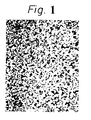
- the average pore diameter of open pores are measured and defined as follows:-
- li is the length of a line segment cut by a pore that crosses the straight line, is the is the sum of the length of the n pores, and n is the number of pores which cross the straight line and is at least 10.
- This example illustrates a secondary cell of the first type in this invention in which both the positive and negative electrodes were composed of a shaped article of porous active carbon.
- a cell was built by using the porous active carbon film obtained in Example 1 was positive and negative electrodes and a 1 mole/liter propylene carbonate solution of (C 2 H 5 ) 4 NClO 4 as an electrolyte solution, and subjected to a charging-discharging test.
- the cell had a voltage of 0 V. Then, by applying voltage to the cell from an external power supply, ClO 4 - ions were doped into the positive electrode, and (C 2 H 5 ) 4 N + ions, into the negative electrode. This charging was carried out for 3 hours at such a speed that the amount of doping per hour was 1 %. The open circuit voltage at this time was 3.0 V. Then, the ClO 4 - and (C 2 H 5 ) 4 N + ions were undoped at the same speed as in charging to discharge the cell. The discharging was continued until the cell voltage reached 0 V. The relation of the charging and discharge voltages to the amount of doping was nearly linear, and the cell had characteristics resembling those of a capacitor. Assuming that this cell is a capacitor, the capacity of the capacitor was calculated and found to be 25 F/g (F: farad).
- a plain-weave fabric of Kaynol fibers (a fabric of phenolic resin fibers made by Japan Kaynol Co., Ltd.) was fired (carbonized) to 900°C in a siliconit electric furnace in a non-oxidizing atmosphere. Then, steam was blown into the electric furnace at the same temperature to perform activating treatment for about 1 hour.
- the resulting active carbon fabric had a BET specific surface area of 1600 m 2 /g, and a fiber diameter of about 15 micrometers. The fabric had hardly any mechanical strength.
- a cell was built in the same structure as in Example 2 using the active carbon fabric as positive and negative electrodes, and subjected to a charging-discharging test under the same conditions. Assuming that the cell was a capatcitor, its capacity was calculated as 16 F/g.
Landscapes
- Chemical & Material Sciences (AREA)
- Chemical Kinetics & Catalysis (AREA)
- Engineering & Computer Science (AREA)
- General Chemical & Material Sciences (AREA)
- Electrochemistry (AREA)
- Materials Engineering (AREA)
- Ceramic Engineering (AREA)
- Inorganic Chemistry (AREA)
- Organic Chemistry (AREA)
- Manufacturing & Machinery (AREA)
- Dispersion Chemistry (AREA)
- Structural Engineering (AREA)
- Spectroscopy & Molecular Physics (AREA)
- Physics & Mathematics (AREA)
- Health & Medical Sciences (AREA)
- Medicinal Chemistry (AREA)
- Polymers & Plastics (AREA)
- Secondary Cells (AREA)
- Battery Electrode And Active Subsutance (AREA)
- Carbon And Carbon Compounds (AREA)
Claims (10)
- Cellule à électrolyte organique comprenant une électrode positive, une électrode négative et une solution électrolytique, une ou les deux électrodes desdites électrodes positive et négative étant constituée d'un charbon actif poreux présentant une surface spécifique, mesurée par le procédé BET, d'au moins 600 m2/g et contenant des pores ouverts, présentant un diamètre de pore moyen de 0,2 à 10 µm, ledit charbon actif poreux étant un produit carbonisé d'un polymère de condensation aromatique qui est constitué de carbone, d'hydrogène et d'oxygène et ladite solution électrolytique étant une solution dans un solvant organique aprotique d'un composé capable de former des ions qui peuvent doper ladite électrode par électrolyse.
- Cellule organique selon la revendication 1, dans laquelle les pores s'étalent dans une structure de réseau tridimensionnelle dans le charbon actif poreux.
- Cellule organique selon la revendication 1, dans laquelle le charbon actif poreux a une masse spécifique de 0,2 à 0,6 g/cm2.
- Cellule organique selon la revendication 1, dans laquelle le charbon actif poreux est sous la forme d'un film, d'une plaque ou d'un composé de ceux-ci.
- Cellule organique selon la revendication 1, dans laquelle l'électrode positive est constituée de charbon actif poreux et l'électrode négative est constituée d'un métal alcalin ou d'un métal alcalinoterreux.
- Cellule organique selon la revendication 1, dans laquelle l'électrode négative est constituée de métal alcalin et le métal alcalin est le lithium.
- Cellule organique selon la revendication 1, dans laquelle les deux électrodes, la positive et la négative sont constituées de charbon actif poreux.
- Cellule organique selon la revendication 1, dans lequel le composé capable de former des ions dopables est LiI, NaI, NH4I, LiClO4, LiAsF6, LiBF4, KPF6, NaP6, (C2H5)4NClO4, (n-C4H9)S4NClO4, (C2H5)4NBF4, (n-C4H9)4PF6 ou LiHF2.
- Cellule organique selon la revendication 1, dans laquelle le solvant organique aprotique est du carbonate d'éthylène, du carbonate de propylène, du gamma-butyrolactone, du diméthylformamide, du diméthylacétamide, du diméthylsulfoxyde, de l'acétonitrile, du diméthoxyéthane, du tétrahydrofurane, du chlorure de méthylène ou du sulfolane.
- Charbon actif poreux présentant une surface spécifique mesurée par le procédé BET d'au moins 600 m2/g et contenant des pores ouverts présentant un diamètre de pores moyen de 0,2 à 10 µm et étant un produit carbonisé d'un polymère de condensation aromatique qui est constitué de carbone, d'hydrogène et d'oxygène.
Applications Claiming Priority (22)
| Application Number | Priority Date | Filing Date | Title |
|---|---|---|---|
| JP60058602A JPH0620123B2 (ja) | 1985-03-25 | 1985-03-25 | 多孔性有機半導体 |
| JP60058604A JPH0630260B2 (ja) | 1985-03-25 | 1985-03-25 | 有機電解質電池 |
| JP5860485 | 1985-03-25 | ||
| JP5860385 | 1985-03-25 | ||
| JP58603/85 | 1985-03-25 | ||
| JP58602/85 | 1985-03-25 | ||
| JP5860285 | 1985-03-25 | ||
| JP60058603A JPH0620124B2 (ja) | 1985-03-25 | 1985-03-25 | 多孔性有機半導体 |
| JP58604/85 | 1985-03-25 | ||
| JP60063705A JPH0676509B2 (ja) | 1985-03-29 | 1985-03-29 | 多孔性フエノール樹脂硬化体 |
| JP60063707A JPS61222916A (ja) | 1985-03-29 | 1985-03-29 | 多孔性活性炭の製造法 |
| JP6370785 | 1985-03-29 | ||
| JP63706/85 | 1985-03-29 | ||
| JP63707/85 | 1985-03-29 | ||
| JP60063706A JPS61222912A (ja) | 1985-03-29 | 1985-03-29 | 多孔性グラッシーカーボンの製造法 |
| JP6370685 | 1985-03-29 | ||
| JP6370585 | 1985-03-29 | ||
| JP63705/85 | 1985-03-29 | ||
| JP65016/85 | 1985-03-30 | ||
| JP6501685 | 1985-03-30 | ||
| JP60065016A JPS61225761A (ja) | 1985-03-30 | 1985-03-30 | 有機電解質電池 |
| EP86104063A EP0196055B1 (fr) | 1985-03-25 | 1986-03-25 | Article poreux à pores ouverts préparé, à partir d'un polycondensat aromatique et son application |
Related Parent Applications (2)
| Application Number | Title | Priority Date | Filing Date |
|---|---|---|---|
| EP86104063.2 Division | 1986-03-25 | ||
| EP86104063A Division EP0196055B1 (fr) | 1985-03-25 | 1986-03-25 | Article poreux à pores ouverts préparé, à partir d'un polycondensat aromatique et son application |
Publications (3)
| Publication Number | Publication Date |
|---|---|
| EP0480909A2 EP0480909A2 (fr) | 1992-04-15 |
| EP0480909A3 EP0480909A3 (en) | 1992-08-19 |
| EP0480909B1 true EP0480909B1 (fr) | 1999-07-21 |
Family
ID=27564956
Family Applications (2)
| Application Number | Title | Priority Date | Filing Date |
|---|---|---|---|
| EP92100194A Expired - Lifetime EP0480909B1 (fr) | 1985-03-25 | 1986-03-25 | Charbon actif poreux préparé à partir d'un polycondensat arÔmatique et son application dans des électrodes pour piles électrochimiques |
| EP86104063A Expired - Lifetime EP0196055B1 (fr) | 1985-03-25 | 1986-03-25 | Article poreux à pores ouverts préparé, à partir d'un polycondensat aromatique et son application |
Family Applications After (1)
| Application Number | Title | Priority Date | Filing Date |
|---|---|---|---|
| EP86104063A Expired - Lifetime EP0196055B1 (fr) | 1985-03-25 | 1986-03-25 | Article poreux à pores ouverts préparé, à partir d'un polycondensat aromatique et son application |
Country Status (3)
| Country | Link |
|---|---|
| US (1) | US4753717A (fr) |
| EP (2) | EP0480909B1 (fr) |
| DE (2) | DE3650725T2 (fr) |
Families Citing this family (24)
| Publication number | Priority date | Publication date | Assignee | Title |
|---|---|---|---|---|
| US4832881A (en) * | 1988-06-20 | 1989-05-23 | The United States Of America As Represented By The United States Department Of Energy | Low density microcellular carbon foams and method of preparation |
| JPH04282557A (ja) * | 1991-03-11 | 1992-10-07 | Matsushita Electric Ind Co Ltd | 電極 |
| US5911918A (en) * | 1992-06-03 | 1999-06-15 | Monsanto Company | Surface dopants as blend compatibilizers in conjugated polymers |
| US6399206B1 (en) | 1992-09-30 | 2002-06-04 | The Dow Chemical Company | Electrostatically painted polymers and a process for making same |
| JP3565994B2 (ja) * | 1996-06-28 | 2004-09-15 | 呉羽化学工業株式会社 | 非水溶媒系二次電池の電極用炭素質材料およびその製造方法、並びに非水溶媒系二次電池 |
| JPH1027623A (ja) * | 1996-07-09 | 1998-01-27 | Asahi Glass Co Ltd | 有機電解質電池 |
| JP4104187B2 (ja) * | 1997-02-06 | 2008-06-18 | 株式会社クレハ | 二次電池電極用炭素質材料 |
| JPH11339780A (ja) * | 1998-05-27 | 1999-12-10 | Tdk Corp | 非水電解質二次電池用電極の製造方法 |
| GB0207943D0 (en) * | 2002-04-05 | 2002-05-15 | Univ Cambridge Tech | Sensors and their production |
| KR100450208B1 (ko) * | 2002-09-23 | 2004-09-24 | 삼성에스디아이 주식회사 | 리튬 전지용 음극 및 이를 포함하는 리튬 전지 |
| US6814786B1 (en) | 2003-04-02 | 2004-11-09 | Philip Morris Usa Inc. | Filters including segmented monolithic sorbent for gas-phase filtration |
| US7370657B2 (en) * | 2003-04-02 | 2008-05-13 | Philip Morris Usa Inc. | Activated carbon-containing sorbent |
| EP1609200A1 (fr) * | 2003-04-09 | 2005-12-28 | MURRAY, Graham Simpson | Polymere conducteur, compositions a base de polymeres conducteurs et leur utilisation |
| US8333909B2 (en) | 2003-04-09 | 2012-12-18 | Bac2 Limited | Conductive polymer, conductive polymer compositions and methods for their use |
| CN100354200C (zh) * | 2003-08-26 | 2007-12-12 | 大阪瓦斯株式会社 | 烃材料以及其制造方法 |
| US7503960B2 (en) * | 2005-03-15 | 2009-03-17 | Philip Morris Usa Inc. | Smoking articles and filters with carbon fiber composite molecular sieve sorbent |
| US7505225B2 (en) * | 2005-06-16 | 2009-03-17 | Seagate Technology Llc | Activated carbon fiber filter for a data storage system |
| CN100362136C (zh) * | 2005-08-23 | 2008-01-16 | 天津大学 | 电化学制备五氧化二氮装置及方法 |
| US7896950B2 (en) * | 2006-02-21 | 2011-03-01 | Yashen Xia | Plasma-aided method and apparatus for hydrogen storage and adsorption of gases into porous powder |
| US8252716B2 (en) * | 2008-11-04 | 2012-08-28 | Corning Incorporated | Process for making porous activated carbon |
| JP2010174358A (ja) * | 2009-02-02 | 2010-08-12 | Permelec Electrode Ltd | 電解用陽極および該電解用陽極を使用するフッ素含有物質の電解合成方法 |
| KR101239966B1 (ko) * | 2010-11-04 | 2013-03-06 | 삼성전자주식회사 | 리튬 공기 전지용 양극, 그 제조방법 및 이를 채용한 리튬 공기 전지 |
| GB2565278B (en) | 2017-07-31 | 2023-06-07 | Acell Ind Ltd | Method for producing cured polymeric skins |
| WO2020054833A1 (fr) | 2018-09-14 | 2020-03-19 | 株式会社日本触媒 | Procédé de production de matériau contenant une matière carbonée, matériau contenant une matière carbonée et composite organique-inorganique soluble |
Family Cites Families (20)
| Publication number | Priority date | Publication date | Assignee | Title |
|---|---|---|---|---|
| DE1097669B (de) * | 1957-06-14 | 1961-01-19 | Basf Ag | Verfahren zur Herstellung von gehaerteten Schaumstoffen mit vergroesserter Oberflaeche aus Aminoplasten |
| US3342555A (en) * | 1961-06-19 | 1967-09-19 | Dow Chemical Co | Process for the preparation of light weight porous carbon |
| US3476603A (en) * | 1966-02-07 | 1969-11-04 | Standard Oil Co | Nitrile composite electrodes |
| US3859421A (en) * | 1969-12-05 | 1975-01-07 | Edward E Hucke | Methods of producing carbonaceous bodies and the products thereof |
| US3825506A (en) * | 1972-01-26 | 1974-07-23 | Glasrock Products | Method of preparation of a porous thermosetting resin |
| US4519985A (en) * | 1980-03-12 | 1985-05-28 | Calgon Carbon Corporation | Use of activated carbon to remove dissolved organics from uranium leachate |
| US4337139A (en) * | 1980-10-31 | 1982-06-29 | Diamond Shamrock Corporation | Fluorinated carbon electrode |
| US4601849A (en) * | 1981-06-15 | 1986-07-22 | Kanebo, Ltd. | Electrically conductive organic polymeric material and process for production thereof |
| JPS58136649A (ja) | 1982-02-05 | 1983-08-13 | Kanebo Ltd | 電気伝導性有機高分子系材料およびその製造方法 |
| JPS5835881A (ja) * | 1981-08-27 | 1983-03-02 | Kao Corp | 電気化学電池 |
| JPS58209864A (ja) * | 1982-05-31 | 1983-12-06 | Kanebo Ltd | 有機電解質電池 |
| JPS5971339A (ja) * | 1982-10-15 | 1984-04-23 | Toto Ltd | 連続気孔多孔体の製法 |
| JPS59146165A (ja) * | 1983-02-08 | 1984-08-21 | Kao Corp | 電気化学電池 |
| US4518488A (en) * | 1983-02-28 | 1985-05-21 | Standard Oil Company (Indiana) | Metal-containing active carbon and methods for making and using same |
| JPS60137811A (ja) * | 1983-12-22 | 1985-07-22 | Toho Rayon Co Ltd | 浄水用活性炭素繊維 |
| US4615960A (en) * | 1984-01-19 | 1986-10-07 | Kanebo, Ltd. | Insoluble and infusible substrate with a polyacene-type skeletal structure, and its applications for electrical conductor or organic cell |
| JPH0789483B2 (ja) * | 1984-05-07 | 1995-09-27 | 三洋化成工業株式会社 | 二次電池 |
| DE3588167T2 (de) * | 1984-06-12 | 1998-03-12 | Mitsubishi Chem Corp | Sekundärbatterien, die mittels Pyrolyse hergestelltes Pseudo-Graphit als Elektrodenmaterial enthalten |
| US4582575A (en) * | 1984-09-04 | 1986-04-15 | Rockwell International Corporation | Electrically conductive composites and method of preparation |
| US4628015A (en) * | 1984-09-20 | 1986-12-09 | Kanebo, Ltd. | Insoluble and infusible substrate with a polyacene-type skeletal structure, and its applications for electrical conductor and organic cell |
-
1986
- 1986-03-21 US US06/842,335 patent/US4753717A/en not_active Expired - Lifetime
- 1986-03-25 EP EP92100194A patent/EP0480909B1/fr not_active Expired - Lifetime
- 1986-03-25 DE DE3650725T patent/DE3650725T2/de not_active Expired - Lifetime
- 1986-03-25 EP EP86104063A patent/EP0196055B1/fr not_active Expired - Lifetime
- 1986-03-25 DE DE86104063T patent/DE3689239T2/de not_active Expired - Lifetime
Also Published As
| Publication number | Publication date |
|---|---|
| EP0196055A3 (en) | 1988-03-30 |
| DE3689239D1 (de) | 1993-12-09 |
| DE3650725D1 (de) | 1999-08-26 |
| US4753717A (en) | 1988-06-28 |
| EP0196055A2 (fr) | 1986-10-01 |
| EP0480909A3 (en) | 1992-08-19 |
| EP0196055B1 (fr) | 1993-11-03 |
| DE3689239T2 (de) | 1994-04-14 |
| DE3650725T2 (de) | 1999-12-02 |
| EP0480909A2 (fr) | 1992-04-15 |
Similar Documents
| Publication | Publication Date | Title |
|---|---|---|
| EP0480909B1 (fr) | Charbon actif poreux préparé à partir d'un polycondensat arÔmatique et son application dans des électrodes pour piles électrochimiques | |
| JPH0324024B2 (fr) | ||
| JPS63314762A (ja) | アルミニウム−リチウム合金を負極とする有機電解質電池 | |
| JP2532878B2 (ja) | 活性炭金属酸化物複合物を正極とする有機電解質電池 | |
| JPH0630260B2 (ja) | 有機電解質電池 | |
| WO1995008852A1 (fr) | Element electrolytique organique | |
| JP2562601B2 (ja) | 活性炭−アニリン複合物を正極とする有機電解質電池 | |
| JP2534490B2 (ja) | 有機電解質電池 | |
| JP2614725B2 (ja) | 活性炭金属硫化物複合物を正極とする有機電解質電池 | |
| JPS61225761A (ja) | 有機電解質電池 | |
| JP2515547B2 (ja) | アニリン複合物を正極とする有機電解質電池 | |
| JP2614724B2 (ja) | 金属硫化物複合物を正極とする有機電解質電池 | |
| JP2519454B2 (ja) | 含窒素基体を電極とする有機電解質電池 | |
| JP2519180B2 (ja) | 有機電解質電池 | |
| JP2616775B2 (ja) | 三元複合物を正極とする有機電解質電池 | |
| JP2616774B2 (ja) | 金属酸化物複合物を正極とする有機電解質電池 | |
| JP2524184B2 (ja) | 複合体電極を含む有機電解質電池 | |
| JP2646461B2 (ja) | 有機電解質電池 | |
| JP2588405B2 (ja) | 高濃度混合溶質を用いた有機電解質電池 | |
| JP2588404B2 (ja) | 有機電解質電池 | |
| JP3403894B2 (ja) | 有機電解質電池 | |
| JPH0624160B2 (ja) | 有機電解質電池 | |
| JP2646462B2 (ja) | 有機電解質電池 | |
| JPS6180773A (ja) | 有機電解質電池 | |
| JPH0624159B2 (ja) | 有機電解質電池 |
Legal Events
| Date | Code | Title | Description |
|---|---|---|---|
| PUAI | Public reference made under article 153(3) epc to a published international application that has entered the european phase |
Free format text: ORIGINAL CODE: 0009012 |
|
| AC | Divisional application: reference to earlier application |
Ref document number: 196055 Country of ref document: EP |
|
| AK | Designated contracting states |
Kind code of ref document: A2 Designated state(s): CH DE FR GB LI NL |
|
| RIN1 | Information on inventor provided before grant (corrected) |
Inventor name: SAKURAI, KAZUO Inventor name: OSAKI, TAKUJI Inventor name: HATO, YUKINORI Inventor name: YATA, SHIZUKUNI |
|
| PUAL | Search report despatched |
Free format text: ORIGINAL CODE: 0009013 |
|
| AK | Designated contracting states |
Kind code of ref document: A3 Designated state(s): CH DE FR GB LI NL |
|
| 17P | Request for examination filed |
Effective date: 19921217 |
|
| 17Q | First examination report despatched |
Effective date: 19950220 |
|
| GRAG | Despatch of communication of intention to grant |
Free format text: ORIGINAL CODE: EPIDOS AGRA |
|
| GRAG | Despatch of communication of intention to grant |
Free format text: ORIGINAL CODE: EPIDOS AGRA |
|
| GRAG | Despatch of communication of intention to grant |
Free format text: ORIGINAL CODE: EPIDOS AGRA |
|
| GRAH | Despatch of communication of intention to grant a patent |
Free format text: ORIGINAL CODE: EPIDOS IGRA |
|
| GRAH | Despatch of communication of intention to grant a patent |
Free format text: ORIGINAL CODE: EPIDOS IGRA |
|
| GRAA | (expected) grant |
Free format text: ORIGINAL CODE: 0009210 |
|
| AC | Divisional application: reference to earlier application |
Ref document number: 196055 Country of ref document: EP |
|
| AK | Designated contracting states |
Kind code of ref document: B1 Designated state(s): CH DE FR GB LI NL |
|
| REG | Reference to a national code |
Ref country code: CH Ref legal event code: EP |
|
| REF | Corresponds to: |
Ref document number: 3650725 Country of ref document: DE Date of ref document: 19990826 |
|
| REG | Reference to a national code |
Ref country code: CH Ref legal event code: NV Representative=s name: BUECHEL & PARTNER AG PATENTBUERO |
|
| ET | Fr: translation filed | ||
| PLBE | No opposition filed within time limit |
Free format text: ORIGINAL CODE: 0009261 |
|
| STAA | Information on the status of an ep patent application or granted ep patent |
Free format text: STATUS: NO OPPOSITION FILED WITHIN TIME LIMIT |
|
| 26N | No opposition filed | ||
| REG | Reference to a national code |
Ref country code: GB Ref legal event code: IF02 |
|
| PGFP | Annual fee paid to national office [announced via postgrant information from national office to epo] |
Ref country code: NL Payment date: 20030327 Year of fee payment: 18 |
|
| PGFP | Annual fee paid to national office [announced via postgrant information from national office to epo] |
Ref country code: CH Payment date: 20030331 Year of fee payment: 18 |
|
| PG25 | Lapsed in a contracting state [announced via postgrant information from national office to epo] |
Ref country code: LI Free format text: LAPSE BECAUSE OF NON-PAYMENT OF DUE FEES Effective date: 20040331 Ref country code: CH Free format text: LAPSE BECAUSE OF NON-PAYMENT OF DUE FEES Effective date: 20040331 |
|
| PG25 | Lapsed in a contracting state [announced via postgrant information from national office to epo] |
Ref country code: NL Free format text: LAPSE BECAUSE OF NON-PAYMENT OF DUE FEES Effective date: 20041001 |
|
| REG | Reference to a national code |
Ref country code: CH Ref legal event code: PL |
|
| NLV4 | Nl: lapsed or anulled due to non-payment of the annual fee |
Effective date: 20041001 |
|
| PGFP | Annual fee paid to national office [announced via postgrant information from national office to epo] |
Ref country code: FR Payment date: 20050308 Year of fee payment: 20 |
|
| PGFP | Annual fee paid to national office [announced via postgrant information from national office to epo] |
Ref country code: DE Payment date: 20050317 Year of fee payment: 20 |
|
| PGFP | Annual fee paid to national office [announced via postgrant information from national office to epo] |
Ref country code: GB Payment date: 20050323 Year of fee payment: 20 |
|
| PG25 | Lapsed in a contracting state [announced via postgrant information from national office to epo] |
Ref country code: GB Free format text: LAPSE BECAUSE OF EXPIRATION OF PROTECTION Effective date: 20060324 |
|
| REG | Reference to a national code |
Ref country code: GB Ref legal event code: PE20 |