EP0467221A2 - Verfahren und Vorrichtung zur Herstellung von kugelförmigen Teilchen aus flüssiger Phase - Google Patents
Verfahren und Vorrichtung zur Herstellung von kugelförmigen Teilchen aus flüssiger Phase Download PDFInfo
- Publication number
- EP0467221A2 EP0467221A2 EP91111545A EP91111545A EP0467221A2 EP 0467221 A2 EP0467221 A2 EP 0467221A2 EP 91111545 A EP91111545 A EP 91111545A EP 91111545 A EP91111545 A EP 91111545A EP 0467221 A2 EP0467221 A2 EP 0467221A2
- Authority
- EP
- European Patent Office
- Prior art keywords
- liquid
- drops
- liquid phase
- drop
- cooling medium
- Prior art date
- Legal status (The legal status is an assumption and is not a legal conclusion. Google has not performed a legal analysis and makes no representation as to the accuracy of the status listed.)
- Granted
Links
Images

Classifications
-
- C—CHEMISTRY; METALLURGY
- C03—GLASS; MINERAL OR SLAG WOOL
- C03B—MANUFACTURE, SHAPING, OR SUPPLEMENTARY PROCESSES
- C03B19/00—Other methods of shaping glass
- C03B19/10—Forming beads
- C03B19/1005—Forming solid beads
- C03B19/1055—Forming solid beads by extruding, e.g. dripping molten glass in a gaseous atmosphere
-
- B—PERFORMING OPERATIONS; TRANSPORTING
- B01—PHYSICAL OR CHEMICAL PROCESSES OR APPARATUS IN GENERAL
- B01J—CHEMICAL OR PHYSICAL PROCESSES, e.g. CATALYSIS OR COLLOID CHEMISTRY; THEIR RELEVANT APPARATUS
- B01J2/00—Processes or devices for granulating materials, e.g. fertilisers in general; Rendering particulate materials free flowing in general, e.g. making them hydrophobic
- B01J2/18—Processes or devices for granulating materials, e.g. fertilisers in general; Rendering particulate materials free flowing in general, e.g. making them hydrophobic using a vibrating apparatus
-
- B—PERFORMING OPERATIONS; TRANSPORTING
- B22—CASTING; POWDER METALLURGY
- B22F—WORKING METALLIC POWDER; MANUFACTURE OF ARTICLES FROM METALLIC POWDER; MAKING METALLIC POWDER; APPARATUS OR DEVICES SPECIALLY ADAPTED FOR METALLIC POWDER
- B22F1/00—Metallic powder; Treatment of metallic powder, e.g. to facilitate working or to improve properties
- B22F1/06—Metallic powder characterised by the shape of the particles
- B22F1/065—Spherical particles
-
- B—PERFORMING OPERATIONS; TRANSPORTING
- B22—CASTING; POWDER METALLURGY
- B22F—WORKING METALLIC POWDER; MANUFACTURE OF ARTICLES FROM METALLIC POWDER; MAKING METALLIC POWDER; APPARATUS OR DEVICES SPECIALLY ADAPTED FOR METALLIC POWDER
- B22F9/00—Making metallic powder or suspensions thereof
- B22F9/02—Making metallic powder or suspensions thereof using physical processes
- B22F9/06—Making metallic powder or suspensions thereof using physical processes starting from liquid material
- B22F9/08—Making metallic powder or suspensions thereof using physical processes starting from liquid material by casting, e.g. through sieves or in water, by atomising or spraying
-
- B—PERFORMING OPERATIONS; TRANSPORTING
- B23—MACHINE TOOLS; METAL-WORKING NOT OTHERWISE PROVIDED FOR
- B23K—SOLDERING OR UNSOLDERING; WELDING; CLADDING OR PLATING BY SOLDERING OR WELDING; CUTTING BY APPLYING HEAT LOCALLY, e.g. FLAME CUTTING; WORKING BY LASER BEAM
- B23K35/00—Rods, electrodes, materials, or media, for use in soldering, welding, or cutting
- B23K35/02—Rods, electrodes, materials, or media, for use in soldering, welding, or cutting characterised by mechanical features, e.g. shape
- B23K35/0222—Rods, electrodes, materials, or media, for use in soldering, welding, or cutting characterised by mechanical features, e.g. shape for use in soldering or brazing
- B23K35/0244—Powders, particles or spheres; Preforms made therefrom
-
- C—CHEMISTRY; METALLURGY
- C03—GLASS; MINERAL OR SLAG WOOL
- C03B—MANUFACTURE, SHAPING, OR SUPPLEMENTARY PROCESSES
- C03B19/00—Other methods of shaping glass
- C03B19/10—Forming beads
- C03B19/109—Glass-melting furnaces specially adapted for making beads
-
- B—PERFORMING OPERATIONS; TRANSPORTING
- B22—CASTING; POWDER METALLURGY
- B22F—WORKING METALLIC POWDER; MANUFACTURE OF ARTICLES FROM METALLIC POWDER; MAKING METALLIC POWDER; APPARATUS OR DEVICES SPECIALLY ADAPTED FOR METALLIC POWDER
- B22F9/00—Making metallic powder or suspensions thereof
- B22F9/02—Making metallic powder or suspensions thereof using physical processes
- B22F9/06—Making metallic powder or suspensions thereof using physical processes starting from liquid material
- B22F9/08—Making metallic powder or suspensions thereof using physical processes starting from liquid material by casting, e.g. through sieves or in water, by atomising or spraying
- B22F9/082—Making metallic powder or suspensions thereof using physical processes starting from liquid material by casting, e.g. through sieves or in water, by atomising or spraying atomising using a fluid
- B22F2009/086—Cooling after atomisation
-
- B—PERFORMING OPERATIONS; TRANSPORTING
- B22—CASTING; POWDER METALLURGY
- B22F—WORKING METALLIC POWDER; MANUFACTURE OF ARTICLES FROM METALLIC POWDER; MAKING METALLIC POWDER; APPARATUS OR DEVICES SPECIALLY ADAPTED FOR METALLIC POWDER
- B22F2998/00—Supplementary information concerning processes or compositions relating to powder metallurgy
Definitions
- the invention relates to a method and a device for producing spherical particles in the grain size range from 5 .mu.m to 5 mm with a narrow grain spectrum from the liquid phase by generating drops by means of vibrating nozzles and solidifying the drops formed in a gaseous or liquid cooling medium.
- spherical particles in the size range from 5 .mu.m to 5 mm there is a wide range of applications, for example in the field of powder processing, since such particles can be handled dust-free and are free-flowing.
- the uniformity of the particles and their narrow grain distribution enable good space filling, for example when loading molds or chromatographic columns. They are also suitable as catalyst supports.
- Spherical particles made of metals or alloys are u. a. used in soldering technology, whereby the requirements for the narrowest possible grain distribution are constantly increasing.
- the interest in microspheres made from organic substances instead of dusting powder is also constantly increasing, for example in the animal feed sector due to its good meterability or in the pharmaceutical industry in the manufacture of pharmaceuticals with a sustained release effect.
- microspheres with a monodisperse distribution which are based on the division of liquid jets by the action of mechanical vibrations on the liquid, the use of periodic vibrations, e.g. of electromagnetic vibration systems, monodisperse drops, which are solidified in different ways.
- the drops are usually solidified by chemical processes such as precipitation and / or dehydration.
- these processes are not suitable for producing spherical particles from liquid phases with a high melting point.
- DE-PS 27 25 924 also describes a method for casting molten substances under vibration through a nozzle and for producing spherical particles by solidification of the drops in a cooled drop line.
- a major disadvantage of this method is that the droplets are cooled and solidified in a temperature gradient, which is difficult to control, particularly at higher temperatures. Here, too, particles stick together in the cooling section at higher temperatures.
- a corresponding device had to be constructed.
- This object is achieved in that the liquid phase flowing to the nozzles, the vibrating nozzles and the droplets formed are kept at a constant temperature until the stabilization of their spherical shape, which is 1 to 10 ° C above the melting temperature of the liquid phase, and that the droplets solidify suddenly after their stabilization by quenching with a gaseous or liquid cooling medium, the working temperature of which is at least 100 ° C. below the melting temperature of the liquid phase.
- the spherical drops are preferably quenched by being colder by at least 100 ° C. than the drop temperature Cooling medium through constant supply of the cooling medium in cocurrent with the direction of the drop. Liquids whose working temperatures are close to the boiling point of these cooling liquids have proven particularly useful as cooling media.
- Liquid nitrogen, liquid argon or liquid carbonic acid are advantageously used for this, but water mist with working temperatures of 80 to 95 ° C. can also be used.
- This process is particularly suitable for ball diameters from 20 ⁇ m to 2 mm and meltable organic and inorganic substances with melting points up to 1500 ° C.
- the liquid phases can also contain suspended solids.
- the process of droplet formation from a vibrating liquid jet, including droplet formation into a ball, takes place in the present method in very short periods of time from a few milliseconds to a microsecond.
- the further fate of the round drops, such as the immediate solidification into a ball or the undesirable formation of the so-called drop shape due to the action of frictional forces, as well as the undesirable melting of the falling drops into larger particles of all conceivable shapes, depends on the speed at which the drops be solidified in this molten state.
- the remaining heat is then dissipated in a cooling tower and in a cooled collecting vessel, where the solid particles can no longer fuse.
- the cooling medium used can be both a gas, steam or mist, and a liquid with the lowest possible viscosity. It has been found that the cheapest way of dissipating heat by means of a cooling medium at the lowest possible temperature, at least 100 ° C. below the atomizing temperature, is when the flow of the cooling medium is aligned with the droplet jets or the direction in which the drops fall. According to the invention, the drops come into contact with the cold cooling medium for the first time when they have the exact spherical shape. This can also be done by blowing the drops onto the side with the cooling medium, but cooling in the same direction is more advantageous.
- evaporating liquid nitrogen or evaporating liquid carbonic acid is preferably used as the cooling medium.
- a mist of the finest drops of a liquid close to the boiling point is advantageously used as the cooling medium.
- the heat of solidification of the drops can be rapidly dissipated by the sudden heat consumption when the liquid cooling medium evaporates.
- Such a process is particularly economical when using the finest water mist at 80 to 95 C.
- the vibrating nozzles are preferably driven by electromagnetic vibration systems, for very high frequencies by piezoelectric or magnetostrictive vibration systems. With high throughputs, nozzle plates with up to 100 nozzles can be used.
- an apparatus which consists of a reservoir for the liquid phase, egg nem with a vibration exciter connected nozzle head with one or more nozzles, a feed line between the reservoir and nozzle head, a drop line, a coolant supply and a receptacle for the spherical particles.
- the device is characterized in that the feed line for the liquid phase, or a part thereof, the nozzle head and a variable part of the drop drop section above the coolant supply is enclosed by a container with thermally insulating walls, which has an opening on the underside in the area of the drop drop section having.
- the container is preferably provided with gas lines in order to flush it with inert gas, the temperature in the interior having to be kept constant in the range from 0.3 to 0.5%.
- the feed line for the liquid phase has a spiral section. This makes it possible to move the nozzle head up or down by small amounts to set the required drop drop distance. With larger displacements, the connection between the nozzle head and the vibration exciter must be shortened or lengthened.
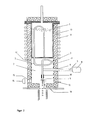
- FIGS. 1 and 2 Exemplary embodiments of the device according to the invention are shown schematically in FIGS. 1 and 2.
- the device is characterized in that the vibrating nozzle head (4), the feed line (2) for the liquid phase from the storage container (1) to the nozzle head (4) and a section of the drop drop section (6) until the formation of the exact spherical shape in one sealed, isothermal container (7) are arranged, the temperature of which can be kept constant in the range from 50 to 1500 ° C., preferably to 0.3 to 0.5%.
- the isothermal space can be flushed with an inert gas which is supplied and discharged via pipes (12).
- the vibration generator (8) is arranged outside the isothermal container (7) and mechanically coupled to the nozzle head (4) using a heat-insulating bushing (9) in such a way that the transmission of vibrations in the temperature range up to 1,500 C is ensured.
- the liquid is metered from the storage container (1) to the nozzle head (4) through a feed line (2) which has a spiral section (3).
- the oscillating total mass in the isothermal container (7) is kept constant in the range 0.1 to 1 kg by additional compensating masses (10).
- the container (7) has walls (13) made of a thermally insulating material and only has a larger opening in the area of the drop drop section (6).
- the liquid phase is conveyed through the feed line (2) in the isothermal container (7) and fed to the nozzle at the nozzle head (4).
- the vibration generator (8) which is located outside the isothermal container (7), causes the nozzle head (4) to oscillate periodically with the aid of a rigid connection (5), as a result of which the liquid jet flowing out of the nozzle disintegrates into uniform drops.
- the rigid connection (5) is in a heat-insulating bushing (9) and transmits the vibrations of the vibration generator (8) to the hot nozzle. In Figure 1, this is shown in a vertical version, in Figure 2 in a horizontal version.
- the substance to be dripped is melted in the storage container (1) or is already present as a melt.
- the temperature of the liquid in this container may be slightly more than 10 ° C above the melting temperature, and the temperature fluctuation may also be slightly greater than 0.5%.
- the feed line (2) which leads from the storage container (1) to the nozzle, is initially arranged outside the isothermal container (7) in the embodiment according to FIG. 1 and must therefore be heated and thermally insulated.
- the heater (11) can consist of electrical resistance wires.
- the liquid phase enters the feed line (2) inside the isothermal container (7), it takes on the temperature set there from 1 to 10 ° C. above its melting point.
- the dwell time required for this can preferably be adapted to the throughput in an ascending branch and an extension of the feed line (2) in the isothermal container (7).
- the materials used must be adapted to the respective requirements that are to be processed processing substances are determined. This can cause the weight of the vibrating mass to change from case to case.
- the use of differently sized nozzle heads (4) with more or fewer nozzles also changes the weight.
- compensating masses are preferably attached in front of or on the nozzle head (4), which ensure that the total oscillated total mass is almost constant in all cases.
- the process of droplet formation from a jet of liquid flowing from a nozzle depends, among other things. on the surface tension, density and viscosity of the liquid phase. Therefore, the drop distance (6) from the nozzle to the formation of the spherical shape must be determined empirically for each liquid.
- a stroboscopic lamp (14) is used, the light flashes of which make the process observable through the viewing window (15).
- a slight phase shift in the frequency of the stroboscopic lamp compared to that of the vibration generator even enables the oscillation processes of the drops to be observed after different falling distances, so that the point at which the drops have assumed a spherical shape can be precisely located.
- the falling drops are quenched with the cooling medium by blowing on the drops from the coolant supply (16), which is distributed uniformly around the nozzle head (4).
- the distance between the coolant supply (16) and the drops is a few centimeters. This ensures that the required temperature gradient of at least 100 ° C is maintained in a controlled manner.
- a nozzle plate with several nozzles of the same size and the same bore can be used on the nozzle head (4).
- the resulting increased mass is compensated for by a corresponding reduction in the balancing mass.
- the optimal number of nozzles on a nozzle plate is determined by the desired throughput, the geometrical possible conditions and the required cooling.
- the adaptation to the vibration system is not a problem.
- high-purity silver nitrate of melting point 209 C was melted in the storage container (1) and the temperature was raised to 225 C.
- the supply line (2) leading from there to the isothermal container (7) of a heating cabinet was heated to 220 ° C.
- the accuracy of the temperature control was better than + 1 C, correspondingly less than 0.5%.
- the diameter of the nozzle opening on the nozzle head (4) was 350 ⁇ m.
- the vibration that was transmitted from the vibration generator (8) to the nozzle head (4) had a frequency of 800 Hz.
- the flow rate of silver nitrate melt was 28.5 g / min., corresponding to 7.2 ml / min, taking into account the density of 3.96 g / cm 3 at the melting point. This corresponds to a throughput of 1.71 kg of silver nitrate per hour and nozzle, corresponding to the formation of 48,000 drops per minute and nozzle.
- the drop distance (6) was set to 5 cm after this drop distance had been assessed as optimal using the stroboscope (14).
- the drops were blown on both sides with compressed air from two nozzles of the coolant supply (16) with a diameter of 10 mm.
- the air metering for both nozzles was 500 l / h, the distance between the nozzles and the drops was set to 2 cm.
- the compressed air was at room temperature, so that the hot silver nitrate drops solidified very quickly at the temperature difference of 200 ° C. A slight suction in the direction of the drops resulted in a direct flow of drops and cooling gas and prevented cold air from entering the isothermal container (7).
- a total of 940 g of silver nitrate microspheres were produced.
- the yield of the sieve fraction 630-800 ⁇ m was 98.5%.
- the diameter distribution was measured on a representative sample, giving an average diameter of 653 ⁇ m with a percentage standard deviation of 3.6%.
- the balls were glassy, colorless to white and were characterized by very good roundness.
- the same experiment was carried out using a 10-fold nozzle head (4) with ten identical nozzles with a diameter of 350 ⁇ m.
- the temperature in the storage container (1) was 223 C and in the isothermal container (7) 216 ° C with a fluctuation range of less than 0.5%.
- the flow was 334 g / min, corresponding to 84.4 ml / min. This corresponds to a throughput of 20 kg of silver nitrate per hour.
- a soft solder alloy consisting of 63 percent by weight tin and 37 percent by weight lead, with a melting point of 183 ° C. was melted in the storage container (1), as shown in FIG. 1, and heated to 190 ° C., with temperature fluctuations of ⁇ 3 ° C. With a gas pressure of 0.79 bar, the melt was fed through the feed line (2) to the nozzle in the isothermal container (7).
- the temperature of the isothermal container (7) was adjusted to 187 ° C, the fluctuation range was less than 1 C.
- the nozzle opening had a diameter of 120 ⁇ m.
- the nozzle was excited by the vibration generator (8) to periodically vibrate at a frequency of 1,900 hertz.
- the isothermal container (7) was flushed with nitrogen gas of the "purest" quality until it was free of air.
- the gas above the melt in the storage container (1) and the cooling medium also consisted of pure nitrogen.
- the liquid alloy throughput was 7.2 g / min, from which 114,000 drops / min were formed. These drops were blown on both sides with pure nitrogen gas of 20 C from the nozzles of the coolant supply (16). The gas was discharged downwards in a cocurrent with the microspheres by gentle suction. After a drop distance of 3.5 m, which was additionally cooled to -10 ° C., the microspheres were collected in a container and then sieved.
- the yield of the 180-250 ⁇ m sieve fraction was 91.5%.
- a representative sample of 1,003 microspheres from this batch of sieves was measured.
- the mean diameter was 232 ⁇ m and the percentage standard deviation was 2.5%.
- the average weight of the microspheres was 63.4 ⁇ g, corresponding to a density of 9.60 g / cm 3 .
- the spheres showed a good roundness: more than 96% of all particles had a diameter ratio of large axis to small axis better than 1.03. Oxygen analysis of the microspheres showed values of less than 100 ppm.
- the frequency of the vibration excitation by the vibration generator (8) was 9,550 Hertz, with 573,000 drops being formed per minute.
- the throughput was 2.10 g / min per nozzle. This corresponds to a quantity of 756 g / h for the 6-fold nozzle plate.
- microspheres were sieved, yields of 93.8 and 88.3% of the sieve fraction 50-125 ⁇ m being achieved. Representative samples of these microspheres were measured to give mean diameters of 92 ⁇ m and 90 ⁇ m and percentage standard deviations of 7.6% and 9.8%, respectively.
- a device according to FIG. 2 was used to produce microspheres from silver solder.
- the silver solder used had a degree of purity of 99.9%, was oxide-free and had a melting point of 960 C.
- a stainless steel crucible was used as the storage container (1) for the silver melt, which was surrounded by insulation and was heated with the aid of an induction coil.
- a resistance-heated furnace room with heating (11) and insulation Below the steel crucible was a resistance-heated furnace room with heating (11) and insulation.
- the metering of the silver melt to the nozzle was carried out in a feed line (2), also made of stainless steel, which led through the bottom of the crucible into the isothermal container (7) and was shaped there into a spiral, whereby a certain elasticity was achieved.
- the rigid connection (5) between the vibration generator (8) and the nozzle head (4) was fastened below the spiral.
- the nozzle was also made of stainless steel and was firmly connected to the feed line (2).
- the silver melt was heated to 974 C, a temperature fluctuation of ⁇ 6 C occurring.
- the melt was metered through the feed line (2) in the isothermal container (7) to the nozzle head (4).
- the temperature in the isothermal container (7) was adjusted to 966 C with a fluctuation range of ⁇ 3 ⁇ C, corresponding to ⁇ 0.3%.
- the isothermal container (7) was rinsed air-free with pure starch.
- a periodic vibration of the frequency 200 Hz was transmitted from the vibration generator (8) to the nozzle head (4) via the rigid connection (5).
- the jet of liquid flowing out of the nozzle disintegrated into 12,000 drops per minute.
- the silver drops were blown laterally out of the nozzles (16) with argon gas from room temperature and thus suddenly solidified at the temperature difference of several hundred degrees.
- the microspheres were completely cooled and collected in a cooled steel sheet baffle in a steel container after collection.
- Example 3 Similar to Example 3, a device according to FIG. 2 was used for the production of spherical glass beads.
- the storage container (1), the feed line (2) and the nozzle head (4) with the pouring nozzles were made of platinum.
- the glass beads were made from soda-lime glass with the composition 65% by weight SiO 2 , 15% by weight Na 2 0 and 20% by weight CaO + MgO.
- the temperature of the glass melt in the storage container (1) was 1,450 ° C., in the isothermal container (7) 1,420 ° C. were set with an accuracy of ⁇ 5 ° C.
- the liquid glass was metered in at an air pressure of 1.30 bar through the feed line (2) to the single nozzle with a diameter of 520 ⁇ m. Under the influence of the vibrations of the vibration generator (8) of 500 Hz, uniform glass drops formed in the drop section (6), which were quenched 60 mm below the nozzle in the compressed air stream. The hot glass beads fell into a cooling pipe and were collected on the floor in a tub of water.
- the average diameter of the glass beads was determined to be 995 ⁇ m from a representative sample with a percentage standard deviation of 5.2%.
- the throughput was 2.25 kg glass per hour in the form of 1.8 million glass beads.
Landscapes
- Chemical & Material Sciences (AREA)
- Engineering & Computer Science (AREA)
- Organic Chemistry (AREA)
- Manufacturing & Machinery (AREA)
- Materials Engineering (AREA)
- Nanotechnology (AREA)
- Mechanical Engineering (AREA)
- Chemical Kinetics & Catalysis (AREA)
- Manufacture Of Metal Powder And Suspensions Thereof (AREA)
- Glanulating (AREA)
- Physical Or Chemical Processes And Apparatus (AREA)
- Processing And Handling Of Plastics And Other Materials For Molding In General (AREA)
Abstract
Description
- Die Erfindung betrifft ein Verfahren und eine Vorrichtung zur Herstellung von kugelförmigen Teilchen im Korngrößenbereich von 5 um bis 5 mm mit engem Kornspektrum aus flüssiger Phase durch Erzeugung von Tropfen mittels vibrierender Düsen und Verfestigung der gebildeten Tropfen in einem gasförmigen oder flüssigen Kühlmedium.
- Für kugelförmige Teilchen im Größenbereich 5 um bis 5mm gibt es einen großen Anwendungsbereich, beispielsweise auf dem Gebiet der Pulververarbeitung, da solche Teilchen staubfrei gehandhabt werden können und gut rieselfähig sind. Die Gleichmäßigkeit der Teilchen und ihre enge Kornverteilung ermöglichen eine gute Raumausfüllung, zum Beispiel bei der Beladung von Preßformen oder von chromatografischen Säulen. Sie sind daneben auch als Katalysatorträger geeignet.
- Kugelförmige Teilchen aus Metallen oder Legierungen werden u. a. in der Löttechnik verwendet, wobei die Anforderungen an eine möglichst enge Kornverteilung ständig steigen. Das Interesse an Mikrokugeln aus organischen Stoffen anstelle von staubendem Pulver nimmt ebenfalls ständig zu, beispielsweise auf dem Sektor Futtermittel wegen der guten Dosierbarkeit oder in der Pharmaindustrie bei der Herstellung von Pharmaka mit Depotwirkung.
- Es gibt auch bei organischen Stoffen Anforderungen, die auf eine vollständige und reproduzierbare Raumausfüllung, gegebenenfalls unter optimaler Raumnutzung durch Verwendung mehrerer Fraktionen unterschiedlicher Größe, aber enger Kornverteilung abzielen, wie zum Beispiel bei der Sprengstoffherstellung.
- Für die Herstellung von rieselfähigen Teilchen mit mehr oder minder guter Kugelform gibt es eine Reihe von Verfahren, die meist auf der Verwendung von Zweistoffdüsen (Hohlkegeldüsen) beruhen, aber aufgrund des Sprüheffekts kein einheitliches Kornspektrum, sondern eine breite Korngrößenverteilung ergeben. Nachteilig ist auch der dabei auftretende Staubanteil sowie die Entstehung von Teilchen mit sehr unterschiedlichen Eigenschaften, die sich bei der Erstarrung von großen und kleinen Tropfen in einer gekühlten Fallstrecke ergeben.
- Zur Erzeugung von Mikrokugeln mit monodisperser Verteilung sind Verfahren bekannt geworden, die auf die Zerteilung von Flüssigkeitsstrahlen durch Einwirkung von mechanischen Schwingungen auf die Flüssigkeit beruhen, wobei die Anwendung periodischer Schwingungen, z.B. von elektromagnetischen Schwingungssystemen, monodisperse Tropfen ergibt, welche auf unterschiedlichen Wegen verfestigt werden.
- Die meisten dieser Verfahren beziehen sich auf den Einsatz von wäßrigen Lösungen und anderen Flüssigkeiten bei Raumtemperatur.
- Die Verfestigung der Tropfen erfolgt bei diesen Verfahren meist durch chemische Prozesse wie Fällung und/oder Wasserentzug. Zur Herstellung von kugelförmigen Teilchen aus flüssigen Phasen mit hohem Schmelzpunkt sind diese Verfahren aber nicht geeignet.
- In der US-PS 2 968 833 wird ein Verfahren vorgeschlagen, nach dem hochkonzentrierte wäßrige Lösungen von Ammoniumnitrat bei einer Temperatur von 140°C mit Hilfe von vibrierenden Düsensystemen in uniforme Tropfen umgewandelt werden, die sich während des Fallens in einer Kühlstrecke zu gleich großen Granulatteilchen verfestigen. Dieses Verfahren kann auch auf andere Salze mit ähnlichen chemischen und physikalischen Eigenschaften, wie Ammoniumnitrat oder Harnstoff angewendet werden. Für Flüssigkeiten mit hohem Schmelzpunkt ist dieses Verfahren allerdings nicht geeignet, da sich keine kugelrunden Teilchen bei höheren Temperaturen bilden bzw. die Teilchen in der Kühlstrecke zusammenkleben.
- Auch in der DE-PS 27 25 924 wird ein Verfahren beschrieben, geschmolzene Substanzen unter Vibration durch eine Düse zu vergießen und durch Erstarrung der Tropfen in einer gekühlten Fallstrekke kugelförmige Teilchen zu erzeugen. Ein wesentlicher Nachteil dieses Verfahrens liegt darin, daß die Abkühlung und Erstarrung der Tropfen in einem Temperaturgradienten erfolgt, was insbesondere bei höheren Temperaturen nur schwer zu steuern ist. Auch hier erfolgen Teilchenverklebungen in der Kühlstrecke bei höheren Temperaturen.
- Es war daher Aufgabe der vorliegenden Erfindung, ein Verfahren zur Herstellung von kugelförmigen Teilchen im Korngrößenbereich 5 um bis 5 mm mit engem Kornspektrum aus flüssiger Phase durch Erzeugung von Tropfen mittels vibrierender Düsen und Verfestigung der gebildeten Tropfen in einem gasförmigen oder flüssigen Kühlmedium zu entwickeln, das auch für Stoffe mit hohem Schmelzpunkt anwendbar sein sollte. Außerdem war eine entsprechende Vorrichtung zu konstruieren.
- Diese Aufgabe wird erfindungsgemäß dadurch gelöst, daß die den Düsen zufließende flüssige Phase, die vibrierenden Düsen und die sich bildenden Tropfen bis zur Stabilisierung ihrer Kugelform auf konstanter Temperatur gehalten werden, die 1 bis 10°C über der Schmelztemperatur der flüssigen Phase liegt, und daß die Verfestigung der Tropfen nach ihrer Stabilisierung schlagartig durch Abschrecken mit einem gasförmigen oder flüssigen Kühlmedium erfolgt, dessen Arbeitstemperatur mindestens 100°C unter der Schmelztemperatur der flüssigen Phase liegt.
- Vorzugsweise erfolgt die Abschreckung der kugelförmigen Tropfen durch das um mindestens 100°C gegenüber der Tropfentemperaturkältere Kühlmedium durch ständige Zufuhr des Kühlmediums im Gleichstrom mit der Tropfenfallrichtung. Besonders bewährt haben sich als Kühlmedium Flüssigkeiten, deren Arbeitstemperaturen nahe am Siedepunkt dieser Kühlflüssigkeiten liegen.
- Vorteilhafterweise verwendet man hierfür flüssigen Stickstoff, flüssiges Argon oder flüssige Kohlensäure, doch sind auch Wassernebel mit Arbeitstemperaturen von 80 bis 95 C brauchbar.
- Dieses Verfahren eignet sich besonders für Kugeldurchmesser von 20 um bis 2 mm und schmelzbare organische und anorganische Stoffe mit Schmelzpunkten bis 1500°C. Die flüssigen Phasen können dabei auch suspendierte Feststoffe enthalten.
- Der Vorgang der Tropfenbildung aus einem vibrierenden Flüssigkeitsstrahl, einschließlich der Tropfenformung zu einer Kugel, läuft bei dem vorliegenden Verfahren in sehr kurzen Zeiträumen von wenigen Millisekunden bis zu einer Mikrosekunde ab. Das weitere Schicksal der runden Tropfen, wie die sofortige Erstarrung zur Kugel oder die unerwünschte Ausbildung der sogenannten Tropfenform aufgrund der Einwirkung von Reibungskräften sowie das unerwünschte Verschmelzen der fallenden Tropfen zu größeren Teilchen aller nur denkbaren Formen, hängt von der Geschwindigkeit ab, mit der die Tropfen in diesem schmelzflüssigen Zustand verfestigt werden.
- Bei dem vorliegenden Verfahren wird der Vorgang der Tropfenbildung und Tropfenformung zu einer Kugel scharf getrennt vom Erstarrungsvorgang, dem Übergang des flüssigen Tropfens in den festen Zustand. Dadurch ergibt sich der große Vorteil, daß die Einhaltung weniger Verfahrensparameter genügt, daß die primär entstehenden uniformen, kugelförmigen Tropfen auch als feste Kugeln mit engem Kornspektrum erhalten werden.
- Die genaue Einhaltung der genannten Verfahrensparameter ermöglicht die Übertragung der bei Raumtemperatur bekannten Vorgänge der Kugelerzeugung auf höhere Temperaturen. Dabei hat sich gezeigt, daß die Tropfenbildung aus vibrierenden Flüssigkeitsstrahlen und die Tropfenformung zu Kugel sowie deren Verfestigung mit engem Kornspektrum auch bei Stoffen mit hohen Schmelzpunkten bis zu 1500 C erreicht werden kann, wenn die von den jeweiligen Stoffeigenschaften abhängigen Verfahrensparameter entsprechend eingestellt und konstant gehalten werden.
- Die Beobachtung des Tropfenbildungsvorganges mit Hilfe einer Stroboskoplampe hat ergeben, daß auch bei hohen Temperaturen und schweren Flüssigkeiten, wie geschmolzenen Bleilegierungen, der Zerfall des Flüssigkeitsstrahles in uniforme Tropfen unter der Einwirkung von Schwingungen ebenso abläuft, wie bei Raumtemperatur und wäßrigen Lösungen. Nach dem Zerfall des Flüssigkeitsstrahles schwingen Teilchen hoher Dichte allerdings viel stärker nach als solche niedriger Dichte, dennoch durchlaufen auch sie das Stadium der exakten flüssigen Kugel, bevor sie die bekannte Tropfenform annehmen. Diese schmelzflüssigen, kugelförmigen Tropfen können durch gezieltes schnelles Abkühlen oder Abschrecken aus dem flüssigen Zustand ohne Verformung in feste kugelförmige Teilchen überführt werden. Voraussetzung dafür ist, daß die Tropfentemperatur nur um wenige Grade über der Erstarrungstemperatur liegt, so daß zuerst nur die Schmelzwärme oder ein für die Oberflächenhärtung der Teilchen ausreichender Teil davon abgeführt werden muß.
- Die restliche Wärme wird dann während des Fallens in einem Kühlturm und in einem gekühlten Sammelgefäß abgeführt, wo ein Verschmelzen der festen Teilchen nicht mehr stattfinden kann.
- Das verwendete Kühlmedium kann sowohl ein Gas, Dampf oder Nebel, als auch eine möglichst niedrigviskose Flüssigkeit sein. Es wurde gefunden, daß die günstigste Art der Wärmeabführung durch ein Kühlmedium bei möglichst niedriger Temperatur, mindestens 100°C unter der Verdüsungstemperatur dann gegeben ist, wenn die Strömung des Kühlmediums den Tropfenstrahlen bzw. der Fallrichtung der Tropfen gleichgerichtet ist. Erfindungsgemäß kommen die Tropfen mit dem kalten Kühlmedium erstmals dann in Kontakt, wenn sie die exakte Kugelform ausgebildet haben. Dies kann auch durch seitliches Anblasen der Tropfen mit dem Kühlmedium erfolgen, vorteilhafter ist jedoch die Abkühlung bei gleichgerichteter Strömung.
- Wegen der Empfindlichkeit vieler Stoffe gegen Sauerstoff, zum Beispiel Metallschmelzen oder organische Stoffe, wird als Kühlmedium bevorzugt verdampfender flüssiger Stickstoff oder verdampfende flüssige Kohlensäure verwendet.
- Bei großen Durchsätzen und insbesondere dort, wo das Produkt es erlaubt, wird als Kühlmedium vorteilhafterweise ein Nebel aus feinsten Tropfen einer Flüssigkeit nahe am Siedepunkt verwendet. Dadurch kann die Erstarrungswärme der Tropfen durch den plötzlichen Wärmeverbrauch beim Verdampfen des flüssigen Kühlmediums rasch abgeführt werden.
- Besonders wirtschaftlich gestaltet sich ein solches Verfahren bei Verwendung von feinsten Wassernebeln bei 80 bis 95 C.
- Der Antrieb der vibrierenden Düsen erfolgt vorzugsweise durch elektromagnetische Schwingungssysteme, für sehr hohe Frequenzen durch piezoelektrische oder magnetostriktive Schwingungssysteme. Bei hohen Durchsätzen kann man Düsenplatten mit bis zu 100 Düsen einsetzen.
- Zur Durchführung dieses Verfahrens verwendet man vorteilhafterweise eine Vorrichtung, die aus einem Vorratsbehälter für die flüssige Phase, einem mit einem Vibrationserreger verbundenen Düsenkopf mit einer oder mehreren Düsen, einer Zuführungsleitung zwischen Vorratsbehälter und Düsenkopf, einer Tropfenfallstrecke, einer Kühlmittelzuführung und einem Auffanggefäß für die kugelförmigen Teilchen besteht. Gekennzeichnet ist die Vorrichtung dadurch, daß die Zuführungsleitung für die flüssige Phase, oder ein Teil davon, der Düsenkopf und ein variabler Teil der Tropfenfallstrecke oberhalb der Kühlmittelzuführung von einem Behälter mit thermisch isolierenden Wänden umschlossen ist, der auf der Unterseite im Bereich der Tropfenfallstrecke eine Öffnung aufweist.
- Vorzugsweise ist der Behälter mit Gasleitungen versehen, um ihn mit Inertgas zu spülen, wobei die Temperatur im Innenraum im Bereich von 0,3 bis 0,5 % konstant gehalten werden muß.
- Weiterhin ist es vorteilhaft, wenn die Zuführungsleitung für die flüssige Phase einen spiralförmigen Abschnitt aufweist. Dadurch ist es möglich, den Düsenkopf zur Einstellung der benötigten Tropfenfallstrecke nach oben oder unten um geringe Beträge zu verschieben. Bei größeren Verschiebungen muß die Verbindung zwischen Düsenkopf und Schwingungserreger verkürzt oder verlängert werden.
- Außerdem ist es wichtig, durch Ausgleichsmassen am Düsenkopf die schwingende Gesamtmasse konstant zu halten.
- Beispielhafte Ausführungsformen der erfindungsgemäßen Vorrichtung sind schematisch in Figur 1 und 2 dargestellt. Die Vorrichtung ist dadurch gekennzeichnet, daß der vibrierende Düsenkopf (4), die Zuführungsleitung (2) für die flüssige Phase aus dem Vorratsbehälter (1) zum Düsenkopf (4) und ein Teilstück der Tropfenfallstrecke (6) bis zur Ausbildung der exakten Kugelform in einem abgeschlossenen, isothermen Behälter (7) angeordnet sind, dessen Temperatur im Bereich 50 bis 1.500 C vorzugsweise auf 0,3 bis 0,5 % konstant gehalten werden kann. Der isotherme Raum kann mit einem inerten Gas gespült werden, das über Rohrleitungen (12) zu- und abgeführt wird. Der Vibrationsgenerator (8) ist außerhalb des isothermen Behälters (7) angeordnet und unter Verwendung einer wärmeisolierenden Durchführung (9) mit dem Düsenkopf (4) mechanisch so gekoppelt, daß die Schwingungsübertragung im Temperaturbereich bis zu 1.500 C gewährleistet ist.
- Die Flüssigkeitsdosierung aus dem Vorratsbehälter (1) zum Düsenkopf (4) erfolgt durch eine Zuführungsleitung (2), die einen spiralförmigen Abschnitt (3) aufweist. Die schwingende Gesamtmasse im isothermen Behälter (7) wird durch zusätzliche Ausgleichsmassen (10) im Bereich 0,1 bis 1 kg konstant gehalten.
- Der Behälter (7) besitzt Wände (13) aus einem thermisch isolierenden Material und besitzt lediglich im Bereich der Tropfenfallstrecke (6) eine größere Öffnung. Mit diesen Vorrichtungen werden die geforderten Bedingungen nach Temperaturkonstanz der dem Düsenkopf (4) zudosierten flüssigen Phase, der vibrierenden Flüssigkeitsstrahlen und der sich daraus bildenden Tropfen bis zur Stabilisierung der Kugelform in besonderem Maße realisiert. Außerdem wird damit die erforderliche schnelle Abkühlung der Tropfen durch Abschrekken erreicht, was eine Voraussetzung für die Erzeugung diskreter runder Kugeln ohne Ausschuß, z.B. in Form von Zwillingen und anderen Sonderformen ist. Die Ausführung entsprechend Figur 1 ist geeignet für Stoffe mit Schmelzpunkten bis etwa 800 C. Bei Anwendung von höheren Temperaturen bis zu 1.500 C ist die Ausführung gemäß Figur 2 vorzuziehen. Bei beiden Ausführungen befindet sich die geschmolzene, in Tropfen umzuwandelnde flüssige Phase in einem Vorratsbehälter (1), der mit einer Heizung und einer Isolation ausgestattet ist.
- Mit Hilfe von z.B. eines Gasdrucks wird die flüssige Phase durch die Zuführungsleitung (2) im isothermen Behälter (7) gefördert und der Düse am Düsenkopf (4) zugeführt.
- Durch den Vibrationsgenerator (8), der sich außerhalb des isothermen Behälters (7) befindet, wird der Düsenkopf (4) mit Hilfe einer starren Verbindung (5) in periodische Schwingungen versetzt, wodurch der aus der Düse fließende Flüssigkeitsstrahl in uniforme Tropfen zerfällt. Die starre Verbindung (5) steckt in einer wärmeisolierenden Durchführung (9) und überträgt die Schwingungen des Vibrationsgenerators (8) auf die heiße Düse. In Figur 1 ist dies in vertikaler Ausführung, in Figur 2 in horizontaler Ausführung dargestellt.
- Im Vorratsbehälter (1) wird der zu vertropfende Stoff geschmolzen oder liegt schon als Schmelze vor. In diesem Behälter darf die Temperatur der Flüssigkeit etwas mehr als 10°C über der Schmelztemperatur liegen, auch die Temperaturschwankung darf etwas größer als 0,5 % sein.
- Die Zuführungsleitung (2), die vom Vorratsbehälter (1) zur Düse führt, ist in der Ausführung gemäß Figur 1 zunächst außerhalb des isothermen Behälters (7) angeordnet und muß deshalb beheizt und wärmeisoliert sein. Die Heizung (11) kann aus elektrischen Widerstandsdrähten bestehen.
- Sobald aber die flüssige Phase in die Zuführungsleitung (2) innerhalb des isothermen Behälters (7) eintritt, nimmt sie die dort eingestellte Temperatur von 1 bis 10°C über ihrem Schmelzpunkt an. Die dafür erforderliche Verweilzeit kann vorzugsweise in einem aufsteigenden Ast und einer Erweiterung der Zuführungsleitung (2) im isothermen Behälter (7) dem Durchsatz angepaßt werden.
- Insbesondere bei hohen Temperaturen müssen die verwendeten Werkstoffe den jeweiligen Anforderungen angepaßt werden, die von den zu verarbeitenden Stoffen bestimmt sind. Dies kann dazu führen, daß sich das Gewicht der schwingenden Masse von Fall zu Fall ändert. Auch die Verwendung unterschiedlich großer Düsenköpfe (4) mit mehr oder weniger Düsen verändert das Gewicht. Um zu vermeiden, daß das ganze Schwingungssystem stets entsprechend angepaßt werden muß, werden vorzugsweise Ausgleichsmassen vor oder am Düsenkopf (4) angebracht, die dafür sorgen, daß die gesamte, in Schwingung versetzte Gesamtmasse in allen Fällen nahezu konstant ist.
- Der Vorgang der Tropfenbildung aus einem Flüssigkeitsstrahl, der aus einer Düse fließt, ist abhängig u.a. von der Oberflächenspannung, Dichte und Viskosität der flüssigen Phase. Daher muß die Tropfenfallstrecke (6) von der Düse bis zur Ausbildung der Kugelform für jede Flüssigkeit empirisch ermittelt werden. Dazu dient beispielsweise eine Stroboskoplampe (14), deren Lichtblitze den Vorgang durch das Sichtfenster (15) beobachtbar machen. Eine geringe Phasenverschiebung der Frequenz der Stroboskoplampe gegenüber der des Vibrationsgenerators ermöglicht sogar die Beobachtung der Schwingungsvorgänge der Tropfen nach unterschiedlichen Fallstrecken, so daß man den Punkt, an dem die Tropfen Kugelgestalt angenommen haben, genau lokalisieren kann. Durch Verschiebung des Düsenkopfes (4) kann man die Tropfenfallstrecke (6) so verändern, daß die Tropfen genau an der Stelle abkühlen, wo sie Kugelgestalt angenommen haben.
- Falls man die Tropfen nicht sichtbar machen kann, muß man die Bedingungen für die Erzeugung der optimalen Kugelform in einer Versuchsreihe an Hand von erstarrten Kugeln ermitteln.
- Das Abschrecken der fallenden Tropfen mit dem Kühlmedium erfolgt durch Anblasen der Tropfen aus der Kühlmittelzuführung (16), die gleichmäßig um den Düsenkopf (4) verteilt angeordnet ist. Der Abstand der Kühlmittelzuführung (16) zu den Tropfen beträgt wenige Zentimeter. Damit wird sichergestellt, daß das geforderte Temperaturgefälle von mindestens 100°C kontrolliert aufrechterhalten wird.
- Anstelle einer Einzeldüse kann am Düsenkopf (4) eine Düsenplatte mit mehreren Düsen gleicher Größe und gleicher Bohrung verwendet werden. Die dadurch vergrößerte Masse wird durch entsprechende Verringerung der Ausgleichsmasse kompensiert.
- Die optimale Anzahl Düsen an einer Düsenplatte wird bestimmt vom gewünschten Durchsatz, von den geometrischen möglichen Verhältnissen und von der erforderlichen Abkühlung. Die Anpassung an das Schwingungssystem ist unproblematisch.
- An Hand der folgenden Beispiele wird die vorliegende Erfindung näher erläutert.
- In einer Vorrichtung gemäß Figur 1 wurde hochreines Silbernitrat vom Schmelzpunkt 209 C im Vorratsbehälter (1) geschmolzen und auf 225 C temperiert. Die von dort zum isothermen Behälter (7) eines Wärmeschrankes führende Zuführungsleitung (2) war auf 220 C temperiert. Der isotherme Behälter (7), in dem sich die Zuführungsleitung (2), der Düsenkopf (4) mit der Düse und die Tropfenfallstrecke (6) für die Ausbildung der Kugelform befand, wurde auf eine Arbeitstemperatur von 215°C eingestellt. Die Genauigkeit der Temperaturregelung war besser als + 1 C, entsprechend kleiner als 0,5%.
- Der Durchmesser der Düsenöffnung am Düsenkopf (4) betrug 350 um. Die Schwingung, die vom Vibrationsgenerator (8) auf den Düsenkopf (4) übertragen wurde, hatte eine Frequenz von 800 Hz. Bei einem Gasdruck von 0,14 bar, der mit Hilfe von Druckluft eingeregelt wurde, betrug die Durchflußmenge an Silbernitratschmelze 28,5 g/min., entsprechend 7,2 ml/min unter Berücksichtigung der Dichte von 3,96 g/cm3 am Schmelzpunkt. Dies entspricht einem Durchsatz von 1,71 kg Silbernitrat pro Stunde und Düse, entsprechend der Bildung von 48.000 Tropfen je Minute und Düse. Die Tropfenfallstrecke (6) wurde auf 5 cm eingestellt, nachdem mit Hilfe des Stroboskops (14) diese Fallstrekke als optimal beurteilt worden war.
- An dieser Stelle wurden die Tropfen mit Preßluft aus zwei Düsen der Kühlmittelzuführung (16) vom Durchmesser 10 mm beidseitig angeblasen. Die Luftdosierung für beide Düsen betrug 500 I/h, der Abstand der Düsen von den Tropfen war auf 2 cm eingestellt. Die Preßluft hatte Raumtemperatur, so daß die heißen Silbernitrat-Tropfen bei der Temperaturdifferenz von 200 C sehr rasch erstarrten. Ein geringer Sog in Fallrichtung der Tropfen ergab einen Gleichstrom von Tropfen und Kühlgas und verhinderte das Eindringen von kalter Luft in den isothermen Behälter (7).
- Insgesamt wurden 940 g Mikrokugeln aus Silbernitrat erzeugt. Die Ausbeute der Siebfraktion 630-800 um lag bei 98,5 %. An einer repräsentativen Probe wurde die Durchmesserverteilung gemessen, wobei sich ein mittlerer Durchmesser von 653 um mit einer prozentualen Standardabweichung von 3,6 % ergab. Die Kügelchen waren glasig farblos bis weiß und zeichneten sich durch sehr gute Rundheit aus.
- Der gleiche Versuch wurde unter Verwendung eines 10-fach-Düsenkopfes (4) mit zehn gleichen Düsen vom Durchmesser 350 um durchgeführt. Die Temperatur im Vorratsbehälter (1) betrug 223 C und im isothermen Behälter (7) 216°C mit einer Schwankungsbreite von weniger als 0,5 %. Bei einem Luftdruck über die Schmelze von 0,20 bar und der gleichen Frequenz von 800 Hz betrug der Durchfluß 334 g/min, entsprechend 84,4 ml/min. Dies entspricht einem Durchsatz von 20 kg Silbernitrat je Stunde.
- In diesem Falle wurden die Tropfen jeder Düse nach der Fallstrecke (6) von 5 cm Länge nur von einer Seite aus 10 mm-Düsen im Abstand von 2 cm angeblasen. Der Preßluftverbrauch bei Raumtemperatur für alle 10 Düsen betrug 2.500 I/h. Bei diesem Versuch wurden 17,3 kg Mikrokugeln aus Silbernitrat erzeugt, die nach dem Sieben der Fraktion 630-800 um eine Ausbeute von 97 % ergaben. Eine repräsentative Probe wurde vermessen mit dem Ergebnis, daß der mittlere Durchmesser bei 691 um lag und die prozentuale Standardabweichung 5,2 % betrug.
- Eine Weichlotlegierung, bestehend aus 63 Gewichtsprozent Zinn und 37 Gewichtsprozent Blei, mit einem Schmelzpunkt von 183°C wurde im Vorratsbehälter (1), wie in Figur 1 dargestellt, geschmolzen und auf 190°C temperiert, wobei Temperaturschwankungen von ±3 C auftraten. Mit einem Gasdruck von 0,79 bar wurde die Schmelze durch die Zuführungsleitung (2) der Düse im isothermen Behälter (7) zugeführt. Die Temperatur des isothermen Behälters (7) wurde auf 187°C eingeregelt, die Schwankungsbreite war kleiner als 1 C. Die Düsenöffnung hatte einen Durchmesser von 120 um. Die Düse wurde vom Vibrationsgenerator (8) zu periodischen Schwingungen der Frequenz 1.900 Hertz angeregt. Der isotherme Behälter (7) wurde mit Stickstoffgas der Qualität "reinst" luftfrei gespült.
- Auch das Gas über der Schmelze im Vorratsbehälter (1) sowie das Kühlmedium bestand aus Reinstickstoff.
- Damit wurde die Oxydation der sehr sauerstoffempfindlichen Zinn-Blei-Legierung vermieden.
- Der Durchsatz an flüssiger Legierung betrug 7,2 g/min, daraus bildeten sich 114.000 Tropfen/min. Diese Tropfen wurden mit Reinstickstoffgas von 20 C aus den Düsen der Kühlmittelzuführung (16) beidseitig angeblasen. Das Gas wurde durch leichten Sog nach unten im Gleichstrom mit den Mikrokugeln abgeführt. Die Mikrokugeln wurden nach einer Fallstrecke von 3,5 m, die zusätzlich noch auf -10°C gekühlt wurde, in einem Behälter gesammelt und dann gesiebt.
- Die Ausbeute der Siebfraktion 180-250 um betrug 91,5 %. Eine repräsentative Probe von 1.003 Mikrokugeln aus dieser Siebcharge wurde vermessen. Dabei ergab sich ein mittlerer Durchmesser von 232 um und eine prozentuale Standardabweichung von 2,5 %. Das mittlere Gewicht der Mikrokugeln betrug 63,4 µg, entsprechend einer Dichte von 9,60 g/cm3.
- Die Kugeln zeigten eine gute Rundheit: mehr als 96 % aller Teilchen hatten ein Durchmesserverhältnis von großer Achse zu kleiner Achse besser als 1,03. Die Sauerstoffanalyse der Mikrokugeln ergab Werte von weniger als 100 ppm.
- Dieselbe Legierung wurde unter ähnlichen Bedingungen einer vibrierenden Düse von 50 um Durchmesser zudosiert. Bei einer Frequenz von 9.450 Hertz, entsprechend 567.000 Tropfen pro Minute, betrug der Durchsatz 133 g/h. Diese Einzeldüse wurde anschließend durch eine Düsenplatte (4) mit sechs gleichen Düsen ebenfalls vom Durchmesser 50 um ersetzt.
- Die Frequenz der Schwingungsanregung durch den Vibrationsgenerator (8) betrug 9.550 Hertz, wobei sich 573.000 Tropfen je Minute bildeten. Der Durchsatz betrug je Düse 2,10 g/min. Dies entspricht einer Menge von 756 g/h für die 6-fache-Düsenplatte.
- Die Mikrokugeln wurden gesiebt, wobei Ausbeuten von 93,8 bzw. 88,3 % der Siebfraktion 50-125 um erzielt wurden. Repräsentative Proben dieser Mikrokugeln wurden gemessen und ergaben mittlere Durchmesser von 92 um bzw. 90 um sowie prozentuale Standardabweichungen von 7,6 % bzw. 9,8 %.
- Für die Herstellung von Mikrokugeln aus Silberlot wurde eine Vorrichtung gemäß Figur 2 benutzt. Das verwendete Silberlot hatte einen Reinheitsgrad von 99,9 %, war oxidfrei und hatte einen Schmelzpunkt von 960 C.
- Als Vorratsbehälter (1) für die Silberschmelze wurde ein Tiegel aus rostfreiem Stahl benutzt, der von einer Isolation umgeben war und mit Hilfe einer Induktionsspule aufgeheizt wurde.
- Unterhalb des Stahltiegels befand sich ein widerstandsbeheizter Ofenraum mit Heizung (11) und Isolation. Die Dosierung der Silberschmelze zur Düse erfolgte in einer Zuführungsleitung (2) ebenfalls aus rostfreiem Stahl, die durch den Boden des Tiegels in den isothermen Behälter (7) führte und dort zu einer Spirale geformt war, wodurch eine gewisse Elastizität erreicht wurde. Unterhalb der Spirale war die starre Verbindung (5) zwischen Vibrationsgenerator (8) und Düsenkopf (4) befestigt. Die Düse bestand ebenfalls aus rostfreiem Stahl und war mit der Zuführungsleitung (2) fest verbunden.
- Im Vorratsbehälter (1) wurde die Silberschmelze auf 974 C aufgeheizt, wobei eine Temperaturschwankung von ±6 C auftrat. Mit Hilfe von Argongasdruck wurde die Schmelze durch die Zuführungsleitung (2) im isothermen Behälter (7) bis zum Düsenkopf (4) dosiert. Die Temperatur im isothermen Behälter (7) wurde auf 966 C eingeregelt mit einer Schwankungsbreite von ±3` C, entsprechend ±0,3%. Vor Arbeitsbeginn wurde der isotherme Behälter (7) mit Reinstargon luftfrei gespült.
- Vom Vibrationsgenerator (8) wurde über die starre Verbindung (5) eine periodische Schwingung der Frequenz 200 Hz auf den Düsenkopf (4) übertragen. Dabei zerfiel der aus der Düse ausfließende Flüssigkeitsstrahl in 12.000 Tropfen pro Minute. Nach einer Fallstrecke (6) von 35 mm Länge wurden die Silbertropfen seitlich aus den Düsen (16) mit Argongas von Raumtemperatur angeblasen und so bei der Temperaturdifferenz von mehreren hundert Grad schlagartig verfestigt. In der sich anschließenden gekühlten Fallstrecke wurden die Mikrokugeln vollends abgekühlt und nach dem Auffangen in einer gekühlten Schikane aus Stahlblech in einem Stahlbehälter gesammelt.
- Ähnlich wie in Beispiel 3 wurde eine Vorrichtung gemäß Figur 2 zur Herstellung von kugelförmigen Glasperlen benutzt. Der Vorratsbehälter (1), die Zuführungsleitung (2) und der Düsenkopf (4) mit den Gießdüsen waren aus Platin gefertigt.
- Die Glasperlen wurden aus einem Kalknatronglas der Zusammensetzung 65 Gew. % Si02, 15 Gew. % Na20 und 20 Gew. % CaO + MgO hergestellt.
- Im Vorratsbehälter (1) betrug die Temperatur der Glasschmelze 1.450 C, im isothermen Behälter (7) wurden 1.420 C, mit einer Genauigkeit von ±5 C eingestellt.
- Das flüssige Glas wurde mit einem Luftdruck von 1,30 bar durch die Zuführungsleitung (2) zur Einfachdüse vom Durchmesser 520 um dosiert. Unter der Einwirkung der Schwingungen des Vibrationsgenerators (8) von 500 Hz bildeten sich in der Fallstrecke (6) uniforme Glastropfen, die 60 mm unterhalb der Düse im Preßluftstrom abgeschreckt wurden. Die heißen Glasperlen fielen in ein Kühlrohr und wurden am Boden in einer Wanne mit Wasser gesammelt.
- Von einer repräsentativen Probe wurde der mittlere Durchmesser der Glasperlen zu 995 um mit einer prozentualen Standardabweichung von 5,2 % bestimmt. Der Durchsatz betrug 2,25 kg Glas je Stunde in Form von 1,8 Millionen Glasperlen.
Claims (8)
dadurch gekennzeichnet,
daß die den Düsen zufließende flüssige Phase, die vibrierenden Düsen und die sich bildenden Tropfen bis zur Stabilisierung ihrer Kugelform auf konstanter Temperatur gehalten werden, die 1 bis 10°C über der Schmelztemperatur der flüssigen Phase liegt, und daß die Verfestigung der Tropfen nach ihrer Stabilisierung schlagartig durch Abschrecken mit einem gasförmigen oder flüssigen Kühlmedium erfolgt, dessen Arbeitstemperatur mindestens 100°C unter der Schmelztemperatur der flüssigen Phase liegt.
dadurch gekennzeichnet,
daß die Abschreckung der Tropfen durch das um mindestens 100°C gegenüber der Tropfentemperatur kältere Kühlmedium durch ständige Zufuhr des Kühlmediums im Gleichstrom mit der Tropfenfallrichtung erfolgt.
dadurch gekennzeichnet,
das als Kühlmedium eine Flüssigkeit verwendet wird, deren Arbeitstemperatur nahe am Siedepunkt des Kühlmediums, vorzugsweise 5° - 20 C unterhalb des Siedepunkts liegt.
dadurch gekennzeichnet,
daß als Kühlmedium flüssiger Stickstoff, flüssiges Argon oder flüssige Kohlensäure verwendet wird.
dadurch gekennzeichnet,
daß die Zuführungsleitung (2) für die flüssige Phase, oder ein Teil davon, der Düsenkopf (4) und ein variabler Teil der Tropfenfallstrecke (6) oberhalb der Kühlmittelzuführung (16) von einem Behälter (7) mit thermisch isolierenden Wänden (13) umschlossen ist, der auf der Unterseite eine die Tropfenfallstrecke umgebende Öffnung aufweist.
dadurch gekennzeichnet,
daß der Behälter (7) zu dessen Spülung mit Gasleitungen (12) versehen ist.
dadurch gekennzeichnet,
daß die Zuführungsleitung (2) für die flüssige Phase einen spiralförmigen Abschnitt (3) aufweist.
dadurch gekennzeichnet,
daß am Düsenkopf (4) Ausgleichsmassen (10) vorgesehen sind.
Applications Claiming Priority (2)
| Application Number | Priority Date | Filing Date | Title |
|---|---|---|---|
| DE4022648 | 1990-07-17 | ||
| DE4022648A DE4022648C2 (de) | 1990-07-17 | 1990-07-17 | Verfahren und Vorrichtung zur Herstellung von kugelförmigen Teilchen aus flüssiger Phase |
Publications (3)
| Publication Number | Publication Date |
|---|---|
| EP0467221A2 true EP0467221A2 (de) | 1992-01-22 |
| EP0467221A3 EP0467221A3 (en) | 1992-09-30 |
| EP0467221B1 EP0467221B1 (de) | 1995-10-04 |
Family
ID=6410409
Family Applications (1)
| Application Number | Title | Priority Date | Filing Date |
|---|---|---|---|
| EP91111545A Expired - Lifetime EP0467221B1 (de) | 1990-07-17 | 1991-07-11 | Verfahren und Vorrichtung zur Herstellung von kugelförmigen Teilchen aus flüssiger Phase |
Country Status (9)
| Country | Link |
|---|---|
| US (1) | US5183493A (de) |
| EP (1) | EP0467221B1 (de) |
| JP (1) | JPH0712422B2 (de) |
| AT (1) | ATE128640T1 (de) |
| CA (1) | CA2047151A1 (de) |
| DE (2) | DE4022648C2 (de) |
| DK (1) | DK0467221T3 (de) |
| ES (1) | ES2077729T3 (de) |
| GR (1) | GR3017886T3 (de) |
Cited By (10)
| Publication number | Priority date | Publication date | Assignee | Title |
|---|---|---|---|---|
| WO1995013176A1 (de) * | 1993-11-10 | 1995-05-18 | Nukem Gmbh | Verfahren und vorrichtung zur herstellung von aus kunststoff bestehenden partikeln |
| US5550170A (en) * | 1993-09-25 | 1996-08-27 | Huels Aktiengesellschaft | Process for the production of foam beads |
| WO1999003626A1 (en) * | 1997-07-14 | 1999-01-28 | Aeroquip Corporation | Apparatus and method for making uniformly sized and shaped spheres |
| EP0905218A3 (de) * | 1997-09-26 | 1999-11-03 | IRT-Innovative Recycling Technologie GmbH | Verfahren zur Herstellung eines Granulats für die Erzeugung von Zündkeimen in Treib- und Brennstoffen |
| WO2001000311A1 (de) * | 1999-06-28 | 2001-01-04 | Boehringer Ingelheim Pharma Kg | Verfahren und vorrichtung zur herstellung von pellets |
| DE10120612A1 (de) * | 2001-04-26 | 2002-11-21 | Omg Ag & Co Kg | Verfahren und Vorrichtung zur Herstellung von kugelförmigen Metallteilchen |
| DE102008036094A1 (de) | 2008-08-04 | 2010-02-11 | Brace Capital Gmbh | Sphärische Halbleitermetall Granulate |
| CN103008672A (zh) * | 2012-12-14 | 2013-04-03 | 大连理工大学 | 脉冲小孔多振动杆喷射法高效制备均一球形微粒子的方法及装置 |
| WO2016169795A1 (en) * | 2015-04-21 | 2016-10-27 | Basf Se | Method for producing particles comprising a hydrocarbon wax in a continuous phase and a pesticide dispersed in the continuous phase by generating droplets with a vibrating nozzle |
| WO2017017153A1 (de) * | 2015-07-28 | 2017-02-02 | Umicore Ag & Co. Kg | Bis(oxalato)platinsäure "on the rocks" |
Families Citing this family (41)
| Publication number | Priority date | Publication date | Assignee | Title |
|---|---|---|---|---|
| DE4031952A1 (de) * | 1990-10-09 | 1992-04-16 | Degussa | Verfahren zur herstellung von staubfreiem silbernitrat |
| US5294242A (en) * | 1991-09-30 | 1994-03-15 | Air Products And Chemicals | Method for making metal powders |
| DE4201589C1 (de) * | 1992-01-22 | 1993-07-22 | Degussa Ag, 6000 Frankfurt, De | |
| DE4242645C2 (de) * | 1992-12-17 | 1997-12-18 | Deutsche Forsch Luft Raumfahrt | Verfahren und Einrichtung zur Herstellung von Metallkügelchen annähernd gleichen Durchmessers |
| US5609919A (en) * | 1994-04-21 | 1997-03-11 | Altamat Inc. | Method for producing droplets |
| US5683720A (en) * | 1994-10-28 | 1997-11-04 | Fuisz Technologies Ltd. | Liquiflash particles and method of making same |
| US6083430A (en) * | 1994-10-28 | 2000-07-04 | Fuisz Technologies Ltd. | Method of preparing a dosage unit by direct tableting and product therefrom |
| US6319507B1 (en) * | 1997-05-02 | 2001-11-20 | Kobo Products, Inc. | Agar gel bead composition and method |
| DE19801832C2 (de) * | 1998-01-14 | 2000-01-20 | Juergen Schulze | Verfahren und Vorrichtung zur Herstellung von kugelförmigen Teilchen nahezu gleichen Durchmessers |
| DE19845126A1 (de) * | 1998-09-30 | 2000-04-06 | Marco Systemanalyse Entw | Verfahren zur Tropfenbildung |
| EE200100660A (et) * | 1999-06-07 | 2003-04-15 | Byk Gulden Lomberg Chemische Fabrik Gmbh | Ravimvorm happe suhtes labiilsete toimeainete jaoks, toimeaine üksus, selle valmistamismeetod ja mikrokerake |
| US6284279B1 (en) * | 1999-12-03 | 2001-09-04 | Avecia, Inc. | Phenothiazine in prill form and method for making the same |
| DE10032137B4 (de) * | 2000-07-01 | 2009-04-02 | Allessachemie Gmbh | Verfahren zur Herstellung von Phenothiazin-Granulat mit verbesserten Eigenschaften |
| AU2001288660A1 (en) * | 2000-09-01 | 2002-03-13 | Fry's Metals, Inc. D/B/A Alpha Metals, Inc. | Rapid surface cooling of solder droplets by flash evaporation |
| US6579479B1 (en) | 2000-11-09 | 2003-06-17 | Honeywell International Inc. | Methods of forming a plurality of spheres; and pluralities of spheres |
| US6706959B2 (en) | 2000-11-24 | 2004-03-16 | Clean Venture 21 Corporation | Photovoltaic apparatus and mass-producing apparatus for mass-producing spherical semiconductor particles |
| WO2003000741A1 (fr) | 2001-06-22 | 2003-01-03 | Sekisui Chemical Co., Ltd. | Procede de preparation de particules de resine, particules de resine et appareil permettant de preparer lesdites particules |
| DE10160597A1 (de) * | 2001-12-10 | 2003-06-26 | Hte Ag The High Throughput Exp | Herstellung und Formgebung von Formkörpern mit Hilfe von Tiefkühl- und Trocknungs-Verfahren |
| BRPI0417492A (pt) * | 2003-12-09 | 2007-05-29 | Pfizer | composições compreendendo um inibidor de protease de hiv |
| WO2005096785A2 (en) * | 2004-04-09 | 2005-10-20 | Synergy Innovations, Inc. | System and method of manufacturing mono-sized-disbursed spherical particles |
| EP1739212A1 (de) * | 2004-04-21 | 2007-01-03 | Kyosemi Corporation | Vorrichtung zur herstellung von granulären kristallen vom tropfrohrtyp und verfahren zur herstellung von granulären kristallen |
| DE102004026725A1 (de) * | 2004-05-28 | 2005-12-15 | Cavis Microcaps Gmbh | Modulares Düsensystem zur Erzeugung von Tropfen aus Flüssigkeiten unterschiedlicher Viskosität |
| US7867613B2 (en) * | 2005-02-04 | 2011-01-11 | Oxane Materials, Inc. | Composition and method for making a proppant |
| US7491444B2 (en) * | 2005-02-04 | 2009-02-17 | Oxane Materials, Inc. | Composition and method for making a proppant |
| US8012533B2 (en) * | 2005-02-04 | 2011-09-06 | Oxane Materials, Inc. | Composition and method for making a proppant |
| ATE531895T1 (de) * | 2005-02-04 | 2011-11-15 | Oxane Materials Inc | Zusammensetzung und verfahren zur herstellung eines stützmittels |
| US8047288B2 (en) | 2007-07-18 | 2011-11-01 | Oxane Materials, Inc. | Proppants with carbide and/or nitride phases |
| KR101822208B1 (ko) * | 2009-11-02 | 2018-01-25 | 맨카인드 코포레이션 | 약학적 조성물을 극저온 과립화하는 장치 및 방법 |
| MX2012007248A (es) * | 2009-12-22 | 2012-07-30 | Oxane Materials Inc | Un consolidante que tiene un material de vidrio-ceramica. |
| EP2519473A4 (de) | 2009-12-31 | 2016-12-07 | Halliburton Energy Services Inc | Keramikpartikel mit gesteuerter poren- und/oder mikrokugelplatzierung und/oder -grösse sowie herstellungsverfahren dafür |
| WO2011094106A1 (en) | 2010-01-29 | 2011-08-04 | Oxane Materials, Inc. | Self-toughened high-strengh proppant and methods of making same |
| JP5768956B2 (ja) * | 2010-12-24 | 2015-08-26 | 芝浦メカトロニクス株式会社 | 固体粒子の製造装置及び固体粒子の製造方法 |
| CA2828642A1 (en) | 2011-03-02 | 2012-09-07 | Basf Se | Alkanesulfonic acid microcapsules and use thereof in deep wells |
| US8863841B2 (en) | 2011-03-02 | 2014-10-21 | Basf Se | Alkanesulfonic acid microcapsules and use thereof in deep wells |
| US9315719B2 (en) | 2011-07-13 | 2016-04-19 | Halliburton Energy Services, Inc. | Low surface friction proppants |
| EP3099639B1 (de) * | 2014-01-27 | 2017-12-20 | Ingenieurbüro Franke GlasTechnologie-Service | Verfahren und vorrichtung zur herstellung von glashohlkugeln |
| JP6296036B2 (ja) * | 2015-10-13 | 2018-03-20 | トヨタ自動車株式会社 | 溶湯温度管理方法 |
| DE102015224974A1 (de) * | 2015-12-11 | 2017-06-14 | Forschungsinstitut Für Anorganische Werkstoffe - Glas Keramik Gmbh | Verfahren und Vorrichtung zum Herstellen von einen sinterfähigen Stoff enthaltenden Mikrokugeln |
| EP3797861A1 (de) * | 2019-09-24 | 2021-03-31 | Casale Sa | Verfahren und system zur steuerung eines vibrierenden sprühkondensationsbehälter in einem harnstoff-sprühkondensationsverfahren |
| CN117123788B (zh) * | 2023-08-29 | 2026-02-13 | 中国机械总院集团宁波智能机床研究院有限公司 | 一种铜核球及其制备方法、装置 |
| CN117428198A (zh) * | 2023-10-30 | 2024-01-23 | 云南前沿液态金属研究院有限公司 | 一种bga金属球形颗粒的制备方法 |
Family Cites Families (18)
| Publication number | Priority date | Publication date | Assignee | Title |
|---|---|---|---|---|
| US2968833A (en) * | 1957-05-17 | 1961-01-24 | Phillips Petroleum Co | Method and apparatus for prilling ammonium nitrate |
| JPS5030781A (de) * | 1973-07-21 | 1975-03-27 | ||
| US4419303A (en) * | 1976-02-02 | 1983-12-06 | Scott Anderson | Method for producing large diameter high purity sodium amalgam particles |
| DE2725924C3 (de) * | 1977-06-08 | 1980-11-06 | Hobeg Hochtemperaturreaktor-Brennelement Gmbh, 6450 Hanau | Verfahren zur Herstellung kugelförmiger Teilchen aus niedrigschmelzenden organischen Substanzen |
| JPS5623882A (en) * | 1979-08-07 | 1981-03-06 | Snow Brand Milk Prod Co Ltd | Preparation of frozen material of granular shape |
| FR2471827A1 (fr) * | 1979-12-21 | 1981-06-26 | Extramet Sa | Dispositif pour la production de granules metalliques uniformes |
| CA1154213A (en) * | 1981-07-07 | 1983-09-27 | Cominco Ltd. | Sulfur prilling |
| JPS5910333A (ja) * | 1982-07-12 | 1984-01-19 | Nippon Kagaku Sangyo Kk | 有機酸金属塩の造粒方法 |
| JPS5925904A (ja) * | 1982-08-04 | 1984-02-10 | Toyo Alum Kk | 金属粉製造装置および金属粉製造方法 |
| JPS59136127A (ja) * | 1983-01-21 | 1984-08-04 | Kanegafuchi Chem Ind Co Ltd | 液滴生成法およびそれに用いる装置 |
| DE3319508A1 (de) * | 1983-05-03 | 1984-11-08 | BBC Aktiengesellschaft Brown, Boveri & Cie., Baden, Aargau | Vorrichtung und verfahren zur zerstaeubung von fluessigen metallen zwecks erzeugung eines feinkoernigen pulvers |
| FR2571980A1 (fr) * | 1984-10-22 | 1986-04-25 | Extramet Sa | Procede et dispositif de fabrication de micro-billes calibrees et micro-billes obtenues. |
| JPS61221310A (ja) * | 1985-03-26 | 1986-10-01 | Agency Of Ind Science & Technol | 金属或は合金等の微粉末製造方法とその装置 |
| US4774037A (en) * | 1986-09-26 | 1988-09-27 | The United States Of America As Represented By The United States Department Of Energy | Method for producing solid or hollow spherical particles of chosen chemical composition and of uniform size |
| JPH0628720B2 (ja) * | 1986-11-12 | 1994-04-20 | 鐘淵化学工業株式会社 | 均一液滴の製造装置 |
| DE3735787A1 (de) * | 1987-09-22 | 1989-03-30 | Stiftung Inst Fuer Werkstoffte | Verfahren und vorrichtung zum zerstaeuben mindestens eines strahls eines fluessigen stoffs, vorzugsweise geschmolzenen metalls |
| JPH0829014B2 (ja) * | 1987-10-02 | 1996-03-27 | 井関農機株式会社 | 歩行型田植機 |
| JPH02227130A (ja) * | 1989-02-28 | 1990-09-10 | Taisho Pharmaceut Co Ltd | 球形微小凍結粒子の製造法 |
-
1990
- 1990-07-17 DE DE4022648A patent/DE4022648C2/de not_active Expired - Fee Related
-
1991
- 1991-07-08 US US07/726,803 patent/US5183493A/en not_active Expired - Lifetime
- 1991-07-11 DK DK91111545.9T patent/DK0467221T3/da active
- 1991-07-11 AT AT91111545T patent/ATE128640T1/de not_active IP Right Cessation
- 1991-07-11 ES ES91111545T patent/ES2077729T3/es not_active Expired - Lifetime
- 1991-07-11 DE DE59106612T patent/DE59106612D1/de not_active Expired - Lifetime
- 1991-07-11 EP EP91111545A patent/EP0467221B1/de not_active Expired - Lifetime
- 1991-07-16 CA CA002047151A patent/CA2047151A1/en not_active Abandoned
- 1991-07-17 JP JP3177020A patent/JPH0712422B2/ja not_active Expired - Lifetime
-
1995
- 1995-10-25 GR GR950402994T patent/GR3017886T3/el unknown
Cited By (16)
| Publication number | Priority date | Publication date | Assignee | Title |
|---|---|---|---|---|
| US5550170A (en) * | 1993-09-25 | 1996-08-27 | Huels Aktiengesellschaft | Process for the production of foam beads |
| WO1995013176A1 (de) * | 1993-11-10 | 1995-05-18 | Nukem Gmbh | Verfahren und vorrichtung zur herstellung von aus kunststoff bestehenden partikeln |
| EP1275434A3 (de) * | 1997-07-14 | 2004-08-04 | Alpha Metals (Korea) Ltd. | Verfahren und Vorrichtung zur Herstellung von Kugeln mit uniformer Grösse und Form |
| WO1999003626A1 (en) * | 1997-07-14 | 1999-01-28 | Aeroquip Corporation | Apparatus and method for making uniformly sized and shaped spheres |
| US5891212A (en) * | 1997-07-14 | 1999-04-06 | Aeroquip Corporation | Apparatus and method for making uniformly |
| US6083454A (en) * | 1997-07-14 | 2000-07-04 | Aeroquip Corporation | Apparatus and method for making uniformly sized and shaped spheres |
| USRE39224E1 (en) * | 1997-07-14 | 2006-08-08 | Alpha Metals (Korea) Ltd. | Apparatus and method for making uniformly sized and shaped spheres |
| EP0905218A3 (de) * | 1997-09-26 | 1999-11-03 | IRT-Innovative Recycling Technologie GmbH | Verfahren zur Herstellung eines Granulats für die Erzeugung von Zündkeimen in Treib- und Brennstoffen |
| WO2001000311A1 (de) * | 1999-06-28 | 2001-01-04 | Boehringer Ingelheim Pharma Kg | Verfahren und vorrichtung zur herstellung von pellets |
| DE10120612A1 (de) * | 2001-04-26 | 2002-11-21 | Omg Ag & Co Kg | Verfahren und Vorrichtung zur Herstellung von kugelförmigen Metallteilchen |
| DE102008036094A1 (de) | 2008-08-04 | 2010-02-11 | Brace Capital Gmbh | Sphärische Halbleitermetall Granulate |
| CN103008672A (zh) * | 2012-12-14 | 2013-04-03 | 大连理工大学 | 脉冲小孔多振动杆喷射法高效制备均一球形微粒子的方法及装置 |
| CN103008672B (zh) * | 2012-12-14 | 2015-08-19 | 大连理工大学 | 脉冲小孔多振动杆喷射法高效制备均一球形微粒子的方法及装置 |
| WO2016169795A1 (en) * | 2015-04-21 | 2016-10-27 | Basf Se | Method for producing particles comprising a hydrocarbon wax in a continuous phase and a pesticide dispersed in the continuous phase by generating droplets with a vibrating nozzle |
| WO2017017153A1 (de) * | 2015-07-28 | 2017-02-02 | Umicore Ag & Co. Kg | Bis(oxalato)platinsäure "on the rocks" |
| CN107922304A (zh) * | 2015-07-28 | 2018-04-17 | 优美科股份公司及两合公司 | “带冰”的双(草酸)合铂酸 |
Also Published As
| Publication number | Publication date |
|---|---|
| DE4022648C2 (de) | 1994-01-27 |
| US5183493A (en) | 1993-02-02 |
| GR3017886T3 (en) | 1996-01-31 |
| ATE128640T1 (de) | 1995-10-15 |
| DK0467221T3 (da) | 1996-02-19 |
| EP0467221B1 (de) | 1995-10-04 |
| ES2077729T3 (es) | 1995-12-01 |
| DE4022648A1 (de) | 1992-01-23 |
| EP0467221A3 (en) | 1992-09-30 |
| JPH0712422B2 (ja) | 1995-02-15 |
| JPH04227043A (ja) | 1992-08-17 |
| DE59106612D1 (de) | 1995-11-09 |
| CA2047151A1 (en) | 1992-01-18 |
Similar Documents
| Publication | Publication Date | Title |
|---|---|---|
| EP0467221B1 (de) | Verfahren und Vorrichtung zur Herstellung von kugelförmigen Teilchen aus flüssiger Phase | |
| DE69814860T2 (de) | Verfahren und vorrichtung zur herstellung von kugeln mit uniformer grösse und form | |
| DE68917132T2 (de) | Verfahren und vorrichtung zum zerstäuben einer metallschmelze. | |
| DE69423959T2 (de) | Herstellung von pulver | |
| AT502777B1 (de) | Verfahren zur herstellung von partikeln aus einem keramischen werkstoff | |
| DE3505660A1 (de) | Vorrichtung und verfahren zum zerstaeuben instabiler schmelzstroeme | |
| DE2725924C3 (de) | Verfahren zur Herstellung kugelförmiger Teilchen aus niedrigschmelzenden organischen Substanzen | |
| EP0361396B1 (de) | Verfahren und Vorrichtung zum Herstellen eines Pulvers von amorphen Partikeln einer keramischen oder metallischen Substanz | |
| DE3730147A1 (de) | Verfahren zur herstellung von pulvern aus geschmolzenen stoffen | |
| EP0007352A1 (de) | Granulat aus Schmelzen und Verfahren und Vorrichtung zu dessen Herstellung. | |
| EP1042093B1 (de) | Verfahren und vorrichtung zur herstellung feiner pulver durch zerstäubung von schmelzen mit gasen | |
| DE1583715C3 (de) | Verfahren zum Kühlen eines schmelzflüssigen Drahtes oder Fadens | |
| DE2725849B2 (de) | Vorrichtung zur Herstellung von kugelförmigen Teilchen | |
| DE1496434B2 (de) | Verfahren und Vorrichtung zur Herstellung von Glasperlen | |
| DE2634617A1 (de) | Verfahren zur herstellung von magnetitkugeln und einrichtung zur durchfuehrung des verfahrens | |
| DE69519334T2 (de) | Perlförmiges Vanillin oder Ethylvanillin und Verfahren zu deren Herstellung | |
| DE3126854C2 (de) | Verfahren und Vorrichtung zur Herstellung kugelförmiger Teilchen aus spontan reagierenden flüssigen Komponenten | |
| DE2635373A1 (de) | Verfahren und vorrichtung zur kontinuierlichen zuechtung von einkristallen bestimmter form | |
| DE3124200C2 (de) | Verfahren zur Herstellung von Schwefel in Granulatform | |
| DE60128119T2 (de) | Verfahren zur herstellung von pulver aus kernbrennstoffmetall oder -metalllegierung | |
| DE2518848A1 (de) | Prillierverfahren und vorrichtung zu dessen durchfuehrung | |
| EP1222147B1 (de) | Verfahren und vorrichtung zur herstellung von aus im wesentlichen sphärischen partikeln gebildeten pulvern | |
| DE3150221A1 (de) | Verfahren und vorrichtung zur herstellung von metallpulver aus einer schmelze | |
| DE69520384T2 (de) | Kleine Kugeln von Kumarin und/oder Derivate und Verfahren zu deren Herstellung | |
| EP1108465A2 (de) | Rieselfähige Nicotinsäureamid-haltige Formlinge und Verfahren zu deren Herstellung |
Legal Events
| Date | Code | Title | Description |
|---|---|---|---|
| PUAI | Public reference made under article 153(3) epc to a published international application that has entered the european phase |
Free format text: ORIGINAL CODE: 0009012 |
|
| AK | Designated contracting states |
Kind code of ref document: A2 Designated state(s): AT BE CH DE DK ES FR GB GR IT LI LU NL SE |
|
| PUAL | Search report despatched |
Free format text: ORIGINAL CODE: 0009013 |
|
| AK | Designated contracting states |
Kind code of ref document: A3 Designated state(s): AT BE CH DE DK ES FR GB GR IT LI LU NL SE |
|
| 17P | Request for examination filed |
Effective date: 19921111 |
|
| 17Q | First examination report despatched |
Effective date: 19931207 |
|
| GRAA | (expected) grant |
Free format text: ORIGINAL CODE: 0009210 |
|
| AK | Designated contracting states |
Kind code of ref document: B1 Designated state(s): AT BE CH DE DK ES FR GB GR IT LI LU NL SE |
|
| REF | Corresponds to: |
Ref document number: 128640 Country of ref document: AT Date of ref document: 19951015 Kind code of ref document: T |
|
| REF | Corresponds to: |
Ref document number: 59106612 Country of ref document: DE Date of ref document: 19951109 |
|
| REG | Reference to a national code |
Ref country code: ES Ref legal event code: FG2A Ref document number: 2077729 Country of ref document: ES Kind code of ref document: T3 |
|
| ITF | It: translation for a ep patent filed | ||
| ET | Fr: translation filed | ||
| REG | Reference to a national code |
Ref country code: GR Ref legal event code: FG4A Free format text: 3017886 |
|
| GBT | Gb: translation of ep patent filed (gb section 77(6)(a)/1977) |
Effective date: 19951123 |
|
| REG | Reference to a national code |
Ref country code: DK Ref legal event code: T3 |
|
| PGFP | Annual fee paid to national office [announced via postgrant information from national office to epo] |
Ref country code: GR Payment date: 19960617 Year of fee payment: 6 |
|
| PGFP | Annual fee paid to national office [announced via postgrant information from national office to epo] |
Ref country code: SE Payment date: 19960618 Year of fee payment: 6 |
|
| PGFP | Annual fee paid to national office [announced via postgrant information from national office to epo] |
Ref country code: DK Payment date: 19960627 Year of fee payment: 6 |
|
| PGFP | Annual fee paid to national office [announced via postgrant information from national office to epo] |
Ref country code: BE Payment date: 19960711 Year of fee payment: 6 |
|
| PGFP | Annual fee paid to national office [announced via postgrant information from national office to epo] |
Ref country code: NL Payment date: 19960731 Year of fee payment: 6 |
|
| PLBE | No opposition filed within time limit |
Free format text: ORIGINAL CODE: 0009261 |
|
| STAA | Information on the status of an ep patent application or granted ep patent |
Free format text: STATUS: NO OPPOSITION FILED WITHIN TIME LIMIT |
|
| 26N | No opposition filed | ||
| PG25 | Lapsed in a contracting state [announced via postgrant information from national office to epo] |
Ref country code: DK Free format text: LAPSE BECAUSE OF NON-PAYMENT OF DUE FEES Effective date: 19970711 |
|
| REG | Reference to a national code |
Ref country code: DK Ref legal event code: EBP |
|
| PG25 | Lapsed in a contracting state [announced via postgrant information from national office to epo] |
Ref country code: SE Effective date: 19970712 |
|
| PGFP | Annual fee paid to national office [announced via postgrant information from national office to epo] |
Ref country code: AT Payment date: 19970724 Year of fee payment: 7 |
|
| PG25 | Lapsed in a contracting state [announced via postgrant information from national office to epo] |
Ref country code: BE Free format text: LAPSE BECAUSE OF NON-PAYMENT OF DUE FEES Effective date: 19970731 Ref country code: GR Free format text: LAPSE BECAUSE OF NON-PAYMENT OF DUE FEES Effective date: 19970731 |
|
| PGFP | Annual fee paid to national office [announced via postgrant information from national office to epo] |
Ref country code: ES Payment date: 19970925 Year of fee payment: 7 |
|
| PGFP | Annual fee paid to national office [announced via postgrant information from national office to epo] |
Ref country code: LU Payment date: 19970930 Year of fee payment: 7 |
|
| BERE | Be: lapsed |
Owner name: NUKEM G.M.B.H. Effective date: 19970731 |
|
| PG25 | Lapsed in a contracting state [announced via postgrant information from national office to epo] |
Ref country code: NL Free format text: LAPSE BECAUSE OF NON-PAYMENT OF DUE FEES Effective date: 19980201 |
|
| NLV4 | Nl: lapsed or anulled due to non-payment of the annual fee |
Effective date: 19980201 |
|
| EUG | Se: european patent has lapsed |
Ref document number: 91111545.9 |
|
| PG25 | Lapsed in a contracting state [announced via postgrant information from national office to epo] |
Ref country code: AT Free format text: LAPSE BECAUSE OF NON-PAYMENT OF DUE FEES Effective date: 19980711 Ref country code: LU Free format text: LAPSE BECAUSE OF NON-PAYMENT OF DUE FEES Effective date: 19980711 |
|
| PG25 | Lapsed in a contracting state [announced via postgrant information from national office to epo] |
Ref country code: ES Free format text: LAPSE BECAUSE OF THE APPLICANT RENOUNCES Effective date: 19980713 |
|
| REG | Reference to a national code |
Ref country code: GB Ref legal event code: 732E |
|
| REG | Reference to a national code |
Ref country code: FR Ref legal event code: TP |
|
| REG | Reference to a national code |
Ref country code: GB Ref legal event code: 746 Effective date: 19981111 |
|
| REG | Reference to a national code |
Ref country code: CH Ref legal event code: PUE Owner name: NUKEM GMBH TRANSFER- BRANDAU, EGBERT, DR. |
|
| REG | Reference to a national code |
Ref country code: FR Ref legal event code: ST |
|
| REG | Reference to a national code |
Ref country code: FR Ref legal event code: RN |
|
| REG | Reference to a national code |
Ref country code: FR Ref legal event code: FC |
|
| REG | Reference to a national code |
Ref country code: ES Ref legal event code: FD2A Effective date: 20001009 |
|
| PGFP | Annual fee paid to national office [announced via postgrant information from national office to epo] |
Ref country code: FR Payment date: 20010718 Year of fee payment: 11 |
|
| PGFP | Annual fee paid to national office [announced via postgrant information from national office to epo] |
Ref country code: GB Payment date: 20010719 Year of fee payment: 11 |
|
| PGFP | Annual fee paid to national office [announced via postgrant information from national office to epo] |
Ref country code: CH Payment date: 20010726 Year of fee payment: 11 |
|
| REG | Reference to a national code |
Ref country code: GB Ref legal event code: IF02 |
|
| PG25 | Lapsed in a contracting state [announced via postgrant information from national office to epo] |
Ref country code: GB Free format text: LAPSE BECAUSE OF NON-PAYMENT OF DUE FEES Effective date: 20020711 |
|
| PG25 | Lapsed in a contracting state [announced via postgrant information from national office to epo] |
Ref country code: CH Free format text: LAPSE BECAUSE OF NON-PAYMENT OF DUE FEES Effective date: 20020731 Ref country code: LI Free format text: LAPSE BECAUSE OF NON-PAYMENT OF DUE FEES Effective date: 20020731 |
|
| GBPC | Gb: european patent ceased through non-payment of renewal fee |
Effective date: 20020711 |
|
| REG | Reference to a national code |
Ref country code: CH Ref legal event code: PL |
|
| PG25 | Lapsed in a contracting state [announced via postgrant information from national office to epo] |
Ref country code: FR Free format text: LAPSE BECAUSE OF NON-PAYMENT OF DUE FEES Effective date: 20030331 |
|
| REG | Reference to a national code |
Ref country code: FR Ref legal event code: ST |
|
| PG25 | Lapsed in a contracting state [announced via postgrant information from national office to epo] |
Ref country code: IT Free format text: LAPSE BECAUSE OF NON-PAYMENT OF DUE FEES;WARNING: LAPSES OF ITALIAN PATENTS WITH EFFECTIVE DATE BEFORE 2007 MAY HAVE OCCURRED AT ANY TIME BEFORE 2007. THE CORRECT EFFECTIVE DATE MAY BE DIFFERENT FROM THE ONE RECORDED. Effective date: 20050711 |
|
| PGFP | Annual fee paid to national office [announced via postgrant information from national office to epo] |
Ref country code: DE Payment date: 20100802 Year of fee payment: 20 |
|
| REG | Reference to a national code |
Ref country code: DE Ref legal event code: R071 Ref document number: 59106612 Country of ref document: DE |
|
| REG | Reference to a national code |
Ref country code: DE Ref legal event code: R071 Ref document number: 59106612 Country of ref document: DE |
|
| PG25 | Lapsed in a contracting state [announced via postgrant information from national office to epo] |
Ref country code: DE Free format text: LAPSE BECAUSE OF EXPIRATION OF PROTECTION Effective date: 20110712 |