EP0433643B1 - Verfahren zur Herstellung von mit seltenen Erden dotiertem Glas durch Solgelverfahren - Google Patents
Verfahren zur Herstellung von mit seltenen Erden dotiertem Glas durch Solgelverfahren Download PDFInfo
- Publication number
- EP0433643B1 EP0433643B1 EP90121468A EP90121468A EP0433643B1 EP 0433643 B1 EP0433643 B1 EP 0433643B1 EP 90121468 A EP90121468 A EP 90121468A EP 90121468 A EP90121468 A EP 90121468A EP 0433643 B1 EP0433643 B1 EP 0433643B1
- Authority
- EP
- European Patent Office
- Prior art keywords
- rare earth
- earth element
- glass
- gel
- metal alkoxide
- Prior art date
- Legal status (The legal status is an assumption and is not a legal conclusion. Google has not performed a legal analysis and makes no representation as to the accuracy of the status listed.)
- Expired - Lifetime
Links
- 229910052761 rare earth metal Inorganic materials 0.000 title claims description 53
- 239000011521 glass Substances 0.000 title claims description 51
- 150000002910 rare earth metals Chemical class 0.000 title claims description 13
- 238000004519 manufacturing process Methods 0.000 title claims description 7
- 238000003980 solgel method Methods 0.000 title description 2
- 229910052751 metal Inorganic materials 0.000 claims description 16
- 239000002184 metal Substances 0.000 claims description 16
- 150000004703 alkoxides Chemical class 0.000 claims description 15
- 238000000034 method Methods 0.000 claims description 15
- 150000001875 compounds Chemical class 0.000 claims description 12
- VHUUQVKOLVNVRT-UHFFFAOYSA-N Ammonium hydroxide Chemical compound [NH4+].[OH-] VHUUQVKOLVNVRT-UHFFFAOYSA-N 0.000 claims description 8
- QGZKDVFQNNGYKY-UHFFFAOYSA-N ammonia Natural products N QGZKDVFQNNGYKY-UHFFFAOYSA-N 0.000 claims description 8
- 238000001035 drying Methods 0.000 claims description 6
- ZAMOUSCENKQFHK-UHFFFAOYSA-N Chlorine atom Chemical compound [Cl] ZAMOUSCENKQFHK-UHFFFAOYSA-N 0.000 claims description 5
- 125000000217 alkyl group Chemical group 0.000 claims description 5
- 239000000460 chlorine Substances 0.000 claims description 5
- 229910052801 chlorine Inorganic materials 0.000 claims description 5
- 239000001307 helium Substances 0.000 claims description 5
- 229910052734 helium Inorganic materials 0.000 claims description 5
- SWQJXJOGLNCZEY-UHFFFAOYSA-N helium atom Chemical compound [He] SWQJXJOGLNCZEY-UHFFFAOYSA-N 0.000 claims description 5
- 239000007788 liquid Substances 0.000 claims description 4
- 230000003301 hydrolyzing effect Effects 0.000 claims description 3
- 230000001476 alcoholic effect Effects 0.000 claims description 2
- 239000011541 reaction mixture Substances 0.000 claims 1
- LFQSCWFLJHTTHZ-UHFFFAOYSA-N Ethanol Chemical compound CCO LFQSCWFLJHTTHZ-UHFFFAOYSA-N 0.000 description 23
- VYPSYNLAJGMNEJ-UHFFFAOYSA-N Silicium dioxide Chemical compound O=[Si]=O VYPSYNLAJGMNEJ-UHFFFAOYSA-N 0.000 description 20
- 239000000203 mixture Substances 0.000 description 18
- XLYOFNOQVPJJNP-UHFFFAOYSA-N water Substances O XLYOFNOQVPJJNP-UHFFFAOYSA-N 0.000 description 16
- 229910052691 Erbium Inorganic materials 0.000 description 13
- UYAHIZSMUZPPFV-UHFFFAOYSA-N erbium Chemical compound [Er] UYAHIZSMUZPPFV-UHFFFAOYSA-N 0.000 description 11
- 229910052782 aluminium Inorganic materials 0.000 description 10
- XAGFODPZIPBFFR-UHFFFAOYSA-N aluminium Chemical compound [Al] XAGFODPZIPBFFR-UHFFFAOYSA-N 0.000 description 8
- 238000010438 heat treatment Methods 0.000 description 7
- 239000013307 optical fiber Substances 0.000 description 7
- OKKJLVBELUTLKV-UHFFFAOYSA-N Methanol Chemical compound OC OKKJLVBELUTLKV-UHFFFAOYSA-N 0.000 description 6
- 230000007062 hydrolysis Effects 0.000 description 6
- 238000006460 hydrolysis reaction Methods 0.000 description 6
- 235000012239 silicon dioxide Nutrition 0.000 description 6
- VEXZGXHMUGYJMC-UHFFFAOYSA-M Chloride anion Chemical compound [Cl-] VEXZGXHMUGYJMC-UHFFFAOYSA-M 0.000 description 5
- VEXZGXHMUGYJMC-UHFFFAOYSA-N Hydrochloric acid Chemical compound Cl VEXZGXHMUGYJMC-UHFFFAOYSA-N 0.000 description 5
- 229910052681 coesite Inorganic materials 0.000 description 5
- 229910052906 cristobalite Inorganic materials 0.000 description 5
- CRNJBCMSTRNIOX-UHFFFAOYSA-N methanolate silicon(4+) Chemical compound [Si+4].[O-]C.[O-]C.[O-]C.[O-]C CRNJBCMSTRNIOX-UHFFFAOYSA-N 0.000 description 5
- -1 oxygen ions Chemical class 0.000 description 5
- 239000000377 silicon dioxide Substances 0.000 description 5
- 229910052682 stishovite Inorganic materials 0.000 description 5
- 229910052905 tridymite Inorganic materials 0.000 description 5
- 239000004809 Teflon Substances 0.000 description 4
- 229920006362 Teflon® Polymers 0.000 description 4
- 239000002390 adhesive tape Substances 0.000 description 4
- 238000000921 elemental analysis Methods 0.000 description 4
- 230000003287 optical effect Effects 0.000 description 4
- 229920001343 polytetrafluoroethylene Polymers 0.000 description 4
- 239000004810 polytetrafluoroethylene Substances 0.000 description 4
- 229910052779 Neodymium Inorganic materials 0.000 description 3
- 238000001237 Raman spectrum Methods 0.000 description 3
- HDGGAKOVUDZYES-UHFFFAOYSA-K erbium(iii) chloride Chemical compound Cl[Er](Cl)Cl HDGGAKOVUDZYES-UHFFFAOYSA-K 0.000 description 3
- 238000007496 glass forming Methods 0.000 description 3
- 150000002500 ions Chemical class 0.000 description 3
- 229910052747 lanthanoid Inorganic materials 0.000 description 3
- 150000002602 lanthanoids Chemical class 0.000 description 3
- ATINCSYRHURBSP-UHFFFAOYSA-K neodymium(iii) chloride Chemical compound Cl[Nd](Cl)Cl ATINCSYRHURBSP-UHFFFAOYSA-K 0.000 description 3
- 229910052698 phosphorus Inorganic materials 0.000 description 3
- 239000012808 vapor phase Substances 0.000 description 3
- OKTJSMMVPCPJKN-UHFFFAOYSA-N Carbon Chemical compound [C] OKTJSMMVPCPJKN-UHFFFAOYSA-N 0.000 description 2
- 229910052684 Cerium Inorganic materials 0.000 description 2
- 229910052693 Europium Inorganic materials 0.000 description 2
- 229910052689 Holmium Inorganic materials 0.000 description 2
- KFZMGEQAYNKOFK-UHFFFAOYSA-N Isopropanol Chemical compound CC(C)O KFZMGEQAYNKOFK-UHFFFAOYSA-N 0.000 description 2
- LRHPLDYGYMQRHN-UHFFFAOYSA-N N-Butanol Chemical compound CCCCO LRHPLDYGYMQRHN-UHFFFAOYSA-N 0.000 description 2
- 229910017544 NdCl3 Inorganic materials 0.000 description 2
- HUKJQVKQHYLZSZ-UHFFFAOYSA-N P.CO.CO.CO Chemical compound P.CO.CO.CO HUKJQVKQHYLZSZ-UHFFFAOYSA-N 0.000 description 2
- 229910052771 Terbium Inorganic materials 0.000 description 2
- 229910052775 Thulium Inorganic materials 0.000 description 2
- 229910052769 Ytterbium Inorganic materials 0.000 description 2
- 125000004429 atom Chemical group 0.000 description 2
- 229910052799 carbon Inorganic materials 0.000 description 2
- 238000006243 chemical reaction Methods 0.000 description 2
- 238000007796 conventional method Methods 0.000 description 2
- PXEBDTDCCMANHM-UHFFFAOYSA-N erbium(3+) methanolate Chemical compound [Er+3].[O-]C.[O-]C.[O-]C PXEBDTDCCMANHM-UHFFFAOYSA-N 0.000 description 2
- 239000000835 fiber Substances 0.000 description 2
- 239000000463 material Substances 0.000 description 2
- 239000001301 oxygen Substances 0.000 description 2
- 229910052760 oxygen Inorganic materials 0.000 description 2
- BDERNNFJNOPAEC-UHFFFAOYSA-N propan-1-ol Chemical compound CCCO BDERNNFJNOPAEC-UHFFFAOYSA-N 0.000 description 2
- 238000001228 spectrum Methods 0.000 description 2
- 230000007704 transition Effects 0.000 description 2
- HPICRATUQFHULE-UHFFFAOYSA-J uranium(4+);tetrachloride Chemical compound Cl[U](Cl)(Cl)Cl HPICRATUQFHULE-UHFFFAOYSA-J 0.000 description 2
- VXEGSRKPIUDPQT-UHFFFAOYSA-N 4-[4-(4-methoxyphenyl)piperazin-1-yl]aniline Chemical compound C1=CC(OC)=CC=C1N1CCN(C=2C=CC(N)=CC=2)CC1 VXEGSRKPIUDPQT-UHFFFAOYSA-N 0.000 description 1
- QTBSBXVTEAMEQO-UHFFFAOYSA-M Acetate Chemical compound CC([O-])=O QTBSBXVTEAMEQO-UHFFFAOYSA-M 0.000 description 1
- KZBUYRJDOAKODT-UHFFFAOYSA-N Chlorine Chemical compound ClCl KZBUYRJDOAKODT-UHFFFAOYSA-N 0.000 description 1
- 229910052692 Dysprosium Inorganic materials 0.000 description 1
- 229910052688 Gadolinium Inorganic materials 0.000 description 1
- 229910052765 Lutetium Inorganic materials 0.000 description 1
- 229910002651 NO3 Inorganic materials 0.000 description 1
- NHNBFGGVMKEFGY-UHFFFAOYSA-N Nitrate Chemical compound [O-][N+]([O-])=O NHNBFGGVMKEFGY-UHFFFAOYSA-N 0.000 description 1
- 229910052777 Praseodymium Inorganic materials 0.000 description 1
- 229910052772 Samarium Inorganic materials 0.000 description 1
- QAOWNCQODCNURD-UHFFFAOYSA-L Sulfate Chemical compound [O-]S([O-])(=O)=O QAOWNCQODCNURD-UHFFFAOYSA-L 0.000 description 1
- 229910052770 Uranium Inorganic materials 0.000 description 1
- 238000010521 absorption reaction Methods 0.000 description 1
- 230000002411 adverse Effects 0.000 description 1
- 239000003513 alkali Substances 0.000 description 1
- 238000004458 analytical method Methods 0.000 description 1
- QVGXLLKOCUKJST-UHFFFAOYSA-N atomic oxygen Chemical compound [O] QVGXLLKOCUKJST-UHFFFAOYSA-N 0.000 description 1
- 230000015572 biosynthetic process Effects 0.000 description 1
- 229910052796 boron Inorganic materials 0.000 description 1
- 125000004432 carbon atom Chemical group C* 0.000 description 1
- 239000003054 catalyst Substances 0.000 description 1
- 239000013078 crystal Substances 0.000 description 1
- 239000002178 crystalline material Substances 0.000 description 1
- 230000018044 dehydration Effects 0.000 description 1
- 238000006297 dehydration reaction Methods 0.000 description 1
- 238000007598 dipping method Methods 0.000 description 1
- 125000001495 ethyl group Chemical group [H]C([H])([H])C([H])([H])* 0.000 description 1
- 238000001704 evaporation Methods 0.000 description 1
- 150000004687 hexahydrates Chemical class 0.000 description 1
- 125000001449 isopropyl group Chemical group [H]C([H])([H])C([H])(*)C([H])([H])[H] 0.000 description 1
- 229910052746 lanthanum Inorganic materials 0.000 description 1
- 239000007791 liquid phase Substances 0.000 description 1
- 125000002496 methyl group Chemical group [H]C([H])([H])* 0.000 description 1
- 125000004108 n-butyl group Chemical group [H]C([H])([H])C([H])([H])C([H])([H])C([H])([H])* 0.000 description 1
- 125000004123 n-propyl group Chemical group [H]C([H])([H])C([H])([H])C([H])([H])* 0.000 description 1
- QEFYFXOXNSNQGX-UHFFFAOYSA-N neodymium atom Chemical compound [Nd] QEFYFXOXNSNQGX-UHFFFAOYSA-N 0.000 description 1
- 239000011148 porous material Substances 0.000 description 1
- 239000010453 quartz Substances 0.000 description 1
- 239000002994 raw material Substances 0.000 description 1
- 239000005049 silicon tetrachloride Substances 0.000 description 1
- 238000005245 sintering Methods 0.000 description 1
- UAEJRRZPRZCUBE-UHFFFAOYSA-N trimethoxyalumane Chemical compound [Al+3].[O-]C.[O-]C.[O-]C UAEJRRZPRZCUBE-UHFFFAOYSA-N 0.000 description 1
- DNYWZCXLKNTFFI-UHFFFAOYSA-N uranium Chemical compound [U][U][U][U][U][U][U][U][U][U][U][U][U][U][U][U][U][U][U][U][U][U][U][U][U][U][U][U][U][U][U][U][U][U][U][U][U][U][U][U][U][U][U][U][U][U][U][U][U][U][U][U][U][U][U][U][U][U][U][U][U][U][U][U][U][U][U][U][U][U][U][U][U][U][U][U][U][U][U][U][U][U][U][U][U][U][U][U][U][U][U][U][U][U][U][U][U][U][U][U][U][U][U][U][U][U][U][U][U][U][U][U][U][U] DNYWZCXLKNTFFI-UHFFFAOYSA-N 0.000 description 1
- CKLHRQNQYIJFFX-UHFFFAOYSA-K ytterbium(III) chloride Chemical compound [Cl-].[Cl-].[Cl-].[Yb+3] CKLHRQNQYIJFFX-UHFFFAOYSA-K 0.000 description 1
Images
Classifications
-
- C—CHEMISTRY; METALLURGY
- C03—GLASS; MINERAL OR SLAG WOOL
- C03C—CHEMICAL COMPOSITION OF GLASSES, GLAZES OR VITREOUS ENAMELS; SURFACE TREATMENT OF GLASS; SURFACE TREATMENT OF FIBRES OR FILAMENTS MADE FROM GLASS, MINERALS OR SLAGS; JOINING GLASS TO GLASS OR OTHER MATERIALS
- C03C1/00—Ingredients generally applicable to manufacture of glasses, glazes, or vitreous enamels
- C03C1/006—Ingredients generally applicable to manufacture of glasses, glazes, or vitreous enamels to produce glass through wet route
-
- C—CHEMISTRY; METALLURGY
- C03—GLASS; MINERAL OR SLAG WOOL
- C03B—MANUFACTURE, SHAPING, OR SUPPLEMENTARY PROCESSES
- C03B19/00—Other methods of shaping glass
- C03B19/12—Other methods of shaping glass by liquid-phase reaction processes
-
- C—CHEMISTRY; METALLURGY
- C03—GLASS; MINERAL OR SLAG WOOL
- C03B—MANUFACTURE, SHAPING, OR SUPPLEMENTARY PROCESSES
- C03B37/00—Manufacture or treatment of flakes, fibres, or filaments from softened glass, minerals, or slags
- C03B37/01—Manufacture of glass fibres or filaments
- C03B37/012—Manufacture of preforms for drawing fibres or filaments
- C03B37/014—Manufacture of preforms for drawing fibres or filaments made entirely or partially by chemical means, e.g. vapour phase deposition of bulk porous glass either by outside vapour deposition [OVD], or by outside vapour phase oxidation [OVPO] or by vapour axial deposition [VAD]
- C03B37/016—Manufacture of preforms for drawing fibres or filaments made entirely or partially by chemical means, e.g. vapour phase deposition of bulk porous glass either by outside vapour deposition [OVD], or by outside vapour phase oxidation [OVPO] or by vapour axial deposition [VAD] by a liquid phase reaction process, e.g. through a gel phase
-
- C—CHEMISTRY; METALLURGY
- C03—GLASS; MINERAL OR SLAG WOOL
- C03C—CHEMICAL COMPOSITION OF GLASSES, GLAZES OR VITREOUS ENAMELS; SURFACE TREATMENT OF GLASS; SURFACE TREATMENT OF FIBRES OR FILAMENTS MADE FROM GLASS, MINERALS OR SLAGS; JOINING GLASS TO GLASS OR OTHER MATERIALS
- C03C3/00—Glass compositions
- C03C3/04—Glass compositions containing silica
- C03C3/076—Glass compositions containing silica with 40% to 90% silica, by weight
- C03C3/095—Glass compositions containing silica with 40% to 90% silica, by weight containing rare earths
-
- C—CHEMISTRY; METALLURGY
- C03—GLASS; MINERAL OR SLAG WOOL
- C03C—CHEMICAL COMPOSITION OF GLASSES, GLAZES OR VITREOUS ENAMELS; SURFACE TREATMENT OF GLASS; SURFACE TREATMENT OF FIBRES OR FILAMENTS MADE FROM GLASS, MINERALS OR SLAGS; JOINING GLASS TO GLASS OR OTHER MATERIALS
- C03C4/00—Compositions for glass with special properties
- C03C4/0071—Compositions for glass with special properties for laserable glass
-
- C—CHEMISTRY; METALLURGY
- C03—GLASS; MINERAL OR SLAG WOOL
- C03B—MANUFACTURE, SHAPING, OR SUPPLEMENTARY PROCESSES
- C03B2201/00—Type of glass produced
- C03B2201/06—Doped silica-based glasses
- C03B2201/30—Doped silica-based glasses doped with metals, e.g. Ga, Sn, Sb, Pb or Bi
-
- C—CHEMISTRY; METALLURGY
- C03—GLASS; MINERAL OR SLAG WOOL
- C03B—MANUFACTURE, SHAPING, OR SUPPLEMENTARY PROCESSES
- C03B2201/00—Type of glass produced
- C03B2201/06—Doped silica-based glasses
- C03B2201/30—Doped silica-based glasses doped with metals, e.g. Ga, Sn, Sb, Pb or Bi
- C03B2201/34—Doped silica-based glasses doped with metals, e.g. Ga, Sn, Sb, Pb or Bi doped with rare earth metals, i.e. with Sc, Y or lanthanides, e.g. for laser-amplifiers
-
- C—CHEMISTRY; METALLURGY
- C03—GLASS; MINERAL OR SLAG WOOL
- C03B—MANUFACTURE, SHAPING, OR SUPPLEMENTARY PROCESSES
- C03B2201/00—Type of glass produced
- C03B2201/06—Doped silica-based glasses
- C03B2201/30—Doped silica-based glasses doped with metals, e.g. Ga, Sn, Sb, Pb or Bi
- C03B2201/34—Doped silica-based glasses doped with metals, e.g. Ga, Sn, Sb, Pb or Bi doped with rare earth metals, i.e. with Sc, Y or lanthanides, e.g. for laser-amplifiers
- C03B2201/36—Doped silica-based glasses doped with metals, e.g. Ga, Sn, Sb, Pb or Bi doped with rare earth metals, i.e. with Sc, Y or lanthanides, e.g. for laser-amplifiers doped with rare earth metals and aluminium, e.g. Er-Al co-doped
-
- Y—GENERAL TAGGING OF NEW TECHNOLOGICAL DEVELOPMENTS; GENERAL TAGGING OF CROSS-SECTIONAL TECHNOLOGIES SPANNING OVER SEVERAL SECTIONS OF THE IPC; TECHNICAL SUBJECTS COVERED BY FORMER USPC CROSS-REFERENCE ART COLLECTIONS [XRACs] AND DIGESTS
- Y10—TECHNICAL SUBJECTS COVERED BY FORMER USPC
- Y10S—TECHNICAL SUBJECTS COVERED BY FORMER USPC CROSS-REFERENCE ART COLLECTIONS [XRACs] AND DIGESTS
- Y10S65/00—Glass manufacturing
- Y10S65/901—Liquid phase reaction process
Definitions
- the present invention relates to a method for producing a rare earth element-doped glass which exhibits functions of the rare earth by a sol-gel process.
- the glass has many advantages that it can provide a large size mass in comparison with a crystalline material, and it is homogeneous and easily processed. In addition, the glass can be easily processed in a fiber form and used to assemble a telecommunication optical fiber system.
- a vapor phase method and a solution impregnating method are known.
- the vapor phase method includes a method comprising heating a chloride of the rare earth element to vaporize it and introducing the vaporized chloride in a reaction tube together with a quartz glass-forming raw material such as silicon tetrachloride to form a glass while adding the rare earth element to the glass and a method comprising heating a mass of silica particles to vitrify it in an atmosphere comprising a vapor of the rare earth element to add the rare earth element to the glass.
- the solution impregnating method comprises dipping a mass of silica particles in a solution of the rare earth element in an alcohol or water, evaporating the alcohol or water and sintering the mass of silica particles to produce a glass containing the rare earth element.
- the above conventional methods for producing the rare earth element-doped glass are based on the technique for producing the quartz glass optical fiber and have various merits in quality and productivity.
- the rare earth element is added to the glass in an amount of several ppm to several ten ppm.
- the rare earth element can be added in an amount up to several thousand ppm, but amounts of the impregnated rare earth element vary due to a bulk density profile in the mass of silica particles so that it is difficult to produce the glass in which the rare earth element is uniformly added.
- One object of the present invention is to provide a method for producing a rare earth element-doped glass in which the rare earth element is homogeneously doped.
- Another object of the present invention is to provide a method for producing a rare earth element-doped glass by which a doped amount of the rare earth element can be controlled.
- a method for producing a rare earth element-doped glass comprising the steps of: hydrolyzing at least one metal alkoxide selected from Si(OR)4, Ge(OR)4, Al(OR)3, Ti(OR)4 and B(OR)3 wherein R is an alkyl group in an aqueous or alcoholic liquid medium having a pH of 6-9 in the presence of a compound of a laser-generating rare earth element to form a gel, drying said gel at a temperature of 60-200°C, dehydrating the dried gel in an atmosphere containing chlorine, and vitrifying the dehydrated gel at a temperature of 1200-1300°C in a helium atmosphere or under vacuum to form the rare earth element-doped glass.
- the doped glass produced by this method is suitable for making into an optical device such as a fiber laser, a glass laser or an optical switch.
- the alkyl group R is preferably a straight or branched alkyl group having 1 to 8 carbon atoms. Specific examples of the alkyl group are a methyl group, an ethyl group, a n-propyl group, an isopropyl group, a n-butyl group and a tert.-butyl group.
- Si(OR)4 is used as the metal alkoxide, a quartz glass is formed.
- the compound of rare earth element to be used in the present invention is at least one compound of a lanthanoid element.
- the lanthanoid elements are La, Ce, Pr, Nd, Pm, Sm, Eu, Gd, Tb, Dy, Ho, Er, Tm, Yb and Lu.
- the lanthanoid elements which generate the laser such as Er, Yb, Ho, Tm, Nd, Eu, Tb and Ce are used.
- Examples of the compound of the rare earth element are chloride, nitrate, sulfate, acetate, etc..
- the metal alkoxide is added to the alcohol or water and hydrolyzed in the presence of at least one compound of the rare earth element.
- Preferred examples of the alcohol are methanol, ethanol, n-propanol, isopropanol and butanol.
- the hydrolysis conditions may be substantially the same as those employed in the conventional hydrolysis of the metal alkoxide.
- the pH of the mixture is adjusted in the range 6 and 9 with an alkali solution such as aqueous ammonia.
- an alkali solution such as aqueous ammonia.
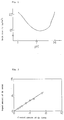
- the gel is formed through hydrolysis of Si(OR)4 in the pH range between 7 and 9, it is not cracked during drying so that a large size bulk can be produced. The reason for this may be explained from a relationship between the pH of the mixture for hydrolysis and a bulk density of the synthesized gel. As shown in Fig. 1, the bulk density is minimized in the pH range between 7 and 9.
- the gel having the small bulk density has large pores therein so that water or other liquids are easily evaporated off and the gel is hardly cracked during drying.
- the amount of the added rare earth element depends on the solubility of the rare earth element compound.
- the rare earth element chloride such as NdCl3, YbCl3, HoCl3 or TmCl3 is soluble in water and has large solubility in the alcohol. Then, the rare earth element chloride can be practically used.
- An amount of the rare earth element to be added to the glass depends on the solubility of rare earth element compound in the alcohol or water and is usually from 100 to 100,000 ppm. For example, 50 grams of NdCl3 can be dissolved in 100 grams of water. Such solubility is practically satisfactory. Since the rare earth element is added in a liquid phase, it can be homogeneously added to the glass. The amount of the rare earth element added to the glass can be adjusted by changing the amount of the rare earth element compound to be added to the starting mixture. This is one of the advantages of the present invention.
- the rare earth element is added to the synthesized glass, the rare earth element and the glass-forming elements are not sufficiently bonded. In such case, the rare earth element forms clusters or crystals, which adversely affect the generation of laser or optical properties of the doped glass.
- the rare earth element is trapped in the network of the glass during formation of the glass from the metal alkoxide, so that the glass with good quality is produced.
- the amount of the rare earth element compound is increased to increase the doped amount of the rare earth element, atoms of the rare earth element associate together so that the functions of the rare earth element cannot be effectively activated. This may be because, in the quartz glass, the rare earth atoms which are independently doped in the SiO2 network cannot coordinate the oxygen ions sufficiently so that the network is unstabilized by strain generated in the network. Then, the rare earth atoms associate together to restabilize the network.
- the rare earth element compound and other metal alkoxide are previously hydrolyzed to prepare a solution containing the rare earth element, and this solution is added to the mixture of Si(OR)4 and the alcohol or water.
- This previous hydrolysis may be carried out at a reaction temperature of from 20 to 40°C for 1 to 3 hours in the presence of a catalyst such as hydrochloric acid or aqueous ammonia.
- Preferred examples of the other metal alkoxide are alkoxides of Ge, Al, P and B.
- a glass-forming element such as Wo and Te may be used.
- Al and P are most preferred.
- 5 to 6 moles of the other metal is used per one mole of the rare earth element.
- the gel is heated and dried.
- the drying is carried out at a temperature of at least 60°C, preferably from 60°C to 200°C, for example from 120°C to 200°C. When the drying temperature is lower than 60°C, residual water cannot be sufficiently removed.
- the dried gel is then dehydrated preferably in a chlorine-containing atmosphere and vitrified at a sufficiently high temperature, for example, higher than 200°C in a helium atmosphere or under vacuum to give a glass containing the rare earth element in the form of an oxide.
- the dried gel was dehydrated in an atmosphere containing 7 % of chlorine at 800°C for about two hours followed by heating in a helium atmosphere at 1300°C for two hours to obtain a transparent pink glass. Elemental analysis of the glass revealed that it contained about 1 % by weight of erbium.
- the resulting mixture was poured in a messcylinder made of polytetrafluoroethylene (Teflon, a trade mark), and the messcylinder was sealed with an aluminum adhesive tape and kept standing at 35°C for one day to form a gel. Then, the mixture was heated to 80°C over two days. After making small holes in the aluminum tape, the mixture in the messcylinder was kept standing at 80°C for five days, heated to 150°C over four days, kept standing at 100°C for one day and then evacuated under vacuum at 200°C to obtain a dried gel.
- Teflon polytetrafluoroethylene
- the dried gel was heated to 1200°C at a heating rate of 1°C/min. and kept at that temperature for two hours to obtain a transparent glass. Elemental analysis of the glass revealed that it contained 1 % by weight of erbium.
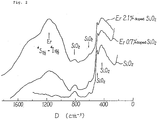
- Example 2 In the same manner as in Example 2, a SiO2 glass containing 0.7 % by weight or 2.1 % by weight of erbium was produced and its Raman spectrum was recorded and compared with the Raman spectrum of pure SiO2. The spectra are shown in Fig. 2. The peaks indicated by the arrows are assigned to SiO2 and are not affected by the addition of erbium. This result means that erbium is homogeneously dispersed in the erbium-doped glass.
- the resulting mixture was charged in a messcylinder made of polytetrafluoroethylene (Teflon, a trade mark), and the messcylinder was sealed with an aluminum adhesive tape and kept standing at 35°C for one day to form a gel. Then, the mixture was heated to 80°C over two days. After making small holes in the aluminum tape, the mixture in the messcylinder was kept standing at 80°C for five days, heated to 150°C over four days and kept standing at that temperature for one day followed by evacuation under vacuum at 200°C for eight hours to obtain a dried gel.
- Teflon polytetrafluoroethylene
- the dried gel was heated in the air to 350°C at a heating rate of 1°C/min. to remove the residual carbon. Thereafter, the gel was heated to 800°C at a heating rate of 1°C/min. and a chlorine gas was introduced in the messcylinder to dehydrate the gel. The dehydrated gel was heated to 1200°C at a heating rate of 1°C/min. and kept at that temperature for two hours to obtain a transparent glass. Elemental analysis of the glass revealed that it contained 1 % by weight of neodymium.
- the mixture in the messcylinder was kept standing at 80°C for five days, at 100°C for two days, at 130°C for two days and at 150°C for two days to obtain a dried gel.
- the dried gel was heated with an electric furnace in an oxygen atmosphere at 350°C for two days to burn out the residual carbon followed by dehydration in a chlorine atmosphere at 800°C for two hours. Then, the dehydrated gel was heated in a helium atmosphere at 1200°C to obtain a transparent pink glass. Elemental analysis of the glass revealed that it contained about 1 % by weight of erbium. The glass contained no scattering materials, which indicated that Er atoms did not form clusters and were homogeneously dispersed in the glass.
- erbium-doped glass With changing the charged amount of erbium methoxide, erbium-doped glass was produced. The relationship between the charged amount of erbium methoxide and the amount of dope erbium is shown in Fig. 3. The doped amount of erbium was measured by atomic absorption analysis. The results indicate that erbium was added to the glass at a yield of 70 %.
- Example 5 In the same manner as in Example 5 except that silicon tetramethoxide (100 ml), ethanol (270 ml), water (100 ml), 0.1N aqueous ammonia (70 ml) and uranium chloride (UCl3) (5.8 g) were used, a glass doped with 1 % of uranium was produced.
Landscapes
- Chemical & Material Sciences (AREA)
- Engineering & Computer Science (AREA)
- Chemical Kinetics & Catalysis (AREA)
- Organic Chemistry (AREA)
- Materials Engineering (AREA)
- Life Sciences & Earth Sciences (AREA)
- General Chemical & Material Sciences (AREA)
- Geochemistry & Mineralogy (AREA)
- Manufacturing & Machinery (AREA)
- Optics & Photonics (AREA)
- Physics & Mathematics (AREA)
- Dispersion Chemistry (AREA)
- General Life Sciences & Earth Sciences (AREA)
- Glass Compositions (AREA)
Claims (4)
- Verfahren zur Herstellung eines mit Seltenerdelement versetzten Glases, das die folgenden Schritte umfaßt:- Hydrolysieren mindestens eines Alkoxids, das unter Si(OR)₄, Ge(OR)₄, Al(OR)₃, Ti(OR)₄ und B(OH)₃, worin R eine Alkylgruppe ist, ausgewählt wird, in einem wäßrigen oder alkoholischen flüssigen Medium, das einen pH von 7 bis 9 hat, in Gegenwart einer Verbindung eines Laser-erzeugenden Seltenerdelements unter Bildung eines Gels;- Trocknen des Gels bei einer Temperatur von 60 bis 200°C;- Dehydratisieren des getrockneten Gels in einer chlorhaltigen Atmosphäre; und- Verglasen des dehydratisierten Gels bei einer Temperatur von 1200 bis 1300°C in Heliumatmosphäre oder unter Vakuum unter Bildung des mit Seltenerdelement versetzten Glases.
- Verfahren nach Anspruch 1, in dem das Metallalkoxid Si(OR)₄ ist, und mindestens ein anderes Metallakoxid vorher mit der Verbindung des Seltenerdelements vermischt und hydrolysiert und dann zum Hydrolysieren von Si(OR)₄ zu einer Reaktionsmischung gegeben wird.
- Verfahren nach Anspruch 2, in dem das andere Metallalkoxid Ge(OR)₄, Al(OR)₃, R(OR)₅ oder B(OH)₃ ist.
- Verfahren nach Anspruch 1, das den Schritt eines Einstellens des pH's des flüssigen Mediums unter Verwendung von wäßrigem Ammoniak umfaßt.
Applications Claiming Priority (4)
| Application Number | Priority Date | Filing Date | Title |
|---|---|---|---|
| JP328123/89 | 1989-12-20 | ||
| JP1328123A JPH03193628A (ja) | 1989-12-20 | 1989-12-20 | ゾルゲル法による希土類ドープ石英ガラスの製造方法 |
| JP1338744A JPH03199132A (ja) | 1989-12-28 | 1989-12-28 | 希土類ドープ石英ガラスの製造方法 |
| JP338744/89 | 1989-12-28 |
Publications (2)
| Publication Number | Publication Date |
|---|---|
| EP0433643A1 EP0433643A1 (de) | 1991-06-26 |
| EP0433643B1 true EP0433643B1 (de) | 1996-05-08 |
Family
ID=26572764
Family Applications (1)
| Application Number | Title | Priority Date | Filing Date |
|---|---|---|---|
| EP90121468A Expired - Lifetime EP0433643B1 (de) | 1989-12-20 | 1990-11-09 | Verfahren zur Herstellung von mit seltenen Erden dotiertem Glas durch Solgelverfahren |
Country Status (7)
| Country | Link |
|---|---|
| US (1) | US5196383A (de) |
| EP (1) | EP0433643B1 (de) |
| KR (1) | KR930000200B1 (de) |
| AU (1) | AU637646B2 (de) |
| CA (1) | CA2029693C (de) |
| DE (1) | DE69026911T2 (de) |
| NO (1) | NO304826B1 (de) |
Families Citing this family (11)
| Publication number | Priority date | Publication date | Assignee | Title |
|---|---|---|---|---|
| AU649845B2 (en) * | 1991-06-24 | 1994-06-02 | Sumitomo Electric Industries, Ltd. | Method for producing glass preform for optical fiber |
| US5254508A (en) * | 1991-12-12 | 1993-10-19 | Yazaki Corporation | Sol-gel process for forming a germania-doped silica glass rod |
| US5356447A (en) * | 1993-03-11 | 1994-10-18 | At&T Bell Laboratories | Manufacture of high proof-test optical fiber using sol-gel |
| JPH07330370A (ja) * | 1994-06-08 | 1995-12-19 | Olympus Optical Co Ltd | 組成に分布を有したガラス体 |
| CA2231114A1 (en) | 1995-09-06 | 1997-03-13 | The Research Foundation Of State University Of New York | Two-photon upconverting dyes and applications |
| US6578387B2 (en) * | 1999-04-09 | 2003-06-17 | Fitel Usa Corp. | Method of fabrication of rare earth doped preforms for optical fibers |
| ITMI20012555A1 (it) * | 2001-12-04 | 2003-06-04 | Infm Istituto Naz Per La Fisi | Vetri luminescenti ad alta efficienza, particolarmente per l'impiego come materiali scintillatori per la rivelazione di radiazioni ionizzant |
| RU2191755C1 (ru) * | 2001-12-21 | 2002-10-27 | Лимбах Иван Юрьевич | Способ производства фосфатных стекол |
| CN1863741B (zh) * | 2003-06-30 | 2011-03-30 | 普雷斯曼电缆及系统能源有限公司 | 用于对多孔光纤预制棒钻孔的方法和设备 |
| KR100772501B1 (ko) * | 2005-06-30 | 2007-11-01 | 한국전자통신연구원 | 텔루라이트 유리 조성물, 이를 이용한 광도파로 및광증폭기 |
| US7531466B2 (en) * | 2006-07-26 | 2009-05-12 | Sharp Laboratories Of America, Inc. | Metal organic deposition precursor solution synthesis and terbium-doped SiO2 thin film deposition |
Family Cites Families (4)
| Publication number | Priority date | Publication date | Assignee | Title |
|---|---|---|---|---|
| JPS6186429A (ja) * | 1984-10-05 | 1986-05-01 | Sumitomo Electric Ind Ltd | ガラスの製造方法 |
| JPS62143830A (ja) * | 1985-12-18 | 1987-06-27 | Toppan Printing Co Ltd | 発光ガラスの製造方法 |
| NL8602519A (nl) * | 1986-10-08 | 1988-05-02 | Philips Nv | Luminescerend kwartsglas, werkwijze voor het bereiden van een dergelijk glas en luminescerend scherm voorzien van een dergelijk glas. |
| US4789389A (en) * | 1987-05-20 | 1988-12-06 | Corning Glass Works | Method for producing ultra-high purity, optical quality, glass articles |
-
1990
- 1990-11-08 AU AU65885/90A patent/AU637646B2/en not_active Ceased
- 1990-11-09 US US07/610,226 patent/US5196383A/en not_active Expired - Lifetime
- 1990-11-09 CA CA002029693A patent/CA2029693C/en not_active Expired - Fee Related
- 1990-11-09 EP EP90121468A patent/EP0433643B1/de not_active Expired - Lifetime
- 1990-11-09 DE DE69026911T patent/DE69026911T2/de not_active Expired - Fee Related
- 1990-11-09 NO NO904874A patent/NO304826B1/no unknown
- 1990-12-19 KR KR1019900021079A patent/KR930000200B1/ko not_active Expired - Fee Related
Also Published As
| Publication number | Publication date |
|---|---|
| CA2029693C (en) | 1996-10-22 |
| US5196383A (en) | 1993-03-23 |
| NO904874D0 (no) | 1990-11-09 |
| AU6588590A (en) | 1991-06-27 |
| KR910021342A (ko) | 1991-12-20 |
| NO304826B1 (no) | 1999-02-22 |
| DE69026911T2 (de) | 1996-10-24 |
| KR930000200B1 (ko) | 1993-01-14 |
| DE69026911D1 (de) | 1996-06-13 |
| EP0433643A1 (de) | 1991-06-26 |
| NO904874L (no) | 1991-06-21 |
| AU637646B2 (en) | 1993-06-03 |
| CA2029693A1 (en) | 1991-06-21 |
Similar Documents
| Publication | Publication Date | Title |
|---|---|---|
| EP0433643B1 (de) | Verfahren zur Herstellung von mit seltenen Erden dotiertem Glas durch Solgelverfahren | |
| US8557171B2 (en) | Method for producing doped quartz glass | |
| WO1991011401A1 (en) | Quartz glass doped with rare earth element and production thereof | |
| EP0271282B1 (de) | Glasgegenstand, hergestellt aus einem mit Hilfe von Gas geformten Gel, und Verfahren zum Herstellen dieses Gegenstandes | |
| EP0565439A1 (de) | Herstellungsverfahren von mit Erbium dotiertem Siliciumdioxid für optische Glasfaservorformen | |
| Brusatin et al. | GeO2‐Based Sol–Gel Films | |
| JP2524174B2 (ja) | 光学機能性を有する石英ガラスの製造方法 | |
| CN115818950B (zh) | 多模铒镱共掺光纤、芯棒及其制备方法、应用 | |
| JP2931026B2 (ja) | 希土類元素ドープガラスの製造方法 | |
| EP1304774A1 (de) | Verstärkungsmedium mit niedriger Phononenenergie und dessen Herstellung | |
| JP2604466B2 (ja) | 希土類元素ドープ石英ガラスの製造方法 | |
| JP3157000B2 (ja) | 光導波路 | |
| JPH02296735A (ja) | ガラスの製造方法 | |
| JPH11180719A (ja) | 光ファイバ用ガラス母材の製造方法 | |
| JPH0613410B2 (ja) | アルミノ珪酸系ガラスの製造方法 | |
| JPH03199132A (ja) | 希土類ドープ石英ガラスの製造方法 | |
| JPH03193628A (ja) | ゾルゲル法による希土類ドープ石英ガラスの製造方法 | |
| JP3475109B2 (ja) | 希土類元素ドープガラス | |
| JPH06122523A (ja) | 希土類イオン含有カルコゲナイドガラスの製造方法 | |
| CN116813207B (zh) | 一种抗辐照保偏掺铒光纤及其制备方法与应用 | |
| WO2001068544A1 (en) | Erbium-doped multicomponent glasses manufactured by the sol-gel method | |
| CN119707279B (zh) | 荧光光谱蓝移至870nm波段的掺钕石英玻璃及其制备方法 | |
| WO2003048058A1 (en) | High-efficiency luminescent glasses, and sol-gel process for producing them | |
| JP5896507B2 (ja) | 金属元素ドープシリカガラスおよびその製造方法 | |
| JPH0776093B2 (ja) | 石英ガラスの製造方法 |
Legal Events
| Date | Code | Title | Description |
|---|---|---|---|
| PUAI | Public reference made under article 153(3) epc to a published international application that has entered the european phase |
Free format text: ORIGINAL CODE: 0009012 |
|
| 17P | Request for examination filed |
Effective date: 19901220 |
|
| AK | Designated contracting states |
Kind code of ref document: A1 Designated state(s): BE DE FR GB IT NL |
|
| 17Q | First examination report despatched |
Effective date: 19930419 |
|
| GRAH | Despatch of communication of intention to grant a patent |
Free format text: ORIGINAL CODE: EPIDOS IGRA |
|
| GRAA | (expected) grant |
Free format text: ORIGINAL CODE: 0009210 |
|
| AK | Designated contracting states |
Kind code of ref document: B1 Designated state(s): BE DE FR GB IT NL |
|
| ITF | It: translation for a ep patent filed | ||
| REF | Corresponds to: |
Ref document number: 69026911 Country of ref document: DE Date of ref document: 19960613 |
|
| ET | Fr: translation filed | ||
| PLBE | No opposition filed within time limit |
Free format text: ORIGINAL CODE: 0009261 |
|
| STAA | Information on the status of an ep patent application or granted ep patent |
Free format text: STATUS: NO OPPOSITION FILED WITHIN TIME LIMIT |
|
| 26N | No opposition filed | ||
| PGFP | Annual fee paid to national office [announced via postgrant information from national office to epo] |
Ref country code: FR Payment date: 19971112 Year of fee payment: 8 |
|
| PGFP | Annual fee paid to national office [announced via postgrant information from national office to epo] |
Ref country code: DE Payment date: 19971114 Year of fee payment: 8 |
|
| PGFP | Annual fee paid to national office [announced via postgrant information from national office to epo] |
Ref country code: NL Payment date: 19971130 Year of fee payment: 8 |
|
| PGFP | Annual fee paid to national office [announced via postgrant information from national office to epo] |
Ref country code: BE Payment date: 19980115 Year of fee payment: 8 |
|
| PG25 | Lapsed in a contracting state [announced via postgrant information from national office to epo] |
Ref country code: BE Free format text: LAPSE BECAUSE OF NON-PAYMENT OF DUE FEES Effective date: 19981130 |
|
| BERE | Be: lapsed |
Owner name: SUMITOMO ELECTRIC INDUSTRIES LTD Effective date: 19981130 |
|
| PG25 | Lapsed in a contracting state [announced via postgrant information from national office to epo] |
Ref country code: NL Free format text: LAPSE BECAUSE OF NON-PAYMENT OF DUE FEES Effective date: 19990601 |
|
| PG25 | Lapsed in a contracting state [announced via postgrant information from national office to epo] |
Ref country code: FR Free format text: LAPSE BECAUSE OF NON-PAYMENT OF DUE FEES Effective date: 19990730 |
|
| NLV4 | Nl: lapsed or anulled due to non-payment of the annual fee |
Effective date: 19990601 |
|
| REG | Reference to a national code |
Ref country code: FR Ref legal event code: ST |
|
| PG25 | Lapsed in a contracting state [announced via postgrant information from national office to epo] |
Ref country code: DE Free format text: LAPSE BECAUSE OF NON-PAYMENT OF DUE FEES Effective date: 19990901 |
|
| REG | Reference to a national code |
Ref country code: GB Ref legal event code: IF02 |
|
| PGFP | Annual fee paid to national office [announced via postgrant information from national office to epo] |
Ref country code: GB Payment date: 20041104 Year of fee payment: 15 |
|
| PG25 | Lapsed in a contracting state [announced via postgrant information from national office to epo] |
Ref country code: IT Free format text: LAPSE BECAUSE OF NON-PAYMENT OF DUE FEES;WARNING: LAPSES OF ITALIAN PATENTS WITH EFFECTIVE DATE BEFORE 2007 MAY HAVE OCCURRED AT ANY TIME BEFORE 2007. THE CORRECT EFFECTIVE DATE MAY BE DIFFERENT FROM THE ONE RECORDED. Effective date: 20051109 Ref country code: GB Free format text: LAPSE BECAUSE OF NON-PAYMENT OF DUE FEES Effective date: 20051109 |
|
| GBPC | Gb: european patent ceased through non-payment of renewal fee |
Effective date: 20051109 |