EP0407418B1 - Nussknacker - Google Patents
Nussknacker Download PDFInfo
- Publication number
- EP0407418B1 EP0407418B1 EP19890903728 EP89903728A EP0407418B1 EP 0407418 B1 EP0407418 B1 EP 0407418B1 EP 19890903728 EP19890903728 EP 19890903728 EP 89903728 A EP89903728 A EP 89903728A EP 0407418 B1 EP0407418 B1 EP 0407418B1
- Authority
- EP
- European Patent Office
- Prior art keywords
- lever
- nut
- jaw
- levers
- nuts
- Prior art date
- Legal status (The legal status is an assumption and is not a legal conclusion. Google has not performed a legal analysis and makes no representation as to the accuracy of the status listed.)
- Expired - Lifetime
Links
- 241000557624 Nucifraga Species 0.000 title claims abstract description 14
- 210000000707 wrist Anatomy 0.000 abstract description 3
- 210000000080 chela (arthropods) Anatomy 0.000 abstract 1
- 235000014571 nuts Nutrition 0.000 description 22
- 238000000034 method Methods 0.000 description 3
- 238000005336 cracking Methods 0.000 description 2
- 235000020113 brazil nut Nutrition 0.000 description 1
- 238000005507 spraying Methods 0.000 description 1
Images

Classifications
-
- A—HUMAN NECESSITIES
- A47—FURNITURE; DOMESTIC ARTICLES OR APPLIANCES; COFFEE MILLS; SPICE MILLS; SUCTION CLEANERS IN GENERAL
- A47J—KITCHEN EQUIPMENT; COFFEE MILLS; SPICE MILLS; APPARATUS FOR MAKING BEVERAGES
- A47J43/00—Implements for preparing or holding food, not provided for in other groups of this subclass
- A47J43/26—Nutcrackers
Definitions
- the invention relates to a nutcracker according to the preamble of the claim.
- a nutcracker is known from US-A-2 720 900.
- a large amount of force is usually required.
- the sudden breakage of the nutshell caused thereby often means that the pressure exerted on the nut cannot be reduced in time, so that not only the shell but also the nut core is destroyed. This is especially true for large nuts, because here the levers have to be opened wide and the pressure exerted on the nut is particularly high.
- the invention has for its object to construct a nutcracker that allows the opening of nuts of different sizes in a convenient manner and with little effort while maintaining the classic shape and without any learning requirement.
- the object is achieved according to the invention by the features specified in the characterizing part of the patent claim.
- the distance between the hand levers is constant regardless of the size of the nut, since the crushing jaw is movable and provided with a ring gear and can therefore be opened and steplessly applied to the inserted nut regardless of the lever movement. Thanks to the double lever principle, the pressure on the nut is many times higher than with a conventional nutcracker and sufficient to do it, despite minimal effort very easy to crack very hard nuts, such as Brazil nuts.
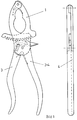
- FIG. 1 the nutcracker according to the invention is shown in side and front view.
- Picture 2 shows a nutcracker according to picture 1 as an enlargement without cover plate.
- the nutcracker shown in Figure 2 consists of two hand levers 2 and 3, lever 2 being firmly connected to an associated crushing jaw, that is to say that the two consist of one piece, while lever 3 is movably fastened on hand lever 2 about axis b .
- the crushing jaw 1 is rotatably fastened together with the crushing jaw of the hand lever 2 on the axis a and has a toothed strip at its lower end.
- lever 3 is a feed pawl between axis b and the ring gear 5 movably mounted.
- a spring 7 in lever 3 presses the feed pawl 5 into the teeth.
- a cover plate 4 the shape of which is identical to the shape of hand lever 2, covers hand lever 2 and all parts fastened thereon. To open and insert a nut, the catch 6 is moved in the direction z.
- the end of the pawl angled upwards takes the one-tooth feed pawl 5 with it and releases the toothed bar of the jaw 1.
- the crushing jaw 1 which can be pivoted about point a, can now be put on the nut by hand.
- the catch pawl 6 is released, the spring 7 presses the feed pawl 5 into the teeth.
- the feed pawl is movably mounted in hand lever 3. If the hand lever 3, which rotates about the point b, is pressed against the lever 2 in the y direction, the feed pawl 5 takes the crushing jaw 1 with it and closes the crushing jaws by one tooth pitch.
- a spring 10 opens the lever path and brings the feed pawl 5 into the next tooth.
- the detent pawl which is rotatably mounted on the hand lever 2 about the point c, holds the tension between the nut and the crushing jaws.
Landscapes
- Engineering & Computer Science (AREA)
- Mechanical Engineering (AREA)
- Food Science & Technology (AREA)
- Crushing And Grinding (AREA)
- Food-Manufacturing Devices (AREA)
Description
- Die Erfindung betrifft einen Nußknacker gemäß dem Oberbegriff des Patentanspruches. Ein derartiger Nußknacker ist aus der US-A-2 720 900 bekannt.
Beim Knacken von Nüssen mit einem herkömmlichen, aus zwei an einem Drehpunkt verbundenen Hebeln bestehenden Nußknacker ist in der Regel ein großer Kraftaufwand erforderlich. Das dadurch hervorgerufene plötzliche Zerbrechen der Nußschale hat häufig zur Folge, daß der auf die Nuß ausgeübte Druck nicht rechtzeitig verringert werden kann, so daß nicht nur die Schale, sondern auch der Nußkern zerstört wird.
Dies trifft besonders für große Nüsse zu, da gerade hier die Hebel weit geöffnet werden müssen und so der auf die Nuß ausgeübte Druck besonders groß ist.
Ein weiterer Nachteil besteht darin, daS bei dem weiten Öffnen der Hebel zum Knacken einer großen Nuß die Spannweite einer Hand häufig nicht ausreicht, um die Hebel zu fassen und die notwendige Kraft auf sie auszuüben, und daß andererseits beim Knacken sehr kleiner Nüsse die Hebel eng aufeinander liegen, so daß der notwendige Druck auf die Nuß noch ausgeübt werden kann.
Der Erfindung liegt die Aufgabe zugrunde, einen Nußknacker zu konstruieren, der unter Beibehaltung der klassischen Form und ohne jegliches Lernerfordernis das Öffnen von Nüssen unterschiedlicher Größe auf bequeme Art und Weise und unter geringem Kraftaufwand ermöglicht.
Die Aufgabe wird gemäß der Erfindung durch die im Kennzeichen des Patentanspruches angegebenen Merkmale gelöst.
Der Abstand zwischen den Handhebeln ist unabhängig von der Nußgröße konstant, da die Brechbacke beweglich und mit einem Zahnkranz versehen ist und sich daher unabhängig von der Hebelbewegung öffnen und stufenlos an die eingelegte Nuß anlegen läßt. Durch das Doppelhebelprinzip ist der Druck auf die Nuß trotz minimalem Kraftaufwand um ein vielfaches höher als bei einem herkömmlichen Nußknacker und ausreichend, um auch sehr harte Nüsse, wie z.B. Paranüsse, mühelos zu knacken. - Dadurch wird das Knacken von Nüssen auch unzähligen Menschen mit schwachen Handgelenken bzw. Handgelenkserkrankungen ermöglicht. Gleichzeitig wird die unerwünschte Zertrümmerung des Nußkerns dadurch ausgeschlossen, daß durch Druck auf die Handhebel die bewegliche Brechbacke sich jeweils nur um eine Zahnteilung schließt und dadurch begrenzter Hub auf die Nuß ausgeübt wird.
Durch Loslassen der Hebel und erneutes Schließen kann der Druck auf die Nuß stufenweise, d.h. jeweils um einen Zahn, verstärkt werden, bis die Nußschale aufgebrochen ist, der Kern aber unbeschädigt bleibt. Da die Brechbacke stufenlos an die Nuß angelegt wird, ist dieser Vorgang in der Regel nach zwei- bis dreimaliger Hebelbewegung beendet.
Der Nußknacker ist wirtschaftlich zu produzieren, weil alle Teile im Druckspritzverfahren bzw. Stanzverfahren herstellbar sind. - Die Erfindung wird nachfolgend an einem Ausführungsbeispiel näher erläutert, das in den Zeichnungen Bild 1 und Bild 2 dargestellt ist.
In Bild 1 wird der erfindungsgemäße Nußknacker in Seiten- und Vorderansicht dargestellt.
Bild 2 zeigt einen Nußknacker gemäß Bild 1 als Vergrößerung ohne Deckplatte.
Der in Bild 2 dargestellte Nußknacker besteht aus zwei Handhebeln 2 und 3, wobei Hebel 2 mit einer dazugehörigen Brechbacke fest verbunden ist, d.h., daß die beiden aus einem Stück bestehen, während der Hebel 3 beweglich um die Achse b auf dem Handhebel 2 befestigt ist. Die Brechbacke 1 ist zusammen mit der Brechbacke von Handhebel 2 an der Achse a drehbar befestigt und besitzt an ihrem unteren Ende eine Zahnleiste. Eine Feder 9, die auf der Brechbacke von Handhebel 2 befestigt ist, drückt die Brechbacke 1 in Richtung y. Im Hebel 3 ist zwischen Achse b und dem Zahnkranz eine Vorschubklinke 5 beweglich gelagert. Eine Feder 7 in Hebel 3 drückt die Vorschubklinke 5 in die anstehende Verzahnung. Im Handhebel 2 ist eine Rastenklinke 6, die an ihrem Ende nach oben abgewinkelt ist, drehbar befestigt. Eine Feder 8, die auch in der Achse c befestigt ist, drückt die Rastenklinke 6 ebenfalls in die Verzahnung. Wie Bild 1 zu entnehmen ist, deckt eine Deckelplatte 4, deren Form mit der Form von Handhebel 2 identisch ist, den Handhebel 2 sowie alle darauf befestigten Teile ab. Zum Öffnen und Einlegen einer Nuß wird die Rastenklinke 6 in Richtung z bewegt. Das nach oben abgewinkelte Klinkenende nimmt die einzahnige Vorschubklinke 5 mit und gibt die Zahnleiste von Brechbacke 1 frei. Die um Punkt a schwenkbare Brechbacke 1 kann nun mit der Hand an die Nuß angelegt werden. Zum Aufbrechen der Nußschale wird die Rastenklinke 6 losgelassen, die Feder 7 drückt die Vorschubklinke 5 in die anstehende Verzahnung. Die Vorschubklinke ist beweglich in Handhebel 3 gelagert. Wird der Handhebel 3, der sich um den Punkt b dreht, gegen den Hebel 2 in Richtung y gedrückt, so nimmt die Vorschubklinke 5 die Brechbacke 1 mit und schließt die Brechbacken um eine Zahnteilung. Bei Loslassen des Hebels 3 öffnet eine Feder 10 den Hebelweg und bringt die Vorschubklinke 5 in den nächstfolgenden Zahn. Die Rastenklinke, die auf dem Handhebel 2 drehbar um den Punkt c befestigt ist, hält die Spannung zwischen Nuß und den Brechbacken. - Sie bleibt im Eingriff mit dem Zahnkranz.
Der Drückvorgang kann wiederholt werden.
Zum Öffnen des Nußknackers und zur Entnahme des Nußkerns wird die Rastenklinke und die mitgenommene Vorschubklinke gegen den Zahnkranz frei. Dieser wird durch die Feder 9 zur Freigabe in Richtung y bewegt.
Claims (1)
- Nußknacker mit einem ersten und zweiten Handhebel (2,3), die in einer ersten Achse (b) beweglich verbunden sind, und mit zwei Brechbacken, wobei die erste Brechbacke mit dem ersten Handhebel (2) einstückig ausgebildet ist, die zweite Brechbacke (1) an der ersten Brechbacke an einer zweiten Achse (a) drehbar befestigt ist und auf das freie Ende der zweiten Brechbacke (1) der zweite Handhebel (3) einwirkt, wobei das freie Ende der zweiten Brechbacke (1) mit einer gebogenen Zahnleiste versehen ist, wobei im Handhebel (3) zwischen der ersten Achse (b) und der Zahnleiste eine Vorschubklinke (5) beweglich gelagert ist, die mittels einer Feder (7) in die Zahnleiste drückbar ist, und wobei auf die Handhebel (2,3) eine Feder (10) im Öffnungssinne einwirkt, dadurch gekennzeichnet, daß am ersten Handhebel (2) eine Rastenklinke (6) angeordnet ist, die unter der Wirkung einer Feder (8) in die Zahnleiste eingreift und deren nach oben abgewinkeltes Klinkenende so ausgebildet ist, daß es die Vorschubklinke zum Öffnen mitnimmt und somit die Zahnleiste freigibt, und daß die zweite Achse (a) an dem freien Ende der ersten Brechbacke angeordnet ist.
Priority Applications (1)
| Application Number | Priority Date | Filing Date | Title |
|---|---|---|---|
| AT89903728T ATE99143T1 (de) | 1988-03-09 | 1989-03-07 | Nussknacker. |
Applications Claiming Priority (2)
| Application Number | Priority Date | Filing Date | Title |
|---|---|---|---|
| DE19883807689 DE3807689C1 (de) | 1988-03-09 | 1988-03-09 | |
| DE3807689 | 1988-03-09 |
Publications (2)
| Publication Number | Publication Date |
|---|---|
| EP0407418A1 EP0407418A1 (de) | 1991-01-16 |
| EP0407418B1 true EP0407418B1 (de) | 1993-12-29 |
Family
ID=6349225
Family Applications (1)
| Application Number | Title | Priority Date | Filing Date |
|---|---|---|---|
| EP19890903728 Expired - Lifetime EP0407418B1 (de) | 1988-03-09 | 1989-03-07 | Nussknacker |
Country Status (3)
| Country | Link |
|---|---|
| EP (1) | EP0407418B1 (de) |
| DE (1) | DE3807689C1 (de) |
| WO (1) | WO1989008421A1 (de) |
Families Citing this family (3)
| Publication number | Priority date | Publication date | Assignee | Title |
|---|---|---|---|---|
| DE19500632C1 (de) * | 1995-01-11 | 1996-07-25 | Janusz Serocki | Nußknacker |
| EP3096661A1 (de) * | 2014-01-21 | 2016-11-30 | Mario Rossi | Handbedientes werkzeug |
| CN208941909U (zh) * | 2017-07-26 | 2019-06-07 | 深圳市蓝海星科技有限公司 | 一种坚果破壳器 |
Family Cites Families (7)
| Publication number | Priority date | Publication date | Assignee | Title |
|---|---|---|---|---|
| DE240985C (de) * | ||||
| US1791992A (en) * | 1929-01-12 | 1931-02-10 | Wiemers John | Nutcracker |
| FR975797A (fr) * | 1948-12-03 | 1951-03-09 | Casse-noix à arrêt automatique | |
| US2550197A (en) * | 1950-06-09 | 1951-04-24 | Julius E Lisbon | Nutcracker automatically adjusted to crack nuts of various sizes |
| FR1029351A (fr) * | 1950-12-11 | 1953-06-02 | Casse-noix, amandes, etc. | |
| US2720900A (en) * | 1952-10-17 | 1955-10-18 | Clifford M Quist | Nut cracker having a resilient receptacle |
| DE1256847B (de) * | 1965-04-06 | 1967-12-21 | Karl Friedrich Walter | Hebelanordnung bei zangen- oder scherenaehnlichen Haushaltgeraeten oder Werkzeugen |
-
1988
- 1988-03-09 DE DE19883807689 patent/DE3807689C1/de not_active Expired
-
1989
- 1989-03-07 EP EP19890903728 patent/EP0407418B1/de not_active Expired - Lifetime
- 1989-03-07 WO PCT/EP1989/000231 patent/WO1989008421A1/de not_active Ceased
Also Published As
| Publication number | Publication date |
|---|---|
| DE3807689C1 (de) | 1989-07-13 |
| WO1989008421A1 (fr) | 1989-09-21 |
| EP0407418A1 (de) | 1991-01-16 |
Similar Documents
| Publication | Publication Date | Title |
|---|---|---|
| DE2142570C3 (de) | Mechanische Pulverpresse, insbesondere Metallpulverpresse | |
| DE2203722A1 (de) | Blindniet-Zange | |
| DE3807689C1 (de) | ||
| DE8312209U1 (de) | Nussknacker | |
| DE318561C (de) | ||
| DE3327881A1 (de) | Vorrichtung zum aufpressen und vernieten von laschen auf bolzen einer kette | |
| DE2843442C2 (de) | ||
| DE2625238C3 (de) | Schraubdeckelzange | |
| DE3329776A1 (de) | Schraubenschluessel | |
| AT401141B (de) | Handpresse für knoblauch oder dgl. | |
| DE102009005520A1 (de) | Werkzeug zum Öffnen von Nüssen, insbesondere zum Knacken von Nussschalen | |
| DE1516404B1 (de) | Blutdruckmessgerät mit austauschbarem Quecksilber-Manometerrohr | |
| DE19922528C2 (de) | Nußknacker | |
| DE924654C (de) | Schalenobstoeffner | |
| DE1548101C (de) | Vorrichtung zum Abziehen eines Uhr glases und zum Abziehen mit dieser Vor richtung bestimmtes Uhrglas | |
| DE617260C (de) | Spann- und Schliessvorrichtung fuer die Enden einer Bandbereifung mit zwei in entgegengesetztem Sinne schwenkbaren und zur Ausfuehrung des Schliesshubes kuppelbaren Druckhebeln | |
| DE1812481B2 (de) | Fersenniederhalter für eine Sicherheits-Skibindung | |
| CH633696A5 (de) | Verfahren und vorrichtung zur bildung eines abstandsteilstueckes in einem reissverschluss. | |
| DE451148C (de) | Vorrichtung zur selbsttaetigen Verriegelung, insbesondere als Haubenverschluss bei Kraftfahrzeugen | |
| DE648444C (de) | Verkapselmaschine fuer Flaschen und andere Gefaesse | |
| DE1247979B (de) | Abgabevorrichtung fuer Sicherungsringe | |
| DE736727C (de) | Tuerschloss, insbesondere fuer Kraftfahrzeuge | |
| DE513825C (de) | Handlochstanze | |
| DE172571C (de) | ||
| DE1577214C (de) | Handhebelgerät zum Zusammendrücken von Verbindungsstücken für elektrische Leitungen |
Legal Events
| Date | Code | Title | Description |
|---|---|---|---|
| PUAI | Public reference made under article 153(3) epc to a published international application that has entered the european phase |
Free format text: ORIGINAL CODE: 0009012 |
|
| 17P | Request for examination filed |
Effective date: 19900730 |
|
| AK | Designated contracting states |
Kind code of ref document: A1 Designated state(s): AT BE CH FR GB IT LI LU NL SE |
|
| 17Q | First examination report despatched |
Effective date: 19930222 |
|
| GRAA | (expected) grant |
Free format text: ORIGINAL CODE: 0009210 |
|
| AK | Designated contracting states |
Kind code of ref document: B1 Designated state(s): AT BE CH FR GB IT LI LU NL SE |
|
| REF | Corresponds to: |
Ref document number: 99143 Country of ref document: AT Date of ref document: 19940115 Kind code of ref document: T |
|
| ET | Fr: translation filed | ||
| ITF | It: translation for a ep patent filed | ||
| GBT | Gb: translation of ep patent filed (gb section 77(6)(a)/1977) |
Effective date: 19940322 |
|
| EPTA | Lu: last paid annual fee | ||
| PLBE | No opposition filed within time limit |
Free format text: ORIGINAL CODE: 0009261 |
|
| STAA | Information on the status of an ep patent application or granted ep patent |
Free format text: STATUS: NO OPPOSITION FILED WITHIN TIME LIMIT |
|
| 26N | No opposition filed | ||
| EAL | Se: european patent in force in sweden |
Ref document number: 89903728.7 |
|
| PGFP | Annual fee paid to national office [announced via postgrant information from national office to epo] |
Ref country code: CH Payment date: 19950308 Year of fee payment: 7 |
|
| PGFP | Annual fee paid to national office [announced via postgrant information from national office to epo] |
Ref country code: LU Payment date: 19960201 Year of fee payment: 8 |
|
| PGFP | Annual fee paid to national office [announced via postgrant information from national office to epo] |
Ref country code: FR Payment date: 19960222 Year of fee payment: 8 |
|
| PGFP | Annual fee paid to national office [announced via postgrant information from national office to epo] |
Ref country code: SE Payment date: 19960223 Year of fee payment: 8 Ref country code: NL Payment date: 19960223 Year of fee payment: 8 Ref country code: AT Payment date: 19960223 Year of fee payment: 8 |
|
| PGFP | Annual fee paid to national office [announced via postgrant information from national office to epo] |
Ref country code: GB Payment date: 19960226 Year of fee payment: 8 |
|
| PGFP | Annual fee paid to national office [announced via postgrant information from national office to epo] |
Ref country code: BE Payment date: 19960312 Year of fee payment: 8 |
|
| PG25 | Lapsed in a contracting state [announced via postgrant information from national office to epo] |
Ref country code: LI Effective date: 19960331 Ref country code: CH Effective date: 19960331 |
|
| REG | Reference to a national code |
Ref country code: CH Ref legal event code: PL |
|
| PG25 | Lapsed in a contracting state [announced via postgrant information from national office to epo] |
Ref country code: LU Free format text: LAPSE BECAUSE OF NON-PAYMENT OF DUE FEES Effective date: 19970307 Ref country code: GB Effective date: 19970307 Ref country code: AT Effective date: 19970307 |
|
| PG25 | Lapsed in a contracting state [announced via postgrant information from national office to epo] |
Ref country code: SE Effective date: 19970308 |
|
| PG25 | Lapsed in a contracting state [announced via postgrant information from national office to epo] |
Ref country code: BE Effective date: 19970331 |
|
| BERE | Be: lapsed |
Owner name: ABDI-TABARI MOHAMMED Effective date: 19970331 |
|
| PG25 | Lapsed in a contracting state [announced via postgrant information from national office to epo] |
Ref country code: NL Effective date: 19971001 |
|
| GBPC | Gb: european patent ceased through non-payment of renewal fee |
Effective date: 19970307 |
|
| PG25 | Lapsed in a contracting state [announced via postgrant information from national office to epo] |
Ref country code: FR Free format text: LAPSE BECAUSE OF NON-PAYMENT OF DUE FEES Effective date: 19971128 |
|
| NLV4 | Nl: lapsed or anulled due to non-payment of the annual fee |
Effective date: 19971001 |
|
| EUG | Se: european patent has lapsed |
Ref document number: 89903728.7 |
|
| REG | Reference to a national code |
Ref country code: FR Ref legal event code: ST |
|
| PG25 | Lapsed in a contracting state [announced via postgrant information from national office to epo] |
Ref country code: IT Free format text: LAPSE BECAUSE OF NON-PAYMENT OF DUE FEES;WARNING: LAPSES OF ITALIAN PATENTS WITH EFFECTIVE DATE BEFORE 2007 MAY HAVE OCCURRED AT ANY TIME BEFORE 2007. THE CORRECT EFFECTIVE DATE MAY BE DIFFERENT FROM THE ONE RECORDED. Effective date: 20050307 |