EP0400509B1 - Verfahren zur Herstellung von Muscon, Zwischenprodukte für dieses Verfahren sowie deren Herstellung - Google Patents
Verfahren zur Herstellung von Muscon, Zwischenprodukte für dieses Verfahren sowie deren Herstellung Download PDFInfo
- Publication number
- EP0400509B1 EP0400509B1 EP90110008A EP90110008A EP0400509B1 EP 0400509 B1 EP0400509 B1 EP 0400509B1 EP 90110008 A EP90110008 A EP 90110008A EP 90110008 A EP90110008 A EP 90110008A EP 0400509 B1 EP0400509 B1 EP 0400509B1
- Authority
- EP
- European Patent Office
- Prior art keywords
- formula
- preparation
- diketone
- muscone
- catalyst
- Prior art date
- Legal status (The legal status is an assumption and is not a legal conclusion. Google has not performed a legal analysis and makes no representation as to the accuracy of the status listed.)
- Expired - Lifetime
Links
- 238000000034 method Methods 0.000 title claims description 35
- 238000002360 preparation method Methods 0.000 title claims description 24
- ALHUZKCOMYUFRB-UHFFFAOYSA-N muskone Natural products CC1CCCCCCCCCCCCC(=O)C1 ALHUZKCOMYUFRB-UHFFFAOYSA-N 0.000 title claims description 10
- ALHUZKCOMYUFRB-OAHLLOKOSA-N Muscone Chemical compound C[C@@H]1CCCCCCCCCCCCC(=O)C1 ALHUZKCOMYUFRB-OAHLLOKOSA-N 0.000 title claims 8
- 238000004519 manufacturing process Methods 0.000 title description 8
- 239000000543 intermediate Substances 0.000 title 1
- 239000003054 catalyst Substances 0.000 claims description 28
- GWEVSGVZZGPLCZ-UHFFFAOYSA-N Titan oxide Chemical compound O=[Ti]=O GWEVSGVZZGPLCZ-UHFFFAOYSA-N 0.000 claims description 24
- 238000005882 aldol condensation reaction Methods 0.000 claims description 12
- XUHNSDFQZQVOGL-UHFFFAOYSA-N deca-1,9-diene-3,8-diol Chemical compound C=CC(O)CCCCC(O)C=C XUHNSDFQZQVOGL-UHFFFAOYSA-N 0.000 claims description 11
- 239000000203 mixture Substances 0.000 claims description 10
- 150000001875 compounds Chemical class 0.000 claims description 9
- ZNWNWEHQFXOPGK-UHFFFAOYSA-N decanedial Chemical compound O=CCCCCCCCCC=O ZNWNWEHQFXOPGK-UHFFFAOYSA-N 0.000 claims description 9
- 125000002496 methyl group Chemical group [H]C([H])([H])* 0.000 claims description 8
- XLYOFNOQVPJJNP-UHFFFAOYSA-N water Substances O XLYOFNOQVPJJNP-UHFFFAOYSA-N 0.000 claims description 8
- 239000007795 chemical reaction product Substances 0.000 claims description 7
- FOTKYAAJKYLFFN-UHFFFAOYSA-N decane-1,10-diol Chemical compound OCCCCCCCCCCO FOTKYAAJKYLFFN-UHFFFAOYSA-N 0.000 claims description 7
- XXMIOPMDWAUFGU-UHFFFAOYSA-N hexane-1,6-diol Chemical compound OCCCCCCO XXMIOPMDWAUFGU-UHFFFAOYSA-N 0.000 claims description 7
- 238000006563 Carroll rearrangement reaction Methods 0.000 claims description 5
- 238000007239 Wittig reaction Methods 0.000 claims description 5
- 238000009903 catalytic hydrogenation reaction Methods 0.000 claims description 5
- 150000003997 cyclic ketones Chemical class 0.000 claims description 5
- 238000005839 oxidative dehydrogenation reaction Methods 0.000 claims description 5
- 238000003747 Grignard reaction Methods 0.000 claims description 4
- 229910004369 ThO2 Inorganic materials 0.000 claims description 4
- -1 alkyl acetoacetate Chemical compound 0.000 claims description 4
- CETPSERCERDGAM-UHFFFAOYSA-N ceric oxide Chemical compound O=[Ce]=O CETPSERCERDGAM-UHFFFAOYSA-N 0.000 claims description 4
- 229910000422 cerium(IV) oxide Inorganic materials 0.000 claims description 4
- ZCUFMDLYAMJYST-UHFFFAOYSA-N thorium dioxide Chemical compound O=[Th]=O ZCUFMDLYAMJYST-UHFFFAOYSA-N 0.000 claims description 4
- 150000004794 vinyl magnesium halides Chemical class 0.000 claims description 4
- 229910000272 alkali metal oxide Inorganic materials 0.000 claims description 3
- 229910000287 alkaline earth metal oxide Inorganic materials 0.000 claims description 3
- 150000002576 ketones Chemical class 0.000 claims description 2
- 230000001590 oxidative effect Effects 0.000 claims 2
- 150000003839 salts Chemical class 0.000 claims 2
- YMWUJEATGCHHMB-UHFFFAOYSA-N Dichloromethane Chemical compound ClCCl YMWUJEATGCHHMB-UHFFFAOYSA-N 0.000 description 16
- 239000000243 solution Substances 0.000 description 15
- WYURNTSHIVDZCO-UHFFFAOYSA-N Tetrahydrofuran Chemical compound C1CCOC1 WYURNTSHIVDZCO-UHFFFAOYSA-N 0.000 description 12
- 238000006243 chemical reaction Methods 0.000 description 11
- 239000007789 gas Substances 0.000 description 10
- ANOHLAYDIMKILU-UHFFFAOYSA-N hexadecane-2,15-dione Chemical compound CC(=O)CCCCCCCCCCCCC(C)=O ANOHLAYDIMKILU-UHFFFAOYSA-N 0.000 description 10
- YXFVVABEGXRONW-UHFFFAOYSA-N Toluene Chemical compound CC1=CC=CC=C1 YXFVVABEGXRONW-UHFFFAOYSA-N 0.000 description 9
- 239000012071 phase Substances 0.000 description 9
- CURLTUGMZLYLDI-UHFFFAOYSA-N Carbon dioxide Chemical compound O=C=O CURLTUGMZLYLDI-UHFFFAOYSA-N 0.000 description 8
- HEDRZPFGACZZDS-MICDWDOJSA-N Trichloro(2H)methane Chemical compound [2H]C(Cl)(Cl)Cl HEDRZPFGACZZDS-MICDWDOJSA-N 0.000 description 8
- 125000005594 diketone group Chemical group 0.000 description 8
- UMHJEEQLYBKSAN-UHFFFAOYSA-N Adipaldehyde Chemical compound O=CCCCCC=O UMHJEEQLYBKSAN-UHFFFAOYSA-N 0.000 description 7
- KDLHZDBZIXYQEI-UHFFFAOYSA-N Palladium Chemical compound [Pd] KDLHZDBZIXYQEI-UHFFFAOYSA-N 0.000 description 7
- ZCMUMDJGJVONJO-UHFFFAOYSA-N hexadeca-5,11-diene-2,15-dione Chemical compound CC(=O)CCC=CCCCCC=CCCC(C)=O ZCMUMDJGJVONJO-UHFFFAOYSA-N 0.000 description 7
- 239000007858 starting material Substances 0.000 description 7
- 241000402754 Erythranthe moschata Species 0.000 description 6
- OKKJLVBELUTLKV-UHFFFAOYSA-N Methanol Chemical compound OC OKKJLVBELUTLKV-UHFFFAOYSA-N 0.000 description 6
- 238000003786 synthesis reaction Methods 0.000 description 6
- YLQBMQCUIZJEEH-UHFFFAOYSA-N tetrahydrofuran Natural products C=1C=COC=1 YLQBMQCUIZJEEH-UHFFFAOYSA-N 0.000 description 6
- 238000001644 13C nuclear magnetic resonance spectroscopy Methods 0.000 description 5
- 230000015572 biosynthetic process Effects 0.000 description 5
- 238000004821 distillation Methods 0.000 description 5
- 239000003205 fragrance Substances 0.000 description 5
- 238000007363 ring formation reaction Methods 0.000 description 5
- IJGRMHOSHXDMSA-UHFFFAOYSA-N Atomic nitrogen Chemical compound N#N IJGRMHOSHXDMSA-UHFFFAOYSA-N 0.000 description 4
- 244000309464 bull Species 0.000 description 4
- 229910002092 carbon dioxide Inorganic materials 0.000 description 4
- 230000008030 elimination Effects 0.000 description 4
- 238000003379 elimination reaction Methods 0.000 description 4
- 238000004817 gas chromatography Methods 0.000 description 4
- 239000003921 oil Substances 0.000 description 4
- XDTMQSROBMDMFD-UHFFFAOYSA-N Cyclohexane Chemical compound C1CCCCC1 XDTMQSROBMDMFD-UHFFFAOYSA-N 0.000 description 3
- XEKOWRVHYACXOJ-UHFFFAOYSA-N Ethyl acetate Chemical compound CCOC(C)=O XEKOWRVHYACXOJ-UHFFFAOYSA-N 0.000 description 3
- 229910019093 NaOCl Inorganic materials 0.000 description 3
- 238000001816 cooling Methods 0.000 description 3
- AUONHKJOIZSQGR-UHFFFAOYSA-N oxophosphane Chemical compound P=O AUONHKJOIZSQGR-UHFFFAOYSA-N 0.000 description 3
- 229910052763 palladium Inorganic materials 0.000 description 3
- 239000011541 reaction mixture Substances 0.000 description 3
- SUKJFIGYRHOWBL-UHFFFAOYSA-N sodium hypochlorite Chemical compound [Na+].Cl[O-] SUKJFIGYRHOWBL-UHFFFAOYSA-N 0.000 description 3
- 239000002904 solvent Substances 0.000 description 3
- CXWXQJXEFPUFDZ-UHFFFAOYSA-N tetralin Chemical compound C1=CC=C2CCCCC2=C1 CXWXQJXEFPUFDZ-UHFFFAOYSA-N 0.000 description 3
- AZUYLZMQTIKGSC-UHFFFAOYSA-N 1-[6-[4-(5-chloro-6-methyl-1H-indazol-4-yl)-5-methyl-3-(1-methylindazol-5-yl)pyrazol-1-yl]-2-azaspiro[3.3]heptan-2-yl]prop-2-en-1-one Chemical compound ClC=1C(=C2C=NNC2=CC=1C)C=1C(=NN(C=1C)C1CC2(CN(C2)C(C=C)=O)C1)C=1C=C2C=NN(C2=CC=1)C AZUYLZMQTIKGSC-UHFFFAOYSA-N 0.000 description 2
- KRNWYBIEWUXCOB-UHFFFAOYSA-N 1-hydroxy-4-methoxy-2,2,6,6-tetramethylpiperidine Chemical compound COC1CC(C)(C)N(O)C(C)(C)C1 KRNWYBIEWUXCOB-UHFFFAOYSA-N 0.000 description 2
- HSJKGGMUJITCBW-UHFFFAOYSA-N 3-hydroxybutanal Chemical compound CC(O)CC=O HSJKGGMUJITCBW-UHFFFAOYSA-N 0.000 description 2
- KAKZBPTYRLMSJV-UHFFFAOYSA-N Butadiene Chemical compound C=CC=C KAKZBPTYRLMSJV-UHFFFAOYSA-N 0.000 description 2
- SXVPOSFURRDKBO-UHFFFAOYSA-N Cyclododecanone Chemical compound O=C1CCCCCCCCCCC1 SXVPOSFURRDKBO-UHFFFAOYSA-N 0.000 description 2
- RTZKZFJDLAIYFH-UHFFFAOYSA-N Diethyl ether Chemical compound CCOCC RTZKZFJDLAIYFH-UHFFFAOYSA-N 0.000 description 2
- WRQNANDWMGAFTP-UHFFFAOYSA-N Methylacetoacetic acid Chemical compound COC(=O)CC(C)=O WRQNANDWMGAFTP-UHFFFAOYSA-N 0.000 description 2
- KKCBUQHMOMHUOY-UHFFFAOYSA-N Na2O Inorganic materials [O-2].[Na+].[Na+] KKCBUQHMOMHUOY-UHFFFAOYSA-N 0.000 description 2
- 239000007832 Na2SO4 Substances 0.000 description 2
- JUJWROOIHBZHMG-UHFFFAOYSA-N Pyridine Chemical compound C1=CC=NC=C1 JUJWROOIHBZHMG-UHFFFAOYSA-N 0.000 description 2
- BQCADISMDOOEFD-UHFFFAOYSA-N Silver Chemical compound [Ag] BQCADISMDOOEFD-UHFFFAOYSA-N 0.000 description 2
- PMZURENOXWZQFD-UHFFFAOYSA-L Sodium Sulfate Chemical compound [Na+].[Na+].[O-]S([O-])(=O)=O PMZURENOXWZQFD-UHFFFAOYSA-L 0.000 description 2
- UIIMBOGNXHQVGW-UHFFFAOYSA-M Sodium bicarbonate Chemical compound [Na+].OC([O-])=O UIIMBOGNXHQVGW-UHFFFAOYSA-M 0.000 description 2
- 150000001298 alcohols Chemical class 0.000 description 2
- 150000001340 alkali metals Chemical class 0.000 description 2
- 239000003153 chemical reaction reagent Substances 0.000 description 2
- KBQDZEMXPBDNGH-UHFFFAOYSA-N cycloheptadecanone Chemical compound O=C1CCCCCCCCCCCCCCCC1 KBQDZEMXPBDNGH-UHFFFAOYSA-N 0.000 description 2
- NNBZCPXTIHJBJL-UHFFFAOYSA-N decalin Chemical compound C1CCCC2CCCCC21 NNBZCPXTIHJBJL-UHFFFAOYSA-N 0.000 description 2
- 238000010790 dilution Methods 0.000 description 2
- 239000012895 dilution Substances 0.000 description 2
- 239000000284 extract Substances 0.000 description 2
- 238000005984 hydrogenation reaction Methods 0.000 description 2
- 238000002844 melting Methods 0.000 description 2
- 230000008018 melting Effects 0.000 description 2
- 125000001570 methylene group Chemical group [H]C([H])([*:1])[*:2] 0.000 description 2
- 235000019799 monosodium phosphate Nutrition 0.000 description 2
- 239000012452 mother liquor Substances 0.000 description 2
- 229910052757 nitrogen Inorganic materials 0.000 description 2
- 239000012074 organic phase Substances 0.000 description 2
- 239000003960 organic solvent Substances 0.000 description 2
- 230000003647 oxidation Effects 0.000 description 2
- 238000007254 oxidation reaction Methods 0.000 description 2
- 239000000047 product Substances 0.000 description 2
- CXMXRPHRNRROMY-UHFFFAOYSA-N sebacic acid Chemical compound OC(=O)CCCCCCCCC(O)=O CXMXRPHRNRROMY-UHFFFAOYSA-N 0.000 description 2
- 229910052709 silver Inorganic materials 0.000 description 2
- 239000004332 silver Substances 0.000 description 2
- AJPJDKMHJJGVTQ-UHFFFAOYSA-M sodium dihydrogen phosphate Chemical compound [Na+].OP(O)([O-])=O AJPJDKMHJJGVTQ-UHFFFAOYSA-M 0.000 description 2
- 229910000162 sodium phosphate Inorganic materials 0.000 description 2
- 229910052938 sodium sulfate Inorganic materials 0.000 description 2
- 235000011152 sodium sulphate Nutrition 0.000 description 2
- RIOQSEWOXXDEQQ-UHFFFAOYSA-N triphenylphosphine Chemical class C1=CC=CC=C1P(C=1C=CC=CC=1)C1=CC=CC=C1 RIOQSEWOXXDEQQ-UHFFFAOYSA-N 0.000 description 2
- GTQHJCOHNAFHRE-UHFFFAOYSA-N 1,10-dibromodecane Chemical compound BrCCCCCCCCCCBr GTQHJCOHNAFHRE-UHFFFAOYSA-N 0.000 description 1
- 238000005160 1H NMR spectroscopy Methods 0.000 description 1
- RVWUHFFPEOKYLB-UHFFFAOYSA-N 2,2,6,6-tetramethyl-1-oxidopiperidin-1-ium Chemical compound CC1(C)CCCC(C)(C)[NH+]1[O-] RVWUHFFPEOKYLB-UHFFFAOYSA-N 0.000 description 1
- ZNZYKNKBJPZETN-WELNAUFTSA-N Dialdehyde 11678 Chemical compound N1C2=CC=CC=C2C2=C1[C@H](C[C@H](/C(=C/O)C(=O)OC)[C@@H](C=C)C=O)NCC2 ZNZYKNKBJPZETN-WELNAUFTSA-N 0.000 description 1
- 238000006228 Dieckmann condensation reaction Methods 0.000 description 1
- BUDQDWGNQVEFAC-UHFFFAOYSA-N Dihydropyran Chemical compound C1COC=CC1 BUDQDWGNQVEFAC-UHFFFAOYSA-N 0.000 description 1
- CTQNGGLPUBDAKN-UHFFFAOYSA-N O-Xylene Chemical compound CC1=CC=CC=C1C CTQNGGLPUBDAKN-UHFFFAOYSA-N 0.000 description 1
- ISWSIDIOOBJBQZ-UHFFFAOYSA-N Phenol Chemical compound OC1=CC=CC=C1 ISWSIDIOOBJBQZ-UHFFFAOYSA-N 0.000 description 1
- 229910010413 TiO 2 Inorganic materials 0.000 description 1
- DSWICQDUYHOEPQ-UHFFFAOYSA-N [Mg]C=C Chemical class [Mg]C=C DSWICQDUYHOEPQ-UHFFFAOYSA-N 0.000 description 1
- 238000006657 acyloin condensation reaction Methods 0.000 description 1
- 239000000443 aerosol Substances 0.000 description 1
- 239000008346 aqueous phase Substances 0.000 description 1
- 125000002619 bicyclic group Chemical group 0.000 description 1
- SIPUZPBQZHNSDW-UHFFFAOYSA-N bis(2-methylpropyl)aluminum Chemical compound CC(C)C[Al]CC(C)C SIPUZPBQZHNSDW-UHFFFAOYSA-N 0.000 description 1
- 229910052799 carbon Inorganic materials 0.000 description 1
- 239000001569 carbon dioxide Substances 0.000 description 1
- 239000004359 castor oil Substances 0.000 description 1
- 235000019438 castor oil Nutrition 0.000 description 1
- 230000003197 catalytic effect Effects 0.000 description 1
- 238000003776 cleavage reaction Methods 0.000 description 1
- 238000004939 coking Methods 0.000 description 1
- 238000006482 condensation reaction Methods 0.000 description 1
- 239000012043 crude product Substances 0.000 description 1
- ZOXMHKCFDXHCJX-UHFFFAOYSA-N dimethyl octadecanedioate Chemical compound COC(=O)CCCCCCCCCCCCCCCCC(=O)OC ZOXMHKCFDXHCJX-UHFFFAOYSA-N 0.000 description 1
- HMYNVJHFNFCEMK-UHFFFAOYSA-N dodeca-4,8-diene-1,1-diol Chemical compound CCCC=CCCC=CCCC(O)O HMYNVJHFNFCEMK-UHFFFAOYSA-N 0.000 description 1
- 238000011156 evaluation Methods 0.000 description 1
- 238000001914 filtration Methods 0.000 description 1
- 238000004508 fractional distillation Methods 0.000 description 1
- 238000010574 gas phase reaction Methods 0.000 description 1
- ZEMPKEQAKRGZGQ-XOQCFJPHSA-N glycerol triricinoleate Natural products CCCCCC[C@@H](O)CC=CCCCCCCCC(=O)OC[C@@H](COC(=O)CCCCCCCC=CC[C@@H](O)CCCCCC)OC(=O)CCCCCCCC=CC[C@H](O)CCCCCC ZEMPKEQAKRGZGQ-XOQCFJPHSA-N 0.000 description 1
- 238000010438 heat treatment Methods 0.000 description 1
- 239000011261 inert gas Substances 0.000 description 1
- 239000012442 inert solvent Substances 0.000 description 1
- 239000004615 ingredient Substances 0.000 description 1
- 238000003402 intramolecular cyclocondensation reaction Methods 0.000 description 1
- 238000011835 investigation Methods 0.000 description 1
- 150000002678 macrocyclic compounds Chemical class 0.000 description 1
- IJMWREDHKRHWQI-UHFFFAOYSA-M magnesium;ethene;chloride Chemical compound [Mg+2].[Cl-].[CH-]=C IJMWREDHKRHWQI-UHFFFAOYSA-M 0.000 description 1
- 239000000463 material Substances 0.000 description 1
- 230000007935 neutral effect Effects 0.000 description 1
- 125000000449 nitro group Chemical group [O-][N+](*)=O 0.000 description 1
- 125000002524 organometallic group Chemical group 0.000 description 1
- 239000003208 petroleum Substances 0.000 description 1
- NTTOTNSKUYCDAV-UHFFFAOYSA-N potassium hydride Chemical compound [KH] NTTOTNSKUYCDAV-UHFFFAOYSA-N 0.000 description 1
- 229910000105 potassium hydride Inorganic materials 0.000 description 1
- 238000001556 precipitation Methods 0.000 description 1
- 238000000746 purification Methods 0.000 description 1
- UMJSCPRVCHMLSP-UHFFFAOYSA-N pyridine Natural products COC1=CC=CN=C1 UMJSCPRVCHMLSP-UHFFFAOYSA-N 0.000 description 1
- 239000002994 raw material Substances 0.000 description 1
- 239000000376 reactant Substances 0.000 description 1
- 238000001953 recrystallisation Methods 0.000 description 1
- 238000006049 ring expansion reaction Methods 0.000 description 1
- 230000007017 scission Effects 0.000 description 1
- 229910000030 sodium bicarbonate Inorganic materials 0.000 description 1
- 235000017557 sodium bicarbonate Nutrition 0.000 description 1
- 238000003756 stirring Methods 0.000 description 1
- 239000000126 substance Substances 0.000 description 1
- 238000001308 synthesis method Methods 0.000 description 1
- 238000010189 synthetic method Methods 0.000 description 1
- PXXNTAGJWPJAGM-UHFFFAOYSA-N vertaline Natural products C1C2C=3C=C(OC)C(OC)=CC=3OC(C=C3)=CC=C3CCC(=O)OC1CC1N2CCCC1 PXXNTAGJWPJAGM-UHFFFAOYSA-N 0.000 description 1
- 238000006886 vinylation reaction Methods 0.000 description 1
- 238000010626 work up procedure Methods 0.000 description 1
- 239000008096 xylene Substances 0.000 description 1
Classifications
-
- C—CHEMISTRY; METALLURGY
- C07—ORGANIC CHEMISTRY
- C07C—ACYCLIC OR CARBOCYCLIC COMPOUNDS
- C07C45/00—Preparation of compounds having >C = O groups bound only to carbon or hydrogen atoms; Preparation of chelates of such compounds
- C07C45/61—Preparation of compounds having >C = O groups bound only to carbon or hydrogen atoms; Preparation of chelates of such compounds by reactions not involving the formation of >C = O groups
- C07C45/67—Preparation of compounds having >C = O groups bound only to carbon or hydrogen atoms; Preparation of chelates of such compounds by reactions not involving the formation of >C = O groups by isomerisation; by change of size of the carbon skeleton
- C07C45/68—Preparation of compounds having >C = O groups bound only to carbon or hydrogen atoms; Preparation of chelates of such compounds by reactions not involving the formation of >C = O groups by isomerisation; by change of size of the carbon skeleton by increase in the number of carbon atoms
-
- C—CHEMISTRY; METALLURGY
- C07—ORGANIC CHEMISTRY
- C07C—ACYCLIC OR CARBOCYCLIC COMPOUNDS
- C07C45/00—Preparation of compounds having >C = O groups bound only to carbon or hydrogen atoms; Preparation of chelates of such compounds
- C07C45/27—Preparation of compounds having >C = O groups bound only to carbon or hydrogen atoms; Preparation of chelates of such compounds by oxidation
- C07C45/30—Preparation of compounds having >C = O groups bound only to carbon or hydrogen atoms; Preparation of chelates of such compounds by oxidation with halogen containing compounds, e.g. hypohalogenation
-
- C—CHEMISTRY; METALLURGY
- C07—ORGANIC CHEMISTRY
- C07C—ACYCLIC OR CARBOCYCLIC COMPOUNDS
- C07C45/00—Preparation of compounds having >C = O groups bound only to carbon or hydrogen atoms; Preparation of chelates of such compounds
- C07C45/61—Preparation of compounds having >C = O groups bound only to carbon or hydrogen atoms; Preparation of chelates of such compounds by reactions not involving the formation of >C = O groups
- C07C45/62—Preparation of compounds having >C = O groups bound only to carbon or hydrogen atoms; Preparation of chelates of such compounds by reactions not involving the formation of >C = O groups by hydrogenation of carbon-to-carbon double or triple bonds
-
- C—CHEMISTRY; METALLURGY
- C07—ORGANIC CHEMISTRY
- C07C—ACYCLIC OR CARBOCYCLIC COMPOUNDS
- C07C45/00—Preparation of compounds having >C = O groups bound only to carbon or hydrogen atoms; Preparation of chelates of such compounds
- C07C45/61—Preparation of compounds having >C = O groups bound only to carbon or hydrogen atoms; Preparation of chelates of such compounds by reactions not involving the formation of >C = O groups
- C07C45/65—Preparation of compounds having >C = O groups bound only to carbon or hydrogen atoms; Preparation of chelates of such compounds by reactions not involving the formation of >C = O groups by splitting-off hydrogen atoms or functional groups; by hydrogenolysis of functional groups
- C07C45/66—Preparation of compounds having >C = O groups bound only to carbon or hydrogen atoms; Preparation of chelates of such compounds by reactions not involving the formation of >C = O groups by splitting-off hydrogen atoms or functional groups; by hydrogenolysis of functional groups by dehydration
-
- C—CHEMISTRY; METALLURGY
- C07—ORGANIC CHEMISTRY
- C07C—ACYCLIC OR CARBOCYCLIC COMPOUNDS
- C07C45/00—Preparation of compounds having >C = O groups bound only to carbon or hydrogen atoms; Preparation of chelates of such compounds
- C07C45/61—Preparation of compounds having >C = O groups bound only to carbon or hydrogen atoms; Preparation of chelates of such compounds by reactions not involving the formation of >C = O groups
- C07C45/67—Preparation of compounds having >C = O groups bound only to carbon or hydrogen atoms; Preparation of chelates of such compounds by reactions not involving the formation of >C = O groups by isomerisation; by change of size of the carbon skeleton
- C07C45/68—Preparation of compounds having >C = O groups bound only to carbon or hydrogen atoms; Preparation of chelates of such compounds by reactions not involving the formation of >C = O groups by isomerisation; by change of size of the carbon skeleton by increase in the number of carbon atoms
- C07C45/72—Preparation of compounds having >C = O groups bound only to carbon or hydrogen atoms; Preparation of chelates of such compounds by reactions not involving the formation of >C = O groups by isomerisation; by change of size of the carbon skeleton by increase in the number of carbon atoms by reaction of compounds containing >C = O groups with the same or other compounds containing >C = O groups
Definitions
- the present invention relates to a process for the preparation of the wished fragrance Muscon by intramolecular aldol condensation of hexadecane-2,15-dione or hexadecadiene-2,15-dione in the gas phase as well as new hexadecadiene-2,15-diones and an advantageous process for their preparation .
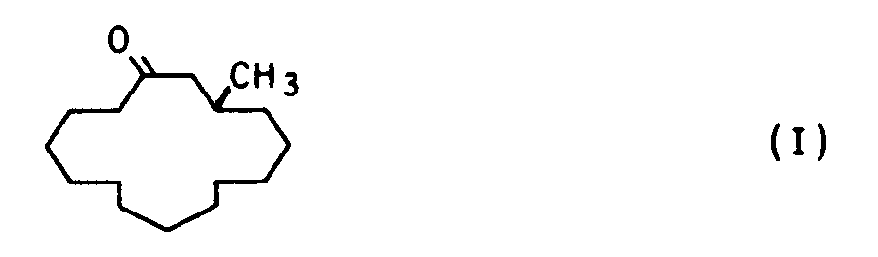
- Muscon (3-methyl-cyclopentadecanone) of the formula I. is one of the most important ingredients in natural musk extracts, which are very popular in perfumery. As a result of the extremely high price of natural extracts, the synthetic production of I is of great interest, in particular since I is far superior to all other known musk fragrances, such as the tetralin or nitro musk compounds.
- the manufacturing methods used hitherto are mainly based on ring expansion reactions, starting from cyclododecanone (cf. for example Helv. Chim. Acta 71 (1988), pp. 1704-1718 and literature cited in loc. Cit.). These methods all have very complex multi-stage process steps and are therefore unattractive for economic use.
- the invention therefore also relates to a process for preparing a mixture of the 2-unsaturated 2,15-diketones of the formulas IIb and IIc which is characterized in that 1,10-decanediol of the formula III oxidatively dehydrated, the 1,10-decanedial of formula IV thus obtained a Wittig reaction with 2 moles of a 2-oxo-propenyl-triphenylphosphonium salt of the formula V
- the 1,10-decanediol required for this process is a commercially available compound which can be obtained in a relatively simple manner by alkaline cleavage of castor oil and subsequent hydrogenation of the sebacic acid obtained.
- the oxidative dehydrogenation of the 1,10-decanediol in the 1,10-decanedial can be achieved in various ways. It is advantageous to work on silver catalysts in the gas phase, such as in Manuf.Chem. Aerosol News 37 (1966) pages 42-45 for C5-C14 alcohols. Further details on the reaction conditions for this process stage can be found in the cited literature reference. However, it can also be carried out by oxidation in methylene chloride with aqueous NaOCl solution in the presence of catalytic amounts of 4-methoxy-2,2,6,6-tetramethyl-piperidine-N-oxide. For more details on this stage of the process, we refer to J. Org. Chem. 52 (1987), pages 2559-2562.
- the procedure is advantageously such that the triphenylphosphonium salt is initially introduced in an inert organic solvent, such as methylene chloride, and the solution of the 1,10-dial in one inert, preferably slowly adding the same inert solvent and stirring the reaction mixture for a further 1 to 2 hours.
- an inert organic solvent such as methylene chloride
- the invention also relates to a process for the preparation of the 2-fold unsaturated 2,15-diketone of the formula IId
- the 1,6-hexane-diol required for this process is a commercially available and therefore inexpensive starting compound.
- the oxidative dehydrogenation of 1,6-hexanediol to adipindialdehyde can, for example, analogously to the oxidative dehydrogenation of 1,10-decanediol in the gas phase described above on a silver catalyst or with aqueous NaOCl solution in the presence of 4-methoxy-2,2 , 6,6-tetramethylpiperidine-N-oxide.
- the subsequent vinylation with 2 mol of a vinyl magnesium salt is carried out in a manner customary for Grignard reactions.
- the vinyl magnesium halide is prepared and placed in a solvent such as tetrahydrofuran (THF) and a solution of the adipindialdehyde in THF is added slowly and under temperature control.
- THF tetrahydrofuran
- the 1,9-decadiene-3,8-diol of the formula IX is obtained in very good yields by customary working up and fractional distillation.
- the Carroll reaction of the 1,9-decadiene-3,8-diol with an alkyl acetoacetate, preferably with methyl acetoacetate, is carried out by slowly heating both reactants to temperatures of about 200 ° C.
- the elimination of methanol begins at about 160 ° C and then the elimination of CO2.
- the 2-unsaturated new 2,15-diketones of the formulas IIb to IId can, like the already known diketone IIe, be converted into the saturated 2,15-hexadecanedione of the formula IIa in a simple manner and in good yields, for example by catalytic hydrogenation on a palladium catalyst be transferred.
- the invention therefore relates in particular to a process for the preparation of muscon of the formula I. which is characterized in that open-chain 2,15-diketones of the general formula II CH3-CO-X-CO-CH3 (II) in the X for one of the remnants at temperatures of 300 to 400 ° C, preferably 350 to 380 ° C in the presence of 5 to 15 wt.% Water, based on the amount of catalyst, in the gas phase on a fixed bed catalyst containing as a catalytically active compound TiO2, CeO2 or ThO2, preferably one TiO2 catalyst, in contact and the unsaturated cyclic ketone which is formed by intramolecular aldol condensation.
- the aldol condensation according to the invention is particularly advantageous if the 2,15-diketones of the general formula II are brought into contact with an alkali metal or alkaline earth metal oxide doped TiO 2 catalyst.
- the intramolecular aldol condensation is carried out in the gas phase at a temperature of 300 to 400 ° C., preferably 350 to 390 ° C., in particular 350 to 380 ° C.
- TiO2 is used with particular advantage, in particular TiO2 doped with alkali metal or alkaline earth metal oxides, i.e. about 2 to 10 wt .-% Na2O and / or K2O containing TiO2.
- the catalysts described can be used, for example, in the form of 2 to 4 mm strands or in the form of tablets with 3 to 4 mm in diameter.
- a catalyst load of 0.1 to 30 g, in particular 1 to 10 g, of open-chain diketone of the formula II is advantageously maintained per g of catalyst and hour.
- a solution of the crystalline diketones of the formula II in an inert organic solvent, such as toluene or a xylene, is generally evaporated in a tubular reactor and then - if appropriate together with an inert gas such as carbon dioxide or nitrogen - at the desired Reaction temperature passed in gaseous form over the fixed catalyst.
- an inert gas such as carbon dioxide or nitrogen -
- the addition of small amounts of water is also necessary in order to prevent possible coking of the catalyst. It is advantageous to work with 5 to 15% by weight of water, based on the amount of catalyst.
- reaction products are condensed by means of suitable cooling devices and examined by gas chromatography. Reaction products with as yet unreacted starting material can optionally be recycled directly into the cyclization reaction without further purification.
- the unsaturated cyclic ketones of the formulas Xa to Xc obtained in this aldol condensation are then converted in a manner known per se by hydrogenation in the presence of Pd catalysts into the desired musk fragrance Muscon.
- the sought-after musk fragrance Muscon can be obtained in excellent yields.
- reaction products were condensed by means of a suitable cooling device, then examined by gas chromatography and then hydrogenated in the presence of Pd catalysts.
Landscapes
- Chemical & Material Sciences (AREA)
- Organic Chemistry (AREA)
- Chemical Kinetics & Catalysis (AREA)
- Organic Low-Molecular-Weight Compounds And Preparation Thereof (AREA)
- Low-Molecular Organic Synthesis Reactions Using Catalysts (AREA)
Description
- Die vorliegende Erfindung betrifft ein Verfahren zur Herstellung des begehrten Riechstoffs Muscon durch intramolekulare Aldolkondensation von Hexadecan-2,15-dion oder Hexadecadien-2,15-dionen in der Gasphase sowie neue Hexadecadien-2,15-dione und ein vorteilhaftes Verfahren zu deren Herstellung.
- Muscon (3-Methyl-cyclopentadecanon) der Formel I

ist einer der wichtigsten Inhaltsstoffe der in der Parfümerie sehr begehrten natürlichen Moschusextrakte. Infolge des extrem hohen Preises für natürliche Extrakte ist die synthetische Herstellung von I von großem Interesse, insbesondere, da I allen anderen bekannten Moschusriechstoffen, wie den Tetralin- oder Nitromoschusverbindungen, weit überlegen ist. - Die bisher angewendeten Herstellungsmethoden basieren überwiegend auf Ringerweiterungsreaktionen, ausgehend von Cyclododekanon (vgl. beispielsweise Helv. Chim. Acta 71 (1988), S. 1704 - 1718 und in loc. Cit. genannte Literatur). Diese Methoden weisen alle teilweise recht aufwendige mehrstufige Verfahrensschritte auf und sind daher für eine wirtschaftliche Nutzung unattraktiv.
- Andere bekannte Synthesemethoden beinhalten intramolekulare Kondensationsreaktionen wie Aldol-, Dieckmann- oder Acyloinkondensation (siehe dazu Houben-Weyl, Methoden der organischen Chemie, Bd. 4/2, S. 729 - 815). Diese Methoden haben alle den großen Nachteil, daß nur in sehr hoher Verdünnung relativ gute Ausbeuten an Makrocyclen erhalten werden.
- In Helv. Chim. Acta, 62 (1979), Seiten 2673 - 2680 wird ein neuartiges Syntheseverfahren für Muscon auf Basis 4,8-Dodecadiendiol vorgestellt. Schlüsselschritt ist hierbei die säurekatalysierte intramolekulare Cyclisierung eines offenkettigen Hydroxyacetals zum bicyclischen Dihydropyran, wobei allerdings wegen des notwendigen Verdünnungsprinzips hohe Lösungsmittelmengen erforderlich sind, wodurch dieses Verfahren nur für die Synthese von Labormengen sinnvoll einsetzbar ist.
- Eine an sich recht gute Möglichkeit für die Herstellung von I schien die erstmals von Stoll (vgl. Helv. Chim. Acta, 30 (1947), Seiten 2019-2023) beschriebene Aldolkondensation ausgehend von Hexadecan-2,15-dion der Formel IIa zu sein,

da hierbei die Methylgruppe in 3-Stellung von I gleich mit eingebracht wird. - Allerdings war dieses Verfahren mit beachtlichen Nachteilen behaftet:
- 1) Waren die Herstellmöglichkeiten für das als Ausgangsmaterial benötigte Keton der Formel IIa bzw. von adäquaten 2,15-Diketonen bislang unbefriedigend.
- 2) Sind die bei der Aldolkondensation zu erzielenden Ausbeuten trotz des Arbeitens in stark verdünnten Lösungen relativ gering (gemäß loc. cit. 17 %).
- Zu 1:
Es hat daher in der Vergangenheit nicht an Versuchen gefehlt, geeignete Herstellmöglichkeiten für IIa zu entwickeln. Stoll synthetisierte es nach folgendem Reaktionsschema:
- Nachteilig an dieser Synthese ist insbesondere die Verwendung des kostspieligen und außerdem toxikologisch bedenklichen 1,10-Dibromdecans.
- Ferner wurde in J. Am. Chem. Soc. 82 (1960), Seiten 1447 - 1450, die folgende Synthese ausgehend von 2,2′,5′,2˝-Terthienyl vorgestellt:

- Zur Synthese größerer Diketonmengen ist diese Synthese jedoch wegen der schlechten Zugänglichkeit des Ausgangsmaterials nicht geeignet.
- Zwei weitere Verfahren zur Herstellung des Diketons IIa jeweils ausgehend von Butadien wurden von Tsuji et al. beschrieben:
- a) in Chem. Lett. 1976, Seiten 773-774:

- b) in Bull. Chem. Soc. Japan, 51 (1978), Seite 1915:

- In beiden Verfahren kommen teure Palladiumkatalysatoren zum Einsatz, wodurch auch diese Synthesen für einen industriellen Einsatz unattraktiv werden.
- Weiterhin ist aus Bull. Chem. Soc. Japan, 56 (1983) Seiten 345-346 ein Verfahren zur Herstellung von IIa ausgehend von α,ω-Tetradecandicarbonsäure bekannt. Nachteilig an diesem Verfahren ist die schlechte Zugänglichkeit der Ausgangsverbindung.
- Aus J. Organomet. Chem. 264 (1984), Seiten 229-37 ist außerdem ein Verfahren zur Herstellung von IIa ausgehend von (CH₃)₃Si-CH₂-CH=CH-CH₂-CH₂-C(CH₃)=CH-CH₂-Si(CH₃)₃ bekannt. Nachteilig an diesem Verfahren ist neben der schlechten Zugänglichkeit der Ausgangsverbindung die Notwendigkeit der Verwendung von problematischen Reagentien, wie dem leicht entzündlichen Kaliumhydrid.
- Es war daher eine Aufgabe der Erfindung eine technisch einfache und billige Herstellweise für das Hexadecan-2,15-dion zu finden.
- Diese Aufgabe wurde durch Bereitstellen der neuen 2-fach ungesättigten 2,15-Diketone der allgemeinen Formel II
CH₃-CO-X-CO-CH₃ (II),
in der X für einen unverzweigten Alkadienylenrest der Struktur
steht,
im wesentlichen gelöst, da diese 2,15-Diketone einerseits auf technisch einfache Weise herstellbar sind und andererseits recht vorteilhaft in das Diketon IIa sowie in Muscon überführt werden können. - Gegenstand der Erfindung ist daher auch ein Verfahren zur Herstellung eines Gemisches der 2-fach ungesättigten 2,15-Diketone der Formeln IIb und IIc

das dadurch gekennzeichnet ist, daß man 1,10-Decan-diol der Formel III
oxidativ dehydriert,
das dabei erhaltene 1,10-Decan-dial der Formel IV
einer Wittig-Reaktion mit 2 Mol eines 2-Oxo-propenyl-triphenylphosphoniumsalzes der Formel V
- worin
Y⊖ für Cl⁻, Br⁻ oder HSO₄⊖ steht, unterwirft und das Reaktionsprodukt destilliert. - Das für dieses Verfahren benötigte 1,10-Decan-diol ist eine handelsübliche Verbindung, die durch alkalische Spaltung von Ricinusöl und anschließende Hydrierung der erhaltenen Sebacinsäure auf relativ einfache Weise erhalten werden kann.
- Die oxidative Dehydrierung des 1,10-Decan-diols in das 1,10-Decandial kann auf verschiedene Weise realisiert werden. Mit Vorteil arbeitet man in der Gasphase an Silberkatalysatoren, wie beispielsweise in Manuf.Chem. Aerosol News 37 (1966) Seiten 42-45 für C₅-C₁₄-Alkohole beschrieben ist. Nähere Einzelheiten über die Reaktionsbedingungen für diese Verfahrensstufe können der genannten Literaturstelle entnommen werden. Sie kann aber auch durch Oxidation in Methylenchlorid mit wäßriger NaOCl-Lösung in Gegenwart von katalytischen Mengen von 4-Methoxy-2,2,6,6-tetramethyl-piperidin-N-oxid erfolgen. Bezüglich näherer Einzelheiten über diese Verfahrensstufe verweisen wir auf J. Org. Chem. 52 (1987), Seiten 2559-2562.
- Zur Durchführung der Wittig-Reaktion mit einem 2-Oxy-propenyl-triphenylphosphoniumsalz der Formel V geht man mit Vorteil so vor, daß man das Triphenylphosphoniumsalz in einem inerten organischen Lösungsmittel, wie Methylenchlorid vorlegt und hierzu die Lösung des 1,10-Dials in einem inerten, vorzugsweise dem gleichen inerten Lösungsmittel langsam zufügt und das Reaktionsgemisch noch 1 bis 2 Stunden nachrührt.
- Die Aufarbeitung erfolgt auf für Wittig-Reaktionen übliche Weise durch Einengen, Ausfällen des Phosphinoxids und Destillation. Durch ¹³C-NMR-Untersuchungen zeigte sich, daß bei der destillativen Aufarbeitung des Reaktionsgemisches ein Teil des zunächst gebildeten Diketons der Formel IIb zu dem Diketon der Formel IIc isomerisiert.
- Gegenstand der Erfindung ist auch ein Verfahren zur Herstellung des 2-fach ungesättigten 2,15-Diketons der Formel IId

- das dadurch gekennzeichnet ist, daß man
- A. 1,6-Hexan-diol der Formel VI

- B. den dabei erhaltenen Adipindialdehyd der Formel VII

CH₂=CH-Mg-Hal (VIII),
in der Hal für Cl oder Br steht, in einer Grignard-Reaktion umsetzt und - C. das dabei erhaltene 1,9-Decadien-3,8-diol der Formel IX

- Das für dieses Verfahren benötigte 1,6-Hexan-diol ist eine großtechnisch verfügbare und daher billige Ausgangsverbindung.
- Die oxidative Dehydrierung des 1,6-Hexan-diols zu Adipindialdehyd kann beispielsweise analog zu der oben beschriebenen oxidativen Dehydrierung des 1,10-Decandiols in der Gasphase an einem Silberkatalysator oder mit wäßriger NaOCl-Lösung in Gegenwart von 4-Methoxy-2,2,6,6-tetramethylpiperidin-N-oxid erfolgen.
- Die anschließende Vinylierung mit 2 Mol eines Vinylmagnesiumsalzes erfolgt auf für Grignard-Reaktionen übliche Weise. Beispielsweise wird das Vinylmagnesiumhalogenid in einem Lösungsmittel, wie Tetrahydrofuran (THF) hergestellt und vorgelegt und hierzu langsam und unter Temperaturkontrolle eine Lösung des Adipindialdehyds in THF zugefügt. Durch übliche Aufarbeitung und fraktionierende Destillation erhält man das 1,9-Decadien-3,8-diol der Formel IX in recht guten Ausbeuten. Bezüglich näherer Einzelheiten dieses Reaktionsschrittes verweisen wir auf Bull. Soc. Chim. France 1959, Seiten 1248-1251, bes. 1248.
- Die Carroll-Reaktion des 1,9-Decadien-3,8-diols mit einem Acetessigsäurealkylester, vorzugsweise mit Acetessigsäuremethylester erfolgt durch langsames Erhitzen beider Reaktionspartner auf Temperaturen von etwa 200°C. Dabei beginnt bei etwa 160°C die Abspaltung von Methanol und anschließend die CO₂-Abspaltung.
- Bezüglich näherer Einzelheiten der Carroll-Reaktion, d.h. der Anlagerung α,β-ungesättigter Alkohole an Verbindungen mit aktiver Methylengruppe verweisen wir auf Chem. Soc. Chim. France 1940, Seiten 704-706.
- Die 2-fach ungesättigten neuen 2,15-Diketone der Formeln IIb bis IId können wie das bereits bekannte Diketon IIe auf einfache Weise und in guten Ausbeuten, beispielsweise durch katalytische Hydrierung an einem Palladiumkatalysator, in das gesättigte 2,15-Hexadecandion der Formel IIa überführt werden.
- Zu 2:
Es wurde gefunden, daß man bei der intramolekularen Aldolkondensation des 2,15-Hexadecandions der Formel IIa Ausbeuten von bis zu 60 % der Theorie erhalten kann, wenn man diese Aldolkondensation nicht - wie bekannt - in stark verdünnter Lösung, sondern bei Temperaturen von 300 bis 450°C und in Gegenwart geringer Mengen Wasser in der Gasphase an einem Festbettkatalysator enthaltend als katalytisch wirksame Verbindung TiO₂, CeO₂ oder ThO₂, vorzugsweise TiO₂ durchführt. Es war sehr überraschend, daß diese lang untersuchte und sensible Umsetzung unter den drastischen Bedingungen einer Gasphasenreaktion so außerordentlich vorteilhaft verläuft. - Es war zwar schon eine Gasphasencyclisierungsreaktion, nämlich die Cyclisierung von Octadecandisäuredimethylester zu Cycloheptadecanon bekannt, jedoch wurde hierbei das gewünschte Cyclisierungsprodukt nur in Ausbeuten von 14 % der Theorie (gaschromatographisch ermittelt) erhalten (vgl. Parfumer and Flavorist, Vol. 7 (1982), Seite 57). Das Hauptprodukt dieser Cyclisierungsreaktion war polymeres Material.
- Überraschenderweise wurde weiterhin gefunden, daß auch die 2-fach ungesättigten 2,15-Diketone der Formeln IIb bis IIe in der Gasphase an Katalysatoren enthaltend als katalytisch wirksame Verbindung TiO₂, CeO₂ oder ThO₂ mit guten Ausbeuten cyclisiert werden können.
- Das war besonders überraschend, da aus J. Organometallic Chem. 264 (1984), Seiten 229-237, insbesondere 234, bekannt war, daß bei einem Versuch, das 2,15-Diketon der Formel IIe auf die bekannte Weise mit Diisobutylaluminiumhydrid, Phenol und Pyridin zu cyclisieren, nur Ausbeuten von etwa 6 % der Theorie an dem entsprechenden cyclischen Keton erzielt werden konnten.
- Gegenstand der Erfindung ist daher insbesondere ein Verfahren zur Herstellung von Muscon der Formel I

das dadurch gekennzeichnet ist, daß man offenkettige 2,15-Diketone der allgemeinen Formel II
CH₃-CO-X-CO-CH₃ (II)
in der X für einen der Reste
bei Temperaturen von 300 bis 400°C, vorzugsweise 350 bis 380°C in Gegenwart von 5 bis 15 Gew.% Wasser, bezogen auf die Katalysatormenge, in der Gasphase an einem Festbettkatalysator enthaltend als katalytisch wirksame Verbindung TiO₂, CeO₂ oder ThO₂, vorzugsweise einen TiO₂-Katalysator, in Kontakt bringt und das sich hierbei durch intramolekulare Aldolkondensation bildende ungesättigte cyclische Keton katalytisch hydriert. - Mit besonderem Vorteil gelingt die erfindungsgemäße Aldolkondensation, wenn man die 2,15-Diketone der allgemeinen Formel II mit einem Alkali- oder Erdalkalimetalloxid dotierten TiO₂-Katalysator in Kontakt bringt.
- Da sich die 2,15-Diketone der allgemeinen Formel II nach den oben beschriebenen Verfahren in technisch einfacher Weise herstellen lassen, ergibt sich somit ein technisch einfacher und vorteilhafter Syntheseweg zu dem begehrten Moschusriechstoff Muscon.
- Die intramolekulare Aldolkondensation wird in der Gasphase bei einer Temperatur von 300 bis 400°C, vorzugsweise 350 bis 390°C, insbesondere 350 bis 380°C durchgeführt. Als Katalysatoren für das erfindungsgemäße Verfahren verwendet man mit besonderem Vorteil TiO₂, insbesondere mit Alkali- oder Erdalkalimetalloxiden dotiertes TiO₂, d.h. etwa 2 bis 10 Gew.-% Na₂O und/oder K₂O enthaltendes TiO₂. Die beschriebenen Katalysatoren können beispielsweise in Form von 2- bis 4-mm-Strängen oder in Form von Tabletten mit 3 bis 4 mm Durchmesser eingesetzt werden. Bei der Umsetzung in der Gasphase hält man zweckmäßig eine Katalysatorbelastung von 0,1 bis 30 g, insbesondere 1 bis 10 g, offenkettiges Diketon der Formel II pro g Katalysator und Stunde ein.
- Zur Durchführung der Umsetzung wird im allgemeinen zunächst eine Lösung der kristallin anfallenden Diketone der Formel II in einem inerten organischen Lösungsmittel, wie Toluol oder einem Xylol, in einem Rohrreaktor verdampft und dann - gegebenenfalls zusammen mit einem Inertgas, wie Kohlendioxid oder Stickstoff - bei der gewünschten Reaktionstemperatur gasförmig über den fest angeordneten Katalysator geleitet. Um gute Ausbeuten an cyclischem Keton zu erzielen, ist weiterhin der Zusatz von geringen Mengen an Wasser notwendig, um eine mögliche Verkokung des Katalysators zu unterbinden. Vorteilhaft arbeitet man mit 5 bis 15 Gew.% Wasser, bezogen auf die Katalysatormenge.
- Die Reaktionsprodukte werden mittels geeigneter Kühlvorrichtungen kondensiert und gaschromatographisch untersucht. Reaktionsprodukte mit noch unumgesetztem Ausgangsmaterial lassen sich gegebenenfalls erneut ohne weitere Reinigung direkt in die Cyclisierungsreaktion zurückführen.
- Die bei dieser Aldolkondensation erhaltenen ungesättigten cyclischen Ketone der Formeln Xa bis Xc

werden anschließend in an sich bekannter Weise durch Hydrieren in Gegenwart von Pd-Katalysatoren in den gewünschten Moschusriechstoff Muscon überführt. - Mit Hilfe der erfindungsgemäßen intramolekularen Aldolkondensation der 2,15-Diketone der Formel II und die anschließende katalytische Hydrierung kann der begehrte Moschusriechstoff Muscon in ausgezeichneten Ausbeuten erhalten werden. Durch Bereitstellen der neuen 2,15-Diketone der Formeln IIb bis IId sowie vorteilhaften Verfahren zu deren Herstellung ergibt sich somit ein technisch einfacher und vorteilhafter Syntheseweg von gut zugänglichen Ausgangsstoffen zu dem begehrten Muscon.
- In einem 4-l-Dreihalskolben wurden bei Raumtemperatur (RT) die folgenden Chemikalien vorgelegt:
59 g (0,5 mol) 1,6-Hexandiol
3,9 g (0,025 mol) 2,2,6,6-Tetramethyl-piperidin-1-oxyd
3,0 g (0,025 mol) KBr
7,8 g (0,05 mol) NaH₂PO₄ x 2 H₂O
8,9 g (0,05 mol) NaH₂PO₄ x 2 H₂O
1 l CH₂Cl₂ + 375 ml Wasser. - Innerhalb von 2 Stunden (h) wurden anschließend 567 g (0,51 mol) einer ca. 13 %igen wäßrigen NaOCl-Lösung zugetropft (leicht exotherm). Dabei änderte sich der pH-Wert der Reaktionslösung von 6,7 nach 6,0. Nach dem Zutropfen wurde 15 Minuten (min) bei RT nachgerührt. Nach dem Abtrennen der organischen Phase wurde die wäßrige Phase 2mal mit je 200 ml CH₂Cl₂ extrahiert, die vereinigten organischen Phasen mit NaHCO₃-Lösung neutral gewaschen und mit Na₂SO₄ getrocknet. Nach dem Abfiltrieren von Na₂SO₄ wurde am Rotationsverdampfer das Lösungsmittel abdestilliert und vom Rückstand ein Gaschromatogramm aufgenommen.
- Das Rohprodukt wurde direkt in der nächsten Stufe vinyliert.
- 0,81 l einer 1,55 molaren Vinylmagnesiumchloridlösung in Tetrahydrofuran (THF) wurden vorgelegt. Innerhalb von 1 h wurden 48,0 g Adipindialdehyd (roh, 80,5 %ig), gelöst in 50 ml THF, unter Temperaturkontrolle zugetropft und anschließend 2 h nachgerührt. Nach der üblichen Aufarbeitung verblieben 59,6 g eines hellgelben Öls, das unter stark vermindertem Druck (Ölpumpe) fraktionierend destilliert wurde.
- Die Ausbeute nach Destillation (Kp·0,5 = 108 bis 110°C) betrug 36,4 g (91 %ig), entsprechend einer Ausbeute von 64 % der Theorie.
- Ein Gemisch aus 36,4 g eines 91 %igen (entsprechend 0,19 mol) 1,9-Decadien-3,8-diols und 74,5 g (0,61 mol) Acetessigsäuremethylester wurde innerhalb von 3 h auf 200°C erhitzt. Bei ca. 160°C begann die Methanolabspaltung, anschließend die CO₂-Abspaltung. Insgesamt destillierten 14,1 g Niedersieder (Sdp. <70°C) ab, und es wurden 9,5 l CO₂ (Theorie 10,2 l) abgespalten. Der Rückstand (73,5 g) wurde anschließend unter stark vermindertem Druck (Ölpumpe) fraktionierend destilliert.
- Die Ausbeute nach Destillation (Kp·0,5 = 160 bis 170°C) betrug 38,6 g (81 %ig), entsprechend einer Ausbeute von 66 % der Theorie. Schmelzpunkt 54°C.
- ¹H-NMR (CDCl₃): δ = 1,32 (4H, m); 1,8-2,0 (4H, m); 2,1 (6H, s); 2,2-2,3 (4H, m); 2,5 (4H, b); 5,3-5,4 (4H, m); ¹³C-NMR (CDCl₃): δ = 26,9; 28,9; 29,6; 32,3; 43,6; 128,6; 131,3; 207,4.
- 38 g Hexadeca-5,11-dien-2,15-dion (0,152 mol) wurden in 200 ml Essigsäureethylester gelöst und bei 50°C unter Standardbedingungen mit 1,9 g 10 %ig Pd/C hydriert. Man erhielt nach Umkristallisation aus Petrolether 25,8 g eines 97 %igen Hexadecan-2,15-dions mit einem Schmelzpunkt von 80°C. Die Ausbeute betrug somit 66 % der Theorie.
- Analog dem Verfahren gemäß Beispiel 1a) wurden 37 g (0,2 mol) 1,10-Decandiol durch Oxidation in 1,10-Decandial überführt. Ausbeute: 31 g (79 %ig) entsprechend 73 % der Theorie.
- 1150 ml einer 0,783 molaren Lösung von Triphenyl-phosphin-2-oxopropylen in Dichlormethan (0,9 mol) wurden bei RT vorgelegt. Zu dem so erhaltenen Wittigreagenz wurde innerhalb von 2 h eine Lösung von 69,5 g 1,10-Decandial (0,33 mol) in 250 ml Dichlormethan zugetropft (leicht exotherme Reaktion) und eine weitere Stunde nachgerührt. Zur Aufarbeitung wurde der Kolbeninhalt eingeengt und der Rückstand mit 1 l Cyclohexan ausgerührt. Das auskristallisierte Phosphinoxid wurde abfiltriert und die Mutterlauge nochmals mit 300 ml kaltem Cyclohexan gerührt. Nach dem Abtrennen der Restmenge des Phosphinoxids wurde die Mutterlauge eingeengt und unter vermindertem Druck (Ölpumpe) fraktionierend destilliert.
- Die Ausbeute an 3,13-Hexadecadien-2,15-dion betrug 72 g (93 %ig) vom Sdp.: 136-139°C/0,03 mm, entsprechend einer Ausbeute von 81 % der Theorie.
- ¹³C-NMR (CDCl₃): δ = 197,4 (C-2, C-15); 147,6 (C-4, C-13); 131,4 (C-3, C-14) ; 32,3 (C-5, C-12) ; 29,2 (C-8, C-9) ; 29,1 (C-7, C-10) ; 28,2 (C-6, C-11) ; 26,7 (C-1, C-16);
- Die Auswertung der ¹³C-NMR-Daten der Reaktionsprodukte zeigte, daß bei der Destillation 25 % der erhaltenen Verbindung der Formel IIb in die Verbindung der Formel IIC isomerisiert sind.

- ¹³C-NMR (CDCl₃): δ = 206,0 (C-2, C-15); 134,9 (C-5); 122,3 (C-4); 47,5 (C-3); 32,4 (C-6); 28,6 (C-7);

- Jeweils eine Lösung von 1,5 g eines gemäß Beispiel 1 erhaltenen Hexadecan-2,15-dions (IIa) in einem Gemisch aus 20 ml Dekalin und 10 ml Toluol wurde in einem Rohrreaktor verdampft und dann zusammen mit Stickstoff bei der in der Tabelle angegebenen Reaktionstemperatur gasförmig über einen in einer Säule (d = 22 mm; Länge = 50 cm) fest angeordneten Katalysator der aus der Tabelle ersichtlichen Zusammensetzung in Form von 2 bis 4 mm Strängen geleitet. In den Beispielen 1 bis 4 wurden dem Reaktionsgemisch außerdem die aus der Tabelle ersichtliche Menge Wasser zugesetzt.
- Die Reaktionsprodukte wurden mittels einer geeigneten Kühlvorrichtung kondensiert, anschließend gaschromatographisch untersucht und dann in Gegenwart von Pd-Katalysatoren hydriert.
- Die Reaktionsbedingungen sowie die erzielten Versuchsergebnisse sind in der folgenden Tabelle zusammengestellt.


- Eine Lösung von 4,5 g eines analog Beispiel 1a bis c hergestellten 5,11-Hexadecadien-2,15-dions IId in 20 ml Toluol pro Stunde (LHSV = 0,03) wurde unter Zusatz von 5 ml Wasser/h in einem Rohrreaktor verdampft und zusammen mit 10 L N₂/h und bei 380°C gasförmig über einen in einer Säule (d = 22 mm; 1 = 50 cm) fest angeordneten Katalysator bestehend aus TiO₂ und 2 % Na₂O in Form von 2 bis 4 mm-Strängen geleitet. Die Reaktionsprodukte wurden mittels einer geeigneten Kühlvorrichtung kondensiert und anschließend gaschromatographisch untersucht.
- Man erhielt bei einem Umsatz von 66 % eine Selektivität an Hexadehydromuscon von 63 % der Theorie.
Claims (10)
- Verfahren zur Herstellung von Muscon der Formel I

CH₃-CO-X-CO-CH₃ (II)
in der X für einen der Reste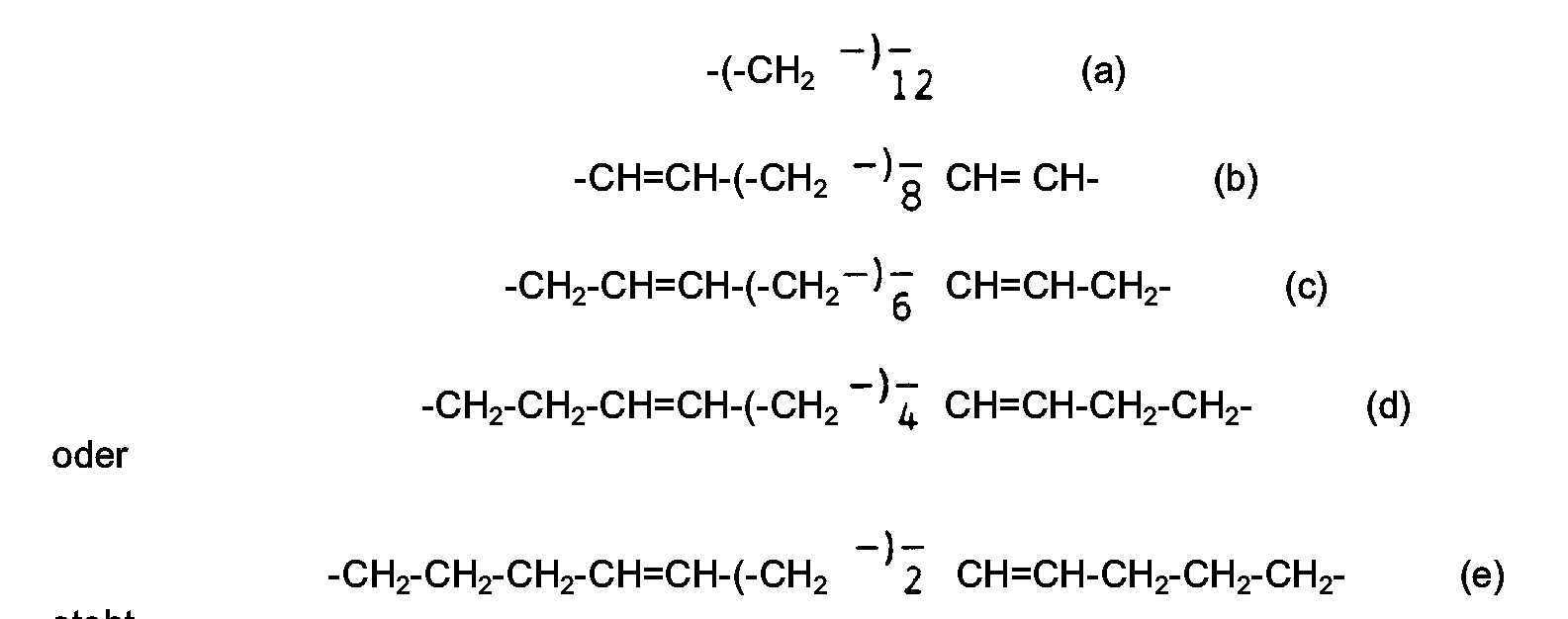
- Verfahren zur Herstellung von Muscon gemäß Anspruch 1, dadurch gekennzeichnet, daß man die 2,15-Diketone der allgemeinen Formel II bei Temperaturen von 350 bis 380°C mit dem Katalysator in Kontakt bringt.
- Verfahren zur Herstellung von Muscon gemäß Anspruch 1, dadurch gekennzeichnet, daß man die 2,15-Diketone der allgemeinen Formel II mit einem TiO₂-Katalysator in Kontakt bringt.
- Verfahren zur Herstellung von Muscon gemäß Anspruch 1, dadurch gekennzeichnet, daß man die 2,15-Diketone der allgemeinen Formel II mit einem mit Alkali- oder Erdalkalimetalloxiden dotierten TiO₂-Katalysator in Kontakt bringt.
- Offenkettige 2-fach ungesättigte 2,15-Diketone der allgemeinen Formel II
CH₃-CO-X-CO-CH₃ (II),
in der X für einen unverzweigten Alkadienylenrest der Struktur
- Verfahren zur Herstellung eines Gemisches der 2-fach ungesättigten 2,15-Diketone der Formeln IIb und IIc gemäß Anspruch 5


das dabei erhaltene 1,10-Decan-dial der Formel IV


Y⊖ für Cl⁻, Br⁻ oder HSO₄⊖ steht, unterwirft und das Reaktionsprodukt destilliert. - Verfahren zur Herstellung des 2-fach ungesättigten 2,15-Diketons der Formel IId gemäß Anspruch 5
 A. 1,6-Hexan-diol der Formel VI
 B. den dabei erhaltenen Adipindialdehyd der Formel VII
CH₂=CH-Mg-Hal (VIII),
in der Hal für Cl oder Br steht, in einer Grignard-Reaktion umsetzt undC. das dabei erhaltene 1,9-Decadien-3,8-diol der Formel IX
- Verfahren zur Herstellung von Muscon gemäß Anspruch 1, dadurch gekennzeichnet, daß man ein offenkettiges 2,15-Diketon der Formeln IIa oder IId
 A. Oxidatives Dehydrieren von 1,6-Hexan-diol der Formel VI
 B. Grignard-Reaktion des dabei erhaltenen Adipindialdehyds der Formel VII
CH₂=CH-Mg-Hal (VIII),
worin Hal für Cl oder Br steht,C. Carroll-Reaktion des dabei erhaltenen 1,9-Decadien-3,8-diols der Formel IX D. ggf. anschließende katalytische Hydrierung des dabei erhaltenen offenkettigen Ketons der Formel IId.
 - Verfahren zur Herstellung von Muscon gemäß Anspruch 1, dadurch gekennzeichnet, daß man ein offenkettiges 2,15-Diketon der Formeln IIa oder ein Gemisch der 2,15-Diketone der Formeln IIb und IIc
 A. Oxidatives Dehydrieren von 1,10-Decandiol der Formel III
 B. Wittig-Reaktion des dabei erhaltenen 1,10-Decandial der Formel IV
 C. ggf. anschließende katalytische Hydrierung des dabei erhaltenen Gemisches der 2,5-Diketone der Formeln IIb und IIc.
 - Verwendung der offenkettigen 2-fach ungesättigten 2,15-Diketone der allgemeinen Formeln IIb, IIc und IId gemäß Anspruch 5


Applications Claiming Priority (2)
| Application Number | Priority Date | Filing Date | Title |
|---|---|---|---|
| DE3918015A DE3918015A1 (de) | 1989-06-02 | 1989-06-02 | Verfahren zur herstellung von muscon, zwischenprodukte fuer dieses verfahren sowie deren herstellung |
| DE3918015 | 1989-06-02 |
Publications (2)
| Publication Number | Publication Date |
|---|---|
| EP0400509A1 EP0400509A1 (de) | 1990-12-05 |
| EP0400509B1 true EP0400509B1 (de) | 1993-04-07 |
Family
ID=6381927
Family Applications (1)
| Application Number | Title | Priority Date | Filing Date |
|---|---|---|---|
| EP90110008A Expired - Lifetime EP0400509B1 (de) | 1989-06-02 | 1990-05-26 | Verfahren zur Herstellung von Muscon, Zwischenprodukte für dieses Verfahren sowie deren Herstellung |
Country Status (4)
| Country | Link |
|---|---|
| US (2) | US5081311A (de) |
| EP (1) | EP0400509B1 (de) |
| JP (1) | JP2763383B2 (de) |
| DE (2) | DE3918015A1 (de) |
Families Citing this family (13)
| Publication number | Priority date | Publication date | Assignee | Title |
|---|---|---|---|---|
| EP0976714A1 (de) * | 1998-07-06 | 2000-02-02 | Quest International B.V. | Anlagerung von Ketonen an Alkenen |
| DE10023886A1 (de) | 2000-05-17 | 2001-11-22 | Basf Ag | Acetessigsäure-Derivate, Verfahren zu ihrer Herstellung und ihre Verwendung |
| DE10038021A1 (de) * | 2000-08-04 | 2002-02-14 | Haarmann & Reimer Gmbh | Neue makrocyclische Ketone |
| JP4540197B2 (ja) * | 2000-08-30 | 2010-09-08 | 高砂香料工業株式会社 | (e)−3−メチル−2−シクロペンタデセノンの製造法 |
| DE10232750A1 (de) | 2002-07-18 | 2004-02-05 | Basf Ag | Verfahren zur Herstellung von macrocyclischen Ketonen durch Dieckmann-Kondensation in der Gasphase |
| DE10344690A1 (de) * | 2003-09-25 | 2005-04-14 | Basf Ag | Verfahren zur Herstellung von 1,7-Octadien und dessen Verwendung |
| DE102004015873B4 (de) | 2004-03-31 | 2007-03-22 | Joachim Fiedler | Lösbare Magnethalterung |
| JP4673611B2 (ja) * | 2004-12-01 | 2011-04-20 | 高砂香料工業株式会社 | ムスコンの製造方法及びその中間体 |
| WO2010109650A1 (ja) | 2009-03-27 | 2010-09-30 | Doya Masaharu | 3-メチル-シクロペンタデセノン類の製造方法、r/s-ムスコンの製造方法および光学活性ムスコンの製造方法 |
| EP3170828A1 (de) * | 2015-11-23 | 2017-05-24 | Basf Se | Verfahren zur herstellung von verbindungen mit 16-oxabicyclo[10.3.1]pentadecengerüst und deren folgeprodukten |
| US11634718B2 (en) | 2017-11-01 | 2023-04-25 | Takasago International Corporation | Production of macrocyclic ketones in recombinant hosts |
| CN108191622B (zh) * | 2017-12-15 | 2021-02-09 | 广东省石油与精细化工研究院 | 一种dl-麝香酮的连续制备方法 |
| JP7382333B2 (ja) | 2018-09-25 | 2023-11-16 | 高砂香料工業株式会社 | 3-メチルシクロアルケノン類の製造方法 |
Family Cites Families (10)
| Publication number | Priority date | Publication date | Assignee | Title |
|---|---|---|---|---|
| AT108150B (de) * | 1924-06-16 | 1927-11-25 | Naef & Cie M | Verfahren zur Herstellung der carbocyclischen Ketone mit mehr als neun Ringgliedern. |
| DE875351C (de) * | 1946-09-02 | 1953-04-30 | Firmenich & Co Successeurs De | Verfahren zur Herstellung von ª‰-Methylcyclopentadekanon |
| AT230347B (de) * | 1961-01-28 | 1963-12-10 | Bayer Ag | Verfahren zur Herstellung von Octen-(4)-dion-(2, 7) |
| US3718696A (en) * | 1970-03-11 | 1973-02-27 | Int Flavors & Fragrances Inc | Process for the preparation of macrocyclic compounds and novel compounds produced thereby |
| GB1492525A (en) * | 1973-11-14 | 1977-11-23 | Shell Int Research | Cyclic alkanones |
| US4570021A (en) * | 1976-08-20 | 1986-02-11 | Sds Biotech Corporation | Preparation of ketones |
| US4277625A (en) * | 1978-12-07 | 1981-07-07 | Firmenich Sa | Process for the preparation of muscone |
| US4302607A (en) * | 1979-02-12 | 1981-11-24 | Firmenich Sa | Process for the preparation of novel unsaturated macrocyclic ketones |
| EP0230499B1 (de) * | 1984-08-28 | 1991-07-03 | Nippon Mining Company Limited | Verfahren zur Herstellung von makrozyklischen Ketonen |
| DE3824625A1 (de) * | 1988-07-20 | 1990-01-25 | Bayer Ag, 5090 Leverkusen | Verfahren zur hydrierung von (alpha),(beta)-ungesaettigten ketonen |
-
1989
- 1989-06-02 DE DE3918015A patent/DE3918015A1/de not_active Withdrawn
-
1990
- 1990-05-18 US US07/524,929 patent/US5081311A/en not_active Expired - Lifetime
- 1990-05-26 DE DE9090110008T patent/DE59001156D1/de not_active Expired - Lifetime
- 1990-05-26 EP EP90110008A patent/EP0400509B1/de not_active Expired - Lifetime
- 1990-06-01 JP JP2141730A patent/JP2763383B2/ja not_active Expired - Fee Related
-
1991
- 1991-09-10 US US07/757,305 patent/US5120880A/en not_active Expired - Lifetime
Also Published As
| Publication number | Publication date |
|---|---|
| DE59001156D1 (de) | 1993-05-13 |
| DE3918015A1 (de) | 1990-12-06 |
| US5120880A (en) | 1992-06-09 |
| US5081311A (en) | 1992-01-14 |
| JP2763383B2 (ja) | 1998-06-11 |
| EP0400509A1 (de) | 1990-12-05 |
| JPH0381242A (ja) | 1991-04-05 |
Similar Documents
| Publication | Publication Date | Title |
|---|---|---|
| EP0400509B1 (de) | Verfahren zur Herstellung von Muscon, Zwischenprodukte für dieses Verfahren sowie deren Herstellung | |
| DE2916418C2 (de) | ||
| DE19949796A1 (de) | Verfahren zur Herstellung von ungesättigten 4,5-Allenketonen, 3,5-Dienketonen und den entsprechenden gesättigten Ketonen | |
| EP0293739B1 (de) | Verfahren zur Herstellung von 4-Isopropyl-cyclohexylmethanol bzw. dessen Alkylethern | |
| DE2036936C3 (de) | ||
| CH621105A5 (de) | ||
| DE3034040C2 (de) | Verfahren zur Herstellung von Muscon, 16-Oxa-14-methyl-bicyclo[10.3.1]-hexadec-1-en als Zwischenprodukt für dieses Verfahren und ein Verfahren zu dessen Herstellung | |
| DE2363535C2 (de) | 2,7-Dimethyl-5,7-octadien-2-ol, seinen Methyläther und seinen Essigsäureester, Verfahren zu ihrer Herstellung und ihre Verwendung | |
| DE2141309C3 (de) | ||
| DE2630835A1 (de) | Neue moschusartige riechstoffe und verfahren zu deren herstellung | |
| EP0010213A2 (de) | Bicyclische Verbindungen, Verfahren zu deren Herstellung und deren Verwendung | |
| EP1156029B1 (de) | Acetessigsäure-Derivate, Verfahren zu ihrer Herstellung und ihre Verwendung | |
| DE2630428C3 (de) | 15-Methyl- und 15 Äthyl-13-oxo- bzw. -13-hydroxy-bicyclo[10.3.0]-pentadecane bzw.-pentadecene-[1(12)], Verfahren zu deren Herstellung und Verwendung als Riechstoffe | |
| DE3237632C2 (de) | ||
| DE2537417B2 (de) | Verfahren zur Herstellung von tricyclischen Sesquiterpenen und diese enthaltende Parfümkompositionen | |
| DE3508420A1 (de) | Verfahren zur herstellung von 2-alkyl-cyclopentanonen | |
| DE2848095A1 (de) | Substituierte perhydro-naphtofurane | |
| DE2844155A1 (de) | 1,7-octadien-3-on und verfahren zu seiner herstellung | |
| DE2064919C3 (de) | ||
| DE2719976C2 (de) | Bicyclische Aldehyde und Verfahren zu deren Herstellung | |
| EP0533892B1 (de) | 8-exo-formyl-2,6-exo-tricyclo[5.2.1.0/2,6]decan, verfahren zu seiner herstellung sowie verwendung desselben | |
| DE19747226A1 (de) | Verfahren zur Herstellung von alpha-Methylen-beta-methyl-gamma-butyrolacton und als Zwischenprodukt wertvolle 4-Hydroxybutyraldehyde sowie 2-Hydroxy-3-methylen-4-methyltetrahydrofuran | |
| DE2357753B2 (de) | 2- bzw. 3-Methyl-4-alkoxy(aryloxy)-3-buten-l-ale und Verfahren zu deren Herstellung | |
| EP0051260A1 (de) | Methyl-4-oxatricyclo(5.2.1.02,6)-dec-8-en-3-on (I) und Methyl-4-oxatricyclo(5.2.1.02,6)-decan-3-on (II), deren Herstellung und deren Verwendung als Riechstoffe | |
| DE2064918C3 (de) |
Legal Events
| Date | Code | Title | Description |
|---|---|---|---|
| PUAI | Public reference made under article 153(3) epc to a published international application that has entered the european phase |
Free format text: ORIGINAL CODE: 0009012 |
|
| AK | Designated contracting states |
Kind code of ref document: A1 Designated state(s): CH DE FR GB LI NL |
|
| 17P | Request for examination filed |
Effective date: 19901113 |
|
| 17Q | First examination report despatched |
Effective date: 19920825 |
|
| GRAA | (expected) grant |
Free format text: ORIGINAL CODE: 0009210 |
|
| AK | Designated contracting states |
Kind code of ref document: B1 Designated state(s): CH DE FR GB LI NL |
|
| REF | Corresponds to: |
Ref document number: 59001156 Country of ref document: DE Date of ref document: 19930513 |
|
| GBT | Gb: translation of ep patent filed (gb section 77(6)(a)/1977) |
Effective date: 19930428 |
|
| ET | Fr: translation filed | ||
| K2C3 | Correction of patent specification (complete document) published |
Effective date: 19930407 |
|
| PLBE | No opposition filed within time limit |
Free format text: ORIGINAL CODE: 0009261 |
|
| STAA | Information on the status of an ep patent application or granted ep patent |
Free format text: STATUS: NO OPPOSITION FILED WITHIN TIME LIMIT |
|
| 26N | No opposition filed | ||
| REG | Reference to a national code |
Ref country code: GB Ref legal event code: IF02 |
|
| PGFP | Annual fee paid to national office [announced via postgrant information from national office to epo] |
Ref country code: NL Payment date: 20020415 Year of fee payment: 13 |
|
| PG25 | Lapsed in a contracting state [announced via postgrant information from national office to epo] |
Ref country code: NL Free format text: LAPSE BECAUSE OF NON-PAYMENT OF DUE FEES Effective date: 20031201 |
|
| NLV4 | Nl: lapsed or anulled due to non-payment of the annual fee |
Effective date: 20031201 |
|
| PGFP | Annual fee paid to national office [announced via postgrant information from national office to epo] |
Ref country code: GB Payment date: 20040526 Year of fee payment: 15 |
|
| PGFP | Annual fee paid to national office [announced via postgrant information from national office to epo] |
Ref country code: CH Payment date: 20040527 Year of fee payment: 15 |
|
| PGFP | Annual fee paid to national office [announced via postgrant information from national office to epo] |
Ref country code: FR Payment date: 20050511 Year of fee payment: 16 |
|
| PGFP | Annual fee paid to national office [announced via postgrant information from national office to epo] |
Ref country code: DE Payment date: 20050519 Year of fee payment: 16 |
|
| PG25 | Lapsed in a contracting state [announced via postgrant information from national office to epo] |
Ref country code: GB Free format text: LAPSE BECAUSE OF NON-PAYMENT OF DUE FEES Effective date: 20050526 |
|
| PG25 | Lapsed in a contracting state [announced via postgrant information from national office to epo] |
Ref country code: LI Free format text: LAPSE BECAUSE OF NON-PAYMENT OF DUE FEES Effective date: 20050531 Ref country code: CH Free format text: LAPSE BECAUSE OF NON-PAYMENT OF DUE FEES Effective date: 20050531 |
|
| REG | Reference to a national code |
Ref country code: CH Ref legal event code: PL |
|
| GBPC | Gb: european patent ceased through non-payment of renewal fee |
Effective date: 20050526 |
|
| PG25 | Lapsed in a contracting state [announced via postgrant information from national office to epo] |
Ref country code: DE Free format text: LAPSE BECAUSE OF THE APPLICANT RENOUNCES Effective date: 20060624 |
|
| REG | Reference to a national code |
Ref country code: FR Ref legal event code: ST Effective date: 20070131 |
|
| PG25 | Lapsed in a contracting state [announced via postgrant information from national office to epo] |
Ref country code: FR Free format text: LAPSE BECAUSE OF NON-PAYMENT OF DUE FEES Effective date: 20060531 |