EP0391956B1 - Cyanohydrin derivatives and their use in liquid crystal materials and devices - Google Patents
Cyanohydrin derivatives and their use in liquid crystal materials and devices Download PDFInfo
- Publication number
- EP0391956B1 EP0391956B1 EP89900631A EP89900631A EP0391956B1 EP 0391956 B1 EP0391956 B1 EP 0391956B1 EP 89900631 A EP89900631 A EP 89900631A EP 89900631 A EP89900631 A EP 89900631A EP 0391956 B1 EP0391956 B1 EP 0391956B1
- Authority
- EP
- European Patent Office
- Prior art keywords
- formula
- liquid crystal
- derivative according
- alkyl
- cyanohydrin derivative
- Prior art date
- Legal status (The legal status is an assumption and is not a legal conclusion. Google has not performed a legal analysis and makes no representation as to the accuracy of the status listed.)
- Expired - Lifetime
Links
- 0 CCC(*(C)C)(c(cc1)ccc1-c(cc1)ccc1-c1ccc(C(C)(*)*)cc1)I=* Chemical compound CCC(*(C)C)(c(cc1)ccc1-c(cc1)ccc1-c1ccc(C(C)(*)*)cc1)I=* 0.000 description 9
- YWARALJRTFUCOQ-UHFFFAOYSA-N CCCC(C)CCC(C)C1(C)CCCC1 Chemical compound CCCC(C)CCC(C)C1(C)CCCC1 YWARALJRTFUCOQ-UHFFFAOYSA-N 0.000 description 1
Images



Classifications
-
- C—CHEMISTRY; METALLURGY
- C07—ORGANIC CHEMISTRY
- C07C—ACYCLIC OR CARBOCYCLIC COMPOUNDS
- C07C255/00—Carboxylic acid nitriles
- C07C255/01—Carboxylic acid nitriles having cyano groups bound to acyclic carbon atoms
- C07C255/11—Carboxylic acid nitriles having cyano groups bound to acyclic carbon atoms containing cyano groups and singly-bound oxygen atoms bound to the same saturated acyclic carbon skeleton
- C07C255/14—Carboxylic acid nitriles having cyano groups bound to acyclic carbon atoms containing cyano groups and singly-bound oxygen atoms bound to the same saturated acyclic carbon skeleton containing cyano groups and esterified hydroxy groups bound to the carbon skeleton
-
- C—CHEMISTRY; METALLURGY
- C09—DYES; PAINTS; POLISHES; NATURAL RESINS; ADHESIVES; COMPOSITIONS NOT OTHERWISE PROVIDED FOR; APPLICATIONS OF MATERIALS NOT OTHERWISE PROVIDED FOR
- C09K—MATERIALS FOR MISCELLANEOUS APPLICATIONS, NOT PROVIDED FOR ELSEWHERE
- C09K19/00—Liquid crystal materials
- C09K19/04—Liquid crystal materials characterised by the chemical structure of the liquid crystal components, e.g. by a specific unit
- C09K19/06—Non-steroidal liquid crystal compounds
- C09K19/08—Non-steroidal liquid crystal compounds containing at least two non-condensed rings
- C09K19/10—Non-steroidal liquid crystal compounds containing at least two non-condensed rings containing at least two benzene rings
- C09K19/20—Non-steroidal liquid crystal compounds containing at least two non-condensed rings containing at least two benzene rings linked by a chain containing carbon and oxygen atoms as chain links, e.g. esters or ethers
- C09K19/2007—Non-steroidal liquid crystal compounds containing at least two non-condensed rings containing at least two benzene rings linked by a chain containing carbon and oxygen atoms as chain links, e.g. esters or ethers the chain containing -COO- or -OCO- groups
- C09K19/2021—Compounds containing at least one asymmetric carbon atom
-
- C—CHEMISTRY; METALLURGY
- C07—ORGANIC CHEMISTRY
- C07C—ACYCLIC OR CARBOCYCLIC COMPOUNDS
- C07C255/00—Carboxylic acid nitriles
- C07C255/01—Carboxylic acid nitriles having cyano groups bound to acyclic carbon atoms
- C07C255/16—Carboxylic acid nitriles having cyano groups bound to acyclic carbon atoms containing cyano groups and singly-bound oxygen atoms bound to the same carbon atom of an acyclic carbon skeleton
-
- C—CHEMISTRY; METALLURGY
- C09—DYES; PAINTS; POLISHES; NATURAL RESINS; ADHESIVES; COMPOSITIONS NOT OTHERWISE PROVIDED FOR; APPLICATIONS OF MATERIALS NOT OTHERWISE PROVIDED FOR
- C09K—MATERIALS FOR MISCELLANEOUS APPLICATIONS, NOT PROVIDED FOR ELSEWHERE
- C09K19/00—Liquid crystal materials
-
- C—CHEMISTRY; METALLURGY
- C09—DYES; PAINTS; POLISHES; NATURAL RESINS; ADHESIVES; COMPOSITIONS NOT OTHERWISE PROVIDED FOR; APPLICATIONS OF MATERIALS NOT OTHERWISE PROVIDED FOR
- C09K—MATERIALS FOR MISCELLANEOUS APPLICATIONS, NOT PROVIDED FOR ELSEWHERE
- C09K19/00—Liquid crystal materials
- C09K19/04—Liquid crystal materials characterised by the chemical structure of the liquid crystal components, e.g. by a specific unit
- C09K19/06—Non-steroidal liquid crystal compounds
- C09K19/08—Non-steroidal liquid crystal compounds containing at least two non-condensed rings
- C09K19/10—Non-steroidal liquid crystal compounds containing at least two non-condensed rings containing at least two benzene rings
- C09K19/12—Non-steroidal liquid crystal compounds containing at least two non-condensed rings containing at least two benzene rings at least two benzene rings directly linked, e.g. biphenyls
- C09K19/126—Compounds containing at least one asymmetric carbon atom
-
- C—CHEMISTRY; METALLURGY
- C09—DYES; PAINTS; POLISHES; NATURAL RESINS; ADHESIVES; COMPOSITIONS NOT OTHERWISE PROVIDED FOR; APPLICATIONS OF MATERIALS NOT OTHERWISE PROVIDED FOR
- C09K—MATERIALS FOR MISCELLANEOUS APPLICATIONS, NOT PROVIDED FOR ELSEWHERE
- C09K19/00—Liquid crystal materials
- C09K19/04—Liquid crystal materials characterised by the chemical structure of the liquid crystal components, e.g. by a specific unit
- C09K19/06—Non-steroidal liquid crystal compounds
- C09K19/32—Non-steroidal liquid crystal compounds containing condensed ring systems, i.e. fused, bridged or spiro ring systems
- C09K19/322—Compounds containing a naphthalene ring or a completely or partially hydrogenated naphthalene ring
-
- C—CHEMISTRY; METALLURGY
- C07—ORGANIC CHEMISTRY
- C07C—ACYCLIC OR CARBOCYCLIC COMPOUNDS
- C07C2601/00—Systems containing only non-condensed rings
- C07C2601/12—Systems containing only non-condensed rings with a six-membered ring
-
- C—CHEMISTRY; METALLURGY
- C09—DYES; PAINTS; POLISHES; NATURAL RESINS; ADHESIVES; COMPOSITIONS NOT OTHERWISE PROVIDED FOR; APPLICATIONS OF MATERIALS NOT OTHERWISE PROVIDED FOR
- C09K—MATERIALS FOR MISCELLANEOUS APPLICATIONS, NOT PROVIDED FOR ELSEWHERE
- C09K19/00—Liquid crystal materials
- C09K19/04—Liquid crystal materials characterised by the chemical structure of the liquid crystal components, e.g. by a specific unit
- C09K19/06—Non-steroidal liquid crystal compounds
- C09K19/08—Non-steroidal liquid crystal compounds containing at least two non-condensed rings
- C09K19/10—Non-steroidal liquid crystal compounds containing at least two non-condensed rings containing at least two benzene rings
- C09K19/12—Non-steroidal liquid crystal compounds containing at least two non-condensed rings containing at least two benzene rings at least two benzene rings directly linked, e.g. biphenyls
- C09K2019/121—Compounds containing phenylene-1,4-diyl (-Ph-)
- C09K2019/123—Ph-Ph-Ph
Definitions
- This invention relates to cyanohydrin derivatives and also to liquid crystal materials containing them.
- the invention relates to chiral derivatives and ferroelectric smectic liquid crystal compositions containing them.
- Ferroelectric smectic liquid crystal materials are known, (eg N A Clark et al: Appl Phys Lett (1980) 36 899), and exploit the electro-optical properties of the ferroelectric chiral smectic phase.
- the chiral smectic C (abbreviated S the asterisk denoting chirality) is most used as it is the most fluid, but other chiral smectic phases eg I, F, J, K, G, H or X may also be used.
- ferroelectric smectic liquid crystal materials are single compounds it is more usual for such a material to be a composition.
- a composition contains one or more compounds which either singly or together show an S C phase (termed a smectic "host"), together with one or more chiral (ie optically active) compounds which are generally added to induce the smectic material to show a high spontaneous polarisation. Ps.
- the composition may also contain additives. For example to broaden the Sc* range, to suppress undesirable phases, or optically active compounds to modify the helical pitch of the Sc* phase.
- Optically active compounds used in ferroelectric smectic liquid crystal compositions generally consist of a "core" consisting of a chain of linked cyclic groups, with an optically active group containing an asymmetric carbon atom at or near a terminal position of the chain.
- the core is selected from the reasonably well known combinations of cyclic groups which encourage the compound to be miscible with smectic liquid crystal phases.
- the goal of much research in ferroelectric smectic liquid crystal chemistry is to identify novel optically active groups which may be combined with such cores to form advantageous compounds.
- PCT/GB 87/00441 (Agents Ref P0383) and JPA-61-243055 describe compounds of structure where R is alkyl. These compounds show a high Ps.
- PCT/GB87/00441 has a publication date later than the priority date of this application. It is an object of the present invention to provide novel compounds which are suitable optically active constituents of ferroelectric liquid crystal compositions, and which have advantageous properties relative to known compounds.
- This invention provides compounds which are novel cyanohydrin derivatives having a general formula I: wherein R1 is selected from hydrogen, C1 - C12 alkyl, alkoxy, perfluoroalkyl and perfluoroalkoxy and may be straight chain or branched chain; R2 is alkyl, which may be C1 - C8 straight chain, C1 - C15 branched chain or cyclic; r is an integer 1 to 10, n and m are independently 0 or 1; with the provisos that: if both n and m are O then X is selected from: where the (F)'s indicate that X carries one or two fluorine substituents in any one or two of the available lateral substitution positions on the indicated phenyl rings,p is 0 or 1, Z is a single bond where p is O and COO when p is 1, and; if one or both of n or m are 1 then X is a group of general formula: where each ring A, B and C is independently
- Preferred compounds of formula I therefore have a formula II: wherein R1 is selected from C1 - C12 alkyl or alkoxy; R2, r, n and m are as defined in formula I, with the provisos that: if both n and m are O then X is selected from: where p and Z and their relationship are as defined in formula I and (F) indicates that the biphenyl system carries one or two fluorine substituents on any one or two of the available substitutions positions of the biphenyl system, and if one or both of n or m are 1 then X is a group of general formula: where each ring A, B and C is indenpendently selected from phenyl, fluoro or chloro subsititued phenyl and trans -cyclohexane, c is 0 or 1, B is COO or a single bond, being a single bond if c is O.
- n and m are not both O, then preferably one rather than both of n or m is 1.
- X is preferably biphenyl or laterally monofluorosubstituted biphenyl.
- Particularly preferred compounds of formula II are those of formula IIA, ie a subclass of the case where n and m are both O. where R1 (F), Z, p and R2, and their relationship are as defined in formula II above. Preferably in formula IIA there is one substituent (F), or two in the 2,3 or 2' ,3' positions on the biphenyl.
- formula 11A Some preferred structural types encompassed by formula 11A are those listed in table 1 below: of these, formulae IIA1, 2, 3, 4, 9 are particularly preferred.
- Another preferred class of compounds of formula II are those of formula IIB: wherein R1, r, B, c and R2 are as defined in formula II, (F) indicates that the relevant phenyl ring may carry a fluorine substituent, Q is fluorine or chlorine and d is O or 1.
- r in formula IIB is 1 to 6, more preferably 1 to 4.
- Another preferred class of compounds of formula II are those of general formula IIC, another subclass of formula II where both n and m are O. wherein R1, B, C and R2 are as defined in forumla II, (F) indicates that the relevant phenyl ring may carry afluorine substituent, Q is fluorine or chlorine and d is 0 or 1.
- forumlae II C1, 2, 3, 4 and 5 are particularly preferred.
- a fourth class of preferred compounds of formula II are those of formula IID:- where R1 and R2 are as defined in formula II above.
- R1 is preferably n-alkyl or n-alkoxy containing 3 to 11 carbon atoms, especially 5 to 9 carbon atoms.
- R2 is preferably C1 - C5 n-alkyl especially methyl, cyclohexyl, or in particular a branched or asymmetrically substituted alkyl group R3 of formula: where w is 0 or an integer 1 to 5, and each of x and y are independently 1 to 6.
- w is 0, and preferably at least one of x and y is 1.
- R3 may be optically active or in a racemic mixture.
- the carbon atom indicated by an asterisk in formula I may be present in an optically active form or as a racemic mixture.
- the invention also includes the use of compounds of formula I in liquid crystal compositions, and a liquid crystal composition which includes one or more compounds of formula I.
- the liquid crystal composition is preferably a smectic C (S C ) liquid crystal composition, especially a ferroelectric chiral S C composition.
- S C smectic C
- Preferred compounds of formula I for use in such compositions are as discussed above.
- Compounds of formula IIA in an optically active form preferably those of formulae IIA1, 2, 3 and 4, and especially those of formula IIA1 where R1 is n-alkoxy are particularly useful components of ferroelectric smectic liquid crystal compositions. They generally have lower melting points,higher solubilities in S C materials, and when included in such a composition generally lead to a higher spontaneous polarisation Ps, than their unfluorinated counterparts eg as described in the cited prior art. These are useful and unexpected advantages.
- a ferroelectric smectic liquid crystal composition of this invention as well as one or more compounds of formula I also contains one or more "host" compounds which either separately or together show an S C phase.
- host compounds are known.
- Preferred host compounds are the known compounds of formula III: where Ra and Rb are independently C3 - C12 alkyl or alkoxy and (F) indicates that the biphenyl system may carry a lateral fluorine substituent.
- Preferred compounds of formula III are those of formula IIIA below, ie those described in PCT/GB86/0040:
- Other preferred host compounds are the known fluoro- and difluoroterphenyls of general formula IV where n is 1 or 2 and Ra and Rb are independently C 3 - C12 alklyl or alkoxy.
- Preferred terphenyls of foruma IV are those described in EPA 8430494.3 of formula IV A: and those described in GB-A-8806220 of formula IV B:
- Preferably both Ra and Rb in formulae III and IV are n-alkyl or n-alkoxy.
- host compounds include cyanocyclohexanes of formula V: and phenyl pyrimidines of forumula VI: where Rc, Re and Rf are independently C3 - C12 n- alkyl or alkoxy and Rd is n-alkyl.
- the ferroelectric smectic liquid crystal compoisiton of this invention may also contain additives. These may for example be addivites which broaden the temperature range over which the Sc phase persists, eg known compounds of formula VII: where Ra and Rb are independently C1 to C12 alkyl or alkoxy and (F) indicates a fluorosubstituent may be present. Additives of formula VII are particularly useful when the host is or includes compounds of formula III or III A.
- Useful additives when the host is a terphenyl of formula IV, IVA, or IVB are the cyano-terphenyls of general formula VIII: where n is O or 1 and Ra and Rb are independently C3 - C12 n-alkyl or n-alkoxy.
- Compounds of formula VIII are described in PCT/GB88/00880
- Preferred additives of formula VIII have a formula VIII A: and are useful in suppressing S B phases.
- the ferroelectric smectic liquid crystal composition of this invention may also contain additives which are "pitch compensators" if the compound of formula I is in an optically active form.
- Pitch compensators are optically active compounds which have a twisting effect on the S C phase which is of opposite handedness to that of the optically active compound of formula I.
- Some examples of pitch compensating additives are the compounds described in PCT/GB87/00223, eg IX: where Ra and Rb are independently C1 - C12 n-alkyl or n-alkoxy. If at least one of the optically active compounds of formula I is a compound of formula IIA, then pitch compensating additives may be compounds of formula IIB, IIC or IID.
- two or more compounds each of any one of formulae IIA, IIB, IIC or IID, preferably of formula IIA, having twisting effects of opposite handedness may be used.
- two compounds of the same formula IIA but having the carbon atom indicated by * in formula I in mirror image configurations may be used.
- the helical pitch of the ferroelectric smectic liquid crystal phase may be adjusted to provide a long pitch.
- the ferroelectric liquid crystal composition of this invention typically but not exclusively has the following composition, expressed in weight percentages.
- Such a ferroelectric smectic liquid crystal composition may be used in any of the known types of liquid crystal device suitable for such a composition, for example the "Clark-Lagerwall Device” described in Appl Phys Lett (1980), 36 , 899. The physics of this device and methods of constructing and using one are well known.
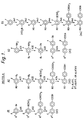
- Compounds of formula IIA may be prepared by a number of synthetic routes, but it is prefered to start from the acid X: Such acids may be commercially available, or else they may be prepared by for example routes A1 to A4 shown in Fig 1 starting from known compounds, yielding the acids X1, X2, X3 and X4:
- routes A1, A2, A3 and A4 are:
- Compounds of formula IIB may be prepared by a number of synthetic routes, but it is preferred to start from the acid XI: which may be prepared by route B shown in figure 2. This route is of general applicability for use with any appropriate hydroxy-ester.
- Compounds of formula IIC may be prepared by a number of synthetic routes, but it is preferred to start from the acid XII: which may be prepared by route C shown in figure 3. This route is of general applicability to any phenol or alcohol. In route C the steps are as follows:
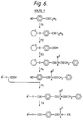
- Compounds of formula IID may be prepared using the known naphthoic acids.
- Suitable routes are routes E, F and G in Figs 5, 6 and 7.
- Many alpha-hydroxy carboxylic acids HO-CH(R2)COOH for use in these routes are commercially available, eg lactic acid and mandelic acid.
- Y represents the particular group between R1 and COO in formula I, for example Y may be: in the preferred formula II compounds discussed above.
- Example 1 Routes A1 and E to prepare:
- 3'-fluoro-4'-octoxybiphenyl-4-carboxylic acid was first prepared by the following method: 4-Bromo-2-fluorooctoxybenzene (95g) (made by standard bromination of 2-fluorooctoxybenzene) was dissolved in dry tetrahydrofuran (250ml) and slowly added to a mixture of magnesium turnings (8.5g) and tetrahydrofuran (50ml) containing a crystal of iodine. The Gagnard reaction was initiated by heating the solution. After the addition of bromide solution the mixture was stirred and refluxed under nitrogen for one hour.
- Step A13 The product from Step A13 (10g) was stirred for 16 hrs with dry toluene (120 ml), oxalyl chloride (12.4g) and ten drops of dry DMF.
- the toluene was distilled off and the acid chloride and redissolved in toluene (40 mls) and added to the product from Step E1 (4.41g) a pyridine (20 mls).
- the mixture was stirred for 30 minutes at 20°C then heated under reflux for 3 hours. After cooling the solution was carefully neutralized with dilute hydrochloric acid, the organic layer was removed and washed with sodium bicarbonate solution, then water. After drying, the organic layer was chromatographed on aluminium. Yield 65% after crystallization from IMS.
- Step E3 The product from Step E3 (5g) was stirred at 20°C with tolvene (100 ml), DMF (10 drops) and oxalyl chloride (2.87g) for 3hrs. The solvents were removed and the acid chloride dissolved in day dichloromethane (100 mls). To this solution was added a mixture of dichloromethane (100 ml) and cone ammonia solution (1.5 ml) over about 10 minutes. After a further 10 minutes stirring at 20°C, water (200 mls) was added and the solution separated. The organic layer yielded 4g of a white solid. This was dried at 40°C under vacuum and used in the next step.
- a ferroelectric smectic liquid crystal mixture was prepared which consisted of a 10 weight % solution of the product of Step E5 in: This composition had the following properties: (1) Liquid crystal transitions: Sc at room temperature and below Sc-S A 83°C S A -N 109.6°C N-I 137.140°C (2) Ferroelectric properties: Temp (°C) Ps(nC cm ⁇ 2) Tilt (°) 80 3.39 75 9.67 21.5 70 14.11 65 17.78 60 20.67 55 23.56 22.0 50 26.67 40 33.33
- Methyl 4-hydroxybiphenyl-4-carboxylate (17g), bromopentene (12.7g) butanone (200ml) and anhydrous potassium carbonate (22g) were stirred and heated under reflux for 16 hrs.
- the colled solution was filtered, and the solid washed with acetone (1001 l).
- the combined filtrates were evaporated to dryness, taken up in dichloromethane (200 ml), washed with water (2 x 50 l), dried over sodium sulphate and evaporated to dryness.
- the solid was crystallized from methylated spirits. Yield 20g.
- Step B1 The product from Step B1 (19.5g) was stirred and heated under reflux for 2 hours with potasium hydroxide (8.4g), water (30 ml) and methylated spirits (100 ml). The solution was poured into water (100 mls) and acidified wity cone Hce. The solid was filtered off, washed with water and dried in vacuo. After crystallization from acetic acid a yield of 15g was found. HPLC 99.6%.
- Step B2 The product from Step B2 (10g) was stirred for 16 hrs with dry tolune (120 ml), oxalyl chloride (12.4g) and ten drops of dry DMF.
- the toluene was distilled off and the acid chloride and redissolved in toluene (40 mls) and added to the product from Step E1 (4.41g) a pyridine (20 mls).
- the mixture was stirred for 30 minutes at 20°C then heated under reflux for 3 hours. After cooling the solution was carefully neutralised with dilute hydrochloric acid, the organic layer was removed and washed with sodium bicarbonate solution, then water. After drying, the organic layer was chromatographed on aluminium. Yield 65% after crystallisation from IMS.
- Step E3 The product from Step E3 (5g) was stirred at 20°C with tolvene (100 ml), DMF (10 drops) and oxalyl chloride (2.87g) for 3hrs. The solvents were removed and the acid chloride dissolved in day dichloromethane (100 mls). To this solution was added a mixture of dichloromethane (100 ml) and cone ammonia solution (1.5 ml) over about 10 minutes. After a further 10 minutes stirring at 20°C, water (200 mls) was added and the solution separated. The organic layer yielded 4g of a white solid. This was dried at 40°C under vacuum and used in the next step.
- a ferroelectric smectic liquid crystal mixture was prepared which consisted of a 10 weight % solution of the product of Step in: This composition had the following properties: (1) Liquid crystal transitions: Sc at room temperature and below Sc-S A 83°C S A -N 109.6°C N-I 137.140°C (2) Ferroelectric properties: Temp (°C) Ps(nC cm ⁇ 2) Tilt (°) 80 3.39 75 9.67 21.5 70 14.11 65 17.78 60 20.67 55 23.56 22.0 50 26.67 40 33.33
- Step C1 The product from Step C1 (53.7g) was heated on a steam bath for 5 hrs with potassium hydroxide (20g), water (60ml) and 2-methoxyethanol (800ml). About 400ml of industrial methylated spirits was added to reduce foaming. After cooling, conc.HCL was added to adjust the mixture to pHl. The mixture was then stirred and heated for 1 hour. After cooling the solid was filtered and dried at 40°C under vacuum. Yield 43g.
- Step C2 The product from Step C2 (10g) was stirred for 16 hrs with dry toluene (120ml), oxalyl chloride (12.4g) and tem drops of dry dimethylformamide.
- the toluene was distilled off and the acid chloride redissolved in toluene (40mls) and added to the product from Step E1 (4.41g) on pyridine (20mls).
- the mixture was stirred for 30 minutes at 20°C then heated under reflux for 3 hours. After cooling the solution was carefully neutralized with dilute hydrochloric acid, the organic layer was removed and washed with sodium bicarbonate solution, then water. After drying, the organic layer was chromatographed on alumina. Yield 8.5g; 65%, after crystallization from IMS.
- Step E2 The product from Step E2 (8.2g) was dissolved in ethyl acetate (65mls). 5% Pd on carbon (1g) was added and the mixture stirred under a hydrogen armozphere overnight. Tha catalyst was filtered off and the solution evaporated and the white solid dried under vacuum. Yield 6.7g; 98% mpt 150°C.
- This material had the following properties: Room temperature and below S C , 91 o C S C -S A , 110 o C S A -N, 134 o C N-I Temp. ( o C) Ps (nCcm ⁇ 2) 80 7.3 70 12.2 60 16.4 50 22.2 40 31.1
- 6-Octoxy-2-Naphthoic acid (15g) [prepared by standard methods] was condensed with the product from Step E1 (8.33g) by dissolving both compounds in dichloromethane (300 ml) and adding trifluoroacetic anhydride (10.7g). The mixture was stirred at 20°C for 3 hrs, poured into water and the organic layer washed with dilute sodium bicarbonate solution until neutral. The organic layer was dried on sodium sulphate and purified by column chromatography on alumina. After crystallisation from petroleum spirit (hp 40-60°C) a white solid was obtained. Yield 8.5g; 38%.
- step E2 The product of step E2 (8.2g) was dissolved in ethyl acetate (65ml) 5% Pd on carbon (1g) was added and the mixture stirred under a hydrogen atmosphere overnight. The catalyst was filtered off and the solution evaporated and the white solid product dried under vacuum. Yield 95% after recrystallisation from petroleum spirit (bp 80-100°&C)
- N-Bromosuccinimide (160.4 g, 0.90 mol) was added in small portions to a stirred, cooled solution of 2-fluroaniline (100.0 g, 0.90 mol) in dry dichloromethane (400 ml). The stirred mixture was allowed to warm to 0°C over 45 min, washed with water and dried (MgSO4). The solvent was removed in vacuo to yield a red solid (180 g) which was steam distilled to give a colourless solid.
- Step A33 The product of Step A33 was hydrolysed to the acid by conventional reflux with 50% hydrochloric acid and tol ene, until glc analysis revealed absence of the nitrile starting compound. At the end of this time the acid liquid was cooled to room temperature. The organic layer was separated and further purification was as Step A13.
- the carboxylic acid product of Step A34 was made into the product via route E, using a procedure analogous to example I above.
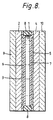
- a liquid crystal cell comprises a layer 1 of liquid crystal material exhibiting a chiral smectic phase sandwiched between a glass slide 2 having a transparent conducting layer 3 on its surface, eg of tin oxide or indium oxide, and a glass slide 4 having a transparent conducting layer 5 on its surface.
- the slides 2,4 bearing the layers 3,5 are respectively coated by films 6,7 of a polyimide polymer.
- films 6 and 7 Prior to construction of the cell the films 6 and 7 are rubbed with a soft tissue in a given direction the rubbing directions being arranged parallel upon construction of the cell.
- a spacer 8 eg of polymethyl methacrylate, separates the slides 2, 4 to the required distance, eg 5 microns.
- the liquid crystal material 1 is introduced between the slides 2,4 by filling the space between the slides 2, 4 and spacer 8 and sealing the spacer 8 in a vacuum in a known way.
- the liquid crystal material is in the smectic A, nematic or isotropic liquid phase (obtained by heating the material) when it is introduced between the slides 2,4 to facilitate alignment of the liquid crystal molecules with the rubbing directions on the slides 2,4.
- a polarizer 9 is arranged with its polarization axis parallel to the rubbing direction on the films 6,7 and an analyzer (crossed polarizer) 10 is arranged with its polarization axis perpendicular to that rubbing direction.
- the layers 3 and 5 may be selectively shaped in a known way, eg by photoetching or deposition through a mask, eg to provide one or more display symbols, eg letters, numerals, words or graphics and the like as conventionally seen on displays.
- the electrode portions formed thereby may be addressed in a variety of ways which include multiplexed operation.
- liquid crystal mixtures described in examples 1 to 6 above were found to be suitable for use as the layer 1.
Landscapes
- Chemical & Material Sciences (AREA)
- Organic Chemistry (AREA)
- Crystallography & Structural Chemistry (AREA)
- Engineering & Computer Science (AREA)
- Materials Engineering (AREA)
- Organic Low-Molecular-Weight Compounds And Preparation Thereof (AREA)
- Liquid Crystal Substances (AREA)
- Hydrogenated Pyridines (AREA)
- Preparation Of Compounds By Using Micro-Organisms (AREA)
Priority Applications (1)
| Application Number | Priority Date | Filing Date | Title |
|---|---|---|---|
| AT89900631T ATE88462T1 (de) | 1987-12-18 | 1988-12-15 | Cyanhydrinderivate und deren verwendung in fluessigkristallmaterialien und vorrichtungen. |
Applications Claiming Priority (8)
| Application Number | Priority Date | Filing Date | Title |
|---|---|---|---|
| GB878729503A GB8729503D0 (en) | 1987-12-18 | 1987-12-18 | Glycollic acid cyanoalkyl esters & liquid crystal materials containing them |
| GB878729502A GB8729502D0 (en) | 1987-12-18 | 1987-12-18 | Naphthoic acid cyano esters & liquid crystal materials containing them |
| GB878729865A GB8729865D0 (en) | 1987-12-22 | 1987-12-22 | Alkenyloxy biphenyl cyanoalkyl esters & liquid crystal materials containing them |
| GB878729982A GB8729982D0 (en) | 1987-12-23 | 1987-12-23 | Fluoro biphenyl-4'-cyanoalkyl esters & liquid crystal materials containing them |
| GB8729503 | 1987-12-23 | ||
| GB8729865 | 1987-12-23 | ||
| GB8729502 | 1987-12-23 | ||
| GB8729982 | 1987-12-23 |
Publications (2)
| Publication Number | Publication Date |
|---|---|
| EP0391956A1 EP0391956A1 (en) | 1990-10-17 |
| EP0391956B1 true EP0391956B1 (en) | 1993-04-21 |
Family
ID=27450019
Family Applications (1)
| Application Number | Title | Priority Date | Filing Date |
|---|---|---|---|
| EP89900631A Expired - Lifetime EP0391956B1 (en) | 1987-12-18 | 1988-12-15 | Cyanohydrin derivatives and their use in liquid crystal materials and devices |
Country Status (7)
| Country | Link |
|---|---|
| EP (1) | EP0391956B1 (enExample) |
| JP (1) | JP2724227B2 (enExample) |
| KR (2) | KR0140530B1 (enExample) |
| AT (1) | ATE88462T1 (enExample) |
| DE (1) | DE3880499T2 (enExample) |
| GB (1) | GB2232416B (enExample) |
| WO (1) | WO1989005792A1 (enExample) |
Families Citing this family (7)
| Publication number | Priority date | Publication date | Assignee | Title |
|---|---|---|---|---|
| DE3807861A1 (de) * | 1988-03-10 | 1989-09-21 | Merck Patent Gmbh | 2,3-difluorbiphenyle |
| GB8928283D0 (en) * | 1989-12-14 | 1990-02-21 | Secr Defence | Fluoro biphenyls |
| EP0440082B1 (de) * | 1990-02-01 | 1998-04-15 | MERCK PATENT GmbH | Verfahren zur Umsetzung von fluorierten Aromaten mit Elektrophilen |
| DE4012865A1 (de) * | 1990-04-23 | 1991-10-24 | Merck Patent Gmbh | Verfahren zur alkylierung oder hydroxyalkylierung von fluorierten aromaten |
| GB9224542D0 (en) * | 1992-11-24 | 1993-01-13 | Secr Defence | Ferroelectric liquid crystal device |
| GB9325438D0 (en) * | 1993-12-13 | 1994-02-16 | Secr Defence | Ferroelectric liquid crystal devices |
| GB9411233D0 (en) * | 1994-06-04 | 1994-07-27 | Central Research Lab Ltd | Liquid crystal compositions |
Family Cites Families (6)
| Publication number | Priority date | Publication date | Assignee | Title |
|---|---|---|---|---|
| JPS61210056A (ja) * | 1985-03-14 | 1986-09-18 | Chisso Corp | 含ハロゲン光学活性液晶化合物及び液晶組成物 |
| GB8520715D0 (en) * | 1985-08-19 | 1985-09-25 | Secr Defence | Secondary alcohol derivatives |
| DE3604462A1 (de) * | 1986-02-13 | 1987-08-20 | Merck Patent Gmbh | Smektische fluessigkristalline phasen |
| GB8615316D0 (en) * | 1986-06-23 | 1986-07-30 | Secr Defence | Chiral liquid crystal compounds |
| GB8627107D0 (en) * | 1986-11-13 | 1986-12-10 | Secr Defence | Ferroelectric smectic liquid crystal mixtures |
| GB8629322D0 (en) * | 1986-12-08 | 1987-01-14 | Secr Defence | Cyano-terpenoid esters |
-
1988
- 1988-12-15 KR KR1019890701539A patent/KR0140530B1/ko not_active Expired - Fee Related
- 1988-12-15 AT AT89900631T patent/ATE88462T1/de not_active IP Right Cessation
- 1988-12-15 EP EP89900631A patent/EP0391956B1/en not_active Expired - Lifetime
- 1988-12-15 WO PCT/GB1988/001111 patent/WO1989005792A1/en not_active Ceased
- 1988-12-15 DE DE89900631T patent/DE3880499T2/de not_active Expired - Fee Related
- 1988-12-15 JP JP1500408A patent/JP2724227B2/ja not_active Expired - Lifetime
-
1990
- 1990-06-13 GB GB9013143A patent/GB2232416B/en not_active Expired - Lifetime
-
1997
- 1997-11-17 KR KR97060640A patent/KR0143248B1/ko not_active Expired - Fee Related
Also Published As
| Publication number | Publication date |
|---|---|
| GB2232416B (en) | 1991-08-28 |
| DE3880499D1 (de) | 1993-05-27 |
| WO1989005792A1 (en) | 1989-06-29 |
| EP0391956A1 (en) | 1990-10-17 |
| KR0140530B1 (ko) | 1998-07-01 |
| KR0143248B1 (en) | 1998-07-15 |
| JPH06502382A (ja) | 1994-03-17 |
| GB9013143D0 (en) | 1990-08-01 |
| KR900700437A (ko) | 1990-08-13 |
| JP2724227B2 (ja) | 1998-03-09 |
| GB2232416A (en) | 1990-12-12 |
| ATE88462T1 (de) | 1993-05-15 |
| DE3880499T2 (de) | 1993-10-14 |
Similar Documents
| Publication | Publication Date | Title |
|---|---|---|
| KR920004141B1 (ko) | 스멕틱 액정조성물 | |
| US5716542A (en) | Liquid crystal compound and liquid crystal composition containing the same | |
| EP0450595A1 (en) | Liquid crystal compound and liquid crystal display device | |
| KR100283163B1 (ko) | 시클로헥센일 코아를 갖는 강유전성 액정 화합물 및 이들을 함유하는 조성물 | |
| US5378396A (en) | Liquid crystal compound and liquid crystal display device | |
| US5723069A (en) | Anti-ferroelectric liquid crystal compound and anti-ferroelectric liquid crystal composition | |
| US5133896A (en) | Cyanohyorin derivatives and their use in liquid crystal materials and devices | |
| KR0140530B1 (ko) | 시아노히드린 유도체 및 이의 액정 물질에서의 용도 및 장치 | |
| EP0333760B1 (en) | Cyano-alicyclic esters and liquid crystal compositions | |
| JPS6210045A (ja) | 液晶化合物および液晶組成物 | |
| US5230830A (en) | Cyanohydrin derivatives and their use in liquid crystal materials and devices | |
| JPH056535B2 (enExample) | ||
| JPH02225434A (ja) | 光学活性化合物 | |
| EP0385692A2 (en) | Optcally active compounds | |
| JPS63175095A (ja) | 光学活性液晶化合物および組成物 | |
| JPH0832665B2 (ja) | 反強誘電性液晶化合物 | |
| US5064564A (en) | Optically active compound, intermediate therefor, process for producing the intermediate, and liquid-crystal composition | |
| JP2008174480A (ja) | イオン性化合物およびこれを含む液晶組成物 | |
| JP2911636B2 (ja) | モノフルオロベンゼン環を含む液晶化合物 | |
| JPH0733353B2 (ja) | ハロゲン置換フエニルベンジルエ−テル誘導体 | |
| JP2857230B2 (ja) | 新規なエステル化合物、これを含む液晶組成物及び光スイッチング素子 | |
| JP2645048B2 (ja) | 液晶化合物、混合物及びデバイス | |
| JP2911635B2 (ja) | モノフルオロベンゼン環を含む液晶化合物 | |
| JP3073760B2 (ja) | ピリミジン系液晶化合物 | |
| JPS5998051A (ja) | 液晶性化合物並びに液晶組成物 |
Legal Events
| Date | Code | Title | Description |
|---|---|---|---|
| PUAI | Public reference made under article 153(3) epc to a published international application that has entered the european phase |
Free format text: ORIGINAL CODE: 0009012 |
|
| 17P | Request for examination filed |
Effective date: 19900605 |
|
| AK | Designated contracting states |
Kind code of ref document: A1 Designated state(s): AT BE CH DE FR GB IT LI LU NL SE |
|
| 17Q | First examination report despatched |
Effective date: 19920709 |
|
| GRAA | (expected) grant |
Free format text: ORIGINAL CODE: 0009210 |
|
| ITF | It: translation for a ep patent filed | ||
| AK | Designated contracting states |
Kind code of ref document: B1 Designated state(s): AT BE CH DE FR GB IT LI LU NL SE |
|
| REF | Corresponds to: |
Ref document number: 88462 Country of ref document: AT Date of ref document: 19930515 Kind code of ref document: T |
|
| ET | Fr: translation filed | ||
| REF | Corresponds to: |
Ref document number: 3880499 Country of ref document: DE Date of ref document: 19930527 |
|
| EPTA | Lu: last paid annual fee | ||
| PLBE | No opposition filed within time limit |
Free format text: ORIGINAL CODE: 0009261 |
|
| STAA | Information on the status of an ep patent application or granted ep patent |
Free format text: STATUS: NO OPPOSITION FILED WITHIN TIME LIMIT |
|
| 26N | No opposition filed | ||
| EAL | Se: european patent in force in sweden |
Ref document number: 89900631.6 |
|
| REG | Reference to a national code |
Ref country code: CH Ref legal event code: PUEA Free format text: THE SECRETARY OF STATE FOR DEFENCE IN HER BRITANNIC MAJESTY'S GOVERNMENT OF THE;IAN CHARLES SAGE -DANN AN- THE SECRETARY OF STATE FOR DEFENCE IN HER BRITANNIC MAJESTY'S GOVERNMENT OF THE |
|
| REG | Reference to a national code |
Ref country code: FR Ref legal event code: TP |
|
| NLS | Nl: assignments of ep-patents |
Owner name: THE SECRETARY OF STATE FOR DEFENCE IN HER BRITANNI |
|
| BECA | Be: change of holder's address |
Free format text: 20011123 *QINETIQ LTD:85 BUCKINGHAM GATE, LONDON SW14 0LX |
|
| REG | Reference to a national code |
Ref country code: GB Ref legal event code: IF02 |
|
| REG | Reference to a national code |
Ref country code: FR Ref legal event code: TP |
|
| NLS | Nl: assignments of ep-patents |
Owner name: QINETIQ LIMITED |
|
| PGFP | Annual fee paid to national office [announced via postgrant information from national office to epo] |
Ref country code: AT Payment date: 20021107 Year of fee payment: 15 |
|
| PGFP | Annual fee paid to national office [announced via postgrant information from national office to epo] |
Ref country code: FR Payment date: 20021111 Year of fee payment: 15 |
|
| PGFP | Annual fee paid to national office [announced via postgrant information from national office to epo] |
Ref country code: GB Payment date: 20021115 Year of fee payment: 15 |
|
| PGFP | Annual fee paid to national office [announced via postgrant information from national office to epo] |
Ref country code: CH Payment date: 20021118 Year of fee payment: 15 |
|
| PGFP | Annual fee paid to national office [announced via postgrant information from national office to epo] |
Ref country code: DE Payment date: 20021119 Year of fee payment: 15 |
|
| PGFP | Annual fee paid to national office [announced via postgrant information from national office to epo] |
Ref country code: SE Payment date: 20021121 Year of fee payment: 15 Ref country code: NL Payment date: 20021121 Year of fee payment: 15 |
|
| PGFP | Annual fee paid to national office [announced via postgrant information from national office to epo] |
Ref country code: LU Payment date: 20021128 Year of fee payment: 15 |
|
| PGFP | Annual fee paid to national office [announced via postgrant information from national office to epo] |
Ref country code: BE Payment date: 20030106 Year of fee payment: 15 |
|
| PG25 | Lapsed in a contracting state [announced via postgrant information from national office to epo] |
Ref country code: LU Free format text: LAPSE BECAUSE OF NON-PAYMENT OF DUE FEES Effective date: 20031215 Ref country code: GB Free format text: LAPSE BECAUSE OF NON-PAYMENT OF DUE FEES Effective date: 20031215 Ref country code: AT Free format text: LAPSE BECAUSE OF NON-PAYMENT OF DUE FEES Effective date: 20031215 |
|
| PG25 | Lapsed in a contracting state [announced via postgrant information from national office to epo] |
Ref country code: SE Free format text: LAPSE BECAUSE OF NON-PAYMENT OF DUE FEES Effective date: 20031216 |
|
| PG25 | Lapsed in a contracting state [announced via postgrant information from national office to epo] |
Ref country code: LI Free format text: LAPSE BECAUSE OF NON-PAYMENT OF DUE FEES Effective date: 20031231 Ref country code: CH Free format text: LAPSE BECAUSE OF NON-PAYMENT OF DUE FEES Effective date: 20031231 Ref country code: BE Free format text: LAPSE BECAUSE OF NON-PAYMENT OF DUE FEES Effective date: 20031231 |
|
| BERE | Be: lapsed |
Owner name: *QINETIQ LTD Effective date: 20031231 |
|
| PG25 | Lapsed in a contracting state [announced via postgrant information from national office to epo] |
Ref country code: NL Free format text: LAPSE BECAUSE OF NON-PAYMENT OF DUE FEES Effective date: 20040701 Ref country code: DE Free format text: LAPSE BECAUSE OF NON-PAYMENT OF DUE FEES Effective date: 20040701 |
|
| EUG | Se: european patent has lapsed | ||
| GBPC | Gb: european patent ceased through non-payment of renewal fee |
Effective date: 20031215 |
|
| REG | Reference to a national code |
Ref country code: CH Ref legal event code: PL |
|
| PG25 | Lapsed in a contracting state [announced via postgrant information from national office to epo] |
Ref country code: FR Free format text: LAPSE BECAUSE OF NON-PAYMENT OF DUE FEES Effective date: 20040831 |
|
| NLV4 | Nl: lapsed or anulled due to non-payment of the annual fee |
Effective date: 20040701 |
|
| REG | Reference to a national code |
Ref country code: FR Ref legal event code: ST |
|
| PG25 | Lapsed in a contracting state [announced via postgrant information from national office to epo] |
Ref country code: IT Free format text: LAPSE BECAUSE OF NON-PAYMENT OF DUE FEES;WARNING: LAPSES OF ITALIAN PATENTS WITH EFFECTIVE DATE BEFORE 2007 MAY HAVE OCCURRED AT ANY TIME BEFORE 2007. THE CORRECT EFFECTIVE DATE MAY BE DIFFERENT FROM THE ONE RECORDED. Effective date: 20051215 |