EP0348964A2 - Polarisierender Film - Google Patents
Polarisierender Film Download PDFInfo
- Publication number
- EP0348964A2 EP0348964A2 EP89111826A EP89111826A EP0348964A2 EP 0348964 A2 EP0348964 A2 EP 0348964A2 EP 89111826 A EP89111826 A EP 89111826A EP 89111826 A EP89111826 A EP 89111826A EP 0348964 A2 EP0348964 A2 EP 0348964A2
- Authority
- EP
- European Patent Office
- Prior art keywords
- liquid crystal
- polarizing film
- dichroic substance
- film according
- crystal properties
- Prior art date
- Legal status (The legal status is an assumption and is not a legal conclusion. Google has not performed a legal analysis and makes no representation as to the accuracy of the status listed.)
- Granted
Links
- 0 C1*CC*C1 Chemical compound C1*CC*C1 0.000 description 5
- LWBVFBDGTYYSCX-HEZNUULDSA-N Cc(cc(cc1)-c(cc2)cc(Cl)c2/N=C\c(cc2)ccc2OC)c1/N=C\c(cc1)ccc1OC Chemical compound Cc(cc(cc1)-c(cc2)cc(Cl)c2/N=C\c(cc2)ccc2OC)c1/N=C\c(cc1)ccc1OC LWBVFBDGTYYSCX-HEZNUULDSA-N 0.000 description 1
Images
Classifications
-
- G—PHYSICS
- G02—OPTICS
- G02B—OPTICAL ELEMENTS, SYSTEMS OR APPARATUS
- G02B5/00—Optical elements other than lenses
- G02B5/30—Polarising elements
- G02B5/3025—Polarisers, i.e. arrangements capable of producing a definite output polarisation state from an unpolarised input state
- G02B5/3033—Polarisers, i.e. arrangements capable of producing a definite output polarisation state from an unpolarised input state in the form of a thin sheet or foil, e.g. Polaroid
-
- C—CHEMISTRY; METALLURGY
- C09—DYES; PAINTS; POLISHES; NATURAL RESINS; ADHESIVES; COMPOSITIONS NOT OTHERWISE PROVIDED FOR; APPLICATIONS OF MATERIALS NOT OTHERWISE PROVIDED FOR
- C09K—MATERIALS FOR MISCELLANEOUS APPLICATIONS, NOT PROVIDED FOR ELSEWHERE
- C09K19/00—Liquid crystal materials
- C09K19/04—Liquid crystal materials characterised by the chemical structure of the liquid crystal components, e.g. by a specific unit
- C09K19/06—Non-steroidal liquid crystal compounds
- C09K19/08—Non-steroidal liquid crystal compounds containing at least two non-condensed rings
- C09K19/10—Non-steroidal liquid crystal compounds containing at least two non-condensed rings containing at least two benzene rings
- C09K19/24—Non-steroidal liquid crystal compounds containing at least two non-condensed rings containing at least two benzene rings linked by a chain containing nitrogen-to-nitrogen bonds
-
- C—CHEMISTRY; METALLURGY
- C09—DYES; PAINTS; POLISHES; NATURAL RESINS; ADHESIVES; COMPOSITIONS NOT OTHERWISE PROVIDED FOR; APPLICATIONS OF MATERIALS NOT OTHERWISE PROVIDED FOR
- C09K—MATERIALS FOR MISCELLANEOUS APPLICATIONS, NOT PROVIDED FOR ELSEWHERE
- C09K19/00—Liquid crystal materials
- C09K19/04—Liquid crystal materials characterised by the chemical structure of the liquid crystal components, e.g. by a specific unit
- C09K19/06—Non-steroidal liquid crystal compounds
- C09K19/32—Non-steroidal liquid crystal compounds containing condensed ring systems, i.e. fused, bridged or spiro ring systems
-
- C—CHEMISTRY; METALLURGY
- C09—DYES; PAINTS; POLISHES; NATURAL RESINS; ADHESIVES; COMPOSITIONS NOT OTHERWISE PROVIDED FOR; APPLICATIONS OF MATERIALS NOT OTHERWISE PROVIDED FOR
- C09K—MATERIALS FOR MISCELLANEOUS APPLICATIONS, NOT PROVIDED FOR ELSEWHERE
- C09K19/00—Liquid crystal materials
- C09K19/52—Liquid crystal materials characterised by components which are not liquid crystals, e.g. additives with special physical aspect: solvents, solid particles
- C09K19/60—Pleochroic dyes
-
- G—PHYSICS
- G02—OPTICS
- G02B—OPTICAL ELEMENTS, SYSTEMS OR APPARATUS
- G02B5/00—Optical elements other than lenses
- G02B5/30—Polarising elements
- G02B5/3016—Polarising elements involving passive liquid crystal elements
Definitions
- This invention relates to a polarizing film by use of a dichroic substance having liquid crystal properties, more particularly to a polarizing film which is excellent in polarizing characteristics with the dichroic substance having liquid crystal properties being highly oriented and yet is endowed with high durability.
- polarizing films which have been generally used for liquid crystal displays, photographic filters, etc. have been prepared with the use of a polyvinyl alcohol type resin as the film base material and imparting polarizing performance by attaching iodine or a dichroic dye thereto.
- an object of the present invention in view of the state of the art as described above, is to provide a novel polarizing film which can satisfy at the same time excellent polarizing performance and high durability.
- the present invention provides a polarizing film, comprising a dichroic substance having liquid crystal properties contained and oriented in a hydrophobic resin.
- the dichroic substance having liquid crystal properties in the present invention is a substance satisfying the following conditions:
- the temperature range of the liquid crystal phase which is not particularly limited, may be 20 °C or higher, preferably 40 °C or higher, more preferably 60 °C or higher.
- the melting point (T m ), the liquid crystal transition temperature (T LC ), the isotropic liquefaction temperature (T i ) and the glass transition point (T g ) mentioned below mean the temperatures determined according to the methods as described below.
- the glass transition point (T g ) and the melting point (T m ) are defined as follows. That is, in the glass transition curve and the melting curve obtained, using Differential scanning calorimeter, by elevating the temperature to a temperature higher by 20 °C than the temperature at which a sample amount of 5 mg is completely melted with a temperature raising rate of 320 °C/min, maintaining thereat for 3 minutes, then falling down the temperature with a rate of 10 °C/min, maintaining the sample at a temperature lower by 50 °C than the temperature at which it is crystallized or solidified, and thereafter elevating the temperature again with a rate of 20 °C/min in the case of glass transition point and with a rate of 10 °C/min in the case of melting point, the glass transition point refers to the temperature at the initiation point of heat content change from the baseline of the glass transition curve, and the melting point refers to the temperature at the end point of melting of the melting curve.
- the liquid crystal transition temperature refers to the temperature at the initiation point where a birefringent optical pattern inherent in liquid crystal is observed in a polarizing microscope equipped with a heating device, when a small amount of a sample is sandwiched between cover glasses, melted by heating, cooled to room temperature and elevated in temperature with a rate of 10 °C/min, while the isotropic liquefaction temperature (T i ) refers to the temperature at the initiation point where the birefringent optical pattern disappears when temperature elevation is further continued, whereby the liquid crystal becomes isotropic liquid.
- the liquid crystal state of such dichroic substance is not particularly limited, but either one of nematic, various smectic (A, C, F, B, E, G and D) and cholesteric liquid crystals, etc. may be employed, but preferably nematic or smectic liquid crystal.
- the maximum absorption wavelength ( ⁇ max) of the dichroic substance to be used in the present invention is not particularly limited, but it may be preferably 250 nm or higher, more preferably 270 nm or higher.
- dichroic liquid crystals represented by the formulae (a) to (g).
- dichroic liquid crystals represented by the formulae (a) to (g).
- These are not limited to low molecular weight compounds, but also include even oligomers or polymers having reactive groups imparted to a part of the end groups and introduced into the main chain or the side chain of polymers.
- H- CH3(CH2) m - (where m is an integer of 0 to 10, preferably 1 to 6), CH3(CH2) m O- (where m is an integer of 0 to 10), Cl-, Br-, I-, F-, -CN, -NO2, -NH2, -N(R)2 or and more secifically, for example, azo type substances as shown in Table 1 may be mentioned.
- Y and Z each represent the same groups as mentioned above
- G represents a phenylene group, a naphthalene group or a biphenylene group which may be also substituted
- the dichroic substance having liquid crystal properties as described above can be prepared, for example, as follows.
- polystyrene resin for example, there may be employed homopolymers or copolymers including polyolefins such as polyethylene, polypropylene, etc.; polyvinylidene halides such as polyvinylidene fluoride, polyvinylidene chloride, etc.; polyesters such as polyethylene terephthalate, polybutylene terephthalate, etc.; polycarbonates; poly(meth)acrylate; polyethers; polystyrene; polysulfone; polyamide; etc. These polymers may be also used as a mixture.
- polyolefins such as polyethylene, polypropylene, etc.
- polyvinylidene halides such as polyvinylidene fluoride, polyvinylidene chloride, etc.
- polyesters such as polyethylene terephthalate, polybutylene terephthalate, etc.
- polycarbonates poly(meth)acrylate
- polyethers polystyrene
- a dichroic substance having polarizing characteristic at the UV-ray region it is preferred to use a combination of polyethylene, polypropylene, polyamide or polyvinylidene fluoride, and by use of such resins, a polarizing film having excellent polarizing characteristic in near-UV-ray region of 400 nm or less can be obtained.
- hydrophobic resins may have molecular weights which are not particularly limited, provided that they can be molded according to the known film fabrication and stretching methods.
- the dichroic substance having liquid crystal properties as described above is contained in an amount of 0.001 to 15 % by weight, preferably 0.001 to 5 % by weight, more preferively 0.01 to 2 % by weight, and is highly oriented in the hydrophobic resin.
- the polarizing film of the present invention in addition to the dichroic substance having liquid crystal properties and the hydrophobic resin as described above, other additives such as dye having no dichroism, UV-ray absorbers, antioxidants, etc. may be also contained, and the content of them may be 3 % by weight or less.
- the dichroic substance having liquid crystal properties and the hydrophobic resin are mixed and kneaded at a predetermined ratio, and the kneading temperature may be a temperature at which the dichroic substance having liquid crystal properties exhibits liquid crystal state or isotropic liquid state, preferably liquid crystal state. Dispersion of the dichroic substance at this time may be in either molecular state or a mass of molecules. If the kneading temperature is out of the above temperature, uni form dispersion of the dichroic substance will be obstructed, whereby no good polarizing film can be obtained.
- Kneading can be practiced according to the means convention literallyally practiced by use of, for example, Brabender, etc.
- the kneaded product is fabricated into a film at the above kneading temperature.
- Film fabrication may be practiced according to the T-die method or the inflation method.
- the polarizing film of the present invention is obtained.
- Stretching may be practiced at a temperature at which the dichroic substance having liquid crystal properties exhibits liquid crystal state or crystal state, preferably crystal state. Outside of this temperature range, orientation of the dichroic substance will become undesirably insufficient.
- stretching may be preferably effected at T m - 100 °C to T m - 5 °C or T g - 50 °C to T g + 100 °C.
- stretching to 1.1 to 18-fold, preferably 2 to 12-fold, more preferably 3 to 10-fold, in uniaxial direction under the temperature, a polarizing film with a thickness of, for example, 10 to 150 ⁇ m can be obtained. Stretching can be performed generally by use of roll stretching machine, etc.
- the kneading-film fabrication temperature and the stretching temperature as described above also depend on selection of the hydrophobic resin and, for example, in the case of polypropylene, the kneading-film fabrication temperature may be preferably 180 to 300 °C, and the stretching temperature 70 to 160 °C, while in the case of polyethylene terephtha late, they may be preferably 270 to 350 °C and 60 to 160 °C, respectively.
- the polarizing film thus prepared can be used as such for film, sheet, or otherwise can be applied with various workings before use.
- lamination may be effected with other polymers, or alternatively a transparent electroconductive film such as indium-tin oxide, etc. may be formed on the surface of the polarizing film of the present invention according to vapor deposition, sputtering or coating method to be provided for practical application.
- the polarizing film thus obtained can be used for liquid crystal display, display for mounting on vehicle, color phase variable filter, variable transmission sunglass, photographic film, cathode-ray tube, reflection preventive filter of measuring instrument numerical value displaying portion, etc.
- the characteristics of the polarizing film were examined according to the following measurement method and evaluation standards.
- the polarizing film was subjected to the heat treatment in hot air at 100 °C for 1000 hours, and the polarizing performance after that was compared with that before the treatment and evaluated.
- the polarizing film was subjected to the humidity and heat treatment at 80 °C and 95 % RH (relative humidity) for 1000 hours, and the polarizing performance after that was compared with that before the treatment and evaluated.
- RH relative humidity
- the resulting crude dye was purified through a silica gel column chromatography by developing with toluene and collected,the solvent was distilled to obtain a trisazo dye.
- the dyes E to H were obtained according to the method for preparing dyes A to D.
- Table 2 Dichroic substance Color hue (in acetone) Transition temperature (°C) T LC T i A Red 170 246 B Red 163 232 C Red 156 217 D Red 158 225 E Pale yellow 196 280 F Pale yellow 139 330 G Red 176 250 H Blue - -
- the dichroic substances A - G having liquid crystal properties are transferred from crystalline state to liquid crystal state at 139 to 222 °C, and also from liquid crystal state to isotropic liquid state at 217 to 330 °C.
- the known dichroic substance H having no liquid crystal property was found to be only transferred from crystalline state to isotropic liquid state at 156 °C (melting point).
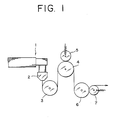
- the M/B obtained (110 g) and 780 g of the polypropylene resin were fabricated into a film at 210 °C by means of a 15 mm extruder 1 equipped with a T-dice 2 (dice width: 120 mm) as shown in Fig. 1.
- the film was taken up on the chilling rolls 3 shown in Fig. 1, passed through the low speed rolls 4 (0.85 m/min.) at 120 °C and then stretched by high speed chilling rolls 6 (5.5 m/min.) to 6.5-fold in the longitudinal direction to obtain a polarizing film with a thickness of about 75 ⁇ m.
- 5 and 6 are nip rolls.
- T o refers to light transmittance of one sheet of polarizing film, which is hereinafter the same.
- a polarizing film was prepared in the same manner as in Example 2 except for using 0.66 g of B in place of A shown in Table 2 as the dichroic substance having liquid crystal properties.
- the polarizing films of the present invention are not substantially changed in appearance and polarizing characteristics before and after the respective treatments, and therefore are excellent in durability.
- the M/B obtained (125 g) and 765 g of the polyvinylidene fluoride were fabricated into a film at 210 °C by use of a 15 mm extruder equipped with a T-dice (dice width 120 mm).
- a polarizing film was prepared in the same manner as in Example 4 except for using 1.0 g of D in place of C shown in Table 2 as the dichroic substance having liquid crystal properties.
- An amount 120 g of a polyethylene resin (FZ70, manufactured by Mitsubishi Petrochemical Co., Ltd.) and 1.0 g of a dichroic liquid crystal E were blended uniformly at 200 °C by use of a Brabender to prepare a masterbatch (M/B).
- the M/B obtained (110 g) and 780 g of the polyethylene resin were fabricated into a film at 200 °C by means of a device as shown in Fig. 1, passed through the low speed rolls 4 (0.85 m/min.) at 100 °C and then stretched by high speed chilling rolls 6 (5.5 m/min.) to 6.0-fold in the longitudinal direction to obtain a polarizing film with a thickness of about 75 ⁇ m.
- An amount 140 g of a polyvinylidene fluoride (Solef 1008, manufactured by Solvay) and 1.0 g of a dichroic liquid crystal E were uniformly blended at 200 °C by use of a Brabender to prepare a masterbatch (M/B).
- the M/B obtained (125 g) and 765 g of the polyvinylidene fluoride were fabricated into a film at 210 °C by use of a device as shown in Fig. 1.
- a polarizing film was prepared in the same manner as in Example 6 except for using 1.0 g of F shown in Table 2 as the dichroic substance having liquid crystal properties.
- a polarizing film was prepared in the same manner as in Example 2 except for using 1.2 g of G in place of A shown in Table 2 as the dichroic substance having liquid crystal properties.
- the M/B obtained was formed into a film under the same conditions as in Example 2 and stretched under the same conditions as in Example 2 to obtain a polarizing film.
- the polarizing film of the present invention in which a dichroic substance having liquid crystal properties is highly oriented in a hydrophobic resin, has excellent polarizing characteristics with polarizing degree of 90 % or higher, and also has high durability with excellent heat resistance and humidity resistance.
- the polarizing performance will not be substantially changed with heat or moisture and can maintain excellent polarizing characteristics for a long term.
- the polarizing film of the present invention can be also applied with various workings depending on the purpose of use, and therefore its uses are wide and also it is of high commercial value.
Landscapes
- Chemical & Material Sciences (AREA)
- Crystallography & Structural Chemistry (AREA)
- Physics & Mathematics (AREA)
- Engineering & Computer Science (AREA)
- Materials Engineering (AREA)
- Organic Chemistry (AREA)
- General Physics & Mathematics (AREA)
- Optics & Photonics (AREA)
- Polarising Elements (AREA)
Applications Claiming Priority (2)
| Application Number | Priority Date | Filing Date | Title |
|---|---|---|---|
| JP160977/88 | 1988-06-30 | ||
| JP63160977A JP2710630B2 (ja) | 1988-06-30 | 1988-06-30 | 偏光フィルムおよびその製造方法 |
Publications (3)
| Publication Number | Publication Date |
|---|---|
| EP0348964A2 true EP0348964A2 (de) | 1990-01-03 |
| EP0348964A3 EP0348964A3 (en) | 1990-08-16 |
| EP0348964B1 EP0348964B1 (de) | 1995-05-10 |
Family
ID=15726231
Family Applications (1)
| Application Number | Title | Priority Date | Filing Date |
|---|---|---|---|
| EP19890111826 Expired - Lifetime EP0348964B1 (de) | 1988-06-30 | 1989-06-29 | Polarisierender Film |
Country Status (3)
| Country | Link |
|---|---|
| EP (1) | EP0348964B1 (de) |
| JP (1) | JP2710630B2 (de) |
| DE (1) | DE68922532T2 (de) |
Cited By (16)
| Publication number | Priority date | Publication date | Assignee | Title |
|---|---|---|---|---|
| EP0439791A1 (de) * | 1990-01-10 | 1991-08-07 | Bayer Ag | Lichtpolarisierende Filme oder Folien enthaltend Triphendioxazin- bzw. Triphendithiazin-Farbstoffe |
| FR2676285A1 (fr) * | 1991-05-08 | 1992-11-13 | Sandoz Sa | Pellicule polarisante, son procede de preparation et colorants dichrouiques utilises a cette fin. |
| US5213582A (en) * | 1990-01-10 | 1993-05-25 | Bayer Aktiengesellschaft | Light-polarizing films or foils containing triphendioxazine or triphendithiazine dyes with good dichrditic properties |
| EP0518425A3 (de) * | 1991-06-11 | 1994-03-23 | Dsm Nv | |
| WO1996038746A1 (en) * | 1995-06-02 | 1996-12-05 | Hoechst Celanese Corporation | Polariser films with high thermal and hygroscopic stability |
| WO1996038745A1 (en) * | 1995-06-02 | 1996-12-05 | Hoechst Celanese Corporation | High extinction polarizer films comprising liquid crystal polymeric moieties |
| WO1996038747A1 (en) * | 1995-06-02 | 1996-12-05 | Hoechst Celanese Corporation | Process for preparing high performance polarizer films |
| WO1996038743A1 (en) * | 1995-06-02 | 1996-12-05 | Hoechst Celanese Corporation | Polarizer films comprising wholly aromatic liquid crystalline polymers and dichroic dyes |
| EP0670506A4 (de) * | 1993-09-10 | 1997-12-03 | Nippon Kayaku Kk | Polarisator,polarisationsplatte und verfahren zu deren herstellung. |
| US5739296A (en) * | 1993-05-21 | 1998-04-14 | Russian Technology Group | Method and materials for thermostable and lightfast dichroic light polarizers |
| GB2326727A (en) * | 1997-06-28 | 1998-12-30 | Sharp Kk | Liquid crystal device |
| WO2001007525A3 (en) * | 1999-07-22 | 2001-08-09 | Landqart | Process for forming photoluminescent polarizers |
| US6624863B1 (en) | 1997-06-28 | 2003-09-23 | Sharp Kabushiki Kaisha | Method of making a patterned retarder, patterned retarder and illumination source |
| EP2730954A1 (de) * | 2012-11-07 | 2014-05-14 | Samsung Electronics Co., Ltd | Zusammensetzung, Polarisationsfolie und Anzeigevorrichtung mit Polarisationsfolie |
| US9207359B2 (en) | 2012-11-07 | 2015-12-08 | Samsung Electronics Co., Ltd. | Polarizing film and display device including the polarizing film |
| US20160187549A1 (en) * | 2014-12-31 | 2016-06-30 | Samsung Electronics Co., Ltd. | Polarizing film, method of manufacturing the same, and display device |
Families Citing this family (4)
| Publication number | Priority date | Publication date | Assignee | Title |
|---|---|---|---|---|
| JP5112147B2 (ja) * | 2008-03-31 | 2013-01-09 | 富士フイルム株式会社 | 偏光素子、および偏光素子の製造方法 |
| US8927070B2 (en) * | 2008-09-30 | 2015-01-06 | Fujifilm Corporation | Dichroic dye composition, light absorption anisotropic film, and polarizing element |
| US8623476B2 (en) * | 2008-11-28 | 2014-01-07 | Fujifilm Corporation | Polarizing element and method of producing the same |
| US9250371B2 (en) * | 2012-11-06 | 2016-02-02 | Samsung Electronics Co., Ltd. | Polarizing film, anti-reflective film and display device including the same |
Family Cites Families (10)
| Publication number | Priority date | Publication date | Assignee | Title |
|---|---|---|---|---|
| JPS5784409A (en) * | 1980-11-15 | 1982-05-26 | Toyobo Co Ltd | Polarizing film |
| JPS58125002A (ja) * | 1982-01-22 | 1983-07-25 | Mitsui Toatsu Chem Inc | 偏光板及び液晶表示素子 |
| JPS6187757A (ja) * | 1984-10-05 | 1986-05-06 | Mitsui Toatsu Chem Inc | 色素およびこれを用いた偏光フイルム |
| JPH0430986A (ja) * | 1990-05-25 | 1992-02-03 | Sanyo Electric Co Ltd | ハンド制御装置 |
| JPH0430897A (ja) * | 1990-05-29 | 1992-02-03 | Toshiba Corp | 洗濯機 |
| JPH0436189A (ja) * | 1990-05-30 | 1992-02-06 | Otsuka Pharmaceut Co Ltd | 肝細胞増殖因子の製造方法 |
| JPH0470603A (ja) * | 1990-07-06 | 1992-03-05 | Nippon Telegr & Teleph Corp <Ntt> | 光ファイバ収納モジュール |
| JPH0652327A (ja) * | 1992-07-30 | 1994-02-25 | Tokyo Gas Co Ltd | 図面表示方式 |
| JP3219477B2 (ja) * | 1992-07-31 | 2001-10-15 | キヤノン株式会社 | 画像処理方法及び装置 |
| JPH07104448A (ja) * | 1993-09-30 | 1995-04-21 | Fuji Photo Film Co Ltd | ハロゲン化銀カラー写真感光材料およびそれを用いたカラー画像形成方法 |
-
1988
- 1988-06-30 JP JP63160977A patent/JP2710630B2/ja not_active Expired - Lifetime
-
1989
- 1989-06-29 DE DE1989622532 patent/DE68922532T2/de not_active Expired - Fee Related
- 1989-06-29 EP EP19890111826 patent/EP0348964B1/de not_active Expired - Lifetime
Cited By (23)
| Publication number | Priority date | Publication date | Assignee | Title |
|---|---|---|---|---|
| EP0439791A1 (de) * | 1990-01-10 | 1991-08-07 | Bayer Ag | Lichtpolarisierende Filme oder Folien enthaltend Triphendioxazin- bzw. Triphendithiazin-Farbstoffe |
| US5213582A (en) * | 1990-01-10 | 1993-05-25 | Bayer Aktiengesellschaft | Light-polarizing films or foils containing triphendioxazine or triphendithiazine dyes with good dichrditic properties |
| FR2676285A1 (fr) * | 1991-05-08 | 1992-11-13 | Sandoz Sa | Pellicule polarisante, son procede de preparation et colorants dichrouiques utilises a cette fin. |
| EP0518425A3 (de) * | 1991-06-11 | 1994-03-23 | Dsm Nv | |
| US6174394B1 (en) | 1993-05-21 | 2001-01-16 | Optiva, Inc. | Method for thermostable and lightfast dichroic light polarizers |
| US5739296A (en) * | 1993-05-21 | 1998-04-14 | Russian Technology Group | Method and materials for thermostable and lightfast dichroic light polarizers |
| EP0670506A4 (de) * | 1993-09-10 | 1997-12-03 | Nippon Kayaku Kk | Polarisator,polarisationsplatte und verfahren zu deren herstellung. |
| EP1275988A3 (de) * | 1993-09-10 | 2006-03-22 | Nippon Kayaku Kabushiki Kaisha | Polarisierendes Element und Polarisationsplatte |
| WO1996038746A1 (en) * | 1995-06-02 | 1996-12-05 | Hoechst Celanese Corporation | Polariser films with high thermal and hygroscopic stability |
| US5667719A (en) * | 1995-06-02 | 1997-09-16 | Hoechst Celanese Corp. | High extinction polarizer films comprising liquid crystal polymeric moieties |
| WO1996038747A1 (en) * | 1995-06-02 | 1996-12-05 | Hoechst Celanese Corporation | Process for preparing high performance polarizer films |
| US5707566A (en) * | 1995-06-02 | 1998-01-13 | Hoechst Celanese Corp. | Process for preparing high performance polarizer films |
| WO1996038745A1 (en) * | 1995-06-02 | 1996-12-05 | Hoechst Celanese Corporation | High extinction polarizer films comprising liquid crystal polymeric moieties |
| US5753145A (en) * | 1995-06-02 | 1998-05-19 | Hoecst Celanese Corp. | Polarizer films with high thermal and hygroscopic stability |
| US5672296A (en) * | 1995-06-02 | 1997-09-30 | Hoechst Celanese Corp. | Polarizer films comprising wholly aromatic liquid crystalline polymers and dichroic dyes |
| WO1996038743A1 (en) * | 1995-06-02 | 1996-12-05 | Hoechst Celanese Corporation | Polarizer films comprising wholly aromatic liquid crystalline polymers and dichroic dyes |
| GB2326727A (en) * | 1997-06-28 | 1998-12-30 | Sharp Kk | Liquid crystal device |
| US6624863B1 (en) | 1997-06-28 | 2003-09-23 | Sharp Kabushiki Kaisha | Method of making a patterned retarder, patterned retarder and illumination source |
| WO2001007525A3 (en) * | 1999-07-22 | 2001-08-09 | Landqart | Process for forming photoluminescent polarizers |
| EP2730954A1 (de) * | 2012-11-07 | 2014-05-14 | Samsung Electronics Co., Ltd | Zusammensetzung, Polarisationsfolie und Anzeigevorrichtung mit Polarisationsfolie |
| US9194980B2 (en) | 2012-11-07 | 2015-11-24 | Samsung Electronics Co., Ltd. | Polarizing film and display device including the polarizing film |
| US9207359B2 (en) | 2012-11-07 | 2015-12-08 | Samsung Electronics Co., Ltd. | Polarizing film and display device including the polarizing film |
| US20160187549A1 (en) * | 2014-12-31 | 2016-06-30 | Samsung Electronics Co., Ltd. | Polarizing film, method of manufacturing the same, and display device |
Also Published As
| Publication number | Publication date |
|---|---|
| EP0348964A3 (en) | 1990-08-16 |
| DE68922532D1 (de) | 1995-06-14 |
| JP2710630B2 (ja) | 1998-02-10 |
| EP0348964B1 (de) | 1995-05-10 |
| DE68922532T2 (de) | 1995-11-09 |
| JPH0212104A (ja) | 1990-01-17 |
Similar Documents
| Publication | Publication Date | Title |
|---|---|---|
| EP0348964B1 (de) | Polarisierender Film | |
| EP0198082B1 (de) | Polarisierender film | |
| KR100398793B1 (ko) | 배향염료함유필름,그것의제조방법및그것을이용한편광자와액정표시장치 | |
| KR101153767B1 (ko) | 편광막 생성용 코팅액 및 편광막 | |
| KR101059001B1 (ko) | 리오트로픽 액정성 혼합물 및 코팅액 및 광학 이방성 필름 | |
| WO2009058396A1 (en) | Negative birefringent optical films with flat or reversed birefringence wavelength dispersions for liquid crystal displays | |
| GB2065695A (en) | Guest-host type liquid crystal composition and liquid crystal display device using the same | |
| US6551529B2 (en) | Dichromatic polarizing element and production method thereof | |
| JPH0430987B2 (de) | ||
| JPH07207169A (ja) | 偏光フィルム用アゾ系色素及びこれを用いた偏光フィルム | |
| JP2011150162A (ja) | 偏光板およびその製法 | |
| JPH0466268B2 (de) | ||
| JPH01103667A (ja) | アントラキノン系色素および該色素を用いた偏光フィルム | |
| EP0300770B1 (de) | Polarisierender Film der einen anthrachinonen Farbstoff enthält | |
| JPH0457716B2 (de) | ||
| US5382465A (en) | Anthraquinonic colorant and polarizing film containing the colorant | |
| GB2255570A (en) | Polarizing film and dichroic dyestuffs therfor | |
| JPH03132701A (ja) | 偏光フィルム | |
| JP4784897B2 (ja) | コーティング液および偏光膜 | |
| JP2954306B2 (ja) | アントラキノン系偏光フィルム用色素及び該色素を用いた偏光フィルム | |
| JP3100461B2 (ja) | 二色性アゾ色素及びこれを用いた偏光フィルム | |
| JP5060853B2 (ja) | 多環式化合物の精製方法、多環式化合物の製造方法、及び多環式化合物の用途 | |
| JP2955329B2 (ja) | アントラキノン系黄色色素及び該色素を用いた偏光フィルム | |
| JP2011085748A (ja) | コーティング液およびその製造方法、ならびに偏光膜 | |
| JP2966973B2 (ja) | アントラキノン系色素及び該色素を用いた偏光フィルム |
Legal Events
| Date | Code | Title | Description |
|---|---|---|---|
| PUAI | Public reference made under article 153(3) epc to a published international application that has entered the european phase |
Free format text: ORIGINAL CODE: 0009012 |
|
| AK | Designated contracting states |
Kind code of ref document: A2 Designated state(s): DE FR GB |
|
| PUAL | Search report despatched |
Free format text: ORIGINAL CODE: 0009013 |
|
| AK | Designated contracting states |
Kind code of ref document: A3 Designated state(s): DE FR GB |
|
| 17P | Request for examination filed |
Effective date: 19901017 |
|
| 17Q | First examination report despatched |
Effective date: 19920629 |
|
| GRAA | (expected) grant |
Free format text: ORIGINAL CODE: 0009210 |
|
| AK | Designated contracting states |
Kind code of ref document: B1 Designated state(s): DE FR GB |
|
| REF | Corresponds to: |
Ref document number: 68922532 Country of ref document: DE Date of ref document: 19950614 |
|
| ET | Fr: translation filed | ||
| PLBE | No opposition filed within time limit |
Free format text: ORIGINAL CODE: 0009261 |
|
| STAA | Information on the status of an ep patent application or granted ep patent |
Free format text: STATUS: NO OPPOSITION FILED WITHIN TIME LIMIT |
|
| 26N | No opposition filed | ||
| REG | Reference to a national code |
Ref country code: GB Ref legal event code: IF02 |
|
| PGFP | Annual fee paid to national office [announced via postgrant information from national office to epo] |
Ref country code: FR Payment date: 20040526 Year of fee payment: 16 |
|
| PGFP | Annual fee paid to national office [announced via postgrant information from national office to epo] |
Ref country code: GB Payment date: 20040608 Year of fee payment: 16 |
|
| PG25 | Lapsed in a contracting state [announced via postgrant information from national office to epo] |
Ref country code: GB Free format text: LAPSE BECAUSE OF NON-PAYMENT OF DUE FEES Effective date: 20050629 |
|
| PG25 | Lapsed in a contracting state [announced via postgrant information from national office to epo] |
Ref country code: FR Free format text: LAPSE BECAUSE OF NON-PAYMENT OF DUE FEES Effective date: 20060228 |
|
| GBPC | Gb: european patent ceased through non-payment of renewal fee |
Effective date: 20050629 |
|
| REG | Reference to a national code |
Ref country code: FR Ref legal event code: ST Effective date: 20060228 |
|
| PGFP | Annual fee paid to national office [announced via postgrant information from national office to epo] |
Ref country code: DE Payment date: 20070606 Year of fee payment: 19 |
|
| PG25 | Lapsed in a contracting state [announced via postgrant information from national office to epo] |
Ref country code: DE Free format text: LAPSE BECAUSE OF NON-PAYMENT OF DUE FEES Effective date: 20090101 |