EP0346772B1 - Verwendung einer Masse zur Herstellung eines im nahen IR absorbierenden Materials und das Material enthaltender Formkörper - Google Patents
Verwendung einer Masse zur Herstellung eines im nahen IR absorbierenden Materials und das Material enthaltender Formkörper Download PDFInfo
- Publication number
- EP0346772B1 EP0346772B1 EP19890110486 EP89110486A EP0346772B1 EP 0346772 B1 EP0346772 B1 EP 0346772B1 EP 19890110486 EP19890110486 EP 19890110486 EP 89110486 A EP89110486 A EP 89110486A EP 0346772 B1 EP0346772 B1 EP 0346772B1
- Authority
- EP
- European Patent Office
- Prior art keywords
- copper
- lead
- compound
- heat treatment
- thiourea
- Prior art date
- Legal status (The legal status is an assumption and is not a legal conclusion. Google has not performed a legal analysis and makes no representation as to the accuracy of the status listed.)
- Expired - Lifetime
Links
- 239000000463 material Substances 0.000 title claims description 48
- 239000000203 mixture Substances 0.000 title claims description 37
- 239000011358 absorbing material Substances 0.000 title description 6
- 238000000465 moulding Methods 0.000 title 1
- 238000010438 heat treatment Methods 0.000 claims description 50
- -1 thiourea compound Chemical class 0.000 claims description 44
- 239000010949 copper Substances 0.000 claims description 41
- 229910052802 copper Inorganic materials 0.000 claims description 39
- RYGMFSIKBFXOCR-UHFFFAOYSA-N Copper Chemical compound [Cu] RYGMFSIKBFXOCR-UHFFFAOYSA-N 0.000 claims description 38
- UMGDCJDMYOKAJW-UHFFFAOYSA-N aminothiocarboxamide Natural products NC(N)=S UMGDCJDMYOKAJW-UHFFFAOYSA-N 0.000 claims description 38
- 150000002611 lead compounds Chemical class 0.000 claims description 37
- XSQUKJJJFZCRTK-UHFFFAOYSA-N Urea Natural products NC(N)=O XSQUKJJJFZCRTK-UHFFFAOYSA-N 0.000 claims description 36
- 239000005749 Copper compound Substances 0.000 claims description 18
- 150000001880 copper compounds Chemical class 0.000 claims description 18
- 125000000217 alkyl group Chemical group 0.000 claims description 8
- 125000003710 aryl alkyl group Chemical group 0.000 claims description 7
- 125000003118 aryl group Chemical group 0.000 claims description 7
- 125000000753 cycloalkyl group Chemical group 0.000 claims description 7
- 125000004435 hydrogen atom Chemical group [H]* 0.000 claims description 7
- 238000004519 manufacturing process Methods 0.000 claims description 7
- 125000001424 substituent group Chemical group 0.000 claims description 7
- 125000003342 alkenyl group Chemical group 0.000 claims description 4
- 229930002875 chlorophyll Natural products 0.000 claims description 4
- 235000019804 chlorophyll Nutrition 0.000 claims description 4
- ATNHDLDRLWWWCB-AENOIHSZSA-M chlorophyll a Chemical compound C1([C@@H](C(=O)OC)C(=O)C2=C3C)=C2N2C3=CC(C(CC)=C3C)=[N+]4C3=CC3=C(C=C)C(C)=C5N3[Mg-2]42[N+]2=C1[C@@H](CCC(=O)OC\C=C(/C)CCC[C@H](C)CCC[C@H](C)CCCC(C)C)[C@H](C)C2=C5 ATNHDLDRLWWWCB-AENOIHSZSA-M 0.000 claims description 4
- ZDOYGJNADZJRFB-PVMVIUQGSA-L copper (17S,18S)-18-(2-carboxyethyl)-20-(carboxymethyl)-12-ethenyl-7-ethyl-3,8,13,17-tetramethyl-17,18-dihydroporphyrin-21,23-diide-2-carboxylic acid Chemical compound [Cu++].CCc1c(C)c2cc3[n-]c(cc4nc([C@@H](CCC(O)=O)[C@@H]4C)c(CC(O)=O)c4[n-]c(cc1n2)c(C)c4C(O)=O)c(C)c3C=C ZDOYGJNADZJRFB-PVMVIUQGSA-L 0.000 claims description 3
- 229910001956 copper hydroxide Inorganic materials 0.000 claims description 3
- 229910021514 lead(II) hydroxide Inorganic materials 0.000 claims description 3
- 229910052760 oxygen Inorganic materials 0.000 claims description 3
- POILWHVDKZOXJZ-ARJAWSKDSA-M (z)-4-oxopent-2-en-2-olate Chemical compound C\C([O-])=C\C(C)=O POILWHVDKZOXJZ-ARJAWSKDSA-M 0.000 claims description 2
- JJLJMEJHUUYSSY-UHFFFAOYSA-L Copper hydroxide Chemical compound [OH-].[OH-].[Cu+2] JJLJMEJHUUYSSY-UHFFFAOYSA-L 0.000 claims description 2
- 239000005750 Copper hydroxide Substances 0.000 claims description 2
- 235000019805 chlorophyllin Nutrition 0.000 claims 1
- 229940099898 chlorophyllin Drugs 0.000 claims 1
- ZKXWKVVCCTZOLD-UHFFFAOYSA-N copper;4-hydroxypent-3-en-2-one Chemical compound [Cu].CC(O)=CC(C)=O.CC(O)=CC(C)=O ZKXWKVVCCTZOLD-UHFFFAOYSA-N 0.000 claims 1
- 125000000623 heterocyclic group Chemical group 0.000 claims 1
- 229910000464 lead oxide Inorganic materials 0.000 claims 1
- 239000011133 lead Substances 0.000 description 53
- 238000010521 absorption reaction Methods 0.000 description 33
- 239000000243 solution Substances 0.000 description 16
- 239000000047 product Substances 0.000 description 11
- 239000011248 coating agent Substances 0.000 description 9
- 238000000576 coating method Methods 0.000 description 9
- 230000000052 comparative effect Effects 0.000 description 9
- 239000000975 dye Substances 0.000 description 9
- 239000004372 Polyvinyl alcohol Substances 0.000 description 8
- 238000002835 absorbance Methods 0.000 description 8
- 239000007864 aqueous solution Substances 0.000 description 8
- 239000008199 coating composition Substances 0.000 description 8
- 238000002156 mixing Methods 0.000 description 8
- 229920002451 polyvinyl alcohol Polymers 0.000 description 8
- XLYOFNOQVPJJNP-UHFFFAOYSA-N water Substances O XLYOFNOQVPJJNP-UHFFFAOYSA-N 0.000 description 8
- 150000001875 compounds Chemical class 0.000 description 7
- 150000003585 thioureas Chemical class 0.000 description 7
- 229910052751 metal Inorganic materials 0.000 description 6
- 239000002184 metal Substances 0.000 description 6
- 239000006185 dispersion Substances 0.000 description 5
- FCSHMCFRCYZTRQ-UHFFFAOYSA-N N,N'-diphenylthiourea Chemical compound C=1C=CC=CC=1NC(=S)NC1=CC=CC=C1 FCSHMCFRCYZTRQ-UHFFFAOYSA-N 0.000 description 4
- 229910019142 PO4 Inorganic materials 0.000 description 4
- 230000007613 environmental effect Effects 0.000 description 4
- 239000002245 particle Substances 0.000 description 4
- 239000002994 raw material Substances 0.000 description 4
- 239000004065 semiconductor Substances 0.000 description 4
- 239000007787 solid Substances 0.000 description 4
- 238000001228 spectrum Methods 0.000 description 4
- 238000003860 storage Methods 0.000 description 4
- XRHGYUZYPHTUJZ-UHFFFAOYSA-M 4-chlorobenzoate Chemical compound [O-]C(=O)C1=CC=C(Cl)C=C1 XRHGYUZYPHTUJZ-UHFFFAOYSA-M 0.000 description 3
- 239000002250 absorbent Substances 0.000 description 3
- 230000002745 absorbent Effects 0.000 description 3
- 239000011230 binding agent Substances 0.000 description 3
- 238000006243 chemical reaction Methods 0.000 description 3
- CDSMJSXAGLRUQW-UHFFFAOYSA-L copper;4-chlorobenzoate Chemical compound [Cu+2].[O-]C(=O)C1=CC=C(Cl)C=C1.[O-]C(=O)C1=CC=C(Cl)C=C1 CDSMJSXAGLRUQW-UHFFFAOYSA-L 0.000 description 3
- 230000003287 optical effect Effects 0.000 description 3
- 239000000843 powder Substances 0.000 description 3
- 125000000999 tert-butyl group Chemical group [H]C([H])([H])C(*)(C([H])([H])[H])C([H])([H])[H] 0.000 description 3
- OZFLRNPZLCUVFP-UHFFFAOYSA-N 8-methylnonyl dihydrogen phosphate Chemical compound CC(C)CCCCCCCOP(O)(O)=O OZFLRNPZLCUVFP-UHFFFAOYSA-N 0.000 description 2
- PXHVJJICTQNCMI-UHFFFAOYSA-N Nickel Chemical compound [Ni] PXHVJJICTQNCMI-UHFFFAOYSA-N 0.000 description 2
- 229920001131 Pulp (paper) Polymers 0.000 description 2
- ATJFFYVFTNAWJD-UHFFFAOYSA-N Tin Chemical compound [Sn] ATJFFYVFTNAWJD-UHFFFAOYSA-N 0.000 description 2
- 150000001408 amides Chemical class 0.000 description 2
- YEOCHZFPBYUXMC-UHFFFAOYSA-L copper benzoate Chemical compound [Cu+2].[O-]C(=O)C1=CC=CC=C1.[O-]C(=O)C1=CC=CC=C1 YEOCHZFPBYUXMC-UHFFFAOYSA-L 0.000 description 2
- 125000000113 cyclohexyl group Chemical group [H]C1([H])C([H])([H])C([H])([H])C([H])(*)C([H])([H])C1([H])[H] 0.000 description 2
- 125000001511 cyclopentyl group Chemical group [H]C1([H])C([H])([H])C([H])([H])C([H])(*)C1([H])[H] 0.000 description 2
- 125000001495 ethyl group Chemical group [H]C([H])([H])C([H])([H])* 0.000 description 2
- 229910052736 halogen Inorganic materials 0.000 description 2
- 150000002367 halogens Chemical class 0.000 description 2
- 239000011874 heated mixture Substances 0.000 description 2
- FUZZWVXGSFPDMH-UHFFFAOYSA-N hexanoic acid Chemical compound CCCCCC(O)=O FUZZWVXGSFPDMH-UHFFFAOYSA-N 0.000 description 2
- 125000001449 isopropyl group Chemical group [H]C([H])([H])C([H])(*)C([H])([H])[H] 0.000 description 2
- 238000005259 measurement Methods 0.000 description 2
- 125000002496 methyl group Chemical group [H]C([H])([H])* 0.000 description 2
- 125000004123 n-propyl group Chemical group [H]C([H])([H])C([H])([H])C([H])([H])* 0.000 description 2
- 239000010452 phosphate Substances 0.000 description 2
- XNGIFLGASWRNHJ-UHFFFAOYSA-L phthalate(2-) Chemical compound [O-]C(=O)C1=CC=CC=C1C([O-])=O XNGIFLGASWRNHJ-UHFFFAOYSA-L 0.000 description 2
- 229910052573 porcelain Inorganic materials 0.000 description 2
- 239000002904 solvent Substances 0.000 description 2
- BDHFUVZGWQCTTF-UHFFFAOYSA-M sulfonate Chemical compound [O-]S(=O)=O BDHFUVZGWQCTTF-UHFFFAOYSA-M 0.000 description 2
- 229920005992 thermoplastic resin Polymers 0.000 description 2
- 239000011135 tin Substances 0.000 description 2
- 229910052718 tin Inorganic materials 0.000 description 2
- HQEMUQNZGCZHHN-UHFFFAOYSA-N (3-nitrophenyl)thiourea Chemical compound NC(=S)NC1=CC=CC([N+]([O-])=O)=C1 HQEMUQNZGCZHHN-UHFFFAOYSA-N 0.000 description 1
- QGKMIGUHVLGJBR-UHFFFAOYSA-M (4z)-1-(3-methylbutyl)-4-[[1-(3-methylbutyl)quinolin-1-ium-4-yl]methylidene]quinoline;iodide Chemical compound [I-].C12=CC=CC=C2N(CCC(C)C)C=CC1=CC1=CC=[N+](CCC(C)C)C2=CC=CC=C12 QGKMIGUHVLGJBR-UHFFFAOYSA-M 0.000 description 1
- 125000006702 (C1-C18) alkyl group Chemical group 0.000 description 1
- 125000000923 (C1-C30) alkyl group Chemical group 0.000 description 1
- 125000000229 (C1-C4)alkoxy group Chemical group 0.000 description 1
- 125000006656 (C2-C4) alkenyl group Chemical group 0.000 description 1
- OYEDAMXEBRVBQC-UHFFFAOYSA-N 1-(4-hydroxyphenyl)-3-methylthiourea Chemical compound CNC(=S)NC1=CC=C(O)C=C1 OYEDAMXEBRVBQC-UHFFFAOYSA-N 0.000 description 1
- LNETULKMXZVUST-UHFFFAOYSA-N 1-naphthoic acid Chemical compound C1=CC=C2C(C(=O)O)=CC=CC2=C1 LNETULKMXZVUST-UHFFFAOYSA-N 0.000 description 1
- RUFPHBVGCFYCNW-UHFFFAOYSA-N 1-naphthylamine Chemical compound C1=CC=C2C(N)=CC=CC2=C1 RUFPHBVGCFYCNW-UHFFFAOYSA-N 0.000 description 1
- QAOJBHRZQQDFHA-UHFFFAOYSA-N 2,3-dichlorobenzoic acid Chemical compound OC(=O)C1=CC=CC(Cl)=C1Cl QAOJBHRZQQDFHA-UHFFFAOYSA-N 0.000 description 1
- IRLYGRLEBKCYPY-UHFFFAOYSA-M 2,5-dimethylbenzenesulfonate Chemical compound CC1=CC=C(C)C(S([O-])(=O)=O)=C1 IRLYGRLEBKCYPY-UHFFFAOYSA-M 0.000 description 1
- IKCLCGXPQILATA-UHFFFAOYSA-M 2-chlorobenzoate Chemical compound [O-]C(=O)C1=CC=CC=C1Cl IKCLCGXPQILATA-UHFFFAOYSA-M 0.000 description 1
- JHLGIWLLGRJIEN-UHFFFAOYSA-L 2-hydroxypropanoate;lead(2+) Chemical compound [Pb+2].CC(O)C([O-])=O.CC(O)C([O-])=O JHLGIWLLGRJIEN-UHFFFAOYSA-L 0.000 description 1
- LULAYUGMBFYYEX-UHFFFAOYSA-M 3-chlorobenzoate Chemical compound [O-]C(=O)C1=CC=CC(Cl)=C1 LULAYUGMBFYYEX-UHFFFAOYSA-M 0.000 description 1
- ALYNCZNDIQEVRV-UHFFFAOYSA-M 4-aminobenzoate Chemical compound NC1=CC=C(C([O-])=O)C=C1 ALYNCZNDIQEVRV-UHFFFAOYSA-M 0.000 description 1
- TUXYZHVUPGXXQG-UHFFFAOYSA-M 4-bromobenzoate Chemical compound [O-]C(=O)C1=CC=C(Br)C=C1 TUXYZHVUPGXXQG-UHFFFAOYSA-M 0.000 description 1
- GHICCUXQJBDNRN-UHFFFAOYSA-M 4-iodobenzoate Chemical compound [O-]C(=O)C1=CC=C(I)C=C1 GHICCUXQJBDNRN-UHFFFAOYSA-M 0.000 description 1
- OTLNPYWUJOZPPA-UHFFFAOYSA-M 4-nitrobenzoate Chemical compound [O-]C(=O)C1=CC=C([N+]([O-])=O)C=C1 OTLNPYWUJOZPPA-UHFFFAOYSA-M 0.000 description 1
- NNJMFJSKMRYHSR-UHFFFAOYSA-M 4-phenylbenzoate Chemical compound C1=CC(C(=O)[O-])=CC=C1C1=CC=CC=C1 NNJMFJSKMRYHSR-UHFFFAOYSA-M 0.000 description 1
- JXSRRBVHLUJJFC-UHFFFAOYSA-N 7-amino-2-methylsulfanyl-[1,2,4]triazolo[1,5-a]pyrimidine-6-carbonitrile Chemical compound N1=CC(C#N)=C(N)N2N=C(SC)N=C21 JXSRRBVHLUJJFC-UHFFFAOYSA-N 0.000 description 1
- RZVHIXYEVGDQDX-UHFFFAOYSA-N 9,10-anthraquinone Chemical compound C1=CC=C2C(=O)C3=CC=CC=C3C(=O)C2=C1 RZVHIXYEVGDQDX-UHFFFAOYSA-N 0.000 description 1
- 125000000882 C2-C6 alkenyl group Chemical group 0.000 description 1
- OCUCCJIRFHNWBP-IYEMJOQQSA-L Copper gluconate Chemical compound [Cu+2].OC[C@@H](O)[C@@H](O)[C@H](O)[C@@H](O)C([O-])=O.OC[C@@H](O)[C@@H](O)[C@H](O)[C@@H](O)C([O-])=O OCUCCJIRFHNWBP-IYEMJOQQSA-L 0.000 description 1
- SNRUBQQJIBEYMU-UHFFFAOYSA-N Dodecane Natural products CCCCCCCCCCCC SNRUBQQJIBEYMU-UHFFFAOYSA-N 0.000 description 1
- BDAGIHXWWSANSR-UHFFFAOYSA-M Formate Chemical compound [O-]C=O BDAGIHXWWSANSR-UHFFFAOYSA-M 0.000 description 1
- BLYAANPIHFKKMQ-UHFFFAOYSA-N NC(Nc(cc1)ccc1[N+]([O-])=O)=S Chemical compound NC(Nc(cc1)ccc1[N+]([O-])=O)=S BLYAANPIHFKKMQ-UHFFFAOYSA-N 0.000 description 1
- MUBZPKHOEPUJKR-UHFFFAOYSA-N Oxalic acid Chemical compound OC(=O)C(O)=O MUBZPKHOEPUJKR-UHFFFAOYSA-N 0.000 description 1
- OAICVXFJPJFONN-UHFFFAOYSA-N Phosphorus Chemical compound [P] OAICVXFJPJFONN-UHFFFAOYSA-N 0.000 description 1
- NINIDFKCEFEMDL-UHFFFAOYSA-N Sulfur Chemical compound [S] NINIDFKCEFEMDL-UHFFFAOYSA-N 0.000 description 1
- AYPZCTCULRIASE-ZVGUSBNCSA-L [Pb+2].C([C@H](O)[C@@H](O)C(=O)[O-])(=O)[O-] Chemical compound [Pb+2].C([C@H](O)[C@@H](O)C(=O)[O-])(=O)[O-] AYPZCTCULRIASE-ZVGUSBNCSA-L 0.000 description 1
- 125000002777 acetyl group Chemical group [H]C([H])([H])C(*)=O 0.000 description 1
- 125000005595 acetylacetonate group Chemical group 0.000 description 1
- 239000002253 acid Substances 0.000 description 1
- 239000000654 additive Substances 0.000 description 1
- WNLRTRBMVRJNCN-UHFFFAOYSA-L adipate(2-) Chemical compound [O-]C(=O)CCCCC([O-])=O WNLRTRBMVRJNCN-UHFFFAOYSA-L 0.000 description 1
- 125000003545 alkoxy group Chemical group 0.000 description 1
- RWZYAGGXGHYGMB-UHFFFAOYSA-N anthranilic acid Chemical compound NC1=CC=CC=C1C(O)=O RWZYAGGXGHYGMB-UHFFFAOYSA-N 0.000 description 1
- QVGXLLKOCUKJST-UHFFFAOYSA-N atomic oxygen Chemical compound [O] QVGXLLKOCUKJST-UHFFFAOYSA-N 0.000 description 1
- 229940067597 azelate Drugs 0.000 description 1
- 229940116224 behenate Drugs 0.000 description 1
- UKMSUNONTOPOIO-UHFFFAOYSA-M behenate Chemical compound CCCCCCCCCCCCCCCCCCCCCC([O-])=O UKMSUNONTOPOIO-UHFFFAOYSA-M 0.000 description 1
- 125000002511 behenyl group Chemical group [H]C([*])([H])C([H])([H])C([H])([H])C([H])([H])C([H])([H])C([H])([H])C([H])([H])C([H])([H])C([H])([H])C([H])([H])C([H])([H])C([H])([H])C([H])([H])C([H])([H])C([H])([H])C([H])([H])C([H])([H])C([H])([H])C([H])([H])C([H])([H])C([H])([H])C([H])([H])[H] 0.000 description 1
- WPYMKLBDIGXBTP-UHFFFAOYSA-N benzoic acid Chemical compound OC(=O)C1=CC=CC=C1 WPYMKLBDIGXBTP-UHFFFAOYSA-N 0.000 description 1
- 125000003236 benzoyl group Chemical group [H]C1=C([H])C([H])=C(C([H])=C1[H])C(*)=O 0.000 description 1
- 125000001797 benzyl group Chemical group [H]C1=C([H])C([H])=C(C([H])=C1[H])C([H])([H])* 0.000 description 1
- 230000015572 biosynthetic process Effects 0.000 description 1
- CEYLPYBDQDCTPB-UHFFFAOYSA-L butanedioate;lead(2+) Chemical compound [Pb+2].[O-]C(=O)CCC([O-])=O CEYLPYBDQDCTPB-UHFFFAOYSA-L 0.000 description 1
- MGIWDIMSTXWOCO-UHFFFAOYSA-N butanedioic acid;copper Chemical compound [Cu].OC(=O)CCC(O)=O MGIWDIMSTXWOCO-UHFFFAOYSA-N 0.000 description 1
- 125000000484 butyl group Chemical group [H]C([*])([H])C([H])([H])C([H])([H])C([H])([H])[H] 0.000 description 1
- 125000004432 carbon atom Chemical group C* 0.000 description 1
- ZENVDAOWLCNJHY-UHFFFAOYSA-N carbonic acid;naphthalene Chemical compound OC(O)=O.C1=CC=CC2=CC=CC=C21 ZENVDAOWLCNJHY-UHFFFAOYSA-N 0.000 description 1
- 150000001735 carboxylic acids Chemical class 0.000 description 1
- 229920002678 cellulose Polymers 0.000 description 1
- 239000001913 cellulose Substances 0.000 description 1
- 239000007795 chemical reaction product Substances 0.000 description 1
- 239000003795 chemical substances by application Substances 0.000 description 1
- AXTNPHLCOKUMDY-UHFFFAOYSA-N chromium cobalt Chemical compound [Co][Cr][Co] AXTNPHLCOKUMDY-UHFFFAOYSA-N 0.000 description 1
- 229910017052 cobalt Inorganic materials 0.000 description 1
- 239000010941 cobalt Substances 0.000 description 1
- GUTLYIVDDKVIGB-UHFFFAOYSA-N cobalt atom Chemical compound [Co] GUTLYIVDDKVIGB-UHFFFAOYSA-N 0.000 description 1
- 239000003086 colorant Substances 0.000 description 1
- 150000001879 copper Chemical class 0.000 description 1
- 229940108925 copper gluconate Drugs 0.000 description 1
- 229940120693 copper naphthenate Drugs 0.000 description 1
- GXROCGVLAIXUAF-UHFFFAOYSA-N copper octan-1-ol Chemical compound [Cu].CCCCCCCCO GXROCGVLAIXUAF-UHFFFAOYSA-N 0.000 description 1
- OPQARKPSCNTWTJ-UHFFFAOYSA-L copper(ii) acetate Chemical compound [Cu+2].CC([O-])=O.CC([O-])=O OPQARKPSCNTWTJ-UHFFFAOYSA-L 0.000 description 1
- SVOAENZIOKPANY-CVBJKYQLSA-L copper;(z)-octadec-9-enoate Chemical compound [Cu+2].CCCCCCCC\C=C/CCCCCCCC([O-])=O.CCCCCCCC\C=C/CCCCCCCC([O-])=O SVOAENZIOKPANY-CVBJKYQLSA-L 0.000 description 1
- BNPNTOCOXIIGRH-UHFFFAOYSA-L copper;2,3,4-trichlorobenzoate Chemical compound [Cu+2].[O-]C(=O)C1=CC=C(Cl)C(Cl)=C1Cl.[O-]C(=O)C1=CC=C(Cl)C(Cl)=C1Cl BNPNTOCOXIIGRH-UHFFFAOYSA-L 0.000 description 1
- ZLBNIEALSOKBJD-UHFFFAOYSA-L copper;2,3-dichlorobenzoate Chemical compound [Cu+2].[O-]C(=O)C1=CC=CC(Cl)=C1Cl.[O-]C(=O)C1=CC=CC(Cl)=C1Cl ZLBNIEALSOKBJD-UHFFFAOYSA-L 0.000 description 1
- BOZZLSTZCUGZHL-UHFFFAOYSA-L copper;2-aminobenzoate Chemical compound [Cu+2].NC1=CC=CC=C1C([O-])=O.NC1=CC=CC=C1C([O-])=O BOZZLSTZCUGZHL-UHFFFAOYSA-L 0.000 description 1
- OPEIQWUGFPOGLX-UHFFFAOYSA-L copper;2-benzoylbenzoate Chemical compound [Cu+2].[O-]C(=O)C1=CC=CC=C1C(=O)C1=CC=CC=C1.[O-]C(=O)C1=CC=CC=C1C(=O)C1=CC=CC=C1 OPEIQWUGFPOGLX-UHFFFAOYSA-L 0.000 description 1
- RFOBAXICGWDOKB-UHFFFAOYSA-L copper;2-chlorobenzoate Chemical compound [Cu+2].[O-]C(=O)C1=CC=CC=C1Cl.[O-]C(=O)C1=CC=CC=C1Cl RFOBAXICGWDOKB-UHFFFAOYSA-L 0.000 description 1
- DYROSKSLMAPFBZ-UHFFFAOYSA-L copper;2-hydroxypropanoate Chemical compound [Cu+2].CC(O)C([O-])=O.CC(O)C([O-])=O DYROSKSLMAPFBZ-UHFFFAOYSA-L 0.000 description 1
- SEVNKWFHTNVOLD-UHFFFAOYSA-L copper;3-(4-ethylcyclohexyl)propanoate;3-(3-ethylcyclopentyl)propanoate Chemical compound [Cu+2].CCC1CCC(CCC([O-])=O)C1.CCC1CCC(CCC([O-])=O)CC1 SEVNKWFHTNVOLD-UHFFFAOYSA-L 0.000 description 1
- JPWWRDRDNZAMHY-UHFFFAOYSA-L copper;3-chlorobenzoate Chemical compound [Cu+2].[O-]C(=O)C1=CC=CC(Cl)=C1.[O-]C(=O)C1=CC=CC(Cl)=C1 JPWWRDRDNZAMHY-UHFFFAOYSA-L 0.000 description 1
- DRTKWJRLPDAHPN-UHFFFAOYSA-L copper;4-aminobenzoate Chemical compound [Cu+2].NC1=CC=C(C([O-])=O)C=C1.NC1=CC=C(C([O-])=O)C=C1 DRTKWJRLPDAHPN-UHFFFAOYSA-L 0.000 description 1
- KGHTXGGEVNWIMZ-UHFFFAOYSA-L copper;4-bromobenzoate Chemical compound [Cu+2].[O-]C(=O)C1=CC=C(Br)C=C1.[O-]C(=O)C1=CC=C(Br)C=C1 KGHTXGGEVNWIMZ-UHFFFAOYSA-L 0.000 description 1
- HPKKXCDZGLIJED-UHFFFAOYSA-L copper;4-iodobenzoate Chemical compound [Cu+2].[O-]C(=O)C1=CC=C(I)C=C1.[O-]C(=O)C1=CC=C(I)C=C1 HPKKXCDZGLIJED-UHFFFAOYSA-L 0.000 description 1
- MRYMYQPDGZIGDM-UHFFFAOYSA-L copper;4-methylbenzenesulfonate Chemical compound [Cu+2].CC1=CC=C(S([O-])(=O)=O)C=C1.CC1=CC=C(S([O-])(=O)=O)C=C1 MRYMYQPDGZIGDM-UHFFFAOYSA-L 0.000 description 1
- QNXVQZCLZLGOEP-UHFFFAOYSA-L copper;4-nitrobenzoate Chemical compound [Cu+2].[O-]C(=O)C1=CC=C([N+]([O-])=O)C=C1.[O-]C(=O)C1=CC=C([N+]([O-])=O)C=C1 QNXVQZCLZLGOEP-UHFFFAOYSA-L 0.000 description 1
- KXGIWENUXVOICJ-UHFFFAOYSA-L copper;4-phenylbenzoate Chemical compound [Cu+2].C1=CC(C(=O)[O-])=CC=C1C1=CC=CC=C1.C1=CC(C(=O)[O-])=CC=C1C1=CC=CC=C1 KXGIWENUXVOICJ-UHFFFAOYSA-L 0.000 description 1
- BJAIYGWDSCTVJT-UHFFFAOYSA-N copper;butan-1-olate Chemical compound [Cu+2].CCCC[O-].CCCC[O-] BJAIYGWDSCTVJT-UHFFFAOYSA-N 0.000 description 1
- OBITVTZBIATBCL-UHFFFAOYSA-L copper;decanoate Chemical compound [Cu+2].CCCCCCCCCC([O-])=O.CCCCCCCCCC([O-])=O OBITVTZBIATBCL-UHFFFAOYSA-L 0.000 description 1
- HFDWIMBEIXDNQS-UHFFFAOYSA-L copper;diformate Chemical compound [Cu+2].[O-]C=O.[O-]C=O HFDWIMBEIXDNQS-UHFFFAOYSA-L 0.000 description 1
- NVNJDKNLESDRQF-UHFFFAOYSA-L copper;docosanoate Chemical compound [Cu+2].CCCCCCCCCCCCCCCCCCCCCC([O-])=O.CCCCCCCCCCCCCCCCCCCCCC([O-])=O NVNJDKNLESDRQF-UHFFFAOYSA-L 0.000 description 1
- JDPSPYBMORZJOD-UHFFFAOYSA-L copper;dodecanoate Chemical compound [Cu+2].CCCCCCCCCCCC([O-])=O.CCCCCCCCCCCC([O-])=O JDPSPYBMORZJOD-UHFFFAOYSA-L 0.000 description 1
- AITVUWGCWIXHDT-UHFFFAOYSA-L copper;dodecyl phosphate Chemical compound [Cu+2].CCCCCCCCCCCCOP([O-])([O-])=O AITVUWGCWIXHDT-UHFFFAOYSA-L 0.000 description 1
- UUDQUXWIZNNGNO-UHFFFAOYSA-N copper;ethanol Chemical compound [Cu].CCO.CCO UUDQUXWIZNNGNO-UHFFFAOYSA-N 0.000 description 1
- GYPBUYJSHBFNEJ-UHFFFAOYSA-L copper;hexadecanoate Chemical compound [Cu+2].CCCCCCCCCCCCCCCC([O-])=O.CCCCCCCCCCCCCCCC([O-])=O GYPBUYJSHBFNEJ-UHFFFAOYSA-L 0.000 description 1
- ZCXLQZOQWCXFNN-UHFFFAOYSA-N copper;hexanedioic acid Chemical compound [Cu].OC(=O)CCCCC(O)=O ZCXLQZOQWCXFNN-UHFFFAOYSA-N 0.000 description 1
- OBBCYCYCTJQCCK-UHFFFAOYSA-L copper;n,n-diethylcarbamodithioate Chemical compound [Cu+2].CCN(CC)C([S-])=S.CCN(CC)C([S-])=S OBBCYCYCTJQCCK-UHFFFAOYSA-L 0.000 description 1
- WORZJPXXJHLODQ-UHFFFAOYSA-N copper;naphthalen-1-amine Chemical compound [Cu].C1=CC=C2C(N)=CC=CC2=C1 WORZJPXXJHLODQ-UHFFFAOYSA-N 0.000 description 1
- CAMXOLUXKJMDSB-UHFFFAOYSA-L copper;naphthalene-1-carboxylate Chemical compound [Cu+2].C1=CC=C2C(C(=O)[O-])=CC=CC2=C1.C1=CC=C2C(C(=O)[O-])=CC=CC2=C1 CAMXOLUXKJMDSB-UHFFFAOYSA-L 0.000 description 1
- UFXHHGSBXSVQCB-UHFFFAOYSA-L copper;naphthalene-1-sulfonate Chemical compound [Cu+2].C1=CC=C2C(S(=O)(=O)[O-])=CC=CC2=C1.C1=CC=C2C(S(=O)(=O)[O-])=CC=CC2=C1 UFXHHGSBXSVQCB-UHFFFAOYSA-L 0.000 description 1
- CBWHZKYVNWJCRL-UHFFFAOYSA-L copper;octadecyl phosphate Chemical compound [Cu+2].CCCCCCCCCCCCCCCCCCOP([O-])([O-])=O CBWHZKYVNWJCRL-UHFFFAOYSA-L 0.000 description 1
- HHVMSVSAWRRCIK-UHFFFAOYSA-N copper;octanedioic acid Chemical compound [Cu].OC(=O)CCCCCCC(O)=O HHVMSVSAWRRCIK-UHFFFAOYSA-N 0.000 description 1
- QYCVHILLJSYYBD-UHFFFAOYSA-L copper;oxalate Chemical compound [Cu+2].[O-]C(=O)C([O-])=O QYCVHILLJSYYBD-UHFFFAOYSA-L 0.000 description 1
- LMCVMQNMDSVUFJ-UHFFFAOYSA-N copper;pentanedioic acid Chemical compound [Cu].OC(=O)CCCC(O)=O LMCVMQNMDSVUFJ-UHFFFAOYSA-N 0.000 description 1
- NBPFTDFXKORRKN-UHFFFAOYSA-L copper;pentanoate Chemical compound [Cu+2].CCCCC([O-])=O.CCCCC([O-])=O NBPFTDFXKORRKN-UHFFFAOYSA-L 0.000 description 1
- GSCLWPQCXDSGBU-UHFFFAOYSA-L copper;phthalate Chemical compound [Cu+2].[O-]C(=O)C1=CC=CC=C1C([O-])=O GSCLWPQCXDSGBU-UHFFFAOYSA-L 0.000 description 1
- VNGORJHUDAPOQZ-UHFFFAOYSA-N copper;propan-2-olate Chemical compound [Cu+2].CC(C)[O-].CC(C)[O-] VNGORJHUDAPOQZ-UHFFFAOYSA-N 0.000 description 1
- PJBGIAVUDLSOKX-UHFFFAOYSA-N copper;propanedioic acid Chemical compound [Cu].OC(=O)CC(O)=O PJBGIAVUDLSOKX-UHFFFAOYSA-N 0.000 description 1
- LZJJVTQGPPWQFS-UHFFFAOYSA-L copper;propanoate Chemical compound [Cu+2].CCC([O-])=O.CCC([O-])=O LZJJVTQGPPWQFS-UHFFFAOYSA-L 0.000 description 1
- KBHNIKDUMLKTIJ-UHFFFAOYSA-L decanoate;lead(2+) Chemical compound [Pb+2].CCCCCCCCCC([O-])=O.CCCCCCCCCC([O-])=O KBHNIKDUMLKTIJ-UHFFFAOYSA-L 0.000 description 1
- UQLDLKMNUJERMK-UHFFFAOYSA-L di(octadecanoyloxy)lead Chemical compound [Pb+2].CCCCCCCCCCCCCCCCCC([O-])=O.CCCCCCCCCCCCCCCCCC([O-])=O UQLDLKMNUJERMK-UHFFFAOYSA-L 0.000 description 1
- HEYYNPBHZQPMJJ-UHFFFAOYSA-L dibenzoyloxylead Chemical compound C=1C=CC=CC=1C(=O)O[Pb]OC(=O)C1=CC=CC=C1 HEYYNPBHZQPMJJ-UHFFFAOYSA-L 0.000 description 1
- AGZCHLPJCXXPDM-UHFFFAOYSA-N dibutoxylead Chemical compound [Pb+2].CCCC[O-].CCCC[O-] AGZCHLPJCXXPDM-UHFFFAOYSA-N 0.000 description 1
- RCJVRSBWZCNNQT-UHFFFAOYSA-N dichloridooxygen Chemical compound ClOCl RCJVRSBWZCNNQT-UHFFFAOYSA-N 0.000 description 1
- POULHZVOKOAJMA-UHFFFAOYSA-M dodecanoate Chemical compound CCCCCCCCCCCC([O-])=O POULHZVOKOAJMA-UHFFFAOYSA-M 0.000 description 1
- YRIUSKIDOIARQF-UHFFFAOYSA-N dodecyl benzenesulfonate Chemical compound CCCCCCCCCCCCOS(=O)(=O)C1=CC=CC=C1 YRIUSKIDOIARQF-UHFFFAOYSA-N 0.000 description 1
- TVACALAUIQMRDF-UHFFFAOYSA-N dodecyl dihydrogen phosphate Chemical compound CCCCCCCCCCCCOP(O)(O)=O TVACALAUIQMRDF-UHFFFAOYSA-N 0.000 description 1
- 125000003438 dodecyl group Chemical group [H]C([H])([H])C([H])([H])C([H])([H])C([H])([H])C([H])([H])C([H])([H])C([H])([H])C([H])([H])C([H])([H])C([H])([H])C([H])([H])C([H])([H])* 0.000 description 1
- HVGXBBXVWFLCAY-UHFFFAOYSA-L dodecyl sulfate;lead(2+) Chemical compound [Pb+2].CCCCCCCCCCCCOS([O-])(=O)=O.CCCCCCCCCCCCOS([O-])(=O)=O HVGXBBXVWFLCAY-UHFFFAOYSA-L 0.000 description 1
- 230000000694 effects Effects 0.000 description 1
- 239000000835 fiber Substances 0.000 description 1
- 239000000945 filler Substances 0.000 description 1
- 125000002541 furyl group Chemical group 0.000 description 1
- JFCQEDHGNNZCLN-UHFFFAOYSA-N glutaric acid Chemical compound OC(=O)CCCC(O)=O JFCQEDHGNNZCLN-UHFFFAOYSA-N 0.000 description 1
- QZWHQSRWOYUNFT-UHFFFAOYSA-L hexadecanoate;lead(2+) Chemical compound [Pb+2].CCCCCCCCCCCCCCCC([O-])=O.CCCCCCCCCCCCCCCC([O-])=O QZWHQSRWOYUNFT-UHFFFAOYSA-L 0.000 description 1
- 125000002887 hydroxy group Chemical group [H]O* 0.000 description 1
- 230000006698 induction Effects 0.000 description 1
- 238000009776 industrial production Methods 0.000 description 1
- 239000011261 inert gas Substances 0.000 description 1
- 230000000977 initiatory effect Effects 0.000 description 1
- 125000000959 isobutyl group Chemical group [H]C([H])([H])C([H])(C([H])([H])[H])C([H])([H])* 0.000 description 1
- 238000002955 isolation Methods 0.000 description 1
- 229940070765 laurate Drugs 0.000 description 1
- 229940046892 lead acetate Drugs 0.000 description 1
- QTWJUFWTDYVHOM-UHFFFAOYSA-L lead(2+) propanedioate Chemical compound [Pb+2].[O-]C(=O)CC([O-])=O QTWJUFWTDYVHOM-UHFFFAOYSA-L 0.000 description 1
- GIWKOZXJDKMGQC-UHFFFAOYSA-L lead(2+);naphthalene-2-carboxylate Chemical compound [Pb+2].C1=CC=CC2=CC(C(=O)[O-])=CC=C21.C1=CC=CC2=CC(C(=O)[O-])=CC=C21 GIWKOZXJDKMGQC-UHFFFAOYSA-L 0.000 description 1
- YJOMWQQKPKLUBO-UHFFFAOYSA-L lead(2+);phthalate Chemical compound [Pb+2].[O-]C(=O)C1=CC=CC=C1C([O-])=O YJOMWQQKPKLUBO-UHFFFAOYSA-L 0.000 description 1
- FYDIWJWWROEQCB-UHFFFAOYSA-L lead(2+);propanoate Chemical compound [Pb+2].CCC([O-])=O.CCC([O-])=O FYDIWJWWROEQCB-UHFFFAOYSA-L 0.000 description 1
- GPSDUZXPYCFOSQ-UHFFFAOYSA-N m-toluic acid Chemical compound CC1=CC=CC(C(O)=O)=C1 GPSDUZXPYCFOSQ-UHFFFAOYSA-N 0.000 description 1
- 239000000155 melt Substances 0.000 description 1
- 238000000034 method Methods 0.000 description 1
- 125000002757 morpholinyl group Chemical group 0.000 description 1
- 125000004108 n-butyl group Chemical group [H]C([H])([H])C([H])([H])C([H])([H])C([H])([H])* 0.000 description 1
- PSZYNBSKGUBXEH-UHFFFAOYSA-M naphthalene-1-sulfonate Chemical compound C1=CC=C2C(S(=O)(=O)[O-])=CC=CC2=C1 PSZYNBSKGUBXEH-UHFFFAOYSA-M 0.000 description 1
- 125000001624 naphthyl group Chemical group 0.000 description 1
- 229910052759 nickel Inorganic materials 0.000 description 1
- QJGQUHMNIGDVPM-UHFFFAOYSA-N nitrogen group Chemical group [N] QJGQUHMNIGDVPM-UHFFFAOYSA-N 0.000 description 1
- 150000002832 nitroso derivatives Chemical class 0.000 description 1
- BDJRBEYXGGNYIS-UHFFFAOYSA-N nonanedioic acid Chemical compound OC(=O)CCCCCCCC(O)=O BDJRBEYXGGNYIS-UHFFFAOYSA-N 0.000 description 1
- WWZKQHOCKIZLMA-UHFFFAOYSA-N octanoic acid Chemical compound CCCCCCCC(O)=O WWZKQHOCKIZLMA-UHFFFAOYSA-N 0.000 description 1
- 150000002894 organic compounds Chemical class 0.000 description 1
- 239000001301 oxygen Substances 0.000 description 1
- 125000001997 phenyl group Chemical group [H]C1=C([H])C([H])=C(*)C([H])=C1[H] 0.000 description 1
- 125000000286 phenylethyl group Chemical group [H]C1=C([H])C([H])=C(C([H])=C1[H])C([H])([H])C([H])([H])* 0.000 description 1
- 229910052698 phosphorus Inorganic materials 0.000 description 1
- 239000011574 phosphorus Substances 0.000 description 1
- 239000001007 phthalocyanine dye Substances 0.000 description 1
- WLJVNTCWHIRURA-UHFFFAOYSA-M pimelate(1-) Chemical compound OC(=O)CCCCCC([O-])=O WLJVNTCWHIRURA-UHFFFAOYSA-M 0.000 description 1
- 125000004193 piperazinyl group Chemical group 0.000 description 1
- 125000003386 piperidinyl group Chemical group 0.000 description 1
- 238000002360 preparation method Methods 0.000 description 1
- 125000004076 pyridyl group Chemical group 0.000 description 1
- 125000000719 pyrrolidinyl group Chemical group 0.000 description 1
- 125000000168 pyrrolyl group Chemical group 0.000 description 1
- 238000000985 reflectance spectrum Methods 0.000 description 1
- 150000003839 salts Chemical class 0.000 description 1
- 229910052710 silicon Inorganic materials 0.000 description 1
- 239000010703 silicon Substances 0.000 description 1
- 229910052709 silver Inorganic materials 0.000 description 1
- 239000004332 silver Substances 0.000 description 1
- ADZWSOLPGZMUMY-UHFFFAOYSA-M silver bromide Chemical compound [Ag]Br ADZWSOLPGZMUMY-UHFFFAOYSA-M 0.000 description 1
- 239000010802 sludge Substances 0.000 description 1
- 125000004079 stearyl group Chemical group [H]C([*])([H])C([H])([H])C([H])([H])C([H])([H])C([H])([H])C([H])([H])C([H])([H])C([H])([H])C([H])([H])C([H])([H])C([H])([H])C([H])([H])C([H])([H])C([H])([H])C([H])([H])C([H])([H])C([H])([H])C([H])([H])[H] 0.000 description 1
- 238000003756 stirring Methods 0.000 description 1
- TYFQFVWCELRYAO-UHFFFAOYSA-L suberate(2-) Chemical compound [O-]C(=O)CCCCCCC([O-])=O TYFQFVWCELRYAO-UHFFFAOYSA-L 0.000 description 1
- 239000000126 substance Substances 0.000 description 1
- 239000011593 sulfur Substances 0.000 description 1
- 229910052717 sulfur Inorganic materials 0.000 description 1
- DHCDFWKWKRSZHF-UHFFFAOYSA-N sulfurothioic S-acid Chemical compound OS(O)(=O)=S DHCDFWKWKRSZHF-UHFFFAOYSA-N 0.000 description 1
- 125000000383 tetramethylene group Chemical group [H]C([H])([*:1])C([H])([H])C([H])([H])C([H])([H])[*:2] 0.000 description 1
- 125000000335 thiazolyl group Chemical group 0.000 description 1
- 125000001544 thienyl group Chemical group 0.000 description 1
- JOXIMZWYDAKGHI-UHFFFAOYSA-N toluene-4-sulfonic acid Chemical compound CC1=CC=C(S(O)(=O)=O)C=C1 JOXIMZWYDAKGHI-UHFFFAOYSA-N 0.000 description 1
- 239000001003 triarylmethane dye Substances 0.000 description 1
- 238000009941 weaving Methods 0.000 description 1
Images

Classifications
-
- C—CHEMISTRY; METALLURGY
- C08—ORGANIC MACROMOLECULAR COMPOUNDS; THEIR PREPARATION OR CHEMICAL WORKING-UP; COMPOSITIONS BASED THEREON
- C08K—Use of inorganic or non-macromolecular organic substances as compounding ingredients
- C08K5/00—Use of organic ingredients
- C08K5/04—Oxygen-containing compounds
- C08K5/09—Carboxylic acids; Metal salts thereof; Anhydrides thereof
- C08K5/098—Metal salts of carboxylic acids
-
- C—CHEMISTRY; METALLURGY
- C08—ORGANIC MACROMOLECULAR COMPOUNDS; THEIR PREPARATION OR CHEMICAL WORKING-UP; COMPOSITIONS BASED THEREON
- C08K—Use of inorganic or non-macromolecular organic substances as compounding ingredients
- C08K5/00—Use of organic ingredients
- C08K5/0091—Complexes with metal-heteroatom-bonds
-
- C—CHEMISTRY; METALLURGY
- C08—ORGANIC MACROMOLECULAR COMPOUNDS; THEIR PREPARATION OR CHEMICAL WORKING-UP; COMPOSITIONS BASED THEREON
- C08K—Use of inorganic or non-macromolecular organic substances as compounding ingredients
- C08K5/00—Use of organic ingredients
- C08K5/36—Sulfur-, selenium-, or tellurium-containing compounds
- C08K5/39—Thiocarbamic acids; Derivatives thereof, e.g. dithiocarbamates
- C08K5/405—Thioureas; Derivatives thereof
-
- G—PHYSICS
- G11—INFORMATION STORAGE
- G11B—INFORMATION STORAGE BASED ON RELATIVE MOVEMENT BETWEEN RECORD CARRIER AND TRANSDUCER
- G11B7/00—Recording or reproducing by optical means, e.g. recording using a thermal beam of optical radiation by modifying optical properties or the physical structure, reproducing using an optical beam at lower power by sensing optical properties; Record carriers therefor
- G11B7/24—Record carriers characterised by shape, structure or physical properties, or by the selection of the material
- G11B7/241—Record carriers characterised by shape, structure or physical properties, or by the selection of the material characterised by the selection of the material
- G11B7/242—Record carriers characterised by shape, structure or physical properties, or by the selection of the material characterised by the selection of the material of recording layers
- G11B7/244—Record carriers characterised by shape, structure or physical properties, or by the selection of the material characterised by the selection of the material of recording layers comprising organic materials only
-
- G—PHYSICS
- G11—INFORMATION STORAGE
- G11B—INFORMATION STORAGE BASED ON RELATIVE MOVEMENT BETWEEN RECORD CARRIER AND TRANSDUCER
- G11B7/00—Recording or reproducing by optical means, e.g. recording using a thermal beam of optical radiation by modifying optical properties or the physical structure, reproducing using an optical beam at lower power by sensing optical properties; Record carriers therefor
- G11B7/24—Record carriers characterised by shape, structure or physical properties, or by the selection of the material
- G11B7/241—Record carriers characterised by shape, structure or physical properties, or by the selection of the material characterised by the selection of the material
- G11B7/242—Record carriers characterised by shape, structure or physical properties, or by the selection of the material characterised by the selection of the material of recording layers
- G11B7/244—Record carriers characterised by shape, structure or physical properties, or by the selection of the material characterised by the selection of the material of recording layers comprising organic materials only
- G11B7/249—Record carriers characterised by shape, structure or physical properties, or by the selection of the material characterised by the selection of the material of recording layers comprising organic materials only containing organometallic compounds
Definitions
- This invention relates to the use of a near-IR absorbent mass containing at least one thiourea compound and at least one copper compound and or lead compound for the production of a material in the near-IR region after heat treatment, and to a shaped body containing this mass or material.
- the materials absorbing in the near IR have been specially developed in recent years. These materials are widely used in practice, e.g. as photosensitive materials in which a semiconductor laser with a wavelength in the near IR range, etc. is used as a light source; as information recording materials such as optical recording disks; as optical materials such as filters and films for the near IR, etc; as a material for shielding thermal rays.
- a chromium-cobalt complex in the near IR are known as absorbent materials JP-A-42269/1985; a ThiolNickel complex in JP-A-21294/1985; an anthraquinone derivative in JP-A-115958/1986; a new squarylium compound with a maximum wavelength of 700-800 nm in JP-A-218551/1986.
- nitroso compounds their metal complexes, polymethine dyes (cyanine dyes), thiol-cobalt complexes, thiol-platinum complexes, thio-palladium complexes, phthalocyanine dyes, triarylmethane dyes, diimmonium dyes, immunononium dyes, immononium dyes, immononium dyes, immonon and the like.
- the previous organic type materials absorbing in the near IR have the disadvantage that the durability is inferior; that is, the initial properties deteriorate under the influence of environmental conditions or over time.
- the complex-type materials absorbing in the near IR are superior in durability, but they have the disadvantage that because of the absorption of the visible light, the materials are highly colored, making the materials of limited use. Every material has one Absorption maximum at a certain wavelength, but has almost no absorption capacity at other wavelengths. In the case of a recording material in which the above material is used and, for example, a laser light with a wavelength in the near IR is used as the light source, it is necessary that the laser wavelength match the absorption maximum of the material.
- the combination possibilities in which the laser wavelength and the absorption material wavelength match are very small. Furthermore, such combinations are practically non-existent, taking into account the absorbency, durability, color, cost, etc. of the recording material. These materials are therefore of limited use.
- JP-A-141,639 / 1976 describes a thermographic recording material which (A) is a salt of a metal selected from tin, cobalt, nickel and lead and an acid selected from silicon, boric and phosphorus oxyacids and organic carboxylic acids with 12 or less Carbon atoms; (B) a thiosulfate of a metal which is less noble than tin and (C) an organic compound which contains the thiourea unit and at least one reactive hydrogen atom.
- A is a salt of a metal selected from tin, cobalt, nickel and lead and an acid selected from silicon, boric and phosphorus oxyacids and organic carboxylic acids with 12 or less Carbon atoms
- B a thiosulfate of a metal which is less noble than tin
- C an organic compound which contains the thiourea unit and at least one reactive hydrogen atom.
- GB-A-1 202 881 describes photosensitive compositions comprising a silver halide consisting at least in part of silver bromide, copper i-iodide and an organic halogen acceptor which is a compound having a thiourea group. These compositions are useful for making photographic materials.
- the present invention has for its object to provide a near-IR absorbing material and a near-IR absorbent molded body which develop a color to a small extent when heated, are of high durability and have a uniform absorption in the near IR range of 700-2000 nm wavelength.
- R1, R2 and R3 each represent a hydrogen atom, an alkyl, cycloalkyl, aryl, aralkyl alkenyl group, or monovalent radical of a 5 or 6-membered ring, where each group can be substituted by at least one substituent, or R1 and R2 or R2 and R3 together can form a ring
- R1 and R2 or R2 and R3
- the near IR absorbing material according to the invention comprises the reaction product obtained by the heat treatment of the mass.
- the shaped body according to the invention comprises the material according to the invention, obtainable by heat treatment of the mass.
- thiourea compounds of the general formula (I) is not particularly restricted, for example the following can be used: 1-ethyl-3-phenylthiourea 1,3-diphenylthiourea 1,3-diethylthiourea 1-ethyl-3-p-chlorophenylthiourea 1-ethyl-3- (2-hydroxyethyl) thiourea 1- (2-thiazolyl) -3-phenylthiourea 1,3-distearylthiourea 1,3-dibehenylthiourea 1-ethylthiourea 1-p-bromophenyl-3-phenylthiourea 1- (2-thiophenyl) -3-phenylthiourea 1,3-bis (hydroxyethyl) thiourea 1-p-aminophenyl-3-phenylthiourea 1-p-nitrophenyl-3-phenylthiourea 1-p-hydroxyphenyl-3-pheny
- the copper compound according to the invention is a copper compound of the formula (II) (R - X) n C u wherein R is a hydrogen atom, an alkyl, cycloalkyl, aryl, aralkyl group or a heterocyclic radical (where each group or the radical can be substituted by at least one substituent), X -COO, -SO4, -SO3, -PO4, or -O means n is an integer from 1 to 4.
- copper compounds of the general formula (II) is not particularly restricted, for example the following can be used: copper stearate, copper palmitate, copper oleate, copper behenate, copper laurate, copper caprate, copper capronate, copper valerianate, copper isolactate, copper lactate, copper propionate, copper acetate, copper format, copper hydroxide, Copper benzoate, copper o-toluylate, copper m-toluylate, copper p-toluylate, copper p-tert-butyl benzoate, Copper-o-chlorobenzoate, copper-m-chlorobenzoate, copper-p-chlorobenzoate, copper dichlorobenzoate, copper trichlorobenzoate, copper-p-bromobenzoate, copper-p-iodobenzoate, copper-p-phenylbenzoate, copper-o-benzoylbenzoate, copper-p -nitrobenzo
- the lead compound according to the invention is a lead compound of the formula (III) (R - X) n Pb wherein R is a hydrogen atom, an alkyl, cycloalkyl, aryl, aralkyl group or a heterocyclic radical (where each group or the radical can be substituted by at least one substituent), X -COO, -SO4, -SO3, -PO4, or -O means, n is an integer from 1 to 4.
- alkyl, alkenyl, alkoxy etc. can be straight-chain or branched.
- Alkyl is preferably C1-C30-alkyl, in particular C1-C25-alkyl. Examples are methyl, ethyl, n- and i-propyl, butyl, stearyl or behenyl.
- Cycloalkyl is preferably cyclopentyl or cyclohexyl.
- Aryl is preferably phenyl or naphthyl
- aralkyl is preferably phenyl-C1-C4-alkyl, such as benzyl or phenylethyl.
- Alkenyl is preferably C2-C6 alkenyl, especially C2-C4 alkenyl.
- the heterocyclic radicals are preferably 5- or 6-membered rings with one or more oxygen, sulfur or nitrogen heteroatoms, such as thiazolyl, thienyl, furyl, pyrrolidinyl, pyrrolyl, morpholinyl, piperazinyl, piperidinyl or pyridinyl. If R1 and R2 or R2 and R3 together form a ring, they are preferably ethylene, propylene or butylene.
- Preferred substituents of the radicals present in the formulas I, II and III are straight-chain or branched C1-C18-alkyl (such as methyl, ethyl, n- and i-propyl, n-, i- and t-butyl, dodecyl etc.), C1-C4 alkoxy, hydroxy, halogen (F, C1, Br, J), nitro, amino, phenyl, cyclopentyl, cyclohexyl, benzoyl, acetyl.
- C1-C18-alkyl such as methyl, ethyl, n- and i-propyl, n-, i- and t-butyl, dodecyl etc.
- C1-C4 alkoxy such as methyl, ethyl, n- and i-propyl, n-, i- and t-butyl, dodecyl etc.
- Either the above thiourea compound or the above copper or lead compound hardly absorbs near IR light or only a certain wavelength. Heat treatment of the thiourea compound or the copper or lead compound has no effect on absorption in the near IR. But the mixture of this thiourea compound and this copper and / or lead compound takes on After its heat treatment, close IR light is strong and even.
- the mixture of a thiourea compound of the general formula (I) and at least one compound from the group of the compounds of the general formula (II), the compounds of the general formula (III), copper and lead acetylacetonates, chlorophyll copper and lead and chlorophyllin copper and lead almost no near IR light.
- the heated part strongly absorbs the near IR light.
- the heated part does not absorb light in the visible wavelength range and produces a latent image (a pattern created by heating).
- the material according to the invention which is obtained by the heat treatment of the mixture containing a mixture of thiourea compound and copper and / or lead compound, the Strongly absorbing light in the near IR range, it can be used in the manufacture of a near IR light detector and in the manufacture of the means for the laser beam recording system.
- the strength of the absorption in the near IR can be adjusted by the type and the mixing ratio of thiourea compound and copper and / or lead compound, heating temperature and time, etc.
- the mass is made by mixing the thiourea compound and the copper and / or lead compound in an appropriate mixing ratio, or by mixing the thiourea compound, the copper and / or lead compound, a binder, pulp, wood pulp, thermoplastic resin powder, etc. and optionally Additives such as dyes etc. mixed.
- the mass can be prepared by dissolving the mixture of all raw materials in a suitable solvent or a suitable dispersion, or by dissolving all raw materials except binder, dye, etc. in a solvent in which binders, colorants, etc. are dispersed or are dissolved.
- the mass can be, for example, a coating mass, filler, etc.
- the mixing ratio, the mass content in the shaped body and the addition amount of other substances are determined such that the thiourea compound and the copper and / or lead compound are brought into contact as solids or as a melt or as a mixture of solid and melt when heated.
- the molded body is produced by producing a film, a sheet or a rod from cellulose, wood pulp, fiber, thermoplastic resin, etc. in a known manner, for example by weaving, sheet formation, heat-forming, etc., and if necessary treating it further.
- the heat treatment to achieve absorption in the near IR is not particularly limited. All heat treatments that involve the transfer of thermal energy to achieve absorption in the near IR due to the reaction of the thiourea compound with the copper or lead compound can be used in accordance with the invention. Heating can be carried out, for example, with the aid of an electrical heating device, induction heating device, Film extruders, etc., thermal head, semiconductor laser; IR lamp and the like.
- the heat treatment is carried out under any atmosphere, for example an air atmosphere, an inert gas atmosphere, etc., usually under an air atmosphere.
- the heating temperature is usually 40-400 ° C, preferably 50-350 ° C.
- the heating time is in the range of a few milliseconds to a few ten minutes.
- Uniform mixing by a mixer, e.g. Whisk, by stirring and swirling is preferred because this leads to a uniform heat transfer and high reaction rate due to the increasing frequency of contact of the materials.
- the mixing ratio of thiourea compound, copper and / or lead compound differs depending on the type of these compounds, but 0.01-50 parts by weight, preferably 0.1-10 parts by weight of the thiourea compound, based on 1 part by weight of the Copper and / or lead compound are generally used.
- the mixture takes from the thiourea compound of the general formula (I) and from at least one compound from the group copper and lead hydroxide, copper compound of the general formula (II), lead compound of the general formula (III), copper and lead acetylacetonate , Chlorophyll copper and lead, and After heat treatment, chlorophyllin copper and lead uniformly illuminate near IR light over the entire range of 700 - 2000 nm. The reason for the above fact is not clear.
- neither the thiourea compound nor the above copper and / or lead compound absorbs near-infrared light strongly and uniformly over the entire range from 700 to 2000 nm after heat treatment.
- the mixture of the thiourea compound of the general formula (I) and the above copper and / or lead compound without heat treatment likewise does not strongly and uniformly absorb near IR light. Therefore, it is believed that when the mixture is heat-treated, a reaction occurs between the thiourea compound represented by the general formula (I) and the above copper and / or lead compound, thereby forming a complex.
- the thiourea compounds and copper compounds of Nos. 1, 3 and 5 of Table 1 were ground wet in an attritor to a particle size of approximately 3 ⁇ .
- This coating composition was applied in a coating amount of 5 g / m onto a high-quality paper with a weight of 60 g / m by means of the Meyerbar device and dried. A recording sheet was obtained. All of the recording sheets obtained are white to pale blue, and turn pale green when touched with a metal plate from a surface temperature of 150 ° C for 5 seconds. For each colored part, the absorption values of the near IR light at 800, 900, 1000, 1500 and 2000 nm wavelength are on average more than 80% and are therefore high.
- the heat sensitive printing was carried out by a heat sensitive bar code printer (BW-100T, manufactured by Mekano System Co., Ltd.). In each case, a pale green bar code pattern was printed on each of the sheets.
- This pattern is readable by means of a bar code slip reader (MS-Ba-Dec 230, manufactured by Mekano System Co., Ltd.), in which the light of a Semiconductor laser was used as a reading light source.
- MS-Ba-Dec 230 manufactured by Mekano System Co., Ltd.
- the pale-colored powder product obtained was fixed in a certain thickness on high-quality paper.
- the reflectance of the surface was measured with the spectrophotometer (UVID EC-590, manufactured by Japan Spectroscopic Co., Ltd.) with respect to the reflection spectrum of the near IR range in the wavelength range of 800 - 2500 nm.
- UVID EC-590 manufactured by Japan Spectroscopic Co., Ltd.
- the absorbance in the near IR is shown as the average value of the absorption values, this absorption value being the difference between 100% and the reflectance at the wavelengths of 800, 900, 1000, 1500 and 2000 nm.
- Heretician shows an average value of at least 80%, ⁇ one Average of at least 60%, ⁇ an average of at least 30%, and X an average of less than 30%.
- the material with an average value of at least 30% means a near IR absorbing material according to the invention.
- the near IR absorption capabilities of the materials according to the invention in Nos. 1-23 of Table 1 show an average value of at least 60%.
- Example 2 Each of the thiourea compounds or copper compounds in Table 2 was heat-treated under the same conditions as in Example 2 and applied to the preparation of the product.
- the near IR reflection spectrum of a product obtained was measured, and the near IR absorbance was evaluated in the same manner as in Example 2. All absorption capabilities in the near IR are less than 30%, as can be seen from Table 2.
- No. 1 and No. 4 of Comparative Example 1 (separate heat treatment)
- No. 1 of Example 1 mixture without heat treatment) and No. 1 of Example 2 (heat treatment of the mixture) are in the range of 800 - with respect to the near IR reflection spectra 2000 nm compared.
- Thiourea compound 50 parts 10% aqueous solution of polyvinyl alcohol 25 parts water 125 pieces
- the solutions of the above compositions were individually milled to a particle size of 1 micron in an attritor.
- the solutions were mixed together in the ratio shown in Table 3 to obtain a coating composition.
- the coating composition obtained was applied in a coating amount of 3.0 g / m (solid content) on a high-class paper of 50 g / m and dried to obtain a recording sheet.
- This recording sheet was heated to 150 ° C for 5 seconds under a pressure of 10 g / m 2 Pressed plate (heat treated). A near IR absorbing recording sheet was obtained.
- the absorbance of the obtained recording sheet was measured in the same manner as in Example 2, and the background color of the coating surface and the resistance of the IR absorbance to heat, moisture, and light were determined as follows, and the results are summarized in Table 3.
- the reflectance of the coating surface after the heat treatment is measured with a Macbeth density meter (RD-914, use of the amber filter).
- One sheet is left in the oven at 60 ° C for 24 hours. Then the IR reflectance of the sheet is measured with a spectrophotometer (at a wavelength of 1000 nm).
- a sheet is irradiated with the light of a fade-o-meter for 6 hours.
- the sheet's IR reflectance is measured with a spectrophotometer (at a wavelength of 1000 nm).
- the dispersion A containing the thiourea compound or the dispersion B containing the copper compound used in Example 3 was separately applied in the same manner as in Example 3, dried, and then heat-treated to prepare a product. The near IR absorbance of the product was measured.
- Each of the thiourea compounds and the lead compounds described in Nos. 1, 3 and 5 of Table 4 was wet milled in an attritor to a particle size of approximately 3 microns.
- This coating composition was applied in a coating amount of 5 g / m onto a high-quality paper with a weight of 60 g / m by means of the Meyerbar device and dried. A recording sheet was obtained. All of the recording sheets obtained are white to pale blue and turn pale green when touched with a metal plate from a surface temperature of 150 ° C for 5 seconds. For each colored part, the absorption values of the near IR light at 800, 900, 1000, 1500 and 2000 nm wavelength are on average more than 80% and are therefore high.
- the heat sensitive printing was carried out by a heat sensitive bar code printer (BW-100T, manufactured by Mekano System Co., Ltd.). In each case, a pale green bar code pattern was printed on each of the sheets.
- This pattern is readable by a bar code reader (MS-Ba-Dec 230, manufactured by Mekano System Co., Ltd.), in which the light is a Semiconductor laser was used as a reading light source.
- MS-Ba-Dec 230 manufactured by Mekano System Co., Ltd.
- the pale-colored powder product obtained was fixed in a certain thickness on high-quality paper.
- the reflectance of the surface was measured in the same manner as in Example 2.
- the near IR absorbance is shown in the same manner as in Example 2.
- IR absorption capabilities of the materials according to the invention in Nos. 1-23 of Table 4 show an average value of at least 60%.
- Example 5 Each of the thiourea compounds or each of the lead compounds in Table 5 was among the same conditions as in Example 5, and applied to the manufacture of the product.
- the near IR reflectance spectrum of a product obtained was measured, and the near IR absorbance was evaluated in the same manner as in Example 5. All absorption capabilities in the near IR are less than 30%, as can be seen from Table 5.
- compositions were prepared with each of the thiourea compounds and lead compounds of Nos. 24-32 of Table 6.
- Thiourea compound 50 parts 10% aqueous solution of polyvinyl alcohol 25 parts water 125 pieces
- the solutions of the above compositions were individually milled to a particle size of 1 micron in an attritor.
- the solutions were mixed together in the ratio shown in Table 6 to obtain a coating composition.
- the coating composition obtained was applied in a coating amount of 3.0 g / m (solid content) on a high-class paper of 50 g / m and dried to obtain a recording sheet.
- This recording sheet was pressed for 5 seconds under a pressure of 10 g / m 2 against a plate heated to 150 ° C. (heat-treated). A near IR absorbing recording sheet was obtained.
- the dispersion A containing the thiourea compound or that containing the lead compound Dispersion B used in Example 6 was separately applied in the same manner as in Example 6, dried, and then heat-treated to produce a product. The near IR absorbance of the product was measured.
- the heat absorbing mass in the near IR and the sheet containing this mass are almost colorless, and the heated part immediately has a near IR absorption capacity.
- the heat treatment of the mass, or of the sheet containing this heat-treated mass leads to the strong absorption capacity in the very near IR range of 800-2000 nm.
- the products according to the invention can be used as optical materials such as a thermal detector; Filters for light in the near IR range, recording material; Material for the rejection or isolation of Heat rays; Heat collector; Sensor for IR detectors and the like can be used.
- the mass or the material obtained through its heat treatment is only slightly discolored despite the presence of metal. Therefore, the shaped bodies (film, sheet, etc.) containing this mass or material have a superior appearance.
- the absorption capacity of the mass absorbing mass in the near IR after heat treatment, the material in the near IR absorbing material according to the invention and the shaped body containing this mass or this material is stable in relation to the change in environmental conditions over time, i.e. it does not deteriorate.
- the heat-absorbing mass in the near IR after heat treatment can only be produced by mixing the components, and the material in the near IR absorbing according to the invention can only be produced by heating this mixture.
- the production of the shaped body containing the material according to the invention does not require a new agent. Therefore, the subject of this invention is suitable for industrial production.
Landscapes
- Chemical & Material Sciences (AREA)
- Organic Chemistry (AREA)
- Health & Medical Sciences (AREA)
- Chemical Kinetics & Catalysis (AREA)
- Medicinal Chemistry (AREA)
- Polymers & Plastics (AREA)
- Heat Sensitive Colour Forming Recording (AREA)
Description
- Diese Erfindung betrifft die Verwendung einer im nahen IR absorbierende Masse, die mindestens eine Thioharnstoffverbindung und mindestens eine Kupferverbindung und oder Bleiverbindung enthält, zur Herstellung eines nach Hitzebehandlung im nahen IR absorbierendes Material, und eines Formkörpers, der diese Masse oder dieses Material enthält.
- Die im nahen IR absorbierenden Materialien wurden in den letzten Jahren besonders entwickelt. Diese Materialien werden vielfältig in der Praxis verwendet, z.B. als lichtempfindliche Materialien, bei denen ein Halbleiterlaser mit einer Wellenlänge im nahen IR-Bereich, usw. als Lichtquelle verwendet wird; als Informationsaufzeichnungsmaterialien wie optische Aufzeichnungsscheiben; als optische Materialien wie Filter und Filme für das nahe IR usw; als Material für die Abschirmung thermischer Strahlen.
- Als bekannte im nahen IR absorbierende Materialien werden ein Chrom-Kobalt-Komplex in der JP-A-42269/1985 beschrieben; ein ThiolNickel-Komplex in JP-A-21294/1985; ein Anthrachinonderivat in JP-A-115958/1986; eine neue Squaryliumverbindung mit einer Maximumwellenlänge von 700-800 nm in JP-A-218551/1986. Weiter werden in "Im nahen IR absorbierender Farbstoff" (Kagakukogyo 43, Mai 1959) Nitrosoverbindungen, ihre Metallkomplexe, Polymethinfarbstoffe (Cyaninfarbstoffe), Thiol-Kobaltkomplexe, Thiol-Platin-Komplexe, Thio-Palladiumkomplexe, Phthalocyaninfarbstoffe, Triarylmethanfarbstoffe, Immoniumfarbstoffe, Diimmoniumfarbstoffe, Naphthochinonfarbstoffe und dergleichen beschrieben.
- Die bisherigen, im nahen IR absorbierenden Materialien des organischen Typs haben den Nachteil, daß die Dauerhaftigkeit unterlegen ist; d.h. daß die Anfangseigenschaften unter dem Einfluß der Umweltbedingungen oder im Lauf der Zeit verschlechtert werden. Andererseits weisen die im nahen IR absorbierenden Materialien des Komplextyps eine überlegene Dauerhaftigkeit auf, sie haben jedoch den Nachteil, daß wegen der Absorption des sichtbaren Lichts die Materialien stark gefärbt sind, wodurch die Materialien nur beschränkt anwendbar sind. Jedes Material hat ein Absorptionsmaximum bei einer bestimmten Wellenlänge, besitzt aber fast keine Absorptionsfähigkeit bei anderen Wellenlängen. Bei einem Aufzeichnungsmaterial, bei dem das obige Material verwendet wird und als Lichtquelle beispielsweise ein Laserlicht mit einer Wellenlänge im nahen IR angewandt wird, ist es erforderlich, daß die Laserwellenlänge mit dem Absorptionsmaximum des Materials übereinstimmt. Weil die Laserwellenlänge und die Absorptionsmaterialwellenlänge beschränkt sind, sind die Kombinationsmöglichkeiten, bei denen die Laserwellenlänge und die Absorptionsmaterialwellenlänge übereinstimmen, sehr gering. Weiter sind derartige Kombinationsmöglichkeiten unter Berücksichtigung von Absorptionsfähigkeit, Dauerhaftigkeit, Färbung, Kosten usw. des Aufzeichnungsmaterials praktisch fast nicht vorhanden. Daher sind diese Materialien nur beschränkt anwendbar.
- Die JP-A-141,639/1976 beschreibt ein thermographisches Aufzeichnungsmaterial das (A) ein Salz eines Metalles, ausgewählt unter Zinn, Kobalt, Nickel und Blei, und einer Säure ausgewählt unter Silizium-, Bor- und Phosphoroxysäuren und organischen Carbonsäuren mit 12 oder weniger Kohlenstoffatomen; (B) ein Thiosulfat eines Metalls, das weniger edel als Zinn ist und (C) eine organische Verbindung, welche die Thioharnstoffeinheit und wenigstens ein reaktives Wasserstoffatom enthält, umfaßt. Bei Verwendung des Materials in einem ThermofaxKopierer erhält man eine scharfe braune Kopie mit gutem Kontrast.
- Die GB-A-1 202 881 beschreibt lichtempfindliche Zusammensetzungen, welche ein Silberhalogenid, das wenigstens zum Teil aus Silberbromid besteht, Kupfer-I-Jodid und einen organischen Halogenakzeptor, bei dem es sich um eine Verbindung mit einer Thioharnstoffgruppe handelt, umfassen. Diese Zusammensetzungen sind zur Herstellung photographischer Materialen brauchbar.
- Der vorliegenden Erfindung liegt die Aufgabe zugrunde, ein im nahen IR absorbierendes Material und einen im nahen IR absorbierenden Formkörper zur Verfügung zu stellen, welche beim Erhitzen in nur geringem Umfang eine Farbe entwickeln, von hoher Dauerhaftigkeit sind und eine gleichmäßige Absorption im nahen IR-Bereich von 700-2000 nm Wellenlänge besitzen.
- Diese Aufgaben werden gelöst durch die Verwendung einer Masse zur Herstellung eines nach Hitzebehandlung im nahen IR absorbierenden Materials, die sowohl mindestens eine Thioharnstoffverbindung der allgemeinen Formel (I)

- Das erfindungsgemäß im nahen IR absorbierende Material umfaßt das Reaktionsprodukt, das durch die Hitzebehandlung der Masse erhalten wird. Der erfindungsgemäße Formkörper umfaßt das erfindungsgemäße Material, erhältlich durch Hitzebehandlung der Masse.
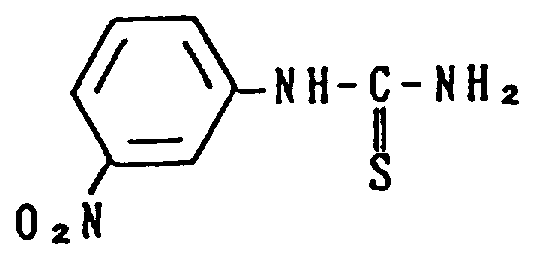
- Die Wahl der Thioharnstoffverbindungen der allgemeinen Formel (I) ist nicht besonders beschränkt, man kann z.B. folgende verwenden:







- Die erfindungsgemäße Kupferverbindung ist eine Kupferverbindung der Formel (II)

- Die Wahl der erfindungsgemäßen Kupferverbindungen der allgemeinen Formel (II) ist nicht besonders beschränkt, man kann z.B. folgende verwenden: Kupferstearat, Kupferpalmitat, Kupferoleat, Kupferbehenat, Kupferlaurat, Kupfercaprat, Kupfercapronat, Kupfervalerianat, Kupferisolaktat, Kupferlaktat, Kupferpropionat, Kupferacetat, Kupferformat, Kupferhydroxid, Kupferbenzoat, Kupfer-o-toluylat, Kupfer-m-toluylat, Kupfer-p-toluylat, Kupfer-p-tert.-butylbenzoat, Kupfer-o-chlorbenzoat, Kupfer-m-chlorbenzoat, Kupfer-p-chlorbenzoat, Kupferdichlorbenzoat, Kupfertrichlor benzoat, Kupfer-p-brombenzoat, Kupfer-p-jodbenzoat, Kupfer-p-phenylbenzoat, Kupfer-o-benzoylbenzoat, Kupfer-p-nitrobenzoat, Kupferanthranilat, Kupfer-p-aminobenzoat, Kupferoxalat, Kupfermalonat, Kupfersuccinat, Kupferglutarat, Kupferadipat, Kupferpimelat, Kupfersuberat, Kupferazelat, Kupfersebacinat, Kupferphthalat, Kupfermonoesterphthalat, Kupfernaphthenat, Kupfernaphthalincarbonat, Kupfertartrat, Kupferdiphenylamin-2-carboxylat, Kupfer-4-cyclohexyllaktat, Kupferdiäthyldithiocarbamat, Kupferglukonat, Diäthoxykupfer, Di-isopropoxykupfer, Di-n-butoxykupfer, Kupferoctylat, Kupferalkylbenzolsulfonat, Kupfer-p-toluolsulfonat, Kupfernaphthalinsulfonat, Kupfernaphthylaminsulfonat, Kupfer-n-dodecylbenzolsulfonat, Kupferdodecylsulfat, Kupfer-2,5-dimethylbenzolsulfonat, Kupfer-2-carbomethoxy-5-methylbenzolsulfonat, Kupfer-α-naphthylphosphat, Kupferstearylphosphat, Kupferlaurylphosphat, Kupfer-di-2-äthylhexylphosphat, Kupferisodecylphosphat, und dergleichen.
- Die erfindungsgemäße Bleiverbindung ist eine Bleiverbindung der Formel (III)
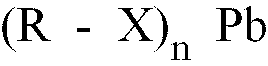
-COO, -SO₄, -SO₃, -PO₄, oder -O bedeutet, n eine ganze Zahl von 1 bis 4 ist. - Die Wahl der erfindungsgemäßen Bleiverbindungen der allgemeinen Formel (III) ist nicht besonders beschränkt, man kann z.B. folgende verwenden:
Bleistearat, Bleipalmitat, Bleioleat, Bleibehenat, Bleilaurat, Bleicaprat, Bleicapronat, Bleivalerianat, Bleiisolaktat, Bleilaktat, Bleipropionat, Bleiacetat, Bleiformat, Bleihydroxid, Bleibenzoat, Blei-o-toluylat, Blei-m-toluylat, Blei-p-toluylat, Blei-p-tert.-butylbenzoat, Blei-o-chlorbenzoat, Blei-m-chlorbenzoat, Blei-p-chlorbenzoat, Bleidichlorbenzoat, Bleitrichlor benzoat, Blei-p-brombenzoat, Blei-p-jodbenzoat, Blei-p-phenylbenzoat, Blei-o-benzoylbenzoat, Blei-p-nitrobenzoat, Bleianthranilat, Blei-p-aminobenzoat, Bleioxalat, Bleimalonat, Bleisuccinat, Bleiglutarat, Bleiadipat, Bleipimelat, Bleisuberat, Bleiazelat, Bleisebacinat, Bleiphthalat, Bleimonoesterphthalat, Bleinaphthenat, Bleinaphthalincarbonat, Bleitartrat, Bleidiphenylamin-2-carboxylat, Blei-4-cyclohexyllaktat, Bleidiäthyldithiocarbamat, Bleiglukonat, Diäthoxyblei, Di-isopropoxyblei, Di-n-butoxyblei, Bleioctylat, Bleialkylbenzolsulfonat, Blei-p-toluolsulfonat, Bleinaphthalinsulfonat, Bleinaphthylaminsulfonat, Blei-n-dodecylbenzolsulfonat, Bleidodecylsulfat, Blei-2,5-dimethylbenzolsulfonat, Blei-2-carbomethoxy-5-methylbenzolsulfonat, Blei-α-naphthylphosphat, Bleistearylphosphat, Bleilaurylphosphat, Blei-di-2-äthylhexylphosphat, Bleiisodecylphosphat, und dergleichen. - In den Formeln I, II und III können Alkyl, Alkenyl, Alkoxy etc. geradkettig oder verzweigt sein. Vorzugsweise steht Alkyl für C₁-C₃₀-Alkyl, insbesondere C₁-C₂₅-Alkyl. Beispiele sind Methyl, Ethyl, n- und i-Propyl, Butyl, Stearyl oder Behenyl.
- Cycloalkyl steht vorzugsweise für Cyclopentyl oder Cyclohexyl.
- Aryl bedeutet vorzugsweise Phenyl oder Naphthyl, Aralkyl steht vorzugsweise für Phenyl-C₁-C₄-Alkyl, wie Benzyl oder Phenylethyl.
- Alkenyl steht vorzugsweise für C₂-C₆-Alkenyl, insbesondere C₂-C₄-Alkenyl.
- Bei den heterocyclischen Resten handelt es sich vorzugsweise um 5- oder 6-gliedrige Ringe mit einem oder mehreren Sauerstoff-, Schwefel- oder Stickstoff-Heteroatomen, wie Thiazolyl, Thienyl, Furyl, Pyrrolidinyl, Pyrrolyl, Morpholinyl, Piperazinyl, Piperidinyl oder Pyridinyl.
Wenn R₁ und R₂ oder R₂ und R₃ gemeinsam einen Ring bilden, stehen sie vorzugsweise für Ethylen, Propylen oder Butylen. - Bevorzugte Substituenten der in den Formeln I, II und III vorhandenen Reste sind geradkettiges oder verzweigtes C₁-C₁₈-Alkyl (wie Methyl, Ethyl, n- und i-Propyl, n-, i- und t-Butyl, Dodecyl etc.), C₁-C₄-Alkoxy, Hydroxy, Halogen (F, C1, Br, J), Nitro, Amino, Phenyl, Cyclopentyl, Cyclohexyl, Benzoyl, Acetyl.
- Entweder die obige Thioharnstoffverbindung oder die obige Kupfer- oder Bleiverbindung absorbiert nahes IR-Licht fast nicht oder nur eine bestimmte Wellenlänge. Eine Hitzebehandlung der Thioharnstoffverbindung oder der Kupfer- oder Bleiverbindung übt keinen Einfluß auf die Absorption im nahen IR aus. Aber das Gemisch aus dieser Thioharnstoffverbindung und dieser Kupfer- und/oder Bleiverbindung nimmt nach seiner Hitzebehandlung nahes IR-Licht stark und gleichmäßig auf.
- Ohne Hitzebehandlung nimmt das Gemisch aus einer Thioharnstoffverbindung der allgemeinen Formel (I) und wenigstens einer Verbindung aus der Gruppe der Verbindungen der allgemeinen Formel (II), der Verbindungen der allgemeinen Formel (III), Kupfer- und Bleiacetylacetonate, Chlorophyll-Kupfer und -Blei und Chlorophyllin-Kupfer und -Blei fast kein nahes IR-Licht auf.
- Wenn man die Masse oder die diese Masse enthaltenden Formkörper vollständig oder teilweise (abschnittsweise) durch Zufuhr von Wärmeenergie behandelt, nimmt der erhitzte Teil das nahe IR-Licht stark auf. Der erhitzte Teil nimmt kein Licht im sichtbaren Wellenlängenbereich auf und produziert ein latentes Bild (eines durch Erhitzen erzeugten Musters).
- Daher kann man unter der Verwendung des obigen Phänomens einen Detektor für das durch Erhitzen erzeugte Muster und in Kombination mit einem geeigneten Entwicklungsgerät ein Aufzeichnungspapier herstellen.
- Weil das erfindungsgemäße Material, das durch die Hitzebehandlung der ein Gemisch aus Thioharnstoffverbindung und aus Kupfer- und/oder Bleiverbindung enthaltenden Masse erhalten wird, das Licht im nahen IR-Bereich stark absorbiert, kann es Verwendung bei der Herstellung eines Detektors für nahes IR-Licht und bei der Herstellung der Mittel für das Aufzeichnungssystem des Laserstrahls finden.
- Die Stärke der Absorption im nahen IR kann durch die Art und das Mischverhältnis von Thioharnstoffverbindung und Kupfer- und/oder Bleiverbindung, Erhitzungstemperatur und -zeit usw. eingestellt werden.
- Die Masse wird hergestellt, indem man die Thioharnstoffverbindung und die Kupfer- und/oder Bleiverbindung in einem geeigneten Mischungsverhältnis vermischt, oder indem man die Thioharnstoffverbindung, die Kupfer- und/oder Bleiverbindung, ein Bindemittel, Zellstoff, Holzschliff, thermoplastisches Harzpulver usw. und gegebenenfalls Additive wie Farbstoffe usw. vermischt.
- Weiter kann die Masse hergestellt werden, indem man das Gemisch aus allen Rohstoffen in einem geeigneten Lösungsmittel oder einer geeigneten Dispersion auflöst, oder indem man alle Rohstoffe außer Bindemittel, Farbstoff, usw. in einem Lösungsmittel auflöst, in dem Bindemittel, Färbungsmittel, usw. dispergiert oder aufgelöst sind.
- Die Masse kann beispielsweise eine Beschichtungsmasse, Füllstoff usw. sein. Das Mischverhältnis, der Massegehalt im Formkörper und die Zugabemenge anderer Stoffe werden so festgelegt, daß beim Erhitzen die Thioharnstoffverbindung und die Kupfer- und/oder Bleiverbindung als Feststoffe oder als Schmelze oder als Gemisch aus Feststoff und Schmelze miteinander in Kontakt gebracht werden.
- Der erfindungsgemäße Formkörper umfaßt eine Masse, erhältlich durch Hitzebehandlung, die die Thioharnstoffverbindung und die Kupfer- und/oder Bleiverbindung enthält, oder ein im nahen IR absorbierendes Material, das durch die Hitzebehandlung der Masse erhalten wird. Das Verfahren zur Herstellung dieses Formkörpers erfolgt durch:
- (a) Formen eines Gemisches aus den Formkörperrohstoffen, und dem erfindungsgemäßen im nahen IR absorbierenden Material, oder
- (b) Auftragen oder Imprägnieren eines dispergierten Schlamms des erfindungsgemäßen Materials mittels Zerstäubungs-, Streich- oder Druckmaschine auf den Förmkörperrohstoff.
- Der Formkörper wird hergestellt, indem man aus Zellstoff, Holzschliff, Faser, thermoplastischem Harz, usw. auf bekannte Weise, beispielsweise durch Weben, Blattbildung, Hitzeformierung usw. einen Film, ein Blatt oder eine Stange produziert und gegebenfalls weiter behandelt.
- Die Hitzebehandlung zur Erzielung einer Absorptionsfähigkeit im nahen IR ist nicht besonders beschränkt. Alle Hitzebehandlungen, die eine Übertragung von Wärmeenergie für die Erzielung der Absorptionsfähigkeit im nahen IR auf Grund der Reaktion der Thioharnstoffverbindung mit der Kupfer- oder Bleiverbindung mit sich bringen, können erfindungsgemäß verwendet werden. Das Erhitzen kann beispielsweise mit Hilfe einer elektrischen Heizvorrichtung, Induktionsheizvorrichtung, Filmextruders usw., Thermokopfes, Halbleiterlasers; IR-Lampe und dergleichen, erfolgen.
- Die Hitzebehandlung wird unter beliebiger Atmosphäre, beispielweise Luftatmosphäre, inerter Gasatmosphäre, usw., üblicherweise unter Luftatmosphäre durchgeführt.
- Die Erhitzungstemperatur liegt üblicherweise bei 40 - 400 °C, vorzugsweise bei 50 - 350 °C. Die Erhitzungszeit ist im Bereich von einigen Millisekunden bis zu einigen Zehnminuten.
- Eine gleichmäßige Vermischung durch einen Mischer,z.B. Quirl, durch Umrühren und Schwenken ist bevorzugt, weil dies wegen der zunehmenden Berührungshäufigkeit der Materialien zu einer einheitlichen Wärmeübertragung und großen Reaktionsgeschwindigkeit führt.
- Das Mischverhältnis von Thioharnstoffverbindung, Kupfer- und/oder Bleiverbindung ist je nach der Art dieser Verbindungen verschieden, aber 0.01 - 50 Gew.-Teile, vorzugsweise 0,1 - 10 Gew.-Teile der Thioharnstoffverbindung, bezogen auf 1 Gew.-Teil der Kupfer- und/oder Bleiverbindung, werden im allgemeinen verwendet.
- Wie oben erwähnt wurde, nimmt das Gemisch aus der Thioharnstoffverbindung der allgemeinen Formel (I) und aus mindestens einer Verbindung aus der Gruppe Kupfer-und Bleihydroxid, Kupferverbindung der allgemeinen Formel (II), Bleiverbindung der allgemeinen Formel (III), Kupfer- und Bleiacetylacetonat, Chlorophyll-Kupfer und -Blei, und
Chlorophyllin-Kupfer und -Blei nach Hitzebehandlung nahes IR-Licht gleichmäßig im ganzen Bereich von 700 - 2000 nm auf. Die Ursache für die obige Tatsache ist nicht klar. - Wie aus folgenden Beispielen und Vergleichsbeispielen ersichtlich ist, nimmt weder die Thioharnstoffverbindung noch die obige Kupfer- und/oder Bleiverbindung nach Hitzebehandlung nahes IR-Licht stark und gleichmäßig im ganzen Bereich von 700 - 2000 nm auf . Das Gemisch aus der Thioharnstoffverbindung der allgemeinen Formel (I) und der obigen Kupfer- und/oder Bleiverbindung ohne Hitzebehandlung nimmt ebenfalls kein nahes IR-Licht stark und gleichmäßig auf. Daher vermutet man, daß bei der Hitzebehandlung des Gemisches eine Reaktion zwischen der Thioharnstoffverbindung der allgemeinen Formel (I) und der obigen Kupfer- und/oder Bleiverbindung auftritt, wodurch ein Komplex gebildet wird.
- Die Erfindung wird durch folgende Beispiele erläutert. Als Abkürzung für Gewichtsteile wird "Teile" verwendet.
- Die Thioharnstoffverbindungen und Kupferverbindungen der Nrn. 1, 3 und 5 der der Tabelle 1 wurden in einer Reibmühle bis zur Teilchengröße von ungefähr 3 µ naß vermahlen.
-
Thioharnstoffverbindung von Nr. 1, 3 oder 5 20 Teile 10%-ige wäßrige Lösung von Polyvinylalkohol 50 Teile Wasser 30 Teile Gesamt 100 Teile -
Kupferverbindung von Nr. 1, 3 oder 5 20 Teile 10%-ige wäßrige Lösung von Polyvinylalkohol 50 Teile Wasser 30 Teile Gesamt 100 Teile - 50 Teile der Lösung A und 50 Teile der Lösung B wurden miteinander vermischt, um eine Beschichtungsmasse herzustellen.
- Diese Beschichtungsmasse wurde in einer Beschichtungsmenge von 5 g/m auf ein hochklassiges Papier mit einem Gewicht von 60 g/m mittels des Meyerbargeräts aufgetragen und getrocknet. Man erhielt ein Aufzeichnungsblatt. Alle erhaltenen Aufzeichnungsblätter sind weiß bis blaßblau, und färben sich blaßgrünlich bei der Berührung mit einer Metallplatte von einer Oberflächentemperatur von 150°C während 5 Sekunden. Bei jedem gefärbten Teil sind die Absorptionswerte des nahen IR-Lichtes bei 800, 900, 1000, 1500 und 2000 nm Wellenlänge durchschnittlich mehr als 80%, und sie sind daher hoch.
- Der wärmeempfindliche Druck erfolgte durch einen wärmeempfindlichen Drucker für Strichcode-Zettel (BW-100T, hergestellt von Mekano System Co., Ltd.). In jedem Fall wurde ein blaßgrünes Strichcode-Muster auf jedes der Blätter gedruckt.
- Dieses Muster ist lesbar mittels eines Lesers für Strichcode-Zettel (MS-Ba-Dec 230, hergestellt von Mekano System Co., Ltd.), bei dem das Licht eines Halbleiterlasers als Leselichtquelle verwendet wurde.
- Auf Basis der Kombinationen Nr. 1 - 23 in der Tabelle 1 wurden 5 Teile einer Thioharnstoffverbindung und 5 Teile einer Kupferverbindung in einem Porzellantiegel vermischt. 10 Teile des Gemisches wurden während 15 Sekunden bei 150°C in einem elektrischen Ofen hitzebehandelt.
- Das erhaltene, blaßfarbige Pulverprodukt wurde in einer bestimmten Dicke auf einem hochklassigen Papier fixiert.
- Der Reflexionsgrad der Oberfläche wurde mit dem Spektrophotometer (UVID EC-590, hergestellt von Japan Spectroscopic Co., Ltd.) in bezug auf das. Reflexionsspektrum des nahen IR-Bereiches im Wellenlängenbereich von 800 - 2500 nm gemessen.
- Die Absorptionsfähigkeit im nahen IR wird als Durchschnittswert der Absorptionswerte dargestellt, wobei dieser Absorptionswert der Unterschied zwischen 100% und dem Reflexionsgrad bei der Wellenlänge von 800, 900, 1000, 1500 und 2000 nm ist. Dabei zeigt ⓞ einen Durchschnittswert von wenigstens 80%, ○ einen Durchschnittswert von wenigstens 60%, Δ einen Durchschnittwert von wenigstens 30%, und X einen Durchschnittswert von weniger als 30%.
- Das Material mit einem Durchschnittswert von wenigstens 30% bedeutet ein erfindungsgemäßes im nahen IR absorbierendes Material. Die nahen IR-Absorptionsfähigkeiten der erfindungsgemäßen Materialien in Nrn. 1 - 23 der Tabelle 1 zeigen einen Durchschnittswert von wenigstens 60%.
- Jede der Thioharnstoffverbindungen oder jede der Kupferverbindungen in der Tabelle 2 wurde unter den gleichen Bedingungen wie im Beispiel 2 hitzebehandelt, und auf die Herstellung des Produktes angewandt. Das nahe IR-Reflexionsspektrum eines erhaltenen Produktes wurde gemessen, und die nahe IR-Absorptionsfähigkeit wurde in gleicher Weise wie im Beispiel 2 bewertet. Alle Absorptionsfähigkeiten im nahen IR sind weniger als 30%, wie es aus der Tabelle 2 ersichtlich ist.
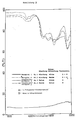
- Die Änderung der Absorptionsfähigkeit im nahen IR bei der getrennten Hitzebehandlung der einzelnen Komponenten, der Mischung ohne Hitzebehandlung, und der Mischung aus einer Thioharnstoffverbindung und einer Kupferverbindung nach Hitzebehandlung ist in Abbildung 1 erläutert. In der Abbildung 1 werden als Thioharnstoffverbindung 1,3-Diphenylthioharnstoff und als Kupferverbindung Kupfer-p-chlorbenzoat verwendet.
- Nr. 1 und Nr. 4 des Vergleichsbeispiels 1 (getrennte Hitzebehandlung) Nr. 1 des Beispiels 1 Mischung ohne Hitzebehandlung) und Nr. 1 des Beispiels 2 (Hitzebehandlung der Mischung) werden in bezug auf die nahen IR-Reflexionsspektra im Bereich von 800 - 2000 nm verglichen.
- Aus der Abbildung 1 ist ersichtlich, daß die Absorptionsfähigkeit des erhitzten Gemisches aus 1,3-Diphenylthioharnstoff und Kupfer-p-chlorbenzoat (bei Nr. 1 des Beispiels 2) im nahen IR erheblich höher ist als diejenige der getrennt erhitzten Komponenten oder als diejenige der Mischung ohne Hitzebehandlung; das heißt, daß die nahe IR-Absorptionsfähigkeit von Nr. 1 des Beispiels 2 mehr als 90% im ganzen Meßewellenlängenbereich ist.
- Mit jeder der Thioharnstoffverbindungen und Kupferverbindungen der Nrn. 24 - 32 der Tabelle 3 wurden folgende Zusammensetzungen zubereitet:
-
Thioharnstoffverbindung 50 Teile 10%-ige wäßrige Lösung von Polyvinylalkohol 25 Teile Wasser 125 Teile -
Kupferverbindung 50 Teile 10%-ige wäßrige Lösung von Polyvinylalkohol 25 Teile Wasser 125 Teile - Die Lösungen der obigen Zusammensetzungen wurden in einer Reibmühle einzeln bis zur Teilchengröße von 1 Mikron vermahlen. Die Lösungen wurden in dem in der Tabelle 3 angegebenen Verhältnis miteinander vermischt, um eine Beschichtungsmasse zu erhalten. Die erhaltene Beschichtungsmasse wurde in einer Beschichtungsmenge von 3,0 g/m (Feststoffgehalt) auf ein hochklassiges Papier von 50 g/m aufgetragen und getrocknet, um ein Aufzeichnungsblatt zu erhalten.
- Dieses Aufzeichnungsblatt wurde 5 Sekunden unter einem Druck von 10 g/m2 gegen eine auf 150°C erhitzte Platte gepreßt (hitzebehandelt). Man erhielt ein im nahen IR absorbierendes Aufzeichnungsblatt.
- Die Absorptionsfähigkeit des erhaltenen Aufzeichnungsblattes wurde in der gleichen Weise wie im Beispiel 2 gemessen, und die Hintergrundfarbe der Beschichtungsoberfläche und die Beständigkeit der IR-Absorptionsfähigkeit gegenüber Hitze, Feuchtigkeit, und Licht wurde wie folgt bestimmt, und die Ergebnisse sind in der Tabelle 3 zusammengefaßt.
- Der Reflexionsgrad der Beschichtungsoberfläche nach der Hitzebehandlung wird mit einem Macbeth-Dichtemesser (RD-914, Verwendung des Amber-Filters) gemessen.
- Ein Blatt wird 24 Stunden im Ofen bei 60°C belassen. Dann wird der IR-Reflexionsgrad des Blattes mit einem Spectrophotometer (bei einer Wellenlänge von 1000 nm) gemessen.
- Die Beständigkeit gegenüber Hitze wird als Restprozentsatz der nahen IR-Absorptionsfähigkeit durch folgende Formel bewertet.

- Ein Blatt wird bei 40°C und 90% relativer Luftfeuchtigkeit stehengelassen. Nach 24 Stunden wird. der IR-Reflexionsgrad des Blattes mit einem Spektrophotometer (bei einer Wellenlänge von 1000 nm) gemessen. Die Beständigkeit gegenüber Luftfeuchtigkeit wird als Restprozentsatz der nahen IR-Absorptionsfähigkeit durch folgende Formel bewertet.

- Ein Blatt wird 6 Stunden mit dem Licht eines Fade-O-Meters bestrahlt. Der IR-Reflexionsgrad des Blattes wird mit einem Spektrophotometer (bei einer Wellenlänge von 1000 nm) gemessen. Die Beständigkeit gegenüber Licht wird als Restprozentsatz der nahen IR-Absorptionsfähigkeit durch folgende Formel bewertet.

- Die die Thioharnstoffverbindung enthaltende Dispersion A oder die die Kupferverbindung enthaltende Dispersion B, die im Beispiel 3 verwendet wurden, wurde auf die gleiche Weise wie im Beispiel 3 getrennt aufgetragen, getrocknet und dann hitzebehandelt, um ein Produkt zu herzustellen. Die nahe IR-Absorptionsfähigkeit des Produktes wurde gemessen.
- Bei den Blättern, auf die ein- Gemisch aus der Thioharnstoffverbindung und der Kupferverbindung aufgetragen und die getrocknet wurden, führt eine Hitzebehandlung zu einem Blatt mit einer hohen Absorptionsfähigkeit im nahen IR,wie aus Tabelle 3 ersichtlich ist. Diese hohe IR-Absorptionsfähigkeit wird unter der Einwirkung von Hitze, Feuchtigkeit und Licht fast nicht erniedrigt und sie ist erstaunlich stabil gegenüber der Handhabung und der Änderung der Umweltsbedingungen. Die Oberfläche dieses Blattes färbt sich etwas ins Graue, wodurch das Blatt aber keine auffallende Farbveränderung erfährt. Das Blatt, auf das entweder die Thioharnstoffverbindung oder die Kupferverbindung aufgetragen und das getrocknet wurde, weist bei der Hitzebehandlung keine nahe IR-Absorptionsfähigkeit auf, und es wurde daher hinsichtlich der Stabilität der IR-Absorptionsfähigkeit während der Lagerung nicht geprüft.


- Jede der Thioharnstoffverbindungen und der Bleiverbindungen, die in Nrn. 1, 3 und 5 der Tabelle 4 beschrieben wurden, wurde in einer Reibmühle bis zur Teilchengröße von ungefähr 3 µ naß vermahlen.
-
Thioharnstoffverbindung von Nr. 1, 3 oder 5 20 Teile 10%-ige wäßrige Lösung von Polyvinylalkohol 50 Teile Wasser 30 Teile Gesamt 100 Teile -
Bleiverbindung von Nr. 1, 3 oder 5 20 Teile 10%-ige wäßrige Lösung von Polyvinylalkohol 50 Teile Wasser 30 Teile Gesamt 100 Teile - 50 Teile der Lösung A und 50 Teile der Lösung B wurden miteinander vermischt, um eine Beschichtungsmasse herzustellen.
- Diese Beschichtungsmasse wurde in einer Beschichtungsmenge von 5 g/m auf ein hochklassiges Papier mit einem Gewicht von 60 g/m mittels des Meyerbargeräts aufgetragen und getrocknet. Man erhielt ein Aufzeichnungsblatt. Alle erhaltenen Aufzeichnungsblätter sind weiß bis blaßblau und färben sich blaßgrünlich bei der Berührung mit einer Metallplatte von einer Oberflächentemperatur von 150°c während 5 Sekunden. Bei jedem gefärbten Teil sind die Absorptionswerte des nahen IR-Lichtes bei 800, 900, 1000, 1500 und 2000 nm Wellenlänge durchschnittlich mehr als 80%, und sie sind daher hoch.
- Der wärmeempfindliche Druck erfolgte durch einen wärmeempfindlichen Drucker für Strichcode-Zettel (BW-100T, hergestellt von Mekano System Co., Ltd.). In jedem Fall wurde ein blaßgrünes Strichcode-Muster auf jedes der Blätter gedruckt.
- Dieser Muster ist lesbar mittels eines Lesers für Strichcode-Zittel (MS-Ba-Dec 230, hergestellt von Mekano System Co., Ltd.), bei dem das Licht eines Halbleiterlasers als Leselichtquelle verwendet wurde.
- Auf Basis der Kombinationen Nr. 1 - 23 in der Tabelle 4 wurden 5 Teile einer Thioharnstoffverbindung und 5 Teile einer Bleiverbindung in einem Porzellantiegel vermischt. 10 Teile des Gemisches wurden während 15 Minuten bei 150°C in einem elektrischen Ofen hitzebehandelt.
- Das erhaltene, blaßfarbige Pulverprodukt wurde in einer bestimmten Dicke auf einem hochklassigen Papier fixiert.
- Der Reflexionsgrad der Oberfläche wurde in der gleichen Weise wie im Beispiel 2 gemessen.
- Die nahe IR-Absorptionsfähigkeit wird in der gleichen Weise wie im Beispiel 2 dargestellt. Die nahen. IR-Absorptionsfähigkeiten der erfindungsgemäßen Materialien in Nrn. 1 - 23 der Tabelle 4 zeigen einen Durchschnittswert von wenigstens 60%.
- Jede der Thioharnstoffverbindungen oder jede der Bleiverbindungen in der Tabelle 5 wurde unter den gleichen Bedingungen wie im Beispiel 5 hitzebehandelt, und auf die Herstellung des Produktes angewandt. Das nahe IR-Reflexionsspektrum eines erhaltenen Produktes wurde gemessen, und die nahe IR-Absorptionsfähigkeit wurde in gleicher Weise wie im Beispiel 5 bewertet. Alle Absorptionsfähigkeiten im nahen IR sind weniger als 30%, wie es aus der Tabelle 5 ersichtlich ist.
- Die Änderung der Absorptionsfähigkeit im nahen IR bei der getrennten Hitzebehandlung der einzelnen Komponenten, der Mischung ohne Hitzebehandlung, und der Mischung aus einer Thioharnstoffverbindung und einer Bleiverbindung nach Hitzebehandlung ist in Abbildung 2 erläutert. In der Abbildung 2 werden als Thioharnstoffverbindung 1,3-Diphenylthioharnstoff und als Bleiverbindung Blei-p-chlorbenzoat verwendet. Nr. 1 und Nr. 4 des Vergleichsbeispiels 3 (getrennte Hitzebehandlung) Nr. 1 des Beispiels 4 (Mischung ohne Hitzebehandlung) und Nr. 1 des Beispiels 5 (Hitzebehandlung der Mischung)werden in bezug auf die nahen IR-Reflexionsspektra im Bereich von 800 - 2000 nm verglichen.
- Aus der Abbildung 2 ist ersichtlich, daß die Absorptionsfähigkeit von Nr. 1 des Beispiels 5 im nahen IR beim erhitzten Gemisch aus 1,3-Diphenylthioharnstoff und Blei-p-chlorbenzoat erheblich höher ist als diejenige der getrennt erhitzten Komponenten oder als diejenige der Mischung ohne Hitzebehandlung; das heißt, daß die nahe IR-Absorptionsfähigkeit von Nr. 1 des Beispiels 5 mehr als 90% im ganzen Meßwellenlängenbereich ist.
- Mit jeder der Thioharnstoffverbindungen und Bleiverbindungen der Nrn. 24 - 32 der Tabelle 6 wurden folgende Zusammensetzungen zubereitet.
-
Thioharnstoffverbindung 50 Teile 10%-ige wäßrige Lösung von Polyvinylalkohol 25 Teile Wasser 125 Teile -
Bleiverbindung 50 Teile 10%-ige wäßrige Lösung von Polyvinylalkohol 25 Teile Wasser 125 Teile - Die Lösungen der obigen Zusammensetzungen wurden in einer Reibmühle einzeln bis zur Teilchengröße von 1 Mikron vermahlen. Die Lösungen wurden in dem in Tabelle 6 angegebenen Verhältnis miteinander vermischt, um eine Beschichtungsmasse zu erhalten. Die erhaltene Beschichtungsmasse wurde in einer Beschichtungsmenge von 3,0 g/m (Feststoffgehalt) auf ein hochklassiges Papier von 50 g/m aufgetragen und getrocknet, um ein Aufzeichnungsblatt zu erhalten.
- Dieses Aufzeichnungsblatt wurde 5 Sekunden unter einem Druck von 10 g/m2 gegen eine auf 150°C erhitzte Platte gepreßt (hitzebehandelt). Man erhielt ein im nahen IR absorbierendes Aufzeichnungsblatt.
- Die Absorptionsfähigkeit des erhaltenen Aufzeichnungsblattes, die Hintergrundfarbe der Beschichtungsoberfläche und die Beständigkeit der IR-Absorptionsfähigkeit gegenüber Wärme, Feuchtigkeit, und Licht wurden in der gleichen Weise wie im Beispiel 3 bestimmt, und die Ergebnisse sind in der Tabelle 6 zusammengefaßt.
- Die die Thioharnstoffverbindung enthaltende Dispersion A oder die die Bleiverbindung enthaltende Dispersion B, die im Beispiel 6 verwendet wurden, wurde auf die gleiche Weise wie im Beispiel 6 getrennt aufgetragen, getrocknet und dann hitzebehandelt, um ein Produkt zu herzustellen. Die nahe IR-Absorptionsfähigkeit des Produktes wurde gemessen.
- Bei den Blättern, auf die ein Gemisch aus der Thioharnstoffverbindung und der Bleiverbindung aufgetragen und die getrocknet wurden, führt eine Hitzebehandlung zu einem Blatt mit einer hohen Absorptionsfähiskeit im nahen IR, wie aus Tabelle 6 ersichtlich ist. Diese hohe IRAbsorptionsfähigkeit wird unter der Einwirkung von Hitze, Feuchtigkeit und Licht fast nicht erniedrigt und sie ist erstaunlich stabil gegenüber der Handhabung und der Änderung der Umweltsbedingungen. Die Oberfläche dieses Blattes färbt sich etwas ins Graue, wodurch das Blatt aber keine auffallende Farbveränderung erfährt. Das Blatt, auf das.entweder die Thioharnstoffverbindung oder die Bleiverbindung aufgetragen und das getrocknet wurde, weist bei der Hitzebehandlung keine nahe IR-Absorptionsfähigkeit auf, und es wurde daher hinsichtlich der Stabilität der IR-Absorptionsfähigkeit während der Lagerung nicht geprüft.


- Die nach Hitzebehandlung im nahen IR absorbierende Masse und das diese Masse enthaltende Blatt sind fast farblos, wobei der erhitzte Teil sofort eine nahe IR-Absorptionsfähigkeit besitzt. Die Hitzebehandlung der Masse, oder des diese hitzebehandelte Masse enthaltenden Blattes führt zur starken Absorptionsfähigkeit im ganz nahen IR-Bereich von 800 - 2000 nm. Wegen der obigen nahen IR-Absorptionsfähigkeit können die erfindungsgemäßen Produkte als optische Materialien wie als Thermodetektor; Filter für Licht im nahen IR-Bereich, Aufzeichnungsmaterial; Material zur Abweisung bzw. Isolierung von Wärmestrahlen; Wärmesammler; Sensor für IR-Detektoren und dergleichen verwendet werden.
- Die Masse oder das durch ihre Hitzebehandlung erhaltene Material wird trotz des Vorhandenseins von Metall nur gering verfärbt. Daher besitzen die diese Masse oder dieses Material enthaltenden Formkörper (Film, Blatt usw.) ein überlegenes Aussehen.
- Die Absorptionsfähigkeit der nach Hitzebehandlung im nahen IR absorbierenden Masse, des erfindungsgemäßen im nahen IR absorbierenden Materials und des diese Masse oder dieses Material enthaltenden Formkörpers ist stabil genenüber der Veränderung der Umweltbedingungen im Laufe der Zeit, d.h. sie verschlechtert sich nicht.
- Weiter kann die nach Hitzebehandlung im nahen IR-absorbierende Masse nur durch die Mischung der Komponenten hergestellt werden, das erfindungsgemäße im nahen IR absorbierende Material nur durch Erhitzen dieser Mischung. Die Herstellung des Formkörpers, das das erfindungsgemäße Material enthält, benötigt kein neues Mittel. Daher ist der Gegenstand dieser Erfindung für die industrielle Produktion geeignet.
Claims (9)
- Verwendung einer Masse, die mindestens eine Thioharnstoffverbindung der allgemeinen Formel (I) und mindestens eine Kupfer- und/oder Bleiverbindung enthält:

oder einen einwertigen 5- oder 6-gliedrigen Ring bedeuten, wobei jede Gruppe durch mindestens einen Substituenten substituiert sein kann, oder R₁ und R₂ oder R₂ und R₃ gemeinsam einen Ring bilden können), zur Herstellung eines nach Hitzebehandlung im nahen IR absorbierenden Materials. - Verwendung nach Anspruch 1, dadurch gekennzeichnet, daß die Kupferverbindung eine Kupferverbindung der Formel (II)

worin R ein Wasserstoffatom, eine Alkyl-, Cycloalkyl-Aryl-, Aralkyigruppe oder einen einwertigen 5- oder 6gliedrigen Ring bedeutet, wobei jede Gruppe durch mindestens einen Substituenten substituiert sein kann, X für -COO, -SO₄, -SO₃, -PO₄, oder -O steht und n eine ganze Zahl von 1 bis 4 ist. - Verwendung nach Anspruch 1,
dadurch gekennzeichnet, daß die Kupferverbindung Kupferacetylacetonat ist. - Verwendung nach Anspruch 1, dadurch gekennzeichnet, daß die Kupferverbindung Chlorophyll-Kupfer oder Chlorophyllin-Kupfer oder Kupferhydroxid ist.
- Verwendung nach Anspruch 1, dadurch gekennzeichnet, daß die Bleiverbindung eine Bleiverbindung der Formel (III)

worin R ein Wasserstoffatom, eine Alkyl-, Cycloalkyl-Aryl-, Aralkylgruppe, oder ein heterocyclischer Rest ist, (wobei jede Gruppe oder der Rest durch mindestens einen Substituenten substituiert sein kann), X für -COO, -SO₄, -SO₃, -PO₄, oder -O steht und n eine ganze Zahl von 1 bis 4 ist. - Verwendung nach Anspruch 1, dadurch gekennzeichnet, daß die Bleiverbindung Bleiacetylacetonat ist.
- Verwendung nach Anspruch 1, dadurch gekennzeichnet, daß die Bleiverbindung Chlorophyll-Blei oder Chlorophyllin-Blei oder Bleihydroxid ist.
- Im nahen IR absorbierendes Material erhältlich durch Hitzebehandlung der in einem der Ansprüche 1 bis 7 definierten Masse.
- Im nahen IR absorbierender Formkörper, dadurch gekennzeichnet, daß er das im nahen IR absorbierende Material nach Anspruch 8 umfaßt.
Applications Claiming Priority (4)
| Application Number | Priority Date | Filing Date | Title |
|---|---|---|---|
| JP63145262A JP2505859B2 (ja) | 1988-06-13 | 1988-06-13 | 近赤外線吸収剤用組成物並に近赤外線吸収材料及びそれらを含有した成形体 |
| JP145262/88 | 1988-06-13 | ||
| JP23207588A JPH0280486A (ja) | 1988-09-16 | 1988-09-16 | 近赤外線吸収剤用組成物並に近赤外線吸収材料及びそれらを含有した成形体 |
| JP232075/88 | 1988-09-16 |
Publications (2)
| Publication Number | Publication Date |
|---|---|
| EP0346772A1 EP0346772A1 (de) | 1989-12-20 |
| EP0346772B1 true EP0346772B1 (de) | 1996-02-28 |
Family
ID=26476432
Family Applications (1)
| Application Number | Title | Priority Date | Filing Date |
|---|---|---|---|
| EP19890110486 Expired - Lifetime EP0346772B1 (de) | 1988-06-13 | 1989-06-09 | Verwendung einer Masse zur Herstellung eines im nahen IR absorbierenden Materials und das Material enthaltender Formkörper |
Country Status (3)
| Country | Link |
|---|---|
| EP (1) | EP0346772B1 (de) |
| CA (1) | CA1334624C (de) |
| DE (1) | DE58909609D1 (de) |
Families Citing this family (1)
| Publication number | Priority date | Publication date | Assignee | Title |
|---|---|---|---|---|
| JP3603315B2 (ja) * | 1993-02-19 | 2004-12-22 | 日本製紙株式会社 | 近赤外線吸収剤およびそれを含有した熱線遮蔽材 |
Family Cites Families (1)
| Publication number | Priority date | Publication date | Assignee | Title |
|---|---|---|---|---|
| GB1202881A (en) * | 1966-12-20 | 1970-08-19 | Kodak Ltd | Light-sensitive compositions |
-
1989
- 1989-06-09 EP EP19890110486 patent/EP0346772B1/de not_active Expired - Lifetime
- 1989-06-09 DE DE58909609T patent/DE58909609D1/de not_active Expired - Fee Related
- 1989-06-12 CA CA 602470 patent/CA1334624C/en not_active Expired - Fee Related
Also Published As
| Publication number | Publication date |
|---|---|
| CA1334624C (en) | 1995-03-07 |
| DE58909609D1 (de) | 1996-04-04 |
| EP0346772A1 (de) | 1989-12-20 |
Similar Documents
| Publication | Publication Date | Title |
|---|---|---|
| EP0351875A2 (de) | Masse zur Herstellung eines im nahen IR absorbierenden Materials und die Masse oder das Material enthaltender Formkörper | |
| DE69123915T2 (de) | Indol-Verbindungen und deren Verwendung | |
| DE1494908C3 (de) | Tris-(p-dialkylaminophenyl)aminiumsalze und ihre Verwendung als Infrarotabsorber in organischen Polymeren | |
| DE69601891T2 (de) | Durch Laser direkt beschreibbare Auzeichnungsmaterialien | |
| DE69426221T2 (de) | Azomethinderivate als UV Licht Absorber | |
| DE69708302T2 (de) | Thermisches bleichen von infrarotfarbstoffen | |
| DE2321470C2 (de) | Wasserlösliche Oxonolfarbstoffe und Verfahren zu ihrer Herstellung | |
| DE1200845B (de) | Waermeempfindliches Kopierblatt | |
| DE1619620A1 (de) | Pigmentmassen | |
| EP0280284B1 (de) | Wärmeempfindliches Aufzeichnungsmaterial | |
| DE1197102B (de) | Warmeempfindliches Kopierblatt | |
| DE2026074C3 (de) | Verwendung von Ammoniumsalzen als strahlungsempfindliche Verbindungen | |
| DE2554099C3 (de) | Aufzeichnungsmaterial und Verfahren zum Registrieren von Informationen in Form von gefärbten Abdrucken | |
| DE2532224C2 (de) | 3-Furyl- und 3-Thienyl-bernsteinsäureanhydride oder -imide, Verfahren zu ihrer Herstellung und ihre Verwendung als photochrome Substanzen | |
| DE2822495C2 (de) | Photographisches Aufzeichnungsmaterial | |
| DE1467461A1 (de) | Verfahren zum Behandeln eines Pigments | |
| EP0918075B1 (de) | Hitzestabile Eisenoxidgelb-Pigmente | |
| DE2021432B2 (de) | Thermographisch farbentwickelbare zusammensetzung | |
| EP0287121A2 (de) | Wärme- und lichtempfindliches Aufzeichnungsmaterial und Aufzeichnungsverfahren | |
| EP0346772A1 (de) | Verwendung einer Masse zur Herstellung eines im nahen IR absorbierenden Materials und das Material enthaltender Formkörper | |
| EP0286116B1 (de) | Wärmeempfindliches Aufzeichnungsmaterial | |
| DE2041845A1 (de) | Neue 2-(2-Hydroxyphenyl)-2H-1,2,3-triazolderivate,Verfahren zu ihrer Herstellung sowie deren Anwendung als Ultraviolettlicht-Absorptionsmittel | |
| DE1471677B2 (de) | Waermeentwickelbares kopierblatt | |
| DE69326316T2 (de) | Thermische Farbbleichmittel Tetra-alkylammonium phenylsulfonylacetat | |
| DE69219375T2 (de) | Farbstoff und Farbstoffträgertintenband für thermische Farbstoffübertragungskopien |
Legal Events
| Date | Code | Title | Description |
|---|---|---|---|
| PUAI | Public reference made under article 153(3) epc to a published international application that has entered the european phase |
Free format text: ORIGINAL CODE: 0009012 |
|
| AK | Designated contracting states |
Kind code of ref document: A1 Designated state(s): BE DE FR GB IT SE |
|
| 17P | Request for examination filed |
Effective date: 19900212 |
|
| 17Q | First examination report despatched |
Effective date: 19920810 |
|
| REG | Reference to a national code |
Ref country code: FR Ref legal event code: ST |
|
| RAP1 | Party data changed (applicant data changed or rights of an application transferred) |
Owner name: NIPPON PAPER INDUSTRIES CO., LTD. |
|
| GRAH | Despatch of communication of intention to grant a patent |
Free format text: ORIGINAL CODE: EPIDOS IGRA |
|
| GRAA | (expected) grant |
Free format text: ORIGINAL CODE: 0009210 |
|
| AK | Designated contracting states |
Kind code of ref document: B1 Designated state(s): BE DE FR GB IT SE |
|
| GBT | Gb: translation of ep patent filed (gb section 77(6)(a)/1977) |
Effective date: 19960226 |
|
| REF | Corresponds to: |
Ref document number: 58909609 Country of ref document: DE Date of ref document: 19960404 |
|
| ET | Fr: translation filed | ||
| ITF | It: translation for a ep patent filed | ||
| PLBE | No opposition filed within time limit |
Free format text: ORIGINAL CODE: 0009261 |
|
| STAA | Information on the status of an ep patent application or granted ep patent |
Free format text: STATUS: NO OPPOSITION FILED WITHIN TIME LIMIT |
|
| 26N | No opposition filed | ||
| PGFP | Annual fee paid to national office [announced via postgrant information from national office to epo] |
Ref country code: SE Payment date: 19980616 Year of fee payment: 10 |
|
| PG25 | Lapsed in a contracting state [announced via postgrant information from national office to epo] |
Ref country code: SE Free format text: THE PATENT HAS BEEN ANNULLED BY A DECISION OF A NATIONAL AUTHORITY Effective date: 19990629 |
|
| EUG | Se: european patent has lapsed |
Ref document number: 89110486.1 |
|
| REG | Reference to a national code |
Ref country code: GB Ref legal event code: IF02 |
|
| PGFP | Annual fee paid to national office [announced via postgrant information from national office to epo] |
Ref country code: FR Payment date: 20040608 Year of fee payment: 16 |
|
| PGFP | Annual fee paid to national office [announced via postgrant information from national office to epo] |
Ref country code: GB Payment date: 20040609 Year of fee payment: 16 |
|
| PGFP | Annual fee paid to national office [announced via postgrant information from national office to epo] |
Ref country code: DE Payment date: 20040617 Year of fee payment: 16 |
|
| PGFP | Annual fee paid to national office [announced via postgrant information from national office to epo] |
Ref country code: BE Payment date: 20040812 Year of fee payment: 16 |
|
| PG25 | Lapsed in a contracting state [announced via postgrant information from national office to epo] |
Ref country code: IT Free format text: LAPSE BECAUSE OF NON-PAYMENT OF DUE FEES;WARNING: LAPSES OF ITALIAN PATENTS WITH EFFECTIVE DATE BEFORE 2007 MAY HAVE OCCURRED AT ANY TIME BEFORE 2007. THE CORRECT EFFECTIVE DATE MAY BE DIFFERENT FROM THE ONE RECORDED. Effective date: 20050609 Ref country code: GB Free format text: LAPSE BECAUSE OF NON-PAYMENT OF DUE FEES Effective date: 20050609 |
|
| PG25 | Lapsed in a contracting state [announced via postgrant information from national office to epo] |
Ref country code: BE Free format text: LAPSE BECAUSE OF NON-PAYMENT OF DUE FEES Effective date: 20050630 |
|
| PG25 | Lapsed in a contracting state [announced via postgrant information from national office to epo] |
Ref country code: DE Free format text: LAPSE BECAUSE OF NON-PAYMENT OF DUE FEES Effective date: 20060103 |
|
| PG25 | Lapsed in a contracting state [announced via postgrant information from national office to epo] |
Ref country code: FR Free format text: LAPSE BECAUSE OF NON-PAYMENT OF DUE FEES Effective date: 20060228 |
|
| GBPC | Gb: european patent ceased through non-payment of renewal fee |
Effective date: 20050609 |
|
| REG | Reference to a national code |
Ref country code: FR Ref legal event code: ST Effective date: 20060228 |
|
| BERE | Be: lapsed |
Owner name: *NIPPON PAPER INDUSTRIES CO. LTD Effective date: 20050630 |