EP0343573B1 - Neue 1,2-dithiol-3-thion-S-oxid-Verbindungen enthaltende Arzneimittel - Google Patents
Neue 1,2-dithiol-3-thion-S-oxid-Verbindungen enthaltende Arzneimittel Download PDFInfo
- Publication number
- EP0343573B1 EP0343573B1 EP89109207A EP89109207A EP0343573B1 EP 0343573 B1 EP0343573 B1 EP 0343573B1 EP 89109207 A EP89109207 A EP 89109207A EP 89109207 A EP89109207 A EP 89109207A EP 0343573 B1 EP0343573 B1 EP 0343573B1
- Authority
- EP
- European Patent Office
- Prior art keywords
- dithiol
- compounds
- thione
- formula
- oxide
- Prior art date
- Legal status (The legal status is an assumption and is not a legal conclusion. Google has not performed a legal analysis and makes no representation as to the accuracy of the status listed.)
- Expired - Lifetime
Links
Classifications
-
- C—CHEMISTRY; METALLURGY
- C07—ORGANIC CHEMISTRY
- C07D—HETEROCYCLIC COMPOUNDS
- C07D409/00—Heterocyclic compounds containing two or more hetero rings, at least one ring having sulfur atoms as the only ring hetero atoms
- C07D409/02—Heterocyclic compounds containing two or more hetero rings, at least one ring having sulfur atoms as the only ring hetero atoms containing two hetero rings
- C07D409/04—Heterocyclic compounds containing two or more hetero rings, at least one ring having sulfur atoms as the only ring hetero atoms containing two hetero rings directly linked by a ring-member-to-ring-member bond
-
- A—HUMAN NECESSITIES
- A61—MEDICAL OR VETERINARY SCIENCE; HYGIENE
- A61K—PREPARATIONS FOR MEDICAL, DENTAL OR TOILETRY PURPOSES
- A61K31/00—Medicinal preparations containing organic active ingredients
- A61K31/33—Heterocyclic compounds
- A61K31/38—Heterocyclic compounds having sulfur as a ring hetero atom
- A61K31/385—Heterocyclic compounds having sulfur as a ring hetero atom having two or more sulfur atoms in the same ring
-
- A—HUMAN NECESSITIES
- A61—MEDICAL OR VETERINARY SCIENCE; HYGIENE
- A61P—SPECIFIC THERAPEUTIC ACTIVITY OF CHEMICAL COMPOUNDS OR MEDICINAL PREPARATIONS
- A61P1/00—Drugs for disorders of the alimentary tract or the digestive system
- A61P1/16—Drugs for disorders of the alimentary tract or the digestive system for liver or gallbladder disorders, e.g. hepatoprotective agents, cholagogues, litholytics
-
- C—CHEMISTRY; METALLURGY
- C07—ORGANIC CHEMISTRY
- C07D—HETEROCYCLIC COMPOUNDS
- C07D339/00—Heterocyclic compounds containing rings having two sulfur atoms as the only ring hetero atoms
- C07D339/02—Five-membered rings
- C07D339/04—Five-membered rings having the hetero atoms in positions 1 and 2, e.g. lipoic acid
Definitions
- the present invention relates to 5-phenyl-1,2-dithiol-3-thione-S-oxide compounds for use as pharmaceuticals, in particular as pharmaceuticals for the treatment and prophylaxis of liver damage in larger mammals, in particular humans, and pharmaceuticals which are active ingredients Contain 5-phenyl-1,2-dithiol-3-thione-S-oxide compounds, as well as new 1,2-dithiol-3-thione-S-oxide compounds with valuable pharmacological properties, in particular hepatoprotective properties.
- Anetholtrithione 5- (4-methoxyphenyl) -3H-1,2-dithiol-3-thione is a choleretic medicinal product (commercial products Sulfarlem®, Felvitin®), which is known to have hepatoprotective properties .
- the present invention has for its object to develop new drugs for the prophylaxis and treatment of liver damage. Another object of the invention is to produce new 1,2-dithiol-3-thione derivatives with valuable pharmacological properties.
- liver protective effects against the damaging effects of exogenous hepatotoxic substances with good tolerance and low toxicity.
- 1,2-dithiol-3-thione-S-oxide compounds of the formula I are suitable as Medicines, in particular for the prophylaxis and treatment of liver damage, for example liver damage caused by hepatotoxic doses of medicinal products, chemical poisons or radiation.
- alkyl groups contained in the radicals R1 and R2 of the compounds of the formula I can be straight or branched and contain 1-4, in particular 1-2 carbon atoms.
- Alkoxy groups R.sup.1 or R.sup.2 are, in particular, methoxy.
- Halogen substituents R.sup.1 or R.sup.2 are fluorine, chlorine or bromine, preferably chlorine or fluorine.
- R1 is an alkyl group, this is preferably methyl and is preferably arranged in the 2- or 3-position.
- Halogen substituents R 1 are preferably arranged in the 4-position.
- R2 is hydrogen.
- the 5-phenyl-1,2-dithiol-3-thione-S-oxide compounds of the formula I have valuable pharmacological properties, in particular hepatoprotective properties, and are distinguished by good tolerability and low toxicity.
- the substances thus have the ability to protect the liver from damaging influences, e.g. Protect against or counteract liver damage occurring after taking hepatotoxic exogenous substances.
- liver damage As is known, a large number of chemical substances and also medicinal products can cause damage to liver cells with a correspondingly high dosage and lead to hepatic cytolysis and liver necrosis. With cytolytic liver damage, there is an increased release of some transaminases from the damaged liver cells into the bloodstream. In the case of liver damage, the blood level of these transaminases is therefore increased, and the measurement the serum activity of these transaminases gives a possibility to determine liver damage and to estimate its extent.
- the compounds of the formula I have a pronounced protective action against the liver-damaging effects of acetaminophen, as can be shown in the standard pharmacological animal experiments described below.
- hepatotoxicity is caused in part by the covalent binding of a metabolically formed reactive agent to macromolecules of the liver tissue and that peroxidation of lipids in the cell membrane and the resulting overproduction of reactive radicals, including oxygen radicals, play a key role in the hepatoxicity of acetaminophen.
- the hepatoprotective effects of the 5-phenyl-1,2-dithiol-3-thione-S-oxide compounds of the formula I against acetaminophen-induced damage can therefore be regarded as an indication that that the compounds have lipid peroxidation inhibiting properties and can be antioxidative and effective as radical scavengers.
- mice Groups of 20-30 female mice each weighing approximately 20 g were used for the experiments. The animals receive a daily feed ration during the experiment and water with pH3 is available to them indefinitely.
- the animals are intoxicated by i.p. application of 1000 mg / kg acetaminophen suspended in 0.5 ml of an aqueous gum arabic solution.
- Table A shows results obtained according to the test method described above.
- the example numbers given for the compounds of the formula I relate to the preparation examples below.
- Table A Example No. Protective effect against acetaminophen-induced lethality in mice Number of dead animals / total number of animals per test group % dead animals Erziel% protection achieved 11 1/20 5 94.6 12th 4/20 20th 78.4 4th 1/20 5 94.6 14 2/20 10th 89.2 6 3/30 10th 89.2 7 6/30 20th 78.4 8th 14/30 47.6 49.6 9 3/30 10th 89.2 1 3/30 10th 89.2 5 9/30 30th 67.6 Control animal groups 648/700 92.6
- mice with a body weight of approximately 25 g are used for the experiments.
- the animals are intoxicated by ip application of 450 mg / kg acetaminophen suspended in 0.5 ml aqueous gum arabic solution.
- the animals were given 75 mg / kg of the test substance as a suspension per os with a gavage.
- a group of control animals only receive the suspending agent one hour before intoxication.
- the animals are sacrificed 18 hours after the acetaminophen application and bled through the carotid artery.
- Blood samples from two animals each are placed in a test tube, left to stand for 2-3 hours at room temperature, decanted for one hour at 4 ° C. and then centrifuged at 2,500 ⁇ g for 10 minutes.
- the activities are measured at a wavelength of 334 nm using an automated spectrophotometer (Spectrophotometer No.
- Table B The results obtained by the test method described above are shown in Table B.
- the table shows the transaminase activities in international units / l / min.
- the compounds of the formula I are suitable for the prophylaxis and treatment of liver damage.
- the substances are thus suitable for the prophylaxis and treatment of pathological conditions which are associated with liver damage, e.g. Liver cirrhosis, involuntary or accidental intoxication with hepatotoxic chemicals, e.g. Herbicides, hepatotoxic drug overdoses, treatment with drugs with hepatotoxic side effects, e.g. in cancer chemotherapy, hepatotoxic radiation damage e.g. in cancer radiation therapy.
- the doses to be used can vary individually and naturally vary depending on the type of condition to be treated, the substance used and the form of administration. In general, however, pharmaceutical forms with an active substance content of 5-50 mg per single dose are suitable for applications on larger mammals, in particular humans.
- 1,2-dithiol-3-thione-S-oxide compounds of the general formula I can be obtained by using corresponding 1,2-dithiol-3-thione compounds of the general formula II wherein R1 and R2 have the above meaning, oxidized in a manner known per se.
- the oxidation of the compounds of formula II to the corresponding compounds of formula I can be carried out according to methods known per se for the oxidation of 1,2-dithiol-3-thiones to the corresponding S-oxides, for example the methods described in the work mentioned above .
- the reaction temperature can vary depending on the type of oxidizing agent used and can be, for example, between -10 ° C and 50 ° C. If desired, other organic solvents which are inert under the reaction conditions, for example aromatic hydrocarbons such as benzene or toluene, can be added to the reaction medium. Oxidation by means of approximately equivalent amounts (up to 15% excess) of 3-chloroperbenzoic acid at low temperatures, for example temperatures between -25 ° C. and room temperature, has proven to be particularly favorable.
- the compounds of formula I obtained can be isolated and purified from the reaction mixture in a manner known per se.
- the 5-phenyl-3H-1,2-dithiol-3-thione compounds of the formula II used as starting products are known and / or can be prepared by methods known per se or analogously to methods known per se.
- keto esters of the general formula III in which R1 ⁇ and R2 have the above meaning and R4 is lower alkyl, in particular ethyl, in a manner known per se cyclizing sulfurization, for example by treatment with P4S10 or particularly advantageously by the method described by Pedersen and Lawesson (see Tetrahedron 35 , 2433-2437 ) by reaction with 2,4-bis (4-methoxyphenyl) -1,3-dithia-2,4-diphosphetane-2,4-disulfide of the formula IV ( known as Lawesson's reagent) preferably in the presence of elemental sulfur.
- the reaction with Lawesson's reagent and elemental sulfur takes place in a solvent which is inert under the reaction conditions, for example an anhydrous aromatic hydrocarbon such as toluene at elevated temperature, advantageously at the boiling point of the reaction mixture.
- a solvent which is inert under the reaction conditions, for example an anhydrous aromatic hydrocarbon such as toluene at elevated temperature, advantageously at the boiling point of the reaction mixture.
- 1-2 moles of the compound of the formula IV and 1-2 moles of elemental sulfur are used per mole of the keto ester of the formula III.
- Compounds of formula II can also be obtained by using olefin compounds of formula V wherein R1 and R2 have the above meaning, reacted with sulfur at an elevated temperature in an organic solvent.
- the reaction is preferably carried out at elevated temperature, for example temperatures of 175-235 ° C., using sulfolane as the solvent according to the method described in US Pat. No. 3,847,943.
- Compounds of the formula IIb can also start from acetophenone compounds of the formula VI in which R1 ⁇ and R2 have the above meaning, are obtained by first using carbon disulfide in the presence of a base to give compounds of the formula VII, wherein R1 ⁇ and R2 have the above meaning, condensed and these intermediates further reacted with phosphorus pentasulfide to compounds of formula II.
- the reaction of compounds of formula VI with carbon disulfide can be carried out, for example, by the method described by Thuillier et al (see Bull. Soc. Chim. France, Series 5, Memoires presentes à la Soc. Chim. (1959), 1398-1401) will.
- the reaction is expediently carried out in an inert organic solvent, for example benzene or ether, using a tertiary alkali metal alcoholate, for example sodium butylate or amylate.
- the reaction of the intermediates obtained with P2S5 is advantageously carried out in an aromatic hydrocarbon such as toluene or xylene at the boiling point of the reaction mixture.
- corresponding compounds of the formula II in which R 1 is methoxy can be demethylated in a manner known per se.
- the methoxy group can be acid-cleaved by treatment with pyridinium chloride.
- the compounds of the formula I can be present in solid or liquid pharmaceutical preparations together with customary pharmaceutical auxiliaries and / or carriers.
- solid preparations are orally administrable preparations such as capsules, tablets, granules or dragees or suppositories.
- Solid preparations can be pharmaceutically customary inorganic and / or organic carriers such as e.g. Talc, milk sugar or starch in addition to pharmaceutically customary auxiliaries, for example lubricants such as magnesium stearate or tablet disintegrants.
- Suppositories can contain known suppository bases.
- Liquid preparations such as solutions, suspensions or emulsions can use the usual diluents e.g. Contain water, or paraffins, and / or suspending agents such as polyethylene glycols and the like. Additional auxiliary substances can also be added, e.g. Preservatives, stabilizers, flavor correctors and the like.
- the active ingredients can be mixed and formulated with the pharmaceutical auxiliaries and / or carriers in a manner known per se.
- the active ingredients can be mixed, for example, with the auxiliaries and / or carriers in the customary manner and granulated wet or dry.
- a directly tablettable powder can optionally also be obtained by simple mixing.
- the granules or powder can be filled directly into capsules or pressed into tablet cores in the usual way. If desired, these can be coated in a manner known per se.
- the reaction mixture is washed first with 100 ml of aqueous saturated sodium bicarbonate solution and then with water and dried over sodium sulfate and filtered.
- the filtered solution is concentrated under reduced pressure at room temperature to about 30 ml and placed on a 175 g silica gel column and eluted with chloroform.
- unreacted raw material is used first deposited and can thus be recovered, and then the 5- (4-chlorophenyl) -1,2-dithiol-3-thione-S-oxide formed in the oxidation is obtained.
- the eluate fractions containing the S-oxide are evaporated at room temperature under reduced pressure. The remaining residue is crystallized by adding light petroleum ether.
- the 5- (4-chlorophenyl) -1,2-dithiol-3-thione-S-oxide obtained as a rotor solid is filtered off and quickly air-dried. 3.4 g of the S-oxide with a melting point of 123-125 ° C. are obtained.
- Tablets are produced in the following composition per tablet: 5- (4-chlorophenyl) -3H-1,2-dithiol-3-thione S-oxide 15 mg Cornstarch 65 mg Milk sugar 135 mg Gelatin (as a 10% solution) 6 mg
- the active ingredient, the corn starch and the milk sugar are thickened with the 10% gelatin solution.
- the paste is crushed and the resulting granulate is placed on a suitable plate and dried at 45 ° C.
- the dried granulate is passed through a comminution machine and mixed in a mixer with the following auxiliaries: talc 5 mg Magnesium stearate 5 mg Cornstarch 9 mg and then compressed into tablets of 240 mg.
- Capsules are made with the following composition per capsule: 5-phenyl-3H-1,2-dithiol-3-thione S-oxide 10 mg Lactose 65 mg Cornstarch 40 mg soluble starch 4 mg Magnesium stearate 1 mg
- the active ingredient is mixed with lactose and corn starch.
- the resulting mixture is moistened with a 15% aqueous solution of the soluble starch and granulated.
- the moist mass is passed through a 1.6 mm sieve, dried at 40 ° C. and then passed through a 1.0 mm sieve. After mixing the granules with magnesium stearate, the resulting mixture is filled into capsules in amounts of 120 mg.
- capsules are also produced which contain 5- (2-methoxyphenyl) -3H-1,2-dithiol-3-thione-S-oxide or 5- (4-fluorophenyl) -3H-1 as the active ingredient , 2-dithiol-3-thione-S-oxide included.
Landscapes
- Chemical & Material Sciences (AREA)
- Organic Chemistry (AREA)
- Health & Medical Sciences (AREA)
- Veterinary Medicine (AREA)
- Pharmacology & Pharmacy (AREA)
- Public Health (AREA)
- General Health & Medical Sciences (AREA)
- Medicinal Chemistry (AREA)
- Animal Behavior & Ethology (AREA)
- Life Sciences & Earth Sciences (AREA)
- Nuclear Medicine, Radiotherapy & Molecular Imaging (AREA)
- Engineering & Computer Science (AREA)
- Bioinformatics & Cheminformatics (AREA)
- General Chemical & Material Sciences (AREA)
- Chemical Kinetics & Catalysis (AREA)
- Gastroenterology & Hepatology (AREA)
- Epidemiology (AREA)
- Pharmaceuticals Containing Other Organic And Inorganic Compounds (AREA)
- Organic Low-Molecular-Weight Compounds And Preparation Thereof (AREA)
- Acyclic And Carbocyclic Compounds In Medicinal Compositions (AREA)
- Heterocyclic Compounds Containing Sulfur Atoms (AREA)
- Plural Heterocyclic Compounds (AREA)
Description
- Die vorliegende Erfindung betrifft 5-Phenyl-1,2-dithiol-3-thion-S-oxid-Verbindungen zur Anwendung als Pharmazeutica, insbesondere als Pharmazeutica zur Behandlung und Prophylaxe von Leberschädigungen bei größeren Säugetieren, insbesondere Menschen, und Arzneimittel, welche als Wirkstoffe 5-Phenyl-1,2-dithiol-3-thion-S-oxid-Verbindungen enthalten, sowie neue 1,2-Dithiol-3-thion-S-oxid-Verbindungen mit wertvollen pharmakologischen Eigenschaften, insbesondere hepatoprotektiven Eigenschaften.
- Aus Studien über Oxidationsreaktionen von Trithionen von Perez et al (Liebigs Ann. Chem. 1981, 1510-1512), Tamayaki et al (Chem. Lett. 1980, 619-620) und Behringer et al (Phosphorus and Sulfur, 12 (1981), 115-122) ist das 5-Phenyl-3H-1,2-dithiol-3-thion-S-oxid bekannt. Für diese Verbindung ist jedoch bisher keine pharmakologische Wirksamkeit beschrieben worden.
- Anetholtrithion (= 5-(4-Methoxyphenyl)-3H-1,2-dithiol-3-thion ist ein als Cholereticum im Handel befindliches Arzneimittel (Handelsprodukte Sulfarlem®, Felvitin®), von welchem bekannt ist, daß es auch hepatoprotektive Eigenschaften besitzt.
- Der vorliegenden Erfindung liegt die Aufgabe zugrunde, neue Arzneimittel zur Prophylaxe und Behandlung von Leberschädigungen zu entwickeln. Ferner liegt der Erfindung die Aufgabe zugrunde, neue 1,2-Dithiol-3-thion-Derivate mit wertvollen pharmakologischen Eigenschaften herzustellen.
- Es wurde nun gefunden, daß die 1,2-Dithiol-3-thion-S-oxid-Verbindungen der allgemeinen Formel I

worin - R¹
- Wasserstoff, Alkyl mit 1-2 Kohlenstoffatomen, Alkoxy mit 1-4 Kohlenstoffatomen, Hydroxy, Halogen, Trifluormethyl oder Nitro bedeutet, und
- R²
- Wasserstoff, Halogen oder Alkoxy mit 1-4 Kohlenstoffatomen bedeutet, oder
- R¹ und R²
- an benachbarte Kohlenstoffatome gebunden sind und zusammen Alkylendioxy mit 1-2 Kohlenstoffatomen bedeuten,
- Sie zeichnen sich insbesondere durch die Leber vor schädigenden Einflüssen von exogenen hepatotoxischen Substanzen schützende Wirkungen bei guter Verträglichkeit und geringer Toxizität aus.
- Aufgrund ihrer pharmakologischen Eigenschaften, insbesondere ihrer hepatoprotektiven Wirkung, eignen sich die 1,2-Dithiol-3-thion-S-oxid-Verbindungen der Formel I als Arzneimittel, insbesondere zur Prophylaxe und Behandlung von Leberschädigungen, beispielsweise durch hepatotoxische Dosen von Arzneimitteln, chemischen Giften oder Bestrahlungen verursachten Leberschädigungen.
- Die in den Resten R¹ und R² der Verbindungen der Formel I enthaltenen Alkylgruppen können gerade oder verzweigt sein und enthalten 1-4, insbesondere 1-2 Kohlenstoffatome. Alkoxygruppen R¹ oder R² stellen insbesondere Methoxy dar. Als Halogensubstituenten R¹ oder R² kommen Fluor, Chlor oder Brom, bevorzugt Chlor oder Fluor in Frage.
- Sofern R¹ eine Alkylgruppe bedeutet, stellt diese vorzugsweise Methyl dar und ist bevorzugt in 2- oder 3-Stellung angeordnet. Halogensubstituenten R¹ sind vorzugsweise in 4-Stellung angeordnet. Vorzugsweise bedeutet R² Wasserstoff.
- Die 5-Phenyl-1,2-dithiol-3-thion-S-oxid-Verbindungen der Formel I weisen wertvolle pharmakologische Eigenschaften, insbesondere hepatoprotektive Eigenschaften auf und zeichnen sich durch eine gute Verträglichkeit und geringe Toxizität aus.
- So besitzen die Substanzen die Fähigkeit, die Leber vor schädigenden Einflüssen, z.B. vor nach Einnahme von hepatotoxischen exogenen Substanzen auftretenden Leberschädigungen zu schützen bzw. diesen entgegenzuwirken.
- Bekanntermaßen können eine Reihe von chemischen Substanzen und auch von Arzneimitteln bei entsprechend hoher Dosierung Schädigungen von Leberzellen hervorrufen und zu hepatischer Cytolyse und Lebernekrose führen. Bei cytolytischen Leberschädigungen findet eine erhöhte Freisetzung einiger Transaminasen aus den geschädigten Leberzellen in die Blutbahn statt. Bei Leberschädigungen sind daher die Blutspiegelwerte dieser Transaminasen erhöht, und die Messung der Serumaktivität dieser Transaminasen gibt eine Möglichkeit, Leberschädigungen festzustellen und deren Ausmaß abzuschätzen.
- Eine bekannte leberschädigend wirkende Substanz ist z.B. Acetaminophen [= Paracetamol = 4-(N-Acetylamino)-phenol], welches in physiologisch verträglichen Dosen als Schmerzmittel allgemein verwendet wird, in hohen Dosen jedoch eine stark hepatotoxische Substanz ist. Hohe Dosen von Acetaminophen führen auch in Nagetieren zu humanen Lebernekrosen vergleichbaren Leberschädigungen. Acetaminophen wird daher als hepatotoxische Standardsubstanz in pharmakologischen Standardtests in Tieren verwendet, um hepatoprotektive Eigenschaften von Testsubstanzen zu beurteilen.
- Die Verbindungen der Formel I besitzen eine ausgeprägte Schutzwirkung gegenüber den leberschädigenden Wirkungen von Acetaminophen, wie sich in den nachfolgend beschriebenen pharmakologischen Standardtierversuchen zeigen läßt.
- Der Metabolismus und die hepatotoxische Wirkung von Acetaminophen sind in der Literatur eingehend beschrieben worden. So ist bekannt, daß Konjugation von Acetaminophenmetaboliten an Gluthathion eine wesentliche Rolle bei der Entgiftung und Elimination von Acetaminophen spielt, und daß dessen hepatotoxische Effekte besonders stark in Erscheinung treten, wenn z.B. durch Überdosierung verursacht, Gluthathionmangel in der Zelle herrscht. Es ist ferner bekannt, daß die Hepatotoxizität zum Teil durch covalente Bindung eines metabolisch gebildeten reaktiven Agens an Makromoleküle des Lebergewebes bewirkt wird und daß Peroxidation von Lipiden der Zellmembran und dadurch bedingte Überproduktion von reaktiven Radikalen, u.a. Sauerstoffradikalen eine Schlüsselrolle bei der Hepatoxizität von Acetaminophen spielen. Die hepatoprotektiven Wirkungen der 5-Phenyl-1,2-dithiol-3-thion-S-oxid-Verbindungen der Formel I gegenüber Acetaminophen-induzierten Schädigungen können daher als Indiz dafür angesehen werden, daß die Verbindungen die Lipidperoxidation hemmende Eigenschaften besitzen und antioxidativ und als Radikalfänger wirksam sein können.
- Für die Versuche werden Gruppen von jeweils 20-30 weiblichen Mäusen mit einem Körpergewicht von ungefähr 20 g verwendet. Die Tiere erhalten während des Versuches eine tägliche Futterration, und Wasser mit pH3 steht ihnen unbegrenzt zur Verfügung.
- Die Tiere werden durch i.p.-Applikation von 1000 mg/kg Acetaminophen suspendiert in 0,5 ml einer wäßrigen Gummiarabicum-Lösung intoxiziert.
- Eine Stunde vor der Intoxikation erhalten die Tiere einer Testgruppe 50 mg/kg der Testsubstanz als Suspension per os mit einer Schlundsonde appliziert. Eine Kontrollgruppe mit gleicher Anzahl Tieren erhält nur Suspensionsmittel eine Stunde vor der Intoxikation.
- Die Zahl der in einer Zeitspanne von 6 Tagen verstorbenen Tiere jeder Testgruppe wird festgestellt und daraus die Schutzwirkung der Substanz in % erzieltem Schutz (= Differenz der Anzahl der in der Testgruppe verstorbenen Tiere zur Anzahl der in der jeweiligen Kontrollgruppe verstorbenen Tiere dividiert durch Anzahl der Tiere pro Gruppe) berechnet.
- Die folgende Tabelle A gibt nach der vorstehend beschriebenen Testmethode erhaltene Ergebnisse wieder. Die für die Verbindungen der Formel I angegebenen Beispielsnummern beziehen sich auf die nachstehenden Herstellungsbeispiele.
Tabelle A Beispiel Nr. Schutzwirkung gegenüber Acetaminophen induzierter Lethalität in Mäusen Anzahl toter Tiere/Gesamtzahl Tiere pro Testgruppe % tote Tiere ≙ % erzielter Schutz 11 1/20 5 94,6 12 4/20 20 78,4 4 1/20 5 94,6 14 2/20 10 89,2 6 3/30 10 89,2 7 6/30 20 78,4 8 14/30 47,6 49,6 9 3/30 10 89,2 1 3/30 10 89,2 5 9/30 30 67,6 Kontrolltiergruppen 648/700 92,6 - Für die Versuche werden weibliche Mäuse mit einem Körpergewicht von ungefähr 25 g eingesetzt. Die Tiere erhalten eine Futterration und Wasser mit pH3 steht Ihnen unbegrenzt zur Verfügung.
- Die Tiere werden durch i.p.-Applikation von 450 mg/kg Acetaminophen suspendiert in 0,5 ml wäßriger Gummi-arabicum-Lösung intoxiziert.
- Eine Stunde vor der Intoxikation erhalten die Tiere vorbeugend 75 mg/kg der Testsubstanz als Suspension per os mit einer Schlundsonde appliziert. Eine Gruppe von Kontrolltieren erhält nur das Suspensionsmittel eine Stunde vor der Intoxikation.
- 18 Stunden nach der Acetaminophen-Applikation werden die Tiere getötet und durch Durchschneiden der Halsschlagader entblutet.
- Blutproben von jeweils 2 Tieren werden zusammen in ein Reagenzglas gegeben, 2-3 Stunden bei Raumtemperatur stehengelassen, eine Stunde bei 4 °C dekantiert und anschließend 10 Min. bei 2.500 x g zentrifugiert.
- Das überstehende Serum wird in Plastikreagenzröhrchen überführt und darin die Aktivitäten der Transaminasen SGOT (= Serum Glutamat-Oxalacetat Transaminase) und SGPT (= Serum Glutamat-Pyruvat Transaminase) in internationalen Einheiten/l/min nach an sich bekannten Standardmethoden unter den von der deutschen Gesellschaft für Klinische Chemie empfohlenen optimierten Standardisierungsbedingungen (siehe Z.klin. Chem. u. klin. Biochem. 8 (1970), 658-660 und ibid 10 (1972), 281-283) bestimmt. Die Aktivitäten werden bei einer Wellenlänge von 334 nm gemessen unter Verwendung eines automatisierten Spectrophotometers (Spectrophotometer Nr. 61 der Fa. Eppendorff) und einer Reagentienpackung für GOT und GPT Bestimmungen der Fa. Boehringer-Mannheim (= Automatenpackung GOT und GPT opt, Diagnostica Nr. 258 822 und 258 784 der Fa. Boehringer-Mannheim GmbH).
- Die nach der vorstehend beschriebenen Testmethode erhaltenen Ergebnisse werden in Tabelle B wiedergegeben. In der Tabelle werden die Transaminaseaktivitäten in internationalken Einheiten/l/min angegeben. Es werden bei den nicht vorbehandelten Kontrolltiergruppen und bei den vorbehandelten Testtiergruppen jeweils die für die Gruppe aus den Einzelergebnissen gebildeten Mittelwerte (= m) und die Standardabweichungen (= sem) angegeben. Außerdem wird die Schutzwirkung in % erzielter Schutz (= Differenz der Serumaktivitätsmittelwerte zwischen Kontrollgruppe und vorbehandelter Testtiergruppe dividiert durch den Mittelwert der Kontrolltiergruppe) berechnet und angegeben.

- Auf Grund ihrer pharmakologischen Eigenschaften, insbesondere ihrer hepatoprotektiven Wirkungen sind die Verbindungen der Formel I geeignet zur Prophylaxe und Behandlung von Leberschädigungen. So eignen sich die Substanzen zur Prophylaxe und Behandlung von pathologischen Zuständen, welche mit Leberschädigungen verbunden sind, z.B. Leberzirrhosen, unfreiwillige oder versehentliche Intoxikation mit hepatotoxischen Chemikalien, z.B. Herbiziden, hepatotoxischen Überdosierungen von Arzneimitteln, Behandlung mit Arzneimitteln mit hepatotoxischen Nebenwirkungen, z.B. in der Chemotherapie des Krebses, hepatotoxischen Strahlenschädigungen, z.B. in der Bestrahlungstherapie des Krebses.
- Die zu verwendenden Dosen können individuell verschieden sein und variiieren naturgemäß je nach Art des zu behandelnden Zustandes, der verwendeten Substanz und der Applikationsform. Im allgemeinen eignen sich jedoch für Applikationen an größeren Säugetieren, insbesondere Menschen, Arzneiformen mit einem Wirkstoffgehalt von 5-50 mg pro Einzeldosis.
- Die Erfindung betrifft ferner neue 1,2-Dithiol-3-thion-S-oxid-Verbindungen der allgemeinen Formel Ia

worin - R¹'
- Alkyl mit 1-2 Kohlenstoffatomen, niederes Alkoxy, Hydroxy, Halogen, Trifluormethyl oder Nitro bedeutet, und
- R²
- Wasserstoff, Halogen oder niederes Alkoxy bedeutet, oder
- R¹' und R²
- an benachbarte Kohlenstoffatome gebunden sind und zusammen Alkylendioxy mit 1-2 Kohlenstoffatomen bedeuten,
- 1,2-Dithiol-3-thion-S-oxid-Verbindungen der allgemeinen Formel I können erhalten werden, indem man entsprechende 1,2-Dithiol-3-thion-Verbindungen der allgemeinen Formel II

worin R¹ und R² obige Bedeutung besitzen, auf an sich bekannte Weise oxidiert. - Die Oxidation der Verbindungen der Formel II zu den entsprechenden Verbindungen der Formel I kann nach an sich zur Oxidation von 1,2-Dithiol-3-thionen zu den entsprechenden S-Oxiden bekannten Methoden, beispielsweise den in den vorstehend angeführten Arbeiten beschriebenen Methoden durchgeführt werden.
- Als geeignete Oxidationsmittel nennen die vorstehend zitierten Literaturstellen beispielsweise Wasserstoffperoxid in Gegenwart eines Hydroxygruppen enthaltenden organischen Lösungsmittels, beispielsweise Essigsäure oder Methanol, Peressigsäure in einem aromatischen Kohlenwasserstoff wie Benzol, 3-Chlorperbenzoesäure in einem unter den Reaktionsbedingungen inerten aprotischen Lösungsmittel, beispielsweise einem Halogenkohlenwasserstoff wie Dichlormethan oder Chloroform oder auch Aceton, oder Natriumperjodid in einem Gemisch aus Aceton und einem niederen Alkohol, insbesondere Methanol. Zweckmäßigerweise werden die Oxidationsmittel in etwa äquivalenten Mengen, vorzugsweise nicht mehr als 20 % Überschuß eingesetzt, und die Reaktion wird abgebrochen, sobald kein Ausgangsmaterial mehr in dem Reaktionsgemisch nachweisbar ist. Die Reaktionstemperatur kann je nach Art des verwendeten Oxidationsmittels variieren und kann z.B. zwischen -10 °C und 50 °C betragen. Gewünschtenfalls können dem Reaktionsmedium noch weitere unter den Reaktionsbedingungen inerte organische Lösungsmittel, beispielsweise aromatische Kohlenwasserstoffe, wie Benzol oder Toluol, zugesetzt werden. Als besonders günstig erweist sich die Oxidation mittels ungefähr äquivalenter Mengen (bis zu 15 % Überschuß) von 3-Chlorperbenzoesäure bei niederen Temperaturen, beispielsweise Temperaturen zwischen -25 °C und Raumtemperatur.
- Die erhaltenen Verbindungen der Formel I können auf an sich bekannte Weise aus dem Reaktionsgemisch isoliert und gereinigt werden.
- Die als Ausgangsprodukte verwendeten 5-Phenyl-3H-1,2-dithiol-3-thion-Verbindungen der Formel II sind bekannt und/oder können nach an sich bekannten Methoden oder analog zu an sich bekannten Methoden hergestellt werden.
- So kann man zu Beispiel zur Herstellung von Verbindungen der Formel IIb

worin R¹˝ die für R¹ angegebene Bedeutung mit Ausnahme von Hydroxy besitzt und R² obige Bedeutung besitzt, Ketoester der allgemeinen Formel III
worin R¹˝ und R² obige Bedeutung besitzen und R⁴ niederes Alkyl, insbesondere Äthyl bedeutet, auf an sich bekannte Weise cyclisierend sulfurieren, beispielsweise durch Behandeln mit P₄S₁₀ oder besonders vorteilhaft nach der von Pedersen und Lawesson beschriebenen Methode (s. Tetrahedron 35, 2433-2437) durch Umsetzen mit 2,4-bis(4-Methoxyphenyl)-1,3-dithia-2,4-diphosphetan-2,4-disulfid der Formel IV
(= bekannt als Lawessons Reagenz) vorzugsweise in Gegenwart von elementarem Schwefel. Die Umsetzung mit Lawessons Reagenz und elementarem Schwefel erfolgt in einem unter den Reaktionsbedingungen inerten Lösungsmittel, beispielsweise einem wasserfreien aromatischen Kohlenwasserstoff wie Toluol bei erhöhter Temperatur, zweckmäßigerweise Siedetemperatur des Reaktionsgemisches. Zweckmäßigerweise werden pro 1 Mol des Ketoesters der Formel III 1 - 2 Mole der Verbindung der Formel IV und 1 -2 Mole elementarer Schwefel eingesetzt. - Verbindungen der Formel II können auch erhalten werden, indem man Olefin-Verbindungen der Formel V

worin R¹ und R² obige Bedeutung besitzen, mit Schwefel bei erhöhter Temperatur in einem organischen Lösungsmittel umsetzt. Die Umsetzung wird vorzugsweise bei erhöhter Temperatur, beispielsweise Temperaturen von 175 - 235 °C unter Verwendung von Sulfolan als Lösungsmittel nach der in dem US-Patent Nr. 3,847,943 beschriebenen Methode durchgeführt. - Verbindungen der Formel IIb können auch ausgehend von Acetophenon-Verbindungen der Formel VI

worin R¹˝ und R² obige Bedeutung besitzen, erhalten werden, indem man diese zunächst mit Schwefelkohlenstoff in Gegenwart einer Base zu Verbindungen der Formel VII,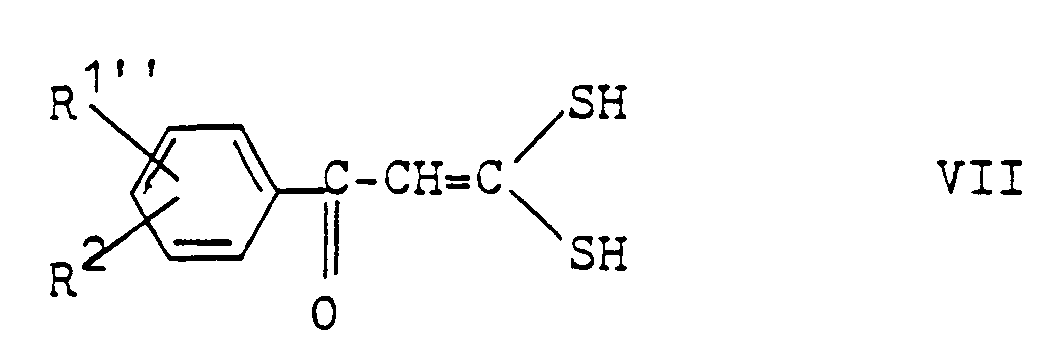
worin R¹˝ und R² obige Bedeutung besitzen, kondensiert und diese Zwischenprodukte weiter mit Phosphorpentasulfid zu Verbindungen der Formel II umsetzt. - Die Umsetzung von Verbindungen der Formel VI mit Schwefelkohlenstoff kann z.B. nach der von Thuillier et al beschriebenen Methode (s. Bull. Soc. Chim. France, Serie 5, Memoires presentes à la Soc. Chim. (1959), 1398-1401) durchgeführt werden. So erfolgt die Umsetzung zweckmäßig in einem inerten organischen Lösungsmittel, z.B. Benzol oder Äther unter Verwendung eines tertiären Alkalimetallalkoholates, z.B. Natriumbutylat oder -amylat. Die Umsetzung der hierbei erhaltenen Zwischenprodukte mit P₂S₅ erfolgt zweckmäßig in einem aromatischen Kohlenwasserstoff wie Toluol oder Xylol bei Siedetemperatur des Reaktionsgemisches.
- Zur Herstellung von Verbindungen der Formel II, worin R¹ Hydroxy bedeutet, können entsprechende Verbindungen der Formel II, worin R¹ Methoxy bedeutet, in an sich bekannter Weise demethyliert werden. Beispielsweise kann die Methoxy-Gruppe durch Behandeln mit Pyridiniumchlorid sauer gespalten werden.
- Die Verbindungen der Formel I können erfindungsgemäß zusammen mit üblichen pharmazeutischen Hilfs- und/oder Trägerstoffen in festen oder flüssigen pharmazeutischen Zubereitungen enthalten sein. Als Beispiele fester Präparate seien oral applizierbare Präparate wie Kapseln, Tabletten, Granulate oder Dragees genannt oder auch Suppositorien. Feste Präparate können pharmazeutisch übliche anorganische und/oder organische Trägerstoffe wie z.B. Talkum, Milchzucker oder Stärke neben pharmazeutisch üblichen Hilfsmitteln, beispielsweise Gleitmittel wie Magnesiumstearat oder Tablettensprengmitteln, enthalten. Suppositorien können an sich bekannte Suppositoriengrundlagen enthalten. Flüssige Präparate wie Lösungen, Suspensionen oder Emulsionen können die üblichen Verdünnungsmittel z.B. Wasser, oder Paraffine, und/oder Suspensionsmittel wie Polyäthylenglycole und dergleichen enthalten. Es können zusätzlich weitere Hilfsstoffe zugesetzt werden, wie z.B. Konservierungsmittel, Stabilisierungsmittel, Geschmackskorrigenzien und dergleichen.
- Die Wirkstoffe können mit den pharmazeutischen Hilfs- und/oder Trägerstoffen in an sich bekannter Weise gemischt und formuliert werden. Zur Herstellung fester Arzneiformen können die Wirkstoffe beispielsweise mit den Hilfs- und/oder Trägerstoffen in üblicher Weise gemischt und naß oder trocken granuliert werden. Je nach Art der verwendeten Zusatzstoffe kann gegebenenfalls auch durch einfaches Mischen ein direkt tablettierbares Pulver erhalten werden. Das Granulat oder Pulver kann direkt in Kapseln abgefüllt oder in üblicher Weise zu Tablettenkernen verpreßt werden. Diese können gewünschtenfalls auf an sich bekannte Weise dragiert werden.
- Die nachfolgenden Beispiele erläutern die Erfindung, sollen deren Umfang jedoch in keiner Weise beschränken.
-
- a) 22,7 g (= 0,1 Mol) 4-Chlorbenzoylessigsäureäthylester, 100 g (= 0,25 Mol) Lawessons Reagenz (= 2,4-bis(4-Methoxyphenyl)-1,3-dithia-2,4-diphosphetan-2,4-disulfid) und 6,4 g (= 0,2 Mol) elementarer Schwefel werden in 100 ml wasserfreiem Toluol 10 Stunden bei 100 °C gerührt. Zur Aufarbeitung wird das das gebildete 5-(4-Chlorphenyl)-1,2-dithiol-3-thion enthaltende Reaktionsgemisch auf Raumtemperatur abgekühlt, filtriert und das Filtrat auf eine 300 g Kieselgelsäule gegeben. Das Toluol wird mit leichtem Petroläther eluiert, und dann wird das 5-(4-Chlorphenyl)-1,2-dithiol-3-thion mit einem Toluol/leichter Petroläther-Gemisch (50 : 50) eluiert. Das erhaltene Rohprodukt wird ein zweites Mal über eine Kieselgelsäule unter Verwendung von Toluol/leichter Petroläther als Elutionsmittel gereinigt und aus Toluol umkristallisiert. Es werden 9,6 g 5-(4-Chlorphenyl)-1,2-dithiol-3-thion mit einem Schmelzpunkt von 135 °C erhalten.
- b) 4,9 g (= 0,02 Mol) 5-(4-Chlorphenyl)-1,2-dithiol-3-thion werden in 60 ml Chloroform gelöst. Die Lösung wird auf 0 °C abgekühlt, und zu der abgekühlten Lösung wird tropfenweise eine Lösung von 5,3 g 80-90 % reiner 3-Chlorperbenzoesäure (= ungefährt 0,026 Mol) in 150 ml Chloroform zugegeben. Nach Beendigung der etwa 30 Minuten dauernden Zugabe wird die rot gefärbte Reaktionsmischung eine weitere Stunde bei 0 °C gehalten.
- Zur Aufarbeitung wird das Reaktionsgemisch zunächst mit 100 ml wäßriger gesättigter Natriumbicarbonatlösung und anschließend mit Wasser gewaschen und über Natriumsulfat getrocknet und filtriert. Die filtrierte Lösung wird unter vermindertem Druck bei Raumtemperatur auf etwa 30 ml eingeengt und auf eine 175 g Kieselgelsäule gegeben und mit Chloroform eluiert. Hierbei wird nicht umgesetztes Ausgangsmaterial zuerst abgeschieden und kann so zurückgewonnen werden, und anschließend wird das bei der Oxidation gebildete 5-(4-Chlorphenyl)-1,2-dithiol-3-thion-S-oxid erhalten. Die das S-Oxid enthaltenden Eluatfraktionen werden bei Raumtemperatur unter vermindertem Druck eingedampft. Der verbleibende Rückstand wird durch Zugabe von leichtem Petroläther kristallisiert. Das als rotor Feststoff erhaltene 5-(4-Chlorphenyl)-1,2-dithiol-3-thion-S-oxid wird abfiltriert und schnell luftgetrocknet. Es werden 3,4 g des S-Oxides mit einem Schmelzpunkt von 123-125 °C erhalten.
-
- a) Ein Gemisch aus 100 g (= 0,41 Mol) 5-(4-Methoxyphenyl)-1,2-dithiol-3-thion und 335 g (= 2,9 Mol) Pyridiniumchlorid wird 4 Stunden auf eine Temperatur von 210-215 °C erhitzt. Anschließend wird das Reaktionsgemisch auf 80 °C abkühlen gelassen und wird dann mit 2 l warmen Wasser gewaschen, um das Pyridiniumsalz zu entfernen. Zu dem Rückstand werden 400 ml 10 %-iger wäßriger Natriumhydroxidlösung gegeben. Das ausgefallene Natriumsalz des gebildeten 5-(4-Hydroxyphenyl)-1,2-dithiol-3-thion wird abfiltriert, in 500 ml warmen Wasser gelöst, und das 5-(4-Hydroxyphenyl)-1,2-dithiol-3-thion wird durch Zugabe von Essigsäure gefällt. Der Niederschlag wird abgesaugt und getrocknet. Das erhaltene Rohprodukt wird in einem warmen Gemisch aus 300 ml Äthanol und 25 ml Diäthylamin gelöst und die Lösung auf eine kurze Aluminiumoxidsäule gegeben. Die Säule wird mit 100 ml warmen Äthanol eluiert. Die erhaltene rote Eluatlösung wird unter vermindertem Druck auf die Hälfte seines Volumens eingeengt. Hierbei kristallisiert das Diäthylaminsalz des 5-(4-Hydroxyphenyl)-1,2-dithiol-3-thions aus. Die roten Kristalle werden abfiltriert und in 250 ml verdünnte Salzsäure gegeben. Die hierbei erhaltene Suspension wird eine Stunde bei Raumtemperatur gerührt. Sodann wird das als fester Niederschlag abgeschiedene 5-(4-Hydroxyphenyl)-1,2-dithiol-3-thion abfiltriert, mit Wasser gewaschen und über Phosphorpentoxid getrocknet. Es werden 23,5 g 5-(4-Hydroxyphenyl)-1,2-dithiol-3-thion mit einem Schmelzpunkt von 192 °C erhalten.
- b) Zu einer Lösung von 10 g (= 0,004 Mol) 5-(4-Hydroxyphenyl)-1,2-dithiol-3-thion in 300 ml Aceton wird unter starkem Rühren eine Lösung von 9,4 g 80-90 % reiner 3-Chlorperbenzoesäure (= ungefährt 0,046 Mol) in 200 ml Aceton innerhalb einer Stunde bei Raumtemperatur zugetropft. Anschließend wird das Reaktionsgemisch für eine weitere Stunde auf gleicher Temperatur gehalten. Das als roter Niederschlag ausgefallene 5-(4-Hydroxyphenyl)-1,2-dithiol-3-thion-S-oxid wird abgesaugt und über Phosphorpentoxid getrocknet. Es werden 9,4 g des S-Oxids mit einem Schmelzpunkt von 118-124 °C erhalten.
- Nach den in den vorstehenden Beispielen beschriebenen Verfahren können auch die in der nachfolgenden Tabelle aufgeführten Verbindungen der Formel I durch Oxidation entsprechender Verbindungen der Formel II hergestellt werden.

- Man stellt Tabletten in folgender Zusammensetzung pro Tablette her:
5-(4-Chlorphenyl)-3H-1,2-dithiol-3-thion-S-oxid 15 mg Maisstärke 65 mg Milchzucker 135 mg Gelatine (als 10-%ige Lösung) 6 mg - Die Wirkstoff, die Maisstärke und der Milchzucker werden mit der 10%-igen Gelatine-Lösung eingedickt. Die Paste wird zerkleinert und das entstandene Granulat wird auf ein geeignetes Blech gebracht und bei 45 °C getrocknet. Das getrocknete Granulat wird durch eine Zerkleinerungsmaschine geleitet und in einem Mixer mit weiteren folgenden Hilfsstoffen vermischt:
Talkum 5 mg Magnesiumstearat 5 mg Maisstärke 9 mg und sodann zu Tabletten von 240 mg verpreßt. - Es werden Kapseln mit folgender Zusammensetzung pro Kapsel hergestellt:
5-Phenyl-3H-1,2-dithiol-3-thion-S-oxid 10 mg Lactose 65 mg Maisstärke 40 mg lösliche Stärke 4 mg Magnesiumstearat 1 mg - Der Wirkstoff wird mit Lactose und Maisstärke vermischt. Die entstandene Mischung wird mit einer 15%-igen wäßrigen Lösung der löslichen Stärke durchfeuchtet und granuliert. Die feuchte Masse wird durch ein 1,6 mm-Sieb passiert, bei 40 °C getrocknet und anschließend durch ein 1,0 mm-Sieb passiert. Nach dem Vermischen des Granulats mit Magnesiumstearat wird die entstandene Mischung in Mengen von 120 mg in Kapseln abgefüllt.
- Nach der in Beispiel II beschriebenen Methode werden auch Kapseln hergestellt, welche als Wirkstoff 5-(2-Methoxyphenyl)-3H-1,2-dithiol-3-thion-S-oxid oder 5-(4-Fluorphenyl)-3H-1,2-dithiol-3-thion-S-oxid enthalten.
Claims (6)


Priority Applications (1)
| Application Number | Priority Date | Filing Date | Title |
|---|---|---|---|
| AT89109207T ATE92484T1 (de) | 1988-05-27 | 1989-05-23 | Neue 1,2-dithiol-3-thion-s-oxid-verbindungen enthaltende arzneimittel. |
Applications Claiming Priority (2)
| Application Number | Priority Date | Filing Date | Title |
|---|---|---|---|
| EP88401304 | 1988-05-27 | ||
| EP88401304A EP0343303A1 (de) | 1988-05-27 | 1988-05-27 | Neue 1,2-Dithiol-3-thion-S-oxid-Verbindungen enthaltende Arzneimittel |
Publications (2)
| Publication Number | Publication Date |
|---|---|
| EP0343573A1 EP0343573A1 (de) | 1989-11-29 |
| EP0343573B1 true EP0343573B1 (de) | 1993-08-04 |
Family
ID=8200390
Family Applications (2)
| Application Number | Title | Priority Date | Filing Date |
|---|---|---|---|
| EP88401304A Withdrawn EP0343303A1 (de) | 1988-05-27 | 1988-05-27 | Neue 1,2-Dithiol-3-thion-S-oxid-Verbindungen enthaltende Arzneimittel |
| EP89109207A Expired - Lifetime EP0343573B1 (de) | 1988-05-27 | 1989-05-23 | Neue 1,2-dithiol-3-thion-S-oxid-Verbindungen enthaltende Arzneimittel |
Family Applications Before (1)
| Application Number | Title | Priority Date | Filing Date |
|---|---|---|---|
| EP88401304A Withdrawn EP0343303A1 (de) | 1988-05-27 | 1988-05-27 | Neue 1,2-Dithiol-3-thion-S-oxid-Verbindungen enthaltende Arzneimittel |
Country Status (22)
| Country | Link |
|---|---|
| US (1) | US5096920A (de) |
| EP (2) | EP0343303A1 (de) |
| JP (1) | JP2718429B2 (de) |
| KR (1) | KR970011289B1 (de) |
| CN (2) | CN1027893C (de) |
| AR (1) | AR247207A1 (de) |
| AU (1) | AU624141B2 (de) |
| CA (1) | CA1332609C (de) |
| DD (1) | DD283820A5 (de) |
| DE (1) | DE58905106D1 (de) |
| DK (1) | DK175286B1 (de) |
| DZ (1) | DZ1340A1 (de) |
| ES (1) | ES2058386T3 (de) |
| FI (1) | FI88503C (de) |
| GR (1) | GR3009107T3 (de) |
| HU (1) | HU203745B (de) |
| IE (1) | IE63291B1 (de) |
| IL (1) | IL90407A0 (de) |
| NO (1) | NO172579C (de) |
| NZ (1) | NZ229274A (de) |
| PT (1) | PT90521B (de) |
| ZA (1) | ZA893037B (de) |
Families Citing this family (5)
| Publication number | Priority date | Publication date | Assignee | Title |
|---|---|---|---|---|
| US6437092B1 (en) * | 1998-11-06 | 2002-08-20 | Conjuchem, Inc. | Conjugates of opioids and endogenous carriers |
| KR100484526B1 (ko) * | 2002-11-13 | 2005-04-20 | 씨제이 주식회사 | 티온 유도체, 그 제조방법 및 약제학적 조성물 |
| CN101463030B (zh) * | 2009-01-09 | 2012-03-21 | 福建深纳生物工程有限公司 | 茴三硫的制备方法 |
| CN103012394B (zh) * | 2012-11-19 | 2015-03-25 | 苏州大学 | 一种罗丹宁衍生物及其制备方法 |
| CN102993166B (zh) * | 2012-12-13 | 2015-05-13 | 苏州大学 | 一种3h-1,2-二硫环戊烯-3-硫酮类化合物的制备方法与应用 |
Family Cites Families (8)
| Publication number | Priority date | Publication date | Assignee | Title |
|---|---|---|---|---|
| DE874447C (de) * | 1944-08-22 | 1953-04-23 | Bruno Dr Boettcher | Verfahren zur Herstellung von 5-Thion-1, 2-dithiolen |
| US2556963A (en) * | 1946-07-15 | 1951-06-12 | Gaudin Olivier | Benzenes containing sulfur in their allylic or propenylic side chains and process of preparing them |
| US2662899A (en) * | 1950-07-29 | 1953-12-15 | Stauffer Chemical Co | Chlorinated cyclic organic trithiocarbonate and process for preparing same |
| US2688620A (en) * | 1951-05-04 | 1954-09-07 | Gaudin Olivier | Trisulfureted heterocyclic compounds |
| US2816116A (en) * | 1954-06-01 | 1957-12-10 | Standard Oil Co | 2-para-t-butyl phenyl trithione |
| US3225062A (en) * | 1963-02-11 | 1965-12-21 | American Cyanamid Co | Process for 1,2-dithiole-3-thiones |
| US3214442A (en) * | 1963-06-26 | 1965-10-26 | American Cyanamid Co | 4, 5-dicyano-1, 3-dithiole-2-thione oxide and its preparation |
| US3847943A (en) * | 1972-09-08 | 1974-11-12 | P Warner | Preparing anethole trithione using sulfolane solvent |
-
1988
- 1988-05-27 EP EP88401304A patent/EP0343303A1/de not_active Withdrawn
-
1989
- 1989-04-21 KR KR1019890005296A patent/KR970011289B1/ko not_active Expired - Fee Related
- 1989-04-25 ZA ZA893037A patent/ZA893037B/xx unknown
- 1989-04-28 AR AR89313802A patent/AR247207A1/es active
- 1989-05-10 PT PT90521A patent/PT90521B/pt not_active IP Right Cessation
- 1989-05-21 DZ DZ890078A patent/DZ1340A1/fr active
- 1989-05-22 HU HU892514A patent/HU203745B/hu unknown
- 1989-05-22 DD DD89328800A patent/DD283820A5/de unknown
- 1989-05-23 ES ES89109207T patent/ES2058386T3/es not_active Expired - Lifetime
- 1989-05-23 EP EP89109207A patent/EP0343573B1/de not_active Expired - Lifetime
- 1989-05-23 DE DE8989109207T patent/DE58905106D1/de not_active Expired - Lifetime
- 1989-05-25 NZ NZ229274A patent/NZ229274A/xx unknown
- 1989-05-25 IL IL90407A patent/IL90407A0/xx not_active IP Right Cessation
- 1989-05-26 AU AU35216/89A patent/AU624141B2/en not_active Ceased
- 1989-05-26 JP JP1131700A patent/JP2718429B2/ja not_active Expired - Lifetime
- 1989-05-26 DK DK198902566A patent/DK175286B1/da not_active IP Right Cessation
- 1989-05-26 FI FI892571A patent/FI88503C/fi not_active IP Right Cessation
- 1989-05-26 NO NO892147A patent/NO172579C/no not_active IP Right Cessation
- 1989-05-26 US US07/357,271 patent/US5096920A/en not_active Expired - Lifetime
- 1989-05-26 CN CN89103718A patent/CN1027893C/zh not_active Expired - Fee Related
- 1989-05-29 CA CA000601030A patent/CA1332609C/en not_active Expired - Fee Related
- 1989-06-12 IE IE177789A patent/IE63291B1/en not_active IP Right Cessation
-
1993
- 1993-09-21 GR GR930400136T patent/GR3009107T3/el unknown
-
1994
- 1994-02-09 CN CN94101573A patent/CN1047171C/zh not_active Expired - Fee Related
Also Published As
Similar Documents
| Publication | Publication Date | Title |
|---|---|---|
| EP0002482B1 (de) | 4-Hydroxy-2H-1,2-benzothiazin-3-carboxamid-1,1-dioxide, Verfahren zu ihrer Herstellung und diese Verbindungen enthaltende Arzneimittel | |
| DE2928485A1 (de) | Verwendung von harnstoffderivaten als arzneimittel bei der behandlung von fettstoffwechselstoerungen | |
| DE3412885C2 (de) | 1,3-dihydro-6-methyl-7-hydroxy-furo-(3,4-c)-pyridin-derivate, verfahren zu ihrer herstellung und sie enthaltende arzneimittel | |
| DE2516554A1 (de) | Thienyl- und thiaethylverbindungen | |
| WO1985003507A2 (fr) | Sels de metallicenium et leur utilisation en tant qu'agents cytostatiques pour la lutte contre le cancer | |
| EP0010156B1 (de) | 6-Arylpyridazin-3-one, diese enthaltende pharmazeutische Zubereitungen und Verfahren zu ihrer Herstellung | |
| EP0029247A1 (de) | Alkenyl-thienyl-alkancarbonsäuren und ihre Derivate, Verfahren zu deren Herstellung und diese enthaltende Arzneimittel | |
| EP0046961A1 (de) | Epoxi-cycloalkylalkancarbonsäuren, Verfahren zu ihrer Herstellung, ihre Verwendung sowie sie enthaltende Arzneimittel | |
| EP0051077A1 (de) | Substituierte Oxocarbonsäuren, Verfahren zu ihrer Herstellung, ihre Verwendung und sie enthaltende Arzneimittel | |
| DE2523103A1 (de) | Neue propargyl-2-phenylamino-imidazoline-(2), deren saeureadditionssalze, diese enthaltende arzneimittel und verfahren zur herstellung derselben | |
| EP0343573A1 (de) | Neue 1,2-dithiol-3-thion-S-oxid-Verbindungen enthaltende Arzneimittel | |
| EP0101898A1 (de) | Anellierte 4H-1,4-Benzothiazine, Verfahren zu ihrer Herstellung und ihre Verwendung als Arzneimittel | |
| EP0075140B1 (de) | Tricyclische Thiazolyloxamidsäuren und Derivate, Verfahren zu ihrer Herstellung und diese enthaltende therapeutische Mittel | |
| EP0061056A1 (de) | 5,6-Dimethyl-pyrrolo(2,3-b)pyridine, Verfahren zu ihrer Herstellung und ihre Verwendung als Arzneimittel | |
| EP1157015A1 (de) | Polycyclische 2-amino-thiazol systeme, verfahren zu ihrer herstellung und arzneimittel enthaltend diese verbindungen | |
| EP0539806B1 (de) | Thiadiazinone und sie enthaltende Arzneimittel, insbesondere mit Positiv-Inotroper und vasodilatierender Wirksamkeit | |
| DE69118850T2 (de) | Derivate der 1,4-Benzothiazin-2-essigsäure, Verfahren zu ihrer Herstellung und ihre Verwendung | |
| EP0313935B1 (de) | Enolether von 6-Chlor-4-hydroxy-2-methyl-N-(2-pyridyl)-2H-thieno(2,3-e)-1,2-thiazin-3-carbonsäureamid-1,1-dioxid, ein Verfahren zu ihrer Herstellung sowie ihre Verwendung | |
| EP0301428A2 (de) | Benzyldiaminopyrimidin-Derivate und deren Verwendung als Arzneimittel | |
| DE69023045T2 (de) | Carboxamidderivate. | |
| EP0147778A2 (de) | 1,4-Naphthochinonderivate mit entzündungshemmender Wirkung | |
| CH639363A5 (de) | Bis/nitrosoureido/-polyol-derivate und verfahren zu ihrer herstellung. | |
| EP0213295B1 (de) | Neue Thieno-1,2-thiazolderivate, Verfahren zu ihrer Herstellung und diese enthaltende pharmazeutische Präparate | |
| EP0461574A2 (de) | 3,7-Diazabicyclo(3,3,1)-nonan-Verbindungen enthaltende Arzneimittel | |
| EP0095641B1 (de) | Chinazolinonderivate, Verfahren zu ihrer Herstellung und ihre Verwendung in Arzneimitteln |
Legal Events
| Date | Code | Title | Description |
|---|---|---|---|
| PUAI | Public reference made under article 153(3) epc to a published international application that has entered the european phase |
Free format text: ORIGINAL CODE: 0009012 |
|
| AK | Designated contracting states |
Kind code of ref document: A1 Designated state(s): AT BE CH DE ES FR GB GR IT LI LU NL SE |
|
| 17P | Request for examination filed |
Effective date: 19900330 |
|
| 17Q | First examination report despatched |
Effective date: 19920522 |
|
| ITF | It: translation for a ep patent filed | ||
| GRAA | (expected) grant |
Free format text: ORIGINAL CODE: 0009210 |
|
| AK | Designated contracting states |
Kind code of ref document: B1 Designated state(s): AT BE CH DE ES FR GB GR IT LI LU NL SE |
|
| REF | Corresponds to: |
Ref document number: 92484 Country of ref document: AT Date of ref document: 19930815 Kind code of ref document: T |
|
| REF | Corresponds to: |
Ref document number: 58905106 Country of ref document: DE Date of ref document: 19930909 |
|
| ET | Fr: translation filed | ||
| REG | Reference to a national code |
Ref country code: GR Ref legal event code: FG4A Free format text: 3009107 |
|
| GBT | Gb: translation of ep patent filed (gb section 77(6)(a)/1977) |
Effective date: 19931029 |
|
| PLBE | No opposition filed within time limit |
Free format text: ORIGINAL CODE: 0009261 |
|
| STAA | Information on the status of an ep patent application or granted ep patent |
Free format text: STATUS: NO OPPOSITION FILED WITHIN TIME LIMIT |
|
| EPTA | Lu: last paid annual fee | ||
| 26N | No opposition filed | ||
| REG | Reference to a national code |
Ref country code: ES Ref legal event code: FG2A Ref document number: 2058386 Country of ref document: ES Kind code of ref document: T3 |
|
| EAL | Se: european patent in force in sweden |
Ref document number: 89109207.4 |
|
| REG | Reference to a national code |
Ref country code: CH Ref legal event code: PFA Free format text: KALI-CHEMIE PHARMA GMBH TRANSFER- SOLVAY PHARMACEUTICALS GMBH |
|
| NLT1 | Nl: modifications of names registered in virtue of documents presented to the patent office pursuant to art. 16 a, paragraph 1 |
Owner name: SOLVAY PHARMACEUTICALS GMBH |
|
| REG | Reference to a national code |
Ref country code: FR Ref legal event code: CD |
|
| REG | Reference to a national code |
Ref country code: ES Ref legal event code: PC2A |
|
| REG | Reference to a national code |
Ref country code: GB Ref legal event code: IF02 |
|
| REG | Reference to a national code |
Ref country code: CH Ref legal event code: PCAR Free format text: ISLER & PEDRAZZINI AG;POSTFACH 1772;8027 ZUERICH (CH) |
|
| PGFP | Annual fee paid to national office [announced via postgrant information from national office to epo] |
Ref country code: CH Payment date: 20080530 Year of fee payment: 20 Ref country code: LU Payment date: 20080606 Year of fee payment: 20 Ref country code: ES Payment date: 20080526 Year of fee payment: 20 |
|
| PGFP | Annual fee paid to national office [announced via postgrant information from national office to epo] |
Ref country code: AT Payment date: 20080502 Year of fee payment: 20 |
|
| PGFP | Annual fee paid to national office [announced via postgrant information from national office to epo] |
Ref country code: BE Payment date: 20080624 Year of fee payment: 20 |
|
| PGFP | Annual fee paid to national office [announced via postgrant information from national office to epo] |
Ref country code: SE Payment date: 20080529 Year of fee payment: 20 Ref country code: NL Payment date: 20080524 Year of fee payment: 20 Ref country code: DE Payment date: 20080630 Year of fee payment: 20 |
|
| PGFP | Annual fee paid to national office [announced via postgrant information from national office to epo] |
Ref country code: IT Payment date: 20080528 Year of fee payment: 20 |
|
| PGFP | Annual fee paid to national office [announced via postgrant information from national office to epo] |
Ref country code: GB Payment date: 20080529 Year of fee payment: 20 |
|
| PGFP | Annual fee paid to national office [announced via postgrant information from national office to epo] |
Ref country code: GR Payment date: 20080530 Year of fee payment: 20 |
|
| REG | Reference to a national code |
Ref country code: CH Ref legal event code: PL |
|
| BE20 | Be: patent expired |
Owner name: *SOLVAY PHARMACEUTICALS G.M.B.H. Effective date: 20090523 |
|
| REG | Reference to a national code |
Ref country code: GB Ref legal event code: PE20 Expiry date: 20090522 |
|
| EUG | Se: european patent has lapsed | ||
| REG | Reference to a national code |
Ref country code: ES Ref legal event code: FD2A Effective date: 20090525 |
|
| PG25 | Lapsed in a contracting state [announced via postgrant information from national office to epo] |
Ref country code: NL Free format text: LAPSE BECAUSE OF EXPIRATION OF PROTECTION Effective date: 20090523 |
|
| NLV7 | Nl: ceased due to reaching the maximum lifetime of a patent |
Effective date: 20090523 |
|
| PG25 | Lapsed in a contracting state [announced via postgrant information from national office to epo] |
Ref country code: ES Free format text: LAPSE BECAUSE OF EXPIRATION OF PROTECTION Effective date: 20090525 |
|
| PG25 | Lapsed in a contracting state [announced via postgrant information from national office to epo] |
Ref country code: GB Free format text: LAPSE BECAUSE OF EXPIRATION OF PROTECTION Effective date: 20090522 |
|
| PGFP | Annual fee paid to national office [announced via postgrant information from national office to epo] |
Ref country code: FR Payment date: 20080519 Year of fee payment: 20 |