EP0338410A2 - Sekretormutante von Escherichia coli - Google Patents
Sekretormutante von Escherichia coli Download PDFInfo
- Publication number
- EP0338410A2 EP0338410A2 EP89106554A EP89106554A EP0338410A2 EP 0338410 A2 EP0338410 A2 EP 0338410A2 EP 89106554 A EP89106554 A EP 89106554A EP 89106554 A EP89106554 A EP 89106554A EP 0338410 A2 EP0338410 A2 EP 0338410A2
- Authority
- EP
- European Patent Office
- Prior art keywords
- coli
- coli strain
- known per
- manner known
- plasmid
- Prior art date
- Legal status (The legal status is an assumption and is not a legal conclusion. Google has not performed a legal analysis and makes no representation as to the accuracy of the status listed.)
- Granted
Links
Images


Classifications
-
- C—CHEMISTRY; METALLURGY
- C12—BIOCHEMISTRY; BEER; SPIRITS; WINE; VINEGAR; MICROBIOLOGY; ENZYMOLOGY; MUTATION OR GENETIC ENGINEERING
- C12N—MICROORGANISMS OR ENZYMES; COMPOSITIONS THEREOF; PROPAGATING, PRESERVING, OR MAINTAINING MICROORGANISMS; MUTATION OR GENETIC ENGINEERING; CULTURE MEDIA
- C12N9/00—Enzymes; Proenzymes; Compositions thereof; Processes for preparing, activating, inhibiting, separating or purifying enzymes
- C12N9/10—Transferases (2.)
- C12N9/1048—Glycosyltransferases (2.4)
- C12N9/1051—Hexosyltransferases (2.4.1)
- C12N9/1074—Cyclomaltodextrin glucanotransferase (2.4.1.19)
-
- C—CHEMISTRY; METALLURGY
- C12—BIOCHEMISTRY; BEER; SPIRITS; WINE; VINEGAR; MICROBIOLOGY; ENZYMOLOGY; MUTATION OR GENETIC ENGINEERING
- C12N—MICROORGANISMS OR ENZYMES; COMPOSITIONS THEREOF; PROPAGATING, PRESERVING, OR MAINTAINING MICROORGANISMS; MUTATION OR GENETIC ENGINEERING; CULTURE MEDIA
- C12N1/00—Microorganisms; Compositions thereof; Processes of propagating, maintaining or preserving microorganisms or compositions thereof; Processes of preparing or isolating a composition containing a microorganism; Culture media therefor
- C12N1/20—Bacteria; Culture media therefor
- C12N1/205—Bacterial isolates
-
- C—CHEMISTRY; METALLURGY
- C12—BIOCHEMISTRY; BEER; SPIRITS; WINE; VINEGAR; MICROBIOLOGY; ENZYMOLOGY; MUTATION OR GENETIC ENGINEERING
- C12N—MICROORGANISMS OR ENZYMES; COMPOSITIONS THEREOF; PROPAGATING, PRESERVING, OR MAINTAINING MICROORGANISMS; MUTATION OR GENETIC ENGINEERING; CULTURE MEDIA
- C12N15/00—Mutation or genetic engineering; DNA or RNA concerning genetic engineering, vectors, e.g. plasmids, or their isolation, preparation or purification; Use of hosts therefor
- C12N15/09—Recombinant DNA-technology
- C12N15/63—Introduction of foreign genetic material using vectors; Vectors; Use of hosts therefor; Regulation of expression
- C12N15/70—Vectors or expression systems specially adapted for E. coli
-
- C—CHEMISTRY; METALLURGY
- C12—BIOCHEMISTRY; BEER; SPIRITS; WINE; VINEGAR; MICROBIOLOGY; ENZYMOLOGY; MUTATION OR GENETIC ENGINEERING
- C12R—INDEXING SCHEME ASSOCIATED WITH SUBCLASSES C12C - C12Q, RELATING TO MICROORGANISMS
- C12R2001/00—Microorganisms ; Processes using microorganisms
- C12R2001/01—Bacteria or Actinomycetales ; using bacteria or Actinomycetales
- C12R2001/185—Escherichia
- C12R2001/19—Escherichia coli
Definitions
- the invention relates to Escherichia coli strains for massive protein secretion into the culture medium, processes for their preparation and their use.
- E. coli Due to the cell wall structure of gram-negative bacteria, it was previously assumed that real secretion of proteins into the culture medium cannot take place, since the outer membrane represents a strong permeability barrier.
- the bacterium E. coli is naturally not able to secrete proteins or to release them into the culture medium. Only protein export into the periplasm is possible with E. coli.
- the hemolysin and colicine proteins are two exceptions. However, these exoproteins represent special cases, since specific secretion proteins for the respective exoprotein are involved in the discharge process; see. Wagner et al., J. Biol. Chem., 369 (1988) 39-46.
- mutants So called "leaky” mutants. Such mutants are known, for example, from E. coli K12, with periplasmic or periplasmic enriched proteins entering the culture medium due to a defect in the outer membrane. It is an unspecific mechanism; see. Lazzosoni & Portalier, J. Bact., 145 (1981) 1351-1358. These "leaky” mutants are in part strains with an altered lipopolysaccharide structure, for Part by strains with altered lipoprotein levels in the outer membrane; see. Hirota et al., Proc. Natl. Acad. Sci. USA, 74 (1977) 1417-1420, and Yem & Wu, J. Bacteriol., 133 (1978) 1419-1426. Mutations in the so-called “tol” loci also lead to the "leaky” phenotype via activation of phospholipase A. This can be a specific or non-specific "leakage”.
- coli is probably itself a heat shock protein itself, since it has a sigma-32-like promoter structure upstream of the actual promoter, which further potentiates the effect.
- promoter sequence, signal sequence and N-terminal fragments of protein A are linked to the genetic information of the desired protein, periplasmic proteins can be secreted into the culture medium via the heat-shock response and filamentous growth.
- this system is problematic in that the ATP-dependent protease La is additionally induced by the heat-shock response. This leads to the proteolytic breakdown of the desired protein. It would therefore be desirable to use a La-deficient strain (lon ⁇ ; see. Young & Davis, Proc. Natl. Acad. Sci. USA, 80 (1983) 1194-1198) for the production. Such one However, strain has not yet been provided.
- the present invention is based on the object of providing E. coli strains which permit massive protein secretion of the cells into the culture medium.
- stage a The term structural gene for an exoprotein is understood here (stage a) and below to mean the DNA sequence coding for the desired protein, including its signal sequence or a signal sequence essential for export (leader sequence).
- an E. coli strain with a minA and / or minB mutation or an E. coli strain with a mutation in one or more proteins of the outer membrane is preferably used.
- the E. coli strains according to the invention are preferably characterized by a higher protein secretion capacity than E. coli HB 101.
- the mutagenesis can be carried out chemically, for example with N-methyl-N '-nitro-N-nitrosoguanidine (MNNG).
- MNNG N-methyl-N '-nitro-N-nitrosoguanidine
- step b) An example of a cell wall active substance is D-cycloserine.
- an E. coli strain with a minA and / or minB mutation or an E. coli strain with a mutation in one or more proteins of the outer membrane is preferably used.
- the method according to the invention is based on E. coli DS 410 or E. coli BW 7261.
- the starting strain can be transformed with a hybrid plasmid which comprises the structural gene of the protein whose production is desired.
- the process according to the invention can also be carried out in such a way that the starting strain is first transformed with a hybrid plasmid which comprises the structural gene of an indicator protein with which it is easy to screen mutants which have the desired property of massive protein secretion into the culture medium. If such a mutant has been determined with the aid of the indicator protein, this mutant is made plasmid-free in accordance with the variant of the method according to the invention mentioned here, after which the plasmid-free mutant is transformed with another hybrid plasmid which comprises the structural gene of a protein whose technical production is desired.
- an indicator protein is CGT, since its ability to hydrolysis polysaccharide (starch hydrolysis) as an indicator reaction allows convenient screening.
- CGT the DNA fragment coding for the exoprotein, together with its own signal sequence, which is essential for export, is placed under the control of a strong promoter, whose activity can be regulated in a simple and targeted manner, for example under the control of the tac Promoter.
- the DNA section mentioned can be integrated into the "multicopy number" plasmid pJF118ut.
- E. coli strain preferably with a minA and / or minB mutation (mini cell strain), such as E. Coli DS 410, or with a mutation in one or more proteins of the outer membrane, such as E.
- the recipient is subjected to a chemical mutagenesis with the recombinant plasmid and then exposed to substances that are active on the membrane or cell wall.
- a chemical mutagenesis with the recombinant plasmid and then exposed to substances that are active on the membrane or cell wall.
- resistance to D-cycloserine is a useful indicator of improved discharge.
- the treatment with the cell wall-active substance is advantageously repeated several times.
- Potential secretory mutants are selected from the large number of mutants obtained using a simple screening system. The quantitative evaluation of the mutants is carried out by an enzyme test or immunoblotting.
- the mutants according to the invention quantitatively discharge over-produced exoprotein into the culture medium. This eliminates the time-consuming and sometimes complicated processes of cell opening and renaturation of the "inclusion bodies".
- “Inclusionbodies” often consist of the pre-forms of the protein to be exported, so they still have the signal sequence and therefore do not show a complete catalytic function. Since the renaturation succeeds to a satisfactory extent in a few cases, the production of exoprotein with the aid of the mutants according to the invention is a great simplification of the process Exoenzymes can be used directly in the desired enzyme reaction.
- the mutants according to the invention can be widely used in the field of bacterial exoprotein production.
- a desired recombinant plasmid which carries the genetic information for a commercially interesting protein can be introduced into the mutants according to the invention using the methods of recombinant DNA technology.
- the exoprotein is secreted specifically into the culture medium by the mutant according to the invention. This enables simple, quick and inexpensive purification of the desired protein.
- the exoprotein is an enzyme
- the culture supernatant can, for example, be 250 mg / l or, owing to the high enzyme yields more can be used directly in the subsequent enzyme reaction.
- Example 1 Production of an E. coli mutant according to the invention
- E. coli DS 410 (pCM703) was grown in liquid culture in full medium at 37 ° C. After an optical density of 1 had been reached, 20 ⁇ g / ml of N-methyl-N-nitro-N-nitrosoguanidine (MNNG) was added to the culture suspension, after which the mixture was incubated at 37 ° C. for a further 30 minutes (approximately 90% destruction). The effect of the mutagen was interrupted by washing the cells with phosphate buffer (pH 7.0).
- MNNG N-methyl-N-nitro-N-nitrosoguanidine
- the plasmid-free mutant E. coli DS410 K5 according to the invention was retransformed with the plasmid pCM703 (which codes for a CGT).
- the recombinant strain was grown in LB liquid medium (0.5% lactose and 0.2% glucose) at 30 ° C. After 24 h, 48 h and 72 h incubation, respectively, an aliquot of the cell suspension was removed. The cells were then centrifuged off and the diluted culture supernatant with an equal volume of a 10 percent. Starch solution incubated at 40 ° C. After 5 minutes of incubation, 1.5 parts by volume of methanol were added, which led to the precipitation of unreacted starch. The precipitated starch was centrifuged off, after which the cyclodextrin content in the supernatant was determined using an HPLC system. Mann received the following results:
- Example 2 was repeated with the exception that the plasmid pCM703 was transformed into E. coli HB101.
- the cultivation and the determination of the extracellular enzyme activity were carried out analogously. The following results were obtained:
- the mutant E. coli DS410 K5 according to the invention was transformed with the plasmid pAP5, which carries the genetic information for ⁇ -lactamase.
- the ⁇ -lactamase gene is under the control of the tac promoter, which causes the overexpression of the ⁇ -lactamase by induction with, for example, lactose.
- E. coli DS410 K5 (pAP5) was grown and the samples were taken after 48 hours of incubation to determine the extracellular ⁇ -lactamase activity in accordance with Example 2.
- the extracellular ⁇ -lactamase activity was determined using a chromogenic substrate, namely nitrocefin, determined spectrophotometrically at 480 nm; see. Biochemistry, 23 (1984) 1282-1287. The following results were obtained:
- Example 3 was reworked with the modification that the recombinant strain E. coli HB101 (pAP5) was used. The following results were obtained:
- E. coli strain with minAB mutation Davie et al., Bacteriol., 158 (1984) 1202-1203.
- E. coli DS410 DSM 4513, German collection of microorganisms, Mascheroder Weg 1b, 3300 Braunschweig.
- E. coli strain with a mutation of protein in the outer membrane Wanner, J. Mol. Biol. 191 (1986) 39.
- E. coli BW 7261, DSM 5231 German collection of microorganisms, Mascheroder Weg 1b, 3300 Braunschweig.
- E. coli HB101 e.g. DSM 1607 pJF118ut: Fig. 1 pCM703: Fig. 2 pAP5: Fig.
- CGT structural gene for CGT (cyclodextrin glycosyl transferase) (including signal sequence)
- t Terminator amp: ampicillin resistance
- tet tetracycline resistance
- lacI lac repressor
Landscapes
- Health & Medical Sciences (AREA)
- Life Sciences & Earth Sciences (AREA)
- Chemical & Material Sciences (AREA)
- Engineering & Computer Science (AREA)
- Genetics & Genomics (AREA)
- Wood Science & Technology (AREA)
- Bioinformatics & Cheminformatics (AREA)
- Organic Chemistry (AREA)
- Zoology (AREA)
- Biotechnology (AREA)
- Biomedical Technology (AREA)
- General Engineering & Computer Science (AREA)
- Microbiology (AREA)
- Biochemistry (AREA)
- General Health & Medical Sciences (AREA)
- Molecular Biology (AREA)
- Medicinal Chemistry (AREA)
- Virology (AREA)
- Physics & Mathematics (AREA)
- Biophysics (AREA)
- Tropical Medicine & Parasitology (AREA)
- Plant Pathology (AREA)
- Micro-Organisms Or Cultivation Processes Thereof (AREA)
- Preparation Of Compounds By Using Micro-Organisms (AREA)
- Medicines Containing Material From Animals Or Micro-Organisms (AREA)
- Saccharide Compounds (AREA)
- Led Devices (AREA)
- Organic Low-Molecular-Weight Compounds And Preparation Thereof (AREA)
Abstract
Description
- Die Erfindung betrifft Escherichia-coli-Stämme zur massiven Proteinsekretion in das Kulturmedium, Verfahren zu ihrer Herstellung und ihre Verwendung.
- Aufgrund der Zellwandstruktur von gramnegativen Bakterien ging man bisher davon aus, daß eine wirkliche Sekretion von Proteinen in das Kulturmedium nicht stattfinden kann, da die äußere Membran eine starke Permeabilitätsbarriere darstellt. Natürlicherweise ist das Bakterium E. coli nicht in der Lage, Proteine zu sekretieren bzw. in das Kulturmedium auszuschleusen. Nur Proteinexport in das Periplasma ist bei E. coli möglich. Zwei Ausnahmen bilden die Proteine Haemolysin und Colicine. Diese Exoproteine stellen aber Sonderfälle dar, da für das jeweilige Exoprotein spezifische Sekretionsproteine am Ausschleusungsprozeß beteiligt sind; vgl. Wagner et al., J. Biol. Chem., 369 (1988) 39-46.
- Ferner sind in der Literatur artifizielle Sekretions-Systeme für E. coli beschrieben, die jedoch nur zu geringen Exoproteinausbeuten im Kulturmedium führen oder in ihrer Anwendbarkeit beschränkt sind.
- (a) Sogenannte "leaky"-Mutanten. Derartige Mutanten sind beispielsweise von E. coli K12 bekannt, wobei aufgrund eines Defekts in der äußeren Membran periplasmatische bzw. periplasmatisch angereicherte Proteine in das Kulturmedium gelangen. Es handelt sich um einen unspezifischen Mechanismus; vgl. Lazzosoni & Portalier, J. Bact., 145 (1981) 1351-1358. Bei diesen "leaky"-Mutanten handelt es sich zum Teil um Stämme mit veränderter Lipopolysaccharidstruktur, zum Teil um Stämme mit veränderten Lipoproteinanteilen in der äußeren Membran; vgl. Hirota et al., Proc. Natl. Acad. Sci. USA, 74 (1977) 1417-1420, sowie Yem & Wu, J. Bacteriol., 133 (1978) 1419-1426. Auch Mutationen in den sogenannten "tol"-loci führen über Aktivierung der Phospholipase A zum "leaky"-Phänotyp. Es kann sich dabei um spezifisches oder unspezifisches "leakage" handeln.
- (b) Protein-Sekretion durch Protein A-Fusion gemäß EP-A-0 225 860 = 86.850 415.0. Grundlage dieses Stands der Technik ist die Beobachtung, daß die Induktion von filamentösem Wachstum in E. Coli zur Sekretion von periplasmatischen Proteinen in das Kulturmedium führt. E. coli zeigt filamentöses Wachstum bei Induktion der sogenannten Hitze-Schock-Antwort. Wenn also die Expression des gewünschten Genprodukts abhängig gemacht wird von der Hitze-Schock-Antwort, dann kann eine Sekretion des gewünschten, im Periplasma angereicherten Proteins erzielt werden. In diesem Verfahren macht man sich zunutze, daß Protein A aus Staphylococcus aureus sowie Fragmente dieses Proteins in E. coli eine Hitze-Schock-Antwort auslösen. Wahrscheinlich stellt das Protein A in E. coli sogar selbst ein Hitze-Schock-Protein dar, da es stromaufwärts von eigentlichen Promotor eine sigma-32-artige Promotorstruktur besitzt, wodurch sich der Effekt noch potenziert. Verknüpft man also Promotorsequenz, Signalsequenz und N-terminale Fragmente von protein A mit der genetischen Information des gewünschten Proteins, so kann über die Hitze-Schock-Antwort und filamentöses Wachstum eine Sekretion periplasmatischer Proteine in das Kulturmedium erfolgen. Dieses System ist allerdings insofern problematisch, als durch die Hitze-Schock-Antwort zusätzlich die ATP-abhängige Protease La induziert wird. Es kommt daher zum proteolytischen Abbau des gewünschten Proteins. Daher wäre es erwünscht, einen La-defizienten Stamm (lon⁻; vgl. Young & Davis, Proc. Natl. Acad. Sci. USA, 80 (1983) 1194-1198) für die Produktion zu verwenden. Ein derartiger Stamm wurde jedoch bisher nicht bereitgestellt.
- (c) Extrazelluläre Herstellung von Penicillinase und Xylanase gemäß EP-A-0 121 138 = 84.102 440.9. Dieser Stand der Technik betrifft ein Verfahren unter Verwendung spezieller E.-coli-Konstrukte zur Sekretion von Penicillinase und Xylanase in das Kulturmedium. Dieses bekannte Verfahren ist also auf die Gewinnung spezieller Proteine beschränkt.
- Der vorliegenden Erfindung liegt nun die Aufgabe zugrunde, E.-coli-Stämme bereitzustellen, die eine massive Proteinsekretion der Zellen in das Kulturmedium gestatten. Teilaufgaben sind
- eine Exoprotein-Produktion in E. coli als einem nicht pathogenen Organismus,
- eine möglichst hohe Sekretionsrate und
- eine einfache Aufarbeitung des Exoproteins aus der Kultur (ggf. nach Filtration). - Die vorstehend genannte Aufgabe wird gemäß einer Ausführungsform der Erfindung durch einen E.-coli-Stamm zur massiven proteinsekretion in das Kulturmedium gelöst, der dadurch herstellbar ist, daß man
- (a) in an sich bekannter Weise das Strukturgen eines zu exprimierenden Exoproteins in ein für die Expression geeignetes Plasmid zu einem Hybridplasmid integriert,
- (b) in an sich bekannter Weise einen E.-coli-Stamm mit dem gebildeten Hybridplasmid transformiert,
- (c) in an sich bekannter Weise den transformierten E.-coli-Stamm einer Mutagenese unterwirft und
- (d) gegebenenfalls danach zellwandaktiven Substanzen aussetzt,
- (e) in an sich bekannter Weise das den Stufen (c) und ggf. (d) unterworfene Zellmaterial einem Screening auf E.-coli-Mutanten mit gegenüber dem eingesetzten E.-coli-Stamm erhöhter proteinsekretion unterwirft und
- (f) gegebenenfalls in an sich bekannter Weise die gemäß Stufe (e) gewonnene E.-coli-Mutante(n) mit erhöhter proteinsekretion plasmidfrei macht.
- Unter dem Begriff des Strukturgens für ein Exoprotein wird hier (Stufe a) und im folgenden die das gewünschte Protein kodierende DNA-Sequenz einschließlich ihrer oder einer für den Export essentiellen Signalsequenz (Leadersequenz) verstanden.
- Vorzugsweise wird in Stufe b) ein E.-coli-Stamm mit minA- und/oder minB-Mutation beziehungsweise ein E.-coli-Stamm mit einer Mutation in einem Protein oder in mehreren Proteinen der äußeren Membran verwendet. Vorzugsweise sind die erfindungsgemäßen E.-coli-Stämme durch ein höheres Proteinsekretionsvermögen als E. coli HB 101 gekennzeichnet.
- Die vorstehend genannte Aufgabe wird gemäß einer weiteren Ausführungsform der Erfindung durch ein Verfahren zur Herstellung eines erfindungsgemäßen E.-coli-Stammes gelöst, das dadurch gekennzeichnet ist, daß man
- (a) in an sich bekannter Weise das Strukturgen eines zu exprimierenden Exoproteins in ein für die Expression geeignetes Plasmid zu einem Hybridplasmid integriert,
- (b) in an sich bekannter Weise einen E.-coli-Stamm mit dem gebildeten Hybridplasmid transformiert,
- (c) in an sich bekannter Weise den transformierten E.-coli-Stamm einer Mutagenese unterwirft und
- (d) gegebenenfalls danach zellwandaktiven Substanzen aussetzt,
- (e) in an sich bekannter Weise das den Stufen (c) und ggf. (d) unterworfene Zellmaterial einem Screening auf E.-coli-Mutanten mit gegenüber dem eingesetzten E.-coli-Stamm erhöhter Proteinsekretion unterwirft und
- (f) gegebenenfalls in an sich bekannter Weise die gemäß Stufe (e) gewonnene E.-coli-Mutante(n) mit erhöhter Proteinsekretion plasmidfrei macht.
- Die Mutagenese kann chemisch durchgeführt werden, beispielsweise mit N-Methyl-N' -nitro-N-nitrosoguanidin (MNNG).
- Ein Beispiel für eine zellwandaktive Substanz ist D-Cycloserin. Vorzugsweise wird in Stufe b) ein E.-coli-Stamm mit minA- und/oder minB-Mutation beziehungsweise ein E.-coli-Stamm mit einer Mutation in einem Protein oder in mehreren Proteinen der äußeren Membran verwendet. Insbesondere geht man beim erfindungsgemäßen Verfahren von E. coli DS 410 beziehungsweise E. coli BW 7261 aus.
- Gemäß dem erfindungsgemäßen Verfahren kann man den Ausgangsstamm mit einem Hybridplasmid transformieren, das das Strukturgen des Proteins umfaßt, dessen produktion erwünscht ist.
- Man kann das erfindungsgemäße Verfahren jedoch auch so durchführen, daß man den Ausgangsstamm zuerst mit einem Hybridplasmid transformiert, das das Strukturgen eines Indikatorproteins umfaßt, mit dem sich auf einfache Weise Mutanten screenen lassen, die die gewünschte Eigenschaft einer massiven Proteinsekretion in das Kulturmedium besitzen. Ist eine derartige Mutante mit Hilfe des Indikatorproteins ermittelt, so wird diese Mutante gemäß der hier angesprochenen Variante des erfindungsgemäßen Verfahrens plasmidfrei gemacht, wonach man die plasmidfreie Mutante mit einem anderen Hybridplasmid transformiert, das das Strukturgen eines Proteins umfaßt, dessen technische Produktion erwünscht ist.
- Ein Beispiel für ein Indikatorprotein ist CGT, da seine Fähigkeit zur Polysaccharid-Hydrolyse (Stärke-Hydrolyse) als Indikatorreaktion ein bequemes Screenen erlaubt. Bei der Verwendung von CGT wird das für das Exoprotein kodierende DNA-Fragment zusammen mit der eigenen, für den Export essentiellen Signalsequenz unter die Kontrolle eines starken Promotors gestellt, der einfach und gezielt in seiner Aktivität reguliert werden kann, beispielsweise unter die Kontrolle des tac-Promotors. Dazu kann der genannte DNA-Abschnitt in das "multicopy-number"-Plasmid pJF118ut integriert werden. Nach Transformation eines E.-coli-Stammes, vorzugsweise mit minA- und/oder minB-Mutation (Minizell-Stamm), wie E. Coli DS 410, beziehungsweise mit einer Mutation in einem Protein oder in mehreren Proteinen der äußeren Membran, wie E. coli BW 7261, mit dem rekombinanten Plasmid wird der Rezipient einer chemischen Mutagenese unterworfen und anschließend membran- bzw. zellwandaktiven Substanzen ausgesetzt. Eine Resistenz gegen D-Cycloserin ist erfahrungsgemäß ein brauchbares Indiz für eine verbesserte Ausschleusung. Die Behandlung mit der zellwandaktiven Substanz wird zweckmäßigerweise mehrfach wiederholt. Potentielle Sekretormutanten werden aus der Vielzahl der erhaltenen Mutanten mit einem einfachen Screeningsystem ausgewählt. Die quantitative Bewertung der Mutanten erfolgt durch einen Enzymtest oder Immunoblotting.
- Im übrigen kann sich der Fachmann bezüglich der Hybridplasmid-Bildung, der Transformation, der Mutagenese, der Behandlung mit zellwandaktiven Substanzen, dem Screenen, der Plasmid-Entfernung, der Kultivierung der Bakterien sowie der Proteingewinnung an den einschlägigen Stand der Technik halten, etwa an die eingangs zitierte Literatur.
- Die Erfindung bietet folgende Vorteile:
- (a) Die erfindungsgemäßen E.-coli-Stämme produzieren Exoproteine in industriell interessantem Maßstab.
- (b) Das von den erfindungsgemäßen Mutanten hergestellte Exoprotein kann kostengünstig und mit geringem Zeitaufwand aufgereinigt bzw. direkt weiter verwendet werden.
- Während bekannte Bakterien, die Exoproteine überproduzieren, ihre Produkte zu "Inclusionbodies" (Einschlußkörpern) aggregiert intrazellulär ablagern, schleusen die erfindungsgemäßen Mutanten überproduziertes Exoprotein quantitativ in das Kulturmedium aus. Damit entfallen die zeitaufwendigen und zum Teil komplizierten Prozesse des Zellaufbruchs und der Renaturierung der "Inclusionbodies". "Inclusionbodies" bestehen oftmals aus den Prä-Formen des zu exportierenden Proteins, besitzen also noch die Signalsequenz und zeigen somit keine vollständige katalytische Funktion. Da die Renaturierung in wenigen Fällen in zufriedenstellendem Ausmaß gelingt, stellt die Exoprotein-Produktion mit Hilfe der erfindungsgemäßen Mutanten eine große Verfahrenserleichterung dar. Das Exoprotein muß nur aus der Kultur (ggf. nach Filtration) aufgereinigt werden oder kann aufgrund der hohen Ausbeuten im Fall von Exoenzymen direkt in die gewünschte Enzymreaktion eingesetzt werden.
- Die erfindungsgemäßen Mutanten können im Bereich der bakteriellen Exoprotein-Produktion breite Anwendung finden. Ein gewünschtes rekombinantes Plasmid, das die genetische Information für ein kommerziell interessantes Protein trägt, kann in den erfindungsgemäßen Mutanten mit Hilfe der Methoden der rekombinanten DNA-Technik eingebracht werden. Im Laufe der stationären Phase des bakteriellen Wachstums wird das Exoprotein durch die erfindungsgemäße Mutante spezifisch in das Kulturmedium sezerniert. Damit ist eine einfache, schnelle und kostengünstige Aufreinigung des gewünschten Proteins möglich. Handelt es sich bei dem Exoprotein um ein Enzym, so kann der Kulturüberstand aufgrund der hohen Enzymausbeuten von beispielsweise 250 mg/l oder mehr direkt in die anschließende Enzymreaktion eingesetzt werden.
- Nachstehend wird die Erfindung durch Beispiele näher erläutert.
- Zur Herstellung einer Sekretormutante wählte man das Plasmid pCM703, das die genetische Information für eine CGT enthält, und E. coli DS 410. CGT wurde als Indikator für Mutanten mit verbesserter Enzymsekretion gewählt. Dementsprechend wurde E. coli DS 410 (pCM703) in Flüssigkultur in Vollmedium bei 37 °C angezogen. Nach dem Erreichen einer optischen Dichte von 1 wurden der Kultursuspension 20µg/ml N-Methyl-N-́nitro-N-nitrosoguanidin (MNNG) zugesetzt, wonach weitere 30 min lang bei 37 °C inkubiert wurde (etw 90 % Abtötung). Durch Waschen der Zellen mit Phosphatpuffer (pH 7.0) wurde die Wirkung des Mutagens unterbrochen. Aliquots der Zellsuspension wurden auf LB-Platten (2 % Stärke, 0,5 % Lactose und steigende Konzentrationen an D-Cycloserin) ausplattiert. Die für die Selektion eingesetzten Antibiotikum-Konzentrationen betrugen 200 bis 1 000µg D-Cycloserin/ml, wobei die Konzentration nach jedem Mutageneseschritt verdoppelt wurde. Nach 48 h Bebrütung bei 37 °C erfolgte die Auswahl der Mutanten aufgrund der Größe des Stärkehydrolysehofes, der auf die Aktivität der sezernierten CGT zurückzuführen ist. Potentiell verbesserte Ausschleusung des plasmidkodierten Enzyms wurde durch Ausstreichen auf Indikatorplatten (0,5% Amylopektinazur) überprüft und in einem enzymatischen Test bestätigt. Aus einer Vielzahl von Mutanten wurde der E.-coli-Stamm ausgewählt, der die höchste extrazelluläre Enzymaktivität aufwies (bezeichnet: E. coli DS410 K5). Durch mehrmalige Anzucht in antibiotikumfreiem Medium konnte die Mutante plasmidfrei gemacht werden.
- Die erfindungsgemäße plasmidfreie Mutante E. coli DS410 K5 wurde mit dem Plasmid pCM703 (das für eine CGT kodiert) retransformiert. Der rekombinante Stamm wurde in LB-Flüssigmedium (0,5 % Laktose und 0,2 % Glukose) bei 30 °C angezogen. Nach 24 h, 48 h bzw. 72 h Inkubation wurde jeweils ein Aliquot der Zellsuspension entnommen. Danach wurden die Zellen abzentrifugiert und der verdünnte Kulturüberstand mit einem gleichen Volumen einer 10-proz. Stärkelösung bei 40 °C inkubiert. Nach 5 min Inkubationsdauer wurden 1,5 Volumenteile Methanol zugegeben, was zur Präzipitation nicht umgesetzter Stärke führte. Die gefällte Stärke wurde abzentrifugiert, wonach der Cyclodextringehalt im Überstand mit Hilfe einer HPLC-Anlage ermittelt wurde. Mann erhielt folgende Ergebnisse:

- Beispiel 2 wurde mit der Ausnahme wiederholt, daß das Plasmid pCM703 in E. coli HB101 transformiert wurde. Die Anzucht und die Bestimmung der extrazellulären Enzymaktivität erfolgten analog. Man erhielt folgende Ergebnisse:

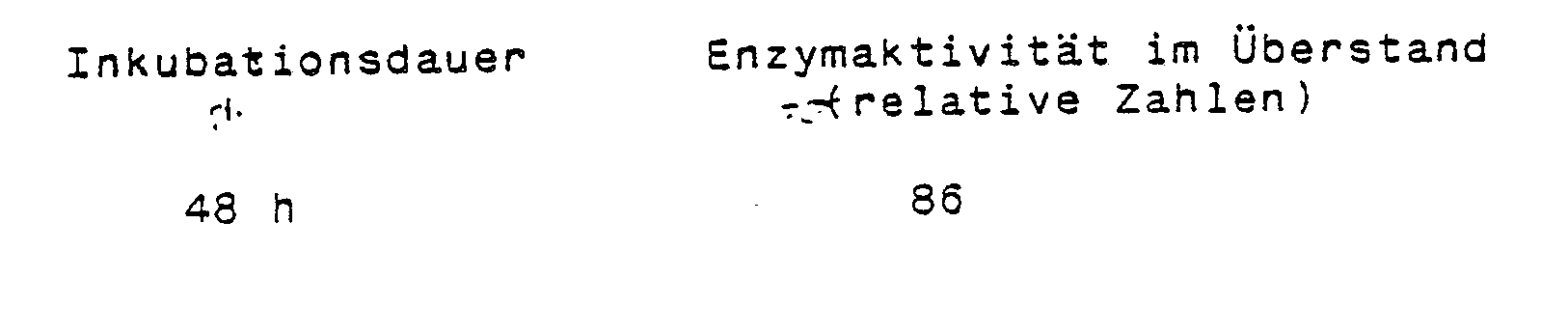
- Die erfindungsgemäße Mutante E. coli DS410 K5 wurde mit dem Plasmid pAP5 transformiert, das die genetische Information für β-Lactamase trägt. In diesem rekombinanten Plasmid steht das β-Lactamase-Gen unter der Kontrolle des tac-Promotors, der durch Induktion mit beispielsweise Lactose die Überexpression der β-Lactamase bewirkt. Die Anzucht von E. coli DS410 K5 (pAP5) und die Probennahme nach 48-stündiger Inkubation zur Bestimmung der extrazellulären β-Lactamase-Aktivität erfolgten gemäß Beispiel 2. Die extrazelluläre β-Lactamase-Aktivität wurde mit Hilfe eines chromogenen Substrats, nämlich Nitrocefin, spektralphotometrisch bei 480 nm bestimmt; vgl. Biochemistry, 23 (1984) 1282-1287. Man erhielt folgende Ergebnisse:
- Beispiel 3 wurde mit der Abänderung nachgearbeitet, daß der rekombinante Stamm E. coli HB101 (pAP5) verwendet wurde. Man erhielt folgende Ergebnisse:

- Die Vorgehensweise gemäß den Beispielen 1 und 2 wurde wiederholt mit der Abänderung, daß anstatt E. coli DS 410 der E. coli Stamm BW 7261 (ton A22, ompF 627) mit dem Plasmid pCM 703 verwendet wurde. Die daraus erhaltene Mutante wurde plasmidfrei gemacht und mit dem Plasmid pCM 703 retransformiert. Dieser Stamm wurde in flüssigem Vollmedium (LB), das 0,5 % Laktose und 0,2 % Glukose enthält, bei 30°C angezogen. Nach 48 h bzw. 72 h Inkubation wurde die Enzymaktivität im Überstand bestimmt (siehe Beispiel 2).

- E.-coli-Stamm mit minAB-Mutation: Davie et al., Bacteriol., 158 (1984) 1202 - 1203.
E. coli DS410: DSM 4513, Deutsche Sammlung von Mikroorganismen, Mascheroder Weg 1b, 3300 Braunschweig.
E.-coli-Stamm mit einer Mutation von Protein in der äußeren Membran: Wanner, J. Mol. Biol. 191 (1986) 39.
E. coli BW 7261, DSM 5231, Deutsche Sammlung von Mikroorganismen, Mascheroder Weg 1b, 3300 Braunschweig.
E. coli HB101: z.B. DSM 1607
pJF118ut: Fig. 1
pCM703: Fig. 2
pAP5: Fig. 3
tac: tac-Promotor; vgl. De Boer et al., Proc. Natl. Acad. Sci. USA, 80 (1983) 21-25
CGT: Strukturgen für CGT (Cyclodextringlycosyltransferase) (einschließlich Signalsequenz)
t: Terminator
amp: Ampicillin-Resistenz
tet: Tetracyclin-Resistenz
lacI:lac-Repressor - BamH I
Cla I
EcoR I
Hind III
Nru I
Pst I
Pvu I
Sca I
Claims (17)
- eine plasmidfreie E.-coli-Mutante verwendet, die gemäß Anspruch 1 Stufen (a) bis (f) erhältlich ist (wobei Stufe (d) fehlen kann),
- in an sich bekannter Weise die Mutante mit einem für die Expression des gewünschten Proteins geeigneten Hybridplasmid transformiert, das das Strukturgen des Proteins umfaßt, und
- das Protein produziert.
Applications Claiming Priority (2)
| Application Number | Priority Date | Filing Date | Title |
|---|---|---|---|
| DE3813107A DE3813107A1 (de) | 1988-04-19 | 1988-04-19 | Sekretormutante von escherichia coli |
| DE3813107 | 1988-04-19 |
Publications (3)
| Publication Number | Publication Date |
|---|---|
| EP0338410A2 true EP0338410A2 (de) | 1989-10-25 |
| EP0338410A3 EP0338410A3 (de) | 1991-10-16 |
| EP0338410B1 EP0338410B1 (de) | 1994-09-28 |
Family
ID=6352379
Family Applications (1)
| Application Number | Title | Priority Date | Filing Date |
|---|---|---|---|
| EP89106554A Expired - Lifetime EP0338410B1 (de) | 1988-04-19 | 1989-04-13 | Sekretormutante von Escherichia coli |
Country Status (6)
| Country | Link |
|---|---|
| EP (1) | EP0338410B1 (de) |
| JP (1) | JP3040402B2 (de) |
| AT (1) | ATE112320T1 (de) |
| DE (2) | DE3813107A1 (de) |
| DK (1) | DK174508B1 (de) |
| FI (1) | FI102544B (de) |
Cited By (9)
| Publication number | Priority date | Publication date | Assignee | Title |
|---|---|---|---|---|
| EP0448093A3 (en) * | 1990-03-22 | 1991-12-04 | Consortium Fuer Elektrochemische Industrie Gmbh | Secretion of hirudin derivatives |
| EP0510658A2 (de) | 1991-04-26 | 1992-10-28 | Roche Diagnostics GmbH | Verbesserung der Ausbeute bei der Sekretion von disulfidverbrückten Proteinen |
| WO1998011203A1 (en) * | 1996-09-13 | 1998-03-19 | Novo Nordisk Biotech, Inc. | Cells having dna insertion mutations which produce altered amounts of a polypeptide |
| US5830692A (en) * | 1995-03-24 | 1998-11-03 | Consortium Fur Elektrochemische Industrie Gmbh | Expression system which can be regulated |
| US6514730B1 (en) | 1991-03-21 | 2003-02-04 | Consortium für elektrochemische Industrie GmbH | Secretion of hirudin derivatives |
| EP1903105A1 (de) * | 2006-09-22 | 2008-03-26 | Wacker Chemie AG | Verfahren zur fermentativen Herstellung von Proteinen |
| WO2009021548A1 (en) * | 2007-08-10 | 2009-02-19 | Wacker Chemie Ag | Expression of full length igg and secretion into the culture medium of prokaryotic cells |
| EP2298912A2 (de) * | 2006-02-02 | 2011-03-23 | Wacker Chemie AG | Mikroorganismenstamm zur Produktion von rekombinanten Proteinen |
| US8216573B2 (en) | 2006-09-22 | 2012-07-10 | Wacker Chemie Ag | Process for the fermentative production of antibodies |
Families Citing this family (4)
| Publication number | Priority date | Publication date | Assignee | Title |
|---|---|---|---|---|
| US6247571B1 (en) | 1996-08-30 | 2001-06-19 | Aisin Seiki Kabushiki Kaisha | Power transmitting mechanism with two hysteresis mechanisms |
| DE102006044841A1 (de) | 2006-09-22 | 2008-04-03 | Wacker Chemie Ag | Signalpeptid zur Produktion von rekombinanten Proteinen |
| DE102006050332A1 (de) | 2006-10-25 | 2008-04-30 | Wacker Chemie Ag | DNS-Konstrukt und Verfahren zur fermentativen Herstellung von Fusionsproteinen |
| CN121794386A (zh) | 2024-06-05 | 2026-04-03 | 瓦克化学股份公司 | 具有增加的复制速率的质粒 |
Family Cites Families (2)
| Publication number | Priority date | Publication date | Assignee | Title |
|---|---|---|---|---|
| CA1187432A (en) * | 1981-07-30 | 1985-05-21 | Jyoji Kato | Microorganism and its use for the preparation of glutathione |
| ATE122391T1 (de) * | 1987-01-30 | 1995-05-15 | Harvard College | Periplasmische protease-mutanten von escherichia coli. |
-
1988
- 1988-04-19 DE DE3813107A patent/DE3813107A1/de not_active Withdrawn
-
1989
- 1989-04-13 DE DE58908428T patent/DE58908428D1/de not_active Expired - Lifetime
- 1989-04-13 AT AT89106554T patent/ATE112320T1/de not_active IP Right Cessation
- 1989-04-13 EP EP89106554A patent/EP0338410B1/de not_active Expired - Lifetime
- 1989-04-18 DK DK198901865A patent/DK174508B1/da not_active IP Right Cessation
- 1989-04-18 FI FI891832A patent/FI102544B/fi not_active IP Right Cessation
- 1989-04-19 JP JP1097687A patent/JP3040402B2/ja not_active Expired - Lifetime
Cited By (12)
| Publication number | Priority date | Publication date | Assignee | Title |
|---|---|---|---|---|
| EP0448093A3 (en) * | 1990-03-22 | 1991-12-04 | Consortium Fuer Elektrochemische Industrie Gmbh | Secretion of hirudin derivatives |
| US5919895A (en) * | 1990-03-22 | 1999-07-06 | Consortium Fur Elektrochemische Industrie Gmbh | Secretion of hirudin derivatives |
| CN1067104C (zh) * | 1990-03-22 | 2001-06-13 | 联合电化学工业股份有限公司 | 含水蛭素衍生物的分泌物的制备方法 |
| US6514730B1 (en) | 1991-03-21 | 2003-02-04 | Consortium für elektrochemische Industrie GmbH | Secretion of hirudin derivatives |
| EP0510658A2 (de) | 1991-04-26 | 1992-10-28 | Roche Diagnostics GmbH | Verbesserung der Ausbeute bei der Sekretion von disulfidverbrückten Proteinen |
| US5830692A (en) * | 1995-03-24 | 1998-11-03 | Consortium Fur Elektrochemische Industrie Gmbh | Expression system which can be regulated |
| WO1998011203A1 (en) * | 1996-09-13 | 1998-03-19 | Novo Nordisk Biotech, Inc. | Cells having dna insertion mutations which produce altered amounts of a polypeptide |
| US5958727A (en) * | 1996-09-13 | 1999-09-28 | Novo Nordisk Biotech, Inc | Methods for modifying the production of a polypeptide |
| EP2298912A2 (de) * | 2006-02-02 | 2011-03-23 | Wacker Chemie AG | Mikroorganismenstamm zur Produktion von rekombinanten Proteinen |
| EP1903105A1 (de) * | 2006-09-22 | 2008-03-26 | Wacker Chemie AG | Verfahren zur fermentativen Herstellung von Proteinen |
| US8216573B2 (en) | 2006-09-22 | 2012-07-10 | Wacker Chemie Ag | Process for the fermentative production of antibodies |
| WO2009021548A1 (en) * | 2007-08-10 | 2009-02-19 | Wacker Chemie Ag | Expression of full length igg and secretion into the culture medium of prokaryotic cells |
Also Published As
| Publication number | Publication date |
|---|---|
| DK174508B1 (da) | 2003-05-05 |
| EP0338410A3 (de) | 1991-10-16 |
| EP0338410B1 (de) | 1994-09-28 |
| JPH0235077A (ja) | 1990-02-05 |
| ATE112320T1 (de) | 1994-10-15 |
| FI891832A0 (fi) | 1989-04-18 |
| DK186589A (da) | 1989-10-20 |
| DK186589D0 (da) | 1989-04-18 |
| DE3813107A1 (de) | 1989-11-02 |
| DE58908428D1 (de) | 1994-11-03 |
| FI102544B1 (fi) | 1998-12-31 |
| JP3040402B2 (ja) | 2000-05-15 |
| FI891832L (fi) | 1989-10-20 |
| FI102544B (fi) | 1998-12-31 |
Similar Documents
| Publication | Publication Date | Title |
|---|---|---|
| EP0338410B1 (de) | Sekretormutante von Escherichia coli | |
| DE68926882T2 (de) | Plasmidvektor mit pectatlyase-signalsequenz | |
| DE3587814T2 (de) | Verfahren zum erhalten von dns, rns, peptiden, polypeptiden oder proteinen durch dns-rekombinant-verfahren. | |
| DE10053224A1 (de) | Verfahren zur Exposition von Peptiden und Polypeptiden auf der Zelloberfläche von Bakterien | |
| EP0069697A2 (de) | Herstellung und Anwendung von Plasmiden mit Genen für die Biosynthese von L-Prolin | |
| EP1905835A1 (de) | Signalpeptid zur Produktion von rekombinanten Proteinen | |
| DE60021188T2 (de) | Modifizierter humaner granulozyten-kolonie stimulierenderfaktor sowie verfahren zur herstellung desselben | |
| DE3048612C2 (de) | "Verfahren zur enzymatischen Trennung von L-2-Ami no-4-methylphosphinobuttersäure" | |
| EP0599159B1 (de) | Heterogenes Proteingemisch mit alpha-L-rhamnosidase Aktivität, Verfahren zu ihrer Herstellung und ihre Verwendung. | |
| DE60131261T2 (de) | Verbesserte verfahren und zellen zur expression von rekombinanter proteinprodukte | |
| DE3423899C2 (de) | ||
| DE19944870A1 (de) | Signalsequenzen zur Herstellung von Leu-Hirudin über Sekretion durch E. coli in das Kulturmedium | |
| CH640268A5 (en) | Process for the preparation of filamentous hybrid phages, novel hybrid phages and their use | |
| DD202735A5 (de) | Verfahren zur herstellung invertasefreier alpha-galactosidase | |
| DE69125541T2 (de) | Verfahren zur enzymatischen Herstellung von 7-Aminocephalosporinsäure | |
| DE3320339A1 (de) | Expressionsvektor, verfahren zu seiner herstellung und verwendung des expressionsvektors zur herstellung eines polypeptids | |
| DE2723463B2 (de) | Verfahren zur Herstellung von 7-Aminocephem-Verbindungen | |
| DE69105188T2 (de) | Asporogener Stamm von Bacillus substilis und seine Verwendung als Wirt in der Herstellung von heterologen Produkten. | |
| DE69227661T2 (de) | Lineare Plasmide von Pichia pastoris und Fragmente davon | |
| DE3689993T2 (de) | Vektor für Expression und Sekretion von Produkten von heterologen Genen in Bacillus Subtilis. | |
| DE4231764A1 (de) | Verfahren zur chromosomalen Integration eines Produkt-Gens | |
| DE3586145T2 (de) | Rekombinante dns, diese enthaltende mikroorganismen und deren verwendung zur herstellung von amylasen. | |
| DE2930922C2 (de) | ||
| DE3723992A1 (de) | Verfahren zur herstellung von proteinen in loeslicher form | |
| DE3530935A1 (de) | Rekombinantes plasmid, transformante und verfahren zur herstellung von n-acylneuraminat-aldolase |
Legal Events
| Date | Code | Title | Description |
|---|---|---|---|
| PUAI | Public reference made under article 153(3) epc to a published international application that has entered the european phase |
Free format text: ORIGINAL CODE: 0009012 |
|
| 17P | Request for examination filed |
Effective date: 19890413 |
|
| AK | Designated contracting states |
Kind code of ref document: A2 Designated state(s): AT BE CH DE FR GB LI NL SE |
|
| PUAL | Search report despatched |
Free format text: ORIGINAL CODE: 0009013 |
|
| AK | Designated contracting states |
Kind code of ref document: A3 Designated state(s): AT BE CH DE FR GB LI NL SE |
|
| 17Q | First examination report despatched |
Effective date: 19930226 |
|
| GRAA | (expected) grant |
Free format text: ORIGINAL CODE: 0009210 |
|
| AK | Designated contracting states |
Kind code of ref document: B1 Designated state(s): AT BE CH DE FR GB LI NL SE |
|
| REF | Corresponds to: |
Ref document number: 112320 Country of ref document: AT Date of ref document: 19941015 Kind code of ref document: T |
|
| REF | Corresponds to: |
Ref document number: 58908428 Country of ref document: DE Date of ref document: 19941103 |
|
| GBT | Gb: translation of ep patent filed (gb section 77(6)(a)/1977) |
Effective date: 19941101 |
|
| EAL | Se: european patent in force in sweden |
Ref document number: 89106554.2 |
|
| ET | Fr: translation filed | ||
| PLBE | No opposition filed within time limit |
Free format text: ORIGINAL CODE: 0009261 |
|
| STAA | Information on the status of an ep patent application or granted ep patent |
Free format text: STATUS: NO OPPOSITION FILED WITHIN TIME LIMIT |
|
| 26N | No opposition filed | ||
| REG | Reference to a national code |
Ref country code: GB Ref legal event code: IF02 |
|
| REG | Reference to a national code |
Ref country code: GB Ref legal event code: 732E |
|
| REG | Reference to a national code |
Ref country code: CH Ref legal event code: PUE Owner name: WACKER CHEMIE AG Free format text: CONSORTIUM FUER ELEKTROCHEMISCHE INDUSTRIE GMBH#ZIELSTATTSTRASSE 20#D-81379 MUENCHEN (DE) -TRANSFER TO- WACKER CHEMIE AG#HANNS-SEIDEL-PLATZ 4#81737 MUENCHEN (DE) |
|
| NLS | Nl: assignments of ep-patents |
Owner name: WACKER CHEMIE AG Effective date: 20070516 |
|
| REG | Reference to a national code |
Ref country code: FR Ref legal event code: TP |
|
| PGFP | Annual fee paid to national office [announced via postgrant information from national office to epo] |
Ref country code: CH Payment date: 20080415 Year of fee payment: 20 Ref country code: DE Payment date: 20080418 Year of fee payment: 20 |
|
| PGFP | Annual fee paid to national office [announced via postgrant information from national office to epo] |
Ref country code: AT Payment date: 20080415 Year of fee payment: 20 |
|
| PGFP | Annual fee paid to national office [announced via postgrant information from national office to epo] |
Ref country code: BE Payment date: 20080522 Year of fee payment: 20 |
|
| PGFP | Annual fee paid to national office [announced via postgrant information from national office to epo] |
Ref country code: NL Payment date: 20080415 Year of fee payment: 20 Ref country code: SE Payment date: 20080414 Year of fee payment: 20 |
|
| PGFP | Annual fee paid to national office [announced via postgrant information from national office to epo] |
Ref country code: FR Payment date: 20080412 Year of fee payment: 20 |
|
| PGFP | Annual fee paid to national office [announced via postgrant information from national office to epo] |
Ref country code: GB Payment date: 20080421 Year of fee payment: 20 |
|
| BE20 | Be: patent expired |
Owner name: *WACKER CHEMIE A.G. Effective date: 20090413 |
|
| REG | Reference to a national code |
Ref country code: CH Ref legal event code: PL |
|
| REG | Reference to a national code |
Ref country code: GB Ref legal event code: PE20 Expiry date: 20090412 |
|
| PG25 | Lapsed in a contracting state [announced via postgrant information from national office to epo] |
Ref country code: NL Free format text: LAPSE BECAUSE OF EXPIRATION OF PROTECTION Effective date: 20090413 |
|
| NLV7 | Nl: ceased due to reaching the maximum lifetime of a patent |
Effective date: 20090413 |
|
| EUG | Se: european patent has lapsed | ||
| PG25 | Lapsed in a contracting state [announced via postgrant information from national office to epo] |
Ref country code: GB Free format text: LAPSE BECAUSE OF EXPIRATION OF PROTECTION Effective date: 20090412 |