EP0335832A2 - Arylhydrazone - Google Patents
Arylhydrazone Download PDFInfo
- Publication number
- EP0335832A2 EP0335832A2 EP89810207A EP89810207A EP0335832A2 EP 0335832 A2 EP0335832 A2 EP 0335832A2 EP 89810207 A EP89810207 A EP 89810207A EP 89810207 A EP89810207 A EP 89810207A EP 0335832 A2 EP0335832 A2 EP 0335832A2
- Authority
- EP
- European Patent Office
- Prior art keywords
- formula
- hydrogen
- lower alkyl
- amino
- compound
- Prior art date
- Legal status (The legal status is an assumption and is not a legal conclusion. Google has not performed a legal analysis and makes no representation as to the accuracy of the status listed.)
- Granted
Links
Classifications
-
- C—CHEMISTRY; METALLURGY
- C07—ORGANIC CHEMISTRY
- C07D—HETEROCYCLIC COMPOUNDS
- C07D213/00—Heterocyclic compounds containing six-membered rings, not condensed with other rings, with one nitrogen atom as the only ring hetero atom and three or more double bonds between ring members or between ring members and non-ring members
- C07D213/02—Heterocyclic compounds containing six-membered rings, not condensed with other rings, with one nitrogen atom as the only ring hetero atom and three or more double bonds between ring members or between ring members and non-ring members having three double bonds between ring members or between ring members and non-ring members
-
- C—CHEMISTRY; METALLURGY
- C07—ORGANIC CHEMISTRY
- C07D—HETEROCYCLIC COMPOUNDS
- C07D213/00—Heterocyclic compounds containing six-membered rings, not condensed with other rings, with one nitrogen atom as the only ring hetero atom and three or more double bonds between ring members or between ring members and non-ring members
- C07D213/02—Heterocyclic compounds containing six-membered rings, not condensed with other rings, with one nitrogen atom as the only ring hetero atom and three or more double bonds between ring members or between ring members and non-ring members having three double bonds between ring members or between ring members and non-ring members
- C07D213/04—Heterocyclic compounds containing six-membered rings, not condensed with other rings, with one nitrogen atom as the only ring hetero atom and three or more double bonds between ring members or between ring members and non-ring members having three double bonds between ring members or between ring members and non-ring members having no bond between the ring nitrogen atom and a non-ring member or having only hydrogen or carbon atoms directly attached to the ring nitrogen atom
- C07D213/60—Heterocyclic compounds containing six-membered rings, not condensed with other rings, with one nitrogen atom as the only ring hetero atom and three or more double bonds between ring members or between ring members and non-ring members having three double bonds between ring members or between ring members and non-ring members having no bond between the ring nitrogen atom and a non-ring member or having only hydrogen or carbon atoms directly attached to the ring nitrogen atom with hetero atoms or with carbon atoms having three bonds to hetero atoms with at the most one bond to halogen, e.g. ester or nitrile radicals, directly attached to ring carbon atoms
- C07D213/78—Carbon atoms having three bonds to hetero atoms, with at the most one bond to halogen, e.g. ester or nitrile radicals
-
- A—HUMAN NECESSITIES
- A61—MEDICAL OR VETERINARY SCIENCE; HYGIENE
- A61P—SPECIFIC THERAPEUTIC ACTIVITY OF CHEMICAL COMPOUNDS OR MEDICINAL PREPARATIONS
- A61P33/00—Antiparasitic agents
- A61P33/02—Antiprotozoals, e.g. for leishmaniasis, trichomoniasis, toxoplasmosis
-
- A—HUMAN NECESSITIES
- A61—MEDICAL OR VETERINARY SCIENCE; HYGIENE
- A61P—SPECIFIC THERAPEUTIC ACTIVITY OF CHEMICAL COMPOUNDS OR MEDICINAL PREPARATIONS
- A61P35/00—Antineoplastic agents
-
- C—CHEMISTRY; METALLURGY
- C07—ORGANIC CHEMISTRY
- C07C—ACYCLIC OR CARBOCYCLIC COMPOUNDS
- C07C281/00—Derivatives of carbonic acid containing functional groups covered by groups C07C269/00 - C07C279/00 in which at least one nitrogen atom of these functional groups is further bound to another nitrogen atom not being part of a nitro or nitroso group
- C07C281/16—Compounds containing any of the groups, e.g. aminoguanidine
- C07C281/18—Compounds containing any of the groups, e.g. aminoguanidine the other nitrogen atom being further doubly-bound to a carbon atom, e.g. guanylhydrazones
-
- C—CHEMISTRY; METALLURGY
- C07—ORGANIC CHEMISTRY
- C07C—ACYCLIC OR CARBOCYCLIC COMPOUNDS
- C07C337/00—Derivatives of thiocarbonic acids containing functional groups covered by groups C07C333/00 or C07C335/00 in which at least one nitrogen atom of these functional groups is further bound to another nitrogen atom not being part of a nitro or nitroso group
- C07C337/06—Compounds containing any of the groups, e.g. thiosemicarbazides
- C07C337/08—Compounds containing any of the groups, e.g. thiosemicarbazides the other nitrogen atom being further doubly-bound to a carbon atom, e.g. thiosemicarbazones
-
- C—CHEMISTRY; METALLURGY
- C07—ORGANIC CHEMISTRY
- C07D—HETEROCYCLIC COMPOUNDS
- C07D223/00—Heterocyclic compounds containing seven-membered rings having one nitrogen atom as the only ring hetero atom
-
- C—CHEMISTRY; METALLURGY
- C07—ORGANIC CHEMISTRY
- C07D—HETEROCYCLIC COMPOUNDS
- C07D239/00—Heterocyclic compounds containing 1,3-diazine or hydrogenated 1,3-diazine rings
- C07D239/02—Heterocyclic compounds containing 1,3-diazine or hydrogenated 1,3-diazine rings not condensed with other rings
- C07D239/24—Heterocyclic compounds containing 1,3-diazine or hydrogenated 1,3-diazine rings not condensed with other rings having three or more double bonds between ring members or between ring members and non-ring members
- C07D239/28—Heterocyclic compounds containing 1,3-diazine or hydrogenated 1,3-diazine rings not condensed with other rings having three or more double bonds between ring members or between ring members and non-ring members with hetero atoms or with carbon atoms having three bonds to hetero atoms with at the most one bond to halogen, directly attached to ring carbon atoms
- C07D239/30—Halogen atoms or nitro radicals
-
- C—CHEMISTRY; METALLURGY
- C07—ORGANIC CHEMISTRY
- C07D—HETEROCYCLIC COMPOUNDS
- C07D401/00—Heterocyclic compounds containing two or more hetero rings, having nitrogen atoms as the only ring hetero atoms, at least one ring being a six-membered ring with only one nitrogen atom
- C07D401/02—Heterocyclic compounds containing two or more hetero rings, having nitrogen atoms as the only ring hetero atoms, at least one ring being a six-membered ring with only one nitrogen atom containing two hetero rings
- C07D401/04—Heterocyclic compounds containing two or more hetero rings, having nitrogen atoms as the only ring hetero atoms, at least one ring being a six-membered ring with only one nitrogen atom containing two hetero rings directly linked by a ring-member-to-ring-member bond
Definitions
- the invention relates to compounds of the formula I.
- A represents a single bond or a group NR7; X1, X2, X3 and X4 independently of one another are CH or N with the proviso that at least two of the groups X1-X4 are CH; Y is NR8 or - if A is a simple bond - is O; Z represents NR9, O or S; R1 represents hydrogen, lower alkyl, hydroxy, etherified or esterified hydroxy or unsubstituted or mono- or disubstituted amino; the radicals R2, R3, R4, R5, R7, R8 and R9 independently of one another are hydrogen or lower alkyl, or R1 and R8 together can also mean alkylene; and R6 represents hydrogen, lower alkyl, cycloalkyl, aryl-lower alkyl, aryl, free or functionally modified carboxy, hydroxy, etherified or esterified hydroxy, unsubstituted or mono- or disubstit
- Tautomers can occur, for example, when Z is NR9 and R4 and / or R5 and / or R6 are hydrogen:
- Lower alkyl is e.g. n-propyl, isopropyl, n-butyl, isobutyl, sec-butyl, tert-butyl, n-pentyl, neopentyl, n-hexyl or n-heptyl, preferably ethyl and especially methyl.
- Cycloalkyl contains e.g. 3 to 8, preferably 5 or 6, ring carbon atoms and is e.g. Cyclopropyl, cyclopentyl, cyclohexyl or cycloheptyl.
- Aryl-lower alkyl is preferably phenyl-lower alkyl and especially benzyl.
- Aryl is, for example, phenyl or naphthyl, such as 1- or 2-naphthyl.
- the phenyl or naphthyl radicals can be unsubstituted or substituted.
- Aryl is preferably phenyl which is unsubstituted or substituted by lower alkyl, hydroxy, lower alkoxy, halogen, trifluoromethyl and / or nitro, and primarily phenyl.
- Free or functionally modified carboxy is preferably cyano, further also e.g. Carboxy, esterified carboxy, e.g. Lower alkoxycarbonyl, or amidated carboxy, e.g. Carbamoyl, N-lower alkylcarbamoyl or N, N-di-lower alkylcarbamoyl.
- Halogen is e.g. Fluorine or iodine, especially bromine and especially chlorine.
- Etherified hydroxy is e.g. Lower alkoxy. Esterified hydroxy is e.g. Lower alkanoyloxy. Monosubstituted amino is e.g. Lower alkylamino. Disubstituted amino is e.g. Di-lower alkylamino, lower alkylene amino, e.g. C4-C7 and especially C4-C5 alkylene amino, e.g. Piperidino, or oxa, thia or azane lower alkylene amino, e.g. Morpholino, thiomorpholino, piperazino or 4-lower alkylpiperazino.
- radical R6 is in particular also a group T.
- a ′, X ′ 1 , X ′ 2nd , X ′ 3rd , X ′ 4th , Y ′, R ′ 1 , R ′ 2nd and R ′ 3rd how the corresponding radicals A, X1, X2, X3, X4, Y, R1, R2 and R3 are defined under formula I.
- the symbols A, X are preferred in a radical R6 of a compound of the formula I.
- a group T is e.g. meta-amidino- (phenyl or pyridyl) -methylidenamino and especially 3-amidinophenylmethylidenamino, 2-amidino-6-pyridylmethylidenamino, 2-amidino-4-pyridylmethylidenamino, 4-amidino-2-pyridylmethylidenamino or 4-amidinomethylidenamino or
- Alkylene formed together from the radicals R1 and R8 is in particular - (CH2) 2- or - (CH2) 3- and especially - (CH2) 2-.
- Salts of compounds according to the invention are primarily pharmaceutically usable, non-toxic salts.
- compounds of formula I with basic groups of acid addition salts e.g. with inorganic acids, such as hydrochloric acid, sulfuric acid or phosphoric acid, or with suitable organic carboxylic or sulfonic acids, e.g. Acetic acid, fumaric acid or methanesulfonic acid, or e.g. with amino acids such as arginine or lysine.
- mono- or poly-salts can be formed.
- Compounds of formula I with an acidic group, e.g. Carboxy, and a basic group, e.g. Amino, e.g. in the form of internal salts, i.e. be in zwitterionic form, or part of the molecule may be an inner salt and another part may be a normal salt.
- the compounds of the present invention can be in the form of mixtures of isomers or of pure isomers.
- the compounds according to the invention have valuable, in particular pharmacologically usable, properties. In particular, they have a strong, specific inhibitory effect on the enzyme S-adenosylmethionine decarboxylase (SAMDC).
- SAMDC plays an important role in the synthesis of polyamine, which occurs in virtually all mammalian cells, including humans.
- SAMDC regulates the polyamine concentration in the cell. Inhibition of the enzyme SAMDC results in a reduction in the polyamine concentration. Since a reduction in the polyamine concentration inhibits cell growth, it is possible to inhibit the growth of both eukaryotic and prokaryotic cells by administering SAMDC-inhibiting substances and even to kill cells or to inhibit the onset of cell differentiation.
- the inhibition of the enzyme SAMDC can, for example, with the method of HG Williams-Ashmann and A. Schenone, Biochem.Biophys.Res.Communs. 46 , 288 (1972).
- the compounds of the invention have IC50 values of at least about 0.05 ⁇ M.
- Another advantage of the compounds according to the invention is that they only slightly inhibit the diamine oxidase in comparison to their strong inhibitory effect on SAMDC and are well tolerated.
- the inhibition of diamine oxidase is according to J. Jaenne and DR Morris, Biochem. J. 218 , 974 (1984), since it can lead to the accumulation of putrescine and indirect SAMDC activation.
- the compounds of the formula I are therefore useful, for example, for the treatment of benign and malignant tumors. They can cause tumor regressions and also prevent the spread of tumor cells and the growth of micrometastases. Furthermore, they can be used, for example, to treat protozoan infections, such as trypanosomiasis, malaria or pneumonia caused by Pneumocystis carinii.
- the compounds of the formula I can be used as selective SAMDC inhibitors either alone or in combination with other pharmacologically active substances.
- a) inhibitors of other enzymes of polyamine biosynthesis e.g. Ornithine decarboxylase inhibitors,
- b) protein kinase C inhibitors e.g. Ornithine decarboxylase inhibitors
- protein kinase C inhibitors e.g. Ornithine decarboxylase inhibitors
- tyrosine protein kinase inhibitors e.g., tyrosine protein kinase inhibitors
- cytokines e.g., cytokines
- e) negative growth regulators e.g) aromatase inhibitors
- h) classic cytostatic agents e.g., cytostatic agents.
- A denotes a simple bond or a group NR7; X1, X2, X3 and X4 independently of one another are CH or N with the proviso that at least two of the groups X1-X4 are CH; Y is NR8 or - if A is a simple bond - is O; Z represents NR9, O or S; R1 represents hydrogen, lower alkyl, hydroxy, lower alkoxy or amino; the radicals R2, R3, R4, R5, R7, R8 and R9 independently of one another are hydrogen or lower alkyl, or R1 and R8 together can also be - (CH2) 2- or - (CH2) 3-; and R6 represents hydrogen, lower alkyl, hydroxy, amino or a group where A ′, X ′ , X ′ 2nd , X ′ 3rd , X ′ 4th , Y ′, R ′ 1 , R ′ 2nd and R ′ 3r
- A denotes a single bond or a group NH; wherein a) X1, X2, X3 and X4 are CH, or (b) X1 is N and X2, X3 and X4 are CH, or (c) X2 is N and X1, X3 and X4 are CH, or (d ) X1 and X4 are N and X2 and X3 are CH; Y is NR8 or - if A is a simple bond - is O; Z represents NH or S; R1 represents hydrogen, lower alkyl, hydroxy, lower alkoxy or amino; the radicals R2, R3 and R8 independently of one another are hydrogen or lower alkyl, or R1 and R8 together can also be - (CH2) 2-; R4 and R5 are hydrogen and R6 is hydrogen, lower alkyl, hydroxy, amino, 3-amidinophenylmethylidenamino or 2-amidino-6-pyridy
- A is a simple bond or a group NH; wherein (a) X1, X2, X3 and X4 represent CH, or (b) X1 represents N and X2, X3 and X4 represent CH, or (c) X2 represents N and X1, X3 and X4 represent CH, or ( d) X1 and X4 are N and X2 and X3 are CH; Y is NH or - if A is a simple bond - is O; Z represents NH or S; R1 represents hydrogen, lower alkyl, hydroxy, lower alkoxy or amino; R3 means hydrogen or lower alkyl tet; R2, R4 and R5 are hydrogen and R6 is hydrogen, lower alkyl, hydroxy or amino, tautomers thereof, and their salts.
- A denotes a simple bond or a group NR7; X1, X2, X3 and X4 independently of one another are CH or N with the proviso that at least two of the groups X1-X4 are CH; Y is NR8 or - if A is a simple bond - is O; Z represents NR9, O or S; the radicals R1, R2, R3, R4, R5, R7, R8 and R9 are independently hydrogen or lower alkyl and R6 is hydrogen, lower alkyl, hydroxy, amino or 3-amidinophenylmethylideneamino, tautomers thereof, and their salts.
- A denotes a single bond or an NH group
- X1 and X2 independently of one another are CH or N with the proviso that at least one of the groups X1 and X2 is CH
- X3 and X4 are CH
- Y for NH or also - if A means a simple bond tet - stands for O
- Z represents NH or S
- the radical R3 is hydrogen or lower alkyl
- R1, R2, R4 and R5 are hydrogen
- R6 is hydrogen, lower alkyl, hydroxy or amino, tautomers thereof, and their salts.
- the invention relates in particular to the specific compounds and salts thereof described in the examples.
- Examples of functionally modified or protected carbonyl CW1W2 are: diniederalkoxymethyl, C1-C2-alkylenedioxymethyl, dihalomethyl, diniederalkylthiomethyl or C1-C2-alkylenedithiomethyl.
- the condensation reaction according to process a) takes place under the conditions known per se in the formation of hydrazones. It is preferably catalyzed by acid.
- such protected carbonyl groups CW 1 W 2 are suitable which pass under the conditions of the condensation into free carbonyl.
- the intermediates of formula II, wherein A is a single bond and Y is NH are obtained, for example, by a compound of formula VII wherein the group CW1W2 is as defined under formula II, for example treated with ethanol and hydrochloric acid in, for example, chloroform or diethyl ether, the corresponding iminoethyl ester hydrochloride being formed, for example by reaction with ammonia or a primary or secondary amine of the formula NHR1R2 and, for example, methanol can be converted into the desired carboximidamide of the formula II.
- the thionecarboxamides are e.g.
- Compounds of formula VII - especially those in which X1 and X4 are N and X2 and X3 are CH - can be e.g. also produce in the following way: Starting from 6-hydroxy-2,4-dimethylpyrimidine, (a) by selective condensation of the 2-methyl group with benzaldehyde, (b) conversion of the 6-hydroxy group into 6-chlorine using a chlorinating agent, e.g. POCl3, and (c) selective removal of the 6-chloro substituent by reduction, e.g. with H2 / Lindlar catalyst (5% Pd on CaCO3, poisoned with Pb), the 4-methyl-2- (2-phenylethenyl) pyrimidine obtained.
- a chlorinating agent e.g. POCl3
- aminoguanidines, ureas and thioureas of the formula III are known per se.
- Aminoguanidines of the formula III in which Z is NR8 and R4, R5, R6 and R8 are as defined under formula I, are known per se and can be e.g. produce from corresponding aminothioureas of the formula III by converting the latter by alkylation, for example with an alkyl tosylate or halide, into the corresponding S-alkylisothiuronium salts and reacting these with an amine of the formula NHR5R6.
- Examples of reagents which can convert the group -NHR7 in a compound of the formula IV into a guanidine of the formula I are compounds of the formula V. wherein W3 means functionally modified carboxy, suitable.
- the intermediates of formula IV are e.g. prepared by condensing a compound of formula VIII, wherein the group CW1W2 is as defined under formula II, with an amine of formula III.
- the reaction taking place corresponds to process a) described above.
- the amino group NHR7 in the intermediate of formula IV is optionally to be protected from the reaction by one of the NH2 protective groups commonly used in organic chemistry. After the condensation has taken place, the protective group can then be split off in a manner known per se and an intermediate of the formula IV is obtained.
- W4 means e.g. free or functionally modified carboxy, in particular halocarbonyl, cyano, imino-lower alkoxycarbonyl or imino-lower alkylthiolcarbonyl.
- an imino-lower alkyl ester of the formula VI is used with an ⁇ , ⁇ -diaminoalkane, e.g. 1,2-diaminoethane or 1,3-diaminopropane, in order to obtain a compound of formula I, wherein the radicals R1 and R8 together represent alkylene.
- carboxy, halocarbonyl e.g. -COCl
- cyano optionally mono- or disubstituted carbamoyl compounds of the formula I from corresponding intermediates of the formula VI, in which W4 denotes carboxy, halocarbonyl or lower alkoxycarbonyl, by reaction with ammonia or primary or secondary amines is known per se.
- Intermediates of formula VI, wherein W4 is cyano can e.g.
- hydrolysis by partial hydrolysis, in the sense of a Graf-Ritter reaction, or via carboxylic ester imide salts in optionally mono- or disubstituted carbamoyl compounds of the formula I.
- the conditions in the hydrolysis of the cyano intermediates can be selected so that the reaction is stopped at the amide stage.
- hydrolysis with acids is particularly important, e.g. 80% sulfuric acid (with heating), polyphosphoric acid (at 110-150 ° C), hydrogen bromide / glacial acetic acid (room temperature, formic acid or without solvent), HCl gas in ethereal solution followed by the addition of water or aqueous hydrochloric acid, or boron halides in Question come.
- the Graf-Ritter reaction also enables the production of N-substituted amides from nitriles of the formula VI.
- the nitriles are reacted in the presence of a strong acid, primarily 85-90% sulfuric acid, or also polyphosphoric acid, formic acid, boron trifluoride or other Lewis acids, but not aluminum chloride, with compounds which can form carbenium ions in the acidic medium for example with olefins such as propylene or alcohols such as ethanol.
- the carboxylic ester imides are obtained e.g. by acid-catalyzed addition of alcohols to the nitriles of the formula VI.
- the amides are obtained from the esterimides in the sense of a pinner cleavage by thermal decomposition of the esterimide salts at temperatures above about 80 ° C.
- Compounds of formula VI, wherein W4 is cyano can e.g. be prepared by reacting a compound of formula VII with a compound of formula III according to process a). From compounds of the formula VI in which W4 is cyano, the other compounds of the formula VI in which W4 is free or otherwise functionally modified carboxy can be prepared in a manner known per se or as described above.
- Process-free compounds of formula I with salt-forming properties can be converted into their salts in a manner known per se, compounds with basic properties e.g. by treatment with acids or suitable derivatives thereof, compounds with acidic properties e.g. by treatment with bases or suitable derivatives thereof.
- the compounds, including their salts, can also be obtained in the form of hydrates, or their crystals can e.g. include the solvent used for crystallization.
- Mixtures of isomers obtainable according to the invention can be separated into the individual isomers in a manner known per se, racemates e.g. by forming salts with optically pure salt-forming reagents and separating the mixture of diastereomers thus obtainable, e.g. by means of fractional crystallization.
- the reactions mentioned above can be carried out under reaction conditions known per se, in the absence or usually in the presence of solvents or diluents, preferably those which are inert to the reagents used and dissolve them, in the absence or presence of catalysts, condensing agents or neutralizing agents Agents, depending on the type of reaction and / or the reactants at low, normal or elevated temperature, for example in the temperature range from about -70 ° C to about 190 ° C, preferably from about -20 ° C to about 150 ° C, e.g. at the boiling point of the solvent used, under atmospheric pressure or in a closed vessel, optionally under pressure, and / or in an inert atmosphere, e.g. under a nitrogen atmosphere.
- solvents or diluents preferably those which are inert to the reagents used and dissolve them
- catalysts condensing agents or neutralizing agents
- Agents depending on the type of reaction and / or the reactants at low, normal or elevated temperature, for example in
- the invention also relates to those embodiments of the process in which one starts from a compound obtainable as an intermediate at any process stage and carries out the missing process steps, or in which a starting material is formed under the reaction conditions or used in the form of a derivative, for example a salt thereof becomes.
- the present invention also relates to pharmaceutical preparations which contain one of the pharmacologically active compounds of the formula I as active ingredient.
- Preparations for enteral, in particular oral, and for parenteral administration are particularly preferred.
- the preparations contain the active ingredient alone or preferably together with a pharmaceutically usable carrier material.
- the dosage of the active ingredient depends on the disease to be treated, as well as on species, their age, weight and individual condition, and on the mode of administration.
- the pharmaceutical preparations contain from about 5% to about 95% of the active ingredient, single dosage forms preferably from about 20% to about 90% and non-dosage forms preferably from about 5% to about 20% active ingredient.
- Dosage unit forms such as coated tablets, tablets or capsules, contain from about 0.05 g to about 1.0 g of the active ingredient.
- compositions for oral use can be obtained by combining the active ingredient with one or more solid carriers, optionally granulating a mixture obtained, and, if desired, the mixture or granules, if appropriate by adding additional auxiliaries, to tablets or coated tablets. Cores processed.
- Suitable carriers are in particular fillers, such as sugar, for example lactose, sucrose, mannitol or sorbitol, cellulose preparations and / or calcium phosphates, for example tricalcium phosphate or calcium hydrogen phosphate, and also binders, such as starches, for example corn, wheat, rice or potato starch, methyl cellulose, hydroxypropylmethyl cellulose , Sodium carboxymethyl cellulose and / or polyvinyl pyrrolidone, and / or, if desired, disintegrants, such as the above-mentioned starches, carboxymethyl starch, cross-linked polyvinyl pyrrolidone, alginic acid or a salt thereof, such as sodium alginate.
- fillers such as sugar, for example lactose, sucrose, mannitol or sorbitol, cellulose preparations and / or calcium phosphates, for example tricalcium phosphate or calcium hydrogen phosphate
- binders such as starches
- Additional aids are primarily flow regulators and lubricants, e.g. Silicic acid, talc, stearic acid or salts thereof, such as magnesium or calcium stearate, and / or polyethylene glycol, or derivatives thereof.
- flow regulators and lubricants e.g. Silicic acid, talc, stearic acid or salts thereof, such as magnesium or calcium stearate, and / or polyethylene glycol, or derivatives thereof.
- Dragées kernels can be provided with suitable, possibly gastric juice-resistant coatings, among other things, Concentrated sugar solutions, which may contain arabic gum, talc, polyvinyl pyrrolidone, polyethylene glycol and / or titanium dioxide, lacquer solutions in suitable organic solvents or solvent mixtures or, for the production of gastric juice-resistant coatings, solutions of suitable cellulose preparations, such as acetyl cellulose phthalate or hydroxypropyl methyl cellulose phthalate. Dyes or pigments, e.g. for identification or for labeling different doses of active ingredient.
- Concentrated sugar solutions which may contain arabic gum, talc, polyvinyl pyrrolidone, polyethylene glycol and / or titanium dioxide, lacquer solutions in suitable organic solvents or solvent mixtures or, for the production of gastric juice-resistant coatings, solutions of suitable cellulose preparations, such as acetyl cellulose phthalate or hydroxypropyl methyl cellulose phthalate.
- Dyes or pigments
- Oral pharmaceutical compositions are also capsules made of gelatin, as well as soft, closed capsules made of gelatin and a plasticizer, such as glycerol or sorbitol.
- the capsules can contain the active ingredient in the form of granules, e.g. in a mixture with fillers, such as corn starch, binders and / or lubricants, such as talc or magnesium stearate, and optionally stabilizers.
- the active ingredient is preferably dissolved or suspended in suitable liquid auxiliaries, such as fatty oils, paraffin oil or liquid polyethylene glycols, stabilizers also being able to be added.
- oral administration forms are, for example, syrups prepared in the customary manner, which contain the active ingredient, for example, in suspended form and in a concentration of about 5% to 20%, preferably about 10% or in a similar concentration, for example when measuring 5 or 10 ml results in a suitable single dose.
- Powdery or liquid concentrates for preparing shakes, for example in milk, are also suitable. Such concentrates can also be packaged in single dose amounts.
- suppositories into consideration consist of a combination of the active ingredient with a suppository base.
- Suitable suppository bases are e.g. natural or synthetic triglycerides, paraffin hydrocarbons, polyethylene glycols or higher alkanols.
- aqueous solutions of an active ingredient in water-soluble form e.g. a water-soluble salt, or aqueous injection suspensions which contain viscosity-increasing substances, e.g. Contain sodium carboxymethyl cellulose, sorbitol and / or dextran and optionally stabilizers.
- the active ingredient optionally together with adjuvants, can also be in the form of a lyophilisate and be brought into solution by adding suitable solvents before parenteral administration.
- Solutions such as used for parenteral administration can also be used as infusion solutions.
- the invention also relates to a method for treating the disease states mentioned above.
- the compounds of the present invention can be administered prophylactically or therapeutically, preferably using them in the form of pharmaceutical preparations.
- a daily dose of about 0.1 g to about 10 g, preferably from about 0.5 g to about 5 g, of a compound of the present invention is administered.
- the starting compounds are made as follows:
- the starting compounds are made as follows:
- the starting compounds are made as follows:
- the starting compounds are made as follows:
- Example 8 2-Amidino-6-formylpyridine-2'-amidinohydrazone dihydrochloride and 2-carbamoyl-6-formylpyridine-2'-amidinohydrazone dihydrochloride
- the starting compounds are made as follows:
- the starting compounds are made as follows:
- Example 10 3-amino-1- (3'-amidinobenzylidene-amino) guanidine dihydrochloride and 1,3-bis (3'-amidinobenzylidene-amino) guanidine trihydrochloride
- Fractions 10-13 correspond to 3-amino-1- (3′-amidinobenzylidene-amino) guanidine dihydrochloride (decomp. At ⁇ 160 °) and fractions 15-20 correspond to 1,3-bis (3′- Amidinobenzylidene-amino) guanidine trihydrochloride dihydrate (decomp. At ⁇ 180 °).
- the starting compounds are made as follows:
- the starting compound is made as follows:
- reaction mixture is allowed to boil under reflux for a further 60 min and 9.7 ml (2 equivalents) of n-butyl nitrite are then added dropwise within 10 min.
- a red solution is obtained, which is allowed to boil under reflux for a further 60 min.
- 6.93 g (129 mmol) of ammonium chloride (in portions) are then added to the reaction mixture, the cooling bath is removed and the ammonia is allowed to evaporate at room temperature.
- the solid, gray residue is boiled up with acetone, filtered off and the solution is concentrated.
- the crude product is purified by chromatography on silica gel, eluent methylene chloride / acetone 5-10%.
- the title compound obtained is a syn-anti mixture of the two oximes.
- the starting compound is made as follows:
- Example 15 Analogously to Example 15, the title compound is prepared starting from 3-guanidinopropiophenone and aminoguanidine hydrogen carbonate.
- Example 15 Analogously to Example 15, the title compound is prepared starting from 3-guanidinoisobutyrophenone and aminoguanidine hydrogen carbonate.
- Example 17 Analogously to Example 17, the title compound is obtained starting from 2-cyano-4-formylpyrimidine-2'-amidinohydrazone hydrochloride.
- the starting material used is prepared from 2-cyano-4-methylpyrimidine by oxidation with selenium dioxide and reaction of the resulting 2-cyano-4-formylpyrimidine with aminoguanidine hydrogen carbonate.
- Capsules containing 0.25 g of active ingredient for example from one of the compounds of Examples 1-38, can be prepared as follows: Composition (for 5000 capsules) Active ingredient 1250 G Talk 180 G Wheat starch 120 G Magnesium stearate 80 G lactose 20th G
- the powdery substances are passed through a sieve with a mesh size of 0.6 mm and mixed. Portions of 0.33 g each of the mixture are filled into gelatin capsules using a capsule filling machine.
Landscapes
- Organic Chemistry (AREA)
- Chemical & Material Sciences (AREA)
- Health & Medical Sciences (AREA)
- Veterinary Medicine (AREA)
- Nuclear Medicine, Radiotherapy & Molecular Imaging (AREA)
- General Chemical & Material Sciences (AREA)
- Pharmacology & Pharmacy (AREA)
- Life Sciences & Earth Sciences (AREA)
- Animal Behavior & Ethology (AREA)
- General Health & Medical Sciences (AREA)
- Public Health (AREA)
- Chemical Kinetics & Catalysis (AREA)
- Medicinal Chemistry (AREA)
- Tropical Medicine & Parasitology (AREA)
- Pharmaceuticals Containing Other Organic And Inorganic Compounds (AREA)
- Organic Low-Molecular-Weight Compounds And Preparation Thereof (AREA)
- Pyridine Compounds (AREA)
- Transition And Organic Metals Composition Catalysts For Addition Polymerization (AREA)
- Medicinal Preparation (AREA)
- Plural Heterocyclic Compounds (AREA)
- Acyclic And Carbocyclic Compounds In Medicinal Compositions (AREA)
- Photoreceptors In Electrophotography (AREA)
- Centrifugal Separators (AREA)
- Steroid Compounds (AREA)
- Luminescent Compositions (AREA)
Abstract
Description
- Die Erfindung betrifft Verbindungen der Formel I

- Tautomere können z.B. dann auftreten, wenn Z für NR₉ steht und R₄ und/oder R₅ und/oder R₆ Wasserstoff bedeuten:
Der entsprechende Guanylrest, in Formel I als -N(R₄)-C(=Z)-NR₅R₆ dargestellt, kann dann z.B. auch in den tautomeren Formen -N=C(-ZH)-NR₅R₆, -N(R₄)-C(-ZH)=NR₆ oder -N(R₄)-C(-ZH)=NR₅ vorliegen. - Steht Y für NR₈ und ist R₁ und/oder R₂ Wasserstoff, so kann die entsprechende Amidinstruktur, in Formel I als -C(=Y)-NR₁R₂ dargestellt, ebenso in den tautomeren Formen -C(-YH)=NR₂ oder -C(-YH)=NR₁ auftreten. Dem Fachmann ist das Vorliegen solcher und ähnlicher Tautomere geläufig. Alle diese Tautomere werden von der allgemeinen Formel I mit umfasst.
- Die vor- und nachstehend verwendeten Allgemeinbegriffe haben im Rahmen der vorliegenden Anmeldung vorzugsweise die folgenden Bedeutungen:
- Das Präfix "Nieder" bezeichnet einen Rest bis und mit 7 und insbesondere bis und mit 4 Kohlenstoffatomen.
- Niederalkyl ist z.B. n-Propyl, Isopropyl, n-Butyl, Isobutyl, sek-Butyl, tert-Butyl, n-Pentyl, Neopentyl, n-Hexyl oder n-Heptyl, vorzugsweise Ethyl und vor allem Methyl.
- Cycloalkyl enthält z.B. 3 bis 8, vorzugsweise 5 oder 6, Ringkohlenstoffatome und ist z.B. Cyclopropyl, Cyclopentyl, Cyclohexyl oder Cycloheptyl.
- Arylniederalkyl ist vorzugsweise Phenylniederalkyl und insbesondere Benzyl.
- Aryl ist z.B. Phenyl oder Naphthyl, wie 1- oder 2-Naphthyl. Die Phenyl- oder Naphthylreste können unsubstituiert oder substituiert sein. Aryl ist bevorzugt Phenyl, das unsubstituiert oder durch Niederalkyl, Hydroxy, Niederalkoxy, Halogen, Trifluormethyl und/oder Nitro substituiert ist, und in erster Linie Phenyl.
- Freies oder funktionell abgewandeltes Carboxy ist bevorzugt Cyano, ferner auch z.B. Carboxy, verestertes Carboxy, wie z.B. Niederalkoxycarbonyl, oder amidiertes Carboxy, wie z.B. Carbamoyl, N-Niederalkylcarbamoyl oder N,N-Diniederalkylcarbamoyl.
- Halogen ist z.B. Fluor oder Iod, insbesondere Brom und vor allem Chlor.
- Verethertes Hydroxy ist z.B. Niederalkoxy. Verestertes Hydroxy ist z.B. Niederalkanoyloxy. Monosubstituiertes Amino ist z.B. Niederalkylamino. Disubstituiertes Amino ist z.B. Diniederalkylamino, Niederalkylenamino, z.B. C₄-C₇- und insbesondere C₄-C₅-Alkylenamino, z.B. Piperidino, oder Oxa-, Thia- oder Azaniederalkylenamino, z.B. Morpholino, Thiomorpholino, Piperazino oder 4-Niederalkylpiperazino.
- Unter der Bedeutung "disubstituiertes Amino" für den Rest R₆ ist insbesondere auch eine Gruppe T


- Eine Gruppe T ist z.B. meta-Amidino-(phenyl oder pyridyl)-methylidenamino und vor allem 3-Amidinophenylmethylidenamino, 2-Amidino-6-pyridylmethylidenamino, 2-Amidino-4-pyridylmethylidenamino, 4-Amidino-2-pyridylmethylidenamino oder 4-Amidino-2-pyrimidylmethylidenamino.
- Alkylen gebildet gemeinsam aus den Resten R₁ und R₈ ist insbesondere -(CH₂)₂- oder -(CH₂)₃- und vor allem -(CH₂)₂-. Im letzteren Fall entspricht die Gruppe-C(=NR₈)-NR₁R₂ (R₂ = H) einem 4,5-Dihydroimidazol-2-yl-rest (=̂ 2-Imidazolinyl).
- Salze von erfindungsgemässen Verbindungen sind in erster Linie pharmazeutisch verwendbare, nicht-toxische Salze. Beispielsweise können Verbindungen der Formel I mit basischen Gruppen Säureadditionssalze, z.B. mit anorganischen Säuren, wie Salzsäure, Schwefelsäure oder Phosphorsäure, oder mit geeigneten organischen Carbon- oder Sulfonsäuren, z.B. Essigsäure, Fumarsäure oder Methansulfonsäure, oder z.B. mit Aminosäuren, wie Arginin oder Lysin, bilden. Bei Anwesenheit von mehreren basischen Gruppen können Mono- oder Polysalze gebildet werden. Verbindungen der Formel I mit einer sauren Gruppe, z.B. Carboxy, und einer basischen Gruppe, z.B. Amino, können z.B. in Form von inneren Salzen, d.h. in zwitterionischer Form vorliegen, oder es kann ein Teil des Moleküls als inneres Salz, und ein anderer Teil als normales Salz vorliegen.
- Zur Isolierung oder Reinigung können auch pharmazeutisch ungeeignete Salze, z.B. Pikrate oder Perchlorate, Verwendung finden. Zur therapeutischen Anwendung gelangen nur die pharmazeutisch verwendbaren, nicht-toxischen Salze, die deshalb bevorzugt sind.
- Je nach den strukturellen Gegebenheiten können die Verbindungen der vorliegenden Erfindung in Form von Isomerengemischen oder von reinen Isomeren vorliegen.
- Die erfindungsgemässen Verbindungen weisen wertvolle, insbesondere pharmakologisch verwendbare, Eigenschaften auf. Insbesondere haben sie eine starke, spezifische Hemmwirkung auf das Enzym S-Adenosylmethionindecarboxylase (SAMDC). SAMDC spielt als ein Schlüsselenzym eine wichtige Rolle bei der Polyaminsynthese, die in praktisch allen Zellen von Säugetieren, einschliesslich Menschen, abläuft. Durch SAMDC wird die Polyaminkonzentration in der Zelle reguliert. Eine Hemmung des Enzyms SAMDC hat eine Verringerung der Polyaminkonzentration zur Folge. Da eine Verringerung der Polyaminkonzentration eine Hemmung des Zellwachstums bewirkt, ist es möglich, durch Verabreichung von SAMDC-hemmenden Substanzen das Wachstum sowohl von eukaryontischen als auch prokaryontischen Zellen zu hemmen und sogar Zellen abzutöten oder das Einsetzen der Zelldifferenzierung zu hemmen.
- Die Hemmung des Enzyms SAMDC kann z.B. mit der Methode von H.G. Williams-Ashmann und A. Schenone, Biochem.Biophys.Res.Communs. 46, 288 (1972) nachgewiesen werden. Die Verbindungen der Erfindung weisen IC₅₀-Werte von minimal etwa 0.05 µM auf.
- Ein weiterer Vorteil der erfindungsgemässen Verbindungen besteht darin, dass sie nur in geringem Masse im Vergleich zu ihrer starken Hemmwirkung auf SAMDC die Diaminoxidase inhibieren und gut verträglich sind. Die Hemmung der Diaminoxidase ist nach J. Jaenne und D.R. Morris, Biochem. J. 218, 974 (1984) ungünstig, da sie zur Akkumulation von Putrescin und einer indirekten SAMDC-Aktivierung führen kann.
- Daher sind die Verbindungen der Formel I z.B. nützlich zur Behandlung benigner und maligner Tumoren. Sie können Tumorregressionen bewirken und ferner die Verbreitung von Tumorzellen sowie das Wachstum von Mikrometastasen verhindern. Des weiteren können sie z.B. zur Behandlung von Protozoainfektionen, wie etwa Trypanosomiasis, Malaria oder durch Pneumocystis carinii verursachte Lungenentzündung, dienen.
- Als selektive SAMDC-Hemmer können die Verbindungen der Formel I allein oder auch in Kombination mit anderen pharmakologisch wirksamen Substanzen angewendet werden. Zu denken ist z.B. an eine Kombination mit (a) Inhibitoren anderer Enzyme der Polyaminbiosynthese, z.B. Ornithindecarboxylasehemmern, (b) Inhibitoren der Proteinkinase C, (c) Inhibitoren der Tyrosinproteinkinase, (d) Cytokinen, (e) negativen Wachstumsregulatoren, (f) Aromatasehemmern, (g) Antiöstrogenen oder (h) klassischen zytostatischen Wirkstoffen.
- Bevorzugt sind die Verbindungen der Formel I, worin A eine einfache Bindung oder eine Gruppe NR₇ bedeutet; X₁, X₂, X₃ und X₄ unabhängig voneinander CH oder N bedeuten mit der Massgabe, dass mindestens zwei der Gruppen X₁-X₄ CH bedeuten; Y für NR₈ oder auch - falls A eine einfache Bindung bedeutet - für O steht; Z für NR₉, O oder S steht; R₁ Wasserstoff, Niederalkyl, Hydroxy, Niederalkoxy oder Amino bedeutet; die Reste R₂, R₃, R₄, R₅, R₇, R₈ und R₉ unabhängig voneinander Wasserstoff oder Niederalkyl bedeuten, oder R₁ und R₈ zusammen auch -(CH₂)₂- oder -(CH₂)₃- bedeuten können; und R₆ für Wasserstoff, Niederalkyl, Hydroxy, Amino oder eine Gruppe


- Besonders bevorzugt sind die Verbindungen der Formel I, worin A eine einfache Bindung oder eine Gruppe NH bedeutet; die Reste X₁, X₂, X₃ und X₄ folgende Bedeutungen haben:
X₁ = X₂ = X₃ = X₄ = CH
X₁ = N, X₂ = X₃ = X₄ = CH
X₂ = N, X₁ = X₃ = X₄ = CH
X₃ = N, X₁ = X₂ = X₄ = CH
X₄ = N, X₁ = X₂ = X₃ = CH
X₁ = X₂ = N, X₃ = X₄ = CH
X₁ = X₃ = N, X₂ = X₄ = CH
X₁ = X₄ = N, X₂ = X₃ = CH;
Y für NR₈ oder auch - falls A eine einfache Bindung bedeutet - für O steht; Z für NR₉, O oder S steht; R₁ Wasserstoff, Niederalkyl, Hydroxy, Niederalkoxy oder Amino bedeutet; die Reste R₂, R₃, R₈ und R₉ unabhängig voneinander Wasserstoff oder Niederalkyl bedeuten, oder R₁ und R₈ zusammen auch -(CH₂)₂- bedeuten können; R₄ und R₅ Wasserstoff bedeuten und R₆ für Wasserstoff, Niederalkyl, Hydroxy, Amino, 3-Amidinophenylmethylidenamino oder 2-Amidino-6-pyridylmethylidenamino steht, Tautomere davon, und ihre Salze. - In erster Linie bevorzugt sind die Verbindungen der Formel I, worin A eine einfache Bindung oder eine Gruppe NH bedeutet; worin a) X₁, X₂, X₃ und X₄ CH bedeuten, oder (b) X₁ für N steht und X₂, X₃ und X₄ CH bedeuten, oder (c) X₂ für N steht und X₁, X₃ und X₄ CH bedeuten, oder (d) X₁ und X₄ für N stehen und X₂ und X₃ CH bedeuten; Y für NR₈ oder auch - falls A eine einfache Bindung bedeutet - für O steht; Z für NH oder S steht; R₁ Wasserstoff, Niederalkyl, Hydroxy, Niederalkoxy oder Amino bedeutet; die Reste R₂, R₃ und R₈ unabhängig voneinander Wasserstoff oder Niederalkyl bedeuten, oder R₁ und R₈ zusammen auch -(CH₂)₂- bedeuten können; R₄ und R₅ Wasserstoff bedeuten und R₆ für Wasserstoff, Niederalkyl, Hydroxy, Amino, 3-Amidinophenylmethylidenamino oder 2-Amidino-6-pyridylmethylidenamino steht, Tautomere davon, und ihre Salze.
- Vor allem bevorzugt sind die Verbindungen der Formel I, worin A eine einfache Bindung oder eine Gruppe NH bedeutet; worin (a) X₁, X₂, X₃ und X₄ CH bedeuten, oder (b) X₁ für N steht und X₂, X₃ und X₄ CH bedeuten, oder (c) X₂ für N steht und X₁, X₃ und X₄ CH bedeuten, oder (d) X₁ und X₄ für N stehen und X₂ und X₃ CH bedeuten; Y für NH oder auch - falls A eine einfache Bindung bedeutet - für O steht; Z für NH oder S steht; R₁ Wasserstoff, Niederalkyl, Hydroxy, Niederalkoxy oder Amino bedeutet; R₃ Wasserstoff oder Niederalkyl bedeu tet; R₂, R₄ und R₅ Wasserstoff bedeuten und R₆ für Wasserstoff, Niederalkyl, Hydroxy oder Amino steht, Tautomere davon, und ihre Salze.
- Weiterhin bevorzugt sind die Verbindungen der Formel I, worin A eine einfache Bindung oder eine Gruppe NR₇ bedeutet; X₁, X₂, X₃ und X₄ unabhängig voneinander CH oder N bedeuten mit der Massgabe, dass mindestens zwei der Gruppen X₁-X₄ CH bedeuten; Y für NR₈ oder auch - falls A eine einfache Bindung bedeutet - für O steht; Z für NR₉, O oder S steht; die Reste R₁, R₂, R₃, R₄, R₅, R₇, R₈ und R₉ unabhängig voneinander Wasserstoff oder Niederalkyl bedeuten und R₆ für Wasserstoff, Niederalkyl, Hydroxy, Amino oder 3-Amidinophenylmethylidenamino steht, Tautomere davon, und ihre Salze.
- Besonders bevorzugt sind ferner die Verbindungen der Formel I, worin A eine einfache Bindung oder eine Gruppe NH bedeutet; die Reste X₁, X₂, X₃ und X₄ folgende Bedeutungen haben:
X₁ = X₂ = X₃ = X₄ = CH
X₁ = N, X₂ = X₃ = X₄ = CH
X₂ = N, X₁ = X₃ = X₄ = CH
X₃ = N, X₁ = X₂ = X₄ = CH
X₁ = X₂ = N, X₃ = X₄ = CH
X₁ = X₃ = N, X₂ = X₄ = CH
X₁ = X₄ = N, X₂ = X₃ = CH;
Y für NR₈ oder auch - falls A eine einfache Bindung bedeutet - für O steht; Z für NR₉, O oder S steht; die Reste R₁, R₂, R₃, R₈ und R₉ unabhängig voneinander Wasserstoff oder Niederalkyl bedeuten, R₄ und R₅ Wasserstoff bedeuten und R₆ für Wasserstoff, Niederalkyl, Hydroxy, Amino, oder 3-Amidinophenylmethylidenamino, Tautomere davon, und ihre Salze. - Des weiteren bevorzugt sind die Verbindungen der Formel I, worin A eine einfache Bindung oder eine Gruppe NH bedeutet; X₁ und X₂ unabhängig voneinander CH oder N bedeuten mit der Massgabe, dass mindestens eine der Gruppen X₁ und X₂ CH bedeutet; X₃ und X₄ für CH stehen; Y für NH oder auch - falls A eine einfache Bindung bedeu tet - für O steht; Z für NH oder S steht; der Rest R₃ Wasserstoff oder Niederalkyl bedeutet; R₁, R₂, R₄ und R₅ Wasserstoff bedeuten und R₆ für Wasserstoff, Niederalkyl, Hydroxy oder Amino steht, Tautomere davon, und ihre Salze.
- Als Untergruppen aus einer Gruppe von Verbindungen der Formel I sind jeweils hervorzuheben: (a) Verbindungen der Formel I, worin A eine einfache Bindung bedeutet, (b) Verbindungen der Formel I, worin A eine einfache Bindung bedeutet und Y für NH steht, (c) Verbindungen der Formel I, worin Z für NH steht und R₅ und R₆ Wasserstoff bedeuten, (d) Verbindungen der Formel I, worin X₁ für N steht und X₂, X₃ und X₄ CH bedeuten, (e) Verbindungen der Formel I, worin X₁, X₂, X₃ und X₄ CH bedeuten, (f) Verbindungen der Formel worin X₁ und X₄ für N stehen und X₂ und X₃ CH bedeuten, und (g) Verbindungen der Formel I, worin X₁ und X₂ für N stehen und X₃ und X₄ CH bedeuten.
- Die Erfindung betrifft vor allem die in den Beispielen beschriebenen spezifischen Verbindungen und Salze davon.
- Die Verbindungen der Formel I können in an sich bekannter Weise hergestellt werden, indem man z.B.
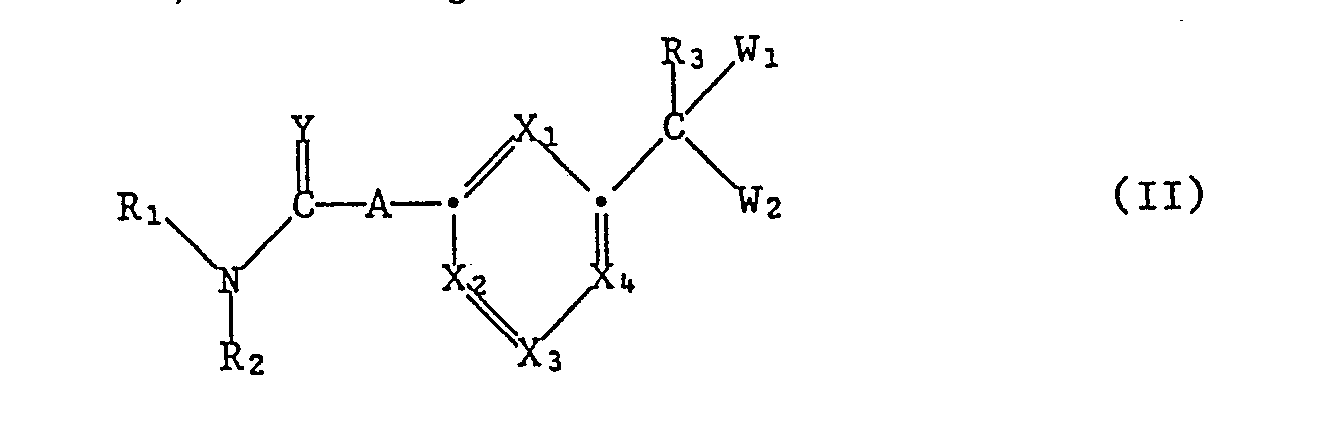
- a) eine Verbindung der Formel II

- b) zur Herstellung einer Verbindung der Formel I, worin A eine Gruppe-NR₇- bedeutet, eine Verbindung der Formel IV

- c) zur Herstellung einer Verbindung der Formel I, worin A eine einfache Bindung bedeutet, in einer Verbindung der Formel VI

- In der folgenden näheren Beschreibung der Verfahren a)-c) haben die Symbole A, X₁, X₂, X₃, X₄, Y, Z und R₁-R₉ jeweils die unter Formel I angegebene Bedeutung, sofern nichts anderes angegeben ist.
- Als funktionell abgewandeltes bzw. geschütztes Carbonyl CW₁W₂ sind beispielhaft zu nennen: Diniederalkoxymethyl, C₁-C₂-Alkylendioxymethyl, Dihalogenmethyl, Diniederalkylthiomethyl oder C₁-C₂-Alkylendithiomethyl.
- Die Kondensationsreaktion gemäss Verfahren a) erfolgt unter den an sich bekannten Bedingungen bei der Bildung von Hydrazonen. Sie ist bevorzugt durch Säure katalysiert. In Verbindungen der Formel II sind solche geschützte Carbonylgruppen CW₁W₂ geeignet, die unter den Bedingungen der Kondensation in freies Carbonyl übergehen.
- Zur Herstellung von Verbindungen der Formel I, worin R₆ Amino bedeutet, empfiehlt es sich, die Verbindung der Formel III im Ueberschuss einzusetzen. Verwendet man stöchiometrische Mengen der Verbindung der Formel III, so erhält man normalerweise ein Gemisch bestehend aus einer Verbindung der Formel I, worin R₆ Amino bedeutet, und einer anderen Verbindung der Formel I, worin R₆ einem Rest T wie oben definiert entspricht. Ausschliesslich die letzteren Verbindungen der Formel I erhält man, wenn man 1 Aequivalent einer Verbindung der Formel II mit 0,5 Aequivalenten einer Verbindung der Formel III umsetzt.
- Die Zwischenprodukte der Formel II, worin A eine einfache Bindung und Y NH bedeutet, werden z.B. dadurch erhalten, dass man eine Verbindung der Formel VII

- Eine weitere Möglichkeit zur Herstellung der Verbindungen der Formel II besteht darin, eine Verbindung der Formel VII zunächst durch Behandlung mit Schwefelwasserstoff in das entsprechende Thioncarboxamid [-C(=S)-NH₂] zu überführen. Letzteres kann auch auf anderem Wege ausgehend vom analogen Carboxamid [-C(=O)-NH₂] z.B. durch Umsetzung mit dem Lawesson-Reagens [2,4-Bis-(4-methoxyphenyl)-2,4-dithioxo-1,3,2,4-dithiadiphosphetan] erhalten werden. Die Thioncarboxamide werden z.B. mit Niederalkyliodiden S-alkyliert und damit in Imino-niederalkylthiolester-Hydroiodide [-C(=NH)-S-Alkyl · HI] überführt, welche sich leicht durch Umsetzung mit Ammoniak bzw. Aminen der Formel NHR₁R₂ in die gewünschten Carboximidamide der Formel II überführen lassen [vgl. S. Patai (Ed.), The Chemistry of amidines and imidates, Wiley, London etc. 1975, S. 303-304].
- Zwischenprodukte der Formel II, worin A die Gruppe -NR₇- bedeutet und Y für NR₈ steht, sind an sich bekannt oder werden z.B. dadurch hergestellt, dass man eine Verbindung der Formel VIII


- Die Herstellung von Verbindungen der Formel VII ist an sich bekannt [vgl. z.B. J.0rg.Chem. 44, 2702 (1979)]. Verbindungen der Formel VII, worin R₃ für Wasserstoff steht und (a) X₄ = N, X₁ = X₂ = X₃ = CH, (b) X₁ = X₂ = N, X₃ = X₄ = CH, (c) X₁ = X₄ = N, X₂ = X₃ = CH, (d) X₂ = X₄ = N, X₁ = X₃ = CH, (e) X₁ = X₃ = N, X₂ = X₄ = CH, (f) X₂ = X₃ = N, X₁ = X₄ = CH oder (g) X₃ = X₄ = N, X₁ = X₂ = CH bedeuten, lassen sich z.B. aus den entsprechenden Cyanomethylverbindungen der Formel X

- Die Herstellung von Verbindungen der Formel X ist an sich bekannt. Eine Verbindung der Formel X, worin X₂ = X₃ = N und X₁ = X₄ = CH bedeutet, lässt sich z.B. aus 5-Methylpyridazin-3-on durch Umsetzung mit PCl₅ oder POCl₃ und Reaktion der erhaltenen 3-Chlor-Verbindung mit z.B. Kupfer(I)cyanid in Dimethylformamid bei erhöhter Temperatur erhalten. Ganz analog kann man eine Verbindung der Formel X, worin X₃ = X₄ = N und X₁ = X₂ = CH bedeuten, z.B. aus 6-Methylpyridazin-4-on durch Umsetzung mit PCl₅ oder POCl₃ und Reaktion der erhaltenen 4-Chlorverbindung mit Cu(I)CH in DMF erhalten.
- Verbindungen der Formel VII - insbesondere solche, worin X₁ und X₄ für N stehen und X₂ und X₃ CH bedeuten - lassen sich z.B. auch auf folgendem Weg herstellen: Ausgehend von 6-Hydroxy-2,4-dimethylpyrimidin wird (a) durch selektive Kondensation der 2-Methylgruppe mit Benzaldehyd, (b) Umwandlung der 6-Hydroxygruppe in 6-Chlor mittels eines Chlorierungsmittels, z.B. POCl₃, und (c) selektive Entfernung des 6-Chlorsubstituenten durch Reduktion, z.B. mit H₂/Lindlar-Katalysator (5 % Pd auf CaCO₃, mit Pb vergiftet), das 4-Methyl-2-(2-phenylethenyl)-pyrimidin erhalten. In letzterem wird die 4-Methylgruppe (d) z.B. durch Behandlung mit metallischem Natrium und n-Butylnitrit in 4-(N-Hydroxyiminomethyl) (Oxim) und letzteres (e) z.B. durch Behandlung mit POCl₃ in eine 4-Cyanogruppe überführt. (f) Eine Ozonolyse des erhaltenen 4-Cyano-2-(2-phenylethenyl)-pyrimidins führt schliesslich zur gewünschten Verbindung der Formel VII.
- Verbindungen der Formel VII, worin R₃ für Niederalkyl steht, lassen sich in an sich bekannter Weise aus entsprechenden Verbindungen der Formel VII herstellen, worin R₃ Wasserstoff bedeutet. Z.B. gelingt dies (a) durch Umsetzung mit Cyclohexylamin, Behandlung des entstandenen Azomethins mit Natriumhydrid und einem Diniederalkylsulfoxid und abschliessender saurer Hydrolyse [s. Can.J.Chem. 48, 570 (1970)], (b) durch Ueberführung des Aldehyds (R₃ = H) in das entsprechende 1,2-Ethylenacetal oder 1,3-Propylenacetal und Umsetzung desselben mit Niederalkyllithium [s. J.0rg.Chem. 30, 226 (1965)] oder (c) durch Umsetzung mit Diazoniederalkan, jeweils gegebenenfalls nach vorherigem Schutz der Cyanofunktion im Molekül durch eine an sich bekannte Cyanoschutzgruppe und abschliessender Abspaltung derselben.
- Die Herstellung von Verbindungen der Formel VIII ist an sich bekannt. So können Verbindungen der Formel VIII, und zwar bevorzugt solche, worin X₁ und/oder X₂ N bedeuten, z.B. durch Umsetzung einer entsprechenden Halogenverbindung der Formel XI

- Verbindungen der Formel VIII, worin R₇ Wasserstoff bedeutet, lassen sich ferner z.B. aus entsprechenden Verbindungen der Formel VII herstellen, indem man zunächst die Cyanogruppe zu Carboxy verseift und anschliessend z.B. einen Curtius-Abbau durchführt, d.h. die Carboxygruppe in das entsprechende Azid überführt und dieses thermisch zersetzt. Besonders einfach gelingt diese Umsetzung, wenn man eine modifizierte Curtius-Reaktion unter Verwendung von (C₆H₅O)₂P(=O)-N₃ durchführt [vgl. Tetrahedron 30, 2151-57 (1974)].
- Eine weitere Möglichkeit zur Herstellung von Verbindungen der Formel VIII, worin R₇ Wasserstoff bedeutet, besteht in der Reduktion entsprechender Nitroverbindungen.
- Verbindungen der Formel VIII, worin R₇ Niederalkyl bedeutet, lassen sich z.B. aus entsprechenden Verbindungen der Formel VIII, worin R₇ für Wasserstoff steht, durch Alkylierung mit Alkylierungsmitteln, z.B. Niederalkyliodiden oder -bromiden, herstellen.
- Die Herstellung von Aminoguanidinen, -harnstoffen und -thioharnstoffen der Formel III ist an sich bekannt. Amino(thio)harnstoffe [=̂ Semi(thio)carbazide] werden z.B. in analoger Weise hergestellt wie entsprechende (Thio-)Harnstoffe. Dabei werden z.B. anstelle von Aminen die entsprechenden Hydrazine der Formel H₂N-NHR₄ eingesetzt und z.B. mit einem Isocyanat der Formel R₅N=C=O oder R₆N=C=O, einem Isothiocyanat der Formel R₅N=C=S oder R₆N=C=S, einem Carbamoylchlorid der Formel R₅R₆N-COCl oder einem Thioncarbamoylchlorid der Formel R₅R₆N-CSCl umgesetzt. Weiterhin ist z.B. auch die Reaktion eines Hydrazins der Formel H₂N-NHR₄ mit einem Acylisothiocyanat, z.B. Acetylisothiocyanat, und nachfolgender saurer Hydrolyse möglich.
- Aminoguanidine der Formel III, worin Z für NR₈ steht und R₄, R₅, R₆ und R₈ wie unter Formel I definiert sind, sind an sich bekannt und lassen sich z.B. aus entsprechenden Aminothioharnstoffen der Formel III herstellen, indem man letztere durch Alkylierung, etwa mit einem Alkyltosylat oder -halogenid, in die entsprechenden S-Alkylisothiuroniumsalze überführt und diese mit einem Amin der Formel NHR₅R₆ umsetzt.
- Als Reagentien, die die Gruppe -NHR₇ in einer Verbindung der Formel IV in ein Guanidin der Formel I umwandeln können, sind z.B. Verbindungen der Formel V

- Die Gruppe W₃ in einer Verbindung der Formel V kann bei der Herstellung von Guanidinen der Formel I (Y =̂ NR₇) z.B. bedeuten:
- Cyano oder -C(=HR₇)-S-Niederalkyl B⊖. Die Bildung von Guanidinen der Formel I bei der Reaktion von Aminen der Formel IV mit gegebenenfalls mono- oder disubstituierten Cyanamiden der Formel V (W₃ =̂ CN) bzw. mit gegebenenfalls mono- oder disubstituierten

- S-Alkylthiuroniumsalzen der Formel V (W₃ =̂ -C(=NHR)-S-Niederalkyl B⊖) ist an sich bekannt.

- Die Zwischenprodukte der Formel IV werden z.B. hergestellt, indem man eine Verbindung der Formel VIII, worin die Gruppe CW₁W₂ wie unter Formel II definiert ist, mit einem Amin der Formel III kondensiert. Die dabei ablaufende Reaktion entspricht dem oben beschriebenen Verfahren a). Die Aminogruppe NHR₇ im Zwischenprodukt der Formel IV ist dabei gegebenenfalls vor der Reaktion durch eine der in der organischen Chemie üblicherweise verwendeten NH₂-Schutzgruppen zu schützen. Nach erfolgter Kondensation lässt sich dann die Schutzgruppe in an sich bekannter Weise abspalten und man erhält ein Zwischenprodukt der Formel IV.
- In den Zwischenprodukten der Formel VI bedeutet W₄ z.B. freies oder funktionell abgewandeltes Carboxy, insbesondere Halogencarbonyl, Cyan, Imino-niederalkoxycarbonyl oder Imino-niederalkylthiolcarbonyl.
- Die Gruppe W₄ in einer Verbindung der Formel VI kann bei der Herstellung von Amidinen der Formel I (Y =̂ NR₇) z.B. bedeuten: ein Säureadditionssalz eines Imino-niederalkylesters (=̂ Iminoniederalkylether) oder Imino-niederalkylthiolesters, z.B. -C(=NH)-OC₂H₅ · HCl bzw. -C(=NH)-SC₂H₅ · HI, oder Cyano.
- Durch die Umsetzung eines Imino-niederalkylesters der Formel VI (als Salz) mit Ammoniak oder primären bzw. sekundären Aminen erhält man die unsubstituierten bzw. mono- oder disubstituierten Amidine der Formel I. Cyanoverbindungen der Formel VI können z.B. durch Umsetzung mit einem Alkalimetallamid, z.B. KNH₂, oder durch Reaktion mit einem primären oder sekundären (Di-)niederalkylammoniumhalogenid, z.B.H₃CH₃ Cl⊖ in ein gegebenenfalls mono- oder disubstituiertes Amidin der Formel I überführt werden.

- Setzt man einen Imino-niederalkylester der Formel VI mit einem α,ω-Diaminoalkan, z.B. 1,2-Diaminoethan oder 1,3-Diaminopropan, um, so erhält man eine Verbindung der Formel I, worin die Reste R₁ und R₈ zusammen Alkylen bedeuten.
- Die Gruppe W₄ in einer Verbindung der Formel VI kann bei der Herstellung von Carbamoylverbindungen der Formel I (Y =̂ O) z.B. bedeuten: Carboxy, Halocarbonyl (z.B. -COCl), Niederalkoxycarbonyl oder Cyano. Die Bildung von gegebenenfalls mono- oder disubstituierten Carbamoylverbindungen der Formel I aus entsprechenden Zwischenprodukten der Formel VI, worin W₄ Carboxy, Halocarbonyl oder Niederalkoxycarbonyl bedeutet, durch Umsetzung mit Ammoniak bzw. primären oder sekundären Aminen ist an sich bekannt. Zwischenprodukte der Formel VI, worin W₄ Cyano bedeutet, können z.B. durch partielle Hydrolyse, im Sinne einer Graf-Ritter-Reaktion, oder über Carbonsäureesterimid-Salze in gegebenenfalls mono- oder disubstituierte Carbamoylverbindungen der Formel I überführt werden. Die Bedingungen bei der Hydrolyse der Cyano-Zwischenprodukte können so gewählt werden, dass die Reaktion auf der Stufe des Amids abgebrochen wird. Zu diesem Zweck ist insbesondere die Hydrolyse mit Säuren, wobei z.B. 80 %ige Schwefelsäure (unter Erwärmen), Polyphosphorsäure (bei 110-150°C), Bromwasserstoff/Eisessig (Raumtemperatur, Ameisensäure oder ohne Lösungsmittel), HCl-Gas in etherischer Lösung gefolgt von der Zugabe von Wasser oder wässriger Salzsäure, oder Borhalogenide in Frage kommen.
- Mit Hilfe der Graf-Ritter-Reaktion gelingt auch die Herstellung N-substituierter Amide aus Nitrilen der Formel VI. Hierzu setzt man die Nitrile in Gegenwart einer starken Säure, vornehmlich 85-90 %iger Schwefelsäure, oder auch Polyphosphorsäure, Ameisensäure, Bortrifluorid oder anderen Lewis-Säuren, nicht jedoch Aluminiumchlorid, mit Verbindungen um, die in dem sauren Medium Carbeniumionen bilden können, also z.B. mit Olefinen, wie Propylen, oder Alkoholen, wie Ethanol.
- Die Carbonsäureesterimide erhält man z.B. durch säurekatalysierte Anlagerung von Alkoholen an die Nitrile der Formel VI. Aus den Esterimiden erhält man die Amide im Sinne einer Pinner-Spaltung durch thermischen Zerfall der Esterimid-Salze bei Temperaturen oberhalb von etwa 80°C.
- Verbindungen der Formel VI, worin W₄ Cyano bedeutet, können z.B. dadurch hergestellt werden, dass man eine Verbindung der Formel VII mit einer Verbindung der Formel III gemäss dem Verfahren a) umsetzt. Aus Verbindungen der Formel VI, worin W₄ Cyano bedeutet, lassen sich die anderen Verbindungen der Formel VI, worin W₄ freies oder anderweitig funktionell abgewandeltes Carboxy bedeutet, in an sich bekannter Weise oder wie oben beschrieben herstellen.
- Verbindungen der Formel I können in andere Verbindungen der Formel I überführt werden.
- Zum Beispiel erhält man bei der Umsetzung einer Verbindung der Formel I, worin R₆ Amino bedeutet, mit einer Verbindung der Formel II eine Verbindung der Formel I, worin R₆ einen Rest T wie oben definiert bedeutet. Auf diese Weise lassen sich auch entsprechende Verbindungen der Formel I herstellen, die unsymmetrisch in bezug auf ihre Gruppierung -N(R₄)-C(=Z)-N(R₅) sind.
- Verfahrensgemäss erhältliche freie Verbindungen der Formel I mit salzbildenden Eigenschaften können in an sich bekannter Weise in ihre Salze überführt werden, Verbindungen mit basischen Eigenschaften z.B. durch Behandeln mit Säuren oder geeigneten Derivaten davon, Verbindungen mit sauren Eigenschaften z.B. durch Behandeln mit Basen oder geeigneten Derivaten davon.
- Infolge der engen Beziehung zwischen den Verbindungen der Formel I in freier Form und in Form von Salzen sind vor- und nachstehend unter den freien Verbindungen bzw. ihren Salzen sinn- und zweckmässig gegebenenfalls auch die entsprechenden Salze bzw. freien Verbindungen zu verstehen.
- Die Verbindungen, einschliesslich ihrer Salze, können auch in Form von Hydraten erhalten werden, oder ihre Kristalle können z.B. das zur Kristallisation verwendete Lösungsmittel einschliessen.
- Erfindungsgemäss erhältliche Gemische von Isomeren können in an sich bekannter Weise in die einzelnen Isomeren aufgetrennt werden, Racemate z.B. durch Bilden von Salzen mit optisch reinen salzbildenden Reagentien und Auftrennen des so erhältlichen Diastereomerengemisches, z.B. mittels fraktionierter Kristallisation.
- Die oben angeführten Reaktionen können unter an sich bekannten Reaktionsbedingungen durchgeführt werden, in Ab- oder üblicherweise Anwesenheit von Lösungs- oder Verdünnungsmitteln, vorzugsweise solchen, die gegenüber den verwendeten Reagenzien inert sind und diese lösen, in Ab- oder Anwesenheit von Katalysatoren, Kondensationsmitteln oder neutralisierenden Agentien, je nach Art der Reaktion und/oder der Reaktionsteilnehmer bei erniedrigter, normaler oder erhöhter Temperatur, z.B. im Temperaturbereich von etwa -70°C bis etwa 190°C, vorzugsweise von etwa -20°C bis etwa 150°C, z.B. beim Siedepunkt des verwendeten Lösungsmittels, unter atmosphärischem Druck oder in einem geschlossenen Gefäss, gegebenenfalls unter Druck, und/oder in einer inerten Atmosphäre, z.B. unter einer Stickstoffatmosphäre.
- Im Verfahren der vorliegenden Erfindung werden vorzugsweise solche Ausgangsstoffe eingesetzt, die zu den eingangs als besonders wertvoll beschriebenen Verbindungen führen.
- Die Erfindung betrifft auch diejenigen Ausführungsformen des Verfahrens, bei denen man von einer auf einer beliebigen Verfahrensstufe als Zwischenprodukt erhältlichen Verbindung ausgeht und die fehlenden Verfahrensschritte durchführt, oder bei denen ein Ausgangsstoff unter den Reaktionsbedingungen gebildet oder in Form eines Derivates, z.B. eines Salzes davon, verwendet wird.
- Die vorliegende Erfindung betrifft ebenfalls pharmazeutische Präparate, die als Wirkstoff eine der pharmakologisch wirksamen Verbindungen der Formel I enthalten. Besonders bevorzugt sind Präparate zur enteralen, insbesondere oralen, sowie zur parenteralen Verabreichung. Die Präparate enthalten den Wirkstoff allein oder vorzugsweise zusammen mit einem pharmazeutisch anwendbaren Trägermaterial. Die Dosierung des Wirkstoffs hängt von der zu behandelnden Krankheit, sowie von Spezies, deren Alter, Gewicht und individuellem Zustand, sowie von der Applikationsweise ab.
- Die pharmazeutischen Präparate enthalten von etwa 5 % bis etwa 95 % des Wirkstoffs, wobei einzeldosierte Applikationsformen vorzugsweise von etwa 20 % bis etwa 90 % und nicht-einzeldosierte Applikationsformen vorzugsweise etwa 5 % bis etwa 20 % Wirkstoff aufweisen. Dosiseinheitsformen, wie Dragées, Tabletten oder Kapseln, enthalten von etwa 0,05 g bis etwa 1,0 g des Wirkstoffs.
- Die pharmazeutischen Präparate der vorliegenden Erfindung werden in an sich bekannter Weise, z.B. mittels konventioneller Misch-, Granulier-, Dragier-, Lösungs-, oder Lyophilisierungsverfahren hergestellt. So kann man pharmazeutische Zusammensetzungen zur oralen Anwendung erhalten, indem man den Wirkstoff mit einem oder mehreren festen Trägerstoffen kombiniert, ein erhaltenes Gemisch gegebenenfalls granuliert, und das Gemisch bzw. Granulat, wenn erwünscht, gegebenenfalls durch Zugabe von zusätzlichen Hilfsstoffen, zu Tabletten oder Dragées-Kernen verarbeitet.
- Geeignete Trägerstoffe sind insbesondere Füllstoffe, wie Zucker, z.B. Lactose, Saccharose, Mannit oder Sorbit, Cellulosepräparate und/oder Calciumphosphate, z.B. Tricalciumphosphat oder Calciumhydrogenphosphat, ferner Bindemittel, wie Stärken, z.B. Mais-, Weizen-, Reis- oder Kartoffelstärke, Methylcellulose, Hydroxypropylmethylcellulose, Natriumcarboxymethylcellulose und/oder Polyvinylpyrrolidon, und/oder, wenn erwünscht, Sprengmittel, wie die obgenannten Stärken, ferner Carboxymethylstärke, quervernetztes Polyvinylpyrrolidon, Alginsäure oder ein Salz davon, wie Natriumalginat.
- Zusätzliche Hilfsmittel sind in erster Linie Fliessregulier- und Schmiermittel, z.B. Kieselsäure, Talk, Stearinsäure oder Salze davon, wie Magnesium- oder Calciumstearat, und/oder Polyethylenglykol, oder Derivate davon.
- Dragées-Kerne können mit geeigneten, gegebenenfalls Magensaft-resistenten Ueberzügen versehen werden, wobei man u.a. konzentrierte Zuckerlösungen, welche gegebenenfalls arabischen Gummi, Talk, Polyvinylpyrrolidon, Polyethylenglykol und/oder Titandioxid enthalten, Lacklösungen in geeigneten organischen Lösungsmitteln oder Lösungsmittelgemischen oder, zur Herstellung von Magensaft-resistenten Ueberzügen, Lösungen von geeigneten Cellulosepräparaten, wie Acetylcellulosephthalat oder Hydroxypropylmethylcellulosephthalat, verwendet. Den Tabletten oder Dragée-Ueberzügen können Farbstoffe oder Pigmente, z.B. zur Identifizierung oder zur Kennzeichnung verschiedener Wirkstoffdosen, beigefügt werden.
- Oral anwendbare pharmazeutische Zusammensetzungen sind ebenfalls Steckkapseln aus Gelatine, sowie weiche, geschlossene Kapseln aus Gelatine und einem Weichmacher, wie Glycerin oder Sorbit. Die Steckkapseln können den Wirkstoff in Form eines Granulats, z.B. im Gemisch mit Füllstoffen, wie Maisstärke, Bindemitteln und/oder Gleitmitteln, wie Talk oder Magnesiumstearat, und gegebenenfalls von Stabilisatoren, enthalten. In weichen Kapseln ist der Wirkstoff vorzugsweise in geeigneten flüssigen Hilfsstoffen, wie fetten Oelen, Paraffinöl oder flüssigen Polyethylenglykolen, gelöst oder suspendiert, wobei ebenfalls Stabilisatoren zugefügt sein können.
- Weitere orale Applikationsformen sind z.B. in üblicher Weise bereitete Sirups, die den Wirkstoff z.B. in suspendierter Form und in einer Konzentration von ca. 5 % bis 20 % vorzugsweise ca. 10 % oder in einer ähnlichen Konzentration, die z.B. beim Abmessen von 5 oder 10 ml eine geeignete Einzeldosis ergibt, enthalten. Ferner kommen z.B. auch pulverförmige oder flüssige Konzentrate zur Bereitung von Shakes, z.B. in Milch, in Betracht. Solche Konzentrate können auch in Einzeldosismengen abgepackt sein.
- Als rektal anwendbare pharmazeutische Präparate kommen z.B. Suppositorien in Betracht, welche aus einer Kombination des Wirkstoffs mit einer Suppositoriengrundmasse bestehen. Als Suppositoriengrundmasse eignen sich z.B. natürliche oder synthetische Triglyceride, Paraffinkohlenwasserstoffe, Polyethylenglykole oder höhere Alkanole.
- Zu parenteralen Verabreichung eignen sich in erster Linie wässrige Lösungen eines Wirkstoffes in wasserlöslicher Form, z.B. eines wasserlöslichen Salzes, oder wässrige Injektionssuspensionen, welche viskositätserhöhende Stoffe, z.B. Natriumcarboxymethylcellulose, Sorbit und/oder Dextran und gegebenenfalls Stabilisatoren enthalten. Dabei kann der Wirkstoff, gegebenenfalls zusammen mit Hilfsstoffen, auch in Form eines Lyophilisats vorliegen und vor der parenteralen Verabreichung durch Zugabe von geeigneten Lösungsmitteln in Lösung gebracht werden.
- Lösungen, wie sie z.B. für die parenterale Verabreichung verwendet werden, können auch als Infusionslösungen angewandt werden.
- Die Erfindung betrifft ebenfalls ein Verfahren zur Behandlung der oben genannten Krankheitszustände. Die Verbindungen der vorliegenden Erfindung können prophylaktisch oder therapeutisch verabreicht werden, wobei man sie vorzugsweise in Form von pharmazeutischen Präparaten verwendet. Dabei wird bei einem Körpergewicht von etwa 70 kg eine tägliche Dosis von etwa 0,1 g bis etwa 10 g, vorzugsweise von etwa 0,5 g bis etwa 5 g einer Verbindung der vorliegenden Erfindung verabreicht.
- Die nachfolgenden Beispiele illustrieren die vorliegende Erfindung; Temperaturen werden in Grad Celsius angegeben.
- Rohes 3-Formylbenzamidin-hydrochlorid wird in 200 ml 96-proz. Ethanol gelöst und zu einer Mischung von 12,3 g (0,1 Mol) Aminoguanidin-sulfat, 60 ml Wasser und einigen Tropfen konzentrierter Schwefelsäure gegeben und das Ganze während 15 min unter Rückfluss gekocht. Beim Abkühlen kristallisieren 20 g Produkt als Sulfat aus. Dieses wird zu einer Lösung von 6,3 g (0,15 ,Mol) NaOH in 400 ml Ethanol gegeben und 2,5 h auf 70° erhitzt. Nach dem Abkühlen wird ungelöstes Material abfiltriert und das Filtrat eingedampft. Der Rückstand wird in wenig Ethanol gelöst und mit 10-proz. ethanolischer Salzsäure sauer gestellt. Nach dem Filtrieren durch Kieselgur Hyflo Super Cel®, Fluka) wird im Vakuum bis zur einsetzenden Kristallisation eingeengt. Man erhält so die Titelverbindung, Smp. 206-207°.
- Die Ausgangsverbindungen werden wie folgt hergestellt:
- Eine Lösung von 86,7 g (0,662 Mol) 3-Formylbenzonitril in 530 ml abs. Aether wird mit 59,7 ml (1,025 Mol) abs. Ethanol versetzt und auf 0° abgekühlt. Die Reaktionslösung wird mit trockenem Salzsäure-Gas gesättigt und anschliessend sechs Tage bei 0° stehengelassen. Nach dem Abfiltrieren eines feinen Niederschlags wird die Reaktionslösung mit 1ℓ Ether versetzt. Dabei kristallisiert die Titelverbindung aus, Smp. 126-128° (unter Aufschäumen).
- 21,3 g (0.1 Mol) des Iminoethers aus Beispiel 1a werden mit 250 ml abs. Ethanol und 250 ml gesättigter ethanolischer Ammoniaklösung versetzt und während 3 h auf 70° erhitzt. Nach dem Abkühlen wird das Ethanol abgedampft und der Rückstand, der der Titelverbindung in roher Form entspricht, weiter umgesetzt.
- Zu einer Lösung von 5,0 g (0,033 Mol) 3-Formylbenzamid in 70 ml Ethanol wird eine Lösung von 4,05 g (0,033 Mol) Aminoguanidin-sulfat in 20 ml Wasser gegeben. Nach Zugabe von 3 Tropfen konz. Schwefelsäure wird das Reaktionsgemisch während 2 h unter Rückfluss gekocht. Beim Abkühlen kristallisiert das Produkt aus. Dieses wird abfiltriert, mit Ethanol verkocht, abgekühlt, wieder filtriert und schliesslich aus Wasser umkristallisiert, Smp. 270° (Zers.).
- 11,4 g (0,05 Mol) des Iminoethers aus Beispiel 3a, 200 ml Ethanol und 125 ml gesättigte ethanolische Ammoniaklösung werden während 6 h unter Rückfluss gekocht. Nach dem Abkühlen wird das Reaktionsgemisch eingedampft, der Rückstand in 4 N Salzsäure gelöst, mit Ether gewaschen und zur Trockne eingedampft. Das erhaltene rohe 3-Acetylbenzamidin-hydrochlorid wird in 75 ml Methanol gelöst und mit einer Lösung von Aminoguanidin-hydrochlorid [hergestellt aus 7,5 g (0,055 Mol) Aminoguanidin-hydrogencarbonat in 40 ml Wasser und 54 ml 2 N Salzsäure] versetzt. Dieses Gemisch wird anschliessend während 1,5 h auf 70° erhitzt und danach eingedampft. Der Rückstand wird aus Ethanol umkristallisiert und man erhält die Titelverbindung, Smp. 185°.
- Die Ausgangsverbindungen werden wie folgt hergestellt:
- Eine Lösung von 7,25 g (0,05 Mol) 3-Acetylbenzonitril in 150 ml Ether und 4,5 ml Ethanol wird bei 0° mit trockenem Salzsäuregas gesättigt und anschliessend 2 Tage bei 0° stehengelassen. Das auskristallisierte Produkt wird abfiltriert und aus Ethanol/Ether umkristallisiert; Smp. 110° (Zers.).
- Eine Lösung von 6,9 g (0,028 Mol) rohem 3-Formyl-benzamidin-hydrochlorid (hergestellt wie unter Beispiel 1b beschrieben) in 28 ml Methanol wird mit einer Lösung von 7,3 g (0,028 Mol) 1-Amino-3-Hydroxyguanidin-toluolsulfonat in 14 ml Wasser und 14,5 ml 2 N Salz säure versetzt und 1 h auf 70° erhitzt. Das Reaktionsgemisch wird abgekühlt, eingedampft und das Rohprodukt aus Wasser/Ethanol umkristallisiert; Smp. 248-250°.
- Zu einer Lösung von 6,71 g (0,049 Mol) Aminoguanidin-hydrogencarbonat in 37 ml Wasser und 53,4 ml 2 N Salzsäure wird eine Lösung von 8,11 g (∼0,05 Mol) N,N′-Dimethylamidinobenzaldehyd in 80 ml Methanol zugetropft. Das Reaktionsgemisch wird 30 min unter Rückfluss gekocht und anschliessend 24 h bei Raumtemperatur stehengelassen. Nach dem Eindampfen wird das Rohprodukt mittels Chromatographie an Amberlite® XAD 1180 (Wasser als Eluiermittel) gereinigt und schliesslich aus 2 N Salzsäure/Ethanol umkristallisiert; Smp. 103-105°.
- Die Ausgangsverbindungen werden wie folgt hergestellt:
- 10,7 g (0,05 Mol) Iminoether aus Beispiel 1a werden in 125 ml abs. Ethanol suspendiert und langsam mit 125 ml einer 33-proz. Lösung von Methylamin in Ethanol (Hersteller: Fluka) versetzt. Nach 3 h bei 70° wird das klare, hellbraune Reaktionsgemisch eingedampft, in 50 ml 2 N Salzsäure gelöst und mit Ether gewaschen. Die wässrige Phase wird eingedampft und der Rückstand, der der Titelverbindung in roher Form entspricht, direkt weiterverarbeitet.
- Zu einer Lösung von 0,91 g (0,01 Mol) Thiosemicarbazid in 5 ml Wasser und 10 ml 2 N Salzsäure wird eine Lösung von 1,84 g (∼0,01 Mol) rohes 3-Formylbenzamidin-hydrochlorid (hergestellt analog Beispiel 1b) in 10 ml Methanol getropft. Dieses Gemisch wird 1 h unter Rückfluss erhitzt, abgekühlt, filtriert und zur Trockne eingedampft. Der Rückstand wird aus Methanol umkristallisiert; Smp. 210° (Zers.). Das Produkt enthält 0,5 Mol Wasser.
- Zu einer Lösung von 6,6 g (0,049 Mol) Aminoguanidin-hydrogencarbonat in 35 ml Wasser und 51 ml 2 N Salzsäure wird eine Lösung von 11,7 g (∼0,05 Mol) rohem 3-Formyl-N,N-dimethylbenzamidin-hydrochlorid in 50 ml Methanol getropft. Das Reaktionsgemisch wird 30 min unter Rückfluss erhitzt und anschliessend eingedampft. Der Rückstand wird an Amberlite® XAD 1180 (mit Wasser als Eluiermittel) chromatographiert. Lyophilisat-"Smp." 80-82°.
- Die Ausgangsverbindungen werden wie folgt hergestellt:
- 10,7 g (0,05 Mol) des Iminoethers aus Beispiel 1a werden in 125 ml abs. Ethanol aufgeschlemmt und tropfenweise mit 125 ml einer 33-proz. Dimethylamin-Lösung in Ethanol versetzt. Nach einer Reaktionszeit von 3 h bei 70° wird eingedampft, der Rückstand in 50 ml 2 N Salzsäure gelöst, mit Ether gewaschen und erneut zur Trockne eingedampft. Das resultierende Oel, das der Titelverbindung in roher Form entspricht, wird ohne Reinigung weiter umgesetzt.
- 12,5 g (0,09 Mol) Aminoguanidin-hydrogencarbonat werden in 75 ml Wasser und 100 ml 2 N Salzsäure gelöst und bei Raumtemperatur mit einer Lösung von ∼33 g (∼0,1 Mol) rohem 2-Amidino-6-formylpyridin-hydrochlorid in 100 ml Methanol versetzt. Das Reaktionsgemisch wird 1,5 h unter Rückfluss erhitzt, abgekühlt und eingedampft. Der Rückstand wird in wenig heissem 90-proz. Ethanol gelöst und langsam abgekühlt. Dabei kristallisiert das 2-Carbamoyl-6-formylpyridin-2′-amidinohydrazon-dihydrochlorid, Smp. 190°, aus. Es wird abfiltriert, die Mutterlauge eingedampft und der Rückstand an Amberlite® XAD 1180 chromatographiert (Wasser als Eluiermittel). Das als Hauptprodukt erhaltene 2-Amidino-6-formylpyridin-2′-amidinohydrazon-dihydrochlorid wird schliesslich aus Ethanol umkristallisiert; Smp. 160°.
- Die Ausgangsverbindungen werden wie folgt hergestellt:
- 2-Cyano-6-formylpyridin (16,5 g =̂ 0,125 Mol) wird in 150 ml trockenem Ether und 150 ml abs. Ethanol gelöst und bei 0° mit trockenem Salzsäuregas gesättigt und 44 h bei 0° stehengelassen. Die rotbraune Reaktionslösung wird zur Trockne eingeengt. Zum Entfernen überschüssiger Salzsäure wird der Rückstand nochmals in absolutem Ethanol gelöst, erneut eingedampft und zuletzt am Hochvakuum getrocknet. Der resultierende rohe Iminoether wird in 100 ml abs. Ethanol gelöst und mit einer gesättigten ethanolischen Ammoniaklösung (100 ml) versetzt. Das Reaktionsgemisch wird 3 h unter Rückfluss erhitzt, abgekühlt, klarfiltriert und das Filtrat eingedampft. Die Lösung des Rückstandes in 100 ml 2 N Salzsäure wird mit Ether gewaschen bis zur Trockne eingedampft und am Hochvakuum getrocknet. Man erhält die Titelverbindung in roher Form, welche direkt weiterverarbeitet wird.
- 11,2 g (0,08 Mol) Aminoguanidin-hydrogencarbonat werden in 90 ml Wasser und 104 ml 2 N Salzsäure gelöst und mit einer Lösung von 52 g (∼0,11 Mol) rohem 2-Amidino-4-formylpyridin-diethylacetal-hydrochlorid in 180 ml Ethanol versetzt. Das resultierende Gemisch wird 1,5 h unter Rückfluss erhitzt, abgekühlt und eingedampft. Der Rückstand wird an Amberlite® XAD 1180 mit Wasser als Eluiermittel chromatographiert. Die Fraktionen, welche nach Dünnschichtchromatographie das gewünschte Produkt enthalten, werden eingedampft und der Rückstand aus Ethanol/Ether umkristallisiert; Smp. 290° (Zers.).
- Die Ausgangsverbindungen werden wie folgt hergestellt:
- 27 g (0,125 Mol) 2-Cyano-4-formylpyridin-diethylacetal werden in 250 ml trockenem Ether und 11 ,25 ml abs. Ethanol gelöst. Diese Lösung wird bei 0° mit trockenem Salzsäuregas gesättigt (ca. 50 g) und 1 h bei 0° gerührt. Das ausgefallene Produkt wird abfiltriert, mit kaltem Ether gewaschen und getrocknet; Smp. 95-97°.
- 37,0 g (0,128 Mol) des Iminoethers aus Beispiel 9a werden in 277 ml abs. Ethanol gelöst und bei Raumtemperatur mit 470 ml einer gesättigten ethanolischen Ammoniaklösung versetzt. Nach 2 h bei 70° (Rückfluss) wird abgekühlt, eingedampft, der Rückstand in 2 N Salzsäure gelöst, mit Ether gewaschen und zuletzt nochmals zur Trockne eingedampft. Das noch leicht feuchte Rohprodukt wird ohne weitere Reinigung weiterverarbeitet.
- 1,25 g (0,01 Mol) 1,3-Diaminoguanidin-hydrochlorid werden in 10 ml Wasser gelöst und bei Raumtemperatur mit einer Lösung von 1,84 g (∼0,01 Mol) rohem 3-Formylbenzamidin-hydrochlorid (Beispiel 1b) in 10 ml Methanol versetzt. Das Gemisch wird 16 h bei Raumtemperatur gerührt und danach eingedampft. Der Rückstand wird in Ethanol aufgenommen, durch Filtration von ungelöstem Material befreit und erneut eingedampft. Das resultierende Oel wird an Amberlite® XAD 1180 mit Wasser chromatographiert. Die Fraktionen 10-13 entsprechen dem 3-Amino-1-(3′-Amidinobenzyliden-amino)-guanidin-dihydrochlorid (Zers. bei ∼160°) und die Fraktionen 15-20 entsprechen dem 1,3-Bis(3′-Amidinobenzyliden-amino)-guanidin-trihydrochlorid-dihydrat (Zers. bei ∼180°).
- 1,22 g (0,0099 Mol) Aminoguanidin-hydrogencarbonat werden in 10 ml Wasser und 10 ml 2 N Salzsäure gelöst und bei Raumtemperatur mit einer Lösung von ca. 2,4 g (∼0,01 Mol) rohem 3-Formyl-N-n-butylbenzamidin-hydrochlorid in 15 ml Ethanol versetzt. Das Gemisch wird abgekühlt, zur Trockne eingedampft und an einer Säule mit Amberlite® XAD 1180 chromatographiert (Wasser als Eluiermittel). Nach Umkristallisation aus Ethanol/Ether erhält man die Titelverbindung, Smp. 230°.
- Die Ausgangsverbindungen werden wie folgt hergestellt:
- 2,1 g (0,01 Mol) Ethyl-3-formylbenzimidat-hydrochlorid (Beispiel 1a) in 15 ml abs. Ethanol werden unter Rühren bei Raumtemperatur mit 2,0 ml (0,02 Mol) n-Butylamin versetzt. Das Reaktionsgemisch wird 3 h unter Rückfluss erhitzt, abgekühlt und direkt weiter umgesetzt.
- Eine Lösung von ca. 1,8 g (0,01 Mol) 3-Formylbenzamidin-hydrochlorid (Beispiel 1b) wird bei Raumtemperatur mit einer Lösung von 1,66 g (0,01 Mol) 1-Amino-3-n-butylguanidin-hydrochlorid in 30 ml 50-proz. Ethanol versetzt und 2 h auf ca. 70° erwärmt (Rückfluss). Die klare Reaktionslösung wird abgekühlt, eingedampft und der Rückstand an einer Säule Amberlite® XAD 1180 (Wasser als Eluiermittel) chromatographiert. Die Fraktionen 14-30 ergeben, nach Umkristallisation aus Ethanol/Ether, die Titelverbindung mit einem Zersetzungspunkt von 140°.
- Eine Suspension von 14,0 g 3-Aminoacetophenon-2′-amidinohydrazon-hydrochlorid in 360 ml Ethanol und 102,8 ml 0.6 N ethanolischer Salzsäure wird mit 15,4 g Cyanamid (H₂N-CN) versetzt und 65 h am Rückfluss gekocht. Das Reaktionsgemisch wird heiss filtriert, die erhaltenen Kristalle werden mit wenig Ethanol nachgewaschen und dann im Vakuum bei 40° getrocknet. Man erhält so die Titelverbindung, Smp. >250°.
- 1,7 g (0,01 Mol) 1-Amino-3-n-butylguanidin-hydrochlorid werden in 30 ml 50-proz. Ethanol gelöst und mit einer Lösung von ca. 2,4 g (0,01 Mol) rohem 3-Formyl-N-n-butylbenzamidin-hydrochlorid (Beispiel 11a) in 20 ml Ethanol versetzt. Das Reaktionsgemisch wird anschliessend 1 h unter Rückfluss erhitzt, abgekühlt, eingedampft und an Amberlite® XAD 1180 chromatographiert (Wasser als Eluiermittel). Die das Produkt enthaltenden Fraktionen werden eingedampft und der Rückstand aus Ethanol/Ether unter Zusatz von ethanolischer Salzsäure umkristallisiert. Man erhält Kristalle, die sehr hygroskopisch sind; ¹H-NMR: δ = 0,8-1,0 (m, 6H); 1,20-1,75 (m, 8H); 3,46 (q, J = 6 Hz, 4H). MS: m/e 317 (M + 1), 316 (M⁺), 244, 202, 176 (100 %).
- Eine Lösung von 1,36 g Aminoguanidin-hydrogencarbonat in 5 ml 4,0 N Salzsäure wird mit einer Lösung von 1,59 g 3-Guanidinoacetophenon [J. Med. Chem. 10, 1123 (1967)] in 10 ml Methanol versetzt und 22 h am Rückfluss gekocht. Das Reaktionsgemisch wird zur Trockne eingedampft und der Rückstand aus 50 ml Ethanol umkristallisiert. Man erhält so die Titelverbindung, Smp. >250°.
- Eine Lösung von 2,5 g (10 mMol) 3-Aminobenzylidenamino-guanidin-dihydrochlorid [s. Chem. Abstr. 57, 9826a (1957)] in 90 ml abs. Ethanol wird mit 1,5 g Cyanamid und 12,5 ml 0,95 N ethanolischer Salzsäure versetzt und 89 h am Rückfluss gekocht. Anschliessend wird das Reaktionsgemisch abgekühlt und auf die Hälfte eingeengt. Das auskristallisierte Produkt wird abgesaugt, mit wenig Ethanol gewaschen und getrocknet. Man erhält so die Titelverbindung, Smp. >250°.
- 100 mg (0,41 mMol) 4-Cyano-2-formylpyrimidin-2′-amidinohydrazonhydrochlorid werden in 2 ml abs. Methanol gelöst, mit 100 mg Molekularsieb 3 Å versetzt und bei Raumtemperatur unter Argon während 1 h gerührt. Danach gibt man 91 µl einer ca. 5,4 M Lösung von Natriummethanolat in Methanol hinzu und rührt während 2 h bei 50°, dann weitere 3 h bei Raumtemperatur. Nach erfolgtem Umsatz zum Iminoester (HPLC-Kontrolle) gibt man zum Reaktionsgemisch 24,1 mg Ammoniumchlorid (trocken) und rührt während 21 h bei Raumtemperatur. Nach Zugabe einer zweiten Portion Ammoniumchlorid (11 mg) rührt man noch 3 h bei 50°, nutscht über Hyflo Super Cel® (Kieselgur) ab und destilliert das Lösungsmittel unter Vakuum ab. Der Rückstand wird in wenig Wasser gelöst und bei 0° mit 1,64 ml 0,1 N Salzsäure versetzt. Eine "reverse phase"-Chromatographie an Opti-UP-C₁₂ Kieselgel (Antecgel-Dodecyltrichlorsilan, Fa. Antec) in Wasser führt nach Verdampfung des Wassers zur Titelverbindung; ¹H-NMR (DMSO-d₆): δ = 9,30 (d,1H); 8,46 (d,1H); 8,35 (s,1H).
- Die Ausgangsverbindung wird wie folgt hergestellt:
- 60 g (0,483 Mol) 6-Hydroxy-2,4-dimethylpyrimidin [s. Tetrahedron 35, 2087 (1979)] in 180 ml Acetanhydrid werden mit 48,8 ml frisch destilliertem Benzaldehyd versetzt und unter Argon während 23 h auf 130° erwärmt. Man giesst das erkaltete Reaktionsgemisch in 2 l eiskalten Ether, rührt während 1 h unter Eiskühlung nach und nutscht den erhaltenen Niederschlag ab. Die gelbbraunen Kristalle werden mit Ether gewaschen und aus Methanol umkristallisiert, Smp. 217-219°.
- 212 mg (1 mMol) 6-Hydroxy-4-methyl-2-(2-phenylethenyl)-pyrimidin in 1 ml Phosphoroxychlorid werden unter Stickstoff während 35 min am Rückfluss gekocht. Man giesst das erkaltete Reaktionsgemisch auf Eis, neutralisiert die wässrige Lösung mit Natronlauge und extrahiert mehrmals mit Ether. Die Etherextrakte werden mit Wasser und gesättigter Kochsalzlösung gewaschen, über CaCl₂ getrocknet, abgenutscht und eingeengt. Die Reinigung erfolgt durch Sublimation im Kugelrohrofen bei 150° Ofentemperatur und unter Vakuum (0,1 mm Hg =̂ 0,13 mbar). Man erhält farblose Kristalle vom Smp. 71-73°.
- 13,65 g (59,17 mMol) 6-Chlor-4-methyl-2-(2-phenylethenyl)-pyrimidin in 220 ml abs. Ethanol werden mit 9,02 ml Triethylamin und 1,365 g Lindlar-Katalysator versetzt und bei Normaldruck und Raumtemperatur hydriert. Nach Aufnahme von 1 Aequivalent Wasserstoff wird die Hydrierung abgebrochen (nach etwa 7,5 h), das Reaktionsgemisch über Hyflo Super Cel® abgenutscht und am Rotationsverdampfer eingeengt. Durch zweimalige Chromatographie an Kieselgel, Laufmittel Chloroform bzw. n-Hexan/Essigester 5 - 20 %, erhält man die reine Titelverbindung; Smp. 65-67°.
- In einem mit Aceton/Trockeneis gekühlten 4-Halskolben mit Magnetrührer, Gaseinleitungsrohr, Thermometer und einem mit Trockeneis gefüllten Kühlfinger werden unter Stickstoff 416 ml flüssiger Ammoniak vorgelegt. Zu diesem gibt man unter Stickstoff und unter Rühren 2,91 g (126,7 mMol) in kleine Stücke geschnittenes, metallisches Natrium gefolgt von 100 mg Eisen(III)chlorid (wasserfrei). Man lässt das Gemisch während 20 min unter Rückfluss kochen (Kältebad -20°). Man erhält eine schwarzblaue Lösung, die innerhalb von 10 min mit 8,16 g (41,16 mMol) pulverisiertem 4-Methyl-2-(2-phenylethenyl)-pyrimidin (in 3 Portionen) versetzt wird. Man lässt das Reaktionsgemisch weitere 60 min unter Rückfluss kochen und tropft dann innerhalb von 10 min 9,7 ml (2 Aequivalente) n-Butylnitrit hinzu. Man erhält eine rote Lösung, die man weitere 60 min unter Rückfluss kochen lässt. Danach gibt man zum Reaktionsgemisch 6,93 g (129 mMol) Ammoniumchlorid (portionenweise), entfernt das Kältebad und lässt den Ammoniak bei Raumtemperatur abdampfen. Der feste, graue Rückstand wird mit Aceton aufgekocht, abfiltriert und die Lösung eingeengt. Das Rohprodukt wird durch Chromatographie an Kieselgel, Laufmittel Methylenchlorid/Aceton 5 - 10 %, gereinigt. Die erhaltene Titelverbindung ist ein syn-anti-Gemisch der beiden Oxime. ¹H-NMR (DMSO-d₆): δ = 12,65 und 12,29 (bs, 1H); 8,94/d und 8,80/d (1H); 8,15/d und 7,61/d (1H); 8,09/s und 7,57/s (1H); 7,97/d und 7,96/d (1H); 7,31/d und 7,29/d (1H).
- 425 mg (1,88 mMol) 4-N-Hydroxyiminomethyl-2-(2-phenylethenyl)-pyrimidin (syn-anti-Gemisch) in 4,25 ml POCl₃ werden unter Stickstoff während 1 h auf 120° erhitzt. Die auf ca. 70° abgekühlte Lösung giesst man auf ein Gemisch bestehend aus 50 g Eis und 22 ml 28 % wässrige Ammoniaklösung, sättigt mit festem K₂CO₃ und extrahiert dreimal mit Essigester. Die organische Phase wird neutral gewaschen, über Na₂SO₄ getrocknet und eingeengt. Zur Reinigung kristallisiert man aus Chloroform/Ether um; Smp. 147-150° (farblose Kristalle).
- 2,238 g (10,81 mMol) 4-Cyano-2-(2-phenylethenyl)-pyrimidin in 150 ml abs. Methanol und 75 ml abs. Methylenchlorid werden auf -70°C abgekühlt. Es wird solange Ozon durchgeleitet, bis eine blaue Lösung entsteht (ca. 0,5 h). Man leitet Stickstoff durch die Lösung, bis das überschüssige Ozon entfernt ist (ca. 0,75 h) und versetzt dann das Reaktionsgemisch mit 3,5 ml Dimethylsulfid. Man lässt die Lösung auf Raumtemperatur erwärmen und engt am Rotationsverdampfer ein. Das Rohprodukt wird an Kieselgel (Laufmittel: n-Hexan/Essigester 1:3) gereinigt. ¹H-NMR (CDCl₃): δ = 10,11 (s,1H); 9,23 (d,1H); 7,82 (d,1H).
- 207 mg (1,49 mMol) Aminoguanidin-hydrogencarbonat in 1,14 ml Wasser werden mit 1,65 ml 2 N HCl versetzt gefolgt von 200 mg (1,5 mMol) 4-Cyano-2-formylpyrimidin sowie 1,5 ml Methanol. Man erwärmt das Reaktionsgemisch auf 70°, wobei eine klare Lösung entsteht. Nach 45 min bei dieser Temperatur wird das Reaktionsgemisch weitgehend eingeengt und der entstandene Niederschlag abgenutscht. Man wäscht mit wenig kaltem Wasser und kaltem Ethanol nach und trocknet die Titelverbindung bei 40° am Hochvakuum. ¹H-NMR (DMSO-d₆): δ = 12,65/bs und 7,97/bs (NH; tauschen mit D₂O aus), 9,23 (d,1H); 8,30 (s,1H); 8,16 (s,1H).
- Ausgehend von 4-Cyano-2-formylpyrimidin-2′-amidinohydrazon-hydrochlorid (Beispiel 17g) und Methylamin-hydrochlorid erhält man analog Beispiel 17 die Titelverbindung; ¹H-NMR (DMSO-d₆): δ = 9,30 (d,1H); 8,62 (d,1H); 8,38 (s,1H); 3,15 (d,1H).
- 200 mg (0,819 mMol) 4-Cyano-2-formylpyrimidin-2′-amidinohydrazon-hydrochlorid (Beispiel 17g) werden unter Argon in 8 ml abs. Methanol vorgelegt und mit 0,3 ml einer 5,4 M methanolischen Natriummethanolat-Lösung versetzt. Nach 6 h Rühren bei 50° kühlt man das Reaktionsgemisch auf Raumtemperatur ab und versetzt es mit 86,9 mg (1,06 mMol) Ethylamin-hydrochlorid. Man rührt über Nacht bei Raumtemperatur, versetzt das Reaktionsgemisch mit weiteren 20 mg (0,24 mMol) Ethylamin-hydrochlorid und rührt weitere 22 h bei Raumtemperatur. Danach erwärmt man noch 1 h auf 50°, kühlt die Lösung ab und engt das Gemisch weitgehend ein. Der Rückstand wird in Wasser aufgenommen, und es wird durch Zugabe von 1 N Salzsäure bei 0° ein pH von ca. 1,5 eingestellt. Die Reinigung der Titelverbindung erfolgt durch Chromatographie an Opti-Up Kieselgel. ¹H-NMR (DMSO-d₆): δ = 9,30 (d,1H); 8,49 (d,1H); 8,36 (s,1H); 3,57 (m,2H); 1,24 (t,3H).
- Analog Beispiel 19 erhält man aus 4-Cyano-2-formylpyrimidin-2′-amidinohydrazon-hydrochlorid (Beispiel 17g) nach Behandlung mit Natriummethanolat und n-Propylamin-hydrochlorid die Titelverbindung; ¹H-NMR (DMSO-d₆): δ = 9,29 (d,1H); 8,49 (d,2H); 8,37 (s,1H); 3,53 (m,2H); 1,68 (m,2H); 0,93 (t,3H).
- Analog Beispiel 19 erhält man aus 4-Cyano-2-formylpyrimidin-2′-amidinohydrazon-hydrochlorid (Beispiel 17g) nach Behandlung mit Natriummethanolat und Hydroxylamin-hydrochlorid die Titelverbindung; ¹H-NMR (DMSO-d₆): δ = 12,67 (s,OH); 8,85 (d,1H); 8,26 (s,1H); 7,82 (d,1H).
- Eine Lösung von 2,2 g (0,0076 Mol) 2-Amidino-6-formylpyridin-diethylacetal-hydrochlorid (Beispiel 9b) in 15 ml Methanol wird mit einer Lösung von 1,99 g (0,0076 Mol) 1-Amino-3-hydroxyguanidin-toluolsulfonat in 4 ml Wasser versetzt und nach Zugabe von 3,7 ml 2N Salzsäure 1 h auf 70° erwärmt. Nach dem Abkühlen dampft man ein, nimmt den Rückstand in wenig Ethanol auf, filtriert das ungelöste Material ab und dampft erneut ein. Das Rohprodukt wird mittels Chromatographie an Amberlite XAD 1180 (Wasser als Eluiermittel) gereinigt und anschliessend aus Ethanol/Ether umkristallisiert; Smp. 230-235° (Zersetzung).
- Eine Lösung von 0,17 g (0,0076 g-Atom) Natrium in 6 ml abs. Methanol versetzt man bei Raumtemperatur mit 0,85 g (0,0038 Mol) 2-Cyano-6-formylpyridin-2′-amidinohydrazon-hydrochlorid und rührt die rötliche Suspension 12 h bei Raumtemperatur. Der daraus in situ gebildete Iminoether wird mit 0,63 g (0,0076 Mol) O-Methylhydroxylamin-hydrochlorid versetzt und anschliessend weitere 12 h bei Raumtemperatur gerührt. Man filtriert, dampft das Filtrat ein, nimmt den Rückstand in wenig Ethanol auf und filtriert nochmals. Nach Zugabe von ethanolischer Salzsäure kristallisiert die Titelverbindung aus, Smp. 230-234°.
- Die Ausgangsverbindung wird wie folgt hergestellt:
- Eine Lösung von 3,09 g (0,022 Mol) Aminoguanidin-hydrogencarbonat in 15 ml Wasser wird tropfenweise mit 22 ml 2 N Salzsäure versetzt (CO₂-Entwicklung). Zu dieser Lösung gibt man 3,0 g (0,022 Mol) 2-Cyano-6-formylpyridin gelöst in 15 ml Methanol zu und erhitzt 1 h auf 70°. Nach dem Abkühlen wird die Titelverbindung abfiltriert, mit wenig Methanol/Wasser (1:1) gewaschen und getrocknet; Smp. 295-298°.
- Analog Beispiel 23 wird der intermediär gebildete Iminoether mit Hydrazin-dihydrochlorid zur Titelverbindung umgesetzt; Smp. 245-248°.
- Analog Beispiel 23 wird der intermediär gebildete Iminoether mit 1,2-Diaminoethan-dihydrochlorid zur Titelverbindung umgesetzt, Smp. 310-313°.
- Analog Beispiel 23 wird der intermediär gebildete Iminoether mit Hydroxylamin-hydrochlorid zur Titelverbindung umgesetzt; Smp. 260-263° (das Produkt enthält 3 Mol Wasser).
- Analog Beispiel 22 wird 2-Amidino-6-formylpyridin-diethylacetal-hydrochlorid (Beispiel 9b) mit einem 5-fachen Ueberschuss an 1,3-Diaminoguanidin-hydrochlorid zur Titelverbindung umgesetzt; Smp. 250-253°.
- Analog Beispiel 22 wird 2-Amidino-6-formylpyridin-diethylacetal-hydrochlorid (Beispiel 9b) mit 0,5 Aequivalenten 1,3-Diaminoguanidin-hydrochlorid zur Titelverbindung umgesetzt; Smp. 260-265°.
- Ausgehend von 3-Aminopropiophenon und Aminoguanidin-hydrogencarbonat erhält man via 3-Aminopropiophenon-2′-amidinohydrazon-hydrochlorid analog Beispiel 13 die Titelverbindung.
- Analog Beispiel 15 wird ausgehend von 3-Guanidinopropiophenon und Aminoguanidin-hydrogencarbonat die Titelverbindung hergestellt.
- Ausgehend von 3-Aminoisobutyrophenon und Aminoguanidin-hydrogencarbonat erhält man via 3-Aminoisobutyrophenon-2′-amidinohydrazon-hydrochlorid analog Beispiel 13 die Titelverbindung.
- Analog Beispiel 15 wird ausgehend von 3-Guanidinoisobutyrophenon und Aminoguanidin-hydrogencarbonat die Titelverbindung hergestellt.
- Analog Beispiel 8a und 8 wird ausgehend von 2-Cyano-6-acetylpyridin die Titelverbindung hergestellt.
- Analog Beispiel 8a und 8 wird ausgehend von 2-Cyano-6-propionylpyridin die Titelverbindung hergestellt.
- Analog Beispiel 8a und 8 wird ausgehend von 2-Cyano-6-isobutyroylpyridin die Titelverbindung hergestellt.
- Analog Beispiel 8a und 8 wird ausgehend von 4-Cyano-2-acetylpyridin die Titelverbindung hergestellt.
- Analog Beispiel 8a und 8 wird ausgehend von 4-Cyano-2-propionylpyridin die Titelverbindung hergestellt.
- Analog Beispiel 3a und 3 wird ausgehend von 3-Propionylbenzonitril die Titelverbindung hergestellt.
- Analog Beispiel 3a und 3 wird ausgehend von 3-Isobutyroylbenzonitril die Titelverbindung hergestellt.
- Analog Beispiel 17 wird ausgehend von 2-Cyano-4-formylpyrimidin-2′-amidinohydrazon-hydrochlorid die Titelverbindung erhalten. Das verwendete Ausgangsmaterial wird ausgehend von 2-Cyano-4-methylpyrimidin durch Oxidation mit Selendioxid und Umsetzung des entstehenden 2-Cyano-4-formylpyrimidins mit Aminoguanidin-hydrogencarbonat hergestellt.
- Kapseln enthaltend 0,25 g Wirkstoff, z.B. von einer der Verbindungen der Beispiele 1-38, können wie folgt hergestellt werden:
Zusammensetzung (für 5000 Kapseln) Wirkstoff 1250 g Talk 180 g Weizenstärke 120 g Magnesiumstearat 80 g Laktose 20 g - Die pulverförmigen Substanzen werden durch ein Sieb mit einer Maschenweite von 0,6 mm getrieben und gemischt. Portionen von je 0,33 g des Gemisches werden mittels einer Kapselfüllmaschine in Gelatine-Kapseln abgefüllt.
Claims (19)


X₁ = X₂ = X₃ = X₄ = CH
X₁ = N, X₂ = X₃ = X₄ = CH
X₂ = N, X₁ = X₃ = X₄ = CH
X₃ = N, X₁ = X₂ = X₄ = CH
X₄ = N, X₁ = X₂ = X₃ = CH
X₁ = X₂ = N, X₃ = X₄ = CH
X┴ = X₃ = N, X₂ = X₄ = CH
X = X₄, = N, X₂ = X₃ = CH;
Y für NR₈ oder auch - falls A eine einfache Bindung bedeutet - für O steht; Z für NR₉, O oder S steht; R₁ Wasserstoff, Niederalkyl, Hydroxy, Niederalkoxy oder Amino bedeutet; die Reste R₂, R₃, R₈ und R₉ unabhängig voneinander Wasserstoff oder Niederalkyl bedeuten, oder R₁ und R₈ zusammen auch -(CH₂)₂- bedeuten können; R₄ und R₅ Wasserstoff bedeuten und R₆ für Wasserstoff, Niederalkyl, Hydroxy, Amino, 3-Amidinophenylmethylidenamino oder 2-Amidino-6-pyridylmethylidenamino steht, Tautomere davon, und ihre Salze.
X₁ = X₂ = X₃ = X₄ = CH
X₁ = N, X₂ = X₃ = X₄ = CH
X₂ = N, X₁ = X₃ = X₄ = CH
X₃ = N, X₁ = X₂ = X₄ = CH
X₁ = X₂ = N, X₃ = X₄ = CH
X₁ = X₃ = N, X₂ = X₄ = CH
X₁ = X₄ = N, X₂ = X₃ = CH;
Y für NR₈ oder auch - falls A eine einfache Bindung bedeutet - für 0 steht; Z für NR₉, O oder S steht; die Reste R₁, R₂, R₃, R₈ und R₉ unabhängig voneinander Wasserstoff oder Niederalkyl bedeuten, R₄ und R₅ Wasserstoff bedeuten und R₆ für Wasserstoff, Niederalkyl, Hydroxy, Amino, oder 3-Amidinophenylmethylidenamino, Tautomere davon, und ihre Salze.

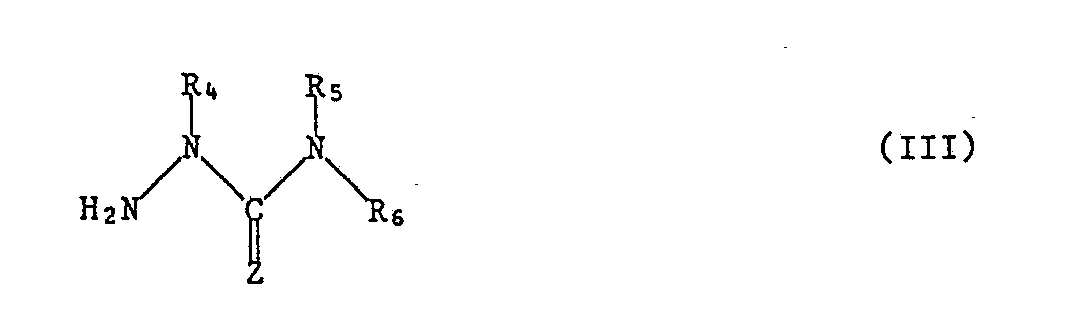


Priority Applications (1)
| Application Number | Priority Date | Filing Date | Title |
|---|---|---|---|
| AT89810207T ATE85607T1 (de) | 1988-03-25 | 1989-03-16 | Arylhydrazone. |
Applications Claiming Priority (2)
| Application Number | Priority Date | Filing Date | Title |
|---|---|---|---|
| CH1139/88 | 1988-03-25 | ||
| CH113988 | 1988-03-25 |
Publications (3)
| Publication Number | Publication Date |
|---|---|
| EP0335832A2 true EP0335832A2 (de) | 1989-10-04 |
| EP0335832A3 EP0335832A3 (en) | 1989-10-18 |
| EP0335832B1 EP0335832B1 (de) | 1993-02-10 |
Family
ID=4203401
Family Applications (1)
| Application Number | Title | Priority Date | Filing Date |
|---|---|---|---|
| EP89810207A Expired - Lifetime EP0335832B1 (de) | 1988-03-25 | 1989-03-16 | Arylhydrazone |
Country Status (23)
| Country | Link |
|---|---|
| US (2) | US4971986A (de) |
| EP (1) | EP0335832B1 (de) |
| JP (1) | JP2664241B2 (de) |
| KR (1) | KR890014479A (de) |
| AT (1) | ATE85607T1 (de) |
| AU (1) | AU627719B2 (de) |
| CA (1) | CA1340962C (de) |
| DD (1) | DD283601A5 (de) |
| DE (1) | DE58903483D1 (de) |
| DK (1) | DK175234B1 (de) |
| ES (1) | ES2046527T3 (de) |
| FI (1) | FI91397C (de) |
| GR (1) | GR3007512T3 (de) |
| HU (1) | HU204778B (de) |
| IE (1) | IE63164B1 (de) |
| IL (1) | IL89841A (de) |
| MX (1) | MX15387A (de) |
| NO (1) | NO176314C (de) |
| NZ (1) | NZ228478A (de) |
| PH (1) | PH27574A (de) |
| PT (1) | PT90105B (de) |
| YU (1) | YU59189A (de) |
| ZA (1) | ZA892205B (de) |
Cited By (2)
| Publication number | Priority date | Publication date | Assignee | Title |
|---|---|---|---|---|
| WO1996022979A1 (en) * | 1995-01-26 | 1996-08-01 | Novartis Ag | Imidazole derivatives, their preparation and their use as s-adenosylmethionine decarboxylase (=samdc) inhibitors |
| WO2015107122A1 (en) * | 2014-01-17 | 2015-07-23 | University College Dublin - National University Of Ireland, Dublin | Anti-angiogenic compounds |
Families Citing this family (27)
| Publication number | Priority date | Publication date | Assignee | Title |
|---|---|---|---|---|
| US5238941A (en) * | 1988-03-25 | 1993-08-24 | Ciba-Geigy Corporation | Arylhydrazones and pharmaceutical compositions thereof |
| US5395855A (en) * | 1990-05-07 | 1995-03-07 | Ciba-Geigy Corporation | Hydrazones |
| US6020139A (en) * | 1995-04-25 | 2000-02-01 | Oridigm Corporation | S-adenosyl methionine regulation of metabolic pathways and its use in diagnosis and therapy |
| JPH11506426A (ja) | 1995-04-25 | 1999-06-08 | オリディグム コーポレイション | 代謝経路のs−アデノシルメチオニン調節ならびに診断および治療におけるその使用 |
| ATE289295T1 (de) | 1997-04-22 | 2005-03-15 | Euro Celtique Sa | Die verwendung von durch carbozyklische und heterozyklische reste substituierte semicarbazonen und thiosemicarbazonen als natriumkanalblocker |
| DOP2002000332A (es) * | 2001-02-14 | 2002-08-30 | Warner Lambert Co | Inhibidores de piridina de metaloproteinasas de la matriz |
| EP1399159A4 (de) * | 2001-06-01 | 2007-02-14 | Cytovia Inc | 4-substituiertes 1-(arylmethyliden)thiosemicarbazid, 4-substituiertes 1-(arylcarbonyl)thiosemicarbazid und analoga als aktivatoren von caspasen und apoptosis-induktoren und ihre verwendung |
| EP1408028A1 (de) * | 2002-10-09 | 2004-04-14 | Institut National De La Sante Et De La Recherche Medicale (Inserm) | Hemmung der S-Adenosyl methionine decarboxylase zur Behandlung von Herpes simplex Virusinfektionen |
| CA2511646A1 (en) * | 2002-12-27 | 2004-07-22 | Chiron Corporation | Thiosemicarbazones as anti-virals and immunopotentiators |
| US7045632B2 (en) * | 2003-03-04 | 2006-05-16 | Chevron Phillips Chemical Company, Lp | Composition and method for a hexadentate ligand and bimetallic complex for polymerization of olefins |
| US20050187418A1 (en) * | 2004-02-19 | 2005-08-25 | Small Brooke L. | Olefin oligomerization |
| US7384886B2 (en) * | 2004-02-20 | 2008-06-10 | Chevron Phillips Chemical Company Lp | Methods of preparation of an olefin oligomerization catalyst |
| US20070043181A1 (en) * | 2005-08-19 | 2007-02-22 | Knudsen Ronald D | Methods of preparation of an olefin oligomerization catalyst |
| US20050187098A1 (en) * | 2004-02-20 | 2005-08-25 | Knudsen Ronald D. | Methods of preparation of an olefin oligomerization catalyst |
| US9550841B2 (en) | 2004-02-20 | 2017-01-24 | Chevron Phillips Chemical Company Lp | Methods of preparation of an olefin oligomerization catalyst |
| US7456284B2 (en) * | 2004-12-10 | 2008-11-25 | Chevron Phillips Chemical Company Lp | Methods for producing a hexadentate bimetallic complex |
| US7129304B1 (en) | 2005-07-21 | 2006-10-31 | Chevron Phillips Chemical Company Lp | Dimine metal complexes, methods of synthesis, and methods of using in oligomerization and polymerization |
| US7727926B2 (en) * | 2005-07-21 | 2010-06-01 | Chevron Phillips Chemical Company Lp | Diimine metal complexes, methods of synthesis, and method of using in oligomerization and polymerization |
| US7271121B2 (en) * | 2005-07-21 | 2007-09-18 | Chevron Phillips Chemical Company Lp | Diimine metal complexes, methods of synthesis, and methods of using in oligomerization and polymerization |
| US7268096B2 (en) * | 2005-07-21 | 2007-09-11 | Chevron Phillips Chemical Company Lp | Diimine metal complexes, methods of synthesis, and methods of using in oligomerization and polymerization |
| KR100807403B1 (ko) * | 2006-07-26 | 2008-02-28 | 동아대학교 산학협력단 | 식물 잿빛 곰팡이병 방제용 바실러스 아밀로리퀘페이션스lp03 균주 및 이를 이용한 미생물 제제의 제조방법 |
| US7902415B2 (en) * | 2007-12-21 | 2011-03-08 | Chevron Phillips Chemical Company Lp | Processes for dimerizing or isomerizing olefins |
| US9586872B2 (en) | 2011-12-30 | 2017-03-07 | Chevron Phillips Chemical Company Lp | Olefin oligomerization methods |
| CN102627593A (zh) * | 2012-02-23 | 2012-08-08 | 河南师范大学 | 具有抗癌活性的1,4-二羟基-2-甲酰基-9,10蒽醌缩氨硫脲新化合物及制备方法 |
| CN102942431B (zh) * | 2012-10-26 | 2014-07-23 | 青岛正大海尔制药有限公司 | 一种利用分子筛分离手性化合物的方法 |
| EP2818641A1 (de) | 2013-06-26 | 2014-12-31 | Siemens Aktiengesellschaft | Turbinenschaufel mit gestufter und abgeschrägter Plattformkante |
| US9944661B2 (en) | 2016-08-09 | 2018-04-17 | Chevron Phillips Chemical Company Lp | Olefin hydroboration |
Family Cites Families (11)
| Publication number | Priority date | Publication date | Assignee | Title |
|---|---|---|---|---|
| CH383948A (de) * | 1959-07-22 | 1964-11-15 | Ciba Geigy | Verfahren zur Herstellung neuer Hydrazone |
| CH396881A (de) * | 1961-01-16 | 1965-08-15 | Ciba Geigy | Verfahren zur Herstellung neuer Hydrazone |
| US3206478A (en) * | 1961-10-05 | 1965-09-14 | Ciba Geigy Corp | Aminoarylalkanone |
| CH430694A (de) * | 1962-04-03 | 1967-02-28 | Ciba Geigy | Verfahren zur Herstellung neuer Guanylhydrazone |
| CH474486A (de) * | 1965-11-19 | 1969-06-30 | Ciba Geigy | Verfahren zur Herstellung neuer Diphenylharnstoffe |
| CH496671A (de) * | 1968-04-04 | 1970-09-30 | Ciba Geigy | Verfahren zur Herstellung von neuen Guanylhydrazonen |
| DE1914999A1 (de) * | 1968-04-04 | 1969-11-06 | Ciba Geigy | Neue Guanylhydrazone und Verfahren zu ihrer Herstellung |
| US3753680A (en) * | 1970-05-14 | 1973-08-21 | Stauffer Chemical Co | Arylidene semicarbazones and their utility as herbicides |
| DE2309260A1 (de) * | 1973-02-24 | 1974-08-29 | Beiersdorf Ag | Substituierte guanylhydrazone von alkylarylketonen |
| US4321274A (en) * | 1980-10-06 | 1982-03-23 | Merck & Co., Inc. | Substituted 1-(cinnamylideneamino)-3-benzyli-deneaminoguanidines active against Giardia lamblia and Trichomonas vaginalis |
| DE3360148D1 (en) * | 1982-02-10 | 1985-06-05 | Beecham Group Plc | Guanidine derivatives |
-
1989
- 1989-03-15 US US07/324,368 patent/US4971986A/en not_active Expired - Lifetime
- 1989-03-16 DE DE8989810207T patent/DE58903483D1/de not_active Expired - Lifetime
- 1989-03-16 AT AT89810207T patent/ATE85607T1/de not_active IP Right Cessation
- 1989-03-16 EP EP89810207A patent/EP0335832B1/de not_active Expired - Lifetime
- 1989-03-16 ES ES198989810207T patent/ES2046527T3/es not_active Expired - Lifetime
- 1989-03-21 NO NO891232A patent/NO176314C/no not_active IP Right Cessation
- 1989-03-21 PH PH38362A patent/PH27574A/en unknown
- 1989-03-22 FI FI891361A patent/FI91397C/fi not_active IP Right Cessation
- 1989-03-22 MX MX1538789A patent/MX15387A/es unknown
- 1989-03-22 DK DK198901470A patent/DK175234B1/da not_active IP Right Cessation
- 1989-03-23 PT PT90105A patent/PT90105B/pt not_active IP Right Cessation
- 1989-03-23 AU AU31629/89A patent/AU627719B2/en not_active Expired
- 1989-03-23 DD DD89326848A patent/DD283601A5/de unknown
- 1989-03-23 IE IE93389A patent/IE63164B1/en not_active IP Right Cessation
- 1989-03-23 ZA ZA892205A patent/ZA892205B/xx unknown
- 1989-03-23 YU YU00591/89A patent/YU59189A/xx unknown
- 1989-03-23 CA CA000594714A patent/CA1340962C/en not_active Expired - Fee Related
- 1989-03-23 NZ NZ228478A patent/NZ228478A/xx unknown
- 1989-03-24 HU HU891528A patent/HU204778B/hu unknown
- 1989-03-24 JP JP1070720A patent/JP2664241B2/ja not_active Expired - Lifetime
- 1989-03-25 KR KR1019890003771A patent/KR890014479A/ko not_active Ceased
- 1989-04-04 IL IL8984189A patent/IL89841A/en unknown
-
1990
- 1990-08-29 US US07/574,991 patent/US5118709A/en not_active Expired - Lifetime
-
1993
- 1993-03-31 GR GR920402944T patent/GR3007512T3/el unknown
Cited By (3)
| Publication number | Priority date | Publication date | Assignee | Title |
|---|---|---|---|---|
| WO1996022979A1 (en) * | 1995-01-26 | 1996-08-01 | Novartis Ag | Imidazole derivatives, their preparation and their use as s-adenosylmethionine decarboxylase (=samdc) inhibitors |
| WO2015107122A1 (en) * | 2014-01-17 | 2015-07-23 | University College Dublin - National University Of Ireland, Dublin | Anti-angiogenic compounds |
| US9975860B2 (en) | 2014-01-17 | 2018-05-22 | University College Dublin, National University Of Ireland, Dublin | Anti-angiogenic compounds |
Also Published As
Similar Documents
| Publication | Publication Date | Title |
|---|---|---|
| EP0335832B1 (de) | Arylhydrazone | |
| EP0350448A1 (de) | Biarylverbindungen | |
| EP1082308B1 (de) | Heterocyclisch substituierte amide als calpainhemmer | |
| DE69524246T2 (de) | 1,2,3,4-Tetrahydroquinoxalindion Derivate und ihre Verwendung als Glutamat Rezeptor Antagonisten | |
| EP1073638B1 (de) | Heterozyklische substituierte amide, deren herstellung und anwendung | |
| EP1171424A1 (de) | Cycloalkylsubstituierte benzimidazole und ihre verwendung als parp inhibitoren | |
| EP0600832A1 (de) | Diaminobenzoe- und Diaminophthalsäurederivate und ihre Verfahren als Proteinkinase-Inhibitoren | |
| EP0516588B1 (de) | Substituierte Diaminophthalimide und Analoga | |
| RU2195452C2 (ru) | Цианогуанидины, способы их получения и фармацевтический препарат на их основе | |
| EP0456133B1 (de) | Hydrazone | |
| EP0600831A1 (de) | Phthalazinonderivate | |
| US5238941A (en) | Arylhydrazones and pharmaceutical compositions thereof | |
| EP0538193B1 (de) | Kondensierte cycloaliphatische Amidinohydrozon-Salze als S-Adenosylmelthionin de carboxylase Inhibitoren | |
| EP0600830A1 (de) | Substituierte Derivate von Diaminophthalimid als Protein-Tyrosin-Kinase-Hemmer | |
| US5084457A (en) | Benzoylaminoquinazolinones | |
| DE69633557T2 (de) | Imdazol-derivate, deren herstellung und deren verwendung als s-adenosylmethionin decarboxylase (=samdc) inhibitoren | |
| EP0495749A1 (de) | Bipyridyle | |
| US3856975A (en) | Anticoccidial composition containing guanidine derivatives |
Legal Events
| Date | Code | Title | Description |
|---|---|---|---|
| PUAI | Public reference made under article 153(3) epc to a published international application that has entered the european phase |
Free format text: ORIGINAL CODE: 0009012 |
|
| PUAL | Search report despatched |
Free format text: ORIGINAL CODE: 0009013 |
|
| 17P | Request for examination filed |
Effective date: 19890318 |
|
| AK | Designated contracting states |
Kind code of ref document: A2 Designated state(s): AT BE CH DE ES FR GB GR IT LI LU NL SE |
|
| AK | Designated contracting states |
Kind code of ref document: A3 Designated state(s): AT BE CH DE ES FR GB GR IT LI LU NL SE |
|
| 17Q | First examination report despatched |
Effective date: 19911031 |
|
| GRAA | (expected) grant |
Free format text: ORIGINAL CODE: 0009210 |
|
| AK | Designated contracting states |
Kind code of ref document: B1 Designated state(s): AT BE CH DE ES FR GB GR IT LI LU NL SE |
|
| REF | Corresponds to: |
Ref document number: 85607 Country of ref document: AT Date of ref document: 19930215 Kind code of ref document: T |
|
| ITF | It: translation for a ep patent filed | ||
| REF | Corresponds to: |
Ref document number: 58903483 Country of ref document: DE Date of ref document: 19930325 |
|
| ET | Fr: translation filed | ||
| GBT | Gb: translation of ep patent filed (gb section 77(6)(a)/1977) |
Effective date: 19930511 |
|
| REG | Reference to a national code |
Ref country code: GR Ref legal event code: FG4A Free format text: 3007512 |
|
| PLBE | No opposition filed within time limit |
Free format text: ORIGINAL CODE: 0009261 |
|
| STAA | Information on the status of an ep patent application or granted ep patent |
Free format text: STATUS: NO OPPOSITION FILED WITHIN TIME LIMIT |
|
| REG | Reference to a national code |
Ref country code: ES Ref legal event code: FG2A Ref document number: 2046527 Country of ref document: ES Kind code of ref document: T3 |
|
| 26N | No opposition filed | ||
| ITTA | It: last paid annual fee | ||
| EPTA | Lu: last paid annual fee | ||
| EAL | Se: european patent in force in sweden |
Ref document number: 89810207.4 |
|
| REG | Reference to a national code |
Ref country code: CH Ref legal event code: PFA Free format text: CIBA-GEIGY AG TRANSFER- NOVARTIS AG |
|
| REG | Reference to a national code |
Ref country code: GB Ref legal event code: 732E |
|
| NLS | Nl: assignments of ep-patents |
Owner name: NOVARTIS AG |
|
| REG | Reference to a national code |
Ref country code: ES Ref legal event code: PC2A |
|
| REG | Reference to a national code |
Ref country code: FR Ref legal event code: TP |
|
| REG | Reference to a national code |
Ref country code: GB Ref legal event code: IF02 |
|
| PGFP | Annual fee paid to national office [announced via postgrant information from national office to epo] |
Ref country code: CH Payment date: 20080313 Year of fee payment: 20 |
|
| PGFP | Annual fee paid to national office [announced via postgrant information from national office to epo] |
Ref country code: GB Payment date: 20080312 Year of fee payment: 20 Ref country code: IT Payment date: 20080327 Year of fee payment: 20 Ref country code: SE Payment date: 20080306 Year of fee payment: 20 Ref country code: LU Payment date: 20080313 Year of fee payment: 20 Ref country code: NL Payment date: 20080203 Year of fee payment: 20 |
|
| PGFP | Annual fee paid to national office [announced via postgrant information from national office to epo] |
Ref country code: AT Payment date: 20080313 Year of fee payment: 20 |
|
| PGFP | Annual fee paid to national office [announced via postgrant information from national office to epo] |
Ref country code: DE Payment date: 20080313 Year of fee payment: 20 Ref country code: ES Payment date: 20080418 Year of fee payment: 20 Ref country code: FR Payment date: 20080311 Year of fee payment: 20 |
|
| PGFP | Annual fee paid to national office [announced via postgrant information from national office to epo] |
Ref country code: GR Payment date: 20080215 Year of fee payment: 20 Ref country code: BE Payment date: 20080916 Year of fee payment: 20 |
|
| BE20 | Be: patent expired |
Owner name: *NOVARTIS A.G. Effective date: 20090316 |
|
| REG | Reference to a national code |
Ref country code: CH Ref legal event code: PL |
|
| REG | Reference to a national code |
Ref country code: GB Ref legal event code: PE20 Expiry date: 20090315 |
|
| NLV7 | Nl: ceased due to reaching the maximum lifetime of a patent |
Effective date: 20090316 |
|
| REG | Reference to a national code |
Ref country code: ES Ref legal event code: FD2A Effective date: 20090317 |
|
| PG25 | Lapsed in a contracting state [announced via postgrant information from national office to epo] |
Ref country code: NL Free format text: LAPSE BECAUSE OF EXPIRATION OF PROTECTION Effective date: 20090316 |
|
| PG25 | Lapsed in a contracting state [announced via postgrant information from national office to epo] |
Ref country code: GB Free format text: LAPSE BECAUSE OF EXPIRATION OF PROTECTION Effective date: 20090315 |
|
| PG25 | Lapsed in a contracting state [announced via postgrant information from national office to epo] |
Ref country code: ES Free format text: LAPSE BECAUSE OF EXPIRATION OF PROTECTION Effective date: 20090317 |