EP0334080B1 - T-Verbindung zwischen zwei Profilen, vorzugsweise einem Sprossen- und einem Pfostenprofil einer Fassade - Google Patents
T-Verbindung zwischen zwei Profilen, vorzugsweise einem Sprossen- und einem Pfostenprofil einer Fassade Download PDFInfo
- Publication number
- EP0334080B1 EP0334080B1 EP89103797A EP89103797A EP0334080B1 EP 0334080 B1 EP0334080 B1 EP 0334080B1 EP 89103797 A EP89103797 A EP 89103797A EP 89103797 A EP89103797 A EP 89103797A EP 0334080 B1 EP0334080 B1 EP 0334080B1
- Authority
- EP
- European Patent Office
- Prior art keywords
- connector
- transom
- plate
- mullion
- bore
- Prior art date
- Legal status (The legal status is an assumption and is not a legal conclusion. Google has not performed a legal analysis and makes no representation as to the accuracy of the status listed.)
- Expired - Lifetime
Links
- 239000000853 adhesive Substances 0.000 abstract description 6
- 230000001070 adhesive effect Effects 0.000 abstract description 6
- 238000009435 building construction Methods 0.000 abstract 1
- 238000010276 construction Methods 0.000 abstract 1
- 230000000284 resting effect Effects 0.000 abstract 1
- 238000007789 sealing Methods 0.000 description 6
- 238000004873 anchoring Methods 0.000 description 3
- 238000005553 drilling Methods 0.000 description 2
- 238000003780 insertion Methods 0.000 description 2
- 230000037431 insertion Effects 0.000 description 2
- 230000007704 transition Effects 0.000 description 2
- 238000004026 adhesive bonding Methods 0.000 description 1
- 210000003746 feather Anatomy 0.000 description 1
- 210000001503 joint Anatomy 0.000 description 1
Images

Classifications
-
- E—FIXED CONSTRUCTIONS
- E04—BUILDING
- E04B—GENERAL BUILDING CONSTRUCTIONS; WALLS, e.g. PARTITIONS; ROOFS; FLOORS; CEILINGS; INSULATION OR OTHER PROTECTION OF BUILDINGS
- E04B2/00—Walls, e.g. partitions, for buildings; Wall construction with regard to insulation; Connections specially adapted to walls
- E04B2/88—Curtain walls
- E04B2/96—Curtain walls comprising panels attached to the structure through mullions or transoms
-
- E—FIXED CONSTRUCTIONS
- E04—BUILDING
- E04B—GENERAL BUILDING CONSTRUCTIONS; WALLS, e.g. PARTITIONS; ROOFS; FLOORS; CEILINGS; INSULATION OR OTHER PROTECTION OF BUILDINGS
- E04B2/00—Walls, e.g. partitions, for buildings; Wall construction with regard to insulation; Connections specially adapted to walls
- E04B2/88—Curtain walls
- E04B2/96—Curtain walls comprising panels attached to the structure through mullions or transoms
- E04B2/965—Connections of mullions and transoms
-
- F—MECHANICAL ENGINEERING; LIGHTING; HEATING; WEAPONS; BLASTING
- F16—ENGINEERING ELEMENTS AND UNITS; GENERAL MEASURES FOR PRODUCING AND MAINTAINING EFFECTIVE FUNCTIONING OF MACHINES OR INSTALLATIONS; THERMAL INSULATION IN GENERAL
- F16B—DEVICES FOR FASTENING OR SECURING CONSTRUCTIONAL ELEMENTS OR MACHINE PARTS TOGETHER, e.g. NAILS, BOLTS, CIRCLIPS, CLAMPS, CLIPS OR WEDGES; JOINTS OR JOINTING
- F16B2200/00—Constructional details of connections not covered for in other groups of this subclass
- F16B2200/20—Connections with hook-like parts gripping behind a blind side of an element to be connected
- F16B2200/205—Connections with hook-like parts gripping behind a blind side of an element to be connected the hook being a separate retainer
-
- Y—GENERAL TAGGING OF NEW TECHNOLOGICAL DEVELOPMENTS; GENERAL TAGGING OF CROSS-SECTIONAL TECHNOLOGIES SPANNING OVER SEVERAL SECTIONS OF THE IPC; TECHNICAL SUBJECTS COVERED BY FORMER USPC CROSS-REFERENCE ART COLLECTIONS [XRACs] AND DIGESTS
- Y10—TECHNICAL SUBJECTS COVERED BY FORMER USPC
- Y10T—TECHNICAL SUBJECTS COVERED BY FORMER US CLASSIFICATION
- Y10T403/00—Joints and connections
- Y10T403/46—Rod end to transverse side of member
Definitions
- the invention relates to a T-connection between two profiles, preferably a rung and a mullion profile of a facade, of which the rung profile and the mullion profile have an inner chamber and in the inner chamber of the rung profile on the front end facing the connecting joint, a longitudinal section U- Shaped connector is defined, which consists of a front plate provided with at least one guide bore for a spring-loaded collar bolt equipped with a rectangular stop plate and of plate-shaped legs extending from two opposite end plate edges, which extend adjacent to the associated inner surfaces of the rung profile, the collar bolt non-rotatably in the Guided connector body and protrudes through the connection joint and a hole in a wall of the post profile into the inner chamber of the post profile and is fixed relative to the post profile.
- T-connection is known (DE-OS 3419294.8), in which the plate-shaped legs of the U-shaped connector body in longitudinal section are provided with an adhesive before insertion into the rung profile and the connector body after insertion into a front end of the rung profile is fastened by screws screwed into the rung profile in addition to the gluing between the legs and the inside of the rung profile.
- the known connector body is equipped with two collar bolts which are spring-loaded, have a rectangular stop plate and are guided in the connector body so as to be secured against rotation. These collar bolts penetrate when the rung profile is connected to a mullion profile through a bore in the inner chamber of the mullion profile and have a transverse bore through which a pin is driven from the outside through a mounting hole in the mullion profile in order to anchor the collar bolts to the mullion profile.
- the invention has for its object to design a T-connection of the type mentioned so that the T-connector can be fixed both in the rung profile and in the post profile in a simple manner without the connector body needs to be screwed to the rung profile and the collar bolt or the like with a pin inserted from the outside into the post profile. must be anchored in the inner chamber of the post profile.
- the legs covered with adhesive are attached to the assigned inner surfaces of the Pressed rung profile, so that when the adhesive sets, a perfect connection between the plate-shaped legs of the connector body and the rung profile is created.
- the collar bolt inserted through a bore into the inner chamber of the post profile can accommodate part of the bore wall in its locking recess, so that there is a positive connection between the collar bolt and the post profile.
- a screw or a spring-loaded locking pin can be used, which springs into a locking hole in the post profile.
- the collar bolt is equipped with two locking recesses arranged one behind the other in the longitudinal direction and offset at an angular distance of 180 ° to one another.
- the stop plate of the collar bolt is guided between cheeks, the free length of the bolt projecting beyond the end plate being less than the maximum guide distance of the cheeks when the stop plate is in contact with the stop surface of the connector.
- the collar bolt By pressing the collar bolt against the action of the spring in the connector body until the stop plate is outside the cheeks, the collar bolt can be rotated by 180 ° and released so that the stop plate under the action of the spring again in the area of the guide cheeks up to front stop is moved.
- the second locking recess can now be used for the positive connection of the bolt to the post profile.
- a connector 3 is fixed at the front end of a rung profile 1 in its inner chamber 2, the structural design of which is shown in FIGS. 4 to 6.
- the connector body is U-shaped in longitudinal section and has an end plate 4, from which plate-shaped legs 5 extend on two side edges. These plate-shaped legs 5 have outwardly open recesses 6, which are used to hold an adhesive with which the legs of the connector body are covered before being inserted into the inner chamber of the rung profile 1.
- toggle-like bridge web 7 is provided, which is integral with the legs and consists of a central web part 8 and web parts 9, which start from the central web part 8 and extend to the legs 5 at an obtuse angle ⁇ .
- the central web part 8 is equipped with a threaded bore 10 for a clamping screw 11, which is supported with its head 12 on the end plate, specifically on the bottom 13 of a groove 14 provided in the end plate.
- This groove 14 extends over the entire height of the end plate 4.
- the bottom 13 is equipped with a through hole 15 for the threaded shaft of the clamping screw 11.
- grooves 16, 17 are provided at the transition from the middle web part 8 to the web parts 9 and at the transition from the web parts 9 to the legs.
- an angle bar 18 is arranged, which has a strip part 19 running parallel to the central web part, is limited by the stroke of the clamping screw and thus the spreading of the legs 5.
- the bottom 13 is also provided with a through hole 20 for a collar bolt 21, in which the collar is formed by a stop plate 22 with a rectangular cross section.
- This stop plate is guided between cheeks 23, which start from the bottom 13 of the groove and extend in the direction of the bridge web 7.
- the cheeks 23 form a guideway with a length h2, while the length of the collar bolt part, which protrudes beyond the end plate when the stop plate 22 abuts the stop surface of the connector, is h1.
- h1 must be less than h2.
- the collar bolt 21 is assigned a spring 24 which extends through a bore 25 of the central web part 8 and is supported with its rear end on the strip part 19.
- the front end of the collar bolt 21 has two in the longitudinal direction one behind the other recesses 26, 27 equipped. These recesses are offset from one another at an angular distance of 180 °.
- the front end face of the collar bolt is equipped with a slot 28 for inserting a screwdriver.
- the collar bolt can be pressed against the action of the spring 24 into the interior of the connector body until the stop plate 22 is outside the cheeks 23.
- the collar bolt can then be rotated through 180 ° in order to bring the latching recess 26 into the lower position, in order then to use this latching recess when connecting the rung profile to the post profile.
- the latching recess 26 is used for the positive connection of the collar bolt 21 with a post profile 29 in the embodiment according to FIGS. 1 and 2, in which a sealing collar 30 is arranged in the connection area.
- the front part of the collar bolt is inserted through a bore 31 into the inner chamber 32 of the post profile and then brought into the position shown in FIG. 2 for connecting the two profiles.
- a screw connection 33 is made between the two profiles in the region of the anchoring grooves 34 and 35 for sealing profiles.
- FIG. 7 and 8 show a further embodiment of a butt connection between the rung profile 36 and the post profile 37.
- the connector 38 is equipped with two collar bolts 39 lying next to one another in a plane and furthermore has a spring-loaded locking pin 40 which fits into one Bores 41 of the post profile.
Landscapes
- Engineering & Computer Science (AREA)
- Architecture (AREA)
- Electromagnetism (AREA)
- Civil Engineering (AREA)
- Structural Engineering (AREA)
- Physics & Mathematics (AREA)
- Joining Of Building Structures In Genera (AREA)
- Load-Bearing And Curtain Walls (AREA)
- Superconductors And Manufacturing Methods Therefor (AREA)
- Coupling Device And Connection With Printed Circuit (AREA)
- Mutual Connection Of Rods And Tubes (AREA)
- Pressure Welding/Diffusion-Bonding (AREA)
- Fertilizing (AREA)
- Use Of Switch Circuits For Exchanges And Methods Of Control Of Multiplex Exchanges (AREA)
- Mechanical Coupling Of Light Guides (AREA)
- Finishing Walls (AREA)
- Standing Axle, Rod, Or Tube Structures Coupled By Welding, Adhesion, Or Deposition (AREA)
- Medicines Containing Antibodies Or Antigens For Use As Internal Diagnostic Agents (AREA)
- Pharmaceuticals Containing Other Organic And Inorganic Compounds (AREA)
Description
- Die Erfindung bezieht sich auf eine T-Verbindung zwischen zwei Profilen, vorzugsweise einem Sprossen- und einem Pfostenprofil einer Fassade, von denen das Sprossenprofil und das Pfostenprofil eine Innenkammer aufweisen und in der Innenkammer des Sprossenprofils an dem der Verbindungsfuge zugewandten Stirnende ein im Längsschnitt U-förmiger Verbinder festgelegt ist, der aus einer mit mindestens einer Führungsbohrung für einen federbelasteten, mit einer rechteckigen Anschlagplatte ausgerüsteten Bundbolzen versehenen Stirnplatte und aus von zwei gegenüberliegenden Stirnplattenrändern ausgehenden plattenförmigen Schenkeln besteht, die benachbart den zugeordneten Innenflächen des Sprossenprofils sich erstrecken, der Bundbolzen verdrehsicher in dem Verbinderkörper geführt und durch die Verbindungsfuge und eine Bohrung in einer Wand des Pfostenprofils in die Innenkammer des Pfostenprofils ragt und gegenüber dem Pfostenprofil festgelegt ist.
- Es ist eine derartige T-Verbindung bekannt (DE-OS 3419294.8), bei der die plattenförmigen Schenkel des im Längsschnitt U-förmigen Verbinderkörpers vor dem Einsetzen in das Sprossenprofil mit einem Kleber versehen werden und der Verbinderkörper nach dem Einsetzen in ein Stirnende des Sprossenprofils durch in das Sprossenprofil eingedrehte Schrauben zusätzlich zu der Verklebung zwischen den Schenkeln und den Innenseiten des Sprossenprofils befestigt wird.
- Der bekannte Verbinderkörper ist mit zwei Bundbolzen ausgerüstet, die federbelastet sind, eine rechteckige Anschlagplatte aufweisen und im Verbinderkörper verdrehsicher geführt werden. Diese Bundbolzen dringen, bei der Verbindung des Sprossenprofils mit einem Pfostenprofil durch eine Bohrung in die Innenkammer des Pfostenprofils ein und weisen eine Querbohrung auf, durch die ein Stift von außen durch eine Montagebohrung im Pfostenprofil getrieben wird, um die Bundbolzen am Pfostenprofil zu verankern.
- Der Erfindung liegt die Aufgabe zugrunde, eine T-Verbindung der eingangs genannten Art so zu gestalten, daß der T-Verbinder sowohl im Sprossenprofil als auch im Pfostenprofil in einfacher Weise festgelegt werden kann, ohne daß der Verbinderkörper mit dem Sprossenprofil verschraubt zu werden braucht und der Bundbolzen mit einem von außen in das Pfostenprofil eingeführten Stift o.dgl. in der Innenkammer des Pfostenprofils verankert werden muß.
- Diese Aufgabe wird erfindungsgemäß mit den kennzeichnenden Merkmalen des Anspruches 1 gelöst.
- Durch das Anziehen der Spannschraube werden nach dem Einsetzen des Verbinderkörpers in das Stirnende eines Sprossenprofils die mit einem Klebstoff belegten Schenkel an die zugeordneten Innenflächen des Sprossenprofils gepreßt, so daß beim Abbinden des Klebers eine einwandfreie Verbindung zwischen den plattenförmigen Schenkeln des Verbinderkörpers und dem Sprossenprofil entsteht.
- Da das vordere Ende des oder der Bundbolzen mit einer Rastausnehmung ausgerüstet ist, kann der durch eine Bohrung in die Innenkammer des Pfostenprofils eingeführte Bundbolzen in seiner Rastausnehmung einen Teil der Bohrungswand aufnehmen, so daß sich eine formschlüssige Verbindung zwischen dem Bundbolzen und dem Pfostenprofil ergibt.
- Als weiteres Verbindungsmittel zwischen dem Sprossen- und dem Pfostenprofil kann eine Schraube oder ein federbelasteter Raststift verwendet werden, der in eine Rastbohrung des Pfostenprofils einfedert.
- Bei einer vorteilhaften Ausführungsform der Erfindung ist der Bundbolzen mit zwei in Längsrichtung hintereinander angeordneten und in einem Winkelabstand von 180° zueinander versetzten Rastausnehmungen ausgestattet.
- Die Anschlagplatte des Bundbolzens wird zwischen Wangen geführt, wobei die die Stirnplatte überragende freie Länge des Bolzens bei an der Anschlagfläche des Verbinders anliegender Anschlagplatte kleiner ist als die maximale Führungsstrecke der Wangen.
- Durch ein Eindrücken des Bundbolzens entgegen der Wirkung der Feder in den Verbinderkörper bis sich die Anschlagplatte außerhalb der Wangen befindet, kann der Bundbolzen um 180° gedreht und freigelassen werden, so daß die Anschlagplatte unter der Wirkung der Feder wieder in den Bereich der Führungswangen bis zum vorderen Anschlag bewegt wird. Es kann nun die zweite Rastausnehmung zur formschlüssigen Verbindung des Bolzens mit dem Pfostenprofil verwendet werden.
- Weitere Merkmale der Erfindung ergeben sich aus den Unteransprüchen und der folgenden Beschreibung vorteilhafter, beispielsweiser Ausführungsformen der T-Verbindung.
- Es zeigen:
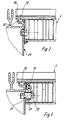
- Fig. 1
- ein mit einem Verbinder ausgerüstetes Sprossenprofil und ein Pfostenprofil im Schnitt mit zwischengeschalteter Dichtmanschette vor dem Zusammenfügen dieser Teile,
- Fig. 2
- die in der Fig. 1 aufgezeigten Teile nach der Verbindung im Schnitt,
- Fig. 3
- eine Verbindung zwischen einem Sprossen- und einem Pfostenprofil ohne eine Dichtmanschette im Verbindungsbereich,
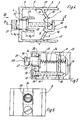
- Fig. 4
- einen mit einem Bundbolzen ausgerüsteten Verbinder im Schnitt,
- Fig. 5
- einen Schnitt nach der Linie V-V in Fig. 4,
- Fig. 6
- eine Ansicht in Richtung des Pfeiles VI in Fig. 4,
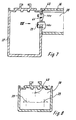
- Fig. 7
- ein weiteres Ausführungsbeispiel einer Stoßverbindung zwischen einem Sprossenprofil und einem Pfostenprofil im Schnitt und
- Fig. 8
- eine Ansicht in Richtung des Pfeiles VIII mit schematischer Darstellung des Verb inders.
- Bei dem Ausführungsbeispiel nach der Fig. 1 ist am Stirnende eines Sprossenprofils 1 in seiner Innenkammer 2 ein Verbinder 3 festgelegt, dessen konstruktiver Aufbau sich aus den Fig. 4 bis 6 ergibt.
- Der Verbinderkörper ist, wie aus der Fig. 4 folgt, im Längsschnitt U-förmig gestaltet und weist eine Stirnplatte 4 auf, von der an zwei Seitenrändern plattenförmige Schenkel 5 ausgehen. Diese plattenförmigen Schenkel 5 weisen nach außen geöffnete Aussparungen 6 auf, die zur Aufnahme eines Klebstoffes verwendet werden, mit dem die Schenkel des Verbinderkörpers vor dem Einsetzen in die Innenkammer des Sprossenprofils 1 belegt werden.
- Zwischen den plattenförmigen Schenkeln 5 ist ein kniehebelartig ausgebildeter Brückensteg 7 vorgesehen, der mit den Schenkeln einstückig ist und aus einem mittigen Stegteil 8 und Stegteilen 9 besteht, die vom mittigen Stegteil 8 ausgehen und zu den Schenkeln 5 unter einem stumpfen Winkel α verlaufen.
- Der mittige Stegteil 8 ist mit einer Gewindebohrung 10 für eine Spannschraube 11 ausgerüstet, die sich mit ihrem Kopf 12 an der Stirnplatte, und zwar an dem Boden 13 einer in der Stirnplatte vorgesehenen Nut 14 abstützt. Diese Nut 14 erstreckt sich über die gesamte Höhe der Stirnplatte 4. Der Boden 13 ist mit einer Durchsteckbohrung 15 für den Gewindeschaft der Spannschraube 11 ausgerüstet. Beim Anziehen der Spannschraube wird der Brückensteg 7 deformiert und spreizt die plattenförmigen Schenkel 5 nach außen.
- Um diese Deformation des Brückenstegs beim Anziehen der Schraube zu unterstützen und zu vereinfachen, sind am Übergang vom mittleren Stegteil 8 zu den Stegteilen 9 und am Übergang von den Stegteilen 9 zu den Schenkeln 5 Auskehlungen 16, 17 vorgesehen.
- An der Rückseite des mittleren Stegteils ist eine Winkelleiste 18 angeordnet, die einen parallel zum mittleren Stegteil verlaufenden Leistenteil 19 aufweist, durch den Hub der Spannschraube und damit die Spreizung der Schenkel 5 begrenzt wird.
- Der Boden 13 ist ferner mit einer Durchsteckbohrung 20 für einen Bundbolzen 21 versehen, bei dem der Bund durch eine im Querschnitt rechteckige Anschlagplatte 22 gebildet wird. Diese Anschlagplatte wird zwischen Wangen 23 geführt, die vom Boden 13 der Nut ausgehen und sich in Richtung auf den Brückensteg 7 erstrecken. Die Wangen 23 bilden eine Führungsbahn mit einer Länge h₂, während die Länge des Bundbolzenteils, der bei an der Anschlagfläche des Verbinders anliegender Anschlagplatte 22 über die Stirnplatte hinausragt, h₁ ist. h₁ muß kleiner sein als h₂.
- Dem Bundbolzen 21 ist eine Feder 24 zugeordnet, die sich durch eine Bohrung 25 des mittleren Stegteils 8 erstreckt und sich mit ihrem hinteren Ende an dem Leistenteil 19 abstützt.
- Das vordere Ende des Bundbolzens 21 ist mit zwei in Längsrichtung hintereinander angeordneten Rastausnehmungen 26, 27 ausgerüstet. Diese Rastausnehmungen sind in einem Winkelabstand von 180° zueinander versetzt angeordnet.
- Die vordere Stirnfläche des Bundbolzens ist mit einem Schlitz 28 zum Einführen eines Schraubendrehers ausgestattet. Mit diesem Schraubendreher kann der Bundbolzen entgegen der Wirkung der Feder 24 in das Innere des Verbinderkörpers eingedrückt werden, bis sich die Anschlagplatte 22 außerhalb der Wangen 23 befindet. Der Bundbolzen kann dann um 180° gedreht werden, um die Rastausnehmung 26 in die untere Lage zu bringen, um diese Rastausnehmung dann bei der Verbindung des Sprossenprofils mit dem Pfostenprofil einzusetzen.
- Die Rastausnehmung 26 wird für die formschlüssige Verbindung des Bundbolzens 21 mit einem Pfostenprofil 29 beim Ausführungsbeispiel nach den Fig. 1 und 2 verwendet, bei dem Verbindungsbereich eine Dichtmanschette 30 angeordnet ist.
- Der vordere Teil des Bundbolzens wird zur Verbindung der beiden Profile durch eine Bohrung 31 in die Innenkammer 32 des Pfostenprofils eingeführt und dann in die Lage gebracht, die in der Fig. 2 aufgezeigt ist.
- Sofern eine Verbindung zwischen dem Sprossenprofil 1 und dem Pfostenprofil 29 ohne die Dichtmanschette 30 vorgenommen werden soll, wird die hintere Rastausnehmung 27 des Bundbolzens 21 verwendet. Eine derartige Verbindung ist in der Fig. 3 aufgezeigt.
- Zur endgültigen Verbindung zwischen dem Sprossenprofil 2 und dem Pfostenprofil 29 wird eine Verschraubung 33 zwischen den beiden Profilen im Bereich der Verankerungsnuten 34 und 35 für Dichtungsprofile vorgenommen.
- Die Fig. 7 und 8 zeigen ein weiteres Ausführungsbeispiel einer Stoßverbindung zwischen dem Sprossenprofil 36 und dem Pfostenprofil 37. Bei dieser Verbindung ist der Verbinder 38 mit zwei in einer Ebene nebeneinander liegenden Bundbolzen 39 ausgerüstet und weist ferner einen federbelasteten Raststift 40 auf, der in eine Bohrung 41 des Pfostenprofils einfedert.
-
- 1
- Sprossenprofil
- 2
- Innenkammer
- 3
- Verbinder
- 4
- Stirnplatte
- 5
- Schenkel
- 6
- Aussparung
- 7
- Brückensteg
- 8
- Stegteil
- 9
- Stegteil
- 10
- Gewindebohrung
- 11
- Spannschraube
- 12
- Kopf
- 13
- Boden
- 14
- Nut
- 15
- Durchsteckbohrung
- 16
- Auskehlung
- 17
- Auskehlung
- 18
- Winkelleiste
- 19
- Leistenteil
- 20
- Durchsteckbohrung
- 21
- Bundbolzen
- 22
- Anschlagplatte
- 23
- Wange
- 24
- Feder
- 25
- Bohrung
- 26
- Rastausnehmung
- 27
- Rastausnehmung
- 28
- Schlitz
- 29
- Pfostenprofil
- 30
- Dichtmanschette
- 31
- Bohrung
- 32
- Innenkammer
- 33
- Verschraubung
- 34
- Verankerungsnut
- 35
- Verankerungsnut
- 36
- Sprosspenprofil
- 37
- Pfostenprofil
- 38
- Verbinder
- 39
- Bundbolzen
- 40
- Raststift
Claims (7)
Priority Applications (1)
| Application Number | Priority Date | Filing Date | Title |
|---|---|---|---|
| AT89103797T ATE69078T1 (de) | 1988-03-24 | 1989-03-03 | T-verbindung zwischen zwei profilen, vorzugsweise einem sprossen- und einem pfostenprofil einer fassade. |
Applications Claiming Priority (2)
| Application Number | Priority Date | Filing Date | Title |
|---|---|---|---|
| DE3809951A DE3809951A1 (de) | 1988-03-24 | 1988-03-24 | T-verbindung zwischen zwei profilen, vorzugsweise einem sprossen- und einem pfostenprofil einer fassade |
| DE3809951 | 1988-03-24 |
Publications (2)
| Publication Number | Publication Date |
|---|---|
| EP0334080A1 EP0334080A1 (de) | 1989-09-27 |
| EP0334080B1 true EP0334080B1 (de) | 1991-10-30 |
Family
ID=6350589
Family Applications (1)
| Application Number | Title | Priority Date | Filing Date |
|---|---|---|---|
| EP89103797A Expired - Lifetime EP0334080B1 (de) | 1988-03-24 | 1989-03-03 | T-Verbindung zwischen zwei Profilen, vorzugsweise einem Sprossen- und einem Pfostenprofil einer Fassade |
Country Status (12)
| Country | Link |
|---|---|
| US (1) | US4948290A (de) |
| EP (1) | EP0334080B1 (de) |
| JP (1) | JP2880179B2 (de) |
| KR (1) | KR960014624B1 (de) |
| AT (1) | ATE69078T1 (de) |
| CA (1) | CA1295591C (de) |
| DE (2) | DE3809951A1 (de) |
| DK (1) | DK167821B1 (de) |
| ES (1) | ES2025824T3 (de) |
| FI (1) | FI89618C (de) |
| GR (1) | GR3003423T3 (de) |
| NO (1) | NO172001C (de) |
Families Citing this family (24)
| Publication number | Priority date | Publication date | Assignee | Title |
|---|---|---|---|---|
| DE8916130U1 (de) * | 1989-11-23 | 1994-03-10 | Schüco International KG, 33609 Bielefeld | T-Verbindung zwischen zwei Profilen, vorzugsweise einem Sprossen- und einem Pfostenprofil einer Fassade |
| DE9006344U1 (de) * | 1990-06-05 | 1990-09-06 | Bahr, Frank, 4952 Porta Westfalica | Vorrichtung zum lösbaren Verbinden von zwei Profilstäben |
| DE4210575A1 (de) * | 1992-03-31 | 1993-10-07 | Herbert Lacker | Unterkonstruktion für Glasdächer und Glasfassaden |
| DE19510310A1 (de) * | 1995-03-22 | 1996-09-26 | Eberspaecher J | Riegel-Pfosten-Verbindung, insbesondere im Glasfassadenbau |
| DE19527141C2 (de) * | 1995-07-25 | 1998-07-09 | Evg Bauprofil System Entwicklungs & Vermarktungsgesellschaft Mbh | Pfosten-Sprossen-Konstruktion, insbesondere für Fassaden |
| DE19859886C1 (de) * | 1998-12-23 | 2000-11-30 | Manfred Muehle | Profilverbindung |
| DE19901775A1 (de) | 1999-01-18 | 2000-07-20 | Schueco Int Kg | T-Verbindung zwischen einem Sprossen- und einem Pfostenprofil einer Fassade oder eines Lichtdaches |
| DE20117100U1 (de) * | 2000-10-19 | 2002-04-18 | W. Hartmann & Co. (GmbH & Co.), 20459 Hamburg | Verbindungsvorrichtung zwischen einem Pfostenprofil und einem Riegelprofil für eine Bauwerksfassade |
| ITMI20021546A1 (it) * | 2002-07-12 | 2004-01-12 | Hydro Aluminium Systems Spa | Giunto per collegare fra loro due profilati e sistema per formare unacornice di una facciata o di un tetto di un edificio utilizzando tale |
| DE10321098B4 (de) * | 2003-05-09 | 2012-04-19 | Wicona Bausysteme Gmbh | Verbinder für Eck- oder Stoßverbindungen zweier Hohlprofile |
| BE1016889A3 (nl) * | 2005-12-12 | 2007-09-04 | Reynaers Aluminium Nv | Verbeterde t-verbinder. |
| DE202008014975U1 (de) * | 2008-11-12 | 2010-04-01 | Raico Bautechnik Gmbh | T-Verbindung zwischen einem Pfosten- und Riegelprofil |
| DE102009008380A1 (de) * | 2009-02-11 | 2010-08-12 | SCHÜCO International KG | T-Verbindung |
| DE102010060434A1 (de) * | 2010-11-08 | 2012-05-10 | Norsk Hydro Asa | Dichtelement |
| ITMI20110658A1 (it) * | 2011-04-18 | 2012-10-19 | Ponzio Sud S R L | Dispositivo di bloccaggio di un traverso ad un montante di una facciata continua |
| DE102012102497B4 (de) * | 2012-03-22 | 2024-02-15 | Sapa As | Verbinder, Werkzeug zur Montage und Verwendung eines Verbinders |
| BE1020554A3 (nl) | 2012-04-20 | 2013-12-03 | Reynaers Aluminium Nv | T-verbinder en t-verbinding daarmee gerealiseerd. |
| DE202014102054U1 (de) * | 2014-05-02 | 2015-08-17 | Raico Bautechnik Gmbh | T-Verbindung zwischen einem Pfosten- und Riegelprofil |
| DE202014102053U1 (de) * | 2014-05-02 | 2015-08-17 | Raico Bautechnik Gmbh | T-Verbindung zwischen einem Pfosten- und Riegelprofil |
| CN104695597B (zh) * | 2015-03-16 | 2017-08-15 | 杭州斯泰新材料技术有限公司 | 一种快装可拆销 |
| CN106836511A (zh) * | 2017-01-12 | 2017-06-13 | 马敬元 | 一种阳光房梁和立柱用的卯榫结构 |
| CN111024358B (zh) * | 2020-01-21 | 2021-06-25 | 中国空气动力研究与发展中心低速空气动力研究所 | 一种用于低速风洞试验的t型结构尾撑方法 |
| CN112502332B (zh) * | 2020-12-08 | 2022-02-15 | 中科建安工程有限公司 | 一种建筑工程幕墙安装用连接组件 |
| CN113374116B (zh) * | 2021-06-16 | 2022-04-08 | 黑龙江建筑职业技术学院 | 一种装配式墙体及其拼装方法 |
Family Cites Families (8)
| Publication number | Priority date | Publication date | Assignee | Title |
|---|---|---|---|---|
| DE2550200C2 (de) * | 1975-11-08 | 1977-12-01 | W. Hartmann & Co, 2000 Hamburg | Verbindungseinrichtung an zwei aneinander anliegenden Profilstäben |
| FR2376318A1 (fr) * | 1977-01-03 | 1978-07-28 | Leveque Xavier | Dispositif de liaison, notamment pour l'assemblage amovible d'elements profiles |
| FR2448065A1 (fr) * | 1979-01-30 | 1980-08-29 | Lauzier Rene | Dispositif d'assemblage de tubes de section carree ou rectangulaire formant un angle |
| SU838110A1 (ru) * | 1979-05-16 | 1981-06-15 | Musyakin Vyacheslav E | Замок дл креплени профилей |
| SE443601B (sv) * | 1982-04-22 | 1986-03-03 | Bo Allan Hjelm | Stellningssystem med inskjutbara skarvstycken och spiror med invendiga styrflensar for skarvstyckena |
| DE3228056A1 (de) * | 1982-07-27 | 1984-02-02 | Thyssen Plastik Anger KG, 8000 München | Verbindungselement |
| DE3419294A1 (de) * | 1984-05-24 | 1985-11-28 | SCHÜCO Heinz Schürmann GmbH & Co, 4800 Bielefeld | T-verbinder fuer einen sprossenstoss in einer vorsatzfassade |
| US4572694A (en) * | 1984-07-20 | 1986-02-25 | Otto Fastening Systems Ltd. | Structure member connector |
-
1988
- 1988-03-24 DE DE3809951A patent/DE3809951A1/de not_active Withdrawn
-
1989
- 1989-03-03 AT AT89103797T patent/ATE69078T1/de not_active IP Right Cessation
- 1989-03-03 DE DE8989103797T patent/DE58900409D1/de not_active Expired - Fee Related
- 1989-03-03 ES ES198989103797T patent/ES2025824T3/es not_active Expired - Lifetime
- 1989-03-03 EP EP89103797A patent/EP0334080B1/de not_active Expired - Lifetime
- 1989-03-14 US US07/329,126 patent/US4948290A/en not_active Expired - Lifetime
- 1989-03-21 NO NO891242A patent/NO172001C/no unknown
- 1989-03-21 DK DK136789A patent/DK167821B1/da not_active IP Right Cessation
- 1989-03-23 FI FI891422A patent/FI89618C/fi not_active IP Right Cessation
- 1989-03-23 CA CA000594718A patent/CA1295591C/en not_active Expired - Fee Related
- 1989-03-24 JP JP1070742A patent/JP2880179B2/ja not_active Expired - Fee Related
- 1989-03-24 KR KR1019890003748A patent/KR960014624B1/ko not_active Expired - Fee Related
-
1991
- 1991-12-23 GR GR91402119T patent/GR3003423T3/el unknown
Also Published As
| Publication number | Publication date |
|---|---|
| ATE69078T1 (de) | 1991-11-15 |
| ES2025824T3 (es) | 1992-04-01 |
| KR890014904A (ko) | 1989-10-25 |
| FI891422A7 (fi) | 1989-09-25 |
| JPH0224434A (ja) | 1990-01-26 |
| FI89618C (fi) | 1993-10-25 |
| DE3809951A1 (de) | 1989-10-05 |
| DK136789D0 (da) | 1989-03-21 |
| FI89618B (fi) | 1993-07-15 |
| GR3003423T3 (en) | 1993-02-17 |
| CA1295591C (en) | 1992-02-11 |
| NO891242D0 (no) | 1989-03-21 |
| JP2880179B2 (ja) | 1999-04-05 |
| NO172001C (no) | 1993-05-26 |
| US4948290A (en) | 1990-08-14 |
| DE58900409D1 (de) | 1991-12-05 |
| FI891422A0 (fi) | 1989-03-23 |
| NO172001B (no) | 1993-02-15 |
| DK167821B1 (da) | 1993-12-20 |
| KR960014624B1 (ko) | 1996-10-19 |
| EP0334080A1 (de) | 1989-09-27 |
| DK136789A (da) | 1989-09-25 |
| NO891242L (no) | 1989-09-25 |
Similar Documents
| Publication | Publication Date | Title |
|---|---|---|
| EP0334080A1 (de) | T-Verbindung zwischen zwei Profilen, vorzugsweise einem Sprossen- und einem Pfostenprofil einer Fassade | |
| EP0528213B1 (de) | Beschlagteil zur Klemmbefestigung in einer mindestens einseitigen hinterschnittenen Profilnut | |
| DE2618442C2 (de) | Stütze für ein Geländer oder dergleichen | |
| EP1020575A2 (de) | T-Verbindung zwischen einem Sprossen- und einem Pfostenprofil einer Fasade oder eines Lichtdaches | |
| DE19849152C2 (de) | Pfosten-Riegelverbindung | |
| DE3419294A1 (de) | T-verbinder fuer einen sprossenstoss in einer vorsatzfassade | |
| DE8632187U1 (de) | Vorrichtung zum Befestigen von Fasaden-Bauelementen (Fassadenelementen) an Konstruktionselementen | |
| DE102005044980A1 (de) | Stoßverbinder für Holz-/Aluminiumfassaden | |
| DE2626580C2 (de) | Anschlußstück | |
| EP0429931B1 (de) | T-Verbindung zwischen einem Sprossen- und einem Pfostenprofil einer Fassade | |
| DE10029343A1 (de) | Verbindungssystem zum festen Verbinden von mindestens zwei Elementen | |
| DE4110863C2 (de) | Pfosten- oder Riegelprofil für Gebäudefassadenkonstruktionen | |
| EP0551836A1 (de) | Schraubverbindung zwischen einer Profilschiene und einem Beschlag oder einem sonstigen Bauteil | |
| DE2636434B2 (de) | Rahmeneckverbindung | |
| EP0067970B1 (de) | Befestigungsvorrichtung für Fassadenelemente an einer Gebäudeaussenwand | |
| DE19822103A1 (de) | Fassadensystem für die Verkleidung eines Bauwerkes | |
| EP0057662A2 (de) | Beschlag zum lösbaren Verbinden von plattenförmigen Bauelementen | |
| DE3147092C2 (de) | Verbindungssystem mit wenigstens einem Eckbogenelement | |
| EP1342861B1 (de) | Befestigungsvorrichtung | |
| DE102020132669A1 (de) | Befestigungseinrichtung und Verfahren zur Ausrichtung und Fixierung eines Pfostenprofils einer Pfosten-Riegel-Konstruktion | |
| DE102004022276B4 (de) | Vorrichtung zur Befestigung von Dämmstoffelementen an ebenen Flächen | |
| DE3103291A1 (de) | An blend- und fluegelrahmen von fenstern, tueren od.dgl. ansetzbares verbindungselement | |
| DE3203127C1 (de) | Verbindung fuer zwei Bauteile von Bauwerken | |
| DE8400332U1 (de) | Eck- oder stossverbinder fuer bauprofile | |
| DE2363593A1 (de) | Expansionsverbindungsmuffe zum verbinden von rohrgliedern |
Legal Events
| Date | Code | Title | Description |
|---|---|---|---|
| PUAI | Public reference made under article 153(3) epc to a published international application that has entered the european phase |
Free format text: ORIGINAL CODE: 0009012 |
|
| AK | Designated contracting states |
Kind code of ref document: A1 Designated state(s): AT BE CH DE ES FR GB GR IT LI LU NL SE |
|
| 17P | Request for examination filed |
Effective date: 19890816 |
|
| 17Q | First examination report despatched |
Effective date: 19910107 |
|
| ITF | It: translation for a ep patent filed | ||
| GRAA | (expected) grant |
Free format text: ORIGINAL CODE: 0009210 |
|
| AK | Designated contracting states |
Kind code of ref document: B1 Designated state(s): AT BE CH DE ES FR GB GR IT LI LU NL SE |
|
| REF | Corresponds to: |
Ref document number: 69078 Country of ref document: AT Date of ref document: 19911115 Kind code of ref document: T |
|
| GBT | Gb: translation of ep patent filed (gb section 77(6)(a)/1977) | ||
| REF | Corresponds to: |
Ref document number: 58900409 Country of ref document: DE Date of ref document: 19911205 |
|
| ET | Fr: translation filed | ||
| REG | Reference to a national code |
Ref country code: ES Ref legal event code: FG2A Ref document number: 2025824 Country of ref document: ES Kind code of ref document: T3 |
|
| PLBE | No opposition filed within time limit |
Free format text: ORIGINAL CODE: 0009261 |
|
| STAA | Information on the status of an ep patent application or granted ep patent |
Free format text: STATUS: NO OPPOSITION FILED WITHIN TIME LIMIT |
|
| 26N | No opposition filed | ||
| REG | Reference to a national code |
Ref country code: GR Ref legal event code: FG4A Free format text: 3003423 |
|
| EPTA | Lu: last paid annual fee | ||
| EAL | Se: european patent in force in sweden |
Ref document number: 89103797.0 |
|
| REG | Reference to a national code |
Ref country code: GB Ref legal event code: IF02 |
|
| PGFP | Annual fee paid to national office [announced via postgrant information from national office to epo] |
Ref country code: SE Payment date: 20050323 Year of fee payment: 17 |
|
| PGFP | Annual fee paid to national office [announced via postgrant information from national office to epo] |
Ref country code: LU Payment date: 20050325 Year of fee payment: 17 |
|
| PG25 | Lapsed in a contracting state [announced via postgrant information from national office to epo] |
Ref country code: SE Free format text: LAPSE BECAUSE OF NON-PAYMENT OF DUE FEES Effective date: 20060304 |
|
| PG25 | Lapsed in a contracting state [announced via postgrant information from national office to epo] |
Ref country code: LU Free format text: LAPSE BECAUSE OF NON-PAYMENT OF DUE FEES Effective date: 20060331 |
|
| PGFP | Annual fee paid to national office [announced via postgrant information from national office to epo] |
Ref country code: IT Payment date: 20060331 Year of fee payment: 18 |
|
| EUG | Se: european patent has lapsed | ||
| PGFP | Annual fee paid to national office [announced via postgrant information from national office to epo] |
Ref country code: NL Payment date: 20070319 Year of fee payment: 19 |
|
| PGFP | Annual fee paid to national office [announced via postgrant information from national office to epo] |
Ref country code: AT Payment date: 20070323 Year of fee payment: 19 Ref country code: BE Payment date: 20070323 Year of fee payment: 19 Ref country code: ES Payment date: 20070323 Year of fee payment: 19 Ref country code: GB Payment date: 20070323 Year of fee payment: 19 |
|
| PGFP | Annual fee paid to national office [announced via postgrant information from national office to epo] |
Ref country code: CH Payment date: 20070329 Year of fee payment: 19 |
|
| PGFP | Annual fee paid to national office [announced via postgrant information from national office to epo] |
Ref country code: DE Payment date: 20070521 Year of fee payment: 19 |
|
| PGFP | Annual fee paid to national office [announced via postgrant information from national office to epo] |
Ref country code: GR Payment date: 20070323 Year of fee payment: 19 |
|
| PGFP | Annual fee paid to national office [announced via postgrant information from national office to epo] |
Ref country code: FR Payment date: 20070321 Year of fee payment: 19 |
|
| BERE | Be: lapsed |
Owner name: *SCHUCO INTERNATIONAL G.M.B.H. & CO. Effective date: 20080331 |
|
| REG | Reference to a national code |
Ref country code: CH Ref legal event code: PL |
|
| GBPC | Gb: european patent ceased through non-payment of renewal fee |
Effective date: 20080303 |
|
| PG25 | Lapsed in a contracting state [announced via postgrant information from national office to epo] |
Ref country code: AT Free format text: LAPSE BECAUSE OF NON-PAYMENT OF DUE FEES Effective date: 20080303 Ref country code: NL Free format text: LAPSE BECAUSE OF NON-PAYMENT OF DUE FEES Effective date: 20081001 |
|
| NLV4 | Nl: lapsed or anulled due to non-payment of the annual fee |
Effective date: 20081001 |
|
| REG | Reference to a national code |
Ref country code: FR Ref legal event code: ST Effective date: 20081125 |
|
| PG25 | Lapsed in a contracting state [announced via postgrant information from national office to epo] |
Ref country code: LI Free format text: LAPSE BECAUSE OF NON-PAYMENT OF DUE FEES Effective date: 20080331 Ref country code: DE Free format text: LAPSE BECAUSE OF NON-PAYMENT OF DUE FEES Effective date: 20081001 Ref country code: CH Free format text: LAPSE BECAUSE OF NON-PAYMENT OF DUE FEES Effective date: 20080331 |
|
| PG25 | Lapsed in a contracting state [announced via postgrant information from national office to epo] |
Ref country code: BE Free format text: LAPSE BECAUSE OF NON-PAYMENT OF DUE FEES Effective date: 20080331 |
|
| PG25 | Lapsed in a contracting state [announced via postgrant information from national office to epo] |
Ref country code: FR Free format text: LAPSE BECAUSE OF NON-PAYMENT OF DUE FEES Effective date: 20080331 |
|
| REG | Reference to a national code |
Ref country code: ES Ref legal event code: FD2A Effective date: 20080304 |
|
| PG25 | Lapsed in a contracting state [announced via postgrant information from national office to epo] |
Ref country code: GR Free format text: LAPSE BECAUSE OF NON-PAYMENT OF DUE FEES Effective date: 20081002 Ref country code: GB Free format text: LAPSE BECAUSE OF NON-PAYMENT OF DUE FEES Effective date: 20080303 |
|
| PG25 | Lapsed in a contracting state [announced via postgrant information from national office to epo] |
Ref country code: ES Free format text: LAPSE BECAUSE OF NON-PAYMENT OF DUE FEES Effective date: 20080304 |
|
| PG25 | Lapsed in a contracting state [announced via postgrant information from national office to epo] |
Ref country code: IT Free format text: LAPSE BECAUSE OF NON-PAYMENT OF DUE FEES Effective date: 20070303 |