EP0333912B1 - Verfahren zum Verdampfen einer Probensubstanz - Google Patents
Verfahren zum Verdampfen einer Probensubstanz Download PDFInfo
- Publication number
- EP0333912B1 EP0333912B1 EP88111565A EP88111565A EP0333912B1 EP 0333912 B1 EP0333912 B1 EP 0333912B1 EP 88111565 A EP88111565 A EP 88111565A EP 88111565 A EP88111565 A EP 88111565A EP 0333912 B1 EP0333912 B1 EP 0333912B1
- Authority
- EP
- European Patent Office
- Prior art keywords
- matrix material
- molecules
- sample substance
- laser beam
- sample
- Prior art date
- Legal status (The legal status is an assumption and is not a legal conclusion. Google has not performed a legal analysis and makes no representation as to the accuracy of the status listed.)
- Expired - Lifetime
Links
- 238000000034 method Methods 0.000 title claims description 28
- 238000001704 evaporation Methods 0.000 title claims description 8
- 230000008020 evaporation Effects 0.000 title claims description 8
- 239000000126 substance Substances 0.000 claims description 53
- 239000011159 matrix material Substances 0.000 claims description 46
- 150000001875 compounds Chemical class 0.000 claims description 13
- 239000004698 Polyethylene Substances 0.000 claims description 11
- 239000007789 gas Substances 0.000 claims description 11
- -1 polyethylene Polymers 0.000 claims description 11
- 229920000573 polyethylene Polymers 0.000 claims description 11
- 239000000203 mixture Substances 0.000 claims description 8
- 239000012159 carrier gas Substances 0.000 claims description 6
- PCHJSUWPFVWCPO-UHFFFAOYSA-N gold Chemical compound [Au] PCHJSUWPFVWCPO-UHFFFAOYSA-N 0.000 claims description 6
- 229910052737 gold Inorganic materials 0.000 claims description 6
- 239000010931 gold Substances 0.000 claims description 6
- 230000007935 neutral effect Effects 0.000 claims description 6
- 239000008188 pellet Substances 0.000 claims description 6
- 230000005855 radiation Effects 0.000 claims description 6
- 241000430525 Aurinia saxatilis Species 0.000 claims description 5
- 235000000346 sugar Nutrition 0.000 claims description 5
- 241000557876 Centaurea cineraria Species 0.000 claims description 4
- 150000002605 large molecules Chemical class 0.000 claims description 4
- 229920002521 macromolecule Polymers 0.000 claims description 4
- 239000000428 dust Substances 0.000 claims description 3
- 238000004949 mass spectrometry Methods 0.000 claims description 3
- PAWQVTBBRAZDMG-UHFFFAOYSA-N 2-(3-bromo-2-fluorophenyl)acetic acid Chemical compound OC(=O)CC1=CC=CC(Br)=C1F PAWQVTBBRAZDMG-UHFFFAOYSA-N 0.000 claims description 2
- 229920002678 cellulose Polymers 0.000 claims description 2
- 239000001913 cellulose Substances 0.000 claims description 2
- 150000004676 glycans Chemical class 0.000 claims description 2
- 150000002402 hexoses Chemical class 0.000 claims description 2
- 238000011835 investigation Methods 0.000 claims description 2
- 239000002184 metal Substances 0.000 claims description 2
- 229910052751 metal Inorganic materials 0.000 claims description 2
- 150000002972 pentoses Chemical class 0.000 claims description 2
- 229920001282 polysaccharide Polymers 0.000 claims description 2
- 239000005017 polysaccharide Substances 0.000 claims description 2
- 108090000765 processed proteins & peptides Proteins 0.000 description 21
- 238000001228 spectrum Methods 0.000 description 12
- 230000008016 vaporization Effects 0.000 description 6
- BQCADISMDOOEFD-UHFFFAOYSA-N Silver Chemical compound [Ag] BQCADISMDOOEFD-UHFFFAOYSA-N 0.000 description 5
- XLYOFNOQVPJJNP-UHFFFAOYSA-N water Chemical compound O XLYOFNOQVPJJNP-UHFFFAOYSA-N 0.000 description 5
- WQZGKKKJIJFFOK-GASJEMHNSA-N Glucose Natural products OC[C@H]1OC(O)[C@H](O)[C@@H](O)[C@@H]1O WQZGKKKJIJFFOK-GASJEMHNSA-N 0.000 description 4
- CZMRCDWAGMRECN-UGDNZRGBSA-N Sucrose Chemical compound O[C@H]1[C@H](O)[C@@H](CO)O[C@@]1(CO)O[C@@H]1[C@H](O)[C@@H](O)[C@H](O)[C@@H](CO)O1 CZMRCDWAGMRECN-UGDNZRGBSA-N 0.000 description 4
- 229930006000 Sucrose Natural products 0.000 description 4
- 230000006378 damage Effects 0.000 description 4
- 238000000354 decomposition reaction Methods 0.000 description 4
- 239000008103 glucose Substances 0.000 description 4
- 102000004196 processed proteins & peptides Human genes 0.000 description 4
- 229910052709 silver Inorganic materials 0.000 description 4
- 239000004332 silver Substances 0.000 description 4
- 239000005720 sucrose Substances 0.000 description 4
- JGKHAFUAPZCCDU-BZSNNMDCSA-N Leu-Tyr-Leu Chemical compound CC(C)C[C@H]([NH3+])C(=O)N[C@H](C(=O)N[C@@H](CC(C)C)C([O-])=O)CC1=CC=C(O)C=C1 JGKHAFUAPZCCDU-BZSNNMDCSA-N 0.000 description 3
- 238000010586 diagram Methods 0.000 description 3
- 239000012634 fragment Substances 0.000 description 3
- 239000000463 material Substances 0.000 description 3
- 150000002894 organic compounds Chemical class 0.000 description 3
- 108010016626 Dipeptides Proteins 0.000 description 2
- OIRDTQYFTABQOQ-KQYNXXCUSA-N adenosine Chemical compound C1=NC=2C(N)=NC=NC=2N1[C@@H]1O[C@H](CO)[C@@H](O)[C@H]1O OIRDTQYFTABQOQ-KQYNXXCUSA-N 0.000 description 2
- 150000001768 cations Chemical class 0.000 description 2
- 238000006297 dehydration reaction Methods 0.000 description 2
- 150000002484 inorganic compounds Chemical class 0.000 description 2
- 229910010272 inorganic material Inorganic materials 0.000 description 2
- 238000002156 mixing Methods 0.000 description 2
- 238000000197 pyrolysis Methods 0.000 description 2
- 230000035945 sensitivity Effects 0.000 description 2
- 239000002002 slurry Substances 0.000 description 2
- 238000004611 spectroscopical analysis Methods 0.000 description 2
- RWQNBRDOKXIBIV-UHFFFAOYSA-N thymine Chemical compound CC1=CNC(=O)NC1=O RWQNBRDOKXIBIV-UHFFFAOYSA-N 0.000 description 2
- 238000009834 vaporization Methods 0.000 description 2
- 239000002126 C01EB10 - Adenosine Substances 0.000 description 1
- 238000004566 IR spectroscopy Methods 0.000 description 1
- ROHFNLRQFUQHCH-YFKPBYRVSA-N L-leucine Chemical compound CC(C)C[C@H](N)C(O)=O ROHFNLRQFUQHCH-YFKPBYRVSA-N 0.000 description 1
- FFEARJCKVFRZRR-BYPYZUCNSA-N L-methionine Chemical compound CSCC[C@H](N)C(O)=O FFEARJCKVFRZRR-BYPYZUCNSA-N 0.000 description 1
- QIVBCDIJIAJPQS-VIFPVBQESA-N L-tryptophane Chemical compound C1=CC=C2C(C[C@H](N)C(O)=O)=CNC2=C1 QIVBCDIJIAJPQS-VIFPVBQESA-N 0.000 description 1
- OUYCCCASQSFEME-QMMMGPOBSA-N L-tyrosine Chemical compound OC(=O)[C@@H](N)CC1=CC=C(O)C=C1 OUYCCCASQSFEME-QMMMGPOBSA-N 0.000 description 1
- ROHFNLRQFUQHCH-UHFFFAOYSA-N Leucine Natural products CC(C)CC(N)C(O)=O ROHFNLRQFUQHCH-UHFFFAOYSA-N 0.000 description 1
- QIVBCDIJIAJPQS-UHFFFAOYSA-N Tryptophan Natural products C1=CC=C2C(CC(N)C(O)=O)=CNC2=C1 QIVBCDIJIAJPQS-UHFFFAOYSA-N 0.000 description 1
- 238000010521 absorption reaction Methods 0.000 description 1
- 230000002378 acidificating effect Effects 0.000 description 1
- 229960005305 adenosine Drugs 0.000 description 1
- 238000007605 air drying Methods 0.000 description 1
- 150000001413 amino acids Chemical class 0.000 description 1
- 239000007864 aqueous solution Substances 0.000 description 1
- 150000004945 aromatic hydrocarbons Chemical class 0.000 description 1
- 125000003118 aryl group Chemical group 0.000 description 1
- WQZGKKKJIJFFOK-VFUOTHLCSA-N beta-D-glucose Chemical compound OC[C@H]1O[C@@H](O)[C@H](O)[C@@H](O)[C@@H]1O WQZGKKKJIJFFOK-VFUOTHLCSA-N 0.000 description 1
- 230000002902 bimodal effect Effects 0.000 description 1
- 150000001793 charged compounds Chemical class 0.000 description 1
- 238000006243 chemical reaction Methods 0.000 description 1
- 238000001816 cooling Methods 0.000 description 1
- 230000018044 dehydration Effects 0.000 description 1
- 238000003795 desorption Methods 0.000 description 1
- 239000000975 dye Substances 0.000 description 1
- 238000002474 experimental method Methods 0.000 description 1
- 238000004880 explosion Methods 0.000 description 1
- 238000004992 fast atom bombardment mass spectroscopy Methods 0.000 description 1
- 238000013467 fragmentation Methods 0.000 description 1
- 238000006062 fragmentation reaction Methods 0.000 description 1
- 150000002500 ions Chemical class 0.000 description 1
- 238000004989 laser desorption mass spectroscopy Methods 0.000 description 1
- 238000001819 mass spectrum Methods 0.000 description 1
- 239000002923 metal particle Substances 0.000 description 1
- 229930182817 methionine Natural products 0.000 description 1
- 238000004452 microanalysis Methods 0.000 description 1
- 239000002773 nucleotide Substances 0.000 description 1
- 125000003729 nucleotide group Chemical group 0.000 description 1
- 239000002245 particle Substances 0.000 description 1
- 230000001681 protective effect Effects 0.000 description 1
- 230000000717 retained effect Effects 0.000 description 1
- 230000035939 shock Effects 0.000 description 1
- 239000007787 solid Substances 0.000 description 1
- 150000008163 sugars Chemical group 0.000 description 1
- 230000001629 suppression Effects 0.000 description 1
- 229940113082 thymine Drugs 0.000 description 1
- OUYCCCASQSFEME-UHFFFAOYSA-N tyrosine Natural products OC(=O)C(N)CC1=CC=C(O)C=C1 OUYCCCASQSFEME-UHFFFAOYSA-N 0.000 description 1
Images


Classifications
-
- H—ELECTRICITY
- H05—ELECTRIC TECHNIQUES NOT OTHERWISE PROVIDED FOR
- H05H—PLASMA TECHNIQUE; PRODUCTION OF ACCELERATED ELECTRICALLY-CHARGED PARTICLES OR OF NEUTRONS; PRODUCTION OR ACCELERATION OF NEUTRAL MOLECULAR OR ATOMIC BEAMS
- H05H3/00—Production or acceleration of neutral particle beams, e.g. molecular or atomic beams
- H05H3/02—Molecular or atomic-beam generation, e.g. resonant beam generation
Definitions
- the invention relates to a method for vaporizing a sample substance consisting of large molecules, in which the sample substance is exposed to laser beam pulses of high energy, so that the molecules located on the surface of the sample substance are desorbed by the energy of the laser beam pulses.
- the molecules of the sample substance are effectively cooled, by means of which Decomposition should be largely excluded.
- the ionization of the sample molecules required for mass spectroscopic analysis takes place within the beam of the carrier gas at a later point in time.
- the present invention has for its object to provide a method for vaporizing large neutral molecules, in which the risk of destruction of the molecules by the energy supplied for vaporizing is greatly reduced, if not completely eliminated.
- the sample substance is mixed with a matrix material which at least one compound, which absorbs light with the wavelength of the laser beam pulse, and which consists of the sample substance and the matrix material existing mixture is exposed to the laser beam pulses, neutral molecules being desorbed and admixed with the beam of a carrier gas, and that at a later point in time the ionization of the sample molecules required for mass spectroscopic analysis takes place within the beam of the carrier gas.
- the energy supplied by means of the laser beam pulses is distributed to the sample substance and the matrix material and primarily used to cause the matrix to disintegrate.
- an effective destruction of the material takes place in the vicinity of the sample molecules embedded in the matrix substance, with the result that the sample molecules become Loss of connection to the surface and thus also to other molecules and as a result are thrown off the surface of the sample substance.
- This process could be called a "local explosion". Therefore, when using the method according to the invention, the sensitive molecules of the sample substance are detached from the sample surface without having to absorb a very high energy themselves.
- the disintegration of the matrix material creates a kind of "own jet", which is directed away from the sample surface and whose gas particles effectively cool the desorbed sample molecules before they reach a supersonic jet, for example, in which further cooling takes place in the manner described above.
- a matrix material which consists of at least one compound which easily decomposes into gas molecules. It is advantageous for effective protection of the sample substance if a mixture is used in which the number of molecules of the matrix material is greater than the number of molecules of the sample substance.
- the proportion of the sample substance in the mixture depending on the type of sample substance on the one hand and the type of compounds used for the matrix on the other hand, can be 10 to 40% by weight.
- organic and inorganic compounds are sugar, in particular pentose or hexose, but also polysaccharides such as cellulose. These compounds decompose thermally to CO2 and H2O, so that they do not form residues that could lead to chemical reactions.
- inorganic Compounds should be mentioned in particular ammonium nitrate, which disintegrates practically without residue.
- metal dust preferably gold or silver dust with a grain size of less than 40 ⁇ m
- matrix materials can also be used which are not thermolytically decomposed due to the absorption of the laser radiation.
- plasma waves are generated on the surface of the metal particles, which propagate as shock waves and on the surface of the matrix material cause the matrix to tear and thus release the embedded molecules.
- the use of a polyethylene as the matrix material has proven to be particularly suitable for this variant of the method according to the invention.
- polyethylene has the particular advantage that this material is already used as a matrix material in infrared spectroscopy and therefore tried and tested materials and devices for embedding the sample substance in such polyethylene are available.
- pellets can be formed from the matrix material and the sample substance and exposed to the laser beam pulses.
- the process according to the invention was used for the vaporization of organic compounds which vary greatly in their chemical composition. So it can easily be used with molecules that have strongly polar groups, as well as with non-polar molecules. Connections are among the first with an acidic and / or basic character, such as peptides, amino acids and dyes, while the latter include aromatic and non-aromatic hydrocarbons. It has been found to be particularly advantageous that the total yield of desorbed sample molecules can be increased by a factor of 4 to 10 compared to evaporation without mixing with a matrix material, depending on the type of sample substance.
- a spectroscopic polyethylene which is transparent to radiation in the range of 10 »m wavelength with a proportion of about 10 ⁇ 1 to 10 ⁇ 2 Gew.T. the sample substance and about 10 ⁇ 1 to 10 ⁇ 2 Gew.T. made of gold or silver dust and exposed to the radiation of a CO2 laser.
- a sample which was located on a sample holder arranged a few millimeters below a supersonic jet nozzle was used to carry out the method according to the invention irradiated with an IR laser beam pulse, the energy of which was 50 mJ and the duration of which was 20 »s.
- the supersonic gas jet was switched on in each case after an IR laser beam pulse, so that the gaseous products generated by the laser beam pulse were carried away by the supersonic gas jet and cooled when the gas jet expanded.
- the gas jet was then passed through means for removing any cations so that only neutral molecules enter a subsequent ionization area in which a UV laser beam cuts the gas jet.
- Laser beam pulses of 5 ns duration with an energy of 300 »J were generated by the UV laser.
- the cations generated in this way were fed to a time-of-flight mass spectrometer and detected with a multi-channel plate arrangement.
- the time-of-flight mass spectrometer used was that of Anal. Instrum., 16, 151 (1986).
- the typical mass resolution is in the range from 6000 to 10000 according to the FWHM definition.
- sample substances examined with the described device were dipeptides. About 1 mg of the peptide was slurried in 50 »l of water and then 20» l of this slurry was applied to the sample carrier. In most of the spectra obtained, about 10% of the substance applied to the sample carrier was used to generate the spectrum.
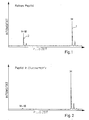
- FIG. 1 shows the mass spectrum of the pure peptide leucine tryptophan obtained in the manner described above.
- the spectrum shows a further line 2 of a substance of the mass M-18.
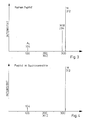
- FIG. 2 shows the spectrum of the same peptide leucine-tryptophan, however after embedding the peptide in a glucose matrix in a ratio of 1 mg glucose per 1 mg peptide. Mixing with the glucose results in almost complete suppression of the M-18 line, which is due to the destruction of part of the peptide molecules during evaporation.
- pellets were produced from 5 mg of powdered polyethylene, about 0.1 mg of powdered silver or gold and the specified amount of the sample substance. These pellets were exposed to the radiation of a scanning TEA laser with a wavelength of 10.6 »m and a pulse power of 10 mJ.
- the intensity of the trailing edge was only about half the intensity of the sharp one Top.
- the molecules of the sample substance desorbed by the laser beam pulses entered a gas jet generated by a supersonic nozzle, which was at a distance of 1 to 2 mm from the desorption point.
- the back pressure of the jet was 0.1 to 0.2 MPa (1 to 2 bar).
- the molecules of the sample substance were distributed over the gas jet after a flight of 80 mm in the direction of the ionization area.
- the mass spectrometer used was the same as in the previous examples.
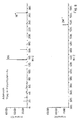
- 5 and 6 illustrate the significant increase in sensitivity that can be obtained by embedding the substance to be examined in a matrix of polyethylene with an admixture of silver.
- 10 mg of powdered Leu-Tyr-Leu results in a line with an intensity that is only slightly greater than the intensity of the line obtained from only 100 ng of Leu-Tyr-Leu embedded in polyethylene with silver, that is, around 10 ⁇ 5 lesser amount.
- the reason for this is that the evaporation of the Leu-Tyr-Leu embedded in the polyethylene matrix with the addition of silver powder occurs practically without any destruction of the molecules, while the substance without a protective matrix is bombarded to a high degree by the laser beam gets destroyed.
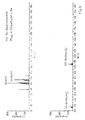
- FIG. 7 to 9 illustrate the spectra of substances from which no signal could be obtained at all up to now, ie without embedding according to the invention in a matrix material.
- the spectrum of Fig. 7 shows the line of thymine obtained from only 50 »g of the substance in a matrix of polyethylene with silver.
- the spectrum according to FIG. 8 was obtained using only 10 »g adenosine in a matrix containing gold dust.
- Fig. 9 shows the spectrum of tris-Ru-bipyridyl acetate. The amount used was only 20 »g in a matrix containing gold.
Landscapes
- Physics & Mathematics (AREA)
- Spectroscopy & Molecular Physics (AREA)
- Engineering & Computer Science (AREA)
- Plasma & Fusion (AREA)
- Physical Or Chemical Processes And Apparatus (AREA)
- Other Investigation Or Analysis Of Materials By Electrical Means (AREA)
Applications Claiming Priority (2)
| Application Number | Priority Date | Filing Date | Title |
|---|---|---|---|
| DE3809504A DE3809504C1 (enExample) | 1988-03-22 | 1988-03-22 | |
| DE3809504 | 1988-03-22 |
Publications (3)
| Publication Number | Publication Date |
|---|---|
| EP0333912A2 EP0333912A2 (de) | 1989-09-27 |
| EP0333912A3 EP0333912A3 (en) | 1990-03-07 |
| EP0333912B1 true EP0333912B1 (de) | 1995-06-28 |
Family
ID=6350311
Family Applications (1)
| Application Number | Title | Priority Date | Filing Date |
|---|---|---|---|
| EP88111565A Expired - Lifetime EP0333912B1 (de) | 1988-03-22 | 1988-07-19 | Verfahren zum Verdampfen einer Probensubstanz |
Country Status (3)
| Country | Link |
|---|---|
| US (1) | US5062935A (enExample) |
| EP (1) | EP0333912B1 (enExample) |
| DE (1) | DE3809504C1 (enExample) |
Families Citing this family (65)
| Publication number | Priority date | Publication date | Assignee | Title |
|---|---|---|---|---|
| DE4017805C2 (de) * | 1989-08-22 | 1998-03-26 | Finnigan Mat Gmbh | Verfahren, Präparat und Vorrichtung zur Bereitstellung eines Analytes für eine Untersuchung |
| DE4108462C2 (de) * | 1991-03-13 | 1994-10-13 | Bruker Franzen Analytik Gmbh | Verfahren und Vorrichtung zum Erzeugen von Ionen aus thermisch instabilen, nichtflüchtigen großen Molekülen |
| US6436635B1 (en) | 1992-11-06 | 2002-08-20 | Boston University | Solid phase sequencing of double-stranded nucleic acids |
| US5605798A (en) | 1993-01-07 | 1997-02-25 | Sequenom, Inc. | DNA diagnostic based on mass spectrometry |
| US6194144B1 (en) | 1993-01-07 | 2001-02-27 | Sequenom, Inc. | DNA sequencing by mass spectrometry |
| EP1262564A3 (en) | 1993-01-07 | 2004-03-31 | Sequenom, Inc. | Dna sequencing by mass spectrometry |
| US6020208A (en) * | 1994-05-27 | 2000-02-01 | Baylor College Of Medicine | Systems for surface-enhanced affinity capture for desorption and detection of analytes |
| US20020037517A1 (en) | 1993-05-28 | 2002-03-28 | Hutchens T. William | Methods for sequencing biopolymers |
| EP1347493A3 (en) | 1993-05-28 | 2005-11-23 | Baylor College Of Medicine | Method and apparatus for desorption and ionization of analytes |
| US6071610A (en) | 1993-11-12 | 2000-06-06 | Waters Investments Limited | Enhanced resolution matrix-laser desorption and ionization TOF-MS sample surface |
| WO1995015001A2 (en) * | 1993-11-12 | 1995-06-01 | Waters Corporation | Enhanced resolution maldi tof-ms sample surface |
| US7803529B1 (en) | 1995-04-11 | 2010-09-28 | Sequenom, Inc. | Solid phase sequencing of biopolymers |
| US5830655A (en) | 1995-05-22 | 1998-11-03 | Sri International | Oligonucleotide sizing using cleavable primers |
| US5589685A (en) * | 1995-05-26 | 1996-12-31 | Jen Wu; Kuang | Matrix enhanced SIMS |
| US6146854A (en) * | 1995-08-31 | 2000-11-14 | Sequenom, Inc. | Filtration processes, kits and devices for isolating plasmids |
| US5777324A (en) | 1996-09-19 | 1998-07-07 | Sequenom, Inc. | Method and apparatus for maldi analysis |
| ES2215241T3 (es) | 1996-11-06 | 2004-10-01 | Sequenom, Inc. | Procedimiento de espectrometria de masa. |
| EP1164203B1 (en) | 1996-11-06 | 2007-10-10 | Sequenom, Inc. | DNA Diagnostics based on mass spectrometry |
| DE19705762C2 (de) * | 1997-02-14 | 2001-06-07 | Rainer Edmund Weinkauf | Verfahren und Vorrichtung zum Erzeugen von Gasstrahlen |
| US6207370B1 (en) | 1997-09-02 | 2001-03-27 | Sequenom, Inc. | Diagnostics based on mass spectrometric detection of translated target polypeptides |
| US6723564B2 (en) | 1998-05-07 | 2004-04-20 | Sequenom, Inc. | IR MALDI mass spectrometry of nucleic acids using liquid matrices |
| WO2001081829A1 (en) * | 2000-04-27 | 2001-11-01 | Brio Technology, Inc. | Method and apparatus for processing jobs on an enterprise-wide computer system |
| US7087435B2 (en) * | 2001-04-30 | 2006-08-08 | Syn X Pharma, Inc. | Biopolymer marker indicative of disease state having a molecular weight of 2753 daltons |
| US6627608B2 (en) | 2001-04-30 | 2003-09-30 | Syn X Pharma, Inc. | Biopolymer marker indicative of disease state having a molecular weight of 1206 daltons |
| US7294688B2 (en) | 2001-04-30 | 2007-11-13 | Nanogen Inc. | Biopolymer marker indicative of disease state having a molecular weight of 1348 daltons |
| US20040224423A1 (en) * | 2001-04-30 | 2004-11-11 | George Jackowski | Biopolymer marker indicative of disease state having a molecular weight of 2056 daltons |
| US6627606B2 (en) | 2001-04-30 | 2003-09-30 | Syn X Pharma, Inc. | Biopolymer marker indicative of disease state having a molecular weight of 1465 daltons |
| US6599877B2 (en) | 2001-04-30 | 2003-07-29 | Syn X Pharma, Inc. | Biopolymer marker indicative of disease state having a molecular weight of 1020 daltons |
| US6620787B2 (en) | 2001-04-30 | 2003-09-16 | Syn X Pharma, Inc. | Biopolymer marker indicative of disease state having a molecular weight of 2267 daltons |
| US6602855B2 (en) | 2001-04-30 | 2003-08-05 | Syn X Pharma, Inc. | Biopolymer marker indicative of disease state having a molecular weight of 1449 daltons |
| US6756476B2 (en) | 2001-04-30 | 2004-06-29 | Syn X Pharma, Inc. | Biopolymer marker indicative of disease state having a molecular weight of 2021 daltons |
| US6593298B2 (en) | 2001-04-30 | 2003-07-15 | Syn X Pharma, Inc. | Biopolymer marker indicative of disease state having a molecular weight of 1690 daltons |
| US6620786B2 (en) | 2001-04-30 | 2003-09-16 | Syn X Pharma, Inc. | Biopolymer marker indicative of disease state having molecular weight of 2937 daltons |
| US6693080B2 (en) | 2001-04-30 | 2004-02-17 | Syn X Pharma | Biopolymer marker indicative of disease state having a molecular weight of 1521 daltons |
| US20040198950A1 (en) * | 2001-04-30 | 2004-10-07 | George Jackowski | Biopolymer marker indicative of disease state having a molecular weight of 1518 daltons |
| US6617308B2 (en) | 2001-04-30 | 2003-09-09 | Syn X Pharma, Inc. | Biopolymer marker indicative of disease state having a molecular weight of 1865 daltons |
| US6677303B2 (en) | 2001-04-30 | 2004-01-13 | Syn X Pharma | Biopolymer marker indicative of disease state having a molecular weight of 1097 daltons |
| US6627607B2 (en) | 2001-04-30 | 2003-09-30 | Syn X Pharma, Inc. | Biopolymer marker indicative of disease state having a molecular weight of 1845 daltons |
| US7015004B2 (en) * | 2001-11-23 | 2006-03-21 | Syn X Pharma, Inc. | Inter-alpha trypsin inhibitor biopolymer marker indicative of insulin resistance |
| US20020160533A1 (en) * | 2001-04-30 | 2002-10-31 | George Jackowski | Biopolymer marker indicative of disease state having a molecular of weight of 1525 daltons |
| US6890763B2 (en) | 2001-04-30 | 2005-05-10 | Syn X Pharma, Inc. | Biopolymer marker indicative of disease state having a molecular weight of 1350 daltons |
| US7314717B2 (en) | 2001-04-30 | 2008-01-01 | Nanogen Inc. | Biopolymer marker indicative of disease state having a molecular weight of 1562 daltons |
| US6703366B2 (en) | 2001-04-30 | 2004-03-09 | George Jackowski | Biopolymer marker indicative of disease state having a molecular weight of 1,896 daltons |
| US7049397B2 (en) | 2001-04-30 | 2006-05-23 | Syn X Pharma, Inc. | Biopolymer marker indicative of disease state having a molecular weight of 1211 daltons |
| US7008800B2 (en) | 2001-04-30 | 2006-03-07 | Artemis Proteomics, Ltd. | Biopolymer marker indicative of disease state having a molecular weight of 1077 daltons |
| US7132244B2 (en) * | 2001-11-21 | 2006-11-07 | Syn X Pharma, Inc. | Betaine/GABA transport protein biopolymer marker indicative of insulin resistance |
| US7179610B2 (en) * | 2001-11-23 | 2007-02-20 | Nanogen Inc. | Complement C3 precursor biopolymer markers indicative of insulin resistance |
| US7314762B2 (en) | 2001-11-21 | 2008-01-01 | Nanogen, Inc. | Apolipoprotein biopolymer markers indicative of insulin resistance |
| US7135297B2 (en) | 2001-11-23 | 2006-11-14 | Nanogen Inc. | Protein biopolymer markers indicative of insulin resistance |
| US7026129B2 (en) * | 2001-11-23 | 2006-04-11 | Syn X Pharma, Inc. | IG lambda biopolymer markers predictive of Alzheimers disease |
| JP2005510723A (ja) * | 2001-11-23 | 2005-04-21 | シン.クス ファーマ、インコーポレイテッド | 年齢にマッチした対照を示すタンパク質バイオポリマーマーカー |
| US7074576B2 (en) * | 2001-11-23 | 2006-07-11 | Syn X Pharma, Inc. | Protein biopolymer markers indicative of alzheimer's disease |
| US7052849B2 (en) * | 2001-11-23 | 2006-05-30 | Syn X Pharma, Inc. | Protein biopolymer markers predictive of insulin resistance |
| US7122327B2 (en) * | 2001-11-23 | 2006-10-17 | Nanogen Inc. | Biopolymer markers indicative of type II diabetes |
| US7125678B2 (en) * | 2001-11-23 | 2006-10-24 | Nanogen, Inc. | Protein biopolymer markers predictive of type II diabetes |
| US7179606B2 (en) * | 2001-11-23 | 2007-02-20 | Syn X Pharma, Inc. | IG heavy chain, IG kappa, IG lambda biopolymer markers predictive of Alzheimer's disease |
| US7179605B2 (en) | 2001-11-23 | 2007-02-20 | Nanogen Inc. | Fibronectin precursor biopolymer markers indicative of alzheimer's disease |
| US6890722B2 (en) | 2001-11-23 | 2005-05-10 | Syn X Pharma, Inc. | HP biopolymer markers predictive of insulin resistance |
| US7097989B2 (en) * | 2001-11-23 | 2006-08-29 | Syn X Pharma, Inc. | Complement C3 precursor biopolymer markers predictive of type II diabetes |
| US20070003974A1 (en) * | 2001-11-23 | 2007-01-04 | George Jackowski | Cene-E biopolymer marker indicative of age matched control |
| US7094549B2 (en) * | 2001-11-23 | 2006-08-22 | Syn X Pharma, Inc. | Fibronectin biopolymer marker indicative of insulin resistance |
| US20030113808A1 (en) * | 2001-12-13 | 2003-06-19 | George Jackowski | Apolipoprotein biopolymer markers predictive of alzheimers disease |
| JP3530942B2 (ja) * | 2002-03-05 | 2004-05-24 | 独立行政法人通信総合研究所 | 分子ビーム発生方法及び装置 |
| CN101310183A (zh) | 2005-11-16 | 2008-11-19 | 诺瓦提斯公司 | 用于脊髓损伤中抗Nogo-A抗体治疗的生物标记 |
| FR2995403B1 (fr) * | 2012-09-13 | 2014-09-12 | Commissariat Energie Atomique | Procede et dispositif de mesure quantitative par libs de cibles biomoleculaires sur bio-puce |
Family Cites Families (6)
| Publication number | Priority date | Publication date | Assignee | Title |
|---|---|---|---|---|
| US4091256A (en) * | 1975-01-16 | 1978-05-23 | The United States Of America As Represented By The Secretary Of The Air Force | Pulsed atomic beam apparatus |
| US4091265A (en) * | 1975-08-06 | 1978-05-23 | Racor Industries, Inc. | Fuel filter heating assembly |
| DE2654057B1 (de) * | 1976-11-29 | 1978-04-27 | Varian Mat Gmbh | Verfahren zur Ionisierung von organischen Substanzen,sowie dieses Verfahren benutzendes Analysegeraet |
| DE3018455A1 (de) * | 1979-05-16 | 1980-11-27 | Varian Mat Gmbh | Verfahren zur ionisierung von organischen substanzen |
| DE3224801C2 (de) * | 1982-07-02 | 1986-04-30 | Edward William Prof. Dr. 8000 München Schlag | Verfahren und Einrichtung zum Erzeugen von gepulsten Molekularstrahlen, die große, thermisch instabile Moleküle enthalten |
| US4728796A (en) * | 1986-04-10 | 1988-03-01 | Medical College Of Wisconsin | Method for ionization of polymers |
-
1988
- 1988-03-22 DE DE3809504A patent/DE3809504C1/de not_active Expired
- 1988-07-19 EP EP88111565A patent/EP0333912B1/de not_active Expired - Lifetime
-
1989
- 1989-03-21 US US07/326,763 patent/US5062935A/en not_active Expired - Lifetime
Also Published As
| Publication number | Publication date |
|---|---|
| EP0333912A2 (de) | 1989-09-27 |
| DE3809504C1 (enExample) | 1989-09-21 |
| EP0333912A3 (en) | 1990-03-07 |
| US5062935A (en) | 1991-11-05 |
Similar Documents
| Publication | Publication Date | Title |
|---|---|---|
| DE3809504C1 (enExample) | ||
| EP0503748B1 (de) | Verfahren zum Erzeugen von Ionen, insbesondere für ein Massenspektrometer, wie Flugzeitmassenspektrometer, aus thermisch instabilen, nichtflüchtigen grossen Molekülen | |
| DE69010410T2 (de) | Verfahren zur vorbereitung von proben für eine massenanalyse mittels desorption von einer gefrorenen lösung. | |
| DE69024344T2 (de) | Verfahren für die Laserdesorption von Ionen in der Massenspektrometrie | |
| DE2804393C2 (de) | Verfahren zum Erzeugen und Beschleunigen von Elektronen bzw. Ionen in einem Entladungsgefäß, sowie dazugehöriger Teilchenbeschleuniger und ferner dazugehörige Anwendungen des Verfahrens | |
| DE69618949T2 (de) | Analyse von biomolekuelen mittels flugzeitmassenspektrometrie | |
| DE4202123A1 (de) | Verfahren und vorrichtung fuer die massenspektrometrische untersuchung schneller organischer ionen | |
| DE1808965C3 (de) | Verfahren und Vorrichtung zum Verdampfen einer Probe | |
| DE102021105327B3 (de) | Desorptions-Ionenquelle mit Postdesorptions-Ionisierung in Transmissionsgeometrie | |
| WO2001008196A2 (de) | Verfahren und vorrichtung zur clusterfragmentation | |
| DE19617011A1 (de) | Verfahren zur matrixunterstützten ionisierenden Laserdesorption | |
| DE19544808C2 (de) | Verfahren zur Untersuchung der Struktur von Ionen in einem Flugzeitmassenspektrometer | |
| EP0112858B1 (de) | Verfahren und einrichtung zum erzeugen von molekularstrahlen und verwendung dieses verfahrens | |
| DE102004025841B4 (de) | Verfahren und Vorrichtung zur massenspektroskopischen Untersuchung von Analyten | |
| DE2900516A1 (de) | Vorrichtung zur erzeugung einer roentgenbremsstrahlung | |
| DE19637480A1 (de) | Massenspektrometrische Analyse von Oberflächen | |
| DE19641981A1 (de) | Verfahren zur Bestimmung von Tiefenprofilen im Dünnschichtbereich | |
| DE2703047C2 (de) | Verfahren zur Erzeugung unterschiedlicher Massenspektren einer Probe aus festem Material | |
| DE19630547A1 (de) | Verfahren zur Matrix-unterstützten Laserdesorption und Ionisierung von Analytmolekülen, insbesondere von fragilen bzw. labilen Molekülen | |
| DE4017804A1 (de) | Verfahren und vorrichtung zur laserdesorption von analytmolekuelionen, insbesondere von biomolekuelen | |
| DE3705694C2 (enExample) | ||
| DE2528596A1 (de) | Verfahren zur lokalen, chemischen analyse einer festkoerperprobe | |
| DE3137568A1 (de) | Verfahren zur analyse von festkoerpern, vorzugsweise metallen | |
| DE69310238T2 (de) | Verfahren und Vorrichtung zum Unschädlichmachen einer Bedrohung durch Freigabe eines Neutralisationsmittels | |
| DE19705762C2 (de) | Verfahren und Vorrichtung zum Erzeugen von Gasstrahlen |
Legal Events
| Date | Code | Title | Description |
|---|---|---|---|
| PUAI | Public reference made under article 153(3) epc to a published international application that has entered the european phase |
Free format text: ORIGINAL CODE: 0009012 |
|
| AK | Designated contracting states |
Kind code of ref document: A2 Designated state(s): AT BE CH DE ES FR GB GR IT LI LU NL SE |
|
| PUAL | Search report despatched |
Free format text: ORIGINAL CODE: 0009013 |
|
| AK | Designated contracting states |
Kind code of ref document: A3 Designated state(s): AT BE CH DE ES FR GB GR IT LI LU NL SE |
|
| 17P | Request for examination filed |
Effective date: 19900313 |
|
| RBV | Designated contracting states (corrected) |
Designated state(s): CH DE FR GB IT LI |
|
| 17Q | First examination report despatched |
Effective date: 19931014 |
|
| RBV | Designated contracting states (corrected) |
Designated state(s): CH FR GB IT LI |
|
| REG | Reference to a national code |
Ref country code: DE Ref legal event code: 8566 |
|
| GRAA | (expected) grant |
Free format text: ORIGINAL CODE: 0009210 |
|
| AK | Designated contracting states |
Kind code of ref document: B1 Designated state(s): CH FR GB IT LI |
|
| PG25 | Lapsed in a contracting state [announced via postgrant information from national office to epo] |
Ref country code: IT Free format text: LAPSE BECAUSE OF FAILURE TO SUBMIT A TRANSLATION OF THE DESCRIPTION OR TO PAY THE FEE WITHIN THE PRE;WARNING: LAPSES OF ITALIAN PATENTS WITH EFFECTIVE DATE BEFORE 2007 MAY HAVE OCCURRED AT ANY TIME BEFORE 2007. THE CORRECT EFFECTIVE DATE MAY BE DIFFERENT FROM THE ONE RECORDED.SCRIBED TIME-LIMIT Effective date: 19950628 |
|
| GBT | Gb: translation of ep patent filed (gb section 77(6)(a)/1977) |
Effective date: 19950629 |
|
| ET | Fr: translation filed | ||
| PLBE | No opposition filed within time limit |
Free format text: ORIGINAL CODE: 0009261 |
|
| STAA | Information on the status of an ep patent application or granted ep patent |
Free format text: STATUS: NO OPPOSITION FILED WITHIN TIME LIMIT |
|
| 26N | No opposition filed | ||
| REG | Reference to a national code |
Ref country code: GB Ref legal event code: IF02 |
|
| PGFP | Annual fee paid to national office [announced via postgrant information from national office to epo] |
Ref country code: GB Payment date: 20070718 Year of fee payment: 20 |
|
| PGFP | Annual fee paid to national office [announced via postgrant information from national office to epo] |
Ref country code: CH Payment date: 20071002 Year of fee payment: 20 |
|
| PGFP | Annual fee paid to national office [announced via postgrant information from national office to epo] |
Ref country code: FR Payment date: 20070712 Year of fee payment: 20 |
|
| REG | Reference to a national code |
Ref country code: CH Ref legal event code: PL |
|
| REG | Reference to a national code |
Ref country code: GB Ref legal event code: PE20 Expiry date: 20080718 |
|
| PG25 | Lapsed in a contracting state [announced via postgrant information from national office to epo] |
Ref country code: GB Free format text: LAPSE BECAUSE OF EXPIRATION OF PROTECTION Effective date: 20080718 |