EP0330020B1 - Diamine und Bismaleinimide sowie daraus hergestellte Polyimide - Google Patents
Diamine und Bismaleinimide sowie daraus hergestellte Polyimide Download PDFInfo
- Publication number
- EP0330020B1 EP0330020B1 EP89102234A EP89102234A EP0330020B1 EP 0330020 B1 EP0330020 B1 EP 0330020B1 EP 89102234 A EP89102234 A EP 89102234A EP 89102234 A EP89102234 A EP 89102234A EP 0330020 B1 EP0330020 B1 EP 0330020B1
- Authority
- EP
- European Patent Office
- Prior art keywords
- bismaleimides
- diamines
- general formula
- polyimides
- appropriate
- Prior art date
- Legal status (The legal status is an assumption and is not a legal conclusion. Google has not performed a legal analysis and makes no representation as to the accuracy of the status listed.)
- Expired - Lifetime
Links
- 229920001721 polyimide Polymers 0.000 title claims abstract description 49
- 150000004985 diamines Chemical class 0.000 title claims abstract description 46
- 229920003192 poly(bis maleimide) Polymers 0.000 title claims abstract description 43
- 239000004642 Polyimide Substances 0.000 title claims abstract description 42
- XQUPVDVFXZDTLT-UHFFFAOYSA-N 1-[4-[[4-(2,5-dioxopyrrol-1-yl)phenyl]methyl]phenyl]pyrrole-2,5-dione Chemical compound O=C1C=CC(=O)N1C(C=C1)=CC=C1CC1=CC=C(N2C(C=CC2=O)=O)C=C1 XQUPVDVFXZDTLT-UHFFFAOYSA-N 0.000 claims abstract description 16
- 238000002360 preparation method Methods 0.000 claims abstract description 12
- 229910052717 sulfur Inorganic materials 0.000 claims abstract description 8
- 125000004435 hydrogen atom Chemical group [H]* 0.000 claims abstract description 6
- FZWLAAWBMGSTSO-UHFFFAOYSA-N Thiazole Chemical compound C1=CSC=N1 FZWLAAWBMGSTSO-UHFFFAOYSA-N 0.000 claims abstract description 5
- 229910052760 oxygen Inorganic materials 0.000 claims abstract description 3
- 238000000034 method Methods 0.000 claims description 8
- 150000001875 compounds Chemical class 0.000 claims description 7
- 239000009719 polyimide resin Substances 0.000 claims description 7
- CZGCEKJOLUNIFY-UHFFFAOYSA-N 4-Chloronitrobenzene Chemical compound [O-][N+](=O)C1=CC=C(Cl)C=C1 CZGCEKJOLUNIFY-UHFFFAOYSA-N 0.000 claims description 6
- QSNSCYSYFYORTR-UHFFFAOYSA-N 4-chloroaniline Chemical compound NC1=CC=C(Cl)C=C1 QSNSCYSYFYORTR-UHFFFAOYSA-N 0.000 claims description 3
- OFOBLEOULBTSOW-UHFFFAOYSA-N Propanedioic acid Natural products OC(=O)CC(O)=O OFOBLEOULBTSOW-UHFFFAOYSA-N 0.000 claims description 2
- VZCYOOQTPOCHFL-UPHRSURJSA-N maleic acid Chemical compound OC(=O)\C=C/C(O)=O VZCYOOQTPOCHFL-UPHRSURJSA-N 0.000 claims description 2
- 239000011976 maleic acid Substances 0.000 claims description 2
- VZCYOOQTPOCHFL-UHFFFAOYSA-N trans-butenedioic acid Natural products OC(=O)C=CC(O)=O VZCYOOQTPOCHFL-UHFFFAOYSA-N 0.000 claims description 2
- UGUHFDPGDQDVGX-UHFFFAOYSA-N 1,2,3-thiadiazole Chemical group C1=CSN=N1 UGUHFDPGDQDVGX-UHFFFAOYSA-N 0.000 claims 1
- 125000003277 amino group Chemical group 0.000 claims 1
- 239000007795 chemical reaction product Substances 0.000 claims 1
- 239000000178 monomer Substances 0.000 claims 1
- 125000000449 nitro group Chemical group [O-][N+](*)=O 0.000 claims 1
- 230000003014 reinforcing effect Effects 0.000 claims 1
- 239000000835 fiber Substances 0.000 abstract description 18
- VLLMWSRANPNYQX-UHFFFAOYSA-N thiadiazole Chemical compound C1=CSN=N1.C1=CSN=N1 VLLMWSRANPNYQX-UHFFFAOYSA-N 0.000 abstract description 2
- JWAWEQBUZOGIBZ-UHFFFAOYSA-N 1-methyltriazole Chemical group CN1C=CN=N1 JWAWEQBUZOGIBZ-UHFFFAOYSA-N 0.000 abstract 1
- ZMXDDKWLCZADIW-UHFFFAOYSA-N N,N-Dimethylformamide Chemical compound CN(C)C=O ZMXDDKWLCZADIW-UHFFFAOYSA-N 0.000 description 36
- XLYOFNOQVPJJNP-UHFFFAOYSA-N water Substances O XLYOFNOQVPJJNP-UHFFFAOYSA-N 0.000 description 20
- YXFVVABEGXRONW-UHFFFAOYSA-N Toluene Chemical compound CC1=CC=CC=C1 YXFVVABEGXRONW-UHFFFAOYSA-N 0.000 description 15
- SECXISVLQFMRJM-UHFFFAOYSA-N N-Methylpyrrolidone Chemical compound CN1CCCC1=O SECXISVLQFMRJM-UHFFFAOYSA-N 0.000 description 12
- HEMHJVSKTPXQMS-UHFFFAOYSA-M Sodium hydroxide Chemical compound [OH-].[Na+] HEMHJVSKTPXQMS-UHFFFAOYSA-M 0.000 description 12
- 238000001035 drying Methods 0.000 description 12
- 239000004744 fabric Substances 0.000 description 12
- -1 aromatic tetracarboxylic acids Chemical class 0.000 description 11
- 239000000203 mixture Substances 0.000 description 11
- CSCPPACGZOOCGX-UHFFFAOYSA-N Acetone Chemical compound CC(C)=O CSCPPACGZOOCGX-UHFFFAOYSA-N 0.000 description 10
- 229920000049 Carbon (fiber) Polymers 0.000 description 10
- 239000004917 carbon fiber Substances 0.000 description 10
- 238000005470 impregnation Methods 0.000 description 10
- 238000004519 manufacturing process Methods 0.000 description 8
- 238000002844 melting Methods 0.000 description 8
- 230000008018 melting Effects 0.000 description 8
- VNWKTOKETHGBQD-UHFFFAOYSA-N methane Chemical compound C VNWKTOKETHGBQD-UHFFFAOYSA-N 0.000 description 8
- WFDIJRYMOXRFFG-UHFFFAOYSA-N Acetic anhydride Chemical compound CC(=O)OC(C)=O WFDIJRYMOXRFFG-UHFFFAOYSA-N 0.000 description 6
- NINIDFKCEFEMDL-UHFFFAOYSA-N Sulfur Chemical compound [S] NINIDFKCEFEMDL-UHFFFAOYSA-N 0.000 description 5
- 229920006231 aramid fiber Polymers 0.000 description 5
- FPYJFEHAWHCUMM-UHFFFAOYSA-N maleic anhydride Chemical compound O=C1OC(=O)C=C1 FPYJFEHAWHCUMM-UHFFFAOYSA-N 0.000 description 5
- 229920000642 polymer Polymers 0.000 description 5
- 239000002244 precipitate Substances 0.000 description 5
- 239000011541 reaction mixture Substances 0.000 description 5
- 239000011734 sodium Substances 0.000 description 5
- 239000011593 sulfur Substances 0.000 description 5
- UFHFLCQGNIYNRP-UHFFFAOYSA-N Hydrogen Chemical compound [H][H] UFHFLCQGNIYNRP-UHFFFAOYSA-N 0.000 description 4
- FAPWRFPIFSIZLT-UHFFFAOYSA-M Sodium chloride Chemical compound [Na+].[Cl-] FAPWRFPIFSIZLT-UHFFFAOYSA-M 0.000 description 4
- 239000003054 catalyst Substances 0.000 description 4
- 238000010438 heat treatment Methods 0.000 description 4
- 229910052739 hydrogen Inorganic materials 0.000 description 4
- 239000001257 hydrogen Substances 0.000 description 4
- 238000010992 reflux Methods 0.000 description 4
- 230000002787 reinforcement Effects 0.000 description 4
- 229920005989 resin Polymers 0.000 description 4
- 239000011347 resin Substances 0.000 description 4
- 101000872120 Arabidopsis thaliana Probable histone H2A.5 Proteins 0.000 description 3
- 229920003369 Kevlar® 49 Polymers 0.000 description 3
- 239000011521 glass Substances 0.000 description 3
- 239000003365 glass fiber Substances 0.000 description 3
- 239000000843 powder Substances 0.000 description 3
- CATRMDZFPYOMOG-UHFFFAOYSA-N 4-[[5-(4-aminophenyl)sulfanyl-1,3,4-thiadiazol-2-yl]sulfanyl]aniline Chemical compound C1=CC(N)=CC=C1SC(S1)=NN=C1SC1=CC=C(N)C=C1 CATRMDZFPYOMOG-UHFFFAOYSA-N 0.000 description 2
- RTZKZFJDLAIYFH-UHFFFAOYSA-N Diethyl ether Chemical compound CCOCC RTZKZFJDLAIYFH-UHFFFAOYSA-N 0.000 description 2
- JUJWROOIHBZHMG-UHFFFAOYSA-N Pyridine Chemical compound C1=CC=NC=C1 JUJWROOIHBZHMG-UHFFFAOYSA-N 0.000 description 2
- CDBYLPFSWZWCQE-UHFFFAOYSA-L Sodium Carbonate Chemical compound [Na+].[Na+].[O-]C([O-])=O CDBYLPFSWZWCQE-UHFFFAOYSA-L 0.000 description 2
- 239000004760 aramid Substances 0.000 description 2
- 239000000919 ceramic Substances 0.000 description 2
- 238000001816 cooling Methods 0.000 description 2
- 230000008030 elimination Effects 0.000 description 2
- 238000003379 elimination reaction Methods 0.000 description 2
- 238000001704 evaporation Methods 0.000 description 2
- 239000000706 filtrate Substances 0.000 description 2
- 238000001914 filtration Methods 0.000 description 2
- 125000000623 heterocyclic group Chemical group 0.000 description 2
- 239000005457 ice water Substances 0.000 description 2
- 125000005439 maleimidyl group Chemical group C1(C=CC(N1*)=O)=O 0.000 description 2
- OETHQSJEHLVLGH-UHFFFAOYSA-N metformin hydrochloride Chemical compound Cl.CN(C)C(=N)N=C(N)N OETHQSJEHLVLGH-UHFFFAOYSA-N 0.000 description 2
- UKVIEHSSVKSQBA-UHFFFAOYSA-N methane;palladium Chemical compound C.[Pd] UKVIEHSSVKSQBA-UHFFFAOYSA-N 0.000 description 2
- KUDPGZONDFORKU-UHFFFAOYSA-N n-chloroaniline Chemical compound ClNC1=CC=CC=C1 KUDPGZONDFORKU-UHFFFAOYSA-N 0.000 description 2
- 150000002828 nitro derivatives Chemical class 0.000 description 2
- 239000012783 reinforcing fiber Substances 0.000 description 2
- 239000011780 sodium chloride Substances 0.000 description 2
- 239000007787 solid Substances 0.000 description 2
- 239000007858 starting material Substances 0.000 description 2
- JOXIMZWYDAKGHI-UHFFFAOYSA-N toluene-4-sulfonic acid Chemical compound CC1=CC=C(S(O)(=O)=O)C=C1 JOXIMZWYDAKGHI-UHFFFAOYSA-N 0.000 description 2
- 0 **I(*N)c1ccccc1 Chemical compound **I(*N)c1ccccc1 0.000 description 1
- OTNSJAUBOYWVEB-UHFFFAOYSA-N 1,2,4-thiadiazolidine-3,5-dithione Chemical compound S=C1NSC(=S)N1 OTNSJAUBOYWVEB-UHFFFAOYSA-N 0.000 description 1
- BIGYLAKFCGVRAN-UHFFFAOYSA-N 1,3,4-thiadiazolidine-2,5-dithione Chemical compound S=C1NNC(=S)S1 BIGYLAKFCGVRAN-UHFFFAOYSA-N 0.000 description 1
- PUKLCKVOVCZYKF-UHFFFAOYSA-N 1-[2-(2,5-dioxopyrrol-1-yl)ethyl]pyrrole-2,5-dione Chemical compound O=C1C=CC(=O)N1CCN1C(=O)C=CC1=O PUKLCKVOVCZYKF-UHFFFAOYSA-N 0.000 description 1
- OOTVRBPTSHCZJI-UHFFFAOYSA-N 1-methyl-5-sulfanylidene-1,2,4-triazolidin-3-one Chemical compound CN1NC(=O)NC1=S OOTVRBPTSHCZJI-UHFFFAOYSA-N 0.000 description 1
- HYZJCKYKOHLVJF-UHFFFAOYSA-N 1H-benzimidazole Chemical compound C1=CC=C2NC=NC2=C1 HYZJCKYKOHLVJF-UHFFFAOYSA-N 0.000 description 1
- OBLJXSZHKPMCAJ-UHFFFAOYSA-N 3,5-bis[(4-nitrophenyl)sulfanyl]-1,2,4-thiadiazole Chemical compound C1=CC([N+](=O)[O-])=CC=C1SC1=NSC(SC=2C=CC(=CC=2)[N+]([O-])=O)=N1 OBLJXSZHKPMCAJ-UHFFFAOYSA-N 0.000 description 1
- ZXVONLUNISGICL-UHFFFAOYSA-N 4,6-dinitro-o-cresol Chemical group CC1=CC([N+]([O-])=O)=CC([N+]([O-])=O)=C1O ZXVONLUNISGICL-UHFFFAOYSA-N 0.000 description 1
- FDNABMLWLBPZTA-UHFFFAOYSA-N 4-[[3-(4-aminophenyl)sulfanyl-2h-thiadiazol-5-yl]sulfanyl]aniline Chemical compound C1=CC(N)=CC=C1SN1C=C(SC=2C=CC(N)=CC=2)SN1 FDNABMLWLBPZTA-UHFFFAOYSA-N 0.000 description 1
- NSPMIYGKQJPBQR-UHFFFAOYSA-N 4H-1,2,4-triazole Chemical compound C=1N=CNN=1 NSPMIYGKQJPBQR-UHFFFAOYSA-N 0.000 description 1
- QTBSBXVTEAMEQO-UHFFFAOYSA-M Acetate Chemical compound CC([O-])=O QTBSBXVTEAMEQO-UHFFFAOYSA-M 0.000 description 1
- PAYRUJLWNCNPSJ-UHFFFAOYSA-N Nc1ccccc1 Chemical compound Nc1ccccc1 PAYRUJLWNCNPSJ-UHFFFAOYSA-N 0.000 description 1
- VMHLLURERBWHNL-UHFFFAOYSA-M Sodium acetate Chemical compound [Na+].CC([O-])=O VMHLLURERBWHNL-UHFFFAOYSA-M 0.000 description 1
- 239000002253 acid Substances 0.000 description 1
- 150000001447 alkali salts Chemical class 0.000 description 1
- 150000004984 aromatic diamines Chemical class 0.000 description 1
- 230000015572 biosynthetic process Effects 0.000 description 1
- 238000002485 combustion reaction Methods 0.000 description 1
- 239000002131 composite material Substances 0.000 description 1
- 238000000748 compression moulding Methods 0.000 description 1
- 238000010924 continuous production Methods 0.000 description 1
- 239000011888 foil Substances 0.000 description 1
- 150000002391 heterocyclic compounds Chemical class 0.000 description 1
- 238000007731 hot pressing Methods 0.000 description 1
- 239000000463 material Substances 0.000 description 1
- 230000007935 neutral effect Effects 0.000 description 1
- 239000004745 nonwoven fabric Substances 0.000 description 1
- WCPAKWJPBJAGKN-UHFFFAOYSA-N oxadiazole Chemical compound C1=CON=N1 WCPAKWJPBJAGKN-UHFFFAOYSA-N 0.000 description 1
- NAKOELLGRBLZOF-UHFFFAOYSA-N phenoxybenzene;pyrrole-2,5-dione Chemical compound O=C1NC(=O)C=C1.O=C1NC(=O)C=C1.C=1C=CC=CC=1OC1=CC=CC=C1 NAKOELLGRBLZOF-UHFFFAOYSA-N 0.000 description 1
- 230000001376 precipitating effect Effects 0.000 description 1
- UMJSCPRVCHMLSP-UHFFFAOYSA-N pyridine Natural products COC1=CC=CN=C1 UMJSCPRVCHMLSP-UHFFFAOYSA-N 0.000 description 1
- 239000002994 raw material Substances 0.000 description 1
- 238000001953 recrystallisation Methods 0.000 description 1
- KIWUVOGUEXMXSV-UHFFFAOYSA-N rhodanine Chemical compound O=C1CSC(=S)N1 KIWUVOGUEXMXSV-UHFFFAOYSA-N 0.000 description 1
- 239000001632 sodium acetate Substances 0.000 description 1
- 235000017281 sodium acetate Nutrition 0.000 description 1
- 229910000029 sodium carbonate Inorganic materials 0.000 description 1
- 239000002904 solvent Substances 0.000 description 1
- 238000003756 stirring Methods 0.000 description 1
- 239000000126 substance Substances 0.000 description 1
- 239000000725 suspension Substances 0.000 description 1
- 150000004867 thiadiazoles Chemical group 0.000 description 1
- 125000000101 thioether group Chemical group 0.000 description 1
- 150000003852 triazoles Chemical group 0.000 description 1
Classifications
-
- C—CHEMISTRY; METALLURGY
- C07—ORGANIC CHEMISTRY
- C07D—HETEROCYCLIC COMPOUNDS
- C07D277/00—Heterocyclic compounds containing 1,3-thiazole or hydrogenated 1,3-thiazole rings
- C07D277/02—Heterocyclic compounds containing 1,3-thiazole or hydrogenated 1,3-thiazole rings not condensed with other rings
- C07D277/20—Heterocyclic compounds containing 1,3-thiazole or hydrogenated 1,3-thiazole rings not condensed with other rings having two or three double bonds between ring members or between ring members and non-ring members
- C07D277/32—Heterocyclic compounds containing 1,3-thiazole or hydrogenated 1,3-thiazole rings not condensed with other rings having two or three double bonds between ring members or between ring members and non-ring members with hetero atoms or with carbon atoms having three bonds to hetero atoms with at the most one bond to halogen, e.g. ester or nitrile radicals, directly attached to ring carbon atoms
-
- C—CHEMISTRY; METALLURGY
- C07—ORGANIC CHEMISTRY
- C07D—HETEROCYCLIC COMPOUNDS
- C07D249/00—Heterocyclic compounds containing five-membered rings having three nitrogen atoms as the only ring hetero atoms
- C07D249/02—Heterocyclic compounds containing five-membered rings having three nitrogen atoms as the only ring hetero atoms not condensed with other rings
-
- C—CHEMISTRY; METALLURGY
- C07—ORGANIC CHEMISTRY
- C07D—HETEROCYCLIC COMPOUNDS
- C07D249/00—Heterocyclic compounds containing five-membered rings having three nitrogen atoms as the only ring hetero atoms
- C07D249/02—Heterocyclic compounds containing five-membered rings having three nitrogen atoms as the only ring hetero atoms not condensed with other rings
- C07D249/08—1,2,4-Triazoles; Hydrogenated 1,2,4-triazoles
- C07D249/10—1,2,4-Triazoles; Hydrogenated 1,2,4-triazoles with hetero atoms or with carbon atoms having three bonds to hetero atoms with at the most one bond to halogen, e.g. ester or nitrile radicals, directly attached to ring carbon atoms
- C07D249/12—Oxygen or sulfur atoms
-
- C—CHEMISTRY; METALLURGY
- C07—ORGANIC CHEMISTRY
- C07D—HETEROCYCLIC COMPOUNDS
- C07D263/00—Heterocyclic compounds containing 1,3-oxazole or hydrogenated 1,3-oxazole rings
- C07D263/02—Heterocyclic compounds containing 1,3-oxazole or hydrogenated 1,3-oxazole rings not condensed with other rings
- C07D263/30—Heterocyclic compounds containing 1,3-oxazole or hydrogenated 1,3-oxazole rings not condensed with other rings having two or three double bonds between ring members or between ring members and non-ring members
- C07D263/34—Heterocyclic compounds containing 1,3-oxazole or hydrogenated 1,3-oxazole rings not condensed with other rings having two or three double bonds between ring members or between ring members and non-ring members with hetero atoms or with carbon atoms having three bonds to hetero atoms with at the most one bond to halogen, e.g. ester or nitrile radicals, directly attached to ring carbon atoms
- C07D263/46—Sulfur atoms
-
- C—CHEMISTRY; METALLURGY
- C07—ORGANIC CHEMISTRY
- C07D—HETEROCYCLIC COMPOUNDS
- C07D271/00—Heterocyclic compounds containing five-membered rings having two nitrogen atoms and one oxygen atom as the only ring hetero atoms
- C07D271/02—Heterocyclic compounds containing five-membered rings having two nitrogen atoms and one oxygen atom as the only ring hetero atoms not condensed with other rings
-
- C—CHEMISTRY; METALLURGY
- C07—ORGANIC CHEMISTRY
- C07D—HETEROCYCLIC COMPOUNDS
- C07D277/00—Heterocyclic compounds containing 1,3-thiazole or hydrogenated 1,3-thiazole rings
- C07D277/02—Heterocyclic compounds containing 1,3-thiazole or hydrogenated 1,3-thiazole rings not condensed with other rings
- C07D277/20—Heterocyclic compounds containing 1,3-thiazole or hydrogenated 1,3-thiazole rings not condensed with other rings having two or three double bonds between ring members or between ring members and non-ring members
- C07D277/32—Heterocyclic compounds containing 1,3-thiazole or hydrogenated 1,3-thiazole rings not condensed with other rings having two or three double bonds between ring members or between ring members and non-ring members with hetero atoms or with carbon atoms having three bonds to hetero atoms with at the most one bond to halogen, e.g. ester or nitrile radicals, directly attached to ring carbon atoms
- C07D277/36—Sulfur atoms
-
- C—CHEMISTRY; METALLURGY
- C07—ORGANIC CHEMISTRY
- C07D—HETEROCYCLIC COMPOUNDS
- C07D285/00—Heterocyclic compounds containing rings having nitrogen and sulfur atoms as the only ring hetero atoms, not provided for by groups C07D275/00 - C07D283/00
- C07D285/01—Five-membered rings
- C07D285/02—Thiadiazoles; Hydrogenated thiadiazoles
- C07D285/04—Thiadiazoles; Hydrogenated thiadiazoles not condensed with other rings
- C07D285/12—1,3,4-Thiadiazoles; Hydrogenated 1,3,4-thiadiazoles
- C07D285/125—1,3,4-Thiadiazoles; Hydrogenated 1,3,4-thiadiazoles with oxygen, sulfur or nitrogen atoms, directly attached to ring carbon atoms, the nitrogen atoms not forming part of a nitro radical
-
- C—CHEMISTRY; METALLURGY
- C07—ORGANIC CHEMISTRY
- C07D—HETEROCYCLIC COMPOUNDS
- C07D403/00—Heterocyclic compounds containing two or more hetero rings, having nitrogen atoms as the only ring hetero atoms, not provided for by group C07D401/00
- C07D403/14—Heterocyclic compounds containing two or more hetero rings, having nitrogen atoms as the only ring hetero atoms, not provided for by group C07D401/00 containing three or more hetero rings
-
- C—CHEMISTRY; METALLURGY
- C07—ORGANIC CHEMISTRY
- C07D—HETEROCYCLIC COMPOUNDS
- C07D417/00—Heterocyclic compounds containing two or more hetero rings, at least one ring having nitrogen and sulfur atoms as the only ring hetero atoms, not provided for by group C07D415/00
- C07D417/14—Heterocyclic compounds containing two or more hetero rings, at least one ring having nitrogen and sulfur atoms as the only ring hetero atoms, not provided for by group C07D415/00 containing three or more hetero rings
-
- C—CHEMISTRY; METALLURGY
- C08—ORGANIC MACROMOLECULAR COMPOUNDS; THEIR PREPARATION OR CHEMICAL WORKING-UP; COMPOSITIONS BASED THEREON
- C08G—MACROMOLECULAR COMPOUNDS OBTAINED OTHERWISE THAN BY REACTIONS ONLY INVOLVING UNSATURATED CARBON-TO-CARBON BONDS
- C08G73/00—Macromolecular compounds obtained by reactions forming a linkage containing nitrogen with or without oxygen or carbon in the main chain of the macromolecule, not provided for in groups C08G12/00 - C08G71/00
- C08G73/06—Polycondensates having nitrogen-containing heterocyclic rings in the main chain of the macromolecule
- C08G73/10—Polyimides; Polyester-imides; Polyamide-imides; Polyamide acids or similar polyimide precursors
- C08G73/12—Unsaturated polyimide precursors
- C08G73/124—Unsaturated polyimide precursors the unsaturated precursors containing oxygen in the form of ether bonds in the main chain
-
- C—CHEMISTRY; METALLURGY
- C08—ORGANIC MACROMOLECULAR COMPOUNDS; THEIR PREPARATION OR CHEMICAL WORKING-UP; COMPOSITIONS BASED THEREON
- C08G—MACROMOLECULAR COMPOUNDS OBTAINED OTHERWISE THAN BY REACTIONS ONLY INVOLVING UNSATURATED CARBON-TO-CARBON BONDS
- C08G73/00—Macromolecular compounds obtained by reactions forming a linkage containing nitrogen with or without oxygen or carbon in the main chain of the macromolecule, not provided for in groups C08G12/00 - C08G71/00
- C08G73/06—Polycondensates having nitrogen-containing heterocyclic rings in the main chain of the macromolecule
- C08G73/10—Polyimides; Polyester-imides; Polyamide-imides; Polyamide acids or similar polyimide precursors
- C08G73/12—Unsaturated polyimide precursors
- C08G73/125—Unsaturated polyimide precursors the unsaturated precursors containing atoms other than carbon, hydrogen, oxygen or nitrogen in the main chain
-
- H—ELECTRICITY
- H05—ELECTRIC TECHNIQUES NOT OTHERWISE PROVIDED FOR
- H05K—PRINTED CIRCUITS; CASINGS OR CONSTRUCTIONAL DETAILS OF ELECTRIC APPARATUS; MANUFACTURE OF ASSEMBLAGES OF ELECTRICAL COMPONENTS
- H05K1/00—Printed circuits
- H05K1/02—Details
- H05K1/03—Use of materials for the substrate
- H05K1/0313—Organic insulating material
- H05K1/032—Organic insulating material consisting of one material
- H05K1/0346—Organic insulating material consisting of one material containing N
Definitions
- the invention relates to diamines and bismaleimides, and optionally fiber-reinforced polyimides produced therefrom.
- Polyimides based on bismaleimides are already known from US Pat. No. 3,380,964; they can be prepared by heating the bismaleimides at temperatures from 80 to 400 ° C., among others ethylene bismaleimide, diphenylmethane bismaleimide, Diphenyl ether-bis-maleimide or diphenylsulfonebis-maleimide can be used.
- a major disadvantage of these known polyimides is that they are brittle, difficult to melt and difficult to dissolve, so that they are difficult to process and can only be processed to a limited extent. For example, no films or foils can be produced from them, but only hard laminates.
- the object of the invention was therefore to find diamines and bismaleimides which can be polymerized to give flexible, less brittle and thermoformable polyimides which can be easily further processed in subsequent operations, for example in the impregnation of fiber fabrics or fiber mats or by compression molding .
- B. diamines containing pyridine, oxadiazole or benzimidazole for the production of polyimides based on aromatic tetracarboxylic acids is for example from JP-Kokai 1987-138,472 (C.A. 107: 237486d) or from Vysokomol. Soedin., Ser. A 1981.23 (8) 1736-42 (C.A. 96: 20532 k).
- Compounds in which Y 1 and Y 2 are the same are preferred.
- R 1 and R 2 represent an H atom
- the starting compounds of the formula III or IV are prepared by known processes, for example based on DE-C-958 650, DE-A-2 360 623, according to J.V. Metzger "Thiazole and its Derivatives", Chemistry of Heterocyclic Compounds Vol 34 Part 1 (1979) p. 215, J. Wiley, New York or according to Frank F. Cesark (Northwestern Univ., Evanston, 111). Univ. Microfilms (Ann Arbor, Mich.), Order No. 61-5299, 101 pp .; Dissertation Abstr. 22, 2192 (1962).
- the diamines and bismaleimides according to the invention can be used to produce polyimides with improved properties.
- the bismaleimides can be polymerized either alone or together with the diamines to form polyimides.
- the polyimides prepared from the diamines and bismaleimides according to the invention are a further subject of the invention.
- the polyimides consist of repeating monomeric units of compounds of the formula I or II, where in the case of the use of bismaleimides alone, the polymer bond takes place via the double bonds of the maleimide residues, and in the case of the use of bismaleimides and diamines, addition of the NH 2 - Groups of diamine to the double bond of the maleimide residue.
- the polyimides can advantageously be reinforced with fibers for certain applications, it being possible to use both short fibers and fiber mats, fiber fabrics or fabrics for reinforcement.
- the proportion of reinforcing fibers in the composite is usually about 20-70% by weight.
- the basis weight of the fiber mats is usually around 250-1,200 g / m 2 , that of fabrics around 100-300 g / m 2 .
- Carbon fibers or aramid fibers are mainly used where particular demands are made on the strength, rigidity and low specific weight of the parts made from the polyimides.
- Prepregs preferably consist of only partially cured polyimides reinforced with fiber fabrics or nonwoven fabrics, are storable and can be hot pressed to the desired finished part even after months.
- the polyimides according to the invention are prepared, for example, by melting the bismaleimide according to the invention, optionally together with the diamine according to the invention, at temperatures from 100 to 300 ° C., a temperature range from 120 to 160 ° C. being particularly preferred.
- the starting materials are advantageously ground before and after melting.
- the polyimide resin is more or less fully cured.
- the polyimide resin can be cured to a large extent, for example, with a heat treatment of about 80 minutes at about 120 ° C, or within 15 minutes at about 160 ° C. If the heat treatment is insufficient, the polyimide cures only partially and can be finally cured to the desired finished part in a subsequent process step.
- the reinforcing fibers can be mixed with the bismaleimide and, if appropriate, the diamine and then heated and melted to form the polyimide resin. It is also possible to mix the fibers with the already partially cured polyimide powder and, if necessary, to fuse them.
- Fiber-reinforced laminates or prepregs can be produced, for example, by impregnating a fiber fabric or fabric with the powdery bismaleimide and diamine or the already partially cured polyimide powder. Solvents such as dimethylformamide (DMF) or N-methylpyrrolidone (NMP) can be used, but their presence is not absolutely necessary.
- the continuous production of fiber-reinforced laminates is particularly advantageous, the pulverulent components being metered, for example, onto the belt of a double belt press and at the same time one or more layers of the fiber reinforcement being run into the press.
- the mats, scrims or fabrics are impregnated with the melted raw materials, as well as the formation or curing of the polyimides at pressures from 1 to 20 bar and temperatures from 100 to 300 ° C.
- the production of polyimide prepregs takes place, for example, on impregnation plants using fabrics and solutions of the polyimide resin according to the invention in NMP. The concentration of the solutions is 20-60% by weight.
- the temperature in the dryer for example a drying tower or a horizontal drying tunnel, is 150 - 200 ° C.
- the only partially cured fiber-reinforced polyimide prepregs can be processed into a finished part in a later processing step under the influence of pressure and temperature, for example, printed circuit boards, electro-coil cores, parts of internal combustion engines or device parts for the aerospace industry.
- the diamine was prepared in accordance with E. Müller, Houben-Weyl, Methods of Organic Chemistry, Volume IX (1955) p. 93 and Volume XI / 1 (1957) p. 341, G. Thieme, Stuttgart.
- the diamines and bismaleimides prepared according to 1.1 and 1.2 were in a molar ratio of 0.4: 1 mixed, ground to a grain size of less than 0.2 mm and melted within 5 minutes at 150 ° C.
- the polyimide obtained was cooled and ground again to a grain size of less than 0.2 mm.
- the diamines and bismaleimides prepared according to 2.1 and 2.2 were melted together in a molar ratio of 0.4: 1 for 5 minutes at 150 ° C.
- the cooled melt was ground to a grain size of less than 0.1 mm and dissolved in NMP to a 50% by weight solution (viscosity at room temperature: 0.5 Pas).
- the gap width of the doctor blade was chosen so that a prepreg with a resin content of 40% by weight was obtained after drying at 150 ° C. for 8 minutes in the drying tower.
- the prepreg was then pressurized at 160 ° C. for 15 minutes without pressure and cured at 180 ° C. and 20 bar pressure for 1 hour, and pressurized at 200 ° C. for 48 hours without pressure.
- the thickness of the laminate was 0.24 mm, the weight per unit area 493 g / m 2 .
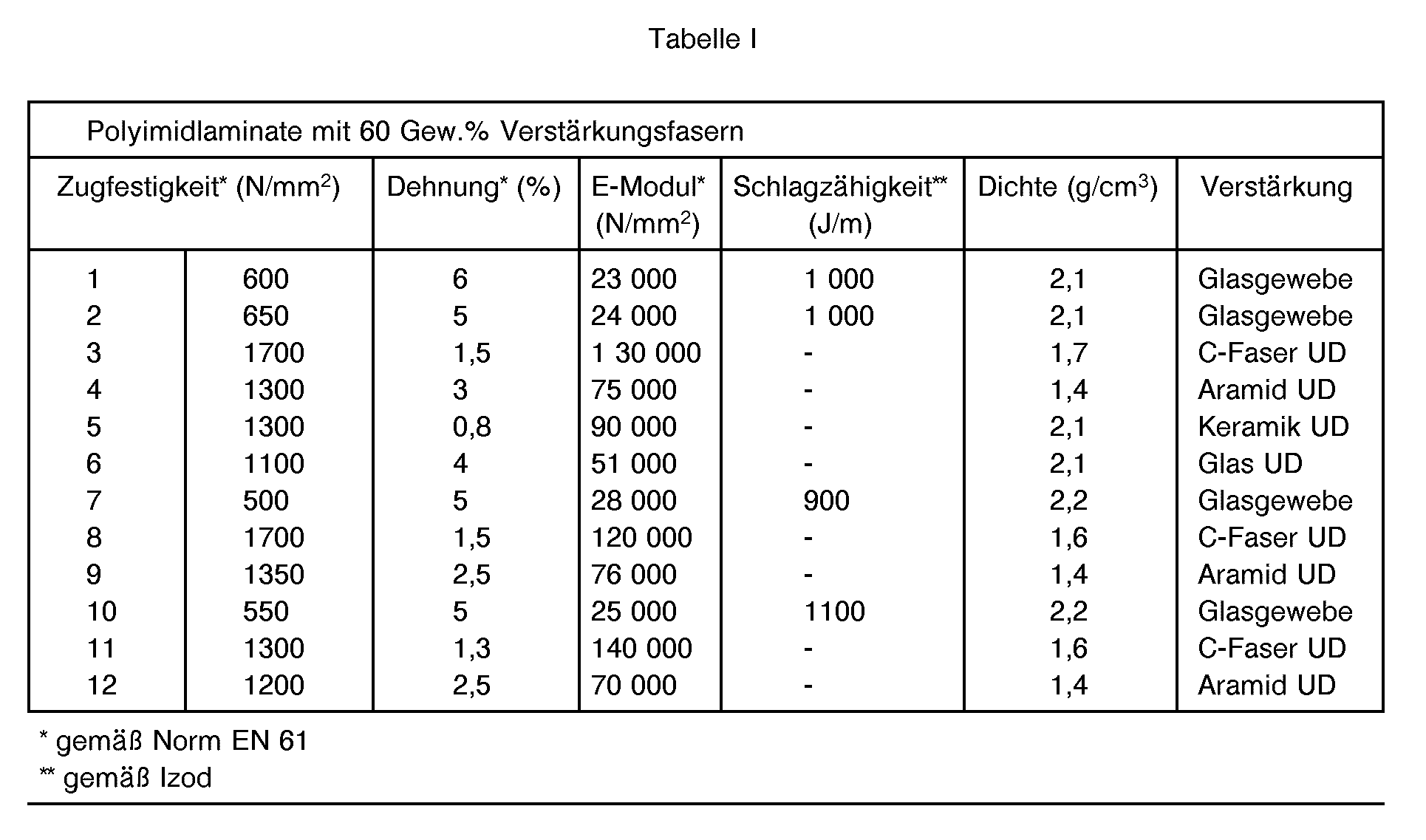
- the mechanical properties of the laminate are summarized in Table 1.
- the diamines and bismaleimides prepared according to 1.1 and 1.2 were melted together in a molar ratio of 0.4: 1 for 5 minutes at 150 ° C.
- the cooled melt was ground to a grain size of less than 0.1 mm and dissolved in NMP to a 50% by weight solution (viscosity at room temperature: 1 Pas).
- a layer of unidirectional (UD) carbon fiber rovings (820 tex, Toho Rayon (R) HTA7 12000) with 185 strands per 1 m width was impregnated with the polyimide solution on a continuous impregnation system.
- the gap width of the doctor blade was chosen so that a prepreg with a resin content of 40% by weight was obtained after drying at 150 ° C.
- the prepreg was then pressurized at 160 ° C. for 15 minutes without pressure and cured at 180 ° C. and 20 bar pressure for 1 hour, and pressurized at 200 ° C. for 48 hours without pressure.
- the thickness of the laminate was 0.12 mm, the weight per unit area 250 g / m 2.
- the mechanical properties of the laminate are summarized in Table I.
- a fiber-reinforced laminate was produced analogously to Example 3, but instead of carbon fiber, a scrim made of unidirectional (UD) Kevlar 49 (aramid fiber from Du Pont), which consisted of 950 strands each of 158 tex per 1 m width, was used for the impregnation the polyimide solution was used.
- UD unidirectional
- Kevlar 49 aramid fiber from Du Pont
- the cured laminate was 0.14 mm thick and the weight per unit area was 250 g / m 2.
- the mechanical properties are summarized in Table I.
- a fiber-reinforced laminate was produced analogously to Example 3, but using a unidirectional (UD) scrim made of a ceramic fiber (Si-Ti-C-0 fiber, Tyrano ( R ) from Ube as fiber reinforcement instead of the UD carbon fiber. Japan), which consisted of 1500 strands of 100 tex per 1 m width, was used for impregnation with the polyimide solution.
- UD unidirectional
- the cured laminate was 0.12 mm thick and the weight per unit area was 250 g / m 2.
- the mechanical properties of the laminate are summarized in Table I.
- a fiber-reinforced laminate was produced analogously to Example 3, except that unidirectional glass roving from Gevetex, FRG (EC 11-2400 K 247 (50)) was impregnated with the polyimide solution as fiber reinforcement instead of carbon fiber. 65 strands of 2400 tex each were laid per 1 m width.
- the cured laminate was 1.2 mm thick and the weight per unit area was 250 g / m 2.
- the mechanical properties are summarized in Table I.
- Diamines and bismaleimides produced were sintered in a molar ratio of 0.4: 1 for 5 minutes at 150 ° C.
- the cooled melt was ground to a grain size of less than 0.1 mm and dissolved in NMP to a 50% solution.
- the diamines and bismaleimides prepared according to 7.1 and 7.2 were melted together in a molar ratio of 0.4: 1 for 5 minutes at 150 ° C.
- the cooled melt was ground to a grain size of less than 0.1 mm and dissolved in NMP to a 50% by weight solution (viscosity at room temperature: 1 Pas).
- a layer of unidirectional (UD) carbon fiber rovings (820 tex, Toho Rayon (R) HTA7 12000) with 185 strands per 1 m width was impregnated with the polyimide solution on a continuous impregnation system.
- the gap width of the doctor blade was chosen so that a prepreg with a resin content of 40% by weight was obtained after drying at 150 ° C.
- the prepreg was then pressurized at 160 ° C. for 15 minutes without pressure and cured at 180 ° C. and 20 bar pressure for 1 hour, and pressurized at 200 ° C. for 48 hours without pressure.
- the thickness of the laminate was 0.12 mm, the weight per unit area 250 g / m 2.
- the mechanical properties of the laminate are summarized in Table I.
- a fiber-reinforced laminate was produced analogously to Example 8, but instead of carbon fiber, a scrim made of unidirectional (UD) Kevlar 49 (aramid fiber from Du Pont), which consisted of 950 strands each of 158 tex per 1 m width, was used for the impregnation with the polyimide solution was used.
- UD unidirectional
- Kevlar 49 aramid fiber from Du Pont
- the cured laminate was 0.14 mm thick and the weight per unit area was 250 g / m 2.
- the mechanical properties are summarized in Table I.
- the nitro compound obtained was dissolved in a 5% strength solution in toluene, 2.5% by weight of palladium-carbon catalyst was added and the mixture was hydrogenated at 120 ° C. until no more hydrogen was consumed. After filtering off the catalyst and evaporating the solution, 8 g of 3,5-bis (4-aminophenylthio) thiadiazole with a sulfur content of 29% by weight were obtained.
- a layer of unidirectional (UD) carbon fiber rovings (820 tex, Toho Rayon (R) HTA7 12000) with 185 strands per 1 m width was impregnated with this polymer solution on a continuous impregnation system.
- the gap width of the doctor blade was chosen so that after drying at 150 ° C. for 8 Minutes in the drying tower, a prepreg with a resin content of 40% by weight was obtained.
- the prepreg was then pressurized at 160 ° C. for 15 minutes without pressure and cured at 180 ° C. and 20 bar pressure for 1 hour, and pressurized at 200 ° C. for 48 hours without pressure.
- the thickness of the laminate was 0.12 mm, the weight per unit area 250 g / m 2 .
- the mechanical properties of the laminate are summarized in Table 1.
- a fiber-reinforced laminate was produced analogously to Example 11, but instead of carbon fiber, a scrim made of unidirectional (UD) Kevlar 49 (aramid fiber from Du Pont), which consisted of 950 strands each of 158 tex per 1 m width, was used for the impregnation the polyimide solution was used.
- UD unidirectional
- Kevlar 49 aramid fiber from Du Pont
- the cured laminate was 0.14 mm thick and the weight per unit area was 250 g / m 2.
- the mechanical properties are summarized in Table I.
Landscapes
- Chemical & Material Sciences (AREA)
- Organic Chemistry (AREA)
- Health & Medical Sciences (AREA)
- Chemical Kinetics & Catalysis (AREA)
- Medicinal Chemistry (AREA)
- Polymers & Plastics (AREA)
- Reinforced Plastic Materials (AREA)
- Macromolecular Compounds Obtained By Forming Nitrogen-Containing Linkages In General (AREA)
- Nitrogen- Or Sulfur-Containing Heterocyclic Ring Compounds With Rings Of Six Or More Members (AREA)
- Thiazole And Isothizaole Compounds (AREA)
- Heterocyclic Carbon Compounds Containing A Hetero Ring Having Nitrogen And Oxygen As The Only Ring Hetero Atoms (AREA)
- Plural Heterocyclic Compounds (AREA)
- Nitrogen And Oxygen Or Sulfur-Condensed Heterocyclic Ring Systems (AREA)
Description
- Die Erfindung betrifft Diamine und Bismaleinimide, sowie daraus hergestellte, gegebenenfalls faserverstärkte Polyimide.
- Polyimide auf Basis von Bismaleinimiden sind bereits aus der US-A-3 380 964 bekannt, ihre Herstellung ist durch Erhitzen der Bismaleinimide bei Temperaturen von 80 bis 400 ° C möglich, wobei unter anderem Ethylen-bis-maleinimid, Diphenylmethan-bis-maleinimid, Diphenylether-bis-maleinimid oder Diphenylsulfonbis-maleinimid eingesetzt werden.
- Ein wesentlicher Nachteil dieser bekannten Polyimide liegt jedoch darin, daß sie spröde, schwer schmelzbar und schwer löslich sind, sodaß sie nur schwierig und nur in begrenztem Umfang weiter verarbeitbar sind. Es lassen sich beispielsweise keine Filme oder Folien aus ihnen herstellen, sondern nur harte Laminate.
- Die Aufgabe der Erfindung war es daher, Diamine und Bismaleinimide zu finden, die zu flexiblen, weniger spröden und warmverformbaren Polyimiden polymerisiert werden können, die in nachfolgenden Arbeitsgängen, beispielsweise bei der Imprägnierung von Fasergeweben oder Fasermatten bzw. durch Formpressen, leicht weiter verarbeitet werden können.
- Die Lösung der Aufgabe wurde mit Hilfe von bestimmten Diaminen und Bismaleinimiden gefunden, die in ihrer Kette einen über Äther- bzw. Thioäthergruppen verbundenen Thiazol-, Thiadiazol- oder Triazolring enthalten, und aus denen verbesserte Polyimide hergestellt werden konnten.
- Die Verwendung von Heterocyclen wie z. B. Pyridin, Oxadiazol oder Benzimidazol enthaltenden Diaminen zur Herstellung von Polyimiden auf Basis von aromatischen Tetracarbonsäuren ist beispielsweise aus JP-Kokai 1987-138,472 (C.A. 107: 237486d) bzw. aus Vysokomol. Soedin., Ser.A 1981,23(8)1736-42 (C.A. 96:20532 k) bekannt.
- Gegenstand der vorliegenden Erfindung sind demnach Diamine und Bismaleinimide der allgemeinen Formel

- Ein weiterer Gegenstand der Erfindung sind Verbindungen der Formel 11,

- Für den Fall, daß R1 und R2 ein H-Atom bedeuten, stellen die erfindungsgemäßen chemischen Verbindungen aromatische Diamine, und für den Fall, daß R1 und R2 gemeinsam die Gruppe - OC - CH = CH - CO - bedeuten, aromatische Bismaleinimide dar.
- Die Herstellung der erfindungsgemäßen Substanzen erfolgt durch Reaktion von Dimercapto- oder Dihydroxyheterocyclen, vorzugsweise in Form ihrer Alkalisalze, der allgemeinen Formel III oder IV:
- (K) Na - Y1 - Het - Y2 - Na (K) III

in der Yi, Y2 und Het die oben angegebene Bedeutung haben, mit Chloranilin, wobei man unter Abspaltung von NaCI oder KCI das erfindungsgemäße Diamin der allgemeinen Formel 1 oder II erhält. Es ist auch möglich, die Verbindungen der allgemeinen Formel III oder IV mit p-Chlornitrobenzol umzusetzen, wobei man unter Abspaltung von NaCI oder KCI vorerst die entsprechenden Dinitroverbindungen erhält, welche anschließend mittels Wasserstoffs zum erfindungsgemäßen Diamin der allgemeinen Formel 1 oder II reduziert werden. Die erfindungsgemäßen Bismaleinimide der allgemeinen Formel 1 oder II erhält man durch Umsetzen der erfindungsgemäßen Diamine der allgemeinen Formel 1 oder II mit Maleinsäure oder deren Derivaten, beispielsweise mit Maleinsäureanhydrid. - Die Herstellung der Ausgangsverbindungen gemäß Formel III oder IV erfolgt nach bekannten Verfahren, beispielsweise in Anlehnung an die DE-C-958 650, DE-A-2 360 623, gemäß J.V. Metzger "Thiazole and its Derivatives", Chemistry of Heterocyclic Compounds Vol 34 Part 1 (1979) p. 215, J. Wiley, New York oder gemäß Frank F. Cesark (Northwestern Univ., Evanston, 111). Univ. Microfilms (Ann Arbor, Mich.), Order No. 61-5299, 101 pp.; Dissertation Abstr. 22, 2192 (1962).
- Die erfindungsgemäßen Diamine und Bismaleinimide können zur Herstellung von Polyimiden mit verbesserten Eigenschaften verwendet werden. Die Bismaleinimide können entweder für sich allein, oder gemeinsam mit den Diaminen zu Polyimiden polymerisiert werden.
- Die aus den erfindungsgemäßen Diaminen und Bismaleinimiden hergestellten Polyimide sind ein weiterer Gegenstand der Erfindung. Die Polyimide bestehen aus sich wiederholenden monomeren Einheiten von Verbindungen gemäß Formel 1 oder II, wobei im Falle der Verwendung von Bismaleinimiden allein, die Polymerbindung über die Doppelbindungen der Maleinimidreste erfolgt, und im Falle der Verwendung von Bismaleinimiden und Diaminen außerdem eine Anlagerung der NH2 -Gruppen des Diamins an die Doppelbindung des Maleinimidrestes erfolgt. Bevorzugt sind Polyimide, die aus 0 bis 0,8 Molen Diamin je 1 Mol Bismaleinimid aufgebaut sind, wobei ein molares Verhältnis von Diamin zu Bismaleinimid von 0,2 : 1 bis 0,6 : 1 besonders bevorzugt ist.
- Zur Verbesserung der mechanischen Eigenschaften können die Polyimide für bestimmte Anwendungen vorteilhaft mit Fasern verstärkt werden, wobei sowohl Kurzfasern als auch Fasermatten, Fasergelege oder Gewebe zur Verstärkung eingesetzt werden können. Der Anteil an Verstärkungsfasern im Verbund liegt dabei üblicherweise bei etwa 20 - 70 Gew.%. Das Flächengewicht der Fasermatten liegt üblicherweise bei etwa 250 - 1.200 g/m2, jenes von Geweben bei etwa 100 - 300 g/m2.
- Entsprechend den Ansprüchen an die mechanischen Eigenschaften können beispielsweise Glasfasern, Kohlefasern, Keramikfasern oder Aramidfasern, bzw. Mischungen aus diesen Fasern oder Hybridgelege bzw. Hybridgewebe eingesetzt werden. Kohlefasern oder Aramidfasern kommen vor allem dort zum Einsatz, wo insbesondere an Festigkeit, Steifigkeit und geringes spezifisches Gewicht der aus den Polyimiden hergestellten Teile besondere Anforderungen gestellt werden.
- In vielen Fällen erweist es sich als besonders vorteilhaft, die Polyimide nicht vollständig auszuhärten, sodaß sie noch verformbar, schmelzbar und hitzehärtbar bleiben, und gegebenenfalls in einem nachfolgenden Heißpreßvorgang zu einem Fertigteil umgeformt werden können. Dies ist im Falle von Prepregs von Bedeutung. Prepregs bestehen bevorzugt aus mit Fasergeweben bzw. Fasergelegen verstärkten, nur teilweise ausgehärteten Polyimiden, sind lagerfähig und können auch noch nach Monaten zum gewünschten Fertigteil heißverpreßt werden.
- Die Herstellung der erfindungsgemäßen Polyimide erfolgt beispielsweise durch Aufschmelzen des erfindungsgemäßen Bismaleinimids, gegebenenfalls gemeinsam mit dem erfindungsgemäßen Diamin, auf Temperaturen von 100 bis 300 ° C, wobei ein Temperaturbereich von 120 bis 160 ° C besonders bevorzugt ist. Die Ausgangsmaterialien werden vor und nach dem Aufschmelzen vorteilhafterweise gemahlen. Entsprechend der gewählten Temperatur und der Dauer des Aufschmelzens erfolgt eine mehr oder weniger vollständige Aushärtung des Polyimidharzes. Je nach verwendeten Einsatzstoffen kann eine weitgehende Aushärtung des Polyimidharzes beispielsweise bei einer Wärmebehandlung von etwa 80 Minuten bei etwa 120°C, oder innerhalb von 15 Minuten bei etwa 160°C erreicht werden. Bei nicht ausreichender Wärmebehandlung härtet das Polyimid nur teilweise aus, und kann in einem zu einem späteren Zeitpunkt nachfolgenden Verfahrensschritt endgültig zum gewünschten Fertigteil ausgehärtet werden.
- Zur Herstellung von faserverstärkten Polyimidharzen können beispielsweise die Verstärkungsfasern mit dem Bismaleinimid und gegebenenfalls dem Diamin gemischt und anschließend unter Bildung des Polyimidharzes erhitzt und aufgeschmolzen werden. Es ist auch möglich, die Fasern mit dem bereits teilweise ausgehärteten Polyimidpulver zu mischen und gegebenenfalls zu verschmelzen. Die Herstellung faserverstärkter Laminate oder Prepregs gelingt beispielsweise dadurch, daß man ein Fasergelege oder Gewebe mit dem pulverförmigen Bismaleinimid und Diamin, oder dem bereits teilweise ausgehärteten Polyimidpulver imprägniert. Dabei können Lösungsmittel, beispielsweise Dimethylformamid (DMF) oder N-Methylpyrrolidon (NMP) verwendet werden, ihre Anwesenheit ist jedoch nicht unbedingt erforderlich.
- Besonders vorteilhaft gestaltet sich die kontinuierliche Herstellung von faserverstärkten Laminaten, wobei man die pulverförmigen Komponenten beispielsweise auf das Band einer Doppelbandpresse dosiert und gleichzeitig eine oder mehrere Lagen der Faserverstärkung mit in die Presse einlaufen läßt. In der Doppelbandpresse erfolgt die Imprägnierung der Matten, Gelege oder Gewebe mit den aufgeschmolzenen Ausgangsstoffen, sowie die Bildung bzw. Aushärtung der Polyimide bei Drücken von 1 bis 20 bar und Temperaturen von 100 bis 300 °C. Die Fertigung von Polyimid-Prepregs erfolgt beispielsweise auf Imprägnieranlagen unter Einsatz von Geweben und Lösungen des erfindungsgemäßen Polyimidharzes in NMP. Die Konzentration der Lösungen liegt bei 20 - 60 Gew.%. Die Temperatur im Trockner, beispielsweise einem Trockenturm bzw. einem waagrechten Trockentunnel, beträgt 150 - 200 °C. Die nur teilweise ausgehärteten faserverstärkten Polyimid-Prepregs lassen sich in einem späteren Verarbeitungsschritt unter Druck- und Temperatureinwirkung zu einem Fertigteil verarbeiten, beispielsweise zu Leiterplatten, Elektrospulkernen, Teilen von Verbrennungsmotoren oder Geräteteilen für die Luft- und Raumfahrt.
- Die Herstellung des Diamins erfolgte in Anlehnung an E. Müller, Houben-Weyl, Methoden der Organischen Chemie, Band IX (1955) p. 93 und Band XI/1 (1957) p. 341, G. Thieme, Stuttgart.
- In einem 250 ml Dreihalskolben wurden 3 g Natriumhydroxid in 5 ml Wasser gelöst, 3,8 g (25 mmol 2,5-Dimercapto-1,3,4-thiadiazol zugegeben und auf 100 ° C erhitzt. Die entstandene klare Lösung wurde 30 Minuten gerührt, worauf 79 g (50 mmol) 1-Chlor-4-Nitrobenzol, gelöst in 75 ml DMF, zugetropft wurden.
- Das Reaktionsgemisch wurde 4 Stunden unter Rückfluß gekocht, dann weitgehend eingedampft und abgekühlt. Der Rückstand wurde in Wasser aufgenommen, gerührt, abfiltriert und mit Wasser gewaschen. Der Filterrückstand wurde in Aceton gelöst, mit Wasser gefällt, filtriert und getrocknet. Man erhielt 8,8 g (80 % d. Th.) 2,5 Bis-(4-Nitrothiophenyl)-1,3,4-thiadiazol mit einem Schmelzpunkt von 210 ° C und einem Schwefelgehalt von 24,5 Gew.%.
- Die Nitroverbindung wurde in Toluol gelöst (5 %ige Lösung), 2,5 Gew.% eines Palladium-Kohlenstoffkatalysators (Fa. Heraeus, 5 % Pd auf C) zugesetzt und sodann bei 120°C mittels Tauchrohres während 7 Stunden Wasserstoff eingeleitet, bis kein Wasserstoffverbrauch mehr erfolgte. Nach Abfiltration des Katalysators und Eindampfen der Lösung erhielt man 7,3 g (97 % d. Th.) 2,5 Bis-(4-Aminophenylthio)-1,3,4-thiadiazol).
- Fp = 253 ° C
- Schwefel-Gehalt = 29 Gew.%
- 332 g (1 Mol) des gemäß 1.1 hergestellten Diamins wurden in 500 g DMF gelöst und 196 g (2 Mol) Maleinsäureanhydrid, gelöst in 500 g DMF, bei -5 ° C portionsweise zugegeben. Danach fügte man 300 g Essigsäureanhydrid und 15 g Na-Acetat (fest) zu, erwärmte auf 55 ° C und hielt diese Temperatur während 1 Stunde. Dann ließ man das Reaktionsgemisch langsam in 5000 g Eiswasser einlaufen und rührte während 3 Stunden, wobei das Bismaleinimid ausfiel. Der Niederschlag wurde abfiltriert und mit 4000 g Wasser gewaschen, bis das Filtrat neutral war. Nach dem Trocknen wurden 454 g 2,5 Bis(4- maleinimidophenylthio)-1,3,4-thiadiazol (90 % d. Th.) erhalten.
- Fp = 263 ° C
- 1.3. Herstellung des Polyimids
- Die gemäß 1.1 und 1.2 hergestellten Diamine und Bismaleinimide wurden im Molverhältnis 0,4 : 1 vermischt, auf eine Korngröße von unter 0,2 mm gemahlen und innerhalb von 5 Minuten bei 150 ° C aufgeschmolzen. Das erhaltene Polyimid wurde abgekühlt und wieder auf eine Korngröße von unter 0,2 mm gemahlen.
- 24 kg/h des Polyimidpulvers wurden aus einem Schüttkasten auf das Band einer Doppelbandpresse dosiert und gleichzeitig ein Glasgewebe mit 296 g/m2 Flächengewicht (Nr. 92626, Interglas) zugefahren. Die Temperatur in der Heizzone der Doppelbandpresse betrug 150°C, der Preßdruck 5 bar, die Bandgeschwindigkeit lag bei 2 m/min. Nach dem Abkühlen unter Druck in einer anschließenden Kühlzone der Doppelbandpresse erhielt man eine 0,23 mm dicke, 1 m breite Prepregplatte. Die Eigenschaften der Platte nach dem Aushärten (10 Minuten bei 160 ° C drucklos, 1 Stunde bei 180 ° C und 20 bar Druck, 48 Stunden bei 200 ° C drucklos) sind in Tabelle 1 zusammengestellt.
- 3 g Natriumhydroxid wurden in einem 250 ml Dreihalskolben in 5 ml Wasser gelöst und 3,3 g (25 mmol) Rhodanin zugegeben. Die erhaltene klare Lösung wurde auf 100 ° C erwärmt und 6,25 g (50 mmol) p-Chloranilin, in 75 ml DMF gelöst, zugegeben, worauf man 4 Stunden unter Rückfluß kochte. Anschließend wurde unter Vakuum weitgehend eingedampft und der Rückstand in Wasser aufgenommen. Der Niederschlag wurde filtriert, in Aceton gelöst, mit Wasser gefällt, filtriert und getrocknet. Man erhielt 6,3 g 2-(4-Aminophenylthio)-4-(4-Aminophenyloxo)-1,3-thiazol (80 % d. Th.) mit 20,3 Gew.% Schwefelgehalt und einem Schmelzpunkt von 175 ° C.
- 2.2. Herstellung des Bismaleinimids (2-(4-Maleinimidophenylthio)4-(4-Maleinimidophenyloxo)-1,3-thiazol) 315 g des gemäß 2.1 hergestellten Diamins (1 Mol) wurden in 500 g DMF gelöst und 196 g (2 Mol) Maleinsäureanhydrid, in 500 g DMF gelöst, bei -5 ° C portionsweise zugegeben. Danach fügte man 300 g Essigsäureanhydrid und 15 g Natriumacetat (fest) zu, erwärmte das Reaktionsgemisch auf 55 ° C und hielt eine Stunde bei dieser Temperatur. Danach ließ man das Reaktionsgemisch langsam in 5000 g Eiswasser zulaufen und rührte 3 Stunden, wobei das Bismaleinimid ausfiel. Der Niederschlag wurde abfiltriert und mit etwa 4000 g Wasser gewaschen, bis das Filtrat einen pH-Wert von 7 aufwies. Nach dem Trocknen erhielt man 438 g (90 % d. Th.) 2-(4-Maleinimidophenylthio)4-(4-Maleinimidophenyloxo)-1,3-thiazol mit einem Schmelzpunkt von 205 ° C.
- Die gemäß 2.1 und 2.2 hergestellten Diamine und Bismaleinimide wurden im Molverhältnis 0,4 : 1 gemeinsam während 5 Minuten bei 150 ° C aufgeschmolzen. Die erkaltete Schmelze wurde auf eine Korngröße von unter 0,1 mm vermahlen und in NMP zu einer 50 Gew.%igen Lösung (Viskosität bei Raumtemperatur: 0,5 Pas) gelöst.
- Ein 1 m breites Glasgewebe mit 296 g/m2 Flächengewicht (Nr. 92626, Interglas) wurde auf einer kontinuierlichen Imprägnieranlage bei 23 ° C mit dieser Lösung imprägniert. Die Spaltbreite der Rakel wurde so gewählt, daß nach dem Trocknen bei 150 ° C während 8 Minuten im Trockenturm ein Prepreg mit einem Harzgehalt von 40 Gew.% erhalten wurde. Das Prepreg wurde anschließend während 15 Minuten bei 160°C drucklos und während 1 Stunde bei 180°C und 20 bar Druck gehärtet, sowie während 48 Stunden bei 200 ° C drucklos getempert. Die Dicke des Laminats betrug 0,24 mm, das Flächengewicht 493 g/m2. Die mechanischen Eigenschaften des Laminats sind in Tabelle 1 zusammengestellt.
- Die gemäß 1.1 und 1.2 hergestellten Diamine und Bismaleinimide wurden im Molverhältnis 0,4 : 1 gemeinsam während 5 Minuten bei 150°C aufgeschmolzen. Die erkaltete Schmelze wurde auf eine Korngröße von unter 0,1 mm vermahlen und in NMP zu einer 50 Gew.%igen Lösung (Viskosität bei Raumtemperatur: 1 Pas) gelöst. Auf einer kontinuierlichen Imprägnieranlage wurde ein Gelege aus unidirektionalen (UD) Kohlefaserrovings (820 tex, Toho Rayon(R) HTA7 12000) mit 185 Strängen pro 1 m Breite mit der Polyimidlösung imprägniert. Die Spaltbreite der Rakel wurde so gewählt, daß nach dem Trocknen bei 150 ° C während 8 Minuten im Trockenturm ein Prepreg mit einem Harzgehalt von 40 Gew.% erhalten wurde. Das Prepreg wurde anschließend während 15 Minuten bei 160 ° C drucklos und während 1 Stunde bei 180 ° C und 20 bar Druck gehärtet, sowie während 48 Stunden bei 200 ° C drucklos getempert. Die Dicke des Laminats betrug 0,12 mm, das Flächengewicht 250 g/m2. Die mechanischen Eigenschaften des Laminats sind in Tabelle I zusammengestellt.
- Analog zu Beispiel 3 wurde ein faserverstärktes Laminat hergestellt, wobei jedoch als Faserverstärkung statt der Kohlefaser ein Gelege aus unidirektionalem (UD) Kevlar 49 (Aramidfaser von Du Pont), das aus 950 Strängen zu je 158 tex pro 1 m Breite bestand, zur Imprägnierung mit der Polyimidlösung verwendet wurde.
- Das ausgehärtete Laminat war 0,14 mm dick, das Flächengewicht lag bei 250 g/m2. Die mechanischen Eigenschaften sind in Tabelle I zusammengestellt.
- Analog zu Beispiel 3 wurde ein faserverstärktes Laminat hergestellt, wobei jedoch als Faserverstärkung statt der UD-Kohlefaser ein unidirektionales (UD) Gelege aus einer Keramikfaser (Si-Ti-C-0-Faser, Tyran- no(R) von Fa. Ube, Japan), das aus 1500 Strängen zu je 100 tex pro 1 m Breite bestand, zur Imprägnierung mit der Polyimidlösung verwendet wurde.
- Das ausgehärtete Laminat war 0,12 mm dick, das Flächengewicht lag bei 250 g/m2. Die mechanischen Eigenschaften des Laminats sind in Tabelle I zusammengestellt.
- Analog zu Beispiel 3 wurde ein faserverstärktes Laminat hergestellt, wobei jedoch als Faserverstärkung statt der Kohlefaser ein unidirektionaler Glasroving der Fa. Gevetex, BRD (EC 11-2400 K 247(50)) mit der Polyimidlösung imprägniert wurde. Pro 1 m Breite wurden 65 Stränge mit je 2400 tex verlegt.
- Das ausgehärtete Laminat war 1,2 mm dick, das Flächengewicht lag bei 250 g/m2. Die mechanischen Eigenschaften sind in Tabelle I zusammengestellt.
- In einem 250 ml Dreihalskolben wurden 3 g NaOH in 5 ml Wasser gelöst und 2,33 g (25 mmol) 1 Methyl-3-hydroxy-5-mercapto-1,2,4-triazol (Herstellung gemäß DE-OS 23 60 623) zugegeben. Die erhaltene klare Lösung wurde auf 100 ° C erwärmt, 6,25 g (50 mmol) p-Chloranilin, in 75 ml DMF gelöst, zugegeben und 4 h unter Rückfluß gekocht. Anschließend wurde unter Vakuum weitgehend eingedampft und der Rückstand in Wasser aufgenommen. Der Niederschlag wurde filtriet, in Aceton gelöst, mit Wasser gefällt, filtriert und getrocknet, wobei 6,33 g 1-Methyl-3-(4-aminophenyloxo-)5(4-aminophenylthio- )1,2,4-triazol (85 % d. Th.) erhalten wurden. Der Schwefelgehalt betrug 10,7 Gew.%, der Schmelzpunkt lag bei 180°C.
- 5,6 g Maleinsäureanhydrid wurden unter Rühren in 28,8 ml Toluol gelöst und innerhalb einer Stunde bei maximal 30 ° C eine Lösung aus 6,9 g (23 mmol) des Diamins gemäß 7.1. in 15,8 ml Toluol und 4,8 ml Dimethylformamid (DMF) zudosiert, wobei eine Suspension der gelben Amidsäure gebildet wurde. Anschließend setzte man 0,45 g p-Toluolsulfonsäure zu und kochte das Reaktionsgemisch während 4 Stunden am Rückfluß bei 112°C. Dabei wurden über einen Wasserabscheider insgesamt 0,8 ml Wasser abgeschieden, wonach eine klare Lösung vorlag.
- Das Toluol wurde anschließend unter Vakuum abdestilliert, der Rückstand mit 11,4 ml Aceton verdünnt und bei 10 ° C während 2 Stunden mit 28 ml einer 2 %igen wäßrigen Sodalösung versetzt. Anschließend rührte man 15 min, filtrierte den gebildeten Niederschlag ab, wusch 2 mal mit 14 ml Wasser und trocknete bei 60 ° C im Vakuum. Es wurden 9,5 g des entsprechenden Bismaleinimids erhalten (90 % d. Th.)
- Die gemäß 7.1. und 7.2. hergestellten Diamine und Bismaleinimide wurden im Molverhältnis 0,4 : 1 während 5 Minuten bei 150 ° C versintert. Die erkaltete Schmelze wurde auf eine Korngröße von kleiner als 0,1 mm vermahlen und in NMP zu einer 50 %igen Lösung gelöst.
- Anschließend wurde mit dieser Lösung analog zu 2.3. ein glasfaserverstärktes Laminat mit einer Dicke von 0,24 mm und einem Flächengewicht von 493 g/m2 hergestellt. Die mechanischen Eigenschaften des Laminats sind in Tabelle 1 zusammengestellt.
- Die gemäß 7.1 und 7.2 hergestellten Diamine und Bismaleinimide wurden im Molverhältnis 0,4 : 1 gemeinsam während 5 Minuten bei 150°C aufgeschmolzen. Die erkaltete Schmelze wurde auf eine Korngröße von unter 0,1 mm vermahlen und in NMP zu einer 50 Gew.%igen Lösung (Viskosität bei Raumtemperatur: 1 Pas) gelöst. Auf einer kontinuierlichen Imprägnieranlage wurde ein Gelege aus unidirektionalen (UD) Kohlefaserrovings (820 tex, Toho Rayon(R) HTA7 12000) mit 185 Strängen pro 1 m Breite mit der Polyimidlösung imprägniert. Die Spaltbreite der Rakel wurde so gewählt, daß nach dem Trocknen bei 150 ° C während 8 Minuten im Trockenturm ein Prepreg mit einem Harzgehalt von 40 Gew.% erhalten wurde. Das Prepreg wurde anschließend während 15 Minuten bei 160 ° C drucklos und während 1 Stunde bei 180 ° C und 20 bar Druck gehärtet, sowie während 48 Stunden bei 200 ° C drucklos getempert. Die Dicke des Laminats betrug 0,12 mm, das Flächengewicht 250 g/m2. Die mechanischen Eigenschaften des Laminats sind in Tabelle I zusammengestellt.
- Analog zu Beispiel 8 wurde ein faserverstärktes Laminat hergestellt, wobei jedoch als Faserverstärkung statt der Kohlefaser ein Gelege aus unidirektionalem (UD) Kevlar 49 (Aramidfaser von Du Pont), das aus 950 Strängen zu je 158 tex pro 1 m Breite bestand, zur Imprägnierung mit der Polyimidlösung verwendet wurde.
- Das ausgehärtete Laminat war 0,14 mm dick, das Flächengewicht lag bei 250 g/m2. Die mechanischen Eigenschaften sind in Tabelle I zusammengestellt.
- In einem 250 ml Dreihalskolben wurden 3 g NaOH in 5 ml Wasser gelöst, 3,8 g (25 mmol) 3,5-Dimercapto-1,2,4-thiadiazol (Herstellung analog zu US 3 899 502, bzw. Z. Anorgan. Allgem. Chemie Vol. 486 (1982), Seite 111 - 115) zugegeben und auf 100 ° C erhitzt. Zu der klaren Lösung wurden 79 g (50 mmol) 1-Chlor-4-Nitrobenzol, gelöst in 75 ml DMF, zudosiert. Nach 4 Stunden Kochen am Rückfluß wurde eingedampft und der Rückstand in Wasser aufgenommen, gewaschen und abfiltriert. Nach dem Umkristallisieren aus einem Aceton-Wassergemisch erhielt man 9 g (92 % d. Th.) 3,5-Bis(4-nitrophenylt- hio)1,2,4-thiadiazol).
- Die erhaltene Nitroverbindung wurde zu einer 5 %igen Lösung in Toluol gelöst, mit 2,5 Gew.% Palladium-Kohlenstoffkatalysator versetzt und bei 120 ° C hydriert, bis kein Wasserstoff mehr verbraucht wurde. Nach Abfiltration des Katalysators und Eindampfen der Lösung erhielt man 8 g 3,5-Bis(4-aminophenylthio)thiadiazol mit einem Schwefelgehalt von 29 Gew.%.
- 332 g (1 Mol) des gemäß 10.1. hergestellten Diamins wurden analog zu 1.2. mit 2 Mol Maleinsäureanhydrid umgesetzt, wobei 460 g 3,5-Bis (4-maleinimidophenylthio)-1,2,4-thiadiazol mit einem Schmelzpunkt von 180°C erhalten wurden.
- Die gemäß 10.1. und 10.2. hergestellten Diamine und Bismaleinimide wurden im Molverhältnis 0,4 : 1 in NMP zu einer 50 %igen Lösung gelöst, in einem Rohrreaktor (Ullmann, Enzyklopädie der Techn.
- Chemie, Band 3, Seite 350, Verlag Chemie 1973) während 5 min auf 150 ° C erhitzt und in Wasser gefällt. Das ausfallende Polymere wurde abfiltriert und das NMP rückgeführt. Das erhaltene Polymer wurde in NMP zu einer 50 %igen Lösung gelöst.
- Anschließend wurde mit dieser Lösung analog zu 2.3. ein glasfaserverstärktes Laminat hergestellt, die Eigenschaften sind in Tabelle 1 zusammengestellt.
- Die gemäß 10.1. und 10.2. hergestellten Diamine und Bismaleinimide wurden im Molverhältnis 0,4 : 1 in NMP zu einer 50 %igen Lösung gelöst, in einem Rohrreaktor während 5 min auf 150 ° C erhitzt und in Wasser gefällt. Das ausfallende Polymere wurde in NMP zu einer 50 %igen Lösung gelöst.
- Auf einer kontinuierlichen Imprägnieranlage wurde ein Gelege aus unidirektionalen (UD) Kohlefaserrovings (820 tex, Toho Rayon(R) HTA7 12000) mit 185 Strängen pro 1 m Breite mit dieser Polymerlösung imprägniert. Die Spaltbreite der Rakel wurde so gewählt, daß nach dem Trocknen bei 150 ° C während 8 Minuten im Trockenturm ein Prepreg mit einem Harzgehalt von 40 Gew.% erhalten wurde. Das Prepreg wurde anschließend während 15 Minuten bei 160 ° C drucklos und während 1 Stunde bei 180 ° C und 20 bar Druck gehärtet, sowie während 48 Stunden bei 200 ° C drucklos getempert. Die Dicke des Laminats betrug 0,12 mm, das Flächengewicht 250 g/m2. Die mechanischen Eigenschaften des Laminats sind in Tabelle 1 zusammengestellt.
- Analog zu Beispiel 11 wurde ein faserverstärktes Laminat hergestellt, wobei jedoch als Faserverstärkung statt der Kohlefaser ein Gelege aus unidirektionalem (UD) Kevlar 49 (Aramidfaser von Du Pont), das aus 950 Strängen zu je 158 tex pro 1 m Breite bestand, zur Imprägnierung mit der Polyimidlösung verwendet wurde.
- Das ausgehärtete Laminat war 0,14 mm dick, das Flächengewicht lag bei 250 g/m2. Die mechanischen Eigenschaften sind in Tabelle I zusammengestellt.
Claims (10)


Applications Claiming Priority (3)
| Application Number | Priority Date | Filing Date | Title |
|---|---|---|---|
| AT506/88 | 1988-02-26 | ||
| AT0050688A AT390059B (de) | 1988-02-26 | 1988-02-26 | Diamine und bismaleinimide, sowie daraus hergestellte polyimide |
| DE3808781A DE3808781A1 (de) | 1988-02-26 | 1988-03-16 | Heterocyclisch substituierte diamine und bismaleinimide, sowie daraus hergestellte polyimide |
Publications (2)
| Publication Number | Publication Date |
|---|---|
| EP0330020A1 EP0330020A1 (de) | 1989-08-30 |
| EP0330020B1 true EP0330020B1 (de) | 1994-07-20 |
Family
ID=25592979
Family Applications (2)
| Application Number | Title | Priority Date | Filing Date |
|---|---|---|---|
| EP89102234A Expired - Lifetime EP0330020B1 (de) | 1988-02-26 | 1989-02-09 | Diamine und Bismaleinimide sowie daraus hergestellte Polyimide |
| EP89902042A Pending EP0394361A1 (de) | 1988-02-26 | 1989-02-09 | Diamine und bismaleinimide, sowie daraus hergestellte polyimide |
Family Applications After (1)
| Application Number | Title | Priority Date | Filing Date |
|---|---|---|---|
| EP89902042A Pending EP0394361A1 (de) | 1988-02-26 | 1989-02-09 | Diamine und bismaleinimide, sowie daraus hergestellte polyimide |
Country Status (7)
| Country | Link |
|---|---|
| US (1) | US5175224A (de) |
| EP (2) | EP0330020B1 (de) |
| JP (1) | JPH03503406A (de) |
| AT (2) | AT390059B (de) |
| DE (2) | DE3808781A1 (de) |
| ES (1) | ES2056972T3 (de) |
| WO (1) | WO1989008107A1 (de) |
Families Citing this family (20)
| Publication number | Priority date | Publication date | Assignee | Title |
|---|---|---|---|---|
| US5244999A (en) * | 1988-02-26 | 1993-09-14 | Petrochemie Danubia Gesellschaft M.B.H. | Polyimide from diamine and bismaleimide having azole ring |
| JP5299607B2 (ja) * | 2006-10-04 | 2013-09-25 | 東洋紡株式会社 | ポリイミド樹脂、ポリイミドワニス、及びポリイミドフィルム |
| JP5354493B2 (ja) * | 2009-02-18 | 2013-11-27 | 国立大学法人東京工業大学 | ジアミン化合物、それを使用して製造されるポリアミック酸及びイミド化重合体 |
| US9111658B2 (en) | 2009-04-24 | 2015-08-18 | Applied Nanostructured Solutions, Llc | CNS-shielded wires |
| WO2010124260A1 (en) | 2009-04-24 | 2010-10-28 | Lockheed Martin Corporation | Cnt-infused emi shielding composite and coating |
| US20110089958A1 (en) * | 2009-10-19 | 2011-04-21 | Applied Nanostructured Solutions, Llc | Damage-sensing composite structures |
| US9167736B2 (en) | 2010-01-15 | 2015-10-20 | Applied Nanostructured Solutions, Llc | CNT-infused fiber as a self shielding wire for enhanced power transmission line |
| EP2629595A2 (de) | 2010-09-23 | 2013-08-21 | Applied NanoStructured Solutions, LLC | CNT-infundierte Faser als selbstabschirmendes Kabel für eine Übertragungsleitung mit erhöhter Leistung |
| US9085464B2 (en) | 2012-03-07 | 2015-07-21 | Applied Nanostructured Solutions, Llc | Resistance measurement system and method of using the same |
| CN105567403B (zh) * | 2014-10-23 | 2018-05-18 | 中国石油化工股份有限公司 | 减磨性能优异的复合锂钙基润滑脂组合物及其制备方法 |
| CN105524698B (zh) * | 2014-10-23 | 2018-05-18 | 中国石油化工股份有限公司 | 一种减磨性能优异的复合钡基润滑脂组合物及其制备方法 |
| CN105586116B (zh) * | 2014-10-23 | 2018-05-18 | 中国石油化工股份有限公司 | 一种减磨性能优异的膨润土润滑脂组合物及其制备方法 |
| CN105586129B (zh) * | 2014-10-23 | 2018-05-18 | 中国石油化工股份有限公司 | 一种减磨性能优异的钠基润滑脂组合物及其制备方法 |
| CN105586115B (zh) * | 2014-10-23 | 2018-05-18 | 中国石油化工股份有限公司 | 一种减磨性能优异的锂基润滑脂组合物及其制备方法 |
| CN105586131B (zh) * | 2014-10-23 | 2018-05-18 | 中国石油化工股份有限公司 | 一种抗氧性能优异的复合钡基润滑脂组合物及其制备方法 |
| CN105586133B (zh) * | 2014-10-23 | 2018-04-13 | 中国石油化工股份有限公司 | 一种具有优良抗氧化性能的润滑脂组合物 |
| CN105586132B (zh) * | 2014-10-23 | 2018-03-20 | 中国石油化工股份有限公司 | 一种抗氧化性能优异的膨润土润滑脂组合物及其制备方法 |
| CN105586134B (zh) * | 2014-10-23 | 2018-06-19 | 中国石油化工股份有限公司 | 一种减磨性能优异的钙基润滑脂组合物及其制备方法 |
| CN105586137B (zh) * | 2014-10-23 | 2018-05-18 | 中国石油化工股份有限公司 | 一种抗氧性能优异的复合铝基润滑脂组合物及其制备方法 |
| CN105586139B (zh) * | 2014-10-23 | 2018-05-25 | 中国石油化工股份有限公司 | 一种具有优良减磨抗氧化性能的润滑脂组合物 |
Citations (1)
| Publication number | Priority date | Publication date | Assignee | Title |
|---|---|---|---|---|
| US3380964A (en) * | 1964-11-13 | 1968-04-30 | Rhodiaceto | Reticulated polyimides and method of producing same from n, n'-bis-imides |
Family Cites Families (9)
| Publication number | Priority date | Publication date | Assignee | Title |
|---|---|---|---|---|
| DE958650C (de) | 1953-03-15 | 1957-02-21 | Basf Ag | Verfahren zur Herstellung von 2, 5-Dimercapto-1,3,4-thiadiazol |
| GB1209460A (en) * | 1966-12-21 | 1970-10-21 | Monsanto Co | Polyimides containing 2,5-diamino-1,3,4-thiadiazole |
| US3597426A (en) * | 1968-10-02 | 1971-08-03 | M & T Chemicals Inc | Unsymmetrical disubstituted perthiocyanates |
| US3899502A (en) | 1973-05-14 | 1975-08-12 | Monsanto Co | 1,2,4-Thiadiazol-3,5-diyl-sulfenamides |
| US3944525A (en) * | 1973-10-03 | 1976-03-16 | Ciba-Geigy Corporation | Crosslinked resins prepared from an N,N'-bis-imide and a schiff base |
| JPS56103162A (en) * | 1980-01-21 | 1981-08-18 | Hitachi Ltd | Ether-imide and its preparation |
| JPS62133472A (ja) * | 1985-12-05 | 1987-06-16 | Canon Inc | 画像形成装置 |
| JPS62138472A (ja) | 1985-12-11 | 1987-06-22 | Mitsui Toatsu Chem Inc | 2,6−ビス(4−アミノフエノキシ)ピリジンおよびその製造方法 |
| JPH075737B2 (ja) * | 1988-05-17 | 1995-01-25 | 三井東圧化学株式会社 | 熱硬化性樹脂組成物 |
-
1988
- 1988-02-26 AT AT0050688A patent/AT390059B/de not_active IP Right Cessation
- 1988-03-16 DE DE3808781A patent/DE3808781A1/de not_active Withdrawn
-
1989
- 1989-02-09 AT AT89102234T patent/ATE108784T1/de active
- 1989-02-09 WO PCT/EP1989/000120 patent/WO1989008107A1/de not_active Ceased
- 1989-02-09 JP JP1501888A patent/JPH03503406A/ja active Pending
- 1989-02-09 US US07/573,035 patent/US5175224A/en not_active Expired - Fee Related
- 1989-02-09 EP EP89102234A patent/EP0330020B1/de not_active Expired - Lifetime
- 1989-02-09 EP EP89902042A patent/EP0394361A1/de active Pending
- 1989-02-09 DE DE58908055T patent/DE58908055D1/de not_active Expired - Fee Related
- 1989-02-09 ES ES89102234T patent/ES2056972T3/es not_active Expired - Lifetime
Patent Citations (1)
| Publication number | Priority date | Publication date | Assignee | Title |
|---|---|---|---|---|
| US3380964A (en) * | 1964-11-13 | 1968-04-30 | Rhodiaceto | Reticulated polyimides and method of producing same from n, n'-bis-imides |
Also Published As
| Publication number | Publication date |
|---|---|
| EP0330020A1 (de) | 1989-08-30 |
| AT390059B (de) | 1990-03-12 |
| ATE108784T1 (de) | 1994-08-15 |
| ATA50688A (de) | 1989-08-15 |
| JPH03503406A (ja) | 1991-08-01 |
| DE58908055D1 (de) | 1994-08-25 |
| DE3808781A1 (de) | 1989-10-05 |
| ES2056972T3 (es) | 1994-10-16 |
| US5175224A (en) | 1992-12-29 |
| WO1989008107A1 (fr) | 1989-09-08 |
| EP0394361A1 (de) | 1990-10-31 |
Similar Documents
| Publication | Publication Date | Title |
|---|---|---|
| EP0330020B1 (de) | Diamine und Bismaleinimide sowie daraus hergestellte Polyimide | |
| DE3688882T2 (de) | Härtbare Harze. | |
| DE2934550A1 (de) | Imidgruppen enthaltende silane | |
| US4427802A (en) | Heterocyclic multifunctional amine adducts and curable compositions containing the same | |
| DE2934578A1 (de) | N-substituierte imide und bisimide | |
| DE2530571A1 (de) | Polyimide und verfahren zu ihrer herstellung | |
| DE2510796A1 (de) | Verfahren zur herstellung von schichtstoffen | |
| DE2838842A1 (de) | Siliciummodifizierte phthalsaeurederivate | |
| DE2943964C2 (de) | Verfahren zur Herstellung von vorimprägnierten Faserwerkstoffen | |
| DE3887098T2 (de) | Polyaminobisimid-Harze. | |
| US4599413A (en) | Perimidene and benzimidazole derivatives useful in curable compositions | |
| US5244999A (en) | Polyimide from diamine and bismaleimide having azole ring | |
| EP0316775B1 (de) | Bismaleinimide, sowie daraus hergestellte Polyimide | |
| DE2547094A1 (de) | Waermehaertbare zusammensetzungen auf bis-imid- und polyurethanbasis | |
| DE19616601A1 (de) | Erhärtungsbeschleuniger für ein Epoxyharz | |
| DE68908009T2 (de) | Zusammensetzung für wärmehärtbares Harz. | |
| DE2459961A1 (de) | Verfahren zur herstellung von imidgruppen aufweisenden polyadditionsprodukten | |
| US4433115A (en) | Phosphorus-containing imide resins | |
| DE69015158T2 (de) | Härtbare Harzzusammensetzung. | |
| DE2750947A1 (de) | Neue fluorhaltige benz-azol-derivate, verfahren zu ihrer herstellung und ihre verwendung als optische aufheller | |
| KR930007507B1 (ko) | 봉쇄 디아민으로 부터 제조된 이미드기를 함유하는 중합체 및 그의 제조방법 | |
| DE2053414A1 (de) | Diamino s triazine | |
| JPH01113379A (ja) | 新規なエポキシ−スルホニルアジ化物 | |
| US5194545A (en) | Bismaleimides and polyimides prepared therefrom | |
| US4395557A (en) | Phosphorus-containing imide resins |
Legal Events
| Date | Code | Title | Description |
|---|---|---|---|
| PUAI | Public reference made under article 153(3) epc to a published international application that has entered the european phase |
Free format text: ORIGINAL CODE: 0009012 |
|
| AK | Designated contracting states |
Kind code of ref document: A1 Designated state(s): ES GR |
|
| 17P | Request for examination filed |
Effective date: 19891208 |
|
| RAP1 | Party data changed (applicant data changed or rights of an application transferred) |
Owner name: PCD POLYMERE GESELLSCHAFT M.B.H. |
|
| 17Q | First examination report despatched |
Effective date: 19911024 |
|
| RBV | Designated contracting states (corrected) |
Designated state(s): AT BE CH DE ES FR GB GR IT LI LU NL SE |
|
| XX | Miscellaneous (additional remarks) |
Free format text: VERBUNDEN MIT 89902042.4/0394361 (EUROPAEISCHE ANMELDENUMMER/VEROEFFENTLICHUNGSNUMMER) DURCH ENTSCHEIDUNG VOM 30.01.92. |
|
| RAP1 | Party data changed (applicant data changed or rights of an application transferred) |
Owner name: CHEMIE LINZ GESELLSCHAFT M.B.H. |
|
| GRAA | (expected) grant |
Free format text: ORIGINAL CODE: 0009210 |
|
| AK | Designated contracting states |
Kind code of ref document: B1 Designated state(s): AT BE CH DE ES FR GB GR IT LI LU NL SE |
|
| REF | Corresponds to: |
Ref document number: 108784 Country of ref document: AT Date of ref document: 19940815 Kind code of ref document: T |
|
| XX | Miscellaneous (additional remarks) |
Free format text: VERBUNDEN MIT 89902042.4/0394361 (EUROPAEISCHE ANMELDENUMMER/VEROEFFENTLICHUNGSNUMMER) DURCH ENTSCHEIDUNG VOM 30.01.92. |
|
| ITF | It: translation for a ep patent filed | ||
| GBT | Gb: translation of ep patent filed (gb section 77(6)(a)/1977) |
Effective date: 19940719 |
|
| REF | Corresponds to: |
Ref document number: 58908055 Country of ref document: DE Date of ref document: 19940825 |
|
| REG | Reference to a national code |
Ref country code: GR Ref legal event code: FG4A Free format text: 3012686 |
|
| REG | Reference to a national code |
Ref country code: ES Ref legal event code: FG2A Ref document number: 2056972 Country of ref document: ES Kind code of ref document: T3 |
|
| ET | Fr: translation filed | ||
| EAL | Se: european patent in force in sweden |
Ref document number: 89102234.5 |
|
| PLBE | No opposition filed within time limit |
Free format text: ORIGINAL CODE: 0009261 |
|
| STAA | Information on the status of an ep patent application or granted ep patent |
Free format text: STATUS: NO OPPOSITION FILED WITHIN TIME LIMIT |
|
| 26N | No opposition filed | ||
| PGFP | Annual fee paid to national office [announced via postgrant information from national office to epo] |
Ref country code: LU Payment date: 19960101 Year of fee payment: 8 |
|
| PGFP | Annual fee paid to national office [announced via postgrant information from national office to epo] |
Ref country code: DE Payment date: 19960112 Year of fee payment: 8 |
|
| PGFP | Annual fee paid to national office [announced via postgrant information from national office to epo] |
Ref country code: GB Payment date: 19960115 Year of fee payment: 8 |
|
| PGFP | Annual fee paid to national office [announced via postgrant information from national office to epo] |
Ref country code: FR Payment date: 19960116 Year of fee payment: 8 Ref country code: BE Payment date: 19960116 Year of fee payment: 8 |
|
| PGFP | Annual fee paid to national office [announced via postgrant information from national office to epo] |
Ref country code: NL Payment date: 19960123 Year of fee payment: 8 Ref country code: GR Payment date: 19960123 Year of fee payment: 8 Ref country code: AT Payment date: 19960123 Year of fee payment: 8 |
|
| PGFP | Annual fee paid to national office [announced via postgrant information from national office to epo] |
Ref country code: SE Payment date: 19960125 Year of fee payment: 8 |
|
| PGFP | Annual fee paid to national office [announced via postgrant information from national office to epo] |
Ref country code: CH Payment date: 19960126 Year of fee payment: 8 |
|
| PGFP | Annual fee paid to national office [announced via postgrant information from national office to epo] |
Ref country code: ES Payment date: 19960221 Year of fee payment: 8 |
|
| PG25 | Lapsed in a contracting state [announced via postgrant information from national office to epo] |
Ref country code: LU Free format text: LAPSE BECAUSE OF NON-PAYMENT OF DUE FEES Effective date: 19970209 Ref country code: GB Effective date: 19970209 Ref country code: AT Effective date: 19970209 |
|
| PG25 | Lapsed in a contracting state [announced via postgrant information from national office to epo] |
Ref country code: SE Effective date: 19970210 Ref country code: ES Free format text: LAPSE BECAUSE OF NON-PAYMENT OF DUE FEES Effective date: 19970210 |
|
| PG25 | Lapsed in a contracting state [announced via postgrant information from national office to epo] |
Ref country code: LI Effective date: 19970228 Ref country code: CH Effective date: 19970228 Ref country code: BE Effective date: 19970228 |
|
| BERE | Be: lapsed |
Owner name: CHEMIE LINZ G.M.B.H. Effective date: 19970228 |
|
| PG25 | Lapsed in a contracting state [announced via postgrant information from national office to epo] |
Ref country code: GR Free format text: THE PATENT HAS BEEN ANNULLED BY A DECISION OF A NATIONAL AUTHORITY Effective date: 19970831 |
|
| PG25 | Lapsed in a contracting state [announced via postgrant information from national office to epo] |
Ref country code: NL Effective date: 19970901 |
|
| REG | Reference to a national code |
Ref country code: GR Ref legal event code: MM2A Free format text: 3012686 |
|
| GBPC | Gb: european patent ceased through non-payment of renewal fee |
Effective date: 19970209 |
|
| REG | Reference to a national code |
Ref country code: CH Ref legal event code: PL |
|
| PG25 | Lapsed in a contracting state [announced via postgrant information from national office to epo] |
Ref country code: FR Effective date: 19971030 |
|
| PG25 | Lapsed in a contracting state [announced via postgrant information from national office to epo] |
Ref country code: DE Effective date: 19971101 |
|
| EUG | Se: european patent has lapsed |
Ref document number: 89102234.5 |
|
| NLV4 | Nl: lapsed or anulled due to non-payment of the annual fee |
Effective date: 19970901 |
|
| REG | Reference to a national code |
Ref country code: FR Ref legal event code: ST |
|
| REG | Reference to a national code |
Ref country code: ES Ref legal event code: FD2A Effective date: 19990405 |
|
| PG25 | Lapsed in a contracting state [announced via postgrant information from national office to epo] |
Ref country code: IT Free format text: LAPSE BECAUSE OF NON-PAYMENT OF DUE FEES Effective date: 20050209 |