EP0317878B1 - Stabilisierte Arzneistoffe, Verfahren zu ihrer Herstellung sowie stabile Arzneizubereitungen - Google Patents
Stabilisierte Arzneistoffe, Verfahren zu ihrer Herstellung sowie stabile Arzneizubereitungen Download PDFInfo
- Publication number
- EP0317878B1 EP0317878B1 EP88119014A EP88119014A EP0317878B1 EP 0317878 B1 EP0317878 B1 EP 0317878B1 EP 88119014 A EP88119014 A EP 88119014A EP 88119014 A EP88119014 A EP 88119014A EP 0317878 B1 EP0317878 B1 EP 0317878B1
- Authority
- EP
- European Patent Office
- Prior art keywords
- ramipril
- physiologically tolerated
- alkyl
- formula
- hydrogen
- Prior art date
- Legal status (The legal status is an assumption and is not a legal conclusion. Google has not performed a legal analysis and makes no representation as to the accuracy of the status listed.)
- Expired - Lifetime
Links
Classifications
-
- A—HUMAN NECESSITIES
- A61—MEDICAL OR VETERINARY SCIENCE; HYGIENE
- A61K—PREPARATIONS FOR MEDICAL, DENTAL OR TOILETRY PURPOSES
- A61K31/00—Medicinal preparations containing organic active ingredients
- A61K31/33—Heterocyclic compounds
- A61K31/395—Heterocyclic compounds having nitrogen as a ring hetero atom, e.g. guanethidine or rifamycins
- A61K31/495—Heterocyclic compounds having nitrogen as a ring hetero atom, e.g. guanethidine or rifamycins having six-membered rings with two or more nitrogen atoms as the only ring heteroatoms, e.g. piperazine or tetrazines
- A61K31/505—Pyrimidines; Hydrogenated pyrimidines, e.g. trimethoprim
-
- C—CHEMISTRY; METALLURGY
- C08—ORGANIC MACROMOLECULAR COMPOUNDS; THEIR PREPARATION OR CHEMICAL WORKING-UP; COMPOSITIONS BASED THEREON
- C08G—MACROMOLECULAR COMPOUNDS OBTAINED OTHERWISE THAN BY REACTIONS ONLY INVOLVING UNSATURATED CARBON-TO-CARBON BONDS
- C08G59/00—Polycondensates containing more than one epoxy group per molecule; Macromolecules obtained by polymerising compounds containing more than one epoxy group per molecule using curing agents or catalysts which react with the epoxy groups
- C08G59/18—Macromolecules obtained by polymerising compounds containing more than one epoxy group per molecule using curing agents or catalysts which react with the epoxy groups ; e.g. general methods of curing
- C08G59/40—Macromolecules obtained by polymerising compounds containing more than one epoxy group per molecule using curing agents or catalysts which react with the epoxy groups ; e.g. general methods of curing characterised by the curing agents used
-
- A—HUMAN NECESSITIES
- A61—MEDICAL OR VETERINARY SCIENCE; HYGIENE
- A61K—PREPARATIONS FOR MEDICAL, DENTAL OR TOILETRY PURPOSES
- A61K38/00—Medicinal preparations containing peptides
- A61K38/04—Peptides having up to 20 amino acids in a fully defined sequence; Derivatives thereof
-
- A—HUMAN NECESSITIES
- A61—MEDICAL OR VETERINARY SCIENCE; HYGIENE
- A61K—PREPARATIONS FOR MEDICAL, DENTAL OR TOILETRY PURPOSES
- A61K9/00—Medicinal preparations characterised by special physical form
- A61K9/14—Particulate form, e.g. powders, Processes for size reducing of pure drugs or the resulting products, Pure drug nanoparticles
- A61K9/16—Agglomerates; Granulates; Microbeadlets ; Microspheres; Pellets; Solid products obtained by spray drying, spray freeze drying, spray congealing,(multiple) emulsion solvent evaporation or extraction
- A61K9/1605—Excipients; Inactive ingredients
- A61K9/1617—Organic compounds, e.g. phospholipids, fats
-
- A—HUMAN NECESSITIES
- A61—MEDICAL OR VETERINARY SCIENCE; HYGIENE
- A61K—PREPARATIONS FOR MEDICAL, DENTAL OR TOILETRY PURPOSES
- A61K9/00—Medicinal preparations characterised by special physical form
- A61K9/14—Particulate form, e.g. powders, Processes for size reducing of pure drugs or the resulting products, Pure drug nanoparticles
- A61K9/16—Agglomerates; Granulates; Microbeadlets ; Microspheres; Pellets; Solid products obtained by spray drying, spray freeze drying, spray congealing,(multiple) emulsion solvent evaporation or extraction
- A61K9/1605—Excipients; Inactive ingredients
- A61K9/1629—Organic macromolecular compounds
- A61K9/1652—Polysaccharides, e.g. alginate, cellulose derivatives; Cyclodextrin
-
- A—HUMAN NECESSITIES
- A61—MEDICAL OR VETERINARY SCIENCE; HYGIENE
- A61K—PREPARATIONS FOR MEDICAL, DENTAL OR TOILETRY PURPOSES
- A61K9/00—Medicinal preparations characterised by special physical form
- A61K9/20—Pills, tablets, discs, rods
- A61K9/2072—Pills, tablets, discs, rods characterised by shape, structure or size; Tablets with holes, special break lines or identification marks; Partially coated tablets; Disintegrating flat shaped forms
- A61K9/2077—Tablets comprising drug-containing microparticles in a substantial amount of supporting matrix; Multiparticulate tablets
- A61K9/2081—Tablets comprising drug-containing microparticles in a substantial amount of supporting matrix; Multiparticulate tablets with microcapsules or coated microparticles according to A61K9/50
-
- A—HUMAN NECESSITIES
- A61—MEDICAL OR VETERINARY SCIENCE; HYGIENE
- A61K—PREPARATIONS FOR MEDICAL, DENTAL OR TOILETRY PURPOSES
- A61K9/00—Medicinal preparations characterised by special physical form
- A61K9/48—Preparations in capsules, e.g. of gelatin, of chocolate
- A61K9/50—Microcapsules having a gas, liquid or semi-solid filling; Solid microparticles or pellets surrounded by a distinct coating layer, e.g. coated microspheres, coated drug crystals
- A61K9/5005—Wall or coating material
- A61K9/5021—Organic macromolecular compounds
- A61K9/5036—Polysaccharides, e.g. gums, alginate; Cyclodextrin
- A61K9/5042—Cellulose; Cellulose derivatives, e.g. phthalate or acetate succinate esters of hydroxypropyl methylcellulose
- A61K9/5047—Cellulose ethers containing no ester groups, e.g. hydroxypropyl methylcellulose
-
- A—HUMAN NECESSITIES
- A61—MEDICAL OR VETERINARY SCIENCE; HYGIENE
- A61P—SPECIFIC THERAPEUTIC ACTIVITY OF CHEMICAL COMPOUNDS OR MEDICINAL PREPARATIONS
- A61P43/00—Drugs for specific purposes, not provided for in groups A61P1/00-A61P41/00
-
- A—HUMAN NECESSITIES
- A61—MEDICAL OR VETERINARY SCIENCE; HYGIENE
- A61P—SPECIFIC THERAPEUTIC ACTIVITY OF CHEMICAL COMPOUNDS OR MEDICINAL PREPARATIONS
- A61P9/00—Drugs for disorders of the cardiovascular system
- A61P9/12—Antihypertensives
Definitions
- the active compounds of the formula I are preferably administered orally, solid administration forms, such as e.g. Tablets, coated tablets or capsules are particularly suitable.
- active ingredients of the formula I such as e.g. 2- [N - [(S) -1-Ethoxycarbonyl-3-phenylpropyl] -L-alanyl] (1S, 3S, 5S) -2-azabicyclo [3.3.0] octane-3-carboxylic acid (ramipril) in pharmaceutical preparations show tendencies towards instability depending on the additives used, the manufacturing process and the storage.
- the main decomposition product in pharmaceutical preparations is the diketopiperazine compound formed by condensation with the following structure II to prove.
- the main decomposition product of ramipril is therefore the diketopiperazine derivative of the formula IIa
- the stability can be influenced by the selection of suitable auxiliaries and that a major cause of decomposition is the mechanical stress associated with the production process, especially when the active ingredient, for example ramipril, is present in a mixture with auxiliaries.
- Ramipril tablets 2.5 mg / influence of mechanical stress on stability.
- Ramipril diketopiperazine derivative (%) Time and type of stress Tablets 2.5 mg Tablets 2.5 mg Capsules 2.5 mg 3 months + 40 ° C 13.6 7.6 4.0 6 months + 40 ° C 22.8 12.0 6.4 Manufacturing process Dry granulation Direct pressing Filling the powder mixture Mechanical stress high medium low
- composition of the three preparations compared is identical and contains the following auxiliaries: mannitol, microcrystalline cellulose, sodium stearyl fumarate. The only difference is the processing pressure (mechanical stress).
- the active substance content after exposure was determined by a) the active substance per se; unpressed b) of ramipril tablets that contained several auxiliary substances and were subjected to mechanical stress (compression): Time and type of stress Salary based on the initial value Ramipril active substance Ramipril tablets 6 months + 40 ° C 99% 56% 6 months + 40 ° C 96% ⁇ 20% 80% rel. F.
- the chiral centers on the carbon atoms marked with an asterisk (*) in formula I preferably have the S configuration.
- Cellulose derivatives e.g. Hydroxypropyl cellulose, hydroxypropyl methyl cellulose, hydroxypropyl methyl cellulose phthalate, hydroxyethyl cellulose, ethyl cellulose, cellulose acetate phthalate, cellulose acetate, polyvinyl acetate phthalate, polyvinylpyrrolidone, cationic and anionic polymers, copolymer with a neutral character based on poly (meth) acrylic acid ester E, Eudit acrylic® ester E, Eudite acrylic E® Eudite Eudite® Eudite Methacrylic acid and methacrylic acid methyl ester (Eudragit® L or S, Eudragit® L 30 D), gelatin. Basically, all physiologically compatible polymers can be used.
- the protective coating can be carried out by dispersing the active substance with the solution or dispersion of the film former in a suitable kneader, mixer or mixer-granulator. The evenly wetted mass is then passed through a sieve and dried. The dried granules are passed through a sieve again and then used to produce capsules or tablets. A particularly uniform coating is achieved in the fluidized bed.
- the active substance particles are sprayed with a solution or dispersion of the polymer in an air stream and dried. After the drying process, the coated granules of active ingredient can be used directly for filling in capsules or for the production of tablets.
- both processes can also be combined by first wetting the active substance with the polymer solution or dispersion in the kneader, mixer or mixer-granulator and by subsequent granulation working up to uniform agglomerates, which are then finally mixed with the polymer solution or dispersion in the fluidized bed to be enveloped.
- the active ingredients stabilized by a protective film according to the method of the invention can be processed into capsules or pressed dosage forms. Such preparations are stable in comparison with preparations which are produced with an untreated active ingredient. This can best be seen from the example of tablets, in which the mechanical stress during manufacture after subsequent exposure to temperature reduces stability.
- Table 1 Ramipril tablets 2.5 mg Comparison of stability / stabilizing influence of a protective covering Type of exposure: 6 months + 40 ° C Packaging: round glass body with tight screw cap Composition in mg Standard recipe Tablets produced in accordance with Example 5 Ramipril substance uncoated 2.50 - Ramipril substance 87% * - 2.87 * Contains 13% HPMC as a film cover Microcrystalline cellulose 47.00 47.00 Free flowing mannitol 49.50 49.13 Na stearyl fumarate 1.00 1.00 Tablet weight 100.00 100.00 Pressing force 10,000 N 10,000 N Decomposition to diketopiperazine degradation product in% 12.72 1.87
- Table 2 Ramipril tablets 2.5 mg Stability comparison Type of exposure: 12 months + 40 ° C Packaging: round glass body with tight screw cap Composition in mg Standard recipe Tablets produced according to example 6 Ramipril substance uncoated 2.50 - Ramipril substance 94% * - 2.66 * Contains 6% HPMC as a film cover Microcrystalline cellulose 25.00 25.00 Free flowing mannitol 71.50 71.34 Na stearyl fumarate 1.00 1.00 Tablet weight 100.00 100.00 Pressing power when tableting 10,000 N 10,000 N Decomposition to diketopiperazine degradation product in% 25.34 5.97
- the latter becomes either the active ingredient or the coated one Active ingredient added, the active ingredient or the coated active ingredient is granulated with a buffer solution or it is in the dispersion or solution of the polymer substance if both types of stabilization are used simultaneously.
- a tablet turns out in the presence of moisture, e.g. Humidity or water a pH between 5.5 and 8.0.
- moisture e.g. Humidity or water a pH between 5.5 and 8.0.
- Buffer substances are e.g. Suitable: sodium dihydrogen phosphate dihydrate, tri-sodium citrate dihydrate, sodium carbonate, sodium hydrogen carbonate, tris (hydroxymethyl) aminomethane.
- the buffer substance is used as an aqueous solution either by moistening the active substance uniformly in a suitable mixer, kneader, mixer-granulator and then granulating and drying or spraying in the fluidized bed and spray-granulating in this way.
- a mixture of active ingredient and buffer substance can be granulated with water in the manner described.
- ramipril substance 87 parts by weight are granulated in a fluidized bed apparatus with 13 parts by weight of hydroxypropylmethyl cellulose, hereinafter referred to as HPMC, as a 5% strength aqueous solution.
- HPMC hydroxypropylmethyl cellulose
- Suitable are e.g. the types Pharmacoat® 606 or Methocel® E5 Premium.
- the process proceeds in two sections, in which the ramipril substance is first granulated with half of the HPMC solution and then coated with the second half of the 5% aqueous HPMC solution.
- the drying temperature is around 50 ° C.
- the coated ramipril substance can be filled into capsules in a mixture with auxiliaries or pressed directly into tablets without further granulation steps.
- ramipril substance 94 parts by weight of ramipril substance are dispersed in a suitable kneader, mixer or mixer-granulator with 6 parts by weight of HMPC as a 10% strength aqueous solution until a uniformly moistened mass has formed.
- the moist mass is passed through a sieve with a mesh size of 1.2 mm and then dried at approx. 40 ° C.
- the dried agglomerates are again passed through a sieve with a mesh size of 0.5 to 1 mm.
- the ready-to-use Ramipril granules can be used to manufacture capsules or tablets.
- ramipril substance and 1 part by weight of tris (hydroxymethyl) aminomethane buffer substance are mixed in a suitable mixer or mixer-granulator and then moistened with as much purified water until a uniform, wetted mass has formed.
- the moist mass is granulated in the manner described in Example 2.
- ramipril substance 6 parts by weight of polyvinylpyrrolidone (e.g. Kollidon® K25), 18.8 parts by weight of sodium carbonate are mixed in a suitable mixer or mixer-granulator and then moistened with as much purified water until a uniformly wetted mass has formed.
- the moist mass is granulated in the manner described in Example 2.
- enalapril hydrogen maleate 85 parts by weight of enalapril hydrogen maleate are in a fluidized bed apparatus with 15 parts by weight of hydroxypropylmethyl cellulose (HPMC) as a 5% strength aqueous solution Solution granulated in the manner given in Example 1.
- HPMC hydroxypropylmethyl cellulose
- the coated enalapril substance can be filled into capsules in a mixture with auxiliaries or pressed directly into tablets without further granulation steps.
- enalapril hydrogen maleate 90 parts by weight of enalapril hydrogen maleate are dispersed in a suitable kneader, mixer or mixer-granulator with 10 parts by weight of HPMC as an aqueous solution until a uniformly moistened mass has formed.
- the moist enalapril mass is granulated in the manner described in Example 2.
- the ready-to-use, protective enalapril granules can be used to manufacture capsules or tablets.
Landscapes
- Health & Medical Sciences (AREA)
- Chemical & Material Sciences (AREA)
- Life Sciences & Earth Sciences (AREA)
- Engineering & Computer Science (AREA)
- Bioinformatics & Cheminformatics (AREA)
- Medicinal Chemistry (AREA)
- Veterinary Medicine (AREA)
- Pharmacology & Pharmacy (AREA)
- Animal Behavior & Ethology (AREA)
- General Health & Medical Sciences (AREA)
- Public Health (AREA)
- Epidemiology (AREA)
- Organic Chemistry (AREA)
- Chemical Kinetics & Catalysis (AREA)
- Nuclear Medicine, Radiotherapy & Molecular Imaging (AREA)
- Biophysics (AREA)
- Polymers & Plastics (AREA)
- Gastroenterology & Hepatology (AREA)
- Immunology (AREA)
- Proteomics, Peptides & Aminoacids (AREA)
- General Chemical & Material Sciences (AREA)
- Molecular Biology (AREA)
- Cardiology (AREA)
- Heart & Thoracic Surgery (AREA)
- Medicinal Preparation (AREA)
- Pharmaceuticals Containing Other Organic And Inorganic Compounds (AREA)
- Medicines That Contain Protein Lipid Enzymes And Other Medicines (AREA)
- Peptides Or Proteins (AREA)
Description
- Verbindungen der Formel I

worin - R
- Wasserstoff, C₁-C₄-Alkyl oder Phenyl ist,
- R¹
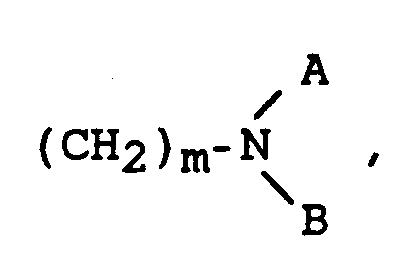
- C₁-C₄-Alkyl oder
- R²
- Wasserstoff, C₁-C₄-Alkyl oder Benzyl ist
- R³
- Wasserstoff oder C₁-C₄-Alkyl ist und
- R⁴ und R⁵
- zusammen mit den sie tragenden Atomen ein heterocyclisches, mono-, bi- oder tricyclisches hydriertes oder teilhydriertes Ringsystem mit 1 Stickstoffatom und 4 bis 15 Ringkohlenstoffatomen, das gegebenenfalls mono- oder disubstituiert ist mit C₁-C₄-Alkoxy, bedeuten,
- Die Wirkstoffe der Formel I werden vorzugsweise oral verabreicht, fest Applikationsformen, wie z.B. Tabletten, Dragees oder Kapseln sind besonders geeignet.
- Es wurde festgestellt, daß Wirkstoffe der Formel I, wie z.B. 2-[N-[(S)-1-Ethoxycarbonyl-3-phenylpropyl]-L-alanyl](1S,3S,5S)-2-azabicyclo[3.3.0]octan-3-carbonsäure (Ramipril) in pharmazeutischen Zubereitungen in Abhängigkeit von den engesetzten Hilfsstoffen, vom Herstellungsverfahren und von der Lagerung Tendenzen zur Instabilität zeigen.
- Als Hauptzersetzungsprodukt läßt sich in pharmazeutischen Zubereitungen die durch Kondensation entstandene Diketopiperazin-Verbindung mit folgender Struktur II
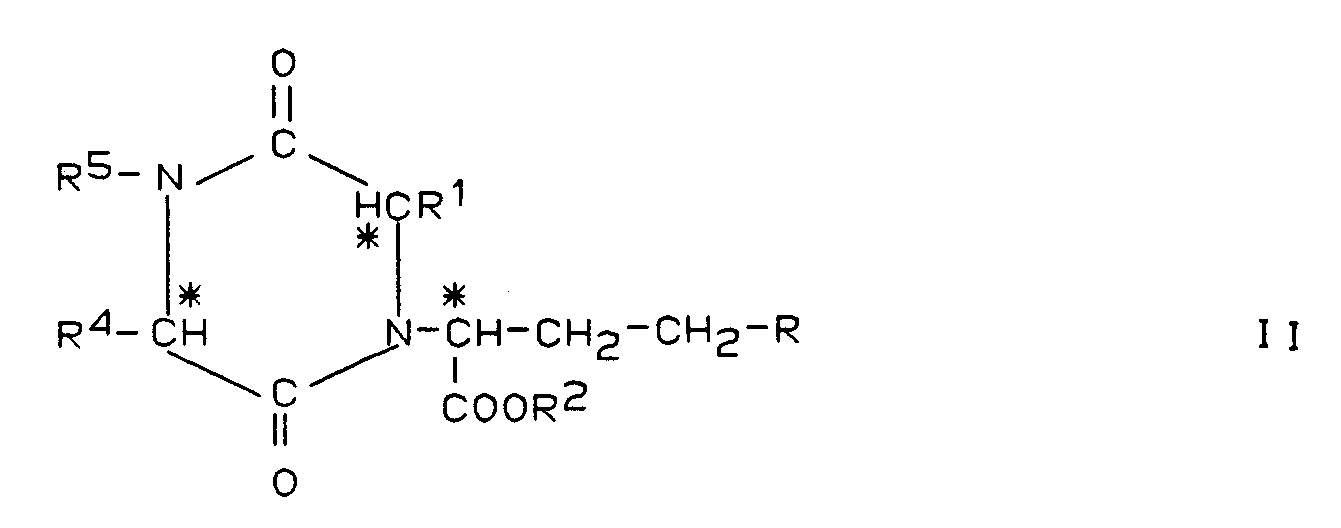
nachweisen. Das Hauptzersetzungsprodukt von Ramipril ist demnach des Diketopiperazin-Derivat der Formel IIa
- Es wurde gefunden, daß durch die Auswahl geeigneter Hilfsstoffe die Stabilität beeinflußt werden kann und daß eine wesentliche Zersetzungsursache der mit dem Herstellungsverfahren verbundene mechanische Streß ist, vor allem dann, wenn der Wirkstoff, z.B. Ramipril, im Gemisch mit Hilfsstoffen vorliegt.
- In der folgenden tabellarisch zusammengefaßten Untersuchung wird der zersetzungsinduzierende Einfluß der mechanischen Belastung am Beispiel von Ramipril verdeutlicht.
- Ramipril-Tabletten zu 2,5 mg/Einfluß des mechanischen Stresses auf die Stabilität.
Diketopiperazin-Derivat vom Ramipril (%) Zeit und Art der Belastung Tabletten 2,5 mg Tabletten 2,5 mg Kapseln 2,5 mg 3 Mon. + 40°C 13,6 7,6 4,0 6 Mon. + 40°C 22,8 12,0 6,4 Hersetllungsverfahren Trockengranulation Direktverpressung Abfüllung des Pulvergemischs Mechanischer Streß hoch mittel niedrig - Die Zusammensetzung der drei verglichenen Zubereitungen ist identisch und enthält folgende Hilfsstoffe: Mannit, mikrokristalline Zellulose, Na-stearylfumarat. Der Unterschied besteht allein in dem verarbeitungsbedingten Preßdruck (mechan. Streß).
- Die Ergebnisse zeigen deutlich, daß der mechanische Streß ein wesentlicher, zersetzungsinduzierender Faktor ist.
- Es wurde ferner gefunden, daß die Lagerungsbedingungen die Stabilität der Wirkstoffe der Formel I beeinflussen. Die Zersetzung wird bei ansteigender Temperatur und Feuchte und durch das Zusammenwirken beider Lagerungseinflüsse begünstigt.
- Die Zersetzungsneigung z.B. von Ramipril in Zubereitungen, in denen alle genannten Einflußfaktoren zusammenwirken, ist im folgenden Vergleichstest zu erkennen:
- Es wurde der Wirkstoffgehalt nach Belastung bestimmt von
a) der Wirksubstanz an sich; unverpreßt
b) von Ramipril-Tabletten, die mehrere Hilfsstoffe enthielten und einer mechanischen Belastung (Verpressen) ausgesetzt waren:Zeit und Art der Belastung Gehalt bezogen auf den Ausgangswert Ramipril-Wirksubstanz Ramipril-Tabletten 6 Monate + 40°C 99 % 56 % 6 Monate + 40°C 96 % < 20 % 80 % rel. F. - Lactose-Monohydrat, Maisstärke, mikrokristalline Zellulose, Natriumstärkeglykolat, hochdisperses Siliciumdioxid, Talkum, Magnesiumstearat.
- Die Ergebnisse zeigen deutlich, daß die unverpreßte Wirksubstanz unter den gewählten Prüfbedingungen eine gute Stabilität aufweist. Erste die Verpressung (mechan. Streß) mit allgemein üblichen Tablettierhilfsstoffen führt nach Temperatur- und vor allem Feuchtebelastung zu einem starken Abfall des Wirkstoffgehalts.
- Die bevorzugte Zubereitungsform für die Wirkstoffe der Formel I ist wegen der individuellen Möglichkeit der Dosiseinstellung und besseren Patienten Compliance die Tablette. Die Zubereitungsformen sind wie die obigen Ergebnisse zeigen, extrem instabil, insbesondere durch das Zusammenwirken von
- 1. mechanischem Streß (Preßdruck)
- 2. Tablettierhilfsstoffen
- 3. Temperatur
- 4. Feuchtigkeit.
- Während bei der Herstellung von Zubereitungen in gepreßter Form auf mechanischen Streß nicht verzichtet werden kann, wurde versucht, durch Änderungen der Hilfsstoffe zu stabilen Zubereitungen zu gelangen. Am Beispiel von Ramipril konnte durch gezielte Auswahl von Hilfsstoffen hinsichtlich ihrer Kompatibilität mit Ramipril die Rezeptur optimiert werden. Dies verdeutlicht der nachstehende Vergleich nach Streßbelastung.
Zeit und Art der Belastung Ramipril-Tabletten zu 1 mg Gehalt bezogen auf den Ausgangswert Rezeptur I Rezeptur II (optimierte Rezeptur) 6 Monate 40°C 56 % 88,5 % Hilfsstoffe Lactose-Monohydrat, Maisstärke, mikrokristalline Zellulose, Na-Stärkeglykolat, hochdisperses Siliciumdioxid, Talkum, Magnesiumstearat Mannit, mikrokristalline Zellulose, Na-Stearylfumarat - Jedoch ist diese Maßnahme allein nicht ausreichend, die Tablettenzubereitung zu stabilisieren. Überraschenderweise wurde nun gefunden, daß eine Schutzumhüllung der zersetzungsanfälligen Ramipril-Substanz mit polymeren Filmbildnern der mechanischen Desaktivierung entgegenwirkt. Überraschend waren diese Befunde deshalb, weil schon geringe Umhüllungsmengen ausreichten, den Wirkstoff gegenüber mechanischer Belastung abzuschirmen.
- Es ist bereits beschrieben worden, daß Arzneiwirkstoffe durch Mikroverkapselung mit Polymeren gegen Sauerstoff, Feuchtigkeit oder andere chemische Agenzien geschützt werden können (Hagers Handbuch der pharmazeutischen Praxis, Band 7A, Springer Verlag, Berlin, 499-502, 1971). Ebenso ist beschrieben worden, daß Tabletten z.B. zum Schutz gegen äußere Einflüsse wie Feuchtigkeit mit Polymerfilmen umhüllt werden (W.A. Ritschel, Die Tablette, 1966, Editio Cantor KG/Aulendorf i. Württ., Seiten 46-47, 211-212, 354-357, 366-369, 371-372). Entsprechend den Angaben in EP-A-0288732 kann die Freigabe eines ACE-Inhibitors aus Beadlets durch Umhüllung derselben mit einem Polymerfilm modifiziert werden.
- Es wurde außerdem gefunden, daß man stabile, für die perorale Anwendung geeignete Tabletten erhält, wenn man der Wirksubstanz der Formel I einen Puffer zusetzt, der sicherstellt, daß der unter der Einwirkung von Luftfeuchtigkeit sich in der Zubereitung einstellende pH-Wert im schwach sauren bis schwach alkalischen Bereich (5,5 bis 8,0) liegt.
- Entsprechend EP-A-0280999 wird die Instabilität von ACE-Inhibitoren in pharmazeutischen Präparaten durch Zusatz von Alkali- oder Erdalkalicarbonat und Zucker herabgesetzt. Die in Dictionnaire Vidal, 1986, O.V.P. Paris, 1276-1277 aufgeführte Enalapril-Zusammensetzung enthält u.a. Natriumhydrogencarbonat und Lactose.
- Die Erfindung betrifft daher stabile, gepreßte pharmazeutische Zubereitung enthaltend eine Verbindung der Formel I oder deren physiologisch verträgliche Salze, dadurch gekennzeichnet, daß eine Verbindung der Formel I oder ein physiologisch verträgliches Salz einer Verbindung der Formel I zur Stabilisierung vor dem Verpressen
- a) mit einer polymeren, physiologisch verträglichen Schutzhülle umhüllt wird oder
- b) mit einem physiologisch verträglichen Puffer, der sicherstellt, daß sich in einer pharmazeutischen Zubereitung in Gegenwart von Feuchtigkeit ein pH-Wert im schwach sauren bis schwach alkalischen Bereich einstellt, vermischt wird, wobei Natriumhydrogencarbonat als Puffer ausgeschlossen ist, oder
- c) mit einem physiologisch verträglichen Puffer, der sicherstellt, daß sich in einer pharmazeutischen Zubereitung in Gegenwart von Feuchtigkeit ein pH-Wert im schwach sauren bis schwach alkalischen Bereich einstellt, vermischt und mit einer polymeren, physiologisch verträglichen Schutzhülle umhüllt wird,
- Weitere Einzelheiten der erfindungsgemäßen Zubereitung und des Verfahrens zu deren Herstellung sind in den Patentansprüchen definiert.
- Die Chiralitätszentren an den in Formel I mit einem Stern (*) markierten Kohlenstoffatomen haben vorzugsweise die S-Konfiguration.
- Wirkstoffe der Formel I, worin R, R¹, R² und R³ die folgenden Bedeutungen haben:
- R :
- Methyl oder Phenyl,
- R¹:
- Methyl oder (CH₂)₄-NH₂,
- R²:
- Wasserstoff oder Ethyl,
- R³:
- Wasserstoff und worin
- R⁴ und R⁵
- mit den sie tragenden Atomen vorzugsweise folgende Ringsysteme bilden
- Als Wirkstoffe kommen insbesondere in Betracht:


- Wirksam sind bereits Schutzumhüllungen in Konzentrationen von 3 bis 25%, vorzugsweise 5 bis 15 % (Gewichtsprozent, bezogen auf den zu umhüllenden Wirkstoff). Es war nicht zu erwarten, daß selbst dünne Filmhüllen den Inhalt vor hohen mechanischen Belastungen, wie sie beim Tablettierprozess üblich sind (5 KN bis 30 KN), abschirmen können.
- Weiterhin war überraschend, daß die zur Schutzumhüllung vorgesehenen Polymere als wäßrige Lösungen eingesetzt werden können, ohne daß die Stabilität negativ beeinflußt wird.
- Cellulosederivate, wie z.B. Hydroxypropylcellulose, Hydroxypropylmethylcellulose, Hydroxypropylmethylcellulosephthalat, Hydroxyethylcellulose, Ethylcellulose, Celluloseacetatphthalat, Celluloseacetat, Polyvinylacetatphthalat, Polyvinylpyrrolidon, kationische und anionische Polymerisate, Copolymerisat mit neutralem Charakter auf Basis von Poly(meth)acrylsäureestern (Eudragit® E, Eudragit® E 30 D), anionisches Polymerisat aus Methacrylsäure und Methacrylsäuremethylester (Eudragit® L oder S, Eudragit® L 30 D), Gelatine. Grundsätzlich kommen alle physiologisch verträglichen Polymere in Frage.
- Die Schutzumhüllung kann durch Dispergieren von Wirksubstanz mit der Lösung oder Dispersion des Filmbildners in einem geeigneten Kneter, Mischer oder Mischer-Granulator vorgenommen werden. Die gleichmäßig benetzte Masse wird anschließend durch ein Sieb getrieben und getrocknet. Das getrocknete Granulat wird nochmals durch ein Sieb passiert und dann zur Herstellung von Kapseln oder Tabletten eingesetzt.
Eine besonders gleichmäßig Umhüllung gelingt in der Wirbelschicht. Die Wirkstoffpartikel werden im Luftstrom mit einer Lösung oder Dispersion des Polymeren besprüht und getrocknet.
Das umhüllte Wirkstoffgranulat kann nach dem Trocknungsprozeß direkt zur Abfüllung in Kapseln oder zur Herstellung von Tabletten verwendet werden. - Man kann aber auch beide Prozesse miteinander kombinieren, indem man zunächst im Kneter, Mischer oder Mischer-Granulator die Wirksubstanz mit der Polymerlösung oder -dispersion benetzt und durch anschließendes Granulieren zu gleichmäßigen Agglomeraten aufarbeiten, die dann in der Wirbelschicht abschließend mit der Polymerlösung oder -dispersion umhüllt werden.
- Die nach dem erfindungsgemäßen Verfahren durch einen Schutzfilm stabilisierten Wirkstoffe können zu Kapseln oder gepreßten Darreichungsformen verarbeitet werden. Solche Präparate sind im Verlgeich zu Präparaten, die mit unbehandeltem Wirkstoff hergestellt werden, stabil. Dies läßt sich am besten am Beispiel von Tabletten erkennen, bei denen sich der mechanische Streß bei der Herstellung nach anschließender Temperaturbelastung stabilitätsmindernd bemerkbar macht.
- Ein Stabilitätsvergleich mit einer Standardrezeptur ohne Schutzumhüllung ist der nachfolgenden Tabelle zu entnehmen.
Tabelle 1 Ramipril-Tabletten zu 2,5 mg Stabilitätsvergleich/stabilisierender Einfluß einer Schutzumhüllung Belastungsart: 6 Monate + 40°C Verpackung: Glasrundkörper mit dichtem Schraubverschluß Zusammensetzung in mg Standardrezeptur Erfindungsgemäß hergestellte Tabletten entspr. Beispiel 5 Ramipril-Substanz ungecoatet 2,50 - Ramipril-Substanz 87 %ig* - 2,87 * enthält 13 % HPMC als Filmhülle Mikrokristalline Cellulose 47,00 47,00 Mannit freifließend 49,50 49,13 Na-Stearylfumarat 1,00 1,00 Tablettengewicht 100,00 100,00 Preßkraft 10 000 N 10 000 N Zersetzung zum Diketopiperazinabbauprodukt in % 12,72 1,87 - Der Nachweis, daß eine dünnere Beschichtung von Ramipril selbst nach einer Langzeitbelastung noch effektiv ist, geht aus der folgenden Tabelle 2 hervor.
Tabelle 2 Ramipril-Tabletten zu 2,5 mg Stabilitätsvergleich Belastungsart: 12 Monate + 40°C Verpackung: Glasrundkörper mit dichtem Schraubverschluß Zusammensetzung in mg Standardrezeptur Erfindungsgemäß hergestellte Tabletten entspr. Beispiel 6 Ramipril-Substanz ungecoatet 2,50 - Ramipril-Substanz 94 %ig* - 2,66 * enthält 6 % HPMC als Filmhülle Mikrokristalline Cellulose 25,00 25,00 Mannit freifließend 71,50 71,34 Na-Stearylfumarat 1,00 1,00 Tablettengewicht 100,00 100,00 Preßkraft beim Tablettieren 10 000 N 10 000 N Zersetzung zum Diketopiperazinabbauprodukt in % 25,34 5,97 - Bei der Stabilisierung durch Zusatz eines Puffers wird letzterer entweder dem Wirkstoff oder dem umhüllten Wirkstoff zugesetzt, der Wirkstoff oder der umhüllte Wirkstoff wird dabei mit einer Pufferlösung granuliert oder er befindet sich in der Dispersion oder Lösung der Polymersubstanz, wenn beide Stabilisierungsarten gleichzeitig verwendet werden.
- In der Zubereitung, wie z.B. einer Tablette, stellt sich in Gegenwart von Feuchtigkeit, wie z.B. Luftfeuchtigkeit oder Wasser ein pH-Wert zwischen 5,5 und 8,0 ein.
- Als Puffersubstanzen sind z.B. geeignet: Natriumdihydrogenphosphat dihydrat, tri-Natriumcitrat dihydrat, Natriumcarbonat, Natriumhydrogencarbonat, Tris-(hydroxymethyl)-aminomethan.
- Es ist vorteilhaft, wenn die Puffersubstanz als wäßrige Lösung verwendet wird, indem man entweder Wirksubstanz in einem geeigneten Mischer, Kneter, Mischer-Granulator gleichmäßig befeuchtet und dann granuliert und trocknet oder in der Wirbelschicht besprüht und auf diese Weise sprühgranuliert. Es kann aber auch eine Mischung von Wirkstoff und Puffersubstanz auf die beschriebene Weise mit Wasser granuliert werden.
- Als besonders vorteilhaft hat es sich erwiesen, wenn der sich durch Pufferzusatzt einstellende stabilisierende Effekt mit einer Schutzumhüllung der Wirkstoff-Partikel durch polymere Filmbildner kombiniert wird.
- Dies geschieht am vorteilhaftesten in der Weise, daß die Puffersubstanz bereits in dem zum Umhüllen der Partikel vorgesehenen Medium gelöst und zusammen mit dem polymeren Filmbildner auf die Oberfläche des Wirkstoffs aufgebracht wird. Dabei kommt die zur Umhüllung der Partikel beschriebene Beschichtungstechnik zur Anwendung.
- Der stabilisierende Effekt von Puffersubstanzen wird durch folgenden tabellarischen Vergleich (Tabelle 3) verdeutlicht.
Tabelle 3 Ramipril-Tabletten zu 2,5 mg Stabilitätsvergleich/stabilisierender Einfluß von Puffersubstanzen Belastungsart: 3 Monate + 40°C Verpackung: Glasrundkörper mit dichtem Schraubverschluß Zusammensetzung in mg Standardrezeptur Erfindungsgemäß hergestellte Tabletten entspr. Beispiel 7 Ramipril-Substanz 2,5 2,5 Tris-(hydroxymethyl)-aminomethan - 2,5 Pregelatineisierte Stärke 51,5 49,0 Mikrokristalline Cellulose 45,0 45,0 Na-Stearlyfumarat 1,0 1,0 Tablettengewicht 100,0 100,0 Preßkraft beim Tablettieren 10 000 N 10 000 N pH-Wert nach Suspendieren mit Wasser 5.4 6,9 Zersetzung zum Diketopiperazinabbauprodukt in % 7,1 0,6 - 87 Gewichtsteile Ramipril-Substanz werden in einer Wirbelschichtapparatur mit 13 Gewichtsteilen Hydroxypropylmethylcellulose, im folgenden HPMC genannt, als 5 %ige wäßrige Lösung granuliert. Geeignet sind z.B. die Typen Pharmacoat® 606 oder Methocel® E5 Premium. Das Verfahren verläuft in zwei Abschnitten, in dem zunächst die Ramipril-Substanz mit der Hälfte der HPMC-Lösung granuliert und anschließend mit der zweiten Hälfte der 5 %igen wäßrigen HPMC-Lösung gecoatet wird.
- Die Trocknungstemperatur beträgt etwa 50°C. Die gecoatete Ramipril-Substanz kann im Gemisch mit Hilfsstoffen in Kapseln abgefüllt oder direkt, ohne weitere Granulationsschritte zu Tabletten verpreßt werden.
- 94 Gewichtsteile Ramipril-Substanz werden in einem geeigneten Kneter, Mischer oder Mischer-Granulator mit 6 Gewichtsteilen HMPC als 10 %ige wäßrige Lösung so lange dispergiert, bis eine gleichmäßig befeuchtete Masse entstanden ist. Die feuchte Masse wird durch ein Sieb mit einer Maschenweite von 1,2 mm passiert und anschließend bei ca. 40°C getrocknet. Die getrockneten Agglomerate werden nochmals durch ein Sieb mit einer Maschenweite von 0,5 bis 1 mm passiert. Das gebrauchsfertige Ramipril-Granulat kann zur Herstellung von Kapseln oder Tablettten eingesetzt werden.
- 1 Gewichtsteil Ramipril-Substanz und 1 Gewichtsteil Tris-(hydroxymethyl)-aminomethan-Puffersubstanz werden in einem geeigneten Mischer oder Mischer-Granulator gemischt und dann mit so viel gereinigtem Wasser befeuchtet, bis eine gleichmäßige benetzte Masse entstanden ist.
- Die feuchte Masse wird auf die in Beispiel 2 beschriebene Weise granuliert.
- 94 Gewichtsteile Ramipril-Substanz, 6 Gewichtsteile Polyvinylpyrrolidon (z.B. Kollidon® K25), 18,8 Gewichtsteile Natriumcarbonat werden in einem geeigneten Mischer oder Mischer-Granulator gemischt und dann mit soviel gereinigtem Wasser befeuchtet, bis eine gleichmäßig benetzte Masse entstanden ist. Die feuchte Masse wird auf die in Beispiel 2 beschriebene Weise granuliert.
- 28,7 g Ramipril 87 %ig (enthält 13 % HPMC als Filmhülle gemäß Beispiel 1), 470 g mikrokristalline Cellulose und 491,3 g Mannit freifließend werden gemischt. Dieser Mischung werden in einem zweiten Schritt 10 g Natriumstearylfumarat zugemischt. 1 kg der so hergestellten Mischung werden direkt, ohne weitere Granulationsschritte, zu Tabletten mit einem Endgewicht von 100 mg verpreßt.
- 26,6 g Ramipril 94 %ig (enthält 6 % HPMC als Filmhülle gemäß Beispiel 2), 250 g mikrokristalline Cellulose und 713,4 g Mannit freifließend werden gemischt. Dieser Mischung werden in einem zweiten Schritt 10 g Natriumstearylfumarat zugemischt.
- 1 kg der so hergestellten Mischung werden direkt, ohne weitere Granulationsschritte, zu Tabletten mit einem Endgewicht von 100 mg verpreßt.
- 50 g Ramipril 50 %ig, hergestellt gemäß Beispiel 3, 450 g mikrokristalline Cellulose und 490 g pregelatinisierte Stärke werden gemischt. Dieser Mischung werden in einem zweiten Schritt 10 g Natriumstearylfumarat zugemischt.
- 1 kg der so hergestellten Mischung werden direkt, ohne weitere Granulationsschritte, zu Tabletten mit einem Endgewicht von 100 mg verpreßt.
- 63 g Ramipril stabilisiert gemäß Beispiel 4, 250 g mikrokristalline Cellulose und 667 g Mannit freifließend werden gemischt. Dieser Mischung werden in einem zweiten Schritt 20 g Natriumstearylfumarat zugemischt.
- 1 kg dieser Mischung werden direkt, ohne weitere Granulationsschritte, zu Tabletten mit einem Endgewicht von 100 mg verpreßt.
- 85 Gewichtsteile Enalaprilhydrogenmaleat werden in einer Wirbelschichtapparatur mit 15 Gewichtsteilen Hydroxypropylmethylcellulose (HPMC) als 5 %ige wäßrige Lösung auf die in Beispiel 1 angegebene Weise granuliert. Die gecoatete Enalapril-Substanz kann im Gemisch mit Hilfsstoffen in Kapseln abgefüllt oder direkt, ohne weitere Granulationsschritte zu Tabletten verpreßt werden.
- 90 Gewichtsteile Enalaprilhydrogenmaleat werden in einem geeigneten Kneter, Mischer oder Mischer-Granulator mit 10 Gewichtsteilen HPMC als wäßrige Lösung so lange dispergiert, bis eine gleichmäßig befeuchtete Masse entstanden ist. Die feuchte Enalapril-Masse wird auf die in Beispiel 2 beschriebene Weise granuliert.
Das gebrauchsfertige schutzumhüllte Enalapril-Granulat kann zur Herstellung von Kapseln oder Tabletten eingesetzt werden. - 29,4 g Enalaprilhydrogenmaleat 85 %ig (enthält 15 % HPMC als Filmhülle gemäß Beispiel 9), 480g mikrokristalline Zellulose und 480,6 g modifizierte Stärke freifließend werden gemischt. Dieser Mischung werden in einem zweiten Schritt 10 g Natriumstearylfumarat zugemischt. 1 kg dieser Mischung werden direkt, ohne weitere Granulationsschritte, zu Tabletten mit einem Endgewicht von 100 mg verpreßt.
- 111,1 g Enalaprilhydrogenmaleat 90 %ig (enthält 10 % HPMC als Filmhülle gemäß Beispiel 10), 480 g mikrokristalline Zellulose und 398,9 g modifizierte Stärke freifließend werden gemischt. Dieser Mischung werden in einem zweiten Schritt 10 g Natriumstearylfumarat zugemischt. 1 kg dieser Mischung werden direkt, ohne weitere Granulationsschritte, zu Tabletten mit einem Endgewicht von 100 mg verpreßt.

wobei R³ vorzugsweise Wasserstoff ist, sind bevorzugt.
Claims (8)
- Stabile, gepreßte pharmazeutische Zubereitung enthaltend eine Verbindung der Formel I
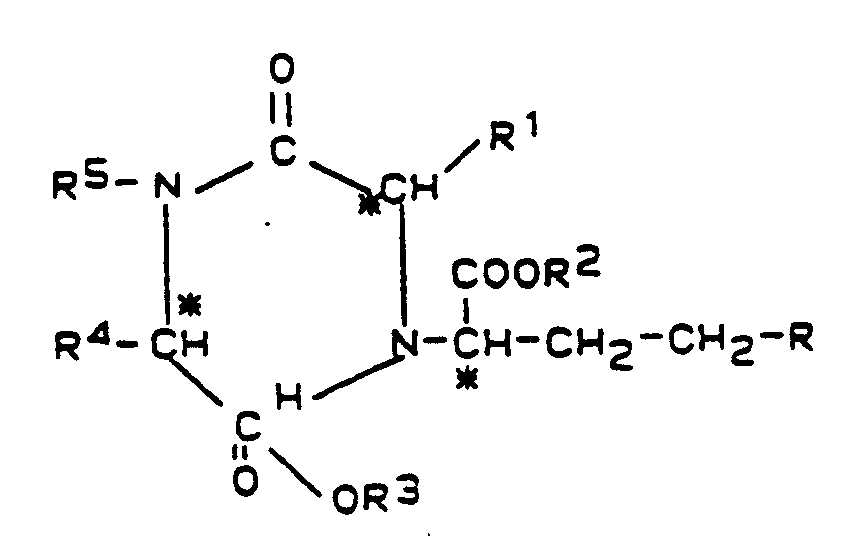 R Wasserstoff, C₁-C₄-Alkyl oder Phenyl istR¹ C₁-C₄-Alkyl oder
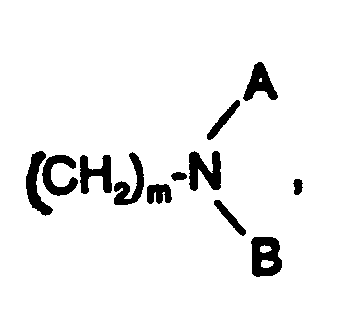 R² Wasserstoff, C₁-C₄-Alkyl oder Benzyl ist,R³ Wasserstoff oder C₁-C₄-Alkyl ist undR⁴ und R⁵ zusammen mit den sie tragenden Atomen ein heterocyclisches, mono-, bi- oder tricyclisches hydriertes oder teilhydriertes Ringsystem mit 1 Stickstoffatom und 4 bis 15 Ringkohlenstoffatomen, das gegebenenfalls mono- oder disubstituiert ist mit C₁-C₄-Alkoxy, bedeuten, oder deren physiologisch verträgliche Salze,dadurch gekennzeichnet, daß eine Verbindung der Formel I oder ein physiologisch verträgliches Salz einer Verbindung der Formel I zur Stabilisierung vor dem Verpressena) mit einer polymeren, physiologisch verträglichen Schutzhülle umhüllt wird oderb) mit einem physiologisch vertraglichen Puffer, der sicherstellt, daß sich in einer pharmazeutischen Zubereitung in Gegenwart Von Feuchtigkeit ein pH-Wert im schwach sauren bis schwach alkalischen Bereich einstellt, vermischt wird, wobei Natriumhydrogencarbonat als Puffer ausgeschlossen ist, oderc) mit einem physiologisch verträglichen Puffer, der sicherstellt, daß sich in einer pharmazeutischen Zubereitung in Gegenwart von Feuchtigkeit ein pH-Wert im schwach sauren bis schwach alkalischen Bereich einstellt, vermischt und mit einer polymeren, physiologisch verträglichen Schutzhülle umhüllt wird,wobei im Falle der Stabilisierung gemäß b) mit Alkali- oder Erdalkalicarbonat die Zubereitung frei von Zucker ist.
 - Stabile, gepreßte pharmazeutische Zubereitung gemäß Anspruch 1 enthaltend Ramipril, dadurch gekennzeichnet, daß Ramipril zur Stabilisierung vor dem verpressen mit einer physiologisch verträglichen polymeren Schutzhülle umhüllt wird.
- Verfahren zur Herstellung von stabilen, gepreßten pharmazeutischen Zubereitungen gemäß Anspruch 1, dadurch gekennzeichnet, daß man eine Verbindung der Formel I oder ein physiologisch verträgliches Salz einer Verbindung der Formel I nach üblichen Verfahren mit einem physiologisch verträglichen polymeren Schutzfilm überzieht und/oder daß man einen physiologisch verträglichen Puffer zusetzt und anschließend verpreßt.
- Verfahren gemäß Anspruch 3, dadurch gekennzeichnet, daß man die Wirksubstanz mit einem physiologisch verträglichen polymeren Schutzfilm überzieht und, gegebenenfalls unter Zusatz üblicher Hilfsstoffe, verpreßt.
- Verfahren gemäß Anspruch 3, dadurch gekennzeichnet, daß man die Umgebung des Wirkstoffs durch Zusatz von Puffersubstanzen auf einen pH-Bereich von 5,5 bis 8, vorzugsweise 6,5 bis 7, einstellt.
- Ramipril enthaltende Zubereitung erhältlich nach Verfahren gemäß Anspruch 4, dadurch gekennzeichnet, daß der Gewichtsanteil der Schutzumhüllung 3 bis 25 %, vorzugsweise 5 bis 15 %, bezogen auf den Wirkstoff, beträgt.
- Ramipril enthaltende Zubereitung erhältlich nach Verfahren gemäß Anspruch 5.
- Verwendung von stabilisierten Wirkstoffen gemäß Anspruch 1 zur Herstellung von pharmazeutischen Zubereitungen.
Priority Applications (1)
| Application Number | Priority Date | Filing Date | Title |
|---|---|---|---|
| AT88119014T ATE74513T1 (de) | 1987-11-24 | 1988-11-15 | Stabilisierte arzneistoffe, verfahren zu ihrer herstellung sowie stabile arzneizubereitungen. |
Applications Claiming Priority (2)
| Application Number | Priority Date | Filing Date | Title |
|---|---|---|---|
| DE19873739690 DE3739690A1 (de) | 1987-11-24 | 1987-11-24 | Stabilisierte arzneistoffe, verfahren zu ihrer herstellung sowie stabile arzneizubereitungen |
| DE3739690 | 1987-11-24 |
Publications (2)
| Publication Number | Publication Date |
|---|---|
| EP0317878A1 EP0317878A1 (de) | 1989-05-31 |
| EP0317878B1 true EP0317878B1 (de) | 1992-04-08 |
Family
ID=6341084
Family Applications (1)
| Application Number | Title | Priority Date | Filing Date |
|---|---|---|---|
| EP88119014A Expired - Lifetime EP0317878B1 (de) | 1987-11-24 | 1988-11-15 | Stabilisierte Arzneistoffe, Verfahren zu ihrer Herstellung sowie stabile Arzneizubereitungen |
Country Status (21)
| Country | Link |
|---|---|
| US (2) | US5151433A (de) |
| EP (1) | EP0317878B1 (de) |
| JP (1) | JPH0768140B2 (de) |
| KR (1) | KR970004908B1 (de) |
| CN (1) | CN1028962C (de) |
| AT (1) | ATE74513T1 (de) |
| AU (1) | AU615495B2 (de) |
| CA (1) | CA1338344C (de) |
| DE (2) | DE3739690A1 (de) |
| DK (1) | DK168423B1 (de) |
| ES (1) | ES2033400T3 (de) |
| FI (1) | FI93693C (de) |
| GR (1) | GR3004925T3 (de) |
| HU (1) | HU202100B (de) |
| IE (1) | IE61173B1 (de) |
| IL (1) | IL88460A0 (de) |
| NO (1) | NO176550C (de) |
| NZ (1) | NZ227032A (de) |
| PH (1) | PH27416A (de) |
| PT (1) | PT89061B (de) |
| ZA (1) | ZA888734B (de) |
Cited By (3)
| Publication number | Priority date | Publication date | Assignee | Title |
|---|---|---|---|---|
| US7368469B2 (en) | 1999-08-30 | 2008-05-06 | Sanofi-Aventis Deutschland Gmbh | Use of inhibitors of the renin-angiotensin system in the prevention of cardiovascular events |
| US7589064B2 (en) | 2004-03-24 | 2009-09-15 | Actavis Group Hf. | Formulations of ramipril |
| WO2011060945A2 (en) | 2009-11-20 | 2011-05-26 | Gp Pharm, S.A. | Capsules of active pharmaceutical ingredients and polyunsaturated fatty acid esters for the treatment of cardiovascular diseases |
Families Citing this family (45)
| Publication number | Priority date | Publication date | Assignee | Title |
|---|---|---|---|---|
| FI94339C (fi) | 1989-07-21 | 1995-08-25 | Warner Lambert Co | Menetelmä farmaseuttisesti käyttökelpoisen /R-(R*,R*)/-2-(4-fluorifenyyli)- , -dihydroksi-5-(1-metyylietyyli)-3-fenyyli-4-/(fenyyliamino)karbonyyli/-1H-pyrroli-1-heptaanihapon ja sen farmaseuttisesti hyväksyttävien suolojen valmistamiseksi |
| US6300361B1 (en) | 1990-07-25 | 2001-10-09 | Novartis Ag | Stabilized pharmaceutical compositions comprising acid donors |
| TW483763B (en) * | 1994-09-02 | 2002-04-21 | Astra Ab | Pharmaceutical composition comprising of ramipril and dihydropyridine compound |
| ATE206304T1 (de) * | 1995-12-27 | 2001-10-15 | Janssen Pharmaceutica Nv | Bioadhesive feste arzneimittelform |
| SE9903028D0 (sv) | 1999-08-27 | 1999-08-27 | Astra Ab | New use |
| US20030225124A1 (en) * | 1999-08-31 | 2003-12-04 | Spiridon Spireas | Stable formulations of ACE inhibitors, and methods for preparation thereof |
| FR2824477B1 (fr) * | 2001-05-09 | 2005-09-09 | Ethypharm Lab Prod Ethiques | Granules enrobes a base d'inhibiteur de l'enzyme de conversion de l'anfiotensine, leur procede de preparation et comprimes orodispersibles contenant les granules enrobes |
| CA2357982A1 (en) * | 2001-09-28 | 2003-03-28 | Bernard Charles Sherman | Solid compositions comprising ramipril |
| EP1467717A1 (de) * | 2002-01-15 | 2004-10-20 | Ranbaxy Laboratories Limited | Stabile pharmazeutische zusammensetzungen mit ace-inhibitor(en) |
| US20060177498A1 (en) * | 2003-01-22 | 2006-08-10 | Ramaswami Bharatrajan | Solid pharmaceutical composition comprising ramipril |
| GB0301471D0 (en) * | 2003-01-22 | 2003-02-19 | Biochemie Gmbh | Organic compounds |
| CA2530788C (en) * | 2003-06-26 | 2010-02-09 | Teva Pharmaceutical Industries Ltd | Stable pharmaceutical compositions of 2-aza-bicyclo[3.3.0]-octane-3-carboxylic acid derivatives |
| US6869963B2 (en) * | 2003-07-11 | 2005-03-22 | Sandoz Ag | Stable pharmaceutical compositions containing an ACE inhibitor |
| AU2003300692A1 (en) * | 2003-10-30 | 2005-05-19 | Lupin Ltd. | Stable formulations of ace inhibitors and methods for preparation thereof |
| GB2394660A (en) * | 2003-12-17 | 2004-05-05 | Niche Generics Ltd | Stabilisation of pharmaceutical compositions comprising ACE inhibitor by absence of acidic excipients having large specific surface area, eg silicon dioxide |
| GB2411355B (en) * | 2004-02-27 | 2006-02-22 | Niche Generics Ltd | Pharmaceutical composition |
| US20060045911A1 (en) * | 2004-08-27 | 2006-03-02 | Sun Pharmaceutical Industries Ltd. | Stable pharmaceutical formulations |
| WO2006052968A2 (en) * | 2004-11-05 | 2006-05-18 | King Pharmaceuticals Research & Development, Inc. | Stabilized ramipril compositions and methods of making |
| US20080096979A1 (en) * | 2004-11-08 | 2008-04-24 | Rubicon Research Pvt. Ltd. | Aqueous Pharmaceutical Coating |
| GB0518129D0 (en) * | 2005-09-06 | 2005-10-12 | Arrow Int Ltd | Ramipril formulation |
| KR100679166B1 (ko) | 2005-10-04 | 2007-02-06 | 신풍제약주식회사 | 안정성이 증진된 약제학적 조성물 및 그의 제조방법 |
| US20070098782A1 (en) * | 2005-10-28 | 2007-05-03 | Selamine Limited | Ramipril Formulation |
| GB2431579A (en) * | 2005-10-28 | 2007-05-02 | Arrow Int Ltd | Ramipril formulations |
| MX2008012248A (es) * | 2006-03-28 | 2009-02-20 | Gelesis Inc | Uso de materiales polimericos con otras sustancias para rendimiento mejorado. |
| US20070232680A1 (en) * | 2006-04-04 | 2007-10-04 | Vijayabhaskar Bolugoddu | Preparation of ramipril and stable pharmaceutical compositions |
| WO2007120930A2 (en) * | 2006-04-19 | 2007-10-25 | Teva Pharmaceutical Industries Ltd. | Stable pharmaceutical compositions of 2-aza-bicyclo[3.3.0]-octane-3-carboxylic acid derivatives |
| WO2007142628A1 (en) * | 2006-06-02 | 2007-12-13 | Teva Pharmaceutical Industries Ltd. | Stable formulation comprising moisture sensitive drug/s and manufacturing procedure thereof |
| US20070281000A1 (en) * | 2006-06-02 | 2007-12-06 | Michael Fox | Stable formulation comprising moisture sensitive drug/s and manufacturing procedure thereof |
| DE602006000402T8 (de) * | 2006-06-02 | 2009-04-09 | Teva Pharmaceutical Industries Ltd. | Stabile Zubereitung enthaltend eine feuchtigkeitsempfindliche aktive Substanz und Verfahren zur Herstellung der Zubereitung. |
| AU2007264414A1 (en) * | 2006-06-30 | 2008-01-03 | Alphapharm Pty Ltd | A stabilised composition comprising ACE inhibitors |
| AU2007291602B2 (en) * | 2006-08-28 | 2012-09-06 | Sanofi-Aventis Deutschland Gmbh | Methods of lowering glucose levels |
| GB0624090D0 (en) * | 2006-12-01 | 2007-01-10 | Selamine Ltd | Ramipril amine salts |
| GB0624084D0 (en) * | 2006-12-01 | 2007-01-10 | Selamine Ltd | Ramipril amino acid salts |
| GB0624087D0 (en) * | 2006-12-01 | 2007-01-10 | Selamine Ltd | Ramipril combination salt |
| PL382311A1 (pl) * | 2007-04-27 | 2008-11-10 | Zakłady Farmaceutyczne POLPHARMA Spółka Akcyjna | Kompozycja farmaceutyczna o polepszonej stabilności zawierająca inhibitor acetylocholinoesterazy lub farmaceutycznie dopuszczalną jego sól oraz sposób jej wytwarzania |
| CN101980701A (zh) | 2008-03-28 | 2011-02-23 | 菲尔若国际公司 | 用于预防心血管疾病的胶囊 |
| WO2010030735A2 (en) * | 2008-09-11 | 2010-03-18 | Aethos Pharmaceuticals, Inc. | Stabilized coating for pharmaceutical formulations |
| TR200906322A2 (tr) | 2009-08-17 | 2011-07-21 | Bi̇lgi̇ç Mahmut | Çözünürlük ve stabilite özellikleri geliştirilmiş granüller. |
| BR112014020184B1 (pt) | 2012-02-17 | 2021-11-30 | Egis Gyógyszergyár Zrt | Preparação farmacêutica que contém anlodipina e ra-mipril |
| PL227900B1 (pl) | 2012-11-15 | 2018-01-31 | Adamed Spolka Z Ograniczona Odpowiedzialnoscia | Kompozycja farmaceutyczna zawierająca inhibitor ACE i bloker kanałów wapniowych, sposób jej wytwarzania i jednostka dawkowania zawierająca tę kompozycję |
| HUP1300496A2 (hu) | 2013-08-16 | 2015-03-02 | Egis Gyogyszergyar Nyilvanosan Muekoedoe Reszvenytarsasag | Stabil kombinációs gyógyszerkészítmény |
| TWI668285B (zh) * | 2015-12-31 | 2019-08-11 | 長興材料工業股份有限公司 | 可熱聚合之組合物、由此形成之組成液及其用途 |
| EP3275432A1 (de) | 2016-07-25 | 2018-01-31 | H e x a l Aktiengesellschaft | Darreichungsform mit ace-hemmer |
| EP4106733A2 (de) | 2020-02-10 | 2022-12-28 | Adamed Pharma S.A. | Stabile ramiprilzusammensetzung und zusammensetzung mit fester dosierung damit |
| CN115068434B (zh) * | 2022-08-03 | 2023-05-09 | 昆山龙灯瑞迪制药有限公司 | 一种雷米普利片的制备方法 |
Citations (2)
| Publication number | Priority date | Publication date | Assignee | Title |
|---|---|---|---|---|
| EP0280999A2 (de) * | 1987-02-24 | 1988-09-07 | Warner-Lambert Company | Inhibitoren des Angiotensin-Umwandlungsenzyms enthaltende stabilisierte Arzneimittel |
| EP0288732A2 (de) * | 1987-04-28 | 1988-11-02 | E.R. Squibb & Sons, Inc. | Pharmazeutische Zusammensetzung in Form von Mikroperlen und Methode |
Family Cites Families (15)
| Publication number | Priority date | Publication date | Assignee | Title |
|---|---|---|---|---|
| US3565559A (en) * | 1968-03-11 | 1971-02-23 | Sumitomo Chemical Co | Process for making microcapsules |
| IL58849A (en) * | 1978-12-11 | 1983-03-31 | Merck & Co Inc | Carboxyalkyl dipeptides and derivatives thereof,their preparation and pharmaceutical compositions containing them |
| US4344949A (en) * | 1980-10-03 | 1982-08-17 | Warner-Lambert Company | Substituted acyl derivatives of 1,2,3,4-tetrahydroisoquinoline-3-carboxylic acids |
| DE3039073A1 (de) * | 1980-10-16 | 1982-05-19 | Röhm GmbH, 6100 Darmstadt | Umhuelltes acetylsalicylsaeurepraeparat |
| EP0050800B2 (de) * | 1980-10-23 | 1995-06-07 | Schering Corporation | Carboxyalkyl-Dipeptide, Verfahren zu ihrer Herstellung und diese enthaltende Arzneimittel |
| US4425355A (en) * | 1981-02-17 | 1984-01-10 | Warner-Lambert Company | Substituted acyl derivatives of chair form of octahydro-1H-indole-2-carboxylic acids |
| DE3226768A1 (de) * | 1981-11-05 | 1983-05-26 | Hoechst Ag, 6230 Frankfurt | Derivate der cis, endo-2-azabicyclo-(3.3.0)-octan-3-carbonsaeure, verfahren zu ihrer herstellung, diese enthaltende mittel und deren verwendung |
| WO1985003436A1 (en) * | 1984-02-10 | 1985-08-15 | A/S Alfred Benzon | Diffusion coated multiple-units dosage form |
| DE3413710A1 (de) * | 1984-04-12 | 1985-10-24 | Hoechst Ag, 6230 Frankfurt | Verfahren zur behandlung der herzinsuffizienz |
| AU4104085A (en) * | 1984-04-13 | 1985-10-17 | Macewans Machinery Ltd. | Steam-heated beater |
| CA1259924A (en) * | 1985-03-25 | 1989-09-26 | Wallace E. Becker | Pharmaceutical tableting method |
| DE3610391A1 (de) * | 1986-03-27 | 1987-10-08 | Hoechst Ag | Verbindungen mit nootroper wirkung, diese enthaltende mittel und deren verwendung bei der behandlung und prophylaxe cognitiver dysfunktionen |
| GB8616669D0 (en) * | 1986-07-09 | 1986-08-13 | Merk Sharpe & Dohme Ltd | Pharmaceutical compositions |
| US4808413A (en) * | 1987-04-28 | 1989-02-28 | E. R. Squibb & Sons, Inc. | Pharmaceutical compositions in the form of beadlets and method |
| US4898732A (en) * | 1988-05-04 | 1990-02-06 | The Clinipad Corporation | Inhibiting of tumor growth with an antagonist of the renin-angioten-sin system |
-
1987
- 1987-11-24 DE DE19873739690 patent/DE3739690A1/de not_active Withdrawn
-
1988
- 1988-11-15 DE DE8888119014T patent/DE3869919D1/de not_active Expired - Lifetime
- 1988-11-15 AT AT88119014T patent/ATE74513T1/de not_active IP Right Cessation
- 1988-11-15 EP EP88119014A patent/EP0317878B1/de not_active Expired - Lifetime
- 1988-11-15 ES ES198888119014T patent/ES2033400T3/es not_active Expired - Lifetime
- 1988-11-22 ZA ZA888734A patent/ZA888734B/xx unknown
- 1988-11-22 JP JP63293761A patent/JPH0768140B2/ja not_active Expired - Lifetime
- 1988-11-22 FI FI885398A patent/FI93693C/fi not_active IP Right Cessation
- 1988-11-22 US US07/274,598 patent/US5151433A/en not_active Expired - Lifetime
- 1988-11-22 HU HU885992A patent/HU202100B/hu unknown
- 1988-11-22 NZ NZ227032A patent/NZ227032A/en unknown
- 1988-11-22 PH PH37849A patent/PH27416A/en unknown
- 1988-11-23 IE IE350588A patent/IE61173B1/en not_active IP Right Cessation
- 1988-11-23 NO NO885213A patent/NO176550C/no unknown
- 1988-11-23 CA CA000583952A patent/CA1338344C/en not_active Expired - Lifetime
- 1988-11-23 IL IL88460A patent/IL88460A0/xx not_active IP Right Cessation
- 1988-11-23 CN CN88108057A patent/CN1028962C/zh not_active Expired - Lifetime
- 1988-11-23 PT PT89061A patent/PT89061B/pt not_active IP Right Cessation
- 1988-11-23 DK DK653688A patent/DK168423B1/da not_active IP Right Cessation
- 1988-11-23 AU AU25818/88A patent/AU615495B2/en not_active Expired
- 1988-11-23 KR KR1019880015400A patent/KR970004908B1/ko not_active Expired - Lifetime
-
1992
- 1992-06-17 GR GR920401112T patent/GR3004925T3/el unknown
-
1994
- 1994-02-10 US US08/194,634 patent/US5442008A/en not_active Expired - Lifetime
Patent Citations (2)
| Publication number | Priority date | Publication date | Assignee | Title |
|---|---|---|---|---|
| EP0280999A2 (de) * | 1987-02-24 | 1988-09-07 | Warner-Lambert Company | Inhibitoren des Angiotensin-Umwandlungsenzyms enthaltende stabilisierte Arzneimittel |
| EP0288732A2 (de) * | 1987-04-28 | 1988-11-02 | E.R. Squibb & Sons, Inc. | Pharmazeutische Zusammensetzung in Form von Mikroperlen und Methode |
Non-Patent Citations (2)
| Title |
|---|
| Gu.L. et al. PHARMACEUTICAL RESEARCH, Band 4, Nr. 5, 1987, Seiten 392-397 * |
| Ritschel W.A.:DIE TABLETTE, 1966, Editio Cantor KG Aulendorf i.Würt, Seiten 46-47, 354-357, 366-369, 371-372, 211-212 * |
Cited By (3)
| Publication number | Priority date | Publication date | Assignee | Title |
|---|---|---|---|---|
| US7368469B2 (en) | 1999-08-30 | 2008-05-06 | Sanofi-Aventis Deutschland Gmbh | Use of inhibitors of the renin-angiotensin system in the prevention of cardiovascular events |
| US7589064B2 (en) | 2004-03-24 | 2009-09-15 | Actavis Group Hf. | Formulations of ramipril |
| WO2011060945A2 (en) | 2009-11-20 | 2011-05-26 | Gp Pharm, S.A. | Capsules of active pharmaceutical ingredients and polyunsaturated fatty acid esters for the treatment of cardiovascular diseases |
Also Published As
Similar Documents
| Publication | Publication Date | Title |
|---|---|---|
| EP0317878A1 (de) | Stabilisierte Arzneistoffe, Verfahren zu ihrer Herstellung sowie stabile Arzneizubereitungen | |
| DE3783394T2 (de) | Arzneizubereitung zur oralen anwendung. | |
| AT401870B (de) | Stabilisiertes pharmazeutisches mittel, enthaltend einen hmg-coa-reduktase-inhibitor wirkstoff | |
| DE69625046T2 (de) | Pharmazeutische zusammensetzung stabilisiert mit einem basischen medium | |
| DE69013296T3 (de) | Einzeldosen mit verzögerter Arzneistofffreigabe. | |
| EP2037891B1 (de) | Tablette enthaltend candesartan cilexetil | |
| DE69418252T2 (de) | Stabilisierte, feste pharmazeutische Zubereitung, die Dextromethorphan Phenylpropanolamine und Coffein enthält | |
| EP1523303B1 (de) | Vardenafil hydrochlorid trihydrat enthaltende arzneimittel und deren herstellungsverfahren | |
| DE4332394A1 (de) | Budesonid-Pellets mit kontrolliertem Freigabeprofil und Verfahren zu ihrer Herstellung | |
| DE69814850T2 (de) | Paracetamol enthaltende schlickbare tablette | |
| EP1077681B1 (de) | Levothyroxin natrium enthaltende pharmazeutische zubereitung | |
| WO1994013287A1 (de) | Verwendung von 2-amino-6-a-propyl-amino-4,5,6,7-tetrahydrobenzothiazol (pramipexol) als arzneimittel mit antidepressiver wirkung | |
| DE60319707T2 (de) | Pharmazeutische zusammensetzung enthaltend ein benzimidazol-derivat gemischt mit mikrokristalliner cellulose | |
| DE19740983A1 (de) | Verfahren zur Erschwerung der Extraktion von Wirkstoffen aus Tabletten | |
| DE4124409B4 (de) | Pharmazeutische Zubereitungen | |
| EP0088098B1 (de) | Komposition und verfahren zur herstellung von in wässrigem medium schnell zerfallenden tabletten | |
| CA2048367C (en) | Solid oral forms of application containing ifosfamide as active substance | |
| DE60203997T2 (de) | Nasses granulationsverfahren zur herstellung von pharmazeutischen tabletten mit paroxetinhydrochlorid anhydrat | |
| EP0641200B1 (de) | 2-arylpropionsäure-zubereitungen und verfahren zu ihrer herstellung | |
| DE3045488A1 (de) | Verfahren zur herstellung von stabilisierten kallikreinhaltigen tabletten | |
| AT392002B (de) | Verwendung von peroxydiphosphaten zur herstellung von pharmazeutischen tabletten bzw. pharmazeutischen waesserigen loesungen | |
| DE69920039T2 (de) | Quinapril magnesium enthaltende, pharmazeutisch wirksame zusammensetzung | |
| EP0223033A2 (de) | Verfahren zum gleichzeitigen Trocknen und Granulieren von Extraktstoffen aus enteiweisstem Kälberblut, nach diesem Verfahren erhaltenes Granulat und dessen Verwendung zur Herstellung von pharmazeutischen Präparaten | |
| DE3419129A1 (de) | Nifedipinpraeparate und verfahren zu ihrer herstellung | |
| DE602006000402T2 (de) | Stabile Zubereitung enthaltend eine feuchtigkeitsemphindliche aktive Substanz und Verfahren zur Herstellung der Zubereitung. |
Legal Events
| Date | Code | Title | Description |
|---|---|---|---|
| PUAI | Public reference made under article 153(3) epc to a published international application that has entered the european phase |
Free format text: ORIGINAL CODE: 0009012 |
|
| AK | Designated contracting states |
Kind code of ref document: A1 Designated state(s): AT BE CH DE ES FR GB GR IT LI LU NL SE |
|
| 17P | Request for examination filed |
Effective date: 19890808 |
|
| 17Q | First examination report despatched |
Effective date: 19900827 |
|
| GRAA | (expected) grant |
Free format text: ORIGINAL CODE: 0009210 |
|
| AK | Designated contracting states |
Kind code of ref document: B1 Designated state(s): AT BE CH DE ES FR GB GR IT LI LU NL SE |
|
| REF | Corresponds to: |
Ref document number: 74513 Country of ref document: AT Date of ref document: 19920415 Kind code of ref document: T |
|
| REF | Corresponds to: |
Ref document number: 3869919 Country of ref document: DE Date of ref document: 19920514 |
|
| ITF | It: translation for a ep patent filed | ||
| ET | Fr: translation filed | ||
| GBT | Gb: translation of ep patent filed (gb section 77(6)(a)/1977) | ||
| REG | Reference to a national code |
Ref country code: GR Ref legal event code: FG4A Free format text: 3004925 |
|
| PLBE | No opposition filed within time limit |
Free format text: ORIGINAL CODE: 0009261 |
|
| STAA | Information on the status of an ep patent application or granted ep patent |
Free format text: STATUS: NO OPPOSITION FILED WITHIN TIME LIMIT |
|
| REG | Reference to a national code |
Ref country code: ES Ref legal event code: FG2A Ref document number: 2033400 Country of ref document: ES Kind code of ref document: T3 |
|
| 26N | No opposition filed | ||
| EPTA | Lu: last paid annual fee | ||
| EAL | Se: european patent in force in sweden |
Ref document number: 88119014.4 |
|
| REG | Reference to a national code |
Ref country code: CH Ref legal event code: PUE Owner name: HOECHST AKTIENGESELLSCHAFT TRANSFER- AVENTIS PHARM |
|
| REG | Reference to a national code |
Ref country code: GB Ref legal event code: IF02 |
|
| NLS | Nl: assignments of ep-patents |
Owner name: AVENTIS PHARMA DEUTSCHLAND GMBH |
|
| REG | Reference to a national code |
Ref country code: FR Ref legal event code: TP |
|
| REG | Reference to a national code |
Ref country code: GB Ref legal event code: 732E |
|
| REG | Reference to a national code |
Ref country code: CH Ref legal event code: PFA Owner name: SANOFI-AVENTIS DEUTSCHLAND GMBH Free format text: AVENTIS PHARMA DEUTSCHLAND GMBH#BRUENINGSTRASSE 50#65926 FRANKFURT AM MAIN (DE) -TRANSFER TO- SANOFI-AVENTIS DEUTSCHLAND GMBH##65926 FRANKFURT AM MAIN (DE) |
|
| NLT1 | Nl: modifications of names registered in virtue of documents presented to the patent office pursuant to art. 16 a, paragraph 1 |
Owner name: SANOFI-AVENTIS DEUTSCHLAND GMBH |
|
| PGFP | Annual fee paid to national office [announced via postgrant information from national office to epo] |
Ref country code: NL Payment date: 20071023 Year of fee payment: 20 Ref country code: DE Payment date: 20071130 Year of fee payment: 20 Ref country code: LU Payment date: 20071114 Year of fee payment: 20 Ref country code: ES Payment date: 20071219 Year of fee payment: 20 |
|
| PGFP | Annual fee paid to national office [announced via postgrant information from national office to epo] |
Ref country code: IT Payment date: 20071126 Year of fee payment: 20 Ref country code: CH Payment date: 20071114 Year of fee payment: 20 Ref country code: AT Payment date: 20071113 Year of fee payment: 20 |
|
| REG | Reference to a national code |
Ref country code: FR Ref legal event code: CA Ref country code: FR Ref legal event code: CD |
|
| PGFP | Annual fee paid to national office [announced via postgrant information from national office to epo] |
Ref country code: SE Payment date: 20071106 Year of fee payment: 20 |
|
| PGFP | Annual fee paid to national office [announced via postgrant information from national office to epo] |
Ref country code: GB Payment date: 20071114 Year of fee payment: 20 Ref country code: FR Payment date: 20071108 Year of fee payment: 20 |
|
| PGFP | Annual fee paid to national office [announced via postgrant information from national office to epo] |
Ref country code: GR Payment date: 20071015 Year of fee payment: 20 |
|
| PGFP | Annual fee paid to national office [announced via postgrant information from national office to epo] |
Ref country code: BE Payment date: 20071130 Year of fee payment: 20 |
|
| REG | Reference to a national code |
Ref country code: CH Ref legal event code: PL |
|
| BE20 | Be: patent expired |
Owner name: *SANOFI-AVENTIS DEUTSCHLAND G.M.B.H. Effective date: 20081115 |
|
| REG | Reference to a national code |
Ref country code: GB Ref legal event code: PE20 Expiry date: 20081114 |
|
| NLV7 | Nl: ceased due to reaching the maximum lifetime of a patent |
Effective date: 20081115 |
|
| PG25 | Lapsed in a contracting state [announced via postgrant information from national office to epo] |
Ref country code: NL Free format text: LAPSE BECAUSE OF EXPIRATION OF PROTECTION Effective date: 20081115 |
|
| REG | Reference to a national code |
Ref country code: ES Ref legal event code: FD2A Effective date: 20081117 |
|
| PG25 | Lapsed in a contracting state [announced via postgrant information from national office to epo] |
Ref country code: ES Free format text: LAPSE BECAUSE OF EXPIRATION OF PROTECTION Effective date: 20081117 |
|
| PG25 | Lapsed in a contracting state [announced via postgrant information from national office to epo] |
Ref country code: GB Free format text: LAPSE BECAUSE OF EXPIRATION OF PROTECTION Effective date: 20081114 |