EP0194361B1 - Hitzehärtende Klebe- und Dichtungsmassen, Verfahren zu ihrer Herstellung und Verwendung - Google Patents
Hitzehärtende Klebe- und Dichtungsmassen, Verfahren zu ihrer Herstellung und Verwendung Download PDFInfo
- Publication number
- EP0194361B1 EP0194361B1 EP85202042A EP85202042A EP0194361B1 EP 0194361 B1 EP0194361 B1 EP 0194361B1 EP 85202042 A EP85202042 A EP 85202042A EP 85202042 A EP85202042 A EP 85202042A EP 0194361 B1 EP0194361 B1 EP 0194361B1
- Authority
- EP
- European Patent Office
- Prior art keywords
- fillers
- mass
- curing
- compounds
- parts
- Prior art date
- Legal status (The legal status is an assumption and is not a legal conclusion. Google has not performed a legal analysis and makes no representation as to the accuracy of the status listed.)
- Expired
Links
- 238000007789 sealing Methods 0.000 title claims description 9
- 238000000034 method Methods 0.000 title claims description 4
- 238000002360 preparation method Methods 0.000 title claims 2
- 239000000853 adhesive Substances 0.000 title description 7
- 230000001070 adhesive effect Effects 0.000 title description 7
- 239000000203 mixture Substances 0.000 claims description 40
- NUJOXMJBOLGQSY-UHFFFAOYSA-N manganese dioxide Chemical compound O=[Mn]=O NUJOXMJBOLGQSY-UHFFFAOYSA-N 0.000 claims description 29
- 229920000642 polymer Polymers 0.000 claims description 23
- XLYOFNOQVPJJNP-UHFFFAOYSA-N water Substances O XLYOFNOQVPJJNP-UHFFFAOYSA-N 0.000 claims description 17
- 150000001875 compounds Chemical class 0.000 claims description 15
- 239000000945 filler Substances 0.000 claims description 15
- 239000000654 additive Substances 0.000 claims description 9
- 239000007788 liquid Substances 0.000 claims description 8
- 239000004014 plasticizer Substances 0.000 claims description 7
- 239000003795 chemical substances by application Substances 0.000 claims description 6
- 239000002274 desiccant Substances 0.000 claims description 6
- 239000002904 solvent Substances 0.000 claims description 5
- 239000000049 pigment Substances 0.000 claims description 4
- 239000003340 retarding agent Substances 0.000 claims description 4
- 239000003381 stabilizer Substances 0.000 claims description 4
- 230000007935 neutral effect Effects 0.000 claims description 2
- -1 adhesion promotors Substances 0.000 claims 2
- PXQLVRUNWNTZOS-UHFFFAOYSA-N sulfanyl Chemical class [SH] PXQLVRUNWNTZOS-UHFFFAOYSA-N 0.000 claims 2
- 239000006286 aqueous extract Substances 0.000 claims 1
- 239000007900 aqueous suspension Substances 0.000 claims 1
- 238000001723 curing Methods 0.000 description 16
- 239000004848 polyfunctional curative Substances 0.000 description 14
- 229920001021 polysulfide Polymers 0.000 description 13
- 239000000523 sample Substances 0.000 description 12
- 239000000843 powder Substances 0.000 description 8
- IRIAEXORFWYRCZ-UHFFFAOYSA-N Butylbenzyl phthalate Chemical compound CCCCOC(=O)C1=CC=CC=C1C(=O)OCC1=CC=CC=C1 IRIAEXORFWYRCZ-UHFFFAOYSA-N 0.000 description 6
- GWEVSGVZZGPLCZ-UHFFFAOYSA-N Titan oxide Chemical compound O=[Ti]=O GWEVSGVZZGPLCZ-UHFFFAOYSA-N 0.000 description 6
- 238000003860 storage Methods 0.000 description 6
- 239000013466 adhesive and sealant Substances 0.000 description 5
- 239000002808 molecular sieve Substances 0.000 description 5
- URGAHOPLAPQHLN-UHFFFAOYSA-N sodium aluminosilicate Chemical compound [Na+].[Al+3].[O-][Si]([O-])=O.[O-][Si]([O-])=O URGAHOPLAPQHLN-UHFFFAOYSA-N 0.000 description 5
- QVQLCTNNEUAWMS-UHFFFAOYSA-N barium oxide Chemical compound [Ba]=O QVQLCTNNEUAWMS-UHFFFAOYSA-N 0.000 description 4
- 238000004132 cross linking Methods 0.000 description 4
- 238000010438 heat treatment Methods 0.000 description 4
- 238000013008 moisture curing Methods 0.000 description 4
- 239000000047 product Substances 0.000 description 4
- 239000004838 Heat curing adhesive Substances 0.000 description 3
- 235000021355 Stearic acid Nutrition 0.000 description 3
- YXFVVABEGXRONW-UHFFFAOYSA-N Toluene Chemical compound CC1=CC=CC=C1 YXFVVABEGXRONW-UHFFFAOYSA-N 0.000 description 3
- 239000006229 carbon black Substances 0.000 description 3
- 230000000052 comparative effect Effects 0.000 description 3
- 238000009472 formulation Methods 0.000 description 3
- 238000004519 manufacturing process Methods 0.000 description 3
- QIQXTHQIDYTFRH-UHFFFAOYSA-N octadecanoic acid Chemical compound CCCCCCCCCCCCCCCCCC(O)=O QIQXTHQIDYTFRH-UHFFFAOYSA-N 0.000 description 3
- OQCDKBAXFALNLD-UHFFFAOYSA-N octadecanoic acid Natural products CCCCCCCC(C)CCCCCCCCC(O)=O OQCDKBAXFALNLD-UHFFFAOYSA-N 0.000 description 3
- 239000005077 polysulfide Substances 0.000 description 3
- 150000008117 polysulfides Polymers 0.000 description 3
- 239000000565 sealant Substances 0.000 description 3
- 239000007787 solid Substances 0.000 description 3
- 239000008117 stearic acid Substances 0.000 description 3
- 239000013008 thixotropic agent Substances 0.000 description 3
- 239000004408 titanium dioxide Substances 0.000 description 3
- AZQWKYJCGOJGHM-UHFFFAOYSA-N 1,4-benzoquinone Chemical compound O=C1C=CC(=O)C=C1 AZQWKYJCGOJGHM-UHFFFAOYSA-N 0.000 description 2
- HGUFODBRKLSHSI-UHFFFAOYSA-N 2,3,7,8-tetrachloro-dibenzo-p-dioxin Chemical compound O1C2=CC(Cl)=C(Cl)C=C2OC2=C1C=C(Cl)C(Cl)=C2 HGUFODBRKLSHSI-UHFFFAOYSA-N 0.000 description 2
- ZAMOUSCENKQFHK-UHFFFAOYSA-N Chlorine atom Chemical compound [Cl] ZAMOUSCENKQFHK-UHFFFAOYSA-N 0.000 description 2
- VYPSYNLAJGMNEJ-UHFFFAOYSA-N Silicium dioxide Chemical compound O=[Si]=O VYPSYNLAJGMNEJ-UHFFFAOYSA-N 0.000 description 2
- XLOMVQKBTHCTTD-UHFFFAOYSA-N Zinc monoxide Chemical compound [Zn]=O XLOMVQKBTHCTTD-UHFFFAOYSA-N 0.000 description 2
- 230000002378 acidificating effect Effects 0.000 description 2
- 229910000287 alkaline earth metal oxide Inorganic materials 0.000 description 2
- 239000007864 aqueous solution Substances 0.000 description 2
- 235000012216 bentonite Nutrition 0.000 description 2
- WPYMKLBDIGXBTP-UHFFFAOYSA-N benzoic acid Chemical compound OC(=O)C1=CC=CC=C1 WPYMKLBDIGXBTP-UHFFFAOYSA-N 0.000 description 2
- 238000006243 chemical reaction Methods 0.000 description 2
- 239000000460 chlorine Substances 0.000 description 2
- 229910052801 chlorine Inorganic materials 0.000 description 2
- 238000001816 cooling Methods 0.000 description 2
- 238000001035 drying Methods 0.000 description 2
- 239000012943 hotmelt Substances 0.000 description 2
- DLINORNFHVEIFE-UHFFFAOYSA-N hydrogen peroxide;zinc Chemical compound [Zn].OO DLINORNFHVEIFE-UHFFFAOYSA-N 0.000 description 2
- 230000002427 irreversible effect Effects 0.000 description 2
- 239000004849 latent hardener Substances 0.000 description 2
- 239000000463 material Substances 0.000 description 2
- 230000035699 permeability Effects 0.000 description 2
- 230000002035 prolonged effect Effects 0.000 description 2
- 230000002829 reductive effect Effects 0.000 description 2
- 239000002002 slurry Substances 0.000 description 2
- 239000000243 solution Substances 0.000 description 2
- 239000000126 substance Substances 0.000 description 2
- 229920001187 thermosetting polymer Polymers 0.000 description 2
- 125000003396 thiol group Chemical group [H]S* 0.000 description 2
- 229940105296 zinc peroxide Drugs 0.000 description 2
- DGVVWUTYPXICAM-UHFFFAOYSA-N β‐Mercaptoethanol Chemical compound OCCS DGVVWUTYPXICAM-UHFFFAOYSA-N 0.000 description 2
- WRIDQFICGBMAFQ-UHFFFAOYSA-N (E)-8-Octadecenoic acid Natural products CCCCCCCCCC=CCCCCCCC(O)=O WRIDQFICGBMAFQ-UHFFFAOYSA-N 0.000 description 1
- NQIJOUOHCIVSMY-UHFFFAOYSA-N 2-(5-phenylpentoxycarbonyl)benzoic acid Chemical compound OC(=O)C1=CC=CC=C1C(=O)OCCCCCC1=CC=CC=C1 NQIJOUOHCIVSMY-UHFFFAOYSA-N 0.000 description 1
- LQJBNNIYVWPHFW-UHFFFAOYSA-N 20:1omega9c fatty acid Natural products CCCCCCCCCCC=CCCCCCCCC(O)=O LQJBNNIYVWPHFW-UHFFFAOYSA-N 0.000 description 1
- QSBYPNXLFMSGKH-UHFFFAOYSA-N 9-Heptadecensaeure Natural products CCCCCCCC=CCCCCCCCC(O)=O QSBYPNXLFMSGKH-UHFFFAOYSA-N 0.000 description 1
- 239000005711 Benzoic acid Substances 0.000 description 1
- OYPRJOBELJOOCE-UHFFFAOYSA-N Calcium Chemical compound [Ca] OYPRJOBELJOOCE-UHFFFAOYSA-N 0.000 description 1
- PWHULOQIROXLJO-UHFFFAOYSA-N Manganese Chemical compound [Mn] PWHULOQIROXLJO-UHFFFAOYSA-N 0.000 description 1
- 239000005642 Oleic acid Substances 0.000 description 1
- ZQPPMHVWECSIRJ-UHFFFAOYSA-N Oleic acid Natural products CCCCCCCCC=CCCCCCCCC(O)=O ZQPPMHVWECSIRJ-UHFFFAOYSA-N 0.000 description 1
- LGRFSURHDFAFJT-UHFFFAOYSA-N Phthalic anhydride Natural products C1=CC=C2C(=O)OC(=O)C2=C1 LGRFSURHDFAFJT-UHFFFAOYSA-N 0.000 description 1
- 239000004952 Polyamide Substances 0.000 description 1
- 206010051788 Sticky skin Diseases 0.000 description 1
- NINIDFKCEFEMDL-UHFFFAOYSA-N Sulfur Chemical compound [S] NINIDFKCEFEMDL-UHFFFAOYSA-N 0.000 description 1
- 239000005083 Zinc sulfide Substances 0.000 description 1
- 238000010521 absorption reaction Methods 0.000 description 1
- 239000002253 acid Substances 0.000 description 1
- 230000000996 additive effect Effects 0.000 description 1
- 238000004026 adhesive bonding Methods 0.000 description 1
- 230000032683 aging Effects 0.000 description 1
- 150000005215 alkyl ethers Chemical group 0.000 description 1
- 125000000217 alkyl group Chemical group 0.000 description 1
- 125000005012 alkyl thioether group Chemical group 0.000 description 1
- 239000000440 bentonite Substances 0.000 description 1
- 229910000278 bentonite Inorganic materials 0.000 description 1
- SVPXDRXYRYOSEX-UHFFFAOYSA-N bentoquatam Chemical compound O.O=[Si]=O.O=[Al]O[Al]=O SVPXDRXYRYOSEX-UHFFFAOYSA-N 0.000 description 1
- 235000010233 benzoic acid Nutrition 0.000 description 1
- 150000001558 benzoic acid derivatives Chemical class 0.000 description 1
- 238000009835 boiling Methods 0.000 description 1
- JHIWVOJDXOSYLW-UHFFFAOYSA-N butyl 2,2-difluorocyclopropane-1-carboxylate Chemical compound CCCCOC(=O)C1CC1(F)F JHIWVOJDXOSYLW-UHFFFAOYSA-N 0.000 description 1
- 229910052791 calcium Inorganic materials 0.000 description 1
- 239000011575 calcium Substances 0.000 description 1
- 230000015556 catabolic process Effects 0.000 description 1
- 239000001913 cellulose Substances 0.000 description 1
- 229920002678 cellulose Polymers 0.000 description 1
- 239000007795 chemical reaction product Substances 0.000 description 1
- ZCDOYSPFYFSLEW-UHFFFAOYSA-N chromate(2-) Chemical compound [O-][Cr]([O-])(=O)=O ZCDOYSPFYFSLEW-UHFFFAOYSA-N 0.000 description 1
- 239000004927 clay Substances 0.000 description 1
- 230000000295 complement effect Effects 0.000 description 1
- 239000000470 constituent Substances 0.000 description 1
- 238000000354 decomposition reaction Methods 0.000 description 1
- 238000006731 degradation reaction Methods 0.000 description 1
- 230000001419 dependent effect Effects 0.000 description 1
- 239000010459 dolomite Substances 0.000 description 1
- 229910000514 dolomite Inorganic materials 0.000 description 1
- 230000000694 effects Effects 0.000 description 1
- 239000000284 extract Substances 0.000 description 1
- 238000001125 extrusion Methods 0.000 description 1
- 238000011049 filling Methods 0.000 description 1
- 239000011521 glass Substances 0.000 description 1
- 239000003292 glue Substances 0.000 description 1
- 238000013007 heat curing Methods 0.000 description 1
- 239000008240 homogeneous mixture Substances 0.000 description 1
- 150000004679 hydroxides Chemical class 0.000 description 1
- 238000009776 industrial production Methods 0.000 description 1
- 239000011256 inorganic filler Substances 0.000 description 1
- 229910003475 inorganic filler Inorganic materials 0.000 description 1
- 230000002452 interceptive effect Effects 0.000 description 1
- 150000002500 ions Chemical class 0.000 description 1
- QXJSBBXBKPUZAA-UHFFFAOYSA-N isooleic acid Natural products CCCCCCCC=CCCCCCCCCC(O)=O QXJSBBXBKPUZAA-UHFFFAOYSA-N 0.000 description 1
- NLYAJNPCOHFWQQ-UHFFFAOYSA-N kaolin Chemical compound O.O.O=[Al]O[Si](=O)O[Si](=O)O[Al]=O NLYAJNPCOHFWQQ-UHFFFAOYSA-N 0.000 description 1
- FPYJFEHAWHCUMM-UHFFFAOYSA-N maleic anhydride Chemical compound O=C1OC(=O)C=C1 FPYJFEHAWHCUMM-UHFFFAOYSA-N 0.000 description 1
- 229910052751 metal Inorganic materials 0.000 description 1
- 239000002184 metal Substances 0.000 description 1
- 150000004972 metal peroxides Chemical class 0.000 description 1
- 150000002739 metals Chemical class 0.000 description 1
- 238000002156 mixing Methods 0.000 description 1
- 150000002888 oleic acid derivatives Chemical class 0.000 description 1
- 238000005457 optimization Methods 0.000 description 1
- 230000001590 oxidative effect Effects 0.000 description 1
- 239000012188 paraffin wax Substances 0.000 description 1
- 230000036961 partial effect Effects 0.000 description 1
- 125000005498 phthalate group Chemical class 0.000 description 1
- 239000004033 plastic Substances 0.000 description 1
- 229920002647 polyamide Polymers 0.000 description 1
- 229920000570 polyether Polymers 0.000 description 1
- 239000012286 potassium permanganate Substances 0.000 description 1
- 230000035484 reaction time Effects 0.000 description 1
- 230000002787 reinforcement Effects 0.000 description 1
- 230000003014 reinforcing effect Effects 0.000 description 1
- 239000000377 silicon dioxide Substances 0.000 description 1
- 238000003756 stirring Methods 0.000 description 1
- UHCGLDSRFKGERO-UHFFFAOYSA-N strontium peroxide Chemical compound [Sr+2].[O-][O-] UHCGLDSRFKGERO-UHFFFAOYSA-N 0.000 description 1
- 239000011593 sulfur Substances 0.000 description 1
- 229910052717 sulfur Inorganic materials 0.000 description 1
- 150000001911 terphenyls Chemical class 0.000 description 1
- 238000005979 thermal decomposition reaction Methods 0.000 description 1
- 150000003568 thioethers Chemical class 0.000 description 1
- 230000009974 thixotropic effect Effects 0.000 description 1
- 239000011787 zinc oxide Substances 0.000 description 1
- 229910052984 zinc sulfide Inorganic materials 0.000 description 1
- DRDVZXDWVBGGMH-UHFFFAOYSA-N zinc;sulfide Chemical compound [S-2].[Zn+2] DRDVZXDWVBGGMH-UHFFFAOYSA-N 0.000 description 1
Classifications
-
- C—CHEMISTRY; METALLURGY
- C09—DYES; PAINTS; POLISHES; NATURAL RESINS; ADHESIVES; COMPOSITIONS NOT OTHERWISE PROVIDED FOR; APPLICATIONS OF MATERIALS NOT OTHERWISE PROVIDED FOR
- C09K—MATERIALS FOR MISCELLANEOUS APPLICATIONS, NOT PROVIDED FOR ELSEWHERE
- C09K3/00—Materials not provided for elsewhere
- C09K3/10—Materials in mouldable or extrudable form for sealing or packing joints or covers
- C09K3/1006—Materials in mouldable or extrudable form for sealing or packing joints or covers characterised by the chemical nature of one of its constituents
- C09K3/1012—Sulfur-containing polymers, e.g. polysulfides
-
- C—CHEMISTRY; METALLURGY
- C08—ORGANIC MACROMOLECULAR COMPOUNDS; THEIR PREPARATION OR CHEMICAL WORKING-UP; COMPOSITIONS BASED THEREON
- C08G—MACROMOLECULAR COMPOUNDS OBTAINED OTHERWISE THAN BY REACTIONS ONLY INVOLVING UNSATURATED CARBON-TO-CARBON BONDS
- C08G75/00—Macromolecular compounds obtained by reactions forming a linkage containing sulfur with or without nitrogen, oxygen, or carbon in the main chain of the macromolecule
- C08G75/14—Polysulfides
-
- C—CHEMISTRY; METALLURGY
- C08—ORGANIC MACROMOLECULAR COMPOUNDS; THEIR PREPARATION OR CHEMICAL WORKING-UP; COMPOSITIONS BASED THEREON
- C08L—COMPOSITIONS OF MACROMOLECULAR COMPOUNDS
- C08L81/00—Compositions of macromolecular compounds obtained by reactions forming in the main chain of the macromolecule a linkage containing sulfur with or without nitrogen, oxygen or carbon only; Compositions of polysulfones; Compositions of derivatives of such polymers
- C08L81/04—Polysulfides
-
- C—CHEMISTRY; METALLURGY
- C09—DYES; PAINTS; POLISHES; NATURAL RESINS; ADHESIVES; COMPOSITIONS NOT OTHERWISE PROVIDED FOR; APPLICATIONS OF MATERIALS NOT OTHERWISE PROVIDED FOR
- C09K—MATERIALS FOR MISCELLANEOUS APPLICATIONS, NOT PROVIDED FOR ELSEWHERE
- C09K2200/00—Chemical nature of materials in mouldable or extrudable form for sealing or packing joints or covers
- C09K2200/02—Inorganic compounds
- C09K2200/0239—Oxides, hydroxides, carbonates
Definitions
- Thermosetting adhesives and sealants process for their production and use
- the invention relates to heat-curing adhesives and sealants based on mercapto-terminated polymers and / or oligomers.
- compositions which are sprayable at room temperature and harden to a rubber-elastic product, play a major role in technical seals and adhesive bonds, in which the adhesive or sealing point must be elastic.
- Mercury-terminated polymers and oligomers in particular mercapto-terminated polysulfide polymers and oligomers, are particularly suitable for many such technical seals and bonds because of their great elasticity, their excellent aging and chemical resistance and because of their particularly low vapor permeability. Examples of such applications are seals between functional parts that are not rigidly connected to one another, gluing of insulating glass panes, of front and rear panes in car bodies or of films and profiles which are difficult to glue onto metals.
- these adhesives and sealants have mainly been used as so-called two-component systems in which the components containing the hardener and the polymer or oligomer were stored separately and mixed together before use, or as moisture-curing one-component systems in which the mercapto-terminated polymer and / or oligomer are already mixed with a latent hardener, but the hardener only becomes active after moisture has been added. Due to the low water vapor permeability of these polymers, however, these one-component systems cure too slowly for all those areas of application where fast bonding or quick elastic sealing is important. This is also the case with the compositions according to EP-A-153 442 which, as in the present case, contain manganese (IV) oxide as the hardness. However, this only has the task of partial hardening, while the required metal peroxide effects the final crosslinking; this hardener is only activated after moisture has entered and the time for complete crosslinking at 23 ° C and 60% relative humidity is 6 weeks.
- thermosetting compound that is pumpable and sprayable at room temperature.
- hardener systems for mercapto-terminated polymers and oligomers with zinc oxide, zinc peroxide, p-quinone dioxin as hardener component are also suitable for curing pumpable and sprayable compositions at room temperature.
- the reaction time takes too long for a technical application.
- pumpable and sprayable sealants with zinc peroxide or p-quinone dioxin as hardeners have a curing time of more than 60 minutes at 150 to 160 ° C. In order to shorten this long heating-up time, one chose the route described above via the so-called hot melt masses.
- the upper heating temperature is strictly limited. As a result, it is not possible to increase the curing rate by further increasing the temperature, since then the polymer structure is thermally degraded. The resulting masses lose their elasticity depending on the degree of thermal degradation. They become soft, plastic and can no longer fulfill their function as adhesives and sealants.
- the basic concept of the heat-curable adhesives and sealants according to the invention corresponds to the moisture-curing one-component materials with manganese (IV) oxide as the hardener component.
- their formulation differs from that of known one-component systems in that the selection of Fillers and additives with the exception of retardants must be limited to basic substances.
- fillers for such compositions are normally selected in such a way that their properties, whether in terms of their reinforcing action, their sliding behavior, their water absorption and also their alkalinity or acidity, complement and balance one another .
- basic fillers are usually used in combination with acid fillers.
- the acidic fillers are not only necessary for the optimization of the reinforcement properties, but especially for the thixotropy of the masses.
- Sealing compounds are expected to have a certain stability in the uncured state, which is achieved not only by using fillers that are as finely divided as possible but also by adding thixotropic agents. Acidic fillers are normally required for the effectiveness of these thixotropic agents, especially if the compositions are anhydrous.
- manganese (IV) oxide for the production of moisture-curing one-component compositions based on polysulfide polymers is also known from DE-OS-25 57 088.
- compositions based on polysulfide polymers or oligomers and manganese (IV) oxide are suitable as hardeners for curing by the action of heat, but that they are very strongly dependent on the formulation of these compositions, i.e. the fillers and additives are important and that the compositions which have a composition which the person skilled in the art would classify as unfavorable and would therefore reject are particularly suitable.
- All liquid polymers or oligomers or mixtures of monomeric, oligomeric and polymeric compounds with terminal mercapto groups can be used for the heat-curing adhesives and sealants according to the invention, such as, for. B. polysulfide polymers, polymeric thioethers and.
- An example of a monomeric compound with only one SH group is 2-mercaptoethanol, which is often added to the polymers as a so-called chain stopper in order to achieve greater flexibility in the cured end product.
- the preferred liquid mercapto-terminal compounds are polysulfide polymers and oligomers of the general formula HS- (RSS) n - RSH, where n is in the range from 5 to 25 and R represents an alkyl, alkyl ether or alkylthioether residue.
- the preferred radical R is a bis-ethyl-formal radical of the formula -C 2 H 4 -0-CH 2 -0-C 2 H 4 .
- the molecular weight of these compounds is in the range from 500 to 8000.
- These polysulfide compounds have a viscosity of 0.5 to 80 pa's at room temperature.
- manganese (IV) oxide Those types which are commercially available as hardeners for polysulfide polymers are preferably used as manganese (IV) oxide. It is mostly gamma or delta-manganese (IV) oxide, which, depending on the manufacturer, was further activated by dosing with foreign ions. This manganese (IV) oxide can contain up to 8% by weight of water. It is important that this water content is reduced to less than 0.1% by weight before the manganese (IV) oxide is mixed with other constituents of the mass.
- the amount of manganese (IV) oxide used must be such that all mercapto groups can be crosslinked oxidatively to form disulfide bridges. Expediently, 2 to 3 times the stoichiometrically necessary amount is used.
- fillers and additives which can be used according to the invention are those which are neutral or basic.
- acidity or alkalinity of this pH value is a 10 O fo-aqueous solution or slurry at filling and solid additives, or the pH of an aqueous solution or Extratkion case of liquid additives. If the pH of such a solution or slurry or extract is greater than or equal to 7, the filler or additive tested can be used.
- the retarders used in small quantities such as. B. oleic, stearic or benzoic acid or maleic or phthalic anhydride.
- fillers examples include chalk, alkaline carbon black, dolomite, titanium dioxide, zinc sulfide, heavy spar, cellulose or polyamide powder.
- solid additives which can be used are alkaline earth oxides or hydroxides, molecular sieve powders, sulfur bloom, bentonites and, if appropriate, pigments, reaction accelerators or stabilizers.
- liquid additives are solvents, plasticizers, such as. B. phthalates, benzoic acid esters, hydrogenated terphenyls or high-boiling polyethers, adhesives or liquid stabilizers, drying or anti-settling agents.
- the masses are produced in such a way that at least two different parts are prepared separately and finally mixed together.
- the mercapto-terminal polymer and / or oligomer is mixed intensively with plasticizer, fillers, drying agent, pigment, thixotropic and retarding agent and, if appropriate, with solvent, adhesive and accelerating agent in the absence of air, preferably under vacuum.
- the mixtures also contain drying agents that react chemically with water, such as. B. alkaline earth oxides or strongly absorb water, such as. B. molecular sieve powder, the water content of the storable mixtures is usually below 0.05% by weight.
- manganese (IV) oxide dried in drying ovens at 105 - 120 ° C or under vacuum, pasted with plasticizer and mixed intensively.
- This manganese (IV) oxide paste is brought together with the mixture containing the mercapto-terminal polymer or oligomer and intimately mixed under vacuum.
- High-speed anchor stirrers, planetary mixers or dissolvers which can be operated under vacuum, are suitable as mixing devices.
- the masses can be stored for months in dry storage at temperatures up to 50 ° C. They can be pumped and sprayed at room temperature. If they get moisture, they harden within a few days, whereby a thin, tack-free skin first forms, which thickens until it hardens. When heated, the entire mass is evenly hardened.
- This heat curing sets in at about 100 ° C with curing times of about 60 minutes. As the temperature increases, the curing time is reduced to around 5 minutes at an oven temperature of 230 ° C.
- the mass can be heated by heating in an oven, by brief contact with hot surfaces or by irradiation with infrared or microwaves.
- the latter has the advantage of heating the mass evenly. It is not necessary to heat the mass throughout the curing time. Rather, it is sufficient to briefly heat the mass to a temperature of 170 to 200 ° C. During the cooling phase, which is prolonged by the heat of reaction released, the mass hardens.
- This type of curing is only due to the further unexpected advantage of the compositions according to the invention that they are thermally very stable, so that they can be heated to appropriate temperatures without demonstrably interfering with decomposition reactions. This makes it possible for these compositions to be used as hot-apply adhesive and sealing compositions which can be pumped at room temperature.
- Example 2 The polymer used in Example 2 and Comparative Examples is an average structure polysulfide polymer
- the homogeneous mixture has a water content of 0.09%.
- a base mixture is prepared analogously to Example 2, the mercapto-terminal compound used being an oligomeric polysulfide of average structure
- a basic mixture is prepared analogously to Example 2, the mercapto-terminal compound used being a polymercaptan of average structure where R is an aliphatic radical.
- the polymer has an average molecular weight of 6000 and a viscosity at 25 ° C of 6 Pa s.
- Example 2 is produced analogously to Example 2 and mixed intensively with 170 parts of the hardener mixture from Example 1 under vacuum.
Landscapes
- Chemical & Material Sciences (AREA)
- Organic Chemistry (AREA)
- Health & Medical Sciences (AREA)
- Chemical Kinetics & Catalysis (AREA)
- Medicinal Chemistry (AREA)
- Polymers & Plastics (AREA)
- Engineering & Computer Science (AREA)
- Materials Engineering (AREA)
- Sealing Material Composition (AREA)
- Adhesives Or Adhesive Processes (AREA)
Description
- Hitzehärtende Klebe- und Dichtungsmassen, Verfahren zu ihrer Herstellung und Verwendung
- Die Erfindung betrifft hitzehärtende Klebe- und Dichtungsmassen auf der Basis von merkaptoendständigen Polymeren und/oder Oligomeren.
- Derartige Massen, die bei Raumtemperatur spritzfähig sind und zu einem gummielastischen Produkt härten, spielen eine große Rolle bei technischen Abdichtungen und Verklebungen, bei denen die Klebe- oder Dichtstelle elastisch sein muß.
- Merkaptoendständige Polymere und Oligomere, insbesondere merkaptoendständige Polysulfidpolymere und -oligomere sind aufgrund ihrer großen Elastizität, ihrer ausgezeichneten Alterungs- und Chemikalienbeständigkeit und wegen ihrer besonders niedrigen Dampfdurchlässigkeiten für viele derartige technische Abdichtungen und Verklebungen besonders geeignet. Beispiele für derartige Anwendungen sind Abdichtungen zwischen nicht starr miteinander verbundenen Funktionsteilen, Verklebungen von Isolierglasscheiben, von Front- und Heckscheiben in Autokarosserien oder von schwer verklebbaren Folien und Profilen auf Metalle.
- Bisher wurden diese Klebe- und Dichtungsmassen vorwiegend als sog. Zweikomponentensysteme eingesetzt, bei denen die den Härter und die das Polymer oder Oligomer enthaltenden Komponenten getrennt gelagert und vor Gebrauch miteinander vermischt wurden, oder als feuchtigkeitshärtende Einkomponentensysteme, bei denen das merkaptoendständige Polymer und/oder Oligomer bereits mit einem latenten Härter vermischt vorliegen, der Härter aber erst nach Feuchtigkeitszutritt aktiv wird. Bedingt durch die niedrige Wasserdampfdurchlässigkeit dieser Polymere härten diese Einkomponentensysteme aber für alle die Anwendungsbereiche zu langsam aus, bei denen es auf eine schnelle Verklebung oder eine schnelle elastische Abdichtung ankommt. Dies ist auch bei den Massen nach EP-A-153 442 der fall, die zwar wie im vorliegenden Fall Mangan(IV)-Oxid als Härte enthalten. Dieser hat jedoch nur die Aufgabe als Teilhärter, während das erforderliche Metallperoxid die Endvernetzung bewirkt; dieser Härter wird erst nach Feuchtigkeitszutritt aktiviert und dei Zeiten zur vollständigen Vernetzung bei 23°C und 60 % relativer Luftfeuchte beträgt 6 Wochen.
- Eine andere technische Lösung bieten heiß applizierbare Systeme, wie sie aus EP-A-6 698, EP-A-8 845, EP-A-9297 und EP-A-73 530 bekannt sind. Auch hierbei sind Polymer und/oder Oligomer bereits mit einem latenten Härter gemischt, der jedoch erst durch Erhitzen aktiviert wird und zu einer irreversiblen Härtung führt.
- Bei all diesen Systemen werden entweder vorvernetzte Massen eingesetzt oder so hochmolekulare Systeme, daß die Massen bei Raumtemperatur nicht applizierbar sind, sondern vor der Applikation aufgeschmolzen und dann heiß extrudiert werden müssen. Dazu müssen diese Massen entweder als festes Band vorfabriziert werden, was sehr aufwendig ist, oder sie müssen in einem Vorratsbehälter aufgeschmolzen werden. Dies führt, da die Härtung aus dem aufgeschmolzenen Zustand irreversibel ist, bei Unterbrechungen der Application zu Verstopfungen der Leitungssysteme.
- Wünschenswert wäre daher eine hitzehärtbare Masse, die bei Raumtemperatur pump- und spritzfähig ist. Zwar sind theoretisch Härtersysteme für merkaptoendständige Polymere und Oligomere mit Zinkoxid, Zinkperoxid, p-Chinondioxin als Härterkomponente auch geeignet, bei Raumtemperatur pump- und spritzfähige Massen auszuhärten. Jedoch dauert dabei die Reaktionszeit für eine technische Anwendung zu lange. So haben bei Raumtemperatur pump- und spritzfähige Dichtungsmassen mit Zinkperoxid oder p-Chinondioxin als Härter bei 150 bis 160°C eine Aushärtungszeit von mehr als 60 min. Um diese lange Aufheizzeit abzukürzen, wählte man den oben geschilderten Weg über die sogenannten Hotmelt-Massen.
- Eine Verkürzung der Aushärtungszeit durch Erhöhung der Aushärtungstemperatur ist nicht möglich, da sich in diesen Rezepturen dann die Polymere zersetzen. Es ist zwar aus EP-A-9 297 bekannt, ein entsprechendes vorvernetztes Band mittels einer etwa 210°C heißen Extrusionspistole zu erwärmen, jedoch erwärmt sich dabei die Masse nicht auf 210°C, sondern auch lediglich auf etwa 150°C, und zudem währt diese Hitzeeinwirkung nur so kurze Zeit, daß die thermische Zersetzung des Polymers vernachlässigt werden kann.
- Bei länger andauernder Wärmeeinwirkung ist die Aufheiztemperatur nach oben eng begrenzt. Dadurch ist es nicht möglich, die Härtungsgeschwindigkeit durch weitere Temperaturerhöhung zu steigern, da dann ein thermischer Abbau des Polymergerüsts erfolgt. Die resultierenden Massen verlieren dann, je nach Grad des thermischen Abbaus, ihre Elastizität. Sie werden weich, plastisch und können ihrer Funktion als Klebeund Dichtungsmassen nicht mehr gerecht werden.
- Es war daher Aufgabe der Erfindung, lagerstabile Klebe- und Dichtungsmassen auf der Basis von merkaptoendständigen Polymeren und Oligomeren bereitzustellen, die bei Raumtemperatur pump- und spritzfähig sind und die bei Wärmeeinwirkung eine schnellere Härtung ermöglichen, als dies bei den bisher bekannten Systemen dieser Art der Fall ist. Dabei soll die schnellere Härtung durch eine Erhöhung der Härtungstemperatur bedingt erzielt werden können. Dazu ist aber erforderlich, daß die erfindungsgemäß bereitgestellen Klebe- und Dichtungsmassen thermisch stabiler sind und eine höhere thermische Belastbarkeit zeigen als die bislang bekannten hitzehärtbaren Systeme dieser Art.
- Diese Aufgabe wird gelöst durch hitzehärtende Klebe-und Dichtungsmassen gemäß Anspruch 1 sowie Verfahren zu ihrer Herstellung und Verwendung gemäß der Ansprüche 2-3.
- Die erfindungsgemäßen hitzehärtbaren Klebe- und Dichtungsmassen entsprechen in ihrer Grundkonzeption den feuchtigkeitshärtenden Einkomponentenmassen mit Mangan(IV)-oxid als Härterkomponente. Ihre Rezeptierung ist aber insofern unterschiedlich zu der bekannter Einkomponentensysteme, als die Auswahl der Füll- und Zusatzstoffe mit Ausnahme von Verzögerungsmitteln auf basische Stoffe beschränkt sein muß.
- Dies ist insofern für den Fachmann ungewöhnlich, als die Auswahl der Füllstoffe für derartige Massen normalerweise dahingehend erfolgt, daß sie sich in ihren Eigenschaften, sei es in ihrer Verstärkungswirkung, ihrem Gleitverhalten, ihrer Wasseraufnahme und auch in ihrer Alkalität bzw. Azidität gegenseitig ergänzen und ausgleichen. So werden, um optimale Eigenschaften zu erzielen, normalerweise basische mit sauren Füllstoffen kombiniert eingesetzt. Dabei sind die sauren Füllstoffe nicht nur für die Optimierung der Verstärkungseigenschaft notwendig, sondern insbesondere für die Thixotropie der Massen. Von Dichtungsmassen wird eine bestimmte Standfestigkeit im unausgehärteten Zustand erwartet, die außer durch Verwendung möglichst feinteiliger Füllstoffe noch durch den Zusatz von Thixotropiermitteln erzielt wird. Für die Wirksamkeit dieser Thixotropiermittel sind normalerweise saure Füllstoffe notwendig, insbesondere dann, wenn die Massen wasserfrei sind.
- Die Verwendung von Mangan(IV)-oxid zur Herstellung von feuchtigkeitshärtenden Einkomponentenmassen auf Basis von Polysulfid-Polymere ist auch aus DE-OS-25 57 088 bekannt.
- Es ist nicht bekannt, daß sich derartige Einkomponentenmassen durch Wärmeeinwirkung härten lassen. Dies ist insofern überraschend, als sich feuchtigkeitshärtende Einkomponentenmassen auf Basis von Polysulfid-Polymeren oder Oligomeren und anderen Härtungsmitteln wie Calcium- oder Strontiumperoxid, Chromat oder Kaliumpermanganat nicht durch Wärmeeinwirkung härten lassen. Nach Ansicht des Fachmanns ist auch zur oxidativen Härtung in der Wärme Wasser notwendig.
- Es ist ebenfalls neu und überraschend, daß sich nicht alle Einkomponentenmassen auf Basis von Polysulfid-Polymeren oder -Oligomeren und Mangan(IV)-oxid als Härter zur Härtung durch Wärmeeinwirkung eignen, sondern daß es hierbei sehr stark auf die Rezeptierung dieser Massen, d.h. auf die Füll- und Zusatzstoffe ankommt und daß sich insbesondere die Massen gut eignen, die eine Zusammensetzung haben, die der Fachmann als ungünstig klassifizieren und damit verwerfen würde.
- Für die erfindungsgemäße hitzehärtenden Klebe- und Dichtungsmassen sind alle flüssigen Polymere oder Oligomere oder Mischungen von monomeren, oligomeren und polymeren Verbindungen mit endständigen Mercaptogruppen verwendbar, wie z. B. Polysulfidpolymere, polymere Thioäther u. dgl. Als Beispiel für eine monomere Verbindung mit nur einer SH-Gruppe sei 2-Mercapto-äthanol erwähnt, das man als sog. Kettenstopper oft den Polymeren zusetzt, um eine größere Flexibilität des gehärteten Endprodukts zu erzielen.
- Die bevorzugten flüssigen merkaptoendständigen Verbindungen sind Polysulfid-Polymere und -Oligomere der allgemeinen Formel HS-(RSS)n - RSH, wobei n im Bereich von 5 bis 25 liegt und R einen Alkyl-, Alkyläther oder Alkylthioätherrest darstellt. Der bevorzugte Rest R ist ein Bis-ethyl-formal-Rest der Formel -C2H4-0-CH2-0-C2H4.
- Das Molekulargewicht dieser Verbindungen liegt, abhängig von der Zahl n und der Größe des Restes R im Bereich von 500 bis 8000. Diese Polysulfid-Verbindungen haben bei Raumtemperatur eine Viskosität von 0,5 bis 80 Pa's.
- Als Mangan(IV)-oxid werden bevorzugt solche Typen eingesetzt, die als Härter für Polysulfidpolymere im Handel sind. Es handelt sich dabei meist um gamma- oder delta- Mangan(IV)-oxid, das zudem, je nach Hersteller, durch Dosierung mit Fremdionen weiter aktiviert wurde. Dieses Mangan(IV)-oxid kann bis zu 8 Gew.-% Wasser enthalten. Es ist wichtig, daß dieser Wassergehalt auf weniger als 0,1 Gew.-% reduziert wird, bevor das Mangan(IV)-oxid mit weiteren Bestandteilen der Masse vermischt wird.
- Die verwendete Menge an Mangan(IV)-oxid muß so bemessen sein, daß alle Merkaptogruppen oxidativ zu Disulfidbrücken vernetzt werden können. Zweckmäßigerweise wird die 2- bis 3-fache der stöchiometrisch notwendigen Menge eingesetzt.
- Als Füll- und Zusatzstoffe lassen mit Ausnahme von Verzögerungsmitteln lassen sich erfindungsgemäß nur solche einsetzen, die neutral oder basisch sind. Als Maß für diese Acidität bzw. Alkalität dient der pH-Wert einer 10 Ofo-igen wäßrigen Lösung oder Aufschlämmung bei Füll- und festen Zusatzstoffen oder der pH-Wert einer wäßrigen Lösung oder Extratkion bei flüssigen Zusatzstoffen. Ist der pH-Wert einer derartigen Lösung oder Aufschlämmung oder eines derartigen Extraktes größer oder gleich 7, so ist der geprüfte Füll- oder Zusatzstoff einsetzbar. Einzige Ausnahme bilden die in geringen Mengen eingesetzten Verzögerer, wie z. B. Öl-, Stearin- oder Benzoesäure oder Malein- oder Phthalsäureanhydrid.
- Beispiele für verwendbare Füllstoffe sind Kreiden, alkalische Ruße, Dolomit, Titandioxid, Zinksulfid, Schwerspat, Cellulose- oder Polyamidpulver. Beispiele für verwendbare feste Zusatzstoffe sind Erdalkalioxide oder -hydroxide, Molekularsiebpulver, Schwefelblüte, Bentonite sowie ggf. Pigmente, Reaktionsbeschleuniger oder Stabilisatoren. Beispiele für flüssige Zusatzstoffe sind Lösemittel, Weichmacher, wie z. B. Phthalate, Benzoesäureester, hydrierte Terphenyle oder hochsiedende Polyäther, Haftmittel oder flüssige Stabilisatoren, Trocknungs- oder Antiabsetzmittel.
- Die Herstellung der Massen erfolgt in der Art, daß zumindest zwei verschiedene Teile getrennt angesetzt und zum Schluß miteinander vermischt werden. In der Regel wird das merkaptoendständige Polymer und/oder Oligomer mit Weichmacher, Füllstoffen, Trockenmittel, Pigment, Thixotropier- und Verzögerungsmittel sowie ggf. mit Lösemittel, Haft- und Beschleunigungsmittel intensiv unter Luftabschluß, bevorzugt unter Vakuum gemischt.
- Dazu müssen alle eingesetzten Stoffe trocken sein. Da anorganische Füllstoffe, viele Weichmacher sowie ebenfalls die merkaptoendständigen Polymere oder Oligomere immer Spuren von Wasser enthalten, ist der Einsatz von absolut wasserfreien Produkten unter den Bedingungen einer industriellen Fertigung nicht möglich. Die Mischung darf aber nur einem Wassergehalt von maximal 0,1 Gew.-% enthalten.
- Dies wird erreicht, teils indem vorgetrocknete Einsatzstoffe verwendet werden, mit einem Wassergehalt von etwa 0,1 Gew.-%, teils indem die Herstellung dieser Mischung durch Rühren unter Vakuum erfolgt, wobei ggf. das Entfernen des Wassers durch vorherige Zugabe von azeotrop destillierenden Lösemitteln wie z. B. Toluol erleichtert wird.
- Da zudem die Mischungen noch Trocknungsmittel enthalten, die mit Wasser chemisch reagieren, wie z. B. Erdalkalioxide oder die Wasser stark absorbieren, wie z. B. Molekularsiebpulver, liegt der Wassergehalt der lagerfähigen Mischungen meist unter 0,05 Gew.-%.
- Parallel dazu wird das in Trockenöfen bei 105 - 120° C oder unter Vakuum getrocknete Mangan(IV)-oxid mit Trockenmittel versetzt, mit Weichmacher angepastet und intensiv gemischt. Diese Mangan(IV)-oxid-Paste wird mit der das merkaptoendständige Polymer oder Oligomer enthaltenden Mischung zusammengebracht und unter Vakuum innig vermischt.
- Als Mischgeräte hierzu eignen sich hochtourige Ankerrührer, Planetenmischer oder Dissolver, die unter Vakuum betrieben werden können. Die hergestellten Massen sind bei trockener Lagerung bei Temperaturen bis 50°C monatelang lagerfähig. Sie sind bei Raumtemperatur pump- und spritzfähig. Bei Feuchtigkeitszutritt härten sie innerhalb weniger Tage, wobei sich zuerst eine dünne klebfreie Haut bildet, die sich bis zur Durchhärtung verdickt. Beim Erhitzen erfolgt eine gleichmäßige Durchhärtung der ganzen Masse.
- Diese Hitzehärtung setzt bei etwa 100°C ein mit Härtungszeiten von etwa 60 min. Bei steigender Temperatur verkürzt sich die Härtungszeit auf etwa 5 min bei 230° C Ofentemperatur.
- Die Erhitzung der Masse kann durch Erwärmen in einem Ofen, durch kurzzeitigen Kontakt mit heißen Flächen oder durch Bestrahlen mit Infrarot oder Mikrowellen erfolgen. Letzteres hat den Vorteil der gleichmäßigen Aufheizung der Masse. Es ist dabei nicht notwendig, die Masse während der ganzen Härtungszeit zu erhitzen. Vielmehr genügt es, die Masse kurzzeitig auf eine Temperatur von 170 bis 200° C zu erhitzen. Während der Abkühlphase, die durch die freiwerdende Reaktionswärme verlängert wird, härtet die Masse durch. Diese Art der Aushärtung wird erst durch den weiteren unerwarteten Vorteil der erfindungsgemäßen Massen bedingt, daß sie thermisch sehr stabil sind, sodaß sie sich auf entsprechende Temperaturen erhitzen lassen, ohne daß Zersetzungsreaktionen nachweislich stören. Dadurch wird es ermöglicht, daß diese Massen als bei Raumtemperatur pumpbare, heiß applizierbare Klebe- und Dichtungsmassen verwendet werden können.
- Das in Beispiel 2 und den Vergleichsbeispielen verwendete Polymer ist ein Polysulfid-Polymer der durchschnittlichen Struktur

- mit etwa 0,5 % Quervernetzung. Es hat ein mittleres Molekulargewicht von 4000 und eine Viskosittät bei 270C von 35-45 Pa's. Alle Mengenangaben beziehen sich auf Gewichtsteile oder Gewichtsprozente.
- Technisches Mangan(IV)-oxid für die Härtung flüssiger Polysulfide wird bei 110°C 24 h getrocknet.
- In einer Kugelmühle wird eine Härtermischung aus
- 60 Teilen trockenem Mangan(IV)-oxid
- 90 Teilen Benzylbutylphthalat
- 5 Teilen Bariumoxidpulver
- 15 Teilen Molekularsiebpulver 3 A
- angepastet.
- Die Paste hat einen Wassergehalt von 0,02 Gew.-%.
-
- Eine Grundmischung aus
- 1000 Teilen Polymer
- 370 Teilen Benzylbutylphthalat
- 800 Teilen Kreide
- 100 Teilen SRP-Ruß (pH 8)
- 250 Teilen Titandioxid
- 5 Teilen Stearinsäure
- 25 Teilen Molekularsiebpulver 3 A
- 25 Teilen Bentonit (Bentone SD-2)
- 5 Teilen Bariumoxidpulver
- wird im Planetenmischer 40 min unter Vakuum (600 pascal) intensiv gerührt.
- Die homogene Mischung hat einen Wassergehalt von 0,09 %.
- Zu dieser Mischung werden 170 Teile der Härtermischung aus Beispiel 1 gegeben und unter Vakuum 10 min lang intensiv gemischt.
- Die erhaltene Masse wird in mehrere Portionen geteilt, mit denen folgende Versuche durchgeführt werden:
- a. Ein Teil wird in einer Tube verschlossen bei 23° C gelagert. Die Masse ist noch nach einer Lagerzeit von 6 Mon. spritzbar.
- b. Ein Teil wird zu einem Probekörper (15x15x50 mm) ausgespritzt und bei 23° C und 50 % relativer Feuchte offen gelagert.
- Die Masse hat nach 30 min eine dünne klebfreie Haut. Die Haut ist nach 1 d 3 mm stark. Nach 10 d ist die Probe zu einem gummielastischen Körper durchgehärtet.
- c. Jeweils 50 g der Masse werden in einem Umluftofen gelagert.
- Bei den in Tabelle 1 aufgeführten Ofentemperaturen werden die entsprechenden Aushärtungszeiten und die zum Zeitpunkt der Aushärtung in der Masse erreichten Temperaturen gemessen:
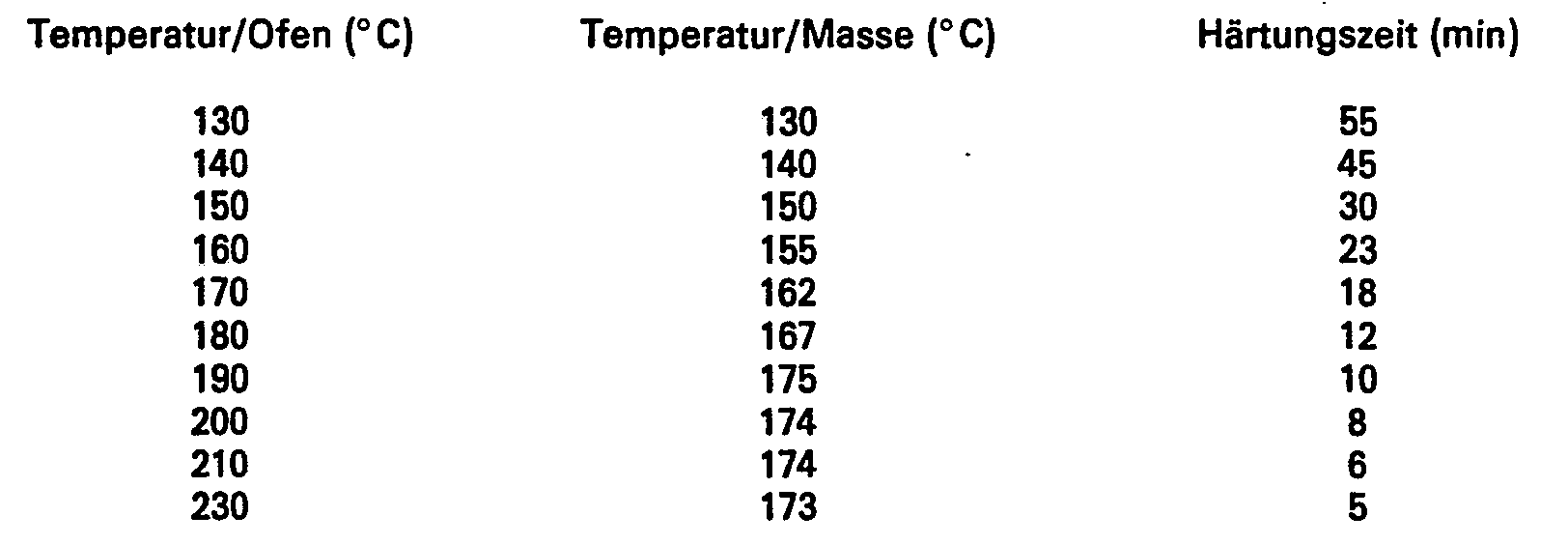
- Bei den in Tabelle 1 aufgeführten Ofentemperaturen werden die entsprechenden Aushärtungszeiten und die zum Zeitpunkt der Aushärtung in der Masse erreichten Temperaturen gemessen:
- d. 50 g der Masse werden in einem Mikrowellenherd 60 s lang mit stärkster Intensität aufgeheizt. Die Temperatur der Probe beträgt danach gleichmäßig 175°C. Nach dem Abkühlen ist die Probe zu einem gummielastischen Körper durchgehärtet.
- e. Ein Teil der Masse wird mittels einer Hot-melt-Pistole ausgespritzt, wobei die Masse in der Pistole kurzzeitig auf 180°C erhitzt wird. Nach dem Abkühlen des ausgespritzten Stranges ist dieser durchgehärtet.
- Analog zu Beispiel 2 wird eine Grundmischung hergestellt, wobei die verwendete merkaptoendständige Verbindung ein oligomeres Polysulfid der durchschnittlichen Struktur
- HS-(C2H4-0-CH2-0-C2H4-SS)8-C2H4-0-CH2-0-C2H2-SH
- mit etwa 2 % Quervernetzung ist. Es hat ein durchschnittliches Molekulargewicht von 1000 und eine Viskosität bei 27° C von 0,7 - 1,2 Pa. s.
- Zu der Grundmischung werden 680 Teile der Härtermischung gemäß Beispiel 1 gegeben und unter Vakuum 10 min lang intensiv gemischt.
- Die erhaltene Masse wird in mehrere Portionen geteilt, mit denen folgende Versuche durchgeführt werden:
- a. Ein Teil wird in einer Tube verschlossen bei 23° C gelagert. Die Masse ist noch nach einer Lagerzeit von 6 Mon. spritzbar.
- b. Ein Teil wird zu einem Probekörper (15x15x50 mm) ausgespritzt und bei 23° C und 50 % relativer Feuchte offen gelagert. Die Masse hat nach 30 min. eine dünne klebfreie Haut. Nach 10 d ist die Probe zu einem gummielastischen Körper durchgehärtet.
- c. 50 g der Masse werden in einem Umluftofen bei 160°C gelagert. Nach 20 min ist die Masse zu einem gummielastischen Produkt durchgehärtet.
- Analog zu Beispiel 2 wird eine Grundmischung hergestellt, wobei die verwendete merkaptoendständige Verbindung ein Polymercaptan der durchschnittlichen Struktur

- Zu dieser Mischung werden 250 Teile der Härtermischung aus Beispiel 1 gegeben und unter Vakuum 10 min lang intensiv gemischt.
- Die erhaltene Masse wird in mehrere Portionen geteilt, mit denen folgende Versuche durchgeführt werden:
- a. Ein Teil wird in einer Tube verschlossen bei 23°C gelagert. Die Masse ist noch nach einer Lagerzeit von 4 Mon. spritzbar.
- b. Ein Teil wird zu einem Probekörper (15x15x50 mm) ausgespritzt und bei 23° C und 50 % relativer Feuchte offen gelagert.
- Die Masse hat nach 20 min eine dünne klebfreie Haut. Nach 10 d ist die Probe zu einem gummielastischen Körper durchgehärtet.
- c. 50 g der Masse werden in einem Umluftofen bei 160°C gelagert. Nach 25 min ist die Masse zu einem gummielastischen Produkt durchgehärtet.
-
- 1000 Teilen Polysulfid-Polymer
- 270 Teilen Benzylbutylphthalat
- 100 Teilen Chlorparaffin (56 % Chlor)
- 600 Teilen Kreide
- 300 Teilen Calcinierter Ton
- 250 Teilen Titandioxid
- 5 Teilen SRP-Ruß (pH 8)
- 5 Teilen Stearinsäure
- 25 Teilen Hochdisperse Kieselsäure
- 25 Teilen Molekularsiebpulver 3A
- wird analog zu Beispiel 2 hergestellt und mit 170 Teilen der Härtermischung aus Beispiel 1 unter Vakuum intensiv gemischt.
- Die erhaltene Masse wird in mehrere Portionen geteilt, mit denen folgende Versuche durchgeführt werden:
- a. Ein Teil wird in einer Tube verschlossen bei 23°C gelagert. Die Masse ist noch nach einer Lagerzeit von 6 Mon. spritzbar.
- b. Ein Teil wird zu einem Probekörper (15x15x50 mm) ausgespritzt und bei 23 ° C und 50 % relativer Feuchte .offen gelagert.
- Die Masse hat nach 1 h eine dünne klebfreie Haut. Nach 14 d ist die Probe zu einem gummielastischen Körper durchgehärtet.
- c. 50 g der Masse werden in einem Umluftofen bei 160°C gelagert. Nach 60 min ist noch keine Härtung zu beobachten.
- Jeweils 50 g verschiedener Einkomponentenmassen auf Basis von Polysulfidpolymer werden in einem Umluftofen bei 160°C 60 min lang gelagert. Dabei werden folgende Ergebnisse erhalten:

Claims (3)
Applications Claiming Priority (2)
| Application Number | Priority Date | Filing Date | Title |
|---|---|---|---|
| DE19853509175 DE3509175A1 (de) | 1985-03-14 | 1985-03-14 | Hitzehaertende klebe- und dichtungsmassen, verfahren zu ihrer herstellung und verwendung |
| DE3509175 | 1985-03-14 |
Publications (2)
| Publication Number | Publication Date |
|---|---|
| EP0194361A1 EP0194361A1 (de) | 1986-09-17 |
| EP0194361B1 true EP0194361B1 (de) | 1988-03-16 |
Family
ID=6265211
Family Applications (1)
| Application Number | Title | Priority Date | Filing Date |
|---|---|---|---|
| EP85202042A Expired EP0194361B1 (de) | 1985-03-14 | 1985-12-10 | Hitzehärtende Klebe- und Dichtungsmassen, Verfahren zu ihrer Herstellung und Verwendung |
Country Status (3)
| Country | Link |
|---|---|
| US (1) | US4689395A (de) |
| EP (1) | EP0194361B1 (de) |
| DE (2) | DE3509175A1 (de) |
Families Citing this family (15)
| Publication number | Priority date | Publication date | Assignee | Title |
|---|---|---|---|---|
| DE3700134A1 (de) * | 1987-01-03 | 1988-07-14 | Ruetgerswerke Ag | Kunststoffbahn |
| DE3809104A1 (de) * | 1988-03-18 | 1989-09-28 | Ruetgerswerke Ag | Einkomponentige dichtungsmassen |
| DE3822122A1 (de) * | 1988-06-30 | 1990-01-11 | Ruetgerswerke Ag | Dichtungs- und versiegelungsmassen und verfahren zu ihrer herstellung |
| FR2636068B1 (fr) * | 1988-09-08 | 1993-08-13 | Sandoz Sa | Compositions reticulables comprenant un polymere a groupe mercapto |
| DE3833051A1 (de) * | 1988-09-29 | 1990-04-12 | Ruetgerswerke Ag | Reaktionsspritzgussverfahren fuer fluessige merkaptoendstaendige polymere |
| GB9201452D0 (en) * | 1992-01-23 | 1992-03-11 | Morton Int Ltd | Single-component polysulphide based sealant compositions |
| US5409985A (en) * | 1992-01-23 | 1995-04-25 | Morton International Limited | Single-component polysulphide based sealant compositions |
| US5225472A (en) * | 1992-05-19 | 1993-07-06 | Courtaulds Aerospace, Inc. | Low viscosity polythiol and method therefor |
| US5412069A (en) * | 1993-07-30 | 1995-05-02 | Rutgers, The State University Of New Jersey | Two-part polysulfide molding composition and process |
| GB9418612D0 (en) * | 1994-09-15 | 1994-11-02 | Morton Int Ltd | One component polysulfide sealant composition |
| JP2001164232A (ja) * | 1999-12-09 | 2001-06-19 | Sony Chem Corp | 熱硬化性接着材料 |
| US7067612B2 (en) * | 2003-01-30 | 2006-06-27 | Prc-Desoto International, Inc. | Preformed compositions in shaped form |
| US7553908B1 (en) | 2003-01-30 | 2009-06-30 | Prc Desoto International, Inc. | Preformed compositions in shaped form comprising polymer blends |
| US20050245695A1 (en) * | 2004-04-30 | 2005-11-03 | Cosman Michael A | Polymer blend and compositions and methods for using the same |
| US7390859B2 (en) * | 2005-02-08 | 2008-06-24 | Ppg Industries Ohio, Inc. | Compositions and methods of making compositions exhibiting fuel resistance |
Family Cites Families (14)
| Publication number | Priority date | Publication date | Assignee | Title |
|---|---|---|---|---|
| US2940959A (en) * | 1957-05-07 | 1960-06-14 | Thiokol Chemical Corp | Curing of polysulfide polymers with manganite coated mno2 |
| US3331782A (en) * | 1963-06-21 | 1967-07-18 | Thiokol Chemical Corp | Curing paste |
| US3282902A (en) * | 1963-12-04 | 1966-11-01 | Thiokol Chemical Corp | Curable polysulfide compositions, methods and vulcanizates |
| US3505254A (en) * | 1965-07-23 | 1970-04-07 | Inter Chem Corp | Stable polysulfide composition containing encapsulated curing agent |
| US3491046A (en) * | 1967-02-24 | 1970-01-20 | Thiokol Chemical Corp | Lead dioxide/manganese dioxide/sulfur cure for polysulfide-bituminous compositions |
| DE2107971C3 (de) * | 1971-02-19 | 1979-01-11 | Ruetgerswerke Ag, 6000 Frankfurt | Härtungsbeschleuniger für lagerstabile, mit Luftfeuchtigkeit aushärtende Mischungen auf der Basis von flüssigen monomeren, oligomeren oder polymeren Verbindungen mit endständigen Mercaptogruppen und Peroxiden des Zinks oder Cadmiums als Härter |
| DE2557012C3 (de) * | 1975-12-18 | 1980-01-17 | Riedel-De Haen Ag, 3016 Seelze | Härter für Polysulfid-Polymermassen |
| DE2557088A1 (de) | 1975-12-18 | 1977-06-30 | Riedel De Haen Ag | Feuchtigkeitshaertende einkomponenten-polysulfid-polymermasse und verfahren zu ihrer herstellung |
| DE2615963C3 (de) * | 1976-04-12 | 1981-07-02 | Rütgerswerke AG, 6000 Frankfurt | Einkomponenten-Mischungen zur Herstellung von Dichtungs-, Versiegelungs- oder Formmassen auf der Basis von flüssigen Polymeren oder Mischungen von monomeren, oligomeren und polymeren Verbindungen mit endständigen Mercaptogruppen |
| US4165426A (en) | 1978-06-08 | 1979-08-21 | Thiokol Corporation | Zinc oxide cured polysulfide polymers containing levulinic acid suitable for hot melt application |
| US4192941A (en) | 1978-06-08 | 1980-03-11 | Thiokol Corporation | Cured polysulfide polymers suitable for hot melt applications |
| US4263078A (en) | 1978-06-08 | 1981-04-21 | Thiokol Corporation | Method of making an article comprising polysulfide rubbers |
| DE3134151A1 (de) | 1981-08-28 | 1983-03-17 | Rütgerswerke AG, 6000 Frankfurt | Heiss applizier- und haertbare dichtungsmasse und ihre verwendung |
| DE3329076C2 (de) * | 1983-08-11 | 1987-02-26 | Polychemie-Gesellschaft mbH, 8900 Augsburg | Einkomponentige Massen auf Basis merkaptogruppenhaltiger Polymere mit verbesserten physikalischen Eigenschaften und guter Lagerfähigkeit |
-
1985
- 1985-03-14 DE DE19853509175 patent/DE3509175A1/de not_active Withdrawn
- 1985-12-10 EP EP85202042A patent/EP0194361B1/de not_active Expired
- 1985-12-10 DE DE8585202042T patent/DE3561888D1/de not_active Expired
-
1986
- 1986-02-11 US US06/828,430 patent/US4689395A/en not_active Expired - Fee Related
Also Published As
| Publication number | Publication date |
|---|---|
| EP0194361A1 (de) | 1986-09-17 |
| DE3509175A1 (de) | 1986-09-18 |
| US4689395A (en) | 1987-08-25 |
| DE3561888D1 (en) | 1988-04-21 |
Similar Documents
| Publication | Publication Date | Title |
|---|---|---|
| EP0194361A1 (de) | Hitzehärtende Klebe- und Dichtungsmassen, Verfahren zu ihrer Herstellung und Verwendung | |
| DE1470925B2 (de) | Polyalkylenpolysusfidformmasse | |
| EP0619355B1 (de) | Dichtstoffe | |
| CH620469A5 (de) | ||
| DE2000658A1 (de) | Neue Polyaether-Verbindungen und Verfahren zur Herstellung dieser Polyaether | |
| EP0073530A2 (de) | Heiss applizier- und härtbare Dichtungsmasse und ihre Verwendung | |
| DE1719217A1 (de) | Durch Feuchtigkeit haertbare Polythiolpolymermasse | |
| DE1494530C3 (de) | Überzugs- und Abdichtmasse | |
| DE2533041A1 (de) | Plastifizierte schwefelgemische und verfahren zum plastifizieren von schwefel | |
| DE2000752B2 (de) | Haertung von fluessigen polythiolpolymeren | |
| DE2635176C2 (de) | Härtbare Formmassen auf der Basis chlorsulfonierter Polyolefine | |
| EP0332754B1 (de) | Einkomponentige Dichtungsmassen | |
| DE2615963C3 (de) | Einkomponenten-Mischungen zur Herstellung von Dichtungs-, Versiegelungs- oder Formmassen auf der Basis von flüssigen Polymeren oder Mischungen von monomeren, oligomeren und polymeren Verbindungen mit endständigen Mercaptogruppen | |
| DE3329076C2 (de) | Einkomponentige Massen auf Basis merkaptogruppenhaltiger Polymere mit verbesserten physikalischen Eigenschaften und guter Lagerfähigkeit | |
| DD154996A5 (de) | Sauerstoffhaertbare massenauf basis mercaptofunktioneller organischer verbindungen und ihre verwendung zur herstellung hoehermolekularer produkte | |
| EP0365748B1 (de) | Spritzgiessverfahren für flüssige merkaptoendständige Polymere | |
| DE19521671C1 (de) | Recycling von ausgehärteten Polysulfid- und/oder Polymercaptan-Kleb-/Dichtstoffen | |
| DE2363856C3 (de) | Herstellung von unter Einwirkung von Luftfeuchtigkeit härtenden, trocken lagerstabilen Mischungen auf der Basis von flüssigen monomeren, oligomeren oder polymeren Verbindungen mit einer oder mehreren endständigen Mercaptogruppen | |
| DE1945457A1 (de) | Dichtungsmassen | |
| DE10338069B3 (de) | Härtbare zweikomponentige flüssige Polymerzusammensetzungen | |
| DE3929225A1 (de) | Polymermassen mit verzoegerter haertung | |
| DE1769949C (de) | Härtbare Polymercaptanpolymermasse | |
| DE1800982C3 (de) | Härter-Beschleuniger-System für flüssige Polysulfidpolymer-Massen | |
| CH678429A5 (de) | ||
| DE1769949A1 (de) | Haertbare Polymercaptanpolymermasse |
Legal Events
| Date | Code | Title | Description |
|---|---|---|---|
| PUAI | Public reference made under article 153(3) epc to a published international application that has entered the european phase |
Free format text: ORIGINAL CODE: 0009012 |
|
| AK | Designated contracting states |
Kind code of ref document: A1 Designated state(s): BE CH DE FR IT LI NL |
|
| 17P | Request for examination filed |
Effective date: 19860723 |
|
| ITCL | It: translation for ep claims filed |
Representative=s name: BARZANO' E ZANARDO ROMA S.P.A. |
|
| TCNL | Nl: translation of patent claims filed | ||
| EL | Fr: translation of claims filed | ||
| 17Q | First examination report despatched |
Effective date: 19870810 |
|
| ITF | It: translation for a ep patent filed | ||
| GRAA | (expected) grant |
Free format text: ORIGINAL CODE: 0009210 |
|
| AK | Designated contracting states |
Kind code of ref document: B1 Designated state(s): BE CH DE FR IT LI NL |
|
| REF | Corresponds to: |
Ref document number: 3561888 Country of ref document: DE Date of ref document: 19880421 |
|
| ET | Fr: translation filed | ||
| PLBE | No opposition filed within time limit |
Free format text: ORIGINAL CODE: 0009261 |
|
| STAA | Information on the status of an ep patent application or granted ep patent |
Free format text: STATUS: NO OPPOSITION FILED WITHIN TIME LIMIT |
|
| 26N | No opposition filed | ||
| ITTA | It: last paid annual fee | ||
| PGFP | Annual fee paid to national office [announced via postgrant information from national office to epo] |
Ref country code: FR Payment date: 19911209 Year of fee payment: 7 |
|
| PGFP | Annual fee paid to national office [announced via postgrant information from national office to epo] |
Ref country code: CH Payment date: 19911218 Year of fee payment: 7 |
|
| PGFP | Annual fee paid to national office [announced via postgrant information from national office to epo] |
Ref country code: NL Payment date: 19911231 Year of fee payment: 7 |
|
| PGFP | Annual fee paid to national office [announced via postgrant information from national office to epo] |
Ref country code: DE Payment date: 19920107 Year of fee payment: 7 |
|
| PGFP | Annual fee paid to national office [announced via postgrant information from national office to epo] |
Ref country code: BE Payment date: 19920204 Year of fee payment: 7 |
|
| PG25 | Lapsed in a contracting state [announced via postgrant information from national office to epo] |
Ref country code: LI Effective date: 19921231 Ref country code: CH Effective date: 19921231 Ref country code: BE Effective date: 19921231 |
|
| BERE | Be: lapsed |
Owner name: RUTGERSWERKE A.G. Effective date: 19921231 |
|
| PG25 | Lapsed in a contracting state [announced via postgrant information from national office to epo] |
Ref country code: NL Effective date: 19930701 |
|
| NLV4 | Nl: lapsed or anulled due to non-payment of the annual fee | ||
| PG25 | Lapsed in a contracting state [announced via postgrant information from national office to epo] |
Ref country code: FR Effective date: 19930831 |
|
| REG | Reference to a national code |
Ref country code: CH Ref legal event code: PL |
|
| PG25 | Lapsed in a contracting state [announced via postgrant information from national office to epo] |
Ref country code: DE Effective date: 19930901 |
|
| REG | Reference to a national code |
Ref country code: FR Ref legal event code: ST |