EP0161632B1 - Neue Pyrrolo-Benzimidazole, Verfahren zu ihrer Herstellung und diese Verbindungen enthaltende Arzneimittel sowie Zwischenprodukte - Google Patents
Neue Pyrrolo-Benzimidazole, Verfahren zu ihrer Herstellung und diese Verbindungen enthaltende Arzneimittel sowie Zwischenprodukte Download PDFInfo
- Publication number
- EP0161632B1 EP0161632B1 EP85105675A EP85105675A EP0161632B1 EP 0161632 B1 EP0161632 B1 EP 0161632B1 EP 85105675 A EP85105675 A EP 85105675A EP 85105675 A EP85105675 A EP 85105675A EP 0161632 B1 EP0161632 B1 EP 0161632B1
- Authority
- EP
- European Patent Office
- Prior art keywords
- indolin
- nitro
- methyl
- pyridinoylamino
- pyridyl
- Prior art date
- Legal status (The legal status is an assumption and is not a legal conclusion. Google has not performed a legal analysis and makes no representation as to the accuracy of the status listed.)
- Expired - Lifetime
Links
- 0 CC(C)(C(Nc1c2)=*)c1cc([N+]([O-])=O)c2NC(**)=O Chemical compound CC(C)(C(Nc1c2)=*)c1cc([N+]([O-])=O)c2NC(**)=O 0.000 description 3
- VNGSELLKGABCRR-UHFFFAOYSA-N CC(C)(C(N)=O)c(c(C)c1)cc(N)c1N Chemical compound CC(C)(C(N)=O)c(c(C)c1)cc(N)c1N VNGSELLKGABCRR-UHFFFAOYSA-N 0.000 description 1
Classifications
-
- C—CHEMISTRY; METALLURGY
- C07—ORGANIC CHEMISTRY
- C07D—HETEROCYCLIC COMPOUNDS
- C07D487/00—Heterocyclic compounds containing nitrogen atoms as the only ring hetero atoms in the condensed system, not provided for by groups C07D451/00 - C07D477/00
- C07D487/12—Heterocyclic compounds containing nitrogen atoms as the only ring hetero atoms in the condensed system, not provided for by groups C07D451/00 - C07D477/00 in which the condensed system contains three hetero rings
- C07D487/14—Ortho-condensed systems
-
- C—CHEMISTRY; METALLURGY
- C07—ORGANIC CHEMISTRY
- C07D—HETEROCYCLIC COMPOUNDS
- C07D487/00—Heterocyclic compounds containing nitrogen atoms as the only ring hetero atoms in the condensed system, not provided for by groups C07D451/00 - C07D477/00
- C07D487/02—Heterocyclic compounds containing nitrogen atoms as the only ring hetero atoms in the condensed system, not provided for by groups C07D451/00 - C07D477/00 in which the condensed system contains two hetero rings
- C07D487/04—Ortho-condensed systems
-
- A—HUMAN NECESSITIES
- A61—MEDICAL OR VETERINARY SCIENCE; HYGIENE
- A61P—SPECIFIC THERAPEUTIC ACTIVITY OF CHEMICAL COMPOUNDS OR MEDICINAL PREPARATIONS
- A61P9/00—Drugs for disorders of the cardiovascular system
-
- A—HUMAN NECESSITIES
- A61—MEDICAL OR VETERINARY SCIENCE; HYGIENE
- A61P—SPECIFIC THERAPEUTIC ACTIVITY OF CHEMICAL COMPOUNDS OR MEDICINAL PREPARATIONS
- A61P9/00—Drugs for disorders of the cardiovascular system
- A61P9/04—Inotropic agents, i.e. stimulants of cardiac contraction; Drugs for heart failure
-
- A—HUMAN NECESSITIES
- A61—MEDICAL OR VETERINARY SCIENCE; HYGIENE
- A61P—SPECIFIC THERAPEUTIC ACTIVITY OF CHEMICAL COMPOUNDS OR MEDICINAL PREPARATIONS
- A61P9/00—Drugs for disorders of the cardiovascular system
- A61P9/12—Antihypertensives
-
- C—CHEMISTRY; METALLURGY
- C07—ORGANIC CHEMISTRY
- C07D—HETEROCYCLIC COMPOUNDS
- C07D209/00—Heterocyclic compounds containing five-membered rings, condensed with other rings, with one nitrogen atom as the only ring hetero atom
- C07D209/02—Heterocyclic compounds containing five-membered rings, condensed with other rings, with one nitrogen atom as the only ring hetero atom condensed with one carbocyclic ring
- C07D209/04—Indoles; Hydrogenated indoles
- C07D209/30—Indoles; Hydrogenated indoles with hetero atoms or with carbon atoms having three bonds to hetero atoms with at the most one bond to halogen, directly attached to carbon atoms of the hetero ring
- C07D209/32—Oxygen atoms
- C07D209/34—Oxygen atoms in position 2
-
- C—CHEMISTRY; METALLURGY
- C07—ORGANIC CHEMISTRY
- C07D—HETEROCYCLIC COMPOUNDS
- C07D209/00—Heterocyclic compounds containing five-membered rings, condensed with other rings, with one nitrogen atom as the only ring hetero atom
- C07D209/02—Heterocyclic compounds containing five-membered rings, condensed with other rings, with one nitrogen atom as the only ring hetero atom condensed with one carbocyclic ring
- C07D209/04—Indoles; Hydrogenated indoles
- C07D209/30—Indoles; Hydrogenated indoles with hetero atoms or with carbon atoms having three bonds to hetero atoms with at the most one bond to halogen, directly attached to carbon atoms of the hetero ring
- C07D209/42—Carbon atoms having three bonds to hetero atoms with at the most one bond to halogen, e.g. ester or nitrile radicals
-
- C—CHEMISTRY; METALLURGY
- C07—ORGANIC CHEMISTRY
- C07D—HETEROCYCLIC COMPOUNDS
- C07D209/00—Heterocyclic compounds containing five-membered rings, condensed with other rings, with one nitrogen atom as the only ring hetero atom
- C07D209/56—Ring systems containing three or more rings
- C07D209/96—Spiro-condensed ring systems
-
- C—CHEMISTRY; METALLURGY
- C07—ORGANIC CHEMISTRY
- C07D—HETEROCYCLIC COMPOUNDS
- C07D401/00—Heterocyclic compounds containing two or more hetero rings, having nitrogen atoms as the only ring hetero atoms, at least one ring being a six-membered ring with only one nitrogen atom
- C07D401/02—Heterocyclic compounds containing two or more hetero rings, having nitrogen atoms as the only ring hetero atoms, at least one ring being a six-membered ring with only one nitrogen atom containing two hetero rings
- C07D401/12—Heterocyclic compounds containing two or more hetero rings, having nitrogen atoms as the only ring hetero atoms, at least one ring being a six-membered ring with only one nitrogen atom containing two hetero rings linked by a chain containing hetero atoms as chain links
-
- C—CHEMISTRY; METALLURGY
- C07—ORGANIC CHEMISTRY
- C07D—HETEROCYCLIC COMPOUNDS
- C07D403/00—Heterocyclic compounds containing two or more hetero rings, having nitrogen atoms as the only ring hetero atoms, not provided for by group C07D401/00
- C07D403/14—Heterocyclic compounds containing two or more hetero rings, having nitrogen atoms as the only ring hetero atoms, not provided for by group C07D401/00 containing three or more hetero rings
-
- C—CHEMISTRY; METALLURGY
- C07—ORGANIC CHEMISTRY
- C07D—HETEROCYCLIC COMPOUNDS
- C07D487/00—Heterocyclic compounds containing nitrogen atoms as the only ring hetero atoms in the condensed system, not provided for by groups C07D451/00 - C07D477/00
- C07D487/02—Heterocyclic compounds containing nitrogen atoms as the only ring hetero atoms in the condensed system, not provided for by groups C07D451/00 - C07D477/00 in which the condensed system contains two hetero rings
- C07D487/10—Spiro-condensed systems
Definitions
- the invention also relates to the optically active forms and racemic mixtures of these compounds.
- These new compounds of the present invention have valuable pharmacological properties, in particular they increase heart strength and / or have a hypotensive effect and / or influence platelet aggregation and improve microcirculation.
- benzimidazole derivatives which are substituted in the 2-position by phenyl groups.
- the compounds described there affect the contractility of the heart.
- they differ structurally from the compounds of the present invention essentially in that they are exclusively bicyclic derivatives, while the compounds according to the invention are tricyclic derivatives (pyrrolo-benzimidazoles) which are in the 2-position of the imidazole system by the heterocyclic group Py-X substituted.
- GB-1,158,532, FR-1,529,901 and Helv. Chim. Acta 20, 373-386 (1937) discloses compounds or the preparation of compounds which can be used as intermediates for the preparation of the compounds according to the invention.
- the substituents R 1 and R 2 can be identical or different and can be hydrogen, a straight-chain or branched alkyl or alkenyl group having 1-6 or 2-6 carbon atoms, a cyano group or one by one Hydroxy, alkyl, alkoxy, amino, alkylamino, dialkylamino or hydrazino group are substituted carbonyl groups, where each of the aforementioned alkyl parts can be straight-chain or branched from 1-6 or 2-6 carbon atoms.
- R 1 is a straight-chain alkyl group with 1-6 carbon atoms or a branched alkyl group, a cycloalkyl or alkenyl group with 3-7 carbon atoms, a cyano group or one with an alkyl, alkoxy, amino or , Alkylamino, dialkylamino or hydrazino group substituted carbonyl group.
- R 1 and R 2 together with the carbon atom to which they are attached can also form a cycloalkyl ring with 3-8 carbon atoms, these are preferably the spirocyclopropyl, Spirocyclobutyl, Spirocyclopentyl and Spirocyclohexyl group.
- R 1 and R 2 together can also form a C 2 -C 3 alkylidene or Ca-Cs cycloalkylidene group, preferably the isopropylidene group.
- Alkyl or alkoxy substituents of the pyridine ring can contain 1-6, preferably 1-4 carbon atoms. Methyl and ethyl or methoxy and ethoxy is preferred. Halogen is to be understood as fluorine, chlorine and bromine, preferably chlorine.
- Py represents a 2-, 3- or 4-pyridyl radical which optionally carries an oxygen atom on the ring heteroatom and / or can be substituted by one or more alkyl, alkoxy, hydroxyl, cyano or nitro groups and by halogen and x is a valence line, in this sense 2-pyridyl-, 2- (N-oxypyridyl) -, 2- (5-n-butyl-pyridyl) -, 3-pyridyl-, 3- (N- Oxy-pyridyl) -, 3- (6-methyl-pyridyl) -, 3- (6-cyanopyridyl) -, 3- (6-nitro-pyridyl) -, 3- (6-hydroxy-pyridyl) -, 3- (2-methoxy-6-methyl-pyriayl) -, 4-pyridyl-, 4- (N-oxypyridyl) -, 4- (2-methyl-pyridyl) -
- X is a C 1 -C 4 alkylene group or the vinylene group and Py is a 2-, 3- or 4-pyridyl radical
- 3-pyridyl-methyl-, 3-pyridyl-ethyl-, 3-pyridyl are particularly preferred in this sense vinyl, 4-pyridyl-methyl, 4-pyridyl-ethyl and 4-pyridyl-vinyl radical.
- Preferred pyrrolo-benzimidazoles of the general formula are compounds in which R 1 is hydrogen, methyl, ethyl, 2-propyl, 2-methyl-propyl or cyclopentyl, R 2 is hydrogen, methyl, ethyl, ethoxycarbonyl or hydrazinocarbonyl, R 1 and R 2 together with the carbon atom to which they are attached form a cyclopentane ring or together form an isopropylidene radical, X is a valence bond, a methylene, ethylene or vinylene group, T is oxygen or sulfur and Py is a pyridyl-N-oxide Radical or a pyridyl radical, which can be substituted one or more times by hydroxyl, methoxy, methyl or halogen.
- T is oxygen
- X is a valence bond
- R 1 is hydrogen or methyl
- R 2 is methyl
- Py is a pyridine-N-oxide radical or a pyridyl radical which is substituted by hydroxyl or may be substituted methyl.
- cyclizations to the desired compounds of general formula I mentioned in processes a) - g) above are preferably carried out in a solvent or solvent mixture such as ethanol, isopropanol, glacial acetic acid, benzene, toluene, chlorobenzene, glycol, ethylene glycol dimethyl ether, sulfolane or dimethylformamide Temperatures between 0 ° C and 220 ° C, but preferably at the boiling point of the reaction mixture, optionally in the presence of a condensing agent such as phosphorus oxychloride, thionyl chloride, p-toluenesulfonic acid, hydrochloric acid, sulfuric acid, phosphoric acid, polyphosphoric acid or optionally also in the presence of a base such as sodium hydroxide, sodium methylate or potassium tert-butoxide.
- a solvent or solvent mixture such as ethanol, isopropanol, glacial acetic acid, benzene, tol
- the subsequent conversion relates to compounds of the general formula I in which R or R 2 represents a carboxyl group or a reactive derivative such as, for example, carboxylic acid ester or acid chloride, which reacts with hydrazine, ammonia, a primary or secondary amine or a reactive derivative thereof to form new compounds of the general formula I, in which R 1 or R 2 is a carbonyl group substituted by an amino, alkylamino, dialkylamino or hydrazino group.
- R or R 2 represents a carboxyl group or a reactive derivative such as, for example, carboxylic acid ester or acid chloride, which reacts with hydrazine, ammonia, a primary or secondary amine or a reactive derivative thereof to form new compounds of the general formula I, in which R 1 or R 2 is a carbonyl group substituted by an amino, alkylamino, dialkylamino or hydrazino group.
- the subsequent conversion also relates to compounds of the general formula I in which R or R 2 is an aminocarbonyl group to those in which R 1 or R 2 is a cyano group, and the subsequent conversion of a cyano group to a carboxyl, aminocarbonyl or alkoxycarbonyl group.
- the compounds of general formula I or their tautomeric forms into their pharmacologically acceptable salts, they are preferably placed in an organic solvent with the equivalent amount of an inorganic or organic acid, e.g. Hydrochloric acid, hydrobromic acid, phosphoric acid, sulfuric acid, acetic acid, citric acid, tartaric acid, maleic acid, fumaric acid, benzoic acid or cyclohexylsulfamic acid.
- an inorganic or organic acid e.g. Hydrochloric acid, hydrobromic acid, phosphoric acid, sulfuric acid, acetic acid, citric acid, tartaric acid, maleic acid, fumaric acid, benzoic acid or cyclohexylsulfamic acid.
- the substances of the general formula are mixed in a manner known per se with suitable pharmaceutical carrier substances, flavorings, flavors and colors and shaped, for example, as tablets or dragées or with the addition of appropriate auxiliaries in water or oil, such as Olive oil, suspended or dissolved.
- the new substances of the general formula I according to the invention and their salts can be administered enterally or parenterally in liquid or solid form.
- Water is preferably used as the injection medium, which contains the additives which are customary in injection solutions, such as stabilizing agents, solubilizers or buffers.
- Such additions are e.g. Tartrate and citrate buffers, ethanol, combined complexing agents (such as ethylenediaminetetraacetic acid and its non-toxic salts) and high molecular weight polymers (such as liquid polyethylene oxide) for viscosity regulation.
- Solid carrier materials are e.g. Starch, lactose, mannitol, methyl cellulose, talc, highly disperse silica, high molecular weight fatty acids (such as steric acid), gelatin, agar-agar, calcium phosphate, magnesium stearate, animal and vegetable fats and solid high molecular weight polymers (such as polyethylene glycols).
- Preparations suitable for oral administration can optionally contain flavorings and sweeteners.
- the compounds of the formula I according to the invention are usually applied in amounts of 10-500 mg per day based on 75 kg of body weight. It is preferable to take 1-2 tablets 2-3 times a day an active ingredient content of 5-200 mg. The tablets can also be delayed, which means that 1-2 tablets with 10-500 mg of active ingredient only have to be given once a day.
- the active substance can also be given by injection 1-8 times a day or by continuous infusion, with amounts of 5-200 mg / day usually being sufficient.
- the starting materials for the compounds claimed in Example 1 can be prepared as follows.
- the starting materials for the compounds claimed in Example 5 can be prepared as follows will.
- the starting materials for the compounds claimed in Example 6 can be prepared as follows:
- the starting materials for the compounds claimed in Example 8 can be prepared as follows:
- Example 10 The starting materials from Example 10 are produced as follows:
- the starting compounds are made as follows:
Landscapes
- Organic Chemistry (AREA)
- Chemical & Material Sciences (AREA)
- Health & Medical Sciences (AREA)
- Engineering & Computer Science (AREA)
- Bioinformatics & Cheminformatics (AREA)
- Cardiology (AREA)
- Pharmacology & Pharmacy (AREA)
- Animal Behavior & Ethology (AREA)
- Medicinal Chemistry (AREA)
- Nuclear Medicine, Radiotherapy & Molecular Imaging (AREA)
- Chemical Kinetics & Catalysis (AREA)
- Life Sciences & Earth Sciences (AREA)
- Heart & Thoracic Surgery (AREA)
- General Chemical & Material Sciences (AREA)
- General Health & Medical Sciences (AREA)
- Public Health (AREA)
- Veterinary Medicine (AREA)
- Hospice & Palliative Care (AREA)
- Pharmaceuticals Containing Other Organic And Inorganic Compounds (AREA)
- Nitrogen Condensed Heterocyclic Rings (AREA)
- Plural Heterocyclic Compounds (AREA)
Description
- Die vorliegende Erfindung betrifft neue Pyrrolo-Benzimidazole der allgemeinen Formel I

- R1 ein Wasserstoffatom, eine C1-C6-Alkyl-, C2-CG-Alkenyl- oder eine C3-C7-Cycloalkylgruppe bedeutet,
- R2 ein Wasserstoffatom, eine C1-C6-Alkyl-, C2-CG-Alkenyl-, oder Cyangruppe, eine durch eine Hydroxy-, C1-C6-Alkyl-, C1-C6-Alkoxy-, Amino-, C1-C6-Alkylamino-, Di-C1-C6-alkylamino- oder Hydrazinogruppe substituierte Carbonylgruppe bedeutet oder mit R1 zusammen eine C3-C8-Cycloalkylengruppe darstellt oder R1 und R2 zusammen eine C2-C6-Alkyliden- oder C3-C8-Cycloalkylidengruppe bilden,
- X einen Valenzstrich, eine C1-C4-Alkylengruppe oder die Vinylengruppe bedeutet,
- T gleich Sauerstoff oder Schwefel bedeutet,
- Py einen 2-, 3- oder 4-Pyridylrest darstellt, der gegebenenfalls am Ringheteroatom ein Sauerstoffatom trägt und/oder durch eine oder mehrere C1-C6-Alkyl-, C1-C6-Alkoxy-, Hydroxy-, Cyano- oder Nitrogruppen, sowie durch Halogen substituiert sein kann, deren Tautomere und deren physiologisch verträgliche Salze anorganischer und organischer Säuren und Verfahren zu ihrer Herstellung, sowie diese Verbindungen enthaltende Arzneimittel.
- Da die Verbindungen der allgemeinen Formel I für den Fall, daß R1 nicht gleich R2 ist, ein asymmetrisches Kohlenstoffatom besitzen, sind auch Gegenstand der Erfindung die optisch aktiven Formen und racemischen Gemische dieser Verbindungen. Diese neuen Verbindungen der vorliegenden Erfindung weisen wertvolle pharmakologische Eigenschaften auf, insbesondere steigern sie die Herzkraft und/oder wirken blutdrucksenkend und/oder beeinflussen die Thrombozytenaggregation und verbessern die Mikrozirkulation.
- Aus EP-A-0 098 448 sind Benzimidazol-Derivate bekannt, die in 2-Stellung durch Phenylgruppen substituiert sind. Die dort beschriebenen Verbindungen beeinflussen die Kontraktilität des Herzens. Sie unterscheiden sich jedoch strukturell von den Verbindungen der vorliegenden Erfindung im wesentlichen dadurch, daß sie ausschließlich bicyclische Derivate darstellen, während es sich bei den erfindungsgemäßen Verbindungen um tricyclische Derivate (Pyrrolo-Benzimidazole) handelt, die in 2-Stellung des Imidazolsystems durch die heterocyclische Gruppe Py-X-substituiert sind. Aus GB-1,158,532, FR-1,529,901 und Helv. Chim. Acta 20 , 373-386 (1937) sind Verbindungen bzw. die Herstellung von Verbindungen bekannt, die als Zwischenprodukte für die Herstellung der erfindungsgemäßen Verbindungen eingesetzt werden können.
- In den nachstehend aufgeführten Formeln, insbesondere Formel I, können die Substituenten R1 und R2 gleich oder verschieden sein und Wasserstoff, eine geradkettige oder verzweigte Alkyl- oder Alkenylgruppe mit 1-6 bzw. 2-6 Kohlenstoffatomen, eine Cyanogruppe oder eine durch eine Hydroxy-, Alkyl-, Alkoxy-, Amino-, Alkylamino-, Dialkylamino-, oder Hydrazinogruppe substituierte Carbonylgruppe darstellen, wobei jeder der vorgenannten Alkylteile geradkettig oder verzweigt aus 1-6 bzw. 2-6 Kohlenstoffatomen zusammengesetzt sein kann. Insbesondere kommen jedoch Wasserstoff, die Methyl-, Ethyl-, Allyl-, Cyan-, Carboxy-, Acetyl-, Propionyl-, Methoxycarbonyl-, Ethoxycarbonyl-, Aminocarbonyl-, Methylaminocarbonyl-, Dimethylaminocarbonyl- und Hydrazinocarbonylgruppe für R1 und R2 in Frage.
- Stellt nur R2 ein Wasserstoffatom dar, so ist R1 eine geradkettige Alkylgruppe mit 1-6 Kohlenstoffatomen oder eine verzweigte Alkylgruppe, eine Cycloalkyl- oder Alkenylgruppe mit 3-7 Kohlenstoffatomen, eine Cyanogruppe oder eine durch eine Alkyl-, Alkoxy-, Amino-, Alkylamino-, Dialkylamino- oder Hydrazinogruppe substituierte Carbonylgruppe. Bevorzugt in diesem Sinne sind die Methyl-, Ethyl-, Isopropyl-, Isobutyl-, Pentyl-, Cyclopentyl-, Cyclohexyl-, Allyl-, Cyan-, Acetyl-, Propionyl,-Methoxycarbonyl-, Ethoxycarbonyl-, Aminocarbonyl-, Methylaminocarbonyl-, Dimethylaminocarbonyl- und Hydrazinocarbonylgruppe.
- R1 und R2 koennen zusammen mit dem C-Atom, an das sie gebunden sind, auch einen Cycloalkylring mit 3-8 Kohlenstoffatomen bilden, vorzugsweise handelt es sich dabei um die Spirocyclopropyl-, Spirocyclobutyl-, Spirocyclopentyl- und Spirocyclohexylgruppe.
- R1 und R2 können zusammen auch eine C2-C3-Alkyliden- oder Ca-Cs-Cycloalkylidengruppe bilden, vorzugsweise handelt es sich dabei um die Isopropylidengruppe.
- Alkyl- oder Alkoxy-Substituenten des Pyridin-Rings koennen 1-6, vorzugsweise 1-4 C-Atome enthalten. Bevorzugt ist Methyl und Ethyl bzw. Methoxy und Ethoxy. Unter Halogen ist Fluor, Chlor und Brom, vorzugsweise Chlor zu verstehen.
- Stellt Py einen 2-, 3- oder 4-Pyridylrest dar, der gegebenenfalls am Ringheteroatom ein Sauerstoffatom traegt und/oder durch eine oder mehrere Alkyl-, Alkoxy-, Hydroxy-, Cyano- oder Nitrogruppen, sowie durch Halogen substituiert sein kann und x ist ein Valenzstrich, so sind in diesem Sinne bevorzugt der 2-Pyridyl-, 2-(N-Oxy-pyridyl)-, 2-(5-n-Butyl-pyridyl)-, 3-Pyridyl-, 3-(N-Oxy-pyridyl)-, 3-(6-Methyl-pyridyl)-, 3-(6-Cyan- pyridyl)-, 3-(6-Nitro-pyridyl)-, 3-(6-Hydroxy-pyridyl)-, 3-(2-Methoxy-6-methyl-pyriayl)-, 4-Pyridyl-, 4-(N-Oxy- pyridyl)-, 4-(2-Methyl-pyridyl)-, 4-(2-Ethyl-pyridyl)-, 4-(2-Hydroxy-pyridyl)-, 4-(2-Methoxy-pyridyl)-, 4-(2-Nitro- pyridyl)-, 4-(2-Chlor-pyridyl)- und der 4-(3-Hydroxy-pyridyl)-rest.
- Bedeutet X eine C1-C4 Alkylengruppe oder die Vinylengruppe und Py einen 2-, 3-oder 4-Pyridylrest, so sind in diesem Sinne besonders bevorzugt der 3-Pyridyl-methyl-, 3-Pyridyl-ethyl-, 3-Pyridyl-vinyl-, 4-Pyridyl-methyl-, 4-Pyridyl-ethyl und 4-Pyridyl-vinylrest.
- Bevorzugte Pyrrolo-Benzimidazole der allgemeinen Formel sind Verbindungen, in denen R1 Wasserstoff, Methyl, Ethyl, 2-Propyl, 2-Methyl-propyl oder Cyclopentyl, R2 Wasserstoff, Methyl, Ethyl, Ethoxycarbonyl oder Hydrazinocarbonyl, R1 und R2 zusammen mit dem C-Atom, an das sie gebunden sind, einen Cyclopentan-Ring oder zusammen einem Isopropyliden-Rest bilden, X eine Valenzbindung, eine Methylen-, Ethylen- oder Vinylengruppe, T Sauerstoff oder Schwefel und Py einen Pyridyl-N-oxid-Rest oder einen Pyridyl-Rest bedeuten, der ein- oder mehrfach durch Hydroxyl, Methoxy, Methyl oder Halogen substituiert sein kann.
- Besonders bevorzugt sind Verbindungen der Formel I, in denen T Sauerstoff, X eine Valenzbindung, R1 Wasserstoff oder Methyl, R2 Methyl, Ethyl oder Ethoxycarbonyl und Py einen Pyridin-N-oxid-Rest oder einen Pyridyl-Rest darstellen, der durch Hydroxy oder Methyl substituiert sein kann.
- Die Herstellung der Verbindungen der allgemeinen Formel I erfolgt zunaechst in der Weise, daß man entweder
- a) o-Cyanbenzylnitril II
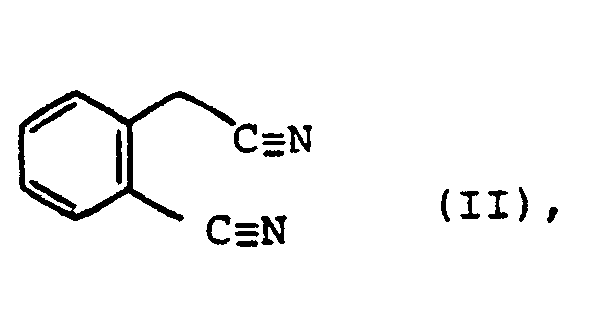


- b) Isochinolin-1,3-dion mit einer Verbindung der allgemeinen Formel III oder IV zu einer Verbindung der allgemeinen Formel VI alkyliert oder
- c) Isochinolin-1,3-dion mit einer Verbindung der allgemeinen Formel VII


Eine abspaltbare Gruppe Z der Verbindungen der Formel III bzw. IV ist in der Regel ein Halogenatom, wobei Chlor, Brom und Jod bevorzugt sind.
Die Cyclisierung einer Verbindung der Formel V findet in saurem Medium statt, vorzugsweise in Gegenwart von Mineralsaeuren wie Salzsaeure oder Schwefelsaeure.
Die Kondensation von Isochinolin-1,3-dion mit einer Verbindung der Formel VII geschieht in Gegenwart einer Base, vorzugsweise KOH oder NaOH.
Die katalytische Hydrierung von Verbindungen der Formel VIII geschieht vorzugsweise mit Pd/C in alkoholischen Medien.
Verbindungen der Formel VI sowie die voranstehend aufgefuehrten Verfahrensschritte sind in der deutschen Patentanmeldung p 34 10 168.3 beschrieben.
Die so erhaltenen Verbindungen der allgemeinen Formel VI werden in bekannter Weise durch Nitrieren in 7-Stellung in Verbindungen der allgemeinen Formel IX ueberfuehrt
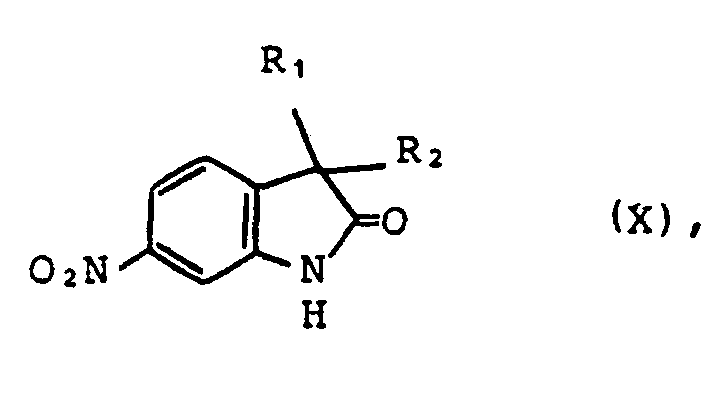
Durch Reduktion der Nitrogruppe in eine Aminogruppe erhaelt man Verbindungen der allgemeinen Formel XI
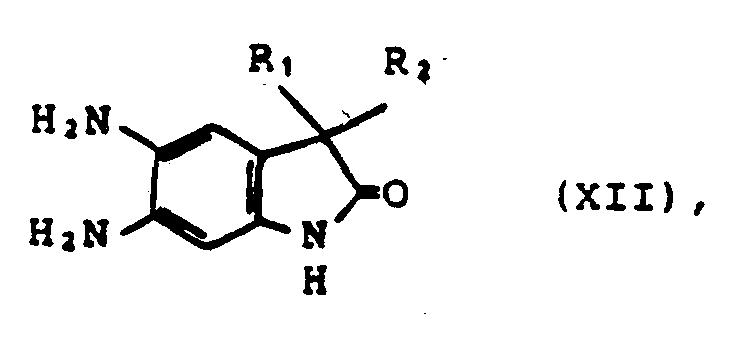
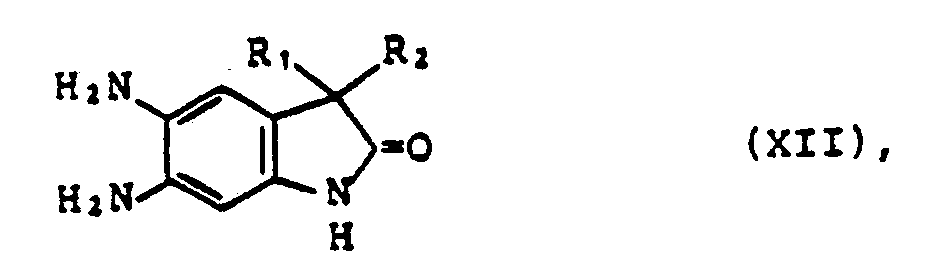
Die so erhaltenen Verbindungen der allgemeinen Formel XI werden in bekannter Weise durch Acetylierung der Aminogruppe in 6-Stellung, Nitrierung in 5-Stellung, Abspaltung der Schutzgruppe und Reduktion der Nitrogruppe in 5-Stellung in ein 5,6-Diamino-indolin-2-on der allgemeinen Formel XII
Die Herstellung der Verbindungen der allgemeinen Formel I kann auch in der Weise erfolgen, daß man - d) Verbindungen der allgemeinen Formel XII erhaelt, indem man ein am Stickstoff geschuetztes Oxindol-Derivat der allgemeinen Formel XIII

Die so erhaltenen Verbindungen der allgemeinen Formel XIII werden in bekannter Weise durch Nitrierung in 5-Stellung, anschließendes Reduzieren der Nitrogruppe zur Aminofunktion, Acetylierung der Aminogruppe in 5-Stellung, Nitrierung in 6-Stellung, Abspaltung der Schutzgruppe und Reduktion der Nitrogruppe in 5-Stellung in ein entsprechendes 5,6-Diamino-indolin-2-on Derivat der allgemeinen Formel XII mit der oben angefuehrten Bedeutung ueberfuehrt.
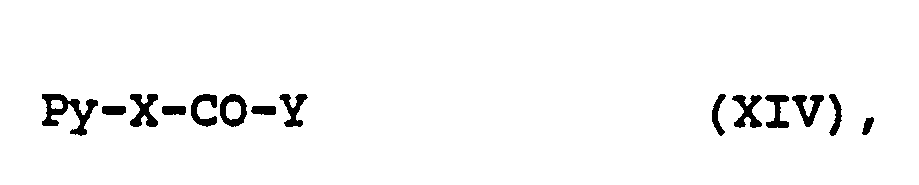
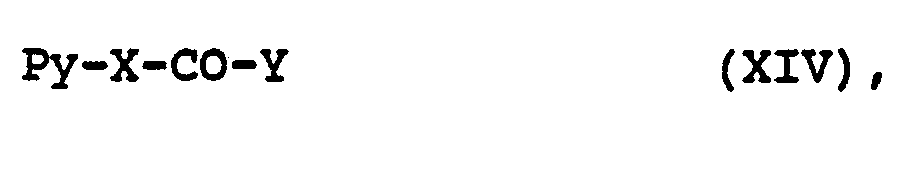
Das erfinderische Verfahren zur Herstellung von Verbindungen der Formel 1 erfolgt dadurch, daß man eine Verbindung der Formel XII mit einer Verbindung der Formel XIV
Unter Verbindungen der Formel XIV versteht man insbesondere Aldehyde, sowie Saeurehalogenide wie Saeurechloride, Carbonsaeureester wie Methyl- und Ethylester und andere aktivierte Carbonsaeurederivate, wie z.B. Anhydride.
Ist die Verbindung der Formel XIV ein Aldehyd findet die Umsetzung zur Schiff'schen Base mit Verbindungen der allgemeinen Formel XII vorzugsweise in alkoholischem Medium statt, die anschließende Cyclisierung und Oxidation zu den Verbindungen der allgemeinen Formel I erfolgt durch Erwaermen des Reaktionsansatzes zum Rueckfluß in Gegenwart von Luftsauerstoff und katalytischen Mengen Saeure, wie z.B. Toluolsulfonsaeure.
Ist die Verbindung der allgemeinen Formel XIV ein Carbonsaeurederivat, findet die Umsetzung mit Verbindung der allgemeinen Formel XII zum Amid in inerten Loesungsmitteln, vorzugsweise Methylenchlorid statt und die anschließende Cyclisierung zu Verbindungen der allgemeinen Formel I wird in saurem Medium, vorzugsweise in Gegenwart von Mineralsaeuren wie H2SO4 oder HC1 in alkoholischer Loesung, vorgenommen.
Verbindungen der allgemeinen Formel I werden auch erhalten, in dem man - e) ausgehend von Verbindungen der Formel XV
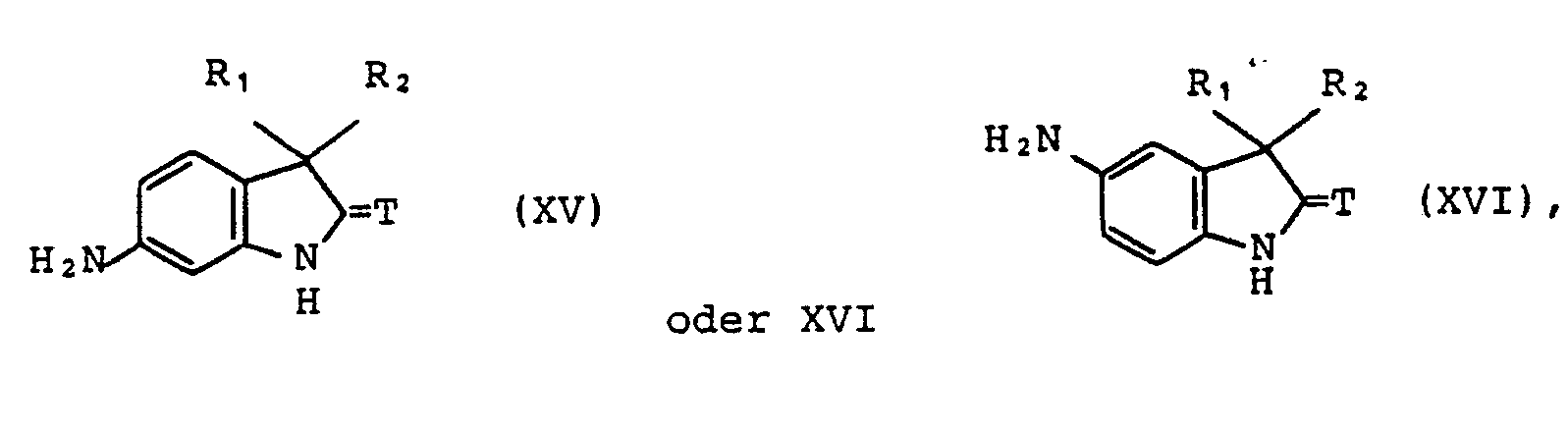


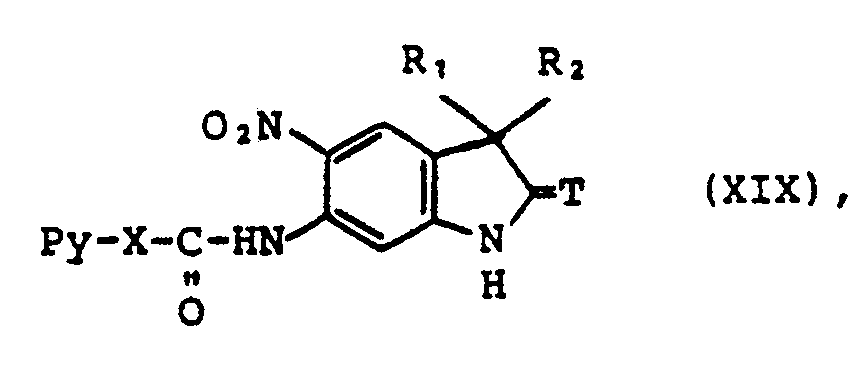
Nach Hydrierung der Nitrogruppe in den Verbindungen der allgemeinen Formel XIX bzw. XX zu den entsprechenden Aminverbindungen XXI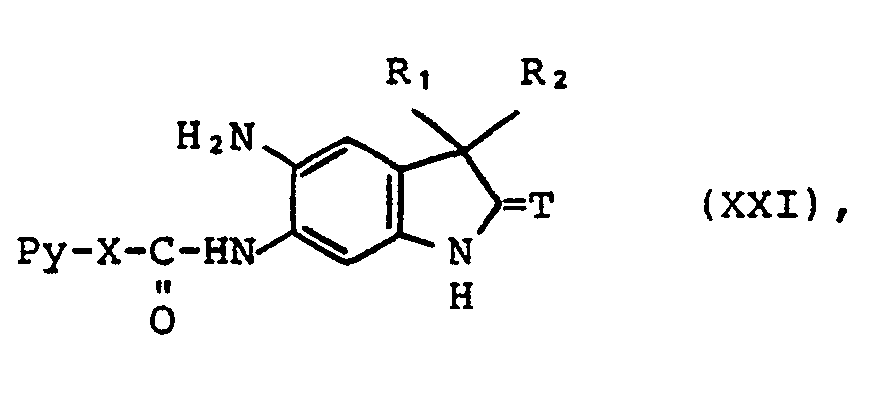

Verbindungen der Formel XVI erhaelt man z.B. durch Nitrierung von Verbindungen der allgemeinen Formel XXIII
Die Herstellung der Verbindungen der allgemeinen Formel I kann auch in der Weise erfolgen, daß man - f) in allgemein bekannter Weise Verbindungen der allgemeinen Formel XV bzw. XVI an der 6- bzw. 5-Aminofunktion acetyliert und durch nachfolgende Nitrierung und Abspaltung der Acetylschutzgruppen Verbindungen der allgemeinen Formel XXIV

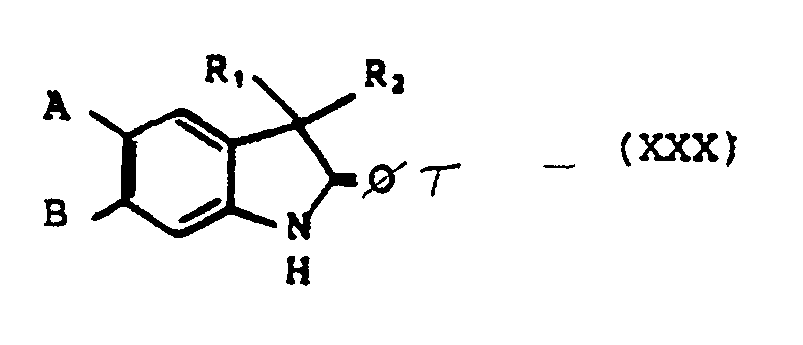
- g) Verbindungen der allgemeinen Formel I oder deren tautomere Formen sowie die hierzu fuehrenden verschiedenen Zwischenprodukte lassen sich außer nach den oben beschriebenen Verfahren auch nach verschiedenen literaturbekannten Verfahren, z.B. aus Verbindungen der allgemeinen Formel XXVI

So werden z.B. Verbindungen der Formel XXVI mit einem reaktiven Carbonsäure-Derivat der Formel XXVII, vorzugsweise Säurechlorid,
Nach einer anderen Variante werden Verbindungen der Formel XXVIII

Reaktive Carbonsäure-Derivate der Formeln XXVII und XXIX sind insbesondere Säurechloride, Anhydride oder Mesyl- und Tosylester.
Entsprechende Verbindungen der allgemeinen Formel I oder die hierzu fuehrenden Zwischenprodukte werden auch erhalten durch Umsetzung von Phenylhydrazin bzw. entsprechend substituierten Phenylhydrazinen nach der von K. Brunner, Monatsh. f. Chemie 18 , 95 (1897) beschriebenen Weise oder z.B. durch Alkylierung von 2,4-Dinitrochlorbenzol mit geeignet substituierten Malonsaeurederivaten, z.B. dem Natriumsalz des Methylmalonsaeurediethylesters, nach literaturbekannten Verfahren, anschließende Reduktion der Nitrogruppen und Ringschluß zu Verbindungen der allgemeinen Formel XV. - Die oben erwaehnte Hydrierung einer Nitrogruppe in den unter a) - g) genannten Verfahren zu Verbindungen der allgemeinen Formel I wird vorzugsweise in einem Loesungsmittel oder Loesungsmittelgemisch wie Wasser, Methanol, Ethanol, Eisessig, Essigsaeureethylester oder Dimethylformamid mit Wasserstoff in Gegenwart eines Katalysators wie Raney-Nickel, Platin oder Palladium/Kohle, mit Metallen wie Eisen, Zinn oder Zink in Gegenwart einer Saeure, mit Salzen wie Eisen(II)sulfat, Zin0n(II)chlorid, Natriumsulfid, Natriumhydrogensulfit oder Natriumdithionit oder mit Hydrazin in Gegenwart von Raney-Nickel bei Temperaturen zwischen 0 und 100°C, vorzugsweise jedoch bei Raumtemperatur, durchgefuehrt.
- Die in den oben in den Verfahren a) - g) genannten Cyclisierungen zu den gewuenschten Verbindungen der allgemeinen Formel I werden vorzugsweise in einem Loesungsmittel oder Loesungsmittelgemisch wie Ethanol, Isopropanol, Eisessig, Benzol, Toluol, Chlorbenzol, Glycol, Ethylenglycoldimethylether, Sulfolan oder Dimethylformamid bei Temperaturen zwischen 0°C und 220°C, vorzugsweise jedoch bei der Siedetemperatur des Reaktionsgemisches, gegebenenfalls in Gegenwart eines Kondensationsmittels wie Phosphoroxychlorid, Thionylchlorid, p-Toluolsulfonsaeure, Salzsaeure, Schwefelsaeure, Phosphorsaeure, Polyphosphorsaeure oder gegebenenfalls auch in Gegenwart einer Base wie Natriumhydroxid, Natriummethylat oder Kalium-tert.-butylat vorgenommen. Die Cyclisierung kann jedoch auch ohne Loesungsmittel und/oder Kondensationsmittel durchgefuehrt werden.
- Die nachtraegliche Umwandlung einer Verbindung der Formel I in eine andere Verbindung der Formel I betrifft z.B. die Oxidation des Pyridyl-Restes in das entsprechende N-Oxid, was vorwiegend durch H202 in Essigsaeure geschieht, sowie die Hydrierung eines ungesaettigten Substituenten. Dies trifft insbesondere fuer die Hydrierung einer Vinyl-Verbindung (X = -CH=CH-) in die entsprechende Ethyl-Verbindung zu.
- Die nachtraegliche Umwandlung einer Verbindung der Formel I, in der R1 und R2 gleich Wasserstoff bedeuten, in eine andere Verbindung der Formel I betrifft z.B. auch die Umsetzung mit Verbindungen der allgemeinen Formel VII mit der oben angegebenen Bedeutung in Gegenwart einer Base wie Ammoniak oder Triethylamin in alkoholischer Loesung. Insbesondere trifft dieses zu fuer die Umwandlung von Verbindungen der allgemeinen Formel I in denen R1 = R2 = Wasserstoff bedeuten zu Verbindungen der allgemeinen Formel I in denen R1 zusammen mit R2 die Isopropylidengruppe, die Cyclopentyliden- oder Cyclohexylidengruppe darstellen, sowie gegebenenfalls deren Hydrierung zu den entsprechenden Verbindungen der allgemeinen Formel I, in denen R1 oder R2 gleich Wasserstoff ist.
- Außerdem betrifft die nachtraegliche Umwandlung Verbindungen der allgemeinen Formel I in denen R, oder R2 eine Carboxylgruppe oder ein reaktionsfaehiges Derivat wie z.B. Carbonsaeureester oder Saeurechlorid darstellt, die sich mit Hydrazin, Ammoniak, einem primaeren oder sekundaeren Amin oder einem reaktionsfaehigen Derivat hiervon zu neuen Verbindungen der allgemeinen Formel I, in denen Ri oder R2 eine durch eine Amino-, Alkylamino-, Dialkylamino- oder Hydrazinogruppe substituierte Carbonylgruppe ist, umsetzen lassen. Die nachtraegliche Umwandlung betrifft auch Verbindungen der allgemeinen Formel I in denen R, oder R2 eine Aminocarbonylgruppe darstellt zu solchen in denen R1 oder R2 eine Cyangruppe ist, sowie die nachtraegliche Umwandlung einer Cyanogruppe in eine Carboxyl-, Aminocarbonyl- oder Alkoxycarbonylgruppe. Diese Umwandlungen werden alle nach allgemein ueblichen und literaturbekannten Methoden vorgenommen.
- Die nachtraegliche Umwandlung zu Verbindungen der allgemeinen Formel 1 und den zu den Verbindungen der allgemeinen Formel I fuehrenden Zwischenprodukten in denen T ein Schwefelatom bedeutet, aus solchen in denen T ein Sauerstoffatom darstellt, wird nach literaturbekannten Verfahren mit einem das Schwefelatom uebertragenden Reagenz wie z.B. Phosphorpentasulfid oder 2,4-Bis (4-methoxyphenyl)-2,4-dithioxo-1,3,2,4-dithiadiphosphetan in einem geeigneten Loesungsmittel wie z.B. Tetrahydrofuran, Dioxan, Ethylenglycoldimethylether, Benzol, Toluol oder Pyridin bei Temperaturen zwischen 0°C und der Siedetemperatur des Reaktionsgemisches durchgefuehrt.
- Die Verbindungen der allgemeinen Formel XII, XIX, XX, XXIV und XXV, in denen
- R1 ein Wasserstoffatom, eine Alkyl-, Alkenyl- oder eine Cycloalkylgruppe bedeutet,
- R2 ein Wasserstoffatom, eine Alkyl-, Alkenyl- oder Cyanogruppe, eine durch eine Hydroxy-, Alkyl-, Alkoxy-, Amino-, Alkylamino-, Dialkylamino- oder Hydrazinogruppe substituierte Carbonylgruppe bedeutet oder mit R, eine Cycloalkylengruppe bilden, und soweit zutreffend
- X einen Valenzstrich, eine C1-C4-Alkylengruppe oder die Vinylgruppe bedeutet,
- T gleich Sauerstoff oder Schwefel bedeutet und
- Py einen 2-, 3-, oder 4-Pyridylrest darstellt, der gegebenenfalls durch eine oder mehrere Alkyl-, Alkoxy-, Hydroxy-, Cyano- oder Nitrogruppen, sowie durch Halogen substituiert sein kann,
- Erfindungsgemaeße Verbindungen der Formel XII sind außer den in den Beispielen genannten folgende Verbindungen:
- 5,6-Diamino-3-acetyl-indolin-2-on
- 5,6-Diamino-3-acetyl-3-methyl-indolin-2-on
- 5,6-Diamino-3-allyl-indolin-2-on
- 5,6-Diamino-3-cyan-3-methyl-indolin-2-on
- 5,6-Diamino-3-cyclohexyl-indolin-2-on
- 5,6-Diamino-3-cyclopentyl-indolin-2-on
- 5,6-Diamino-3,3-diallyl-indolin-2-on
- 5,6-Diamino-3-ethoxycarbonyl-indolin-2-on
- 5,6-Diamino-3-ethoxycarbonyl-3-ethyl-indolin-2-on
- 5,6-Diamino-3-ethoxycarbonyl-3-methyl-indolin-2-on
- 5,6-Diamino-3-ethyl-indolin-2-on
- 5,6-Diamino-3-methoxycarbonyl-indolin-2-on
- 5,6-Diamino-3-methoxycarbonyl-3-methyl-indolin-2-on
- 5,6-Diamino-3-methyl-indolin-2-on
- 5,6-Diamino-3-(3-pentyl)-indolin-2-on
- 5,6-Diamino-3-(2-propyl)-indolin-2-on
- 5',6'-Diamino-spiro[cyclohexan-1,3'-indolin]-2'-on
- Erfindungsgemaeße Verbindungen der Formel XXV sind außer den in den Beispielen genannten Verbindungen folgende:
- 5-Amino-6-nitro-3-acetyl-indolin-2-on
- 5-Amino-6-nitro-3-acetyl-3-methyl-indolin-2-on
- 5-Amino-6-nitro-3-allyl-indolin-2-on
- 5-Amino-6-nitro-3-cyan-3-methyl-indolin-2-on
- 5-Amino-6-nitro-3-cyclohexyl-indolin-2-on
- 5-Amino-6-nitro-3-cyclopentyl-i ndoli n-2-on
- 5-Amino-6-nitro-3,3-diallyl-indolin-2-on
- 5-Amino-6-nitro-3-ethoxycarbonyl-indolin-2-on
- 5-Amino-6-nitro-3-ethoxycarbonyl-3-ethyl-indolin-2-on
- 5-Amino-6-nitro-3-ethoxycarbonyl-3-methyl-indolin-2-on
- 5-Amino-6-nitro-3-ethyl-indolin-2-on
- 5-Amino-6-nitro-3-methoxycarbonyl-indolin-2-on
- 5-Amino-6-nitro-3-methoxycarbonyl-3-methyl-indolin-2-on
- 5-Amino-6-nitro-3-methyl-indolin-2-on
- 5-Amino-6-nitro-3-(3-pentyl)-indolin-2-on
- 5-Amino-6-nitro-3-(2-propyl)-indolin-2-on
- 5-Amino-6-nitro-3-(2-methyl-propyl)-indolin-2-on
- 5'-Amino-6'-nitro-spiro[cyclohexan-1,3'-indolin]-2'-on
- 5'-Amino-6'-nitro-spiro[cyclopentan-1,3'-indolin]-2'-on
- 5-Amino-6-nitro-3,3-dimethyl-indolin-2-thion
- 5-Amino-6-nitro-3-ethyl-indolin-2-thion
- 5-Amino-6-nitro-3-methyl-indolin-2-thion
- Erfindungsgemaeße Verbindungen der Formel XXIV sind außer den in den Beispielen genannten Verbindungen folgende:
- 6-Amino-5-nitro-indo!in-2-on
- 6-Amino-5-nitro-3-acetyl-indolin-2-on
- 6-Amino-5-nitro-3-acetyl-3-methyl-indolin-2-on
- 6-Amino-5-nitro-3-allyl-indolin-2-on
- 6-Amino-5-nitro-3-cyan-3-methyl-indolin-2-on
- 6-Amino-5-nitro-3-cyclohexyl-indolin-2-on
- 6-Amino-5-nitro-3-cyclopentyl-indolin-2-on
- 6-Amino-5-nitro-3,3-diallyl-indolin-2-on
- 6-Amino-5-nitro-3-ethoxycarbonyl-indolin-2-on
- 6-Amino-5-nitro-3-ethoxycarbonyl-3-ethyl-indolin-2-on
- 6-Amino-5-nitro-3-ethoxycarbonyl-3-methyl-indolin-2-on
- 6-Amino-5-nitro-3-ethyl-indolin-2-on
- 6-Amino-5-nitro-3-methoxycarbonyl-indolin-2-on
- 6-Amino-5-nitro-3-methoxycarbonyl-3-methyl-indolin-2-on
- 6-Amino-5-nitro-3-methyl-indolin-2-on
- 6-Amino-5-nitro-3-(3-pentyl)-indolin-2-on
- 6-Amino-5-nitro-3-(2-propyl)-indolin-2-on
- 6'-Amino-5'nitro-spiro[cyclohexan-1,3'-indolin)-2-'-on
- 6-Amino-5-nitro-3,3-dimethyl-indolin-2-thion
- 6-Amino-5-nitro-3-ethyl-indolin-2-thion
- 6-Amino-5-nitro-3-methyl-indolin-2-thion
- Erfindungsgemaeße Verbindungen der Formel XIX sind außer den in den Beispielen genannten Verbindungen folgende:
- 5-Nitro-6-(3-pyridinoylamino)-indolin-2-on
- 3-Acetyl-5-nitro-6-(3-pyridinoylamino)-indolin-2-on
- 3-Acetyl-5-nitro-6-(4-pyridinoylamino)-indolin-2-on
- 3-Acetyl-3-methyl-5-nitro-6-(3-pyridinoylamino)-indolin-2-on
- 3-Acetyl-3-methyl-5-nitro-6-(4-Pyridinoylamino)-indolin-2-on
- 3-Allyl-5-nitro-6-(3-pyridinoylamino)-indolin-2-on
- 3-Allyl-5-nitro-6-(4-pyridinoylamino)-indolin-2-on
- 3-Cyan-3-methyl-5-nitro-6-(3-pyridinoylamino)-indolin-2-on
- 3-Cyan-3-methyl-5-nitro-6-(4-pyridinoylamino)-indolin-2-on
- 3-Cyclohexyl-5-nitro-6-(3-pyridinoylamino)-indolin-2-on
- 3-Cyclohexyl-5-nitro-6.(4-pyridinoylamino)-indolin-2-on
- 3-Cyclopentyl-5-nitro-6-(3-pyridinoylamino)-indolin-2-on
- 3,3-Diallyl-5-nitro-6-(3-pyridinoylamino)-indolin-2-on
- 3,3-Diallyl-5-nitro-6-(4-pyridinoylamino)-indolin-2-on
- 3,3-Dimethyl-5-nitro-6-(2-pyridinoylamino)-indolin-2-on
- 3,3-Dimethyl-5-nitro-6-(2-(5-n-butyl-pyridinoylamino))-indolin-2-on
- 3,3-Dimethyl-5-nitro-6-(3-(6-cyan-pyridinoylamino))-indolin-2-on
- 3,3-Dimethyl-5-nitro-6-(3-(6-methyl-pyridinoylamino))-indolin-2-on
- 3,3-Dimethyl-5-nitro-6-(4-(2-methyl-pyridinoylamino))-indolin-2-on
- 3,3-Dimethyl-5-nitro-6-(4-(2-hydroxy-pyridinoylamino))-indolin-2-on
- 3-Ethoxycarbonyl-5-nitro-6-(3-pyridinoylamino)-indolin-2-on
- 3-Ethoxycarbonyl-5-nitro-6-(4-pyridinoylamino)-indolin-2-on
- 3-Ethoxycarbonyl-3-ethyl-5-nitro-6-(3-pyridinoylamino)-indolin-2-on
- 3-Ethoxycarbonyl-3-ethyl-5-nitro-6-(4-pyridinoylamino)-indolin-2-on
- 3-Ethoxycarbonyl-3-methyl-5-nitro-6-(3-pyridinoylamino)-indolin-2-on
- 3-Methoxycarbonyl-5-nitro-6-(3-pyridinoylamino)-indolin-2-on
- 3-Methoxycarbonyl-5-nitro-6-(4-pyridinoylamino)-indolin-2-on
- 3-Methoxycarbonyl-3-methyl-5-nitro-6-(3-pyridinoylamino)-indolin-2-on
- 3-Methoxycarbonyl-3-methyl-5-nitro-6-(4-pyridinoylamino)-indolin-2-on
- 3-(3-Pentyl)-5-nitro-6-(3-pyridinoylamino)-indolin-2-on
- 3-(3-Pentyl)-5-nitro-6-(4-pyridinoylamino)-indolin-2-on
- 3-(2-Propyl)-5-nitro-6-(3-pyridinoylamino)-indolin-2-on
- 3-(2-Methyl-propyl)-5-nitro-6-(3-pyridinoylamino)-indolin-2-on
- 3-(2-Methyl-propyl)-5-nitro-6-(4-pyridinoylamino)-indolin-2-on
- 5'-Nitro-6'-(3-pyridinoylamino)-spiro[cyclohexan-1,3'-indolin]-2'-on
- 5'-Nitro-6'-(4-pyridinoylamino)-spiro[cyclohexan-1,3'-indolin]-2'-on
- 5'-Nitro-6'-(3-pyridinoylamino)-spiro[cyclopentan-1,3'-indolin]-2'-on
- 5'-Nitro-6'-(4-pyridinoylamino)-spiro[cyclopentan-1,3'-indolin]-1'-on
- 3,3-Dimethyl-5-nitro-6-(2-pyridinoylamino)-indolin-2-thion
- 3,3-Dimethyl-5-nitro-6-(3-pyridinoylamino)-indolin-2-thion
- 3,3-Dimethyl-5-nitro-6-(4-pyridinoylamino)-indolin-2-thion
- 3-Ethyl-5-nitro-6-(2-pyridinoylamino)-indolin-2-thion
- 3-Ethyl-5-nitro-6-(3-pyridinoylamino)-indolin-2-thion
- 3-Ethyl-5-nitro-6-(4-pyridinoylamino)-indolin-2-thion
- 3-Methyl-5-nitro-6-(2-pyridinoylamino)-indolin-2-thion
- 3-Methyl-5-nitro-6-(3-pyridinoylamino)-indolin-2-thion
- 3-Methyl-5-nitro-6-(4-pyridinoylamino)-indolin-2-thion
- Erfindungsgemaeße Verbindungen der allgemeinen Formel XX sind außer in den Beispielen genannten Verbindungen folgende:
- 6-Nitro-5-(3-pyridinoylamino)-indolin-2-on
- 6-Nitro-5-(4-pyridinoylamino)-indolin-2-on
- 3-Acetyl-6-nitro-5-(3-pyridinoylamino)-indolin-2-on
- 3-Acetyl-6-nitro-5-(4-pyridinoylamino)-indolin-2-on
- 3-Acetyl-3-methyl-6-nitro-5-(3-pyridinoylamino)-indolin-2-on
- 3-Acetyl-3-methyl-6-nitro-5-(4-pyridinoylamino)-indolin-2-on
- 3-Allyl-6-nitro-5-(3-pyridinoylamino)-indolin-2-on
- 3-Allyl-6-nitro-5-(4-pyridinoylamino)-indolin-2-on
- 3-Cyan-3-methyl-6-nitro-5-(3-pyridinoylamino)-indolin-2-on
- 3-Cyan-3-methyl-6-nitro-5-(4-pyridinoylamino)-indolin-2-on
- 3-Cyclohexyl-6-nitro-5-(3-pyridinoylamino)-indolin-2-on
- 3-Cyclohexyl-6-nitro-5-(4-pyridinoylamino)-indolin-2-on
- 3-Cyclopentyl-6-nitro-5-(3-pyridinoylamino)-indolin-2-on
- 3-Cyclopentyl-6-nitro-5-(4-pyridinoylamino)-indolin-2-on
- 3,3-Diallyl-6-nitro-5-(3-pyridinoylamino)-indolin-2-on
- 3,3-Diallyl-6-nitro-5-(4-pyridinoylamino)-indolin-2-on
- 3,3-Diethyl-6-nitro-5-(3-pyridinoylamino)-indolin-2-on
- 3,3-Diethyl-6-nitro-5-(4-pyridinoylamino)-indolin-2-on
- 3,3-Dimethyl-6-nitro-5-(2-pyridinoylamino)-indolin-2-on
- 3,3-Dimethyl-6-nitro-5-(3-pyridinoylamino)-indolin-2-on
- 3,3-Dimethyl-6-nitro-5-(2-(5-n-butyl-pyridinoylamino)-indolin-2-on
- 3,3-Dimethyl-6-nitro-5-(3-(6-cyan-pyridinoylamino))-indolin-2-on
- 3,3-Dimethyl-6-nitro-5-(3-(6-methyl-pyridinoylamino))-indolin-2-on
- 3,3-Dimethyl-6-nitro-5-(4-(2-methyl-pyridinoylamino))-indolin-2-on
- 3,3-Dimethyl-6-nitro-5(4-(2-hydroxy-pyridinoylamino))-indolin-2-on
- 3-Ethoxycarbonyl-6-nitro-5-(3-pyridinoylamino)-indolin-2-on
- 3-Ethoxycarbonyl-6-nitro-5-(4-pyridinoylamino)-indolin-2-on
- 3-Ethoxycarbonyl-3-ethyl-6-nitro-5-(3-pyridinoylamino)-indolin-2-on
- 3-Ethoxycarbonyl-3-ethyl-6-nitro-5-(4-pyridinoylamino)-indolin-2-on
- 3-Ethoxycarbonyl-3-methyl-6-nitro-5-(3-pyridinoylamino)-indolin-2-on
- 3-Ethoxycarbonyl-3-methyl-6-nitro-5-(4-pyridinoylamino)-indolin-2-on
- 3-Ethyl-6-nitro-5-(3-pyridinoylamino)-indolin-2-on
- 3-Ethyl-6-nitro-5-(4-pyridinoylamino)-indolin-2-on
- 3-Methoxycarbonyl-6-nitro-5-(3-pyridinoylamino)-indolin-2-on
- 3-Methoxycarbonyl-6-nitro-5-(4-pyridinoylamino)-indolin-2-on
- 3-Methoxycarbonyl-3-methyl-6-nitro-5-(3-pyridinoylamino)-indolin-2-on
- 3-Methoxycarbonyl-3-methyl-6-nitro-5-(4-pyridinoylamino)-indolin-2-on
- 3-Methyl-6-nitro-5-(3-pyridinoylamino)-indolin-2-on
- 3-Methyl-6-nitro-5-(4-pyridinoylamino)-indolin-2-on
- 3-(3-Pentyl)-6-nitro-5-(3-pyridinoylamino)-indolin-2-on
- 3-(3-Pentyl)-6-nitro-5-(4-pyridinoylamino)-indolin-2-on
- 3-(2-Propyl)-6-nitro-5-(3-pyridinoylamino)-indolin-2-on
- 3-(2-Propyl)-6-nitro-5-(4-pyridinoylamino)-indolin-2-on
- 3-(2-Methyl-propyl)-6-nitro-5-(3-pyridinoylamino)-indolin-2-on
- 3-(2-Methyl-propyl)-6-nitro-5-(4-pyridinoylamino)-indolin-2-on
- 6'-Nitro-5'-(3-pyridinoylamino)-spiro[cyclohexan-1,3'-indolin]-2'-on
- 6'-Nitro-5'-(4-pyridinoylamino)-spiro[cyclohexan-1,3'-indolin]-2'-on
- 6'-Nitro-5'-(3-pyridinoylamino)-spiro[cyclopentan-1,3'-indolin]-2'-on
- 6'-Nitro-5'-(4-pyridinoylamino)-spiro[cyclopentan-1,3'-indolin]-2'-on
- 3,3-Dimethyl-6-nitro-5-(2-pyridinoylamino)-indolin-2-thion
- 3,3-Dimethyl-6-nitro-5-(3-pyridinoylamino)-indolin-2-thion
- 3,3-Dimethyl-6-nitro-5-(4-pyridinoylamino)-indolin-2-thion
- 3-Ethyl-6-nitro-5-(2-pyridinoylamino)-indolin-2-thion
- 3-Ethyl-6-nitro-5-(3-pyridinoylamino)-indolin-2-thion
- 3-Ethyl-6-nitro-5-(4-pyridinoylamino)-indolin-2-thion
- 3-Methyl-6-nitro-5-(2-pyridinoylamino)-indolin-2-thion
- 3-Methyl-6-nitro-5-(3-pyridinoylamino)-indolin-2-thion
- 3-Methyl-6-nitro-5-(4-pyridinoylamino)-indolin-2-thion
- Zur Ueberfuehrung der Verbindungen der allgemeinen Formel I bzw. deren tautomeren Formen in ihre pharmakologisch unbedenklichen Salze, setzt man diese vorzugsweise in einem organischen Loesungsmittel mit der aequivalenten Menge einer anorganischen oder organischen Saeure, z.B. Salzsaeure, Bromwasserstoffsaeure, Phosphorsaeure, Schwefelsaeure, Essigsaeure, Citronensaeure, Weinsaeure, Maleinsaeure, Fumarsaeure, Benzoesaeure oder Cyclohexylsulfaminsaeure um.
- Zur Herstellung von Arzneimitteln werden die Substanzen der allgemeinen Formel in an sich bekannter Weise mit geeigneten pharmazeutischen Traegersubstanzen, Aroma-, Geschmacks- und Farbstoffen gemischt und beispielsweise als Tabletten oder Dragees ausgeformt oder unter Zugabe entsprechender Hilfsstoffe in Wasser oder Oel, wie z.B. Olivenoel, suspendiert oder geloest.
- Die erfindungsgemaeßen neuen Substanzen der allgemeinen Formel I und ihre Salze koennen in fluessiger oder fester Form enteral oder parenteral appliziert werden. Als Injektionsmedium kommt vorzugsweise Wasser zur Anwendung, welches die bei Injektionsloesungen ueblichen Zusaetze wie Stabilisierungsmittel, Loesungsvermittler oder Puffer enthaelt.
- Derartige Zusaetze sind z.B. Tartrat- und Citratpuffer, Ethanol, Komblexbildner (wie Ethylendiamintetraessigsaeure und deren nicht toxische Salze) und hochmolekulare Polymere (wie fluessiges Polyethylenoxid) zur Viskositaetsregulierung. Feste Traegerstoffe sind z.B. Staerke, Lactose, Mannit, Methylcellulose, Talkum, hochdisperse Kieselsaeuren, hochmolekulare Fettsaeuren (wie Sterinsaeure), Gelatine, Agar-Agar, Calciumphosphat, Magnesiumstearat, tierische und pflanzliche Fette und feste hochmolekulare Polymere (wie Polyethylenglykole). Fuer orale Applikation geeignete Zubereitungen koennen gewuenschtenfalls Geschmacks-und Sueßstoffe enthalten.
- Die erfindungsgemaeßen Verbindungen der Formel I werden ueblicherweise in Mengen von 10-500 mg pro Tag bezogen auf 75 kg Koerpergewicht appliziert. Bevorzugt ist es, 2-3 mal pro Tag 1-2 Tabletten mit einem Wirkstoffgehalt von 5-200 mg zu verabreichen. Die Tabletten koennen auch retardiert sein, wodurch nur noch 1 mal pro Tag 1-2 Tabletten mit 10-500 mg Wirkstoff gegeben werden muß. Der Wirkstoff kann auch durch Injektion 1-8 mal pro Tag bzw. durch Dauerinfusion gegeben werden, wobei Mengen von 5-200 mg/Tag normalerweise ausreichen.
- Bevorzugt im Sinne der vorliegenden Erfindung sind außer den in den Beispielen genannten Verbindungen die folgenden und deren Tautomere:
- 2-(3-Pyridyl)-6,7-dihydro-3H,5H-pyrrolo[2,3-f]benzimidazol-6-on
- 7-Acetyl-2(3-pyridyl)-6,7-dihydro-3H,5H-pyrrolo[2,3-f]benzimidazol-6-on
- 7-Acetyl-2-(4-pyridyl)-6,7-dihydro-3H,5H-pyrrolo[2,3-f]benzimidazol-6-on
- 7-Acetyl-7-methyl-2-(3-pyridyl)-6,7-dihydro-3H,5H-pyrrolo[2,3-f]benzimidazol-6-on
- 7-Acetyl-7-methyl-2-(4-pyridyl)-6,7-dihydro-3H,5H-pyrrolo[2,3-f]-benzimidazol-6-on
- 7-Allyl-2-(3-pyridiyl)-6,7-dihydro-3H,5H-pyrrolo[2,3-f]benzimidazol-6-on
- 7-Allyl-2-(4-pyridyl)-6,7-dihydro-3H,5H-pyrrolo[2,3-f]benzimidazol-6-on
- 7-Aminocarbonyl-7-methyl-2-(3-pyridyl)-6,7-dihydro-3H,5H-pyrrolo[2,3-f]benzimidazol-6-on
- 7-Aminocarbonyl-7-methyl.2-(4-pyridyl)-6,7-dihydro-3H,5H-pyrrolo[2,3-f]benzimidazol-6.on
- 7-Cyan-7-methyl-2-(3-pyridyl)-6,7-dihydro-3H,5H-pyrrolo[2,3-f]benzimidazol-6-on
- 7-Cyan-7-methyl-2-(4-pyridyl)-6,7-dihydro-3H,5H-pyrrolo[2,3-f]benzimidazol-6-on
- 7-Cyclohexyl-2-(3-pyridyl)-6,7-dihydro-3H,5H-pyrrolo[2,3-f]-benzimidazol-6-on
- 7-Cyclohexyl-2-(4-pyridyl)-6,7-dihydro-3H,5H-pyrrolo[2,3-f]-benzimidazol-6-on
- 7-Cyclopentyl-2-(3-pyridyl)-6,7-dihydro-3H,5H-pyrrolo[2,3-f]-benzimidazol-6-on
- 7,7-Diallyl-2-(3-pyridyl)-6,7-dihydro-3H,5H-pyrrolo[2,3-f]-benzimidazol-6-on
- 7,7-Diallyl-2-(4-pyridyl)-6,7-dihydro-3H,5H-pyrrolo[2,3-f]-benzimidazol-6-on
- 7,7-Diethyl-2-(3-pyridyl)-6,7-dihydro-3H,5H-pyrrolo[2,3-f]-benzimidazol-6-on
- 7,7-Diethyl-2-(4-N-oxy-pyridyl)-6,7-dihydro-3H,5H-pyrrolo[2,3-f]benzimidazol-6-on
- 7,7-Diethyl-2-(4-(2-methyl-pyridyl)-6,7-dihydro-3H,5H-pyrrolo[2,3-f]benzimidazol-6-on
- 7,7-Diethyl-2-(4-pyridyl-ethyl)-6,7-dihydro-3H,5H-pyrrolo[2,3-f]benzimidazol-6-on
- 7,7-Dimethyl-2-(2-N-oxy-pyridyl)-6,7-dihydro-3H,5H-pyrrolo[2,3-f]benzimidazol-6-on
- 7,7-Dimethyl-2-(2-(5-n-butyl-pyridyl))-6,7-dihydro-3H,5H-pyrrolo[2,3-f]benzimidazol-6-on
- 7,7-Dimethyl-2-(3-(6-cyan-pyridyl))-6,7-dihydro-3H,5H-pyrrolo[2,3-f]benzimidazol-6-on
- 7,7-Dimethyl-2-(3-(6-hydroxy-pyridyl))-6,7-dihydro-3H,5H-pyrrolo[2,3-f]benzimidazol-6-on
- 7,7-Dimethyl-2-(3-(6-nitro-pyridyl))-6,7-dihydro-3H,5H-pyrrolo[2,3-f]benzimidazol-6-on
- 7,7-Dimethyl-2-(4-(2-ethyl-pyridyl))-6,7-dihydro-3H,5H-pyrrolo[2,3-f]benzimidazol-6-on
- 7,7-Dimethyl-2-(4-(2-methoxy-pyridyl))-6,7-dihydro-3H,5H-pyrrolo[2,3-f]benzimidazol-6-on
- 7,7-Dimethyl-2-(4-(2-nitro-pyridyl))-6,7-dihydro-3H,5H-pyrrolo[2,3-f]benzimidazol-6-on
- 7,7-Dimethyl-2-(3-pyridyl-methyl)-6,7-dihydro-3H,5H-pyrrolo[2,3-f]benzimidazol-6-on
- 7,7-Dimethyl-2-(3-pyridyl)-ethyl)-6,7-dihydro-3H,5H-pyrrolo[2,3-f]benzimidazol-6-on
- 7,7-Dimethyl-2-(4-pyridyl-vinyl)-6,7-dihydro-3H,5H-pyrrolo[2,3-f]benzimidazol-6-on
- 7-Ethoxycarbonyl-2-(3-pyridyl)-6,7-dihydro-3H,5H-pyrrolo[2,3-f]benzimidazol-6-on
- 7-Ethoxycarbonyl-2-(4-pyridyl)-6,7-dihydro-3H,5H-pyrrolo[2,3-f]benzimidazol-6-on
- 7-Ethoxycarbonyl-7-ethyl-2-(3-pyridyl)-6,7-dihydro-3H,5H-pyrrolo[2,3-f]benzimidazol-6-on
- 7-Ethoxycarbonyl-7-ethyl-2-(4-pyridyl)-6,7-dihydro-3H,5H-pyrrolo[2,3-f]benzimidazol-6-on
- 7-Ethoxycarbonyl-7-methyl-2-(3-pyridyl)-6,7-dihydro-3H,5H-pyrrolo[2,3-f]benzimidazol-6-on
- 7-Ethyl-2-(3-N-oxy-pyridyl)-6,7-dihydro-3H,5H-pyrrolo[2,3-f]benzimidazol-6-on
- 7-Ethyl-2-(4-N-oxy-pyridyl)-6,7-dihydro-3H,5H-pyrrolo[2,3-f]benzimidazol-6-on
- 7-Hydrazinocarbonyl-7-methyl-2-(3-pyridyl)-6,7-diyhdro-3H,5H-pyrrolo[2,3-f]benzimidazol-6-on
- 7-Isopropyliden-2-(3-pyridyl)-6,7-dihydro-3H,5H-pyrrolo[2,3-f]benzimidazol-6-on
- 7-Methoxycarbonyl-2-(3-pyridyl)-6,7-dihydro-3H,5H-pyrrolo[2,3-f]benzimidazol-6-on
- 7-Methoxycarbonyl-2-(4-pyridyl)-6,7-dihydro-3H,5H-pyrrolo[2,3-f]benzimidazol-6-on
- 7-Methoxycarbonyl-7-methyl-2-(3-pyridyl)-6,7-dihydro-3H,5H-pyrrolo[2,3-f]benzimidazol-6-on
- 7-Methoxycarbonyl-7-methyl-2-(4-pyridyl)-6,7-dihydro-3H,5H-pyrrolo[2,3-f]benzimidazol-6-on
- 7-Methyl-2-(3-N-oxy-pyridyl)-6,7-dihydro-3H,5H-pyrrolo[2,3-f]benzimidazol-6-on
- 7-(2-Methyl-propyl)-2-(3-pyridyl)-6,7-dihydro-3H,5H-pyrrolo[2,3-f]benzimidazol-6-on
- 7-(2-Methyl-propyl)-2-(4-pyridyl)-6,7-dihydro-3H,5H-pyrrolo[2,3-f]benzimidazol-6-on
- 7-(3-Pentyl)-2-(3-pyridyl)-6,7-dihydro-3H,5H-pyrrolo[2,3-f]benzimidazol-6-on
- 7-(3-Pentyl)-2-(4-pyridyl)-6,7-dihydro-3H,5H-pyrrolo[2,3-f]benzimidazol-6-on
- 7-(2-Propyl)-2-(3-pyridyl)-6,7-dihydro-3H,5H-pyrrolo[2,3-f]benzimidazol-6-on
- 7-(2-Propyl)-2-(4-(2-methyl-pyridyl))-6,7-dihydro-3H,5H-pyrrolo[2,3-f]benzimidazol-6-on
- 2'-(3-Pyridyl)-spiro[cyclopropan-1,7'-6',7'-diyhdro-3'H,5'H-pyrrolo[2',3'-f]benzimidazol-6'-on
- 2'-(3-Pyridyl)-spiro[cyclopentan-1,7'-6',7'-dihydro-3'H,5'H-pyrrolo[2',3'-f]benzimidazol-6'-on
- 2'-(3-Pyridyl)-spiro[cyclohexan-1,7'-6',7'-dihydro-3'H,5'H-pyrrolo[2',3'-f]benzimidazol-6'-on
- 2'-(4-Pyridyl)-spiro[cyclohexan-1,7'-6',7'-dihydro-3'H,5'-pyrrolo[2',3'-f]benzimidazol-6'-on
- 7,7-Dimethyl-2-(2-pyridyl)-6,7-dihydro-3H,5H-pyrrolo[2,3-f]benzimidazol-6-thion
- 7,7-Dimethyl-2-(3-pyridyl)-6,7-dihydro-3H,5H-pyrrolo[2,3-f]benzimidazol-6-thion
- 7,7-Dimethyl-2-(3-(6-methyl-pyridyl))-6,7-dihydro-3H,5H-pyrrolo[2,3-f]benzimidazol-6-thion
- 7,7-Dimethyl-2-(4-(2-methyl-pyridyl))-6,7-dihydro-3H,5H-pyrrolo[2,3-f]benzimidazol-6-thion
- 7-Ethyl-2-(2-pyridyl)-6,7-dihydro-3H,5H-pyrrolo[2,3-f]benzimidazol-6-thion
- 7-Ethyl-2-(3-Pyridyl)-6,7-dihydro-3H,5H-pyrrolo[2,3-f]benzimidazol-6-thion
- 7-Ethyl-2-(4-pyridyl)-6,7-dihydro-3H,5H-pyrrolo[2,3-f]benzimidazol-6-thion
- 7-Methyl-2-(2-pyridyl)-6,7-dihydro-3H,5H-pyrrolo[2,3-f]benzimidazol-6-thion
- 7-Methyl-2-(3-pyridyl)-6,7-dihydro-3H,5H-pyrrolo[2,3-f]benzimidazol-6-thion
- 7-Methyl-2-(4-pyridyl)-6,7-dihydro-3H,5H-pyrrolo[2,3-f]benzimidazol-6-thion
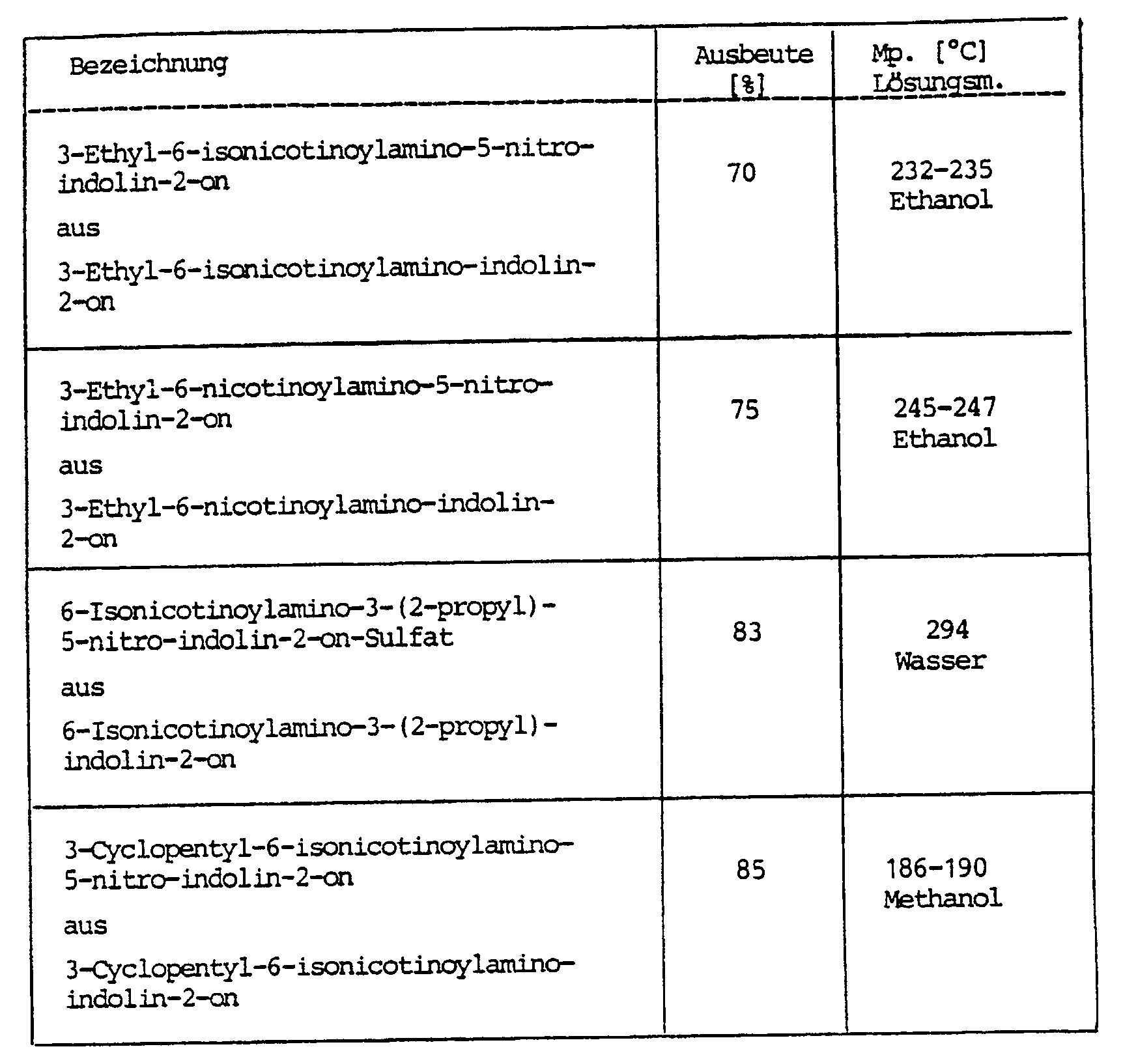
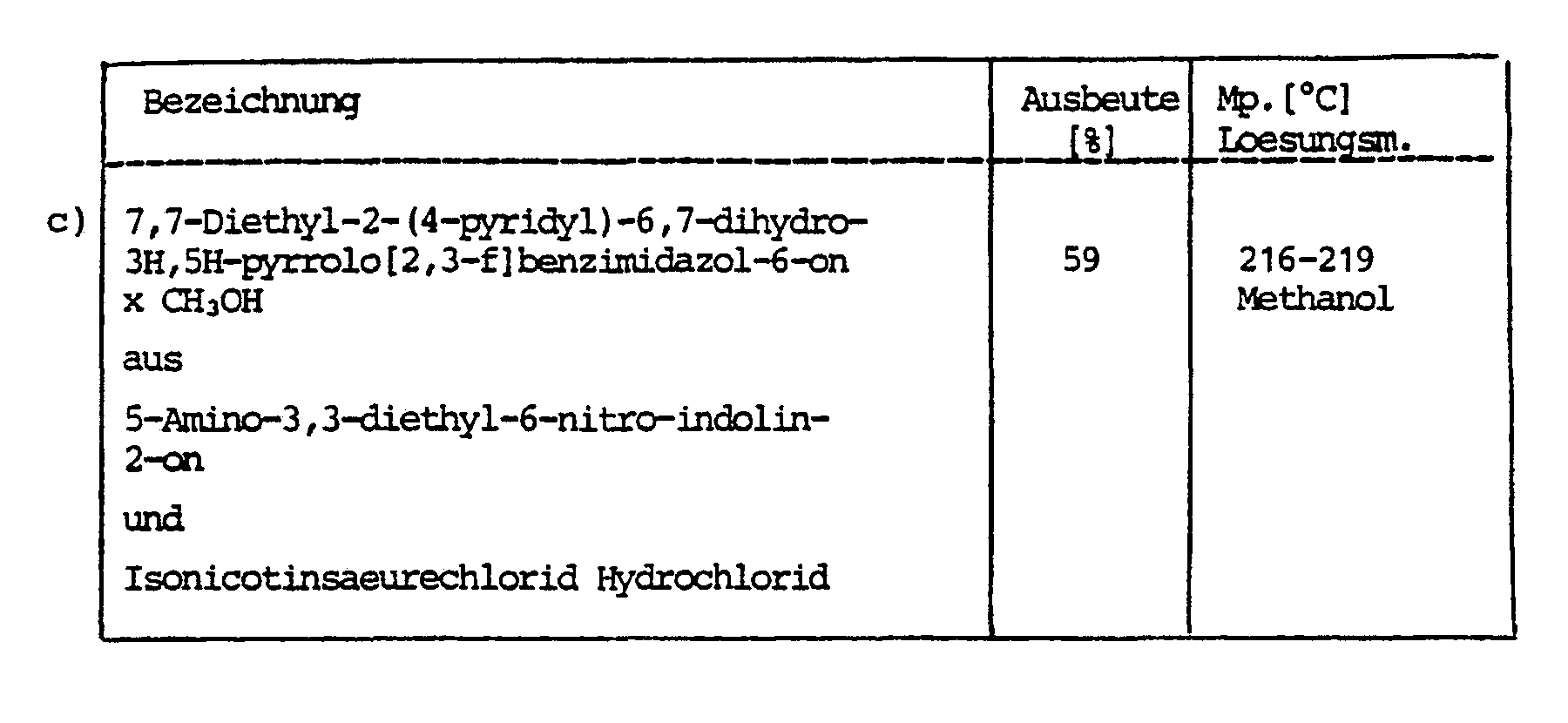
- Zu einer Loesung von 5,6-Diamino-3,3-dimethyl-indolin-2-on (2.9 g, 0.015 mol) in Methylenchlorid (30 ml) mit Triethylamin (4.4 ml, 0.032 mol) gibt man portionsweise Isonicotinsaeurechlorid Hydrochlorid (3 g, 0.017 mol) und laeßt ueber Nacht weiterruehren. Es wird im Vakuum zur Trockene eingeengt, der Rueckstand mehrfach mit Wasser durchgeruehrt, abgesaugt und die erhaltenen Kristalle in einer Loesung von Ethanol (100 ml) mit konz. HCI (10 ml) ca. 12 h zum Rueckfluß erhitzt. Die erhaltene Mischung wird im Vakuum zur Trockne eingeengt, mit Wasser (20 ml) durchgeruehrt und mit waessriger NH3-Loesung neutral gestellt. Anschließend wird abgesaugt, mit Wasser nachgewaschen, getrocknet und aus Wasser mit 30 % Ethanol umkristallisiert.
- Ausbeute 1.9 g (36 % d.Th.), Mp. 215° C
- Analog zu Beispiel 1 erhaelt man:

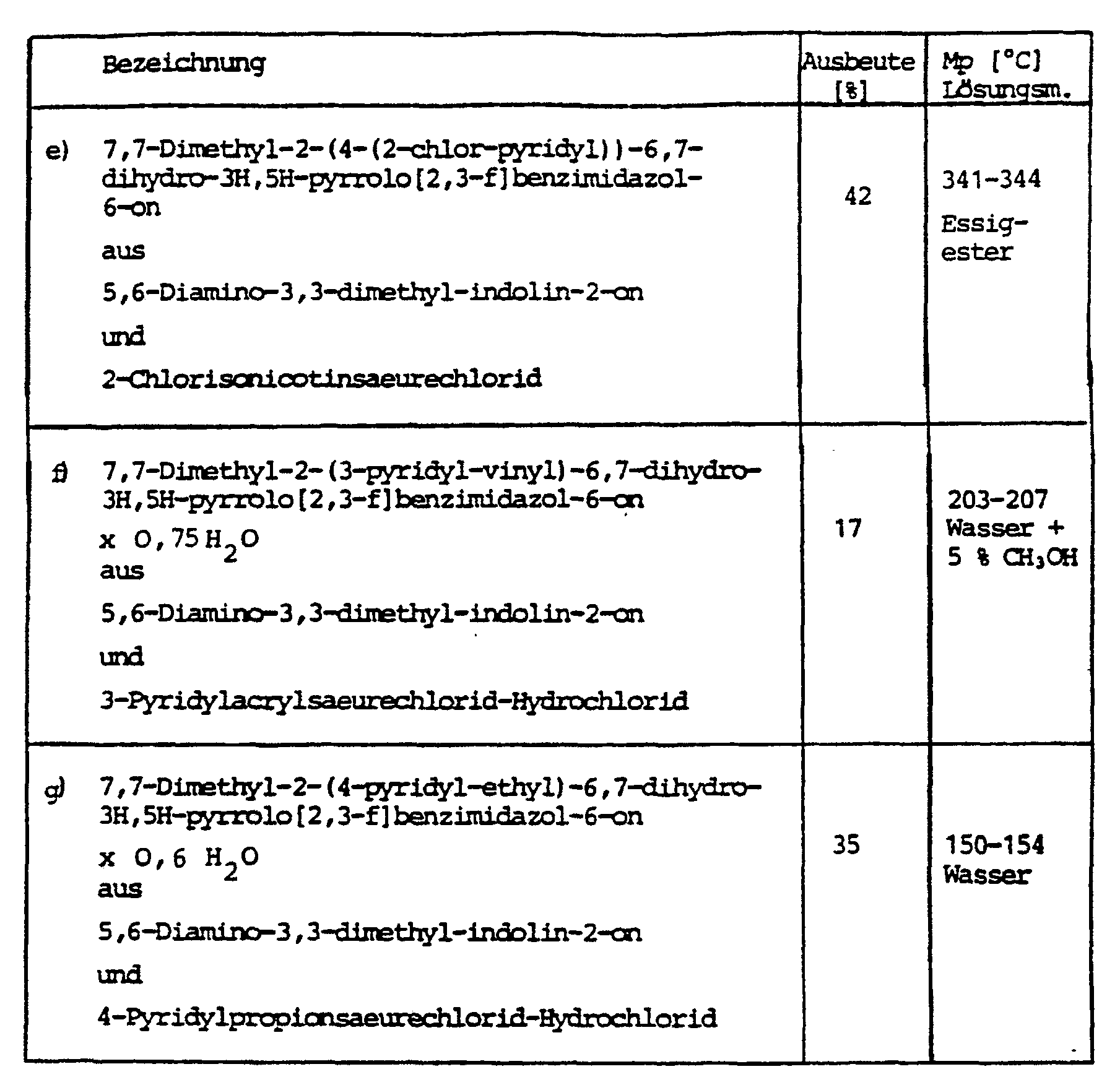

- Die Ausgangsstoffe fuer die in Beispiel 1 beanspruchten Verbindungen koennen wie folgt hergestellt werden.
-
- a) Cyan-o-tolunitril (142 g, 1 mol) werden zusammen mit Benzyltributylammoniumbromid (10.8 g, 0.03 mol) in konz. NaOH-Loesung (700 ml) gegeben und Methyljodid (185 ml, 2 mol) unter Eiskuehlung zugetropft. Es wird 2 h nachgeruehrt, vom Kristallisat abgesaugt, mit Wasser nachgewaschen und getrocknet. Man erhaelt 170 g (100 % d.Th.) o-Cyano-α,α-dimethyl-phenylessigsaeurenitril. Mp 84-88 C. Das erhaltene Produkt wird in 90proz. H2SO4 (1500 ml) eingetragen, 3 h lang geruehrt, auf Eis gegossen, das Kristallisat mit Wasser nachgewaschen und getrocknet. Man erhaelt 167 g (88 % d.Th.) der Titelverbindung. Mp 119-120 C.
- b) KOH (17.73 g, 0.32 mol) wurde in 26.5 ml Wasser und 106 ml Ethanol geloest. In dieser Loesung wurde 1,3(2H,4H)-Isochinolindion (25.55 g, 0.16 mol) unter Erwaermung geloest. Zu der auf Raumtemperatur gekuehlten Loesung wurde Methyliodid (45.44 g, 0.32 mol) zugetropft.
Nach 1 h bei Raumtemperatur wurde noch 1 h bei 80° C weitergeruehrt. Der groeßte Teil des Ethanols wurde abdestilliert, der Rueckstand mit 300 ml heißem Wasser versetzt, abgekuehlt und die Kristalle abgesaugt. Die Kristalle wurden in wenig 2 H NaOH geloest und mit gesaettigter NH4CI-Loesung ausgefaellt und abgesaugt. Durch Behandeln mit Aktivkohle und umkristallisieren aus Ethanol erhaelt man das reine Produkt 17 g (57 %). - In analoger Weise koennen auf dem Weg a oder b die folgenden Verbindungen erhalten werden:

- Zu einer Loesung von 4,4-Dimethyl-2H,4H-isochinolin-1,3-dion (195 g, 1 mol) in konz. H2S04 (1000 ml) wird eine Loesung von rauchender HNO3 (46.2 ml, 1.1 mol) in konz. H2SO4 bei 20°C zugetropft. Es wird eine Stunde bei RT nachgeruehrt, auf Eis gegossen, die Kristalle abgesaugt, gut mit Wasser nachgewaschen und getrocknet. Es wird aus Ethanol umkristallisiert.
- Ausbeute: 206 g (85 % d.TH.), Mp 211-214°C
- In analoger Weise koennen nach dem Weg c die folgenden Verbindungen erhalten werden:

- Zu einer Loesung von NaOH (210 g, 5.25 mol) in Wasser (1700 ml) wird bei 0°C Brom (54 ml, 1.05 mol) zugetropft und anschließend 4,4-Dimethyl-7-nitro-2H,4H-isochinolin-1,3-dion (81.7 g, 0.35 mol) eingetragen. Nach 1 h Ruehren bei RT wird ca. 1 h auf 80 C erhitzt und nach dem Abkuehlen mit Essigsaeure sauer gestellt. Es wird abgesaugt, gut mit Wasser nachgewaschen und getrocknet.
- Ausbeute 49 g (68 % d.Th.), Mp 241-242°C.
- Analog zu d lassen sich folgende Verbindungen synthetisieren:

- Eine Suspension von 6-Nitro-3,3-dimethyl-indolin-2-on (146 g, 0.71 mol) in Methanol (3.5 Liter) mit Eisessig (300 ml) werden an 10proz. Pd/C (16 g) bei 40° C unter gutem Ruehren hydriert. Die anschließend klare Loesung wird vom Katalysator abgesaugt und eingeengt. Ausbeute 125 g (100 % d.Th.), Mp 185-190° C.
- Analog zu e lassen sich folgende Verbindungen erhalten:
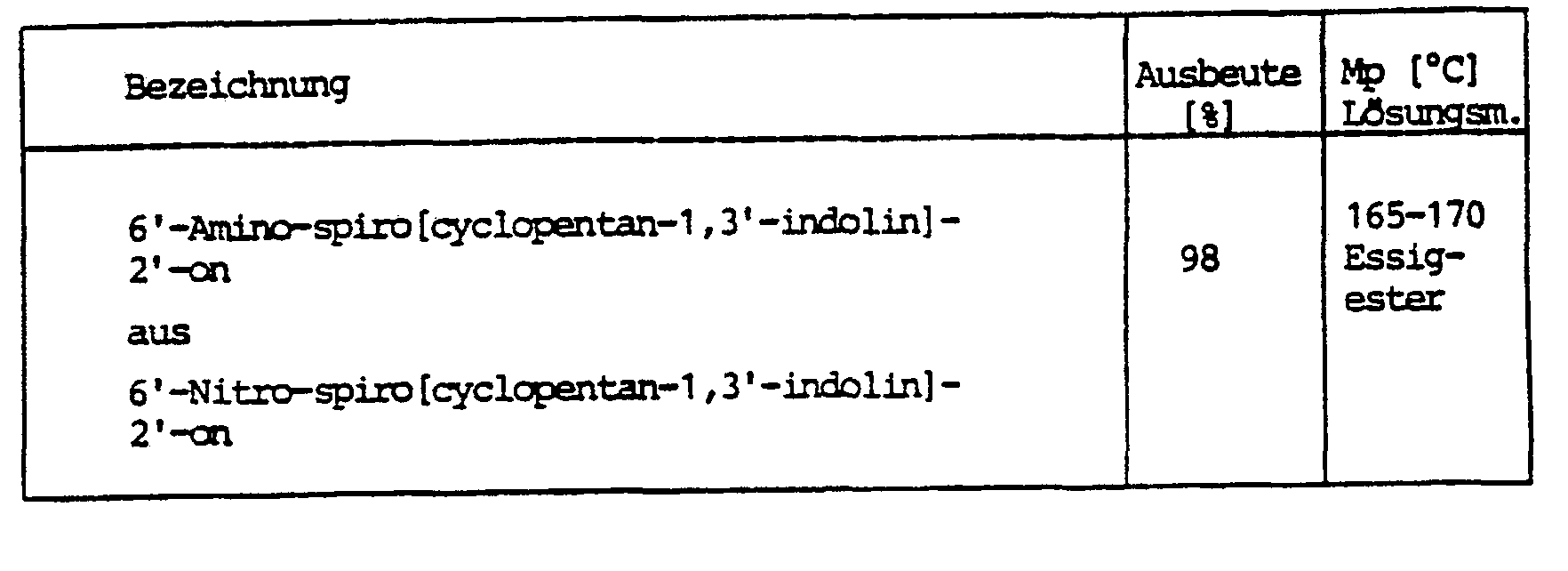
- Zu einer Suspension von 6-Amino-3,3-dimethyl-indolin-2-on (32 g, 0.18 mol) in Essigester (500 ml) wird unter Kuehlung Essigsaeureanhydrid (20.4 g, 0.2 mol) zugetropft und ca. 1 h bei RT nachgeruehrt. Das entstandene Produkt wird abgesaugt mit Essigester gut nachgewaschen und getrocknet.
- Ausbeute: 37.8 g (96 % d.Th.), Mp 275-277° C.
- Nach f erhaelt man in analoger Weise folgende Verbindungen:

- Zu einer Loesung von 6-Acetamido-3,3-dimethyl-indolin-2-on (35 g, 0.16 mol) in konz. H2S04 (200 ml) wird unter Kuehlung eine Loesung von rauchender HN03 (7.6 ml, 0.18 mol) in konz. H2S04 (7.6 ml) zugetropft. Es wird eine Stunde nachgeruehrt, auf Eis gegossen, die Kristalle abgesaugt, gut mit Wasser nachgewaschen und getrocknet.
- Ausbeute: 39 g (92 % d.Th.), Mp 276-280°C.
- In analoger Weise koennen nach g die folgenden Verbindungen erhalten werden:

- Eine Loesung von 6-Acetamido-3,3-dimethyl-5-nitro-indolin-2-on (36.2 g, 0.14 mol) in Ethanol (180 ml) mit konz. NaOH (18 ml) wird ca. 2 h am Rueckfluß erhitzt, anschließend im Vakuum eingeengt, auf pH 6 eingestellt und im Eisbad gekuehlt. Die erhaltenen Kristalle werden abgesaugt, mit Wasser gewaschen und getrocknet. Ausbeute 29.5 g (97 % d.Th.), Mp 247-248°C.
- Analog zu h lassen sich folgende Verbindungen erhalten:
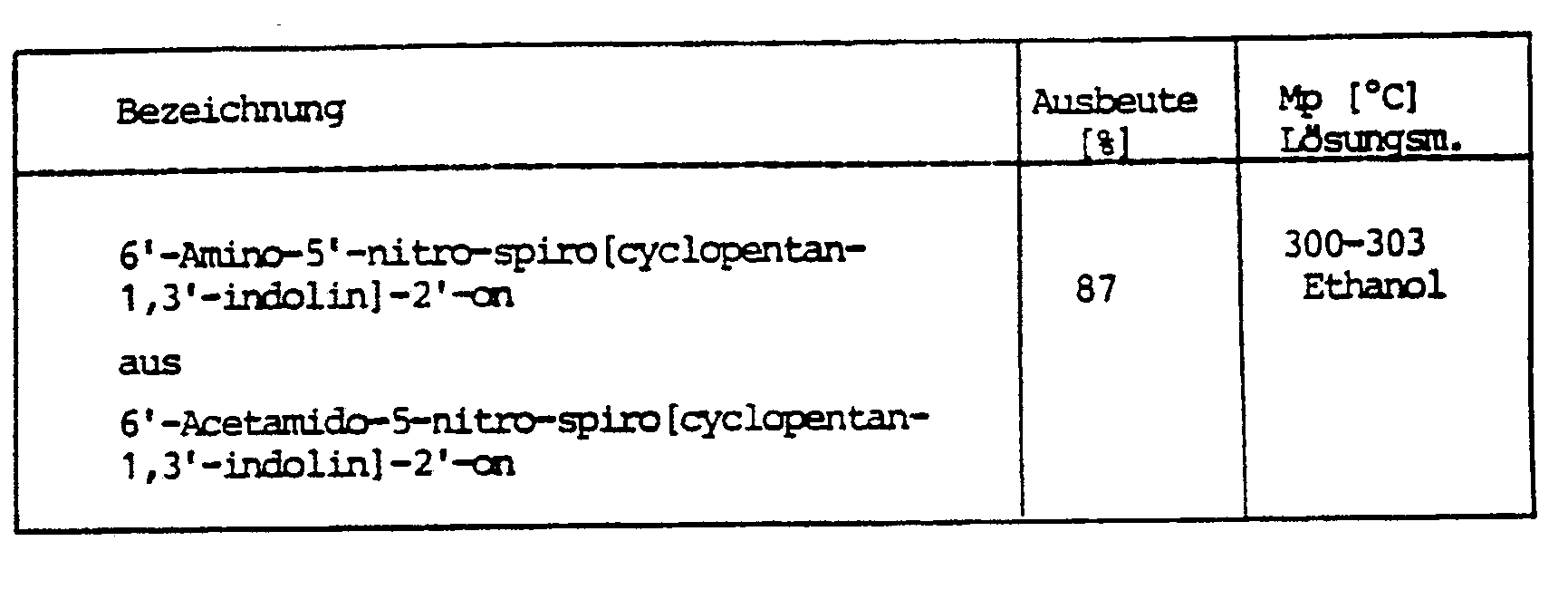
- Eine Loesung von 6-Amino-3,3-dimethyl-5-nitro-indolin-2-on (18.7 g, 0.085 mol) in Methanol (200 ml) werden an 10proz. Pd/C (1.9 g) bei 40° C hydriert. Es wird vom Katalysator abgesaugt, eingeengt und aus Ethanol kristallisiert.
- Ausbeute: 15.6 g (96 % d.Th.), Mp 245-247°C.
- Nach der Vorschrift i lassen sich in analoger Weise folgende Verbindungen erhalten:
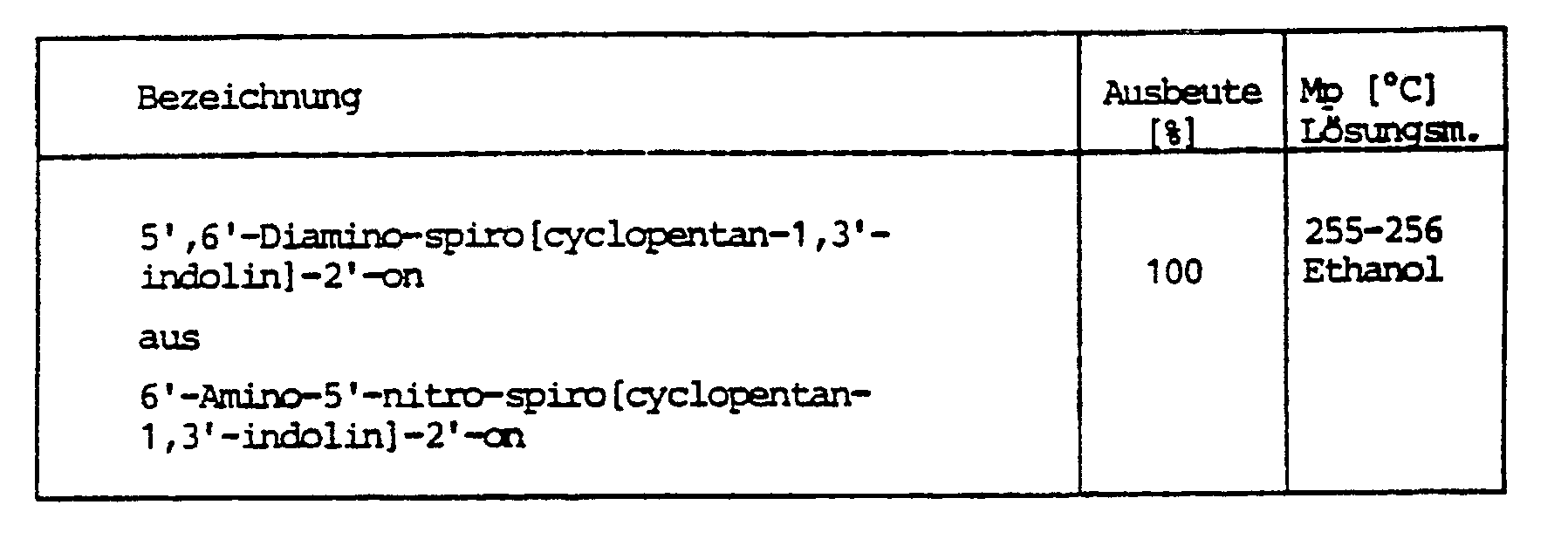
- Eine Suspension von 5,6-Diamino-3,3-dimethyl-indolin-2-on (7.3 g, 0.038 mol) in 4-Pyridylessigsaeuremethylester (11.6 g, 0.077 mol) wird unter N2-Atmosphaere ca. 16 h auf 180°C unter Ruehren erhitzt. Anschließend wird der ueberschuessige Ester im Vakuum abdestilliert und der erhaltene Rueckstand an Kieselgel (Laufmittel: Dichlormethan/NH3-ges. Methanol 20:1) aufgetrennt. Ausbeute: 1.8 g (16 % d.Th.), Mp 333-337° C (Wasser/Methanol 10:1)
- Eine Loesung von 5,6-Diamino-3,3-dimethyl-indolin-2-on (3.8 g, 0.02 mol) mit 2-Methoxy-6-methyl- pyridin-3-aldehyd (3 g, 0.02 mol) und Toluolsulfonsaeure (0.4 g, 0.002 mol) in Ethanol (50 ml) wird ca. 1 h zum Rueckfluß erhitzt, wobei nach 30 min durch ein Einleitungsrohr Luft durch die Reaktionsmischung geleitet wird. Nach dem Abkuehlen wird von der ausgefallenen Substanz abgesaugt und das Filtrat im Vakuum eingeengt, mit Wasser verruehrt und mit Dichlormethan extrahiert. Die organische Phase wird eingeengt und der Rueckstand aus Ether kristallisiert. Die vereinigten Rohprodukte werden nochmals aus Essigester umkristallisiert. Ausbeute: 1.2 g (19 % d.Th.), Mp 296-298 C.
- Analog zu Beispiel 3 erhaelt man:

- Eine Loesung von 7,7-Dimethyl-2-(4-pyridyl)-6,7-dihydro-3H, 5H-pyrrolo[2,3-f]benzimidazol-6-on (3.9 g, 0.014 mol) in Eisessig (50 ml) mit 30proz. H202 (20 ml) wird 2 Tage lang bei 50°C geruehrt und anschließend mit Wasser verduennt. Die ausgefallene Substanz wird abgesaugt und aus Dioxan/Wasser 1:1 umkristallisiert. Ausbeute 1.4 g (34 % d.Th.), Mp 260-262 C.
- Analog zu Beispiel 4 erhaelt man:

- 0.2 g (0.67 mmol) 6-lsonicotinoylamino-5-nitro-indolin-2-on wurden in 20 ml Eisessig suspendiert, mit 80 mg 10proz. Pd/Kohle versetzt und bei Normaldruck hydriert. Nach der Hydrierung wurde vom Katalysator abgetrennt, eingeengt und der Rueckstand in Alkohol geloest, filtriert und mit ethanolischer Salzsaeure angesaeuert. Durch Absaugen und Nachwaschen mit Ethanol erhaelt man 0.12 g (62.5 %)Produkt. Mp >300 C, MS (Trimethylsilylderivat) : M+ 394.466

- Analog zu Beispiel 5 erhaelt man:


- Die Ausgangsstoffe fuer die in Beispiel 5 beanspruchten Verbindungen koennen wie folgt hergestellt werden.
- 5.5 g (21.7 mmol) 6-lsonicotinoylamino-indolin-2-on wurden portionsweise in 20 ml konzentrierten Schwefelsaeure geloest, mit Eis gekuehlt und 2.19 g (21.7 mmol) KN03 in konzentrierter H2SO4 geloest langsam zugetropft. Die Loesung wurde nach 2 Stunden auf Eis gegossen, neutralisiert und abgesaugt. Der Rueckstand wurde in 2 N Salzsaeure weitgehend geloest, filtriert, mit Floridin behandelt, abgesaugt und neutral gestellt. Man erhaelt 4.5 g (70 %) der Titelverbindung. Mp >300°C
- In analoger Weise werden die folgenden Verbindungen erhalten:

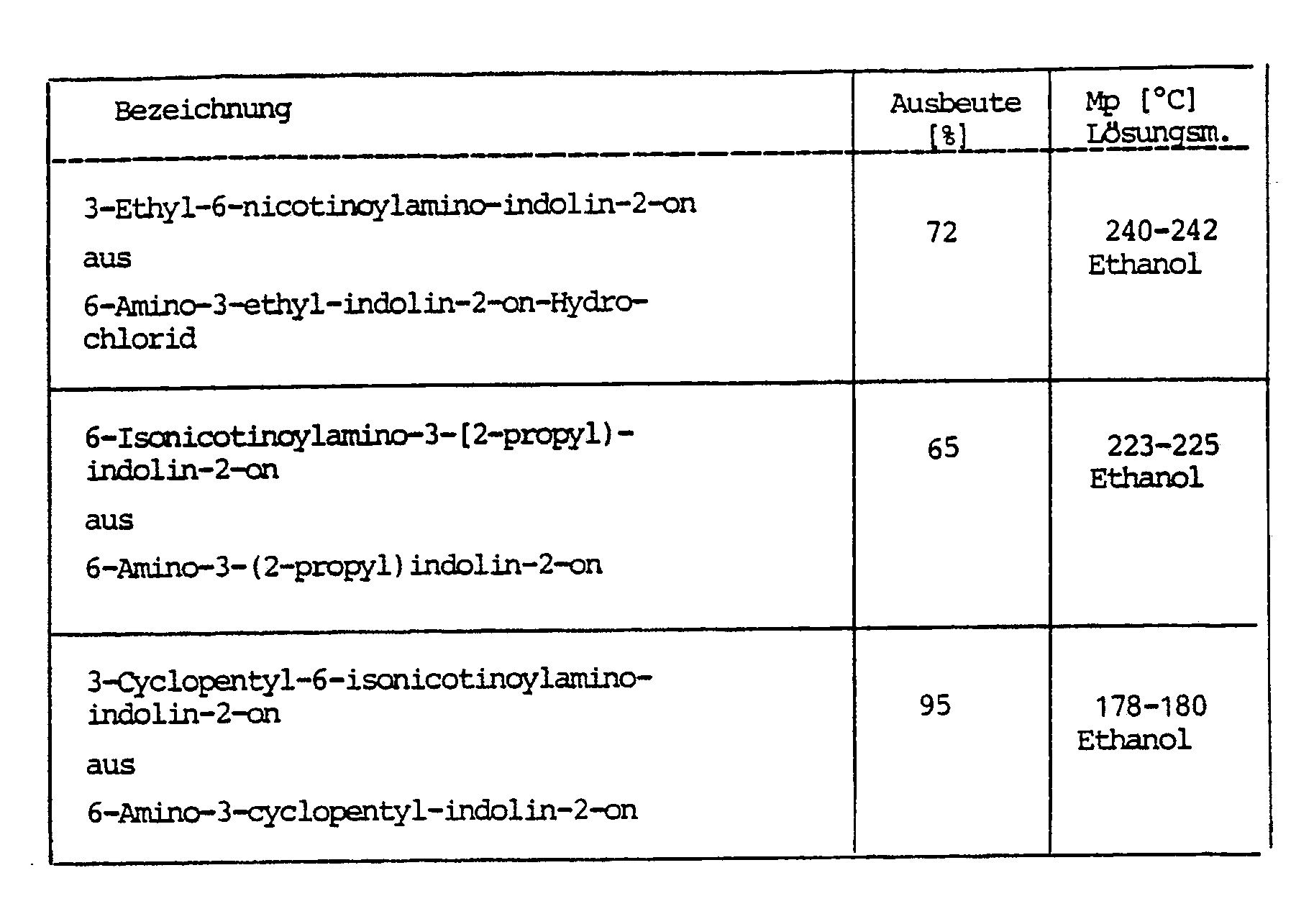
- 5.0 g (27.1 mmol) 6-Amino-indolin-2-on-Hydrochlorid (Helv. Chim. Acta 20 , 373, 1937) wurden in 100 ml Methylenchlorid suspendiert und mit 3.7 ml (27.1 mmol) Triethylamin versetzt und 10 min geruehrt. Unter Eiskuehlung wurden 6.73 g (37.8 mmol) Isonicotinsaeurechlorid-Hydrochlorid und 5.24 ml (37.8 mmol) Triethylamin zugegeben. Anschließend wurden nochmals 3.7 ml (27.1 mmol) Triethylamin zugetropft. Nach 3 h wurde das Methylenchlorid abdestilliert, der Rueckstand mit Wasser durchgearbeitet und abgesaugt. Der Rueckstand wurde mit heißem Ethanol ausgeruehrt. Man erhaelt 5.6 g (82 %) der Titelverbindung. Mp 315-320°C
- In analoger Weise wird die folgende Verbindung erhalten:

- Zu einer Loesung von 5,6-Diamino-3,3-diethyl-indolin-2-on (4.4 g, 0.02 mol) in Methylenchlorid (100 ml) mit Triethylamin (8.4 ml) gibt man portionsweise Isonicotinsaeurechlorid Hydrochlorid (5.4 g, 0.03 mol), nach ca. 2 h gibt man Eisessig hinzu und die erhaltenen Kristalle werden abgesogen, nachgewaschen und getrocknet. Anschließend wird in einer Mischung von Ethanol (100 ml) mit konz. HCI (20 ml) ca. 20 h zum Rueckfluß erhitzt, im Vakuum eingedampft, der Rueckstand mit NH3-Loesung digeriert, abgesaugt und getrocknet. Anschließend wird an Kieselgel (Laufmittel: Methylenchlorid/NH3-gesaettigtes Methanol 15:1) gereinigt und aus Methanol kristallisiert.
- Ausbeute: 2.4 g (35 % d.Th.), Mp. 216-219° C
- Analog zu Beispiel 6 erhaelt man:

- Die Ausgangsstoffe fuer die in Beispiel 6 beanspruchten Verbindungen koennen wie folgt hergestellt werden:
- Eine Loesung von 5-Amino-3,3-diethyl-6-nitro-indolin-2-on (10 g, 0.041 mol) in Ethanol (150 ml) wird an 10proz. Pd/C (0.6 g) bei RT hydriert. Es wird vom Katalysator abgesaugt, eingeengt und aus Ethanol umkristallisiert.
- Ausbeute: 8.5 g (97 % d.Th.), Mp. 167-173° C.
- Nach der Vorschrift a lassen sich folgende Verbindungen in analoger Weise erhalten:
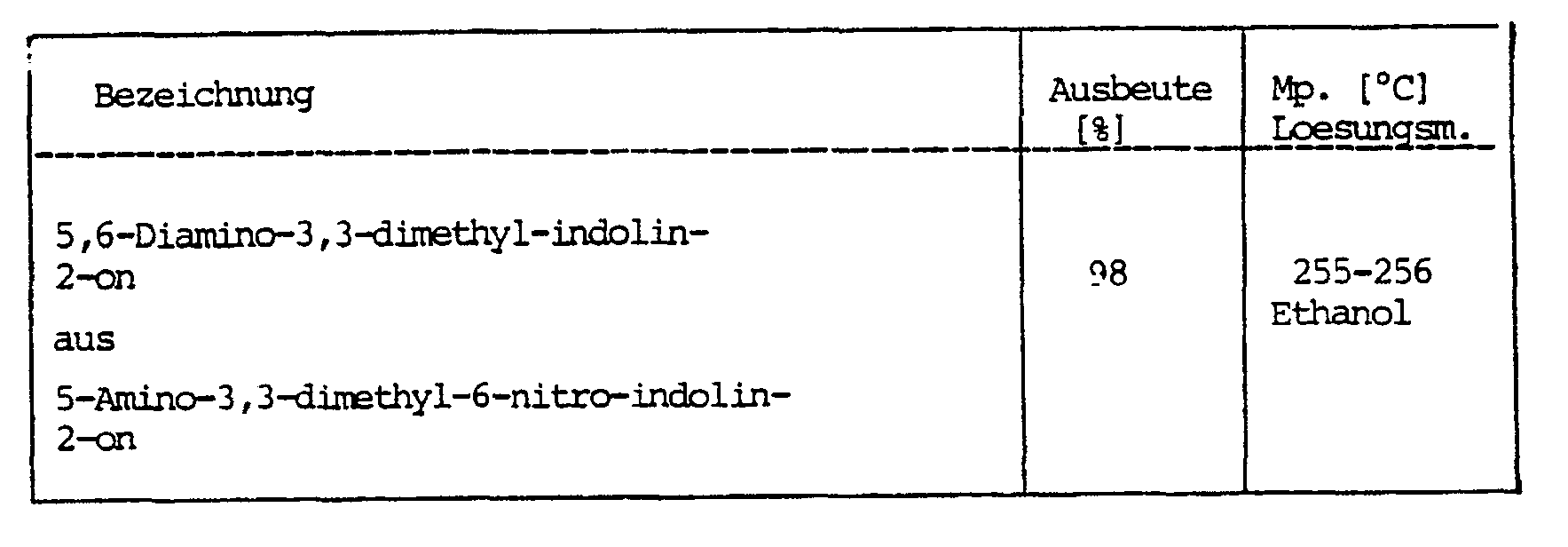
- Eine Loesung von 5-Acetamido-3,3-diethyl-6-nitro-indolin-2-on (72 g, 0.25 mol) in Ethanol (500 ml) mit konz. HCI (100 ml) wird ca. 3 h am Rueckfluß erhitzt, mit Wasser (1000 ml) verduennt, abgesaugt und die erhaltenen Kristalle mit waessrigem Ethanol nachgewaschen und getrocknet.
- Ausbeute: 54.7 g (89 % d.Th.), Mp. 267-272 C.
- Analog zu b lassen sich folgende Verbindungen erhalten:

- Zu einer Loesung von 5-Acetamido-3,3-diethyl-indolin-2-on (84 g, 0.34 mol) in Essigsaeureanhydrid (800 ml) wird unter Kuehlung rauchende HNO3 (24 ml) getropft und bei RT ca. 2 h nachgeruehrt. Es wird vorsichtig in Eiswasser gegeben und die erhaltenen Kristalle abgesaugt, mit Wasser nachgewaschen und getrocknet.
- Ausbeute: 72 g (72 % d.Th.), Mp. 182-184°C.
- In analoger Weise koennen nach Vorschrift c die folgenden Verbindungen erhalten werden:

- Eine Suspension von 3,3-Diethyl-5-nitro-indolin-2-on (86 g, 0.372 mol) in Ethanol (700 ml) wird an 10proz. Pd/C (4 g) unter gutem Ruehren hydriert. Anschließend wird die klare Loesung abgesaugt und eine Probe aus Ethanol kristallisiert (Mp. 188-190 C), die Hauptmenge der Loesung wird vorsichtig mit Essigsaeureanhydrid (50 ml) versetzt und im Vakuum eingedampft. Der Rueckstand wird mit Essigester digeriert, abgesaugt, gewaschen und getrocknet. Kristallisation aus Essigester.
- Ausbeute: 85 g (94 % d.Th.), Mp. 196-197 C.
- Nach d erhaelt man in analoger Weise folgende Verbindungen:

- Zu einer Loesung von 3,3-Diethyl-indolin-2-on (86 g, 0.462 mol) in 80proz. H2SO4 (500 ml) wird unter Kuehlung eine Loesung von rauchender HNO3 (17 ml) in 80proz. H2S0 (200 ml) zugetropft. Es wird ca. 30 min nachgeruehrt, auf Eis gegossen, abgesaugt, mit Wasser nachgewaschen und getrocknet.
- Ausbeute: 86 g (79 % d.Th.), Mp. 174-176° C.
- In analoger Weise koennen nach e die folgenden Verbindungen erhalten werdend:

- In eine Suspension von 2-(4-Pyridyl)-6,7-dihydro-3H,5H-pyrrolo[2,3-f]benzimidazol-6-on (0.4 g, 1.6 mmol) in Ethanol (20 ml) mit Aceton (10 ml) wird bis zur Saettigung Ammoniak eingeleitet und 2 h bei 60°C geruehrt. Anschließend wird noch einmal Aceton (10 ml) zugesetzt und 4 h bei 60°C geruehrt, dann wird eingeengt, in Ethanol aufgenommen, angesaeuert und vom Niederschlag abgesogen. Der erhaltene Rueckstand wird in Wasser geloest, neutral gestellt, von den Kristallen abgesaugt und aus Isopropanol/Essigester umkristallisiert.
- Ausbeute: 40 mg (9 % d.Th.), Mp. >300°C.
- Eine Loesung von 5-Amino-3-ethoxycarbonyl-3-methyl-6-(4-pyridinoylamino)-indolin-2-on (10.85 g, 32.2 mmol) in Ethanol (700 ml) mit konz. HCI (50 ml) wird ca. 12 h zum Rueckfluß erhitzt. Anschließend wird abgekuehlt, etwas eingeengt, von den Kristallen abgesaugt und aus Ethanol umkristallisiert.
- Ausbeute: 9.6 g (79 % d.Th.), Mp. 288-290 C.
- Die Ausgangsstoffe fuer die in Beispiel 8 beanspruchten Verbindungen koennen wie folgt hergestellt werden:
- Eine Loesung von 3-Ethoxycarbonyl-3-methyl-5-nitro-6-(4-pyridinoylamino)-indolin-2-on (12.4 g, 32.2 mmol) in Ethanol (500 ml) wird an 10proz. Pd/C (1 g) bei Raumtemperatur hydriert. Es wird vom Katalysator abgesaugt, eingeengt und die erhaltene Substanz sofort weiter eingesetzt.
- Zu einer Loesung von 3-Ethoxycarbonyl-3-methyl-6-(4-pyridinoylamino)-indolin-2-on (13 g, 0.038 mol) in konz. H2SO4 (90 ml) wird unter Kuehlung eine Loesung von Kaliumnitrat (3.9 g, 0.038 mol) in konz. H2SO4 - (30 ml) zugetropft. Es wird ca. eine Stunde nachgeruehrt, auf Eis gegossen, unter Kuehlung mit konz. NH3-Loesung auf pH 8 gestellt, die Kristalle abgesaugt und aus Ethanol/Methylenchlorid umkristallisiert. Ausbeute: 12.81 g (82 % d.Th.), Mp. 217-2190 C.
- Zu einer gekuehlten Loesung von 6-Amino-3-ethoxycarbonyl-3-methyl-indolin-2-on (13 g, 0.048 mol) in Methylenchlorid (500 ml) werden Triethylamin (22.1 ml) und Pyridin-4-carbonsaeurechlorid Hydrochlorid (9.4 g, 0.053 mol) gegeben und ca. 2 h bei RT geruehrt. Anschließend wird zur Trockne eingeengt mit Wasser verruehrt, abgesaugt und der Rueckstand aus Ethanol/Methylenchlorid umkristallisiert. Ausbeute: 11.9 g (73 % d.Th.), Mp. 222-224 C.
- Eine Loesung von Methyl-(2,4-dinitro-phenyl)malonsaeurediethylester (27 g, 0.079 mol) in Ethanol (800 ml) wird an 10proz. Pd/C (1 g) bei RT hydriert. Anschließend wird vom Katalysator abgesaugt, mit ethanolischer HCI angesaeuert, eingeengt und durch Zusatz von Isopropanol auskristallisiert. Ausbeute: 13.19 g (71 % d-Th.), Mp. 248° C.
- Eine Loesung von 7-Ethoxycarbonyl-7-methyl-2-(4-pyridyl)-6,7-dihydro-3H,5H-pyrrolo[2,3-f]-benzimidazol-6-on Hydrochlorid (1 g, 2.7 mmol) in Ethanol (30 ml) mit Hydrazin-Hydrat (6 ml) wird ca. 8 h bei 80 C geruehrt. Anschließend wird abgesaugt, mit einer Loesung von Methanol (1000 ml) mit Methylenchlorid (500 ml) aufgekocht, etwas eingeengt und die Kristalle abgesaugt, mit Methanol nachgewaschen und getrocknet.
- Ausbeute: 0.6 g (70 % d.Th.), Mp. >300°C.
- Eine Loesung von 3,3-Dimethyl-5-nitro-6-(4-pyridinoylamino)-indolin-2-on (68 g, 0.209 mol) in Ethanol (3000ml) mit Triethylamin (30 ml) wird an 10proz. Pd/C hydriert. Anschließend wird vom Katalysator abgesaugt, eingeengt und das Rohprodukt in Ethanol (1000 ml) mit konz. HCI (200 ml) ca. 6 h am Rueckfluß erhitzt, eingeengt, mit Wasser verduennt und mit Ammoniakwasser auf pH 8 gestellt. Das entstandene Kristallisat wird abgesaugt, gewaschen und aus Ethanol/Wasser kristallisiert.
- Ausbeute: 52.3 g (71 % d.Th.), Mp. 215°C.
- Analog zu Beispiel 10 erhaelt man:

- Die Ausgangsstoffe aus Beispiel 10 werden wie folgt hergestellt:
- Eine Loesung von 6-Amino-3,3-dimethyl-5-nitro-indolin-2-on (48.3 g, 0.22 mol) in Pyridin (400 ml) wird portionsweise mit Isonicotinsaeurechlorid Hydrochlorid (78.8 g, 0.44 mol) versetzt und ca. 2 h nachgeruehrt. Anschließend wird auf Wasser gegossen, neutral gestellt, abgesaugt und aus Ethanol umkristallisiert.
- Ausbeute: 68.1 g (95 % d.Th.), Mp. 225-230 C.
- Man erhaelt nach Vorschrift a) in analoger Weise folgende Verbindungen:

- Zu einer Loesung von 5,6-Diamino-3-(2-methyl-propyl)-indolin-2-on (1.3 g, 0.006 mol) in Methylenchlorid (40 ml) mit Triethylamin (3 ml) gibt man portionsweise Isonicotinsaeurechlorid Hydrochlorid (1.6 g, 0.009 mol), extrahiert nach ca. 2 h mit Wasser und engt die organische Phase ein. Der feste Rueckstand wird in Ethanol (70 ml) mit konz. HCI (10 ml) ueber Nacht am Rueckfluß erhitzt, eingeengt, mit waessrigem Ammoniak durchgeruehrt und mit Methylenchlorid/Methanol extrahiert. Die organische Phase wird eingeengt und an Kieselgel (Laufmittel: Methylenchlorid/NH3-gesaettigtes Methanol 9:1) gereinigt.
- Ausbeute: 0.65 g (35 % d.Th.), Mp. 200-2020 C.
- Ausgangsstoffe für Beispiel 11 werden in folgender Weise erhalten:
- Eine Loesung von 6-Amino-3-(2-methyl-propyl)-5-nitro-indolin-2-on (1.5 g, 0.006 mol) in Methanol (50 ml) wird an 10proz. Pd/C (0.3 g) hydriert. Es wird vom Katalysator abgesaugt, eingeengt und aus Ethanol umkristallisiert. Ausbeute: 1.3 g (99 % d.Th.)
- Eine Loesung von 6-Acetamido-3-(2-methyl-propyl)-5-nitro-indolin-2-on (2.9 g, 0.01 mol) in Ethanol (50 ml) mit konz. HCI (3 ml) wird ca. 30 min am Rueckfluß erhitzt, eingeengt und an Kieselgel (Laufmittel: Methylenchlorid/Methanol NH3 gesaettigt 20:1) gereinigt.
- Ausbeute: 1.5 g (60 % d.Th.)
- Eine Loesung von 6-Acetamido-3-(2-methyl-propyl)indolin-2-on (4.2 g, 0.017 mol) in Acetanhydrid (50 ml) wird unter Kuehlung mit rauchender HNO3 (0.8 ml, 0.019 mol) versetzt und ca. 30 min nachgeruehrt. Anschließend wird vorsichtig auf Eis gegossen und die Kristalle abgesaugt, mit Wasser gewaschen und getrocknet.
- Ausbeute: 3.2 g (66 % d.Th.), Mp. 192-197°C.
- Eine Loesung von 6-Acetamido-3-isopropyliden-indolin-2-on (6.4 g, 0.026 mol) in Methanol (100 ml) wird an 10proz. Pd/C (0.6 g) hydriert. Anschließend wird vom Katalysator abgesaugt und die Loesung zur Trockene eingeengt.
- Ausbeute: 5.5 g (84 % d.Th.), Mp. 214-216 C.
- Zu einer Suspension von 6-Acetamido-indolin-2-on (9 g, 0.047 mol) in Ethanol (50 ml) mit Isobutyraldehyd (3.4 g, 0.047 mol) wird eine Loesung von NaOH (1.9 g) in Wasser (2 ml) getropft. Nach ca. 5 h wird im Vakuum zur Trockne eingeengt und an Kiesel gel (Laufmittel: Methylenchlorid/Methanol NH3 gesaettigt) gereinigt.
- Ausbeute: 7.6 g (65 % d.Th.) Schaum, Mp. 93 C.
- Eine Loesung von 7,7-Dimethyl-2-(4-pyridyl)-6,7-dihydro-3H,5H-pyrrolo[2,3-f]benzimidazol-6-on (2.0 g, 7.2 mmol) in Pyridin (35 ml) wird mit P4S10 (4 g) unter gutem Ruehren ca. 5 h auf 100 C erhitzt. Anschließend wird mit Eiswasser zersetzt, alkalisch gestellt, die gewuenschte Substanz extrahiert und an Kieselgel (Laufmittel; Methylenchlorid/NH3) gesaettigtes Methanol 20:1) gereinigt.
- Ausbeute: 1.7 g (72 % d.Th.), Mp. 205-220°C.
- Zu einer Mischung von 3-Hydroxy-pyridin-4-carbonsaeure (2.8 g, 0.02 mol) in DMF (30 ml) mit wasserfreiem CaSO4 (3 g) und Hydroxybenzotriazol (3.4 g, 0.025 mol) wird unter Ruehren bei 0° C eine Loesung von DCC (5.2 g, 0.025 mol) in DMF (20 ml) gegeben. Anschließend wird mit 5,6-Diamino-3,3-dimethyl-indolin-2-on (2.8 g, 0.015 mol) versetzt und nach kurzem Nachruehren eingeengt, mit Wasser digeriert und abgesaugt. Der Rueckstand wird mit Ethanol (200 ml) und konz. HCI (40 ml) 2 d am Rueckfluß erhitzt, nach dem Abkuehlen abgesaugt und das Filtrat im Vakuum eingeengt, mit Ammoniakwasser digeriert und abgesaugt. Es wird saeulenchromatographisch an Kieselgel (Laufmittel: Methylenchlorid/Methanol/Essigsaeure 10:1:1) gereinigt.
- Ausbeute: 1.4 g (24 % d.Th.), Mp. > 300° C.
- Analog zu Beispiel 13 erhaelt man:
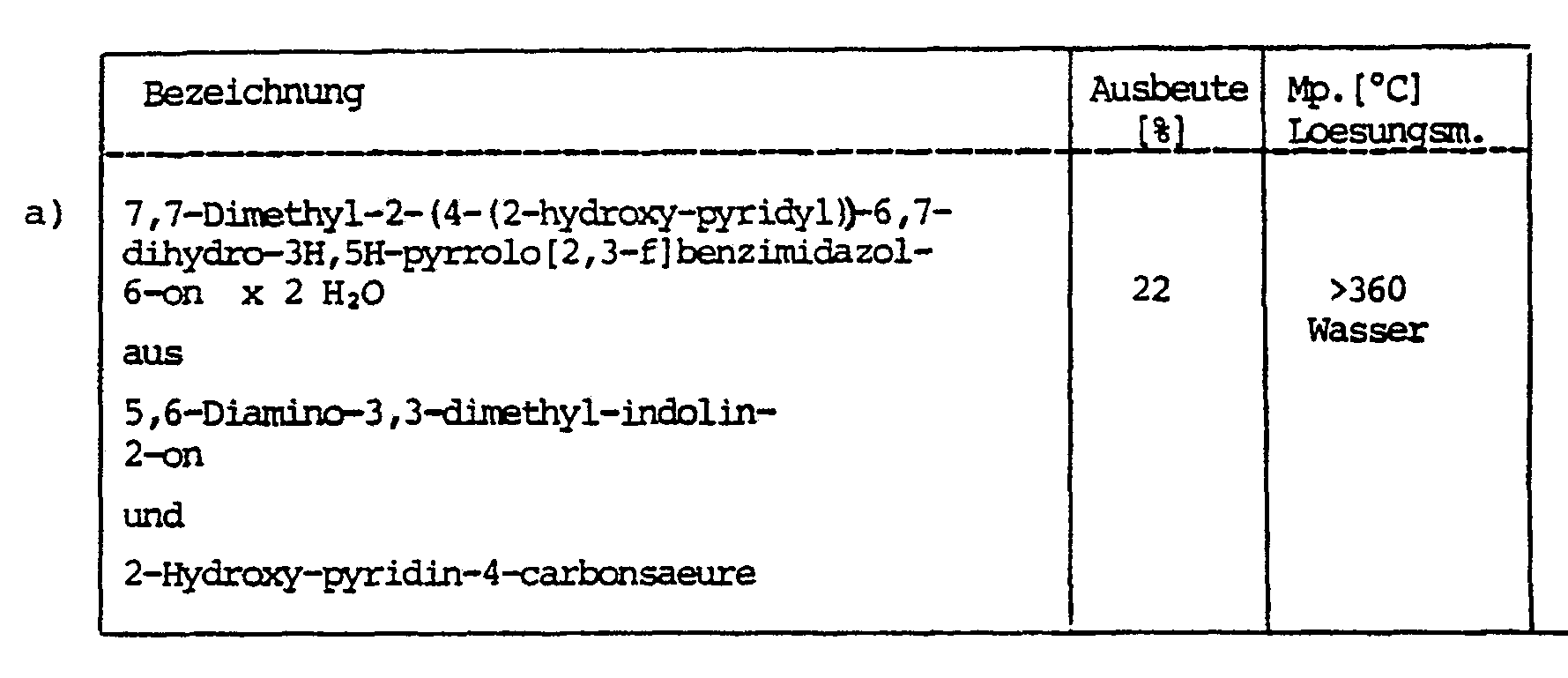
- Eine Loesung von 3,3-Dimethyl-6-nitro-5-(4-pyridinoylamino)indolin-2-on (33 g, 0.1 mol) in Ethanol (1300 ml) mit Triethylamin (13 ml) wird an 10proz. Pd/C hydriert. Anschließend wird vom Katalysator abgesaugt, eingeengt und in Ethanol (500 ml) mit konz. HCI (100 ml) ca. 6 h am Rueckfluß erhitzt. Es wird eingeengt, mit Ammoniakwasser digeriert und das entstandene Produkt abgesaugt, mit Wasser gewaschen, aus Ethanol/Wasser kristallisiert und aus Methanol umkristallisiert.
- Ausbeute: 19.5 g (70 % d.Th.), Mp. 285-288° C.
- Die Ausgangsverbindungen werden wie folgt hergestellt:
- Zu einer Loesung von 3,3-Dimethyl-5-(5-pyridinoylamino)indolin-2-on (5.5 g, 0.02 mol) in Eisessig (50 ml) wird unter Kuehlung rauchende HNO3 (2.5 ml) getropft und bei RT ca. 2 h nachgeruehrt. Es wird vorsichtig auf Eis gegossen, neutralisiert und die erhaltenen Kristalle abgesaugt, mit Wasser gewaschen und getrocknet.
- Ausbeute: 5.2 g (81 % d.Th.), Mp. 310-318° C (aus Methanol)
- Eine Suspension von 5-Amino-3,3-dimethyl-indolin-2-on (5.0 g, 0.028 mol) in Methylenchlorid (100 ml) mit Triethylamin (14 ml) wird unter Kuehlung mit Isonicotinsaeurechlorid Hydrochlorid (7.0 g, 0.04 mol) versetzt. Anschließend wird eingeengt, mit Wasser digeriert, abgesaugt und aus Ethanol umkristallisiert.
- Ausbeute: 5.8 g (73 % d.Th.), Mp. >300 C.
- Eine Suspension von 5-Nitro-indolin-2-on (100 g, 0.48 mol) in Methanol (2500 ml) mit Eisessig (200 ml) wird an 10proz. Pd/C (10 g) bei 40° C unter gutem Ruehren hydriert. Die anschließende klare Loesung wird vom Katalysator abgesaugt und eingeengt.
- Ausbeute: 82 g (96 % d.Th.), Mp. 185-191 ° C (HCl-Salz aus Methanol).
- Zu einer Loesung von 3,3-Dimethyl-indolin-2-on (100 g, 0.62 mol) in 80proz. H2S04 (500 ml) wird unter Kuehlung eine Loesung von rauchender HNO3 (22 ml) in 80proz. H2SO4 (200 ml) zugetropft. Es wird ca. 30 min nachgeruehrt, auf Eis gegossen, abgesaugt, mit Wasser nachgewaschen und getrocknet.
- Ausbeute: 100 g (78 % d.Th.), Mp. 192-196° C (Essigester/Heptan).
- Zu einer Loesung von 5-Amino-3,3-dimethyl-6-nitro-indolin-2-on (5 g, 0.023 mol) in Pyridin (50 ml) wird portionsweise Isonicotinsaeurechlorid Hyrochlorid (8 g, 0.04 mol) gegeben und ca. 2 h nachgeruehrt. Anschließend wird auf Wasser gegossen, mit Ammoniakwasser digeriert, abgesaugt, mit Wasser gewaschen und der Rueckstand in Ethanol (300 ml) mit Triethylamin (3 ml) an 10proz. Pd/C hydriert. Es wird vom Katalysator abgesaugt, eingeengt und das Rohprodukt in Ethanol (100 ml) mit konz. HCI (20 ml) ca. 6 h am Rueckfluß erhitzt, eingeengt, neutral gestellt und das erhaltene Produkt abgesaugt, gewaschen und aus Ethanol/Wasser kristallisiert.
- Ausbeute: 5.5 g (69 % d.Th.), Mp. 215° C.
- Analog zu Beispiel 15 erhaelt man:

- Zu einer Loesung von 6-Amino-5-nitro-3,3-dimethyl-indolin-2-on (221 mg, 1 mmol) in DMF (2 ml) mit Pyridin (0.5 ml) und Isonicotinsaeure (123 mg, 4 mmol) gibt man POCl3 (0.15 ml), laeßt ca. 3 h Nachruehren, gießt auf Eiswasser und saugt die erhaltenen Kristalle ab. Anschließend wird in Ethanol (10 ml) mit Triethylamin (0.2 ml) an Pd/C hydriert, vom Katalysator abgesaugt, eingeengt und ca. 6 h in einer Loesung von Ethanol (5 ml) mit konz. HCI (1 ml) zum Rueckfluß erhitzt. Es wird eingeengt, mit Ammoniakwasser digeriert und aus Ethanol/Wasser umkristallisiert.
- Ausbeute: 220 mg (63 % d.Th.), Mp. 215° C.
- Analog zu Beispiel 16 erhaelt man:


sind neu und ebenfalls Gegenstand der Erfindung.
Claims (9)


umsetzt und die erhaltene Verbindung in saurem Medium cyclisiert, oder

reduziert und anschließend cyclisiert oder


wobei Ri, R2, Py, X und Hal die angegebenen Bedeutungen haben, oder











Priority Applications (1)
| Application Number | Priority Date | Filing Date | Title |
|---|---|---|---|
| AT85105675T ATE62487T1 (de) | 1984-05-12 | 1985-05-09 | Neue pyrrolo-benzimidazole, verfahren zu ihrer herstellung und diese verbindungen enthaltende arzneimittel sowie zwischenprodukte. |
Applications Claiming Priority (4)
| Application Number | Priority Date | Filing Date | Title |
|---|---|---|---|
| DE3417643 | 1984-05-12 | ||
| DE19843417643 DE3417643A1 (de) | 1984-05-12 | 1984-05-12 | Neue pyrrolo-benzimidazole, verfahren zu ihrer herstellung und diese verbindungen enthaltende arzneimittel sowie zwischenprodukte |
| DE3446417 | 1984-12-20 | ||
| DE19843446417 DE3446417A1 (de) | 1984-12-20 | 1984-12-20 | Neue pyrrolo-benzimidazole, verfahren zu ihrer herstellung und diese verbindungen enthaltende arzneimittel sowie zwischenprodukte |
Publications (3)
| Publication Number | Publication Date |
|---|---|
| EP0161632A2 EP0161632A2 (de) | 1985-11-21 |
| EP0161632A3 EP0161632A3 (en) | 1986-06-11 |
| EP0161632B1 true EP0161632B1 (de) | 1991-04-10 |
Family
ID=25821132
Family Applications (1)
| Application Number | Title | Priority Date | Filing Date |
|---|---|---|---|
| EP85105675A Expired - Lifetime EP0161632B1 (de) | 1984-05-12 | 1985-05-09 | Neue Pyrrolo-Benzimidazole, Verfahren zu ihrer Herstellung und diese Verbindungen enthaltende Arzneimittel sowie Zwischenprodukte |
Country Status (18)
| Country | Link |
|---|---|
| US (2) | US4666923A (de) |
| EP (1) | EP0161632B1 (de) |
| JP (2) | JPH0647593B2 (de) |
| KR (1) | KR870001201B1 (de) |
| AU (1) | AU560349B2 (de) |
| DE (1) | DE3582447D1 (de) |
| DK (1) | DK209585A (de) |
| ES (1) | ES8603178A1 (de) |
| FI (1) | FI81351C (de) |
| GR (1) | GR851085B (de) |
| HU (1) | HU193754B (de) |
| IL (1) | IL75120A (de) |
| NO (1) | NO851862L (de) |
| NZ (1) | NZ212005A (de) |
| PH (1) | PH22863A (de) |
| PL (2) | PL144822B1 (de) |
| PT (1) | PT80425B (de) |
| SU (1) | SU1480770A3 (de) |
Families Citing this family (38)
| Publication number | Priority date | Publication date | Assignee | Title |
|---|---|---|---|---|
| PL144822B1 (en) * | 1984-05-12 | 1988-07-30 | Boehringer Mannheim Gmbh | Method of obtaining novel pyrolobenzimidazoles |
| DE3445669A1 (de) * | 1984-12-14 | 1986-06-19 | Boehringer Mannheim Gmbh, 6800 Mannheim | Neue pyrrolo-benzimidazole, verfahren zu ihrer herstellung und diese verbindungen enthaltende arzneimittel |
| DE3501497A1 (de) * | 1985-01-18 | 1986-07-24 | Boehringer Mannheim Gmbh, 6800 Mannheim | Neue pyrrolo-benzimidazole, verfahren zu ihrer herstellung und diese verbindungen enthaltende arzneimittel sowie zwischenprodukte |
| DE3524067A1 (de) * | 1985-07-05 | 1987-01-08 | Boehringer Mannheim Gmbh | Neue benzimidazole, verfahren zu ihrer herstellung und diese verbindungen enthaltende arzneimittel sowie zwischenprodukte |
| DE3530825A1 (de) * | 1985-08-29 | 1987-03-05 | Boehringer Mannheim Gmbh | Neue benzodipyrrole, verfahren zu ihrer herstellung und diese verbindungen enthaltende arzneimittel |
| DE3531678A1 (de) * | 1985-09-05 | 1987-03-12 | Boehringer Mannheim Gmbh | Neue pyrrolo-benzimidazole, verfahren zu ihrer herstellung und diese verbindungen enthaltende arzneimittel |
| DE3626664A1 (de) * | 1986-08-07 | 1988-02-11 | Boehringer Mannheim Gmbh | Tricyclische benzotriazole, verfahren zu ihrer herstellung sowie arzneimittel |
| DE3639466A1 (de) * | 1986-11-18 | 1988-05-19 | Thomae Gmbh Dr K | Neue pyrrolo-benzimidazole, diese verbindungen enthaltende arzneimittel und verfahren zu ihrer herstellung |
| DE3642315A1 (de) * | 1986-12-11 | 1988-06-23 | Boehringer Mannheim Gmbh | Neue pyrrolobenzimidazole, verfahren zu ihrer herstellung sowie arzneimittel |
| DE3740985A1 (de) * | 1987-12-03 | 1989-06-15 | Boehringer Mannheim Gmbh | Verwendung linear anellierter tricyclen als hemmer der erythrozytenaggregation |
| US4963677A (en) * | 1987-12-30 | 1990-10-16 | Orion Corporation Ltd. | Heterocyclic lactam compounds |
| EP0322746B1 (de) * | 1987-12-30 | 1996-05-29 | Orion Corporation Limited | Heterocyclische Verbindungen |
| DE3803775A1 (de) * | 1988-02-09 | 1989-08-17 | Boehringer Mannheim Gmbh | Neue substituierte lactame, verfahren zu ihrer herstellung und arzneimittel, die diese verbindungen enthalten |
| US5324911A (en) * | 1990-01-08 | 1994-06-28 | Schroer Manufacturing Company | Heated animal surgery table |
| DE4027592A1 (de) * | 1990-08-31 | 1992-03-05 | Beiersdorf Ag | Neue pyrrolobenzimidazole, imidazobenzoxazinone und imidazochinolone, verfahren zu ihrer herstellung und ihre verwendung sowie die verbindungen enthaltende zubereitungen |
| US7772188B2 (en) | 2003-01-28 | 2010-08-10 | Ironwood Pharmaceuticals, Inc. | Methods and compositions for the treatment of gastrointestinal disorders |
| US20060142247A1 (en) * | 2004-12-17 | 2006-06-29 | Guy Georges | Tricyclic heterocycles |
| EP1885725B1 (de) * | 2005-04-14 | 2008-09-24 | F.Hoffmann-La Roche Ag | Tricyclische azolderivate, ihre herstellung und ihre verwendung als pharmazeutische mittel |
| AU2006233537A1 (en) * | 2005-04-14 | 2006-10-19 | F. Hoffmann-La Roche Ag | Aminopyrazole derivatives, their manufacture and use as pharmaceutical agents |
| AU2006326247A1 (en) * | 2005-12-15 | 2007-06-21 | F. Hoffmann-La Roche Ag | Tricyclic lactam derivatives, their manufacture and use as pharmaceutical agents |
| CA2645892A1 (en) * | 2006-03-23 | 2007-09-27 | F. Hoffmann-La Roche Ag | Substituted indazole derivatives, their manufacture and use as pharmaceutical agents |
| US8063225B2 (en) * | 2006-08-14 | 2011-11-22 | Chembridge Corporation | Tricyclic compound derivatives useful in the treatment of neoplastic diseases, inflammatory disorders and immunomodulatory disorders |
| US8969514B2 (en) | 2007-06-04 | 2015-03-03 | Synergy Pharmaceuticals, Inc. | Agonists of guanylate cyclase useful for the treatment of hypercholesterolemia, atherosclerosis, coronary heart disease, gallstone, obesity and other cardiovascular diseases |
| MX354786B (es) | 2007-06-04 | 2018-03-21 | Synergy Pharmaceuticals Inc | Agonistas de guanilato ciclasa utiles para el tratamiento de trastornos gastrointestinales, inflamacion, cancer y otros trastornos. |
| CA2726917C (en) | 2008-06-04 | 2018-06-26 | Synergy Pharmaceuticals Inc. | Agonists of guanylate cyclase useful for the treatment of gastrointestinal disorders, inflammation, cancer and other disorders |
| EP2321341B1 (de) | 2008-07-16 | 2017-02-22 | Synergy Pharmaceuticals Inc. | Zur behandlung von erkrankungen des magen-darm-trakts, entzündlichen erkrankungen, krebs und anderen erkrankungen geeignete agonisten von guanylatcyclase |
| US9616097B2 (en) | 2010-09-15 | 2017-04-11 | Synergy Pharmaceuticals, Inc. | Formulations of guanylate cyclase C agonists and methods of use |
| RU2443704C1 (ru) * | 2010-10-29 | 2012-02-27 | Федеральное государственное автономное образовательное учреждение высшего профессионального образования "ЮЖНЫЙ ФЕДЕРАЛЬНЫЙ УНИВЕРСИТЕТ" | СУЛЬФАТЫ 2-АРИЛ-4-ДИАЛКИЛАМИНОЭТИЛ-3-ФЕНИЛПИРРОЛО[1,2-a]-БЕНЗИМИДАЗОЛОВ, ОБЛАДАЮЩИЕ АНТИОКСИДАНТНЫМИ И АНТИРАДИКАЛЬНЫМИ СВОЙСТВАМИ |
| EA201391254A1 (ru) | 2011-03-01 | 2014-02-28 | Синерджи Фармасьютикалз Инк. | Способ получения агонистов гуанилатциклазы c |
| SG11201501923WA (en) | 2012-09-13 | 2015-04-29 | Hoffmann La Roche | 2-oxo-2,3-dihydro-indoles for the treatment of cns disorders |
| JP6499591B2 (ja) | 2013-02-25 | 2019-04-10 | シナジー ファーマシューティカルズ インコーポレイテッド | 結腸洗浄において用いるためのグアニル酸シクラーゼ受容体アゴニスト |
| WO2014151200A2 (en) | 2013-03-15 | 2014-09-25 | Synergy Pharmaceuticals Inc. | Compositions useful for the treatment of gastrointestinal disorders |
| JP2016514671A (ja) | 2013-03-15 | 2016-05-23 | シナジー ファーマシューティカルズ インコーポレイテッド | グアニル酸シクラーゼのアゴニストおよびその使用 |
| CN105764916B (zh) | 2013-06-05 | 2021-05-18 | 博士医疗爱尔兰有限公司 | 鸟苷酸环化酶c的超纯激动剂、制备和使用所述激动剂的方法 |
| EP3492106B1 (de) | 2013-08-09 | 2021-02-17 | Ardelyx, Inc. | Verbindungen und verfahren zur hemmung eines phosphattransports |
| GB201709456D0 (en) * | 2017-06-14 | 2017-07-26 | Ucb Biopharma Sprl | Therapeutic agents |
| EP3972599B1 (de) | 2019-05-21 | 2025-10-22 | Ardelyx, Inc. | Kombination zur senkung des serum-phosphatspiegels bei einem patienten |
| JP6854953B1 (ja) | 2020-06-16 | 2021-04-07 | 株式会社ソディック | ワイヤ放電加工装置 |
Family Cites Families (7)
| Publication number | Priority date | Publication date | Assignee | Title |
|---|---|---|---|---|
| GB1158532A (en) * | 1967-01-05 | 1969-07-16 | Centre Nat Rech Scient | 2-Oxoindoline-3-Carboxylic Acids and Esters thereof |
| FR1529901A (fr) * | 1967-05-12 | 1968-06-21 | Centre Nat Rech Scient | Procédé de préparation de lactames se rattachant à l'indolinone et à l'oxo quinoléine |
| BE714717A (de) * | 1967-05-12 | 1968-09-30 | ||
| US4322533A (en) * | 1980-03-17 | 1982-03-30 | Lesher George Y | 1H-Indole-2,3-dione derivatives |
| CH644116A5 (de) * | 1980-08-21 | 1984-07-13 | Hoffmann La Roche | Imidazolderivate. |
| DE3224512A1 (de) * | 1982-07-01 | 1984-01-05 | Dr. Karl Thomae Gmbh, 7950 Biberach | Neue imidazolderivate, ihre herstellung und diese verbindungen enthaltende arzneimittel |
| PL144822B1 (en) * | 1984-05-12 | 1988-07-30 | Boehringer Mannheim Gmbh | Method of obtaining novel pyrolobenzimidazoles |
-
1985
- 1985-05-06 PL PL1985253246A patent/PL144822B1/pl unknown
- 1985-05-06 GR GR851085A patent/GR851085B/el unknown
- 1985-05-06 PL PL1985259261A patent/PL147842B1/pl unknown
- 1985-05-07 NZ NZ212005A patent/NZ212005A/xx unknown
- 1985-05-07 US US06/731,500 patent/US4666923A/en not_active Expired - Lifetime
- 1985-05-07 IL IL75120A patent/IL75120A/xx unknown
- 1985-05-08 PH PH32240A patent/PH22863A/en unknown
- 1985-05-09 ES ES542976A patent/ES8603178A1/es not_active Expired
- 1985-05-09 DE DE8585105675T patent/DE3582447D1/de not_active Expired - Lifetime
- 1985-05-09 AU AU42222/85A patent/AU560349B2/en not_active Ceased
- 1985-05-09 PT PT80425A patent/PT80425B/de not_active IP Right Cessation
- 1985-05-09 EP EP85105675A patent/EP0161632B1/de not_active Expired - Lifetime
- 1985-05-09 KR KR1019850003144A patent/KR870001201B1/ko not_active Expired
- 1985-05-10 SU SU853894709A patent/SU1480770A3/ru active
- 1985-05-10 HU HU851775A patent/HU193754B/hu not_active IP Right Cessation
- 1985-05-10 DK DK209585A patent/DK209585A/da not_active Application Discontinuation
- 1985-05-10 FI FI851869A patent/FI81351C/fi not_active Application Discontinuation
- 1985-05-10 NO NO851862A patent/NO851862L/no unknown
- 1985-05-13 JP JP60099742A patent/JPH0647593B2/ja not_active Expired - Lifetime
-
1988
- 1988-07-05 US US07/217,143 patent/US4963686A/en not_active Expired - Fee Related
-
1993
- 1993-12-10 JP JP5310823A patent/JPH0772185B2/ja not_active Expired - Lifetime
Also Published As
| Publication number | Publication date |
|---|---|
| US4963686A (en) | 1990-10-16 |
| IL75120A0 (en) | 1985-09-29 |
| NO851862L (no) | 1985-11-13 |
| JPH0647593B2 (ja) | 1994-06-22 |
| KR850008170A (ko) | 1985-12-13 |
| HUT37938A (en) | 1986-03-28 |
| DK209585A (da) | 1985-11-13 |
| IL75120A (en) | 1989-02-28 |
| DE3582447D1 (de) | 1991-05-16 |
| ES542976A0 (es) | 1986-01-01 |
| JPS60246386A (ja) | 1985-12-06 |
| JPH0772185B2 (ja) | 1995-08-02 |
| NZ212005A (en) | 1989-07-27 |
| FI851869L (fi) | 1985-11-13 |
| PL144822B1 (en) | 1988-07-30 |
| SU1480770A3 (ru) | 1989-05-15 |
| DK209585D0 (da) | 1985-05-10 |
| EP0161632A2 (de) | 1985-11-21 |
| FI81351C (fi) | 1990-10-10 |
| PL253246A1 (en) | 1986-08-26 |
| AU560349B2 (en) | 1987-04-02 |
| KR870001201B1 (ko) | 1987-06-20 |
| US4666923A (en) | 1987-05-19 |
| PH22863A (en) | 1989-01-19 |
| ES8603178A1 (es) | 1986-01-01 |
| HU193754B (en) | 1987-11-30 |
| JPH0741474A (ja) | 1995-02-10 |
| FI851869A0 (fi) | 1985-05-10 |
| FI81351B (fi) | 1990-06-29 |
| PT80425B (de) | 1987-04-16 |
| PT80425A (de) | 1985-06-01 |
| AU4222285A (en) | 1985-11-14 |
| GR851085B (de) | 1985-11-25 |
| PL147842B1 (en) | 1989-08-31 |
| EP0161632A3 (en) | 1986-06-11 |
Similar Documents
| Publication | Publication Date | Title |
|---|---|---|
| EP0161632B1 (de) | Neue Pyrrolo-Benzimidazole, Verfahren zu ihrer Herstellung und diese Verbindungen enthaltende Arzneimittel sowie Zwischenprodukte | |
| EP0362695B1 (de) | Pyrrolocarbazol-Derivate, Verfahren zu deren Herstellung und deren Verwendung als Arzneimittel | |
| DE3935514A1 (de) | Neue bicyclo-imidazole, verfahren zu ihrer herstellung und diese verbindungen enthaltende arzneimittel | |
| EP0275888B1 (de) | Neue tricyclische Benzimidazole, Verfahren zu ihrer Herstellung und Verwendung als Arzneimittel | |
| EP0496753A1 (de) | 2-bicyclo-benzimidazole, verfahren zu ihrer herstellung und diese verbindungen enthaltende arzneimittel | |
| EP0201188A2 (de) | 5-Substituierte Pyrazolo[4,3-d]pyrimidin-7-one, Verfahren zu deren Herstellung und diese enthaltende pharmazeutische Zubereitungen | |
| EP0189103B1 (de) | Neue Pyrrolo-Benzimidazole, Verfahren zu ihrer Herstellung und diese Verbindungen enthaltende Arzneimittel sowie Zwischenprodukte | |
| HU198208B (en) | Process for production of new derivatives of beta carboline and medical compositions containg them | |
| EP0344634B1 (de) | Bicyclische Carboxamide, Verfahren zu ihrer Herstellung und diese Verbindungen enthaltende Arzneimittel | |
| EP0186010B1 (de) | Neue Pyrrolo-Benzimidazole, Verfahren zu ihrer Herstellung und diese Verbindungen enthaltende Arzneimittel | |
| EP0271040A2 (de) | Neue Pyrrolobenzimidazole, Verfahren zu ihrer Herstellung, sowie Arzneimittel | |
| EP0137390A1 (de) | Substituierte beta-Carboline, Verfahren zu ihrer Herstellung und ihre Verwendung als Arzneimittel | |
| EP0214592B1 (de) | Neue Pyrrolo-Benzimidazole, Verfahren zu ihrer Herstellung und diese Verbindungen enthaltende Arzneimittel | |
| EP0180834B1 (de) | 4-Alkoxy-pyrido[2,3-d]pyrimidin-Derivate, Verfahren zu deren Herstellung und diese enthaltende Arzneimittel | |
| EP0148431A1 (de) | Neue Benzimidazole, ihre Herstellung und diese Verbindungen enthaltende Arzneimittel | |
| EP0180833B1 (de) | 4-Oxo-pyrido[2,3]pyrimidin-Derivate, Verfahren zur deren Herstellung und diese ethaltende Arzneimittel | |
| DD234867A5 (de) | Neue pyrrolo-benzimidazole, verfahren zu ihrer herstellung und diese verbindungen enthaltende arzneimittel sowie zwischenprodukte | |
| EP0239667B1 (de) | 5- oder 6-substituierte-beta-carbolin-3-carbonsäureester | |
| US4372956A (en) | 5, 10-Dihydroimidazo[2,1-b]quinazolines and pharmaceutical compositions containing them | |
| DE3446417A1 (de) | Neue pyrrolo-benzimidazole, verfahren zu ihrer herstellung und diese verbindungen enthaltende arzneimittel sowie zwischenprodukte | |
| EP0257334B1 (de) | Tricyclische Benzotriazole, Verfahren zu ihrer Herstellung sowie Arzneimittel | |
| EP0012347A1 (de) | 7,8,9,10-Tetrahydrothieno(3,2-e)pyrido(4,3-b)indole, Verfahren zu ihrer Herstellung und diese enthaltende Arzneimittel | |
| KR870001202B1 (ko) | 피롤로벤즈이미다졸의 제조방법 | |
| EP0189870A1 (de) | 5-Alkoxy-pyrido [4,3-d] pyrimidine Derivate, Verfahren zu deren Herstellung und diese enthaltende Arzneimittel | |
| EP0189883A1 (de) | 5-Oxo-pyrido(4,3-d)pyrimidin-Derivate, Verfahren zu deren Herstellung und diese enthaltende Arzneimittel |
Legal Events
| Date | Code | Title | Description |
|---|---|---|---|
| PUAI | Public reference made under article 153(3) epc to a published international application that has entered the european phase |
Free format text: ORIGINAL CODE: 0009012 |
|
| 17P | Request for examination filed |
Effective date: 19850509 |
|
| AK | Designated contracting states |
Designated state(s): AT BE CH DE FR GB IT LI LU NL SE |
|
| PUAL | Search report despatched |
Free format text: ORIGINAL CODE: 0009013 |
|
| AK | Designated contracting states |
Kind code of ref document: A3 Designated state(s): AT BE CH DE FR GB IT LI LU NL SE |
|
| 17Q | First examination report despatched |
Effective date: 19871103 |
|
| GRAA | (expected) grant |
Free format text: ORIGINAL CODE: 0009210 |
|
| AK | Designated contracting states |
Kind code of ref document: B1 Designated state(s): AT BE CH DE FR GB IT LI LU NL SE |
|
| PG25 | Lapsed in a contracting state [announced via postgrant information from national office to epo] |
Ref country code: BE Effective date: 19910410 |
|
| REF | Corresponds to: |
Ref document number: 62487 Country of ref document: AT Date of ref document: 19910415 Kind code of ref document: T |
|
| ITF | It: translation for a ep patent filed | ||
| PG25 | Lapsed in a contracting state [announced via postgrant information from national office to epo] |
Ref country code: AT Effective date: 19910509 |
|
| REF | Corresponds to: |
Ref document number: 3582447 Country of ref document: DE Date of ref document: 19910516 |
|
| PG25 | Lapsed in a contracting state [announced via postgrant information from national office to epo] |
Ref country code: LU Free format text: LAPSE BECAUSE OF NON-PAYMENT OF DUE FEES Effective date: 19910531 Ref country code: LI Effective date: 19910531 Ref country code: CH Effective date: 19910531 |
|
| ET | Fr: translation filed | ||
| GBT | Gb: translation of ep patent filed (gb section 77(6)(a)/1977) | ||
| REG | Reference to a national code |
Ref country code: CH Ref legal event code: PL |
|
| PLBE | No opposition filed within time limit |
Free format text: ORIGINAL CODE: 0009261 |
|
| STAA | Information on the status of an ep patent application or granted ep patent |
Free format text: STATUS: NO OPPOSITION FILED WITHIN TIME LIMIT |
|
| 26N | No opposition filed | ||
| EAL | Se: european patent in force in sweden |
Ref document number: 85105675.4 |
|
| PGFP | Annual fee paid to national office [announced via postgrant information from national office to epo] |
Ref country code: SE Payment date: 19990414 Year of fee payment: 15 |
|
| PGFP | Annual fee paid to national office [announced via postgrant information from national office to epo] |
Ref country code: FR Payment date: 19990511 Year of fee payment: 15 |
|
| PGFP | Annual fee paid to national office [announced via postgrant information from national office to epo] |
Ref country code: GB Payment date: 19990512 Year of fee payment: 15 |
|
| PGFP | Annual fee paid to national office [announced via postgrant information from national office to epo] |
Ref country code: NL Payment date: 19990531 Year of fee payment: 15 |
|
| PGFP | Annual fee paid to national office [announced via postgrant information from national office to epo] |
Ref country code: DE Payment date: 19990616 Year of fee payment: 15 |
|
| PG25 | Lapsed in a contracting state [announced via postgrant information from national office to epo] |
Ref country code: GB Free format text: LAPSE BECAUSE OF NON-PAYMENT OF DUE FEES Effective date: 20000509 |
|
| PG25 | Lapsed in a contracting state [announced via postgrant information from national office to epo] |
Ref country code: SE Free format text: LAPSE BECAUSE OF NON-PAYMENT OF DUE FEES Effective date: 20000510 |
|
| PG25 | Lapsed in a contracting state [announced via postgrant information from national office to epo] |
Ref country code: NL Free format text: LAPSE BECAUSE OF NON-PAYMENT OF DUE FEES Effective date: 20001201 |
|
| GBPC | Gb: european patent ceased through non-payment of renewal fee |
Effective date: 20000509 |
|
| EUG | Se: european patent has lapsed |
Ref document number: 85105675.4 |
|
| PG25 | Lapsed in a contracting state [announced via postgrant information from national office to epo] |
Ref country code: FR Free format text: LAPSE BECAUSE OF NON-PAYMENT OF DUE FEES Effective date: 20010131 |
|
| NLV4 | Nl: lapsed or anulled due to non-payment of the annual fee |
Effective date: 20001201 |
|
| PG25 | Lapsed in a contracting state [announced via postgrant information from national office to epo] |
Ref country code: DE Free format text: LAPSE BECAUSE OF NON-PAYMENT OF DUE FEES Effective date: 20010301 |
|
| REG | Reference to a national code |
Ref country code: FR Ref legal event code: ST |