EP0160824B2 - Umsetzungsprodukt von olefinisch ungesättigten Verbindungen mit wasserstoffaktiven Verbindungen, Verfahren zu dessen Herstellung und darauf basierende 2-Komponentenlacke - Google Patents
Umsetzungsprodukt von olefinisch ungesättigten Verbindungen mit wasserstoffaktiven Verbindungen, Verfahren zu dessen Herstellung und darauf basierende 2-Komponentenlacke Download PDFInfo
- Publication number
- EP0160824B2 EP0160824B2 EP85103655A EP85103655A EP0160824B2 EP 0160824 B2 EP0160824 B2 EP 0160824B2 EP 85103655 A EP85103655 A EP 85103655A EP 85103655 A EP85103655 A EP 85103655A EP 0160824 B2 EP0160824 B2 EP 0160824B2
- Authority
- EP
- European Patent Office
- Prior art keywords
- carbon atoms
- radical
- alkyl
- group
- acid
- Prior art date
- Legal status (The legal status is an assumption and is not a legal conclusion. Google has not performed a legal analysis and makes no representation as to the accuracy of the status listed.)
- Expired - Lifetime
Links
- 150000001875 compounds Chemical class 0.000 title claims abstract description 45
- 238000000034 method Methods 0.000 title description 14
- 239000007795 chemical reaction product Substances 0.000 title description 13
- 238000000576 coating method Methods 0.000 title description 12
- 238000002360 preparation method Methods 0.000 title description 6
- 239000011248 coating agent Substances 0.000 title description 3
- 150000002483 hydrogen compounds Chemical class 0.000 title 1
- -1 alkyl silicates Chemical class 0.000 claims abstract description 48
- 125000004432 carbon atom Chemical group C* 0.000 claims abstract description 35
- 239000003054 catalyst Substances 0.000 claims abstract description 34
- 125000004435 hydrogen atom Chemical class [H]* 0.000 claims abstract description 28
- 125000000217 alkyl group Chemical group 0.000 claims abstract description 19
- LFQSCWFLJHTTHZ-UHFFFAOYSA-N Ethanol Chemical compound CCO LFQSCWFLJHTTHZ-UHFFFAOYSA-N 0.000 claims abstract description 17
- 150000001412 amines Chemical class 0.000 claims abstract description 14
- 239000004922 lacquer Substances 0.000 claims abstract description 14
- 150000005846 sugar alcohols Polymers 0.000 claims abstract description 13
- 229910000064 phosphane Inorganic materials 0.000 claims abstract description 11
- 239000001257 hydrogen Substances 0.000 claims abstract description 10
- 229910052739 hydrogen Inorganic materials 0.000 claims abstract description 10
- UFHFLCQGNIYNRP-UHFFFAOYSA-N Hydrogen Chemical compound [H][H] UFHFLCQGNIYNRP-UHFFFAOYSA-N 0.000 claims abstract description 8
- 239000004215 Carbon black (E152) Substances 0.000 claims abstract description 6
- 125000003545 alkoxy group Chemical group 0.000 claims abstract description 6
- 229930195733 hydrocarbon Natural products 0.000 claims abstract description 6
- 125000004663 dialkyl amino group Chemical group 0.000 claims abstract description 5
- 150000003856 quaternary ammonium compounds Chemical class 0.000 claims abstract description 5
- 239000000654 additive Substances 0.000 claims abstract description 4
- 125000004185 ester group Chemical group 0.000 claims abstract description 4
- 150000003002 phosphanes Chemical group 0.000 claims abstract description 4
- 150000002148 esters Chemical class 0.000 claims description 22
- 150000003254 radicals Chemical class 0.000 claims description 17
- 239000004925 Acrylic resin Substances 0.000 claims description 13
- OFOBLEOULBTSOW-UHFFFAOYSA-N malonic acid group Chemical group C(CC(=O)O)(=O)O OFOBLEOULBTSOW-UHFFFAOYSA-N 0.000 claims description 13
- NIXOWILDQLNWCW-UHFFFAOYSA-N 2-Propenoic acid Natural products OC(=O)C=C NIXOWILDQLNWCW-UHFFFAOYSA-N 0.000 claims description 12
- 239000002253 acid Substances 0.000 claims description 11
- SMZOUWXMTYCWNB-UHFFFAOYSA-N 2-(2-methoxy-5-methylphenyl)ethanamine Chemical compound COC1=CC=C(C)C=C1CCN SMZOUWXMTYCWNB-UHFFFAOYSA-N 0.000 claims description 10
- 125000002887 hydroxy group Chemical group [H]O* 0.000 claims description 10
- 229920000642 polymer Polymers 0.000 claims description 10
- XYFCBTPGUUZFHI-UHFFFAOYSA-N Phosphine Chemical compound P XYFCBTPGUUZFHI-UHFFFAOYSA-N 0.000 claims description 8
- CIUQDSCDWFSTQR-UHFFFAOYSA-N [C]1=CC=CC=C1 Chemical compound [C]1=CC=CC=C1 CIUQDSCDWFSTQR-UHFFFAOYSA-N 0.000 claims description 8
- 229940126062 Compound A Drugs 0.000 claims description 7
- NLDMNSXOCDLTTB-UHFFFAOYSA-N Heterophylliin A Natural products O1C2COC(=O)C3=CC(O)=C(O)C(O)=C3C3=C(O)C(O)=C(O)C=C3C(=O)OC2C(OC(=O)C=2C=C(O)C(O)=C(O)C=2)C(O)C1OC(=O)C1=CC(O)=C(O)C(O)=C1 NLDMNSXOCDLTTB-UHFFFAOYSA-N 0.000 claims description 7
- 239000005922 Phosphane Substances 0.000 claims description 7
- 239000011347 resin Substances 0.000 claims description 7
- 229920005989 resin Polymers 0.000 claims description 7
- 229920000728 polyester Polymers 0.000 claims description 6
- 229920000178 Acrylic resin Polymers 0.000 claims description 5
- 229920000768 polyamine Polymers 0.000 claims description 5
- 229920000647 polyepoxide Polymers 0.000 claims description 5
- VZCYOOQTPOCHFL-UHFFFAOYSA-N trans-butenedioic acid Natural products OC(=O)C=CC(O)=O VZCYOOQTPOCHFL-UHFFFAOYSA-N 0.000 claims description 5
- CERQOIWHTDAKMF-UHFFFAOYSA-N Methacrylic acid Chemical compound CC(=C)C(O)=O CERQOIWHTDAKMF-UHFFFAOYSA-N 0.000 claims description 4
- LSDPWZHWYPCBBB-UHFFFAOYSA-N Methanethiol Chemical compound SC LSDPWZHWYPCBBB-UHFFFAOYSA-N 0.000 claims description 4
- 150000004820 halides Chemical class 0.000 claims description 4
- VZCYOOQTPOCHFL-UPHRSURJSA-N maleic acid Chemical compound OC(=O)\C=C/C(O)=O VZCYOOQTPOCHFL-UPHRSURJSA-N 0.000 claims description 4
- 239000011976 maleic acid Substances 0.000 claims description 4
- 150000005840 aryl radicals Chemical class 0.000 claims description 3
- ZDBIRELPHMTOGQ-UHFFFAOYSA-N bis[(4-methoxyphenyl)methyl]-methylphosphane Chemical compound C1=CC(OC)=CC=C1CP(C)CC1=CC=C(OC)C=C1 ZDBIRELPHMTOGQ-UHFFFAOYSA-N 0.000 claims description 3
- 239000003822 epoxy resin Substances 0.000 claims description 3
- UJNZOIKQAUQOCN-UHFFFAOYSA-N methyl(diphenyl)phosphane Chemical compound C=1C=CC=CC=1P(C)C1=CC=CC=C1 UJNZOIKQAUQOCN-UHFFFAOYSA-N 0.000 claims description 3
- 150000004714 phosphonium salts Chemical class 0.000 claims description 3
- RAVACSWYIIPFFV-UHFFFAOYSA-N tris[(4-methoxyphenyl)methyl]phosphane Chemical compound C1=CC(OC)=CC=C1CP(CC=1C=CC(OC)=CC=1)CC1=CC=C(OC)C=C1 RAVACSWYIIPFFV-UHFFFAOYSA-N 0.000 claims description 3
- 150000001735 carboxylic acids Chemical class 0.000 claims description 2
- 229910052751 metal Inorganic materials 0.000 claims description 2
- 239000002184 metal Substances 0.000 claims description 2
- 239000000758 substrate Substances 0.000 claims description 2
- 229920005862 polyol Polymers 0.000 claims 2
- 150000003077 polyols Chemical class 0.000 claims 2
- KRHYYFGTRYWZRS-UHFFFAOYSA-M Fluoride anion Chemical compound [F-] KRHYYFGTRYWZRS-UHFFFAOYSA-M 0.000 claims 1
- HRKQOINLCJTGBK-UHFFFAOYSA-N dihydroxidosulfur Chemical compound OSO HRKQOINLCJTGBK-UHFFFAOYSA-N 0.000 claims 1
- WPLLIZNSPJDMRC-UHFFFAOYSA-N n-[dimethyl-(2,3,4,5-tetramethylcyclopenta-2,4-dien-1-ylidene)-$l^{5}-phosphanyl]adamantan-1-amine Chemical compound CC1=C(C)C(C)=C(C)C1=P(C)(C)NC1(C2)CC(C3)CC2CC3C1 WPLLIZNSPJDMRC-UHFFFAOYSA-N 0.000 claims 1
- 239000000203 mixture Substances 0.000 abstract description 26
- 125000001997 phenyl group Chemical group [H]C1=C([H])C([H])=C(*)C([H])=C1[H] 0.000 abstract description 4
- NFDXQGNDWIPXQL-UHFFFAOYSA-N 1-cyclooctyldiazocane Chemical compound C1CCCCCCC1N1NCCCCCC1 NFDXQGNDWIPXQL-UHFFFAOYSA-N 0.000 abstract 2
- 239000012973 diazabicyclooctane Substances 0.000 abstract 2
- ADBCTWDHWVRUDR-UHFFFAOYSA-N N[PH4] Chemical class N[PH4] ADBCTWDHWVRUDR-UHFFFAOYSA-N 0.000 abstract 1
- 150000001409 amidines Chemical class 0.000 abstract 1
- 150000002222 fluorine compounds Chemical class 0.000 abstract 1
- OKKJLVBELUTLKV-UHFFFAOYSA-N Methanol Chemical compound OC OKKJLVBELUTLKV-UHFFFAOYSA-N 0.000 description 36
- 239000000047 product Substances 0.000 description 24
- CTQNGGLPUBDAKN-UHFFFAOYSA-N O-Xylene Chemical compound CC1=CC=CC=C1C CTQNGGLPUBDAKN-UHFFFAOYSA-N 0.000 description 21
- RTZKZFJDLAIYFH-UHFFFAOYSA-N Diethyl ether Chemical compound CCOCC RTZKZFJDLAIYFH-UHFFFAOYSA-N 0.000 description 20
- WASQWSOJHCZDFK-UHFFFAOYSA-N diketene Chemical compound C=C1CC(=O)O1 WASQWSOJHCZDFK-UHFFFAOYSA-N 0.000 description 14
- 239000000243 solution Substances 0.000 description 14
- 239000008096 xylene Substances 0.000 description 13
- ZJCCRDAZUWHFQH-UHFFFAOYSA-N Trimethylolpropane Chemical compound CCC(CO)(CO)CO ZJCCRDAZUWHFQH-UHFFFAOYSA-N 0.000 description 12
- 239000007787 solid Substances 0.000 description 12
- 239000000126 substance Substances 0.000 description 12
- YXFVVABEGXRONW-UHFFFAOYSA-N Toluene Chemical compound CC1=CC=CC=C1 YXFVVABEGXRONW-UHFFFAOYSA-N 0.000 description 11
- XYIBRDXRRQCHLP-UHFFFAOYSA-N ethyl acetoacetate Chemical compound CCOC(=O)CC(C)=O XYIBRDXRRQCHLP-UHFFFAOYSA-N 0.000 description 11
- 238000006243 chemical reaction Methods 0.000 description 10
- 238000004132 cross linking Methods 0.000 description 10
- 239000007788 liquid Substances 0.000 description 10
- 238000004821 distillation Methods 0.000 description 9
- PEDCQBHIVMGVHV-UHFFFAOYSA-N Glycerine Chemical compound OCC(O)CO PEDCQBHIVMGVHV-UHFFFAOYSA-N 0.000 description 8
- PPBRXRYQALVLMV-UHFFFAOYSA-N Styrene Chemical compound C=CC1=CC=CC=C1 PPBRXRYQALVLMV-UHFFFAOYSA-N 0.000 description 8
- 239000003973 paint Substances 0.000 description 8
- 238000009835 boiling Methods 0.000 description 7
- 238000001816 cooling Methods 0.000 description 7
- KWYUFKZDYYNOTN-UHFFFAOYSA-M Potassium hydroxide Chemical compound [OH-].[K+] KWYUFKZDYYNOTN-UHFFFAOYSA-M 0.000 description 6
- ZMANZCXQSJIPKH-UHFFFAOYSA-N Triethylamine Chemical compound CCN(CC)CC ZMANZCXQSJIPKH-UHFFFAOYSA-N 0.000 description 6
- 230000000052 comparative effect Effects 0.000 description 6
- XLYOFNOQVPJJNP-UHFFFAOYSA-N water Substances O XLYOFNOQVPJJNP-UHFFFAOYSA-N 0.000 description 6
- LYCAIKOWRPUZTN-UHFFFAOYSA-N Ethylene glycol Chemical compound OCCO LYCAIKOWRPUZTN-UHFFFAOYSA-N 0.000 description 5
- WDJHALXBUFZDSR-UHFFFAOYSA-N acetoacetic acid Chemical group CC(=O)CC(O)=O WDJHALXBUFZDSR-UHFFFAOYSA-N 0.000 description 5
- 239000012948 isocyanate Substances 0.000 description 5
- 150000002513 isocyanates Chemical class 0.000 description 5
- NWVVVBRKAWDGAB-UHFFFAOYSA-N p-methoxyphenol Chemical compound COC1=CC=C(O)C=C1 NWVVVBRKAWDGAB-UHFFFAOYSA-N 0.000 description 5
- 238000003756 stirring Methods 0.000 description 5
- OMIGHNLMNHATMP-UHFFFAOYSA-N 2-hydroxyethyl prop-2-enoate Chemical compound OCCOC(=O)C=C OMIGHNLMNHATMP-UHFFFAOYSA-N 0.000 description 4
- RWSOTUBLDIXVET-UHFFFAOYSA-N Dihydrogen sulfide Chemical class S RWSOTUBLDIXVET-UHFFFAOYSA-N 0.000 description 4
- KFZMGEQAYNKOFK-UHFFFAOYSA-N Isopropanol Chemical compound CC(C)O KFZMGEQAYNKOFK-UHFFFAOYSA-N 0.000 description 4
- BAPJBEWLBFYGME-UHFFFAOYSA-N Methyl acrylate Chemical compound COC(=O)C=C BAPJBEWLBFYGME-UHFFFAOYSA-N 0.000 description 4
- ATUOYWHBWRKTHZ-UHFFFAOYSA-N Propane Chemical compound CCC ATUOYWHBWRKTHZ-UHFFFAOYSA-N 0.000 description 4
- GWEVSGVZZGPLCZ-UHFFFAOYSA-N Titan oxide Chemical compound O=[Ti]=O GWEVSGVZZGPLCZ-UHFFFAOYSA-N 0.000 description 4
- XLOMVQKBTHCTTD-UHFFFAOYSA-N Zinc monoxide Chemical compound [Zn]=O XLOMVQKBTHCTTD-UHFFFAOYSA-N 0.000 description 4
- YRKCREAYFQTBPV-UHFFFAOYSA-N acetylacetone Chemical compound CC(=O)CC(C)=O YRKCREAYFQTBPV-UHFFFAOYSA-N 0.000 description 4
- 150000007513 acids Chemical class 0.000 description 4
- 150000001298 alcohols Chemical class 0.000 description 4
- 150000001408 amides Chemical class 0.000 description 4
- 229910052799 carbon Inorganic materials 0.000 description 4
- MLIREBYILWEBDM-UHFFFAOYSA-N cyanoacetic acid Chemical compound OC(=O)CC#N MLIREBYILWEBDM-UHFFFAOYSA-N 0.000 description 4
- 125000003700 epoxy group Chemical group 0.000 description 4
- 150000002170 ethers Chemical class 0.000 description 4
- PSHKMPUSSFXUIA-UHFFFAOYSA-N n,n-dimethylpyridin-2-amine Chemical compound CN(C)C1=CC=CC=N1 PSHKMPUSSFXUIA-UHFFFAOYSA-N 0.000 description 4
- 150000003003 phosphines Chemical class 0.000 description 4
- 229920001228 polyisocyanate Polymers 0.000 description 4
- 239000005056 polyisocyanate Substances 0.000 description 4
- 239000002904 solvent Substances 0.000 description 4
- 239000007858 starting material Substances 0.000 description 4
- SMNOVRZDAZZQTI-UHFFFAOYSA-N 1-[dibutyl(dodecanoyl)stannyl]dodecan-1-one Chemical compound CCCCCCCCCCCC(=O)[Sn](CCCC)(CCCC)C(=O)CCCCCCCCCCC SMNOVRZDAZZQTI-UHFFFAOYSA-N 0.000 description 3
- ZWEHNKRNPOVVGH-UHFFFAOYSA-N 2-Butanone Chemical compound CCC(C)=O ZWEHNKRNPOVVGH-UHFFFAOYSA-N 0.000 description 3
- CSCPPACGZOOCGX-UHFFFAOYSA-N Acetone Chemical compound CC(C)=O CSCPPACGZOOCGX-UHFFFAOYSA-N 0.000 description 3
- VEXZGXHMUGYJMC-UHFFFAOYSA-N Hydrochloric acid Chemical compound Cl VEXZGXHMUGYJMC-UHFFFAOYSA-N 0.000 description 3
- WRQNANDWMGAFTP-UHFFFAOYSA-N Methylacetoacetic acid Chemical compound COC(=O)CC(C)=O WRQNANDWMGAFTP-UHFFFAOYSA-N 0.000 description 3
- QAOWNCQODCNURD-UHFFFAOYSA-N Sulfuric acid Chemical compound OS(O)(=O)=O QAOWNCQODCNURD-UHFFFAOYSA-N 0.000 description 3
- 239000007983 Tris buffer Substances 0.000 description 3
- UKLDJPRMSDWDSL-UHFFFAOYSA-L [dibutyl(dodecanoyloxy)stannyl] dodecanoate Chemical compound CCCCCCCCCCCC(=O)O[Sn](CCCC)(CCCC)OC(=O)CCCCCCCCCCC UKLDJPRMSDWDSL-UHFFFAOYSA-L 0.000 description 3
- WNLRTRBMVRJNCN-UHFFFAOYSA-N adipic acid Chemical compound OC(=O)CCCCC(O)=O WNLRTRBMVRJNCN-UHFFFAOYSA-N 0.000 description 3
- 150000001338 aliphatic hydrocarbons Chemical class 0.000 description 3
- 150000004945 aromatic hydrocarbons Chemical class 0.000 description 3
- 125000003118 aryl group Chemical group 0.000 description 3
- 239000002585 base Substances 0.000 description 3
- 239000011230 binding agent Substances 0.000 description 3
- 239000003795 chemical substances by application Substances 0.000 description 3
- 239000012975 dibutyltin dilaurate Substances 0.000 description 3
- 230000000694 effects Effects 0.000 description 3
- 125000001495 ethyl group Chemical group [H]C([H])([H])C([H])([H])* 0.000 description 3
- 238000002474 experimental method Methods 0.000 description 3
- 239000000945 filler Substances 0.000 description 3
- 235000013312 flour Nutrition 0.000 description 3
- 239000007789 gas Substances 0.000 description 3
- 239000011521 glass Substances 0.000 description 3
- 235000011187 glycerol Nutrition 0.000 description 3
- VOZRXNHHFUQHIL-UHFFFAOYSA-N glycidyl methacrylate Chemical compound CC(=C)C(=O)OCC1CO1 VOZRXNHHFUQHIL-UHFFFAOYSA-N 0.000 description 3
- 150000002431 hydrogen Chemical class 0.000 description 3
- 150000002576 ketones Chemical class 0.000 description 3
- 238000004519 manufacturing process Methods 0.000 description 3
- VLKZOEOYAKHREP-UHFFFAOYSA-N n-Hexane Chemical compound CCCCCC VLKZOEOYAKHREP-UHFFFAOYSA-N 0.000 description 3
- 150000002825 nitriles Chemical class 0.000 description 3
- 238000006467 substitution reaction Methods 0.000 description 3
- JOXIMZWYDAKGHI-UHFFFAOYSA-N toluene-4-sulfonic acid Chemical compound CC1=CC=C(S(O)(=O)=O)C=C1 JOXIMZWYDAKGHI-UHFFFAOYSA-N 0.000 description 3
- RIOQSEWOXXDEQQ-UHFFFAOYSA-N triphenylphosphine Chemical compound C1=CC=CC=C1P(C=1C=CC=CC=1)C1=CC=CC=C1 RIOQSEWOXXDEQQ-UHFFFAOYSA-N 0.000 description 3
- IBTPYQRLYBREMH-UHFFFAOYSA-N (4-methoxyphenyl)methyl-diphenylphosphane Chemical compound C1=CC(OC)=CC=C1CP(C=1C=CC=CC=1)C1=CC=CC=C1 IBTPYQRLYBREMH-UHFFFAOYSA-N 0.000 description 2
- FQFZTNRNCKYDKK-UHFFFAOYSA-N 1,2,2-triphenylethenylphosphanium;fluoride Chemical compound [F-].C=1C=CC=CC=1C([PH3+])=C(C=1C=CC=CC=1)C1=CC=CC=C1 FQFZTNRNCKYDKK-UHFFFAOYSA-N 0.000 description 2
- KBPLFHHGFOOTCA-UHFFFAOYSA-N 1-Octanol Chemical compound CCCCCCCCO KBPLFHHGFOOTCA-UHFFFAOYSA-N 0.000 description 2
- XFRBXZCBOYNMJP-UHFFFAOYSA-N 2,2,6-trimethyl-1,3-dioxin-4-one Chemical compound CC1=CC(=O)OC(C)(C)O1 XFRBXZCBOYNMJP-UHFFFAOYSA-N 0.000 description 2
- LTMRRSWNXVJMBA-UHFFFAOYSA-L 2,2-diethylpropanedioate Chemical compound CCC(CC)(C([O-])=O)C([O-])=O LTMRRSWNXVJMBA-UHFFFAOYSA-L 0.000 description 2
- GTELLNMUWNJXMQ-UHFFFAOYSA-N 2-ethyl-2-(hydroxymethyl)propane-1,3-diol;prop-2-enoic acid Chemical compound OC(=O)C=C.OC(=O)C=C.OC(=O)C=C.CCC(CO)(CO)CO GTELLNMUWNJXMQ-UHFFFAOYSA-N 0.000 description 2
- RPNUMPOLZDHAAY-UHFFFAOYSA-N Diethylenetriamine Chemical compound NCCNCCN RPNUMPOLZDHAAY-UHFFFAOYSA-N 0.000 description 2
- 239000004593 Epoxy Substances 0.000 description 2
- VZCYOOQTPOCHFL-OWOJBTEDSA-N Fumaric acid Chemical compound OC(=O)\C=C\C(O)=O VZCYOOQTPOCHFL-OWOJBTEDSA-N 0.000 description 2
- UQSXHKLRYXJYBZ-UHFFFAOYSA-N Iron oxide Chemical compound [Fe]=O UQSXHKLRYXJYBZ-UHFFFAOYSA-N 0.000 description 2
- VVQNEPGJFQJSBK-UHFFFAOYSA-N Methyl methacrylate Chemical compound COC(=O)C(C)=C VVQNEPGJFQJSBK-UHFFFAOYSA-N 0.000 description 2
- 238000006845 Michael addition reaction Methods 0.000 description 2
- LRHPLDYGYMQRHN-UHFFFAOYSA-N N-Butanol Chemical compound CCCCO LRHPLDYGYMQRHN-UHFFFAOYSA-N 0.000 description 2
- VVBXKASDRZXWON-UHFFFAOYSA-N N=[PH3] Chemical compound N=[PH3] VVBXKASDRZXWON-UHFFFAOYSA-N 0.000 description 2
- ISWSIDIOOBJBQZ-UHFFFAOYSA-N Phenol Chemical compound OC1=CC=CC=C1 ISWSIDIOOBJBQZ-UHFFFAOYSA-N 0.000 description 2
- 239000004952 Polyamide Substances 0.000 description 2
- KKEYFWRCBNTPAC-UHFFFAOYSA-N Terephthalic acid Chemical compound OC(=O)C1=CC=C(C(O)=O)C=C1 KKEYFWRCBNTPAC-UHFFFAOYSA-N 0.000 description 2
- NIXOWILDQLNWCW-UHFFFAOYSA-M acrylate group Chemical group C(C=C)(=O)[O-] NIXOWILDQLNWCW-UHFFFAOYSA-M 0.000 description 2
- 125000001931 aliphatic group Chemical group 0.000 description 2
- 125000005263 alkylenediamine group Chemical group 0.000 description 2
- 125000003368 amide group Chemical group 0.000 description 2
- 150000008064 anhydrides Chemical class 0.000 description 2
- TZCXTZWJZNENPQ-UHFFFAOYSA-L barium sulfate Chemical compound [Ba+2].[O-]S([O-])(=O)=O TZCXTZWJZNENPQ-UHFFFAOYSA-L 0.000 description 2
- HBRZCDJRGWDACG-UHFFFAOYSA-N bis[(2-methoxyphenyl)methyl]-phenylphosphane Chemical compound COC1=CC=CC=C1CP(C=1C=CC=CC=1)CC1=CC=CC=C1OC HBRZCDJRGWDACG-UHFFFAOYSA-N 0.000 description 2
- WXGGTLXBLQONRX-UHFFFAOYSA-N bis[(4-methoxyphenyl)methyl]-phenylphosphane Chemical compound C1=CC(OC)=CC=C1CP(C=1C=CC=CC=1)CC1=CC=C(OC)C=C1 WXGGTLXBLQONRX-UHFFFAOYSA-N 0.000 description 2
- WXMZPPIDLJRXNK-UHFFFAOYSA-N butyl(diphenyl)phosphane Chemical compound C=1C=CC=CC=1P(CCCC)C1=CC=CC=C1 WXMZPPIDLJRXNK-UHFFFAOYSA-N 0.000 description 2
- 150000001732 carboxylic acid derivatives Chemical class 0.000 description 2
- 229920001577 copolymer Polymers 0.000 description 2
- WOWBFOBYOAGEEA-UHFFFAOYSA-N diafenthiuron Chemical class CC(C)C1=C(NC(=S)NC(C)(C)C)C(C(C)C)=CC(OC=2C=CC=CC=2)=C1 WOWBFOBYOAGEEA-UHFFFAOYSA-N 0.000 description 2
- SBZXBUIDTXKZTM-UHFFFAOYSA-N diglyme Chemical compound COCCOCCOC SBZXBUIDTXKZTM-UHFFFAOYSA-N 0.000 description 2
- LDCRTTXIJACKKU-ARJAWSKDSA-N dimethyl maleate Chemical compound COC(=O)\C=C/C(=O)OC LDCRTTXIJACKKU-ARJAWSKDSA-N 0.000 description 2
- 239000000975 dye Substances 0.000 description 2
- DNJIEGIFACGWOD-UHFFFAOYSA-N ethanethiol Chemical compound CCS DNJIEGIFACGWOD-UHFFFAOYSA-N 0.000 description 2
- AQXZGKJQMMOZTH-UHFFFAOYSA-N ethyl-bis[(4-methoxyphenyl)methyl]phosphane Chemical compound C=1C=C(OC)C=CC=1CP(CC)CC1=CC=C(OC)C=C1 AQXZGKJQMMOZTH-UHFFFAOYSA-N 0.000 description 2
- 150000004673 fluoride salts Chemical class 0.000 description 2
- LNEPOXFFQSENCJ-UHFFFAOYSA-N haloperidol Chemical compound C1CC(O)(C=2C=CC(Cl)=CC=2)CCN1CCCC(=O)C1=CC=C(F)C=C1 LNEPOXFFQSENCJ-UHFFFAOYSA-N 0.000 description 2
- 238000010438 heat treatment Methods 0.000 description 2
- HJOVHMDZYOCNQW-UHFFFAOYSA-N isophorone Chemical compound CC1=CC(=O)CC(C)(C)C1 HJOVHMDZYOCNQW-UHFFFAOYSA-N 0.000 description 2
- VNWKTOKETHGBQD-UHFFFAOYSA-N methane Chemical compound C VNWKTOKETHGBQD-UHFFFAOYSA-N 0.000 description 2
- VOWOYSREBMUEQA-UHFFFAOYSA-N methyl-bis(2-methylphenyl)phosphane Chemical compound C=1C=CC=C(C)C=1P(C)C1=CC=CC=C1C VOWOYSREBMUEQA-UHFFFAOYSA-N 0.000 description 2
- YQIYTHIOMUASNS-UHFFFAOYSA-N n-(diphenylphosphanylmethyl)-n-ethylethanamine Chemical compound C=1C=CC=CC=1P(CN(CC)CC)C1=CC=CC=C1 YQIYTHIOMUASNS-UHFFFAOYSA-N 0.000 description 2
- HNHVTXYLRVGMHD-UHFFFAOYSA-N n-butyl isocyanate Chemical compound CCCCN=C=O HNHVTXYLRVGMHD-UHFFFAOYSA-N 0.000 description 2
- SLCVBVWXLSEKPL-UHFFFAOYSA-N neopentyl glycol Chemical compound OCC(C)(C)CO SLCVBVWXLSEKPL-UHFFFAOYSA-N 0.000 description 2
- 239000012071 phase Substances 0.000 description 2
- XNGIFLGASWRNHJ-UHFFFAOYSA-N phthalic acid Chemical group OC(=O)C1=CC=CC=C1C(O)=O XNGIFLGASWRNHJ-UHFFFAOYSA-N 0.000 description 2
- 239000000049 pigment Substances 0.000 description 2
- 229920000058 polyacrylate Polymers 0.000 description 2
- 229920002647 polyamide Polymers 0.000 description 2
- 229920000570 polyether Polymers 0.000 description 2
- 239000004848 polyfunctional curative Substances 0.000 description 2
- 239000004814 polyurethane Substances 0.000 description 2
- 229920002635 polyurethane Polymers 0.000 description 2
- 239000002243 precursor Substances 0.000 description 2
- 238000012545 processing Methods 0.000 description 2
- 239000001294 propane Substances 0.000 description 2
- SUVIGLJNEAMWEG-UHFFFAOYSA-N propane-1-thiol Chemical compound CCCS SUVIGLJNEAMWEG-UHFFFAOYSA-N 0.000 description 2
- 230000001681 protective effect Effects 0.000 description 2
- 230000009257 reactivity Effects 0.000 description 2
- 238000010992 reflux Methods 0.000 description 2
- 229920006395 saturated elastomer Polymers 0.000 description 2
- PAVNXBJENBMNKP-UHFFFAOYSA-N tert-butylimino(triphenyl)-$l^{5}-phosphane Chemical compound C=1C=CC=CC=1P(C=1C=CC=CC=1)(=NC(C)(C)C)C1=CC=CC=C1 PAVNXBJENBMNKP-UHFFFAOYSA-N 0.000 description 2
- 238000012360 testing method Methods 0.000 description 2
- CWERGRDVMFNCDR-UHFFFAOYSA-N thioglycolic acid Chemical compound OC(=O)CS CWERGRDVMFNCDR-UHFFFAOYSA-N 0.000 description 2
- 239000004408 titanium dioxide Substances 0.000 description 2
- 239000003981 vehicle Substances 0.000 description 2
- 238000005406 washing Methods 0.000 description 2
- 239000002023 wood Substances 0.000 description 2
- 238000004383 yellowing Methods 0.000 description 2
- 239000011787 zinc oxide Substances 0.000 description 2
- SLYLZTFTYNJIID-UHFFFAOYSA-N (2-methoxyphenyl)methyl-diphenylphosphane Chemical compound COC1=CC=CC=C1CP(C=1C=CC=CC=1)C1=CC=CC=C1 SLYLZTFTYNJIID-UHFFFAOYSA-N 0.000 description 1
- 229920002818 (Hydroxyethyl)methacrylate Polymers 0.000 description 1
- RYSXWUYLAWPLES-MTOQALJVSA-N (Z)-4-hydroxypent-3-en-2-one titanium Chemical compound [Ti].C\C(O)=C\C(C)=O.C\C(O)=C\C(C)=O.C\C(O)=C\C(C)=O.C\C(O)=C\C(C)=O RYSXWUYLAWPLES-MTOQALJVSA-N 0.000 description 1
- WBYWAXJHAXSJNI-VOTSOKGWSA-M .beta-Phenylacrylic acid Natural products [O-]C(=O)\C=C\C1=CC=CC=C1 WBYWAXJHAXSJNI-VOTSOKGWSA-M 0.000 description 1
- RYHBNJHYFVUHQT-UHFFFAOYSA-N 1,4-Dioxane Chemical compound C1COCCO1 RYHBNJHYFVUHQT-UHFFFAOYSA-N 0.000 description 1
- XKQMKMVTDKYWOX-UHFFFAOYSA-N 1-[2-hydroxypropyl(methyl)amino]propan-2-ol Chemical compound CC(O)CN(C)CC(C)O XKQMKMVTDKYWOX-UHFFFAOYSA-N 0.000 description 1
- CVBUKMMMRLOKQR-UHFFFAOYSA-N 1-phenylbutane-1,3-dione Chemical compound CC(=O)CC(=O)C1=CC=CC=C1 CVBUKMMMRLOKQR-UHFFFAOYSA-N 0.000 description 1
- RGYDDAILUUUYRN-UHFFFAOYSA-N 1-prop-2-enoyloxybutyl prop-2-enoate Chemical compound C=CC(=O)OC(CCC)OC(=O)C=C RGYDDAILUUUYRN-UHFFFAOYSA-N 0.000 description 1
- YWOYCXNNAGNDKT-UHFFFAOYSA-N 1-prop-2-enoyloxyethyl prop-2-enoate Chemical compound C=CC(=O)OC(C)OC(=O)C=C YWOYCXNNAGNDKT-UHFFFAOYSA-N 0.000 description 1
- TXBCBTDQIULDIA-UHFFFAOYSA-N 2-[[3-hydroxy-2,2-bis(hydroxymethyl)propoxy]methyl]-2-(hydroxymethyl)propane-1,3-diol Chemical compound OCC(CO)(CO)COCC(CO)(CO)CO TXBCBTDQIULDIA-UHFFFAOYSA-N 0.000 description 1
- GVNHOISKXMSMPX-UHFFFAOYSA-N 2-[butyl(2-hydroxyethyl)amino]ethanol Chemical compound CCCCN(CCO)CCO GVNHOISKXMSMPX-UHFFFAOYSA-N 0.000 description 1
- GHVVZXRZVGCCNG-UHFFFAOYSA-N 2-benzoyl-1-phenylbutane-1,3-dione Chemical compound C=1C=CC=CC=1C(=O)C(C(=O)C)C(=O)C1=CC=CC=C1 GHVVZXRZVGCCNG-UHFFFAOYSA-N 0.000 description 1
- IJVRPNIWWODHHA-UHFFFAOYSA-N 2-cyanoprop-2-enoic acid Chemical class OC(=O)C(=C)C#N IJVRPNIWWODHHA-UHFFFAOYSA-N 0.000 description 1
- ZNQVEEAIQZEUHB-UHFFFAOYSA-N 2-ethoxyethanol Chemical group CCOCCO ZNQVEEAIQZEUHB-UHFFFAOYSA-N 0.000 description 1
- BNCADMBVWNPPIZ-UHFFFAOYSA-N 2-n,2-n,4-n,4-n,6-n,6-n-hexakis(methoxymethyl)-1,3,5-triazine-2,4,6-triamine Chemical compound COCN(COC)C1=NC(N(COC)COC)=NC(N(COC)COC)=N1 BNCADMBVWNPPIZ-UHFFFAOYSA-N 0.000 description 1
- WUPHOULIZUERAE-UHFFFAOYSA-N 3-(oxolan-2-yl)propanoic acid Chemical compound OC(=O)CCC1CCCO1 WUPHOULIZUERAE-UHFFFAOYSA-N 0.000 description 1
- OXTNCQMOKLOUAM-UHFFFAOYSA-N 3-Oxoglutaric acid Chemical compound OC(=O)CC(=O)CC(O)=O OXTNCQMOKLOUAM-UHFFFAOYSA-N 0.000 description 1
- DKIDEFUBRARXTE-UHFFFAOYSA-N 3-mercaptopropanoic acid Chemical compound OC(=O)CCS DKIDEFUBRARXTE-UHFFFAOYSA-N 0.000 description 1
- GOEGBJDTWXTPHP-UHFFFAOYSA-N 4-diphenylphosphanyl-n,n-dimethylaniline Chemical compound C1=CC(N(C)C)=CC=C1P(C=1C=CC=CC=1)C1=CC=CC=C1 GOEGBJDTWXTPHP-UHFFFAOYSA-N 0.000 description 1
- JHWGFJBTMHEZME-UHFFFAOYSA-N 4-prop-2-enoyloxybutyl prop-2-enoate Chemical compound C=CC(=O)OCCCCOC(=O)C=C JHWGFJBTMHEZME-UHFFFAOYSA-N 0.000 description 1
- 239000005995 Aluminium silicate Substances 0.000 description 1
- DKPFZGUDAPQIHT-UHFFFAOYSA-N Butyl acetate Natural products CCCCOC(C)=O DKPFZGUDAPQIHT-UHFFFAOYSA-N 0.000 description 1
- XDTMQSROBMDMFD-UHFFFAOYSA-N C1CCCCC1 Chemical compound C1CCCCC1 XDTMQSROBMDMFD-UHFFFAOYSA-N 0.000 description 1
- FHKKTLPRCAUPIT-UHFFFAOYSA-N CN(C)PC1=CC=CC=C1.C1(=CC=CC=C1)P(CC=1C(=CC=CC1)OC)C1=CC=CC=C1 Chemical compound CN(C)PC1=CC=CC=C1.C1(=CC=CC=C1)P(CC=1C(=CC=CC1)OC)C1=CC=CC=C1 FHKKTLPRCAUPIT-UHFFFAOYSA-N 0.000 description 1
- KXDHJXZQYSOELW-UHFFFAOYSA-N Carbamic acid Chemical class NC(O)=O KXDHJXZQYSOELW-UHFFFAOYSA-N 0.000 description 1
- OKTJSMMVPCPJKN-UHFFFAOYSA-N Carbon Chemical compound [C] OKTJSMMVPCPJKN-UHFFFAOYSA-N 0.000 description 1
- VYZAMTAEIAYCRO-UHFFFAOYSA-N Chromium Chemical compound [Cr] VYZAMTAEIAYCRO-UHFFFAOYSA-N 0.000 description 1
- WBYWAXJHAXSJNI-SREVYHEPSA-N Cinnamic acid Chemical compound OC(=O)\C=C/C1=CC=CC=C1 WBYWAXJHAXSJNI-SREVYHEPSA-N 0.000 description 1
- FBPFZTCFMRRESA-FSIIMWSLSA-N D-Glucitol Natural products OC[C@H](O)[C@H](O)[C@@H](O)[C@H](O)CO FBPFZTCFMRRESA-FSIIMWSLSA-N 0.000 description 1
- FBPFZTCFMRRESA-JGWLITMVSA-N D-glucitol Chemical compound OC[C@H](O)[C@@H](O)[C@H](O)[C@H](O)CO FBPFZTCFMRRESA-JGWLITMVSA-N 0.000 description 1
- LCGLNKUTAGEVQW-UHFFFAOYSA-N Dimethyl ether Chemical compound COC LCGLNKUTAGEVQW-UHFFFAOYSA-N 0.000 description 1
- XEKOWRVHYACXOJ-UHFFFAOYSA-N Ethyl acetate Natural products CCOC(C)=O XEKOWRVHYACXOJ-UHFFFAOYSA-N 0.000 description 1
- PIICEJLVQHRZGT-UHFFFAOYSA-N Ethylenediamine Chemical compound NCCN PIICEJLVQHRZGT-UHFFFAOYSA-N 0.000 description 1
- YZCKVEUIGOORGS-UHFFFAOYSA-N Hydrogen atom Chemical compound [H] YZCKVEUIGOORGS-UHFFFAOYSA-N 0.000 description 1
- WOBHKFSMXKNTIM-UHFFFAOYSA-N Hydroxyethyl methacrylate Chemical compound CC(=C)C(=O)OCCO WOBHKFSMXKNTIM-UHFFFAOYSA-N 0.000 description 1
- 239000005058 Isophorone diisocyanate Substances 0.000 description 1
- 239000004640 Melamine resin Substances 0.000 description 1
- 229920000877 Melamine resin Polymers 0.000 description 1
- CERQOIWHTDAKMF-UHFFFAOYSA-M Methacrylate Chemical compound CC(=C)C([O-])=O CERQOIWHTDAKMF-UHFFFAOYSA-M 0.000 description 1
- XOBKSJJDNFUZPF-UHFFFAOYSA-N Methoxyethane Chemical compound CCOC XOBKSJJDNFUZPF-UHFFFAOYSA-N 0.000 description 1
- BPQQTUXANYXVAA-UHFFFAOYSA-N Orthosilicate Chemical compound [O-][Si]([O-])([O-])[O-] BPQQTUXANYXVAA-UHFFFAOYSA-N 0.000 description 1
- WYNCHZVNFNFDNH-UHFFFAOYSA-N Oxazolidine Chemical compound C1COCN1 WYNCHZVNFNFDNH-UHFFFAOYSA-N 0.000 description 1
- 239000002202 Polyethylene glycol Substances 0.000 description 1
- 239000004372 Polyvinyl alcohol Substances 0.000 description 1
- 229920001807 Urea-formaldehyde Polymers 0.000 description 1
- 229920002522 Wood fibre Polymers 0.000 description 1
- MBHRHUJRKGNOKX-UHFFFAOYSA-N [(4,6-diamino-1,3,5-triazin-2-yl)amino]methanol Chemical class NC1=NC(N)=NC(NCO)=N1 MBHRHUJRKGNOKX-UHFFFAOYSA-N 0.000 description 1
- CEJBNLATGUFJHU-UHFFFAOYSA-N [Ti+4].[Cr+3].[S-2].[Zn+2] Chemical compound [Ti+4].[Cr+3].[S-2].[Zn+2] CEJBNLATGUFJHU-UHFFFAOYSA-N 0.000 description 1
- YGCOKJWKWLYHTG-UHFFFAOYSA-N [[4,6-bis[bis(hydroxymethyl)amino]-1,3,5-triazin-2-yl]-(hydroxymethyl)amino]methanol Chemical compound OCN(CO)C1=NC(N(CO)CO)=NC(N(CO)CO)=N1 YGCOKJWKWLYHTG-UHFFFAOYSA-N 0.000 description 1
- OHBRHBQMHLEELN-UHFFFAOYSA-N acetic acid;1-butoxybutane Chemical compound CC(O)=O.CCCCOCCCC OHBRHBQMHLEELN-UHFFFAOYSA-N 0.000 description 1
- WFDIJRYMOXRFFG-UHFFFAOYSA-N acetic anhydride Substances CC(=O)OC(C)=O WFDIJRYMOXRFFG-UHFFFAOYSA-N 0.000 description 1
- 125000005396 acrylic acid ester group Chemical group 0.000 description 1
- 239000001361 adipic acid Substances 0.000 description 1
- 235000011037 adipic acid Nutrition 0.000 description 1
- 150000008044 alkali metal hydroxides Chemical class 0.000 description 1
- 150000004703 alkoxides Chemical class 0.000 description 1
- 125000003282 alkyl amino group Chemical group 0.000 description 1
- 125000001118 alkylidene group Chemical group 0.000 description 1
- 235000012211 aluminium silicate Nutrition 0.000 description 1
- 150000001414 amino alcohols Chemical class 0.000 description 1
- 125000003277 amino group Chemical group 0.000 description 1
- 239000002969 artificial stone Substances 0.000 description 1
- 239000010425 asbestos Substances 0.000 description 1
- IRERQBUNZFJFGC-UHFFFAOYSA-L azure blue Chemical compound [Na+].[Na+].[Na+].[Na+].[Na+].[Na+].[Na+].[Na+].[Al+3].[Al+3].[Al+3].[Al+3].[Al+3].[Al+3].[S-]S[S-].[O-][Si]([O-])([O-])[O-].[O-][Si]([O-])([O-])[O-].[O-][Si]([O-])([O-])[O-].[O-][Si]([O-])([O-])[O-].[O-][Si]([O-])([O-])[O-].[O-][Si]([O-])([O-])[O-] IRERQBUNZFJFGC-UHFFFAOYSA-L 0.000 description 1
- QFFVPLLCYGOFPU-UHFFFAOYSA-N barium chromate Chemical compound [Ba+2].[O-][Cr]([O-])(=O)=O QFFVPLLCYGOFPU-UHFFFAOYSA-N 0.000 description 1
- 229940083898 barium chromate Drugs 0.000 description 1
- 239000011324 bead Substances 0.000 description 1
- AGYULCVGTMTHPE-UHFFFAOYSA-N benzyl(methyl)azanium;hydroxide Chemical compound [OH-].C[NH2+]CC1=CC=CC=C1 AGYULCVGTMTHPE-UHFFFAOYSA-N 0.000 description 1
- WLJVXDMOQOGPHL-UHFFFAOYSA-N benzyl-alpha-carboxylic acid Natural products OC(=O)CC1=CC=CC=C1 WLJVXDMOQOGPHL-UHFFFAOYSA-N 0.000 description 1
- NDKBVBUGCNGSJJ-UHFFFAOYSA-M benzyltrimethylammonium hydroxide Chemical compound [OH-].C[N+](C)(C)CC1=CC=CC=C1 NDKBVBUGCNGSJJ-UHFFFAOYSA-M 0.000 description 1
- IISBACLAFKSPIT-UHFFFAOYSA-N bisphenol A Chemical compound C=1C=C(O)C=CC=1C(C)(C)C1=CC=C(O)C=C1 IISBACLAFKSPIT-UHFFFAOYSA-N 0.000 description 1
- 230000001680 brushing effect Effects 0.000 description 1
- 239000004566 building material Substances 0.000 description 1
- FPCJKVGGYOAWIZ-UHFFFAOYSA-N butan-1-ol;titanium Chemical compound [Ti].CCCCO.CCCCO.CCCCO.CCCCO FPCJKVGGYOAWIZ-UHFFFAOYSA-N 0.000 description 1
- 239000001273 butane Substances 0.000 description 1
- 229910052980 cadmium sulfide Inorganic materials 0.000 description 1
- BIOOACNPATUQFW-UHFFFAOYSA-N calcium;dioxido(dioxo)molybdenum Chemical compound [Ca+2].[O-][Mo]([O-])(=O)=O BIOOACNPATUQFW-UHFFFAOYSA-N 0.000 description 1
- 239000006229 carbon black Substances 0.000 description 1
- 239000000919 ceramic Substances 0.000 description 1
- 150000008280 chlorinated hydrocarbons Chemical class 0.000 description 1
- 150000001805 chlorine compounds Chemical class 0.000 description 1
- ZCDOYSPFYFSLEW-UHFFFAOYSA-N chromate(2-) Chemical compound [O-][Cr]([O-])(=O)=O ZCDOYSPFYFSLEW-UHFFFAOYSA-N 0.000 description 1
- 229910052804 chromium Inorganic materials 0.000 description 1
- 239000011651 chromium Substances 0.000 description 1
- 229930016911 cinnamic acid Natural products 0.000 description 1
- 235000013985 cinnamic acid Nutrition 0.000 description 1
- 150000001851 cinnamic acid derivatives Chemical class 0.000 description 1
- HNEGQIOMVPPMNR-IHWYPQMZSA-N citraconic acid Chemical compound OC(=O)C(/C)=C\C(O)=O HNEGQIOMVPPMNR-IHWYPQMZSA-N 0.000 description 1
- 229940018557 citraconic acid Drugs 0.000 description 1
- 235000019864 coconut oil Nutrition 0.000 description 1
- 239000003240 coconut oil Substances 0.000 description 1
- 239000004567 concrete Substances 0.000 description 1
- 238000001944 continuous distillation Methods 0.000 description 1
- 238000007334 copolymerization reaction Methods 0.000 description 1
- LDHQCZJRKDOVOX-NSCUHMNNSA-N crotonic acid Chemical compound C\C=C\C(O)=O LDHQCZJRKDOVOX-NSCUHMNNSA-N 0.000 description 1
- XMYLSWOTJKUSHE-UHFFFAOYSA-N cyanamide;lead Chemical compound [Pb].NC#N XMYLSWOTJKUSHE-UHFFFAOYSA-N 0.000 description 1
- 150000004985 diamines Chemical class 0.000 description 1
- WMKGGPCROCCUDY-PHEQNACWSA-N dibenzylideneacetone Chemical compound C=1C=CC=CC=1\C=C\C(=O)\C=C\C1=CC=CC=C1 WMKGGPCROCCUDY-PHEQNACWSA-N 0.000 description 1
- JGFBRKRYDCGYKD-UHFFFAOYSA-N dibutyl(oxo)tin Chemical compound CCCC[Sn](=O)CCCC JGFBRKRYDCGYKD-UHFFFAOYSA-N 0.000 description 1
- 235000014113 dietary fatty acids Nutrition 0.000 description 1
- ZBCBWPMODOFKDW-UHFFFAOYSA-N diethanolamine Chemical compound OCCNCCO ZBCBWPMODOFKDW-UHFFFAOYSA-N 0.000 description 1
- CGBYBGVMDAPUIH-ARJAWSKDSA-N dimethylmaleic acid Chemical compound OC(=O)C(/C)=C(/C)C(O)=O CGBYBGVMDAPUIH-ARJAWSKDSA-N 0.000 description 1
- 150000002009 diols Chemical group 0.000 description 1
- 238000007598 dipping method Methods 0.000 description 1
- 238000001035 drying Methods 0.000 description 1
- 230000032050 esterification Effects 0.000 description 1
- 238000005886 esterification reaction Methods 0.000 description 1
- BEFDCLMNVWHSGT-UHFFFAOYSA-N ethenylcyclopentane Chemical compound C=CC1CCCC1 BEFDCLMNVWHSGT-UHFFFAOYSA-N 0.000 description 1
- 125000001033 ether group Chemical group 0.000 description 1
- 125000004494 ethyl ester group Chemical group 0.000 description 1
- 239000000194 fatty acid Substances 0.000 description 1
- 229930195729 fatty acid Natural products 0.000 description 1
- 235000019387 fatty acid methyl ester Nutrition 0.000 description 1
- 150000004665 fatty acids Chemical class 0.000 description 1
- 230000002349 favourable effect Effects 0.000 description 1
- SZVJSHCCFOBDDC-UHFFFAOYSA-N ferrosoferric oxide Chemical compound O=[Fe]O[Fe]O[Fe]=O SZVJSHCCFOBDDC-UHFFFAOYSA-N 0.000 description 1
- 239000011094 fiberboard Substances 0.000 description 1
- 150000003948 formamides Chemical class 0.000 description 1
- 239000001530 fumaric acid Substances 0.000 description 1
- 125000003055 glycidyl group Chemical group C(C1CO1)* 0.000 description 1
- 239000010439 graphite Substances 0.000 description 1
- 229910002804 graphite Inorganic materials 0.000 description 1
- TZMQHOJDDMFGQX-UHFFFAOYSA-N hexane-1,1,1-triol Chemical compound CCCCCC(O)(O)O TZMQHOJDDMFGQX-UHFFFAOYSA-N 0.000 description 1
- FUZZWVXGSFPDMH-UHFFFAOYSA-N hexanoic acid Chemical compound CCCCCC(O)=O FUZZWVXGSFPDMH-UHFFFAOYSA-N 0.000 description 1
- WJRBRSLFGCUECM-UHFFFAOYSA-N hydantoin Chemical compound O=C1CNC(=O)N1 WJRBRSLFGCUECM-UHFFFAOYSA-N 0.000 description 1
- 229940091173 hydantoin Drugs 0.000 description 1
- 229910000037 hydrogen sulfide Inorganic materials 0.000 description 1
- CPSYWNLKRDURMG-UHFFFAOYSA-L hydron;manganese(2+);phosphate Chemical compound [Mn+2].OP([O-])([O-])=O CPSYWNLKRDURMG-UHFFFAOYSA-L 0.000 description 1
- WGCNASOHLSPBMP-UHFFFAOYSA-N hydroxyacetaldehyde Natural products OCC=O WGCNASOHLSPBMP-UHFFFAOYSA-N 0.000 description 1
- GJIDOLBZYSCZRX-UHFFFAOYSA-N hydroxymethyl prop-2-enoate Chemical class OCOC(=O)C=C GJIDOLBZYSCZRX-UHFFFAOYSA-N 0.000 description 1
- 150000003949 imides Chemical class 0.000 description 1
- 238000011835 investigation Methods 0.000 description 1
- HLJDOURGTRAFHE-UHFFFAOYSA-N isocyanic acid;3,5,5-trimethylcyclohex-2-en-1-one Chemical compound N=C=O.N=C=O.CC1=CC(=O)CC(C)(C)C1 HLJDOURGTRAFHE-UHFFFAOYSA-N 0.000 description 1
- NIMLQBUJDJZYEJ-UHFFFAOYSA-N isophorone diisocyanate Chemical compound CC1(C)CC(N=C=O)CC(C)(CN=C=O)C1 NIMLQBUJDJZYEJ-UHFFFAOYSA-N 0.000 description 1
- NLYAJNPCOHFWQQ-UHFFFAOYSA-N kaolin Chemical compound O.O.O=[Al]O[Si](=O)O[Si](=O)O[Al]=O NLYAJNPCOHFWQQ-UHFFFAOYSA-N 0.000 description 1
- MOUPNEIJQCETIW-UHFFFAOYSA-N lead chromate Chemical compound [Pb+2].[O-][Cr]([O-])(=O)=O MOUPNEIJQCETIW-UHFFFAOYSA-N 0.000 description 1
- WRIRWRKPLXCTFD-UHFFFAOYSA-N malonamide Chemical compound NC(=O)CC(N)=O WRIRWRKPLXCTFD-UHFFFAOYSA-N 0.000 description 1
- 239000000463 material Substances 0.000 description 1
- HNEGQIOMVPPMNR-NSCUHMNNSA-N mesaconic acid Chemical compound OC(=O)C(/C)=C/C(O)=O HNEGQIOMVPPMNR-NSCUHMNNSA-N 0.000 description 1
- 150000002734 metacrylic acid derivatives Chemical class 0.000 description 1
- ANGDWNBGPBMQHW-UHFFFAOYSA-N methyl cyanoacetate Chemical compound COC(=O)CC#N ANGDWNBGPBMQHW-UHFFFAOYSA-N 0.000 description 1
- CRVGTESFCCXCTH-UHFFFAOYSA-N methyl diethanolamine Chemical compound OCCN(C)CCO CRVGTESFCCXCTH-UHFFFAOYSA-N 0.000 description 1
- 125000002496 methyl group Chemical group [H]C([H])([H])* 0.000 description 1
- WBYWAXJHAXSJNI-UHFFFAOYSA-N methyl p-hydroxycinnamate Natural products OC(=O)C=CC1=CC=CC=C1 WBYWAXJHAXSJNI-UHFFFAOYSA-N 0.000 description 1
- HNEGQIOMVPPMNR-UHFFFAOYSA-N methylfumaric acid Natural products OC(=O)C(C)=CC(O)=O HNEGQIOMVPPMNR-UHFFFAOYSA-N 0.000 description 1
- 239000010445 mica Substances 0.000 description 1
- 229910052618 mica group Inorganic materials 0.000 description 1
- 239000002480 mineral oil Substances 0.000 description 1
- 235000010446 mineral oil Nutrition 0.000 description 1
- 238000002156 mixing Methods 0.000 description 1
- 150000002762 monocarboxylic acid derivatives Chemical class 0.000 description 1
- 239000000178 monomer Substances 0.000 description 1
- PJUIMOJAAPLTRJ-UHFFFAOYSA-N monothioglycerol Chemical compound OCC(O)CS PJUIMOJAAPLTRJ-UHFFFAOYSA-N 0.000 description 1
- IJDNQMDRQITEOD-UHFFFAOYSA-N n-butane Chemical compound CCCC IJDNQMDRQITEOD-UHFFFAOYSA-N 0.000 description 1
- 125000004108 n-butyl group Chemical group [H]C([H])([H])C([H])([H])C([H])([H])C([H])([H])* 0.000 description 1
- OFBQJSOFQDEBGM-UHFFFAOYSA-N n-pentane Natural products CCCCC OFBQJSOFQDEBGM-UHFFFAOYSA-N 0.000 description 1
- 238000005648 named reaction Methods 0.000 description 1
- PYUYQYBDJFMFTH-WMMMYUQOSA-N naphthol red Chemical compound CCOC1=CC=CC=C1NC(=O)C(C1=O)=CC2=CC=CC=C2\C1=N\NC1=CC=C(C(N)=O)C=C1 PYUYQYBDJFMFTH-WMMMYUQOSA-N 0.000 description 1
- 238000006386 neutralization reaction Methods 0.000 description 1
- 230000003472 neutralizing effect Effects 0.000 description 1
- 229910000480 nickel oxide Inorganic materials 0.000 description 1
- 150000002826 nitrites Chemical class 0.000 description 1
- 150000002828 nitro derivatives Chemical class 0.000 description 1
- RGHXWDVNBYKJQH-UHFFFAOYSA-N nitroacetic acid Chemical class OC(=O)C[N+]([O-])=O RGHXWDVNBYKJQH-UHFFFAOYSA-N 0.000 description 1
- 125000005474 octanoate group Chemical group 0.000 description 1
- 239000012074 organic phase Substances 0.000 description 1
- 239000003960 organic solvent Substances 0.000 description 1
- GNRSAWUEBMWBQH-UHFFFAOYSA-N oxonickel Chemical compound [Ni]=O GNRSAWUEBMWBQH-UHFFFAOYSA-N 0.000 description 1
- 238000010422 painting Methods 0.000 description 1
- 230000035515 penetration Effects 0.000 description 1
- UCUUFSAXZMGPGH-UHFFFAOYSA-N penta-1,4-dien-3-one Chemical compound C=CC(=O)C=C UCUUFSAXZMGPGH-UHFFFAOYSA-N 0.000 description 1
- WXZMFSXDPGVJKK-UHFFFAOYSA-N pentaerythritol Chemical compound OCC(CO)(CO)CO WXZMFSXDPGVJKK-UHFFFAOYSA-N 0.000 description 1
- QJFMCHRSDOLMHA-UHFFFAOYSA-N phenylmethanamine;hydrobromide Chemical class Br.NCC1=CC=CC=C1 QJFMCHRSDOLMHA-UHFFFAOYSA-N 0.000 description 1
- IEQIEDJGQAUEQZ-UHFFFAOYSA-N phthalocyanine Chemical class N1C(N=C2C3=CC=CC=C3C(N=C3C4=CC=CC=C4C(=N4)N3)=N2)=C(C=CC=C2)C2=C1N=C1C2=CC=CC=C2C4=N1 IEQIEDJGQAUEQZ-UHFFFAOYSA-N 0.000 description 1
- 230000019612 pigmentation Effects 0.000 description 1
- 239000004033 plastic Substances 0.000 description 1
- 229920003023 plastic Polymers 0.000 description 1
- 239000004014 plasticizer Substances 0.000 description 1
- 229920003055 poly(ester-imide) Polymers 0.000 description 1
- 229920006149 polyester-amide block copolymer Polymers 0.000 description 1
- 229920001223 polyethylene glycol Polymers 0.000 description 1
- 229920002451 polyvinyl alcohol Polymers 0.000 description 1
- OULHJYPVZJQBDI-UHFFFAOYSA-N propanedioic acid propane-1,2,3-triol Chemical class C(CC(=O)O)(=O)O.C(CC(=O)O)(=O)O.C(CC(=O)O)(=O)O.OCC(O)CO OULHJYPVZJQBDI-UHFFFAOYSA-N 0.000 description 1
- AOHJOMMDDJHIJH-UHFFFAOYSA-N propylenediamine Chemical compound CC(N)CN AOHJOMMDDJHIJH-UHFFFAOYSA-N 0.000 description 1
- KIDHWZJUCRJVML-UHFFFAOYSA-N putrescine Chemical compound NCCCCN KIDHWZJUCRJVML-UHFFFAOYSA-N 0.000 description 1
- 239000010453 quartz Substances 0.000 description 1
- 238000010526 radical polymerization reaction Methods 0.000 description 1
- 239000011541 reaction mixture Substances 0.000 description 1
- 239000013558 reference substance Substances 0.000 description 1
- 229910052895 riebeckite Inorganic materials 0.000 description 1
- 238000007127 saponification reaction Methods 0.000 description 1
- 238000007789 sealing Methods 0.000 description 1
- 150000004760 silicates Chemical class 0.000 description 1
- VYPSYNLAJGMNEJ-UHFFFAOYSA-N silicon dioxide Inorganic materials O=[Si]=O VYPSYNLAJGMNEJ-UHFFFAOYSA-N 0.000 description 1
- 239000010454 slate Substances 0.000 description 1
- 239000004334 sorbic acid Substances 0.000 description 1
- 229940075582 sorbic acid Drugs 0.000 description 1
- 235000010199 sorbic acid Nutrition 0.000 description 1
- 239000000600 sorbitol Substances 0.000 description 1
- 238000005507 spraying Methods 0.000 description 1
- 239000003381 stabilizer Substances 0.000 description 1
- 238000003860 storage Methods 0.000 description 1
- NVKTUNLPFJHLCG-UHFFFAOYSA-N strontium chromate Chemical compound [Sr+2].[O-][Cr]([O-])(=O)=O NVKTUNLPFJHLCG-UHFFFAOYSA-N 0.000 description 1
- 239000001117 sulphuric acid Substances 0.000 description 1
- 239000000454 talc Substances 0.000 description 1
- 229910052623 talc Inorganic materials 0.000 description 1
- 150000003505 terpenes Chemical class 0.000 description 1
- 235000007586 terpenes Nutrition 0.000 description 1
- 150000003510 tertiary aliphatic amines Chemical class 0.000 description 1
- 150000003512 tertiary amines Chemical class 0.000 description 1
- 125000001302 tertiary amino group Chemical group 0.000 description 1
- VDZOOKBUILJEDG-UHFFFAOYSA-M tetrabutylammonium hydroxide Chemical compound [OH-].CCCC[N+](CCCC)(CCCC)CCCC VDZOOKBUILJEDG-UHFFFAOYSA-M 0.000 description 1
- HWCKGOZZJDHMNC-UHFFFAOYSA-M tetraethylammonium bromide Chemical compound [Br-].CC[N+](CC)(CC)CC HWCKGOZZJDHMNC-UHFFFAOYSA-M 0.000 description 1
- 239000004753 textile Substances 0.000 description 1
- NBOMNTLFRHMDEZ-UHFFFAOYSA-N thiosalicylic acid Chemical class OC(=O)C1=CC=CC=C1S NBOMNTLFRHMDEZ-UHFFFAOYSA-N 0.000 description 1
- DVKJHBMWWAPEIU-UHFFFAOYSA-N toluene 2,4-diisocyanate Chemical compound CC1=CC=C(N=C=O)C=C1N=C=O DVKJHBMWWAPEIU-UHFFFAOYSA-N 0.000 description 1
- 231100000331 toxic Toxicity 0.000 description 1
- 230000002588 toxic effect Effects 0.000 description 1
- LDHQCZJRKDOVOX-UHFFFAOYSA-N trans-crotonic acid Natural products CC=CC(O)=O LDHQCZJRKDOVOX-UHFFFAOYSA-N 0.000 description 1
- RYVBINGWVJJDPU-UHFFFAOYSA-M tributyl(hexadecyl)phosphanium;bromide Chemical compound [Br-].CCCCCCCCCCCCCCCC[P+](CCCC)(CCCC)CCCC RYVBINGWVJJDPU-UHFFFAOYSA-M 0.000 description 1
- QXJQHYBHAIHNGG-UHFFFAOYSA-N trimethylolethane Chemical compound OCC(C)(CO)CO QXJQHYBHAIHNGG-UHFFFAOYSA-N 0.000 description 1
- 150000004072 triols Chemical class 0.000 description 1
- WXAZIUYTQHYBFW-UHFFFAOYSA-N tris(4-methylphenyl)phosphane Chemical compound C1=CC(C)=CC=C1P(C=1C=CC(C)=CC=1)C1=CC=C(C)C=C1 WXAZIUYTQHYBFW-UHFFFAOYSA-N 0.000 description 1
- BSFVCIYREAMMOJ-UHFFFAOYSA-N tris[(2-methoxyphenyl)methyl]phosphane Chemical compound COC1=CC=CC=C1CP(CC=1C(=CC=CC=1)OC)CC1=CC=CC=C1OC BSFVCIYREAMMOJ-UHFFFAOYSA-N 0.000 description 1
- 235000013799 ultramarine blue Nutrition 0.000 description 1
- 239000002025 wood fiber Substances 0.000 description 1
- 150000003738 xylenes Chemical class 0.000 description 1
- NDKWCCLKSWNDBG-UHFFFAOYSA-N zinc;dioxido(dioxo)chromium Chemical compound [Zn+2].[O-][Cr]([O-])(=O)=O NDKWCCLKSWNDBG-UHFFFAOYSA-N 0.000 description 1
Classifications
-
- C—CHEMISTRY; METALLURGY
- C07—ORGANIC CHEMISTRY
- C07D—HETEROCYCLIC COMPOUNDS
- C07D487/00—Heterocyclic compounds containing nitrogen atoms as the only ring hetero atoms in the condensed system, not provided for by groups C07D451/00 - C07D477/00
- C07D487/02—Heterocyclic compounds containing nitrogen atoms as the only ring hetero atoms in the condensed system, not provided for by groups C07D451/00 - C07D477/00 in which the condensed system contains two hetero rings
- C07D487/04—Ortho-condensed systems
-
- C—CHEMISTRY; METALLURGY
- C07—ORGANIC CHEMISTRY
- C07D—HETEROCYCLIC COMPOUNDS
- C07D487/00—Heterocyclic compounds containing nitrogen atoms as the only ring hetero atoms in the condensed system, not provided for by groups C07D451/00 - C07D477/00
- C07D487/02—Heterocyclic compounds containing nitrogen atoms as the only ring hetero atoms in the condensed system, not provided for by groups C07D451/00 - C07D477/00 in which the condensed system contains two hetero rings
- C07D487/10—Spiro-condensed systems
-
- C—CHEMISTRY; METALLURGY
- C08—ORGANIC MACROMOLECULAR COMPOUNDS; THEIR PREPARATION OR CHEMICAL WORKING-UP; COMPOSITIONS BASED THEREON
- C08F—MACROMOLECULAR COMPOUNDS OBTAINED BY REACTIONS ONLY INVOLVING CARBON-TO-CARBON UNSATURATED BONDS
- C08F299/00—Macromolecular compounds obtained by interreacting polymers involving only carbon-to-carbon unsaturated bond reactions, in the absence of non-macromolecular monomers
- C08F299/02—Macromolecular compounds obtained by interreacting polymers involving only carbon-to-carbon unsaturated bond reactions, in the absence of non-macromolecular monomers from unsaturated polycondensates
-
- C—CHEMISTRY; METALLURGY
- C08—ORGANIC MACROMOLECULAR COMPOUNDS; THEIR PREPARATION OR CHEMICAL WORKING-UP; COMPOSITIONS BASED THEREON
- C08F—MACROMOLECULAR COMPOUNDS OBTAINED BY REACTIONS ONLY INVOLVING CARBON-TO-CARBON UNSATURATED BONDS
- C08F8/00—Chemical modification by after-treatment
-
- C—CHEMISTRY; METALLURGY
- C08—ORGANIC MACROMOLECULAR COMPOUNDS; THEIR PREPARATION OR CHEMICAL WORKING-UP; COMPOSITIONS BASED THEREON
- C08G—MACROMOLECULAR COMPOUNDS OBTAINED OTHERWISE THAN BY REACTIONS ONLY INVOLVING UNSATURATED CARBON-TO-CARBON BONDS
- C08G16/00—Condensation polymers of aldehydes or ketones with monomers not provided for in the groups C08G4/00 - C08G14/00
-
- C—CHEMISTRY; METALLURGY
- C08—ORGANIC MACROMOLECULAR COMPOUNDS; THEIR PREPARATION OR CHEMICAL WORKING-UP; COMPOSITIONS BASED THEREON
- C08G—MACROMOLECULAR COMPOUNDS OBTAINED OTHERWISE THAN BY REACTIONS ONLY INVOLVING UNSATURATED CARBON-TO-CARBON BONDS
- C08G18/00—Polymeric products of isocyanates or isothiocyanates
- C08G18/06—Polymeric products of isocyanates or isothiocyanates with compounds having active hydrogen
- C08G18/70—Polymeric products of isocyanates or isothiocyanates with compounds having active hydrogen characterised by the isocyanates or isothiocyanates used
- C08G18/81—Unsaturated isocyanates or isothiocyanates
- C08G18/8141—Unsaturated isocyanates or isothiocyanates masked
-
- C—CHEMISTRY; METALLURGY
- C08—ORGANIC MACROMOLECULAR COMPOUNDS; THEIR PREPARATION OR CHEMICAL WORKING-UP; COMPOSITIONS BASED THEREON
- C08G—MACROMOLECULAR COMPOUNDS OBTAINED OTHERWISE THAN BY REACTIONS ONLY INVOLVING UNSATURATED CARBON-TO-CARBON BONDS
- C08G18/00—Polymeric products of isocyanates or isothiocyanates
- C08G18/06—Polymeric products of isocyanates or isothiocyanates with compounds having active hydrogen
- C08G18/83—Chemically modified polymers
-
- C—CHEMISTRY; METALLURGY
- C08—ORGANIC MACROMOLECULAR COMPOUNDS; THEIR PREPARATION OR CHEMICAL WORKING-UP; COMPOSITIONS BASED THEREON
- C08G—MACROMOLECULAR COMPOUNDS OBTAINED OTHERWISE THAN BY REACTIONS ONLY INVOLVING UNSATURATED CARBON-TO-CARBON BONDS
- C08G61/00—Macromolecular compounds obtained by reactions forming a carbon-to-carbon link in the main chain of the macromolecule
Definitions
- a two-component system which reacts without isocyanate is also known. This consists of an epoxy group-containing acrylic resin that is curable with another acrylic resin that contains tertiary amino groups. In the product produced by this process, the insufficient degree of crosslinking leads to an insufficient chemical resistance, so that the coatings produced with this system are only suitable for a limited area of application.
- US Pat. No. 4,408,018 describes acrylic polymers into which acetoacetate groups have been introduced and which can be crosslinked with a, ⁇ -olefinically unsaturated esters via the Michael addition in the presence of strong bases.
- the acetoacetate group is introduced via the acetoacetic esters of the hydroxymethyl acrylates or methacrylates and subsequent copolymerization with further copolymerizable monomers or by reaction of polymers containing OH groups with the precursor of the acetoacetic ester component, the diketene.
- the organic components which can be crosslinked with the polymers containing acetoacetate groups are polyacrylates with more than two acrylate groups, reaction products of polyisocyanates with hydroxyl group-containing acrylic acid esters and reaction products of epoxy resins with acrylic acid.
- these compounds have the disadvantage that the strong bases acting as catalysts, such as alkali metal hydroxides or alkoxides, lead to severe yellowing and clouding of the paint.
- the invention is based on the object of expanding the range of paint binders on the market by a system which does not require any free isocyanates for curing, ie is environmentally friendly.
- catalysts are used which do not shorten the pot life and also do not cause yellowing of the paint films and which, when using small amounts of catalyst, produce coatings which meet high requirements with regard to hardening properties and chemical resistance.
- component A) is a Michael acceptor
- component B) is a Michael donor
- This two-component paint has the advantage that it is made from components that contain no toxic components and that can therefore be used without any special precautions.
- Groups (I) are usually bound in the form of esters or amides. They can be bound to the remainder of a polyhydric alcohol, a compound having NH groups such as a polyamine, polyamide, polyiminoamide or a polyhydric phenol, preferably an oligomer or polymer.
- compound A) can be derived from saturated and / or unsaturated, OH-containing polyethers or polyesters, for example those based on maleic acid, phthalic acid and diols; Acrylic groups containing OH groups; aliphatic or preferably aromatic epoxy resins optionally containing OH groups, for example those based on diphenylolpropane and / or methane, hydantoin and / or amine resins.
- the ester-like radical (I) may have arisen, for example, from the addition of acrylic or methacrylic acid to the epoxy group.
- Polyhydric alcohols suitable as starting substances for A) are, for example, alkanediols and triols, such as ethanediol, the various propane, butane, hexane, octanediols or their homologues, the corresponding oligomeric ethers, furthermore glycerol, trimethylolethane or propane, hexanetriol, pentaerythritol , Dipentaerythritol, sorbitol, polyvinyl alcohol or the like.
- Starting compounds for compounds A containing NH groups are e.g. called alkylenediamines and their oligomers, such as ethylenediamine, propylenediamine, butylenediamine, diethylenetriamine, tetramines and higher homologues of these amines, furthermore amino alcohols, such as diethanolamine or the like.
- alkylenediamines and their oligomers such as ethylenediamine, propylenediamine, butylenediamine, diethylenetriamine, tetramines and higher homologues of these amines, furthermore amino alcohols, such as diethanolamine or the like.
- amines e.g. aminocarboxylic acid esters of polyhydric alcohols are also possible.
- Examples of compounds with NH groups are in question acrylic or methacrylic acid polyamides, also polyurethanes, e.g.
- Polyisocyanates which are blocked in the form of polyurethane groups such as those obtained by reacting hydroxyethyl acrylate on polyisocyanates, amine resins such as methylolmelamines, preferably hexamethylolmelamine, urea resins, the rest (I) with the grouping -CO- being attached to the amine groups of these compounds as the amide is bound. If these amine compounds have OH groups or alkylol groups, it is also possible for the radical (I) to be bound to these resins directly via an ester group (formula III see formula sheet) or indirectly via an ether group (formula IV see formula sheet) is.
- the radical (I) one can start from a hydroxyalkyl ester or a hydroxyalkylamide of an unsaturated acid, such as acrylic acid. The same applies to a corresponding binding to polyhydroxy compounds.
- Suitable compounds B) of type aa) are, for example, ketones, such as acetylacetone, benzoylacetone, acetyldibenzoylmethane, further esters of optionally alkyl-substituted acetoacetic acid such as a- and / or y-methylacetoacetic acid, or acetone dicarboxylic acid, malonic acid units of malonic acid and their monoalkyl derivatives or their straight-chain alkyl derivatives branched, with 1 to 6 carbon atoms in the alkyl radical, for example Methyl, ethyl and n-butyl or also phenyl, or cyanoacetic acid with mono- to hexahydric alcohols with 1 to 10 carbon atoms.
- ketones such as acetylacetone, benzoylacetone, acetyldibenzoylmethane, further esters of optionally alkyl-substituted acetoacetic acid
- alkyl substituted esters e.g. a-Methyl or a, y-dimethyl acetylacetate have only one active H atom and are therefore preferably used in the form of di- or polyesters of polyhydric alcohols in order to have a sufficient number of reactive groups available.
- Suitable alcohols for the esterification of the above acids are e.g. Methanol, ethanol, butanol, octanol and / or, which is preferred, polyhydric alcohols or polyhydroxy compounds such as those mentioned as starting substances for A).
- Other connections B) are e.g.
- Acetoacetic esters ethanediol-bisacetoacetic esters, glycerol tris-malonic acid esters, trimethylolpropane tris acetoacetic esters, partial esters of these acids with polyhydric alcohols, likewise the corresponding esters of OH groups-containing acrylic resins, polyesters, polyethers, polyester amides and imides, polyhydroxylamines, and also nitriles of these acids, provided these exist, e.g. Malonic acid mono- or dinitrile, alkoxycarbonyl-methanephosphonic acid esters and the corresponding bis-methanephosphonic acid esters (formula VII see formula sheet).
- the acids mentioned above can also be bound in the form of amides to amines, preferably polyamines, e.g. to those mentioned in connection with compound A), which also include oligomers and / or polymers including amine resins, aliphatic amines being preferred.
- Reactive nitro compounds are also suitable as compounds aa), e.g. Nitroacetic acid derivatives, such as tris (nitroacetic acid) glycerol ester or trimethylolpropane nitroacetic acid ester.
- Nitroacetic acid derivatives such as tris (nitroacetic acid) glycerol ester or trimethylolpropane nitroacetic acid ester.
- Suitable compounds B) with a group -SH are e.g. Thioglycolic acid, ⁇ -mercaptopropionic acid or thiosalicylic acid esters of polyhydric alcohols and thioalcohol ethers and esters, mercaptans, for example ethyl, propyl mercaptan and their homologues or their ethers, e.g. Thioglycerin, substitution products of cyclic amines with thioalkanols or the like.
- Compounds B) which form groups of type (11) include e.g. Diketene and its mono-a-alkyl substitution products, also to mention tetrahydrodioxin, which can react with suitable components to form acetoacetic ester or amide groups.
- Reaction component B) can be added to at least one polyhydric compound from the group of mono- or polyhydric alcohols, polymers containing OH groups, e.g. the polyamines and polymercaptans mentioned above are bound and, based on the CH function, is multivalent. For example, it can be esterified by a polyepoxide with a carboxylic acid forming the group -AH- (11), e.g. Cyanoacetic acid (equation V see formula sheet). This gives component B) with two active H atoms per epoxy group.
- Aromatic or aliphatic polyepoxides can be used here, e.g. the above.
- grouping -AH- the meaning 1 mole of an alkylenediamine, which is reacted with 2 moles of acetoacetic ester to form compound VI (see formula sheet), which likewise has four H atoms activated by amide groups.
- the catalysts or catalyst mixtures mentioned can be used in the presence of tertiary aliphatic amines which are not effective per se at room temperature, such as, for example, triethylamine, N-methyldiethanolamine, N-methyldiisopropanolamine or N-butyldiethanolamine.
- tertiary aliphatic amines which are not effective per se at room temperature, such as, for example, triethylamine, N-methyldiethanolamine, N-methyldiisopropanolamine or N-butyldiethanolamine.
- auxiliaries can be present in an amount of 0.1-5%, preferably 0.1-1% by weight.
- the amount of the catalyst is generally 0.01 to 5, preferably 0.02 to 2,% by weight, based on the total solids content of the starting product. It can be varied depending on the reactivity of the compounds A) and B) and the intended procedure.
- the catalyst can also be added in portions, i.e. in several stages.
- oligomeric and / or polymeric reaction products are also obtained.
- the reaction generally takes place at -10 to 180, preferably 0 to 100, in particular 20 to 80 ° C.
- products with good hardness are obtained after 2 to 24 hours at room temperature or after 10 to 40 minutes at 60 ° C.
- the compounds A) are mixed with a minor proportion of those compounds A) which contain only one group of the formula, or the compounds B) are mixed with a minor proportion of compounds B) which are only one contain active H atom or only one group of formula (11), implemented.
- You will only make use of this option if you want to reduce the crosslink density and if you want to vary the properties of the product accordingly. This is especially the case if at least one of components A) and B) is characterized by a relatively high proportion of reactive groups, e.g. when using a monomolecular hexaacrylic acid ester, a particularly strong crosslinking is effected, so that an undesirable tensing of the reaction product and therefore the risk of possible embrittlement can be expected.
- the proportion of the compounds with only one group (I) or (11) will be a maximum of 20, preferably a maximum of 10, in particular up to 5% by weight, based on the respective analogous compound A) or B) .
- the hardness and elasticity of the reaction product can be controlled to a certain extent.
- the compounds A) to be used for this variant with only one reactive group (I) are e.g. the esters or amines of the unsaturated carboxylic acids listed for A), but which have only been esterified with monohydric alcohols or monoamines or have been reacted to form amides.
- Suitable compounds B) for this embodiment are, for example, those with the groups mentioned under aa) above, in which R 1 has a meaning other than hydrogen, for example the alkyl substitution products of acetoacetic acid and malonic acid, which are only esterified with a monohydric alcohol or reacted with a monoamine have been.
- Compounds B) of type bb) are alkanol mercaptans which contain only one mercaptan group, for example ethyl mercaptan.
- the process can be carried out in one or more stages.
- the one-step process will be preferred for reasons of labor economy, for example by working with equivalent proportions of the components with two active groups or H atoms (equation XII, see formula sheet, underlined H atoms).
- the choice of process stages, the pot life and properties of the product therefore depend on the process conditions, ie on the type and amount of the starting materials, the dosage of the catalyst and the temperature control.
- the elasticity of the crosslinked product can thus be determined within a tolerance range, for example by the chain length of the oligo used for A) or B) mers and / or control polymers.
- one or more of the components can be added in portions.
- 1 mol of butanediol-bis-acrylate can be reacted using 2 mol of malonic acid diamide (equation XI see formula sheet) to form a product which contains two groups (11), each with an active (underlined) H atom.
- This product can be reacted with further molecules of a compound A) in at least one further stage with chain extension and crosslinking.
- one mole of trimethylolpropane tirs acrylate or methacrylate in the first stage with three moles of acetylacetone.
- Crosslinking in the second and possibly subsequent stages can be carried out, for example, by adding a catalyst.
- One can proceed in such a way that in the first stage only a relatively small amount of catalyst, e.g. less than 2%, or works with a relatively little active catalyst.
- the second or subsequent stages are carried out relatively shortly after the production of the preliminary product, it is not necessary to remove the catalyst used in the first stage. You can now either use a higher dose of the same catalyst and / or a different catalyst in the second stage.
- the catalyst will be used advantageously, e.g.
- Suitable solvents are e.g. aromatic and aliphatic hydrocarbons such as toluene, the various xylenes, mixtures of aliphatic and / or aromatic hydrocarbons, mineral oil fractions, esters, ethers, alcohols or the like.
- reaction components can be used individually or in a mixture, provided that they are compatible with one another.
- the mutual quantitative ratio of the reaction components A) and B) depends on the number of unsaturated groups (I) of compound A) and the sum of the active H atoms in compound B), including those in groups (11) (hereinafter briefly referred to as "active double bonds: active H atoms").
- active double bonds active H atoms
- the ratio of active double bonds: active H atoms is generally for the preparation of the crosslinked end product about 2.4: 0.8 to 0.8: 2.4, preferably about 2: 1 to 1: 2, in particular (0.8 to 1.2): 1 to 1: (0.8 to 1.2). Because of the two active H atoms in acetoacetic ester, for example, only about 0.8 to 1.2 moles of acetoacetic ester are used for one mole of ethanediol bisacrylate, whereas if you only want to convert one H atom of acetoacetic ester, you can also use 2 x (0.8 to 1.2) moles of acetoacetic ester (formula XII see Fo sleeve).
- the reaction product still contains a reactive group (see underlined H atom), so that it can either crosslink with other molecules or with itself.
- the ratio of active double bonds: active H atoms is then 1: 1.
- the reaction mixture according to the invention is a 2-component system which shows pot lives which, depending on the selection of the compounds A) and B) and on the type and amount of the catalyst or the catalyst combination, between 5 minutes. and fluctuate about 12 hours. This ensures a high level of processing security. Due to this advantageous property of the product in connection with its rapid and perfect curing at room temperature or elevated temperature and its chemical resistance, it is ideally suited as a binder for coatings.
- the 2-component systems can be applied as coatings on a variety of substrates, e.g. organic or inorganic in nature, such as wood, wood fiber, e.g. wood sealing, textiles of natural or synthetic origin, plastics, glass, ceramics, building materials, such as concrete, fiberboard , Artificial stones, but especially on metal.
- substrates e.g. organic or inorganic in nature, such as wood, wood fiber, e.g. wood sealing, textiles of natural or synthetic origin, plastics, glass, ceramics, building materials, such as concrete, fiberboard , Artificial stones, but especially on metal.
- the covers can also be used for household items and equipment and businesses are used, such as refrigerators, washing machines, electrical appliances, windows, doors, furniture or the like. However, use for motor vehicles is preferred.
- the application can be carried out by brushing, spraying, dipping or electrostatically.
- the two-component systems can also contain the usual additives such as dyes, pigments, fillers, plasticizers, stabilizers, leveling agents, neutralizing substances such as tertiary amines and catalysts, which can be used in the usual amounts. These substances can be added to the individual components and / or the overall mixture.
- dyes or pigments which can be inorganic or organic are: titanium dioxide, graphite, carbon black, zinc chromate, strontium chromate, barium chromate, lead chromate, lead cyanamide, lead silicate chromate, calcium molybdate, manganese phosphate, zinc oxide, cadmium sulfide, nickel oxide, zinc oxide, zinc sulfide Chromium titanium yellow, iron oxide red, iron oxide black, ultramarine blue, phthalocyanine complexes, naphthol red or the like.
- Suitable fillers are e.g. Talc, mica, kaolin, chalk, quartz flour, asbestos flour, slate flour, barium sulfate, various silicas, silicates or the like.
- the customary solvents are used for the fillers, for example aliphatic and aromatic hydrocarbons, ethers, esters, glycol ethers and their esters, ketones, chlorinated hydrocarbons, terpene derivatives, such as toluene, xylene, ethyl and butyl acetate, ethylene glycol monoethyl or butyl ether acetate, ethylene glycol, ethyl ether, ethyl ether, cyclodiethyl ether, ethyl ether, methyl ether, cycloethyl ether, cycloethane, ethyl ether, ethyl ether, cycloethyl ether, cyclodiethyl ether, , Methyl ethyl ketone, acetone, isophorone or mixtures thereof.
- aliphatic and aromatic hydrocarbons such as toluene, xylene, e
- the scope of the invention therefore also includes two-component systems which are suitable for producing coatings, preferably motor vehicle sheets and in particular automotive refinish paints.
- coatings preferably motor vehicle sheets and in particular automotive refinish paints.
- Of particular interest here is the resistance to xylene and, at the same time, good resistance to super gasoline.
- the use of the reaction products according to the invention is therefore particularly advantageous. Since, according to a preferred embodiment of the invention, the two-component system can cure itself at room temperature in a relatively short time without liberating environmentally harmful substances, its use as automotive refinish paint is of considerable practical importance.
- % means parts by weight and parts by weight. Vacuum is understood to mean that of the water jet pump.
- Examples 1 to 51 according to the invention are summarized in Tables 1 and 2.
- four comparative tests V 1 to 4 are carried out with commercially available products.
- the weight amounts of components A and B given in Tables 1 and 2 below were mixed.
- a copolymer prepared from 31 parts of glycidyl methacrylate, 15 parts of dimethyl maleate and 54 parts of styrene was used as the reference substance.
- Diethylene triamine served as the hardener for this system.
- the amount of titanium dioxide corresponding to the desired degree of pigmentation was mixed in and the mixture was rubbed off on a bead mill.
- the coating material obtained was applied as such or, if necessary, after admixing the specified catalyst by means of a doctor blade in a wet film thickness of 100 ⁇ m on glass plates and cured at room temperature or at 80 ° C. (30 min).
- Examples 1 to 38 show high chemical resistance and high hardness, that is to say they are completely crosslinked, although in some cases curing only took place at room temperature. On the other hand, they still have favorable pot lives, compare in particular Examples 6 to 9.16-18, 22, 23, 27, 30.
- the last-mentioned examples show that a suitable pot life in the range from 5 to about 20 h by suitable selection of the catalysts can be achieved.
- Examples 11 to 13 and 16, 19-21, 24, 28.33 to 37 show that with forced drying (hot curing 30min / 80 ° C) high hardness values are obtained after only one day.
- the strong bases used in comparative experiments 1 to 5 and 10 and 11 lead to discolored coatings, as other comparative experiments show.
- Table 2 shows that the pot lives of the pigmented systems are somewhat shorter, but that they are nevertheless sufficient for safe processing. As can be seen from Examples 39 to 49, the films harden completely at room temperature. The chemical resistance of the products in Table 2 is higher on average than that of the unpigmented systems in Table 1.
- Examples 12, 13, 50 and 51 show that the amine and mercapto compounds as component B also give complete curing and good chemical resistance of the products, and in the case of Examples 13 and 51 the process is even carried out without a catalyst.
- the physical values of the comparative tests V1 to V 4 show a low xylene resistance and also a poor degree of hardening.
- the products according to the invention are therefore superior to the comparative samples.
Landscapes
- Chemical & Material Sciences (AREA)
- Organic Chemistry (AREA)
- Health & Medical Sciences (AREA)
- Chemical Kinetics & Catalysis (AREA)
- Medicinal Chemistry (AREA)
- Polymers & Plastics (AREA)
- General Chemical & Material Sciences (AREA)
- Organic Low-Molecular-Weight Compounds And Preparation Thereof (AREA)
- Addition Polymer Or Copolymer, Post-Treatments, Or Chemical Modifications (AREA)
- Paints Or Removers (AREA)
- Polymers With Sulfur, Phosphorus Or Metals In The Main Chain (AREA)
- Epoxy Resins (AREA)
Description
- Es ist bekannt, ungesättigte Verbindungen, wie Zimtsäureester, mit H-aktiven Verbindungen, z.B. Malonsäureester oder Acetessigester, durch Michael-Addition unter Bildung von substituierten Verbindungen, z.B. substituierten Malonsäureestern, umzusetzen (Krauch-Kunz « Namensreaktionen der organischen Chemie » 5. Auflage 1976, Seite 42).
- Ferner ist es bekannt, ein OH-Gruppen enthaltendes Acrylatharz bzw. ein mit s-Caprolacton modifiziertes Acrylatharz im Gemisch mit Polyisocyanaten als Zweikomponentenlacke zu verwenden (DE-PS 3 005 945, 3 027 776 und 3 148 022). Eine weitere Druckschrift beschreibt die Umsetzung von Epoxidgruppen enthaltenden Acrylatcopolymerisaten mit einem teilblockierten Isocyanat und die Verwendung des Reaktionsproduktes als Lackbindemittel (DE-OS 3 130 545).
- Die bekannten Produkte haben sich zum Teil gut bewährt. Es wurde jedoch schon versucht, umweltfreundlichere Produkte herzustellen, indem man von Systemen ohne freies Isocyanat ausgeht.
- So ist in einer anderen Druckschrift ein Oxazolidin enthaltendes Acrylatharz beschrieben, das Wasser oder Luftfeuchtigkeit als Härter nutzt (EP-OS 34 720). Dieses System hat den Nachteil, daß die gehärtete Oberfläche einem tieferen Eindringen von Wasser in die unteren Schichten des Überzugs entgegenwirkt und so eine vollständige Härtung durch die ganze Schichtdicke verhindert.
- Es ist auch ein ohne Isocyanat reagierendes Zweikomponenten-System bekannt. Dieses besteht aus einem Epoxidgruppen enthaltenden Acrylharz, das mit einem anderen Acrylharz, das tertiäre Aminogruppen enthält, härtbar ist. Bei dem nach diesem Verfahren hergestellten Produkt führt der zu geringe Vernetzungsgrad zu einer ungenügenden chemischen Beständigkeit, so daß die mit diesem System hergestellten Überzüge nur für ein beschränktes Anwendungsgebiet geeignet sind.
- In der US-PS 4 408 018 werden Acryl polymere beschrieben, in die Acetoacetat-Gruppierungen eingeführt worden sind und die über die Michael-Addition in Gegenwart starker Basen mit a,ß-olefinisch ungesättigten Estern vernetzt werden können. Die Einführung derAcetoacetat-Gruppe erfolgt über die Acetessigester der Hydroxymethylacrylate oder -methacrylate und nachfolgende Copolymerisation mit weiteren copolymerisierbaren Monomeren oder durch Reaktion OH-gruppenhaltiger Polymere mit dem Vorprodukt derAcetessigesterkomponente, dem Diketen. Als organische Komponente, die mit den Acetoacetatgruppen enthaltenen Polymeren vernetzt werden können, sind Polyacrylate mit mehr als zwei Acrylatgruppen, Reaktionsprodukte von Polyisocyanaten mit Hydroxylgruppen enthaltenden Acrylsäureestern und Reaktionsprodukte von Epoxidharzen mit Acrylsäure genannt. Diese Verbindungen haben aber den Nachteil, daß die als Katalysatoren wirkenden starken Basen wie Alkalihydroxide oder -alkoholate zu einer starken Vergilbung und Trübung des Lackes führen.
- Der Erfindung liegt nunmehr die Aufgabe zugrunde, das Angebot der auf dem Markt befindlichen Lackbindemittel durch ein System zu erweitern, das zur Härtung keine freien Isocyanate benötigt, also umweltfreundlich ist. Hierbei werden Katalysatoren eingesetzt, die die Topfzeit nicht verkürzen und auch keine Vergilbung der Lackfilme bewirken und die bei Verwendung geringer Katalysatormengen Überzüge ergeben, die hohen Anforderungen hinsichtlich Härtungseigenschaften und chemischer Beständigkeit entsprechen.
- Die vorliegende Erfindung betrifft daher einen
- 1. 2-Komponentenlack bestehend aus
- A) Verbindungen mit mindestens zwei R1R2C = CR3-X-Gruppen (I),
- B) Verbindungen, die
- a) mindestens zwei aktive H-Atome oder
- b) mindestens zwei Gruppen mit aktiven H-Atomen des Typs -AH- (11) oder
- c) mindestens ein aktives H-Atom und mindestens eine Gruppe des Typs (11) enthalten bzw. die entsprechende Anzahl dieser Gruppe (11) bilden,
worin in Formel (I) bedeuten- X = -CO-, das entweder direkt oder über den Rest eines mehrwertigen Alkohols oder eines Amins an eine weitere R1R2C = CR3-Gruppe gebunden ist,
- R1 = Wasserstoff oder ein Kohlenwasserstoff-Rest mit 1 bis 10 C-Atomen,
- R2 = Wasserstoff, ein Kohlenwasserstoff-Rest mit 1 bis 10 C-Atomen, eine Estergruppe mit dem Rest R14 eines einwertigen Alkohols mit bis zu 12 C-Atomen, -CN, -N02, eine CO-NHR1- oder eine CO-R1- Gruppe,
- R3 = R2 und hiermit gleich oder verschieden ist, und in Formel (11)
- -AH- für eine der Gruppierungen

- C) einem Katalysator aus der Gruppe Halogenide von quartären Ammoniumverbindungen, allein oder im Gemisch mit Kieselsäurealkylestern, oder organischen Phosphoniumsalzen mit 1 bis 20 C-Atomen im Alkylrest und/oder Arylrest sowie Phosphanen, für sich oder in Kombination mit üblichen Zusatzstoffen.
- In dem 2-Komponentenlack ist Komponente A) ein Michael-Acceptor, Komponente B) ein Michael-Donator.
- Dieser 2-Komponentenlack hat den Vorteil, daß es aus Komponenten hergestellt wird, die keine toxischen Bestandteile enthalten und die daher ohne besondere Vorsichtsmaßnahmen angewendet werden können.
- Obwohl bei der Umsetzung von Verbindungen A) mit jeweils zwei Gruppen (I) mit Verbindungen B) mit zwei aktiven H-Atomen bzw. zwei Gruppen (11), auch wenn diese nur ein H-Atom enthalten, aufgrund der beiderseitigen Bifunktionalität zu erwarten ist, daß hierbei ausschließlich eine Kettenverlängerung eintritt, erhält man überraschenderweise die erfindungsgemäßen gehärteten vernetzten Umsetzungsprodukte. Die wirksamen Gruppen der Verbindungen A) und B) können auch in einem einzigen Molekül enthalten sein, so daß Systeme vorliegen, die durch intermolekulare Vernetzung härtbar und selbstvernetzend sind.
- Wenn eine höhere Reaktivität und damit stärkere Vernetzung des Produktes angestrebt wird, kann man mit Vorteil so vorgehen, daß in mindestens einer der Verbindungen A) und B) drei oder mehr Gruppen des Typs (I) bzw. aktive H-Atome und/oder Gruppierungen des Typs (11) vorhanden sind.
- Nach einer Ausführungsform der Erfindung kann der Rest R'R2C CR3-X(I)vn einer ein- oder mehrfach ungesättigten höchsten zweibasischen Carbonsäure, z.B. Mono- und/oder Dicarbonsäure, mit 2 bis 10, vorzugsweise 3 bis 6 C-Atomen, wie Zi mtsäure, Crotonsäure, Citraconsäure oder deren Anhydrid, Mesaconsäure, Fumarsäure, Dehydrolävulinsäure, Sorbinsäure, vorzugsweise jedoch Acrylsäure, Methacrylsäure und/oder Maleinsäure oder deren Anhydrid abgeleitet sein, ferner auch von ungesättigten Ketonen, wie Divinylketon, Dibenzalaceton; ferner von ungesättigten Nitrilen, wie Maleinsäuremononitril-monoestern mehrwertiger Alkohole, von Cyanacrylsäureestern der Formel H2C = C(CN)-COOR, von Nitriten der Formel ROOC-R3C = CH-N02, von Alkylidenmalonsäureestern der Formel ROOC-C-(CO0R4) = CR1R2, Alkylidenacetessigestern der Formel ROOC-C(CO-CH3) = CR1R2 bzw. den entsprechenden Nitrilen, wobei in vorstehenden Formeln R der Rest eines mehrwertigen Alkohols, R1 und R2 Wasserstoff oder Alkyl ist, oder dergleichen. Die Gruppen (I) liegen in der Regel in Form von Estern oderAmiden gebunden vor. Sie können an den Rest eines mehrwertigen Alkohols, einer Verbindung mit NH-Gruppen wie eines Polyamins, Polyamids, Polyiminoamids oder eines mehrwertigen Phenols, vorzugsweise eines Oligomeren oder Polymeren gebunden sein. So kann sich die Verbindung A) beispielsweise ableiten von gesättigten und/oder ungesättigten, OH-Gruppen enthaltenden Polyäthern oder Polyestern, z.B. solchen auf der Basis von Maleinsäure, Phthalsäure und Diolen; OH-Gruppen enthaltenden Acrylharzen; aliphatischen oder vorzugsweise aromatischen, gegebenenfalls OH-Gruppen enthaltenden Epoxidharzen, z.B. solchen auf der Basis von Diphenylolpropan und/oder-methan, Hydantoin und/oder Aminharzen. Dabei kann der esterartig gebundene Rest (I) z.B. durch Anlagerung von Acryl- oder Methacrylsäure an die Epoxidgruppe entstanden sein. Als Ausgangssubstanzen für A) geeignete mehrwertige Alkohole sind beispielsweise Alkandiole und -triole, wie Äthandiol, die verschiedenen Propan-, Butan-, Hexan-, Octandiole oder deren Homologe, die entsprechenden oligomeren Äther, ferner Glycerin, Trimethyloläthan oder -propan, Hexantriol, Pentaerythrit, Dipentaerythrit, Sorbit, Polyvinylalkohol oder dergleichen.
- Als NH-Gruppen enthaltende Ausgangsverbindungen für die Verbindungen A werden z.B. genannt Alkylendiamine und deren Oligomere, wie Äthylendiamin, Propylendiamin, Butylendiamin, Diäthylentriamin, Tetramine und höhere Homologe dieser Amine, ferner Aminoalkohole, wie Diäthanolamin oder dergleichen. Als Amine kommen z.B. auch Aminocarbonsäureester mehrwertiger Alkohole in Frage. Als Verbindungen mit NH-Gruppen kommen z.B. in Frage Acryl- oder Methacrylsäure-polyamide, ferner Polyurethane, z.B. Polyisocyanate, die in Form von Polyurethangruppen verkappt sind wie solche, die durch Umsetzung von Hydroxyäthylacrylat an Polyisocyanate erhalten werden, Aminharze wie Methylolmelamine, vorzugsweise Hexamethylolmelamin, Harnstoffharze, wobei der Rest (I) mit der Gruppierung -CO- an die Amingruppen dieser Verbindungen als Amid gebunden ist. Falls diese Aminverbindungen über OH-Gruppen bzw. Alkylolgruppen verfügen, ist es auch möglich, daß der Rest (I) unmittelbar über eine Estergruppe (Formel III s. Formelblatt) oder indirekt über eine Äthergruppe (Formel IV s. Formelblatt) an diese Harze gebunden ist. Für die Ätherbindung des Restes (I) kann man also von einem Hydroxyalkylester oder einem Hydroxyalkylamid einer ungesättigten Säure, wie Acrylsäure, ausgehen. Dasselbe giltfüreine entsprechende Bindung an Polyhydroxyverbindungen.
- Die Gruppierung -AH- (11) leitet sich in der Verbindung B)
- aa) für die Bedeutuna
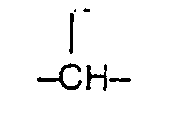
und - bb) für die Bedeutung -SH von einem Thioalkoholsäureester, -amid und/oder einem Mercaptan ab. β-Dioxoverbindungen sind bevorzugt.
- Geeignete Verbindungen B) vom Typ aa) sind beispielsweise Ketone, wie Acetylaceton, Benzoylaceton, Acetyldibenzoylmethan, ferner Ester der gegebenenfalls alkylsubstituierten Acetessigsäure wie a- und/oder y-Methylacetessigsäure, oder der Acetondicarbonsäure, esterartig gebundene Malonsäureeinheiten der Malonsäure und deren Monoalkylderivate, geradkettig oder verzweigt, mit 1 bis 6 C-Atomen im Alkylrest, z.B. Methyl, Äthyl und n-Butyl oder auch Phenyl, oder der Cyanessigsäure mit ein- bis 6-wertigen Alkoholen mit 1 bis 10 C-Atomen. Die alkylsubstituierten Ester, z.B. a-Methyl- oder a,y-Di methylacetessigester, haben nur ein aktives H-Atom und werden daher vorzugsweise in Form von Di- oder Polyestern mehrwertiger Alkohole eingesetzt, um eine genügende Anzahl reaktiver Gruppen zur Verfügung zu haben. Geeignete Alkohole für die Veresterung vorstehender Säuren sind z.B. Methanol, Äthanol, Butanol, Octanol und/oder, was bevorzugt ist, mehrwertige Alkohole bzw. Polyhydroxyverbindungen wie die als Ausgangssubstanzen fürA) genannten. Weitere Verbindungen B) sind z.B. Acetessigester, Äthandiol-bisacetessigester, Glycerintris-malonsäureester, Trimethylolpropantris-acetessigester, Teilester dieser Säuren mit mehrwertigen Alkoholen, ebenfalls die entsprechenden Ester von OH-Gruppen enthaltenden Acrylharzen, Polyestern, Polyäthern, Polyesteramiden und -imiden, Polyhydroxylaminen, ferner Nitrile dieser Säuren, sofern diese existieren, z.B. Malonsäuremono-oder -dinitril, Alkoxycarbonyl-methanphosphonsäureester und die entsprechenden Bis-methanphosphonsäureester (Formel VII s. Formelblatt). Die vorstehend genannten Säuren können auch in Form von Amiden an Amine, vorzugsweise Polyamine, gebunden sein, z.B. an die im Zusammenhang mit Verbindung A) genannten, die auch Oligomere und/oder Polymere einschließlich Aminharze umfassen, wobei aliphatische Amine bevorzugt sind.
- Als Verbindungen aa) eignen sich auch reaktive Nitroverbindungen, z.B. Nitroessigsäurederivate, wie Tris-(nitroessigsäure)-glycerinester oder Trimethylolpropan-nitroessigsäureester.
- Geeignete Verbindungen B) mit einer Gruppierung -SH sind z.B. Thioglykolsäure-, β-Mercaptopropionsäure- oder Thiosalicylsäureestervon mehrwertigen Alkoholen und Thioalkoholäther und -ester, Mercaptane, beispielsweise Äthyl-, Propylmercaptan und deren Homologe bzw. deren Äther, z.B. Thioglycerin, Substitutionsprodukte cyclischer Amine mit Thioalkanolen oder dergleichen.
- Unter Verbindungen B), die Gruppen des Typs (11) bilden, sind z.B. Diketen sowie dessen Mono-a-Alkylsubstitutionsprodukte, ferner Tetrahydrodioxin zu nennen, die mit geeigneten Komponenten unter Bildung von Acetessigester- oder -amid-Gruppen reagieren können.
- Die Reaktionskomponente B) kann an mindestens eine mehrwertige Verbindung der Gruppe ein- oder mehrwertige Alkohole, OH-Gruppen enthaltende Polymere, z.B. die weiter oben genannten, Polyamine und Polymercaptane gebunden sein und ist, bezogen auf die CH-Funktion mehrwertig. So kann sie beispielsweise durch Veresterung eines Polyepoxids mit einer die Gruppierung -AH- (11) bildenden Carbonsäure, z.B. Cyanessigsäure (Gleichung V s. Formelblatt) hergestellt worden sein. Man erhält so eine Komponente B) mit zwei aktiven H-Atomen je Epoxydgruppe. Hierbei lassen sich aromatische oder aliphatische Polyepoxide einsetzen, z.B. die oben genannten.
- Falls die Gruppierung -AH- die Bedeutung
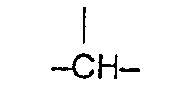
- Als Halogenide von quartären Ammoniumverbindungen können Alkyl-, Aryl- und/oder Benzylammoniumbromide, -chloride und insbesondere -fluoride eingesetzt werden, gegebenenfalls in Kombination mit Kieselsäure-alkylestern, um die Aktivität des Katalysators noch zu verbessern. Im einzelnen seien z.B. Alkylbenzyldimethylammoniumhalogenide (Alkyl = C16-C22), Benzyltrimethylammoniumhalogenide, Tetrabutylammoniumhalogenide, insbesondere jeweils die Fluoride sowie einpolymerisiertes Triphenylvinylphosphoniumfluorid genannt. Weiterhin eignen sich als Katalysatoren die den vorstehenden Ammoniumhalogeniden entsprechenden organischen Phosphoniumsalze mit 1 bis 20 C-Atomen im Alkylrest und/oderArylrest, z.B. Trimethylbenzyl-phosphoniumhalogenide, Tributylhexadecylphosphoniumbromid. Weitere geeignete Katalysatoren sind die Phosphane (früher als Phosphine bezeichnet) z.B.
- a) tertiäre Phosphane der allgemeinen Formel P(CH2-Y)3, in der Y gleich oder verschieden ist und den Rest -OH, -CH2CN oder -N(Z)2 bedeutet, wobei Z ein Alkylrest mit 1 bis 5 C-Atomen ist, wie Tris-2-cyanoethylphosphan, Trisdiethylaminomethylphosphan, vorzugsweise Trishydroxymethylphosphan und Trisdimethyl-aminomethylphosphan;
- b) tertiäre Phosphane der allgemeinen Formel P(R4,R5,R6) in der die Reste R4, R5 und R6 einen Alkylrest mit 1 bis 12 C-Atomen oder einen Phenylrest, unsubstituiert oder substituiert mit mindestens einer Alkyl-, Alkoxy- oder Dialkylaminogruppe mit jeweils 1 bis 4 C-Atomen im Alkylrest bedeuten, R4, R5 und R6 gleich oder verschieden sind, wobei jedoch mindestens einer der Reste einen Phenylrest darstellt, wie
Triphenylphosphan,Tris-p-tolylphosphan, Tris-o-anisylphosphan,Tris-p-dimethylaminophenylphosphan, Phenyl-di-p-anisylphosphan, Phenyldi-o-anisylphosphan, Diphenyl-p-anisylphosphan, Diphenyl-o-anisylphosphan, Diphenyl-p-dimethylaminophenylphosphan, Butyl-diphenylphosphan, Methyl-ditolylphosphan, Ethyl-di-p-anisylphosphan, (Diethylaminomethyl)-di-phenylphosphan, vorzugsweise Tris-p-anisylphosphan, Methyldiphenylphosphan und Methyl-di-p-anisylphosphan, und - c) Iminophosphorane der allgemeinen Formel (R7,R8,R9)P = N-C(R'0, R11, R12), in der R7, R8, R9 gleich oder verschieden sind und einen Alkylrest mit 1 bis 12 C-Atomen oder einen Phenylrest, unsubstituiert oder substituiert mit mindestens einer Alkyl-, Alkoxy- oder Dialkylaminogruppe mit jeweils 1 bis 4 C-Atomen im Alkylrest bedeuten und R10, R11, R12 gleich oder verschieden sind und einen Alkylrest mit 1 bis 5 C-Atomen oder einen Phenylrest darstellt, wie a,a-Dimethylbenzylimino-tris(dimethylamino-)-phosphoran, a,a-Dimethylbenzyliminomethyl-diphenylphosphoran, t-Butylimino-tri-phenyl-phosphoran, vorzugsweise a,a-Dimethylbenzylimino-tri-butylphosphoran.
- Die genannten Katalysatoren oder Katalysatorengemische können in Gegenwart von an sich bei Raumtemperatur nicht wirksamen tertiären aliphatischen Aminen, wie beispielsweise Triethylamin, N-Methyldiethanolamin, N-Methyl-di-isopropanolamin oder N-Butyldiethanolamin verwendet werden. Diese Hilfsstoffe können zu 0,1-5, vorzugsweise 0,1-1 Gew.-%, anwesend sein.
- Die Menge des Katalysators beträgt im allgemeinen 0,01 bis 5, vorzugsweise 0,02 bis 2 Gew.-%, bezogen auf den Gesamtfeststoffgehalt des Ausgangsproduktes. Sie kann je nach der Reaktivität der Verbindungen A) und B) und der beabsichtigten Verfahrensführung variiertwerden. Die Katalysatorzugabe kann auch portionsweise, d.h. in mehreren Stufen, erfolgen.
- Diese Verfahren gehen sehr glatt vor sich. Da vorzugsweise von oligomeren und/oder polymeren Verbindungen A) und B) ausgegangen wird, erhält man auch oligomere und/oder polymere Reaktionsprodukte. Die Reaktion erfolgt im allgemeinen bei -10 bis 180, vorzugsweise 0 bis 100, insbesondere 20 bis 80°C. Zum Beispiel erhält man bei Raumtemperatur nach 2 bis 24 Stunden oder bei 60°C nach 10 bis 40 Minuten Produkte mit guter Härte.
- Nach einer Ausführungsforderung der Erfindung werden die Verbindungen A) im Gemisch mit einem untergeordneten Anteil von solchen Verbindungen A), die nur eine Gruppe der Formel enthalten, bzw. die Verbindungen B) im Gemisch mit einem untergeordneten Anteil von Verbindungen B), die nur ein aktives H-Atom bzw. nur eine Gruppe der Formel (11) enthalten, umgesetzt. Von dieser Möglichkeit wird man aber nur dann Gebrauch machen, wenn man die Vernetzungsdichte verringern will und die damit verbundenen Eigenschaften des Produktes entsprechend variieren möchte. Dies ist vor allem dann der Fall, wenn mindestens eine der Komponenten A) und B) durch einen verhältnismäßig hohen Anteil an reaktiven Gruppen, z.B. bei Verwendung eines monomolekularen Hexaacrylsäureesters, eine besonders starke Vernetzung bewirkt, so daß gegebenenfalls mit einer unerwünschten Verstrammung des Reaktionsprodukts und daher der Gefahr einer etwaigen Versprödung zu rechnen ist. Bei dieser Ausführungsform wird der Anteil der Verbindungen mit nur einer Gruppe (I) bzw. (11) maximal 20, vorzugsweise maximal 10, insbesondere bis zu 5 Gew.-%, bezogen auf die jeweils analoge Verbindung A) bzw. B), betragen. Mit einem solchen Zusatz kann man die Härte und Elastizität des Reaktionsproduktes in einem bestimmten Ausmaß steuern. Die für diese Variante einzusetzenden Verbindungen A) mit nur einer reaktiven Gruppe (I) sind z.B. die Ester oder Amine der für A) aufgezählten ungesättigten Carbonsäuren, die jedoch nur mit einwertigen Alkoholen oder Monoaminen verestert bzw. unter Amidbildung umgesetzt worden sind.
- Geeignete Verbindungen B) für diese Ausführungsform sind z.B. solche mit den oben unter aa) genannten Gruppierungen, in denen R1 eine andere Bedeutung als Wasserstoff hat, beispielsweise die Alkylsubstitutionsprodukte von Acetessigsäure und Malonsäure, die nur mit einem einwertigen Alkohol verestert oder mit einem Monoamin umgesetzt worden sind. Verbindungen B) vom Typ bb) sind Alkanolmercaptane, die nur eine Mercaptangruppe enthalten, z.B. Äthylmercaptan.
- Das Verfahren läßt sich in einer oder mehreren Stufen durchführen. In der Regel wird man jedoch aus arbeitsökonomischen Gründen das Einstufenverfahren vorziehen, indem man beispielsweise mit äquivalenten Anteilen der Komponenten mit jeweils zwei aktiven Gruppen bzw. H-Atomen arbeitet (Gleichung XII s. Formelblatt s. unterstrichene H-Atome). Die Wahl der Verfahrensstufen, die Topfzeit und Eigenschaften des Produktes hängen daher von den Verfahrensbedingungen, d.h. von der Art und Menge der Ausgangsstoffe, der Dosierung des Katalysators und der Temperaturführung ab. So läßt sich die Elastizität des vernetzten Produktes innerhalb eines Toleranzbereiches z.B. durch die Kettenlänge der für A) oder B) eingesetzten Oligomeren und/oder Polymeren steuern.
- Obwohl das Verfahren in der Regel diskontinuierlich betrieben wird, liegt es auch im Rahmen der Erfindung, das Vermischen der Komponenten und den Reaktionsverlauf kontinuierlich durchzuführen, beispielsweise mittels einer automatischen Lackiervorrichtung.
- Bei der mehrstufigen Verfahrensführung kann man eine oder mehrere der Komponenten portionsweise zugeben. Beispielsweise kann in erster Stufe 1 Mol Butandiol-bis-acrylat mittels 2 Mol Malonsäurediamid umgesetzt werden (Gleichung XI s. Formelblatt) unter Bildung eines Produktes, das zwei Gruppen (11) mit je einem aktiven (unterstrichenen) H-Atom enthält. Dieses Produkt kann in mindestens einerweiteren Stufe mit weiteren Molekülen einer Verbindung A) umgesetzt werden unter Kettenverlängerung und Vernetzung. Auf analoge Weise läßt sich z.B. ein Mol Trimethylolpropan-tirs-acrylat oder -methacrylat in erster Stufe mit drei Mol Acetylaceton umsetzen.
- Die Vernetzung in zweiter und gegebenenfalls noch folgenden Stufen kann beispielsweise durch Katalysatorzugabe erfolgen. Man kann dabei so vorgehen, daß man in erster Stufe nur mit einer verhältnismäßig geringen Katalysatormenge, z.B. weniger als 2%, oder mit einem verhältnismäßig wenig aktiven Katalysator arbeitet. Falls die zweite oder folgende Stufen relativ kurz nach der Herstellung des Vorproduktesdurchgeführt werden, ist es nicht erforderlich, den etwa in erster Stufe eingesetzten Katalysator zu entfernen. Man kann nun in zweiter Stufe entweder eine höhere Dosis desselben Katalysators und/oder einen anderen Katalysator verwenden. Es besteht auch die Möglichkeit, in erster Stufe ein Vorprodukt herzustellen, das über eine längere Zeitspanne lagerstabil ist und sogar zum Verarbeiter verschickt werden kann. In diesem Fall wird man den Katalysator mit Vorteil, z.B. durch Neutralisation oderAbdestilIation, entfernen oder einen Katalysator einsetzen, der entweder von vornherein an ein Polymeres, wie polymerisiertes Triphenylvinylphosphoniumfluorid, gebunden ist, oder der während der Reaktion an ein Polymeres gebunden wird. Vor der endgültigen Anwendung wird die Vernetzungsreaktion durch erneute Zugabe einer ausreichenden Katalysatormenge in Gang gesetzt.
- Das Verfahren kann in Gegenwart oder Abwesenheit von organischen Lösungsmitteln durchgeführtwerden, die gegebenenfalls auch einen Einfluß auf die Aktivität der Katalysatoren ausüben. Geeignete Lösungsmittel sind z.B. aromatische und aliphatische Kohlenwasserstoffe wie Toluol, die verschiedenen Xylole, Gemische aliphatischer und/oder aromatischer Kohlenwasserstoffe, Mineralölfraktionen, Ester, Äther, Alkohole oder dergleichen.
- Alle Reaktionskomponenten können einzeln oder im Gemisch, sofern sie miteinander verträglich sind, eingesetzt werden.
- Obwohl das Verfahren gewöhnlich unter Normaldruck abläuft, kann es in einzelnen Fällen erwünscht sein, auch unter erhöhtem Druck zu arbeiten, um die Härtungsgeschwindigkeit zu erhöhen.
- Das gegenseitige Mengenverhältnis der Reaktionskomponenten A) und B), hängt von der Anzahl der ungesättigten Gruppen (I) der Verbindung A) und der Summe der aktiven H-Atome in Verbindung B) also einschließlich derjenigen in den Gruppen (11) (im folgenden kurz mit « aktive Doppelbindungen: aktive H-Atome" bezeichnet) ab. Bei der mehrstufigen Verfahrensführung kann es zur Herstellung der Vorprodukte innerhalb eines breiten Bereiches variiert werden. Zur Herstellung des vernetzten Endproduktes beträgt jedoch das genannte Verhältnis aktive Doppelbindungen: aktive H-Atome im allgemeinen etwa 2,4:0,8 bis 0,8:2,4, vorzugsweise etwa 2:1 bis 1:2, insbesondere (0,8 bis 1,2):1 bis 1:(0,8 bis 1,2). Für ein Mol Äthandiol-bisacrylat werden daher wegen der zwei aktiven H-Atome im Acetessigesterz.B. nur etwa 0,8 bis 1,2 Mol Acetessigester angewendet. Will man hingegen nur ein H-Atom vom Acetessigester umsetzen, so kann man auch 2 x (0,8 bis 1,2) Mol Acetessigester einsetzen (Formel XII s. Formelblatt). Wie aus dieser Formel hervorgeht, enthält das Umsetzungsprodukt noch eine reaktionsfähige Gruppe (s. unterstrichenes H-Atom), so daß es entweder mit anderen Molekülen oder mit sich selbst weitervernetzen kann. Das Verhältnis aktive Doppelbindungen:aktive H-Atome ist dann 1:1. Andererseits ist es auch möglich, ein Gemisch der Komponenten Aeinerseits und/oder B andererseits mit jeweils unterschiedlicher Funktionalität einzusetzen, um den Vernetzungsgrad der Endprodukte zu steuern.
- Das erfindungsgemäße Umsetzungsgemisch ist ein 2-Komponenten-System, das Topfzeiten zeigt, die je nach Auswahl der Verbindungen A) und B) sowie nach Art und Menge des Katalysators bzw. der Katalysatorkombination zwischen 5 min. und etwa 12 Stunden schwanken. Dadurch ist eine hohe Verarbeitungssicherheit gewährleistet. Aufgrund dieser vorteilhaften Eigenschaft des Produktes im Zusammenhang mit seiner raschen und einwandfreien Härtung bei Raumtemperatur oder erhöhter Temperatur und seiner chemischen Beständigkeit ist es hervorragend als Bindemittel für Überzüge geeignet.
- Die 2-Komponenten-Systeme lassen sich als Überzüge auf vielerlei Unterlagen aufbringen, z.B. auf solche organischer oder anorganischer Natur, wie Holz, Holzfaserstoffe, z.B. als Holzversiegelung, Textilien natürlicher oder synthetischer Herkunft, Kunststoffe, Glas, Keramik, Baustoffe, wie Beton, Faserplatten, Kunststeine, insbesondere jedoch auf Metall. Die Überzüge können auch für Gegenstände und Geräte im Haushalt und Gewerbe eingesetzt werden, z.B. Kühlgeräte, Waschmaschinen, Elektrogeräte, Fenster, Türen, Mögel oder dergleichen. Bevorzugt ist jedoch der Einsatz für Kraftfahrzeuge. Das Aufbringen kann durch Streichen, Sprühen, Tauchen oder elektrostatisch durchgeführt werden. Selbstverständlich können die 2-Komponenten-Systeme noch die üblichen Zusatzstoffe enthalten wie Farbstoffe, Pigmente, Füllstoffe, Weichmacher, Stabilisatoren, Verlaufmittel, neutralisierende Stoffe wie tertiäre Amine und Katalysatoren, die in den üblichen Mengen verwendet werden können. Diese Substanzen können den Einzelkomponenten und/oder der Gesamtmischung zugesetzt werden.
- Als Farbstoffe bzw. Pigmente, die anorganischer oder organischer Natur sein können, werden beispielsweise genannt: Titandioxyd, Graphit, Ruß, Zinkchromat, Strontiumchromat, Bariumchromat, Bleichromat, Bleicyanamid, Bleisilikochromat, Calciummolybdat, Manganphosphat, Zinkoxyd, Cadmiumsulfid, Chromoxyd, Zinksulfid, Nickeltitangelb, Chromtitangelb, Eisenoxydrot, Eisenoxydschwarz, Ultramarinblau, Phthalocyaninkomplexe, Naptholrot oder dergleichen.
- Geeignete Füllstoffe sind z.B. Talkum, Glimmer, Kaolin, Kreide, Quarzmehl, Asbestmehl, Schiefermehl, Bariumsulfat, verschiedene Kieselsäuren, Silikate oder dergleichen.
- Für die Füller werden die üblichen Lösungsmittel verwendet beispielsweise aliphatische und aromatische Kohlenwasserstoffe, Äther, Ester, Glykoläther sowie deren Ester, Ketone, Chlorkohlenwasserstoffe, Terpenderivate, wie Toluol, Xylol, Äthyl- und Butylacetat, Äthylenglykolmonoäthyl- oder -butylätheracetat, Äthylenglykoldimethyläther, Diäthylenglykoldimethyläther, Cyclohexanon, Methyläthylketon, Aceton, Isophoron oder Mischungen davon.
- Im Rahmen der Erfindung liegen daher auch 2-Komponenten-Systeme, die sich zur Herstellung von Überzügen, vorzugsweise Kraftfahrzeuglakken und insbesondere Autoreparaturlacken eignen. Hierbei ist die Xylolbeständigkeit und damit gleichzeitig eine gute Beständigkeit gegenüber Superbenzin vor allem von Interesse. Deshalb ist die erfindungsgemäße Verwendung der Umsetzungsprodukte besonders vorteilhaft. Da das 2-Komponenten-System nach einer bevorzugten Ausführungsform der Erfindung in verhältnismäßig kurzer Zeit bei Raumtemperatur selbst härten kann, ohne daß umweltbelastende Substanzen frei werden, ist seine Verwendung als Autoreparaturlack von erheblicher praktischer Bedeutung.
- In den nachstehenden Vorschriften und Beispielen bedeuten % jeweils Gew.-% und Tjeweils Gew.-Teile. Unter Vakuum wird jeweils das der Wasserstrahlpumpe verstanden.
- I) Herstellung der Komponente A (Michael-Acceptor)
- A 1) 400 T eines lösungsmittelfreien Acrylatharzes @Macrynai SM 510 der Hoechst AG) (OH-Zahl 150) wurden mit 400 T Acrylsäure, 200 T Toluol, 3 T Hydrochinonmonomethyläther und 3 T p-Toluolsulfonsäure versetzt. Unter Durchleiten von Luft wurde bis zur Beendigung der H20-Entwicklung am Wasserabscheider erhitzt. Nach Abkühlen auf Raumtemperatur und Waschen mit Wasser wurde die überschüssige Acrylsäure entfernt. Die organische Phase wurde durch Destillation unter Vakuum vom Lösungsmittel befreit und auf einen Festkörpergehalt von 60% verdünnt. C = C-Äquivalentgewicht 864.
- A 2) 510 T des unter A 1 genannten Acrylatharzes wurden mit 500 T Acrylsäuremethylester, 3 T Hydrochinonmonomethyläther und 6 T Dibutylzinnoxid versetzt. Binnen 30 h wurden über eine Vigreux-Kolonne 26T Methanol bei 80 bis 90°C Innentemperatur abdestilliert. Unter Vakuum wurde der überschüssige Acrylsäuremethylester abdestilliert. Der Rückstand wurde mit Xylol auf einen Festkörpergehalt von 60% verdünnt. C = C-Äquivalentgewicht 1083.
- A 3) 1000 T eines glycidylgruppenhaltigen Acrylatharzes hergestellt aus Styrol, Glycidylmethacrylat und Dimethylmaleinat (Epoxidäquivalentgewicht 510) wurden in 660 T Xylol bei 70°C gelöst. Bei 70°C wurden 127 T Acrylsäure und 1 T Tetraäthylammoniumbromid zugesetzt. Unter Durchleiten von Luft wurde bei 80°C bis zur Säurezahl 1 nachgerührt. Die hellgelbe Lösung wurde mit 17 T Xylol verdünnt. Festkörpergehalt 62,5%, C = C-Äquivalentgewicht 1022.
- A4) 570 T der Harzlösung aus Beispiel A3) wurden mit 0,1 T Dibutylzinndilaurat und 50 T n-Butylisocyanat versetzt. Es wurde bei 60°C 4 h lang nachgerührt (NCO-Wert 0,2%). Festkörpergehalt 65%; C = C-Äquivalentgewicht 1112.
- A 5) 296 T Trimethylolpropantrisacrylat wurden in einem mit Rührer, Rückflußkühler und einer Gaseinleitung versehenen 1-I-Kolben vorgelegt und mit 200 T Isopropanol und 1,5 T Triäthylamin versetzt. Bei Raumtemperatur wurden 17 T Schwefelwasserstoff absorbiert. Es wurde eine weitere Stunde bei 30°C gerührt. Dann wurde die gebildete schwerere Produktphase als fast farblose Flüssigkeit abgetrennt. Festkörpergehalt 88%; C = C-Äquivalentgewicht 172.
- A 6) In einem Dreihalskolben, versehen mit Rührer, Thermometer sowie Destillier-Kolonne mit absteigendem Kühler, wurden 657 T eines Melaminharzes vom Typ Hexamethoxymethylmelamin (Molekulargewicht 399), 1053 T 2-Hydroxyäthylacrylat, 3,3 T Hydrochinonmonomethyläther und 1,65 T Schwefelsäure vorgelegt. Im Vakuum wurde auf 75°C erwärmt und binnen 4 h auf 95°C erhitzt. Nach Abkühlung auf Zimmertemperaturwurde mit 10 T einer 10%igen methanolischen Kalilauge neutralisiert und filtriert. Man erhielt 141 T einer niedrigviskosen klaren Harzlösung. C = C-Äquivalentgewicht 175.
- A 7) 220 T Isophorondiisocyanat wurden mit 1 T Dibutylzinndilaurat versetzt und auf 50°C erwärmt. Bei gleicher Temperatur wurden binnen einer Stunde 2 T Hydrochinonmonomethyläther, gelöst in 232 T Hydroxyäthylacrylat, zugetropft. Es wurde nachgerührt, bis der N = C = O-Gehalt kleiner als 0,5 war. Nach Zugabe von 7 T eines Glycidylesters einer gesättigten, in a-Stellung verzweigten C9-11-Fettsäure (Epoxidäquivalentgewicht 260) und 0,5 T Chrom-III-octoat wurde 5 h lang bei 80°C nachgerührt und anschließend mit 115 T Xylol versetzt. Festkörpergehalt 80%; C = C-Äquivalentgewicht 289.
- 11) Herstellung der Komponente B (Michael-Donator)
- B 1) in einem 2-I-Glaskolben, ausgestattet mit einer Desti llationsbrücke, Rührer und Kontaktthermometer, wurden 312 T Neopentylglykol und 706 T Acetessigsäuremethylester unter N2 als Schutzgas auf 130 bis 160°C erhitzt. Nach Beendigung der Abdestillation des Methanols (nach ca. 7 h) wurde auf 120°C gekühlt. Der überschüssige Acetessigsäuremethylester wurde im Vakuum abdestilliert. Es verblieben 819 T einer klaren hellen Flüssigkeit als Rückstand. C-H-Äquivalentgewicht 70.
- B 2) In einer 41-Apparatur analog B 1) wurden 670 T Trimethylolpropan und 1972 T Acetessigsäuremethylester binnen 5 h von 130 auf 180°C erhitzt. Nach beendeter Destillation befanden sich 465 T Methanol in der Vorlage. Nach Abkühlen auf 150°C wurde der niedrigsiedende Anteil im Vakuum abdestilliert. Es verblieben 1950 T einer farblosen Flüssigkeit als Rückstand. C-H-Äquivalentgewicht 64.
- B 3) In der gleichen Apparatur wie nach B 1) wurden 335 T Trimethylolpropan und 2400 T Malonsäurediäthylester unter N2- als Schutzgas auf 150 bis 170°C erhitzt. Nach beendeter Abdestillation des Äthanols wurde der überschüssige Malonsäurediäthylester im Vakuum bei 150 bis 160°C abdestilliert. Es verblieben als Rückstand 1201 T einer farblosen Flüssigkeit. C-H-Äquivalentgewicht 79.
- B 4) In einer Apparatur wie in B 1) wurden 92 T Glycerin und 426 T 2,2,6-Trimethyl-4-oxo-4H-1,3-dioxin vorgelegt. Unter Rühren wurden binnen 5 h bei 180°C 160 TAceton abdestilliert. Anschließend wurde der Rückstand bei 120°C im Vakuum von niedrigsiedenden Anteilen befreit. Es verblieben 348 T einergelben niedrigviskosen Flüssigkeit. C-H-Äquivalentgewicht 58.
- B 5) Unter Rühren wurden in einem 1-I-Dreihalskolben, der mit Rührer, Rückflußkühler und Kontaktthermometerversehen war, 300 TAcetessigsäureäthylester, 3 T Kalilauge und 4 T Hydrochinonmonomethyläther vorgelegt und auf 130°C erhitzt. Binnen einer Stunde wurden 198 T Butandioldiacrylat zudosiert. Nach weiteren 2 h betrug der Doppelbindungsanteil wenigerals 0,2%. Anschließend wurde die Kalilauge mit methanolischer Salzsäure neutralisiert. Durch Anlegen von Hochvakuum wurden bei 100°C die niedrigsiedenden Anteile entfernt. Es verblieben 464 T einer hellgelben viskosen Flüssigkeit. C-H-Äquivalentgewicht 232.
- B 6) 250 T eines Polyäthylenglykoldiamins (Aminzahl 243), gelöst in 166 T Diäthylenglykoldimethyläther, wurden bei-20°C zu einer Lösung von 190 T Diketen in 134 T Diäthylenglykoldimethyläther getropft. Nach 1½ h Rühren bei -28°C wurde auf + 10°C erwärmt und bis zu einer Aminzahl unter 1 nachgerührt. Nach Zugabe von 10 T Äthanol wurde für 40 min auf 90°C erhitzt. Anschließend wurde das Lösungsmittel im Vakuum abdestilliert. Der Rückstand wurde in 100 T Di methoxyäthan aufgenommen. Man erhielt eine hellgelbe klare Lösung. Festkörpergehalt 81%; C-H-Äquivalentgewicht 122.
- B 7) 134 T Trimethylolpropan und 327 T Cyanessigsäuremethylester wurden mit 4 T Titanacetylacetonat von 100 bis 180°C unter Abdestillieren von Methanol erhitzt. Nach 4 h wurde auf 140°C abgekühlt und der niedrigsiedende Anteil im Vakuum abdestilliert. Es verblieben 341 T einer gelben Flüssigkeit. C-H-Äquivalentgewicht 57.
- B 8) 750 T des unter A 1) genannten Acrylatharzes (OH-Zahl 150) und 260 T Acetessigsäureäthylester wurden in einer Destillationsapparatur auf 150°C erhitzt. Innerhalb von 2 h wurde auf 170°C erhitzt. Nach beendeter Abdestillation des Äthanols wurde der niedrigsiedende Anteil nach Anlegen von Vakuum entfernt. Nach Abkühlen auf 100°C wurden 306 T Xylol zugegeben. Man erhielt eine klare hellgelbe Flüssigkeit. Festkörpergehalt 75%; CH-Äquivalentgewicht 310.
- B 9) 510 T eines auf Basis Trimethylolpropan, Terephthalsäure, Adipinsäure und Neopentylglykol hergestellten Polyesters (OH-Zahl 110) wurden zusammen mit 130 T Acetessigsäureäthylester auf 140°C erhitzt. Binnen 3 h wurde unter fortlaufender Abdestillation flüchtiger Bestandteile auf 170°C erhitzt. Nach Abkühlen auf 140°C wurde der niedrigsiedende Anteil im Vakuum abdestilliert. Anschließend wurde mit 198 T Xylol verdünnt. Man erhielt eine hellgelbe klare Lösung. Festkörpergehalt 75%; C-H-Äquivalentgewicht 402.
- B 10) 300 T des unter A 1 genannten OH-gruppenhaltigen Acrylatharzes wurden in 200 T Xylol bei 70°C gelöst. Nach Abkühlen auf Raumtemperatur wurden 0,025 T Dimethylaminopyridin zugesetzt. Innerhalb von 6 h wurden 60 T Diketen eingetropft. Nach weiteren 12 h warderGehaltan freiem Diketen 0,2%. Festkörpergehalt 65%; C-H-Äquivalentgewicht 392.
- B 11) 440 T Kokosölfettsäuremethylester (Verseifungszahl 255) wurden zusammen mit 268 T Trimethylolpropan und 1 T Butyltitanat in einer Destillationsapparatur auf 180°C erhitzt. Binnen 7 h wurde die Temperatur unter fortlaufender Abdestillation von Methanol langsam auf 250°C gesteigert. Nach Abdestillation von insgesamt 59 T Methanol wurde auf 100°C abgekühlt und mit 585 T Acetessigsäureäthylester versetzt. Nach Erwärmung auf 140°C wurde unter fortlaufender Destillation binnen 3 h auf 175°C erhitzt. Insgesamt wurden weitere 175 T Destillat erhalten. Nach Abkühlen auf 150°C wurde der niedrigsiedende Anteil im Vakuum entfernt. Es wurden 992 T einer viskosen hellgelben Flüssigkeit erhalten. C-H-Äquivalentgewicht 124.
- B 12) 200 TAcetylaceton und 0,5 T Tri methylbenzylammoniumhydroxid wurden auf 40°C erwärmt. Binnen 2 h wurden 170 T Trimethylolpropantrisacrylat zugetropft. Anschließend wurde bis zu einem Doppelbindungsgehalt von unter 0,5% nachgerührt. Man erhielt eine hellgelbe viskose Flüssigkeit. C-H-Äquivalentgewicht 162.
- III) Herstellung eines selbstvernetzenden Umsetzungsproduktes gemäß der Erfindung
- C) (Beispiel 17) 924 T einer 70%igen Lösung eines durch radikalische Polymerisation von Styrol, Hydroxyäthylmethacrylat und Methylmethacrylat hergestellten Acrylatharzes (OH-Zahl 130) (Trägersubstanz) in Xylol wurden bei 40°C mit 258 T einer 70%igen Lösung eines mit Hydroxyäthylacrylat halbverkappten Toluylendiisocyanats (N = C = O-Gehalt 9,8%, C = C-Äquivalentgewicht 290) (Komponente A) in Xylol in Gegenwartvon 5 T Dibutylzinndilaurat bis zu einem Isocyanat-Gehaltvon wenigerals 0,3% umgesetzt. Anschließend gab man 2 T Dimethylaminopyridin zu und tropfte bei Raumtemperatur unter Rühren 25 T Diketen (Komponente B) zu. Nach 24stündigem Rühren bei Raumtemperatur ließ sich kein freies Diketen mehr nachweisen. Festkörpergehalt 71%; C = C-Äquivalentgewicht 2022; C-H-Äquivalentgewicht 2020. Anstelle von Diketen kann auch die äquivalente Menge Acetessigester umgesetzt werden, wobei man ein Produkt mit denselben Kennzahlen erhält.
- Beispiele 1 bis 51 gemäß der Erfindung sind in Tabellen 1 und 2 zusammengefaßt. Außerdem sind noch vier Vergleichsversuche V 1 bis 4 mit handelsüblichen Produkten ausgeführt.
- Die in nachstehenden Tabellen 1 und 2 angegebenen Gewichtsmengen der Komponenten Aund B wurden gemischt. Als Vergleichssubstanz diente ein aus 31 T Glycidylmethacrylat, 15 T Dimethylmaleinat und 54 T Styrol hergestelltes Copolymerisat. Als Härter für dieses System diente Diäthylentriamin. Im Fall der pigmentierten Überzüge wurde die dem gewünschten Pigmentierungsgrad entsprechende Menge an Titandioxid zugemischt und das Gemisch auf einer Perlmühle abgerieben. Das erhaltene Beschichtungsmaterial wurde als solches oder, falls erforderlich, nach Zumischung des angegebenen Katalysators mittels eines Aufziehrakels in einer Naßfilmstärke von 100 µm auf Glasplatten aufgebracht und bei Raumtemperatur bzw. bei 80°C (30 min) gehärtet.
- Die in den nachstehenden Tabellen benutzten Abkürzunqen bedeuten:

- Wie aus Tabelle 1 hervorgeht, zeigen die Produkte der Beispiele 1 bis 38 hohe chemische Beständigkeit und hohe Härte, d.h. sie sind vollständig vernetzt, obwohl die Härtung z.T. nur bei Raumtemperatur erfolgt ist. Andererseits weisen sie noch günstige Topfzeiten auf, vergleiche insbesondere Beispiele 6 bis 9,16-18, 22, 23, 27, 30. Die zuletzt genannten Beispiele zeigen, daß durch geeignete Auswahl der Katalysatoren eine Topfzeit im Bereich von 5 bis zu ca 20 h erzielt werden kann. Die Beispiele 11 bis 13 sowie 16, 19-21, 24,


- Tabelle 2 zeigt im Vergleich zu Tabelle 1, daß die Topfzeiten der pigmentierten Systeme etwas kürzer sind, daß sie aber trotzdem für eine sichere Verarbeitung ausreichen. Wie aus den Beispielen 39 bis 49 hervorgeht, härten die Filme schon bei Raumtemperatur vollständig aus. Die chemische Beständigkeit der Produkte gemäß Tabelle 2 ist im Durchschnitt höher als die der unpigmentierten Systeme von Tabelle 1.
- Die Beispiele 12, 13, 50 und 51 zeigen, daß auch die Amin- und Mercaptoverbindungen als Komponente B eine vollständige Aushärtung und gute chemische Beständigkeit der Produkte ergeben, wobei im Fall der Beispiele 13 und 51 sogarohne Katalysator gearbeitet wird. Die physikalischen Werte der Vergleichsversuche V1 bis V 4 lassen eine geringe Xylolbeständigkeit erkennen und auch einen wenig ausgeprägten Härtungsgrad. Auch hier liefert der starke Katalysator BTAH in den weiteren Vergleichsversuchen 39, 40, 42, 43 und 45 bis 47 gemäß anderen Untersuchungen Überzüge mit schlechteren Farbzahlen. Die erfindungsgemäßen Produkte sind daher den Vergleichsproben überlegen.

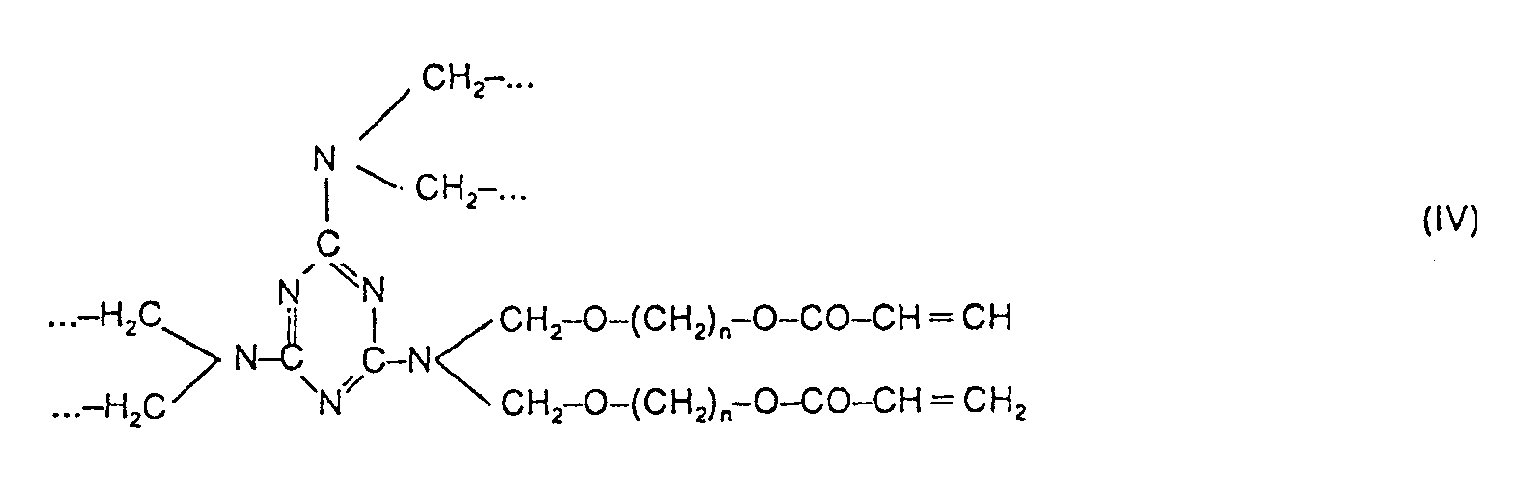
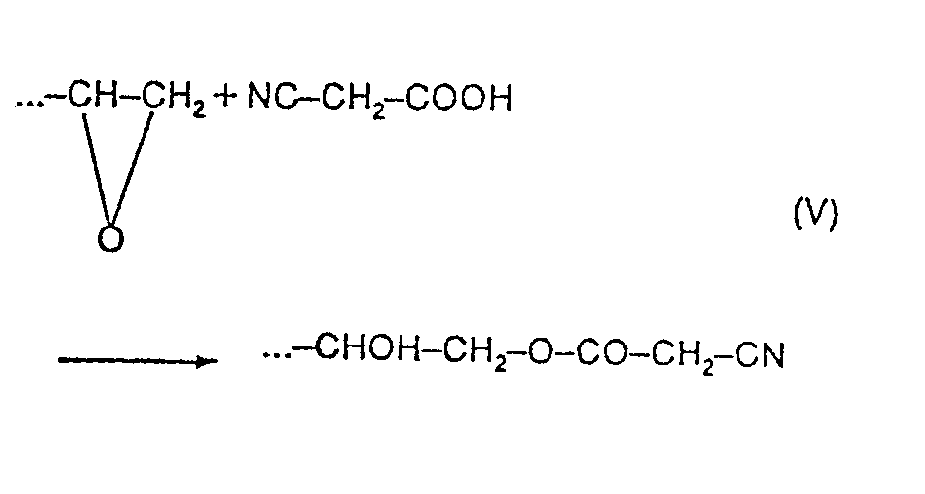


Claims (11)
worin in Formel (I) bedeuten


Priority Applications (1)
| Application Number | Priority Date | Filing Date | Title |
|---|---|---|---|
| AT85103655T ATE46178T1 (de) | 1984-04-04 | 1985-03-27 | Umsetzungsprodukt von olefinisch ungesaettigten verbindungen mit wasserstoffaktiven verbindungen, verfahren zu dessen herstellung und darauf basierende 2-komponentenlacke. |
Applications Claiming Priority (4)
| Application Number | Priority Date | Filing Date | Title |
|---|---|---|---|
| DE3412658 | 1984-04-04 | ||
| DE3412658 | 1984-04-04 | ||
| DE3508399A DE3508399C2 (de) | 1984-04-04 | 1985-03-08 | 2-Komponentenlacke und deren Verwendung |
| DE3508399 | 1985-03-08 |
Publications (3)
| Publication Number | Publication Date |
|---|---|
| EP0160824A1 EP0160824A1 (de) | 1985-11-13 |
| EP0160824B1 EP0160824B1 (de) | 1989-09-06 |
| EP0160824B2 true EP0160824B2 (de) | 1994-08-03 |
Family
ID=25820075
Family Applications (1)
| Application Number | Title | Priority Date | Filing Date |
|---|---|---|---|
| EP85103655A Expired - Lifetime EP0160824B2 (de) | 1984-04-04 | 1985-03-27 | Umsetzungsprodukt von olefinisch ungesättigten Verbindungen mit wasserstoffaktiven Verbindungen, Verfahren zu dessen Herstellung und darauf basierende 2-Komponentenlacke |
Country Status (7)
| Country | Link |
|---|---|
| US (2) | US4871822A (de) |
| EP (1) | EP0160824B2 (de) |
| JP (1) | JPH0739559B2 (de) |
| AT (1) | ATE46178T1 (de) |
| CA (1) | CA1281494C (de) |
| DE (1) | DE3572829D1 (de) |
| ES (1) | ES541864A0 (de) |
Families Citing this family (82)
| Publication number | Priority date | Publication date | Assignee | Title |
|---|---|---|---|---|
| DE3541140A1 (de) * | 1985-11-21 | 1987-05-27 | Hoechst Ag | Haertungsprodukt auf basis von olefinisch ungesaettigten verbindungen und wasserstoffaktiven verbindungen, verfahren zu dessen herstellung und darauf basierende zwei-komponentenlacke |
| JPS62207324A (ja) * | 1986-03-06 | 1987-09-11 | Nippon Soda Co Ltd | 置換ピロ−ル重合体 |
| US5969046A (en) * | 1986-11-18 | 1999-10-19 | Rohm And Haas Company | Reacting methylene and alkene components in presence of tertiary amine reacted with epoxide |
| US5496896A (en) * | 1987-03-28 | 1996-03-05 | Basf Lacke & Farben Aktiengesellschaft | Curable composition based on a Michael addition product, processes for its preparation and its use |
| DE3710431A1 (de) * | 1987-03-28 | 1988-10-06 | Basf Lacke & Farben | Haertbare zusammensetzung auf basis eines michael-additionsproduktes, verfahren zu seiner herstellung sowie seine verwendung |
| US5216094A (en) * | 1987-12-23 | 1993-06-01 | Kansai Paint Company, Limited | Resins with unsaturated carbonyl and hydroxyl groups |
| ES2073016T5 (es) * | 1988-10-17 | 2004-02-01 | Guertin Bros. Coatings And Sealants, Ltd. | Resinas exentas de nco utiles como un sustituto de poliuretanos. |
| DE3932517A1 (de) * | 1989-09-29 | 1991-04-11 | Herberts Gmbh | Bindemittelzusammensetzung und deren verwendung in ueberzugsmitteln |
| EP0448154A1 (de) * | 1990-03-20 | 1991-09-25 | Akzo Nobel N.V. | Beschichtungszusammensetzung enthaltend einen blockierten basischen Katalysator |
| US5589534A (en) * | 1990-10-16 | 1996-12-31 | Akzo Nobel N.V. | Aqueous coating compositions including a reactive emulsifier |
| NL9002728A (nl) * | 1990-12-12 | 1992-07-01 | Stamicarbon | Bindmiddelsamenstelling voor poedercoatings. |
| MY108731A (en) * | 1992-04-16 | 1996-11-30 | Akzo Nv | Aqueous coating compositions |
| WO1994015974A1 (en) * | 1993-01-06 | 1994-07-21 | Akzo N.V. | Oligomeric sterically hindered polyamide crosslinkers and coating compositions containing the same |
| US5567761A (en) * | 1993-05-10 | 1996-10-22 | Guertin Bros. Coatings And Sealants Ltd. | Aqueous two-part isocyanate-free curable, polyurethane resin systems |
| CN1126484A (zh) * | 1993-05-26 | 1996-07-10 | 阿克佐诺贝尔公司 | 含uv-可脱保护碱性催化剂的涂料组合物 |
| AU672337B2 (en) * | 1993-10-27 | 1996-09-26 | Nippon Paint Co., Ltd. | Curable resin composition for coating uses |
| CA2164994A1 (en) * | 1994-12-24 | 1996-06-25 | Heinz Dietholf Becker | Binder composition, coating agents containing it, and use thereof |
| JPH08283626A (ja) * | 1995-04-12 | 1996-10-29 | Nippon Paint Co Ltd | 塗料用硬化性樹脂組成物 |
| JPH08283627A (ja) * | 1995-04-12 | 1996-10-29 | Nippon Paint Co Ltd | 塗料用一液熱硬化性樹脂組成物 |
| DK0775734T3 (da) | 1995-11-22 | 1999-09-13 | Akzo Nobel Nv | Fugthærdende overtræksammensætning |
| US6204343B1 (en) | 1996-12-11 | 2001-03-20 | 3M Innovative Properties Company | Room temperature curable resin |
| EP0944664B1 (de) * | 1996-12-11 | 2002-03-20 | Minnesota Mining And Manufacturing Company | Bei raumtemperatur härtbares harz |
| GB2323599A (en) * | 1997-03-18 | 1998-09-30 | Courtaulds Plc | Compositions curable by a Michael reaction |
| US6517343B2 (en) | 1997-09-26 | 2003-02-11 | Arizona Chemical Company | Coated candles and coating compositions |
| DE60114160D1 (de) | 2000-03-13 | 2006-03-02 | Akzo Nobel Coatings Int Bv | Zusammensetzung enthaltend eine isocyanat-funktionelle verbindung, eine isocyanat-reaktive verbindung und einen cokatalysator |
| WO2001072910A1 (en) * | 2000-03-28 | 2001-10-04 | Akzo Nobel N.V. | Photoactivatable coating composition and its use for the preparation of coatings with a rapidly processable surface at ambient temperature |
| US6965226B2 (en) * | 2000-09-05 | 2005-11-15 | Cascade Microtech, Inc. | Chuck for holding a device under test |
| JP3984488B2 (ja) | 2001-03-27 | 2007-10-03 | 日本ペイント株式会社 | 硬化性塗料組成物および塗膜形成方法 |
| AU4885002A (en) * | 2001-07-03 | 2003-01-09 | Rohm And Haas Company | Composition method of making and method of using adhesive composition |
| US6673851B2 (en) * | 2001-10-12 | 2004-01-06 | Ashland Inc. | Self-photoinitiating multifunctional acrylates |
| US20030165701A1 (en) * | 2001-12-13 | 2003-09-04 | Straw Thomas Allen | Water borne ambient temperature curable coating composition |
| CA2414719C (en) * | 2001-12-21 | 2009-07-21 | Dainippon Ink And Chemicals, Inc. | Curable resin compositions and process for preparing oligomers containing acrylate groups and substituted methacrylate groups |
| US7238744B2 (en) * | 2002-04-12 | 2007-07-03 | Daramic, Inc. | Ultrahigh molecular weight polyethylene articles and method of manufacture |
| EP1371689A1 (de) * | 2002-06-14 | 2003-12-17 | Dainippon Ink And Chemicals, Inc. | Lagerstabile vernetzbare Zusammensetzungen zur Beschichtung |
| US8013068B2 (en) * | 2003-01-02 | 2011-09-06 | Rohm And Haas Company | Michael addition compositions |
| US20050081994A1 (en) | 2003-01-02 | 2005-04-21 | Beckley Ronald S. | Methods of using Michael addition compositions |
| BRPI0413526A (pt) | 2003-08-14 | 2006-10-10 | Akzo Nobel Coatings Int Bv | tinta compreendendo uma fase lìquida e uma fase em pó de ativação |
| US7304112B2 (en) * | 2004-10-01 | 2007-12-04 | 3M Innovative Properties Company | Azlactone telechelic polymer |
| US7332546B2 (en) * | 2004-10-01 | 2008-02-19 | 3M Innovative Properties Company | Ring-opened azlactone telechelic polymer |
| US7307106B2 (en) * | 2004-12-10 | 2007-12-11 | 3M Innovative Properties Company | Photocurable Michael addition polymers |
| US8609131B2 (en) * | 2005-01-25 | 2013-12-17 | 3M Innovative Properties Company | Absorbent dressing comprising hydrophilic polymer prepared via Michael reaction |
| US7335690B2 (en) * | 2005-01-25 | 2008-02-26 | 3M Innovative Properties Company | Crosslinkable hydrophilic materials from polymers having pendent Michael donor groups |
| US20070173602A1 (en) * | 2006-01-25 | 2007-07-26 | Brinkman Larry F | Encapsulated Michael addition catalyst |
| JP4849688B2 (ja) * | 2007-05-14 | 2012-01-11 | ローム アンド ハース カンパニー | 硬化性および硬化した木材粒子複合体ならびにその製造法 |
| CA2628522C (en) * | 2007-05-14 | 2011-11-08 | Rohm And Haas Company | Curable and cured wood particle composites and method of making same |
| JP5654207B2 (ja) * | 2008-03-24 | 2015-01-14 | アイカ工業株式会社 | 樹脂組成物、ハードコート剤、フィルム、及び成型体の製造方法 |
| US8142855B2 (en) * | 2008-09-12 | 2012-03-27 | Ppg Industries Ohio, Inc | Michael addition curing using phosphine catalyst |
| EP2374836A1 (de) | 2010-04-07 | 2011-10-12 | Nuplex Resins B.V. | Vernetzbare Zusammensetzung, die mit einem latent basischen Katalysator vernetzbar ist |
| CN105985724A (zh) | 2011-10-07 | 2016-10-05 | 树脂核动力工业有限公司 | 可交联组合物 |
| AU2013229383B2 (en) | 2012-03-09 | 2017-01-12 | Polynt Composites USA, Inc. | Acetoacetyl thermosetting resin for zero VOC gel coat |
| EP2900729B1 (de) | 2012-09-28 | 2017-04-12 | Dow Global Technologies LLC | Funktionalisierte oligomere |
| JP6373965B2 (ja) | 2013-04-08 | 2018-08-15 | オールネックス・ネザーランズ・ビー.ブイ.Allnex Netherlands B.V. | 真マイケル付加(rma)反応により架橋可能な組成物 |
| CN105555830B (zh) | 2013-09-27 | 2017-12-26 | 陶氏环球技术有限责任公司 | 基于碳‑迈克尔加成反应的电缆线接头密封剂系统 |
| CA2983148C (en) | 2015-04-17 | 2023-05-09 | Allnex Netherlands B.V. | Process for the manufacture of a crosslinkable composition |
| EP3283584A1 (de) | 2015-04-17 | 2018-02-21 | Allnex Netherlands B.V. | Rma-kreuzverbindbare zusammensetzung mit verbesserter haftung |
| PL3283587T3 (pl) | 2015-04-17 | 2024-07-22 | Allnex Netherlands B.V. | Sieciowalne rma kompozycje i sieciowalne rma żywice do powłok łatwych do czyszczenia |
| CN107660227B (zh) | 2015-04-17 | 2021-07-16 | 欧尼克斯荷兰有限公司 | 地板涂料组合物 |
| EP3085748B1 (de) | 2015-04-20 | 2017-12-27 | Jotun A/S | Beschichtungen |
| AU2016357093B2 (en) * | 2015-11-19 | 2019-07-18 | Ppg Industries Ohio, Inc. | Catalytic compositions and thiolene-based compositions with extended pot life |
| ES2859683T3 (es) | 2016-06-30 | 2021-10-04 | Elementis Specialties Inc | Composiciones de recubrimiento reticulables formuladas con iniciador de carbamato latente |
| MX2019014529A (es) | 2017-06-13 | 2020-08-31 | Elementis Specialties Inc | Sistema de revestimiento. |
| CN107805207B (zh) * | 2017-10-18 | 2020-01-31 | 万华化学集团股份有限公司 | 一种聚天门冬氨酸酯的制备方法 |
| EP3743460A1 (de) | 2018-01-26 | 2020-12-02 | Allnex Netherlands B.V. | Pulverbeschichtungszusammensetzung |
| EP3663326A1 (de) | 2018-12-04 | 2020-06-10 | Allnex Netherlands B.V. | Rma-vernetzbares polymer |
| CN109877025B (zh) | 2019-01-29 | 2022-04-26 | 广东华润涂料有限公司 | 木制品及其制备方法 |
| CN109909138B (zh) | 2019-01-29 | 2022-07-12 | 广东华润涂料有限公司 | 木制品及其制备方法 |
| EP3712190A1 (de) | 2019-03-18 | 2020-09-23 | ALLNEX AUSTRIA GmbH | Bindemittel für eine wässrige beschichtungszusammensetzung |
| EP3918017A1 (de) | 2019-02-01 | 2021-12-08 | Allnex Austria GmbH | Bindemittel für eine wässrige beschichtungszusammensetzung |
| EP3689986A1 (de) | 2019-02-01 | 2020-08-05 | ALLNEX AUSTRIA GmbH | Bindemittel für wässrige beschichtungszusammensetzungen |
| CN110038488A (zh) * | 2019-04-29 | 2019-07-23 | 南开大学 | 一种利用有机固体废弃物产氢的方法 |
| CN110105799B (zh) | 2019-05-07 | 2021-10-01 | 广东华润涂料有限公司 | 木器用涂料组合物以及由其制成的木制品 |
| CN110240821B (zh) | 2019-05-07 | 2021-04-02 | 广东华润涂料有限公司 | 木器用涂料组合物以及由其制成的木制品 |
| JP7778075B2 (ja) | 2019-12-19 | 2025-12-01 | オルネクス ネザーランズ ビー.ヴイ. | 非水性架橋性組成物 |
| WO2022229209A1 (en) | 2021-04-28 | 2022-11-03 | Allnex Netherlands B.V. | Process for overspray-free application of a resin composition and resin compositions for use in the process |
| WO2022236519A1 (en) | 2021-05-10 | 2022-11-17 | Allnex Resins (Shanghai) Co., Ltd. | Powder coating compostion blend |
| KR20240024222A (ko) | 2021-06-22 | 2024-02-23 | 알넥스 네덜란드 비. 브이. | 비수성 가교성 조성물 |
| KR20240029740A (ko) | 2021-07-05 | 2024-03-06 | 알넥스 네덜란드 비. 브이. | 분말 코팅 및 결정질 공여체 및/또는 수용체 |
| EP4367160B1 (de) | 2021-07-05 | 2025-07-16 | Allnex Netherlands B.V. | Pulverbeschichtung und kristalliner vorläuferkatalysator |
| JP2025537542A (ja) | 2022-11-07 | 2025-11-18 | オルネクス ネザーランズ ビー.ヴイ. | 分離された触媒系を有する二成分粉体コーティング組成物 |
| CN116813930B (zh) * | 2023-08-29 | 2023-12-15 | 鲁东大学 | 一种高分子量超支化树形大分子金属离子吸附剂的制备方法 |
| WO2025153696A1 (en) | 2024-01-19 | 2025-07-24 | Jotun A/S | Intumescent coating composition |
| WO2025153683A1 (en) | 2024-01-19 | 2025-07-24 | Jotun A/S | Intumescent coating composition |
Family Cites Families (9)
| Publication number | Priority date | Publication date | Assignee | Title |
|---|---|---|---|---|
| US3324017A (en) * | 1958-06-12 | 1967-06-06 | Sinclair Research Inc | Method for copolymerizing an alkylidene bisacrylamide and an ethylenic monomer employing radiation |
| US3369007A (en) * | 1963-09-24 | 1968-02-13 | Pharmacia Ab | Molecular sieving agent consisting of mainly ball shaped gel grains and a method for their manufacture |
| CH606154A5 (de) * | 1974-07-02 | 1978-11-15 | Goodrich Co B F | |
| DE2612843B2 (de) * | 1976-03-26 | 1979-10-31 | Dynamit Nobel Ag, 5210 Troisdorf | Bis-acrylester und Bis-methacrylester, Verfahren zur Herstellung dieser Verbindungen und deren Verwendung |
| US4289678A (en) * | 1977-09-08 | 1981-09-15 | Rohm And Haas Company | Acrylic thickener for publication gravure inks, method of preparing said thickener, ink containing the same and method of printing |
| US4316835A (en) * | 1979-05-01 | 1982-02-23 | Union Carbide Corporation | Polyester resin compositions |
| US4373608A (en) * | 1979-12-20 | 1983-02-15 | General Electric Company | Tuned sound barriers |
| US4330640A (en) * | 1980-06-16 | 1982-05-18 | Ppg Industries, Inc. | Novel acrylic polymers and the Michael adducts thereof useful in coating applications |
| US4408018A (en) * | 1982-10-29 | 1983-10-04 | Rohm And Haas Company | Acetoacetate functionalized polymers and monomers useful for crosslinking formulations |
-
1985
- 1985-03-27 EP EP85103655A patent/EP0160824B2/de not_active Expired - Lifetime
- 1985-03-27 AT AT85103655T patent/ATE46178T1/de active
- 1985-03-27 DE DE8585103655T patent/DE3572829D1/de not_active Expired
- 1985-04-02 ES ES541864A patent/ES541864A0/es active Granted
- 1985-04-03 JP JP60069254A patent/JPH0739559B2/ja not_active Expired - Lifetime
- 1985-04-03 CA CA000478314A patent/CA1281494C/en not_active Expired - Fee Related
-
1986
- 1986-06-16 US US06/874,688 patent/US4871822A/en not_active Expired - Fee Related
-
1989
- 1989-06-26 US US07/371,517 patent/US5084536A/en not_active Expired - Fee Related
Also Published As
| Publication number | Publication date |
|---|---|
| ES8603199A1 (es) | 1985-12-16 |
| DE3572829D1 (en) | 1989-10-12 |
| US5084536A (en) | 1992-01-28 |
| CA1281494C (en) | 1991-03-12 |
| AU4080785A (en) | 1985-10-10 |
| JPS60226525A (ja) | 1985-11-11 |
| ATE46178T1 (de) | 1989-09-15 |
| EP0160824B1 (de) | 1989-09-06 |
| ES541864A0 (es) | 1985-12-16 |
| JPH0739559B2 (ja) | 1995-05-01 |
| EP0160824A1 (de) | 1985-11-13 |
| US4871822A (en) | 1989-10-03 |
| AU572640B2 (en) | 1988-05-12 |
Similar Documents
| Publication | Publication Date | Title |
|---|---|---|
| EP0160824B1 (de) | Umsetzungsprodukt von olefinisch ungesättigten Verbindungen mit wasserstoffaktiven Verbindungen, Verfahren zu dessen Herstellung und darauf basierende 2-Komponentenlacke | |
| EP0224158B1 (de) | Härtbare Mischung auf Basis von olefinisch ungesättigten Verbindungen und wasserstoffaktiven Verbindungen. | |
| EP0596461B2 (de) | Verfahren zur Herstellung von Lackierungen | |
| DE69817216T2 (de) | Hydroxyalkylamidgruppen enthaltendes kondensationspolymer | |
| DE3046409C2 (de) | ||
| DE3932517C2 (de) | ||
| DE3412534A1 (de) | Durch saeure haertbare ueberzugsmittel und verfahren zu ihrer herstellung | |
| EP0596460A2 (de) | Überzugsmittel und dessen Verwendung zur Herstellung von säurebeständigen Lackierungen | |
| DE3720984A1 (de) | Haertbare mischungen und deren verwendung | |
| DE4134290A1 (de) | Verfahren zur mehrschichtlackierung | |
| EP0310011B1 (de) | Härtungskomponente und deren Verwendung | |
| DE1644800C3 (de) | Lackmischung | |
| DE2612784B1 (de) | Blockierte Diisocyanate,ihre Herstellung aus Hexamethylendiisocyanat-1,6 und Acetessigsaeureestern,sowie ihre Verwendung als Vernetzungsmittel | |
| DE69025017T2 (de) | Thermohärtende Harzzusammensetzung | |
| DE2855847A1 (de) | Ueberzugsmasse mit hohem feststoffgehalt | |
| DE4432897A1 (de) | Vernetzende Massen | |
| DE3508399C2 (de) | 2-Komponentenlacke und deren Verwendung | |
| DE2842272B2 (de) | Überzugsmittel auf der Basis von Esterdiolakoxylaten | |
| DE2612785B1 (de) | Blockierte Diisocyanate,ihre Herstellung aus 4,4'-Diisocyanato-dicyclohexylmethan und Acetessigsaeurealkylester sowie ihre Verwendung als Vernetzungsmittel | |
| DE4225104C1 (de) | Überzugsmittel und dessen Verwendung bei der Herstellung von Überzügen mit rasch bearbeitbarer Oberfläche | |
| DE69601455T2 (de) | Feuchtigkeitshärtende Beschichtungszusammensetzung | |
| DE2612638C3 (de) | Blockierte Diisocyanate aus 2,2,4-Trimethylhexamethylendiisocyanat und Acetessigsäurealkylestern sowie ihre Verwendung als Vernetzungsmittel | |
| EP0307701B1 (de) | Verfahren zur Herstellung von feuchtigkeitshärtenden Bindemittelkombinationen, die nach diesem Verfahren erhältlichen Kombinationen und ihre Verwendung | |
| EP0244792B1 (de) | Härterkomponente für ofentrocknende Lackbindemittel und Verfahren zu deren Herstellung | |
| DE2435419A1 (de) | Polyisocyanatmasse und ihre verwendung als beschichtungs- und anstrichmasse |
Legal Events
| Date | Code | Title | Description |
|---|---|---|---|
| PUAI | Public reference made under article 153(3) epc to a published international application that has entered the european phase |
Free format text: ORIGINAL CODE: 0009012 |
|
| AK | Designated contracting states |
Designated state(s): AT BE CH DE FR GB IT LI NL SE |
|
| 17P | Request for examination filed |
Effective date: 19860509 |
|
| 17Q | First examination report despatched |
Effective date: 19871124 |
|
| GRAA | (expected) grant |
Free format text: ORIGINAL CODE: 0009210 |
|
| AK | Designated contracting states |
Kind code of ref document: B1 Designated state(s): AT BE CH DE FR GB IT LI NL SE |
|
| REF | Corresponds to: |
Ref document number: 46178 Country of ref document: AT Date of ref document: 19890915 Kind code of ref document: T |
|
| REF | Corresponds to: |
Ref document number: 3572829 Country of ref document: DE Date of ref document: 19891012 |
|
| ITF | It: translation for a ep patent filed | ||
| ET | Fr: translation filed | ||
| GBT | Gb: translation of ep patent filed (gb section 77(6)(a)/1977) | ||
| PLBI | Opposition filed |
Free format text: ORIGINAL CODE: 0009260 |
|
| PLAB | Opposition data, opponent's data or that of the opponent's representative modified |
Free format text: ORIGINAL CODE: 0009299OPPO |
|
| 26 | Opposition filed |
Opponent name: AKZO N.V. Effective date: 19900601 |
|
| R26 | Opposition filed (corrected) |
Opponent name: AKZO N.V. Effective date: 19900601 |
|
| NLR1 | Nl: opposition has been filed with the epo |
Opponent name: AKZO N.V. |
|
| ITTA | It: last paid annual fee | ||
| PLAB | Opposition data, opponent's data or that of the opponent's representative modified |
Free format text: ORIGINAL CODE: 0009299OPPO |
|
| R26 | Opposition filed (corrected) |
Opponent name: AKZO NOBEL N.V. Effective date: 19900601 |
|
| PUAH | Patent maintained in amended form |
Free format text: ORIGINAL CODE: 0009272 |
|
| STAA | Information on the status of an ep patent application or granted ep patent |
Free format text: STATUS: PATENT MAINTAINED AS AMENDED |
|
| 27A | Patent maintained in amended form |
Effective date: 19940803 |
|
| AK | Designated contracting states |
Kind code of ref document: B2 Designated state(s): AT BE CH DE FR GB IT LI NL SE |
|
| REG | Reference to a national code |
Ref country code: CH Ref legal event code: AEN |
|
| ITF | It: translation for a ep patent filed | ||
| NLR2 | Nl: decision of opposition | ||
| GBTA | Gb: translation of amended ep patent filed (gb section 77(6)(b)/1977) |
Effective date: 19940928 |
|
| ET3 | Fr: translation filed ** decision concerning opposition | ||
| NLR3 | Nl: receipt of modified translations in the netherlands language after an opposition procedure | ||
| EAL | Se: european patent in force in sweden |
Ref document number: 85103655.8 |
|
| PGFP | Annual fee paid to national office [announced via postgrant information from national office to epo] |
Ref country code: CH Payment date: 19960216 Year of fee payment: 12 |
|
| PG25 | Lapsed in a contracting state [announced via postgrant information from national office to epo] |
Ref country code: LI Effective date: 19970331 Ref country code: CH Effective date: 19970331 |
|
| REG | Reference to a national code |
Ref country code: CH Ref legal event code: PL |
|
| PGFP | Annual fee paid to national office [announced via postgrant information from national office to epo] |
Ref country code: GB Payment date: 19980123 Year of fee payment: 14 |
|
| PGFP | Annual fee paid to national office [announced via postgrant information from national office to epo] |
Ref country code: NL Payment date: 19980211 Year of fee payment: 14 |
|
| PGFP | Annual fee paid to national office [announced via postgrant information from national office to epo] |
Ref country code: SE Payment date: 19980212 Year of fee payment: 14 |
|
| PGFP | Annual fee paid to national office [announced via postgrant information from national office to epo] |
Ref country code: FR Payment date: 19980213 Year of fee payment: 14 |
|
| PGFP | Annual fee paid to national office [announced via postgrant information from national office to epo] |
Ref country code: BE Payment date: 19980225 Year of fee payment: 14 |
|
| PGFP | Annual fee paid to national office [announced via postgrant information from national office to epo] |
Ref country code: AT Payment date: 19990119 Year of fee payment: 15 |
|
| PGFP | Annual fee paid to national office [announced via postgrant information from national office to epo] |
Ref country code: DE Payment date: 19990123 Year of fee payment: 15 |
|
| PG25 | Lapsed in a contracting state [announced via postgrant information from national office to epo] |
Ref country code: GB Free format text: LAPSE BECAUSE OF NON-PAYMENT OF DUE FEES Effective date: 19990327 |
|
| PG25 | Lapsed in a contracting state [announced via postgrant information from national office to epo] |
Ref country code: SE Free format text: LAPSE BECAUSE OF NON-PAYMENT OF DUE FEES Effective date: 19990328 |
|
| PG25 | Lapsed in a contracting state [announced via postgrant information from national office to epo] |
Ref country code: BE Free format text: LAPSE BECAUSE OF NON-PAYMENT OF DUE FEES Effective date: 19990331 |
|
| BERE | Be: lapsed |
Owner name: HOECHST A.G. Effective date: 19990331 |
|
| PG25 | Lapsed in a contracting state [announced via postgrant information from national office to epo] |
Ref country code: NL Free format text: LAPSE BECAUSE OF NON-PAYMENT OF DUE FEES Effective date: 19991001 |
|
| EUG | Se: european patent has lapsed |
Ref document number: 85103655.8 |
|
| GBPC | Gb: european patent ceased through non-payment of renewal fee |
Effective date: 19990327 |
|
| PG25 | Lapsed in a contracting state [announced via postgrant information from national office to epo] |
Ref country code: FR Free format text: LAPSE BECAUSE OF NON-PAYMENT OF DUE FEES Effective date: 19991130 |
|
| NLV4 | Nl: lapsed or anulled due to non-payment of the annual fee |
Effective date: 19991001 |
|
| EUG | Se: european patent has lapsed |
Ref document number: 85103655.8 |
|
| REG | Reference to a national code |
Ref country code: FR Ref legal event code: ST |
|
| PG25 | Lapsed in a contracting state [announced via postgrant information from national office to epo] |
Ref country code: AT Free format text: LAPSE BECAUSE OF NON-PAYMENT OF DUE FEES Effective date: 20000327 |
|
| PG25 | Lapsed in a contracting state [announced via postgrant information from national office to epo] |
Ref country code: DE Free format text: LAPSE BECAUSE OF NON-PAYMENT OF DUE FEES Effective date: 20010103 |