EP0124911A2 - 4-Oxo-thiazolidin-2-yliden-acetamid-Derivate, Verfahren zu deren Herstellung und diese enthaltende Arzneimittel zur Bekämpfung von Erkrankungen des Zentralnervensystems - Google Patents
4-Oxo-thiazolidin-2-yliden-acetamid-Derivate, Verfahren zu deren Herstellung und diese enthaltende Arzneimittel zur Bekämpfung von Erkrankungen des Zentralnervensystems Download PDFInfo
- Publication number
- EP0124911A2 EP0124911A2 EP84105322A EP84105322A EP0124911A2 EP 0124911 A2 EP0124911 A2 EP 0124911A2 EP 84105322 A EP84105322 A EP 84105322A EP 84105322 A EP84105322 A EP 84105322A EP 0124911 A2 EP0124911 A2 EP 0124911A2
- Authority
- EP
- European Patent Office
- Prior art keywords
- methyl
- carbon atoms
- group
- hydrogen atom
- general formula
- Prior art date
- Legal status (The legal status is an assumption and is not a legal conclusion. Google has not performed a legal analysis and makes no representation as to the accuracy of the status listed.)
- Granted
Links
Classifications
-
- C—CHEMISTRY; METALLURGY
- C07—ORGANIC CHEMISTRY
- C07D—HETEROCYCLIC COMPOUNDS
- C07D277/00—Heterocyclic compounds containing 1,3-thiazole or hydrogenated 1,3-thiazole rings
- C07D277/02—Heterocyclic compounds containing 1,3-thiazole or hydrogenated 1,3-thiazole rings not condensed with other rings
- C07D277/20—Heterocyclic compounds containing 1,3-thiazole or hydrogenated 1,3-thiazole rings not condensed with other rings having two or three double bonds between ring members or between ring members and non-ring members
- C07D277/32—Heterocyclic compounds containing 1,3-thiazole or hydrogenated 1,3-thiazole rings not condensed with other rings having two or three double bonds between ring members or between ring members and non-ring members with hetero atoms or with carbon atoms having three bonds to hetero atoms with at the most one bond to halogen, e.g. ester or nitrile radicals, directly attached to ring carbon atoms
- C07D277/34—Oxygen atoms
-
- A—HUMAN NECESSITIES
- A61—MEDICAL OR VETERINARY SCIENCE; HYGIENE
- A61P—SPECIFIC THERAPEUTIC ACTIVITY OF CHEMICAL COMPOUNDS OR MEDICINAL PREPARATIONS
- A61P21/00—Drugs for disorders of the muscular or neuromuscular system
- A61P21/02—Muscle relaxants, e.g. for tetanus or cramps
-
- A—HUMAN NECESSITIES
- A61—MEDICAL OR VETERINARY SCIENCE; HYGIENE
- A61P—SPECIFIC THERAPEUTIC ACTIVITY OF CHEMICAL COMPOUNDS OR MEDICINAL PREPARATIONS
- A61P25/00—Drugs for disorders of the nervous system
-
- A—HUMAN NECESSITIES
- A61—MEDICAL OR VETERINARY SCIENCE; HYGIENE
- A61P—SPECIFIC THERAPEUTIC ACTIVITY OF CHEMICAL COMPOUNDS OR MEDICINAL PREPARATIONS
- A61P25/00—Drugs for disorders of the nervous system
- A61P25/08—Antiepileptics; Anticonvulsants
Definitions
- Preferred compounds of the general formula I are those in which R 1 is a hydrogen atom, a saturated or unsaturated alkyl radical having 1 to 3 carbon atoms, a phenyl or benzyl radical, R 2 is a hydrogen atom, a methyl or ethyl group, or a dialkylaminoalkyl radical with a total of up to 7 carbon atoms, X is a hyphen or a branched alkylene group with 1-3 carbon atoms and R 3 , R 4 and R 5 , which may be the same or different, a hydrogen atom, a methyl, ethyl, methoxy, ethoxy, methylthio or ethylthio group, where two adjacent radicals together can also form a methylenedioxy group, a fluorine, chlorine, bromine, iodine atom, a hydroxyl group or a nitro group or a carboxyl group or a lower alkoxycarbonyl radical having up
- R is a hydrogen atom, a methyl, ethyl, allyl or benzyl radical
- R 2 is a hydrogen atom, a methyl radical, a hyphen or an ethylidene group
- R 3 , R 4 and R 5 which may be the same or different, represents a hydrogen atom, a methyl radical or a chlorine or bromine atom
- R 6 and R 7 represent a hydrogen atom.
- the compounds of general formula I are valuable medicinal products with an unusually broad anticonvulsant activity profile and excellent tolerability. They are particularly suitable for comprehensive, anti-epileptic therapy.
- epilepsy is a collective term for a class of chronic diseases of the central nervous system which have the occurrence of episodic seizures with abnormal motor (“convulsions”), sensory and psychological phenomena.
- epilepsy is surprisingly high and is around 0.5% of the population.
- the variety of forms of epilepsy forces pharmacotherapy, which is complicated by the need for often changing, differentiated treatment with different pharmaceuticals.
- Anti-epileptic substances belong to different chemical classes. These include barbiturates, pyrimidones, hydantoins, oxazolidinediones, succinimides, benzodiazepines, iminostilbenes and valproates. Depending on their effects in laboratory models, representatives of these classes are more or less suitable for the therapy of partial (focal), generalized, temporal or myoclonal seizures and absences. An ideal anti-epileptic would therefore be a substance that is able to suppress all types of seizures and absences and does not produce any undesirable side effects.
- a disadvantage of the known antiepileptics is that they often fail to control seizures and can also cause CNS dysfunction and other side effects up to aplastic anemia (Goodman, Gilman, The Pharmacological Basis of Therapeutics - 6th Ed. 198o , P. 451 ff). Even if known anticonvulsants are used in a suitable selection and combination, seizures occurring in only 50% of the treated patients can be controlled. Even if successful, however, unpleasant side effects usually have to be accepted.
- the compounds of the general formula I are not only distinguished by an extraordinary breadth of their activity spectrum, but also by a high potency and by an extremely good tolerance. Although these findings can only be supported by animal testing, the compounds of the invention are expected to represent a significant advance in the treatment of epilepsy in its many forms.
- the compounds of general formula I can occur in a Z and E configuration due to the C-C double bond on the thiazolidine ring.
- the present application includes both forms.
- the starting compounds II and III are known or can be prepared by known methods.
- the process a) is preferably carried out in an aprotic bipolar solvent, such as. B. dichloromethane, chloroform or dimethylformamide or in mixtures of such solvents.
- an aprotic bipolar solvent such as. B. dichloromethane, chloroform or dimethylformamide or in mixtures of such solvents.
- a suitable acid halide such as. B. thionyl chloride, oxalyl chloride or phosphorus pentachloride.
- the compounds of general formula IV can - starting from cyanoacetic acid esters - such as. B. ethyl cyanoacetate with corresponding aniline derivatives of the general formula VII in which R 3 , R and R have the meaning given above by generally known methods, for. B. by heating the reaction components with distillation of the released ester alcohol.
- the compounds I according to the invention can be administered enterally or parenterally in liquid or solid form.
- Aqueous injection which contains the usual additives such as stabilizing agents and solubilizers, is primarily used as the injection medium.
- Solid carriers are e.g. B. starch, lactose, mannitol, methyl cellulose, talc, highly disperse silicas, higher molecular fatty acids (such as stearic acid), gelatin, agar, calcium phosphate, magnesium stearate, animal and vegetable fats, solid high molecular weight polymers (such as polyethylene glycols);
- Preparations suitable for oral administration can, if desired, contain flavorings and / or sweeteners.
- the dosage of the compounds of the invention depends on the type and severity of the particular Erkran - kung.
- the single oral dose is about 1 0 - 2oo mg.
- the cyanoacetic acid 2,6-dimethylanilide is obtained in the form of colorless crystals with a melting point of 2o4-2o6 ° C.
- the precipitate is filtered off and recrystallized from 50% aqueous acetic acid, washed neutral with water and dried in vacuo.
- methocel mucus was used as the vehicle in the cramp tests.
- the premedication time was 30 minutes, unless otherwise stated, and the application was carried out i.g. in 20 ml / kg body weight.
- Test animals were male mice (NMRI) with a body weight of 18 to 24 g, which were kept under conditioned conditions. The feed was withdrawn 24 hours (unless otherwise stated) before the start of the test, but the drinking water was left until the start of the test.
- Phenytoin, valproate, GABA and baclofen were used as positive standards.
- Isonicotinic acid hydrazide (isoniazid) was used as a convulsant in a dosage of 25o mg / kg s.c. used, the observation time was 90 min.
- the HSE shock stimulator type 2o7 was used for the electric shock.
- Electrodes in the form of ear clips were attached to the mouse ears to transmit the current surge.
- Phenytoin sodium (EPANUTIN (R) was used as a positive standard in a dose of 50 mg / kg ig or sc.
- the observation time was set at 5 minutes.
- Picrotoxin was administered at a dose of 15 mg / kg s.c. administered. The animals were observed for 20 minutes.
- the anticonvulsant was Bicucullin purum.
- the dose was 3.0 mg / kg s.c.
- the observation time was 20 min.
- Semicarbazide hydrochloride was used as a convulsant in a dose of 1000 mg / kg s.c. used. The observation time was 9o min p.a.
- 3-Mercaptopropionic acid was diluted with physiological NaCl solution, adjusted to pH 7 with 6 mol / l NaOH and brought to the final volume with NaCl solution (10 ml / kg). The observation time was 30 minutes.
- the animals were sonicated with a 10.9 KHz tone of 110 dBA for 30 seconds.
- the observation time was 1 min.
- Acute toxicity was determined on male mice (NMRI) with a body weight of 18-23 g. All test animals were fasted 20 hours before the start of the test. Water was available ad libitum. There were 4 animals in each dose group. The sequence of doses was logarithmic. The test substances were administered intragastral as a suspension in 0.88% methocel. The application volume was 20 ml / kg body weight. The animals were observed for a total of 7 days.
Landscapes
- Health & Medical Sciences (AREA)
- Chemical & Material Sciences (AREA)
- Organic Chemistry (AREA)
- Life Sciences & Earth Sciences (AREA)
- General Health & Medical Sciences (AREA)
- Veterinary Medicine (AREA)
- Public Health (AREA)
- Bioinformatics & Cheminformatics (AREA)
- Chemical Kinetics & Catalysis (AREA)
- General Chemical & Material Sciences (AREA)
- Medicinal Chemistry (AREA)
- Nuclear Medicine, Radiotherapy & Molecular Imaging (AREA)
- Engineering & Computer Science (AREA)
- Pharmacology & Pharmacy (AREA)
- Neurology (AREA)
- Animal Behavior & Ethology (AREA)
- Pain & Pain Management (AREA)
- Biomedical Technology (AREA)
- Neurosurgery (AREA)
- Physical Education & Sports Medicine (AREA)
- Orthopedic Medicine & Surgery (AREA)
- Pharmaceuticals Containing Other Organic And Inorganic Compounds (AREA)
- Plural Heterocyclic Compounds (AREA)
- Cosmetics (AREA)
- Thiazole And Isothizaole Compounds (AREA)
- Heterocyclic Carbon Compounds Containing A Hetero Ring Having Nitrogen And Oxygen As The Only Ring Hetero Atoms (AREA)
- Organic Low-Molecular-Weight Compounds And Preparation Thereof (AREA)
- Peptides Or Proteins (AREA)
- Pyrrole Compounds (AREA)
- Cephalosporin Compounds (AREA)
Abstract
- R' ein Wasserstoffatom, einen gesättigten oder ungesättigten geradkettigen oder verzweigten aliphatischen Kohlenwasserstoffrest mit bis zu 4 Kohlenstoffatomen, eine Aryl-oder Aralkylgruppe, R2 ein Wasserstoffatom oder einen geradkettigen oder verzweigten Alkyl- oder Alkylaminoalkylrest mit bis zu 9 Kohlenstoffatomen, X einen Bindestrich oder eine geradkettige oder verzweigte Alkylenkette mit bis zu 4 Kohlenstoffatomen und die Reste R', R4 und R6, die gleich oder verschieden sein können, ein Wasserstoffatom, einen geradkettigen oder verzweigten Alkylrest mit bis zu 4 Kohlenstoffatomen, eine geradkettige oder verzweigte Alkoxy- oder Alkylthiogruppe mit bis zu 4 Kohlenstoffatomen, wobei zwei benachbarte Rest gemeinsam auch eine Methylendioxy- oder Ethylendioxygruppe bilden können, ein Halogenatom, eine Hydroxygruppe, eine Nitrogruppe oder einen Carboxylrest oder einen Niederalkoxycarbonylrest mit bis zu 5 Kohlenstoffatomen und R6 und R7, die gleich oder verschieden sein können ein Wasserstoffatom oder eine geradkettige oder verzweigte Alkylgruppe mit bis zu 4 Kohlenstoffatomen bedeutet.
Description
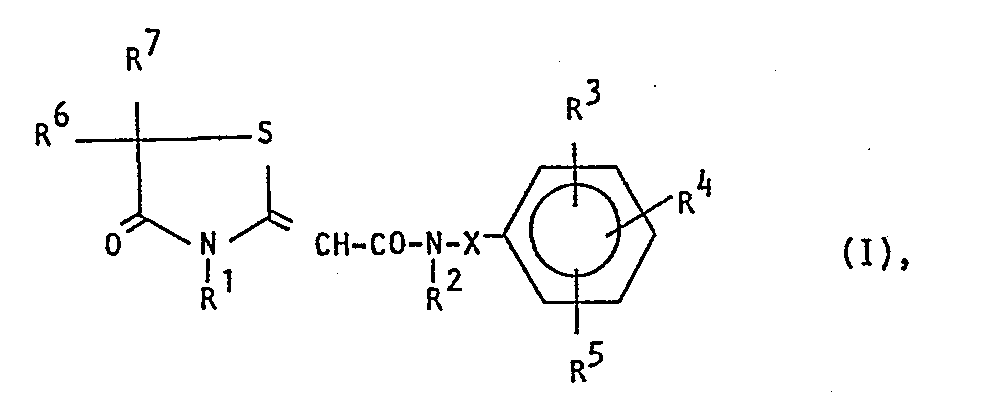
- Die Erfindung betrifft neue 4-Oxo-thiazolidin-2-yliden-acetamid-derivate der allgemeinen Formel I

- R1 ein Wasserstoffatom, einen gesättigten oder ungesättigten geradkettigen oder verzweigten aliphatischen Kohlenwasserstoffrest mit bis zu 4 Kohlenstoffatomen, eine Aryl- oder Aralkylgruppe, R2 ein Wasserstoffatom oder einen geradkettigen oder verzweigten Alkyl- oder Alkylaminoalkylrest mit bis zu 9 Kohlenstoffatomen, X einen Bindestrich oder eine geradkettige oder verzweigte Alkylenkette mit bis zu 4 Kohlenstoff- atomen und die Reste R3, R und R5, die gleich oder verschieden sein können, ein Wasserstoffatom, einen geradkettigen oder verzweigten Alkylrest mit bis zu 4 Kohlenstoffatomen, eine geradkettige oder verzweigte Alkoxy- oder Alkylthiogruppe mit bis zu 4 Kohlenstoffatomen, wobei zwei benachbarte Reste gemeinsam auch eine Methylendioxy- oder Ethylendioxygruppe bilden können, ein Halogenatom, eine Bydroxygruppe, eine Nitrogruppe oder einen Carboxylrest oder einen Niederalkoxycarbonylrest mit bis zu-5 Kohlenstoffatomen und R und R7, die gleich oder verschieden sein können, ein Wasserstoffatom oder einen geradkettigen oder verzweigten Alkylrest mit bis zu 4 Kohlenstoffatomen bedeuten.
- Bevorzugt sind Verbindungen der allgemeinen Formel I, in welcher R1 ein Wasserstoffatom, einen gestättigten oder ungesättigten Alkylrest mit 1 bis 3 Kohlenstoffatomen, einen Phenyl- oder Benzylrest, R2 ein Wasserstoffatom, eine Methyl- oder Ethylgruppe, oder einen Dialkylaminoalkylrest mit insgesamt bis zu 7 Kohlenstoffatomen, X einen Bindestrich oder eine verzweigte Alkylengruppe mit 1 - 3 Kohlenstoffatomen und R3, R 4 und R5, die gleich oder verschieden sein können, ein Wasserstoffatom, eine Methyl-, Ethyl-, Methoxy-, Ethoxy-, Methylthio- oder Ethylthiogruppe bedeuten, wobei zwei benachbarte Reste gemeinsam auch ein Methylendioxygruppe bilden können, ein Fluor-, Chlor-, Brom-, Jodatom, eine Hydroxygruppe oder eine Nitrogruppe oder eine Carboxylgruppe oder einen Niederalkoxycarbonylrest mit bis zu 5 Kohlenstoffatomen und R6 und R7 ein Wasserstoffatom oder eine Methyl- oder Ethylgruppe bedeutet.
- Ganz besonders bevorzugt sind Verbindungen der allgemeinen Formel I, in welcher R ein Wasserstoffatom, einen Methyl-, Ethyl-, Allyl- oder Benzylrest, R2 ein Wasserstoffatom, einen Methylrest, einen Bindestrich oder eine Ethylidengruppe und R3, R4 und R5, die gleich oder verschieden sein können, ein Wasserstoffatom, einen Methylrest oder ein Chlor- oder Bromatom und R6 und R7 ein Wasserstoffatom bedeutet.
- Ein weiterer Gegenstand der Erfindung ist ein Verfahren zur Herstellung von Verbindungen der allgemeinen Formel I, dadurch gekennzeichnet, daß man entweder
- a) eine Verbindung der allgemeinen Formel II


- b) eine Verbindung der allgemeinen Formel IV

- Die Verbindungen der allgemeinen Formel I sind wertvolle Arzneimittel mit ungewöhnlich breitem antikonvulsivem Wirkungsprofil und hervorragender Verträglichkeit. Sie sind insbesondere für eine umfassende, antiepileptische Therapie geeignet.
- Der Begriff der Epilepsie ist eine kollektive Bezeichnung für eine Klasse chronischer Erkrankungen des zentralen Nervensystems, welche das Auftreten episodischer Anfälle mit abnormalen motorischen ("Krämpfe"), sensorischen und psychischen Phänomenen gemeinsam haben.
- Die Häufigkeit der Epilepsien ist überraschend groß und liegt bei ca. o,5 % der Bevölkerung. Der Formenreichtum der Epilepsien zwingt zu einer Pharmakotherapie, die durch die Notwendigkeit einer oft wechselnden, differenzierten Behandlung mit unterschiedlichen Pharmaka sehr kompliziert wird.
- Antiepileptische Substanzen gehören zu verschiedenartigen chemischen Klassen. Diese umfassen Barbiturate, Pyrimidone, Hydantoine, Oxazolidindione, Succinimide, Benzodiazepine, Iminostilbene und Valproate. Entsprechend ihren Wirkungen in Labormodellen sind Vertreter dieser Klassen mehr oder weniger zur Therapie partieller (fokaler), generalisierter, temporaler oder myoklonaler Anfälle und Absencen geeignet. Ein ideales Antiepileptikum wäre demnach eine Substanz, die alle Arten von Anfällen und Absencen zu unterdrücken in der Lage ist und keine unerwünschten Nebeneffekte erzeugt.
- Ein Nachteil der bekannten Antiepileptika ist, daß sie beim Versuch, Anfälle zu kontrollieren, oft versagen und darüber hinaus ZNS-Funktionsstörungen und andere Nebenwirkungen bis hin zur aplastischen Anämie verursachen können (Goodman, Gilman, The Pharmacological Basis of Therapeutics - 6. Ed. 198o, S. 451 ff). Selbst wenn man bekannte Antikonvulsiva in geeigneter Auswahl und Kombination anwendet, können bei nur 5o % der behandelten Patienten auftretende Anfälle unter Kontrolle gebracht werden. Selbst im Erfolgsfalle müssen jedoch in der Regel unangenehme Nebeneffekte in Kauf genommen werden.
- Die Verbindungen der allgemeinen Formel I zeichnen sich nun nicht nur durch eine außerordentliche Breite ihres Wirkungsspektrums aus, sondern auch durch eine hohe Potenz und durch eine extrem gute Verträglichkeit. Obwohl diese Befunde erst durch Tierversuche gestützt werden können, ist zu erwarten, daß die Verbindungen der Erfindung einen erheblichen Fortschritt bei der Behandlung der Epilepsie in ihren vielfältigen Erscheinungsformen bedeuten.
- Die Verbindungen der allgemeinen Formel I können aufgrund der C-C-Doppelbindung am Thiazolidinring in einer Z- und E-Konfiguration vorkommen. Die vorliegende Anmeldung schließt beide Formen ein.
- Die Ausgangsverbindungen II und III sind bekannt oder können nach bekannten Methoden hergestellt werden. Verbindungen der allgemeinen Formel II, in welcher R ein Wasserstoffatom ist, können, ausgehend von den bekannten Säuren (R* = H, Y = OH) durch Alkylierung am Ringstickstoff nach vorhergehender Veresterung mittels niederer aliphatischer Alkohole und anschließender vorsichtige Hydrolyse erhalten werden (Annalen 665 (1963) S. 150 ff).
- In besonders vorteilhafter Weise werden dabei die entsprechenden t-Butylester (Y = tert. Butoxy-Gruppe) eingesetzt.
- Das Verfahren a) wird bevorzugt in einem aprotisch bipolaren Lösungsmittel, wie z. B. Dichlormethan, Chloroform oder Dimethylformamid oder in Gemischen solcher Lösungsmittel durchgeführt.
- Als reaktive Gruppen kommen z. B. Anhydride, Alkylester, gemischte Anhydride, insbesondere jedoch die Halogenide in Frage.
- Die Reaktion läßt sich jedoch auch unter Einsatz von Alkylestern durchführen (Y = niedere Alkoxy-Gruppe).
- Die besonders reaktionsfähigen Säurechloride werden hergestellt, indem man die freie Säure (Y = OH) mit einem geeigneten Säurehalogenid, wie z. B. Thionylchlorid, Oxalylchlorid oder Phosphorpentachlorid umsetzt.
- Die Verbindungen der allgemeinen Formel IV lassen sich - ausgehend von Cyanessigsäureestern - wie z. B. Cyanessigsäureethylester mit entsprechenden Anilinderivaten der allgemeinen Formel VII

- Die Verbindungen der allgemeinen Formel I, in welchen R1 ein Wasserstoffatom bedeutet, werden vorzugsweise nach Verfahren b) hergestellt, da das Verfahren a) in Einzelfällen unbefriedigende Ausbeuten ergibt.
- Die erfindungsgemäßen Verbindungen I können in flüssiger oder fester Form enteral oder parenteral appliziert werden. Als Injektionsmedium kommen vor allem wäßrige Phasen zur Anwendung, welche die üblichen Zusätze wie Stabilisierungsmittel und Lösungsvermittler enthalten. Feste Trägerstoffe sind z. B. Stärke, Lactose, Mannit, Methylcellulose, Talkum, hochdisperse Kieselsäuren, höhermolekulare Fettsäuren (wie Stearinsäure), Gelatine, Agar-Agar, Kalziumphosphat, Magnesiumstearat, tierische und pflanzliche Fette, feste hochmolekulare Polymere (wie Polyäthylenglykole); für orale Applikation geeignete Zubereitungen können gewünschtenfalls Geschmacks- und/oder Süßstoffe enthalten.
- Die Dosierung der erfindungsgemäßen Verbindungen richtet sich nach Art und Schwere der jeweiligen Erkran- kung. Die orale Einzeldosis beträgt etwa 10 - 2oo mg.
- Die folgenden Beispiele dienen der näheren Erläuterung der Erfindung:
- Beispie 11
- 4,2 g (35 mMol) Thioglycolsäure-ethylester werden mit 6,6 g (35 mMol) Cyanessigsäure-2,6-dimethyl-anilid und o,13 g (1 mMol) Kaliumcarbonat vermischt. Anschließend werden 15 ml Ethanol zugegeben und das Gemisch unter Rühren 3,5 Stunden zum Sieden erhitzt. Man gibt dann weitere 15 ml Ethanol zu und kühlt auf 4o °C ab. Der ausgefallene Niederschlag wird abgesaugt, das Rohprodukt aus 5o %iger wäßriger Essigsäure umkristallisiert, mit Wasser neutral gewaschen und im Vakuum getrocknet. Man erhält (Z)-(4-oxo-thiazolidin-2-yliden)-N-(2,6-dimethylphenyl)acetamid; Schmp. 25o °C (Zers.)
- Das als Ausgangsprodukt verwendete Cyanessigsäure-2,6-di- methylanilid wird wie folgt hergestellt:
- 11,3 g (O,1 Mol) Cyanessigsäure-ethylester und 15,7 g (o,13 Mol) 2,6-Dimethylanilin werden vermischt und unter Rühren auf 17o °C erhitzt. Das entstehende Ethanol wird dabei laufend abdestilliert; hierbei steigt die Temperatur bis auf 195 °C an. Nach 6 Stunden ist die Reaktion beendet.
- Der Kolbeninhalt wird nach dem Erkalten aus 35o ml Ethanol umkristallisiert. Man erhält das Cyanessigsäure 2,6-dimethylanilid in Form farbloser Kristalle vom Schmp. 2o4 - 2o6 °C.
- o,1 Mol (Z)-(3-Methyl-4-oxo-thiazolidin-2-yliden)essigsäure werden in einer Mischung von 5oo ml Dichlormethan und 5 ml Dimethylformamid gelöst und 1o ml Thionylchlorid, gelöst in 3o ml Dichlormethan, innerhalb von 45 Minuten bei Raumtemperatur zugetropft. Man läßt das Reaktionsgemisch noch 15 Minuten bei dieser Temperatur rühren und dampft die nunmehr braune Lösung im Vakuum ein.
- Der Rückstand wird in 5oo ml Dichlormethan gelöst. In die filtrierte Lösung tropft man dann innerhalb von 3o Minuten eine Lösung von o,2 Mol 2,6-Dimethylanilin in 3o ml Dichlormethan bei Raumtemperatur zu und rührt weitere 4 Stunden bei 4o °C.
- Der ausgefallene Niederschlag wird abgesaugt und aus 5o %iger wäßriger Essigsäure umkristallisiert, mit Wasser neutral gewaschen und im Vakuum getrocknet.
- Man erhält (Z)-(3-Methyl-4-oxo-thiazolidin-2-yliden)-N-(2,6-dimethylphenyl) acetamid. Schmp. 25o,4 °C (Zers.)
- Die als Ausgangsprodukt verwendete (Z)-(3-Methyl-4-oxo- thiazolidin-2-yliden)essigsäure wird wie folgt hergestellt:
- 2o g (Z)-(3-Methyl-4-oxo-thiazolidin-2-yliden)essigsäure-t-butylester (Annalen 665 (1963) S. 15o ff) werden in 45 ml Eisessig gelöst und bei O °C mit 8 ml einer 33 %igen Lösung von Bromwasserstoff in Eisessig versetzt. Nach 15 Minuten wird Eiswasser zugesetzt und die ausgefallene Säure abgesaugt. Da sich das Endprodukt rasch zersetzt, wird schnell aus Isopropanol umkristallisiert. Die erhaltene freie Säure kann unmittelbar weiterverwendet werden.
- o, o2o Mol (Z)-(4-Oxo-thiazolidin-2-yliden)-N-(2,6-dimethylphenyl)acetamid werden bei Raumtemperatur in 22 ml 1N Natriumhydroxid-Lösung mit 2,3 g (0,024 Mol) Dimethylsulfat tropfenweise versetzt und insgesamt 1 Stunde rühren gelassen. Danach extrahiert man das Methylierungsprodukt mit Dichlormethan und erhält nach üblicher Aufarbeitung und Kristallisation aus Methanol (Z)-(3-Methyl-4-oxo-thiazolidin-2-yliden)-N-(2,6-dimethylphenyl)acetamid vom Schmp. 25o,4 °C (Zers.).
- In analoger Weise, wie in Beispiel 2 beschrieben, erhält man folgende Verbindungen:
- b) (Z)-(3-Methyl-4-oxo-thiazolidin-2-yliden)-N-(2-chlorphenyl)acetamid; Schmp. 193 - 194 °C (Zers.). (Methanol)
- c) (Z)-(3-Methyl-4-oxo-thiazolidin-2-yliden)-N-(3-chlorphenyl)acetamid. Schmp. 275,3 °C (Zers.). (Dimethylsulfoxid = DMSO)
- d) (Z)-(3-Methyl-4-oxo-thiazolidin-2-yliden)-N-(4-chlorphenyl)acetamid; Schmp. 295,5 °C (Zers.) (DMSO-Methanol)
- e) (Z)-(3-Methyl-4-oxo-thiazolidin-2-yliden)-N-(2,3-dimethylphenyl)acetamid; Schmp. 205 - 207 °C (Zers.) (Ethanol)
- f) (±) (Z)-(3-Methyl-4-oxo-thiazolidin-2-yliden)-N-(1-phenylethyl)acetamid; Schmp. 122 - 125 °C (Propanol-2/Petrolether).
- g) (-)-(Z)-(3-Methyl-4-oxo-thiazolidin-2-yliden)-N-(1-phenylethyl)acetamid; Schmp. 55 - 60 °C (Dichlormethan)
- h) (+)-(Z)-(3-Methyl-4-oxo-thiazolidin-2-yliden)-N-(1-phenylethyl)-acetamid; Schmp. 65 - 7o °C (Dichlormethan).
- i) (Z)-(3-Methyl-4-oxo-thiazolidin-2-yliden)-N-(2-chlor-6-methylphenyl)acetamid; Schmp. 244 - 245 °C (Ethanol).
- j) (Z)-(3-Methyl-4-oxo-thiazolidin-2-yliden)-N-(2,6-dichlorphenyl)acetamid; Schmp. 224 - 226 °C (Toluol).
- k) (Z)-(3-Methyl-4-oxo-thiazolidin-2-yliden)-N-(1,2,4,6 = trimethylphenyl)acetamid; Schmp. 249,8 °C (Zers.) (Ethanol).
- 1) (Z)-(3-Methyl-4-oxo-thiazolidin-2-yliden)-N-(4-brom-2,6-dimethylphenyl)acetamid; Schmp. 263 °C (Methanol).
- m) (Z)-(3-Methyl-4-oxo-thiazolidin-2-yliden)-N-methyl-N-(2-methylphenyl)acetamid; Schmp. 114 - 115 °C (Diisopropylether).
- n) (Z)-(3-Methyl-4-oxo-thiazolidin-2-yliden)-N-methyl-N-(3-methylphenyl)acetamid; Schmp. 117 - 118 °C (Diisopropylether).
- o) (Z)-(3-Methyl-4-oxo-thiazolidin-2-yliden)-N-methyl-N-(2,6-dimethylphenyl)acetamid; Schmp. 153 - 154 °C (Diisopropylether).
- p) (Z)-(3-Ethyl-4-oxo-thiazolidin-2-yliden)-N-(2,6-dimethylphenyl)acetamid; Schmp. 282,3 °C (Zers.) (Propranol-2).
- q) (Z)-(3-Allyl-4-oxo-thiazolidin-2-yliden)-N-(2,6-dimethylphenyl)acetamid; Schmp. 250,5 °C (Zers.), (Propanol 2/Wasser).
- r) (Z)-(3-Benzyl-4-oxo-thiazolidin-2-yliden)-N-(2,6-dimethylphenyl)acetamid; Schmp. 182 - 184 °C. (Toluol).
- s) 3-Methyl-2-[(3-methyl-4-oxo-thiazolidin-2-yliden)acetylamino] benzoesäureethylester; Schmp. 167-168 °C (THF/Petrolether)
- t) (Z)-N-(2-Methoxy-6-methyl-phenyl)-(3-methyl-4-oxo-thiazolidin-2-yliden)acetamid; Schmp. 158-160 °C (Isopropanol)
- u) (Z)-N-(2-Methylthio-phenyl)-(3-methyl-4-oxo-thiazolidin-2-yliden) acetamid; Schmp. 177-178 °C (Toluol)
- v) Z-(3-Methyl-4-oxo-thiazolidin-2-yliden)-N-(3,4,5-trimethoxyphenyl) acetamid; Schmp. 224-225 °C (Isopropanol)
- w) (Z)-N-(2-Methyl-6-nitro-phenyl)-(3-methyl-4-oxo-thiazolidin-2-yliden)acetamid; Schmp. 218-219 °C (Toluol/Aceton)
- x) (Z)-N-(2-Diethylaminoethyl)-N-(2,6-xylyl)-(3-methyl-4-oxo-thia- zolidin-2-yliden)acetamid HBr; Schmp. 261,5 °C (Ethanol)
- y) Z-(3-Methyl-4-oxo-thiazolidin-2-yliden)acetanilid; Schmp. 212-215 °C (Ethanol)
- z) Z-N-(4-Chlor-2-nitrophenyl)-(3-methyl-4-oxo-thiazolidin-2-yliden) acetamid; Schmp. 264-265 °C (DMF/H20)
- aa) 2-Hydroxy-4- [(3-methyl-4-oxo-thiazolidin-2-yliden)acetylamino] benzoesäureethylester; Schmp. 236-237 °C (DMF/H20)
- bb) (Z)-N-(3-Diethylaminopropyl)-N-(2,6-xylyl)-(3-methyl-4-oxo- thiazolidin-2-yliden)-acetamid - HCl; Schmp. 222-223 °C (Isopropanol)
- cc) (Z)-N-(2-Dimethylaminoethyl)-N-(2,6-xylyl)-(3-methyl-4-oxo- thiazolidin-2-yliden)acetamid - HCl; Schmp. 268,8 °C (Ethanol)
- dd) (Z)-N-(3-Dimethylaminopropyl)-N-(2,6-xylyl)-(3-methyl-4-oxo- thiazolidin-2-yliden)-acetamid Hydrobromid; Schmp. 253,6 °C (Ethanol)
- ee) (Z)-3-Methyl-2- [(3-methyl-4-oxo-thiazolidin-2-yliden)acetyl- amino]-benzoesäure; Schmp. 186,9 °C (Dichlormethan)
- ff) (Z)-(4-Oxo-3-phenyl-thiazolidin-2-yliden)-N-(2,6-xylyl) acetamid; Schmp. 228,3 °C (Ethanol)
- gg) (Z)-N-(2-Chlor-6-methylphenyl)-(4-oxo-3-phenyl-thiazolidin-2-yliden)acetamid; Schmp. 213-214 °C (Ethanol)
- hh) Z-(3,5-Dimethyl-4-oxo-thiazolidin-2-yliden)-N-(2,6-xylyl)-acetamid; Schmp. 220-222 °C (Ethanol)
- Bei allen Substanzen wurde in den Krampftests als Vehikel o,8 % Methocelschleim benutzt. Die Prämedikationszeit betrug 3o Minuten, sofern nicht anders angegeben, und die Applikation erfolgte i.g. in 2o ml/kg Körpergewicht.
- Versuchstiere waren männliche Mäuse (NMRI) mit einem Körpergewicht von 18 bis 24 g, die unter konditionierten Bedingungen gehalten wurden. 24 Stunden (falls nicht anders angegeben) vor Versuchsbeginn wurde das Futter entzogen, das Trinkwasser jedoch bis zu Beginn des Versuchs belassen.
- Bei den audiogenen Krämpfen wurden DBA/2J-Mäuse männlichen Geschlechts im Gewicht von 5 - 1o g verwendet, die am Tag vor dem Versuch bezogen und nicht nüchtern gesetzt waren.
- Pro Dosierung wurden jeweils 1o Tiere dem Test unterzogen.
- Als Positivstandard wurden Phenytoin, Valproat, GABA und Baclofen verwendet.
- Als Konvulsivum wurde Isonicotinsäure-hydrazid (Isoniazid) in einer Dosierung von 25o mg/kg s.c. benutzt, wobei die Beobachtungszeit 9o min betrug.
- Als Konvulsivum wurde Strychnin nitric. cryst. in einer Dosis von 1,1 mg/kg s.c. angewendet, wobei die Beobachtungszeit 2o min p.a. betrug.
- Für den Elektroschock wurde das HSE-Schock-Reizgerät Typ 2o7 verwendet.
- Zur Übertragung des Stromstoßes wurden Elektroden in Form von ohrclips an den Ohren der Maus befestigt.
- Die Dauer des Schocks betrug o,3 s, die Stromstärke 35 mA (Spannung selbstregelnd). Als Positivstandard wurde Phenytoin-Natrium (EPANUTIN(R)) in einer Dosis von 5o mg/kg i.g. bzw. s.c. angewendet.
- Die Beobachtungszeit war auf 5 min festgelegt.
- Als Konvulsivum wurden 14o mg/kg Pentetrazol s.c. appliziert. Die Beobachtungszeit betrug 2o min.
- Pikrotoxin wurde in einer Dosis von 15 mg/kg s.c. verabreicht. Beobachtet wurden die Tiere 2o min.
- Krampfmittel war Bicucullin purum. Die Dosis betrug 3,o mg/kg s.c.. Die Beobachtungszeit betrug 2o min.
- Semicarbazid-Hydrochlorid wurde als Krampfmittel in einer Dosis von 1000 mg/kg s.c. verwendet. Die Beobachtungszeit betrug jeweils 9o min p.a.
- 3-Mercaptopropionsäure wurde mit physiologischer NaCl-Lösung verdünnt, mit 6 mol/l NaOH auf pH 7 eingestellt und mit NaCl-Lösung auf das Endvolumen gebracht (1o ml/kg). Die Beobachtungszeit betrug 3o min.
- Die Tiere wurden mit einem 10,9 KHz-Ton von 110 dBA 3o Sekunden lang beschallt. Die Beobachtungszeit betrug 1 min.

- Die Bestimmung der akuten Toxizität wurde an männlichen Mäusen (NMRI) mit einem Körpergewicht von 18 - 23 g durchgeführt. Alle Versuchstiere wurden 2o Stunden vor Versuchsbeginn nüchtern gesetzt. Wasser stand ad libitum zur Verfügung. Zu jeder Dosierungsgruppe gehörten 4 Tiere. Die Dosenfolge war logarithmisch. Die Prüfsubstanzen wurden als Suspension in o,88 %igem Methocel intragastral verabreicht. Das Applikationsvolumen betrug 2o ml/kg Körpergewicht. Die Tiere wurden insgesamt 7 Tage beobachtet.


umsetzt und gegebenenfalls anschließend N-alkyliert oder
mit einem Thioglykolsäureester der allgemeinen Formel V


gewünschtenfalls in an sich bekannter Weise anschließend N-alkyliert und die so erhaltenen Verbindungen der allgemeinen Formel I in an sich bekannter Weise isoliert.
Claims (14)


umsetzt und gegebenenfalls anschließend N-alkyliert oder

mit einem Thioglykolsäureester der allgemeinen Formel V

umsetzt, die erhaltenen Verbindungen der allgemeinen Formel VI

gewünschtenfalls in an sich bekannter Weise anschließend N-alkyliert und die so erhaltenen Verbindungen der allgemeinen Formel I in an sich bekannter Weise isoliert.


in an sich bekannter Weise mit einer Verbindung der allgemeinen Formel (III)

umsetzt und gegebenenfalls anschließend N-alkyliert oder

mit einem Thioglykolsäureester der allgemeinen Formel V

umsetzt, die erhaltenen Verbindungen der allgemeinen Formel VI

gewünschtenfalls in an sich bekannter Weise anschließend N-alkyliert und die so erhaltenen Verbindungen der allgemeinen Formel I in an sich bekannter Weise isoliert.
Priority Applications (1)
| Application Number | Priority Date | Filing Date | Title |
|---|---|---|---|
| AT84105322T ATE65778T1 (de) | 1983-05-10 | 1984-05-10 | 4-oxo-thiazolidin-2-yliden-acetamid-derivate, verfahren zu deren herstellung und diese enthaltende arzneimittel zur bekaempfung von erkrankungen des zentralnervensystems. |
Applications Claiming Priority (2)
| Application Number | Priority Date | Filing Date | Title |
|---|---|---|---|
| DE3317000A DE3317000C2 (de) | 1983-05-10 | 1983-05-10 | 4-Oxo-thiazolidin-2-yliden-acetamid-derivate, Verfahren zu deren Herstellung und deren Verwendung bei der Bekämpfung von durch das Zentralnervensystem bedingten Konvulsionen |
| DE3317000 | 1983-05-10 |
Publications (3)
| Publication Number | Publication Date |
|---|---|
| EP0124911A2 true EP0124911A2 (de) | 1984-11-14 |
| EP0124911A3 EP0124911A3 (en) | 1987-02-04 |
| EP0124911B1 EP0124911B1 (de) | 1991-07-31 |
Family
ID=6198604
Family Applications (1)
| Application Number | Title | Priority Date | Filing Date |
|---|---|---|---|
| EP84105322A Expired - Lifetime EP0124911B1 (de) | 1983-05-10 | 1984-05-10 | 4-Oxo-thiazolidin-2-yliden-acetamid-Derivate, Verfahren zu deren Herstellung und diese enthaltende Arzneimittel zur Bekämpfung von Erkrankungen des Zentralnervensystems |
Country Status (19)
| Country | Link |
|---|---|
| US (1) | US4563471A (de) |
| EP (1) | EP0124911B1 (de) |
| JP (1) | JPS59206372A (de) |
| AT (1) | ATE65778T1 (de) |
| AU (1) | AU565799B2 (de) |
| BG (2) | BG41129A3 (de) |
| CA (1) | CA1237436A (de) |
| CS (1) | CS244814B2 (de) |
| DD (1) | DD224319A5 (de) |
| DE (2) | DE3317000C2 (de) |
| DK (1) | DK162048C (de) |
| ES (2) | ES8502696A1 (de) |
| GR (1) | GR82086B (de) |
| HU (1) | HU190566B (de) |
| IE (1) | IE57372B1 (de) |
| PL (2) | PL142365B1 (de) |
| SU (2) | SU1251803A3 (de) |
| YU (2) | YU45183B (de) |
| ZA (1) | ZA843489B (de) |
Cited By (1)
| Publication number | Priority date | Publication date | Assignee | Title |
|---|---|---|---|---|
| US6133299A (en) * | 1993-02-25 | 2000-10-17 | Warner-Lambert Company | Methods for treating neurodegenerative diseases and disorders using N-(2,6-disubstituted aromatic)-N'-pyridinyl ureas and other anticonvulsant compounds |
Families Citing this family (6)
| Publication number | Priority date | Publication date | Assignee | Title |
|---|---|---|---|---|
| EP0269024A3 (en) * | 1986-11-21 | 1990-05-09 | Godecke Aktiengesellschaft | Use of 3-methyl-4-oxothiazolidin-2-ylidene-acetamide derivatives in the treatment of aids |
| DE69214467T3 (de) * | 1991-01-10 | 2000-09-28 | Transcend Therapeutics, Inc. | Verwendung von L-2-oxo Thiazolidin-4-carboxylat zur Behandlung von Atemnotsyndrom |
| US5747459A (en) * | 1991-02-04 | 1998-05-05 | Nestec, Ltd. | Method for insuring adequate intracellular glutathione in tissue |
| US5430045A (en) * | 1992-04-23 | 1995-07-04 | Free Radical Sciences, Inc. | Method of reducing or preventing bone marrow hypoplasia |
| US5447712A (en) * | 1993-12-09 | 1995-09-05 | Free Radical Sciences | Method of reducing cyclophosphamide induced hemorrhagic cystitis |
| KR100329808B1 (ko) * | 2000-01-14 | 2002-03-25 | 박호군 | 2-펜아실리덴-3,5-알킬치환된-1,3-티아졸리딘-4-온의 효율적 제조 방법 |
Family Cites Families (3)
| Publication number | Priority date | Publication date | Assignee | Title |
|---|---|---|---|---|
| DE1150985B (de) * | 1961-03-06 | 1963-07-04 | Warner Lambert Pharmaceutical | Verfahren zur Herstellung von Thiazolidin-4-on-Derivaten |
| FR2726M (fr) * | 1962-12-04 | 1964-08-17 | Warner Lambert Pharmaceutical | Amides de thiazolidinones substituées. |
| DE2423725C2 (de) * | 1974-05-16 | 1982-12-30 | Gödecke AG, 1000 Berlin | 5-Phenyl-4-oxo-Delta 2,ALPHA-thiazolidinessigsäureester |
-
1983
- 1983-05-10 DE DE3317000A patent/DE3317000C2/de not_active Expired
-
1984
- 1984-05-04 CS CS843307A patent/CS244814B2/cs unknown
- 1984-05-07 YU YU792/84A patent/YU45183B/xx unknown
- 1984-05-07 SU SU843735694A patent/SU1251803A3/ru active
- 1984-05-08 PL PL1984247581A patent/PL142365B1/pl unknown
- 1984-05-08 DD DD84262809A patent/DD224319A5/de not_active IP Right Cessation
- 1984-05-08 BG BG069786A patent/BG41129A3/xx unknown
- 1984-05-08 US US06/608,298 patent/US4563471A/en not_active Expired - Fee Related
- 1984-05-08 BG BG065397A patent/BG40143A3/xx unknown
- 1984-05-08 PL PL1984252100A patent/PL142398B1/pl unknown
- 1984-05-08 CA CA000453789A patent/CA1237436A/en not_active Expired
- 1984-05-08 GR GR74638A patent/GR82086B/el unknown
- 1984-05-09 IE IE1150/84A patent/IE57372B1/en not_active IP Right Cessation
- 1984-05-09 ZA ZA843489A patent/ZA843489B/xx unknown
- 1984-05-09 ES ES532331A patent/ES8502696A1/es not_active Expired
- 1984-05-09 JP JP59092716A patent/JPS59206372A/ja active Granted
- 1984-05-09 HU HU841803A patent/HU190566B/hu unknown
- 1984-05-09 DK DK229984A patent/DK162048C/da not_active IP Right Cessation
- 1984-05-09 ES ES532322A patent/ES532322A0/es active Granted
- 1984-05-10 DE DE8484105322T patent/DE3484859D1/de not_active Expired - Fee Related
- 1984-05-10 AT AT84105322T patent/ATE65778T1/de active
- 1984-05-10 AU AU27889/84A patent/AU565799B2/en not_active Ceased
- 1984-05-10 EP EP84105322A patent/EP0124911B1/de not_active Expired - Lifetime
-
1985
- 1985-02-25 SU SU853857487A patent/SU1272985A3/ru active
-
1986
- 1986-04-18 YU YU00635/86A patent/YU63586A/xx unknown
Cited By (1)
| Publication number | Priority date | Publication date | Assignee | Title |
|---|---|---|---|---|
| US6133299A (en) * | 1993-02-25 | 2000-10-17 | Warner-Lambert Company | Methods for treating neurodegenerative diseases and disorders using N-(2,6-disubstituted aromatic)-N'-pyridinyl ureas and other anticonvulsant compounds |
Also Published As
Similar Documents
| Publication | Publication Date | Title |
|---|---|---|
| DE3854764T2 (de) | Verfahren zur Herstellung von (R) 5-Pentylamino-5-Oxopentanesäurederivate mit Anticholecystokininwirkung. | |
| DE2508045C2 (de) | Substituierte n-(1-benzylpyrrolidinyl-2-alkyl)-benzamide, verfahren zu deren herstellung und diese enthaltende arzneimittel | |
| EP0276803B1 (de) | 1-(4-Hydroxy-3,5-di-tert.-butyl-benzoyl)-homopiperazin, verschiedene von dessen Derivaten, Verfahren zur Herstellung dieser Verbindungen, die sie enthaltenden Arzneimittel und ihre Verwendung | |
| DE3031791C2 (de) | ||
| DE2704989A1 (de) | Arzneimittel, in diesen enthaltene neue verbindungen und verfahren zu ihrer herstellung | |
| EP0124911B1 (de) | 4-Oxo-thiazolidin-2-yliden-acetamid-Derivate, Verfahren zu deren Herstellung und diese enthaltende Arzneimittel zur Bekämpfung von Erkrankungen des Zentralnervensystems | |
| EP0431371B1 (de) | 3-Aminopyrrole, Verfahren zu ihrer Herstellung und ihre Verwendung als Antikonvulsiva | |
| EP0000174A1 (de) | Aminobenzoesäurederivate, Verfahren zu ihrer Herstellung und Arzneimittel enthaltend solche Aminobenzoesäurederivate | |
| DE2535147A1 (de) | 2-thiol-4,5-diphenyloxazol-s-derivate, verfahren zu ihrer herstellung und diese verbindungen enthaltende arzneimittel | |
| DE2535930C3 (de) | Abietinsaureamidderivate und Verfahren zu ihrer Herstellung | |
| DE2446100C3 (de) | Phenoxyalkancarbonsäureamide von Thiazolidincarbonsäuren, Verfahren zu ihrer Herstellung und Arzneimittel | |
| CH616650A5 (de) | ||
| DE69100897T2 (de) | N-phenyl-n-alkoxycarbonylalkyl-glycinamide, ihre herstellung und sie enthaltende medikamente. | |
| DE2557220A1 (de) | N-substituierte spirolactame | |
| DE69009765T2 (de) | Kynurensäurederivate, deren herstellung und diese enthaltende pharmazeutische zusammensetzungen. | |
| EP0019157A1 (de) | 5,6-Dihydro-11-alkylen-morphantridin-6-one und Verfahren zu ihrer Herstellung | |
| EP0003298B1 (de) | 4-Hydroxy-2-benzimidazolin-thion-Derivate, Verfahren zu deren Herstellung sowie diese Verbindungen enthaltende Arzneimittel | |
| EP0046554B1 (de) | N-substituierte Brenztraubensäurehydrazone, Verfahren zu ihrer Herstellung und Arzneimittel, die diese Verbindungen enthalten | |
| DE2415691A1 (de) | Substituierte benzamide, verfahren zu deren herstellung und deren verwendung | |
| DE2654888A1 (de) | Diphenylacetamide, verfahren zu ihrer herstellung und sie enthaltende arzneimittel | |
| DE2753878A1 (de) | Derivate des 1-(3,5-dichlorphenyl)- piperazins, verfahren zu ihrer herstellung und diese verbindungen enthaltende arzneimittel | |
| DE2711149B2 (de) | ||
| CH634835A5 (de) | Verfahren zur herstellung von neuen benzodiazepinderivaten. | |
| EP0016867B1 (de) | Monochlorcitronensäurederivate, diese enthaltende pharmazeutische Präparate und Verfahren zur Herstellung dieser Derivate | |
| DE2012667A1 (de) | Acyloxyalky!verbindungen, ihre Salze, Verfahren zu ihrer Herstellung und ihre Verwendung |
Legal Events
| Date | Code | Title | Description |
|---|---|---|---|
| PUAI | Public reference made under article 153(3) epc to a published international application that has entered the european phase |
Free format text: ORIGINAL CODE: 0009012 |
|
| 17P | Request for examination filed |
Effective date: 19840510 |
|
| AK | Designated contracting states |
Designated state(s): AT BE CH DE FR GB IT LI LU NL SE |
|
| PUAL | Search report despatched |
Free format text: ORIGINAL CODE: 0009013 |
|
| AK | Designated contracting states |
Kind code of ref document: A3 Designated state(s): AT BE CH DE FR GB IT LI LU NL SE |
|
| 17Q | First examination report despatched |
Effective date: 19880620 |
|
| ITF | It: translation for a ep patent filed | ||
| GRAA | (expected) grant |
Free format text: ORIGINAL CODE: 0009210 |
|
| AK | Designated contracting states |
Kind code of ref document: B1 Designated state(s): AT BE CH DE FR GB IT LI LU NL SE |
|
| REF | Corresponds to: |
Ref document number: 65778 Country of ref document: AT Date of ref document: 19910815 Kind code of ref document: T |
|
| GBT | Gb: translation of ep patent filed (gb section 77(6)(a)/1977) | ||
| REF | Corresponds to: |
Ref document number: 3484859 Country of ref document: DE Date of ref document: 19910905 |
|
| ET | Fr: translation filed | ||
| PLBE | No opposition filed within time limit |
Free format text: ORIGINAL CODE: 0009261 |
|
| STAA | Information on the status of an ep patent application or granted ep patent |
Free format text: STATUS: NO OPPOSITION FILED WITHIN TIME LIMIT |
|
| 26N | No opposition filed | ||
| EPTA | Lu: last paid annual fee | ||
| EAL | Se: european patent in force in sweden |
Ref document number: 84105322.6 |
|
| PGFP | Annual fee paid to national office [announced via postgrant information from national office to epo] |
Ref country code: LU Payment date: 19951001 Year of fee payment: 12 |
|
| PGFP | Annual fee paid to national office [announced via postgrant information from national office to epo] |
Ref country code: GB Payment date: 19951024 Year of fee payment: 12 |
|
| PGFP | Annual fee paid to national office [announced via postgrant information from national office to epo] |
Ref country code: SE Payment date: 19951030 Year of fee payment: 12 Ref country code: CH Payment date: 19951030 Year of fee payment: 12 |
|
| PGFP | Annual fee paid to national office [announced via postgrant information from national office to epo] |
Ref country code: FR Payment date: 19951031 Year of fee payment: 12 |
|
| PGFP | Annual fee paid to national office [announced via postgrant information from national office to epo] |
Ref country code: AT Payment date: 19951109 Year of fee payment: 12 |
|
| PGFP | Annual fee paid to national office [announced via postgrant information from national office to epo] |
Ref country code: BE Payment date: 19951110 Year of fee payment: 12 |
|
| PGFP | Annual fee paid to national office [announced via postgrant information from national office to epo] |
Ref country code: DE Payment date: 19960118 Year of fee payment: 12 |
|
| PG25 | Lapsed in a contracting state [announced via postgrant information from national office to epo] |
Ref country code: LU Free format text: LAPSE BECAUSE OF NON-PAYMENT OF DUE FEES Effective date: 19960510 Ref country code: GB Effective date: 19960510 Ref country code: AT Effective date: 19960510 |
|
| PG25 | Lapsed in a contracting state [announced via postgrant information from national office to epo] |
Ref country code: SE Effective date: 19960511 |
|
| PG25 | Lapsed in a contracting state [announced via postgrant information from national office to epo] |
Ref country code: LI Effective date: 19960531 Ref country code: CH Effective date: 19960531 Ref country code: BE Effective date: 19960531 |
|
| PGFP | Annual fee paid to national office [announced via postgrant information from national office to epo] |
Ref country code: NL Payment date: 19960531 Year of fee payment: 13 |
|
| BERE | Be: lapsed |
Owner name: GODECKE A.G. Effective date: 19960531 |
|
| GBPC | Gb: european patent ceased through non-payment of renewal fee |
Effective date: 19960510 |
|
| REG | Reference to a national code |
Ref country code: CH Ref legal event code: PL |
|
| PG25 | Lapsed in a contracting state [announced via postgrant information from national office to epo] |
Ref country code: FR Effective date: 19970131 |
|
| PG25 | Lapsed in a contracting state [announced via postgrant information from national office to epo] |
Ref country code: DE Effective date: 19970201 |
|
| EUG | Se: european patent has lapsed |
Ref document number: 84105322.6 |
|
| REG | Reference to a national code |
Ref country code: FR Ref legal event code: ST |
|
| PG25 | Lapsed in a contracting state [announced via postgrant information from national office to epo] |
Ref country code: NL Effective date: 19971201 |
|
| NLV4 | Nl: lapsed or anulled due to non-payment of the annual fee |
Effective date: 19971201 |