EP0104530A2 - Küpenfarbstoffgemische - Google Patents
Küpenfarbstoffgemische Download PDFInfo
- Publication number
- EP0104530A2 EP0104530A2 EP83108980A EP83108980A EP0104530A2 EP 0104530 A2 EP0104530 A2 EP 0104530A2 EP 83108980 A EP83108980 A EP 83108980A EP 83108980 A EP83108980 A EP 83108980A EP 0104530 A2 EP0104530 A2 EP 0104530A2
- Authority
- EP
- European Patent Office
- Prior art keywords
- diaminotoluene
- mixture
- naphthalenetetracarboxylic acid
- dianhydride
- phenol
- Prior art date
- Legal status (The legal status is an assumption and is not a legal conclusion. Google has not performed a legal analysis and makes no representation as to the accuracy of the status listed.)
- Withdrawn
Links
Classifications
-
- C—CHEMISTRY; METALLURGY
- C09—DYES; PAINTS; POLISHES; NATURAL RESINS; ADHESIVES; COMPOSITIONS NOT OTHERWISE PROVIDED FOR; APPLICATIONS OF MATERIALS NOT OTHERWISE PROVIDED FOR
- C09B—ORGANIC DYES OR CLOSELY-RELATED COMPOUNDS FOR PRODUCING DYES, e.g. PIGMENTS; MORDANTS; LAKES
- C09B67/00—Influencing the physical, e.g. the dyeing or printing properties of dyestuffs without chemical reactions, e.g. by treating with solvents grinding or grinding assistants, coating of pigments or dyes; Process features in the making of dyestuff preparations; Dyestuff preparations of a special physical nature, e.g. tablets, films
- C09B67/0033—Blends of pigments; Mixtured crystals; Solid solutions
- C09B67/0034—Mixtures of two or more pigments or dyes of the same type
-
- C—CHEMISTRY; METALLURGY
- C09—DYES; PAINTS; POLISHES; NATURAL RESINS; ADHESIVES; COMPOSITIONS NOT OTHERWISE PROVIDED FOR; APPLICATIONS OF MATERIALS NOT OTHERWISE PROVIDED FOR
- C09B—ORGANIC DYES OR CLOSELY-RELATED COMPOUNDS FOR PRODUCING DYES, e.g. PIGMENTS; MORDANTS; LAKES
- C09B57/00—Other synthetic dyes of known constitution
- C09B57/12—Perinones, i.e. naphthoylene-aryl-imidazoles
Definitions
- the invention relates to mixtures of vat dyes, processes for their preparation and their use.
- vat dye mixtures according to the invention can be obtained by optionally substituting 1,4,5,8-naphthalenetetracarboxylic acid or its dianhydride in the naphthalene ring with 2,3-diaminotoluene or a mixture of 2,3- and 3,4-diaminotoluene, preferably in the presence of a Diluent, reacted at elevated temperature.
- mixtures obtainable in this way contain dyes of the formulas where the rings labeled A and B can be substituted.
- Example 3 The condensation of naphthalenetetracarboxylic acid (anhydride) with 3-nitro-4-aminotoluene in the presence of iron as a reducing agent in acetic acid according to JP 5 224 225, Example 3 leads to a naphthoylenedibenzimidazole (cis-trans mixture) which is identical to one from 4 -Methyl-1,2-diaminobenzene produced dye.
- the 1,4,5,8-naphthalenetetracarboxylic acid or its anhydride used in the reactions can be substituted, for example, by chlorine or C 1 -C 4 alkyl, in particular methyl.
- the unsubstituted compounds are preferably used.
- the 2,3-diaminotoluene used can be prepared by methods known from the literature, e.g. be prepared from 3-nitro-2-amino-toluene by reduction.
- the 2,3- / 3,4-diaminotoluene mixture used is preferably an industrial mixture such as is obtained in the production of toluenediamine.
- the 2,3- / 3,4-diamine mixture used preferably contains 30-70% by weight, particularly preferably 45-55% by weight of 2,3-diaminotoluene and 70-30% by weight, particularly preferably 55-45 % By weight 3,4-diaminotoluene.
- a mixture which contains approximately 50% by weight of 2,3-diaminotoluene and approximately 50% by weight of 3,4-diaminotoluene is very preferably used.
- diamines of the formulas V-IX are: 4-methyl-1,2-diaminobenzene, 4-ethoxy-1,2-diaminobenzene, 4-chloro-1,2-diaminobenzene, 4-cyano-1,2- diaminobenzene, 1,2-diaminonaphthalene, 1,8-diaminonaphthalene, 1,2-diaminoanthraquinone, 2,3-diaminoanthraquinone, o-phenylenediamine is preferably used.
- the amount of diamine or mixture required to prepare the vat dye mixture according to the invention is about 2 to about 2.5 mol, preferably 2 to 2.1 mol, per mol of naphthalenetetracarboxylic acid (anhydride).
- the process according to the invention for producing vat dye mixtures from 1,4,5,8-naphthalenetetracarboxylic acid or its dianhydride and 2,3-diaminotoluene or a mixture of 2,3- and 3,4-diaminotoluene optionally substituted in the naphthalene ring or a mixture of 2,3- and 3,4-diaminotoluene can also be used without a diluent the baking melt are carried out; however, it is preferred to work in the presence of a diluent.
- Suitable diluents are, for example, water and organic solvents such as glacial acetic acid, nitrobenzene and especially preferably phenol. Other organic solvents can also be used.
- the amount of diluent can vary over a longer interval. In general, about 2 to about 7 parts by weight, preferably 4 to 6 parts by weight of diluent per part by weight of naphthalenetetracarboxylic acid (anhydride) are used.
- the reaction temperature can also vary within wide limits. Generally one works between about 60 and about 185 ° C, preferably at 130 to 170 ° C. In some cases it is advisable to distill off the water of reaction continuously.
- the reaction time depends on various parameters and is generally between about 2 and about 12 hours.
- the end of the reaction can be easily determined by thin layer chromatography of samples which are taken from the reaction mixture from time to time.
- the mixture is worked up in the customary manner. For this you can e.g. Evaporate to dryness under reduced pressure. In this way, the diluent used - e.g. Phenol 90-95% - recover and can be used in a new batch if necessary without further purification.
- the diluent used e.g. Phenol 90-95% - recover and can be used in a new batch if necessary without further purification.
- vat dye mixtures can also be practiced as inexpensive tank-paddle dryer processes.
- the dye mixtures are dry and ground. They can be formed directly without further cleaning.
- vat dyes obtainable according to the invention are considerably stronger in color than the known dyes based on 3,4-diaminotoluene.
- the new dyes dye cotton from the dithionite hat scarlet red.
- the dyeings are characterized by good wash and light fastness.
- the new dyes can be produced very economically; especially when using phenol as a diluent and when using the technical o-diamine mixture.
- reaction mixture is then cooled to 100-120 ° C, the melt is poured onto an enamel sheet and dried at 140-150 ° C in a vacuum.
- the raw dye which is formed in the usual way, gives cotton a strong scarlet color with good light and wash fastness.
- a mixture of 105.5 g liquid phenol, 16 g 1,4,5,8-naphthalenetetracarboxylic acid (99%) and 15 g 2,3-diaminotoluene (90-91%) is placed in a 250 ml flat beaker within 2 h heated from 60 to 165 ° C and kept at 165-170 ° C with good stirring for 2 h. After thin layer chromatography, tetraacid is no longer present and ⁇ 2% of half-converted dicarboxylic acid is present.
- a mixture of 105th, 5 g of liquid phenol, 20 g of 1,4,5,8-naphthalenetetracarboxylic acid (9 $ -100%) and 15 g of o-phenylenediamine is dissolved in a 250 ml flat beaker from 70 to 1 hour Heated at 165 ° C and kept at 165-170 ° C for 2 h with good stirring, the water of reaction formed being continuously distilled off.
Landscapes
- Chemical & Material Sciences (AREA)
- Organic Chemistry (AREA)
- Chemical Kinetics & Catalysis (AREA)
- Organic Low-Molecular-Weight Compounds And Preparation Thereof (AREA)
- Heterocyclic Carbon Compounds Containing A Hetero Ring Having Oxygen Or Sulfur (AREA)
- Coloring (AREA)
- Cosmetics (AREA)
Abstract


- R und n die in der Beschreibung angegebenen Bedeutungen besitzen.
- in Phenol bei erhöhter Temperatur umsetzt.
Description
- Die Erfindung betrifft Gemische von Küpenfarbstoffen, Verfahren zu ihrer Herstellung sowie ihre Verwendung.
- Die erfindungsgemäßen Küpenfarbstoffgemische sind dadurch erhältlich, daß man gegebenenfalls im Naphthalinring substituierte 1,4,5,8-Naphthalintetracarbonsäure oder deren Dianhydrid mit 2,3-Diaminotoluol oder einem Gemisch aus 2,3- und 3,4-Diaminotoluol,vorzugsweise in Gegenwart eines Verdünnungsmittels, bei erhöhter Temperatur umsetzt.
- Die so erhältlichen Gemische enthalten Farbstoffe der Formeln

- Bei Einsatz von 2,3-Diaminotoluol als einziges Amin in die obige Reaktion resultieren Küpenfarbstoffgemische, die Farbstoffe der Formeln

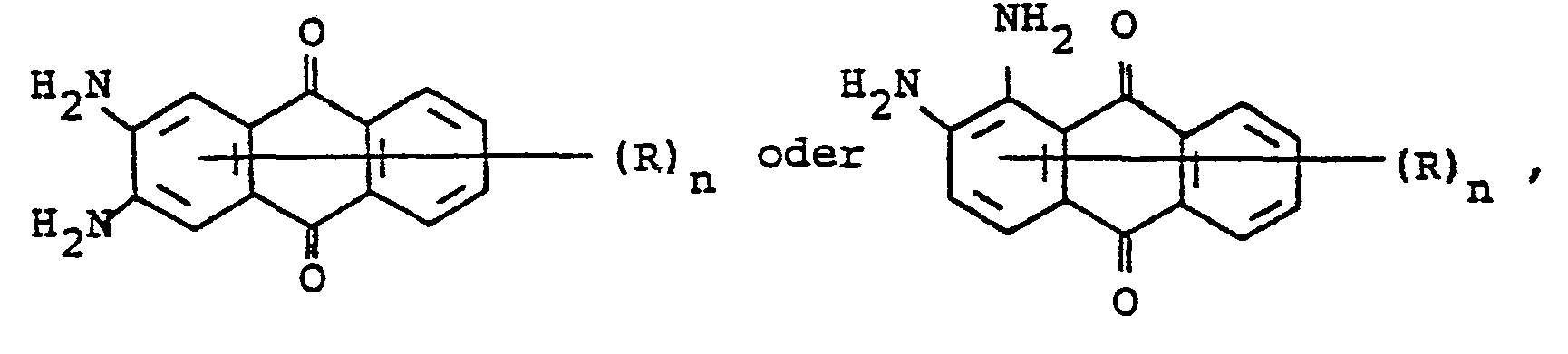
- Weiterhin betrifft die Erfindung ein Verfahren zur Herstellung eines Küpenfarbstoffgemischs, das dadurch gekennzeichnet ist, daß man gegebenenfalls im Naphthalinring substituierte 1r4,5,8-Naphthalintetracarbonsäure oder deren Dianhydrid mit einem Diamin der Formel

- R H, -OH, C1-C4-Alkyl, C1-C4-Alkoxy, Phenoxy, Halogen, insbesondere Cl und Br, -NO2, -CN, Acylamino, insbesondere C1-C4-Alkylcarbonylamino, C1-C4-Alkyl- sulfonylamino und Benzoylamino und
- n 1, 2 oder 3 bezeichnen,
- Die Herstellung von Naphthoylenbisimidazolen aus 1,4,5,8-Naphthalintetracarbonsäure(anhydrid) und 1,2-Diaminobenzol wird in der DE-PS 430 632 beschrieben. Die Reaktionskomponenten werden entweder ohne Lösungsmittel zusammengeschmolzen oder in einem hochsiedenden Lösungsmittel, z.B. Nitrobenzol, erhitzt.
- Als weitere Lösungsmittel für diese Kondensationsreaktion werden in der Literatur genannt:
- Eisessig (Fiat Final Report 1313 II, 168; J. Arient, Russ. chem. Reviews (übersetzung) 1965, Nr. 11, S. 827); verdünnte H2SO4 (DE-OS 1 569 740) und verdünnte H2SO4 in Gegenwart oberflächenaktiver Mittel (RA 182 822/823).
- Literaturbekannt ist ebenfalls die Reaktion von Naphthalintetracarbonsäure(anhydrid) mit 4-Methyl-1,2-diaminobenzol. Gemäß der GB-PS 1 237 838 (DE-OS 1 569 736) führt man die Umsetzung unter Druck in einem C1-C6-Alkohol in Gegenwart von Essigsäure bei 120-180°C durch. Nach Collect. czechoslov. chem. Commun. 30 (1965), Nr. 11, S. 3718-3729 wird siedender Eisessig als Lösungsmittel verwendet.
- Die Kondensation von Naphthalintetracarbonsäure(anhydrid) mit 3-Nitro-4-aminotoluol in Gegenwart von Eisen als Reduktionsmittel in Essigsäure gemäß JP 5 224 225, Beispiel 3 führt zu einem Naphthoylendibenzimidazol (cis-trans-Gemisch), das identisch ist mit einem aus 4-Methyl-1,2-diaminobenzol hergestellten Farbstoff.
- überraschenderweise fanden wir nun, daß durch Reaktion von gegebenenfalls im Naphthalinring substituierter 1,4,5,8-Naphthalintetracarbonsäure oder deren Dianhydrid mit 2,3-Diaminotoluol oder einem Gemisch aus 2,3- und 3,4-Diaminotoluol, vorzugsweise in Gegenwart eines inerten Verdünnungsmittels, bei erhöhter Temperatur, scharlachrote Küpenfarbstoffe erhalten werden, die erheblich farbstärker sind als die bekannten Farbstoffe auf Basis 3,4-Diaminotoluol.
- Die in die Umsetzungen eingesetzte 1,4,5,8-Naphthalintetracarbonsäure oder deren Anhydrid können z.B. durch Chlor oder C1-C4-Alkyl, insbesondere Methyl, substituiert sein.
- Vorzugsweise werden jedoch die unsubstituierten Verbindungen eingesetzt.
- Das eingesetzte 2,3-Diaminotoluol kann nach literaturbekannten Verfahren, z.B. aus 3-Nitro-2-amino-toluol durch Reduktion hergestellt werden.
- Bei dem eingesetzten 2,3-/3,4-Diaminotoluol-Gemisch handelt es sich vorzugsweise um ein technisches Gemisch wie es bei der Toluylendiamin-Produktion anfällt.
- Das eingesetzte 2,3-/3,4-Diamingemisch enthält vorzugsweise 30 - 70 Gew.-%, besonders bevorzugt 45 - 55 Gew.-% 2,3-Diaminotoluol sowie 70 - 30 Gew.-%, besonders bevorzugt 55 - 45 Gew.-% 3,4-Diaminotoluol.
- Ganz bevorzugt eingesetzt wird ein Gemisch, das ca. 50 Gew.-% 2,3-Diaminotoluol und ca. 50 Gew.-% 3,4-Diaminotoluol enthält.
- Als Beispiele für Diamine der Formeln V-IX seien genannt: 4-Methyl-1,2-diaminobenzol, 4-Ethoxy-1,2-diaminobenzol, 4-Chlor-1,2-diaminobenzol, 4-Cyan-1,2-diaminobenzol, 1,2-Diaminonaphthalin, 1,8-Diaminonaphthalin, 1,2-Diaminoanthrachinon, 2,3-Diaminoanthrachinon, bevorzugt eingesetzt wird o-Phenylendiamin.
- Die zur Herstellung der erfindungsgemäßen Küpenfarbstoffgemische benötigte Menge an Diamin oder -Gemisch beträgt etwa 2 bis etwa 2,5 Mol, vorzugsweise 2 bis 2,1 Mol, pro Mol Naphthalintetracarbonsäure(anhydrid).
- Prinzipiell kann das erfindungsgemäße Verfahren zur Herstellung von Küpenfarbstoffgemischen aus gegebenenfalls im Naphthalinring substituierter 1,4,5,8-Naphthalintetracarbonsäure oder deren Dianhydrid und 2,3-Diaminotoluol oder einem Gemisch aus 2,3- und 3,4-Diaminotoluol auch ohne Verdünnungsmittel in der Backschmelze durchgeführt werden; vorzugsweise arbeitet man jedoch in Gegenwart eines Verdünnungsmittels.
- Geeignete Verdünnungsmittel sind z.B. Wasser und organische Lösungsmittel wie Eisessig, Nitrobenzol und besonders bevorzugt Phenol. Auch andere organische Lösungsmittel können eingesetzt werden.
- Die Umsetzung von gegebenenfalls substituierter 1,4,5,8-Naphthalintetracarbonsäure oder deren Dianhydrid mit den Diaminen der Formeln V-IX erfolgt erfindungsgemäß in Phenol.
- Die Arbeitsweisen in Phenol bieten zahlreiche Vorteile. So kann zum einen sehr gute Farbausbeute erzielt werden. Weiterhin wird es möglich, die einzusetzende Aminmenge gering zu halten; dadurch ergeben sich wesentliche Vereinfachungen bei der Aufarbeitung der Produkte.
- Die Menge an Verdünnungsmittel kann innerhalb eines größeren Intervalls schwanken. Im allgemeinen arbeitet man mit etwa 2 bis etwa 7 Gewichtsteilen, vorzugsweise 4 bis 6 Gewichtsteilen Verdünnungsmittel pro Gewichtsteil Naphthalintetracarbonsäure(anhydrid).
- Auch die Reaktionstemperatur kann in weiten Grenzen schwanken. Im allgemeinen arbeitet man zwischen etwa 60 und etwa 185° C, vorzugsweise bei 130 bis 170° C. Es empfiehlt sich in einigen Fällen, das Reaktionswasser laufend abzudestillieren.
- Die Reaktionsdauer hängt von verschiedenen Parametern ab und liegt im allgemeinen zwischen etwa 2 und etwa 12 Stunden. Das Ende der Reaktion läßt lich leicht durch Dünnschichtchromatographie von Proben, die von Zeit zu Zeit dem Reaktionsgemisch entnommen werden, ermitteln.
- Nach Beendigung der Reaktion wird der Ansatz in üblicher Weise aufgearbeitet. Dazu kann man z.B. unter vermindertem Druck zur Trockne eindampfen. Auf diese Weise läßt sich das eingesetzte Verdünnungsmittel - z.B. Phenol zu 90-95 % - wiedergewinnen und kann gegebenenfalls ohne weitere Reinigung in einen neuen Ansatz eingesetzt werden.
- Großtechnisch können die Verfahren zur Herstellung von Küpenfarbstoffgemischen auch als kostengünstige Kessel-Schaufeltrockner-Verfahren praktiziert werden. Dabei fallen die Farbstoffgemische trocken und gemahlen an. Sie können direkt, ohne weitere Reinigung formiert werden.
- Überraschenderweise sind die erfindungsgemäß erhältlichen Küpenfarbstoffe erheblich farbstärker als die bekannten Farbstoffe auf Basis 3,4-Diaminotoluol. Die neuen Farbstoffe färben Baumwolle aus der Dithionitküpe scharlachrot. Die Färbungen zeichnen sich durch gute Wasch- und Lichtechtheit aus.
- Bedeutsam ist weiterhin, daß sich die neuen Farbstoffe sehr ökonomisch herstellen lassen; insbesondere bei Verwendung von Phenol als Verdünnungsmittel sowie bei Einsatz des technischen o-Diamingemischs.
- In einem 1 1-Planschliffbecher mit Ankerrührer, Destillationsbrücke mit Vorlage und Innenthermometer wird ein Gemisch aus 633 g (600 ml) flüssigem Phenol, 120 g 1,4,5,8-Napthalintetracarbonsäure (98 %ig; gemahlen) und 92,7 g eines technischen o-Diaminogemischs (98 %ig;. bestehend aus ca. 50 Gew.-% 2,3- und ca. 50 Gew.-% 3,4-Diaminotoluol) innerhalb 4 h von 60 auf 165° C erhitzt, wobei ca. 35 ml Reaktionswasser abdestilliert werden. Anschließend erwärmt man so lange auf 165 - 170° C, bis eine dem Reaktionsgemisch entnommene Probe dünnschichtchromatographisch keine Tetracarbonsäure mehr und <2 % der halbseitig umgesetzten Dicarbonsäure enthält (Dauer ca. 1-4 h; gegebenenfalls Nachsatz von o-Diamingemisch).

- Der Reaktionsansatz wird dann auf 100 - 120° C abgekühlt, die Schmelze auf ein Emailblech gegossen und bei 140 - 150° C im Vakuum getrocknet.
- Erhalten werden 186,7 g eines Rohfarbstoffs, der weniger als 0,1 % an Phenol und Diaminotoluolen enthält.
- Der in üblicher Weise formierte Rohfarbstoff ergibt auf Baumwolle ein farbstarkes Scharlach mit guter Licht- und Waschechtheit.
- Ein Gemisch aus 105,5 g flüssigem Phenol, 16 g 1,4,5,8-Naphthalintetracarbonsäure (99 %ig) und 15 g 2,3-Diaminotoluol (90-91 %ig) wird in einem 250 ml-Planschliffbecher innerhalb 2 h von 60 auf 165° C erwärmt und 2 h unter gutem Rühren bei 165 - 170° C gehalten. Nach Dünnschichtchromatographie sind keine Tetrasäure mehr und <2 % an halbseitig umgesetzter Dicarbonsäure vorhanden.
- Nach der Aufarbeitung analog zu Beispiel 1 resultieren 25,6 g eines Farbstoffs, der Baumwolle nach üblichen Färbeverfahren im Scharlachton anfärbt.
- Eine Mischung aus 105.,5 g flüssigem Phenol, 20 g 1,4,5,8-Naphthalintetracarbonsäure (9$-100 %ig) und 15 g o-Phenylendiamin wird in einem 250 ml-Planschliffbecher innerhalb von 1 h von 70 auf 165°C erhitzt und 2 h unter gutem Rühren bei 165-170°C gehalten, wobei das entstehende Reaktionswasser laufend abdestilliert wird.
- Nach Dünnschichtchromatogramm sind keine Tetrasäure mehr und < 2 % halbseitig umgesetzter Dicarbonsäure vorhanden.
- Arbeitet man gemäß Beispiel 1 auf, so erhält man 28,6 g eines cis-trans-Farbstoffgemischs, das Baumwolle nach üblichen Färbeverfahren in einem klaren Scharlachton anfärbt.
- Arbeitet man gemäß Beispiel 3, ersetzt aber o-Phenylendiamin durch eine entsprechende Menge der in der folgenden Tabelle genannten Diamine, so erhält man die entsprechenden Küpenfarbstoffe in ebenfalls guten Ausbeuten.


in Phenol bei erhöhter Temperatur umsetzt.
Claims (10)


Applications Claiming Priority (2)
| Application Number | Priority Date | Filing Date | Title |
|---|---|---|---|
| DE3235572 | 1982-09-25 | ||
| DE19823235572 DE3235572A1 (de) | 1982-09-25 | 1982-09-25 | Kuepenfarbstoffgemische |
Publications (2)
| Publication Number | Publication Date |
|---|---|
| EP0104530A2 true EP0104530A2 (de) | 1984-04-04 |
| EP0104530A3 EP0104530A3 (de) | 1986-01-08 |
Family
ID=6174164
Family Applications (1)
| Application Number | Title | Priority Date | Filing Date |
|---|---|---|---|
| EP83108980A Withdrawn EP0104530A3 (de) | 1982-09-25 | 1983-09-12 | Küpenfarbstoffgemische |
Country Status (3)
| Country | Link |
|---|---|
| EP (1) | EP0104530A3 (de) |
| JP (1) | JPS5980471A (de) |
| DE (1) | DE3235572A1 (de) |
Families Citing this family (2)
| Publication number | Priority date | Publication date | Assignee | Title |
|---|---|---|---|---|
| DE3836674A1 (de) * | 1988-10-28 | 1990-05-03 | Hoechst Ag | Verfahren zur herstellung von kuepenfarbstoffen und pigmenten der perinon-reihe |
| CN102634226A (zh) * | 2011-02-11 | 2012-08-15 | 张争鸣 | 一种还原大红的制备方法 |
Family Cites Families (7)
| Publication number | Priority date | Publication date | Assignee | Title |
|---|---|---|---|---|
| DE607945C (de) * | 1932-05-05 | 1935-01-10 | I G Farbenindustrie Akt Ges | Verfahren zum Trennen von Kuepenfarbstoffen |
| GB854162A (en) * | 1956-01-04 | 1960-11-16 | Hoechst Ag | New vat dyestuffs of the anthraquinone series and process for their manufacture |
| GB1237838A (en) * | 1969-06-05 | 1971-06-30 | Farbewerke Hoechst Ag | Process for the manufacture of the pure isomers of naphthoylene-bis-benzimidazoles |
| CH557861A (de) * | 1970-12-01 | 1975-01-15 | Ciba Geigy Ag | Verfahren zur herstellung von perinonfarbstoffen. |
| DE2148101A1 (de) * | 1971-09-27 | 1973-04-05 | Dieter Dr Kaempgen | Temperaturbestaendige organische pigmentfarbstoffe aus pyromellithsaeuredianhydrid |
| CH592091A5 (de) * | 1972-09-20 | 1977-10-14 | Hoechst Ag | |
| DE2328727A1 (de) * | 1973-06-06 | 1975-01-02 | Bayer Ag | Polycyclische farbstoffe |
-
1982
- 1982-09-25 DE DE19823235572 patent/DE3235572A1/de not_active Withdrawn
-
1983
- 1983-09-12 EP EP83108980A patent/EP0104530A3/de not_active Withdrawn
- 1983-09-21 JP JP17329783A patent/JPS5980471A/ja active Pending
Also Published As
| Publication number | Publication date |
|---|---|
| JPS5980471A (ja) | 1984-05-09 |
| DE3235572A1 (de) | 1984-03-29 |
| EP0104530A3 (de) | 1986-01-08 |
Similar Documents
| Publication | Publication Date | Title |
|---|---|---|
| EP0252406B1 (de) | Verfahren zur Herstellung polycyclischer Verbindungen | |
| DE1192765B (de) | Verfahren zur Herstellung tetrahalogen-substituierter linearer Chinacridone | |
| DE3605976A1 (de) | Verfahren zur herstellung von 6,13-dihydrochinacridonen und chinacridonen | |
| DE1070315B (de) | Verfahren zur Herstellung von Anthrachinonfarbstoffen | |
| DE2637733C3 (de) | Verfahren zur Trennung von Dinitroanthrachinon-Gemischen | |
| DE3235572A1 (de) | Kuepenfarbstoffgemische | |
| DE2220744C3 (de) | Derivate der l,l'-Dinaphthyl-4,4', 5,5',8,8'-hexacarbonsäure, Verfahren zu deren Herstellung und ihre Verwendung | |
| DE2346047C3 (de) | Blaue anthrachinoide Dispersionsfarbstoffe, deren Herstellung und Verwendung | |
| DE935566C (de) | Verfahren zur Herstellung von Kuepenfarbstoffen | |
| CH657357A5 (de) | Verfahren zur herstellung von anthrachinonimidverbindungen. | |
| EP0367067A2 (de) | Verfahren zur Herstellung von Küpenfarbstoffen und Pigmenten der Perinon-Reihe | |
| DE512821C (de) | Verfahren zur Herstellung von 1, 1-Dianthrachinonyl-2, 2-diurethan, seinen Derivaten und gegebenenfalls Kondensationsprodukten | |
| DE1260656B (de) | Verfahren zur Herstellung von 1, 4-Diaminoanthrachinon-2, 3-dicarbonsaeureimid-Dispersionsfarbstoffen | |
| EP0070445A2 (de) | Verfahren zur Herstellung von Styrylfarbstoffen | |
| DE1960896B2 (de) | Lineare trans-Chinacridon-Pigmente, Verfahren zu ihrer Herstellung und mit ihnen gefärbte Lacke, Druckfarben und Kunststoffe | |
| DE867892C (de) | Verfahren zur Herstellung von Bisoxazol-Kuepenfarbstoffen | |
| DE1090225B (de) | Verfahren zur Herstellung von p-Nitrodiphenylaminen | |
| DE867725C (de) | Verfahren zur Herstellung von Kuepenfarbstoffen | |
| EP0031089B1 (de) | Verfahren zur Herstellung von N,N'-Diarylalkylendiaminen oder N,N',N"-Triaryldialkylen-triaminen | |
| DE891386C (de) | Verfahren zum gleichmaessigen Faerben von cellulosehaltigen Fasern mit Kuepen- und Schwefelfarbstoffen und zum Abziehen derartiger Faerbungen | |
| DE3325277A1 (de) | Verfahren zur herstellung von anthrimiden | |
| DE923192C (de) | Verfahren zur Herstellung von N-Aryl-pseudothiohydantoinen | |
| DE120465C (de) | ||
| CH637979A5 (en) | Anthraquinonoid disperse dyes | |
| DE964084C (de) | Verfahren zur Herstellung von Kuepenfarbstoffen |
Legal Events
| Date | Code | Title | Description |
|---|---|---|---|
| PUAI | Public reference made under article 153(3) epc to a published international application that has entered the european phase |
Free format text: ORIGINAL CODE: 0009012 |
|
| 17P | Request for examination filed |
Effective date: 19830912 |
|
| AK | Designated contracting states |
Designated state(s): CH DE FR GB LI |
|
| PUAL | Search report despatched |
Free format text: ORIGINAL CODE: 0009013 |
|
| AK | Designated contracting states |
Designated state(s): CH DE FR GB LI |
|
| 17Q | First examination report despatched |
Effective date: 19860618 |
|
| STAA | Information on the status of an ep patent application or granted ep patent |
Free format text: STATUS: THE APPLICATION HAS BEEN WITHDRAWN |
|
| 18W | Application withdrawn |
Withdrawal date: 19870424 |
|
| RIN1 | Information on inventor provided before grant (corrected) |
Inventor name: WUNDERLICH, KLAUS, DR. Inventor name: HERZOG, HELMUT, DR. Inventor name: HOHMANN, WALTER, DR. |