EP0093547B1 - Linearmotor - Google Patents
Linearmotor Download PDFInfo
- Publication number
- EP0093547B1 EP0093547B1 EP83302275A EP83302275A EP0093547B1 EP 0093547 B1 EP0093547 B1 EP 0093547B1 EP 83302275 A EP83302275 A EP 83302275A EP 83302275 A EP83302275 A EP 83302275A EP 0093547 B1 EP0093547 B1 EP 0093547B1
- Authority
- EP
- European Patent Office
- Prior art keywords
- teeth
- cores
- pair
- field
- linear motor
- Prior art date
- Legal status (The legal status is an assumption and is not a legal conclusion. Google has not performed a legal analysis and makes no representation as to the accuracy of the status listed.)
- Expired
Links
- XEEYBQQBJWHFJM-UHFFFAOYSA-N Iron Chemical group [Fe] XEEYBQQBJWHFJM-UHFFFAOYSA-N 0.000 claims description 81
- 230000004907 flux Effects 0.000 claims description 79
- 238000003491 array Methods 0.000 claims description 21
- 238000003475 lamination Methods 0.000 claims description 7
- 239000000696 magnetic material Substances 0.000 claims description 7
- 239000000758 substrate Substances 0.000 claims description 3
- 238000005530 etching Methods 0.000 description 11
- 238000003754 machining Methods 0.000 description 11
- 238000010276 construction Methods 0.000 description 9
- 238000004519 manufacturing process Methods 0.000 description 7
- 238000010586 diagram Methods 0.000 description 5
- 230000018199 S phase Effects 0.000 description 4
- 230000007547 defect Effects 0.000 description 4
- 230000000694 effects Effects 0.000 description 3
- 239000002648 laminated material Substances 0.000 description 3
- 230000000717 retained effect Effects 0.000 description 3
- 230000007423 decrease Effects 0.000 description 2
- 230000005484 gravity Effects 0.000 description 2
- 229910052742 iron Inorganic materials 0.000 description 2
- PMVSDNDAUGGCCE-TYYBGVCCSA-L Ferrous fumarate Chemical group [Fe+2].[O-]C(=O)\C=C\C([O-])=O PMVSDNDAUGGCCE-TYYBGVCCSA-L 0.000 description 1
- 241001676573 Minium Species 0.000 description 1
- 238000005520 cutting process Methods 0.000 description 1
- 230000006866 deterioration Effects 0.000 description 1
- 239000000463 material Substances 0.000 description 1
- 238000000034 method Methods 0.000 description 1
- 238000000819 phase cycle Methods 0.000 description 1
- 230000000306 recurrent effect Effects 0.000 description 1
- 239000002699 waste material Substances 0.000 description 1
- 238000004804 winding Methods 0.000 description 1
Images



Classifications
-
- H—ELECTRICITY
- H02—GENERATION; CONVERSION OR DISTRIBUTION OF ELECTRIC POWER
- H02K—DYNAMO-ELECTRIC MACHINES
- H02K41/00—Propulsion systems in which a rigid body is moved along a path due to dynamo-electric interaction between the body and a magnetic field travelling along the path
- H02K41/02—Linear motors; Sectional motors
- H02K41/03—Synchronous motors; Motors moving step by step; Reluctance motors
- H02K41/031—Synchronous motors; Motors moving step by step; Reluctance motors of the permanent magnet type
- H02K41/033—Synchronous motors; Motors moving step by step; Reluctance motors of the permanent magnet type with armature and magnets on one member, the other member being a flux distributor
-
- H—ELECTRICITY
- H02—GENERATION; CONVERSION OR DISTRIBUTION OF ELECTRIC POWER
- H02K—DYNAMO-ELECTRIC MACHINES
- H02K2213/00—Specific aspects, not otherwise provided for and not covered by codes H02K2201/00 - H02K2211/00
- H02K2213/03—Machines characterised by numerical values, ranges, mathematical expressions or similar information
Definitions
- This invention relates to a linear motor in which a movable element shifts linearly.
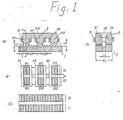
- Fig. 1 is a block diagram which shows a prior art of the linear motor.
- A is a vertical sectional view
- B is a sectional view of C-C line of (A)
- C is sectional view of A-A line of (A)
- D is sectional view of B-B line.
- 1 is a guiding path composed of magnetic materials
- 2 is the movable element which faces the guiding path through a minute gap, which is a three phase linear motor here.
- Magnetic teeth's phases of field cores 211, 212 and 213 (221, 222 and 223) which are on the same iron core among field cores of iron cores 21 and 22 are positioned being shifted as much as (N ⁇ n/m)P with each other (provided that N is an integer, m is number of linear motor's phases, n is an integer, m>n which is (5+ 1/3)P in this example).
- N is an integer
- m number of linear motor's phases
- n is an integer
- m>n which is (5+ 1/3)P in this example.
- magnetic teeth on adjacent field cores (211, 221; 212, 222; 212, 223) of iron cores 21 and 22 have the same phase.
- guiding path 1 has rows of magnetic teeth 11 and 12 which has the same pitch P as magnetic teeth on iron cores 21 and 22 of movable element 2. Rows of magnetic teeth 11 and 12 are arranged shifting phases as much as 1/2P in the direction of said movable element 2's movement.
- said permanent magnet 20 is magnetized in the direction as shown in Fig. (B) and magnetic flux generated by said permanent magnet 20 returns to permanent magnet 20 through field cores 211, 212 and 213 of iron core 21, guiding path 1's row of magnetic teeth 11 which faces magnetic teeth a, b and c through a minute gap and passing from row of magnetic teeth 12, through a minute gap, to each magnetic tooth of iron core 22 and each field core 221, 222 and 223. That means there is bias magnetic flux in a gap between said movable element 2's magnetic teeth and guiding path 1's magnetic teeth.
- exciting current is conducted to said coil 31, magnetic flux generated by the exciting current is overlapped with said bias magnetic flux.
- Movable element 2 shifts to the right.
- Movable element 2 shifts as much as 1/3P, as phases between field core 211's magnetic teeth a, b and c and field core 212's magnetic teeth a, b and c shift as much as 1/3P.
- width W 2 of guiding path 1 should be also expanded accordingly. Expansion of width W 2 of guiding path 1 is made on the entire length of guiding path 1, thus weight of the guiding path increases greatly. Due to this increase, weight of a device into which the motor is integrated naturally increases. Also, for X-Y plotter into which the motor is integrated, weight increase of the guiding path gives a lot of adversable effect on the velocity of plotting, as a motor of one spindle sets shift positioning of a motor of another spindle with its guiding path.
- Movable element magnetic teeth of the prior art as shown in Fig. 1 is difficult to be machined precisely in terms of dimension.
- movable element magnetic teeth are machined by feeding a machining knife by magnetic teeth pitch.
- the number of linear motor's phases is increased to 5, 6, whils , the type of magnetic teeth with different phases on the same iron core is increased to 5, 6, ising and their phase difference become detailed to 2 ⁇ I5 and 2 ⁇ I6, ... . . . , thus feeding pitch of the machining knife should be changed many times during machining, therefore there is a defect that machining cannot be made precisely.
- Fig. 2 is the oblique view of movable element 2 to explain leakage magnetic flux of the prior art shown on Fig. 1.
- Half cylinder part 81 and 82 drawn in dots show a leakage magnet path in which bias magnetic flux is leaked on both sides of a pair of iron cores 21 and 22.
- This kind of leakage magnet path makes it the level of bias magnetic flux which passes through each field core. That is, comparing with bias magnetic flux which passes central field cores 212 and 222, bias magnetic flux which passes through field cores 211, 221, 213 and 223 which are positioned outside of 212 and 222 are smaller.
- magnetic flux of coils are different depending on each field core. This is mainly due to the difference of magnetic resistance depending on the length of iron core magnetic path.
- magnetic flux generated by coil 32 which is wound around field core 212 at the center of iron core 21 separately goes around field core 211 and 213 on the both sides of coil 32, but magnetic flux, for instance, of coil 31 wound around outside field core 211, goes around separately field core 212 which is next to 211 and, further, field core 213 which is next to 212.
- iron core's magnetic path is slightly longer and magnetic flux of outside field cores tends to be slightly smaller than that of the central part and field cores.
- Deviation of magnetic flux caused by coils can be almost neglected by lowering iron core's reluctance, but deviation of bias magnetic flux is relatively large and, as a consequence, the linear motor's thrust force of the prior art is deviated to a large extent.
- JP-A-56-83259 discloses a linear motor comprising: a guiding path having magnetic teeth provided at a constant pitch P in the longitudinal direction of said guiding path; and a movable element which is in spaced opposed relation to said guiding path with a small gap therebetween and movable along said guiding path, wherein said movable element comprises: a pair of iron core arrays spaced from each other in said longitudinal direction; means connected between said pair of iron core arrays for supplying bias magnetic flux thereto; and means electrically associated with said pair of iron core arrays for energizing thereof, each of said pair of iron core arrays comprising a plurality of field cores disposed side by side in a transverse direction to said longitudinal direction, each of said field cores having on a surface facing said guiding path teeth provided at said pitch P in said longitudinal direction.
- this motor operates satisfactorily the need still exists for a linear motor with higher efficiency and performance and to improve the manufacturing methods
- an object of the invention is to provide a linear motor with high efficiency, high performance and large thrust force.
- Another object of the invention is to provide a linear motor which is constructed so that machining work of magnetic teeth and dimension precision can be easily improved.
- a further object of the invention is to provide a smooth and high grade linear motor which has even thrust force for shifting generated by each field core.
- the movable element 2 can be shifted with the minimum shifting length of 1/6P by flowing exciting currents through coils 61, 62 and 63 so that the teeth on the field cores 511, 523, 512, 521, 513 and 522 are attracted to the teeth on the guiding path 1 in the order named.
- the linear motor of the invention can increase thrust force improving efficiency and this does not increase guiding path's weight.
- the linear motor of the invention has the equivalent width and weight to that of the guiding path and almost equivalent dimension and weight to that of the movable element, and thrust force is increased by 30%-40%. Therefore, it can be said that the linear motor of the invention is most suitable for the X-Y plotter, as mentioned before.
- the linear motor movable element 5's construction of the invention is very advantageous in terms of defects of prior arts that it is difficult to precisely machine movable element magnetic teeth. That is, among plural field cores of movable element 5, phase of each magnetic tooth on the field cores of the same iron core is the same, thus, no matter how the number of linear motor's phase increases, there is only one kind of magnetic teeth on the same iron core in terms of phase, therefore, it is necessary to change the feeding pitch of the machining knife only when setting phase difference 1/2 - P in a pair of iron cores. Therefore, the construction of the linear motor movable element of the invention is really excellent in which machining work of magnetic teeth is improved and precision of dimension can be easily improved. In above description, operation of the linear motor of the invention is explained as a step motor, but it does not damage advantages of the invention even when position detecting means, non-contact current feeding means and so on are installed there to use it as a electronic commutator linear motor.
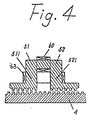
- Fig. 4 and Fig. 5 are block diagram of major parts showing other embodiments of the linear motor of the invention.
- coils 61, 62 and 63 in Fig. 3 which are wound around a pair of field cores 511 and 521 (512 and 522, 513 and 523)
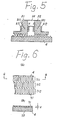
- coils 611 and 612 can be wound around field cores 511 and 521 respectively as shown in Fig. 5 to connect them in serial or conduct exciting current to them separately. It is the same for field cores 512, 522, 513 and 523.
- Fig. 5 is very effective to reduce ohmic loss as the length of coils can be shortened.
- Fig. 6 is an embodiment to realize, with ease and good precision, guiding path 4's construction of linear motor's embodiments of the invention in Fig. 3, Fig. 4 and Fig. 5.
- Fig 6(A) is a plain view of the guiding path and (B) is a sectional view of G-G line of (A).
- etching lamination laminated material (hereafter it is referred to as an etching lamination) made of magnetic materials with plural slits is fixed to substrate 72 made of magnetic materials by etching, etc. to form magnetic teeth equivalently, and thus realizing guiding path 4.
- Plural rows in this embodiment, three rows: 711,712 and 713) of etching lamination 71's slits are formed along the direction of movable element 5's movement.
- Phases of row of slits 711, 712 and 713 are shifted bv - - - - - - - n/m ⁇ v in the direction of said movable element's movement (provided that m is the number of phase of the linear motor and n is integer, m>n and they are shifted ------by 1/3 - P with each other in the embodiment).
- etching lamination 71's each slit depend on the precision of etching determined by the quality of laminated material and thickness t. Therefore, even when the row of magnetic teeth of guiding path 4 is increased to 5 rows, 6 rows, « and become complicated, as the number of phases of the linear motor increases to 5, 6, ising , the level of etching lamination's production is not affected, precision is not deteriorated and production can be made very easily.
- the etching lamination's slits of the embodiment penetrate the laminated material, but there is no doubt that half etching is acceptable, and thus, it has same advantages in the view point of precision and easy production.
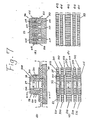
- permanent magnet 57 which is positioned between these iron cores to provide bias magnetic flux and plural coils.
- 621, 622, 623, 624 and 625 wound around adjacent field cores 531 and 541 (532 and 542, 533 and 543, 534 and 544, 535 and 545) of a pair of iron cores.
- Magnetic teeth groups with pitch P is formed on the edge of each field core which faces the guiding path.
- magnetic teeth on iron core 53's field core 531,532,533,534 and 535 have the same phase
- magnetic teeth on iron core 54's field cores 541, 542, 543, 544 and 545 have the same phase and phases of magnetic teeth of adjacent field cores 531 and 541 (532 and 542, 533 and 543, 534 and 544, 535 and 545) are shifted as much as 1/2 - p.
- the magnetic teeth group of each of field cores 531, 532, 534, 535, 541, 542, 544 and 545 has the same area S1
- the magnetic teeth group of each of field cores 533 and 543 has the same area S2 and S2 is twice as large as S1.
- Coils 621, 622, 624 and 625 which are respectively wound around over field cores 531 and 541, 532 and 542, 534 and 544 and 535 and 545 have the same number of turns (N 1 ).
- N 1 When the number of turns of coild 623 wound around field cores 533 and 543 is N 2 , N 2 is twice as many as N,.
- coils 621 and 625 (622 and 624) are connected in serial or parallel to conduct exciting current simultaneously to coils 621 and 625 (622 and 624).
- Guiding path 40 is made of magnetic materials and plural magnetic teeth with the same pitch as for movable element 500's magnetic teeth are formed on a surface which faces magnetic teeth on said movable element 500.
- rows of magnetic teeth 411 and 415 (412 and 414) have the same phase
- rows of magnetic teeth 411, 412, 413 are shifted-n/m - P (m is the number of phases of the linear motor and n is an integer where relationship is m>n) and, in this embodiment, phases are shifted as much as 1/3 - P for rows of magnetic teeth 411 and 412 (412 and 413, 413 and 411). That is, the linear motor's embodiment of the invention in Fig. 7 is a three phase motor.
- field cores 531 and 535 (532 and 534, 541 and 545, 542 and 544) have the same phase and all others have different phases.
- movable element 500's field cores 531, 535 and guiding path 40's rows of magnetic teeth 411, 415 pull with each other and movable element 5 is retained in the position as shown in Fig. 7(A) in which reluctance of its gap is minimized.
- exciting current is conducted to coils 622 and 624 which are wound around field cores 532 and 542, and 534 and 544, magnetic flux between field cores 532, 534 and guiding path 40's rows of magnetic teeth 412,414 increases and they pull with each other, thus movable element 500 shifts to the right.
- Movable element 500 shifts as much as 1/3P, as rows of magnetic teeth on the guiding path 411 and 415, 412 and 414 have the same phase and phases of 411, 412 are shifted as much as 1/3P in the direction of the movable element movement.
- movable element 500 shifts to the right respectively with 1/3P as a minium shifting length.
- exciting current is conducted to coils 623, 622 and 624, 621 and 625, . .to the left.
- movable element 500 shifts to the left with 1/3P as a minimum shifting length.
- phases of magnetic teeth on movable elements 500's field cores 531 and 541 (532 and 542, 533 and 543, 534 and 544, 535 and 545) are shifted as much as 1/2P in the direction of movable element 500's movement, when the direction of exciting current to be conducted to coils is positive and negative (reverse direction), stopping positions of movable element 500 are not overlapped and are shifted as much as 1/6P.
- Movable element 500 shifts with 1/6P as a minimum shifting length by changing the direction of exciting current to magnetize coils respectively. Explanation is given only on single energizing in above description, but it is needless to say that polyphase energizing can increase thrust force in the same manner as for the prior art in Fig. 1.
- linear motor of the invention has the following superior features.
- Fig. 8 is another embodiment of the linear motor of the invention. This drawing especially shows the movable element in terms of magnetic teeth.
- This drawing is basically corresponded to the first embodiment of the invention, Fig. 3(C).
- 50 is the permanent magnet for bias magnetic flux and 55 and 56 are a pair of iron cores, 551, 552, 553 and 561, 562, 563 are field cores with magnetic teeth on said iron cores 55, 56 and 631, 632, 633 are three coils.
- An arrow 64 shows the direction of the movable element's movement.
- field cores 551, 553 or 561, 563 which are positioned outside of the central field cores 552 or 562 have the larger area of magnetic teeth than these central field cores.
- the width of magnetic teeth has widened outside field cores more than central field cores, and it has consequently enlarged the area of magnetic teeth part.
- areas of magnetic teeth and the guiding path's rows of magnetic teeth are enlarged, reluctance of the gap is reduced, more bias magnetic flux can be induced and it becomes possible to compensate leakage, thus, even thrust force can be realized as a result.
- the area of the magnetic teeth part is adjusted by the width of its teeth, thus, thrust force of each field core can be equalized quite precisely. Also, of course, the same effects can be achieved by changing the area of the magnetic teeth part adjusting the number of teeth and setting the same width for teeth. However, adjustment is not so precise as for former case.
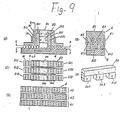
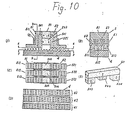
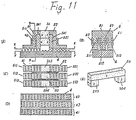
- Fig. 9, Fig. 10 and Fig. 11 show embodiments of linear motor of the invention. There, component elements of the linear motor except the permanent magnet in each Fig. are the same for the first embodiment of the invention in Fig. 3 and explanation is omitted giving the same number to them.
- FIG. 9 Fig. 10 and Fig. 11, (A) is a vertical sectional view, (B) is a sectional view of D-D line of (A), (C) is a sectional view of E-E line of (A), (D) is F-F sectional view of F-F line of (A) and (E) is an oblique view of the permanent magnet.
- movable element 5 has permanent magnet 50 which is positioned between a pair of iron cores 51 and 52 to provide bias magnetic flux, and permanent magnets 503, 504, 505 which are positioned between each magnetic core part between a pair of iron cores 51 and 52.
- Said permanent magnets 503, 504 and 505 have the same dimension. As the direction of their magnetizing is adjusted to that of permanent magnet 50 and magnetic flux generated in permanent magnet 50 does not leak from adjacent field core 511 to 521 (from 512 to 522, from 513 to 523) and induced passing by the field core part, and thus, effectively utilized.
- a part of magnetic flux generated in further added permanent magnets 503, 504 'and 505 becomes bias magnet flux of the linear motor and it also enlarges a total amount of magnetic flux.
- permanent magnet 503, 504 and 505 works for thrust force in multiple way and thrust force can be increased about 30% according to a sample made by the inventor. That is, the linear motor with larger thrust force than that of prior arts can be easily realized without changing its external dimensions at all.
- permanent magnets 50, 503 and 504 correspond to permanent magnets 50, 503 and 504 in Fig. 9 and 503 and 504 have the same dimension.
- the size of permanent magnet 506 is smaller than that of permanent magnet 503 and 504 and it corresponds to permanent magnet 505 in Fig. 9.
- permanent magnets 503, 504, 506 can reduce the leakage of magnetic flux between adjacent fields cores of the adjacent iron cores like embodiment in Fig. 9. Also, linear motor's thrust force can be increased by increasing a total amount of bias magnetic flux extending the effective area of the permanent magnet. In addition to that, in the embodiments in Fig. 10, the amount of bias magnetic flux which passes by magnetic teeth on the central fields cores is adjusted by designing the dimension of permanent magnet 506 positioned between central field core parts at will to adjust thrust force generated in this part. By this measure, thrust force generated in each magnetic teeth group on each field core can be balanced and an effective linear motor can be realized. In the embodiment of Fig. 11, permanent magnets 50, 503 and 504 correspond to those 50, 503 and 504 in Fig.
- the linear motor of the invention has superior features that the balance of thrust force can be maintained between each magnetic teeth group while increasing thrust force at the same time, compared with prior arts.
- the small linear motor with large thrust force can be easily realized without damaging advantages of prior arts at all.
- the major part of adjacent iron cores and the field core permanent magnet are made of different materials, but there is no affect on characteristics even if they are unified in various forms. All forms of permanent magnets in the Figures are rectangular bodies, but it is not necessary to limit their forms to rectangular bodies and they can be designed at will according to forms of iron cores and field cores within the scope of the invention.
Landscapes
- Engineering & Computer Science (AREA)
- Physics & Mathematics (AREA)
- Chemical & Material Sciences (AREA)
- Combustion & Propulsion (AREA)
- Electromagnetism (AREA)
- Power Engineering (AREA)
- Linear Motors (AREA)
Claims (9)
Applications Claiming Priority (8)
| Application Number | Priority Date | Filing Date | Title |
|---|---|---|---|
| JP57067575A JPS58186363A (ja) | 1982-04-21 | 1982-04-21 | リニアモ−タ |
| JP67575/82 | 1982-04-21 | ||
| JP129338/82 | 1982-07-23 | ||
| JP57129338A JPS5921272A (ja) | 1982-07-23 | 1982-07-23 | リニアモ−タ |
| JP57130672A JPS5921273A (ja) | 1982-07-26 | 1982-07-26 | リニアモ−タ |
| JP130672/82 | 1982-07-26 | ||
| JP133432/82 | 1982-07-29 | ||
| JP57133432A JPS5925571A (ja) | 1982-07-29 | 1982-07-29 | リニアモ−タ |
Publications (2)
| Publication Number | Publication Date |
|---|---|
| EP0093547A1 EP0093547A1 (de) | 1983-11-09 |
| EP0093547B1 true EP0093547B1 (de) | 1986-09-17 |
Family
ID=27464873
Family Applications (1)
| Application Number | Title | Priority Date | Filing Date |
|---|---|---|---|
| EP83302275A Expired EP0093547B1 (de) | 1982-04-21 | 1983-04-21 | Linearmotor |
Country Status (3)
| Country | Link |
|---|---|
| US (1) | US4504750A (de) |
| EP (1) | EP0093547B1 (de) |
| DE (1) | DE3366213D1 (de) |
Families Citing this family (31)
| Publication number | Priority date | Publication date | Assignee | Title |
|---|---|---|---|---|
| US4761574A (en) * | 1983-05-18 | 1988-08-02 | Shinko Electric Co., Ltd. | Linear pulse motor |
| US4661730A (en) * | 1984-03-28 | 1987-04-28 | Shinko Electric Co., Ltd | Linear pulse motor |
| US4594520A (en) * | 1984-04-26 | 1986-06-10 | Shinko Electric Co., Ltd. | Linear pulse motor |
| JPS6176239A (ja) * | 1984-09-25 | 1986-04-18 | Hiroshi Teramachi | リニアモ−タ付xyテ−ブル |
| JPS61161952A (ja) * | 1985-01-09 | 1986-07-22 | Yaskawa Electric Mfg Co Ltd | 3相リニア誘導子形モ−タ |
| JPS61185059A (ja) * | 1985-02-09 | 1986-08-18 | Amada Co Ltd | リニアパルスモ−タ |
| JPS61199278A (ja) * | 1985-02-28 | 1986-09-03 | Tokyo Juki Ind Co Ltd | デイスクドライブ用の駆動装置 |
| SE457043B (sv) * | 1985-04-29 | 1988-11-21 | Facit Ab | Linjaer stegmotor |
| JPH0687651B2 (ja) * | 1986-01-14 | 1994-11-02 | オムロン株式会社 | リニアパルスモ−タ |
| US4772841A (en) * | 1986-03-08 | 1988-09-20 | Shinko Electric Co., Ltd. | Stepping motor and driving method thereof |
| DE68910649T2 (de) * | 1988-11-22 | 1994-05-19 | Shinko Electric Co Ltd | Betätigungsgerät mit starker magnetischer Schiebekraft. |
| JPH04276363A (ja) * | 1991-03-01 | 1992-10-01 | Hitachi Ltd | ディスク装置、リニアアクチュエータ |
| WO1999041825A1 (en) * | 1998-02-13 | 1999-08-19 | Kabushiki Kaisha Yaskawa Denki | Linear motor |
| US5965962A (en) * | 1998-02-20 | 1999-10-12 | Northern Magnetics, Inc. | Linear stepper motor |
| SE518110C2 (sv) * | 1999-12-23 | 2002-08-27 | Hoeganaes Ab | Stator och rotor för en elektrisk maskin |
| US6756705B2 (en) * | 2000-02-10 | 2004-06-29 | Tri-Tech., Inc | Linear stepper motor |
| DE10043120A1 (de) * | 2000-08-31 | 2002-04-11 | Wolfgang Hill | Elektrische Maschine für hohe Ummagnetisierungsfrequenzen |
| US6885270B2 (en) * | 2001-01-23 | 2005-04-26 | Harrie R. Buswell | Wire core inductive devices having a biassing magnet and methods of making the same |
| JP2004521589A (ja) * | 2001-02-12 | 2004-07-15 | トライ−テック インコーポレイテッド | リニアステッパーモータ、着磁装置および方法 |
| JP3894297B2 (ja) * | 2001-02-28 | 2007-03-14 | 富士電機機器制御株式会社 | リニアアクチュエータ |
| US20050108869A1 (en) * | 2003-05-16 | 2005-05-26 | Shuen-Shing Hsiao | Method for manufacturing teeth of linear step motors |
| MY136646A (en) * | 2004-05-11 | 2008-11-28 | Toshiba Elevator Kk | Magnet unit, elevator guiding apparatus and weighing apparatus |
| DE102006005046A1 (de) * | 2006-02-03 | 2007-08-09 | Siemens Ag | Elektrische Maschine mit ungleichmäßigen Polzähnen |
| DE102006009439A1 (de) * | 2006-03-01 | 2007-09-06 | Siemens Ag | Elektrische Maschine mit Einschubeinrichtung für einen Dauermagneten zwischen Polzahnhälften und entsprechendes Herstellungsverfahren |
| DE102006012736A1 (de) * | 2006-03-17 | 2007-09-20 | Siemens Ag | Elektrische Maschine |
| CN102239626B (zh) * | 2009-09-08 | 2015-01-28 | 莫戈公司 | 带有小步幅间隔的步进马达 |
| US10020716B2 (en) * | 2010-03-31 | 2018-07-10 | The Boeing Company | Transverse flux induction motor with passive braking system |
| US8803371B2 (en) * | 2011-07-11 | 2014-08-12 | Baldor Electric Company | Secondary for linear drive motor comprising sheet of highly permeable magnetic material having synchronized motor teeth, encoder teeth, and commutation tracks integrally formed therein |
| EP2963497B1 (de) * | 2014-06-30 | 2019-10-16 | Dr. Johannes Heidenhain GmbH | Antrieb für einen XY-Tisch sowie XY-Tisch |
| US9956969B2 (en) * | 2015-04-30 | 2018-05-01 | The Boeing Company | Brake device |
| WO2021092106A1 (en) * | 2019-11-07 | 2021-05-14 | Hyperloop Technologies, Inc. | A force-producing electromagnetic machine |
Family Cites Families (11)
| Publication number | Priority date | Publication date | Assignee | Title |
|---|---|---|---|---|
| US3869625A (en) * | 1971-09-08 | 1975-03-04 | Bruce A Sawyer | Plural axis linear position |
| US3867676A (en) * | 1973-09-20 | 1975-02-18 | Ibm | Variable reluctance linear stepper motor |
| DE2413410A1 (de) * | 1974-03-18 | 1975-10-02 | Siemens Ag | Synchroner elektrischer linearmotor |
| DE2429492C3 (de) * | 1974-06-20 | 1979-04-26 | Elmeg-Elektro-Mechanik Gmbh, 3150 Peine | Schrittweise oder kontinuierlich betreibbarer elektrischer Motor, insbesondere Schrittmotor zum Antrieb eines Rollenzählwerkes |
| JPS5223606A (en) * | 1975-08-15 | 1977-02-22 | Kokusai Denshin Denwa Co Ltd <Kdd> | Reciprocal steppin motion mechanism |
| US4286180A (en) * | 1978-07-20 | 1981-08-25 | Kollmorgen Technologies Corporation | Variable reluctance stepper motor |
| JPS591059B2 (ja) * | 1979-02-22 | 1984-01-10 | 横河電機株式会社 | リニアパルスモ−タ |
| JPS5854737B2 (ja) * | 1979-03-05 | 1983-12-06 | 横河電機株式会社 | リニアパルスモ−タ |
| JPS5855748B2 (ja) * | 1979-06-21 | 1983-12-12 | 横河電機株式会社 | リニアパルスモ−タ |
| JPS5683259A (en) * | 1979-12-11 | 1981-07-07 | Matsushita Electric Ind Co Ltd | Linear stepping motor |
| JPS5725151A (en) * | 1980-07-22 | 1982-02-09 | Matsushita Electric Ind Co Ltd | Linear motor |
-
1983
- 1983-04-20 US US06/486,965 patent/US4504750A/en not_active Expired - Fee Related
- 1983-04-21 EP EP83302275A patent/EP0093547B1/de not_active Expired
- 1983-04-21 DE DE8383302275T patent/DE3366213D1/de not_active Expired
Also Published As
| Publication number | Publication date |
|---|---|
| US4504750A (en) | 1985-03-12 |
| EP0093547A1 (de) | 1983-11-09 |
| DE3366213D1 (en) | 1986-10-23 |
Similar Documents
| Publication | Publication Date | Title |
|---|---|---|
| EP0093547B1 (de) | Linearmotor | |
| US6448733B1 (en) | XYZ-axes table | |
| US6798089B1 (en) | Forcer and associated three phase linear motor system | |
| US5334894A (en) | Rotary pulse motor | |
| EP0334645B1 (de) | Linearmotor und diesen Linearmotor benutzende Linearantriebsvorrichtung | |
| US20030098620A1 (en) | Permanent magnet synchronous linear motor | |
| US4837467A (en) | Linear motor with angularly indexed magnetic poles | |
| US5214323A (en) | Linear motor with reduced cogging | |
| JP2003209963A (ja) | リニアモータ | |
| US6541880B2 (en) | Linear motor | |
| JP2002238241A (ja) | リニアモータ | |
| US4761574A (en) | Linear pulse motor | |
| JPH06197517A (ja) | リニアパルスモータ | |
| EP0183854A1 (de) | Schrittmotor | |
| KR101798548B1 (ko) | 선형 전동기 | |
| US6876108B2 (en) | Linear motor, its controlling method, and XY table | |
| JP2002186244A (ja) | 永久磁石型リニアモータ | |
| US4772841A (en) | Stepping motor and driving method thereof | |
| JP2785406B2 (ja) | リニアサーボモータ | |
| JP2003134792A (ja) | 永久磁石形リニアモータ | |
| JP2782830B2 (ja) | リニアサーボモータ | |
| JPS58186363A (ja) | リニアモ−タ | |
| JPH01315250A (ja) | リニアモータ及びリニアモータを使用した直線駆動装置 | |
| JPS60223461A (ja) | リニアステツピングモ−タ | |
| JP4352485B2 (ja) | 三相パルスモータ |
Legal Events
| Date | Code | Title | Description |
|---|---|---|---|
| PUAI | Public reference made under article 153(3) epc to a published international application that has entered the european phase |
Free format text: ORIGINAL CODE: 0009012 |
|
| AK | Designated contracting states |
Designated state(s): DE FR GB |
|
| 17P | Request for examination filed |
Effective date: 19840502 |
|
| GRAA | (expected) grant |
Free format text: ORIGINAL CODE: 0009210 |
|
| AK | Designated contracting states |
Kind code of ref document: B1 Designated state(s): DE FR GB |
|
| REF | Corresponds to: |
Ref document number: 3366213 Country of ref document: DE Date of ref document: 19861023 |
|
| ET | Fr: translation filed | ||
| PLBE | No opposition filed within time limit |
Free format text: ORIGINAL CODE: 0009261 |
|
| STAA | Information on the status of an ep patent application or granted ep patent |
Free format text: STATUS: NO OPPOSITION FILED WITHIN TIME LIMIT |
|
| 26N | No opposition filed | ||
| PGFP | Annual fee paid to national office [announced via postgrant information from national office to epo] |
Ref country code: GB Payment date: 19970414 Year of fee payment: 15 |
|
| PGFP | Annual fee paid to national office [announced via postgrant information from national office to epo] |
Ref country code: DE Payment date: 19970428 Year of fee payment: 15 |
|
| PGFP | Annual fee paid to national office [announced via postgrant information from national office to epo] |
Ref country code: FR Payment date: 19980409 Year of fee payment: 16 |
|
| PG25 | Lapsed in a contracting state [announced via postgrant information from national office to epo] |
Ref country code: GB Free format text: LAPSE BECAUSE OF NON-PAYMENT OF DUE FEES Effective date: 19980421 |
|
| GBPC | Gb: european patent ceased through non-payment of renewal fee |
Effective date: 19980421 |
|
| PG25 | Lapsed in a contracting state [announced via postgrant information from national office to epo] |
Ref country code: DE Free format text: LAPSE BECAUSE OF NON-PAYMENT OF DUE FEES Effective date: 19990202 |
|
| PG25 | Lapsed in a contracting state [announced via postgrant information from national office to epo] |
Ref country code: FR Free format text: LAPSE BECAUSE OF NON-PAYMENT OF DUE FEES Effective date: 19991231 |
|
| REG | Reference to a national code |
Ref country code: FR Ref legal event code: ST |